EP1262195A1 - Vasoactive agents - Google Patents
Vasoactive agents Download PDFInfo
- Publication number
- EP1262195A1 EP1262195A1 EP01908338A EP01908338A EP1262195A1 EP 1262195 A1 EP1262195 A1 EP 1262195A1 EP 01908338 A EP01908338 A EP 01908338A EP 01908338 A EP01908338 A EP 01908338A EP 1262195 A1 EP1262195 A1 EP 1262195A1
- Authority
- EP
- European Patent Office
- Prior art keywords
- substituted
- group
- alkoxy
- alkyl
- halogen atom
- Prior art date
- Legal status (The legal status is an assumption and is not a legal conclusion. Google has not performed a legal analysis and makes no representation as to the accuracy of the status listed.)
- Withdrawn
Links
Classifications
-
- C—CHEMISTRY; METALLURGY
- C07—ORGANIC CHEMISTRY
- C07D—HETEROCYCLIC COMPOUNDS
- C07D471/00—Heterocyclic compounds containing nitrogen atoms as the only ring hetero atoms in the condensed system, at least one ring being a six-membered ring with one nitrogen atom, not provided for by groups C07D451/00 - C07D463/00
- C07D471/02—Heterocyclic compounds containing nitrogen atoms as the only ring hetero atoms in the condensed system, at least one ring being a six-membered ring with one nitrogen atom, not provided for by groups C07D451/00 - C07D463/00 in which the condensed system contains two hetero rings
- C07D471/04—Ortho-condensed systems
-
- A—HUMAN NECESSITIES
- A61—MEDICAL OR VETERINARY SCIENCE; HYGIENE
- A61K—PREPARATIONS FOR MEDICAL, DENTAL OR TOILETRY PURPOSES
- A61K31/00—Medicinal preparations containing organic active ingredients
-
- A—HUMAN NECESSITIES
- A61—MEDICAL OR VETERINARY SCIENCE; HYGIENE
- A61K—PREPARATIONS FOR MEDICAL, DENTAL OR TOILETRY PURPOSES
- A61K31/00—Medicinal preparations containing organic active ingredients
- A61K31/33—Heterocyclic compounds
- A61K31/395—Heterocyclic compounds having nitrogen as a ring hetero atom, e.g. guanethidine or rifamycins
- A61K31/435—Heterocyclic compounds having nitrogen as a ring hetero atom, e.g. guanethidine or rifamycins having six-membered rings with one nitrogen as the only ring hetero atom
- A61K31/4353—Heterocyclic compounds having nitrogen as a ring hetero atom, e.g. guanethidine or rifamycins having six-membered rings with one nitrogen as the only ring hetero atom ortho- or peri-condensed with heterocyclic ring systems
- A61K31/437—Heterocyclic compounds having nitrogen as a ring hetero atom, e.g. guanethidine or rifamycins having six-membered rings with one nitrogen as the only ring hetero atom ortho- or peri-condensed with heterocyclic ring systems the heterocyclic ring system containing a five-membered ring having nitrogen as a ring hetero atom, e.g. indolizine, beta-carboline
-
- A—HUMAN NECESSITIES
- A61—MEDICAL OR VETERINARY SCIENCE; HYGIENE
- A61K—PREPARATIONS FOR MEDICAL, DENTAL OR TOILETRY PURPOSES
- A61K31/00—Medicinal preparations containing organic active ingredients
- A61K31/33—Heterocyclic compounds
- A61K31/395—Heterocyclic compounds having nitrogen as a ring hetero atom, e.g. guanethidine or rifamycins
- A61K31/435—Heterocyclic compounds having nitrogen as a ring hetero atom, e.g. guanethidine or rifamycins having six-membered rings with one nitrogen as the only ring hetero atom
- A61K31/44—Non condensed pyridines; Hydrogenated derivatives thereof
- A61K31/4427—Non condensed pyridines; Hydrogenated derivatives thereof containing further heterocyclic ring systems
- A61K31/444—Non condensed pyridines; Hydrogenated derivatives thereof containing further heterocyclic ring systems containing a six-membered ring with nitrogen as a ring heteroatom, e.g. amrinone
-
- A—HUMAN NECESSITIES
- A61—MEDICAL OR VETERINARY SCIENCE; HYGIENE
- A61K—PREPARATIONS FOR MEDICAL, DENTAL OR TOILETRY PURPOSES
- A61K31/00—Medicinal preparations containing organic active ingredients
- A61K31/33—Heterocyclic compounds
- A61K31/395—Heterocyclic compounds having nitrogen as a ring hetero atom, e.g. guanethidine or rifamycins
- A61K31/435—Heterocyclic compounds having nitrogen as a ring hetero atom, e.g. guanethidine or rifamycins having six-membered rings with one nitrogen as the only ring hetero atom
- A61K31/47—Quinolines; Isoquinolines
- A61K31/4738—Quinolines; Isoquinolines ortho- or peri-condensed with heterocyclic ring systems
- A61K31/4745—Quinolines; Isoquinolines ortho- or peri-condensed with heterocyclic ring systems condensed with ring systems having nitrogen as a ring hetero atom, e.g. phenantrolines
-
- A—HUMAN NECESSITIES
- A61—MEDICAL OR VETERINARY SCIENCE; HYGIENE
- A61P—SPECIFIC THERAPEUTIC ACTIVITY OF CHEMICAL COMPOUNDS OR MEDICINAL PREPARATIONS
- A61P43/00—Drugs for specific purposes, not provided for in groups A61P1/00-A61P41/00
-
- A—HUMAN NECESSITIES
- A61—MEDICAL OR VETERINARY SCIENCE; HYGIENE
- A61P—SPECIFIC THERAPEUTIC ACTIVITY OF CHEMICAL COMPOUNDS OR MEDICINAL PREPARATIONS
- A61P9/00—Drugs for disorders of the cardiovascular system
- A61P9/04—Inotropic agents, i.e. stimulants of cardiac contraction; Drugs for heart failure
-
- A—HUMAN NECESSITIES
- A61—MEDICAL OR VETERINARY SCIENCE; HYGIENE
- A61P—SPECIFIC THERAPEUTIC ACTIVITY OF CHEMICAL COMPOUNDS OR MEDICINAL PREPARATIONS
- A61P9/00—Drugs for disorders of the cardiovascular system
- A61P9/08—Vasodilators for multiple indications
-
- A—HUMAN NECESSITIES
- A61—MEDICAL OR VETERINARY SCIENCE; HYGIENE
- A61P—SPECIFIC THERAPEUTIC ACTIVITY OF CHEMICAL COMPOUNDS OR MEDICINAL PREPARATIONS
- A61P9/00—Drugs for disorders of the cardiovascular system
- A61P9/10—Drugs for disorders of the cardiovascular system for treating ischaemic or atherosclerotic diseases, e.g. antianginal drugs, coronary vasodilators, drugs for myocardial infarction, retinopathy, cerebrovascula insufficiency, renal arteriosclerosis
-
- A—HUMAN NECESSITIES
- A61—MEDICAL OR VETERINARY SCIENCE; HYGIENE
- A61P—SPECIFIC THERAPEUTIC ACTIVITY OF CHEMICAL COMPOUNDS OR MEDICINAL PREPARATIONS
- A61P9/00—Drugs for disorders of the cardiovascular system
- A61P9/12—Antihypertensives
Definitions
- the present invention relates to GPR14 antagonistic agents and vasoactive agents which comprise, as an active agent, a compound having GPR 14-antagonizing activity or salts thereof, and more particularly to a novel quinoline derivatives having GPR 14-antagonizing activity or salts thereof.
- Urotensin II was discovered as one of peptide hormones having a potent vasoconstrictive activity, and has been proved to have extremely higher vasoconstrictive activity than endothelin, which is the potentest vasoconstrictor among those which are currently known to have vasoconstrictive activity on mammal arteria.
- the receptor for urotensin II is GPR 14 protein, which is one of orphan receptors (see, Nature, vol. 401, p.282 (1999)), and antagonists of this receptor may possibly be used to treat ischemic myocardial infarction, congestive heart failure and the like. However, none of such antagonists have been reported yet.
- An agent which exhibits GPR 14-antagonizing activity may probably be used as a therapeutic agent to treat ischemic myocardial infarction, congestive heart failure and the like, and thus can be expected for use as a novel vasoactive drug.
- the present invention provides, based on such GPR 14-antagonizing activity, a vasoactive agent (particularly vasoconstriction inhibitor) which is useful for preventing and/or treating, for example, hypertension, arteriosclerosis, hypercardia, myocardial infarction and heart failure, as well as a novel quinoline derivative having GPR 14-antagonizing activity or salts thereof.
- a vasoactive agent particularly vasoconstriction inhibitor
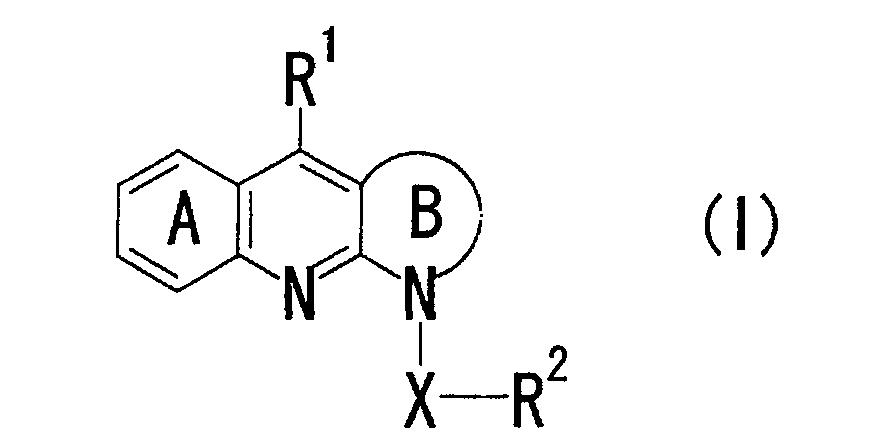
- the present inventors developed the present invention, after intense studies examining compounds having GPR 14-antagonizing activity, based on the findings that a compound having the formula (I) below or salts thereof (hereinafter sometimes referred to as "compound (I)”) can exhibit an excellent GPR 14-antagonizing activity.
- the present invention relates to:
- GPR 14-antagonizing activity refers to an activity to competitively or non-competitively inhibit the binding of a ligand (e.g., urotensin II) to GPR14 protein on a cell membrane.
- a ligand e.g., urotensin II
- the present invention provides, based on such GPR 14-antagonizing activity, drugs which exhibit a variety of effects on blood vessels (e.g., accentuation or suppression of vasoconstriction).
- vasoconstriction inhibitors may preferably be used which reduce urotensin II-induced potent vasoconstriction.
- the vasoconstriction inhibitors can be used for preventing and/or treating a variety of diseases. Particularly, they may preferably be used for preventing and/or treating hypertension, arteriosclerosis, hypercardia, myocardial infarction, heart failure and the like, and more preferably, ischemic myocardial infarction, congestive heart failure and the like.
- compounds having GPR 14-antagonizing activity or salts thereof to be used in the present invention include non-peptide compounds having GPR 14-antagonizing activity or salts thereof which may advantageously exhibit a longer period of reaction time.
- quinoline derivative may be preferable, and 4-aminoquinoline derivative may be more preferable.
- preferable examples of compounds having GPR 14-antagonizing activity or salts thereof which can be used in the present invention include those having the formula (I) below: wherein A is a benzene ring which may be substituted, B is a 5- to 8-membered ring which may be substituted, X is a divalent group containing 1 to 4 atom(s) in its linear chain, R 1 is an amino group which may be substituted, and R 2 is a cyclic group which may be substituted; or salts thereof.
- examples of substituent which the "benzene ring which may be substituted" may have include hydrocarbon group which may be substituted; heterocyclic group which may be substituted; nitro group; halogen atom; amino group which may be substituted; a group represented by the formula: R 4 -Y- (wherein Y is an oxygen atom or sulfur atom which may be oxidized, and R 4 is a hydrocarbon group which may be substituted or heterocyclic group which may be substituted); cyano group; acyl group which may be substituted; carboxyl group which may be esterified or amidated; and the like.
- hydrocarbon group in the "hydrocarbon group which may be substituted" which the "benzene ring which may be substituted" (represented by A) may have or which are represented by R 4 include
- alkyl may be preferable, C 1-4 alkyl (e.g., methyl, ethyl, etc.) may be more preferable, and methyl may be most preferable.
- C 1-4 alkyl e.g., methyl, ethyl, etc.
- methyl may be most preferable.
- the hydrocarbon group may have one or more substituent(s), and preferably 1 to 3 substituent(s).
- substituents include, for example, halogen (e.g., fluorine, chlorine, bromine, iodine, etc.), nitro, cyano, hydroxy group, thiol group which may be substituted (e.g., thiol, C 1-4 alkylthio, etc.), amino group which may be substituted (e.g., amino, mono-C 1-4 alkylamino, di-C 1-4 alkylamino, mono-C 2-5 alkanoylamino, or 5- or 6-membered cyclic amino such as tetrahydropyrrole, piperazine, piperidine, morpholine, thiomorpholine, pyrrole, imidazole, etc.), phenyl-lower (C 1-4 ) alkyl, C 3-7 cycloalkyl, carboxyl group which may be esterified or amidated (e
- heterocyclic group in the "heterocyclic group which may be substituted” which the "benzene ring which may be substituted” (represented by A) may have, and in the "heterocyclic group which may be substituted” (represented by R 4 ), include those which may be formed by eliminating one hydrogen atom from a 5- to 8-membered aromatic heterocyclic ring and saturated or unsaturated non-aromatic (aliphatic) heterocyclic ring containing at least 1 (preferably 1 to 4, and more preferably 1 or 2) of 1 to 3 (preferably 1 or 2) heteroatom(s) selected from the group consisting of oxygen, sulfur and nitrogen atoms.
- aromatic heterocyclic ring examples include 5-to 8-membered (preferably 5- or 6-membered) aromatic monocyclic heterocyclic rings (e.g., furan, thiophene, pyrrole, oxazole, isoxazole, thiazole, isothiazole, imidazole, pyrazole, 1,2,3-oxadiazole, 1,2,4-oxadiazole, 1,3,4-thiadiazole, 1,2,3-thiadiazole, 1,2,4-thiadiazole, 1,3,4-thiadiazole, 1,2,3-triazole, 1,2,4-triazole, tetrazole, pyridine, pyridazine, pyrimidine, pyrazine or triazine).
- aromatic monocyclic heterocyclic rings e.g., furan, thiophene, pyrrole, oxazole, isoxazole, thiazole, isothiazole, imidazole, pyrazole
- non-aromatic heterocyclic ring examples include 5- to 8-membered (preferably 5- or 6-membered) saturated or unsaturated monocyclic non-aromatic heterocyclic ring (aliphatic heterocyclic ring) such as pyrrolidine, tetrahydrofuran, tetrahydrothiophene, thiolane, dithiolane, oxathiolane, pyrroline, imidazolidine, imidazoline, pyrazolidine, pyrazoline, oxazine, oxadiazine, thiazine, thiadiazine, piperidine, morpholine, thiomorpholine, tetrahydropyran, piperazine, pyran, oxepin, thiepin or azepine; and 5- to 8-membered non-aromatic heterocyclic rings comprising any of the above-described aromatic monocyclic heterocyclic ring with all or portion of double bonds therein being saturated.
- heterocyclic group in the "heterocyclic group which may be substituted” which "benzene ring which may be substituted” represented by A may have, or in the "heterocyclic group which may be substituted " represented by R 4 , include those formed by eliminating one hydrogen atom from a condensed ring formed by condensation of two or three (preferably two) rings selected from the group consisting of the above-listed monocyclic heterocyclic rings (monocyclic aromatic heterocyclic rings and monocyclic non-aromatic heterocyclic rings) and 5- to 8-membered cyclic hydrocarbons (e.g., 5- to 8-membered (preferably 5- or 6-membered) saturated or unsaturated alicyclic hydrocarbons such as C 5-8 cycloalkane, C 5-8 cycloalkene, C 5-8 cycloalkadiene, etc., and 6-membered aromatic hydrocarbon such as benzene).
- Those condensed rings may be saturated, partially unsaturated or aromatic.
- condensed ring examples include those comprising two identical or different heterocyclic rings (preferably one is a heterocyclic ring and the other an aromatic heterocyclic ring, and more preferably two identical or different aromatic heterocyclic rings), and those comprising one heterocyclic ring and one homocyclic ring (preferably one is a heterocyclic ring and the other a benzene ring, and more preferably one is an aromatic heterocyclic ring and the other a benzene ring).
- condensed ring include indole, benzothiophene, benzofuran, benzimidazole, imidazo[1,2-a]pyridine, quinoline, isoquinoline, cinnoline, etc.
- heterocyclic group which may be substituted which the "benzene ring which may be substituted” represented by A may have, or which is represented by R 4 , may have one or more substituent(s), including, for example, those similar to the above-listed substituents which the "hydrocarbon group which may be substituted” that the "benzene ring which may be substituted” represented by A may have may have.
- halogen atom which the "benzene ring which may be substituted" represented by A may have include fluorine, chlorine, bromine and iodine.
- amino groups which may be substituted which the "benzene ring which may be substituted” represented by A may have include those similar to the "amino group which may be substituted” represented by R 1 (described later).
- amino groups are preferable which may have one or two substituents selected from the group consisting of "hydrocarbon group which may be substituted” (those similar to the above-listed “hydrocarbon group which may be substituted” which the "benzene ring which may be substituted” represented by A may have); “heterocyclic group which may be substituted” (those similar to the above-listed "heterocyclic group which may be substituted” which "benzene ring which may be substituted” represented by A may have); and "acyl group which may be substituted” (those similar to the "acyl group which may be substituted” which "benzene ring which may be substituted” represented by A may have, described later).
- amino groups which may have one or two alkyl groups which may be substituted [e.g., C 1-10 alkyl such as methyl, ethyl, propyl, isopropyl, butyl, isobutyl, sec-butyl, tert-butyl, pentyl, isopentyl, neopentyl, hexyl, heptyl, octyl, nonyl, decyl, etc., preferably lower (C 1-6 ) alkyl, which may have 1 to 3 substituent(s) selected from the group consisting of halogen (e.g., fluorine, chlorine, bromine, iodine, etc.), nitro, cyano, hydroxy group, thiol group which may be substituted (e.g., thiol or C 1-4 alkylthio), amino group which may be substituted (e.g., amino, mono-C 1-4 alkylamino,
- amino group which may be substituted which the "benzene ring which may be substituted” represented by A may be an amino group in which the substituents of the amino group are bonded to each other to form a cyclic amino group (e.g., a cyclic amino group formed by eliminating one hydrogen atom from constituent nitrogen atom of a 5- or 6-membered ring with a binding arm on its nitrogen atom, such as tetrahydropyrrole, piperazine, piperidine, morpholine, thiomorpholine, pyrrole, imidazole, etc.).
- a cyclic amino group formed by eliminating one hydrogen atom from constituent nitrogen atom of a 5- or 6-membered ring with a binding arm on its nitrogen atom, such as tetrahydropyrrole, piperazine, piperidine, morpholine, thiomorpholine, pyrrole, imidazole, etc.
- the cyclic amino group may have one or more (preferably 1 to 3) substituent(s), including halogen (e.g., fluorine, chlorine, bromine, iodine, etc.), nitro, cyano, hydroxy group, thiol group, amino group, carboxyl group, C 1-4 alkyl which may be halogenated (e.g., trifluoromethyl, methyl, ethyl, etc.), C 1-4 alkoxy which may be halogenated (e.g., methoxy, ethoxy, propoxy, butoxy, trifluoromethoxy, trifluoroethoxy, etc.), formyl, C 2-4 alkanoyl (e.g., acetyl, propionyl, etc.) or C 1-4 alkylsulfonyl (e.g., methanesulfonyl, ethanesulfonyl, etc.).
- halogen e.g., fluorine,
- acyl group which may be substituted" which the "benzene ring which may be substituted” represented by A may have include those comprising carbonyl group or sulfonyl group bonded with, for example: hydrogen; "hydrocarbon group which may be substituted” (e.g., those similar to the above-listed "hydrocarbon group which may be substituted” which the "benzene ring which may be substituted” represented by A may have); or "heterocyclic group which may be substituted” (e.g., those similar to the above-listed "heterocyclic group which may be substituted” which the "benzene ring which may be substituted” represented by A may have).
- Preferable examples are those comprising carbonyl group or sulfonyl group bonded with, for example:
- the "carboxyl group which may be esterified " which the "benzene ring which may be substituted" represented by A may have may include those comprising carbonyloxy group bonded with, for example: hydrogen; or "hydrocarbon group which may be substituted” (such as those similar to the above-listed "hydrocarbon group which may be substituted” which the "benzene ring which may be substituted” represented by A may have).
- Preferable examples are those comprising carbonyloxy group bonded with, for example:
- carboxyl lower (C 1-6 ) alkoxycarbonyl and allyloxycarbonyl (e.g., methoxycarbonyl, ethoxycarbonyl, propoxycarbonyl, phenoxycarbonyl, naphthoxycarbonyl, etc.).
- the above-listed (2) alkyl which may be substituted, (3) cycloalkyl which may be substituted, (4) alkenyl which may be substituted, (5) cycloalkenyl which may be substituted, and (6) aryl which may be substituted may preferably have 1 to 3 substituent(s), including, for example: halogen (e.g., fluorine, chlorine, bromine, iodine, etc.); nitro; cyano; hydroxy group; thiol group which may be substituted (e.g., thiol, C 1-4 alkylthio, etc.); amino group which may be substituted (e.g., amino, mono-C 1-4 alkylamino, di-C 1-4 alkylamino, 5- or 6-membered cyclic amino such as tetrahydropyrrole, piperazine, piperidine, morpholine, thiomorpholine, pyrrole, imidazole, etc.); carboxyl group which may be ester
- Examples of the "carboxyl group which may be amidated” which the "benzene ring which may be substituted” represented by A may have include those comprising a carbonyl group bonded with, for example:
- the "benzene ring which may be substituted" represented by A may have 1 to 4 identical or different substituent(s) (preferably 1 or 2 substituent(s)) at any position(s) of the ring.
- substituents which the "benzene ring which may be substituted" represented by A may have include: hydrocarbon group which may be substituted; heterocyclic group which may be substituted; nitro group; halogen atom; amino group which may be substituted; and a group represented by the formula: R 4 -Y- (wherein Y is oxygen atom or sulfur atom which may be oxidized and R 4 is a hydrocarbon group which may be substituted or heterocyclic group which may be substituted).
- hydrocarbon group which may be substituted More preferable are hydrocarbon group which may be substituted, heterocyclic group which may be substituted, halogen atom, amino group which may be substituted and a group represented by the formula R 4 -Y- (wherein Y is oxygen atom or sulfur atom which may be oxidized and R 4 is a hydrocarbon group which may be substituted or heterocyclic group which may be substituted), etc.
- R 4 -Y- wherein Y is oxygen atom or sulfur atom which may be oxidized and R 4 is a hydrocarbon group which may be substituted or heterocyclic group which may be substituted
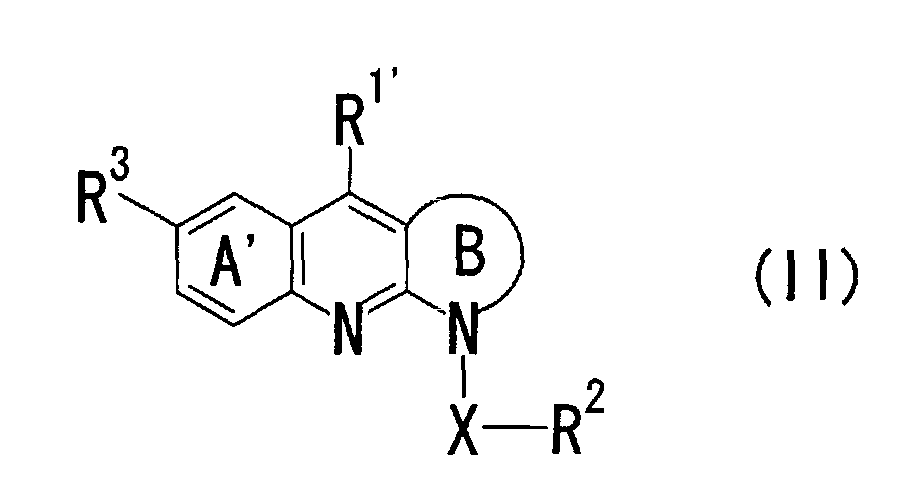
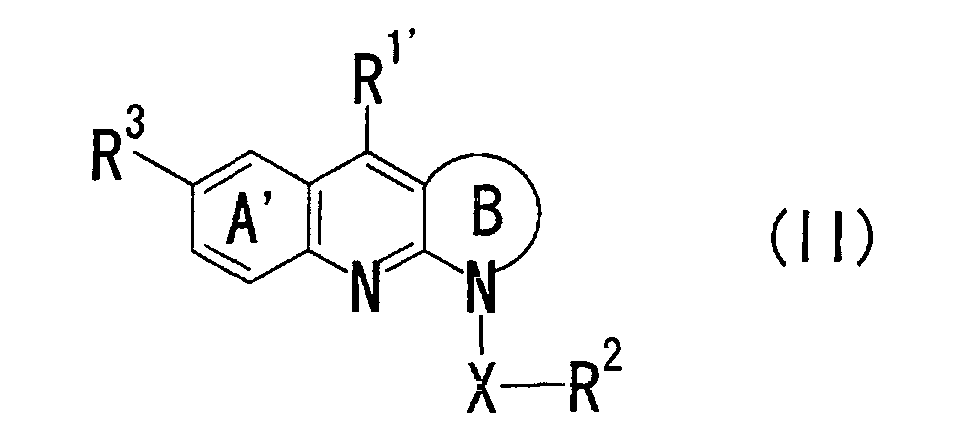
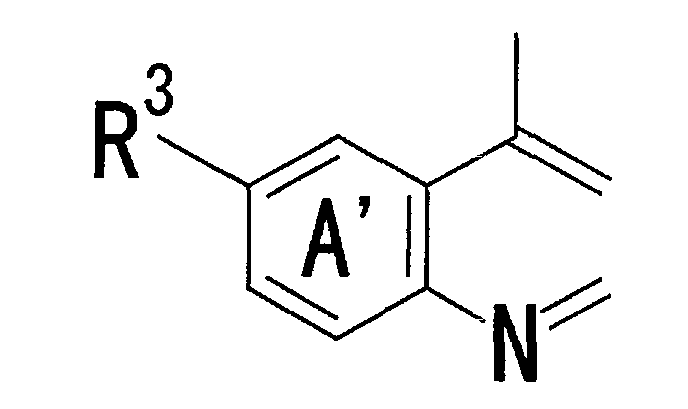
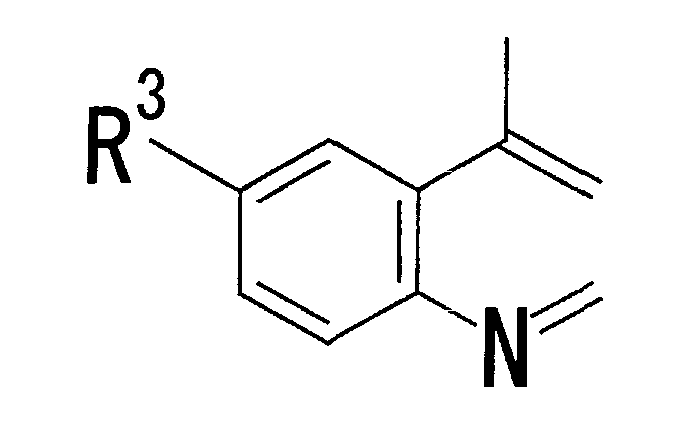
- Examples of "benzene ring which may be substituted" represented by A preferably include those having the formula below: wherein the benzene ring has at least one substituent at position "a", and more preferably those having the formula below: [wherein A' is a benzene ring which may have one or more substituent(s) in addition to substituent R 3 , R 3 is hydrocarbon group which may be substituted, heterocyclic group which may be substituted, nitro group, halogen atom, amino group which may be substituted, or a group represented by the formula: R 4 -Y- (wherein Y is an oxygen atom or a sulfur atom which may be oxidized and R 4 is a hydrocarbon group which may be substituted or a heterocyclic group which may be substituted)], and most preferably those having the formula below: [wherein R 3 is as described above].
- examples of R 3 preferably include hydrocarbon group which may be substituted, heterocyclic group which may be substituted, halogen atom, amino group which may be substituted, or a group represented by the formula: R 4 -Y-(wherein Y is an oxygen atom or a sulfur atom which may be oxidized and R 4 is a hydrocarbon group which may be substituted or a heterocyclic group which may be substituted), more preferably hydrocarbon group which may be substituted, heterocyclic group which may be substituted or halogen atom, and most preferably lower alkyl group which may be substituted or halogen atom.
- examples of "a 5- to 8-membered ring which may be substituted" represented by B include saturated 5- to 8-membered ring which may have a substituent or substituents at any position(s) which can be substituted, having the formula below: [wherein Z is a saturated divalent group with which ring B can form a saturated 5- to 8-membered ring which may be substituted]. Such saturated 5- to 8-membered rings may partially have unsaturated bond(s) and may form an aromatic ring. Ring B may preferably be a saturated 5- to 8-membered ring which may be substituted.
- saturated 5- to 8-membered ring in “saturated 5- to 8-membered ring which may be substituted” represented by B refers to "a 5- to 8-membered ring in which all the bonds (except for the double bond via which the ring B forms, together with a quinoline ring, a condensed ring) which constitute the ring B are single bonds".
- unsaturated 5- to 8-membered ring in “unsaturated 5- to 8-membered ring which may be substituted” represented by B refers to "a 5- to 8-membered ring in which at least one of the bonds (except for the double bond via which the ring B forms, together with a quinoline ring, a condensed ring) which constitute the ring B is an unsaturated bond".
- the saturated divalent group represented by Z may include any saturated groups provided that ring B can form, together with Z, a saturated 5- to 8-membered ring which may be substituted.
- Z may include any saturated divalent groups which have 2 to 5 atoms in its linear chain (preferably saturated divalent hydrocarbon group having 2 to 5 atoms in its linear chain). Particular examples are:
- examples of the "5- to 8-membered ring which may be substituted" represented by B in the above-described formula may also include a "saturated 5- to 8-membered ring which may be substituted" which partially has unsaturated bond(s) and a "5- to 8-membered aromatic ring which may be substituted".
- Z in the following formula: may represent a divalent group which is similar to any of the above-exemplified "saturated divalent group having 2 to 5 atoms in its linear chain” except for that the bonds in the "saturated divalent group having 2 to 5 atoms in its linear chain” have partially been converted into unsaturated bond(s).
- the divalent group may have any one or more substituent(s) provided the substituent or substituents are capable of binding to the divalent group, including, for example, oxo-group and those groups similar to the above-listed "substituent" which the "benzene ring which may be substituted” represented by A may have.
- the divalent group may be substituted by 1 to 4 (preferably 1 or 2) identical or different substituent(s) at any position(s) thereof.
- the divalent group has two or more substituents
- the "divalent group having 1 to 4 atom(s) in its linear chain" represented by X may include saturated divalent groups including:
- X may preferably indicate any divalent group except for -CO-O-CH 2 -, more preferably divalent group having 1 to 4 carbon atom(s) which constitute its linear chain, and most preferably C 1-4 alkylene, C 2-4 alkenylene, particularly C 1-4 alkylene, especially methylene.
- the divalent group represented by X may have one or more substituent(s) at any position or positions (preferably on carbon atom(s)), provided that the substituent or substituents are capable of binding to the divalent chain which constitutes the linear chain, including, for example, oxo-group and those similar to the above-listed substituent which the "benzene ring which may be substituted" represented by A may have.
- the divalent groups may be substituted by 1 to 4 (preferably 1 or 2) identical or different substituent(s) at any position or positions thereon.
- substituents which the divalent groups represented by X may have include: lower (C 1-6 ) alkyl (e.g., methyl, ethyl, propyl, isopropyl, butyl, isobutyl, sec-butyl, tert-butyl, pentyl, isopentyl, neopentyl, hexyl, etc.); lower (C 3-7 ) cycloalkyl (e.g., cyclopropyl, cyclobutyl, cyclopentyl, cyclohexyl, cycloheptyl, etc.); formyl; lower (C 2-7 ) alkanoyl (e.g., acetyl, propionyl butyryl, etc.); lower (C 2-7 ) lower alkoxy-carbonyl; lower (C 1-6 ); lower alkoxy; hydroxy group; and oxo-group.
- lower (C 1-6 ) alkyl
- amino group which may be substituted represented by R 1 in the above-described formula
- examples of “amino group which may be substituted” represented by R 1 in the above-described formula include any amino group which may have one or two selected from the group consisting of: “hydrocarbon group which may be substituted” (e.g., those similar to the above-described "hydrocarbon group which may be substituted” which the "benzene ring which may be substituted” represented by A may have), “heterocyclic group which may be substituted” (e.g., those similar to the above-described “heterocyclic group which may be substituted” which the "benzene ring which may be substituted” represented by A may have) and “acyl group which may be substituted” (e.g., those similar to the above-described "acyl group which may be substituted” which the " benzene ring which may be substituted” represented by A may have).
- the substituents of the amino group may be bonded to each other to form a cyclic amino group (e.g., a cyclic amino group formed by eliminating one hydrogen atom from a constituent nitrogen atom of 5- or 6-membered ring such as tetrahydropyrrole, piperazine, piperidine, morpholine, thiomorpholine, pyrrole or imidazole, having a binding arm on the nitrogen atom).
- a cyclic amino group e.g., a cyclic amino group formed by eliminating one hydrogen atom from a constituent nitrogen atom of 5- or 6-membered ring such as tetrahydropyrrole, piperazine, piperidine, morpholine, thiomorpholine, pyrrole or imidazole, having a binding arm on the nitrogen atom.
- the cyclic amino group may have one or more substituent(s), and preferably 1 to 3 substituent(s), including halogen (e.g., fluorine, chlorine, bromine, iodine, etc.), nitro, cyano, hydroxy group, thiol group, amino group, carboxyl group, C 1-4 alkyl which may be halogenated (e.g., trifluoromethyl, methyl, ethyl, etc.), C 1-4 alkoxy which may be halogenated (e.g., methoxy, ethoxy, propoxy, butoxy, trifluoromethoxy, trifluoroethoxy, etc.), formyl, C 2-4 alkanoyl (e.g., acetyl, propionyl, etc.), C 1-4 alkylsulfonyl (e.g., methanesulfonyl, ethanesulfonyl, etc.), etc.
- halogen e.g
- R 1 examples of substituent which the "amino group which may be substituted" represented by R 1 may have preferably include
- (1) alkyl which may be substituted, (2) cycloalkyl which may be substituted, (3) alkenyl which may be substituted, (4) cycloalkenyl which may be substituted, (5) aralkyl which may be substituted, (6) acyl which may be substituted, (7) aryl which may be substituted, and (8) heterocyclic group which may be substituted may have one or more substituent(s) (preferably 1 to 3 substituent(s)), including halogen (e.g., fluorine, chlorine, bromine, iodine, etc.); C 1-4 alkyl which may be substituted by halogen atom or C 1-4 alkoxy; C 1-4 alkoxy which may be substituted by halogen atom or C 1-4 alkoxy (e.g., methoxy, ethoxy, propoxy, butoxy, trifluoromethoxy, trifluoroethoxy, etc.); C 1-4 alkylenedioxy (e.g., -
- amino group which may be substituted represented by R 1 include amino groups which may have one or two alkyl which may be substituted [e.g., C 1-10 alkyl (such as methyl, ethyl, propyl, isopropyl, butyl, isobutyl, sec-butyl, tert-butyl, pentyl, isopentyl, neopentyl, hexyl, heptyl, octyl, nonyl, decyl, preferably lower (C 1-6 ) alkyl) which may have 1 to 3 substituent(s) selected from the group consisting of halogen (e.g., fluorine, chlorine, bromine, iodine, etc.), nitro, cyano, hydroxy group, thiol group which may be substituted (e.g., thiol, C 1-4 alkylthio, etc.), amino group which may be substituted (e.g., C 1-10 alkyl
- Examples of the "cyclic group which may be substituted" represented by R 2 in the above-described formula include 5- to 8-membered (preferably 5- or 6-membered) saturated or unsaturated alicyclic monocyclic hydrocarbon such as C 5-8 cycloalkane (e.g., cyclopentane, cyclohexane, cycloheptane, etc.), C 5-8 cycloalkene (e.g., 1-cyclopentene, 2-cyclopentene, 3-cyclopentene, 2-cyclohexene or 3-cyclohexene), C 5-8 cycloalkadiene (e.g., 2,4-cyclopentadiene, 2,4-cyclohexadiene, 2,5-cyclohexadiene, etc.); 6-membered aromatic monocyclic hydrocarbon such as benzene; 5- to 8-membered aromatic monocyclic heterocyclic, or saturated or unsaturated non-aromatic monocyclic heterocyclic (aliphatic heterocyclic
- aromatic monocyclic heterocyclic ring examples include 5- to 8-membered (preferably 5- or 6-membered) aromatic monocyclic heterocyclic rings (e.g., furan, thiophene, pyrrole, oxazole, isoxazole, thiazole, isothiazole, imidazole, pyrazole, 1,2,3-oxadiazole, 1,2,4-oxadiazole, 1,3,4-oxadiazole, 1,2,3-thiadiazole, 1,2,4-thiadiazole, 1,3,4-thiadiazole, 1,2,3-triazole, 1,2,4-triazole, tetrazole, pyridine, pyridazine, pyrimidine, pyrazine, triazine, etc.).
- aromatic monocyclic heterocyclic rings e.g., furan, thiophene, pyrrole, oxazole, isoxazole, thiazole, isothiazole, imid
- non-aromatic monocyclic heterocyclic ring examples include 5- to 8-membered (preferably 5- or 6-membered) saturated or unsaturated monocyclic non-aromatic heterocyclic (aliphatic heterocyclic) rings such as pyrrolidine, tetrahydrofuran, tetrahydrothiophene, thiolane, dithiolane, oxathiolane, pyrroline, imidazolidine, imidazoline, pyrazolidine, pyrazoline, oxazine, oxadiazine, thiazine, thiadiazine, piperidine, morpholine, thiomorpholine, tetrahydropyran, piperazine, pyran, oxepin, thiepin or azepine; and 5- to 8-membered non-aromatic heterocyclic ring comprising any of the above-exemplified aromatic monocyclic heterocyclic rings with all or portion of double bonds therein being
- the "cyclic group which may be substituted" represented by R 2 may include a group formed by eliminating one hydrogen atom from a condensed ring comprising 2 or 3 (preferably 2) identical or different rings selected from the above-exemplified monocyclic homocyclic rings and heterocyclic rings. Such condensed rings may be saturated, partially saturated or aromatic.
- condensed ring may include those comprising two identical or different heterocyclic rings (preferably one is a heterocyclic ring and the other an aromatic heterocyclic ring, and more preferably two identical or different aromatic heterocyclic rings); and those comprising one heterocyclic ring and one homocyclic ring (preferably one is a heterocyclic ring and the other a benzene ring, and more preferably one is an aromatic heterocyclic ring and the other a benzene ring).
- condensed ring are, for example, indole, benzothiophene, benzofuran, benzimidazole, imidazo [1,2-a] pyridine, quinoline, isoquinoline, cinnoline, etc.
- substituents which the "cyclic group which may be substituted" represented by R 2 may have include those similar to the above-listed substituents which the "hydrocarbon group which may be substituted” that the "benzene ring which may be substituted” represented by A may have may have.
- the "cyclic group which may be substituted" represented by R 2 preferably include 5- or 6-membered cyclic group, 5- or 6-membered aromatic cyclic group, more preferably phenyl, furyl, thienyl, pyrrolyl or pyridyl (preferably 6-membered ring), and most preferably phenyl.
- examples of the substituent (excluding substituent R 3 ) which the "benzene ring which may have one or more substituent(s) in addition to substituent R 3 " represented by A' and the "benzene ring which may which one or more substituent(s) in addition to substituent R 3 '" represented by A'' may have include, in addition to substituent R 3 , those similar to the above-exemplified substituents which the "benzene ring which may be substituted" represented by A may have.
- Examples of the "substituted amino group" represented by R 1 ' in the above-described formula include the "amino group which may be substituted” represented by R 1 except for unsubstituted amino group, i.e., amino groups having one or two identical or different substituents similar to the above-exemplified substituents which the "amino group which may be substituted” represented by R 1 may have. Particularly preferable are “amino groups substituted by one or two lower alkyl group(s) which may be substituted".
- amino group substituted by one or two lower alkyl groups which may be substituted include amino groups substituted by one or two lower (C 1-6 ) alkyl (e.g., methyl, ethyl, propyl, isopropyl, butyl, isobutyl, sec-butyl, tert-butyl, pentyl, isopentyl, neopentyl, hexyl, etc.) which may have 1 to 3 substituent(s) selected from the group consisting of:
- examples of the "hydrocarbon group which may be substituted" represented by R 3 or R 3 ' include those similar to the above-exemplified "hydrocarbon group which may be substituted” which the "benzene ring which may be substituted” represented by A may have.
- heterocyclic group which may be substituted represented by R 3 or R 3 include those similar to the above-exemplified “heterocyclic group which may be substituted” which the "benzene ring which may be substituted” represented by A may have.
- examples of "amino group which may be substituted” represented by R 3 or R 3 ' include those similar to the above-exemplified “amino group which may be substituted” which the "benzene ring which may be substituted'' represented by A may have.
- examples of the "hydrocarbon group which may be substituted” or “heterocyclic group which may be substituted” represented by R 4 in the group of the formula: R 4 -Y- include those similar to the above-exemplified "hydrocarbon group which may be substituted” or “heterocyclic group which may be substituted” which the "benzene ring which may be substituted” represented by A may have.
- examples of the " sulfur atom which may be oxidized" represented by Y in the group of the formula R 4 -Y- include S, S(O) and S(O) 2 .
- salts of compounds having GPR 14-antagonizing activity to be used in the present invention preferably include pharmaceutically acceptable salts such as salts with inorganic base, organic base, inorganic acid, organic acid, or basic or acidic amino acid.
- salts with inorganic base include alkaline metal salts such as sodium salts or potassium salts; alkaline earth metal salts such as calcium salts or magnesium salts; and aluminium salts and ammonium salts, etc.
- salts with organic base include salts with, for example, trimethylamine, triethylamine, pyridine, picoline, ethanolamine, diethanolamine, triethanolamine, dicyclohexylamine or N,N'-dibenzylethylenediamine, etc.
- salts with inorganic acid include salts with, for example, hydrochloric acid, hydrobromic acid, nitric acid, sulfuric acid or phosphoric acid, etc.
- salts with organic acid include salts with, for example, formic acid, acetic acid, trifluoroacetic acid, fumaric acid, oxalic acid, tartaric acid, maleic acid, citric acid, succinic acid, malic acid, methansulfonic acid, benzenesulfonic acid or p-toluenesulfonic acid, etc.
- salts with basic amino acid include salts with, for example, arginine, lysine or ornithine, etc.
- salts with acidic amino acid include salts with, for example, aspartic acid or glutamic acid, etc.
- Compounds having GPR 14-antagonizing activity to be used in the present invention may be hydrates or non-hydrates.
- Compounds having GPR 14-antagonizing activity to be used in the present invention can be individually isolated by any known means for separation/purification as desired when they are present as configurational isomers, diastereoisomers or conformers.
- Compounds having GPR 14-antagonizing activity to be used in the present invention [including compounds represented by formula (I), (II) and (II')] can be separated into S-form and R-form by any conventional optical resolution means when they are present as racemic modifications. All of those optically active substances and racemic modifications are encompassed by the present invention.
- GPR14 antagonist Compounds having GPR 14-antagonizing activity to be used in the present invention and salts thereof [including compounds represented by formula (I), (II) and (II') and salts thereof] [hereinafter sometimes referred to as GPR14 antagonist] may be use as prodrugs.
- Examples of such prodrug may include compounds which may be converted into GPR14 antagonist through, for example, enzyme- or gastric acid-mediated reaction in vivo under physiological conditions, i.e., compounds which may be enzymatically oxidized, reduced and/or hydrolyzed to be converted into GPR14 antagonist, and compounds which may be hydrolyzed by gastric acid and the like to be converted into GPR14 antagonist.
- prodrug of GPR14 antagonist examples include compounds comprising GPR 14 antagonist in which amino group or groups have been acylated, alkylated or phosphorylated (e.g., compounds comprising GPR14 antagonist in which amino group or groups have been eicosanoylated, alanylated, pentylamino carbonylated, (5-methyl-2-oxo-1,3-dioxolene-4-yl) methoxycarbonylated, tetrahydrofuranylated, pyrrolidylmethylated, pivaloyloxymethylated, or tert-butylated); compounds comprising GPR 14 antagonist in which hydroxy group or groups have been acylated, alkylated, phosphorylated or borated (e.g., compounds comprising GPR14 antagonist in which hydroxy group or groups have been acetylated, palmitoylated, propanoylated, pivaloylated, succinylated, fumarylated, alanyl
- prodrugs of GPR14 antagonist may be compounds which may be converted into GPR14 antagonist under physiological conditions as described in "Development of pharmaceuticals (Iyakuhinn no Kaihatsu)", vol. 7, Molecular Design pp.163-198, Hirokawa Shoten (1990).
- GPR14 antagonist may be labeled with any suitable isotope such as 3 H, 14 C, 35 S, 125 I, etc.
- GPR14 antagonist according to the present invention may be used alone or in combination with pharmaceutically acceptable carrier or carriers, to formulate solid (such as tablet, capsule, granule or powder) or liquid (such as syrup or injection) formulations which can then be administered orally or parenterally.
- pharmaceutically acceptable carrier or carriers such as tablet, capsule, granule or powder
- liquid such as syrup or injection
- Dosage forms for parenteral administration include, for example, injection, instillation and suppository.
- Examples of pharmaceutically acceptable carrier include various organic or inorganic carrier materials which have been conventionally used as formulation bases. Excipient, lubricant, binder and/or disintegrator may be used for solid formulations while solvent, dissolution adjuvant, suspending agent, isotonizing agent, buffer and/or soothing agent may be used for liquid formulations. Additive or additives may be added when required, including preservative, anti-oxidant, colorant and/or sweetening agent. Preferable examples of excipient include lactose, saccharose, D-mannitol, starch, crystalline cellulose or light anhydrous silicic acid, etc.
- lubricant examples include, for example, magnesium stearate, calcium stearate, talc or colloidal silica, etc.
- binder examples include, for example, crystalline cellulose, saccharose, D-mannitol, dextrin, hydroxypropylcellulose, hydroxypropylmethylcellulose, polyvinylpyrrolidone, etc.
- disintegrator examples include, for example, starch, carboxymethyl cellulose, carboxy methylcellulose calcium, crosscarmellose sodium or sodium carboxymethyl starch.
- solvent examples include, for example, water for injection, alcohol, propylene glycol, macrogol, sesame oil or corn oil.
- dissolution adjuvant examples include, for example, polyethylene glycol, propylene glycol, D-mannitol, benzyl benzoate, ethanol, trisaminomethane, cholesterol, triethanolamine, sodium carbonate or sodium citrate.
- suspending agent examples include: surfactants such as stearyl triethanolamine, sodium lauryl sulfate, laurylamino propionate, lecitin, benzalkonium chloride, benzethonium chloride or glyceryl monostearate; and hydrophilic polymers such as polyvinyl alcohol, polyvinylpyrrolidone, sodium carboxymethylcellulose, methylcellulose, hydroxymethyl cellulose, hydroxyethyl cellulose, hydroxypropyl cellulose, etc.
- isotonizing agent include, for example, sodium chloride, glycerine, D-mannitol, etc.
- buffer examples include buffer solution of, for example, phosphate, acetate, carbonate, citrate, etc.
- soothing agent include, for example, benzyl alcohol, etc.
- preservative include, for example, p-hydroxybenzoic esters, chlorobutanol, benzyl alcohol, phenethyl alcohol, dehydroacetic acid and sorbic acid.
- anti-oxidant include, for example, sulfite and ascorbic acid, etc.
- Compounds represented by formula (I) or salts thereof can be prepared according to any conventionally known method. Particularly, compounds represented by formula (I) or salts thereof can be prepared according to or substantially according to the methods described below or in "Tetrahedron Letters", vol. 40, pp.5643-5646, Japanese Patent Application Laid-Open No. 3-220189 or Japanese Patent Publication No. 48-30280.
- Compounds which may be used in the following methods may form salts similar to compounds (I) provided that they do not have any adverse effect on the reactions.
- protecting group or groups which are typically used in peptide chemical may be introduced into the substituent or substituents. In this case, the protecting group or groups may be removed as required after reaction to obtain title compounds.
- protecting group for amino group may include, C 1-6 alkylcarbonyl which may have one or more substituent(s) (e.g., acetyl, propionyl, etc.), formyl, phenylcarbonyl, C 1-6 alkyloxycarbonyl (e.g., methoxycarbonyl, ethoxycarbonyl, t-butoxycarbonyl, etc.), phenyloxycarbonyl (e.g., benzoxycarbonyl, etc.), C 7-10 aralkyloxycarbonyl (e.g., benzyloxycarbonyl, etc.), trityl, phthaloyl, etc.
- substituent(s) e.g., acetyl, propionyl, etc.
- formyl e.g., acetyl, propionyl, etc.
- phenylcarbonyl C 1-6 alkyloxycarbonyl (e.g., methoxycarbonyl,
- Those may have about 1 to 3 substituent(s), including halogen atom (e.g., fluorine, chlorine, bromine, iodine, etc.), C 1-6 alkylcarbonyl (e.g., acetyl, propionyl, butyryl, etc.) and nitro group.
- halogen atom e.g., fluorine, chlorine, bromine, iodine, etc.
- C 1-6 alkylcarbonyl e.g., acetyl, propionyl, butyryl, etc.
- Examples of protecting group for carboxyl group may include C 1-6 alkyl which may have one or more substituent(s) (e.g., methyl, ethyl, propyl, isopropyl, butyl, tert-butyl, etc.), phenyl, trityl, silyl, etc. They may be have about 1 to 3 substituent(s), including halogen atom (e.g., fluorine, chlorine, bromine, iodine, etc.), C 1-6 alkylcarbonyl (e.g., acetyl, propionyl, butyryl, etc.), formyl and nitro group, etc.
- substituent(s) e.g., methyl, ethyl, propyl, isopropyl, butyl, tert-butyl, etc.
- phenyl, trityl, silyl etc.
- They may be have about 1 to 3 substituent(s), including halogen
- Examples of protecting group for hydroxy group may include C 1-6 alkyl which may have one or more substituent(s) (e.g., methyl, ethyl, propyl, isopropyl, butyl, tert-butyl, etc.), phenyl, C 7-10 aralkyl (e.g., benzyl, etc.), C 1-6 alkylcarbonyl (e.g., acetyl, propionyl, etc.), formyl, phenyloxycarbonyl, C 7-10 aralkyloxycarbonyl (e.g., benzyloxycarbonyl, etc.), pyranyl, furanyl, silyl, etc.
- substituent(s) e.g., methyl, ethyl, propyl, isopropyl, butyl, tert-butyl, etc.
- phenyl C 7-10 aralkyl
- C 1-6 alkylcarbonyl e
- halogen atom e.g., fluorine, chlorine, bromine, iodine, etc.
- C 1-6 alkyl e.g., phenyl, C 7-10 aralkyl and nitro group, etc.
- Protecting groups may be introduced and/or removed according to or substantially according to any conventionally known methods [e.g., methods described in J.F.W.McOmie et al., "Protective groups in organic chemistry” Prenum Press].
- protecting groups may be removed by, for example, treating with acid, base, reduction, UV-light, hydrazine, phenylhydrazine, sodium N-methyldithiocarbamate, tetrabutyl ammonium fluoride or palladium acetate, etc.
- Compounds represented by formula (Ia) or salts thereof can be obtained by allowing compound represented by formula (III) or salts thereof to react with compound represented by formula (IV) or salts thereof to obtain product compound represented by (V) or salts thereof, and then cyclizing the product compound according to or substantially according to the methods described in Japanese Patent Application Laid-Open No. 3-220189, Japanese Patent Publication No. 48-30280 or other publications.
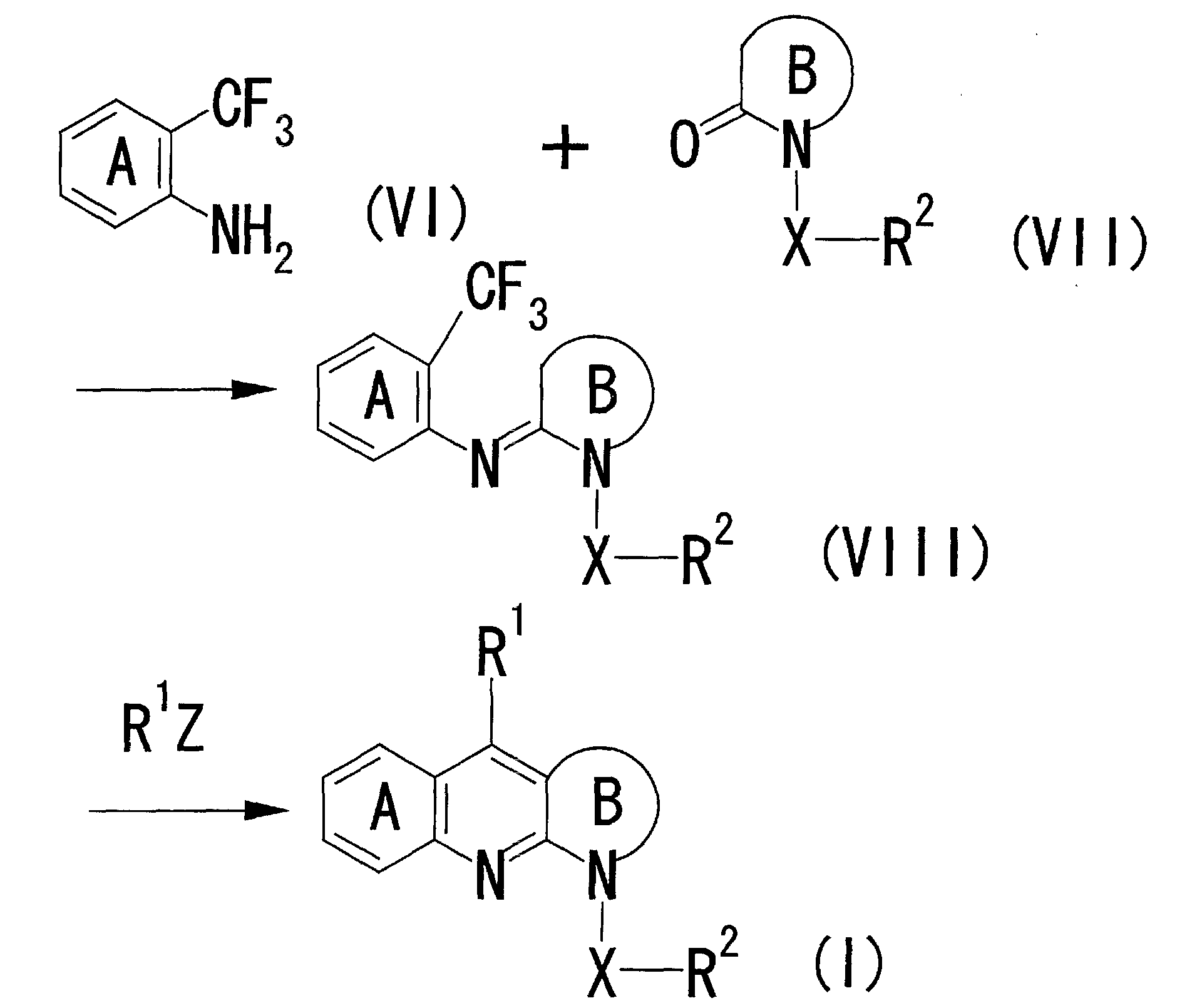
- compounds represented by formula (I) [including compounds represented by formula (II) or (II') having a novel structure] or salts thereof can also be prepared according to, for example, the following scheme: [wherein Z represents alkaline metal, and for other definitions, see above].
- Compound represented by formula (VI) or salts thereof may be allowed to react with compound represented by formula (VII) or salts thereof to give product compound represented by formula (VIII) or salts thereof which may be then allowed to react with compound represented by formula R 1 Z, to prepare compound represented by formula (I) or salts thereof, according to or substantially according to the method described in, for example, "Tetrahedron letters", vol. 40, pp.5643-5646.
- alkaline metal represented by Z examples include lithium, sodium, etc.
- Reaction may be performed without solvent or in solvent.
- Any suitable solvent may be used provided that the solvent does not have any adverse effect on the reaction, including, for example, ether solvent (e.g., diethyl ether, tetrahydrofuran, dioxane, etc.), halogen solvent (e.g., dichloromethane, dichloroethane, chloroform, carbon tetrachloride, etc.), hydrocarbon solvent (e.g., benzene, toluene, hexane, heptane, etc.), amide solvent (dimethylformamide, dimethylacetamide, N-methylpyrrolidone, etc.), ester solvent (ethyl acetate, methyl acetate, etc.), acetonitrile, dimethylsulfoxide, etc. Solvent may be used alone or in combination.
- ether solvent e.g., diethyl ether, tetrahydrofuran, dioxane,
- About 0.5-20 molar equivalent, and preferably about 0.8-10 molar equivalent of compound represented by the formula R 1 Z may be allowed to react with compound represented by formula (VIII) or salts thereof at about - 80°C to 200°C (preferably about -80°C to 80°C) for about 0.1 to 96 hours (preferably about 0.5 to 72 hours).
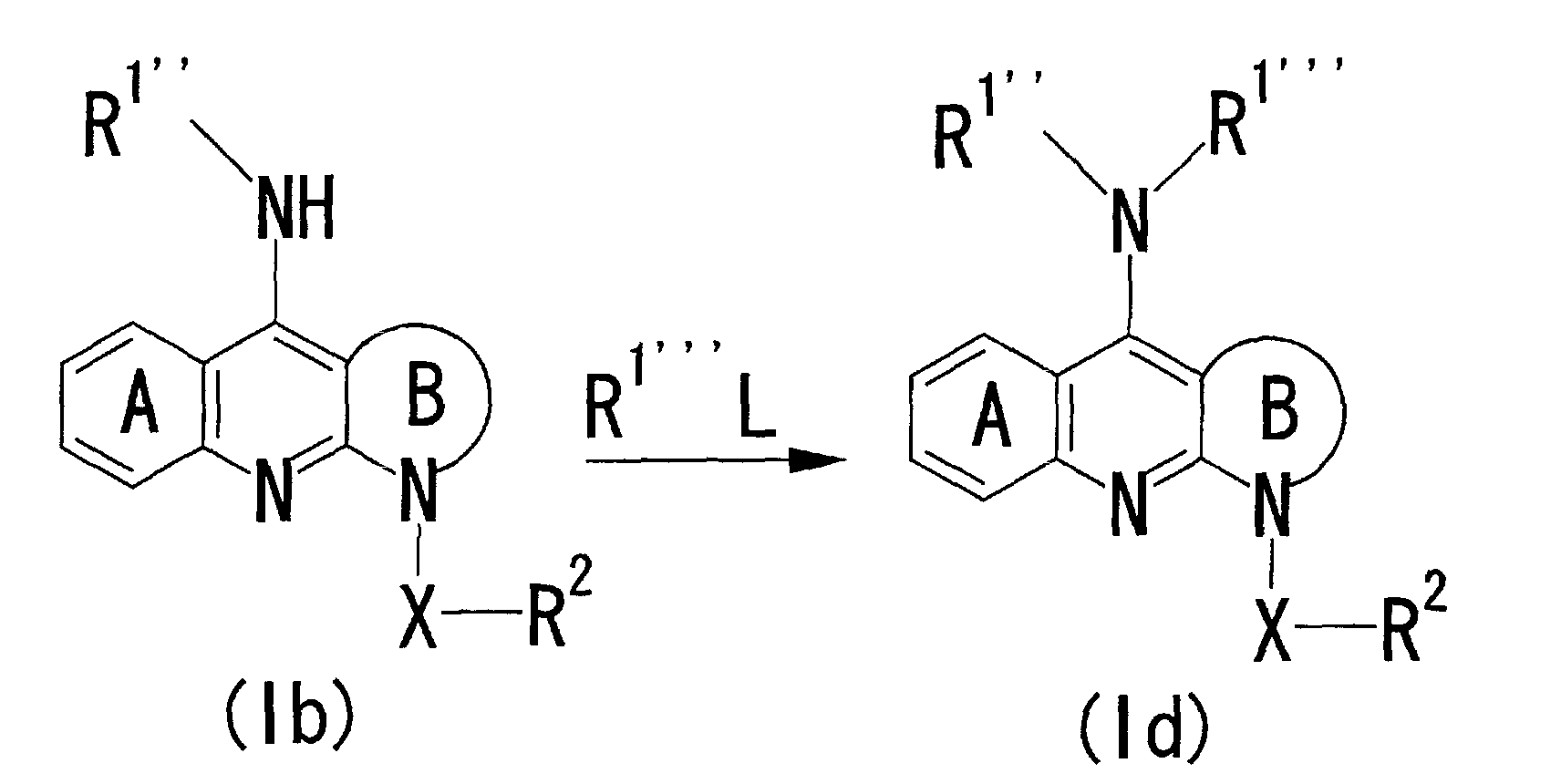
- Examples of leaving group represented by L include halogen atoms such as chlorine, bromine, iodo atom, etc., and sulfonate ester such as methanesulfonyl group, toluenesulfonyl group, etc.
- Reaction may be performed without solvent or in solvent.
- Any suitable solvent may be used provided that the solvent does not have any adverse effect on the reaction, including, for example, ether solvent (e.g., diethyl ether, tetrahydrofuran, dioxane, etc.), halogen solvent (e.g., dichloromethane, dichloroethane, chloroform, carbon tetrachloride, etc.), hydrocarbon solvent (e.g., benzene, toluene, hexane, heptane, etc.), amide solvent (dimethylformamide, dimethylacetamide, N-methylpyrrolidone, etc.), ester solvent (ethyl acetate, methyl acetate, etc.), acetonitrile, dimethylsulfoxide, etc.
- ether solvent e.g., diethyl ether, tetrahydrofuran, dioxane, etc.
- halogen solvent e
- Solvent may be used alone or in combination.
- reaction may be performed in the presence of base (e.g., triethylamine, 4-(dimethylamino)pyridine, 2-tert-butylimino-2-diethylamino-1,3-dimethylperhydro-1,3,2-diazaphospholine, sodium hydrogencarbonate, potassium hydrogencarbonate, sodium carbonate, potassium carbonate, sodium hydride or potassium hydride), or phase transfer catalyst (e.g., quaternary ammonium salt such as tetrabutylammonium bromide, benzyl triethyl ammonium chloride, etc., and crown ethers such as 18-crown-6, etc.), or both base and phase transfer catalyst.
- base e.g., triethylamine, 4-(dimethylamino)pyridine, 2-tert-butylimino-2-diethylamino-1,3-dimethylperhydro-1,3,2-diazaphospholine, sodium
- R 1 ''L or R 1 '''L may be allowed to react with compound represented by formula (Ia) or salt thereof or by formula (Ib) or salt thereof, respectively, at about -20°C to 200°C (preferably about 20°C to 150°C) for about 0.1 to 96 hours (preferably about 0.5 to 72 hours).
- Base may typically be used at an amount of about 0.5 to 10 molar equivalent, and preferably about 1 to 5 molar equivalent, relative to compound represented by formula (Ia) or (Ib).
- substituents which the benzene ring represented by ring A may have may be easily replaced by any other functional group (e.g., substituents which the benzene ring represented by ring A may have) according to any known substitution reaction (e.g., Suzuki coupling reaction, Still reaction, Heck reaction, etc.).
- Compounds (I) obtained as described above can be isolated and purified by any known means for separation/purification such as concentration, concentration under reduced pressure, solvent extraction, crystallization, recrystallization, dissolution, or chromatography, etc.
- compounds having GPR 14-antagonizing activity or salts thereof according to the present invention [including compounds represented by formula (I), (II) and (II') or salts thereof] have a potent GPR 14-antagonizing activity, those can be used as therapeutic agents for expressing various vasoactivities (such as accentuation) or inhibition of vasoconstriction), and preferably as vasoconstriction inhibitors.
- Compounds having GPR 14-antagonizing activity or salts thereof according to the present invention can be used as therapeutic agents for preventing/treating various diseases (e.g., circulatory system-associated diseases), more preferably hypertension, arteriosclerosis, hypertension, hypercardia, myocardial infarction, heart failure or septic shock, and most preferably ischemic myocardial infarction or congestive heart failure.
- various diseases e.g., circulatory system-associated diseases
- diseases e.g., circulatory system-associated diseases
- arteriosclerosis e.g., arteriosclerosis, hypertension, hypercardia, myocardial infarction, heart failure or septic shock, and most preferably ischemic myocardial infarction or congestive heart failure.
- compounds having GPR 14-antagonizing activity or salts thereof according to the present invention [including compounds represented by formula (I), (II) and (II') or salts thereof] have very low toxicity and thus can be used safely.
- Dose of compounds having GPR 14-antagonizing activity or salts thereof according to the present invention may depend on various factors such as the condition and weight of the patient to be treated and administration manner.
- compound may be preferably administered at an amount of about 0.1-100mg [active agent (e.g., compound represented by formula (II) or (II') or salt thereof)]/adult (50kg)/day, more preferably about 1-50mg (active agent)/adult (50kg)/day, and most preferably about 1-20mg (active agent)/adult (50kg)/day, once to three times a day.
- active agent e.g., compound represented by formula (II) or (II') or salt thereof
- Compounds having GPR 14-antagonizing activity or salts thereof according to the present invention may be used in combination with other therapeutic agent or agents (particularly with therapeutic agent for preventing/treating hypertension).
- these agents may separately be formulated into different preparations, or may be formulated together into one preparation, by blending with any pharmaceutically acceptable carrier, excipient, binder and/or diluent, and then administered orally or parenterally.
- these preparations may be administered to a subject after mixing together by using diluent just prior to use.
- these preparations may separately be administered to the subject simultaneously or with a certain time interval.
- kits product for mixing separate preparations using diluent and the like just prior to use for administration e.g., a kit for injection which contains two or more ampoules each containing a different powdery drug and a diluent for mixing the drugs just prior to use
- kit product for administering separate preparations to a subject simultaneously or separately with a certain time interval e.g., a kit for administering two or more types of separate tables to a subject simultaneously or separately with a certain time interval wherein tablets each containing a different drug are packed in the same bag or different bags, and a column is provided on the bag in which a time interval for drug administration can be written
- the pharmaceutical compositions of the present invention are encompassed by the pharmaceutical compositions of the present invention.
- therapeutic agents which can be used in combination with compounds having GPR 14-antagonizing activity or salts thereof according to the present invention include:
- a synthetic DNA used for screening cDNA encoding human GPR14 protein was used for screening cDNA encoding human GPR14 protein.
- Another synthetic DNA used for screening cDNA encoding human GPR14 protein is Another synthetic DNA used for screening cDNA encoding human GPR14 protein.
- nucleotide sequence of cDNA encoding human GPR14 protein with nucleotide sequences which may be recognized by restriction enzymes Sal I and Spe I added at the 5'- and 3'-termini, respectively.
- Reference Example 1 Amplifying cDNA for human GPR14 receptor by PCR method using human skeletal muscle-derived cDNA
- PCR amplification was performed by using cDNA derived from human skeletal muscle (Clontech) as a template and two synthetic DNA primers (SEQ ID NOS: 1 and 2).
- the synthetic DNA primers were designed so that the gene in the region which is to be translated into receptor protein would be amplified, and such that nucleotide sequences which may be recognized by restriction enzymes Sal I and Spe I were added at the 5'- and 3'-termini of the gene, respectively.
- Reaction solution included 2.5 ⁇ l of cDNA template, synthetic DNA primers (0.2 ⁇ M each), 0.2mM dNTPs, 1 ⁇ l of Advantage 2 polymerase mix (Clontech) and the buffer appended to the enzyme (total reaction volume of 50 ⁇ l).
- Thermocycler (Perkin-Elmer Corp.) was used for amplification.
- the amplification cycle consisted of heating at 95°C for 60 seconds, followed by 5 rounds of 95°C for 30 seconds and 72°C for 3 minutes, 5 rounds of 95°C for 30 seconds and 70°C for 3 minutes, and then 20 rounds of 95°C for 30 seconds and 68°C for 3 minutes, and finally heating at 68°C for 3 minutes.
- the resultant PCR amplification products were confirmed by purification by electrophoresis on a 0.8% agarose gel followed by staining with ethidium bromide.
- Reference Example 2 Subcloning of PCR product into plasmid vector and confirming amplified cDNA by reading the nucleotide sequence of cDNA insert
- PCR reaction products obtained in Reference Example 1 were separated on a 0.8% low-melting agarose gel, a gel containing bands was excised using a razor, and DNA was collected using GENECLEAN SPIN (BIO 101, Inc.).
- GENECLEAN SPIN BIO 101, Inc.
- the collected DNA was cloned into a plasmid vector for expression in animal cells, pcDNA3.1/V5/His, to construct a plasmid for protein expression, pcDNA3.1-hGPR14 which was then introduced into Escherichia coli DH5 ⁇ competent cells (Toyobo Co., Ltd.) for transformation.
- clone which contained cDNA insert fragment was selected on an ampicillin-containing LB agar medium, and separated using a sterilized toothpick to obtain transformant E. coli DH5 ⁇ /pcDNA3.1-hGPR14. Each clone was cultured overnight on an ampicillin-containing LB medium, and Quiawell 8 Ultra Plasmid kit (Qiagen) was used to prepare plasmid DNA. Portion of DNA prepared was digested with restriction enzyme Sal I, and the size and direction of receptor cDNA fragment inserted were determined. The sequences of nucleotides were determined by using DyeDeoxy Terminator Cycle Sequence Kit (Perkin-Elmer Corp.) and then reading in a fluorescence automatic sequencer.
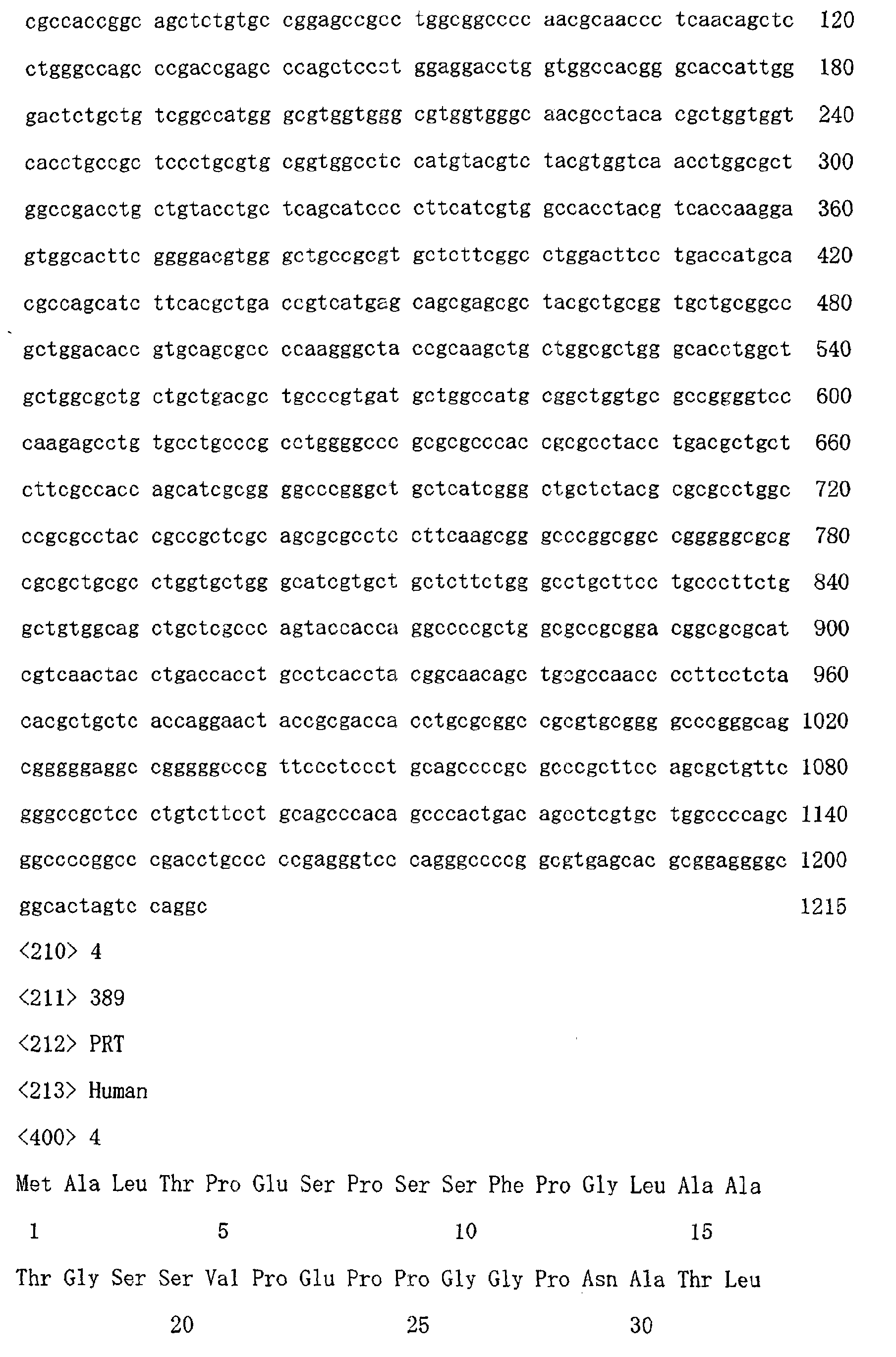
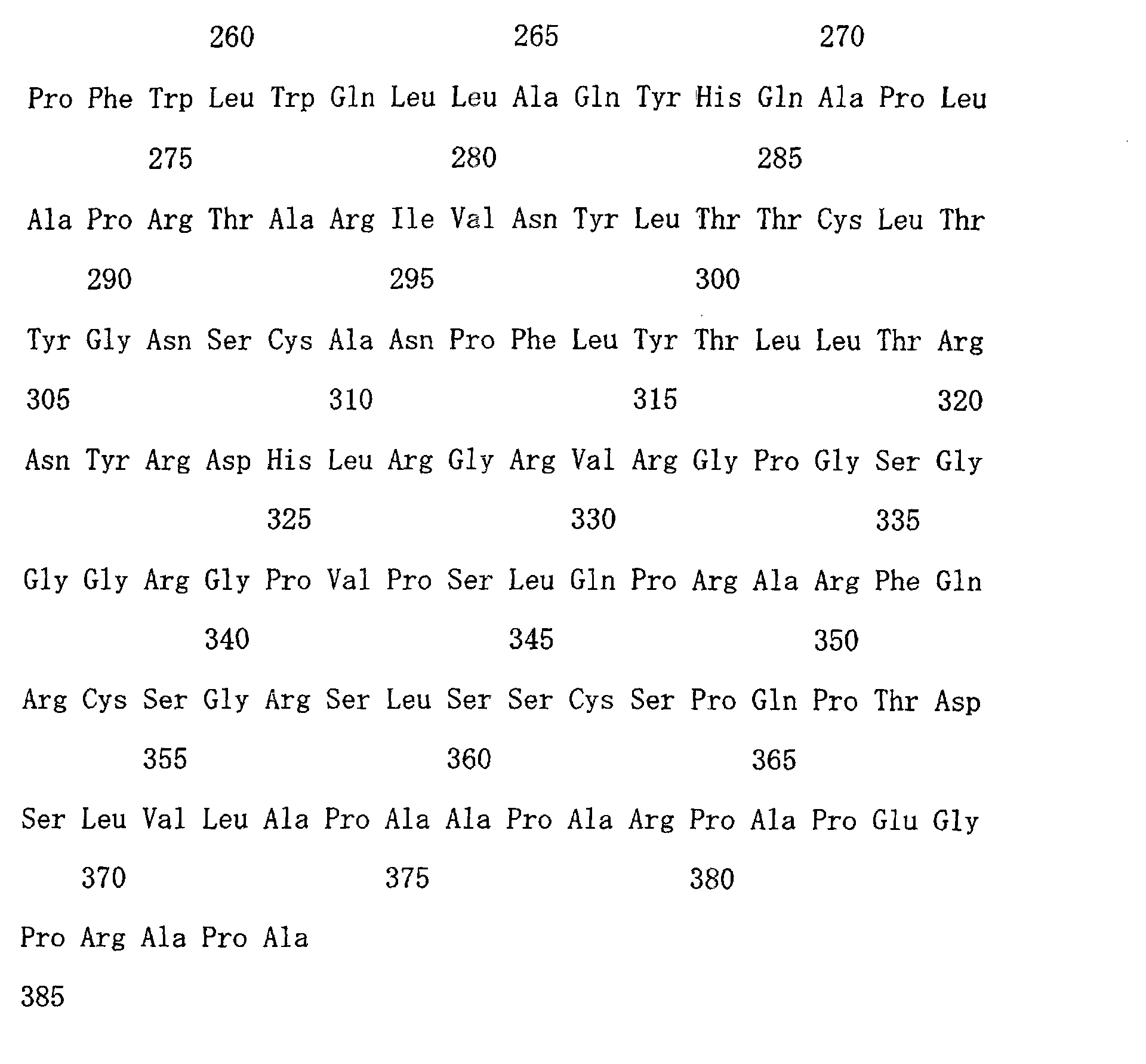
- sequence of clone obtained was analyzed and confirmed to be consistent with a genetic sequence comprising the sequence of human GPR14 gene, of which entire sequence has been reported (EP 0 859 052 A1), and Sal I and Spe I recognition sequences added to the 5'- and 3'-termini of the sequence, respectively (SEQ ID NOS: 3 and 4). It should be noted that although the 1133rd base in the sequence of human GPR14 gene (SEQ ID NO: 3) was identified as C in the report (EP 0 859 052 A1) while it was identified as G in the present Example though the amino acids which would be translated from these sequences may be the same.
- Plasmid Midi Kit Qiagen
- the plasmid DNA was introduced into CHO dhfr cells using CellPhect Transfection Kit (Amersham Pharmacia Biotech) according to the protocol appended thereto. 10 ⁇ g of DNA was co-precipitated with calcium phosphate to prepare a suspension which was then added to a 10cm petri dish on which 5 x 10 5 or 1 x 10 6 CHO dhfr - cells had previously been inoculated 24 hours before then.
- MEM ⁇ medium containing 10% fetal bovine serum for one day, subcultured, and cultured in a selection medium, a MEM ⁇ medium containing 0.4 mg/ml G418 (GIBCO BRL) and 10% dialysis fetal bovine serum.
- Colonies of transformed cells CHO/hGPR14, which were human GPR14-expessing CHO cells growing in the selection medium, were selected.
- CHO/GPR14 cells were added 10 ml of homogenate buffer (10 mM NaHCO 3 , 5 mM EDTA, 0.5 mM PMSF, 1 ⁇ g/ml pepstatin, 4 ⁇ g/ml E64, 20 ⁇ g/ml leupeptin), and disrupted using Polytron (12,000 rpm, 1 minute).
- Cell debris solution was centrifuged at 1,000g for 15 minutes to obtain a supernatant. The supernatant was then ultra-sonicated (in Beckman type 30 rotor, 30,000 rpm, 1 hour), and the resultant precipitant was collected as human GPR14-expressing CHO cell fraction.
- Isotope-labeled human urotensin II to be used in experiments for testing inhibition of binding was prepared as described below. 5 ⁇ g of human urotensin II (available from Peptide Institute, Inc.) was dissolved in 25 ⁇ l of 0.4M sodium acetate (pH 5.6). To the solution was added 200ng of lactoperoxidase (Wako Pure Chemical Industries, Ltd.) followed by 1 mCi [ 125 I]-sodium iodide (Amersham Pharmacia Biotech) and 200 ng of hydrogen peroxide (10 ⁇ l). The solution was left to stand at room temperature for 10 minutes, another 200 ng of hydrogen peroxide (10 ⁇ l) was added thereto and then the solution was left to stand for 10 minutes. The mixture was then purified by HPLC using TSKgel ODS-80T s column (4.6 mm x 25 cm, Toso Co., Ltd.) to obtain [ 125 I]-labeled human urotensin II.
- Human GPR14-expressing CHO cell fraction was diluted in a membrane diluting buffer (20mM phosphate buffer (pH7.3), 150mM NaCl, 5mM MgCl 2 ,0.1% BSA, 0.05% CHAPS, 0.5mM PMSF, 0.1 ⁇ g/ml Pepstatin, 20 ⁇ g/ml Leupeptin, 4 ⁇ g/ml E-64) to prepare a solution of cell membrane fraction (protein concentration:3 ⁇ g/ml) for assay.
- a membrane diluting buffer (20mM phosphate buffer (pH7.3), 150mM NaCl, 5mM MgCl 2 ,0.1% BSA, 0.05% CHAPS, 0.5mM PMSF, 0.1 ⁇ g/ml Pepstatin, 20 ⁇ g/ml Leupeptin, 4 ⁇ g/ml E-64) to prepare a solution of cell membrane fraction (protein concentration:3 ⁇ g/ml) for assay.
- the membrane fraction solution for assay was dispensed in 96-well microplates (85 ⁇ l each) which were left for stand for reaction at 25°C for 3 hours after adding: 10 ⁇ l of membrane diluting buffer containing 1nM [ 125 I]-labeled human urotensin II and 5 ⁇ l of di-methylsulfoxide diluted 5-times (by volume) in membrane diluting buffer for examining the total binding; 10 ⁇ l of membrane diluting buffer containing 1nM [ 125 I]-labeled human urotensin II and 5 ⁇ l of 20% dimethylsulfoxide-containing membrane diluting buffer containing 20 ⁇ M ⁇ human urotensin II without isotope-labeling for examining non-specific binding; and 5 ⁇ l of a solution of test compound in dimethylsulfoxide diluted 5-times (by volume) in membrane diluting buffer and 10 ⁇ l of membrane diluting solution containing 1nM [ 125 I]-labeled-human urotensin
- test compound was washed three times with membrane diluting buffer (0.2ml), added with 20 ⁇ l of Microscinti 20 (Packard), and determined for radioactivity in Topcount (Packard). Specific-binding is calculated by subtracting non-specific binding from the total binding.
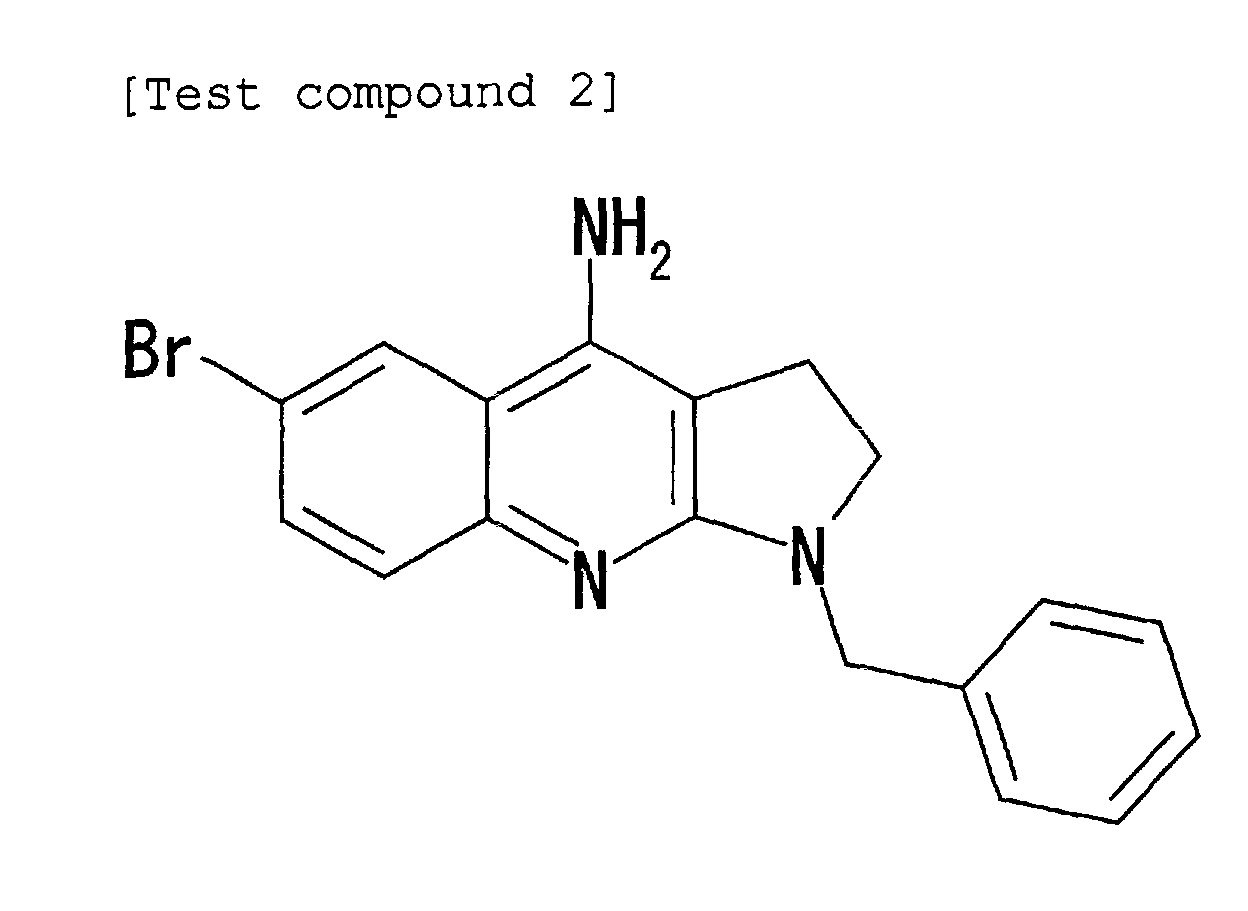
- the ability of test compound to inhibit binding of urotensin II to human GPR14 is represented by the ratio of [(total binding) - (the radio activity of the cell fraction to which test compound was added)] vs [specific binding]. Concentrations of test compounds at which the compounds showed 50% inhibition of human GPR14 binding activity are shown. Test compounds 1 and 3 were purchased from ASINEX, and test compound 2 was purchased from CHEMBRIDGE.
- Test compound Inhibitory concentration 1 4.3nM 2 2.4nM 3 33nM
- GPR14-expressing CHO cells were inoculated on a 96-well plate at 1 ⁇ 10 4 cell/well, cultured for 48 hours, and then washed with 0.1ml of HBSS containing 20mM HEPES(pH7.4), 1% FCS and 1% penicillin-streptomycin (hereinafter referred to as "wash buffer”).
- wash buffer 20mM HEPES(pH7.4), 1% FCS and 1% penicillin-streptomycin
- 100 ⁇ l of another wash buffer containing 4 ⁇ M Fluo3, 0.04% pluronic acid and 2.5mM probenicid hereinafter referred to as "reaction buffer" was added thereto for reaction at 37°C for 1 hour. The reaction buffer was then removed and the plate was washed three times with 0.2ml of wash buffer.
- N-benzylpyrrolidone (1.8g, 10.4mmol) was dissolved in 4ml of chloroform, and phosphorus oxychloride (1.8g, 11.7mmol) was added to the solution which was then stirred at room temperature for 30 minutes.
- 4-bromo-2-cyanoaniline (2.0g, 10mmol) was added and the mixture was refluxed for 3 hours while heating.
- the reaction solution was poured into an ice-water and neutalized with 20% aqueous sodium hydroxide solution. After extraction with chloroform, the organic layer was dried over anhydrous sodium sulfate. After concentration under reduced pressure, the residue was dissolved in 10 ml of nitrobenzene.
- Phosphorus oxychloride (0.30ml) was added to a solution of 1-(4-fluorobenzyl)-2-pyrrolidone (600mg) in chloroform (3ml) and the mixture was stirred at room temperature for 30 minutes, and then 2-amino-5-bromobenzonitrile (583mg) was added thereto. The reaction mixture was refluxed for 3 hours while heating. Ice-water was added to the mixture. Further, the mixture was neutralized by adding 20% aqueous sodium hydroxide solution and then extracted with chloroform.
- Phosphorus oxychloride (0.23ml) wa added to a solution of 1-(2-phenethyl)-2-pyrrolidone (438mg) in chloroform (3ml). The mixture was stirred at room temperature for 30 minutes, and then 2-amino-5-bromobenzonitrile (435mg) was added thereto. The reaction mixture was refluxed for 3 hours while heating and ice-water was added thereto. Further, the mixture was neutralized by adding 20% aqueous sodium hydroxide solution and then extracted with chloroform.
- 2-Pyrrolidone (0.76ml) was added to a suspension of sodium hydride (60% mineral oil suspension) (880mg) in N,N-dimethylformamide (10ml). The mixture was stirred at room temperature for 15 minutes, and 3-(chloromethyl)pyridine hydrochloride (1.80g) was added thereto. The reaction mixture was stirred at room temperature for 15 hours. Water was added to the mixture and the mixture was extracted with dichloroform. The extract was washed with brine, dried over anhydrous magnesium sulfate and concentrated under reduced pressure. The resultant residue was treated with 4N HCl-ethyl acetate to give 1-(3-pyridinylmethyl)-2-pyrrolidone hydrochloride (2.02g).
- Phosphorus oxychloride (0.31ml) was added to a solution of 1-(3-pyridinylmethyl)-2-pyrrolidone hydrochloride (600mg) in chloroform (3ml) and the mixture was stirred at room temperature for 30 minutes, and then 2-amino-5-bromobenzonitrile (530mg) was added thereto. The reaction mixture was refluxed for 3 hours while heating and then ice-water was added thereto. Further, the mixture was neutralized by adding 20% aqueous sodium hydroxide solution and extracted with chloroform.
- Phosphorus oxychloride (0.51ml) was added to a solution of 1-benzyl-2-pyrrolidone (0.84ml) in chloroform (3ml). The solution was stirred at room temperature for 30 minutes, and 2-amino-5-fluorobenzonitrile (0.65ml) was added thereto. The reaction mixture was refluxed for 3 hours while heating and then ice-water was added thereto. Further, the mixture was neutralized by adding 20% aqueous sodium hydroxide solution and extracted with chloroform.
- Vasoactive drugs including drugs for preventing/treating myocardial infarction, heart failure, etc.
- any of compounds having GPR 14-antagonizing activity or salts thereof according to the present invention can be prepared according to, for example, the following procedures.
- inventive compounds having GPR 14-antagonizing activity [including compounds represented by formula (I), (II) or (II')] or salts thereof have potent GPR14 antagonistic activity, they can advantageously be used in various vasoactive drugs (preferably vasoconstriction inhibitor) as well as in treatment of various diseases (preferably ischemic myocardial infarction or congestive heart failure).
Landscapes
- Health & Medical Sciences (AREA)
- Chemical & Material Sciences (AREA)
- Medicinal Chemistry (AREA)
- Pharmacology & Pharmacy (AREA)
- Life Sciences & Earth Sciences (AREA)
- Animal Behavior & Ethology (AREA)
- General Health & Medical Sciences (AREA)
- Public Health (AREA)
- Veterinary Medicine (AREA)
- Organic Chemistry (AREA)
- Engineering & Computer Science (AREA)
- Bioinformatics & Cheminformatics (AREA)
- Cardiology (AREA)
- Chemical Kinetics & Catalysis (AREA)
- General Chemical & Material Sciences (AREA)
- Nuclear Medicine, Radiotherapy & Molecular Imaging (AREA)
- Heart & Thoracic Surgery (AREA)
- Epidemiology (AREA)
- Urology & Nephrology (AREA)
- Vascular Medicine (AREA)
- Hospice & Palliative Care (AREA)
- Pharmaceuticals Containing Other Organic And Inorganic Compounds (AREA)
- Acyclic And Carbocyclic Compounds In Medicinal Compositions (AREA)
Abstract
Description







- compounds of the formula (II):
[wherein A' is a benzene ring which may have one or more substituent(s) in addition to substituent R3, B is 5- to 8-membered ring which may be substituted, X is a divalent group containing 1 to 4 atoms in its linear chain, R1' is an amino group substituted by one or two lower alkyl groups which may be substituted, R2 is a cyclic group which may be substituted, and R3 is a hydrocarbon group which may be substituted, a heterocyclic group which may be substituted, a nitro group, a halogen atom, an amino group which may be substituted or a group represented by the formula: R4-Y-(wherein Y is an oxygen atom or a sulfur atom which may be oxidized, and R4 is a hydrocarbon group which may be substituted or a heterocyclic group which may be substituted)] or salts thereof; and

- compounds of the formula (II'):
[wherein A'' is a benzene ring which may have one or more substituent(s) in addition to substituent R3', B is 5- to 8-membered ring which may be substituted, X is a divalent group containing 1 to 4 atoms in its linear chain, R1 is an amino group which may be substituted, R2 is a cyclic group which may be substituted, and R3' is a hydrocarbon group which may be substituted, a heterocyclic group which may be substituted, a halogen atom, an amino group which may be substituted or a group represented by the formula: R4-Y-(wherein Y is an oxygen atom or a sulfur atom which may be oxidized, and R4 is a hydrocarbon group which may be substituted or a heterocyclic group which may be substituted)] or salts thereof.



- drugs for treating hypertension such as diuretic [e.g., furosemide (Lasix), bumetanide (Lunetoron) or azosemide (Diart) ], antihypertensive drug [e.g., ACE inhibitor such as enalapril maleate (Renivace) or delapril hydrochloride] and Ca antagonist (manidipine or amlodipine), or α- or β-receptor blocker];
- drugs for treating chronic heart failure such as cardiotonic drug [e.g., cardiotonic glycoside (e.g., digoxin), β-receptor stimulator (catecholamine preparation such as denopamine or dobutamine) and PDE inhibitor], diuretic [e.g., furosemide (Lasix) or spironolactone (Aldactone) ], ACE inhibitor [e.g., enalapril maleate (Renivace)], Ca antagonist [e.g., amlodipine] and β-receptor blocker;
- antiarrhythmic drugs such as disopyramide, lidocaine, quinidine sulfate, flecainide acetate, mexiletine hydrochloride, amiodarone hydrochloride, as well as β-blocker, Ca antagonist;
- drugs for preventing/treating thrombogenesis: coagulation inhibitor [e.g., heparin sodium, heparin calcium, warfarin calcium (warfarin), blood coagulation factor Xa inhibitor and drugs capable of balancing coagulation fibrinolytic system], thrombolytic agent [e.g., tPA, urokinase, prourokinase, etc.], antiplatelet drug [e.g., aspirin, sulfinpyrazolo (Anturan), dipyridamole (Persantin), ticlopidine (Panaldine), cilostazol (Pletaal) and GP IIb/IIIa antagonist (ReoPro)];
- coronary vasodilators such as nifedipine, diltiazem, nicorandil or nitrite agent; and
- cardioplegic drugs such as opener for cardiac ATP-K, Na-H exchange inhibitor, endothelin antagonist or urotensin antagonist.
| Test compound | Inhibitory concentration |
| 1 | 4.3nM |
| 2 | 2.4nM |
| 3 | 33nM |



Mass (ESI+); 354 (M+H), 356
1H-NMR (CDCl3)δ: 2.41(3H, s), 2.92 (2H, t, J=8.0Hz), 3.50 (2H, t, J=8.0Hz), 4.75 (2H, s), 7.24-7.38 (7H, m), 7.57 (2H, d), 7.69 (3H, m).
Mass (ESI+); 366 (M+H)
1H-NMR (DMSO-d6)δ: 3.01(2H, t, J=8.0Hz), 3.73 (2H, t, J=8.0Hz), 4.92 (2H, s), 7.40 (5H, bs), 7.70-7.88 (3H, m), 8.02-8.09 (2H, m), 8.54 (1H, s). Mass (ESI+); 358 (M+H)
1H-NMR (CDCl3)δ: 3.13(2H, t, J=8.0Hz), 3.54 (2H, t, J=8.0Hz), 4.72 (2H, s), 4.82 (2H, s), 7.22-7.37 (10H, m), 7.50 (1H, dd, J=9.0, 2.0Hz), 7.69 (1H, d, J=9.0Hz), 8.00 (1H, d, J=2.0Hz).
Mass (ESI+); 444 (M+H), 446
1H-NMR (CDCl3)δ: 2.61(2H, t, J=8.0Hz), 3.49 (2H, t, J=8.0Hz), 4.27 (4H, s), 4.99 (2H, s), 7.17-7.38 (15H, m), 7.74 (1H, dd, J=8.8, 2.0Hz), 7.97 (1H, d, J=8.8Hz), 8.16 (1H, d, J=2.0Hz).
Mass (ESI+); 534 (M+H), 536
1H-NMR (CDCl3)δ: 3.23(2H, t, J=8.0Hz), 3.62 (2H, t, J=8.0Hz), 4.07 (2H, bs), 4.83 (2H, s), 5.12-5.24 (2H, m), 5.91-6.00 (1H, m), 7.35 (5H, bs), 7.44 (1H, dd, J=8.8, 2.0Hz), 7.61 (1H, d, J=8.8Hz), 8.03 (1H, d, J=2.0Hz).
Mass (ESI+); 394 (M+H), 396
1H-NMR (CDCl3)δ: 3.20 (2H, t, J=8.0Hz), 3.70 (2H, t, J=8.0Hz), 3.88 (4H, d), 5.01 (2H, s), 5.20-5.29 (4H, m), 5.68-5.89 (2H, m), 7.36 (5H, bs), 7.67 (1H, dd, J=9.0, 2.0Hz), 7.90 (1H, d, J=9.0Hz), 7.97 (1H, d, J=2.0Hz).
Mass (ESI+); 434 (M+H), 436
1H-NMR (CDCl3)δ: 3.19 (3H, s), 3.39 (2H, t, J=8.0Hz), 3.66 (2H, t, J=8.0Hz), 4.81 (2H, s), 7.28-7.57 (7H, m), 7.97 (1H, s).
Mass (ESI+); 368 (M+H), 370
1H-NMR (CDCl3)δ: 3.14 (6H, s) , 3.37 (2H, t, J=8.0Hz), 3.74 (2H, t, J=8.0Hz), 4.94 (2H, s), 7.38 (5H, bs), 7.67 (1H, dd, J=9.0, 2.0Hz), 7.77 (1H, d, J=9.0Hz), 7.95 (1H, d, J=2.0Hz). Mass (ESI+); 382 (M+H), 384
1H-NMR (DMSO-d6) δ: 2.86 (2H, t, J=8.0Hz), 3.42 (2H, t, J=8.0Hz), 4.58 (2H, s), 7.14 (2H, d, J=8.8Hz), 7.29-7.46 (4H, m), 8.13 (1H, d, J=2.2Hz)
Mass (APCI+); 372 (M+H), 374
1H-NMR (DMSO-d6)δ: 2.80-3.00 (2H, m), 3.15-3.30 (2H, m), 3.83 (2H, t, J=8.0Hz), 3.93 (2H, t, J=8.0Hz), 7.15-7.45 (5H, m), 7.75-7.90 (2H, m), 8.39 (1H, s)
1H-NMR (DMSO-d6)δ: 3.00 (2H, t, J=8.0Hz), 3.79 (2H, t, J=8.0Hz), 5.28 (2H,s), 7.56 (2H, m), 7.83 (1H, d, J=8.0Hz), 7.90-8.10 (2H, m), 8.46 (1H, s), 8.54 (1H, d, J=8.0Hz), 8.85 (1H, d, J=5.8Hz), 9.05 (1H, s)
Mass (APCI+); 355 (M+H), 357
1H-NMR (DMSO-d6)δ: 2.99 (2H, t, J=8.0Hz), 3.72 (2H, t, J=8.0Hz), 4.95 (2H,s), 7.25-7.65 (6H, m), 7.95-8.15 (2H, m) Mass (APCI+); 294 (M+H)
1H-NMR (DMSO-d6)δ: 1.85-2.00 (2H, m), 2.59 (2H, t, J=6.0Hz), 3.10-3.50 (2H, m), 5.12 (2H,s), 7.25-7.45 (5H, m), 7.80 (1H, dd, J=1.8Hz, 8.8Hz), 8.03 (1H, d, J=8.8Hz), 8.54 (1H, d, J=1.8Hz)
Mass (APCI+); 368 (M+H), 370
1H-NMR (DMSO-d6)δ: 1.55-1.85 (4H, m), 2.71 (2H, m), 3.51 (2H, m),4.94 (2H,s), 7.30-7.50 (5H, m), 7.84 (1H, dd, J=2.0Hz, 8.8Hz), 8.07 (1H, d, J=8.8Hz), 8.60 (1H, d, J=2.0Hz)
Mass (APCI+); 382 (M+H), 384
Mass (ESI+); 392 (M+H)
1H-NMR (DMSO-d6)δ: 2.09 (3H, s) , 3.00 (2H, t, J=8.0Hz), 3.73 (2H, t, J=8.0Hz), 4.98 (2H, s), 7.35-7.64 (9H, m), 7.88 (1H, d, J=8.4Hz), 7.99 (2H, bs), 8.01 (1H, d, J=8.4Hz), 8.44 (1H, s) .
Mass (ESI+); 409 (M+H)
1H-NMR (DMSO-d6)δ: 1.27 (9H, s), 2.98 (2H, t, J=8.0Hz), 3.73 (2H, t, J=8.0Hz), 4.87 (2H, s), 7.29 (1H, d, J=8.2Hz), 7.42 (1H, d, J=8.2Hz), 7.48 (2H, bs), 7.81 (2H, s), 8.43 (1H, s). Mass (ESI+); 410 (M+H)
1H-NMR (DMSO-d6)δ: 3.00 (2H, t, J=8.0Hz), 3.74 (2H, t, J=8.0Hz), 5.06 (2H, s), 7.50-7.62 (4H, m), 7.82-7.90 (6H, m), 8.45 (1H, s).
Mass (ESI+); 379 (M+H)
1H-NMR (DMSO-d6)δ: 2.98 (2H, t, J=8.0Hz), 3.70-3.74 (8H, m), 6.42-6.54 (3H, m), 7.48 (2H, bs), 7.80 (2H, s), 8.43 (1H, s) .
Mass (ESI+); 414 (M+H)
1H-NMR (DMSO-d6)δ: 2.95 (2H, t, J=8.0Hz), 3.69 (2H, t, J=8.0Hz), 3.75 (3H, s), 4.85 (2H, s), 6.95 (2H, d, J=8.8Hz), 7.33 (2H, d, J=8.8Hz), 7.45 (2H, bs), 7.84 (2H, bs), 8.43 (1H, s).
Mass (ESI+); 384 (M+H)
| (1) Compounds obtained in Example 1 | 40mg |
| (2) Lactose | 70mg |
| (3) Microcrystalline cellulose | 9mg |
| (4) Magnesium stearate | 1mg |
| (1 capsule unit=120mg) |
| (1) Compounds obtained in Example 1 | 40mg |
| (2) Lactose | 58mg |
| (3) Corn starch | 18mg |
| (4) Microcrystalline cellulose | 3.5mg |
| (5) Magnesium stearate | 0.5mg |
| (1 tablet unit=120mg) |


Claims (35)
- A vasoactive agent which comprises a compound having GPR 14 antagonistic action or salts thereof.
- The agent according to claim 1, which is a vasoconstriction inhibitor.
- The agent according to claim 1, which is the agent for preventing and/or treating hypertension, arteriosclerosis, hypercardia, myocardial infarction or heart failure.
- A GPR 14 antagonistic agent which comprises a non-peptide compound or salts thereof.
- A GPR 14 antagonistic agent which comprises a quinoline derivative or salts thereof.
- A GPR 14 antagonistic agent which comprises 4-amino quinoline derivative or salts thereof.
- A GPR 14 antagonistic agent which comprises a compound having the formula (I) :wherein A is a benzene ring which may be substituted, B is a 5- to 8-membered ring which may be substituted , X is a divalent group containing 1 to 4 atoms in its linear chain, R1 is an amino group which may be substituted, and R2 is a cyclic group which may be substituted; or salts thereof.
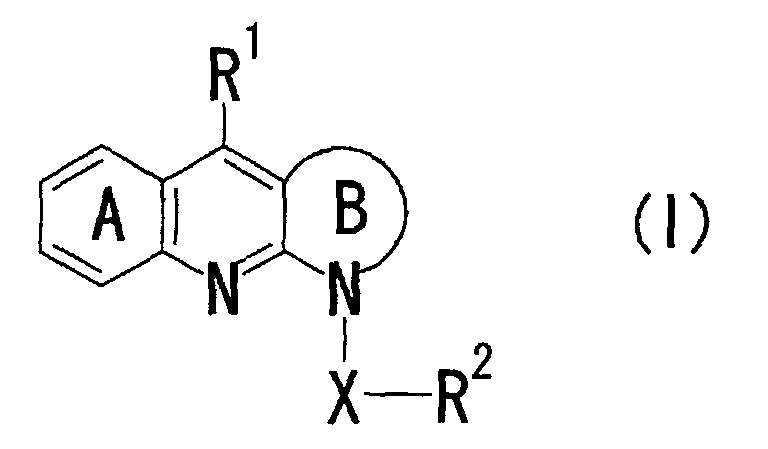
- The agent according to claim 7, wherein A is a benzene ring which may be. substituted by: (1) a hydrocarbon group which may be substituted by (1') halogen, (2') nitro, (3') cyano, (4') hydroxy group, (5') thiol group which may be substituted, (6') amino group which may be substituted, (7') phenyl-C1-4 alkyl, (8') C3-7 cycloalkyl, (9') carboxyl group which may be esterified or amidated, (10') C1-4 alkyl which may be substituted by halogen atom or C1-4 alkoxy, (11') C1-4 alkoxy which may be substituted by halogen atom or C1-4 alkoxy, (12') C1-4 alkylenedioxy, (13') formyl, (14') C2-4 alkanoyl, (15') C1-4 alkylsulfonyl or (16') C1-4 alkylsulfinyl; (2) a heterocyclic group which may be substituted by (1') halogen, (2') nitro, (3') cyano, (4') hydroxy group, (5') thiol group which may be substituted, (6') amino group which may be substituted, (7') phenyl-C1-4 alkyl, (8') C3-7 cycloalkyl, (9') carboxyl group which may be esterified or amidated, (10') C1-4 alkyl which may be substituted by halogen atom or C1-4 alkoxy, (11') C1-4 alkoxy which may be substituted by halogen atom or C1-4 alkoxy, (12') C1-4 alkylenedioxy, (13') formyl, (14') C2-4 alkanoyl, (15') C1-4 alkylsulfonyl, (16') C1-4 alkylsulfinyl; (3) a nitro group; (4) a halogen atom; (5) an amino group which may be substituted by (1') alkyl group which may be substituted, (2') cycloalkyl group which may be substituted, (3') alkenyl group which may be substituted, (4') cycloalkenyl group which may be substituted, (5') aralkyl group which may be substituted, (6') formyl or acyl group which may be substituted, (7') aryl group which may be substituted, (8') heterocyclic group which may be substituted; or (6) a group represented by the formula: R4-Y- (wherein Y is an oxygen atom or sulfur atom which may be oxidized, and R4 is (1) a hydrocarbon group which may be substituted by (1') halogen, (2') nitro, (3') cyano, (4') hydroxy group, (5') thiol group which may be substituted, (6') amino group which may be substituted, (7') phenyl-C1-4 alkyl, (8') C3-7 cycloalkyl, (9') carboxyl group which may be esterified or amidated, (10') C1-4 alkyl which may be substituted by halogen atom or C1-4 alkoxy, (11') C1-4 alkoxy which may be substituted by halogen atom or C1-4 alkoxy, (12') C1-4 alkylenedioxy, (13') formyl, (14') C2-4 alkanoyl, (15') C1-4 alkylsulfonyl or (16') C1-4 alkylsulfinyl or (2) a heterocyclic group which may be substituted by (1') halogen, (2') nitro, (3') cyano, (4') hydroxy group, (5') thiol group which may be substituted, (6') amino group which may be substituted, (7') phenyl-C1-4 alkyl, (8') C3-7 cycloalkyl, (9') carboxyl group which may be esterified or amidated, (10') C1-4 alkyl which may be substituted by halogen atom or C1-4 alkoxy, (11') C1-4 alkoxy which may be substituted by halogen atom or C1-4 alkoxy, (12') C1-4 alkylenedioxy, (13') formyl, (14') C2-4 alkanoyl, (15') C1-4 alkylsulfonyl or (16') C1-4 alkylsulfinyl) .
- The agent according to claim 7, wherein B is a 5-to 8-membered saturated ring which may be substituted by: (1) a hydrocarbon group which may be substituted by (1') halogen, (2') nitro, (3') cyano, (4') hydroxy group, (5') thiol group which may be substituted, (6') amino group which may be substituted, (7') phenyl-C1-4 alkyl, (8') C3-7 cycloalkyl, (9') carboxyl group which may be esterified or amidated, (10') C1-4 alkyl which may be substituted by halogen atom or C1-4 alkoxy, (11') C1-4 alkoxy which may be substituted by halogen atom or C1-4 alkoxy, (12') C1-4 alkylenedioxy, (13') formyl, (14') C2-4 alkanoyl, (15') C1-4 alkylsulfonyl or (16') C1-4 alkylsulfinyl; (2) a heterocyclic group which may be substituted by (1') halogen, (2') nitro, (3') cyano, (4') hydroxy group, (5') thiol group which may be substituted, (6') amino group which may be substituted, (7') phenyl-C1-4 alkyl, (8') C3-7 cycloalkyl, (9') carboxyl group which may be esterified or amidated, (10') C1-4 alkyl which may be substituted by halogen atom or C1-4 alkoxy, (11') C1-4 alkoxy which may be substituted by halogen atom or C1-4 alkoxy, (12') C1-4 alkylenedioxy, (13') formyl, (14') C2-4 alkanoyl, (15') C1-4 alkylsulfonyl or (16') C1-4 alkylsulfinyl; (3) a nitro group; (4) a halogen atom; (5) an amino group which may be substituted by (1') alkyl group which may be substituted, (2') cycloalkyl group which may be substituted, (3') alkenyl group which may be substituted, (4') cycloalkenyl group which may be substituted, (5') aralkyl group which may be substituted, (6') formyl or acyl group which may be substituted, (7') aryl group which may be substituted or (8') heterocyclic group which may be substituted; (6) a group represented by the formula: R4-Y- (wherein Y is oxygen atom or sulfur atom which may be oxidized, and R4 is (1) a hydrocarbon group which may be substituted by (1') halogen, (2') nitro, (3') cyano, (4') hydroxy group, (5') thiol group which may be substituted, (6') amino group which may be substituted, (7') phenyl-C1-4 alkyl, (8') C3-7 cycloalkyl, (9') carboxyl group which may be esterified or amidated, (10') C1-4 alkyl which may be substituted by halogen atom or C1-4 alkoxy, (11') C1-4 alkoxy which may be substituted by halogen atom or C1-4 alkoxy, (12') C1-4 alkylenedioxy, (13') formyl, (14') C2-4 alkanoyl, (15') C1-4 alkylsulfonyl, (16') C1-4 alkylsulfinyl; or (2) a heterocyclic group which may be substituted by (1') halogen, (2') nitro, (3') cyano, (4') hydroxy group, (5') thiol group which may be substituted, (6') amino group which may be substituted, (7') phenyl-C1-4 alkyl, (8') C3-7 cycloalkyl, (9') carboxyl group which may be esterified or amidated, (10') C1-4 alkyl which may be substituted by halogen atom or C1-4 alkoxy, (11') C1-4 alkoxy which may be substituted by halogen atom or C1-4 alkoxy, (12') C1-4 alkylenedioxy, (13') formyl, (14') C2-4 alkanoyl, (15') C1-4 alkylsulfonyl or (16') C1-4 alkylsulfinyl); or (7) an oxo-group.
- The agent according to claim 7, wherein X is a C1-4 alkylene group which may be substituted by: (1) a hydrocarbon group which may be substituted by (1') halogen, (2') nitro, (3') cyano, (4') hydroxy group, (5') thiol group which may be substituted, (6') amino group which may be substituted, (7') phenyl-C1-4 alkyl, (8') C3-7 cycloalkyl, (9') carboxyl group which may be esterified or amidated, (10') C1-4 alkyl which may be substituted by halogen atom or C1-4 alkoxy, (11') C1-4 alkoxy which may be substituted by halogen atom or C1-4 alkoxy, (12') C1-4 alkylenedioxy, (13') formyl, (14') C2-4 alkanoyl, (15') C1-4 alkylsulfonyl or (16') C1-4 alkylsulfinyl; (2) a heterocyclic group which may be substituted by (1') halogen, (2') nitro, (3') cyano, (4') hydroxy group, (5') thiol group which may be substituted, (6') amino group which may be substituted, (7') phenyl-C1-4 alkyl, (8') C3-7 cycloalkyl, (9') carboxyl group which may be esterified or amidated, (10') C1-4 alkyl which may be substituted by halogen atom or C1-4 alkoxy, (11') C1-4 alkoxy which may be substituted by halogen atom or C1-4 alkoxy, (12') C1-4 alkylenedioxy, (13') formyl, (14') C2-4 alkanoyl, (15') C1-4 alkylsulfonyl or (16') C1-4 alkylsulfinyl; (3) a nitro group; (4) a halogen atom; (5) an amino group which may be substituted by (1') alkyl group which may be substituted, (2') cycloalkyl group which may be substituted, (3') alkenyl group which may be substituted, (4') cycloalkenyl group which may be substituted, (5') aralkyl group which may be substituted, (6') formyl or acyl group which may be substituted, (7') aryl group which may be substituted, (8') heterocyclic group which may be substituted; (6) a group represented by the formula: R4-Y-(wherein Y is oxygen atom or sulfur atom which may be oxidized, and R4 is (1) a hydrocarbon group which may be substituted by (1') halogen, (2') nitro, (3') cyano, (4') hydroxy group, (5') thiol group which may be substituted, (6') amino group which may be substituted, (7') phenyl-C1-4 alkyl, (8') C3-7 cycloalkyl, (9') carboxyl group which may be esterified or amidated, (10') C1-4 alkyl which may be substituted by halogen atom or C1-4 alkoxy, (11') C1-4 alkoxy which may be substituted by halogen atom or C1-4 alkoxy, (12') C1-4 alkylenedioxy, (13') formyl, (14') C2-4 alkanoyl, (15') C1-4 alkylsulfonyl or (16') C1-4 alkylsulfinyl; or (2) a heterocyclic group which may be substituted by (1') halogen, (2') nitro, (3') cyano, (4') hydroxy group, (5') thiol group which may be substituted, (6') amino group which may be substituted, (7') phenyl-C1-4 alkyl, (8') C3-7 cycloalkyl, (9') carboxyl group which may be esterified or amidated, (10') C1-4 alkyl which may be substituted by halogen atom or C1-4 alkoxy, (11') C1-4 alkoxy which may be substituted by halogen atom or C1-4 alkoxy, (12') C1-4 alkylenedioxy, (13') formyl, (14') C2-4 alkanoyl, (15') C1-4 alkylsulfonyl or (16') C1-4 alkylsulfinyl); or (7) an oxo-group.
- The agent according to claim 7, wherein X is a methylene group.
- The agent according to claim 7, wherein R1 is an amino group which may be substituted by one or two selected from (1) halogen atom, (2) nitro, (3) cyano, (4) hydroxy group, (5) thiol group which may be substituted, (6) amino group which may be substituted, (7) carboxyl group which may be esterified or amidated, (8) C1-4 alkyl which may be substituted by halogen atom or C1-4 alkoxy, (9) C1-4 alkoxy which may be substituted by halogen atom or C1-4 alkoxy, (10) C1-4 alkylenedioxy, (11) phenyl-C1-4 alkyl, (12) C3-7 cycloalkyl, (13) formyl, (14) C2-4 alkanoyl, (15) C1-4 alkylsulfonyl or (16) lower alkyl group which may be substituted by C1-4 alkylsulfinyl.
- The agent according to claim 7, wherein R2 is a 5- or 6-membered cyclic group which may be substituted by (1) halogen, (2) nitro, (3) cyano, (4) hydroxy group, (5) thiol group which may be substituted, (6) amino group which may be substituted, (7) phenyl-C1-4 alkyl, (8) C3-7 cycloalkyl, (9) carboxyl group which may be esterified or amidated, (10) C1-4 alkyl which may be substituted by halogen atom or C1-4 alkoxy, (11) C1-4 alkoxy which may be substituted by halogen atom or C1-4 alkoxy, (12) C1-4 alkylenedioxy, (13) formyl, (14) C2-4 alkanoyl, (15) C1-4 alkylsulfonyl or (16) C1-4 alkylsulfinyl.
- The agent according to claim 7, wherein R2 is a 5- or 6-membered aromatic ring group which may be substituted by (1) halogen, (2) nitro, (3) cyano, (4) hydroxy group, (5) thiol group which may be substituted, (6) amino group which may be substituted, (7) phenyl-C1-4 alkyl, (8) C3-7 cycloalkyl, (9) carboxyl group which may be esterified or amidated, (10) C1-4 alkyl which may be substituted by halogen atom or C1-4 alkoxy, (11) C1-4 alkoxy which may be substituted by halogen atom or C1-4 alkoxy, (12) C1-4 alkylenedioxy, (13) formyl, (14) C2-4 alkanoyl, (15) C1-4 alkylsulfonyl or (16) C1-4 alkylsulfinyl.
- The agent according to claim 7, wherein R2 is a phenyl group which may be substituted by (1) halogen, (2) nitro, (3) cyano, (4) hydroxy group, (5) thiol group which may be substituted, (6) amino group which may be substituted, (7) phenyl-C1-4 alkyl, (8) C3-7 cycloalkyl, (9) carboxyl group which may be esterified or amidated, (10) C1-4 alkyl which may be substituted by halogen atom or C1-4 alkoxy, (11) C1-4 alkoxy which may be substituted by halogen atom or C1-4 alkoxy, (12) C1-4 alkylenedioxy, (13) formyl, (14) C2-4 alkanoyl, (15) C1-4 alkylsulfonyl or (16) C1-4 alkylsulfinyl.
- A GPR 14 antagonistic agent which comprises a compound of the formula (II):wherein A' is a benzene ring which may have one or more substituent(s) in addition to substituent R3, B is a 5- to 8-membered ring which may be substituted, X is a divalent group containing 1 to 4 atoms in its linear chain, R1' is a substituted amino group, R2 is a cyclic group which may be substituted, R3 is a hydrocarbon group which may be substituted, a heterocyclic group which may be substituted, a nitro group, a halogen atom, an amino group which may be substituted or a group represented by the formula: R4-Y-(wherein Y is an oxygen atom or sulfur atom which may be oxidized, and R4 is a hydrocarbon group which may be substituted or a heterocyclic group which may be substituted) or salts thereof.

- A method for vasoactivating which comprises administering an effective amount of a compound having GPR 14 antagonitic action or salts thereof.
- Use of a compound having GPR 14 antagonitic action or salts thereof for manufacturing vasoactive agents.
- A compound of the formula (II):wherein A' is a benzene ring which may have one or more substituent(s) in addition to substituent R3, B is a 5- to 8-membered ring which may be substituted, X is a divalent group containing 1 to 4 atoms in its linear chain, R1' is a substituted amino group, R2 is a cyclic group which may be substituted, R3 is a hydrocarbon group which may be substituted, heterocyclic group which may be substituted, nitro group, halogen atom, amino group which may be substituted or a group represented by the formula: R4-Y-(wherein Y is an oxygen atom or sulfur atom which may be oxidized, and R4 is a hydrocarbon group which may be substituted or heterocyclic group which may be substituted), with the proviso that the compound is not 2-({1-[(benzyloxy)carbonyl]-6-methoxy-3-methyl-1H-pyrazolo [3,4-b]quinoline-4-yl}amino)acetic acid tert-butyl ester, 2-({1-[(benzyloxy)carbonyl]-6-methoxy-3-methyl-1H-pyrazolo[3,4-b]quinoline-4-yl}amino)acetic acid, 2-({1-[(benzyloxy)carbonyl]-6-methoxy-3-methyl-1H-pyrazolo[3,4-b]quinoline-4-yl}amino)acetic acid sodium salt, 2-({1-[(benzyloxy)carbonyl]-6-methoxy-3-methyl-1H-pyrazolo [3,4-b]quinoline-4-yl}amino)acetyl-alanine tert-butyl ester, 2-({1-[(benzyloxy)carbonyl]-6-methoxy-3-methyl-1H-pyrazolo[3,4-b]quinoline-4-yl}amino)acetyl-methionine tert-butyl ester, and 2-({1-[(benzyloxy)carbonyl]-6-methoxy-3-methyl-1H-pyrazolo[3,4-b]quinoline-4-yl}amino)acetylleucine tert-butyl ester, or salts thereof.
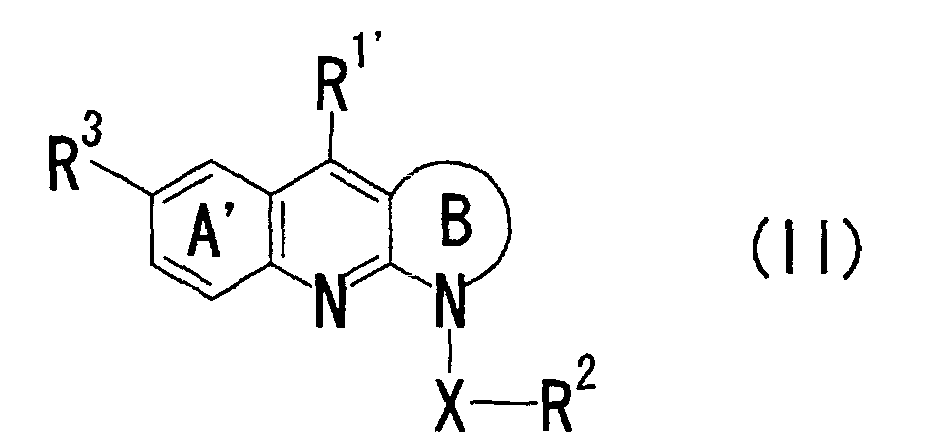
- A compound of the formula (II):wherein A' is a benzene ring which may have one or more substituent(s) in addition to substituent R3, B is a 5- to 8-membered ring which may be substituted, X is C1-4 alkylene group which may be substituted, R1' is a substituted amino group, R2 is a cyclic group which may be substituted, R3 is a hydrocarbon group which may be substituted, heterocyclic group which may be substituted, nitro group, halogen atom, amino group which may be substituted or a group represented by the formula: R4-Y- (wherein Y is an oxygen atom or sulfur atom which may be oxidized, and R4 is a hydrocarbon group which may be substituted or heterocyclic group which may be substituted], or salts thereof.

- A prodrug of the compound or salts thereof according to claim 19 or 20.
- The compound according to claim 19 or 20, wherein R3 is (1) a lower alkyl group which may be substituted by (1') halogen, (2') nitro, (3') cyano, (4') hydroxy group, (5') thiol group which may be substituted, (6') amino group which may be substituted, (7') phenyl-C1-4 alkyl, (8') C3-7 cycloalkyl, (9') carboxyl group which may be esterified or amidated, (10') C1-4 alkyl which may be substituted by halogen atom or C1-4 alkoxy, (11') C1-4 alkoxy which may be substituted by halogen atom or C1-4 alkoxy, (12') C1-4 alkylenedioxy, (13') formyl, (14') C2-4 alkanoyl, (15') C1-4 alkylsulfonyl or (16') C1-4 alkylsulfinyl; (2) a halogen group; (3) a phenyl group which may be substituted by (1') halogen, (2') nitro, (3') cyano, (4') hydroxy group, (5') thiol group which may be substituted, (6') amino group which may be substituted, (7') phenyl-C1-4 alkyl, (8') C3-7 cycloalkyl, (9') carboxyl group which may be esterified or amidated, (10') C1-4 alkyl which may be substituted by halogen atom or C1-4 alkoxy, (11') C1-4 alkoxy which may be substituted by halogen atom or C1-4 alkoxy, (12') C1-4 alkylenedioxy, (13') formyl, (14') C2-4 alkanoyl, (15') C1-4 alkylsulfonyl or (16') C1-4 alkylsulfinyl; or (4) a heterocyclic group which may be substituted by (1') halogen, (2') nitro, (3') cyano, (4') hydroxy group, (5') thiol group which may be substituted, (6') amino group which may be substituted, (7') phenyl-C1-4 alkyl, (8') C3-7 cycloalkyl, (9') carboxyl group which may be esterified or amidated, (10') C1-4 alkyl which may be substituted by halogen atom or C1-4 alkoxy, (11') C1-4 alkoxy which may be substituted by halogen atom or C1-4 alkoxy, (12') C1-4 alkylenedioxy, (13') formyl, (14') C2-4 alkanoyl, (15') C1-4 alkylsulfonyl or (16') C1-4 alkylsulfinyl.
- The compound according to claim 19 or 20, wherein R3 is (1) a lower alkyl group which may be substituted by (1') halogen, (2') nitro, (3') cyano, (4') hydroxy group, (5') thiol group which may be substituted, (6') amino group which may be substituted, (7') phenyl-C1-4 alkyl, (8') C3-7 cycloalkyl, (9') carboxyl group which may be esterified or amidated, (10') C1-4 alkyl which may be substituted by halogen atom or C1-4 alkoxy, (11') C1-4 alkoxy which may be substituted by halogen atom or C1-4 alkoxy, (12') C1-4 alkylenedioxy, (13') formyl, (14') C2-4 alkanoyl, (15') C1-4 alkylsulfonyl or (16') C1-4 alkylsulfinyl; or (2) a halogen atom.
- The compound according to claim 19 or 20, wherein B is a 5- to 8-membered saturated ring which may be substituted by:(1) a hydrocarbon group which may be substituted by (1') halogen, (2') nitro, (3') cyano, (4') hydroxy group, (5') thiol group which may be substituted, (6') amino group which may be substituted, (7') phenyl-C1-4 alkyl, (8') C3-7 cycloalkyl, (9') carboxyl group which may be esterified or amidated, (10') C1-4 alkyl which may be substituted by halogen atom or C1-4 alkoxy, (11') C1-4 alkoxy which may be substituted by halogen atom or C1-4 alkoxy, (12') C1-4 alkylenedioxy, (13') formyl, (14') C2-4 alkanoyl, (15') C1-4 alkylsulfonyl or (16') C1-4 alkylsulfinyl; (2) a heterocyclic group which may be substituted by (1') halogen, (2') nitro, (3') cyano, (4') hydroxy group, (5') thiol group which may be substituted, (6') amino group which may be substituted, (7') phenyl-C1-4 alkyl, (8') C3-7 cycloalkyl, (9') carboxyl group which may be esterified or amidated, (10') C1-4 alkyl which may be substituted by halogen atom or C1-4 alkoxy, (11') C1-4 alkoxy which may be substituted by halogen atom or C1-4 alkoxy, (12') C1-4 alkylenedioxy, (13') formyl, (14') C2-4 alkanoyl, (15') C1-4 alkylsulfonyl or (16') C1-4 alkylsulfinyl; (3) a nitro group; (4) a halogen atom; (5) an amino group which may be substituted by (1') alkyl group which may be substituted, (2') cycloalkyl group which may be substituted, (3') alkenyl group which may be substituted, (4') cycloalkenyl group which may be substituted, (5') aralkyl group which may be substituted, (6') formyl or acyl group which may be substituted, (7') aryl group which may be substituted, (8') heterocyclic group which may be substituted; (6) a group represented by the formula: R4-Y- (wherein Y is an oxygen atom or sulfur atom which may be oxidized, and R4 is (1) a hydrocarbon group which may be substituted by (1') halogen, (2') nitro, (3') cyano, (4') hydroxy group, (5') thiol group which may be substituted, (6') amino group which may be substituted, (7') phenyl-C1-4 alkyl, (8') C3-7 cycloalkyl, (9') carboxyl group which may be esterified or amidated, (10') C1-4 alkyl which may be substituted by halogen atom or C1-4 alkoxy, (11') C1-4 alkoxy which may be substituted by halogen atom or C1-4 alkoxy, (12') C1-4 alkylenedioxy, (13') formyl, (14') C2-4 alkanoyl, (15') C1-4 alkylsulfonyl or (16') C1-4 alkylsulfinyl, or (2) a heterocyclic group which may be substituted by (1') halogen, (2') nitro, (3') cyano, (4') hydroxy group, (5') thiol group which may be substituted, (6') amino group which may be substituted, (7') phenyl-C1-4 alkyl, (8') C3-7 cycloalkyl, (9') carboxyl group which may be esterified or amidated, (10') C1-4 alkyl which may be substituted by halogen atom or C1-4 alkoxy, (11') C1-4 alkoxy which may be substituted by halogen atom or C1-4 alkoxy, (12') C1-4 alkylenedioxy, (13') formyl, (14') C2-4 alkanoyl, (15') C1-4 alkylsulfonyl or (16') C1-4 alkylsulfinyl); or (7) an oxo-group.
- The compound according to claim 19 or 20, wherein X is a methylene group.
- The compound according to claim 19 or 20, wherein
R2 is a 5- or 6-membered cyclic ring which may be substituted by (1) halogen, (2) nitro, (3) cyano, (4) hydroxy group, (5) thiol group which may be substituted, (6) amino group which may be substituted, (7) phenyl-C1-4 alkyl, (8) C3-7 cycloalkyl, (9) carboxyl group which may be esterified or amidated, (10) C1-4 alkyl which may be substituted by halogen atom or C1-4 alkoxy, (11) C1-4 alkoxy which may be substituted by halogen atom or C1-4 alkoxy, (12) C1-4 alkylenedioxy, (13) formyl, (14) C2-4 alkanoyl, (15) C1-4 alkylsulfonyl or (16) C1-4 alkylsulfinyl. - The compound according to claim 19 or 20, wherein R2 is a 5- or 6-membered aromatic ring group which may be substituted by (1) halogen, (2) nitro, (3) cyano, (4) hydroxy group, (5) thiol group which may be substituted, (6) amino group which may be substituted, (7) phenyl-C1-4 alkyl, (8) C3-7 cycloalkyl, (9) carboxyl group which may be esterified or amidated, (10) C1-4 alkyl which may be substituted by halogen atom or C1-4 alkoxy, (11) C1-4 alkoxy which may be substituted by halogen atom or C1-4 alkoxy, (12) C1-4 alkylenedioxy, (13) formyl, (14) C2-4 alkanoyl, (15) C1-4 alkylsulfonyl or (16) C1-4 alkylsulfinyl.
- The compound according to claim 19 or 20, wherein R2 is a phenyl group which may be substituted by (1) halogen, (2) nitro, (3) cyano, (4) hydroxy group, (5) thiol group which may be substituted, (6) amino group which may be substituted, (7) phenyl-C1-4 alkyl, (8) C3-7 cycloalkyl, (9) carboxyl group which may be esterified or amidated, (10) C1-4 alkyl which may be substituted by halogen atom or C1-4 alkoxy, (11) C1-4 alkoxy which may be substituted by halogen atom or C1-4 alkoxy, (12) C1-4 alkylenedioxy, (13) formyl, (14) C2-4 alkanoyl, (15) C1-4 alkylsulfonyl or (16) C1-4 alkylsulfinyl.
- The compound according to claim 19 or 20, wherein:R1 is an amino group which is substituted by a lower alkyl group which may be substituted by one or two of (1) halogen atom, (2) nitro, (3) cyano, (4) hydroxy group, (5) thiol group which may be substituted, (6) amino group which may be substituted, (7) carboxyl group which may be esterified or amidated, (8) C1-4 alkyl which may be substituted by halogen atom or C1-4 alkoxy, (9) C1-4 alkoxy which may be substituted by halogen atom or C1-4 alkoxy, (10) C1-4 alkylenedioxy, (11) phenyl-C1-4 alkyl, (12) C3-7 cycloalkyl, (13) formyl, (14) C2-4 alkanoyl, (15) C1-4 alkylsulfonyl or (16) C1-4 alkylsulfinyl.
- A pharmaceutical composition which comprises a compound or salts thereof according to claim 19 or 20 or prodrugs thereof;
- The pharmaceutical composition according to claim 30 wherein said pharmaceutical composition is a GPR 14 antagonistic agent.
- A method for antagonizing GPR14 which comprises administering an effective amount of a compound of the formula (I):[wherein A is a benzene ring which may be substituted, B is a 5- to 8-membered ring which may be substituted, X is a divalent group containing 1 to 4 atom(s) in its linear chain, R1 is an amino group which may be substituted, and R2 is a cyclic group which may be substituted]or salts thereof.
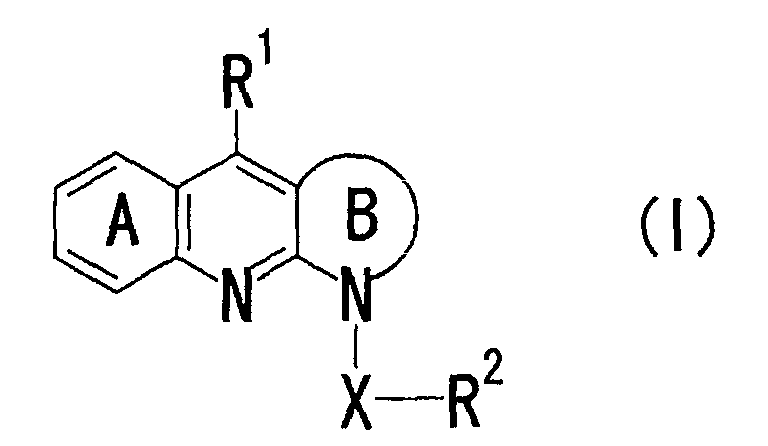
- A method for antagonizing GPR14 which comprises administering an effective amount of a compound of the formula (II):[wherein A' is a benzene ring which may have one or more substituent(s) in addition to substituent R3, B is a 5- to 8-membered ring which may be substituted, X is a divalent group containing 1 to 4 atoms in its linear chain, R1' is a substituted amino group, R2 is a cyclic group which may be substituted, R3 is a hydrocarbon group which may be substituted, heterocyclic group which may be substituted, nitro group, halogen atom, amino group which may be substituted or a group represented by the formula: R4-Y-(wherein Y is an oxygen atom or sulfur atom which may be oxidized, and R4 is a hydrocarbon group which may be substituted or heterocyclic group which may be substituted)] or salts thereof.

- Use of a compound of the formula (I):[wherein A is a benzene ring which may be substituted, B is a 5- to 8-membered ring which may be substituted, X is a divalent group containing 1 to 4 atoms in its linear chain, R1 is an amino group which may be substituted, and R2 is a cyclic group which may be substituted] or salts thereof for manufacturing GPR 14 antagonistic agent.
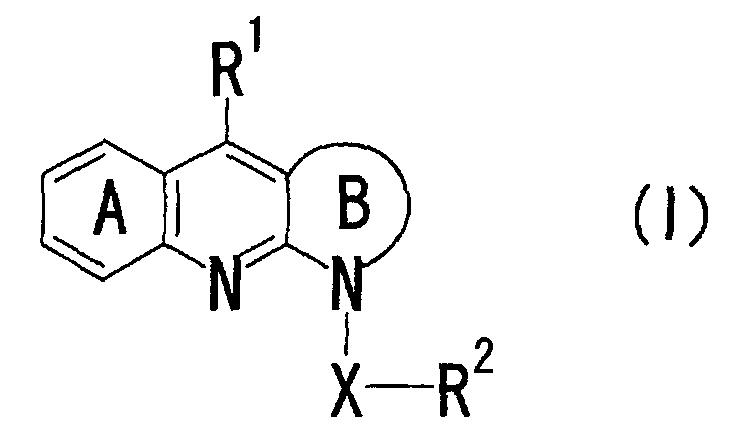
- Use of a compound of the formula (II)[wherein A' is a benzene ring which may have one or more substituent(s) in addition to substituent R3, B is a 5- to 8-membered ring which may be substituted, X is a divalent group containing 1 to 4 atoms in its linear chain, R1' is a substituted amino group, R2 is a cyclic group which may be substituted, R3 is a hydrocarbon group which may be substituted, heterocyclic group which may be substituted, nitro group, halogen atom, amino group which may be substituted or a group represented by the formula: R4-Y-(wherein Y is an oxygen atom or sulfur atom which may be oxidized, and R4 is a hydrocarbon group which may be substituted or heterocyclic group which may be substituted)] or salts thereof for manufacturing GPR 14 antagonistic agent.
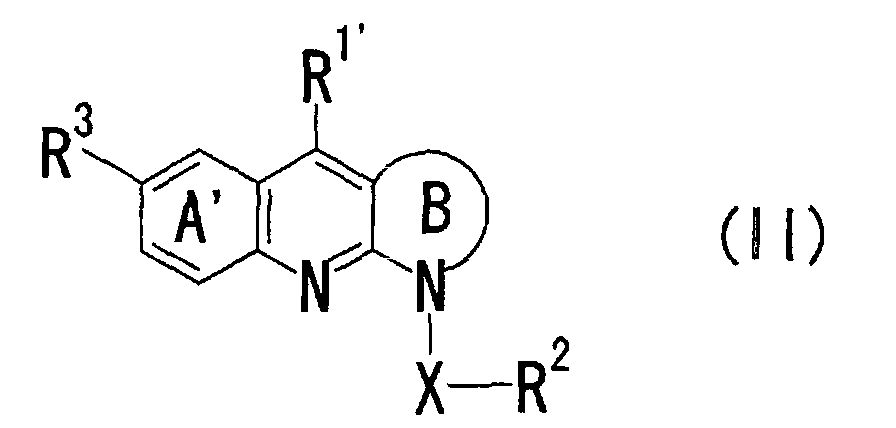
Applications Claiming Priority (3)
| Application Number | Priority Date | Filing Date | Title |
|---|---|---|---|
| JP2000067213 | 2000-03-07 | ||
| JP2000067213 | 2000-03-07 | ||
| PCT/JP2001/001717 WO2001066143A1 (en) | 2000-03-07 | 2001-03-06 | Vasoactive agents |
Publications (2)
| Publication Number | Publication Date |
|---|---|
| EP1262195A1 true EP1262195A1 (en) | 2002-12-04 |
| EP1262195A4 EP1262195A4 (en) | 2003-05-21 |
Family
ID=18586443
Family Applications (1)
| Application Number | Title | Priority Date | Filing Date |
|---|---|---|---|
| EP01908338A Withdrawn EP1262195A4 (en) | 2000-03-07 | 2001-03-06 | VASOAKTIEVE AGENTIA |
Country Status (4)
| Country | Link |
|---|---|
| EP (1) | EP1262195A4 (en) |
| AU (1) | AU2001236100A1 (en) |
| CA (1) | CA2402096A1 (en) |
| WO (1) | WO2001066143A1 (en) |
Cited By (2)
| Publication number | Priority date | Publication date | Assignee | Title |
|---|---|---|---|---|
| WO2004038408A3 (en) * | 2002-10-24 | 2005-01-20 | Bayer Healthcare Ag | Diagnostics and therapeutics for diseases associated with human g-protein coupled receptor 14 (gpr14) |
| US7115630B2 (en) | 2000-10-02 | 2006-10-03 | Janssen Pharmaceutica N.V. | Metabotropic glutamate receptor antagonists |
Families Citing this family (8)
| Publication number | Priority date | Publication date | Assignee | Title |
|---|---|---|---|---|
| WO2001074790A2 (en) * | 2000-03-30 | 2001-10-11 | The Penn State Research Foundation | Novel compounds for enhancing chemotherapy |
| EP1295867A4 (en) | 2000-06-28 | 2005-03-30 | Takeda Pharmaceutical | biphenyl |
| EP1308513A4 (en) * | 2000-08-10 | 2008-07-09 | Takeda Pharmaceutical | USE OF POLYPEPTIDE |
| ES2254772T3 (en) | 2001-12-04 | 2006-06-16 | Actelion Pharmaceuticals Ltd. | 4- (PIPERIDIL-Y PIRROLIDIL-ALQUIL-UREIDO) -CHINOLEINS AS ANTHROGONIST RECEIVERS OF UROTENSIN II. |
| WO2003064646A1 (en) * | 2002-01-25 | 2003-08-07 | Takeda Chemical Industries, Ltd. | Novel peptide and use thereof |
| UA78548C2 (en) * | 2002-03-29 | 2007-04-10 | Janssen Pharmaceutica Nv | Radiolabelled quinoline and quinolinone derivatives and use thereof as metabotropic ligands of glutamate receptor |
| CA2540196C (en) | 2003-09-26 | 2012-03-20 | Actelion Pharmaceuticals Ltd | Pyridine derivatives and use thereof as urotensin ii antagonists |
| AR051213A1 (en) | 2004-10-12 | 2006-12-27 | Actelion Pharmaceuticals Ltd | 1- (2- (4-BENCIL-4-HIDROXI-PIPERIDIN-1-IL) -ETIL) -3- (2-METHYL-QUINOLIN-4-IL) -UREA AS A CRYSTALLINE SULFATE SALT |
Family Cites Families (9)
| Publication number | Priority date | Publication date | Assignee | Title |
|---|---|---|---|---|
| JPS4830280B1 (en) * | 1968-07-12 | 1973-09-18 | ||
| EP0430485A3 (en) * | 1989-11-29 | 1992-01-22 | Ube Industries, Ltd. | Quinoline compound |
| US5608067A (en) * | 1993-12-09 | 1997-03-04 | Afonso; Adriano | 4-substituted pyrazoloquinoline derivatives |
| US5488055A (en) * | 1995-03-10 | 1996-01-30 | Sanofi Winthrop Inc. | Substituted N-cycloalkylmethyl-1H-pyrazolo(3,4-b)quinolin-4 amines and compositions and methods of use thereof |
| US6159700A (en) * | 1997-01-27 | 2000-12-12 | Smithkline Beecham Corporation | Method of finding agonist and antagonist to human and rat GPR14 |
| US5851798A (en) * | 1997-01-27 | 1998-12-22 | Smithkline Beecham Corporation | Nucleic acid encoding human GPR14 receptor |
| US5942520A (en) * | 1998-01-27 | 1999-08-24 | Cell Pathways, Inc. | Method for inhibiting neoplastic cells by exposure to substituted N-cycloalkylmethyl-1-H-pyrazolo (3,4-B) quinolone-4 amines |
| CA2352760A1 (en) * | 1998-11-30 | 2000-06-08 | Takeda Chemical Industries, Ltd. | Novel physiologically active substance, process for producing the same and utilization thereof |
| WO2001004298A1 (en) * | 1999-07-08 | 2001-01-18 | Takeda Chemical Industries, Ltd. | Novel physiologically active substance, process for producing the same and use thereof |
-
2001
- 2001-03-06 CA CA002402096A patent/CA2402096A1/en not_active Abandoned
- 2001-03-06 WO PCT/JP2001/001717 patent/WO2001066143A1/en not_active Ceased
- 2001-03-06 EP EP01908338A patent/EP1262195A4/en not_active Withdrawn
- 2001-03-06 AU AU2001236100A patent/AU2001236100A1/en not_active Abandoned
Cited By (3)
| Publication number | Priority date | Publication date | Assignee | Title |
|---|---|---|---|---|
| US7115630B2 (en) | 2000-10-02 | 2006-10-03 | Janssen Pharmaceutica N.V. | Metabotropic glutamate receptor antagonists |
| US7629468B2 (en) | 2000-10-02 | 2009-12-08 | Janssen Pharmaceutica Nv | Metabotropic glutamate receptor antagonists |
| WO2004038408A3 (en) * | 2002-10-24 | 2005-01-20 | Bayer Healthcare Ag | Diagnostics and therapeutics for diseases associated with human g-protein coupled receptor 14 (gpr14) |
Also Published As
| Publication number | Publication date |
|---|---|
| AU2001236100A1 (en) | 2001-09-17 |
| EP1262195A4 (en) | 2003-05-21 |
| CA2402096A1 (en) | 2001-09-13 |
| WO2001066143A1 (en) | 2001-09-13 |
Similar Documents
| Publication | Publication Date | Title |
|---|---|---|
| AU751139B2 (en) | Amide derivative | |
| US7625887B2 (en) | Receptor agonists | |
| US7091247B2 (en) | Biphenyl compound | |
| US7026320B2 (en) | Serotonergic agents | |
| JP2000128842A (en) | Quarternary ammonium salt derivative and its application | |
| TW201629026A (en) | 3-alkylbicyclo[4,5,0]hydroxamic acid as HDAC inhibitor | |
| KR101017140B1 (en) | (2-Carboxamido) (3-amino) thiophene compound | |
| JP2004532834A (en) | Non-imidazole arylalkylamine compounds that are histamine H3 receptor antagonists, their production and therapeutic use | |
| EP2167083B1 (en) | 1- heteroaryl-3-azabicyclo[3.1.0]hexanes, methods for their preparation and their use as medicaments | |
| KR20030059084A (en) | Carboxamide compounds and their use as antagonists of a human 11cby receptor | |
| KR20070070233A (en) | (2-Carboxamido) (3-amino) thiophene compound | |
| CN101258131B (en) | 6-Aralkylamino-2,3,4,5-tetrahydro-1H-benzo[d]azepines as 5-HT2c receptor agonists | |
| US20160031863A1 (en) | Histone deacetylase inhibitors and compositions and methods of use thereof | |
| JP4740116B2 (en) | 5-HT receptor antagonists for the treatment of psychiatric and neurological disorders | |
| EA006237B1 (en) | Aminoalkylbenzoylbenzofuran derivatives, method for preparing same and compositions containing same | |
| CA2402096A1 (en) | Vasoactive agents | |
| CZ2003525A3 (en) | Aminoalkoxybenzoyl- benzofuran or benzothiophene derivatives, process of their preparation and preparations in which the derivatives are comprised | |
| KR20050119195A (en) | Pyrazole compounds | |
| JPH09506880A (en) | Annelated dihydropyridine and its use for preparing pharmaceutical formulations | |
| EP0950418A2 (en) | Composition for preventing or treating ischemic disease | |
| IE880970L (en) | Benzofuran derivatives | |
| US20040063699A1 (en) | Gpr14 antagonist | |
| WO2022134837A1 (en) | Pyrrole derivative, and preparation method and use therefor | |
| US20030139442A1 (en) | Vasoactive agents | |
| CN110392571B (en) | Substituted 3-dialkylaminomethyl-piperidin-4-yl-benzamides and methods for their preparation and use |
Legal Events
| Date | Code | Title | Description |
|---|---|---|---|
| PUAI | Public reference made under article 153(3) epc to a published international application that has entered the european phase |
Free format text: ORIGINAL CODE: 0009012 |
|
| 17P | Request for examination filed |
Effective date: 20020816 |
|
| AK | Designated contracting states |
Kind code of ref document: A1 Designated state(s): AT BE CH CY DE DK ES FI FR GB GR IE IT LI LU MC NL PT SE TR |
|
| AX | Request for extension of the european patent |
Free format text: AL;LT;LV;MK;RO;SI |
|
| A4 | Supplementary search report drawn up and despatched |
Effective date: 20030403 |
|
| RAP1 | Party data changed (applicant data changed or rights of an application transferred) |
Owner name: TAKEDA PHARMACEUTICAL COMPANY LIMITED |
|
| STAA | Information on the status of an ep patent application or granted ep patent |
Free format text: STATUS: THE APPLICATION HAS BEEN WITHDRAWN |
|
| 17Q | First examination report despatched |
Effective date: 20061113 |
|
| 18W | Application withdrawn |
Effective date: 20061120 |