EP1261224A2 - System and protocol for extending functionality of wireless communication messaging - Google Patents
System and protocol for extending functionality of wireless communication messaging Download PDFInfo
- Publication number
- EP1261224A2 EP1261224A2 EP02011270A EP02011270A EP1261224A2 EP 1261224 A2 EP1261224 A2 EP 1261224A2 EP 02011270 A EP02011270 A EP 02011270A EP 02011270 A EP02011270 A EP 02011270A EP 1261224 A2 EP1261224 A2 EP 1261224A2
- Authority
- EP
- European Patent Office
- Prior art keywords
- message
- sms
- picture
- frame
- messages
- Prior art date
- Legal status (The legal status is an assumption and is not a legal conclusion. Google has not performed a legal analysis and makes no representation as to the accuracy of the status listed.)
- Granted
Links
Images


Classifications
-
- H—ELECTRICITY
- H04—ELECTRIC COMMUNICATION TECHNIQUE
- H04W—WIRELESS COMMUNICATION NETWORKS
- H04W4/00—Services specially adapted for wireless communication networks; Facilities therefor
- H04W4/12—Messaging; Mailboxes; Announcements
- H04W4/14—Short messaging services, e.g. short message services [SMS] or unstructured supplementary service data [USSD]
-
- H—ELECTRICITY
- H04—ELECTRIC COMMUNICATION TECHNIQUE
- H04W—WIRELESS COMMUNICATION NETWORKS
- H04W4/00—Services specially adapted for wireless communication networks; Facilities therefor
- H04W4/18—Information format or content conversion, e.g. adaptation by the network of the transmitted or received information for the purpose of wireless delivery to users or terminals
Definitions
- the present invention relates to providing messages in the form of at least text and pictures from one mobile terminal to another using for example the so-called Short Message Service (SMS). More particularly, the present invention relates to extending the functionality of wireless communication messaging, such as SMS-based picture messaging, so that for example a sequence of related SMS picture messages in a predetermined order can be provided to or from a mobile terminal, the extending being accomplished in such a way that a mobile terminal that is compatible with SMS-based picture messaging can interpret at least a part of a message conveyed according to the invention.
- SMS-based picture messaging so that for example a sequence of related SMS picture messages in a predetermined order can be provided to or from a mobile terminal, the extending being accomplished in such a way that a mobile terminal that is compatible with SMS-based picture messaging can interpret at least a part of a message conveyed according to the invention.
- SMS short messaging service
- SMS Short Message Service
- a simple graphic message service provides a black-and-white picture, for instance 72 x 28 pixels, along with a short greeting displayed below the picture.
- a maximum size of the greeting is specified, for example 120 characters.
- An application co-filed with the present application and owned by the owner of the present application discloses a type of message that addresses the needs left unfulfilled by the prior art.
- the type of message disclosed there includes a plurality of linked frames, each frame including either text or a picture or both, so that a single message consists of a sequence of frames, in the order in which they are linked together.
- a sender sends such a message as a single, unified message, rather than as three individual SMS picture messages.
- a receiver of such a message is able to view the message, usually frame-by-frame (although future equipment might allow for viewing all of the frames at the same time), save it, and use it as a basis for a message the recipient would later create and send to a third party.
- the co-filed application does not, however, indicate any particular mechanism by which the individual frames of the sequential-frame message, called a funny (as in the funnies or comics of some newspapers), would be linked together so that sending and receiving equipment is able to refer to the message and manipulate it as a unified entity.
- What is needed is a mechanism for linking together the frames of a funny (a sequence of frames of pictures and associated text) so that the funny can be manipulated (viewed, edited, sent and received) as a single entity by a mobile station, preserving the order of the individual frames of the funny.
- a mechanism would allow existing equipment to properly manipulate a funny, or at least part of a funny, rather than simply signaling to the user of the equipment that a message (of some sort) has been received but cannot be displayed.
- the present invention provides an apparatus and corresponding method for extending the functionality of a message according to a predetermined message format, for use when communicating one or more messages at least in part via a wireless communication system from a sending terminal to a receiving terminal, either of which may be a mobile terminal, the message format providing a user data field, the method including the steps of: determining a number of bits at the end of the user data field to be used to convey extension data; defining the information to be conveyed by each bit; inserting extension data into the user data field in the determined number of bits at the end of the user data field; wherein the extension data includes information indicating instructions associated with displaying the message, thereby providing an extension to the messaging according to the predetermined format that is effective for mobile terminals adapted to interpret the extension data but does not prevent mobile terminals not so adapted from displaying the message without regard for the instructions indicated by the extension data.
- the message format is for a message including a picture and each picture message includes a picture and possibly some associated text
- the method also includes the steps of: inserting into the user data field at least some of the text to be associated with the picture; and inserting at least some of the picture into the user data field after the text.
- the predetermined message format is the short message service (SMS) picture message format.
- SMS short message service
- an ordered sequence of SMS picture messages is conveyed as a single message object logically organized into frames, each frame consisting of and conveyed as one or more SMS picture messages, and for frames consisting of only one SMS picture message, the SMS extension data is included after the picture in the only one SMS picture message, but in each frame consisting of multiple SMS picture messages, the SMS extension data is included after the picture in the last SMS picture message of the multiple SMS picture messages making up the frame.
- the method also includes the step of inserting SMS message concatenation data into the user data field of each SMS message used to convey the frame so as to indicate the individual SMS messages and their order to be used to convey the frame.
- the SMS extension data includes a message identifier and also the order number or other identifier of the current frame for use by the receiving terminal in ordering the frames of the multi-frame message, and in some of these applications, the SMS extension data further includes the SMS message number of the SMS message to be used to convey a frame too long to be conveyed by a single SMS message.
- the invention thus extends the functionality of wireless communication messaging by providing a mechanism for manipulating funnies based on an approach that provides additional data in the existing message structure.
- An advantage of such an approach is that the mechanism is backwards compatible with existing picture messaging applications.
- a user can at least send funnies to those existing mobile phones that support picture messaging (e.g. especially Nokia 3210 and 3310, and in addition Nokia 6210, 8210, 8850, and 8890).
- a further advantage of an approach based on providing additional data in an existing SMS messaging infrastructure is that it is possible to also provide new value-added features to the existing SMS messaging infrastructure without losing backwards compatibility, and with existing billing and transmitting capabilities.
- a drawback of the approach is that the actual payload of the message is decreased with the size of the additional data.
- the present invention is a protocol that extends the functionality of SMS-based picture messaging, so that for example a sequence of related SMS picture messages in a predetermined order can be provided to or from a mobile terminal, the extending being accomplished in such a way that a mobile terminal that is compatible with SMS-based picture messaging can interpret at least a part of a message conveyed according to the invention.
- An ordered sequence of SMS-based picture messages is here called a funny, as explained below.
- the invention provides that such terminals will nevertheless be able to display at least part of an SMS-based picture message according to the invention, thereby providing at least partial backwards (toward earlier model mobile terminals) compatibility.
- the invention is not restricted to making possible the conveying of funnies via SMS messages (in a partially backwards compatible way), but makes possible conveying to a mobile terminal (as opposed to the operator of the mobile terminal) any information or instructions that can be encoded in the byte-budget provided by a particular embodiment of the invention, such as for example instructions that the mobile terminal is to vibrate when displaying a picture message, one that may or may not be a part of a funny.
- the invention could be used to provided a key to decrypting encrypted text to accompany a picture. Older mobile terminals could see the picture, but would not read the key for opening the text. Mobile phones adapted to be compatible with the invention would notice the key provided according to the invention, and so would display the text (after decrypting it), if the user provides a correct password when prompted by the mobile terminal.
- the display of a mobile terminal can be used to display a sequence of pictures and associated text, each picture and associated text called a frame, that in combination and in a particular order make up a message that can be sent to another mobile terminal.
- Such an ordered sequence of pictures and associated text make up what is here called a funny, using the term funny in the sense of a comic strip, which usually consists of three individual frames, each frame including a picture and associated text.
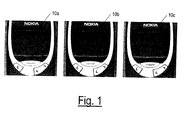
- Fig. 1 shows a message according to the invention consisting of three frames 10a 10b 10c, the text for the first frame beginning "How boring ... ,” the text for the next frame beginning "Huge meteor!”, and so on.
- a funny according to the invention can also include special effects such as sound and vibration effects, so as to provide messages that can be even more expressive than messages consisting of only text and pictures.
- the user assembles pictures (usually selecting the pictures from a library of images) and provides associated text so as to create a single, personalized message.
- Such messages can be created and sent using either a mobile terminal or using a desktop or web application, instead of a mobile terminal.
- Funnies are preferably implemented based on the existing short message service (SMS) in a way that allows sending and receiving funnies using equipment with the functionality to make use of the SMS picture messaging.
- SMS short message service
- a funny can be sent using wireless application protocol (WAP) bookmarks so that an intended recipient of a funny would download pictures using WAP.
- WAP wireless application protocol
- the disadvantage of providing funnies based on WAP is that it is likely that the cost to the user would be greater than funnies based on SMS.
- a funny can be sent using the so-called multimedia messaging service (MMS).
- MMS multimedia messaging service
- a mechanism according to the invention for conveying a funny as a single, unified object to a mobile phone having an SMS capability is shown.
- the invention encompasses a mechanism in case each frame of a funny can be transmitted as a single SMS message (illustrated in Fig. 2), and also in case a frame of a funny must be transmitted as more than one message (illustrated in Figs. 3A-B).
- a single Transport Protocol User Data (TP-UD) field of an SMS message conveying a frame of a funny in case the entire frame can be conveyed by a single SMS picture message.
- TP-UD Transport Protocol User Data
- the full funny is transmitted frame-by-frame, one frame per SMS picture message, by the sending application after the sending application inserts extra data, called here SMS extension data, into the SMS message after the bitmap information used for conveying a picture.
- SMS extension data guide the receiving application in how it manipulates (displays and saves) the funny being received.
- the application understands from the SMS extension data that what is being received is an ordered sequence of frames, each including possibly both a picture and associated text, (i.e. a funny), and for a given SMS picture message conveying a particular frame of the funny, the order in the sequence of the frame being conveyed by the SMS picture message.
- a picture and associated text i.e. a funny
- section 9.2.3 of Digital cellular telecommunications system Phase 2+
- Technical realization of the Short Message Service (SMS) Point-to-Point GSM 03.40
- SMS Short Message Service
- GSM 03.40 Technical realization of the Short Message Service Point-to-Point
- the present invention achieves much more than providing for concatenating SMS-based picture messages, as mentioned above.
- the invention allows for having a long frame of a funny, one that must be conveyed by several SMS messages concatenated according to the prior art, and having the long frame be one of several frames concatenated according to the invention.
- the SMS extension data are added after the last bitmap information section in the last SMS message being used to convey the frame. As shown in Fig.
- the first SMS message of the sequence being used to convey a single frame of a multi-frame funny includes no SMS extension data, but does include standard SMS message concatenation information immediately following the SMS header to indicate that the first SMS message is to be concatenated with one or more subsequent SMS messages, as known in the art and as set out in Section 9.2.3 of Digital cellular telecommunications system (Phase 2+); Technical realization of the Short Message Service (SMS) Point-to-Point (GSM 03.40) , hereby incorporated by reference as background.
- SMS Short Message Service
- GSM 03.40 Technical realization of the Short Message Service Point-to-Point
- the last SMS message being used to convey a long frame of a funny includes the extra data (5 bytes) added after the bitmap being used to convey the last part of the frame.
- the concatenating mechanism that is a standard element of the SMS message (i.e. the SMS message concatenation information) works with the SMS extension data of the invention to allow for funnies including frames too long to be conveyed by a single SMS message.
- the SMS extension data is essentially frame concatenation data, and includes:
- a specific implementation for conveying a funny according to the preferred embodiment is as follows:
- the SMS extension data for a funny in some embodiments could also include instructions to the receiving equipment to exhibit special effects such as vibration when displaying a frame.
- the SMS extension data of one or more frames includes, in some embodiments, instructions for a frame or for the entire funny to self-destruct after some indicated date and time.
- a mobile terminal includes a composer that enables a user to compose an extension to an SMS message, such as in creating a funny (the composing of a funny being done optionally by altering an existing funny or by pasting into the frames of the funny being created a picture downloaded from a service), a (non-volatile) memory for holding one or more extended SMS messages (such as funnies), a display (a screen) for displaying extended SMS messages (including for example displaying at least one frame of a funny at a time or for displaying an entire funny all at once in case of a mobile terminal having a wide display), and an operating system.
- a composer that enables a user to compose an extension to an SMS message, such as in creating a funny (the composing of a funny being done optionally by altering an existing funny or by pasting into the frames of the funny being created a picture downloaded from a service), a (non-volatile) memory for holding one or more extended SMS messages (such as funnies), a display (a screen) for displaying
- the operating system inserts the SMS extension data into the user data field of SMS messages being extended according to the invention, and also interprets SMS extension data in received SMS messages.
- the operating system also provides for executing commands from a user to access to one or more extended SMS messages (including for example for accessing entire funnies) commands for editing, viewing, storing, and sending an extended SMS message or series of SMS messages in case of a funny, or for listing extended SMS message in memory (and in so doing preferably indicating all of the frames of a funny and all of the SMS messages that would be used to convey a single funny as a single unified object), and so on.
- the system also includes an electromechanical or piezoelectric device that is operative at the command of the operating system for vibrating the mobile terminal during display of an extended SMS message.
- the system includes a service for providing funnies that can be downloaded by a user into a mobile terminal and then altered to personalize them for use as a personal message to someone, or used as is.
- the SMS extension data allows for encoding many different kinds of instructions to a mobile terminal adapted according to the invention, such as instructions for handling funnies, for handling encrypted text, for exhibiting special effects such as vibration when displaying an SMS picture message, and even for handling animated funnies, in which the picture of an SMS picture message is a motion picture. All of this is done, according to the invention as explained above, in a way that allows mobile terminals not adapted according to the invention to display at least part of an SMS picture message even though it is extended according to the invention, rather than simply signaling to a user that the mobile terminal has received a message it cannot display.
- the present invention has been shown and described as a way of extending the functionality of SMS picture messages, the invention is intended to comprehend appending messaging extension data not only to SMS picture messages, but to messages according to any format.
- what the invention aims to provide is not merely an extension of the functionality of messages according to a given format or protocol, but an extension of the functionality of messages in such a way that older equipment, not adapted for the extended functionality, can at least display a message according to its original, non-extended functionality.
- the present invention comprehends providing message extension data at the end of messages encoded according to any predetermined format or protocol, including for example GRPS (General Radio Packet Service), I-Mode (wireless, continuous internet connection mobile phone), WAP (wireless access protocol) or 3G (third generation mobile phone) systems.
- GRPS General Radio Packet Service
- I-Mode wireless, continuous internet connection mobile phone
- WAP wireless access protocol
- 3G third generation mobile phone
- An apparatus and method for extending the functionality of a message according to a predetermined message format such as the Short Message Service (SMS) format, communicated at least in part via a wireless communication system, the method including the steps of: determining a number of bits to be used for conveying extension data indicating instructions associated with displaying the message; defining the information to be conveyed by each bit; and inserting the extension data into the message at the end of a user data field of the message.
- SMS Short Message Service
- the method thus provides an extension to the messaging according to the predetermined format, an extension that is effective for mobile terminals adapted to interpret the extension data but that does not prevent mobile terminals not so adapted from displaying the message without regard for the instructions indicated by the extension data.
Landscapes
- Engineering & Computer Science (AREA)
- Computer Networks & Wireless Communication (AREA)
- Signal Processing (AREA)
- Mobile Radio Communication Systems (AREA)
- Telephonic Communication Services (AREA)
- Computer And Data Communications (AREA)
Abstract
Description
- Byte 1:
- application type (e.g. funny application: 0x01);
- Byte 2:
- number of total SMS messages;
- Byte 3:
- application data 0 (funny identifier);
- Byte 4:
- application data 1 (current frame);
- Byte 5:
- application data 2 (current SMS of the frame);
- Byte 6:
- application data 3 (future extensions); and
- Byte 7:
- application data 4 (version number of the funny format).
An apparatus and method for extending the functionality of a message according to a predetermined message format, such as the Short Message Service (SMS) format, communicated at least in part via a wireless communication system, the method including the steps of: determining a number of bits to be used for conveying extension data indicating instructions associated with displaying the message; defining the information to be conveyed by each bit; and inserting the extension data into the message at the end of a user data field of the message. The method thus provides an extension to the messaging according to the predetermined format, an extension that is effective for mobile terminals adapted to interpret the extension data but that does not prevent mobile terminals not so adapted from displaying the message without regard for the instructions indicated by the extension data.
Claims (14)
- A method for extending the functionality of a message according to a predetermined message format, for use when communicating one or more messages at least in part via a wireless communication system from a sending terminal to a receiving terminal, either of which may be a mobile terminal, the message format providing a user data field, the method comprising the steps of:wherein the extension data includes information indicating instructions associated with displaying the message, thereby providing an extension to the messaging according to the predetermined format that is effective for mobile terminals adapted to interpret the extension data but does not prevent mobile terminals not so adapted from displaying the message without regard for the instructions indicated by the extension data.a) determining a number of bits at the end of the user data field to be used to convey extension data;b) defining the information to be conveyed by each bit;c) inserting extension data into the user data field in the determined number of bits at the end of the user data field;
- A method as in claim 1, wherein the message format is for a message including a picture, and wherein each picture message includes a picture and possibly some associated text, and wherein the method further comprises the steps of:a) inserting into the user data field at least some of the text to be associated with the picture; andb) inserting at least some of the picture into the user data field after the text.
- The method of claim 1, wherein the predetermined message format is the short message service (SMS) picture message format.
- The method of claim 3, wherein an ordered sequence of SMS picture messages is conveyed as a single message object logically organized into frames, each frame consisting of and conveyed as one or more SMS picture messages, and wherein for frames consisting of only one SMS picture message, the SMS extension data is included after the picture in the only one SMS picture message, but in each frame consisting of multiple SMS picture messages, the SMS extension data is included after the picture in the last SMS picture message of the multiple SMS picture messages making up the frame.
- The method of claim 4, wherein in case a frame is conveyed by more than one SMS message, the method further comprises the step of inserting SMS message concatenation data into the user data field of each SMS message used to convey the frame so as to indicate the individual SMS messages and their order to be used to convey the frame.
- The method of claim 4, wherein the SMS extension data comprises: a message identifier and also the order number or other identifier of the current frame for use by the receiving terminal in ordering the frames of the multi-frame message.
- The method of claim 6, wherein the SMS extension data further comprises the SMS message number of the SMS message to be used to convey a frame too long to be conveyed by a single SMS message.
- An apparatus for sending and receiving a signal conveying a message according to a predetermined message format, but including information for extending the functionality of messaging according to the predetermined format, for use when communicating one or more messages at least in part via a wireless communication system from a sending terminal to a receiving terminal, either of which may be a mobile terminal, the message format providing a user data field, the apparatus comprising:wherein the extension data includes information indicating instructions associated with displaying the message, thereby providing an extension to the messaging according to the predetermined format that is effective for mobile terminals adapted to interpret the extension data but does not prevent mobile terminals not so adapted from displaying the message without regard for the instructions indicated by the extension data.a) means for sending and receiving the signal conveying the message; andb) means for inserting extension data into the user data field in the determined number of bits at the end of the user data field;
- An apparatus as in claim 8, wherein the message format is for a message including a picture, wherein each picture message includes some text associated with the picture, and
wherein the apparatus further comprises:a) means for inserting into the user data field at least some of the text to be associated with the picture; andb) means for inserting at least some of the picture into the user data field after the text. - The apparatus of claim 9, wherein the predetermined message format is the short message service (SMS) picture message format.
- The apparatus of claim 10, wherein the signal conveys an ordered sequence of SMS picture messages as a single message object logically organized into frames, each frame consisting of and conveyed as one or more SMS picture messages, and
wherein for frames consisting of only one SMS picture message, the SMS extension data is included after the picture in the only one SMS picture message, but in each frame consisting of multiple SMS picture messages, the SMS extension data is included after the picture in the last SMS picture message of the multiple SMS picture messages making up the frame. - The apparatus of claim 11, wherein in case a frame is conveyed by more than one SMS message, the apparatus further comprises means for inserting SMS message concatenation data into the user data field of each SMS message used to convey the frame so as to indicate the individual SMS messages and their order to be used to convey the frame.
- The apparatus of claim 11, wherein the SMS extension data comprises: a message identifier and also the order number or other identifier of the current frame for use by the receiving terminal in ordering the frames of the multi-frame message.
- The apparatus of claim 13, wherein the SMS extension data further comprises the SMS message number of the SMS message to be used to convey a frame too long to be conveyed by a single SMS message.
Applications Claiming Priority (2)
| Application Number | Priority Date | Filing Date | Title |
|---|---|---|---|
| US09/864,855 US6909904B2 (en) | 2001-05-23 | 2001-05-23 | System and protocol for extending functionality of wireless communication messaging |
| US864855 | 2001-05-23 |
Publications (3)
| Publication Number | Publication Date |
|---|---|
| EP1261224A2 true EP1261224A2 (en) | 2002-11-27 |
| EP1261224A3 EP1261224A3 (en) | 2003-04-23 |
| EP1261224B1 EP1261224B1 (en) | 2004-11-24 |
Family
ID=25344226
Family Applications (1)
| Application Number | Title | Priority Date | Filing Date |
|---|---|---|---|
| EP02011270A Expired - Lifetime EP1261224B1 (en) | 2001-05-23 | 2002-05-22 | System and protocol for extending the functionality of wireless communication messaging |
Country Status (5)
| Country | Link |
|---|---|
| US (1) | US6909904B2 (en) |
| EP (1) | EP1261224B1 (en) |
| JP (1) | JP2003101667A (en) |
| AT (1) | ATE283611T1 (en) |
| DE (1) | DE60202019T2 (en) |
Cited By (5)
| Publication number | Priority date | Publication date | Assignee | Title |
|---|---|---|---|---|
| WO2005011304A1 (en) * | 2003-07-31 | 2005-02-03 | Zte Corporation | A implementing method of supporting copyright protect mms |
| DE10337052A1 (en) * | 2003-08-12 | 2005-02-10 | Siemens Ag | Data file loading and reading system for display on border and picture area of mobile telephone display screen has several modules in data display for data for different pictures |
| GB2409385A (en) * | 2003-12-18 | 2005-06-22 | Sendo Int Ltd | Wireless messaging maintaining different bit-wise boundaries |
| CN1320834C (en) * | 2005-06-13 | 2007-06-06 | 南望信息产业集团有限公司 | Method for transmitting multimedia short messages in end-to-end mode within security product |
| CN100337495C (en) * | 2004-07-08 | 2007-09-12 | 腾讯科技(深圳)有限公司 | Method for transmitting text synchysis DIY |
Families Citing this family (26)
| Publication number | Priority date | Publication date | Assignee | Title |
|---|---|---|---|---|
| WO2002047035A1 (en) * | 2000-12-04 | 2002-06-13 | Rice Village L.L.C | Unit for generating display image control information, image display, image information distribution system, and image data distribution system |
| US7221951B2 (en) * | 2001-09-17 | 2007-05-22 | Level Z, L.L.C. | Method and system for short message service exchange and teleconferencing |
| US7487262B2 (en) | 2001-11-16 | 2009-02-03 | At & T Mobility Ii, Llc | Methods and systems for routing messages through a communications network based on message content |
| US7793334B2 (en) | 2001-11-16 | 2010-09-07 | At&T Mobility Ii Llc | System and method for password protecting a distribution list |
| US7617328B2 (en) | 2001-11-16 | 2009-11-10 | At&T Mobility Ii Llc | System for translation and communication of messaging protocols into a common protocol |
| US8660537B2 (en) | 2001-11-16 | 2014-02-25 | At&T Mobility Ii Llc | System for the storage and retrieval of messages |
| US7454195B2 (en) | 2001-11-16 | 2008-11-18 | At&T Mobility Ii, Llc | System for the centralized storage of wireless customer information |
| US7549096B2 (en) * | 2001-11-16 | 2009-06-16 | At&T Mobility Ii Llc | Methods and systems for tracking and playing back errors in a communications network |
| US7657253B2 (en) | 2001-11-16 | 2010-02-02 | At&T Mobility Ii Llc | System and method for providing message notification |
| CA2483222A1 (en) * | 2002-04-22 | 2003-10-30 | Inphonic, Inc. | Method and system for short message service (sms) transactions for wireless devices |
| US7277529B1 (en) | 2003-02-27 | 2007-10-02 | Cingular Wireless Ii, Llc | System and method for voice mail service in an environment having multiple voice mail technology platforms |
| US7248857B1 (en) | 2004-02-27 | 2007-07-24 | Cingular Wireless Ii, Llc | System and method for enhanced message notification |
| KR100582575B1 (en) * | 2003-10-27 | 2006-05-23 | 삼성전자주식회사 | Data transmission method of wireless communication system using multi-frame |
| CN1842005B (en) * | 2005-03-28 | 2010-07-14 | 腾讯科技(深圳)有限公司 | A method for realizing graphic message presentation |
| CN100396115C (en) * | 2005-07-28 | 2008-06-18 | 华为技术有限公司 | A method of billing short messages |
| US7904099B2 (en) * | 2005-12-22 | 2011-03-08 | Research In Motion Limited | Unified addressing |
| CN1988512B (en) * | 2005-12-23 | 2010-10-13 | 国际商业机器公司 | Device, method and system for supporting multimedia news sending and receiving based on application |
| US9094806B2 (en) | 2005-12-23 | 2015-07-28 | International Business Machines Corporation | MMS system to support message based applications |
| CN100450107C (en) * | 2006-01-21 | 2009-01-07 | 熊明宝 | Method and system for appending information to communication information |
| CN100525484C (en) * | 2006-03-29 | 2009-08-05 | 华为技术有限公司 | Method for implementing sending super long short message in CDMA circuit domain |
| WO2008024720A2 (en) * | 2006-08-21 | 2008-02-28 | Muggmail, Llc | Systems and methods for multimedia messaging |
| KR101492635B1 (en) * | 2007-10-16 | 2015-02-17 | 한국전자통신연구원 | Sensory Effect Media Generating and Consuming Method and Apparatus thereof |
| US20090143049A1 (en) * | 2007-12-04 | 2009-06-04 | Microsoft Corporation | Mobile telephone hugs including conveyed messages |
| US20090149218A1 (en) * | 2007-12-11 | 2009-06-11 | Microsoft Corporation | Mobile telephone relationships |
| JP5581953B2 (en) * | 2010-10-06 | 2014-09-03 | 日本電気株式会社 | Mobile communication system and communication method thereof |
| CN106034292A (en) * | 2015-03-13 | 2016-10-19 | 广东欧珀移动通信有限公司 | Method, device and system for exchanging short messages between mobile communication terminals |
Family Cites Families (11)
| Publication number | Priority date | Publication date | Assignee | Title |
|---|---|---|---|---|
| US5629940A (en) * | 1985-11-27 | 1997-05-13 | Seiko Communications Holding N.V. | Transmitting and receiving long messages in a wireless one-way communication system while reserving selected slots for short messages |
| CA2193764A1 (en) * | 1995-12-25 | 1997-06-25 | Yasuyuki Mochizuki | Selective call receiver |
| CN1216665A (en) | 1996-02-20 | 1999-05-12 | 艾利森公司 | Sending graphic images to mobile terminals |
| CN1230324A (en) | 1996-07-11 | 1999-09-29 | 格姆普拉斯有限公司 | Enhanced short messages and method of synchronizing and securing enhanced short message exchange in a cellular telecommunication system |
| JPH11239371A (en) * | 1998-02-23 | 1999-08-31 | Nec Corp | Communication device |
| US6314100B1 (en) * | 1998-03-26 | 2001-11-06 | Emulex Corporation | Method of validation and host buffer allocation for unmapped fibre channel frames |
| DE19856440C2 (en) * | 1998-12-08 | 2002-04-04 | Bosch Gmbh Robert | Transmission frame and radio unit with transmission frame |
| KR100296049B1 (en) | 1999-03-19 | 2001-07-28 | 윤종용 | User data transfering apparatus by using of short messageservice fuction in digital portable terminal and methodthereof |
| US6795711B1 (en) | 1999-10-07 | 2004-09-21 | Nokia Mobile Phones Ltd | Multimedia message content adaptation |
| KR100357866B1 (en) * | 2000-05-31 | 2002-10-25 | 삼성전자 주식회사 | Method for transmitting and receiving graphic short message service message in portable radio telephone |
| US20020177454A1 (en) * | 2001-05-23 | 2002-11-28 | Nokia Mobile Phones Ltd | System for personal messaging |
-
2001
- 2001-05-23 US US09/864,855 patent/US6909904B2/en not_active Expired - Lifetime
-
2002
- 2002-05-22 EP EP02011270A patent/EP1261224B1/en not_active Expired - Lifetime
- 2002-05-22 DE DE60202019T patent/DE60202019T2/en not_active Expired - Fee Related
- 2002-05-22 AT AT02011270T patent/ATE283611T1/en not_active IP Right Cessation
- 2002-05-22 JP JP2002148103A patent/JP2003101667A/en not_active Withdrawn
Cited By (6)
| Publication number | Priority date | Publication date | Assignee | Title |
|---|---|---|---|---|
| WO2005011304A1 (en) * | 2003-07-31 | 2005-02-03 | Zte Corporation | A implementing method of supporting copyright protect mms |
| DE10337052A1 (en) * | 2003-08-12 | 2005-02-10 | Siemens Ag | Data file loading and reading system for display on border and picture area of mobile telephone display screen has several modules in data display for data for different pictures |
| GB2409385A (en) * | 2003-12-18 | 2005-06-22 | Sendo Int Ltd | Wireless messaging maintaining different bit-wise boundaries |
| GB2409385B (en) * | 2003-12-18 | 2005-11-16 | Sendo Int Ltd | Messaging in a wireless communication unit |
| CN100337495C (en) * | 2004-07-08 | 2007-09-12 | 腾讯科技(深圳)有限公司 | Method for transmitting text synchysis DIY |
| CN1320834C (en) * | 2005-06-13 | 2007-06-06 | 南望信息产业集团有限公司 | Method for transmitting multimedia short messages in end-to-end mode within security product |
Also Published As
| Publication number | Publication date |
|---|---|
| US20020177455A1 (en) | 2002-11-28 |
| EP1261224A3 (en) | 2003-04-23 |
| US6909904B2 (en) | 2005-06-21 |
| JP2003101667A (en) | 2003-04-04 |
| DE60202019T2 (en) | 2005-11-24 |
| ATE283611T1 (en) | 2004-12-15 |
| EP1261224B1 (en) | 2004-11-24 |
| DE60202019D1 (en) | 2004-12-30 |
Similar Documents
| Publication | Publication Date | Title |
|---|---|---|
| EP1261224B1 (en) | System and protocol for extending the functionality of wireless communication messaging | |
| EP1261180A2 (en) | System for personal messaging | |
| EP1633157B1 (en) | Data transmitting and receiving apparatus and method for a digital mobile station | |
| FI115276B (en) | Method and system for forming a combination message in a data communication system | |
| CA2420779C (en) | Handset personalisation | |
| JP4456136B2 (en) | Terminal and method for generating menu in terminal for wireless communication network | |
| RU2190309C2 (en) | Graphic presentation transmission to mobile terminals | |
| EP1215864B1 (en) | transmitting information based on location data onto display of mobile station | |
| WO2007052264A2 (en) | Sending and receiving text messages using a variety of fonts | |
| WO2000057617A1 (en) | Communication terminal handling messages including graphics | |
| WO2004071048A1 (en) | Message data transmission in mobile communication systems taking into account capabilities of sending and receiving devices | |
| KR20020011033A (en) | Method for generating multimedia event using Short Message Service | |
| JP2002342773A (en) | METHOD AND DATA STRUCTURE FOR MANAGEMENT OF VIDEO OF ICONS DEFINED IN A MESSAGE, AND A MOBILE TERMINAL WHICH CAN EXECUTE THE METHOD | |
| US8131824B2 (en) | Method for the transmission of multimedia data utilizing a signaling signal in a telecommunications network | |
| WO2001072062A1 (en) | Method and system for delivering information services | |
| JP4001718B2 (en) | Transmission frame and wireless unit having transmission frame | |
| CN101313599B (en) | Interactive message service system and its method | |
| CN101335911A (en) | Message processing method, user terminal and server | |
| JP2005045816A (en) | Method and system for placing messages in box of message service | |
| CN1972465A (en) | A method for receiving and sending multimedia information | |
| KR100608759B1 (en) | MMS message and EMS message compatible device and method of mobile terminal | |
| US20030096598A1 (en) | Method for transmitting data | |
| KR100710139B1 (en) | Character image transmission and reception system including voice and transmission method | |
| CN1780437A (en) | Method for generating user appearance pictures and method for delivering and receiving short messages | |
| CN100579151C (en) | Method of identifying a caller during a telephone call |
Legal Events
| Date | Code | Title | Description |
|---|---|---|---|
| PUAI | Public reference made under article 153(3) epc to a published international application that has entered the european phase |
Free format text: ORIGINAL CODE: 0009012 |
|
| AK | Designated contracting states |
Kind code of ref document: A2 Designated state(s): AT BE CH CY DE DK ES FI FR GB GR IE IT LI LU MC NL PT SE TR |
|
| AX | Request for extension of the european patent |
Free format text: AL;LT;LV;MK;RO;SI |
|
| PUAL | Search report despatched |
Free format text: ORIGINAL CODE: 0009013 |
|
| AK | Designated contracting states |
Designated state(s): AT BE CH CY DE DK ES FI FR GB GR IE IT LI LU MC NL PT SE TR |
|
| AX | Request for extension of the european patent |
Extension state: AL LT LV MK RO SI |
|
| 17P | Request for examination filed |
Effective date: 20030924 |
|
| 17Q | First examination report despatched |
Effective date: 20031021 |
|
| AKX | Designation fees paid |
Designated state(s): AT BE CH CY DE DK ES FI FR GB GR IE IT LI LU MC NL PT SE TR |
|
| GRAP | Despatch of communication of intention to grant a patent |
Free format text: ORIGINAL CODE: EPIDOSNIGR1 |
|
| RTI1 | Title (correction) |
Free format text: SYSTEM AND PROTOCOL FOR EXTENDING THE FUNCTIONALITY OF WIRELESS COMMUNICATION MESSAGING |
|
| RIN1 | Information on inventor provided before grant (corrected) |
Inventor name: HAEMYNEN, KIMMO Inventor name: LEHTO, JOHANNES |
|
| GRAS | Grant fee paid |
Free format text: ORIGINAL CODE: EPIDOSNIGR3 |
|
| GRAA | (expected) grant |
Free format text: ORIGINAL CODE: 0009210 |
|
| AK | Designated contracting states |
Kind code of ref document: B1 Designated state(s): AT BE CH CY DE DK ES FI FR GB GR IE IT LI LU MC NL PT SE TR |
|
| PG25 | Lapsed in a contracting state [announced via postgrant information from national office to epo] |
Ref country code: TR Free format text: LAPSE BECAUSE OF FAILURE TO SUBMIT A TRANSLATION OF THE DESCRIPTION OR TO PAY THE FEE WITHIN THE PRESCRIBED TIME-LIMIT Effective date: 20041124 Ref country code: LI Free format text: LAPSE BECAUSE OF FAILURE TO SUBMIT A TRANSLATION OF THE DESCRIPTION OR TO PAY THE FEE WITHIN THE PRESCRIBED TIME-LIMIT Effective date: 20041124 Ref country code: IT Free format text: LAPSE BECAUSE OF FAILURE TO SUBMIT A TRANSLATION OF THE DESCRIPTION OR TO PAY THE FEE WITHIN THE PRESCRIBED TIME-LIMIT;WARNING: LAPSES OF ITALIAN PATENTS WITH EFFECTIVE DATE BEFORE 2007 MAY HAVE OCCURRED AT ANY TIME BEFORE 2007. THE CORRECT EFFECTIVE DATE MAY BE DIFFERENT FROM THE ONE RECORDED. Effective date: 20041124 Ref country code: CH Free format text: LAPSE BECAUSE OF FAILURE TO SUBMIT A TRANSLATION OF THE DESCRIPTION OR TO PAY THE FEE WITHIN THE PRESCRIBED TIME-LIMIT Effective date: 20041124 Ref country code: BE Free format text: LAPSE BECAUSE OF FAILURE TO SUBMIT A TRANSLATION OF THE DESCRIPTION OR TO PAY THE FEE WITHIN THE PRESCRIBED TIME-LIMIT Effective date: 20041124 Ref country code: AT Free format text: LAPSE BECAUSE OF FAILURE TO SUBMIT A TRANSLATION OF THE DESCRIPTION OR TO PAY THE FEE WITHIN THE PRESCRIBED TIME-LIMIT Effective date: 20041124 |
|
| REG | Reference to a national code |
Ref country code: GB Ref legal event code: FG4D |
|
| REG | Reference to a national code |
Ref country code: CH Ref legal event code: EP |
|
| REF | Corresponds to: |
Ref document number: 60202019 Country of ref document: DE Date of ref document: 20041230 Kind code of ref document: P |
|
| REG | Reference to a national code |
Ref country code: IE Ref legal event code: FG4D |
|
| PG25 | Lapsed in a contracting state [announced via postgrant information from national office to epo] |
Ref country code: SE Free format text: LAPSE BECAUSE OF FAILURE TO SUBMIT A TRANSLATION OF THE DESCRIPTION OR TO PAY THE FEE WITHIN THE PRESCRIBED TIME-LIMIT Effective date: 20050224 Ref country code: GR Free format text: LAPSE BECAUSE OF FAILURE TO SUBMIT A TRANSLATION OF THE DESCRIPTION OR TO PAY THE FEE WITHIN THE PRESCRIBED TIME-LIMIT Effective date: 20050224 Ref country code: DK Free format text: LAPSE BECAUSE OF FAILURE TO SUBMIT A TRANSLATION OF THE DESCRIPTION OR TO PAY THE FEE WITHIN THE PRESCRIBED TIME-LIMIT Effective date: 20050224 |
|
| PG25 | Lapsed in a contracting state [announced via postgrant information from national office to epo] |
Ref country code: ES Free format text: LAPSE BECAUSE OF FAILURE TO SUBMIT A TRANSLATION OF THE DESCRIPTION OR TO PAY THE FEE WITHIN THE PRESCRIBED TIME-LIMIT Effective date: 20050306 |
|
| PGFP | Annual fee paid to national office [announced via postgrant information from national office to epo] |
Ref country code: FI Payment date: 20050512 Year of fee payment: 4 |
|
| PGFP | Annual fee paid to national office [announced via postgrant information from national office to epo] |
Ref country code: DE Payment date: 20050519 Year of fee payment: 4 |
|
| PG25 | Lapsed in a contracting state [announced via postgrant information from national office to epo] |
Ref country code: LU Free format text: LAPSE BECAUSE OF NON-PAYMENT OF DUE FEES Effective date: 20050522 Ref country code: CY Free format text: LAPSE BECAUSE OF FAILURE TO SUBMIT A TRANSLATION OF THE DESCRIPTION OR TO PAY THE FEE WITHIN THE PRESCRIBED TIME-LIMIT Effective date: 20050522 |
|
| PG25 | Lapsed in a contracting state [announced via postgrant information from national office to epo] |
Ref country code: IE Free format text: LAPSE BECAUSE OF NON-PAYMENT OF DUE FEES Effective date: 20050523 |
|
| PG25 | Lapsed in a contracting state [announced via postgrant information from national office to epo] |
Ref country code: MC Free format text: LAPSE BECAUSE OF NON-PAYMENT OF DUE FEES Effective date: 20050531 |
|
| REG | Reference to a national code |
Ref country code: CH Ref legal event code: PL |
|
| ET | Fr: translation filed | ||
| PLBE | No opposition filed within time limit |
Free format text: ORIGINAL CODE: 0009261 |
|
| STAA | Information on the status of an ep patent application or granted ep patent |
Free format text: STATUS: NO OPPOSITION FILED WITHIN TIME LIMIT |
|
| 26N | No opposition filed |
Effective date: 20050825 |
|
| REG | Reference to a national code |
Ref country code: IE Ref legal event code: MM4A |
|
| PGFP | Annual fee paid to national office [announced via postgrant information from national office to epo] |
Ref country code: NL Payment date: 20060503 Year of fee payment: 5 |
|
| PGFP | Annual fee paid to national office [announced via postgrant information from national office to epo] |
Ref country code: FR Payment date: 20060515 Year of fee payment: 5 |
|
| PG25 | Lapsed in a contracting state [announced via postgrant information from national office to epo] |
Ref country code: GB Free format text: LAPSE BECAUSE OF NON-PAYMENT OF DUE FEES Effective date: 20060522 Ref country code: FI Free format text: LAPSE BECAUSE OF NON-PAYMENT OF DUE FEES Effective date: 20060522 |
|
| PG25 | Lapsed in a contracting state [announced via postgrant information from national office to epo] |
Ref country code: DE Free format text: LAPSE BECAUSE OF NON-PAYMENT OF DUE FEES Effective date: 20061201 |
|
| GBPC | Gb: european patent ceased through non-payment of renewal fee |
Effective date: 20060522 |
|
| PG25 | Lapsed in a contracting state [announced via postgrant information from national office to epo] |
Ref country code: PT Free format text: LAPSE BECAUSE OF NON-PAYMENT OF DUE FEES Effective date: 20050424 |
|
| PG25 | Lapsed in a contracting state [announced via postgrant information from national office to epo] |
Ref country code: NL Free format text: LAPSE BECAUSE OF NON-PAYMENT OF DUE FEES Effective date: 20071201 |
|
| NLV4 | Nl: lapsed or anulled due to non-payment of the annual fee |
Effective date: 20071201 |
|
| REG | Reference to a national code |
Ref country code: FR Ref legal event code: ST Effective date: 20080131 |
|
| PG25 | Lapsed in a contracting state [announced via postgrant information from national office to epo] |
Ref country code: FR Free format text: LAPSE BECAUSE OF NON-PAYMENT OF DUE FEES Effective date: 20070531 |