EP1260860A2 - Spectral sentisized silver halide element for electronic filmwriter device - Google Patents

Spectral sentisized silver halide element for electronic filmwriter device Download PDF

Info

Publication number
EP1260860A2
EP1260860A2 EP02076872A EP02076872A EP1260860A2 EP 1260860 A2 EP1260860 A2 EP 1260860A2 EP 02076872 A EP02076872 A EP 02076872A EP 02076872 A EP02076872 A EP 02076872A EP 1260860 A2 EP1260860 A2 EP 1260860A2
Authority
EP
European Patent Office
Prior art keywords
silver halide
light sensitive
sensitive silver
halide layer
sensitizing dye
Prior art date
Legal status (The legal status is an assumption and is not a legal conclusion. Google has not performed a legal analysis and makes no representation as to the accuracy of the status listed.)
Withdrawn
Application number
EP02076872A
Other languages
German (de)
French (fr)
Other versions
EP1260860A3 (en
Inventor
Kristen Demaso Eastman Kodak Company Lockhart
Cheryl Schultz Eastman Kodak Company Johnston
Mark E. Eastman Kodak Company Johnson
David Lee Eastman Kodak Company Fridd
Current Assignee (The listed assignees may be inaccurate. Google has not performed a legal analysis and makes no representation or warranty as to the accuracy of the list.)
Eastman Kodak Co
Original Assignee
Eastman Kodak Co
Priority date (The priority date is an assumption and is not a legal conclusion. Google has not performed a legal analysis and makes no representation as to the accuracy of the date listed.)
Filing date
Publication date
Application filed by Eastman Kodak Co filed Critical Eastman Kodak Co
Publication of EP1260860A2 publication Critical patent/EP1260860A2/en
Publication of EP1260860A3 publication Critical patent/EP1260860A3/en
Withdrawn legal-status Critical Current

Links

Images

Classifications

    • GPHYSICS
    • G03PHOTOGRAPHY; CINEMATOGRAPHY; ANALOGOUS TECHNIQUES USING WAVES OTHER THAN OPTICAL WAVES; ELECTROGRAPHY; HOLOGRAPHY
    • G03CPHOTOSENSITIVE MATERIALS FOR PHOTOGRAPHIC PURPOSES; PHOTOGRAPHIC PROCESSES, e.g. CINE, X-RAY, COLOUR, STEREO-PHOTOGRAPHIC PROCESSES; AUXILIARY PROCESSES IN PHOTOGRAPHY
    • G03C1/00Photosensitive materials
    • G03C1/005Silver halide emulsions; Preparation thereof; Physical treatment thereof; Incorporation of additives therein
    • G03C1/06Silver halide emulsions; Preparation thereof; Physical treatment thereof; Incorporation of additives therein with non-macromolecular additives
    • G03C1/08Sensitivity-increasing substances
    • G03C1/10Organic substances
    • G03C1/12Methine and polymethine dyes
    • G03C1/14Methine and polymethine dyes with an odd number of CH groups
    • G03C1/18Methine and polymethine dyes with an odd number of CH groups with three CH groups
    • GPHYSICS
    • G03PHOTOGRAPHY; CINEMATOGRAPHY; ANALOGOUS TECHNIQUES USING WAVES OTHER THAN OPTICAL WAVES; ELECTROGRAPHY; HOLOGRAPHY
    • G03CPHOTOSENSITIVE MATERIALS FOR PHOTOGRAPHIC PURPOSES; PHOTOGRAPHIC PROCESSES, e.g. CINE, X-RAY, COLOUR, STEREO-PHOTOGRAPHIC PROCESSES; AUXILIARY PROCESSES IN PHOTOGRAPHY
    • G03C7/00Multicolour photographic processes or agents therefor; Regeneration of such processing agents; Photosensitive materials for multicolour processes
    • G03C7/30Colour processes using colour-coupling substances; Materials therefor; Preparing or processing such materials
    • G03C7/3041Materials with specific sensitometric characteristics, e.g. gamma, density
    • GPHYSICS
    • G03PHOTOGRAPHY; CINEMATOGRAPHY; ANALOGOUS TECHNIQUES USING WAVES OTHER THAN OPTICAL WAVES; ELECTROGRAPHY; HOLOGRAPHY
    • G03CPHOTOSENSITIVE MATERIALS FOR PHOTOGRAPHIC PURPOSES; PHOTOGRAPHIC PROCESSES, e.g. CINE, X-RAY, COLOUR, STEREO-PHOTOGRAPHIC PROCESSES; AUXILIARY PROCESSES IN PHOTOGRAPHY
    • G03C5/00Photographic processes or agents therefor; Regeneration of such processing agents
    • G03C5/04Photo-taking processes
    • G03C2005/045Scanning exposure

Definitions

  • This invention relates to a new spectral sensitized silver halide film. Specifically, the invention relates to a new sensitized silver halide film used to form images by exposure to electronic filmwriter devices and a method for forming the image.
  • Electronic filmwriter devices represent a different means of exposing a photographic film other than a camera. These devices usually contain three different light sources, one that exposes the red portion of an image, one that exposes the green portion, and one that exposes the blue portion. Examples of electronic filmwriter devices are the Saphire and Solitaire by MGI, Lightjet by CSI, Miruswriter Turbopro II by Mirus Industries, and LVT by Dice. These devices have different types of light sources having different spectral power distributions. The Saphire, Solitaire, and Miruswriter all have CRT light sources, Lightjet contains laser sources, and the LVT contains LED sources.
  • Information is supplied to the device that digitally describes the original scene's content.
  • This information originates from either a camera image or a computer.
  • the camera image is the source of the information to the device, the image is scanned so that digital values can be supplied to the device.
  • the supplied information is then used to expose an output film.
  • the original image is generated by a computer, the information is already in digital form.
  • Signal processing of the supplied information is performed within the device to determine the intensity and time of exposures that the three light sources are to give the output film.
  • the filmwriter device When the film is exposed, the filmwriter device must scan over the entire area of the film to expose each color record of the output film. The extent of exposure of the output film, and hence, the amount of dye formation, depends in part on the spectral sensitivity distributions of the film and the spectral power distributions of the light sources of the electronic filmwriter device.
  • U. S. patent 4,954,429 discloses a film for laser recording.
  • the disclosed film is spectral sensitized to minimize unwanted dye formation to prevent 'color mixing.' The result is obtained from the specific ratio of the sensitivity of the light sensitive emulsion layers constituting the film.
  • films which are exposed by electronic filmwriter devices are films which are spectrally optimized to be exposed by natural light radiation, not the light source of an electronic filmwriter device.
  • extra 'scans' by the light sources are often needed. It is know that extra scans are often required for proper exposure by the green light source of the filmwriter device.
  • extra scans by the red light source are also often required to decrease the amount of cyan density that forms in the low density region of images. These extra scans undesirably increase the completion time of the image. This affects the throughput of the machine.
  • This invention provides a photographic element comprising a support having thereon light sensitive silver halide layers comprising at least one red light sensitive silver halide layer, at least one green light sensitive silver halide layer, and at least one blue sensitive silver halide layer, wherein the green light sensitive silver halide layer has an absorption spectra having a maximum absorption at a wavelength ⁇ max from 530 to 560 nm and a half bandwidth less than 50 nm; and the red light sensitive silver halide layer has an adsorption spectra having a maximum absorption at a wavelength ⁇ max from 610 to 640 nm, and exhibiting from 30 nm hypsochromic of the wavelength of maximum absorption and below an area less than 30% based on the total area of the red light sensitive silver halide layer adsorption spectra.
  • This invention also provides a process for forming a photographic image which comprises exposing the above photographic element with light sources from an electronic filmwriter device.
  • the present invention provides a silver halide element that shows sensitometric advantages when exposed by an electronic filmwriter device.
  • the film of the present invention exhibits increased green and red spectral sensitivities.
  • the increased red and green sensitivities decrease the time the element needs to be exposed by the red and green light sources of the electronic film writer. This provides an advantageous time saving for the completion of the image.
  • Other and further advantages of the invention will appear from the description of the present invention.
  • Fig. 1 shows the cyan spectral sensitivity of sample 102 illustrating the present invention versus the cyan spectral sensitivity of comparative sample 103, discussed more fully below.
  • Fig. 2 shows the magenta spectral sensitivity of sample 102 illustrating the present invention versus the magenta spectral sensitivity of comparative sample 101 discussed more fully below.
  • the photographic elements of this invention comprise a support having thereon light sensitive silver halide layers comprising at least one red light sensitive silver halide layer, at least one green light sensitive silver halide layer, and at least one blue sensitive silver halide layer.
  • the green light sensitive silver halide layer has an absorption spectra having a maximum absorption at a wavelength ⁇ max from about 530 to about 560 nm and a half bandwidth less than 50 nm, and more preferably between 35 to 50 nm.
  • the red light sensitive silver halide layer has an adsorption spectra having a maximum absorption at a wavelength ⁇ max from about 610 to about 640 nm and more preferably a maximum absorption at a wavelength ⁇ max from 620 to 640 nm.
  • the red layer further exhibits from 30 nm hypsochromic of the wavelength of maximum absorption and below (meaning further to the left) an area less than 40% based on the total area of the red light sensitive silver halide layer adsorption spectra. More preferably, the area of the absorption spectra from 30 nm hypsochromic of the wavelength of maximum absorption and below is less than 35% based on the total area of the red light sensitive silver halide layer adsorption spectra.
  • the green sensitive layer can contain any of known sensitizing dyes that exhibits an absorption spectra as previously defined.
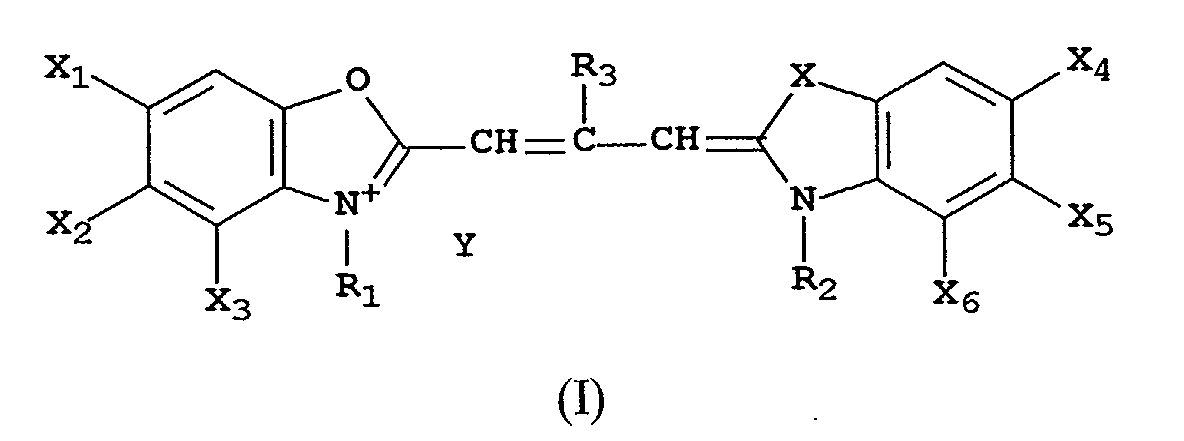
  • the green sensitive layer contains a sensitizing dye having the following Formula (I): wherein R 1 and R 2 independently are an alkyl group having 1 to 6 carbon atoms and R 3 is an aryl or an alkyl group having 1 to 4 carbon atoms.
  • X 1 , X 2 , X 3 , X 4 , X 5 , and X 6 independently are hydrogen, halogen or alkyl alkoxy, aryl, heteroaryl or acetamido groups, or X 1 and X 2 , X 2 and X 3 , X 4 and X 5 , X 5 and X 6 can each independently be combined to form a saturated or unsaturated cyclic group, preferably a fused benzene group.
  • X 2 and X 2 are not phenyl or or other aryl groups.
  • X is O or N-R 4 wherein R 4 is an alkyl group having 1 to 6 carbon atoms.
  • Y represents an ion as needed to balance the charge of the sensitizing dye.
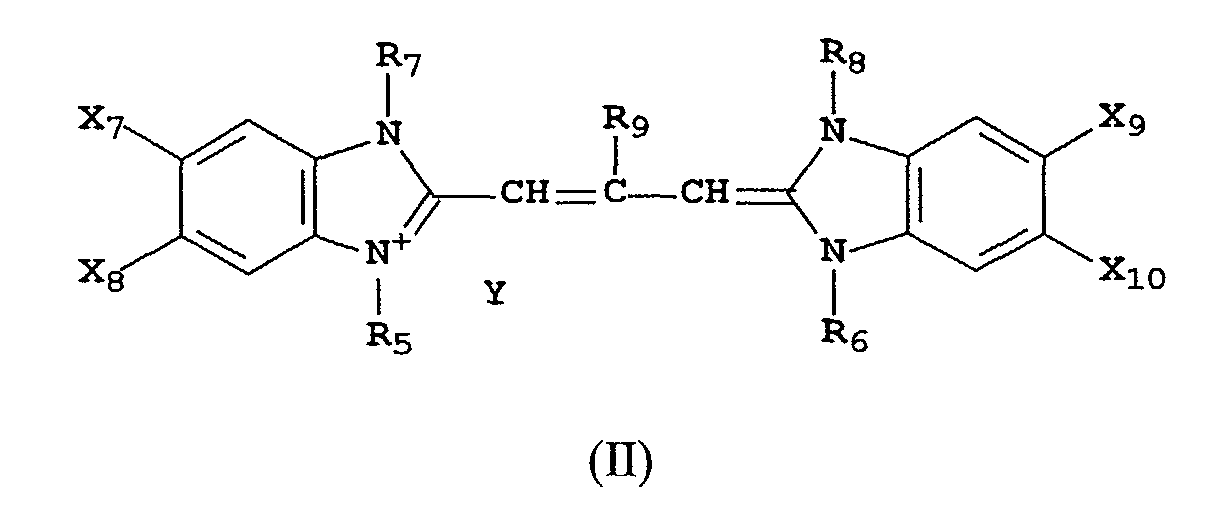
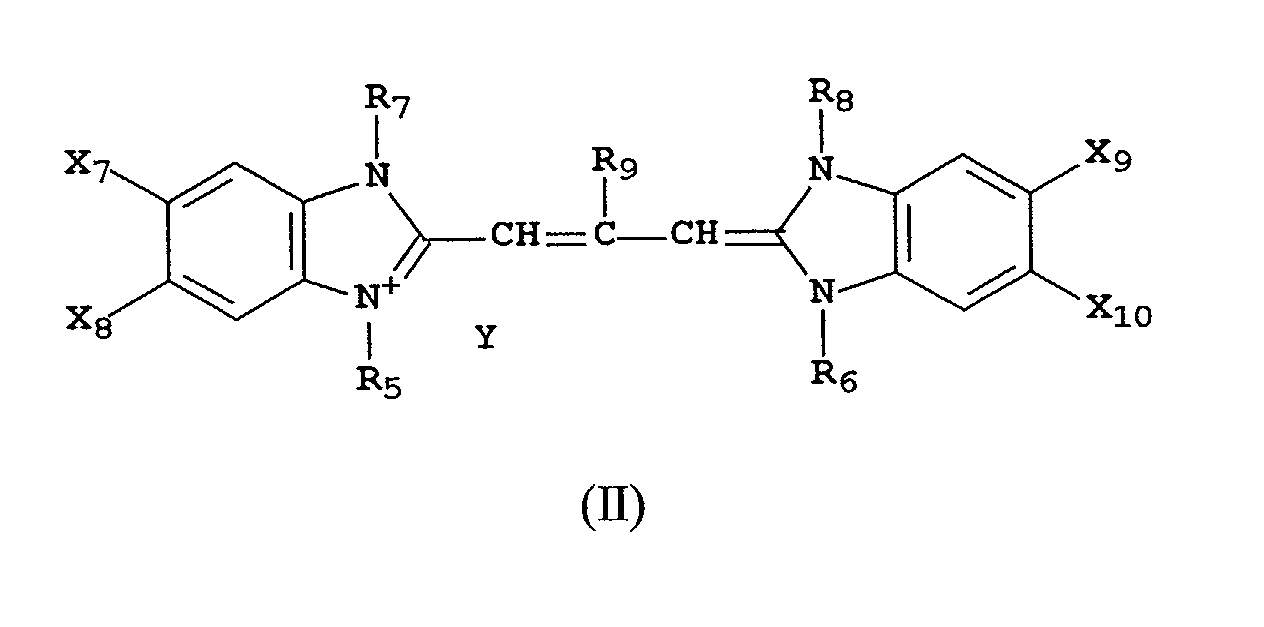
  • the green sensitive layer alternatively contains a sensitizing dye having the following Formula (II): wherein R 7 and R 8 are methyl or ethyl groups provided that at least one of R 7 and R 8 is a methyl group.
  • R 5 and R 6 are alkyl groups having from 1 to 6 carbon atoms, provided that R 5 and R 6 are not both methyl groups.
  • R 9 is hydrogen.
  • X 7 , X 8 , X 9 , and X 10 are each independently methyl, fluoro-substituted methyl or methylthio groups, or hydrogen, provided that at least one of X 7 and X 8 and at least one of X 9 and X 10 are not hydrogen.
  • Y represents an ion as needed to balance the charge of the sensitizing dye.
  • the sensitizing dye of formula (II) is disclosed in detail in U.S. Patent 5,210,014 of Anderson et al incorporated herein by reference.
  • R 1 and R 2 or R 5 and R 6 include lower alkyls such as methyl, ethyl, propyl, butyl, pentyl, and hexyl.
  • one or both R 1 and R 2 or R 5 and R 6 contains an acid solubilizing group and the term alkyl group when referring to R 1 , R 2, R 5 or R 6 includes alkyl groups containing such acid solublizing groups.
  • R 1 and R 2 or R 5 and R 6 are both sulfoalkyl groups.
  • a counterion Y may be necessary to balance the charge of the sensitizing dye. For example, if the sensitizing dye is substituted with two anionic groups (e.g., sulfo), then Y will be a cation. If the dye molecule is substituted with only one anionic group, the counterion Y is not present. If the sensitizing dye is substituted with no anionic group, Y will be an anion.
  • two anionic groups e.g., sulfo
  • Such counter ions are well known in the art, and examples thereof include cations such as sodium, potassium, triethylammonium, and the like, and anions such as chloride, bromide, iodide, p-toluene sulfonate, methane sulfonate, methyl sulfate, ethyl, sulfate, perchlorate, fluoroborate, and the like.
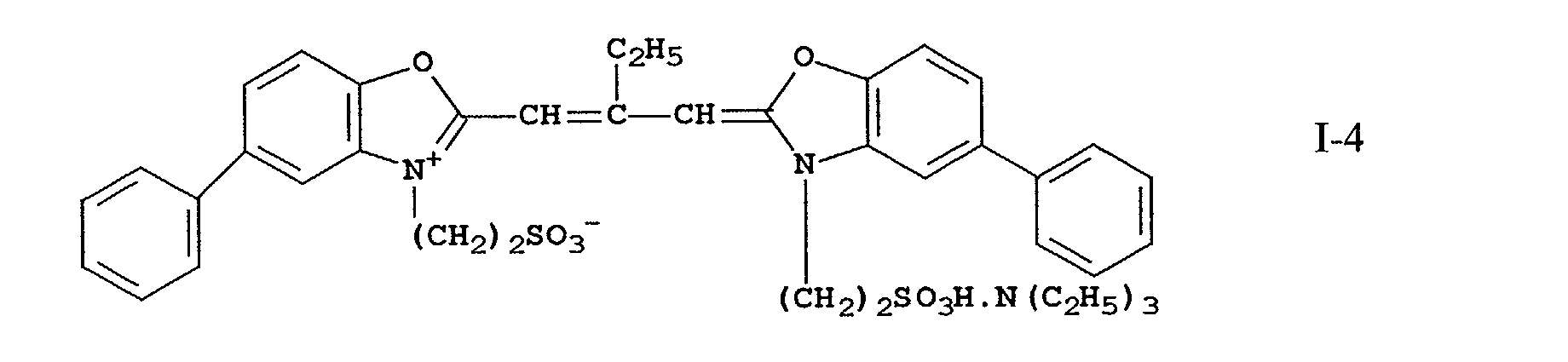
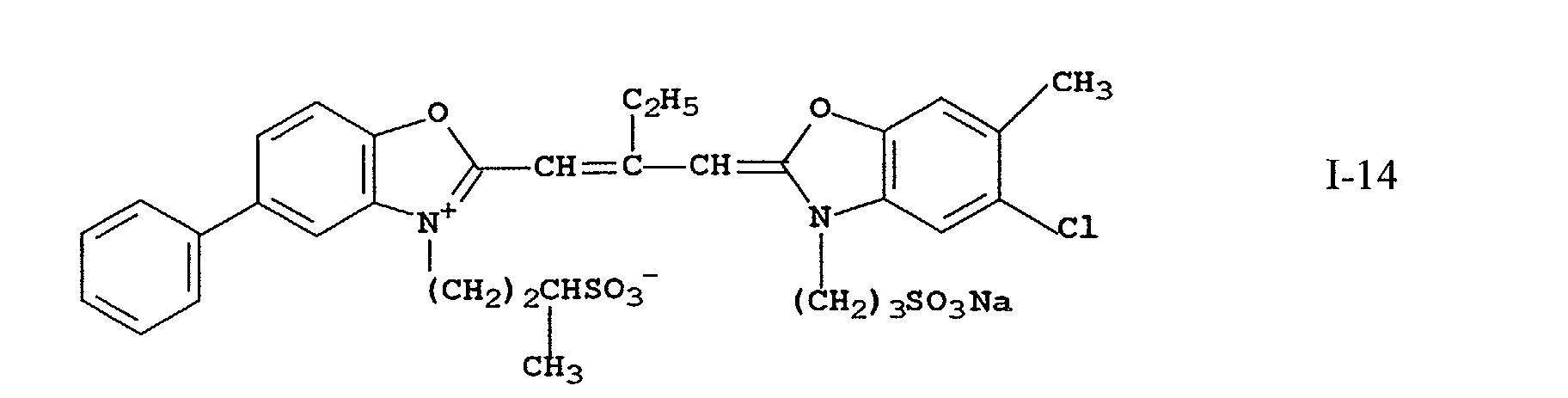
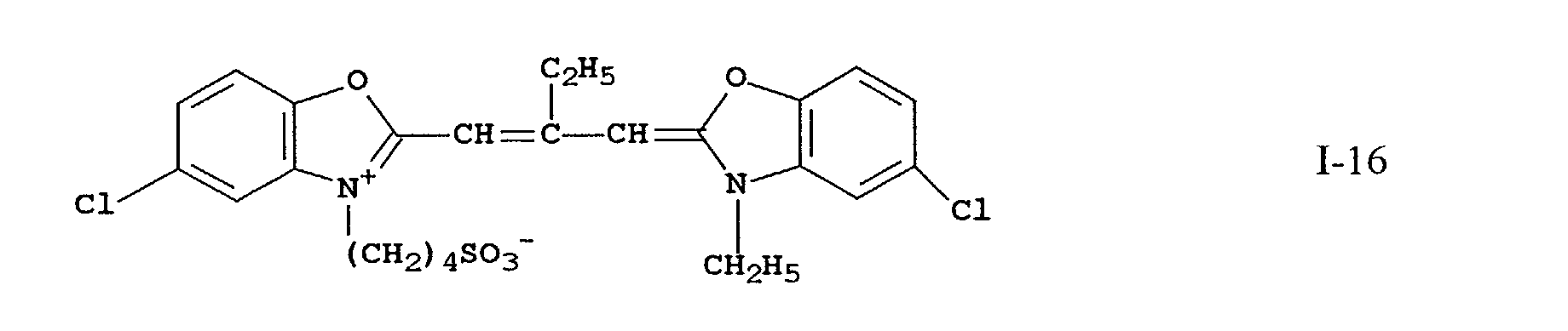
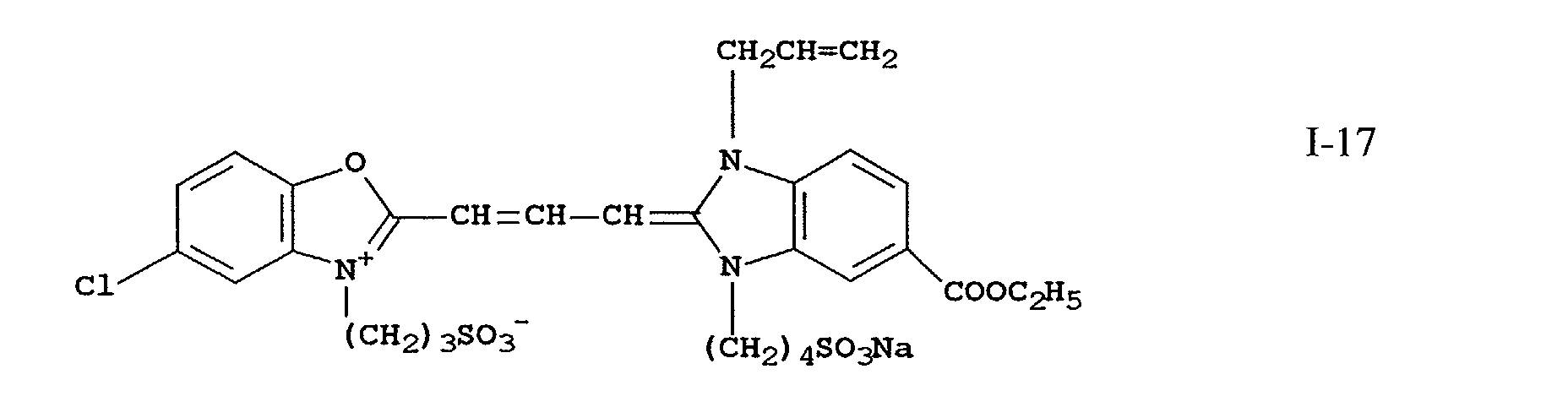
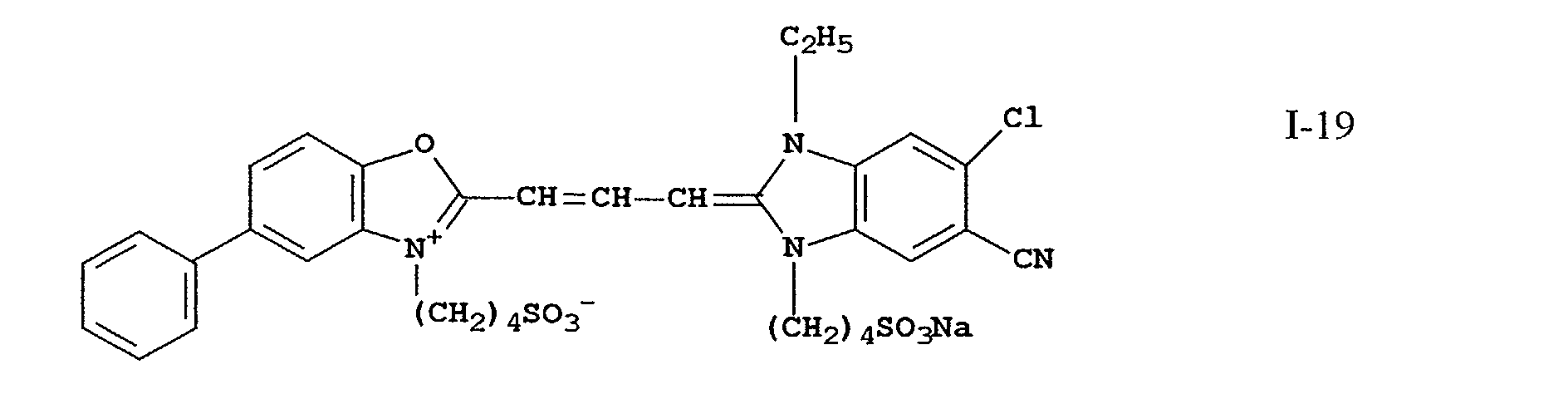
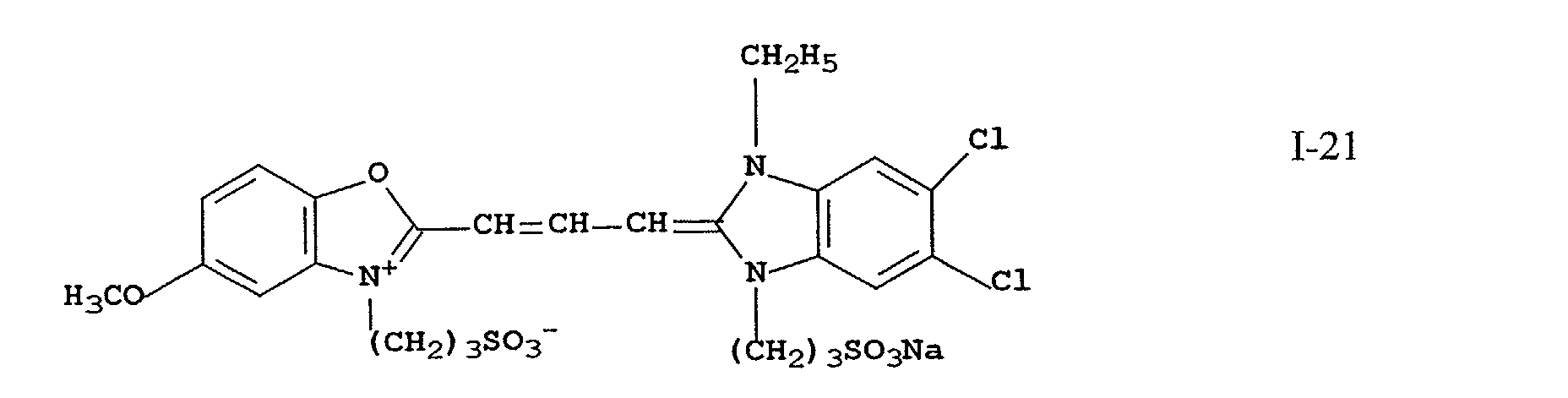
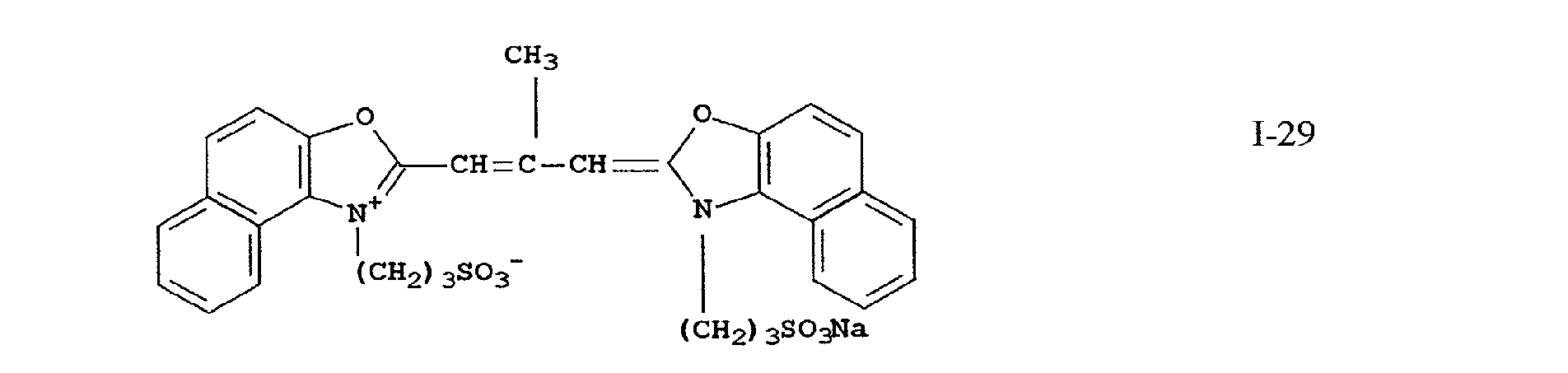
  • sensitizing dyes of Formula (I) include the following:
  • sensitizing dyes of Formula II are listed in Table I: Dye R 5 R 6 R 7 R 8 X 7 X 8 X 9 X 10 II-1 SP - SP - Me Me H SMe H SMe II-2 Et Et Me Me H SMe H SMe II-3 Me SP - Me Me Me Me Me H CF 3 II-4 SP - Et Et Me H CF 3 Me Me II-5 SP - Me Et Me H CF 3 H Me II-6 Et SP - Me Me H SMe H CF 3 II-7 SP - Et Me Me H CF 3 H CF 3 II-8 Et SP - Et Me H CF 3 H CF 3 II-9 TFE SP - Me Me H CF 3 H CF 3 II-10 SP - SP - Me Me H CF 3 H CF 3 II-11 TFE SP - Et Me H CF 3 H CF 3 II-12 TFE TFE Me Me H CF 3 H CF 3 II-13 Et Et Me Me Me SMe CF 3 SMe CF 3 II-14 CH 2 CO
  • Dye II-1 has a potassium counterion Y
  • dyes II-2, II-13, II-22 and II-24 have p-toluene sulfonate counterions Y
  • dye II-10 has a sodium counterion Y
  • dye II-12 has a fluoroborate counterion Y
  • dye II-25 has a bromide counterion Y associated therewith.
  • the particular counterion is not critical, however, and others may be selected, for example, from those listed above.
  • the amount of green sensitizing dye that is useful in the invention is generally in the range of 0.1 to 4 millimoles per mole of silver halide and preferably from 0.5 to 3.0 millimoles per mole of silver halide.
  • the red sensitive layer can contain any known red sensitizing dyes exhibiting an adsorption spectrum having the features required by the present invention.
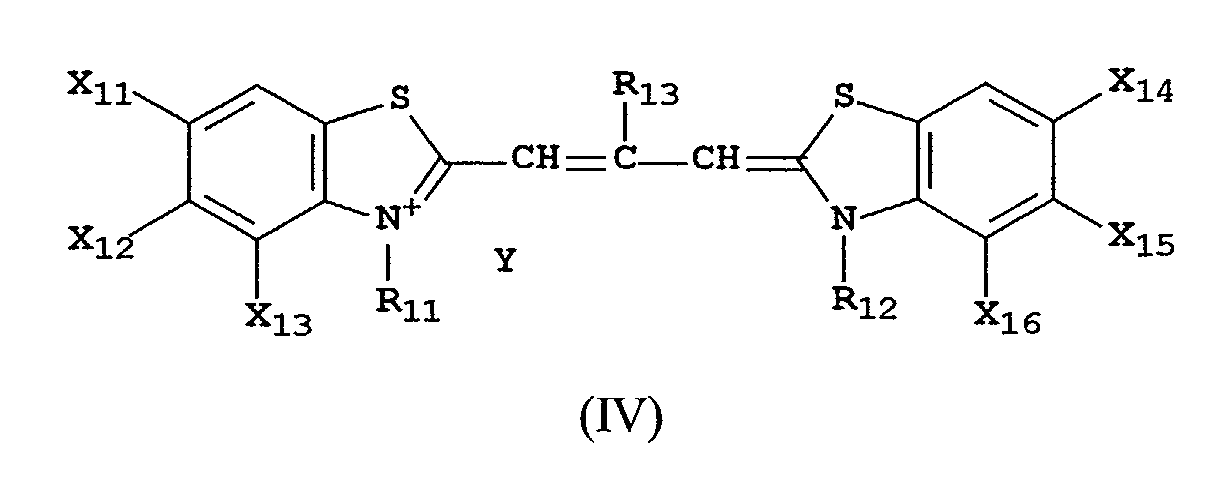
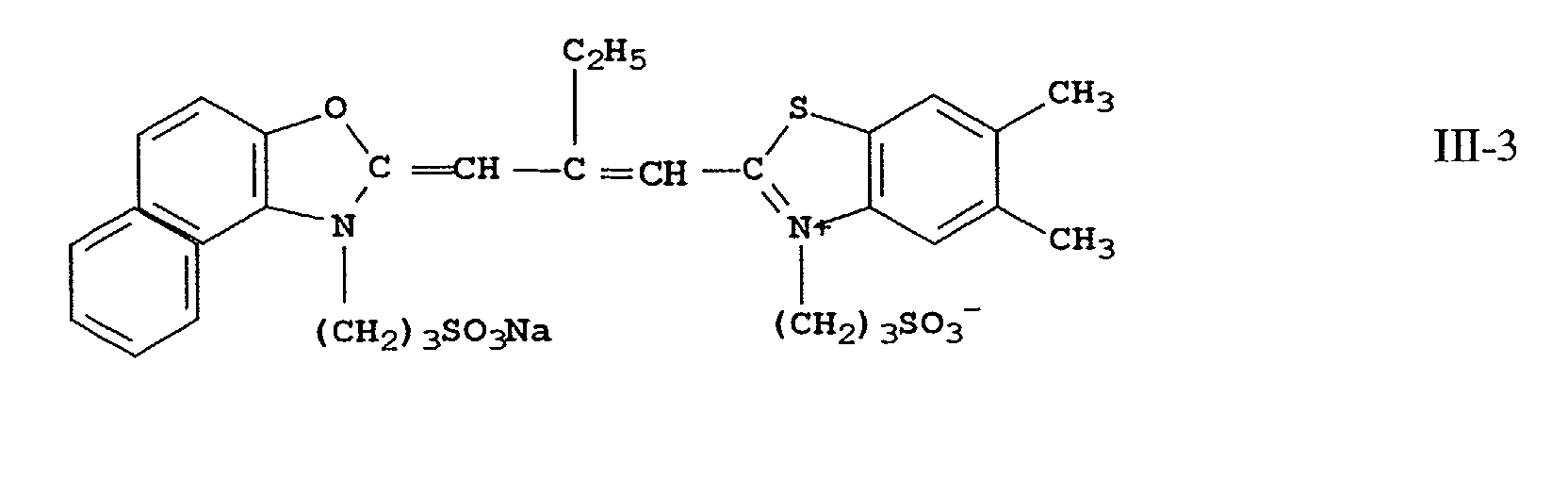
  • the red sensitive layer contain a sensitizing dye combination containing a sensitizing dye having the Formula (III) and a sensitizing dye having the following Formula (IV):
  • R 11 and R 12 independently are an alkyl group having from 1 to 6 carbon atoms and R 13 is an aryl group or an alkyl group having from 1 to 4 carbon atoms.
  • X 11 , X 12 , X 13 , X 14 , X 15 and X 16 are independently hydrogen, halogen or alkyl, alkoxy, aryl, heteroaryl, or acetamido groups, or X 11 and X 12 , X 12 and X 13 , X 14 and X 15 , or X 15 and X 16 can each independently be combined to form a saturated or unsaturated cyclic group, preferably a fused benzene group. It is preferred, however, that there are no fused ring or aryl substituents.
  • Y represents an ion as needed to balance the charge of the sensitizing dye.
  • R 11 and R 12 examples include lower alkyls such as methyl, ethyl, propyl, butyl, pentyl, and hexyl.
  • R 11 and R 12 contains an acid solubilizing group, and the term "alkyl" group when referring to R 11 and R 12 includes alkyl groups containing such acid solublizing groups.
  • R 11 and R 12 are both sulfoalkyl groups
  • a counterion Y may be necessary to balance the charge of the sensitizing dye.
  • Such counterions are well known in the art, and examples thereof include cations such as sodium, potassium, triethylammonium, and the like, and anions such as chloride, bromide, iodide, p-toluene sulfonate, methane sulfonate, methyl sulfate, ethyl, sulfate, perchlorate, fluoroborate, and the like.
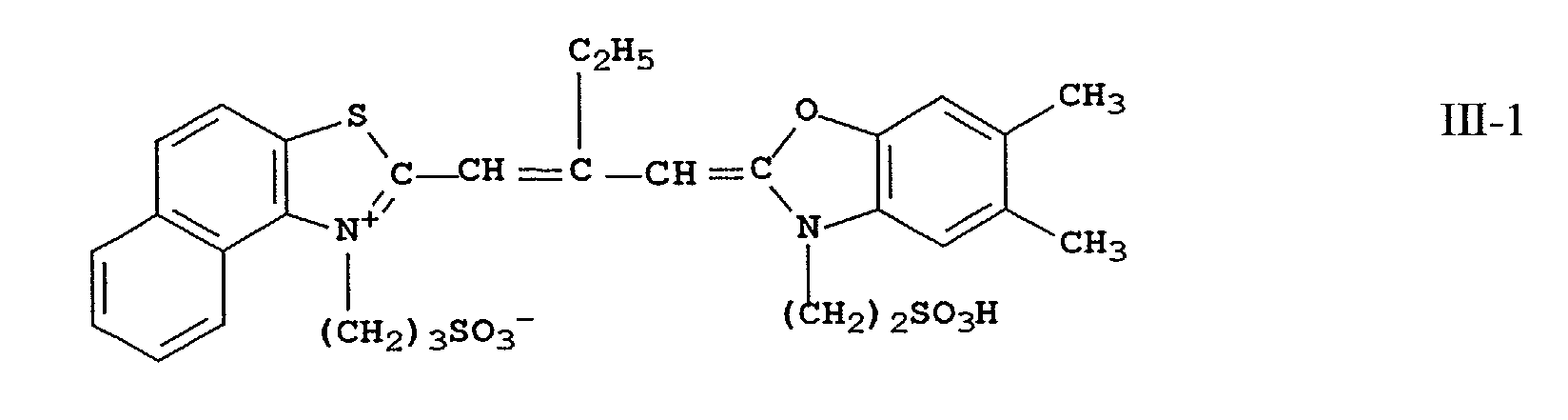
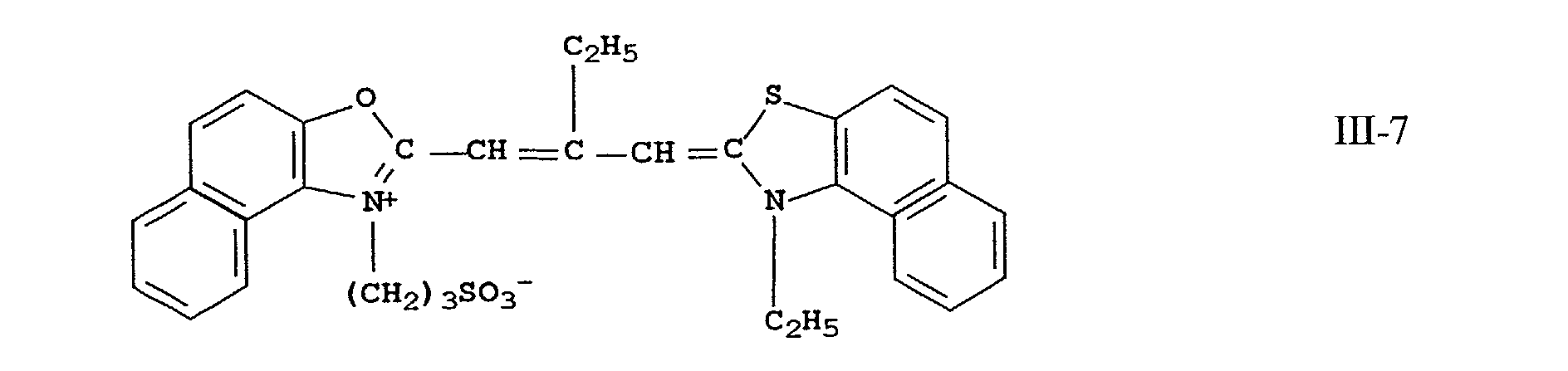
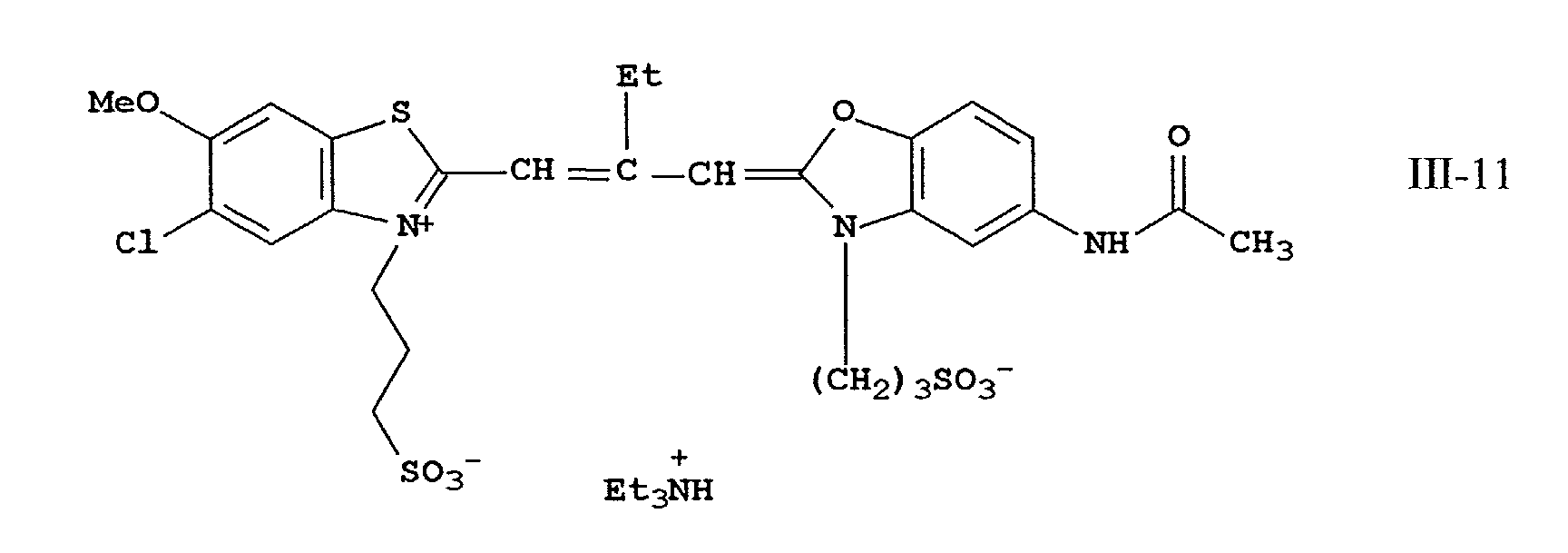
  • Illustrative xamples of compounds having Formula III include:
  • the amount of red sensitizing dye that is useful in the invention is preferably in the range of 0.1 to 4 millimoles per mole of silver halide and more preferably from 0.5 to 3.0 millimoles per mole of silver halide.
  • alkyl refers to a substituted or unsubstituted alkyl group
  • benzene refers to a substituted or unsubstituted benzene (with up to six substituents).
  • the substituent may be itself substituted or unsubstituted.
  • substituents include any substituents, whether substituted or unsubstituted, which do not destroy properties necessary for the photographic utility.
  • substituents include known substituents such as: halogen, for example, chloro, fluoro, bromo, iodo; alkoxy, particularly those "lower alkyl" (that is, with 1 to 6 carbon atoms, for example, methoxy, ethoxy; substituted or unsubstituted alkyl, particularly lower alkyl (for example, methyl, trifluoromethyl); thioalkyl (for example, methylthio or ethylthio), particularly either of those with 1 to 6 carbon atoms; substituted and unsubstituted aryl, particularly those having from 6 to 20 carbon atoms (for example, phenyl); and substituted or unsubstituted heteroaryl, particularly those having a 5- or 6-membered ring containing 1 to 3 heteroatoms selected from N, O
  • Alkyl substituents may specifically include "lower alkyl” (that is, having 1-6 carbon atoms), for example, methyl, ethyl, and the like. Further, with regard to any alkyl group or alkylene group, it will be understood that these can be branched or unbranched and include ring structures.
  • the element of the invention further comprises a blue sensitive layer containing any known blue spectral sensitizing dye.
  • the blue sensitive layer usually shows an adsorption spectra having a maximum adsorption at a wavelength between 400 and 500 nm.
  • Spectral sensitizing dyes are well known in the art and are disclosed, for example, in Research Disclosure, September 1996, 38957, Section V.
  • the dyes useful in the element of the invention can be prepared by synthetic techniques well known in the art. Such techniques are further illustrated, for example, in "The Cyanine Dyes and Related Compounds", Frances Hamer, Interscience Publishers, 1964 and James, The Theory of the Photograhic Process 4th, 1977.
  • Optimum spectral sensitizing dye concentrations will depend on the nature of the spectral sensitizing used and on the intended end use of the photographic material and can be determined by methods well known in the art.
  • the element of the invention can be any known silver halide photographic element. These elements include silver halide photographic films, silver halide photographic papers, negative working elements, positive working elements, reversal photographic elements, and the like.
  • the photographic elements made in accordance with the present are generally multicolor elements containing dye image-forming units sensitive to each of the three primary regions of the spectrum. Each unit can be comprised of a single emulsion layer or of multiple emulsion layers sensitive to a given region of the light spectrum.
  • the photographic emulsions conventionally contain silver halide grains. Grains containing combinations of halides most frequently employed for latent image formation include silver iodochloride, silver iodobromide, silver chlorobromide, silver iodochlorobromide, silver chloroiodobromide, silver bromochloride, silver iodobromochloride and silver bromoiodochloride grains, where the halides are named in order of ascending concentrations.
  • the silver halide emulsions can be chemically sensitized with active gelatin as illustrated by T.H. James, The Theory of the Photographic Process, 4th Ed., Macmillan, 1977, pp. 67-76, or with middle chalcogen (sulfur, selenium or tellurium), gold, a platinum metal (platinum, palladium, rhodium, ruthenium, iridium and osmium), rhenium or phosphorus sensitizers or combinations of these sensitizers.
  • active gelatin illustrated by T.H. James, The Theory of the Photographic Process, 4th Ed., Macmillan, 1977, pp. 67-76, or with middle chalcogen (sulfur, selenium or tellurium), gold, a platinum metal (platinum, palladium, rhodium, ruthenium, iridium and osmium), rhenium or phosphorus sensitizers or combinations of these sensitizers.
  • the element can contain further to the layers already disclosed additional layers, such as interlayers, filter layers, overcoat layers, subbing layers, and the like. All of these can be coated on a support that can be transparent or reflective (for example, a paper support).
  • Typical photographic supports include polymeric film, wood fiber--e.g., paper, metallic sheet and foil, glass and ceramic supporting elements provided with one or more subbing layers.
  • the element of the invention is a reversal element and comprises a support having thereon in the following order, a red-light sensitive layer having a cyan dye-forming color coupler associated therewith; a green-light sensitive layer having a magenta dye-forming color coupler associated therewith and, and a blue-light sensitive layer having a yellow dye-forming color coupler associated therewith.
  • Color reversal elements are those containing negative-working emulsions and intended to be developed using a reversal process.
  • Silver halide color reversal films are typically associated with an indication for processing by a color reversal process.
  • Reference to a film being associated with an indication for processing by a color reversal process most typically means the film, its container, or packaging (which includes printed inserts provided with the film), will have an indication on it that the film should be processed by a color reversal process.
  • the indication may, for example, be simply a printed statement stating that the film is a "reversal film” or that it should be processed by a color reversal process, or simply a reference to a known color reversal process such as "Process E-6".
  • a "color reversal" process in this context is one employing treatment with a non-chromogenic developer (that is, a developer which will not imagewise produce color by reaction with other compounds in the film; sometimes referenced as a “black and white developer”). This is followed by fogging unexposed silver halide, usually either chemically or by exposure to light. Then the element is treated with a color developer (that is, a developer which will produce color in an imagewise manner upon reaction with other compounds in the film).
  • a color developer that is, a developer which will produce color in an imagewise manner upon reaction with other compounds in the film.
  • One well-known reversal process is Kodak Process E-6, Eastman Kodak Company.
  • a reversal film does not have any masking couplers. Furthermore, reversal films have a gamma generally between 1.5 and 2.0, and this is much higher than for typical negative materials.
  • Photographic elements and methods of processing such elements particularly suitable for use with this invention are described in Research Disclosure, February 1995, Item 37038, and in Research Disclosure, September 1997, Item 40145 published by Kenneth Mason Publications, Ltd., Dudley Annex, 12a North Street, Emsworth, Hampshire PO10 7DQ, ENGLAND, the disclosures of which are incorporated herein by reference.
  • Reference Section Subject Matter 1 I, II Grain composition, morphology and preparation. Emulsion preparation including hardeners, coating aids, addenda, etc.
  • the photographic elements can be exposed with various forms of energy which encompass the ultraviolet, visible, and infrared regions of the electromagnetic spectrum, as well as the electron beam, beta radiation, gamma radiation, x-ray, alpha particle, neutron radiation, and other forms of corpuscular and wave-like radiant energy in either noncoherent (random phase) forms or coherent (in phase) forms, as produced by lasers.
  • the photographic elements can include features found in conventional radiographic elements.
  • the photographic elements are preferably exposed using the various energy sources utilized by electronic filmwriter devices, such as CRT light sources, laser sources, and LED sources.
  • Comparative sample 101 was prepared according to the following description.
  • the layers described below were coated on a cellulose triacetate film support to form a multilayer color photographic material.
  • the coating amounts listed below are in the unit of g/m 2 except for sensitizing dyes which are listed in terms of molar amount per mole of silver halide present in the same layer.
  • ECD refers to equivalent circular diameter.
  • %I refers to the mole percent of total iodide content.
  • First Layer Antihalation Layer Antihalation Colloidal Silver 0.25 UV Protection Dye UV-1 0.04 Dispersed in Solvent S-1 0.04 Gelatin 2.44 Second Layer: Intermediate Layer Fine Grain Silver Bromide (0.055 mm ECD) 0.05 Scavenger SCV-1 0.11 Gelatin 1.22 Third Layer: Slow Red Sensitive Layer Silver Iodobromide Emulsion (0.44 ⁇ m ECD X 0.06 ⁇ m - 4% I) 0.25 Spectrally sensitized with Red Sensitizing Dye SD-1 7.88 X 10 -4 Red Sensitizing Dye SD-2 3.39 X 10 -4 Fine Grain Silver Bromide (0.055 ⁇ m ECD) 0.04 Coupler C-1 0.09 Dispersed in Solvent S-3 0.04 Gelatin 0.08 Fourth Layer: Mid Red Sensitive Layer Silver Iodobromide Emulsion (0.86 ⁇ m ECD X 0.09 ⁇ m - 4% I) 0.32 Spectrally sensitized with Red Sensitizing Dye SD-1
  • Sample 102 illustrating an element of the invention, was constructed similarly to sample 101 except for the following changes: Seventh Layer: Slow Green Sensitive Layer Silver Iodobromide Emulsion - (0.40 ⁇ m ECD X 0.06 ⁇ m - 4% I) 0.31 Spectrally sensitized with Green Sensitizing Dye SD-5 1.32 X 10 -3 Fine Grain Silver Bromide (0.055 ⁇ m ECD) 0.04 Coupler M-1 0.07 Coupler M-2 0.03 Co-dispersed in Solvent S-2 0.10 Gelatin 0.47 Eighth Layer: Mid Green Sensitive Layer Silver Iodobromide Emulsion - (0.63 ⁇ m ECD X 0.11 ⁇ m - 3% I) 0.380 Spectrally sensitized with Green Sensitizing Dye SD-5 1.28 X 10 -3 Coupler M-1 0.34 Coupler M-2 0.15 Co-dispersed in Solvent S-2 0.20 Gelatin 0.91 Ninth Layer: Fast Green Sensitive Layer Silver Iod
  • Fig. 2 shows the absorption spectrum of the green light sensitive layers of samples 101 and 102.
  • the characteristics of each spectra are reported in Table 2 below wherein ⁇ max is the maximum absorption wavelength of the peak and W h/2( ⁇ max) is the half bandwidth of the peak measured at ⁇ max.
  • the above samples were exposed by electronic filmwriter devices and a conventional 1B daylight sensitometer. When exposed to the daylight sensitometer, the samples were exposed for 1/50 sec with a 0.6 inconel filter at a color temperature 5500 K; and developed using Kodak Process E-6 with a development time of 6 minutes. For each experiment, the green density variations between sample 101 and 102 were measured (Delta green density) for the densities 0.3, 0.5, 1, 1.5, and 2 of sample 101, at the same exposure level.
  • Comparative sample 103 was constructed similarly to sample 101 except for the following changes: Third Layer: Slow Red Sensitive Layer Silver Iodobromide Emulsion (0.44 ⁇ m ECD X 0.06 ⁇ m - 4% I) 0.25 Spectrally sensitized with Red Sensitizing Dye SD-3 8.82 X 10 -4 Red Sensitizing Dye SD-4 1.04 X 10 -5 Fine Grain Silver Bromide (0.055 ⁇ m ECD) 0.04 Coupler C-1 0.09 Dispersed in Solvent S-3 0.04 Gelatin 0.08 Fourth Layer: Mid Red Sensitive Layer Silver Iodobromide Emulsion (0.86 ⁇ m ECD X 0.09 ⁇ m - 4% I) 0.32 Spectrally sensitized with Red Sensitizing Dye SD-3 6.96 X 10 -4 Red Sensitizing Dye SD-4 8.17 X 10 -5 Fine Grain Silver Bromide (0.055 ⁇ m ECD) 0.05 Coupler C-1 0.4 Dispersed in Solvent S
  • Fig. 1 shows the absorption spectrum of the red sensitive layers of samples 102 and 103.
  • the characteristics of each peak are reported in Table 4 below wherein ⁇ max is the maximum absorption wavelength of the peak and %A 30 is % area of the peak at 30 nm hypsochromic and below, based on the total area of peak.
  • Sample ⁇ max (nm) A 30 102 630 29% 103 650 42%

Landscapes

  • Physics & Mathematics (AREA)
  • Chemical & Material Sciences (AREA)
  • General Physics & Mathematics (AREA)
  • Spectroscopy & Molecular Physics (AREA)
  • Chemical Kinetics & Catalysis (AREA)
  • Engineering & Computer Science (AREA)
  • Materials Engineering (AREA)
  • Silver Salt Photography Or Processing Solution Therefor (AREA)
  • Laminated Bodies (AREA)

Abstract

This invention relates to a photographic element comprising a support having thereon light sensitive silver halide layers comprising at least one red light sensitive silver halide layer, at least one green light sensitive silver halide layer, and at least one blue sensitive silver halide layer, wherein
   the green light sensitive silver halide layer has an absorption spectra having a maximum absorption at a wavelength λmax from 530 to 560 nm and a half bandwidth less than 50 nm; and
   the red light sensitive silver halide layer has an adsorption spectra having a maximum absorption at a wavelength λmax from 610 to 640 nm, and exhibiting from 30 nm hypsochromic of the wavelength of maximum absorption and below an area less than 40% based on the total area of the red light sensitive silver halide layer adsorption spectra. It further relates to a method of processing said element using an electronic filmwriter device.

Description

FIELD OF THE INVENTION
This invention relates to a new spectral sensitized silver halide film. Specifically, the invention relates to a new sensitized silver halide film used to form images by exposure to electronic filmwriter devices and a method for forming the image.
BACKGROUND OF THE INVENTION
It is well known to expose silver halide photographic elements using light radiation, the silver halide element being usually placed in a camera. Electronic filmwriter devices represent a different means of exposing a photographic film other than a camera. These devices usually contain three different light sources, one that exposes the red portion of an image, one that exposes the green portion, and one that exposes the blue portion. Examples of electronic filmwriter devices are the Saphire and Solitaire by MGI, Lightjet by CSI, Miruswriter Turbopro II by Mirus Industries, and LVT by Dice. These devices have different types of light sources having different spectral power distributions. The Saphire, Solitaire, and Miruswriter all have CRT light sources, Lightjet contains laser sources, and the LVT contains LED sources.
Information is supplied to the device that digitally describes the original scene's content. This information originates from either a camera image or a computer. In the case where the camera image is the source of the information to the device, the image is scanned so that digital values can be supplied to the device. The supplied information is then used to expose an output film. In the case where the original image is generated by a computer, the information is already in digital form.
Signal processing of the supplied information is performed within the device to determine the intensity and time of exposures that the three light sources are to give the output film. Typically, when the film is exposed, the filmwriter device must scan over the entire area of the film to expose each color record of the output film. The extent of exposure of the output film, and hence, the amount of dye formation, depends in part on the spectral sensitivity distributions of the film and the spectral power distributions of the light sources of the electronic filmwriter device.
U. S. patent 4,954,429 discloses a film for laser recording. The disclosed film is spectral sensitized to minimize unwanted dye formation to prevent 'color mixing.' The result is obtained from the specific ratio of the sensitivity of the light sensitive emulsion layers constituting the film.
Often films which are exposed by electronic filmwriter devices are films which are spectrally optimized to be exposed by natural light radiation, not the light source of an electronic filmwriter device. As a result, when these films are used as the imaging media from an electronic filmwriter device, extra 'scans' by the light sources are often needed. It is know that extra scans are often required for proper exposure by the green light source of the filmwriter device. When conventional reversal films are exposed by an electronic filmwriter device, extra scans by the red light source are also often required to decrease the amount of cyan density that forms in the low density region of images. These extra scans undesirably increase the completion time of the image. This affects the throughput of the machine.
SUMMARY OF THE INVENTION
This invention provides a photographic element comprising a support having thereon light sensitive silver halide layers comprising at least one red light sensitive silver halide layer, at least one green light sensitive silver halide layer, and at least one blue sensitive silver halide layer, wherein
   the green light sensitive silver halide layer has an absorption spectra having a maximum absorption at a wavelength λmax from 530 to 560 nm and a half bandwidth less than 50 nm; and
   the red light sensitive silver halide layer has an adsorption spectra having a maximum absorption at a wavelength λmax from 610 to 640 nm, and exhibiting from 30 nm hypsochromic of the wavelength of maximum absorption and below an area less than 30% based on the total area of the red light sensitive silver halide layer adsorption spectra. This invention also provides a process for forming a photographic image which comprises exposing the above photographic element with light sources from an electronic filmwriter device.
The present invention provides a silver halide element that shows sensitometric advantages when exposed by an electronic filmwriter device. The film of the present invention exhibits increased green and red spectral sensitivities. The increased red and green sensitivities decrease the time the element needs to be exposed by the red and green light sources of the electronic film writer. This provides an advantageous time saving for the completion of the image. Other and further advantages of the invention will appear from the description of the present invention.
BRIEF DESCRIPTION OF THE DRAWINGS
Fig. 1 shows the cyan spectral sensitivity of sample 102 illustrating the present invention versus the cyan spectral sensitivity of comparative sample 103, discussed more fully below.
Fig. 2 shows the magenta spectral sensitivity of sample 102 illustrating the present invention versus the magenta spectral sensitivity of comparative sample 101 discussed more fully below.
DETAILED DESCRIPTION OF THE INVENTION
The photographic elements of this invention comprise a support having thereon light sensitive silver halide layers comprising at least one red light sensitive silver halide layer, at least one green light sensitive silver halide layer, and at least one blue sensitive silver halide layer. The green light sensitive silver halide layer has an absorption spectra having a maximum absorption at a wavelength λmax from about 530 to about 560 nm and a half bandwidth less than 50 nm, and more preferably between 35 to 50 nm. The red light sensitive silver halide layer has an adsorption spectra having a maximum absorption at a wavelength λmax from about 610 to about 640 nm and more preferably a maximum absorption at a wavelength λmax from 620 to 640 nm. The red layer further exhibits from 30 nm hypsochromic of the wavelength of maximum absorption and below (meaning further to the left) an area less than 40% based on the total area of the red light sensitive silver halide layer adsorption spectra. More preferably, the area of the absorption spectra from 30 nm hypsochromic of the wavelength of maximum absorption and below is less than 35% based on the total area of the red light sensitive silver halide layer adsorption spectra.
In the present invention, the green sensitive layer can contain any of known sensitizing dyes that exhibits an absorption spectra as previously defined. In one suitable embodiment of the invention, the green sensitive layer contains a sensitizing dye having the following Formula (I):
Figure 00040001
wherein R1 and R2 independently are an alkyl group having 1 to 6 carbon atoms and R3 is an aryl or an alkyl group having 1 to 4 carbon atoms. X1, X2, X3, X4, X5, and X6 independently are hydrogen, halogen or alkyl alkoxy, aryl, heteroaryl or acetamido groups, or X1 and X2, X2and X3, X4 and X5, X5 and X6 can each independently be combined to form a saturated or unsaturated cyclic group, preferably a fused benzene group. Preferably X2 and X2 are not phenyl or or other aryl groups. X is O or N-R4 wherein R4 is an alkyl group having 1 to 6 carbon atoms. Y represents an ion as needed to balance the charge of the sensitizing dye.
In another suitable embodiment of the invention, the green sensitive layer alternatively contains a sensitizing dye having the following Formula (II):
Figure 00040002
wherein R7 and R8 are methyl or ethyl groups provided that at least one of R7 and R8 is a methyl group. R5 and R6 are alkyl groups having from 1 to 6 carbon atoms, provided that R5 and R6 are not both methyl groups. R9 is hydrogen. X7, X8, X9, and X10 are each independently methyl, fluoro-substituted methyl or methylthio groups, or hydrogen, provided that at least one of X7 and X8 and at least one of X9 and X10 are not hydrogen. Y represents an ion as needed to balance the charge of the sensitizing dye. The sensitizing dye of formula (II) is disclosed in detail in U.S. Patent 5,210,014 of Anderson et al incorporated herein by reference.
Examples of R1 and R2 or R5 and R6 include lower alkyls such as methyl, ethyl, propyl, butyl, pentyl, and hexyl. According to one embodiment, one or both R1 and R2 or R5 and R6 contains an acid solubilizing group and the term alkyl group when referring to R1, R2, R5 or R6 includes alkyl groups containing such acid solublizing groups. Preferably R1 and R2 or R5 and R6 are both sulfoalkyl groups.
Depending upon the R1, R2, R5 or R6 groups, a counterion Y may be necessary to balance the charge of the sensitizing dye. For example, if the sensitizing dye is substituted with two anionic groups (e.g., sulfo), then Y will be a cation. If the dye molecule is substituted with only one anionic group, the counterion Y is not present. If the sensitizing dye is substituted with no anionic group, Y will be an anion. Such counter ions are well known in the art, and examples thereof include cations such as sodium, potassium, triethylammonium, and the like, and anions such as chloride, bromide, iodide, p-toluene sulfonate, methane sulfonate, methyl sulfate, ethyl, sulfate, perchlorate, fluoroborate, and the like.
Illustrative examples of sensitizing dyes of Formula (I) include the following:
Figure 00050001
Figure 00060001
Figure 00060002
Figure 00060003
Figure 00060004
Figure 00060005
Figure 00060006
Figure 00070001
Figure 00070002
Figure 00070003
Figure 00070004
Figure 00070005
Figure 00070006
Figure 00080001
Figure 00080002
Figure 00080003
Figure 00080004
Figure 00080005
Figure 00080006
Figure 00090001
Figure 00090002
Figure 00090003
Figure 00090004
Figure 00090005
Figure 00100001
Figure 00100002
Figure 00100003
Figure 00100004
Figure 00100005
Figure 00100006
Figure 00110001
Illustrative examples of sensitizing dyes of Formula II are listed in Table I:
Figure 00110002
Dye R5 R6 R7 R8 X7 X8 X9 X10
II-1 SP- SP- Me Me H SMe H SMe
II-2 Et Et Me Me H SMe H SMe
II-3 Me SP- Me Me Me Me H CF3
II-4 SP- Et Et Me H CF3 Me Me
II-5 SP- Me Et Me H CF3 H Me
II-6 Et SP- Me Me H SMe H CF3
II-7 SP- Et Me Me H CF3 H CF3
II-8 Et SP- Et Me H CF3 H CF3
II-9 TFE SP- Me Me H CF3 H CF3
II-10 SP- SP- Me Me H CF3 H CF3
II-11 TFE SP- Et Me H CF3 H CF3
II-12 TFE TFE Me Me H CF3 H CF3
II-13 Et Et Me Me SMe CF3 SMe CF3
II-14 CH2COOMe SP- Me Me H CF3 H CF3
II-15 CH2COOMe SP- Et Me H CF3 H CF3
II-16 CH2COOMe SP- Me Et H CF3 H CF3
II-17 CH2CONH2 SP- Et Me H CF3 H CF3
II-18 CH2COOEt SP- Et Me H CF3 H CF3
II-19 CH2COOPr SP- Et Me H CF3 H CF3
II-20 CH2CONMe2 SP- Et Me H CF3 H CF3
II-21 SECM- TFE Me Me SMe CF3 SMe CF3
II-22 TFE TFE Me Et Me CF3 Me CF3
II-23 CH2CN SP- Me Et H CF3 H CF3
II-24 Et Et Me Me CF3 CF3 CF3 CF3
II-25 TFE CH2COOMe Me Me Me CF3 Me CF3
II-26 SECM- Et Me Me H CF3 H CF3
II-27 TFE 4SB- Me Me H CF3 H CF3
II-28 TFE 3SB- Me Me H CF3 H CF3
II-29 TFE SE- Me Me H CF3 H CF3
II-30 TFE MSCM- Me Me H CF3 H CF3
Me = Methyl   MSCM- = Methylsulfonylcarbamoylmethyl
Et = Ethy   SECM- = Sulfoethylcarbamoylmethy
TFE = Trifluoroethyl   SMe = Methylthio
SE- = Sulfoethy   3SB- = 3-sulfobutyl
SP- = Sulfopropyl   4SB- = 4-sulfobutyl
Dye II-1 has a potassium counterion Y, dyes II-2, II-13, II-22 and II-24 have p-toluene sulfonate counterions Y, dye II-10 has a sodium counterion Y, dye II-12 has a fluoroborate counterion Y, and dye II-25 has a bromide counterion Y associated therewith. The particular counterion is not critical, however, and others may be selected, for example, from those listed above.
When the above green sensitizing dyes are used, the amount of green sensitizing dye that is useful in the invention is generally in the range of 0.1 to 4 millimoles per mole of silver halide and preferably from 0.5 to 3.0 millimoles per mole of silver halide.
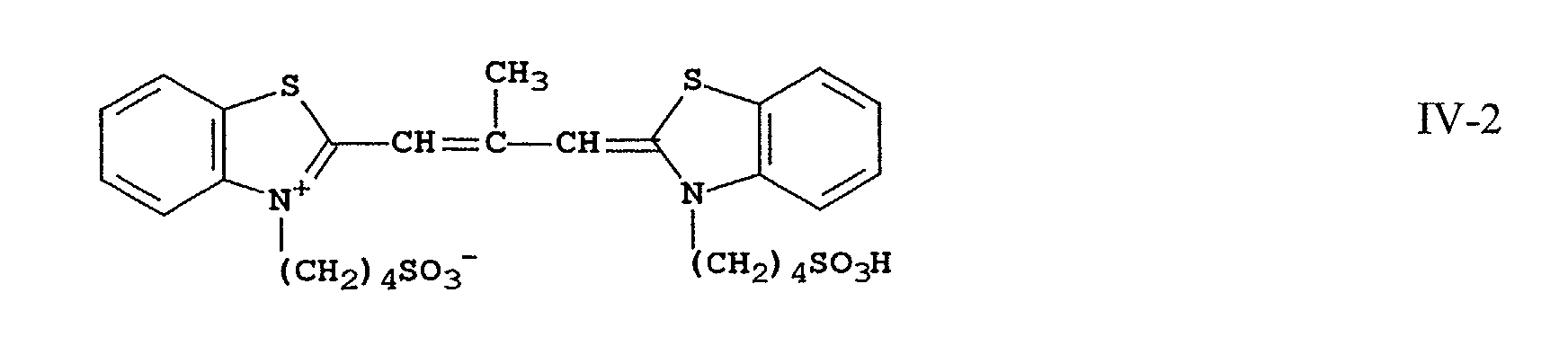
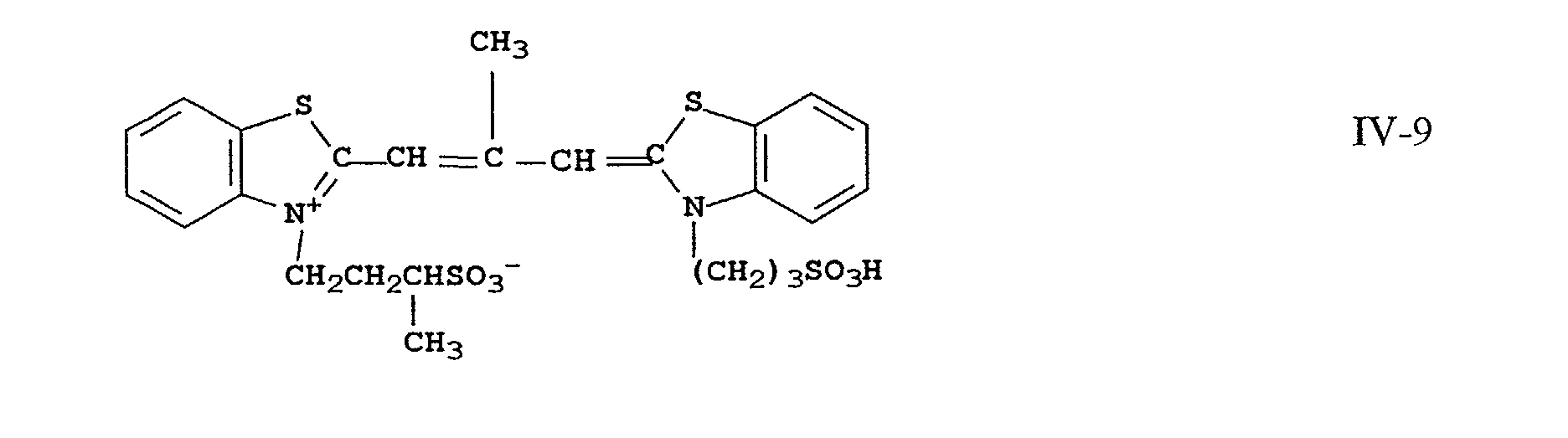
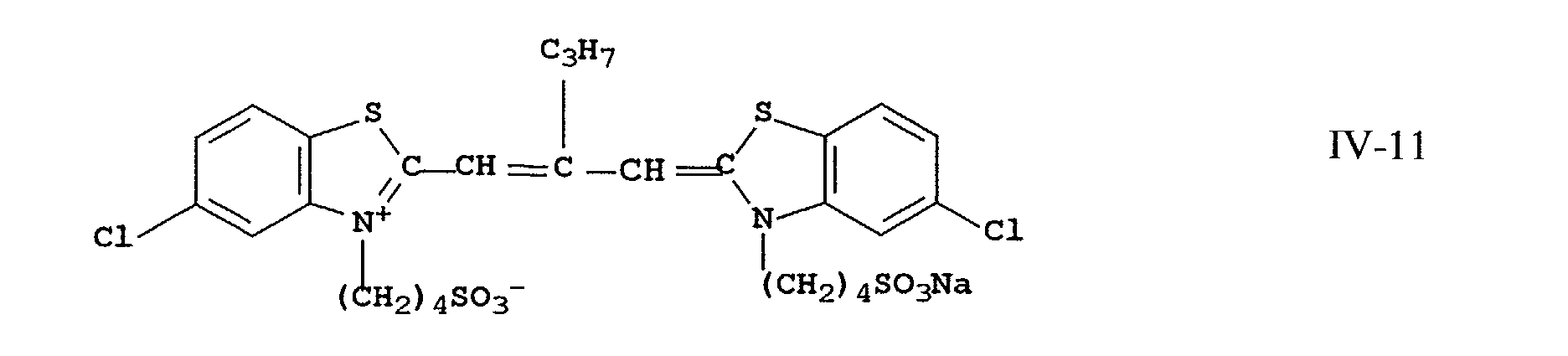
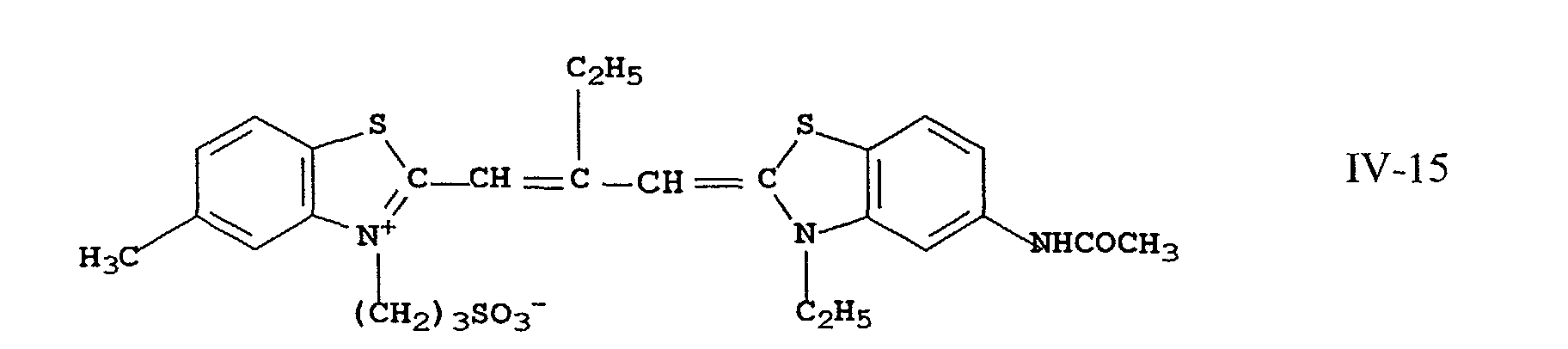
In the present invention, the red sensitive layer can contain any known red sensitizing dyes exhibiting an adsorption spectrum having the features required by the present invention. In one suitable embodiment, the red sensitive layer contain a sensitizing dye combination containing a sensitizing dye having the Formula (III) and a sensitizing dye having the following Formula (IV):
Figure 00130001
Figure 00130002
In the above forumlas R11 and R12 independently are an alkyl group having from 1 to 6 carbon atoms and R13 is an aryl group or an alkyl group having from 1 to 4 carbon atoms. X11, X12, X13, X14, X15 and X16 are independently hydrogen, halogen or alkyl, alkoxy, aryl, heteroaryl, or acetamido groups, or X11 and X12, X12 and X13, X14 and X15, or X15 and X16 can each independently be combined to form a saturated or unsaturated cyclic group, preferably a fused benzene group. It is preferred, however, that there are no fused ring or aryl substituents. Y represents an ion as needed to balance the charge of the sensitizing dye.
Examples of R11 and R12 include lower alkyls such as methyl, ethyl, propyl, butyl, pentyl, and hexyl. According to one embodiment, one or both of R11 and R12 contains an acid solubilizing group, and the term "alkyl" group when referring to R11 and R12 includes alkyl groups containing such acid solublizing groups. Preferably R11 and R12 are both sulfoalkyl groups
As described for the dyes contained in the green sensitive layer, depending upon the R11 and R12 groups, a counterion Y may be necessary to balance the charge of the sensitizing dye. Such counterions are well known in the art, and examples thereof include cations such as sodium, potassium, triethylammonium, and the like, and anions such as chloride, bromide, iodide, p-toluene sulfonate, methane sulfonate, methyl sulfate, ethyl, sulfate, perchlorate, fluoroborate, and the like.
Illustrative xamples of compounds having Formula III include:
Figure 00140001
Figure 00140002
Figure 00140003
Figure 00150001
Figure 00150002
Figure 00150003
Figure 00150004
Figure 00150005
Figure 00150006
Figure 00160001
Figure 00160002
Illustrative examples of compounds having Formula IV include the following:
Figure 00160003
Figure 00160004
Figure 00160005
Figure 00170001
Figure 00170002
Figure 00170003
Figure 00170004
Figure 00170005
Figure 00170006
Figure 00180001
Figure 00180002
Figure 00180003
Figure 00180004
Figure 00180005
Figure 00190001
When the above red sensitizing dye combination is used, the amount of red sensitizing dye that is useful in the invention is preferably in the range of 0.1 to 4 millimoles per mole of silver halide and more preferably from 0.5 to 3.0 millimoles per mole of silver halide.
When reference in this application is made to a particular group, unless otherwise specifically stated, the group may itself be unsubstituted or substituted with one or more substituents (up to the maximum possible number). For example, "alkyl" group refers to a substituted or unsubstituted alkyl group, while "benzene " refers to a substituted or unsubstituted benzene (with up to six substituents). The substituent may be itself substituted or unsubstituted.
Generally, unless otherwise specifically stated, substituents include any substituents, whether substituted or unsubstituted, which do not destroy properties necessary for the photographic utility. Examples of substituents include known substituents such as: halogen, for example, chloro, fluoro, bromo, iodo; alkoxy, particularly those "lower alkyl" (that is, with 1 to 6 carbon atoms, for example, methoxy, ethoxy; substituted or unsubstituted alkyl, particularly lower alkyl (for example, methyl, trifluoromethyl); thioalkyl (for example, methylthio or ethylthio), particularly either of those with 1 to 6 carbon atoms; substituted and unsubstituted aryl, particularly those having from 6 to 20 carbon atoms (for example, phenyl); and substituted or unsubstituted heteroaryl, particularly those having a 5- or 6-membered ring containing 1 to 3 heteroatoms selected from N, O, or S (for example, pyridyl, thienyl, furyl, pyrrolyl); acid or acid salt groups such as any of those described below; and others known in the art. Alkyl substituents may specifically include "lower alkyl" (that is, having 1-6 carbon atoms), for example, methyl, ethyl, and the like. Further, with regard to any alkyl group or alkylene group, it will be understood that these can be branched or unbranched and include ring structures.
The element of the invention further comprises a blue sensitive layer containing any known blue spectral sensitizing dye. In the element of the present invention, the blue sensitive layer usually shows an adsorption spectra having a maximum adsorption at a wavelength between 400 and 500 nm.
Spectral sensitizing dyes are well known in the art and are disclosed, for example, in Research Disclosure, September 1996, 38957, Section V. The dyes useful in the element of the invention can be prepared by synthetic techniques well known in the art. Such techniques are further illustrated, for example, in "The Cyanine Dyes and Related Compounds", Frances Hamer, Interscience Publishers, 1964 and James, The Theory of the Photograhic Process 4th, 1977. Optimum spectral sensitizing dye concentrations will depend on the nature of the spectral sensitizing used and on the intended end use of the photographic material and can be determined by methods well known in the art.
The element of the invention can be any known silver halide photographic element. These elements include silver halide photographic films, silver halide photographic papers, negative working elements, positive working elements, reversal photographic elements, and the like.
The photographic elements made in accordance with the present are generally multicolor elements containing dye image-forming units sensitive to each of the three primary regions of the spectrum. Each unit can be comprised of a single emulsion layer or of multiple emulsion layers sensitive to a given region of the light spectrum. The photographic emulsions conventionally contain silver halide grains. Grains containing combinations of halides most frequently employed for latent image formation include silver iodochloride, silver iodobromide, silver chlorobromide, silver iodochlorobromide, silver chloroiodobromide, silver bromochloride, silver iodobromochloride and silver bromoiodochloride grains, where the halides are named in order of ascending concentrations. The silver halide emulsions can be chemically sensitized with active gelatin as illustrated by T.H. James, The Theory of the Photographic Process, 4th Ed., Macmillan, 1977, pp. 67-76, or with middle chalcogen (sulfur, selenium or tellurium), gold, a platinum metal (platinum, palladium, rhodium, ruthenium, iridium and osmium), rhenium or phosphorus sensitizers or combinations of these sensitizers.
The element can contain further to the layers already disclosed additional layers, such as interlayers, filter layers, overcoat layers, subbing layers, and the like. All of these can be coated on a support that can be transparent or reflective (for example, a paper support). Typical photographic supports include polymeric film, wood fiber--e.g., paper, metallic sheet and foil, glass and ceramic supporting elements provided with one or more subbing layers.
According to one embodiment, the element of the invention is a reversal element and comprises a support having thereon in the following order, a red-light sensitive layer having a cyan dye-forming color coupler associated therewith; a green-light sensitive layer having a magenta dye-forming color coupler associated therewith and, and a blue-light sensitive layer having a yellow dye-forming color coupler associated therewith. Color reversal elements are those containing negative-working emulsions and intended to be developed using a reversal process.
Silver halide color reversal films are typically associated with an indication for processing by a color reversal process. Reference to a film being associated with an indication for processing by a color reversal process, most typically means the film, its container, or packaging (which includes printed inserts provided with the film), will have an indication on it that the film should be processed by a color reversal process. The indication may, for example, be simply a printed statement stating that the film is a "reversal film" or that it should be processed by a color reversal process, or simply a reference to a known color reversal process such as "Process E-6". A "color reversal" process in this context is one employing treatment with a non-chromogenic developer (that is, a developer which will not imagewise produce color by reaction with other compounds in the film; sometimes referenced as a "black and white developer"). This is followed by fogging unexposed silver halide, usually either chemically or by exposure to light. Then the element is treated with a color developer (that is, a developer which will produce color in an imagewise manner upon reaction with other compounds in the film). One well-known reversal process is Kodak Process E-6, Eastman Kodak Company.
In a typical construction, a reversal film does not have any masking couplers. Furthermore, reversal films have a gamma generally between 1.5 and 2.0, and this is much higher than for typical negative materials.
In the following Table, reference will be made to (1) Research Disclosure, December 1978, Item 17643, (2) Research Disclosure, December 1989, Item 308119, (3) Research Disclosure, September 1994, Item 36544, and (4) Research Disclosure, September 1996, Item 38957, all published by Kenneth Mason Publications, Ltd., Dudley Annex, 12a North Street, Emsworth, Hampshire PO10 7DQ, ENGLAND, the disclosures of which are incorporated herein by reference. The Table and the references cited in the Table are to be read as describing particular components suitable for use in the elements of the invention. The Table and its cited references also describe suitable ways of preparing, exposing, processing and manipulating the elements, and the images contained therein. Photographic elements and methods of processing such elements particularly suitable for use with this invention are described in Research Disclosure, February 1995, Item 37038, and in Research Disclosure, September 1997, Item 40145 published by Kenneth Mason Publications, Ltd., Dudley Annex, 12a North Street, Emsworth, Hampshire PO10 7DQ, ENGLAND, the disclosures of which are incorporated herein by reference.
Reference Section Subject Matter
1 I, II Grain composition, morphology and preparation. Emulsion preparation including hardeners, coating aids, addenda, etc.
2 I, II, IX, X, XI, XII, XIV, XV
3 & 4 I, II, III, IX A&B
1 III, IV Chemical sensitization and spectral sensitization/ Desensitization
2 III, IV
3 & 4 IV, V
1 V UV dyes, optical brighteners, luminescent dyes
2 V
3 & 4 VI
1 VI Antifoggants and stabilizers
2 VI
3 & 4 VII
1 VIII Absorbing and scattering materials; Antistatic layers; matting agents
2 VIII, XIII, XVI
3 & 4 VIII, IX C &D
1 VII Image-couplers and image-modifying couplers; Wash-out couplers; Dye stabilizers and hue modifiers
2 VII
3 & 4 X
1 XVII Supports
2 XVII
3 & 4 XV
3 & 4 XI Specific layer arrangements
3 & 4 XII, XIII Negative working emulsions; Direct positive emulsions
2 XVIII Exposure
3 & 4 XVI
1 XIX, XX Chemical processing; Developing agents
2 XIX, XX,
XXII
3 & 4 XVIII, XIX, XX
3 & 4 XIV Scanning and digital processing procedures
The photographic elements can be exposed with various forms of energy which encompass the ultraviolet, visible, and infrared regions of the electromagnetic spectrum, as well as the electron beam, beta radiation, gamma radiation, x-ray, alpha particle, neutron radiation, and other forms of corpuscular and wave-like radiant energy in either noncoherent (random phase) forms or coherent (in phase) forms, as produced by lasers. When the photographic elements are intended to be exposed by x-rays, they can include features found in conventional radiographic elements. The photographic elements are preferably exposed using the various energy sources utilized by electronic filmwriter devices, such as CRT light sources, laser sources, and LED sources.
Next, a more detailed description of the invention will be made. However, it is to be understood that the present invention is not limited to the following examples.
Example 1:
Comparative sample 101 was prepared according to the following description. The layers described below were coated on a cellulose triacetate film support to form a multilayer color photographic material. The coating amounts listed below are in the unit of g/m2 except for sensitizing dyes which are listed in terms of molar amount per mole of silver halide present in the same layer. "ECD" refers to equivalent circular diameter. "%I" refers to the mole percent of total iodide content.
First Layer: Antihalation Layer
Antihalation Colloidal Silver 0.25
UV Protection Dye UV-1 0.04
Dispersed in Solvent S-1 0.04
Gelatin 2.44
Second Layer: Intermediate Layer
Fine Grain Silver Bromide (0.055 mm ECD) 0.05
Scavenger SCV-1 0.11
Gelatin 1.22
Third Layer: Slow Red Sensitive Layer
Silver Iodobromide Emulsion (0.44 µm ECD X 0.06 µm - 4% I) 0.25
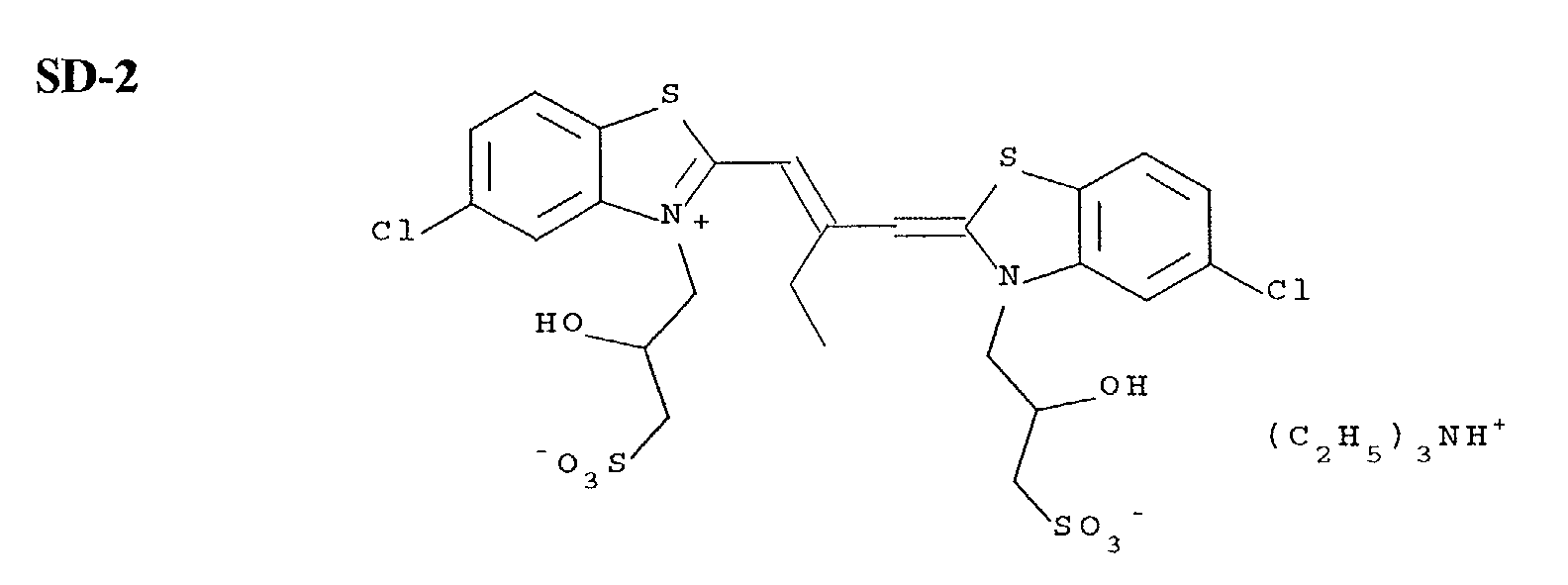
Spectrally sensitized with Red Sensitizing Dye SD-1 7.88 X 10⁻⁴
Red Sensitizing Dye SD-2 3.39 X 10⁻⁴
Fine Grain Silver Bromide (0.055 µm ECD) 0.04
Coupler C-1 0.09
Dispersed in Solvent S-3 0.04
Gelatin 0.08
Fourth Layer: Mid Red Sensitive Layer
Silver Iodobromide Emulsion (0.86 µm ECD X 0.09 µm - 4% I) 0.32
Spectrally sensitized with Red Sensitizing Dye SD-1 6.13 X 10⁻⁴
Red Sensitizing Dye SD-2 2.64 X 10⁻⁴
Fine Grain Silver Bromide (0.055 µm ECD) 0.05
Coupler C-1 0.4
Dispersed in Solvent S-3 0.2
Gelatin 0.73
Fifth Layer: Fast Red Sensitive Layer
Silver Iodobromide Emulsion (1.15 µm ECD X 0.10 µm - 3% I) 0.46
Spectrally sensitized with Red Sensitizing Dye SD-1 5.48 X 10⁻⁴
Red Sensitizing Dye SD-2 2.21 X 10⁻⁴
Fine Grain Silver Iodobromide (0.15 µm ECD - 4.8% I) 0.05
Fine Grain Silver Bromide (0.055 µm ECD) 0.03
Coupler C-1 0.70
Dispersed in Solvent S-3 0.35
Gelatin 1.18
Sixth Layer: Intermediate Layer
Filter Dye FD-1 0.07
Scavenger SCV-01 0.16
Gelatin 0.92
Inhibitor I-1 0.001
Seventh Layer: Slow Green Sensitive Layer
Silver Iodobromide Emulsion (0.40 µm ECD X 0.06 µm - 4% I) 0.31
Spectrally sensitized with Green Sensitizing Dye SD-5 1.26 X 10⁻³
Green Sensitizing Dye SD-6 3.74 X 10⁻⁴
Fine Grain Silver Bromide (0.055 µm ECD) 0.04
Coupler M-1 0.07
Coupler M-2 0.03
Co-dispersed in Solvent S-2 0.05
Gelatin 0.47
Eighth Layer: Mid Green Sensitive Layer
Silver Iodobromide Emulsion - (1.27 µm ECD X 0.14 µm - 3% I) 0.38
Spectrally sensitized with Green Sensitizing Dye SD-5 1.10 X 10⁻³
Green Sensitizing Dye SD-6 3.49 X 10⁻⁴
Coupler M-1 0.34
Coupler M-2 0.15
Co-dispersed in Solvent S-2 0.25
Gelatin 0.91
Ninth Layer: Fast Green Sensitive Layer
Silver Iodobromide Emulsion - (1.27 µm ECD X 0.14 µm - 3% I) 0.54
Spectrally sensitized with Green Sensitizing Dye SD-5 1.09 X 10⁻³
Green Sensitizing Dye SD-6 1.82 X 10⁻⁴
Fine Grain Silver Iodobromide (0.15 µm ECD - 4.8% I) 0.04
Coupler M-1 0.72
Coupler M-2 0.31
Co-dispersed in Solvent S-2 0.52
Gelatin 1.78
Tenth Layer: Intermediate Layer
Gelatin 0.61
Eleventh Layer: Yellow Filter Layer
Carey Lea Silver 0.07
Gelatin 0.61
Twelfth Layer: Intermediate Layer
Scavenger SCV-1 0.11
Hardener H-1 1.38% total gel
Gelatin 0.75
Thirteenth Layer: Slow Blue Sensitive Layer
Silver Iodobromide Emulsion - (0.49 µm ECD X 0.13 µm - 3% I) 0.19
Spectrally Sensitized with Blue Sensitizing Dye SD-7 4.71 X 10⁻⁴
Blue Sensitizing Dye SD-8 9.44 X 10⁻⁴
Silver Iodobromide Emulsion - (1.01 µm ECD X 0.125 µm - 3% I) 0.22
Spectrally Sensitized with Blue Sensitizing Dye SD-7 3.86 X 10⁻⁴
Blue Sensitizing Dye SD-8 1.16 X 10⁻³
Coupler Y-1 0.96
Dispersed in Solvent S-3 0.32
Gelatin 1.32
Fourteenth Layer: Fast Blue Sensitive Layer
Silver Iodobromide Emulsion - (2.67 µm ECD X 0.15 µm) 0.63
Spectrally Sensitized with
Blue Sensitizing Dye SD-7 2.20 X 10⁻⁴
Blue Sensitizing Dye SD-8 6.61 X 10⁻⁴
Coupler Y-1 1.44
Dispersed in Solvent S-3 0.48
Gelatin 1.91
Fifteenth Layer: First Protective Layer
UV Protection Dye UV-1 0.09
Dispersed in Latex L-1 0.43
UV Protection Dye UV-4 0.41
Scavenger SCV-1 0.07
Gelatin 1.40
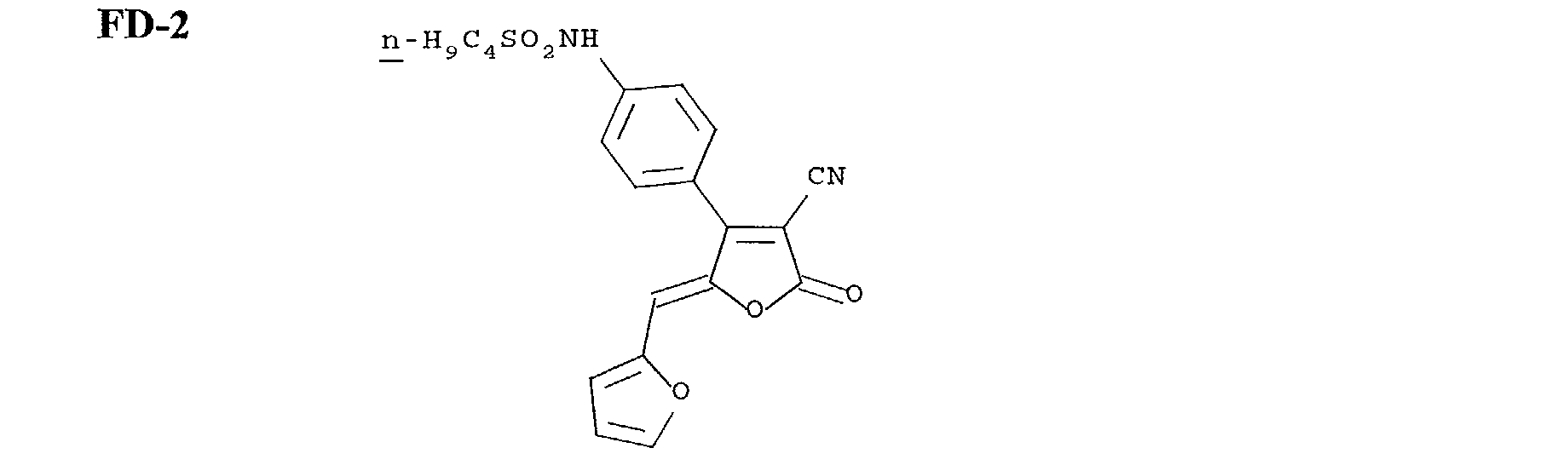
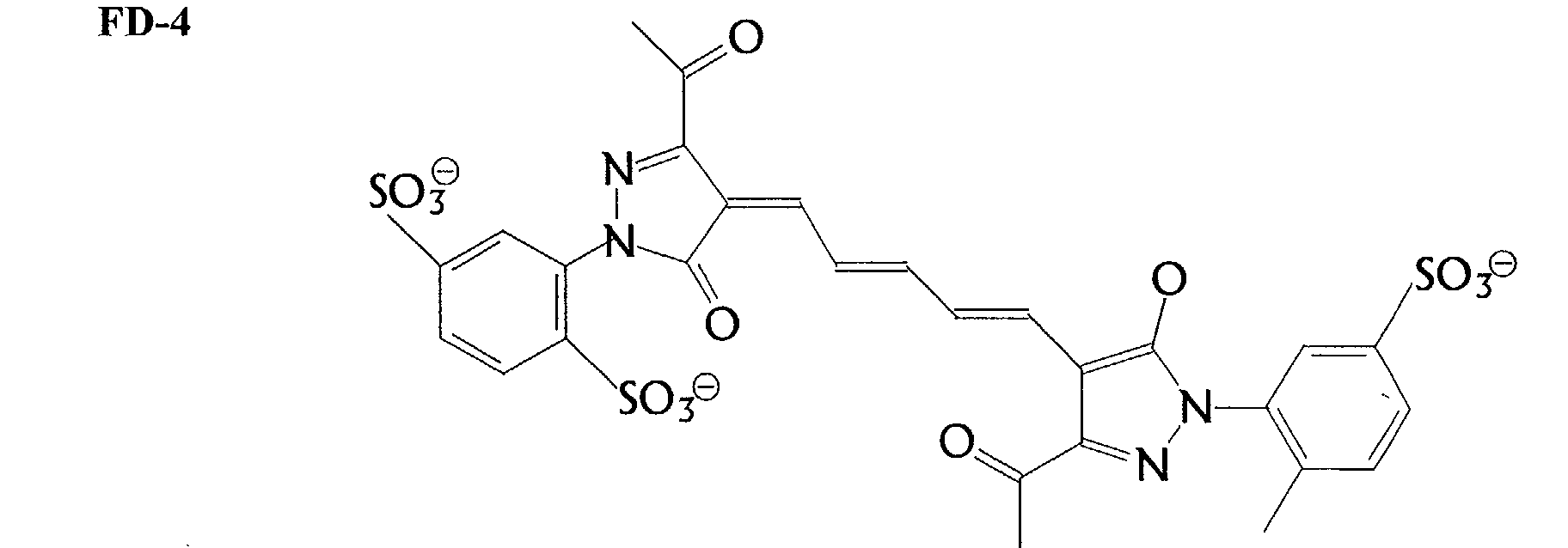
Filter Dye FD-3 0.06
Filter Dye FD-4 0.01
Sixteenth Layer: Second Protective Layer
Fine Grain Silver Bromide (0.055 µm ECD) 0.12
Matte 0.06
Gelatin 0.98
Sample 102, illustrating an element of the invention, was constructed similarly to sample 101 except for the following changes:
Seventh Layer: Slow Green Sensitive Layer
Silver Iodobromide Emulsion - (0.40 µm ECD X 0.06 µm - 4% I) 0.31
Spectrally sensitized with Green Sensitizing Dye SD-5 1.32 X 10⁻³
Fine Grain Silver Bromide (0.055 µm ECD) 0.04
Coupler M-1 0.07
Coupler M-2 0.03
Co-dispersed in Solvent S-2 0.10
Gelatin 0.47
Eighth Layer: Mid Green Sensitive Layer
Silver Iodobromide Emulsion - (0.63 µm ECD X 0.11 µm - 3% I) 0.380
Spectrally sensitized with Green Sensitizing Dye SD-5 1.28 X 10⁻³
Coupler M-1 0.34
Coupler M-2 0.15
Co-dispersed in Solvent S-2 0.20
Gelatin 0.91
Ninth Layer: Fast Green Sensitive Layer
Silver Iodobromide Emulsion - (1.27 µm ECD X 0.14 µm - 3% I) 0.54
Spectrally sensitized with Green Sensitizing Dye SD-5 1.32 X 10⁻³
Fine Grain Silver Iodobromide (0.15 µm ECD - 4.8% I) 0.04
Coupler M-1 0.72
Coupler M-2 0.31
Co-dispersed in Solvent S-2 0.52
Gelatin 1.78
Fifteenth Layer: First Protective Layer
UV Protection Dye UV-1 0.09
Dispersed in Latex L-1 0.43
UV Protection Dye UV-4 0.41
Scavenger SCV-1 0.07
Gelatin 1.40
Filter Dye FD-4 0.01
Fig. 2 shows the absorption spectrum of the green light sensitive layers of samples 101 and 102. The characteristics of each spectra are reported in Table 2 below wherein λmax is the maximum absorption wavelength of the peak and Wh/2(λmax) is the half bandwidth of the peak measured at λmax.
Sample λmax (nm) Wh/2(λmax)
101 570 70
102 550 42
The above samples were exposed by electronic filmwriter devices and a conventional 1B daylight sensitometer. When exposed to the daylight sensitometer, the samples were exposed for 1/50 sec with a 0.6 inconel filter at a color temperature 5500 K; and developed using Kodak Process E-6 with a development time of 6 minutes. For each experiment, the green density variations between sample 101 and 102 were measured (Delta green density) for the densities 0.3, 0.5, 1, 1.5, and 2 of sample 101, at the same exposure level.
The results are reported in following Table 3.
Density of sample 101 Delta green density (102-101)
LVT Solitaire IB Sensitometer
0.3 - 0.15 -0.05
0.5 - 0.2 -0.05
1 -0.3 -0.4 -0.05
1.5 -0.4 -0.5 -0.1
2 -0.5 -0.65 -0.2
These examples show that at the same exposure level, when exposed to daylight sensitometer, the green density of the element of the invention 102 is only slightly reduced in high densities in comparison with the green density of sample 101. When exposed to the LVT or solitaire filmwriter, the element of the invention 102 gives substantially less green density than the density of sample 101. This shows that, when exposed to electronic filmwriter devices, the speed of the element of the invention is improved.
Example 2:
Comparative sample 103 was constructed similarly to sample 101 except for the following changes:
Third Layer: Slow Red Sensitive Layer
Silver Iodobromide Emulsion (0.44 µm ECD X 0.06 µm - 4% I) 0.25
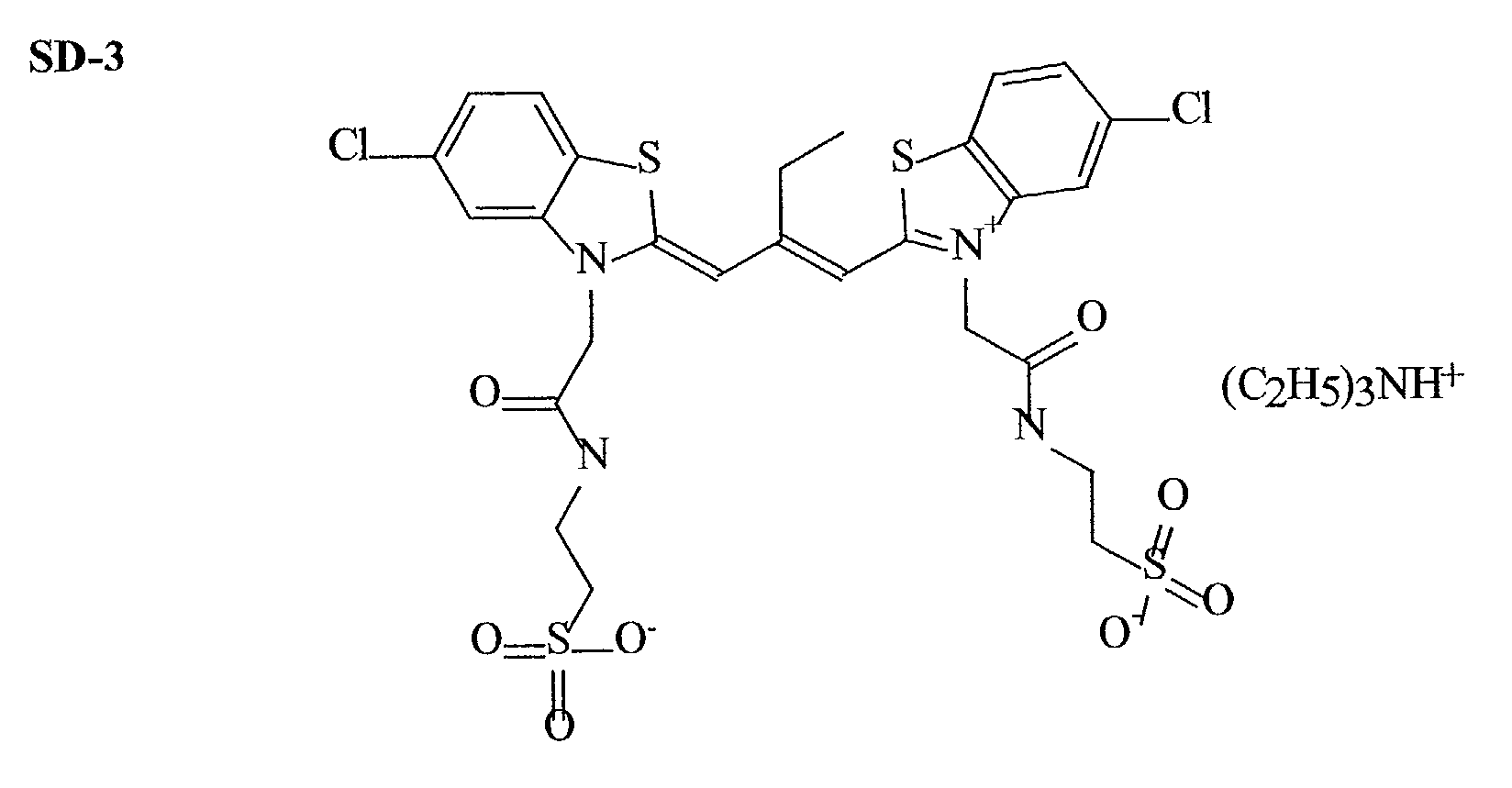
Spectrally sensitized with Red Sensitizing Dye SD-3 8.82 X 10⁻⁴
Red Sensitizing Dye SD-4 1.04 X 10⁻⁵
Fine Grain Silver Bromide (0.055 µm ECD) 0.04
Coupler C-1 0.09
Dispersed in Solvent S-3 0.04
Gelatin 0.08
Fourth Layer: Mid Red Sensitive Layer
Silver Iodobromide Emulsion (0.86 µm ECD X 0.09 µm - 4% I) 0.32
Spectrally sensitized with Red Sensitizing Dye SD-3 6.96 X 10⁻⁴
Red Sensitizing Dye SD-4 8.17 X 10⁻⁵
Fine Grain Silver Bromide (0.055 µm ECD) 0.05
Coupler C-1 0.4
Dispersed in Solvent S-3 0.2
Gelatin 0.73
Fifth Layer: Fast Red Sensitive Layer
Silver Iodobromide Emulsion (1.15 µm ECD X 0.10 µm - 3% I) 0.46
Spectrally sensitized with Red Sensitizing Dye SD-3 6.82 X 10⁻⁴
Red Sensitizing Dye SD-4 7.19 X 10⁻⁵
Fine Grain Silver Iodobromide (0.15 µm ECD - 4.8% I) 0.05
Fine Grain Silver Bromide (0.055 µm ECD) 0.03
Coupler C-1 0.70
Dispersed in Solvent S-3 0.35
Gelatin 1.18
Fifteenth Layer: First Protective Layer
UV Protection Dye UV-1 0.09
Dispersed in Latex L-1 0.43
UV Protection Dye UV-4 0.41
Scavenger SCV-1 0.07
Gelatin 1.40
Filter Dye FD-4 0.01
Fig. 1 shows the absorption spectrum of the red sensitive layers of samples 102 and 103. The characteristics of each peak are reported in Table 4 below wherein λmax is the maximum absorption wavelength of the peak and %A30 is % area of the peak at 30 nm hypsochromic and below, based on the total area of peak.
Sample λmax (nm) A30
102 630 29%
103 650 42%
The above samples were exposed by the electronic filmwriter devices indicated below and a conventional 1B daylight sensitometer in the same conditions as Example 1. For each experiment, the red density variations (Delta red density) between sample 102 and 103 were measured for the densities 0.5, 1, 1.5, and 2 of sample 103, at the same exposure level.
The results are reported in followingTable 5.
Density of sample 103 Delta red density (102-103)
LVT Sensitometer
0.5 -0.15 0
1 -0.3 -0.03
1.5 -0.5 -0.03
2 -0.55 0
These experiments show that, at the same exposure level, when exposed to daylight 1B sensitometer, the red density of the element of the invention is only slightly reduced in comparison with the red density of sample 103. When exposed to the LVT or solitaire filmwriter, the element of the invention gives substantially less red density than the density of sample 103. This shows that, when exposed to an electronic filmwriter device, the speed of the element of the invention is improved.
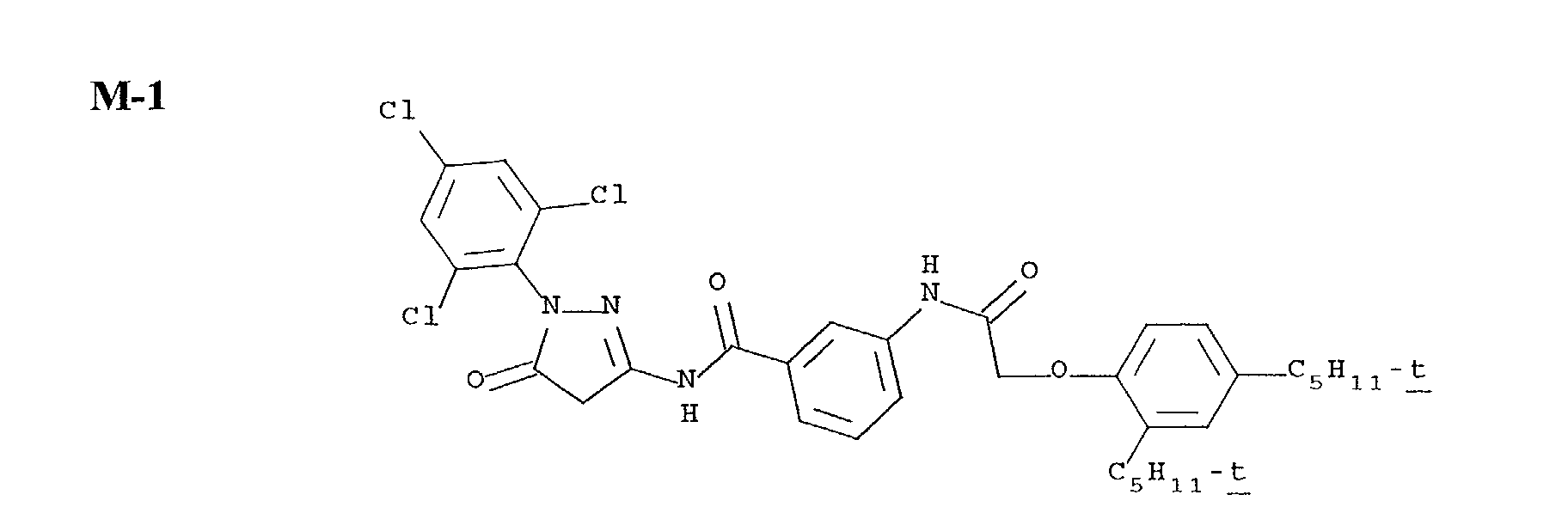
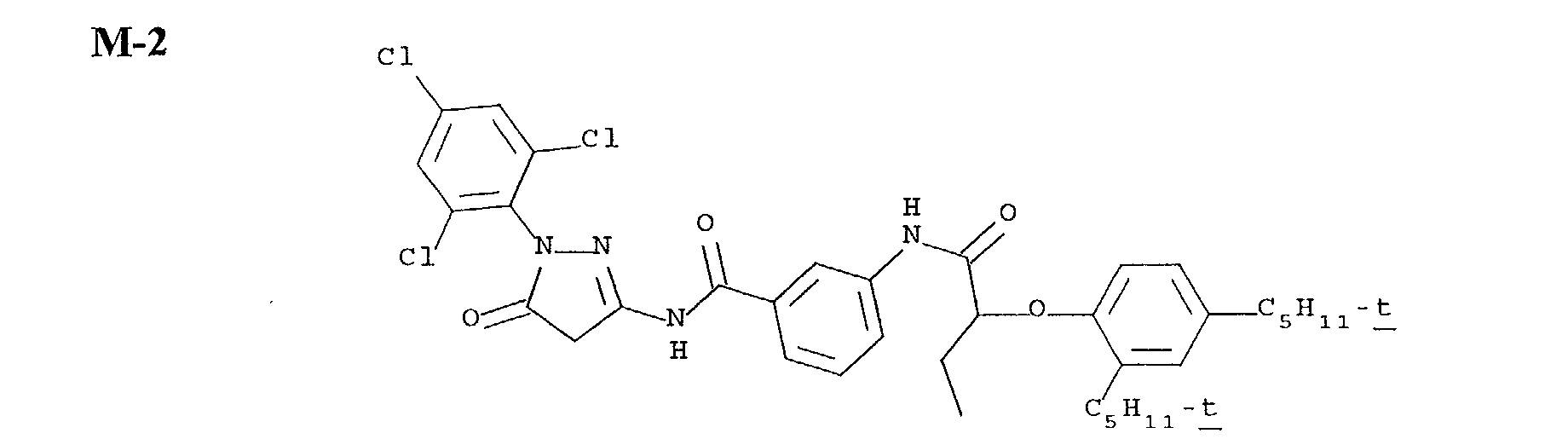
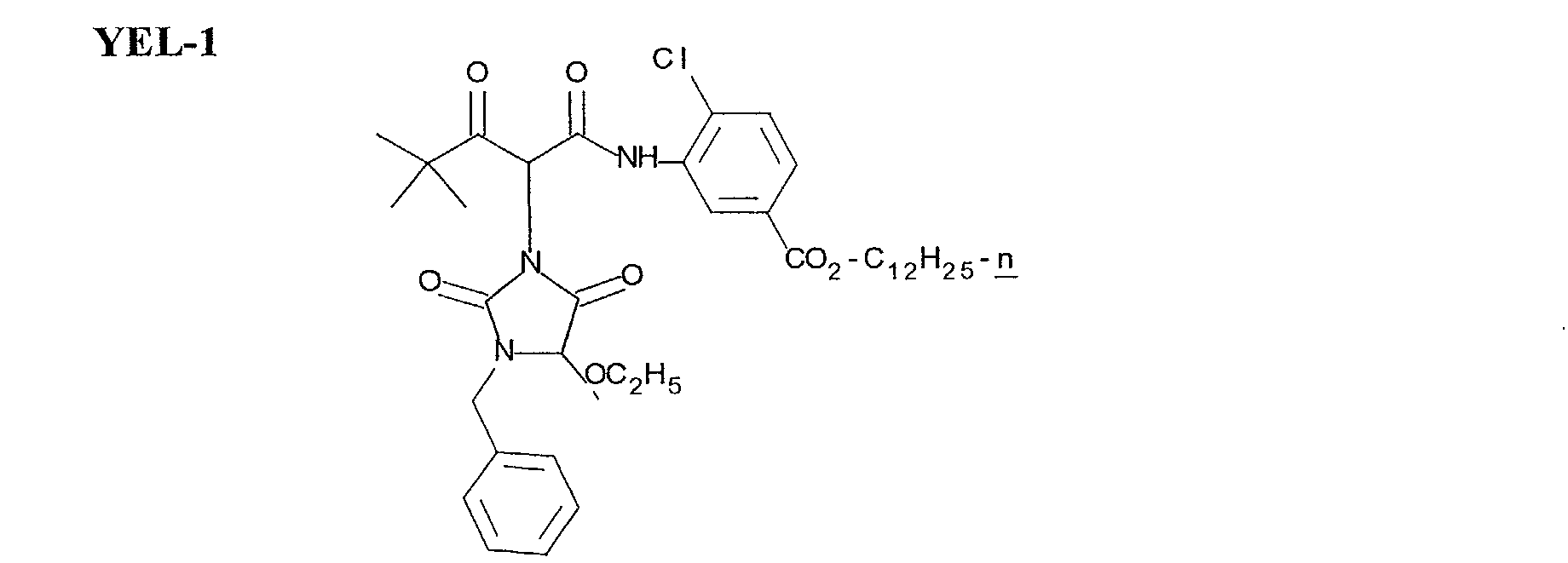
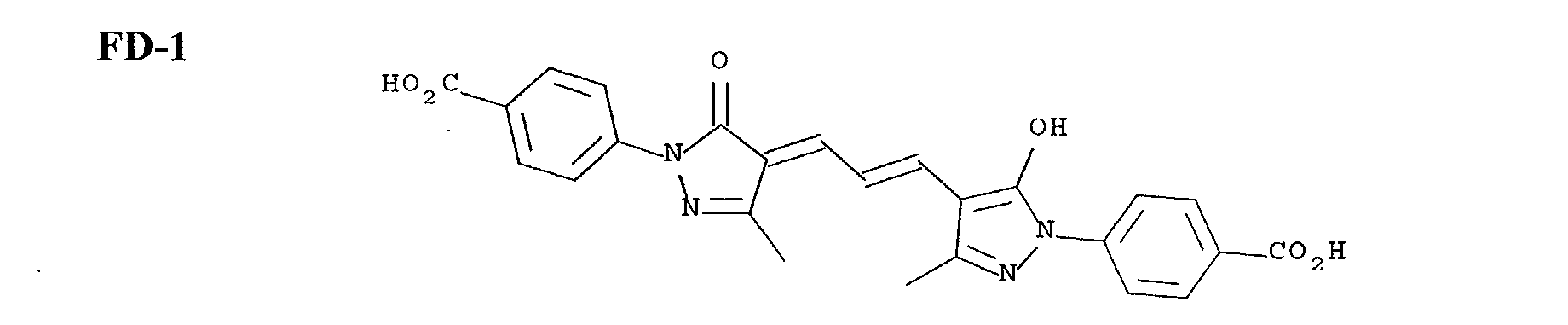
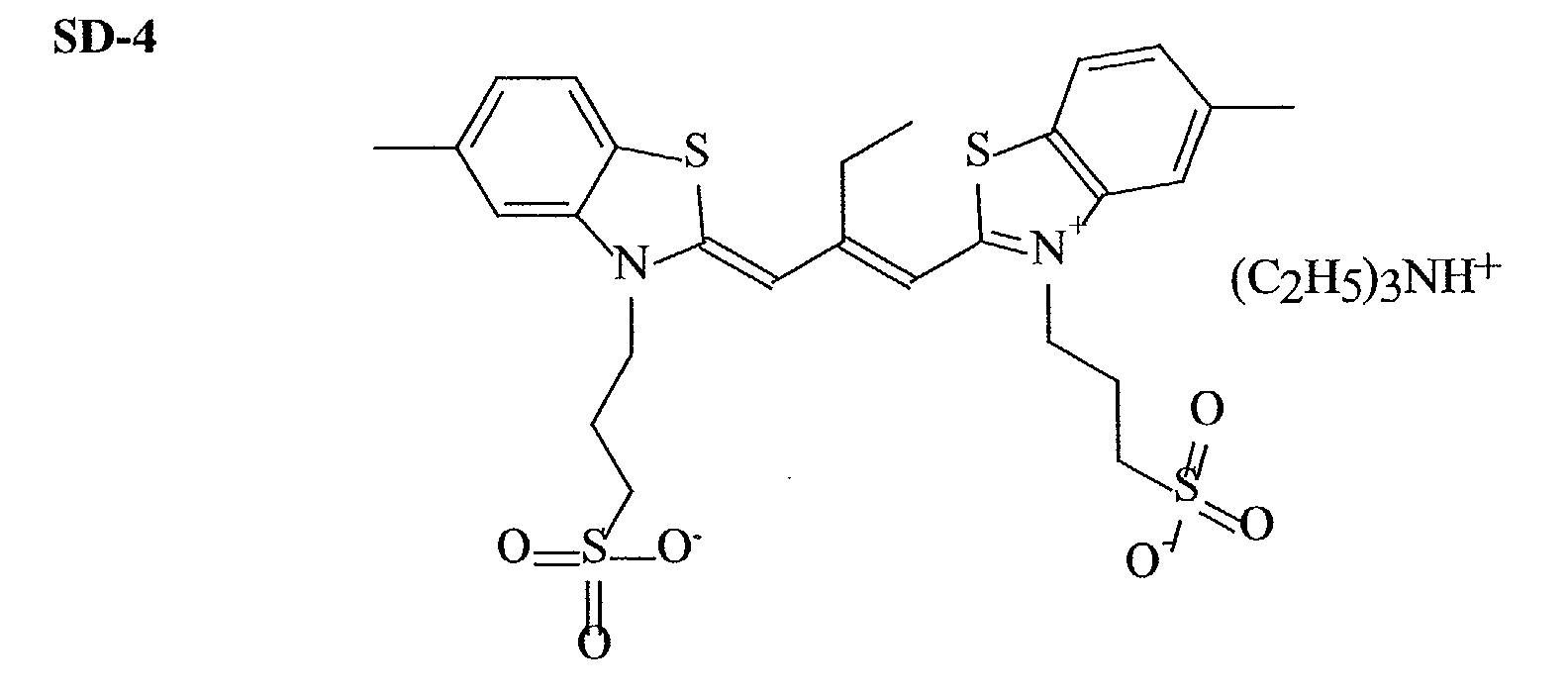
Compounds of samples 101, 102 and 103.
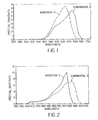
Figure 00310001
Figure 00310002
Figure 00320001
Figure 00320002
Figure 00320003
Figure 00320004
Figure 00320005
Figure 00330001
Figure 00330002
Figure 00330003
Figure 00340001
Figure 00340002
Figure 00340003
Figure 00340004
Figure 00350001
Figure 00350002
Figure 00350003
Figure 00350004
Figure 00350005
Figure 00350006
Figure 00360001
  • Hardener H-1 1,1'-[methylenebis(sulfonyl)]bis-ethene
  • Solvent S-1 1,4-Cyclohexylenedimethylene bis(2-ethylhexanoate)
  • Solvent S-2 Phosphoric acid, tris(methylphenyl) ester
  • Solvent S-3 1,2-Benzenedicarboxylic acid, dibutyl ester.
  • Claims (11)

    1. A photographic element comprising a support having thereon light sensitive silver halide layers comprising at least one red light sensitive silver halide layer, at least one green light sensitive silver halide layer, and at least one blue sensitive silver halide layer, wherein
         the green light sensitive silver halide layer has an absorption spectra having a maximum absorption at a wavelength λmax from 530 to 560 nm and a half bandwidth less than 50 nm; and
         the red light sensitive silver halide layer has an adsorption spectra having a maximum absorption at a wavelength λmax from 610 to 640 nm, and exhibiting from 30 nm hypsochromic of the wavelength of maximum absorption and below an area less than 40% based on the total area of the red light sensitive silver halide layer adsorption spectra.
    2. The photographic element of claim 1 wherein the half bandwidth of the green light sensitive layer is between 35 to 50 nm.
    3. The photographic element of claims 1 or 2 wherein the area of the absorption spectra from 30 nm hypsochromic of the wavelength of maximum absorption and below is less than 35% based on the total area of the red light sensitive silver halide layer adsorption spectra.
    4. The photographic element of claims 1 to 3 wherein the red light sensitive silver halide layer has an adsorption spectra having a maximum absorption at a wavelength λmax from 620 to 640 nm.
    5. The photographic element of claims 1 to 4 wherein the green light sensitive silver halide layer comprises a sensitizing dye having the following Formula (I):
      Figure 00380001
      wherein R1 and R2 independently are an alkyl group having 1 to 6 carbon atoms; R3 is an aryl group or an alkyl group having 1 to 4 carbon atoms; X1, X2, X3, X4, X5, and X6 independently are hydrogen, halogen, or alkyl, alkoxy, aryl, heteroaryl or acetamido groups, or X1 and X2, X2 and X3, X4 and X5, X5 and X6 can each independently be combind to form a saturated or unsaturated cyclic group, X is O or N-R4 wherein R4 is an alkyl group having 1 to 6 carbon atoms, and Y represents an ion as needed to balance the charge of the sensitizing dye.
    6. The photographic element of claim 5 wherein R1 and R2 are both sulfoalkyl groups.
    7. The photographic element of claims 1 to 4 wherein the green light sensitive silver halide layer comprises a sensitizing dye having the following Formula II:
      Figure 00380002
      wherein R7 and R8 are methyl or ethyl groups provided that at least one of R7 and R8 is a methyl group; R5 and R6 are alkyl groups having from 1 to 6 carbon atoms, provided that R5 and R6 are not both methyl groups, R9 is hydrogen, X7, X8, X9, and X10 are each independently methyl, methylthio, fluoro-substituted methyl or methylthio groups, or hydrogen, provided that at least one of X7 and X8 and at least one of X9 and X10 are not hydrogen; and Y represents an ion as needed to balance the charge of the sensitizing dye.
    8. The photographic element of claim 7 wherein R5 and R6 are both sulfoalkyl groups.
    9. The photographic element of claims 1 to 8 wherein the red light sensitive silver halide layer comprises a dye combination containing a sensitizing dye having the following Formula III and a sensitizing dye having the following Formula IV:
      Figure 00390001
      Figure 00390002
      wherein R11 and R12 independently are an alkyl group having from 1 to 6 carbon atoms; R13 is an aryl group or an alkyl group having from 1 to 4 carbon atoms; X11, X12, X13, X14, X15 and X16 are independently hydrogen, halogen, or alkyl, alkoxy, aryl, heteroaryl, or acetamido groups, or X11 and X12, X12 and X13, X14 and X15, or X15 and X16 each independently are combined to form a saturated or unsaturated cyclic group; and Y represents an ion as needed to balance the charge of the sensitizing dye.
    10. The photographic element of claim 9 wherein R11 and R12 are both sulfoalkyl groups and wherein the compounds of Formula (III) and (IV) do not contain fused ring or aryl substituents.
    11. A process for forming a photographic image which comprises exposing a silver halide photographic element with light sources from an electronic filmwriter device, the element comprising a support having thereon at least one red light sensitive silver halide layer, at least one green light sensitive silver halide layer, and at least one blue light sensitive silver halide layer, wherein
         the green light sensitive silver halide layer has an absorption spectra having a maximum absorption at awavelength λmax from 530 to 560 nm and a half bandwidth less than 50 nm; and
         the red light sensitive silver halide layer has an adsorption spectra having a maximum absorption at a wavelength λmax from 610 to 640 nm, and exhibiting from 30 nm hypsochromic of the wavelength of maximum absorption and below an area less than 40% based on the total area of the red light sensitive silver halide layer adsorption spectra.
    EP02076872A 2001-05-22 2002-05-13 Spectral sentisized silver halide element for electronic filmwriter device Withdrawn EP1260860A3 (en)

    Applications Claiming Priority (2)

    Application Number Priority Date Filing Date Title
    US09/862,923 US6485897B1 (en) 2001-05-22 2001-05-22 Spectral sensitized silver halide element for electronic filmwriter device
    US862923 2001-05-22

    Publications (2)

    Publication Number Publication Date
    EP1260860A2 true EP1260860A2 (en) 2002-11-27
    EP1260860A3 EP1260860A3 (en) 2003-04-02

    Family

    ID=25339746

    Family Applications (1)

    Application Number Title Priority Date Filing Date
    EP02076872A Withdrawn EP1260860A3 (en) 2001-05-22 2002-05-13 Spectral sentisized silver halide element for electronic filmwriter device

    Country Status (3)

    Country Link
    US (1) US6485897B1 (en)
    EP (1) EP1260860A3 (en)
    JP (1) JP2002351007A (en)

    Families Citing this family (1)

    * Cited by examiner, † Cited by third party
    Publication number Priority date Publication date Assignee Title
    US10179288B2 (en) 2016-06-20 2019-01-15 Zynga Inc. Adaptive object placement in computer-implemented games

    Family Cites Families (21)

    * Cited by examiner, † Cited by third party
    Publication number Priority date Publication date Assignee Title
    JPH0690463B2 (en) 1986-01-08 1994-11-14 富士写真フイルム株式会社 Color photographic light-sensitive material
    EP0294193A3 (en) 1987-06-05 1989-02-15 Konica Corporation Apparatus for forming color image, and light-sensitive silver halide color photographic material suited for optical scanning exposure
    US5079132A (en) 1987-09-16 1992-01-07 Fuji Photo Film Co., Ltd. Method for forming a color positive having improved color reproduction
    JP2571074B2 (en) * 1987-10-29 1997-01-16 富士写真フイルム株式会社 Silver halide color photographic materials
    US5024925A (en) * 1988-07-21 1991-06-18 Fuji Photo Film Co., Ltd. Method of forming color image from a color reversal photographic material comprising a specified iodide content and spectral distribution
    JPH0786674B2 (en) 1989-06-13 1995-09-20 富士写真フイルム株式会社 Silver halide color photographic light-sensitive material and color image forming method
    DE3924111A1 (en) 1989-07-20 1991-01-31 Agfa Gevaert Ag COLOR PHOTOGRAPHIC RECORDING MATERIAL WITH IMPROVED REVIEW OF COLOR SHADES
    US5180657A (en) 1989-12-22 1993-01-19 Konica Corporation Color photographic light-sensitive material offering excellent hue reproduction
    US5200308A (en) 1990-01-19 1993-04-06 Konica Corporation Color photographic material
    JP2884371B2 (en) 1990-09-04 1999-04-19 コニカ株式会社 Silver halide color photographic materials
    US5350665A (en) 1990-11-30 1994-09-27 Fuji Photo Film Co., Ltd. Silver halide color photographic material
    JP2926663B2 (en) 1991-02-08 1999-07-28 コニカ株式会社 Color photographic photosensitive material with excellent hue reproducibility
    US5210014A (en) 1991-03-28 1993-05-11 Eastman Kodak Company Mid-green sensitizing dyes for photographic materials
    JP2717466B2 (en) 1991-06-12 1998-02-18 富士写真フイルム株式会社 Silver halide color photographic materials
    JPH0695284A (en) 1992-09-16 1994-04-08 Konica Corp Positive color photosensitive material and image forming method
    JPH06214351A (en) 1993-01-14 1994-08-05 Fuji Photo Film Co Ltd Image forming method
    JP3240536B2 (en) 1993-06-23 2001-12-17 コニカ株式会社 Silver halide photographic materials
    US5582961A (en) 1995-06-06 1996-12-10 Eastman Kodak Company Photographic elements which achieve colorimetrically accurate recording
    US5609978A (en) 1995-06-06 1997-03-11 Eastman Kodak Company Method for producing an electronic image from a photographic element
    US6143482A (en) * 1998-08-05 2000-11-07 Eastman Kodak Company Photographic film element containing an emulsion with green-red responsivity
    JP2001133941A (en) * 1999-11-04 2001-05-18 Konica Corp Image forming method and silver halide color photographic sensitive material

    Also Published As

    Publication number Publication date
    JP2002351007A (en) 2002-12-04
    EP1260860A3 (en) 2003-04-02
    US6485897B1 (en) 2002-11-26

    Similar Documents

    Publication Publication Date Title
    US6066443A (en) Blue sensitizing dyes with heterocyclic substituents
    US3816121A (en) Direct positive photographic material containing a color coupler under one micron in size and fogged silver halide grains with substantially no internal sensitivity having absorbed on the surface a desensitizing dye containing a solubilizing group
    JPS63286847A (en) Silver halide color photographic sensitive material
    DE3854930T2 (en) Photographic silver halide emulsion
    US4889796A (en) Silver halide photographic emulsion
    US6485897B1 (en) Spectral sensitized silver halide element for electronic filmwriter device
    EP0539978A1 (en) Silver halide photographic material and method of forming color images using the same
    US6120982A (en) Red sensitizing dye combinations for high chloride emulsions
    US3637388A (en) Process for the photographic production of equidensities
    GB2302411A (en) Silver halide materials
    EP0898200A1 (en) Reversal photographic elements comprising an additional layer containing an imaging emulsion and a non-imaging emulsion
    US5695918A (en) Cyanine dyes with chain sulfone substituent photographic materials comprising
    US5441858A (en) Photographic silver halide elements comprising infrared sensitizing dyes
    JPH07306491A (en) Photographic element
    EP0915370B1 (en) Silver halide light-sensitive photographic material
    GB2321716A (en) Photographic element with colour enhancing layer adjacent the yellow dye forming layer
    US5405739A (en) Silver halide photographic light-sensitive material
    US5312724A (en) Silver halide photographic photosensitive materials
    US5312723A (en) Silver halide photographic photosensitive materials
    US6017690A (en) Silver halide photographic material and method of forming images using the same
    EP0608017B1 (en) Silver halide photographic elements sensitized to green light
    US5869228A (en) Silver halide color photographic light-sensitive material and method of forming color image
    US5516628A (en) Silver halide photographic elements with particular blue sensitization
    JP2881329B2 (en) Color photographic photosensitive material with excellent hue reproducibility
    US5508156A (en) Silver halide photographic light-sensitive material

    Legal Events

    Date Code Title Description
    PUAI Public reference made under article 153(3) epc to a published international application that has entered the european phase

    Free format text: ORIGINAL CODE: 0009012

    AK Designated contracting states

    Kind code of ref document: A2

    Designated state(s): AT BE CH CY DE DK ES FI FR GB GR IE IT LI LU MC NL PT SE TR

    AX Request for extension of the european patent

    Free format text: AL;LT;LV;MK;RO;SI

    PUAL Search report despatched

    Free format text: ORIGINAL CODE: 0009013

    AK Designated contracting states

    Kind code of ref document: A3

    Designated state(s): AT BE CH CY DE DK ES FI FR GB GR IE IT LI LU MC NL PT SE TR

    Designated state(s): AT BE CH CY DE DK ES FI FR GB GR IE IT LI LU MC NL PT SE TR

    AX Request for extension of the european patent

    Extension state: AL LT LV MK RO SI

    17P Request for examination filed

    Effective date: 20030915

    AKX Designation fees paid

    Designated state(s): DE FR GB

    17Q First examination report despatched

    Effective date: 20040331

    STAA Information on the status of an ep patent application or granted ep patent

    Free format text: STATUS: THE APPLICATION IS DEEMED TO BE WITHDRAWN

    18D Application deemed to be withdrawn

    Effective date: 20040811