EP1260859A2 - A method and system for processing of photographic material - Google Patents
A method and system for processing of photographic material Download PDFInfo
- Publication number
- EP1260859A2 EP1260859A2 EP02008923A EP02008923A EP1260859A2 EP 1260859 A2 EP1260859 A2 EP 1260859A2 EP 02008923 A EP02008923 A EP 02008923A EP 02008923 A EP02008923 A EP 02008923A EP 1260859 A2 EP1260859 A2 EP 1260859A2
- Authority
- EP
- European Patent Office
- Prior art keywords
- processing
- silver
- product
- concentration
- solution
- Prior art date
- Legal status (The legal status is an assumption and is not a legal conclusion. Google has not performed a legal analysis and makes no representation as to the accuracy of the status listed.)
- Withdrawn
Links
Images
Classifications
-
- G—PHYSICS
- G03—PHOTOGRAPHY; CINEMATOGRAPHY; ANALOGOUS TECHNIQUES USING WAVES OTHER THAN OPTICAL WAVES; ELECTROGRAPHY; HOLOGRAPHY
- G03C—PHOTOSENSITIVE MATERIALS FOR PHOTOGRAPHIC PURPOSES; PHOTOGRAPHIC PROCESSES, e.g. CINE, X-RAY, COLOUR, STEREO-PHOTOGRAPHIC PROCESSES; AUXILIARY PROCESSES IN PHOTOGRAPHY
- G03C5/00—Photographic processes or agents therefor; Regeneration of such processing agents
- G03C5/26—Processes using silver-salt-containing photosensitive materials or agents therefor
-
- G—PHYSICS
- G03—PHOTOGRAPHY; CINEMATOGRAPHY; ANALOGOUS TECHNIQUES USING WAVES OTHER THAN OPTICAL WAVES; ELECTROGRAPHY; HOLOGRAPHY
- G03C—PHOTOSENSITIVE MATERIALS FOR PHOTOGRAPHIC PURPOSES; PHOTOGRAPHIC PROCESSES, e.g. CINE, X-RAY, COLOUR, STEREO-PHOTOGRAPHIC PROCESSES; AUXILIARY PROCESSES IN PHOTOGRAPHY
- G03C5/00—Photographic processes or agents therefor; Regeneration of such processing agents
- G03C5/26—Processes using silver-salt-containing photosensitive materials or agents therefor
- G03C5/395—Regeneration of photographic processing agents other than developers; Replenishers therefor
-
- G—PHYSICS
- G03—PHOTOGRAPHY; CINEMATOGRAPHY; ANALOGOUS TECHNIQUES USING WAVES OTHER THAN OPTICAL WAVES; ELECTROGRAPHY; HOLOGRAPHY
- G03C—PHOTOSENSITIVE MATERIALS FOR PHOTOGRAPHIC PURPOSES; PHOTOGRAPHIC PROCESSES, e.g. CINE, X-RAY, COLOUR, STEREO-PHOTOGRAPHIC PROCESSES; AUXILIARY PROCESSES IN PHOTOGRAPHY
- G03C11/00—Auxiliary processes in photography
- G03C11/02—Marking or applying text
-
- G—PHYSICS
- G03—PHOTOGRAPHY; CINEMATOGRAPHY; ANALOGOUS TECHNIQUES USING WAVES OTHER THAN OPTICAL WAVES; ELECTROGRAPHY; HOLOGRAPHY
- G03C—PHOTOSENSITIVE MATERIALS FOR PHOTOGRAPHIC PURPOSES; PHOTOGRAPHIC PROCESSES, e.g. CINE, X-RAY, COLOUR, STEREO-PHOTOGRAPHIC PROCESSES; AUXILIARY PROCESSES IN PHOTOGRAPHY
- G03C5/00—Photographic processes or agents therefor; Regeneration of such processing agents
- G03C5/26—Processes using silver-salt-containing photosensitive materials or agents therefor
- G03C5/395—Regeneration of photographic processing agents other than developers; Replenishers therefor
- G03C5/3954—Electrical methods, e.g. electroytic silver recovery, electrodialysis
Definitions
- the present invention relates to a method and system for the processing of photographic materials.
- the invention relates in particular to the processing of black and white photographic materials such as those used in graphic arts.
- the by-products of a particular processing step may actually retard the rate of reaction of that processing step.
- the halide ions released by the development of silver halide crystals can retard the development reaction.
- One of the key components in a seasoned fixing stage which retards fixing rate is silver. It is known from, for example United States Patent Number 5,736,304 in the name of the Eastman Kodak Company, that fixing rate shows an inverse dependence on fixing stage silver concentration. In the case of certain graphic arts recording films, such as Kodak GEN5 Film GRDTM for example, the fixing time is increased by approximately 1.2 seconds per g/l increase in the silver concentration at a constant fixer replenishment rate. Thus, 6 seconds extra are required to fix a film when the silver concentration in the fixing stage is 10 g/l than when the concentration is 5 g/l.
- each type of photographic material has an upper limit (UL) for fixing stage silver concentration ([Ag]) at which point the material is just adequately fixed. It is clearly desirable to operate a photographic process in such a way that [Ag] is less than UL. This may be achieved either by setting the process conditions to ensure a high value of the UL or by maintaining a low value of [Ag].
- a method of keeping [Ag] below the UL involves setting the fixer solution replenishment rate so that on average, after a suitably large area of film has been processed, [Ag] will equilibrate to a value less than the UL. If the user makes a substantial change to the average image density on the photographic material then it may be necessary to change the fixer solution replenishment rate, but normally this approach works well, although it may require higher fixer solution replenishment rates than are desirable from a cost or environmental viewpoint.
- one approach is to reduce [Ag] by recirculating the fixer solution through a silver recovery unit, which removes silver and then returns the de-silvered solution to the fixing stage.
- In-line electrolytic silver recovery is a well known example of this technique.
- Examples of other possible approaches use chemical precipitation, ion exchange or metal exchange for the treatment technology.
- Electrolytic silver recovery has a further benefit of reducing fixer replenishment rates as well, since silver complexes are split during electrolysis, with the silver plating out on the cathode of the silver recovery unit and fixing agent being regenerated. Reductions in replenishment rate of up to a factor of two are possible when using in-line electrolytic silver recovery. Furthermore, the lower average [Ag] in the fixing stage results in less silver salts being carried over into downstream processing baths. For black and white processors, this results in lower [Ag] in the wash bath and for many countries, this enables users to discharge wash water directly to drain without exceeding discharge limits.
- a problem with most electrolytic silver recovery units is that they are not able to remove the silver at the same rate as it is introduced to the fixer during film processing. Indeed, for a current of 1 Amp, which is typical of many small silver recovery units, the ratio of the rate of input of silver to the rate of removal of silver by electrolysis is approximately 40 to 1. Clearly, these units are not able to cope with high throughput peaks and maintain the silver concentration below the UL.
- the problem of reaching the UL is more likely to occur with users who batch their film processing. This may happen for example if a roll of film is exposed off-line and then the whole roll is processed in one go. Another situation which might arise is when jobs are sent to a batch queue and then the whole batch is run together - possibly overnight.
- the batch queue might also be used for an on-line exposing system where several users are sending jobs to a batch queue. If jobs arrive at the queue faster than they can be exposed and processed, the queue will lengthen and the processing will be continuous.
- United Kingdom Patent Number GB 2,004,310 in the name of L'Accessorio Radiografico SpA discloses the use of in-line electrolytic silver recovery to maintain the silver concentration of the fixer solution below a predetermined level.
- European Patent Application having publication number EP 0,279,479 and United States Patent Number 4,744,874 in the name of Toulson describe a twostage electrolytic treatment of fixer solution.
- the first stage is an in-line unit in which the fixer solution is subjected to electrolysis using a current of between 0.3 and 2 Amps and the second stage is a terminal treatment unit prior to the fixer solution being discarded.
- the fixer solution is continuously recirculated from the fixing stage through the in-line unit and back to the fixing stage.
- a system for and method of processing photographic material is required that can provide rapid processing at low fixer solution replenishment rate.
- a method is required which can ensure that photographic material processed is always adequately fixed, even under conditions of high peak throughput, without wasting fixer solution and without requiring continuous high fixer solution temperature.
- a method of processing photographic material comprising the steps of:
- a photographic processing system comprising:
- the invention provides a method of photographic processing and photographic processing system controlled such that the photographic material is always adequately fixed.
- the system includes an in-line electrolytic silver recovery unit on the fixing stage (which is itself good for the environment and which reduces costs), it enables rapid processing of film whilst maintaining low replenishment rates and low fixer solution temperature.
- the system is arranged such that the control is performed automatically and no operator intervention is required. Therefore, inadequately fixed film is avoided.
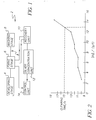
- FIG. 1 shows a schematic representation of an example of a photographic processing system according to the present invention.
- the system 2 has a developing stage 4 arranged to receive photographic material (not shown) such as exposed silver halide film.
- the photographic material may include both colour material and black and white material, for example, microfilm, X-ray materials, high contrast materials and printing plates, or any other light-sensitive silver containing material.
- the photographic material proceeds to the fixing stage 6 where the exposed image is fixed, from where it proceeds to a washing stage 8 and then to a drying stage (not shown).
- An in-line silver recovery unit 10 is provided coupled to the fixing stage 6 arranged to recover silver from the fixer solution within the fixing stage 6.
- a circulation loop 9 is provided to couple fixer solution from the fixing stage 6 to the in-line silver recovery unit 10 and back to the fixing stage 6 after it has passed through the in-line silver recovery unit 10.
- a silver concentration determination unit 12 is also provided to determine the concentration of silver in the fixing stage. In the example shown, this is done by a calculation involving the silver mass recovered by the in-line silver recovery unit 10.
- a control unit 14 is provided to receive a signal from the silver concentration determination unit 12 in dependence on the concentration of silver in the fixer solution within the fixing stage 6 and provide a corresponding control signal to the fixing stage 6.
- the control unit 14 takes remedial action.
- the remedial action taken may involve one or more of a number of different possibilities.
- the in-line silver recovery unit 10, together with silver concentration determination unit 12 and the control unit 14, serve to monitor continually the fixer solution silver concentration, [Ag], during use of the processor. If [Ag] increases beyond the PL specific to the film and processor conditions at the selected processing time, then appropriate action is taken to adjust either the UL or the [Ag] to ensure that the condition [Ag] ⁇ UL is satisfied. This may involve reducing [Ag] or increasing the UL.
- the value of the UL for a given set of processing conditions is dependent on the level of fixing at which it can be said that the photographic material is adequately fixed. In some situations it may be sufficient that the film leaves the fixing stage just fully cleared. This can be somewhat difficult to determine experimentally since fixing can continue within the emulsion layers of the film even after the film leaves the fixer solution. Alternatively, it may be required that the film is fully cleared a certain number of seconds before leaving the fixing stage. For example, it may be required that the total fixing time is twice as long as the clearing time. This requirement provides a safety margin of time to permit more of the soluble silver salts to be washed out of the film in the fixing stage. This is described in, for example, United States Patent number 6,102,589.
- Another way of determining the UL is as a limit on residual silver in the film after processing.
- This definition relates to the archival keeping requirements of the processed film. If the film is not well-fixed, it will bring in more silver to the wash and hence will not be adequately washed. Alternatively, there may be a limit on residual silver in the film after leaving the fixing stage.
- This definition relates to the silver load carried into the wash. Such a definition might be used where the silver concentration in the wash effluent is desired to be kept below a certain level for legal discharge to drain
- the UL is measured experimentally for the desired processing conditions (fixer solution temperature and time). This is preferably done under the actual conditions that are likely to be experienced in use. It is preferable that the developer should already be seasoned before determination of the UL. If this is not the case, the developer may be seasoned by processing an appropriate quantity of film at the expected average exposure using the appropriate developer replenishment rate.
- fixer solution silver concentration Whilst film is processed, each sheet of film is monitored to determine whether or not it is adequately fixed. As processing continues, the silver concentration in the fixer solution will rise and eventually there will come a point at which the film is just adequately fixed. At this point, processing is stopped and a sample of the fixer solution is taken for silver analysis.
- Techniques for analyzing fixer solution silver concentration include silver indicator papers, X-ray fluorescence and atomic absorption spectroscopy.
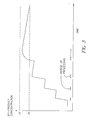
- Figure 2 shows the effect of fixer solution silver concentration on clearing time for Kodak GEN5 Film GRD at 30°C through Kodak RA3000 fixer and replenisher seasoned with Kodak RA2000 developer and replenisher.
- the UL is 12.8 g/l. If the silver concentration exceeds this value, then clear areas of the film will appear milky, in accordance with the definition of adequately fixed being "just cleared”. It is preferable to use a more stringent definition of "adequately fixed" to minimise carryover of silver into the wash bath, in which case, the UL would be lower.
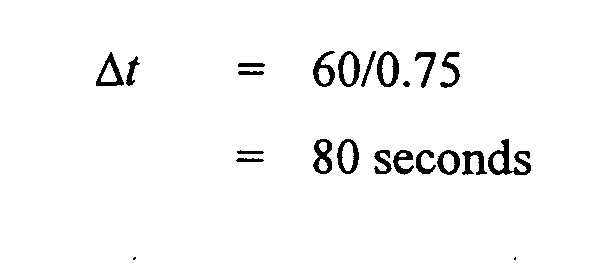
- FIG. 3 is a graph showing schematically the variation of silver concentration in a fixing stage with time in accordance with the present invention.
- a first method is used to reduce the silver concentration, such as in-line silver recovery.
- Other options for the first method include metallic replacement and ion-exchange, where the by-product is silver.
- the processing solution is a developer in which, for example, halide ions are a process-retarding by-product then an ion exchange cartridge may be used to reduce the concentration of the by-product.
- Both metallic replacement and ion-exchange are examples of active removal systems in that they remove only certain components of the solution. Dilution and overflow by replenishment is an example of a passive removal system in that all components of the processing solution are diluted.
- the photographic processing system is controlled to activate automatically a second method to ensure that the silver concentration does not reach or exceed the UL.
- the second method does not involve changing the UL (for example by increasing the fixer temperature) but reducing [Ag] (by for example increasing the fixer replenisher rate).
- the UL is a maximum value for the silver concentration of the fixing stage above which the film will not be adequately fixed.
- the second method may be any suitable method such as increasing the temperature of the processing solution, diluting the processing solution or reducing the amount of photographic material being processed. The present invention therefore enables rapid processing of film without unnecessary use of high replenishment rates and high fixer solution temperature.
- the by-product concentration PL at which it is required that the second method is activated is dependent on each specific system and in particular on which method or methods are to be used as the second method.
- the PL is set at between 0.5 and 0.9 of the UL.
- the PL should be set sufficiently below the UL such that during the time which is required for the fixer solution to heat up to the new operating temperature, the UL at the original temperature is not exceeded as further film is processed during the heating period.
- the time required to heat up the solution will be dependent on tank volume, heater power and thermal insulation of the tank and will therefore vary from processor to processor.
- the PL should be set sufficiently below the UL to allow time for the extra fixer replenisher solution to be pumped into the tank as further film is processed.
- This method might further require that no more film should be processed while the dilution step is being taken, such that a combination of dilution and reducing the area of film processed in a given time period is implemented together.
- a silver ion electrochemical sensor may be placed in the fixing stage close to the outlet of the tank recirculation system to ensure the fixer solution is well mixed at the point of measurement.
- calculation techniques are used, if the area, silver content and the exposure of the processed film is known it is possible to calculate the amount of silver that will be released into the fixing stage. This assumes, with little significant loss of accuracy, that the diffusion of silver complexes out of the film is allowed to proceed to completion in the fixer solution. If time is short, correction factors may be used as described in United States Patent number 6,102,589.
- the present invention requires that there should be an in-line silver recovery unit associated with the fixing stage.
- this is electrolytic silver recovery although other types of silver recovery systems are possible, for example, metallic exchange or ion exchange cartridges, in which case it is possible to monitor the mass of silver recovered by weighing the cartridge.
- electrolytic silver recovery the amount of silver recovered during a given time may be determined from Faraday's law and from a knowledge of the applied electrolysis current as a function of time.
- the silver recovered by electrolysis may be expressed as K . I . T, where I is the average current during the time period and K is a constant, assuming that the electrolysis process was conducted at a constant efficiency throughout the period.
- the change in silver mass in the fixing stage, ⁇ M may be expressed as V . ⁇ C, where C is the silver concentration in the fixing stage and V is the total volume of solution associated with the fixing stage and the silver recovery unit.
- the silver mass leaving the fixing stage through overflow and carryout may be expressed as (F+f) .
- F is the volume of fixer replenisher added to the fixing stage per unit area of film
- f is the volume of fixer solution carried out with the film from the fixing stage per unit area processed
- C avg is the average silver concentration in the bath during the processing of the area, A. It is assumed that the effects of evaporation are negligible since this would form only a very small correction to the calculated silver concentration.
- E E-time fixer silver concentration
- some on-line exposing/processing systems are equipped with a link between the exposing and processing devices.
- the exposing device is able to compute the average exposure given to the material to be processed, it is possible to send the information over the link to the processor, where it may be used to compute C(t), the real-time fixer silver concentration.
- the silver concentration of the fixer solution may also be determined in accordance with approximate methods using the plating current of the silver electrolysis unit.
- Some silver recovery units are equipped with sensors which either measure silver ion concentration directly, in which case the method described above could be used or which measure conductivity of the fixer solution.
- Conductivity scales approximately with silver concentration such that the conductivity of the fixer goes up as the silver concentration increases. It also changes in response to other parameters, such as temperature, and the concentration of other ions.
- conductivity can be used to give a useful indication of silver concentration.
- a conductivity measurement can be taken at the PL and used in the method of the present invention.
- Some silver recovery units operate by various methods to derive a signal which is used to increase or decrease the plating current.
- the principle of operation is that it is safe to use a high electrolysis current when the silver ion concentration in the fixer solution is high. Therefore, if the PL corresponds to a silver concentration, which enables a particular plating current to be used, the plating current itself may be used in the method of the present invention.
- the options for the second method are, to:
- Options (d), (e) and (f) are also not preferred because they require additional processing equipment to be provided. This increases the overall cost of the processing system and its complexity.
- electrolytic silver recovery equipment it is known in the art for electrolytic silver recovery equipment to be shared between processors with one unit servicing up to 4 processors. In this way, a silver recovery unit could be shared by several processors, each of which already has its own silver recovery equipment permanently installed. In this case, it would be more cost-effective to switch the resources of the shared silver recovery unit onto a processor in circumstances where the permanently installed silver recovery unit on that processor is not able to maintain [Ag] below the PL.
- a control link between the silver recovery unit and the processor is required so that the silver recovery unit can send a signal to the processor, which will effect control of replenishment rates, temperature, etc.
- the control link may be executed by a microprocessor (or any other suitable electronic or nonelectronic device) arranged to receive a signal from the silver recovery unit and control the processor in dependence on the received signal.
- a single sheet of film measuring 1 square metre with a silver coated weight of 4 g/m 2 with an exposure of 10% is processed.
- the replenishment rate is 150 ml/m 2
- the carryover from the developer to the fixer on the processed material is 20 ml/m 2
- the carryover from the fixer to the wash is 15 ml/m 2 .
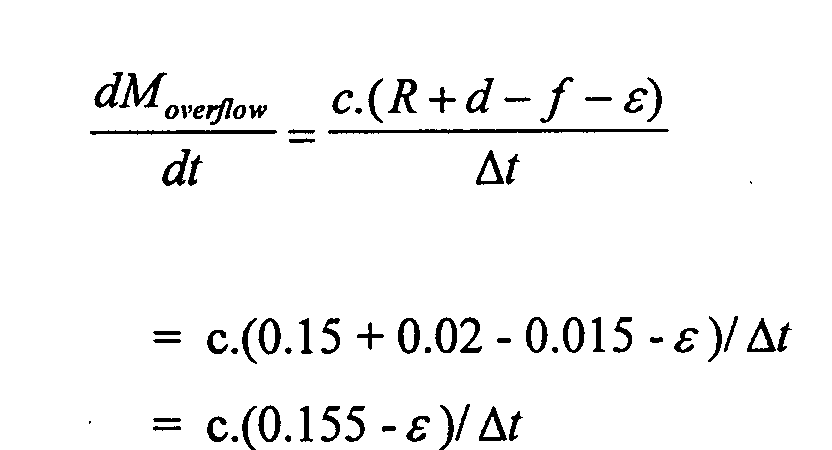
- the transport speed of the processor is 1 m per minute and the maximum film width, 0.75m.
- the ratio of the rate of input of silver to the rate of removal of silver by electrolysis is about 40 to 1.
- the rate of input of silver is not maintained throughout the working day since there may be long gaps between sheets being processed. Furthermore, silver is also removed from the tank by overflow to drain.
- the rate of removal of silver through overflow for 1 m 2 of film is given by the product of the concentration of silver in the tank times the volume of solution in the overflow divided by the time increment during which the film is in the tank.
- c is the silver concentration
- R is the replenishment volume
- d is the volume of solution carried in from the developer with the film
- f is the volume of solution carried out from the fixer with the film
- ⁇ is the evaporation volume occurring during the time increment
- the silver recovery unit might be able to maintain the silver concentration below 5 g/l but for a high throughput, the silver concentration would certainly rise above 5g/l.
- the above example has not taken into account the buffering effect of the fixing stage, which would delay the reaching of the UL.
- the calculation demonstrates, however, that some customers with prolonged high throughput will certainly find that a small silver recovery unit will not be able to maintain the silver concentration below the UL.
- e principle described above may be used with any photographic processing solution in which the rate of processing is inversely dependent on the concentration of a by-product of the processing reaction occurring and where the by-product is being removed from the tank by some suitable removal means.
- the removal means may be electrolytic or metal-exchange.
- the removal means may be ion-exchange such as bromide removal from developer solution in an ion-exchange column.
- the UL and minimum processing time information may be recorded on a label associated with the film.
- the label may be machine-readable or form part of machine-readable packaging.
- a bar-code on the film packaging may be used or the necessary information may be stored as a latent image bar-code on the film itself. If the processor or silver recovery unit to which it is connected has a bar-code reader, the bar-code label may be swiped and the control parameters for that film downloaded into a control system of the processor or silver recovery unit.
- the bar-code may include data such as minimum processing time for the specific film, fixer type and dilution as a function of fixer silver concentration and temperature, fixer solution replenishment rate below UL and silver coated weight of film.
- a processing system according to the present invention is adapted to be able to read the bar-code and process the film in accordance with the method of the present invention. This provides a convenient and simple way of providing the processing system with the necessary information about film processing characteristics to enable the film to be processed according to the present invention. This approach has been described in United States Patent Numbers 5,701,545 and 5,669,029 in the name of Eastman Kodak Company.
Landscapes
- Physics & Mathematics (AREA)
- General Physics & Mathematics (AREA)
- Silver Salt Photography Or Processing Solution Therefor (AREA)
- Electrolytic Production Of Metals (AREA)
Abstract
Description



Claims (16)
- A method of processing photographic material, comprising the steps of:processing the photographic material in a processing solution;monitoring the concentration of a process-retarding by-product of the processing in the processing solution during operation of the method;reducing the concentration of the by-product in the processing solution by a first method; and,as the by-product concentration in the processing solution exceeds a predetermined level, activating simultaneous operation of a second method for a period of time, thereby to ensure that the photographic material is always adequately processed.
- A method according to claim 1, in which the second method comprises one or more of:(a) increasing the temperature of the processing solution;(b) reducing the by-product concentration in the processing solution by dilution; and,(c) reducing the amount of photographic material being processed per unit time.
- A method according to claim 2 in which the processing solution is regenerated by supply of replenisher solution during processing and wherein when the second method comprises step (b) during operation of the second method, the replenishment rate is increased to reduce the by-product concentration.
- A method according to claim 1 or 2, in which the first method comprises electrolytic recovery of said by-product.
- A method according to claim 1, in which the processing solution is a solution with fixing ability and the by-product is silver.
- A method according to claim 1 or 2, in which the processing solution is developing solution and the by-product is halide ions.
- A method according to claim 1 or 2, wherein the by-product concentration is controlled so that an upper limit wherein the photographic material is not adequately processed is not reached.
- A method according to claim 6, wherein the upper limit is up to double the predetermined level.
- A photographic processing system, comprising:at least one processing stage;by-product concentration monitoring means to monitor the concentration of a process-retarding by-product of the process in the processing stage;means for reducing the concentration of said by-product in the processing solution by a first method; and,means for simultaneously operating a second method for a period of time, operation of the second method being activated as the by-product concentration in the processing solution exceeds a predetermined level thereby to ensure that the photographic material is always adequately processed.
- A system according to any of claim 9, in which the second method comprises one or more of:(a) increasing the temperature of the processing solution;(b) diluting the processing solution; and,(c) reducing the amount of photographic material being processed per unit time.(d) employing additional means for by-product removal from the processing stage, such as electrolytic recovery, metallic replacement or ion-exchange units.
- A system according to claim 9, in which the at least one processing stage comprises a developing stage and a fixing stage.
- A system according to claim 9, wherein the means for reducing the concentration of by-product in the processing solution by a first method comprises an electrolytic recovery unit.
- A system according to claim 9, in which the processing solution is fixer solution and the by-product is silver.
- A photographic material having a machine-readable label, the label including information indicative of material composition component levels, a minimum processing time of said material for each of at least one processing solution type or types, dilution of said at least one processing solution type or types as a function of by-product concentration and processing solution temperature, to enable said material to be processed by a processing system according to claim 9.
- A photographic material according to claim 14, in which the code is a bar-code.
- A material according to claim 14, wherein the material composition component is silver, the processing solution has fixing ability and the by-product is silver.
Applications Claiming Priority (2)
| Application Number | Priority Date | Filing Date | Title |
|---|---|---|---|
| GBGB0112180.5A GB0112180D0 (en) | 2001-05-18 | 2001-05-18 | A method and system for processing of photographic materials |
| GB0112180 | 2001-05-18 |
Publications (2)
| Publication Number | Publication Date |
|---|---|
| EP1260859A2 true EP1260859A2 (en) | 2002-11-27 |
| EP1260859A3 EP1260859A3 (en) | 2003-08-13 |
Family
ID=9914888
Family Applications (1)
| Application Number | Title | Priority Date | Filing Date |
|---|---|---|---|
| EP02008923A Withdrawn EP1260859A3 (en) | 2001-05-18 | 2002-04-22 | A method and system for processing of photographic material |
Country Status (4)
| Country | Link |
|---|---|
| US (1) | US7001085B2 (en) |
| EP (1) | EP1260859A3 (en) |
| JP (1) | JP2002372773A (en) |
| GB (1) | GB0112180D0 (en) |
Family Cites Families (16)
| Publication number | Priority date | Publication date | Assignee | Title |
|---|---|---|---|---|
| US4078983A (en) * | 1976-09-02 | 1978-03-14 | Ag-Met, Inc. | Digital control of electrolytic current |
| JPS5437731A (en) * | 1977-08-30 | 1979-03-20 | Fuji Photo Film Co Ltd | Method and apparatus for controlling halogen ion concentration in photographic processing solution |
| US4130299A (en) | 1977-09-12 | 1978-12-19 | Monsanto Company | Low-odor dye solvents for pressure-sensitive copying systems |
| US4204930A (en) * | 1979-04-13 | 1980-05-27 | Teijin Limited | Method and apparatus for regenerating spent photographic bleach-fixer solution |
| GB8605278D0 (en) * | 1986-03-04 | 1986-04-09 | Fixersave Ltd | Photographic processing |
| GB8715317D0 (en) | 1987-06-30 | 1987-08-05 | Toulson B | Treatment of medium |
| JPH03213855A (en) * | 1989-11-02 | 1991-09-19 | Fuji Photo Film Co Ltd | Processing method for silver halide color photographic sensitive material |
| DE4127454A1 (en) | 1991-08-20 | 1993-02-25 | Nahalka Apparatebau Und Photog | Photo-fixing bath regeneration - in which current at electrolysis cell is monitored to control volume of fresh fixing bath to be added |
| DE4315434A1 (en) * | 1993-05-08 | 1994-11-10 | Kodak Ag | Method and device for electrolytic silver recovery for two film processing machines |
| GB9509079D0 (en) | 1995-05-04 | 1995-06-28 | Kodak Ltd | Method of processing black-and-white photographic materials |
| GB9509039D0 (en) * | 1995-05-04 | 1995-06-28 | Kodak Ltd | Photographic processing |
| GB9509040D0 (en) * | 1995-05-04 | 1995-06-28 | Kodak Ltd | Photographic processing |
| JP3617726B2 (en) * | 1995-10-20 | 2005-02-09 | 富士写真フイルム株式会社 | Image recording method and apparatus |
| US5736304A (en) * | 1996-05-03 | 1998-04-07 | Eastman Kodak Company | Method of processing black-and-white photographic materials |
| EP0864923A1 (en) * | 1997-03-05 | 1998-09-16 | Eastman Kodak Company | Process for the recovery of silver from hardening photoprocessing solutions |
| US6102589A (en) * | 1998-02-03 | 2000-08-15 | Agfa-Gevaert, N.V. | Processing method of black-and-white photographic materials |
-
2001
- 2001-05-18 GB GBGB0112180.5A patent/GB0112180D0/en not_active Ceased
-
2002
- 2002-04-22 EP EP02008923A patent/EP1260859A3/en not_active Withdrawn
- 2002-05-13 US US10/144,497 patent/US7001085B2/en not_active Expired - Fee Related
- 2002-05-20 JP JP2002144709A patent/JP2002372773A/en active Pending
Also Published As
| Publication number | Publication date |
|---|---|
| JP2002372773A (en) | 2002-12-26 |
| US20020175081A1 (en) | 2002-11-28 |
| US7001085B2 (en) | 2006-02-21 |
| EP1260859A3 (en) | 2003-08-13 |
| GB0112180D0 (en) | 2001-07-11 |
Similar Documents
| Publication | Publication Date | Title |
|---|---|---|
| US4882246A (en) | Method for supplementing replenisher for developer in automatic developing machine for presensitized plate | |
| US6207037B1 (en) | Recovery of metal from solution | |
| JP3534211B2 (en) | Automatic developing system for photosensitive lithographic printing plate | |
| JPS6120854B2 (en) | ||
| US5477300A (en) | Method for processing photographic light-sensitive material | |
| JP2005070351A (en) | Method and apparatus for supplying developing solution | |
| US7001085B2 (en) | Method and system for processing of photographic materials | |
| EP0972860B1 (en) | Electrolytic recovery of metal from solution | |
| US5355191A (en) | Photographic processing apparatus and method | |
| EP0596994B1 (en) | Improvements in or relating to photographic processing | |
| US5928843A (en) | Method for processing exposed silver-based photographic material | |
| US6638673B2 (en) | Method and system for calculating the fractional exposure of photographic material | |
| EP0741324A1 (en) | Photographic processing | |
| US5620834A (en) | Method of processing photographic silver halide materials | |
| US5683839A (en) | Method of processing black and white photographic silver halide materials | |
| EP0596991B1 (en) | Improvements in or relating to photographic processing | |
| JP2002146581A (en) | Method and device for controlling recovery of metal from solution | |
| EP0742481A1 (en) | Method of processing black-and-white photographic materials | |
| JPH05257249A (en) | Method for treating photographic sensitive material | |
| US5780189A (en) | Apparatus and method for controlling the chemical activity of processing solution in a photographic processing apparatus | |
| JPH05297532A (en) | Treatment of silver halide photographic sensitive material | |
| JPH07159964A (en) | Apparatus for regenerating processing solution for silver halide photosensitive material and method for regenerating processing solution for silver halide photosensitive material | |
| JPH0120737B2 (en) | ||
| Titus | Anatomy of silver recovery | |
| JPH05297534A (en) | Photosensitive material processing device |
Legal Events
| Date | Code | Title | Description |
|---|---|---|---|
| PUAI | Public reference made under article 153(3) epc to a published international application that has entered the european phase |
Free format text: ORIGINAL CODE: 0009012 |
|
| AK | Designated contracting states |
Kind code of ref document: A2 Designated state(s): AT BE CH CY DE DK ES FI FR GB GR IE IT LI LU MC NL PT SE TR |
|
| AX | Request for extension of the european patent |
Free format text: AL;LT;LV;MK;RO;SI |
|
| PUAL | Search report despatched |
Free format text: ORIGINAL CODE: 0009013 |
|
| AK | Designated contracting states |
Designated state(s): AT BE CH CY DE DK ES FI FR GB GR IE IT LI LU MC NL PT SE TR |
|
| AX | Request for extension of the european patent |
Extension state: AL LT LV MK RO SI |
|
| 17P | Request for examination filed |
Effective date: 20040115 |
|
| 17Q | First examination report despatched |
Effective date: 20040319 |
|
| AKX | Designation fees paid |
Designated state(s): DE FR GB |
|
| STAA | Information on the status of an ep patent application or granted ep patent |
Free format text: STATUS: THE APPLICATION IS DEEMED TO BE WITHDRAWN |
|
| 18D | Application deemed to be withdrawn |
Effective date: 20050125 |