EP1260814A2 - Gas sensor and method for measuring gas concentration using the same - Google Patents
Gas sensor and method for measuring gas concentration using the same Download PDFInfo
- Publication number
- EP1260814A2 EP1260814A2 EP02253413A EP02253413A EP1260814A2 EP 1260814 A2 EP1260814 A2 EP 1260814A2 EP 02253413 A EP02253413 A EP 02253413A EP 02253413 A EP02253413 A EP 02253413A EP 1260814 A2 EP1260814 A2 EP 1260814A2
- Authority
- EP
- European Patent Office
- Prior art keywords
- electrode
- gas
- measured
- proton
- gas sensor
- Prior art date
- Legal status (The legal status is an assumption and is not a legal conclusion. Google has not performed a legal analysis and makes no representation as to the accuracy of the status listed.)
- Withdrawn
Links
- 238000000034 method Methods 0.000 title claims abstract description 27
- 239000007789 gas Substances 0.000 claims abstract description 187
- 239000005518 polymer electrolyte Substances 0.000 claims abstract description 65
- 238000009792 diffusion process Methods 0.000 claims abstract description 27
- 238000005192 partition Methods 0.000 claims abstract description 21
- 229920001940 conductive polymer Polymers 0.000 claims abstract description 16
- 239000001257 hydrogen Substances 0.000 claims abstract description 13
- 229910052739 hydrogen Inorganic materials 0.000 claims abstract description 13
- 238000005259 measurement Methods 0.000 claims description 52
- UFHFLCQGNIYNRP-UHFFFAOYSA-N Hydrogen Chemical compound [H][H] UFHFLCQGNIYNRP-UHFFFAOYSA-N 0.000 claims description 35
- 238000005342 ion exchange Methods 0.000 claims description 15
- 229910021645 metal ion Inorganic materials 0.000 claims description 11
- 238000006467 substitution reaction Methods 0.000 claims description 9
- 229910001415 sodium ion Inorganic materials 0.000 claims description 6
- 239000007864 aqueous solution Substances 0.000 claims description 3
- XLYOFNOQVPJJNP-UHFFFAOYSA-N water Chemical compound O XLYOFNOQVPJJNP-UHFFFAOYSA-N 0.000 abstract description 45
- 125000004435 hydrogen atom Chemical class [H]* 0.000 abstract 1
- 239000000758 substrate Substances 0.000 description 17
- OKKJLVBELUTLKV-UHFFFAOYSA-N Methanol Chemical compound OC OKKJLVBELUTLKV-UHFFFAOYSA-N 0.000 description 12
- 230000008569 process Effects 0.000 description 12
- 229910052799 carbon Inorganic materials 0.000 description 11
- BASFCYQUMIYNBI-UHFFFAOYSA-N platinum Chemical compound [Pt] BASFCYQUMIYNBI-UHFFFAOYSA-N 0.000 description 11
- OKTJSMMVPCPJKN-UHFFFAOYSA-N Carbon Chemical compound [C] OKTJSMMVPCPJKN-UHFFFAOYSA-N 0.000 description 9
- 229920000557 Nafion® Polymers 0.000 description 9
- 150000002500 ions Chemical class 0.000 description 9
- 239000000446 fuel Substances 0.000 description 7
- 239000003054 catalyst Substances 0.000 description 6
- 150000002431 hydrogen Chemical class 0.000 description 6
- 230000001965 increasing effect Effects 0.000 description 6
- 239000011347 resin Substances 0.000 description 6
- 229920005989 resin Polymers 0.000 description 6
- PNEYBMLMFCGWSK-UHFFFAOYSA-N Alumina Chemical compound [O-2].[O-2].[O-2].[Al+3].[Al+3] PNEYBMLMFCGWSK-UHFFFAOYSA-N 0.000 description 5
- 239000000463 material Substances 0.000 description 5
- CURLTUGMZLYLDI-UHFFFAOYSA-N Carbon dioxide Chemical compound O=C=O CURLTUGMZLYLDI-UHFFFAOYSA-N 0.000 description 4
- YCKRFDGAMUMZLT-UHFFFAOYSA-N Fluorine atom Chemical compound [F] YCKRFDGAMUMZLT-UHFFFAOYSA-N 0.000 description 4
- 238000009835 boiling Methods 0.000 description 4
- 239000004020 conductor Substances 0.000 description 4
- 229910052731 fluorine Inorganic materials 0.000 description 4
- 239000011737 fluorine Substances 0.000 description 4
- 229910052697 platinum Inorganic materials 0.000 description 4
- 239000000243 solution Substances 0.000 description 4
- 229910002092 carbon dioxide Inorganic materials 0.000 description 3
- 230000007423 decrease Effects 0.000 description 3
- 239000002737 fuel gas Substances 0.000 description 3
- 238000003754 machining Methods 0.000 description 3
- 238000004519 manufacturing process Methods 0.000 description 3
- 230000035945 sensitivity Effects 0.000 description 3
- 239000002002 slurry Substances 0.000 description 3
- IJGRMHOSHXDMSA-UHFFFAOYSA-N Atomic nitrogen Chemical compound N#N IJGRMHOSHXDMSA-UHFFFAOYSA-N 0.000 description 2
- DGAQECJNVWCQMB-PUAWFVPOSA-M Ilexoside XXIX Chemical compound C[C@@H]1CC[C@@]2(CC[C@@]3(C(=CC[C@H]4[C@]3(CC[C@@H]5[C@@]4(CC[C@@H](C5(C)C)OS(=O)(=O)[O-])C)C)[C@@H]2[C@]1(C)O)C)C(=O)O[C@H]6[C@@H]([C@H]([C@@H]([C@H](O6)CO)O)O)O.[Na+] DGAQECJNVWCQMB-PUAWFVPOSA-M 0.000 description 2
- PMZURENOXWZQFD-UHFFFAOYSA-L Sodium Sulfate Chemical compound [Na+].[Na+].[O-]S([O-])(=O)=O PMZURENOXWZQFD-UHFFFAOYSA-L 0.000 description 2
- 230000003197 catalytic effect Effects 0.000 description 2
- 238000001514 detection method Methods 0.000 description 2
- 239000012153 distilled water Substances 0.000 description 2
- 238000001035 drying Methods 0.000 description 2
- 230000002708 enhancing effect Effects 0.000 description 2
- 238000007731 hot pressing Methods 0.000 description 2
- 239000012212 insulator Substances 0.000 description 2
- 239000000203 mixture Substances 0.000 description 2
- 239000002245 particle Substances 0.000 description 2
- 239000011148 porous material Substances 0.000 description 2
- 229910052708 sodium Inorganic materials 0.000 description 2
- 239000011734 sodium Substances 0.000 description 2
- 229910052938 sodium sulfate Inorganic materials 0.000 description 2
- 235000011152 sodium sulphate Nutrition 0.000 description 2
- JPVYNHNXODAKFH-UHFFFAOYSA-N Cu2+ Chemical compound [Cu+2] JPVYNHNXODAKFH-UHFFFAOYSA-N 0.000 description 1
- MHAJPDPJQMAIIY-UHFFFAOYSA-N Hydrogen peroxide Chemical compound OO MHAJPDPJQMAIIY-UHFFFAOYSA-N 0.000 description 1
- 229910001260 Pt alloy Inorganic materials 0.000 description 1
- 230000002411 adverse Effects 0.000 description 1
- 239000001569 carbon dioxide Substances 0.000 description 1
- 239000000919 ceramic Substances 0.000 description 1
- 239000002131 composite material Substances 0.000 description 1
- 238000010276 construction Methods 0.000 description 1
- 239000000356 contaminant Substances 0.000 description 1
- 229910001431 copper ion Inorganic materials 0.000 description 1
- 238000003912 environmental pollution Methods 0.000 description 1
- 238000011156 evaluation Methods 0.000 description 1
- 239000004744 fabric Substances 0.000 description 1
- 239000010419 fine particle Substances 0.000 description 1
- UQSQSQZYBQSBJZ-UHFFFAOYSA-N fluorosulfonic acid Chemical compound OS(F)(=O)=O UQSQSQZYBQSBJZ-UHFFFAOYSA-N 0.000 description 1
- 239000007788 liquid Substances 0.000 description 1
- 239000012528 membrane Substances 0.000 description 1
- 238000006386 neutralization reaction Methods 0.000 description 1
- 229910052757 nitrogen Inorganic materials 0.000 description 1
- 229910001414 potassium ion Inorganic materials 0.000 description 1
- 239000000843 powder Substances 0.000 description 1
- 238000012545 processing Methods 0.000 description 1
- 230000009467 reduction Effects 0.000 description 1
- 230000004044 response Effects 0.000 description 1
- 239000007787 solid Substances 0.000 description 1
- 238000010345 tape casting Methods 0.000 description 1
- 238000012360 testing method Methods 0.000 description 1
- 238000004448 titration Methods 0.000 description 1
Images


Classifications
-
- G—PHYSICS
- G01—MEASURING; TESTING
- G01N—INVESTIGATING OR ANALYSING MATERIALS BY DETERMINING THEIR CHEMICAL OR PHYSICAL PROPERTIES
- G01N33/00—Investigating or analysing materials by specific methods not covered by groups G01N1/00 - G01N31/00
- G01N33/0004—Gaseous mixtures, e.g. polluted air
- G01N33/0009—General constructional details of gas analysers, e.g. portable test equipment
- G01N33/0027—General constructional details of gas analysers, e.g. portable test equipment concerning the detector
- G01N33/0036—General constructional details of gas analysers, e.g. portable test equipment concerning the detector specially adapted to detect a particular component
- G01N33/005—H2
-
- G—PHYSICS
- G01—MEASURING; TESTING
- G01N—INVESTIGATING OR ANALYSING MATERIALS BY DETERMINING THEIR CHEMICAL OR PHYSICAL PROPERTIES
- G01N27/00—Investigating or analysing materials by the use of electric, electrochemical, or magnetic means
- G01N27/26—Investigating or analysing materials by the use of electric, electrochemical, or magnetic means by investigating electrochemical variables; by using electrolysis or electrophoresis
- G01N27/403—Cells and electrode assemblies
- G01N27/406—Cells and probes with solid electrolytes
- G01N27/407—Cells and probes with solid electrolytes for investigating or analysing gases
- G01N27/4073—Composition or fabrication of the solid electrolyte
- G01N27/4074—Composition or fabrication of the solid electrolyte for detection of gases other than oxygen
-
- G—PHYSICS
- G01—MEASURING; TESTING
- G01N—INVESTIGATING OR ANALYSING MATERIALS BY DETERMINING THEIR CHEMICAL OR PHYSICAL PROPERTIES
- G01N33/00—Investigating or analysing materials by specific methods not covered by groups G01N1/00 - G01N31/00
- G01N33/0004—Gaseous mixtures, e.g. polluted air
- G01N33/0009—General constructional details of gas analysers, e.g. portable test equipment
- G01N33/0027—General constructional details of gas analysers, e.g. portable test equipment concerning the detector
- G01N33/0036—General constructional details of gas analysers, e.g. portable test equipment concerning the detector specially adapted to detect a particular component
- G01N33/0059—Avoiding interference of a gas with the gas to be measured
- G01N33/006—Avoiding interference of water vapour with the gas to be measured
Definitions
- the present invention relates to gas sensor and to a method for measuring gas concentration by use of the same. More particularly, the invention relates to a gas sensor and a method for measuring gas concentration that are capable of measuring the concentration of a gas to be measured on the basis of a limiting current flowing between electrodes formed on a proton-conductive polymer electrolyte element.
- the present invention further relates to a combustible-gas sensor which is adapted to measure the concentration of a combustible gas, such as hydrogen gas, which is contained in a fuel gas, such as methanol-reformed gas for use in a fuel cell, and which is suitably used for measurement or control of hydrogen gas concentration.
- PEFC polymer electrolyte fuel cell
- Japanese Patent Publication ( kokoku ) No. 7-31153 proposes such a low-temperature operation type sensor.
- This sensor is configured such that a working electrode, a counter electrode, and a reference electrode are disposed on an insulating base material while the three electrodes are unitarily covered with a gas permeable proton conductor membrane.
- the sensor disclosed in the above-described patent publication uses, as a proton conductor, Nafion (registered trademark, product of DuPont), which is one type of fluorine-containing resin and is used in polymer electrolyte fuel cells.
- Nafion registered trademark, product of DuPont
- An object of the present invention is to solve the above-described problems, and to provide a gas sensor and a method for measuring gas concentration which measure the gas concentration by measuring a limiting current flowing between electrodes formed on a proton-conductive polymer electrolyte element and which, even when water is present in an atmosphere to be measured, can measure the concentration of a gas contained in the atmosphere while overcoming problems due to the influence of water vapor.
- the problem of overcoming the adverse affects of water vapor on the gas measurement is achieved by providing a gas sensor comprising a gas sensor comprising a proton conductive-polymer electrolyte layer; a first electrode and a second electrode provided in contact with the proton-conductive polymer electrolyte layer; a partition wall or gas diffusion controlling portion provided between the first electrode and the gas atmosphere to be measured; and the gas sensor further comprises at least one of the following:
- a method for measuring a gas concentration comprising measuring a limiting current flowing between the first electrode and a second electrode by use of the gas sensor as described above.
- the gas sensor of the present invention in one preferred aspect comprises a proton-conductive polymer electrolyte layer, a first measuring electrode and a second measuring electrode formed in contact with the polymer electrolyte layer, a partition wall provided between the first measuring electrode and an atmosphere to be measured, and a diffusion-controlling hole provided in the partition wall and extending through the partition wall between the first measuring electrode and the atmosphere to be measured.
- the gas sensor is characterized in that A/(B x C) is not less than 9.5 x 10 -5 mm -1 , where A (mm 2 ) is the opening area of the diffusion-controlling hole on the side toward the atmosphere to be measured, B (mm) is the length of the diffusion-controlling hole, and C (mm 2 ) is the area of the first measuring electrode or that of the second measuring electrode, whichever is smaller.
- a gas sensor according to the present invention has a proton conductive layer formed of a polymer electrolyte having a thickness of not less than 0.08 mm.
- the proton conductive layer is formed to have a sufficiently large thickness, when the H 2 O concentration of an atmosphere changes, the quantity of H 2 O molecules which accompany protons traveling through the proton conductive layer changes to a reduced degree. In other words, when the thickness of the proton conductive layer increases, the proton conductive layer becomes less susceptible to variation in H 2 O concentration. Therefore, the H 2 O dependency of combustible-gas concentration measurement can be reduced.
- the proton conductive layer is formed of a polymer electrolyte wherein protons of ion exchange groups of the polymer electrolyte have been partially substituted by metal ions.
- the polymer electrolyte layer in the present invention is particularly formed of a proton-conductive polymer electrolyte.
- a polymer electrolyte is of a fluorine-containing resin type.
- a polymer electrolyte of a fluorine-containing resin type can be operated at low temperature (room temperature to 130°C).
- Nafion registered trademark, product of DuPont is used.
- the polymer electrolyte layer may vary in size, thickness, shape, etc. However, when the first electrode and the second electrode are to be provided on the respective opposite sides of the polymer electrolyte layer, the polymer electrolyte layer preferably has a thickness of 30-600 ⁇ m (more preferably 90-360 ⁇ m).
- first electrode is used for measuring and is a porous electrode formed in contact with the polymer electrolyte layer.
- the first electrode is isolated from the atmosphere to be measured by a partition wall, and is allowed to come into contact with a gas to be measured (an object of measurement contained in an atmosphere to be measured) only through a diffusion-controlling hole.
- the first electrode may be in contact with the partition wall or may be separated from the partition wall.
- the first electrode is connected via a power supply to a second electrode, described below, whereby voltage is applied thereto.
- the thus-arranged first electrode is adapted to decompose a predetermined gas to be measured which is contained in the atmosphere to be measured and reaches the same through the diffusion-controlling hole.
- the above-mentioned "second electrode” is used for measuring and is a porous electrode formed in contact with the polymer electrolyte layer and usually opens (partially or entirely) upon the atmosphere or an atmosphere to be measured.
- protons transmitted from the first electrode through the polymer electrolyte layer are formed into hydrogen gas at the second electrode, and the thus-formed hydrogen gas can be ejected from the second electrode.
- the first electrode and the second electrode may be formed on the same side or on the respective opposite sides of the polymer electrolyte layer.
- each of the first and second electrodes usually assumes an area of 6-27 mm 2 .
- C represents the area of the first electrode or that of the second electrode, whichever is smaller, a preferred value of "C” is the above-mentioned preferred area.
- the first electrode and the second electrode usually assume the form of a very thin layer.
- area appearing herein refers to the area of the surface of an electrode.
- each of the first and second measuring electrodes has a thickness of 200-600 ⁇ m.
- reference electrode is adapted to function in the following manner.
- the reference electric-potential difference which serves as a reference for voltage to be applied between the first electrode and the second electrode, the reference electric-potential difference is induced between the reference electrode and the first electrode.
- the first electrode, the second electrode, and the reference electrode each include a catalyst layer and a gas diffusion layer.
- the catalyst layer is constituted of a composite formed such that carbon particles which carry platinum or platinum alloy on their surfaces are covered with a polymer electrolyte.
- the gas diffusion layer is formed of carbon paper and/or carbon cloth. Usually, as viewed from the polymer electrolyte layer, the gas diffusion layer is formed on the far side of an electrode, and the catalyst layer is formed on the near side of the electrode.
- partition wall is adapted to prevent entry of an atmosphere to be measured into the first measuring electrode from a portion other than that corresponding to the diffusion-controlling hole, described below, and is preferably formed of a gas-impermeable, dense sintered body.
- the thickness of the partition wall is not particularly limited, but is preferably 0.5-2 mm.
- diffusion-controlling hole is a through-hole formed in the partition wall. No particular limitations are imposed on the size, shape, quantity, etc. in relation to the diffusion-controlling hole.
- A which, as mentioned above, represents the opening area of the diffusion-controlling hole (a total area when a plurality of diffusion-controlling holes are formed) on the side toward an atmosphere to be measured, is smaller in value than "C,” which represents the area of an electrode, and A/C is 5.0 x 10 -5 to 5.0 x 10 -3 .
- B represents the length of the diffusion-controlling hole.
- the value of B is not particularly limited, but is usually 0.5 - 1.2 mm.
- A/(B x C) is preferably not less than 9.5 x 10 -5 mm -1 .
- the ratio I 30 /I 20 becomes 1.2 or greater, where I 30 is a limiting current as measured with an atmosphere to be measured which contains H 2 in an amount of 50% by volume and H 2 O in an amount of 30% by volume, and I 20 is a limiting current as measured with an atmosphere to be measured which contains H 2 in an amount of 50% by volume and H 2 O in an amount of 20% by volume.
- I 30 is a limiting current as measured with an atmosphere to be measured which contains H 2 in an amount of 50% by volume and H 2 O in an amount of 30% by volume
- I 20 is a limiting current as measured with an atmosphere to be measured which contains H 2 in an amount of 50% by volume and H 2 O in an amount of 20% by volume.
- the gas sensor of a one embodiment of the present invention employment of an "A/(B x C)" value not less than 9.5 x 10 -5 mm -1 can limit the I 30 /I 20 value to less than 1.2. That is, the difference in measured values can be less than 10% between an atmosphere to be measured which contains H 2 in an amount of 50% by volume and H 2 O in an amount of 30% by volume and an atmosphere to be measured which contains H 2 in an amount of 50% by volume and H 2 O in an amount of 20% by volume.
- the EW 1000/ion exchange group capacity
- the increased EW reduces the quantity of H 2 O molecules which accompany protons traveling through the proton conductive layer. Therefore, when the H 2 O concentration of an atmosphere changes, the quantity of H 2 O molecules which accompany the protons changes to a reduced degree.
- the H 2 O dependency of combustible-gas concentration measurement can be reduced.
- the H 2 O dependency of combustible-gas concentration measurement can be reduced through employment of a proton conductive layer formed of a polymer electrolyte, protons of ion exchange groups of the polymer electrolyte having been partially substituted by sodium ions.
- protons of ion exchange groups of a polymer electrolyte, which constitute the proton conductive layer are partially substituted by ions which can be exchanged with protons of ion exchange groups of the proton conductive layer; for example, by potassium ions or copper ions, and particularly preferably by sodium ions.
- protons of ion exchange groups of a polymer electrolyte, which constitute the proton conductive layer are substituted by use of an aqueous solution containing metal ions at a concentration not greater than 10 -3 mol/L.
- the combustible-gas sensor has a reference electrode provided in contact with the proton conductive layer; and a predetermined voltage is applied between the first electrode and the second electrode in such a manner as to establish a constant electric potential difference between the first electrode and the reference electrode.
- the first electrode and the second electrode are formed in opposition to each other with the proton conductive layer being held therebetween.
- This configuration reduces resistance between the first and second electrodes, thereby enhancing the proton conductive capability of the proton conductive layer.
- gas diffusion resistance of a gas diffusion controlling portion increases excessively, the sensitivity of the combustible-gas sensor drops. Therefore, when sensitivity must be held at a certain, appropriate level, the area of the first electrode and/or the area of the second electrode is preferably increased. When sufficient sensitivity can be attained, the first electrode and the second electrode can be formed on the same plane of the proton conductive layer.
- a proton conductive layer which is formed of a polymer electrolyte and operates sufficiently at relatively low temperature; for example, not higher than 150°C, preferably not higher than 130°C, more preferably around 80°C, such as a proton conductive layer formed of a resin-type solid polymer electrolyte.
- each electrode is a porous electrode which is made mainly of carbon or the like and carries a catalyst, such as Pt, on the side in contact with the proton conductive layer.
- each electrode is formed such that a layer containing a polymer electrolyte is formed on the side in contact with the proton conductive layer (interface between the electrode and the proton conductive layer) through application of a solution containing a polymer electrolyte similar to the proton conductive layer.
- a layer containing a polymer electrolyte is formed on the side in contact with the proton conductive layer (interface between the electrode and the proton conductive layer) through application of a solution containing a polymer electrolyte similar to the proton conductive layer.
- the proton conductive layer, the electrodes, and a gas diffusion controlling portion are supported by a support element to thereby configure a unitary combustible-gas sensor.
- the support element is formed of an inorganic insulator, such as alumina ceramic, or an organic insulator made of resin or a like material.
- the gas diffusion controlling portion is preferably formed of a gas permeable, porous alumina ceramic or a like material or may be configured such that one or more bores having a small cross-sectional area; for example, one or more through-holes each having a very small diameter, are formed in a portion of the support element formed of a dense material.
- Such a fine through-hole can be formed by use of, for example, a laser beam machining process or an ultrasonic machining process.
- a laser beam machining process the diameter of an opening may be adjusted by controlling the diameter of a laser beam, laser output, laser beam emission time, or a like parameter.
- a combustible gas contained in a measurement gas is hydrogen
- the average pore diameter of the above-mentioned porous material or the diameter of a through-hole(s) is preferably not less than 1 ⁇ m, whereby gas diffusion proceeds outside the region of Knudsen diffusion and thus pressure dependence can be reduced.
- a combustible-gas sensor is favorably used for measuring the concentration of a combustible gas, particularly, hydrogen gas which is contained in a measurement gas atmosphere containing methanol, particularly for measuring the concentration of a combustible gas, particularly, hydrogen gas which is contained in a fuel gas, particularly a methanol-reformed gas, for use in a fuel cell.
- a method for measuring gas concentration of the present invention is characterized by measuring a limiting current flowing between the first measuring electrode and the second measuring electrode using the gas sensor of the present invention.
- the measuring method of the present invention employs the following measuring principle.
- a gas to be measured flows through the diffusion-controlling hole formed in the gas sensor of the present invention and reaches the first electrode, at which the gas is dissociated into ions, including protons.
- the protons are transmitted to the second electrode through the polymer electrolyte layer.
- the protons are formed into hydrogen, which is diffused (ejected) into an atmosphere to be measured or a like atmosphere.
- current flowing between the first electrode and the second electrode becomes a limiting current since a sufficient voltage is applied.
- the limiting current is proportional to the concentration of a gas to be measured contained in an atmosphere to be measured.
- the concentration of the gas to be measured can be measured.
- the "limiting current” is defined as follows. When the gas sensor is placed in an atmosphere to be measured and the voltage applied between the first electrode and the second electrode is increased gradually, the current as measured between the first electrode and the second electrode becomes substantially constant (with a variation of ⁇ 0.2 mA) regardless of the magnitude of the applied voltage. The constant current at that time is called a limiting current.
- a limiting current flowing between the first electrode and the second electrode is measured while voltage is applied between the first electrode and the second electrode such that voltage as measured between the first electrode and the reference electrode becomes constant.
- a sheet formed of Nafion 117 (product of DuPont) was cut into pieces of a predetermined size, thereby obtaining polymer electrolyte layers.
- a slurry which contains carbon particles carrying platinum fine particles was applied onto the surface of a carbon sheet (400 ⁇ m thick), followed by drying.
- liquid Nafion 117 (product of DuPont) was applied onto the dried carbon sheet, followed by drying.
- the thus-prepared carbon sheet was cut into pieces of a predetermined size, thereby obtaining electrodes.
- the thus-obtained electrodes were placed on either side of each of the above-obtained polymer electrolyte layers, followed by hot pressing. Thus were provided polymer electrolyte layers each having the first measuring electrode and the second measuring electrode bonded thereto.
- a slurry which contains an alumina powder was prepared.
- the slurry was formed into a green sheet by a doctor blading process.
- a green pattern of leads for the first measuring electrodes was printed on the green sheet at a predetermined position by use of an electrically conductive paste.
- the green sheet was cut into pieces of a predetermined size, thereby obtaining green substrates.
- the green substrates were fired, and then a through-hole of a predetermined diameter was formed in each of the fired substrates at a predetermined position, thereby obtaining substrates (partition walls) for the first measuring electrode side.
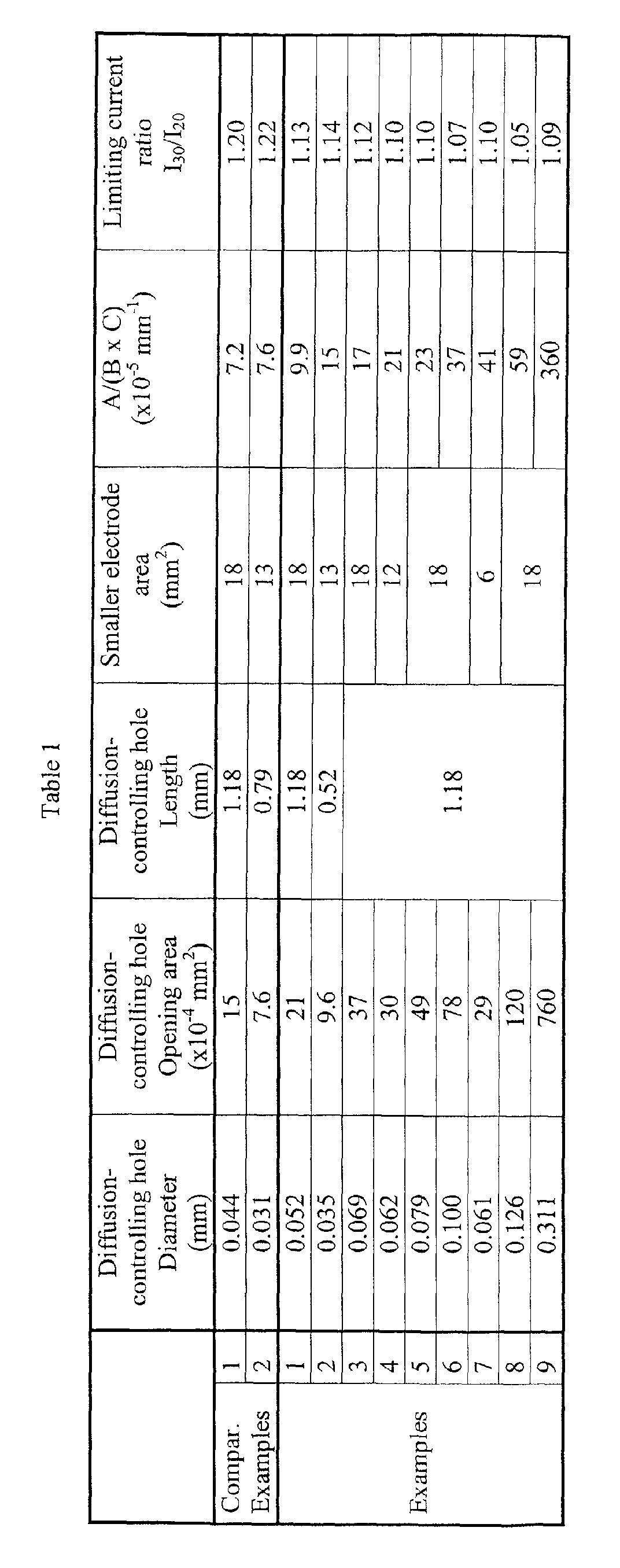
- the thus-obtained substrates for the first measuring electrode side have three kinds of thickness (0.52 mm, 0.79 mm, and 1.18 mm), a longitudinal dimension of 7 mm, a lateral dimension of 40 mm, and a diffusion-controlling hole of a diameter shown in Table 1.
- the thus-obtained substrates for the second electrode side have a thickness of 180 ⁇ m, a longitudinal dimension of 7 mm, a lateral dimension of 40 mm, and an outlet of a 1.7 mm diameter.
- the thus-obtained 11 kinds of gas sensors had the following dimensions.
- Polymer electrolyte layer thickness about 180 ⁇ m; length 13-25 mm; width 3.8-7.2 mm
- Second electrode the same size as that of the corresponding first electrode
- Substrate for the first electrode side thickness 0.52 mm, 0.79 mm, or 1.18 mm
- Substrate for the second electrode side thickness 1.8 mm
- Each of the gas sensors obtained above in [1] was fixed such that the detection portion (the polymer electrolyte element, the first electrode, and the second measuring electrode) projects into a chamber.
- a power supply for supplying variable voltage and an ammeter were connected to platinum wires extending from the first and second electrodes.
- a model gas was introduced into the chamber at a flow rate of 10 liters per minute, while the chamber was maintained at 80°C.
- the model gas contained hydrogen in an amount of 50% by volume, carbon dioxide in an amount of 15% by volume, water in an amount of 20% by volume, and the balance nitrogen.
- a voltage of 0-1000 mV was applied between the first measuring electrode and the second measuring electrode, and the limiting current I 20 was measured.
- the limiting current I 30 was measured under the same conditions as those in measurement of I 20 except that a model gas to be introduced into the chamber contains water in an amount of 30% by volume.
- the limiting current ratio I 30 /I 20 was calculated from the thus-measured values. The calculation results are shown in Table 1.
- the limiting current ratio I 30 /I 20 can assume a value less than 1.2. This means that, even when the H 2 O concentration varies between 20% by volume and 30% by volume in an atmosphere to be measured whose H 2 concentration is 50% by volume, the H 2 concentration can be measured with an error within 10% by volume.
- a gas sensor of the present invention and a method for measuring gas concentration by use of the gas sensor can measure the concentration of a gas to be measured, at high accuracy, through reduction of influence of the water.
- Fig. 4 is a sectional view of a main portion of a gas sensor illustrating a combustible-gas sensor according to a first embodiment of the present invention.
- the combustible-gas sensor is configured such that a first electrode 203 and a second electrode 204 are formed in opposition to each other with a proton conductive layer 202 being held therebetween.
- the first electrode 203 and the second electrode 204 are in contact with the proton conductive layer 202.
- the first electrode 203, the proton conductive layer 202, and the second electrode 204 are held between an upper support element 201a and a lower support element 201b, which constitute a support element.
- a gas diffusion controlling portion 206 for introducing a measurement gas onto the first electrode 203 is formed in the upper support element 201a.
- a hole 211 is formed in the lower support element 201b, in contact with the second electrode 204.
- a power supply 207 and an ammeter 208 are connected between the first electrode 203 and the second electrode 204 via lead portions, thereby enabling application of voltage and measurement of current.
- the proton conductive layer 202 is formed of Nafion (trademark, product of DuPont), which is a fluorine-containing resin which operates at relatively low temperature.
- Each of the first electrode 203 and the second electrode 204 is a porous electrode which is made of carbon or the like and carries a catalyst, such as Pt, on the side in contact with the proton conductive layer 202.
- the insulating support element (the upper support element 201a and the lower support element 201b) is formed of a ceramic such as alumina. Notably, the support element can be formed of a resin or a like material.
- the gas diffusion controlling portion 206 is formed of gas-permeable, porous alumina.
- the gas diffusion controlling portion 206 may be formed of a very fine through-hole having a diameter of about 30 to 450 ⁇ m.
- the proton conductive layer 202, the first electrode 203, and the second electrode 204 are physically held in the support member, in contact with one another.
- the proton conductive layer 202, the first electrode 203, and the second electrode 204 may be bonded together by use of a hot pressing process.
- the concentration of hydrogen gas (example combustible gas) contained in a measurement gas was measured by use of a plurality of combustible-gas sensors which have a sensor structure as shown in Fig. 4, and which have the same EW value, but differ from one another in thickness of the proton conductive layer.
- a predetermined voltage was applied between the first and second electrodes, and the current flowing between the first and second electrodes was measured so as to determine the hydrogen gas concentration.
- perfluorosulfonic acid films of different thicknesses were used. The thicknesses are as follows: (1) 0.029 mm, (2) 0.080 mm, (3) 0.185 mm, (4) 0.346 mm, (5) 0.577 mm.
- each thickness was measured by use of a micrometer in the atmosphere (20°C, RH: 30%). Other conditions are specified below.
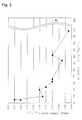
- Fig. 5 is a graph for explaining the results of Measurement Example 10.
- the horizontal axis represents the thickness of the proton conductive layer
- the vertical axis represents current ratio.
- the current ratio decreases when the proton conductive layer has a thickness of not less than 0.08 mm.
- This result demonstrates that the H 2 O concentration dependency of hydrogen-gas concentration measurement can be mitigated through employment of a polymer electrolyte film having a thickness of not less than 0.08 mm. Further, it is understood that a predetermined characteristic can be obtained when the thickness is set to 0.08 mm to 0.6 mm.
- a combustible-gas sensor according to the another embodiment of the present invention has the same sensor structure as that of the combustible-gas sensor according to Example 10 (see Fig. 4) and has a proton conductive layer which is formed of a polymer electrolyte, protons of ion exchange groups of the polymer electrolyte having been partially substituted by metal ions.
- An example metal-ion substitution process will be shown below.
- the concentration of hydrogen gas (an example combustible gas) contained in a measurement gas was measured by use of the combustible-gas sensor according to Example 11. In the measurement, a predetermined voltage was applied between the first and second electrodes, and the current flowing between the first and second electrodes was measured so as to determine the hydrogen gas concentration. Other conditions are specified below.
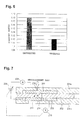
- Fig. 6 is a graph for explaining the results of Measurement Example 11.
- Measurement was performed in order to determine preferred conditions for the above-described ion substitution process for the proton conductive layer. Specifically, the above-described ion substitution process was performed by use of aqueous sodium solutions of different concentrations, and the impedance between the first and second electrodes was measured by use of an impedance analyzer under the following conditions.
- Table 2 shows that the impedance between the first and second electrode becomes excessively high when the concentration of sodium ions is 1 x 10 -2 mol/L or greater.
- concentration of an aqueous sodium solution used for the substitution process is preferably set to be less than 1 x 10 -2 mol/L, and more preferably to not greater than 1 x 10 -3 mol/L.
- a combustible-gas sensor according to still another embodiment of the present invention is described.
- the structure of the combustible-gas sensor according to this embodiment differs from that of the combustible-gas sensor according to Example 10 in that a reference electrode is added.
- the following description of the embodiment of Example 12 mainly covers the difference between Example 12 and Example 10.
- the description of the first embodiment may be referred to as appropriate.
- Fig. 7 is a sectional view of a main portion of a gas sensor illustrating the structure of the combustible-gas sensor according to the third embodiment of the present invention.
- this combustible-gas sensor is configured such that a reference electrode 205 is formed in contact with the proton conductive layer 202.
- the reference electrode 205 is covered with the support element 201b so as to reduce the influence of variation in the concentration of combustible gas in a measurement gas.
- the reference electrode 205 and the second electrode 204 are formed on the same surface of the proton conductive layer 202 and disposed in different chambers.
- the reference electrode 205 is preferably a self-generation-type reference electrode. This can be attained in the following manner: a constant, very small current is caused to flow from the first electrode 203 to the reference electrode 205 such that a portion of the combustible gas leaks, in the form of hydrogen, to the exterior of the sensor via a predetermined leakage resistance portion (e.g., a very fine hole).
- a predetermined leakage resistance portion e.g., a very fine hole.
- a potentiometer 210 is connected between the first electrode 203 and the reference electrode 205 via lead portions.
- a power supply 209 and an ammeter 208 are connected between the first electrode 203 and the second electrode 204 via lead portions. Sufficient voltage is applied between the first electrode 203 and the second electrode 204 such that the electric potential difference between the first electrode 203 and the reference electrode 5 assumes a constant value. At this time, the current flowing between the first electrode 203 and the second electrode 202 is measured.
- the combustible-gas sensor can control the concentration of hydrogen gas on the first electrode to a constant level while the voltage applied between the first electrode and the second electrode is optimally varied according to the concentration of hydrogen in the measurement gas ⁇ high voltage is applied at high concentration, and low voltage is applied at low concentration ⁇ such that the electric potential difference between the first electrode and the reference electrode becomes constant.
- the combustible-gas sensor according to the third embodiment of the present invention can control the concentration of hydrogen gas on the first electrode to a constant level by varying the applied voltage as appropriate.
- this combustible-gas sensor can always control hydrogen concentration on the first electrode to not less than 10 -12 atm as reduced to partial pressure of hydrogen, even when used in an atmosphere whose hydrogen gas concentration, temperature, etc. vary greatly. Therefore, even when methanol is present, combustible gas concentration can be accurately measured over a wide concentration range without being influenced by methanol.
- the present invention provides a combustible-gas sensor which is not affected by variation in H 2 O concentration of an atmosphere.
Landscapes
- Chemical & Material Sciences (AREA)
- Health & Medical Sciences (AREA)
- Life Sciences & Earth Sciences (AREA)
- Engineering & Computer Science (AREA)
- Pathology (AREA)
- Immunology (AREA)
- Physics & Mathematics (AREA)
- Analytical Chemistry (AREA)
- Biochemistry (AREA)
- General Health & Medical Sciences (AREA)
- General Physics & Mathematics (AREA)
- Combustion & Propulsion (AREA)
- Food Science & Technology (AREA)
- Medicinal Chemistry (AREA)
- Electrochemistry (AREA)
- Chemical Kinetics & Catalysis (AREA)
- Molecular Biology (AREA)
- Measuring Oxygen Concentration In Cells (AREA)
Abstract
Description
| Processing concentration (mol/L) | Results |
| 1 x 10⁻² | Conductivity Not established |
| 1 x 10⁻³ | Conductivity established |
| 1 x 10⁻⁴ | Conductivity established |
Claims (15)
- A gas sensor comprising a proton conductive-polymer electrolyte layer; a first electrode and a second electrode provided in contact with the proton-conductive polymer electrolyte layer; a partition wall or gas diffusion controlling portion provided between the first electrode and the gas atmosphere to be measured; and the gas sensor further comprises at least one of the following:(1) a diffusion-controlling hole provided in the partition wall and extending through the partition wall between the first measuring electrode and the atmosphere to be measured, the gas sensor being characterized in that A/(B x C) is not less than 9.5 x 10⁻⁵ mm-1, where A (mm2) is an opening area of the diffusion-controlling hole on a side toward the gas atmosphere to be measured, B (mm) is a length of the diffusion-controlling hole, and C (mm2) is an area of the first electrode or that of the second measuring electrode, whichever is smaller, and(2) the proton-conductive polymer electrolyte layer is formed of a polymer electrolyte having a thickness of not less than 0.08mm.
- A method for measuring gas concentration, comprising measuring a limiting current flowing between the first electrode and a second electrode by use of the gas sensor according to claim 1.
- A gas sensor comprising a proton-conductive polymer electrolyte layer, a first electrode and a second electrode formed in contact with the proton-conductive polymer electrolyte layer, a partition wall provided between the first electrode and a gas atmosphere to be measured, and a diffusion-controlling hole provided in the partition wall and extending through the partition wall between the first measuring electrode and the gas atmosphere to be measured, the gas sensor being characterized in that A/(B x C) is not less than 9.5 x 10⁻⁵ mm-1, where A (mm2) is an opening area of the diffusion-controlling hole on a side toward the gas atmosphere to be measured, B (mm) is a length of the diffusion-controlling hole, and C (mm2) is an area of the first electrode or that of the second electrode, whichever is smaller.
- A gas sensor according to claim 3, further comprising a reference electrode bonded to the polymer electrolyte layer.
- A gas sensor according to claim 3 or 4, wherein I30/I20 is less than 1.2, where I30 is a limiting current as measured with an atmosphere to be measured which contains H2 in an amount of 50% by volume and H2O in an amount of 30% by volume, and I20 is a limiting current as measured with an atmosphere to be measured which contains H2 in an amount of 50% by volume and H2O in an amount of 20% by volume.
- A method for measuring gas concentration, comprising measuring a limiting current flowing between the first electrode and a second electrode by use of the gas sensor according to one of claims 3, 4 or 5.
- A method for measuring gas concentration, wherein a limiting current flowing between the first electrode and a second electrode is measured by using a gas sensor according to claim 4 while voltage is applied to the first electrode and the second electrode such that the voltage as measured between the first electrode and the reference electrode becomes constant.
- A method for measuring gas concentration according to claim 6 or 7, wherein I30/I20 is less than 1.2, where I30 is a limiting current as measured with an atmosphere to be measured which contains H2 in an amount of 50% by volume and H2O in an amount of 30% by volume, and I20 is a limiting current as measured with an atmosphere to be measured which contains H2 in an amount of 50% by volume and H2O in an amount of 20% by volume.
- A gas sensor comprising a proton-conductive polymer electrolyte layer; a first electrode and a second electrode provided in contact with the proton conductive polymer layer; a gas diffusion controlling portion provided between the first electrode and the gas atmosphere to be measured; and a support element for supporting the proton-conductive layer, the first electrode, the second electrode, and the gas diffusion controlling portion, wherein, in use, a combustible gas contained in a measurement gas introduced via the gas diffusion controlling portion is caused to be dissociated, decomposed, or reacted through application of voltage between the first electrode and the second electrode to thereby generate protons, and the concentration of the combustible gas is obtained on the basis of limiting current generated as a result of the generated protons being pumped out via the proton conductive layer from a first electrode side to a second electrode side,
the gas sensor being characterized in that the proton-conductive layer is formed of a polymer electrolyte having a thickness of not less than 0.08mm. - A gas sensor comprising a proton-conductive layer; a first electrode and a second electrode provided in contact with the proton-conductive layer; a gas diffusion controlling portion provided between a measurement gas atmosphere and the first electrode; and a support element for supporting the proton-conductive layer, the first electrode, the second electrode, and the gas diffusion controlling portion, wherein, in use, a combustible gas contained in a measurement gas introduced via the gas diffusion controlling portion is caused to be dissociated, decomposed, or reacted through application of voltage between the first electrode and the second electrode to thereby generate protons, and the concentration of the combustible gas is obtained on the basis of limiting current generated as a result of the generated protons being pumped out via the proton-conductive layer from the first electrode side to the second electrode side,
wherein the proton-conductive layer is formed of a polymer electrolyte
wherein, protons of ion exchange groups of the polymer electrolyte having been partially substituted by metal ions. - A gas sensor according to claim 10, wherein the proton- conductive layer has an EW (Equivalent Weight = 1000/ion exchange group capacity) of not less than 1100.
- A gas sensor according to claim 10 or 11, wherein the metal ions are sodium ions.
- A gas sensor according to claim 10, 11 or 12, wherein the substitution is performed by use of an aqueous solution containing metal ions at a concentration of not greater than 10-3 mol/L.
- A gas sensor according to any one of claims 9 to 13, further comprising a reference electrode provided in contact with the proton-conductive layer, wherein, in use, a predetermined voltage is applied between the first electrode and the second electrode in such a manner as to establish a constant electric potential difference between the first electrode and the reference electrode.
- A gas sensor according to any one of claims 9 to 14, wherein the gas to be measured is hydrogen.
Applications Claiming Priority (4)
| Application Number | Priority Date | Filing Date | Title |
|---|---|---|---|
| JP2001145299 | 2001-05-15 | ||
| JP2001145299A JP2002340851A (en) | 2001-05-15 | 2001-05-15 | Gas sensor and gas concentration measuring method using the same |
| JP2001327477A JP2003130844A (en) | 2001-10-25 | 2001-10-25 | Combustible gas sensor |
| JP2001327477 | 2001-10-25 |
Publications (2)
| Publication Number | Publication Date |
|---|---|
| EP1260814A2 true EP1260814A2 (en) | 2002-11-27 |
| EP1260814A3 EP1260814A3 (en) | 2004-07-14 |
Family
ID=26615126
Family Applications (1)
| Application Number | Title | Priority Date | Filing Date |
|---|---|---|---|
| EP02253413A Withdrawn EP1260814A3 (en) | 2001-05-15 | 2002-05-15 | Gas sensor and method for measuring gas concentration using the same |
Country Status (3)
| Country | Link |
|---|---|
| US (1) | US7306712B2 (en) |
| EP (1) | EP1260814A3 (en) |
| CA (1) | CA2385816A1 (en) |
Cited By (3)
| Publication number | Priority date | Publication date | Assignee | Title |
|---|---|---|---|---|
| WO2006061278A1 (en) * | 2004-12-10 | 2006-06-15 | Robert Bosch Gmbh | Resistive particle sensors with measuring electrodes |
| EP2042862A1 (en) * | 2006-06-27 | 2009-04-01 | Fujikura, Ltd. | Limiting current type oxygen sensor and method of sensing and measuring oxygen concentrations using the same |
| EP2105731A3 (en) * | 2008-03-28 | 2011-11-30 | NGK Insulators, Ltd. | Laminated solid electrolyte gas sensor comprising |
Families Citing this family (12)
| Publication number | Priority date | Publication date | Assignee | Title |
|---|---|---|---|---|
| US7151069B2 (en) * | 2003-07-16 | 2006-12-19 | Japan Storage Battery Co., Ltd. | Manufacturing processes of catalyst layer for fuel cell |
| EP1719197A4 (en) * | 2003-12-05 | 2008-08-06 | Proton Energy Sys Inc | HYDROGEN PRODUCTION SYSTEM AND ASSOCIATE PROCESS |
| DE102004049874A1 (en) * | 2004-10-13 | 2006-04-20 | Robert Bosch Gmbh | Gas sensor |
| US7556738B2 (en) * | 2005-05-26 | 2009-07-07 | Culligan International Company | Method for determining the duration of a brine/slow rinse cycle for a water conditioner |
| US8813539B2 (en) * | 2007-07-10 | 2014-08-26 | National Taiwan University Of Science And Technology | Electrochemistry apparatus |
| WO2009105673A2 (en) * | 2008-02-21 | 2009-08-27 | New York University | Tumor therapy with replication competent sindbis viral vectors |
| JP2014041055A (en) * | 2012-08-22 | 2014-03-06 | Ngk Spark Plug Co Ltd | Gas detection device and gas detection method |
| JP6165343B2 (en) * | 2013-09-12 | 2017-07-19 | コリア・アドバンスト・インスティテュート・オブ・サイエンス・アンド・テクノロジー | Hydrogen sensor element for measuring dissolved hydrogen gas concentration in liquid and method for measuring hydrogen gas concentration using the same |
| EP3343212B1 (en) * | 2015-08-28 | 2019-11-06 | Panasonic Intellectual Property Management Co., Ltd. | Gas sensor and fuel cell vehicle |
| US20190041351A1 (en) * | 2016-01-08 | 2019-02-07 | Keith Francis Edwin Pratt | Mems electrochemical gas sensor |
| US11486851B2 (en) * | 2018-09-18 | 2022-11-01 | Ams Ag | Electrochemical gas sensors |
| CN112577863B (en) * | 2019-09-27 | 2025-01-14 | 研能科技股份有限公司 | Gas detection module |
Family Cites Families (12)
| Publication number | Priority date | Publication date | Assignee | Title |
|---|---|---|---|---|
| JPS59178354A (en) * | 1983-03-29 | 1984-10-09 | Ngk Spark Plug Co Ltd | Oxygen sensor |
| IT1215930B (en) * | 1988-02-22 | 1990-02-22 | Eniricerche Spa | SOLID STATE SENSOR FOR DETERMINING THE CONCENTRATION OF GAS WITH A SOLID REFERENCE ELECTRODE. |
| CH678660A5 (en) * | 1988-02-24 | 1991-10-15 | Matsushita Electric Works Ltd | |
| US4990235A (en) * | 1989-02-23 | 1991-02-05 | Toyota Jidosha Kabushiki | Oxygen sensor |
| US5302274A (en) * | 1990-04-16 | 1994-04-12 | Minitech Co. | Electrochemical gas sensor cells using three dimensional sensing electrodes |
| JP2989961B2 (en) * | 1991-05-27 | 1999-12-13 | 株式会社デンソー | Oxygen concentration detector for intake pipe |
| US5387329A (en) * | 1993-04-09 | 1995-02-07 | Ciba Corning Diagnostics Corp. | Extended use planar sensors |
| JPH0731153A (en) | 1993-07-13 | 1995-01-31 | Tec Corp | Power converter |
| KR100319947B1 (en) * | 1998-04-06 | 2002-01-09 | 마츠시타 덴끼 산교 가부시키가이샤 | Hydrocarbon sensor |
| JP3953677B2 (en) * | 1999-03-12 | 2007-08-08 | 日本特殊陶業株式会社 | Gas sensor |
| EP1767930A3 (en) * | 1999-10-01 | 2007-04-04 | Matsushita Electric Industrial Co., Ltd. | Carbon monoxide sensor |
| JP2001215214A (en) * | 1999-11-24 | 2001-08-10 | Ngk Spark Plug Co Ltd | Hydrogen gas sensor |
-
2002
- 2002-05-10 CA CA002385816A patent/CA2385816A1/en not_active Abandoned
- 2002-05-15 US US10/144,835 patent/US7306712B2/en not_active Expired - Fee Related
- 2002-05-15 EP EP02253413A patent/EP1260814A3/en not_active Withdrawn
Cited By (6)
| Publication number | Priority date | Publication date | Assignee | Title |
|---|---|---|---|---|
| WO2006061278A1 (en) * | 2004-12-10 | 2006-06-15 | Robert Bosch Gmbh | Resistive particle sensors with measuring electrodes |
| US7872466B2 (en) | 2004-12-10 | 2011-01-18 | Robert Bosch Gmbh | Resistive particle sensors having measuring electrodes |
| EP2042862A1 (en) * | 2006-06-27 | 2009-04-01 | Fujikura, Ltd. | Limiting current type oxygen sensor and method of sensing and measuring oxygen concentrations using the same |
| US8052862B2 (en) | 2006-06-27 | 2011-11-08 | Fujikura Ltd. | Limiting current type oxygen sensor and method of sensing and measuring oxygen concentrations using the same |
| EP2105731A3 (en) * | 2008-03-28 | 2011-11-30 | NGK Insulators, Ltd. | Laminated solid electrolyte gas sensor comprising |
| US8246800B2 (en) | 2008-03-28 | 2012-08-21 | Ngk Insulators, Ltd. | Gas sensor |
Also Published As
| Publication number | Publication date |
|---|---|
| EP1260814A3 (en) | 2004-07-14 |
| US7306712B2 (en) | 2007-12-11 |
| CA2385816A1 (en) | 2002-11-15 |
| US20030066763A1 (en) | 2003-04-10 |
Similar Documents
| Publication | Publication Date | Title |
|---|---|---|
| CA2326210C (en) | Hydrogen gas sensor | |
| US7306712B2 (en) | Gas sensor and method for measuring gas concentration using the same | |
| US4171253A (en) | Self-humidifying potentiostated, three-electrode hydrated solid polymer electrolyte (SPE) gas sensor | |
| USRE45186E1 (en) | Low cost room temperature electrochemical carbon monoxide and toxic gas sensor with humidity compensation based on protonic conductive membranes | |
| USRE45100E1 (en) | Gas sensor based on protonic conductive membranes | |
| EP1037041B1 (en) | Gas sensor | |
| US7422646B2 (en) | Electrochemical sensor with dry ionomer membrane and methodfor making the same | |
| CA2381400C (en) | Hydrogen sensor | |
| JP2001506751A (en) | Gas sensor | |
| WO2013052041A1 (en) | Gas sensor | |
| US5624538A (en) | Measuring device for determining the concentration of alcohols | |
| Mitsuda et al. | Polarization study of a fuel cell with four reference electrodes | |
| US6797151B2 (en) | CO sensor and method of measuring CO concentration | |
| US20090246570A1 (en) | Method and apparatus for measuring crossover loss of fuel cell | |
| US20030089604A1 (en) | Hydrogen sensor | |
| JP2008270062A (en) | Evaluation method and apparatus for fuel cell membrane / electrode assembly | |
| JP2008270063A (en) | Evaluation method and apparatus for electrolyte membrane for fuel cell | |
| KR100531602B1 (en) | Electrochemical methanol sensor incorporating Nafion-impregnated ultra-thin PETE membrane as the electrolyte and method for manufacturing the same | |
| CA1114021A (en) | Potentiostated, three-electrode, solid polymer electrolyte (spe) gas sensor having highly invariant background current characteristics with temperature during zero-air operation | |
| JP2003207483A (en) | Gas sensor | |
| US20030042138A1 (en) | Gas sensor | |
| JP2003130844A (en) | Combustible gas sensor | |
| EP1288655A2 (en) | Gas sensor | |
| JP2002340851A (en) | Gas sensor and gas concentration measuring method using the same | |
| JP2004212157A (en) | Gas sensor |
Legal Events
| Date | Code | Title | Description |
|---|---|---|---|
| PUAI | Public reference made under article 153(3) epc to a published international application that has entered the european phase |
Free format text: ORIGINAL CODE: 0009012 |
|
| AK | Designated contracting states |
Kind code of ref document: A2 Designated state(s): AT BE CH CY DE DK ES FI FR GB GR IE IT LI LU MC NL PT SE TR |
|
| AX | Request for extension of the european patent |
Free format text: AL;LT;LV;MK;RO;SI |
|
| PUAL | Search report despatched |
Free format text: ORIGINAL CODE: 0009013 |
|
| AK | Designated contracting states |
Kind code of ref document: A3 Designated state(s): AT BE CH CY DE DK ES FI FR GB GR IE IT LI LU MC NL PT SE TR |
|
| AX | Request for extension of the european patent |
Extension state: AL LT LV MK RO SI |
|
| RIC1 | Information provided on ipc code assigned before grant |
Ipc: 7G 01N 33/00 B Ipc: 7G 01N 27/407 A |
|
| 17P | Request for examination filed |
Effective date: 20050111 |
|
| AKX | Designation fees paid |
Designated state(s): DE FR GB SE |
|
| 17Q | First examination report despatched |
Effective date: 20090909 |
|
| STAA | Information on the status of an ep patent application or granted ep patent |
Free format text: STATUS: THE APPLICATION IS DEEMED TO BE WITHDRAWN |
|
| 18D | Application deemed to be withdrawn |
Effective date: 20100120 |