EP1260731A2 - Hydro-damped air spring - Google Patents
Hydro-damped air spring Download PDFInfo
- Publication number
- EP1260731A2 EP1260731A2 EP02100197A EP02100197A EP1260731A2 EP 1260731 A2 EP1260731 A2 EP 1260731A2 EP 02100197 A EP02100197 A EP 02100197A EP 02100197 A EP02100197 A EP 02100197A EP 1260731 A2 EP1260731 A2 EP 1260731A2
- Authority
- EP
- European Patent Office
- Prior art keywords
- air spring
- piston
- chamber
- damping
- variable volume
- Prior art date
- Legal status (The legal status is an assumption and is not a legal conclusion. Google has not performed a legal analysis and makes no representation as to the accuracy of the status listed.)
- Withdrawn
Links
Images




Classifications
-
- F—MECHANICAL ENGINEERING; LIGHTING; HEATING; WEAPONS; BLASTING
- F16—ENGINEERING ELEMENTS AND UNITS; GENERAL MEASURES FOR PRODUCING AND MAINTAINING EFFECTIVE FUNCTIONING OF MACHINES OR INSTALLATIONS; THERMAL INSULATION IN GENERAL
- F16F—SPRINGS; SHOCK-ABSORBERS; MEANS FOR DAMPING VIBRATION
- F16F9/00—Springs, vibration-dampers, shock-absorbers, or similarly-constructed movement-dampers using a fluid or the equivalent as damping medium
- F16F9/06—Springs, vibration-dampers, shock-absorbers, or similarly-constructed movement-dampers using a fluid or the equivalent as damping medium using both gas and liquid
- F16F9/08—Springs, vibration-dampers, shock-absorbers, or similarly-constructed movement-dampers using a fluid or the equivalent as damping medium using both gas and liquid where gas is in a chamber with a flexible wall
-
- B—PERFORMING OPERATIONS; TRANSPORTING
- B60—VEHICLES IN GENERAL
- B60G—VEHICLE SUSPENSION ARRANGEMENTS
- B60G17/00—Resilient suspensions having means for adjusting the spring or vibration-damper characteristics, for regulating the distance between a supporting surface and a sprung part of vehicle or for locking suspension during use to meet varying vehicular or surface conditions, e.g. due to speed or load
- B60G17/02—Spring characteristics, e.g. mechanical springs and mechanical adjusting means
- B60G17/04—Spring characteristics, e.g. mechanical springs and mechanical adjusting means fluid spring characteristics
- B60G17/048—Spring characteristics, e.g. mechanical springs and mechanical adjusting means fluid spring characteristics with the regulating means inside the fluid springs
- B60G17/0485—Spring characteristics, e.g. mechanical springs and mechanical adjusting means fluid spring characteristics with the regulating means inside the fluid springs the springs being pneumatic springs with a flexible wall, e.g. with levelling valves
-
- B—PERFORMING OPERATIONS; TRANSPORTING
- B60—VEHICLES IN GENERAL
- B60G—VEHICLE SUSPENSION ARRANGEMENTS
- B60G17/00—Resilient suspensions having means for adjusting the spring or vibration-damper characteristics, for regulating the distance between a supporting surface and a sprung part of vehicle or for locking suspension during use to meet varying vehicular or surface conditions, e.g. due to speed or load
- B60G17/02—Spring characteristics, e.g. mechanical springs and mechanical adjusting means
- B60G17/04—Spring characteristics, e.g. mechanical springs and mechanical adjusting means fluid spring characteristics
- B60G17/052—Pneumatic spring characteristics
- B60G17/0521—Pneumatic spring characteristics the spring having a flexible wall
-
- F—MECHANICAL ENGINEERING; LIGHTING; HEATING; WEAPONS; BLASTING
- F16—ENGINEERING ELEMENTS AND UNITS; GENERAL MEASURES FOR PRODUCING AND MAINTAINING EFFECTIVE FUNCTIONING OF MACHINES OR INSTALLATIONS; THERMAL INSULATION IN GENERAL
- F16F—SPRINGS; SHOCK-ABSORBERS; MEANS FOR DAMPING VIBRATION
- F16F13/00—Units comprising springs of the non-fluid type as well as vibration-dampers, shock-absorbers, or fluid springs
- F16F13/002—Units comprising springs of the non-fluid type as well as vibration-dampers, shock-absorbers, or fluid springs comprising at least one fluid spring
-
- F—MECHANICAL ENGINEERING; LIGHTING; HEATING; WEAPONS; BLASTING
- F16—ENGINEERING ELEMENTS AND UNITS; GENERAL MEASURES FOR PRODUCING AND MAINTAINING EFFECTIVE FUNCTIONING OF MACHINES OR INSTALLATIONS; THERMAL INSULATION IN GENERAL
- F16F—SPRINGS; SHOCK-ABSORBERS; MEANS FOR DAMPING VIBRATION
- F16F9/00—Springs, vibration-dampers, shock-absorbers, or similarly-constructed movement-dampers using a fluid or the equivalent as damping medium
- F16F9/02—Springs, vibration-dampers, shock-absorbers, or similarly-constructed movement-dampers using a fluid or the equivalent as damping medium using gas only or vacuum
- F16F9/04—Springs, vibration-dampers, shock-absorbers, or similarly-constructed movement-dampers using a fluid or the equivalent as damping medium using gas only or vacuum in a chamber with a flexible wall
- F16F9/05—Springs, vibration-dampers, shock-absorbers, or similarly-constructed movement-dampers using a fluid or the equivalent as damping medium using gas only or vacuum in a chamber with a flexible wall the flexible wall being of the rolling diaphragm type
-
- F—MECHANICAL ENGINEERING; LIGHTING; HEATING; WEAPONS; BLASTING
- F16—ENGINEERING ELEMENTS AND UNITS; GENERAL MEASURES FOR PRODUCING AND MAINTAINING EFFECTIVE FUNCTIONING OF MACHINES OR INSTALLATIONS; THERMAL INSULATION IN GENERAL
- F16F—SPRINGS; SHOCK-ABSORBERS; MEANS FOR DAMPING VIBRATION
- F16F9/00—Springs, vibration-dampers, shock-absorbers, or similarly-constructed movement-dampers using a fluid or the equivalent as damping medium
- F16F9/06—Springs, vibration-dampers, shock-absorbers, or similarly-constructed movement-dampers using a fluid or the equivalent as damping medium using both gas and liquid
- F16F9/08—Springs, vibration-dampers, shock-absorbers, or similarly-constructed movement-dampers using a fluid or the equivalent as damping medium using both gas and liquid where gas is in a chamber with a flexible wall
- F16F9/084—Springs, vibration-dampers, shock-absorbers, or similarly-constructed movement-dampers using a fluid or the equivalent as damping medium using both gas and liquid where gas is in a chamber with a flexible wall comprising a gas spring contained within a flexible wall, the wall not being in contact with the damping fluid, i.e. mounted externally on the damper cylinder
-
- F—MECHANICAL ENGINEERING; LIGHTING; HEATING; WEAPONS; BLASTING
- F16—ENGINEERING ELEMENTS AND UNITS; GENERAL MEASURES FOR PRODUCING AND MAINTAINING EFFECTIVE FUNCTIONING OF MACHINES OR INSTALLATIONS; THERMAL INSULATION IN GENERAL
- F16F—SPRINGS; SHOCK-ABSORBERS; MEANS FOR DAMPING VIBRATION
- F16F13/00—Units comprising springs of the non-fluid type as well as vibration-dampers, shock-absorbers, or fluid springs
- F16F13/04—Units comprising springs of the non-fluid type as well as vibration-dampers, shock-absorbers, or fluid springs comprising both a plastics spring and a damper, e.g. a friction damper
- F16F13/06—Units comprising springs of the non-fluid type as well as vibration-dampers, shock-absorbers, or fluid springs comprising both a plastics spring and a damper, e.g. a friction damper the damper being a fluid damper, e.g. the plastics spring not forming a part of the wall of the fluid chamber of the damper
- F16F13/20—Units comprising springs of the non-fluid type as well as vibration-dampers, shock-absorbers, or fluid springs comprising both a plastics spring and a damper, e.g. a friction damper the damper being a fluid damper, e.g. the plastics spring not forming a part of the wall of the fluid chamber of the damper characterised by comprising also a pneumatic spring
-
- F—MECHANICAL ENGINEERING; LIGHTING; HEATING; WEAPONS; BLASTING
- F16—ENGINEERING ELEMENTS AND UNITS; GENERAL MEASURES FOR PRODUCING AND MAINTAINING EFFECTIVE FUNCTIONING OF MACHINES OR INSTALLATIONS; THERMAL INSULATION IN GENERAL
- F16F—SPRINGS; SHOCK-ABSORBERS; MEANS FOR DAMPING VIBRATION
- F16F2230/00—Purpose; Design features
- F16F2230/10—Enclosure elements, e.g. for protection
-
- F—MECHANICAL ENGINEERING; LIGHTING; HEATING; WEAPONS; BLASTING
- F16—ENGINEERING ELEMENTS AND UNITS; GENERAL MEASURES FOR PRODUCING AND MAINTAINING EFFECTIVE FUNCTIONING OF MACHINES OR INSTALLATIONS; THERMAL INSULATION IN GENERAL
- F16F—SPRINGS; SHOCK-ABSORBERS; MEANS FOR DAMPING VIBRATION
- F16F9/00—Springs, vibration-dampers, shock-absorbers, or similarly-constructed movement-dampers using a fluid or the equivalent as damping medium
- F16F9/06—Springs, vibration-dampers, shock-absorbers, or similarly-constructed movement-dampers using a fluid or the equivalent as damping medium using both gas and liquid
- F16F9/08—Springs, vibration-dampers, shock-absorbers, or similarly-constructed movement-dampers using a fluid or the equivalent as damping medium using both gas and liquid where gas is in a chamber with a flexible wall
- F16F9/082—Springs, vibration-dampers, shock-absorbers, or similarly-constructed movement-dampers using a fluid or the equivalent as damping medium using both gas and liquid where gas is in a chamber with a flexible wall characterised by the hydropneumatic accumulator
Definitions
- the present invention relates to air springs.
- the invention is directed to a hydro-damped air spring.
- Air springs have been used for motor vehicles and various machines and other equipment for a number of years.
- the springs are designed to support a suspension load such as a vehicle.
- the springs are often combined with a separate shock absorber device in the suspension that functions to dampen oscillations.
- the air spring usually consists of a flexible elastomeric reinforced sleeve that extends between a pair of end members.
- the sleeve is attached to end members to form a pressurized chamber therein.
- the end members mount the air spring on spaced components or parts of the vehicle or equipment on which the air spring is to be mounted.
- the internal pressurized gas usually air, absorbs most of the motion impressed upon or experienced by one of the spaced end members by which the air spring is mounted.
- the end members move inwards and towards each other and also away and outwards from each other as the motion of the suspension requires.
- the air spring of the present invention combines both traditional air spring characteristics and components with internal hydro damping.
- the air spring has an upper retainer, a piston, an elastomeric sleeve secured to the upper retainer at a first end and secured to the piston at the lower end, and a damping device.
- the damping device has an upper and a lower variable volume chamber and a channel connecting the two variable volume chambers, and a damping fluid contained within the damping device.
- one of the variable volume chambers may have a bellows configuration.
- the sleeve forming the bellows may be made from a reinforced elastomeric sleeve or may be a molded sleeve.
- the corrugations in the bellows may be formed from a series of external rings, molded in rings, or elongated rings.
- the lower variable volume chamber is located within the piston and the upper variable volume chamber is located within a chamber formed by the secured elastomeric sleeve.
- the channel connecting the two variable volume chambers is a continuous circular channel.
- the damping device may have a quick relief valve.
- FIG 1 illustrates the inventive air spring 1.
- the air spring 1 has four main components, the upper retainer 2, the piston 4, the elastomeric sleeve 6 and the damping device 8.
- the elastomeric sleeve 6 is secured at first end 10 to the upper retainer 2 and to the piston 4 at the opposing end 12, forming a chamber 14.
- the elastomeric sleeve 6 is preferably comprised of at least 3 plies: an outer elastomeric ply, at least one reinforcing ply formed of elastomeric embedded reinforcing cords, and an inner elastomeric ply.
- the upper end 10 of the sleeve 6 is secured onto the upper retainer 2 by means of a clamping ring 16 in a conventional manner, similar to that disclosed in US-A- 5,005,808.
- the upper sleeve end 10 may have an inextensible bead about which the upper retainer 2 is crimped for securing the sleeve end 10, similar to those disclosed in US-A- 5,535,994 or 5,580,033.
- the lower sleeve end 12 is secured to the piston 4 at the clamping region 18 of the piston by means of a clamping ring 20.
- the ends of the sleeve may be secured to the upper retainer 2 or piston 4 by any other attachment methods that are commonly known in the air spring or hose industries.
- the upper retainer 2 may also be provided with means to secure the air spring 1 to a suspension.
- the piston 4 is illustrated as a straight sided piston; however, the sides of the piston 4 may flare out or flare in as needed to tune the suspension performance.
- the piston 4 has an internal chamber 22 formed by the base plate 24.
- the piston 4 has a mounting plate 26 for mounting the air spring 1.
- any commonly known fastening methods are suitable (examples: threaded fasteners, pinned connections, snapin couplings, etc.).
- the retainer 2 has a two part construction with an outer main ring 28 and an inner mounting ring 30.
- the outer main ring 28 has a circular configuration with a central orifice 32 and an extending clamping collar 34.
- the central orifice 32 has an extending ledge 36 for restraining the inner mounting ring 30.
- the inner mounting ring 30 has a central orifice 38 which is sealed by a plug 40.
- the inner mounting ring 30 has an extending ledge 42 abutting against the inner surface 44 of the extending clamping collar 34.
- an o-ring may be provided in groove 46.
- the inner ring 30 has an extending clamping collar 48.
- air spring 1 is also provided with means to introduce a gas into the chamber 14.
- Air inlet means may be provided in the upper retainer 2 or in the piston 4.
- the damping device 8 has an upper variable volume chamber 50, a lower variable volume chamber 52, and damping channel 54 connecting the two chambers 50, 52.
- the upper chamber 50 is formed as a bellows from an elastomeric sleeve 56, similar in construction to the elastomeric sleeve 6, and may be formed into the bellows configuration by either a series of rings 58 that encircle the sleeve 56 or the sleeve 56 may be molded into the bellows or accordion like configuration.
- the relative lengths of each bellows section may be equal or may vary depending upon the desired damping characteristics of the air spring 1.
- the rings 58 that form the bellows may be single rings or multiple rings of different sizes may be positioned at each location to enhance the pumping action of the bellows.
- the upper end 60 of the upper chamber 50 is secured to the extending clamping collar 48 of the inner ring 30 by crimping ring 62.
- the lower end 64 of the chamber 50 is secured to an upper extending clamping collar 66 of the intermediate piston plate 68 by crimping ring 70. While the chamber 50 is shown as being secured at both ends by crimping rings 62, 70, it would be appreciated by those skilled in the art that the ends of the chamber may be secured to either the inner ring 30 or the intermediate piston plate 68 by crimped over bead rings or other common attachment methods as discussed above in regards to the sleeve 6.
- An incompressible damping fluid is introduced into the chamber 50 through the central orifice 38.
- the damping fluid may be any conventional incompressible damping fluid such as hydraulic fluid, glycol, or even water. Whatever damping fluid is chosen, it should be non-reactive and non-degrading with the components of the air spring 1 that it contacts.
- the lower variable volume chamber 52 of the damping device 8 is located within the piston chamber 22.
- the lower chamber 52 is formed by an elastomeric cap 72.
- the elastomeric cap 72 is secured to the lower extending clamping collar 74 of the intermediate piston plate 68 by the crimping ring 76. Alternatively, the elastomeric cap may be attached by other commonly known means such as rubber bonding, threaded fastening, etc.
- the elastomeric cap 72 is formed from a single thick ply of elastomeric material. The elasticity of the elastomeric cap 72 should permit expansion of the volume of the lower chamber 52.
- the elastomeric cap 72 can be made of any elastomeric compound that has sufficient strength and elongation characteristics, and is not adversely affected by the damping fluid used in the part.
- the damping performance of the air spring can also be tuned by varying the amount of damping fluid added to the damping device 8 (Fig 1), such that the elastomeric cap 72 is partially inflated at the spring design height, thus providing a pressure in the damping fluid higher than the pressure in the surrounding gas in the air spring.
- the damping device supports a greater fraction of the suspension load (compared to non-pressurized damping fluid), and the damping device can provide more intense suspension damping on the rebound (extension) portion of the suspension motion.
- a 50 durometer (Shore A) natural rubber compound with 3700 psi tensile strength and 480% elongation is preferred.
- Many different elastomeric compounds are suitable for forming the elastomeric cap 72, as will be apparent to those skilled in the art of rubber compounding.
- the intermediate piston plate 68 Between the upper chamber 50 and the lower chamber 52 is the intermediate piston plate 68, more clearly illustrated in FIG. 2.
- the intermediate piston plate 68 has an extending ring 78 that rests on the piston seat 80.
- Piston plate 68 may be fastened to piston 4 by snap rings, threaded fasteners, pins or any other common attachment method.
- a plurality of apertures 82 which permit gas to flow from the upper chamber 14 to the piston chamber 22. These apertures 82 may be varied in size or eliminated to tune the performance of the air spring.
- the damping channel 54 controls the amount and direction of fluid passing between the upper and lower chambers 50, 52.
- the damping channel 54 is formed from one upper damping channel plate 84 and at least one lower damping channel plate 86.
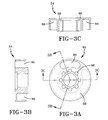
- the upper damping channel plate 84 is shown in FIGS. 3A, 3B, and 3C.
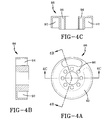
- the lower damping channel plate 86 is shown in FIGS. 4A, 4B, and 4C.
- the upper damping channel plate 84 is positioned within the intermediate piston plate 68 facing closest to the upper chamber 50. Fluid from upper chamber 50 enters plate 84 through aperture 90, the fluid then enters an arcuate groove 88 about the plate 84 in which the damping fluid travels. The next adjacent plate damping channel plate is the lower damping channel plate 86. The fluid enters the lower plate 86 by aperture 94 and travels through the arcuate groove 92, which provides a path for the fluid in plate 86. The arcuate groove 92 in the lower damping channel 86 either leads to either the lower chamber 52 or to an aperture in a third plate if another plate is present.
- each plate 84,86 there are a series of holes 96 in which to thread connecting members to connect the plates 84, 86 together.
- the center of the plates 84, 86 is also opened to form a column 98 when the plates 84, 86 are connected.
- This column 98 may be closed, as seen in FIG. 1, or provided with a pressure relief valve as shown in FIG. 5.
- a single spiral plate may be employed, see FIG. 9. Such a plate would have a circular path traveling around a central column.
- Operation of the air spring 1 occurs in the following manner.
- suspension motion causes the air spring 1 to stroke
- the movement also causes a fluid pumping action in the upper chamber 50 that forces the damping fluid through the damping channel 54 into the lower chamber 52.
- the gas present in the chamber 14 is displaced into the piston chamber 22 through the apertures 82 in the intermediate piston plate 68.
- Due to the nature of the elastomeric cap 72 forming the lower chamber 52 after an expansion of the chamber 52, the chamber 52 contracts back to its original size and forces the damping fluid back through the damping channel 54 and into the upper chamber 50 on the return stroke.
- the increasing pressure of gas in the piston chamber 22 assists in forcing the expanded lower chamber 52 to contract.
- the upper chamber 50 expands, assisting the air spring 1 in the rebound movement.
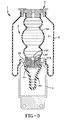
- FIG. 5 is another embodiment of the present invention.
- the air spring 1 has a two part upper retainer 2, a piston 4, an elastomeric sleeve 6, and a damping device 8.
- the damping device 8 has an upper chamber 50, a lower chamber 100, and a damping channel 54 to control the flow of fluid from between the upper and lower chambers 50, 100.
- the lower chamber 100 has an extended drip configuration differing from the semi-circular configuration of the lower chamber 52 of the first embodiment.
- the lower chamber 100 is also made of a material selected for its rebound and elasticity characteristics.
- the damping channel 54 is set radially within the intermediate piston plate 68.
- the damping channel flows about a pressure relief valve.
- the pressure relief valve is a ball 102 and spring 104.
- the pressure relief valve is activated when there is a sudden high compressive force acting on the air spring 1.
- the ball 102 is forced out of the seat 106 and pushes down on the pretensioned spring 104, allowing fluid to travel from the upper chamber 50 to the lower chamber 100. Once the fluid pressure drops to the designed level, the ball 102 reseats itself and the pressure relief valve is closed.
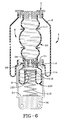
- FIG. 6 shows another embodiment of the present invention.
- the air spring 1 has a two part upper retainer 2, a piston 4, an elastomeric sleeve 6, and a damping device 8.
- the damping device 8 has an upper chamber 50, a lower chamber 108, a pretensioned spring 110, and a damping channel 54.
- the upper chamber 50 is formed into a bellows configuration by a series of extending elongated flat rings 112.
- the rings 112 extend out a radial width that can be as wide as the greatest width of the upper chamber 50 when the air spring 1 is in neither the joust or rebound state, as illustrated.
- the rings are sized to control the pumping force of the bellows to achieve the desired air spring performance.
- the lower chamber 108 is formed from an elastomeric sleeve 114.
- the sleeve 114 is similar in construction to the sleeve 56.
- the sleeve upper end 116 is crimped onto the lower crimping collar 74 of the intermediate piston ring 68.
- the sleeve lower end 118 is crimped onto a lower internal retainer 120.
- Extending from the piston base 24 to the underside of the internal retainer 120 is the pretensioned spring 110.
- the spring 110 has a triangular configuration so that when the spring 100 is compressed, the spring 110 coils within itself, taking up the least amount of space when in a compressed state.
- the damping channel 54 is a circular channel permitting the damping fluid to flow between the upper chamber 50 and the lower chamber 108.
- FIGS. 7 through 9 Other variations in the construction of the air spring 1 are illustrated in FIGS. 7 through 9.
- FIG. 7 shows another configuration for an elastomeric cap 126 to form the fluid reservoir 52.
- FIG. 8 is an example of another method of forming the upper chamber.
- the upper chamber 126 has a central portion with multiple corrugations 128.
- the upper portion is molded to form an upper retainer 130 and the lower portion is molded to form an intermediate piston plate 132.
- the air spring 1 has an upper retainer 134, an elastomeric sleeve 6, a piston 136, and an internal damping device 138.
- the damping device 138 has a lower variable volume chamber 140, an upper variable volume chamber 142, a damping channel 144, and internal piston 146.
- the lower end 148 of the chamber 140 is secured within the piston and the upper end 150 is crimped to the external surface of the damping channel 144 by a crimping ring 154.
- a single spiral plate 156 forms the damping channel 144 around a central column 158.
- the chamber 142 has a sleeve construction and is crimped to the upper retainer 134 at a first end and is secured between the spiral plate 156 and the piston at the lower end 162.
- the lower chamber 140 and the upper chamber 142 are filled with damping fluid.
- Operation of the air spring 1' is as follows.
- the air spring 1' is in jounce, as the upper retainer 134 moves toward the piston 136, the internal piston 146 is free to move into the piston chamber 160.
- the damping channel 144 and the lower end 162 of the upper chamber 142 when the internal piston end 152 enters into the piston chamber 160, the lower chamber 140 is compressed, and the damping fluid is forced through the damping channel 144 into the upper chamber 142.
- the upper chamber 142 expands into the chamber 164 formed by the internal piston.
- the lower end 152 of the internal piston 146 retreats from the piston chamber 160 as the upper end 166 of the internal piston 146 is fixedly attached to the upper retainer 134.
- the volume of the lower chamber 140 increases and the fluid pressure in the upper chamber 142 becomes greater than the fluid pressure in the lower chamber 140 and the damping fluid flows through the damping channel 144 from the upper chamber 142 into the lower chamber 140.
- the piston 136 has a differing configuration than the piston 4.
- the piston 4, 136 may have any configuration so long as there is sufficient space within the piston chamber 22, 160 for either the expanding reservoir or the expanding and compressing bellows.
- the various elements of the air spring disclosed herein such as the construction of the upper chamber 50, the type of restraining rings for the sleeve 56, the configuration of the lower reservoir 52, the configuration of the damping channel 54, the use of a pressure relief valve, etc., can be varied in order to achieve an air spring with the desired damping characteristics.
- the air spring of the present invention that is, an air spring that combines both traditional air spring characteristics and components with internal hydro damping, eliminates the need for a separate shock absorber damper in the suspension system of a vehicle. Additionally, the air spring enables the designer to optimize the damping frequency and intensity for a particular suspension application.
Landscapes
- Engineering & Computer Science (AREA)
- General Engineering & Computer Science (AREA)
- Mechanical Engineering (AREA)
- Fluid-Damping Devices (AREA)
- Vehicle Body Suspensions (AREA)
Abstract
Description
Claims (10)
- An air spring (1) comprising an upper retainer (2), a piston (4), an elastomeric sleeve (56) secured to the upper retainer at a first end (10) and secured to the piston at the lower end (12), and a damping device (8), the air spring being characterized in that the damping device (8) is comprised of an upper (50) and a lower (52) variable volume chamber and a channel (54) connecting the two variable volume chambers, and a damping fluid contained within the damping device.
- An air spring in accordance with claim 1 wherein one of the variable volume chambers (50, 52) is elastomeric.
- An air spring in accordance with claim 1 wherein the upper variable volume chamber (50) is formed into a bellows configuration by at least one elongated ring (58).
- An air spring in accordance with claim 1 wherein the lower variable volume chamber (52) is located within the piston (4) and the upper variable volume chamber is located within a chamber formed by the secured elastomeric sleeve (6).
- An air spring in accordance with claim 1 wherein one of the variable volume chambers (50, 52, 140) has a bellows type configuration.
- An air spring in accordance with any of claims 1-5 wherein the damping device (8) is further comprised of a quick relief valve.
- An air spring in accordance with claim 1 wherein the channel (54, 144) connecting the two variable volume chambers (50, 52) is a series of continuous circular channels or a continuous spiral channel.
- An air spring in accordance with claim 1 wherein the lower variable volume chamber (140) is fixedly secured to the base of the piston (136).
- An air spring in accordance with claim 1 wherein the upper variable volume chamber (142) is secured within an inner piston (146).
- An air spring in accordance with claim 1 wherein the damping fluid has a pressure higher than the surrounding air pressure inside the elastomeric sleeve (6).
Applications Claiming Priority (2)
| Application Number | Priority Date | Filing Date | Title |
|---|---|---|---|
| US09/802,525 US6561500B2 (en) | 2001-03-07 | 2001-03-07 | Hydro-damped air spring |
| US802525 | 2001-03-07 |
Publications (2)
| Publication Number | Publication Date |
|---|---|
| EP1260731A2 true EP1260731A2 (en) | 2002-11-27 |
| EP1260731A3 EP1260731A3 (en) | 2004-01-02 |
Family
ID=25183934
Family Applications (1)
| Application Number | Title | Priority Date | Filing Date |
|---|---|---|---|
| EP02100197A Withdrawn EP1260731A3 (en) | 2001-03-07 | 2002-02-28 | Hydro-damped air spring |
Country Status (4)
| Country | Link |
|---|---|
| US (1) | US6561500B2 (en) |
| EP (1) | EP1260731A3 (en) |
| JP (1) | JP2002323081A (en) |
| BR (1) | BR0200550A (en) |
Cited By (3)
| Publication number | Priority date | Publication date | Assignee | Title |
|---|---|---|---|---|
| DE102008017703A1 (en) * | 2008-04-08 | 2009-10-22 | Knorr-Bremse Systeme für Nutzfahrzeuge GmbH | Spring bellows comprises adjustment unit, which is formed to reduce inner volume of spring bellows, and to increase spring rigidity of spring bellows, and spring bellows comprises effective bearing surface and bellows height |
| CN104047987A (en) * | 2014-06-18 | 2014-09-17 | 江苏大学 | Novel hydro-pneumatic spring |
| CN105179547A (en) * | 2015-09-15 | 2015-12-23 | 广德高斯特车辆部件有限公司 | Minitype self-balance rubber air spring |
Families Citing this family (15)
| Publication number | Priority date | Publication date | Assignee | Title |
|---|---|---|---|---|
| US6691989B1 (en) * | 2002-08-16 | 2004-02-17 | Bfs Diversified Products, Llc | Variable rate air spring assembly |
| US6923434B2 (en) * | 2003-11-10 | 2005-08-02 | The Goodyear Tire & Rubber Company | Dual height airspring having adjusted spring rate |
| US7325794B2 (en) | 2005-06-06 | 2008-02-05 | Bfs Diversified Products, Llc | Air spring assembly and method |
| US7404547B2 (en) * | 2005-07-27 | 2008-07-29 | Bfs Diversified Products, Llc | Multi-component end member assembly and air spring assembly including the same |
| US20070087876A1 (en) * | 2005-10-19 | 2007-04-19 | Ward Michael C | Multi-stage spring for track tensioning system |
| US20090278290A1 (en) * | 2008-05-08 | 2009-11-12 | Veyance Technologies, Inc. | Easy-to-install air spring |
| AU2009268503B2 (en) * | 2008-07-09 | 2014-05-08 | Firestone Industrial Products Company, Llc | Gas spring and gas damper assembly and method |
| CA2730255A1 (en) * | 2008-07-09 | 2010-01-14 | Firestone Industrial Products Company, Llc | Gas spring and gas damper assembly and method |
| DE102009034677B4 (en) * | 2009-07-24 | 2013-10-31 | Trelleborg Automotive Germany Gmbh | attenuator |
| CN102072826B (en) * | 2010-11-19 | 2012-08-29 | 江苏大学 | Volume variable air spring auxiliary chamber experiment device and method |
| DE102012200388A1 (en) * | 2011-10-06 | 2013-04-11 | Continental Teves Ag & Co. Ohg | Air spring cover with switchable air volume |
| US9541150B2 (en) * | 2012-08-31 | 2017-01-10 | Firestone Industrial Products Company, Llc | End members and gas spring assemblies including same |
| WO2015125365A1 (en) * | 2014-02-24 | 2015-08-27 | 住友電気工業株式会社 | Air spring |
| CN104613123B (en) * | 2014-11-28 | 2017-01-25 | 江苏大学 | A two-stage pressure oil-gas spring and its working method |
| CN111043219A (en) * | 2019-12-07 | 2020-04-21 | 佛山市鼎科科技发展有限公司 | Elasticity-adjustable air spring |
Family Cites Families (21)
| Publication number | Priority date | Publication date | Assignee | Title |
|---|---|---|---|---|
| US3722875A (en) * | 1971-04-29 | 1973-03-27 | Us Air Force | Adjustable suspension unit |
| DE2750667C2 (en) * | 1977-11-12 | 1980-01-24 | Daimler-Benz Ag, 7000 Stuttgart | Air springs for automobiles |
| US4474267A (en) * | 1979-06-25 | 1984-10-02 | Holland Company | Method of hydraulically damping railway car body roll |
| AU523318B2 (en) * | 1980-06-23 | 1982-07-22 | Bridgestone Tire Co. Ltd. | Rubber vibration isolators |
| US4629170A (en) * | 1984-06-29 | 1986-12-16 | The Goodyear Tire & Rubber Company | Dual chamber air spring |
| US4738434A (en) * | 1986-04-07 | 1988-04-19 | Marjoram Robert H | Vibration and/or shock attenuating fluid mount or the like |
| US4867043A (en) * | 1986-06-30 | 1989-09-19 | Tayco Developments, Inc. | End cap for fluid cylinder |
| JP2693434B2 (en) * | 1986-12-29 | 1997-12-24 | 株式会社ブリヂストン | Damping force generator for suspension and operation control device thereof |
| EP0368607B1 (en) * | 1988-11-07 | 1995-09-20 | Bridgestone Corporation | Vibration damping apparatus for transportation |
| JPH03234938A (en) * | 1989-08-25 | 1991-10-18 | Bridgestone Corp | Vibration damping equipment |
| US5029824A (en) * | 1989-12-26 | 1991-07-09 | General Motors Corporation | Hydraulic engine mount with pressure relief valve |
| DE4213043C2 (en) * | 1992-04-21 | 1994-03-10 | Continental Ag | Hydropneumatic damper spring element |
| DE4300669C1 (en) * | 1993-01-13 | 1994-08-18 | Continental Ag | Pneumatic spring with elastomeric pneumatic-spring bellows and an additional volume |
| DE4325172C1 (en) * | 1993-07-27 | 1994-09-22 | Continental Ag | Air spring with an elastomeric air-spring bellows and an integrated damping device |
| CA2129785C (en) * | 1993-08-30 | 2001-10-02 | Donald L. Stephens | Seat suspension |
| JPH07133840A (en) * | 1993-11-11 | 1995-05-23 | Bridgestone Corp | Device using electrorheological fluid |
| FR2737271A1 (en) * | 1995-07-27 | 1997-01-31 | Sardou Max | Damper sensitive to acceleration for vehicle suspension systems, bogey for trains and emergency stop systems on automatic vehicles - uses system of hydraulic multiplication to increase its inertia which is in phase with disturbing force |
| DE29619081U1 (en) * | 1996-11-04 | 1997-01-09 | ContiTech Luftfedersysteme GmbH, 30165 Hannover | Bellows air spring |
| JPH11108099A (en) * | 1997-10-08 | 1999-04-20 | Ohbayashi Corp | Fluid damper |
| FR2793859B1 (en) * | 1999-05-17 | 2001-08-03 | Hutchinson | ACTIVE HYDRAULIC ANTIVIBRATORY SUPPORT, AND ACTIVE ANTIVIBRATORY SYSTEM COMPRISING SUCH A SUPPORT |
| US6234460B1 (en) * | 1999-08-23 | 2001-05-22 | The Goodyear Tire & Rubber Company | Push-on air spring bumper |
-
2001
- 2001-03-07 US US09/802,525 patent/US6561500B2/en not_active Expired - Fee Related
-
2002
- 2002-02-28 BR BR0200550-6A patent/BR0200550A/en active Search and Examination
- 2002-02-28 EP EP02100197A patent/EP1260731A3/en not_active Withdrawn
- 2002-03-04 JP JP2002057138A patent/JP2002323081A/en active Pending
Cited By (4)
| Publication number | Priority date | Publication date | Assignee | Title |
|---|---|---|---|---|
| DE102008017703A1 (en) * | 2008-04-08 | 2009-10-22 | Knorr-Bremse Systeme für Nutzfahrzeuge GmbH | Spring bellows comprises adjustment unit, which is formed to reduce inner volume of spring bellows, and to increase spring rigidity of spring bellows, and spring bellows comprises effective bearing surface and bellows height |
| CN104047987A (en) * | 2014-06-18 | 2014-09-17 | 江苏大学 | Novel hydro-pneumatic spring |
| CN104047987B (en) * | 2014-06-18 | 2016-03-02 | 江苏大学 | A kind of Novel oil gas spring |
| CN105179547A (en) * | 2015-09-15 | 2015-12-23 | 广德高斯特车辆部件有限公司 | Minitype self-balance rubber air spring |
Also Published As
| Publication number | Publication date |
|---|---|
| BR0200550A (en) | 2002-12-03 |
| JP2002323081A (en) | 2002-11-08 |
| US20020125622A1 (en) | 2002-09-12 |
| US6561500B2 (en) | 2003-05-13 |
| EP1260731A3 (en) | 2004-01-02 |
Similar Documents
| Publication | Publication Date | Title |
|---|---|---|
| US6561500B2 (en) | Hydro-damped air spring | |
| US6923434B2 (en) | Dual height airspring having adjusted spring rate | |
| US5413316A (en) | Adjustable rate air spring | |
| JP4986960B2 (en) | Push-fit shock absorber for air spring | |
| US6691989B1 (en) | Variable rate air spring assembly | |
| US7637486B2 (en) | Very high damping body mount, subframe mount or engine mount with bolt-through construction | |
| US4342446A (en) | Self-leveling viscous elastic damper | |
| US4988082A (en) | Spliced air sleeve assembly for air spring damper | |
| EP0120005B1 (en) | Shock absorber with a hydro-mechanical stop | |
| US8342488B2 (en) | Damping cylinder with annular bladder | |
| KR20080045760A (en) | Car Single Cylinder Hydraulic Shock Absorber | |
| JPH09257081A (en) | Shock absorber | |
| EP3904133B1 (en) | Air suspension assembly | |
| EP0974476B1 (en) | Spring seat fixing structure for a hydraulic shock absorber | |
| US5080328A (en) | Spliced air sleeve assembly having a plurality of rolling lobes | |
| US6746004B2 (en) | Vehicle air spring assembly | |
| CN110831793A (en) | Air spring strut with sealed closure cap | |
| US20040262107A1 (en) | Shock absorber having a pressurized gas compartment | |
| US6942201B2 (en) | Volume reducing bead plate for air spring | |
| US4092017A (en) | Pneumatic spring device | |
| US20020179389A1 (en) | Hydraulic piston assembly | |
| KR20060020328A (en) | Air suspension | |
| KR101263479B1 (en) | Monotube type shock absorber | |
| KR100906890B1 (en) | Car damper | |
| WO2017048895A1 (en) | Air spring sleeves swage assembly |
Legal Events
| Date | Code | Title | Description |
|---|---|---|---|
| PUAI | Public reference made under article 153(3) epc to a published international application that has entered the european phase |
Free format text: ORIGINAL CODE: 0009012 |
|
| AK | Designated contracting states |
Kind code of ref document: A2 Designated state(s): AT BE CH CY DE DK ES FI FR GB GR IE IT LI LU MC NL PT SE TR |
|
| AX | Request for extension of the european patent |
Free format text: AL;LT;LV;MK;RO;SI |
|
| PUAL | Search report despatched |
Free format text: ORIGINAL CODE: 0009013 |
|
| AK | Designated contracting states |
Kind code of ref document: A3 Designated state(s): AT BE CH CY DE DK ES FI FR GB GR IE IT LI LU MC NL PT SE TR |
|
| AX | Request for extension of the european patent |
Extension state: AL LT LV MK RO SI |
|
| 17P | Request for examination filed |
Effective date: 20040702 |
|
| 17Q | First examination report despatched |
Effective date: 20040803 |
|
| AKX | Designation fees paid |
Designated state(s): DE FR GB |
|
| 17Q | First examination report despatched |
Effective date: 20040803 |
|
| STAA | Information on the status of an ep patent application or granted ep patent |
Free format text: STATUS: THE APPLICATION IS DEEMED TO BE WITHDRAWN |
|
| 18D | Application deemed to be withdrawn |
Effective date: 20080902 |