EP1260567A1 - Composition for member preventing accretion of snow or ice and member preventing accretion of snow or ice using the same - Google Patents

Composition for member preventing accretion of snow or ice and member preventing accretion of snow or ice using the same Download PDF

Info

Publication number
EP1260567A1
EP1260567A1 EP01908243A EP01908243A EP1260567A1 EP 1260567 A1 EP1260567 A1 EP 1260567A1 EP 01908243 A EP01908243 A EP 01908243A EP 01908243 A EP01908243 A EP 01908243A EP 1260567 A1 EP1260567 A1 EP 1260567A1
Authority
EP
European Patent Office
Prior art keywords
snow
composition
ice
static friction
friction coefficient
Prior art date
Legal status (The legal status is an assumption and is not a legal conclusion. Google has not performed a legal analysis and makes no representation as to the accuracy of the status listed.)
Withdrawn
Application number
EP01908243A
Other languages
German (de)
French (fr)
Other versions
EP1260567A4 (en
Inventor
Katsuo Sanwa Fact. Dainippon Shikizai KOBAYASHI
T. Kurosaki Plant Mitsubishi Chem. Corp. SAWAI
Current Assignee (The listed assignees may be inaccurate. Google has not performed a legal analysis and makes no representation or warranty as to the accuracy of the list.)
Mitsubishi Chemical Corp
Hokkaido Prefecture
Dainippon Shikizai Kogyo Co Ltd
Original Assignee
Mitsubishi Chemical Corp
Hokkaido Prefecture
Dainippon Shikizai Kogyo Co Ltd
Priority date (The priority date is an assumption and is not a legal conclusion. Google has not performed a legal analysis and makes no representation as to the accuracy of the date listed.)
Filing date
Publication date
Application filed by Mitsubishi Chemical Corp, Hokkaido Prefecture, Dainippon Shikizai Kogyo Co Ltd filed Critical Mitsubishi Chemical Corp
Publication of EP1260567A1 publication Critical patent/EP1260567A1/en
Publication of EP1260567A4 publication Critical patent/EP1260567A4/en
Withdrawn legal-status Critical Current

Links

Images

Classifications

    • CCHEMISTRY; METALLURGY
    • C09DYES; PAINTS; POLISHES; NATURAL RESINS; ADHESIVES; COMPOSITIONS NOT OTHERWISE PROVIDED FOR; APPLICATIONS OF MATERIALS NOT OTHERWISE PROVIDED FOR
    • C09DCOATING COMPOSITIONS, e.g. PAINTS, VARNISHES OR LACQUERS; FILLING PASTES; CHEMICAL PAINT OR INK REMOVERS; INKS; CORRECTING FLUIDS; WOODSTAINS; PASTES OR SOLIDS FOR COLOURING OR PRINTING; USE OF MATERIALS THEREFOR
    • C09D183/00Coating compositions based on macromolecular compounds obtained by reactions forming in the main chain of the macromolecule a linkage containing silicon, with or without sulfur, nitrogen, oxygen, or carbon only; Coating compositions based on derivatives of such polymers
    • CCHEMISTRY; METALLURGY
    • C09DYES; PAINTS; POLISHES; NATURAL RESINS; ADHESIVES; COMPOSITIONS NOT OTHERWISE PROVIDED FOR; APPLICATIONS OF MATERIALS NOT OTHERWISE PROVIDED FOR
    • C09KMATERIALS FOR MISCELLANEOUS APPLICATIONS, NOT PROVIDED FOR ELSEWHERE
    • C09K3/00Materials not provided for elsewhere
    • C09K3/18Materials not provided for elsewhere for application to surfaces to minimize adherence of ice, mist or water thereto; Thawing or antifreeze materials for application to surfaces
    • YGENERAL TAGGING OF NEW TECHNOLOGICAL DEVELOPMENTS; GENERAL TAGGING OF CROSS-SECTIONAL TECHNOLOGIES SPANNING OVER SEVERAL SECTIONS OF THE IPC; TECHNICAL SUBJECTS COVERED BY FORMER USPC CROSS-REFERENCE ART COLLECTIONS [XRACs] AND DIGESTS
    • Y10TECHNICAL SUBJECTS COVERED BY FORMER USPC
    • Y10TTECHNICAL SUBJECTS COVERED BY FORMER US CLASSIFICATION
    • Y10T428/00Stock material or miscellaneous articles
    • Y10T428/31504Composite [nonstructural laminate]
    • Y10T428/31652Of asbestos
    • Y10T428/31663As siloxane, silicone or silane

Definitions

  • the present invention relates to a novel composition suitably used for snow- or ice-accretion inhibiting members.
  • organopolysiloxanes form a water-repellant surface because of a low surface energy due to hydrocarbon chains regularly oriented thereon, and are free from freezing of molecular movement even at a temperature of not more than -30°C because of a low glass transition temperature thereof, thereby preventing hydrogen bonds from being formed therein upon icing. For this reason, the organopolysiloxanes are considered to exhibit a good snow-accretion inhibiting effect.
  • the coating composition of the present invention is excellent in snow-accretion inhibiting effect (snow slipping-off effect) as well as ice-accretion inhibiting effect.
  • the composition of the present invention has a static friction coefficient of less than 1.3, preferably not more than 1.2, more preferably not more than 1.15 as measured relative to snow having a temperature range of 0 to -10°C, snow having a density range of 0.2 to 0.5 g/cm 3 or snow having a water content range of 0 to 15%. Also, the composition of the present invention has a static friction coefficient of less than 1.3, preferably not more than 1.2, more preferably not more than 1.1, still more preferably not more than 1.0, most preferably not more than 0.9 as measured relative to snow having a temperature range of 0 to -1°C, snow having a density range of 0.3 to 0.5 g/cm 3 or snow having a water content range of 2 to 15%.
  • the composition of the present invention has a friction coefficient of not more than 1.1, preferably not more than 1.0, more preferably not more than 0.9 as measured relative to snow having a temperature of - 0.1°C, snow having a density of 0.3 g/cm 3 or snow having a water content of 2.0%.
  • the composition for a snow- or ice-accretion inhibiting member according to the present invention is characterized in that the static friction coefficient relative to snow having a temperature of -10°C is larger than that relative to snow having a temperature of 0°C and which is not more than 7.5, preferably not more than 5, more preferably not more than 3.
  • the composition for a snow- or ice-accretion inhibiting member according to the present invention is characterized in that the static friction coefficient relative to snow having a density of 0.2 g/cm 3 is larger than that relative to snow having a density of 0.45 g/cm 3 and which is not more than 7.5, preferably not more than 5, more preferably not more than 3. Further, the composition of the present invention is characterized in that the static friction coefficient relative to snow having a water content of 0% is larger than that relative to snow having a water content of 15% and which is not more than 7.5, preferably not more than 5, more preferably not more than 3.
  • the static friction coefficient relative to snow having a temperature range of 0 to -10°C means the range covered by the specific static friction coefficients relative to snows having temperatures of 0°C, -0.1°C, -5°C and -10°C, but does not mean the range covered by whole static friction coefficients measured relative to whole snows having a temperature range of from 0°C to -10°C.
  • the static friction coefficient relative to snow having a density range of 0.2 to 0.5 g/cm 3 means the range covered by the specific static friction coefficients relative to snows having densities of 0.21 g/cm 3 , 0.24 g/cm 3 , 0.30 g/cm 3 and 0.45 g/cm 3 , but does not mean the range covered by whole static friction coefficients measured relative to whole snows having a density range of from 0.2 to 0.5 g/cm 3 .
  • the static friction coefficient relative to snow having a water content range of 0 to 15% means the range covered by the specific static friction coefficients relative to snows having water contents of 0%, 0.1%, 2.0% and 15.0%, but does not mean the range covered by whole static friction coefficients measured relative to whole snows having a water content range of from 0 to 15%.
  • the static friction coefficient relative to snow having a temperature range of 0 to -1°C means the range covered by the specific static friction coefficients relative to snows having temperatures of 0°C and -0.1°C, but does not mean the range covered by whole static friction coefficients measured relative to whole snows having a temperature range of from 0 to -1°C.
  • the static friction coefficient relative to snow having a density range of 0.3 to 0.5 g/cm 3 means the range covered by the specific static friction coefficients relative to snows having temperatures of 0.30 g/cm 3 and 0.45 g/cm 3 , but does not mean the range covered by whole static friction coefficients measured relative to whole snows having a density range of from 0.3 to 0.5 g/cm 3 .
  • the static friction coefficient relative to snow having a water content range of 2 to 15% means the range covered by the specific static friction coefficients relative to snows having water contents of 2.0% and 15.0%, but does not mean the range covered by whole static friction coefficients measured relative to whole snows having a water content range of from 2 to 15%.
  • composition of the present invention contains an organosilicate.
  • the organosilicate represents compounds obtained by substituting a part or whole of hydrogen atoms of silane (SiH 4 ) with an organic group via oxygen atom (hereinafter occasionally referred to as "organoxy group"). As long as such an organoxy group is contained, other organic groups such as alkyl may be bonded to the silicon atom.
  • organosilicate may include organoxysilanes having 1 to 4 organic groups each bonded to a common silicon atom via oxygen atom, and organoxysiloxanes whose silicon constitutes a siloxane main chain ((Si-O) n ).
  • the organic groups each bonded to the silicon via oxygen atom are not particularly restricted.
  • the organic groups may include linear, branched or cyclic alkyl groups. Specific examples of the organic groups may include methyl, ethyl, n-propyl, i-propyl, n-butyl, i-butyl, t-butyl, n-pentyl, i-pentyl, neopentyl, hexyl, octyl or the like.
  • fluorinated alkyl groups obtained by substituting a part or whole of hydrogen atoms of these alkyl groups with fluorine atoms.
  • Especially suitable organic groups are alkyl groups having 1 to 4 carbon atoms.
  • the other organic groups there may be used aryl, xylyl, naphthyl or the like. Two or more different kinds of organic groups may be used in combination.
  • the above alkyl groups may be either linear or branched, and preferably have 1 to 4 carbon atoms. Specific examples of the alkyl groups may include methyl, ethyl, n-propyl, i-propyl, n-butyl, i-butyl, sec-butyl, t-butyl or the like. Further, as the alkyl groups, there may also be used fluorinated alkyl groups obtained by substituting a par or whole of hydrogen atoms of these alkyl groups with fluorine atoms. These alkyl groups may be used in combination of any two or more thereof.
  • alkyl groups methyl and/or ethyl are preferred from the standpoint of exhibiting a good snow slipping-off property, and the most preferred alkyl group is methyl.
  • the organosilicate tends to be deteriorated in hydrolyzability, so that the formation of SiOH group becomes too slow when a coating film obtained from the composition is exposed to outside atmosphere, resulting in failure to show a sufficient snow slipping-off property.
  • organoxysilanes may include tetramethoxysilane, tetraethoxysilane, tetrapropoxysilane, tetrabutoxysilane, tetraphenoxysilane, dimethoxydiethoxysilane or the like.
  • organoxysiloxanes may include condensates of the above organoxysilanes.
  • the preferred organosilicates used in the present invention may include tetraalkoxysilanes such as tetramethoxysilane, tetraethoxysilane, tetra-n-propoxysilane, tetraisopropoxysilane, tetra-n-butoxysilane, tetraisobutoxysilane, tetra-sec-butoxysilane and tetra-t-butoxysilane, and/or partially hydrolyzed condensates thereof.
  • the hydrolysis rate of these organosilicates is 0 to 80%, preferably 20 to 70%, more preferably 30 to 60%.
  • the hydrolysis rate is the value calculated according to the following formula (II), more specifically, the value obtained from the amount of water added upon the partial hydrolytic condensation of tetraalkoxysilanes or organoalkoxysilanes. Also, the hydrolysis rate is substantially identical to the value obtained by measuring a siloxane condensation degree of the obtained partially-hydrolyzed condensate (i.e., a factor "m" of oxygen of the partially-hydrolyzed condensate represented by the formula (I)).
  • a coating film formed from the above organosilicate preferably has a water-contact angle (wetting angle) of not more than 60°C.
  • fluorinated organosilicates obtained by substituting a part or whole of hydrogen atoms of alkyl groups of these organosilicates and/or partially hydrolyzed condensates thereof with fluorine atoms. These organosilicates may be used alone or in combination of any two or more thereof.
  • organosilicates tetramethoxysilane and/or partially hydrolyzed condensates thereof are preferred because these compounds can readily form a silanol group owing to a high hydrolytic reactivity thereof and, therefore, can readily provide a composition having a high snow slipping-off property.
  • organosilicates there may be suitably used polymethoxypolysiloxanes as partially hydrolyzed condensates of tetramethoxysilane such as "MKC SILICATE MS51” and “MKC SILICATE MS56” both produced by Mitsubishi Chemical Corporation, or hydrolyzed solutions thereof since these compounds contain a less amount of impurities and can exhibit an excellent safety and a stable quality because the amount of high-toxic monomers contained therein is substantially ignorable.
  • the organosilicates used in the present invention includes those obtained by substituting a part or whole of hydrogen atoms of SiH 4 with organic groups via oxygen or with other organic groups.
  • these organosilicates may include various silane coupling agents or the like.
  • organosilicates may include trialkoxysilane compounds such as methyl trimethoxysilane, methyl triethoxysilane, methyl tripropoxysilane, methyl triisopropoxysilane, ethyl trimethoxysilane, ethyl triethoxysilane, ethyl tripropoxysilane, ethyl triisopropoxysilane, propyl trimethoxysilane, propyl triethoxysilane, butyl trimethoxysilane, butyl triethoxysilane, pentyl trimethoxysilane, pentyl triethoxysilane, hexyl trimethoxysilane, hexyl triethoxysilane, phenyl trimethoxysilane, phenyl triethoxysilane, phenyl tripropoxysilane, phenyl triisopropoxysilane,
  • the coating composition of the present invention may contain organosilicates other than those obtained by substituting whole hydrogen atoms of SiH 4 with organoxy groups.
  • the content of the organosilicates other than those obtained by substituting whole hydrogen atoms of SiH 4 with organoxy groups is not more than 200 parts by weight, preferably not more than 150 parts by weight (calculated as SiO 2 ) based on 100 parts by weight of the organosilicates obtained by substituting whole hydrogen atoms of SiH 4 with organoxy groups.
  • the content of the organosilicates other than those obtained by substituting whole hydrogen atoms of SiH 4 with organoxy groups is too high, the obtained composition tends to be deteriorated in snow slipping-off property.
  • organosilicates obtained by substituting only a part of hydrogen atoms of SiH 4 with the above alkyl groups there may be used organosilicates obtained by substituting only a part of hydrogen atoms of SiH 4 with the above alkyl groups.
  • the content of such organosilicates obtained by substituting only a part of hydrogen atoms of SiH 4 with the above alkyl groups is 0.1 to 200 parts by weight, preferably 1 to 150 parts by weight (calculated as SiO 2 ) based on 100 parts by weight of the organosilicates obtained by substituting whole hydrogen atoms of SiH 4 with organoxy groups.
  • the composition of the present invention may also contain silicon compounds having hydrolyzable functional groups other than the organoxy groups, e.g., various halogens or the like.
  • silicon compounds tends to produce substances such as hydrochloric acid which are difficult to handle upon hydrolysis thereof, thereby causing unfavorable environmental problems. Therefore, the silicon compounds are contained in an amount of not more than 100 parts by weight, preferably not more than 5 parts by weight (calculated as SiO 2 ) based on 100 parts by weight of the organosilicates.
  • the composition of the present invention may not contain at all such silicon compounds.
  • the composition When practically used for painting, the composition preferably shows a good film forming-property so as to allow the composition to be rapidly cured at ordinary temperature.
  • the silicate component may be previously blended with an appropriate amount of water or a solvent such as alcohol so as to prepare a composition capable of forming a proper film at ordinary temperature.
  • water or the solvent enables the silicate as well as the below-mentioned hydrophobic compound to be uniformly dispersed or dissolved therein.
  • the silicate component is hydrolyzed by adding water thereto to form a silanol group, so that the effect of increasing a hydrophilic property of the composition can be exhibited.
  • the obtained composition can show an excellent coatability upon practical use.
  • water and the solvent are previously blended with the silicate component to prepare a hydrolyzed solution of the silicate component.
  • the resultant solution is mixed with the below-mentioned hydrophobic compound and, if required, with an appropriate amount of solvent, or may be mixed with the hydrophobic compound previously dispersed or dissolved in the solvent.
  • composition of the present invention in the form of a coating solution may also suitably contain the respective components explained below.
  • the hydrophobic compound is a component capable of imparting a hydrophobic property to the composition as compared to the case where the silicate solely is used therein.
  • at least one hydrophobic compound selected from the group consisting of nonionic surfactants, fluorine-based surfactants, fluororesin powder, silicon resin powder and silicone-based surfactants.
  • the hydrophobic compound preferably exhibits a critical surface tension of not more than 20 mPa ⁇ s.
  • nonionic surfactants may include polyoxyethylene alkyl ethers, polyoxyethylene alkyl phenyl ethers, polyoxyethylene sorbitan fatty acid esters, sorbitan fatty acid esters or the like.
  • fluorine-based surfactants may include perfluoroalkyl-containing perfluoroalkyl oligomers such as oligomers of perfluoroalkyl carboxylic acid salts, perfluoroalkyl phosphoric acid esters and perfluoroalkyl ammonium salts; perfluoroethyleneoxide adducts; perfluorocarboxylic acid salts; or the like.
  • fluorine-based surfactants there may be used "SC-101" and "SC-105" both produced by Asahi Glass Co., Ltd.
  • fluororesin powder may include low-molecular weight ethylene tetrafluoride polymers, more specifically, perfluoro compounds having an average molecular weight of preferably 1,500 to 20,000, more preferably 500 to 15,000, and a particle diameter of preferably 0.1 to 20 ⁇ m, more preferably 0.1 to 1 ⁇ m.
  • the silicon resin powder has an average particle diameter of preferably 0.1 to 20 ⁇ m, more preferably 0.1 to 1 ⁇ m.
  • silicone-based surfactants may include those containing methylpolysiloxane as a hydrophobic group and polyalkyleneoxide as a hydrophilic group.
  • silicone-based surfactants may include those containing methylpolysiloxane as a hydrophobic group and polyalkyleneoxide as a hydrophilic group.
  • silicone-based surfactants may include those containing methylpolysiloxane as a hydrophobic group and polyalkyleneoxide as a hydrophilic group.
  • silicone-based surfactants may include those containing methylpolysiloxane as a hydrophobic group and polyalkyleneoxide as a hydrophilic group.
  • silicone-based surfactants may include those containing methylpolysiloxane as a hydrophobic group and polyalkyleneoxide as a hydrophilic group.
  • the fluorine-based surfactants are preferred because the excellent effect can be attained by using the fluorine-based surfactants in combination with the organosilicates, though the reason therefor is not clearly known.
  • composition of the solvent used for preparation of the silicate solution may be appropriately controlled according to the kind of hydrophobic compound used so as to uniformly disperse the hydrophobic compound and the silicate therein.
  • the hydrophobic compound may be suitably contained in an amount of 0.1 to 100 parts by weight, preferably 1 to 50 parts by weight based on 100 parts by weight of the silicate.
  • the content of the hydrophobic compound is less than 0.1 part by weight, the obtained composition tends to show a low snow-accretion inhibiting effect.
  • the content of the hydrophobic compound is more than 100 parts by weight, the coating film obtained from the composition tends to be deteriorated in strength and adhesion to a substrate.
  • the use of the silicate according to the present invention can enhance a snow slipping-off property of the obtained composition.
  • the silicate when used in combination with the hydrophobic material such as fluororesin, the obtained composition can be further enhanced in snow-accretion inhibiting property.
  • the solution containing the silicate, water, the solvent and the hydrophobic compound has a silicate concentration of preferably not less than 0.05% by weight, more preferably not less than 0.1% by weight (calculated as SiO 2 ).
  • SiO 2 a silicate concentration of preferably not less than 0.05% by weight, more preferably not less than 0.1% by weight.
  • the silicate concentration is less than 0.05% by weight, the obtained composition tends to become poor in snow slipping-off property.
  • the silicate is used in combination with the fluororesin, the obtained composition fails to exhibit a sufficient snow-accretion inhibiting property.
  • the snow slipping-off property of the composition as well as the snow-accretion inhibiting property thereof when used in combination with the hydrophobic material such as fluororesins are considerably influenced by the silicate concentration in solid components (non-volatile components) calculated as SiO 2 .
  • the silicate concentration in solid components (non-volatile components) calculated as SiO 2 is preferably not less than 15% by weight, more preferably not less than 25% by weight.
  • the silicate concentration in solid components is less than 15% by weight, the obtained composition tends to become poor in snow slipping-off property, and even when the silicate is used in combination with the hydrophobic material such as fluororesins, the composition fails to exhibit a sufficient snow-accretion inhibiting property.
  • acrylic resins may include ordinary acrylic resins such as methyl methacrylate polymers.
  • the above-described liquid composition may be applied onto various substrates.
  • the substrates are not particularly restricted, and there may be used any materials capable of forming a coating film thereon, such as roofs or other structural materials.
  • the composition of the present invention can be suitably applied to constructions or structures mainly including roofs, electric cables, steel towers for electric cables, road signs or the like which require snow- or ice-accretion inhibiting properties as well as those having a surface inclined at an angle of not more than 45° from horizontal and, therefore, requiring a good snow slipping-off property.
  • the snow temperature was measured by K thermocouple-type digital thermometer "TNA-120" manufactured by Tasco Japan Co., Ltd.
  • Snow blocks were sampled to measure weight and volume thereof.
  • the snow volume was measured by "Snow Sampler” (rectangular cup) capable of sampling 200cc of snow, and the snow weight was measured by an electronic balance.
  • Coating solutions obtained in the below-mentioned Preparation Examples 1 to 5 were respectively applied onto an aluminum plate (tradename "A1050P” produced by Engineering Test Service Co., Ltd.; according to JIS H4000; surface roughness: 0.5 ⁇ m; length: 50 cm; width: 50 cm; thickness: 2 mm) using a roller ("Small Roller Model 6S-C113" manufactured by Otsuka Brush Co., Ltd.) to form a coating film having a dry thickness of about 2 ⁇ m.
  • the coating films thus obtained using the respective coating solutions were used as samples of Examples 1 to 3 and Comparative Examples 1 and 2, respectively.
  • an uncoated glass plate (reinforced glass plate produced by Engineering Test Service Co., Ltd.; according to JIS R3206; surface roughness: 0.5 ⁇ m; length: 50 cm; width: 50 cm; thickness: 2 mm) was used as a sample of Comparative Example 3, and a Teflon plate (Teflon (polytetrafluoroethylene resin) produced by Engineering Test Service Co., Ltd.) was used as a sample of Comparative Example 4.
  • Teflon plate Teflon (polytetrafluoroethylene resin) produced by Engineering Test Service Co., Ltd.
  • Aluminum plates were respectively coated with the coating solutions prepared in Preparation Examples 1 to 5 to produce samples of Examples 1 to 3 and samples of Comparative Examples 1 and 2.
  • An uncoated glass plate was used as a sample of Comparative Example 3, and a Teflon plate (Teflon: registered trademark; tetrafluoroethylene polymer) was used as a sample of Comparative Example 4.
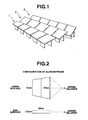
  • Three samples were prepared for each coating solution. The three samples were set at angles of 10°, 30° and 45° from a horizontal plane, respectively. Three uncoated glass plates and three Teflon plates were respectively set at the same angles as above. The outline of the test is shown in Fig. 1 wherein (1) denotes samples held at an angle of 10°; (2) denotes samples held at an angle of 30°; and (3) denotes samples held at an angle of 45°.
  • the test plate set at an angle of 45° was free from snow accretion thereon, and the test plates set at angles of 30° and 10° were covered with snow.
  • the test plates coated with the coating solutions prepared in Preparation Examples 1, 3, 4 and 5 as well as the Teflon plates, roof steel plates and glass plates were covered with snow at every setting angles.
  • Example 2 The test plates used in Example 2 (which were coated with the solution prepared in Preparation Example 2 by using the organosilicate in combination with the hydrophobic compound), were free from snow coverage during the snowfall test. As a result, it was confirmed that the coating composition used in Example 2 showed an excellent snow-accretion inhibiting effect.
  • Example 2 The test plates used in Example 2 as well as the test plates used in Example 1 (which were coated with the hydrolyzed solution of organosilicate prepared in Preparation Example 1), exhibited a higher snow slipping-off property (earlier snow-slippage) as compared to those used in Comparative Examples even though the setting angle of Examples was smaller than that of Comparative Examples. As a result, it was confirmed that the coating compositions used in these Examples were more effective than those used in Comparative Examples.
  • the composition can be improved in snow slipping-off property by adding the organosilicate thereto; and the composition using the organosilicate in combination with the hydrophobic compound can show an improved snow slipping-off property and simultaneously can be prevented from undergoing snow coverage upon snowfall and, therefore, is excellent in both of snow slipping-off property and snow- or ice-accretion inhibiting property.
  • a coating composition capable of showing not only a good snow- or ice-accretion inhibiting property upon snowfall but also an improved snow slipping-off property upon temperature rise.
Landscapes

  • Chemical & Material Sciences (AREA)
  • Engineering & Computer Science (AREA)
  • Materials Engineering (AREA)
  • Organic Chemistry (AREA)
  • Chemical Kinetics & Catalysis (AREA)
  • Life Sciences & Earth Sciences (AREA)
  • Wood Science & Technology (AREA)
  • Combustion & Propulsion (AREA)
  • Materials Applied To Surfaces To Minimize Adherence Of Mist Or Water (AREA)
  • Paints Or Removers (AREA)
  • Compositions Of Macromolecular Compounds (AREA)

Abstract

A composition for a snow- or ice-accretion inhibiting member which has a static friction coefficient of less than 1.3 relative to snow having a temperature range of 0 to -10 DEG C. The composition of the present invention can show not only a good snow- or ice-accretion inhibiting property upon snowfall but also an improved snow slipping-off property upon temperature rise.
Description

TECHNICAL FIELD
The present invention relates to a novel composition suitably used for snow- or ice-accretion inhibiting members.
BACKGROUND ART
Hitherto, in various application fields such as ships, marine constructions, air planes, vehicles, houses or buildings and power transmission steel towers, a variety of ice-accretion inhibiting paints and snow-accretion inhibiting paints have been studied in order to prevent damages due to snow coverage and icing.
In these applications, the use of organopolysiloxanes has been frequently proposed. The organopolysiloxanes form a water-repellant surface because of a low surface energy due to hydrocarbon chains regularly oriented thereon, and are free from freezing of molecular movement even at a temperature of not more than -30°C because of a low glass transition temperature thereof, thereby preventing hydrogen bonds from being formed therein upon icing. For this reason, the organopolysiloxanes are considered to exhibit a good snow-accretion inhibiting effect. Also, in order to improve a persistency of the snow- or ice-accretion inhibiting effect by preventing the organopolysiloxanes from suffering from bleed-out as well as peel-off upon removal of ice, there have been proposed the composition using a copolymer obtained by copolymerizing a specific organosilicon compound having a hydrolyzable silyl group with the other monomer, in combination with a hydroxy-containing resin (Japanese Patent Application Laid-Open (KOKAI) No. 3-84069); and the composition using a specific alkoxydimethylsiloxane (Japanese Patent Application Laid-Open (KOKAI) No. 2-147688). In addition, as a water-slipping-off coating composition, there has also been proposed the composition comprising an acrylic polymer, a silicone and a fluorine-containing polymer (Japanese Patent Application Laid-Open (KOKAI) No. 10-310740).
However, these conventionally known compositions have failed to exhibit a sufficient snow- or ice-accretion inhibiting effect. Thus, upon snowfall, it has been required to attain a good snow- or ice-accretion inhibiting effect. On the other hand, when the ambient temperature is raised after snowfall, snow deposited on the surface of building structures such as roof gradually changes to sticky snow having a large water content. Such sticky snow adheres to the surface of the building structures and becomes difficult to peel off therefrom. That is, after snowfall, there arises such a problem that snow slipping-off property is deteriorated. Therefore, it has also been required to improve the snow slipping-off property even under such conditions. In particular, the building structures having a gradient of not more than 45° suffer from severe snow coverage and, therefore, are required to show a more excellent snow slipping-off property.
DISCLOSURE OF THE INVENTION
As a result of the present inventors' earnest studies for solving the above problems, it has been found that excellent snow- or ice-accretion inhibiting effect upon snowfall does not necessarily lead to excellent snow slipping-off property. As a result of further studies by the present inventors, it has been found that although it is considered that low adhesion (low icing force) between snow and the surface of the building structure is advantageous to attain a good snow- or ice-accretion inhibiting effect and the snow slipping-off property tends to be improved by a low viscosity of water present at an interface between snow and the building structure (lubrication action), conventionally known snow- or ice-accretion inhibiting agents fail to show a sufficient surface hydrophilic property and, therefore, is deteriorated in snow slipping-off property. As a result of still further earnest studies made by the present inventors, the following present invention has been attained.
That is, according to various aspects of the present invention, there are provided:
  • (1) A composition for snow- or ice-accretion inhibiting member, having a static friction coefficient of less than 1.3 as measured relative to snow having a temperature range of 0 to -10°C;
  • (2) A composition for snow- or ice-accretion inhibiting member, having a static friction coefficient of less than 1.3 as measured relative to snow having a density range of 0.2 to 0.5 g/cm3;
  • (3) A composition for snow- or ice-accretion inhibiting member, having a static friction coefficient of less than 1.3 as measured relative to snow having a water content range of 0 to 15%;
  • (4) A composition for snow- or ice-accretion inhibiting member, having a static friction coefficient of less than 1.3 as measured relative to snow having a temperature range of 0 to -1°C;
  • (5) A composition for snow- or ice-accretion inhibiting member, having a static friction coefficient of less than 1.3 as measured relative to snow having a density range of 0.3 to 0.5 g/cm3;
  • (6) A composition for snow- or ice-accretion inhibiting member, having a static friction coefficient of less than 1.3 as measured relative to snow having a water content range of 2 to 12%;
  • (7) A composition for snow- or ice-accretion inhibiting member, having a static friction coefficient of less than 1.2 as measured relative to snow having a temperature of -0.1°C;
  • (8) A composition for snow- or ice-accretion inhibiting member, having a static friction coefficient of not more than 1.1 as measured relative to snow having a density of 0.3 g/cm3;
  • (9) A composition for snow- or ice-accretion inhibiting member, having a friction coefficient of not more than 1.1 as measured relative to snow having a water content of 2.0%;
  • (10) A composition for snow- or ice-accretion inhibiting member, having a static friction coefficient relative to snow having a temperature of -10°C which is larger than a static friction coefficient relative to snow having a temperature of 0°C and which is not more than 7.5;
  • (11) A composition for snow- or ice-accretion inhibiting member, having a static friction coefficient relative to snow having a density of 0.2 g/cm3 which is larger than a static friction coefficient relative to snow having a density of 0.45 g/cm3 and which is not more than 7.5; and
  • (12) A composition for snow- or ice-accretion inhibiting member, having a static friction coefficient relative to snow having a water content of 0% which is larger than a static friction coefficient relative to snow having a water content of 15% and which is not more than 7.5.
  • Thus, the coating composition of the present invention is excellent in snow-accretion inhibiting effect (snow slipping-off effect) as well as ice-accretion inhibiting effect.
    BEST MODE FOR CARRYING OUT THE INVENTION
    The present invention will be described in more detail below.
    The composition of the present invention has a static friction coefficient of less than 1.3, preferably not more than 1.2, more preferably not more than 1.15 as measured relative to snow having a temperature range of 0 to -10°C, snow having a density range of 0.2 to 0.5 g/cm3 or snow having a water content range of 0 to 15%. Also, the composition of the present invention has a static friction coefficient of less than 1.3, preferably not more than 1.2, more preferably not more than 1.1, still more preferably not more than 1.0, most preferably not more than 0.9 as measured relative to snow having a temperature range of 0 to -1°C, snow having a density range of 0.3 to 0.5 g/cm3 or snow having a water content range of 2 to 15%. Further, the composition of the present invention has a friction coefficient of not more than 1.1, preferably not more than 1.0, more preferably not more than 0.9 as measured relative to snow having a temperature of - 0.1°C, snow having a density of 0.3 g/cm3 or snow having a water content of 2.0%. In addition, the composition for a snow- or ice-accretion inhibiting member according to the present invention is characterized in that the static friction coefficient relative to snow having a temperature of -10°C is larger than that relative to snow having a temperature of 0°C and which is not more than 7.5, preferably not more than 5, more preferably not more than 3. Also, the composition for a snow- or ice-accretion inhibiting member according to the present invention is characterized in that the static friction coefficient relative to snow having a density of 0.2 g/cm3 is larger than that relative to snow having a density of 0.45 g/cm3 and which is not more than 7.5, preferably not more than 5, more preferably not more than 3. Further, the composition of the present invention is characterized in that the static friction coefficient relative to snow having a water content of 0% is larger than that relative to snow having a water content of 15% and which is not more than 7.5, preferably not more than 5, more preferably not more than 3. In the above-described preferred embodiments of the present invention, the static friction coefficient relative to snow having a temperature range of 0 to -10°C means the range covered by the specific static friction coefficients relative to snows having temperatures of 0°C, -0.1°C, -5°C and -10°C, but does not mean the range covered by whole static friction coefficients measured relative to whole snows having a temperature range of from 0°C to -10°C. Also, the static friction coefficient relative to snow having a density range of 0.2 to 0.5 g/cm3 means the range covered by the specific static friction coefficients relative to snows having densities of 0.21 g/cm3, 0.24 g/cm3, 0.30 g/cm3 and 0.45 g/cm3, but does not mean the range covered by whole static friction coefficients measured relative to whole snows having a density range of from 0.2 to 0.5 g/cm3. In addition, the static friction coefficient relative to snow having a water content range of 0 to 15% means the range covered by the specific static friction coefficients relative to snows having water contents of 0%, 0.1%, 2.0% and 15.0%, but does not mean the range covered by whole static friction coefficients measured relative to whole snows having a water content range of from 0 to 15%. Further, the static friction coefficient relative to snow having a temperature range of 0 to -1°C means the range covered by the specific static friction coefficients relative to snows having temperatures of 0°C and -0.1°C, but does not mean the range covered by whole static friction coefficients measured relative to whole snows having a temperature range of from 0 to -1°C. In addition, the static friction coefficient relative to snow having a density range of 0.3 to 0.5 g/cm3 means the range covered by the specific static friction coefficients relative to snows having temperatures of 0.30 g/cm3 and 0.45 g/cm3, but does not mean the range covered by whole static friction coefficients measured relative to whole snows having a density range of from 0.3 to 0.5 g/cm3. Furthermore, the static friction coefficient relative to snow having a water content range of 2 to 15% means the range covered by the specific static friction coefficients relative to snows having water contents of 2.0% and 15.0%, but does not mean the range covered by whole static friction coefficients measured relative to whole snows having a water content range of from 2 to 15%.
    Next, individual compounds constituting the respective compositions of the present invention are specifically described below.
    Explanation of Silicate Component
    The composition of the present invention contains an organosilicate.
    The organosilicate represents compounds obtained by substituting a part or whole of hydrogen atoms of silane (SiH4) with an organic group via oxygen atom (hereinafter occasionally referred to as "organoxy group"). As long as such an organoxy group is contained, other organic groups such as alkyl may be bonded to the silicon atom. Examples of the organosilicate may include organoxysilanes having 1 to 4 organic groups each bonded to a common silicon atom via oxygen atom, and organoxysiloxanes whose silicon constitutes a siloxane main chain ((Si-O)n).
    The organic groups each bonded to the silicon via oxygen atom are not particularly restricted. Examples of the organic groups may include linear, branched or cyclic alkyl groups. Specific examples of the organic groups may include methyl, ethyl, n-propyl, i-propyl, n-butyl, i-butyl, t-butyl, n-pentyl, i-pentyl, neopentyl, hexyl, octyl or the like. Also, as the organic groups, there may be used fluorinated alkyl groups obtained by substituting a part or whole of hydrogen atoms of these alkyl groups with fluorine atoms. Especially suitable organic groups are alkyl groups having 1 to 4 carbon atoms. As the other organic groups, there may be used aryl, xylyl, naphthyl or the like. Two or more different kinds of organic groups may be used in combination.
    The above alkyl groups may be either linear or branched, and preferably have 1 to 4 carbon atoms. Specific examples of the alkyl groups may include methyl, ethyl, n-propyl, i-propyl, n-butyl, i-butyl, sec-butyl, t-butyl or the like. Further, as the alkyl groups, there may also be used fluorinated alkyl groups obtained by substituting a par or whole of hydrogen atoms of these alkyl groups with fluorine atoms. These alkyl groups may be used in combination of any two or more thereof.
    Of these alkyl groups, methyl and/or ethyl are preferred from the standpoint of exhibiting a good snow slipping-off property, and the most preferred alkyl group is methyl.
    When the alkyl groups have a too large number of carbon atoms, the organosilicate tends to be deteriorated in hydrolyzability, so that the formation of SiOH group becomes too slow when a coating film obtained from the composition is exposed to outside atmosphere, resulting in failure to show a sufficient snow slipping-off property.
    Examples of the organoxysilanes may include tetramethoxysilane, tetraethoxysilane, tetrapropoxysilane, tetrabutoxysilane, tetraphenoxysilane, dimethoxydiethoxysilane or the like.
    Examples of the organoxysiloxanes may include condensates of the above organoxysilanes.
    Specific examples of the preferred organosilicates used in the present invention may include tetraalkoxysilanes such as tetramethoxysilane, tetraethoxysilane, tetra-n-propoxysilane, tetraisopropoxysilane, tetra-n-butoxysilane, tetraisobutoxysilane, tetra-sec-butoxysilane and tetra-t-butoxysilane, and/or partially hydrolyzed condensates thereof. The hydrolysis rate of these organosilicates is 0 to 80%, preferably 20 to 70%, more preferably 30 to 60%.
    Here, the hydrolysis rate is the value calculated according to the following formula (II), more specifically, the value obtained from the amount of water added upon the partial hydrolytic condensation of tetraalkoxysilanes or organoalkoxysilanes. Also, the hydrolysis rate is substantially identical to the value obtained by measuring a siloxane condensation degree of the obtained partially-hydrolyzed condensate (i.e., a factor "m" of oxygen of the partially-hydrolyzed condensate represented by the formula (I)). XnSi(OR)4-n + mH2O → XnSi(OR)4-n-2mOm + 2mROH (wherein X and R are the same or different organic groups; and n is an integer of 0 to 3) Hydrolysis Rate = 2m/(4-n)×100 = m/(2-n/2) ×100
    In addition, a coating film formed from the above organosilicate preferably has a water-contact angle (wetting angle) of not more than 60°C. Also, in the present invention, there may be used fluorinated organosilicates obtained by substituting a part or whole of hydrogen atoms of alkyl groups of these organosilicates and/or partially hydrolyzed condensates thereof with fluorine atoms. These organosilicates may be used alone or in combination of any two or more thereof. Of these organosilicates, tetramethoxysilane and/or partially hydrolyzed condensates thereof are preferred because these compounds can readily form a silanol group owing to a high hydrolytic reactivity thereof and, therefore, can readily provide a composition having a high snow slipping-off property.
    As the organosilicates, there may be suitably used polymethoxypolysiloxanes as partially hydrolyzed condensates of tetramethoxysilane such as "MKC SILICATE MS51" and "MKC SILICATE MS56" both produced by Mitsubishi Chemical Corporation, or hydrolyzed solutions thereof since these compounds contain a less amount of impurities and can exhibit an excellent safety and a stable quality because the amount of high-toxic monomers contained therein is substantially ignorable.
    As described above, the organosilicates used in the present invention includes those obtained by substituting a part or whole of hydrogen atoms of SiH4 with organic groups via oxygen or with other organic groups. Examples of these organosilicates may include various silane coupling agents or the like. Specific examples of the organosilicates may include trialkoxysilane compounds such as methyl trimethoxysilane, methyl triethoxysilane, methyl tripropoxysilane, methyl triisopropoxysilane, ethyl trimethoxysilane, ethyl triethoxysilane, ethyl tripropoxysilane, ethyl triisopropoxysilane, propyl trimethoxysilane, propyl triethoxysilane, butyl trimethoxysilane, butyl triethoxysilane, pentyl trimethoxysilane, pentyl triethoxysilane, hexyl trimethoxysilane, hexyl triethoxysilane, phenyl trimethoxysilane, phenyl triethoxysilane, phenyl tripropoxysilane, phenyl triisopropoxysilane, benzyl trimethoxysilane, benzyl triethoxysilane, 3-glycidoxypropyl trimethoxysilane, 3-glycidoxypropyl triethoxysilane, 2-(3,4-epoxycyclohexyl)ethyl trimethoxysilane, 2-(3,4-epoxycyclohexyl)ethyl triethoxysilane, 3-methacryloxypropyl trimethoxysilane, 3-methacryloxypropyl triethoxysilane, vinyl trimethoxysilane, vinyl triethoxysilane, 3-mercaptopropyl trimethoxysilane, 3-mercaptopropyl triethoxysilane, 3-aminopropyl triethoxysilane, N-(2-aminoethyl)-3-aminopropyl trimethoxysilane, 3-ureidopropyl triethoxysilane, 1H,1H,2H,2H-perfluorohexyl trimethoxysilane, 1H,1H,2H,2H-perfluorohexyl triethoxysilane, 1H,1H,2H,2H,3H,3H-perfluorohexyl trimethoxysilane, 1H,1H,2H,2H,3H,3H-perfluorohexyl triethoxysilane, 1H,1H,2H,2H-perfluorooctyl trimethoxysilane, 1H,1H,2H,2H-perfluorooctyl triethoxysilane, 1H,1H,2H,2H,3H,3H-perfluorooctyl trimethoxysilane, 1H,1H,2H,2H,3H,3H-perfluorooctyl triethoxysilane, 1H,1H,2H,2H-perfluorodecyl trimethoxysilane, 1H,1H,2H,2H-perfluorodecyl triethoxysilane, 1H,1H,2H,2H,3H,3H-perfluorodecyl trimethoxysilane and 1H,1H,2H,2H,3H,3H-perfluorodecyl triethoxysilane, and partially hydrolyzed condensates thereof; dialkoxysilane compounds such as dimethyl dimethoxysilane, dimethyl diethoxysilane, diethyl dimethoxysilane, diethyl diethoxysilane, diphenyl dimethoxysilane, diphenyl diethoxysilane, 3-glycidoxypropylmethyl dimethoxysilane, 3-methacryloxypropylmethyl dimethoxysilane, 3-mercaptopropylmethyl dimethoxysilane, 3-aminopropylmethyl dimethoxysilane, N-(2-aminoethyl)-3-aminopropylmethyl dimethoxysilane, 1H,1H,2H,2H-perfluorohexyl dimethoxymonomethylsilane, 1H,1H,2H,2H-perfluorohexyl diethoxymonoethylsilane, 1H,1H,2H,2H,3H,3H-perfluorohexyl dimethoxymonomethylsilane, 1H,1H,2H,2H,3H,3H-perfluorohexyl diethoxymonoethylsilane, 1H,1H,2H,2H-perfluorooctyl dimethoxymonomethylsilane, 1H,1H,2H,2H-perfluorooctyl diethoxymonoethylsilane, 1H,1H,2H,2H,3H,3H-perfluorooctyl dimethoxymonomethylsilane, 1H,1H,2H,2H,3H,3H-perfluorooctyl diethoxymonoethylsilane, 1H,1H,2H,2H-perfluorodecyl dimethoxymonomethylsilane, 1H,1H,2H,2H-perfluorodecyl diethoxymonoethylsilane, 1H,1H,2H,2H,3H,3H-perfluorodecyl dimethoxymonomethylsilane and 1H,1H,2H,2H,3H,3H-perfluorodecyl diethoxymonoethylsilane, and partially hydrolyzed condensates thereof; chlorosilane compounds such as methyltrichlorosilane, vinyltrichlorosilane, phenyltrichlorosilane, methyldichlorosilane, dimethyldichlorosilane, dimethylchlorosilane, methylvinyldichlorosilane, 3-chloropropylmethyldichlorosilane, diphenyldichlorosilane and methylphenyldichlorosilane, and partially hydrolyzed condensates thereof; 3-aminopropyl trimethoxysilane; N-3-trimethoxysilylpropyl-m-phenylene diamine; N,N-bis[3-(methyldimethoxysilyl)propyl]ethylene diamine; N,N-bis[3-(trimethoxysilyl)propyl]ethylene diamine; P-[N-(2-aminoethyl)aminomethyl]phenethyl trimethoxysilane; or the like.
    The coating composition of the present invention may contain organosilicates other than those obtained by substituting whole hydrogen atoms of SiH4 with organoxy groups. In this case, the content of the organosilicates other than those obtained by substituting whole hydrogen atoms of SiH4 with organoxy groups is not more than 200 parts by weight, preferably not more than 150 parts by weight (calculated as SiO2) based on 100 parts by weight of the organosilicates obtained by substituting whole hydrogen atoms of SiH4 with organoxy groups. When the content of the organosilicates other than those obtained by substituting whole hydrogen atoms of SiH4 with organoxy groups is too high, the obtained composition tends to be deteriorated in snow slipping-off property.
    For example, in order to enhance a coatability of the composition upon forming a coating film therefrom, or prevent occurrence of cracks in the coating film (i.e., enhance a flexibility of the coating film), there may be used organosilicates obtained by substituting only a part of hydrogen atoms of SiH4 with the above alkyl groups. The content of such organosilicates obtained by substituting only a part of hydrogen atoms of SiH4 with the above alkyl groups is 0.1 to 200 parts by weight, preferably 1 to 150 parts by weight (calculated as SiO2) based on 100 parts by weight of the organosilicates obtained by substituting whole hydrogen atoms of SiH4 with organoxy groups.
    In addition, the composition of the present invention may also contain silicon compounds having hydrolyzable functional groups other than the organoxy groups, e.g., various halogens or the like. However, such silicon compounds tends to produce substances such as hydrochloric acid which are difficult to handle upon hydrolysis thereof, thereby causing unfavorable environmental problems. Therefore, the silicon compounds are contained in an amount of not more than 100 parts by weight, preferably not more than 5 parts by weight (calculated as SiO2) based on 100 parts by weight of the organosilicates. As a matter of course, the composition of the present invention may not contain at all such silicon compounds.
    When practically used for painting, the composition preferably shows a good film forming-property so as to allow the composition to be rapidly cured at ordinary temperature. For this purpose, the silicate component may be previously blended with an appropriate amount of water or a solvent such as alcohol so as to prepare a composition capable of forming a proper film at ordinary temperature. The addition of water or the solvent enables the silicate as well as the below-mentioned hydrophobic compound to be uniformly dispersed or dissolved therein.
    The silicate component is hydrolyzed by adding water thereto to form a silanol group, so that the effect of increasing a hydrophilic property of the composition can be exhibited.
    For example, when 1 to 100 parts by weight, preferably 10 to 50 parts by weight of water, and 100 to 5,000 parts by weight, preferably 500 to 2,000 parts by weight of the solvent such as alcohol are blended in 100 parts by weight of the silicate component, the obtained composition can show an excellent coatability upon practical use. For example, water and the solvent are previously blended with the silicate component to prepare a hydrolyzed solution of the silicate component. Then, the resultant solution is mixed with the below-mentioned hydrophobic compound and, if required, with an appropriate amount of solvent, or may be mixed with the hydrophobic compound previously dispersed or dissolved in the solvent.
    The composition of the present invention in the form of a coating solution may also suitably contain the respective components explained below.
    Explanation of hydrophobic compound
    The hydrophobic compound is a component capable of imparting a hydrophobic property to the composition as compared to the case where the silicate solely is used therein. Specifically, there may be suitably used at least one hydrophobic compound selected from the group consisting of nonionic surfactants, fluorine-based surfactants, fluororesin powder, silicon resin powder and silicone-based surfactants.
    The hydrophobic compound preferably exhibits a critical surface tension of not more than 20 mPa·s.
    Examples of the nonionic surfactants may include polyoxyethylene alkyl ethers, polyoxyethylene alkyl phenyl ethers, polyoxyethylene sorbitan fatty acid esters, sorbitan fatty acid esters or the like. Examples of the fluorine-based surfactants may include perfluoroalkyl-containing perfluoroalkyl oligomers such as oligomers of perfluoroalkyl carboxylic acid salts, perfluoroalkyl phosphoric acid esters and perfluoroalkyl ammonium salts; perfluoroethyleneoxide adducts; perfluorocarboxylic acid salts; or the like. For example, as the fluorine-based surfactants, there may be used "SC-101" and "SC-105" both produced by Asahi Glass Co., Ltd.
    Examples of the fluororesin powder may include low-molecular weight ethylene tetrafluoride polymers, more specifically, perfluoro compounds having an average molecular weight of preferably 1,500 to 20,000, more preferably 500 to 15,000, and a particle diameter of preferably 0.1 to 20 µm, more preferably 0.1 to 1 µm.
    The silicon resin powder has an average particle diameter of preferably 0.1 to 20 µm, more preferably 0.1 to 1 µm. Examples of the silicone-based surfactants may include those containing methylpolysiloxane as a hydrophobic group and polyalkyleneoxide as a hydrophilic group. For example, there may be suitably used "SILWET L-7001" produced by Nippon Unicar Co., Ltd.
    Of these hydrophobic compounds, the fluorine-based surfactants are preferred because the excellent effect can be attained by using the fluorine-based surfactants in combination with the organosilicates, though the reason therefor is not clearly known.
    The composition of the solvent used for preparation of the silicate solution may be appropriately controlled according to the kind of hydrophobic compound used so as to uniformly disperse the hydrophobic compound and the silicate therein.
    Blending ratio of silicate to hydrophobic compound
    The hydrophobic compound may be suitably contained in an amount of 0.1 to 100 parts by weight, preferably 1 to 50 parts by weight based on 100 parts by weight of the silicate. When the content of the hydrophobic compound is less than 0.1 part by weight, the obtained composition tends to show a low snow-accretion inhibiting effect. When the content of the hydrophobic compound is more than 100 parts by weight, the coating film obtained from the composition tends to be deteriorated in strength and adhesion to a substrate.
    The use of the silicate according to the present invention can enhance a snow slipping-off property of the obtained composition. In addition, when the silicate is used in combination with the hydrophobic material such as fluororesin, the obtained composition can be further enhanced in snow-accretion inhibiting property.
    The solution containing the silicate, water, the solvent and the hydrophobic compound has a silicate concentration of preferably not less than 0.05% by weight, more preferably not less than 0.1% by weight (calculated as SiO2). When the silicate concentration is less than 0.05% by weight, the obtained composition tends to become poor in snow slipping-off property. In addition, even when the silicate is used in combination with the fluororesin, the obtained composition fails to exhibit a sufficient snow-accretion inhibiting property.
    The snow slipping-off property of the composition as well as the snow-accretion inhibiting property thereof when used in combination with the hydrophobic material such as fluororesins, are considerably influenced by the silicate concentration in solid components (non-volatile components) calculated as SiO2. The silicate concentration in solid components (non-volatile components) calculated as SiO2 is preferably not less than 15% by weight, more preferably not less than 25% by weight. When the silicate concentration in solid components is less than 15% by weight, the obtained composition tends to become poor in snow slipping-off property, and even when the silicate is used in combination with the hydrophobic material such as fluororesins, the composition fails to exhibit a sufficient snow-accretion inhibiting property.
    When it is required to obtain a coating film having an improved adhesion to a substrate and a good flexibility for preventing occurrence of cracks, appropriate resin components such as acrylic resins and other components may be added to the composition.
    Examples of the acrylic resins may include ordinary acrylic resins such as methyl methacrylate polymers.
    The above-described liquid composition may be applied onto various substrates. The substrates are not particularly restricted, and there may be used any materials capable of forming a coating film thereon, such as roofs or other structural materials. More specifically, the composition of the present invention can be suitably applied to constructions or structures mainly including roofs, electric cables, steel towers for electric cables, road signs or the like which require snow- or ice-accretion inhibiting properties as well as those having a surface inclined at an angle of not more than 45° from horizontal and, therefore, requiring a good snow slipping-off property.
    EXAMPLES
    The present invention is described in more detail by the following examples.
    <Measurement of snow temperature>
    The snow temperature was measured by K thermocouple-type digital thermometer "TNA-120" manufactured by Tasco Japan Co., Ltd.
    <Measurement of snow density>
    Snow blocks were sampled to measure weight and volume thereof. The snow volume was measured by "Snow Sampler" (rectangular cup) capable of sampling 200cc of snow, and the snow weight was measured by an electronic balance.
    <Measurement of static friction force and calculation of static friction coefficient>
    Coating solutions obtained in the below-mentioned Preparation Examples 1 to 5 were respectively applied onto an aluminum plate (tradename "A1050P" produced by Engineering Test Service Co., Ltd.; according to JIS H4000; surface roughness: 0.5 µm; length: 50 cm; width: 50 cm; thickness: 2 mm) using a roller ("Small Roller Model 6S-C113" manufactured by Otsuka Brush Co., Ltd.) to form a coating film having a dry thickness of about 2 µm. The coating films thus obtained using the respective coating solutions were used as samples of Examples 1 to 3 and Comparative Examples 1 and 2, respectively. Further, an uncoated glass plate (reinforced glass plate produced by Engineering Test Service Co., Ltd.; according to JIS R3206; surface roughness: 0.5 µm; length: 50 cm; width: 50 cm; thickness: 2 mm) was used as a sample of Comparative Example 3, and a Teflon plate (Teflon (polytetrafluoroethylene resin) produced by Engineering Test Service Co., Ltd.) was used as a sample of Comparative Example 4.
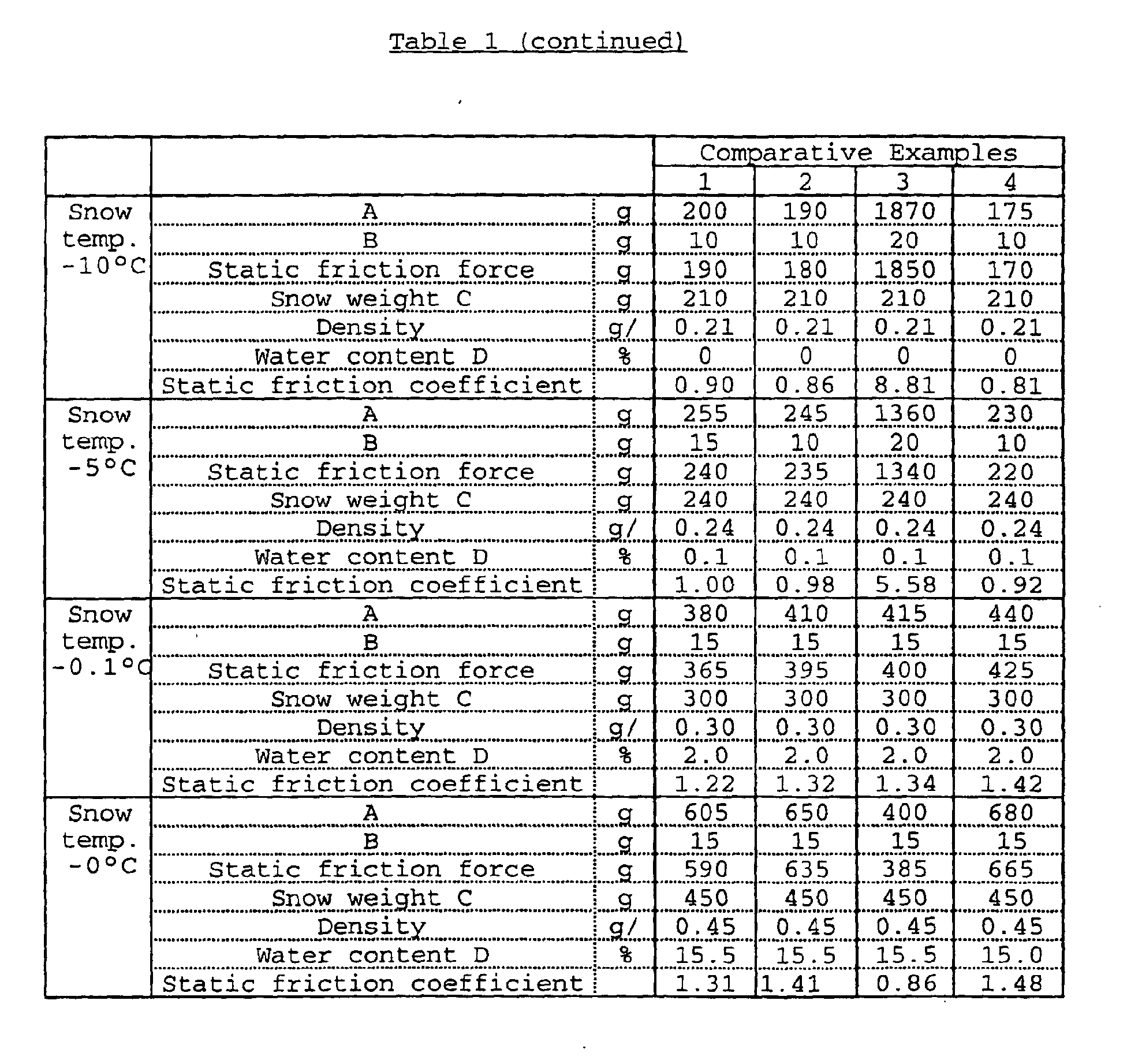
    These samples were subjected to measurement of friction force relative to snow by the following method. The results are shown in Table 1.
  • (1) The test plates were set on a horizontal plane within a low-temperature room (laboratory capable of being controlled to a temperature of 0°C or lower, and changing an inside temperature thereof at intervals of 0.1°C).
  • (2) Snow having a snow temperature of -10°C was deposited at a height of about 5 cm on the respective test plates under an ambient temperature condition of -10°C. Also, the test plates set on such a place where no snow was deposited, were used as blanks. (The snow deposited on the test plates was an artificial snow prepared by scratching off "frost" formed by blowing steam onto a membrane. The snow has an average diameter (crystal size) of 0.025 mm, and a snow quality corresponding to a fresh snow having a density of about 0.2 g/ml. The test was conducted using a test device manufactured by Toyo Seisakusho Co., Ltd.)
  • (3) After completion of snowfall, the test plates were allowed to stand for one hour, and subjected to measurement of friction force.
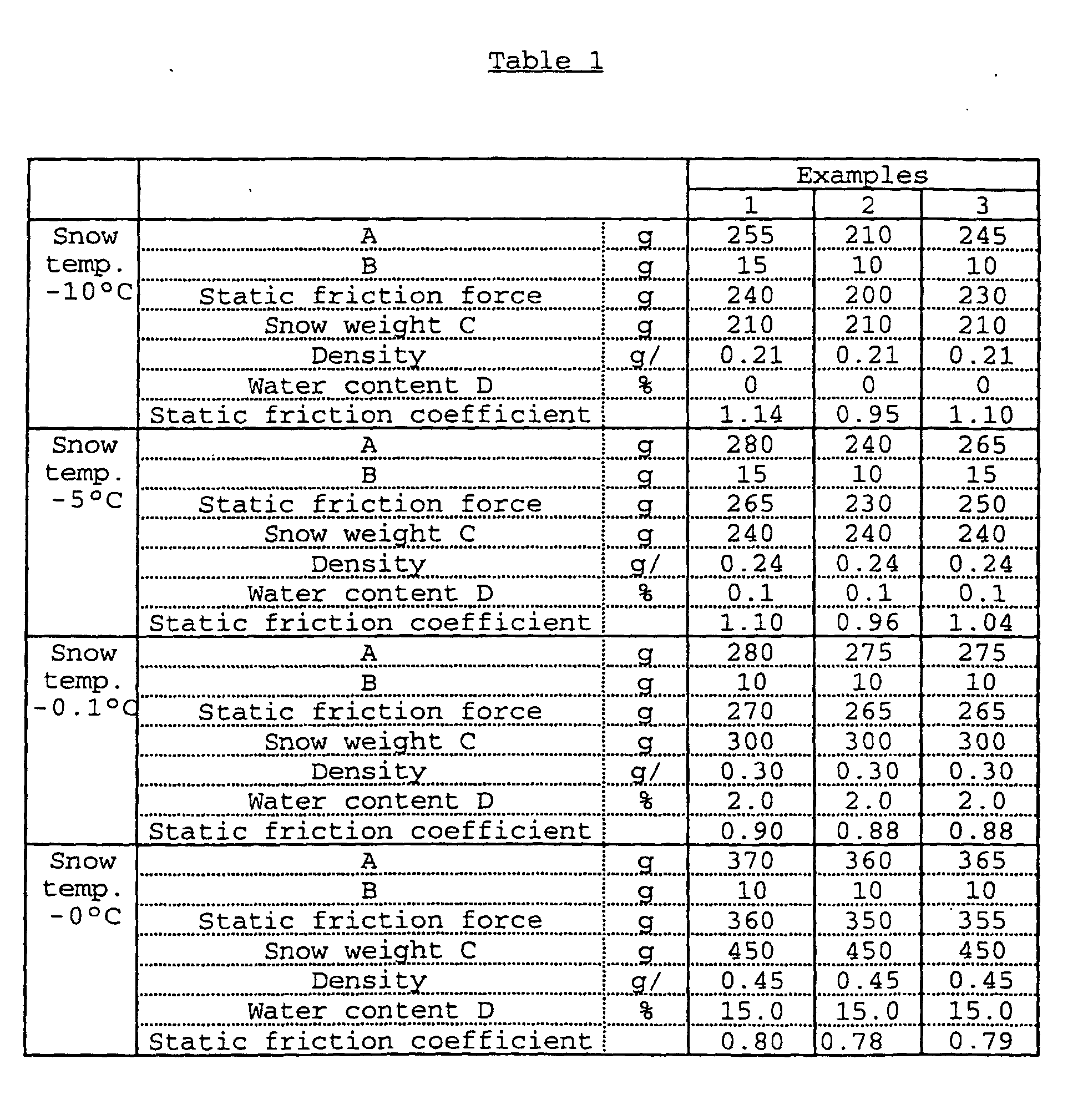
  • (4) An aluminum frame (configuration of the aluminum frame is shown in Fig. 2; tare weight: 120 g; frame inner volume: 1,000 cc) was pushed in the snow deposited on each test plate to be measured without causing the snow to move thereon until coming into contact with the test plate.
  • (5) The snow attached to an upper portion of the aluminum frame was removed, and a measuring device (spring balance: push-pull gauge) was fitted thereto.
  • (6) The aluminum frame was pulled at a constant speed of about 10 mm/min. A pulling force A at which the aluminum frame was first moved and a pulling force B for the test plates as blanks on which no snow was deposited, were respectively measured to calculate a friction force (A-B).
  • (7) The weight C of the snow received within the aluminum frame used for measuring the above friction force was measured by an electronic balance. In addition, the water content D in the snow was measured by an Innsbruck-type water content meter.
  • (8) After the ambient temperature was raised to -5°C, the test plates were maintained under this condition for one hour, and then the above procedures (4) to (7) were repeated.
  • (9) After the ambient temperature was further raised to -0.1°C, the test plates were maintained under this condition for one hour, and then the above procedures (4) to (7) were repeated.
  • (10) After the ambient temperature was further raised to 0°C, the test plates were maintained under this condition for one hour, and then the above procedures (4) to (7) were repeated.
  • Calculation of static friction coefficient:
    The static friction coefficient under each of the above conditions was calculated from the static friction force and the snow weight C according to the following formula: (Static Friction Coefficient) = (Static Friction Force)/C
    <Composition>
    Meanwhile, "MKC SILICATE MS51" produced by Mitsubishi Chemical Corporation. (hydrolysis rate: 40%) was used as the organosilicate. Also, the composition of the "mixed solvent" used during the formulation was as follows.
    Toluene 23 parts by weight
    Propylene glycol monomethyl ether acetate 18 parts by weight
    Butyl acetate 12.5 parts by weight
    Methyl isobutyl ketone 9 parts by weight
    Propylene glycol monomethyl ether 22.5 parts by weight
    n-butanol 7.5 parts by weight
    Isopropyl alcohol 7.5 parts by weight
       Total 100.0 parts by weight
    Preparation Example 1:
    Hydrolyzed solution of organosilicate () 118 parts by weight
    Mixed solvent 100 parts by weight
    Organosilicate 16 parts by weight
    10% hydrochloric acid solution 2.0 parts by weight
    Preparation Example 2:
    Formulation:
    Hydrolyzed solution of organosilicate (*1) 118 parts by weight
    SC-101 () 4.8 parts by weight
    (corresponding to 10% by weight as a solid content based on the weight of the silicate contained in the hydrolyzed solution)
    Preparation Example 3:
    Formulation:
    Hydrolyzed solution of organosilicate () 118 parts by weight
    SILWET L-7001 () 1.6 parts by weight
    (corresponding to 10% by weight as a solid content based on the weight of the silicate contained in the hydrolyzed solution)
    Preparation Example 4:
    Cold-curing type fluororesin paint (vinylidene fluoride based paint) 100 parts by weight
    Preparation Example 5:
    Cold-curing type fluororesin paint (vinylidene fluoride based paint) 100 parts by weight
    SILWET L-7001 2.5 parts by weight
    (corresponding to 10% by weight as a solid content based on the weight of solid components of the fluororesin paint)
    Examples 1 to 3 and Comparative Examples 1 to 4:
    Aluminum plates were respectively coated with the coating solutions prepared in Preparation Examples 1 to 5 to produce samples of Examples 1 to 3 and samples of Comparative Examples 1 and 2. An uncoated glass plate was used as a sample of Comparative Example 3, and a Teflon plate (Teflon: registered trademark; tetrafluoroethylene polymer) was used as a sample of Comparative Example 4. Three samples were prepared for each coating solution. The three samples were set at angles of 10°, 30° and 45° from a horizontal plane, respectively. Three uncoated glass plates and three Teflon plates were respectively set at the same angles as above. The outline of the test is shown in Fig. 1 wherein (1) denotes samples held at an angle of 10°; (2) denotes samples held at an angle of 30°; and (3) denotes samples held at an angle of 45°.
    These samples were subjected to snowfall test under the following conditions.
    First Day
  • 21:30 Initiation of snowfall (ambient temperature: -8°C to -10°C)
  • Second Day
  • 8:00 Termination of snowfall
  • 9:00 Initiation of temperature rise (until the ambient temperature was raised to 5°C)
  • 14:00 Termination of snowfall test
  • Results of Experiments:
    During the snowfall test, among the test plates coated with the coating solution prepared in Preparation Example 2, the test plate set at an angle of 45° was free from snow accretion thereon, and the test plates set at angles of 30° and 10° were covered with snow. On the other hand, the test plates coated with the coating solutions prepared in Preparation Examples 1, 3, 4 and 5 as well as the Teflon plates, roof steel plates and glass plates were covered with snow at every setting angles.
    When the ambient temperature was raised, snow was dropped off from the test plates in the following order for a period between 10:15 to 13:00.
  • 10:15 Among the test plates coated with the coating solution prepared in Preparation Example 2, snow was dropped-off from the test plate set at an angle of 30°.
  • 10:30 Snow was dropped-off from the test plates set at angles of 45° and 30° among those coated with the coating solution prepared in Preparation Example 1; the test plates set at angles of 45° and 30° among those coated with the coating solution prepared in Preparation Example 3; and the glass plate set at an angle of 45°.
  • 11:00 Snow was dropped-off from the test plates set at angles of 45° and 30° among those coated with the coating solution prepared in Preparation Example 4; the test plates set at angles of 45° and 30° among those coated with the coating solution prepared in Preparation Example 5; and the glass plate set at an angle of 30°.
  • 12:00 Snow was dropped-off from the Teflon plate set at an angle of 45°; the glass plate set at an angle of 10°; the test plate set at an angle of 10° among those coated with the coating solution prepared in Preparation Example 2; the test plate set at an angle of 10° among those coated with the coating solution prepared in Preparation Example 1; and the test plate set at an angle of 10° among those coated with the coating solution prepared in Preparation Example 3.
  • 12:30 Snow was dropped-off from the Teflon plate set at an angle of 30°; and the roof steel plate set at an angle of 45°.
  • 13:00 Snow was dropped-off from the roof steel plate set at an angle of 30°.
  • 13:30 Termination of test
  • As a result, it was confirmed that snow deposited on the test plates set at an angle of 10° among those coated with the coating solutions prepared in Preparation Examples 4 and 5 as well as the Teflon plate and the roof steel plate set at an angle of 10°, was not dropped-off until the test was finally terminated, and these test plates were still covered with snow.
    Considerations from the test results (1) Snow- and ice-accretion inhibiting effect:
    The test plates used in Example 2 (which were coated with the solution prepared in Preparation Example 2 by using the organosilicate in combination with the hydrophobic compound), were free from snow coverage during the snowfall test. As a result, it was confirmed that the coating composition used in Example 2 showed an excellent snow-accretion inhibiting effect.
    (2) Snow slipping-off effect
    The test plates used in Example 2 as well as the test plates used in Example 1 (which were coated with the hydrolyzed solution of organosilicate prepared in Preparation Example 1), exhibited a higher snow slipping-off property (earlier snow-slippage) as compared to those used in Comparative Examples even though the setting angle of Examples was smaller than that of Comparative Examples. As a result, it was confirmed that the coating compositions used in these Examples were more effective than those used in Comparative Examples.
    From the above descriptions, it is recognized that the composition can be improved in snow slipping-off property by adding the organosilicate thereto; and the composition using the organosilicate in combination with the hydrophobic compound can show an improved snow slipping-off property and simultaneously can be prevented from undergoing snow coverage upon snowfall and, therefore, is excellent in both of snow slipping-off property and snow- or ice-accretion inhibiting property.
    Figure 00300001
    Figure 00310001
    INDUSTRIAL APPLICABILITY
    In accordance with the present invention, it is possible to obtain a coating composition capable of showing not only a good snow- or ice-accretion inhibiting property upon snowfall but also an improved snow slipping-off property upon temperature rise.
    Claims (21)

    1. A composition for a snow- or ice-accretion inhibiting member, having a static friction coefficient of less than 1.3 as measured relative to snow having a temperature range of 0 to -10°C.
    2. A composition for a snow- or ice-accretion inhibiting member, having a static friction coefficient of less than 1.3 as measured relative to snow having a density range of 0.2 to 0.5 g/cm3.
    3. A composition for a snow- or ice-accretion inhibiting member, having a static friction coefficient of less than 1.3 as measured relative to snow having a water content range of 0 to 15%.
    4. A composition for a snow- or ice-accretion inhibiting member, having a static friction coefficient of less than 1.3 as measured relative to snow having a temperature range of 0 to -1°C.
    5. A composition for snow- or ice-accretion inhibiting member, having a static friction coefficient of less than 1.3 as measured relative to snow having a density of 0.3 to 0.5 g/cm3.
    6. A composition for a snow- or ice-accretion inhibiting member, having a static friction coefficient of less than 1.3 as measured relative to snow having a water content range of 2 to 15%.
    7. A composition for a snow- or ice-accretion inhibiting member, having a static friction coefficient of less than 1.2 as measured relative to snow having a temperature of -0.1°C.
    8. A composition for a snow- or ice-accretion inhibiting member, having a static friction coefficient of not more than 1.1 as measured relative to snow having a density of 0.3 g/cm3.
    9. A composition for a snow- or ice-accretion inhibiting member, having a friction coefficient of not more than 1.1 as measured relative to snow having a water content of 2.0%.
    10. A composition for a snow- or ice-accretion inhibiting member, having a static friction coefficient relative to snow having a temperature of -10°C which is larger than a static friction coefficient relative to snow having a temperature of 0°C and which is not more than 7.5.
    11. A composition for a snow- or ice-accretion inhibiting member, having a static friction coefficient relative to snow having a density of 0.2 g/cm3 which is larger than a static friction coefficient relative to snow having a density of 0.45 g/cm3 and which is not more than 7.5.
    12. A composition for a snow- or ice-accretion inhibiting member, having a static friction coefficient relative to snow having a water content of 0% which is larger than a static friction coefficient relative to snow having a water content of 15% and which is not more than 7.5.
    13. A composition according to any of claims 1 to 12, containing an organosilicate and a hydrophobic compound.
    14. A composition according to claim 13, containing a partially hydrolyzed condensate of the organosilicate, and the hydrophobic compound.
    15. A composition according to claim 14, wherein said partially hydrolyzed condensate of the organosilicate has a hydrolysis rate of 0 to 80%.
    16. A composition according to claim 15, wherein a coating film formed from said partially hydrolyzed condensate of the organosilicate has a water contact angle of not more than 60°.
    17. A composition according to claim 13, wherein said hydrophobic compound is a fluororesin powder.
    18. A composition according to claim 13, wherein said hydrophobic compound is a surfactant having a perfluoroalkyl group.
    19. A composition according to claim 13, wherein said hydrophobic compound has a critical surface tension of not more than 20 mPa·s.
    20. A paint comprising the composition according to any one of claims 1 to 19.
    21. A snow- or ice-accretion inhibiting member coated with the paint according to claim 20.
    EP01908243A 2000-03-02 2001-03-02 COMPOSITION OF AN ELEMENT PREVENTING SNOW OR ICE INCREASE AND ELEMENT PREVENTING AN INCREASE OF SNOW OR ICE USING THE SAME Withdrawn EP1260567A4 (en)

    Applications Claiming Priority (5)

    Application Number Priority Date Filing Date Title
    JP2000057226 2000-03-02
    JP2000057226 2000-03-02
    JP2000374587 2000-12-08
    JP2000374587A JP2002206087A (en) 2000-03-02 2000-12-08 Composition for snow and ice prevention member and snow and ice prevention member using the same
    PCT/JP2001/001615 WO2001064810A1 (en) 2000-03-02 2001-03-02 Composition for member preventing accretion of snow or ice and member preventing accretion of snow or ice using the same

    Publications (2)

    Publication Number Publication Date
    EP1260567A1 true EP1260567A1 (en) 2002-11-27
    EP1260567A4 EP1260567A4 (en) 2003-05-02

    Family

    ID=26586614

    Family Applications (1)

    Application Number Title Priority Date Filing Date
    EP01908243A Withdrawn EP1260567A4 (en) 2000-03-02 2001-03-02 COMPOSITION OF AN ELEMENT PREVENTING SNOW OR ICE INCREASE AND ELEMENT PREVENTING AN INCREASE OF SNOW OR ICE USING THE SAME

    Country Status (6)

    Country Link
    US (1) US6835322B2 (en)
    EP (1) EP1260567A4 (en)
    JP (1) JP2002206087A (en)
    AU (1) AU2001236050A1 (en)
    CA (1) CA2401384A1 (en)
    WO (1) WO2001064810A1 (en)

    Cited By (1)

    * Cited by examiner, † Cited by third party
    Publication number Priority date Publication date Assignee Title
    DE102004059152A1 (en) * 2004-12-08 2006-06-22 Few Chemicals Gmbh Chemiepark Bitterfeld Wolfen Areal A Coating composition, useful to prepare protecting layer and coat substrates, comprises mixture of metal- and/or semi-metal alkoxide, mixture of organosilane, fluoridated polyether, perfluoropolymer and soluble structure-viscous compound

    Families Citing this family (6)

    * Cited by examiner, † Cited by third party
    Publication number Priority date Publication date Assignee Title
    US6737313B1 (en) * 2003-04-16 2004-05-18 Micron Technology, Inc. Surface treatment of an oxide layer to enhance adhesion of a ruthenium metal layer
    US7992823B2 (en) * 2008-04-30 2011-08-09 General Electric Company Ice shed reduction for leading edge structures
    US8245981B2 (en) * 2008-04-30 2012-08-21 General Electric Company Ice shed reduction for leading edge structures
    US9309781B2 (en) 2011-01-31 2016-04-12 General Electric Company Heated booster splitter plenum
    RU2547754C2 (en) 2013-08-16 2015-04-10 Игорь Леонидович Радченко Polymer powder composition for superhydrophobic coating and method of obtaining superhydrophobic coating
    US9840639B2 (en) 2014-03-27 2017-12-12 Innosense Llc Hydrophilic anti-fog coatings

    Family Cites Families (15)

    * Cited by examiner, † Cited by third party
    Publication number Priority date Publication date Assignee Title
    US4701508A (en) * 1984-12-14 1987-10-20 Mitsui Sekiyu Kagaku Kogyo Kabushiki Kaisha Solvent soluble fluorine-containing polymer, coating composition containing the same and coating process thereof
    JP2771019B2 (en) * 1990-07-26 1998-07-02 セントラル硝子株式会社 Coating paint composition with excellent snow-slip properties and anti-icing properties
    JP3576580B2 (en) * 1993-11-10 2004-10-13 セントラル硝子株式会社 Water repellent glass
    JPH1017823A (en) * 1996-06-28 1998-01-20 Toray Dow Corning Silicone Co Ltd Coating composition
    JPH11124518A (en) * 1997-10-21 1999-05-11 Nippon Paint Co Ltd Rain dripping stain-resistant coating film, coating composition, coating film forming method and coated product
    KR19980079940A (en) * 1997-03-05 1998-11-25 후지이 히로시 Rainwater contamination-preventing coating film, coating composition, coating film forming method and coating material
    JPH11181334A (en) * 1997-12-24 1999-07-06 Nippon Paint Co Ltd Coating composition, coating film forming method and painted object
    JPH10245504A (en) * 1997-03-05 1998-09-14 Nippon Paint Co Ltd Rain dripping stain-resistant coating film, coating composition, coating film forming method and coated product
    JPH10316820A (en) * 1997-03-18 1998-12-02 Toto Ltd Member having extremely water-repelling surface and extremely water-repelling coating composition
    JPH11293114A (en) * 1998-04-13 1999-10-26 Toyo Ink Mfg Co Ltd Curable resin composition, varnish and cured product thereof
    JPH11293188A (en) * 1998-04-13 1999-10-26 Toyo Ink Mfg Co Ltd Curable resin composition, varnish and cured product thereof
    JP2000040422A (en) * 1998-07-23 2000-02-08 Hitachi Ltd Difficult-to-wear snow transmission line and method of manufacturing the same
    FR2782522B1 (en) * 1998-08-19 2003-10-03 Atochem Elf Sa WATERPROOFING COMPOSITION
    JP2002256218A (en) * 2001-03-02 2002-09-11 Mitsunori Yoshida Composition for snow and ice prevention member and snow and ice prevention member using the same
    JP2003155410A (en) * 2001-08-30 2003-05-30 Dainippon Shikizai Kogyo Kk Composition containing silicon component and fluorine component and snow and ice prevention member

    Cited By (1)

    * Cited by examiner, † Cited by third party
    Publication number Priority date Publication date Assignee Title
    DE102004059152A1 (en) * 2004-12-08 2006-06-22 Few Chemicals Gmbh Chemiepark Bitterfeld Wolfen Areal A Coating composition, useful to prepare protecting layer and coat substrates, comprises mixture of metal- and/or semi-metal alkoxide, mixture of organosilane, fluoridated polyether, perfluoropolymer and soluble structure-viscous compound

    Also Published As

    Publication number Publication date
    AU2001236050A1 (en) 2001-09-12
    US6835322B2 (en) 2004-12-28
    WO2001064810A1 (en) 2001-09-07
    JP2002206087A (en) 2002-07-26
    US20030164469A1 (en) 2003-09-04
    EP1260567A4 (en) 2003-05-02
    CA2401384A1 (en) 2001-09-07

    Similar Documents

    Publication Publication Date Title
    KR101126374B1 (en) Antifouling Coating Agent and Article Coated with the Same
    US6706798B2 (en) Water repellent silicone coating agent composition
    US6599976B2 (en) Coating process and silicon-containing liquid composition
    US9029491B2 (en) Repellent coating composition and coating, method for making and uses thereof
    KR100370899B1 (en) Water repellent
    KR20080104979A (en) Scratch Resistant Coating Compositions and Covered Articles
    JP3232004B2 (en) Coating composition
    US6835322B2 (en) Composition for member preventing accretion of snow or ice and member preventing accretion of snow or ice using the same
    JP4502112B2 (en) Antifouling coating agent and coated article
    KR100463926B1 (en) Multi Functional Silicon-polymer Composite for Coating
    JP3228085B2 (en) Water repellent agent
    KR102595033B1 (en) Polysiloxane formulations and coatings for optoelectronic applications
    WO2007119805A1 (en) Phosphoric ester containing coating fluid and antireflection coatings
    JP3279015B2 (en) Composition for coating
    WO2005083006A1 (en) Silicon-containing liquid composition
    JP2002256218A (en) Composition for snow and ice prevention member and snow and ice prevention member using the same
    JP4424780B2 (en) Coating method and silicon-containing liquid composition
    JP2005272835A (en) Silicon-containing liquid composition
    JPH0940910A (en) Water repellent treatment
    JP3269314B2 (en) Water repellent agent
    JP2003155348A (en) Polysiloxane having perfluoroalkyl group, composition thereof, and snow / ice prevention member
    JP2000169835A (en) Water and oil repellent substrate
    JP2003155410A (en) Composition containing silicon component and fluorine component and snow and ice prevention member
    JP2002088347A (en) Snow and ice slipping coated material
    JP2003147202A (en) Composition containing silicon component and fluorine component and snow and ice prevention member

    Legal Events

    Date Code Title Description
    PUAI Public reference made under article 153(3) epc to a published international application that has entered the european phase

    Free format text: ORIGINAL CODE: 0009012

    17P Request for examination filed

    Effective date: 20020826

    AK Designated contracting states

    Kind code of ref document: A1

    Designated state(s): AT BE CH CY DE DK ES FI FR GB GR IE IT LI LU MC NL PT SE TR

    AX Request for extension of the european patent

    Free format text: LT;LV;MK;RO;SI

    A4 Supplementary search report drawn up and despatched

    Effective date: 20030317

    RAP1 Party data changed (applicant data changed or rights of an application transferred)

    Owner name: HOKKAIDO

    Owner name: MITSUBISHI CHEMICAL CORPORATION

    Owner name: DAINIPPON SHIKIZAI KOUGYO CO., LTD.

    RBV Designated contracting states (corrected)

    Designated state(s): AT BE CH DE FR GB LI

    RAP1 Party data changed (applicant data changed or rights of an application transferred)

    Owner name: MITSUBISHI CHEMICAL CORPORATION

    Owner name: HOKKAIDO

    Owner name: DAINIPPON SHIKIZAI KOUGYO CO., LTD.

    STAA Information on the status of an ep patent application or granted ep patent

    Free format text: STATUS: THE APPLICATION IS DEEMED TO BE WITHDRAWN

    18D Application deemed to be withdrawn

    Effective date: 20051001