EP1260076B1 - Procedure to facilitate communication between participants acting in networks that utilize different administrative and technical principles by dividing the infrastructure into logical layers - Google Patents
Procedure to facilitate communication between participants acting in networks that utilize different administrative and technical principles by dividing the infrastructure into logical layers Download PDFInfo
- Publication number
- EP1260076B1 EP1260076B1 EP01902939A EP01902939A EP1260076B1 EP 1260076 B1 EP1260076 B1 EP 1260076B1 EP 01902939 A EP01902939 A EP 01902939A EP 01902939 A EP01902939 A EP 01902939A EP 1260076 B1 EP1260076 B1 EP 1260076B1
- Authority
- EP
- European Patent Office
- Prior art keywords
- participants
- logical
- layer
- service
- layers
- Prior art date
- Legal status (The legal status is an assumption and is not a legal conclusion. Google has not performed a legal analysis and makes no representation as to the accuracy of the status listed.)
- Expired - Lifetime
Links
Images

Classifications
-
- H—ELECTRICITY
- H04—ELECTRIC COMMUNICATION TECHNIQUE
- H04L—TRANSMISSION OF DIGITAL INFORMATION, e.g. TELEGRAPHIC COMMUNICATION
- H04L61/00—Network arrangements, protocols or services for addressing or naming
- H04L61/30—Managing network names, e.g. use of aliases or nicknames
-
- H—ELECTRICITY
- H04—ELECTRIC COMMUNICATION TECHNIQUE
- H04L—TRANSMISSION OF DIGITAL INFORMATION, e.g. TELEGRAPHIC COMMUNICATION
- H04L61/00—Network arrangements, protocols or services for addressing or naming
-
- H—ELECTRICITY
- H04—ELECTRIC COMMUNICATION TECHNIQUE
- H04L—TRANSMISSION OF DIGITAL INFORMATION, e.g. TELEGRAPHIC COMMUNICATION
- H04L61/00—Network arrangements, protocols or services for addressing or naming
- H04L61/45—Network directories; Name-to-address mapping
-
- H—ELECTRICITY
- H04—ELECTRIC COMMUNICATION TECHNIQUE
- H04L—TRANSMISSION OF DIGITAL INFORMATION, e.g. TELEGRAPHIC COMMUNICATION
- H04L69/00—Network arrangements, protocols or services independent of the application payload and not provided for in the other groups of this subclass
- H04L69/30—Definitions, standards or architectural aspects of layered protocol stacks
- H04L69/32—Architecture of open systems interconnection [OSI] 7-layer type protocol stacks, e.g. the interfaces between the data link level and the physical level
Definitions
- the present invention relates generally to communication networks and specifically to a procedure to facilitate communication between different participants in an infrastructure for communication, which participants act in communication networks which at least partially utilize different administrative and technical principles.
- a supplier of a service will, in addition, in many cases need to utilize services of other suppliers at realization and management of the services.
- a supplier of a mobile telephone service must, for instance, utilize a supplier of an interconnectivity service when a call shall be set up between a customer of the mobile telephone service and a customer of another service, such as a service for fixed telephony. This results in a need of coordination between the different services.
- Especially the management of data related to participants has to be coordinated between the services. Examples of participants are users, service suppliers, networks, services, data objects etc.
- a customer who utilizes a first supplier's service must in his/her turn utilize a second supplier's service for realization of the first supplier's service.
- a customer who utilizes an information supplier's service transmit/transfer the information by means of a transfer service.
- the connection between the customer and the supplier of the information service is also connected to the supplier of the transfer/transmission service. This results in coordination problems, especially if the customer and the information supplier are connected to different suppliers of the transfer/transmission service.
- WO 9828899 discloses systems and methods for managing call processing information, and in particular for facilitating local number portability when requested by an individual or business. Specifically a method is described for providing local number portability services, when changing operator, to a telecommunications system arranged in a Telecommunications Management Network (TMN) framework.
- TTN Telecommunications Management Network
- the TMN architecture provides a functional hierarchy of logical layered levels, which break down the telecommunications system into operation layers.
- the aim of the present invention is to solve the problem that information regarding connection between two participants sometimes must be strongly connected with other participants than these two, which results in coordination problems, and to then facilitate communication between different participants in an infrastructure for communication, which participants act in communication networks which at least partially utilize different administrative and technical principles.
- the infrastructure for communication is divided into a number of logical layers.
- a number of participants are defined and each of the participants in a logical layer is linked to one or more participants in the same or adjacent logical layers.
- attributes are defined with regard to the other participants to which these are linked.
- participant By participants are meant physical or logical objects which can act in the communication networks. These participants consequently can be technical equipment or physical/legal persons such as customers/users, service suppliers, networks, support systems etc., but also logical objects such as software in computers etc. Communication networks and communication shall be interpreted in a wide sense and include all types of connections respective information exchange between participants, i.e. connections respective information exchange in a service and within systems for technical and administrative management.
- connections can be defined between a participant and different other participants. These connections can be defined by means of the attributes that are defined with regard to the other participants. For instance is a participant, as a user of a service in the service layer, not directly connected to the technical systems, such as telecommunication networks, in underlying layers that are needed for realization of the service. Further, the linking between participants in a layer consequently can be made without going via links to participants in underlying layers. The coordination that is needed towards underlying layers is managed via the linking to participants in this underlying layer.
- the invention consequently is based on the knowledge that it is not sufficient that the managing of participant data between different communication networks are coordinated, either this is made locally between each of the systems, or centrally in an overall system, to overcome the above mentioned problem. Instead, the managing of participants must to a larger extent be released from the specific technical solution and especially a certain part of the management of the connection between customers and service suppliers must be released from the specific technical solution that respective service supplier utilizes in the infrastructure for communication.
- the present invention releases the management of participants from the underlying technical solutions of the communication by the way which the connection between participants and addressing is made.
- a number of logical addresses are defined in each of the logical layers, and the participants in respective logical layers are linked to one or more logical addresses in the logical layer to which they belong.
- Logical addresses shall be interpreted in a wide sense and include everything from physical addresses, such as a permanent home address or an address to a port in a computer, to more abstract addresses, such as a logical pointer to one at present used physical address.
- a participant can have the same logical address in a layer for utilization of different services which are realized by means of underlying layers which have different principles for addressing.
- the invention has a number of advantages compared with known technology in addition to the above discussed.
- the object-oriented approach to participants and logical addresses in an architecture based on layers results in possibilities for a more consistent and thus more secure and efficient management of participant data.
- the architecture makes general methods for access and management of participant data of both technical and administrative systems possible.
- By defining the participants by layers can for instance situations when a company has different roles in different layers towards other companies be easier managed. For instance can a company be supplier of a service in a service layer, whereas this company is customer in a network layer.
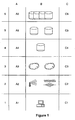
- Figure 1 a division of an infrastructure for communication in a number of logical layers 1-6.
- the division is in this example made in six layers 1-6 for three different groups/branches A-C which include business architecture A, technical architecture B and information architecture C. Another division into layers and other types of groups/fields can of course be made.
- a terminal layer 1 with the physical terminals, such as mobile telephones, exchanges, service servers etc.
- a transmission layer 2 with equipment for transmission/transfer, such as optical fibers, radio links etc.
- the layer above the transmission layer 2 is the network layer 3, in which the different networks are, such as IP-networks, GSM-networks, PSTN-networks etc.
- this layer there is an interconnectivity layer 4, in which the functions for interconnection of different networks are.
- the interconnection can be made between networks which utilize the same technology and networks which utilize different technologies.
- a service layer 5 in which different types of services have been realized, which utilize the underlying layers.
- the services can be information services and communication services etc, such as web-services and telephony.
- a context layer 6 in which tailor-made services are, for instance customer specific applications and profiles. According to the invention then this logical division of layers is utilized at storing, management and exchange of information between different systems and services in and between layers by a number of participants and logical addresses which are connected to these being defined in the different logical layers.
- Examples of participants are customers/users, operators, service suppliers, information suppliers etc, and examples of logical addresses which are connected to these is an address to a customer to a supplier of a telephone service.
- the participants are then linked to each other. For instance is a user of a telephone service in the service layer 5 linked to a supplier of the telephone service.
- FIG. 2 shows schematically a system in which an embodiment of the invention is realized.
- a service server 21 in a service layer 5 is connected to a database unit 22 and an interconnectivity server 23 in an interconnectivity layer 4 which in its turn is connected to a network 24 in a network layer 3.
- the database 22 there are logical addresses 25, participants 26, and links between these stored, such as links between participants 26 and logical addresses 25 and between different participants 26.
- For instance has the service server 21 a logical address in the service layer 5. This logical address is linked to a logical address in the interconnectivity layer 4, which logical address in its turn is linked to a logical address in the network layer 3.
- the logical address of the service server 21 in the service layer 5 linked to a participant which in this case is the service supplier who supplies the service.
- a participant which in this case is the service supplier who supplies the service.
- the database 22 there is also links between the participant who supplies the service and other participants, such as users of the service. For these links there is a level of authorization defined which i.a. controls which information to which the different participants are authorized at each other.
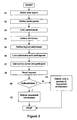
- FIG. 3 is shown a flow chart for a procedure according to the invention.
- the infrastructure for communication is divided into logical layers according to Figure 1 .
- steps 32-37 a number of different objects, which are linked to each other and are stored in a database according to Figure 2 , are defined.
- a step 32 a number of participants, such as a customer and a service supplier, are defined.
- Each of the participants in the logical layers are then linked, in a step 33, to one or more participants in the same or adjacent logical layer. For instance is the customer linked to the service supplier.
- a step 34 a number of attributes for each of the participants defined with regard to the participants to which this is linked.
- an attribute for the service supplier which describes a level of authorization for the service supplier with regard to customer, such as to which information about the customer the service supplier is authorized to have access.
- a number of logical addresses in each of the logical layers in a step 35 at which the participants then are linked in a step 36 to one or more of these logical addresses in the layer to which the participant belongs.
- a service server linked to the service supplier according to Figure 2 is defined.
- a step 38 is then transmitted from the service server a request for information about the customer to the database.
- a step 39 is decided which level of authorization the service supplier, who is linked to the service server, has with regard to the customer. If the service supplier is authorized to all the information that is requested, this information is delivered in a step 40 to the service server, otherwise is delivered in a step 41 only the portion of the requested information to which the service server is authorized.
Landscapes
- Engineering & Computer Science (AREA)
- Computer Networks & Wireless Communication (AREA)
- Signal Processing (AREA)
- Computer Security & Cryptography (AREA)
- Mobile Radio Communication Systems (AREA)
- Data Exchanges In Wide-Area Networks (AREA)
- Telephone Function (AREA)
- Input Circuits Of Receivers And Coupling Of Receivers And Audio Equipment (AREA)
- Communication Control (AREA)
Abstract
Description
- The present invention relates generally to communication networks and specifically to a procedure to facilitate communication between different participants in an infrastructure for communication, which participants act in communication networks which at least partially utilize different administrative and technical principles.
- In the telecommunication and data communication networks of today there are many different technologies for managing of the communication. Further, the deregulation of the telecommunication market has resulted in an ever increasing variety of suppliers in the field. These suppliers are to some extent newly established companies, but are also existing companies with existing infrastructures or service offerings which are suitable for implementation of telecommunication and data communication services respectively, by means of telecommunication and data communication services. Examples of such existing companies are companies which have at their disposal networks for distribution of electrical power, railway system networks and companies which offer information services. The different kinds of new suppliers within the field have had greatly different starting positions, which has resulted in systems with different ways of managing data that are utilized at the realization and management of offered services. This partially applies between systems of different suppliers in which communication is made by means of the same technology, but perhaps above all between systems in which communication is made by means of different technologies.
- A supplier of a service will, in addition, in many cases need to utilize services of other suppliers at realization and management of the services. A supplier of a mobile telephone service must, for instance, utilize a supplier of an interconnectivity service when a call shall be set up between a customer of the mobile telephone service and a customer of another service, such as a service for fixed telephony. This results in a need of coordination between the different services. Especially the management of data related to participants has to be coordinated between the services. Examples of participants are users, service suppliers, networks, services, data objects etc.
- The fact that the different systems, which have been built up for realization and carrying of different services, have different ways of managing data that are utilized at the realization and management of offered services, makes it difficult to satisfy the need of coordination of data between different communication networks and services.
- The solutions of today of how coordination of data shall be possible between different systems for realization and carrying of different communication services are to a large extent based on that specific interfaces are introduced between each of the systems between which coordination is needed. A big problem with this type of solutions is that a large number of specific interfaces are needed, which results in poor flexibility and is expensive and complex. For instance there will be problems at introduction of new services or at utilization in a system of services in another system where no interface for coordination of data has been introduced. Further, this solution will give rise to a complex management of participants such as customers and suppliers and of the connection between these, since these are managed each in the interfaces between them. For instance is the same information stored for one and the same participant for each of the services that it utilizes, which results in that this information has to be updated at each supplier each time a change is made.
- Further, also centralized suggestions for solution have been presented, in which central databases manage coordination of data between different communication networks. These suggestions for solution partially facilitate updating of participant data but, however, they are strongly directed at the technical coordination of different communication networks, which utilize different communication technologies, such as mobile telephone networks, IP networks, and ATM networks etc. Consequently, the participant data, which are stored centrally in these suggestions for solution, are still strongly connected to the technical systems in which the participants are operating. Changes of data related to connections between two participants can in this suggestion for solution result in that changes of information regarding connections between one of these participants and a third participant have to be made. For instance, participants are identified on basis of the addressing in the communication networks that are utilized at the utilization of a service. In many cases a customer who utilizes a first supplier's service must in his/her turn utilize a second supplier's service for realization of the first supplier's service. For instance must a customer who utilizes an information supplier's service transmit/transfer the information by means of a transfer service. In the suggested centralized solution of today, the connection between the customer and the supplier of the information service is also connected to the supplier of the transfer/transmission service. This results in coordination problems, especially if the customer and the information supplier are connected to different suppliers of the transfer/transmission service.
-
WO 9828899 - The aim of the present invention is to solve the problem that information regarding connection between two participants sometimes must be strongly connected with other participants than these two, which results in coordination problems, and to then facilitate communication between different participants in an infrastructure for communication, which participants act in communication networks which at least partially utilize different administrative and technical principles.
- The aim above is achieved by a procedure according to the
claim 1, where the infrastructure for communication is divided into a number of logical layers. In each of the logical layers a number of participants are defined and each of the participants in a logical layer is linked to one or more participants in the same or adjacent logical layers. For each of the participants, attributes are defined with regard to the other participants to which these are linked. - By participants are meant physical or logical objects which can act in the communication networks. These participants consequently can be technical equipment or physical/legal persons such as customers/users, service suppliers, networks, support systems etc., but also logical objects such as software in computers etc. Communication networks and communication shall be interpreted in a wide sense and include all types of connections respective information exchange between participants, i.e. connections respective information exchange in a service and within systems for technical and administrative management.
- By the participants being defined in the different logical layers, i.e. as separate objects in a logical layer rather than based on the connections they have with other participants, different connections can be defined between a participant and different other participants. These connections can be defined by means of the attributes that are defined with regard to the other participants. For instance is a participant, as a user of a service in the service layer, not directly connected to the technical systems, such as telecommunication networks, in underlying layers that are needed for realization of the service. Further, the linking between participants in a layer consequently can be made without going via links to participants in underlying layers. The coordination that is needed towards underlying layers is managed via the linking to participants in this underlying layer.
- The invention consequently is based on the knowledge that it is not sufficient that the managing of participant data between different communication networks are coordinated, either this is made locally between each of the systems, or centrally in an overall system, to overcome the above mentioned problem. Instead, the managing of participants must to a larger extent be released from the specific technical solution and especially a certain part of the management of the connection between customers and service suppliers must be released from the specific technical solution that respective service supplier utilizes in the infrastructure for communication.
- The present invention releases the management of participants from the underlying technical solutions of the communication by the way which the connection between participants and addressing is made. According to the invention, a number of logical addresses are defined in each of the logical layers, and the participants in respective logical layers are linked to one or more logical addresses in the logical layer to which they belong.
- Logical addresses shall be interpreted in a wide sense and include everything from physical addresses, such as a permanent home address or an address to a port in a computer, to more abstract addresses, such as a logical pointer to one at present used physical address.
- By logical addresses being defined and participants being linked to logical addresses in the logical layer to which they belong, rather than connecting participants to addresses which are connected to the technical realization of the services which the participant is utilizing, a participant can have the same logical address in a layer for utilization of different services which are realized by means of underlying layers which have different principles for addressing.
- The invention has a number of advantages compared with known technology in addition to the above discussed. Above all, the object-oriented approach to participants and logical addresses in an architecture based on layers results in possibilities for a more consistent and thus more secure and efficient management of participant data. For instance the architecture makes general methods for access and management of participant data of both technical and administrative systems possible. By defining the participants by layers, can for instance situations when a company has different roles in different layers towards other companies be easier managed. For instance can a company be supplier of a service in a service layer, whereas this company is customer in a network layer.
- The invention will be described in detail in the following with reference to enclosed drawings, in which
-
Figure 1 schematically shows a division of an infrastructure for communication in a number of logical layers, -
Figure 2 schematically shows a system in which an embodiment of the invention is realized, and -
Figure 3 shows a flow chart for a procedure according to the invention. - In
Figure 1 is shown a division of an infrastructure for communication in a number of logical layers 1-6. The division is in this example made in six layers 1-6 for three different groups/branches A-C which include business architecture A, technical architecture B and information architecture C. Another division into layers and other types of groups/fields can of course be made. At the bottom there is aterminal layer 1 with the physical terminals, such as mobile telephones, exchanges, service servers etc. After this there is atransmission layer 2 with equipment for transmission/transfer, such as optical fibers, radio links etc. The layer above thetransmission layer 2 is thenetwork layer 3, in which the different networks are, such as IP-networks, GSM-networks, PSTN-networks etc. Above this layer there is aninterconnectivity layer 4, in which the functions for interconnection of different networks are. The interconnection can be made between networks which utilize the same technology and networks which utilize different technologies. After this layer there is aservice layer 5, in which different types of services have been realized, which utilize the underlying layers. The services can be information services and communication services etc, such as web-services and telephony. At the top of this division there is acontext layer 6 in which tailor-made services are, for instance customer specific applications and profiles. According to the invention then this logical division of layers is utilized at storing, management and exchange of information between different systems and services in and between layers by a number of participants and logical addresses which are connected to these being defined in the different logical layers. Examples of participants are customers/users, operators, service suppliers, information suppliers etc, and examples of logical addresses which are connected to these is an address to a customer to a supplier of a telephone service. The participants are then linked to each other. For instance is a user of a telephone service in theservice layer 5 linked to a supplier of the telephone service. A more detailed description is given in the following -
Figure 2 shows schematically a system in which an embodiment of the invention is realized. Aservice server 21 in aservice layer 5 is connected to adatabase unit 22 and aninterconnectivity server 23 in aninterconnectivity layer 4 which in its turn is connected to anetwork 24 in anetwork layer 3. In thedatabase 22 there arelogical addresses 25,participants 26, and links between these stored, such as links betweenparticipants 26 andlogical addresses 25 and betweendifferent participants 26. For the links between theparticipants 26 there are attributes defined, such.as attributes which describe a level of authorization for theparticipants 26 with regard to each other. For instance has the service server 21 a logical address in theservice layer 5. This logical address is linked to a logical address in theinterconnectivity layer 4, which logical address in its turn is linked to a logical address in thenetwork layer 3. Further is the logical address of theservice server 21 in theservice layer 5 linked to a participant which in this case is the service supplier who supplies the service. In thedatabase 22 there is also links between the participant who supplies the service and other participants, such as users of the service. For these links there is a level of authorization defined which i.a. controls which information to which the different participants are authorized at each other. - In
Figure 3 is shown a flow chart for a procedure according to the invention. In astep 31, the infrastructure for communication is divided into logical layers according toFigure 1 . In the steps 32-37 a number of different objects, which are linked to each other and are stored in a database according toFigure 2 , are defined. In a step 32 a number of participants, such as a customer and a service supplier, are defined. Each of the participants in the logical layers are then linked, in astep 33, to one or more participants in the same or adjacent logical layer. For instance is the customer linked to the service supplier. Then are in a step 34 a number of attributes for each of the participants defined with regard to the participants to which this is linked. Here is defined an attribute for the service supplier which describes a level of authorization for the service supplier with regard to customer, such as to which information about the customer the service supplier is authorized to have access. Further are defined a number of logical addresses in each of the logical layers in astep 35, at which the participants then are linked in astep 36 to one or more of these logical addresses in the layer to which the participant belongs. In addition is in a step 37 a service server linked to the service supplier according toFigure 2 . - In a
step 38 is then transmitted from the service server a request for information about the customer to the database. In astep 39 is decided which level of authorization the service supplier, who is linked to the service server, has with regard to the customer. If the service supplier is authorized to all the information that is requested, this information is delivered in astep 40 to the service server, otherwise is delivered in astep 41 only the portion of the requested information to which the service server is authorized.
Claims (4)
- Procedure to facilitate communication between different participants in an infrastructure for communication, which participants act in communication networks which at least partially utilize different administrative and technical principles, including the steps
to divide the infrastructure for communication into a number of logical layers,
to define a number of participants in each of the logical layers,
to link each of the participants in a logical layer to one or more participants in the same or adjacent logical layers, and
to define attributes for each of the participants with regard to the other participants to which this is linked,
characterized by the steps
to define a number of logical addresses in each of the logical layers,
to link the participants in respective logical layer to one or more logical addresses in the logical layer to which they belong,
to store, for each of the logical layers, the participants, their linking/links and attributes in a separate logical unit in respective logical layer,
to link a first unit (21) in a communication network to a first participant (26),
to transmit from said first unit (21) in said communication network, a request for stored information regarding a second participant to a separate logical unit (22),
to define an attribute for said first participant with regard to said second participant, which describes a level of authorization for the first participant, and
to transmit only that portion of the requested information which corresponds to said level of authorization. - Procedure as claimed in claim 1, wherein said request is transmitted via a general protocol for exchange of information.
- Procedure as claimed in claims 1 or 2, wherein the logical layers include at least two of the following layers,
a terminal layer (1),
a transmission layer (2),
a network layer (3),
an interconnectivity layer (4),
a service layer (5), and
a context layer (6), - Procedure as claimed in claim 3, wherein said first unit is a service server (21) and said separate, logical unit a database (22), said service server and said database being located in said service layer (5).
Applications Claiming Priority (3)
| Application Number | Priority Date | Filing Date | Title |
|---|---|---|---|
| SE0000301A SE0000301L (en) | 2000-01-31 | 2000-01-31 | Procedure at communication networks |
| SE0000301 | 2000-01-31 | ||
| PCT/SE2001/000190 WO2001056243A1 (en) | 2000-01-31 | 2001-01-31 | Procedure to facilitate communication between participants acting in networks that utilize different administrative and technical principles by dividing the infrastructure into logical layers |
Publications (2)
| Publication Number | Publication Date |
|---|---|
| EP1260076A1 EP1260076A1 (en) | 2002-11-27 |
| EP1260076B1 true EP1260076B1 (en) | 2008-10-08 |
Family
ID=20278288
Family Applications (1)
| Application Number | Title | Priority Date | Filing Date |
|---|---|---|---|
| EP01902939A Expired - Lifetime EP1260076B1 (en) | 2000-01-31 | 2001-01-31 | Procedure to facilitate communication between participants acting in networks that utilize different administrative and technical principles by dividing the infrastructure into logical layers |
Country Status (6)
| Country | Link |
|---|---|
| EP (1) | EP1260076B1 (en) |
| AT (1) | ATE410869T1 (en) |
| DE (1) | DE60136053D1 (en) |
| NO (1) | NO20023497L (en) |
| SE (1) | SE0000301L (en) |
| WO (1) | WO2001056243A1 (en) |
Families Citing this family (1)
| Publication number | Priority date | Publication date | Assignee | Title |
|---|---|---|---|---|
| CN121441907B (en) * | 2026-01-04 | 2026-06-12 | 麒麟软件有限公司 | Decentralized communication methods, storage media, and application products |
Family Cites Families (6)
| Publication number | Priority date | Publication date | Assignee | Title |
|---|---|---|---|---|
| EP0710042A2 (en) * | 1994-10-26 | 1996-05-01 | AT&T Corp. | Means and method for providing local telephone number portability |
| US5625681A (en) * | 1995-08-11 | 1997-04-29 | Stratus Computer, Inc. | Method and apparatus for telephone number portability |
| US5940490A (en) * | 1995-08-23 | 1999-08-17 | Stratus Computer Corporation | Call processing to provide number portability |
| US6169793B1 (en) * | 1996-12-24 | 2001-01-02 | Evolving Systems, Inc. | Systems and methods for providing order and service mediation for telecommunications systems |
| US6154534A (en) * | 1997-12-30 | 2000-11-28 | Ericsson, Inc. | Flexible routing of local number portability (LNP) data in a telecommunications network |
| US6192242B1 (en) * | 1998-03-16 | 2001-02-20 | Lucent Technologies Inc. | Method for poring a mobile directory number from one wireless service provider to another |
-
2000
- 2000-01-31 SE SE0000301A patent/SE0000301L/en not_active Application Discontinuation
-
2001
- 2001-01-31 WO PCT/SE2001/000190 patent/WO2001056243A1/en not_active Ceased
- 2001-01-31 EP EP01902939A patent/EP1260076B1/en not_active Expired - Lifetime
- 2001-01-31 AT AT01902939T patent/ATE410869T1/en not_active IP Right Cessation
- 2001-01-31 DE DE60136053T patent/DE60136053D1/en not_active Expired - Fee Related
-
2002
- 2002-07-23 NO NO20023497A patent/NO20023497L/en not_active Application Discontinuation
Also Published As
| Publication number | Publication date |
|---|---|
| WO2001056243A1 (en) | 2001-08-02 |
| SE0000301L (en) | 2001-08-01 |
| ATE410869T1 (en) | 2008-10-15 |
| NO20023497L (en) | 2002-09-30 |
| NO20023497D0 (en) | 2002-07-23 |
| EP1260076A1 (en) | 2002-11-27 |
| DE60136053D1 (en) | 2008-11-20 |
| SE0000301D0 (en) | 2000-01-31 |
Similar Documents
| Publication | Publication Date | Title |
|---|---|---|
| US5652787A (en) | Management system for public and private switched networks | |
| RU2143183C1 (en) | Method for administration of network computer applications and device which implements said method | |
| US6510216B1 (en) | Intelligent network provisioning system and method | |
| JP2002530783A (en) | Integrated information service platform system and method | |
| US5483585A (en) | Apparatus for managing an element manager for a telecommunications switch | |
| CN1182687C (en) | Large capacity call centre system | |
| WO1996009726A1 (en) | Network management for multiple networks | |
| CN101202662A (en) | System and method for meeting network management requirements of massive terminal equipment | |
| EP1264460B1 (en) | Procedure to facilitate communication between participants acting in networks that utilize different administrative and technical principles by dividing the infrastructure into logical layers | |
| WO2001056243A1 (en) | Procedure to facilitate communication between participants acting in networks that utilize different administrative and technical principles by dividing the infrastructure into logical layers | |
| EP1121788A1 (en) | Management of path selection in a communications network | |
| CN1255265A (en) | Method and device for managing performance characteristics for telephone subscribers | |
| KR100262342B1 (en) | V5.2 provision processing method for access network system and digital electronic switching system | |
| CA2348577A1 (en) | Management of terminations in a communications network | |
| CN1143557C (en) | Method of transferring data to operational service members | |
| CN100450139C (en) | A telephone bill settlement method for supermarkets | |
| KR100513030B1 (en) | Method for managing on-line pvc by use of svc of atm network | |
| CA2350561C (en) | Device for controlling a telecommunications system | |
| Anschutz | A historical perspective of CSTA | |
| WO2002015534A2 (en) | Procedure for facilitating a service in a communication network | |
| CN1353910A (en) | Method for transmitting information between switching centre and communication terminal | |
| WO2002015537A2 (en) | Procedure for facilitating a service in a communication network | |
| Ryan | The SCAI Standard | |
| Agoulmine et al. | A solution for the interoperability of telecommunication management network systems | |
| AU1253600A (en) | Management of terminations in a communications network |
Legal Events
| Date | Code | Title | Description |
|---|---|---|---|
| PUAI | Public reference made under article 153(3) epc to a published international application that has entered the european phase |
Free format text: ORIGINAL CODE: 0009012 |
|
| 17P | Request for examination filed |
Effective date: 20020902 |
|
| AK | Designated contracting states |
Kind code of ref document: A1 Designated state(s): AT BE CH CY DE DK ES FI FR GB GR IE IT LI LU MC NL PT SE TR |
|
| AX | Request for extension of the european patent |
Free format text: LT PAYMENT 20020902;LV PAYMENT 20020902 |
|
| RAP1 | Party data changed (applicant data changed or rights of an application transferred) |
Owner name: TELIASONERA AB |
|
| GRAP | Despatch of communication of intention to grant a patent |
Free format text: ORIGINAL CODE: EPIDOSNIGR1 |
|
| GRAS | Grant fee paid |
Free format text: ORIGINAL CODE: EPIDOSNIGR3 |
|
| GRAA | (expected) grant |
Free format text: ORIGINAL CODE: 0009210 |
|
| AK | Designated contracting states |
Kind code of ref document: B1 Designated state(s): AT BE CH CY DE DK ES FI FR GB GR IE IT LI LU MC NL PT SE TR |
|
| AX | Request for extension of the european patent |
Extension state: LT LV |
|
| REG | Reference to a national code |
Ref country code: GB Ref legal event code: FG4D |
|
| REG | Reference to a national code |
Ref country code: CH Ref legal event code: EP |
|
| REG | Reference to a national code |
Ref country code: IE Ref legal event code: FG4D |
|
| REF | Corresponds to: |
Ref document number: 60136053 Country of ref document: DE Date of ref document: 20081120 Kind code of ref document: P |
|
| LTIE | Lt: invalidation of european patent or patent extension |
Effective date: 20081008 |
|
| NLV1 | Nl: lapsed or annulled due to failure to fulfill the requirements of art. 29p and 29m of the patents act | ||
| PG25 | Lapsed in a contracting state [announced via postgrant information from national office to epo] |
Ref country code: ES Free format text: LAPSE BECAUSE OF FAILURE TO SUBMIT A TRANSLATION OF THE DESCRIPTION OR TO PAY THE FEE WITHIN THE PRESCRIBED TIME-LIMIT Effective date: 20090119 Ref country code: AT Free format text: LAPSE BECAUSE OF FAILURE TO SUBMIT A TRANSLATION OF THE DESCRIPTION OR TO PAY THE FEE WITHIN THE PRESCRIBED TIME-LIMIT Effective date: 20081008 |
|
| PG25 | Lapsed in a contracting state [announced via postgrant information from national office to epo] |
Ref country code: NL Free format text: LAPSE BECAUSE OF FAILURE TO SUBMIT A TRANSLATION OF THE DESCRIPTION OR TO PAY THE FEE WITHIN THE PRESCRIBED TIME-LIMIT Effective date: 20081008 Ref country code: FI Free format text: LAPSE BECAUSE OF FAILURE TO SUBMIT A TRANSLATION OF THE DESCRIPTION OR TO PAY THE FEE WITHIN THE PRESCRIBED TIME-LIMIT Effective date: 20081008 Ref country code: PT Free format text: LAPSE BECAUSE OF FAILURE TO SUBMIT A TRANSLATION OF THE DESCRIPTION OR TO PAY THE FEE WITHIN THE PRESCRIBED TIME-LIMIT Effective date: 20090217 |
|
| PG25 | Lapsed in a contracting state [announced via postgrant information from national office to epo] |
Ref country code: DK Free format text: LAPSE BECAUSE OF FAILURE TO SUBMIT A TRANSLATION OF THE DESCRIPTION OR TO PAY THE FEE WITHIN THE PRESCRIBED TIME-LIMIT Effective date: 20081008 Ref country code: BE Free format text: LAPSE BECAUSE OF FAILURE TO SUBMIT A TRANSLATION OF THE DESCRIPTION OR TO PAY THE FEE WITHIN THE PRESCRIBED TIME-LIMIT Effective date: 20081008 |
|
| PLBE | No opposition filed within time limit |
Free format text: ORIGINAL CODE: 0009261 |
|
| STAA | Information on the status of an ep patent application or granted ep patent |
Free format text: STATUS: NO OPPOSITION FILED WITHIN TIME LIMIT |
|
| PG25 | Lapsed in a contracting state [announced via postgrant information from national office to epo] |
Ref country code: MC Free format text: LAPSE BECAUSE OF NON-PAYMENT OF DUE FEES Effective date: 20090131 Ref country code: IT Free format text: LAPSE BECAUSE OF FAILURE TO SUBMIT A TRANSLATION OF THE DESCRIPTION OR TO PAY THE FEE WITHIN THE PRESCRIBED TIME-LIMIT Effective date: 20081008 Ref country code: SE Free format text: LAPSE BECAUSE OF FAILURE TO SUBMIT A TRANSLATION OF THE DESCRIPTION OR TO PAY THE FEE WITHIN THE PRESCRIBED TIME-LIMIT Effective date: 20090108 |
|
| REG | Reference to a national code |
Ref country code: CH Ref legal event code: PL |
|
| 26N | No opposition filed |
Effective date: 20090709 |
|
| GBPC | Gb: european patent ceased through non-payment of renewal fee |
Effective date: 20090131 |
|
| PG25 | Lapsed in a contracting state [announced via postgrant information from national office to epo] |
Ref country code: LI Free format text: LAPSE BECAUSE OF NON-PAYMENT OF DUE FEES Effective date: 20090131 Ref country code: CH Free format text: LAPSE BECAUSE OF NON-PAYMENT OF DUE FEES Effective date: 20090131 Ref country code: DE Free format text: LAPSE BECAUSE OF NON-PAYMENT OF DUE FEES Effective date: 20090801 |
|
| REG | Reference to a national code |
Ref country code: FR Ref legal event code: ST Effective date: 20091030 |
|
| PG25 | Lapsed in a contracting state [announced via postgrant information from national office to epo] |
Ref country code: GB Free format text: LAPSE BECAUSE OF NON-PAYMENT OF DUE FEES Effective date: 20090131 |
|
| PG25 | Lapsed in a contracting state [announced via postgrant information from national office to epo] |
Ref country code: IE Free format text: LAPSE BECAUSE OF NON-PAYMENT OF DUE FEES Effective date: 20090131 |
|
| PG25 | Lapsed in a contracting state [announced via postgrant information from national office to epo] |
Ref country code: FR Free format text: LAPSE BECAUSE OF NON-PAYMENT OF DUE FEES Effective date: 20090202 |
|
| PG25 | Lapsed in a contracting state [announced via postgrant information from national office to epo] |
Ref country code: GR Free format text: LAPSE BECAUSE OF FAILURE TO SUBMIT A TRANSLATION OF THE DESCRIPTION OR TO PAY THE FEE WITHIN THE PRESCRIBED TIME-LIMIT Effective date: 20090109 |
|
| PG25 | Lapsed in a contracting state [announced via postgrant information from national office to epo] |
Ref country code: LU Free format text: LAPSE BECAUSE OF NON-PAYMENT OF DUE FEES Effective date: 20090131 |
|
| PG25 | Lapsed in a contracting state [announced via postgrant information from national office to epo] |
Ref country code: TR Free format text: LAPSE BECAUSE OF FAILURE TO SUBMIT A TRANSLATION OF THE DESCRIPTION OR TO PAY THE FEE WITHIN THE PRESCRIBED TIME-LIMIT Effective date: 20081008 |
|
| PG25 | Lapsed in a contracting state [announced via postgrant information from national office to epo] |
Ref country code: CY Free format text: LAPSE BECAUSE OF FAILURE TO SUBMIT A TRANSLATION OF THE DESCRIPTION OR TO PAY THE FEE WITHIN THE PRESCRIBED TIME-LIMIT Effective date: 20081008 |