EP1259063A2 - Image processing method - Google Patents
Image processing method Download PDFInfo
- Publication number
- EP1259063A2 EP1259063A2 EP02006224A EP02006224A EP1259063A2 EP 1259063 A2 EP1259063 A2 EP 1259063A2 EP 02006224 A EP02006224 A EP 02006224A EP 02006224 A EP02006224 A EP 02006224A EP 1259063 A2 EP1259063 A2 EP 1259063A2
- Authority
- EP
- European Patent Office
- Prior art keywords
- pixel
- gradation
- signal
- tone jump
- gradations
- Prior art date
- Legal status (The legal status is an assumption and is not a legal conclusion. Google has not performed a legal analysis and makes no representation as to the accuracy of the status listed.)
- Withdrawn
Links
Images





Classifications
-
- H—ELECTRICITY
- H04—ELECTRIC COMMUNICATION TECHNIQUE
- H04N—PICTORIAL COMMUNICATION, e.g. TELEVISION
- H04N1/00—Scanning, transmission or reproduction of documents or the like, e.g. facsimile transmission; Details thereof
- H04N1/40—Picture signal circuits
- H04N1/405—Halftoning, i.e. converting the picture signal of a continuous-tone original into a corresponding signal showing only two levels
- H04N1/4051—Halftoning, i.e. converting the picture signal of a continuous-tone original into a corresponding signal showing only two levels producing a dispersed dots halftone pattern, the dots having substantially the same size
- H04N1/4052—Halftoning, i.e. converting the picture signal of a continuous-tone original into a corresponding signal showing only two levels producing a dispersed dots halftone pattern, the dots having substantially the same size by error diffusion, i.e. transferring the binarising error to neighbouring dot decisions
- H04N1/4053—Halftoning, i.e. converting the picture signal of a continuous-tone original into a corresponding signal showing only two levels producing a dispersed dots halftone pattern, the dots having substantially the same size by error diffusion, i.e. transferring the binarising error to neighbouring dot decisions with threshold modulated relative to input image data or vice versa
-
- H—ELECTRICITY
- H04—ELECTRIC COMMUNICATION TECHNIQUE
- H04N—PICTORIAL COMMUNICATION, e.g. TELEVISION
- H04N1/00—Scanning, transmission or reproduction of documents or the like, e.g. facsimile transmission; Details thereof
- H04N1/40—Picture signal circuits
- H04N1/405—Halftoning, i.e. converting the picture signal of a continuous-tone original into a corresponding signal showing only two levels
- H04N1/4055—Halftoning, i.e. converting the picture signal of a continuous-tone original into a corresponding signal showing only two levels producing a clustered dots or a size modulated halftone pattern
- H04N1/4057—Halftoning, i.e. converting the picture signal of a continuous-tone original into a corresponding signal showing only two levels producing a clustered dots or a size modulated halftone pattern the pattern being a mixture of differently sized sub-patterns, e.g. spots having only a few different diameters
Definitions
- the present invention relates to an image processing method of converting input image data of M-gradations in a pixel into multivalued image data of N-gradations (M > N > 2) in a pixel by a pseudo half tone processing.
- an image processing of converting multivalued input image data into a binary or multivalued image signal is carried out.
- an error diffusion method that has excellent gradation reproducibility and high resolution, for example, is known.
- a case where a binary processing is performed with use of the error diffusion method will be described, for example.
- a binarized pixel distributes the result obtained by multiplying a binary error generated in the binary processing by a certain weighting factor to surrounding pixels. Then, a binary processing is performed to an input remarked pixel by adding the entire errors distributed to the remarked pixel and using a threshold.
- a dot to be practically printed has a shape different from rectangular one that is theoretically considered.
- an eight-valued case for an ink jet printer is considered.
- practical dots are reproduced using variable dot sizes of seven kinds for one pixel.
- the size of each dot in each gradation is adjusted in advance to have a linear characteristic etc. in density.
- edges of the dots are secured as shown with H in FIG. 12.
- the adjacent dots are associated with each other as shown with I in FIG. 12.
- a dot area increases remarkably. That is, a surplus area d is generated owing to the association, and the density increases rapidly.
- a phenomenon such that a rapid change in density occurs in a case where the specific numbers of gradation are adjacent to each other is referred to as a tone jump.
- the phenomenon occurs not only in an ink jet printer but also in the other image forming apparatuses.
- an object of the present invention is to provide an image processing method that enables avoidance of the tone jump owing to the area increase caused by dot association and preservation of the average density after converting into multivalued image data.
- an image data of M-gradations in a pixel is converted into multivalued image data of N-gradations (M > N > 2) in a pixel.
- a remarked pixel converted into the multivalued data is determined whether to be a predetermined gradation TJ (N > TJ > 2) in which a tone jump occurs.
- the remarked pixel converted into the multivalued data is determined to be the predetermined gradation TJ, it is determined whether a pixel of the predetermined gradation TJ exists in pixels being adjacent to the remarked pixel.
- the gradation of the remarked pixel is changed to the gradation other than the predetermined gradation so as to prevent the tone jump, and an average density after multivalued image data conversion is preserved.
- This embodiment is described about an image processing method of converting an input image signal of M-gradations into an image signal of N (M > N > 2)-gradations through an error diffusion processing.
- FIG. 1 is a block diagram showing the entire construction.
- an input image signal Din0 of M-gradations is supplied to an input image signal correcting section 1.
- the input image signal correcting section 1 adds a remarked image accumulated error Es supplied from an accumulated error storage section 2 to the input image signal Din0, and outputs a corrected image signal Din1.
- the corrected image signal Din1 outputted from the input image signal correcting section 1 is supplied to a comparator 3.
- the numeral 4 denotes a threshold generating device that generates thresholds T(i) to the number of (N - 1), which are necessary for N-valuing.
- the threshold generating device 4 supplies the thresholds T(i) to the comparator 3. Note that i is a natural number satisfying 1 ⁇ i ⁇ (N - 1).
- the N-valued signal Dout0 outputted from the comparator 3 is supplied to a tone jump correcting processing section 5.
- the tone jump correcting processing section 5 performs a correcting process to the N-valued signal Dout0 at a predetermined gradation TJ where a tone jump is caused to the N-valued signal Dout0 at the time when corrected image signals surrounding the signal Dout0 are also in the predetermined gradation TJ, and outputs a N-valued signal Dout1 with the tone jump prevented.
- the numeral 6 denotes a N-valued error calculating section.
- the N-valued error calculating section 6 calculates the difference between the corrected image signal Din1 and a converted value of the N-valued signal Dout1, which is obtained by converting the signal Dout1 with the tone jump prevented to an input image signal valued, as an N-valued error Er with the tone jump prevented.
- the N-valued error calculating section 6 then outputs the error Er to a diffusion error calculating section 7.
- the process of converting the N-valued signal Dout1 with the tone jump prevented to a input image signal level means a conversion of the N-valued signal Dout1 having a value in the range of 0 to (N - 1) with the tone jump prevented to a value in the range of 0 to the input image signal maximum value Dmax.
- the value after the conversion becomes Dout1 ⁇ Dmax/(N -1).
- the numeral 8 denotes a diffusion coefficient storage section that stores diffusion coefficients (weighting coefficients) A, B, C and D for calculating a diffusion error E(i).
- the diffusion error calculating section 7 reads out the diffusion coefficients A, B, C and D from the diffusion coefficient storage section 8 and multiplies the respective coefficients by the N-valued error Er with the tone jump prevented, independently. After that, the diffusion error calculating section 7 calculates a diffusion error E(k) against positions of surrounding pixels with the prevented N-valued error Er assumed as a remarked pixel X. Note that k is a natural number satisfying 1 ⁇ k ⁇ 4.
- the diffusion errors E(k) in the four pixels surrounding the remarked pixel X which has been calculated by the diffusion error calculating section 7, is stored cumulatively at corresponding places in the accumulated error storage section 2. More specifically, the accumulated error storage section 2 stores diffusion error accumulated values eA, eB, eC and eD of the respective pixels. The accumulated error storage section 2 is configured to output a remarked error accumulated error Es, which is the accumulation of diffusion errors generated in the four pixels surrounding the remarked pixel X (note that these four pixels have been multiplied to the N-valued.) to the input image signal correcting section 1.
- An image processing device having the structure described above performs N-valuing to one remarked pixel and prevents a tone jump from occurring therein. By repeating this process, the entire input image signal can be N-valued and the tone jump can be prevented form occurring.
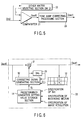
- the tone jump correcting processing section 5 has an error signal correcting section 11 to which the N-valued signal Dout0 supplied from the comparator 3 is input and a corrected N-valued signal storage section 12 that stores the corrected N-valued signal Dout1 with the tone jump prevented.
- the corrected N-valued signal storage section 12 has capacity to store the corrected N-valued signals Dout1 for two lines including the remarked pixel X and stores consecutively the signals for two lines, a line including pixels which is in a process and the preceding line.
- the tone jump correcting processing section 5 has a correcting signal generating section 13 and a predetermined gradation setting value storage section 14.
- the correcting signal generating section 13 compares the respective pixels with a predetermined gradation TJ read out from the predetermined gradation setting value storage section 14, which causes the tone jump. Then the correcting signal generating section 13 outputs a correcting signal Dh to the error signal correcting section 11.
- the error signal correcting section 11 makes a calculation of Dout0 - Dh with the input N-valued signal Dout0 and the correcting signal Dh and outputs the corrected N-valued signal Dout1.
- the predetermined gradation setting value storage section 14 has an A-ink predetermined gradation table 141 shown in FIG. 3A and a B-ink predetermined gradation table 142 shown in FIG. 3B.
- Each of the tables 141 and 142 is set with a predetermined gradation TJ which causes a tone jumps in accordance with the kind of recording medium, i.e., "plain paper”, “dedicated paper”, “glossy paper” and image resolution, i.e., "150 dpi", "300 dpi", “600 dpi". For example, assume that the ink A is used.
- the predetermined gradation TJ is "2" for the plain paper; "4" for the dedicated paper; and "5" for the glossy paper.
- the maximum gradation for the image resolution 150 dpi is "15"; for the image resolution 300 dpi, "7”; and for the image resolution 600 dpi, "3".
- the predetermined gradation setting value storage section 14 reads out the predetermined gradation TJ in accordance with an ink specifying signal, recording medium specifying signal and image resolution specifying signal, which are inputted from external and supplies the read gradation TJ to the correcting signal generating section 13.
- an ink specifying signal the glossy paper as a recording medium and the 300 dpi as an image resolution
- the predetermined gradation TJ of "5" is to be read.
- the tone jump correcting processing section 5 sets the predetermined TJ in accordance with the kind of ink, kind of medium and image resolution.
- correction can be carried out with the correcting signal Dh so as to prevent dots from associating with each other.
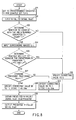
- FIG. 4 is a flow chart showing a correcting processing which the tone jump correcting processing section 5 carries out.
- the tone jump correcting processing section 5 reads out the predetermined gradation TJ from the predetermined gradation setting value storage section 14 in accordance with the ink specifying signal, recording medium specifying signal and image resolution specifying signal, which are input from external, and sets the gradation TJ.
- there is ink to be used is oil pigment ink that is made by dispersing pigment in oil based solvent, and the ink has 10 mm Pa ⁇ s of viscosity at room temperature.
- the gradation may only be set to satisfy A - D ⁇ 0. Accordingly, in this case, the predetermined gradation is set at "5".
- the correcting signal generating section 13 determines whether or not the gradation of the N-valued signal Dout0 coincides with the predetermined gradation TJ.
- the correcting signal generating section 13 specifies the correcting value Dh to be at "0" in a step S15.
- the surrounding pixels L and U are input. Subsequently, in a step S16, it is determined whether or not the gradations of the surrounding pixels L and U coincide with the predetermined gradation TJ. When it is found that U ⁇ TJ and L ⁇ TJ, the correcting signal generating section 13 specifies the correcting value Dh to be at "0" in a step S15. When either of the gradations in the surrounding pixels L and U coincides with the predetermined gradation TJ, the correcting signal generating section 13 specifies the correcting value Dh to be at "1" in a step S17.
- the M-valued input image signal Din0 is input into the input image signal correcting section 1.
- the input image signal correcting section 1 adds the remarked pixel accumulating error Es supplied from the accumulating error storage section 2 to the input image signal Din0 and outputs corrected image signal Din1. And then the corrected image signal Din1 is compared to the threshold T(i) supplied from the threshold value generating device 4 in the comparator 3 and converted into the N-valued signal Dout0.
- the N-valued signal Dout0 is input into the tone jump correcting processing section 5. It is determined whether or not the gradation of the N-valued signal Dout0 coincides with the predetermined gradation TJ. When the gradation of the N-valued signal Dout0 is coincident with the predetermined gradation TJ, subsequently, it is determined whether or not the gradation of the pixel L on the left side of the remarked pixel X which is stored in the corrected N-valued signal storage section 12 with the tone jump prevented and the gradation of the pixel U immediately above the remarked pixel X are coincide with the predetermined gradation TJ.
- the tone jump correcting processing section 5 specified the correcting value Dh to be "1", and outputs the corrected N-valued signal Dout1 obtained by reducing one level of gradation in the N-valued signal Dout0.
- the corrected N-valued signal Dout1 is supplied to the N-valued error calculating section 6.
- the N-valued error calculating section 6 calculates the difference between the corrected image signal Din1 and the value of the N-valued signal Dout1 which is converted into the input image signal level. Then the N-valued error Er with the tone jump prevented is supplied to the diffusion error calculating section 7 and used for a succeeding error diffusion process.
- the corrected N-valued signal Dout1 with the tone jump prevented is supplied to the N-valued error calculating section 6 and used for a succeeding process. Therefore, the corrected N-valued signal Dout1 is a signal to which an error diffusion process has been performed. Accordingly, the image formed from the corrected N-valued signal Dout1 that is the converted multivalued image data is an image preserving the average density. That is, the average density after conversion into the multivalued image data can be preserved.
- the predetermined gradation TJ is read out from the predetermined gradation setting value storage section 14 in accordance with the kind of the ink, kind of the recording medium and image resolution.
- the tone jump can be prevented properly through the ink to be used, the recording medium to be used and the image resolution. That is, even the gradation in which the tone jump occurs is changed, it can be handled through the relation among the kind of ink, the kind of recording medium and the image resolution.
- the invention has been described with the embodiment in that the correction to prevent the tone jump from occurring is achieved by reducing one level of the gradation.
- the invention is not limited to the case above.
- the correction to prevent the tone jump may be achieved by increasing one level of the gradation.
- the method for the error diffusion processing is not limited to the case described in the above embodiment. However, another method for the error diffusion processing may be applicable.
- the input image signal is not limited to black and white one, but a colored input image signal is applicable. In this case, it can be realized by preparing a lookup table for each color signal of Y(Yellow), M(Magenta) and C(Cyan), and carrying out the same processing as one in the embodiment.
- an image processing method will be described in that an input image signal of M-gradations is processed by a dither processing and converted into an image signal of N-gradations (M > N > 2).
- FIG. 5 is a block diagram showing the entire structure.
- the input image signal Din0 of M-gradations is supplied to a comparator 21 and a dither matrix selecting section 22.
- the dither matrix selecting section 22 selects a dither matrix DM (j) in accordance with the input image signal Din0 and supplies a threshold t at a predetermined position to the comparator 21.
- j is a natural number satisfying 1 ⁇ j ⁇ N.
- the comparator 21 supplies the N-valued signal Dout0 to a tone jump correcting processing section 23. Then the tone jump correcting processing section 23 outputs an N-valued signal Dout1 with the tone jump prevented while preserving the average density.
- the tone jump correcting processing section 23 has an error signal correcting section 31 into which the N-valued signal Dout0 supplied from the comparator 21 is input, and the corrected N-valued signal storage section 12 that stores the corrected N-valued signal Dout1 from which the tone jump has been prevented.
- the tone jump correcting processing section 23 is provided with a correcting signal generating section 32, a preceding correcting processing storage section 33 and the predetermined gradation setting value storage section 14.
- the correcting signal generating section 32 outputs a correcting signal Dh to the error signal correcting section 31 with reference to a preceding correcting signal Dhb stored in the preceding correcting processing storage section 33. And then the preceding correcting processing storage section 33 stores the recent correcting signal Dh as a preceding correcting signal Dhb.
- the error signal correcting section 31 makes a calculation of Dout0 + Dh with the input N-valued signal Dout0 and the correcting signal Dh and outputs the corrected N-valued signal Dout1.
- FIG. 8 is a flow chart showing a correcting processing which the tone jump correcting processing section 23 performs.
- the correcting signal generating section 32 determines whether or not the gradation of the N-valued signal Dout0 coincides with the predetermined gradation TJ.
- the correcting signal generating section 32 specifies the correcting value Dh to be "0" in a step S25.
- the surrounding pixels L and U are input. Subsequently, in a step S26, it is determined whether or not the gradations of the surrounding pixels L and U coincide with the predetermined gradation TJ. When it is found that U ⁇ TJ and L ⁇ TJ, the correcting signal generating section 32 specifies the correcting value Dh to be "0" in a step S25. When either of the gradations in the surrounding pixels L and U coincides with the predetermined gradation TJ, it is determined whether or not the preceding correcting signal Dhb stored in the preceding correcting processing storage section 33 is "1".
- the tone jump correcting processing section 23 specifies the correcting value Dh to "-1". Then the tone jump correcting processing section 23 supplies the specified correcting value Dh to the error signal correcting section 31 and stores the correcting value as a preceding correcting signal Dhb in the preceding correction processing storage section 33.
- the section 23 specifies the correcting value Dh to "1". Then, the section 23 supplies the value Dh to the error signal correcting section 31 and stores the value as a preceding correcting signal Dhb in the section 33.
- the M-gradation input image signal Din0 is input into the comparator 21.
- the input image signal Din0 is compared with a threshold of the dither matrix DM (j) supplied from the dither matrix selecting section 22 and converted into the dither-processed N-valued signal Dout0.
- the N-valued signal Dout0 is input into the tone jump correcting processing section 23. It is determined whether or not the gradation of the N-valued signal Dout0 coincides with the predetermined gradation TJ. When the gradation of the N-valued signal Dout0 is coincident with the predetermined gradation TJ, it is determined whether or not the gradation of the pixel L on the left side of the remarked pixel X which is stored in the corrected N-valued signal storage section 12 with the tone jump prevented and the gradation of the pixel U immediately above the remarked pixel X are coincide with the predetermined gradation TJ.
- the tone jump is likely to occur.
- the tone jump can be prevented by reducing or increasing the gradation of the remarked pixel by one level.
- the preceding correcting value is "1”
- the gradation of the remarked pixel is reduced by one level
- the preceding correcting value is at "-1”
- the predetermined gradation TJ is read out from the predetermined gradation setting value storage section 14 in accordance with the kind of the ink, kind of the recording medium and image resolution.
- the tone jump can be prevented properly through the ink to be used, the recording medium to be used and the image resolution. That is, even the gradation in which the tone jump occurs is changed, it can be handled through the relation among the kind of ink, the kind of recording medium and the image resolution.
- the method of dither processing is not limited to one described in the embodiment.
- the invention can be applied to a case where the dither processing is performed by the other method.
- the color of the input image signal is not limited to black and white, but color signal may be acceptable. In this case, it can be realized by preparing a lookup table for each color signal of Y(Yellow), M(Magenta) and C(Cyan) and carrying out the same processing as one in the embodiment.
- the correcting signal generating section reads out a pixel L on the left side of the remarked pixel X and a pixel U immediately above the remarked pixel X from the corrected N-valued signal storage section 12 and compares their gradation with the predetermined gradation TJ.
- the correcting value may be read out as follows.
- a pixel L on the left side of the remarked pixel X, a pixel U immediately above the remarked pixel X, a pixel UL on the diagonally upper left side of the remarked pixel X and a pixel UR on the diagonally upper right side of the remarked pixel X are read out from the corrected N-valued signal storage section 12. Then the correcting value corresponding to a lookup table is read out with combination of gradations in the respective pixels L, U, UL and UR.
- the predetermined gradation table is selected as the predetermined gradation setting value storage section in accordance with the kind of ink, and the predetermined gradation is set in accordance with the kind of recording media and image resolution.
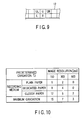
- the kind of ink it is also applicable that only one predetermined gradation table is provided as shown in FIG. 10, and the predetermined gradation is set in accordance with the kind of recording media and image resolution.
Landscapes
- Engineering & Computer Science (AREA)
- Multimedia (AREA)
- Signal Processing (AREA)
- Image Processing (AREA)
- Facsimile Image Signal Circuits (AREA)
- Ink Jet (AREA)
- Color, Gradation (AREA)
Abstract
Description
Claims (10)
- An image processing method of converting input image data (Din0) of M-gradations in a pixel into multivalued image data (Din1) of N-gradations in a pixel, characterized by comprising:converting image data Din of M-gradations in a pixel into multivalued image data Dout0 of N-gradations in a pixel;determining whether a remarked pixel converted into the multivalued data is a predetermined gradation TJ (N > TJ > 2) which causes a tone jump (S13);determining, when the remarked pixel converted into the multivalued data is determined to be the predetermined gradation TJ, whether a pixel of the predetermined gradation TJ exists in pixels being adjacent to the remarked pixel (S16);changing the gradation of the remarked pixel to a gradation other than the predetermined gradation so as to avert the tone jump when the pixel of the predetermined gradation TJ exists (S17); andstoring an average density after multivalued image data conversion (2, 5, 6, 7, 8).
- The method according to claim 1, characterized in that
the image data Din of M-gradations in a pixel is converted into the multivalued image data of N-gradations (M > N > 2) in a pixel by an error diffusion method. - The method according to claim 1, characterized in that
the image data Din of M-gradations in a pixel is converted into the multivalued image data of N-gradations (M > N > 2) in a pixel by a dither method. - The method according to claim 2, characterized in that
an average density after multivalued image data conversion is stored by performing the error diffusion method (2, 5, 6, 7, 8) in accordance with the gradation other than the predetermined gradation converted to prevent the tone jump. - The method according to claim 3, characterized in that
the gradation other than the predetermined gradation changed to prevent the tone jump is repeatedly increased and reduced alternately so as to store its average density (S27 to S29). - The method according to claim 4 or 5, characterized in that
when a pixel of the predetermined gradation TJ exists, a gradation of the remarked pixel is reduced by one level so as to prevent the tone jump (S18). - The method according to claim 4 or 5, characterized in that
when a pixel of the predetermined gradation TJ exists, a gradation of the remarked pixel is increased by one level so as to prevent the tone jump (S30). - The method according to claim 4 or 5, characterized in that
assuming that a dot diameter of a pixel in a gradation i is D (i), and one side length of a rectangle which is given by assuming that a pixel in some resolution has a rectangular shape according to the theory, is A, the predetermined gradation TJ is set to a gradation that satisfies A - D (i) ≒ 0. - The method according to claim 4 or 5, characterized in that
predetermined gradations TJ in which a tone jump occurs are set in a storage section (14) independently in accordance with the kind of recording medium and image resolution, and then the corresponding predetermined gradation is read out from the storage section in accordance with specification of the recording medium and specification of the image resolution, and is set. - The method according to claim 4 or 5, characterized in that
predetermined gradations TJ in which a tone jump occurs are set in a storage section (14) independently in accordance with the kind of ink, the kind of recording medium and image resolution, and then the corresponding predetermined gradation is read out from the storage section in accordance with specification of the ink, specification of the recording medium and specification of the image resolution, and is set.
Applications Claiming Priority (2)
| Application Number | Priority Date | Filing Date | Title |
|---|---|---|---|
| JP2001146715 | 2001-05-16 | ||
| JP2001146715A JP4116265B2 (en) | 2001-05-16 | 2001-05-16 | Image processing method and image processing apparatus |
Publications (2)
| Publication Number | Publication Date |
|---|---|
| EP1259063A2 true EP1259063A2 (en) | 2002-11-20 |
| EP1259063A3 EP1259063A3 (en) | 2005-02-16 |
Family
ID=18992314
Family Applications (1)
| Application Number | Title | Priority Date | Filing Date |
|---|---|---|---|
| EP02006224A Withdrawn EP1259063A3 (en) | 2001-05-16 | 2002-03-20 | Image processing method |
Country Status (3)
| Country | Link |
|---|---|
| US (1) | US7145702B2 (en) |
| EP (1) | EP1259063A3 (en) |
| JP (1) | JP4116265B2 (en) |
Cited By (1)
| Publication number | Priority date | Publication date | Assignee | Title |
|---|---|---|---|---|
| NL2016503A (en) * | 2015-03-26 | 2016-10-10 | Canon Kk | Image processing apparatus, image processing method, and image simulation method |
Families Citing this family (3)
| Publication number | Priority date | Publication date | Assignee | Title |
|---|---|---|---|---|
| JP7483560B2 (en) * | 2020-08-25 | 2024-05-15 | キヤノン株式会社 | Image forming device |
| JP7877777B2 (en) * | 2022-03-31 | 2026-06-23 | ブラザー工業株式会社 | Printing apparatus, its control method, and computer program |
| JP2024050050A (en) * | 2022-09-29 | 2024-04-10 | ブラザー工業株式会社 | Image processing device, image processing method, and program |
Family Cites Families (13)
| Publication number | Priority date | Publication date | Assignee | Title |
|---|---|---|---|---|
| US553967A (en) * | 1896-02-04 | System of supplying water to locomotives | ||
| DE1772367C3 (en) * | 1968-05-04 | 1974-10-31 | Dr.-Ing. Rudolf Hell Gmbh, 2300 Kiel | Process for the rasterized reproduction of halftone images |
| US4680645A (en) * | 1986-08-25 | 1987-07-14 | Hewlett-Packard Company | Method for rendering gray scale images with variable dot sizes |
| US5191444A (en) * | 1988-06-20 | 1993-03-02 | Sanyo Electric Co., Ltd. | Method of converting gradation of a digital image and a circuit thereof and a print density controlling apparatus for a printer and a printer using this method |
| US5539667A (en) | 1992-09-15 | 1996-07-23 | Gcc Technologies | Method and apparatus for improved digital film recorder |
| EP0650289A1 (en) * | 1993-10-04 | 1995-04-26 | Eastman Kodak Company | Method and apparatus for generating a halftone pattern for a multi-level output device |
| US5708514A (en) * | 1994-08-31 | 1998-01-13 | Kabushiki Kaisha Toshiba | Error diffusion method in a multi-level image recording apparatus utilizing adjacent-pixel characteristics |
| JP3862769B2 (en) | 1994-08-31 | 2006-12-27 | 株式会社東芝 | Image recording device |
| US5809177A (en) * | 1996-06-06 | 1998-09-15 | Xerox Corporation | Hybrid error diffusion pattern shifting reduction using programmable threshold perturbation |
| US5835238A (en) | 1996-06-27 | 1998-11-10 | Xerox Corporation | Phantom level edge enhanced error diffusion |
| JPH1188665A (en) * | 1997-09-04 | 1999-03-30 | Minolta Co Ltd | Image processing device |
| JP3861512B2 (en) | 1999-05-19 | 2006-12-20 | セイコーエプソン株式会社 | Image processing device for electrophotography |
| JP4236804B2 (en) * | 2000-09-29 | 2009-03-11 | 富士通株式会社 | Image processing method, apparatus and storage medium |
-
2001
- 2001-05-16 JP JP2001146715A patent/JP4116265B2/en not_active Expired - Fee Related
-
2002
- 2002-03-18 US US10/100,626 patent/US7145702B2/en not_active Expired - Fee Related
- 2002-03-20 EP EP02006224A patent/EP1259063A3/en not_active Withdrawn
Cited By (1)
| Publication number | Priority date | Publication date | Assignee | Title |
|---|---|---|---|---|
| NL2016503A (en) * | 2015-03-26 | 2016-10-10 | Canon Kk | Image processing apparatus, image processing method, and image simulation method |
Also Published As
| Publication number | Publication date |
|---|---|
| JP4116265B2 (en) | 2008-07-09 |
| US20020171882A1 (en) | 2002-11-21 |
| US7145702B2 (en) | 2006-12-05 |
| JP2002344741A (en) | 2002-11-29 |
| EP1259063A3 (en) | 2005-02-16 |
Similar Documents
| Publication | Publication Date | Title |
|---|---|---|
| US5497180A (en) | Image recording apparatus for representing a halftone by use of a plurality of recorded dots | |
| US6011878A (en) | Image processing method and apparatus | |
| US8208172B2 (en) | Image forming apparatus and image forming method | |
| EP0687102A2 (en) | Method of and apparatus for generating halftone image | |
| EP1267565B1 (en) | Method for multilevel printing of digital images using reduced colorant amounts | |
| EP0369778A2 (en) | Image recording apparatus | |
| US7362472B2 (en) | Color error diffusion | |
| US5283664A (en) | Apparatus for converting and processing input bi-level image data and faithfully rendering tones, colors, and edges | |
| EP0777377A1 (en) | Method and image reproduction device for reproducing grey values | |
| US20100103464A1 (en) | Image processing apparatus and image processing method | |
| JP2004188980A (en) | Digital image printing in which reduced amount of colorant is used while maintaining sensed color | |
| US5751929A (en) | Image processing apparatus | |
| US7145702B2 (en) | Image processing method | |
| US8098403B2 (en) | Color error diffusion with error signal offset | |
| US20040085553A1 (en) | Multitoning a digital image having at least one group of similar colors channels | |
| US6554385B2 (en) | Color image generation apparatus and color image generation method | |
| EP1553753A2 (en) | Color printing | |
| WO2004100529A1 (en) | Image processing for expressing gradation | |
| US7002708B2 (en) | Delayed decision dot placement for plane-dependent CMYK error diffusion | |
| EP2413584A1 (en) | Image processing apparatus, image processing method, and program | |
| US7443541B2 (en) | Image processing apparatus and image processing method | |
| JP2011234344A (en) | Image forming device and method for halftone processing | |
| EP1553755B1 (en) | Color printing by replacing chromatic black dots with monochrome black dots | |
| EP0817471A2 (en) | Image process apparatus, image process method and storage medium | |
| JP2800071B2 (en) | Color image forming equipment |
Legal Events
| Date | Code | Title | Description |
|---|---|---|---|
| PUAI | Public reference made under article 153(3) epc to a published international application that has entered the european phase |
Free format text: ORIGINAL CODE: 0009012 |
|
| 17P | Request for examination filed |
Effective date: 20020320 |
|
| AK | Designated contracting states |
Kind code of ref document: A2 Designated state(s): AT BE CH CY DE DK ES FI FR GB GR IE IT LI LU MC NL PT SE TR |
|
| AX | Request for extension of the european patent |
Free format text: AL;LT;LV;MK;RO;SI |
|
| PUAL | Search report despatched |
Free format text: ORIGINAL CODE: 0009013 |
|
| AK | Designated contracting states |
Kind code of ref document: A3 Designated state(s): AT BE CH CY DE DK ES FI FR GB GR IE IT LI LU MC NL PT SE TR |
|
| AX | Request for extension of the european patent |
Extension state: AL LT LV MK RO SI |
|
| AKX | Designation fees paid |
Designated state(s): BE DE FR GB |
|
| 17Q | First examination report despatched |
Effective date: 20060221 |
|
| STAA | Information on the status of an ep patent application or granted ep patent |
Free format text: STATUS: THE APPLICATION IS DEEMED TO BE WITHDRAWN |
|
| 18D | Application deemed to be withdrawn |
Effective date: 20091001 |