EP1258999A2 - Evaluating and optimizing error-correcting codes using a renormalization group transformation - Google Patents
Evaluating and optimizing error-correcting codes using a renormalization group transformation Download PDFInfo
- Publication number
- EP1258999A2 EP1258999A2 EP02009144A EP02009144A EP1258999A2 EP 1258999 A2 EP1258999 A2 EP 1258999A2 EP 02009144 A EP02009144 A EP 02009144A EP 02009144 A EP02009144 A EP 02009144A EP 1258999 A2 EP1258999 A2 EP 1258999A2
- Authority
- EP
- European Patent Office
- Prior art keywords
- node
- nodes
- variable
- error
- check
- Prior art date
- Legal status (The legal status is an assumption and is not a legal conclusion. Google has not performed a legal analysis and makes no representation as to the accuracy of the status listed.)
- Granted
Links
Images






Classifications
-
- H—ELECTRICITY
- H03—ELECTRONIC CIRCUITRY
- H03M—CODING; DECODING; CODE CONVERSION IN GENERAL
- H03M13/00—Coding, decoding or code conversion, for error detection or error correction; Coding theory basic assumptions; Coding bounds; Error probability evaluation methods; Channel models; Simulation or testing of codes
- H03M13/47—Error detection, forward error correction or error protection, not provided for in groups H03M13/01 - H03M13/37
-
- H—ELECTRICITY
- H03—ELECTRONIC CIRCUITRY
- H03M—CODING; DECODING; CODE CONVERSION IN GENERAL
- H03M13/00—Coding, decoding or code conversion, for error detection or error correction; Coding theory basic assumptions; Coding bounds; Error probability evaluation methods; Channel models; Simulation or testing of codes
- H03M13/01—Coding theory basic assumptions; Coding bounds; Error probability evaluation methods; Channel models; Simulation or testing of codes
-
- H—ELECTRICITY
- H03—ELECTRONIC CIRCUITRY
- H03M—CODING; DECODING; CODE CONVERSION IN GENERAL
- H03M13/00—Coding, decoding or code conversion, for error detection or error correction; Coding theory basic assumptions; Coding bounds; Error probability evaluation methods; Channel models; Simulation or testing of codes
- H03M13/37—Decoding methods or techniques, not specific to the particular type of coding provided for in groups H03M13/03 - H03M13/35
Definitions
- the present invention relates generally to the field of error-correcting codes for data storage and data transmission, and more particularly to evaluating and optimizing error-correcting codes for intermediate length data blocks.
- ECC error-correcting codes
- parity-check codes defined by generalized parity check matrices. These types of codes were first described by R. G. Gallager, in "Low-density parity check codes," Vol.21, Research Monograph Series, MIT Press, 1963, but were not properly appreciated until recently. More recently, improved codes defined by sparse generalized parity check matrices have been described, such as turbocodes, irregular low-density parity check (LDPC) codes, Kanter-Saad codes, repeat-accumulate codes, and irregular repeat-accumulate codes.
- LDPC irregular low-density parity check
- the codes can be decoded efficiently using belief propagation (BP) iterative decoding.
- BP belief propagation
- the performance of these codes can often be theoretically analyzed using a density evolution method, in an infinite-block-length limit.
- the preferred prior art way for generating improved codes has been to optimize codes for the infinite block-length limit using density evolution, and hope that a scaled-down version still results in a near optimal code.
- the problem with this method is that for N ⁇ 10 4 , at least, the block-length is still noticeably far from the infinite-block-length limit.
- many decoding failures are found at noise levels far below the threshold level predicted by infinite block-length calculations.
- the best known irregular LDPC codes at a given rate in the N ⁇ ⁇ limit, often have variable nodes that should participate in hundreds or even thousands of parity checks, which makes no sense when the overall number of parity checks is 100 or less.
- a binary erasure channel is a binary input channel with three output symbols: 0, 1, and an erasure, which can be represented by a question mark "?.” Because this method is important background for the method according to the invention, it is distinguished in greater detail.
- Linear block binary error-correcting codes can be defined in terms of a parity check matrix.
- the parity check matrix has N columns and N-k rows, then the parity check defines an error correcting code of block-length N and transmission rate k / N , unless some of the rows are linearly dependent, in which case some of the parity checks are redundant, and the code actually has a higher transmission rate.
- Tanner graph 100 is a bipartite graph with two types of nodes: variable nodes i denoted by circles, and check nodes a denoted by squares.
- each variable node is connected to the check node participating in the check for the variable node i .
- the parity check matrix is represented by the bipartite Tanner graph shown in Figure 1.
- Error-correcting codes defined by parity check matrices are linear. This means that each codeword is a linear combination of other codewords. In a check matrix, there are 2 k possible codewords, each of length N . For the example given the above, the codewords are 000000, 001011, 010110, 011101, 100110, 101101, 110011, 111000. Because of the linearity property, any of the codewords are representative. For the purposes of analyzing a code, it is therefore normally assumed that the all-zeros codeword is transmitted.
- An input bit passes through the binary erasure channel as an erasure with probability x and is received correctly with probability 1 - x . It is important to note that the BEC never flips bits from 0 to 1, or vice versa. If all-zeros codewords are transmitted, the received word must consist entirely of zeros and erasures.
- the receiver uses a belief propagation (BP) decoder to decode the input bits by passing discrete messages between the nodes of the Tanner graph.
- a message m ia is sent from each variable node i to each check node a connected to it.
- the message represents the state of the variable node i .
- the message can be in one of three states: 1, 0, or ?, but because the all-zeros codeword is always transmitted, the possibility that m ia has value 1 can be ignored.
- m ai sent from each check node a to all the variable nodes i connected to the check node.
- These messages are interpreted as directives from the check node a to the variable node i about what state the variable node should be in. This message is based on the states of the other variable nodes connected to the check node.
- the check-to-bit messages can, in principle, take on the values 0, 1, or ?, but again only the two messages 0 and ? are relevant when the all-zeros codeword is transmitted.
- a message m ia from a variable node i to a check node a is equal to a non-erasure received message because such messages are always correct in the BEC, or to an erasure when all incoming messages are erasures.
- a message m ai from a check node a to a variable node i is an erasure when any incoming message from another node participating in the check is an erasure; otherwise it takes on the value of the binary sum of all incoming messages from other nodes participating in the check.
- BP decoding is iterative.
- the messages are initialized so that all variable nodes that are not erased by the channel send out messages equal to the corresponding received bit, and all other messages are initially erasures. Iterating the BP message process converges eventually to stationary messages because convergence of BP decoding is guaranteed for the particularly simple BEC, though not for other channels.
- the final decoded value of any erased variable node is just the value of any non-erasure message coming into that node, unless there is no incoming non-erasure message. In this case, the BP decoding process terminates and fails to decode the particular variable node.
- a real number p ia which represents the probability that the message m ia is an erasure, is associated with each message m ia .
- a real number q ai which represents the probability that the message m ai is an erasure, is associated with each message m ai .
- probabilities p ia and q ai are determined in a way that is exact, as long as the Tanner graph representing the error-correcting code has no loops.
- Equation for p ia is where b ⁇ N ( i ) ⁇ a represents all check nodes directly connected to a neighboring variable node i, except for check node a .
- This equation can be derived from the fact that for a message m ia to be an erasure, the variable node i must be erased in transmission, and all incoming messages from other checks are erasures as well. Of course, if the incoming messages are correlated, then this equation is not correct. However, in a Tanner graph with no loops, each incoming message is independent of all other messages.
- Equation can be derived from the fact that a message q ai can only be in a 0 or 1 state when all incoming messages are in either a zero or one state.
- the density evolution equations (3) and (4) can be solved by iteration.
- the BEC density evolution equations ultimately converge. This can be guaranteed for codes defined in graphs without loops. It is possible to determine b i , which is the probability of a failure to decode at variable node i , from the formula
- the density evolution equations (3, 4, and 5) are exact when the code has a Tanner graph representation without loops.
- a regular Gallager code is a sparse random parity check matrix characterized by the restriction that each row has exactly d c ones in it, and each column contains exactly d v ones.
- the present invention provides a method for evaluating an error correcting code for a data block of a finite size in a binary erasure channel or an additive white Gaussian noise channel.
- An error-correcting code is defined by a generalized parity check matrix, wherein columns represent variable bits and rows represent parity bits. In a notation of the matrix, "hidden" variable bits which are not transmitted through the channel are represented by a bar over the corresponding column of the generalized parity check matrix.
- the generalized parity check matrix is represented as a bipartite graph. A single node in the bipartite graph is iteratively renormalized until the number of nodes in the bipartite graph is less than a predetermined threshold.
- a particular variable node is selected as a target node, and a distance between the target node and every other node in the bipartite graph is measured. Then, if there is at least one "leaf" variable node, renormalize a leaf variable node farthest from the target node, otherwise, renormalize a leaf check node farthest from the target node, and otherwise renormalize a variable node farthest from the target node and having fewest directly connected check nodes.
- Leaf nodes are connected to only one other node in the graph.
- the decoding failure rate for the target node is determined exactly.
- the present invention provides a method for optimizing error-correcting codes by searching for the error-correcting code of a specified data block size and transmission rate with the best performance in terms of decoding failure as a function of noise.
- the decoding failure rates for transmitted variable bits are used to guide the search for an optimal code.
- Our invention evaluates error-correcting codes by using "real-space" renormalization group transformations.
- Our renormalization group (RG) method is adapted from techniques for the analysis of magnetic spin systems described by T. Niemeijer and J. M. J. van Leeuwen in "Phase Transitions and Critical Phenomena,” C. Domb and M. S. Green editors, Vol. 6, Academic Press, London, 1976. Renormalization groups have never been applied to error-correcting codes used to store and transmit data.
- the basis of our RG method is the RG transformation by which we iteratively eliminate, i.e., "renormalize,” single nodes in the decorated Tanner graph, and adjust the remaining values of the p and q messages so that the smaller error-correcting code has a decoding failure rate as close as possible to the replaced code.
- the decorated Tanner graph representing our code shrinks by one node, until the graph is finally small enough that the performance of the error-correcting code can be determined in an efficient manner.
- prior art density evolution methods never change the number of nodes, or the way the nodes are connected to each other. In other words, their graphs are static, while our graphs change dynamically during renormalization.
- our graph is small enough, e.g., when the number of remaining nodes is less than a predetermined threshold, the failure rate can readily be determined. In one embodiment, we reduce the graph down to a single node.
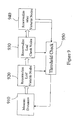
- Figure 9 shows the steps of the general method 900 according to our invention. For each selected "target" variable node i in our decorated Tanner graph for which the decoding failure rate b i is to be determined, repeatedly renormalize a single node from the graph, other than the target node, until a predetermined threshold 950 is reached.
- the threshold can either be expressed as a desired number of nodes, or a desired failure rate for the remaining node. Nodes are renormalized as follows.
- Measure 910 the "distances" between every other node and the "target" node i .
- the distance between two nodes is the minimal number of nodes through which one passes to travel from one node to the other, i.e., the number of intervening nodes.
- a node is a leaf node when it is connected to only one other node in the graph. Ties in distance can be broken randomly.
- the renormalization steps are iteratively repeated until the graph has been reduced down to the desired number of nodes. The details of these steps are described in greater detail below.
- the above steps can be applied to as many target nodes as desired; for example, the average failure rate of every node in the graph can be determined.
- the renormalization is applied to target nodes representative of groups of like nodes. Then, it can be determine if the group of nodes is "strong" or "weak” with respect to its error-correcting capabilities. This information can then be used to improve the overall performance of the error-correcting code. For example, nodes in weak groups can be connected to more parity checks.
- the invention provides means for improving error-correcting codes in a structured manner.
- the first possibility is to renormalize the farthest "leaf" variable node that is connected to the target node i. Clearly, when that leaf node "vanishes,” p ia and q ai are also discarded. We also renormalize all the q aj variables leading out of the target node i to other variable nodes j . Our formulation for this renormalization is: q aj ⁇ 1 - (1 - q aj )(1 - p ia ) where the left arrow indicates that we replace the old value of q aj with the new value. Notice that each renormalization of q aj increases its value.
- step 940 The renormalization of step 940 is described in greater detail below for loopy graphs.
- the new reduced size decorated Tanner graph is shown in Figure 3(b).
- the even smaller decorated Tanner graph is shown in Figure 3(c).
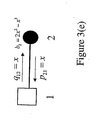
- the Tanner graph is shown in Figure 3(d).
- the renormalization of the q aj variable can be done to varying degrees of accuracy.
- the simplest method uses equation (37) directly.
- the problem with this method is that the value of p ia is always an over-estimate. Recall that p ia decreases with every renormalization. Because we are renormalizing the i th node before it has become a leaf node, p ia is not yet been fully renormalized, and is thus over-estimated.
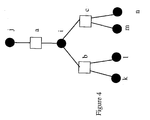
- the new probability of an erasure message can be determined from a logical argument: " m aj is an erasure if it was already or if m ia is an erasure and ( m bi or m kb or m lb are erasures) and ( m ci or m mc or m nc are erasures)."
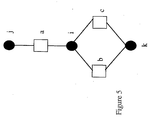
- the graph in Figure 5 shows a case where a variable node k is attached to two check nodes b and c, which in turn are each attached to variable node i that is to be renormalized. Note that before check nodes b or c are renormalized, the probabilities p kb and p kc that variable node k sends out an erasure must be identical, because all renormalizations of p kb and p kc happen in tandem.
- the step for renormalizing a non-leaf variable node i can be made increasingly accurate by increasing the size of the neighborhood around the node that was treated correctly. Naturally, as we increase the size of the neighborhood, we must pay for the increased accuracy with greater computation.
- Figure 10 summarizes a method for renormalize a variable node that is not a leaf node, i.e., step 940 of Figure 9.
- Step 1010 enumerates all check nodes a, b, etc. which are connected to the variable node to be renormalized and discards all the probability variables p ia , p ib , q ai , q bi , etc. between these check nodes and the variable node.
- our RG method can always renormalize nodes until just the "target" node i is left, and then determine the decoding failure rate b i .
- b i by taking the weighted average over all possible received messages of the probability that node i decodes to an erasure. Because the complexity of the exact calculation is O(2 N ), we restricted our to a small N, but nevertheless we can gain some accuracy by switching to an exact calculation after renormalizing sufficient nodes.
- Figure 6 shows an example of expanding a decorated Tanner graph 601 to an equivalent erasure Tanner graph 602 with erasure probabilities.
- Generalized parity check matrices define many of the modern error-correcting codes, such as turbo-codes, Kanter-Saad codes, and repeat-accumulate codes.
- additional columns are added to a parity check matrix to represent "hidden" nodes.
- Hidden nodes have state variables that are not passed to other nodes, i.e., the states of the hidden nodes are "hidden.”.
- a good notation for the hidden state variables is a horizontal line above the corresponding columns. For example, we write to indicate a code where the first variable node is a hidden node. To indicate that a variable node is a hidden node in our graphical model, we use an open circle rather than a filled-in circle.
- Figure 7 shows a Wiberg graph representing an error-correcting code defined by the generalized parity check matrix or equation (47).
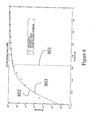
- Figure 8 shows our experimental results
- the x-axis is the erasure rate
- the y-axis the bit error rate.
- Curve 801 is the prior art density evolution prediction
- curve 802 the RG theoretical prediction
- the open circles 803 our experimental results.
- Figure 8 clearly shows that the density-evolution prediction has a threshold-like behavior and is completely incorrect for small or medium block-lengths, whereas the RG method according to the invention is not.
- the log-likelihood ratio m i 0 ln( p ( y i
- x 1 0)/ p ( y i
- the error-correcting code is defined by the generalized parity check matrices, as described above.
- the all-zeros codewords are transmitted, and the decoding process is the sum-product belief propagation process.
- real-valued messages are iteratively solved as functions of each other.
- the types of real-valued messages which are used are m ia from variable nodes i to check nodes a ; and m ai from check nodes a to variable nodes i .
- the messages m ia are log-likelihood ratios by which the variable node i informs the check node a of its probability of being either a zero or a one.
- m ia ⁇ ⁇ means that node i is certain it is a zero
- the messages mai are log-likelihood ratios interpreted as information from the check node a to the variable node i about the state of variable node i .
- the messages are iteratively solved according to the update rules: if node i is a hidden node, the m i 0 is omitted, and
- the density evolution equations for the AWGN channel can be reduced to self-consistent equations for the means u ia of the probability distributions of messages from variable nodes i to check nodes a , and the means v ai of the probability distributions of messages from check nodes a to variable nodes i .
- u 0 is the mean value of m i 0 , and is omitted for hidden nodes
- ⁇ ( x ) is a function defined by
- the density evolution equations (50) and (51) for the AWGN channel under the Gaussian approximation are analogs of the density evolution equations (4) and (3) for the BEC channel.
- Our RG procedure for the AWGN channel is substantially the same as for the BEC channel. The main difference is that we change the RG transformations.
- the RG method proceeds as in the BEC case, until the determination of the bit error rate.
- the RG method proceeds as in the BEC case, until the determination of the bit error rate.
- the search according to the invention improves on the results obtained using the prior art density evolution process.
- We can guide the search because we have information about the bit error rate at every node. For example, it might make sense to "strengthen” a weak variable node with a high bit error rate by adding additional parity check nodes, or we can "weaken" strong nodes with a low bit error rate by turning the weak nodes into hidden nodes, thus increasing the transmission rate.
- determining the bit error rate of every node slows down a search. It may be worthwhile, at least at least for large block-lengths, to restrict oneself to those codes for which there are only a small number of different classes of nodes, defined in terms of the local neighborhoods of the nodes. Most of the best-known codes are of this type. Rather than determining the bit error rate for every variable node, we can determine the bit error rate for just one representative node of each class of variable nodes.
- each node has the same local neighborhood, so any node can be selected as a representative of all the nodes in the neighborhood.
- the error made in this method is estimated by comparing bit error rates of different nodes of the same class.
- the RG method gives very similar predictions for each of the nodes, so that the error made by just considering a single variable node as a representative of all of them is quite small.
Landscapes
- Physics & Mathematics (AREA)
- Probability & Statistics with Applications (AREA)
- Engineering & Computer Science (AREA)
- Theoretical Computer Science (AREA)
- Error Detection And Correction (AREA)
- Detection And Correction Of Errors (AREA)
- Detection And Prevention Of Errors In Transmission (AREA)
Abstract
Description









"maj is an erasure if it was already or if mia is an erasure
and
(mbi or mkb or mlb are erasures) and (mci or mmc or mnc are erasures)."
"maj is an erasure if it was already or if ((mia is an erasure)
and
((mkb is an erasure) or (mbi and mci are erasures)))."






Claims (17)
- A method for evaluating an error-correcting code for a data block of a finite size, comprising;defining an error-correcting code by a parity check matrix;representing the parity check matrix as a bipartite graph; anditeratively renormalizing a single node in the bipartite graph until a predetermined threshold is reached.
- The method of claim 1 wherein the predetermined threshold is a minimum number of remaining nodes.
- The method of claim 1 wherein the bipartite graph includes variable nodes representing variable bits of the data block, and check nodes representing parity bits of the data block, and the renormalizing further comprises:selecting a particular variable node as a target node;selecting a particular node to be renormalized.
- The method of claim 3 further comprising:measuring a distance between the target node and every other node in the bipartite graph;if there is at least one leaf variable node, renormalizing a particular leaf variable node farthest from the target node, otherwiseif there is at least one leaf check node, renormalizing a particular leaf check node farthest from the target node, otherwiserenormalizing a non-leaf variable node farthest from the target node and having fewest directly connected check nodes.
- The method of claim 1 wherein the bipartite graph is loop-free.
- The method of claim 1 wherein the bipartite graph includes at least one loop.
- The method of claim 4 wherein a transmission channel is a binary erasure channel, and further comprising:decorating the bipartite graph with numbers pia representing probabilities of messages from variable nodes to check nodes and with numbers qia representing probabilities of messages from check nodes to variable nodes, and the renormalizing of the non-leaf variable node further comprises:enumerating all check-nodes a which are connected to the non-leaf variable node;enumerating all other variable nodes j attached to the check nodes a: andtransforming the numbers qaj .
- The method of claim 7 wherein the transforming of the numbers qaj further comprises:enumerating all check nodes and variable nodes out to a predetermined distance from the target node;constructing a logical argument to determine combinations of erasure causing a particular message from the check node a to the variable node j to be an erasure;translating the logical argument into a transformation for the number qaj .
- The method of claim 8 further comprisingterminating the renormalizing upon reaching the predetermined threshold by an exact determination.
- The method of claim 9 wherein the remaining bipartite graph includes N nodes in the exact determination, and further comprising:converting the decorated graph with numbers qai and pia into an erasure graph with an erasure probability xi with each node i of the bipartite graph;generating all 2 N possible messages; anddecoding each of the 2 N messages using a belief propagation decoder, where each message has a probability p = Πxi Π (1- xj ).
- The method of claim 7 wherein all the numbers qai are initialized to zero, and all the numbers pia are initialized to an erasure rate of the transmission channel.
- The method of claim 7 further comprising:defining the error-correcting code by a generalized parity check matrix wherein columns represent variable bits and rows define parity bits, and wherein an overbar is placed above columns representing hidden variable bits which are not transmitted; andrepresenting the hidden variable bits by hidden nodes in the bipartite graph.
- The method of claim 12 wherein the transmission channel is a binary erasure channel and wherein the error-correcting code is defined by a generalized parity check matrix, and further comprising:initializing the numbers pia for hidden nodes i to one.
- The method of claim 4 wherein the transmission channel is an additive white Gaussian noise channel, and further comprising:representing messages between nodes in the bipartite graph by Gaussian distributions;
- The method of claim 1, and further comprising:selecting a set of criterion by which to evaluate error-correcting codes;generating a plurality of error-correcting codes;searching the plurality of error-correcting codes for an optimal error-correcting code according to the set of criterion.
- The method of claim 15, and further comprising:evaluating an error rate for each error-correcting code at a plurality of nodes;generating the optimal error-correcting code according to the evaluated error-rate.
- The method of claim 1 further comprising:evaluating an error rate for the renormalized bipartite graph.
Applications Claiming Priority (2)
| Application Number | Priority Date | Filing Date | Title |
|---|---|---|---|
| US858358 | 2001-05-16 | ||
| US09/858,358 US6857097B2 (en) | 2001-05-16 | 2001-05-16 | Evaluating and optimizing error-correcting codes using a renormalization group transformation |
Publications (3)
| Publication Number | Publication Date |
|---|---|
| EP1258999A2 true EP1258999A2 (en) | 2002-11-20 |
| EP1258999A3 EP1258999A3 (en) | 2004-08-25 |
| EP1258999B1 EP1258999B1 (en) | 2007-04-04 |
Family
ID=25328115
Family Applications (1)
| Application Number | Title | Priority Date | Filing Date |
|---|---|---|---|
| EP02009144A Expired - Lifetime EP1258999B1 (en) | 2001-05-16 | 2002-04-24 | Evaluating and optimizing error-correcting codes using a renormalization group transformation |
Country Status (4)
| Country | Link |
|---|---|
| US (1) | US6857097B2 (en) |
| EP (1) | EP1258999B1 (en) |
| JP (1) | JP4046543B2 (en) |
| DE (1) | DE60219238T2 (en) |
Cited By (3)
| Publication number | Priority date | Publication date | Assignee | Title |
|---|---|---|---|---|
| WO2003056705A1 (en) * | 2001-12-27 | 2003-07-10 | Mitsubishi Denki Kabushiki Kaisha | Ldpc code inspection matrix generation method |
| DE102004053656A1 (en) * | 2004-09-10 | 2006-03-30 | Technische Universität Dresden | Signal processing system for signals with block based error protection codes has LDPC decoder in receiver end encoder in transmitter module |
| CN110990375A (en) * | 2019-11-19 | 2020-04-10 | 长安大学 | A Construction Method of Heterogeneous Partially Repeated Codes Based on Adjustment Matrix |
Families Citing this family (25)
| Publication number | Priority date | Publication date | Assignee | Title |
|---|---|---|---|---|
| US7246304B2 (en) * | 2001-09-01 | 2007-07-17 | Dsp Group Inc | Decoding architecture for low density parity check codes |
| US7577207B2 (en) * | 2002-07-03 | 2009-08-18 | Dtvg Licensing, Inc. | Bit labeling for amplitude phase shift constellation used with low density parity check (LDPC) codes |
| US7020829B2 (en) * | 2002-07-03 | 2006-03-28 | Hughes Electronics Corporation | Method and system for decoding low density parity check (LDPC) codes |
| WO2004006442A1 (en) * | 2002-07-03 | 2004-01-15 | Hughes Electronics Corporation | Encoding of low-density parity check (ldpc) codes using a structured parity check matrix |
| US20040019845A1 (en) * | 2002-07-26 | 2004-01-29 | Hughes Electronics | Method and system for generating low density parity check codes |
| US7864869B2 (en) * | 2002-07-26 | 2011-01-04 | Dtvg Licensing, Inc. | Satellite communication system utilizing low density parity check codes |
| JP3815557B2 (en) * | 2002-08-27 | 2006-08-30 | ソニー株式会社 | Encoding apparatus, encoding method, decoding apparatus, and decoding method |
| EP1568140A1 (en) * | 2002-11-27 | 2005-08-31 | Koninklijke Philips Electronics N.V. | Running minimum message passing ldpc decoding |
| US6957375B2 (en) * | 2003-02-26 | 2005-10-18 | Flarion Technologies, Inc. | Method and apparatus for performing low-density parity-check (LDPC) code operations using a multi-level permutation |
| KR100744343B1 (en) * | 2003-12-19 | 2007-07-30 | 삼성전자주식회사 | Apparatus for transmitting and receiving coded data by encoder having unequal error probability in mobile communication system and the method therof |
| JP4296949B2 (en) * | 2004-02-03 | 2009-07-15 | ソニー株式会社 | Decoding apparatus and method, and information processing apparatus and method |
| US20050193320A1 (en) * | 2004-02-09 | 2005-09-01 | President And Fellows Of Harvard College | Methods and apparatus for improving performance of information coding schemes |
| JP4138700B2 (en) * | 2004-05-31 | 2008-08-27 | 株式会社東芝 | Decoding device and decoding circuit |
| US8402325B2 (en) * | 2004-08-02 | 2013-03-19 | St-Ericsson Sa | Data storage and replay apparatus |
| CN101341659B (en) * | 2004-08-13 | 2012-12-12 | Dtvg许可公司 | Code design and implementation improvements for low density parity check codes for multiple-input multiple-output channels |
| KR100684168B1 (en) * | 2004-12-09 | 2007-02-20 | 한국전자통신연구원 | Design Method of Multiple Code Rate LDP Code Using Optimal Pasting Method |
| US7499490B2 (en) * | 2005-06-24 | 2009-03-03 | California Institute Of Technology | Encoders for block-circulant LDPC codes |
| US7707479B2 (en) | 2005-12-13 | 2010-04-27 | Samsung Electronics Co., Ltd. | Method of generating structured irregular low density parity checkcodes for wireless systems |
| US20090217126A1 (en) * | 2007-04-24 | 2009-08-27 | Manik Raina | Generation of tanner graphs for systematic group codes for efficient communication |
| US8117523B2 (en) * | 2007-05-23 | 2012-02-14 | California Institute Of Technology | Rate-compatible protograph LDPC code families with linear minimum distance |
| US8407550B2 (en) * | 2009-08-14 | 2013-03-26 | Mitsubishi Electric Research Laboratories, Inc. | Method and system for decoding graph-based codes using message-passing with difference-map dynamics |
| KR101212759B1 (en) | 2010-10-29 | 2012-12-14 | 에스케이하이닉스 주식회사 | Data transfer method with data error check, semiconductor memory and memory system with data error check |
| US20150169619A1 (en) * | 2013-12-06 | 2015-06-18 | Zaius, Inc. | System and method for creating storage containers in a data storage system |
| US10120753B2 (en) * | 2015-05-26 | 2018-11-06 | Micron Technology, Inc. | Methods and apparatuses for error correction |
| US11200484B2 (en) * | 2018-09-06 | 2021-12-14 | International Business Machines Corporation | Probability propagation over factor graphs |
Family Cites Families (5)
| Publication number | Priority date | Publication date | Assignee | Title |
|---|---|---|---|---|
| US4295218A (en) * | 1979-06-25 | 1981-10-13 | Regents Of The University Of California | Error-correcting coding system |
| US5590248A (en) * | 1992-01-02 | 1996-12-31 | General Electric Company | Method for reducing the complexity of a polygonal mesh |
| US6073250A (en) * | 1997-11-06 | 2000-06-06 | Luby; Michael G. | Loss resilient decoding technique |
| JP2001160678A (en) | 1999-12-01 | 2001-06-12 | Hoya Corp | Method of manufacturing front-to-backside conduction board and method of manufacturing semiconductor mounting board |
| US6910000B1 (en) * | 2000-06-02 | 2005-06-21 | Mitsubishi Electric Research Labs, Inc. | Generalized belief propagation for probabilistic systems |
-
2001
- 2001-05-16 US US09/858,358 patent/US6857097B2/en not_active Expired - Fee Related
-
2002
- 2002-04-24 DE DE60219238T patent/DE60219238T2/en not_active Expired - Lifetime
- 2002-04-24 EP EP02009144A patent/EP1258999B1/en not_active Expired - Lifetime
- 2002-04-26 JP JP2002125331A patent/JP4046543B2/en not_active Expired - Fee Related
Cited By (6)
| Publication number | Priority date | Publication date | Assignee | Title |
|---|---|---|---|---|
| WO2003056705A1 (en) * | 2001-12-27 | 2003-07-10 | Mitsubishi Denki Kabushiki Kaisha | Ldpc code inspection matrix generation method |
| US7516388B2 (en) | 2001-12-27 | 2009-04-07 | Mitsubishi Electric Corporation | LDPC code inspection matrix generation method |
| DE102004053656A1 (en) * | 2004-09-10 | 2006-03-30 | Technische Universität Dresden | Signal processing system for signals with block based error protection codes has LDPC decoder in receiver end encoder in transmitter module |
| DE102004053656B4 (en) * | 2004-09-10 | 2006-11-30 | Technische Universität Dresden | Method for processing signals according to methods with block-based error protection codes |
| CN110990375A (en) * | 2019-11-19 | 2020-04-10 | 长安大学 | A Construction Method of Heterogeneous Partially Repeated Codes Based on Adjustment Matrix |
| CN110990375B (en) * | 2019-11-19 | 2023-01-31 | 长安大学 | A Construction Method of Heterogeneous Partial Repetition Codes Based on Adjustment Matrix |
Also Published As
| Publication number | Publication date |
|---|---|
| DE60219238T2 (en) | 2008-05-15 |
| US20030014717A1 (en) | 2003-01-16 |
| EP1258999A3 (en) | 2004-08-25 |
| JP4046543B2 (en) | 2008-02-13 |
| JP2002353946A (en) | 2002-12-06 |
| DE60219238D1 (en) | 2007-05-16 |
| US6857097B2 (en) | 2005-02-15 |
| EP1258999B1 (en) | 2007-04-04 |
Similar Documents
| Publication | Publication Date | Title |
|---|---|---|
| EP1258999B1 (en) | Evaluating and optimizing error-correcting codes using a renormalization group transformation | |
| US7222284B2 (en) | Low-density parity-check codes for multiple code rates | |
| USRE44421E1 (en) | Decoding apparatus for low-density parity-check codes using sequential decoding, and method thereof | |
| US6842872B2 (en) | Evaluating and optimizing error-correcting codes using projective analysis | |
| US6771197B1 (en) | Quantizing signals using sparse generator factor graph codes | |
| KR20090101173A (en) | Large Scheduling for LDPC Decoding | |
| US11777530B2 (en) | Methods and apparatuses for generating optimized LDPC codes | |
| Phamdo et al. | Quantization of memoryless and Gauss-Markov sources over binary Markov channels | |
| CN113037299A (en) | LDPC code sparse check matrix reconstruction method and device based on iterative decoding | |
| JP2009005343A (en) | Method and system for decoding symbol sequence received via communication path into codeword of error correcting code | |
| CN109075805A (en) | Realize the device and method of polarization code | |
| Bonik et al. | Construction and analysis of polar and concatenated polar codes: practical approach | |
| EP2195928B1 (en) | Encoding method and device for tail-biting trellis ldpc codes | |
| Chiang et al. | Towards network X-ities from a topological point of view: Evolvability and scalability | |
| Rameshwar et al. | Coding Schemes Based on Reed-Muller Codes for (d,∞)-RLL Input-Constrained Channels | |
| CN115348010B (en) | Method and system suitable for eliminating residual error codes of continuous variable quantum key distribution | |
| CN115378582B (en) | A method and system for eliminating residual errors in continuous variable quantum key distribution | |
| WO2020139234A1 (en) | Performance enhancement of polar codes for short frame lengths considering error propagation effects | |
| Liu et al. | On the performance of direct shaping codes | |
| Yedidia et al. | Renormalization group approach to error-correcting codes | |
| KR101299224B1 (en) | Method and system for generating error controlling code | |
| CN121907256A (en) | A method for constructing short code-length QC-LDPC codes based on Stanley sequences and genetic algorithms | |
| CN114070455A (en) | Code word structure obtaining method and related device | |
| SASSATELLI | Unequal Error Protection LDPC Codes | |
| Loskot et al. | On a recursive structure of binary Hamming codes |
Legal Events
| Date | Code | Title | Description |
|---|---|---|---|
| PUAI | Public reference made under article 153(3) epc to a published international application that has entered the european phase |
Free format text: ORIGINAL CODE: 0009012 |
|
| AK | Designated contracting states |
Kind code of ref document: A2 Designated state(s): AT BE CH CY DE DK ES FI FR GB GR IE IT LI LU MC NL PT SE TR |
|
| AX | Request for extension of the european patent |
Free format text: AL;LT;LV;MK;RO;SI |
|
| PUAL | Search report despatched |
Free format text: ORIGINAL CODE: 0009013 |
|
| RIC1 | Information provided on ipc code assigned before grant |
Ipc: 7H 03M 13/00 A |
|
| AK | Designated contracting states |
Kind code of ref document: A3 Designated state(s): AT BE CH CY DE DK ES FI FR GB GR IE IT LI LU MC NL PT SE TR |
|
| AX | Request for extension of the european patent |
Extension state: AL LT LV MK RO SI |
|
| 17P | Request for examination filed |
Effective date: 20040910 |
|
| 17Q | First examination report despatched |
Effective date: 20041018 |
|
| AKX | Designation fees paid |
Designated state(s): DE FR GB |
|
| RBV | Designated contracting states (corrected) |
Designated state(s): DE FR GB |
|
| RAP1 | Party data changed (applicant data changed or rights of an application transferred) |
Owner name: MITSUBISHI DENKI KABUSHIKI KAISHA |
|
| GRAP | Despatch of communication of intention to grant a patent |
Free format text: ORIGINAL CODE: EPIDOSNIGR1 |
|
| RIC1 | Information provided on ipc code assigned before grant |
Ipc: H03M 13/11 20060101ALI20061110BHEP Ipc: H03M 13/00 20060101AFI20061110BHEP |
|
| GRAS | Grant fee paid |
Free format text: ORIGINAL CODE: EPIDOSNIGR3 |
|
| GRAA | (expected) grant |
Free format text: ORIGINAL CODE: 0009210 |
|
| AK | Designated contracting states |
Kind code of ref document: B1 Designated state(s): DE FR GB |
|
| REG | Reference to a national code |
Ref country code: GB Ref legal event code: FG4D |
|
| REF | Corresponds to: |
Ref document number: 60219238 Country of ref document: DE Date of ref document: 20070516 Kind code of ref document: P |
|
| ET | Fr: translation filed | ||
| PLBE | No opposition filed within time limit |
Free format text: ORIGINAL CODE: 0009261 |
|
| STAA | Information on the status of an ep patent application or granted ep patent |
Free format text: STATUS: NO OPPOSITION FILED WITHIN TIME LIMIT |
|
| 26N | No opposition filed |
Effective date: 20080107 |
|
| REG | Reference to a national code |
Ref country code: GB Ref legal event code: 746 Effective date: 20100615 |
|
| REG | Reference to a national code |
Ref country code: FR Ref legal event code: PLFP Year of fee payment: 14 |
|
| PGFP | Annual fee paid to national office [announced via postgrant information from national office to epo] |
Ref country code: GB Payment date: 20150422 Year of fee payment: 14 Ref country code: DE Payment date: 20150422 Year of fee payment: 14 |
|
| PGFP | Annual fee paid to national office [announced via postgrant information from national office to epo] |
Ref country code: FR Payment date: 20150408 Year of fee payment: 14 |
|
| REG | Reference to a national code |
Ref country code: DE Ref legal event code: R119 Ref document number: 60219238 Country of ref document: DE |
|
| GBPC | Gb: european patent ceased through non-payment of renewal fee |
Effective date: 20160424 |
|
| REG | Reference to a national code |
Ref country code: FR Ref legal event code: ST Effective date: 20161230 |
|
| PG25 | Lapsed in a contracting state [announced via postgrant information from national office to epo] |
Ref country code: GB Free format text: LAPSE BECAUSE OF NON-PAYMENT OF DUE FEES Effective date: 20160424 Ref country code: FR Free format text: LAPSE BECAUSE OF NON-PAYMENT OF DUE FEES Effective date: 20160502 Ref country code: DE Free format text: LAPSE BECAUSE OF NON-PAYMENT OF DUE FEES Effective date: 20161101 |