EP1258750A1 - Plastic optical fibers, plastic optical fiber cables, optical fiber cables with plugs and copolymer - Google Patents
Plastic optical fibers, plastic optical fiber cables, optical fiber cables with plugs and copolymer Download PDFInfo
- Publication number
- EP1258750A1 EP1258750A1 EP00987754A EP00987754A EP1258750A1 EP 1258750 A1 EP1258750 A1 EP 1258750A1 EP 00987754 A EP00987754 A EP 00987754A EP 00987754 A EP00987754 A EP 00987754A EP 1258750 A1 EP1258750 A1 EP 1258750A1
- Authority
- EP
- European Patent Office
- Prior art keywords
- optical fiber
- copolymer
- plastic optical
- monomer
- fiber cable
- Prior art date
- Legal status (The legal status is an assumption and is not a legal conclusion. Google has not performed a legal analysis and makes no representation as to the accuracy of the status listed.)
- Granted
Links
Classifications
-
- G—PHYSICS
- G02—OPTICS
- G02B—OPTICAL ELEMENTS, SYSTEMS OR APPARATUS
- G02B6/00—Light guides; Structural details of arrangements comprising light guides and other optical elements, e.g. couplings
- G02B6/02—Optical fibres with cladding with or without a coating
- G02B6/02033—Core or cladding made from organic material, e.g. polymeric material
-
- C—CHEMISTRY; METALLURGY
- C08—ORGANIC MACROMOLECULAR COMPOUNDS; THEIR PREPARATION OR CHEMICAL WORKING-UP; COMPOSITIONS BASED THEREON
- C08F—MACROMOLECULAR COMPOUNDS OBTAINED BY REACTIONS ONLY INVOLVING CARBON-TO-CARBON UNSATURATED BONDS
- C08F220/00—Copolymers of compounds having one or more unsaturated aliphatic radicals, each having only one carbon-to-carbon double bond, and only one being terminated by only one carboxyl radical or a salt, anhydride ester, amide, imide or nitrile thereof
- C08F220/02—Monocarboxylic acids having less than ten carbon atoms; Derivatives thereof
- C08F220/10—Esters
- C08F220/22—Esters containing halogen
-
- G—PHYSICS
- G02—OPTICS
- G02B—OPTICAL ELEMENTS, SYSTEMS OR APPARATUS
- G02B1/00—Optical elements characterised by the material of which they are made; Optical coatings for optical elements
- G02B1/04—Optical elements characterised by the material of which they are made; Optical coatings for optical elements made of organic materials, e.g. plastics
- G02B1/045—Light guides
- G02B1/048—Light guides characterised by the cladding material
-
- G—PHYSICS
- G02—OPTICS
- G02B—OPTICAL ELEMENTS, SYSTEMS OR APPARATUS
- G02B6/00—Light guides; Structural details of arrangements comprising light guides and other optical elements, e.g. couplings
- G02B6/24—Coupling light guides
- G02B6/36—Mechanical coupling means
- G02B6/38—Mechanical coupling means having fibre to fibre mating means
- G02B6/3807—Dismountable connectors, i.e. comprising plugs
-
- C—CHEMISTRY; METALLURGY
- C08—ORGANIC MACROMOLECULAR COMPOUNDS; THEIR PREPARATION OR CHEMICAL WORKING-UP; COMPOSITIONS BASED THEREON
- C08F—MACROMOLECULAR COMPOUNDS OBTAINED BY REACTIONS ONLY INVOLVING CARBON-TO-CARBON UNSATURATED BONDS
- C08F220/00—Copolymers of compounds having one or more unsaturated aliphatic radicals, each having only one carbon-to-carbon double bond, and only one being terminated by only one carboxyl radical or a salt, anhydride ester, amide, imide or nitrile thereof
- C08F220/02—Monocarboxylic acids having less than ten carbon atoms; Derivatives thereof
- C08F220/10—Esters
- C08F220/22—Esters containing halogen
- C08F220/24—Esters containing halogen containing perhaloalkyl radicals
Definitions
- This invention relates to a plastic optical fiber with a lower numerical aperture suitable for high-speed communication; a copolymer suitably used as a clad in the optical fiber; a plastic optical fiber cable; and a plastic optical fiber cable with a plug.
- a plastic optical fiber (hereinafter, referred to as an "optical fiber” as appropriate) has been practically used for short-range communication applications such as lighting, FA, OA and LAN because of its advantageous characteristics such as a lower cost, a light weight, flexibility and a larger diameter although its transmission distance is shorter than that of a quartz optical fiber.
- Most of plastic optical fibers practically used to date have a core-clad structure with a core made of polymethyl methacrylate (PMMA), and have recently been expected to be used as a high-speed communication media in combination with a visible red light source operable with a high speed.
- PMMA polymethyl methacrylate
- JP-As 7-239420, 9-101423 and 9-159844 have disclosed a clad made of 1 to 30 wt% of a long-chain fluoroalkyl methacrylate, 1 to 20 wt% of a short-chain fluoroalkyl methacrylate and 50 to 98 wt% of methyl methacrylate and having an MI value of 5 to 60 g/10 min.
- JP-A 11-133252 has disclosed a clad made of a long-chain fluoroalkyl methacrylate and methyl methacrylate.
- JP-A 10-221543 has disclosed a clad made of 10 to 40 mol% of a short-chain fluoroalkyl methacrylate and 60 to 90 mol% of methyl methacrylate. These clads, however, exhibit inadequate strength.
- JP-As 8-101316 and 10-104455 have disclosed an optical fiber with a clad made of a vinylidenefluoride polymer or polymer mixture.
- a vinylidenefluoride polymer is used as a mixture with polymethyl methacrylate (PMMA) because the polymer itself has a low refractive index.
- PMMA polymethyl methacrylate
- JP-Bs 7-11604 and 7-11605 and JP-As 1-76003, 1-105205, 1-223104, 3-062809 and 4-051206 have disclosed that a 2-(perfluorooctyl)ethyl methacrylate unit (referred to as "17FM") as a rubber component is added to a copolymer for a clad to improve strength of the clad.
- the 17FM unit reduces a refractive index of the copolymer.
- a refractive index of the copolymer is reduced so that an optical fiber using the copolymer as a clad may have an increased numerical aperture.
- An objective of this invention is to provide a plastic optical fiber, a plastic optical fiber cable and a plastic optical fiber cable with a plug each of which exhibits a reduced transmission loss, minimizes increase in a transmission loss even when being held as a bobbin-wound form, exhibits a reduced bend loss and can transmit a wide-band data.
- Another objective of this invention is to provide a copolymer suitable for a clad in a plastic optical fiber which exhibits a higher refractive index, good transparency and higher mechanical strength.
- This invention relates to a plastic optical fiber with a numerical aperture of 0.35 or less and a transmission loss of 150 dB/km or less at a driving NA of 0.1 for a wavelength of 650 nm, wherein increase in a transmission loss is 80 dB/km or less when the plastic optical fiber is heated at 60 °C for 24 hours while being wound under a winding tension of 700 gf around a periphery of a cylinder with a cross-sectional diameter of 20 cm.
- This invention also relates to a plastic optical fiber cable comprising the above plastic optical fiber coated with a coating layer, wherein increase in a transmission loss is 80 dB/km or less when the plastic optical fiber cable is heated at 60 °C for 24 hours while being wound under a winding tension of 1000 gf around a periphery of a cylinder with a cross-sectional diameter of 20 cm.
- This invention also relates to a copolymer having a refractive index of 1.45 or more wherein a rupture deflection is 7.5 mm or more as determined by the ASTM D790 bending test [test piece dimensions; length: 5 inch (12.7 cm), width: 0.5 inch (1.27 cm), thickness: 0.25 inch (0.635 cm); distance between supports: 10 cm; head speed: 3 mm/min].
- This invention also relates to a copolymer prepared by polymerizing at least a vinyl compound (A) which gives a homopolymer with a refractive index of 1.50 or more (hereinafter, referred to as "monomer (A)” as appropriate), a fluoroalkyl (meth)acrylate (B) represented by the following formula (1) (hereinafter, referred to as “monomer (B)” as appropriate) and methyl methacrylate (C) (hereinafter, referred to as “monomer (C)” as appropriate), wherein a weight ratio of monomer (A) component / monomer (B) component ((A)/(B)) in the copolymer is within the range of 0.2 to 1: wherein X represents H or CH 3 ; and Rf represents a fluoroalkyl having 7 to 14 carbon atoms both inclusive and 13 to 25 fluorine atoms both inclusive.
- This invention also relates to the above copolymer comprising a (meth)acrylate unit as the monomer (A) component.
- This invention also relates to the above copolymer comprising a benzyl methacrylate unit as the monomer (A) component.
- This invention also relates to the above copolymer comprising an aromatic vinyl compound unit as the monomer (A) component.
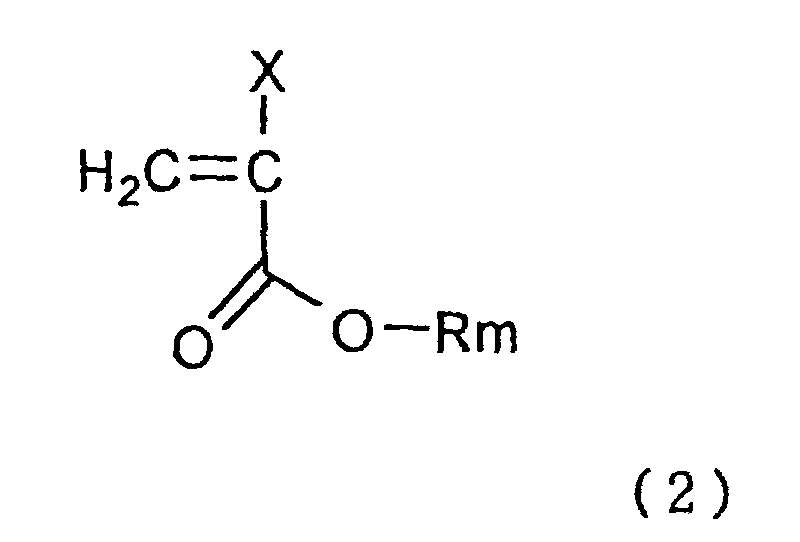
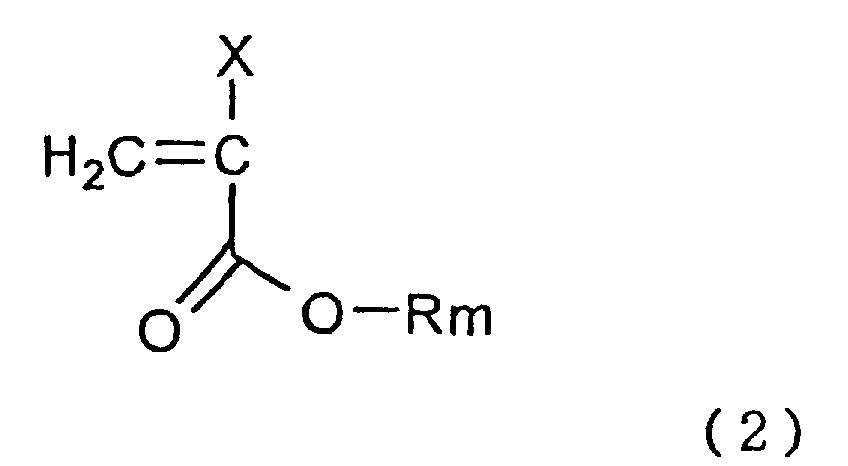
- This invention also relates to the above copolymer comprising a monomer unit consisting of a (meth)acrylate represented by the following formula (2) or methyl acrylate (D) (hereinafter, referred to as "monomer (D)" as appropriate) as a copolymer component: where X represents H or CH 3 ; and Rm represents an alkyl having 2 to 4 carbon atoms both inclusive.
- This invention also relates to a plastic optical fiber comprising a core made of a polymethyl methacrylate or a copolymer mainly containing methyl methacrylate unit and a clad made of the above copolymer.
- This invention also relates to a plastic optical fiber cable comprising the above plastic optical fiber coated with a coating layer.
- This invention also relates to a plastic optical fiber cable with a plug wherein a plug is attached at least to one end of the above plastic optical fiber cable.
- An optical fiber, an optical fiber cable and an optical fiber cable with a plug according to this invention exhibit a reduced transmission loss, minimize increase in a transmission loss even when being held as a bobbin-wound form, exhibit a reduced bend loss and can transmit a wide-band data.
- a copolymer according to this invention exhibits a higher refractive index, good transparency and higher mechanical strength, and can be, therefore, suitably used as a clad in an optical fiber.
- An optical fiber or optical fiber cable has been frequently shipped as a bobbin-wound form as is other fiber materials.
- a widely used bobbin has a configuration where a cylinder with a cross-sectional diameter (shell diameter) of about 10 to 40 cm has brims at both ends, in the light of preventing damage on the optical fiber and improving handling properties.
- an optical fiber is wound around a bobbin with a narrow distance between optical fibers (pitch) and a tension as low as possible within the range where winding is not disturbed, for preventing deteriorated properties due to damage on the optical fiber, as described in, for example, JP-A 1-321259.
- Suitable machines for winding an optical fiber around a bobbin while controlling a tension include those having structures where an optical fiber is wound while controlling a tension in the optical fiber with a tension roll or torque motor and transversing a guide or bobbin.
- a proper winding tension depends on many factors such as the diameter of an optical fiber or cable to be wound and the shell diameter of a bobbin, but is preferably about several hundred gf for winding an optical fiber with a diameter of 1 mm and several hundreds to about 700 gf for winding a single-core fiber cable with a diameter of 2.2 mm, using a bobbin with a shell diameter of 20 cm.
- this invention provides a plastic optical fiber with a numerical aperture of 0.35 or less and a transmission loss of 150 dB/km or less, wherein increase in a transmission loss is 80 dB/km or less, more preferably 70 dB/km or less when the plastic optical fiber is heated at 60 °C for 24 hours while being wound under a winding tension of 700 gf around a periphery of a cylinder with a cross-sectional diameter of 20 cm.
- An optical fiber cable according to this invention comprising the above optical fiber coated with a coating layer exhibits increase in a transmission loss of 80 dB/km or less, preferably 50 dB/km or less when the optical fiber is heated at 60 °C for 24 hours while being wound under a winding tension of 1000 gf around a periphery of a cylinder with a cross-sectional diameter of 20 cm.
- Such an optical fiber or optical fiber cable according to this invention exhibits less increase in a transmission loss even after long-term storage, e.g., a year or longer, while being wound around a bobbin, and can be easily handled.
- a transmission loss in an optical fiber or optical fiber cable is determined using light at a wavelength of 650 nm and a driving NA of 0.1.
- An optical fiber according to this invention may have a known structure; for example, an SI type optical fiber having a core-clad structure, a GI type optical fiber in which a refractive index gradually reduces from the center to a periphery, a multilayer optical fiber in which a refractive index in a core stepwise reduces from the center to a periphery, and a multicore optical fiber in which a plurality of islands are integrated while being separated from each other by a common sea.
- a multilayer optical fiber is preferable for conducting high-speed signal transmission by expanding an optical fiber band.
- a core is a part through which a propagating light within an optical fiber mainly passes
- a clad is a part which is disposed on the periphery of the core for reflecting and refracting a light to confine the light within the core.
- the clad may comprise two or more layers.
- a numerical aperture of an optical fiber is preferably adjusted to 0.35 or less, more preferably 0.3 or less, for expanding a transmission band while it is preferably 0.2 or more for improvement in a bending loss and connection properties.
- An optical fiber according to this invention can be prepared by a known process such as multi-component melt spinning.
- the periphery of the optical fiber may be coated with a protective layer.
- the protective-layer coated structure is preferable because more light can be taken into the optical fiber and mechanical properties of the optical fiber may be improved by appropriately selecting a protective layer material with good dynamic properties.
- a protective layer as used herein is an optically transparent layer; specifically, a layer deposited on the outermost periphery of an optical fiber which can contribute reflection and refraction of a light during transmitting the light by the optical fiber.
- the protective layer coating may be conducted by multi-component melt spinning of a core and a clad simultaneously. Alternatively, it may be formed by passing an optical fiber through a solution of a protective layer material in a solvent and then evaporating the solvent.
- An optical fiber cable according to this invention may be produced by depositing a coating layer on the periphery of the above optical fiber.
- the coating layer may be deposited on the periphery of the optical fiber by a known process, which can be appropriately selected depending on a coating material, but in the light of processability, melt coating using a T-shape die and coating are preferable.
- a core in the optical fiber according to this invention may be made of a known material such as a methyl methacrylate homopolymer (PMMA), a copolymer mainly composed of a methyl methacrylate unit, a variety of methacrylate polymers and polycarbonates.
- PMMA methyl methacrylate homopolymer
- a copolymer mainly composed of a methyl methacrylate unit a core material.
- the copolymer mainly composed of a methyl methacrylate unit comprises preferably 50 wt% or more, more preferably 70 wt% or more of the methyl methacrylate unit.
- a clad for an optical fiber according to this invention is preferably made of a copolymer according to this invention wherein a rupture deflection is 7.5 mm or more as determined by the ASTM D790 bending test [test piece dimensions: 5 inch (12.7 cm)(length) ⁇ 0.5 inch (1.27 cm)(width) ⁇ 0.25 inch (0.635 cm)(thickness); distance between supports: 10 cm; head speed: 3 mm/min].
- Two forces are applied to an optical fiber wound around a bobbin, i.e., a tension along the optical fiber axis and a force from bobbin while the optical fiber is pressed on the bobbin (stress).
- the ASTM D790 bending test evaluates elasticity and rupture properties while bending the material by applying a load to the center between two supports at the ends of a test piece. In this test, the force applied to the test piece is similar in direction to the force applied to the optical fiber wound around the bobbin.
- a copolymer whose rupture deflection is 7.5 mm or more as determined by the bending test may be used as a clad for an optical fiber to prevent crazes generated in a core-clad interface in the optical fiber wound around the bobbin to which the above tension and stress are applied, or cracks or breakage in the clad due to growing of the crazes, and therefore, may effectively reduce increase in a transmission loss in the optical fiber during long-term storage while being wound around the bobbin.
- the rupture deflection as determined by the above test for the copolymer according to this invention is preferably 9 mm or more.
- a refractive index of the copolymer is preferably 1.45 or more, more preferably 1.455 or more for adequately reducing a numerical aperture of the optical fiber and improving a transmission band of the optical fiber. Since an excessively large refractive index tends to increase bending loss in the optical fiber, a refractive index of the copolymer according to this invention is preferably 1.477 or less, particularly when using PMMA as a core.
- a copolymer with a higher refractive index exhibiting a large rupture deflection as determined by the above test is preferably a copolymer prepared by polymerizing a vinyl compound (A) giving a homopolymer with a refractive index of 1.50 or more, a fluoroalkyl (meth)acrylate (B) represented by formula (1) and methyl methacrylate (C). These monomers may be polymerized by a known process.
- a weight ratio of monomer (A) component / monomer (B) component ((A)/(B)) in the copolymer is preferably within the range of 0.2 to 1.
- a vinyl compound giving a homopolymer with a refractive index of 1.50 or more may be added as a copolymer component to reduce a content of the methyl methacrylate unit which increases rigidity and to increase a content of the fluoroalkyl (meth)acrylate unit which increases flexibility, while maintaining a higher refractive index as a copolymer.
- the copolymer may be designed to have improved strength and exhibit an optimum refractive index within the above range when using the copolymer as a clad in an optical fiber.
- Examples of a vinyl compound giving a homopolymer with a refractive index of 1.50 or more (A) include (meth)acrylates and aromatic vinyl compounds.
- Examples of a (meth)acrylate giving a homopolymer with a refractive index of 1.50 or more include methacrylates having an aromatic group such as benzyl methacrylate, phenyl methacrylate, phenethyl methacrylate and naphthyl methacrylate; methacrylates having a chlorinated ester group; and methacrylates having an alicyclic group such as adamantyl methacrylate and tricyclodecyl methacrylate (Hitachi Chemical Co. Ltd., FA513M).
- benzyl methacrylate is preferable because its homopolymer exhibits proper flexibility and heat resistance and has a higher refractive index of 1.568 whereby a content of the methyl methacrylate unit may be reduced in the copolymer while increasing a content of the fluoroalkyl (meth)acrylate unit, as well as has good reactivity with methyl methacrylate so that transparency of the copolymer may be improved.
- the (meth)acrylate unit giving a homopolymer with a refractive index of 1.50 or more is contained preferably at 4 wt% or more, more preferably 10 wt% or more in the copolymer for improving flexibility and mechanical properties of the copolymer, while being preferably 40 wt % or less, more preferably 30 wt% or less for improving optical properties such as transparency in the copolymer.
- Examples of an aromatic vinyl compound giving a homopolymer with a refractive index of 1.50 or more include styrene, 4-methoxy-2-methylstyrene, o-methylstyrene, o-methoxystyrene, p-methoxystyrene, o-chlorostyrene and 2,6-dichlorostyrene.
- Such a homopolymer has a higher refractive index although being brittle, it can be added to reduce a content of the methyl methacrylate unit in the copolymer while increase a content of the fluoroalkyl (meth)acrylate unit as a rubber component so that strength of the copolymer used in a clad can be significantly improved.
- styrene is preferable because it gives a homopolymer with a particularly higher refractive index of 1.591.
- the aromatic vinyl compound may be contained in the copolymer preferably at 4 wt% or more, more preferably 6 wt% or more, for increasing a refractive index of the copolymer and increasing a content of monomer (B) to improve flexibility, while being preferably 25 wt% or less, more preferably 10 wt% or less for reducing brittleness due to the aromatic vinyl compound to improve mechanical properties.
- the fluoroalkyl group (Rf) in the fluoroalkyl (meth)acrylate (B) represented by formula (1) preferably has at least 7 carbon atoms and at least 13 fluorine atoms while for improving transparency of the copolymer, preferably having up to 14 carbon atoms and up to 25 fluorine atoms.
- a fluoroalkyl (meth)acrylate (B) may be an appropriate known monomer including 2-(perfluorooctyl)ethyl methacrylate, 2-(perfluorohexyl)ethyl methacrylate and 2-(perfluorodecyl)ethyl methacrylate.
- a content of the fluoroalkyl (meth)acrylate (B) unit in the copolymer is preferably 15 wt% or more for improving flexibility and mechanical properties of the copolymer while being preferably 60 wt% or less for improving transparency and heat resistance.
- a weight ratio of the vinyl compound (A) component / the fluoroalkyl (meth)acrylate (B) component ((A)/(B)) in the copolymer is preferably within the range of 0.2 to 1. If it is less than 0.2, flexibility of the copolymer may be deteriorated so that increase of a transmission loss due to holding the fiber around a bobbin when using it as a clad in the optical fiber may be insufficiently reduced. If it is more than 1, mechanical properties of the clad polymer may be deteriorated.
- a content of the methyl methacrylate (C) unit in the copolymer is preferably 10 wt% to 70 wt%, more preferably 10 wt% to 60 wt%. If a content of methyl methacrylate (C) is less than 10 wt%, thermolysis resistance of the copolymer may be reduced. If it is more than 70 wt%, rigidity of the copolymer may become too high to sufficiently reduce increase of a transmission loss due to holding the optical fiber around the bobbin.
- a copolymer according to this invention exhibiting a large rupture deflection and having a higher refractive index as determined by the above test may be preferably a copolymer comprising the (meth)acrylate represented by formula (2) or the methyl acrylate (D) unit.
- a homopolymer of monomer (D) has a relatively higher refractive index while having a low glass-transition temperature and exhibiting very high flexibility, and therefore, the copolymer can comprise the monomer (D) unit to improve flexibility and mechanical properties of the copolymer.
- the methyl acrylate unit can be added as the monomer (D) unit to improve thermolysis resistance of the copolymer in addition to the above effects.
- the copolymer comprising the monomer (D) unit also comprises the monomer (B) represented by formula (1) and the monomer (C) units.
- the monomer (B) unit and the monomer (C) unit may be added to provide a copolymer with a higher refractive index exhibiting improved mechanical properties.
- the monomer (A) unit may be also contained to increase a content of the monomer (B) unit having good mechanical properties for further improving mechanical properties of the copolymer.
- the alkyl group in the (meth)acrylate (D) preferably has 2 to 4 carbon atoms for improving flexibility of the copolymer.
- a (meth)acrylate (D) may be a known monomer including ethyl acrylate, ethyl methacrylate, isopropyl acrylate, isopropyl methacrylate, n-butyl acrylate, i-butyl acrylate, t-butyl acrylate, n-butyl methacrylate, i-butyl methacrylate and t-butyl methacrylate.
- a content of the monomer (D) unit in the copolymer is preferably 1 wt% or more, more preferably 5 wt% or more for improving flexibility and mechanical properties of the copolymer, while being preferably 60 wt% or less, more preferably 30 wt% or less for improving transparency of the copolymer.
- contents of the individual monomer units are preferably within the ranges as described for the copolymer comprising the monomer (A), the monomer (B) or the monomer (C) unit.
- the copolymer according to this invention may further comprise a copolymer component composed of another monomer.
- a monomer may be, for example, methacrylic acid for improving adhesiveness in a core-clad interface when using a copolymer as a clad material.
- the copolymer may, as desired, comprise a short-chain fluoroalkyl (meth)acrylate such as trifluoroethyl methacrylate, tetrafluoropropyl methacrylate and pentafluoropropyl methacrylate, and/or a monomer unit such as maleimides and maleic anhydride.
- a protective material may be any appropriate material and is preferably a polymer mainly comprising a vinylidenefluoride unit exhibiting both good mechanical properties and good barrier properties to low molecular weight compounds.
- the vinylidenefluoride unit is contained preferably at 50 mol% or more, more preferably 80 mol% or more, in the polymer.
- a coating material used in an optical fiber cable according to this invention may be selected, depending on a desired effect such as improvement in weather resistance or heat resistance; for example, polyethylene (PE), polyvinyl chloride, chlorinated polyethylene and various UV curable resins, preferably thermoplastic resins.
- PE polyethylene
- polyvinyl chloride polyvinyl chloride
- chlorinated polyethylene chlorinated polyethylene
- various UV curable resins preferably thermoplastic resins.
- a polyamide, Kevlar or a silicone resin may be suitably used.
- An optical fiber cable with a plug according to this invention has a configuration where a known plug is disposed at one or both ends of the above optical fiber cable.
- MI Melt index
- the amount of a polymer discharged from a die nozzle with a diameter of 2 mm and a length of 8 mm at 230 °C for 10 min under a load of 5 kg was determined in grams.
- a film test piece with a thickness of 200 ⁇ m was prepared using a melt press, and its refractive index was determined for sodium D line at room temperature (25 °C) using an Abbe refractometer.
- This test was conducted in compliance with the ASTM D790 bending test.
- Injection Molding Machine 75MS made by Mitsubishi Heavy Industries, Ltd.
- a test piece with length of 5 inch (12.7 cm), width of 0.5 inch (1.27 cm) and thickness of 0.25 inch (0.635 cm) was formed.
- TENSILON/UTM 12500 made by Toyo Boldwin Inc.
- the test piece was supported at two points with an intersupport distance of 10 cm. While the test piece was then pressed at its center at a head speed of 3 mm/min, its rupture deflection was determined.
- An optical fiber cable of 11 m length was used. While introducing a light from one end of the optical fiber cable, the optical fiber cable was bent by 90 degrees with a radius of 25 mm at each of 10 points at intervals of 1 m. While thus bending and holding on a line the cable, the quantity of light emitted from the other end of the optical fiber cable was determined. A light-quantity difference between these beams was used to estimate a bending loss.
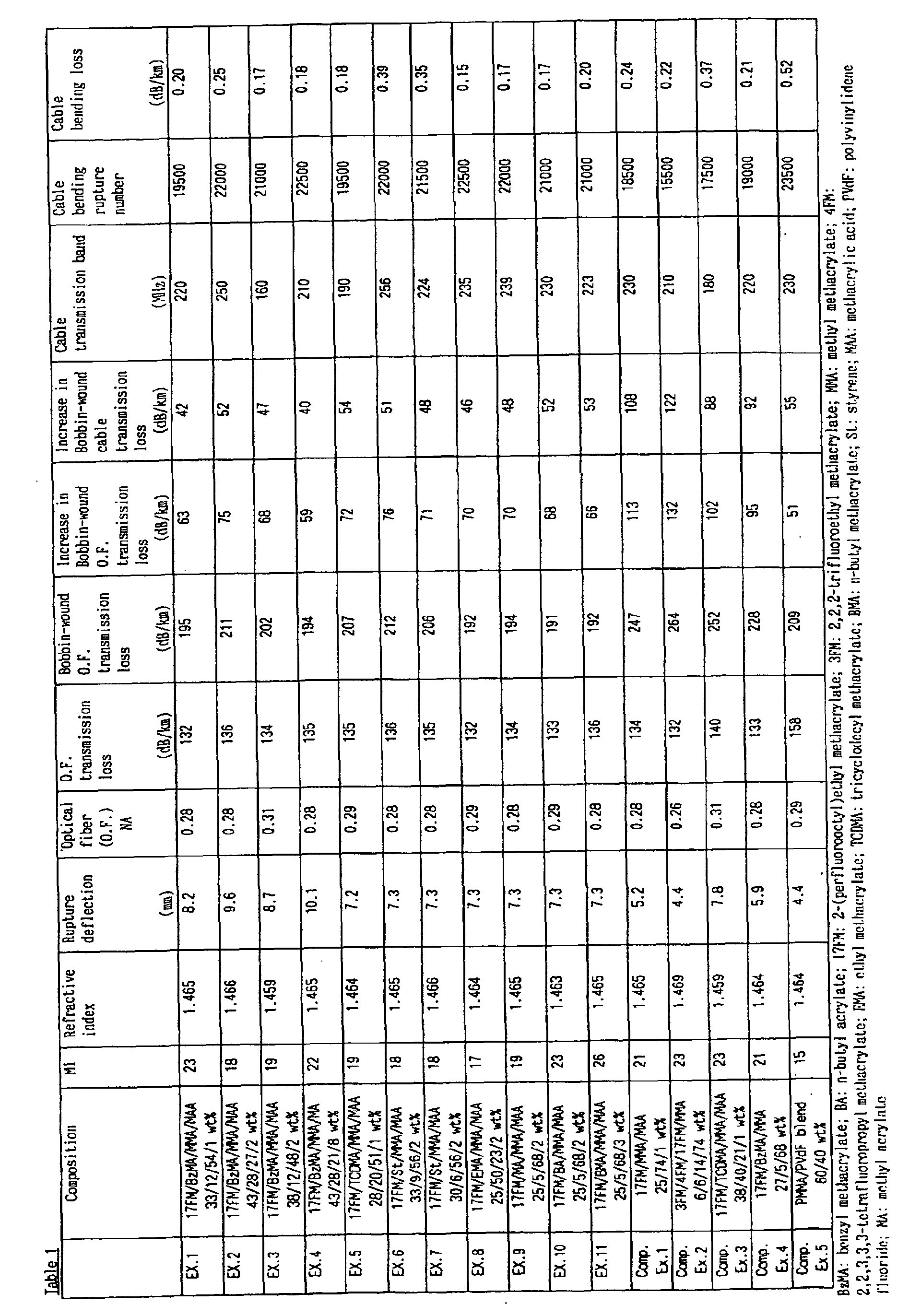
- the polymer had a melt index of 21g/10 min and a refractive index of 1.465, and exhibited a rupture deflection of 5.2 mm in the bending test.
- the filament was extended to a double length in a hot-air oven at 150 °C, and then heated in the hot-air oven at 145 °C to give an optical fiber with a diameter of 1 mm, a clad thickness of 10 ⁇ m and a protective-layer thickness of 10 ⁇ m.
- a numerical aperture and a transmission loss determined while holding the optical fiber in a straight line were 0.28 and 134 dB/km, respectively.
- the optical fiber was wound around a bobbin made of ABS with a shell diameter of 20 cm under a tension of 700 gf, and heated in a hot-air oven at 60 °C for 24 hours. After heating, the fiber wound around the bobbin gave a transmission loss of 247 dB/km, which was higher by 113 dB/km than the transmission loss before heating. In microscopy for the optical fiber after heating, cracks in the clad were observed.
- a PE coating layer was formed on the periphery of the optical fiber to provide a plastic optical fiber cable with a diameter of 2.2 mm.
- a transmission band, a bending rupture number and a bending loss were 230 MHz, 18500 and 0.24 dB, respectively.
- the optical fiber cable was wound around a bobbin made of ABS with a shell diameter of 20 cm under a tension of 1000 gf, and heated in a hot-air oven at 60 °C for 24 hours.
- a transmission loss was increased by 108 dB/km in comparison with the optical fiber cable before heating.
- a clad material, an optical fiber and an optical fiber cable were prepared as described in Comparative Example 1, except that a copolymer composition for the clad was 33 wt% of 2-(perfluorooctyl)ethyl methacrylate, 12 wt% of benzyl methacrylate, 54 wt% of methyl methacrylate, and 1 wt% of methacrylic acid, and 0.15 wt% of n-octyl mercaptan was added. Winding around a bobbin was conducted as described in Comparative Example 1.
- the copolymer for the clad had a melt index of 23 g/10 min and a refractive index of 1.465 and exhibited a deflection of 8.2 mm in the bending test.
- a transmission loss for the optical fiber was 132 dB/kg.
- the optical fiber was wound around a bobbin and heated as described in Comparative Example 1, and then gave a transmission loss of 195 dB/kg, that is, an increase in a transmission loss after heating was 63 dB/km. Microscopy for the optical fiber after heating showed no cracks in the clad.
- the optical fiber cable wound around a bobbin and heated as described in Comparative Example 1 showed an increase of 42 dB/km in a transmission loss.
- a transmission band, a bending rupture number and a bending loss were 220 MHz, 19500 and 0.20 dB, respectively.
- Clad materials, optical fibers and optical fiber cables were prepared as described in Example 1, except that copolymer compositions shown in Table 1 were used for a clad. The evaluation results are also shown in Table 1.
Landscapes
- Physics & Mathematics (AREA)
- General Physics & Mathematics (AREA)
- Optics & Photonics (AREA)
- Chemical & Material Sciences (AREA)
- Health & Medical Sciences (AREA)
- Chemical Kinetics & Catalysis (AREA)
- Medicinal Chemistry (AREA)
- Polymers & Plastics (AREA)
- Organic Chemistry (AREA)
- Addition Polymer Or Copolymer, Post-Treatments, Or Chemical Modifications (AREA)
- Optical Fibers, Optical Fiber Cores, And Optical Fiber Bundles (AREA)
Abstract

Description

Claims (16)
- A plastic optical fiber with a numerical aperture of 0.35 or less and a transmission loss of 150 dB/km or less at a driving NA of 0.1 for a wavelength of 650 nm, wherein increase in a transmission loss is 80 dB/km or less when the plastic optical fiber is heated at 60 °C for 24 hours while being wound under a winding tension of 700 gf around a periphery of a cylinder with a cross-sectional diameter of 20 cm.
- A plastic optical fiber cable comprising the plastic optical fiber as claimed in Claim 1 coated with a coating layer, wherein increase in a transmission loss is 80 dB/km or less when the plastic optical fiber cable is heated at 60 °C for 24 hours while being wound under a winding tension of 1000 gf around a periphery of a cylinder with a cross-sectional diameter of 20 cm.
- A copolymer having a refractive index of 1.45 or more wherein a rupture deflection is 7.5 mm or more as determined by the ASTM D790 bending test [test piece dimensions; length: 5 inch, width: 0.5 inch, thickness: 0.25 inch; distance between supports: 10 cm; head speed: 3 mm/min].
- A copolymer prepared by polymerizing at least a vinyl compound (A) which gives a homopolymer with a refractive index of 1.50 or more, a fluoroalkyl (meth)acrylate (B) represented by the following formula (1) and methyl methacrylate (C), wherein a weight ratio of monomer (A) component / monomer (B) component ((A)/(B)) in the copolymer is within the range of 0.2 to 1:wherein X represents H or CH3; and Rf represents a fluoroalkyl having 7 to 14 carbon atoms both inclusive and 13 to 25 fluorine atoms both inclusive.

- The copolymer as claimed in Claim 4 having a refractive index of 1.45 or more wherein a rupture deflection is 7.5 mm or more as determined by the ASTM D790 bending test [test piece dimensions; length: 5 inch, width: 0.5 inch, thickness: 0.25 inch; distance between supports: 10 cm; head speed: 3 mm/min].
- The copolymer as claimed in Claim 4 or 5 comprising a (meth)acrylate unit as the monomer (A) component.
- The copolymer as claimed in Claim 4 or 5 comprising a benzyl methacrylate unit as the monomer (A) component.
- The copolymer as claimed in Claim 4 or 5 comprising an aromatic vinyl compound unit as the monomer (A) component.
- The copolymer as claimed in any of Claims 3 to 8 comprising a monomer unit consisting of a (meth)acrylate represented by the following formula (2) or methyl acrylate (D) as a copolymer component:wherein X represents H or CH3; and Rm represents an alkyl having 2 to 4 carbon atoms both inclusive.
- A plastic optical fiber comprising a core made of a polymethylmethacrylate or a copolymer mainly containing methyl methacrylate unit and a clad made of the copolymer as claimed in any of Claims 3 to 9.
- A plastic optical fiber cable comprising the plastic optical fiber as claimed in Claim 10 coated with a protective layer.
- The plastic optical fiber as claimed in Claim 10 or 11 with a numerous aperture of 0.35 or less.
- The plastic optical fiber as claimed in Claim 12 with a transmission loss of 150 dB/km or less at a driving NA of 0.1 for a wavelength of 650 nm, wherein increase in a transmission loss is 80 dB/km or less when the plastic optical fiber is heated at 60 °C for 24 hours while being wound under a winding tension of 700 gf around a periphery of a cylinder with a cross-sectional diameter of 20 cm.
- A plastic optical fiber cable comprising the plastic optical fiber as claimed in any of Claims 10 to 13 coated with a coating layer.
- A plastic optical fiber cable comprising the plastic optical fiber as claimed in Claim 13 coated with a coating layer, wherein increase in a transmission loss is 80 dB/km or less when the plastic optical fiber cable is heated at 60 °C for 24 hours while being wound under a winding tension of 1000 gf around a periphery of a cylinder with a cross-sectional diameter of 20 cm.
- A plastic optical fiber cable with a plug wherein a plug is attached at least to one end of the plastic optical fiber cable as claimed in Claim 2, 14 or 15.
Applications Claiming Priority (3)
| Application Number | Priority Date | Filing Date | Title |
|---|---|---|---|
| JP37029599 | 1999-12-27 | ||
| JP37029599 | 1999-12-27 | ||
| PCT/JP2000/009275 WO2001048538A1 (en) | 1999-12-27 | 2000-12-27 | Plastic optical fibers, plastic optical fiber cables, optical fiber cables with plugs and copolymer |
Publications (3)
| Publication Number | Publication Date |
|---|---|
| EP1258750A1 true EP1258750A1 (en) | 2002-11-20 |
| EP1258750A4 EP1258750A4 (en) | 2005-05-04 |
| EP1258750B1 EP1258750B1 (en) | 2007-04-11 |
Family
ID=18496549
Family Applications (1)
| Application Number | Title | Priority Date | Filing Date |
|---|---|---|---|
| EP00987754A Expired - Lifetime EP1258750B1 (en) | 1999-12-27 | 2000-12-27 | Plastic optical fibers |
Country Status (6)
| Country | Link |
|---|---|
| US (1) | US7142754B2 (en) |
| EP (1) | EP1258750B1 (en) |
| CN (1) | CN1250988C (en) |
| DE (1) | DE60034372T2 (en) |
| TW (1) | TW472160B (en) |
| WO (1) | WO2001048538A1 (en) |
Families Citing this family (10)
| Publication number | Priority date | Publication date | Assignee | Title |
|---|---|---|---|---|
| KR100489922B1 (en) * | 2002-10-01 | 2005-05-17 | 최준국 | Dense wavelength division multiplexing-passive optical network using self-injection locking of fabry-perot laser diode |
| CN100393497C (en) * | 2005-03-25 | 2008-06-11 | 中国科学院上海有机化学研究所 | Fluorine-containing graded refractive index optical plastic preform, preparation method and application |
| CN102254625A (en) * | 2011-04-25 | 2011-11-23 | 北京海通荣盛科技有限公司 | Production method and equipment of bunched optical cable |
| US10520126B2 (en) * | 2013-02-28 | 2019-12-31 | Panasonic Intellectual Property Management Co., Ltd. | Heat insulating structure using aerogel |
| WO2016063829A1 (en) * | 2014-10-20 | 2016-04-28 | 三菱レイヨン株式会社 | Optical fiber, method for manufacturing optical fiber, optical fiber cable, and sensor |
| JP6154370B2 (en) * | 2014-12-26 | 2017-06-28 | 住友ゴム工業株式会社 | Surface-modified metal and method for modifying metal surface |
| KR20180050993A (en) * | 2016-11-07 | 2018-05-16 | 현대자동차주식회사 | Fuel reform system for intake and exhaust line of vehicle |
| EP3598187B1 (en) * | 2017-03-13 | 2026-05-06 | Mitsubishi Chemical Corporation | Plastic optical fiber, plastic optical fiber cable, wiring harness and vehicle |
| JP7139949B2 (en) * | 2017-09-22 | 2022-09-21 | 東レ株式会社 | medical equipment lighting |
| CN109870762B (en) * | 2019-02-27 | 2020-11-03 | 南宁旭越光纤有限责任公司 | Low-attenuation plastic optical fiber and preparation method thereof |
Family Cites Families (20)
| Publication number | Priority date | Publication date | Assignee | Title |
|---|---|---|---|---|
| JPS61246703A (en) * | 1985-04-25 | 1986-11-04 | Mitsubishi Rayon Co Ltd | Optical transmission fiber |
| JPS62123425A (en) | 1985-08-02 | 1987-06-04 | Sharp Corp | Liquid crystal display element |
| JPS63180907A (en) * | 1987-01-22 | 1988-07-26 | Mitsubishi Rayon Co Ltd | optical fiber |
| CA1335022C (en) * | 1987-07-30 | 1995-03-28 | Tsuruyoshi Matsumoto | Cladding material for optical fiber |
| US4946902A (en) * | 1988-05-27 | 1990-08-07 | E. I. Du Pont De Nemours And Company | Process for the setabilization of fluoropolymers |
| US5076659A (en) * | 1988-05-27 | 1991-12-31 | E. I. Du Pont De Nemours And Company | Process for the stabilization of fluoropolymers |
| JPH01321259A (en) * | 1988-06-22 | 1989-12-27 | Toray Ind Inc | Method of winding plastic optical fiber |
| JPH0229408A (en) * | 1988-07-20 | 1990-01-31 | Hitachi Ltd | Lowly water-absorbing and transparent plastic |
| US5242972A (en) | 1989-04-05 | 1993-09-07 | Kansai Paint Co., Ltd. | Fluorine based aqueous dispersion, process for preparing the same, and fluorine based matte anionic electrodeposition coating composition containing the same |
| JPH04248506A (en) * | 1991-02-04 | 1992-09-04 | Mitsubishi Rayon Co Ltd | fiber optic cord |
| US5239026A (en) * | 1991-08-26 | 1993-08-24 | Minnesota Mining And Manufacturing Company | Low loss high numerical aperture cladded optical fibers |
| US5148511A (en) * | 1991-11-04 | 1992-09-15 | Minnesota Mining And Manufacturing Company | Low refractive index plastics for optical fiber cladding |
| DE4201603A1 (en) * | 1992-01-22 | 1993-07-29 | Bayer Ag | MIXTURES OF FLUORINE COPOLYMERISATE |
| JPH0764064A (en) * | 1993-08-27 | 1995-03-10 | Kuraray Co Ltd | Liquid crystal display element |
| JPH07239420A (en) | 1994-03-01 | 1995-09-12 | Asahi Chem Ind Co Ltd | Wide range plastic optical fiber |
| KR100396364B1 (en) | 1995-05-15 | 2003-11-28 | 미쯔비시 레이온 가부시끼가이샤 | Plastic optical fibers and optical fiber cables |
| US5942560A (en) | 1996-09-02 | 1999-08-24 | Mitsubishi Pencil Kabushiki Kaisha | Colored resin fine particle water base dispersion liquid for water base ink |
| JPH10160947A (en) | 1996-11-29 | 1998-06-19 | Toray Ind Inc | Broadband plastic clad optical fiber |
| JPH10176002A (en) | 1996-12-18 | 1998-06-30 | Kansai Paint Co Ltd | Nonaqueous polymer dispersion and curable composition |
| JP4102448B2 (en) * | 1997-02-07 | 2008-06-18 | 旭化成エレクトロニクス株式会社 | Multicore plastic optical fiber for optical signal transmission |
-
2000
- 2000-12-27 CN CNB008175314A patent/CN1250988C/en not_active Expired - Fee Related
- 2000-12-27 TW TW089127922A patent/TW472160B/en not_active IP Right Cessation
- 2000-12-27 US US10/169,126 patent/US7142754B2/en not_active Expired - Lifetime
- 2000-12-27 DE DE60034372T patent/DE60034372T2/en not_active Expired - Lifetime
- 2000-12-27 EP EP00987754A patent/EP1258750B1/en not_active Expired - Lifetime
- 2000-12-27 WO PCT/JP2000/009275 patent/WO2001048538A1/en not_active Ceased
Also Published As
| Publication number | Publication date |
|---|---|
| TW472160B (en) | 2002-01-11 |
| US7142754B2 (en) | 2006-11-28 |
| EP1258750A4 (en) | 2005-05-04 |
| EP1258750B1 (en) | 2007-04-11 |
| WO2001048538A1 (en) | 2001-07-05 |
| CN1250988C (en) | 2006-04-12 |
| DE60034372T2 (en) | 2008-01-17 |
| US20030021564A1 (en) | 2003-01-30 |
| DE60034372D1 (en) | 2007-05-24 |
| CN1413307A (en) | 2003-04-23 |
Similar Documents
| Publication | Publication Date | Title |
|---|---|---|
| KR920001247B1 (en) | Cladding material for optical fiber | |
| EP1607778B1 (en) | Graded index type optical fibres and method of making the same | |
| EP0112564B1 (en) | Plastic optical fiber | |
| US7142754B2 (en) | Plastic optical fiber, plastic optical fiber cables, optical fiber cables with plugs with copolymer | |
| US4842369A (en) | Cladding material for plastic optical fiber and plastic optical fiber using the same | |
| AU8358298A (en) | Graded Index type optical fibers | |
| JP2004219579A (en) | Plastic optical fiber and plastic optical fiber cable | |
| WO2001040841A1 (en) | Optical fiber cord and optical fiber cord with plug | |
| JP4875255B2 (en) | Plastic optical fiber, plastic optical fiber cable and plastic optical fiber cable with plug | |
| JP2003139973A (en) | Plastic optical fiber, plastic optical fiber cable and plastic optical fiber cable with plug | |
| JP2696521B2 (en) | Polymer for optical fiber sheath material | |
| JP4225547B2 (en) | Plastic optical fiber and plastic optical fiber cable | |
| JP2002148451A (en) | Plastic optical fiber | |
| JPWO2001048538A1 (en) | Plastic optical fiber, plastic optical fiber cable, optical fiber cable with plug and copolymer | |
| JP2787771B2 (en) | Core-sheath plastic optical fiber | |
| JPS63180907A (en) | optical fiber | |
| JP2003139972A (en) | Plastic optical fiber, plastic optical fiber cable and plastic optical fiber cable with plug | |
| JP2004212871A (en) | Optical fiber and optical fiber cable | |
| JPH01105205A (en) | Clad material for optical fiber | |
| JP2001074944A (en) | High numerical aperture plastic optical fiber and its code | |
| JP4245521B2 (en) | Sheath material for plastic optical fiber | |
| JP2003014951A (en) | Plastic optical fiber cladding material, plastic optical fiber and plastic optical fiber cable | |
| JP2003139971A (en) | Plastic optical fiber | |
| JP3015814B2 (en) | Sheath material for optical fiber | |
| JP3945910B2 (en) | Optical fiber and optical fiber cable |
Legal Events
| Date | Code | Title | Description |
|---|---|---|---|
| PUAI | Public reference made under article 153(3) epc to a published international application that has entered the european phase |
Free format text: ORIGINAL CODE: 0009012 |
|
| 17P | Request for examination filed |
Effective date: 20020701 |
|
| AK | Designated contracting states |
Kind code of ref document: A1 Designated state(s): AT BE CH CY DE DK ES FI FR GB GR IE IT LI LU MC NL PT SE TR |
|
| AX | Request for extension of the european patent |
Free format text: AL;LT;LV;MK;RO;SI |
|
| RBV | Designated contracting states (corrected) |
Designated state(s): AT BE CH CY DE FR GB LI NL |
|
| RIC1 | Information provided on ipc code assigned before grant |
Ipc: 7G 02B 6/16 B Ipc: 7G 02B 6/00 A Ipc: 7G 02B 6/18 B Ipc: 7G 02B 1/04 B |
|
| A4 | Supplementary search report drawn up and despatched |
Effective date: 20050321 |
|
| RIC1 | Information provided on ipc code assigned before grant |
Ipc: 7G 02B 6/16 B Ipc: 7G 02B 6/00 A Ipc: 7G 02B 6/18 B Ipc: 7G 02B 1/04 B Ipc: 7C 08F 220/24 B Ipc: 7C 08F 220/14 B |
|
| 17Q | First examination report despatched |
Effective date: 20050622 |
|
| GRAP | Despatch of communication of intention to grant a patent |
Free format text: ORIGINAL CODE: EPIDOSNIGR1 |
|
| RTI1 | Title (correction) |
Free format text: PLASTIC OPTICAL FIBERS |
|
| RBV | Designated contracting states (corrected) |
Designated state(s): DE FR GB NL |
|
| RIC1 | Information provided on ipc code assigned before grant |
Ipc: C08F 220/14 20060101ALI20061016BHEP Ipc: G02B 1/04 20060101ALI20061016BHEP Ipc: G02B 6/00 20060101AFI20061016BHEP Ipc: C08F 220/24 20060101ALI20061016BHEP |
|
| GRAS | Grant fee paid |
Free format text: ORIGINAL CODE: EPIDOSNIGR3 |
|
| GRAA | (expected) grant |
Free format text: ORIGINAL CODE: 0009210 |
|
| AK | Designated contracting states |
Kind code of ref document: B1 Designated state(s): DE FR GB NL |
|
| REG | Reference to a national code |
Ref country code: GB Ref legal event code: FG4D |
|
| REF | Corresponds to: |
Ref document number: 60034372 Country of ref document: DE Date of ref document: 20070524 Kind code of ref document: P |
|
| ET | Fr: translation filed | ||
| PLBE | No opposition filed within time limit |
Free format text: ORIGINAL CODE: 0009261 |
|
| STAA | Information on the status of an ep patent application or granted ep patent |
Free format text: STATUS: NO OPPOSITION FILED WITHIN TIME LIMIT |
|
| 26N | No opposition filed |
Effective date: 20080114 |
|
| PGFP | Annual fee paid to national office [announced via postgrant information from national office to epo] |
Ref country code: GB Payment date: 20141224 Year of fee payment: 15 |
|
| PGFP | Annual fee paid to national office [announced via postgrant information from national office to epo] |
Ref country code: FR Payment date: 20141208 Year of fee payment: 15 Ref country code: NL Payment date: 20141108 Year of fee payment: 15 |
|
| PGFP | Annual fee paid to national office [announced via postgrant information from national office to epo] |
Ref country code: DE Payment date: 20141223 Year of fee payment: 15 |
|
| REG | Reference to a national code |
Ref country code: DE Ref legal event code: R119 Ref document number: 60034372 Country of ref document: DE |
|
| GBPC | Gb: european patent ceased through non-payment of renewal fee |
Effective date: 20151227 |
|
| REG | Reference to a national code |
Ref country code: NL Ref legal event code: MM Effective date: 20160101 |
|
| REG | Reference to a national code |
Ref country code: FR Ref legal event code: ST Effective date: 20160831 |
|
| PG25 | Lapsed in a contracting state [announced via postgrant information from national office to epo] |
Ref country code: DE Free format text: LAPSE BECAUSE OF NON-PAYMENT OF DUE FEES Effective date: 20160701 Ref country code: GB Free format text: LAPSE BECAUSE OF NON-PAYMENT OF DUE FEES Effective date: 20151227 Ref country code: NL Free format text: LAPSE BECAUSE OF NON-PAYMENT OF DUE FEES Effective date: 20160101 |
|
| PG25 | Lapsed in a contracting state [announced via postgrant information from national office to epo] |
Ref country code: FR Free format text: LAPSE BECAUSE OF NON-PAYMENT OF DUE FEES Effective date: 20151231 |