EP1258511A2 - Particles containing a colorant and a water-based ink comprising polymer emulsion - Google Patents
Particles containing a colorant and a water-based ink comprising polymer emulsion Download PDFInfo
- Publication number
- EP1258511A2 EP1258511A2 EP02253271A EP02253271A EP1258511A2 EP 1258511 A2 EP1258511 A2 EP 1258511A2 EP 02253271 A EP02253271 A EP 02253271A EP 02253271 A EP02253271 A EP 02253271A EP 1258511 A2 EP1258511 A2 EP 1258511A2
- Authority
- EP
- European Patent Office
- Prior art keywords
- polymer
- colorant
- shell
- core
- ink
- Prior art date
- Legal status (The legal status is an assumption and is not a legal conclusion. Google has not performed a legal analysis and makes no representation as to the accuracy of the status listed.)
- Granted
Links
- 0 C*C(C(C1=O)=Cc2ccc(*)cc2)=NN1c1ncccc1 Chemical compound C*C(C(C1=O)=Cc2ccc(*)cc2)=NN1c1ncccc1 0.000 description 3
- DWBLDHNVLKFGFH-FDTGUPFSSA-N CC1(C)c(cccc2)c2N(C)/C1=C\C=C1\N=C(C)N=C1c1ccccn1 Chemical compound CC1(C)c(cccc2)c2N(C)/C1=C\C=C1\N=C(C)N=C1c1ccccn1 DWBLDHNVLKFGFH-FDTGUPFSSA-N 0.000 description 1
- CBYAMSNEZDNZJW-FCDQGJHFSA-N CC1=NC(c2ncccc2)=N/C1=N/c(c1ccccc11)ccc1OC Chemical compound CC1=NC(c2ncccc2)=N/C1=N/c(c1ccccc11)ccc1OC CBYAMSNEZDNZJW-FCDQGJHFSA-N 0.000 description 1
Classifications
-
- C—CHEMISTRY; METALLURGY
- C08—ORGANIC MACROMOLECULAR COMPOUNDS; THEIR PREPARATION OR CHEMICAL WORKING-UP; COMPOSITIONS BASED THEREON
- C08F—MACROMOLECULAR COMPOUNDS OBTAINED BY REACTIONS ONLY INVOLVING CARBON-TO-CARBON UNSATURATED BONDS
- C08F291/00—Macromolecular compounds obtained by polymerising monomers on to macromolecular compounds according to more than one of the groups C08F251/00 - C08F289/00
-
- C—CHEMISTRY; METALLURGY
- C09—DYES; PAINTS; POLISHES; NATURAL RESINS; ADHESIVES; COMPOSITIONS NOT OTHERWISE PROVIDED FOR; APPLICATIONS OF MATERIALS NOT OTHERWISE PROVIDED FOR
- C09D—COATING COMPOSITIONS, e.g. PAINTS, VARNISHES OR LACQUERS; FILLING PASTES; CHEMICAL PAINT OR INK REMOVERS; INKS; CORRECTING FLUIDS; WOODSTAINS; PASTES OR SOLIDS FOR COLOURING OR PRINTING; USE OF MATERIALS THEREFOR
- C09D11/00—Inks
- C09D11/30—Inkjet printing inks
Definitions
- the present invention relates to a core-shell type colorant-including fine particle and a polymer emulsion type water-based ink by use thereof having superior color reproduction quality and fastness.
- a recording material comprising water-soluble dyes
- an aqueous solution of water-soluble dyes which are categorized mainly into acid dyes, direct dyes and a part of food dyes, being added thereto glycols or alkanolamines as a wetting agent, surfactants or alcohols in order to adjust the surface tension, resins as a binder component and the like.
- the recording materials using water-soluble dyes are most commonly used because of the high reliability of anti-clogging at a pen top or in a recording system.
- the recording materials using water-soluble dyes are, however, easy to cause blotting on recording paper because they comprise an aqueous solution of dyes.
- print quality is forced to deteriorate due to blotting of the ink which has been adjusted so as to quickly permeate into recording paper for accelerating the apparent drying speed.
- Water resistance is naturally poor due to the nature of water-soluble dyes.
- light fastness is very poor because water-soluble dyes only permeate into the recording material and they are dried to adhere in the recording paper. They are hardly said being dyed.
- JP-A 2000-281947 the term, JP-A refers to an unexamined and published Japanese Patent Application
- dyeing ability is enhanced by utilizing an interaction between a dye and a polymer in a two-solution system with cationic polymers to prevent blotting and enhance fastness
- latexes preferably used listed are synthetic rubber latexes such as a styrene-butadiene copolymer latex, an acrylonitrile-butadiene copolymer latex, a polychloroprene latex, a vinylpyridine-stylene-butadiene latex, a butyl rubber latex, a polybutadiene latex, a polyisoprene latex and a polysulfide rubber latex; or synthetic resin type latexes such as an acryl ester type latex, a styrene-butadiene resin latex, a vinyl acetate type latex, a vinyl chloride type latex and a vinylidene chloride type latex.
- synthetic rubber latexes such as a styrene-butadiene copolymer latex, an acrylonitrile-butadiene copolymer latex, a polychloroprene latex, a
- Synthetic rubber type latexes listed in the above patent proposal whose specific gravity is approximately within a range of from 0.9 to 1.0, satisfy such conditions to some extent, but there are problems in terms of light fastness and weather-proofing because most synthetic rubbers have unsaturated double bonds in the molecule.
- the number of the unsaturated bonds is decreased by vulcanization, there occurs a problem of recording quality due to retardation of fixing of particles on recording paper. Further, excessive vulcanization causes a problem of precipitation because the specific gravity becomes not less than 1.1.
- the synthetic rubber type latexes have a low glass transition temperature to easily form film at room temperature, which causes ink-jet nozzles to be often clogged when the ink is dried at the top portion of the nozzles, and furthermore, the property of the dried substance being soft and slightly sticky making it very hard to be removed.
- the synthetic resin latexes listed in the patent all causes precipitation in a particle diameter range of exhibiting anti-blotting effect because the specific gravity reaches to over 1.1 and especially with the synthetic resin containing halogens it reaches to nearly 1.3 to 1.5.
- JP-A 54-146109 is proposed a recording material utilizing a water-soluble dye to which vinyl polymer fine particles having been swelled with solvents and dyed with oil dyes are added.
- a glass transition temperature of not higher than 30° C is a preferable condition.
- a recording material comprising carbon black or an organic pigment.
- water-resistance of an ink is markedly improved.
- the specific gravity of these pigments is, however, as high as 1.5 to 2.0, and caution is required in respect with precipitation of dispersed particles.
- a proposal of dyeing water-dispersible resins by an oil-soluble (oleophilic or hydrophobic) dye is presented as an ink-jet ink. This is a proposal on "an ink using colored polymer fine particles as a recording material".
- an ink using colored polymer fine particles as a recording material For example, in JP-A 54-58504, an ink in which a mixture of a hydrophobic dye solution and vinyl polymer fine particles is dispersed as an oil-in-water type is proposed. It is disclosed that vinyl polymer fine particles being mixed with hydrophobic dye solution are swelled by solvents of a dye solution and colored with a dye. It is also described that because of utilizing hydrophobic recording material, obtained images result in of water-resistant.
- JP-A 55-139471 and 3-250069 there is proposed an ink using emulsion polymerization or dispersion polymerization particles colored with dyes.
- the point of the proposal is to prevent blotting by use of colored particles as a dispersed phase and water as a dispersion medium, which is similar to that of JP-A 54-58504, but it is necessary to fix onto recording paper by film-formation of the particles because solvent is not included in the case of this proposal.
- Preferable particle diameter is suggested to be in a range of sub-micron, in terms of necessity of film-formation and secure of dispersion stability.
- JP-A 54-58504 it is allowed to enhance dyeing ability by swelling of polymer fine particles with solvents, but, in this case, a problem of nozzle clogging occurs due to film formation by drying at the top portion of nozzles.
- the polymer composition has been mainly adjusted to enhance the stability thereof in an ink, but it has been very difficult for colored fine particles to achieve homogeneous incorporation of a colorant and stability at the same time.
- the object of the present invention is to provide a water-based ink, which comprises core-shell type colorant including fine particles, having enhanced fastness and superior color reproduction quality.
- a water-based ink comprising a suspension of fine particles which comprise a polymer core containing a colorant and a polymer shell having a colorant content less than that of a core, and having a specific range of a particle diameter and a specific variation coefficient of a particle diameter, as described below.
- a colorant-containing polymer core mainly contains a colorant and contributes to maintain the fastness or color tone.
- a polymer shell contributes to increase stability of a colorant-containing fine particle as an ink suspension, as well as to accelerate fixing a colorant on a medium, to prevent coagulation and to improve image quality. In addition, it contributes fastness of a colorant and maintaining color tone.
- a colorant content ratio (concentration) in a shell is not more than 0.8 of that in a core without core/shell formation, preferably not more than 0.5 and furthermore preferably not more than 0.2.
- the colorant content can be measured by a mass spectrometer such as TOF-SIMS.
- TOF-SIMS first measured is the total amount of ions having a mass number of from 1 to 1000 with respect to each fine particle surface, and a colorant content can be determined from the total amount of ions attributed to dyes.
- Each colorant content of a shell and of a core which is not converted into a core-shell form is compared. Since TOF-SIMS can perform elementary analysis in the depth direction of a few nm from the surface, it is possible to analyze such a core/shell type fine particle of the present invention.
- a colorant-containing fine particle used in a polymer emulsion type ink has a very large surface area per unite volume when the volume average particle diameter is not more than 5 nm, the effect of sealing a colorant in a core/shell polymer is decreased.
- a particle having a particle diameter of over 500 nm tends to clog in the head, as well as to precipitate in an ink and the storage stability of an ink is deteriorated.
- the particle diameter is preferably not less than 5 nm and not more than 400 nm, and more preferably not less than 10 nm and not more than 300 nm.
- the volume average particle diameter is determined by spherical conversion of a circular equivalent particle diameter obtained from a value of projected areas (for at least 100 particles) in a transmission type electron micrograph (TEM). A volume average particle diameter and its standard deviation are thus determined and a variation coefficient is calculated by dividing the standard deviation by the volume average particle diameter.
- TEM transmission type electron micrograph
- An example of simple and convenient measuring methods for the variation coefficient of the volume diameter of the present invention is a photon correlation method.
- Examples of measuring apparatus are: Laser particle analyzing system manufactured by OTSUKA ELECTRONICS CO., LTD; and Zetasizer 1000HS/2000/3000HS manufactured by MALVERN Co., Ltd.
- a variation coefficient of a particle diameter is a value of a standard deviation of a particle diameter divided by a particle diameter, and it is meant that the larger is this value the wider is the distribution of a particle diameter.
- a variation coefficient of a volume particle diameter is not less than 80%, the distribution of particle diameter becomes very wide, so that the thickness of a core-shell tends to be inhomogeneous and the surface physical properties tend to vary with respect to each particle.
- the variation of the surface physical properties causes coagulation of particles easily which often results in clogging of an ink-jet head. Furthermore, coagulation of particles easily causes light scattering of a colorant on a medium resulting in deterioration of image quality.
- the variation coefficient is preferably not more than 50% and more preferably not more than 30%.
- an amount of polymer used for a shell is not less than 5 weight% and not more than 95 weight% base on the total polymer amount.
- the thickness of a shell is not sufficient so that a part of a core containing a large amount of a colorant easily comes to appear out of the particle surface.
- the polymer in a shell is too much, it is easy to cause lowering of ability to protect the colorant in a core. It is more preferably not less than 10 weight% and not more than 90 weight%.
- the total amount of a colorant is preferably not less than 20 weight% and not more than 1000 weight% base on the total polymer amount.
- the amount of a colorant is too small compared to a polymer, the image density is not sufficiently high after being ink-jet recording , while when the amount of a colorant is too large, protecting ability of a polymer is not sufficient.
- a core-shell according to the present invention may be prepared by a method in which a colorant containing polymer shell is provided after a polymer core is prepared, or by a method in which a core and a shell are simultaneously prepared.
- a colorant-containing polymer which is to constitute a core can be prepared by various methods. For example, following methods can be used: a method in which an oil dye is dissolved in a monomer, and after being emulsified in water the dye is sealed by polymerization; a method in which a polymer and a dye are dissolved in organic solvents, and after being dispersed in water the organic solvents are removed; and a method in which porous polymer fine particles are added to a dye solution and the dye is adsorbed and impregnated into the fine particles.
- a water-soluble polymer dispersant is added and adsorbed to a water-based suspension of a polymer which is to constitute a core
- a method in which a monomer is gradually added dropwise and is polymerized to precipitate on a core surface a method in which a polymer dissolved in organic solvents is gradually added dropwise and precipitated to be adsorbed on a core surface.
- a pigment is mixed and pasted with a polymer, then being dispersed in a water phase to prepare a polymer-coated pigment core and a shell is provided by the foregoing method.
- each particle diameter is as very small as being not more than 200 nm, the analytical methods are limited in terms of resolution.
- TEM or TO-SIMS is applicable.
- core/shell fine particles they can be observed by the dispersed solution being coated and dried on a carbon support film. Because the observed images of TEM have low contrast differences with only depending on the organic polymer kinds, it is necessary to dye the fine particles by use of such as osmium tetraoxide, ruthenium tetraoxide, chloro sulfonic acid/uranyl acetate and silver sulfide in order to evaluate core/shell formation.
- a fine particle comprised of only a core is dyed and TEM observation thereof is performed to be compared with that of a fine particle provided with a shell. Further, fine particles provided with a shell and those without a shell after being mixed are dyed, and confirmation is made whether the ratio of fine particles having different degrees of dyeing is identical to the ratio of the presence to the absence of a shell.
- a colorant content ratio (concentration) can be obtained, by the use of TOF-SIMS, by firstly measuring the total amount of ions having a mass number of from 1 to 1000 with respect to each fine particle surface, and by determining the ratio, among them, of total amount of ions arising from elements which are contained in a dye but are not contained in a core-shell polymer. By the method, comparing each colorant content ratio of a shell to a core without core/shell formation, each colorant content ratio (concentration) can be measured. Since TOF-SIMS can perform elemental analysis in the depth direction of a few nm from a surface, it is possible to analyze such a core-shell fine particle of the present invention.
- a colorant content in a shell can be compared with that of a particle without a shell.
- core-shell formation can be more clearly observed by burying a core-shell particle in epoxy resin, preparing an ultra-thin slice by a microtome and dyeing the slice.
- an element which can be a probe in a polymer or colorant the composition of a core/shell and the distribution of a colorant in a core and a shell also can be estimated.
- a colorant content ratio (concentration) in a shell is not more than 0.8 of that in a core without core/shell formation. Preferably it is not more than 0.5 and more preferably not more than 0.2 (of course, it can be 0 or unlimitedly near to 0).
- a polymer core by including main portion of a colorant, contributes the fastness and maintenance of color tone, while a polymer shell contributes to enhance stability of the colorant-containing fine particles as an ink suspension as well as to accelerate fixing and to prevent coagulation of a colorant on a medium, to improve image quality, and fastness of a colorant and maintenance of a color tone.
- the recipe varies depending on a colorant and a polymer used, it is necessary that a polymer constituting a shell is generally more hydrophilic than a polymer constituting a core.
- a colorant contained in a polymer constituting a shell is preferably less than that in a polymer constituting a core, and a colorant is necessary to be less hydrophilic than a polymer constituting a shell.
- Hydrophilicity and hydrophobicity for example, can be estimated by using a solubility parameter (SP).
- SP solubility parameter
- the solubility parameters are referred to the description in POLYMER HANDBOOK, 4th edition (JOHN WILLY & SONS, INC.) pages from 675, in respect with the value, measurement and calculation.
- shell formation is sometimes difficult when the SP value of a shell polymer is much larger than the SP value of a core polymer. Therefore, the SP value difference between a shell polymer and a core polymer is limited.
- the shell formation can be detected by using a method such as the above-mentioned TOF-SIMS.
- the use of the polymer indicated below is not specifically limited provided that shell formation is achieved.
- a polymer used in a core-shell preferably has a number average molecular weight of from 500 to 100,000, and specifically preferably from 1,000 to 30,000, in terms of film forming ability after printing, as well as durability thereof and suspension forming ability.
- Tg of the polymer can be used, however, at least one kind of the polymers preferably has a Tg of not lower than 10° C.
- every polymer commonly known can be used, however, specifically preferable polymers are polymers containing an acetal group, polymers containing a carboxylic acid ester group, polymers containing a hydroxyl group, and polymers containing an ester group, as a main functional group.
- the aforementioned polymers may be substituted by substituents, and the substituents may have a straight chain, a branched chain or a cyclic structures.
- variety of polymers having the functional groups described above are available on the market, however, they can also be synthesized by commonly known methods.
- the copolymers also can be prepared, for example, by introducing an epoxy group into a polymer molecule followed by condensation polymerization with other polymers or graft polymerization by use of light or radiation.
- Polymers containing an acetal group as a main functional group include such as polyvinyl butyral resins.
- the resins are obtained as derivatives of PVA (polyvinyl alcohol), and a degree of acetal of hydroxy groups of the original PVA is at most approximately 80 mol%, and generally approximately from 50 mol% to 80 mol%.
- a degree of acetal does not mean such a narrow definition of acetal but means more general acetal groups, and indicates compounds having acetal group formed from compounds having hydroxyl groups (herein, being polyvinyl alcohol) and compounds having aldehyde groups (herein, being butanal).
- the content of a hydroxyl group is not specifically limited, however preferably from 10 mol% to 40 mol%.
- the content ratio of an acetyl group is not specifically limited, however, preferably not more than 10 mol%.
- a Polymer having an acetal group as a main functional group means that at least not less than 30 mol% of oxygen atoms contained in the polymer form an acetal group.
- Iupital series manufactured by Mitsubishi Engineering Plastics Co., Ltd. can also be used as polymers containing an acetal group as a main functional group.
- Polymers containing a carboxilic acid ester group as a main functional group include polycarbonate resins.
- Iupilon series and NOVAREX series manufactured by Mitsubishi Engineering Plastics Co., Ltd. are listed.
- Iupilon series is prepared from bisphenol A as a starting material, and those having variety of molecular weights can be used, although the value varies depending on measuring methods.
- NOVAREX series those having a molecular weight of from 20,000 to 30,000 and a glass transition temperature of approximately 150° C can be used, however, they are not limited to these.
- a Polymer containing a carboxylic acid ester group as a main functional group means that at least not less than 30 mol% of oxygen atoms contained in the polymer are contributing to form a carboxylic acid ester group.
- Polymers containing a hydroxyl group as a main functional group include, for example, PVA.
- PVA Most of PVA are small in their solubility to an organic solvent, however, the solubility to an organic solvent is increased provided that the saponification value is small.
- PVA having high water solubility may be added into a water phase and can also be used so as to be adsorbed to a polymer suspension after organic solvents having been removed.
- PVA those available on the market can be used, and for example, in addition to Poval PVA-102, PVA-117, PVA-CSA, PVA-617 and PVA-505 manufactured by KURARAY Co., Ltd., brand PVA for a sizing agent of specific brand, PVA for thermal fusion molding, and other functional polymers such as KL-506, C-118, R-1130, M-205, MP-203, HL-12E and SK-5102 can be used.
- the saponification degree is generally not less than 50 mol%, however, such as LM-10HD having a saponification degree of approximately 40 mol% can also be used.
- Polymers other than PVA having a hydroxyl group as a main functional group can be used, and polymers in which at least 20 mol% of oxygen atoms contained in the polymer form a hydroxyl group can be used.
- Polymers containing an ester group as a main functional group include, for example, methacrylic resins. Such as 560F, 60N, 80-N, LP-1, SR8500 and SR6500 of Delpet series manufactured by ASAHI CHEMICAL INDUSTRIAL Co., Ltd. can be used.
- a polymer containing an ester group as a main functional group means that at least not less than 30 mol% of oxygen atoms contained in the polymer form an ester group. These polymers may be used each alone or in combinations of two or more kinds. Further, provided that not less than 50 mol% of these polymer is contained, other polymers or inorganic fillers may also be included.
- Copolymers of these polymers also preferably used, and, for example, as a method to copolymerize a polymer containing a hydroxyl group and various kinds of polymers, they can be prepared by a hydroxyl group being reacted with a monomer having an epoxy group such as glycidyl methacrylate followed by copolymerization with a methacrylic acid ester monomer by suspension polymerization.
- a monomer having an epoxy group such as glycidyl methacrylate
- Colorants which are sealed by the aforementioned polymers will be explained.
- Colorants which can be sealed by the aforementioned polymers can be used without specific limitation, and include, for example, such as oil dyes, disperse dyes, direct dyes, acid dyes and basic dyes. Oil dyes and dispersion dyes are preferably used in terms of superior sealing property. Specifically preferable examples are shown below, however the invention is not limited thereto. Specifically preferable examples include such as C.I. Disperse Yellow 5, 42, 54, 64, 79, 82, 83, 93, 99, 100, 119, 122, 124, 126, 160, 184:1, 186, 198, 199, 204, 224 and 237; C.I.
- aforementioned oleophilic dyes are not limited by the following, however, specifically preferable examples include as follows.
- Water-soluble dyes such as listed below can be used as colorants.
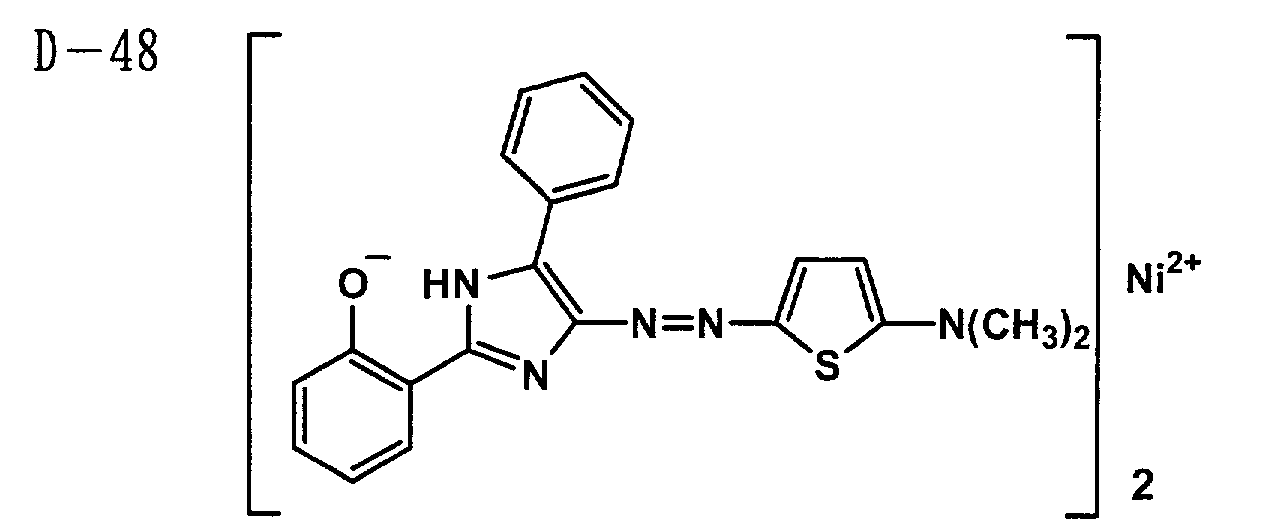
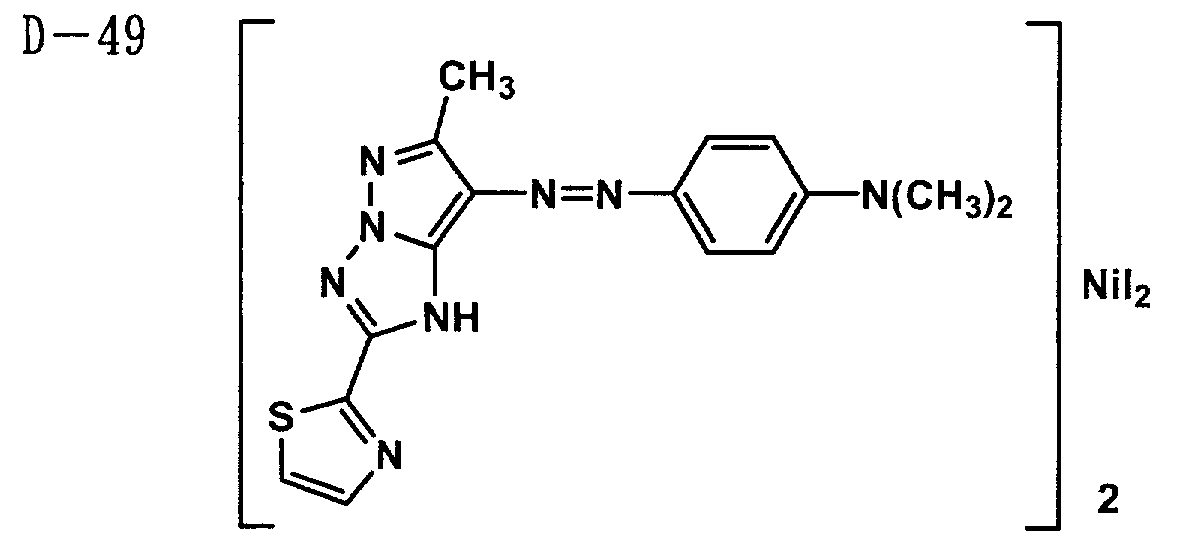
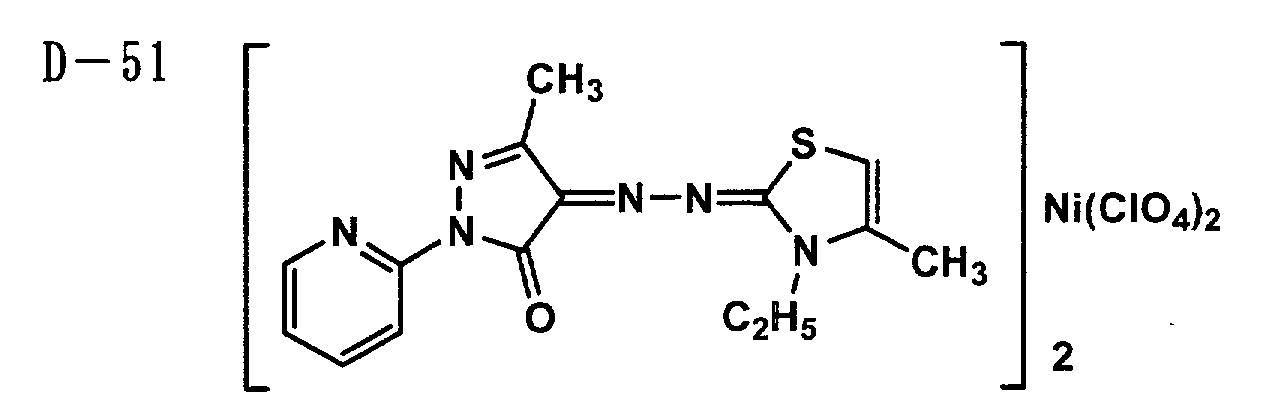
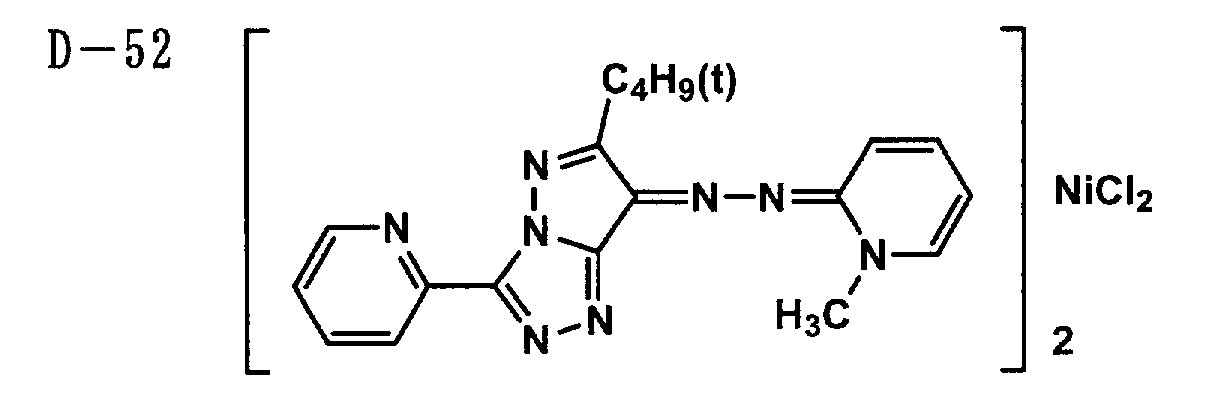
- Water-soluble dyes usable in the present invention include, for example, such as azo dyes, methine dyes, azomethine dyes, xanthene dyes, quinone dyes, phthalocyanine dyes, triphenylmethane dyes and diphenylmethane dyes, and the specific compounds will be shown below.
- the present invention is not limited to these example dyes.
- phthalocyanine dyes include those unsubstituted or having a center element of a metal or a non-metal.
- Preferable metal is copper, and more preferable is C.I. Direct Blue 199.
- pigments which are not soluble in water or in various kinds of organic solvents can also be used.
- conventional organic and inorganic pigments commonly known can be used.
- azo pigments such as an azo lake, an insoluble azo pigment, a condensed azo pigment and a chelate azo pigment, polycyclic pigments such as a phthalocyanine pigment, perylene and a perylene pigment, an anthraquinone pigment, a quinacridone pigment, a dioxazine pigment, a thioindigo pigment, an iso-indolinone pigment and a quinophthalone pigment, dye lakes such as a basic dye type lake and an acid dye type lake, organic pigments such as a nitro pigment, a nitroso pigment, aniline black and a daylight phosphorescent pigment, and inorganic pigments such as carbon black are listed.
- organic pigments are listed below.
- Pigments for magenta or red include C.I. Pigment Red 2, C.I. Pigment Red 3, C.I. Pigment Red 5, C.I. Pigment Red 6, C.I. Pigment Red 7, C.I. Pigment Red 15, C.I. Pigment Red 16, C.I. Pigment Red 48:1, C.I. Pigment Red 53:1, C.I. Pigment Red 57:1, C.I. Pigment Red 122, C.I. Pigment Red 123, C.I. Pigment Red 139, C.I. Pigment Red 144, C.I. Pigment Red 149, C.I. Pigment Red 166, C.I. Pigment Red 177, C.I. Pigment Red 178 and C.I. Pigment Red 222.
- Pigments for orange or yellow include C.I. Pigment Orange 31, C.I. Pigment Orange 43, C.I. Pigment Yellow 12, C.I. Pigment Yellow 13, C.I. Pigment Yellow 14, C.I. Pigment Yellow 15, C.I. Pigment Yellow 17, C.I. Pigment Yellow 93, C.I. Pigment Yellow 94 and C.I. Pigment Yellow 138.
- Pigments for green or cyan include C.I. Pigment Blue 15, C.I. Pigment Blue 15:2, C.I. Pigment Blue 15:3, C.I. Pigment Blue 16, C.I. Pigment Blue 60, and C.I. Pigment Green 7.
- An average particle diameter of a pigment dispersion used in an ink of the present invention is preferably from 10 to 200 nm, more preferably from 10 to 150 nm, and furthermore preferably 10 to 100 nm.
- An average particle diameter of a pigment dispersion exceeds 150 nm, caused is deterioration of glossiness with recorded images on a glossy medium or deterioration of transparency with images recorded on a transparent medium.
- the particle diameter of a pigment dispersion is less than 10 nm, stability of the pigment dispersion becomes poor easily and storage stability of an ink is easily deteriorated.
- a particle diameter of a pigment dispersion can be measured by a particle diameter measuring apparatus available on the market utilizing such as a light scattering method, a electrophoresis method and a laser Doppler method. Further it can also be determined by photographing particle images of at least 100 particles by use of a transmission type electron microscope and statistically analyzing the images by use of an image analyzing software such as Image-Pro (produced by Mediacybernetics Co., Ltd.).
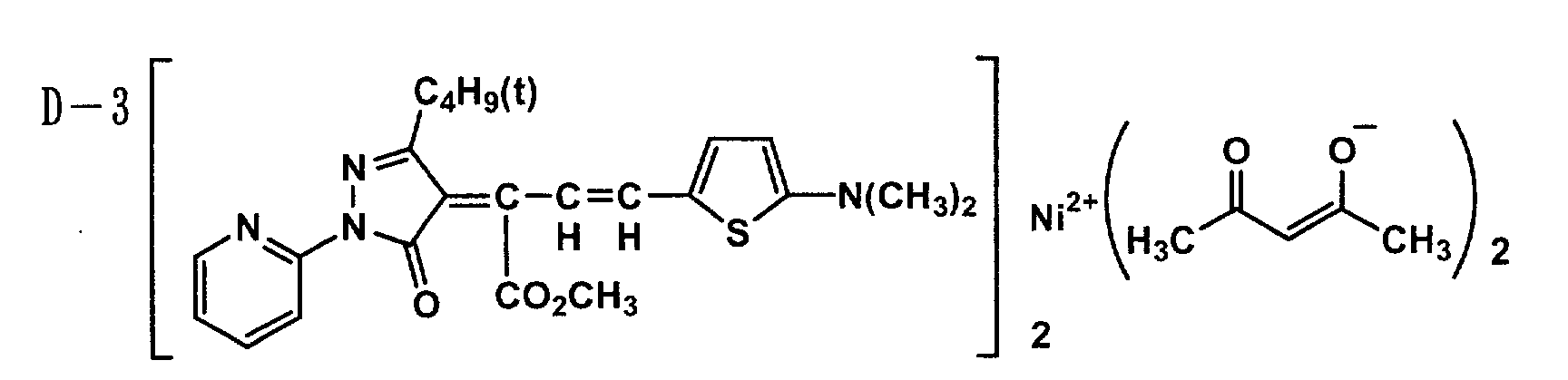
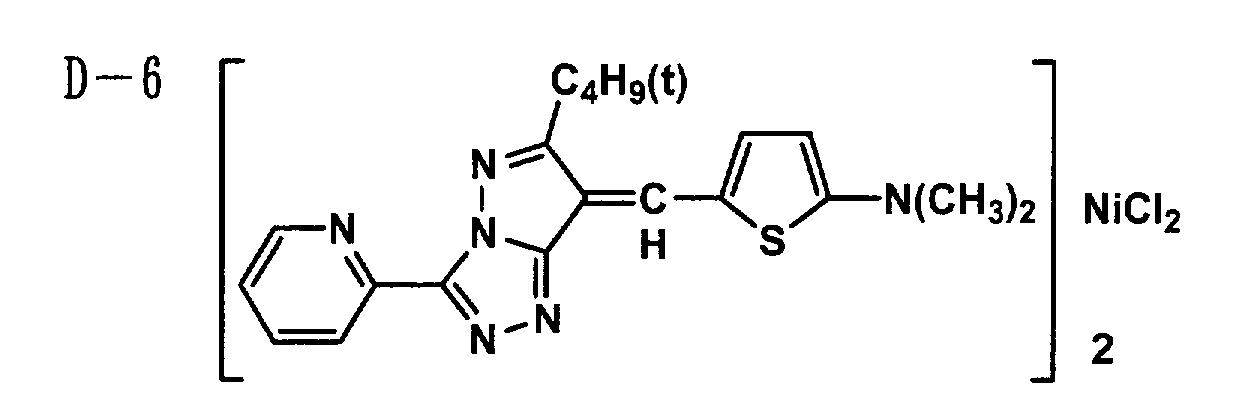
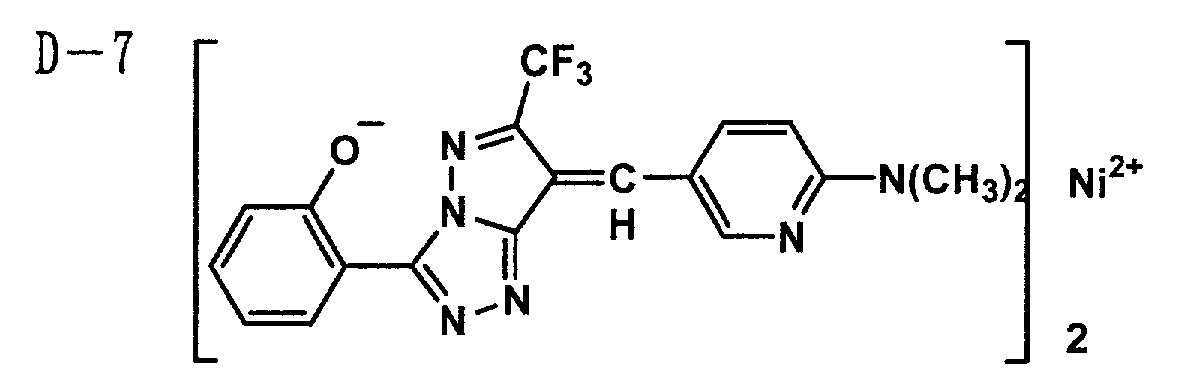
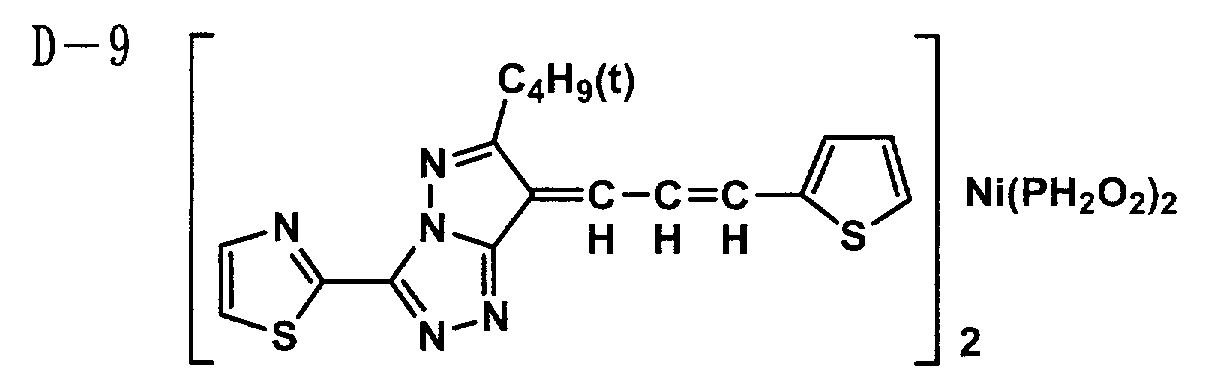
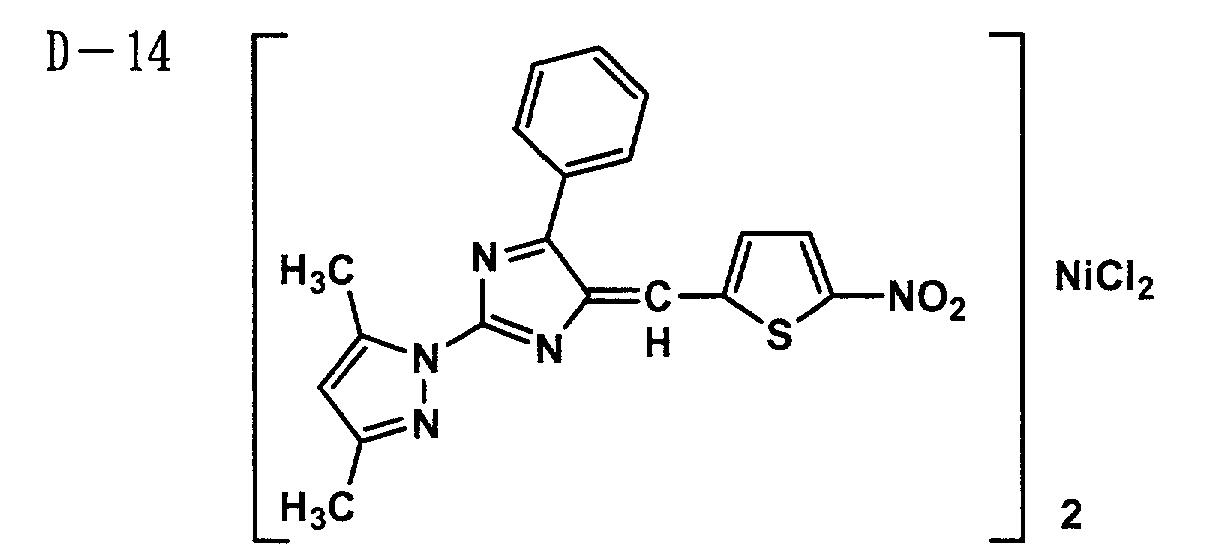
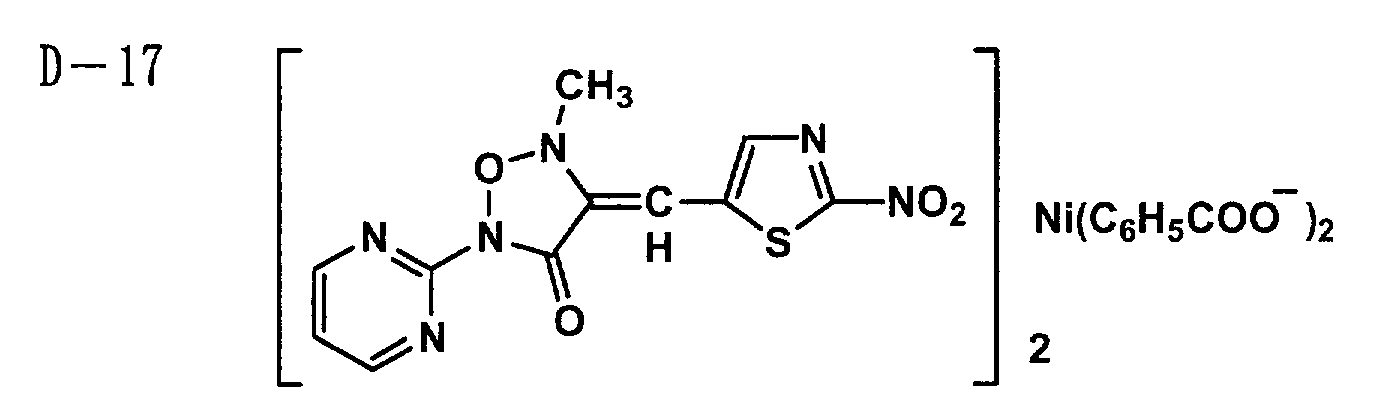
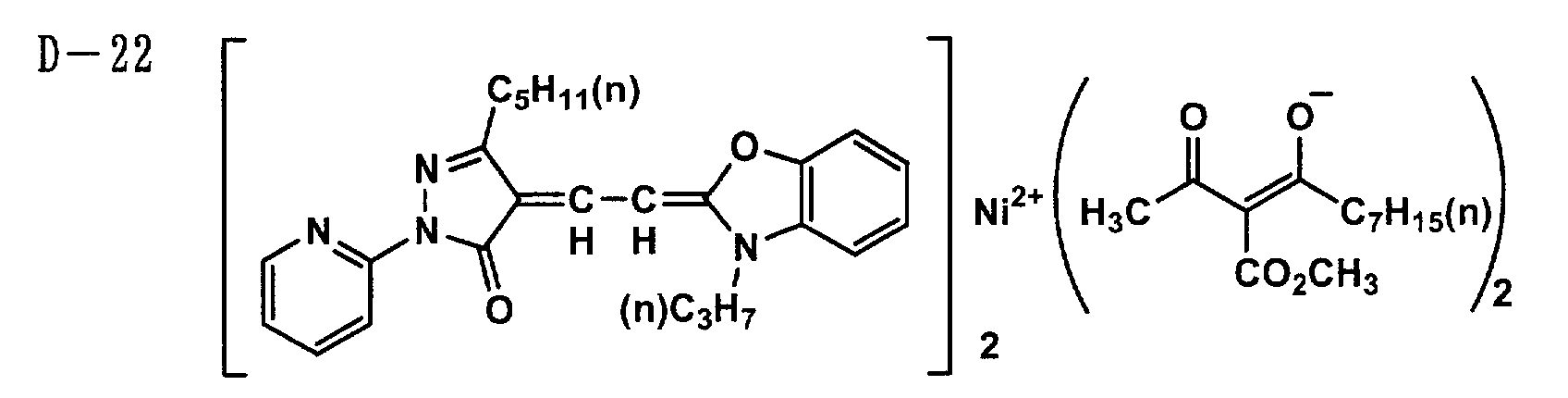
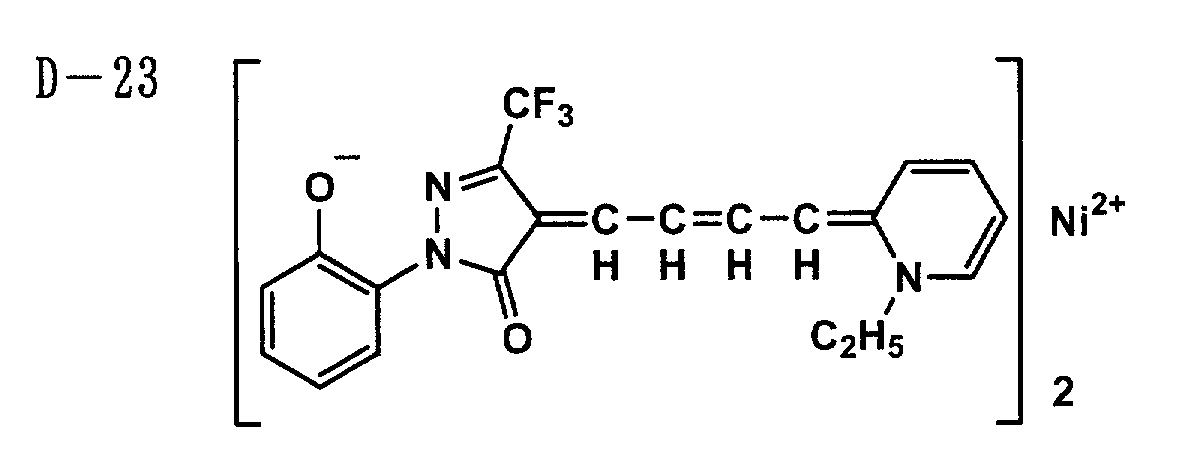
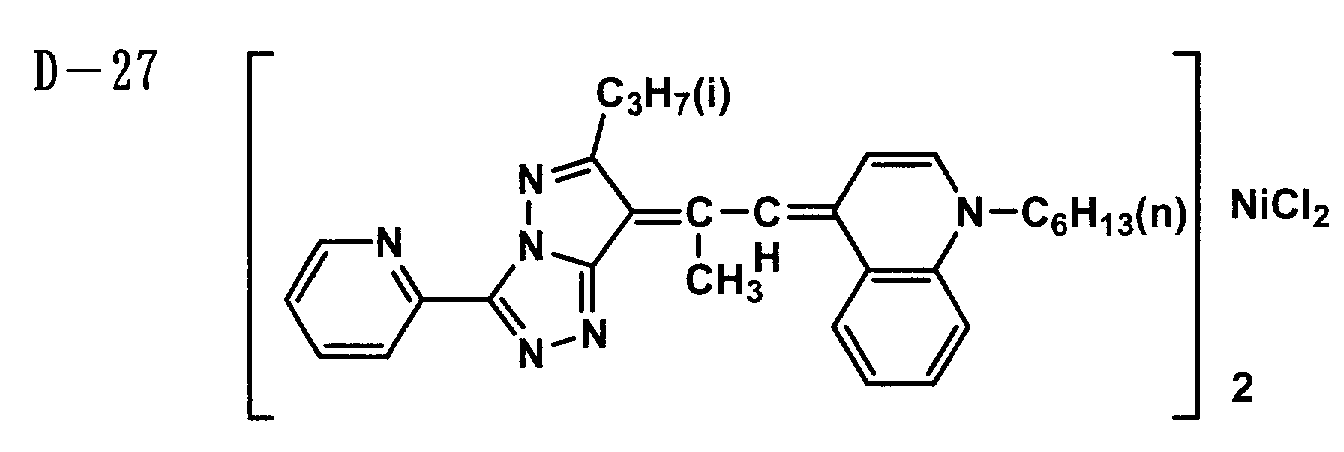
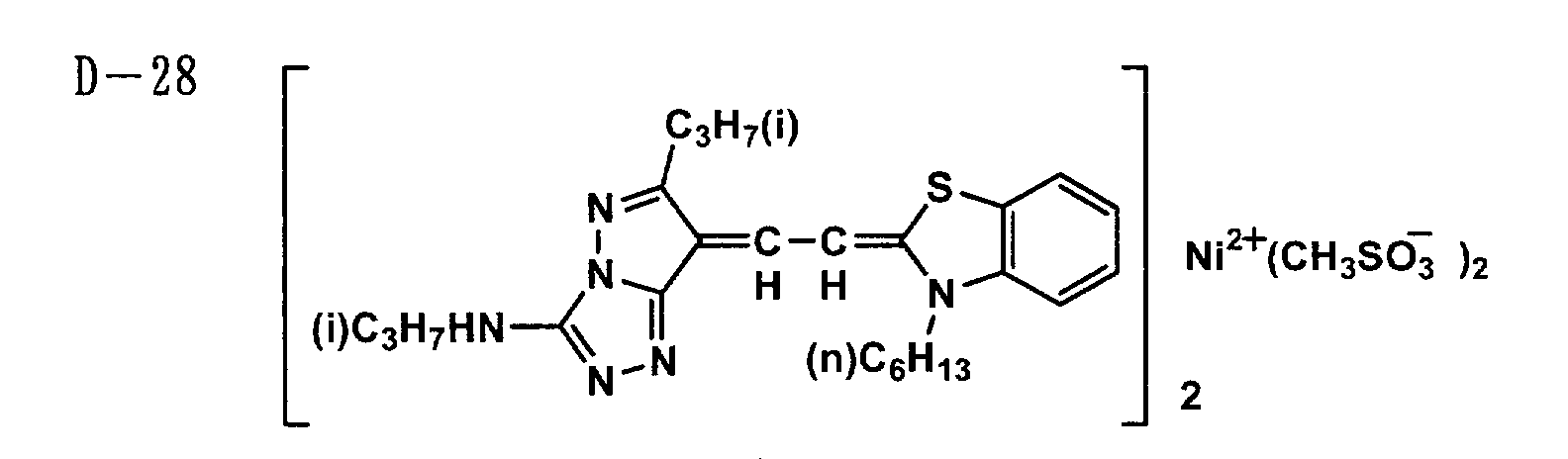
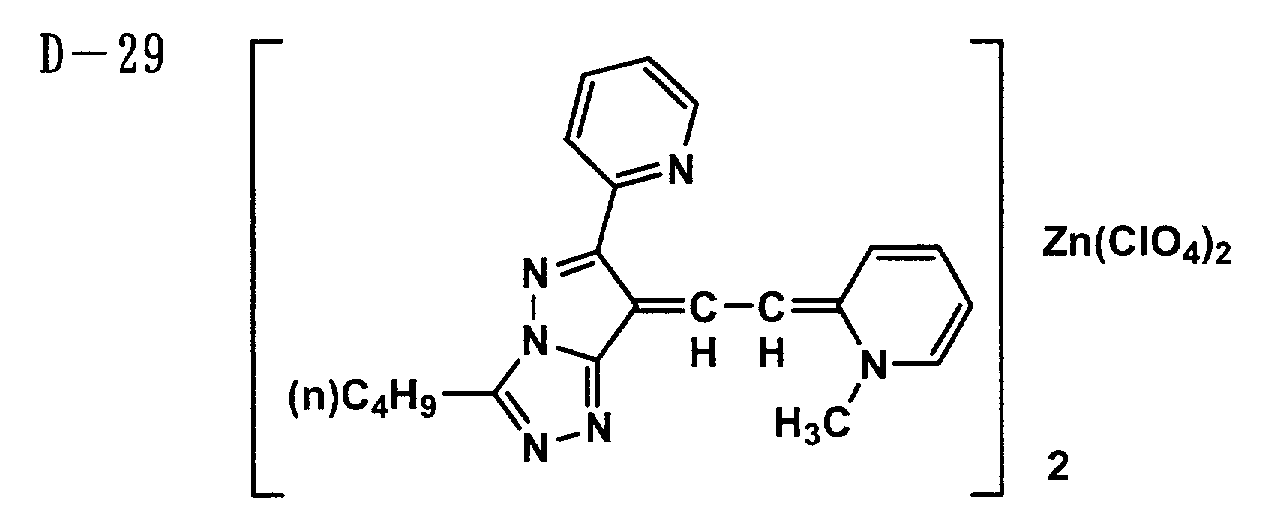
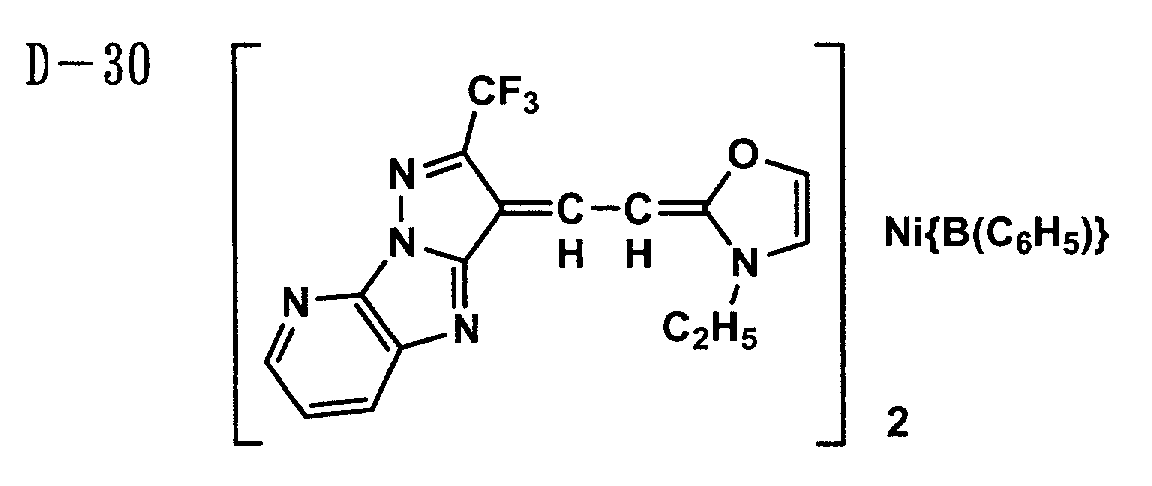
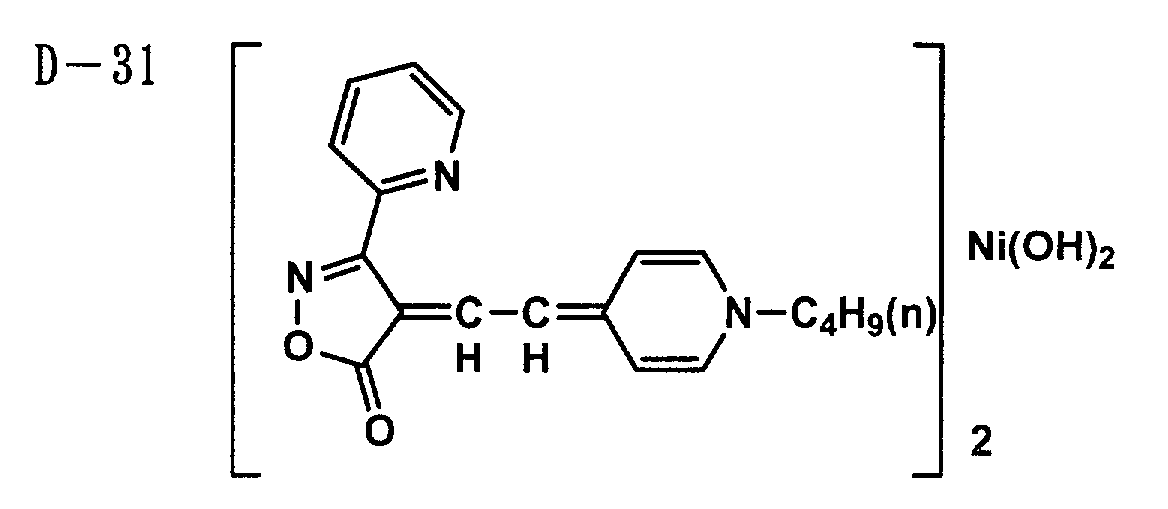
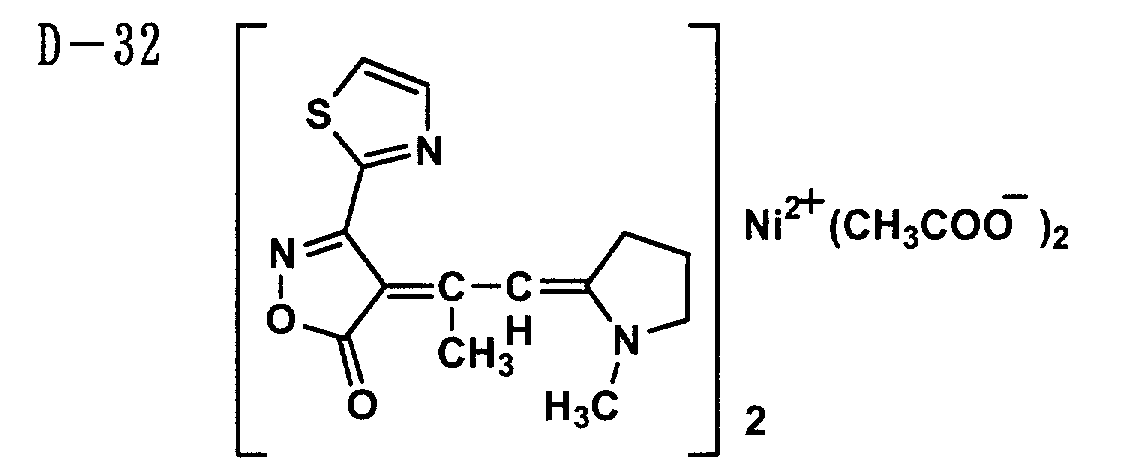
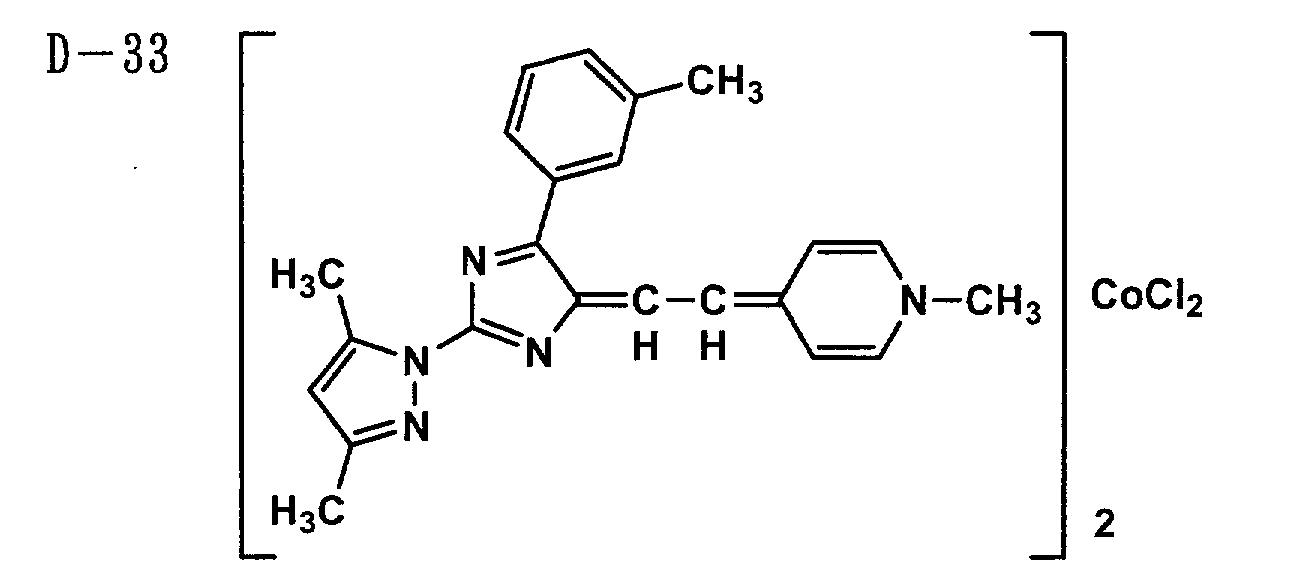
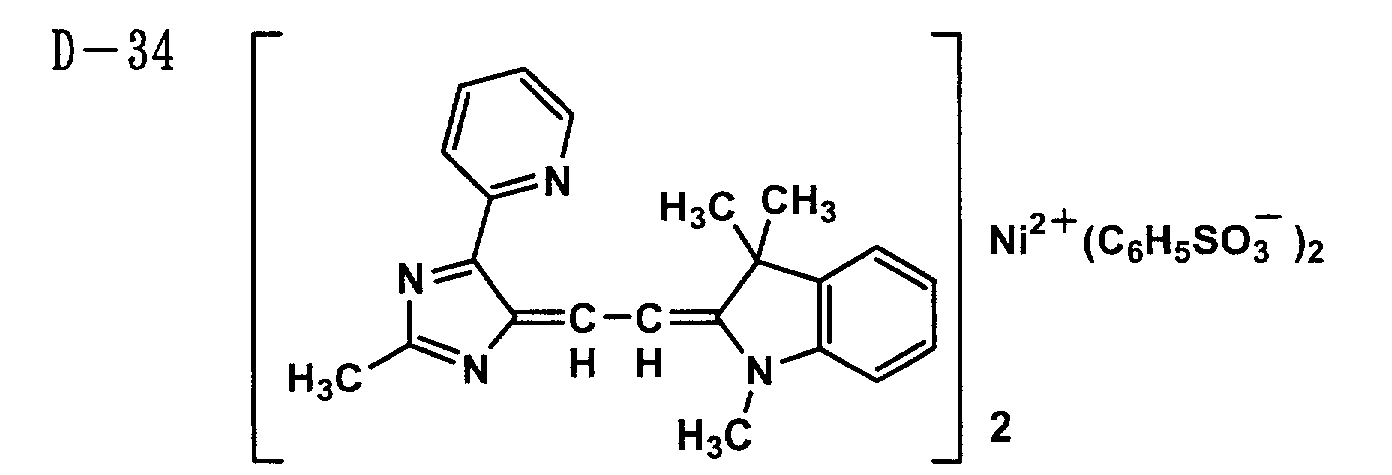
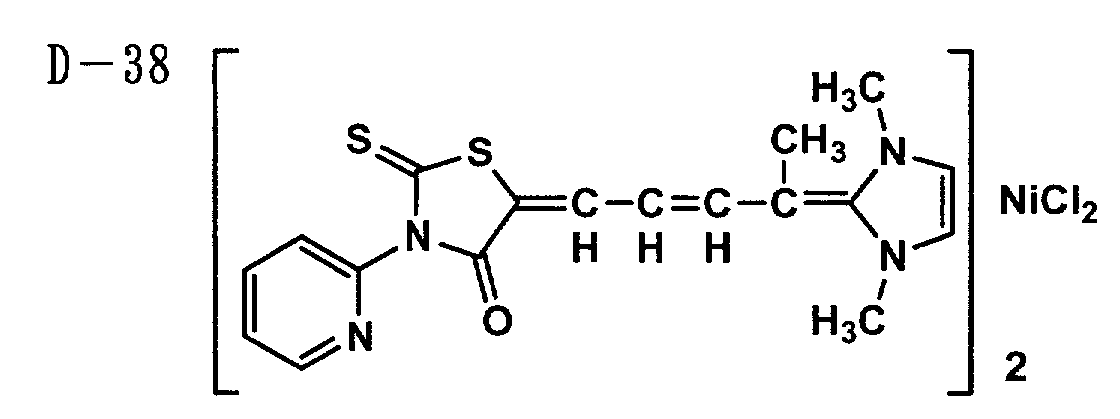
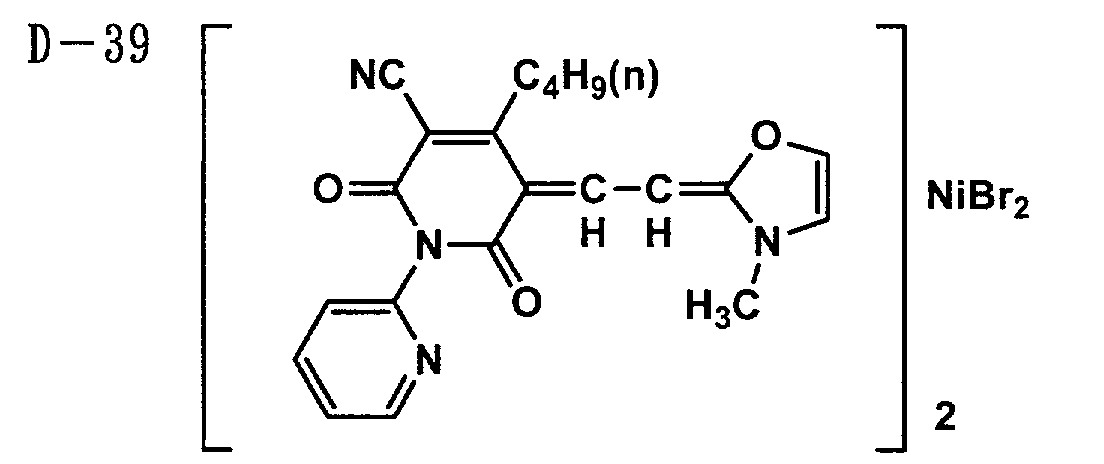
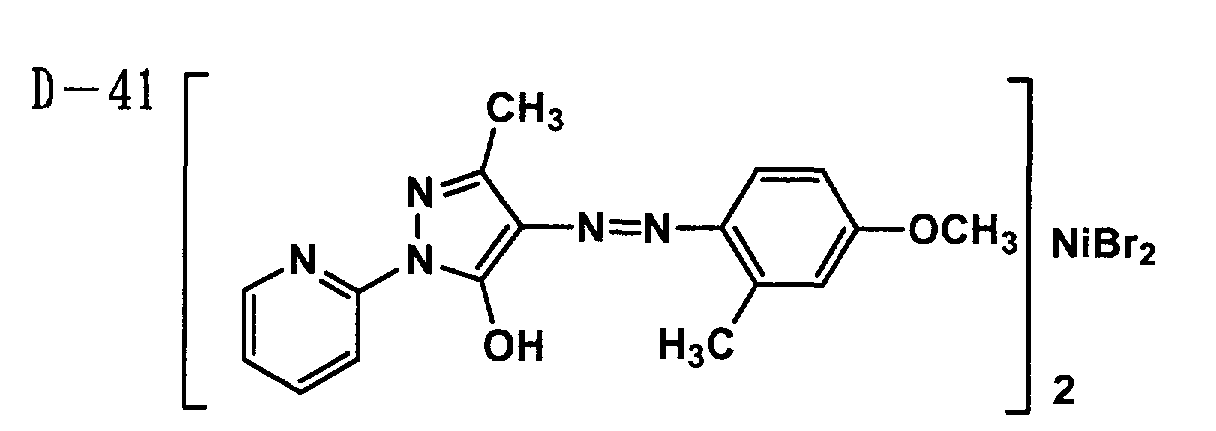
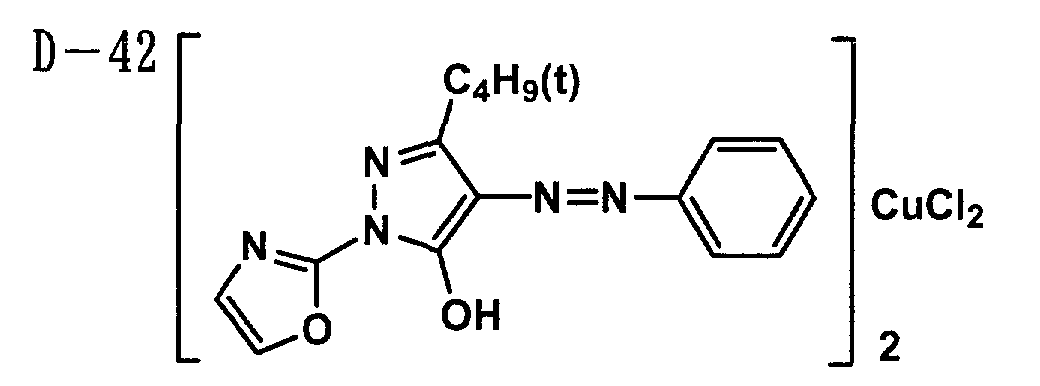
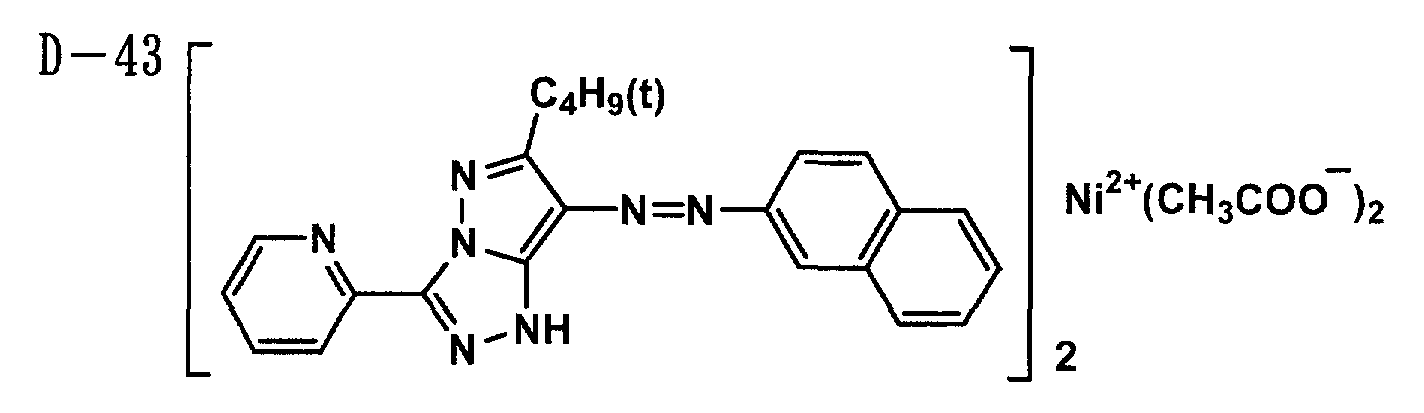
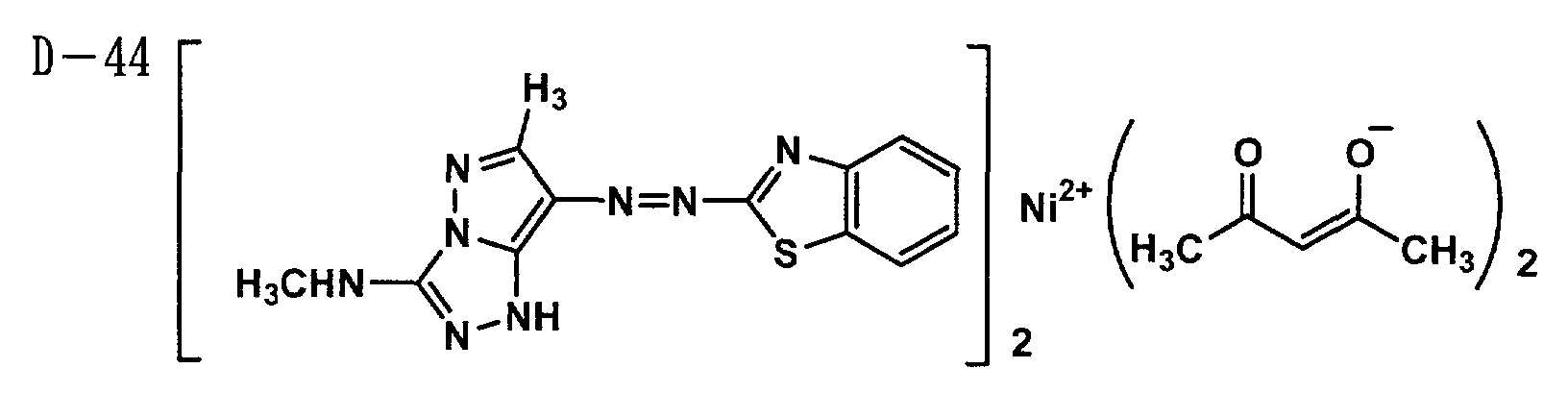
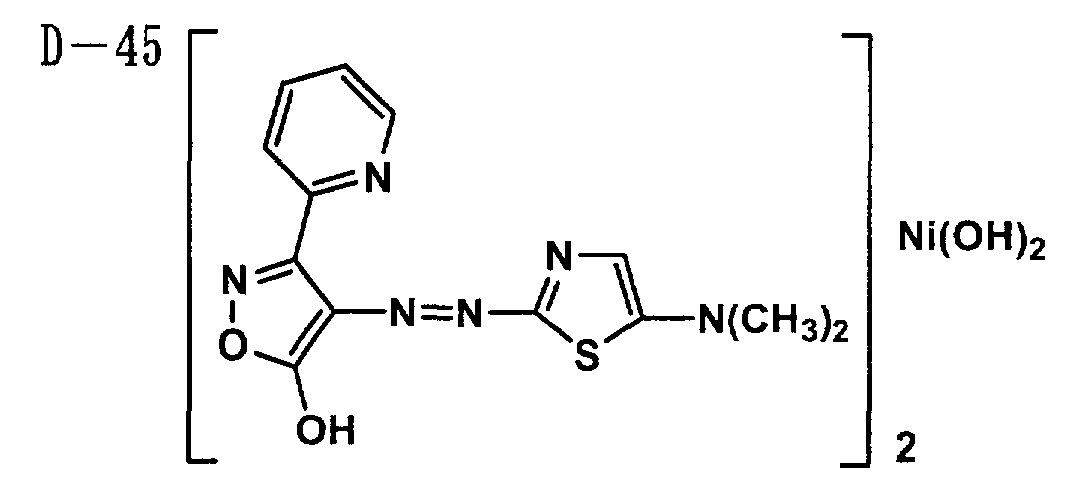
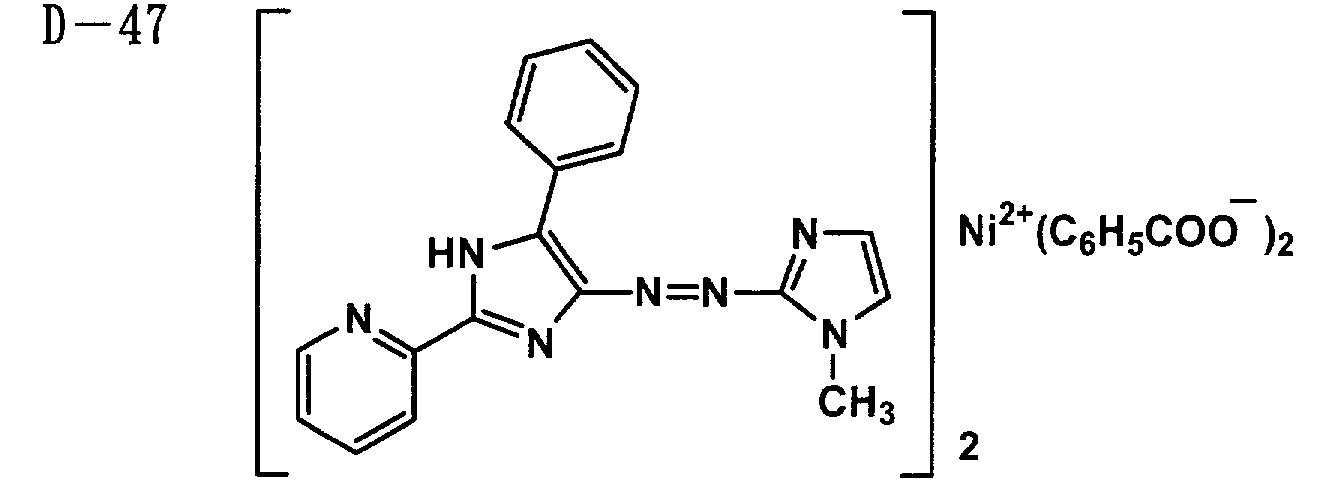
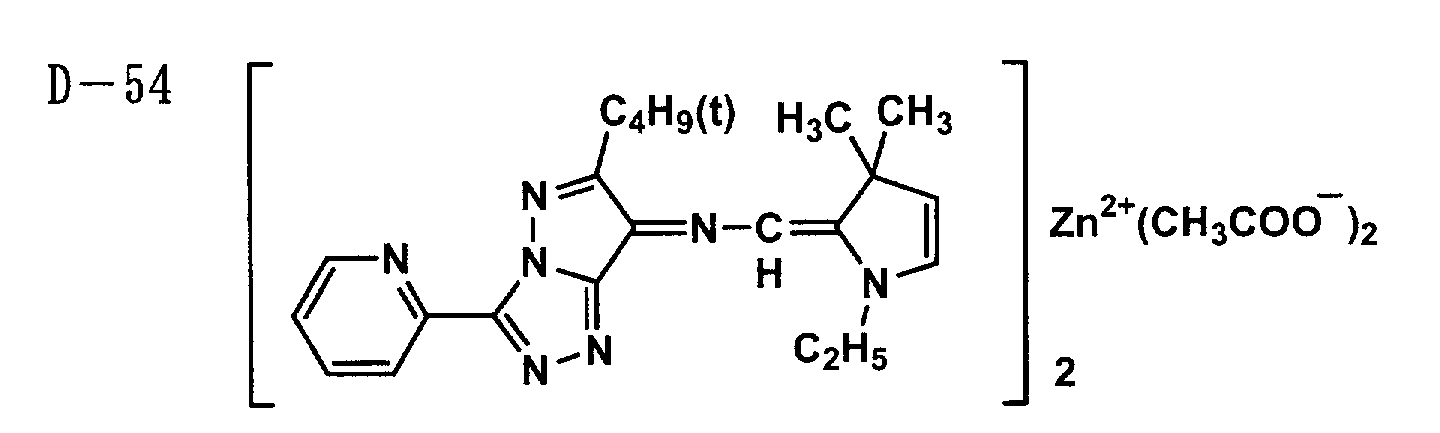
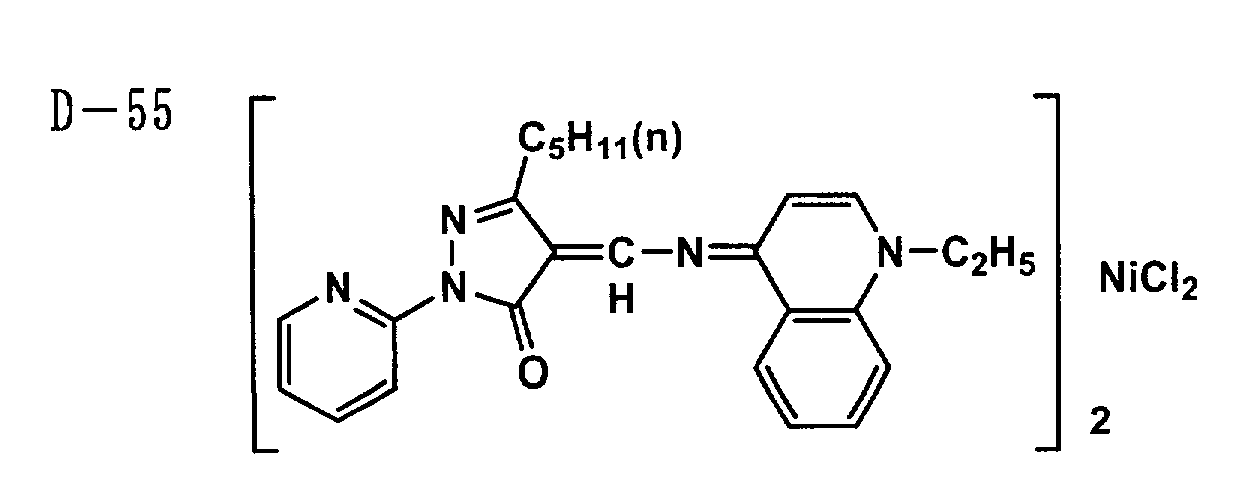
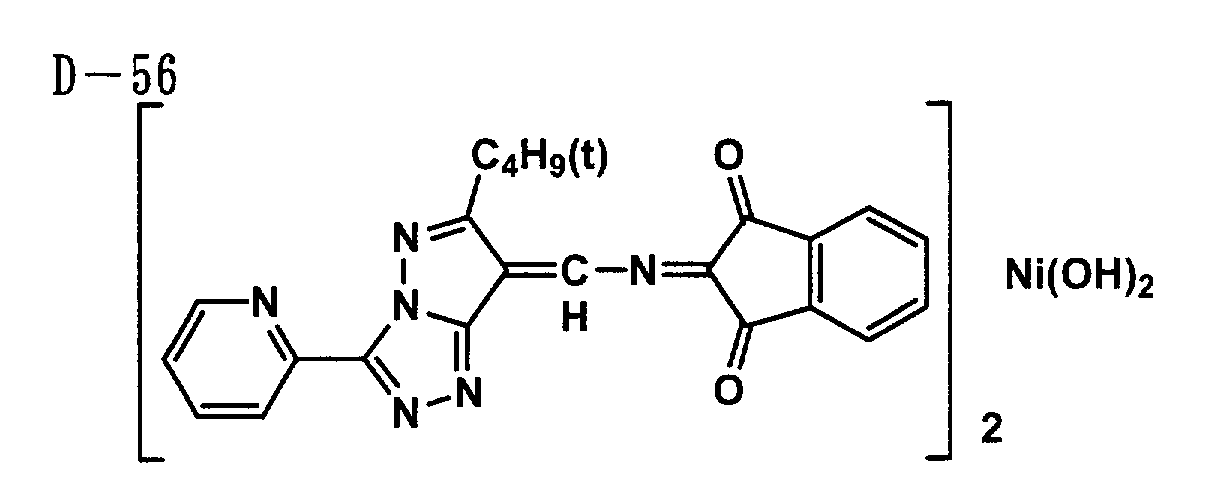
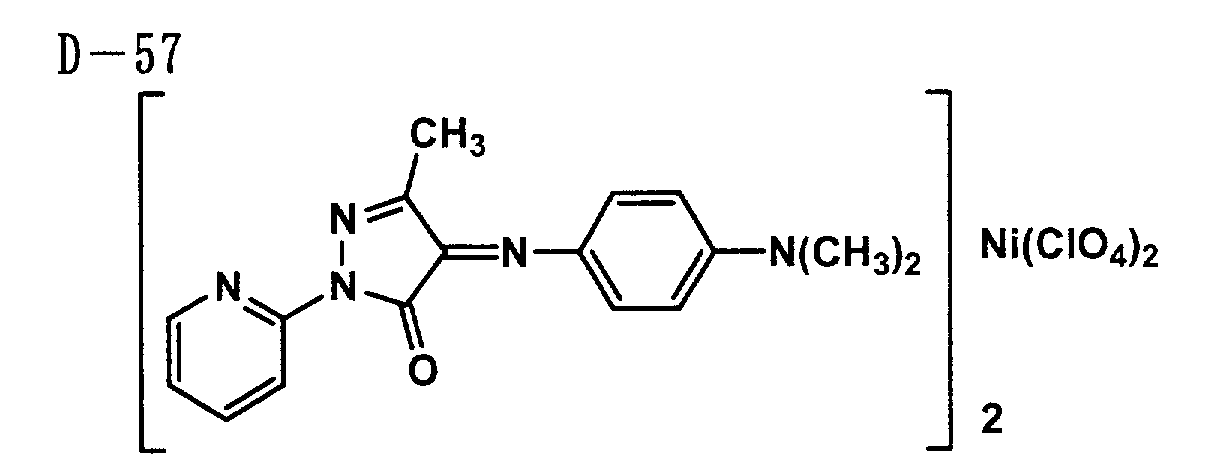
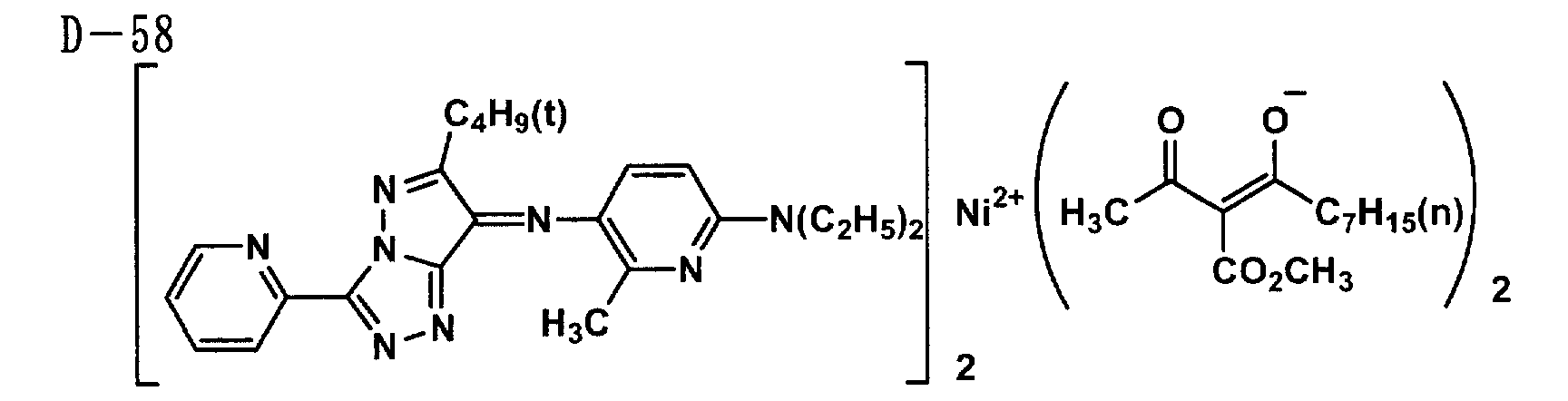
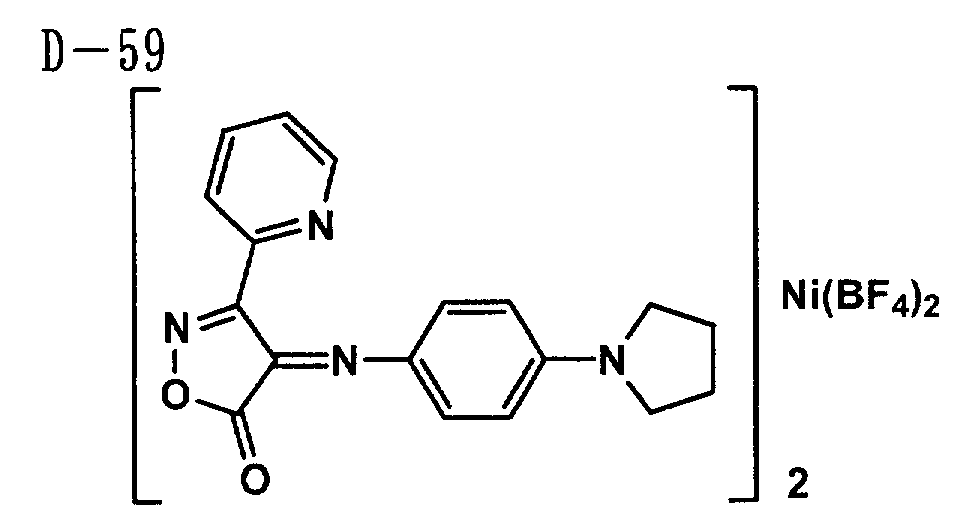
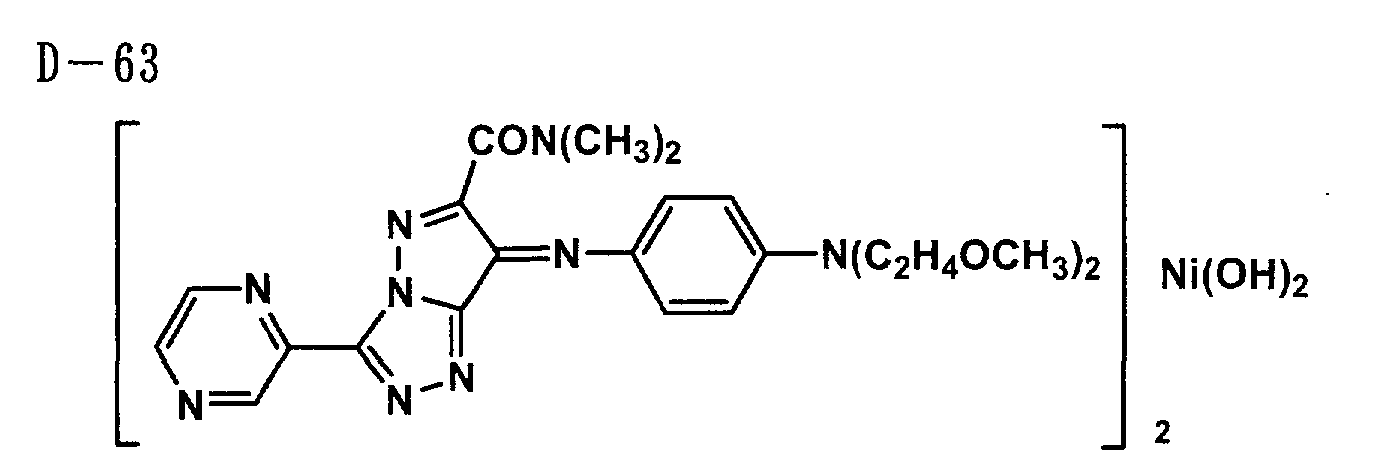
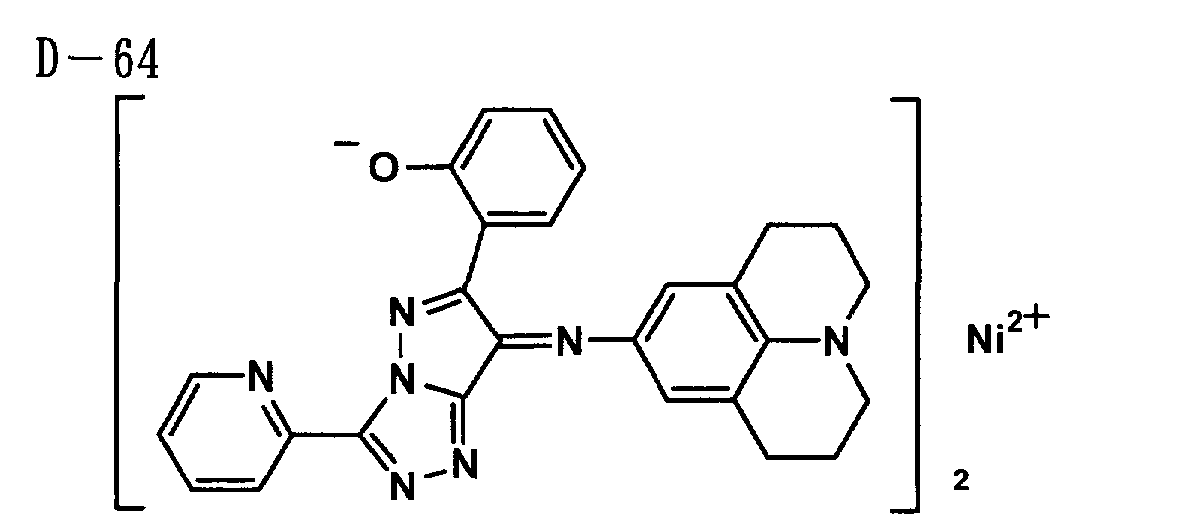
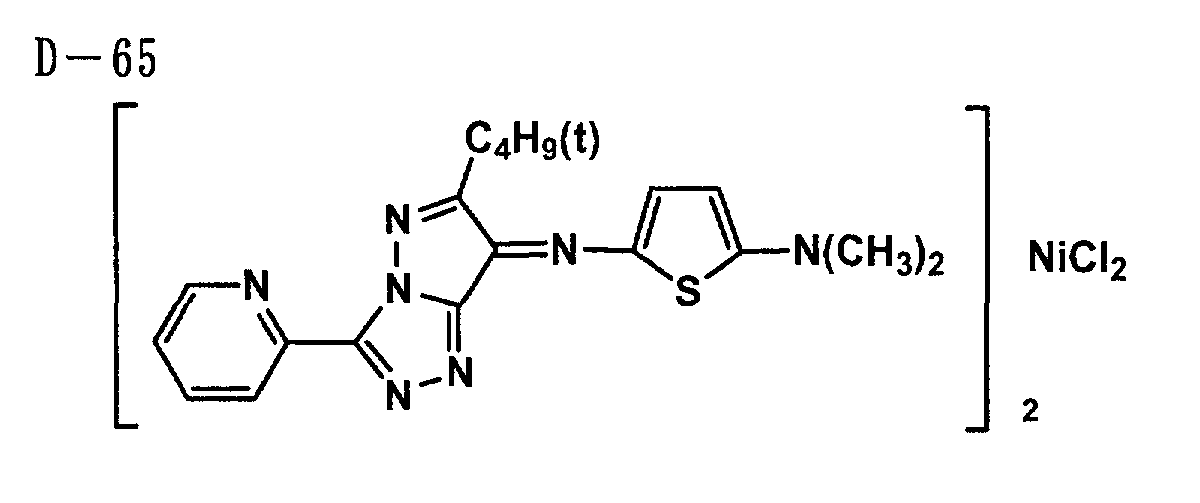
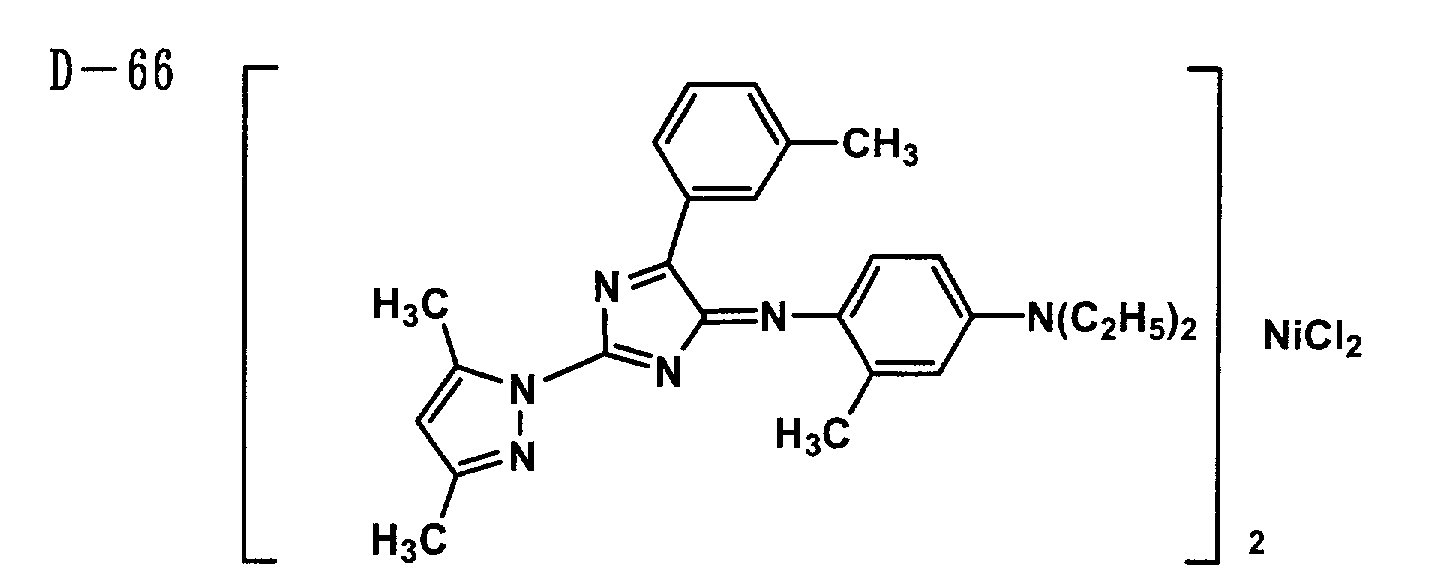
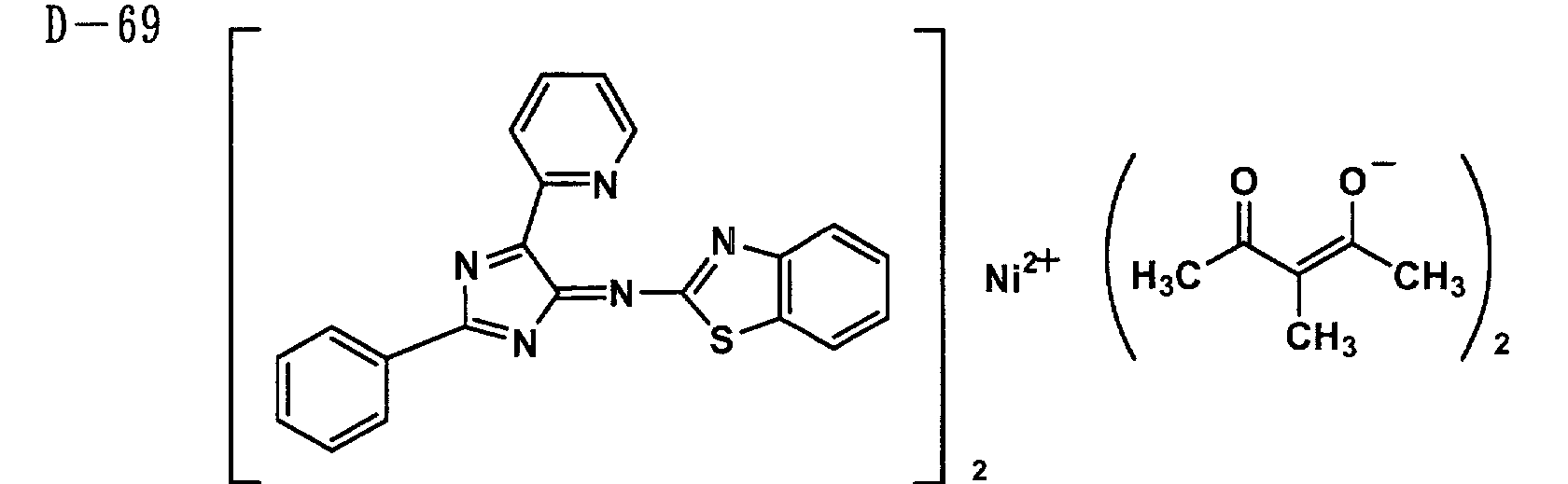
- metal complex dyes such as described in JP-A 9-277693, 10-20559 and 10-30061 are also usable.
- dyes represented by formula (1) and formula (2) described in JP-A 10-20559 can be used.
- X 1 represents a group of atoms having a structure capable of forming at least two coordination bonds with a metal ion
- Y 1 represents an aromatic hydrocarbon ring
- a 5-membered or 6-membered heterocyclic ring or -L 4 Y 2
- Y 2 represents a nitrogen-containing 5-membered or 6-membered heterocyclic ring.
- L 1 and L 4 represent a substituted or unsubstituted methine group.
- M represents a metal ion and forms at least two coordination bonds with the group of atoms represented by X 1 .
- "m" represents 0, an integer of 1, 2 or 3
- n1 represents an integer of 1, 2 or 3.
- X 3 , Y 3 , M and n2 each represent the same as X 1 , Y 1 , M and n1 described above.
- a polymer is preferably blended at a amount of from 0.5 to 50 weight% in a polymer emulsion type water-based ink of the present invention, and more preferably at a amount from 0.5 to 30 weight%.
- the foregoing blending amount of a polymer is less than 0.5 weight%, a function to protect a colorant is insufficient, on the other hand, when the foregoing blending amount of a polymer is over 50 weight%, storage stability of the suspension as an ink may be decreased or clogging of a printer head may occur due to viscosity increase of the ink or coagulation of the suspension accompanied with ink evaporation at the top portion of a nozzle. Therefore the foregoing range of a blend amount is preferred.
- the colorant is preferably blended at 1 to 30 weight% in the ink, and more preferably at 1.5 to 25 weight%.
- the blend amount of a colorant is less than 1 weight% print density is insufficient, and when it is over 30 weight% aging stability is lowered tending to increase the particle diameter by such as coagulation. Therefore, the foregoing range is preferred.
- An ink of the present invention utilizing water as a medium, is comprised of a polymer suspension sealing the foregoing colorant, and various kinds of conventional additives well known in the art, for example, a wetting agent such as polyalcohols, a dispersant, a defoaming agent such as a silicone type, an anti-mold agent such as chloromethyl phenol, and/or a chelating agent such as EDTA, or an oxygen absorbing agent such as a sulfite salt type may be contained in the suspension.
- a wetting agent such as polyalcohols
- a dispersant such as a silicone type
- an anti-mold agent such as chloromethyl phenol
- a chelating agent such as EDTA
- an oxygen absorbing agent such as a sulfite salt type
- polyalcols such as ethylene glycol, propylene glycol, diethylene glycol, triethylene glycol, tetraethylene glycol, polyethylene glycol, glycerin, diethylene glycol diethylether, diethylene glycol mono-n-butylether, ethylene glycol monomethylether, ethylene glycol monoethylether, ethylene glycol monobutylether, methylcarbitol, ethylcarbitol, butylcarbitol, ethylcarbitol acetate, diethylcarbitol, triethylene glycol monomethylether, triethylene glycol monoethylether and propylene glycol monomethylether; ethers thereof, acetate series, nitrogen containing compounds such as N-mehtyl-2-pyrolidone, 1,3-dimethylimidazolidine, triethanolamine, formaldehyde, dimethylformaldehyde; and dimethylsulfoxide can be
- a HLB value thereof is preferably from 8 to 18 in terms of exhibiting an effect as a dispersant and being effective to depress the increase of a particle diameter in a suspension.
- Dispersant SNB Dispersant SNB
- MS Dispersant SNB
- N Surfactant SNB
- SSL Secure Sockets Layer
- ST and P name of products manufactured by Kao Corp.
- a blend amount of a dispersant is not limited specifically, however, it is preferably from 0.01 to 10 weight % in an ink of the present invention.
- a blend amount of the compound is less than 0.01 weight %, it is difficult to make the particle diameter of a suspension small; when it is over 10 weight%, the particle diameter of a suspension may increase or stability of a suspension may be lowered causing a suspension possibly being gelled. Therefore, preferred is the foregoing range.
- Such commercially available products include, for example, KF 96, 66, 69, KS 68, 604, 607A, 602, 603, KM73, 73A, 73E, 72, 72A, 72C, 72F, 82F, 70, 71, 75, 80, 83A, 85, 89, 90, 68-1F and 68-2F (name of products) manufactured by Shin-Etsu Silicone Co., Ltd.
- the blend amount of these compounds is not specifically limited, however, is preferably from 0.001 to 2 weight% in a polymer emulsion type water-based ink of the present invention.
- a blend amount of the compound is less than 0.001 weight%, it is easy to cause foaming at the time of ink preparation and difficult to eliminate small bubbles in an ink, while when it is over 2 weight%, foaming is restrained but print quality may be deteriorated by generation of repellency spots. Therefore, the foregoing range is preferred.
- An ink of the present invention can be prepared by various kinds of emulsifying methods.
- the examples are summarized, for example, in p.86 of "Progress and Application of Functional Emulsifiers and Emulsifying Techniques" published by C. M. C.
- emulsifying dispersion apparatuses utilizing ultrasonic waves, high speed rotational shear or high pressure.
- a batch type is suitable for preparation of a relatively small amount of samples and a continuous type for preparation of a large amount of samples.
- a continuous type for example, an apparatus such as UH-600SR (produced by S. M. T Co., Ltd.) can be used.
- the irradiation time of ultrasonic waves can be determined by (volume of dispersion room)/(flow speed x circulation number).
- the irradiation time is practically not longer than 10,000 seconds.
- dispermixers such as described in pages 255 and 256 of "Progress and Application of Functional Emulsifiers and Emulsifying Techniques" published by C. M. C., homomixers such as described in the page 251 and ultra-mixers such as described in the page 256 can be used. These types of apparatuses can be selectively employed depending on viscosity of a solution at emulsifying dispersion. In the emulsifying dispersion apparatuses by means of high speed rotational shear, the rotational number of stirring fans is important.
- the shear stress is mainly dependent on a circumferential speed of a stirring fan.
- Those having a circumferential speed of not lower than 5 m/sec and not higher than 150 m/sec can be applicable in emulsifying dispersion of the present invention.
- the circumferential speed is too slow, the particle diameter often cannot be made sufficiently small even with prolonged emulsification time, while the motor ability has to be extremely strengthened to achieve 150 m/sec.
- preferable is from 20 to 100 m/sec.
- emulsifying dispersion by means of high pressure such as LAB2000 (produced by S.M. T. Co.) can be used, and the emulsifying dispersion ability is dependent on a pressure applied to a sample.
- the pressure is preferably in a range of from 10 4 kPa to 5 x 10 5 kPa.
- aimed particle diameter can be obtained, if necessary, by repeating emulsifying dispersion a few times. When the pressure is too low an aimed particle diameter often cannot be obtained, while it is not practical to increase the pressure to 5 x 10 5 kPa because of excess load to an apparatus. More preferable is a range of from 5 x 10 4 kPa to 2 x 10 5 kPa.
- emulsifying dispersion apparatus can be utilized alone, as well as in combinations if necessary.
- a colloidal mill or a flow-jet mixer alone cannot achieve the object of the present invention, however, the combination with an apparatus of the present invention can enhance the effect of the present invention by such as enabling emulsifying dispersion in a short time.
- phase inversion emulsification comprises dissolving the foregoing polymer together with dyes in organic solvents such as esters or ketones, ionizing carboxyl groups in the polymer by addition of neutralizers when necessary, followed by addition of a water phase, and being phase inversed into a water phase by distilling out of the organic solvents.
- organic solvents such as esters or ketones
- the solvents of ester and ketone types described above together with a certain amount of water are removed by heating the system under reduced pressure to obtain a water-based ink for ink-jet recording of the present invention having a desired concentration.
- a polymer emulsion type water-based ink of the present invention can be utilized, for example, as an ink for general writing tools such as a fountain pen, a ball-point pen, a felt pen, other than as an ink for ink-jet recording.
- a suspension of the present invention can be dried to obtain powder of fine particles.
- Example compound D-5 a polymer emulsion
- Example 2 Operations similar to those in Example 1 were performed, except that only BL-S was used as a polymer and only sodium lauryl sulfate of 3 g was added in the water phase. Thereafter, after adding 0.1 g of sodium persulfate, polymerization was performed under the flow of nitrogen gas at 80° C while adding dropwise a mixture of 2.5 g of styrene and 2.5 g of 2-hydroxyethyl mehtacrylate in 2 hours. (Shell polymer: styrene/2-hydroxyethyl methacrylate copolymer, 25%)
- Example 3 A sample in Example 3, in which the amounts of styrene and 2-hydroxyethyl methacrylate were increased 1.5 times respectively, was prepared.
- Example 3 A sample in Example 3 in which 2 times amounts respectively of styrene and 2-hydroxyethyl methacrylate were used was prepared.
- Example 3 The amount of styrene and 2-hydroxyethyl methacrylate was reduced to be 1/10 of those used in Example 3. Each amount of other ingredients was the same as in Example 3.
- the amount of styrene was changed to be 6 g, and the amount of 2-hydroxyethyl methacrylate was changed to be 4 g.
- Each amount of other ingredients was the same as in Example 3.
- the amount of styrene was changed to be 2.5 g, and the amount of 2-hydroxyethyl methacrylate was changed to be 7.5 g.
- Each amount of other ingredients was the same as in Example 3.
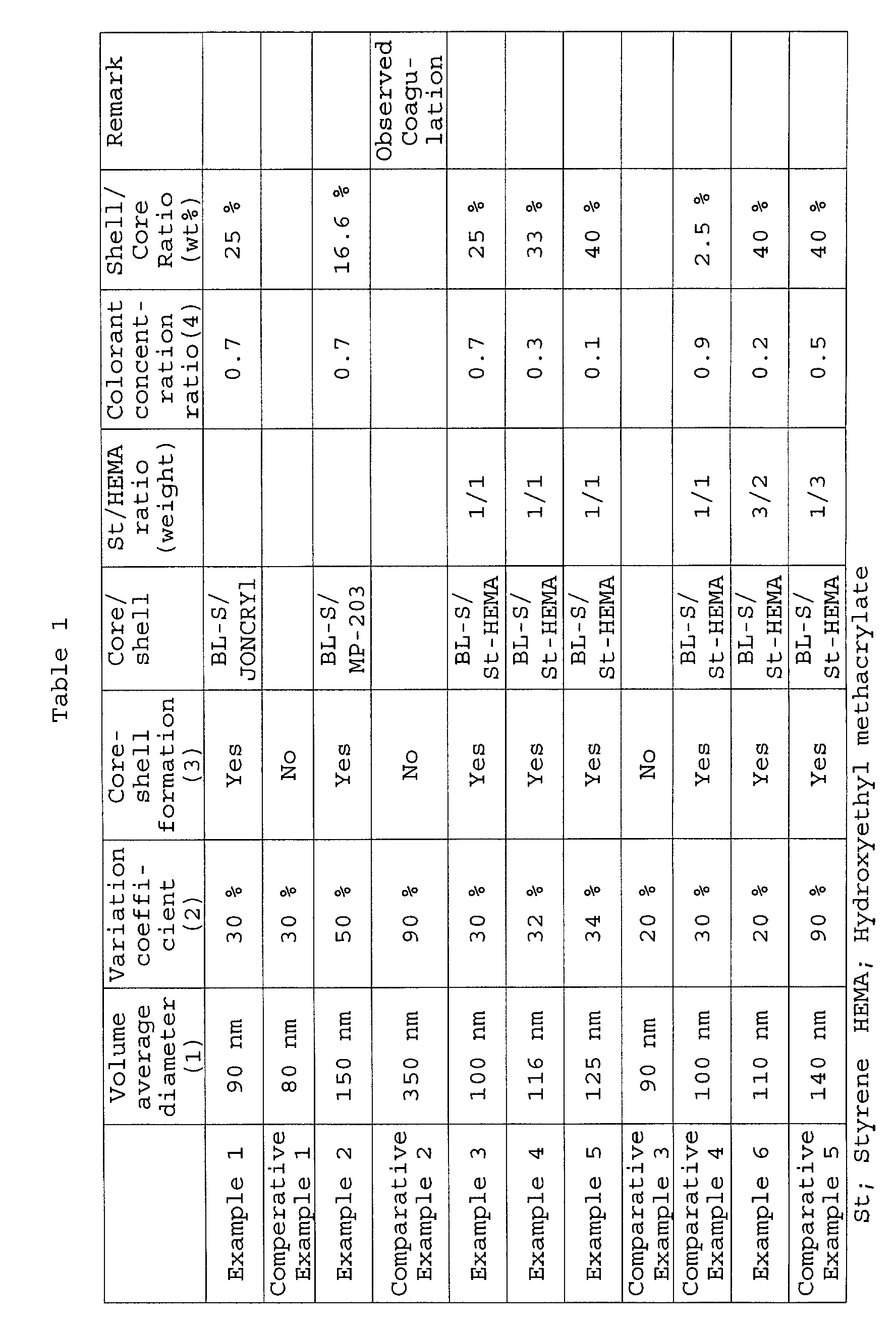
- a volume average particle diameter and a variation coefficient thereof with respect to colorant containing particles thus prepared are shown in Table 1. Further, the dye concentration ratio of a core to a shell was calculated by the following method to show that all the dye concentration ratios of shells of particles of Examples 1, 2 and 3 were 0.7 based on those of cores. The value was 0.3 for the particle of Example 4, and 0.1 for the particle of Example 5.
- Colorant-containing particles prepared were coated and dried on a Si-wafer, an area strength at a mass number of a dye as a colorant + 1 was divided by a strength of total ions detected in a range from 0.5 to 1000 a. m. u., under the following conditions, and colorant containing ratio (concentration) was calculated by comparing the value with respect to, a particle comprised of only a core, and a core/shell particle, respectively.
- the polymer emulsion of colorant containing particles prepared above was mixed with the following components, the obtained dispersion was filtered through a 5-micron filter to eliminate dusts and coarse particles to prepare an ink-jet ink.
- Polymer emulsions prepared in Examples 1 to 6 and Comparative Examples 1 to 5 80 g Diethylene glycol 10 g Glycerin 9.8 g Acethylenol EL 0.20 g
Landscapes
- Chemical & Material Sciences (AREA)
- Organic Chemistry (AREA)
- Life Sciences & Earth Sciences (AREA)
- Medicinal Chemistry (AREA)
- Polymers & Plastics (AREA)
- Chemical Kinetics & Catalysis (AREA)
- Health & Medical Sciences (AREA)
- Engineering & Computer Science (AREA)
- Materials Engineering (AREA)
- Wood Science & Technology (AREA)
- Inks, Pencil-Leads, Or Crayons (AREA)
- Ink Jet Recording Methods And Recording Media Thereof (AREA)
- Ink Jet (AREA)
Abstract
Description
ARIMOTO CHEMICAL CO., LTD: FS Yellow 1015, FS Magenta 1404, FS Cyan 1522, FS Blue 1504, C.I.Solvent Yellow 88, Solvent Yellow 83, Solvent Yellow 82, Solvent Yellow 79, Solvent Yellow 56, Solvent Yellow 29, Solvent Yellow 19, Solvent Yellow 16, Solvent Yellow 14, Solvent Yellow 04, Solvent Yellow 03, Solvent Yellow 02, Solvent Yellow 01, C.I.Solvent Red 84:1, C.I.Solvent Red 84, C.I.Solvent Red 218, C.I.Solvent Red 132, C.I.Solvent Red 73, C.I.Solvent Red 72, C.I.Solvent Red 51, C.I.Solvent Red 43, C.I.Solvent Red 27, C.I.Solvent Red 24, Solvent Red 18, Solvent Red 01, Solvent Blue 70, Solvent Blue 67, Solvent Blue 44, Solvent Blue 40, Solvent Blue 35, Solvent Blue 11, Solvent Blue 02, Solvent Blue 01, Solvent Black 43, C.I.Solvent Black 70, C.I.Solvent Black 34, C.I.Solvent Black 29, C.I.Solvent Black 27, C.I.Solvent Black 22, C.I.Solvent Black 7, C.I.Solvent Black 3, C.I. Solvent Violet 3, C.I.Solvent Green 3, C.I.Solvent Green 7.
are listed, and the dyes listed above are described in such as "Dyeing Notebook 21st edition" (published by Shikisensha).
























Name of Apparatus; TRIFT-II
Producer; Physical Electronics Co., Ltd.
Primary Ion; Ga+
Acceleration Voltage; 15 kV
Measurement Range of Mass Number; 0.5 to 1000 a. m. u.
Measurement Area; 60 µm x 60 µm
Detected Ion; normal secondary ion detection
Time of Accumulation; 5 minutes
Measurement Temperature; cooled by liquid nitrogen
Stage Voltage; 3000 V
| Comparative Examples 1 to 5 | 80 g |
| Diethylene glycol | 10 g |
| Glycerin | 9.8 g |
| Acethylenol EL | 0.20 g |
| Light fastness | Color Tone | |
| Example 1 | A | B |
| Comparative Example 1 | A | C |
| Example 2 | A | B |
| Comparative Example 2 | C | C |
| Example 3 | A | B |
| Example 4 | A | B |
| Example 5 | A | A |
| Comparative Example 3 | A | C |
| Comparative Example 4 | A | C |
| Example 6 | A+ | A |
| Comparative Example 5 | A | C |
Claims (6)
- A polymer dispersion comprising water and polymer particles having a size of 5 to 500 nm in volume average diameter and having a core-part and a shell-part in each of the polymer particles, wherein the core-part and the shell-part each comprise a colorant and a polymer, and the shell-part contains the colorant in an amount of not more than 80 weight % of the colorant in the core-part.
- The polymer particles of claim 1, wherein the core-part and the shell-part each comprise a colorant and a polymer, and the shell-part contains the colorant in an amount of not more than 50 weight % of the colorant in the core-part.
- The polymer particles of claim 1, wherein the variation coefficient of the volume diameter of the polymer particles is not more than 80 %.
- The polymer particles of claim 1, wherein the shell-part in each of the polymer particles contains the polymer in an amount of 5 to 95 weight % of the polymer in each of the polymer particles.
- The polymer particles of claim 1, wherein each of the polymer particles contains the colorant in an amount of 20 to 1000 weight % of the polymer in each of the polymer particles.
- A water-base ink for ink-jet printing comprising the polymer dispersion of claim 1.
Applications Claiming Priority (2)
| Application Number | Priority Date | Filing Date | Title |
|---|---|---|---|
| JP2001146067 | 2001-05-16 | ||
| JP2001146067A JP2002338856A (en) | 2001-05-16 | 2001-05-16 | Fine particle containing colored material and polymer emulsion type aqueous ink |
Publications (3)
| Publication Number | Publication Date |
|---|---|
| EP1258511A2 true EP1258511A2 (en) | 2002-11-20 |
| EP1258511A3 EP1258511A3 (en) | 2003-05-07 |
| EP1258511B1 EP1258511B1 (en) | 2005-08-31 |
Family
ID=18991778
Family Applications (1)
| Application Number | Title | Priority Date | Filing Date |
|---|---|---|---|
| EP20020253271 Expired - Lifetime EP1258511B1 (en) | 2001-05-16 | 2002-05-09 | Particles containing a colorant and a water-based ink comprising polymer emulsion |
Country Status (4)
| Country | Link |
|---|---|
| US (1) | US6777463B2 (en) |
| EP (1) | EP1258511B1 (en) |
| JP (1) | JP2002338856A (en) |
| DE (1) | DE60205808T2 (en) |
Cited By (4)
| Publication number | Priority date | Publication date | Assignee | Title |
|---|---|---|---|---|
| EP1357157A1 (en) * | 2002-04-22 | 2003-10-29 | Konica Corporation | Water-based ink for ink-jet printing |
| EP1591499A1 (en) * | 2004-04-26 | 2005-11-02 | Kabushiki Kaisha Pilot Corporation | Aqueous Ink for ball-point pen using oil-in-water type resin emulsion and ball-point pen using the aqueous ink |
| US7053136B2 (en) * | 2002-01-31 | 2006-05-30 | Konica Corporation | Colored particle aqueous dispersion, water-based ink, and image forming method |
| JP2020183458A (en) * | 2019-04-26 | 2020-11-12 | 三菱鉛筆株式会社 | Ink composition for writing instrument |
Families Citing this family (11)
| Publication number | Priority date | Publication date | Assignee | Title |
|---|---|---|---|---|
| US7008977B2 (en) * | 2001-06-29 | 2006-03-07 | Canon Kabushiki Kaisha | Colored fine resin particles and production process thereof, aqueous dispersion of colored fine resin particles and production process of aqueous dispersion of colored fine resin particles, ink , ink cartridge, recording unit, ink-jet recording apparatus, and ink-jet recording process |
| EP1293544B1 (en) * | 2001-09-17 | 2005-02-16 | Konica Corporation | Colored fine particle dispersion and a water-based ink for an ink-jet system |
| US7132464B2 (en) * | 2002-02-20 | 2006-11-07 | Konica Corporation | Ink for ink-jet recording and image forming method |
| US20040010056A1 (en) * | 2002-06-28 | 2004-01-15 | Konica Corporation | Colored particle dispersion, ink jet ink, dye, and ink jet recording method |
| JP2004182878A (en) * | 2002-12-04 | 2004-07-02 | Konica Minolta Holdings Inc | Colored fine grain dispersion and water-based ink |
| JP2004256737A (en) * | 2003-02-27 | 2004-09-16 | Konica Minolta Holdings Inc | Aqueous cyan ink for inkjet, color ink set for inkjet using the same and image forming method using the same |
| JP4056929B2 (en) * | 2003-05-21 | 2008-03-05 | シャープ株式会社 | Inkjet recording method, recorded matter, and inkjet recording apparatus |
| JP4882248B2 (en) * | 2005-03-14 | 2012-02-22 | コニカミノルタホールディングス株式会社 | Ink jet ink and ink jet recording method |
| US8030376B2 (en) | 2006-07-12 | 2011-10-04 | Minusnine Technologies, Inc. | Processes for dispersing substances and preparing composite materials |
| US7847027B2 (en) * | 2006-12-29 | 2010-12-07 | Eastman Kodak Company | Encapsulated mordant particle dispersion and method of preparing |
| JP6620699B2 (en) | 2016-08-09 | 2019-12-18 | コニカミノルタ株式会社 | Core-shell type fluorescent dye-containing nanoparticles and method for producing the same |
Family Cites Families (14)
| Publication number | Priority date | Publication date | Assignee | Title |
|---|---|---|---|---|
| US4187194A (en) * | 1972-01-03 | 1980-02-05 | Xerox Corporation | Encapsulation process |
| GB2112538B (en) * | 1981-12-10 | 1985-07-17 | Kema Nord Ab | Encapsulated electrophotographic toner |
| US5104763A (en) | 1990-05-18 | 1992-04-14 | Xerox Corporation | Encapsulated toner compositions |
| JPH05239112A (en) * | 1992-03-02 | 1993-09-17 | Nippon Paint Co Ltd | Production of fine resin particles with water-insoluble chemicals immobilized |
| JP2751770B2 (en) * | 1992-12-21 | 1998-05-18 | 富士ゼロックス株式会社 | Capsule toner and method for producing the same |
| JP3642358B2 (en) * | 1995-12-06 | 2005-04-27 | 東洋紡績株式会社 | Polyester resin aqueous dispersion and process for producing the same |
| DE69739222D1 (en) | 1996-11-06 | 2009-03-05 | Zeon Corp | CAPSULE TONER AND METHOD FOR THE PRODUCTION THEREOF |
| US6057384A (en) * | 1997-10-31 | 2000-05-02 | Hewlett-Packard Company | Latex polymer blends for improving the permanence of ink-jet inks |
| JP4038986B2 (en) | 1998-05-12 | 2008-01-30 | 日本ゼオン株式会社 | Polymerized toner and method for producing the same |
| US6252003B1 (en) | 1998-06-04 | 2001-06-26 | Kao Corporation | Polymer emulsion and process for producing the same |
| US6013404A (en) * | 1998-10-09 | 2000-01-11 | Xerox Corporation | Toner composition and processes thereof |
| JP4010748B2 (en) * | 2000-06-30 | 2007-11-21 | 株式会社リコー | Ink jet recording ink, ink jet recording method, recording material used in the recording method, and image removing apparatus |
| KR100839738B1 (en) * | 2000-10-02 | 2008-06-19 | 킴벌리-클라크 월드와이드, 인크. | Nanoparticle Based Ink and Method for Manufacturing the Same |
| JP2002363460A (en) | 2001-06-06 | 2002-12-18 | Konica Corp | Water-based ink containing colored fine particle and image-forming method |
-
2001
- 2001-05-16 JP JP2001146067A patent/JP2002338856A/en active Pending
-
2002
- 2002-04-29 US US10/135,311 patent/US6777463B2/en not_active Expired - Fee Related
- 2002-05-09 DE DE2002605808 patent/DE60205808T2/en not_active Expired - Lifetime
- 2002-05-09 EP EP20020253271 patent/EP1258511B1/en not_active Expired - Lifetime
Cited By (5)
| Publication number | Priority date | Publication date | Assignee | Title |
|---|---|---|---|---|
| US7053136B2 (en) * | 2002-01-31 | 2006-05-30 | Konica Corporation | Colored particle aqueous dispersion, water-based ink, and image forming method |
| EP1357157A1 (en) * | 2002-04-22 | 2003-10-29 | Konica Corporation | Water-based ink for ink-jet printing |
| EP1591499A1 (en) * | 2004-04-26 | 2005-11-02 | Kabushiki Kaisha Pilot Corporation | Aqueous Ink for ball-point pen using oil-in-water type resin emulsion and ball-point pen using the aqueous ink |
| CN1329461C (en) * | 2004-04-26 | 2007-08-01 | 株式会社百乐 | Aqueous ink for ball-point pen using oil-in-water type resin emulsion and ball-point pen using the aqueous ink |
| JP2020183458A (en) * | 2019-04-26 | 2020-11-12 | 三菱鉛筆株式会社 | Ink composition for writing instrument |
Also Published As
| Publication number | Publication date |
|---|---|
| US6777463B2 (en) | 2004-08-17 |
| EP1258511A3 (en) | 2003-05-07 |
| DE60205808D1 (en) | 2005-10-06 |
| DE60205808T2 (en) | 2006-06-08 |
| JP2002338856A (en) | 2002-11-27 |
| EP1258511B1 (en) | 2005-08-31 |
| US20030008939A1 (en) | 2003-01-09 |
Similar Documents
| Publication | Publication Date | Title |
|---|---|---|
| EP1258511B1 (en) | Particles containing a colorant and a water-based ink comprising polymer emulsion | |
| US4705567A (en) | Ink jet compositions with insoluble dye complexes | |
| US7374278B2 (en) | Water-based ink containing colored microparticle dispersion | |
| EP1293544B1 (en) | Colored fine particle dispersion and a water-based ink for an ink-jet system | |
| US7053136B2 (en) | Colored particle aqueous dispersion, water-based ink, and image forming method | |
| US7037957B2 (en) | Water-based ink comprising colored particles and image forming method using the same | |
| US6825247B2 (en) | Water-based ink and preparing method thereof | |
| US6746115B2 (en) | Ink-jet image recording method | |
| JP4281318B2 (en) | Colored fine particle dispersion, water-based ink, and image forming method using the same | |
| JP4453239B2 (en) | Water-based ink and image forming method using the same | |
| GB2303376A (en) | Pigment ink for ink jet printer | |
| JP2002322399A (en) | Aqueous ink and its manufacturing method | |
| JP2003238855A (en) | Ink for inkjet recording and method for forming image | |
| JP2005074938A (en) | Inkjet recording medium and inkjet recording method | |
| JP2004067861A (en) | Water-based ink set for inkjet | |
| JP2004051882A (en) | Water-based ink for ink-jet recording, method for producing the same, ink-jet recording apparatus and ink-jet recording method | |
| JP2004352864A (en) | Method for producing water-based ink and water-based ink | |
| JP2004315655A (en) | Coloring material-containing fine particle and water-based ink using the fine particle | |
| JP2003064285A (en) | Color-material-containing fine granule and polymer emulsion type water-color ink | |
| JP2003238872A (en) | Aqueous ink for ink jet and method of image formation | |
| JP2003213182A (en) | Aqueous colored fine particle dispersion, aqueous ink, and image formation method | |
| JP2003192949A (en) | Water-base ink and method for forming image by inkjet recording | |
| JP2003192958A (en) | Water-based ink and ink-jet image forming method using the same | |
| JP2005082648A (en) | Ink wherein colored particulate is dispersed, ink set, inkjet recording device, inkjet recording method and recorded image | |
| JP2003192950A (en) | Ink set for inkjet recording |
Legal Events
| Date | Code | Title | Description |
|---|---|---|---|
| PUAI | Public reference made under article 153(3) epc to a published international application that has entered the european phase |
Free format text: ORIGINAL CODE: 0009012 |
|
| AK | Designated contracting states |
Kind code of ref document: A2 Designated state(s): AT BE CH CY DE DK ES FI FR GB GR IE IT LI LU MC NL PT SE TR |
|
| AX | Request for extension of the european patent |
Free format text: AL;LT;LV;MK;RO;SI |
|
| PUAL | Search report despatched |
Free format text: ORIGINAL CODE: 0009013 |
|
| AK | Designated contracting states |
Designated state(s): AT BE CH CY DE DK ES FI FR GB GR IE IT LI LU MC NL PT SE TR |
|
| AX | Request for extension of the european patent |
Extension state: AL LT LV MK RO SI |
|
| 17P | Request for examination filed |
Effective date: 20031013 |
|
| AKX | Designation fees paid |
Designated state(s): DE GB |
|
| 17Q | First examination report despatched |
Effective date: 20040414 |
|
| GRAP | Despatch of communication of intention to grant a patent |
Free format text: ORIGINAL CODE: EPIDOSNIGR1 |
|
| GRAS | Grant fee paid |
Free format text: ORIGINAL CODE: EPIDOSNIGR3 |
|
| GRAA | (expected) grant |
Free format text: ORIGINAL CODE: 0009210 |
|
| AK | Designated contracting states |
Kind code of ref document: B1 Designated state(s): DE GB |
|
| REG | Reference to a national code |
Ref country code: GB Ref legal event code: FG4D |
|
| REF | Corresponds to: |
Ref document number: 60205808 Country of ref document: DE Date of ref document: 20051006 Kind code of ref document: P |
|
| PLBE | No opposition filed within time limit |
Free format text: ORIGINAL CODE: 0009261 |
|
| STAA | Information on the status of an ep patent application or granted ep patent |
Free format text: STATUS: NO OPPOSITION FILED WITHIN TIME LIMIT |
|
| 26N | No opposition filed |
Effective date: 20060601 |
|
| PGFP | Annual fee paid to national office [announced via postgrant information from national office to epo] |
Ref country code: GB Payment date: 20110504 Year of fee payment: 10 |
|
| PGFP | Annual fee paid to national office [announced via postgrant information from national office to epo] |
Ref country code: DE Payment date: 20110505 Year of fee payment: 10 |
|
| GBPC | Gb: european patent ceased through non-payment of renewal fee |
Effective date: 20120509 |
|
| REG | Reference to a national code |
Ref country code: DE Ref legal event code: R119 Ref document number: 60205808 Country of ref document: DE Effective date: 20121201 |
|
| PG25 | Lapsed in a contracting state [announced via postgrant information from national office to epo] |
Ref country code: GB Free format text: LAPSE BECAUSE OF NON-PAYMENT OF DUE FEES Effective date: 20120509 |
|
| PG25 | Lapsed in a contracting state [announced via postgrant information from national office to epo] |
Ref country code: DE Free format text: LAPSE BECAUSE OF NON-PAYMENT OF DUE FEES Effective date: 20121201 |