EP1258489B1 - Method for purifying 5'-protected thymidines - Google Patents
Method for purifying 5'-protected thymidines Download PDFInfo
- Publication number
- EP1258489B1 EP1258489B1 EP02253360A EP02253360A EP1258489B1 EP 1258489 B1 EP1258489 B1 EP 1258489B1 EP 02253360 A EP02253360 A EP 02253360A EP 02253360 A EP02253360 A EP 02253360A EP 1258489 B1 EP1258489 B1 EP 1258489B1
- Authority
- EP
- European Patent Office
- Prior art keywords
- inclusion
- formula
- solvent
- compound
- liquid medium
- Prior art date
- Legal status (The legal status is an assumption and is not a legal conclusion. Google has not performed a legal analysis and makes no representation as to the accuracy of the status listed.)
- Expired - Lifetime
Links
- 238000000034 method Methods 0.000 title claims abstract description 34
- 239000002904 solvent Substances 0.000 claims abstract description 48
- 239000013078 crystal Substances 0.000 claims abstract description 26
- IQFYYKKMVGJFEH-XLPZGREQSA-N Thymidine Chemical compound O=C1NC(=O)C(C)=CN1[C@@H]1O[C@H](CO)[C@@H](O)C1 IQFYYKKMVGJFEH-XLPZGREQSA-N 0.000 claims abstract description 23
- DWRXFEITVBNRMK-UHFFFAOYSA-N Beta-D-1-Arabinofuranosylthymine Natural products O=C1NC(=O)C(C)=CN1C1C(O)C(O)C(CO)O1 DWRXFEITVBNRMK-UHFFFAOYSA-N 0.000 claims abstract description 13
- IQFYYKKMVGJFEH-UHFFFAOYSA-N beta-L-thymidine Natural products O=C1NC(=O)C(C)=CN1C1OC(CO)C(O)C1 IQFYYKKMVGJFEH-UHFFFAOYSA-N 0.000 claims abstract description 13
- 229940104230 thymidine Drugs 0.000 claims abstract description 13
- 150000001875 compounds Chemical class 0.000 claims description 34
- 238000000746 purification Methods 0.000 claims description 21
- UIHCLUNTQKBZGK-UHFFFAOYSA-N Methyl isobutyl ketone Natural products CCC(C)C(C)=O UIHCLUNTQKBZGK-UHFFFAOYSA-N 0.000 claims description 20
- 239000007788 liquid Substances 0.000 claims description 20
- DKPFZGUDAPQIHT-UHFFFAOYSA-N Butyl acetate Natural products CCCCOC(C)=O DKPFZGUDAPQIHT-UHFFFAOYSA-N 0.000 claims description 19
- NTIZESTWPVYFNL-UHFFFAOYSA-N Methyl isobutyl ketone Chemical compound CC(C)CC(C)=O NTIZESTWPVYFNL-UHFFFAOYSA-N 0.000 claims description 19
- 150000001728 carbonyl compounds Chemical class 0.000 claims description 15
- 125000002221 trityl group Chemical group [H]C1=C([H])C([H])=C([H])C([H])=C1C([*])(C1=C(C(=C(C(=C1[H])[H])[H])[H])[H])C1=C([H])C([H])=C([H])C([H])=C1[H] 0.000 claims description 9
- 125000002887 hydroxy group Chemical group [H]O* 0.000 claims description 8
- 125000006701 (C1-C7) alkyl group Chemical group 0.000 claims description 6
- 229910052739 hydrogen Inorganic materials 0.000 claims description 6
- 239000001257 hydrogen Substances 0.000 claims description 6
- 238000002360 preparation method Methods 0.000 claims description 6
- 125000004435 hydrogen atom Chemical group [H]* 0.000 claims description 5
- 229910052736 halogen Inorganic materials 0.000 claims description 4
- 150000002367 halogens Chemical group 0.000 claims description 4
- 125000000959 isobutyl group Chemical group [H]C([H])([H])C([H])(C([H])([H])[H])C([H])([H])* 0.000 claims description 4
- FUZZWVXGSFPDMH-UHFFFAOYSA-M hexanoate Chemical compound CCCCCC([O-])=O FUZZWVXGSFPDMH-UHFFFAOYSA-M 0.000 claims description 3
- 125000004191 (C1-C6) alkoxy group Chemical group 0.000 claims description 2
- 125000006606 n-butoxy group Chemical group 0.000 claims description 2
- 150000002431 hydrogen Chemical group 0.000 claims 1
- 239000012535 impurity Substances 0.000 abstract description 10
- 125000002915 carbonyl group Chemical group [*:2]C([*:1])=O 0.000 abstract 1
- -1 thymidine compound Chemical class 0.000 description 53
- XEKOWRVHYACXOJ-UHFFFAOYSA-N Ethyl acetate Chemical compound CCOC(C)=O XEKOWRVHYACXOJ-UHFFFAOYSA-N 0.000 description 21
- VLKZOEOYAKHREP-UHFFFAOYSA-N n-Hexane Chemical compound CCCCCC VLKZOEOYAKHREP-UHFFFAOYSA-N 0.000 description 21
- WEVYAHXRMPXWCK-UHFFFAOYSA-N Acetonitrile Chemical compound CC#N WEVYAHXRMPXWCK-UHFFFAOYSA-N 0.000 description 15
- 125000001424 substituent group Chemical group 0.000 description 13
- ZMXDDKWLCZADIW-UHFFFAOYSA-N N,N-Dimethylformamide Chemical compound CN(C)C=O ZMXDDKWLCZADIW-UHFFFAOYSA-N 0.000 description 12
- JUJWROOIHBZHMG-UHFFFAOYSA-N Pyridine Chemical compound C1=CC=NC=C1 JUJWROOIHBZHMG-UHFFFAOYSA-N 0.000 description 12
- HEDRZPFGACZZDS-MICDWDOJSA-N Trichloro(2H)methane Chemical compound [2H]C(Cl)(Cl)Cl HEDRZPFGACZZDS-MICDWDOJSA-N 0.000 description 12
- 239000000203 mixture Substances 0.000 description 12
- 239000000047 product Substances 0.000 description 12
- WYURNTSHIVDZCO-UHFFFAOYSA-N Tetrahydrofuran Chemical compound C1CCOC1 WYURNTSHIVDZCO-UHFFFAOYSA-N 0.000 description 10
- 125000000217 alkyl group Chemical group 0.000 description 10
- 238000001953 recrystallisation Methods 0.000 description 10
- UHOVQNZJYSORNB-UHFFFAOYSA-N Benzene Chemical compound C1=CC=CC=C1 UHOVQNZJYSORNB-UHFFFAOYSA-N 0.000 description 9
- YMWUJEATGCHHMB-UHFFFAOYSA-N Dichloromethane Chemical compound ClCCl YMWUJEATGCHHMB-UHFFFAOYSA-N 0.000 description 9
- 239000000243 solution Substances 0.000 description 9
- 125000001997 phenyl group Chemical group [H]C1=C([H])C([H])=C(*)C([H])=C1[H] 0.000 description 8
- 125000004432 carbon atom Chemical group C* 0.000 description 7
- 238000004519 manufacturing process Methods 0.000 description 7
- 125000002496 methyl group Chemical group [H]C([H])([H])* 0.000 description 7
- XLYOFNOQVPJJNP-UHFFFAOYSA-N water Substances O XLYOFNOQVPJJNP-UHFFFAOYSA-N 0.000 description 7
- HEDRZPFGACZZDS-UHFFFAOYSA-N Chloroform Chemical compound ClC(Cl)Cl HEDRZPFGACZZDS-UHFFFAOYSA-N 0.000 description 6
- OKKJLVBELUTLKV-UHFFFAOYSA-N Methanol Chemical compound OC OKKJLVBELUTLKV-UHFFFAOYSA-N 0.000 description 6
- UIIMBOGNXHQVGW-UHFFFAOYSA-M Sodium bicarbonate Chemical compound [Na+].OC([O-])=O UIIMBOGNXHQVGW-UHFFFAOYSA-M 0.000 description 6
- FAPWRFPIFSIZLT-UHFFFAOYSA-M Sodium chloride Chemical compound [Na+].[Cl-] FAPWRFPIFSIZLT-UHFFFAOYSA-M 0.000 description 6
- 238000004440 column chromatography Methods 0.000 description 6
- 238000004128 high performance liquid chromatography Methods 0.000 description 6
- UMJSCPRVCHMLSP-UHFFFAOYSA-N pyridine Natural products COC1=CC=CN=C1 UMJSCPRVCHMLSP-UHFFFAOYSA-N 0.000 description 6
- CSCPPACGZOOCGX-UHFFFAOYSA-N Acetone Chemical compound CC(C)=O CSCPPACGZOOCGX-UHFFFAOYSA-N 0.000 description 5
- RTZKZFJDLAIYFH-UHFFFAOYSA-N Diethyl ether Chemical compound CCOCC RTZKZFJDLAIYFH-UHFFFAOYSA-N 0.000 description 5
- 238000002425 crystallisation Methods 0.000 description 5
- 230000008025 crystallization Effects 0.000 description 5
- 239000012044 organic layer Substances 0.000 description 5
- YLQBMQCUIZJEEH-UHFFFAOYSA-N tetrahydrofuran Natural products C=1C=COC=1 YLQBMQCUIZJEEH-UHFFFAOYSA-N 0.000 description 5
- APRNNNUHBMLTFV-UZAHVZLZSA-N 1-[(2r,4r,5r)-5-[[bis(4-methoxyphenyl)-phenylmethoxy]methyl]-4-[bis(4-methoxyphenyl)-phenylmethyl]-4-hydroxyoxolan-2-yl]-5-methylpyrimidine-2,4-dione Chemical compound C1=CC(OC)=CC=C1C(C=1C=CC(OC)=CC=1)(C=1C=CC=CC=1)OC[C@@H]1[C@@](C(C=2C=CC=CC=2)(C=2C=CC(OC)=CC=2)C=2C=CC(OC)=CC=2)(O)C[C@H](N2C(NC(=O)C(C)=C2)=O)O1 APRNNNUHBMLTFV-UZAHVZLZSA-N 0.000 description 4
- 238000005160 1H NMR spectroscopy Methods 0.000 description 4
- ZWEHNKRNPOVVGH-UHFFFAOYSA-N 2-Butanone Chemical compound CCC(C)=O ZWEHNKRNPOVVGH-UHFFFAOYSA-N 0.000 description 4
- IAZDPXIOMUYVGZ-UHFFFAOYSA-N Dimethylsulphoxide Chemical compound CS(C)=O IAZDPXIOMUYVGZ-UHFFFAOYSA-N 0.000 description 4
- 238000000113 differential scanning calorimetry Methods 0.000 description 4
- 125000001495 ethyl group Chemical group [H]C([H])([H])C([H])([H])* 0.000 description 4
- 238000001914 filtration Methods 0.000 description 4
- 125000001449 isopropyl group Chemical group [H]C([H])([H])C([H])(*)C([H])([H])[H] 0.000 description 4
- 239000000843 powder Substances 0.000 description 4
- 238000001226 reprecipitation Methods 0.000 description 4
- LFQSCWFLJHTTHZ-UHFFFAOYSA-N Ethanol Chemical compound CCO LFQSCWFLJHTTHZ-UHFFFAOYSA-N 0.000 description 3
- CSNNHWWHGAXBCP-UHFFFAOYSA-L Magnesium sulfate Chemical compound [Mg+2].[O-][S+2]([O-])([O-])[O-] CSNNHWWHGAXBCP-UHFFFAOYSA-L 0.000 description 3
- 238000005481 NMR spectroscopy Methods 0.000 description 3
- YXFVVABEGXRONW-UHFFFAOYSA-N Toluene Chemical compound CC1=CC=CC=C1 YXFVVABEGXRONW-UHFFFAOYSA-N 0.000 description 3
- ZMANZCXQSJIPKH-UHFFFAOYSA-N Triethylamine Chemical compound CCN(CC)CC ZMANZCXQSJIPKH-UHFFFAOYSA-N 0.000 description 3
- 238000004458 analytical method Methods 0.000 description 3
- PGMYKACGEOXYJE-UHFFFAOYSA-N anhydrous amyl acetate Natural products CCCCCOC(C)=O PGMYKACGEOXYJE-UHFFFAOYSA-N 0.000 description 3
- 230000000052 comparative effect Effects 0.000 description 3
- 238000000605 extraction Methods 0.000 description 3
- RAXXELZNTBOGNW-UHFFFAOYSA-N imidazole Natural products C1=CNC=N1 RAXXELZNTBOGNW-UHFFFAOYSA-N 0.000 description 3
- 229940043265 methyl isobutyl ketone Drugs 0.000 description 3
- 239000002244 precipitate Substances 0.000 description 3
- 239000002994 raw material Substances 0.000 description 3
- 235000017557 sodium bicarbonate Nutrition 0.000 description 3
- 229910000030 sodium bicarbonate Inorganic materials 0.000 description 3
- 239000011780 sodium chloride Substances 0.000 description 3
- CYSGHNMQYZDMIA-UHFFFAOYSA-N 1,3-Dimethyl-2-imidazolidinon Chemical compound CN1CCN(C)C1=O CYSGHNMQYZDMIA-UHFFFAOYSA-N 0.000 description 2
- UDDSFNVDTHTTMK-UPRLRBBYSA-N 1-[(2r,4s,5r)-4-[bis(4-methoxyphenyl)-phenylmethoxy]-5-(hydroxymethyl)oxolan-2-yl]-5-methylpyrimidine-2,4-dione Chemical compound C1=CC(OC)=CC=C1C(C=1C=CC(OC)=CC=1)(C=1C=CC=CC=1)O[C@@H]1[C@@H](CO)O[C@@H](N2C(NC(=O)C(C)=C2)=O)C1 UDDSFNVDTHTTMK-UPRLRBBYSA-N 0.000 description 2
- KEEFTUCWGNJDQZ-WIHCDAFUSA-N 1-[(2r,4s,5r)-4-[bis(4-methoxyphenyl)-phenylmethoxy]-5-[[tert-butyl(dimethyl)silyl]oxymethyl]oxolan-2-yl]-5-methylpyrimidine-2,4-dione Chemical compound C1=CC(OC)=CC=C1C(C=1C=CC(OC)=CC=1)(C=1C=CC=CC=1)O[C@@H]1[C@@H](CO[Si](C)(C)C(C)(C)C)O[C@@H](N2C(NC(=O)C(C)=C2)=O)C1 KEEFTUCWGNJDQZ-WIHCDAFUSA-N 0.000 description 2
- IJWIJLIIOKZJMS-YNEHKIRRSA-N 1-[(2r,4s,5r)-5-[[tert-butyl(dimethyl)silyl]oxymethyl]-4-hydroxyoxolan-2-yl]-5-methylpyrimidine-2,4-dione Chemical compound O=C1NC(=O)C(C)=CN1[C@@H]1O[C@H](CO[Si](C)(C)C(C)(C)C)[C@@H](O)C1 IJWIJLIIOKZJMS-YNEHKIRRSA-N 0.000 description 2
- LOSXTWDYAWERDB-UHFFFAOYSA-N 1-[chloro(diphenyl)methyl]-2,3-dimethoxybenzene Chemical compound COC1=CC=CC(C(Cl)(C=2C=CC=CC=2)C=2C=CC=CC=2)=C1OC LOSXTWDYAWERDB-UHFFFAOYSA-N 0.000 description 2
- HXVNBWAKAOHACI-UHFFFAOYSA-N 2,4-dimethyl-3-pentanone Chemical compound CC(C)C(=O)C(C)C HXVNBWAKAOHACI-UHFFFAOYSA-N 0.000 description 2
- OISVCGZHLKNMSJ-UHFFFAOYSA-N 2,6-dimethylpyridine Chemical compound CC1=CC=CC(C)=N1 OISVCGZHLKNMSJ-UHFFFAOYSA-N 0.000 description 2
- DLFVBJFMPXGRIB-UHFFFAOYSA-N Acetamide Chemical compound CC(N)=O DLFVBJFMPXGRIB-UHFFFAOYSA-N 0.000 description 2
- 108020004491 Antisense DNA Proteins 0.000 description 2
- KXDAEFPNCMNJSK-UHFFFAOYSA-N Benzamide Chemical compound NC(=O)C1=CC=CC=C1 KXDAEFPNCMNJSK-UHFFFAOYSA-N 0.000 description 2
- JOYRKODLDBILNP-UHFFFAOYSA-N Ethyl urethane Chemical compound CCOC(N)=O JOYRKODLDBILNP-UHFFFAOYSA-N 0.000 description 2
- ZHNUHDYFZUAESO-UHFFFAOYSA-N Formamide Chemical compound NC=O ZHNUHDYFZUAESO-UHFFFAOYSA-N 0.000 description 2
- KFZMGEQAYNKOFK-UHFFFAOYSA-N Isopropanol Chemical compound CC(C)O KFZMGEQAYNKOFK-UHFFFAOYSA-N 0.000 description 2
- OFBQJSOFQDEBGM-UHFFFAOYSA-N Pentane Chemical compound CCCCC OFBQJSOFQDEBGM-UHFFFAOYSA-N 0.000 description 2
- SMWDFEZZVXVKRB-UHFFFAOYSA-N Quinoline Chemical compound N1=CC=CC2=CC=CC=C21 SMWDFEZZVXVKRB-UHFFFAOYSA-N 0.000 description 2
- 125000002777 acetyl group Chemical group [H]C([H])([H])C(*)=O 0.000 description 2
- 125000002252 acyl group Chemical group 0.000 description 2
- 125000003545 alkoxy group Chemical group 0.000 description 2
- 239000003816 antisense DNA Substances 0.000 description 2
- 239000007864 aqueous solution Substances 0.000 description 2
- 125000003236 benzoyl group Chemical group [H]C1=C([H])C([H])=C(C([H])=C1[H])C(*)=O 0.000 description 2
- 229910052799 carbon Inorganic materials 0.000 description 2
- 238000006243 chemical reaction Methods 0.000 description 2
- 238000004587 chromatography analysis Methods 0.000 description 2
- RWGFKTVRMDUZSP-UHFFFAOYSA-N cumene Chemical compound CC(C)C1=CC=CC=C1 RWGFKTVRMDUZSP-UHFFFAOYSA-N 0.000 description 2
- 125000001511 cyclopentyl group Chemical group [H]C1([H])C([H])([H])C([H])([H])C([H])(*)C1([H])[H] 0.000 description 2
- 238000001514 detection method Methods 0.000 description 2
- 239000003814 drug Substances 0.000 description 2
- 229940079593 drug Drugs 0.000 description 2
- 239000003480 eluent Substances 0.000 description 2
- 150000002170 ethers Chemical class 0.000 description 2
- 125000001153 fluoro group Chemical group F* 0.000 description 2
- 125000002485 formyl group Chemical group [H]C(*)=O 0.000 description 2
- AOGQPLXWSUTHQB-UHFFFAOYSA-N hexyl acetate Chemical compound CCCCCCOC(C)=O AOGQPLXWSUTHQB-UHFFFAOYSA-N 0.000 description 2
- 125000004108 n-butyl group Chemical group [H]C([H])([H])C([H])([H])C([H])([H])C([H])([H])* 0.000 description 2
- 125000000740 n-pentyl group Chemical group [H]C([H])([H])C([H])([H])C([H])([H])C([H])([H])C([H])([H])* 0.000 description 2
- 125000004123 n-propyl group Chemical group [H]C([H])([H])C([H])([H])C([H])([H])* 0.000 description 2
- 125000001181 organosilyl group Chemical group [SiH3]* 0.000 description 2
- FDPIMTJIUBPUKL-UHFFFAOYSA-N pentan-3-one Chemical compound CCC(=O)CC FDPIMTJIUBPUKL-UHFFFAOYSA-N 0.000 description 2
- 125000001501 propionyl group Chemical group O=C([*])C([H])([H])C([H])([H])[H] 0.000 description 2
- YKYONYBAUNKHLG-UHFFFAOYSA-N propyl acetate Chemical compound CCCOC(C)=O YKYONYBAUNKHLG-UHFFFAOYSA-N 0.000 description 2
- 125000006239 protecting group Chemical group 0.000 description 2
- 229920006395 saturated elastomer Polymers 0.000 description 2
- 239000000741 silica gel Substances 0.000 description 2
- 229910002027 silica gel Inorganic materials 0.000 description 2
- 239000012258 stirred mixture Substances 0.000 description 2
- 238000003756 stirring Methods 0.000 description 2
- BDHFUVZGWQCTTF-UHFFFAOYSA-M sulfonate Chemical compound [O-]S(=O)=O BDHFUVZGWQCTTF-UHFFFAOYSA-M 0.000 description 2
- 125000000999 tert-butyl group Chemical group [H]C([H])([H])C(*)(C([H])([H])[H])C([H])([H])[H] 0.000 description 2
- FPGGTKZVZWFYPV-UHFFFAOYSA-M tetrabutylammonium fluoride Chemical compound [F-].CCCC[N+](CCCC)(CCCC)CCCC FPGGTKZVZWFYPV-UHFFFAOYSA-M 0.000 description 2
- 238000002076 thermal analysis method Methods 0.000 description 2
- AVBGNFCMKJOFIN-UHFFFAOYSA-N triethylammonium acetate Chemical compound CC(O)=O.CCN(CC)CC AVBGNFCMKJOFIN-UHFFFAOYSA-N 0.000 description 2
- SCYULBFZEHDVBN-UHFFFAOYSA-N 1,1-Dichloroethane Chemical compound CC(Cl)Cl SCYULBFZEHDVBN-UHFFFAOYSA-N 0.000 description 1
- LGXAANYJEHLUEM-UHFFFAOYSA-N 1,2,3-tri(propan-2-yl)benzene Chemical compound CC(C)C1=CC=CC(C(C)C)=C1C(C)C LGXAANYJEHLUEM-UHFFFAOYSA-N 0.000 description 1
- OKIRBHVFJGXOIS-UHFFFAOYSA-N 1,2-di(propan-2-yl)benzene Chemical compound CC(C)C1=CC=CC=C1C(C)C OKIRBHVFJGXOIS-UHFFFAOYSA-N 0.000 description 1
- RYHBNJHYFVUHQT-UHFFFAOYSA-N 1,4-Dioxane Chemical compound C1COCCO1 RYHBNJHYFVUHQT-UHFFFAOYSA-N 0.000 description 1
- UBTJZUKVKGZHAD-UPRLRBBYSA-N 1-[(2r,4s,5r)-5-[[bis(4-methoxyphenyl)-phenylmethoxy]methyl]-4-hydroxyoxolan-2-yl]-5-methylpyrimidine-2,4-dione Chemical compound C1=CC(OC)=CC=C1C(C=1C=CC(OC)=CC=1)(C=1C=CC=CC=1)OC[C@@H]1[C@@H](O)C[C@H](N2C(NC(=O)C(C)=C2)=O)O1 UBTJZUKVKGZHAD-UPRLRBBYSA-N 0.000 description 1
- JBWYRBLDOOOJEU-UHFFFAOYSA-N 1-[chloro-(4-methoxyphenyl)-phenylmethyl]-4-methoxybenzene Chemical compound C1=CC(OC)=CC=C1C(Cl)(C=1C=CC(OC)=CC=1)C1=CC=CC=C1 JBWYRBLDOOOJEU-UHFFFAOYSA-N 0.000 description 1
- VFWCMGCRMGJXDK-UHFFFAOYSA-N 1-chlorobutane Chemical compound CCCCCl VFWCMGCRMGJXDK-UHFFFAOYSA-N 0.000 description 1
- 125000003541 2-chlorobenzoyl group Chemical group ClC1=C(C(=O)*)C=CC=C1 0.000 description 1
- 125000002927 2-methoxybenzyl group Chemical group [H]C1=C([H])C([H])=C(C(OC([H])([H])[H])=C1[H])C([H])([H])* 0.000 description 1
- 125000004204 2-methoxyphenyl group Chemical group [H]C1=C([H])C(*)=C(OC([H])([H])[H])C([H])=C1[H] 0.000 description 1
- 125000006179 2-methyl benzyl group Chemical group [H]C1=C([H])C(=C(C([H])=C1[H])C([H])([H])*)C([H])([H])[H] 0.000 description 1
- 125000004493 2-methylbut-1-yl group Chemical group CC(C*)CC 0.000 description 1
- 125000003903 2-propenyl group Chemical group [H]C([*])([H])C([H])=C([H])[H] 0.000 description 1
- 125000001494 2-propynyl group Chemical group [H]C#CC([H])([H])* 0.000 description 1
- SYBYTAAJFKOIEJ-UHFFFAOYSA-N 3-Methylbutan-2-one Chemical compound CC(C)C(C)=O SYBYTAAJFKOIEJ-UHFFFAOYSA-N 0.000 description 1
- 125000006497 3-methoxybenzyl group Chemical group [H]C1=C([H])C(=C([H])C(OC([H])([H])[H])=C1[H])C([H])([H])* 0.000 description 1
- 125000004207 3-methoxyphenyl group Chemical group [H]C1=C([H])C(*)=C([H])C(OC([H])([H])[H])=C1[H] 0.000 description 1
- 125000006180 3-methyl benzyl group Chemical group [H]C1=C([H])C(=C([H])C(=C1[H])C([H])([H])[H])C([H])([H])* 0.000 description 1
- 125000002103 4,4'-dimethoxytriphenylmethyl group Chemical group [H]C1=C([H])C([H])=C(C([H])=C1[H])C(*)(C1=C([H])C([H])=C(OC([H])([H])[H])C([H])=C1[H])C1=C([H])C([H])=C(OC([H])([H])[H])C([H])=C1[H] 0.000 description 1
- 125000001999 4-Methoxybenzoyl group Chemical group [H]C1=C([H])C(=C([H])C([H])=C1OC([H])([H])[H])C(*)=O 0.000 description 1
- 125000000242 4-chlorobenzoyl group Chemical group ClC1=CC=C(C(=O)*)C=C1 0.000 description 1
- 125000004217 4-methoxybenzyl group Chemical group [H]C1=C([H])C(=C([H])C([H])=C1OC([H])([H])[H])C([H])([H])* 0.000 description 1
- 125000004172 4-methoxyphenyl group Chemical group [H]C1=C([H])C(OC([H])([H])[H])=C([H])C([H])=C1* 0.000 description 1
- 125000006181 4-methyl benzyl group Chemical group [H]C1=C([H])C(=C([H])C([H])=C1C([H])([H])[H])C([H])([H])* 0.000 description 1
- ZCYVEMRRCGMTRW-UHFFFAOYSA-N 7553-56-2 Chemical group [I] ZCYVEMRRCGMTRW-UHFFFAOYSA-N 0.000 description 1
- WKBOTKDWSSQWDR-UHFFFAOYSA-N Bromine atom Chemical group [Br] WKBOTKDWSSQWDR-UHFFFAOYSA-N 0.000 description 1
- HKFIDANKWAGVOR-FRXPANAUSA-N CC(C(N1)=C)=CN([C@@H](C2)O[C@H](COC(c3ccccc3)(c(cc3)ccc3OC)c(cc3)ccc3OC)[C@H]2O)C1=O Chemical compound CC(C(N1)=C)=CN([C@@H](C2)O[C@H](COC(c3ccccc3)(c(cc3)ccc3OC)c(cc3)ccc3OC)[C@H]2O)C1=O HKFIDANKWAGVOR-FRXPANAUSA-N 0.000 description 1
- ZAMOUSCENKQFHK-UHFFFAOYSA-N Chlorine atom Chemical group [Cl] ZAMOUSCENKQFHK-UHFFFAOYSA-N 0.000 description 1
- XDTMQSROBMDMFD-UHFFFAOYSA-N Cyclohexane Chemical compound C1CCCCC1 XDTMQSROBMDMFD-UHFFFAOYSA-N 0.000 description 1
- YYLLIJHXUHJATK-UHFFFAOYSA-N Cyclohexyl acetate Chemical compound CC(=O)OC1CCCCC1 YYLLIJHXUHJATK-UHFFFAOYSA-N 0.000 description 1
- 108020004414 DNA Proteins 0.000 description 1
- ZAFNJMIOTHYJRJ-UHFFFAOYSA-N Diisopropyl ether Chemical compound CC(C)OC(C)C ZAFNJMIOTHYJRJ-UHFFFAOYSA-N 0.000 description 1
- IJMWOMHMDSDKGK-UHFFFAOYSA-N Isopropyl propionate Chemical compound CCC(=O)OC(C)C IJMWOMHMDSDKGK-UHFFFAOYSA-N 0.000 description 1
- XBDQKXXYIPTUBI-UHFFFAOYSA-M Propionate Chemical compound CCC([O-])=O XBDQKXXYIPTUBI-UHFFFAOYSA-M 0.000 description 1
- SADFAUYCSFKUGW-WIHCDAFUSA-N [(2R,3S,5R)-2-[[bis(4-methoxyphenyl)-phenylmethoxy]methyl]-5-(5-methyl-2,4-dioxopyrimidin-1-yl)oxolan-3-yl] hexanoate Chemical compound C(CCC)CC(=O)O[C@H]1C[C@@H](O[C@@H]1COC(C1=CC=C(C=C1)OC)(C1=CC=C(C=C1)OC)C1=CC=CC=C1)N1C(=O)NC(=O)C(C)=C1 SADFAUYCSFKUGW-WIHCDAFUSA-N 0.000 description 1
- KPCZJLGGXRGYIE-UHFFFAOYSA-N [C]1=CC=CN=C1 Chemical group [C]1=CC=CN=C1 KPCZJLGGXRGYIE-UHFFFAOYSA-N 0.000 description 1
- KXKVLQRXCPHEJC-UHFFFAOYSA-N acetic acid trimethyl ester Natural products COC(C)=O KXKVLQRXCPHEJC-UHFFFAOYSA-N 0.000 description 1
- PBCJIPOGFJYBJE-UHFFFAOYSA-N acetonitrile;hydrate Chemical compound O.CC#N PBCJIPOGFJYBJE-UHFFFAOYSA-N 0.000 description 1
- 125000004423 acyloxy group Chemical group 0.000 description 1
- 150000001298 alcohols Chemical class 0.000 description 1
- 150000001338 aliphatic hydrocarbons Chemical class 0.000 description 1
- 125000005336 allyloxy group Chemical group 0.000 description 1
- 150000001408 amides Chemical class 0.000 description 1
- 229940072049 amyl acetate Drugs 0.000 description 1
- 150000004945 aromatic hydrocarbons Chemical class 0.000 description 1
- 125000003118 aryl group Chemical group 0.000 description 1
- 239000012298 atmosphere Substances 0.000 description 1
- 125000001231 benzoyloxy group Chemical group C(C1=CC=CC=C1)(=O)O* 0.000 description 1
- 125000001797 benzyl group Chemical group [H]C1=C([H])C([H])=C(C([H])=C1[H])C([H])([H])* 0.000 description 1
- 238000009835 boiling Methods 0.000 description 1
- GDTBXPJZTBHREO-UHFFFAOYSA-N bromine Chemical group BrBr GDTBXPJZTBHREO-UHFFFAOYSA-N 0.000 description 1
- 229910052794 bromium Inorganic materials 0.000 description 1
- 125000001246 bromo group Chemical group Br* 0.000 description 1
- 125000000484 butyl group Chemical group [H]C([*])([H])C([H])([H])C([H])([H])C([H])([H])[H] 0.000 description 1
- 239000006227 byproduct Substances 0.000 description 1
- 125000003917 carbamoyl group Chemical group [H]N([H])C(*)=O 0.000 description 1
- 150000007942 carboxylates Chemical class 0.000 description 1
- 229910052801 chlorine Inorganic materials 0.000 description 1
- 239000000460 chlorine Chemical group 0.000 description 1
- 125000001309 chloro group Chemical group Cl* 0.000 description 1
- 239000012141 concentrate Substances 0.000 description 1
- 235000008504 concentrate Nutrition 0.000 description 1
- 238000007796 conventional method Methods 0.000 description 1
- 125000000113 cyclohexyl group Chemical group [H]C1([H])C([H])([H])C([H])([H])C([H])(*)C([H])([H])C1([H])[H] 0.000 description 1
- 125000001559 cyclopropyl group Chemical group [H]C1([H])C([H])([H])C1([H])* 0.000 description 1
- 125000004186 cyclopropylmethyl group Chemical group [H]C([H])(*)C1([H])C([H])([H])C1([H])[H] 0.000 description 1
- 238000011161 development Methods 0.000 description 1
- 230000018109 developmental process Effects 0.000 description 1
- 125000001664 diethylamino group Chemical group [H]C([H])([H])C([H])([H])N(*)C([H])([H])C([H])([H])[H] 0.000 description 1
- HPYNZHMRTTWQTB-UHFFFAOYSA-N dimethylpyridine Natural products CC1=CC=CN=C1C HPYNZHMRTTWQTB-UHFFFAOYSA-N 0.000 description 1
- 238000001035 drying Methods 0.000 description 1
- 230000008030 elimination Effects 0.000 description 1
- 238000003379 elimination reaction Methods 0.000 description 1
- 125000005448 ethoxyethyl group Chemical group [H]C([H])([H])C([H])([H])OC([H])([H])C([H])([H])* 0.000 description 1
- 125000006260 ethylaminocarbonyl group Chemical group [H]N(C(*)=O)C([H])([H])C([H])([H])[H] 0.000 description 1
- 239000000706 filtrate Substances 0.000 description 1
- 229910052731 fluorine Inorganic materials 0.000 description 1
- 239000011737 fluorine Substances 0.000 description 1
- 239000000499 gel Substances 0.000 description 1
- 150000008282 halocarbons Chemical class 0.000 description 1
- MNWFXJYAOYHMED-UHFFFAOYSA-M heptanoate Chemical compound CCCCCCC([O-])=O MNWFXJYAOYHMED-UHFFFAOYSA-M 0.000 description 1
- 230000003993 interaction Effects 0.000 description 1
- 239000013067 intermediate product Substances 0.000 description 1
- 239000011630 iodine Chemical group 0.000 description 1
- 229910052740 iodine Chemical group 0.000 description 1
- 125000002346 iodo group Chemical group I* 0.000 description 1
- GJRQTCIYDGXPES-UHFFFAOYSA-N iso-butyl acetate Natural products CC(C)COC(C)=O GJRQTCIYDGXPES-UHFFFAOYSA-N 0.000 description 1
- FGKJLKRYENPLQH-UHFFFAOYSA-M isocaproate Chemical compound CC(C)CCC([O-])=O FGKJLKRYENPLQH-UHFFFAOYSA-M 0.000 description 1
- JMMWKPVZQRWMSS-UHFFFAOYSA-N isopropanol acetate Natural products CC(C)OC(C)=O JMMWKPVZQRWMSS-UHFFFAOYSA-N 0.000 description 1
- 229940011051 isopropyl acetate Drugs 0.000 description 1
- GWYFCOCPABKNJV-UHFFFAOYSA-M isovalerate Chemical compound CC(C)CC([O-])=O GWYFCOCPABKNJV-UHFFFAOYSA-M 0.000 description 1
- OQAGVSWESNCJJT-UHFFFAOYSA-N isovaleric acid methyl ester Natural products COC(=O)CC(C)C OQAGVSWESNCJJT-UHFFFAOYSA-N 0.000 description 1
- 150000002576 ketones Chemical class 0.000 description 1
- 238000005259 measurement Methods 0.000 description 1
- AUHZEENZYGFFBQ-UHFFFAOYSA-N mesitylene Substances CC1=CC(C)=CC(C)=C1 AUHZEENZYGFFBQ-UHFFFAOYSA-N 0.000 description 1
- 125000001827 mesitylenyl group Chemical group [H]C1=C(C(*)=C(C([H])=C1C([H])([H])[H])C([H])([H])[H])C([H])([H])[H] 0.000 description 1
- 125000004458 methylaminocarbonyl group Chemical group [H]N(C(*)=O)C([H])([H])[H] 0.000 description 1
- 125000004170 methylsulfonyl group Chemical group [H]C([H])([H])S(*)(=O)=O 0.000 description 1
- 239000012046 mixed solvent Substances 0.000 description 1
- 125000003136 n-heptyl group Chemical group [H]C([H])([H])C([H])([H])C([H])([H])C([H])([H])C([H])([H])C([H])([H])C([H])([H])* 0.000 description 1
- 125000001280 n-hexyl group Chemical group C(CCCCC)* 0.000 description 1
- 150000002825 nitriles Chemical class 0.000 description 1
- 125000000449 nitro group Chemical group [O-][N+](*)=O 0.000 description 1
- 239000012299 nitrogen atmosphere Substances 0.000 description 1
- 125000003232 p-nitrobenzoyl group Chemical group [N+](=O)([O-])C1=CC=C(C(=O)*)C=C1 0.000 description 1
- 125000004115 pentoxy group Chemical group [*]OC([H])([H])C([H])([H])C([H])([H])C(C([H])([H])[H])([H])[H] 0.000 description 1
- 125000001147 pentyl group Chemical group C(CCCC)* 0.000 description 1
- 239000003208 petroleum Substances 0.000 description 1
- 125000003170 phenylsulfonyl group Chemical group C1(=CC=CC=C1)S(=O)(=O)* 0.000 description 1
- 239000002798 polar solvent Substances 0.000 description 1
- 125000002924 primary amino group Chemical group [H]N([H])* 0.000 description 1
- FVSKHRXBFJPNKK-UHFFFAOYSA-N propionitrile Chemical compound CCC#N FVSKHRXBFJPNKK-UHFFFAOYSA-N 0.000 description 1
- MCSINKKTEDDPNK-UHFFFAOYSA-N propyl propionate Chemical compound CCCOC(=O)CC MCSINKKTEDDPNK-UHFFFAOYSA-N 0.000 description 1
- 239000012264 purified product Substances 0.000 description 1
- 150000003222 pyridines Chemical class 0.000 description 1
- 239000011541 reaction mixture Substances 0.000 description 1
- 238000011084 recovery Methods 0.000 description 1
- 239000012047 saturated solution Substances 0.000 description 1
- 238000000926 separation method Methods 0.000 description 1
- 239000011877 solvent mixture Substances 0.000 description 1
- 125000000547 substituted alkyl group Chemical group 0.000 description 1
- 238000006467 substitution reaction Methods 0.000 description 1
- 239000006188 syrup Substances 0.000 description 1
- 235000020357 syrup Nutrition 0.000 description 1
- WMOVHXAZOJBABW-UHFFFAOYSA-N tert-butyl acetate Chemical compound CC(=O)OC(C)(C)C WMOVHXAZOJBABW-UHFFFAOYSA-N 0.000 description 1
- ILMRJRBKQSSXGY-UHFFFAOYSA-N tert-butyl(dimethyl)silicon Chemical group C[Si](C)C(C)(C)C ILMRJRBKQSSXGY-UHFFFAOYSA-N 0.000 description 1
- BCNZYOJHNLTNEZ-UHFFFAOYSA-N tert-butyldimethylsilyl chloride Chemical compound CC(C)(C)[Si](C)(C)Cl BCNZYOJHNLTNEZ-UHFFFAOYSA-N 0.000 description 1
- 150000003512 tertiary amines Chemical class 0.000 description 1
- 231100000331 toxic Toxicity 0.000 description 1
- 230000002588 toxic effect Effects 0.000 description 1
- IMFACGCPASFAPR-UHFFFAOYSA-N tributylamine Chemical compound CCCCN(CCCC)CCCC IMFACGCPASFAPR-UHFFFAOYSA-N 0.000 description 1
- 125000001889 triflyl group Chemical group FC(F)(F)S(*)(=O)=O 0.000 description 1
- 125000000026 trimethylsilyl group Chemical group [H]C([H])([H])[Si]([*])(C([H])([H])[H])C([H])([H])[H] 0.000 description 1
- 239000008096 xylene Substances 0.000 description 1
- 150000003738 xylenes Chemical class 0.000 description 1
Classifications
-
- C—CHEMISTRY; METALLURGY
- C07—ORGANIC CHEMISTRY
- C07H—SUGARS; DERIVATIVES THEREOF; NUCLEOSIDES; NUCLEOTIDES; NUCLEIC ACIDS
- C07H19/00—Compounds containing a hetero ring sharing one ring hetero atom with a saccharide radical; Nucleosides; Mononucleotides; Anhydro-derivatives thereof
- C07H19/02—Compounds containing a hetero ring sharing one ring hetero atom with a saccharide radical; Nucleosides; Mononucleotides; Anhydro-derivatives thereof sharing nitrogen
- C07H19/04—Heterocyclic radicals containing only nitrogen atoms as ring hetero atom
- C07H19/06—Pyrimidine radicals
- C07H19/067—Pyrimidine radicals with ribosyl as the saccharide radical
-
- C—CHEMISTRY; METALLURGY
- C07—ORGANIC CHEMISTRY
- C07H—SUGARS; DERIVATIVES THEREOF; NUCLEOSIDES; NUCLEOTIDES; NUCLEIC ACIDS
- C07H19/00—Compounds containing a hetero ring sharing one ring hetero atom with a saccharide radical; Nucleosides; Mononucleotides; Anhydro-derivatives thereof
- C07H19/02—Compounds containing a hetero ring sharing one ring hetero atom with a saccharide radical; Nucleosides; Mononucleotides; Anhydro-derivatives thereof sharing nitrogen
- C07H19/04—Heterocyclic radicals containing only nitrogen atoms as ring hetero atom
- C07H19/06—Pyrimidine radicals
Definitions
- the present invention relates to a method for purifying a 5'-protected thymidine and a derivative thereof.
- This invention also relates to a solvent inclusion compound of a 5'-protected thymidine compound obtained as crystals from the method of the present invention.
- 5'-protected thymidines are compounds useful as a raw material for an antisense DNA or the like, which has recently been developed.
- a 5'-protected thymidine has been conventionally isolated and purified by column chromatography, as described in Japanese Patent Laid-Open Nos. 6-507883 and 2000-264897, and Methods of Enzymol., 65 (1980).
- separation of impurities greatly different in their polarities or structures may be carried out relatively easily, but elimination of impurities having a similar structure is difficult.
- this method needs a large-scale purification device, in view of mass production and mass supply in the future, it cannot help saying that this method has a large problem.
- Japanese Patent Laid-Open No. 58-180500 has disclosed a purification method using benzene, but in a practical use, the method gives a gel incorporating impurities rather than crystals and is, therefore, impractical. Furthermore, the method has a disadvantage that benzene, which is toxic, is used as a solvent.
- Japanese Patent Laid-Open No. 11-511480 and PCT Publication No. WO 200075154 have disclosed purification by reprecipitation.
- Reprecipitation is a method in which, after a crude compound is dissolved in a soluble solvent, the compound is compulsively reprecipitated by addition of an insoluble solvent or dropping into an insoluble solvent. Consequently, its purification ability is basically low. Moreover, it is industrially difficult to appropriately control the amount ratio between the soluble solvent and the insoluble solvent. In addition, where the amount ratio of these solvents is set inappropriately, it easily results in oilification or generates a viscous precipitate so that purification is apt to end in failure. Actually, as described in Japanese Patent Laid-Open No. 60-152495, in some cases, the purified product is obtained as a viscous syrup, and, from an industrial viewpoint, this is a problem. Although some methods of forming amorphous by reprecipitation has been disclosed till now, no methods for obtaining a crystal by crystallization or recrystallization are known.
- an object of the present invention is to provide an efficient process for producing an extremely pure 5'-protected thymidine compound with no special facilities.
- a 5'-protected thymidine compound can be obtained as a solvated complex including the solvent and be purified by a purification method such as crystallization or recrystallization, thereby completing the present invention.
- the present invention includes the following aspects:
- R1 in formula [1] is substituted or unsubstituted trityl.
- a trityl may have a substituent or substituents on at least one of its three phenyl rings. On such a phenyl ring, substitution may be at 2-, 3- or 4-position, or at two or more positions.
- the plurality of substituents may be the same or may consist of at least two different types.
- these substituted phenyl rings may be the same or consist of at least two different types, including a case that two or three phenyl rings have the same substituent or different substituents.
- Examples of a substituent on a phenyl in the trityl group include alkyl such as methyl, ethyl and isopropyl; alkyloxy such as methoxy, ethoxy, n-propyloxy and isopropyloxy; nitro; substituted or unsubstituted amino such as amino, methylamino, ethylamino, n-propylamino, isopropylamino, dimethylamino and diethylamino; halogen such as fluoro, chloro, bromo and iodo; acyl such as formyl, acetyl, propionyl and benzoyl; acyloxy such as formyloxy, acetyloxy, propionyloxy and benzoyloxy; and amide such as formamide, acetamide and benzamide.
- alkyl such as methyl, ethyl and isopropyl
- alkyloxy
- each substituent may be independently selected from the above groups.
- the alkyl groups in the above various substituents may be preferably lower alkyl groups having 1 to 7 carbon atoms, more preferably ones having the carbon atom numbers in the above concrete examples.
- trityl examples include, but not limited to, trityl, 4-methoxytrityl, 4,4'-dimethoxytrityl, 4,4',4"-trimethoxytrityl, 4-methyltrityl and 4,4'-dimethyltrityl.
- a lower alkyl group in R 2 may be straight or branched. Alternatively, it may form a ring.
- the alkyl may have an additional substituent.
- Examples of the lower alkyl group are alkyl groups having 1 to 7 carbon atoms such as methyl, ethyl, n-propyl, isopropyl, butyl, cyclopropyl, cyclopropylmethyl and cyclopentyl.
- Halogen in R 3 is fluorine, chlorine, bromine or iodine.
- Substituted hydroxyl in R 3 represents hydroxyl substituted with a substituent which can be generally a protective group for hydroxyl such as carboxylate, sulfonate, ether, urethane and silyl.
- Examples of the groups for protection of the hydroxyl group include unsubstituted or substituted alkyl such as methyl, ethyl, isopropyl, n-butyl, isobutyl, t-butyl, pentyl, benzyl, 2-methoxybenzyl, 3-methoxybenzyl, 4-methoxybenzyl, 2-methylbenzyl, 3-methylbenzyl, 4-methylbenzyl, methoxyethyl, ethoxyethyl, benzyloxymethyl, benzyloxyethyl, acetoxymethyl, acetoxyethyl, benzoyloxymethyl, benzoyloxyethyl, methoxyethoxyethyl, propargyl and allyl; aryl such as phenyl, 2-methoxyphenyl, 3-methoxyphenyl, 4-methoxyphenyl, 4-phenylphenyl, 2-pyridinyl, 3-pyridiny
- substituted hydroxyl in R 3 examples include methoxy, ethoxy, isopropyloxy, n-butyloxy, isobutyloxy, t-butyloxy, pentyloxy, benzyloxy, 2-methoxybenzyloxy, 3-methoxybenzyloxy, 4-methoxybenzyloxy, 2-methylbenzyloxy, 3-methylbenzyloxy, 4-methylbenzyloxy, methoxyethyloxy, ethoxyethyloxy, benzyloxymethoxy, benzyloxyethoxy, acetoxymethoxy, acetoxyethoxy, benzoyloxymethoxy, benzoyloxyethoxy, methoxyethoxy, propargyloxy, allyloxy, phenyloxy, 2-methoxyphenyloxy, 3-methoxyphenyloxy, 4-methoxyphenyloxy, 4-phenylphenyloxy, 2-pyridinyloxy, 3-pyridinyl
- the alkyl groups in the above various substituents in the protective groups for the hydroxyl group may be preferably lower alkyl groups having 1 to 7 carbon atoms, more preferably ones having the carbon atom numbers in the above concrete examples.
- the lower alkyl groups that may constitute R 4 and R 5 in formula [2] have 1 to 7 carbon atoms, e.g. methyl, ethyl, n-propyl, isopropyl, n-butyl, isobutyl, t-butyl, n-pentyl, 2-methylbutyl, amyl, n-hexyl, cyclopentyl, cyclohexyl and n-heptyl.
- R5 may be an alkoxy group having 1 to 6 carbon atoms such as methoxy, ethoxy, isopropyloxy, n-butoxy, isobutyloxy, t-butyloxy and pentyloxy.
- An inclusion solvent used in this invention for preparation of the inclusion crystals is a carbonyl compound, preferably represented by formula [2].
- a carbonyl compound preferably represented by formula [2].
- examples of such a solvent include acetone, 2-butanone, 3-pentanone, 2,4-dimethyl-3-pentanone, 4-methyl-2-pentanone, 3-methyl-2-butanone, methyl acetate, ethyl acetate, n-propyl acetate, isopropyl acetate, n-butyl acetate, t-butyl acetate, isobutyl acetate, amyl acetate, n-pentyl acetate, n-hexyl acetate, cyclohexyl acetate, n-propyl propionate and isopropyl propionate.
- These carbonyl compounds are usually used alone in a solvent, but two or more carbonyl compounds may be combined at a mixable
- a liquid medium for forming inclusion crystals may be an inclusion solvent alone or a mixture of an inclusion solvent and a solvent not involved in forming inclusion crystals at a mixable ratio.
- a single carbonyl-compound solvent or a solvent mixture of two or more carbonyl compounds may be combined with another solvent at a mixable ratio.
- the additional solvent used may be any mixable solvent, for example, alcohols such as methanol, ethanol and isopropanol; ketones such as acetone, methylethylketone and methylisobutylketone; nitriles such as acetonitrile and propionitrile; ethers such as diethyl ether, diisopropyl ether, dioxane and tetrahydrofuran (THF); aromatic hydrocarbons such as benzene, toluene, cumene, xylenes, mesitylene, diisopropylbenzene and triisopropylbenzene; aliphatic hydrocarbons such as pentane, hexane, cyclohexane and petroleum ethers; halogenated hydrocarbons such as dichloromethane, chloroform, dichloroethane and chlorobutane; pyridines such as pyridine, lutidine and quinoline;
- inclusion crystal including a solvent means that a solvent plays an auxiliary role to form a crystal structure, such that a crystal is formed in a form wherein a solvent is taken up into a crystal lattice thereof, or a complex is formed by a weak interaction between a crystal and a solvent.
- the inclusion form and the crystal structure are not particularly limited.
- the amount of a carbonyl-compound solvent in crystallization or recrystallization is not particularly limited, as far as the amount of the compound of formula [1] in the solvent is below its saturation solubility, but desirably the amount of the solvent is 5 to 150 fold both inclusive by weight, more desirably 8 to 50 fold both inclusive by weight of the amount of the compound of the formula [1].
- a temperature for crystallization and recrystallization are not particularly limited, but a temperature within a range from -10°C to the boiling point of a solvent or a liquid medium is desired.
- purification can be performed more sufficiently by a single time of recrystallization, but purification at higher purity can also be realized by performing recrystallization repeatedly.
- a preferable liquid medium for recrystallization is that consisting of a inclusion solvent alone and it is more preferable to used the same single inclusion solvent in both of crystallization and recrystallization.
- a preferable aspect of an inclusion compound obtained by the purification method according to this invention may be the above compound represented by formula [6], where n and m represent an arbitrary integer, preferably an integer selected from the range of 1 to 5.
- the present invention allows 5'-protected thymidines to be effectively purified.
- TG-DTA analysis showed that crystals including 0.5 molecules of 4-methyl-2-pentanone after drying to its constant weight lost no weight until a temperature at which an endothermic reaction occurred (122 to 132 °C), indicating that the solvent was not attached to the crystals.
- the product was analyzed by high performance chromatography (HPLC) with a reverse-phase octadecyl silica gel column using a mixture of acetonitrile/water (75/25) as an eluent and using a UV detector (254 nm), indicating a purity of 99.5 %.
- Example 2 After the filtrate obtained by the recrystallization in Example 1 was concentrated, the concentrate residue was purified by column chromatography (ethyl acetate/hexane). The purified fraction was concentrated to obtained a powder. The powder thus obtained was then dispersed in diisopropyl alcohol and the precipitate thus formed was recovered by filtration and dried, whereby the titled compound was obtained as a white powder.
- Thymidine (15.0 g) was dissolved in 200 ml of DMF. After 8.16 g of imidazole was dissolved in the resultant solution by addition, 10.8 g of tert-butyldimethylsilyl chloride was then added. DMF (100 ml) was further added and the solution was stirred at room temperature. After 2 hours, extraction using ethyl acetate was carried out and the organic layer was washed by a saturated aqueous solution of sodium chloride and dried with anhydrous magnesium sulfate. After concentration of the extract, the target compound was separated by column chromatography (methanol/chloroform).
- a method capable of mass production allows highly pure 5'-protected thymidines to be produced more efficiently than conventional methods.
Landscapes
- Chemical & Material Sciences (AREA)
- Organic Chemistry (AREA)
- Engineering & Computer Science (AREA)
- Health & Medical Sciences (AREA)
- Biochemistry (AREA)
- Biotechnology (AREA)
- General Health & Medical Sciences (AREA)
- Genetics & Genomics (AREA)
- Molecular Biology (AREA)
- Life Sciences & Earth Sciences (AREA)
- Saccharide Compounds (AREA)
- Epoxy Compounds (AREA)
- Studio Circuits (AREA)
- Polysaccharides And Polysaccharide Derivatives (AREA)
Abstract
Description
- The present invention relates to a method for purifying a 5'-protected thymidine and a derivative thereof. This invention also relates to a solvent inclusion compound of a 5'-protected thymidine compound obtained as crystals from the method of the present invention.
- 5'-protected thymidines are compounds useful as a raw material for an antisense DNA or the like, which has recently been developed.
- In recent years, with developments in manufacturing genomic drugs, antisense DNA drugs or the like have rapidly been developed. Therewith, a DNA oligomer used as a raw material, and further, protected deoxynucleosides used as raw materials for the oligomer are increasingly demanded. Regarding the pharmaceutical uses, it is necessary to use an extremely highly purified intermediate product to reduce generation of by-products formed based on impurities to a minimum.
- A 5'-protected thymidine has been conventionally isolated and purified by column chromatography, as described in Japanese Patent Laid-Open Nos. 6-507883 and 2000-264897, and Methods of Enzymol., 65 (1980). By this method, separation of impurities greatly different in their polarities or structures may be carried out relatively easily, but elimination of impurities having a similar structure is difficult. In particular, there are many cases where it is difficult to eliminate a 3'-substituted isomer that is an especially problematic impurity. In addition, since this method needs a large-scale purification device, in view of mass production and mass supply in the future, it cannot help saying that this method has a large problem.
- Attempts to eliminate impurities without using column chromatography have been made. As an example of a method using a single solvent, Japanese Patent Laid-Open No. 58-180500 has disclosed a purification method using benzene, but in a practical use, the method gives a gel incorporating impurities rather than crystals and is, therefore, impractical. Furthermore, the method has a disadvantage that benzene, which is toxic, is used as a solvent. Japanese Patent Laid-Open No. 11-511480 and PCT Publication No. WO 200075154 have disclosed purification by reprecipitation. Reprecipitation is a method in which, after a crude compound is dissolved in a soluble solvent, the compound is compulsively reprecipitated by addition of an insoluble solvent or dropping into an insoluble solvent. Consequently, its purification ability is basically low. Moreover, it is industrially difficult to appropriately control the amount ratio between the soluble solvent and the insoluble solvent. In addition, where the amount ratio of these solvents is set inappropriately, it easily results in oilification or generates a viscous precipitate so that purification is apt to end in failure. Actually, as described in Japanese Patent Laid-Open No. 60-152495, in some cases, the purified product is obtained as a viscous syrup, and, from an industrial viewpoint, this is a problem. Although some methods of forming amorphous by reprecipitation has been disclosed till now, no methods for obtaining a crystal by crystallization or recrystallization are known.
- The present invention has been completed in view of the conventional problems. Thus, an object of the present invention is to provide an efficient process for producing an extremely pure 5'-protected thymidine compound with no special facilities.
- As a result of intensive studies by the present inventors directed toward the above object, it has been found that, using a carbonyl compound such as butyl acetate and 4-methyl-2-pentanone, a 5'-protected thymidine compound can be obtained as a solvated complex including the solvent and be purified by a purification method such as crystallization or recrystallization, thereby completing the present invention.
- Thus, the present invention includes the following aspects:
- (1) a method for purifying a 5'-protected thymidine,
comprising the steps of:
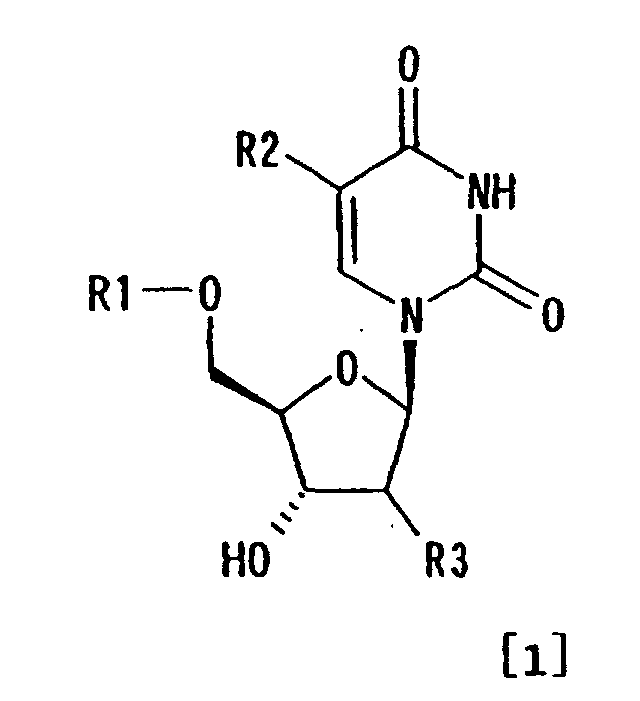
- obtaining a compound represented by formula [1]:
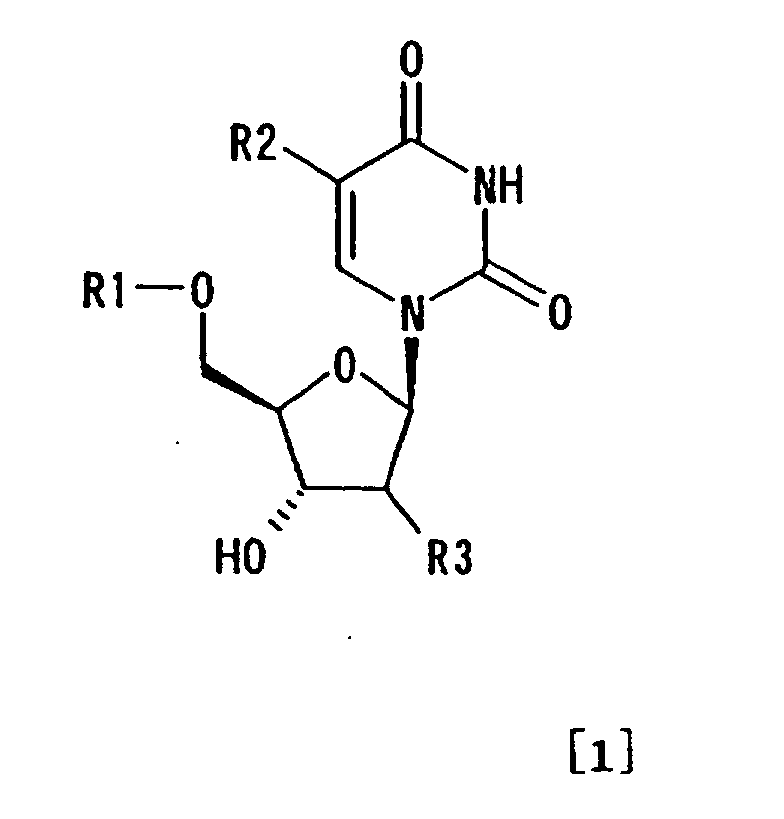 wherein R1 represents optionally substituted trityl;
R2 represents hydrogen or (C1-C7) alkyl; and R3 represents
hydrogen, halogen or substituted hydroxyl, in the form of
inclusion crystals including a solvent which is a carbonyl compound in a liquid medium
comprising the inclusion solvent; and
wherein R1 represents optionally substituted trityl;
R2 represents hydrogen or (C1-C7) alkyl; and R3 represents
hydrogen, halogen or substituted hydroxyl, in the form of
inclusion crystals including a solvent which is a carbonyl compound in a liquid medium
comprising the inclusion solvent; and
- recovering the inclusion crystals from the liquid medium;
- (2) the method for purifying a 5'-protected
thymidine according to the above section (1), wherein the
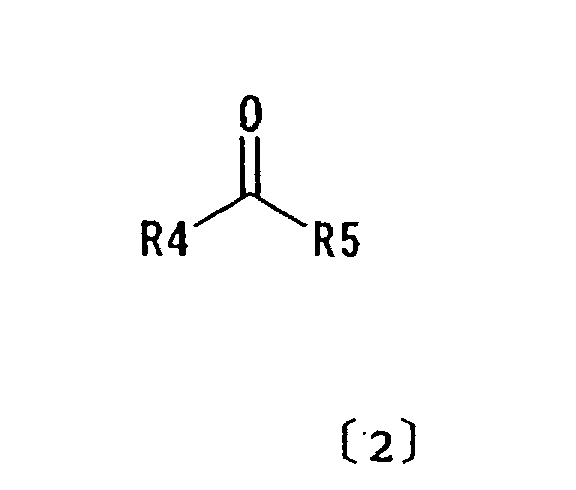
inclusion solvent is a carbonyl compound represented by
formula [2]:
wherein R4 represents (C1-C7) alkyl; and R5 represents (C1-C7) alkyl or (C1-C6) alkoxy;

- (3) the purification method according to the above section (2) wherein the carbonyl compound is butyl acetate or 4-methyl-2-pentanone;
- (4) the purification method according to any of the
above sections (1) to (3), wherein a crude preparation
comprising the compound of formula [1] and a compound of
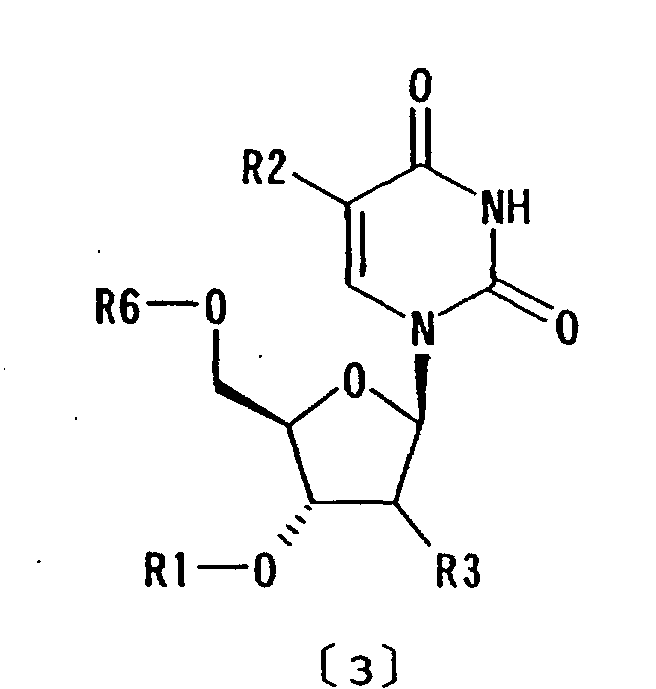
formula [3]:
wherein R6 represents hydrogen or optionally substituted trityl; and R1, R2 and R3 are as defined above, is dissolved in the liquid medium and the compound of formula [3] is removed into the liquid medium by recovering the compound of formula [1] in the form of inclusion crystals from the liquid medium;
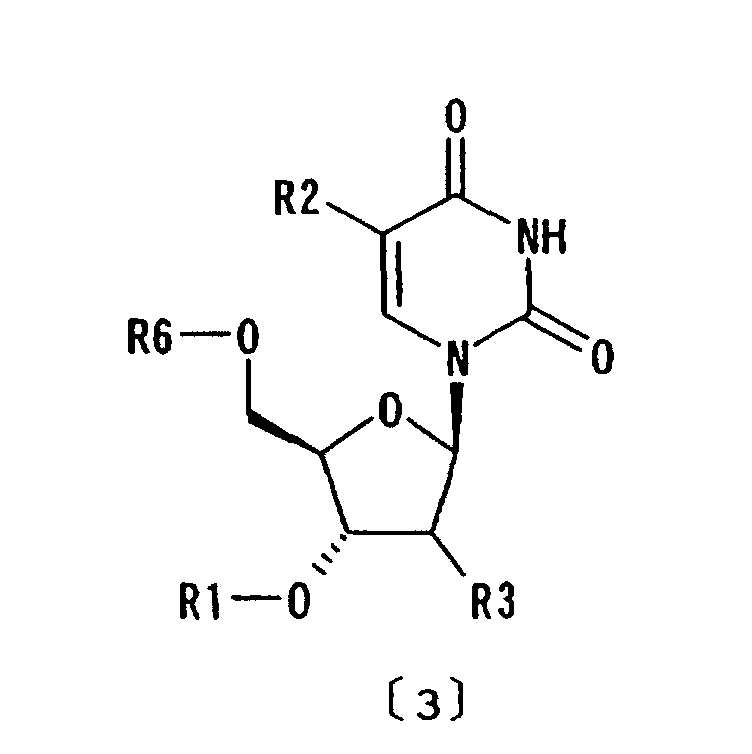
- (5) the purification method according to any of the
above sections (1) to (4), wherein the compound of formula
[1] is a compound represented by formula [4]:

- (6) the purification method according to any of the above sections (1) to (5), wherein the inclusion crystals of the compound of formula [1] including the inclusion solvent are recrystallized from a liquid medium consisting of the inclusion solvent;
- (7) the purification method according to any of the above (1) to (6), wherein the liquid medium consists of a single inclusion solvent;
- (8) An inclusion compound represented by formula
(5):
wherein m and n independently represent an arbitrary integer; R1, R2, R3, R4 and R5 are as defined above; and
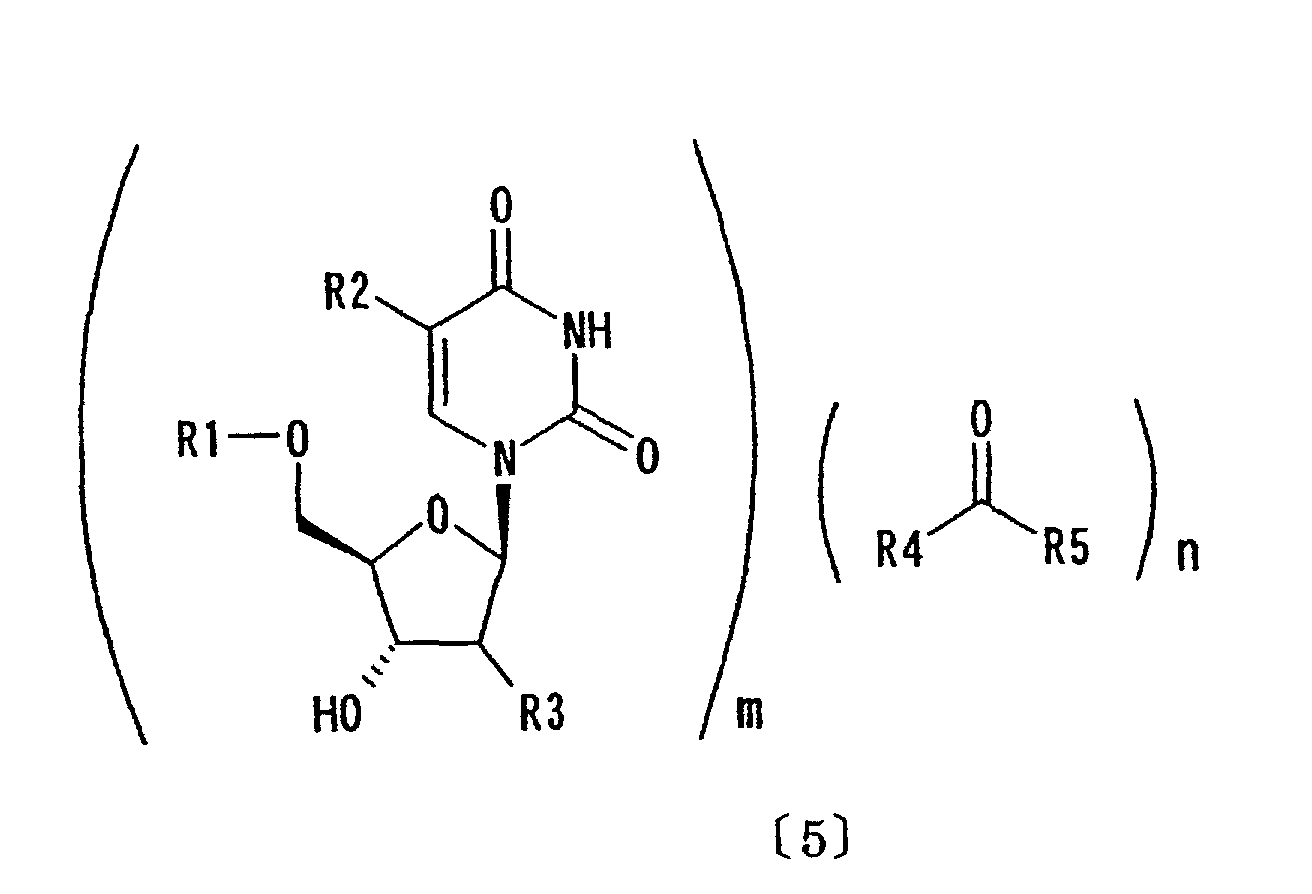
- (9) An inclusion compound represented by formula
(6):
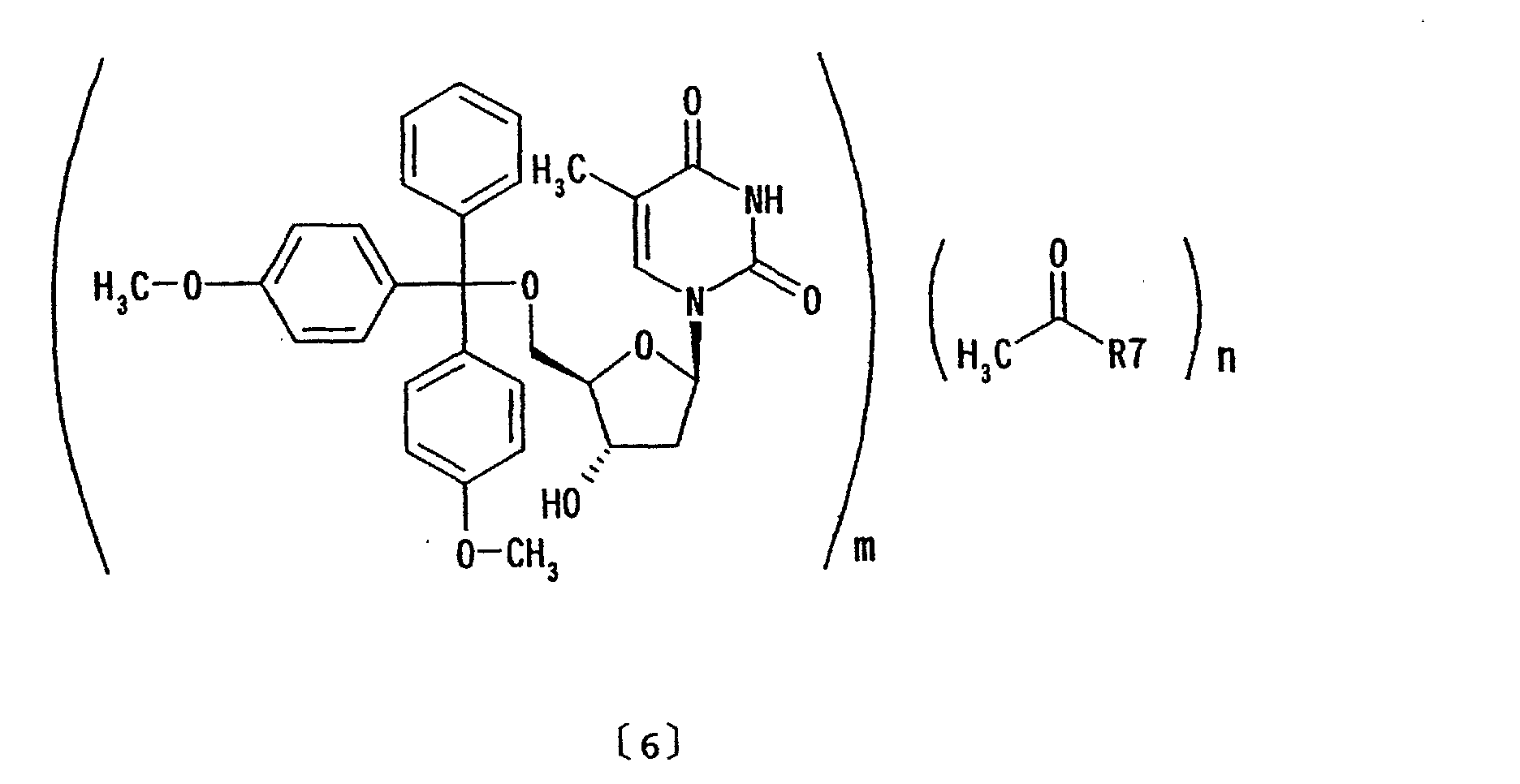 wherein R7 represents n-butoxy or isobutyl; m and n
are as defined above.
wherein R7 represents n-butoxy or isobutyl; m and n
are as defined above. -
- The present invention will be described in detail below.
- R1 in formula [1] is substituted or unsubstituted trityl. A trityl may have a substituent or substituents on at least one of its three phenyl rings. On such a phenyl ring, substitution may be at 2-, 3- or 4-position, or at two or more positions. When one phenyl ring has two or more substituents, the plurality of substituents may be the same or may consist of at least two different types. When two or more phenyl rings are substituted, these substituted phenyl rings may be the same or consist of at least two different types, including a case that two or three phenyl rings have the same substituent or different substituents.
- Examples of a substituent on a phenyl in the trityl group include alkyl such as methyl, ethyl and isopropyl; alkyloxy such as methoxy, ethoxy, n-propyloxy and isopropyloxy; nitro; substituted or unsubstituted amino such as amino, methylamino, ethylamino, n-propylamino, isopropylamino, dimethylamino and diethylamino; halogen such as fluoro, chloro, bromo and iodo; acyl such as formyl, acetyl, propionyl and benzoyl; acyloxy such as formyloxy, acetyloxy, propionyloxy and benzoyloxy; and amide such as formamide, acetamide and benzamide. When a plurality of substituents are present, each substituent may be independently selected from the above groups.
The alkyl groups in the above various substituents may be preferably lower alkyl groups having 1 to 7 carbon atoms, more preferably ones having the carbon atom numbers in the above concrete examples. - Examples of an optionally substituted trityl include, but not limited to, trityl, 4-methoxytrityl, 4,4'-dimethoxytrityl, 4,4',4"-trimethoxytrityl, 4-methyltrityl and 4,4'-dimethyltrityl.
- A lower alkyl group in R2 may be straight or branched. Alternatively, it may form a ring. The alkyl may have an additional substituent. Examples of the lower alkyl group are alkyl groups having 1 to 7 carbon atoms such as methyl, ethyl, n-propyl, isopropyl, butyl, cyclopropyl, cyclopropylmethyl and cyclopentyl.
- Halogen in R3 is fluorine, chlorine, bromine or iodine. Substituted hydroxyl in R3 represents hydroxyl substituted with a substituent which can be generally a protective group for hydroxyl such as carboxylate, sulfonate, ether, urethane and silyl. Examples of the groups for protection of the hydroxyl group include unsubstituted or substituted alkyl such as methyl, ethyl, isopropyl, n-butyl, isobutyl, t-butyl, pentyl, benzyl, 2-methoxybenzyl, 3-methoxybenzyl, 4-methoxybenzyl, 2-methylbenzyl, 3-methylbenzyl, 4-methylbenzyl, methoxyethyl, ethoxyethyl, benzyloxymethyl, benzyloxyethyl, acetoxymethyl, acetoxyethyl, benzoyloxymethyl, benzoyloxyethyl, methoxyethoxyethyl, propargyl and allyl; aryl such as phenyl, 2-methoxyphenyl, 3-methoxyphenyl, 4-methoxyphenyl, 4-phenylphenyl, 2-pyridinyl, 3-pyridinyl and 4-pyridinyl; acyl such as formyl, acetyl, propionyl, benzoyl, 2-methoxybenzoyl, 3-methoxybenzoyl, 4-methoxybenzoyl, 2-methylbenzoyl, 3-methylbenzoyl, 4-methylbenzoyl, 2-nitrobenzoyl, 3-nitrobenzoyl, 4-nitrobenzoyl, 4-phenylbenzoyl, 2-chlorobenzoyl, 3-chlorobenzoyl and 4-chlorobenzoyl; urethane such as aminocarbonyl, dimethylaminocarbonyl, methylaminocarbonyl, ethylaminocarbonyl, diethylaminocarbonyl and phenylaminocarbonyl; sulfonate such as methanesulfonyl, ethanesulfonyl, benzenesulfonyl, 2-methylbenzenesulfonyl, 3-methylbenzenesulfonyl, 4-methylbenzenesulfonyl, trifluoromethanesulfonyl and trichloromethanesulfonyl; and silyl such as trimethylsilyl, triethylsilyl, t-butyldimethylsilyl and t-butyldiphenylsilyl.
- Examples of substituted hydroxyl in R3 include methoxy, ethoxy, isopropyloxy, n-butyloxy, isobutyloxy, t-butyloxy, pentyloxy, benzyloxy, 2-methoxybenzyloxy, 3-methoxybenzyloxy, 4-methoxybenzyloxy, 2-methylbenzyloxy, 3-methylbenzyloxy, 4-methylbenzyloxy, methoxyethyloxy, ethoxyethyloxy, benzyloxymethoxy, benzyloxyethoxy, acetoxymethoxy, acetoxyethoxy, benzoyloxymethoxy, benzoyloxyethoxy, methoxyethoxy, propargyloxy, allyloxy, phenyloxy, 2-methoxyphenyloxy, 3-methoxyphenyloxy, 4-methoxyphenyloxy, 4-phenylphenyloxy, 2-pyridinyloxy, 3-pyridinyloxy, 4-pyridinyloxy, formyloxy, acetyloxy, propionyloxy, benzoyloxy, 2-methoxybenzoyloxy, 3-methoxybenzoyloxy, 4-methoxybenzoyloxy, 2-methylbenzoyloxy, 3-methylbenzoyloxy, 4-methylbenzoyloxy, 2-nitrobenzoyloxy, 3-nitrobenzoyloxy, 4-nitrobenzoyloxy, 4-phenylbenzoyloxy, 2-chlorobenzoyloxy, 3-chlorobenzoyloxy, 4-chlorobenzoyloxy, aminocarbonyloxy, dimethylaminocarbonyloxy, methylaminocarbonyloxy, ethylaminocarbonyloxy, diethylaminocarbonyloxy, phenylaminocarbonyloxy, methanesulfonyloxy, ethanesulfonyloxy, benzenesulfonyloxy, 2-methylbenzenesulfonyloxy, 3-methylbenzenesulfonyloxy, 4-methylbenzenesulfonyloxy, trifluoromethanesulfonyloxy, trichloromethanesulfonyloxy, trimethylsilyloxy, triethylsilyloxy, t-butyldimethylsilyloxy and t-butyldiphenylsilyloxy.
- The alkyl groups in the above various substituents in the protective groups for the hydroxyl group may be preferably lower alkyl groups having 1 to 7 carbon atoms, more preferably ones having the carbon atom numbers in the above concrete examples.
- The lower alkyl groups that may constitute R4 and R5 in formula [2] have 1 to 7 carbon atoms, e.g. methyl, ethyl, n-propyl, isopropyl, n-butyl, isobutyl, t-butyl, n-pentyl, 2-methylbutyl, amyl, n-hexyl, cyclopentyl, cyclohexyl and n-heptyl. R5 may be an alkoxy group having 1 to 6 carbon atoms such as methoxy, ethoxy, isopropyloxy, n-butoxy, isobutyloxy, t-butyloxy and pentyloxy.
- An inclusion solvent used in this invention for preparation of the inclusion crystals is a carbonyl compound, preferably represented by formula [2]. Examples of such a solvent include acetone, 2-butanone, 3-pentanone, 2,4-dimethyl-3-pentanone, 4-methyl-2-pentanone, 3-methyl-2-butanone, methyl acetate, ethyl acetate, n-propyl acetate, isopropyl acetate, n-butyl acetate, t-butyl acetate, isobutyl acetate, amyl acetate, n-pentyl acetate, n-hexyl acetate, cyclohexyl acetate, n-propyl propionate and isopropyl propionate. These carbonyl compounds are usually used alone in a solvent, but two or more carbonyl compounds may be combined at a mixable ratio. Alternatively, a plurality of carbonyl compounds may be blended in advance to prepare a mixed solvent to be used.
- A liquid medium for forming inclusion crystals may be an inclusion solvent alone or a mixture of an inclusion solvent and a solvent not involved in forming inclusion crystals at a mixable ratio. For example, a single carbonyl-compound solvent or a solvent mixture of two or more carbonyl compounds may be combined with another solvent at a mixable ratio. The additional solvent used may be any mixable solvent, for example, alcohols such as methanol, ethanol and isopropanol; ketones such as acetone, methylethylketone and methylisobutylketone; nitriles such as acetonitrile and propionitrile; ethers such as diethyl ether, diisopropyl ether, dioxane and tetrahydrofuran (THF); aromatic hydrocarbons such as benzene, toluene, cumene, xylenes, mesitylene, diisopropylbenzene and triisopropylbenzene; aliphatic hydrocarbons such as pentane, hexane, cyclohexane and petroleum ethers; halogenated hydrocarbons such as dichloromethane, chloroform, dichloroethane and chlorobutane; pyridines such as pyridine, lutidine and quinoline; tertiary amines such as triethylamine and tributylamine; and polar solvents such as dimethylformamide (DMF), dimethyl imidazolidinone (DMI) and dimethyl sulfoxide (DMSO). A proportion of the additional solvent in the mixture is preferably up to 100 wt%, preferably up to 20 wt%, more preferably up to 10 wt% to the total amount of the carbonyl compound(s).
- As used herein, the term "inclusion crystal including a solvent" means that a solvent plays an auxiliary role to form a crystal structure, such that a crystal is formed in a form wherein a solvent is taken up into a crystal lattice thereof, or a complex is formed by a weak interaction between a crystal and a solvent. The inclusion form and the crystal structure are not particularly limited.
- The amount of a carbonyl-compound solvent in crystallization or recrystallization is not particularly limited, as far as the amount of the compound of formula [1] in the solvent is below its saturation solubility, but desirably the amount of the solvent is 5 to 150 fold both inclusive by weight, more desirably 8 to 50 fold both inclusive by weight of the amount of the compound of the formula [1].
- A temperature for crystallization and recrystallization are not particularly limited, but a temperature within a range from -10°C to the boiling point of a solvent or a liquid medium is desired. Generally, purification can be performed more sufficiently by a single time of recrystallization, but purification at higher purity can also be realized by performing recrystallization repeatedly. A preferable liquid medium for recrystallization is that consisting of a inclusion solvent alone and it is more preferable to used the same single inclusion solvent in both of crystallization and recrystallization.
- A preferable aspect of an inclusion compound obtained by the purification method according to this invention may be the above compound represented by formula [6], where n and m represent an arbitrary integer, preferably an integer selected from the range of 1 to 5.
- As stated above, the present invention allows 5'-protected thymidines to be effectively purified.
- The present invention will be further specifically described in the following examples. The examples are, however, not intended to limit the scope of the invention.
- To a stirred solution of 40.0 g of thymidine (0.165 mol) in 500 mL of pyridine was added 56.0 g of dimethoxytrityl chloride (0.165 mol), and the mixture was stirred at room temperature for 3 hours. To the mixture, 16.7 g of sodium hydrogen carbonate was added. The resulting mixture was stirred at room temperature for 30 min and evaporated under a reduced pressure. To the residue was added 500 mL of methyl isobutyl ketone (MIBK). To the stirred mixture was added 500 mL of water and the mixture was stirred for 10 min. Then, the organic layer was separated and washed with 500 mL of water. The organic layer was evaporated under a reduced pressure. The residue was recrystallized from 900 mL of methyl isobutyl ketone to give a crystalline product, which was then collected by filtration. The crystalline product was dried in vacuo at 50 °C to a constant weight to give 67.3 g of the product. NMR spectroscopy indicated that the crystalline product included 0.5 molecules of 4-methyl-2-pentanone per one molecule of the desired product. DSC analysis showed a sharp endothermic peak (66.8 J/G) at 137 °C, indicating that the product was crystals. TG-DTA analysis showed that crystals including 0.5 molecules of 4-methyl-2-pentanone after drying to its constant weight lost no weight until a temperature at which an endothermic reaction occurred (122 to 132 °C), indicating that the solvent was not attached to the crystals. The product was analyzed by high performance chromatography (HPLC) with a reverse-phase octadecyl silica gel column using a mixture of acetonitrile/water (75/25) as an eluent and using a UV detector (254 nm), indicating a purity of 99.5 %. A major impurity was 3',5'-O-bis(4,4'-dimethoxytrityl)thymidine with an HPLC peak area of 0.3 %. An yield was 67 %.
NMR: δ (CDCl3): 8.7 (s, 1H), 7.6 (s, 1H), 7.2-7.4 (m, 9H), 6.8 (m, 4H), 6. 4 (t, 1H), 4.6 (m, 1H), 4. 1(m, 1H), 3.8 (s, 6H), 3.4 (m, 2H), 2.3-2.5 (m, 3H including CH2 in MIBK), 2.1 (m, 1.5H: COCH3 in MIBK), 1.7 (m, 0.5H: CH in MIBK), 1.5 (s, 3H), 0.9 (d, 3H: CH3 × 2 in MIBK) (MIBK: an abbreviation for 4-methyl-2-pentanone);
IR: cm-1 (KBr): 3163, 1698, 1608, 1509, 1259, 1177, 1098, 1033, 830. - To a stirred solution of 40.0 g of thymidine (0.165 mol) in 500 mL of pyridine was added 56.0 g of dimethoxytrityl chloride (0.165 mol), and the mixture was stirred at room temperature for 3 hours. To the mixture, 16.7 g of sodium hydrogen carbonate was added. The resulting mixture was stirred at room temperature for 30 min and evaporated under a reduced pressure. To the residue was added 500 mL of n-butyl acetate. To the stirred mixture was added 500 mL of water and the mixture was stirred for 10 min. Then, the organic layer was separated and washed with 500 mL of water. The organic layer was evaporated under a reduced pressure. The residue was recrystallized from 900 mL of n-butyl acetate to give a crystalline product, which was then collected by filtration. The crystalline product was dried in vacuo at 50 °C to a constant weight to give 74.6 g of the product. The product was analyzed by high performance chromatography (HPLC) with a reverse-phase octadecyl silica gel column using a mixture of acetonitrile/water (75/25) as an eluent and using a UV detector (254 nm), indicating a purity of 99.6 %. A major impurity was 3',5'-O-bis(4,4'-dimethoxytrityl)thymidine with an HPLC peak area of 0.3 %. An yield was 75 %.
NMR: δ (CDCl3): 0.9 (t, 1.5H: CH3 in n-butyl acetate), 1.4 (m, 1H: CH2 in n-butyl acetate), 1.5 (s, 3H), 1.6 (m, 1H, CH2 in n-butyl acetate), 2.0 (s, 1.5H: CH3 in n-butyl acetate), 2.3 (m, 1H), 2.4 (m, 1H), 2.6 (m, 1H: OCH2 in n-butyl acetate), 3.3 (dd, 1H), 3.4 (dd, 1H), 3.8 (s, 6H), 4.1 (m, 1H), 4.6 (m, 1H), 6.4 (m, 1H), 6.8 (m, 4H), 7. 3 (m, 7H), 7.4 (m, 2H), 7.6 (s, 1H), 8.9 (s, 1H). - After the filtrate obtained by the recrystallization in Example 1 was concentrated, the concentrate residue was purified by column chromatography (ethyl acetate/hexane). The purified fraction was concentrated to obtained a powder. The powder thus obtained was then dispersed in diisopropyl alcohol and the precipitate thus formed was recovered by filtration and dried, whereby the titled compound was obtained as a white powder.
1H NMR(400MHz,CDCl3) δ :8.1(1H,s), 7.5-7.2(18H,m), 6.8(8H,m), 6.4(1H,m), 4.4(1H,m), 4.1(0.33H,m), 3.8(1H,m), 3.8(12H,s), 3.2(1H,m), 2.9(1H,m), 1.9(2H,m), 1.4(3H,m), 1.2(2H,d,J=6 Hz) - Thymidine (15.0 g) was dissolved in 200 ml of DMF. After 8.16 g of imidazole was dissolved in the resultant solution by addition, 10.8 g of tert-butyldimethylsilyl chloride was then added. DMF (100 ml) was further added and the solution was stirred at room temperature. After 2 hours, extraction using ethyl acetate was carried out and the organic layer was washed by a saturated aqueous solution of sodium chloride and dried with anhydrous magnesium sulfate. After concentration of the extract, the target compound was separated by column chromatography (methanol/chloroform). The fraction solution including the target compound was prepared and concentrated to obtain 11.3 g of the titled compound (yield; 51%).
1H NMR(400MHz, CDCl3) δ : 9.2(1H,br), 7.5(1H,s), 6.4(1H,dd,J=5.6, 8.4 Hz), 4.5(1H,m), 4.1(1H,m), 3.9(1H,dd,J-2.8,11.2Hz), 3.8(1H,dd,J=2.4,11.2Hz), 2.9(1H,m), 2.4(1H,m), 2.1(1H,m), 1.9(3H,m), 0.9(9H,s), 0.1(6H,s) - 5'-O-(tert-butyldimethylsilyl)thymidine (11.3 g) was dissolved in 100 ml of anhydrous pyridine. 4,4'-dimethoxytrityl chloride (11.4 g) was added to the resultant solution and 140 ml of anhydrous pyridine was further added, follow by stirring at 60 °C. After the reaction completed, the reaction mixture was neutralized by sodium hydrogen carbonate and pyridine was distilled off. Extraction using ethyl acetate was carried out and the extract was washed by a saturated aqueous solution of sodium chloride and dried with anhydrous magnesium sulfate. The extract was concentrated and purified by column chromatography (ethyl acetate/hexane) to obtain 14.9 g of the titled compound (yield: 71%).
1H NMR(400MHz, CDCl3) δ : 8.2(1H,s), 7.8(1H,s), 7.5-7.3(9H,m), 6.8(4H,m), 6.4(1H,dd,J=5.6,5.6Hz), 4.3(1H,m), 4.1(1H,m), 4.0(1H,m), 3.8(6H,s), 3.7(1H,dd,J=1.6,11.2Hz), 3.3(1H,dd,J=8.8,11.2Hz), 2.0(1.5H,m), 1.9(3H,s), 1.7-1.5(2H,m), 1.3(1.5H,m), 0.8(9H,s), 0.1(3H,s), 0.04(3H,s) - 5'-O-(tert-butyldimethylsilyl)-3'-O-(4,4'-dimethoxytrityl)thymidine (14.9 g) was dissolved in 200 ml of dry THF. A THF solution (25 ml) of tetrabutylammonium fluoride was added to the resultant solution and 100 ml of dry THF was further added, followed by stirring at room temperature. After 8 hours, concentration and extraction using ethyl acetate was carried out, and the extract was washed by a saturated solution of sodium chloride and dried with anhydrous magnesium sulfate. The extract was then concentrated and purified by column chromatography (ethyl acetate/hexane). The purified preparation was dissolved in chloroform and the solution was dropped into hexane. The precipitate was recovered by filtration and dried to obtain 12.2 g of the titled compound as a white powder (yield: 98%).
1H NMR(400MHz,CDCl3) δ : 8.7(1H,s), 7.7(1H,s), 7.5-7.2(9H,m), 6.8(4H,m), 6.1(1H,dd,J=5.6,8.8Hz), 4.0(1H,m), 3.8(6H,s), 3.7(1H,m), 3.3(1H,m), 2.3(1H,m), 1.9(1H,m), 1.87(3H,s), 1.7(1H,m) - In respect of an ability to eliminate impurities such as the 3'-substituted isomer [3'-O-(4,4'-dimethoxytrityl)thymidine] or the 3',5'-multisubstituted form [3',5'-O-bis(4,4'-dimethoxytrityl)thymidine], comparison was made between purification methods involving recrystallization from 4-methyl-2-pentanone (MIBK) and involving reprecipitation using dichloromethane as a soluble solvent and hexane as an insoluble solvent. In addition, the results for a recovery of a desired product [5'-O-(4,4'-dimethoxytrityl)thymidine] and for thermal analysis for the crystals obtained (TG-DTA: endothermic peak, DSC: endothermic peak and endothermic energy) were also compared.
Crude crystals Purification solvent MIBK Dichloromethane /hexane 3'-isomer 4.0 % 0 % 0.29 % Multisubstituted form 5.0 % 0.24 % 0.61 % Yield 91 % 81 % DSC Endothermic peak 122/132 °C 105 °C TG-DTA Endothermic peak 137 °C 109 °C Endothermic energy 66.8 J/G 6.2 J/G -
- Column: Develosil TMS-UG-5, 150 mm × 4.6;
- Flow rate: 1.0 mL/min;
- Column temperature: 40 °C;
- Detection wavelength: 254 nm;
- Mobile phase: gradient conditions (See Table 2).
-
- 100 mL of 100 mM triethylamine-acetic acid (pH 7) / 880 mL of water / 20 mL of acetonitrile.
- 100 mL of 100 mM triethylamine-acetic acid (pH 7) / 900 mL of acetonitrile.
-
- Column: Develosil TMS-UG-5 150 mm × 4.6;
- Mobile phase: acetonitrile-water (55 : 45);
- Flow rate: 1.0 mL/min;
- Column temperature: 40 °C;
- Detection wavelength: 254 nm.
-
-
- Apparatus: SHIMADZU TG/DTA320 (SII)
- Temperature programming rate: 10 °C/min
- Measurement atmosphere: under nitrogen atmosphere, 200 mL/min.
-
-
- Apparatus: DSC-7 (Perkin Elmer);
- Temperature programming rate: 10 °C/min.
-
- According to the present invention, a method capable of mass production allows highly pure 5'-protected thymidines to be produced more efficiently than conventional methods.
| Time (sec) | Liquid B (vol %) |
| 0 | 20 |
| 15 | 70 |
| 35 | 100 |
| 40 | 100 |
| 45 | 20 |
| 60 | stop |
Claims (9)
- A method for purifying a 5'-protected thymidine, comprising the steps of:wherein R1 represents optionally substituted trityl; R2 represents hydrogen or C1-C7 alkyl; and R3 represents hydrogen, halogen or substituted hydroxyl, in the form of inclusion crystals including a solvent which is a carbonyl compound, in a liquid medium comprising the inclusion solvent; andobtaining a compound represented by formula [1]:
 recovering the inclusion crystals from the liquid medium.
 - The method for purifying a 5'-protected thymidine as claimed in Claim 1 wherein the inclusion solvent is a carbonyl compound represented by formula [2]:wherein R4 represents C1-C7 alkyl; and R5 represents C1-C7 alkyl or C1-C6 alkoxy.
- The purification method as claimed in Claim 2 wherein the carbonyl compound is butyl acetate or 4-methyl-2-pentanone.
- The purification method as claimed in any of Claims 1 to 3 wherein a crude preparation comprising the compound of formula [1] and a compound of formula [3]:wherein R6 represents hydrogen or optionally substituted trityl; and R1, R2 and R3 are as defined above, is dissolved in the liquid medium and the compound of formula [3] is removed into the liquid medium by recovering the compound of formula [1] in the form of inclusion crystals from the liquid medium.
- The purification method as claimed in any of Claims 1 to 4 wherein the compound of formula [1] is a compound represented by formula [4]:

- The purification method as claimed in any of Claims 1 to 5 wherein the inclusion crystals of the compound of formula [1] including the inclusion solvent are recrystallized from a liquid medium consisting of the inclusion solvent.
- The purification method as claimed in any of Claims 1 to 6 wherein the liquid medium consists of a single inclusion solvent.
- An inclusion compound represented by formula (5):wherein m and n independently represent an arbitrary integer; R1, R2, R3, R4 and R5 are as defined above.

- An inclusion compound represented by formula (6):wherein R7 represents n-butoxy or isobutyl; m and n are as defined above.

Applications Claiming Priority (2)
| Application Number | Priority Date | Filing Date | Title |
|---|---|---|---|
| JP2001144278 | 2001-05-15 | ||
| JP2001144278 | 2001-05-15 |
Publications (2)
| Publication Number | Publication Date |
|---|---|
| EP1258489A1 EP1258489A1 (en) | 2002-11-20 |
| EP1258489B1 true EP1258489B1 (en) | 2004-09-08 |
Family
ID=18990254
Family Applications (1)
| Application Number | Title | Priority Date | Filing Date |
|---|---|---|---|
| EP02253360A Expired - Lifetime EP1258489B1 (en) | 2001-05-15 | 2002-05-14 | Method for purifying 5'-protected thymidines |
Country Status (8)
| Country | Link |
|---|---|
| US (1) | US6875860B2 (en) |
| EP (1) | EP1258489B1 (en) |
| KR (1) | KR100474629B1 (en) |
| CN (1) | CN1195771C (en) |
| AT (1) | ATE275574T1 (en) |
| BR (1) | BR0201842A (en) |
| CA (1) | CA2386285A1 (en) |
| DE (1) | DE60201145T2 (en) |
Families Citing this family (2)
| Publication number | Priority date | Publication date | Assignee | Title |
|---|---|---|---|---|
| US7160537B2 (en) | 2003-12-15 | 2007-01-09 | Siemens Medical Solutions Usa, Inc. | Method for preparing radiolabeled thymidine having low chromophoric byproducts |
| US20050131224A1 (en) * | 2003-12-15 | 2005-06-16 | Cti Pet Systems, Inc. | Method for preparing radiolabeled thymidine |
Family Cites Families (9)
| Publication number | Priority date | Publication date | Assignee | Title |
|---|---|---|---|---|
| EP0090789A1 (en) | 1982-03-26 | 1983-10-05 | Monsanto Company | Chemical DNA synthesis |
| JPS60152495A (en) | 1984-01-18 | 1985-08-10 | Nippon Zeon Co Ltd | Method for producing protected nucleosides |
| US5672697A (en) | 1991-02-08 | 1997-09-30 | Gilead Sciences, Inc. | Nucleoside 5'-methylene phosphonates |
| US5719273A (en) * | 1993-06-14 | 1998-02-17 | Nexstar Pharmaceuticals, Inc. | Palladium catalyzed nucleoside modifications methods using nucleophiles and carbon monoxide |
| ATE159949T1 (en) * | 1993-09-17 | 1997-11-15 | Ciba Geigy Ag | TTTR AS A PROTECTIVE GROUP IN NUCLEOTIDE SYNTHESIS |
| US5734041A (en) | 1995-10-20 | 1998-03-31 | Mcgill University | Preparation of chiral phosphorothioate oligomers |
| US6414137B1 (en) * | 1998-12-23 | 2002-07-02 | Alliedsignal Inc. | Selective solvent extraction for the purification of protected nucleosides |
| JP4420360B2 (en) | 1999-01-14 | 2010-02-24 | ヤマサ醤油株式会社 | Process for producing 5'-O-trityl nucleosides |
| AU5460700A (en) * | 1999-06-04 | 2000-12-28 | Allied-Signal Inc. | Protected nucleosides |
-
2002
- 2002-05-14 DE DE60201145T patent/DE60201145T2/en not_active Expired - Lifetime
- 2002-05-14 AT AT02253360T patent/ATE275574T1/en not_active IP Right Cessation
- 2002-05-14 CA CA002386285A patent/CA2386285A1/en not_active Abandoned
- 2002-05-14 EP EP02253360A patent/EP1258489B1/en not_active Expired - Lifetime
- 2002-05-15 BR BR0201842-0A patent/BR0201842A/en not_active Application Discontinuation
- 2002-05-15 CN CNB02119713XA patent/CN1195771C/en not_active Expired - Fee Related
- 2002-05-15 KR KR10-2002-0026702A patent/KR100474629B1/en not_active Expired - Fee Related
- 2002-05-15 US US10/144,802 patent/US6875860B2/en not_active Expired - Fee Related
Also Published As
| Publication number | Publication date |
|---|---|
| DE60201145D1 (en) | 2004-10-14 |
| CN1385437A (en) | 2002-12-18 |
| US20030004331A1 (en) | 2003-01-02 |
| US6875860B2 (en) | 2005-04-05 |
| DE60201145T2 (en) | 2005-09-22 |
| EP1258489A1 (en) | 2002-11-20 |
| CN1195771C (en) | 2005-04-06 |
| BR0201842A (en) | 2003-04-29 |
| KR100474629B1 (en) | 2005-03-08 |
| CA2386285A1 (en) | 2002-11-15 |
| ATE275574T1 (en) | 2004-09-15 |
| KR20030022675A (en) | 2003-03-17 |
Similar Documents
| Publication | Publication Date | Title |
|---|---|---|
| EP1594882B1 (en) | Process for preparing branched ribonucleosides from 1, 2-anhydroribofuranose intermediates | |
| EP1258489B1 (en) | Method for purifying 5'-protected thymidines | |
| US8158774B2 (en) | Method for introducing a nucleic-acid protecting group | |
| EP1253154B1 (en) | Method for purifying 5'-protected 2'-deoxypurine nucleosides | |
| EP0984976B1 (en) | Process for the preparation of a deoxyuridine derivative | |
| JP4071991B2 (en) | Purification method and novel derivative of 5'-protected thymidines | |
| JP4326841B2 (en) | Method for purifying protected 2'-deoxycytidines | |
| JP4424900B2 (en) | Method for purifying 5'-O-substituted thymidine | |
| JP3983085B2 (en) | Method for producing inclusion compounds of 5'-protected 2'-deoxypurine nucleosides | |
| CN113924308B (en) | Crystal of cross-linked nucleoside intermediate and method for producing the same, and method for producing cross-linked nucleoside phosphoramidite | |
| JP3294594B2 (en) | Method for producing vinylpyrimidine | |
| JPWO2010079813A1 (en) | Method for producing inosine derivative | |
| JP5192807B2 (en) | Stable crystals of protected pseudouridine | |
| JP2003073395A (en) | Isolation and purification of n-acylated purine nucleoside derivative | |
| US20060069248A1 (en) | Process for producing phosphoroamidite | |
| JP2006248956A (en) | Trityl type compound | |
| WO2005021571A1 (en) | Method for producing n4-benzoylcytidine derivative | |
| JP2004123641A (en) | Method for producing n4-benzoyl-2'-deoxycytidines |
Legal Events
| Date | Code | Title | Description |
|---|---|---|---|
| PUAI | Public reference made under article 153(3) epc to a published international application that has entered the european phase |
Free format text: ORIGINAL CODE: 0009012 |
|
| 17P | Request for examination filed |
Effective date: 20020603 |
|
| AK | Designated contracting states |
Kind code of ref document: A1 Designated state(s): AT BE CH CY DE DK ES FI FR GB GR IE IT LI LU MC NL PT SE TR |
|
| AX | Request for extension of the european patent |
Free format text: AL;LT;LV;MK;RO;SI |
|
| AKX | Designation fees paid |
Designated state(s): AT BE CH CY DE DK ES FI FR GB GR IE IT LI LU MC NL PT SE TR |
|
| RIN1 | Information on inventor provided before grant (corrected) |
Inventor name: TSUCHIYA, KATSUTOSHI,C/O MISUI CHEMICALS INC. Inventor name: ISHIBASHI, HIROKI,C/O MISUI CHEMICALS INC. Inventor name: KOUNO, TOSHIYUKI,C/O MISUI CHEMICALS INC. Inventor name: TANIKAWA, HIROHARU,C/O MISUI CHEMICALS INC. Inventor name: KOMATSU, HIRONORI,C/O MISUI CHEMICALS INC. |
|
| 17Q | First examination report despatched |
Effective date: 20030910 |
|
| GRAP | Despatch of communication of intention to grant a patent |
Free format text: ORIGINAL CODE: EPIDOSNIGR1 |
|
| GRAS | Grant fee paid |
Free format text: ORIGINAL CODE: EPIDOSNIGR3 |
|
| GRAA | (expected) grant |
Free format text: ORIGINAL CODE: 0009210 |
|
| AK | Designated contracting states |
Kind code of ref document: B1 Designated state(s): AT BE CH CY DE DK ES FI FR GB GR IE IT LI LU MC NL PT SE TR |
|
| PG25 | Lapsed in a contracting state [announced via postgrant information from national office to epo] |
Ref country code: AT Free format text: LAPSE BECAUSE OF FAILURE TO SUBMIT A TRANSLATION OF THE DESCRIPTION OR TO PAY THE FEE WITHIN THE PRESCRIBED TIME-LIMIT Effective date: 20040908 Ref country code: BE Free format text: LAPSE BECAUSE OF FAILURE TO SUBMIT A TRANSLATION OF THE DESCRIPTION OR TO PAY THE FEE WITHIN THE PRESCRIBED TIME-LIMIT Effective date: 20040908 Ref country code: TR Free format text: LAPSE BECAUSE OF FAILURE TO SUBMIT A TRANSLATION OF THE DESCRIPTION OR TO PAY THE FEE WITHIN THE PRESCRIBED TIME-LIMIT Effective date: 20040908 Ref country code: FI Free format text: LAPSE BECAUSE OF FAILURE TO SUBMIT A TRANSLATION OF THE DESCRIPTION OR TO PAY THE FEE WITHIN THE PRESCRIBED TIME-LIMIT Effective date: 20040908 |
|
| REG | Reference to a national code |
Ref country code: GB Ref legal event code: FG4D |
|
| REG | Reference to a national code |
Ref country code: CH Ref legal event code: EP |
|
| REG | Reference to a national code |
Ref country code: IE Ref legal event code: FG4D |
|
| REF | Corresponds to: |
Ref document number: 60201145 Country of ref document: DE Date of ref document: 20041014 Kind code of ref document: P |
|
| RAP2 | Party data changed (patent owner data changed or rights of a patent transferred) |
Owner name: MITSUI CHEMICALS, INC. |
|
| REG | Reference to a national code |
Ref country code: SE Ref legal event code: TRGR |
|
| PG25 | Lapsed in a contracting state [announced via postgrant information from national office to epo] |
Ref country code: GR Free format text: LAPSE BECAUSE OF FAILURE TO SUBMIT A TRANSLATION OF THE DESCRIPTION OR TO PAY THE FEE WITHIN THE PRESCRIBED TIME-LIMIT Effective date: 20041208 Ref country code: DK Free format text: LAPSE BECAUSE OF FAILURE TO SUBMIT A TRANSLATION OF THE DESCRIPTION OR TO PAY THE FEE WITHIN THE PRESCRIBED TIME-LIMIT Effective date: 20041208 |
|
| PG25 | Lapsed in a contracting state [announced via postgrant information from national office to epo] |
Ref country code: ES Free format text: LAPSE BECAUSE OF FAILURE TO SUBMIT A TRANSLATION OF THE DESCRIPTION OR TO PAY THE FEE WITHIN THE PRESCRIBED TIME-LIMIT Effective date: 20041219 |
|
| REG | Reference to a national code |
Ref country code: CH Ref legal event code: NV Representative=s name: R. A. EGLI & CO. PATENTANWAELTE |
|
| NLT2 | Nl: modifications (of names), taken from the european patent patent bulletin |
Owner name: MITSUI CHEMICALS, INC. |
|
| PG25 | Lapsed in a contracting state [announced via postgrant information from national office to epo] |
Ref country code: LU Free format text: LAPSE BECAUSE OF NON-PAYMENT OF DUE FEES Effective date: 20050514 Ref country code: CY Free format text: LAPSE BECAUSE OF FAILURE TO SUBMIT A TRANSLATION OF THE DESCRIPTION OR TO PAY THE FEE WITHIN THE PRESCRIBED TIME-LIMIT Effective date: 20050514 |
|
| PG25 | Lapsed in a contracting state [announced via postgrant information from national office to epo] |
Ref country code: IE Free format text: LAPSE BECAUSE OF NON-PAYMENT OF DUE FEES Effective date: 20050516 |
|
| PG25 | Lapsed in a contracting state [announced via postgrant information from national office to epo] |
Ref country code: MC Free format text: LAPSE BECAUSE OF NON-PAYMENT OF DUE FEES Effective date: 20050531 |
|
| PLBE | No opposition filed within time limit |
Free format text: ORIGINAL CODE: 0009261 |
|
| STAA | Information on the status of an ep patent application or granted ep patent |
Free format text: STATUS: NO OPPOSITION FILED WITHIN TIME LIMIT |
|
| ET | Fr: translation filed | ||
| 26N | No opposition filed |
Effective date: 20050609 |
|
| REG | Reference to a national code |
Ref country code: IE Ref legal event code: MM4A |
|
| PGFP | Annual fee paid to national office [announced via postgrant information from national office to epo] |
Ref country code: SE Payment date: 20060505 Year of fee payment: 5 |
|
| PGFP | Annual fee paid to national office [announced via postgrant information from national office to epo] |
Ref country code: CH Payment date: 20060515 Year of fee payment: 5 |
|
| PGFP | Annual fee paid to national office [announced via postgrant information from national office to epo] |
Ref country code: NL Payment date: 20060530 Year of fee payment: 5 |
|
| PG25 | Lapsed in a contracting state [announced via postgrant information from national office to epo] |
Ref country code: PT Free format text: LAPSE BECAUSE OF NON-PAYMENT OF DUE FEES Effective date: 20050208 |
|
| EUG | Se: european patent has lapsed | ||
| REG | Reference to a national code |
Ref country code: CH Ref legal event code: PL |
|
| PG25 | Lapsed in a contracting state [announced via postgrant information from national office to epo] |
Ref country code: NL Free format text: LAPSE BECAUSE OF NON-PAYMENT OF DUE FEES Effective date: 20071201 |
|
| NLV4 | Nl: lapsed or anulled due to non-payment of the annual fee |
Effective date: 20071201 |
|
| PG25 | Lapsed in a contracting state [announced via postgrant information from national office to epo] |
Ref country code: CH Free format text: LAPSE BECAUSE OF NON-PAYMENT OF DUE FEES Effective date: 20070531 Ref country code: LI Free format text: LAPSE BECAUSE OF NON-PAYMENT OF DUE FEES Effective date: 20070531 |
|
| PG25 | Lapsed in a contracting state [announced via postgrant information from national office to epo] |
Ref country code: SE Free format text: LAPSE BECAUSE OF NON-PAYMENT OF DUE FEES Effective date: 20070515 |
|
| PGFP | Annual fee paid to national office [announced via postgrant information from national office to epo] |
Ref country code: IT Payment date: 20080527 Year of fee payment: 7 |
|
| PG25 | Lapsed in a contracting state [announced via postgrant information from national office to epo] |
Ref country code: IT Free format text: LAPSE BECAUSE OF NON-PAYMENT OF DUE FEES Effective date: 20090514 |
|
| PGFP | Annual fee paid to national office [announced via postgrant information from national office to epo] |
Ref country code: GB Payment date: 20140521 Year of fee payment: 13 |
|
| PGFP | Annual fee paid to national office [announced via postgrant information from national office to epo] |
Ref country code: FR Payment date: 20140527 Year of fee payment: 13 Ref country code: DE Payment date: 20140521 Year of fee payment: 13 |
|
| REG | Reference to a national code |
Ref country code: DE Ref legal event code: R119 Ref document number: 60201145 Country of ref document: DE |
|
| GBPC | Gb: european patent ceased through non-payment of renewal fee |
Effective date: 20150514 |
|
| REG | Reference to a national code |
Ref country code: FR Ref legal event code: ST Effective date: 20160129 |
|
| PG25 | Lapsed in a contracting state [announced via postgrant information from national office to epo] |
Ref country code: DE Free format text: LAPSE BECAUSE OF NON-PAYMENT OF DUE FEES Effective date: 20151201 Ref country code: GB Free format text: LAPSE BECAUSE OF NON-PAYMENT OF DUE FEES Effective date: 20150514 |
|
| PG25 | Lapsed in a contracting state [announced via postgrant information from national office to epo] |
Ref country code: FR Free format text: LAPSE BECAUSE OF NON-PAYMENT OF DUE FEES Effective date: 20150601 |