EP1258475A2 - Process for the recovery of perfluorinated sulphonic acids from spent acid residue - Google Patents
Process for the recovery of perfluorinated sulphonic acids from spent acid residue Download PDFInfo
- Publication number
- EP1258475A2 EP1258475A2 EP02010561A EP02010561A EP1258475A2 EP 1258475 A2 EP1258475 A2 EP 1258475A2 EP 02010561 A EP02010561 A EP 02010561A EP 02010561 A EP02010561 A EP 02010561A EP 1258475 A2 EP1258475 A2 EP 1258475A2
- Authority
- EP
- European Patent Office
- Prior art keywords
- acid
- residue
- sulphonic acid
- perfluorinated
- ammonium salt
- Prior art date
- Legal status (The legal status is an assumption and is not a legal conclusion. Google has not performed a legal analysis and makes no representation as to the accuracy of the status listed.)
- Withdrawn
Links
Images

Classifications
-
- C—CHEMISTRY; METALLURGY
- C07—ORGANIC CHEMISTRY
- C07C—ACYCLIC OR CARBOCYCLIC COMPOUNDS
- C07C303/00—Preparation of esters or amides of sulfuric acids; Preparation of sulfonic acids or of their esters, halides, anhydrides or amides
- C07C303/42—Separation; Purification; Stabilisation; Use of additives
- C07C303/44—Separation; Purification
Definitions
- the present invention relates to a process for the recovery of perfluorinated sulphonic acid from a hydrocarbon residue.
- the invention provides recovery of those acids from spent acid residue by extraction including steps of diluting the spent acid residue with the acid or a mixture of an alkyl ammonium salt of the acid and the acid to obtain a liquid from which the extraction of acid with water is facilitated.
- EP Patent No. 1,044,963 A describes a process in which spent acid from an alkylation process is processed in a stripping column with the result that fresh, regenerated acid is obtained as a top product along with a hydrocarbon product originating from cracking of the organic part of spent acid.
- Spent acid residue resulting from the stripping process described in this patent publication is typically a highly viscous liquid containing mainly higher aromatic hydrocarbons and acid.
- the spent acid residue can be solid at room temperature and as such, the residual acid is difficult to extract from the residue.
- phase separation is a troublesome operation. Depending on the acid concentration in the aqueous phase, this phase can be more or less dense than the organic phase thereby causing problems with phase inversion in automated continuous phase separation processes.
- EP Patent No. 1,065,199 A describes a process by which acid is stripped from a mixture of acid and an alkyl ammonium salt of the acid in a stripping column with the result that fresh, regenerated acid is obtained as a top product. It has now been found that spent acid residue from the stripping column is mixable with alkyl ammonium salts of the acid and that the resulting mixture is liquid at room temperature, which reduces the complexity of handling, storing and further processing of the residue.
- alkyl ammonium salt of the acid can be mixed with the spent acid prior to introduction into a stripping column, thus reducing plugging of the bottom exit system of the stripping column especially in up-set situations. Thereby, it is possible to combine the stripping process described in EP Patent No. 1,044,963 A with the process described in EP Patent No. 1,065,199 A and performing the two processes in a single stripping column.
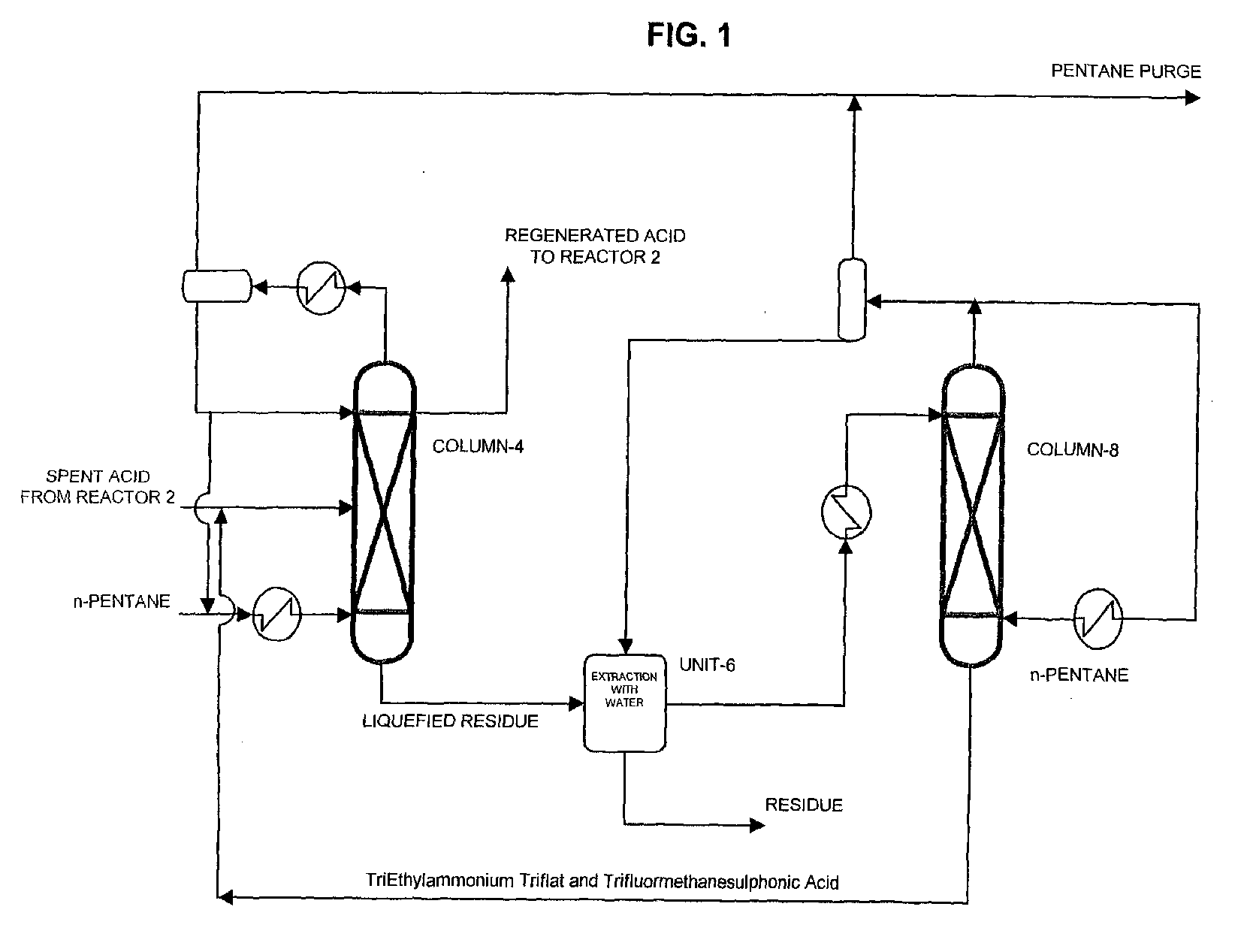
- Spent acid regeneration is in a further embodiment of the invention obtained by mixing spent acid from an alkylation process with a mixture of a corresponding acid and an alkyl ammonium salt of the acid as further explained in more detail in the following description with reference to Fig. 1 in the attached drawing.
- Fig. 1 represents a simplified flow sheet of an acid recovery process according to the invention for the recovery of trifluoromethanesulphonic acid catalyst from spent acid formed in alkylation of paraffinic hydrocarbons with olefinic alkylation agent in presence of the above acid catalyst.
- Spent acid from alkylation reactor 2 is passed to spent acid stripping column 4.
- the spent acid Prior to introduction into stripping column 4, the spent acid is admixed with a mixture of trifluoromethanesulphonic acid and triethyl ammonium triflate from a down stream acid/salt stripping column 8 as further described below.
- trifluoromethanesulphonic acid contained in the spent acid is stripped off by means of n-pentane and recycled to alkylation reactor 2.
- Stripping residue formed in column 4 is a highly viscous hydrocarbon mixture, which by addition of the acid/salt mixture to the spent acid is liquefied as described herein previously.
- the residue contains valuable amounts of trifluoromethanesulphonic acid and ammonium trifalte, which are recovered by extraction with water in extraction unit 6.
- Water is separated for the acid/triflate mixture in stripping column 8 by stripping the aqueous mixture with n-pentane. Recovered acid/triflate mixture is then recycled to inlet of stripping column 4, as described above.
- the resulting mixture contained 56.0 wt% trifluoromethanesulphonic acid, 24.5 wt% higher hydrocarbon by-products, 18.0 wt% triethyl ammonium triflate and 1.6 wt% water.
- the mixture was charged at a feed rate of 575 g/h to top of a stripping column at a temperature of 50°C.
- Stripping agent n-pentane was added at a feed rate of 855 g/h near bottom of the column at a temperature of 255°C.
- Recovered trifluoromethanesulphonic acid was condensed overhead along with stripping agent and a hydrocarbon fraction substantially boiling in the gasoline range formed by cracking of higher hydrocarbon by-products from the spent acid. Spent acid residue containing triethyl ammonium triflate was removed from the bottom of the column.
Landscapes
- Chemical & Material Sciences (AREA)
- Organic Chemistry (AREA)
- Organic Low-Molecular-Weight Compounds And Preparation Thereof (AREA)
- Extraction Or Liquid Replacement (AREA)
Abstract
Description
| Spent acid feed rate, g/h | |
| Trifluoromethanesulphonic acid | 322 |
| Triethyl ammonium triflate | 104 |
| Higher hydrocarbon by-products Water | 141 |
| 9 | |
| Stripping agent feed rate, g/h | |
| Isopentane | 855 |
| Top product rate, g/h | |
| Trifluoromethanesulphonic acid | 288 |
| Gasoline range hydrocarbons | 91 |
| Water | 9 |
| Bottom product rate, g/h | |
| Trifluoromethanesulphonic acid | 34 |
| Triethyl ammonium triflate | 104 |
| Organic residue | 50 |
| Stripping agent temperature, °C | 255 |
| Column bottom temperature, °C | 215 |
| Column top temperature, °C | 170 |
| Cracking of spent acid higher hydrocarbon by-products, % | 65 |
| Recovery of trifluoromethanesulphonic acid in overhead, % | 90 |
| Viscosity of bottom product, Pa*s | 2986 |
| Amount of residue and salt, wt : wt | Viscosity at 23°C, Pa*s |
| 1 : 0 | 4.2*106 |
| 1 : 1 | 3269 |
| 1 : 2 | 328 |
| 1 : 3 | 101 |
| 1 : 5 | 94 |
| Extraction step No. | Total triflate in residue, wt% | ||
| Without salt, 100°C | With salt, 100°C | With salt, 25°C | |
| 0 | 32.3 | 32.3 | 32.3 |
| 1 | 23.4 | 11.4 | 15.4 |
| 2 | 20.3 | 4.4 | 14.0 |
| 3 | 17.8 | 2.1 | 13.7 |
Claims (5)
- Process for the recovery of perfluorinated sulphonic acid from a hydrocarbon residue, comprising the steps of(a) treating the residue with an alkyl ammonium salt of the perfluorinated sulphonic acid or a mixture of an alkyl ammonium salt of the perfluorinated sulphonic acid and the perfluorinated sulphonic acid in an amount being effective to liquefy the residue at ambient temperature;(b) contacting the liquefied residue with water at conditions to obtaining an aqueous extract containing the perfluorinated sulphonic acid and/or the alkyl ammonium salt of the perfluorinated acid into water; and(c) separating water from the aqueous extract to recover the perfluorinated sulphonic acid or the mixture of the acid and the ammonium salt.
- Process according to claim 1, wherein the treatment of the hydrocarbon residue in step (a) is performed prior to stripping of the residue with a stripping agent.
- Process according to claim 1, wherein the separation of water from the aqueous extract in step (c) is performed by stripping the extract with a stripping agent
- Process according to claim 1, comprising the further step of recycling the recovered perfluorinated sulphonic acid or the mixture of the acid and the ammonium salt from step (c) to step (a).
- Process according to claim 2 and 3, wherein the stripping agent in step (a) is used as stripping agent in step (c).
Applications Claiming Priority (2)
| Application Number | Priority Date | Filing Date | Title |
|---|---|---|---|
| DKPA200100809 | 2001-05-19 | ||
| DK200100809 | 2001-05-19 |
Publications (2)
| Publication Number | Publication Date |
|---|---|
| EP1258475A2 true EP1258475A2 (en) | 2002-11-20 |
| EP1258475A3 EP1258475A3 (en) | 2003-10-15 |
Family
ID=8160516
Family Applications (1)
| Application Number | Title | Priority Date | Filing Date |
|---|---|---|---|
| EP02010561A Withdrawn EP1258475A3 (en) | 2001-05-19 | 2002-05-10 | Process for the recovery of perfluorinated sulphonic acids from spent acid residue |
Country Status (3)
| Country | Link |
|---|---|
| US (1) | US6891076B2 (en) |
| EP (1) | EP1258475A3 (en) |
| JP (1) | JP2003026650A (en) |
Families Citing this family (3)
| Publication number | Priority date | Publication date | Assignee | Title |
|---|---|---|---|---|
| US7255798B2 (en) * | 2004-03-26 | 2007-08-14 | Ion Power, Inc. | Recycling of used perfluorosulfonic acid membranes |
| CN104098488A (en) * | 2013-04-03 | 2014-10-15 | 中国科学院生态环境研究中心 | Process for harmless treatment of PFOS containing waste by solvothermal technique |
| CN116462615B (en) * | 2022-01-11 | 2026-04-17 | 中国石油大学(华东) | A method for recovering trifluoromethanesulfonic acid during the production of rubber plasticizers. |
Family Cites Families (6)
| Publication number | Priority date | Publication date | Assignee | Title |
|---|---|---|---|---|
| DK171409B1 (en) * | 1994-03-10 | 1996-10-21 | Topsoe Haldor As | Process for recovery of alkylation catalysts |
| US5759357A (en) * | 1994-06-14 | 1998-06-02 | Haldor Topsoe A/S | Process for the recovery of a strong acid from an aqueous solution |
| US5603812A (en) * | 1994-06-17 | 1997-02-18 | Haldor Tops.o slashed.e A/S | Process for the recovery of a strong acid from an aqueous solution |
| DK26298A (en) * | 1998-02-27 | 1999-08-28 | Haldor Topsoe As | Process for the recovery of sulfonic acid ester from hydrocarbon stream |
| EP1044963A3 (en) * | 1999-03-30 | 2001-05-16 | Haldor Topsoe A/S | Process for the recovery of perfluorinated sulphonic acids from spent acid |
| DE60017504T2 (en) * | 1999-06-30 | 2006-03-23 | Haldor Topsoe A/S | Process for recovering perfluoric acids from aqueous solution |
-
2002
- 2002-05-10 EP EP02010561A patent/EP1258475A3/en not_active Withdrawn
- 2002-05-15 US US10/144,709 patent/US6891076B2/en not_active Expired - Fee Related
- 2002-05-16 JP JP2002141393A patent/JP2003026650A/en active Pending
Also Published As
| Publication number | Publication date |
|---|---|
| US6891076B2 (en) | 2005-05-10 |
| JP2003026650A (en) | 2003-01-29 |
| US20030004388A1 (en) | 2003-01-02 |
| EP1258475A3 (en) | 2003-10-15 |
Similar Documents
| Publication | Publication Date | Title |
|---|---|---|
| RU2208622C2 (en) | Removal of naphthenic acids from oil feedstock and distillates | |
| RU2205857C2 (en) | Removal of naphthenic acids from oil feedstock | |
| DE60125971T2 (en) | REMOVAL OF OXYGENATES FROM A HYDROCARBON CURRENT | |
| US20060070919A1 (en) | Process for separating oxygen-containing compounds contained in a hydrocarbon feed, employing an ionic liquid | |
| DE69302245T2 (en) | Regeneration of an alkylation catalyst | |
| US6891076B2 (en) | Process for the recovery of perfluorinated sulphonic acids from spent acid residue | |
| US20170197994A1 (en) | Method for recovery of ionic liquid and system thereof | |
| WO2015047637A1 (en) | Extract recycle in a hydrocarbon decontamination process | |
| CN114729272B (en) | Extraction of heavy polynuclear aromatic hydrocarbons from heavy oils | |
| RU2594744C2 (en) | Method of removing organic amines from hydrocarbon streams | |
| US3830871A (en) | Removal of a metal pentafluoride from hydrocarbons | |
| US9561499B2 (en) | Process for regenerating ionic compound | |
| EP0077977A2 (en) | Process for removal of hydroxy and/or mercapto-substituted hydrocarbons from coal liquids | |
| US4361520A (en) | Refinement of sulfonated hydrocarbons | |
| US2595516A (en) | Process for recovery of tar acids and bases from hydrocarbon oils | |
| EP0261700B1 (en) | Process for extracting paraffins from their mixtures with parraffinsulphonic acids | |
| US7087803B2 (en) | Method for the recovery of perfluorinated sulphonic acid | |
| HU208306B (en) | Process for purifying paraffin sulfonic acids | |
| US5403963A (en) | Process for the production of lower alcohols | |
| US8084661B2 (en) | Extraction of ASO from spent sulfuric acid using liquid SO2 | |
| CA1144177A (en) | Refinement of sulfonated hydrocarbons | |
| US3840592A (en) | Separation of dioxin and 2,4,5-t from dioxin and 2,4,5-t-contaminated silvex | |
| US4049543A (en) | Method for the separation of a mixture of petroleum acids from petroleum distillates containing such a mixture | |
| HK1037666A (en) | Removal of naphthenic acids in crude oils and distillates | |
| US20160168483A1 (en) | Contaminant removal from kerosene streams with lactamium based ionic liquids |
Legal Events
| Date | Code | Title | Description |
|---|---|---|---|
| PUAI | Public reference made under article 153(3) epc to a published international application that has entered the european phase |
Free format text: ORIGINAL CODE: 0009012 |
|
| AK | Designated contracting states |
Kind code of ref document: A2 Designated state(s): AT BE CH CY DE DK ES FI FR GB GR IE IT LI LU MC NL PT SE TR |
|
| AX | Request for extension of the european patent |
Free format text: AL;LT;LV;MK;RO;SI |
|
| PUAL | Search report despatched |
Free format text: ORIGINAL CODE: 0009013 |
|
| AK | Designated contracting states |
Kind code of ref document: A3 Designated state(s): AT BE CH CY DE DK ES FI FR GB GR IE IT LI LU MC NL PT SE TR |
|
| AX | Request for extension of the european patent |
Extension state: AL LT LV MK RO SI |
|
| 17P | Request for examination filed |
Effective date: 20040415 |
|
| AKX | Designation fees paid |
Designated state(s): AT BE CH CY DE DK ES FI FR GB GR IE IT LI LU MC NL PT SE TR |
|
| 17Q | First examination report despatched |
Effective date: 20050506 |
|
| STAA | Information on the status of an ep patent application or granted ep patent |
Free format text: STATUS: THE APPLICATION IS DEEMED TO BE WITHDRAWN |
|
| 18D | Application deemed to be withdrawn |
Effective date: 20050917 |