EP1258472A2 - Quaternary ammonium salts having a tertiary alkyl group - Google Patents
Quaternary ammonium salts having a tertiary alkyl group Download PDFInfo
- Publication number
- EP1258472A2 EP1258472A2 EP02253203A EP02253203A EP1258472A2 EP 1258472 A2 EP1258472 A2 EP 1258472A2 EP 02253203 A EP02253203 A EP 02253203A EP 02253203 A EP02253203 A EP 02253203A EP 1258472 A2 EP1258472 A2 EP 1258472A2
- Authority
- EP
- European Patent Office
- Prior art keywords
- alkyl
- alkenyl
- methyl
- compound
- substituted
- Prior art date
- Legal status (The legal status is an assumption and is not a legal conclusion. Google has not performed a legal analysis and makes no representation as to the accuracy of the status listed.)
- Granted
Links
Classifications
-
- A—HUMAN NECESSITIES
- A01—AGRICULTURE; FORESTRY; ANIMAL HUSBANDRY; HUNTING; TRAPPING; FISHING
- A01N—PRESERVATION OF BODIES OF HUMANS OR ANIMALS OR PLANTS OR PARTS THEREOF; BIOCIDES, e.g. AS DISINFECTANTS, AS PESTICIDES OR AS HERBICIDES; PEST REPELLANTS OR ATTRACTANTS; PLANT GROWTH REGULATORS
- A01N33/00—Biocides, pest repellants or attractants, or plant growth regulators containing organic nitrogen compounds
- A01N33/02—Amines; Quaternary ammonium compounds
- A01N33/12—Quaternary ammonium compounds
-
- C—CHEMISTRY; METALLURGY
- C07—ORGANIC CHEMISTRY
- C07C—ACYCLIC OR CARBOCYCLIC COMPOUNDS
- C07C211/00—Compounds containing amino groups bound to a carbon skeleton
- C07C211/62—Quaternary ammonium compounds
- C07C211/63—Quaternary ammonium compounds having quaternised nitrogen atoms bound to acyclic carbon atoms
-
- C—CHEMISTRY; METALLURGY
- C23—COATING METALLIC MATERIAL; COATING MATERIAL WITH METALLIC MATERIAL; CHEMICAL SURFACE TREATMENT; DIFFUSION TREATMENT OF METALLIC MATERIAL; COATING BY VACUUM EVAPORATION, BY SPUTTERING, BY ION IMPLANTATION OR BY CHEMICAL VAPOUR DEPOSITION, IN GENERAL; INHIBITING CORROSION OF METALLIC MATERIAL OR INCRUSTATION IN GENERAL
- C23F—NON-MECHANICAL REMOVAL OF METALLIC MATERIAL FROM SURFACE; INHIBITING CORROSION OF METALLIC MATERIAL OR INCRUSTATION IN GENERAL; MULTI-STEP PROCESSES FOR SURFACE TREATMENT OF METALLIC MATERIAL INVOLVING AT LEAST ONE PROCESS PROVIDED FOR IN CLASS C23 AND AT LEAST ONE PROCESS COVERED BY SUBCLASS C21D OR C22F OR CLASS C25
- C23F11/00—Inhibiting corrosion of metallic material by applying inhibitors to the surface in danger of corrosion or adding them to the corrosive agent
- C23F11/08—Inhibiting corrosion of metallic material by applying inhibitors to the surface in danger of corrosion or adding them to the corrosive agent in other liquids
- C23F11/10—Inhibiting corrosion of metallic material by applying inhibitors to the surface in danger of corrosion or adding them to the corrosive agent in other liquids using organic inhibitors
- C23F11/14—Nitrogen-containing compounds
- C23F11/141—Amines; Quaternary ammonium compounds
Definitions
- This invention relates to novel quaternary ammonium salts useful in several applications, including phase-transfer catalysis, corrosion inhibition, inhibition of microbial growth, and development of antistatic agents.
- Quaternary ammonium salts in which one of the groups attached to nitrogen is a tertiary alkyl group are known in the literature only for relatively small alkyl groups such as t-butyl or t-octyl.
- the quaternary salt formed from 1,1,3,3-tetramethylbutanamine is described in Journal of Organic Chemistry, vol. 40, pp. 531-2 (1975).
- the problem addressed by this invention is to provide quaternary ammonium salts containing large branched alkyl groups, and methods for use of these salts as biocides, corrosion inhibitors and phase transfer catalysts.
- This invention is directed to a compound of formula I: wherein R 1 is C 1 -C 18 alkyl, C 1 -C 18 polyether alkyl, C 1 -C 18 alkenyl, C 1 -C 18 alkynyl, or C 7 -C 12 aralkyl; R 2 is C 1 -C 4 alkyl; R 3 is methyl or ethyl; R 4 , R 5 and R 6 are independently C 1 -C 21 alkyl, substituted C 1 -C 21 alkyl, C 1 -C 21 alkenyl or substituted C 1 -C 21 alkenyl; X -n is halide, hydroxide, tetrafluoroborate, phosphate or an organic anion having from 1 to 20 carbon atoms; and n is an integer from 1 to 5; wherein at least one of R 4 , R 5 and R 6 is branched; and wherein R 4 , R 5 and R 6 contain collectively at least nine carbon atoms.
- alkyl is a saturated hydrocarbyl group having from one to twenty-one carbon atoms in a linear, branched or cyclic arrangement.
- a "polyether alkyl” group is an alkyl group comprising an oligomer of an alkyl epoxide, e.g., ethylene oxide or propylene oxide, where the oligomer optionally is end-capped with an alkyl or alkenyl group.
- alkenyl is an “alkyl” group in which at least one carbon-carbon single bond has been replaced with a double bond.
- alkyl and alkenyl groups are substituted with one or more hydroxy; halo; cyano; alkyl; alkoxy; carbalkoxy; carboxy; amino; alkylamino; or nitro groups, with substitution by one or more halo groups being possible on alkyl or alkoxy groups.
- An "alkynyl” group is an "alkyl” group in which at least one carbon-carbon single bond has been replaced with a triple bond.
- alkyl, alkenyl and alkynyl groups are acyclic and unsubstituted.
- An "aryl” group is a substituent derived from an aromatic hydrocarbon compound.
- An aryl group has a total of from six to twenty ring atoms, and has one or more rings which are separate or fused. Substitution on aryl groups of one or more hydroxy; halo; cyano; alkoxy; alkyl; alkenyl; carbalkoxy; carboxy; or nitro groups is permitted, with substitution by one or more halo groups being possible on alkyl, alkenyl or alkoxy groups.
- An "aralkyl” group is an "alkyl” group substituted by an "aryl” group.
- X -n is halide, hydroxide, tetrafluoroborate, phosphate, or an organic anion having from 1 to 20 carbon atoms.
- Organic anions are those containing carbon, with the exception of carbonate, bicarbonate, cyanide, cyanate and thiocyanate, preferably those containing carbon and hydrogen, including, for example, phosphonates, alkoxides, carboxylates, hydrocarbyl sulfates and sulfonates, and chelating carboxylic acids.
- X -n is the conjugate base of an acid H m X, having m acidic hydrogen atoms, where m ⁇ n. Preferably, m is no greater than 10.
- the pKa for removal of the most acidic hydrogen atom in the acid H m X is no greater than 17; more preferably the pKa for removal of the most acidic hydrogen atom in H m X is no greater than 9.
- X -n is selected from the group consisting of halide; hydroxide; alkoxide; alkyl, aryl, aralkyl, alkenyl, and alkylamino carboxylates; alkyl and aryl sulfates; alkyl and aryl sulfonates; phosphates; phosphonates; alkyl, aryl, aralkyl, alkenyl, and alkylamino thiocarboxylates; chelating aliphatic carboxylic acids; and tetrafluoroborate.
- X -n is selected from the group consisting of halide, alkyl sulfate, aliphatic phosphonate and chelating aliphatic carboxylic acids.
- Particularly preferred aliphatic phosphonates are the anions derived from aminotrimethylenephosphonic acid (ATMP), diethylenetriamine pentamethylenephosphonic acid (DETA), bis-hexamethylenetriamine-pentaphosphonic acid (BHMT) and hydroxyethylidene diphosphonic acid (HEDP).
- Particularly preferred chelating carboxylic acids include ethylenediaminetetraacetic acid (EDTA) and nitrilotriacetic acid.
- the conjugate base X -n can have n equal to 1, 2, 3, 4 or 5, up to the number of acidic hydrogen atoms m in the acid H m X.
- the conjugate base is formed by neutralization of the acid H m X, the number of equivalents of base used to form the conjugate base will determine the value of n.
- the number of quaternary ammonium ions in the compound will be equal to n.
- n is 1, i.e., X -n is X - .
- X - is halide or alkyl sulfate, most preferably iodide or bromide.
- the quaternary salts of formula I are prepared from tertiary-alkyl primary or secondary amines.
- R 4 , R 5 and R 6 in formula I all are alkyl groups.
- formula I represents a mixture of compounds among which there are differences in the alkyl groups R 4 , R 5 and R 6 .
- Particularly preferred mixtures of tertiary-alkyl primary or secondary amines are Primene® BC-9 amine, Primene® 81-R amine, Primene® JM-T amine, or Primene® LA-2 amine, all of which are available from Rohm and Haas Company, Philadelphia, Pennsylvania.
- the R 4 R 5 R 6 C- unit is a mixture of C 9 -C 10 , C 10 -C 15 , C 16 -C 22 hydrocarbons, respectively.
- Primene® LA-2 amine is derived from Primene® 81-R amine by alkylation of the amine with a single n-C 12 alkyl group.
- at least one of the R 4 , R 5 and R 6 groups is branched.
- R 1 is a C 1 -C 12 alkyl group.
- R 4 , R 5 and R 6 all are alkyl.
- R 2 and R 3 are methyl and X - is halide, phosphonate or a chelating carboxylic acid. More preferably, R 1 , R 2 and R 3 all are methyl and X - is bromide or iodide.
- R 4 , R 5 and R 6 contain collectively at least ten carbon atoms. More preferably, R 4 , R 5 and R 6 contain collectively at least twelve carbon atoms.
- the present invention is further directed to a method for inhibiting the growth of microorganisms, including, but not limited to bacteria, fungi, algae and yeasts, by introducing a microbicidally effective amount of the compound to a locus that is subject to microbial attack.
- the amount of compound to be used depends on the application. Typically the amount of compound of Formula I incorporated into a locus is from 0.1 to 10,000 ppm, preferably from 0.5 to 5,000 ppm and more preferably from 1 to 1000 ppm.
- Suitable loci include, for example: cooling towers; air washers; boilers; mineral slurries; wastewater treatment; ornamental fountains; marine structures, such as boats, ships, oil platforms, piers, pilings, docks, elastomeric rubbers and fish nets; marine antifouling coatings, such as marine paints and varnishes; reverse osmosis filtration; ultrafiltration; ballast water; evaporative condensers; heat exchangers; pulp and paper processing fluids; plastics; emulsions and dispersions; paints; latexes; coatings, such as varnishes; construction products, such as mastics, caulks, and sealants; construction adhesives, such as ceramic adhesives, carpet backing adhesives, and laminating adhesives; industrial or consumer adhesives; photographic chemicals; printing fluids; household products, such as bathroom disinfectants or sanitizers; cosmetics and toiletries; shampoos; soaps; detergents; industrial disinfectants or sanitizers, such as cold
- the antimicrobial compounds of the present invention are used to inhibit the growth of microorganisms at a locus selected from petroleum processing fluids; fuel; crude oil; oilfield fluids, such as injection water, fracture fluids, and drilling muds; cooling towers, mineral slurries, pulp and paper processing fluids, plastics, emulsions, dispersions, paints, latexes, coatings, construction products, marine structures, household products, cosmetics, toiletries, shampoos, soaps, detergents, industrial cleaners, metalworking fluids, textiles and textile products, wood and wood products, surfactants and diagnostic reagents.
- a locus selected from petroleum processing fluids; fuel; crude oil; oilfield fluids, such as injection water, fracture fluids, and drilling muds; cooling towers, mineral slurries, pulp and paper processing fluids, plastics, emulsions, dispersions, paints, latexes, coatings, construction products, marine structures, household products, cosmetics, toiletries, shampoos, soaps
- the compounds of Formula I can be used in combination with other microbicidal compounds.
- Formulated compositions comprising an effective amount of a compound of Formula I with an acceptable carrier may be used or the compounds may be applied directly to the end-use environment.
- the present invention is further directed to a method for performing reactions with phase transfer catalysis by the compound of formula I, i.e., performing heterogeneous ionic reactions in a two-phase reaction system containing an organic phase and an aqueous phase in the presence of a compound of formula I.
- the present invention is further directed to a method for inhibiting corrosion of metals by incorporation of a compound of formula I into a fluid in contact with a metal.
- the metal is steel or copper.
- the concentration of the compound of formula I in the fluid is from 100 ppm to 5%.
- the present invention is further directed to a method for extracting metal ions from an aqueous phase into an organic phase by contacting a metal-containing aqueous phase, an organic phase and at least one compound of formula I.
- Preferred metals include, for example, alkali and alkaline earth metals, gold, cadmium, cobalt, iron, molybdenum, rare earth metals, tungsten, uranium, vanadium and zinc.
- the present invention is further directed to a method for decreasing the undesirable effects resulting from the presence of a static charge on a surface by treating the surface with a compound of formula I.
- the compounds of formula I are prepared by treating the corresponding tertiary-alkyl primary or secondary amine with an excess of an alkylating agent, R 3 X, for example, an alkyl halide in the presence of a base.
- an alkylating agent R 3 X
- Useful bases include sodium and potassium hydroxide, although those skilled in the art will recognize that other bases are suitable.
- the reaction is performed in a two-phase mixture of the tertiary-alkyl primary or secondary amine and an aqueous base solution, although it is also possible to perform the reaction in a single-phase solvent or solvent mixture. This method will be referred to as "Route A.”
- the compounds of formula I are prepared in two steps: alkylating a tertiary-alkyl primary or secondary amine to form a tertiary amine, and then treating the tertiary amine with an excess of an alkylating agent, for example, an alkyl halide.
- an alkylating agent for example, an alkyl halide.
- the initial alkylation of the tertiary-alkyl primary or secondary amine is performed by any standard alkylation procedure known to be suitable for this purpose, for example, methylation with formaldehyde and formic acid.
- the subsequent reaction with an alkylating agent does not require the presence of a base, and typically would be performed in a one-phase organic solvent system. This method will be referred to as "Route B.”
- the anion X - which is derived from the alkylating agent, R 3 X, is replaced with another anion X - by means of an ion exchange process.
- the alkylating agent, R 3 X, used to prepare the quaternary salt is a methylating agent or an ethylating agent in which R 3 is methyl or ethyl, and X is halo, alkyl sulfate, tosylate, triflate or mesylate.
- the alkylating agent is methyl iodide or methyl bromide.
- N,N,N-Trimethyl t-octyl ammonium iodide To a stirred mixture of neat t-octylamine ( 12.9 g, 100 mmol) was added methyl iodide (42.5 g, 300 mmol) drop-wise. The reaction mixture became quite hot, and a thick paste-like material resulted. After cooling the mixture in a cool water bath, a solution of sodium hydroxide (24 g, 600 mmol, in 100 mL water) was added while the solid-paste was being mixed with a glass rod. Then the mixture was heated under reflux for 5 h, then chilled in an ice bath. The obtained solid was filtered, washed with some cold water, and suction dried.
- N,N,N-Trimethyl 81-R ammonium iodide The procedure given in the previous example was followed. Starting from Primene® 81-R amine (18.5 g, 100 mmol), methyl iodide (56.7 g, 400 mmol), and NaOH (24g, 600 mmol), product was obtained as light yellow waxy solid (2.6 g, 7 %).
- N,N,N-Trimethyl n-octyl ammonium iodide To well stirred mixture of n-octyl amine (12.9 g, 100 mmol), and aqueous sodium hydroxide solution (24g, 600 mmol, in100 mL water), added drop-wise neat methyl iodide (57 g, 400 mmol), while the reaction mixture was cooled in a water bath. After the addition was complete, the mixture was heated under reflux for 5h, and the product isolated as in the procedure given in the first example. Recrystallization from water gave white crystalline solid (16.1 g, 54 %).
- N,N,N-Trimethyl JM-T ammonium iodide The procedure given in the previous example was followed. Primene® JM-T amine (26.9 g, 100 mmol), methyl iodide (57.8, 400 mmol), and NaOH (24 g, 600 mmol) were used. After the reflux, two organic layers were separated.
- the top layer did not contain any quaternary salts as determined from the NMR.
- the bottom organic layer was mixed with 100 mL of toluene, the water layer separated from it, dried with anhydrous sodium sulfate, and the solvent evaporated to obtain a yellow solid. This solid was further dissolved in 100 mL chloroform, filtered to remove some insoluble solid, and once again, solvent was evaporated to get a sticky, dark-yellow solid (6.4 g, 15%).
- N,N-Dimethyl t-octylamine To a mixture of formic acid (27.6 g, 600 mmol) and paraformaldehyde (12 g, 400 mmol) was added drop-wise t-octyl amine while being heated between 50-60°C. After the addition was complete, the mixture was heated at 80-90°C for ca. 30 min during which time, release of a lot of gas as bubbles was observed. The mixture was cooled to 5°C and then neutralized with sodium hydroxide solution (12 g in 40 mL water) while the temperature was being maintained below 15°C.
- N,N-Dimethyl 81-R The procedure given in the previous example was followed. Starting from Primene® 81-R amine (35.5g, ca. 200 mmol), formic acid (30 g, 652 mmol), and paraformaldehyde (13.5 g, 450 mmol) crude product was obtained as an amber-yellow liquid. Purified by vacuum distillation (bp. 80-100°C at 0.1 mm Hg) afforded clear light yellow liquid (37 g, 87%).
- N,N-Dimethyl JM-T The procedure given in the previous example was followed. Starting from Primene® JM-T amine (53.8 g, ca.200 mmol), formic acid (30 g, 652 mmol), and paraformaldehyde (13.5 g, 450 mmol) crude product was obtained as thick amber liquid. Purified by vacuum distillation (bp.105-135°C at 0.1 mm Hg) afforded clear light yellow liquid (37 g, 66 %).
- N-Methyl Amberlite® LA-2 The procedure given in the previous example was followed. Starting from Amberlite® LA-2 amine (59.3 g, ca.150 mmol), formic acid (41.4 g, 900 mmol), and paraformaldehyde (15.7 g, 525 mmol), crude product was obtained as dark amber liquid, which appeared to contain some water emulsion. Purification was attempted by vacuum distillation; about 10-15% of low boiling impurities were distilled between 80-120°C at 0.1 mm Hg), but the main product did not distill even up to 200°C (oil bath). The liquid which remained undistilled (47.5 g, 75 %) was used further without any further purification.
- N,N,N-Trimethyl t-octylammonium iodide To a stirred and cooled (water bath) solution of N,N-dimethyl t-octylamine (5 g, 31.8 mmol) in dichloromethane (30 mL) was added methyl iodide (6.7 g, 47.7 mmol) drop-wise. A slight increase in temperature was observed along with the formation light yellow precipitate. Stirring was continued for 24h at room temperature, and at the end of this period, the solvent and excess methyl iodide were evaporated to produce a light yellow powder.
- N,N,N-Trimethyl t-octyl ammonium bromide The procedure given in the previous example was followed. Starting with a solution of N,N-dimethyl t-octylamine (5 g, 31.8 mmol) in dichloromethane (5 mL) and methyl bromide (2.0 M solution in t-butyl methyl ether, 42.8 mL, 85.6 mmol), product was obtained as a white solid (7.2 g (90%)).
- N,N,N-Trimethyl 81-R ammonium iodide The procedure given in the previous example was followed, starting with N,N-dimethyl Primene® 81-R amine (10 g, ca. 47 mmol), and methyl iodide (13.3 g, 94 mmol), and dichloromethane (15 mL). The reaction mixture was stirred at room temperature for 40 h. The solid obtained after solvent evaporation was dissolved in chloroform (100 mL), and insoluble solid was filtered off. Solvent evaporation gave a sticky yellow solid that was washed with an excess of n-pentane (3x 80 mL), and decanted.
- N,N,N-Trimethyl JM-T ammonium iodide The procedure given in the previous example was followed, but the reaction time was 3 days. Starting with N,N-dimethyl Primene® JM-T amine (7.5 g, ca. 25 mmol) in 5 mL chloroform, and methyl iodide (17.2 g, 100 mmol), a yellow viscous solid-liquid was obtained as crude product. It was dissolved in 100 mL chloroform, filtered to remove the insoluble solid, and the solvent evaporated to give a dirty-mustard-colored sticky solid (7.8 g, 71%).
- N,N-Dimethyl LA-2 ammonium iodide A solution of N-methyl Primene® LA-2 amine (7.0 g, ca. 16 mmol), 5 mL chloroform, and methyl iodide (6.8 g, 47.9 mmol) was stirred at room temperature and the progress of the reaction was followed by proton NMR spectroscopy. After 3 days, a quaternary ammonium salt was formed in only about 15% yield. The stirring was continued for a total of 14 days, and during this time, the amount of quaternary salt in the reaction mixture was raised to ca. 66%.
- Route A Route B amine/ alkyl halide Yield Product Distribution Yield Product Distribution Quat 2°/3° 1° Quat 2° olefin amines salt TOA/Mel 15 100 -- -- 94 100 -- -- TOA/ MeBr -- -- -- -- 90 100 -- -- 81-R/MeI 7 66 23 11 50 62 29 10 JM-T/MeI 15 53 36 11 71 28 28 44 c LA-2/MeI -- -- -- -- 85 60 40 --
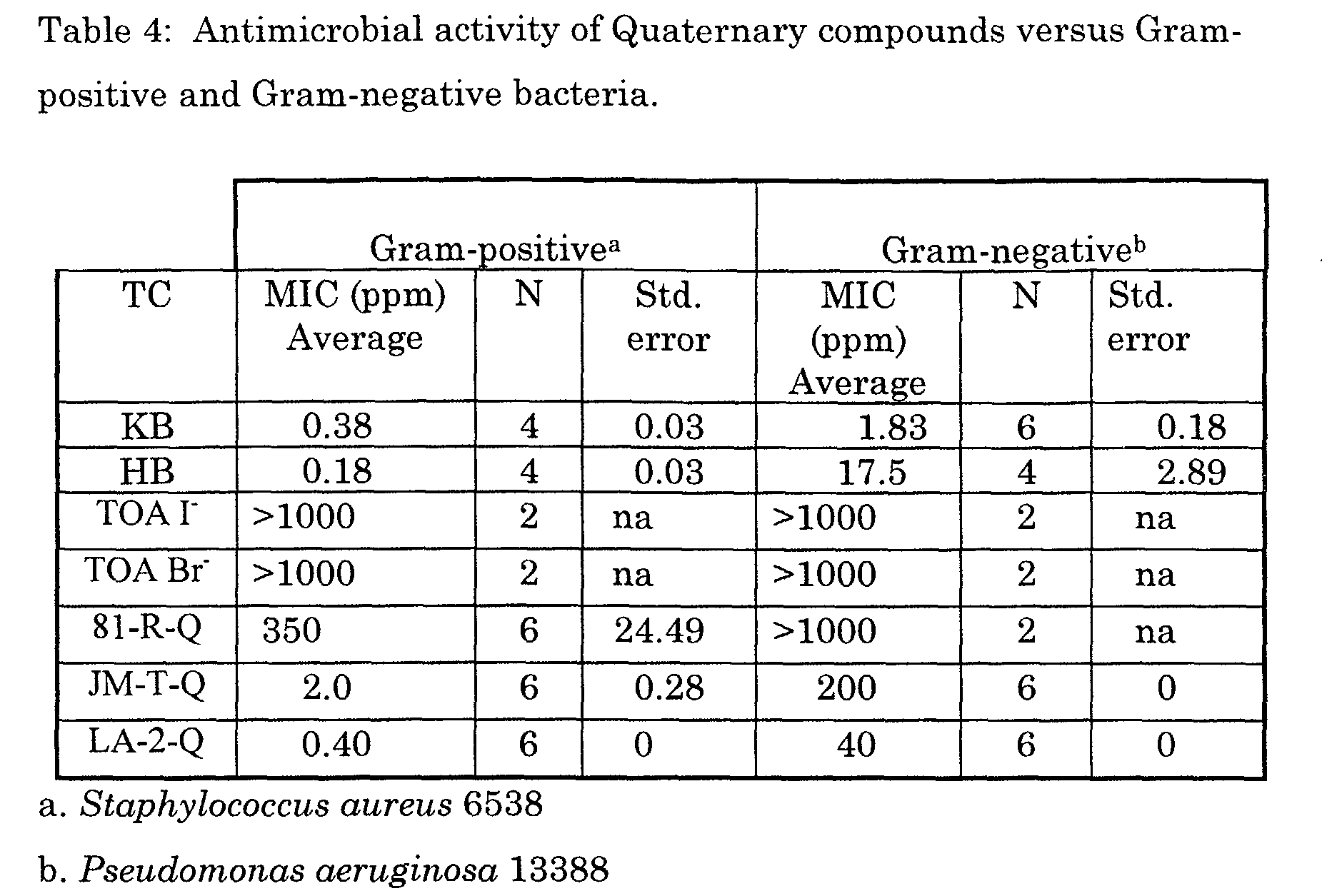
- the five alkylation products from Route B were tested for their ability to inhibit the growth of a Gram-positive bacterium, Staphylococcus aureus 6538 and a Gram-negative bacterium, Pseudomonas aeruginosa 13388 in a high resolution minimum inhibitory concentration (HRMIC) test.
- HRMIC high resolution minimum inhibitory concentration
- Two of the compounds showing biological activity were also tested for activity against sulfate-reducing bacteria (SRB). The details of various tests and results are given below.
- microtiter plates were incubated at 30°C for 24 hours and were then checked for the presence or absence of microbial growth in each well.
- concentration of biocide in the first microtiter well demonstrating no growth was the Minimum Inhibitory Concentration (MIC) for the biocide.
- MIC Minimum Inhibitory Concentration
- test compounds were dissolved in DMSO and added to modified Sulfate API Broth in sterile vials. This media was modified to remove reducing agents but treated in such a way as to minimize oxygen content. Two-fold serial dilutions were performed in an anaerobic chamber to obtain a range of closely spaced concentrations of test compound ("TC") as illustrated in Table 3.
- TC test compound
- a cell suspension of the sulfate reducing bacteria Desulfovibrio desulfuricans ATCC 7757 was added to provide 10 6 CFU/mL in each vial. Kathon® WT biocide and Primene® 81-R amine were included in the test for comparison.
- the vials were incubated at 35°C for 3 days and were then checked for the presence or absence of microbial growth as indicated by a black precipitate formed by reduction of sulfate to hydrogen sulfide by the bacteria.
- the lowest concentration of compound that inhibited growth of the test organism was the Minimum Inhibitory Concentration (MIC) for the compound.
- MIC Minimum Inhibitory Concentration
- Biocide concentration in SRB MIC test TC 1 2 3 4 5 6 7 8 9 10 I 1000 500 250 125 62.5 31.3 15.6 7.8 3.9 2.0 900 450 225 112.5 56.3 28.1 14.1 7.0 3.5 1.8 800 400 200 100 50 25 12.5 6.3 3.1 1.6 II 10 5 2.5 1.3 0.6 0.3 8 4 2.0 1.0 0.5 0.25
- Both LA-2-Q and JM-T-Q showed activity against the sulfate reducing bacteria.
- the activity of LA-2-Q was at least a magnitude better than the Primene® 81-R amine control and comparable to that of Kathon® biocide.
- the activity of JM-T-Q was comparable to that of the Primene® 81-R amine control (see Table 5).
Landscapes
- Chemical & Material Sciences (AREA)
- Organic Chemistry (AREA)
- Life Sciences & Earth Sciences (AREA)
- Engineering & Computer Science (AREA)
- Materials Engineering (AREA)
- Mechanical Engineering (AREA)
- Dentistry (AREA)
- General Health & Medical Sciences (AREA)
- Wood Science & Technology (AREA)
- Zoology (AREA)
- Plant Pathology (AREA)
- Environmental Sciences (AREA)
- Health & Medical Sciences (AREA)
- Pest Control & Pesticides (AREA)
- Metallurgy (AREA)
- Agronomy & Crop Science (AREA)
- Organic Low-Molecular-Weight Compounds And Preparation Thereof (AREA)
- Agricultural Chemicals And Associated Chemicals (AREA)
- Catalysts (AREA)
- Preventing Corrosion Or Incrustation Of Metals (AREA)
Abstract
Description
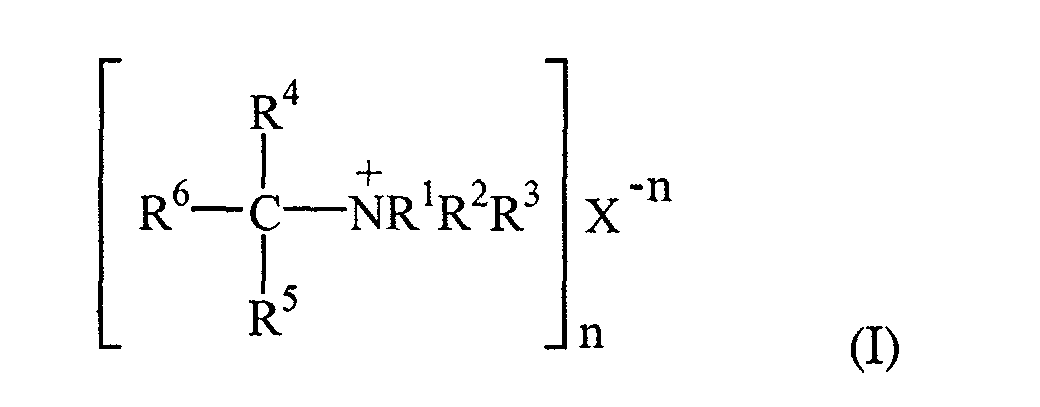
wherein at least one of R4, R5 and R6 is branched;
and wherein R4, R5 and R6 contain collectively at least nine carbon atoms.
where m≥n. Preferably, m is no greater than 10. Preferably, the pKa for removal of the most acidic hydrogen atom in the acid HmX is no greater than 17; more preferably the pKa for removal of the most acidic hydrogen atom in HmX is no greater than 9. Preferably, X-n is selected from the group consisting of halide; hydroxide; alkoxide; alkyl, aryl, aralkyl, alkenyl, and alkylamino carboxylates; alkyl and aryl sulfates; alkyl and aryl sulfonates; phosphates; phosphonates; alkyl, aryl, aralkyl, alkenyl, and alkylamino thiocarboxylates; chelating aliphatic carboxylic acids; and tetrafluoroborate. More preferably, X-n is selected from the group consisting of halide, alkyl sulfate, aliphatic phosphonate and chelating aliphatic carboxylic acids. Particularly preferred aliphatic phosphonates are the anions derived from aminotrimethylenephosphonic acid (ATMP), diethylenetriamine pentamethylenephosphonic acid (DETA), bis-hexamethylenetriamine-pentaphosphonic acid (BHMT) and hydroxyethylidene diphosphonic acid (HEDP). Particularly preferred chelating carboxylic acids include ethylenediaminetetraacetic acid (EDTA) and nitrilotriacetic acid.


| Yields and product distributions in quaternary salt synthesis. | ||||||||
| Route A | Route B | |||||||
| amine/ alkyl halide | Yield | Product Distribution | Yield | Product Distribution | ||||
| Quat | 2°/3° | 1° | Quat | 2° | olefin | |||
| amines | salt | |||||||
| TOA/Mel | 15 | 100 | -- | -- | 94 | 100 | -- | -- |
| TOA/ MeBr | -- | -- | -- | -- | 90 | 100 | -- | -- |
| 81-R/MeI | 7 | 66 | 23 | 11 | 50 | 62 | 29 | 10 |
| JM-T/MeI | 15 | 53 | 36 | 11 | 71 | 28 | 28 | 44c |
| LA-2/MeI | -- | -- | -- | -- | 85 | 60 | 40 | -- |
| Biocide concentration (ppm active ingredient) in a typical HRMIC test | ||||||||||||
| 1 | 2 | 3 | 4 | 5 | 6 | 7 | 8 | 9 | 10 | 11 | 12 | |
| A | 1000 | 100 | 10 | 1 | 0.1 | 0 | 1000 | 100 | 10 | 1 | 0.1 | 0 |
| B | 800 | 80 | 8 | 0.8 | 0.08 | 0 | 800 | 80 | 8 | 0.8 | 0.08 | 0 |
| C | 700 | 70 | 7 | 0.7 | 0.07 | 0 | 700 | 70 | 7 | 0.7 | 0.07 | 0 |
| D | 600 | 60 | 6 | 0.6 | 0.06 | 0 | 600 | 60 | 6 | 0.6 | 0.06 | 0 |
| E | 500 | 50 | 5 | 0.5 | 0.05 | 0 | 500 | 50 | 5 | 0.5 | 0.05 | 0 |
| F | 400 | 40 | 4 | 0.4 | 0.04 | 0 | 400 | 40 | 4 | 0.4 | 0.04 | 0 |
| G | 300 | 30 | 3 | 0.3 | 0.03 | 0 | 300 | 30 | 3 | 0.3 | 0.03 | 0 |
| H | 200 | 20 | 2 | 0.2 | 0.02 | 0 | 200 | 20 | 2 | 0.2 | 0.02 | 0 |
| Biocide concentration in SRB MIC test | ||||||||||
| TC | 1 | 2 | 3 | 4 | 5 | 6 | 7 | 8 | 9 | 10 |
| I | 1000 | 500 | 250 | 125 | 62.5 | 31.3 | 15.6 | 7.8 | 3.9 | 2.0 |
| 900 | 450 | 225 | 112.5 | 56.3 | 28.1 | 14.1 | 7.0 | 3.5 | 1.8 | |
| 800 | 400 | 200 | 100 | 50 | 25 | 12.5 | 6.3 | 3.1 | 1.6 | |
| II | 10 | 5 | 2.5 | 1.3 | 0.6 | 0.3 | ||||
| 8 | 4 | 2.0 | 1.0 | 0.5 | 0.25 |
| Antimicrobial Activity of Quaternary compounds versus Sulfate-Reducing Bacteria | |
| Test Compound | MIC (ppm active ingredient) |
| JM-T-Q | 200 |
| LA-2-Q | 15.6 |
| Primene® 81-R amine | 225 |
| Kathon® WT biocide | 8 |
Claims (10)
- A compound having the formulawherein R1 is C1-C18 alkyl, C1-C18 polyether alkyl, C1-C18 alkenyl, C1-C18 alkynyl, or C7-C12 aralkyl; R2 is C1-C4 alkyl; R3 is methyl or ethyl; R4, R5 and R6 are independently C1-C21 alkyl, substituted C1-C21 alkyl, C1-C21 alkenyl or substituted C1-C21 alkenyl; X-n is halide, hydroxide, tetrafluoroborate, phosphate or an organic anion having from 1 to 20 carbon atoms; and n is an integer from 1 to 5;

wherein at least one of R4, R5 and R6 is branched;
and wherein R4, R5 and R6 contain collectively at least nine carbon atoms. - The compound of claim 1 in which R4, R5 and R6 are alkyl.
- The compound of claim 2 in which R2 and R3 are methyl and X- is halide, phosphonate or a chelating carboxylic acid.
- The compound of claim 3 in which R1 is methyl and X- is bromide or iodide.
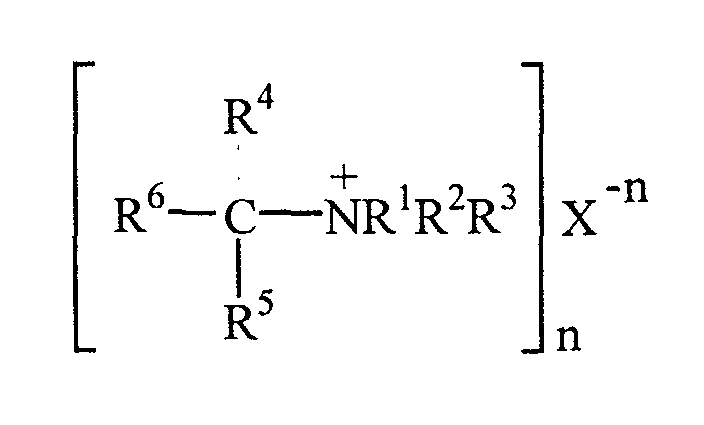
- A method for inhibiting growth of microorganisms comprising introducing to a locus that is subject to microbial attack a microbicidally effective amount of a compound of formulawherein R1 is C1-C18 alkyl, C1-C18 polyether alkyl, C1-C18 alkenyl, C1-C18 alkynyl, or C7-C12 aralkyl; R2 is C1-C4 alkyl; R3 is methyl or ethyl; R4, R5 and R6 are independently C1-C21 alkyl, substituted C1-C21 alkyl, C1-C21 alkenyl or substituted C1-C21 alkenyl; X-n is halide, hydroxide, tetrafluoroborate, phosphate or an organic anion having from one to 20 carbon atoms; and n is an integer from 1 to 5;
wherein at least one of R4, R5 and R6 is branched;
and wherein R4, R5 and R6 contain collectively at least nine carbon atoms. - The method of claim 5 in which R4, R5 and R6 are alkyl; and R1, R2 and R3 are methyl.
- A method for inhibiting corrosion of a metal comprising introducing to a material which contacts the metal an effective amount of a compound of formulawherein R1 is C1-C18 alkyl, C1-C18 polyether alkyl, C1-C18 alkenyl, C1-C18 alkynyl, or C7-C12 aralkyl; R2 is C1-C4 alkyl; R3 is methyl or ethyl; R4, R5 and R6 are independently C1-C21 alkyl, substituted C1-C21 alkyl, C1-C21 alkenyl or substituted C1-C21 alkenyl; X-n is halide, hydroxide, tetrafluoroborate, phosphate or an organic anion having from 1 to 20 carbon atoms; and n is an integer from 1 to 5;

wherein at least one of R4, R5 and R6 is branched;
and wherein R4, R5 and R6 contain collectively at least nine carbon atoms. - A composition produced by allowing a compound of formulawherein R1 is C1-C18 alkyl, C1-C18 polyether alkyl, C1-C18 alkenyl, C1-C18 alkynyl, or C7-C12 aralkyl; R2 is C1-C4 alkyl; and R4, R5 and R6 are independently C1-C21 alkyl, substituted C1-C21 alkyl, C1-C21 alkenyl or substituted C1-C21 alkenyl;

wherein at least one of R4, R5 and R6 is branched;
and wherein R4, R5 and R6 contain collectively at least nine carbon atoms;
to react with an alkylating agent, R3X, wherein R3 is methyl or ethyl; and X is halo, alkyl sulfate or alkyl sulfonate. - The composition of claim 8 in which R4, R5 and R6 are independently C1-C21 alkyl; R1 is C1-C12 alkyl; and R2 is methyl or ethyl.
- The composition of claim 9 in which R3 is methyl and X is iodo.
Applications Claiming Priority (2)
| Application Number | Priority Date | Filing Date | Title |
|---|---|---|---|
| US29090401P | 2001-05-16 | 2001-05-16 | |
| US290904P | 2001-05-16 |
Publications (3)
| Publication Number | Publication Date |
|---|---|
| EP1258472A2 true EP1258472A2 (en) | 2002-11-20 |
| EP1258472A3 EP1258472A3 (en) | 2003-10-29 |
| EP1258472B1 EP1258472B1 (en) | 2007-10-31 |
Family
ID=23117989
Family Applications (1)
| Application Number | Title | Priority Date | Filing Date |
|---|---|---|---|
| EP02253203A Expired - Lifetime EP1258472B1 (en) | 2001-05-16 | 2002-05-08 | Quaternary ammonium salts having a tertiary alkyl group |
Country Status (4)
| Country | Link |
|---|---|
| US (1) | US6727387B2 (en) |
| EP (1) | EP1258472B1 (en) |
| JP (1) | JP2003040846A (en) |
| DE (1) | DE60223194T2 (en) |
Cited By (2)
| Publication number | Priority date | Publication date | Assignee | Title |
|---|---|---|---|---|
| WO2011110601A3 (en) * | 2010-03-10 | 2012-01-19 | Basf Se | Method for producing crude oil using cationic surfactants comprising a hydrophobic block having a chain length of 6 - 10 carbon atoms |
| RU2448735C1 (en) * | 2011-01-11 | 2012-04-27 | ООО "Гидростандарт" | Detergent sanitiser |
Families Citing this family (17)
| Publication number | Priority date | Publication date | Assignee | Title |
|---|---|---|---|---|
| US6759434B2 (en) | 1999-09-22 | 2004-07-06 | B. Ron Johnson | Anti-infective compositions, methods and systems for treating disordered tissue |
| US8173709B2 (en) * | 1999-09-22 | 2012-05-08 | Quadex Pharmaceuticals, Llc | Anti-infective methods for treating pathogen-induced disordered tissues |
| US20050003978A1 (en) * | 2003-05-28 | 2005-01-06 | Lonza Inc. | Quaternary ammonium carbonates and bicarbonates as anticorrosive agents |
| MY148568A (en) * | 2004-12-09 | 2013-04-30 | Lonza Ag | Quaternary ammonium salts as a conversion coating or coating enhancement |
| GB201211688D0 (en) | 2012-07-02 | 2012-08-15 | Reckitt Benckiser Llc | Aqueous alcoholic microbicidal compositions comprising zinc ions |
| GB201211702D0 (en) | 2012-07-02 | 2012-08-15 | Reckitt Benckiser Llc | Sprayable aqueous alcoholic microbicidal compostions comprising zinc ions |
| GB201211691D0 (en) | 2012-07-05 | 2012-08-15 | Reckitt Benckiser Llc | Sprayable aqueous alcoholic microbicidal compositions comprising zinc ions |
| GB201211701D0 (en) | 2012-07-02 | 2012-08-15 | Reckitt Benckiser Llc | Aqueous alcoholic microbicidal compositions comprising zinc ions |
| US10006128B2 (en) * | 2012-09-28 | 2018-06-26 | Ecolab Usa Inc. | Quaternary and cationic ammonium surfactants as corrosion inhibitors |
| WO2014083330A1 (en) | 2012-11-30 | 2014-06-05 | Reckitt & Colman (Overseas) Limited | Microbicidal personal care compositions comprising metal ions |
| US9549930B2 (en) | 2013-03-14 | 2017-01-24 | Quadex Pharmaceuticals, Llc | Combined systemic and topical treatment of disordered and/or prodromal stage tissue |
| US9463180B2 (en) | 2013-03-14 | 2016-10-11 | Quadex Pharmaceuticals, Llc | Treatment of molluscum contagiosum |
| US9125911B2 (en) | 2013-03-14 | 2015-09-08 | Quadex Pharmaceuticals, Llc | Combined systemic and topical treatment of disordered tissues |
| JP6325464B2 (en) * | 2015-01-05 | 2018-05-16 | 信越化学工業株式会社 | Developer and pattern forming method using the same |
| WO2016148649A1 (en) | 2015-03-16 | 2016-09-22 | Agency For Science, Technology And Research | Functionalized quaternary ammonium halides and use thereof |
| US10040954B2 (en) | 2015-05-28 | 2018-08-07 | E Ink California, Llc | Electrophoretic medium comprising a mixture of charge control agents |
| US20160349593A1 (en) * | 2015-05-28 | 2016-12-01 | E Ink California, Llc | Charge control agent for electrophoretic display |
Family Cites Families (7)
| Publication number | Priority date | Publication date | Assignee | Title |
|---|---|---|---|---|
| US3219639A (en) | 1961-05-12 | 1965-11-23 | Crusader Chemical Co Inc | Polymeric quaternary ammonium salt compositions and method of making the same |
| US3486866A (en) | 1966-01-05 | 1969-12-30 | Petrolite Corp | Quaternary ammonium iodide stabilized fuels |
| US3969415A (en) | 1971-12-01 | 1976-07-13 | Sandoz, Inc. | 1-(2-Naphthyl)-2,3-butadien-1-ols |
| US3910971A (en) | 1974-07-12 | 1975-10-07 | Commercial Solvents Corp | Bacteriostatic compounds |
| US4022909A (en) | 1976-07-06 | 1977-05-10 | Imc Chemical Group, Inc. | Method of inhibiting the growth of bacteria using quaternary ammonium compounds |
| US4166846A (en) | 1977-08-16 | 1979-09-04 | Mitsubishi Chemical Industries, Ltd. | Chemicals for controlling plant virus diseases and control method |
| US4395410A (en) | 1979-12-10 | 1983-07-26 | Eli Lilly And Company | Quaternary ammonium antiarrhythmic drugs |
-
2002
- 2002-05-06 US US10/139,440 patent/US6727387B2/en not_active Expired - Lifetime
- 2002-05-08 EP EP02253203A patent/EP1258472B1/en not_active Expired - Lifetime
- 2002-05-08 DE DE60223194T patent/DE60223194T2/en not_active Expired - Lifetime
- 2002-05-16 JP JP2002141513A patent/JP2003040846A/en active Pending
Cited By (2)
| Publication number | Priority date | Publication date | Assignee | Title |
|---|---|---|---|---|
| WO2011110601A3 (en) * | 2010-03-10 | 2012-01-19 | Basf Se | Method for producing crude oil using cationic surfactants comprising a hydrophobic block having a chain length of 6 - 10 carbon atoms |
| RU2448735C1 (en) * | 2011-01-11 | 2012-04-27 | ООО "Гидростандарт" | Detergent sanitiser |
Also Published As
| Publication number | Publication date |
|---|---|
| JP2003040846A (en) | 2003-02-13 |
| EP1258472A3 (en) | 2003-10-29 |
| DE60223194D1 (en) | 2007-12-13 |
| US20030013769A1 (en) | 2003-01-16 |
| DE60223194T2 (en) | 2008-08-14 |
| US6727387B2 (en) | 2004-04-27 |
| EP1258472B1 (en) | 2007-10-31 |
Similar Documents
| Publication | Publication Date | Title |
|---|---|---|
| US6727387B2 (en) | Quaternary ammonium salts having a tertiary alkyl group | |
| US6784168B1 (en) | Biocidal compositions and treatments | |
| US5149524A (en) | Antimicrobial polymeric quaternary ammonium salts | |
| EP0239896B1 (en) | N,n'-dihalo-2-imidazolidinones | |
| CA2206586C (en) | Disinfecting use of quaternary ammonium carbonates | |
| US4767542A (en) | Method for disinfecting aqueous medium with N,N'-dihalo-2-imidazolidinones | |
| US10006128B2 (en) | Quaternary and cationic ammonium surfactants as corrosion inhibitors | |
| US4075243A (en) | Polyquaternary ammonium methylene phosphonates | |
| US4188359A (en) | Thioether containing quartenary ammonium derivatives of 1,4-thiazines | |
| US3956502A (en) | Polyamine alcohols as microbiocides | |
| JPS5993058A (en) | Azolyl-methylamines | |
| US4035480A (en) | Microbiocidal mixtures of polymeric quaternary ammonium compounds | |
| US4267341A (en) | Process for preparing 2,3-substituted-1,2,-isothiazolium salt antimicrobials | |
| CA2082994A1 (en) | Ammonium and phosphonium salts | |
| US4323459A (en) | Process of inhibiting scale formation in aqueous systems using quaternary ammonium salts of α-1,4-thiazine alkanephosphonic acids | |
| US4217329A (en) | Sulfone containing quaternary ammonium derivatives of 1,4-thiazines | |
| EP0368956A1 (en) | Quaternary ammonium dithiocarbamate compounds | |
| US4323461A (en) | Process of inhibiting scale formation in aqueous systems using di-quaternary ammonium salts of α-1,4-thiazine alkanephosphonic acids | |
| CA2819655C (en) | Protected antimicrobial compounds for high temperature applications | |
| US2897236A (en) | Benzylidene-dialkylamino-hexanones and their acid addition salts | |
| US4336156A (en) | Quaternary ammonium salts of α-1,4-thiazine alkanephosphonic acids | |
| US4200633A (en) | Thioether containing quaternary ammonium derivatives of 1,4-thiazines as microbiocides | |
| US4146711A (en) | Sulfone containing quaternary ammonium derivatives of 1,4-thiazines | |
| US7314951B2 (en) | Process and composition for lower toxicity quaternary ammonium compounds | |
| US4200634A (en) | Sulfone containing quaternary ammonium derivatives of 1,4-thiazines as microbiocides |
Legal Events
| Date | Code | Title | Description |
|---|---|---|---|
| PUAI | Public reference made under article 153(3) epc to a published international application that has entered the european phase |
Free format text: ORIGINAL CODE: 0009012 |
|
| 17P | Request for examination filed |
Effective date: 20020524 |
|
| AK | Designated contracting states |
Kind code of ref document: A2 Designated state(s): AT BE CH CY DE DK ES FI FR GB GR IE IT LI LU MC NL PT SE TR |
|
| AX | Request for extension of the european patent |
Free format text: AL;LT;LV;MK;RO;SI |
|
| PUAL | Search report despatched |
Free format text: ORIGINAL CODE: 0009013 |
|
| AK | Designated contracting states |
Kind code of ref document: A3 Designated state(s): AT BE CH CY DE DK ES FI FR GB GR IE IT LI LU MC NL PT SE TR |
|
| AX | Request for extension of the european patent |
Extension state: AL LT LV MK RO SI |
|
| AKX | Designation fees paid |
Designated state(s): DE FR GB IT |
|
| 17Q | First examination report despatched |
Effective date: 20060620 |
|
| 17Q | First examination report despatched |
Effective date: 20060620 |
|
| GRAP | Despatch of communication of intention to grant a patent |
Free format text: ORIGINAL CODE: EPIDOSNIGR1 |
|
| GRAS | Grant fee paid |
Free format text: ORIGINAL CODE: EPIDOSNIGR3 |
|
| GRAA | (expected) grant |
Free format text: ORIGINAL CODE: 0009210 |
|
| AK | Designated contracting states |
Kind code of ref document: B1 Designated state(s): DE FR GB IT |
|
| REG | Reference to a national code |
Ref country code: GB Ref legal event code: FG4D |
|
| REF | Corresponds to: |
Ref document number: 60223194 Country of ref document: DE Date of ref document: 20071213 Kind code of ref document: P |
|
| ET | Fr: translation filed | ||
| PLBE | No opposition filed within time limit |
Free format text: ORIGINAL CODE: 0009261 |
|
| STAA | Information on the status of an ep patent application or granted ep patent |
Free format text: STATUS: NO OPPOSITION FILED WITHIN TIME LIMIT |
|
| 26N | No opposition filed |
Effective date: 20080801 |
|
| REG | Reference to a national code |
Ref country code: FR Ref legal event code: PLFP Year of fee payment: 15 |
|
| REG | Reference to a national code |
Ref country code: FR Ref legal event code: PLFP Year of fee payment: 16 |
|
| REG | Reference to a national code |
Ref country code: FR Ref legal event code: PLFP Year of fee payment: 17 |
|
| PGFP | Annual fee paid to national office [announced via postgrant information from national office to epo] |
Ref country code: IT Payment date: 20210412 Year of fee payment: 20 Ref country code: FR Payment date: 20210412 Year of fee payment: 20 Ref country code: DE Payment date: 20210413 Year of fee payment: 20 |
|
| PGFP | Annual fee paid to national office [announced via postgrant information from national office to epo] |
Ref country code: GB Payment date: 20210414 Year of fee payment: 20 |
|
| REG | Reference to a national code |
Ref country code: DE Ref legal event code: R071 Ref document number: 60223194 Country of ref document: DE |
|
| REG | Reference to a national code |
Ref country code: GB Ref legal event code: PE20 Expiry date: 20220507 |
|
| PG25 | Lapsed in a contracting state [announced via postgrant information from national office to epo] |
Ref country code: GB Free format text: LAPSE BECAUSE OF EXPIRATION OF PROTECTION Effective date: 20220507 |