EP1257146A2 - Method and system of sound processing - Google Patents
Method and system of sound processing Download PDFInfo
- Publication number
- EP1257146A2 EP1257146A2 EP02009933A EP02009933A EP1257146A2 EP 1257146 A2 EP1257146 A2 EP 1257146A2 EP 02009933 A EP02009933 A EP 02009933A EP 02009933 A EP02009933 A EP 02009933A EP 1257146 A2 EP1257146 A2 EP 1257146A2
- Authority
- EP
- European Patent Office
- Prior art keywords
- sound
- microphone array
- source
- location
- relative
- Prior art date
- Legal status (The legal status is an assumption and is not a legal conclusion. Google has not performed a legal analysis and makes no representation as to the accuracy of the status listed.)
- Granted
Links
Images


Classifications
-
- H—ELECTRICITY
- H04—ELECTRIC COMMUNICATION TECHNIQUE
- H04R—LOUDSPEAKERS, MICROPHONES, GRAMOPHONE PICK-UPS OR LIKE ACOUSTIC ELECTROMECHANICAL TRANSDUCERS; ELECTRIC HEARING AIDS; PUBLIC ADDRESS SYSTEMS
- H04R3/00—Circuits for transducers
- H04R3/005—Circuits for transducers for combining the signals of two or more microphones
Definitions
- the present invention relates to sound signal processing.
- the invention relates to enhancing sound signal quality for use in a sound processing device.
- pick-up of noise and reverberation may be reduced by employing an array of remote microphones.
- the remote microphones' outputs are processed and then combined into a single signal that has an improved signal quality.
- the best processing parameters to use in the microphone array depend on the location of the desired sound source relative to the microphones. Many arrays reject noise by having much higher sensitivity to sound coming from the direction (or region) of the desired source than to sounds from elsewhere, where noise sources are located. However, the source's relative location is often unknown initially, and may change over time. For example, people often move their heads whilst speaking, and if an array is in a hand-held device, it is quite likely to move somewhat during use.
- the location of a sound source relative to a microphone array can be estimated by measuring certain characteristics of the signals received from that source by the array of microphones.
- An example of one such characteristic is cross-power spectral phase.
- the other method of location of a sound source relative to a microphone array is estimation by visually imaging the source, with a camera mounted on the same base as the array.
- the camera image is processed to locate the source within it, using known visual characteristics of the source. For example, a speaker's mouth may be located by looking for his/her face in the image.
- Granted US patent US-A-4984087 shows a prior art microphone apparatus for a video camera.
- the methods and system of the invention are for use in portable sound processing devices
- the methods and system according to the present invention allow processing of sound signals that result in increased quality.
- the output signal has decreased content of acoustic noise and reverberation caused by surroundings.
- the output signal is also less sensitive to changes of location of a sound source relative to the microphones. These changes of location are caused both by movement of the sound source, and movement of the device equiped with these microphones.
- the sound source would be a person speaking and the device might be held in his/her hand.
- a method for enhancing sound signal quality comprises steps of receiving sound from sound source by a microphone array and detecting a movement of this microphone array. The movement is detected by a platform motion sensor. Current location of the sound source relative to the microphone array is estimated on the basis of the sound signal from the microphone array and signals from the platform motion sensor. Results of this estimation are used for enhancing output sound signal quality.
- An advantage of the present invention is that the motion sensor can continously track the motion of the microphone array, and use this to adjust the current estimate of the relative location of the desired sound source.
- the changes of relative location of the sound source and microphone array can be tracked even when there is no sound signal.
- the sound-based source location estimation can only track changes in source location when sound is present.
- a system for enhancing sound signal quality comprising a microphone array and a platform motion sensor that are connected to a source location estimator. Additionally the microphone array is connected to a sound enhancing processor. The sound enhancing processor is connected to a source location estimator.
- a “movement signal” herein below refers to a signal generated and provided by a platform motion sensor.
- a “microphone array” mentioned herein below refers to a set of microphones that are a part of a portable device. Such a portable device is typically in a user's hand, during use, and may be subject to various rotational and translational movements.
- a sound from a sound source 412 which may be moving, is received by a microphone array 402.
- a platform motion sensor 400 detects a movement of the microphone array 402.
- a sound signal is provided to a sound enhancing processor 408 and to a source location estimator 406.
- the movement signal is provided to the source location estimator 406.
- step 112 the sound enhancing processor 408 enhances the quality of the sound signal. This enhancement may be performed according to methods known in the art, and is not described further here.
- step 104 on the basis of this sound signal, an estimation of a location of the sound source 412 relative to the microphone array 402 is performed. For the purpose of this estimation, long time intervals of the sound signal are analysed.
- step 106 on the basis of the movement signal, an estimation of a change of position of the microphone array 402 is performed. For the purpose of this estimation, short time intervals of the movement signal are analysed.
- step 108 on the basis of results of estimations performed in steps 104 and 106, a current change of source's relative location is estimated.
- step 110 the estimated current location of the sound source 412 relative to the microphone array 402 is obtained, by combining the current change of source's relative location from step 108 with the location of the sound source 412 relative to the microphone array 402.
- Results of the estimation obtained in step 110 and the enhanced signal received in step 112 can be used for further processing in other devices, e.g. speech recognition devices.
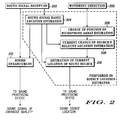
- step 200 a sound from a sound source 412, which may be moving, is received by a microphone array 402.
- platform motion sensor 400 detects a movement of the microphone array 402. Afterwards, a sound signal is provided to a sound enhancing processor 408 and to a source location estimator 406. At the same time the movement signal is provided to the source location estimator 406.
- step 204 on the basis of this sound signal, an estimation of a location of the sound source 412 relative to the microphone array 402 is performed. For the purpose of this estimation, long time intervals of the sound signal are analysed. Results of this estimation are provided to the sound enhancing processor 408.
- step 212 the sound enhancing processor 408 enhances the quality of the sound signal using the results of the estimation performed in step 204.
- step 206 on the basis of the movement signal, an estimation of a change of position of the microphone array 402 is performed. For the purpose of this estimation, short time intervals of the movement signal are analysed.
- step 208 on the basis of results of estimations performed in steps 204 and 206, a current change of the source's relative location is estimated.
- step 210 an estimation of current location of the sound source 412 relative to the microphone array 402 is performed, by combining the current change of the source's relative location from step 208 with the location of the sound source 412 relative to the microphone array 402.
- Results of the estimation obtained in step 210 and the enhanced signal received in step 212 can be used for further processing in other devices, e.g. speech recognition devices.
- step 300 a sound from a sound source 412, which may be moving, is received by a microphone array 402.
- platform motion sensor 400 detects a movement of the microphone array 402.
- a sound signal is provided to a sound enhancing processor 408 and to a source location estimator 406.
- the movement signal is provided to the source location estimator 406.
- step 304 on the basis of this sound signal, an estimation of a location of the sound source 412 relative to the microphone array 402 is performed. For the purpose of this estimation, long time intervals of the sound signal are analysed. Simultaneously, in step 306, on the basis of the movement signal an estimation of a change of position of the microphone array 402 is performed. For the purpose of this estimation, short time intervals of the movement signal are analysed.
- step 308 on the basis of results of estimations performed in steps 304 and 306, a current change of the source's relative location is estimated.
- step 310 by combining the current change of source's relative location from step 308 with the location of the sound source 412 relative to the microphone array 402, the estimated current location of the sound source 412 relative to the microphone array 402 is obtained.
- step 312 the sound enhancing processor 408 enhances the quality of the sound signal using the results of the estimation performed in step 310.
- the sound signal of enhanced quality obtained in step 312 can be used for further processing in other devices, e.g. speech recognition devices.
- the long time interval referenced in steps 104, 204 and 304 is typically in the range from 10 ms up to 1 s.
- the short time interval referenced in steps 106, 206 and 306 is typically in the range from 0.1 ⁇ s up to 10 ⁇ s.
- FIG. 4 depicts a system for enhancing quality of an output sound signal, operative in accordance with the embodiment of the present invention as illustrated in Fig. 3.
- a system for enhancing sound signal quality comprises a microphone array 402, that is connected to a sound enhancing processor 408, and to a source location estimator 406.
- the system also comprises a platform motion sensor 400 that is connected to the source location estimator 406.
- the source location estimator 406 may be connected to the sound enhancing processor 408.
- the microphone array 402 consists of two or more microphones 404.
- An array of at least two microphones can provide output signals that can be used to estimate both the direction and distance of a source of sound.
- the platform motion sensor 400 comprises at least one gyroscope and/or accelerometer.
- the platform motion sensor 400 is fixed to the microphone array 402, or to any other part of the portable sound processing device 410 that forms one unit with the microphone array 402.
- the source location estimator 406 and sound enhancing processor 408 have respectively a first signal output connection and a second signal output connection.
- the invention uses the signal from platform motion sensor 400 to provide an indication of movements of the microphone array 402. Therefore it is necessary that sensor 400 and microphone array 402 be linked so that the signal from sensor 400 relates to the motion of microphone array 402.
- a link may simply include sensor 400 being attached to array 402, or both being attached to the same housing. Therefore, although figure 4 shows elements 400, 402, 406 and 408 all in one unit, elements 406 and 408 may in fact be located elsewhere.
- a system in accordance with the invention, or the methods of the invention may be used in various portable devices.
- the invention is usable in portable radio communication devices. Therefore the system may be used in a mobile telephone or a portable or mobile PMR radio.
- the invention also may be used in a personal digital assistant (PDA) or laptop computer, linked for example by a radio or infra-red communication link to a cellular network.
- PDA personal digital assistant
- Such a network may be in a building, or a cellular telephone, or UMTS/3G network.
- the invention may form part of a Distributed Speech Recognition (DSR) system.
- DSR Distributed Speech Recognition
- some speech processing would be performed remotely, i.e. the processing would be carried out at at least two different locations.
Landscapes
- Health & Medical Sciences (AREA)
- General Health & Medical Sciences (AREA)
- Otolaryngology (AREA)
- Physics & Mathematics (AREA)
- Engineering & Computer Science (AREA)
- Acoustics & Sound (AREA)
- Signal Processing (AREA)
- Circuit For Audible Band Transducer (AREA)
- Measurement Of Velocity Or Position Using Acoustic Or Ultrasonic Waves (AREA)
- Electrophonic Musical Instruments (AREA)
- Devices For Supply Of Signal Current (AREA)
Abstract
Description
Claims (14)
- A method of preparing input signals, for use in a portable sound processing device, the method comprising the steps of:receiving (100) a sound from a sound source (412) by a microphone array (402);detecting (102) a movement of said microphone array (402) by a platform motion sensor (400);providing a sound signal from said microphone array (402) to a sound enhancing processor (408) and to a source location estimator (406);providing a movement signal from said platform motion sensor (400) to said source location estimator (406);said sound enhancing processor (408) enhancing (112) a sound signal quality;said source location estimator (406) estimating a current location of said sound source (412) relative to said microphone array (402);providing said enhanced sound signal to a sound processing device;providing to said sound processing device a result of said estimation of said current location of said sound source relative to said microphone array.
- A method of enhancing a sound signal quality, for use in a portable sound processing device, the method comprising the steps of:receiving (300) a sound from a sound source (412) by a microphone array (402);detecting (302) a movement of said microphone array (402) by a platform motion sensor (400);providing a sound signal from said microphone array (402) to a sound enhancing processor (408) and to a source location estimator (406);providing a movement signal from said platform motion sensor (400) to said source location estimator (406);said source location estimator (406) estimating a current location of said sound source (412) relative to said microphone array (402);providing a result of said estimation of said current location of said sound source (412) relative to said microphone array (402) to said sound enhancing processor (408);said sound enhancing processor (408) enhancing (312) said sound signal quality;providing said enhanced sound signal to a sound processing device.
- A method according to claim 1 or claim 2, wherein said estimation of said current location of said sound source relative to said microphone array comprises the steps of:estimating (104, 304) a location of said sound source relative to said microphone array on the basis of said sound signal;estimating (106, 306) a change of position of said microphone array on the basis of said movement signal;estimating (108, 308) a current change of a source's relative location on the basis of a result of said estimation of said location of said sound source relative to said microphone array and said estimation of said change of position of said microphone array;combining (110, 310) said current change of said source's relative location with said location of said sound source relative to said microphone array.
- A method of enhancing a sound signal quality, for use in a portable sound processing device, the method comprising the method of claim 1, and further comprising:providing (212, 214) a result of said estimation of a location of said sound source (412) relative to said microphone array (402) to said sound enhancing processor (408).
- A method according to claim 4 wherein said estimation of said current location of said sound source relative to said microphone array comprises the steps of:estimating (206) a change of position of said microphone array on the basis of said movement signal from said platform motion sensor;estimating (208) a current change of a source's relative location on the basis of a result of said estimation of said location of said sound source relative to said microphone array and said estimation of said change of position of said microphone array;combining (210) said current change of said source's relative location with said location of said sound source relative to said microphone array.
- A method according to claim 4 wherein said estimation (204) of a location of said sound source relative to said microphone array is performed on the basis of said sound signal only.
- A method according to any previous claim wherein, for the purpose of said estimation of a location of said sound source relative to said microphone array, long time intervals of said sound signal are analysed, the long time intervals being preferably in a range from 10ms to 1s.
- A method according to any previous claim wherein, for the purpose of said estimation of said change of position of said microphone array, short time intervals of said movement signal are analysed, the short time intervals being preferably in a range from 0.1µs to 10µs.
- A method according to claim 2 wherein, for the purpose of said enhancing (312) of said sound signal quality, said result of said estimation of said current location of said sound source is used.
- A system for enhancing sound signal quality, for use in a portable sound processing device (410), said system comprising:a sound enhancing processor (408);a source location estimator (406);a microphone array (402), connected to said sound enhancing processor (408) and to said source location estimator (406);a platform motion sensor (400), connected to said source location estimator (406).
- A system according to claim 10, wherein said source location estimator (406) is connected to said sound enhancing processor.
- A system according to claim 11, wherein said platform motion sensor (400) is fixed to said microphone array.
- A method according to any of claims 10-12, wherein said sound processing device is a speech recognition module.
- A mobile telephone, a portable or mobile PMR radio, a personal digital assistant (PDA), or a laptop computer according to any of claims 10-13, or being adapted to operate in accordance with the method of any of claims 1 - 9.
Applications Claiming Priority (2)
| Application Number | Priority Date | Filing Date | Title |
|---|---|---|---|
| GB0110861A GB2375276B (en) | 2001-05-03 | 2001-05-03 | Method and system of sound processing |
| GB0110861 | 2001-05-03 |
Publications (3)
| Publication Number | Publication Date |
|---|---|
| EP1257146A2 true EP1257146A2 (en) | 2002-11-13 |
| EP1257146A3 EP1257146A3 (en) | 2004-01-07 |
| EP1257146B1 EP1257146B1 (en) | 2006-07-19 |
Family
ID=9913962
Family Applications (1)
| Application Number | Title | Priority Date | Filing Date |
|---|---|---|---|
| EP02009933A Expired - Lifetime EP1257146B1 (en) | 2001-05-03 | 2002-05-03 | Method and system of sound processing |
Country Status (5)
| Country | Link |
|---|---|
| EP (1) | EP1257146B1 (en) |
| AT (1) | ATE333774T1 (en) |
| DE (1) | DE60213155T2 (en) |
| GB (1) | GB2375276B (en) |
| PT (1) | PT1257146E (en) |
Cited By (7)
| Publication number | Priority date | Publication date | Assignee | Title |
|---|---|---|---|---|
| WO2012063103A1 (en) * | 2010-11-12 | 2012-05-18 | Nokia Corporation | An Audio Processing Apparatus |
| US20120183156A1 (en) * | 2011-01-13 | 2012-07-19 | Sennheiser Electronic Gmbh & Co. Kg | Microphone system with a hand-held microphone |
| CN104244142A (en) * | 2013-06-21 | 2014-12-24 | 联想(北京)有限公司 | Microphone array, microphone array obtaining method and electronic device |
| EP2339868A3 (en) * | 2009-12-25 | 2015-04-15 | Fujitsu Limited | Microphone directivity control apparatus |
| WO2015086895A1 (en) * | 2013-12-11 | 2015-06-18 | Nokia Technologies Oy | Spatial audio processing apparatus |
| CN106231501A (en) * | 2009-11-30 | 2016-12-14 | 诺基亚技术有限公司 | For the method and apparatus processing audio signal |
| CN115691555A (en) * | 2021-07-31 | 2023-02-03 | 北京荣耀终端有限公司 | A recording processing method and related device |
Families Citing this family (12)
| Publication number | Priority date | Publication date | Assignee | Title |
|---|---|---|---|---|
| US6675027B1 (en) | 1999-11-22 | 2004-01-06 | Microsoft Corp | Personal mobile computing device having antenna microphone for improved speech recognition |
| US7383181B2 (en) | 2003-07-29 | 2008-06-03 | Microsoft Corporation | Multi-sensory speech detection system |
| US7447630B2 (en) | 2003-11-26 | 2008-11-04 | Microsoft Corporation | Method and apparatus for multi-sensory speech enhancement |
| US7499686B2 (en) | 2004-02-24 | 2009-03-03 | Microsoft Corporation | Method and apparatus for multi-sensory speech enhancement on a mobile device |
| US7574008B2 (en) | 2004-09-17 | 2009-08-11 | Microsoft Corporation | Method and apparatus for multi-sensory speech enhancement |
| US7283850B2 (en) | 2004-10-12 | 2007-10-16 | Microsoft Corporation | Method and apparatus for multi-sensory speech enhancement on a mobile device |
| US7346504B2 (en) | 2005-06-20 | 2008-03-18 | Microsoft Corporation | Multi-sensory speech enhancement using a clean speech prior |
| US7680656B2 (en) | 2005-06-28 | 2010-03-16 | Microsoft Corporation | Multi-sensory speech enhancement using a speech-state model |
| US7406303B2 (en) | 2005-07-05 | 2008-07-29 | Microsoft Corporation | Multi-sensory speech enhancement using synthesized sensor signal |
| US7930178B2 (en) | 2005-12-23 | 2011-04-19 | Microsoft Corporation | Speech modeling and enhancement based on magnitude-normalized spectra |
| US10356514B2 (en) | 2016-06-15 | 2019-07-16 | Mh Acoustics, Llc | Spatial encoding directional microphone array |
| US10477304B2 (en) | 2016-06-15 | 2019-11-12 | Mh Acoustics, Llc | Spatial encoding directional microphone array |
Family Cites Families (4)
| Publication number | Priority date | Publication date | Assignee | Title |
|---|---|---|---|---|
| US3025359A (en) * | 1960-02-25 | 1962-03-13 | Gulton Ind Inc | Vibration-compensated pressure sensitive microphone |
| US4984087A (en) * | 1988-05-27 | 1991-01-08 | Matsushita Electric Industrial Co., Ltd. | Microphone apparatus for a video camera |
| WO1995013690A1 (en) * | 1993-11-08 | 1995-05-18 | Sony Corporation | Angle detector and audio playback apparatus using the detector |
| DE19943872A1 (en) * | 1999-09-14 | 2001-03-15 | Thomson Brandt Gmbh | Device for adjusting the directional characteristic of microphones for voice control |
-
2001
- 2001-05-03 GB GB0110861A patent/GB2375276B/en not_active Expired - Fee Related
-
2002
- 2002-05-03 DE DE60213155T patent/DE60213155T2/en not_active Expired - Fee Related
- 2002-05-03 PT PT02009933T patent/PT1257146E/en unknown
- 2002-05-03 EP EP02009933A patent/EP1257146B1/en not_active Expired - Lifetime
- 2002-05-03 AT AT02009933T patent/ATE333774T1/en not_active IP Right Cessation
Cited By (13)
| Publication number | Priority date | Publication date | Assignee | Title |
|---|---|---|---|---|
| CN106231501A (en) * | 2009-11-30 | 2016-12-14 | 诺基亚技术有限公司 | For the method and apparatus processing audio signal |
| EP2508010B1 (en) * | 2009-11-30 | 2020-08-26 | Nokia Technologies Oy | An apparatus for processing audio signals in dependence of motion and orientation of the apparatus |
| CN106231501B (en) * | 2009-11-30 | 2020-07-14 | 诺基亚技术有限公司 | Method and apparatus for processing audio signal |
| US10657982B2 (en) | 2009-11-30 | 2020-05-19 | Nokia Technologies Oy | Control parameter dependent audio signal processing |
| EP2339868A3 (en) * | 2009-12-25 | 2015-04-15 | Fujitsu Limited | Microphone directivity control apparatus |
| WO2012063103A1 (en) * | 2010-11-12 | 2012-05-18 | Nokia Corporation | An Audio Processing Apparatus |
| US11120818B2 (en) | 2010-11-12 | 2021-09-14 | Nokia Technologies Oy | Processing audio with a visual representation of an audio source |
| US12126311B2 (en) | 2010-11-12 | 2024-10-22 | Nokia Technologies Oy | Processing audio with an audio processing operation |
| US20120183156A1 (en) * | 2011-01-13 | 2012-07-19 | Sennheiser Electronic Gmbh & Co. Kg | Microphone system with a hand-held microphone |
| CN104244142B (en) * | 2013-06-21 | 2018-06-01 | 联想(北京)有限公司 | A kind of microphone array, implementation method and electronic equipment |
| CN104244142A (en) * | 2013-06-21 | 2014-12-24 | 联想(北京)有限公司 | Microphone array, microphone array obtaining method and electronic device |
| WO2015086895A1 (en) * | 2013-12-11 | 2015-06-18 | Nokia Technologies Oy | Spatial audio processing apparatus |
| CN115691555A (en) * | 2021-07-31 | 2023-02-03 | 北京荣耀终端有限公司 | A recording processing method and related device |
Also Published As
| Publication number | Publication date |
|---|---|
| DE60213155T2 (en) | 2007-07-26 |
| GB2375276B (en) | 2003-05-28 |
| GB2375276A (en) | 2002-11-06 |
| EP1257146A3 (en) | 2004-01-07 |
| PT1257146E (en) | 2006-11-30 |
| EP1257146B1 (en) | 2006-07-19 |
| GB0110861D0 (en) | 2001-06-27 |
| DE60213155D1 (en) | 2006-08-31 |
| ATE333774T1 (en) | 2006-08-15 |
Similar Documents
| Publication | Publication Date | Title |
|---|---|---|
| EP1257146B1 (en) | Method and system of sound processing | |
| CN112019976B (en) | Apparatus and method for processing audio signal | |
| CN100559461C (en) | Apparatus and method for voice activity detection | |
| JP3598932B2 (en) | Speaker direction detection circuit and speaker direction detection method used therefor | |
| US8050926B2 (en) | Apparatus and method for adjusting prompt voice depending on environment | |
| CN106782589B (en) | Mobile terminal and voice input method and device thereof | |
| US8868413B2 (en) | Accelerometer vector controlled noise cancelling method | |
| US20180132042A1 (en) | Laser microphone utilizing mirrors having different properties | |
| CN113810825A (en) | Robust loudspeaker positioning system and method in the presence of strong noise interference | |
| WO2014161309A1 (en) | Method and apparatus for mobile terminal to implement voice source tracking | |
| JP2008191662A (en) | Voice control system and method for voice control | |
| US20100098266A1 (en) | Multi-channel audio device | |
| US20030171932A1 (en) | Speech recognition | |
| US20170365249A1 (en) | System and method of performing automatic speech recognition using end-pointing markers generated using accelerometer-based voice activity detector | |
| US12277950B2 (en) | Methods for clear call under noisy conditions | |
| EP4220637B1 (en) | Multi-channel audio signal acquisition method and apparatus, and system | |
| WO2022253003A1 (en) | Speech enhancement method and related device | |
| JP2007221300A (en) | Robot and robot control method | |
| US6959095B2 (en) | Method and apparatus for providing multiple output channels in a microphone | |
| WO2021244056A1 (en) | Data processing method and apparatus, and readable medium | |
| CN111007462A (en) | Positioning method, positioning device, positioning device and electronic device | |
| CN110390953B (en) | Howling voice signal detection method, device, terminal and storage medium | |
| JP3838159B2 (en) | Speech recognition dialogue apparatus and program | |
| US8831681B1 (en) | Image guided audio processing | |
| JP2000206986A (en) | Language information detector |
Legal Events
| Date | Code | Title | Description |
|---|---|---|---|
| PUAI | Public reference made under article 153(3) epc to a published international application that has entered the european phase |
Free format text: ORIGINAL CODE: 0009012 |
|
| AK | Designated contracting states |
Kind code of ref document: A2 Designated state(s): AT BE CH CY DE DK ES FI FR GB GR IE IT LI LU MC NL PT SE TR |
|
| AX | Request for extension of the european patent |
Free format text: AL;LT;LV;MK;RO;SI |
|
| PUAL | Search report despatched |
Free format text: ORIGINAL CODE: 0009013 |
|
| AK | Designated contracting states |
Kind code of ref document: A3 Designated state(s): AT BE CH CY DE DK ES FI FR GB GR IE IT LI LU MC NL PT SE TR |
|
| AX | Request for extension of the european patent |
Extension state: AL LT LV MK RO SI |
|
| RIC1 | Information provided on ipc code assigned before grant |
Ipc: 7H 04R 1/40 B Ipc: 7H 04R 3/00 A Ipc: 7G 10K 11/34 B |
|
| 17P | Request for examination filed |
Effective date: 20040707 |
|
| 17Q | First examination report despatched |
Effective date: 20040805 |
|
| AKX | Designation fees paid |
Designated state(s): AT BE CH CY DE DK ES FI FR GB GR IE IT LI LU MC NL PT SE TR |
|
| GRAP | Despatch of communication of intention to grant a patent |
Free format text: ORIGINAL CODE: EPIDOSNIGR1 |
|
| GRAS | Grant fee paid |
Free format text: ORIGINAL CODE: EPIDOSNIGR3 |
|
| GRAA | (expected) grant |
Free format text: ORIGINAL CODE: 0009210 |
|
| AK | Designated contracting states |
Kind code of ref document: B1 Designated state(s): AT BE CH CY DE DK ES FI FR GR IE IT LI LU MC NL PT SE TR |
|
| PG25 | Lapsed in a contracting state [announced via postgrant information from national office to epo] |
Ref country code: IT Free format text: LAPSE BECAUSE OF FAILURE TO SUBMIT A TRANSLATION OF THE DESCRIPTION OR TO PAY THE FEE WITHIN THE PRESCRIBED TIME-LIMIT;WARNING: LAPSES OF ITALIAN PATENTS WITH EFFECTIVE DATE BEFORE 2007 MAY HAVE OCCURRED AT ANY TIME BEFORE 2007. THE CORRECT EFFECTIVE DATE MAY BE DIFFERENT FROM THE ONE RECORDED. Effective date: 20060719 Ref country code: FI Free format text: LAPSE BECAUSE OF FAILURE TO SUBMIT A TRANSLATION OF THE DESCRIPTION OR TO PAY THE FEE WITHIN THE PRESCRIBED TIME-LIMIT Effective date: 20060719 Ref country code: BE Free format text: LAPSE BECAUSE OF FAILURE TO SUBMIT A TRANSLATION OF THE DESCRIPTION OR TO PAY THE FEE WITHIN THE PRESCRIBED TIME-LIMIT Effective date: 20060719 Ref country code: CH Free format text: LAPSE BECAUSE OF FAILURE TO SUBMIT A TRANSLATION OF THE DESCRIPTION OR TO PAY THE FEE WITHIN THE PRESCRIBED TIME-LIMIT Effective date: 20060719 Ref country code: LI Free format text: LAPSE BECAUSE OF FAILURE TO SUBMIT A TRANSLATION OF THE DESCRIPTION OR TO PAY THE FEE WITHIN THE PRESCRIBED TIME-LIMIT Effective date: 20060719 |
|
| REG | Reference to a national code |
Ref country code: CH Ref legal event code: EP |
|
| REG | Reference to a national code |
Ref country code: IE Ref legal event code: FG4D |
|
| REF | Corresponds to: |
Ref document number: 60213155 Country of ref document: DE Date of ref document: 20060831 Kind code of ref document: P |
|
| PG25 | Lapsed in a contracting state [announced via postgrant information from national office to epo] |
Ref country code: DK Free format text: LAPSE BECAUSE OF FAILURE TO SUBMIT A TRANSLATION OF THE DESCRIPTION OR TO PAY THE FEE WITHIN THE PRESCRIBED TIME-LIMIT Effective date: 20061019 |
|
| PG25 | Lapsed in a contracting state [announced via postgrant information from national office to epo] |
Ref country code: ES Free format text: LAPSE BECAUSE OF FAILURE TO SUBMIT A TRANSLATION OF THE DESCRIPTION OR TO PAY THE FEE WITHIN THE PRESCRIBED TIME-LIMIT Effective date: 20061030 |
|
| REG | Reference to a national code |
Ref country code: SE Ref legal event code: TRGR |
|
| REG | Reference to a national code |
Ref country code: PT Ref legal event code: SC4A Free format text: AVAILABILITY OF NATIONAL TRANSLATION Effective date: 20061006 |
|
| ET | Fr: translation filed | ||
| PGFP | Annual fee paid to national office [announced via postgrant information from national office to epo] |
Ref country code: NL Payment date: 20070412 Year of fee payment: 6 |
|
| PLBE | No opposition filed within time limit |
Free format text: ORIGINAL CODE: 0009261 |
|
| STAA | Information on the status of an ep patent application or granted ep patent |
Free format text: STATUS: NO OPPOSITION FILED WITHIN TIME LIMIT |
|
| 26N | No opposition filed |
Effective date: 20070420 |
|
| PGFP | Annual fee paid to national office [announced via postgrant information from national office to epo] |
Ref country code: IT Payment date: 20070518 Year of fee payment: 6 |
|
| PG25 | Lapsed in a contracting state [announced via postgrant information from national office to epo] |
Ref country code: MC Free format text: LAPSE BECAUSE OF NON-PAYMENT OF DUE FEES Effective date: 20070531 |
|
| REG | Reference to a national code |
Ref country code: PT Ref legal event code: MM4A Free format text: LAPSE DUE TO NON-PAYMENT OF FEES Effective date: 20080204 |
|
| PG25 | Lapsed in a contracting state [announced via postgrant information from national office to epo] |
Ref country code: GR Free format text: LAPSE BECAUSE OF FAILURE TO SUBMIT A TRANSLATION OF THE DESCRIPTION OR TO PAY THE FEE WITHIN THE PRESCRIBED TIME-LIMIT Effective date: 20061020 |
|
| PG25 | Lapsed in a contracting state [announced via postgrant information from national office to epo] |
Ref country code: PT Free format text: LAPSE BECAUSE OF NON-PAYMENT OF DUE FEES Effective date: 20080204 Ref country code: IE Free format text: LAPSE BECAUSE OF NON-PAYMENT OF DUE FEES Effective date: 20070503 |
|
| PGFP | Annual fee paid to national office [announced via postgrant information from national office to epo] |
Ref country code: DE Payment date: 20080530 Year of fee payment: 7 |
|
| PG25 | Lapsed in a contracting state [announced via postgrant information from national office to epo] |
Ref country code: AT Free format text: LAPSE BECAUSE OF NON-PAYMENT OF DUE FEES Effective date: 20070503 |
|
| PG25 | Lapsed in a contracting state [announced via postgrant information from national office to epo] |
Ref country code: NL Free format text: LAPSE BECAUSE OF NON-PAYMENT OF DUE FEES Effective date: 20081201 |
|
| PG25 | Lapsed in a contracting state [announced via postgrant information from national office to epo] |
Ref country code: IT Free format text: LAPSE BECAUSE OF NON-PAYMENT OF DUE FEES Effective date: 20080503 Ref country code: CY Free format text: LAPSE BECAUSE OF FAILURE TO SUBMIT A TRANSLATION OF THE DESCRIPTION OR TO PAY THE FEE WITHIN THE PRESCRIBED TIME-LIMIT Effective date: 20060719 Ref country code: LU Free format text: LAPSE BECAUSE OF NON-PAYMENT OF DUE FEES Effective date: 20070503 |
|
| PG25 | Lapsed in a contracting state [announced via postgrant information from national office to epo] |
Ref country code: TR Free format text: LAPSE BECAUSE OF FAILURE TO SUBMIT A TRANSLATION OF THE DESCRIPTION OR TO PAY THE FEE WITHIN THE PRESCRIBED TIME-LIMIT Effective date: 20060719 |
|
| REG | Reference to a national code |
Ref country code: FR Ref legal event code: ST Effective date: 20100129 |
|
| PG25 | Lapsed in a contracting state [announced via postgrant information from national office to epo] |
Ref country code: FR Free format text: LAPSE BECAUSE OF NON-PAYMENT OF DUE FEES Effective date: 20090602 |
|
| PGFP | Annual fee paid to national office [announced via postgrant information from national office to epo] |
Ref country code: FR Payment date: 20080424 Year of fee payment: 7 |
|
| PG25 | Lapsed in a contracting state [announced via postgrant information from national office to epo] |
Ref country code: DE Free format text: LAPSE BECAUSE OF NON-PAYMENT OF DUE FEES Effective date: 20091201 |
|
| PGFP | Annual fee paid to national office [announced via postgrant information from national office to epo] |
Ref country code: SE Payment date: 20160506 Year of fee payment: 15 |
|
| REG | Reference to a national code |
Ref country code: SE Ref legal event code: EUG |
|
| PG25 | Lapsed in a contracting state [announced via postgrant information from national office to epo] |
Ref country code: SE Free format text: LAPSE BECAUSE OF NON-PAYMENT OF DUE FEES Effective date: 20170504 |