EP1256938A2 - Verfahren zur Generierung von Daten für die semantische Sprachanalyse - Google Patents
Verfahren zur Generierung von Daten für die semantische Sprachanalyse Download PDFInfo
- Publication number
- EP1256938A2 EP1256938A2 EP02010009A EP02010009A EP1256938A2 EP 1256938 A2 EP1256938 A2 EP 1256938A2 EP 02010009 A EP02010009 A EP 02010009A EP 02010009 A EP02010009 A EP 02010009A EP 1256938 A2 EP1256938 A2 EP 1256938A2
- Authority
- EP
- European Patent Office
- Prior art keywords
- semantic
- labels
- syntactic
- sequence
- semantic labels
- Prior art date
- Legal status (The legal status is an assumption and is not a legal conclusion. Google has not performed a legal analysis and makes no representation as to the accuracy of the status listed.)
- Withdrawn
Links
Images

Classifications
-
- G—PHYSICS
- G06—COMPUTING OR CALCULATING; COUNTING
- G06F—ELECTRIC DIGITAL DATA PROCESSING
- G06F40/00—Handling natural language data
- G06F40/20—Natural language analysis
- G06F40/205—Parsing
- G06F40/216—Parsing using statistical methods
-
- G—PHYSICS
- G06—COMPUTING OR CALCULATING; COUNTING
- G06F—ELECTRIC DIGITAL DATA PROCESSING
- G06F40/00—Handling natural language data
- G06F40/20—Natural language analysis
- G06F40/279—Recognition of textual entities
- G06F40/284—Lexical analysis, e.g. tokenisation or collocates
-
- G—PHYSICS
- G06—COMPUTING OR CALCULATING; COUNTING
- G06F—ELECTRIC DIGITAL DATA PROCESSING
- G06F40/00—Handling natural language data
- G06F40/30—Semantic analysis
-
- G—PHYSICS
- G10—MUSICAL INSTRUMENTS; ACOUSTICS
- G10L—SPEECH ANALYSIS TECHNIQUES OR SPEECH SYNTHESIS; SPEECH RECOGNITION; SPEECH OR VOICE PROCESSING TECHNIQUES; SPEECH OR AUDIO CODING OR DECODING
- G10L15/00—Speech recognition
- G10L15/08—Speech classification or search
- G10L15/18—Speech classification or search using natural language modelling
Definitions
- the invention relates to a method for semantic speech analysis according to the preamble of claim 1.
- the present invention addresses the problem of machine speech understanding.
- Conventional rule-based methods for the semantic analysis of spoken sentences achieve good results in limited areas of application.
- the manual development of such a component consisting of explicit rules is expensive, because every application requires specific adaptation or even a completely new system.
- Statistical modeling replaces the rules created by hand, which convert the output of the speech recognizer into a semantic representation.
- the parameters of the probability models are derived from the automatic analysis of large amounts of data from spoken sentences and their semantic representations, which is carried out with computers. For use in other application areas and languages, it is therefore sufficient to train the semantic analysis component with the corresponding data. This is in contrast to manual translation and adaptation of a rule-based grammar.
- the parameter estimator of the computer system creates the stochastic model, which is implemented, for example, as a Hidden Markov Model (HMM).
- HMM Hidden Markov Model
- the semantic decoder of the computer system delivers the most likely sequence of semantic labels with an unknown spoken input sentence.
- the HMM used is shown in Fig. 1. It is intended to translate user requests to a train information and reservation system for the French language into a semantic representation.
- the semantic labels (zero), (number of tickets) and (command) are states s j , and the words je (me), thoughrais (would like to), legislativer (reserve) as observations o m Are defined.
- An ergodic semantic HMM is used as an example.
- the labels (zero), (number of tickets) and (command) are completely linked together as states.
- semantic decoding consists in maximizing P ( S
- O ) ie the probability of a sequence S consisting of states s j given sequence O from observations O m .
- FIG. 2 A possible path through the HMM is shown in FIG. 2, the example states from FIG. 1 being used.
- the marker (m: number of tickets) associated with place is intended to ensure that the word une (one) is interpreted as the number of places to be reserved (number of tickets).
- an observation sequence is generated. Each observation represents a word in the sentence je thoroughrais Anlagenr une place (I would like to reserve a place) .
- the progression and state sequence generation are determined by transition probabilities between the states P ( s j
- the semantic labeling of this data is usually carried out using a semi-automatic procedure, for example the so-called bootstrap , which is used to automatically identify the data and to manually correct the data.
- bootstrap a semi-automatic procedure
- a multi-layered, complex semantic representation makes rapid data production difficult. This increases the transmission phase and transmission effort.
- additional information eg in the form of syntax
- the object of the invention is a method for semantic To provide language analysis that is so general and flexible that it easily transferred to new applications and human languages can be.
- the invention has the advantage that the sequential comparison of word and Label increases the clarity of the data set and the production of large Accelerates the amount of data required in stochastic modeling.
- the method according to the invention also enables a problem-free combination of semantic and syntactic labels. This flexible production of Training data with scalable information content is for an experimental Determination of optimal model properties of the labeling process is important.
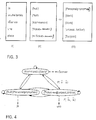
- the invention is based on the fact that the stochastic method manipulates the sequences of words and assigned semantic labels, the labels also being shown in sequential form for reasons of clarity (FIG. 3, columns (I) and (II)).
- (zero) labels refer to words without a specific semantic function in the context of the input sentence, e.g. per discourserais).
- Additional syntactic labeling makes the input sentence one assigned syntactic category. Make syntactic-semantic composite labels the semantic function of the word with its syntactic role in Input sentence.
- the input sentence perRICUSTr une place (I would like to reserve a place) (I) is assigned a sequence of semantic labels (II) and a sequence of syntactic labels (III); sequences (II) and (III) are joined together to form the syntactic-semantic labels.
- FIG. 3 shows an additional syntactic labeling of the example sentence per remotelyraischer une place .
- This labeling is done automatically by, for example, SYLEX, a syntactical analysis program for the French language. Based on syntactic groups, SYLEX assigns a syntactical category to each word in the input sentence.
- the columns created in the representation of Fig. 3 can be e.g. simple PEARL programming can be combined to create different models.
- Syntactic-semantic composite labels are e.g. by coupling the columns (II) and (III) generated.
- a compound label represents the semantic function of the word with its syntactic role in the input sentence.
- Fig. 4 shows how the syntactic-semantic labels are used in the Hidden Markov model.
- the ergodic topology from FIG. 1 is used.
- the semantic labels (zero), (number of tickets) and (command) are each combined with a syntactic label and as states s j , Are defined.
- the words je (ich), thoughrais (would like to), arguer (reserve) are observations O m Are defined.
- the syntactic-semantic labels are completely interconnected as states.
- the decoding into syntactic-semantic labels consists in the maximization of P ( S
- the invention is not limited to the exemplary embodiments specified, but rather other stochastic methods, e.g. Grammatical inference become.
Landscapes
- Engineering & Computer Science (AREA)
- Theoretical Computer Science (AREA)
- Physics & Mathematics (AREA)
- Health & Medical Sciences (AREA)
- Artificial Intelligence (AREA)
- Audiology, Speech & Language Pathology (AREA)
- Computational Linguistics (AREA)
- General Health & Medical Sciences (AREA)
- General Engineering & Computer Science (AREA)
- General Physics & Mathematics (AREA)
- Probability & Statistics with Applications (AREA)
- Machine Translation (AREA)
Abstract
Description
Die vorliegende Erfindung befaßt sich mit dem Problem des maschinellen Sprachverständnisses.
Herkömmliche regelbasierende Verfahren zur semantischen Analyse von gesprochenen Sätzen erzielen gute Resultate in begrenzten Anwendungsbereichen. Die manuelle Entwicklung einer solchen aus expliziten Regeln bestehenden Komponente ist jedoch kostspielig, denn jede Applikation verlangt spezifische Anpassung oder gar ein jeweils völlig neues System. Statistische Modellierung ersetzt die von Hand erstellten Regeln, welche die Ausgabe des Spracherkenners in eine semantische Darstellung umsetzen. Die Parameter der Wahrscheinlichkeitsmodelle leiten sich aus der mit Computern durchgeführten automatischen Analyse großer Datenmengen von gesprochenen Sätzen und deren semantischen Darstellungen ab. Für den Einsatz in anderen Anwendungsbereichen und Sprachen ist es daher ausreichend, die semantische Analysekomponente mit den entsprechenden Daten zu trainieren. Dies steht im Gegensatz zur manuellen Übersetzung und Anpassung einer regelbasierten Grammatik.
In einer stochastischen Komponente unterscheidet man zwei Prozessschritte: In der Trainingsphase erstellt der Parameterschätzer des Computersystems das stochastische Modell, das beispielsweise als Hidden Markov Model (HMM) implementiert wird. In der Testphase liefert der semantische Dekoder des Computersystems die wahrscheinlichste Sequenz aus semantischen Etiketten bei unbekanntem gesprochenem Eingabesatz. Das verwendete HMM ist in Fig. 1 dargestellt. Es soll Benutzeranfragen an ein Zugauskunfts- und Reservierungssystem für die französische Sprache in eine semantische Darstellung umsetzen. Im Beispiel sind die semantischen Etiketten (Null), (Ticket-Anzahl) und (Kommando) als Zustände s
Da ein stochastisches Verfahren ausschließlich von Daten lernt, beschränkt sich die Übertragung einer Komponente zum maschinellen Sprachverständnis in andere Anwendungsbereiche und menschliche Sprachen auf ein Training mit applikationsspezifischen Trainingsdaten. Die semantische Etikettierung dieser Daten erfolgt meist durch ein halbautomatisches Verfahren, z.B. dem sogenannten bootstrap, mit dem eine automatische Kennzeichnung der Daten und eine manuelle Korrektur der Daten durchgeführt wird. In diesem Zusammenhang erschwert eine vielschichtige, komplexe semantische Darstellung die rasche Datenproduktion. Damit erhöhen sich Übertragungsphase und Übertragungsaufwand. Außerdem wird die Kombination der rein semantischen Etiketten mit Zusatzinformationen (z.B. in der Form von Syntax) erschwert.
Claims (7)
- Verfahren zur semantischen Sprachanalyse, bei dem mittels stochastischer Verfahren Wörter und zugeordnete semantische Etiketten verarbeitet werden, dadurch gekennzeichnet, daß einer Wortsequenz (I) eine Sequenz semantischer Etiketten (II) sowohl manuell als auch über ein mittels Computersystem berechnetes, automatisches Etikettierverfahren zugeordnet wird, derart daß der gesamte Datensatz der Wortsequenzen in Teildatensätze unterschiedlicher Größe aufgeteilt wird, daß der kleinste Teildatensatz der Wortsequenzen manuell mit semantischen Etiketten versehen wird, daß mit dem aus diesen Erstdaten errechneten Modell das Computersystem automatisch den nächst größeren Teildatensatz etikettiert, und daß dieses Verfahren bis zur vollständigen Etikettierung des gesamten Datensatzes iterativ fortgesetzt wird.
- Verfahren nach Anspruch 1, dadurch gekennzeichnet, daß der Wortsequenz (I) eine Sequenz syntaktischer Etiketten (III) mittels eines Computersystems automatisch zugeordnet wird, und daß die Sequenzen (II) und (III) zur Bildung von syntaktisch-semantischen Etiketten aneinandergefügt werden.
- Verfahren nach Anspruch 2, dadurch gekennzeichnet, daß der Wortsequenz (I) eine Sequenz syntaktischer Etiketten (III) mittels eines syntaktischen Analyseprogramms automatisch zugeordnet wird.
- Verfahren nach Anspruch 2, dadurch gekennzeichnet, daß die Sequenzen (II) und (III) zur Bildung von syntaktisch-semantischen Etiketten mittels eines Computerprogramm kombiniert werden, um unterschiedliche Modelle zu erzeugen.
- Verfahren nach einem der vorhergehenden Ansprüche, dadurch gekennzeichnet, daß als stochastisches Verfahren das Hidden Markov Modell verwendet wird.
- Verfahren nach Anspruch 5, dadurch gekennzeichnet, daß die semantischen Etiketten mit jeweils einem syntaktischen Etikett kombiniert und als Zustände
s j , definiert werden, daß die Wörter als BeobachtungenO m definiert werden, und daß die syntaktisch-semantischen Etiketten als Zustände vollständig miteinander verbunden werden. - Verfahren nach Anspruch 5, dadurch gekennzeichnet, daß durch die Maximierung der Wahrscheinlichkeit P(
S |O ) einer SequenzS aus Zuständens j bei gegebener SequenzO aus BeobachtungenO m die semantische und syntaktische Dekodierung durchgeführt wird.
Applications Claiming Priority (2)
| Application Number | Priority Date | Filing Date | Title |
|---|---|---|---|
| DE10122756A DE10122756A1 (de) | 2001-05-10 | 2001-05-10 | Verfahren zur Generierung von Daten für die semantische Sprachanalyse |
| DE10122756 | 2001-05-10 |
Publications (2)
| Publication Number | Publication Date |
|---|---|
| EP1256938A2 true EP1256938A2 (de) | 2002-11-13 |
| EP1256938A3 EP1256938A3 (de) | 2004-05-19 |
Family
ID=7684307
Family Applications (1)
| Application Number | Title | Priority Date | Filing Date |
|---|---|---|---|
| EP02010009A Withdrawn EP1256938A3 (de) | 2001-05-10 | 2002-05-04 | Verfahren zur Generierung von Daten für die semantische Sprachanalyse |
Country Status (4)
| Country | Link |
|---|---|
| US (1) | US20020169598A1 (de) |
| EP (1) | EP1256938A3 (de) |
| JP (1) | JP2003016062A (de) |
| DE (1) | DE10122756A1 (de) |
Families Citing this family (6)
| Publication number | Priority date | Publication date | Assignee | Title |
|---|---|---|---|---|
| US9009590B2 (en) * | 2001-07-31 | 2015-04-14 | Invention Machines Corporation | Semantic processor for recognition of cause-effect relations in natural language documents |
| US8799776B2 (en) * | 2001-07-31 | 2014-08-05 | Invention Machine Corporation | Semantic processor for recognition of whole-part relations in natural language documents |
| US7593845B2 (en) * | 2003-10-06 | 2009-09-22 | Microsoflt Corporation | Method and apparatus for identifying semantic structures from text |
| WO2010105216A2 (en) * | 2009-03-13 | 2010-09-16 | Invention Machine Corporation | System and method for automatic semantic labeling of natural language texts |
| US12430371B2 (en) | 2018-02-22 | 2025-09-30 | Entigenlogic Llc | Generating a product-service query response utilizing a knowledge database |
| US10943075B2 (en) * | 2018-02-22 | 2021-03-09 | Entigenlogic Llc | Translating a first language phrase into a second language phrase |
Family Cites Families (4)
| Publication number | Priority date | Publication date | Assignee | Title |
|---|---|---|---|---|
| US5752052A (en) * | 1994-06-24 | 1998-05-12 | Microsoft Corporation | Method and system for bootstrapping statistical processing into a rule-based natural language parser |
| US5926784A (en) * | 1997-07-17 | 1999-07-20 | Microsoft Corporation | Method and system for natural language parsing using podding |
| US6108620A (en) * | 1997-07-17 | 2000-08-22 | Microsoft Corporation | Method and system for natural language parsing using chunking |
| US6952666B1 (en) * | 2000-07-20 | 2005-10-04 | Microsoft Corporation | Ranking parser for a natural language processing system |
-
2001
- 2001-05-10 DE DE10122756A patent/DE10122756A1/de not_active Ceased
-
2002
- 2002-05-04 EP EP02010009A patent/EP1256938A3/de not_active Withdrawn
- 2002-05-09 JP JP2002134498A patent/JP2003016062A/ja not_active Abandoned
- 2002-05-10 US US10/143,151 patent/US20020169598A1/en not_active Abandoned
Non-Patent Citations (3)
| Title |
|---|
| BOD R: "Context-sensitive spoken dialogue processing with the DOP model" NATURAL LANGUAGE ENGINEERING, DEC. 1999, CAMBRIDGE UNIVERSITY PRESS, UK, Bd. 5, pt.4, Seiten 309-323, XP009027184 ISSN: 1351-3249 * |
| MINKER W: "Design considerations for knowledge source representations of a stochastically-based natural language understanding component" SPEECH COMMUNICATION, ELSEVIER SCIENCE PUBLISHERS, AMSTERDAM, NL, Bd. 28, Nr. 2, Juni 1999 (1999-06), Seiten 141-154, XP004168137 ISSN: 0167-6393 * |
| SCHWARTZ R ET AL: "Hidden understanding models for statistical sentence understanding" ACOUSTICS, SPEECH, AND SIGNAL PROCESSING, 1997. ICASSP-97., 1997 IEEE INTERNATIONAL CONFERENCE ON MUNICH, GERMANY 21-24 APRIL 1997, LOS ALAMITOS, CA, USA,IEEE COMPUT. SOC, US, 21. April 1997 (1997-04-21), Seiten 1479-1482, XP010226085 ISBN: 0-8186-7919-0 * |
Also Published As
| Publication number | Publication date |
|---|---|
| DE10122756A1 (de) | 2002-11-21 |
| JP2003016062A (ja) | 2003-01-17 |
| EP1256938A3 (de) | 2004-05-19 |
| US20020169598A1 (en) | 2002-11-14 |
Similar Documents
| Publication | Publication Date | Title |
|---|---|---|
| DE60222093T2 (de) | Verfahren, modul, vorrichtung und server zur spracherkennung | |
| DE602005001125T2 (de) | Erlernen der Aussprache neuer Worte unter Verwendung eines Aussprachegraphen | |
| DE60203705T2 (de) | Umschreibung und anzeige eines eingegebenen sprachsignals | |
| DE60016722T2 (de) | Spracherkennung in zwei Durchgängen mit Restriktion des aktiven Vokabulars | |
| DE602004012909T2 (de) | Verfahren und Vorrichtung zur Modellierung eines Spracherkennungssystems und zur Schätzung einer Wort-Fehlerrate basierend auf einem Text | |
| DE60004862T2 (de) | Automatische bestimmung der genauigkeit eines aussprachewörterbuchs in einem spracherkennungssystem | |
| DE69726499T2 (de) | Verfahren und Vorrichtung zur Kodierung von Aussprache-Prefix-Bäumen | |
| DE69937176T2 (de) | Segmentierungsverfahren zur Erweiterung des aktiven Vokabulars von Spracherkennern | |
| DE69324428T2 (de) | Verfahren zur Sprachformung und Gerät zur Spracherkennung | |
| DE60111329T2 (de) | Anpassung des phonetischen Kontextes zur Verbesserung der Spracherkennung | |
| DE3876207T2 (de) | Spracherkennungssystem unter verwendung von markov-modellen. | |
| DE69822296T2 (de) | Mustererkennungsregistrierung in einem verteilten system | |
| DE69814589T2 (de) | Spracherkennung unter verwendung mehrerer spracherkenner | |
| DE69914131T2 (de) | Positionshandhabung bei der Spracherkennung | |
| DE602004004310T2 (de) | System mit kombiniertem statistischen und regelbasierten Grammatikmodell zur Spracherkennung und zum Sprachverstehen | |
| DE69623364T2 (de) | Einrichtung zur Erkennung kontinuierlich gesprochener Sprache | |
| EP1217610A1 (de) | Verfahren und System zur multilingualen Spracherkennung | |
| EP1336955A2 (de) | Verfahren zur Erzeugung natürlicher Sprache in Computer-Dialogsystemen | |
| DE20004416U1 (de) | Spracherkennungsvorrichtung unter Verwendung mehrerer Merkmalsströme | |
| DE19847419A1 (de) | Verfahren zur automatischen Erkennung einer buchstabierten sprachlichen Äußerung | |
| EP1950672A1 (de) | Verfahren und Datenverarbeitungssystem zum gesteuerten Abfragen strukturiert gespeicherter Informationen | |
| DE10018134A1 (de) | Verfahren und Vorrichtung zum Bestimmen prosodischer Markierungen | |
| DE10040063A1 (de) | Verfahren zur Zuordnung von Phonemen | |
| EP0987682A2 (de) | Verfahren zur Adaption von linguistischen Sprachmodellen | |
| DE602004003609T2 (de) | Lösung der Segmentierungsmehrdeutigkeit bei der Grammatikerstellung |
Legal Events
| Date | Code | Title | Description |
|---|---|---|---|
| PUAI | Public reference made under article 153(3) epc to a published international application that has entered the european phase |
Free format text: ORIGINAL CODE: 0009012 |
|
| AK | Designated contracting states |
Kind code of ref document: A2 Designated state(s): AT BE CH CY DE DK ES FI FR GB GR IE IT LI LU MC NL PT SE TR |
|
| AX | Request for extension of the european patent |
Free format text: AL;LT;LV;MK;RO;SI |
|
| PUAL | Search report despatched |
Free format text: ORIGINAL CODE: 0009013 |
|
| AK | Designated contracting states |
Kind code of ref document: A3 Designated state(s): AT BE CH CY DE DK ES FI FR GB GR IE IT LI LU MC NL PT SE TR |
|
| AX | Request for extension of the european patent |
Extension state: AL LT LV MK RO SI |
|
| RIC1 | Information provided on ipc code assigned before grant |
Ipc: 7G 06F 17/27 B Ipc: 7G 10L 15/18 A |
|
| 17P | Request for examination filed |
Effective date: 20040621 |
|
| AKX | Designation fees paid |
Designated state(s): DE FR GB |
|
| 17Q | First examination report despatched |
Effective date: 20050331 |
|
| RAP1 | Party data changed (applicant data changed or rights of an application transferred) |
Owner name: DAIMLERCHRYSLER AG |
|
| STAA | Information on the status of an ep patent application or granted ep patent |
Free format text: STATUS: THE APPLICATION IS DEEMED TO BE WITHDRAWN |
|
| 18D | Application deemed to be withdrawn |
Effective date: 20061201 |