EP1256937A2 - Emotion recognition method and device - Google Patents
Emotion recognition method and device Download PDFInfo
- Publication number
- EP1256937A2 EP1256937A2 EP01401879A EP01401879A EP1256937A2 EP 1256937 A2 EP1256937 A2 EP 1256937A2 EP 01401879 A EP01401879 A EP 01401879A EP 01401879 A EP01401879 A EP 01401879A EP 1256937 A2 EP1256937 A2 EP 1256937A2
- Authority
- EP
- European Patent Office
- Prior art keywords
- low
- signal
- pass filtering
- voice signal
- values
- Prior art date
- Legal status (The legal status is an assumption and is not a legal conclusion. Google has not performed a legal analysis and makes no representation as to the accuracy of the status listed.)
- Granted
Links
Images




Classifications
-
- G—PHYSICS
- G10—MUSICAL INSTRUMENTS; ACOUSTICS
- G10L—SPEECH ANALYSIS TECHNIQUES OR SPEECH SYNTHESIS; SPEECH RECOGNITION; SPEECH OR VOICE PROCESSING TECHNIQUES; SPEECH OR AUDIO CODING OR DECODING
- G10L13/00—Speech synthesis; Text to speech systems
- G10L13/02—Methods for producing synthetic speech; Speech synthesisers
- G10L13/033—Voice editing, e.g. manipulating the voice of the synthesiser
-
- G—PHYSICS
- G10—MUSICAL INSTRUMENTS; ACOUSTICS
- G10L—SPEECH ANALYSIS TECHNIQUES OR SPEECH SYNTHESIS; SPEECH RECOGNITION; SPEECH OR VOICE PROCESSING TECHNIQUES; SPEECH OR AUDIO CODING OR DECODING
- G10L13/00—Speech synthesis; Text to speech systems
-
- G—PHYSICS
- G10—MUSICAL INSTRUMENTS; ACOUSTICS
- G10L—SPEECH ANALYSIS TECHNIQUES OR SPEECH SYNTHESIS; SPEECH RECOGNITION; SPEECH OR VOICE PROCESSING TECHNIQUES; SPEECH OR AUDIO CODING OR DECODING
- G10L13/00—Speech synthesis; Text to speech systems
- G10L13/08—Text analysis or generation of parameters for speech synthesis out of text, e.g. grapheme to phoneme translation, prosody generation or stress or intonation determination
- G10L13/10—Prosody rules derived from text; Stress or intonation
-
- G—PHYSICS
- G10—MUSICAL INSTRUMENTS; ACOUSTICS
- G10L—SPEECH ANALYSIS TECHNIQUES OR SPEECH SYNTHESIS; SPEECH RECOGNITION; SPEECH OR VOICE PROCESSING TECHNIQUES; SPEECH OR AUDIO CODING OR DECODING
- G10L17/00—Speaker identification or verification techniques
- G10L17/26—Recognition of special voice characteristics, e.g. for use in lie detectors; Recognition of animal voices
-
- G—PHYSICS
- G10—MUSICAL INSTRUMENTS; ACOUSTICS
- G10L—SPEECH ANALYSIS TECHNIQUES OR SPEECH SYNTHESIS; SPEECH RECOGNITION; SPEECH OR VOICE PROCESSING TECHNIQUES; SPEECH OR AUDIO CODING OR DECODING
- G10L13/00—Speech synthesis; Text to speech systems
- G10L13/02—Methods for producing synthetic speech; Speech synthesisers
- G10L13/04—Details of speech synthesis systems, e.g. synthesiser structure or memory management
Definitions
- the present invention relates to the field of emotion recognition, and more particularly to a method and device for detecting an emotion from voice signals.
- applications which require technical means for detecting an emotion conveyed by a human - or possibly synthesised or animal - voice, e.g. to provide a man-machine interface with a more natural and intuitive way of communicating.
- robotic pets or humanoids are now developed with a behaviour remarkably similar to that of living creatures.
- Other applications can be in education, training, speech therapy, human control of equipment, vehicles, tools, etc.
- these robots look like familiar pets such as dogs or cats (e.g. the Sony AIBO robot), or sometimes take the form of young children such as the humanoids SDR3-X (Sony).
- the first result indicates that the goal of making a machine express affect both with meaningless speech and in a way recognisable by people from different cultures with the accuracy of a human speaker is attainable in theory.
- the second result shows that we should not expect a perfect result, and compare the machine's performance in relation to human performance.
- the fact that humans are not so good is mainly explained by the fact that several emotional states have very similar physiological correlates and thus acoustic correlates. In actual situations, we solve the ambiguities by using the context and/or other modalities Indeed, some experiments have shown that the multi-modal nature of the expression of affect can lead to a MacGurk effect for emotions (cf.
- the Applicant investigated how emotion detection could be achieved by using only the prosodic information of the voice.
- the speech of interest is of the kind that occurs in everyday conversations, which means short informal utterances, as opposed to the speech produced when one is asked to read emotionally a prepared text, e.g. paragraph from a newspaper.
- Four broad classes of emotional content were studied : joy/pleasure, grief/sadness/grief, anger and calm/neutral.
- Another object of the invention is to make it possible identify emotions conveyed in short utterances.
- a further object of the invention is to allow operation in real life situations, where utterances are made in noisy and/or acoustically poor environments.
- the invention proposes, according to first aspect, a method of detecting an emotion conveyed in a voice signal, comprising the steps of:
- the low-pass filtering step preferably comprises filtering the intensity of the voice signal with a cut-off frequency (Fco) substantially in the range of 150 to 400 Hz, more preferably substantially in the range of 250 to 300 Hz, a preferred cut-off frequency (Fco) being substantially equal to 250 Hz.
- a cut-off frequency substantially in the range of 150 to 400 Hz, more preferably substantially in the range of 250 to 300 Hz, a preferred cut-off frequency (Fco) being substantially equal to 250 Hz.
- the feature extracting step comprises the steps of selectively extracting one or more among 160 features obtained from the following combination of parameters I, II, and II:
- the parameters I comprise more particularly:
- the parameters III comprise more particularly the following five parameters:
- the extracting step comprises extracting at least one of the following possible features:
- the extracting step can comprise extracting features derived from both the voice signal after the low low-pass filtering step and from the voice signal without low-pass filtering.
- It may also comprises extracting features only from the voice signal after the low-pass filtering step.
- the at least one member of the set of features comprises:
- the method may further comprise a step of smoothing a signal extracted from the voice signal prior to the extracting step.
- the method further comprises a step of generating an emotion detecting algorithm using a teaching algorithm, the teaching algorithm exploiting the at least one feature extracted from a low-pass filtered voice signal.
- the method may further comprise a step of programming an emotion detection device with an off-line emotion detection algorithm and/or an on-line emotion detection algorithm, whereby the algorithms exploit at least on feature extracted from a low-pass filtered voice signal.
- the invention concerns a device for detecting an emotion conveyed in a voice signal, comprising the:
- the invention relates to a voice signal processing device specifically for the device according to the second aspect - or specifically adapted for the implementation of the method according to the first aspect -, characterised in that comprises low-pass filtering means for supplying a low-passed form of the voice signal to the extracting means.
- the preferred embodiment of the invention is chosen to be speaker dependant for the emotion recognition process. This is not necessarily a bad point from an industrial point of view, when the embodiment it is targeted at robotic pets, for instance, which may interact only with their minder. Also, the fact that robots only manage to recognise their minder could even be a positive feature, because it is a source of complicity between a robot and its minder). However, the principles of invention can of course accommodate for speaker-independent approaches, as shall be outlined further.
- the embodiment is based on a robotic pet application, with four basic emotional states to detect in a human voice : i) calm, ii) sad, iii) angry and iv) happy.
- Figure 1 shows how these emotions are positioned in a chart which represents an "emotional space", in which the parameters "valence” and “excitement” are expressed respectively along vertical and horizontal axes 2 and 4.
- the valence axis ranges from negative to positive values, while the excitement axis ranges from low to high values.
- the cross-point O of these axes is at the centre of the chart and corresponds to a calm/neutral state.
- quadrant Q1 happy/praising (quadrant Q1) characterised by positive valence and high excitement
- comfort/soothing quadrant Q2 characterised by positive valence and low excitement
- sad quadrant Q3 characterised by negative valence and low excitement
- angry/admonishing quadrant Q4 characterised by negative valence and high excitement.
- the database stored in digital form the sound recordings of the samples, so that each sample could be accessed and played back at will.
- Figures 2a-2c illustrate how the two physical parameters pitch and intensity are derived from a speech signal.
- the latter is illustrated in figure 2a as a waveform envelope, as obtained e.g. directly from a microphone output or from playing back a voice sample.
- the waveform is the fluctuation in signal amplitude (vertical axis) as a function of time (horizontal axis).
- the signal strength is assigned a zero value at a median position, from which it can take on negative (low amplitude) and positive (high amplitude) values.
- Pitch is a subjective quality of a sound that determines its position in a musical scale or voice spectrum. It may be measured as the frequency of the pure tone of specified intensity that is judged by the average ear to occupy the same place in the musical scale or voice spectrum.
- Figure 2b illustrates a variation of pitch with time. Here, pitch is measured in terms of a frequency (vertical axis) for a particular time value.
- Intensity is a measure the sound energy integrated over a given frequency spectrum.
- Figure 2c illustrates the variation of intensity with time, with the intensity measured in terms of decibels (dB).
- Figure 3 illustrates schematically a system 1 for evaluating emotion detection performance with the possibility of low-pass filtering the voice signal.
- the voice signal can be obtained either directly from a microphone 6 or from the above-mentioned database of recorded utterances 8. In the latter case, each of the samples can be selectively read out in audio format, e.g. from a hard disk drive, so as to obtain an audio signal of the corresponding utterance at an audio output 10.
- the signal from the microphone 6 or database audio output 10 is fed to an audio input 12 of an audio amplification unit 14 which provides impedance matching, preamplification, and controllable gain functions.
- the thus-prepared audio signal is delivered at an audio output 14, from which it is fed to a low-pass filter 18.
- the low-pass filter 18 has an adjustable cut-off frequency Fco, the value of which is selected by a cut-off frequency selection unit 20.
- Figure 4 shows a typical frequency response of the low-pass filter 18 with a curve 22 showing the variation of transferred audio signal level against frequency for an input of constant amplitude over the frequency range.
- the cut-off frequency Fco is shown as the point of half attenuation along the frequency scale. Ideally, the cut-off frequency is the frequency value beyond which the low-pass filter does not transfer a signal. The sharpness depends on the filter characteristics, e.g. the order of filtering, to approach the ideal low-pass response 24.
- Figure 5 shows how the frequency response changes according to the cut-off frequency Fco selected through the selection unit 20, with three curves illustrated 22a, 22b and 22c corresponding to Fco values respectively of 200 Hz, 250 Hz and 320 Hz.
- the shape of the response curves are substantially the same.
- the low-pass filter has a continually adjustable cut-off frequency Fco in view of obtaining fine level comparisons.
- the cut-off frequency selection unit 20 can be electronically controlled to vary a filter component, such as one or several varicap diodes.
- the filter 18 is constructed as an analog circuit based on operational amplifiers.
- Such adjustable cut-off frequency low-pass filters are well known in the art and shall not be described here for conciseness. It can of course equally well be envisaged to produce the low-pass filtering function entirely by digital filtering techniques using e.g. digital signal processors, which are also well known in the art.
- the input audio signal would be initially digitised for processing by the filter electronics, the latter reproducing the response curve 22 in a suitably digitally encoded form.
- the output from the low-pass filter 18 is then supplied to a first input 28a of an audio interface 28 of a feature measurement station 30, which is represented as a functional unit cooperating with a PC based control unit 32.
- the two inputs 28a and 28b constitute separate input channels allowing the feature measurement station 30 to operate selectively on the low-pass filtered form and non filtered forms of the audio signal.
- the PC based control unit 32 is composed of a monitor 34 and keyboard 36 forming the system interface, and a complete PC type computer 38 for the processing, drive and data storage functions.
- the feature measurement station 30 is programmable to extract different features of the signal presented at its signal input 28. As feature extraction provided by the station 30 is based on digital processing techniques, its signal input 28 is connected to an internal analog-to-digital converter (ADC) 40. The filtered audio signal is then processed in terms of binary words to extract the required features, which are discussed below.
- ADC analog-to-digital converter
- the measurements on the different features produced by the station 30 are stored in a data logger 42 where they can be accessed by a functional unit 44 which performs emotion recognition algorithms.
- the algorithms aim to discern an emotion expressed in the voice signal on the basis of the signal features extracted by the station 30.
- an algorithm under evaluation in unit 44 will indicate the discerned emotion (calm, happy, %) and various internal parameters.
- the recognition unit 44 can thus execute different emotion recognition algorithms and produce their respective results and internal parameters.
- This information is entered into a results analyser unit 46 where different algorithms and/or choices of features can be compared in view of determining an optimum selection.
- the functional units composed of the feature measurement station 30, data logger 42, emotion recognition algorithm execution unit 44 and the results analyser 46 can be implemented physically by the PC based control unit 32, as indicated by the staggered double-arrows.
- the system further includes a programming unit PU whose function is to program different emotion recognition systems on the basis of the most appropriate results found.
- the programming unit PU is operationally connected to the results analyser 46 as well as to the PC based control unit 32 and other units, so as to record all the algorithms, parameter settings, features to extract and other optimisations.
- the recording of this information is established in accordance with a predetermined protocol so that the programming data can be downloaded into a suitable programming interface of the an emotion sensitive system, such a robotic pet or the like.
- the programming unit PU can be made detachable from the rest of the system and portable for on-field programming, and/or adapted to produce the programming data on a portable recording medium, such as a disk, semiconductor memory, or the like.
- the measurements performed by the feature measurement station 30 were based on the intensity of low-passed form of the voice signal, as obtained from the filter 18. (Separate experiments were also conducted on high-passed forms using a high-pass filter instead.)
- the cut-off frequency was typically set to 250 Hz (the particular value appears not to be crucial), the idea being to separate the signal into a pure prosodic component and a pure "ceptral" component.
- the samples from the database 8 thus provide sound patterns on which various measurements can be made at the station 30.
- Psycho-acoustic measurements have shown that the most important information is prosody (intonation), and in particular the pitch curve (f0) (cf. figure 2b) and the intensity (I0) curve (cf. figure 2c).
- the first signal i) is taken from input 28a, while the last two signal is taken from input 28b of the feature measurement station 30.
- the pitch can also be measured on the signal after low-pass filtering either instead of on the non filtered signal iii), or in addition, in which case the number of signals in the evaluation total four.
- experiments have shown that the information provided by the pitch analysed from the low-pass filtered signal is generally not significantly different from that provided by the pitch of the unfiltered signal. Accordingly, only signals i) to iii) are actually used in the evaluation.
- the intensity curve of the resultant signal i) was measured in the same way as for the unfiltered signal.
- the pitch was computed using the algorithm described in Boersma P. (1993) "Accurate short-term analysis of the fundamental frequency and the harmonics-to-noise ratio of a sampled sound", in Proceedings of the Institute of Phonetic Sciences of the University of Amsterdam, 17, 97-110 1993, which is known to be very accurate.
- the ceptral measurement signals (iv) are taken into account in the evaluation; only measurements on signals i) to iii) cited above shall be considered.
- the procedure to obtain the series of values is as follows. For a given voice sample from the database 8, typically corresponding to a short phrase, the feature measurement station 30 stores the corresponding voice signal produced at the input (channel 28a or 28b depending on the signal i), ii) or iii) above to be analysed). The signals are initially 10 Hz smoothed.
- Each thus-computed signal i) to iii) is digitally sampled at e.g. 0.01 second intervals. Each sampling gives an absolute instantaneous value of the intensity (signals i) and ii))) or of the pitch (signal iii)).
- sequence of sampled values typically a few hundred, given that a phrase is a few seconds long.
- the sequence of values is stored in time order, starting from the value of the earliest part of the signal, so that the sequence of values expresses the time variation of signal i), ii) or iii) considered.
- Figure 6 illustrates how these four series of values are obtained from the signal undergoing measurement.
- AdaBoostM1 Wi-BoostM1 (Witten and Frank, 2000 cited supra), which significantly improves the generalisation performance for unstable learning schemes like decision trees (an unstable learning algorithm is one that can sometimes produce very different recognition machines when only a slight change in the learning database has been performed).
- Weka software One reason for choosing the Weka software was that its code and executable are freely available, so that the experiment, though being large scale, can be easily reproduced. This software also provides means like automatic cross-validation, or the search of feature spaces with for e.g. genetic algorithms as shall appear later. The list of all learning algorithms is given in table I below.
- Table II below gives the average percentage of correct classification for the 10 fold cross-validation for the different algorithms used. results using all features for two different speakers (1 and 2) Algorithm Emotion detection success rate (%) Speaker 1 Speaker 2 1-NN 82 87 3-NN 84 87 10-NN 83 87 Decision tree-C4.5 84 93 Decision Rules-PART 84 94 Kernel Density 84 90 KStan 81 83 Linear Regression 88 91 LWR 87 90 Voted Perceptrons 70 76 SVM1 88 94 SVM2 89 94 SVM3 88 94 VFI 80 93 M5Prime 86 96 Naive Bayes 84 90 AidaBoots M1/C4.590 90 96 AidaBoots M1/PART 91 97
- a first way of exploring the feature set is to look at the results of learning schemes like decision rules (PART), which are often used mainly as knowledge discovery devices.
- PART decision rules
- Different sets rules can be adapted for optimised performance with different speakers/languages.
- the choice of an appropriate set of rules for a given speaker/language can be determined empirically.
- FIGS. 7a-7c depict an example of a line of measurements for a feature i, j and k respectively taken among the 160 features investigated, as explained above.
- For each line is defined a space in a rectangular box 48a-48c within which are plotted a number of points.
- Each plotted point corresponds to an identification of the voice samples of the database 8.
- the position of a point corresponds to the associated measurement value for the feature considered (evolving on the horizontal scale).
- Figure 7a shows a typical haphazard distribution of identified emotion samples, showing that the feature i from which it is generated does not provide a good basis for discerning emotions. Such a distribution is frequent among features extracted from a voice signal that has not been low-pass filtered.
- Figure 7b shows a significantly more clustered distribution of identified emotion samples, indicating that the feature from which it is generated is potentially good for discerning emotions. However, there is some overlap between neighbouring clusters. Such a distribution is quite typical of a feature extracted from a voice signal whose intensity has been low-passed filtered, the cut-off frequency (f0) being 250 Hz in the examples.
- figure 7c shows an even better distribution of identified emotion samples where the emotion samples are not only well clustered, but also clearly separated by empty regions. Such results are obtained with some features extracted from a voice signal whose intensity has been low-pass filtered.
- figures 8a and 8b show plots of identified emotions from the samples of the database 8.
- two features noted for yielding potentially good emotion discernment are expressed on respective orthogonal axes: the first quartile of intensity distribution on the vertical (ordinate) axis, and the third quartile of intensity distribution on the horizontal axis (abscissa).
- the symbols used to identify the four different emotions are the same as in figures 7a-7c. Similarly, only a representative fraction of symbols are inserted to avoid cluttering.
- the plots of figure 8a are produced from the voice samples of the database without low-pass filtering, while the plots of figure 8b are produced from the same voice samples, but after low-pass filtering with a cut-off frequency of 250 Hz using the filter 18 of figure 3.
- the voice samples in both cases came from the same speaker (speaker 2).
- the same very striking effect also takes place for speaker 1; but what is interesting is that the clusters are not situated at the same places (anger and happiness are 90 degrees rotated), which is an illustration of the great speaker variability initially suspected. However, it seems that the use of some well chosen features is very stable for each speaker.
- Feature Information gain of 20 best features Feature Information gain 1: MEDIANINTENSITYLOW 1.44 (median value of sampled low-pass filtered signal intensity values) 2: MEANINTENSITYLOW 1.40 (mean value of low-pass filtered signal intensity values) 3: THIRDQUARTINTENSITYLOW 1.35 (third quartile value of series of sampled low-pass filtered signal intensity values) 4: ONEQUARTINTENSITYLOW 1.34 (first quartile value of series of sampled low-pass filtered signal intensity values) 5: MAXINTENSITYLOW 1.23 (maximum value of series of sampled low-pas filtered signal intensity values) 6: MININTENSITYLOW 1.14 (maximum value of series of sampled low-pas filtered signal intensity values) 7: THIRDQUARTMINIMASPITCH 0.72 (maximum value of series of minimas of low-pas filtered signal intensity values) 8: THIRDQUARTMAXIMASPITCH 0.72 (maximum value of series of maximas of low-pas filtered signal intensity
- This table confirms the great value of the features concerning the first six set of the distribution of intensity values involving the low-passed signals. It also shows something rather surprising: among the 20 most individually informative features, only 3 (the features numbered 12, 16 and 20 in the table) are part of the standard set put forward in psychoacoustic studies (Murray E., Arnott J.L., (1995) "Implementation and testing of a system for producing emotion-by-rule in synthetic speech", Speech Communication, 16(4), pp. 369-390; Sendlmeier and Burkhardt 2000 cited supra; Stevens and Williams 1972 cited supra), or used in most of more application oriented research as in Slaney et al. 1998 cited supra, Breazal 2000 cited supra).
- (LPF)sp.1 low-passed signal of speaker 1 voice samples
- (LPF)sp.2 low-passed signal of speaker 2 voice samples
- (SF)sp.1 standard, non-filtered signal of speaker 1 voice samples
- (SF)sp.2 standard, non-filtered signal of speaker 2 voice samples.
- the Applicant implemented an automatic search method based on the use of genetic algorithms.
- Populations of features (limited to 30) were generated and evolved using as fitness the 10-fold cross-validation with two algorithms : Naive Bayes and 5-Nearest Neighbours (chosen mainly because they are fast to train).
- the exact genetic algorithm is the simple one described in Goldberg, D.E. (1989) "Genetic algorithms in search, optimization and machine learning, reading", MA: Addison-Wesley.
- the Applicant produced an experiment using the "optimal" feature set fed earlier, but giving to each algorithms only 12 examples of each class. The algorithms were tested on the remaining items of the database.
- linking this-recognition module to an-artificial lymbic/emotional system in which there is some kind of emotional inertia (one very rarely swap from happy to angry in half a second) might give some additional information or tell the system there is uncertainty about the result.
- the robot may for instance take a posture showing it is not sure of what is happening. The human then will often repeat its utterance with an even more exaggerated intonation.
- An aim is therefore to try to reduce the number of measurements while maintaining an acceptable level of performance, or possibly better.
- some learning algorithms are not well suited to exploiting a large number of measurements, especially when are not all highly relevant.
- Some learning algorithms are of the constructive type. They are interesting inasmuch as they aim to generate a certain number of rules readable by the developer for classifying emotions. For example, with one or two databases, there is a learning algorithm which identified from the mass of measurements that is there is simply made a test on four chosen values, acceptable results can be obtained.
- the next question is to determine whether a robot can generalise relatively well from a relatively small initial number of examples.
- an experiment was conducted in which the algorithms were supplied with just twelve examples per class - giving 48 examples in total - to determine to what extent the results would be different. It was observed that differences among the different learning algorithms became more pronounced. However, there are a certain number of standard algorithms which still achieve a success rate in the region of 85-90%.
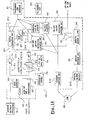
- Figure 14 illustrates schematically how the findings in accordance with the invention can be implemented in an emotion sensitive system 60.
- the latter can be part of a robotic pet, humanoid, teaching device, interactive computer or the like.
- the system is centred on a microcomputer comprising all the necessary processing, data storage, driving and interfacing functions necessary for the emotion recognition process.
- these units are in themselves known and readily adaptable to application requirements by the skilled person, they have been omitted from the diagram for the sake of simplicity.
- the system 60 presents an audio input section for receiving voice data from which an emotion is to be detected.
- the voice data can be obtained from two different sources: a built-in microphone 62 to pick up environmental sounds and thus detect a voice utterance from a nearby person on which to perform emotion detection, as in a real-life situation, and a database of recorded utterances, which can interface with the system 60 via an audio connector 64.
- the database can simply be the database 8 of figure 3, or an adapted version thereof. In this way, the system can be pre-trained, corrected, characterised, etc. This interfacing possibility is also useful to set up all the internal sound processing parameters, including the low-pass filtering characteristics.
- the voice signals from either of the two sources 62 and 8 are fed to an audio amplification and preprocessing unit 66 which adapts the signal levels to the system electronics.
- the unit 66 may also include some noise reduction stages to reduce background noise to a minimum when the microphone 62 is in operation.
- the audio output 68 of unit 66 is fed along first and second paths P1 and P2 to two respective first and second channel inputs IC1 and IC2 of a feature extraction unit 70.
- the first path P1 contains a first digital-to-analog converter (DAC) 72 between the audio output 68 and the first channel input IC1. The latter then simply receives the suitably digitised form of the amplified and preprocessed audio signal.
- DAC digital-to-analog converter
- the second path P2 contains a low-pass filter 74 whose input is connected to the audio output 68.
- the low-pass filter is similar to the filter 18 of figure 3, inasmuch as it has an adjustable cut-off frequency.
- the cut-off frequency (Fco) is set by default to pass signals from a frequency range of 0 to 250 Hz, with a rapid attenuation after that frequency.
- the cut-off frequency can be set to different values by means of a cut-off frequency selector 76.
- the latter can be manually controlled by means of a slider to produce different cut-off frequencies, and/or electronically adjusted by internal control circuitry, e.g. in feedback system to obtain optimal results during a characterisation phase.
- the typical range of possible values for the cut-off frequency Fco is from 150 Hz to 400 Hz.
- the adjustment in the cut-off frequency can be necessary to optimise the system 60 to different speakers, languages, environments, varieties of emotions to detect, etc.
- the low-pass filter 74 further includes a variable attenuation control device 78 which allow the slope of the frequency response curve (cf. figure 4) to be modified, e.g. by changing the order of the filter, to allow a further degree of freedom in optimising the low-pass filtering characteristics.
- the filter 74 need not be variable, nor have an adjustable slope, and simpler embodiments can be envisaged with a fixed low-pass filter set at a predetermined cut-off frequency, e.g. 250 Hz.
- the low-pass filter 74 can be implemented with analog circuitry (passive or active), or as a digital filter. In the latter case, the DAC 80 is no longer necessary, but a similar DAC would be provided at its input, unless the digital low-pass filter comprises its own digital-to-analog converter stage. In a practical implementation, the low-pass filter 74 and its control units 76 and 78 would be typically fully digital such that the control of filter characteristics, including of selection of cut-off frequency are accessible digitally via an interface of a PC based control unit at the heart of the system 60.
- the low-passed signal output from the low-pass filter 74 (analog in the figure) is supplied to a second analog-to-digital converter 80 which supplies the suitably digitised low-pass filtered signal to the second channel input IC2 of the feature extraction unit 70.
- the latter forms the first link in a processing chain whose function is to detect an emotion conveyed by inputted voice signals.
- the first part of the processing chain comprises the feature extraction unit 70, which is programmed to extract a selection of features from the digitised signal, of which some are to be extracted from the voice signal after low pass filtering (at channel input IC2) in accordance with the invention.
- the feature extraction unit 70 operates in a manner analogous to the feature measurement station 30 of figure 3. In particular, it selectively extracts a set of features taken from the 120 features described supra, i.e. obtained from the possible combinations of:
- Each thus-computed signal i) to iii) is digitally sampled at e.g. 0.01 second intervals. Each sampling gives an absolute instantaneous value of the intensity (signals i) and ii))) or of the pitch (signal iii)).
- sequence of sampled values typically a few hundred, given that a phrase is a few seconds long.
- sequences of values are stored in time order, starting from the value of the earliest part of the signal, so that the sequence of values expresses the time variation of signal i), ii) or iii) considered.
- the feature extraction unit 70 can calculate the four series of values described above in connection with the feature measurement station 30 of figure 3, i.e.
- the feature extraction unit can perform the following 10 statistical operations to produce corresponding features:
- the feature extraction unit 70 can be programmed to extract any number of these features according to requirements. At least one of the features is derived from an intensity of a low-pass filtered voice signal on which an emotion recognition is to be performed.
- the feature extraction unit 70 can be programmed to extract at least one the following five statistical features among the ten listed above:
- This extraction can be performed for one or a mix of all three signals i), ii, and iii) listed above, giving up to 15 features that can extracted by unit 70 for each voice signal from which an emotion is to be detected, at least one of the features being extracted from a low-passed intensity signal.
- the extraction unit 70 can be additionally programmed to extract any one of features listed 1 to 10 above from the pitch signal extracted from the voice signal after low-pass filtering.
- the feature extraction unit 70 can also be programmed to extract a reduced number of statistical features which correspond e.g. to at least one of the first six features listed in table III above, i.e.:
- each of the signals listed i) to iii) and - as the case arises - the low-pass filtered pitch signal can be individually programmed to be smoothed, e.g. by 10 Hz smoothing (or some other value), or not smoothed.
- the extracted features are temporarily stored in a data logger 82 where they can be accessed by other functional units.
- the emotion sensitive system 60 is configured to operate selectively in one of two possible modes, these being respectively off-line training emotion recognition and on-line training emotion recognition.
- the training to detect emotions is conducted outside the device, e.g. using the evaluation system as described with reference to figure 3.
- the programming unit PU of figure 3 delivers a complete emotion detection algorithm ready for use.
- the algorithm can be of the type set out in example 1, for instance, or some quite different algorithm.
- the emotion recognition can be frozen in its parameters and programming (closed algorithm), or it can be adaptable to some degree to update its parameters and programming on the basis of user feedback response to correct errors or to coach in emotion detection.
- the teaching algorithm In the on line training mode, there is no initial set emotion recognition algorithm. Rather, there is provided a teaching algorithm which analyses the different features extracted from the feature extraction unit 70 and user feedback, or user indications of the emotions that are to be detected. From this input, the teaching algorithm develops an specific on-line emotion recognition algorithm, which can be continually modified, updated and improved with growing user input and feedback.
- each of these two modes has its own path of functional units: OFF-L and ON-L respectively for the off-line and on-line modes.
- an off-line emotion recognition algorithm unit 84 as mentioned above.
- the latter inputs the features extracted by unit 70, as present in the data logger 82 in accordance with its parameterisation and programming, and determines from these extracted features an emotion in accordance with its own predetermined settings.
- the voice signals will normally only come from the microphone 62.
- a database 86 containing extracted features from which different choices can be investigated by a learning algorithm unit 88.
- the database 86 is connected to the data logger 82 so as to accumulate all the extracted features and thus build a corresponding collection of extracted features.
- a feedback (loop FL1) from the learning algorithm unit 86 to the feature extraction unit 70 allows the latter to be instructed to change or select new features from the possibilities, in order to meet new needs deriving the most appropriate emotion detection algorithm.
- the teaching algorithm unit 88 can include a program allowing a user to input voice messages with different emotions, or be coupled to receive data from the a database of voices, such as database 8.
- the teaching algorithm unit 86 Once the teaching algorithm unit 86 has developed the required on-line emotion recognition algorithm, the latter is loaded into an on-line emotion recognition algorithm unit 90.
- the latter performs the same emotion recognition as that of unit 84, but is produced internally and specifically tailored to a given speaker, such as the user.
- the types of emotion detected by either of the emotion detection algorithm units 84 or 90 can be as discussed earlier : calm, sad, happy, angry. Other emotions can of course be accommodated.
- the choice of operation in the off-line or on-line is determined by a selector 92 which selects from which emotion detection algorithm 84 or 90 the detected emotions are to be taken. The selection is through an external user input signal 94.
- the programming unit PU of figure 3 serves to supply the required information and code for the different functional units. This is achieved through a programming interface PI.
- the programming unit PU and its interface PI serve to program the feature extraction unit 70, load the off-line emotion recognition algorithm (unit 84), and/or the teaching algorithm (unit 88), as well as features to database 86 in order to provide additional samples or complementary data.
- the output from one or the other of the off-line and on-line emotion recognition algorithm units 84 and 90 is delivered to a detected emotion input unit 94 where the recognised emotion is acknowledged. From that unit 94, the detected emotion is delivered to an emotion response unit 96 for governing all the intended emotional responses. For instance, in the case of a robotic pet, the emotional response unit 96 will command the operation of different electro-mechanical actuators, lights and audio output devices to simulate an appropriate response.
- One response includes giving feedback to the human user 98 or any other controlling person or device to indicate the detected information. This is achieved through a detected emotion indicator 100 which delivers a visual, aural, electrical or mechanical signal indicative of the detected emotion. This makes it possible to check if the identification is correct or not and to take corrective measures as appropriate.
- the invention can be implemented with many different combinations of features extracted from the signal, at least one feature being extracted from the signal after low-pass filtering.
Landscapes
- Engineering & Computer Science (AREA)
- Acoustics & Sound (AREA)
- Health & Medical Sciences (AREA)
- Audiology, Speech & Language Pathology (AREA)
- Human Computer Interaction (AREA)
- Physics & Mathematics (AREA)
- Multimedia (AREA)
- Computational Linguistics (AREA)
- Manipulator (AREA)
- User Interface Of Digital Computer (AREA)
- Toys (AREA)
- Measurement Of Mechanical Vibrations Or Ultrasonic Waves (AREA)
- Image Processing (AREA)
Abstract
- extracting (70) a set comprising at least one feature derived from said signal, and
- processing (84, 90) the set of extracted feature(s) to detect an emotion therefrom.
Description
- extracting a set comprising at least one feature derived from said signal, and
- processing said set of extracted feature(s) to detect an emotion therefrom,
- Parameters I:
- i) the intensity of the signal derived after the low-pass filtering step,
- ii) the intensity,of the signal without low-pass filtering,
- iii) the pitch of the signal without low-pass filtering, and
- iv) the pitch of the signal derived after the low-pass filtering step;
- Parameters II, from a sequence of values of a parameter I obtained over a
duration of the voice signal:
- 1) a series of local minimas, whose members are values in the sequence that correspond to a minima,
- 2) a series of local maximas, whose members are values in the sequence that correspond to a maxima,
- 3) a series of durations (time intervals), whose members are time values separating local (adjacent) extremas, and
- 4) a series, whose members are all the successive sampled values of the sequence; and
- Parameters III, calculated from a series of parameter II:
- 1) the mean,
- 2) the maximum (i.e. the overall highest value),
- 3) the minimum (i.e. the overall lowest vale),
- 4) the difference between the maximum and the minimum,
- 5) the variance,
- 6) the median,
- 7) the first quartile,
- 8) the third quartile,
- 9) the interquartile range, defined as the difference between the third and first quartiles,
- 10) the mean of the absolute value of the local derivative;
at least one of the features originating from: i) the intensity of the signal after the low-pass filtering step of parameters I.
- the maximum (i.e. the overall highest value),
- the minimum (i.e. the overall lowest vale),
- the median,
- the first quartile,
- the third quartile,
calculated from:
- the series of values of the intensity signal derived after the low-pass filtering of the voice signal,
- the series of minimum values of the intensity signal derived without low-pass filtering the voice signal,
- the series of pitch values of the signal derived after the low-pass filtering of the voice signal, and
- the series of pitch values of the signal derived without low-pass filtering of the voice signal.
- extracting means for extracting a set comprising at least one feature derived from the signal, and
- processing means for processing the set of extracted feature(s) to detect an emotion therefrom,
- figure 1 is a chart showing how some basic emotions are linked to such parameters as valence and excitement;
- figures 2a, 2b and 2c are signal waveforms showing the relation between a speech signal (figure 2a), pitch (figure 2b) and intensity (figure 2c);
- figure 3 is a block diagram of a system for evaluating, characterising and optimising an emotion detection approach using low-pass filtering of the audio signal on which an emotion is to be detected, in accordance with the invention;
- figure 4 is a curve showing a typical and an ideal low pass filter response curve;
- figure 5 is a set of curves showing the response of an adjustable cut-off frequency filter used in the system of figure 3;
- figure 6 is a sample signal waveform (signal intensity vs. time) showing how different signal features considered are derived;
- figures 7a, 7b and 7c are plots showing different distributions of voice samples when analysed in terms of different extracted signal features for emotion detection, respectively for a poorly informative, good and even better chosen feature;
- figures 8a and 8b are plots of detected emotion in terms of first and third quartile intensity distribution expressing the degree of success in emotion detection in terms of grouping characteristics of data points, respectively for a detection on an unfiltered signal and for a low-pass filtered signal with a cut-off frequency of 250 Hz;
- figures 9 to 13 are charts showing the performance of different algorithms used for emotion detection under different conditions and choices of signal features; and
- figure 14 is a block diagram of an emotion sensitive system implementing a low-pass filtering of voice signals in accordance with the invention.
- persons may talk very freely to the robotic pet,
- persons may utter very short sentences, such as "Aibo ! you're a really naughty robot!",
- the utterances will have to be detected in a noisy environment, and
- several persons may have to interact with the robot, whereupon a choice of speaker dependency or independence needs to be made.
| list of learning algorithms invistigated | |
| Name | Description |
| 1- | 1 nearest neighbour |
| 3-NN | voted two nearest neighbours |
| 10-NN | voted ten nearest neighbours |
| Decision tree-C4.5 | C4.5 decision trees |
| Decision Rules-PART | PART decision rules |
| Kernel Density | Radial basis function - neural network |
| KStan | -- |
| Linear Regression | Classification via linear regression |
| LWR | Classification via locally weighted regression |
| Voted Perceptrons | Committee of perceptrons |
| SVM1 | Polynomial (deg.1) support vector machine |
| SVM2 | Polynomial (deg.2) support vector machine |
| SVM3 | Polynomial (deg.3) support vector machine |
| VF1 | Voted features interval |
| M5Prime | Classification via MP5Prim regression method |
| Naive Bayes | Naive Bayes classification algorithm |
| AidaBoots M1/C4.5 | Ada boosted version of C4.5 |
| AidaBoots M1/PART | Ada boosted version of PART |
| results using all features for two different speakers (1 and 2) | ||
| Algorithm | Emotion detection success rate (%) | |
| | | |
| 1- | 82 | 87 |
| 3- | 84 | 87 |
| 10- | 83 | 87 |
| Decision tree-C4.5 | 84 | 93 |
| Decision Rules- | 84 | 94 |
| | 84 | 90 |
| | 81 | 83 |
| | 88 | 91 |
| | 87 | 90 |
| Voted | 70 | 76 |
| SVM1 | 88 | 94 |
| SVM2 | 89 | 94 |
| SVM3 | 88 | 94 |
| | 80 | 93 |
| | 86 | 96 |
| | 84 | 90 |
| AidaBoots M1/C4.590 | 90 | 96 |
| AidaBoots M1/ | 91 | 97 |
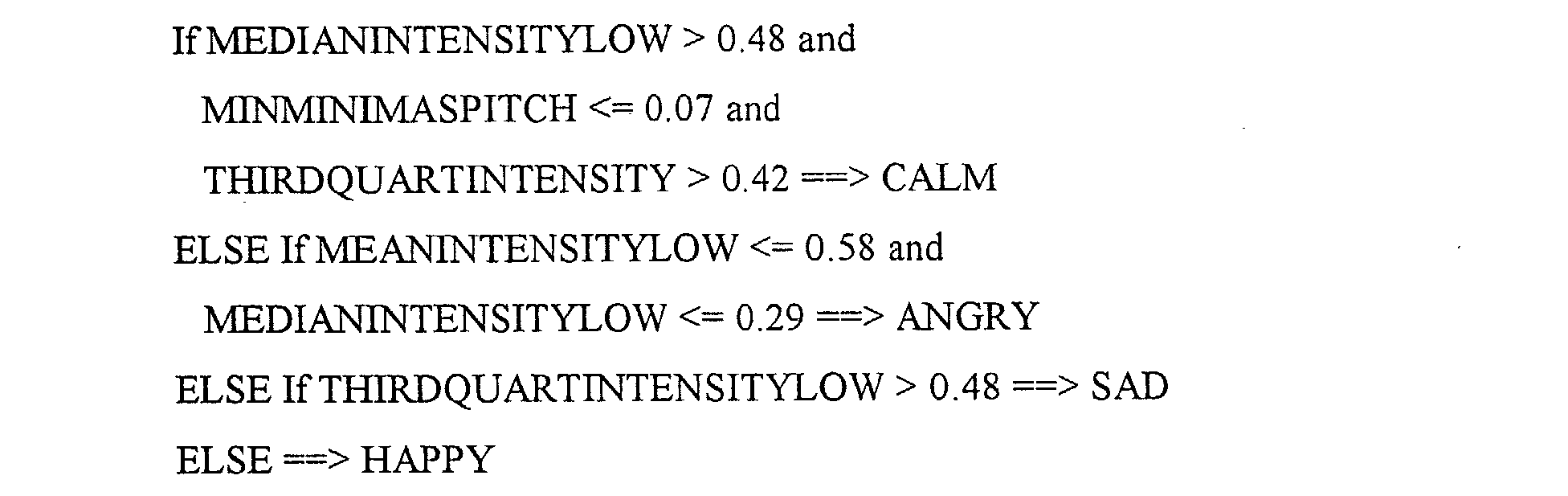
- MEDIANINTENSITYLOW : the median value of series of values of the intensity of the signal after low-pass filtering;
- MINMINIMASPITCH : the value smallest minima in the series of minima in the pitch of the signal without low-pass filtering;
- THIRDQUARTINTENSITY : the value of the third quartile in the series of values of the intensity of the signal without low-pass filtering;
- MEANINTENSITYLOW : the mean value of the of the series of intensity values of the signal after low-pass filtering;
- THIRDQUARTINTENSITYLOW : the value of the third quartile in the series of intensity values of the signal after low-pass filtering.
- quartiles, notably the first and third quartiles,
- maximas,
- minimas, and
- the mean.
| Information gain of 20 best features | |
| Feature | Information gain |
| 1: MEDIANINTENSITYLOW | 1.44 |
| (median value of sampled low-pass filtered signal intensity values) | |
| 2: MEANINTENSITYLOW | 1.40 |
| (mean value of low-pass filtered signal intensity values) | |
| 3: THIRDQUARTINTENSITYLOW | 1.35 |
| (third quartile value of series of sampled low-pass filtered signal intensity values) | |
| 4: ONEQUARTINTENSITYLOW | 1.34 |
| (first quartile value of series of sampled low-pass filtered signal intensity values) | |
| 5: MAXINTENSITYLOW | 1.23 |
| (maximum value of series of sampled low-pas filtered signal intensity values) | |
| 6: MININTENSITYLOW | 1.14 |
| (maximum value of series of sampled low-pas filtered signal intensity values) | |
| 7: THIRDQUARTMINIMASPITCH | 0.72 |
| (maximum value of series of minimas of low-pas filtered signal intensity values) | |
| 8: THIRDQUARTMAXIMASPITCH | 0.72 |
| (maximum value of series of maximas of low-pas filtered signal intensity values) | |
| 9: THIRDQUARTPITCH | 0.69 |
| (third quartile of series of sampled unfiltered pitch values) | |
| 10: MAXMINIMASPITCH | 0.67 |
| (largest value in series of minimas of sampled unfiltered pitch values) | |
| 11: MAXMINI | 0.67 |
| (largest value in series of maximas of sampled unfiltered pitch values) | |
| 12: MAXPITCH | 0.67 |
| (maximum value of sampled unfiltered pitch values) | |
| 13: MINMINIMASPITCH | 0.59 |
| (smallest value in series of minimas of sampled unfiltered pitch values) | |
| 14: MEDIANMAXIMASPITCH | 0.57 |
| (median value in series of minimas of sampled unfiltered pitch values) | |
| 15: MEDIANMAXIMASPITCH | 0.57 |
| (smallest value in series of minimas of sampled unfiltered pitch values) | |
| 16: MINPITCH | 0.52 |
| (minimum value of series of sampled unfiltered pitch values) | |
| 17: MEDIANPITCH | 0.52 |
| (median value of series of sampled unfiltered pitch values) | |
| 18: MEANMINIMASPITCH | 0.48 |
| (mean value in series of minimas of sampled unfiltered pitch values) | |
| 19: MINMAXIMASPITCH | 0.48 |
| (mean value in series of maximas of sampled unfiltered pitch values) | |
| 20: MEANPITCH | 0.48 |
| (mean value of series of sampled unfiltered pitch values) |
(Results are similar if jitter and tremor are added, as sometimes also used).
| comparison between "standard" features and "low-passed signal intensity" featues | ||||
| Learning schemes | (LPF)sp.1 | (LPF)sp.2 | (LPF)sp.1 | (LPF)sp.2 |
| 1- | 78 | 83 | 70 | 72 |
| 3- | 84 | 82 | 72 | 75 |
| 10- | 84 | 82 | 73 | 73 |
| Decision Iree-C4.5 | 80 | 84 | 72 | 81 |
| Decision Rules- | 78 | 83 | 72 | 74 |
| | 82 | 85 | 71 | 74 |
| | 80 | 84 | 70 | 72 |
| | 63 | 68 | 72 | 78 |
| | 75 | 71 | 75 | 80 |
| Voted | 51 | 70 | 60 | 58 |
| | 63 | 68 | 73 | 78 |
| | 71 | 70 | 77 | 50 |
| | 76 | 85 | 78 | 82 |
| | 78 | 76 | 64 | 70 |
| | 83 | 85 | 76 | 80 |
| | 82 | 81 | 74 | 72 |
| AdaBoots M1/C4.5 | 80 | 81 | 80 | 78 |
| AdaBoots M1/ | 80 | 83 | 79 | 78 |
| results of learning scheme using the "optimal" feature set | |||
| | speaker | 1 | |
| 1- | 87 | 92 | |
| 3- | 90 | 92 | |
| 10- | 87 | 91 | |
| Decision Tree/C4.5 | 85 | 92 | |
| Decision Rules- | 86 | 93 | |
| | 87 | 91 | |
| | 86 | 90 | |
| | 83 | 89 | |
| | 87 | 89 | |
| Voted | 65 | 78 | |
| SVM1 | 87 | 91 | |
| SVM2 | 90 | 96 | |
| SVM3 | 89 | 94 | |
| | 83 | 92 | |
| | 88 | 95 | |
| | 89 | 93 | |
| AidaBoots M1/C4.5 | 90 | 96 | |
| AidaBoots M1/ | 90 | 96 |
| results of learning scheme when very few training examples are provided | |||
| learning | speaker | 1 | |
| 1- | 81 | 85 | |
| 3- | 78 | 74 | |
| 10- | 68 | 64 | |
| Decision Tree-C4.5 | 79 | 78 | |
| Decision Rules- | 79 | 74 | |
| | 82 | 84 | |
| | 76 | 68 | |
| | 75 | 74 | |
| | 75 | 79 | |
| Voted | 40 | 51 | |
| | 81 | 83 | |
| | 83 | 85 | |
| | 83 | 85 | |
| | 77 | 76 | |
| | 80 | 79 | |
| | 85 | 87 | |
| AdaBoots M1/C4.5 | 79 | 84 | |
| AdaBoots M1/ | 79 | 90 |
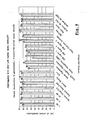
- figure 9 shows performance with only low-passed signal intensity, for the correct classification in generalisation from an initial sample. The features are just the low-passed (250 Hz cut-off frequency) signal intensity;
- figure 10 shows performance with so-called "Kismet" features (Kismet being a system developed by MIT) namely: pitch + intensity + length segments;
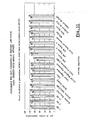
- figure 11 shows performance for the best combination of features : low-passed signal intensity + pitch + minimas intensity;
- figure 12 show performance when very few samples are available, with the correct classification in generalisation, based on 12 training examples/class. The features used are: low-passed signal intensity + pitch + minimas intensity; and
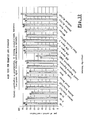
- figure 13 is a chart summarising the results in terms of the best scores per experiment for each of the preceding charts.
- the first quartile,
- the median,
- the third quartile,
- the maximum, and
- the minimum.
- the
system 60 is provided only with an off-lineemotion recognition algorithm 84. The latter can then be totally rigid, or adaptable to a certain degree through feedback response, or - the system is provided only with an on-line emotion algorithm system
composed of the teaching algorithm and the on-line emotion recognition algorithm
produced by the latter (
units 86 to 90).
Claims (26)
- A method of detecting an emotion conveyed in a voice signal, comprising the steps of:characterised in that it comprises a step of low-pass filtering (74) said voice signal prior to extracting therefrom at least one said feature of said set.extracting (70) a set comprising at least one feature derived from said signal, andprocessing (84, 90) said set of extracted feature(s) to detect an emotion therefrom,
- Method according to claim 1, wherein said low-pass filtering step comprises filtering (74) the intensity of said voice signal with a cut-off frequency (Fco) substantially in the range of 150 to 400 Hz.
- Method according to claim 2, wherein said cut-off frequency (Fco) is substantially in the range of 250 to 300 Hz.
- Method according to claim 3, wherein said cut-off frequency (Fco) is substantially equal to 250 Hz.
- Method according to any one of claims 1 to 4, wherein the feature extracting step comprises the steps of selectively extracting one or more among 160 features obtained from the following combination of parameters I, II, and II:Parameters I:i) the intensity of the signal derived after said low-pass filtering step (74),ii) the intensity of the signal without low-pass filtering,iii) the pitch of the signal without low-pass filtering, andiv) the pitch of the signal derived after said low-pass filtering step (74);Parameters II, from a sequence of values of a parameter I obtained over a duration of said voice signal:1) a series of local minimas, whose members are values in said sequence that correspond to a minima,2) a series of local maximas, whose members are values in said sequence that correspond to a maxima,3) a series of durations (time intervals), whose members are time values separating local (adjacent) extremas, and4) a series, whose members are all the successive sampled values of the sequence; andParameters III, calculated from a series of parameter II:1) the mean,2) the maximum (i.e. the overall highest value),3) the minimum (i.e. the overall lowest vale),4) the difference between the maximum and the minimum,5) the variance,6) the median,7) the first quartile,8) the third quartile,9) the interquartile range, defined as the difference between the third and first quartiles,10) the mean of the absolute value of the local derivative;
at least one of said features originating from: i) the intensity of the signal after said low-pass filtering step (74) or from iv) the pitch of the signal after low-pass filtering step (74) of parameters I. - Method according to claim 5, wherein said parameters I comprise:i) the intensity of the signal derived after said low-pass filtering step (74),ii) the intensity of the signal without low-pass filtering, andiii) the pitch of the signal without low-pass filtering,
whereby said combination yields a total of 120 different possible features;
at least one of said features originating from: i) the intensity of the signal after said low-pass filtering step (74) of parameters I. - Method according to claim 5 or 6, wherein said parameters III comprise the following five parameters:whereby said combination yields a total of 80 different possible features with claim 5, and 50 different possible combinations with claim 6.2) the maximum (i.e. the overall highest value),3) the minimum (i.e. the overall lowest vale),6) the median,7) the first quartile,8) the third quartile,
- Method according to claim 7, wherein said extracting step comprises extracting at least one of the following possible features:the maximum (i.e. the overall highest value),the minimum (i.e. the overall lowest vale),the median,the first quartile,the third quartile,
calculated from:the series of values of the intensity signal derived after said low-pass filtering of the voice signal,the series of minimum values of the intensity signal derived without low-pass filtering the voice signal,the series of pitch values of the signal derived after said low-pass filtering of the voice signal, andthe series of pitch values of the signal derived without low-pass filtering of the voice signal. - Method according to any one of claims 1 to 8, wherein said extracting step comprises extracting features derived from both said voice signal after said low low-pass filtering step (74) and from said voice signal without low-pass filtering.
- Method according to any one of claims 1 to 8, wherein said extracting step comprises extracting features only from said voice signal after said low-pass filtering step (74).
- Method according to any one of claims 1 to 10, wherein said at least one member of said set of features comprises:1: the median value of the signal intensity values derived after low-pass filtering the voice signal,2: the mean value of the signal intensity values derived after low-pass filtering the voice signal,3: third quartile value of the signal intensity values derived after low-pass filtering the voice signal,4: the first quartile value of the signal intensity values derived after low-pass filtering the voice signal,5: the maximum of the signal intensity values derived after low-pass filtering the voice signal, and6: the maximum value of the series of the signal intensity values derived after low-pass filtering the voice signal.
- Method according to any one of claims 1 to 11, further comprising a step of smoothing a signal extracted from said voice signal prior to said extracting step.
- Method according to any one of claims 1 to 12, further comprising a step of generating an emotion detecting algorithm using a teaching algorithm, said teaching algorithm exploiting said at least one feature extracted from a low-pass filtered voice signal.
- Method according to claim 13, further comprising a step of programming (PU) an emotion detection device (60) with an off-line emotion detection algorithm (84) and/or an on-line emotion detection algorithm (90), whereby said algorithms exploit at least on feature extracted from a low-pass filtered voice signal.
- A device for detecting an emotion conveyed in a voice signal, comprising the:characterised in that it comprises a low-pass filtering means (74) for low-pass filtering said voice signal prior to extracting therefrom at least one said feature of said set.extracting means (70) for extracting a set comprising at least one feature derived from said signal, andprocessing means (84, 90) for processing said set of extracted feature(s) to detect an emotion therefrom,
- Device according to claim 15, wherein said low-pass filtering means (74) has a cut-off frequency (Fco) substantially in the range of 150 to 400 Hz.
- Device according to claim 16, wherein said cut-off frequency (Fco) is substantially in the range of 250 to 300 Hz.
- Device according to claim 17, wherein said cut-off frequency (Fco) is substantially equal to 250 Hz.
- Device according to any one of claims 15 to 18, wherein the feature extracting means (70) comprises means for selectively extracting one or more among 160 features obtained from the following combination of parameters I, II, and II:at least one of said features originating from: i) the intensity of the signal after said low-pass filtering step (74) or from iv) the pitch of the signal after low-pass filtering step (74) of parameters I.Parameters I:i) the intensity of the signal derived after said low-pass filtering step (74),ii) the intensity of the signal without low-pass filtering,iii) the pitch of the signal without low-pass filtering, andiv) the pitch of the signal derived after said low-pass filtering step (74);Parameters II, from a sequence of values of a parameter I obtained over a duration of said voice signal:1) a series of local minimas, whose members are values in said sequence that correspond to a minima,2) a series of local maximas, whose members are values in said sequence that correspond to a maxima,3) a series of durations (time intervals), whose members are time values separating local (adjacent) extremas, and4) a series, whose members are all the successive sampled values of the sequence; andParameters III, calculated from a series of parameter II:1) the mean,2) the maximum (i.e. the overall highest value),3) the minimum (i.e. the overall lowest vale),4) the difference between the maximum and the minimum,5) the variance,6) the median,7) the first quartile,8) the third quartile,9) the interquartile range, defined as the difference between the third and first quartiles,10) the mean of the absolute value of the local derivative;
- Device according to any one of claims 15 to 19, wherein said extracting means (70) is set to extract features derived from both said voice signal after said low low-pass filtering means (74) and from said voice signal without low-pass filtering.
- Device according to any one of claims 15 to 19, wherein said extracting means (70) are set to extract features only from said voice signal after said low-pass filtering means (74).
- Device according to any one of claims 15 to 21, wherein said at least one member of said set of features comprises:1: the median value of the signal intensity values derived after low-pass filtering the voice signal,2: the mean value of the signal intensity values derived after low-pass filtering the voice signal,3: third quartile value of the signal intensity values derived after low-pass filtering the voice signal,4: the first quartile value of the signal intensity values derived after low-pass filtering the voice signal,5: the maximum of the signal intensity values derived after low-pass filtering the voice signal, and6: the maximum value of the series of the signal intensity values derived after low-pass filtering the voice signal.
- Device according to any one of claims 15 to 22, further comprising means for smoothing a signal extracted from said voice signal prior to said extracting means (70).
- Device according to any one of claims 15 to 23, wherein said processing means comprises an off-line emotion recognition algorithm unit (84) containing a preprogrammed algorithm.
- Device according to any one of claims 15 to 24, wherein said processing means comprises an on-line emotion recognition algorithm unit (90), said device further comprising a teaching algorithm unit (88) for producing an emotion recognition algorithm in response to data produced said extracting means (70).
- A voice signal processing device specifically for the device according to any one of claims 15 to 25, characterised in that it comprises low-pass filtering means (74) for supplying a low-passed form of said voice signal to said extracting means (70).
Priority Applications (3)
| Application Number | Priority Date | Filing Date | Title |
|---|---|---|---|
| EP01401879A EP1256937B1 (en) | 2001-05-11 | 2001-07-13 | Emotion recognition method and device |
| US10/194,848 US7451079B2 (en) | 2001-07-13 | 2002-07-12 | Emotion recognition method and device |
| JP2002206011A JP4458321B2 (en) | 2001-07-13 | 2002-07-15 | Emotion recognition method and emotion recognition device |
Applications Claiming Priority (3)
| Application Number | Priority Date | Filing Date | Title |
|---|---|---|---|
| EP01401203 | 2001-05-11 | ||
| EP01401203A EP1256931A1 (en) | 2001-05-11 | 2001-05-11 | Method and apparatus for voice synthesis and robot apparatus |
| EP01401879A EP1256937B1 (en) | 2001-05-11 | 2001-07-13 | Emotion recognition method and device |
Publications (3)
| Publication Number | Publication Date |
|---|---|
| EP1256937A2 true EP1256937A2 (en) | 2002-11-13 |
| EP1256937A3 EP1256937A3 (en) | 2004-09-29 |
| EP1256937B1 EP1256937B1 (en) | 2006-11-02 |
Family
ID=8182804
Family Applications (1)
| Application Number | Title | Priority Date | Filing Date |
|---|---|---|---|
| EP01401879A Expired - Lifetime EP1256937B1 (en) | 2001-05-11 | 2001-07-13 | Emotion recognition method and device |
Country Status (3)
| Country | Link |
|---|---|
| US (1) | US7451079B2 (en) |
| EP (1) | EP1256937B1 (en) |
| JP (1) | JP4458321B2 (en) |
Cited By (10)
| Publication number | Priority date | Publication date | Assignee | Title |
|---|---|---|---|---|
| DE102004011426B3 (en) * | 2004-03-09 | 2005-05-25 | Fraunhofer-Gesellschaft zur Förderung der angewandten Forschung e.V. | Device for detecting emotion in voice signal for man-machine interface has first function block using fixed processing script that is emotion recognition standard, second function block for supplying output from input using adapted script |
| US7013005B2 (en) | 2004-02-11 | 2006-03-14 | Hewlett-Packard Development Company, L.P. | System and method for prioritizing contacts |
| WO2009153788A3 (en) * | 2008-06-17 | 2010-03-18 | Voicesense Ltd. | Speaker characterization through speech analysis |
| US7698238B2 (en) | 2004-04-01 | 2010-04-13 | Sony Deutschland Gmbh | Emotion controlled system for processing multimedia data |
| EP2418643A1 (en) * | 2010-08-11 | 2012-02-15 | Software AG | Computer-implemented method and system for analysing digital speech data |
| GB2494104A (en) * | 2011-08-19 | 2013-03-06 | Simon Mark Adam Bell | Recognizing the emotional effect a speaker is having on a listener by analyzing the sound of his or her voice |
| US8687792B2 (en) | 2004-04-22 | 2014-04-01 | Hewlett-Packard Development Company, L.P. | System and method for dialog management within a call handling system |
| CN110826358A (en) * | 2018-08-08 | 2020-02-21 | 杭州海康威视数字技术股份有限公司 | Recognition method, device and storage medium for animal emotion |
| CN112220479A (en) * | 2020-09-04 | 2021-01-15 | 陈婉婷 | Genetic algorithm-based examined individual emotion judgment method, device and equipment |
| KR20250139235A (en) | 2025-07-15 | 2025-09-23 | 김종구 | V-AEMI-based artificial intelligence emotional music creation system and method thereof |
Families Citing this family (120)
| Publication number | Priority date | Publication date | Assignee | Title |
|---|---|---|---|---|
| US8001067B2 (en) * | 2004-01-06 | 2011-08-16 | Neuric Technologies, Llc | Method for substituting an electronic emulation of the human brain into an application to replace a human |
| US20070156625A1 (en) * | 2004-01-06 | 2007-07-05 | Neuric Technologies, Llc | Method for movie animation |
| US7089218B1 (en) * | 2004-01-06 | 2006-08-08 | Neuric Technologies, Llc | Method for inclusion of psychological temperament in an electronic emulation of the human brain |
| US7925492B2 (en) | 2004-01-06 | 2011-04-12 | Neuric Technologies, L.L.C. | Method for determining relationships through use of an ordered list between processing nodes in an emulated human brain |
| US7113636B2 (en) * | 2002-08-30 | 2006-09-26 | Lockheed Martin Corporation | Method and computer program product for generating training data for a new class in a pattern recognition classifier |
| JP4204839B2 (en) * | 2002-10-04 | 2009-01-07 | 株式会社エイ・ジー・アイ | Idea model device, spontaneous emotion model device, idea simulation method, spontaneous emotion simulation method, and program |
| DE10254612A1 (en) * | 2002-11-22 | 2004-06-17 | Humboldt-Universität Zu Berlin | Method for determining specifically relevant acoustic characteristics of sound signals for the analysis of unknown sound signals from a sound generation |
| US7260519B2 (en) * | 2003-03-13 | 2007-08-21 | Fuji Xerox Co., Ltd. | Systems and methods for dynamically determining the attitude of a natural language speaker |
| JP4641389B2 (en) * | 2004-06-03 | 2011-03-02 | キヤノン株式会社 | Information processing method and information processing apparatus |
| US20050289582A1 (en) * | 2004-06-24 | 2005-12-29 | Hitachi, Ltd. | System and method for capturing and using biometrics to review a product, service, creative work or thing |
| WO2006028223A1 (en) * | 2004-09-10 | 2006-03-16 | Matsushita Electric Industrial Co., Ltd. | Information processing terminal |
| WO2006033104A1 (en) | 2004-09-22 | 2006-03-30 | Shalon Ventures Research, Llc | Systems and methods for monitoring and modifying behavior |
| US20060122834A1 (en) * | 2004-12-03 | 2006-06-08 | Bennett Ian M | Emotion detection device & method for use in distributed systems |
| US8473449B2 (en) * | 2005-01-06 | 2013-06-25 | Neuric Technologies, Llc | Process of dialogue and discussion |
| CN101199002B (en) * | 2005-06-09 | 2011-09-07 | 株式会社A.G.I. | Speech analyzer detecting pitch frequency, speech analyzing method, and speech analyzing program |
| US7912720B1 (en) * | 2005-07-20 | 2011-03-22 | At&T Intellectual Property Ii, L.P. | System and method for building emotional machines |
| US20080040110A1 (en) * | 2005-08-08 | 2008-02-14 | Nice Systems Ltd. | Apparatus and Methods for the Detection of Emotions in Audio Interactions |
| EP1969589A1 (en) * | 2005-12-22 | 2008-09-17 | Exaudios Technologies Ltd. | System for indicating emotional attitudes through intonation analysis and methods thereof |
| US8032375B2 (en) * | 2006-03-17 | 2011-10-04 | Microsoft Corporation | Using generic predictive models for slot values in language modeling |
| US7571101B2 (en) * | 2006-05-25 | 2009-08-04 | Charles Humble | Quantifying psychological stress levels using voice patterns |
| WO2007138944A1 (en) * | 2006-05-26 | 2007-12-06 | Nec Corporation | Information giving system, information giving method, information giving program, and information giving program recording medium |
| JP4085130B2 (en) * | 2006-06-23 | 2008-05-14 | 松下電器産業株式会社 | Emotion recognition device |
| US7801644B2 (en) * | 2006-07-05 | 2010-09-21 | Battelle Energy Alliance, Llc | Generic robot architecture |
| US8271132B2 (en) * | 2008-03-13 | 2012-09-18 | Battelle Energy Alliance, Llc | System and method for seamless task-directed autonomy for robots |
| US8073564B2 (en) * | 2006-07-05 | 2011-12-06 | Battelle Energy Alliance, Llc | Multi-robot control interface |
| US8355818B2 (en) | 2009-09-03 | 2013-01-15 | Battelle Energy Alliance, Llc | Robots, systems, and methods for hazard evaluation and visualization |
| US7974738B2 (en) * | 2006-07-05 | 2011-07-05 | Battelle Energy Alliance, Llc | Robotics virtual rail system and method |
| US8965578B2 (en) | 2006-07-05 | 2015-02-24 | Battelle Energy Alliance, Llc | Real time explosive hazard information sensing, processing, and communication for autonomous operation |
| US7668621B2 (en) * | 2006-07-05 | 2010-02-23 | The United States Of America As Represented By The United States Department Of Energy | Robotic guarded motion system and method |
| US7584020B2 (en) * | 2006-07-05 | 2009-09-01 | Battelle Energy Alliance, Llc | Occupancy change detection system and method |
| US7587260B2 (en) * | 2006-07-05 | 2009-09-08 | Battelle Energy Alliance, Llc | Autonomous navigation system and method |
| US7620477B2 (en) * | 2006-07-05 | 2009-11-17 | Battelle Energy Alliance, Llc | Robotic intelligence kernel |
| JP5039045B2 (en) * | 2006-09-13 | 2012-10-03 | 日本電信電話株式会社 | Emotion detection method, emotion detection apparatus, emotion detection program implementing the method, and recording medium recording the program |
| US7752043B2 (en) | 2006-09-29 | 2010-07-06 | Verint Americas Inc. | Multi-pass speech analytics |
| US20080096532A1 (en) * | 2006-10-24 | 2008-04-24 | International Business Machines Corporation | Emotional state integrated messaging |
| US20080115063A1 (en) * | 2006-11-13 | 2008-05-15 | Flagpath Venture Vii, Llc | Media assembly |
| US8571853B2 (en) * | 2007-02-11 | 2013-10-29 | Nice Systems Ltd. | Method and system for laughter detection |
| US20080249764A1 (en) * | 2007-03-01 | 2008-10-09 | Microsoft Corporation | Smart Sentiment Classifier for Product Reviews |
| US8166109B2 (en) * | 2007-06-21 | 2012-04-24 | Cisco Technology, Inc. | Linking recognized emotions to non-visual representations |
| US7953279B2 (en) | 2007-06-28 | 2011-05-31 | Microsoft Corporation | Combining online and offline recognizers in a handwriting recognition system |
| WO2009009722A2 (en) | 2007-07-12 | 2009-01-15 | University Of Florida Research Foundation, Inc. | Random body movement cancellation for non-contact vital sign detection |
| US8180780B2 (en) * | 2007-12-06 | 2012-05-15 | International Business Machines Corporation | Collaborative program development method and system |
| KR101560833B1 (en) * | 2009-01-30 | 2015-10-15 | 삼성전자주식회사 | Apparatus and method for emotion recognition using voice signal |
| KR101560834B1 (en) * | 2009-02-18 | 2015-10-15 | 삼성전자주식회사 | Apparatus and method for emotion recognition using voice signal |
| US8719016B1 (en) | 2009-04-07 | 2014-05-06 | Verint Americas Inc. | Speech analytics system and system and method for determining structured speech |
| US20120116186A1 (en) * | 2009-07-20 | 2012-05-10 | University Of Florida Research Foundation, Inc. | Method and apparatus for evaluation of a subject's emotional, physiological and/or physical state with the subject's physiological and/or acoustic data |
| TWI396105B (en) * | 2009-07-21 | 2013-05-11 | Univ Nat Taiwan | Digital data processing method for personalized information retrieval and computer readable storage medium and information retrieval system thereof |
| JP5834449B2 (en) | 2010-04-22 | 2015-12-24 | 富士通株式会社 | Utterance state detection device, utterance state detection program, and utterance state detection method |
| US8595005B2 (en) | 2010-05-31 | 2013-11-26 | Simple Emotion, Inc. | System and method for recognizing emotional state from a speech signal |
| US11393133B2 (en) * | 2010-06-07 | 2022-07-19 | Affectiva, Inc. | Emoji manipulation using machine learning |
| AU2010357179A1 (en) | 2010-07-06 | 2013-02-14 | Rmit University | Emotional and/or psychiatric state detection |
| GB2481992A (en) * | 2010-07-13 | 2012-01-18 | Sony Europe Ltd | Updating text-to-speech converter for broadcast signal receiver |
| US8731932B2 (en) * | 2010-08-06 | 2014-05-20 | At&T Intellectual Property I, L.P. | System and method for synthetic voice generation and modification |
| CN102479291A (en) * | 2010-11-30 | 2012-05-30 | 国际商业机器公司 | Emotion description generation and experience method and equipment and emotion interaction system |
| US20140025385A1 (en) * | 2010-12-30 | 2014-01-23 | Nokia Corporation | Method, Apparatus and Computer Program Product for Emotion Detection |
| CN102637433B (en) * | 2011-02-09 | 2015-11-25 | 富士通株式会社 | The method and system of the affective state carried in recognition of speech signals |
| JP5803125B2 (en) * | 2011-02-10 | 2015-11-04 | 富士通株式会社 | Suppression state detection device and program by voice |
| EP2551846B1 (en) * | 2011-07-26 | 2022-01-19 | AKG Acoustics GmbH | Noise reducing sound reproduction |
| US9491537B2 (en) * | 2011-07-26 | 2016-11-08 | Harman Becker Automotive Systems Gmbh | Noise reducing sound reproduction system |
| KR101901417B1 (en) * | 2011-08-29 | 2018-09-27 | 한국전자통신연구원 | System of safe driving car emotion cognitive-based and method for controlling the same |
| US20130174018A1 (en) * | 2011-09-13 | 2013-07-04 | Cellpy Com. Ltd. | Pyramid representation over a network |
| KR20130055429A (en) * | 2011-11-18 | 2013-05-28 | 삼성전자주식회사 | Apparatus and method for emotion recognition based on emotion segment |
| TWI473080B (en) * | 2012-04-10 | 2015-02-11 | Nat Univ Chung Cheng | The use of phonological emotions or excitement to assist in resolving the gender or age of speech signals |
| US9002768B2 (en) * | 2012-05-12 | 2015-04-07 | Mikhail Fedorov | Human-computer interface system |
| CN102779510B (en) * | 2012-07-19 | 2013-12-18 | 东南大学 | Speech Emotion Recognition Method Based on Feature Space Adaptive Projection |
| US8984065B2 (en) | 2012-08-01 | 2015-03-17 | Eharmony, Inc. | Systems and methods for online matching using non-self-identified data |
| US20140188552A1 (en) * | 2013-01-02 | 2014-07-03 | Lap Chan | Methods and systems to reach target customers at the right time via personal and professional mood analysis |
| TWI573129B (en) * | 2013-02-05 | 2017-03-01 | 國立交通大學 | Code stream generating device, prosody message encoding device, prosody structure analyzing device and speech synthesis device and method |
| US9472207B2 (en) | 2013-06-20 | 2016-10-18 | Suhas Gondi | Portable assistive device for combating autism spectrum disorders |
| IN2013CH04602A (en) * | 2013-10-10 | 2015-10-09 | 3Gs Wellness Pvt Ltd | |
| US10561361B2 (en) * | 2013-10-20 | 2020-02-18 | Massachusetts Institute Of Technology | Using correlation structure of speech dynamics to detect neurological changes |
| CN103531198B (en) * | 2013-11-01 | 2016-03-23 | 东南大学 | Speech emotion feature regularization method based on pseudo speaker clustering |
| KR102191306B1 (en) * | 2014-01-22 | 2020-12-15 | 삼성전자주식회사 | System and method for recognition of voice emotion |
| WO2015116678A1 (en) | 2014-01-28 | 2015-08-06 | Simple Emotion, Inc. | Methods for adaptive voice interaction |
| US9892556B2 (en) | 2014-03-11 | 2018-02-13 | Amazon Technologies, Inc. | Real-time exploration of video content |
| US10939175B2 (en) | 2014-03-11 | 2021-03-02 | Amazon Technologies, Inc. | Generating new video content from pre-recorded video |
| US9894405B2 (en) | 2014-03-11 | 2018-02-13 | Amazon Technologies, Inc. | Object discovery and exploration in video content |
| US9747727B2 (en) | 2014-03-11 | 2017-08-29 | Amazon Technologies, Inc. | Object customization and accessorization in video content |
| US10375434B2 (en) | 2014-03-11 | 2019-08-06 | Amazon Technologies, Inc. | Real-time rendering of targeted video content |
| US9697843B2 (en) | 2014-04-30 | 2017-07-04 | Qualcomm Incorporated | High band excitation signal generation |
| US9409083B2 (en) | 2014-06-27 | 2016-08-09 | Amazon Technologies, Inc. | Spawning new timelines during game session replay |
| US10092833B2 (en) | 2014-06-27 | 2018-10-09 | Amazon Technologies, Inc. | Game session sharing |
| US9393486B2 (en) | 2014-06-27 | 2016-07-19 | Amazon Technologies, Inc. | Character simulation and playback notification in game session replay |
| WO2016047494A1 (en) * | 2014-09-22 | 2016-03-31 | 株式会社 東芝 | Device and system for measuring biological information |
| US9667786B1 (en) | 2014-10-07 | 2017-05-30 | Ipsoft, Inc. | Distributed coordinated system and process which transforms data into useful information to help a user with resolving issues |
| WO2016057781A1 (en) | 2014-10-08 | 2016-04-14 | The University Of Florida Research Foundation, Inc. | Method and apparatus for non-contact fast vital sign acquisition based on radar signal |
| US9269374B1 (en) | 2014-10-27 | 2016-02-23 | Mattersight Corporation | Predictive video analytics system and methods |
| US10430557B2 (en) | 2014-11-17 | 2019-10-01 | Elwha Llc | Monitoring treatment compliance using patient activity patterns |
| US9589107B2 (en) | 2014-11-17 | 2017-03-07 | Elwha Llc | Monitoring treatment compliance using speech patterns passively captured from a patient environment |
| US9585616B2 (en) | 2014-11-17 | 2017-03-07 | Elwha Llc | Determining treatment compliance using speech patterns passively captured from a patient environment |
| US9786299B2 (en) * | 2014-12-04 | 2017-10-10 | Microsoft Technology Licensing, Llc | Emotion type classification for interactive dialog system |
| US9833200B2 (en) | 2015-05-14 | 2017-12-05 | University Of Florida Research Foundation, Inc. | Low IF architectures for noncontact vital sign detection |
| US10300394B1 (en) | 2015-06-05 | 2019-05-28 | Amazon Technologies, Inc. | Spectator audio analysis in online gaming environments |
| US10293260B1 (en) | 2015-06-05 | 2019-05-21 | Amazon Technologies, Inc. | Player audio analysis in online gaming environments |
| CN104851422A (en) * | 2015-06-09 | 2015-08-19 | 张维秀 | Voice signal processing method and system |
| US10970843B1 (en) | 2015-06-24 | 2021-04-06 | Amazon Technologies, Inc. | Generating interactive content using a media universe database |
| US10864447B1 (en) | 2015-06-29 | 2020-12-15 | Amazon Technologies, Inc. | Highlight presentation interface in a game spectating system |
| US10363488B1 (en) | 2015-06-29 | 2019-07-30 | Amazon Technologies, Inc. | Determining highlights in a game spectating system |
| US10390064B2 (en) | 2015-06-30 | 2019-08-20 | Amazon Technologies, Inc. | Participant rewards in a spectating system |
| US10376795B2 (en) | 2015-06-30 | 2019-08-13 | Amazon Technologies, Inc. | Game effects from spectating community inputs |
| US10345897B2 (en) | 2015-06-30 | 2019-07-09 | Amazon Technologies, Inc. | Spectator interactions with games in a specatating system |
| US10484439B2 (en) | 2015-06-30 | 2019-11-19 | Amazon Technologies, Inc. | Spectating data service for a spectating system |
| US10632372B2 (en) | 2015-06-30 | 2020-04-28 | Amazon Technologies, Inc. | Game content interface in a spectating system |
| US11071919B2 (en) | 2015-06-30 | 2021-07-27 | Amazon Technologies, Inc. | Joining games from a spectating system |
| KR102437689B1 (en) | 2015-09-16 | 2022-08-30 | 삼성전자주식회사 | Voice recognition sever and control method thereof |
| CN105575404A (en) * | 2016-01-25 | 2016-05-11 | 薛明博 | Psychological testing method and psychological testing system based on speed recognition |
| JP6726388B2 (en) * | 2016-03-16 | 2020-07-22 | 富士ゼロックス株式会社 | Robot control system |
| US10244113B2 (en) * | 2016-04-26 | 2019-03-26 | Fmr Llc | Determining customer service quality through digitized voice characteristic measurement and filtering |
| US10176793B2 (en) * | 2017-02-14 | 2019-01-08 | Mediatek Inc. | Method, active noise control circuit, and portable electronic device for adaptively performing active noise control operation upon target zone |
| CN108806667B (en) * | 2018-05-29 | 2020-04-17 | 重庆大学 | Synchronous recognition method of voice and emotion based on neural network |
| JP7159655B2 (en) | 2018-07-09 | 2022-10-25 | 富士フイルムビジネスイノベーション株式会社 | Emotion estimation system and program |
| JP2020056918A (en) * | 2018-10-02 | 2020-04-09 | パナソニックIpマネジメント株式会社 | Sound data learning system, sound data learning method, and sound data learning device |
| TWI704555B (en) * | 2018-11-27 | 2020-09-11 | 誠屏科技股份有限公司 | Emotion recognition apparatus and method |
| JP7737976B2 (en) * | 2020-02-25 | 2025-09-11 | パナソニック インテレクチュアル プロパティ コーポレーション オブ アメリカ | Speaker identification device, speaker identification method, and program |
| CN111179965A (en) * | 2020-03-20 | 2020-05-19 | 万不知 | Pet emotion recognition method and system |
| CN112837702A (en) * | 2020-12-31 | 2021-05-25 | 萨孚凯信息系统(无锡)有限公司 | Voice emotion distributed system and voice signal processing method |
| US12315495B2 (en) | 2021-12-17 | 2025-05-27 | Snap Inc. | Speech to entity |
| US12142257B2 (en) | 2022-02-08 | 2024-11-12 | Snap Inc. | Emotion-based text to speech |
| US12361934B2 (en) | 2022-07-14 | 2025-07-15 | Snap Inc. | Boosting words in automated speech recognition |
| CN119274592A (en) * | 2024-12-11 | 2025-01-07 | 山东信达物联应用技术有限公司 | Training method of speech emotion recognition model based on AI |
Family Cites Families (13)
| Publication number | Priority date | Publication date | Assignee | Title |
|---|---|---|---|---|
| US3855416A (en) * | 1972-12-01 | 1974-12-17 | F Fuller | Method and apparatus for phonation analysis leading to valid truth/lie decisions by fundamental speech-energy weighted vibratto component assessment |
| US4093821A (en) * | 1977-06-14 | 1978-06-06 | John Decatur Williamson | Speech analyzer for analyzing pitch or frequency perturbations in individual speech pattern to determine the emotional state of the person |
| WO1980002767A1 (en) * | 1979-05-28 | 1980-12-11 | Univ Melbourne | Speech processor |
| US4532930A (en) * | 1983-04-11 | 1985-08-06 | Commonwealth Of Australia, Dept. Of Science & Technology | Cochlear implant system for an auditory prosthesis |
| US5918222A (en) * | 1995-03-17 | 1999-06-29 | Kabushiki Kaisha Toshiba | Information disclosing apparatus and multi-modal information input/output system |
| US6109923A (en) * | 1995-05-24 | 2000-08-29 | Syracuase Language Systems | Method and apparatus for teaching prosodic features of speech |
| US6577998B1 (en) * | 1998-09-01 | 2003-06-10 | Image Link Co., Ltd | Systems and methods for communicating through computer animated images |
| US6006188A (en) * | 1997-03-19 | 1999-12-21 | Dendrite, Inc. | Speech signal processing for determining psychological or physiological characteristics using a knowledge base |
| KR100291584B1 (en) * | 1997-12-12 | 2001-06-01 | 이봉훈 | Speech Waveform Compression Method by Similarity of FO / F1 Rate by Pitch Section |
| US6697457B2 (en) * | 1999-08-31 | 2004-02-24 | Accenture Llp | Voice messaging system that organizes voice messages based on detected emotion |
| US7590538B2 (en) * | 1999-08-31 | 2009-09-15 | Accenture Llp | Voice recognition system for navigating on the internet |
| US6275806B1 (en) * | 1999-08-31 | 2001-08-14 | Andersen Consulting, Llp | System method and article of manufacture for detecting emotion in voice signals by utilizing statistics for voice signal parameters |
| JP2001154681A (en) * | 1999-11-30 | 2001-06-08 | Sony Corp | Audio processing device, audio processing method, and recording medium |
-
2001
- 2001-07-13 EP EP01401879A patent/EP1256937B1/en not_active Expired - Lifetime
-
2002
- 2002-07-12 US US10/194,848 patent/US7451079B2/en not_active Expired - Fee Related
- 2002-07-15 JP JP2002206011A patent/JP4458321B2/en not_active Expired - Fee Related
Cited By (13)
| Publication number | Priority date | Publication date | Assignee | Title |
|---|---|---|---|---|
| US7013005B2 (en) | 2004-02-11 | 2006-03-14 | Hewlett-Packard Development Company, L.P. | System and method for prioritizing contacts |
| DE102004011426B3 (en) * | 2004-03-09 | 2005-05-25 | Fraunhofer-Gesellschaft zur Förderung der angewandten Forschung e.V. | Device for detecting emotion in voice signal for man-machine interface has first function block using fixed processing script that is emotion recognition standard, second function block for supplying output from input using adapted script |
| US7698238B2 (en) | 2004-04-01 | 2010-04-13 | Sony Deutschland Gmbh | Emotion controlled system for processing multimedia data |
| US8687792B2 (en) | 2004-04-22 | 2014-04-01 | Hewlett-Packard Development Company, L.P. | System and method for dialog management within a call handling system |
| EP3396668A1 (en) * | 2008-06-17 | 2018-10-31 | Voicesense Ltd. | Classifying speech utterances |
| US8195460B2 (en) | 2008-06-17 | 2012-06-05 | Voicesense Ltd. | Speaker characterization through speech analysis |
| US8682666B2 (en) | 2008-06-17 | 2014-03-25 | Voicesense Ltd. | Speaker characterization through speech analysis |
| WO2009153788A3 (en) * | 2008-06-17 | 2010-03-18 | Voicesense Ltd. | Speaker characterization through speech analysis |
| EP2418643A1 (en) * | 2010-08-11 | 2012-02-15 | Software AG | Computer-implemented method and system for analysing digital speech data |
| GB2494104A (en) * | 2011-08-19 | 2013-03-06 | Simon Mark Adam Bell | Recognizing the emotional effect a speaker is having on a listener by analyzing the sound of his or her voice |
| CN110826358A (en) * | 2018-08-08 | 2020-02-21 | 杭州海康威视数字技术股份有限公司 | Recognition method, device and storage medium for animal emotion |
| CN112220479A (en) * | 2020-09-04 | 2021-01-15 | 陈婉婷 | Genetic algorithm-based examined individual emotion judgment method, device and equipment |
| KR20250139235A (en) | 2025-07-15 | 2025-09-23 | 김종구 | V-AEMI-based artificial intelligence emotional music creation system and method thereof |
Also Published As
| Publication number | Publication date |
|---|---|
| JP2003099084A (en) | 2003-04-04 |
| US20030055654A1 (en) | 2003-03-20 |
| US7451079B2 (en) | 2008-11-11 |
| JP4458321B2 (en) | 2010-04-28 |
| EP1256937B1 (en) | 2006-11-02 |
| EP1256937A3 (en) | 2004-09-29 |
Similar Documents
| Publication | Publication Date | Title |
|---|---|---|
| EP1256937B1 (en) | Emotion recognition method and device | |
| Pierre-Yves | The production and recognition of emotions in speech: features and algorithms | |
| US20220148566A1 (en) | Text-to-Speech Adapted by Machine Learning | |
| DE60124225T2 (en) | Method and device for detecting emotions | |
| Ramakrishnan | Recognition of emotion from speech: A review | |
| Schuller et al. | Emotion recognition in the noise applying large acoustic feature sets | |
| US20030093280A1 (en) | Method and apparatus for synthesising an emotion conveyed on a sound | |
| US8214214B2 (en) | Emotion detection device and method for use in distributed systems | |
| Watts et al. | Sentence-level control vectors for deep neural network speech synthesis | |
| Borchert et al. | Emotions in speech-experiments with prosody and quality features in speech for use in categorical and dimensional emotion recognition environments | |
| Rybka et al. | Comparison of speaker dependent and speaker independent emotion recognition | |
| Oudeyer | Novel useful features and algorithms for the recognition of emotions in human speech | |
| Gudmalwar et al. | Improving the performance of the speaker emotion recognition based on low dimension prosody features vector | |
| Hamidi et al. | Emotion recognition from Persian speech with neural network | |
| Dwivedi et al. | Analysing the impact of lstm and mfcc on speech emotion recognition accuracy | |
| Schuller et al. | Recognition of spontaneous emotions by speech within automotive environment | |
| Caponetti et al. | Biologically inspired emotion recognition from speech | |
| Ma | Emotion-aware voice interfaces based on speech signal processing | |
| EP1256932B1 (en) | Method and apparatus for synthesising an emotion conveyed on a sound | |
| Nfissi et al. | From unaltered raw waveform to emotion: Synergizing convolutional and gated recurrent networks for holistic speech emotion analysis: A. Nfissi et al. | |
| Ming et al. | A study on speech emotion recognition based on fuzzy K nearest neighbor | |
| Brueggeman et al. | Speaker Trait Enhancement for Cochlear Implant Users: A Case Study for Speaker Emotion Perception. | |
| Meddeb et al. | Intelligent remote control for TV program based on emotion in Arabic speech | |
| Kim | Fuzzy rule based voice emotion control for user demand speech generation of emotion robot | |
| Panduwawala et al. | Adaptive Robotic Voice Modulation for ASD Kids: Tailored Voice Pitch, Tone, and Speed |
Legal Events
| Date | Code | Title | Description |
|---|---|---|---|
| PUAI | Public reference made under article 153(3) epc to a published international application that has entered the european phase |
Free format text: ORIGINAL CODE: 0009012 |
|
| AK | Designated contracting states |
Kind code of ref document: A2 Designated state(s): AT BE CH CY DE DK ES FI FR GB GR IE IT LI LU MC NL PT SE TR |
|
| AX | Request for extension of the european patent |
Free format text: AL;LT;LV;MK;RO;SI |
|
| PUAL | Search report despatched |
Free format text: ORIGINAL CODE: 0009013 |
|
| RIC1 | Information provided on ipc code assigned before grant |
Ipc: 7G 10L 17/00 A |
|
| AK | Designated contracting states |
Kind code of ref document: A3 Designated state(s): AT BE CH CY DE DK ES FI FR GB GR IE IT LI LU MC NL PT SE TR |
|
| AX | Request for extension of the european patent |
Extension state: AL LT LV MK RO SI |
|
| 17P | Request for examination filed |
Effective date: 20050222 |
|
| 17Q | First examination report despatched |
Effective date: 20050412 |
|
| AKX | Designation fees paid |
Designated state(s): DE FR GB |
|
| GRAP | Despatch of communication of intention to grant a patent |
Free format text: ORIGINAL CODE: EPIDOSNIGR1 |
|
| RIC1 | Information provided on ipc code assigned before grant |
Ipc: G10L 17/00 20060101ALI20060214BHEP Ipc: G10L 15/18 20060101AFI20060214BHEP |
|
| GRAS | Grant fee paid |
Free format text: ORIGINAL CODE: EPIDOSNIGR3 |
|
| GRAA | (expected) grant |
Free format text: ORIGINAL CODE: 0009210 |
|
| AK | Designated contracting states |
Kind code of ref document: B1 Designated state(s): DE FR GB |
|
| REG | Reference to a national code |
Ref country code: GB Ref legal event code: FG4D |
|
| REF | Corresponds to: |
Ref document number: 60124225 Country of ref document: DE Date of ref document: 20061214 Kind code of ref document: P |
|
| ET | Fr: translation filed | ||
| PLBE | No opposition filed within time limit |
Free format text: ORIGINAL CODE: 0009261 |
|
| STAA | Information on the status of an ep patent application or granted ep patent |
Free format text: STATUS: NO OPPOSITION FILED WITHIN TIME LIMIT |
|
| 26N | No opposition filed |
Effective date: 20070803 |
|
| PGFP | Annual fee paid to national office [announced via postgrant information from national office to epo] |
Ref country code: GB Payment date: 20120719 Year of fee payment: 12 |
|
| PGFP | Annual fee paid to national office [announced via postgrant information from national office to epo] |
Ref country code: FR Payment date: 20120806 Year of fee payment: 12 |
|
| GBPC | Gb: european patent ceased through non-payment of renewal fee |
Effective date: 20130713 |
|
| REG | Reference to a national code |
Ref country code: FR Ref legal event code: ST Effective date: 20140331 |
|
| PG25 | Lapsed in a contracting state [announced via postgrant information from national office to epo] |
Ref country code: GB Free format text: LAPSE BECAUSE OF NON-PAYMENT OF DUE FEES Effective date: 20130713 |
|
| PG25 | Lapsed in a contracting state [announced via postgrant information from national office to epo] |
Ref country code: FR Free format text: LAPSE BECAUSE OF NON-PAYMENT OF DUE FEES Effective date: 20130731 |
|
| PGFP | Annual fee paid to national office [announced via postgrant information from national office to epo] |
Ref country code: DE Payment date: 20140721 Year of fee payment: 14 |
|
| REG | Reference to a national code |
Ref country code: DE Ref legal event code: R119 Ref document number: 60124225 Country of ref document: DE |
|
| PG25 | Lapsed in a contracting state [announced via postgrant information from national office to epo] |
Ref country code: DE Free format text: LAPSE BECAUSE OF NON-PAYMENT OF DUE FEES Effective date: 20160202 |