EP1256930A2 - Active noise cancellation for a vehicle induction system having selectable engine noise profile - Google Patents
Active noise cancellation for a vehicle induction system having selectable engine noise profile Download PDFInfo
- Publication number
- EP1256930A2 EP1256930A2 EP02076627A EP02076627A EP1256930A2 EP 1256930 A2 EP1256930 A2 EP 1256930A2 EP 02076627 A EP02076627 A EP 02076627A EP 02076627 A EP02076627 A EP 02076627A EP 1256930 A2 EP1256930 A2 EP 1256930A2
- Authority
- EP
- European Patent Office
- Prior art keywords
- communication
- noise
- controller
- user
- vehicle
- Prior art date
- Legal status (The legal status is an assumption and is not a legal conclusion. Google has not performed a legal analysis and makes no representation as to the accuracy of the status listed.)
- Withdrawn
Links
Images

Classifications
-
- G—PHYSICS
- G10—MUSICAL INSTRUMENTS; ACOUSTICS
- G10K—SOUND-PRODUCING DEVICES; METHODS OR DEVICES FOR PROTECTING AGAINST, OR FOR DAMPING, NOISE OR OTHER ACOUSTIC WAVES IN GENERAL; ACOUSTICS NOT OTHERWISE PROVIDED FOR
- G10K15/00—Acoustics not otherwise provided for
- G10K15/02—Synthesis of acoustic waves
-
- G—PHYSICS
- G10—MUSICAL INSTRUMENTS; ACOUSTICS
- G10K—SOUND-PRODUCING DEVICES; METHODS OR DEVICES FOR PROTECTING AGAINST, OR FOR DAMPING, NOISE OR OTHER ACOUSTIC WAVES IN GENERAL; ACOUSTICS NOT OTHERWISE PROVIDED FOR
- G10K11/00—Methods or devices for transmitting, conducting or directing sound in general; Methods or devices for protecting against, or for damping, noise or other acoustic waves in general
- G10K11/16—Methods or devices for protecting against, or for damping, noise or other acoustic waves in general
- G10K11/175—Methods or devices for protecting against, or for damping, noise or other acoustic waves in general using interference effects; Masking sound
- G10K11/178—Methods or devices for protecting against, or for damping, noise or other acoustic waves in general using interference effects; Masking sound by electro-acoustically regenerating the original acoustic waves in anti-phase
- G10K11/1783—Methods or devices for protecting against, or for damping, noise or other acoustic waves in general using interference effects; Masking sound by electro-acoustically regenerating the original acoustic waves in anti-phase handling or detecting of non-standard events or conditions, e.g. changing operating modes under specific operating conditions
- G10K11/17837—Methods or devices for protecting against, or for damping, noise or other acoustic waves in general using interference effects; Masking sound by electro-acoustically regenerating the original acoustic waves in anti-phase handling or detecting of non-standard events or conditions, e.g. changing operating modes under specific operating conditions by retaining part of the ambient acoustic environment, e.g. speech or alarm signals that the user needs to hear
-
- G—PHYSICS
- G10—MUSICAL INSTRUMENTS; ACOUSTICS
- G10K—SOUND-PRODUCING DEVICES; METHODS OR DEVICES FOR PROTECTING AGAINST, OR FOR DAMPING, NOISE OR OTHER ACOUSTIC WAVES IN GENERAL; ACOUSTICS NOT OTHERWISE PROVIDED FOR
- G10K11/00—Methods or devices for transmitting, conducting or directing sound in general; Methods or devices for protecting against, or for damping, noise or other acoustic waves in general
- G10K11/16—Methods or devices for protecting against, or for damping, noise or other acoustic waves in general
- G10K11/175—Methods or devices for protecting against, or for damping, noise or other acoustic waves in general using interference effects; Masking sound
- G10K11/178—Methods or devices for protecting against, or for damping, noise or other acoustic waves in general using interference effects; Masking sound by electro-acoustically regenerating the original acoustic waves in anti-phase
- G10K11/1787—General system configurations
- G10K11/17873—General system configurations using a reference signal without an error signal, e.g. pure feedforward
-
- G—PHYSICS
- G10—MUSICAL INSTRUMENTS; ACOUSTICS
- G10K—SOUND-PRODUCING DEVICES; METHODS OR DEVICES FOR PROTECTING AGAINST, OR FOR DAMPING, NOISE OR OTHER ACOUSTIC WAVES IN GENERAL; ACOUSTICS NOT OTHERWISE PROVIDED FOR
- G10K2210/00—Details of active noise control [ANC] covered by G10K11/178 but not provided for in any of its subgroups
- G10K2210/10—Applications
- G10K2210/128—Vehicles
- G10K2210/1282—Automobiles
-
- G—PHYSICS
- G10—MUSICAL INSTRUMENTS; ACOUSTICS
- G10K—SOUND-PRODUCING DEVICES; METHODS OR DEVICES FOR PROTECTING AGAINST, OR FOR DAMPING, NOISE OR OTHER ACOUSTIC WAVES IN GENERAL; ACOUSTICS NOT OTHERWISE PROVIDED FOR
- G10K2210/00—Details of active noise control [ANC] covered by G10K11/178 but not provided for in any of its subgroups
- G10K2210/50—Miscellaneous
- G10K2210/51—Improving tonal quality, e.g. mimicking sports cars
Definitions
- This invention generally relates to active noise cancellation in a vehicle induction system. More particularly, this invention relates to active noise cancellation providing a selectable engine noise profile.
- Modern day vehicles typically include an air induction system.
- air induction systems One drawback of air induction systems is that engine noise frequently travels through the air induction system and emanates out of the mouth of the air intake such that the noises are noticeable in the passenger compartment of the vehicle.
- Various efforts have been made to reduce the amount of engine noise traveling through the air induction system. Some arrangements include passive devices such as expansion chambers and Helmholtz resonators. Other efforts include active methods such as anti-noise generators.
- Typical active systems include a speaker that generates a sound to attenuate engine noise.
- the sound from the speaker is typically out of phase with the engine noise and combines with the engine noise. The result is a reduced noise in the air induction system, which results in less noise transmission into the passenger compartment.
- active noise cancellation systems are preset by a vehicle manufacturer or supplier to achieve a desired amount of noise reduction.
- the choice for setting the active noise cancellation system is typically made by one or more technicians utilizing a test vehicle having a lap top computer, for example, appropriately coupled with the controller of the test vehicle active noise cancellation system.
- the technician is able to interface with the active noise system controller to adjust the performance of the active noise system as needed.
- This process provides a standard for presetting similar systems. Such settings are typically preprogrammed into the controllers of active noise cancellations systems subsequently provided to customers.
- This invention provides an enhanced feature recognizing that some individuals may desire to customize the performance of the active noise cancellation system to achieve a desired engine noise profile.
- this invention is an active noise cancellation system that provides an individual the ability to adjust the active noise cancellation system to select the engine noise profile heard by those in the passenger compartment of the vehicle.
- One example system designed according to this invention includes a speaker that generates a sound for attenuating engine noise.
- a controller selectively drives the speaker to generate a noise control sound in the active noise cancellation system.
- the noise control sound controls the engine noise profile heard by the driver and any other passengers present in the passenger compartment of the vehicle.
- the controller has a communication portion that is responsive to a selection from an individual who indicates one of several available engine noise profiles as the preferred noise profile.
- the controller drives the speaker according to the individual's indicated preference.
- the communication portion of the controller has a modem function such that it operates as a cell phone.
- An individual is therefore able to access the customizing feature of the active noise cancellation system by dialing the appropriate cell phone number and providing input to the controller in this manner.
- an individual is able to use a handheld personal digital assistant device to interface with the controller of the active noise cancellation system so that the engine noise profile (i.e., the type of engine sound heard in the passenger compartment) can be selected.
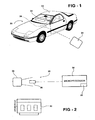
- Figure 1 schematically illustrates an active noise cancellation system 20 for use on a vehicle 22.
- a hand held device 24 facilitates communications with appropriate portions of the active noise cancellation system 26 supported on the vehicle 22.
- the handheld communication device 24 may be a cell phone, a personal digital assistant or a so-called palm top computer, for example.
- the handheld communication device 24 may communicate using wireless technologies such as bluetooth technology.
- the illustrated vehicle 22 also includes a user interface 28 supported in the interior of the vehicle so that an individual may provide information to the appropriate portions of the active noise cancellation system 26 by using the user interface 28.
- the interface 28 preferably includes an input portion such as a keypad or a touch screen.
- the user interface 28 is a cell phone.
- the active noise cancellation system 26 communicates with either type of device (i.e., a handheld communication device 24 that can be remotely located from the vehicle 22 or a communication device 28 supported within the vehicle 22) or both depending on the needs of a particular situation.
- a handheld communication device 24 that can be remotely located from the vehicle 22 or a communication device 28 supported within the vehicle 22
- both depending on the needs of a particular situation.
- the active noise cancellation system 26 includes some conventional components for canceling out engine noises from the engine 30 that are otherwise promulgated through the air induction system 32 in a known manner.
- the active noise cancellation system 26 includes a controller 34 that is programmed to cause the active noise cancellation system to operate in a desired manner.
- the controller 34 drives a speaker 36 to generate a noise cancellation signal or noise attenuating sound that operates to attenuate the engine noise otherwise propagated through the air induction system..
- the controller 34 includes a communication portion 38 that facilitates communications between the controller 34 and an individual using a handheld communication device 24 or a vehicle-mounted communication interface 28, for example.
- Example types of communication portions include a serial data interface or a modem (i.e., a so-called cell phone chip).
- the communication portion 38 is schematically illustrated as part of the controller 34, separate components, software or both may be used to realize the function of the communication portion 38. Those skilled in the art who have the benefit of this description will be able to select from among commercially available components or to custom design circuitry or software to meet the needs of their particular situation.
- the controller 34 preferably is preprogrammed to accommodate a plurality of different engine noise profile selections. For example, one vehicle owner may prefer to experience an engine noise profile that resembles a racecar or sporty performance car. Another individual, on the other hand, may prefer a very quiet, luxury ride where minimal engine noise is experienced in the passenger compartment.
- the controller 34 preferably is programmed to accommodate either individual's preference, among others. Accordingly, the controller 34 adapts or customizes the performance of the active noise cancellation system 26 based upon the individual's preference.
- an individual may use the handheld communication device 24 to communicate through the communication portion 38 of the active noise cancellation system 26.
- the individual provides a selection of one of several available noise profiles.
- the controller 34 determines the individual's preference and customizes the manner in which the speaker 36 is driven so that the noise attenuation results in an engine noise profile consistent with the individual's indicated preference.
- FIG. 3 schematically shows one type of communication strategy in a system designed according to this invention.
- the available consumer preferences 40 preferably are presented to the individual through a graphical user interface 42 on the handheld communication device 24.
- the communication of the user's preference then is accomplished through the communication portion 38 and provided to the controller 34, which responsively drives the speaker 36 to provide the desired engine noise profile at 50.
- the communication portion 38 may be a resident part or dedicated portion of the controller 34 electronics. Alternatively, the communication portion 38 may be incorporated into the communication interface 28 supported on the vehicle.
- the communication interface 28 allows an individual to instruct the controller 34 how to customize the engine noise profile.
- a serial communication is provided through the interface 28 over a conventional CAN bus communication line.
- the user simply accesses the interface 28 within the vehicle to provide the information necessary to communicate the individual's preferred engine noise profile.
- a remote communication device 24 connects to the interface 28 using a conventional telephone communication such as through cellular telephone communications.
- the communication module 38 has its own phone number that can be accessed using the "in-vehicle" interface 28 or a remote communication device 24.
- the communication portion 38 is part of a network that allows communication with various portions of the vehicle for an individual to customize the performance of the corresponding electronics, for example.
- the communication network includes a tracking portion 52 that provides information regarding an individual's access to the active noise cancellation system electronics.
- the tracking module provides information, for example, on the number of changes made by the individual to the engine noise profile. Such information is useful, for example, in assessing a charge to an individual for each time that the engine noise profile is changed. Another use of such information is to determine demographic information regarding customer preferences to then make adjustments to subsequently offered products to meet customer demands.
- the inventive arrangement provides an active noise cancellation system that is selectively customizable by an individual to achieve a desired engine noise profile, which will best suit the individual's preferences to maximize a satisfying experience while driving the vehicle.
Landscapes
- Physics & Mathematics (AREA)
- Engineering & Computer Science (AREA)
- Acoustics & Sound (AREA)
- Multimedia (AREA)
- Health & Medical Sciences (AREA)
- Audiology, Speech & Language Pathology (AREA)
- General Health & Medical Sciences (AREA)
- Soundproofing, Sound Blocking, And Sound Damping (AREA)
- Fittings On The Vehicle Exterior For Carrying Loads, And Devices For Holding Or Mounting Articles (AREA)
Abstract
Description
Claims (20)
- An active noise cancellation system for use in a vehicle air induction system, comprising:a speaker that selectively generates a noise sound control that controls the engine sound heard inside the vehicle;a controller that selectively drives the speaker to generate the noise control sound; anda communication portion that is adapted to communicate a selection from an individual indicating one of several available engine sounds to the controller which responsively drives the speaker to achieve the selected sound.
- The system of claim 1, including a user communication interface supported on the vehicle that communicates with the communication portion and wherein the user communication interface includes an input portion that allows an individual to indicate a desired one of the available engine sounds
- The system of claim 1, including a user communication interface that comprises a modem and wherein the controller communicates with the modem.
- The system of claim 1, including a user communication interface that comprises an electronic personal digital assistant device and wherein the communication portion controller communicates with the electronic personal assistant device.
- The system of claim 1, wherein the communication portion communicates wirelessly with a communication device that is independent of the active noise cancellation system.
- The system of claim 5, wherein the communication portion has an identifier that is accessible by a user through the independent communication device.
- The system of claim 6, wherein the identifier comprises a phone number that is accessible by another telecommunication device for communication with the active noise cancellation system.
- A method of controlling a perceived engine noise profile using an active noise cancellation system in a vehicle air induction system, comprising the steps of:determining a user preference for at least one of a plurality of available engine noises profiles; andautomatically adjusting a noise control sound provided by the noise cancellation system responsive to the user preference so that a resulting engine noise profile heard by the user corresponds to the user preference.
- The method of claim 8, including programming a controller to selectively drive a speaker of the noise cancellation system in one of a plurality of predetermined manners, each of the manners corresponding to one of the available noises.
- The method of claim 9, including programming the controller to drive the speaker to produce a sound that causes the resulting engine noise to be one of a sport engine noise or a quiet performance engine noise.
- The method of claim 8, including communicating with a user interface supported on the vehicle to determine the user preference.
- The method of claim 8, including communicating with a remotely located communication device that is independent of the noise cancellation system to determine the user preference.
- The method of claim 12, including using wireless communication.
- An active noise cancellation system for controlling a perceived engine noise profile that is heard by a driver of a vehicle, comprising:a speaker that generates at least one of a plurality of available noise control sounds that correspond to a plurality of available noise profiles;a controller that selectively drives the speaker such that the perceived engine noise profile corresponds to a user selection of one of the available noise profiles; anda communication network that facilitates communication between an individual and the controller.
- The system of claim 14, wherein the communication network includes a cell phone chip associated with the controller, the cell phone chip providing a unique communication identifier to the controller such that an individual can communicate with the controller through the network.
- The system of claim 15, including a tracking module that tracks use of the communication network and provides information regarding access to the network to selectively adjust the noise profile.
- The system of claim 14, wherein the communication network includes a user communication interface supported on the vehicle that communicates with the controller and wherein the user communication interface includes an input portion that allows an individual to indicate a desired one of the available noise profiles.
- The system of claim 14, including a user communication interface that comprises a cell phone and wherein the communication network receives user input from the cell phone.
- The system of claim 14, including a user communication interface that comprises an electronic personal digital assistant device and wherein the communication network receives user input from the electronic personal digital assistant device.
- The system of claim 14, including a unique identifier and wherein the communication network uses the identifier to facilitate communication between a user and the controller through a remote communication device that is independent of the noise cancellation system.
Applications Claiming Priority (4)
| Application Number | Priority Date | Filing Date | Title |
|---|---|---|---|
| US92076 | 1987-09-02 | ||
| US28929801P | 2001-05-08 | 2001-05-08 | |
| US289298P | 2001-05-08 | ||
| US10/092,076 US7106867B2 (en) | 2001-05-08 | 2002-03-06 | Active noise cancellation for a vehicle induction system having selectable engine noise profile |
Publications (2)
| Publication Number | Publication Date |
|---|---|
| EP1256930A2 true EP1256930A2 (en) | 2002-11-13 |
| EP1256930A3 EP1256930A3 (en) | 2003-10-29 |
Family
ID=26785005
Family Applications (1)
| Application Number | Title | Priority Date | Filing Date |
|---|---|---|---|
| EP02076627A Withdrawn EP1256930A3 (en) | 2001-05-08 | 2002-04-24 | Active noise cancellation for a vehicle induction system having selectable engine noise profile |
Country Status (2)
| Country | Link |
|---|---|
| US (1) | US7106867B2 (en) |
| EP (1) | EP1256930A3 (en) |
Cited By (1)
| Publication number | Priority date | Publication date | Assignee | Title |
|---|---|---|---|---|
| EP1582733A3 (en) * | 2004-03-31 | 2011-03-02 | Toyota Boshoku Kabushiki Kaisha | Systems and methods for controlling acoustical damping |
Families Citing this family (13)
| Publication number | Priority date | Publication date | Assignee | Title |
|---|---|---|---|---|
| US20040195040A1 (en) * | 2003-04-04 | 2004-10-07 | Manish Vaishya | Powerful sound for powerful engines |
| DE102005060064A1 (en) * | 2005-12-15 | 2007-06-21 | Müller-BBM GmbH | Method and system for active noise control, use in a motor vehicle |
| US7818217B2 (en) * | 2007-07-20 | 2010-10-19 | Nike, Inc. | Method of customizing an article |
| ES2528185T3 (en) * | 2007-12-11 | 2015-02-05 | General Electric Company | Gearbox noise reduction by electric drive control |
| US8320581B2 (en) * | 2010-03-03 | 2012-11-27 | Bose Corporation | Vehicle engine sound enhancement |
| US9299337B2 (en) | 2011-01-11 | 2016-03-29 | Bose Corporation | Vehicle engine sound enhancement |
| KR101734578B1 (en) * | 2011-11-16 | 2017-05-24 | 현대자동차주식회사 | An engine driving sound synthesizer |
| US9167067B2 (en) * | 2013-02-14 | 2015-10-20 | Bose Corporation | Motor vehicle noise management |
| US9540015B2 (en) | 2015-05-04 | 2017-01-10 | At&T Intellectual Property I, L.P. | Methods and apparatus to alter a vehicle operation |
| US9773495B2 (en) * | 2016-01-25 | 2017-09-26 | Ford Global Technologies, Llc | System and method for personalized sound isolation in vehicle audio zones |
| US10974729B2 (en) | 2018-08-21 | 2021-04-13 | At&T Intellectual Property I, L.P. | Application and portability of vehicle functionality profiles |
| US11195506B2 (en) * | 2018-12-03 | 2021-12-07 | Toyota Motor Engineering & Manufacturing North America, Inc. | Sound-modulating windows |
| EP4364132A4 (en) * | 2021-06-29 | 2025-05-21 | Silentium Ltd. | ACTIVE ACOUSTIC CONTROL (AAC) APPARATUS, SYSTEM AND METHOD |
Family Cites Families (8)
| Publication number | Priority date | Publication date | Assignee | Title |
|---|---|---|---|---|
| DE3420463A1 (en) | 1984-06-01 | 1985-12-05 | Uwe 6500 Mainz Brückner | Device for acoustic irradiation |
| JP3276214B2 (en) * | 1992-08-31 | 2002-04-22 | マツダ株式会社 | Vehicle vibration reduction device |
| EP0693212B1 (en) * | 1993-04-07 | 1999-12-08 | Noise Cancellation Technologies, Inc. | Hybrid analog/digital vibration control system |
| IT1276387B1 (en) | 1995-06-15 | 1997-10-31 | Magneti Marelli Climat Srl | EQUIPMENT FOR THE GENERATION OF ANTI-NOISE FOR AUTOMOTIVE VEHICLES, USED ALSO AS ANTI-THEFT EQUIPMENT |
| US6259792B1 (en) * | 1997-07-17 | 2001-07-10 | Advanced Micro Devices, Inc. | Waveform playback device for active noise cancellation |
| EP1852836A3 (en) * | 1999-05-26 | 2011-03-30 | Johnson Controls Technology Company | Wireless communications system and method |
| GB2351634A (en) | 1999-06-26 | 2001-01-03 | Thomas Brendan Francis Clarke | Audio processing system |
| DE19949685A1 (en) | 1999-10-15 | 2001-04-19 | Mann & Hummel Filter | Active control of noise generated at air intake of internal combustion engine uses noise cancellation |
-
2002
- 2002-03-06 US US10/092,076 patent/US7106867B2/en not_active Expired - Lifetime
- 2002-04-24 EP EP02076627A patent/EP1256930A3/en not_active Withdrawn
Cited By (1)
| Publication number | Priority date | Publication date | Assignee | Title |
|---|---|---|---|---|
| EP1582733A3 (en) * | 2004-03-31 | 2011-03-02 | Toyota Boshoku Kabushiki Kaisha | Systems and methods for controlling acoustical damping |
Also Published As
| Publication number | Publication date |
|---|---|
| US7106867B2 (en) | 2006-09-12 |
| EP1256930A3 (en) | 2003-10-29 |
| US20020168071A1 (en) | 2002-11-14 |
Similar Documents
| Publication | Publication Date | Title |
|---|---|---|
| US7106867B2 (en) | Active noise cancellation for a vehicle induction system having selectable engine noise profile | |
| US7197278B2 (en) | Method and system for communicating information between a vehicular hands-free telephone system and an external device using a garage door opener as a communications gateway | |
| US6144114A (en) | Auto PC wallet PC faceplate | |
| US6020654A (en) | Auto PC wallet PC faceplate | |
| US8384528B2 (en) | Method and apparatus for selectively varying motor vehicle sounds | |
| EP2028062A2 (en) | System and method for optimizing speech recognition in a vehicle | |
| EP2028061A2 (en) | System and method of controlling personalized settings in a vehicle | |
| US11580950B2 (en) | Apparatus and method for privacy enhancement | |
| WO2012162182A1 (en) | Vehicle hands free telephone system with active noise cancellation | |
| CN107346657A (en) | Including with car audio bus(A2B)The vehicle of the clunk management system of interface | |
| DE102010002861A1 (en) | Car, has identifying unit identifying vehicle occupants on seats, and control device for automatic individual user-adaptive configuration of car functions depending on vehicle occupants identified on seats and defined parameters | |
| CN114537304A (en) | Intelligent adjustment method and system for sound of whole vehicle | |
| WO2008061205A2 (en) | Integrated vehicle communication system | |
| JP5440135B2 (en) | Operation screen customization device | |
| US10629181B2 (en) | Apparatus and method for privacy enhancement | |
| EP1582733B1 (en) | Systems and methods for controlling acoustical damping | |
| CN108725140A (en) | In-vehicle air method of replacing and system | |
| CN110096252A (en) | Interior media sound inhibits | |
| JP7639673B2 (en) | Seat management device, seat management method, and seat management system | |
| JP2020203643A (en) | Controller for active noise canceler, method for controlling active noise canceler, and program | |
| CN110751939B (en) | Regional personalized automobile active noise control system | |
| CN117331435A (en) | Vibration feedback control method, device, equipment, touch panel and storage medium | |
| JPH0741794B2 (en) | Automotive air conditioner | |
| EP1494209B1 (en) | Acoustically and haptically operated apparatus and method thereof | |
| KR20190084152A (en) | Vehicle and method for controlling the same |
Legal Events
| Date | Code | Title | Description |
|---|---|---|---|
| PUAI | Public reference made under article 153(3) epc to a published international application that has entered the european phase |
Free format text: ORIGINAL CODE: 0009012 |
|
| AK | Designated contracting states |
Kind code of ref document: A2 Designated state(s): AT BE CH CY DE DK ES FI FR GB GR IE IT LI LU MC NL PT SE TR |
|
| AX | Request for extension of the european patent |
Free format text: AL;LT;LV;MK;RO;SI |
|
| PUAL | Search report despatched |
Free format text: ORIGINAL CODE: 0009013 |
|
| AK | Designated contracting states |
Kind code of ref document: A3 Designated state(s): AT BE CH CY DE DK ES FI FR GB GR IE IT LI LU MC NL PT SE TR |
|
| AX | Request for extension of the european patent |
Extension state: AL LT LV MK RO SI |
|
| RIC1 | Information provided on ipc code assigned before grant |
Ipc: 7G 10K 15/02 B Ipc: 7G 10K 11/178 A |
|
| AKX | Designation fees paid |
Designated state(s): DE GB |
|
| STAA | Information on the status of an ep patent application or granted ep patent |
Free format text: STATUS: THE APPLICATION IS DEEMED TO BE WITHDRAWN |
|
| 18D | Application deemed to be withdrawn |
Effective date: 20040430 |