EP1256726A1 - Method and apparatus for continuous prediction, monitoring and control of compressor health via detection of precursors to rotating stall and surge - Google Patents
Method and apparatus for continuous prediction, monitoring and control of compressor health via detection of precursors to rotating stall and surge Download PDFInfo
- Publication number
- EP1256726A1 EP1256726A1 EP02252671A EP02252671A EP1256726A1 EP 1256726 A1 EP1256726 A1 EP 1256726A1 EP 02252671 A EP02252671 A EP 02252671A EP 02252671 A EP02252671 A EP 02252671A EP 1256726 A1 EP1256726 A1 EP 1256726A1
- Authority
- EP
- European Patent Office
- Prior art keywords
- compressor
- stall
- monitoring
- precursors
- parameter
- Prior art date
- Legal status (The legal status is an assumption and is not a legal conclusion. Google has not performed a legal analysis and makes no representation as to the accuracy of the status listed.)
- Granted
Links
- 239000002243 precursor Substances 0.000 title claims abstract description 68
- 238000012544 monitoring process Methods 0.000 title claims abstract description 42
- 230000036541 health Effects 0.000 title claims abstract description 25
- 238000000034 method Methods 0.000 title claims description 44
- 238000001514 detection method Methods 0.000 title abstract description 14
- 230000009471 action Effects 0.000 claims abstract description 40
- 238000005259 measurement Methods 0.000 claims description 14
- 230000000977 initiatory effect Effects 0.000 claims description 13
- 238000012545 processing Methods 0.000 claims description 13
- 230000015556 catabolic process Effects 0.000 claims description 11
- 238000006731 degradation reaction Methods 0.000 claims description 11
- 239000007789 gas Substances 0.000 description 17
- 230000008569 process Effects 0.000 description 8
- 238000012731 temporal analysis Methods 0.000 description 8
- 238000000700 time series analysis Methods 0.000 description 8
- 230000002123 temporal effect Effects 0.000 description 6
- 230000003190 augmentative effect Effects 0.000 description 5
- 238000005070 sampling Methods 0.000 description 5
- 238000002485 combustion reaction Methods 0.000 description 3
- 238000010304 firing Methods 0.000 description 3
- 230000006870 function Effects 0.000 description 3
- 230000000116 mitigating effect Effects 0.000 description 3
- 238000010248 power generation Methods 0.000 description 3
- 238000013459 approach Methods 0.000 description 2
- 230000006399 behavior Effects 0.000 description 2
- 230000008859 change Effects 0.000 description 2
- 238000013461 design Methods 0.000 description 2
- 239000000446 fuel Substances 0.000 description 2
- 230000009467 reduction Effects 0.000 description 2
- 238000003070 Statistical process control Methods 0.000 description 1
- 230000001133 acceleration Effects 0.000 description 1
- 239000000567 combustion gas Substances 0.000 description 1
- 230000006835 compression Effects 0.000 description 1
- 238000007906 compression Methods 0.000 description 1
- 238000010586 diagram Methods 0.000 description 1
- 238000009826 distribution Methods 0.000 description 1
- 230000000694 effects Effects 0.000 description 1
- 230000005611 electricity Effects 0.000 description 1
- 238000005516 engineering process Methods 0.000 description 1
- 230000037406 food intake Effects 0.000 description 1
- 230000007774 longterm Effects 0.000 description 1
- 230000007257 malfunction Effects 0.000 description 1
- 238000004519 manufacturing process Methods 0.000 description 1
- 230000004044 response Effects 0.000 description 1
- 238000012546 transfer Methods 0.000 description 1
Images


Classifications
-
- F—MECHANICAL ENGINEERING; LIGHTING; HEATING; WEAPONS; BLASTING
- F04—POSITIVE - DISPLACEMENT MACHINES FOR LIQUIDS; PUMPS FOR LIQUIDS OR ELASTIC FLUIDS
- F04B—POSITIVE-DISPLACEMENT MACHINES FOR LIQUIDS; PUMPS
- F04B49/00—Control, e.g. of pump delivery, or pump pressure of, or safety measures for, machines, pumps, or pumping installations, not otherwise provided for, or of interest apart from, groups F04B1/00 - F04B47/00
-
- F—MECHANICAL ENGINEERING; LIGHTING; HEATING; WEAPONS; BLASTING
- F04—POSITIVE - DISPLACEMENT MACHINES FOR LIQUIDS; PUMPS FOR LIQUIDS OR ELASTIC FLUIDS
- F04D—NON-POSITIVE-DISPLACEMENT PUMPS
- F04D27/00—Control, e.g. regulation, of pumps, pumping installations or pumping systems specially adapted for elastic fluids
- F04D27/02—Surge control
-
- F—MECHANICAL ENGINEERING; LIGHTING; HEATING; WEAPONS; BLASTING
- F04—POSITIVE - DISPLACEMENT MACHINES FOR LIQUIDS; PUMPS FOR LIQUIDS OR ELASTIC FLUIDS
- F04B—POSITIVE-DISPLACEMENT MACHINES FOR LIQUIDS; PUMPS
- F04B49/00—Control, e.g. of pump delivery, or pump pressure of, or safety measures for, machines, pumps, or pumping installations, not otherwise provided for, or of interest apart from, groups F04B1/00 - F04B47/00
- F04B49/06—Control using electricity
-
- F—MECHANICAL ENGINEERING; LIGHTING; HEATING; WEAPONS; BLASTING
- F04—POSITIVE - DISPLACEMENT MACHINES FOR LIQUIDS; PUMPS FOR LIQUIDS OR ELASTIC FLUIDS
- F04C—ROTARY-PISTON, OR OSCILLATING-PISTON, POSITIVE-DISPLACEMENT MACHINES FOR LIQUIDS; ROTARY-PISTON, OR OSCILLATING-PISTON, POSITIVE-DISPLACEMENT PUMPS
- F04C28/00—Control of, monitoring of, or safety arrangements for, pumps or pumping installations specially adapted for elastic fluids
-
- F—MECHANICAL ENGINEERING; LIGHTING; HEATING; WEAPONS; BLASTING
- F04—POSITIVE - DISPLACEMENT MACHINES FOR LIQUIDS; PUMPS FOR LIQUIDS OR ELASTIC FLUIDS
- F04D—NON-POSITIVE-DISPLACEMENT PUMPS
- F04D27/00—Control, e.g. regulation, of pumps, pumping installations or pumping systems specially adapted for elastic fluids
- F04D27/001—Testing thereof; Determination or simulation of flow characteristics; Stall or surge detection, e.g. condition monitoring
-
- F—MECHANICAL ENGINEERING; LIGHTING; HEATING; WEAPONS; BLASTING
- F04—POSITIVE - DISPLACEMENT MACHINES FOR LIQUIDS; PUMPS FOR LIQUIDS OR ELASTIC FLUIDS
- F04D—NON-POSITIVE-DISPLACEMENT PUMPS
- F04D29/00—Details, component parts, or accessories
- F04D29/66—Combating cavitation, whirls, noise, vibration or the like; Balancing
- F04D29/661—Combating cavitation, whirls, noise, vibration or the like; Balancing especially adapted for elastic fluid pumps
-
- F—MECHANICAL ENGINEERING; LIGHTING; HEATING; WEAPONS; BLASTING
- F05—INDEXING SCHEMES RELATING TO ENGINES OR PUMPS IN VARIOUS SUBCLASSES OF CLASSES F01-F04
- F05B—INDEXING SCHEME RELATING TO WIND, SPRING, WEIGHT, INERTIA OR LIKE MOTORS, TO MACHINES OR ENGINES FOR LIQUIDS COVERED BY SUBCLASSES F03B, F03D AND F03G
- F05B2220/00—Application
- F05B2220/30—Application in turbines
- F05B2220/302—Application in turbines in gas turbines
-
- F—MECHANICAL ENGINEERING; LIGHTING; HEATING; WEAPONS; BLASTING
- F05—INDEXING SCHEMES RELATING TO ENGINES OR PUMPS IN VARIOUS SUBCLASSES OF CLASSES F01-F04
- F05B—INDEXING SCHEME RELATING TO WIND, SPRING, WEIGHT, INERTIA OR LIKE MOTORS, TO MACHINES OR ENGINES FOR LIQUIDS COVERED BY SUBCLASSES F03B, F03D AND F03G
- F05B2220/00—Application
- F05B2220/70—Application in combination with
- F05B2220/704—Application in combination with the other apparatus being a gas turbine
Definitions
- This invention relates to non-intrusive techniques for monitoring the health of rotating mechanical components. More particularly, the present invention relates to a method and apparatus for pro-actively monitoring the health and performance of a compressor by detecting precursors to rotating stall and surge.
- the Gas Turbine Combined-Cycle power plant consisting of a Gas-Turbine based topping cycle and a Rankine-based bottoming cycle, continues to be the customer's preferred choice in power generation. This may be due to the relatively-low plant investment cost, and to the continuously-improving operating efficiency of the Gas Turbine based combined cycle, which combine to minimize the cost of electricity production.
- compressor stall In gas turbines used for power generation, a compressor must be allowed to operate at a higher pressure ratio in order to achieve a higher machine efficiency.
- compressor stall a phenomenon known as compressor stall, wherein the pressure ratio of the turbine compressor initially exceeds some critical value at a given speed, resulting in a subsequent reduction of compressor pressure ratio and airflow delivered to the engine combustor.
- Compressor stall may result from a variety of reasons, such as when the engine is accelerated too rapidly, or when the inlet profile of air pressure or temperature becomes unduly distorted during normal operation of the engine. Compressor damage due to the ingestion of foreign objects or a malfunction of a portion of the engine control system may also result in a compressor stall and subsequent compressor degradation. If compressor stall remains undetected and permitted to continue, the combustor temperatures and the vibratory stresses induced in the compressor may become sufficiently high to cause damage to the turbine.
- an optimal cycle pressure ratio is identified which maximizes combined-cycle efficiency. This optimal cycle pressure ratio is theoretically shown to increase with increasing firing temperature.
- Axial flow compressors are thus subjected to demands for ever-increasing levels of pressure ratio, with the simultaneous goals of minimal parts count, operational simplicity, and low overall cost.
- an axial flow compressor is expected to operate at a heightened level of cycle pressure ratio at a compression efficiency that augments the overall cycle efficiency.
- the axial compressor is also expected to perform in an aerodynamically and aero-mechanically stable manner over a wide range in mass flow rate associated with the varying power output characteristics of the combined cycle operation.
- One approach monitors the health of a compressor by measuring the air flow and pressure rise through the compressor. A range of values for the pressure rise is selected a-priori, beyond which the compressor operation is deemed unhealthy and the machine is shut down. Such pressure variations may be attributed to a number of causes such as, for example, unstable combustion, rotating stall and surge events on the compressor itself. To determine these events, the magnitude and rate of change of pressure rise through the compressor are monitored. When such an event occurs, the magnitude of the pressure rise may drop sharply, and an algorithm monitoring the magnitude and its rate of change may acknowledge the event. This approach, however, does not offer prediction capabilities of rotating stall or surge, and fails to offer information to a real-time control system with sufficient lead time to proactively deal with such events.
- the present invention solves the simultaneous need for high cycle pressure ratio commensurate with high efficiency and ample surge margin throughout the operating range of a compressor. More particularly, the present invention is directed to a system and method for pro-actively monitoring and controlling the health of a compressor using stall precursors, the stall precursors being generated by a Kalman filter.
- at least one sensor is disposed about the compressor for measuring the dynamic compressor parameters, such as for example, pressure and velocity of gases flowing through the compressor, force and vibrations on compressor casing, etc. Monitored sensor data is filtered and stored. Upon collecting and digitizing a pre-specified amount of data by the sensors, a time-series analysis is performed on the monitored data to obtain dynamic model parameters.
- the Kalman filter combines the dynamic model parameters with newly monitored sensor data and computes a filtered estimate.
- the Kalman filter updates its filtered estimate of a subsequent data sample based on the most recent data sample.
- the difference between the monitored data and the filtered estimate, known as "innovations" is compared, and a standard deviation of innovations is computed upon making a predetermined number of comparisons.
- the magnitude of the standard deviation is compared to that of a known correlation for the baseline compressor, the difference being used to estimate a degraded compressor operating map.
- a corresponding compressor operability measure is computed and compared to a design target. If the operability of the compressor is deemed insufficient, corrective actions are initiated by the real-time control system to pro-actively anticipate and mitigate any potential rotating stall and surge events thereby maintaining a required compressor operability level.
- Some of the corrective actions may include varying the operating line control parameters such as, for example, making adjustments to compressor variable vanes, inlet air heat, compressor air bleed, combustor fuel mix, etc. in order to operate the compressor at a near threshold level.
- the corrective actions are initiated prior to the occurrence of a compressor surge event and within a margin identified between an operating line threshold value and the occurrence of a compressor surge event. These corrective steps are iterated until the desired level of compressor operability is achieved.
- a Kalman filter contains a dynamic model of system errors, characterized as a set of first order linear differential equations.
- the Kalman filter comprises equations in which the variables (state-variables) correspond to respective error sources -- the equations express the dynamic relationship between these error sources. Weighting factors are applied to take account of the relative contributions of the errors. The weighting factors are optimized at values depending on the calculated simultaneous minimum variance in the distributions of errors.
- the Kalman filter constantly reassesses the values of the state-variables as it receives new measured values, simultaneously taking all past measurements into account, thus capable of predicting a value of one or more chosen parameters based on a set of state-variables which are updated recursively from the respective inputs.
- a temporal Fast Fourier Transform for computing stall measures.
- the present invention provides a correlation integral technique in a statistical process context may be used to compute stall measures.
- the present invention provides an auto-regression (AR) model augmented by a second order Gauss-Markov process to estimate stall measures.
- AR auto-regression
- the invention provides a method for pro-actively monitoring and controlling a compressor, comprising: (a) monitoring at least one compressor parameter; (b) analyzing the monitored parameter to obtain time-series data; (c) processing the time-series data using a Kalman filter to determine stall precursors; (d) comparing the stall precursors with predetermined baseline values to identify compressor degradation; (e) performing corrective actions to mitigate compressor degradation to maintain a pre-selected level of compressor operability; and (f) iterating said corrective action performing step until the monitored compressor parameter lies within predetermined threshold.
- Step (c) of the method may further comprise i) processing the time-series data to compute dynamic model parameters; and ii) combining, in the Kalman filter, the dynamic model parameters and a new measurement of the compressor parameter to produce a filtered estimate, iii) computing a standard deviation of difference between the filtered estimate and the new measurement to produce stall precursors.
- Corrective actions are preferably initiated by varying operating line parameters. The corrective actions include reducing the loading on the compressor. Preferably, the operating line parameters are set to a near threshold value.
- the present invention provides an apparatus for monitoring the health of a compressor, the apparatus comprises at least one sensor operatively coupled to the compressor for monitoring at least one compressor parameter; a processor system, embodying a Kalman filter, operatively coupled to the at least one sensor, the processor system computing stall precursors; a comparator that compares the stall precursors with predetermined baseline data; and a controller operatively coupled to the comparator, the controller initiating corrective actions to prevent a compressor surge and stall if the stall precursors deviate from the baseline data, the baseline data representing predetermined level of compressor operability.
- the apparatus may further comprise an analog-to-digital (A/D) converter operatively coupled to the at least one sensor for sampling and digitizing input data from the at least one sensor; a calibration system coupled to the A/D converter, the calibration system performing time-series analysis (t,x) on the monitored parameter to compute dynamic model parameters; and a look-up-table (LUT) with memory for storing known sets of compressor data including corresponding stall measure data.
- A/D analog-to-digital
- t,x time-series analysis
- LUT look-up-table
- the present invention provides a gas turbine of the type having a compressor, a combustor, a method for monitoring the health of a compressor is performed according to various embodiments of the invention.
- the present invention provides an apparatus for monitoring and controlling the health of a compressor having means for measuring at least one compressor parameter; means for computing stall measures; means for comparing the stall measures with predetermined baseline values; and means for initiating corrective actions if the stall measures deviate from the baseline values.
- the means for computing stall measures embodies a Kalman filter.
- the means for computing stall measures embodies a Fast Fourier Transform (FFT) algorithm.
- FFT Fast Fourier Transform
- the means for measuring computing stall measures is a correlation integral algorithm.
- the present invention provides a method for monitoring and controlling the health of a compressor by providing a means for measuring at least one compressor parameter; providing a means for computing stall measures; providing a means for comparing the stall measures with predetermined baseline values; and providing a means for initiating corrective actions if the stall measures deviate from the baseline values.
- an apparatus for monitoring the health of a compressor comprising at least one sensor operatively coupled to the compressor for monitoring at least one compressor parameter; a processor system, embodying a stall precursor detection algorithm, operatively coupled to the at least one sensor, the processor system computing stall precursors; a comparator that compares the stall precursors with predetermined baseline data; and a controller operatively coupled to the comparator, the controller initiating corrective actions to prevent a compressor surge and stall if the stall precursors deviate from the baseline data, the baseline data representing predetermined level of compressor operability.
- the stall precursor detection algorithm is a Kalman filter.
- the stall precursor detection algorithm is a temporal Fast Fourier Transform.
- the stall precursor detection algorithm is a correlation integral.
- the stall precursor detection algorithm includes an auto-regression(AR) model augmented by a second order Gauss-Markov process.
- the present invention provides a method of detecting precursors to rotating stall and surge in a compressor, the method comprising measuring the pressure and velocity of gases flowing through the compressor and using a Kalman filter in combination with offline calibration computations to predict future precursors to rotating stall and surge, wherein the Kalman filter utilizes a definition of errors and their stochastic behavior in time; the relationship between the errors and the measured pressure and velocity values; and how the errors influence the prediction of precursors to rotating stall and surge.
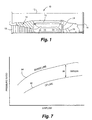
- a gas turbine engine is shown at 10 as comprising a housing 12 having a compressor 14, which may be of the axial flow type, within the housing adjacent to its forward end.
- the compressor 14 receives air through an annular air inlet 16 and delivers compressed air to a combustion chamber 18.
- air is burned with fuel and the resulting combustion gases are directed by a nozzle or guide vane structure 20 to the rotor blades 22 of a turbine rotor 24 for driving the rotor.
- a shaft 13 drivably connects the turbine rotor 24 with the compressor 14. From the turbine blades 22, the exhaust gases discharge rearwardly through an exhaust duct 19 into the surrounding atmosphere.
- FIG. 2 there is shown an exemplary schematic view of the present invention in block diagram fashion.
- a single stage of the compressor is illustrated.
- a compressor may includes several of such stages.
- sensors 30 are disposed about a 26 casing of compressor 14 for measuring the dynamic compressor parameters such as, for example, pressure, velocity of gases flowing through compressor 14, force, vibrations exerted on the compressor casing, etc.
- Dynamic pressure is considered as an exemplary parameter for the detailed explanation of the present invention. It will be appreciated that other compressor parameters, as noted above, may be monitored to estimate the health of compressor 14.
- the pressure data from sensors 30 is digitized and sampled in an A/D converter 32.
- the digitized signals from A/D converter 32 are received by a Kalman Filter 36 and an offline calibration system 34.
- time-series analysis of the data is performed by the calibration system 34 to produce dynamic model parameters while compensating for the sensor drift over time.
- the dynamic model parameters are received by the Kalman Filter 36 which combines the dynamic model parameters and new pressure data digitized by A/D converter 32 to produce a filtered estimate.
- the difference between the measured data and the filtered estimate hereinafter referred to as "innovations" is further processed to identify stall precursors.
- a look-up-table 38 is constructed and populated with stall measure values as a function of speed (rpm), angle of inlet guide vanes (IGVs), and compressor stage.
- the values populated in the LUT 38 are known values against which the measured sensor data processed by the offline calibration unit 34 is compared to determine stall precursors, i.e., LUT 38 identifies the state at which the stall measure of compressor 14 is supposed to be.
- LUT 38 identifies the state at which the stall measure of compressor 14 is supposed to be.
- a standard deviation of the "innovations” is computed.
- the magnitude of the standard deviation of "innovations” is compared with known correlation for the baseline compressor in a decision computations system 40.
- the decision computations system 40 identifies if the stall measure from Kalman filter 36 deviates from the baseline values received in decision system 40.
- the presence/absence of a stall or surge is indicated by a "1/0" to identify whether compressor 14 is healthy or not.
- the stall measure computed by the Kalman Filter 36 is a continuously varying signal for causing the control system 42 to initiate mitigating actions in the event of identifying a stall or surge.
- the mitigating actions may be initiated by varying the operating line parameters of compressor 14.
- a magnitude of the standard deviation of innovations offers information to control system 42 with sufficient lead time for appropriate actions by control system 42 to mitigate risks if the compressor operation is deemed unhealthy.
- the difference between measured precursor magnitude(s) and the baseline stall measure via existing transfer functions is used to estimate a degraded compressor operating map, and a corresponding compressor operability measure, i.e., operating stall margin is computed and compared with a design target.
- the operability of the compressor of interest is then deemed sufficient or not. If the compressor operability is deemed insufficient, then a need for providing active controls is made and the instructions are passed to control system 32 for actively controlling compressor 14.
- FIG. 3 there is shown a schematic of a Kalman filter indicated at 36.
- sampled pressure data from A/D converter 32 is fed to a dynamic state model of plant as indicated at 44.
- the dynamic state model 44 is used to infer data (for example, stall precursor data in the present embodiment) from the measured pressure data.
- Output signals of the dynamic state model 44 are received by the measurement model 46 which calibrates the signals to offset noise from sensors 30 ( Figure 2).
- the calibrated output signals from the measurement model 46 are fed to monitor the Kalman gain indicated at 50 in order to ensure that the filtered estimates from Kalman filter 36 are within the range of sensor measurements.
- the output signals from comparator 48 are also received by unit 56 for computing standard deviation which is indicative of a stall measure.
- the stall measure is fed to decision computations unit 40 and control system 42 (figure 2).
- Comparison of measured pressure data with baseline compressor values indicates the operability of the compressor.
- This compressor operability data may be used to initiate the desired control system corrective actions to prevent a compressor surge, thus allowing the compressor to operate with a higher efficiency than if additional margin were required to avoid near stall operation.
- Stall precursor signals indicative of onset of compressor stall may also be provided, as illustrated in Figure 4, to a display 45 or other indicator means so that an operator may manually initiate corrective measures to prevent a compressor surge and avoid near stall operation.
- FIG 4 there is shown another embodiment where elements in common with schematic of Figure 2 are indicated by similar reference numerals, but with a prefix "1" added.
- a signal processing system having a temporal Fast Fourier Transform (FFT) algorithim 60 is used for computing stall measures.
- Compressor data is measured, as a function of time, by sensors disposed about the compressor.
- a FFT is performed on the measured data and changes in magnitudes at specific frequencies are identified and compared with baseline compressor values to determine compressor health and initiate mitigating actions by control system 142 to maintain a predetermined level of compressor operability.
- FFT temporal Fast Fourier Transform
- a signal processing system 70 having a correlation integral technique in a statistical process context is used to compute stall measures.
- similar reference numerals are employed, but with a prefix "2" added.
- the long-term statistical characteristics of the correlation integral for a healthy compressor is derived and used to obtain a lower control limit.
- the correlation integral is computed continuously, the magnitude of the integral is compared at each servo loop to the lower control limit.
- the compressor of interest is deemed unhealthy if the correlation integral violates any rule in statistical process control when compared to the lower control limit.
- the correlation integral is computed by the following equation: where
- stall measures are determined using a signal processing system 90 having an auto-regression(AR) model augmented by a second order Gauss-Markov process.
- AR auto-regression
- FIG. 6 stall measures are determined using a signal processing system 90 having an auto-regression(AR) model augmented by a second order Gauss-Markov process.
- AR model is illustrated in state variable form which may be constructed from the offline time-series analysis by offline computations unit 34 ( Figure 2).
- Equation (1) sets forth a relationship between the dynamic state of compressor 14, the plant model 44, and measurement model 46, where x represents a dynamic state; "A” represents the plant model; “G” represents the measurement model; “w” is a noise vector.
- Equation (2) sets forth a relation between output (y) of compressor 14, the process model “C”, and the affect of noise “v” on output, and "H” indicates the effect of sensor noise on the output.
- FIG. 7 a graph charting pressure ratio on the Y-axis and airflow on the X-axis is illustrated.
- the acceleration of a gas turbine engine may result in a compressor stall or surge wherein the pressure ratio of the compressor may initially exceed some critical value, resulting in a subsequent drastic reduction of compressor pressure ratio and airflow delivered to the combustor. If such a condition is undetected and allowed to continue, the combustor temperatures and vibratory stresses induced in the compressor may become sufficiently high to cause damage to the gas turbine.
- the OPLINE identified at 92 depicts an operating line that the compressor 14 is operating at.
- the compressor may be operated at an increased pressure ratio.
- the margin 96 indicates that once the gas turbine engine 10 operates at values beyond the values set by the OPLINE as illustrated in the graph, a signal indicative of onset of a compressor stall is issued. Corrective measures by the real-time control system 42 may have to be initiated within margin 96 to avoid a compressor surge and near stall operation of the compressor 14.
Landscapes
- Engineering & Computer Science (AREA)
- Mechanical Engineering (AREA)
- General Engineering & Computer Science (AREA)
- Control Of Positive-Displacement Air Blowers (AREA)
Abstract
Description
- This invention relates to non-intrusive techniques for monitoring the health of rotating mechanical components. More particularly, the present invention relates to a method and apparatus for pro-actively monitoring the health and performance of a compressor by detecting precursors to rotating stall and surge.
- The global market for efficient power generation equipment has been expanding at a rapid rate since the mid-1980's - this trend is projected to continue in the future. The Gas Turbine Combined-Cycle power plant, consisting of a Gas-Turbine based topping cycle and a Rankine-based bottoming cycle, continues to be the customer's preferred choice in power generation. This may be due to the relatively-low plant investment cost, and to the continuously-improving operating efficiency of the Gas Turbine based combined cycle, which combine to minimize the cost of electricity production.
- In gas turbines used for power generation, a compressor must be allowed to operate at a higher pressure ratio in order to achieve a higher machine efficiency. During operation of a gas turbine, there may occur a phenomenon known as compressor stall, wherein the pressure ratio of the turbine compressor initially exceeds some critical value at a given speed, resulting in a subsequent reduction of compressor pressure ratio and airflow delivered to the engine combustor. Compressor stall may result from a variety of reasons, such as when the engine is accelerated too rapidly, or when the inlet profile of air pressure or temperature becomes unduly distorted during normal operation of the engine. Compressor damage due to the ingestion of foreign objects or a malfunction of a portion of the engine control system may also result in a compressor stall and subsequent compressor degradation. If compressor stall remains undetected and permitted to continue, the combustor temperatures and the vibratory stresses induced in the compressor may become sufficiently high to cause damage to the turbine.
- It is well known that elevated firing temperatures enable increases in combined cycle efficiency and specific power. It is further known that, for a given firing temperature, an optimal cycle pressure ratio is identified which maximizes combined-cycle efficiency. This optimal cycle pressure ratio is theoretically shown to increase with increasing firing temperature. Axial flow compressors are thus subjected to demands for ever-increasing levels of pressure ratio, with the simultaneous goals of minimal parts count, operational simplicity, and low overall cost. Further, an axial flow compressor is expected to operate at a heightened level of cycle pressure ratio at a compression efficiency that augments the overall cycle efficiency. The axial compressor is also expected to perform in an aerodynamically and aero-mechanically stable manner over a wide range in mass flow rate associated with the varying power output characteristics of the combined cycle operation.
- The general requirement which led to the present invention was the market need for industrial Gas Turbines of improved combined-cycle efficiency and based on proven technologies for high reliability and availability.
- One approach monitors the health of a compressor by measuring the air flow and pressure rise through the compressor. A range of values for the pressure rise is selected a-priori, beyond which the compressor operation is deemed unhealthy and the machine is shut down. Such pressure variations may be attributed to a number of causes such as, for example, unstable combustion, rotating stall and surge events on the compressor itself. To determine these events, the magnitude and rate of change of pressure rise through the compressor are monitored. When such an event occurs, the magnitude of the pressure rise may drop sharply, and an algorithm monitoring the magnitude and its rate of change may acknowledge the event. This approach, however, does not offer prediction capabilities of rotating stall or surge, and fails to offer information to a real-time control system with sufficient lead time to proactively deal with such events.
- Accordingly, the present invention solves the simultaneous need for high cycle pressure ratio commensurate with high efficiency and ample surge margin throughout the operating range of a compressor. More particularly, the present invention is directed to a system and method for pro-actively monitoring and controlling the health of a compressor using stall precursors, the stall precursors being generated by a Kalman filter. In the exemplary embodiment, at least one sensor is disposed about the compressor for measuring the dynamic compressor parameters, such as for example, pressure and velocity of gases flowing through the compressor, force and vibrations on compressor casing, etc. Monitored sensor data is filtered and stored. Upon collecting and digitizing a pre-specified amount of data by the sensors, a time-series analysis is performed on the monitored data to obtain dynamic model parameters.
- The Kalman filter combines the dynamic model parameters with newly monitored sensor data and computes a filtered estimate. The Kalman filter updates its filtered estimate of a subsequent data sample based on the most recent data sample. The difference between the monitored data and the filtered estimate, known as "innovations" is compared, and a standard deviation of innovations is computed upon making a predetermined number of comparisons. The magnitude of the standard deviation is compared to that of a known correlation for the baseline compressor, the difference being used to estimate a degraded compressor operating map. A corresponding compressor operability measure is computed and compared to a design target. If the operability of the compressor is deemed insufficient, corrective actions are initiated by the real-time control system to pro-actively anticipate and mitigate any potential rotating stall and surge events thereby maintaining a required compressor operability level.
- Some of the corrective actions may include varying the operating line control parameters such as, for example, making adjustments to compressor variable vanes, inlet air heat, compressor air bleed, combustor fuel mix, etc. in order to operate the compressor at a near threshold level. Preferably, the corrective actions are initiated prior to the occurrence of a compressor surge event and within a margin identified between an operating line threshold value and the occurrence of a compressor surge event. These corrective steps are iterated until the desired level of compressor operability is achieved.
- A Kalman filter contains a dynamic model of system errors, characterized as a set of first order linear differential equations. Thus, the Kalman filter comprises equations in which the variables (state-variables) correspond to respective error sources -- the equations express the dynamic relationship between these error sources. Weighting factors are applied to take account of the relative contributions of the errors. The weighting factors are optimized at values depending on the calculated simultaneous minimum variance in the distributions of errors. The Kalman filter constantly reassesses the values of the state-variables as it receives new measured values, simultaneously taking all past measurements into account, thus capable of predicting a value of one or more chosen parameters based on a set of state-variables which are updated recursively from the respective inputs.
- In another embodiment of the present invention, a temporal Fast Fourier Transform (FFT) for computing stall measures.
- In yet another embodiment, the present invention provides a correlation integral technique in a statistical process context may be used to compute stall measures.
- In further another embodiment, the present invention provides an auto-regression (AR) model augmented by a second order Gauss-Markov process to estimate stall measures.
- According to one aspect, the invention provides a method for pro-actively monitoring and controlling a compressor, comprising: (a) monitoring at least one compressor parameter; (b) analyzing the monitored parameter to obtain time-series data; (c) processing the time-series data using a Kalman filter to determine stall precursors; (d) comparing the stall precursors with predetermined baseline values to identify compressor degradation; (e) performing corrective actions to mitigate compressor degradation to maintain a pre-selected level of compressor operability; and (f) iterating said corrective action performing step until the monitored compressor parameter lies within predetermined threshold. Step (c) of the method may further comprise i) processing the time-series data to compute dynamic model parameters; and ii) combining, in the Kalman filter, the dynamic model parameters and a new measurement of the compressor parameter to produce a filtered estimate, iii) computing a standard deviation of difference between the filtered estimate and the new measurement to produce stall precursors. Corrective actions are preferably initiated by varying operating line parameters. The corrective actions include reducing the loading on the compressor. Preferably, the operating line parameters are set to a near threshold value.
- In another aspect, the present invention provides an apparatus for monitoring the health of a compressor, the apparatus comprises at least one sensor operatively coupled to the compressor for monitoring at least one compressor parameter; a processor system, embodying a Kalman filter, operatively coupled to the at least one sensor, the processor system computing stall precursors; a comparator that compares the stall precursors with predetermined baseline data; and a controller operatively coupled to the comparator, the controller initiating corrective actions to prevent a compressor surge and stall if the stall precursors deviate from the baseline data, the baseline data representing predetermined level of compressor operability. The apparatus may further comprise an analog-to-digital (A/D) converter operatively coupled to the at least one sensor for sampling and digitizing input data from the at least one sensor; a calibration system coupled to the A/D converter, the calibration system performing time-series analysis (t,x) on the monitored parameter to compute dynamic model parameters; and a look-up-table (LUT) with memory for storing known sets of compressor data including corresponding stall measure data.
- In yet another aspect, the present invention provides a gas turbine of the type having a compressor, a combustor, a method for monitoring the health of a compressor is performed according to various embodiments of the invention.
- In yet another aspect, the present invention provides an apparatus for monitoring and controlling the health of a compressor having means for measuring at least one compressor parameter; means for computing stall measures; means for comparing the stall measures with predetermined baseline values; and means for initiating corrective actions if the stall measures deviate from the baseline values. In one embodiment, the means for computing stall measures embodies a Kalman filter. In another embodiment, the means for computing stall measures embodies a Fast Fourier Transform (FFT) algorithm. In yet another embodiment, the means for measuring computing stall measures is a correlation integral algorithm.
- In yet another embodiment, the present invention provides a method for monitoring and controlling the health of a compressor by providing a means for measuring at least one compressor parameter; providing a means for computing stall measures; providing a means for comparing the stall measures with predetermined baseline values; and providing a means for initiating corrective actions if the stall measures deviate from the baseline values.
- In further another embodiment, an apparatus for monitoring the health of a compressor, comprising at least one sensor operatively coupled to the compressor for monitoring at least one compressor parameter; a processor system, embodying a stall precursor detection algorithm, operatively coupled to the at least one sensor, the processor system computing stall precursors; a comparator that compares the stall precursors with predetermined baseline data; and a controller operatively coupled to the comparator, the controller initiating corrective actions to prevent a compressor surge and stall if the stall precursors deviate from the baseline data, the baseline data representing predetermined level of compressor operability. In one embodiment, the stall precursor detection algorithm is a Kalman filter. In another embodiment, the stall precursor detection algorithm is a temporal Fast Fourier Transform. In yet another embodiment, the stall precursor detection algorithm is a correlation integral. In a further embodiment, the stall precursor detection algorithm includes an auto-regression(AR) model augmented by a second order Gauss-Markov process.
- In yet another aspect, the present invention provides a method of detecting precursors to rotating stall and surge in a compressor, the method comprising measuring the pressure and velocity of gases flowing through the compressor and using a Kalman filter in combination with offline calibration computations to predict future precursors to rotating stall and surge, wherein the Kalman filter utilizes a definition of errors and their stochastic behavior in time; the relationship between the errors and the measured pressure and velocity values; and how the errors influence the prediction of precursors to rotating stall and surge.
- The invention will now be described in greater detail, by way of example, with reference to the drawings, in which:-
- FIGURE 1 is a schematic representation of a typical gas turbine engine;
- FIGURE 2 illustrates a schematic representation of a compressor control operation and detection of precursors to rotating stall and surge using a Kalman filter;
- FIGURE 3 illustrates the details of a Kalman filter as shown in Figure 2;
- FIGURE 4 shows another embodiment of the present invention wherein a temporal FFT is used to compute stall measures;
- FIGURE 5 illustrates another embodiment of the present invention wherein a correlation integral algorithm is used to compute stall measures;
- FIGURE 6 illustrates another embodiment of the present invention wherein an auto-regression model augmented by a second order Gauss-Markov process is used to estimate stall measures, and
- FIGURE 7 depitcs a graph illustrating pressure ratio on Y-axis and airflow on X-axis for the compressor stage as shown in Figure 1.
-
- Referring now to FIG. 1, a gas turbine engine is shown at 10 as comprising a
housing 12 having acompressor 14, which may be of the axial flow type, within the housing adjacent to its forward end. Thecompressor 14 receives air through anannular air inlet 16 and delivers compressed air to acombustion chamber 18. Within thecombustion chamber 18, air is burned with fuel and the resulting combustion gases are directed by a nozzle or guidevane structure 20 to the rotor blades 22 of aturbine rotor 24 for driving the rotor. Ashaft 13 drivably connects theturbine rotor 24 with thecompressor 14. From the turbine blades 22, the exhaust gases discharge rearwardly through anexhaust duct 19 into the surrounding atmosphere. - Referring now to Figure 2, there is shown an exemplary schematic view of the present invention in block diagram fashion. In this exemplary embodiment, a single stage of the compressor is illustrated. In fact, a compressor may includes several of such stages. Here,
sensors 30 are disposed about a 26 casing ofcompressor 14 for measuring the dynamic compressor parameters such as, for example, pressure, velocity of gases flowing throughcompressor 14, force, vibrations exerted on the compressor casing, etc. Dynamic pressure is considered as an exemplary parameter for the detailed explanation of the present invention. It will be appreciated that other compressor parameters, as noted above, may be monitored to estimate the health ofcompressor 14. The pressure data fromsensors 30 is digitized and sampled in an A/D converter 32. The digitized signals from A/D converter 32 are received by aKalman Filter 36 and anoffline calibration system 34. When a predetermined amount of data is collected during normal operation ofcompressor 14, time-series analysis of the data is performed by thecalibration system 34 to produce dynamic model parameters while compensating for the sensor drift over time. The dynamic model parameters are received by theKalman Filter 36 which combines the dynamic model parameters and new pressure data digitized by A/D converter 32 to produce a filtered estimate. The difference between the measured data and the filtered estimate, hereinafter referred to as "innovations", is further processed to identify stall precursors. - A look-up-table 38 is constructed and populated with stall measure values as a function of speed (rpm), angle of inlet guide vanes (IGVs), and compressor stage. The values populated in the
LUT 38 are known values against which the measured sensor data processed by theoffline calibration unit 34 is compared to determine stall precursors, i.e.,LUT 38 identifies the state at which the stall measure ofcompressor 14 is supposed to be. Upon collecting a predetermined number of innovations, a standard deviation of the "innovations" is computed. The magnitude of the standard deviation of "innovations" is compared with known correlation for the baseline compressor in adecision computations system 40. Thedecision computations system 40 identifies if the stall measure fromKalman filter 36 deviates from the baseline values received indecision system 40. The presence/absence of a stall or surge is indicated by a "1/0" to identify whethercompressor 14 is healthy or not. The stall measure computed by theKalman Filter 36, however, is a continuously varying signal for causing thecontrol system 42 to initiate mitigating actions in the event of identifying a stall or surge. The mitigating actions may be initiated by varying the operating line parameters ofcompressor 14. A magnitude of the standard deviation of innovations offers information to controlsystem 42 with sufficient lead time for appropriate actions bycontrol system 42 to mitigate risks if the compressor operation is deemed unhealthy. - The difference between measured precursor magnitude(s) and the baseline stall measure via existing transfer functions is used to estimate a degraded compressor operating map, and a corresponding compressor operability measure, i.e., operating stall margin is computed and compared with a design target. The operability of the compressor of interest is then deemed sufficient or not. If the compressor operability is deemed insufficient, then a need for providing active controls is made and the instructions are passed to control
system 32 for actively controllingcompressor 14. - Referring now to Figure 3, there is shown a schematic of a Kalman filter indicated at 36. Here, sampled pressure data from A/
D converter 32 is fed to a dynamic state model of plant as indicated at 44. Thedynamic state model 44 is used to infer data (for example, stall precursor data in the present embodiment) from the measured pressure data. Output signals of thedynamic state model 44 are received by themeasurement model 46 which calibrates the signals to offset noise from sensors 30 (Figure 2). The calibrated output signals from themeasurement model 46 are fed to monitor the Kalman gain indicated at 50 in order to ensure that the filtered estimates fromKalman filter 36 are within the range of sensor measurements. The output signals fromcomparator 48 are also received byunit 56 for computing standard deviation which is indicative of a stall measure. The stall measure is fed todecision computations unit 40 and control system 42 (figure 2). - Comparison of measured pressure data with baseline compressor values indicates the operability of the compressor. This compressor operability data may be used to initiate the desired control system corrective actions to prevent a compressor surge, thus allowing the compressor to operate with a higher efficiency than if additional margin were required to avoid near stall operation. Stall precursor signals indicative of onset of compressor stall may also be provided, as illustrated in Figure 4, to a display 45 or other indicator means so that an operator may manually initiate corrective measures to prevent a compressor surge and avoid near stall operation.
- Referring now to Figure 4, there is shown another embodiment where elements in common with schematic of Figure 2 are indicated by similar reference numerals, but with a prefix "1" added. Here, a signal processing system having a temporal Fast Fourier Transform (FFT) algorithim 60 is used for computing stall measures. Compressor data is measured, as a function of time, by sensors disposed about the compressor. A FFT is performed on the measured data and changes in magnitudes at specific frequencies are identified and compared with baseline compressor values to determine compressor health and initiate mitigating actions by
control system 142 to maintain a predetermined level of compressor operability. - In still another embodiment shown in Figure 5, a
signal processing system 70 having a correlation integral technique in a statistical process context is used to compute stall measures. Here again, for elements in common with the schematic of Figure 2, similar reference numerals are employed, but with a prefix "2" added. Here, the long-term statistical characteristics of the correlation integral for a healthy compressor is derived and used to obtain a lower control limit. As the correlation integral is computed continuously, the magnitude of the integral is compared at each servo loop to the lower control limit. The compressor of interest is deemed unhealthy if the correlation integral violates any rule in statistical process control when compared to the lower control limit. The correlation integral is computed by the following equation:where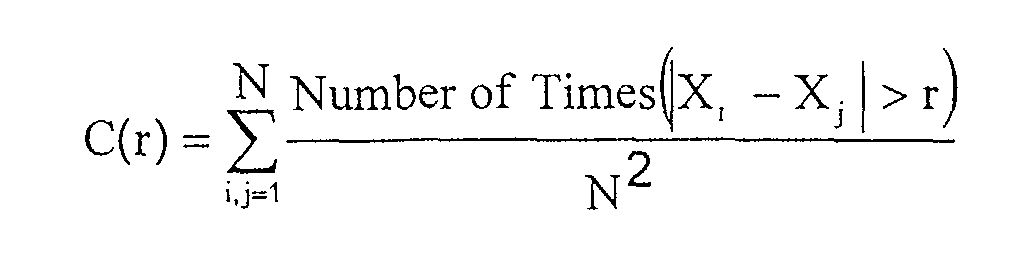
- xi = signal x at time instant I
- N = total number of samples
- r = radius of neighborhood
- C = correlation integral
-
- In still another embodiment shown in Figure 6, stall measures are determined using a
signal processing system 90 having an auto-regression(AR) model augmented by a second order Gauss-Markov process. Here again, for elements in common with the schematic of Figure 2, similar reference numerals are employed, but with a prefix "3" added. The AR model is illustrated in state variable form which may be constructed from the offline time-series analysis by offline computations unit 34 (Figure 2). The AR Gauss Markov model follows the equations: - Equation (1) sets forth a relationship between the dynamic state of
compressor 14, theplant model 44, andmeasurement model 46, where x represents a dynamic state; "A" represents the plant model; "G" represents the measurement model; "w" is a noise vector. Equation (2) sets forth a relation between output (y) ofcompressor 14, the process model "C", and the affect of noise "v" on output, and "H" indicates the effect of sensor noise on the output. - Referring now to FIG. 7, a graph charting pressure ratio on the Y-axis and airflow on the X-axis is illustrated. As previously discussed, the acceleration of a gas turbine engine may result in a compressor stall or surge wherein the pressure ratio of the compressor may initially exceed some critical value, resulting in a subsequent drastic reduction of compressor pressure ratio and airflow delivered to the combustor. If such a condition is undetected and allowed to continue, the combustor temperatures and vibratory stresses induced in the compressor may become sufficiently high to cause damage to the gas turbine. Thus, the corrective actions initiated in response to detection of an onset or precursor to a compressor stall may prevent the problems identified above from taking place. The OPLINE identified at 92 depicts an operating line that the
compressor 14 is operating at. As the airflow is increased into thecompressor 14, the compressor may be operated at an increased pressure ratio. Themargin 96 indicates that once thegas turbine engine 10 operates at values beyond the values set by the OPLINE as illustrated in the graph, a signal indicative of onset of a compressor stall is issued. Corrective measures by the real-time control system 42 may have to be initiated withinmargin 96 to avoid a compressor surge and near stall operation of thecompressor 14. - For the sake of good order, various aspects of the invention are set out in the following clauses: -
- 1. A method for pro-actively monitoring and controlling a
compressor 14, comprising: - (a) monitoring at least one compressor parameter;
- (b) analyzing the monitored parameter to obtain time-series data;
- (c) processing the time-series data using a Kalman filter to determine stall precursors;
- (d) comparing the stall precursors with predetermined baseline values to identify compressor degradation;
- (e) performing corrective actions to mitigate compressor degradation to maintain a pre-selected level of compressor operability; and
- (f) iterating said corrective action performing step until the monitored compressor parameter lies within predetermined threshold.
- 2. The method of
clause 1 wherein step(c) further comprising: - i. processing the time-series data to compute dynamic model parameters; and
- ii. combining, in the Kalman filter, the dynamic model parameters and a new measurement of the compressor parameter to produce a filtered estimate.
- 3. The method of clause 2 further comprising:
- iii. computing a standard deviation of difference between the filtered estimate and the new measurement to produce stall precursors.
- 4. The method of clause 3 wherein said corrective actions are initiated by varying operating line parameters.
- 5. The method of clause 3 wherein said corrective actions include reducing the loading on the compressor.
- 6. The method of clause 4 wherein said operating line parameters are set to a near threshold value.
- 7. An apparatus for monitoring the health of a
compressor 14, comprising: - at least one
sensor 30 operatively coupled to the compressor for monitoring at least one compressor parameter; - a
processor system 36, embodying a Kalman filter, operatively coupled to said at least one sensor, said processor system computing stall precursors; - a
comparator 40 that compares the stall precursors with predetermined baseline data; and - a
controller 42 operatively coupled to the comparator, said controller initiating corrective actions to prevent a compressor surge and stall if the stall precursors deviate from the baseline data, said baseline data representing predetermined level of compressor operability. - 8. The apparatus of clause 7 further comprises:
- an analog-to-digital (A/D)
converter 32 operatively coupled to said at least one sensor for sampling and digitizing input data from said at least one sensor; - a
calibration system 34 coupled to said A/D converter, said calibration system performing time-series analysis (t,x) on the monitored parameter to compute dynamic model parameters; and - a look-up-table (LUT) 38 with memory for storing known sets of compressor data including corresponding stall measure data.
- 9. The apparatus of clause 7 wherein the corrective actions are initiated by varying operating limit line parameters.
- 10. The apparatus of clause 9 wherein said operating limit line parameters are set to a near threshold value.
- 11. In a gas turbine of the type having a
compressor 14, acombustor 18, a method for monitoring the health of a compressor comprising: - (a) monitoring at least one compressor parameter;
- (b) analyzing the monitored parameter to obtain time-series data;
- (c) processing the time-series data using a Kalman filter to determine stall precursors;
- (d) comparing the stall precursors with predetermined baseline values to identify compressor degradation;
- (e) performing corrective actions to mitigate compressor degradation to maintain a pre-selected level of compressor operability; and
- (f) iterating said corrective action performing step until the monitored compressor parameter lies within predetermined threshold.
- 12. The method of clause 11 wherein step(c) further comprising:
- i. processing the time-series data to compute dynamic model parameters; and
- ii. combining, in the Kalman filter, the dynamic model parameters and a new measurement of the compressor parameter to produce a filtered estimate.
- 13. The method of
clause 12 further comprising: - iii. computing a standard deviation of difference between the filtered estimate and the new measurement to produce stall precursors.
- 14. The method of clause 11 wherein the corrective actions are initiated by varying operating line parameters.
- 15. The method of
clause 14 wherein the corrective actions further include varying the loading on the compressor. - 16. The method of
clause 14, wherein said operating line parameters are set to a near threshold value. - 17. An apparatus for monitoring and controlling the health of a
compressor 14, comprising: - means 30 for measuring at least one compressor parameter;
- means 36, 60, 70, 90 for computing stall measures;
- means 40 for comparing the stall measures with predetermined baseline values; and
- means 42 for initiating corrective actions if the stall measures deviate from said baseline values.
- 18. The apparatus of clause 17 wherein said means 36 for computing stall measures embodies a Kalman filter.
- 19. The apparatus of clause 17 wherein said means 60 for computing stall measures embodies a Fast Fourier Transform (FFT) algorithm.
- 20. The apparatus of clause 17 wherein said means 70 for computing stall measures embodies a Correlation Integral algorithm.
- 21. The apparatus of clause 17 wherein the corrective actions are initiated by varying operating limit line parameters.
- 22. The apparatus of clause 21 wherein said operating limit line parameters are set to a near threshold value.
- 23. A method for monitoring and controlling the health of a compressor,
comprising:
- providing a
means 30 for monitoring at least one compressor parameter; - providing a
means - providing a
means 40 for comparing the stall measures with predetermined baseline values; and - providing a
means 42 for initiating corrective actions if the stall measures deviate from said baseline values. - 24. An apparatus for monitoring the health of a
compressor 14, comprising: - at least one
sensor 30 operatively coupled to the compressor for monitoring at least one compressor parameter; - a
processor system 60, embodying a temporal Fast Fourier Transform algorithm, operatively coupled to said at least one sensor, said processor system computing stall precursors; - a
comparator 40 that compares the stall precursors with predetermined baseline data; and - a
controller 42 operatively coupled to the comparator, said controller initiating corrective actions to prevent a compressor surge and stall if the stall precursors deviate from the baseline data, said baseline data representing predetermined level of compressor operability. - 25. The apparatus of
clause 24 further comprises: - an analog-to-digital (A/D)
converter 32 operatively coupled to said at least one sensor for sampling and digitizing input data from said at least one sensor; - a
calibration system 34 coupled to said A/D converter, said calibration system performing time-series analysis (t,x) on the monitored parameter; and - a look-up-table (LUT) 38 with memory for storing known sets of compressor data including corresponding stall measure data.
- 26. An apparatus for monitoring the health of a
compressor 14, comprising: - at least one
sensor 30 operatively coupled to the compressor for monitoring at least one compressor parameter; - a
processor system 70, embodying a correlation integral algorithm, operatively coupled to said at least one sensor, said processor system computing stall precursors; - a
comparator 40 that compares the stall precursors with predetermined baseline data; and - a
controller 42 operatively coupled to the comparator, said controller initiating corrective actions to prevent a compressor surge and stall if the stall precursors deviate from the baseline data, said baseline data representing predetermined level of compressor operability. - 27. The apparatus of
clause 26 further comprises: - an analog-to-digital (A/D) 32 converter operatively coupled to said at least one sensor for sampling and digitizing input data from said at least one sensor;
- a
calibration system 34 coupled to said A/D converter, said calibration system performing time-series analysis (t,x) on the monitored parameter; and - a look-up-table (LUT) 38 with memory for storing known sets of compressor data including corresponding stall measure data.
- 28. An apparatus for monitoring the health of a compressor, comprising:
- at least one
sensor 30 operatively coupled to the compressor for monitoring at least one compressor parameter; - a
first processor system 90, embodying an auto-regression model with second order Gauss Markov algorithm, operatively coupled to said at least one sensor; - a
comparator 40 that compares the stall precursors with predetermined baseline data; and - a
controller 42 operatively coupled to the comparator, said controller initiating corrective actions to prevent a compressor surge and stall if the stall precursors deviate from the baseline data, said baseline data representing predetermined level of compressor operability. - 29. The apparatus of clause 28 further comprises:
- an analog-to-digital (A/D) 32 converter operatively coupled to said at least one sensor for sampling and digitizing input data from said at least one sensor;
- a
second processor 36 operatively coupled to said first processor, said second processor embodying a Kalman filter and processing signals received from said first processor to produce a filtered estimate; - a
calibration system 34 coupled to said A/D converter, said calibration system performing time-series analysis (t,x) on the monitored parameter to compute dynamic model parameters; and - a look-up-table (LUT) 38 with memory for storing known sets of compressor data including corresponding stall measure data.
- 30. A method of detecting precursors to rotating stall and surge in a
compressor, the method comprising measuring the pressure and velocity of
gases flowing through the compressor and using a Kalman filter in
combination with offline calibration computations to predict future precursors
to rotating stall and surge, wherein the Kalman filter utilizes:
- a definition of errors and their stochastic behavior in time;
- the relationship between the errors and the measured pressure and velocity values; and
- how the errors influence the prediction of precursors to rotating stall and surge.
- 31. An apparatus for monitoring the health of a
compressor 14, comprising: - at least one
sensor 30 operatively coupled to the compressor for monitoring at least one compressor parameter; - a
processor system - a
comparator 40 that compares the stall precursors with predetermined baseline data; and - a
controller 42 operatively coupled to the comparator, said controller initiating corrective actions to prevent a compressor surge and stall if the stall precursors deviate from the baseline data, said baseline data representing predetermined level of compressor operability. - 32. The apparatus of clause 31 wherein said stall precursor detection algorithm is a Kalman filter.
- 33. The apparatus of clause 31 wherein said stall precursor detection algorithm is a temporal Fast Fourier Transform.
- 34. The apparatus of clause 31 wherein said stall precursor detection algorithm is a correlation integral.
- 35. The apparatus of clause 31 wherein said stall precursor detection algorithm includes an auto-regression model augmented by a second order Gauss-Markov process.
-
Claims (10)
- A method for pro-actively monitoring and controlling a compressor (14), comprising:(a) monitoring at least one compressor parameter;(b) analyzing the monitored parameter to obtain time-series data;(c) processing the time-series data using a Kalman filter to determine stall precursors;(d) comparing the stall precursors with predetermined baseline values to identify compressor degradation;(e) performing corrective actions to mitigate compressor degradation to maintain a pre-selected level of compressor operability; and(f) iterating said corrective action performing step until the monitored compressor parameter lies within predetermined threshold.
- The method of claim 1 wherein step(c) further comprising:i. processing the time-series data to compute dynamic model parameters; andii. combining, in the Kalman filter, the dynamic model parameters and a new measurement of the compressor parameter to produce a filtered estimate.
- The method of claim 2 further comprising:iii. computing a standard deviation of difference between the filtered estimate and the new measurement to produce stall precursors.
- The method of claim 3 wherein said corrective actions are initiated by varying operating line parameters.
- The method of claim 3 wherein said corrective actions include reducing the loading on the compressor.
- The method of claim 4 wherein said operating line parameters are set to a near threshold value.
- An apparatus for monitoring the health of a compressor (14), comprising:at least one sensor (30) operatively coupled to the compressor for monitoring at least one compressor parameter;a processor system (36), embodying a Kalman filter, operatively coupled to said at least one sensor, said processor system computing stall precursors;a comparator (40) that compares the stall precursors with predetermined baseline data; anda controller (42) operatively coupled to the comparator, said controller initiating corrective actions to prevent a compressor surge and stall if the stall precursors deviate from the baseline data, said baseline data representing predetermined level of compressor operability.
- A method for monitoring the health of a compressor in a gas turbine of the type having a compressor (14), a combustor (18), the method comprising:(a) monitoring at least one compressor parameter;(b) analyzing the monitored parameter to obtain time-series data;(c) processing the time-series data using a Kalman filter to determine stall precursors;(d) comparing the stall precursors with predetermined baseline values to identify compressor degradation;(e) performing corrective actions to mitigate compressor degradation to maintain a pre-selected level of compressor operability; and(f) iterating said corrective action performing step until the monitored compressor parameter lies within predetermined threshold.
- An apparatus for monitoring and controlling the health of a compressor (14), comprising:means (30) for measuring at least one compressor parameter;means (36, 60, 70, 90) for computing stall measures;means (40) for comparing the stall measures with predetermined baseline values; and
- A method for monitoring and controlling the health of a compressor, comprising:providing a means (30) for monitoring at least one compressor parameter;providing a means (36, 60, 70, 90) for computing stall measures;providing a means (40) for comparing the stall measures with predetermined baseline values; andproviding a means (42) for initiating corrective actions if the stall measures deviate from said baseline values.
Applications Claiming Priority (2)
| Application Number | Priority Date | Filing Date | Title |
|---|---|---|---|
| US09/835,826 US6532433B2 (en) | 2001-04-17 | 2001-04-17 | Method and apparatus for continuous prediction, monitoring and control of compressor health via detection of precursors to rotating stall and surge |
| US835826 | 2001-04-17 |
Publications (2)
| Publication Number | Publication Date |
|---|---|
| EP1256726A1 true EP1256726A1 (en) | 2002-11-13 |
| EP1256726B1 EP1256726B1 (en) | 2005-04-06 |
Family
ID=25270566
Family Applications (1)
| Application Number | Title | Priority Date | Filing Date |
|---|---|---|---|
| EP02252671A Expired - Lifetime EP1256726B1 (en) | 2001-04-17 | 2002-04-16 | Method and apparatus for continuous prediction, monitoring and control of compressor health via detection of precursors to rotating stall and surge |
Country Status (5)
| Country | Link |
|---|---|
| US (1) | US6532433B2 (en) |
| EP (1) | EP1256726B1 (en) |
| JP (1) | JP2002371989A (en) |
| KR (1) | KR100652978B1 (en) |
| DE (1) | DE60203560T2 (en) |
Cited By (12)
| Publication number | Priority date | Publication date | Assignee | Title |
|---|---|---|---|---|
| EP1847715A1 (en) * | 2006-04-19 | 2007-10-24 | Siemens Aktiengesellschaft | Method for operation of a turbocompressor and turbocompressor |
| EP1908927A1 (en) * | 2006-09-27 | 2008-04-09 | General Electric Company | Method and apparatus for an aerodynamic stability management system |
| US7356999B2 (en) | 2003-10-10 | 2008-04-15 | York International Corporation | System and method for stability control in a centrifugal compressor |
| EP1985862A1 (en) * | 2007-04-26 | 2008-10-29 | Rolls-Royce plc | Controlling operation of a compressor to avoid compressor instability |
| WO2009109446A1 (en) * | 2008-03-05 | 2009-09-11 | Alstom Technology Ltd | Method for regulating a gas turbine in a power plant and power plant to carry out the method |
| US7905102B2 (en) | 2003-10-10 | 2011-03-15 | Johnson Controls Technology Company | Control system |
| EP1548285A3 (en) * | 2003-12-23 | 2012-08-15 | General Electric Company | Method and apparatus for detecting compressor stall precursors |
| WO2014191051A1 (en) * | 2013-05-31 | 2014-12-04 | Abb Technology Ltd | Detecting surge in a compression system |
| EP3045676A1 (en) * | 2015-01-13 | 2016-07-20 | Siemens Aktiengesellschaft | Method for avoiding a rotating stall |
| EP3184756A1 (en) * | 2015-12-22 | 2017-06-28 | General Electric Company | Method and system for stall margin modulation as a function of engine health |
| US9988930B2 (en) | 2014-11-06 | 2018-06-05 | Rolls-Royce Plc | Compressor monitoring method |
| WO2021248746A1 (en) * | 2020-06-10 | 2021-12-16 | 大连理工大学 | Axial flow compressor stall and surge prediction method based on deep learning |
Families Citing this family (71)
| Publication number | Priority date | Publication date | Assignee | Title |
|---|---|---|---|---|
| US20030077179A1 (en) * | 2001-10-19 | 2003-04-24 | Michael Collins | Compressor protection module and system and method incorporating same |
| NO320915B1 (en) * | 2002-07-30 | 2006-02-13 | Dynatrend As | Method and apparatus for determining the operating state of a turbine blade and using the collected state information in a lifetime calculation |
| US7003426B2 (en) * | 2002-10-04 | 2006-02-21 | General Electric Company | Method and system for detecting precursors to compressor stall and surge |
| US6709240B1 (en) * | 2002-11-13 | 2004-03-23 | Eaton Corporation | Method and apparatus of detecting low flow/cavitation in a centrifugal pump |
| US7072797B2 (en) | 2003-08-29 | 2006-07-04 | Honeywell International, Inc. | Trending system and method using monotonic regression |
| CN100386528C (en) * | 2003-09-27 | 2008-05-07 | 宝钢集团上海第一钢铁有限公司 | Method for forecasting surge in turbine compressor |
| US7348082B2 (en) * | 2004-02-05 | 2008-03-25 | General Motors Corporation | Recursive Kalman filter for feedback flow control in PEM fuel cell |
| US20050197834A1 (en) * | 2004-03-03 | 2005-09-08 | General Electric Company | Systems, methods, and an article of manufacture for determining frequency values associated with forces applied to a device |
| GB0426439D0 (en) * | 2004-12-02 | 2005-01-05 | Rolls Royce Plc | Rotating stall |
| US7467614B2 (en) | 2004-12-29 | 2008-12-23 | Honeywell International Inc. | Pedal position and/or pedal change rate for use in control of an engine |
| ATE456010T1 (en) * | 2005-05-30 | 2010-02-15 | Arcelik As | COOLING DEVICE AND CONTROL METHOD |
| US7389773B2 (en) | 2005-08-18 | 2008-06-24 | Honeywell International Inc. | Emissions sensors for fuel control in engines |
| US7462220B2 (en) * | 2005-08-31 | 2008-12-09 | General Electric Company | Methods and systems for detecting filter rupture |
| US7870816B1 (en) * | 2006-02-15 | 2011-01-18 | Lockheed Martin Corporation | Continuous alignment system for fire control |
| JP4890095B2 (en) | 2006-05-19 | 2012-03-07 | 株式会社Ihi | Stall sign detection device and method, and engine control system |
| US20080034753A1 (en) * | 2006-08-15 | 2008-02-14 | Anthony Holmes Furman | Turbocharger Systems and Methods for Operating the Same |
| DE102007035927A1 (en) * | 2007-07-31 | 2009-02-05 | Mtu Aero Engines Gmbh | Control for a gas turbine with actively stabilized compressor |
| WO2009045218A1 (en) | 2007-10-04 | 2009-04-09 | Donovan John J | A video surveillance, storage, and alerting system having network management, hierarchical data storage, video tip processing, and vehicle plate analysis |
| US8013738B2 (en) | 2007-10-04 | 2011-09-06 | Kd Secure, Llc | Hierarchical storage manager (HSM) for intelligent storage of large volumes of data |
| BE1017905A3 (en) * | 2007-10-29 | 2009-11-03 | Atlas Copco Airpower Nv | METHOD FOR AVOIDING AN UNSTABLE STATE OF OPERATION IN CENTRIFUGAL COMPRESSORS AND CENTRIFUGAL COMPRESSORS PROVIDED WITH MEANS OF WHICH THIS METHOD IS AUTOMATICALLY APPLIED. |
| US8060290B2 (en) | 2008-07-17 | 2011-11-15 | Honeywell International Inc. | Configurable automotive controller |
| US7650777B1 (en) * | 2008-07-18 | 2010-01-26 | General Electric Company | Stall and surge detection system and method |
| US7861578B2 (en) * | 2008-07-29 | 2011-01-04 | General Electric Company | Methods and systems for estimating operating parameters of an engine |
| DE102008036305B4 (en) * | 2008-07-31 | 2016-11-03 | Iav Gmbh Ingenieurgesellschaft Auto Und Verkehr | Method for operating a compressor |
| WO2010036614A2 (en) * | 2008-09-26 | 2010-04-01 | Carrier Corporation | Compressor discharge control on a transport refrigeration system |
| US8311684B2 (en) * | 2008-12-17 | 2012-11-13 | Pratt & Whitney Canada Corp. | Output flow control in load compressor |
| US9650909B2 (en) * | 2009-05-07 | 2017-05-16 | General Electric Company | Multi-stage compressor fault detection and protection |
| US11378088B2 (en) * | 2009-06-05 | 2022-07-05 | Johnson Controls Tyco IP Holdings LLP | Control system for centrifugal compressor |
| GB0915616D0 (en) * | 2009-09-08 | 2009-10-07 | Rolls Royce Plc | Surge margin regulation |
| US8620461B2 (en) | 2009-09-24 | 2013-12-31 | Honeywell International, Inc. | Method and system for updating tuning parameters of a controller |
| US8386121B1 (en) | 2009-09-30 | 2013-02-26 | The United States Of America As Represented By The Administrator Of National Aeronautics And Space Administration | Optimized tuner selection for engine performance estimation |
| US8504175B2 (en) | 2010-06-02 | 2013-08-06 | Honeywell International Inc. | Using model predictive control to optimize variable trajectories and system control |
| DE102010046490A1 (en) | 2010-09-24 | 2012-03-29 | Iav Gmbh Ingenieurgesellschaft Auto Und Verkehr | Method for controlling the operating state of fluid flow machines |
| US8712739B2 (en) | 2010-11-19 | 2014-04-29 | General Electric Company | System and method for hybrid risk modeling of turbomachinery |
| US8342010B2 (en) | 2010-12-01 | 2013-01-01 | General Electric Corporation | Surge precursor protection systems and methods |
| US8471702B2 (en) * | 2010-12-22 | 2013-06-25 | General Electric Company | Method and system for compressor health monitoring |
| US8302625B1 (en) * | 2011-06-23 | 2012-11-06 | General Electric Company | Validation of working fluid parameter indicator sensitivity in system with centrifugal machines |
| US9677493B2 (en) | 2011-09-19 | 2017-06-13 | Honeywell Spol, S.R.O. | Coordinated engine and emissions control system |
| US9650934B2 (en) | 2011-11-04 | 2017-05-16 | Honeywell spol.s.r.o. | Engine and aftertreatment optimization system |
| US20130111905A1 (en) | 2011-11-04 | 2013-05-09 | Honeywell Spol. S.R.O. | Integrated optimization and control of an engine and aftertreatment system |
| ITCO20110056A1 (en) | 2011-12-02 | 2013-06-03 | Nuovo Pignone Spa | METHOD AND EQUIPMENT TO DETECT ROTARY STATION AND COMPRESSOR |
| JP6057786B2 (en) * | 2013-03-13 | 2017-01-11 | ヤフー株式会社 | Time-series data analysis device, time-series data analysis method, and program |
| EP3134020B1 (en) * | 2014-04-23 | 2019-12-11 | Johnson & Johnson Surgical Vision, Inc. | Medical device data filtering for real time display |
| US10436059B2 (en) | 2014-05-12 | 2019-10-08 | Simmonds Precision Products, Inc. | Rotating stall detection through ratiometric measure of the sub-synchronous band spectrum |
| US10037026B2 (en) | 2014-09-25 | 2018-07-31 | General Electric Company | Systems and methods for fault analysis |
| EP3051367B1 (en) | 2015-01-28 | 2020-11-25 | Honeywell spol s.r.o. | An approach and system for handling constraints for measured disturbances with uncertain preview |
| EP3056706A1 (en) | 2015-02-16 | 2016-08-17 | Honeywell International Inc. | An approach for aftertreatment system modeling and model identification |
| CN106151085B (en) | 2015-04-09 | 2019-12-03 | 开利公司 | Fluid device surge monitoring method and refrigeration system |
| EP3091212A1 (en) | 2015-05-06 | 2016-11-09 | Honeywell International Inc. | An identification approach for internal combustion engine mean value models |
| EP3125052B1 (en) | 2015-07-31 | 2020-09-02 | Garrett Transportation I Inc. | Quadratic program solver for mpc using variable ordering |
| US10272779B2 (en) | 2015-08-05 | 2019-04-30 | Garrett Transportation I Inc. | System and approach for dynamic vehicle speed optimization |
| US10379133B2 (en) * | 2016-01-20 | 2019-08-13 | Simmonds Precision Products, Inc. | Speed estimation systems |
| US10415492B2 (en) | 2016-01-29 | 2019-09-17 | Garrett Transportation I Inc. | Engine system with inferential sensor |
| RU2016112469A (en) | 2016-04-01 | 2017-10-04 | Фишер-Роузмаунт Системз, Инк. | METHODS AND DEVICE FOR DETECTING AND PREVENTING COMPRESSOR DIVERSION |
| US10036338B2 (en) | 2016-04-26 | 2018-07-31 | Honeywell International Inc. | Condition-based powertrain control system |
| US10124750B2 (en) | 2016-04-26 | 2018-11-13 | Honeywell International Inc. | Vehicle security module system |
| US10047757B2 (en) * | 2016-06-22 | 2018-08-14 | General Electric Company | Predicting a surge event in a compressor of a turbomachine |
| EP3548729B1 (en) | 2016-11-29 | 2023-02-22 | Garrett Transportation I Inc. | An inferential flow sensor |
| DE102016225661A1 (en) * | 2016-12-20 | 2018-06-21 | Robert Bosch Gmbh | Turbo compressor device |
| US10662959B2 (en) | 2017-03-30 | 2020-05-26 | General Electric Company | Systems and methods for compressor anomaly prediction |
| US11057213B2 (en) | 2017-10-13 | 2021-07-06 | Garrett Transportation I, Inc. | Authentication system for electronic control unit on a bus |
| US20190271608A1 (en) * | 2018-03-01 | 2019-09-05 | GM Global Technology Operations LLC | Method to estimate compressor inlet pressure for a turbocharger |
| US20200063651A1 (en) * | 2018-08-27 | 2020-02-27 | Garrett Transportation I Inc. | Method and system for controlling a variable-geometry compressor |
| US10815904B2 (en) * | 2019-03-06 | 2020-10-27 | General Electric Company | Prognostic health management control for adaptive operability recovery for turbine engines |
| DE102019002826A1 (en) * | 2019-04-18 | 2020-10-22 | KSB SE & Co. KGaA | Process for avoiding vibrations in pumps |
| US11149654B2 (en) * | 2020-03-04 | 2021-10-19 | General Electric Company | Systems, program products, and methods for adjusting operating limit (OL) threshold for compressors of gas turbine systems based on mass flow loss |
| CN113869091A (en) * | 2020-06-30 | 2021-12-31 | 中国航发商用航空发动机有限责任公司 | Surge judgment method and device |
| US11391288B2 (en) | 2020-09-09 | 2022-07-19 | General Electric Company | System and method for operating a compressor assembly |
| US11445340B2 (en) * | 2021-01-21 | 2022-09-13 | Flying Cloud Technologies, Inc. | Anomalous subject and device identification based on rolling baseline |
| CN116480615B (en) * | 2023-05-11 | 2025-12-12 | 成都成发科能动力工程有限公司 | Intelligent fault-tolerant control method for axial compressor control system |
| CN120489327A (en) * | 2025-03-31 | 2025-08-15 | 太行国家实验室 | Method, system, medium and equipment for continuously monitoring near stall state voiceprint of air compressor |
Citations (5)
| Publication number | Priority date | Publication date | Assignee | Title |
|---|---|---|---|---|
| EP0315307A2 (en) * | 1987-10-31 | 1989-05-10 | ROLLS-ROYCE plc | Performance data processing system |
| EP0412795A2 (en) * | 1989-08-11 | 1991-02-13 | Kabushiki Kaisha Fuji Seisakusho | A diagnostic system |
| EP0516534A1 (en) * | 1991-05-28 | 1992-12-02 | European Gas Turbines Sa | Method and device for monitoring an apparatus working under variable conditions |
| US5309379A (en) * | 1989-02-07 | 1994-05-03 | Smiths Industries Public Limited Company | Monitoring |
| US6208953B1 (en) * | 1997-07-31 | 2001-03-27 | Sulzer Innotec Ag | Method for monitoring plants with mechanical components |
Family Cites Families (6)
| Publication number | Priority date | Publication date | Assignee | Title |
|---|---|---|---|---|
| CA2082448C (en) * | 1991-05-08 | 2002-04-30 | Christopher Robert Gent | Weapons systems |
| WO1994003862A1 (en) * | 1992-08-10 | 1994-02-17 | Dow Deutschland Inc. | Process and device for monitoring and for controlling of a compressor |
| US5448881A (en) * | 1993-06-09 | 1995-09-12 | United Technologies Corporation | Gas turbine engine control based on inlet pressure distortion |
| US6231306B1 (en) | 1998-11-23 | 2001-05-15 | United Technologies Corporation | Control system for preventing compressor stall |
| US6231301B1 (en) | 1998-12-10 | 2001-05-15 | United Technologies Corporation | Casing treatment for a fluid compressor |
| US6438484B1 (en) * | 2001-05-23 | 2002-08-20 | General Electric Company | Method and apparatus for detecting and compensating for compressor surge in a gas turbine using remote monitoring and diagnostics |
-
2001
- 2001-04-17 US US09/835,826 patent/US6532433B2/en not_active Expired - Fee Related
-
2002
- 2002-04-16 DE DE60203560T patent/DE60203560T2/en not_active Expired - Lifetime
- 2002-04-16 KR KR1020020020705A patent/KR100652978B1/en not_active Expired - Fee Related
- 2002-04-16 JP JP2002112766A patent/JP2002371989A/en active Pending
- 2002-04-16 EP EP02252671A patent/EP1256726B1/en not_active Expired - Lifetime
Patent Citations (5)
| Publication number | Priority date | Publication date | Assignee | Title |
|---|---|---|---|---|
| EP0315307A2 (en) * | 1987-10-31 | 1989-05-10 | ROLLS-ROYCE plc | Performance data processing system |
| US5309379A (en) * | 1989-02-07 | 1994-05-03 | Smiths Industries Public Limited Company | Monitoring |
| EP0412795A2 (en) * | 1989-08-11 | 1991-02-13 | Kabushiki Kaisha Fuji Seisakusho | A diagnostic system |
| EP0516534A1 (en) * | 1991-05-28 | 1992-12-02 | European Gas Turbines Sa | Method and device for monitoring an apparatus working under variable conditions |
| US6208953B1 (en) * | 1997-07-31 | 2001-03-27 | Sulzer Innotec Ag | Method for monitoring plants with mechanical components |
Cited By (15)
| Publication number | Priority date | Publication date | Assignee | Title |
|---|---|---|---|---|
| US7905102B2 (en) | 2003-10-10 | 2011-03-15 | Johnson Controls Technology Company | Control system |
| US7356999B2 (en) | 2003-10-10 | 2008-04-15 | York International Corporation | System and method for stability control in a centrifugal compressor |
| EP1548285A3 (en) * | 2003-12-23 | 2012-08-15 | General Electric Company | Method and apparatus for detecting compressor stall precursors |
| EP1847715A1 (en) * | 2006-04-19 | 2007-10-24 | Siemens Aktiengesellschaft | Method for operation of a turbocompressor and turbocompressor |
| EP1908927A1 (en) * | 2006-09-27 | 2008-04-09 | General Electric Company | Method and apparatus for an aerodynamic stability management system |
| US8087870B2 (en) | 2007-04-26 | 2012-01-03 | Rolls-Royce Plc | Controlling operation of a compressor to avoid surge |
| EP1985862A1 (en) * | 2007-04-26 | 2008-10-29 | Rolls-Royce plc | Controlling operation of a compressor to avoid compressor instability |
| WO2009109446A1 (en) * | 2008-03-05 | 2009-09-11 | Alstom Technology Ltd | Method for regulating a gas turbine in a power plant and power plant to carry out the method |
| US8826670B2 (en) | 2008-03-05 | 2014-09-09 | Alstom Technology Ltd | Method for controlling a gas turbine in a power station, and a power station for carrying out the method |
| WO2014191051A1 (en) * | 2013-05-31 | 2014-12-04 | Abb Technology Ltd | Detecting surge in a compression system |
| US9988930B2 (en) | 2014-11-06 | 2018-06-05 | Rolls-Royce Plc | Compressor monitoring method |
| EP3045676A1 (en) * | 2015-01-13 | 2016-07-20 | Siemens Aktiengesellschaft | Method for avoiding a rotating stall |
| EP3184756A1 (en) * | 2015-12-22 | 2017-06-28 | General Electric Company | Method and system for stall margin modulation as a function of engine health |
| WO2021248746A1 (en) * | 2020-06-10 | 2021-12-16 | 大连理工大学 | Axial flow compressor stall and surge prediction method based on deep learning |
| US12288164B2 (en) | 2020-06-10 | 2025-04-29 | Dalian University Of Technology | Prediction method for stall and surge of axial compressor based on deep learning |
Also Published As
| Publication number | Publication date |
|---|---|
| US20020161550A1 (en) | 2002-10-31 |
| KR20020081119A (en) | 2002-10-26 |
| US6532433B2 (en) | 2003-03-11 |
| DE60203560T2 (en) | 2006-02-09 |
| EP1256726B1 (en) | 2005-04-06 |
| JP2002371989A (en) | 2002-12-26 |
| KR100652978B1 (en) | 2006-11-30 |
| DE60203560D1 (en) | 2005-05-12 |
Similar Documents
| Publication | Publication Date | Title |
|---|---|---|
| EP1256726B1 (en) | Method and apparatus for continuous prediction, monitoring and control of compressor health via detection of precursors to rotating stall and surge | |
| US6438484B1 (en) | Method and apparatus for detecting and compensating for compressor surge in a gas turbine using remote monitoring and diagnostics | |
| US6536284B2 (en) | Method and apparatus for compressor control and operation via detection of stall precursors using frequency demodulation of acoustic signatures | |
| US6506010B1 (en) | Method and apparatus for compressor control and operation in industrial gas turbines using stall precursors | |
| US7003426B2 (en) | Method and system for detecting precursors to compressor stall and surge | |
| JP5552002B2 (en) | Surge margin control | |
| JP5144998B2 (en) | Aerodynamic stability management system and its controller | |
| US8770913B1 (en) | Apparatus and process for rotor creep monitoring | |
| US20100011846A1 (en) | Stall and surge detection system and method | |
| CN1966955A (en) | Model-based iterative estimation of gas turbine engine component qualities | |
| JP4174031B2 (en) | Turbomachine surging limit or blade damage warning | |
| EP2168100A1 (en) | Engine health monitoring | |
| EP3875774B1 (en) | Systems, program products, and methods for adjusting operating limit (ol) threshold for compressors of gas turbine systems based on mass flow loss | |
| KR100678527B1 (en) | Gas turbine engine control system | |
| US6474935B1 (en) | Optical stall precursor sensor apparatus and method for application on axial flow compressors | |
| JPH0816479B2 (en) | Surge prevention device for compressor | |
| JP7176932B2 (en) | Gas turbine control device, gas turbine equipment, gas turbine control method, and gas turbine control program | |
| KR100543671B1 (en) | Compressor swing stall warning device and method using space Fourier coefficient | |
| Gorrell | An experimental study of exit flow patterns in a multistage compressor in rotating stall | |
| KR20220113521A (en) | Turbine Inlet Temperature Calculation Using Acoustics | |
| KR20050057777A (en) | Apparatus and method of rotating stall warning in compressor using traveling wave energy |
Legal Events
| Date | Code | Title | Description |
|---|---|---|---|
| PUAI | Public reference made under article 153(3) epc to a published international application that has entered the european phase |
Free format text: ORIGINAL CODE: 0009012 |
|
| AK | Designated contracting states |
Kind code of ref document: A1 Designated state(s): AT BE CH CY DE DK ES FI FR GB GR IE IT LI LU MC NL PT SE TR |
|
| AX | Request for extension of the european patent |
Free format text: AL;LT;LV;MK;RO;SI |
|
| 17P | Request for examination filed |
Effective date: 20030513 |
|
| 17Q | First examination report despatched |
Effective date: 20030617 |
|
| AKX | Designation fees paid |
Designated state(s): CH DE FR GB IT LI |
|
| GRAP | Despatch of communication of intention to grant a patent |
Free format text: ORIGINAL CODE: EPIDOSNIGR1 |
|
| GRAS | Grant fee paid |
Free format text: ORIGINAL CODE: EPIDOSNIGR3 |
|
| GRAA | (expected) grant |
Free format text: ORIGINAL CODE: 0009210 |
|
| AK | Designated contracting states |
Kind code of ref document: B1 Designated state(s): CH DE FR GB IT LI |
|
| REG | Reference to a national code |
Ref country code: GB Ref legal event code: FG4D |
|
| REG | Reference to a national code |
Ref country code: CH Ref legal event code: EP |
|
| REG | Reference to a national code |
Ref country code: CH Ref legal event code: NV Representative=s name: SERVOPATENT GMBH |
|
| REG | Reference to a national code |
Ref country code: IE Ref legal event code: FG4D |
|
| REF | Corresponds to: |
Ref document number: 60203560 Country of ref document: DE Date of ref document: 20050512 Kind code of ref document: P |
|
| PLBE | No opposition filed within time limit |
Free format text: ORIGINAL CODE: 0009261 |
|
| STAA | Information on the status of an ep patent application or granted ep patent |
Free format text: STATUS: NO OPPOSITION FILED WITHIN TIME LIMIT |
|
| ET | Fr: translation filed | ||
| 26N | No opposition filed |
Effective date: 20060110 |
|
| REG | Reference to a national code |
Ref country code: CH Ref legal event code: PFA Owner name: GENERAL ELECTRIC COMPANY Free format text: GENERAL ELECTRIC COMPANY#1 RIVER ROAD#SCHENECTADY, NY 12345 (US) -TRANSFER TO- GENERAL ELECTRIC COMPANY#1 RIVER ROAD#SCHENECTADY, NY 12345 (US) |
|
| REG | Reference to a national code |
Ref country code: FR Ref legal event code: PLFP Year of fee payment: 14 |
|
| PGFP | Annual fee paid to national office [announced via postgrant information from national office to epo] |
Ref country code: GB Payment date: 20150427 Year of fee payment: 14 Ref country code: CH Payment date: 20150427 Year of fee payment: 14 Ref country code: DE Payment date: 20150429 Year of fee payment: 14 |
|
| PGFP | Annual fee paid to national office [announced via postgrant information from national office to epo] |
Ref country code: IT Payment date: 20150427 Year of fee payment: 14 Ref country code: FR Payment date: 20150417 Year of fee payment: 14 |
|
| REG | Reference to a national code |
Ref country code: DE Ref legal event code: R119 Ref document number: 60203560 Country of ref document: DE |
|
| REG | Reference to a national code |
Ref country code: CH Ref legal event code: PL |
|
| GBPC | Gb: european patent ceased through non-payment of renewal fee |
Effective date: 20160416 |
|
| REG | Reference to a national code |
Ref country code: FR Ref legal event code: ST Effective date: 20161230 |
|
| PG25 | Lapsed in a contracting state [announced via postgrant information from national office to epo] |
Ref country code: FR Free format text: LAPSE BECAUSE OF NON-PAYMENT OF DUE FEES Effective date: 20160502 Ref country code: CH Free format text: LAPSE BECAUSE OF NON-PAYMENT OF DUE FEES Effective date: 20160430 Ref country code: GB Free format text: LAPSE BECAUSE OF NON-PAYMENT OF DUE FEES Effective date: 20160416 Ref country code: LI Free format text: LAPSE BECAUSE OF NON-PAYMENT OF DUE FEES Effective date: 20160430 Ref country code: DE Free format text: LAPSE BECAUSE OF NON-PAYMENT OF DUE FEES Effective date: 20161101 |
|
| PG25 | Lapsed in a contracting state [announced via postgrant information from national office to epo] |
Ref country code: IT Free format text: LAPSE BECAUSE OF NON-PAYMENT OF DUE FEES Effective date: 20160416 |