EP1256576B1 - Fused imidazolium derivatives - Google Patents
Fused imidazolium derivatives Download PDFInfo
- Publication number
- EP1256576B1 EP1256576B1 EP01904433A EP01904433A EP1256576B1 EP 1256576 B1 EP1256576 B1 EP 1256576B1 EP 01904433 A EP01904433 A EP 01904433A EP 01904433 A EP01904433 A EP 01904433A EP 1256576 B1 EP1256576 B1 EP 1256576B1
- Authority
- EP
- European Patent Office
- Prior art keywords
- group
- alkylene
- substituents selected
- methyl
- alkyl
- Prior art date
- Legal status (The legal status is an assumption and is not a legal conclusion. Google has not performed a legal analysis and makes no representation as to the accuracy of the status listed.)
- Expired - Lifetime
Links
- 150000004693 imidazolium salts Chemical class 0.000 title claims abstract description 8
- 125000001424 substituent group Chemical group 0.000 claims abstract description 128
- 150000001875 compounds Chemical class 0.000 claims abstract description 101
- 239000002246 antineoplastic agent Substances 0.000 claims abstract description 10
- 125000001072 heteroaryl group Chemical group 0.000 claims abstract description 10
- 229910003827 NRaRb Inorganic materials 0.000 claims description 78
- 239000000203 mixture Substances 0.000 claims description 32
- -1 halogen ions Chemical class 0.000 claims description 31
- 150000003839 salts Chemical class 0.000 claims description 29
- 229910052736 halogen Inorganic materials 0.000 claims description 23
- 125000004169 (C1-C6) alkyl group Chemical group 0.000 claims description 18
- 125000001997 phenyl group Chemical group [H]C1=C([H])C([H])=C(*)C([H])=C1[H] 0.000 claims description 18
- 125000000623 heterocyclic group Chemical group 0.000 claims description 14
- 125000004432 carbon atom Chemical group C* 0.000 claims description 13
- 229910052760 oxygen Inorganic materials 0.000 claims description 13
- 229910052717 sulfur Inorganic materials 0.000 claims description 13
- 125000002496 methyl group Chemical group [H]C([H])([H])* 0.000 claims description 12
- 229910052757 nitrogen Inorganic materials 0.000 claims description 9
- 125000002947 alkylene group Chemical group 0.000 claims description 8
- 150000001450 anions Chemical class 0.000 claims description 8
- 125000000753 cycloalkyl group Chemical group 0.000 claims description 8
- 125000004076 pyridyl group Chemical group 0.000 claims description 8
- 229920006395 saturated elastomer Polymers 0.000 claims description 8
- 125000003373 pyrazinyl group Chemical group 0.000 claims description 7
- 125000000714 pyrimidinyl group Chemical group 0.000 claims description 7
- 241000283690 Bos taurus Species 0.000 claims description 6
- RAXXELZNTBOGNW-UHFFFAOYSA-O Imidazolium Chemical compound C1=C[NH+]=CN1 RAXXELZNTBOGNW-UHFFFAOYSA-O 0.000 claims description 5
- 125000001309 chloro group Chemical group Cl* 0.000 claims description 5
- 125000002950 monocyclic group Chemical group 0.000 claims description 5
- 125000004189 3,4-dichlorophenyl group Chemical group [H]C1=C([H])C(Cl)=C(Cl)C([H])=C1* 0.000 claims description 4
- 125000002619 bicyclic group Chemical group 0.000 claims description 4
- 125000000392 cycloalkenyl group Chemical group 0.000 claims description 4
- 239000003937 drug carrier Substances 0.000 claims description 4
- 125000001495 ethyl group Chemical group [H]C([H])([H])C([H])([H])* 0.000 claims description 4
- 150000002460 imidazoles Chemical class 0.000 claims description 4
- 125000001797 benzyl group Chemical group [H]C1=C([H])C([H])=C(C([H])=C1[H])C([H])([H])* 0.000 claims description 3
- 239000008194 pharmaceutical composition Substances 0.000 claims description 3
- VKOGTLMFXPCCQS-UHFFFAOYSA-N 1,3-bis(2-methoxyethyl)-2-methyl-5-nitrobenzo[f]benzimidazol-3-ium-4,9-dione Chemical compound O=C1C2=CC=CC([N+]([O-])=O)=C2C(=O)C2=C1N(CCOC)C(C)=[N+]2CCOC VKOGTLMFXPCCQS-UHFFFAOYSA-N 0.000 claims description 2
- BNHMTSNTMIHNFY-UHFFFAOYSA-N 1,3-bis(2-methoxyethyl)-2-methylbenzo[f]benzimidazol-3-ium-4,9-dione Chemical compound O=C1C2=CC=CC=C2C(=O)C2=C1N(CCOC)C(C)=[N+]2CCOC BNHMTSNTMIHNFY-UHFFFAOYSA-N 0.000 claims description 2
- NXEJFJXXYPKBMH-UHFFFAOYSA-N 1-(2-methoxyethyl)-2-methyl-3-(pyridin-2-ylmethyl)benzo[f]benzimidazol-3-ium-4,9-dione Chemical compound O=C1C2=CC=CC=C2C(=O)C2=C1[N+](CCOC)=C(C)N2CC1=CC=CC=N1 NXEJFJXXYPKBMH-UHFFFAOYSA-N 0.000 claims description 2
- ZDQAORYWWXNIDO-UHFFFAOYSA-N 1-(2-methoxyethyl)-2-methyl-3-(pyridin-3-ylmethyl)benzo[f]benzimidazol-3-ium-4,9-dione Chemical compound O=C1C2=CC=CC=C2C(=O)C2=C1N(CCOC)C(C)=[N+]2CC1=CC=CN=C1 ZDQAORYWWXNIDO-UHFFFAOYSA-N 0.000 claims description 2
- GWJDJQNQXPZFNQ-UHFFFAOYSA-N 1-(2-methoxyethyl)-2-methyl-3-(pyridin-4-ylmethyl)benzo[f]benzimidazol-3-ium-4,9-dione Chemical compound O=C1C2=CC=CC=C2C(=O)C2=C1[N+](CCOC)=C(C)N2CC1=CC=NC=C1 GWJDJQNQXPZFNQ-UHFFFAOYSA-N 0.000 claims description 2
- GUFBWYVOOFVTOL-UHFFFAOYSA-O 1-(2-methoxyethyl)-2-methyl-3-[(2-oxo-1h-pyridin-4-yl)methyl]benzo[f]benzimidazol-3-ium-4,9-dione Chemical compound O=C1C2=CC=CC=C2C(=O)C2=C1[N+](CCOC)=C(C)N2CC1=CC=NC(O)=C1 GUFBWYVOOFVTOL-UHFFFAOYSA-O 0.000 claims description 2
- CFOLHXJJUGSLQR-UHFFFAOYSA-N 1-(2-methoxyethyl)-2-methyl-3-[(5-methylpyrazin-2-yl)methyl]benzo[f]benzimidazol-3-ium-4,9-dione Chemical compound O=C1C2=CC=CC=C2C(=O)C2=C1[N+](CCOC)=C(C)N2CC1=CN=C(C)C=N1 CFOLHXJJUGSLQR-UHFFFAOYSA-N 0.000 claims description 2
- KVYVEPNLLRMSLO-UHFFFAOYSA-N 1-(2-methoxyethyl)-3-[(6-methoxypyridin-3-yl)methyl]-2-methylbenzo[f]benzimidazol-3-ium-4,9-dione Chemical compound O=C1C2=CC=CC=C2C(=O)C2=C1[N+](CCOC)=C(C)N2CC1=CC=C(OC)N=C1 KVYVEPNLLRMSLO-UHFFFAOYSA-N 0.000 claims description 2
- YYOVRWAAGVULAB-UHFFFAOYSA-N 2,3-dimethyl-1-(oxolan-2-ylmethyl)benzo[f]benzimidazol-3-ium-4,9-dione Chemical compound CC=1N(C)C(C(C2=CC=CC=C2C2=O)=O)=C2[N+]=1CC1CCCO1 YYOVRWAAGVULAB-UHFFFAOYSA-N 0.000 claims description 2
- CIMQIRWZTASUBJ-UHFFFAOYSA-N 2-methyl-1,3-bis(pyrazin-2-ylmethyl)benzo[f]benzimidazol-3-ium-4,9-dione Chemical compound O=C1C2=CC=CC=C2C(=O)C2=C1[N+](CC=1N=CC=NC=1)=C(C)N2CC1=CN=CC=N1 CIMQIRWZTASUBJ-UHFFFAOYSA-N 0.000 claims description 2
- SNYNLDVHOLRBOB-UHFFFAOYSA-N 3-[(2-chloropyridin-3-yl)methyl]-1-(2-methoxyethyl)-2-methylbenzo[f]benzimidazol-3-ium-4,9-dione Chemical compound O=C1C2=CC=CC=C2C(=O)C2=C1[N+](CCOC)=C(C)N2CC1=CC=CN=C1Cl SNYNLDVHOLRBOB-UHFFFAOYSA-N 0.000 claims description 2
- UFKCALRRZPPOID-UHFFFAOYSA-N 3-[(2-chloropyridin-4-yl)methyl]-1-(2-methoxyethyl)-2-methylbenzo[f]benzimidazol-3-ium-4,9-dione Chemical compound O=C1C2=CC=CC=C2C(=O)C2=C1[N+](CCOC)=C(C)N2CC1=CC=NC(Cl)=C1 UFKCALRRZPPOID-UHFFFAOYSA-N 0.000 claims description 2
- BDSPGXITFVRNOJ-UHFFFAOYSA-N 3-[(4-chlorophenyl)methyl]-1-(2-methoxyethyl)-2-methylbenzo[f]benzimidazol-3-ium-4,9-dione Chemical compound O=C1C2=CC=CC=C2C(=O)C2=C1[N+](CCOC)=C(C)N2CC1=CC=C(Cl)C=C1 BDSPGXITFVRNOJ-UHFFFAOYSA-N 0.000 claims description 2
- KXQHESROBGJEMS-UHFFFAOYSA-N 3-[(4-fluorophenyl)methyl]-1-(2-methoxyethyl)-2-methylbenzo[f]benzimidazol-3-ium-4,9-dione Chemical compound O=C1C2=CC=CC=C2C(=O)C2=C1[N+](CCOC)=C(C)N2CC1=CC=C(F)C=C1 KXQHESROBGJEMS-UHFFFAOYSA-N 0.000 claims description 2
- WEBJZHLLIPABAP-UHFFFAOYSA-N 3-[(6-chloropyridin-3-yl)methyl]-1-(2-methoxyethyl)-2-methylbenzo[f]benzimidazol-3-ium-4,9-dione Chemical compound O=C1C2=CC=CC=C2C(=O)C2=C1[N+](CCOC)=C(C)N2CC1=CC=C(Cl)N=C1 WEBJZHLLIPABAP-UHFFFAOYSA-N 0.000 claims description 2
- BBKHLNLAOTWULD-UHFFFAOYSA-N 3-[2-(2-methoxyethoxy)ethyl]-1-(2-methoxyethyl)-2-methylbenzo[f]benzimidazol-3-ium-4,9-dione Chemical compound O=C1C2=CC=CC=C2C(=O)C2=C1N(CCOCCOC)C(C)=[N+]2CCOC BBKHLNLAOTWULD-UHFFFAOYSA-N 0.000 claims description 2
- XOZPUDILWABART-UHFFFAOYSA-N 3-[2-[2-(2-methoxyethoxy)ethoxy]ethyl]-1-(2-methoxyethyl)-2-methylbenzo[f]benzimidazol-3-ium-4,9-dione Chemical compound O=C1C2=CC=CC=C2C(=O)C2=C1N(CCOCCOCCOC)C(C)=[N+]2CCOC XOZPUDILWABART-UHFFFAOYSA-N 0.000 claims description 2
- QTDPQUIBYHPFNR-UHFFFAOYSA-N 3-[3-(1h-imidazol-5-yl)propyl]-1-(2-methoxyethyl)-2-methylbenzo[f]benzimidazol-3-ium-4,9-dione Chemical compound O=C1C2=CC=CC=C2C(=O)C2=C1[N+](CCOC)=C(C)N2CCCC1=CNC=N1 QTDPQUIBYHPFNR-UHFFFAOYSA-N 0.000 claims description 2
- 125000002147 dimethylamino group Chemical group [H]C([H])([H])N(*)C([H])([H])[H] 0.000 claims description 2
- OTSOOHRUMBRSHZ-UHFFFAOYSA-N sepantronium Chemical compound O=C1C2=CC=CC=C2C(=O)C2=C1[N+](CCOC)=C(C)N2CC1=CN=CC=N1 OTSOOHRUMBRSHZ-UHFFFAOYSA-N 0.000 claims description 2
- 125000000815 N-oxide group Chemical group 0.000 claims 3
- 125000000217 alkyl group Chemical group 0.000 abstract description 52
- 206010028980 Neoplasm Diseases 0.000 abstract description 15
- 230000000259 anti-tumor effect Effects 0.000 abstract description 10
- 231100000053 low toxicity Toxicity 0.000 abstract description 7
- 125000003118 aryl group Chemical group 0.000 abstract description 6
- 239000003814 drug Substances 0.000 abstract description 3
- XEKOWRVHYACXOJ-UHFFFAOYSA-N Ethyl acetate Chemical compound CCOC(C)=O XEKOWRVHYACXOJ-UHFFFAOYSA-N 0.000 description 45
- LFQSCWFLJHTTHZ-UHFFFAOYSA-N Ethanol Chemical compound CCO LFQSCWFLJHTTHZ-UHFFFAOYSA-N 0.000 description 40
- 239000000243 solution Substances 0.000 description 39
- 238000006243 chemical reaction Methods 0.000 description 27
- 238000000034 method Methods 0.000 description 25
- XLYOFNOQVPJJNP-UHFFFAOYSA-N water Chemical compound O XLYOFNOQVPJJNP-UHFFFAOYSA-N 0.000 description 17
- 239000000843 powder Substances 0.000 description 16
- 239000002904 solvent Substances 0.000 description 16
- UHOVQNZJYSORNB-UHFFFAOYSA-N Benzene Chemical compound C1=CC=CC=C1 UHOVQNZJYSORNB-UHFFFAOYSA-N 0.000 description 12
- HEMHJVSKTPXQMS-UHFFFAOYSA-M Sodium hydroxide Chemical compound [OH-].[Na+] HEMHJVSKTPXQMS-UHFFFAOYSA-M 0.000 description 12
- 238000001914 filtration Methods 0.000 description 10
- 239000000543 intermediate Substances 0.000 description 10
- 238000001308 synthesis method Methods 0.000 description 10
- 238000003786 synthesis reaction Methods 0.000 description 10
- ZMXDDKWLCZADIW-UHFFFAOYSA-N N,N-Dimethylformamide Chemical compound CN(C)C=O ZMXDDKWLCZADIW-UHFFFAOYSA-N 0.000 description 9
- 230000015572 biosynthetic process Effects 0.000 description 9
- 239000012267 brine Substances 0.000 description 9
- 210000004027 cell Anatomy 0.000 description 9
- HPALAKNZSZLMCH-UHFFFAOYSA-M sodium;chloride;hydrate Chemical compound O.[Na+].[Cl-] HPALAKNZSZLMCH-UHFFFAOYSA-M 0.000 description 9
- 239000002253 acid Substances 0.000 description 7
- 239000003795 chemical substances by application Substances 0.000 description 7
- 239000012044 organic layer Substances 0.000 description 7
- WFDIJRYMOXRFFG-UHFFFAOYSA-N Acetic anhydride Chemical compound CC(=O)OC(C)=O WFDIJRYMOXRFFG-UHFFFAOYSA-N 0.000 description 6
- YMWUJEATGCHHMB-UHFFFAOYSA-N Dichloromethane Chemical compound ClCCl YMWUJEATGCHHMB-UHFFFAOYSA-N 0.000 description 6
- RTZKZFJDLAIYFH-UHFFFAOYSA-N Diethyl ether Chemical compound CCOCC RTZKZFJDLAIYFH-UHFFFAOYSA-N 0.000 description 6
- IAZDPXIOMUYVGZ-UHFFFAOYSA-N Dimethylsulphoxide Chemical compound CS(C)=O IAZDPXIOMUYVGZ-UHFFFAOYSA-N 0.000 description 6
- PMZURENOXWZQFD-UHFFFAOYSA-L Sodium Sulfate Chemical compound [Na+].[Na+].[O-]S([O-])(=O)=O PMZURENOXWZQFD-UHFFFAOYSA-L 0.000 description 6
- 239000000126 substance Substances 0.000 description 6
- VEXZGXHMUGYJMC-UHFFFAOYSA-N Hydrochloric acid Chemical compound Cl VEXZGXHMUGYJMC-UHFFFAOYSA-N 0.000 description 5
- 206010060862 Prostate cancer Diseases 0.000 description 5
- 208000000236 Prostatic Neoplasms Diseases 0.000 description 5
- 239000007864 aqueous solution Substances 0.000 description 5
- 201000011510 cancer Diseases 0.000 description 5
- 230000010261 cell growth Effects 0.000 description 5
- 238000001816 cooling Methods 0.000 description 5
- 238000010828 elution Methods 0.000 description 5
- 238000010438 heat treatment Methods 0.000 description 5
- 239000012442 inert solvent Substances 0.000 description 5
- 230000005764 inhibitory process Effects 0.000 description 5
- 239000002244 precipitate Substances 0.000 description 5
- 230000004614 tumor growth Effects 0.000 description 5
- 0 CC(C(C(C1C2CCCCC1)=O)N(*)C(*)*C(*)C1CCCC1)C2=O Chemical compound CC(C(C(C1C2CCCCC1)=O)N(*)C(*)*C(*)C1CCCC1)C2=O 0.000 description 4
- HEDRZPFGACZZDS-UHFFFAOYSA-N Chloroform Chemical compound ClC(Cl)Cl HEDRZPFGACZZDS-UHFFFAOYSA-N 0.000 description 4
- AFVFQIVMOAPDHO-UHFFFAOYSA-N Methanesulfonic acid Chemical compound CS(O)(=O)=O AFVFQIVMOAPDHO-UHFFFAOYSA-N 0.000 description 4
- WYURNTSHIVDZCO-UHFFFAOYSA-N Tetrahydrofuran Chemical compound C1CCOC1 WYURNTSHIVDZCO-UHFFFAOYSA-N 0.000 description 4
- 125000003342 alkenyl group Chemical group 0.000 description 4
- 125000000304 alkynyl group Chemical group 0.000 description 4
- 239000002585 base Substances 0.000 description 4
- 230000000694 effects Effects 0.000 description 4
- 238000004992 fast atom bombardment mass spectroscopy Methods 0.000 description 4
- 125000000524 functional group Chemical group 0.000 description 4
- 125000002883 imidazolyl group Chemical group 0.000 description 4
- BWHMMNNQKKPAPP-UHFFFAOYSA-L potassium carbonate Chemical compound [K+].[K+].[O-]C([O-])=O BWHMMNNQKKPAPP-UHFFFAOYSA-L 0.000 description 4
- 125000006239 protecting group Chemical group 0.000 description 4
- 238000010898 silica gel chromatography Methods 0.000 description 4
- 239000007787 solid Substances 0.000 description 4
- QTBSBXVTEAMEQO-UHFFFAOYSA-N Acetic acid Chemical compound CC(O)=O QTBSBXVTEAMEQO-UHFFFAOYSA-N 0.000 description 3
- WEVYAHXRMPXWCK-UHFFFAOYSA-N Acetonitrile Chemical compound CC#N WEVYAHXRMPXWCK-UHFFFAOYSA-N 0.000 description 3
- VHUUQVKOLVNVRT-UHFFFAOYSA-N Ammonium hydroxide Chemical class [NH4+].[OH-] VHUUQVKOLVNVRT-UHFFFAOYSA-N 0.000 description 3
- 239000006144 Dulbecco’s modified Eagle's medium Substances 0.000 description 3
- WMFOQBRAJBCJND-UHFFFAOYSA-M Lithium hydroxide Chemical compound [Li+].[OH-] WMFOQBRAJBCJND-UHFFFAOYSA-M 0.000 description 3
- CSNNHWWHGAXBCP-UHFFFAOYSA-L Magnesium sulfate Chemical compound [Mg+2].[O-][S+2]([O-])([O-])[O-] CSNNHWWHGAXBCP-UHFFFAOYSA-L 0.000 description 3
- OFOBLEOULBTSOW-UHFFFAOYSA-N Malonic acid Chemical compound OC(=O)CC(O)=O OFOBLEOULBTSOW-UHFFFAOYSA-N 0.000 description 3
- OKKJLVBELUTLKV-UHFFFAOYSA-N Methanol Chemical compound OC OKKJLVBELUTLKV-UHFFFAOYSA-N 0.000 description 3
- 150000001204 N-oxides Chemical class 0.000 description 3
- MUBZPKHOEPUJKR-UHFFFAOYSA-N Oxalic acid Chemical compound OC(=O)C(O)=O MUBZPKHOEPUJKR-UHFFFAOYSA-N 0.000 description 3
- KWYUFKZDYYNOTN-UHFFFAOYSA-M Potassium hydroxide Chemical compound [OH-].[K+] KWYUFKZDYYNOTN-UHFFFAOYSA-M 0.000 description 3
- DNIAPMSPPWPWGF-UHFFFAOYSA-N Propylene glycol Chemical compound CC(O)CO DNIAPMSPPWPWGF-UHFFFAOYSA-N 0.000 description 3
- QAOWNCQODCNURD-UHFFFAOYSA-N Sulfuric acid Chemical compound OS(O)(=O)=O QAOWNCQODCNURD-UHFFFAOYSA-N 0.000 description 3
- ZMANZCXQSJIPKH-UHFFFAOYSA-N Triethylamine Chemical compound CCN(CC)CC ZMANZCXQSJIPKH-UHFFFAOYSA-N 0.000 description 3
- 125000005275 alkylenearyl group Chemical group 0.000 description 3
- 238000005576 amination reaction Methods 0.000 description 3
- KRKNYBCHXYNGOX-UHFFFAOYSA-N citric acid Chemical compound OC(=O)CC(O)(C(O)=O)CC(O)=O KRKNYBCHXYNGOX-UHFFFAOYSA-N 0.000 description 3
- 125000001559 cyclopropyl group Chemical group [H]C1([H])C([H])([H])C1([H])* 0.000 description 3
- OAYLNYINCPYISS-UHFFFAOYSA-N ethyl acetate;hexane Chemical compound CCCCCC.CCOC(C)=O OAYLNYINCPYISS-UHFFFAOYSA-N 0.000 description 3
- 125000002541 furyl group Chemical group 0.000 description 3
- 150000002367 halogens Chemical class 0.000 description 3
- 239000004009 herbicide Substances 0.000 description 3
- 125000005842 heteroatom Chemical group 0.000 description 3
- 229910052739 hydrogen Inorganic materials 0.000 description 3
- 239000001257 hydrogen Substances 0.000 description 3
- IXCSERBJSXMMFS-UHFFFAOYSA-N hydrogen chloride Substances Cl.Cl IXCSERBJSXMMFS-UHFFFAOYSA-N 0.000 description 3
- 229910000041 hydrogen chloride Inorganic materials 0.000 description 3
- 238000006460 hydrolysis reaction Methods 0.000 description 3
- 125000001041 indolyl group Chemical group 0.000 description 3
- 230000002401 inhibitory effect Effects 0.000 description 3
- 238000002347 injection Methods 0.000 description 3
- 239000007924 injection Substances 0.000 description 3
- 150000007529 inorganic bases Chemical class 0.000 description 3
- 125000001449 isopropyl group Chemical group [H]C([H])([H])C([H])(*)C([H])([H])[H] 0.000 description 3
- 125000004433 nitrogen atom Chemical group N* 0.000 description 3
- 230000003287 optical effect Effects 0.000 description 3
- 150000007530 organic bases Chemical class 0.000 description 3
- 125000005493 quinolyl group Chemical group 0.000 description 3
- 238000010992 reflux Methods 0.000 description 3
- 239000008247 solid mixture Substances 0.000 description 3
- 239000000725 suspension Substances 0.000 description 3
- 238000010998 test method Methods 0.000 description 3
- 125000001544 thienyl group Chemical group 0.000 description 3
- FRASJONUBLZVQX-UHFFFAOYSA-N 1,4-naphthoquinone Chemical class C1=CC=C2C(=O)C=CC(=O)C2=C1 FRASJONUBLZVQX-UHFFFAOYSA-N 0.000 description 2
- RAXXELZNTBOGNW-UHFFFAOYSA-N 1H-imidazole Chemical class C1=CNC=N1 RAXXELZNTBOGNW-UHFFFAOYSA-N 0.000 description 2
- ABVGDXLCJRFCOD-UHFFFAOYSA-N 1h-benzo[f]benzimidazole-4,9-dione Chemical class O=C1C2=CC=CC=C2C(=O)C2=C1NC=N2 ABVGDXLCJRFCOD-UHFFFAOYSA-N 0.000 description 2
- SVPKNMBRVBMTLB-UHFFFAOYSA-N 2,3-dichloronaphthalene-1,4-dione Chemical compound C1=CC=C2C(=O)C(Cl)=C(Cl)C(=O)C2=C1 SVPKNMBRVBMTLB-UHFFFAOYSA-N 0.000 description 2
- HZAXFHJVJLSVMW-UHFFFAOYSA-N 2-Aminoethan-1-ol Chemical compound NCCO HZAXFHJVJLSVMW-UHFFFAOYSA-N 0.000 description 2
- 206010005003 Bladder cancer Diseases 0.000 description 2
- 108091003079 Bovine Serum Albumin Proteins 0.000 description 2
- 206010006187 Breast cancer Diseases 0.000 description 2
- 208000026310 Breast neoplasm Diseases 0.000 description 2
- 206010009944 Colon cancer Diseases 0.000 description 2
- FEWJPZIEWOKRBE-JCYAYHJZSA-N Dextrotartaric acid Chemical compound OC(=O)[C@H](O)[C@@H](O)C(O)=O FEWJPZIEWOKRBE-JCYAYHJZSA-N 0.000 description 2
- IAZDPXIOMUYVGZ-WFGJKAKNSA-N Dimethyl sulfoxide Chemical compound [2H]C([2H])([2H])S(=O)C([2H])([2H])[2H] IAZDPXIOMUYVGZ-WFGJKAKNSA-N 0.000 description 2
- QUSNBJAOOMFDIB-UHFFFAOYSA-N Ethylamine Chemical compound CCN QUSNBJAOOMFDIB-UHFFFAOYSA-N 0.000 description 2
- VZCYOOQTPOCHFL-OWOJBTEDSA-N Fumaric acid Chemical compound OC(=O)\C=C\C(O)=O VZCYOOQTPOCHFL-OWOJBTEDSA-N 0.000 description 2
- CPELXLSAUQHCOX-UHFFFAOYSA-N Hydrogen bromide Chemical compound Br CPELXLSAUQHCOX-UHFFFAOYSA-N 0.000 description 2
- DGAQECJNVWCQMB-PUAWFVPOSA-M Ilexoside XXIX Chemical compound C[C@@H]1CC[C@@]2(CC[C@@]3(C(=CC[C@H]4[C@]3(CC[C@@H]5[C@@]4(CC[C@@H](C5(C)C)OS(=O)(=O)[O-])C)C)[C@@H]2[C@]1(C)O)C)C(=O)O[C@H]6[C@@H]([C@H]([C@@H]([C@H](O6)CO)O)O)O.[Na+] DGAQECJNVWCQMB-PUAWFVPOSA-M 0.000 description 2
- 208000008839 Kidney Neoplasms Diseases 0.000 description 2
- BAVYZALUXZFZLV-UHFFFAOYSA-N Methylamine Chemical compound NC BAVYZALUXZFZLV-UHFFFAOYSA-N 0.000 description 2
- 241000699666 Mus <mouse, genus> Species 0.000 description 2
- JGFZNNIVVJXRND-UHFFFAOYSA-N N,N-Diisopropylethylamine (DIPEA) Chemical compound CCN(C(C)C)C(C)C JGFZNNIVVJXRND-UHFFFAOYSA-N 0.000 description 2
- 206010061902 Pancreatic neoplasm Diseases 0.000 description 2
- NBIIXXVUZAFLBC-UHFFFAOYSA-N Phosphoric acid Chemical compound OP(O)(O)=O NBIIXXVUZAFLBC-UHFFFAOYSA-N 0.000 description 2
- 206010038389 Renal cancer Diseases 0.000 description 2
- CDBYLPFSWZWCQE-UHFFFAOYSA-L Sodium Carbonate Chemical compound [Na+].[Na+].[O-]C([O-])=O CDBYLPFSWZWCQE-UHFFFAOYSA-L 0.000 description 2
- FAPWRFPIFSIZLT-UHFFFAOYSA-M Sodium chloride Chemical compound [Na+].[Cl-] FAPWRFPIFSIZLT-UHFFFAOYSA-M 0.000 description 2
- WQDUMFSSJAZKTM-UHFFFAOYSA-N Sodium methoxide Chemical compound [Na+].[O-]C WQDUMFSSJAZKTM-UHFFFAOYSA-N 0.000 description 2
- 208000005718 Stomach Neoplasms Diseases 0.000 description 2
- FEWJPZIEWOKRBE-UHFFFAOYSA-N Tartaric acid Natural products [H+].[H+].[O-]C(=O)C(O)C(O)C([O-])=O FEWJPZIEWOKRBE-UHFFFAOYSA-N 0.000 description 2
- 208000007097 Urinary Bladder Neoplasms Diseases 0.000 description 2
- 239000000853 adhesive Substances 0.000 description 2
- 230000001070 adhesive effect Effects 0.000 description 2
- WGQKYBSKWIADBV-UHFFFAOYSA-N benzylamine Chemical compound NCC1=CC=CC=C1 WGQKYBSKWIADBV-UHFFFAOYSA-N 0.000 description 2
- 229910052799 carbon Inorganic materials 0.000 description 2
- 125000003178 carboxy group Chemical group [H]OC(*)=O 0.000 description 2
- 150000001732 carboxylic acid derivatives Chemical class 0.000 description 2
- 239000003153 chemical reaction reagent Substances 0.000 description 2
- 238000004587 chromatography analysis Methods 0.000 description 2
- 208000029742 colonic neoplasm Diseases 0.000 description 2
- XBDQKXXYIPTUBI-UHFFFAOYSA-N dimethylselenoniopropionate Natural products CCC(O)=O XBDQKXXYIPTUBI-UHFFFAOYSA-N 0.000 description 2
- 239000000839 emulsion Substances 0.000 description 2
- CCIVGXIOQKPBKL-UHFFFAOYSA-M ethanesulfonate Chemical compound CCS([O-])(=O)=O CCIVGXIOQKPBKL-UHFFFAOYSA-M 0.000 description 2
- 239000012894 fetal calf serum Substances 0.000 description 2
- 239000000945 filler Substances 0.000 description 2
- 239000000706 filtrate Substances 0.000 description 2
- 210000002196 fr. b Anatomy 0.000 description 2
- 210000003918 fraction a Anatomy 0.000 description 2
- 206010017758 gastric cancer Diseases 0.000 description 2
- 239000008187 granular material Substances 0.000 description 2
- 150000004820 halides Chemical class 0.000 description 2
- 230000002363 herbicidal effect Effects 0.000 description 2
- 150000002431 hydrogen Chemical class 0.000 description 2
- XMBWDFGMSWQBCA-UHFFFAOYSA-N hydrogen iodide Chemical compound I XMBWDFGMSWQBCA-UHFFFAOYSA-N 0.000 description 2
- 238000001727 in vivo Methods 0.000 description 2
- 239000003701 inert diluent Substances 0.000 description 2
- 238000001990 intravenous administration Methods 0.000 description 2
- 201000010982 kidney cancer Diseases 0.000 description 2
- JVTAAEKCZFNVCJ-UHFFFAOYSA-N lactic acid Chemical compound CC(O)C(O)=O JVTAAEKCZFNVCJ-UHFFFAOYSA-N 0.000 description 2
- 239000007788 liquid Substances 0.000 description 2
- HQKMJHAJHXVSDF-UHFFFAOYSA-L magnesium stearate Chemical compound [Mg+2].CCCCCCCCCCCCCCCCCC([O-])=O.CCCCCCCCCCCCCCCCCC([O-])=O HQKMJHAJHXVSDF-UHFFFAOYSA-L 0.000 description 2
- 208000015486 malignant pancreatic neoplasm Diseases 0.000 description 2
- 201000001441 melanoma Diseases 0.000 description 2
- 229940098779 methanesulfonic acid Drugs 0.000 description 2
- BDAGIHXWWSANSR-UHFFFAOYSA-N methanoic acid Natural products OC=O BDAGIHXWWSANSR-UHFFFAOYSA-N 0.000 description 2
- 125000000956 methoxy group Chemical group [H]C([H])([H])O* 0.000 description 2
- 230000001459 mortal effect Effects 0.000 description 2
- QZUINWYTHMCTQK-UHFFFAOYSA-N n-(3-chloro-1,4-dioxonaphthalen-2-yl)-n-(2-methoxyethyl)acetamide Chemical compound C1=CC=C2C(=O)C(N(C(C)=O)CCOC)=C(Cl)C(=O)C2=C1 QZUINWYTHMCTQK-UHFFFAOYSA-N 0.000 description 2
- HABKMYLFAPUVFE-UHFFFAOYSA-N n-[3-(2-methoxyethylamino)-1,4-dioxonaphthalen-2-yl]acetamide Chemical compound C1=CC=C2C(=O)C(NCCOC)=C(NC(C)=O)C(=O)C2=C1 HABKMYLFAPUVFE-UHFFFAOYSA-N 0.000 description 2
- 208000002154 non-small cell lung carcinoma Diseases 0.000 description 2
- 239000003921 oil Substances 0.000 description 2
- 235000019198 oils Nutrition 0.000 description 2
- 238000007254 oxidation reaction Methods 0.000 description 2
- 208000008443 pancreatic carcinoma Diseases 0.000 description 2
- 238000007911 parenteral administration Methods 0.000 description 2
- 239000006187 pill Substances 0.000 description 2
- XUWHAWMETYGRKB-UHFFFAOYSA-N piperidin-2-one Chemical compound O=C1CCCCN1 XUWHAWMETYGRKB-UHFFFAOYSA-N 0.000 description 2
- 229910000027 potassium carbonate Inorganic materials 0.000 description 2
- 238000002360 preparation method Methods 0.000 description 2
- 239000003755 preservative agent Substances 0.000 description 2
- 125000002098 pyridazinyl group Chemical group 0.000 description 2
- 238000007363 ring formation reaction Methods 0.000 description 2
- 229910052708 sodium Inorganic materials 0.000 description 2
- 239000011734 sodium Substances 0.000 description 2
- 239000011780 sodium chloride Substances 0.000 description 2
- 230000007928 solubilization Effects 0.000 description 2
- 238000005063 solubilization Methods 0.000 description 2
- 201000011549 stomach cancer Diseases 0.000 description 2
- 239000003826 tablet Substances 0.000 description 2
- 239000011975 tartaric acid Substances 0.000 description 2
- 235000002906 tartaric acid Nutrition 0.000 description 2
- YLQBMQCUIZJEEH-UHFFFAOYSA-N tetrahydrofuran Natural products C=1C=COC=1 YLQBMQCUIZJEEH-UHFFFAOYSA-N 0.000 description 2
- VZCYOOQTPOCHFL-UHFFFAOYSA-N trans-butenedioic acid Natural products OC(=O)C=CC(O)=O VZCYOOQTPOCHFL-UHFFFAOYSA-N 0.000 description 2
- 208000029729 tumor suppressor gene on chromosome 11 Diseases 0.000 description 2
- 201000005112 urinary bladder cancer Diseases 0.000 description 2
- BJEPYKJPYRNKOW-REOHCLBHSA-N (S)-malic acid Chemical compound OC(=O)[C@@H](O)CC(O)=O BJEPYKJPYRNKOW-REOHCLBHSA-N 0.000 description 1
- RYHBNJHYFVUHQT-UHFFFAOYSA-N 1,4-Dioxane Chemical compound C1COCCO1 RYHBNJHYFVUHQT-UHFFFAOYSA-N 0.000 description 1
- UFMKVXKZOQVHHO-UHFFFAOYSA-M 1-(2-hydroxyethyl)-2,3-dimethylbenzo[f]benzimidazol-3-ium-4,9-dione;chloride Chemical compound [Cl-].C1=CC=C2C(=O)C(N(CCO)C(=[N+]3C)C)=C3C(=O)C2=C1 UFMKVXKZOQVHHO-UHFFFAOYSA-M 0.000 description 1
- UMNYYNLNCJGKQK-UHFFFAOYSA-M 1-(2-methoxyethyl)-2-methyl-3-(pyridin-4-ylmethyl)benzo[f]benzimidazol-3-ium-4,9-dione;chloride;hydrochloride Chemical compound Cl.[Cl-].O=C1C2=CC=CC=C2C(=O)C2=C1N(CCOC)C(C)=[N+]2CC1=CC=NC=C1 UMNYYNLNCJGKQK-UHFFFAOYSA-M 0.000 description 1
- OBLUQBLVRVEFGU-UHFFFAOYSA-N 1-(2-methoxyethyl)-2-methyl-3-[(2-oxo-1H-pyridin-3-yl)methyl]benzo[f]benzimidazol-3-ium-4,9-dione chloride Chemical compound [Cl-].OC1=NC=CC=C1CN1C(=[N+](C2=C1C(C1=CC=CC=C1C2=O)=O)CCOC)C OBLUQBLVRVEFGU-UHFFFAOYSA-N 0.000 description 1
- 125000004973 1-butenyl group Chemical group C(=CCC)* 0.000 description 1
- 125000004972 1-butynyl group Chemical group [H]C([H])([H])C([H])([H])C#C* 0.000 description 1
- 125000006017 1-propenyl group Chemical group 0.000 description 1
- 125000000530 1-propynyl group Chemical group [H]C([H])([H])C#C* 0.000 description 1
- 238000005160 1H NMR spectroscopy Methods 0.000 description 1
- FNWFJNBTPRYMIN-UHFFFAOYSA-N 2-(dimethylamino)-n-[3-(2-methoxyethylamino)-1,4-dioxonaphthalen-2-yl]-n-methylacetamide Chemical compound C1=CC=C2C(=O)C(NCCOC)=C(N(C)C(=O)CN(C)C)C(=O)C2=C1 FNWFJNBTPRYMIN-UHFFFAOYSA-N 0.000 description 1
- AGKVQTZVCHITEU-UHFFFAOYSA-N 2-(dimethylamino)pyridine-3-carbonitrile Chemical compound CN(C)C1=NC=CC=C1C#N AGKVQTZVCHITEU-UHFFFAOYSA-N 0.000 description 1
- WOXFMYVTSLAQMO-UHFFFAOYSA-N 2-Pyridinemethanamine Chemical class NCC1=CC=CC=N1 WOXFMYVTSLAQMO-UHFFFAOYSA-N 0.000 description 1
- 125000004974 2-butenyl group Chemical group C(C=CC)* 0.000 description 1
- 125000000069 2-butynyl group Chemical group [H]C([H])([H])C#CC([H])([H])* 0.000 description 1
- IAPJSKHYZZLKBU-UHFFFAOYSA-N 2-chloro-3-(2-methoxyethylamino)naphthalene-1,4-dione Chemical compound C1=CC=C2C(=O)C(NCCOC)=C(Cl)C(=O)C2=C1 IAPJSKHYZZLKBU-UHFFFAOYSA-N 0.000 description 1
- VJFDLOVYFWJDMA-UHFFFAOYSA-N 2-chloro-3-(2-oxopiperidin-1-yl)naphthalene-1,4-dione Chemical compound O=C1C2=CC=CC=C2C(=O)C(Cl)=C1N1CCCCC1=O VJFDLOVYFWJDMA-UHFFFAOYSA-N 0.000 description 1
- VOILDFZXZBSUTR-UHFFFAOYSA-N 2-chloro-3-(methylamino)naphthalene-1,4-dione Chemical compound C1=CC=C2C(=O)C(NC)=C(Cl)C(=O)C2=C1 VOILDFZXZBSUTR-UHFFFAOYSA-N 0.000 description 1
- HVPWYAVRGAENOM-UHFFFAOYSA-N 2-chloro-3-(pyrazin-2-ylmethylamino)naphthalene-1,4-dione Chemical compound O=C1C2=CC=CC=C2C(=O)C(Cl)=C1NCC1=CN=CC=N1 HVPWYAVRGAENOM-UHFFFAOYSA-N 0.000 description 1
- AFYWRNZKGGQPQP-UHFFFAOYSA-N 2-chloro-n-(3-chloro-1,4-dioxonaphthalen-2-yl)-n-methylacetamide Chemical compound C1=CC=C2C(=O)C(N(C(=O)CCl)C)=C(Cl)C(=O)C2=C1 AFYWRNZKGGQPQP-UHFFFAOYSA-N 0.000 description 1
- YQUXAPWVKIYMJP-UHFFFAOYSA-N 2-chloro-n-[3-(2-methoxyethylamino)-1,4-dioxonaphthalen-2-yl]-n-methylacetamide Chemical compound C1=CC=C2C(=O)C(NCCOC)=C(N(C)C(=O)CCl)C(=O)C2=C1 YQUXAPWVKIYMJP-UHFFFAOYSA-N 0.000 description 1
- 125000002941 2-furyl group Chemical group O1C([*])=C([H])C([H])=C1[H] 0.000 description 1
- ASUDFOJKTJLAIK-UHFFFAOYSA-N 2-methoxyethanamine Chemical compound COCCN ASUDFOJKTJLAIK-UHFFFAOYSA-N 0.000 description 1
- QTBPGOXRUQIORO-UHFFFAOYSA-N 2-methyl-3-propan-2-ylbenzo[f]benzimidazole-4,9-dione Chemical compound O=C1C2=CC=CC=C2C(=O)C2=C1N(C(C)C)C(C)=N2 QTBPGOXRUQIORO-UHFFFAOYSA-N 0.000 description 1
- 125000003903 2-propenyl group Chemical group [H]C([*])([H])C([H])=C([H])[H] 0.000 description 1
- 125000001494 2-propynyl group Chemical group [H]C#CC([H])([H])* 0.000 description 1
- 125000004105 2-pyridyl group Chemical group N1=C([*])C([H])=C([H])C([H])=C1[H] 0.000 description 1
- 125000000175 2-thienyl group Chemical group S1C([*])=C([H])C([H])=C1[H] 0.000 description 1
- XMYUWJAFZGBQNN-UHFFFAOYSA-N 3-(2-methoxyethyl)-2-methylbenzo[f]benzimidazole-4,9-dione Chemical compound O=C1C2=CC=CC=C2C(=O)C2=C1N(CCOC)C(C)=N2 XMYUWJAFZGBQNN-UHFFFAOYSA-N 0.000 description 1
- LRMLNAXJNYRHHZ-UHFFFAOYSA-N 3-(aminomethyl)-n,n-dimethylpyridin-2-amine Chemical compound CN(C)C1=NC=CC=C1CN LRMLNAXJNYRHHZ-UHFFFAOYSA-N 0.000 description 1
- UJQDCYHZDBWGHO-UHFFFAOYSA-M 3-[(6-chloropyridin-3-yl)methyl]-1-(2-methoxyethyl)-2-methylbenzo[f]benzimidazol-3-ium-4,9-dione;chloride Chemical compound [Cl-].O=C1C2=CC=CC=C2C(=O)C2=C1[N+](CCOC)=C(C)N2CC1=CC=C(Cl)N=C1 UJQDCYHZDBWGHO-UHFFFAOYSA-M 0.000 description 1
- BMYNFMYTOJXKLE-UHFFFAOYSA-N 3-azaniumyl-2-hydroxypropanoate Chemical compound NCC(O)C(O)=O BMYNFMYTOJXKLE-UHFFFAOYSA-N 0.000 description 1
- QQFOAAMUMOKXRQ-UHFFFAOYSA-M 3-benzyl-2-methyl-1-propan-2-ylbenzo[f]benzimidazol-3-ium-4,9-dione;bromide Chemical compound [Br-].O=C1C2=CC=CC=C2C(=O)C2=C1[N+](C(C)C)=C(C)N2CC1=CC=CC=C1 QQFOAAMUMOKXRQ-UHFFFAOYSA-M 0.000 description 1
- 125000004975 3-butenyl group Chemical group C(CC=C)* 0.000 description 1
- 125000000474 3-butynyl group Chemical group [H]C#CC([H])([H])C([H])([H])* 0.000 description 1
- NHQDETIJWKXCTC-UHFFFAOYSA-N 3-chloroperbenzoic acid Chemical compound OOC(=O)C1=CC=CC(Cl)=C1 NHQDETIJWKXCTC-UHFFFAOYSA-N 0.000 description 1
- 125000003349 3-pyridyl group Chemical group N1=C([H])C([*])=C([H])C([H])=C1[H] 0.000 description 1
- OSWFIVFLDKOXQC-UHFFFAOYSA-N 4-(3-methoxyphenyl)aniline Chemical compound COC1=CC=CC(C=2C=CC(N)=CC=2)=C1 OSWFIVFLDKOXQC-UHFFFAOYSA-N 0.000 description 1
- 125000000339 4-pyridyl group Chemical group N1=C([H])C([H])=C([*])C([H])=C1[H] 0.000 description 1
- QTBSBXVTEAMEQO-UHFFFAOYSA-M Acetate Chemical compound CC([O-])=O QTBSBXVTEAMEQO-UHFFFAOYSA-M 0.000 description 1
- GUBGYTABKSRVRQ-XLOQQCSPSA-N Alpha-Lactose Chemical compound O[C@@H]1[C@@H](O)[C@@H](O)[C@@H](CO)O[C@H]1O[C@@H]1[C@@H](CO)O[C@H](O)[C@H](O)[C@H]1O GUBGYTABKSRVRQ-XLOQQCSPSA-N 0.000 description 1
- 238000011729 BALB/c nude mouse Methods 0.000 description 1
- 241000894006 Bacteria Species 0.000 description 1
- 125000000882 C2-C6 alkenyl group Chemical group 0.000 description 1
- 125000003601 C2-C6 alkynyl group Chemical group 0.000 description 1
- OYPRJOBELJOOCE-UHFFFAOYSA-N Calcium Chemical compound [Ca] OYPRJOBELJOOCE-UHFFFAOYSA-N 0.000 description 1
- BVKZGUZCCUSVTD-UHFFFAOYSA-L Carbonate Chemical compound [O-]C([O-])=O BVKZGUZCCUSVTD-UHFFFAOYSA-L 0.000 description 1
- VGCXGMAHQTYDJK-UHFFFAOYSA-N Chloroacetyl chloride Chemical compound ClCC(Cl)=O VGCXGMAHQTYDJK-UHFFFAOYSA-N 0.000 description 1
- 102000008186 Collagen Human genes 0.000 description 1
- 108010035532 Collagen Proteins 0.000 description 1
- FBPFZTCFMRRESA-KVTDHHQDSA-N D-Mannitol Chemical compound OC[C@@H](O)[C@@H](O)[C@H](O)[C@H](O)CO FBPFZTCFMRRESA-KVTDHHQDSA-N 0.000 description 1
- 201000008808 Fibrosarcoma Diseases 0.000 description 1
- KRHYYFGTRYWZRS-UHFFFAOYSA-N Fluorane Chemical compound F KRHYYFGTRYWZRS-UHFFFAOYSA-N 0.000 description 1
- WQZGKKKJIJFFOK-GASJEMHNSA-N Glucose Natural products OC[C@H]1OC(O)[C@H](O)[C@@H](O)[C@@H]1O WQZGKKKJIJFFOK-GASJEMHNSA-N 0.000 description 1
- WHUUTDBJXJRKMK-UHFFFAOYSA-N Glutamic acid Natural products OC(=O)C(N)CCC(O)=O WHUUTDBJXJRKMK-UHFFFAOYSA-N 0.000 description 1
- UFHFLCQGNIYNRP-UHFFFAOYSA-N Hydrogen Chemical compound [H][H] UFHFLCQGNIYNRP-UHFFFAOYSA-N 0.000 description 1
- 229920002153 Hydroxypropyl cellulose Polymers 0.000 description 1
- AHLPHDHHMVZTML-BYPYZUCNSA-N L-Ornithine Chemical compound NCCC[C@H](N)C(O)=O AHLPHDHHMVZTML-BYPYZUCNSA-N 0.000 description 1
- CKLJMWTZIZZHCS-REOHCLBHSA-N L-aspartic acid Chemical compound OC(=O)[C@@H](N)CC(O)=O CKLJMWTZIZZHCS-REOHCLBHSA-N 0.000 description 1
- WHUUTDBJXJRKMK-VKHMYHEASA-N L-glutamic acid Chemical compound OC(=O)[C@@H](N)CCC(O)=O WHUUTDBJXJRKMK-VKHMYHEASA-N 0.000 description 1
- KDXKERNSBIXSRK-YFKPBYRVSA-N L-lysine Chemical compound NCCCC[C@H](N)C(O)=O KDXKERNSBIXSRK-YFKPBYRVSA-N 0.000 description 1
- GUBGYTABKSRVRQ-QKKXKWKRSA-N Lactose Natural products OC[C@H]1O[C@@H](O[C@H]2[C@H](O)[C@@H](O)C(O)O[C@@H]2CO)[C@H](O)[C@@H](O)[C@H]1O GUBGYTABKSRVRQ-QKKXKWKRSA-N 0.000 description 1
- 206010058467 Lung neoplasm malignant Diseases 0.000 description 1
- 206010025323 Lymphomas Diseases 0.000 description 1
- KDXKERNSBIXSRK-UHFFFAOYSA-N Lysine Natural products NCCCCC(N)C(O)=O KDXKERNSBIXSRK-UHFFFAOYSA-N 0.000 description 1
- 239000004472 Lysine Substances 0.000 description 1
- FYYHWMGAXLPEAU-UHFFFAOYSA-N Magnesium Chemical compound [Mg] FYYHWMGAXLPEAU-UHFFFAOYSA-N 0.000 description 1
- 229930195725 Mannitol Natural products 0.000 description 1
- 229920000168 Microcrystalline cellulose Polymers 0.000 description 1
- 241000699670 Mus sp. Species 0.000 description 1
- GRYLNZFGIOXLOG-UHFFFAOYSA-N Nitric acid Chemical compound O[N+]([O-])=O GRYLNZFGIOXLOG-UHFFFAOYSA-N 0.000 description 1
- AHLPHDHHMVZTML-UHFFFAOYSA-N Orn-delta-NH2 Natural products NCCCC(N)C(O)=O AHLPHDHHMVZTML-UHFFFAOYSA-N 0.000 description 1
- UTJLXEIPEHZYQJ-UHFFFAOYSA-N Ornithine Natural products OC(=O)C(C)CCCN UTJLXEIPEHZYQJ-UHFFFAOYSA-N 0.000 description 1
- 206010033128 Ovarian cancer Diseases 0.000 description 1
- 206010061535 Ovarian neoplasm Diseases 0.000 description 1
- 239000002202 Polyethylene glycol Substances 0.000 description 1
- ZLMJMSJWJFRBEC-UHFFFAOYSA-N Potassium Chemical compound [K] ZLMJMSJWJFRBEC-UHFFFAOYSA-N 0.000 description 1
- JUJWROOIHBZHMG-UHFFFAOYSA-N Pyridine Chemical group C1=CC=NC=C1 JUJWROOIHBZHMG-UHFFFAOYSA-N 0.000 description 1
- 239000007868 Raney catalyst Substances 0.000 description 1
- NPXOKRUENSOPAO-UHFFFAOYSA-N Raney nickel Chemical compound [Al].[Ni] NPXOKRUENSOPAO-UHFFFAOYSA-N 0.000 description 1
- 229910000564 Raney nickel Inorganic materials 0.000 description 1
- 208000000453 Skin Neoplasms Diseases 0.000 description 1
- UIIMBOGNXHQVGW-UHFFFAOYSA-M Sodium bicarbonate Chemical class [Na+].OC([O-])=O UIIMBOGNXHQVGW-UHFFFAOYSA-M 0.000 description 1
- 229920002472 Starch Polymers 0.000 description 1
- KDYFGRWQOYBRFD-UHFFFAOYSA-N Succinic acid Natural products OC(=O)CCC(O)=O KDYFGRWQOYBRFD-UHFFFAOYSA-N 0.000 description 1
- QAOWNCQODCNURD-UHFFFAOYSA-L Sulfate Chemical compound [O-]S([O-])(=O)=O QAOWNCQODCNURD-UHFFFAOYSA-L 0.000 description 1
- 208000006105 Uterine Cervical Neoplasms Diseases 0.000 description 1
- 208000002495 Uterine Neoplasms Diseases 0.000 description 1
- 238000010521 absorption reaction Methods 0.000 description 1
- 235000011054 acetic acid Nutrition 0.000 description 1
- 125000002777 acetyl group Chemical group [H]C([H])([H])C(*)=O 0.000 description 1
- 150000008065 acid anhydrides Chemical class 0.000 description 1
- 230000003213 activating effect Effects 0.000 description 1
- 239000011149 active material Substances 0.000 description 1
- 239000013543 active substance Substances 0.000 description 1
- 238000005917 acylation reaction Methods 0.000 description 1
- 125000005073 adamantyl group Chemical group C12(CC3CC(CC(C1)C3)C2)* 0.000 description 1
- 239000000654 additive Substances 0.000 description 1
- 150000001298 alcohols Chemical class 0.000 description 1
- HSFWRNGVRCDJHI-UHFFFAOYSA-N alpha-acetylene Natural products C#C HSFWRNGVRCDJHI-UHFFFAOYSA-N 0.000 description 1
- BJEPYKJPYRNKOW-UHFFFAOYSA-N alpha-hydroxysuccinic acid Natural products OC(=O)C(O)CC(O)=O BJEPYKJPYRNKOW-UHFFFAOYSA-N 0.000 description 1
- 229910052782 aluminium Inorganic materials 0.000 description 1
- XAGFODPZIPBFFR-UHFFFAOYSA-N aluminium Chemical compound [Al] XAGFODPZIPBFFR-UHFFFAOYSA-N 0.000 description 1
- 229910000147 aluminium phosphate Inorganic materials 0.000 description 1
- WMGSQTMJHBYJMQ-UHFFFAOYSA-N aluminum;magnesium;silicate Chemical compound [Mg+2].[Al+3].[O-][Si]([O-])([O-])[O-] WMGSQTMJHBYJMQ-UHFFFAOYSA-N 0.000 description 1
- 230000009435 amidation Effects 0.000 description 1
- 238000007112 amidation reaction Methods 0.000 description 1
- 125000003368 amide group Chemical group 0.000 description 1
- 150000001412 amines Chemical class 0.000 description 1
- 125000003277 amino group Chemical group 0.000 description 1
- 125000004103 aminoalkyl group Chemical group 0.000 description 1
- 150000003863 ammonium salts Chemical class 0.000 description 1
- 238000010171 animal model Methods 0.000 description 1
- 230000000845 anti-microbial effect Effects 0.000 description 1
- 239000003125 aqueous solvent Substances 0.000 description 1
- 150000004945 aromatic hydrocarbons Chemical group 0.000 description 1
- 235000003704 aspartic acid Nutrition 0.000 description 1
- 239000012298 atmosphere Substances 0.000 description 1
- 239000012752 auxiliary agent Substances 0.000 description 1
- 125000003725 azepanyl group Chemical group 0.000 description 1
- 229940077388 benzenesulfonate Drugs 0.000 description 1
- 125000002047 benzodioxolyl group Chemical group O1OC(C2=C1C=CC=C2)* 0.000 description 1
- 125000000499 benzofuranyl group Chemical group O1C(=CC2=C1C=CC=C2)* 0.000 description 1
- 125000005874 benzothiadiazolyl group Chemical group 0.000 description 1
- 125000001164 benzothiazolyl group Chemical group S1C(=NC2=C1C=CC=C2)* 0.000 description 1
- 125000004196 benzothienyl group Chemical group S1C(=CC2=C1C=CC=C2)* 0.000 description 1
- 125000004541 benzoxazolyl group Chemical group O1C(=NC2=C1C=CC=C2)* 0.000 description 1
- AGEZXYOZHKGVCM-UHFFFAOYSA-N benzyl bromide Chemical compound BrCC1=CC=CC=C1 AGEZXYOZHKGVCM-UHFFFAOYSA-N 0.000 description 1
- WQZGKKKJIJFFOK-VFUOTHLCSA-N beta-D-glucose Chemical compound OC[C@H]1O[C@@H](O)[C@H](O)[C@@H](O)[C@@H]1O WQZGKKKJIJFFOK-VFUOTHLCSA-N 0.000 description 1
- OQFSQFPPLPISGP-UHFFFAOYSA-N beta-carboxyaspartic acid Natural products OC(=O)C(N)C(C(O)=O)C(O)=O OQFSQFPPLPISGP-UHFFFAOYSA-N 0.000 description 1
- 229910052794 bromium Inorganic materials 0.000 description 1
- 125000001246 bromo group Chemical group Br* 0.000 description 1
- 244000309464 bull Species 0.000 description 1
- KDYFGRWQOYBRFD-NUQCWPJISA-N butanedioic acid Chemical compound O[14C](=O)CC[14C](O)=O KDYFGRWQOYBRFD-NUQCWPJISA-N 0.000 description 1
- 229910052791 calcium Inorganic materials 0.000 description 1
- 239000011575 calcium Substances 0.000 description 1
- 230000005907 cancer growth Effects 0.000 description 1
- 239000002775 capsule Substances 0.000 description 1
- 239000003054 catalyst Substances 0.000 description 1
- 150000001768 cations Chemical class 0.000 description 1
- 238000004113 cell culture Methods 0.000 description 1
- 201000010881 cervical cancer Diseases 0.000 description 1
- 238000001311 chemical methods and process Methods 0.000 description 1
- 229910052801 chlorine Inorganic materials 0.000 description 1
- 125000000259 cinnolinyl group Chemical group N1=NC(=CC2=CC=CC=C12)* 0.000 description 1
- 235000015165 citric acid Nutrition 0.000 description 1
- 229920001436 collagen Polymers 0.000 description 1
- 238000002425 crystallisation Methods 0.000 description 1
- 230000008025 crystallization Effects 0.000 description 1
- 125000000596 cyclohexenyl group Chemical group C1(=CCCCC1)* 0.000 description 1
- 125000000113 cyclohexyl group Chemical group [H]C1([H])C([H])([H])C([H])([H])C([H])(*)C([H])([H])C1([H])[H] 0.000 description 1
- 125000002433 cyclopentenyl group Chemical group C1(=CCCC1)* 0.000 description 1
- 125000001511 cyclopentyl group Chemical group [H]C1([H])C([H])([H])C([H])([H])C([H])(*)C1([H])[H] 0.000 description 1
- 125000005959 diazepanyl group Chemical group 0.000 description 1
- 239000002270 dispersing agent Substances 0.000 description 1
- 239000012153 distilled water Substances 0.000 description 1
- 239000006196 drop Substances 0.000 description 1
- 238000002451 electron ionisation mass spectrometry Methods 0.000 description 1
- 239000003995 emulsifying agent Substances 0.000 description 1
- 239000002702 enteric coating Substances 0.000 description 1
- 238000009505 enteric coating Methods 0.000 description 1
- 150000002148 esters Chemical class 0.000 description 1
- LJQKCYFTNDAAPC-UHFFFAOYSA-N ethanol;ethyl acetate Chemical compound CCO.CCOC(C)=O LJQKCYFTNDAAPC-UHFFFAOYSA-N 0.000 description 1
- 125000002534 ethynyl group Chemical group [H]C#C* 0.000 description 1
- 238000011156 evaluation Methods 0.000 description 1
- 238000001704 evaporation Methods 0.000 description 1
- 230000008020 evaporation Effects 0.000 description 1
- 238000000605 extraction Methods 0.000 description 1
- 239000003889 eye drop Substances 0.000 description 1
- 229940012356 eye drops Drugs 0.000 description 1
- 239000003885 eye ointment Substances 0.000 description 1
- 239000000796 flavoring agent Substances 0.000 description 1
- 235000019634 flavors Nutrition 0.000 description 1
- 125000003983 fluorenyl group Chemical group C1(=CC=CC=2C3=CC=CC=C3CC12)* 0.000 description 1
- 229910052731 fluorine Inorganic materials 0.000 description 1
- 125000001153 fluoro group Chemical group F* 0.000 description 1
- 235000003599 food sweetener Nutrition 0.000 description 1
- 235000019253 formic acid Nutrition 0.000 description 1
- 238000001640 fractional crystallisation Methods 0.000 description 1
- 239000001530 fumaric acid Substances 0.000 description 1
- 230000002496 gastric effect Effects 0.000 description 1
- 230000002070 germicidal effect Effects 0.000 description 1
- 239000008103 glucose Substances 0.000 description 1
- 235000001727 glucose Nutrition 0.000 description 1
- 235000013922 glutamic acid Nutrition 0.000 description 1
- 239000004220 glutamic acid Substances 0.000 description 1
- 125000005843 halogen group Chemical group 0.000 description 1
- 150000004677 hydrates Chemical class 0.000 description 1
- 150000002430 hydrocarbons Chemical group 0.000 description 1
- 229910000042 hydrogen bromide Inorganic materials 0.000 description 1
- 229910000040 hydrogen fluoride Inorganic materials 0.000 description 1
- 229910000043 hydrogen iodide Inorganic materials 0.000 description 1
- 229940071870 hydroiodic acid Drugs 0.000 description 1
- 230000007062 hydrolysis Effects 0.000 description 1
- 125000002887 hydroxy group Chemical group [H]O* 0.000 description 1
- 239000001863 hydroxypropyl cellulose Substances 0.000 description 1
- 235000010977 hydroxypropyl cellulose Nutrition 0.000 description 1
- 125000005945 imidazopyridyl group Chemical group 0.000 description 1
- 238000011534 incubation Methods 0.000 description 1
- 125000003453 indazolyl group Chemical group N1N=C(C2=C1C=CC=C2)* 0.000 description 1
- 125000003406 indolizinyl group Chemical group C=1(C=CN2C=CC=CC12)* 0.000 description 1
- 229940079865 intestinal antiinfectives imidazole derivative Drugs 0.000 description 1
- 238000010255 intramuscular injection Methods 0.000 description 1
- 239000007927 intramuscular injection Substances 0.000 description 1
- 238000010253 intravenous injection Methods 0.000 description 1
- 125000002346 iodo group Chemical group I* 0.000 description 1
- 150000002500 ions Chemical class 0.000 description 1
- 125000000959 isobutyl group Chemical group [H]C([H])([H])C([H])(C([H])([H])[H])C([H])([H])* 0.000 description 1
- 125000000904 isoindolyl group Chemical group C=1(NC=C2C=CC=CC12)* 0.000 description 1
- 238000002955 isolation Methods 0.000 description 1
- 125000000555 isopropenyl group Chemical group [H]\C([H])=C(\*)C([H])([H])[H] 0.000 description 1
- CUPFSRUOCULQSY-UHFFFAOYSA-N isoquinoline-5,8-dione Chemical class N1=CC=C2C(=O)C=CC(=O)C2=C1 CUPFSRUOCULQSY-UHFFFAOYSA-N 0.000 description 1
- 125000005956 isoquinolyl group Chemical group 0.000 description 1
- 125000001786 isothiazolyl group Chemical group 0.000 description 1
- 125000000842 isoxazolyl group Chemical group 0.000 description 1
- 239000004310 lactic acid Substances 0.000 description 1
- 235000014655 lactic acid Nutrition 0.000 description 1
- 239000008101 lactose Substances 0.000 description 1
- 239000000314 lubricant Substances 0.000 description 1
- 201000005202 lung cancer Diseases 0.000 description 1
- 208000020816 lung neoplasm Diseases 0.000 description 1
- 239000011777 magnesium Substances 0.000 description 1
- 229910052749 magnesium Inorganic materials 0.000 description 1
- 235000019359 magnesium stearate Nutrition 0.000 description 1
- VZCYOOQTPOCHFL-UPHRSURJSA-N maleic acid Chemical compound OC(=O)\C=C/C(O)=O VZCYOOQTPOCHFL-UPHRSURJSA-N 0.000 description 1
- 239000011976 maleic acid Substances 0.000 description 1
- 239000001630 malic acid Substances 0.000 description 1
- 235000011090 malic acid Nutrition 0.000 description 1
- 239000000594 mannitol Substances 0.000 description 1
- 235000010355 mannitol Nutrition 0.000 description 1
- 229910052751 metal Inorganic materials 0.000 description 1
- 239000002184 metal Substances 0.000 description 1
- 239000008108 microcrystalline cellulose Substances 0.000 description 1
- 229940016286 microcrystalline cellulose Drugs 0.000 description 1
- 235000019813 microcrystalline cellulose Nutrition 0.000 description 1
- 150000007522 mineralic acids Chemical class 0.000 description 1
- 238000002156 mixing Methods 0.000 description 1
- 230000004048 modification Effects 0.000 description 1
- 238000012986 modification Methods 0.000 description 1
- 238000002715 modification method Methods 0.000 description 1
- 238000006011 modification reaction Methods 0.000 description 1
- 125000004573 morpholin-4-yl group Chemical group N1(CCOCC1)* 0.000 description 1
- 125000002757 morpholinyl group Chemical group 0.000 description 1
- JHDKABVKOBVNAP-UHFFFAOYSA-N n-(2-methoxyethyl)-n-[3-[(2-methoxypyridin-3-yl)methylamino]-1,4-dioxonaphthalen-2-yl]acetamide Chemical compound O=C1C2=CC=CC=C2C(=O)C(N(C(C)=O)CCOC)=C1NCC1=CC=CN=C1OC JHDKABVKOBVNAP-UHFFFAOYSA-N 0.000 description 1
- OMXMYDUYAUOFRX-UHFFFAOYSA-N n-(3-chloro-1,4-dioxonaphthalen-2-yl)acetamide Chemical compound C1=CC=C2C(=O)C(NC(=O)C)=C(Cl)C(=O)C2=C1 OMXMYDUYAUOFRX-UHFFFAOYSA-N 0.000 description 1
- QZKSEWQZEAYGRI-UHFFFAOYSA-N n-[1,4-dioxo-3-(pyridin-3-ylmethylamino)naphthalen-2-yl]-n-(2-methoxyethyl)acetamide Chemical compound O=C1C2=CC=CC=C2C(=O)C(N(C(C)=O)CCOC)=C1NCC1=CC=CN=C1 QZKSEWQZEAYGRI-UHFFFAOYSA-N 0.000 description 1
- ZTTGHIFBMONENY-UHFFFAOYSA-N n-[1,4-dioxo-3-(pyridin-4-ylmethylamino)naphthalen-2-yl]-n-(2-methoxyethyl)acetamide Chemical compound O=C1C2=CC=CC=C2C(=O)C(N(C(C)=O)CCOC)=C1NCC1=CC=NC=C1 ZTTGHIFBMONENY-UHFFFAOYSA-N 0.000 description 1
- ROWLKXPANPBNBB-UHFFFAOYSA-N n-[3-(2-hydroxyethylamino)-1,4-dioxonaphthalen-2-yl]-n-methylacetamide Chemical compound C1=CC=C2C(=O)C(N(C(C)=O)C)=C(NCCO)C(=O)C2=C1 ROWLKXPANPBNBB-UHFFFAOYSA-N 0.000 description 1
- VPEJYMGZEOSRND-UHFFFAOYSA-N n-[3-(2-methoxyethylamino)-1,4-dioxonaphthalen-2-yl]-n-(pyridin-4-ylmethyl)acetamide Chemical compound O=C1C2=CC=CC=C2C(=O)C(NCCOC)=C1N(C(C)=O)CC1=CC=NC=C1 VPEJYMGZEOSRND-UHFFFAOYSA-N 0.000 description 1
- GSTYCVVTXYSXCS-UHFFFAOYSA-N n-[3-(benzylamino)-1,4-dioxonaphthalen-2-yl]-n-(2-methoxyethyl)acetamide Chemical compound O=C1C2=CC=CC=C2C(=O)C(N(C(C)=O)CCOC)=C1NCC1=CC=CC=C1 GSTYCVVTXYSXCS-UHFFFAOYSA-N 0.000 description 1
- IFYDWYVPVAMGRO-UHFFFAOYSA-N n-[3-(dimethylamino)propyl]tetradecanamide Chemical compound CCCCCCCCCCCCCC(=O)NCCCN(C)C IFYDWYVPVAMGRO-UHFFFAOYSA-N 0.000 description 1
- VTKFLWWKQFZFDY-UHFFFAOYSA-N n-[3-[(6-chloropyridin-3-yl)methylamino]-1,4-dioxonaphthalen-2-yl]-n-(2-methoxyethyl)acetamide Chemical compound O=C1C2=CC=CC=C2C(=O)C(N(C(C)=O)CCOC)=C1NCC1=CC=C(Cl)N=C1 VTKFLWWKQFZFDY-UHFFFAOYSA-N 0.000 description 1
- 125000004108 n-butyl group Chemical group [H]C([H])([H])C([H])([H])C([H])([H])C([H])([H])* 0.000 description 1
- 125000004123 n-propyl group Chemical group [H]C([H])([H])C([H])([H])C([H])([H])* 0.000 description 1
- 125000001624 naphthyl group Chemical group 0.000 description 1
- 229910017604 nitric acid Inorganic materials 0.000 description 1
- 239000002674 ointment Substances 0.000 description 1
- 239000004006 olive oil Substances 0.000 description 1
- 235000008390 olive oil Nutrition 0.000 description 1
- 150000007524 organic acids Chemical class 0.000 description 1
- 229960003104 ornithine Drugs 0.000 description 1
- 125000001715 oxadiazolyl group Chemical group 0.000 description 1
- 235000006408 oxalic acid Nutrition 0.000 description 1
- 125000002971 oxazolyl group Chemical group 0.000 description 1
- 125000004193 piperazinyl group Chemical group 0.000 description 1
- 125000000587 piperidin-1-yl group Chemical group [H]C1([H])N(*)C([H])([H])C([H])([H])C([H])([H])C1([H])[H] 0.000 description 1
- 125000005936 piperidyl group Chemical group 0.000 description 1
- 229920001223 polyethylene glycol Polymers 0.000 description 1
- 239000000244 polyoxyethylene sorbitan monooleate Substances 0.000 description 1
- 235000010482 polyoxyethylene sorbitan monooleate Nutrition 0.000 description 1
- 229940068968 polysorbate 80 Drugs 0.000 description 1
- 229920000053 polysorbate 80 Polymers 0.000 description 1
- 239000001267 polyvinylpyrrolidone Substances 0.000 description 1
- 229920000036 polyvinylpyrrolidone Polymers 0.000 description 1
- 235000013855 polyvinylpyrrolidone Nutrition 0.000 description 1
- 229910052700 potassium Inorganic materials 0.000 description 1
- 239000011591 potassium Substances 0.000 description 1
- 230000002335 preservative effect Effects 0.000 description 1
- 235000019260 propionic acid Nutrition 0.000 description 1
- 238000000746 purification Methods 0.000 description 1
- 239000008213 purified water Substances 0.000 description 1
- 125000004307 pyrazin-2-yl group Chemical group [H]C1=C([H])N=C(*)C([H])=N1 0.000 description 1
- HQIBSDCOMQYSPF-UHFFFAOYSA-N pyrazin-2-ylmethanamine Chemical compound NCC1=CN=CC=N1 HQIBSDCOMQYSPF-UHFFFAOYSA-N 0.000 description 1
- 125000003226 pyrazolyl group Chemical group 0.000 description 1
- ILVXOBCQQYKLDS-UHFFFAOYSA-N pyridine N-oxide Chemical compound [O-][N+]1=CC=CC=C1 ILVXOBCQQYKLDS-UHFFFAOYSA-N 0.000 description 1
- 125000004527 pyrimidin-4-yl group Chemical group N1=CN=C(C=C1)* 0.000 description 1
- 125000000719 pyrrolidinyl group Chemical group 0.000 description 1
- 125000000168 pyrrolyl group Chemical group 0.000 description 1
- 125000002294 quinazolinyl group Chemical group N1=C(N=CC2=CC=CC=C12)* 0.000 description 1
- IUVKMZGDUIUOCP-BTNSXGMBSA-N quinbolone Chemical compound O([C@H]1CC[C@H]2[C@H]3[C@@H]([C@]4(C=CC(=O)C=C4CC3)C)CC[C@@]21C)C1=CCCC1 IUVKMZGDUIUOCP-BTNSXGMBSA-N 0.000 description 1
- 125000001567 quinoxalinyl group Chemical group N1=C(C=NC2=CC=CC=C12)* 0.000 description 1
- 125000004621 quinuclidinyl group Chemical group N12C(CC(CC1)CC2)* 0.000 description 1
- 238000001953 recrystallisation Methods 0.000 description 1
- 201000000849 skin cancer Diseases 0.000 description 1
- 229910000029 sodium carbonate Inorganic materials 0.000 description 1
- 239000012453 solvate Substances 0.000 description 1
- 239000003381 stabilizer Substances 0.000 description 1
- 239000008107 starch Substances 0.000 description 1
- 235000019698 starch Nutrition 0.000 description 1
- 239000007858 starting material Substances 0.000 description 1
- 239000008223 sterile water Substances 0.000 description 1
- 125000000547 substituted alkyl group Chemical group 0.000 description 1
- 238000006467 substitution reaction Methods 0.000 description 1
- 239000000829 suppository Substances 0.000 description 1
- 239000000375 suspending agent Substances 0.000 description 1
- 239000003765 sweetening agent Substances 0.000 description 1
- 238000010189 synthetic method Methods 0.000 description 1
- 239000006188 syrup Substances 0.000 description 1
- 235000020357 syrup Nutrition 0.000 description 1
- 125000003718 tetrahydrofuranyl group Chemical group 0.000 description 1
- 125000001412 tetrahydropyranyl group Chemical group 0.000 description 1
- 125000003831 tetrazolyl group Chemical group 0.000 description 1
- 229940124597 therapeutic agent Drugs 0.000 description 1
- 230000001225 therapeutic effect Effects 0.000 description 1
- 125000001113 thiadiazolyl group Chemical group 0.000 description 1
- 125000000335 thiazolyl group Chemical group 0.000 description 1
- 239000012929 tonicity agent Substances 0.000 description 1
- 231100000820 toxicity test Toxicity 0.000 description 1
- 125000004306 triazinyl group Chemical group 0.000 description 1
- 125000001425 triazolyl group Chemical group 0.000 description 1
- 238000013414 tumor xenograft model Methods 0.000 description 1
- 206010046766 uterine cancer Diseases 0.000 description 1
- 235000013311 vegetables Nutrition 0.000 description 1
- 125000000391 vinyl group Chemical group [H]C([*])=C([H])[H] 0.000 description 1
- 229920002554 vinyl polymer Polymers 0.000 description 1
Classifications
-
- C—CHEMISTRY; METALLURGY
- C07—ORGANIC CHEMISTRY
- C07D—HETEROCYCLIC COMPOUNDS
- C07D213/00—Heterocyclic compounds containing six-membered rings, not condensed with other rings, with one nitrogen atom as the only ring hetero atom and three or more double bonds between ring members or between ring members and non-ring members
- C07D213/02—Heterocyclic compounds containing six-membered rings, not condensed with other rings, with one nitrogen atom as the only ring hetero atom and three or more double bonds between ring members or between ring members and non-ring members having three double bonds between ring members or between ring members and non-ring members
- C07D213/04—Heterocyclic compounds containing six-membered rings, not condensed with other rings, with one nitrogen atom as the only ring hetero atom and three or more double bonds between ring members or between ring members and non-ring members having three double bonds between ring members or between ring members and non-ring members having no bond between the ring nitrogen atom and a non-ring member or having only hydrogen or carbon atoms directly attached to the ring nitrogen atom
- C07D213/60—Heterocyclic compounds containing six-membered rings, not condensed with other rings, with one nitrogen atom as the only ring hetero atom and three or more double bonds between ring members or between ring members and non-ring members having three double bonds between ring members or between ring members and non-ring members having no bond between the ring nitrogen atom and a non-ring member or having only hydrogen or carbon atoms directly attached to the ring nitrogen atom with hetero atoms or with carbon atoms having three bonds to hetero atoms with at the most one bond to halogen, e.g. ester or nitrile radicals, directly attached to ring carbon atoms
- C07D213/62—Oxygen or sulfur atoms
- C07D213/63—One oxygen atom
- C07D213/64—One oxygen atom attached in position 2 or 6
-
- A—HUMAN NECESSITIES
- A61—MEDICAL OR VETERINARY SCIENCE; HYGIENE
- A61K—PREPARATIONS FOR MEDICAL, DENTAL OR TOILETRY PURPOSES
- A61K31/00—Medicinal preparations containing organic active ingredients
- A61K31/33—Heterocyclic compounds
- A61K31/335—Heterocyclic compounds having oxygen as the only ring hetero atom, e.g. fungichromin
- A61K31/357—Heterocyclic compounds having oxygen as the only ring hetero atom, e.g. fungichromin having two or more oxygen atoms in the same ring, e.g. crown ethers, guanadrel
- A61K31/36—Compounds containing methylenedioxyphenyl groups, e.g. sesamin
-
- A—HUMAN NECESSITIES
- A61—MEDICAL OR VETERINARY SCIENCE; HYGIENE
- A61K—PREPARATIONS FOR MEDICAL, DENTAL OR TOILETRY PURPOSES
- A61K31/00—Medicinal preparations containing organic active ingredients
- A61K31/33—Heterocyclic compounds
- A61K31/395—Heterocyclic compounds having nitrogen as a ring hetero atom, e.g. guanethidine or rifamycins
- A61K31/41—Heterocyclic compounds having nitrogen as a ring hetero atom, e.g. guanethidine or rifamycins having five-membered rings with two or more ring hetero atoms, at least one of which being nitrogen, e.g. tetrazole
- A61K31/415—1,2-Diazoles
- A61K31/416—1,2-Diazoles condensed with carbocyclic ring systems, e.g. indazole
-
- A—HUMAN NECESSITIES
- A61—MEDICAL OR VETERINARY SCIENCE; HYGIENE
- A61K—PREPARATIONS FOR MEDICAL, DENTAL OR TOILETRY PURPOSES
- A61K31/00—Medicinal preparations containing organic active ingredients
- A61K31/33—Heterocyclic compounds
- A61K31/395—Heterocyclic compounds having nitrogen as a ring hetero atom, e.g. guanethidine or rifamycins
- A61K31/41—Heterocyclic compounds having nitrogen as a ring hetero atom, e.g. guanethidine or rifamycins having five-membered rings with two or more ring hetero atoms, at least one of which being nitrogen, e.g. tetrazole
- A61K31/4164—1,3-Diazoles
- A61K31/4188—1,3-Diazoles condensed with other heterocyclic ring systems, e.g. biotin, sorbinil
-
- A—HUMAN NECESSITIES
- A61—MEDICAL OR VETERINARY SCIENCE; HYGIENE
- A61K—PREPARATIONS FOR MEDICAL, DENTAL OR TOILETRY PURPOSES
- A61K31/00—Medicinal preparations containing organic active ingredients
- A61K31/33—Heterocyclic compounds
- A61K31/395—Heterocyclic compounds having nitrogen as a ring hetero atom, e.g. guanethidine or rifamycins
- A61K31/41—Heterocyclic compounds having nitrogen as a ring hetero atom, e.g. guanethidine or rifamycins having five-membered rings with two or more ring hetero atoms, at least one of which being nitrogen, e.g. tetrazole
- A61K31/42—Oxazoles
- A61K31/424—Oxazoles condensed with heterocyclic ring systems, e.g. clavulanic acid
-
- A—HUMAN NECESSITIES
- A61—MEDICAL OR VETERINARY SCIENCE; HYGIENE
- A61K—PREPARATIONS FOR MEDICAL, DENTAL OR TOILETRY PURPOSES
- A61K31/00—Medicinal preparations containing organic active ingredients
- A61K31/33—Heterocyclic compounds
- A61K31/395—Heterocyclic compounds having nitrogen as a ring hetero atom, e.g. guanethidine or rifamycins
- A61K31/41—Heterocyclic compounds having nitrogen as a ring hetero atom, e.g. guanethidine or rifamycins having five-membered rings with two or more ring hetero atoms, at least one of which being nitrogen, e.g. tetrazole
- A61K31/4245—Oxadiazoles
-
- A—HUMAN NECESSITIES
- A61—MEDICAL OR VETERINARY SCIENCE; HYGIENE
- A61K—PREPARATIONS FOR MEDICAL, DENTAL OR TOILETRY PURPOSES
- A61K31/00—Medicinal preparations containing organic active ingredients
- A61K31/33—Heterocyclic compounds
- A61K31/395—Heterocyclic compounds having nitrogen as a ring hetero atom, e.g. guanethidine or rifamycins
- A61K31/41—Heterocyclic compounds having nitrogen as a ring hetero atom, e.g. guanethidine or rifamycins having five-membered rings with two or more ring hetero atoms, at least one of which being nitrogen, e.g. tetrazole
- A61K31/425—Thiazoles
- A61K31/427—Thiazoles not condensed and containing further heterocyclic rings
-
- A—HUMAN NECESSITIES
- A61—MEDICAL OR VETERINARY SCIENCE; HYGIENE
- A61K—PREPARATIONS FOR MEDICAL, DENTAL OR TOILETRY PURPOSES
- A61K31/00—Medicinal preparations containing organic active ingredients
- A61K31/33—Heterocyclic compounds
- A61K31/395—Heterocyclic compounds having nitrogen as a ring hetero atom, e.g. guanethidine or rifamycins
- A61K31/41—Heterocyclic compounds having nitrogen as a ring hetero atom, e.g. guanethidine or rifamycins having five-membered rings with two or more ring hetero atoms, at least one of which being nitrogen, e.g. tetrazole
- A61K31/425—Thiazoles
- A61K31/429—Thiazoles condensed with heterocyclic ring systems
-
- A—HUMAN NECESSITIES
- A61—MEDICAL OR VETERINARY SCIENCE; HYGIENE
- A61K—PREPARATIONS FOR MEDICAL, DENTAL OR TOILETRY PURPOSES
- A61K31/00—Medicinal preparations containing organic active ingredients
- A61K31/33—Heterocyclic compounds
- A61K31/395—Heterocyclic compounds having nitrogen as a ring hetero atom, e.g. guanethidine or rifamycins
- A61K31/435—Heterocyclic compounds having nitrogen as a ring hetero atom, e.g. guanethidine or rifamycins having six-membered rings with one nitrogen as the only ring hetero atom
- A61K31/4353—Heterocyclic compounds having nitrogen as a ring hetero atom, e.g. guanethidine or rifamycins having six-membered rings with one nitrogen as the only ring hetero atom ortho- or peri-condensed with heterocyclic ring systems
- A61K31/437—Heterocyclic compounds having nitrogen as a ring hetero atom, e.g. guanethidine or rifamycins having six-membered rings with one nitrogen as the only ring hetero atom ortho- or peri-condensed with heterocyclic ring systems the heterocyclic ring system containing a five-membered ring having nitrogen as a ring hetero atom, e.g. indolizine, beta-carboline
-
- A—HUMAN NECESSITIES
- A61—MEDICAL OR VETERINARY SCIENCE; HYGIENE
- A61K—PREPARATIONS FOR MEDICAL, DENTAL OR TOILETRY PURPOSES
- A61K31/00—Medicinal preparations containing organic active ingredients
- A61K31/33—Heterocyclic compounds
- A61K31/395—Heterocyclic compounds having nitrogen as a ring hetero atom, e.g. guanethidine or rifamycins
- A61K31/435—Heterocyclic compounds having nitrogen as a ring hetero atom, e.g. guanethidine or rifamycins having six-membered rings with one nitrogen as the only ring hetero atom
- A61K31/44—Non condensed pyridines; Hydrogenated derivatives thereof
- A61K31/445—Non condensed piperidines, e.g. piperocaine
- A61K31/4453—Non condensed piperidines, e.g. piperocaine only substituted in position 1, e.g. propipocaine, diperodon
-
- A—HUMAN NECESSITIES
- A61—MEDICAL OR VETERINARY SCIENCE; HYGIENE
- A61K—PREPARATIONS FOR MEDICAL, DENTAL OR TOILETRY PURPOSES
- A61K31/00—Medicinal preparations containing organic active ingredients
- A61K31/33—Heterocyclic compounds
- A61K31/395—Heterocyclic compounds having nitrogen as a ring hetero atom, e.g. guanethidine or rifamycins
- A61K31/435—Heterocyclic compounds having nitrogen as a ring hetero atom, e.g. guanethidine or rifamycins having six-membered rings with one nitrogen as the only ring hetero atom
- A61K31/44—Non condensed pyridines; Hydrogenated derivatives thereof
- A61K31/445—Non condensed piperidines, e.g. piperocaine
- A61K31/4468—Non condensed piperidines, e.g. piperocaine having a nitrogen directly attached in position 4, e.g. clebopride, fentanyl
-
- A—HUMAN NECESSITIES
- A61—MEDICAL OR VETERINARY SCIENCE; HYGIENE
- A61K—PREPARATIONS FOR MEDICAL, DENTAL OR TOILETRY PURPOSES
- A61K31/00—Medicinal preparations containing organic active ingredients
- A61K31/33—Heterocyclic compounds
- A61K31/395—Heterocyclic compounds having nitrogen as a ring hetero atom, e.g. guanethidine or rifamycins
- A61K31/435—Heterocyclic compounds having nitrogen as a ring hetero atom, e.g. guanethidine or rifamycins having six-membered rings with one nitrogen as the only ring hetero atom
- A61K31/44—Non condensed pyridines; Hydrogenated derivatives thereof
- A61K31/445—Non condensed piperidines, e.g. piperocaine
- A61K31/4523—Non condensed piperidines, e.g. piperocaine containing further heterocyclic ring systems
- A61K31/454—Non condensed piperidines, e.g. piperocaine containing further heterocyclic ring systems containing a five-membered ring with nitrogen as a ring hetero atom, e.g. pimozide, domperidone
-
- A—HUMAN NECESSITIES
- A61—MEDICAL OR VETERINARY SCIENCE; HYGIENE
- A61K—PREPARATIONS FOR MEDICAL, DENTAL OR TOILETRY PURPOSES
- A61K31/00—Medicinal preparations containing organic active ingredients
- A61K31/33—Heterocyclic compounds
- A61K31/395—Heterocyclic compounds having nitrogen as a ring hetero atom, e.g. guanethidine or rifamycins
- A61K31/435—Heterocyclic compounds having nitrogen as a ring hetero atom, e.g. guanethidine or rifamycins having six-membered rings with one nitrogen as the only ring hetero atom
- A61K31/47—Quinolines; Isoquinolines
-
- A—HUMAN NECESSITIES
- A61—MEDICAL OR VETERINARY SCIENCE; HYGIENE
- A61K—PREPARATIONS FOR MEDICAL, DENTAL OR TOILETRY PURPOSES
- A61K31/00—Medicinal preparations containing organic active ingredients
- A61K31/33—Heterocyclic compounds
- A61K31/395—Heterocyclic compounds having nitrogen as a ring hetero atom, e.g. guanethidine or rifamycins
- A61K31/435—Heterocyclic compounds having nitrogen as a ring hetero atom, e.g. guanethidine or rifamycins having six-membered rings with one nitrogen as the only ring hetero atom
- A61K31/47—Quinolines; Isoquinolines
- A61K31/4709—Non-condensed quinolines and containing further heterocyclic rings
-
- A—HUMAN NECESSITIES
- A61—MEDICAL OR VETERINARY SCIENCE; HYGIENE
- A61K—PREPARATIONS FOR MEDICAL, DENTAL OR TOILETRY PURPOSES
- A61K31/00—Medicinal preparations containing organic active ingredients
- A61K31/33—Heterocyclic compounds
- A61K31/395—Heterocyclic compounds having nitrogen as a ring hetero atom, e.g. guanethidine or rifamycins
- A61K31/495—Heterocyclic compounds having nitrogen as a ring hetero atom, e.g. guanethidine or rifamycins having six-membered rings with two or more nitrogen atoms as the only ring heteroatoms, e.g. piperazine or tetrazines
- A61K31/4965—Non-condensed pyrazines
- A61K31/497—Non-condensed pyrazines containing further heterocyclic rings
-
- A—HUMAN NECESSITIES
- A61—MEDICAL OR VETERINARY SCIENCE; HYGIENE
- A61K—PREPARATIONS FOR MEDICAL, DENTAL OR TOILETRY PURPOSES
- A61K31/00—Medicinal preparations containing organic active ingredients
- A61K31/33—Heterocyclic compounds
- A61K31/395—Heterocyclic compounds having nitrogen as a ring hetero atom, e.g. guanethidine or rifamycins
- A61K31/495—Heterocyclic compounds having nitrogen as a ring hetero atom, e.g. guanethidine or rifamycins having six-membered rings with two or more nitrogen atoms as the only ring heteroatoms, e.g. piperazine or tetrazines
- A61K31/4985—Pyrazines or piperazines ortho- or peri-condensed with heterocyclic ring systems
-
- A—HUMAN NECESSITIES
- A61—MEDICAL OR VETERINARY SCIENCE; HYGIENE
- A61K—PREPARATIONS FOR MEDICAL, DENTAL OR TOILETRY PURPOSES
- A61K31/00—Medicinal preparations containing organic active ingredients
- A61K31/33—Heterocyclic compounds
- A61K31/395—Heterocyclic compounds having nitrogen as a ring hetero atom, e.g. guanethidine or rifamycins
- A61K31/495—Heterocyclic compounds having nitrogen as a ring hetero atom, e.g. guanethidine or rifamycins having six-membered rings with two or more nitrogen atoms as the only ring heteroatoms, e.g. piperazine or tetrazines
- A61K31/50—Pyridazines; Hydrogenated pyridazines
- A61K31/501—Pyridazines; Hydrogenated pyridazines not condensed and containing further heterocyclic rings
-
- A—HUMAN NECESSITIES
- A61—MEDICAL OR VETERINARY SCIENCE; HYGIENE
- A61K—PREPARATIONS FOR MEDICAL, DENTAL OR TOILETRY PURPOSES
- A61K31/00—Medicinal preparations containing organic active ingredients
- A61K31/33—Heterocyclic compounds
- A61K31/395—Heterocyclic compounds having nitrogen as a ring hetero atom, e.g. guanethidine or rifamycins
- A61K31/495—Heterocyclic compounds having nitrogen as a ring hetero atom, e.g. guanethidine or rifamycins having six-membered rings with two or more nitrogen atoms as the only ring heteroatoms, e.g. piperazine or tetrazines
- A61K31/50—Pyridazines; Hydrogenated pyridazines
- A61K31/5025—Pyridazines; Hydrogenated pyridazines ortho- or peri-condensed with heterocyclic ring systems
-
- A—HUMAN NECESSITIES
- A61—MEDICAL OR VETERINARY SCIENCE; HYGIENE
- A61K—PREPARATIONS FOR MEDICAL, DENTAL OR TOILETRY PURPOSES
- A61K31/00—Medicinal preparations containing organic active ingredients
- A61K31/33—Heterocyclic compounds
- A61K31/395—Heterocyclic compounds having nitrogen as a ring hetero atom, e.g. guanethidine or rifamycins
- A61K31/495—Heterocyclic compounds having nitrogen as a ring hetero atom, e.g. guanethidine or rifamycins having six-membered rings with two or more nitrogen atoms as the only ring heteroatoms, e.g. piperazine or tetrazines
- A61K31/505—Pyrimidines; Hydrogenated pyrimidines, e.g. trimethoprim
- A61K31/506—Pyrimidines; Hydrogenated pyrimidines, e.g. trimethoprim not condensed and containing further heterocyclic rings
-
- A—HUMAN NECESSITIES
- A61—MEDICAL OR VETERINARY SCIENCE; HYGIENE
- A61K—PREPARATIONS FOR MEDICAL, DENTAL OR TOILETRY PURPOSES
- A61K31/00—Medicinal preparations containing organic active ingredients
- A61K31/33—Heterocyclic compounds
- A61K31/395—Heterocyclic compounds having nitrogen as a ring hetero atom, e.g. guanethidine or rifamycins
- A61K31/495—Heterocyclic compounds having nitrogen as a ring hetero atom, e.g. guanethidine or rifamycins having six-membered rings with two or more nitrogen atoms as the only ring heteroatoms, e.g. piperazine or tetrazines
- A61K31/505—Pyrimidines; Hydrogenated pyrimidines, e.g. trimethoprim
- A61K31/519—Pyrimidines; Hydrogenated pyrimidines, e.g. trimethoprim ortho- or peri-condensed with heterocyclic rings
-
- A—HUMAN NECESSITIES
- A61—MEDICAL OR VETERINARY SCIENCE; HYGIENE
- A61K—PREPARATIONS FOR MEDICAL, DENTAL OR TOILETRY PURPOSES
- A61K31/00—Medicinal preparations containing organic active ingredients
- A61K31/33—Heterocyclic compounds
- A61K31/395—Heterocyclic compounds having nitrogen as a ring hetero atom, e.g. guanethidine or rifamycins
- A61K31/535—Heterocyclic compounds having nitrogen as a ring hetero atom, e.g. guanethidine or rifamycins having six-membered rings with at least one nitrogen and one oxygen as the ring hetero atoms, e.g. 1,2-oxazines
- A61K31/5375—1,4-Oxazines, e.g. morpholine
-
- A—HUMAN NECESSITIES
- A61—MEDICAL OR VETERINARY SCIENCE; HYGIENE
- A61K—PREPARATIONS FOR MEDICAL, DENTAL OR TOILETRY PURPOSES
- A61K31/00—Medicinal preparations containing organic active ingredients
- A61K31/33—Heterocyclic compounds
- A61K31/395—Heterocyclic compounds having nitrogen as a ring hetero atom, e.g. guanethidine or rifamycins
- A61K31/55—Heterocyclic compounds having nitrogen as a ring hetero atom, e.g. guanethidine or rifamycins having seven-membered rings, e.g. azelastine, pentylenetetrazole
- A61K31/551—Heterocyclic compounds having nitrogen as a ring hetero atom, e.g. guanethidine or rifamycins having seven-membered rings, e.g. azelastine, pentylenetetrazole having two nitrogen atoms, e.g. dilazep
-
- A—HUMAN NECESSITIES
- A61—MEDICAL OR VETERINARY SCIENCE; HYGIENE
- A61P—SPECIFIC THERAPEUTIC ACTIVITY OF CHEMICAL COMPOUNDS OR MEDICINAL PREPARATIONS
- A61P35/00—Antineoplastic agents
-
- C—CHEMISTRY; METALLURGY
- C07—ORGANIC CHEMISTRY
- C07C—ACYCLIC OR CARBOCYCLIC COMPOUNDS
- C07C233/00—Carboxylic acid amides
- C07C233/01—Carboxylic acid amides having carbon atoms of carboxamide groups bound to hydrogen atoms or to acyclic carbon atoms
- C07C233/34—Carboxylic acid amides having carbon atoms of carboxamide groups bound to hydrogen atoms or to acyclic carbon atoms having the nitrogen atom of at least one of the carboxamide groups bound to a carbon atom of a hydrocarbon radical substituted by amino groups
- C07C233/41—Carboxylic acid amides having carbon atoms of carboxamide groups bound to hydrogen atoms or to acyclic carbon atoms having the nitrogen atom of at least one of the carboxamide groups bound to a carbon atom of a hydrocarbon radical substituted by amino groups with the substituted hydrocarbon radical bound to the nitrogen atom of the carboxamide group by a carbon atom of a ring other than a six-membered aromatic ring
-
- C—CHEMISTRY; METALLURGY
- C07—ORGANIC CHEMISTRY
- C07C—ACYCLIC OR CARBOCYCLIC COMPOUNDS
- C07C235/00—Carboxylic acid amides, the carbon skeleton of the acid part being further substituted by oxygen atoms
- C07C235/02—Carboxylic acid amides, the carbon skeleton of the acid part being further substituted by oxygen atoms having carbon atoms of carboxamide groups bound to acyclic carbon atoms and singly-bound oxygen atoms bound to the same carbon skeleton
- C07C235/04—Carboxylic acid amides, the carbon skeleton of the acid part being further substituted by oxygen atoms having carbon atoms of carboxamide groups bound to acyclic carbon atoms and singly-bound oxygen atoms bound to the same carbon skeleton the carbon skeleton being acyclic and saturated
- C07C235/14—Carboxylic acid amides, the carbon skeleton of the acid part being further substituted by oxygen atoms having carbon atoms of carboxamide groups bound to acyclic carbon atoms and singly-bound oxygen atoms bound to the same carbon skeleton the carbon skeleton being acyclic and saturated having the nitrogen atom of at least one of the carboxamide groups bound to a carbon atom of a ring other than a six-membered aromatic ring
-
- C—CHEMISTRY; METALLURGY
- C07—ORGANIC CHEMISTRY
- C07C—ACYCLIC OR CARBOCYCLIC COMPOUNDS
- C07C237/00—Carboxylic acid amides, the carbon skeleton of the acid part being further substituted by amino groups
- C07C237/02—Carboxylic acid amides, the carbon skeleton of the acid part being further substituted by amino groups having the carbon atoms of the carboxamide groups bound to acyclic carbon atoms of the carbon skeleton
- C07C237/04—Carboxylic acid amides, the carbon skeleton of the acid part being further substituted by amino groups having the carbon atoms of the carboxamide groups bound to acyclic carbon atoms of the carbon skeleton the carbon skeleton being acyclic and saturated
-
- C—CHEMISTRY; METALLURGY
- C07—ORGANIC CHEMISTRY
- C07C—ACYCLIC OR CARBOCYCLIC COMPOUNDS
- C07C255/00—Carboxylic acid nitriles
- C07C255/01—Carboxylic acid nitriles having cyano groups bound to acyclic carbon atoms
- C07C255/24—Carboxylic acid nitriles having cyano groups bound to acyclic carbon atoms containing cyano groups and singly-bound nitrogen atoms, not being further bound to other hetero atoms, bound to the same saturated acyclic carbon skeleton
-
- C—CHEMISTRY; METALLURGY
- C07—ORGANIC CHEMISTRY
- C07C—ACYCLIC OR CARBOCYCLIC COMPOUNDS
- C07C255/00—Carboxylic acid nitriles
- C07C255/01—Carboxylic acid nitriles having cyano groups bound to acyclic carbon atoms
- C07C255/24—Carboxylic acid nitriles having cyano groups bound to acyclic carbon atoms containing cyano groups and singly-bound nitrogen atoms, not being further bound to other hetero atoms, bound to the same saturated acyclic carbon skeleton
- C07C255/25—Aminoacetonitriles
-
- C—CHEMISTRY; METALLURGY
- C07—ORGANIC CHEMISTRY
- C07C—ACYCLIC OR CARBOCYCLIC COMPOUNDS
- C07C255/00—Carboxylic acid nitriles
- C07C255/49—Carboxylic acid nitriles having cyano groups bound to carbon atoms of six-membered aromatic rings of a carbon skeleton
- C07C255/58—Carboxylic acid nitriles having cyano groups bound to carbon atoms of six-membered aromatic rings of a carbon skeleton containing cyano groups and singly-bound nitrogen atoms, not being further bound to other hetero atoms, bound to the carbon skeleton
-
- C—CHEMISTRY; METALLURGY
- C07—ORGANIC CHEMISTRY
- C07C—ACYCLIC OR CARBOCYCLIC COMPOUNDS
- C07C259/00—Compounds containing carboxyl groups, an oxygen atom of a carboxyl group being replaced by a nitrogen atom, this nitrogen atom being further bound to an oxygen atom and not being part of nitro or nitroso groups
- C07C259/04—Compounds containing carboxyl groups, an oxygen atom of a carboxyl group being replaced by a nitrogen atom, this nitrogen atom being further bound to an oxygen atom and not being part of nitro or nitroso groups without replacement of the other oxygen atom of the carboxyl group, e.g. hydroxamic acids
- C07C259/06—Compounds containing carboxyl groups, an oxygen atom of a carboxyl group being replaced by a nitrogen atom, this nitrogen atom being further bound to an oxygen atom and not being part of nitro or nitroso groups without replacement of the other oxygen atom of the carboxyl group, e.g. hydroxamic acids having carbon atoms of hydroxamic groups bound to hydrogen atoms or to acyclic carbon atoms
-
- C—CHEMISTRY; METALLURGY
- C07—ORGANIC CHEMISTRY
- C07C—ACYCLIC OR CARBOCYCLIC COMPOUNDS
- C07C271/00—Derivatives of carbamic acids, i.e. compounds containing any of the groups, the nitrogen atom not being part of nitro or nitroso groups
- C07C271/06—Esters of carbamic acids
- C07C271/08—Esters of carbamic acids having oxygen atoms of carbamate groups bound to acyclic carbon atoms
- C07C271/26—Esters of carbamic acids having oxygen atoms of carbamate groups bound to acyclic carbon atoms with the nitrogen atom of at least one of the carbamate groups bound to a carbon atom of a six-membered aromatic ring
- C07C271/28—Esters of carbamic acids having oxygen atoms of carbamate groups bound to acyclic carbon atoms with the nitrogen atom of at least one of the carbamate groups bound to a carbon atom of a six-membered aromatic ring to a carbon atom of a non-condensed six-membered aromatic ring
-
- C—CHEMISTRY; METALLURGY
- C07—ORGANIC CHEMISTRY
- C07C—ACYCLIC OR CARBOCYCLIC COMPOUNDS
- C07C311/00—Amides of sulfonic acids, i.e. compounds having singly-bound oxygen atoms of sulfo groups replaced by nitrogen atoms, not being part of nitro or nitroso groups
- C07C311/30—Sulfonamides, the carbon skeleton of the acid part being further substituted by singly-bound nitrogen atoms, not being part of nitro or nitroso groups
- C07C311/37—Sulfonamides, the carbon skeleton of the acid part being further substituted by singly-bound nitrogen atoms, not being part of nitro or nitroso groups having the sulfur atom of at least one of the sulfonamide groups bound to a carbon atom of a six-membered aromatic ring
-
- C—CHEMISTRY; METALLURGY
- C07—ORGANIC CHEMISTRY
- C07C—ACYCLIC OR CARBOCYCLIC COMPOUNDS
- C07C317/00—Sulfones; Sulfoxides
- C07C317/26—Sulfones; Sulfoxides having sulfone or sulfoxide groups and nitrogen atoms, not being part of nitro or nitroso groups, bound to the same carbon skeleton
- C07C317/28—Sulfones; Sulfoxides having sulfone or sulfoxide groups and nitrogen atoms, not being part of nitro or nitroso groups, bound to the same carbon skeleton with sulfone or sulfoxide groups bound to acyclic carbon atoms of the carbon skeleton
-
- C—CHEMISTRY; METALLURGY
- C07—ORGANIC CHEMISTRY
- C07C—ACYCLIC OR CARBOCYCLIC COMPOUNDS
- C07C323/00—Thiols, sulfides, hydropolysulfides or polysulfides substituted by halogen, oxygen or nitrogen atoms, or by sulfur atoms not being part of thio groups
- C07C323/23—Thiols, sulfides, hydropolysulfides or polysulfides substituted by halogen, oxygen or nitrogen atoms, or by sulfur atoms not being part of thio groups containing thio groups and nitrogen atoms, not being part of nitro or nitroso groups, bound to the same carbon skeleton
- C07C323/24—Thiols, sulfides, hydropolysulfides or polysulfides substituted by halogen, oxygen or nitrogen atoms, or by sulfur atoms not being part of thio groups containing thio groups and nitrogen atoms, not being part of nitro or nitroso groups, bound to the same carbon skeleton having the sulfur atoms of the thio groups bound to acyclic carbon atoms of the carbon skeleton
- C07C323/25—Thiols, sulfides, hydropolysulfides or polysulfides substituted by halogen, oxygen or nitrogen atoms, or by sulfur atoms not being part of thio groups containing thio groups and nitrogen atoms, not being part of nitro or nitroso groups, bound to the same carbon skeleton having the sulfur atoms of the thio groups bound to acyclic carbon atoms of the carbon skeleton the carbon skeleton being acyclic and saturated
-
- C—CHEMISTRY; METALLURGY
- C07—ORGANIC CHEMISTRY
- C07D—HETEROCYCLIC COMPOUNDS
- C07D209/00—Heterocyclic compounds containing five-membered rings, condensed with other rings, with one nitrogen atom as the only ring hetero atom
- C07D209/02—Heterocyclic compounds containing five-membered rings, condensed with other rings, with one nitrogen atom as the only ring hetero atom condensed with one carbocyclic ring
- C07D209/04—Indoles; Hydrogenated indoles
- C07D209/10—Indoles; Hydrogenated indoles with substituted hydrocarbon radicals attached to carbon atoms of the hetero ring
- C07D209/14—Radicals substituted by nitrogen atoms, not forming part of a nitro radical
- C07D209/16—Tryptamines
-
- C—CHEMISTRY; METALLURGY
- C07—ORGANIC CHEMISTRY
- C07D—HETEROCYCLIC COMPOUNDS
- C07D211/00—Heterocyclic compounds containing hydrogenated pyridine rings, not condensed with other rings
- C07D211/04—Heterocyclic compounds containing hydrogenated pyridine rings, not condensed with other rings with only hydrogen or carbon atoms directly attached to the ring nitrogen atom
- C07D211/06—Heterocyclic compounds containing hydrogenated pyridine rings, not condensed with other rings with only hydrogen or carbon atoms directly attached to the ring nitrogen atom having no double bonds between ring members or between ring members and non-ring members
- C07D211/36—Heterocyclic compounds containing hydrogenated pyridine rings, not condensed with other rings with only hydrogen or carbon atoms directly attached to the ring nitrogen atom having no double bonds between ring members or between ring members and non-ring members with hetero atoms or with carbon atoms having three bonds to hetero atoms with at the most one bond to halogen, e.g. ester or nitrile radicals, directly attached to ring carbon atoms
- C07D211/56—Nitrogen atoms
- C07D211/58—Nitrogen atoms attached in position 4
-
- C—CHEMISTRY; METALLURGY
- C07—ORGANIC CHEMISTRY
- C07D—HETEROCYCLIC COMPOUNDS
- C07D213/00—Heterocyclic compounds containing six-membered rings, not condensed with other rings, with one nitrogen atom as the only ring hetero atom and three or more double bonds between ring members or between ring members and non-ring members
- C07D213/02—Heterocyclic compounds containing six-membered rings, not condensed with other rings, with one nitrogen atom as the only ring hetero atom and three or more double bonds between ring members or between ring members and non-ring members having three double bonds between ring members or between ring members and non-ring members
- C07D213/04—Heterocyclic compounds containing six-membered rings, not condensed with other rings, with one nitrogen atom as the only ring hetero atom and three or more double bonds between ring members or between ring members and non-ring members having three double bonds between ring members or between ring members and non-ring members having no bond between the ring nitrogen atom and a non-ring member or having only hydrogen or carbon atoms directly attached to the ring nitrogen atom
- C07D213/24—Heterocyclic compounds containing six-membered rings, not condensed with other rings, with one nitrogen atom as the only ring hetero atom and three or more double bonds between ring members or between ring members and non-ring members having three double bonds between ring members or between ring members and non-ring members having no bond between the ring nitrogen atom and a non-ring member or having only hydrogen or carbon atoms directly attached to the ring nitrogen atom with substituted hydrocarbon radicals attached to ring carbon atoms
- C07D213/36—Radicals substituted by singly-bound nitrogen atoms
- C07D213/38—Radicals substituted by singly-bound nitrogen atoms having only hydrogen or hydrocarbon radicals attached to the substituent nitrogen atom
-
- C—CHEMISTRY; METALLURGY
- C07—ORGANIC CHEMISTRY
- C07D—HETEROCYCLIC COMPOUNDS
- C07D213/00—Heterocyclic compounds containing six-membered rings, not condensed with other rings, with one nitrogen atom as the only ring hetero atom and three or more double bonds between ring members or between ring members and non-ring members
- C07D213/02—Heterocyclic compounds containing six-membered rings, not condensed with other rings, with one nitrogen atom as the only ring hetero atom and three or more double bonds between ring members or between ring members and non-ring members having three double bonds between ring members or between ring members and non-ring members
- C07D213/04—Heterocyclic compounds containing six-membered rings, not condensed with other rings, with one nitrogen atom as the only ring hetero atom and three or more double bonds between ring members or between ring members and non-ring members having three double bonds between ring members or between ring members and non-ring members having no bond between the ring nitrogen atom and a non-ring member or having only hydrogen or carbon atoms directly attached to the ring nitrogen atom
- C07D213/60—Heterocyclic compounds containing six-membered rings, not condensed with other rings, with one nitrogen atom as the only ring hetero atom and three or more double bonds between ring members or between ring members and non-ring members having three double bonds between ring members or between ring members and non-ring members having no bond between the ring nitrogen atom and a non-ring member or having only hydrogen or carbon atoms directly attached to the ring nitrogen atom with hetero atoms or with carbon atoms having three bonds to hetero atoms with at the most one bond to halogen, e.g. ester or nitrile radicals, directly attached to ring carbon atoms
- C07D213/72—Nitrogen atoms
- C07D213/74—Amino or imino radicals substituted by hydrocarbon or substituted hydrocarbon radicals
-
- C—CHEMISTRY; METALLURGY
- C07—ORGANIC CHEMISTRY
- C07D—HETEROCYCLIC COMPOUNDS
- C07D213/00—Heterocyclic compounds containing six-membered rings, not condensed with other rings, with one nitrogen atom as the only ring hetero atom and three or more double bonds between ring members or between ring members and non-ring members
- C07D213/02—Heterocyclic compounds containing six-membered rings, not condensed with other rings, with one nitrogen atom as the only ring hetero atom and three or more double bonds between ring members or between ring members and non-ring members having three double bonds between ring members or between ring members and non-ring members
- C07D213/89—Heterocyclic compounds containing six-membered rings, not condensed with other rings, with one nitrogen atom as the only ring hetero atom and three or more double bonds between ring members or between ring members and non-ring members having three double bonds between ring members or between ring members and non-ring members with hetero atoms directly attached to the ring nitrogen atom
-
- C—CHEMISTRY; METALLURGY
- C07—ORGANIC CHEMISTRY
- C07D—HETEROCYCLIC COMPOUNDS
- C07D215/00—Heterocyclic compounds containing quinoline or hydrogenated quinoline ring systems
- C07D215/02—Heterocyclic compounds containing quinoline or hydrogenated quinoline ring systems having no bond between the ring nitrogen atom and a non-ring member or having only hydrogen atoms or carbon atoms directly attached to the ring nitrogen atom
- C07D215/12—Heterocyclic compounds containing quinoline or hydrogenated quinoline ring systems having no bond between the ring nitrogen atom and a non-ring member or having only hydrogen atoms or carbon atoms directly attached to the ring nitrogen atom with substituted hydrocarbon radicals attached to ring carbon atoms
-
- C—CHEMISTRY; METALLURGY
- C07—ORGANIC CHEMISTRY
- C07D—HETEROCYCLIC COMPOUNDS
- C07D233/00—Heterocyclic compounds containing 1,3-diazole or hydrogenated 1,3-diazole rings, not condensed with other rings
- C07D233/54—Heterocyclic compounds containing 1,3-diazole or hydrogenated 1,3-diazole rings, not condensed with other rings having two double bonds between ring members or between ring members and non-ring members
- C07D233/64—Heterocyclic compounds containing 1,3-diazole or hydrogenated 1,3-diazole rings, not condensed with other rings having two double bonds between ring members or between ring members and non-ring members with substituted hydrocarbon radicals attached to ring carbon atoms, e.g. histidine
-
- C—CHEMISTRY; METALLURGY
- C07—ORGANIC CHEMISTRY
- C07D—HETEROCYCLIC COMPOUNDS
- C07D235/00—Heterocyclic compounds containing 1,3-diazole or hydrogenated 1,3-diazole rings, condensed with other rings
- C07D235/02—Heterocyclic compounds containing 1,3-diazole or hydrogenated 1,3-diazole rings, condensed with other rings condensed with carbocyclic rings or ring systems
-
- C—CHEMISTRY; METALLURGY
- C07—ORGANIC CHEMISTRY
- C07D—HETEROCYCLIC COMPOUNDS
- C07D235/00—Heterocyclic compounds containing 1,3-diazole or hydrogenated 1,3-diazole rings, condensed with other rings
- C07D235/02—Heterocyclic compounds containing 1,3-diazole or hydrogenated 1,3-diazole rings, condensed with other rings condensed with carbocyclic rings or ring systems
- C07D235/04—Benzimidazoles; Hydrogenated benzimidazoles
- C07D235/06—Benzimidazoles; Hydrogenated benzimidazoles with only hydrogen atoms, hydrocarbon or substituted hydrocarbon radicals, directly attached in position 2
- C07D235/14—Radicals substituted by nitrogen atoms
-
- C—CHEMISTRY; METALLURGY
- C07—ORGANIC CHEMISTRY
- C07D—HETEROCYCLIC COMPOUNDS
- C07D239/00—Heterocyclic compounds containing 1,3-diazine or hydrogenated 1,3-diazine rings
- C07D239/02—Heterocyclic compounds containing 1,3-diazine or hydrogenated 1,3-diazine rings not condensed with other rings
- C07D239/06—Heterocyclic compounds containing 1,3-diazine or hydrogenated 1,3-diazine rings not condensed with other rings having one double bond between ring members or between a ring member and a non-ring member
- C07D239/08—Heterocyclic compounds containing 1,3-diazine or hydrogenated 1,3-diazine rings not condensed with other rings having one double bond between ring members or between a ring member and a non-ring member with hetero atoms directly attached in position 2
- C07D239/12—Nitrogen atoms not forming part of a nitro radical
- C07D239/16—Nitrogen atoms not forming part of a nitro radical acylated on said nitrogen atoms
-
- C—CHEMISTRY; METALLURGY
- C07—ORGANIC CHEMISTRY
- C07D—HETEROCYCLIC COMPOUNDS
- C07D239/00—Heterocyclic compounds containing 1,3-diazine or hydrogenated 1,3-diazine rings
- C07D239/02—Heterocyclic compounds containing 1,3-diazine or hydrogenated 1,3-diazine rings not condensed with other rings
- C07D239/24—Heterocyclic compounds containing 1,3-diazine or hydrogenated 1,3-diazine rings not condensed with other rings having three or more double bonds between ring members or between ring members and non-ring members
- C07D239/26—Heterocyclic compounds containing 1,3-diazine or hydrogenated 1,3-diazine rings not condensed with other rings having three or more double bonds between ring members or between ring members and non-ring members with only hydrogen atoms, hydrocarbon or substituted hydrocarbon radicals, directly attached to ring carbon atoms
-
- C—CHEMISTRY; METALLURGY
- C07—ORGANIC CHEMISTRY
- C07D—HETEROCYCLIC COMPOUNDS
- C07D241/00—Heterocyclic compounds containing 1,4-diazine or hydrogenated 1,4-diazine rings
- C07D241/02—Heterocyclic compounds containing 1,4-diazine or hydrogenated 1,4-diazine rings not condensed with other rings
- C07D241/10—Heterocyclic compounds containing 1,4-diazine or hydrogenated 1,4-diazine rings not condensed with other rings having three double bonds between ring members or between ring members and non-ring members
- C07D241/12—Heterocyclic compounds containing 1,4-diazine or hydrogenated 1,4-diazine rings not condensed with other rings having three double bonds between ring members or between ring members and non-ring members with only hydrogen atoms, hydrocarbon or substituted hydrocarbon radicals, directly attached to ring carbon atoms
-
- C—CHEMISTRY; METALLURGY
- C07—ORGANIC CHEMISTRY
- C07D—HETEROCYCLIC COMPOUNDS
- C07D241/00—Heterocyclic compounds containing 1,4-diazine or hydrogenated 1,4-diazine rings
- C07D241/02—Heterocyclic compounds containing 1,4-diazine or hydrogenated 1,4-diazine rings not condensed with other rings
- C07D241/10—Heterocyclic compounds containing 1,4-diazine or hydrogenated 1,4-diazine rings not condensed with other rings having three double bonds between ring members or between ring members and non-ring members
- C07D241/14—Heterocyclic compounds containing 1,4-diazine or hydrogenated 1,4-diazine rings not condensed with other rings having three double bonds between ring members or between ring members and non-ring members with hetero atoms or with carbon atoms having three bonds to hetero atoms with at the most one bond to halogen, e.g. ester or nitrile radicals, directly attached to ring carbon atoms
- C07D241/20—Nitrogen atoms
-
- C—CHEMISTRY; METALLURGY
- C07—ORGANIC CHEMISTRY
- C07D—HETEROCYCLIC COMPOUNDS
- C07D295/00—Heterocyclic compounds containing polymethylene-imine rings with at least five ring members, 3-azabicyclo [3.2.2] nonane, piperazine, morpholine or thiomorpholine rings, having only hydrogen atoms directly attached to the ring carbon atoms
- C07D295/04—Heterocyclic compounds containing polymethylene-imine rings with at least five ring members, 3-azabicyclo [3.2.2] nonane, piperazine, morpholine or thiomorpholine rings, having only hydrogen atoms directly attached to the ring carbon atoms with substituted hydrocarbon radicals attached to ring nitrogen atoms
- C07D295/12—Heterocyclic compounds containing polymethylene-imine rings with at least five ring members, 3-azabicyclo [3.2.2] nonane, piperazine, morpholine or thiomorpholine rings, having only hydrogen atoms directly attached to the ring carbon atoms with substituted hydrocarbon radicals attached to ring nitrogen atoms substituted by singly or doubly bound nitrogen atoms
- C07D295/125—Heterocyclic compounds containing polymethylene-imine rings with at least five ring members, 3-azabicyclo [3.2.2] nonane, piperazine, morpholine or thiomorpholine rings, having only hydrogen atoms directly attached to the ring carbon atoms with substituted hydrocarbon radicals attached to ring nitrogen atoms substituted by singly or doubly bound nitrogen atoms with the ring nitrogen atoms and the substituent nitrogen atoms attached to the same carbon chain, which is not interrupted by carbocyclic rings
- C07D295/13—Heterocyclic compounds containing polymethylene-imine rings with at least five ring members, 3-azabicyclo [3.2.2] nonane, piperazine, morpholine or thiomorpholine rings, having only hydrogen atoms directly attached to the ring carbon atoms with substituted hydrocarbon radicals attached to ring nitrogen atoms substituted by singly or doubly bound nitrogen atoms with the ring nitrogen atoms and the substituent nitrogen atoms attached to the same carbon chain, which is not interrupted by carbocyclic rings to an acyclic saturated chain
-
- C—CHEMISTRY; METALLURGY
- C07—ORGANIC CHEMISTRY
- C07D—HETEROCYCLIC COMPOUNDS
- C07D307/00—Heterocyclic compounds containing five-membered rings having one oxygen atom as the only ring hetero atom
- C07D307/02—Heterocyclic compounds containing five-membered rings having one oxygen atom as the only ring hetero atom not condensed with other rings
- C07D307/04—Heterocyclic compounds containing five-membered rings having one oxygen atom as the only ring hetero atom not condensed with other rings having no double bonds between ring members or between ring members and non-ring members
- C07D307/10—Heterocyclic compounds containing five-membered rings having one oxygen atom as the only ring hetero atom not condensed with other rings having no double bonds between ring members or between ring members and non-ring members with substituted hydrocarbon radicals attached to ring carbon atoms
- C07D307/14—Radicals substituted by nitrogen atoms not forming part of a nitro radical
-
- C—CHEMISTRY; METALLURGY
- C07—ORGANIC CHEMISTRY
- C07D—HETEROCYCLIC COMPOUNDS
- C07D317/00—Heterocyclic compounds containing five-membered rings having two oxygen atoms as the only ring hetero atoms
- C07D317/08—Heterocyclic compounds containing five-membered rings having two oxygen atoms as the only ring hetero atoms having the hetero atoms in positions 1 and 3
- C07D317/44—Heterocyclic compounds containing five-membered rings having two oxygen atoms as the only ring hetero atoms having the hetero atoms in positions 1 and 3 ortho- or peri-condensed with carbocyclic rings or ring systems
- C07D317/46—Heterocyclic compounds containing five-membered rings having two oxygen atoms as the only ring hetero atoms having the hetero atoms in positions 1 and 3 ortho- or peri-condensed with carbocyclic rings or ring systems condensed with one six-membered ring
- C07D317/48—Methylenedioxybenzenes or hydrogenated methylenedioxybenzenes, unsubstituted on the hetero ring
- C07D317/50—Methylenedioxybenzenes or hydrogenated methylenedioxybenzenes, unsubstituted on the hetero ring with only hydrogen atoms, hydrocarbon or substituted hydrocarbon radicals, directly attached to atoms of the carbocyclic ring
- C07D317/58—Radicals substituted by nitrogen atoms
-
- C—CHEMISTRY; METALLURGY
- C07—ORGANIC CHEMISTRY
- C07D—HETEROCYCLIC COMPOUNDS
- C07D333/00—Heterocyclic compounds containing five-membered rings having one sulfur atom as the only ring hetero atom
- C07D333/50—Heterocyclic compounds containing five-membered rings having one sulfur atom as the only ring hetero atom condensed with carbocyclic rings or ring systems
- C07D333/52—Benzo[b]thiophenes; Hydrogenated benzo[b]thiophenes
- C07D333/62—Benzo[b]thiophenes; Hydrogenated benzo[b]thiophenes with hetero atoms or with carbon atoms having three bonds to hetero atoms with at the most one bond to halogen, e.g. ester or nitrile radicals, directly attached to carbon atoms of the hetero ring
- C07D333/64—Oxygen atoms
-
- C—CHEMISTRY; METALLURGY
- C07—ORGANIC CHEMISTRY
- C07D—HETEROCYCLIC COMPOUNDS
- C07D333/00—Heterocyclic compounds containing five-membered rings having one sulfur atom as the only ring hetero atom
- C07D333/50—Heterocyclic compounds containing five-membered rings having one sulfur atom as the only ring hetero atom condensed with carbocyclic rings or ring systems
- C07D333/52—Benzo[b]thiophenes; Hydrogenated benzo[b]thiophenes
- C07D333/62—Benzo[b]thiophenes; Hydrogenated benzo[b]thiophenes with hetero atoms or with carbon atoms having three bonds to hetero atoms with at the most one bond to halogen, e.g. ester or nitrile radicals, directly attached to carbon atoms of the hetero ring
- C07D333/68—Carbon atoms having three bonds to hetero atoms with at the most one bond to halogen
-
- C—CHEMISTRY; METALLURGY
- C07—ORGANIC CHEMISTRY
- C07D—HETEROCYCLIC COMPOUNDS
- C07D335/00—Heterocyclic compounds containing six-membered rings having one sulfur atom as the only ring hetero atom
- C07D335/04—Heterocyclic compounds containing six-membered rings having one sulfur atom as the only ring hetero atom condensed with carbocyclic rings or ring systems
- C07D335/06—Benzothiopyrans; Hydrogenated benzothiopyrans
-
- C—CHEMISTRY; METALLURGY
- C07—ORGANIC CHEMISTRY
- C07D—HETEROCYCLIC COMPOUNDS
- C07D401/00—Heterocyclic compounds containing two or more hetero rings, having nitrogen atoms as the only ring hetero atoms, at least one ring being a six-membered ring with only one nitrogen atom
- C07D401/02—Heterocyclic compounds containing two or more hetero rings, having nitrogen atoms as the only ring hetero atoms, at least one ring being a six-membered ring with only one nitrogen atom containing two hetero rings
- C07D401/04—Heterocyclic compounds containing two or more hetero rings, having nitrogen atoms as the only ring hetero atoms, at least one ring being a six-membered ring with only one nitrogen atom containing two hetero rings directly linked by a ring-member-to-ring-member bond
-
- C—CHEMISTRY; METALLURGY
- C07—ORGANIC CHEMISTRY
- C07D—HETEROCYCLIC COMPOUNDS
- C07D401/00—Heterocyclic compounds containing two or more hetero rings, having nitrogen atoms as the only ring hetero atoms, at least one ring being a six-membered ring with only one nitrogen atom
- C07D401/02—Heterocyclic compounds containing two or more hetero rings, having nitrogen atoms as the only ring hetero atoms, at least one ring being a six-membered ring with only one nitrogen atom containing two hetero rings
- C07D401/06—Heterocyclic compounds containing two or more hetero rings, having nitrogen atoms as the only ring hetero atoms, at least one ring being a six-membered ring with only one nitrogen atom containing two hetero rings linked by a carbon chain containing only aliphatic carbon atoms
-
- C—CHEMISTRY; METALLURGY
- C07—ORGANIC CHEMISTRY
- C07D—HETEROCYCLIC COMPOUNDS
- C07D401/00—Heterocyclic compounds containing two or more hetero rings, having nitrogen atoms as the only ring hetero atoms, at least one ring being a six-membered ring with only one nitrogen atom
- C07D401/02—Heterocyclic compounds containing two or more hetero rings, having nitrogen atoms as the only ring hetero atoms, at least one ring being a six-membered ring with only one nitrogen atom containing two hetero rings
- C07D401/12—Heterocyclic compounds containing two or more hetero rings, having nitrogen atoms as the only ring hetero atoms, at least one ring being a six-membered ring with only one nitrogen atom containing two hetero rings linked by a chain containing hetero atoms as chain links
-
- C—CHEMISTRY; METALLURGY
- C07—ORGANIC CHEMISTRY
- C07D—HETEROCYCLIC COMPOUNDS
- C07D401/00—Heterocyclic compounds containing two or more hetero rings, having nitrogen atoms as the only ring hetero atoms, at least one ring being a six-membered ring with only one nitrogen atom
- C07D401/14—Heterocyclic compounds containing two or more hetero rings, having nitrogen atoms as the only ring hetero atoms, at least one ring being a six-membered ring with only one nitrogen atom containing three or more hetero rings
-
- C—CHEMISTRY; METALLURGY
- C07—ORGANIC CHEMISTRY
- C07D—HETEROCYCLIC COMPOUNDS
- C07D403/00—Heterocyclic compounds containing two or more hetero rings, having nitrogen atoms as the only ring hetero atoms, not provided for by group C07D401/00
- C07D403/02—Heterocyclic compounds containing two or more hetero rings, having nitrogen atoms as the only ring hetero atoms, not provided for by group C07D401/00 containing two hetero rings
- C07D403/06—Heterocyclic compounds containing two or more hetero rings, having nitrogen atoms as the only ring hetero atoms, not provided for by group C07D401/00 containing two hetero rings linked by a carbon chain containing only aliphatic carbon atoms
-
- C—CHEMISTRY; METALLURGY
- C07—ORGANIC CHEMISTRY
- C07D—HETEROCYCLIC COMPOUNDS
- C07D403/00—Heterocyclic compounds containing two or more hetero rings, having nitrogen atoms as the only ring hetero atoms, not provided for by group C07D401/00
- C07D403/14—Heterocyclic compounds containing two or more hetero rings, having nitrogen atoms as the only ring hetero atoms, not provided for by group C07D401/00 containing three or more hetero rings
-
- C—CHEMISTRY; METALLURGY
- C07—ORGANIC CHEMISTRY
- C07D—HETEROCYCLIC COMPOUNDS
- C07D405/00—Heterocyclic compounds containing both one or more hetero rings having oxygen atoms as the only ring hetero atoms, and one or more rings having nitrogen as the only ring hetero atom
- C07D405/02—Heterocyclic compounds containing both one or more hetero rings having oxygen atoms as the only ring hetero atoms, and one or more rings having nitrogen as the only ring hetero atom containing two hetero rings
- C07D405/06—Heterocyclic compounds containing both one or more hetero rings having oxygen atoms as the only ring hetero atoms, and one or more rings having nitrogen as the only ring hetero atom containing two hetero rings linked by a carbon chain containing only aliphatic carbon atoms
-
- C—CHEMISTRY; METALLURGY
- C07—ORGANIC CHEMISTRY
- C07D—HETEROCYCLIC COMPOUNDS
- C07D471/00—Heterocyclic compounds containing nitrogen atoms as the only ring hetero atoms in the condensed system, at least one ring being a six-membered ring with one nitrogen atom, not provided for by groups C07D451/00 - C07D463/00
- C07D471/02—Heterocyclic compounds containing nitrogen atoms as the only ring hetero atoms in the condensed system, at least one ring being a six-membered ring with one nitrogen atom, not provided for by groups C07D451/00 - C07D463/00 in which the condensed system contains two hetero rings
- C07D471/04—Ortho-condensed systems
-
- C—CHEMISTRY; METALLURGY
- C07—ORGANIC CHEMISTRY
- C07D—HETEROCYCLIC COMPOUNDS
- C07D495/00—Heterocyclic compounds containing in the condensed system at least one hetero ring having sulfur atoms as the only ring hetero atoms
- C07D495/02—Heterocyclic compounds containing in the condensed system at least one hetero ring having sulfur atoms as the only ring hetero atoms in which the condensed system contains two hetero rings
- C07D495/04—Ortho-condensed systems
-
- C—CHEMISTRY; METALLURGY
- C07—ORGANIC CHEMISTRY
- C07C—ACYCLIC OR CARBOCYCLIC COMPOUNDS
- C07C2601/00—Systems containing only non-condensed rings
- C07C2601/02—Systems containing only non-condensed rings with a three-membered ring
-
- C—CHEMISTRY; METALLURGY
- C07—ORGANIC CHEMISTRY
- C07C—ACYCLIC OR CARBOCYCLIC COMPOUNDS
- C07C2601/00—Systems containing only non-condensed rings
- C07C2601/12—Systems containing only non-condensed rings with a six-membered ring
- C07C2601/14—The ring being saturated
-
- C—CHEMISTRY; METALLURGY
- C07—ORGANIC CHEMISTRY
- C07C—ACYCLIC OR CARBOCYCLIC COMPOUNDS
- C07C2602/00—Systems containing two condensed rings
- C07C2602/02—Systems containing two condensed rings the rings having only two atoms in common
- C07C2602/04—One of the condensed rings being a six-membered aromatic ring
- C07C2602/10—One of the condensed rings being a six-membered aromatic ring the other ring being six-membered, e.g. tetraline
-
- C—CHEMISTRY; METALLURGY
- C07—ORGANIC CHEMISTRY
- C07C—ACYCLIC OR CARBOCYCLIC COMPOUNDS
- C07C2603/00—Systems containing at least three condensed rings
- C07C2603/56—Ring systems containing bridged rings
- C07C2603/58—Ring systems containing bridged rings containing three rings
- C07C2603/70—Ring systems containing bridged rings containing three rings containing only six-membered rings
- C07C2603/74—Adamantanes
Definitions
- This invention relates to medicaments, particularly novel fused imidazolium derivatives useful for the treatment of cancers and novel synthetic intermediate compounds thereof.
- R 1 and R 2 of the general formula (I) of the present invention which will be described later, are both lower alkyl, or one is -lower alkylene- (aryl which may have one or more substituents) and the other is -CH 3 , -(CH 2 ) 3 CH 3 or -phenyl, or one is -lower alkylene-CO- (aryl which may have one or more substituents) and the other is -(CH 2 ) 2 CH(CH 3 ) 2 or -(CH 2 ) 3 CH 3 , but there is no disclosure of anti-tumor activity.
- GB-B-1314881 discloses 1,4-dihydro-1,4-dioxonaphthalene derivatives useful as a herbicide
- JP-B-54-25085 discloses isoquinoline-5,8-dione derivatives useful as a herbicide
- isoquinoline-5,8-dione derivatives useful as a herbicide .
- 1,4-dihydro-1,4-dioxonaphthalene derivatives are known from Zh. Org. Khim., 22(8), 1736 - 42 (1986), J. Gen. Chem. USSR, 36, 649 - 652 (1966) and reagent catalogs [Sigma Aldrich Library of Rare Chemicals Structure Index, with update (Aldrich Chemical Company, Inc.)].
- reagent catalogs Sigma Aldrich Library of Rare Chemicals Structure Index, with update (Aldrich Chemical Company, Inc.
- Imidazole derivatives fused with aryl ring are disclosed in WO 97/30022, J. Med. Chem. , 39(7), 1447 - 1451 (1996) and J. Med. Chem., 7(3), 362 - 364 (1964).
- the present inventors have conducted intensive studies on anticancer agents having less side effects and found as a result of the efforts that novel imidazolium derivatives fused with an aryl ring, characterized by being substituted at the 1- and/or 3-position with substituted alkyl group etc., exhibit excellent anti-tumor activity and low toxicity and can be useful as anticancer agents having wide margins of safety.
- novel imidazolium derivatives fused with an aryl ring characterized by being substituted at the 1- and/or 3-position with substituted alkyl group etc.
- R 1 and R 2 are the same or different and one represents lower alkyl having one or more substituents selected from -OR a , -NR a R b , -NR a -COR b , -O-lower alkylene-OR a , -O-lower alkylene-O-lower alkylene-OR a , -SR a , -CONR a R b , -CN, -(cycloalkyl which may have one or more substituents selected from group C), -(saturated heterocylic which may have one or more substituents selected from group C), -(aryl which may have one or more substituents selected from group C) and -(hetero
- the invention also provides a 2-acylamino-3-amino-1,4-quinone derivative represented by the following general formula (II) or a salt thereof, which is a synthetic intermediate for the above derivative (I) and itself has excellent anti-tumour activity
- R 1 and R 2 are the same or different and one represents lower alkyl having one or more substituents selected from -OR a , NR a R b , -NR a -COR b , -O-lower alkylene-OR a , -O-lower alkylene-O-lower alkylene-OR a , -SR a , -CONR a R b , -CN, -(cycloalkyl which may have one or more substituents selected from group C), -(saturated heterocyclic which may have one or more substituents selected from group C), -(aryl which may have one or more substituents selected from group C) and -(heter
- group C is -lower alkyl, -halogen, -halogeno lower alkyl, -OR a , -O-lower alkylene-OR a , -SR a , -NR a R b , -NO 2 , -CN, CO 2 R a , -CO-NR a R b , -COR a , -NR a -COR b , -SO 2 NR a R b , -lower alkylene-NR a R b , -aryl, -lower
- Table 1 The compounds shown in Table 1 are commonly known from GB-B-1314881 and JP-B-25085 (as herbicides), Zh. Org.Khim., 22(8), 1736 - 42 (1986) and J.Gen. Chem. USSR, 36, 649 - 652 (1966) (in relation to their synthesis), and reagent catalogs [Sigma Aldrich Library of Rare Chemicals Structure Index, with update (Aldrich Chemical Company, Inc.)].
- R 1 is lower alkyl having one or more substituents selected from -OR a , -NR a R b , -NR a -COR b , -O-lower alkylene-OR a , -O-lower alkylene-O-lower alkylene-OR a , -SR a , -CONR a R b , -CN, -(cycloalkyl which may have one or more substituents selected from group C), -(saturated heterocyclic which may have one or more substituents selected from group C), -(aryl which may have one or more substituents selected from group C) and -(heteroaryl which may have one or more substituents selected from group C), with the proviso that a lower alkyl having one or more substituents selected from -OR a , -NR a R b , -NR a -COR b , -O-lower alkylene-
- lower means a straight or branched form of hydrocarbon chain having up to 6 carbon atoms.
- the lower (C 1 -C 6 ) alkyl is preferably an alkyl group having from 1 to 4 carbon atoms, and its particularly preferred examples include methyl, ethyl, n-propyl, isopropyl, n-butyl and isobutyl groups.
- the preferred examples of lower (C 2 -C 6 ) alkenyl include vinyl, allyl, 1-propenyl, isopropenyl, 1-butenyl, 2-butenyl and 3-butenyl groups.
- lower (C 2 -C 6 ) alkynyl include ethynyl, 1-propynyl, 2-propynyl, 1-butynyl, 2-butynyl, 3-butynyl and 1-methyl-2-propynyl groups.
- the preferred examples of lower alkylene include methylene, ethylene, trimethylene and 2,2-dimethyltrimethylene groups.
- aryl means an aromatic hydrocarbon ring group having from 6 to 14 carbon atoms, more preferably phenyl, naphthyl and fluorenyl groups.
- heteroaryl means five- or six-membered monocyclic heteroaryl groups containing from 1 to 4 hetero atoms selected from N, S and O and bicyclic heteroaryl groups in which they are fused with a benzene ring or a said monocyclic heteroaryl ring, which may be partially saturated. Also, when it contains N atom, it may form N-oxide.
- Furyl, thienyl, pyrrolyl, imidazolyl, pyrazolyl, thiazolyl, isothiazolyl, oxazolyl, isoxazolyl, oxadiazolyl, thiadiazolyl, triazolyl, tetrazolyl, pyridyl, pyrimidinyl, pyridazinyl, pyrazinyl and triazinyl groups are preferred as the five- or six-membered monocyclic heteroaryl, and benzofuranyl, benzothienyl, benzothiadiazolyl, benzothiazolyl, benzoxazolyl, benzoxadiazolyl, benzoimidazolyl, indolyl, isoindolyl, indazolyl, quinolyl, isoquinolyl, cinnolinyl, quinazolinyl, quinoxalinyl, benzodioxolyl, in
- the partially saturated heteroaryl 1,2,3,4-tetrahydroquinolyl group and the like can be exemplified.
- Further preferred are furyl, thienyl, imidazolyl, pyridyl, pyrazinyl, pyrimidinyl, pyridadinyl, indolyl, benzoimidazolyl, benzodioxonyl and quinolyl groups, and particularly preferred are pyridyl, pyrazinyl and pyrimidinyl groups.
- cycloalkyl means cycloalkyl groups having from 3 to 10 carbon atoms and particularly preferred are cyclopropyl, cyclopentyl, cyclohexyl and adamantyl groups.
- the cycloalkenyl groups have from 3 to 8 carbon atoms and particularly preferred are cyclopentenyl and cyclohexenyl groups.
- counter anion there is no particular limitation with the proviso that it is a pharmaceutically acceptable anion as a counter anion of imidazolium cation, and its preferred examples include monovalent or divalent anions such as halogen ions, organic sulfonate ions (methanesulfonate ion, ethanesulfonate ion, benzenesulfonate ion, toluenesulfonate ion and the like), acetate ion, trifluoroacetate ion, carbonate ion, sulfate ion and the like, of which halogen ions are particularly preferred.
- halogen ions such as halogen ions, organic sulfonate ions (methanesulfonate ion, ethanesulfonate ion, benzenesulfonate ion, toluenesulfonate ion and the like), acetate
- halogen F, Cl, Br and I atoms can be exemplified, and the "halogen ion” means their ions.
- halogeno lower alkyl is the aforementioned lower alkyl which is substituted by one or more of the halogens, and is preferably -CF 3 .
- saturated heterocyclic means a five- to seven-membered monocyclic saturated heterocyclic ring containing from 1 to 4 hetero atoms selected from N, S and O, or its cross-linked ring.
- Preferred are tetrahydropyranyl, tetrahydrofuranyl, pyrrolidinyl, piperazinyl, azepanyl, diazepanyl, quinuclidinyl, piperidyl and morpholinyl groups.
- a group has one or more substituents selected from group C, the number of said substituents is not particularly limited, but is preferably from 1 to 4.
- group C more preferred are -lower alkyl, -halogen, -halogeno lower alkyl, -OH, -O-lower alkyl, -O-lower alkylene-OH, -O-lower alkylene-O-lower alkyl, -lower alkylene-NH 2 , -NH 2 , -NH-lower alkyl, -N(lower alkyl) 2 , -CO 2 H, -CO 2 -lower alkyl, -CO-NH 2 , -SO 2 -NH 2 , -NO 2 and -CN.
- a particularly preferred substituent is -NO 2 .
- R 3 is lower alkyl which may have one or more substituents from group B, -halogen, -OR a , -SR a , -NR a R b , -NO 2 or -CN are preferred substituents.
- R a , R b and R c in the aforementioned groups B and C those in which R a , R b and R c are -H or -lower alkyl are more desirable.
- R 2 and R 3 together form alkylene having from 2 to 5 carbon atoms which may be interrupted with O, S or NR 4 where R 4 is -H or -lower alkyl
- R 4 is -H or -lower alkyl
- R 2 and R 3 together form a C 2 to C 5 alkylene chain which may be interrupted with O, S or NR 4 (preferably -(CH 2 ) 4 -, -(CH 2 ) 2 OCH 2 - or -(CH 2 ) 2 N(Me)CH 2 -), and combine with the adjacent N and C atoms to form a (e.g. four- to seven-membered)hetero ring which is fused with the imidazole ring.
- Preferred compounds (I) and (II) of the invention are those where at least one of R 1 and R 2 is lower alkyl having one or more substituents selected from -OR a , -O-lower alkylene-OR a , -O-lower alkylene-O-lower alkylene-OR a , -(saturated heterocyclic which may have one or more substituents selected from group C), -(aryl which may have one or more substituents selected from group C) and -(heteroaryl which may have one or more substituents selected from group C); or at least one of R 1 and R 2 is lower alkyl substituted by a heteroaryl group selected from furyl, thienyl, imidazolyl, pyridyl, pyrazinyl, pyrimidinyl, pyridazinyl, indolyl, benzoimidazolyl, benzodioxonyl and quinolyl group, which may have
- R 1 and R 2 are lower alkyl having one substituent selected from -(heteroaryl selected from pyridyl, pyrazinyl and pyrimidinyl, which may have one or more substituents selected from group C), -O-lower alkylene-O-lower alkyl and -O-lower alkyl, and ring A is a benzene ring which may be substituted by -NO 2 .
- compounds (I) of the invention particularly preferred compounds are 1-[(6-chloro-3-pyridyl)methyl]-3-(2-methoxyethyl)-2-methyl-4,9-dioxo-4,9-dihydro-1H-naphtho[2,3-d]imidazol-3-ium, 1,2-dimethyl-4,9-dioxo-3-[(2-tetrahydrofuranyl)methyl]-4,9-dihydro-1H-naphtho[2,3-d]imidazol-3-ium, 1,3-bis(2-methoxyethyl)-2-methyl-4,9-dioxo-4,9-dihydro-1H-naphtho[2,3-d]imidazol-3-ium, 3-(2-methoxyethyl)-2-methyl-4,9-dioxo-1-(2-pyrazinylmethyl)-4,9-dihydro-1H-naphth
- the compound (I) of the invention exists in tautomer forms represented by the following formula due to delocalization of the cation, and these isomers in separated forms or mixtures thereof are included in the invention.
- the compound mentioned herein as 1H-imidazol-3-ium derivative includes 3H-imidazol-1-ium derivative as its tautomer and mixture of both isomers.
- X - does not exist when the compound (I) has a substituent -COO - and forms intramolecular salt with the imidazolium cation.
- the compound (I) of the invention forms other salts in some cases depending on the kinds of substituents, and these salts are also included in the invention.
- the compound (II) or (III) of the invention also forms salts in some cases depending on the kinds of substituents, and these salts are also included in the invention.
- salts are not particularly limited with the proviso that they are pharmaceutically acceptable salts
- acid addition salts with an inorganic acid hydroochloric acid, hydrobromic acid, hydroiodic acid, sulfuric acid, nitric acid, phosphoric acid and the like
- an organic acid formic acid, acetic acid, propionic acid, oxalic acid, malonic acid, succinic acid, fumaric acid, maleic acid, lactic acid, malic acid, tartaric acid, citric acid, methanesulfonic acid, ethanesulfonic acid, aspartic acid, glutamic acid and the like
- an inorganic base containing a metal (sodium, potassium, magnesium, calcium, aluminum and the like) or with an organic base (methylamine, ethylamine, ethanolamine, lysine, ornithine and the like) and ammonium salts and the like
- an inorganic base containing a metal (sodium, potassium, magnesium, calcium, aluminum and the
- geometrical isomers and tautomers exist in the compound (I), (II) or (III) of the invention in some cases, and these isomers in separated forms or mixture thereof are included in the invention.
- isomers based on the asymmetric carbon atom can exist.
- the invention includes mixed and separated forms of these optical isomers.
- compounds of the invention may sometimes form N-oxide depending on the kinds of substituents, and these N-oxide compounds are also included in the invention.
- various hydrates and solvates and polymorphic substances of the compound (I), (II) or (III) of the invention are also included in the invention.
- the compounds (I), (II) and (III) of the invention can be synthesized easily by using similar methods described in references, e.g., J. Org. Chem. USSR, 1, 1479 - 85 (1965), J. Med. Chem., 7(3), 362 - 364 (1964), JP-A-3-258765, or by applying the methods known to those skilled in the art.
- R' means hydrogen, methoxy or halogen
- H-X means an acid which forms anion (preferably hydrogen fluoride, hydrogen chloride, hydrogen bromide, hydrogen iodide, methanesulfonic acid, ethanesulfonic acid and the like. The same shall apply hereinafter.
- the compound (II) of the invention can be synthesized by the usual procedures by allowing a compound (IV) to react with amines (V). For example, it can be synthesized by applying the methods described in Chem. Pharm. Bull., 44(6), 1181 - 1187 (1996), Syn. Comm., 27 (12), 2143 - 2157 (1997), Tetrahedron.
- the compound (I) of the invention can be synthesized by the usual procedures by subjecting the compound (II) of the invention to cyclization and making it into a quaternary salt.
- the reaction can be carried out by applying the method described in J. Org. Chem. USSR, 1, 1479 - 85 (1965), and it is advantageous to carry out the reaction at ambient temperature or under heating in an appropriate inert solvent (e.g., an alcohol solvent) using a reaction equivalent amount or an excess amount of an acid.
- an appropriate inert solvent e.g., an alcohol solvent
- R d and R e are any groups defined in R 1 and R 2 . The same shall apply hereinafter.
- Two compounds (IIa) and (IIb) of the invention can be synthesized by hydrolysis of the compound (I) of the invention by the usual procedures.
- the obtained compounds can also be made into synthetic intermediates of desired compound (I) of the invention by subjecting them to commonly known substituent-modification reactions.
- the hydrolysis reaction can be carried out by applying the method described in J. Med. Chem., 7(3), 362 - 364 (1964) and the like, and it is advantageous to carry out the reaction at ambient temperature or under heating in an appropriate inert solvent (ethanol and the like) using a reaction equivalent amount or an excess amount of a base.
- a base lithium hydroxide, sodium hydroxide, potassium hydroxide, sodium carbonate, potassium carbonate can be exemplified.
- the compound (III) of the invention can be synthesized in accordance with the method described in J. Med. Chem., 39(7), 1447 - 1451 (1996) and the like, by subjecting a compound (VI) to cyclization reaction in the presence of a base such as sodium hydroxide and the like.
- the compound (I) of the invention can be synthesized by allowing the compound (III) of the invention to react with a halide (VII) to make it into a quaternary salt.
- the reaction can be carried out in accordance with the method described in J. Med. Chem., 7(3), 362 - 364 (1964), preferably in an appropriate inert solvent using reaction equivalent amounts of the compounds (III) and (VII), or one of them in an excess amount, at ambient temperature or under heating, preferably under reflux temperature of the solvent.
- compounds of the invention can also be synthesized by various commonly known substituent modification methods.
- a compound having a substituent containing sulfonyl bond can be synthesized from a compound having sulfide bond or sulfinyl bond by usual oxidation reaction.
- a N-oxide derivative of a compound having a N atom-containing heteroaryl group (e.g., pyridyl group) as a substituent can be synthesized by usual oxidation reaction.
- a compound having a carboxylic acid-containing substituent can be synthesized from one having an ester or amide group by usual hydrolysis reaction.
- a compound having an aminoalkyl group-containing substituent can be synthesized from one having a halogen-substituted alkyl ggroup by usual amination reaction.
- the compounds (II) and (III) of the invention are in free forms; they can be made into salts by usual salt forming reaction as occasion demands.
- the compound (IV) can be synthesized in accordance with the method described in J. Org. Chem. USSR, 1, 1479 - 85 (1965) and the like, by a usual acylation reaction in which a compound (VIII) is allowed to react with a reactive carboxylic acid derivative such as an acid halide, acid anhydride and the like.
- B 1 represents pyridine ring which may have one or more substituents. The same shall apply hereinafter.
- An aminomethylpyridine derivative (X) can be synthesized by the reduction of a compound (IX) in accordance with the method described in German Patent No. 3726993 (1989) and the like.
- the compound (VI) can be synthesized by the amination of a compound (XI) in accordance with the method described in J. Med. Chem. , 39(7), 1447 - 1451 (1996) and the like.
- the compound (VIII) can be synthesized by the amination of a compound (XII) in accordance with the method described in J. Het. Chem., 33(1), 113 - 117 (1996), Syn. Comm., 27(12), 2143 - 2157 (1997), Tetrahedron. Lett., 39(42), 7677 - 7678 (1998) and the like.
- the compound (IV) can be synthesized by the amidation of the compound (XII). It is advantageous to carry out the reaction by activating a reaction equivalent amount of a compound (XIII) using an appropriate inorganic base (NaH and the like) or organic base (NaOMe and the like) in an appropriate inert solvent (N,N-dimethylformamide (DMF) and the like) and then allowing it to react with a reaction equivalent amount or an excess amount of the compound (XII) at ambient temperature or under heating.
- an appropriate inorganic base NaH and the like
- organic base NaOMe and the like
- an appropriate inert solvent N,N-dimethylformamide (DMF) and the like
- Isolation and purification of the compounds of the invention synthesized in the above described manner are carried out by applying general chemical techniques such as extraction, concentration, evaporation, crystallization, filtration, recrystallization, various types of chromatography and the like.
- Each form of isomer can be isolated by usual procedures making use of physicochemical differences among isomers.
- racemic compounds can be converted into optically pure isomers by a conventional optical resolution method [e.g., a method in which they are made into diastereomer salts with a general optically active acid (tartaric acid and the like) and then subjected to optical resolution].
- a diastereomer mixture can be separated by fractional crystallization, chromatography and the like.
- an optically active compound can also be synthesized by using an appropriate optically active material.
- the compounds (I) and (II) of the invention are useful as anticancer agents which have excellent cancer cell growth inhibitory activity, low toxicity and wide margins of safety. Accordingly, the compounds of the invention have inhibitory activity on growth of tumors, preferably all solid tumors and lymphomas, particularly skin cancer, bladder cancer, breast cancer, uterine cancer, ovary cancer, prostate cancer, lung cancer, colon cancer, pancreas cancer, renal cancer, gastric cancer and the like, and are useful for the treatment thereof. Particularly, they show excellent anti-tumor activity for many kinds of tumor types in a cancer cell growth inhibition test and an in vivo tumor growth inhibition test using a mouse tumor xenograft model, and the activity is superior to those of some existing anticancer agents. Accordingly, they are expected as therapeutic agents for tumor types which show resistance against existing anticancer agents.
- DMEM Dulbecco's modified Eagle's medium
- FCS Fetal Calf Serum
- HeLaS3 cells or A375 cells were added to a collagen-coated 96 well plate (mfd. by IWAKI) and cultured overnight in DMEM. On the next day, a dimethylsulfoxide (DMSO) solution of test compound was added thereto with varied concentrations, while fixing final concentration of DMSO solution to 0.1%. After incubation for 48 hours, cell growth was evaluated by color reaction with Alamar Blue (Biosource).
- DMSO dimethylsulfoxide
- the compounds (I) and (II) of the invention showed similarly excellent cell growth inhibitory activities also for other cancer cells (non-small cell lung cancer (EKVX, HOP-92, NCI-H358, A-549, NCI-H460), breast cancer (MDA-MB-231, MCF7), prostate cancer (PC-3), pancreas cancer (MIA PaCa-2), colon cancer (WiDr), renal cancer (A-498), gastric cancer (MKN28), bladder cancer (UC-14) and fibrosarcoma (HT-1080)).
- cancer cells non-small cell lung cancer (EKVX, HOP-92, NCI-H358, A-549, NCI-H460), breast cancer (MDA-MB-231, MCF7), prostate cancer (PC-3), pancreas cancer (MIA PaCa-2), colon cancer (WiDr), renal cancer (A-498), gastric cancer (MKN28), bladder cancer (UC-14) and fibrosarcoma (HT-1080)).
- the compounds (I) and (II) of the invention satisfactorily inhibited tumor growth, e.g., the compounds of Examples 4, 37, 118, 121, 148, 154, 180 and 182 showed 50% or more inhibition of tumor growth compared to the control group at a dose of 0.3 or 1 mg/kg.
- the compounds of the invention showed similarly excellent anti-tumor activity also in an animal model transplanted with other cancer cells (prostate cancer (PC-3) or non-small cell lung cancer (NCI-H358, A-549 and NCI-H460)).
- PC-3 prostate cancer
- NCI-H358, A-549 and NCI-H460 non-small cell lung cancer
- Test methods The compounds of the invention were administered by single intravenous administration to Balb/C mice, and the presence of mortal case during the observation period of 2 weeks was evaluated.
- the compounds (I) and (II) of the invention showed excellent anti-tumor activities against many kinds of tumor types with low toxicity, it was shown that they are useful as anticancer agents having good therapeutic profiles.
- the pharmaceutical composition of the invention can be prepared by a generally used method using one or two or more of the compounds represented by the general formula (I) or (II) and pharmaceutically acceptable carriers (drug carriers, fillers and the like). Its administration may be either oral administration by tablets, pills, capsules, granules, powders, solutions, inhalations and the like, or parenteral administration by intravenous injection, intramuscular injection, and the like, suppositories, eye drops, ophthalmic ointments, percutaneous solutions, ointments, percutaneous adhesive preparations, transmucosal solutions, transmucosal adhesive preparations and the like.
- the solid composition for use in the oral administration according to the present invention is used in the form of tablets, powders, granules and the like.
- one or more active substances are mixed with at least one inert filler such as lactose, mannitol, glucose, hydroxypropylcellulose, microcrystalline cellulose, starch, polyvinyl pyrrolidone, magnesium aluminate metasilicate and the like.
- the composition may contain inert additives such as lubricants (magnesium stearate and the like) and disintegrating agents (sodium carboxymethylstarch and the like) and solubilization assisting agent. If necessary, tablets or pills may be coated with a sugar or a gastric or enteric coating agent.
- the liquid composition for oral administration includes pharmaceutically acceptable emulsions, solutions, suspensions, syrups, elixirs and the like and contains a generally used inert diluent conventionally employed, e.g., purified water or ethanol.
- this composition may further contain an auxiliary agent such as a solubilizing agent, a moistening agent, a suspending agent and the like, as well as sweeteners, flavors, aromatics and preservatives.
- the injections for parenteral administration include a sterile aqueous or non-aqueous solution, a suspension and an emulsion.
- aqueous solution include distilled water for injection and saline.
- non-aqueous solvent include propylene glycol, polyethylene glycol, vegetable (oils olive oil and the like), alcohols (ethanol and the like), polysorbate 80 (trade name) and the like.
- Such a composition may further contain a tonicity agent, a preservative, a moistening agent, an emulsifier, a dispersing agent, a stabilizer and a solubilization assisting agent.
- compositions are sterilized, e.g., by filtration through a bacteria retaining filter, blending of a germicide or irradiation.
- they may be used by firstly making into sterile solid compositions and then dissolving or suspending them in sterile water or a sterile solvent for injection use prior to their use.
- suitable daily dose is usually about 0.001 to 50 mg/kg, preferably about 0.01 to 30 mg/kg, and in the case of intravenous administration, the daily dose is usually about 0.0001 to 10 mg/kg, preferably about 0.001 to 3 mg/kg, and the daily dose is divided into 1 to several doses per day.
- the dose may be appropriately determined for each case, depending on conditions, age, sex and the like.
- Reference Example 1 Saturated aqueous ammonia (17 ml) and Raney nickel (3.0 g) were added to a solution of 3-cyano-2-(dimethylamino)pyridine (2.45 g) in ethanol (50 ml) and the mixture was stirred at room temperature for 8 hours under a hydrogen atmosphere of 1 atmospheric pressure. After absorption of 760 ml of hydrogen, the catalyst was removed by filtration. By concentrating the mother liquid, 3-(aminomethyl)-2-(dimethylamino)pyridine (2.61 g) was obtained as a yellow oil.
- Reference Example 2 A few drops of concentrated sulfuric acid was added to a solution of 2-chloro-3-[(2-methoxyethyl)amino]-1,4-naphthoquinone (33 g) in acetic anhydride (100 ml) and the mixture was stirred at 45°C for 1 hour. By adding ethanol (100 ml) to the reaction solution, excess acetic anhydride was esterified. After cooling, ethyl acetate was added to the reaction solution and the mixture was washed with water and brine and then dried over anhydrous sodium sulfate.
- Example compounds described in Tables 6 to 20 were obtained.
Landscapes
- Chemical & Material Sciences (AREA)
- Organic Chemistry (AREA)
- Health & Medical Sciences (AREA)
- Animal Behavior & Ethology (AREA)
- Medicinal Chemistry (AREA)
- Pharmacology & Pharmacy (AREA)
- Life Sciences & Earth Sciences (AREA)
- General Health & Medical Sciences (AREA)
- Public Health (AREA)
- Veterinary Medicine (AREA)
- Epidemiology (AREA)
- Nuclear Medicine, Radiotherapy & Molecular Imaging (AREA)
- General Chemical & Material Sciences (AREA)
- Chemical Kinetics & Catalysis (AREA)
- Pharmaceuticals Containing Other Organic And Inorganic Compounds (AREA)
- Nitrogen Condensed Heterocyclic Rings (AREA)
- Plural Heterocyclic Compounds (AREA)
- Heterocyclic Carbon Compounds Containing A Hetero Ring Having Oxygen Or Sulfur (AREA)
- Heterocyclic Compounds Containing Sulfur Atoms (AREA)
- Quinoline Compounds (AREA)
- Hydrogenated Pyridines (AREA)
- Organic Low-Molecular-Weight Compounds And Preparation Thereof (AREA)
- Nitrogen And Oxygen Or Sulfur-Condensed Heterocyclic Ring Systems (AREA)
- Indole Compounds (AREA)
- Heterocyclic Compounds That Contain Two Or More Ring Oxygen Atoms (AREA)
- Furan Compounds (AREA)
- Pyridine Compounds (AREA)
- Acyclic And Carbocyclic Compounds In Medicinal Compositions (AREA)
- Carbon And Carbon Compounds (AREA)
- Catalysts (AREA)
Abstract
Description
- This invention relates to medicaments, particularly novel fused imidazolium derivatives useful for the treatment of cancers and novel synthetic intermediate compounds thereof.
- As fused imidazolium derivatives having anti-tumor activity, only the 4,9-dioxonaphtho[2,3-d]imidazolium compounds (KP-1, KP-3 and the like) of the following formula have so far been disclosed, in Khim. Pharm. Zh., 32(6), 10 - 11 (1998).(In the formula, Et and Me respectively represent ethyl and methyl; the same shall apply hereinafter.)
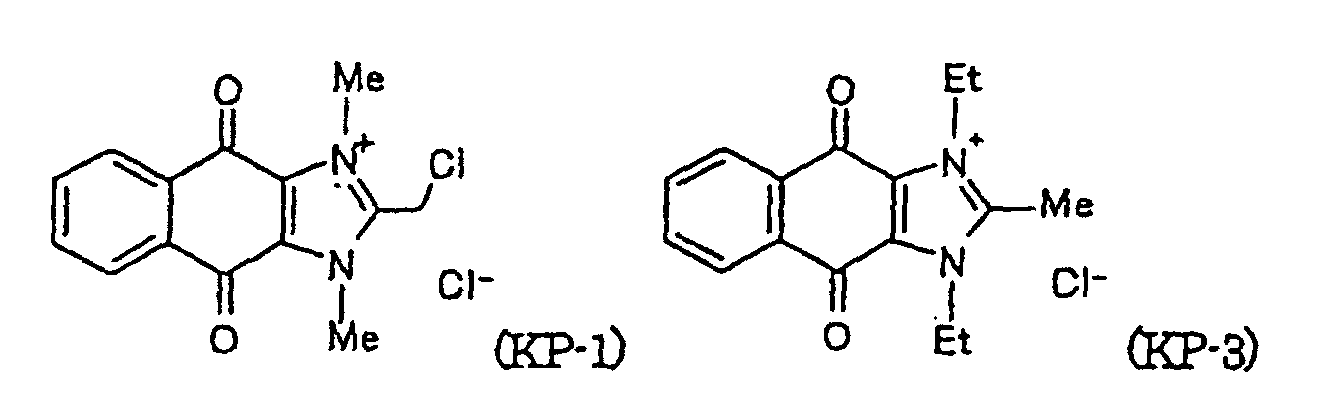
- J. Med. Chem., 7(3), 362 - 364 (1964) discloses compounds having antimicrobial action in which R1 and R2 of the general formula (I) of the present invention, which will be described later, are both lower alkyl, or one is -lower alkylene- (aryl which may have one or more substituents) and the other is -CH3, -(CH2)3CH3 or -phenyl,
or one is -lower alkylene-CO- (aryl which may have one or more substituents) and the other is -(CH2)2CH(CH3)2 or -(CH2)3CH3, but there is no disclosure of anti-tumor activity. - Also, 4,9-dioxonaphtho[2,3-d]imidazolium derivatives in which R1 and R2 of the general formula (I) of the present invention are both lower alkyl groups are disclosed in J. Org. Chem. USSR, 1, 1479 - 85 (1965), JP-A-3-258765 and JP-A-6-59371 and the like. However, there is no disclosure of the medicinal use of these compounds.
- GB-B-1314881 discloses 1,4-dihydro-1,4-dioxonaphthalene derivatives useful as a herbicide, and JP-B-54-25085 discloses isoquinoline-5,8-dione derivatives useful as a herbicide . Also, several 1,4-dihydro-1,4-dioxonaphthalene derivatives are known from Zh. Org. Khim., 22(8), 1736 - 42 (1986), J. Gen. Chem. USSR, 36, 649 - 652 (1966) and reagent catalogs [Sigma Aldrich Library of Rare Chemicals Structure Index, with update (Aldrich Chemical Company, Inc.)].
However,none of these documents discloses the medicinal use of these compounds. - Imidazole derivatives fused with aryl ring are disclosed in WO 97/30022, J. Med. Chem., 39(7), 1447 - 1451 (1996) and J. Med. Chem., 7(3), 362 - 364 (1964).
- Creation of an anticancer agent which exhibits excellent anti-tumor activity and also has low toxicity is still in great demand.
- The present inventors have conducted intensive studies on anticancer agents having less side effects and found as a result of the efforts that novel imidazolium derivatives fused with an aryl ring, characterized by being substituted at the 1- and/or 3-position with substituted alkyl group etc., exhibit excellent anti-tumor activity and low toxicity and can be useful as anticancer agents having wide margins of safety. In addition, by finding a 2-acylamino-3-amino-1,4-quinone derivative and a fused imidazole derivative useful as their synthetic intermediates and further finding that this synthetic intermediate 2-acylamino-3-amino-1,4-quinone derivative itself also shows low toxicity and excellent anti-tumor activity, the invention has been accomplished.
- The invention provides a fused imidazolium derivative represented by the following general formula (I) and salts thereof, and a pharmaceutical composition, particularly an anticancer agent, which comprises this fused imidazolium derivative/salt and a pharmaceutically acceptable carrierIn formula (I):
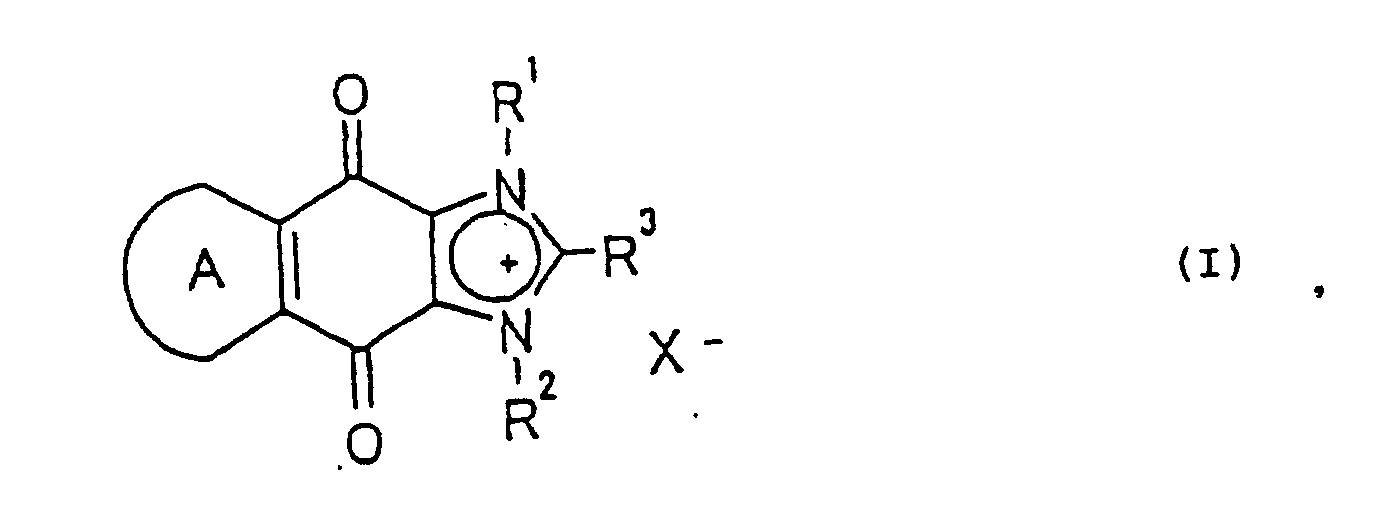
R1 and R2 are the same or different and one represents lower alkyl having one or more substituents selected from -ORa, -NRaRb, -NRa-CORb, -O-lower alkylene-ORa, -O-lower alkylene-O-lower alkylene-ORa, -SRa, -CONRaRb, -CN, -(cycloalkyl which may have one or more substituents selected from group C), -(saturated heterocylic which may have one or more substituents selected from group C), -(aryl which may have one or more substituents selected from group C) and -(heteroaryl which may have one or more substituents selected from group C), whilst the other represents -(lower alkyl having one or more substituents selected from group B), -(lower alkenyl having one or more substituents selected from group B), -(lower alkynyl having one or more substituents selected from group B), -RinD, -lower alkyl, -lower alkenyl or -lower alkynyl;
group B is -ORa, -SRa, -O-lower alkylene-ORa, -O-lower alkylene-O-lower alkylene-ORa, -O-lower alkylene-NRaRb, -O-lower alkylene-O-lower alkylene-NRaRb, -O-lower alkylene-NRc-lower alkylene-NRaRb, -OCO-NRaRb, -SORa, -SO2Ra, -SO2NRaRb, -NRa-SO2Rb, -NRaRb, -NRc-lower alkylene-NRaRb, -N(-lower alkylene-NRaRb)2, -RinD, -NO2, -CN, -halogen, -CO2Ra, -COO-, -CONRaRb, -CONRa-O-Rb, -NRa-CORb, -NRa-CO-NRbRc, -OCORa and -CO-Ra;
group C is -lower alkyl, -halogen, -halogeno lower alkyl, -ORa, -O-lower alkylene-ORa, -SRa, -NRaRb, -NO2, -CN, -CO2Ra, -CO-NRaRb, -CORa, -NRa-CORb, -SO2NRaRb, -aryl, -lower alkylene-NRaRb, -lower alkylene-aryl and -OCO-Ra;
Ra, Rb and Rc are the same or different and selected from -H, -lower alkyl, -lower alkylene-RinD and -RinD;
RinD is -(saturated heterocyclic which may have one or more substituents selected from group C), -(cycloalkyl which may have one or more substituents selected from group C),-(cycloalkenyl which may have one or more substituents selected from group C), -(aryl which may have one or more substituents selected from group C), or -(heteroaryl which may have one or more substituents selected from group C);
R3 is -H or -(lower alkyl which may have one or more substituents selected from group B), or R2 and R3 may together form alkylene having from 2 to 5 carbon atoms which may be interrupted with O, S or NR4 where R4 is -H or -lower alkyl;
ring A is a benzene ring which may have one or more substituents selected from group C; and
X- is a counter anion, with the proviso that X- does not exist when the substituent -COO- of the group B forms intramolecular salt with imidazolium cation;
with the proviso that compounds having the following combinations of R1 and R2 are excluded: - (1) one is -lower alkylene-(aryl which may have one or more substituents) and the other is -CH3, -(CH2)3CH3 or -phenyl, or
- (2) R1 and R2 are both -benzyl or -(CH2)2OC2H5.
-
- The invention also provides a 2-acylamino-3-amino-1,4-quinone derivative represented by the following general formula (II) or a salt thereof, which is a synthetic intermediate for the above derivative (I) and itself has excellent anti-tumour activityIn formula (II):
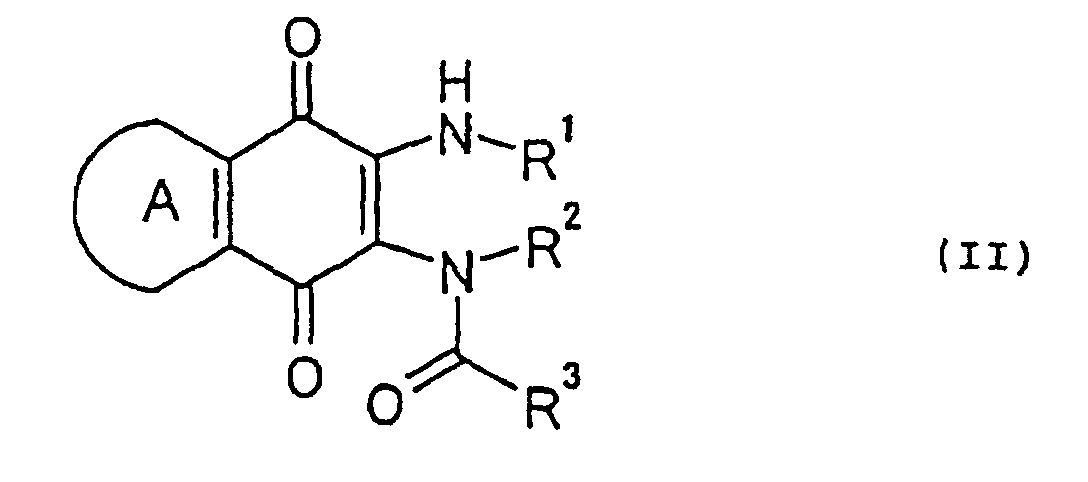
R1 and R2 are the same or different and one represents lower alkyl having one or more substituents selected from -ORa, NRaRb, -NRa-CORb, -O-lower alkylene-ORa, -O-lower alkylene-O-lower alkylene-ORa, -SRa, -CONRaRb, -CN, -(cycloalkyl which may have one or more substituents selected from group C), -(saturated heterocyclic which may have one or more substituents selected from group C), -(aryl which may have one or more substituents selected from group C) and -(heteroaryl which may have one or more substituents selected from group C), whilst the other represents -(lower alkyl having one or more substituents selected from group B), -(lower alkenyl having one or more substituents selected from group B), -(lower alkynyl having one or more substituents selected from group B), -RinD, -lower alkyl, -lower alkenyl or -lower alkynyl;
group B is -ORa, -SRa, -O-lower alkylene-ORa, -O-lower alkylene-O-lower alkylene-ORa, -O-lower alkylene-NRaRb, -O-lower alkylene-O-lower alkylene-NRaRb, -O-lower alkylene-NRc-lower alkylene-NRaRb, -OCO-NRaRb, -SORa, -SO2Ra, -SO2NRa-Rb, -NRa-SO2Rb, -NRaRb, -NRc-lower alkylene-NRaRb, -N(-lower alkylene-NRaRb)2. -RinD, -NO2, -CN, -halogen, -CO2Ra, -CONRaRb, -CONRa-O-Rb, -NRa-CORb, -NRa-CO-NRbRc, -OCORa and -CO-Ra;
group C is -lower alkyl, -halogen, -halogeno lower alkyl, -ORa, -O-lower alkylene-ORa, -SRa, -NRaRb, -NO2, -CN, CO2Ra, -CO-NRaRb, -CORa, -NRa-CORb, -SO2NRaRb, -lower alkylene-NRaRb, -aryl, -lower alkylene-aryl and -OCO-Ra;
Ra, Rb and Rc are the same or different and selected from -H, -lower alkyl, -lower alkylene-RinD and -RinD;
RinD is -(saturated heterocyclic which may have one or more substituents selected from group C), -(cycloalkyl which may have one or more substituents selected from group C), -(cycloalkenyl which may have one or more substituents selected from group C), -(aryl which may have one or more substituents selected from group C) or -(heteroaryl which may have one or more substituents selected from group C);
R3 is -H or -(lower alkyl which may have one or more substituents selected from group B), or R2 and R3 may together form alkylene having from 2 to 5 carbon atoms which may be interrupted with O, S or NR4 where R4 is -H or -lower alkyl; and
ring A is a benzene ring which may have one or more substituents selected from group C;
with the proviso that the following compounds are excluded: - (1) those in which one of R1 and R2 is -lower alkylene -(aryl which may have one or more substituents) and the other is -CH3, -(CH2)3CH3 or -phenyl,
- (2) those in which R1 and R2 are both benzyl or - (CH2)2OC2H5, and
- (3) those of the following Table, in which Comp means compound number, Me means methyl group, Et means ethyl group and Ph means phenyl group, and in the case of a substituted phenyl group, the substituent is shown before Ph together with the substituting position, e.g. 3,4-Cl-Ph represents 3,4-dichlorophenyl:
-
- The compounds shown in Table 1 are commonly known from GB-B-1314881 and JP-B-25085 (as herbicides), Zh. Org.Khim., 22(8), 1736 - 42 (1986) and J.Gen. Chem. USSR, 36, 649 - 652 (1966) (in relation to their synthesis), and reagent catalogs [Sigma Aldrich Library of Rare Chemicals Structure Index, with update (Aldrich Chemical Company, Inc.)].
- In addition, the invention provides a fused imidazole derivative represented by the following general formula (III) or a salt thereof, which is a novel synthetic intermediate for the aforementioned derivative (I)In formula (III):
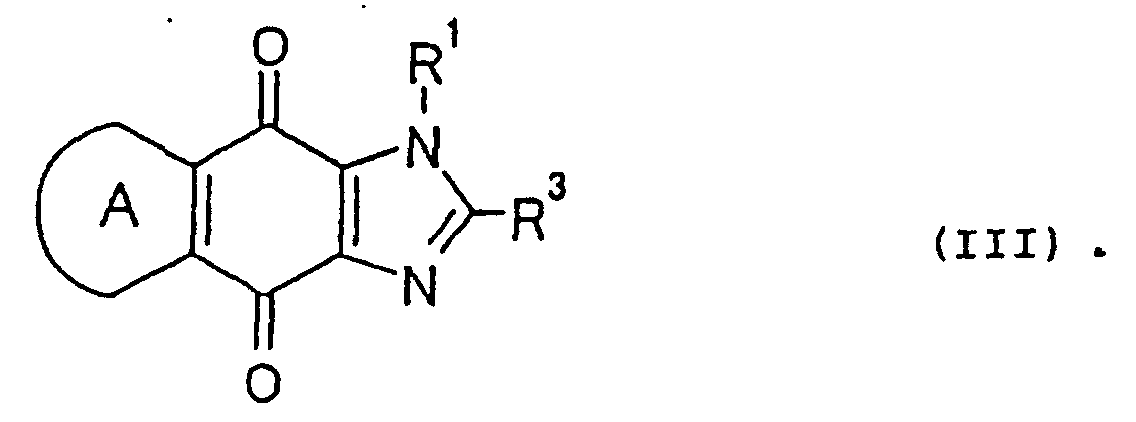
R1 is lower alkyl having one or more substituents selected from -ORa, -NRaRb, -NRa-CORb, -O-lower alkylene-ORa, -O-lower alkylene-O-lower alkylene-ORa, -SRa, -CONRaRb, -CN, -(cycloalkyl which may have one or more substituents selected from group C), -(saturated heterocyclic which may have one or more substituents selected from group C), -(aryl which may have one or more substituents selected from group C) and -(heteroaryl which may have one or more substituents selected from group C), with the proviso that a lower alkyl group having one or more substituents selected from -NH2, -NMe2, -NEt2, -OH and -(phenyl which may be substituted by -Cl, -F, -Me or -OMe) is excluded;
group B is -ORa, -SRa, -O-lower alkylene-ORa, -O-lower alkylene-O-lower alkylene-ORa, -O-lower alkylene-NRaRb, -O-lower alkylene-O-lower alkylene-NRaRb, -O-lower alkylene-NRc-lower alkylene-NRaRb, -OCO-NRaRb, -SORa, -SO2Ra, -SO2NRaRb, -NRa-SO2Rb, -NRaRb, -NRc-lower alkylene-NRaRb, -N(-lower alkylene-NRaRb)2, -RinD, -NO2, -CN, -halogen, -CO2Ra, -CONRaRb, -CONRa-O-Rb, -NRa-CORb, -NRa-CO-NRbRc, -OCORa and -CO-Ra;
group C is -lower alkyl, -halogen, -halogeno lower alkyl, -ORa, -O-lower alkylene-ORa, -SRa, -NRaRb, -NO2, -CN, -CO2Ra, -CO-NRaRb, -CORa, -NRa-CORb, -SO2NRaRb, -lower alkylene-NRaRb, -aryl, -lower alkylene-aryl and -OCO-Ra;
Ra, Rb and Rc are the same or different and selected from -H, -lower alkyl, -lower alkylene-RinD and -RinD;
RinD is -(saturated heterocyclic which may have one or more substituents selected from group C), -(cycloalkyl which may have one or more substituents selected from group C), -(cycloalkenyl which may have one or more substituents selected from group C), -(aryl which may have one or more substituents selected from group C) or -(heteroaryl which may have one or more substituents selected from group C);
R3 is -H or -(lower alkyl which may have one or more substituents selected from group B); and
ring A is a benzene ring which may have one or more substituents selected from group C. - For formulae (I), (II) and (III) above, the following definitions apply.
- The term "lower" means a straight or branched form of hydrocarbon chain having up to 6 carbon atoms. The lower (C1-C6) alkyl is preferably an alkyl group having from 1 to 4 carbon atoms, and its particularly preferred examples include methyl, ethyl, n-propyl, isopropyl, n-butyl and isobutyl groups. The preferred examples of lower (C2-C6) alkenyl include vinyl, allyl, 1-propenyl, isopropenyl, 1-butenyl, 2-butenyl and 3-butenyl groups. The preferred examples of lower (C2-C6) alkynyl include ethynyl, 1-propynyl, 2-propynyl, 1-butynyl, 2-butynyl, 3-butynyl and 1-methyl-2-propynyl groups. The preferred examples of lower alkylene include methylene, ethylene, trimethylene and 2,2-dimethyltrimethylene groups.
- The term "aryl" means an aromatic hydrocarbon ring group having from 6 to 14 carbon atoms, more preferably phenyl, naphthyl and fluorenyl groups.
- The term "heteroaryl" means five- or six-membered monocyclic heteroaryl groups containing from 1 to 4 hetero atoms selected from N, S and O and bicyclic heteroaryl groups in which they are fused with a benzene ring or a said monocyclic heteroaryl ring, which may be partially saturated. Also, when it contains N atom, it may form N-oxide. Furyl, thienyl, pyrrolyl, imidazolyl, pyrazolyl, thiazolyl, isothiazolyl, oxazolyl, isoxazolyl, oxadiazolyl, thiadiazolyl, triazolyl, tetrazolyl, pyridyl, pyrimidinyl, pyridazinyl, pyrazinyl and triazinyl groups are preferred as the five- or six-membered monocyclic heteroaryl, and benzofuranyl, benzothienyl, benzothiadiazolyl, benzothiazolyl, benzoxazolyl, benzoxadiazolyl, benzoimidazolyl, indolyl, isoindolyl, indazolyl, quinolyl, isoquinolyl, cinnolinyl, quinazolinyl, quinoxalinyl, benzodioxolyl, indolizinyl and imidazopyridyl groups are preferred as the bicyclic heteroaryl. As the partially saturated heteroaryl, 1,2,3,4-tetrahydroquinolyl group and the like can be exemplified. Further preferred are furyl, thienyl, imidazolyl, pyridyl, pyrazinyl, pyrimidinyl, pyridadinyl, indolyl, benzoimidazolyl, benzodioxonyl and quinolyl groups, and particularly preferred are pyridyl, pyrazinyl and pyrimidinyl groups.
- The term "cycloalkyl" means cycloalkyl groups having from 3 to 10 carbon atoms and particularly preferred are cyclopropyl, cyclopentyl, cyclohexyl and adamantyl groups. The cycloalkenyl groups have from 3 to 8 carbon atoms and particularly preferred are cyclopentenyl and cyclohexenyl groups.
- As the "counter anion", there is no particular limitation with the proviso that it is a pharmaceutically acceptable anion as a counter anion of imidazolium cation, and its preferred examples include monovalent or divalent anions such as halogen ions, organic sulfonate ions (methanesulfonate ion, ethanesulfonate ion, benzenesulfonate ion, toluenesulfonate ion and the like), acetate ion, trifluoroacetate ion, carbonate ion, sulfate ion and the like, of which halogen ions are particularly preferred.
- As the "halogen", F, Cl, Br and I atoms can be exemplified, and the "halogen ion" means their ions. The "halogeno lower alkyl" is the aforementioned lower alkyl which is substituted by one or more of the halogens, and is preferably -CF3.
- The term "saturated heterocyclic" means a five- to seven-membered monocyclic saturated heterocyclic ring containing from 1 to 4 hetero atoms selected from N, S and O, or its cross-linked ring. Preferred are tetrahydropyranyl, tetrahydrofuranyl, pyrrolidinyl, piperazinyl, azepanyl, diazepanyl, quinuclidinyl, piperidyl and morpholinyl groups.
- Where a group has one or more substituents selected from group C, the number of said substituents is not particularly limited, but is preferably from 1 to 4.
- Among group C, more preferred are -lower alkyl, -halogen, -halogeno lower alkyl, -OH, -O-lower alkyl, -O-lower alkylene-OH, -O-lower alkylene-O-lower alkyl, -lower alkylene-NH2, -NH2, -NH-lower alkyl, -N(lower alkyl)2, -CO2H, -CO2-lower alkyl, -CO-NH2, -SO2-NH2, -NO2 and -CN. For ring A, a particularly preferred substituent is -NO2.
- Where R3 is lower alkyl which may have one or more substituents from group B, -halogen, -ORa, -SRa, -NRaRb, -NO2 or -CN are preferred substituents.
- As the groups using Ra, Rb and Rc in the aforementioned groups B and C, those in which Ra, Rb and Rc are -H or -lower alkyl are more desirable.
- In general formula (I), the term "R2 and R3 together form alkylene having from 2 to 5 carbon atoms which may be interrupted with O, S or NR4 where R4 is -H or -lower alkyl" means that R2 and R3 together form a C2 to C5 alkylene chain which may be interrupted with O, S or NR4 (preferably -(CH2)4-, -(CH2)2OCH2- or -(CH2)2N(Me)CH2-), and combine with the adjacent N and C atoms to form a (e.g. four- to seven-membered)hetero ring which is fused with the imidazole ring.
- Preferred compounds (I) and (II) of the invention are those where at least one of R1 and R2 is lower alkyl having one or more substituents selected from
-ORa, -O-lower alkylene-ORa, -O-lower alkylene-O-lower alkylene-ORa, -(saturated heterocyclic which may have one or more substituents selected from group C), -(aryl which may have one or more substituents selected from group C) and -(heteroaryl which may have one or more substituents selected from group C); or
at least one of R1 and R2 is lower alkyl substituted by a heteroaryl group selected from furyl, thienyl, imidazolyl, pyridyl, pyrazinyl, pyrimidinyl, pyridazinyl, indolyl, benzoimidazolyl, benzodioxonyl and quinolyl group, which may have one or more substituents selected from group C; or
one of R1 and R2 is lower alkyl substituted by -O-lower alkyl and the other is lower alkyl substituted by one substituent selected from
-O-lower alkylene-O-lower alkyl, -O-lower alkylene-O-lower alkylene-O-lower alkyl, -(aryl which may have one or more substituents selected from group C), -(heteroaryl which may have one or more substituents selected from group C) and -O-lower alkyl; or
at least one of R1 and R2 is lower alkyl having one substituent selected from -(heteroaryl selected from pyridyl, pyrazinyl and pyrimidinyl, which may have one or more substituents selected from the group C), -O-lower alkylene-O-lower alkyl and -O-lower alkyl; or
R3 is a methyl group; or
ring A is a benzene ring which may be substituted by -NO2; or,
for formula (I), X- is a halogen ion. - Also preferred are compounds wherein at least one of R1 and R2 is lower alkyl having one substituent selected from -(heteroaryl selected from pyridyl, pyrazinyl and pyrimidinyl, which may have one or more substituents selected from group C), -O-lower alkylene-O-lower alkyl and -O-lower alkyl, and ring A is a benzene ring which may be substituted by -NO2.
- Among compounds (I) of the invention, particularly preferred compounds are 1-[(6-chloro-3-pyridyl)methyl]-3-(2-methoxyethyl)-2-methyl-4,9-dioxo-4,9-dihydro-1H-naphtho[2,3-d]imidazol-3-ium, 1,2-dimethyl-4,9-dioxo-3-[(2-tetrahydrofuranyl)methyl]-4,9-dihydro-1H-naphtho[2,3-d]imidazol-3-ium, 1,3-bis(2-methoxyethyl)-2-methyl-4,9-dioxo-4,9-dihydro-1H-naphtho[2,3-d]imidazol-3-ium, 3-(2-methoxyethyl)-2-methyl-4,9-dioxo-1-(2-pyrazinylmethyl)-4,9-dihydro-1H-naphtho[2,3-d]imidazol-3-ium, 1-[3-(1H-4-imidazolyl)propyl]-3-(2-methoxyethyl)-2-methyl-4,9-dioxo-4,9-dihydro-1H-naphtho[2,3-d]imidazol-3-ium, 3-(2-methoxyethyl)-2-methyl-1-[(5-methyl-2-pyrazinyl)methyl]-4,9-dioxo-4,9-dihydro-1H-naphtho[2,3-d]imidazol-3-ium, 2-methyl-4,9-dioxo-1,3-bis(2-pyrazinylmethyl)-4,9-dihydro-1H-naphtho[2,3-d]imidazol-3-ium, 1-[2-(2-methoxyethoxy)ethyl]-3-(2-methoxyethyl)-2-methyl-4,9-dioxo-4,9-dihydro-1H-naphtho[2,3-d]imidazol-3-ium, 1-{2-[2-(2-methoxyethoxy)ethoxy]ethyl}-3-(2-methoxyethyl)-2-methyl-4,9-dioxo-4,9-dihydro-1H-naphtho[2,3-d]imidazol-3-ium, 1-(2-methoxyethyl)-2-methyl-4,9-dioxo-3-(3-pyridylmethyl)-4,9-dihydro-1H-naphtho[2,3-d]imidazol-3-ium, 3-(2-methoxyethyl)-2-methyl-4,9-dioxo-1-(2-pyridylmethyl)-4,9-dihydro-1H-naphtho[2,3-d]imidazol-3-ium, 3-(2-methoxyethyl)-2-methyl-4,9-dioxo-1-(4-pyridylmethyl)-4,9-dihydro-1H-naphtho[2,3-d]imidazol-3-ium, 1-[(2-chloro-3-pyridyl)methyl]-3-(2-methoxyethyl)-2-methyl-4,9-dioxo-4,9-dihydro-1H-naphtho[2,3-d]imidazol-3-ium, 1-[(2-hydroxy-4-pyridyl)methyl]-3-(2-methoxyethyl)-2-methyl-4,9-dioxo-4,9-dihydro-1H-naphtho[2,3-d]imidazol-3-ium, 3-(2-methoxyethyl)-1-[(6-methoxy-3-pyridyl)methyl]-2-methyl-4,9-dioxo-4,9-dihydro-1H-naphtho[2,3-d]imidazol-3-ium, 1-[(2-chloro-4-pyridyl)methyl]-3-(2-methoxyethyl)-2-methyl-4,9-dioxo-4,9-dihydro-1H-naphtho[2,3-d]imidazol-3-ium, 1-(4-chlorobenzyl)-3-(2-methoxyethyl)-2-methyl-4,9-dioxo-4,9-dihydro-1H-naphtho[2,3-d]imidazol-3-ium, 1-(4-fluorobenzyl)-3-(2-methoxyethyl)-2-methyl-4,9-dioxo-4,9-dihydro-1H-naphtho[2,3-d]imidazol-3-ium and 1,3-bis(2-methoxyethyl)-2-methyl-5-nitro-4,9-dioxo-4,9-dihydro-1H-naphtho[2,3-d]imidazol-3-ium, or tautomers thereof and their salts with halogen ions.
- The compound (I) of the invention exists in tautomer forms represented by the following formula due to delocalization of the cation, and these isomers in separated forms or mixtures thereof are included in the invention. The compound mentioned herein as 1H-imidazol-3-ium derivative includes 3H-imidazol-1-ium derivative as its tautomer and mixture of both isomers. In this connection, X- does not exist when the compound (I) has a substituent -COO- and forms intramolecular salt with the imidazolium cation.
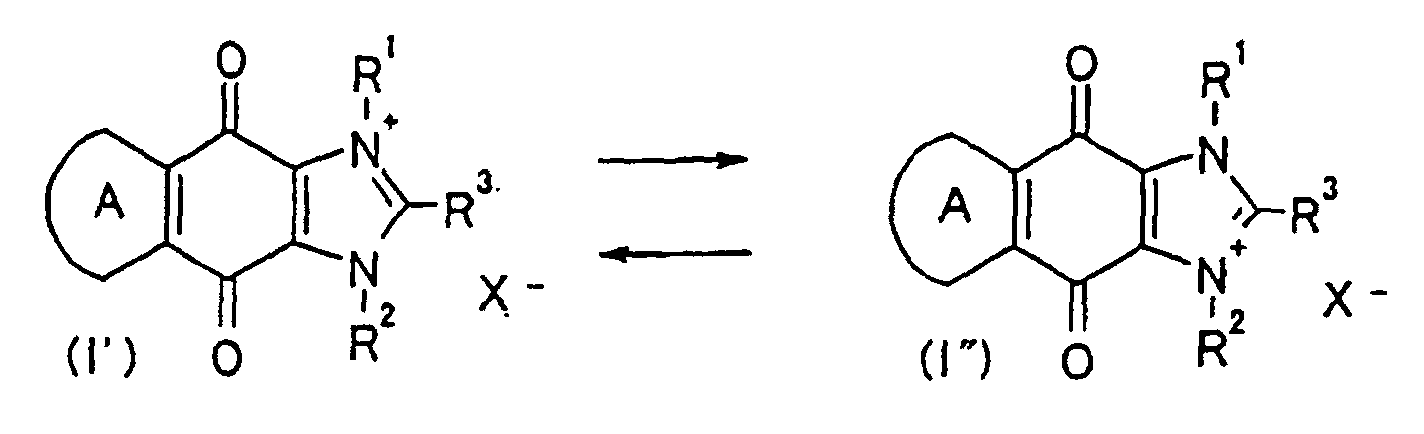
- In addition to the aforementioned salt with a counter anion, the compound (I) of the invention forms other salts in some cases depending on the kinds of substituents, and these salts are also included in the invention. In addition, the compound (II) or (III) of the invention also forms salts in some cases depending on the kinds of substituents, and these salts are also included in the invention. Though these salts are not particularly limited with the proviso that they are pharmaceutically acceptable salts, acid addition salts with an inorganic acid (hydrochloric acid, hydrobromic acid, hydroiodic acid, sulfuric acid, nitric acid, phosphoric acid and the like) and with an organic acid (formic acid, acetic acid, propionic acid, oxalic acid, malonic acid, succinic acid, fumaric acid, maleic acid, lactic acid, malic acid, tartaric acid, citric acid, methanesulfonic acid, ethanesulfonic acid, aspartic acid, glutamic acid and the like) can be cited as illustrative examples of acid addition salts, and salts with an inorganic base containing a metal (sodium, potassium, magnesium, calcium, aluminum and the like) or with an organic base (methylamine, ethylamine, ethanolamine, lysine, ornithine and the like) and ammonium salts and the like can be exemplified as salts with bases.
- Depending on the kinds of substituents, geometrical isomers and tautomers exist in the compound (I), (II) or (III) of the invention in some cases, and these isomers in separated forms or mixture thereof are included in the invention. Also, since certain compounds of the invention have asymmetric carbon atom, isomers based on the asymmetric carbon atom can exist. The invention includes mixed and separated forms of these optical isomers. Also, compounds of the invention may sometimes form N-oxide depending on the kinds of substituents, and these N-oxide compounds are also included in the invention. In addition, various hydrates and solvates and polymorphic substances of the compound (I), (II) or (III) of the invention are also included in the invention.
- The compounds (I), (II) and (III) of the invention can be synthesized easily by using similar methods described in references, e.g., J. Org. Chem. USSR, 1, 1479 - 85 (1965), J. Med. Chem., 7(3), 362 - 364 (1964), JP-A-3-258765, or by applying the methods known to those skilled in the art.
- In this connection, depending on the kind of functional group, it may sometimes be effective from the viewpoint of synthesis techniques to replace the functional group with an appropriate protecting group, namely a group which can be easily converted into the functional group, at the stage of starting materials or synthetic intermediates. Thereafter, a desired compound can be obtained by removing the protecting group as occasion demands. Examples of such functional groups include an amino group, a hydroxyl group, a carboxyl group and the like and examples of their protecting groups include those which are described in "Protective Groups in Organic Synthesis", 2nd edition, edited by Greene and Wuts, which may be optionally used depending on the reaction conditions.
- The following describes typical Synthesis methods.In the formulae R' means hydrogen, methoxy or halogen, and H-X means an acid which forms anion (preferably hydrogen fluoride, hydrogen chloride, hydrogen bromide, hydrogen iodide, methanesulfonic acid, ethanesulfonic acid and the like. The same shall apply hereinafter.

- The compound (II) of the invention can be synthesized by the usual procedures by allowing a compound (IV) to react with amines (V). For example, it can be synthesized by applying the methods described in Chem. Pharm. Bull., 44(6), 1181 - 1187 (1996), Syn. Comm., 27 (12), 2143 - 2157 (1997), Tetrahedron. Lett., 39(42), 7677 - 7678 (1998) and the like, and it is advantageous to carry out the reaction at ambient temperature or under heating in an appropriate inert solvent (benzene and the like) using reaction equivalent amounts of the compounds (IV) and (V), or one of them in an excess amount, if necessary using an appropriate inorganic base (potassium carbonate and the like) or organic base (triethylamine and the like) as an acid capturing agent.
- The compound (I) of the invention can be synthesized by the usual procedures by subjecting the compound (II) of the invention to cyclization and making it into a quaternary salt. For example, the reaction can be carried out by applying the method described in J. Org. Chem. USSR, 1, 1479 - 85 (1965), and it is advantageous to carry out the reaction at ambient temperature or under heating in an appropriate inert solvent (e.g., an alcohol solvent) using a reaction equivalent amount or an excess amount of an acid.
- In the formulae Rd and Re are any groups defined in R1 and R2. The same shall apply hereinafter.

- Two compounds (IIa) and (IIb) of the invention can be synthesized by hydrolysis of the compound (I) of the invention by the usual procedures. The obtained compounds can also be made into synthetic intermediates of desired compound (I) of the invention by subjecting them to commonly known substituent-modification reactions.
- The hydrolysis reaction can be carried out by applying the method described in J. Med. Chem., 7(3), 362 - 364 (1964) and the like, and it is advantageous to carry out the reaction at ambient temperature or under heating in an appropriate inert solvent (ethanol and the like) using a reaction equivalent amount or an excess amount of a base. As the base, lithium hydroxide, sodium hydroxide, potassium hydroxide, sodium carbonate, potassium carbonate can be exemplified.
- The compound (III) of the invention can be synthesized in accordance with the method described in J. Med. Chem., 39(7), 1447 - 1451 (1996) and the like, by subjecting a compound (VI) to cyclization reaction in the presence of a base such as sodium hydroxide and the like.
- The compound (I) of the invention can be synthesized by allowing the compound (III) of the invention to react with a halide (VII) to make it into a quaternary salt. For example, the reaction can be carried out in accordance with the method described in J. Med. Chem., 7(3), 362 - 364 (1964), preferably in an appropriate inert solvent using reaction equivalent amounts of the compounds (III) and (VII), or one of them in an excess amount, at ambient temperature or under heating, preferably under reflux temperature of the solvent.
- In addition to the above Synthesis methods, compounds of the invention can also be synthesized by various commonly known substituent modification methods. For example, a compound having a substituent containing sulfonyl bond can be synthesized from a compound having sulfide bond or sulfinyl bond by usual oxidation reaction. A N-oxide derivative of a compound having a N atom-containing heteroaryl group (e.g., pyridyl group) as a substituent can be synthesized by usual oxidation reaction. A compound having a carboxylic acid-containing substituent can be synthesized from one having an ester or amide group by usual hydrolysis reaction. A compound having an aminoalkyl group-containing substituent can be synthesized from one having a halogen-substituted alkyl ggroup by usual amination reaction. In case that the compounds (II) and (III) of the invention are in free forms; they can be made into salts by usual salt forming reaction as occasion demands.
- Some of the intermediate compounds for compounds of the invention are novel, and can be synthesized easily in a similar manner as for known compounds or by using methods commonly known to those skilled in the art. Typical synthesis methods are shown below.
-
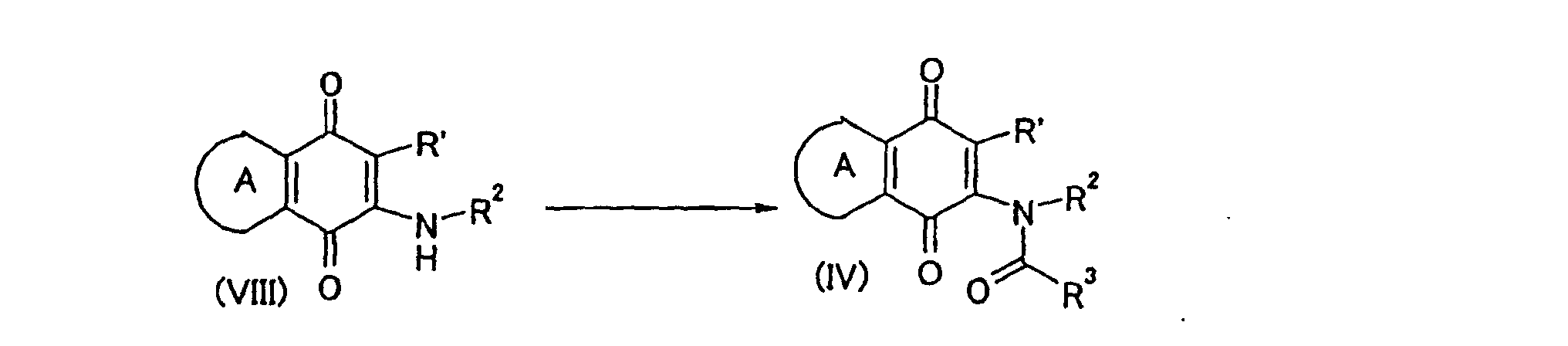
- The compound (IV) can be synthesized in accordance with the method described in J. Org. Chem. USSR, 1, 1479 - 85 (1965) and the like, by a usual acylation reaction in which a compound (VIII) is allowed to react with a reactive carboxylic acid derivative such as an acid halide, acid anhydride and the like.
-

- In the formulae, B1 represents pyridine ring which may have one or more substituents. The same shall apply hereinafter.
- An aminomethylpyridine derivative (X) can be synthesized by the reduction of a compound (IX) in accordance with the method described in German Patent No. 3726993 (1989) and the like.
-
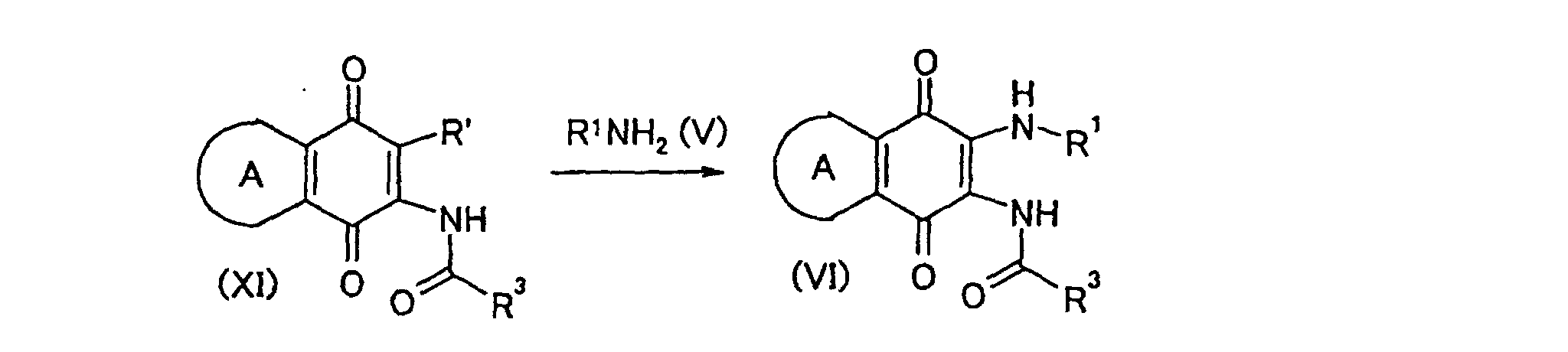
- The compound (VI) can be synthesized by the amination of a compound (XI) in accordance with the method described in J. Med. Chem., 39(7), 1447 - 1451 (1996) and the like.
-

- The compound (VIII) can be synthesized by the amination of a compound (XII) in accordance with the method described in J. Het. Chem., 33(1), 113 - 117 (1996), Syn. Comm., 27(12), 2143 - 2157 (1997), Tetrahedron. Lett., 39(42), 7677 - 7678 (1998) and the like.
-

- The compound (IV) can be synthesized by the amidation of the compound (XII). It is advantageous to carry out the reaction by activating a reaction equivalent amount of a compound (XIII) using an appropriate inorganic base (NaH and the like) or organic base (NaOMe and the like) in an appropriate inert solvent (N,N-dimethylformamide (DMF) and the like) and then allowing it to react with a reaction equivalent amount or an excess amount of the compound (XII) at ambient temperature or under heating.
- Isolation and purification of the compounds of the invention synthesized in the above described manner are carried out by applying general chemical techniques such as extraction, concentration, evaporation, crystallization, filtration, recrystallization, various types of chromatography and the like.
- Each form of isomer can be isolated by usual procedures making use of physicochemical differences among isomers. For example, racemic compounds can be converted into optically pure isomers by a conventional optical resolution method [e.g., a method in which they are made into diastereomer salts with a general optically active acid (tartaric acid and the like) and then subjected to optical resolution]. Also, a diastereomer mixture can be separated by fractional crystallization, chromatography and the like. In addition, an optically active compound can also be synthesized by using an appropriate optically active material.
- The compounds (I) and (II) of the invention are useful as anticancer agents which have excellent cancer cell growth inhibitory activity, low toxicity and wide margins of safety. Accordingly, the compounds of the invention have inhibitory activity on growth of tumors, preferably all solid tumors and lymphomas, particularly skin cancer, bladder cancer, breast cancer, uterine cancer, ovary cancer, prostate cancer, lung cancer, colon cancer, pancreas cancer, renal cancer, gastric cancer and the like, and are useful for the treatment thereof. Particularly, they show excellent anti-tumor activity for many kinds of tumor types in a cancer cell growth inhibition test and an in vivo tumor growth inhibition test using a mouse tumor xenograft model, and the activity is superior to those of some existing anticancer agents. Accordingly, they are expected as therapeutic agents for tumor types which show resistance against existing anticancer agents.
- Effects of the compounds of the invention were verified by the following tests.
- (Test methods) Cell culture: Cervix cancer HeLaS3 cells or melanoma A375 cells were cultured in Dulbecco's modified Eagle's medium (DMEM) (GIBCO) supplemented with 10% Fetal Calf Serum (FCS).
- Compound evaluation: HeLaS3 cells or A375 cells were added to a collagen-coated 96 well plate (mfd. by IWAKI) and cultured overnight in DMEM. On the next day, a dimethylsulfoxide (DMSO) solution of test compound was added thereto with varied concentrations, while fixing final concentration of DMSO solution to 0.1%. After incubation for 48 hours, cell growth was evaluated by color reaction with Alamar Blue (Biosource).
- (Results) The compounds (I) and (II) of the invention satisfactorily inhibited growth of cancer cells, and their IC50 values were 1 µM or less.
- In addition, the compounds (I) and (II) of the invention showed similarly excellent cell growth inhibitory activities also for other cancer cells (non-small cell lung cancer (EKVX, HOP-92, NCI-H358, A-549, NCI-H460), breast cancer (MDA-MB-231, MCF7), prostate cancer (PC-3), pancreas cancer (MIA PaCa-2), colon cancer (WiDr), renal cancer (A-498), gastric cancer (MKN28), bladder cancer (UC-14) and fibrosarcoma (HT-1080)).
- (Test methods) Melanoma A375 cells (2 x 10⁶ cells) were grafted subcutaneously into the frank of male Balb/c nude mice. When the tumor volume reached 50 to 100 mm3, the test compound was intravenously administered once a day for 2 weeks. Also, saline was intravenously administered to a control group. Tumor diameter was periodically measured with a vernier caliper until the next day of the final administration. The tumor volume was calculated by the following calculation formula.
- (Results) In this test, the compounds (I) and (II) of the invention satisfactorily inhibited tumor growth, e.g., the compounds of Examples 4, 37, 118, 121, 148, 154, 180 and 182 showed 50% or more inhibition of tumor growth compared to the control group at a dose of 0.3 or 1 mg/kg.
- The compounds of the invention showed similarly excellent anti-tumor activity also in an animal model transplanted with other cancer cells (prostate cancer (PC-3) or non-small cell lung cancer (NCI-H358, A-549 and NCI-H460)).
- (Test methods) The compounds of the invention were administered by single intravenous administration to Balb/C mice, and the presence of mortal case during the observation period of 2 weeks was evaluated.
- (Results) Mortal case was not found by 3 mg/kg single administration of each of the compounds of Examples 4, 9, 35, 37, 52, 72, 121, 133, 148, 154, 158, 180, 182, 184, 185, 186, 192 and 197 of the invention. On the other hand, all of respective 2 cases died by 3 mg/kg single administration of KP-1 and KP-3 disclosed in a prior report, Khim. Pharm. Zh., 32(6), 10 - 11 (1998). Thus, it was shown that the compounds of the invention have low toxicity in comparison with the prior reported compounds.
- Accordingly, since the compounds (I) and (II) of the invention showed excellent anti-tumor activities against many kinds of tumor types with low toxicity, it was shown that they are useful as anticancer agents having good therapeutic profiles.
- The pharmaceutical composition of the invention can be prepared by a generally used method using one or two or more of the compounds represented by the general formula (I) or (II) and pharmaceutically acceptable carriers (drug carriers, fillers and the like). Its administration may be either oral administration by tablets, pills, capsules, granules, powders, solutions, inhalations and the like, or parenteral administration by intravenous injection, intramuscular injection, and the like, suppositories, eye drops, ophthalmic ointments, percutaneous solutions, ointments, percutaneous adhesive preparations, transmucosal solutions, transmucosal adhesive preparations and the like.
- The solid composition for use in the oral administration according to the present invention is used in the form of tablets, powders, granules and the like. In such a solid composition, one or more active substances are mixed with at least one inert filler such as lactose, mannitol, glucose, hydroxypropylcellulose, microcrystalline cellulose, starch, polyvinyl pyrrolidone, magnesium aluminate metasilicate and the like. In accordance with the usual procedures, the composition may contain inert additives such as lubricants (magnesium stearate and the like) and disintegrating agents (sodium carboxymethylstarch and the like) and solubilization assisting agent. If necessary, tablets or pills may be coated with a sugar or a gastric or enteric coating agent.
- The liquid composition for oral administration includes pharmaceutically acceptable emulsions, solutions, suspensions, syrups, elixirs and the like and contains a generally used inert diluent conventionally employed, e.g., purified water or ethanol. In addition to the inert diluent, this composition may further contain an auxiliary agent such as a solubilizing agent, a moistening agent, a suspending agent and the like, as well as sweeteners, flavors, aromatics and preservatives.
- The injections for parenteral administration include a sterile aqueous or non-aqueous solution, a suspension and an emulsion. Examples of the aqueous solution include distilled water for injection and saline. Examples of the non-aqueous solvent include propylene glycol, polyethylene glycol, vegetable (oils olive oil and the like), alcohols (ethanol and the like), polysorbate 80 (trade name) and the like. Such a composition may further contain a tonicity agent, a preservative, a moistening agent, an emulsifier, a dispersing agent, a stabilizer and a solubilization assisting agent. These compositions are sterilized, e.g., by filtration through a bacteria retaining filter, blending of a germicide or irradiation. Alternatively, they may be used by firstly making into sterile solid compositions and then dissolving or suspending them in sterile water or a sterile solvent for injection use prior to their use.
- In the case of oral administration, suitable daily dose is usually about 0.001 to 50 mg/kg, preferably about 0.01 to 30 mg/kg, and in the case of intravenous administration, the daily dose is usually about 0.0001 to 10 mg/kg, preferably about 0.001 to 3 mg/kg, and the daily dose is divided into 1 to several doses per day. The dose may be appropriately determined for each case, depending on conditions, age, sex and the like.
- The following describes the invention further in detail based on examples. The compounds of the invention are not limited to the compounds described in the following examples. In this connection, Synthesis examples of intermediates for the compounds of the invention are shown in Reference Examples.
- Reference Example 1: Saturated aqueous ammonia (17 ml) and Raney nickel (3.0 g) were added to a solution of 3-cyano-2-(dimethylamino)pyridine (2.45 g) in ethanol (50 ml) and the mixture was stirred at room temperature for 8 hours under a hydrogen atmosphere of 1 atmospheric pressure. After absorption of 760 ml of hydrogen, the catalyst was removed by filtration. By concentrating the mother liquid, 3-(aminomethyl)-2-(dimethylamino)pyridine (2.61 g) was obtained as a yellow oil.
- Reference Example 2: A few drops of concentrated sulfuric acid was added to a solution of 2-chloro-3-[(2-methoxyethyl)amino]-1,4-naphthoquinone (33 g) in acetic anhydride (100 ml) and the mixture was stirred at 45°C for 1 hour. By adding ethanol (100 ml) to the reaction solution, excess acetic anhydride was esterified. After cooling, ethyl acetate was added to the reaction solution and the mixture was washed with water and brine and then dried over anhydrous sodium sulfate. The solvent was evaporated and the residue was crystallized from diethyl ether to give N-(3-chloro-1,4-dihydro-1,4-dioxo-2-naphthalenyl)-N-(2-methoxyethyl)acetamide (29 g) as a yellow powder.
- Reference Example 3 2-Methoxyethylamine (0.8 ml) was added to a solution of N-(3-chloro-1,4-dihydro-1,4-dioxo-2-naphthalenyl)acetamide (1.0 g) in benzene (20 ml) and the mixture was stirred at room temperature for 1 hour. Water was added to the reaction solution and the mixture was extracted with chloroform. The organic layer was washed with water and brine and then dried over anhydrous sodium sulfate. The solvent was evaporated and the residue was recrystallized from ethyl acetate to give N-[3-(2-methoxyethyl)amino-1,4-dihydro-1,4-dioxo-2-naphthalenyl]acetamide (0.87 g) as a red powder.
- Reference Example 4: 2-(Aminomethyl)pyrazine (3.2 g) and diisopropylethylamine (5.8 ml) were added to a solution of 2,3-dichloro-1,4-dihydro-1,4-dioxonaphthalene (3.0 g) in benzene (90 ml) and the mixture was stirred at room temperature for 8 hours. Water was added to the reaction solution and the resulting precipitate was removed by filtration and then the filtrate was extracted with ethyl acetate. The organic layer was washed with water and brine and then dried over anhydrous sodium sulfate. The solvent was evaporated and the residue was purified by silica gel column chromatography (elution with chloroform) to give 2-chloro-1,4-dihydro-1,4-dioxo-3-[(2-pyrazinylmethyl)amino]naphthalene (0.23 g) as a light brown powder.
- Reference Example 5: 2-Chloroacetyl chloride (3.3 ml) was added to a solution of 2-chloro-1,4-dihydro-3-methylamino-1,4-dioxonaphthalene (2.2 g) in 1,4-dioxane (30 ml) and the mixture was stirred under reflux for 14 hours. After cooling of the reaction solution, the solvent was After cooling of the reaction solution, the solvent was evaporated. Ethanol was added to the residue and the resulting precipitate was collected by filtration. The obtained solid was recrystallized from ethanol to give 2-chloro-N-(3-chloro-1,4-dihydro-1,4-dioxo-2-naphthalenyl)-N-methylacetamide (2.6 g) as a yellow powder.
- Reference Example 6: 60% NaH (440 mg) was added to a solution of 2-oxopiperidine (1.0 g) in DMF (20 ml) and the mixture was stirred at room temperature for 30 minutes. This solution was added in a single portion to a solution of 2,3-dichloro-1,4-dihydro-1,4-dioxonaphthalene (6.9 g) in DMF (150 ml) and the mixture was stirred at room temperature for 17 hours. The reaction solution was poured into saturated aqueous ammonia and the resulting precipitate was removed by filtration and then the filtrate was extracted with ethyl acetate. The organic layer was washed with water and brine and then dried over anhydrous sodium sulfate. The solvent was evaporated and the residue was purified by silica gel column chromatography (elution with ethyl acetate-hexane 1:10 solution) to give 2-chloro-1,4-dihydro-1,4-dioxo-3-(2-oxopiperidino)naphthalene (0.49 g) as a light brown powder.
- The compounds of Reference Examples 9 to 11 shown in Table 3 were obtained in a similar manner to that described in Reference Example 1, and the compound of Reference Example 12 shown in Table 4 in a similar manner to that described in Reference Example 2, the compounds of Reference Examples 13 to 15 shown in Table 4 in a similar manner to that described in Reference Example 3 and the compound of Reference Example 16 shown in Table 4 in a similar manner to that described in Reference Example 5.
- Example 1: 2 M Sodium hydroxide aqueous solution (0.9 ml) was added to a solution of N-[3-(2-methoxyethyl)amino-1,4-dihydro-1,4-dioxo-2-naphthalenyl]acetamide (0.5 g) in ethanol (10 ml) and the mixture was stirred at room temperature for 15 minutes. Water was added to the reaction solution and the mixture was extracted with ethyl acetate. The organic layer was washed with water and brine and then dried over anhydrous sodium sulfate. The solvent was evaporated and the residue was collected by filtration and washed with ethanol to give 1-(2-methoxyethyl)-2-methyl-4,9-dihydro-4,9-dioxo-1H-naphtho[2,3-d]imidazole (0.58 g) as a light orange powder.
- Example 2: Benzylamine (0.5 ml) was added to a solution of N-(3-chloro-1,4-dihydro-1,4-dioxo-2-naphthalenyl)-N-(2-methoxyethyl)acetamide (0.5 g) in benzene (15 ml) and the mixture was stirred at room temperature for 4 hours. Ethyl acetate was added to the reaction solution and the mixture was washed with water and brine and then dried over anhydrous magnesium sulfate. The solvent was evaporated and the residue was crystallized from ethyl acetate-hexane to give N-(3-benzylamino-1,4-dihydro-1,4-dioxo-2-naphthalenyl)-N-(2-methoxyethyl)acetamide (0.51 g) as a red powder.
- Example 3: 80% 3-chloroperbenzoic acid (0.6 g) was added to a solution of N-(2-methoxyethyl)-N-[3-(3-pyridylmethyl)amino-1,4-dihydro-1,4-dioxo-2-naphthalenyl]acetamide (0.95 g) in dichloromethane (20 ml) and the mixture was stirred at room temperature for 18 hours. Saturated sodium bicarbonate aqueous solution was added to the reaction solution and the mixture was extracted with dichloromethane. The organic layer was washed with water and brine and then dried over anhydrous sodium sulfate. The solvent was evaporated and the residue was purified by silica gel column chromatography (elution with chloroform-methanol-saturated aqueous ammonia 10:1:0.1 solution) to give 3-[({3-[N-acetyl-N-(2-methoxyethyl)]amino-1,4-dihydro-1,4-dioxo-2-naphthalenyl}amino)methyl]pyridine 1-oxide (0.84 g) as a brown amorphous solid.
- Example 4: 1 M Sodium hydroxide aqueous solution (5.0 ml) was added to a solution of 1-(2-methoxyethyl)-2-methyl-3-(4-pyridylmethyl)-4,9-dihydro-4,9-dioxo-1H-naphtho[2,3-d]imidazol-3-ium chloride monohydrochloride (1.1 g) in ethanol (30 ml) and the mixture was stirred at room temperature for 30 minutes. Water was added to the reaction solution and the mixture was extracted with ethyl acetate. The organic layer was washed with water and brine and then dried over anhydrous magnesium sulfate. The solvent was evaporated and the residue was purified by silica gel column chromatography (fraction A: elution with ethyl acetate-hexane 1:1 solution, fraction B: elution with ethyl acetate). The fraction A was crystallized from diethyl ether to give N-[3-(2-methoxyethyl)amino-1,4-dihydro-1,4-dioxo-2-naphthalenyl]-N-(4-pyridylmethyl)acetamide (0.2 g) as a red powder. In this connection, the fraction B was crystallized from ethyl acetate to give a yellow powder (0.31 g) which was found to be the same compound, N-(2-methoxyethyl)-N-[3-(4-pyridylmethyl)amino-1,4-dihydro-1,4-dioxo-2-naphthalenyl]acetamide that will be described later in Example 37.
- Example 6: 4 M hydrogen chloride/ethyl acetate solution (3 ml) was added to a suspension of N-[3-(2-Hydroxyethyl)amino-1,4-dihydro-1,4-dioxo-2-naphthalenyl]-N-methylacetamide (0.4 g) in ethanol (3 ml) and the mixture was stirred at 45°C for 1 hour. After cooling, the resulting precipitate was collected by filtration and washed with ethyl acetate. The obtained solid was recrystallized from ethanol-ethyl acetate to give 1-(2-hydroxyethyl)-2,3-dimethyl-4,9-dihydro-4,9-dioxo-1H-naphtho[2,3-d]imidazol-3-ium chloride (0.28 g) as a colorless powder.
- Example 7: Benzyl bromide (1.9 ml) was added to a solution of 1-isopropyl-2-methyl-4,9-dihydro-4,9-dioxo-1H-naphtho[2,3-d]imidazole (0.8 g) in acetonitrile (20 ml) and the mixture was stirred under reflux for 6 hours. After cooling, the resulting precipitate was collected by filtration and washed with ethyl acetate. The obtained solid was recrystallized from methanol to give 1-benzyl-3-isopropyl-2-methyl-4,9-dihydro-4,9-dioxo-1H-naphtho[2,3-d]imidazol-3-ium bromide (0.47 g) as a yellow powder.
- Example 8: By a method similar to Example 6, 1-(2-hydroxy-3-pyridyl)methyl-3-(2-methoxyethyl)-2-methyl-4,9-dihydro-4,9-dioxo-1H-naphtho[2,3-d]imidazol-3-ium chloride (0.39 g) was obtained as a light brown powder from N-(2-methoxyethyl)-N-{3-[(2-methoxy-3-pyridyl)methyl]amino-1,4-dihydro-1,4-dioxo-2-naphthalenyl}acetamide (0.49 g).
- Example 9: 4 M Hydrogen chloride/ethyl acetate solution (10 ml) was added to a solution of N-{3-[(6-chloro-3-pyridyl)methyl]amino-1,4-dihydro-1,4-dioxo-2-naphthalenyl}-N-(2-methoxyethyl)acetamide (0.8 g) in ethanol (10 ml) and the mixture was stirred at room temperature for 1 day. The solvent was evaporated and the residue was collected by filtration and washed with ethyl acetate to give 1-[(6-chloro-3-pyridyl)methyl]-3-(2-methoxyethyl)-2-methyl-4,9-dioxo-4,9-dihydro-1H-naphtho[2,3-d]imidazol-3-ium chloride (0.82 g) as a light yellow powder.
- Example 10: 2 M Dimethylamine/tetrahydrofuran solution (3.0 ml) was added to a solution of 2-chloro-N-[1,4-dihydro-3-(2-methoxyethyl)amino-1,4-dioxo-2-naphthalenyl]-N-methylacetamide (0.5 g) in tetrahydrofuran (30 ml) and the mixture was stirred at room temperature for 18 hours. Water was added to the reaction solution and the mixture was extracted with ethyl acetate. The organic layer was washed with water and brine and then dried over anhydrous magnesium sulfate. The solvent was evaporated and the residue was crystallized from ethanol to give N-[1,4-dihydro-3-(2-methoxyethyl)amino-1,4-dioxo-2-naphthalenyl]-N-methyl-2-(dimethylamino)acetamide (0.19 g) as a brown powder.
-
- In a similar manner to those described in the above Examples 1 to 9, the Example compounds described in Tables 6 to 20 were obtained.
- Structural formula and physicochemical properties of the reference example compounds are shown in Tables 3 and 4, and those of the Example compounds in Tables 6 to 20. In addition, the compounds having the chemical structures described in Tables 21 to 26 can be easily synthesized by almost the same methods described in the above Examples or the aforementioned processes, or by applying thereto slight modifications which are obvious to those skilled in the art.
- Abbreviations in the tables respectively indicate as follows, Ref: reference example; Ex: Example; Co: compound number; Sal: salt; Sy: synthetic method (each numeral indicates the example number, showing that the compound was synthesized by the same method of this example); -: does not exist; Dat: physicochemical properties {F: FAB-MS (M)+; F' : FAB-MS (M)-; F+: FAB-MS (M + H)+; F-: FAB-MS (M - H)-; E: EI-MS (M)+; N1: 1H-NMR (DMSO-d6, TMS internal standard) characteristic peaks δ ppm}; i-Pr: isopropyl; c-Pr: cyclopropyl; Ad: 1-adamantyl; Ac: acetyl; Bn: benzyl; Pipe: piperidino; Morp: morpholino; Py2: 2-pyridyl; Py3: 3-pyridyl; Py4: 4-pyridyl; Th: 2-thienyl; Fu: 2-furyl; Thf: 2-tetrahydrofuranyl; Pyr: 2-pyrazinyl; 5-MePyr: 5-methyl-2-pyrazin-2-yl; Pym: 4-pyrimidinyl; Qu: 3-quinolyl; Dio: 4-benzodioxolyl; Im: 4-imidazolyl; Bim: 2-benzoimidazolyl; and In: 2-indolyl. In this connection, the numeral before each substituent indicates its substitution position, e.g., 3,4-Cl means that -Cl is substituted at the 3- and 4-positions respectively.


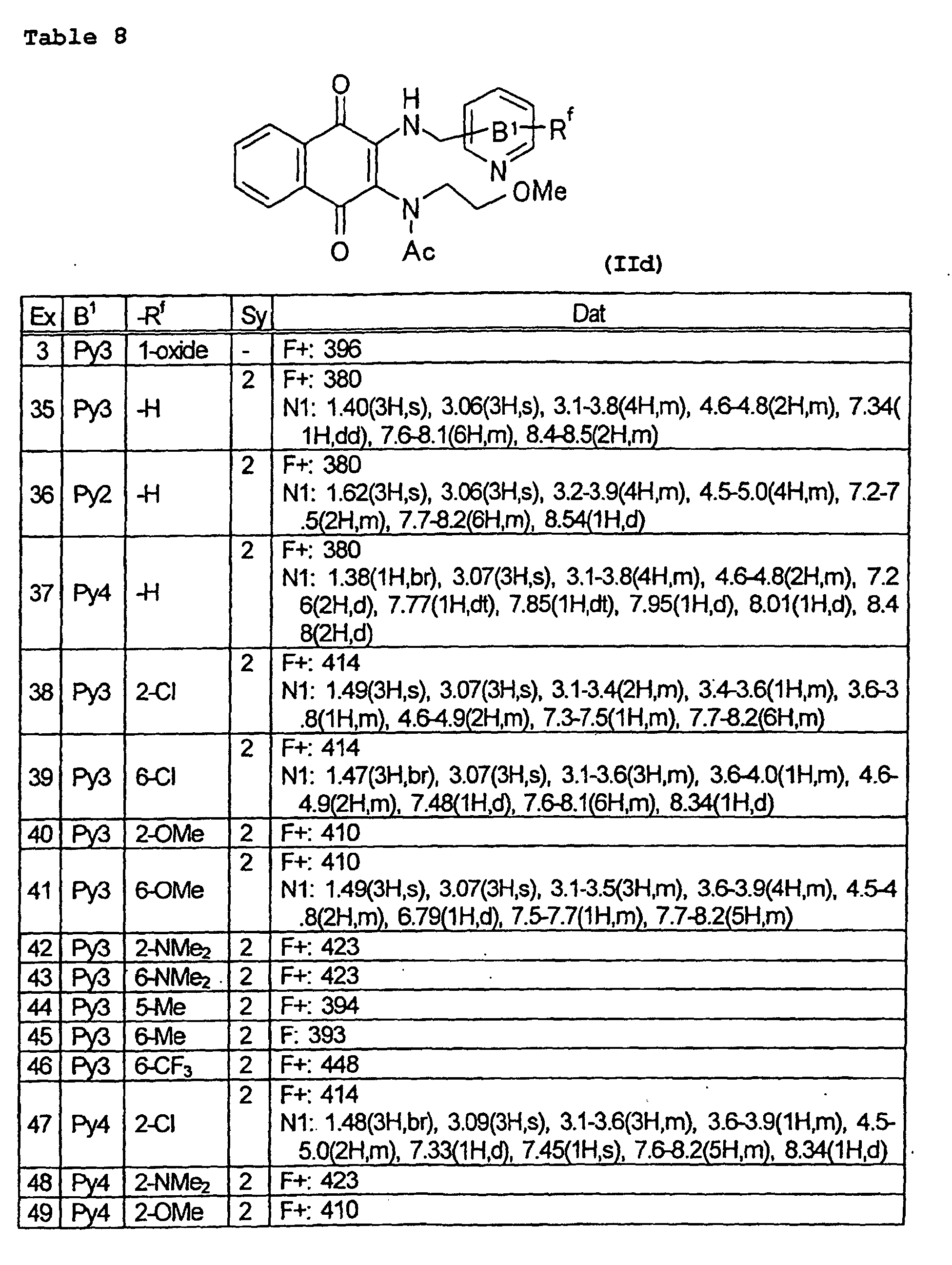
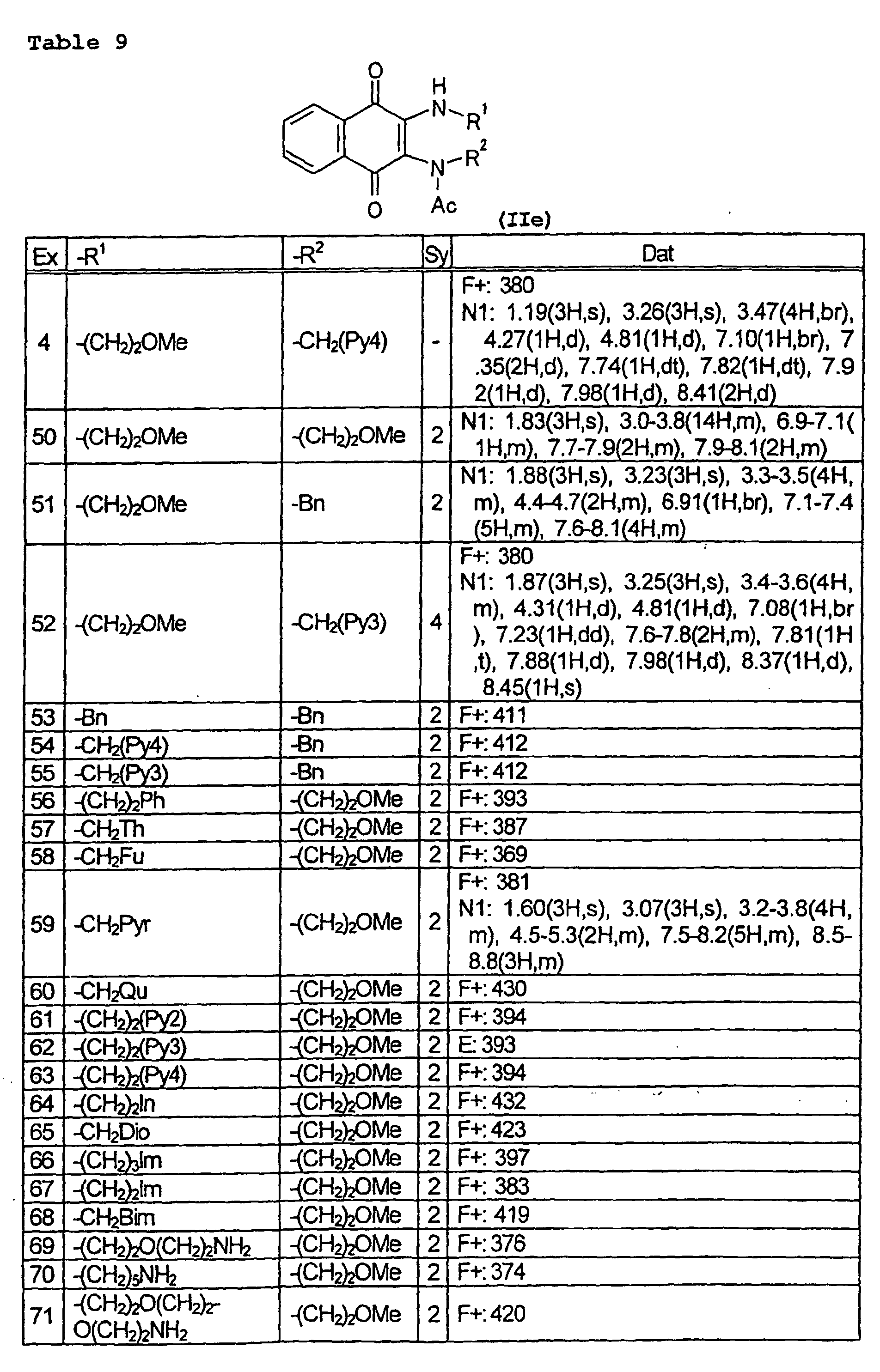
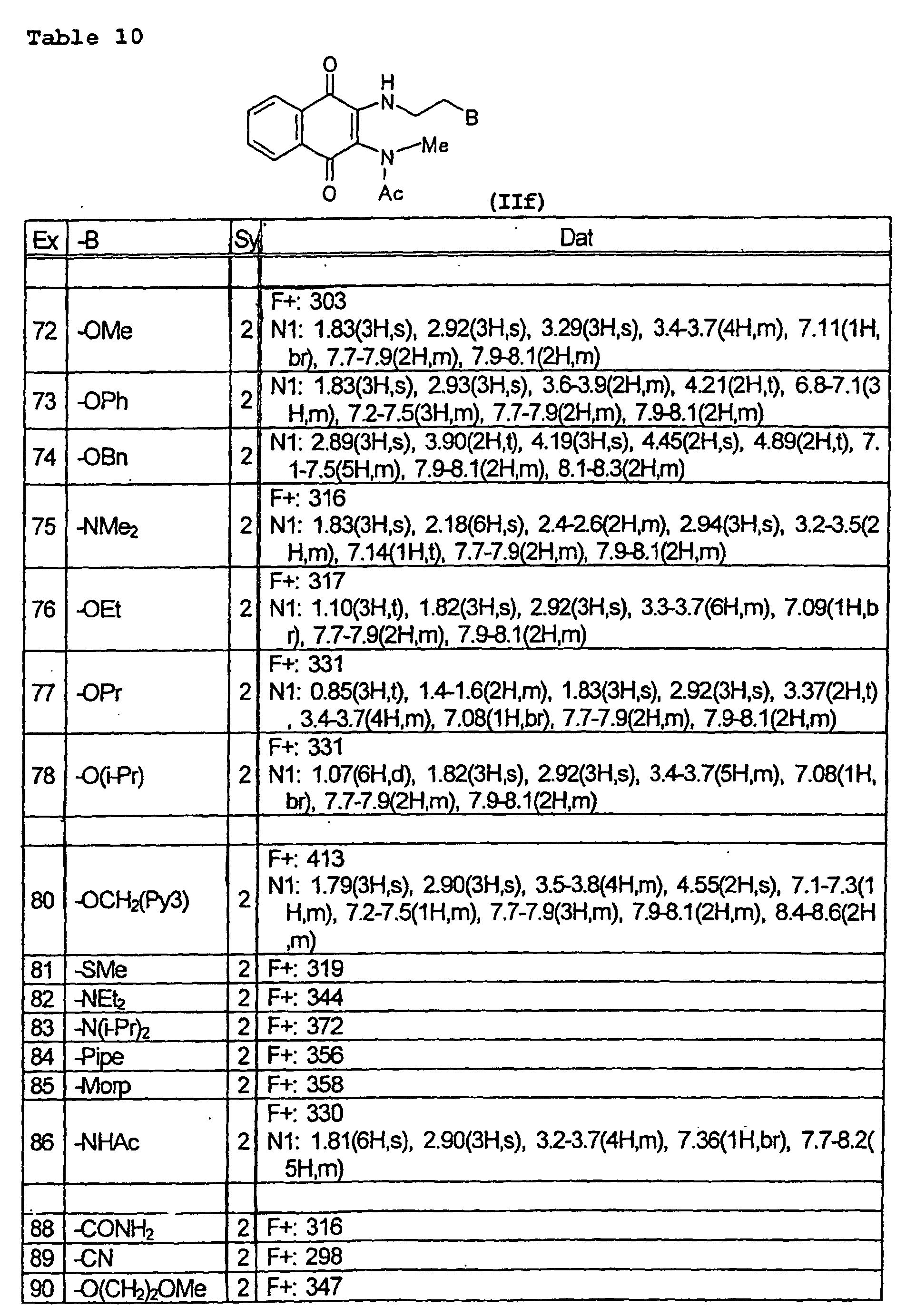

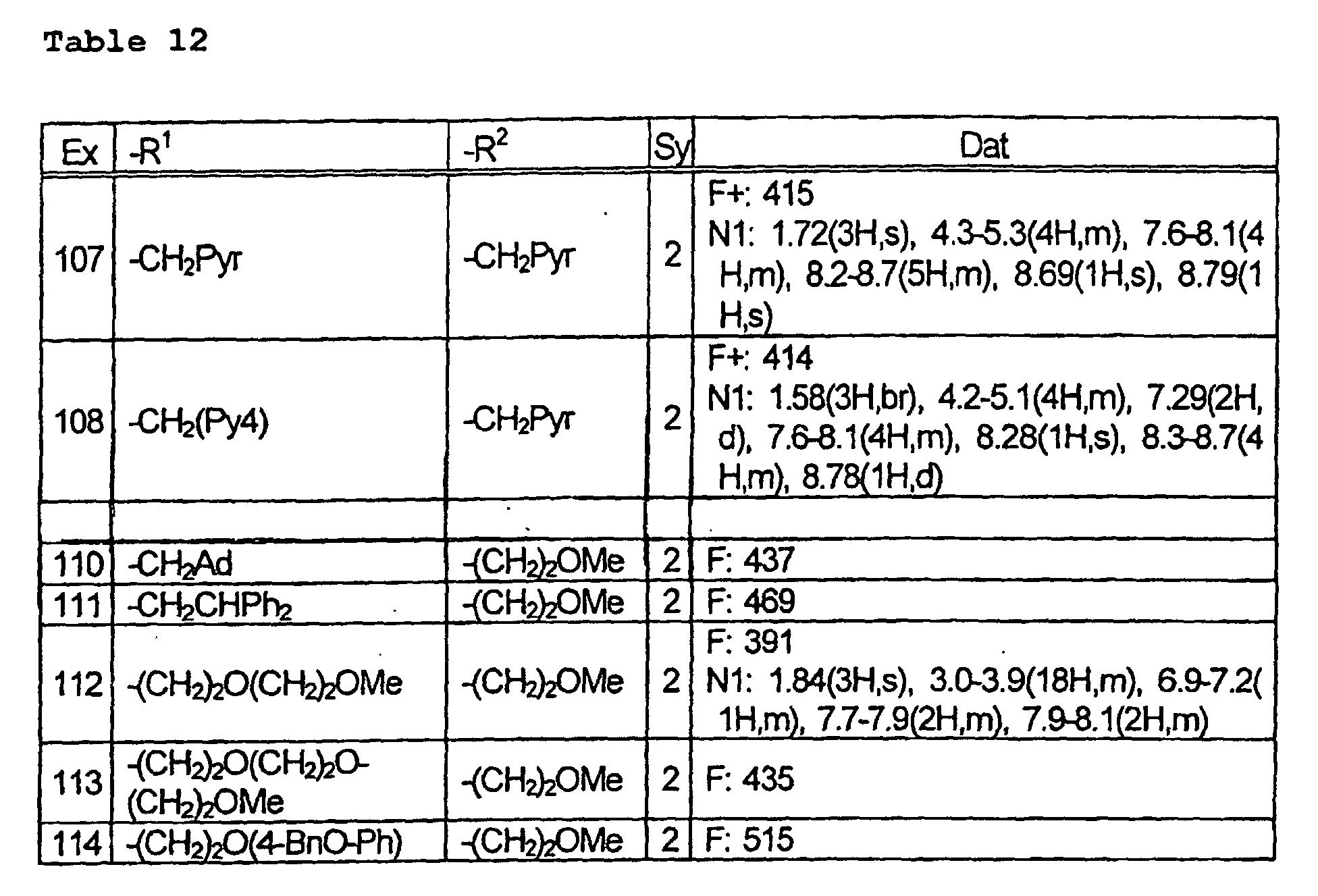

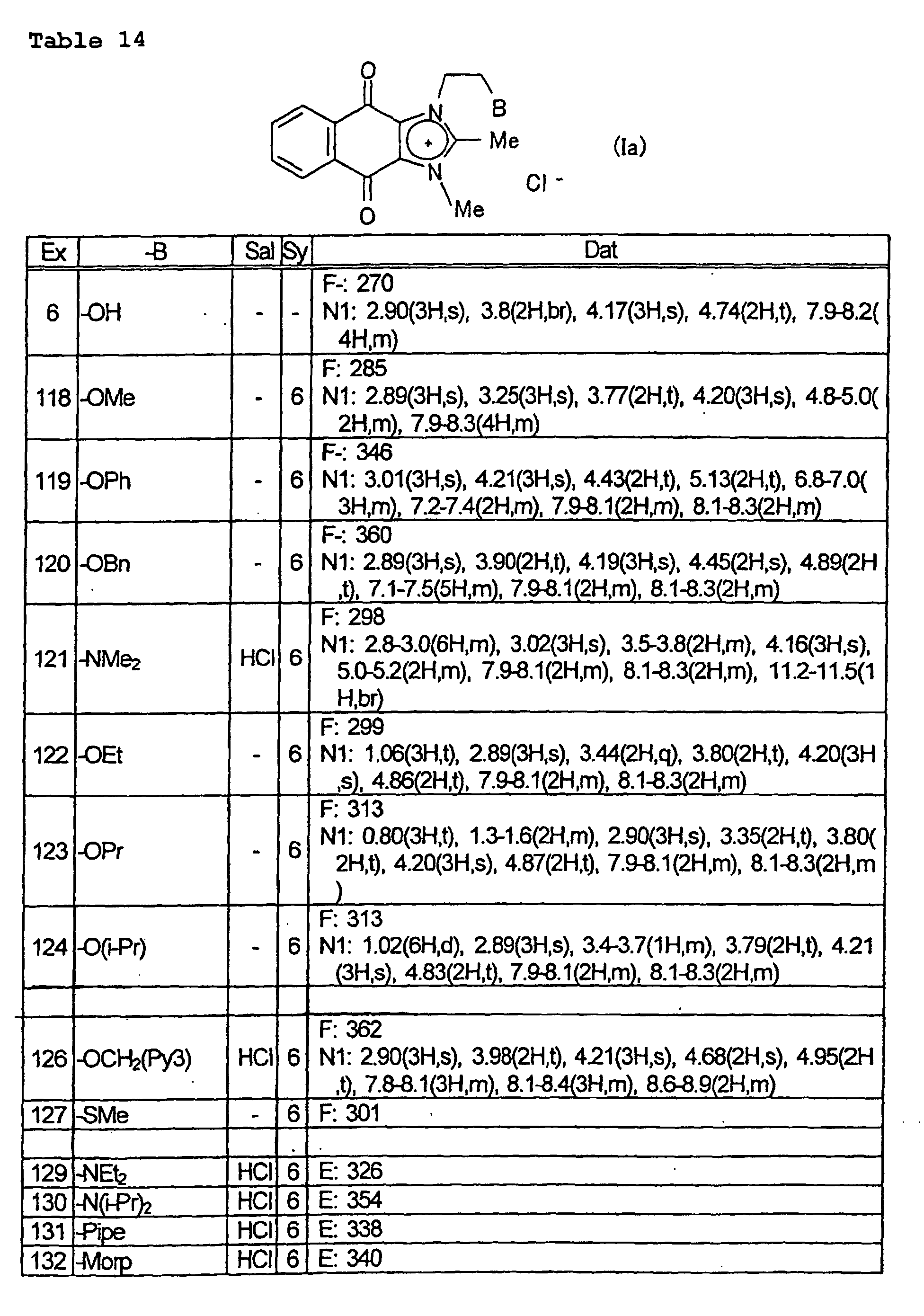

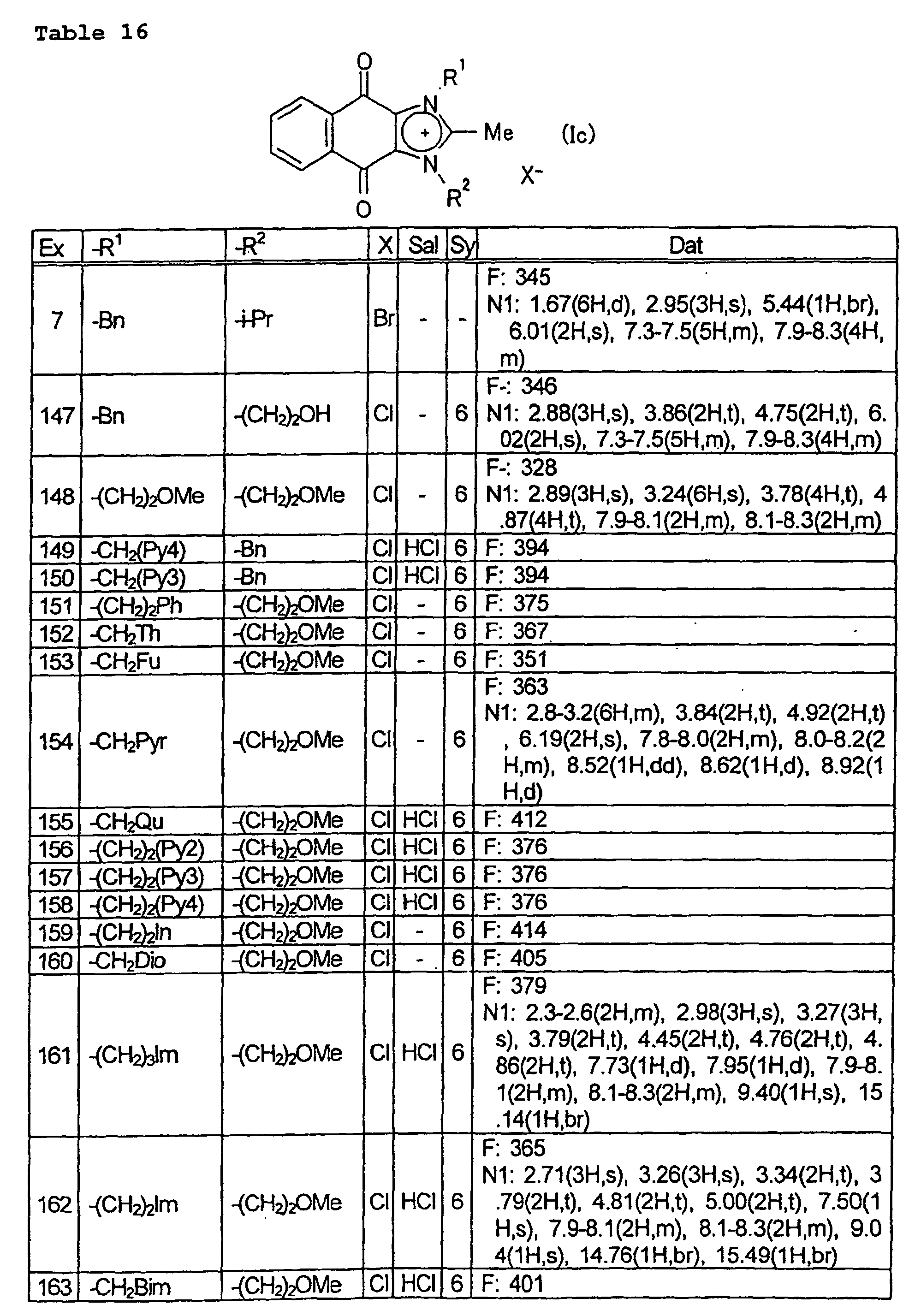
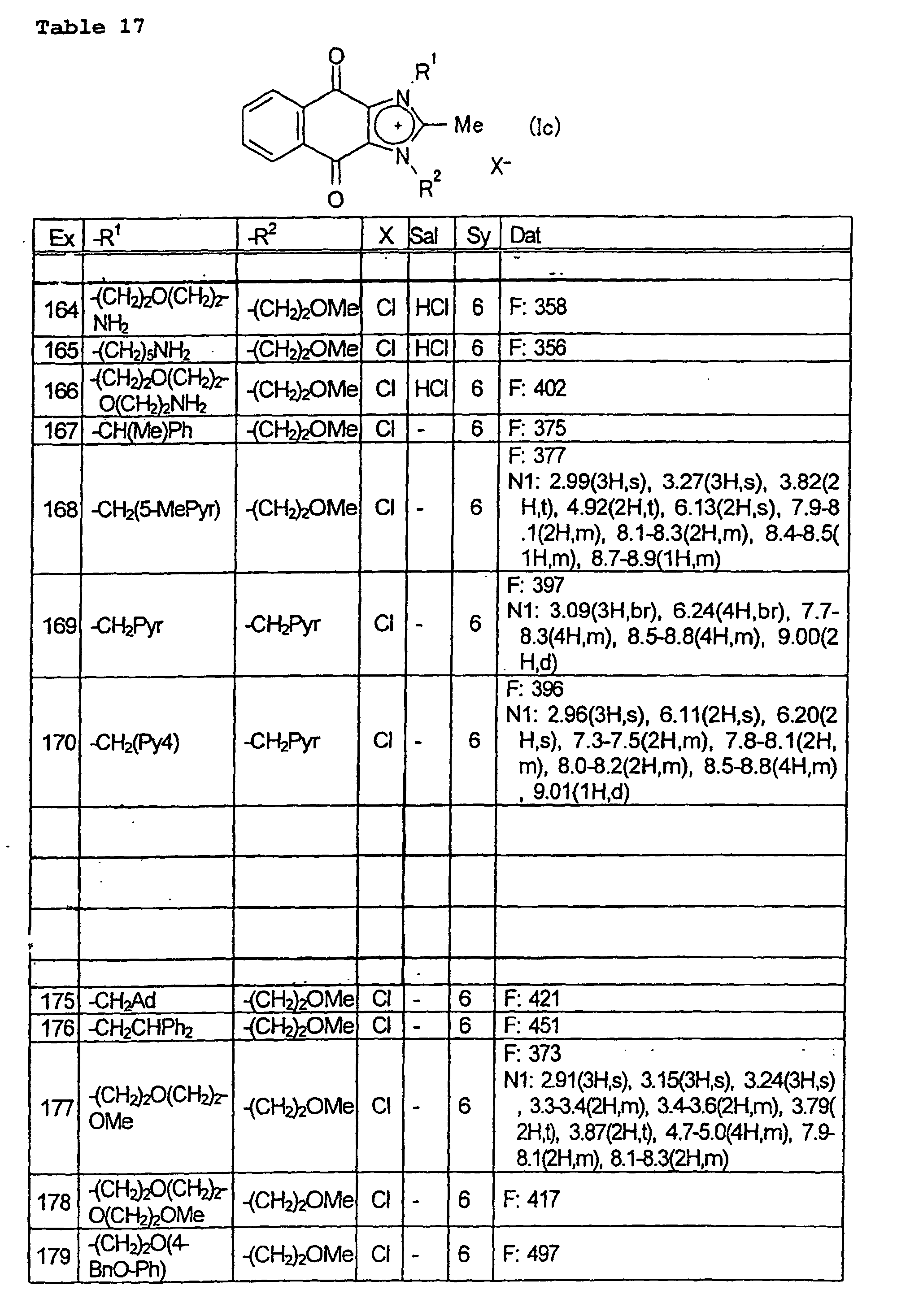


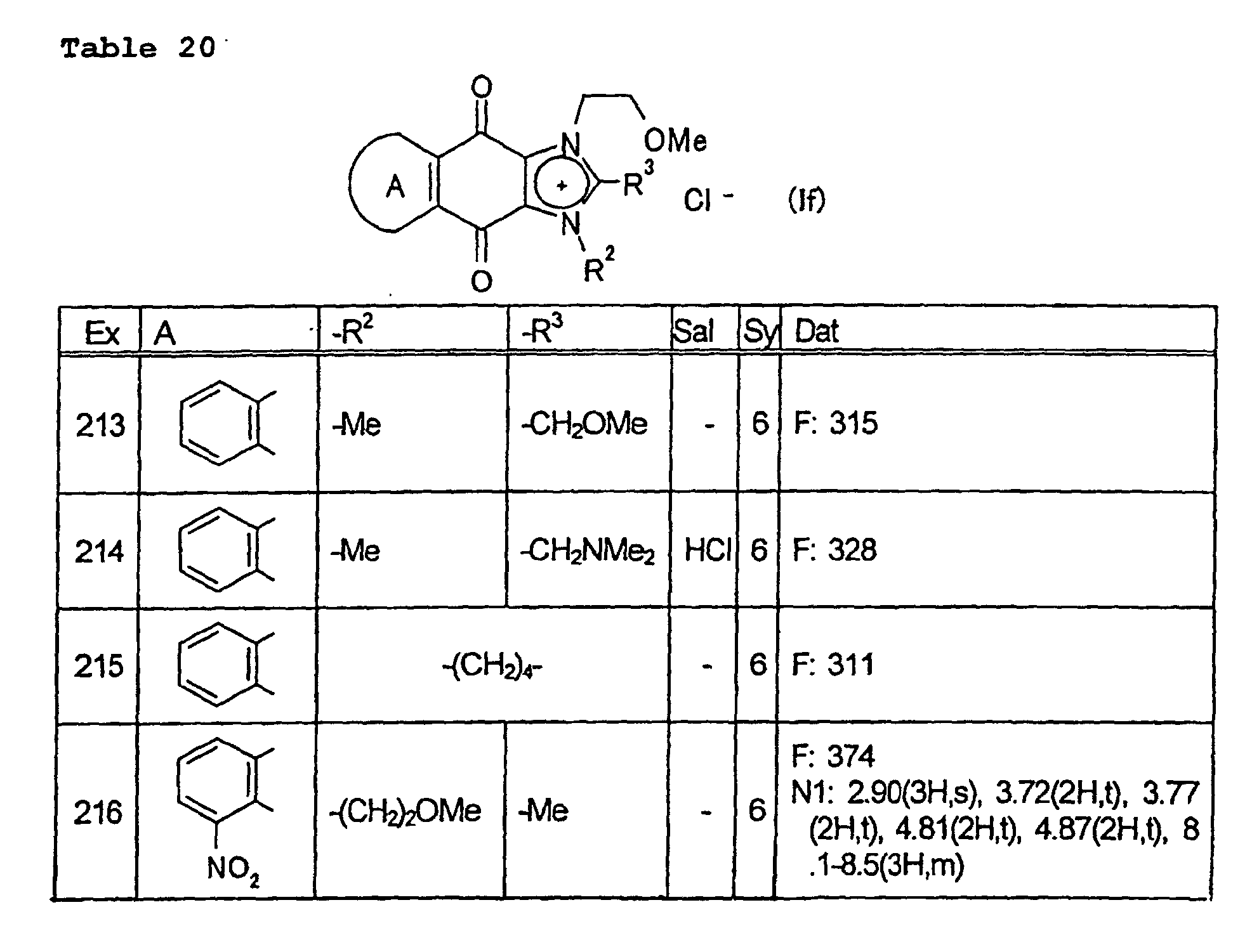

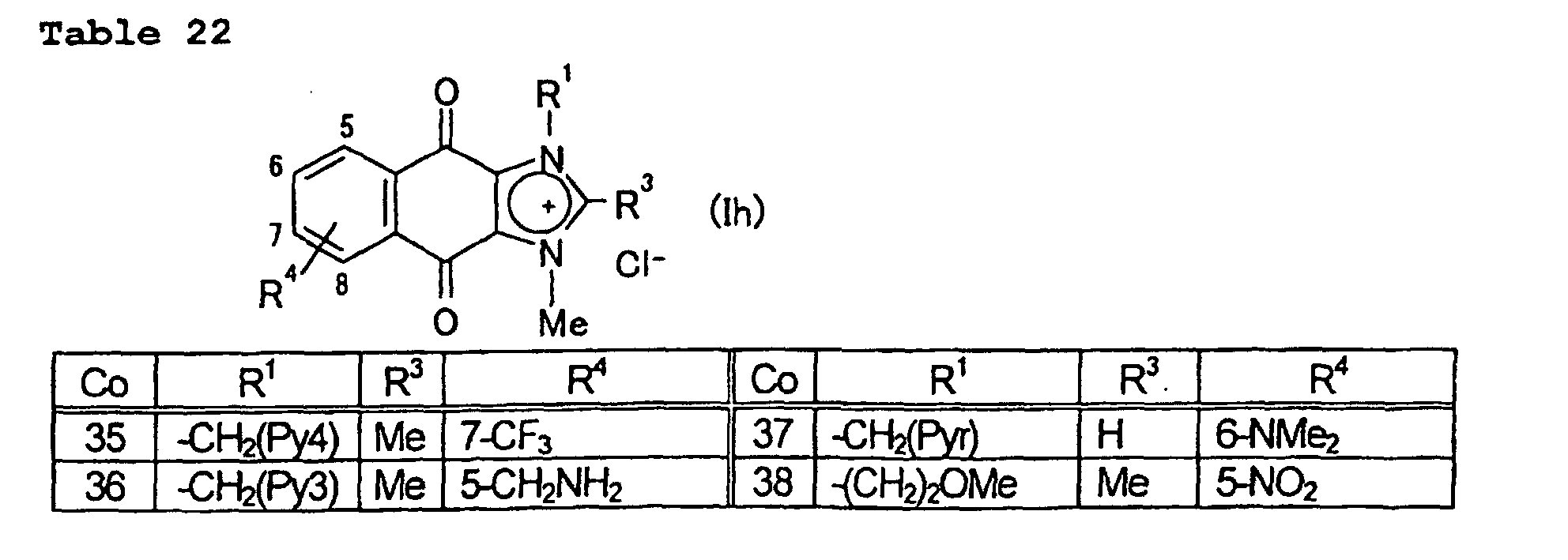

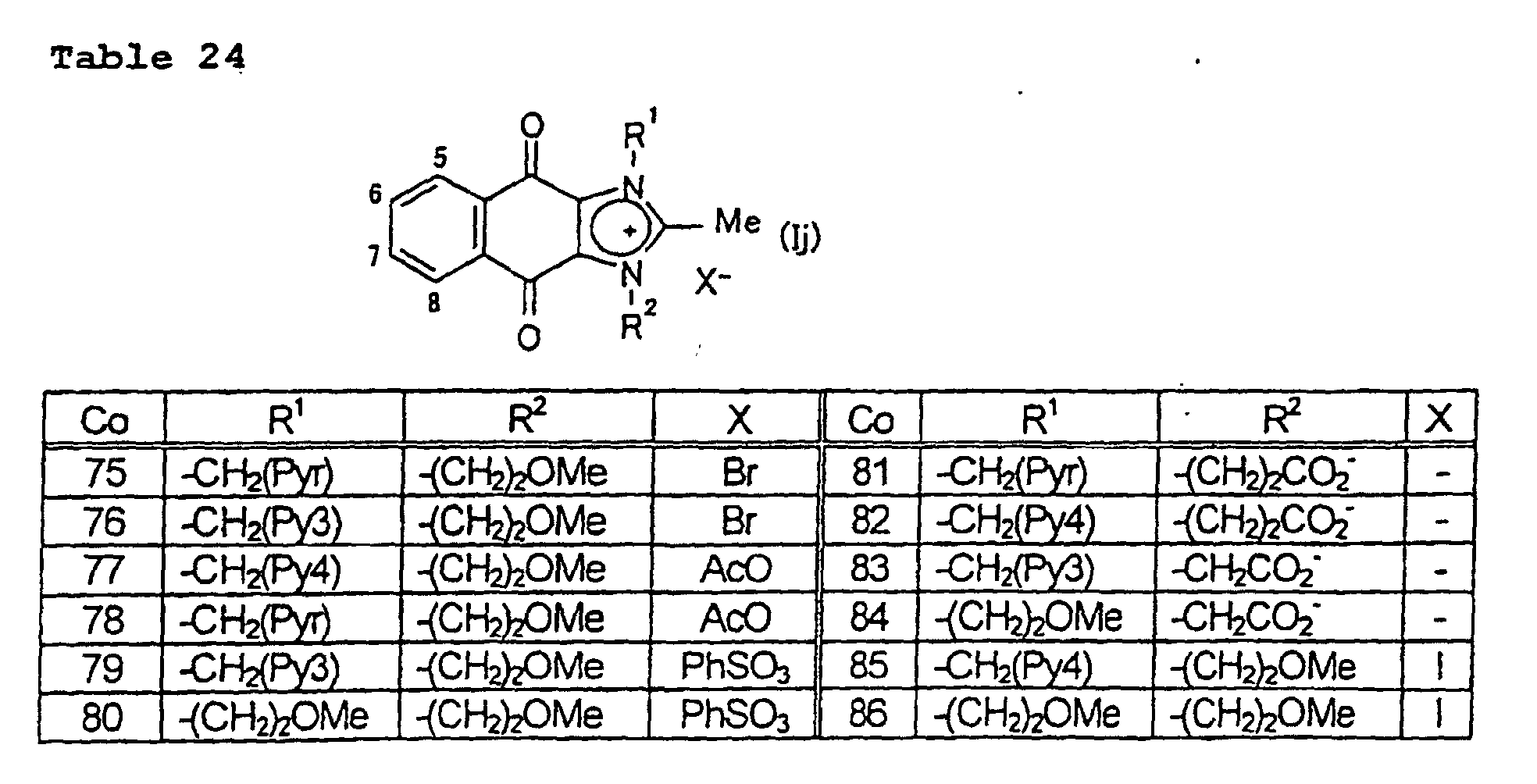
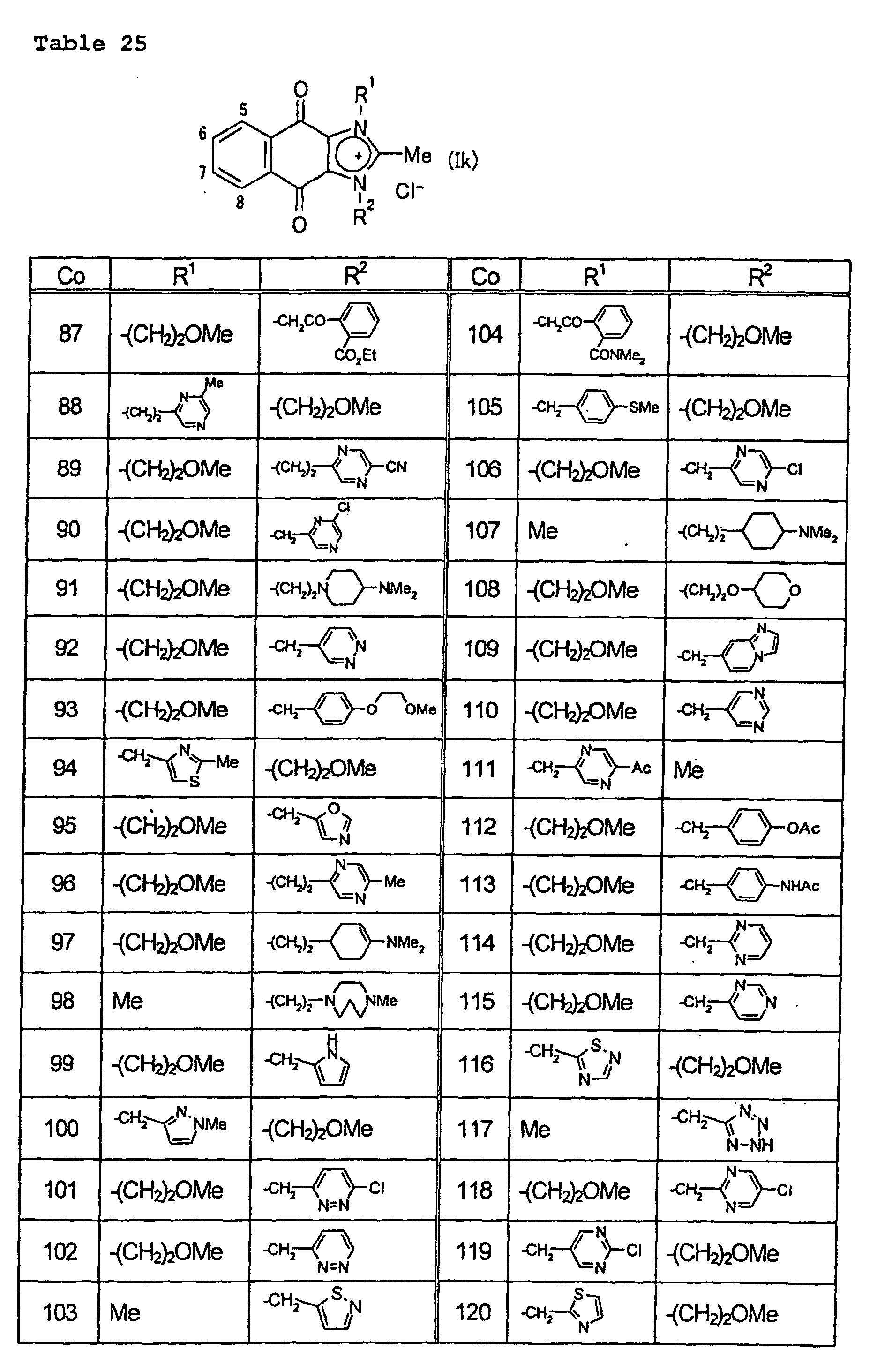

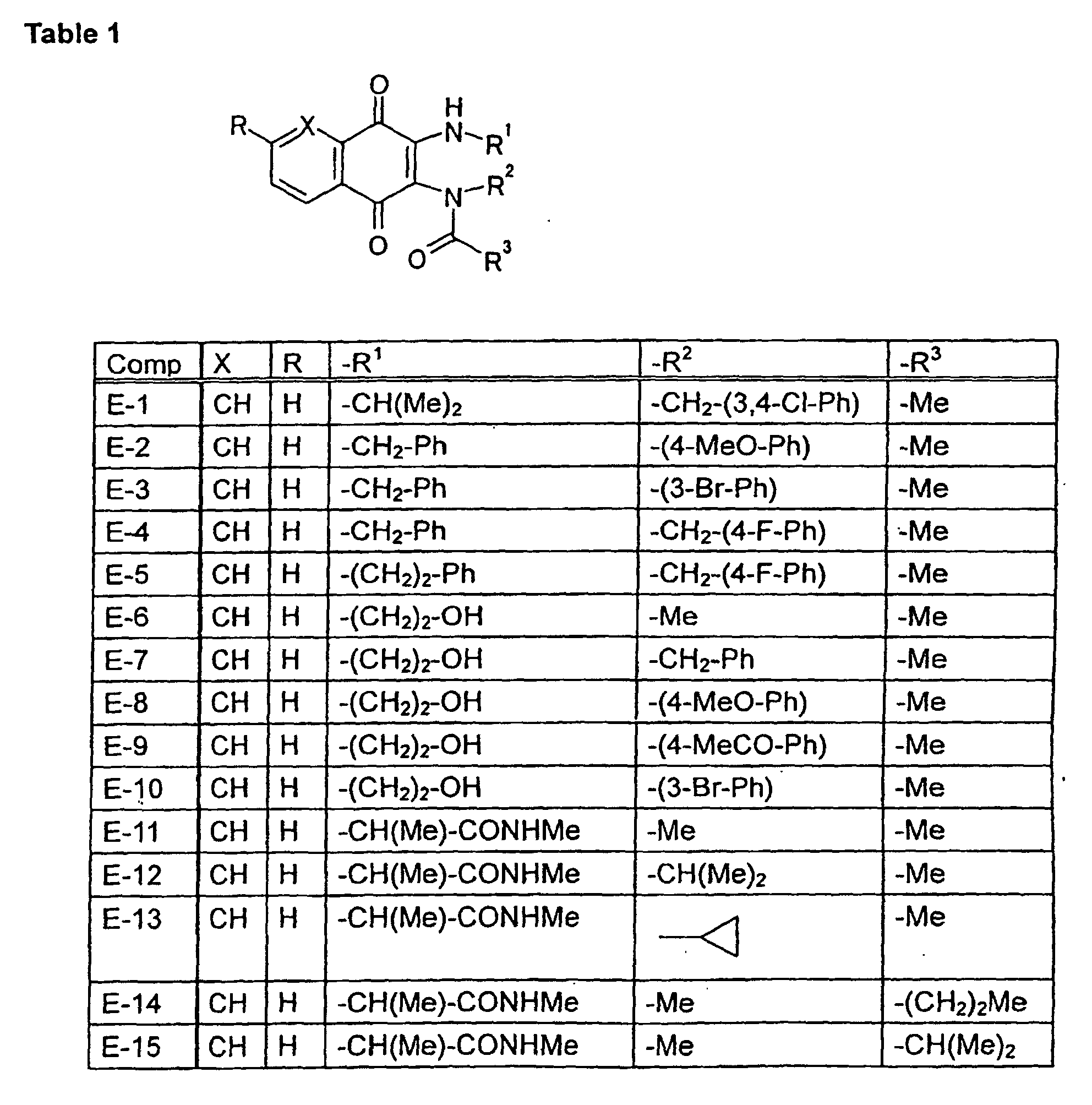
Claims (8)
- A fused imidazolium derivative of formula (I):or a pharmaceutically acceptable salt thereof wherein :
 with the proviso that the following compounds are excluded:R1 and R2 are the same or different;one of R1 and R2 represents C1-C6 alkyl having one or more substituents selected from
-ORa, -NRaRb, -NRa-CORb, -O-C1-C6 alkylene-ORa, -O-C1-C6 alkylene-O-C1-C6 alkylene-ORa, -SRa, -CONRaRb, -CN, -(C3-C10 cycloalkyl which may have one or more substituents selected from group C), -(saturated heterocylic which may have one or more substituents selected from group C), -(C6-C14 aryl which may have one or more substituents selected from group C), and -(heteroaryl which may have one or more substituents selected from group C), wherein saturated heterocyclic is a 5- to 7-membered saturated monocyclic ring which contains from 1 to 4 hetero ring atoms selected from N, S and O and which may be cross-linked, and wherein heteroaryl, which may be an N-heteroaryl in N-oxide form, is a 5- or 6-membered monocyclic heteroaryl ring containing from 1 to 4 hetero ring atoms selected from N, S and O or a bicyclic group in which a said monocyclic heteroaryl ring is fused with a benzene ring or a said monocyclic heteroaryl ring, which may be partially saturated;the other of R1 and R2 represents
-(C1-C6 alkyl having one or more substituents selected from group B), -(C2-C6 alkenyl having one or more substituents selected from group B), -(C2-C6 alkynyl having one or more substituents selected from group B), -RinD, -C1-C6 alkyl, -C2-C6 alkenyl or -C2-C6 alkynyl;group B is -ORa, -SRa, -O-C1-C6 alkylene-ORa, -O-C1-C6 alkylene-O- C1-C6 alkylene-ORa, -0- C1-C6 alkylene-NRaRb, -O-C1-C6 alkylene-O- C1-C6 alkylene-NRaRb, -O- C1-C6 alkylene-NRc- C1-C6 alkylene-NRaRb, -OCO-NRaRb, -SORa, -SO2Ra, -SO2NRaRb, -NRa-SO2Rb, -NRaRb, -NRc- C1-C6 alkylene-NRaRb, -N(-C1-C6 alkylene-NRaRb)2, -RinD, -NO2, -CN, -halogen, -CO2Ra, -COO-, -CONRaRb, -CONRa-O-Rb, -NRa-CORb, -NRa-CO-NRbRc, -OCORa and -CO-Ra;group C is -C1-C6 alkyl, -halogen, -halogeno C1-C6 alkyl, -ORa, -O-C1-C6 alkylene-ORa, -SRa, -NRaRb, -NO2, -CN, -CO2Ra, -CO-NRaRb, -CORa, -NRa-CORb, -SO2NRaRb, -C1-C6 alkylene-NRaRb, -C6-C14 aryl, -C1-C6 alkylene-C6-C14 aryl and -OCO-Ra;Ra, Rb and Rc are selected independently from -H, -C1-C6 alkyl, -C1-C6 alkylene-RinD and -RinD;RinD is -(saturated heterocyclic as defined herein which may have one or more substituents selected from group C), -(C3-C10 cycloalkyl which may have one or more substituents selected from group C),-(C3-C8 cycloalkenyl which may have one or more substituents selected from group C), -(C6-C14 aryl which may have one or more substituents selected from group C), or -(heteroaryl as defined herein which may have one or more substituents selected from group C);R3 is -H or -( C1-C6 alkyl which may have one or more substituents selected from group B), or R2 and R3 may together form alkylene having from 2 to 5 carbon atoms which may be interrupted with 0, S or NR4 where R4 is -H or -C1-C6 alkyl;ring A is a benzene ring which may have one or more substituents selected from group C; andX- is a counter anion, with the proviso that X' does not exist when the substituent -COO- of the group B forms intramolecular salt with imidazolium cation;(1) those in which one of R1 and R2 is -C1-C6 alkylene-(C6-C14 aryl which may have one or more substituents) and the other is -CH3, -(CH2)3CH3 or -phenyl, and(2) those in which R1 and R2 are both -benzyl or - (CH2)2OC2H5. - A compound according to claim 1 wherein R3 is a methyl group.
- A compound according to claim 1 wherein at least one of R1 and R2 is C1-C6 alkyl having one substituent selected from -(heteroaryl selected from pyridyl, pyrazinyl and pyrimidinyl, which may have one or more substituents selected from group C), -O-C1-C6 alkylene-O-C1-C6 alkyl and -O-C1-C6 alkyl, and ring A is a benzene ring which may be substituted by -NO2.
- A compound according to claim 1 selected from
1-[(6-chloro-3-pyridyl)methyl]-3-(2-methoxyethyl)-2-methyl-4,9-dioxo-4,9-di hydro-1H-naphtho[2,3-d]imidazol-3-ium,
1,2-dimethyl-4,9-dioxo-3-[(2-tetrahydrofuranyl)methyl]-4,9-dihydro-1H-naphtho[2,3-d]imidazol-3-ium,
1,3-bis(2-methoxyethyl)-2-methyl-4,9-dioxo-4,9-dihydro-1H-naphtho[2,3-d]imidazol-3-ium,
3-(2-methoxyethyl)-2-methyl-4,9-dioxo-1-(2-pyrazinylmethyl)-4,9-dihydro-1H-naphtho[2,3-d]imidazol-3-ium,
1-[3-(1H-4-imidazolyl)propyl]-3-(2-methoxyethyl)-2-methyl-4,9-dioxo-4,9-dihydro-1H-naphtho[2,3-d]imidazol-3-ium,
3-(2-methoxyethyl)-2-methyl-1-[(5-methyl-2-pyrazinyl)methyl]-4,9-dioxo-4,9 -dihydro-1H-naphtho[2,3-d]imidazol-3-ium,
2-methyl-4,9-dioxo-1,3-bis(2-pyrazinylmethyl)-4,9-dihydro-1H-naphtho[2,3-d]imidazol-3-ium,
1-[2-(2-methoxyethoxy)ethyl]-3-(2-methoxyethyl)-2-methyl-4,9-dioxo-4,9-dihydro-1H-naphtho[2,3-d]imidazol-3-ium,
1-{2-[2-(2-methoxyethoxy)ethoxy]ethyl}-3-(2-methoxyethyl)-2-methyl-4,9-dioxo-4,9-dihydro-1H-naphtho[2,3-d]imidazol-3-ium,
1-(2-methoxyethyl)-2-methyl-4,9-dioxo-3-(3-pyridylmethyl)-4,9-dihydro-1H-naphtho[2,3-d]imidazol-3-ium,
3-(2-methoxyethyl)-2-methyl-4,9-dioxo-1-(2-pyridylmethyl)-4,9-dihydro-1H-naphtho[2,3-d]imidazol-3-ium,
3-(2-methoxyethyl)-2-methyl-4,9-dioxo-1-(4-pyridylmethyl)-4,9-dihydro-1H-naphtho[2,3-d]imidazol-3-ium,
1-[(2-chloro-3-pyridyl)methyl]-3-(2-methoxyethyl)-2-methyl-4,9-dioxo-4,9-dihydro-1H-naphtho[2,3-d]imidazol-3-ium,
1-[(2-hydroxy-4-pyridyl)methyl]-3-(2-methoxyethyl)-2-methyl-4,9-dioxo-4,9-dihydro-1H-naphtho[2,3-d]imidazol-3-ium,
3-(2-methoxyethyl)-1-[(6-methoxy-3-pyridyl)methyl]-2-methyl-4,9-dioxo-4,9-dihydro-1H-naphtho[2,3-d]imidazol-3-ium,
1-[(2-chloro-4-pyridyl)methyl]-3-(2-methoxyethyl)-2-methyl-4,9-dioxo-4,9-dihydro-1H-naphtho[2,3-d]imidazol-3-ium,
1-(4-chlorobenzyl)-3-(2-methoxyethyl)-2-methyl-4,9-dioxo-4,9-dihydro-1H-naphtho[2,3-d]imidazol-3-ium,
1-(4-fluorobenzyl)-3-(2-methoxyethyl)-2-methyl-4,9-dioxo-4,9-dihydro-1H-naphtho[2,3-d]imidazol-3-ium and
1,3-bis(2-methoxyethyl)-2-methyl-5-nitro-4,9-dioxo-4,9-dihydro-1H-naphtho[2,3-d]imidazol-3-ium, tautomers thereof,and their salts with halogen ions. - A pharmaceutical composition which comprises a compound according to any of claims 1 to 4 and pharmaceutically acceptable carrier.
- A composition according to claim 5 which is an anticancer agent.
- A 2-acylamino-3-amino-1,4-quinone derivative of formula (II) or a salt thereofwherein:
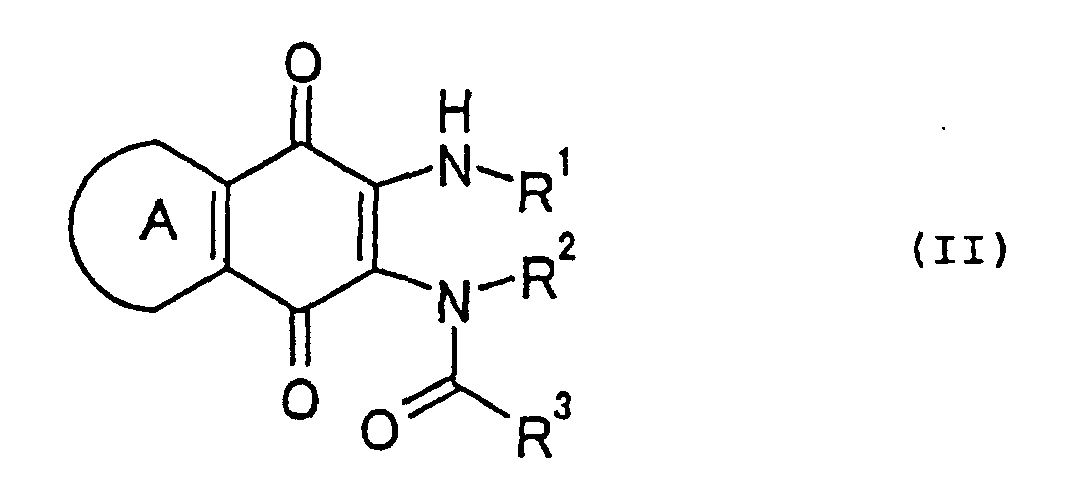 with the proviso that the following compounds are excluded:R1 and R2 are the same or different;one of R1 and R2 represents C1-C6 alkyl having one or more substituents selected from
-ORa, -NRaRb, -NRa-CORb, -O-C1-C6 alkylene-ORa, -O-C1-C6 alkylene-O-C1-C6 alkylene-ORa, -SRa, -CONRaRb, -CN, -(C3-C10 cycloalkyl which may have one or more substituents selected from group C), -(saturated heterocylic which may have one or more substituents selected from group C), -(C6-C14 aryl which may have one or more substituents selected from group C), and -(heteroaryl which may have one or more substituents selected from group C), wherein saturated heterocyclic is a 5- to 7-membered saturated monocyclic ring which contains from 1 to 4 hetero ring atoms selected from N, S and O and which may be cross-linked, and wherein heteroaryl, which may be an N-heteroaryl in N-oxide form, is a 5- or 6-membered monocyclic heteroaryl ring containing from 1 to 4 hetero ring atoms selected from N, S and O or a bicyclic group in which a said monocyclic heteroaryl ring is fused with a benzene ring or a said monocyclic heteroaryl ring, which may be partially saturated;the other of R1 and R2 represents
-(C1-C6 alkyl having one or more substituents selected from group B), -(C2-C6 alkenyl having one or more substituents selected from group B), -(C2-C6 alkynyl having one or more substituents selected from group B), -RinD, -C1-C6 alkyl, -C2-C6 alkenyl or -C2-C6 alkynyl;group B is -ORa, -SRa, -O-C1-C6 alkylene-ORa, -O-C1-C6 alkylene-O- C1-C6 alkylene-ORa, -O- C1-C6 alkylene-NRaRb, -O-C1-C6 alkylene-O- C1-C6 alkylene-NRaRb, -O- C1-C6 alkylene-NRc- C1-C6 alkylene-NRaRb, -OCO-NRaRb, -SORa, -SO2Ra, -SO2NRaRb, -NRa-SO2Rb, -NRaRb, -NRc- C1-C6 alkylene-NRaRb, -N(-C1-C6 alkylene-NRaRb)2, -RinD, -NO2, -CN, -halogen, -CO2Ra, -CONRaRb, -CONRa-O-Rb, -NRa-CORb, -NRa-CO-NRbRc, -OCORa and -CO-Ra;group C is -C1-C6 alkyl, -halogen, -halogeno C1-C6 alkyl, -ORa, -O-C1-C6 alkylene-ORa, -SRa, -NRaRb, -NO2, -CN, -CO2Ra, -CO-NRaRb, -CORa, -NRa-CORb, -SO2NRaRb, -C1-C6 alkylene-NRaRb, -C6-C14 aryl, -C1-C6 alkylene-C6-C14 aryl and -OCO-Ra;Ra, Rb and Rc are selected independently from -H, -C1-C6 alkyl, -C1-C6 alkylene-RinD and -RinD;RinD is -(saturated heterocyclic as defined herein which may have one or more substituents selected from group C), -(C3-C10 cycloalkyl which may have one or more substituents selected from group C),-(C3-C8 cycloalkenyl which may have one or more substituents selected from group C), -(C6-C14 aryl which may have one or more substituents selected from group C), or -(heteroaryl as defined herein which may have one or more substituents selected from group C);R3 is -H or -(C1-C6 alkyl which may have one or more substituents selected from group B), or R2 and R3 may together form alkylene having from 2 to 5 carbon atoms which may be interrupted with O, S or NR4 where R4 is -H or -C1-C6 alkyl;ring A is a benzene ring which may have one or more substituents selected from group C; andComp means compound number, Me means methyl group, Et means ethyl group and Ph means phenyl group, and in the case of a substituted phenyl group, the substituent is shown before Ph together with the substituting position, e.g. 3,4-Cl-Ph represents 3,4-dichlorophenyl:(1) those in which one of R1 and R2 is -C1-C6 alkylene -(C6-C14 aryl which may have one or more substituents) and the other is -CH3, -(CH2)3CH3 or -phenyl,(2) those in which R1 and R2 are both benzyl or -(CH2)2OC2H5, and(3) those of the following Table, in which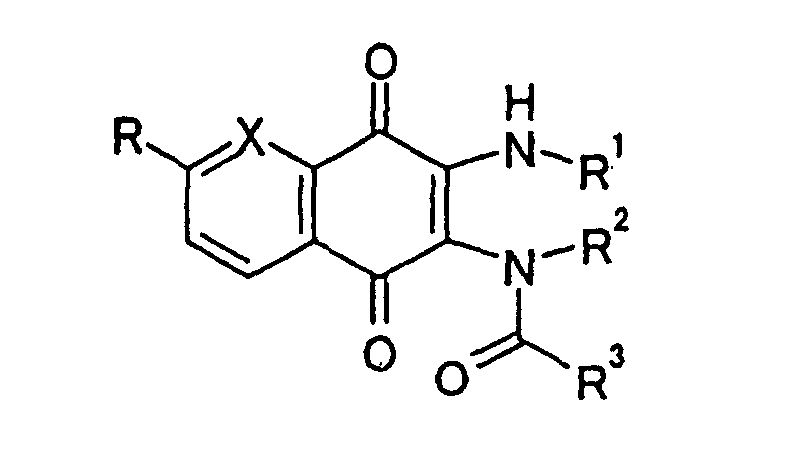

- A fused imidazole derivative of formula (III) or a salt thereofwherein:
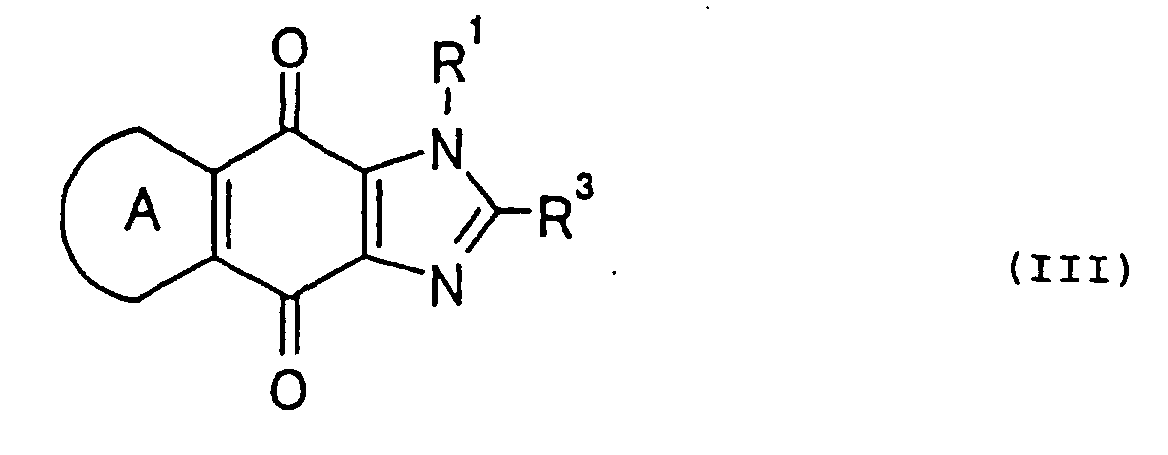 R1 is C1-C6 alkyl having one or more substituents selected from
-ORa, -NRaRb, -NRa-CORb, -O-C1-C6 alkylene-ORa, -O-C1-C6 alkylene-O-C1-C6 alkylene-ORa, -SRa, -CONRaRb, -CN, -(C3-C10 cycloalkyl which may have one or more substituents selected from group C), -(saturated heterocylic which may have one or more substituents selected from group C), -(C6-C14 aryl which may have one or more substituents selected from group C), and -(heteroaryl which may have one or more substituents selected from group C), wherein saturated heterocyclic is a 5- to 7-membered saturated monocyclic ring which contains from 1 to 4 hetero ring atoms selected from N, S and O and which may be cross-linked, and wherein heteroaryl, which may be an N-heteroaryl in N-oxide form, is a 5- or 6-membered monocyclic heteroaryl ring containing from 1 to 4 hetero ring atoms selected from N, S and O or a bicyclic group in which a said monocyclic heteroaryl ring is fused with a benzene ring or a said monocyclic heteroaryl ring, which may be partially saturated, and with the proviso that C1-C6 alkyl having one or more substituents selected from -NH2, -NMe2, -NEt2, -OH and -(phenyl which may be substituted by -Cl, -F, -Me or OMe) is excluded;group B is -ORa, -SRa, -O-C1-C6 alkylene-ORa, -O-C1-C6 alkylene-O- C1-C6 alkylene-ORa, -O- C1-C6 alkylene-NRaRb, -O-C1-C6 alkylene-O- C1-C6 alkylene-NRaRb, -O- C1-C6 alkylene-NRc- C1-C6 alkylene-NRaRb, -OCO-NRaRb, -SORa, -SO2Ra, -SO2NRaRb, -NRa-SO2Rb, -NRaRb, -NRc- C1-C6 alkylene-NRaRb, -N(-C1-C6 alkylene-NRaRb)2, -RinD, -NO2, -CN, -halogen, -CO2Ra, -CONRaRb, -CONRa-O-Rb, -NRa-CORb, -NRa-CO-NRbRc, -OCORa and -CO-Ra;group C is -C1-C6 alkyl, -halogen, -halogeno C1-C6 alkyl, -ORa, -O-C1-C6 alkylene-ORa, -SRa, -NRaRb, -NO2, -CN, -CO2Ra, -CO-NRaRb, -CORa, -NRa-CORb, -SO2NRaRb, -C1-C6 alkylene-NRaRb, -C6-C14 aryl, -C1-C6 alkylene-C6-C14 aryl and -OCO-Ra;Ra, Rb and Rc are selected independently from -H, -C1-C6 alkyl, -C1-C6 alkylene-RinD and -RinD;RinD is -(saturated heterocyclic as defined herein which may have one or more substituents selected from group C), -(C3-C10 cycloalkyl which may have one or more substituents selected from group C),-(C3-C8 cycloalkenyl which may have one or more substituents selected from group C), -(C6-C14 aryl which may have one or more substituents selected from group C), or -(heteroaryl as defined herein which may have one or more substituents selected from group C);R3 is -H or -(C1-C6 alkyl which may have one or more substituents selected from group B); andring A is a benzene ring which may have one or more substituents selected from group C.
Priority Applications (1)
| Application Number | Priority Date | Filing Date | Title |
|---|---|---|---|
| DK01904433T DK1256576T3 (en) | 2000-02-15 | 2001-02-14 | Condensed imidazolium derivatives |
Applications Claiming Priority (5)
| Application Number | Priority Date | Filing Date | Title |
|---|---|---|---|
| JP2000036645 | 2000-02-15 | ||
| JP2000036645 | 2000-02-15 | ||
| JP2000261489 | 2000-08-30 | ||
| JP2000261489 | 2000-08-30 | ||
| PCT/JP2001/001036 WO2001060803A1 (en) | 2000-02-15 | 2001-02-14 | Fused imidazolium derivatives |
Publications (3)
| Publication Number | Publication Date |
|---|---|
| EP1256576A1 EP1256576A1 (en) | 2002-11-13 |
| EP1256576A4 EP1256576A4 (en) | 2003-04-02 |
| EP1256576B1 true EP1256576B1 (en) | 2005-06-15 |
Family
ID=26585385
Family Applications (1)
| Application Number | Title | Priority Date | Filing Date |
|---|---|---|---|
| EP01904433A Expired - Lifetime EP1256576B1 (en) | 2000-02-15 | 2001-02-14 | Fused imidazolium derivatives |
Country Status (12)
| Country | Link |
|---|---|
| US (1) | US6734203B2 (en) |
| EP (1) | EP1256576B1 (en) |
| JP (1) | JP3397320B2 (en) |
| KR (1) | KR100737090B1 (en) |
| CN (1) | CN100436425C (en) |
| AT (1) | ATE297901T1 (en) |
| AU (1) | AU2001232286A1 (en) |
| CA (1) | CA2395717C (en) |
| DE (1) | DE60111498T2 (en) |
| ES (1) | ES2243441T3 (en) |
| PT (1) | PT1256576E (en) |
| WO (1) | WO2001060803A1 (en) |
Families Citing this family (30)
| Publication number | Priority date | Publication date | Assignee | Title |
|---|---|---|---|---|
| CA2522486C (en) * | 2003-04-15 | 2011-02-22 | Astellas Pharma Inc. | Bromide and crystals thereof |
| WO2008023807A1 (en) * | 2006-08-25 | 2008-02-28 | Astellas Pharma Inc. | Stabilized pharmaceutical composition |
| US7618992B2 (en) | 2006-12-29 | 2009-11-17 | Astellas Pharma Inc. | Method of treating cancer by co-administration of anticancer agents |
| WO2009137103A2 (en) * | 2008-05-09 | 2009-11-12 | Ourth Donald D | Anti-cancer/anti-viral compounds and methods of use |
| JP2014156400A (en) * | 2011-05-24 | 2014-08-28 | Astellas Pharma Inc | Labeled derivative for image diagnosis of tumor |
| US9662329B2 (en) | 2012-03-26 | 2017-05-30 | University of Pittsburgh—of the Commonwealth System of Higher Education | Use of survivin antagonists in polyomavirus-related disease |
| US9732154B2 (en) | 2014-02-28 | 2017-08-15 | Janssen Biotech, Inc. | Anti-CD38 antibodies for treatment of acute lymphoblastic leukemia |
| US9603927B2 (en) | 2014-02-28 | 2017-03-28 | Janssen Biotech, Inc. | Combination therapies with anti-CD38 antibodies |
| WO2015151490A1 (en) * | 2014-03-31 | 2015-10-08 | 大日本住友製薬株式会社 | New tricyclic quinone derivative |
| BR112016027393A8 (en) | 2014-06-26 | 2021-03-30 | Ihara Chemical Ind Co | fluoroalkylating agent, method for producing a target compound, compound and its use |
| CN105566148B (en) * | 2014-10-14 | 2017-10-03 | 沈阳中化农药化工研发有限公司 | A kind of quaternary ammonium compound and its application |
| EA202092609A1 (en) | 2014-12-04 | 2021-10-29 | Янссен Байотек, Инк. | ANTIBODIES TO CD38 FOR TREATMENT OF ACUTE MYELOLEUKOSIS |
| CA2986594C (en) | 2015-05-20 | 2025-06-10 | Tufts Medical Center, Inc. | Anti-cd38 antibodies for treatment of light chain amyloidosis and other cd38-positive hematological malignancies |
| CN107708734B (en) | 2015-06-22 | 2022-01-11 | 詹森生物科技公司 | Combination therapy of heme malignancies with anti-CD 38 antibodies and survivin inhibitors |
| HUE053366T2 (en) | 2015-11-03 | 2021-06-28 | Janssen Biotech Inc | Subcutaneous anti-CD38 antibody preparations and their use |
| US20190233533A1 (en) | 2016-06-28 | 2019-08-01 | Umc Utrecht Holding B.V. | Treatment Of IgE-Mediated Diseases With Antibodies That Specifically Bind CD38 |
| CN107501279B (en) * | 2016-09-20 | 2018-11-23 | 东莞市真兴贝特医药技术有限公司 | Furanoquinoline dione compound and medical application thereof |
| JP7106563B2 (en) | 2016-11-29 | 2022-07-26 | スミトモ ファーマ オンコロジー, インコーポレイテッド | Naphthofuran derivatives, their preparation and methods of use |
| WO2018218633A1 (en) | 2017-06-02 | 2018-12-06 | Beijing Percans Oncology Co. Ltd. | Combination therapies for treating cancers |
| CN111565751A (en) | 2017-10-31 | 2020-08-21 | 詹森生物科技公司 | Approaches to the treatment of high-risk multiple myeloma |
| WO2019195959A1 (en) | 2018-04-08 | 2019-10-17 | Cothera Biosciences, Inc. | Combination therapy for cancers with braf mutation |
| CN108530365B (en) * | 2018-06-26 | 2020-07-14 | 上海交通大学 | 1, 4-naphthoquinone/anthraquinone imidazole derivative and preparation and application thereof |
| CN108794403A (en) * | 2018-06-26 | 2018-11-13 | 上海交通大学 | A kind of acyl methylnaphthoquinone imdazole derivatives and its preparation and use |
| EP3590935A1 (en) | 2018-07-06 | 2020-01-08 | Deutsches Krebsforschungszentrum, Stiftung des öffentlichen Rechts | Fused imidazolium derivatives for use in the treatment of colorectal cancer |
| JP7507145B2 (en) | 2018-08-13 | 2024-06-27 | ベイジン パーカンズ オンコロジー カンパニー リミテッド | Biomarkers for Cancer Treatment |
| WO2020181386A1 (en) * | 2019-03-13 | 2020-09-17 | Trillium Therapeutics Inc. | Fluorinated benzo[f]benzimidazol-4-9-dione ium derivatives and pharmaceutical compositions thereof and their use as survivin suppressants |
| WO2023133703A1 (en) * | 2022-01-11 | 2023-07-20 | Chun Jiang | Apoptosis inhibitor salts for cancer |
| EP4484412A4 (en) * | 2022-03-07 | 2025-07-02 | Univ Shanghai Jiaotong | CONDENSED QUINONE OXIMIMIDAZOLES, THEIR ONIUM DERIVATIVES, THEIR PREPARATION AND USE |
| WO2025081428A1 (en) * | 2023-10-19 | 2025-04-24 | Chun Jiang | Apoptosis inhibitor molybdate salts for treating cancer |
| CN118894807B (en) * | 2024-07-11 | 2025-12-02 | 中山大学 | 1,4-Naphthoquinone imidazole salt anode materials and their application in aqueous flow batteries |
Family Cites Families (10)
| Publication number | Priority date | Publication date | Assignee | Title |
|---|---|---|---|---|
| GB887337A (en) * | 1958-02-14 | 1962-01-17 | Ciba Ltd | New benzo-bis-imidazoles and process for their manufacture |
| US3060188A (en) * | 1958-02-14 | 1962-10-23 | Ciba Geigy Corp | 2:6-dialkyl-4:8-dihydroxybenzo[1:2:4:5]bis-imidazoles and the corresponding quinones |
| GB1314881A (en) * | 1970-03-06 | 1973-04-26 | Shell Int Research | Naphthaquinone derivatives and their use as herbicides |
| US4581349A (en) * | 1984-06-21 | 1986-04-08 | University Of Maryland | Certain benzodiimidazoles and their use as radiation sensitizers |
| JPH03258765A (en) | 1990-03-06 | 1991-11-19 | Fuji Photo Film Co Ltd | Method for synthesizing naphthoimidazolium salt |
| US5506361A (en) * | 1991-05-08 | 1996-04-09 | Theupjohn Company | Imidazobenzoquinones and composition for preventing or treating hypertension or congestive heart failure containing the same |
| JP3258765B2 (en) | 1993-06-02 | 2002-02-18 | 川崎製鉄株式会社 | Manufacturing method of high-strength iron-based sintered body |
| WO1997002508A1 (en) * | 1995-07-03 | 1997-01-23 | Citizen Watch Co., Ltd. | Liquid crystal display |
| CN1206403A (en) * | 1996-02-16 | 1999-01-27 | 教堂山北卡罗莱纳州大学 | Naphthoquinone antineoplastic compounds and methods |
| US5789431A (en) | 1996-02-16 | 1998-08-04 | The University Of North Carolina At Chapel Hill | Naphthoquinone antitumor compound and method |
-
2001
- 2001-02-14 US US10/169,409 patent/US6734203B2/en not_active Expired - Lifetime
- 2001-02-14 EP EP01904433A patent/EP1256576B1/en not_active Expired - Lifetime
- 2001-02-14 JP JP2001560188A patent/JP3397320B2/en not_active Expired - Fee Related
- 2001-02-14 AT AT01904433T patent/ATE297901T1/en active
- 2001-02-14 CN CNB018049052A patent/CN100436425C/en not_active Expired - Fee Related
- 2001-02-14 CA CA002395717A patent/CA2395717C/en not_active Expired - Fee Related
- 2001-02-14 DE DE60111498T patent/DE60111498T2/en not_active Expired - Lifetime
- 2001-02-14 KR KR1020027010524A patent/KR100737090B1/en not_active Expired - Fee Related
- 2001-02-14 WO PCT/JP2001/001036 patent/WO2001060803A1/en not_active Ceased
- 2001-02-14 ES ES01904433T patent/ES2243441T3/en not_active Expired - Lifetime
- 2001-02-14 AU AU2001232286A patent/AU2001232286A1/en not_active Abandoned
- 2001-02-14 PT PT01904433T patent/PT1256576E/en unknown
Also Published As
| Publication number | Publication date |
|---|---|
| PT1256576E (en) | 2005-09-30 |
| CA2395717C (en) | 2008-05-20 |
| CN100436425C (en) | 2008-11-26 |
| KR20020073589A (en) | 2002-09-27 |
| AU2001232286A1 (en) | 2001-08-27 |
| JP3397320B2 (en) | 2003-04-14 |
| ES2243441T3 (en) | 2005-12-01 |
| KR100737090B1 (en) | 2007-07-06 |
| DE60111498T2 (en) | 2006-05-11 |
| CA2395717A1 (en) | 2001-08-23 |
| US6734203B2 (en) | 2004-05-11 |
| WO2001060803A1 (en) | 2001-08-23 |
| US20030114508A1 (en) | 2003-06-19 |
| EP1256576A4 (en) | 2003-04-02 |
| ATE297901T1 (en) | 2005-07-15 |
| EP1256576A1 (en) | 2002-11-13 |
| DE60111498D1 (en) | 2005-07-21 |
| CN1400969A (en) | 2003-03-05 |
Similar Documents
| Publication | Publication Date | Title |
|---|---|---|
| US6734203B2 (en) | Fused imidazolium derivatives | |
| JPWO2001060803A1 (en) | Condensed imidazolium derivatives | |
| EP3828174A1 (en) | Pyridazinone derivative | |
| US20040259916A1 (en) | Six membered amino-amide derivatives an angiogenisis inhibitors | |
| TW201215605A (en) | Manufacturing process for pyrimidine derivatives | |
| US6846830B2 (en) | Naphtalene derivatives and their pharmaceutical use | |
| US20190389865A1 (en) | SUBSTITUTED PYRROLO[1,2-a]TRIAZINES AND RELATED COMPOUNDS AND THEIR USE IN THE TREATMENT OF MEDICAL DISORDERS | |
| US20190092789A1 (en) | Heterobicyclic pyrimidinone compounds and their use in the treatment of medical disorders | |
| TW202214626A (en) | Estrogen receptor modulator compounds and use thereof | |
| JP4842963B2 (en) | Substituted benzoquinolidines as DPP-IV inhibitors to treat diabetes | |
| CN112638376B (en) | Substituted tetrahydrocyclopenta [ c ] pyrroles, substituted dihydropyrrolidines, analogs thereof, and methods of use thereof | |
| JP3634328B2 (en) | Pharmaceutical composition comprising a condensed imidazolium derivative | |
| CN110023310A (en) | Biaryl compositions and methods for modulating kinase cascades | |
| JP2004509106A (en) | (2-Aza-bicyclo [2.2.1] hept-7-yl) methanol derivatives as nicotinic acetylcholine receptor agonists | |
| US20110118256A1 (en) | Imidazo [1,2-a] pyridin-3-yl-acetic acid hydrazides, processes, uses and compositions | |
| JP2021500416A (en) | A novel alkoxyamino derivative for the treatment of pain and pain-related conditions | |
| JP2022506378A (en) | Novel tetrahydropyrimid diazepines and tetrahydropyridodiazepine compounds for treating pain and pain-related conditions | |
| JP2004083511A (en) | Acrylamide derivative | |
| JP2025539352A (en) | Substituted macrocyclic amine modulators of orexin receptor 2 | |
| HK40108465A (en) | Biaryl compositions and methods for modulating a kinase cascade | |
| JP3007675B2 (en) | New indole derivatives | |
| HK40053244A (en) | Pyridazinone derivative | |
| HK40047161B (en) | Substituted tetrahydrocyclopenta[c]pyrroles, substituted dihydropyrrolizines, analogues thereof, and methods using same | |
| KR20070050961A (en) | Piperidine derivatives or pharmaceutically acceptable salts thereof | |
| HK1123792B (en) | Imidazo (1,2-a)pyridin-3-yl-acetic acid hydrazides, processes for their preparation and pharmaceutical uses thereof |
Legal Events
| Date | Code | Title | Description |
|---|---|---|---|
| PUAI | Public reference made under article 153(3) epc to a published international application that has entered the european phase |
Free format text: ORIGINAL CODE: 0009012 |
|
| 17P | Request for examination filed |
Effective date: 20020724 |
|
| AK | Designated contracting states |
Kind code of ref document: A1 Designated state(s): AT BE CH CY DE DK ES FI FR GB GR IE IT LI LU MC NL PT SE TR |
|
| AX | Request for extension of the european patent |
Free format text: AL;LT;LV;MK;RO;SI |
|
| A4 | Supplementary search report drawn up and despatched |
Effective date: 20030217 |
|
| 17Q | First examination report despatched |
Effective date: 20030415 |
|
| GRAP | Despatch of communication of intention to grant a patent |
Free format text: ORIGINAL CODE: EPIDOSNIGR1 |
|
| GRAS | Grant fee paid |
Free format text: ORIGINAL CODE: EPIDOSNIGR3 |
|
| GRAA | (expected) grant |
Free format text: ORIGINAL CODE: 0009210 |
|
| AK | Designated contracting states |
Kind code of ref document: B1 Designated state(s): AT BE CH CY DE DK ES FI FR GB GR IE IT LI LU MC NL PT SE TR |
|
| REG | Reference to a national code |
Ref country code: CH Ref legal event code: EP Ref country code: GB Ref legal event code: FG4D |
|
| BECN | Be: change of holder's name |
Owner name: *ASTELLAS PHARMA INC. Effective date: 20050615 |
|
| REF | Corresponds to: |
Ref document number: 60111498 Country of ref document: DE Date of ref document: 20050721 Kind code of ref document: P |
|
| REG | Reference to a national code |
Ref country code: IE Ref legal event code: FG4D |
|
| RAP2 | Party data changed (patent owner data changed or rights of a patent transferred) |
Owner name: ASTELLAS PHARMA INC. |
|
| REG | Reference to a national code |
Ref country code: GR Ref legal event code: EP Ref document number: 20050402512 Country of ref document: GR Ref country code: SE Ref legal event code: TRGR |
|
| REG | Reference to a national code |
Ref country code: PT Ref legal event code: PD4A Owner name: ASTELLAS PHARMA INC., JP Effective date: 20050802 Ref country code: CH Ref legal event code: NV Representative=s name: BOVARD AG PATENTANWAELTE Ref country code: PT Ref legal event code: SC4A Effective date: 20050802 |
|
| REG | Reference to a national code |
Ref country code: DK Ref legal event code: T3 |
|
| NLT2 | Nl: modifications (of names), taken from the european patent patent bulletin |
Owner name: ASTELLAS PHARMA INC. Effective date: 20050831 |
|
| NLT1 | Nl: modifications of names registered in virtue of documents presented to the patent office pursuant to art. 16 a, paragraph 1 |
Owner name: ASTELLAS PHARMA INC. |
|
| REG | Reference to a national code |
Ref country code: ES Ref legal event code: FG2A Ref document number: 2243441 Country of ref document: ES Kind code of ref document: T3 |
|
| REG | Reference to a national code |
Ref country code: FR Ref legal event code: CD |
|
| PG25 | Lapsed in a contracting state [announced via postgrant information from national office to epo] |
Ref country code: MC Free format text: LAPSE BECAUSE OF NON-PAYMENT OF DUE FEES Effective date: 20060228 Ref country code: LU Free format text: LAPSE BECAUSE OF NON-PAYMENT OF DUE FEES Effective date: 20060228 |
|
| ET | Fr: translation filed | ||
| PLBE | No opposition filed within time limit |
Free format text: ORIGINAL CODE: 0009261 |
|
| STAA | Information on the status of an ep patent application or granted ep patent |
Free format text: STATUS: NO OPPOSITION FILED WITHIN TIME LIMIT |
|
| 26N | No opposition filed |
Effective date: 20060316 |
|
| BECN | Be: change of holder's name |
Owner name: *ASTELLAS PHARMA INC. Effective date: 20050615 |
|
| PG25 | Lapsed in a contracting state [announced via postgrant information from national office to epo] |
Ref country code: CY Free format text: LAPSE BECAUSE OF FAILURE TO SUBMIT A TRANSLATION OF THE DESCRIPTION OR TO PAY THE FEE WITHIN THE PRESCRIBED TIME-LIMIT Effective date: 20050615 |
|
| REG | Reference to a national code |
Ref country code: CH Ref legal event code: PFA Owner name: ASTELLAS PHARMA INC. Free format text: ASTELLAS PHARMA INC.#3-11, NIHONBASHI-HONCHO 2-CHOME, CHUO-KU#TOKYO 103-8411 (JP) -TRANSFER TO- ASTELLAS PHARMA INC.#3-11, NIHONBASHI-HONCHO 2-CHOME, CHUO-KU#TOKYO 103-8411 (JP) |
|
| REG | Reference to a national code |
Ref country code: FR Ref legal event code: PLFP Year of fee payment: 16 |
|
| PGFP | Annual fee paid to national office [announced via postgrant information from national office to epo] |
Ref country code: NL Payment date: 20160111 Year of fee payment: 16 |
|
| PGFP | Annual fee paid to national office [announced via postgrant information from national office to epo] |
Ref country code: DK Payment date: 20160210 Year of fee payment: 16 Ref country code: DE Payment date: 20160209 Year of fee payment: 16 Ref country code: IT Payment date: 20160222 Year of fee payment: 16 Ref country code: IE Payment date: 20160209 Year of fee payment: 16 Ref country code: ES Payment date: 20160113 Year of fee payment: 16 Ref country code: CH Payment date: 20160211 Year of fee payment: 16 Ref country code: TR Payment date: 20160114 Year of fee payment: 16 |
|
| PGFP | Annual fee paid to national office [announced via postgrant information from national office to epo] |
Ref country code: GB Payment date: 20160210 Year of fee payment: 16 Ref country code: FR Payment date: 20160108 Year of fee payment: 16 Ref country code: AT Payment date: 20160125 Year of fee payment: 16 Ref country code: FI Payment date: 20160209 Year of fee payment: 16 Ref country code: PT Payment date: 20160215 Year of fee payment: 16 Ref country code: BE Payment date: 20151223 Year of fee payment: 16 Ref country code: GR Payment date: 20160114 Year of fee payment: 16 Ref country code: SE Payment date: 20160211 Year of fee payment: 16 |
|
| PG25 | Lapsed in a contracting state [announced via postgrant information from national office to epo] |
Ref country code: BE Free format text: LAPSE BECAUSE OF NON-PAYMENT OF DUE FEES Effective date: 20170228 |
|
| REG | Reference to a national code |
Ref country code: DE Ref legal event code: R119 Ref document number: 60111498 Country of ref document: DE |
|
| REG | Reference to a national code |
Ref country code: DK Ref legal event code: EBP Effective date: 20170228 |
|
| REG | Reference to a national code |
Ref country code: CH Ref legal event code: PL |
|
| REG | Reference to a national code |
Ref country code: SE Ref legal event code: EUG |
|
| REG | Reference to a national code |
Ref country code: NL Ref legal event code: MM Effective date: 20170301 |
|
| REG | Reference to a national code |
Ref country code: AT Ref legal event code: MM01 Ref document number: 297901 Country of ref document: AT Kind code of ref document: T Effective date: 20170214 |
|
| GBPC | Gb: european patent ceased through non-payment of renewal fee |
Effective date: 20170214 |
|
| PG25 | Lapsed in a contracting state [announced via postgrant information from national office to epo] |
Ref country code: GR Free format text: LAPSE BECAUSE OF NON-PAYMENT OF DUE FEES Effective date: 20170906 Ref country code: LI Free format text: LAPSE BECAUSE OF NON-PAYMENT OF DUE FEES Effective date: 20170228 Ref country code: FI Free format text: LAPSE BECAUSE OF NON-PAYMENT OF DUE FEES Effective date: 20170214 Ref country code: AT Free format text: LAPSE BECAUSE OF NON-PAYMENT OF DUE FEES Effective date: 20170214 Ref country code: CH Free format text: LAPSE BECAUSE OF NON-PAYMENT OF DUE FEES Effective date: 20170228 |
|
| REG | Reference to a national code |
Ref country code: IE Ref legal event code: MM4A |
|
| PG25 | Lapsed in a contracting state [announced via postgrant information from national office to epo] |
Ref country code: SE Free format text: LAPSE BECAUSE OF NON-PAYMENT OF DUE FEES Effective date: 20170215 Ref country code: NL Free format text: LAPSE BECAUSE OF NON-PAYMENT OF DUE FEES Effective date: 20170301 Ref country code: PT Free format text: LAPSE BECAUSE OF NON-PAYMENT OF DUE FEES Effective date: 20170814 |
|
| REG | Reference to a national code |
Ref country code: FR Ref legal event code: ST Effective date: 20171031 |
|
| PG25 | Lapsed in a contracting state [announced via postgrant information from national office to epo] |
Ref country code: FR Free format text: LAPSE BECAUSE OF NON-PAYMENT OF DUE FEES Effective date: 20170228 Ref country code: DE Free format text: LAPSE BECAUSE OF NON-PAYMENT OF DUE FEES Effective date: 20170901 Ref country code: DK Free format text: LAPSE BECAUSE OF NON-PAYMENT OF DUE FEES Effective date: 20170228 |
|
| REG | Reference to a national code |
Ref country code: BE Ref legal event code: MM Effective date: 20170228 |
|
| PG25 | Lapsed in a contracting state [announced via postgrant information from national office to epo] |
Ref country code: IT Free format text: LAPSE BECAUSE OF NON-PAYMENT OF DUE FEES Effective date: 20170214 Ref country code: IE Free format text: LAPSE BECAUSE OF NON-PAYMENT OF DUE FEES Effective date: 20170214 Ref country code: GB Free format text: LAPSE BECAUSE OF NON-PAYMENT OF DUE FEES Effective date: 20170214 |
|
| REG | Reference to a national code |
Ref country code: ES Ref legal event code: FD2A Effective date: 20180626 |
|
| PG25 | Lapsed in a contracting state [announced via postgrant information from national office to epo] |
Ref country code: ES Free format text: LAPSE BECAUSE OF NON-PAYMENT OF DUE FEES Effective date: 20170215 |
|
| PG25 | Lapsed in a contracting state [announced via postgrant information from national office to epo] |
Ref country code: TR Free format text: LAPSE BECAUSE OF NON-PAYMENT OF DUE FEES Effective date: 20170214 |