EP1256575A1 - Phenoxyalkylamine derivatives useful as opioid delta receptor agonists - Google Patents
Phenoxyalkylamine derivatives useful as opioid delta receptor agonists Download PDFInfo
- Publication number
- EP1256575A1 EP1256575A1 EP01904501A EP01904501A EP1256575A1 EP 1256575 A1 EP1256575 A1 EP 1256575A1 EP 01904501 A EP01904501 A EP 01904501A EP 01904501 A EP01904501 A EP 01904501A EP 1256575 A1 EP1256575 A1 EP 1256575A1
- Authority
- EP
- European Patent Office
- Prior art keywords
- group
- substituted
- phenoxy
- piperidine
- lower alkyl
- Prior art date
- Legal status (The legal status is an assumption and is not a legal conclusion. Google has not performed a legal analysis and makes no representation as to the accuracy of the status listed.)
- Granted
Links
- 0 CC1(*)C(*)CN(*)*C1 Chemical compound CC1(*)C(*)CN(*)*C1 0.000 description 1
Classifications
-
- C—CHEMISTRY; METALLURGY
- C07—ORGANIC CHEMISTRY
- C07D—HETEROCYCLIC COMPOUNDS
- C07D211/00—Heterocyclic compounds containing hydrogenated pyridine rings, not condensed with other rings
- C07D211/04—Heterocyclic compounds containing hydrogenated pyridine rings, not condensed with other rings with only hydrogen or carbon atoms directly attached to the ring nitrogen atom
- C07D211/06—Heterocyclic compounds containing hydrogenated pyridine rings, not condensed with other rings with only hydrogen or carbon atoms directly attached to the ring nitrogen atom having no double bonds between ring members or between ring members and non-ring members
- C07D211/08—Heterocyclic compounds containing hydrogenated pyridine rings, not condensed with other rings with only hydrogen or carbon atoms directly attached to the ring nitrogen atom having no double bonds between ring members or between ring members and non-ring members with hydrocarbon or substituted hydrocarbon radicals directly attached to ring carbon atoms
- C07D211/10—Heterocyclic compounds containing hydrogenated pyridine rings, not condensed with other rings with only hydrogen or carbon atoms directly attached to the ring nitrogen atom having no double bonds between ring members or between ring members and non-ring members with hydrocarbon or substituted hydrocarbon radicals directly attached to ring carbon atoms with radicals containing only carbon and hydrogen atoms attached to ring carbon atoms
- C07D211/14—Heterocyclic compounds containing hydrogenated pyridine rings, not condensed with other rings with only hydrogen or carbon atoms directly attached to the ring nitrogen atom having no double bonds between ring members or between ring members and non-ring members with hydrocarbon or substituted hydrocarbon radicals directly attached to ring carbon atoms with radicals containing only carbon and hydrogen atoms attached to ring carbon atoms with hydrocarbon or substituted hydrocarbon radicals attached to the ring nitrogen atom
-
- A—HUMAN NECESSITIES
- A61—MEDICAL OR VETERINARY SCIENCE; HYGIENE
- A61K—PREPARATIONS FOR MEDICAL, DENTAL OR TOILETRY PURPOSES
- A61K31/00—Medicinal preparations containing organic active ingredients
- A61K31/33—Heterocyclic compounds
- A61K31/395—Heterocyclic compounds having nitrogen as a ring hetero atom, e.g. guanethidine or rifamycins
- A61K31/435—Heterocyclic compounds having nitrogen as a ring hetero atom, e.g. guanethidine or rifamycins having six-membered rings with one nitrogen as the only ring hetero atom
- A61K31/438—The ring being spiro-condensed with carbocyclic or heterocyclic ring systems
-
- A—HUMAN NECESSITIES
- A61—MEDICAL OR VETERINARY SCIENCE; HYGIENE
- A61K—PREPARATIONS FOR MEDICAL, DENTAL OR TOILETRY PURPOSES
- A61K31/00—Medicinal preparations containing organic active ingredients
- A61K31/33—Heterocyclic compounds
- A61K31/395—Heterocyclic compounds having nitrogen as a ring hetero atom, e.g. guanethidine or rifamycins
- A61K31/435—Heterocyclic compounds having nitrogen as a ring hetero atom, e.g. guanethidine or rifamycins having six-membered rings with one nitrogen as the only ring hetero atom
- A61K31/44—Non condensed pyridines; Hydrogenated derivatives thereof
- A61K31/445—Non condensed piperidines, e.g. piperocaine
-
- A—HUMAN NECESSITIES
- A61—MEDICAL OR VETERINARY SCIENCE; HYGIENE
- A61K—PREPARATIONS FOR MEDICAL, DENTAL OR TOILETRY PURPOSES
- A61K31/00—Medicinal preparations containing organic active ingredients
- A61K31/33—Heterocyclic compounds
- A61K31/395—Heterocyclic compounds having nitrogen as a ring hetero atom, e.g. guanethidine or rifamycins
- A61K31/435—Heterocyclic compounds having nitrogen as a ring hetero atom, e.g. guanethidine or rifamycins having six-membered rings with one nitrogen as the only ring hetero atom
- A61K31/44—Non condensed pyridines; Hydrogenated derivatives thereof
- A61K31/445—Non condensed piperidines, e.g. piperocaine
- A61K31/451—Non condensed piperidines, e.g. piperocaine having a carbocyclic group directly attached to the heterocyclic ring, e.g. glutethimide, meperidine, loperamide, phencyclidine, piminodine
-
- A—HUMAN NECESSITIES
- A61—MEDICAL OR VETERINARY SCIENCE; HYGIENE
- A61K—PREPARATIONS FOR MEDICAL, DENTAL OR TOILETRY PURPOSES
- A61K31/00—Medicinal preparations containing organic active ingredients
- A61K31/33—Heterocyclic compounds
- A61K31/395—Heterocyclic compounds having nitrogen as a ring hetero atom, e.g. guanethidine or rifamycins
- A61K31/435—Heterocyclic compounds having nitrogen as a ring hetero atom, e.g. guanethidine or rifamycins having six-membered rings with one nitrogen as the only ring hetero atom
- A61K31/44—Non condensed pyridines; Hydrogenated derivatives thereof
- A61K31/445—Non condensed piperidines, e.g. piperocaine
- A61K31/4523—Non condensed piperidines, e.g. piperocaine containing further heterocyclic ring systems
- A61K31/454—Non condensed piperidines, e.g. piperocaine containing further heterocyclic ring systems containing a five-membered ring with nitrogen as a ring hetero atom, e.g. pimozide, domperidone
-
- A—HUMAN NECESSITIES
- A61—MEDICAL OR VETERINARY SCIENCE; HYGIENE
- A61K—PREPARATIONS FOR MEDICAL, DENTAL OR TOILETRY PURPOSES
- A61K31/00—Medicinal preparations containing organic active ingredients
- A61K31/33—Heterocyclic compounds
- A61K31/395—Heterocyclic compounds having nitrogen as a ring hetero atom, e.g. guanethidine or rifamycins
- A61K31/435—Heterocyclic compounds having nitrogen as a ring hetero atom, e.g. guanethidine or rifamycins having six-membered rings with one nitrogen as the only ring hetero atom
- A61K31/47—Quinolines; Isoquinolines
- A61K31/4709—Non-condensed quinolines and containing further heterocyclic rings
-
- A—HUMAN NECESSITIES
- A61—MEDICAL OR VETERINARY SCIENCE; HYGIENE
- A61K—PREPARATIONS FOR MEDICAL, DENTAL OR TOILETRY PURPOSES
- A61K31/00—Medicinal preparations containing organic active ingredients
- A61K31/33—Heterocyclic compounds
- A61K31/395—Heterocyclic compounds having nitrogen as a ring hetero atom, e.g. guanethidine or rifamycins
- A61K31/495—Heterocyclic compounds having nitrogen as a ring hetero atom, e.g. guanethidine or rifamycins having six-membered rings with two or more nitrogen atoms as the only ring heteroatoms, e.g. piperazine or tetrazines
- A61K31/505—Pyrimidines; Hydrogenated pyrimidines, e.g. trimethoprim
- A61K31/517—Pyrimidines; Hydrogenated pyrimidines, e.g. trimethoprim ortho- or peri-condensed with carbocyclic ring systems, e.g. quinazoline, perimidine
-
- A—HUMAN NECESSITIES
- A61—MEDICAL OR VETERINARY SCIENCE; HYGIENE
- A61K—PREPARATIONS FOR MEDICAL, DENTAL OR TOILETRY PURPOSES
- A61K31/00—Medicinal preparations containing organic active ingredients
- A61K31/33—Heterocyclic compounds
- A61K31/395—Heterocyclic compounds having nitrogen as a ring hetero atom, e.g. guanethidine or rifamycins
- A61K31/535—Heterocyclic compounds having nitrogen as a ring hetero atom, e.g. guanethidine or rifamycins having six-membered rings with at least one nitrogen and one oxygen as the ring hetero atoms, e.g. 1,2-oxazines
- A61K31/536—Heterocyclic compounds having nitrogen as a ring hetero atom, e.g. guanethidine or rifamycins having six-membered rings with at least one nitrogen and one oxygen as the ring hetero atoms, e.g. 1,2-oxazines ortho- or peri-condensed with carbocyclic ring systems
-
- A—HUMAN NECESSITIES
- A61—MEDICAL OR VETERINARY SCIENCE; HYGIENE
- A61P—SPECIFIC THERAPEUTIC ACTIVITY OF CHEMICAL COMPOUNDS OR MEDICINAL PREPARATIONS
- A61P25/00—Drugs for disorders of the nervous system
-
- A—HUMAN NECESSITIES
- A61—MEDICAL OR VETERINARY SCIENCE; HYGIENE
- A61P—SPECIFIC THERAPEUTIC ACTIVITY OF CHEMICAL COMPOUNDS OR MEDICINAL PREPARATIONS
- A61P25/00—Drugs for disorders of the nervous system
- A61P25/04—Centrally acting analgesics, e.g. opioids
-
- A—HUMAN NECESSITIES
- A61—MEDICAL OR VETERINARY SCIENCE; HYGIENE
- A61P—SPECIFIC THERAPEUTIC ACTIVITY OF CHEMICAL COMPOUNDS OR MEDICINAL PREPARATIONS
- A61P25/00—Drugs for disorders of the nervous system
- A61P25/08—Antiepileptics; Anticonvulsants
-
- A—HUMAN NECESSITIES
- A61—MEDICAL OR VETERINARY SCIENCE; HYGIENE
- A61P—SPECIFIC THERAPEUTIC ACTIVITY OF CHEMICAL COMPOUNDS OR MEDICINAL PREPARATIONS
- A61P25/00—Drugs for disorders of the nervous system
- A61P25/14—Drugs for disorders of the nervous system for treating abnormal movements, e.g. chorea, dyskinesia
- A61P25/16—Anti-Parkinson drugs
-
- A—HUMAN NECESSITIES
- A61—MEDICAL OR VETERINARY SCIENCE; HYGIENE
- A61P—SPECIFIC THERAPEUTIC ACTIVITY OF CHEMICAL COMPOUNDS OR MEDICINAL PREPARATIONS
- A61P25/00—Drugs for disorders of the nervous system
- A61P25/18—Antipsychotics, i.e. neuroleptics; Drugs for mania or schizophrenia
-
- A—HUMAN NECESSITIES
- A61—MEDICAL OR VETERINARY SCIENCE; HYGIENE
- A61P—SPECIFIC THERAPEUTIC ACTIVITY OF CHEMICAL COMPOUNDS OR MEDICINAL PREPARATIONS
- A61P25/00—Drugs for disorders of the nervous system
- A61P25/24—Antidepressants
-
- A—HUMAN NECESSITIES
- A61—MEDICAL OR VETERINARY SCIENCE; HYGIENE
- A61P—SPECIFIC THERAPEUTIC ACTIVITY OF CHEMICAL COMPOUNDS OR MEDICINAL PREPARATIONS
- A61P25/00—Drugs for disorders of the nervous system
- A61P25/28—Drugs for disorders of the nervous system for treating neurodegenerative disorders of the central nervous system, e.g. nootropic agents, cognition enhancers, drugs for treating Alzheimer's disease or other forms of dementia
-
- A—HUMAN NECESSITIES
- A61—MEDICAL OR VETERINARY SCIENCE; HYGIENE
- A61P—SPECIFIC THERAPEUTIC ACTIVITY OF CHEMICAL COMPOUNDS OR MEDICINAL PREPARATIONS
- A61P43/00—Drugs for specific purposes, not provided for in groups A61P1/00-A61P41/00
-
- A—HUMAN NECESSITIES
- A61—MEDICAL OR VETERINARY SCIENCE; HYGIENE
- A61P—SPECIFIC THERAPEUTIC ACTIVITY OF CHEMICAL COMPOUNDS OR MEDICINAL PREPARATIONS
- A61P9/00—Drugs for disorders of the cardiovascular system
- A61P9/10—Drugs for disorders of the cardiovascular system for treating ischaemic or atherosclerotic diseases, e.g. antianginal drugs, coronary vasodilators, drugs for myocardial infarction, retinopathy, cerebrovascula insufficiency, renal arteriosclerosis
Definitions
- the present invention relates to phenoxyalkylamine derivatives, which have affinity for the opioid ⁇ receptor and are useful in the medicinal field, and relates to medicaments comprising said compounds as an active ingredient.
- Opioid receptors are mainly classified into three types, i.e., ⁇ , ⁇ and ⁇ from a viewpoint of differences in pharmacological actions.
- ⁇ an endogenous opioid peptide
- ⁇ an endogenous opioid peptide
- ⁇ an endogenous opioid peptide
- ⁇ an endogenous opioid peptide
- ⁇ an endogenous opioid peptide
- ⁇ an endogenous opioid peptide
- opioid ⁇ receptor Since the opioid ⁇ receptor is known to be present widely in the central and peripheral nerve systems and considered to have a wide variety of functions, discovery of an effective and selective opioid ⁇ receptor ligands can greatly contribute to therapeutic treatments of central nerve system diseases including schizophrenia, depression, cerebral apoplexy, epilepsy, Alzheimer's disease, and Parkinson's disease, and peripheral nerve system diseases including pains (Exp. Opin. ther. Patents, 1999, 9, 353).
- An aim of the present invention is to provide a substance having affinity for the opioid ⁇ receptor, in particular, to provide an effective and selective opioid ⁇ receptor ligands.
- a further aim is to provide a medicament useful for preventive and/or therapeutic treatment of central nerve system diseases and peripheral nerve system diseases.
- opioid ⁇ receptor ligand means a compound having an ability to bind to an opioid ⁇ receptor, and comprehensively includes an agonist, antagonist, partial agonist, and inverse agonist for an opioid ⁇ receptor.
- the present invention provides medicaments comprising a substance consisting of the compounds represented by the general formula (I) and pharmacologically acceptable salts thereof.
- the preferred medicaments consist of a pharmaceutical composition comprising the substance described above and an additive for pharmaceutical preparations. These medicaments are useful for preventive treatment and/or therapeutic treatment of central nerve system diseases or peripheral nerve system diseases.
- the present invention further provides an opioid ⁇ receptor ligand comprising a substance consisting of the compounds represented by the general formula (I) and pharmacologically acceptable salts thereof.
- the present invention still further provides use of substances consisting of the compounds represented by the general formula (I) and pharmacologically acceptable salts thereof for manufacture of the medicaments, and methods for preventive and/or therapeutic treatment of central nerve system diseases or peripheral nerve system diseases, which comprises a step of administering a preventively or therapeutically effective amount of a substance consisting of the compounds represented by the general formula (I) and pharmacologically acceptable salts thereof to a mammal including human.
- a "lower alkyl group” or a “lower alkoxy group” as a substituent, or a “lower alkyl group” or “lower alkoxy group” constituting a part of a substituent means an alkyl or alkoxy group in a straight or branched chain, cyclic form, or any combination thereof having 1 to 6 carbon atoms, preferably 1 to 4 carbon atoms.
- Examples thereof include methyl, ethyl, n-propyl, isopropyl, cyclopropyl, n-butyl, i-butyl, s-butyl, t-butyl, n-pentyl, cyclopentyl, n-hexyl, cyclohexyl, methoxy, ethoxy, n-propoxy, isopropoxy, cyclopropoxy, n-butoxy, i-butoxy, s-butoxy, t-butoxy and the like.
- a "lower alkenyl group" as a substituent means a straight, branched, or cyclic alkenyl group having 2 to 6 carbon atoms, preferably 2 to 4 carbon atoms, and examples thereof include vinyl group, allyl group and the like.
- the number of double bonds contained in the alkenyl moiety is not particularly limited, and a double bond contained in the alkenyl moiety may either be in Z- or E-configuration.
- halogen atom means a fluorine atom, chlorine atom, bromine atom or iodine atom unless otherwise specifically mentioned.
- hetero atom means a hetero atom such as an oxygen atom, nitrogen atom, or sulfur atom, preferably an oxygen atom, nitrogen atom, or sulfur atom.
- a “heterocyclic ring” may contain two or more hetero atoms as ring-constituting atoms. In such compounds, two or more hetero atoms may be the same or different.
- a heterocyclic group means a residue of a heterocyclic ring obtained by removing one or more hydrogen atoms that bind to ring-constituting atoms.
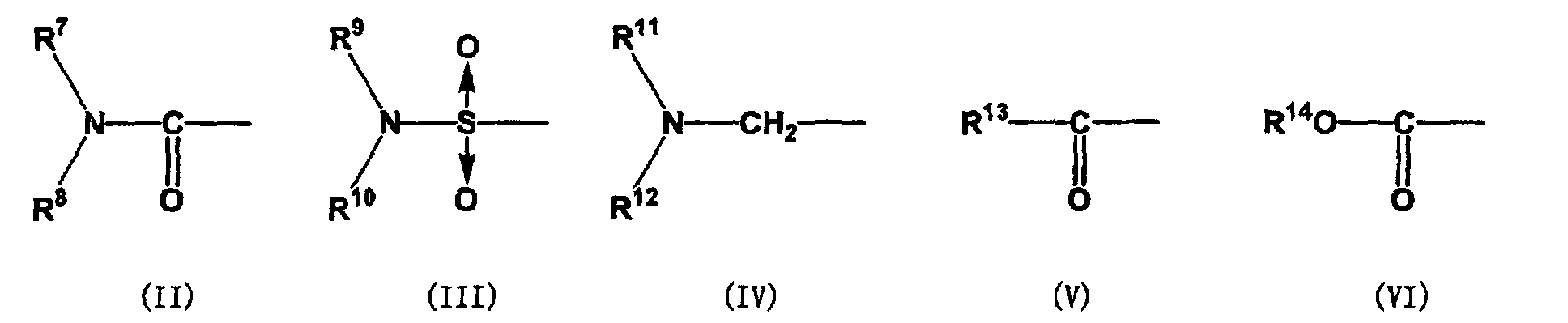
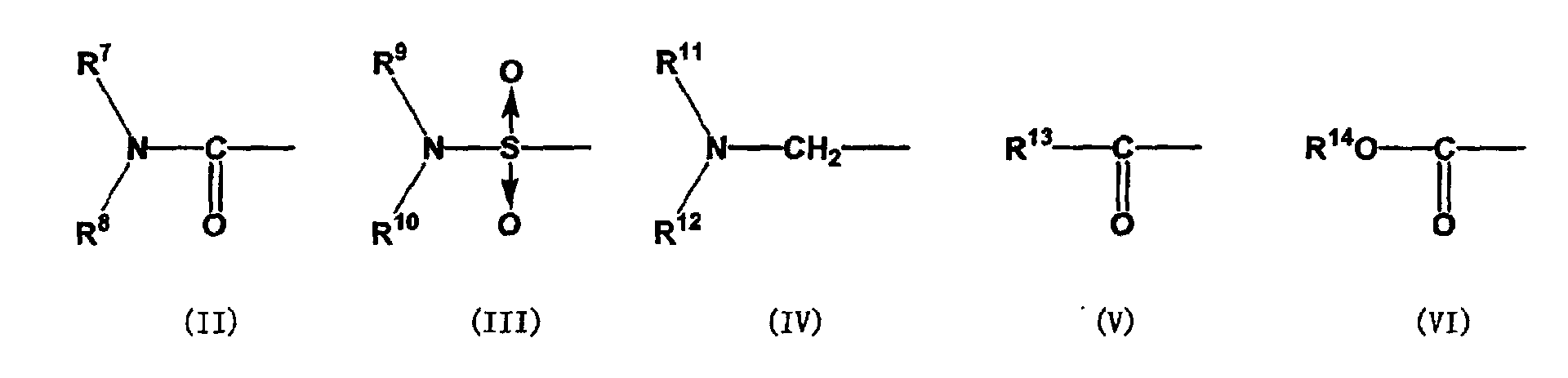
- R 7 and R 8 in the group (II), R 9 and R 10 in the group (III), and R 11 and R 12 in the group (IV), which groups are represented by X, may independently bind to each other to form a cyclic structure.
- the ring include aziridine, azetidine, pyrrolidine, or piperidine. An unsaturated bond may exist in a part of these rings.
- R 7 , R 8 , R 9 , R 10 , R 11 , R 12 , R 13 and R 14 in the group (II), (III), (IV), (V) or (VI) represented by X preferably represent independently a hydrogen atom or a lower alkyl group, or R 7 and R 8 preferably bind to each other to represent pyrrolidine or piperidine.
- the group represented by X is preferably the group (II).
- n is preferably 0.
- Examples of the carbocyclic ring or heterocyclic ring that constitutes the saturated or unsaturated 3- to 6-membered carbocyclic group or saturated or unsaturated monocyclic heterocyclic group containing one or more hetero atoms represented by A include rings of cyclopropane, cyclobutane, cyclopentane, cyclohexane, cyclopropene, cyclobutene, cyclobutadiene, cyclopentene, cyclopentadiene, cyclohexene, cyclohexadiene, benzene, furan, pyrrole, thiophene, thiazole, oxazole, imidazole, isothiazole, isoxazole, pyrazole, triazole, pyridine, pyrimidine, pyrazine, pyridazine and the like.
- Preferred examples include cyclohexane, benzene, and furan, and benzen
- these 3- to 6-membered carbocyclic groups or heterocyclic groups may have one or more substituents, and examples of the substituents include a lower alkyl group such as methyl group, a lower alkoxy group such as methoxy group, a lower alkenyl group such as allyl group, a halogen atom, a hydroxy group, a cyano group, an amino group, a N,N-di(lower alkyl)amino group, a N,N-di(substituted lower alkyl)amino group, a nitro group, a carbamoyl group, a N,N-di(lower alkyl)carbamoyl group such as N,N-dimethylcarbamoyl group, a N,N-di(substituted lower alkyl)carbamoyl group, a carboxyl group, a lower alkoxycarbonyl group which may be substituted such as a meth
- the group represented by "B” is preferably -CH 2 -.
- n is preferably 0.
- R 1 is preferably a hydrogen atom or a lower alkoxy group which may be substituted.
- R 2 and R 3 preferably represent a hydrogen atom or a lower alkyl group, most prefeably a hydrogen atom.
- R 4 is preferably a hydrogen atom or a lower alkyl group which may be substituted, most preferably a hydrogen atom.
- R 5 is preferably a hydrogen atom or a lower alkylcarbonyl group which may be substituted.
- Examples of the carbocyclic ring that constitutes the saturated or unsaturated monocyclic or bicyclic carbocyclic group represented by R 6 include rings of cyclopentane, cyclohexane, benzene, indane, naphthalene and the like, and preferred are benzene, indane and naphthalene.
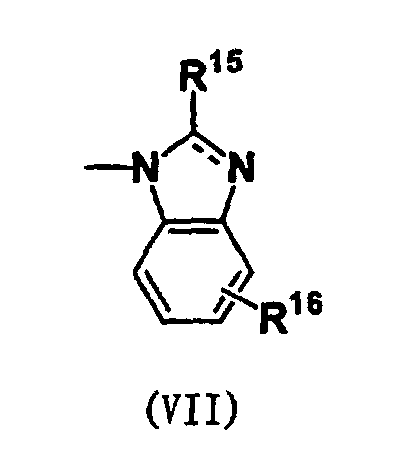
- R 6 is the following group (VII): [in the group, ---- represents a single bond or a double bond, R 15 represents a hydrogen atom, a lower alkyl group which may be substituted, a lower alkenyl group which may be substituted, or an oxo group, and R 15 preferably represents a hydrogen atom, a lower alkyl group which may be substituted with hydroxy group or an oxo group, R 16 represents a hydrogen atom, a halogen atom, a lower alkyl group which may be substituted, a lower alkenyl group which may be substituted, a lower alkoxy group which may be substituted, a hydroxy group, a cyano group, an amino group, a N,N-di(lower alkyl)amino group, a N,N-di(substituted lower alkyl)amino group, a nitro group, a carbamoyl group, a N,N-di(low
- An unsaturated bond as a part of the monocyclic or bicyclic carbocyclic group or monocyclic or bicyclic heterocyclic ring containing one or more hetero atoms represented by R 6 may be hydrogenated to form a saturated bond, or may be substituted with oxygen atom to form a cyclic ketone, cyclic amide (lactam), cyclic ester (lactone), or cyclic ureide structure.
- the substituting position of the adjacent piperidine ring may be an arbitrary substitutable position.
- One or more hydrogen atoms on the saturated or unsaturated monocyclic or bicyclic carbocyclic group or saturated or unsaturated monocyclic or bicyclic heterocyclic ring containing one or more hetero atoms represented by R 6 may be substituted.
- the substituent include a lower alkyl group such as methyl group, a lower alkoxy group such as methoxy group, a lower alkenyl group such as allyl group, a halogen atom, a hydroxy group, a cyano group, an amino group, a N,N-di(lower alkyl)amino group, a N,N-di(substituted lower alkyl)amino group, a nitro group, a carbamoyl group, a N,N-di(lower alkyl)carbamoyl group such as N,N-dimethylcarbamoyl group, a N,N-di(substituted lower alkyl)carb
- an example of the compounds wherein R 5 and R 6 bind to each other to form a cyclic structure include the compounds in which a spiro ring is formed.
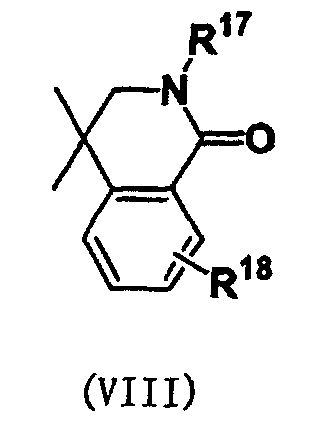
- examples include the following groups (VIII), (IX), (X), (XI), (XII), (XIII), (XIV), (XV), (XVI), and (XVII).
- Preferred groups are groups (VIII), (IX), (X), (XI), (XIII), (XVI), and (XVII), more preferred groups are groups (VIII) and (IX), and most preferred group is group (VIII) (in the following chemical formulas, a spiro ring is formed in each upper ring.
- each of two solid lines drawn from a ring represents a single bond that binds to the 3- or 5-position of the piperidine ring on which R 5 and R 6 substitute):
- R 17 represents a hydrogen atom, a lower alkyl group which may be substituted or a lower alkenyl group which may be substituted, preferably a hydrogen atom, a lower alkyl group which may be substituted with a phenyl or a N,N-di(lower alkyl)carbamoylphenyl
- R 18 represents a hydrogen atom, a halogen atom, a lower alkyl group which may be substituted, a lower alkenyl group which may be substituted, a lower alkoxy group which may be substituted, a hydroxy group, a cyano group, an amino group, a N,N-di(lower alkyl)amino group, a N,N-di(substituted lower alkyl)
- substituents are not limited. Examples thereof include a lower alkyl group such as methyl group, a lower alkoxy group such as methoxy group, a lower alkenyl group such as allyl group, a halogen atom, a hydroxy group, a cyano group, an amino group, a N,N-di(lower alkyl)amino group, a N,N-di(substituted lower alkyl)amino group, a nitro group, a carbamoyl group, a N,N-di(lower alkyl)carbamoyl group such as N,N-dimethylcarbamoyl group, a N,N-di(substituted lower alkyl)carbamoyl group, a carboxyl group, a lower alkoxycarbonyl group which may be substituted such as methoxycarbonyl group, a lower alkylcarbonyl group which may be substituted such as
- examples of the substituents of the N,N-di(substituted lower alkyl)amino group, N,N-di(substituted lower alkyl)carbamoyl group, lower alkoxycarbonyl group which may be substituted, and lower alkylcarbonyl group which may be substituted include, for example, a lower alkoxy group, a lower alkenyl group, a halogen atom, a hydroxy group, a cyano group, an amino group, a N,N-di(lower alkyl)amino group, a nitro group, a carbamoyl group, a N,N-di(lower alkyl)carbamoyl group, a carboxyl group, a lower alkoxycarbonyl group, and a lower alkylcarbonyl group.
- examples of a preferred class of compounds include those wherein R 6 represents the following group (VII): [in the group, ---- represents a single bond or a double bond, and R 15 and R 16 have the same meanings as defined above].
- Examples of another preferred class of compounds include those wherein R 5 and R 6 form a cyclic structure and represent the following group (VIII): [in the group, R 17 and R 18 have the same meanings as defined above].
- Examples of further preferred class of the compounds include those wherein X represents the group (II).
- novel compounds of the present invention can be produced by the methods described below.
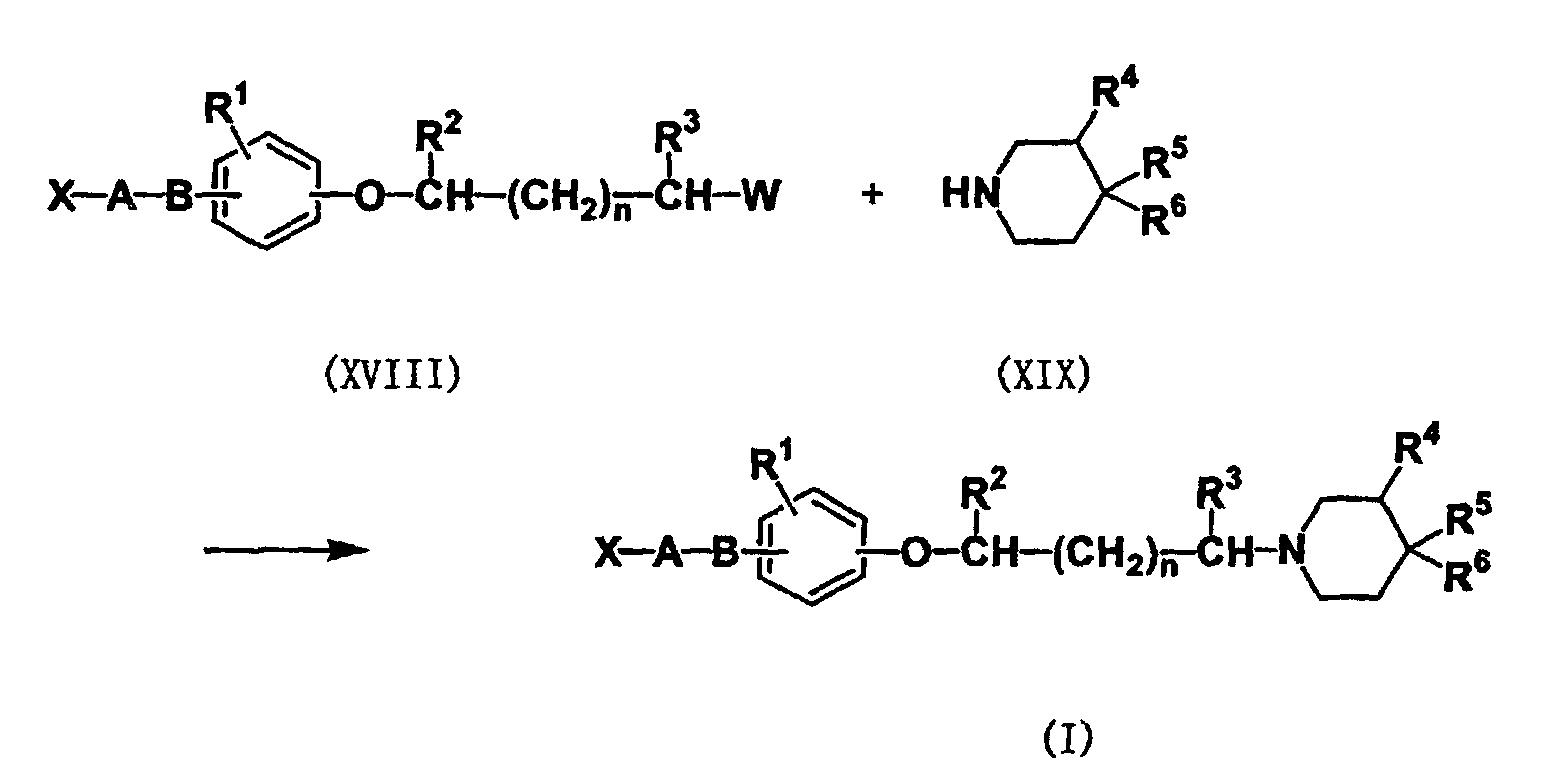
- W represents a halogen atom excluding a fluorine atom or represents a leaving group such as p-toluenesulfonyloxy group, methanesulfonyloxy group or trifluoromethanesulfonyloxy group.
- the compounds (XVIII) can be prepared by the methods described in J. Med. Chem. 1994, 37, 2125 and WO97/10230 with modification, and a specific preparation method is described in Reference Example 1 which follows.
- the compounds (XIX) can be obtained as a commercially available reagent or can also be obtained in accordance with a known method or a known method with modification.
- the compounds (I) of the present invention can be obtained by a reaction of a compound (XVIII) and a compound (XIX) in a solvent that is not involved in the reaction (for example, dichloromethane, tetrahydrofuran, methyl ethyl ketone, N,N-dimethylformamide, dimethyl sulfoxide etc.) in the presence of a base (e.g., pyridine, triethylamine, diisopropylethylamine, 4-dimethylaminopyridine, potassium carbonate, sodium carbonate etc.) at a certain reaction temperature of which lower limit is 20°C and upper limit is 100°C, preferably lower limit is 20°C and upper limit is 50°C, for a reaction time of which lower limit is 2 hours and upper limit is 48 hours, preferably lower limit is 16 hours and upper limit is 24 hours.
- a base e.g., pyridine, triethylamine, diisopropylethylamine,
- the compounds (XXI) wherein R 3 is H can also be produced by the method described below. [in the formula, X, A, B, R 1 , R 2 , R 4 , R 5 , R 6 , and n have the same meanings as those defined in the general formula (I).]
- the compounds (XX) can be produced by the methods described in J. Med. Chem. 1994, 37, 2125 and WO97/10230 with modification, and a specific preparation method is described in Reference Example 2 below.
- the compounds (XXI) wherein R 3 is H can be obtained by a reaction of a compound (XX) and a compound (XIX) in a solvent that is not involved in the reaction (e.g., dichloroethane, tetrahydrofuran, dimethyl sulfoxide and the like) in the presence of sodium triacetoxyborohydride and acetic acid at a reaction temperature of which lower limit is 20°C and upper limit is 50°C, preferably lower limit is 20°C and upper limit is 30°C, for a reaction time of which lower limit is 2 hours and upper limit is 48 hours, preferably lower limit is 5 hours and upper limit is 16 hours.
- a solvent that is not involved in the reaction e.g., dichloroethane, tetrahydrofuran, dimethyl sulfoxide and the like
- sodium triacetoxyborohydride and acetic acid at a reaction temperature of which lower limit is 20°C and upper limit is 50°C, preferably lower limit is 20
- purification of a target compound from a reaction mixture is performed by methods usually used in the filed of organic chemistry, for example, a method comprising distribution and extraction of a reaction mixture between water and an arbitrarily organic solvent that is immiscible with water (e.g., benzene, toluene, ethyl acetate, butyl acetate, methyl isobutyl ketone, chloroform, dichloromethane and the like), followed by concentration, crystallization and the like.
- an arbitrarily organic solvent that is immiscible with water e.g., benzene, toluene, ethyl acetate, butyl acetate, methyl isobutyl ketone, chloroform, dichloromethane and the like
- concentration e.g., benzene, toluene, ethyl acetate, butyl acetate, methyl isobutyl ketone, chloroform, dichlor
- the compounds of the present invention may be in the form of a salt.
- the salt may be an acid addition salt such as salts with inorganic acids including hydrochloric acid, nitric acid, hydrobromic acid, and sulfuric acid, salts with aliphatic monocarboxylic acids, dicarboxylic acids, hydroxyalkanoic acids, hydroxydialkanoic acids, amino acids and the like, or salts deriving from non-toxic organic acids such as aromatic acids, aliphatic acids, and aromatic sulfonic acid.
- acid addition salts include hydrochloride, hydrobromide, nitrate, sulfate, hydrogensulfate, hydrogenphosphate, dihydrogenphosphate, acetate, propionate, tartrate, oxalate, malonate, succinate, fumarate, maleate, mandelate, benzoate, phthalate, methanesulfonate, benzenesulfonate, toluenesulfonate, citrate, lactate, malate, glycolate, trifluoroacetate and the like.
- any hydrates and solvates thereof also fall within the scope of the present invention.
- the types of solvents that form the solvates are not particularly limited. Examples include solvents such as methanol, ethanol, acetone, and diethyl ether. However, the solvents are not limited to these examples.
- the compounds of the present invention may have one or more asymmetric carbon atoms depending on the type of substituent, and any of stereoisomers such as optically active isomers or diastereoisomers in a pure form, any mixtures of the stereoisomers, racemates and the like also fall within the scope of the present invention.
- the compounds of the present invention are characterized to have affinity for opioid ⁇ receptor. Therefore, the compounds of the present invention are useful for preventive and/or therapeutic treatment of central nerve system diseases such as schizophrenia, depression, cerebral apoplexy, epilepsy, Alzheimer's disease, and Parkinson's disease and peripheral nerve system diseases such as pains, in which the opioid ⁇ receptor is involved.
- central nerve system diseases such as schizophrenia, depression, cerebral apoplexy, epilepsy, Alzheimer's disease, and Parkinson's disease
- peripheral nerve system diseases such as pains, in which the opioid ⁇ receptor is involved.
- the medicaments provided by the present invention are characterized to comprise at least one kind of the compound represented by the general formula (I) or pharmacologically acceptable salt thereof as an active ingredient.
- the medicaments of the present invention can be administered to human or animals other than human by any of oral or parenteral routes (for example, intravenous injection, intramuscular injection, subcutaneous administration, rectal administration, percutaneous administration, intraspinal administration).
- the substances as active ingredients, per se may be administered. It is generally preferable to prepare and administer a pharmaceutical composition, as a form suitable for the administration route, by using one or more kinds of additives for pharmaceutical preparations.
- examples of orally available formulations include tablets, capsules, powders, granules, syrups and the like.
- parenteral formulations include injections such as intravenous and intramuscular injections, formulations for rectal administration, oily suppositories, aqueous suppositories and the like.
- compositions can be prepared by using additives for pharmaceutical preparations which are ordinarily used, for example, excipients, disintegrating agents, binders, lubricants and coloring agents.
- excipients examples include lactose, glucose, cornstarch, sorbit, crystalline cellulose and the like.
- examples of the disintegrating agents include starch, sodium alginate, gelatin powder, calcium carbonate, calcium citrate, dextrin and the like.
- Example of the binders include dimethylcellulose, polyvinyl alcohol, polyvinyl ether, methylcellulose, ethylcellulose, gum arabic, gelatin, hydroxypropylcellulose, polyvinylpyrrolidone and the like.
- lubricants examples include talc, magnesium stearate, polyethylene glycol, hydrogenated vegetable oil and the like.
- the pharmaceutical preparations can be prepared with addition of a buffer, pH modifier, stabilizer or the like as required.
- content of the compound of the present invention in the pharmaceutical composition may vary depending on types of formulations. Generally, its lower limit is about 0.1% by weight and upper limit is 50% by weigh, preferably lower limit is 0.5% by weight and upper limit is 20% by weight based on the total composition.
- a dose may appropriately be determined depending on each case in consideration of the age, body weight, sex, type of a disease, severity of symptoms of a patient and the like. Generally, its lower limit is 1 mg and upper limit is 1000 mg, preferably its lower limit is 1 mg and upper limit is 300 mg, per day for an adult. The dose is administered once a day or several times a day dividedly.
- Oxalyl chloride (10.8 ml) was dissolved in dichloromethane (260 ml), added with dimethyl sulfoxide (17.5 ml) at -78°C under an argon gas flow and stirred at the same temperature for 5 minutes.
- the reaction mixture was added with a solution of 4-diethylcarbamoylbenzyl alcohol (12.80 g) dissolved in dichloromethane (260 ml) at -78°C and further stirred at the same temperature for 30 minutes.
- the reaction mixture was added with triethylamine (43.1 ml) at -78°C and further stirred at room temperature for 30 minutes.
- the 2-(4-diethylcarbamoylbenzyl)phenol (355 mg) obtained in Reference Example 1(d) was dissolved in a mixed solution of dioxane (3.6 ml) and water (3.6 ml), added with 1 N aqueous sodium hydroxide (63 ⁇ l) and glycidol (0.12 ml) and stirred at 90°C for 18 hours.
- the reaction mixture was added with water (30 ml) and extracted twice with dichloromethane (30 ml).
- the organic layer was dried over anhydrous magnesium sulfate, and then the solvent was evaporated under reduced pressure.
- 2-amino-2-methylpropanol (53 ⁇ l) was dissolved in dichloromethane (1 ml), added with a solution of the aforementioned acid chloride dissolved in dichloromethane (1 ml) at 0°C and triethylamine (77 ⁇ l) and stirred at the same temperature for 1 hour.
- the reaction mixture was added with water (5 ml) and extracted twice with dichloromethane (5 ml).
- the organic layer was dried over anhydrous magnesium sulfate, and then the solvent was evaporated under reduced pressure.
- the 2-(4-diethylcarbamoylbenzyl)anisole (100 mg) obtained in the process of Reference Example 1(d) was dissolved in toluene (2 ml), added with a solution of sec-butyl lithium in n-hexane and cyclohexane (1.0 M, 0.47 ml) at 0°C under argon atmosphere and stirred at room temperature for 1 hour. After the reaction mixture was slowly poured into 1 N aqueous hydrochloric acid (5 ml) with ice cooling to quench the reaction and the layers were separated, the aqueous layer was extracted with ether (10 ml).
- Example 8 8-[3-[2-(4-diethylcarbamoylbenzyl)phenoxy]propyl]-1-phenyl-1,3,8-triazaspiro[4,5]decan-4-one
- Example 2 The title compound was obtained in the same manner in Example 1 from the 1-[2-(4-diethylcarbamoylbenzyl)phenoxy]acetaldehyde obtained in Reference Example 2 and hexahydrospiro[imidazo[1,2-a]pyridine-3(2H),4'-piperidin]-2-one synthesized in accordance with the descriptions of Yakugaku Zasshi, 1989, 109, 93. Yield: 38%.
- Example 12 1'-[2-[2-(4-Diethylcarbamoylbenzyl)phenoxy]ethyl]-5,6,7,8-tetrahydrospiro[imidazo[1,2-a]pyridine-3(2H),4'-piperidin]-2-one
- Example 2 The title compound was obtained in a manner similar to that of Example 2 from 1-[2-(4-diethylcarbamoylbenzyl)phenoxymethyl]-1-methanesulfonyloxyethane obtained in the similar manner to that of Reference Example 1 and 1-phenyl-1,3,8-triazaspiro[4,5]decan-4-one. Yield: 12%.
- Example 60 1'-[2-[2-(4-Diethylcarbamoylbenzyl)phenoxy]ethyl]-2,3-dihydrospiro[1H-indene-1,4'-piperidine]
- Example 70 1'-[2-[2-(4-Diethylcarbamoylbenzyl)phenoxy]ethyl]spiro[3H-indole-3,4'-piperidin]-2(1H)-one
- Example 76 8-[1-[2-(4-Diethylcarbamoylbenzyl)phenoxymethyl]propyl]-1-phenyl-1,3,8-triazaspiro[4,5]decan-4-one
- Example 77 1'-[2-[2-(4-Diethylcarbamoylbenzyl)phenoxy]ethyl]spiro[isobenzofuran-1(3H),4'-piperidin]-3-one
- Example 80 8-[2-[2-(4-Diethylcarbamoylbenzyl)-4-methoxyphenoxy]ethyl]-1-phenyl-1,3,8-triazaspiro[4,5]decan-4-one
- Example 82 1-[2-[2-(4-Diethylcarbamoylbenzyl)phenoxy]ethyl]-4-(5-fluoro-1,3-dihydro-2H-benzimidazol-2-on-1-yl)piperidine
- Example 96 8-[2-[2-[(5-Diethylcarbamoylfuran-2-yl)methyl]phenoxy]ethyl]-1-phenyl-1,3,8-triazaspiro[4,5]decan-4-one
- Example 84 The 1-[2-[2-(4-diethylcarbamoylbenzyl)phenoxy]ethyl]-4-(2-hydroxymethyl-1H-benzimidazol-1-yl)piperidine (64 mg) obtained in Example 84 was dissolved in tetrahydrofuran (1.3 ml), added with a solution of Red-Al in toluene (65%, 0.18 ml) and stirred at room temperature for 2.5 hours. After the reaction mixture was slowly poured into ice 10 g with ice cooling to quench the reaction and the layers were separated, the aqueous layer was extracted with dichloromethane (30 ml). The organic layer was dried over anhydrous magnesium sulfate, and then the solvent was evaporated under reduced pressure.
- Example 102 1-[2-[2-(3-Diethylcarbamoylbenzyl)phenoxy]ethyl]-4-(2-hydroxymethyl-7-methyl-1H-benzimidazol-1-yl)piperidine
- Example 104 1-[2-[2-(4-Isobutyloxycarbonylbenzyl)phenoxy]ethyl]-4-(1,3-dihydro-2H-benzimidazol-2-on-1-yl)piperidine
- Example 105 8-[2-[2-(4-Isobutyloxycarbonylbenzyl)phenoxy]ethyl]-1-phenyl-1,3,8-triazaspiro[4,5]decan-4-one
- Example 107 1-[2-[2-[trans-(4-Diethylcarbamoylcyclohexyl)methyl]phenoxy]ethyl]-4-(1,3-dihydro-2H-benzimidazol-2-on-1-yl)piperidine
- Example 108 8-[2-[2-[trans-(4-Diethylcarbamoylcyclohexyl)methyl]phenoxy]ethyl]-1-phenyl-1,3,8-triazaspiro[4,5]decan-4-one
- Example 111 1-[2-[2-[cis-(4-Diethylcarbamoylcyclohexyl)methyl]phenoxy]ethyl]-4-(1,3-dihydro-2H-benzimidazol-2-on-1-yl)piperidine
- Example 112 8-[2-[2-[cis-(4-Diethylcarbamoylcyclohexyl)methyl]phenoxy]ethyl]-1-phenyl-1,3,8-triazaspiro[4,5]decan-4-one
- Test Example 1 Binding affinity for opioid ⁇ receptor
- a membrane fraction of opioid ⁇ receptor was prepared from the rat forebrain.
- the rat forebrain was homogenized in a 10-fold volume of 0.32 M sucrose solution, and the resulting homogenate was centrifuged at 900 ⁇ g for 10 minutes. Subsequently, the supernatant was centrifuged at 11,500 ⁇ g for 20 minutes to obtain precipitates. The precipitates were washed with an assay buffer (50 mM Tris-HCl, pH 7.4) by centrifugation, and the finally obtained membrane fraction was used for the experiment.
- an assay buffer 50 mM Tris-HCl, pH 7.4
- a binding experiment was performed by using the resulting membrane fraction and a radioactive ligand [ 3 H]-Naltrindole.
- the membrane fraction and [ 3 H]-Naltrindole at a final concentration of 1 nM were added and incubated at 25°C for 90 minutes.
- the membrane fraction mixture was rapidly filtered through a GF/B filter to quench the reaction and further washed with the assay buffer (5 ml).
- the radioactivity was measured by a liquid scintillation counter.
- Amount of non-specific bindings was determined by using 10 ⁇ M Naltrindole, and amount of specific bindings was calculated from the difference of the amounts of measured bindings and the non-specific bindings.
- IC 50 value of each compound was determined by nonlinear least square regression analysis, and Ki value was calculated by using the Cheng-Prusoff equation.
- the compounds of the present invention have effective and selective affinity for opioid ⁇ receptors.
- the provision of medicaments consisting the compound described above will greatly contribute to therapeutic treatments of central nerve system diseases including schizophrenia, depression, cerebral apoplexy, epilepsy, Alzheimer's disease and Parkinson's disease and peripheral nerve system diseases including pains.
Landscapes
- Health & Medical Sciences (AREA)
- Chemical & Material Sciences (AREA)
- Medicinal Chemistry (AREA)
- Veterinary Medicine (AREA)
- Public Health (AREA)
- Pharmacology & Pharmacy (AREA)
- Life Sciences & Earth Sciences (AREA)
- Animal Behavior & Ethology (AREA)
- General Health & Medical Sciences (AREA)
- Organic Chemistry (AREA)
- Epidemiology (AREA)
- Bioinformatics & Cheminformatics (AREA)
- Engineering & Computer Science (AREA)
- Nuclear Medicine, Radiotherapy & Molecular Imaging (AREA)
- Biomedical Technology (AREA)
- Neurosurgery (AREA)
- Neurology (AREA)
- General Chemical & Material Sciences (AREA)
- Chemical Kinetics & Catalysis (AREA)
- Psychiatry (AREA)
- Pain & Pain Management (AREA)
- Heart & Thoracic Surgery (AREA)
- Cardiology (AREA)
- Vascular Medicine (AREA)
- Hospice & Palliative Care (AREA)
- Urology & Nephrology (AREA)
- Psychology (AREA)
- Pharmaceuticals Containing Other Organic And Inorganic Compounds (AREA)
- Organic Low-Molecular-Weight Compounds And Preparation Thereof (AREA)
- Acyclic And Carbocyclic Compounds In Medicinal Compositions (AREA)
- Plural Heterocyclic Compounds (AREA)
Abstract

Description

"B" represents -CH2-, -CHOH-, -(C=O)-, -CH2CH2-, or a single bond,
"n" represents 0, 1 or 2,
R1 represents a hydrogen atom, a halogen atom, a lower alkyl group which may be substituted, a lower alkenyl group which may be substituted, a lower alkoxy group which may be substituted, a hydroxy group, a cyano group, an amino group, a N,N-di(lower alkyl)amino group, a N,N-di(substituted lower alkyl)amino group, a nitro group, a carbamoyl group, a N,N-di(lower alkyl)carbamoyl group, a N,N-di(substituted lower alkyl)carbamoyl group, a carboxyl group, a lower alkoxycarbonyl group which may be substituted or a lower alkylcarbonyl group which may be substituted,
R2, R3, R7, R8, R9, R10, R11, R12, R13, and R14 each independently represent a hydrogen atom, a lower alkyl group which may be substituted or a lower alkenyl group which may be substituted,
R4 represents a hydrogen atom, a lower alkyl group which may be substituted, a lower alkenyl group which may be substituted, or a lower alkoxy group which may be substituted,
R5 represents a hydrogen atom, a halogen atom, a lower alkyl group which may be substituted, a lower alkenyl group which may be substituted, a lower alkoxy group which may be substituted, a hydroxy group, a cyano group, an amino group, a N,N-di(lower alkyl)amino group, a N,N-di(substituted lower alkyl)amino group, a carbamoyl group, a N,N-di(lower alkyl)carbamoyl group, a N,N-di(substituted lower alkyl)carbamoyl group, a carboxyl group, a lower alkoxycarbonyl group which may be substituted or a lower alkylcarbonyl group which may be substituted,
R6 represents a saturated or unsaturated monocyclic or bicyclic carbocyclic group, a saturated or unsaturated monocyclic or bicyclic heterocyclic group containing one or more hetero atoms, or a N-(lower alkyl)carbonyl-N-(substituted or unsubstituted phenyl)amino group, and
R5 and R6, R7 and R8, R9 and R10, and R11 and R12 may bind to each other to form a cyclic structure] or salts thereof.
R15 represents a hydrogen atom, a lower alkyl group which may be substituted, a lower alkenyl group which may be substituted, or an oxo group, and R15 preferably represents a hydrogen atom, a lower alkyl group which may be substituted with hydroxy group or an oxo group,
R16 represents a hydrogen atom, a halogen atom, a lower alkyl group which may be substituted, a lower alkenyl group which may be substituted, a lower alkoxy group which may be substituted, a hydroxy group, a cyano group, an amino group, a N,N-di(lower alkyl)amino group, a N,N-di(substituted lower alkyl)amino group, a nitro group, a carbamoyl group, a N,N-di(lower alkyl)carbamoyl group, a N,N-di(substituted lower alkyl)carbamoyl group, a carboxyl group, a lower alkoxycarbonyl group which may be substituted or a lower alkylcarbonyl group which may be substituted, and R16 preferably represents a hydrogen atom, a lower alkyl group or a lower alkoxy group],


R19, R21, R26 and R28 independently represent a hydrogen atom, a lower alkyl group which may be substituted or a lower alkenyl group which may be substituted, preferably a hydrogen atom or a lower alkyl group,
R20, R22, R23, R24, R25, R27 and R29 independently represent a hydrogen atom, a halogen atom, a lower alkyl group which may be substituted, a lower alkenyl group which may be substituted, a lower alkoxy group which may be substituted, a hydroxy group, a cyano group, an amino group, a N,N-di(lower alkyl)amino group, a N,N-di(substituted lower alkyl)amino group, a nitro group, a carbamoyl group, a N,N-di(lower alkyl)carbamoyl group, a N,N-di(substituted lower alkyl)carbamoyl group, a carboxyl group, a lower alkoxycarbonyl group which may be substituted or a lower alkylcarbonyl group which may be substituted, preferably a hydrogen atom].

"A" represents a residue of a ring selected from the group consisting of benzene, cyclohexane and furan,
"B" is -CH2-, -CHOH-, -(C=O)-, -CH2CH2- or a single bond,
"n" is 0, 1 or 2,
R1 is a hydrogen atom or a lower alkoxy group,
R2, R3, R7, R8, R9, R10, R13 and R14 each independently represent a hydrogen atom or a lower alkyl group which may be substituted,
R4 is a hydrogen atom or a lower alkyl group which may be substituted,
R5 is a hydrogen atom or a lower alkylcarbonyl group which may be substituted,
R6 is a residue of a ring selected from the group consisting of benzene, naphthalene, indane, benzofuran, imidazole, benzimidazole, indole, quinoline, benzotriazole, benzimidazole, benzisothiazole, benzisoxazole, quinazoline, isoquinoline and benzoxazine (a hydrogen atom on the ring may be replaced with halogen, oxo, lower alkyl, hydroxymethyl, lower alkoxy or benzyl), or R5 and R6 bind to each other to form a residue of a ring selected from the group consisting of indane, imidazole, N-phenylimidazolidine, isoquinoline, quinoline and benzofuran (a hydrogen atom on the ring may be replaced with oxo, lower alkyl or lower alkoxy), and R7 and R8 bind to each other to form pyrrolidine or piperidine.

1H-NMR (CDCl3) δ (ppm); 1.09 (3H, br-s), 1.26 (3H, br-s), 3.25 (2H, br-s), 3.53 (2H, br-s), 4.66 (2H, s), 7.30 (4H, s)
MS (TSP); m/z 208 (MH+)
1H-NMR (CDCl3) δ (ppm); 1.11 (3H, t, J=7Hz), 1.27 (3H, t, J=7Hz), 3.23 (2H, q, J=7Hz), 3.56 (2H, q, J=7Hz), 7.63 (2H, d, J=8Hz), 7.93 (2H, d, J=8Hz), 10.05 (1H, s)
MS (EI); m/z 205 (M+)
1H-NMR (CDCl3) δ (ppm); 1.10 (3H, br-s), 1.23 (3H, br-s), 3.18 (1H, d, J=5Hz), 3.26 (2H, br-s), 3.56 (2H, br-s), 3.81 (3H, s), 6.05 (1H, d, J=5Hz), 6.85-7.00 (2H, m), 7.20-7.45 (6H, m)
MS (TSP); m/z 314 (MH+)
1H-NMR (CDCl3) δ (ppm); 1.10 (3H, br-s), 1.23 (3H, br-s), 3.27 (2H, br-s), 3.53 (2H, br-s), 3.94 (2H, s), 6.70-6.80 (2H, m), 7.00-7.10 (2H, m), 7.15-7.30 (4H, m)
MS (TSP); m/z 284 (MH+)
1H-NMR (CDCl3) δ (ppm); 1.12 (3H, br-s), 1.22 (3H, br-s), 2.25 (2H, m), 3.27 (2H, br-s), 3.44 (2H, t, J=6Hz), 3.52 (2H, br-s), 3.98 (2H, s), 4.08 (2H, t, J=6Hz), 6.84-7.29 (8H, m)
1H-NMR (CDCl3) δ (ppm); 1.12 (3H, br-s), 1.24 (3H, br-s), 2.24 (1H, d, J=5Hz), 2.66 (1H, t, J=5Hz), 3.20-3.40 (4H, m), 3.53 (2H, br-s), 3.75-3.95 (3H, m), 3.99 (2H, s), 6.83 (1H, d, J=8Hz), 6.95 (1H, t, J=8Hz), 7.15-7.30 (6H, m)
MS (TSP); m/z 358 (MH+)
1H-NMR (CDCl3) δ (ppm); 1.11 (3H, br-s), 1.22 (3H, br-s), 3.27 (2H, br-s), 3.53 (2H, br-s), 4.07 (2H, s), 4.53 (2H, s), 6.71 (1H, d, J=8Hz), 6.97 (1H, t, J=8Hz), 7.14-7.29 (6H, m), 9.77 (1H, s)
1H-NMR (CDCl3) δ (ppm); 1.51 (9H, s), 1.69 (2H, d, J=14Hz), 2.56 (2H, br-s), 3.54 (2H, br-s), 4.05 (2H, br-s), 4.76 (2H, s), 6.70-6.90 (4H, m), 7.20-7.30 (2H, m)
MS (TSP); m/z 332 (MH+)
1H-NMR (CDCl3) δ (ppm); 1.51 (9H, s), 1.65 (2H, d, J=14Hz), 2.58 (2H, br-s), 3.62 (2H, br-s), 4.05 (2H, br-s), 4.56 (2H, s), 4.61 (2H, s), 6.67 (1H, d, J=7Hz), 6.81 (1H, t, J=7Hz), 7.15-7.40 (8H, m)
MS (EI); m/z 421 (M+)
1H-NMR (CDCl3) δ (ppm); 1.86 (2H, d, J=14Hz), 3.04 (2H, dt, J=5Hz, 14Hz), 3.43 (2H, d, J=12Hz), 3.96 (2H, q, J=12Hz), 4.61 (2H, s), 4.62 (2H, s), 6.80-6.90 (2H, m), 7.20-7.45 (8H, m)
MS (EI); m/z 321 (M+)
1H-NMR (CDCl3) δ (ppm); 1.48 (9H, s), 1.70 (4H, m), 1.90 (2H, m), 2.73 (2H, t, J=7Hz), 2.79 (2H, m), 3.16 (2H, t, J=7Hz), 3.75 (1H, m), 4.25 (2H, m), 6.57 (1H, t, J=8Hz), 6.66 (1H, d, J=8Hz), 6.96 (1H, d, J=8Hz), 7.05 (1H, t, J=8Hz)
1H-NMR (CDCl3) δ (ppm); 1.65 (2H, m), 2.07 (2H, m), 2.17 (2H, m), 2.95 (2H, t, J=7Hz), 3.15 (2H, m), 3.52 (2H, t, J=7Hz), 3.58 (2H, m), 3.96 (1H, m), 7.25 (4H, m)
MS (TSP); m/z 217 (MH+)
1H-NMR (CDCl3) δ (ppm); 1.11 (3H, br-s), 1.23 (3H, br-s), 3.24 (2H, br-s), 3.52 (2H, br-s), 7.12 (2H, d, J=8Hz), 7.74 (2H, d, J=8Hz)
MS (FAB); m/z 304 (MH+)
1H-NMR (CDCl3) δ (ppm); 1.23 (6H, br-s), 3.36 (2H, br-s), 3.56 (2H, br-s), 3.82 (3H, s), 6.95-7.05 (2H, m), 7.32 (2H, d, J=8Hz), 7.41 (2H, d, J=8Hz), 7.56 (2H, d, J=8Hz)
MS (FAB); m/z 284 (MH+)
1H-NMR (CDCl3) δ (ppm); 1.18 (3H, br-s), 1.26 (3H, br-s), 3.34 (2H, br-s), 3.57 (2H, br-s), 7.00 (2H, t, J=8Hz), 7.26 (2H, m), 7.50 (4H, m)
MS (TSP); m/z 270 (MH+)
1H-NMR (CDCl3) δ (ppm); 1.17 (3H, br-s), 1.26 (3H, br-s), 3.32 (2H, br-s), 3.50-3.75 (4H, m), 3.90-4.10 (3H, m), 6.95-7.10 (2H, m), 7.35 (2H, m), 7.42 (2H, d, J=8Hz), 7.51 (2H, d, J=8Hz)
MS (TSP); m/z 344 (MH+)
1H-NMR (CDCl3) δ (ppm); 1.17 (3H, br-s), 1.26 (3H, br-s), 3.34 (2H, br-s), 3.57 (2H, br-s), 4.53 (2H, s), 6.95-7.10 (2H, m), 7.35-7.45 (4H, m), 7.51 (2H, d, J=8Hz), 9.77 (1H, s)
1H-NMR (CDCl3) δ (ppm); 1.46 (11H, m), 1.86 (2H, m), 3.04 (2H, m), 3.85 (3H, m)
1H-NMR (CDCl3) δ (ppm); 1.43 (9H, s), 1.59 (2H, m), 1.70 (2H, m), 2.45 (3H, s), 3.25 (2H, m), 3.57 (2H, m), 4.67 (1H, m), 7.34 (2H, d, J=8Hz), 7.79 (2H, d, J=8Hz)
1H-NMR (CDCl3) δ (ppm); 1.51 (9H, s), 2.03 (2H, m), 2.18 (2H, m), 2.94 (2H, m), 4.36 (3H, m), 7.30 (2H, m), 7.43 (1H, m), 7.82 (1H, m), 7.98 (1H, s)
MS (TSP); m/z 302 (MH+)
1H-NMR (CDCl3) δ (ppm); 1.47 (2H, m), 1.50 (9H, s), 2.01 (2H, m), 3.00 (2H, m), 3.50 (1H, m), 3.99 (2H, m), 4.67 (2H, s), 6.66 (2H, m), 7.05 (1H, d, J=8Hz), 7.21 (1H, t, J=8Hz)
1H-NMR (CDCl3) δ (ppm); 1.49 (11H, m), 1.79 (2H, m), 2.60 (2H, m), 2.80 (2H, m), 4.14 (1H, m), 4.24 (2H, s), 5.24 (1H, br-s), 7.04 (3H, m), 7.24 (1H, m)
MS (TSP); m/z 332 (MH+)
1H-NMR (DMSO-d6) δ (ppm); 1.86 (2H, m), 2.79 (2H, m), 3.06 (2H, m), 3.35 (2H, m), 4.11 (3H, m), 6.97 (1H, t, J=8Hz), 7.17 (2H, d, J=8Hz), 7.24 (1H, d, J=8Hz)
MS (FAB); m/z 232 (MH+)
1H-NMR(CD3OD) δ (ppm); 1.93 (2H, m), 2.06 (2H, m), 2.89 (1H, m), 3.13 (2H, m), 3.49 (2H, m), 7.20-7.34 (5H, m)
MS (EI); m/z 161 (M+)
1H-NMR (CDCl3) δ (ppm); 2.19 (2H, m), 2.50-2.80 (4H, m), 2.97 (1H, br-s), 3.50-3.65 (5H, m), 6.80-7.05 (3H, m), 7.10-7.30 (6H, m), 8.98 (1H, s)
MS (EI); m/z 310 (M+)
1H-NMR (CDCl3) δ (ppm); 2.25 (2H, m), 2, 85 (1H, m), 3.49 (4H, m), 3.77 (2H, m), 5.05 (1H, d, J=12Hz), 5.12 (1H, d, J=12Hz), 6.81 (1H, d, J=8Hz), 6.90-7.10 (2H, m), 7.19 (1H, t, J=8Hz), 7.34 (5H, m), 7.60-7.80 (1H, m)
MS (TSP); m/z 355 (MH+)
1H-NMR (CDCl3) δ (ppm); 2.23 (2H, m), 2.85-3.00 (3H, m), 3.30-3.70 (5H, m), 4.20-4.40 (2H, m), 5.07 (1H, d, J=12Hz), 5.14 (1H, d, J=12Hz), 6.85 (1H, d, J=8Hz), 6.92 (1H, m), 7.13 (1H, m), 7.20 (1H, t, J=8Hz), 7.35 (5H, m), 7.80-7.95 (1H, m)
MS (FAB); m/z 433 (MH+)
1H-NMR (CDCl3) δ (ppm); 1.58 (4H, m), 3.90 (4H, m), 5.19 (2H, s), 6.89 (1H, d, J=8Hz), 7.05 (1H, t, J=8Hz), 7.23 (1H, t, J=8Hz), 7.30-7.40 (6H, m), 7.56 (1H, s)
MS (FAB); m/z 337 (MH+)
1H-NMR (D2O) δ (ppm); 2.11 (4H, m), 3.48 (2H, m), 3.72 (2H, m), 7.07 (1H, d, J=8Hz), 7.18 (1H, t, J=8Hz), 7.35 (1H, t, J=8Hz), 7.45 (1H, d, J=8Hz)
MS (TSP); m/z 203 (MH+)
1H-NMR (CDCl3) δ (ppm); 1.37 (2H, m), 1.47 (9H, s), 2.00 (2H, m), 2.91 (2H, m), 3.36 (1H, m), 4.04 (2H, m), 6.66 (1H, t, J=8Hz), 6.74 (2H, m), 6.83 (1H, t, J=8Hz)
1H-NMR (CDCl3) δ (ppm); 1.44 (2H, m), 1.47 (9H, s), 2.04 (2H, m), 2.97 (2H, m), 3.44 (1H, m), 3.80 (3H, s), 4.02 (2H, m), 4.64 (2H, s), 6.63 (2H, m), 6.71 (1H, d, J=8Hz), 6.91 (1H, t, J=8Hz)
MS (TSP); m/z 365 (MH+)
1H-NMR (CDCl3) δ (ppm); 1.46 (9H, s), 1.50 (2H, m), 1.97 (2H, m), 2.84 (2H, m), 3.42 (1H, m), 4.05 (2H, m), 4.62 (2H, s), 6.95 (4H, m)
1H-NMR (CDCl3) δ (ppm); 1.49 (9H, s), 1.76 (2H, m), 2.54 (2H, m), 2.80 (2H, m), 4.31 (2H, m), 4.40 (1H, m), 4.50 (2H, s), 7.02 (3H, m), 7.13 (1H, m)
MS (TSP); m/z 333 (MH+)
1H-NMR (DMSO-d6) δ (ppm); 1.89 (2H, m), 2.74 (2H, m), 3.06 (2H, m), 3.38 (2H, m), 4.33 (1H, m), 4.58 (2H, s), 7.06 (3H, m), 7.42 (1H, d, J=8Hz)
1H-NMR (CDCl3) δ (ppm); 1.51 (2H, m), 1.85 (2H, m), 2.07 (2H, m), 2.35 (3H, s), 2.77 (2H, m), 3.28 (1H, m), 3.48 (2H, s), 6.82 (1H, t, J=8Hz), 7.22-7.31 (6H, m), 7.90 (1H, d, J=8Hz)
MS (TSP, negative); m/z 325 (M-)
1H-NMR (CDCl3) δ (ppm); 1.25 (3H, t, J=7Hz), 1.38 (2H, m), 1.87 (2H, m), 2.38 (3H, s), 2.87 (2H, m), 3.37 (1H, m), 4.04 (2H, m), 4.13 (2H, q, J=7Hz), 6.54 (1H, d, J=9Hz), 6.88 (1H, t, J=8Hz), 7.35 (1H, d, J=8Hz), 7.91 (1H, d, J=8Hz)
1H-NMR (CDCl3) δ (ppm); 1.26 (3H, t, J=7Hz), 1.35 (2H, m), 1.90 (2H, m), 2.22 (3H, s), 2.76 (2H, m), 3.13 (1H, m), 4.12 (2H, q, J=7Hz), 4.18 (2H, m), 6.60 (2H, m), 6.80 (1H, t, J=8Hz)
MS (FAB); m/z 277 (MH+)
1H-NMR (CDCl3) δ (ppm); 1.29 (3H, t, J=7Hz), 1.84 (2H, m), 2.60 (3H, s), 2.78 (4H, m), 4.17 (2H, q, J=7Hz), 4.38 (2H, m), 4.52 (1H, m), 6.81 (1H, t, J=5Hz), 6.95 (2H, d, J=5Hz)
MS (TSP); m/z 304 (MH+)
1H-NMR (DMSO-d6) δ (ppm); 1.95 (2H, m), 2.56 (3H, s), 2.80 (2H, m), 3.07 (2H, m), 3.38 (2H, m), 4.59 (1H, m), 6.75 (1H, d, J=8Hz), 6.81 (1H, d, J=8Hz), 6.87 (1H, t, J=8Hz)
MS (TSP); m/z 232 (MH+)
1H-NMR (CDCl3) δ (ppm); 2.34 (2H, br-s), 2.72 (4H, t, J=6Hz), 3.63 (4H, t, J=6Hz), 3.71 (2H, s), 7.20-7.40 (5H, m)
MS (FAB); m/z 196 (MH+)
1H-NMR (CDCl3) δ (ppm); 2.07 (2H, td, J=12Hz, 3Hz), 2.32 (2H, dd, J=12Hz, 3Hz), 2.59 (2H, t, J=12Hz), 2.64 (3H, s), 3.01 (2H, d, J=12Hz), 3.61 (2H, s), 7.20-7.40 (9H, m)
MS (TSP); m/z 291 (MH+)
1H-NMR (CDCl3) δ (ppm); 1.28 (3H, t, J=7Hz), 1.92 (2H, td, J=12Hz, 3Hz), 2.34 (2H, d, J=12Hz), 2.66 (3H, s), 3.33 (2H, m), 4.16 (2H, q, J=7Hz), 4.34 (2H, m), 7.26 (4H, m)
MS (EI); m/z 272 (M+)
1H-NMR (CDCl3) δ (ppm); 1.10-1.30 (6H, m), 1.85 (2H, m), 2.31 (2H, m), 2.51 (3H, s), 3.26 (2H, m), 3.53 (1H, s), 3.55 (1H, s), 3.74 (2H, m), 4.00-4.20 (4H, m), 4.29 (1H, br-s), 7.15-7.30 (4H, m)
MS (TSP); m/z 349 (MH+)
1H-NMR (CDCl3) δ (ppm); 1.49 (9H, m), 1.73 (2H, d, J=12Hz), 2.41 (2H, m), 2.56 (3H, s), 2.99 (2H, t, J=12Hz), 3.59 (2H, s), 4.04 (2H, m), 6.17 (1H, br-s), 7.25-7.35 (2H, m), 8.04 (1H, d, J=8Hz)
MS (TSP); m/z 331 (MH+)
1H-NMR (D2O) δ (ppm); 1.96 (2H, d, J=14Hz), 2.60 (3H, s), 2.70 (2H, td, J=14Hz, 4Hz), 3.26 (2H, t, J=14Hz), 3.43 (2H, dd, J=14Hz, 4Hz), 3.63 (2H, s), 7.36 (1H, t, J=8Hz), 7.46 (1H, d, J=8Hz), 7.84 (1H, d, J=8Hz)
MS (EI); m/z 230 (M+)
1H-NMR (CDCl3) δ (ppm); 1.90 (2H, m), 2.42 (2H, m), 2.59 (3H, s), 2.82 (2H, m), 3.28 (2H, m), 4.57 (1H, m), 4.93 (2H, s), 7.01 (1H, d, J=8Hz), 7.12 (1H, t, J=8Hz), 7.48 (1H, d, J=8Hz)
MS (EI); m/z 245 (M+)
1H-NMR(DMSO-d6) δ (ppm); 5.24 (2H, s), 7.49 (2H, d, J=8Hz), 7.94 (2H, d, J=8Hz), 8.40 (1H, s), 13.01 (1H, s)
1H-NMR (CDCl3) δ (ppm); 1.42 (6H, s), 3.70 (1H, d, J=6Hz), 4.54 (1H, d, J=6Hz), 5.24 (2H, s), 6.19 (1H, m), 7.44 (2H, d, J=8Hz), 7.74 (2H, d, J=8Hz), 8.16 (1H, s)
MS (TSP); m/z 252 (MH+)
1H-NMR (CDCl3) δ (ppm); 1.38 (6H, s), 4.11 (2H, m), 5.23 (2H, s), 7.40 (2H, d,J=8Hz), 7.95 (2H, d, J=8Hz), 8.16 (1H, s)
MS (EI); m/z 232 (M+)
1H-NMR (CDCl3) δ (ppm); 1.37 (6H, s), 4.10 (2H, s), 4.71 (2H, s), 7.35 (2H, d, J=8Hz), 7.85 (2H, d, J=8Hz)
1H-NMR (CDCl3) δ (ppm); 1.41 (6H, s), 4.15 (2H, s), 7.92 (2H, d, J=8Hz), 8.11 (2H, d, J=8Hz), 10.07 (1H, s)
1H-NMR (CDCl3) δ (ppm); 1.37 (6H, s), 3.18 (1H, d, J=6Hz), 3.79 (3H, s), 4.09 (2H, s), 6.06 (1H, d, J=6Hz), 6.88 (1H, d, J=8Hz), 6.94 (1H, t, J=8Hz), 7.20 (1H, d, J=8Hz), 7.27 (1H, t, J=8Hz), 7.42 (2H, d, J=8Hz), 7.89 (2H, d, J=8Hz)
1H-NMR (CDCl3) δ (ppm); 1.36 (6H, s), 3.79 (3H, s), 3.99 (2H, s), 4.08 (2H, s), 6.87 (2H, t, J=8Hz), 7.05 (1H, d, J=8Hz), 7.20-7.25 (3H, m), 7.83 (2H, d, J=8Hz)
MS (TSP); m/z 296 (MH+)
1H-NMR (CDCl3) δ (ppm); 3.80 (3H, s), 4.03 (2H, s), 6.89 (2H, m), 7.09 (1H, d, J=8Hz), 7.22 (1H, t, J=8Hz), 7.30 (2H, d, J=8Hz), 8.00 (2H, d, J=8Hz)
MS (TSP, negative); m/z 241 ([M-H]-)
1H-NMR (DMSO-d6) δ (ppm); 3.91 (2H, s), 6.71 (1H, t, J=8Hz), 6.80 (1H, d, J=8Hz), 7.04 (2H, m), 7.31 (2H, d, J=8Hz), 7.82 (2H, d, J=8Hz)
MS (EI); m/z 228 (M+)
1H-NMR (CDCl3) δ (ppm); 1.00 (6H, d, J=7Hz), 2.06 (1H, m), 4.04 (2H, s), 4.09 (2H, d, J=7Hz), 6.78 (1H, d, J=8Hz), 6.89 (1H, t, J=8Hz), 7.12 (2H, m), 7.30 (2H, d, J=8Hz), 7.96 (2H, d, J=8Hz)
MS (FAB); m/z 285 (MH+)
1H-NMR (CDCl3) δ (ppm); 1.01 (6H, d, J=7Hz), 1.94 (1H, s), 2.06 (1H, m), 2.19 (1H, s), 3.60 (1H, m), 3.70 (1H, m), 3.98 (3H, m), 4.03 (2H, s), 4.07 (2H, d, J=7Hz), 6.86 (1H, d, J=8Hz), 6.96 (1H, t, J=8Hz), 7.16 (2H, d, J=8Hz), 7.23 (2H, m), 7.96 (2H, d, J=8Hz)
1H-NMR (CDCl3) δ (ppm); 1.01 (6H, d, J=7Hz), 2.06 (1H, m), 4.08 (2H, d, J=7Hz), 4.11 (2H, s), 4.53 (2H, s), 6.72 (1H, d, J=8Hz), 6.98 (1H, t, J=8Hz), 7.20 (2H, m), 7.29 (2H, d, J=8Hz), 7.95 (2H, d, J=8Hz), 9.75 (1H, s)
MS (FAB); m/z 327 (MH+)
1H-NMR (CDCl3) δ (ppm); 0.90 (3H, t, J=7Hz), 1.17 (3H, d, J=7Hz), 1.46 (1H, m), 1.81 (1H, m), 3.36 (1H, m), 3.80 (3H, s), 4.01 (2H, s), 6.89 (2H, m), 7.09 (1H, d, J=8Hz), 7.22 (1H, t, J=8Hz), 7.29 (2H, d, J=8Hz), 7.86 (2H, d, J=8Hz)
MS (EI); m/z 282 (M+)
1H-NMR (CDCl3) δ (ppm); 0.90 (3H, t, J=7Hz), 1.17 (3H, d, J=7Hz), 1.47 (1H, m), 1.82 (1H, m), 3.36 (1H, m), 4.04 (2H, s), 6.79 (1H, d, J=8Hz), 6.90 (1H, t, J=8Hz), 7.13 (2H, m), 7.32 (2H, d, J=8Hz), 7.87 (2H, d, J=8Hz)
MS (TSP); m/z 269 (MH+)
1H-NMR (CDCl3) δ (ppm); 0.90 (3H, t, J=7Hz), 1.17 (3H, d, J=7Hz), 1.47 (1H, m), 1.81 (1H, m), 1.92 (1H, s), 2.17 (1H, s), 3.35 (1H, m), 3.60 (1H, m), 3.70 (1H, m), 3.99 (2H, s), 4.03 (3H, m), 6.86 (1H, d, J=8Hz), 6.96 (1H, t, J=8Hz), 7.17 (2H, d, J=8Hz), 7.26 (2H, d, J=8Hz), 7.86 (2H, d, J=8Hz)
MS (TSP); m/z 343 (MH+)
1H-NMR (CDCl3) δ (ppm); 0.90 (3H, t, J=7Hz), 1.17 (3H, d, J=7Hz), 1.47 (1H, m), 1.81 (1H, m), 3.36 (1H, m), 4.11 (2H, s), 4.54 (2H, s), 6.73 (1H, d, J=8Hz), 6.99 (1H, t, J=8Hz), 7.20 (2H, m), 7.32 (2H, d, J=8Hz), 7.87 (2H, d, J=8Hz), 9.76 (1H, s)
1H-NMR (CDCl3) δ (ppm); 1.44 (9H, s), 1.46 (2H, d, J=12Hz), 2.20-2.45 (4H, m), 2.50 (3H, s), 3.47 (2H, s), 3.77 (2H, m), 4.78 (2H, m), 7.25-7.40 (7H, m), 8.13 (1H, t, J=8Hz)
MS (FAB); m/z 421 (MH+)
1H-NMR (CDCl3) δ (ppm); 1.10 (3H, br-s), 1.18 (3H, br-s), 1.80 (2H, m), 2.30-2.60 (4H, m), 2.86 (2H, t, J=5Hz), 3.15-3.35 (4H, m), 3.50 (2H, br-s), 4.00 (2H, s), 4.15 (2H, t, J=5Hz), 4.38 (1H, m), 6.85-6.95 (2H, m), 7.00-7.15 (4H, m), 7.20-7.35 (6H, m), 9.41 (1H, s)
MS (TSP); m/z 527 (MH+)
1H-NMR (CDCl3) δ (ppm); 1.11 (3H, br-s), 1.21 (3H, br-s), 1.82 (2H, m), 1.99 (2H, m), 2.15 (2H, m), 2.46 (2H, m), 2.53 (2H, t, J=5Hz), 3.07 (2H, m), 3.26 (2H, br-s), 3.51 (2H, br-s), 4.00 (2H, s), 4.04 (2H, t, J=5Hz), 4.37 (1H, m), 6.90 (2H, m), 7.03-7.12 (4H, m), 7.20-7.28 (6H, m), 9.66 (1H, s)
MS (EI); m/z 541 (M+)
1H-NMR (CDCl3) δ (ppm); 1.10 (3H, br-s), 1.25 (3H, br-s), 1.69 (2H, d, J=14Hz), 2.70 (2H, m), 2.94 (6H, m), 3.24 (2H, br-s), 3.51 (2 H, br-s), 3.99 (2H, s), 4.18 (2H, m), 4.72 (2H, s), 6.80-7.00 (6H, m), 7.05-7.30 (8H, m)
MS (TSP); m/z 541 (MH+)
1H-NMR (CDCl3) δ (ppm); 1.09 (3H, br-s), 1.20 (3H, br-s), 1.69 (2H, d, J=14Hz), 2.60-3.30 (10H, m), 3.50 (2H, br-s), 4.00 (2H, s), 4.19 (2H, m), 4.58 (2H, s), 4.60 (2H, s), 6.75-6.95 (6H, m), 7.05-7.40 (12H, m)
MS (TSP); m/z 631 (MH+)
1H-NMR (CDCl3) δ (ppm); 0.29 (2H, m), 0.59 (2H, m), 1.00 (1H, m), 1.10 (3H, br-s), 1.18 (3H, br-s), 1.66 (2H, d, J=14Hz), 2.70-3.30 (10H, m), 3.30 (2H, d, J=7Hz), 3.50 (2H, br-s), 3.98 (2H, s), 4.25 (2H, m), 4.80 (2H, s), 6.75-7.00 (6H, m), 7.05-7.35 (7H, m)
MS (TSP); m/z 595 (MH+)
1H-NMR (CDCl3) δ (ppm); 1.10 (3H, br-s), 1.20 (3H, br-s), 1.69 (2H, m), 1.82 (4H, m), 2.35 (2H, m), 2.46 (4H, m), 3.10 (2H, m), 3.26 (2H, br-s), 3.51 (2H, br-s), 4.00 (4H, m), 4.40 (1H, m), 6.88 (2H, m), 7.03 (2H, m), 7.09 (2H, m), 7.18-7.29 (6H, m), 9.81 (1H, s)
MS (EI); m/z 554 (M+)
1H-NMR (CDCl3) δ (ppm); 1.09 (3H, br-s), 1.20 (3H, br-s), 1.68 (6H, m), 2.58 (2H, m), 2.91 (6H, m), 3.26 (2H, br-s), 3.50 (2H, br-s), 3.99 (4H, m), 4.72 (2H, s), 6.85 (3H, m), 6.95 (2H, m), 7.09 (1H, m), 7.16-7.30 (8H, m)
MS (EI); m/z 568 (M+)
1H-NMR (CDCl3) δ (ppm); 1.11 (3H, br-s), 1.21 (3H, br-s), 1.76 (4H, m), 2.06 (2H, m), 2.64 (2H, m), 2.92 (4H, m), 3.26 (2H, br-s), 3.51 (2H, br-s), 3.98 (2H, s), 4.03 (2H, t, J=5Hz), 4.72 (2H, s), 6.70-7.30 (14H, m)
MS (EI); m/z 554 (M+)
1H-NMR (CDCl3) δ (ppm); 1.09 (3H, br-s), 1.19 (3H, br-s), 1.83 (2H, d, J=14Hz), 2.30-2.55 (4H, m), 2.84 (2H, t, J=5Hz), 3.15 (2H, d, J=12Hz), 3.24 (2H, br-s), 3.49 (2H, br-s), 4.00 (2H, s), 4.13 (2H, t, J=5Hz), 4.45 (1H, m), 5.06 (2H, s), 6.85-7.40 (17H, m) MS (TSP); m/z 617 (MH+)
1H-NMR (CDCl3) δ (ppm); 0.42 (2H, m), 0.55 (2H, m), 1.05-1.30 (7H, m), 1.80 (2H, m), 2.25-2.55 (4H, m), 2.84 (2H, t, J=5Hz), 3.14 (2H, d, J=12Hz), 3.24 (2H, br-s), 3.50 (2H, br-s), 3.75 (2H, d, J=7Hz), 4.00 (2H, s), 4.12 (2H, t, J=5Hz), 4.41 (1H, m), 6.85-6.95 (2H, m), 7.05-7.10 (4H, m), 7.15-7.35 (6H, m)
MS (FAB); m/z 581 (MH+)
1H-NMR (CDCl3) δ (ppm); 1.12 (3H, br-s), 1.21 (3H, br-s), 1.35 (2H, m), 1.51 (1H, m), 1.67 (5H, m), 1.83 (2H, m), 2.39 (1H, td, J=12Hz, 3Hz), 2.63 (1H, m), 2.85 (5H, m), 3.10-3.35 (3H, m), 3.51 (2H, br-s), 3.94 (1H, m), 3.97 (2H, s), 4.11 (2H, m), 5.81 (1H, s), 6.80-6.95 (2H, m), 7.08 (1H, d, J=8Hz), 7.15-7.30 (5H, m)
MS (FAB); m/z 519 (MH+)
1H-NMR (CDCl3) δ (ppm); 1.11 (3H, br-s), 1.21 (3H, br-s), 1.57 (2H, d, J=12Hz), 1.75-2.00 (6H, m), 2.70-2.85 (4H, m), 2.91 (2H, t, J=5Hz), 3.15 (2H, t, J=12Hz), 3.23 (4H, m), 3.51 (2H, m), 3.98 (2H, s), 4.11 (2H, t, J=5Hz), 6.80-6.90 (2H, m), 7.10 (1H, d, J=8Hz), 7.15-7.30 (5H, m)
MS (FAB); m/z 517 (MH+)
1H-NMR (CDCl3) δ (ppm); 1.81 (2H, m), 2.33 (2H, m), 2.47 (2H, m), 2.86 (2H, t, J=5Hz), 2.96 (3H, br-s), 3.07 (3H, br-s), 3.14 (2H, m), 4.01 (2H, s), 4.13 (2H, t, J=5Hz), 4.35 (1H, m), 6.90 (2H, m), 7.02-7.12 (4H, m), 7.19-7.25 (4H, m), 7.32 (2H, m), 9.92 (1H, s)
MS (FAB); m/z 499 (MH+)
1H-NMR (CDCl3) δ (ppm); 2.63 (2H, m), 2.87 (6H, m), 2.95 (3H, br-s), 3.08 (5H, m), 4.00 (2H, s), 4.13 (2H, m), 4.72 (2H, s), 6.89 (6H, m), 7.08 (2H, m), 7.25 (6H, m)
MS (EI); m/z 512 (M+)
1H-NMR (CDCl3) δ (ppm); 1.66 (2H, m), 1.81 (2H, m), 1.91 (2H, m), 2.34 (2H, m), 2.46 (2H, m), 2.85 (2H, t, J=5Hz), 3.14 (2H, m), 3.41 (2H, t, J=7Hz), 3.61 (2H, t, J=7Hz), 4.01 (2H, s), 4.13 (2H, t, J=5Hz), 4.36 (1H, m), 6.90 (3H, m), 7.05 (3H, m), 7.22 (5H, m), 7.43 (1H, d, J=8Hz)
MS (TSP); m/z 525 (MH+)
1H-NMR (CDCl3) δ (ppm); 1.84 (2H, m), 1.92 (2H, m), 2.67 (2H, m), 2.89 (2H, m), 2.99 (2H, m), 3.30 (2H, m), 3.41 (2H, t, J=7Hz), 3.58 (2H, m), 3.62 (2H, t, J=7Hz), 4.01 (2H, s), 4.13 (2H, m), 4.71 (2H, s), 6.80-7.43 (14H, m)
MS (TSP); m/z 539 (MH+)
1H-NMR (CDCl3) δ (ppm); 1.12 (3H, br-s), 1.21 (3H, br-s), 1.82 (2H, m), 2.34 (2H, t, J=12Hz), 2.51 (2H, q, J=12Hz), 2.85 (2H, t, J=5Hz), 3.17 (2H, d, J=12Hz), 3.27 (2H, br-s), 3.53 (2H, br-s), 3.97 (2H, s), 4.11 (2H, t, J=5Hz), 4.39 (1H, m), 6.75-6.85 (3H, m), 7.00-7.15 (3H, m), 7.20-7.35 (6H, m), 9.57 (1H, s)
MS (TSP); m/z 527 (MH+)
1H-NMR (CDCl3) δ (ppm); 1.12 (3H, br-s), 1.22 (3H, br-s), 1.72 (2H, d, J=14Hz), 2.70 (2H, m), 2.85-3.10 (6H, m), 3.26 (2H, br-s), 3.52 (2H, br-s), 3.95 (2H, s), 4.11 (2H, t, J=5Hz), 4.71 (2H, s). 6.70-7.00 (6H, m), 7.15-7.35 (8H, m)
MS (TSP); m/z 541 (MH+)
1H-NMR (CDCl3) δ (ppm); 1.12 (3H, br-s), 1.22 (3H, br-s), 1.80 (2H, m), 2.34 (2H, t, J=12Hz), 2.51 (2H, q, J=12Hz), 2.88 (2H, t, J=5 Hz), 3.17 (2H, d, J=12Hz), 3.27 (2H, br-s), 3.52 (2H, br-s), 3.94 (2H, s), 4.13 (2H, t, J=5Hz), 4.39 (1H, m), 6.86 (2H, d, J=8Hz), 7.00-7.15 (4H, m), 7.18 (2H, d, J=8Hz), 7.25-7.35 (4H, m), 9.52 (1H, s)
MS (TSP); m/z 527 (MH+)
1H-NMR (CDCl3) δ (ppm); 1.12 (3H, br-s), 1.21 (3H, br-s), 1.72 (2H, d, J=14Hz), 2.70 (2H, m), 2.85-3.10 (6H, m), 3.26 (2H, br-s), 3.52 (2H, br-s), 3.93 (2H, s), 4.12 (2H, t, J=5Hz), 4.72 (2H, s), 6.70-7.00 (6H, m), 7.08 (2H, d, J=8Hz), 7.18 (2H, d, J=8Hz), 7.25-7.35 (4H, m)
MS (TSP); m/z 541 (MH+)
1H-NMR (CDCl3) δ (ppm); 1.47 (2H, m), 1.62 (4H, m), 1.81 (2H, m), 2.38 (2H, m), 2.51 (2H, m), 2.89 (2H, t, J=5Hz), 3.19 (2H, m), 3.31 (2H, m), 3.68 (2H, m), 4.00 (2H, s), 4.17 (2H, t, J=5Hz), 4.40 (1H, m), 6.89 (2H, m), 7.03 (2H, m), 7.10 (2H, m), 7.19-7.30 (6H, m), 10.22 (1H, s)
MS (TSP); m/z 539 (MH+)
1H-NMR (CDCl3) δ (ppm); 1.47 (2H, m), 1.61 (6H, m), 2.64 (2H, m), 2.88 (4H, m), 2.96 (2H, m), 3.33 (2H, m), 3.67 (2H, m), 4.00 (2H, s), 4.13 (2H, m), 4.73 (2H, s), 6.18 (1H, m), 6.88 (6H, m), 7.10 (1H, m), 7.24 (6H, m)
MS (TSP); m/z 553 (MH+)
1H-NMR (CDCl3) δ (ppm); 1.09 (3H, br-s), 1.24 (3H, br-s), 1.73 (2H, m), 2.15 (2H, m), 2.40 (2H, m), 2.56 (2H, m), 2.94 (2H, m), 3.21 (2H, br-s), 3.55 (2H, br-s), 4.10 (2H, m), 4.29 (1H, m), 7.00-7.11 (6H, m), 7.43 (3H, m), 7.50 (1H, m), 7.83 (2H, d, J=8Hz), 8.80 (1H, s)
MS (TSP); m/z 541 (MH+)
1H-NMR (CDCl3) δ (ppm); 1.10 (3H, br-s), 1.24 (3H, br-s), 1.60 (2H, m), 2.58 (6H, m), 2.80 (2H, m), 3.22 (2H, br-s), 3.54 (2H, br-s), 4.08 (2H, t, J=5Hz), 4.70 (2H, s), 6.23 (1H, s), 6.88 (3H, m), 7.02 (1H, d, J=8Hz), 7.06 (1H, d, J=8Hz), 7.27 (2H, m), 7.40 (3H, m), 7.48 (1H, m), 7.81 (2H, d, J=8Hz)
MS (TSP); m/z 555 (MH+)
1H-NMR (CDCl3) δ (ppm); 1.16 (3H, br-s), 1.26 (3H, br-s), 1.78 (2H, m), 2.25 (2H, m), 2.70 (4H, m), 3.02 (1H, m), 3.21 (1H, m), 3.33 (2H, br-s), 3.58 (2H, br-s), 4.23 (1H, m), 4.30 (1H, m), 4.44 (1H, m), 6.19 (1H, s), 6.82 (1H, m), 6.89 (1H, t, J=8Hz), 7.01 (4H, m), 7.44 (2H, d, J=8Hz), 7.57 (2H, d, J=8Hz), 7.82 (2H, d, J=8Hz), 8.73 (1H, s)
MS (TSP); m/z 543 (MH+)
1H-NMR (CDCl3) δ (ppm); 1.14 (3H, br-s), 1.26 (3H, br-s), 1.69 (2H, t, J=14Hz), 2.78 (3H, m), 2.95 (5H, m), 3.31 (2H, br-s), 3.56 (2H, br-s), 4.26 (2H, m), 4.72 (2H, s), 6.13 (1H, s), 6.77 (3H, m), 6.89 (2H, d, J=8Hz), 6.98 (1H, d, J=8Hz), 7.03 (2H, d, J=8Hz), 7.19 (2H, t, J=8Hz), 7.20 (2H, t, J=8Hz), 7.56 (2H, d, J=8Hz)
MS (TSP); m/z 557 (MH+)
1H-NMR (CDCl3) δ (ppm); 1.03 (3H, br-s), 1.21 (3H, br-s), 1.80 (2H, d, J=12Hz), 2.32 (2H, t, J=12Hz), 2.46 (2H, q, J=12Hz), 2.85 (2H, t, J=5Hz), 3.12 (2H, d, J=12Hz), 3.19 (2H, br-s), 3.50 (2H, br-s), 4.01 (2H, s), 4.13 (2H, t, J=5Hz), 4.37 (1H, m), 6.85-6.95 (2H, m), 7.00-7.30 (10H, m), 9.83 (1H, s)
MS (TSP); m/z 527 (MH+)
1H-NMR (CDCl3) δ (ppm); 1.02 (3H, br-s), 1.21 (3H, br-s), 1.70 (2H, d, J=14Hz), 2.66 (2H, m), 2.80-3.10 (6H, m), 3.19 (2H, br-s), 3.50 (2H, br-s), 4.00 (2H, s), 4.13 (2H, m), 4.72 (2H, s), 6.80-6.95 (6H, m), 7.05-7.30 (8H, m)
MS (TSP); m/z 541 (MH+)
1H-NMR (CDCl3) δ (ppm); 1.13 (3H, br-s), 1.20 (3H, br-s), 1.25 (3H, d, J=5Hz), 1.76 (2H, m), 2.20-2.45 (4H, m), 2.52 (1H, dd, J=12Hz, 4Hz), 2.71 (1H, dd, J=12Hz, 7Hz), 3.07 (2H, m), 3.25 (2H, br-s), 3.51 (2H, br-s), 3.94 (1H, d, J=15Hz), 4.04 (1H, d, J=15Hz), 4.33 (1H, m), 4.60 (1H, q, J=5Hz), 6.80-7.00 (2H, m), 7.00-7.15 (4H, m), 7.18-7.30 (6H, m), 8.91 (1H, s)
MS (TSP); m/z 541 (MH+)
1H-NMR (CDCl3) δ (ppm); 1.10 (3H, br-s), 1.21 (3H, br-s), 1.25 (3H, d, J=5Hz), 1.65 (2H, m), 2.40-3.00 (8H, m), 3.24 (2H, br-s), 3.49 (2H, br-s), 3.94 (1H, d, J=15Hz), 4.03 (1H, d, J=15Hz), 4.59 (1H, m), 4.70 (2H, s), 6.75-6.90 (6H, m), 6.97 (1H, d, J=8Hz), 7.09 (1H, d, J=8Hz), 7.15-7.30 (6H, m)
MS (TSP); m/z 555 (MH+)
1H-NMR (CDCl3) δ (ppm); 1.18 (6H, br-s), 1.45 (6H, br-s), 1.81 (2H, m), 2.38 (2H, m), 2.52 (2H, m), 2.89 (2H, m), 3.20 (2H, m), 3.52 (1H, m), 3.80 (1H, m), 3.99 (2H, s), 4.16 (2H, m), 4.40 (1H, m), 6.89 (2H, m), 7.05 (4H, m), 7.25 (6H, m), 9.58 (1H, s)
MS (TSP); m/z 555 (MH+)
1H-NMR (CDCl3) δ (ppm); 1.16 (6H, br-s), 1.49 (6H, br-s), 1.71 (2H, m), 2.64 (2H, m), 2.89 (4H, m), 2.97 (2H, m), 3.51 (1H, m), 3.80 (1H, m), 3.99 (2H, s), 4.12 (2H, m), 4.73 (2H, s), 6.88 (6H, m), 7.09-7.26 (8H, m)
MS (TSP); m/z 569 (MH+)
1H-NMR (CDCl3) δ (ppm); 1.07 (3H, br-s), 1.22 (3H, br-s), 1.81 (2H, m), 2.42 (4H, m), 2.94 (6H, m), 3.20 (4H, m), 3.52 (2H, br-s), 4.17 (2H, t, J=5Hz), 4.39 (1H, m), 6.88 (2H, d, J=8Hz), 7.03 (4H, m), 7.17-7.30 (6H, m), 9.86 (1H, s)
MS (TSP); m/z 541 (MH+)
1H-NMR (CDCl3) δ (ppm); 1.09 (3H, br-s), 1.23 (3H, br-s), 1.71 (2H, m), 2.66 (2H, m), 2.86 (10H, m), 3.23 (2H, br-s), 3.52 (2H, br-s), 4.17 (2H, m), 4.70 (2H, s), 6.86 (5H, m), 7.06-7.28 (9H, m)
MS (TSP); m/z 555 (MH+)
1H-NMR (CDCl3) δ (ppm); 1.10 (3H, br-s), 1.20 (3H, br-s), 1.78 (2H, m), 2.30-2.60 (4H, m), 2.84 (2H, t, J=5Hz), 3.14 (2H, d, J=12Hz), 3.24 (2H, br-s), 3.41 (3H, s), 3.50 (2H, br-s), 4.00 (2H, s), 4.13 (2H, t, J=5Hz), 4.39 (1H, m), 6.85-7.30 (12H, m)
MS (TSP); m/z 541 (MH+)
1H-NMR (CDCl3) δ (ppm); 1.10 (3H, br-s), 1.21 (3H, br-s), 1.64 (2H, d, J=14Hz), 2.70 (2H, m), 2.85-3.10 (9H, m), 3.22 (2H, br-s), 3.48 (2H, br-s), 3.99 (2H, s), 4.15 (2H, m), 4.67 (2H, s), 6.80-6.95 (5H, m), 7.09 (1H, d, J=8Hz), 7.15-7.30 (7H, m)
MS (TSP); m/z 555 (MH+)
1H-NMR (CDCl3) δ (ppm); 1.11 (3H, br-s), 1.23 (3H, br-s), 1.68 (3H, m), 1.77 (1H, m), 2.11 (3H, m), 2.74 (2H, t, J=5Hz), 2.94 (1H, d, J=12Hz), 3.04 (1H, d, J=12Hz), 3.26 (2H, br-s), 3.38 (1H, d, J=5Hz), 3.54 (2H, br-s), 3.95 (2H, s), 4.05 (2H, t, J=5Hz), 6.85 (4H, m), 6.98 (1H, t, J=8Hz), 7.07 (1H, d, J=7Hz), 7.15-7.26 (7H, m)
MS (FAB); m/z 526 (MH+)
1H-NMR (CDCl3) δ (ppm); 1.11 (3H, br-s), 1.21 (3H, br-s), 1.74 (2H, m), 1.81-1.92 (4H, m), 2.27 (2H, t, J=7Hz), 2.72 (2H, t, J=7Hz), 2.81 (2H, t, J=5Hz), 3.11 (2H, m), 3.20 (2H, t, J=7Hz), 3.28 (2H, br-s), 3.52 (2H, br-s), 3.61 (1H, m), 4.00 (2H, s), 4.10 (2H, t, J=5Hz), 6.55 (1H, t, J=8Hz), 6.65 (1H, d, J=8Hz), 6.88 (1H, t, J=8Hz), 6.94 (1H, t, J=8Hz), 7.04 (1H, t, J=8Hz), 7.09 (1H, d, J=8Hz), 7.24 (6H, m)
MS (FAB); m/z 526 (MH+)
1H-NMR (CDCl3) δ (ppm); 1.11 (3H, br-s), 1.22 (3H, br-s), 1.39 (2H, m), 1.58 (5H, m), 1.78 (1H, m), 1.92 (1H, m), 2.05 (2H, m), 2.26 (1H, m), 2.76 (4H, m), 3.01 (2H, m), 3.36 (2H, br-s), 3.51 (2H, br-s), 4.01 (2H, s), 4.24 (2H, m), 6.98 (2H, m), 7.37 (10H, m)
MS (FAB); m/z 525 (MH+)
1H-NMR (CDCl3) δ (ppm); 1.15 (3H, br-s), 1.23 (3H, br-s), 1.77 (2H, d, J=12Hz), 2.27 (2H, t, J=12Hz), 2.47 (2H, q, J=12Hz), 2.82 (2H, t, J=5Hz), 3.09 (2H, d, J=12Hz), 3.32 (2H, br-s), 3.55 (2H, br-s), 4.16 (2H, t, J=5Hz), 4.34 (1H, m), 6.90-7.10 (4H, m), 7.25-7.55 (6H, m), 7.60 (2H, d, J=8Hz), 9.44 (1H, s)
MS (ESI); m/z 513 (MH+)
1H-NMR (CDCl3) δ (ppm); 1.13 (3H, br-s), 1.23 (3H, br-s), 1.67 (2H, d, J=12Hz), 2.74 (2 H, dt, J=5Hz, 12Hz), 2.90-3.10 (6H, m), 3.31 (2H, br-s), 3.54 (2H, br-s), 4.21 (2H, t, J=5Hz), 4.71 (2H, s), 6.80-6.95 (3H, m), 7.00-7.10 (2H, m), 7.20-7.40 (7H, m), 7.59 (2H, d, J=8Hz)
MS (ESI); m/z 527 (MH+)
1H-NMR (CDCl3) δ (ppm); 1.11 (3H, br-s), 1.22 (3H, br-s), 1.32-1.56 (2H, m), 1.67 (4H, m), 1.94 (1H, m), 2.00-2.12 (2H, m), 2.76 (2H, t, J=5Hz), 2.80-2.94 (2H, m), 2.96-3.12 (3H, m), 3.26 (2H, br-s), 3.53 (2H, br-s), 3.96 (2H, s), 4.09 (2H, t, J=5Hz), 6.86 (2H, m), 7.08 (1H, d, J=8Hz), 7.12-7.27 (9H, m)
MS (FAB); m/z 511 (MH+)
1H-NMR (CDCl3) δ (ppm); 1.16 (3H, br-s), 1.26 (3H, br-s), 1.84 (2H, d, J=12Hz), 2.38 (2H, t, J=12Hz), 2.53 (2H, q, J=12Hz), 2.93 (2H, t, J=5Hz), 3.21 (2H, d, J=12Hz), 3.32 (2H, br-s), 3.57 (2H, br-s), 4.22 (2H, t, J=5Hz), 4.41 (1H, m), 6.90-7.50 (10H, m), 7.61 (2H, d, J=8Hz), 9.92 (1H, s)
MS (ESI); m/z 513 (MH+)
1H-NMR (CDCl3) δ (ppm); 1.16 (3H, br-s), 1.26 (3H, br-s), 1.74 (2H, d, J=14Hz), 2.70 (2H, m), 2.85-3.10 (6H, m), 3.32 (2H, br-s), 3.56 (2H, br-s), 4.21 (2H, t, J=5Hz), 4.73 (2H, s), 6.80-7.00 (4H, m), 7.10-7.20 (2H, m), 7.25-7.45 (6H, m), 7.61 (2H, d, J=8Hz)
MS (ESI); m/z 527 (MH+)
1H-NMR (CDCl3) δ (ppm); 1.12 (3H, br-s), 1.27 (3H, br-s), 1.84 (2H, d, J=12Hz), 2.37 (2H, t, J=12Hz), 2.53 (2H, q, J=12Hz), 2.92 (2H, t, J=5Hz), 3.20 (2H, d, J=12Hz), 3.30 (2H, br-s), 3.56 (2H, br-s), 4.21 (2H, t, J=5Hz), 4.41 (1H, m), 6.90-7.50 (10H, m), 7.65-7.75 (2H, m), 10.01 (1H, s)
MS (ESI); m/z 513 (MH+)
1H-NMR (CDCl3) δ (ppm); 1.12 (3H, br-s), 1.27 (3H, br-s), 1.74 (2H, d, J=14Hz), 2.70 (2H, m), 2.85-3.10 (6H, m), 3.29 (2H, br-s), 3.56 (2H, br-s), 4.20 (2H, t, J=5Hz), 4.72 (2H, s), 6.80-7.00 (4H, m), 7.10-7.20 (3H, m), 7.25-7.50 (5H, m), 7.65-7.75 (2H, m)
MS (ESI); m/z 527 (MH+)
1H-NMR (CDCl3) δ (ppm); 1.09 (3H, br-s), 1.21 (3H, br-s), 2.15 (4H, m), 2.34 (2H, m), 2.86 (2H, t, J=5Hz), 3.16 (2H, m), 3.25 (2H, br-s), 3.51 (2H, br-s), 4.01 (2H, s), 4.13 (2H, t, J=5Hz), 4.22 (1H, m), 6.90 (2H, m), 7.12 (1H, d, J=8Hz), 7.20-7.30 (8H, m), 7.46 (1H, m), 8.02 (1H, s)
MS (FAB); m/z 511 (MH+)
1H-NMR (CDCl3) δ (ppm); 1.10 (3H, br-s), 1.21 (3H, br-s), 1.70 (2H, m), 2.29 (2H, m), 2.57 (2H, m), 2.66 (2H, m), 2.82 (4H, m), 3.11 (2H, m), 3.25 (2H, br-s), 3.53 (2H, br-s), 3.99 (2H, s), 4.12 (2H, t, J=5Hz), 4.33 (1H, m), 6.88 (2H, m), 7.00 (1H, m), 7.09 (1H, d, J=8Hz), 7.14-7.28 (8H, m)
MS (FAB); m/z 540 (MH+)
1H-NMR (CDCl3) δ (ppm); 1.10 (3H, br-s), 1.19 (3H, br-s), 1.91 (3H, s), 2.05 (2H, m), 2.41 (4H, m), 2.74 (2H, t, J=5Hz), 2.80 (2H, m), 3.26 (2H, br-s), 3.51 (2H, br-s), 3.97 (2H, s), 4.02 (2H, t, J=5Hz), 6.84 (1H, d, J=8Hz), 6.88 (1H, t, J=8Hz), 7.09 (1H, d, J=8Hz), 7.16-7.37 (10H, m)
MS (FAB); m/z 513 (MH+)
1H-NMR (CDCl3) δ (ppm); 1.13 (3H, br-s), 1.23 (3H, br-s), 1.75 (2H, m), 2.24 (2H, t, J=12Hz), 2.44 (2H, q, J=12Hz), 2.79 (2H, t, J=5Hz), 3.05 (2H, d, J=12Hz), 3.32 (2H, br-s), 3.55 (2H, br-s), 4.14 (2H, t, J=5Hz), 4.33 (1H, m), 6.95-7.15 (4H, m), 7.20-7.45 (6H, m), 7.53 (1H, s), 7.64 (1H, d, J=8Hz), 9.67 (1H, s)
MS (FAB); m/z 513 (MH+)
1H-NMR (CDCl3) δ (ppm); 1.12 (3H, br-s), 1.26 (3H, br-s), 1.67 (2H, m), 2.64 (2H, m), 2.75-3.00 (6H, m), 3.32 (2H, br-s), 3.54 (2H, br-s), 4.12 (2H, t, J=5Hz), 4.72 (2H, s), 6.80-6.95 (3H, m), 7.00-7.10 (2H, m), 7.20-7.40 (7H, m), 7.50 (1H, s), 7.67 (1H, d, J=8Hz)
MS (FAB); m/z 527 (MH+)
1H-NMR (CDCl3) δ (ppm); 1.00-1.30 (9H, m), 1.70-1.85 (2H, m), 2.30-2.65 (4H, m), 3.00-3.15 (3H, m), 3.25 (2H, br-s), 3.49 (2H, br-s), 3.90 (1H, dd, J=12Hz, 7Hz), 4.02 (2H, s), 4.09 (1H, dd, J=12Hz, 5Hz), 4.34 (1H, m), 6.85-6.95 (2H, m), 7.00-7.15 (4H, m), 7.20-7.35 (6H, m), 9.34 (1H, s)
MS (APCI); m/z 541 (MH+)
1H-NMR (CDCl3) δ (ppm); 1.09 (3H, br-s), 1.20 (3H, br-s), 2.15 (2H, m), 2.36-2.54 (4H, m), 2.87 (2H, t, J=5Hz), 3.18 (2H, m), 3.25 (2H, br-s), 3.51 (2H, br-s), 4.01 (2H, s), 4.14 (2H, t, J=5Hz), 4.71 (1H, m), 6.90 (2H, m), 7.12 (1H, d, J=8Hz), 7.20-7.29 (5H, m), 7.36 (1H, t, J=8Hz), 7.46 (1H, t, J=8Hz), 7.63 (1H, d, J=8Hz), 8.06 (1H, d, J=8Hz)
MS (FAB); m/z 512 (MH+)
1H-NMR (CDCl3) δ (ppm); 1.11 (3H, br-s), 1.21 (3H, br-s), 1.83 (4H, m), 2.36 (2H, m), 2.94 (4H, m), 3.25 (2H, br-s), 3.36 (2H, t, J=5Hz), 3.51 (4H, m), 3.99 (2H, s), 4.12 (2H, m), 4.18 (1H, m), 6.46 (1H, d, J=8Hz), 6.61 (1H, t, J=8Hz), 6.87 (1H, d, J=8Hz), 6.93 (1H, t, J=8Hz), 7.04 (2H, m), 7.12 (1H, d, J=8Hz), 7.18-7.28 (5H, m)
MS (TSP); m/z 512 (MH+)
1H-NMR (CDCl3) δ (ppm); 1.00-1.30 (9H, m), 1.67 (2H, d, J=14Hz), 2.63 (2H, m), 2.79 (2H, m), 3.05-3.30 (5H, m), 3.50 (2H, br-s), 3.80-4.15 (4H, m), 4.71 (2H, s), 6.70-7.00 (6H, m), 7.05-7.30 (8H, m)
MS (TSP); m/z 555 (MH+)
1H-NMR (CDCl3) δ (ppm); 1.00-1.30 (9H, m), 2.14 (4H, m), 2.55 (2H, m), 3.07 (3H, m), 3.23 (2H, br-s), 3.50 (2H, br-s), 3.85-4.25 (5H, m), 6.85-6.95 (2H, m), 7.10-7.35 (8H, m), 7.44 (1H, m), 7.80 (1H, m), 8.01 (1H, s)
MS (ESI); m/z 525 (MH+)
1H-NMR (CDCl3) δ (ppm); 1.10 (3H, br-s), 1.21 (3H, br-s), 2.01 (2H, m), 2.11 (2H, m), 2.33 (2H, m), 2.77 (2H, t, J=5Hz), 3.14 (2H, m), 3.20 (1H, m), 3.25 (2H, br-s), 3.51 (2H, br-s), 4.00 (2H, s), 4.14 (2H, t, J=5Hz), 6.89 (2H, m), 7.09-7.29 (7H, m), 7.57 (1H, m), 7.96 (1H, m)
MS (TSP); m/z 546 (MH+)
1H-NMR (CDCl3) δ (ppm); 1.09 (3H, br-s), 1.21 (3H, br-s), 2.06 (4H, m), 2.34 (2H, m), 2.86 (2H, t, J=5Hz), 3.08 (1H, m), 3.14 (2H, m), 3.25 (2H, br-s), 3.52 (2H, br-s), 4.00 (2H, s), 4.15 (2H, t, J=5Hz), 6.90 (2H, m), 7.04-7.13 (2H, m), 7.19-7.29 (6H, m), 7.71 (1H, m)
MS (TSP); m/z 530 (MH+)
1H-NMR (CDCl3) δ (ppm); 1.08 (3H, br-s), 1.21 (3H, br-s), 1.85 (2H, m), 2.06 (2H, m), 2.34 (2H, m), 2.86 (2H, t, J=5Hz), 3.13 (2H, m), 3.24 (2H, br-s), 3.52 (2H, br-s), 4.01 (2H, s), 4.10 (1H, m), 4.16 (2H, t, J=5Hz), 6.89 (1H, d, J=8Hz), 6.93 (1H, m), 7.07-7.29 (9H, m), 7.35 (1H, d, J=8Hz), 7.64 (1H, d, J=8Hz), 8.14 (1H, s)
MS (TSP); m/z 510 (MH+)
1H-NMR (CDCl3) δ (ppm); 1.09 (3H, br-s), 1.20 (3H, br-s), 1.55 (2H, m), 1.95 (2H, m), 2.02 (2H, t, J=7Hz), 2.35 (2H, m), 2.85 (2H, t, J=5Hz), 2.90 (2H, t, J=7Hz), 2.98 (2H, m), 3.25 (2H, br-s), 3.51 (2H, br-s), 4.00 (2H, s), 4.16 (2H, t, J=5Hz), 6.90 (1H, d, J=8Hz), 7.10 (1H, d, J=8Hz), 7.16-7.28 (10H, m)
MS (TSP); m/z 497 (MH+)
1H-NMR (CDCl3) δ (ppm); 1.00-1.30 (9H, m), 1.80-1.90 (2H, m), 2.30-2.65 (4H, m), 3.00-3.15 (3H, m), 3.25 (2H, br-s), 3.49 (2H, br-s), 3.90 (1H, dd, J=12Hz, 7Hz), 4.02 (2H, s), 4.09 (1H, dd, J=12Hz, 5Hz), 4.34 (1H, m), 6.85-6.95 (2H, m), 7.00-7.15 (4H, m), 7.20-7.35 (6H, m), 9.78 (1H, s)
MS (TSP); m/z 541 (MH+)
[a]D 22 + 3.3° (c 1.02, CH2Cl2)
1H-NMR (CDCl3) δ (ppm); 1.00-1.30 (9H, m), 1.80-1.90 (2H, m), 2.30-2.65 (4H, m), 3.00-3.15 (3H, m), 3.25 (2H, br-s), 3.49 (2H, br-s), 3.90 (1H, dd, J=12Hz, 7Hz), 4.02 (2H, s), 4.09 (1H, dd, J=12Hz, 5Hz), 4.34 (1H, m), 6.85-6.95 (2H, m), 7.00-7.15 (4H, m), 7.20-7.35 (6H, m), 9.74 (1H, s)
MS (TSP); m/z 541 (MH+)
1H-NMR (CDCl3) δ (ppm); 1.10 (3H, br-s), 1.21 (3H, br-s), 1.78 (2H, m), 2.31 (2H, m), 2.74 (2H, m), 2.85 (2H, t, J=5Hz), 3.13 (2H, m), 3.26 (2H, br-s), 3.52 (2H, br-s), 3.99 (2H, s), 4.09 (1H, m), 4.13 (2H, t, J=5Hz), 4.27 (2H, s), 5.13 (1H, m), 6.89 (2H, m), 6.98 (1H, t, J=8Hz), 7.08 (2H, m), 7.14 (1H, d, J=8Hz), 7.19-7.29 (6H, m)
MS (TSP); m/z 541 (MH+)
1H-NMR (CDCl3) δ (ppm); 1.09 (3H, br-s), 1.22 (3H, br-s), 1.78 (2H, m), 2.07 (2H, m), 2.25 (2H, m), 2.79 (2H, t, J=5Hz), 2.87 (2H, m), 3.24 (2H, br-s), 3.49 (2H, s), 3.54 (2H, br-s), 4.00 (2H, s), 4.11 (2H, t, J=5Hz), 6.71 (1H, s), 6.86 (1H, d, J=8Hz), 6.91 (1H, t, J=8Hz), 7.14 (1H, d, J=8Hz), 7.20 (3H, m), 7.27 (2H, m), 7.35 (1H, t, J=8Hz), 7.43 (1H, d, J=8Hz), 7.51 (1H, t, J=8Hz), 8.09 (1H, d, J=8Hz)
MS (TSP); m/z 526 (MH+)
1H-NMR (CDCl3) δ (ppm); 1.09 (3H, br-s), 1.21 (3H, br-s), 1.70 (2H, m), 2.06 (2H, m), 2.51 (2H, m), 2.69 (2H, s), 2.88 (4H, m), 3.26 (2H, br-s), 3.52 (2H, br-s), 3.99 (2H, s), 4.12 (2H, t, J=5Hz), 6.77 (1H, d, J=8Hz), 6.89 (2H, m), 7.08 (2H, m), 7.18-7.28 (7H, m), 7.37 (1H, d, J=8Hz)
MS (TSP); m/z 526 (MH+)
1H-NMR (CDCl3) δ (ppm); 1.09 (3H, br-s), 1.21 (3H, br-s), 1.52 (2H, m), 2.15 (2H, m), 2.26 (2H, m), 2.59 (2H, s), 2.86 (2H, t, J=5Hz), 3.07 (2H, m), 3.25 (2H, br-s), 3.50 (2H, br-s), 4.00 (2H, s), 4.15 (2H, t, J=5Hz), 6.90 (2H, m), 7.11 (1H, d, J=8Hz), 7.19-7.28 (5H, m), 7.40 (1H, t, J=8Hz), 7.55 (1H, d, J=8Hz), 7.64 (1H, t, J=8Hz), 7.73 (1H, d, J=8Hz)
MS (TSP); m/z 511 (MH+)
1H-NMR (CDCl3) δ (ppm); 1.10 (3H, br-s), 1.22 (3H, br-s), 1.35 (6H, s), 1.69 (2H, m), 2.30 (2H, m), 2.46 (2H, m), 2.83 (2H, t, J=5Hz), 3.12 (2H, m), 3.26 (2H, br-s), 3.52 (2H, br-s), 4.00 (2H, s), 4.12 (2H, t, J=5Hz), 4.33 (1H, m), 6.90 (2H, m), 7.03 (1H, t, J=8Hz), 7.10 (1H, d, J=8Hz), 7.18-7.28 (8H, m)
MS (TSP); m/z 554 (MH+)
1H-NMR (CDCl3) δ (ppm); 1.10 (3H, br-s), 1.21 (3H, br-s), 1.82 (4H, m), 2.24 (2H, m), 2.50 (1H, m), 2.83 (2H, t, J=5Hz), 3.11 (2H, m), 3.26 (2H, br-s), 3.52 (2H, br-s), 4.00 (2H, s), 4.13 (2H, t, J=5Hz), 6.84-6.96 (3H, m), 7.10 (1H, d, J=8Hz), 7.16-7.32 (9H, m)
MS (TSP); m/z 471 (MH+)
1H-NMR (CDCl3) δ (ppm); 1.09 (3H, br-s), 1.20 (3H, br-s), 2.08 (4H, m), 2.36 (2H, m), 2.86 (2H, t, J=5Hz), 3.16 (2H, d, J=12Hz), 3.23 (2H, br-s), 3.51 (2H, br-s), 4.00 (2H, s), 4.13 (2H, t, J=5Hz), 4.25 (1H, m), 6.51 (1H, d, J=3Hz), 6.80-7.00 (2H, m), 7.10 (2H, m), 7.15-7.30 (7H, m), 7.38 (1H, d, J=8Hz), 7.62 (1H, d, J=8Hz)
MS (TSP); m/z 510 (MH+)
1H-NMR (CDCl3) δ (ppm); 1.10 (3H, br-s), 1.20 (3H, br-s), 1.94 (4H, m), 2.85 (2H, m), 2.96 (2H, t, J=5Hz), 3.08 (2H, m), 3.26 (2H, br-s), 3.50 (2H, br-s), 4.00 (2H, s), 4.18 (2H, t, J=5Hz), 6.80-6.90 (3H, m), 7.00-7.15 (2H, m), 7.16-7.30 (6H, m), 7.36 (1H, d, J=8Hz), 7.77 (1H, br-s)
MS (TSP); m/z 512 (MH+)
1H-NMR (CDCl3) δ (ppm); 1.09 (3H, br-s), 1.20 (3H, br-s), 1.35 (2H, d, J=12Hz), 2.20 (2H, td, J=12Hz, 3Hz), 2.52 (2H, t, J=12Hz), 2.92 (2H, t, J=5Hz), 3.09 (2H, d, J=12Hz), 3.23 (2H, br-s), 3.50 (2H, br-s), 4.00 (2H, s), 4.18 (2H, t, J=5Hz), 6.75 (1H, d, J=6Hz), 6.80-6.95 (3H, m), 7.05-7.40 (10H, m)
MS (TSP); m/z 495 (MH+)
1H-NMR (CDCl3) δ (ppm); 1.08 (3H, br-s), 1. 20 (3H, br-s), 1.84 (2H, m), 2.30 (2H, m), 2.65 (3H, s), 2.75 (2H, m), 2.86 (2H, t, J=5Hz), 3.17 (2H, m), 3.24 (2H, br-s), 3.50 (2H, br-s), 4.01 (2H, s), 4.15 (2H, t, J=5Hz), 4.18 (1H, m), 6.91 (2H, m), 7.11-7.27 (8H, m), 7.58 (1H, m), 7.68 (1H, m)
MS (TSP); m/z 525 (MH+)
1H-NMR (CDCl3) δ (ppm); 1.10 (3H, br-s), 1.21 (3H, br-s), 1.74 (2H, m), 2.28 (2H, m), 2.65 (2H, m), 2.82 (2H, t, J=5Hz), 3.12 (2H, m), 3.26 (2H, br-s), 3.53 (2H, br-s), 3.99 (2H, s), 4.11 (2H, t, J=5Hz), 4.37 (1H, m), 4.50 (2H, s), 6.88 (2H, m), 7.00 (2H, s), 7.10 (1H, d, J=8Hz), 7.17-7.28 (7H, m)
MS (FAB); m/z 542 (MH+)
1H-NMR (CDCl3) δ (ppm); 1.10 (3H, br-s), 1.22 (3H, br-s), 1.99 (4H, m), 2.11 (2H, m), 2.82 (2H, t, J=5Hz), 3.05 (2H, m), 3.28 (2H, br-s), 3.52 (2H, br-s), 3.92 (1H, m), 3.99 (2H, s), 4.09 (2H, t, J=5Hz), 6.86 (1H, d, J=8Hz), 6.91 (2H, t, J=8Hz), 6.99 (1H, s), 7.05 (1H, s), 7.11 (1H, d, J=8Hz), 7.24 (4H, m), 7.57 (1H, s)
MS (EI); m/z 554 (M+)
1H-NMR (CDCl3) δ (ppm); 0.98 (3H, t, J=7Hz), 1.10 (3H, br-s), 1.18 (3H, br-s), 1.58 (2H, m), 1.85 (2H, d, J=12Hz), 2.30-2.60 (3H, m), 2.80 (2H, m), 3.03 (2H, m), 3.25 (2H, br-s), 3.50 (2H, br-s), 3.90-4.15 (4H, m), 4.32 (1H, m), 6.91 (2H, m), 7.00-7.15 (4H, m), 7.20-7.35 (6H, m), 9.92 (1H, s)
MS (TSP); m/z 555 (MH+)
1H-NMR (CDCl3) δ (ppm); 0.98 (3H, t, J=7Hz), 1.10 (3H, br-s), 1.19 (3H, br-s), 1.50-1.75 (4H, m), 2.50-2.90 (6H, m), 3.00-3.10 (1H, m), 3.20-3.40 (4H, m), 3.50 (2H, br-s), 3.96 (1H, m), 4.02 (2H, s), 4.10 (1H, m), 6.80-6.95 (5H, m), 7.08 (1H, d, J=8Hz), 7.15-7.30 (8H, m)
MS (TSP); m/z 569 (MH+)
1H-NMR (CDCl3) δ (ppm); 1.10 (3H, br-s), 1.20 (3H, br-s), 1.72 (2H, m), 2.23 (2H, m), 2.71 (2H, m), 2.91 (2H, m), 3.02 (2H, m), 3.26 (2H, br-s), 3.51 (2H, br-s), 4.00 (2H, s), 4.14 (2H, m), 6.89 (2H, m), 7.11 (1H, d, J=8Hz), 7.19-7.28 (5H, m), 7.41 (1H, d, J=8Hz), 7.53 (1H, t, J=8Hz), 7.67 (1H, t, J=8Hz), 7.88 (1H, d, J=8Hz)
MS (FAB); m/z 513 (MH+)
1H-NMR (CDCl3) δ (ppm); 1.09 (3H, br-s), 1.21 (3H, br-s), 1.81 (2H, m), 2.02 (2H, m), 2.31 (2H, m), 2.85 (2H, t, J=5Hz), 3.10 (2H, m), 3.25 (2H, br-s), 3.52 (2H, br-s), 4.01 (2H, s), 4.10 (1H, m), 4.14 (2H, t, J=5Hz), 6.86 (4H, m), 7.01 (1H, d, J=8Hz), 7.10 (1H, d, J=8Hz), 7.22 (6H, m), 7.53 (1H, m)
MS (TSP); m/z 528 (MH+)
1H-NMR (CDCl3) δ (ppm); 1.10 (3H, br-s), 1.20 (3H, br-s), 1.81 (2H, d, J=12Hz), 2.33 (2H, t, J=12Hz), 2.49 (2H, q, J=12Hz), 2.82 (2H, t, J=5Hz), 3.15 (2H, d, J=12Hz), 3.24 (2H, br-s), 3.50 (2H, br-s), 3.74 (3H, s), 3.99 (2H, s), 4.08 (2H, t, J=5Hz), 4.38 (1H, m), 6.65-6.80 (2H, m), 6.83 (1H, d, J=8Hz), 7.00-7.15 (3H, m), 7.20-7.35 (5H, m), 9.84 (1H, s)
MS (TSP); m/z 557 (MH+)
1H-NMR (CDCl3) δ (ppm); 1.10 (3H, br-s), 1.21 (3H, br-s), 1.70 (2H, d, J=12Hz), 2.67 (2H, m), 2.80-3.05 (6H, m), 3.25 (2H, br-s), 3.49 (2H, br-s), 3.73 (3H, s), 3.98 (2H, s), 4.08 (2H, t, J=5Hz), 4.72 (2H, s), 6.65-6.75 (2H, m), 6.80-6.95 (4H, m), 7.01 (1H, s), 7.20-7.30 (6H, m)
MS (TSP); m/z 571 (MH+)
1H-NMR (CDCl3) δ (ppm); 1.10 (3H, br-s), 1.20 (3H, br-s), 1.78 (2H, m), 2.24 (2H, m), 2.59 (3H, s), 2.88 (4H, m), 3.16 (2H, m), 3.26 (2H, br-s), 3.51 (2H, br-s), 4.00 (2H, s), 4.14 (2H, m), 4.38 (1H, m), 6.80 (1H, m), 6.90 (5H, m), 7.09 (1H, d, J=8Hz), 7.19-7.29 (4H, m), 9.86 (1H, s)
MS (EI); m/z 540 (M+)
1H-NMR (CDCl3) δ (ppm); 1.09 (3H, br-s), 1.20 (3H, br-s), 1.80 (2H, m), 2.32 (2H, m), 2.42 (2H, m), 2.84 (2H, t, J=5Hz), 3.14 (2H, m), 3.25 (2H, br-s), 3.52 (2H, br-s), 4.00 (2H, s), 4.12 (2H, t, J=5Hz), 4.34 (1H, m), 6.76 (1H, m), 6.83 (1H, m), 6.90 (2H, m), 7.10 (1H, d, J=8Hz), 7.14-7.24 (6H, m), 9.82.(1H, s)
MS (FAB); m/z 545 (MH+)
1H-NMR (CDCl3) δ (ppm); 1.10 (3H, br-s), 1.23 (3H, br-s), 1.69 (2H, d, J=14Hz), 2.25 (2H, t, J=14Hz), 2.56 (2H, m), 2.63 (3H, s), 2.75 (2H, t, J=5Hz), 2.85 (2H, d, J=14Hz), 3.25 (2H, br-s), 3.50 (4H, m), 3.99 (2H, s), 4.12 (2H, t, J=5Hz), 6.64 (1H, s), 6.85-6.95 (2H, m), 7.12 (1H, d, J=8Hz), 7.15-7.30 (7H, m), 8.02 (1H, d, J=8Hz)
MS (FAB); m/z 540 (MH+)
1H-NMR (CDCl3) δ (ppm); 1.06 (3H, br-s), 1.15 (3H, br-s), 1.76 (2H, m), 2.18 (2H, m), 2.48 (2H, m), 2.89 (2H, m), 3.01 (2H, m), 3.20 (2H, br-s), 3.45 (2H, br-s), 4.03 (2H, s), 4.15 (2H, m), 4.48 (1H, m), 4.91 (2H, s), 6.89 (1H, m), 6.95 (1H, m), 7.19-7.26 (8H, m), 7.62 (1H, m), 7.71 (1H, m)
MS (TSP); m/z 541 (MH+)
1H-NMR (CDCl3) δ (ppm); 1.00 (3H, br-s), 1.15 (3H, br-s), 1.84 (2H, m), 2.40 (2H,m), 2.60 (2H, m), 2.90 (2H, t, J=5Hz), 3.16 (2H, t, J=7Hz), 3.21 (4H, m), 3.44 (2H, br-s), 3.96 (2H, t, J=7Hz), 4.06 (2H, s), 4.19 (2H, t, J=5Hz), 4.50 (1H, m), 6.92 (1H, t, J=8Hz), 7.00 (1H, d, J=8Hz), 7.15-7.26 (8H, m), 7.56 (1H, m), 7.78 (1H, m)
MS (TSP); m/z 555 (MH+)
1H-NMR (CDCl3) δ (ppm); 1.06 (3H, br-s), 1.16 (3H, br-s), 1.73 (2H, m), 2.17 (2H, m), 2.46 (2H, m), 2.62 (3H, s), 2.86 (2H, m), 2.99 (2H, m), 3.20 (2H, br-s), 3.46 (2H, br-s), 4.03 (2H, s), 4.13 (2H, m), 4.45 (1H, m), 4.94 (2H, s), 6.89 (1H, m), 6.94 (1H, m), 7.01 (1H, m), 7.07-7.26 (7H, m), 7.44 (1H, m)
MS (TSP); m/z 555 (MH+)
1H-NMR (CDCl3) δ (ppm); 1.07 (3H, br-s), 1.17 (3H, br-s), 1.24 (2H, m), 2.26 (2H, m), 2.54 (2H, m), 2.85 (2H, m), 3.05 (2H, m), 3.21 (2H, br-s), 3.48 (2H, br-s), 3.95 (3H, s), 4.02 (2H, s), 4.12 (2H, m), 4.45 (1H, m), 4.90 (2H, s), 6.71 (1H, m), 6.90 (2H, m), 7.12-7.34 (8H, m)
MS (TSP); m/z 571 (MH+)
1H-NMR (CDCl3) δ (ppm); 1.00-1.40 (9H, m), 1.79 (1H, d, J=12Hz), 2.20-2.40 (2H, m), 2.54 (1H, d, J=12Hz), 2.75-2.90 (3H, m), 3.05 (1H, m), 3.10-3.35 (3H, m), 3.48 (2H, br-s), 4.00 (2H, s), 4.10 (2H, d, J=5Hz), 4.39 (1H, dt, J=12Hz, 3Hz), 6.85-6.95 (2H, m), 7.00-7.15 (4H, m), 7.15-7.30 (6H, m), 9.95 (1H, s)
MS (TSP); m/z 541 (MH+)
1H-NMR (CDCl3) δ (ppm); 1.08 (6H, t, J=7Hz), 1.85 (2H, m), 2.26 (2H, m), 2.53 (2H, m), 2.81 (2H, t, J=5Hz), 3.08 (2H, m), 3.17 (4H, q, J=7Hz), 4.05 (2H, s), 4.12 (2H, t, J=5Hz), 4.40 (1H, in), 4.90 (2H, s), 6.90 (1H, d, J=8Hz), 6.94 (1H, t, J=8Hz), 7.13 (1H, d, J=8Hz), 7.20-7.27 (3H, m), 7.31 (2H, d, J=8Hz), 7.61 (1H, m), 7.67 (2H, d, J=8Hz), 7.70 (1H, m)
MS (TSP); m/z 577 (MH+)
1H-NMR (CDCl3) δ (ppm); 1.09 (6H, t, J=7Hz), 1.80 (2H, m), 2.31 (2H, m), 2.48 (2H, m), 2.81 (2H, m), 3.12 (2H, m), 3.19 (4H, q, J=7Hz), 4.04 (2H, s), 4.13 (2H, m), 4.36 (1H, m), 6.90 (2H, m), 7.05 (2H, m), 7.09 (2H, m), 7.23 (2H, m), 7.32 (2H, d, J=8Hz), 7.69 (2H, d, J=8Hz), 9.87 (1H, s)
MS (TSP); m/z 563 (MH+)
1H-NMR (CDCl3) δ (ppm); 1.11 (6H, t, J=7Hz), 1.66 (2H, m), 1.80 (2H, m), 2.59 (2H, m), 2.82-2.94 (4H, m), 3.18 (4H, q, J=7Hz), 4.03 (2H, s), 4.12 (2H, m), 4.72 (2H, s), 6.83-6.93 (5H, m), 7.11 (1H, d, J=8Hz), 7.24 (4H, m), 7.30 (2H, d, J=8Hz), 7.66 (2H, d, J=8Hz)
MS (TSP); m/z 577 (MH+)
1H-NMR (CDCl3) δ (ppm); 1.09 (6H, t, J=7Hz), 1.85 (2H, m), 2.27 (2H, m), 2.51 (2H, m), 2.85 (2H, t, J=5Hz), 3.05 (2H, m), 3.20 (4H, q, J=7Hz), 4.05 (2H, s), 4.12 (2H, t, J=5Hz), 4.38 (1H, m), 4.91 (2H, s), 6.88 (1H, d, J=8Hz), 6.94 (1H, t, J=8Hz), 7.15 (1H, d, J=8Hz), 7.23 (3H, m), 7.35 (2H, m), 7.60 (2H, m), 7.70 (2H, s)
MS (TSP); m/z 577 (MH+)
1H-NMR (CDCl3) δ (ppm); 1.08 (6H, t, J=7Hz), 1.83 (2H, m), 2.32 (2H, m), 2.48 (2H, m), 2.85 (2H, m), 3.12 (2H, m), 3.19 (4H, q, J=7Hz), 4.04 (2H, s), 4.12 (2H, m), 4.36 (1H, m), 6.90 (2H, m), 7.04 (2H, m), 7.10 (2H, m), 7.21 (2H, m), 7.38 (2H, m), 7.60 (1H, d, J=8Hz), 7.68 (1H, s), 9.95 (1H, s)
MS (TSP); m/z 563 (MH+)
1H-NMR (CDCl3) δ (ppm); 1.06 (6H, t, J=7Hz), 1.71 (2H, m), 2.64 (2H, m), 2.86 (4H, m), 2.96 (2H, m), 3.18 (4H, q, J=7Hz), 4.04 (2H, s), 4.12 (2H, m), 4.73 (2H, s), 6.84-6.92 (6H, m), 7.08 (1H, d, J=8Hz), 7.19-7.28 (3H, m), 7.34 (1H, t, J=8Hz), 7.40 (1H, d, J=8Hz), 7.59 (1H, d, J=8Hz), 7.67 (1H, s)
MS (TSP); m/z 577 (MH+)
1H-NMR (CDCl3) δ (ppm); 1.16 (6H, t, J=7Hz), 1.81 (2H, d, J=12Hz), 2.35 (2H, t, J=12Hz), 2.50 (2H, q, J=12Hz), 2.87 (2H, t, J=5Hz), 3.15 (2H, d, J=12Hz), 3.47 (4H, q, J=7Hz), 4.03 (2H, s), 4.15 (2H, t, J=5Hz), 4.38 (1H, m), 6.10 (1H, d, J=3Hz), 6.85-6.95 (3H, m), 7.00-7.30 (6H, m), 10.00 (1H, s)
MS (TSP); m/z 517 (MH+)
1H-NMR (CDCl3) δ (ppm); 1.16 (6H, t, J=7Hz), 1.72 (2H, d, J=12Hz), 2.67 (2H, m), 2.80-3.10 (6H, m), 3.47 (4H, q, J=7Hz), 4.02 (2H, s), 4.15 (2H, t, J=5Hz), 4.73 (2H, s), 6.09 (1H, d, J=3Hz), 6.80-6.95 (6H, m), 7.10-7.30 (5H, m)
MS (TSP); m/z 531 (MH+)
1H-NMR (CDCl3) δ (ppm); 1.13 (6H, t, J=7Hz), 1.87 (2H, d, J=12Hz), 2.31 (2H, t, J=12Hz), 2.53 (2H, q, J=12Hz), 2.89 (2H, t, J=5Hz), 3.11 (2H, d, J=12Hz), 3.45 (4H, q, J=7Hz), 4.02 (2H, s), 4.15 (2H, t, J=5Hz), 4.46 (1H, m), 4.89 (2H, s), 6.04 (1H, d, J=3Hz), 6.85-6.95 (3H, m), 7.15-7.30 (4H, m), 7.55-7.85 (2H, m)
MS (TSP); m/z 531 (MH+)
1H-NMR (CDCl3) δ (ppm); 1.10 (3H, br-s), 1.22 (3H, br-s), 1.59 (2H, d, J=12Hz), 2.25 (2H, t, J=12Hz), 2.75-2.95 (6H, m), 3.24 (2H, br-s), 3.45-3.60 (4H, m), 3.84 (3H, s), 3.99 (2H, s), 4.15 (2H, t, J=5Hz), 6.48 (1H, br-s), 6.85-6.95 (2H, m), 7.02 (1H, d, J=8Hz), 7.13 (1H, d, J=8Hz), 7.15-7.35 (6H, m), 7.78 (1H, m)
MS (FAB); m/z 556 (MH+)
1H-NMR (CDCl3) δ (ppm); 0.99 (6H, t, J=7Hz), 1.75 (2H, d, J=12Hz), 2.28 (2H, t, J=12Hz), 2.40-2.60 (6H, m), 2.91 (2H, t, J=5Hz), 3.03 (2H, d, J=12Hz), 3.55 (2H, s), 4.00 (2H, s), 4.13 (2H, d, J=5Hz), 4.42 (1H, m), 4.90 (2H, s), 6.87 (1H, d, J=8Hz), 6.92 (1H, t, J=8Hz), 7.10-7.30 (8H, m), 7.60 (1H, m), 7.69 (1H, m)
MS (TSP); m/z 527 (MH+)
1H-NMR (CDCl3) δ (ppm); 1.07 (6H, m), 1.17 (3H, br-s), 1.80 (1H, d, J=12Hz), 2.24 (2H, t, J=12Hz), 2.42 (1H, d, J=12Hz), 2.70-3.00 (4H, m), 3.12 (1H, d, J=12Hz), 3.23 (2H, br-s), 3.47 (2H, br-s), 3.95-4.15 (4H, m), 4.58 (1H, dt, J=12Hz, 5Hz), 4.86 (1H, d, J=14Hz), 4.92 (1H, d, J=14Hz), 6.88 (1H, d, J=8Hz), 6.92 (1H, t, J=8Hz), 7.10-7.30 (8H, m), 7.51 (1H, m), 7.67 (1H, m)
MS (TSP); m/z 555 (MH+)
1H-NMR (CDCl3) δ (ppm); 1.03 (3H, br-s), 1.21 (3H, br-s), 1.80 (2H, d, J=12Hz), 2.22 (2H, t, J=12Hz), 2.48 (2H, q, J=12Hz), 2.87 (2H, t, J=5Hz), 3.00 (2H, d, J=12Hz), 3.19 (2H, br-s), 3.50 (2H, br-s), 4.02 (2H, s), 4.12 (2H, t, J=5Hz), 4.42 (1H, m), 4.89 (2H, s), 6.80-6.95 (2H, m), 7.10-7.30 (8H, m), 7.55-7.85 (2H, m)
MS (TSP); m/z 541 (MH+)
1H-NMR (CDCl3) δ (ppm); 1.02 (3H, br-s), 1.22 (3H, br-s), 1.78 (2H, d, J=12Hz), 2.22 (2H, t, J=12Hz), 2.48 (2H, q, J=12Hz), 2.62 (3H, s), 2.87 (2H, t, J=5Hz), 3.00 (2H, d, J=12Hz), 3.17 (2H, br-s), 3.49 (2H, br-s), 4.02 (2H, s), 4.12 (2H, t, J=5Hz), 4.43 (1H, m), 4.93 (2H, s), 6.80-7.30 (10H, m), 7.45 (1H, d, J=8Hz)
MS (TSP); m/z 555 (MH+)
1H-NMR (CDCl3) δ (ppm); 0.91 (6H, m), 1.83 (2H, m), 1.94 (1H, m), 2.29 (2H, m), 2.50 (2H, m), 2.83 (2H, m), 3.06 (2H, m), 3.99 (2H, m), 4.05 (2H, s), 4.12 (2H, m), 4.41 (1H, m), 4.86 (2H, s), 6.90 (2H, m), 7.20 (6H, m), 7.59 (1H, m), 7.68 (1H, m), 7.92 (2H, m)
MS (FAB); m/z 542 (MH+)
1H-NMR (CDCl3) δ (ppm); 0.96 (6H, m), 1.80 (2H, m), 2.05 (1H, m), 2.31 (2H, m), 2.47 (2H, m), 2.82 (2H, m), 3.10 (2H, m), 4.04 (4H, m), 4.12 (2H, m), 4.36 (1H, m), 6.90 (2H, m), 7.04 (2H, m), 7.10 (2H, m), 7.25 (4H, m), 7.95 (2H, m), 9.99 (1H, s)
MS (FAB); m/z 528 (MH+)
1H-NMR (CDCl3) δ (ppm); 0.99 (6H, m), 1.69 (2H, m), 2.04 (1H, m), 2.64 (2H, m), 2.85 (4H, m), 2.94 (2H, m), 4.04 (4H, m), 4.12 (2H, m), 4.72 (2H, s), 6.89 (5H, m), 7.10 (1H, m), 7.26 (6H, m), 7.92 (2H, d, J=8Hz)
MS (TSP); m/z 542 (MH+)
1H-NMR (CDCl3) δ (ppm); 2.15 (2H, m), 2.95 (2H, m), 3.30 (2H, m), 3.56 (2H, m), 3.68 (2H, m), 4.11 (2H, s), 4.45 (2H, m), 4.88 (1H, m), 5.19 (2H, s), 6.89 (1H, t, J=8Hz), 7.04 (1H, d, J=8Hz), 7.18 (1H, d, J=8Hz), 7.24 (3H, m), 7.59 (2H, m), 7.78 (1H, m), 7.84 (2H, d, J=8Hz), 8.29 (1H, m)
MS (TSP); m/z 486 (MH+)
1H-NMR (CDCl3) δ (ppm); 1.02 (2H, m), 1.07 (3H, t, J=7Hz), 1.15 (3H, t, J=7Hz), 1.45-1.90 (9H, m), 2.30-2.60 (7H, m), 2.90 (2H, t, J=5Hz), 3.15-3.40 (6H, m), 4.15 (2H, t, J=5Hz), 4.41 (1H, m), 6.80-6.90 (2H, m), 7.00-7.35 (6H, m), 9.53 (1H, s)
MS (TSP); m/z 533 (MH+)
1H-NMR (CDCl3) δ (ppm); 1.02 (2H, m), 1.07 (3H, t, J=7Hz), 1.15 (3H, t, J=7Hz), 1.46-1.80 (9H, m), 2.35 (1H, m), 2.51 (2H, d, J=7Hz), 2.70 (2H, m), 2.95 (4H, m), 3.12 (2H, m), 3.40 (4H, m), 4.15 (2H, t, J=5Hz), 4.72 (2H, s), 6.80-6.95 (5H, m), 7.04 (2H, m), 7.15 (1H, m), 7.27 (2H, m)
MS (TSP); m/z 547 (MH+)
1H-NMR (CDCl3) δ (ppm); 1.02 (2H, m), 1.07 (3H, t, J=7Hz), 1.15 (3H, t, J=7Hz), 1.45-1.80 (7H, m), 1.97 (2H, m), 2.45-2.70 (6H, m), 3.03 (2H, t, J=5Hz), 3.15-3.40 (6H, m), 4.15 (2H, t, J=5Hz), 4.72 (1H, m), 4.94 (2H, s), 6.80-6.90 (2H, m), 7.04 (1H, d, J=8Hz), 7.15-7.30 (3H, m), 7.60-7.75 (2H, m)
MS (TSP); m/z 547 (MH+)
1H-NMR (CDCl3) δ (ppm); 0.81 (3H, t, J=7Hz), 1.10 (3H, d, J=7Hz), 1.40 (1H, m), 1.74 (1H, m), 1.83 (2H, m), 2.30 (2H, m), 2.50 (2H, m), 2.84 (2H, m), 3.09 (2H, m), 3.30 (1H, m), 4.06 (2H, s), 4.15 (2H, m), 4.40 (1H, m), 4.88 (2H, s), 6.91 (2H, m), 7.14 (1H, m), 7.25 (5H, m), 7.60 (1H, m), 7.68 (1H, m), 7.84 (2H, d, J=8Hz)
MS (FAB); m/z 526 (MH+)
1H-NMR (CDCl3) δ (ppm); 1.10 (3H, t, J=7Hz), 1.16 (3H, t, J=7Hz), 1.48 (4H, m), 1.65 (1H, m), 1.75-2.00 (6H, m), 2.35-2.60 (5H, m), 2.72 (2H, d, J=7Hz), 2.91 (2H, t, J=5Hz), 3.15-3.40 (6H, m), 4.14 (2H, t, J=5Hz), 4.41 (1H, m), 6.80-6.90 (2H, m), 7.00-7.20 (4H, m), 7.25-7.35 (2H, m), 9.83 (1H, s)
MS (TSP); m/z 533 (MH+)
1H-NMR (CDCl3) δ (ppm); 1.10 (3H, t, J=7Hz), 1.16 (3H, t, J=7Hz), 1.40-1.50 (4H, m), 1.55-2.05 (8H, m), 2.47 (1H, m), 2.70 (3H, m), 2.95-3.10 (6H, m), 3.25-3.40 (4H, m), 4.15 (2H, m), 4.74 (2H, s), 6.80-6.95 (2H, m), 7.05-7.20 (3H, m), 7.25-7.35 (5H, m)
MS (TSP); m/z 547 (MH+)
1H-NMR (CDCl3) δ (ppm); 1.07 (3H, t, J=7Hz), 1.16 (3H, t, J=7Hz), 1.48 (4H, m), 1.64 (1H, m), 1.80-2.10 (5H, m), 2.40-2.70 (6H, m), 2.73 (2H, d, J=7Hz), 2.94 (2H, t, J=5Hz), 3.20-3.40 (6H, m), 4.15 (2H, t, J=5Hz), 4.54 (1H, m), 4.87 (2H, s), 6.80-6.95 (2H, m), 7.10-7.25 (4H, m), 7.60-7.75 (2H, m)
MS (TSP); m/z 547 (MH*)
1H-NMR (CDCl3) δ (ppm); 1.10 (3H, br-s), 1.21 (3H, br-s), 1.49 (2H, d, J=14Hz), 1.80 (2H, m), 2.48 (2H, td, J=14Hz, 4Hz), 2.58 (3H, s), 2.63 (2H, t, J=5Hz), 2.70 (2H, m), 3.25 (2H, br-s), 3.45 (2H, s), 3.51 (2H, br-s), 3.97 (2H, s), 4.00 (2H, t, J=5Hz), 4.75 (2H, s), 6.80-6.95 (2H, m), 7.08 (1H, d, J=8Hz), 7.15-7.40 (12H, m), 8.11 (1H, t, J=8Hz)
MS (FAB); m/z 630 (MH+)
MS (TSP); m/z 729 (MH+)
1H-NMR (CDCl3) δ (ppm); 0.34 (2H, m), 0.55 (2H, m), 1.00-1.30 (7H, m), 1.69 (2H, d, J=14Hz), 2.39 (2H, t, J=14Hz), 2.62 (3H, s), 2.64 (2H, m), 2.82 (2H, t, J=5Hz), 2.92 (2H, d, J=14Hz), 3.25 (2H, br-s), 3.45 (2H, d, J=7Hz), 3.50 (2H, br-s), 3.64 (2H, s), 3.99 (2H, s), 4.13 (2H, t, J=5Hz), 6.85-6.95 (2H, m), 7.09 (1H, d, J=8Hz), 7.15-7.30 (7H, m), 8.04 (1H, m)
MS (TSP); m/z 594 (MH+)
1H-NMR (CDCl3) δ (ppm); 1.09 (6H, br-s), 1.22 (6H, br-s), 1.53 (2H, d, J=14Hz), 1.93 (2H, m), 2.53 (2H, m), 2.59 (3H, s), 2.71 (4H, m), 3.23 (4H, br-s), 3.47 (2H, s), 3.51 (4H, br-s), 3.97 (2H, s), 4.05 (2H, t, J=5Hz), 4.79 (2H, s), 6.85-6.95 (2H, m), 7.09 (1H, d, J=8Hz), 7.15-7.40 (11H, m), 8.11 (1H, m)
MS (TSP); m/z 729 (MH+)
1H-NMR (CDCl3) δ (ppm); 1.12 (3H, br-s), 1.22 (3H, br-s), 1.40 (2H, qd, J=12Hz, 4Hz), 1.74 (3H, s), 1.77 (2H, d, J=12Hz), 2.27 (2H, t, J=12Hz), 2.72 (2H, t, J=5Hz), 2.97 (2H, d, J=12Hz), 3.27 (2H, br-s), 3.53 (2H, br-s), 3.94 (2H, s), 4.00 (2H, t, J=5Hz), 4.65 (1H, m), 6.79 (1H, d, J=8Hz), 6.86 (1H, t, J=8Hz), 7.00-7.45 (11H, m)
MS (FAB); m/z 528 (MH+)
| Binding affinity Ki (nM) | |
| Compound of Example 15 | 281 |
| Compound of Example 29 | 235 |
| Compound of Example 32 | 517 |
| Compound of Example 33 | 467 |
| Compound of Example 36 | 240 |
| Compound of Example 40 | 243 |
| Compound of Example 49 | 943 |
| Compound of Example 88 | 767 |
| Compound of Example 103 | 73 |
| Compound of Example 107 | 133 |
| Compound of Example 110 | 88 |
| Compound of Example 114 | 1530 |
Claims (15)
- A compound represented by the following general formula (I) of a salt thereof:wherein, X represents the following group (II), (III), (IV), (V), or (VI),
 "A" represents a saturated or unsaturated 3- to 6-membered carbocyclic group or a saturated or unsaturated monocyclic heterocyclic group containing one or more hetero atoms,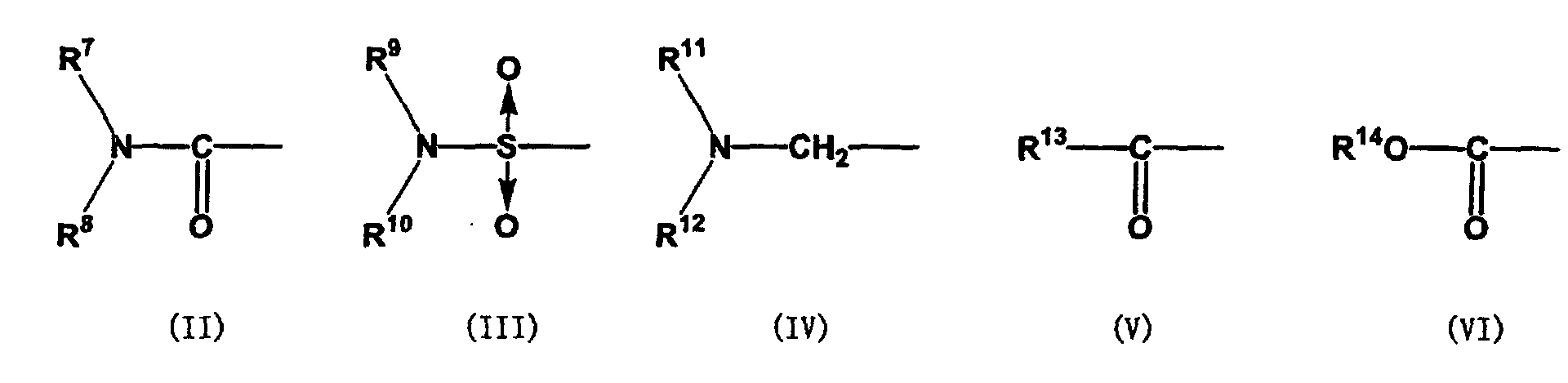
"B" represents -CH2-, -CHOH-, -(C=O)-, -CH2CH2-, or a single bond,
"n" represents 0, 1 or 2,
R1 represents a hydrogen atom, a halogen atom, a lower alkyl group which may be substituted, a lower alkenyl group which may be substituted, a lower alkoxy group which may be substituted, a hydroxy group, a cyano group, an amino group, a N,N-di(lower alkyl)amino group, a N,N-di(substituted lower alkyl)amino group, a nitro group, a carbamoyl group, a N,N-di(lower alkyl)carbamoyl group, a N,N-di(substituted lower alkyl)carbamoyl group, a carboxyl group, a lower alkoxycarbonyl group which may be substituted or a lower alkylcarbonyl group which may be substituted,
R2, R3, R7, R8, R9, R10, R11, R12, R13, and R14 independently represent a hydrogen atom, a lower alkyl group which may be substituted or a lower alkenyl group which may be substituted,
R4 represents a hydrogen atom, a lower alkyl group which may be substituted, a lower alkenyl group which may be substituted, or a lower alkoxy group which may be substituted,
R5 represents a hydrogen atom, a halogen atom, a lower alkyl group which may be substituted, a lower alkenyl group which may be substituted, a lower alkoxy group which may be substituted, a hydroxy group, a cyano group, an amino group, a N,N-di(lower alkyl)amino group, a N,N-di(substituted lower alkyl)amino group, a carbamoyl group, a N,N-di(lower alkyl)carbamoyl group, a N,N-di(substituted lower alkyl)carbamoyl group, a carboxyl group, a lower alkoxycarbonyl group which may be substituted, or a lower alkylcarbonyl group which may be substituted,
R6 represents a saturated or unsaturated monocyclic or bicyclic carbocyclic group, a saturated or unsaturated monocyclic or bicyclic heterocyclic group containing one or more hetero atoms or a N-(lower alkyl)carbonyl-N-(substituted or unsubstituted phenyl)amino group, and
R5 and R6, R7 and R8, R9 and R10, or R11 and R12 may bind to each other to form a cyclic structure. - The compound or a salt thereof according to Claim 1, wherein R6 represents the following group (VII):wherein, ---- represents a single bond or a double bond,

R15 represents a hydrogen atom, a lower alkyl group which may be substituted, a lower alkenyl group which may be substituted, or oxo group,
R16 represents a hydrogen atom, a halogen atom, a lower alkyl group which may be substituted, a lower alkenyl group which may be substituted, a lower alkoxy group which may be substituted, a hydroxy group, a cyano group, an amino group, a N,N-di(lower alkyl)amino group, a N,N-di(substituted lower alkyl)amino group, a nitro group, a carbamoyl group, a N,N-di(lower alkyl)carbamoyl group, a N,N-di(substituted lower alkyl)carbamoyl group, carboxyl group, a lower alkoxycarbonyl group which may be substituted, or a lower alkylcarbonyl group which may be substituted. - The compound or a salt thereof according to Claim 1, wherein R5 and R6 bind to each other to represent the following group (VIII):wherein, R17 represents a hydrogen atom, a lower alkyl group which may be substituted, or a lower alkenyl group which may be substituted, and
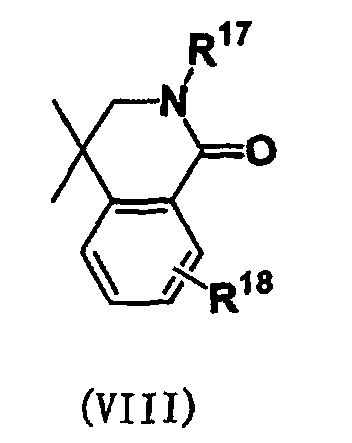
R18 represents a hydrogen atom, a halogen atom, a lower alkyl group which may be substituted, a lower alkenyl group which may be substituted, a lower alkoxy group which may be substituted, hydroxy group, cyano group, an amino group, an N,N-di(lower alkyl)amino group, an N,N-di(substituted lower alkyl)amino group, nitro group, a carbamoyl group, an N,N-di(lower alkyl)carbamoyl group, an N,N-di(substituted lower alkyl)carbamoyl group, carboxyl group, a lower alkoxycarbonyl group which may be substituted, or a lower alkylcarbonyl group which may be substituted. - The compound or a salt thereof according to any one of Claims 1 to 3, wherein X represents the group (II), (III), (V), or (VI),
"A" represents a residue derived from a ring selected from the group consisting of benzene, cyclohexane, and furan,
"B" represents -CH2-, -CHOH-, -(C=O)-, -CH2CH2-, or a single bond,
"n" represents 0, 1, or 2,
R1 represents a hydrogen atom or a lower alkoxy group,
R2, R3, R7, R8, R9, R10, R13, and R14 each independently represent a hydrogen atom or a lower alkyl group which may be substituted,
R4 represents a hydrogen atom or a lower alkyl group which may be substituted,
R5 represents a hydrogen atom or a lower alkylcarbonyl group which may be substituted,
R6 represents a residue of a ring selected from the group consisting of benzene, naphthalene, indane, benzofuran, imidazole, benzimidazole, indole, quinoline, benzotriazole, benzimidazole, benzisothiazole, benzisoxazole, quinazoline, isoquinoline and benzoxazine wherein a hydrogen atom on ring may be replaced with halogen, oxo, lower alkyl, hydroxymethyl, lower alkoxy or benzyl, or
R5 and R6 bind to each other to represent a residue of a ring selected from the group consisting of indane, imidazole, N-phenylimidazolidine, isoquinoline, quinoline and benzofuran wherein a hydrogen atom on ring may be replaced with oxo, lower alkyl or lower alkoxy, and
R7 and R8 bind to each other to represent pyrrolidine or piperidine. - The compound or a salt thereof according to any one of Claims 1 to 4, wherein X represents the group (II).
- A medicament comprising a substance selected from the group consisting of the compound according to any one of Claims 1 to 5 and a pharmacologically acceptable salt thereof as an active ingredient.
- The medicament according to Claim 6 in a form of a pharmaceutical composition which comprises a substance selected from the group consisting of the compound according to any one of Claims 1 to 5 and a pharmacologically acceptable salt thereof together with a pharamaceutical additive.
- The medicament according to Claim 6 or 7, which has affinity for an opioid δ receptor.
- The medicament according to Claim 6 or 7, which is used for preventive and/or therapeutic treatment of a central nerve system disease or a peripheral nerve system disease.
- The medicament according to Claim 9, wherein the central nerve system disease is schizophrenia, depression, cerebral apoplexy, epilepsy, Alzheimer's disease, or Parkinson's disease.
- The medicament according to Claim 9, wherein the peripheral nerve system disease is pain.
- An agent acting on an opioid δ receptor which comprises a substance selected from the group consisting of the compound according to any one of Claims 1 to 5 and a pharmacologically acceptable salt thereof.
- Use of a substance selected from the group consisting of the compound according to any one of Claims 1 to 5 and a pharmacologically acceptable salt thereof for manufacture of the medicament according to any one of Claims 6 to 11.
- A method for preventive and/or therapeutic treatment of a central nerve system disease, which comprises a step of administering preventiveally and/or therapeutically effective amount of a substance selected from the group consisting of the compound according to any one of Claims 1 to 5 and a pharmacologically acceptable salt thereof to a mammal including human.
- A method for preventive and/or therapeutic treatment of a peripheral nerve system disease, which comprises a step of administering preventiveally and/or therapeutically effective amount of a substance selected from the group consisting of the compound according to any one of Claims 1 to 5 and a pharmacologically acceptable salt thereof to a mammal including human.
Applications Claiming Priority (3)
| Application Number | Priority Date | Filing Date | Title |
|---|---|---|---|
| JP2000040791 | 2000-02-18 | ||
| JP2000040791 | 2000-02-18 | ||
| PCT/JP2001/001116 WO2001060796A1 (en) | 2000-02-18 | 2001-02-16 | PHENOXYALKYLAMINE DERIVATIVES USEFUL AS OPIOID δ RECEPTOR AGONISTS |
Publications (3)
| Publication Number | Publication Date |
|---|---|
| EP1256575A1 true EP1256575A1 (en) | 2002-11-13 |
| EP1256575A4 EP1256575A4 (en) | 2003-03-05 |
| EP1256575B1 EP1256575B1 (en) | 2005-08-17 |
Family
ID=18564120
Family Applications (1)
| Application Number | Title | Priority Date | Filing Date |
|---|---|---|---|
| EP01904501A Expired - Lifetime EP1256575B1 (en) | 2000-02-18 | 2001-02-16 | Phenoxyalkylamine derivatives useful as opioid delta receptor agonists |
Country Status (8)
| Country | Link |
|---|---|
| US (2) | US6916822B2 (en) |
| EP (1) | EP1256575B1 (en) |
| AT (1) | ATE302184T1 (en) |
| AU (2) | AU3231901A (en) |
| CA (1) | CA2400640A1 (en) |
| DE (1) | DE60112725T2 (en) |
| ES (1) | ES2248281T3 (en) |
| WO (1) | WO2001060796A1 (en) |
Cited By (1)
| Publication number | Priority date | Publication date | Assignee | Title |
|---|---|---|---|---|
| EP1598338A1 (en) * | 2001-04-18 | 2005-11-23 | Euro-Celtique S.A. | 1-(4-piperidinyl)-1,3-dihydro-2h-indole-2-one derivatives and related compounds as nociceptin analogs and orl1 ligands for the treatment of pain |
Families Citing this family (10)
| Publication number | Priority date | Publication date | Assignee | Title |
|---|---|---|---|---|
| CA2404280A1 (en) * | 2000-03-24 | 2002-09-23 | Meiji Seika Kaisha, Ltd. | Diphenylalkylamine derivatives useful as opioid .delta. receptor agonists |
| RU2268883C2 (en) | 2001-04-18 | 2006-01-27 | Эро-Селтик, С.А. | Analogues of noniceptine and pharmaceutical composition based on thereof |
| RU2382037C2 (en) * | 2003-11-17 | 2010-02-20 | Бёрингер Ингельхайм Интернациональ Гмбх | Novel piperidine substituted indoles and heteroderivatives thereof |
| GB0328906D0 (en) * | 2003-12-12 | 2004-01-14 | Syngenta Participations Ag | Chemical compounds |
| FR2880885B1 (en) * | 2005-01-14 | 2009-01-30 | Merck Sante Soc Par Actions Si | PHENYLBENZOIC ACID DERIVATIVES, PROCESSES FOR THEIR PREPARATION, PHARMACEUTICAL COMPOSITIONS CONTAINING SAME AND THERAPEUTIC APPLICATIONS |
| WO2007028638A1 (en) | 2005-09-09 | 2007-03-15 | Euro-Celtique S.A. | Fused and spirocycle compounds and the use thereof |
| US10752588B2 (en) | 2014-12-19 | 2020-08-25 | The Broad Institute, Inc. | Dopamine D2 receptor ligands |
| WO2016100940A1 (en) | 2014-12-19 | 2016-06-23 | The Broad Institute, Inc. | Dopamine d2 receptor ligands |
| MX2024008868A (en) | 2022-01-18 | 2024-09-23 | Maze Therapeutics Inc | Apol1 inhibitors and methods of use. |
| WO2024249254A2 (en) * | 2023-05-26 | 2024-12-05 | Maze Therapeutics, Inc. | Methods of using apol1 inhibitors |
Family Cites Families (20)
| Publication number | Priority date | Publication date | Assignee | Title |
|---|---|---|---|---|
| GB2176474A (en) * | 1985-06-15 | 1986-12-31 | Tanabe Seiyaku Co | Thiazolidine derivatives |
| FR2654104B1 (en) | 1989-11-07 | 1992-01-03 | Adir | NOVEL 1,2-BENZISOXAZOLE DERIVATIVES, PROCESSES FOR THEIR PREPARATION AND THE PHARMACEUTICAL COMPOSITIONS CONTAINING THEM. |
| GB9202238D0 (en) | 1992-02-03 | 1992-03-18 | Wellcome Found | Compounds |
| NZ247149A (en) | 1992-03-19 | 1996-10-28 | Lilly Co Eli | Cyclic peptide antifungal agents and compositions thereof |
| WO1994013696A1 (en) | 1992-12-11 | 1994-06-23 | Merck & Co., Inc. | Spiro piperidines and homologs which promote release of growth hormone |
| US5578593A (en) * | 1992-12-11 | 1996-11-26 | Merck & Co., Inc. | Spiro piperidines and homologs promote release of growth hormone |
| US5614523A (en) * | 1995-01-17 | 1997-03-25 | Eli Lilly And Company | Compounds having effects on serotonin-related systems |
| IT1275433B (en) * | 1995-05-19 | 1997-08-07 | Smithkline Beecham Farma | DIARYLDIAMINE DERIVATIVES |
| IT1277597B1 (en) | 1995-09-15 | 1997-11-11 | Smithkline Beecham Spa | DIARYLALKENYLAMINE DERIVATIVES |
| US5756508A (en) * | 1995-10-31 | 1998-05-26 | Merck & Co., Inc. | Muscarine antagonists |
| WO1998008816A1 (en) | 1996-08-26 | 1998-03-05 | Meiji Seika Kaisha, Ltd. | Oxindole derivatives and psychotropic drugs |
| TW548271B (en) * | 1996-12-20 | 2003-08-21 | Astra Pharma Inc | Novel piperidine derivatives having an exocyclic double bond with analgesic effects |
| SE9604786D0 (en) * | 1996-12-20 | 1996-12-20 | Astra Pharma Inc | New compounds |
| FR2761070B1 (en) | 1997-03-20 | 1999-04-23 | Synthelabo | DIHYDROPYRAZINO [1,2-A] INDOLE-1-ONE DERIVATIVES, THEIR PREPARATION AND THEIR THERAPEUTIC APPLICATION |
| ES2226129T3 (en) * | 1997-05-30 | 2005-03-16 | Banyu Pharmaceutical Co., Ltd. | DERIVATIVES OF 2-0X0IMIDAZOL. |
| US6166209A (en) * | 1997-12-11 | 2000-12-26 | Hoffmann-La Roche Inc. | Piperidine derivatives |
| JPH11189585A (en) | 1997-12-25 | 1999-07-13 | Meiji Seika Kaisha Ltd | Tetrahydrobenzindole derivative having ability to bind to 5-ht7 receptor |
| US6277991B1 (en) * | 1998-05-18 | 2001-08-21 | Novo Nordisk A/S | 1,3,8-triazaspiro[4.5]decanones with high affinity for opioid receptor subtypes |
| AU3809999A (en) | 1998-05-18 | 1999-12-06 | Novo Nordisk A/S | Novel 1,3,8-triazaspiro[4.5]decanones with high affinity for opioid receptor subtypes |
| CA2404280A1 (en) * | 2000-03-24 | 2002-09-23 | Meiji Seika Kaisha, Ltd. | Diphenylalkylamine derivatives useful as opioid .delta. receptor agonists |
-
2001
- 2001-02-16 US US10/203,617 patent/US6916822B2/en not_active Expired - Fee Related
- 2001-02-16 CA CA002400640A patent/CA2400640A1/en not_active Abandoned
- 2001-02-16 WO PCT/JP2001/001116 patent/WO2001060796A1/en not_active Ceased
- 2001-02-16 EP EP01904501A patent/EP1256575B1/en not_active Expired - Lifetime
- 2001-02-16 AU AU3231901A patent/AU3231901A/en active Pending
- 2001-02-16 AT AT01904501T patent/ATE302184T1/en not_active IP Right Cessation
- 2001-02-16 ES ES01904501T patent/ES2248281T3/en not_active Expired - Lifetime
- 2001-02-16 DE DE60112725T patent/DE60112725T2/en not_active Expired - Fee Related
- 2001-02-16 AU AU2001232319A patent/AU2001232319B2/en not_active Ceased
-
2005
- 2005-03-02 US US11/068,759 patent/US20050148583A1/en not_active Abandoned
Cited By (1)
| Publication number | Priority date | Publication date | Assignee | Title |
|---|---|---|---|---|
| EP1598338A1 (en) * | 2001-04-18 | 2005-11-23 | Euro-Celtique S.A. | 1-(4-piperidinyl)-1,3-dihydro-2h-indole-2-one derivatives and related compounds as nociceptin analogs and orl1 ligands for the treatment of pain |
Also Published As
| Publication number | Publication date |
|---|---|
| DE60112725T2 (en) | 2006-06-01 |
| AU2001232319B2 (en) | 2005-01-13 |
| US20030171370A1 (en) | 2003-09-11 |
| EP1256575B1 (en) | 2005-08-17 |
| US20050148583A1 (en) | 2005-07-07 |
| AU3231901A (en) | 2001-08-27 |
| CA2400640A1 (en) | 2001-08-23 |
| ATE302184T1 (en) | 2005-09-15 |
| US6916822B2 (en) | 2005-07-12 |
| DE60112725D1 (en) | 2005-09-22 |
| WO2001060796A1 (en) | 2001-08-23 |
| EP1256575A4 (en) | 2003-03-05 |
| ES2248281T3 (en) | 2006-03-16 |
Similar Documents
| Publication | Publication Date | Title |
|---|---|---|
| US6790854B2 (en) | Diphenylalkylamine derivatives useful as opioid receptor agonists | |
| JP3073238B2 (en) | 1- (1,2-disubstituted piperidinyl) -4-substituted piperazine derivatives | |
| AU2001283345B2 (en) | Cyclopentyl modulators of chemokine receptor activity | |
| US6890936B2 (en) | Muscarinic antagonists | |
| CN101128435A (en) | Pyrazolone compounds as metabotropic glutamate receptor agonists for the treatment of neurological and psychiatric disorders | |
| HU228128B1 (en) | 1-(1,2-disubstituted piperidinyl)-4-substituted piperidine derivatives as tachykinin receptor antagonists | |
| CN1910150A (en) | Piperidine derivatives as GCS inhibitors | |
| EP0383579A1 (en) | N-Phenyl-N-(4-piperidinyl)amides useful as analgesics | |
| KR20070050076A (en) | Amido Compounds and Uses thereof as Pharmaceuticals | |
| CA2408849A1 (en) | Cyclohexane derivatives and their use as therapeutic agents | |
| CA2172377A1 (en) | Novel 4-piperidinyl substituted lactames as neurokinin 2-receptor antagonists for the treatment of asthma | |
| CA2294549A1 (en) | Heterocyclic substituted piperidines and uses thereof | |
| US20040132710A1 (en) | Lactams as tachkinin antagonists | |
| EP1256575B1 (en) | Phenoxyalkylamine derivatives useful as opioid delta receptor agonists | |
| CN100516040C (en) | Nitrogenous heterocyclic derivative having 2,6-disubstituted styryl | |
| EP0029707B1 (en) | Novel piperidine derivatives, method for the preparation thereof and pharmaceutical compositions containing them | |
| JP2016138122A (en) | Chemokine receptor antagonist and method of use thereof | |
| US4292321A (en) | 1,3,8-Triazaspirodecane-4-ones, pharmaceutical compositions thereof and method of use thereof | |
| JPWO1998000400A1 (en) | Tetrahydrobenzindole compounds | |
| US6218390B1 (en) | Morpholinone and morpholine derivatives and uses thereof | |
| EA008060B1 (en) | Chemokine receptor antagonists and methods of use thereof | |
| US4411904A (en) | Diphenylpropanamines, compositions thereof and use thereof | |
| PL196053B1 (en) | Ethanesulfonyl-piperidine derivatives | |
| JPWO2001060796A1 (en) | Phenoxyalkylamine derivatives useful as opioid delta receptor agonists | |
| JPWO2001070689A1 (en) | Diphenylalkylamine derivatives useful as opioid delta receptor agonists |
Legal Events
| Date | Code | Title | Description |
|---|---|---|---|
| PUAI | Public reference made under article 153(3) epc to a published international application that has entered the european phase |
Free format text: ORIGINAL CODE: 0009012 |
|
| 17P | Request for examination filed |
Effective date: 20020817 |
|
| AK | Designated contracting states |
Kind code of ref document: A1 Designated state(s): AT BE CH CY DE DK ES FI FR GB GR IE IT LI LU MC NL PT SE TR |
|
| AX | Request for extension of the european patent |
Free format text: AL;LT;LV;MK;RO;SI |
|
| A4 | Supplementary search report drawn up and despatched |
Effective date: 20030121 |
|
| RIC1 | Information provided on ipc code assigned before grant |
Ipc: 7A 61K 31/438 B Ipc: 7C 07D 401/04 B Ipc: 7C 07D 211/14 A Ipc: 7A 61K 31/451 B Ipc: 7C 07D 417/04 B Ipc: 7A 61K 31/445 B Ipc: 7C 07D 405/04 B Ipc: 7C 07D 491/10 B Ipc: 7A 61K 31/454 B Ipc: 7C 07D 221/20 B Ipc: 7C 07D 471/20 B Ipc: 7C 07D 471/10 B Ipc: 7C 07D 211/58 B |
|
| 17Q | First examination report despatched |
Effective date: 20030328 |
|
| GRAP | Despatch of communication of intention to grant a patent |
Free format text: ORIGINAL CODE: EPIDOSNIGR1 |
|
| GRAS | Grant fee paid |
Free format text: ORIGINAL CODE: EPIDOSNIGR3 |
|
| GRAA | (expected) grant |
Free format text: ORIGINAL CODE: 0009210 |
|
| AK | Designated contracting states |
Kind code of ref document: B1 Designated state(s): AT BE CH CY DE DK ES FI FR GB GR IE IT LI LU MC NL PT SE TR |
|
| PG25 | Lapsed in a contracting state [announced via postgrant information from national office to epo] |
Ref country code: AT Free format text: LAPSE BECAUSE OF FAILURE TO SUBMIT A TRANSLATION OF THE DESCRIPTION OR TO PAY THE FEE WITHIN THE PRESCRIBED TIME-LIMIT Effective date: 20050817 Ref country code: CH Free format text: LAPSE BECAUSE OF FAILURE TO SUBMIT A TRANSLATION OF THE DESCRIPTION OR TO PAY THE FEE WITHIN THE PRESCRIBED TIME-LIMIT Effective date: 20050817 Ref country code: LI Free format text: LAPSE BECAUSE OF FAILURE TO SUBMIT A TRANSLATION OF THE DESCRIPTION OR TO PAY THE FEE WITHIN THE PRESCRIBED TIME-LIMIT Effective date: 20050817 Ref country code: NL Free format text: LAPSE BECAUSE OF FAILURE TO SUBMIT A TRANSLATION OF THE DESCRIPTION OR TO PAY THE FEE WITHIN THE PRESCRIBED TIME-LIMIT Effective date: 20050817 Ref country code: FI Free format text: LAPSE BECAUSE OF FAILURE TO SUBMIT A TRANSLATION OF THE DESCRIPTION OR TO PAY THE FEE WITHIN THE PRESCRIBED TIME-LIMIT Effective date: 20050817 Ref country code: TR Free format text: LAPSE BECAUSE OF FAILURE TO SUBMIT A TRANSLATION OF THE DESCRIPTION OR TO PAY THE FEE WITHIN THE PRESCRIBED TIME-LIMIT Effective date: 20050817 Ref country code: BE Free format text: LAPSE BECAUSE OF FAILURE TO SUBMIT A TRANSLATION OF THE DESCRIPTION OR TO PAY THE FEE WITHIN THE PRESCRIBED TIME-LIMIT Effective date: 20050817 |
|
| REG | Reference to a national code |
Ref country code: GB Ref legal event code: FG4D |
|
| REG | Reference to a national code |
Ref country code: CH Ref legal event code: EP |
|
| REG | Reference to a national code |
Ref country code: IE Ref legal event code: FG4D |
|
| REF | Corresponds to: |
Ref document number: 60112725 Country of ref document: DE Date of ref document: 20050922 Kind code of ref document: P |
|
| PG25 | Lapsed in a contracting state [announced via postgrant information from national office to epo] |
Ref country code: GR Free format text: LAPSE BECAUSE OF FAILURE TO SUBMIT A TRANSLATION OF THE DESCRIPTION OR TO PAY THE FEE WITHIN THE PRESCRIBED TIME-LIMIT Effective date: 20051117 Ref country code: SE Free format text: LAPSE BECAUSE OF FAILURE TO SUBMIT A TRANSLATION OF THE DESCRIPTION OR TO PAY THE FEE WITHIN THE PRESCRIBED TIME-LIMIT Effective date: 20051117 Ref country code: DK Free format text: LAPSE BECAUSE OF FAILURE TO SUBMIT A TRANSLATION OF THE DESCRIPTION OR TO PAY THE FEE WITHIN THE PRESCRIBED TIME-LIMIT Effective date: 20051117 |
|
| PG25 | Lapsed in a contracting state [announced via postgrant information from national office to epo] |
Ref country code: PT Free format text: LAPSE BECAUSE OF FAILURE TO SUBMIT A TRANSLATION OF THE DESCRIPTION OR TO PAY THE FEE WITHIN THE PRESCRIBED TIME-LIMIT Effective date: 20060117 |
|
| NLV1 | Nl: lapsed or annulled due to failure to fulfill the requirements of art. 29p and 29m of the patents act | ||
| PG25 | Lapsed in a contracting state [announced via postgrant information from national office to epo] |
Ref country code: IE Free format text: LAPSE BECAUSE OF NON-PAYMENT OF DUE FEES Effective date: 20060216 |
|
| PG25 | Lapsed in a contracting state [announced via postgrant information from national office to epo] |
Ref country code: MC Free format text: LAPSE BECAUSE OF NON-PAYMENT OF DUE FEES Effective date: 20060228 Ref country code: LU Free format text: LAPSE BECAUSE OF NON-PAYMENT OF DUE FEES Effective date: 20060228 |
|
| REG | Reference to a national code |
Ref country code: CH Ref legal event code: PL |
|
| REG | Reference to a national code |
Ref country code: ES Ref legal event code: FG2A Ref document number: 2248281 Country of ref document: ES Kind code of ref document: T3 |
|
| ET | Fr: translation filed | ||
| PLBE | No opposition filed within time limit |
Free format text: ORIGINAL CODE: 0009261 |
|
| STAA | Information on the status of an ep patent application or granted ep patent |
Free format text: STATUS: NO OPPOSITION FILED WITHIN TIME LIMIT |
|
| 26N | No opposition filed |
Effective date: 20060518 |
|
| REG | Reference to a national code |
Ref country code: IE Ref legal event code: MM4A |
|
| PGFP | Annual fee paid to national office [announced via postgrant information from national office to epo] |
Ref country code: ES Payment date: 20080226 Year of fee payment: 8 |
|
| PGFP | Annual fee paid to national office [announced via postgrant information from national office to epo] |
Ref country code: DE Payment date: 20080214 Year of fee payment: 8 Ref country code: GB Payment date: 20080213 Year of fee payment: 8 Ref country code: IT Payment date: 20080227 Year of fee payment: 8 |
|
| PGFP | Annual fee paid to national office [announced via postgrant information from national office to epo] |
Ref country code: FR Payment date: 20080208 Year of fee payment: 8 |
|
| PG25 | Lapsed in a contracting state [announced via postgrant information from national office to epo] |
Ref country code: CY Free format text: LAPSE BECAUSE OF FAILURE TO SUBMIT A TRANSLATION OF THE DESCRIPTION OR TO PAY THE FEE WITHIN THE PRESCRIBED TIME-LIMIT Effective date: 20050817 |
|
| GBPC | Gb: european patent ceased through non-payment of renewal fee |
Effective date: 20090216 |
|
| REG | Reference to a national code |
Ref country code: FR Ref legal event code: ST Effective date: 20091030 |
|
| PG25 | Lapsed in a contracting state [announced via postgrant information from national office to epo] |
Ref country code: DE Free format text: LAPSE BECAUSE OF NON-PAYMENT OF DUE FEES Effective date: 20090901 |
|
| REG | Reference to a national code |
Ref country code: ES Ref legal event code: FD2A Effective date: 20090217 |
|
| PG25 | Lapsed in a contracting state [announced via postgrant information from national office to epo] |
Ref country code: GB Free format text: LAPSE BECAUSE OF NON-PAYMENT OF DUE FEES Effective date: 20090216 Ref country code: FR Free format text: LAPSE BECAUSE OF NON-PAYMENT OF DUE FEES Effective date: 20090302 |
|
| PG25 | Lapsed in a contracting state [announced via postgrant information from national office to epo] |
Ref country code: ES Free format text: LAPSE BECAUSE OF NON-PAYMENT OF DUE FEES Effective date: 20090217 |
|
| PG25 | Lapsed in a contracting state [announced via postgrant information from national office to epo] |
Ref country code: IT Free format text: LAPSE BECAUSE OF NON-PAYMENT OF DUE FEES Effective date: 20090216 |