EP1256341A1 - Cancer remedy comprising anthranilic acid derivative as active ingredient - Google Patents
Cancer remedy comprising anthranilic acid derivative as active ingredient Download PDFInfo
- Publication number
- EP1256341A1 EP1256341A1 EP01906131A EP01906131A EP1256341A1 EP 1256341 A1 EP1256341 A1 EP 1256341A1 EP 01906131 A EP01906131 A EP 01906131A EP 01906131 A EP01906131 A EP 01906131A EP 1256341 A1 EP1256341 A1 EP 1256341A1
- Authority
- EP
- European Patent Office
- Prior art keywords
- group
- hydrogen atom
- formula
- compound
- cancer
- Prior art date
- Legal status (The legal status is an assumption and is not a legal conclusion. Google has not performed a legal analysis and makes no representation as to the accuracy of the status listed.)
- Withdrawn
Links
- 0 C*c1ccccc1 Chemical compound C*c1ccccc1 0.000 description 3
- KNIWNVLPCPULCN-UHFFFAOYSA-N OC(c(cccc1)c1NC(Cc(cc1)ccc1Oc(cc1)cc(cc2)c1cc2O)=O)=O Chemical compound OC(c(cccc1)c1NC(Cc(cc1)ccc1Oc(cc1)cc(cc2)c1cc2O)=O)=O KNIWNVLPCPULCN-UHFFFAOYSA-N 0.000 description 1
- JQCWAKMOJSWOJV-UHFFFAOYSA-N OC(c1ccccc1NC(c(cc1)ccc1Oc1cc(cccc2)c2cc1)=O)=O Chemical compound OC(c1ccccc1NC(c(cc1)ccc1Oc1cc(cccc2)c2cc1)=O)=O JQCWAKMOJSWOJV-UHFFFAOYSA-N 0.000 description 1
- QRSXHTQQZWVKOB-UHFFFAOYSA-N Oc(cc1)ccc1Oc1cc2ccccc2cc1 Chemical compound Oc(cc1)ccc1Oc1cc2ccccc2cc1 QRSXHTQQZWVKOB-UHFFFAOYSA-N 0.000 description 1
Classifications
-
- C—CHEMISTRY; METALLURGY
- C07—ORGANIC CHEMISTRY
- C07D—HETEROCYCLIC COMPOUNDS
- C07D257/00—Heterocyclic compounds containing rings having four nitrogen atoms as the only ring hetero atoms
- C07D257/02—Heterocyclic compounds containing rings having four nitrogen atoms as the only ring hetero atoms not condensed with other rings
- C07D257/04—Five-membered rings
-
- A—HUMAN NECESSITIES
- A61—MEDICAL OR VETERINARY SCIENCE; HYGIENE
- A61K—PREPARATIONS FOR MEDICAL, DENTAL OR TOILETRY PURPOSES
- A61K31/00—Medicinal preparations containing organic active ingredients
- A61K31/16—Amides, e.g. hydroxamic acids
- A61K31/165—Amides, e.g. hydroxamic acids having aromatic rings, e.g. colchicine, atenolol, progabide
- A61K31/167—Amides, e.g. hydroxamic acids having aromatic rings, e.g. colchicine, atenolol, progabide having the nitrogen of a carboxamide group directly attached to the aromatic ring, e.g. lidocaine, paracetamol
-
- A—HUMAN NECESSITIES
- A61—MEDICAL OR VETERINARY SCIENCE; HYGIENE
- A61K—PREPARATIONS FOR MEDICAL, DENTAL OR TOILETRY PURPOSES
- A61K31/00—Medicinal preparations containing organic active ingredients
- A61K31/16—Amides, e.g. hydroxamic acids
- A61K31/18—Sulfonamides
-
- A—HUMAN NECESSITIES
- A61—MEDICAL OR VETERINARY SCIENCE; HYGIENE
- A61K—PREPARATIONS FOR MEDICAL, DENTAL OR TOILETRY PURPOSES
- A61K31/00—Medicinal preparations containing organic active ingredients
- A61K31/185—Acids; Anhydrides, halides or salts thereof, e.g. sulfur acids, imidic, hydrazonic or hydroximic acids
- A61K31/19—Carboxylic acids, e.g. valproic acid
- A61K31/192—Carboxylic acids, e.g. valproic acid having aromatic groups, e.g. sulindac, 2-aryl-propionic acids, ethacrynic acid
-
- A—HUMAN NECESSITIES
- A61—MEDICAL OR VETERINARY SCIENCE; HYGIENE
- A61K—PREPARATIONS FOR MEDICAL, DENTAL OR TOILETRY PURPOSES
- A61K31/00—Medicinal preparations containing organic active ingredients
- A61K31/21—Esters, e.g. nitroglycerine, selenocyanates
- A61K31/215—Esters, e.g. nitroglycerine, selenocyanates of carboxylic acids
- A61K31/235—Esters, e.g. nitroglycerine, selenocyanates of carboxylic acids having an aromatic ring attached to a carboxyl group
-
- A—HUMAN NECESSITIES
- A61—MEDICAL OR VETERINARY SCIENCE; HYGIENE
- A61K—PREPARATIONS FOR MEDICAL, DENTAL OR TOILETRY PURPOSES
- A61K31/00—Medicinal preparations containing organic active ingredients
- A61K31/21—Esters, e.g. nitroglycerine, selenocyanates
- A61K31/215—Esters, e.g. nitroglycerine, selenocyanates of carboxylic acids
- A61K31/235—Esters, e.g. nitroglycerine, selenocyanates of carboxylic acids having an aromatic ring attached to a carboxyl group
- A61K31/24—Esters, e.g. nitroglycerine, selenocyanates of carboxylic acids having an aromatic ring attached to a carboxyl group having an amino or nitro group
-
- A—HUMAN NECESSITIES
- A61—MEDICAL OR VETERINARY SCIENCE; HYGIENE
- A61K—PREPARATIONS FOR MEDICAL, DENTAL OR TOILETRY PURPOSES
- A61K31/00—Medicinal preparations containing organic active ingredients
- A61K31/275—Nitriles; Isonitriles
- A61K31/277—Nitriles; Isonitriles having a ring, e.g. verapamil
-
- A—HUMAN NECESSITIES
- A61—MEDICAL OR VETERINARY SCIENCE; HYGIENE
- A61K—PREPARATIONS FOR MEDICAL, DENTAL OR TOILETRY PURPOSES
- A61K31/00—Medicinal preparations containing organic active ingredients
- A61K31/33—Heterocyclic compounds
- A61K31/395—Heterocyclic compounds having nitrogen as a ring hetero atom, e.g. guanethidine or rifamycins
- A61K31/41—Heterocyclic compounds having nitrogen as a ring hetero atom, e.g. guanethidine or rifamycins having five-membered rings with two or more ring hetero atoms, at least one of which being nitrogen, e.g. tetrazole
-
- A—HUMAN NECESSITIES
- A61—MEDICAL OR VETERINARY SCIENCE; HYGIENE
- A61P—SPECIFIC THERAPEUTIC ACTIVITY OF CHEMICAL COMPOUNDS OR MEDICINAL PREPARATIONS
- A61P35/00—Antineoplastic agents
-
- C—CHEMISTRY; METALLURGY
- C07—ORGANIC CHEMISTRY
- C07C—ACYCLIC OR CARBOCYCLIC COMPOUNDS
- C07C235/00—Carboxylic acid amides, the carbon skeleton of the acid part being further substituted by oxygen atoms
- C07C235/02—Carboxylic acid amides, the carbon skeleton of the acid part being further substituted by oxygen atoms having carbon atoms of carboxamide groups bound to acyclic carbon atoms and singly-bound oxygen atoms bound to the same carbon skeleton
- C07C235/32—Carboxylic acid amides, the carbon skeleton of the acid part being further substituted by oxygen atoms having carbon atoms of carboxamide groups bound to acyclic carbon atoms and singly-bound oxygen atoms bound to the same carbon skeleton the carbon skeleton containing six-membered aromatic rings
- C07C235/38—Carboxylic acid amides, the carbon skeleton of the acid part being further substituted by oxygen atoms having carbon atoms of carboxamide groups bound to acyclic carbon atoms and singly-bound oxygen atoms bound to the same carbon skeleton the carbon skeleton containing six-membered aromatic rings having the nitrogen atom of at least one of the carboxamide groups bound to a carbon atom of a six-membered aromatic ring
Definitions
- the present invention relates to a cancer remedy comprising an anthranilic acid derivative or a pharmaceutically acceptable salt as an active ingredient. More particularly, it relates to a cancer remedy comprising an anthranilic acid derivative, having an anthranilic acid skeleton and a benzene skeleton and further having the benzene skeleton or a naphthalene skeleton, or a pharmaceutically acceptable salt thereof, as an active ingredient.
- JP-A No. 5-9170 Japanese Unexamined Patent Publication
- JP-A No. 7-33743 2-arylquinolinol derivatives
- benzoylacetylene derivatives JP-A No. 7-97350
- WO97/19910 describes compounds having a benzene skeleton and an anthranilic acid skeleton and further an antiallergic activity and an inhibitory activity against the production of IgE antibodies.
- An object of the present invention is to provide a cancer remedy having a novel structure.
- anthranilic acid derivatives have a cytotoxic activity against cell strains having a high growth property, and that the anthranilic acid derivatives have a strong growth inhibitory activity or cytotoxic activity against human cancer cells. Therefore, a pharmaceutical composition comprising the anthranilic acid derivative, its pharmaceutically acceptable salt or a pharmaceutically acceptable solvate thereof as an active ingredient is useful as a cancer remedy.
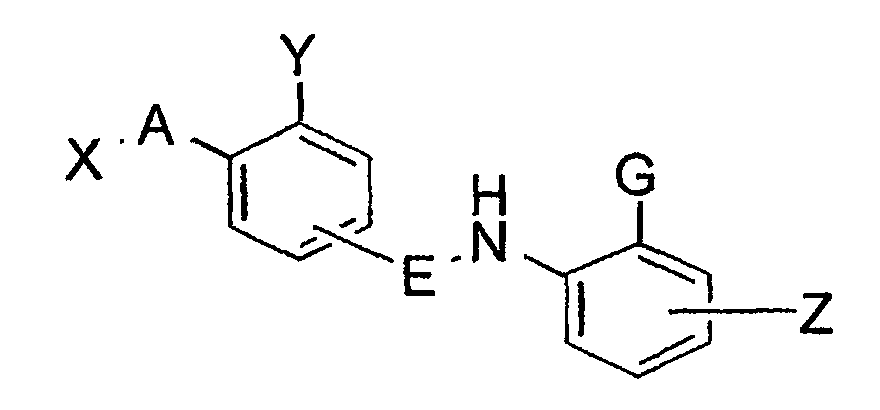
- the present invention provides a cancer remedy comprising an anthranilic acid derivative represented by the following formula (1) or a pharmaceutically acceptable salt thereof as an active ingredient:
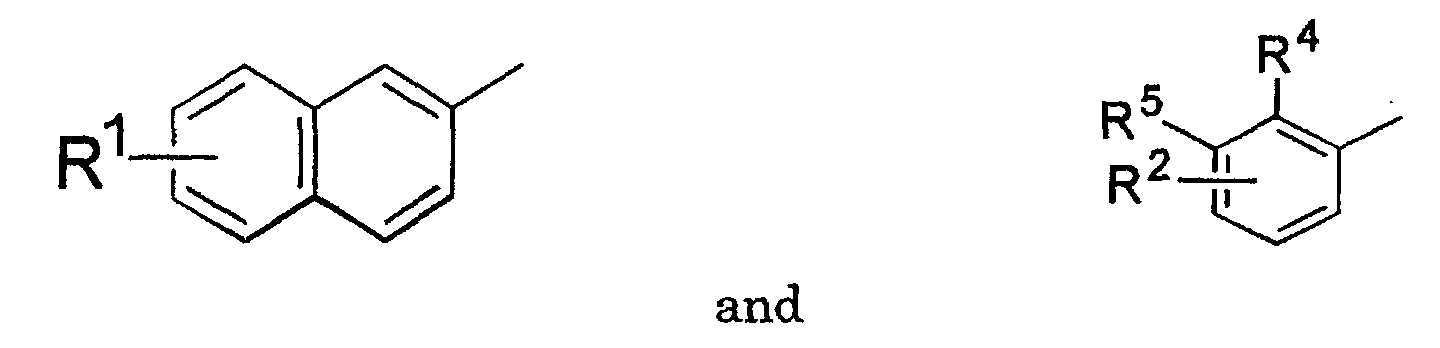
- X represents a group selected from the following formula (2)-1 and formula (2)-2 in the formula (1):
- R 1 and R 2 represent each independently a hydrogen atom, a hydroxy group, a trihalomethyl group, an alkoxy group or an alkylthio group comprising a C 1 -C 12 chain or cyclic hydrocarbon group and an oxy group or a thio group, a C 7 -C 11 aralkyloxy group wherein an aryl group moiety may be substituted with one or more halogen atoms, methyl groups or methyloxy groups or a C 3 -C 10 alkenyloxy group which may be substituted with one or more phenyl groups;
- R 4 and R 5 represent each independently a hydrogen atom, a halogen atom, a C 1 -C 4 alkyl group or a C
- the present invention provides a therapy for cancer using a drug comprising the anthranilic acid derivative or a pharmaceutically acceptable salt thereof.
- the present invention is the use of the anthranilic acid derivative or a pharmaceutically acceptable salt thereof in order to produce the cancer remedy.
- R 1 and R 2 represent each independently a hydrogen atom, a hydroxy group, a trihalomethyl group, an alkoxy group or an alkylthio group comprising a C 1 -C 12 chain or cyclic hydrocarbon group and an oxy group or a thio group, a C 7 -C 11 aralkyloxy group wherein an aryl group moiety may be substituted with one or more of halogen atoms, methyl groups or methyloxy groups or a C 3 -C 10 alkenyloxy group which may be substituted with one or more phenyl groups.
- R 1 or R 2 represents a C 1 -C 12 chain or cyclic alkyloxy group
- R 1 or R 2 can be selected from, for example methyloxy group, ethyloxy group, propyloxy group, 2-propyloxy group, (1- or 2-)methylpropyloxy group, 2,2-dimethylpropyloxy group, (n- or tert-)butyloxy group, 2-ethylbutyloxy group, (2- or 3-)methylbutyloxy group, pentyloxy group, hexyloxy group, heptyloxy group, octyloxy group, decyloxy group, dodecyloxy group, cyclopropyloxy group, cyclopropylmethyloxy group, cyclobutyloxy group, cyclopentyloxy group, cyclohexyloxy group, cyclohexylmethyloxy group, cyclooctyloxy group, cycloheptyloxy group, cyclo
- R 1 or R 2 represents a C 1 -C 12 chain or cyclic alkylthio group
- R 1 or R 2 can be selected from, for example methylthio group, ethylthio group, propylthio group, 2-propylthio group, (1- or 2-)methylpropylthio group, 2,2-dimethylpropylthio group, (n- or tert-)butylthio group, 2-ethylbutyltyhio group, (2- or 3-)methylbutylthio group, pentylthio group, hexylthio group, heptylthio group, octylthio group, decylthio group, dodecylthio group, cyclopropylthio group, cyclopropylmethylthio group, cyclobutylthio group, cyclopentylthio group, cyclohexylthio group, cyclohexylmethylthio group
- R 1 or R 2 represents a C 7 -C 12 aralkyloxy group
- the aryl group moiety of the aralkyloxy group may be represented by one or more of halogen atoms, methyl groups or methyloxy groups, and examples of the substituents include fluorine atoms, chlorine atoms, bromine atoms, methyl groups, methyloxy groups and the like.
- the aralkyloxy groups represented by R 1 can be selected from, for example benzyloxy group, (2-, 3-or 4-)chlorobenzyloxy group, (2-, 3- or 4-)methoxybenzyloxy group, (2-, 3- or 4-)methylbenzyloxy group, ( ⁇ - or ⁇ -)phenethyloxy group, 3-phenylpropyloxy group, 2-phenyl-2-propyloxy group, 2-phenyl-1-cyclohexyloxy group, (1-phenylcyclopropyl)methyloxy group, (1-phenylcyclopentyl)methyloxy group, (1- or 2-)naphthylmethyloxy group and the like.
- R 1 or R 2 may be a C 3 -C 10 alkenyloxy group.
- the alkenyloxy group in this case can be selected from, for example allyloxy group, methallyloxy group, crotyloxy group, 3-butenyloxy group, 4-pentenyloxy group, 5-hexenyloxy group, 7-octenyloxy group, geranyloxy group, cinnamyloxy group, 2-cyclohexenyloxy group, (3-cyclohexenyl)methyloxy group, 1,4-pentadien-3-yloxy group and the like.
- R 1 and R 2 may each be a hydrogen atom, a hydroxy group or a trihalomethyl group.
- the halogen atom representing the trihalomethyl group include fluorine atoms, chlorine atoms and the like.
- Examples of preferable atoms or groups among the atoms or groups represented by R 1 or R 2 include a hydrogen atom, a hydroxy group, methyloxy group, ethyloxy group, propyloxy group, 2-propyloxy group, (1-or 2-)methylpropyloxy group, 2,2-dimethylpropyloxy group, (n- or tert)butyloxy group, 2-ethylbutyloxy group, (2- or 3-)methylbutyloxy group, pentyloxy group, hexyloxy group, heptyloxy group, octyloxy group, decyloxy group, dodecyloxy group, cyclopropylmethyloxy group, cyclopentyloxy group, cyclohexyloxy group, cyclohexylmethyloxy group, cyclooctyloxy group, cycloheptyloxy group, cyclododecyloxy group, methythio group, ethyl
- the atoms or groups are especially preferably an alkyloxy group wherein the R 1 or R 2 group comprises a hydrogen atom, a hydroxy group, a C 1 -C 12 chain or cyclic saturated hydrocarbon or a C 7 -C 12 aralkyloxy group, more preferably a hydrogen atom, for example a C 5 -C 12 cyclic saturated alkoxy group such as cyclohexyloxy group, cycloheptyloxy group, cyclooctyloxy group, cyclopentyloxy group or cyclododecanyloxy group or a C 3 -C 8 branched chain saturated alkoxy group, especially preferably an alkyloxy group producing a branch from the adjacent carbon of the oxygen atom, for example isopropyloxy group, 3-pentyloxy group or benzyloxy group.
- the R 1 or R 2 group comprises a hydrogen atom, a hydroxy group, a C 1 -C 12 chain or cyclic saturated
- R 1 and R 2 may be substituted at an optional position on the naphthalene ring or the benzene ring; however, R 1 is preferably located in the 6-position counted from the ring in which the A on the naphthalene ring is linked (A is substituted at the 2-position) or R 2 is preferably located in the 4-position counted from the bond of A on the benzene ring.
- R 4 and R 6 represent each independently a hydrogen atom, a halogen atom, a C 1 -C 4 alkyl group or a C 1 -C 4 alkoxy group.
- the halogen atom include a fluorine atom, a chlorine atom, a bromine atom and the like.
- the C 1 -C 4 alkyl group include methyl group, ethyl group, isopropyl group, t-butyl group and the like.
- examples of the C 1 -C 4 alkoxy group include methyloxy group, ethyloxy group, isopropyloxy group, t-butyloxy group and the like.
- examples of R 4 or R 5 include preferably a hydrogen atom, a chlorine atom, methyl group or methyloxy group. Among them, hydrogen atom is preferable.
- R 4 is substituted at the 2-position on the benzene ring, and R 5 is substituted at the 3-position on the benzene ring.
- Y represents a hydrogen atom, a halogen atom, a nitro group, a nitrile group, an amino group, -COOR 7 , wherein, R 7 represents a hydrogen atom or a C 1 -C 4 alkyl group, -NHCOR 8 or -NHSO 2 R 9 , wherein, R 8 and R 9 represent each independently a C 1 -C 4 alkyl group.
- R 7 represents a hydrogen atom or a C 1 -C 4 alkyl group
- -NHCOR 8 or -NHSO 2 R 9 wherein, R 8 and R 9 represent each independently a C 1 -C 4 alkyl group.
- examples of the halogen atom include a fluorine atom, a chlorine atom and a bromine atom. Among them, chlorine atom is preferable.
- R 7 represents a hydrogen atom or a C 1 -C 4 alkyl group, and examples thereof include a hydrogen atom, methyl group, ethyl group, n-propyl group, 2-propyl group, n-butyl group and tert-butyl group. It is preferable for the -COOR 7 to be -COOH or -COOCH 3 .
- Y represents -NHCOOR 8 or -NHSO 2 R 9
- R 8 or R 9 represents a C 1 -C 4 alkyl group.
- Y represents -NHCOR 8 or -NHSO 2 R 9 , it is preferable for Y to be -NHCOCH 3 or -NHSO 2 CH 3 .
- Y is especially preferable for Y to be a hydrogen atom, a chlorine atom, a nitro group or a nitrile group, among ones listed above.
- G represents a hydrogen atom, a hydroxy group, -SO 2 NH 2 , -COOR 3 , wherein, R 3 represents a hydrogen atom or a C 1 -C 4 alkyl group, -CN or a tetrazol-5-yl group.
- R 3 represents a hydrogen atom or a C 1 -C 4 alkyl group, -CN or a tetrazol-5-yl group.
- examples of the alkyl group represented by R 3 include methyl group, ethyl group, (n- or iso)propyl group, (n-, iso- or tert-)butyl group and the like.
- the G is preferably -COOR 3 , wherein R 3 represents a hydrogen atom or a C 1 -C 4 alkyl group, or tetrazol-5-yl group; and R 3 is especially preferably a hydrogen atom, methyl group or ethyl group. It is more preferable for G to be -COOH or tetrazol-5-yl group.
- Z represents a hydrogen atom, a halogen atom, a nitro group or a methyl group.
- the halogen atom include a fluorine atom, a chlorine atom and a bromine atom.
- Z is preferably a hydrogen atom, a fluorine atom, a chlorine atom and methyl group, especially preferably a hydrogen atom.
- the compound manifests an exceedingly high cytotoxic activity against cells having a strong growth activity.
- R 1 and R 2 represent each a hydrogen atom, a C 5 -C 12 cyclic alkyl group, a C 3 -C 8 branched chain alkyl group or a benzyl group;
- A represents a bond; -O-;
- G represents COOH or a tetrazol-5-yl group.
- the compound manifests a stronger cytotoxic activity.
- the substituent when Z represents a halogen atom or a methyl group, the substituent is preferably located in the 4- or the 5-position with respect to the group G on the benzene ring to which the group Z represents bound.
- the Z group located in the 4- or the 5-position has advantages in preventing the compound represented by the formula (1) from being inactivated with metabolism and sustaining the pharmaceutical effects thereof.
- nontoxic salt-forming cation examples include alkali metal ions such as Na + and K + ; alkaline earth metal ions such as Mg 2+ and Ca 2+ ; nontoxic equivalent metal ions such as Al 3+ and Zn 2+ ; organic bases such as ammonia, triethylamine, ethylenediamine, propanediamine, pyrrolidine, piperidine, piperazine, pyridine, lysine, choline, ethanolamine, N,N-dimethylethanolamine, 4-hydroxypiperidine, glucosamine, N-methylglucamine and the like.
- Na 2+ , Ca 2+ and the organic bases such as lysine, choline, N,N-dimethylethanolamine and N-methylglucamine are preferably used.
- the anthranilic acid derivative or a nontoxic salt thereof represented by the formula (1) may form a pharmaceutically acceptable solvate thereof.
- Solvents forming the solvate can be selected from water, methanol, ethanol, (n- and iso-)propyl alcohol, (n- and tert-)butanol, acetonitrile, acetone, methyl ethyl ketone, chloroform, ethyl acetate, diethyl ether, tert-butyl methyl ether, benzene, toluene, DMF, DMSO and the like.
- water, methanol, ethanol, (n- and iso-)propyl alcohol or acetonitrile is especially preferably used.
- the cancer remedy of the present invention comprises the anthranilic acid derivative, a pharmaceutically acceptable salt thereof or a solvate thereof as an active ingredient; however, a pharmaceutically acceptable carrier, if necessary, may be added.
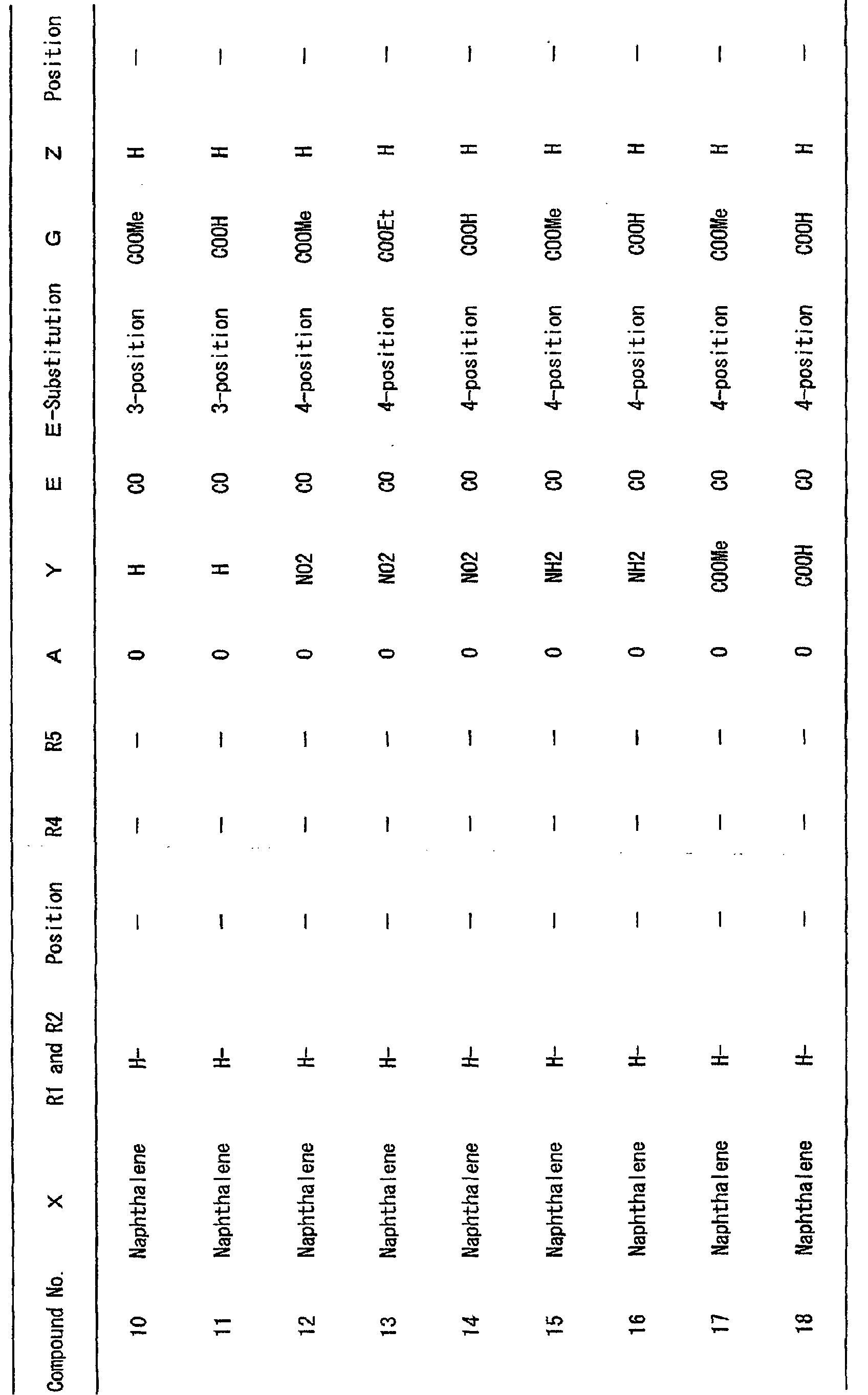
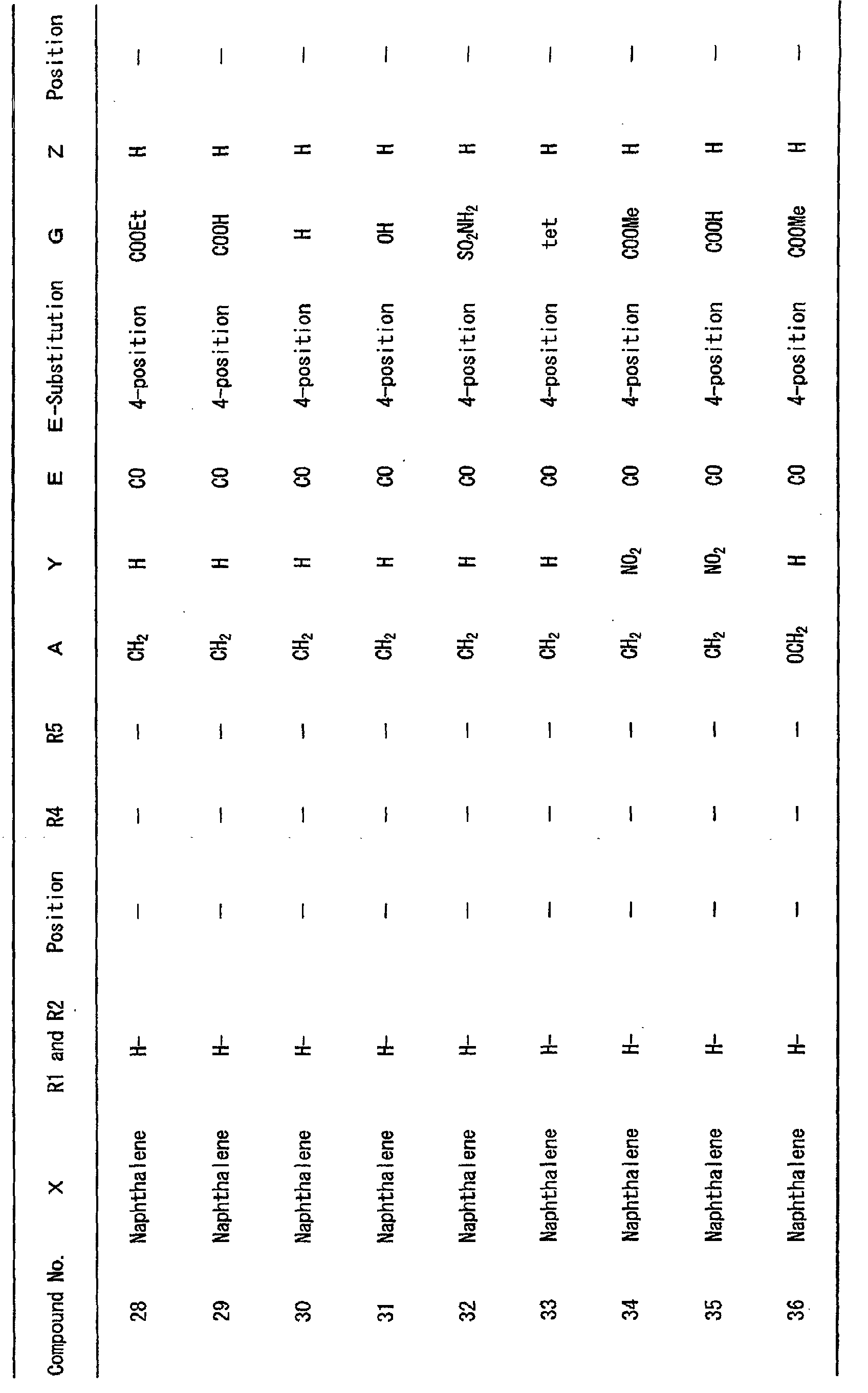
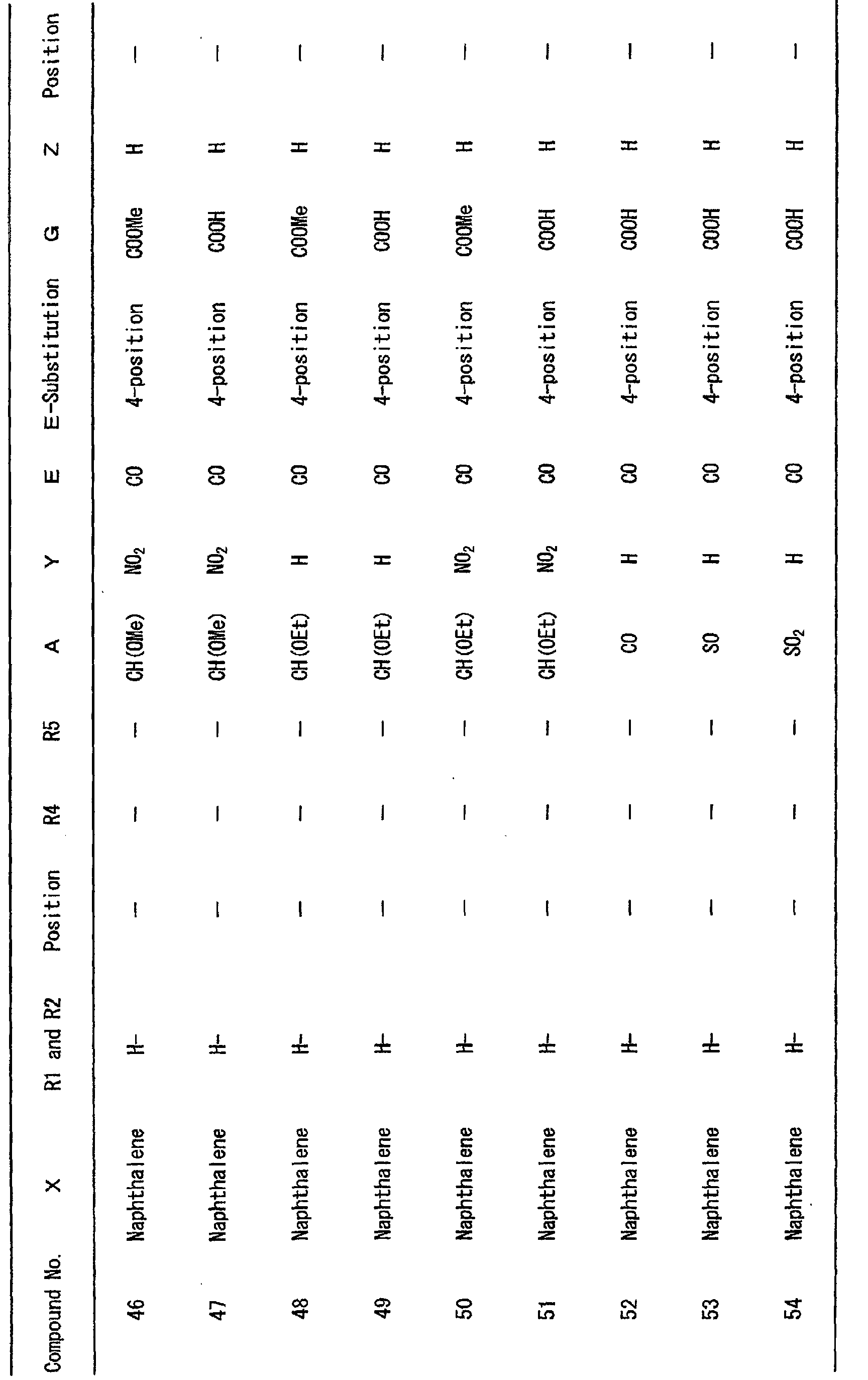
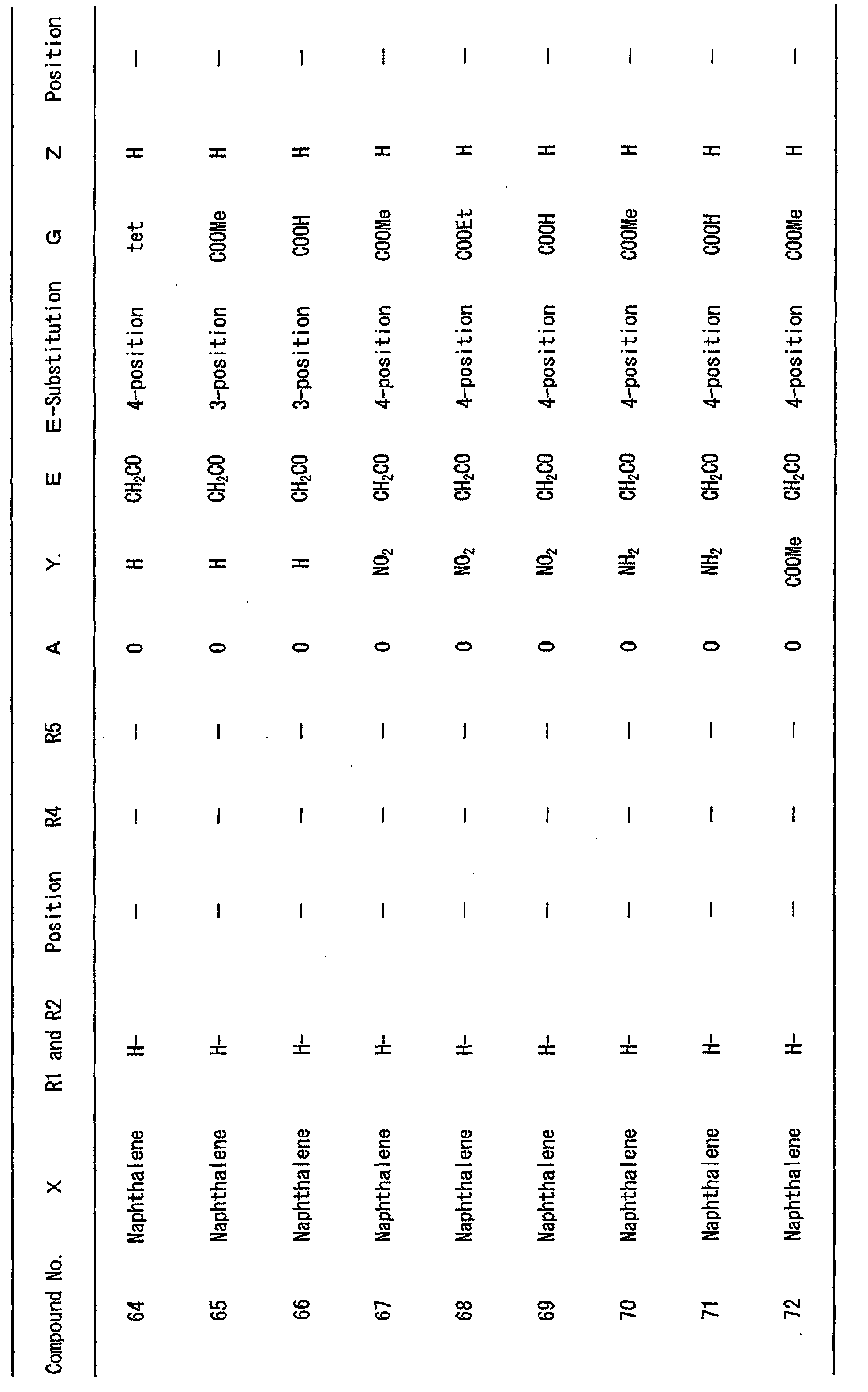
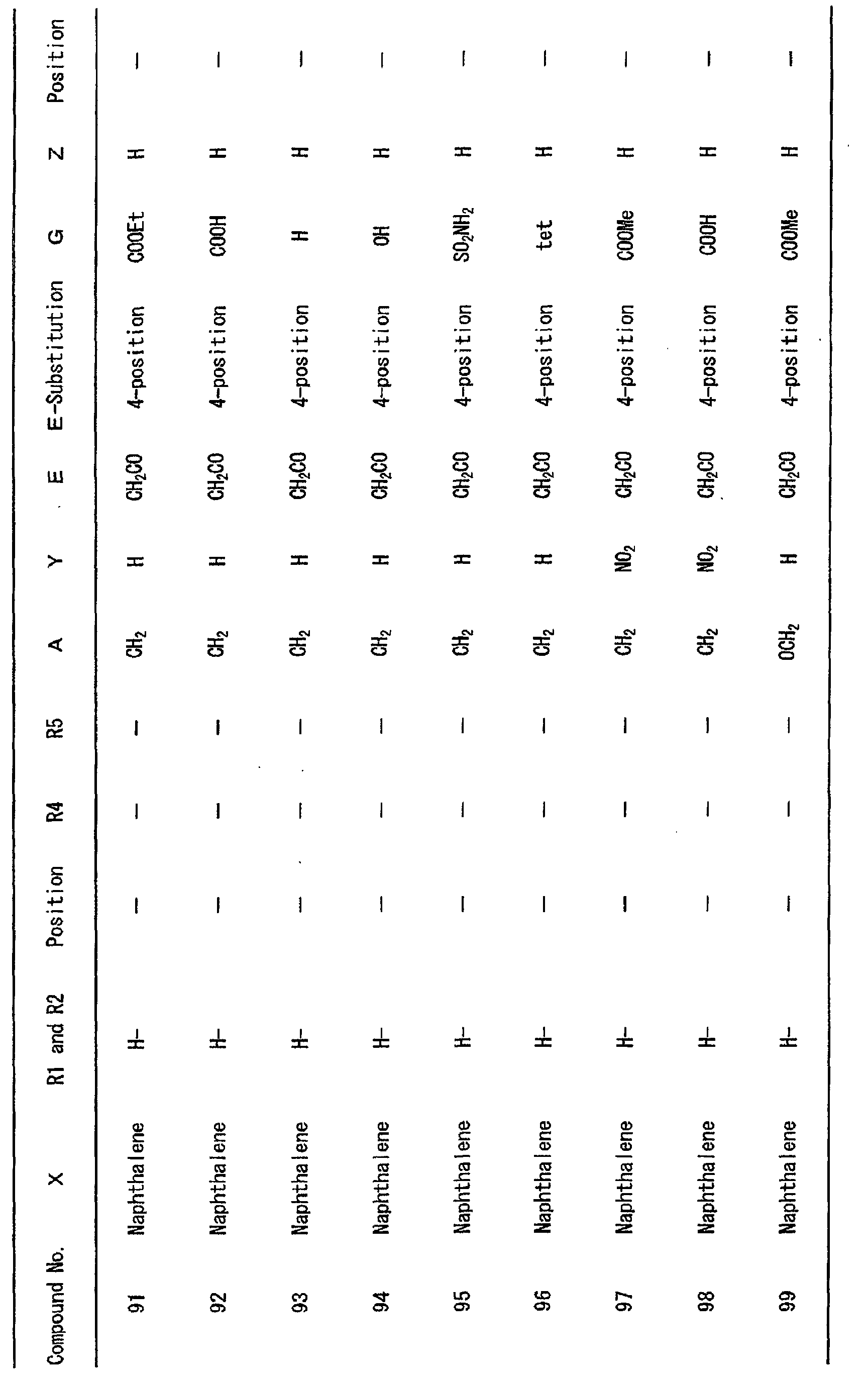
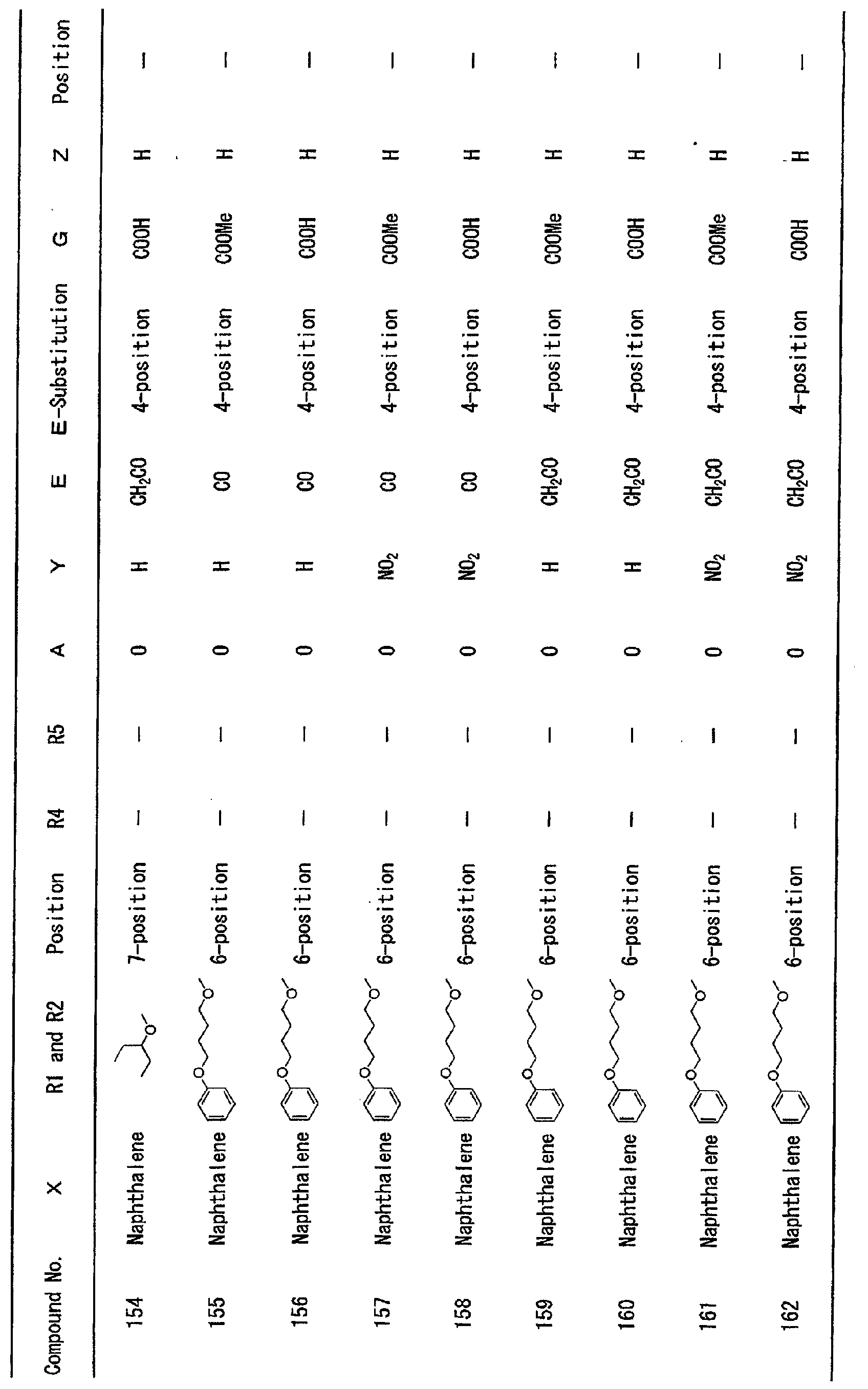
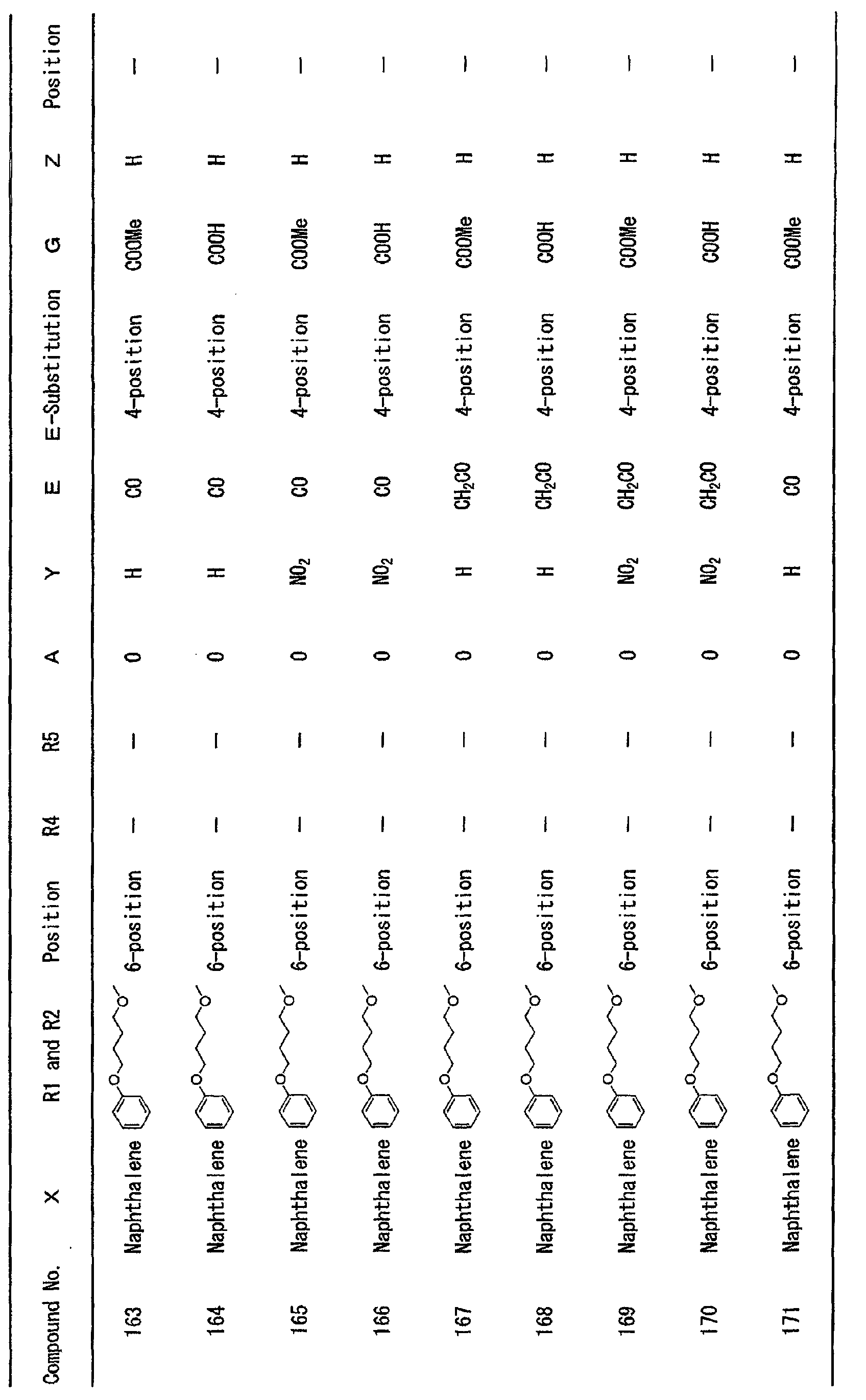
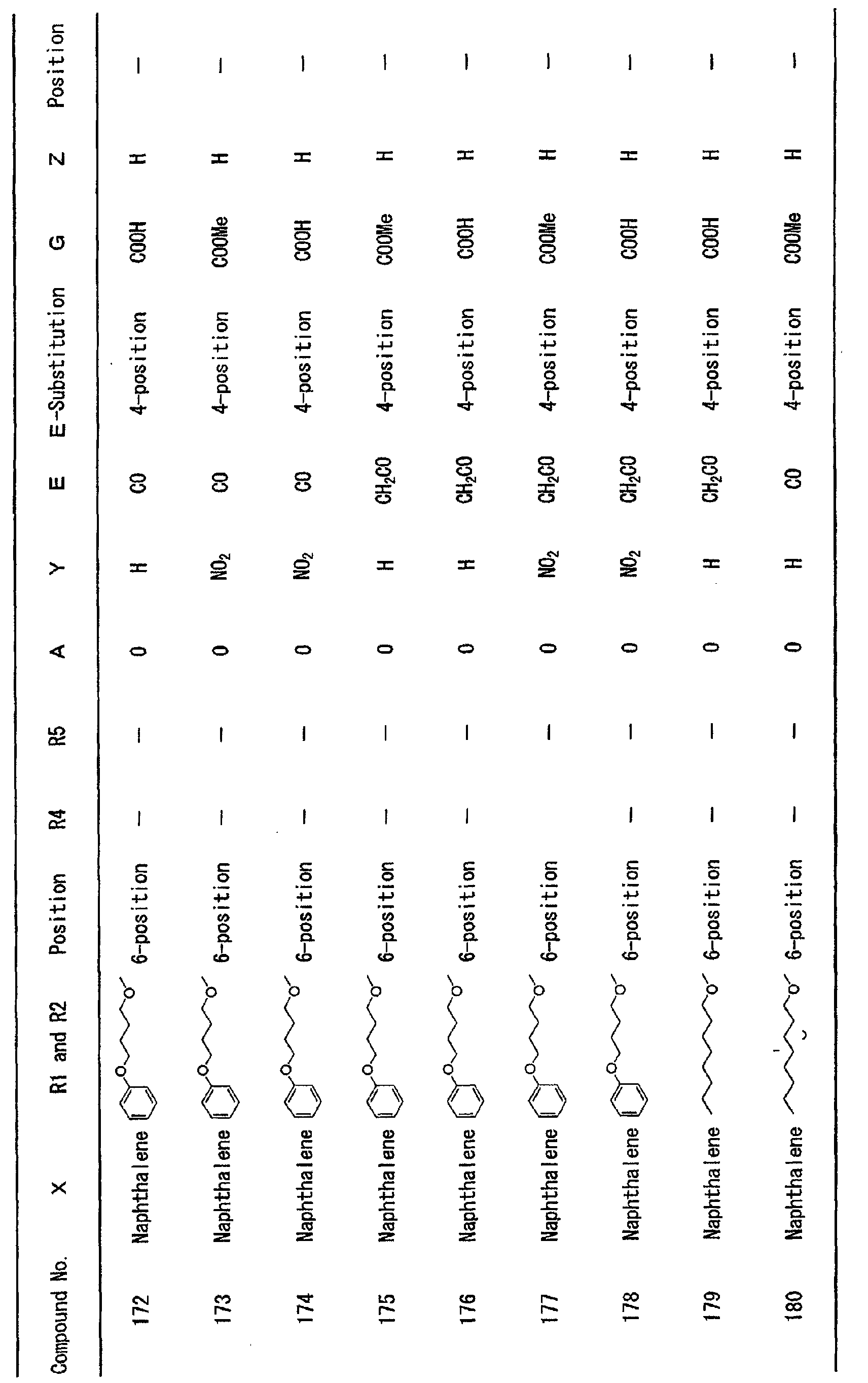
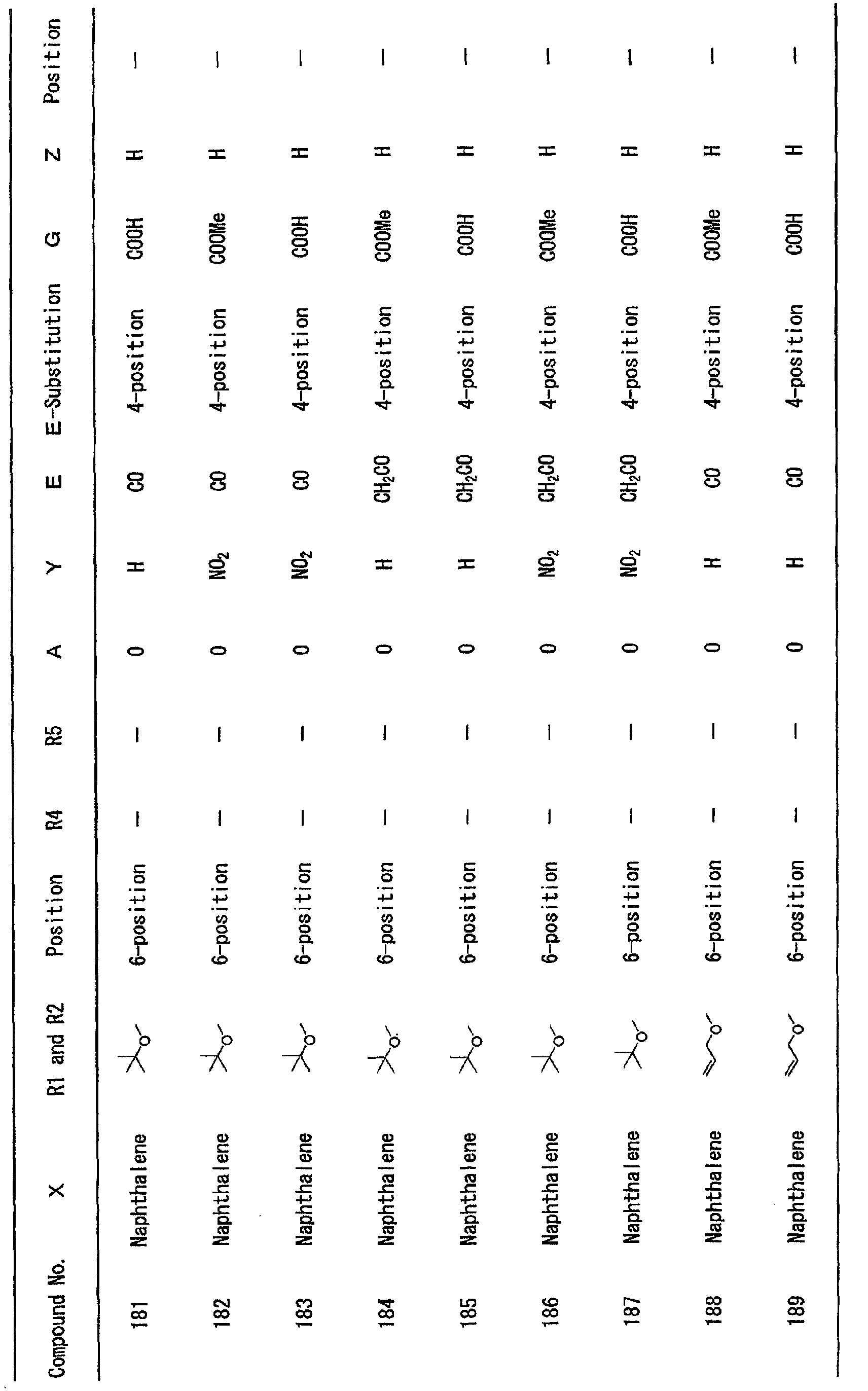
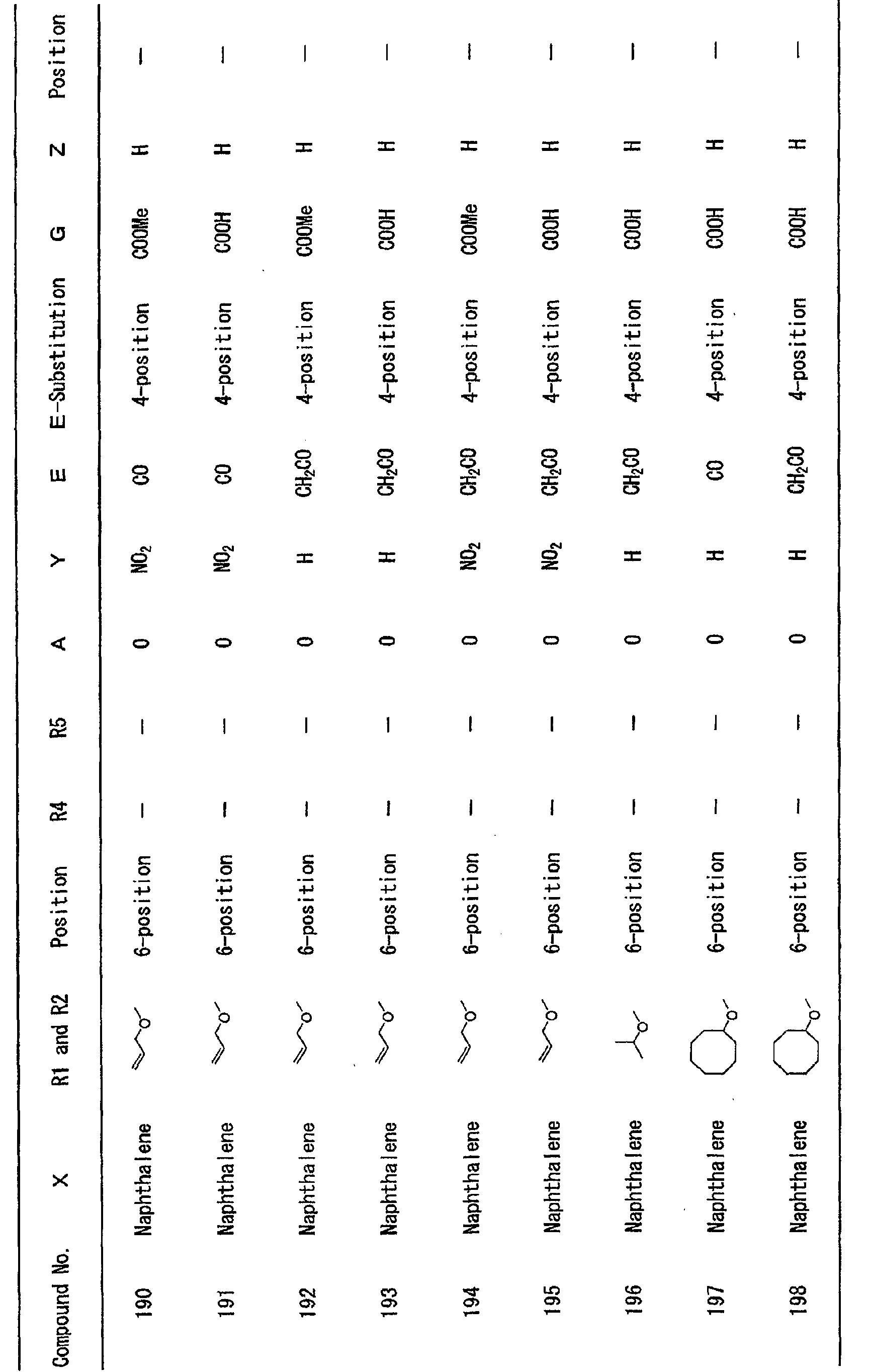
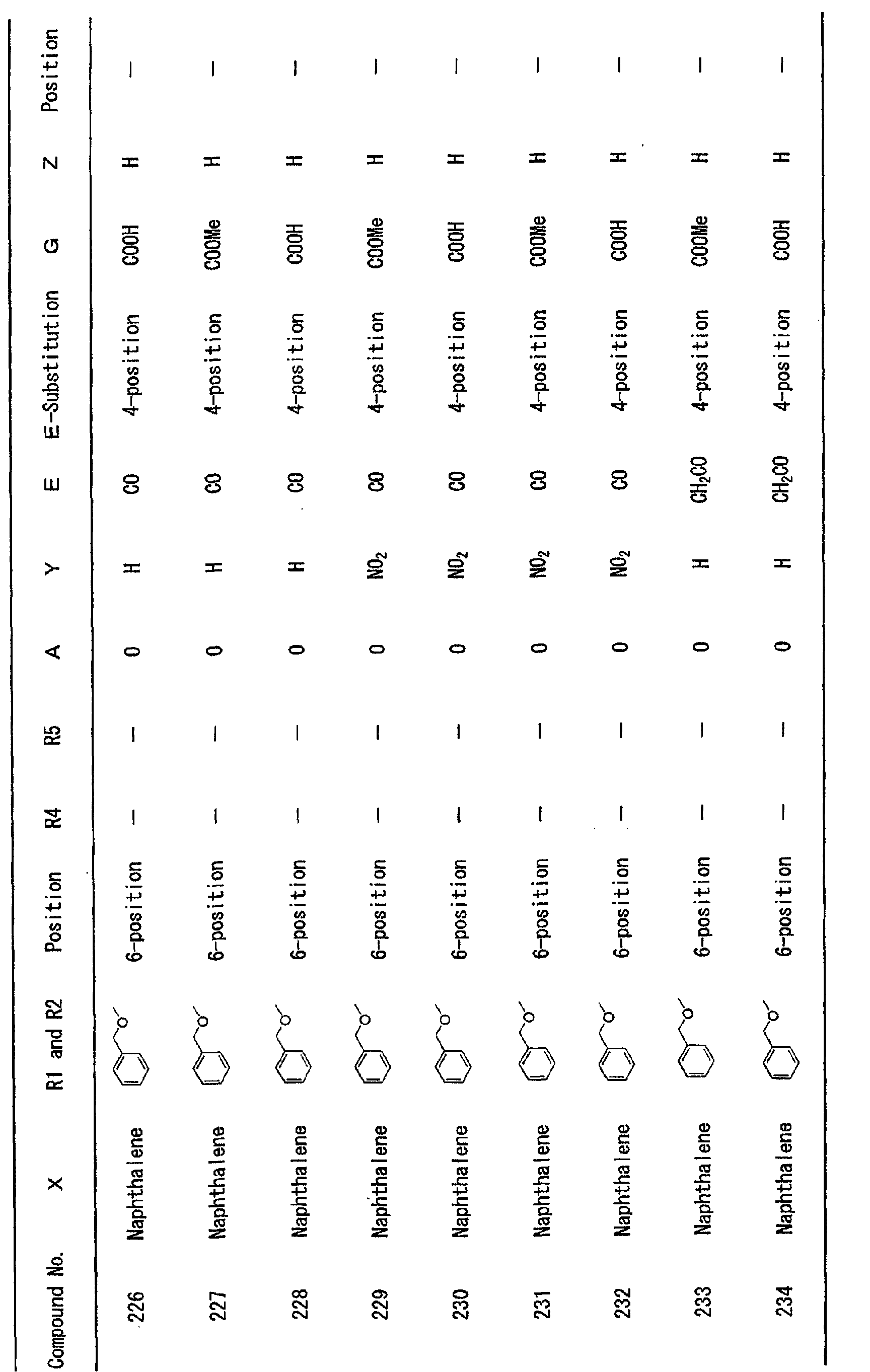
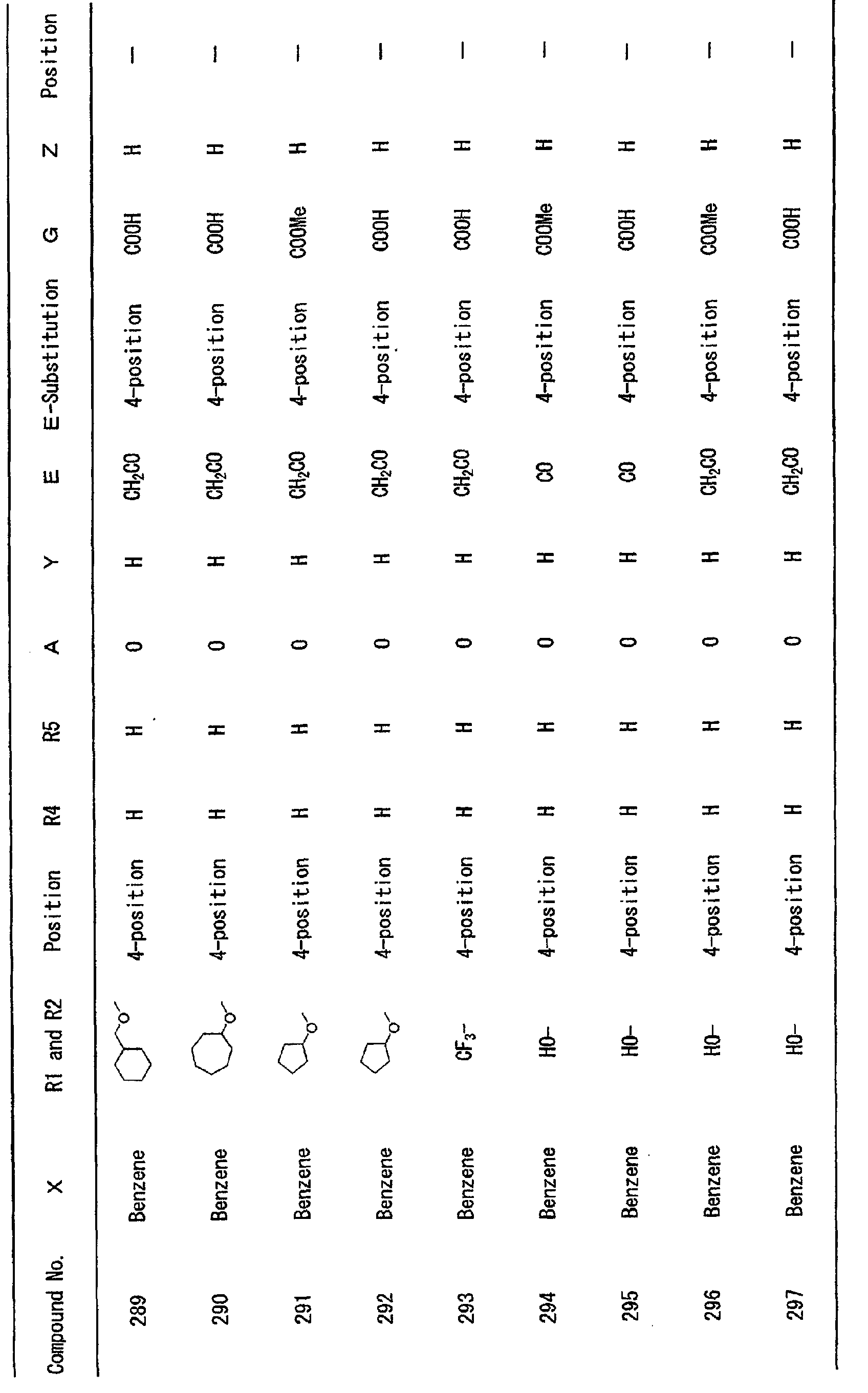
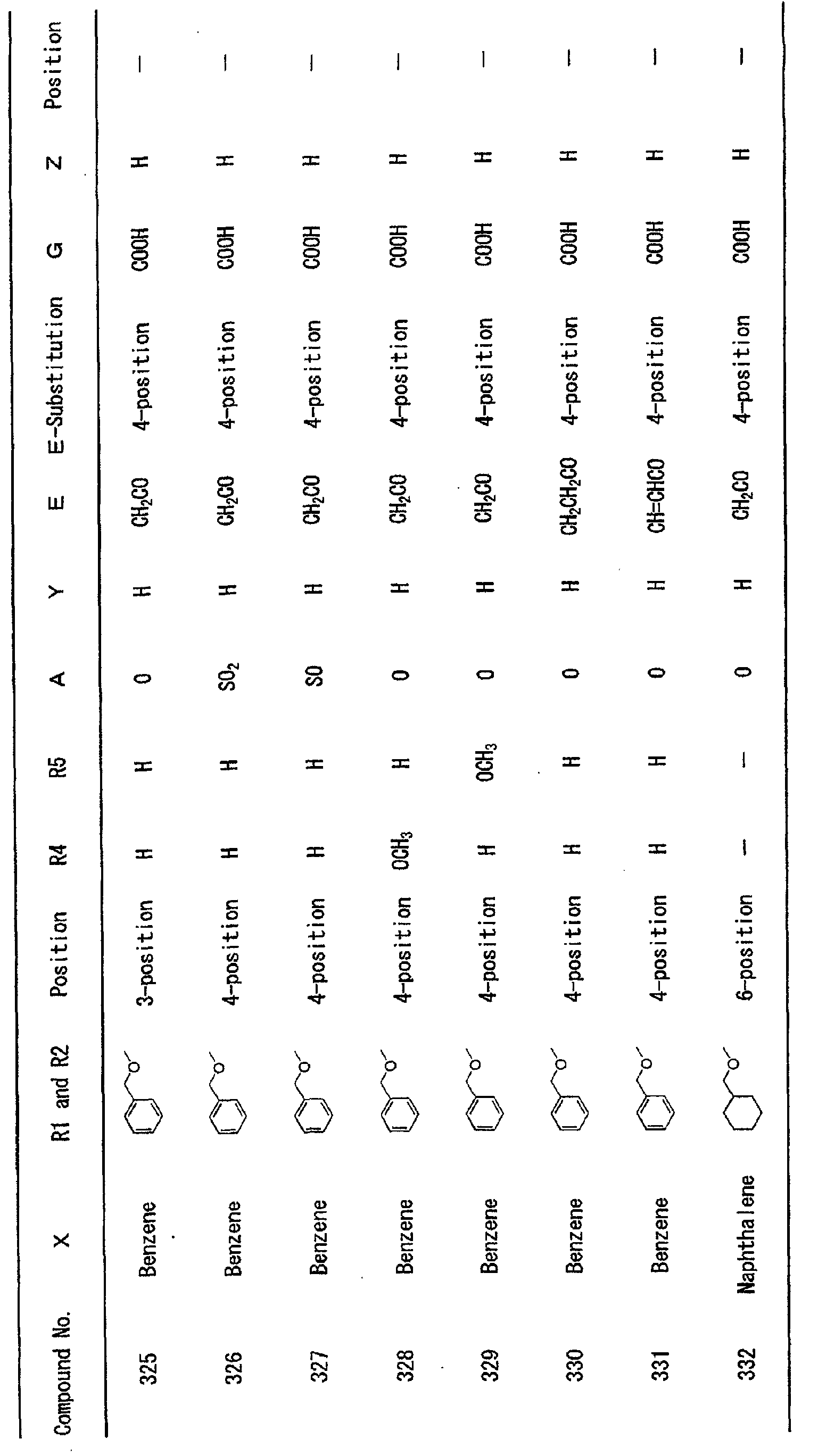
- anthranilic acid derivative represented by the formula (1) is listed in the following tables.
- the structural formula of the compound has an asymmetric carbon (for example, compound No. 44)
- all the optical isomers are included.
- the structural formula has a carbon-carbon double bond (for example, compound No. 120)
- both geometrical isomers are included.
- "tet" indicates a tetrazol-5-yl group.
- the anthranilic acid derivative that is an active ingredient of the cancer remedy of the present invention has a strong cytotoxic activity as described in the Examples hereinafter.
- the anthranilic acid derivative has an LC 50 or a GI 50 of 5 ⁇ M or below, preferably 0.05 nM or above and 1 ⁇ M or below, more preferably 0.05 nM or above and 500 nM or below.
- the anthranilic acid derivative having the excellent cytotoxic activity can be used as an active ingredient of the remedy clinically applicable to cancer.
- the anthranilic acid derivative or a pharmaceutically acceptable salt thereof represented by the formula (1) can be produced if the persons are those skilled in the art by referring to WO95/32943 and WO97/19910. Namely, as shown in the following scheme, the objective compound represented by the following formula [I] can be obtained by condensing a carboxylic acid [II] having a naphthalene skeleton or a carboxylic acid [III] having a benzene skeleton with an aniline derivative [IV].
- R 1 , R 2 , X, A, Y, E, G and Z in each formula mentioned above are the same as defined above.
- E' represents a single bond or a bond;
- CR 10 R 11- , -CH 2 CH 2 - or CH CH-, wherein R 10 and R 11 are the same as defined above.
- the compounds, which are starting materials, represented by the formula [II] and formula [III] can be obtained according to a known method.
- the method for condensation represents roughly classified into a method for passing through an acid halide and a method without passing through the acid halide. Both the methods are basically known.
- the compound [I] can be obtained by reacting the compound [II] or [III] with oxalyl chloride or thionyl chloride in the presence or absence of an additive such as DMF, producing the acid halide of the compound [II] or [III] and reacting the resultant acid halide with the compound [IV] in the presence or absence of a base.
- an additive such as DMF
- the compound [I] in the method without passing through the acid halide, can be obtained by activating the compound [II] or [III] using various activators such as mixed acid anhydrides, carbodiimides, imidazole-forming agent, halophosphoric esters or cyanophosphoric esters and reacting the activated compound [II] or [III] with the compound [IV].
- various activators such as mixed acid anhydrides, carbodiimides, imidazole-forming agent, halophosphoric esters or cyanophosphoric esters and reacting the activated compound [II] or [III] with the compound [IV].
- the compound [I] when G represents -CN, the compound [I], if necessary, can be subjected to a treatment such as reaction with an azide compound and converted into a compound wherein G represents a tetrazol-5-yl group.
- the compound [I] thus obtained (when Y represents -COOR 7 and R 7 represents a hydrogen atom or when G represents -COOR 3 and R 3 represents a hydrogen atom or G represents the tetrazol-5-yl group), if necessary, can be converted into the pharmaceutically acceptable salt described above.
- anthtranilic acid derivative represented by the formula (1) or a pharmaceutically acceptable salt thereof which is an active ingredient of the cancer remedy of the present invention can be obtained.
- the cancer remedy of the present invention can be administered orally or parenterally such as intravenously, subcutaneously, intramuscularly, percutaneously, intrarectally or by instillation or by inhalation.
- Examples of the dosage form for oral administration include a tablet, a pill, a granule, a powder, a solution, a suspension, a syrup, a capsule and the like.
- the tablet form can be produced according to a conventional method using, for example a vehicle such as lactose, starch or crystalline cellulose; a binder such as carboxymethyl cellulose, methyl cellulose or polyvinylpyrrolidone; a disintegrating agent such as sodium alginate, sodium hydrogencarbonate or sodium lauryl sulfate.
- a vehicle such as lactose, starch or crystalline cellulose
- a binder such as carboxymethyl cellulose, methyl cellulose or polyvinylpyrrolidone
- a disintegrating agent such as sodium alginate, sodium hydrogencarbonate or sodium lauryl sulfate.
- the pill, granule and powder can similarly be formed according to a conventional method using the vehicle and the like.
- the solution, suspension and syrup can be formed according to a conventional method using glycerol esters, for example tricaprylin or triacetin; alcohols, for example ethanol; water; vegetable oils, for example corn oil, cottonseed oil, coconut oil, almond oil, peanut oil and olive oil.
- glycerol esters for example tricaprylin or triacetin
- alcohols for example ethanol
- water vegetable oils, for example corn oil, cottonseed oil, coconut oil, almond oil, peanut oil and olive oil.
- the capsule is formed by filling a granule, a powder, a solution or the like in a capsule such as gelatin.
- the dosage form for intravenous, subcutaneous or intramuscular administration includes a parenteral injection in the form of an aseptic aqueous or nonaqueous solution or the like.
- an isotonic sodium chloride solution is used as the aqueous solution.
- propylene glycol, polyethylene glycol, a vegetable oil such as olive oil and an injectable organic ester such as ethyl oleate are used as the nonaqueous solution.
- An isotonic agent, a preservative, a wetting agent, an emulsifying agent, a dispersing agent, a stabilizer and the like, if necessary, are added to the pharmaceutical preparation and the resulting pharmaceutical preparation can be sterilized by suitably carrying out treatment such as filtration through a bacterial filter, formulation of a disinfectant, heating, irradiation or the like.
- An aseptic solid pharmaceutical preparation is produced and can be used by dissolving the resulting pharmaceutical preparation in aseptic water or an aseptic solvent for injection just before use.
- Examples of the dosage form for percutaneous administration include an ointment and a cream.
- the ointment is formed by using oils and fats such as castor oil and olive oil; vaseline and the like.
- the cream is formed according to a conventional method using a fatty oil; diethylene glycol; an emulsifying agent such as a sorbitan monofatty acid ester, and the like.
- a usual suppository such as a gelatin soft capsule is used for rectal administration.
- the dosage form of the eye drop includes an aqueous or a nonaqueous eye drop.
- Sterilized purified water, an isotonic sodium chloride solution or a suitable aqueous solvent is used as a solvent in the aqueous eye drop, and examples of the eye drop include an aqueous eye drop using only sterilized purified water as the solvent; a viscous eye drop prepared by adding a mucilage such as carboxymethyl cellulose, methyl cellulose, hydroxypropyl cellulose or polyvinylpyrrolidone; an aqueous suspension eye drop obtained by adding a suspending agent such as a surfactant or a polymeric thickener; a solubilized eye drop and the like prepared by adding a solubilizing agent such as a nonionic surfactant.
- the nonaqueous eye drop uses a nonaqueous solvent for injection as the solvent, and examples of the nonaqueous eye drop include a nonaqueous eye drop using a vegetable oil, a liquid paraffin, a mineral oil, proplylene glycol or the like; a nonaqueous suspension eye drop obtained by carrying out suspension using a thixotropic colloid such as aluminum monostearate and the like.
- An isotonic agent, a preservative, a buffer, an emulsifying agent, a stabilizer and the like, if necessary, can be added to the pharmaceutical preparation.
- the resulting pharmaceutical preparation can be sterilized by suitably carrying out treatment such as filtration through a bacterial filter, formulation of a disinfectant heating, irradiation or the like.
- An aseptic solid pharmaceutical preparation is produced and can be used by dissolving or suspending the pharmaceutical preparation in a suitable aseptic solution just before use.
- Examples of the dosage form administered to eyes other than the eye drop include an ophthalmic ointment formed by using vaseline or the like; a liniment solution using a dilute iodine tincture, a zinc sulfate solution, a methylrosaniline chloride solution or the like; a dusting powder for directly administering a fine powder of an active ingredient; or an insert agent used by formulating or impregnating a suitable substrate or a material with an active ingredient and inserting the resultant substrate or material into palpebrae or the like.
- a solution or a suspension of the active ingredient and a commonly used pharmaceutical vehicle is employed for inhalation and used as, for example an aerosol spray for inhalation.
- the active ingredient in the form of a dry powder can be administered even with an inhalator or other apparatuses so that the active ingredient can directly be brought into contact with the lungs.
- the dose of the active ingredient of the cancer remedy of the present invention depends on the kinds of diseases, administration routes, conditions, ages, sexuality, body weight and the like of patients; however, the dose is usually about 1 to 1000 mg/day and is preferably formulated so as to satisfy the conditions.
- the active ingredient of the cancer remedy of the present invention inhibits the growth of L929 cells having a strong growth property at a low concentration. Since the active ingredient is capable of similarly inhibiting even the growth of various human cultured cancer cells at a low concentration, the active ingredient is a very useful compound as a carcinostatic agent.
- the resulting solution was dropped into a solution (250 mL) of 16.6 g (0.11 mol) of methyl anthranilate and 12.3 g (0.121 mol) of triethylamine in dry methylene chloride under cooling with ice under a nitrogen atmosphere. The mixture liquid was stirred under cooling with ice for 4 hours and then stirred at room temperature overnight. Water was added to the reaction liquid, and the resulting reaction liquid was extracted with methylene chloride twice. The organic layer was washed with a saturated brine and then dried over anhydrous sodium sulfate to distill off the solvent.
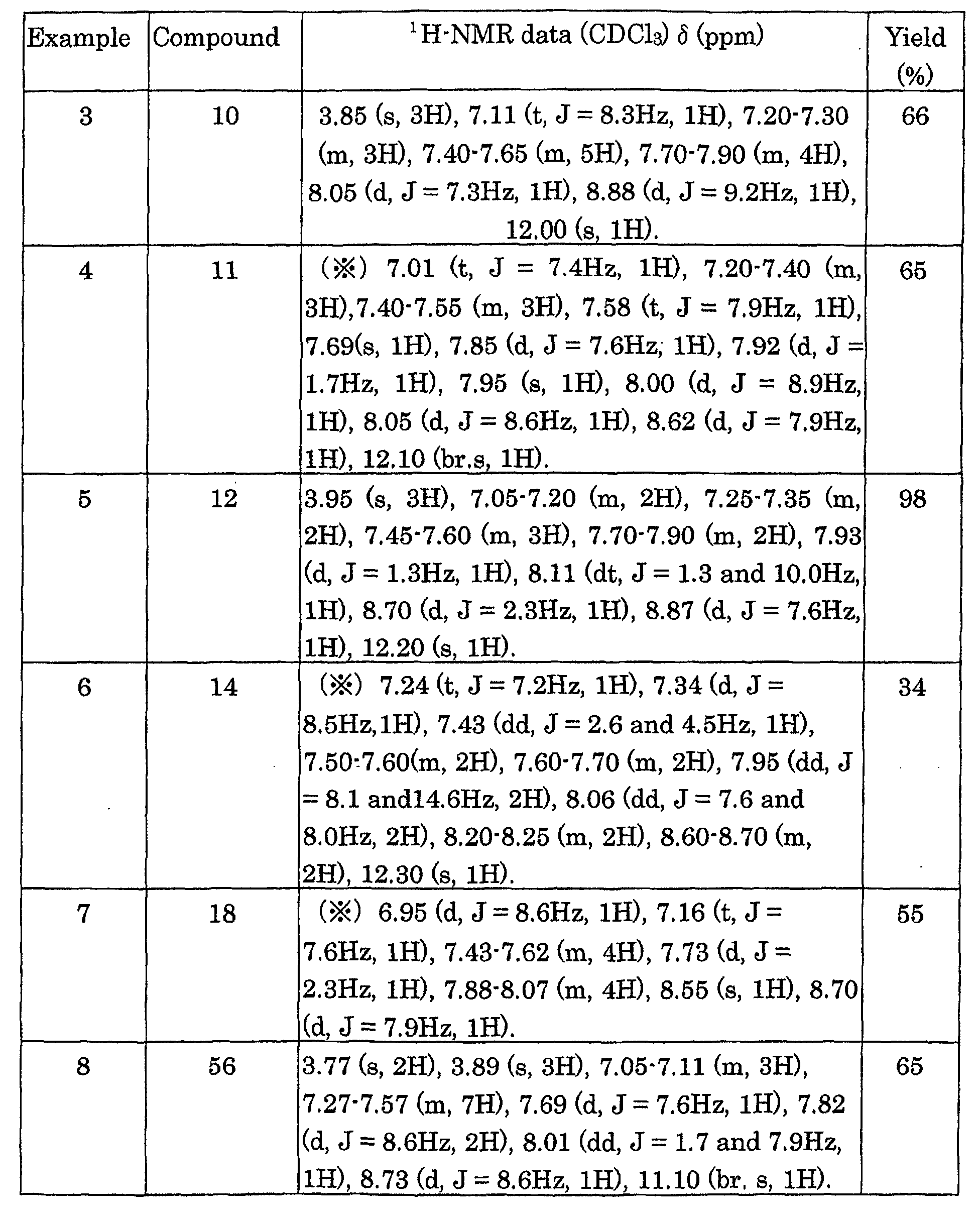
- the compounds used in the present invention were prepared according to the method in Example 1 or 2 using the respective corresponding starting materials.
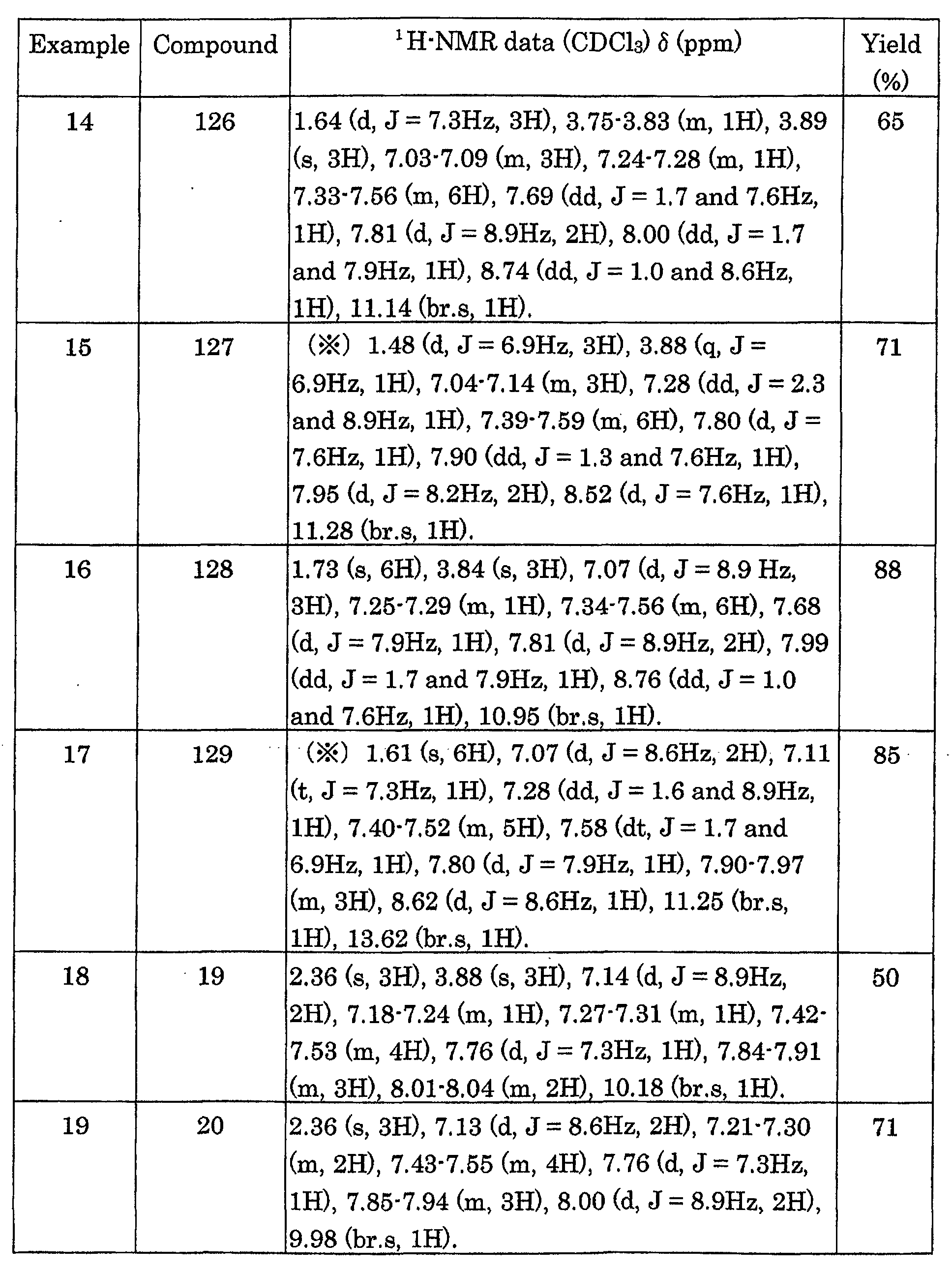
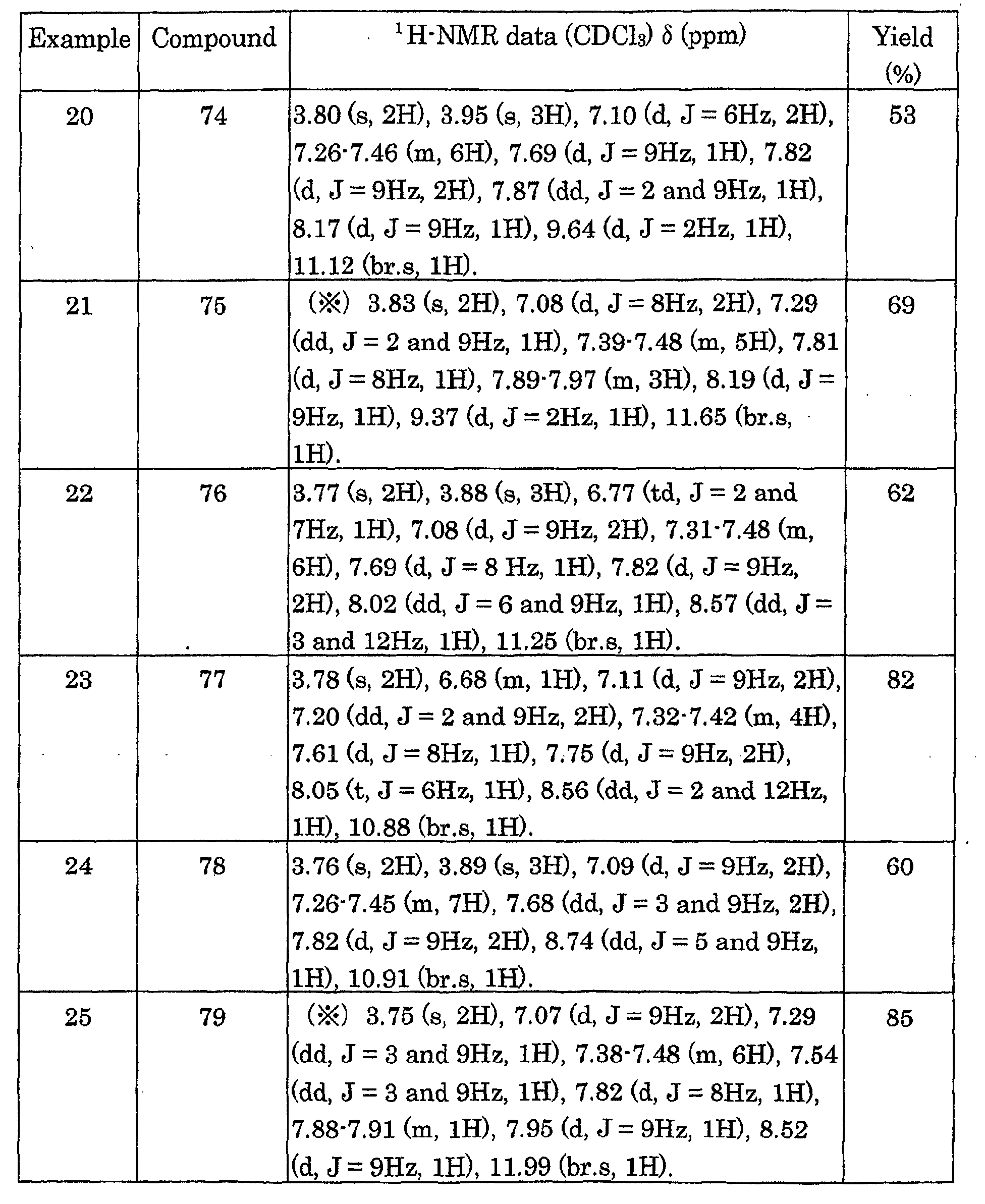
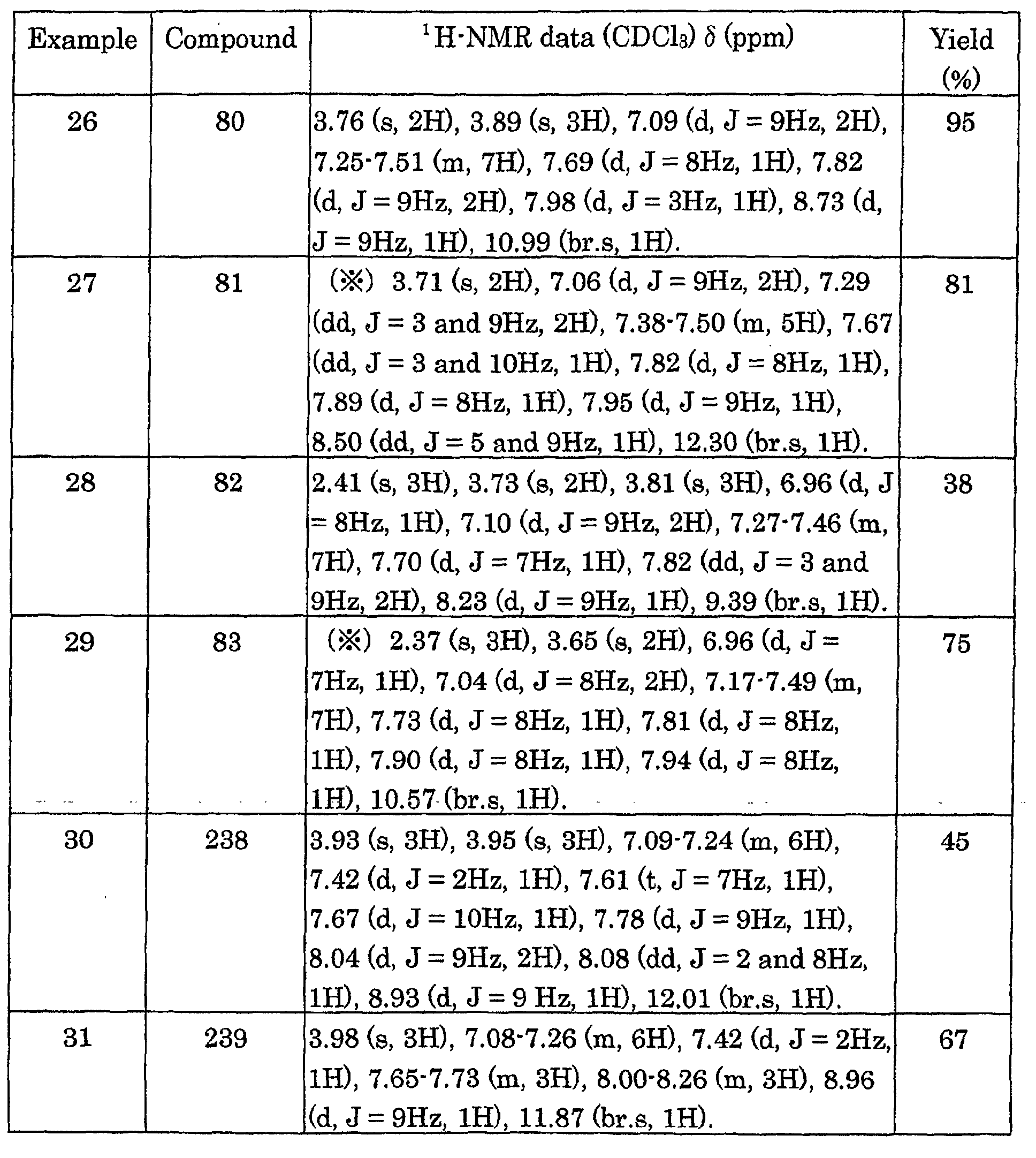
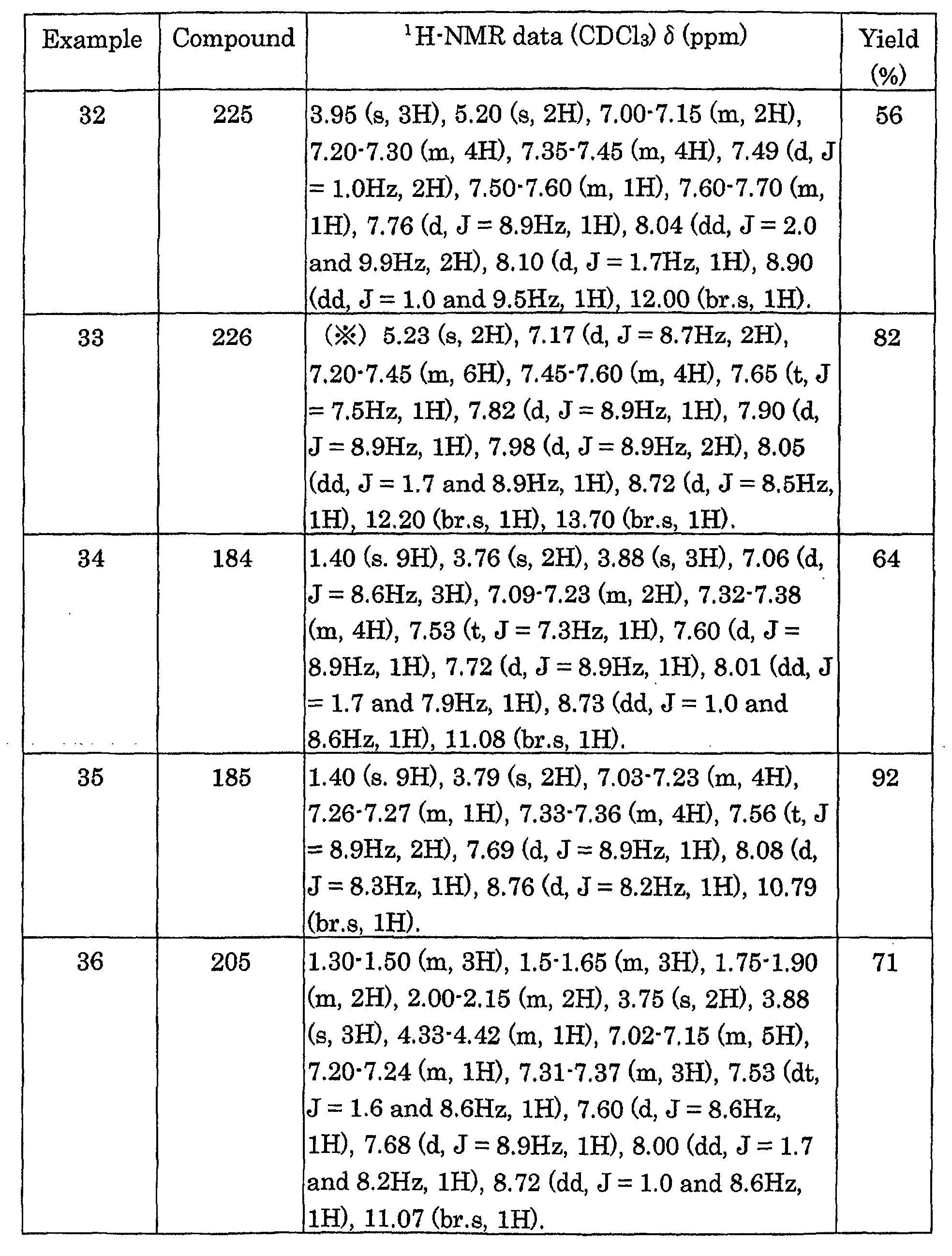
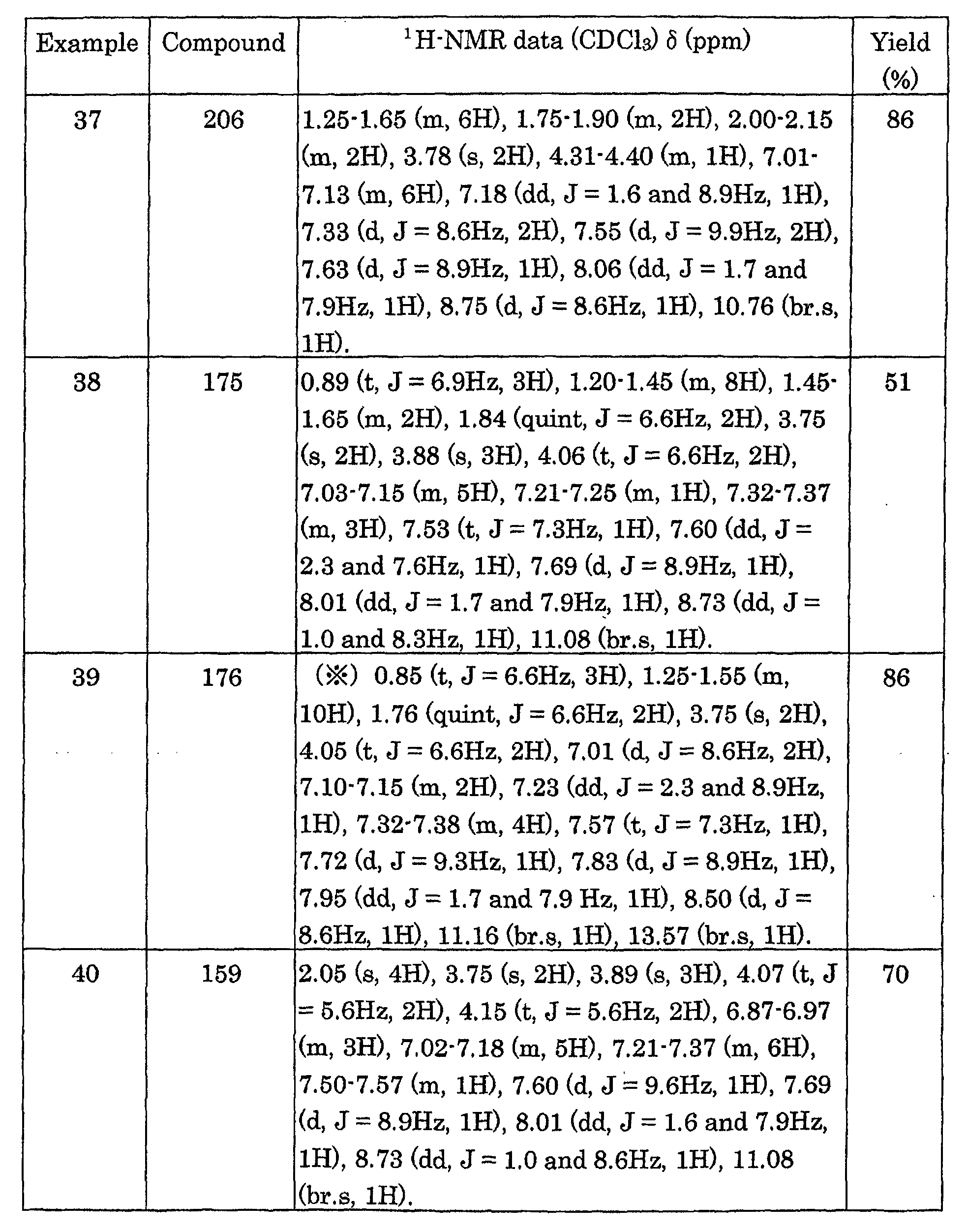
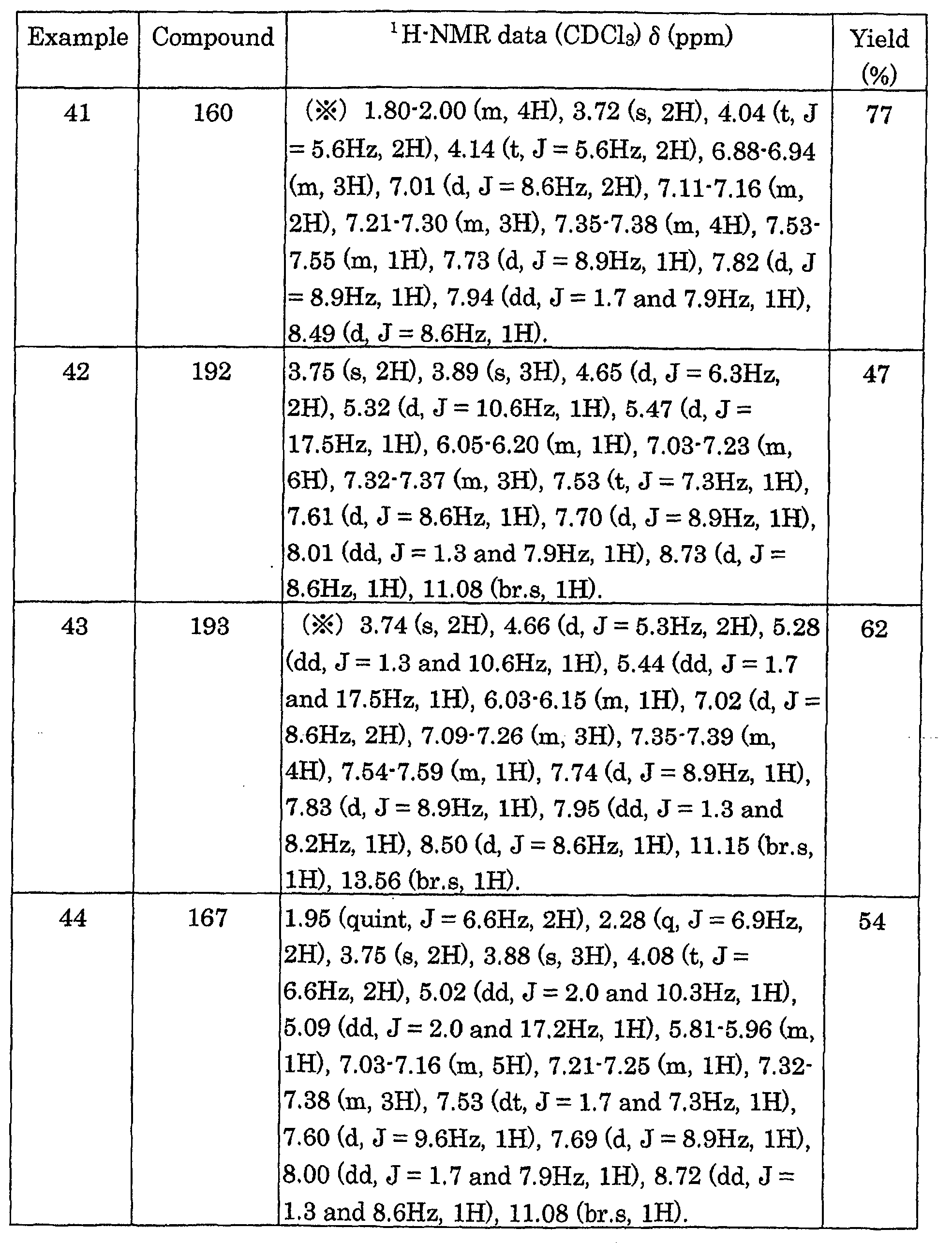
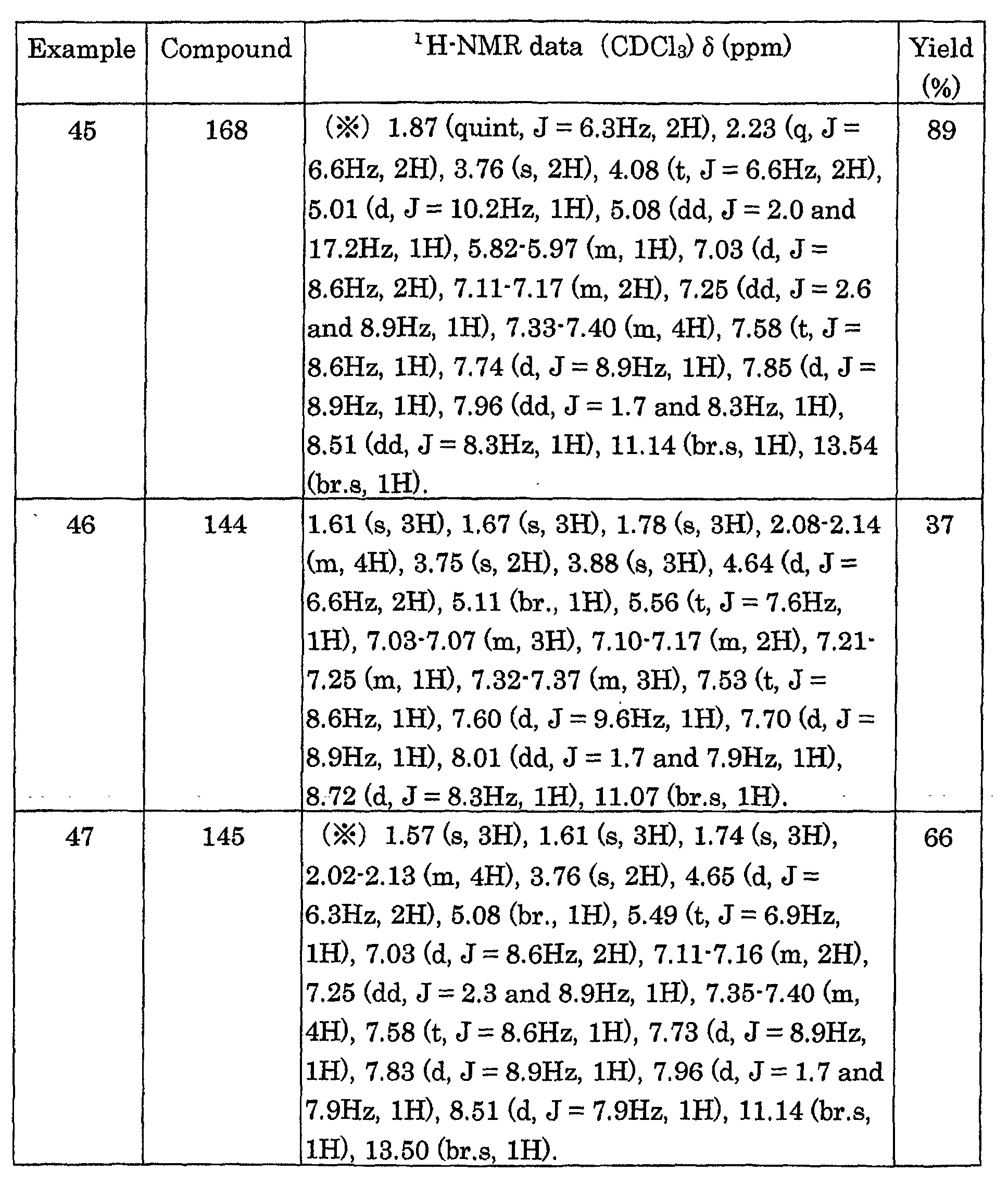
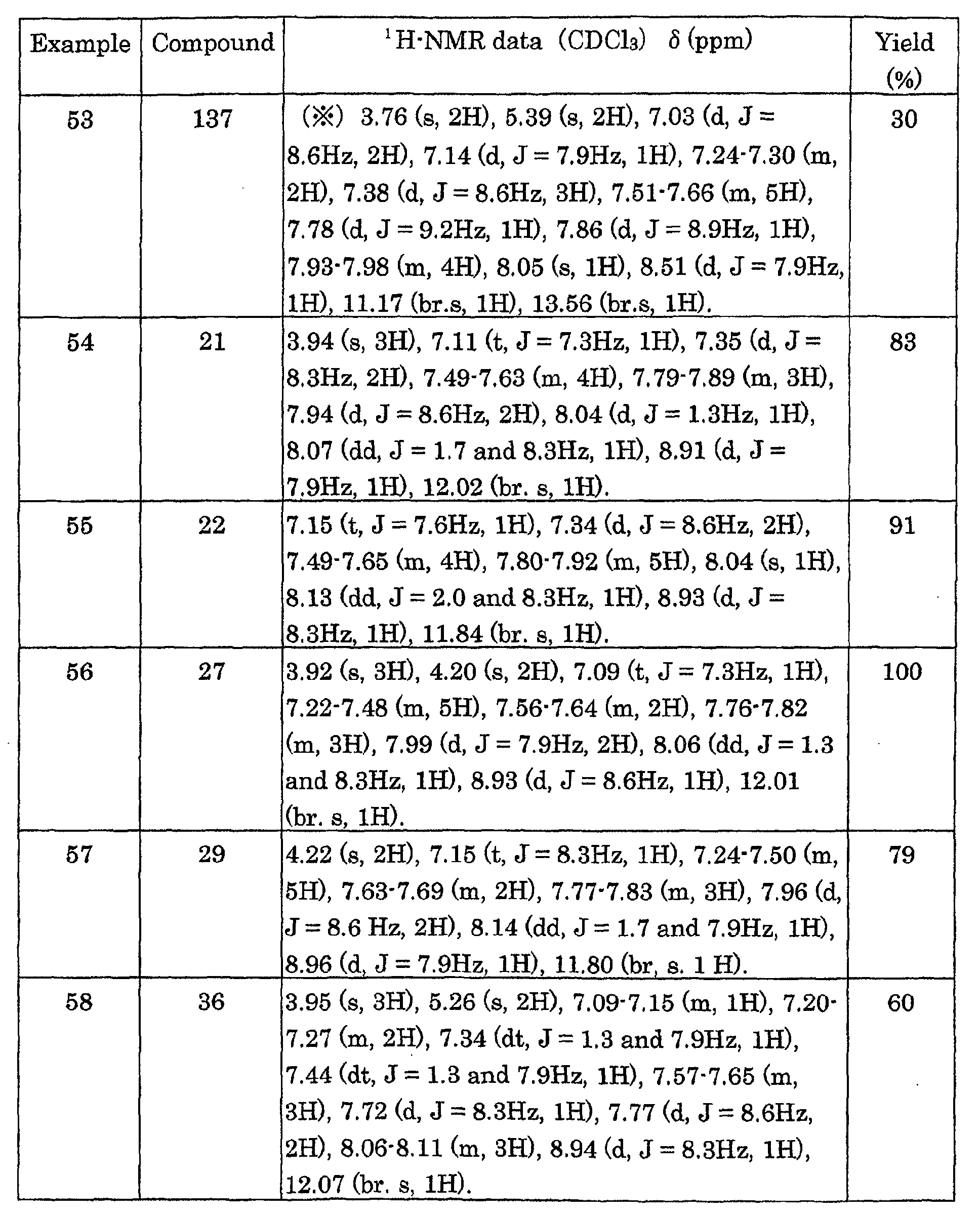
- the following tables show 1H-NMR spectral data and reaction yields of the prepared compounds.
- the compound No. in the tables corresponds to the compound No. listed in the tables mentioned above.
- the spectral data marked with " " are measured data in DMSO-d 6 . All the others are data measured in CDCl 3 .
- the obtained solution was dropped into a dry methylene chloride solution (6 mL) of 59 mg (0.54 mmol) of o-aminophenol and 3 mL of dry pyridine under cooling with ice under a nitrogen atmosphere. The resulting solution was stirred under cooling with ice for 1.5 hours and then at room temperature for 3 days. Water was added to the reaction liquid, and the resulting reaction liquid was extracted with methylene chloride twice. The organic layer was washed with a saturated brine and then dried over anhydrous sodium sulfate, and the solvent was distilled off.
- the resulting solution was dropped into a dry methylene chloride solution (4 mL) of 86 mg (0.5 mmol) of o-aminobenzenesulfonamide and 2 mL of dry pyridine under cooling with ice under a nitrogen atmosphere. The solution was stirred under cooling with ice for 4 hours and then at room temperature overnight. Water was added to the reaction liquid, and the resulting reaction liquid was extracted with methylene chloride twice. The organic layer was washed with a saturated brine and dried over anhydrous sodium sulfate, and the solvent was distilled off.
- Example 5 In 20 mL of ethyl acetate, was dissolved 350 mg (0.79 mmol) of the methyl 2-(4-(2-naphthyloxy)-3-nitrobenzamido)benzoate obtained in Example 5 (compound No. 12). To the resulting solution, was added 97 mg of a 10% Pd/C. The system was kept under a hydrogen atmosphere, and stirred at room temperature for 4 hours. The reaction liquid was filtered through Celite, and the resulting filtrate was concentrated.
- the obtained reaction mixture was neutralized with hydrochloric acid, and the resultant product was extracted with ethyl acetate. The extract was dried and concentrated. The resulting concentrate was purified by silica gel chromatography to afford 4.76 g (13.7 mmol) of methyl ester of the objective compound.
- the resulting mixture liquid was stirred at 50°C for 1 hour and further at room temperature overnight.
- the obtained reaction liquid was washed with water, and the reaction product was extracted with ethyl acetate.
- the extract was dried and concentrated.
- the obtained concentrate was purified by silica gel chromatography to afford 4.29 g (9.2 mmol) of the objective compound. Yield 75%.
- Example Compounds listed in the following table were synthesized according to the same method as in Example 88.
- the table shows yields and results of NMR measurement of the compounds.
- the cytotoxic activity against tumorous cells was measured according to a Neutral Red assay method [the method described in Journal of Tissue Culture Methodology, vol. 9, p. 7 (1984), Toxicology Letters, vol. 24, p. 119 (1985)]. Namely, 100 ⁇ L each of L929 cells (5 ⁇ 10 4 cells/mL, 10% FCS/RPM1) was added to a 96-well ELISA plate, and the cells were cultured overnight. The test compound at each measuring concentration was dissolved in a DMSO solution and added, and culturing was further continued for 3 days. To the cultured cells, was then added 2.0 ⁇ L of Neutral Red so as to provide the final concentration of 0.01%.
- Human cultured cancer cells (39 strains) were seeded in a 96-well plate, and a test substance solution (at concentrations of 5 grades diluted 10-fold ranging from 10 -4 M to 10 -8 M) was added on the next day to carry out culturing for two days.
- the number of grown cells in each plate was measured by colorimetric determination with Sulforhodamine B.
- TGI the concentration at which the growth is inhibited to the reference number of cells (no apparent increase or decrease in number of cells)
- LC 50 the concentration at which the number of cells is decreased to 50% of the reference number of cells (cellulicidal activity)
- the following table collectively shows the results of growth inhibition of the compound 206 of the test substance against representative 9 strains of cancer cells in 39 strains.
- the cancer remedy of the present invention has a cytotoxic activity on cell strains having a strong growth property, and further has a strong growth inhibitory activity or cytotoxic activity even against human cancer cells. Therefore, the remedy of the present invention can be used as a remedy for cancer.
Landscapes
- Health & Medical Sciences (AREA)
- Chemical & Material Sciences (AREA)
- Animal Behavior & Ethology (AREA)
- Veterinary Medicine (AREA)
- Medicinal Chemistry (AREA)
- Pharmacology & Pharmacy (AREA)
- Public Health (AREA)
- Life Sciences & Earth Sciences (AREA)
- General Health & Medical Sciences (AREA)
- Epidemiology (AREA)
- Organic Chemistry (AREA)
- Emergency Medicine (AREA)
- Pain & Pain Management (AREA)
- Chemical Kinetics & Catalysis (AREA)
- General Chemical & Material Sciences (AREA)
- Nuclear Medicine, Radiotherapy & Molecular Imaging (AREA)
- Organic Low-Molecular-Weight Compounds And Preparation Thereof (AREA)
- Acyclic And Carbocyclic Compounds In Medicinal Compositions (AREA)
- Indole Compounds (AREA)
Abstract
Description


A represents a bond; -O-, -S-, -S(=O)-, -S(=O)2-, -CH2-, -OCH2-, -SCH2-, -C(=O)- or -CH(OR6)-,
wherein, R6 represents a hydrogen atom or a C1-C4 alkyl group;
Y represents a hydrogen atom, a halogen atom, a nitro group, a nitrile group, an amino group, -COOR7, -NHCOR8 or -NHSO2R9,
wherein, R7 represents a hydrogen atom or a C1-C4 alkyl group; R8 and R9 represent each independently a C1-C4 alkyl group;
E represents a bond; -C(=O)-, -CR10R11C(=O)- (wherein, R10 and R11 represent each independently a hydrogen atom or a fluorine atom),
-CH2CH2C(=O)- or -CH=CHC(=O)-;
G represents a hydrogen atom, a hydroxy group, -SO2NH2, -COOR3, (wherein, R3 represents a hydrogen atom or a C1-C4 alkyl group), -CN or a tetrazol-5-yl group; and
Z represents a hydrogen atom, a halogen atom, a nitro group or a methyl group.
Examples of the C1-C4 alkyl group include methyl group, ethyl group, n-propyl group, tert-butyl group and the like. R6 is preferably a hydrogen atom or methyl group. More preferable bond is -O- or -S- as A.
-CH2CH2C(=O)- or -CH=CHC(=O)-. Among them, E represents preferably a bond; -C(=O)- or -CH2C(=O)-, more preferably a bond; -CH2C(=O)-.
-CN or a tetrazol-5-yl group. When G represents -COOR3, examples of the alkyl group represented by R3 include methyl group, ethyl group, (n- or iso)propyl group, (n-, iso- or tert-)butyl group and the like. The G is preferably -COOR3, wherein R3 represents a hydrogen atom or a C1-C4 alkyl group, or tetrazol-5-yl group; and R3 is especially preferably a hydrogen atom, methyl group or ethyl group. It is more preferable for G to be -COOH or tetrazol-5-yl group.
















1H-NMR(CDCl3) δ (ppm):
3.96 (S, 3H), 7.09-7.17 (m, 3H), 7.27-7.31 (m, 1H), 7.42-7.53 (m, 3H), 7.58-7.64 (m, 1H), 7.76 (d, J = 8.5Hz, 1H), 7.84-7.90 (m, 2H), 8.03-8.10 (m, 3H), 8.93 (d, J = 8.3Hz, 1H), 12.02 (br. s, 1H).

Colorless needlelike crystals.
1H-NMR(CDCl3) δ (ppm):
7.12-7.18 (m, 3H), 7.27-7.30 (m, 1H), 7.43-7.53 (m, 3H), 7.65 (dt, J = 1.7 and 8.6Hz, 1H), 7.76 (d, J = 7.6Hz, 1H), 7.85-7.91 (m, 2H), 8.03 (dd, J = 2.0 and 6.9Hz, 2H), 8.14 (dd, J = 1.7 and 7.9Hz, 1H), 8.96 (d, J = 7.6Hz, 1H), 11.84 (br. s, 1H).






1H-NMR(CDCl3) δ (ppm):
7.10-7.18 (m, 3H), 7.24-7.29 (m, 2H), 7.34-7.53 (m, 4H), 7.62-7.65 (m, 2H), 7.74-7.77 (m, 2H), 7.86-7.90 (m, 3H).

1H-NMR(CDCl3) δ (ppm):
6.89-6.96 (m, 1H), 7.03-7.23 (m, 5H), 7.28-7.29 (m, 1H), 7.44-7.76 (m, 3H), 7.78-7.79 (d, J = 1.7Hz, 1H), 7.85-7.94 (m, 4H), 8.67 (s, 1H).

1H-NMR(DMSO-d6) δ (ppm):
7.23 (d, J = 8.9Hz, 2H), 7.26-7.38 (m, 2H), 7.46-7.68 (m, 4H), 7.90 (d, J = 7.9Hz, 2H), 7.97 (d, J = 8.6Hz, 3H), 8.04 (d, J = 9.2Hz, 1H), 8.46 (dd, J = 1.0 and 8.6Hz, 1H).

1H-NMR(CDCl3) δ (ppm):
7.15 (d, J = 8.9Hz, 2H), 7.18-7.30 (m, 2H), 7.46-7.54 (m, 3H), 7.61-7.69 (m, 2H), 7.76-7.79 (m, 1H), 7.85-7.96 (m, 4H), 8.34 (br.s, 1H), 8.61 (d, J = 8.6Hz, 1H).

1H-NMR(CDCl3) δ (ppm):
7.21 (t, J = 8.6Hz, 1H), 7.33 (d, J = 8.6Hz, 2H), 7.49-7.68 (m, 4H), 7.78-7.89 (m, 4H), 8.06 (d, J = 1.3Hz, 1H), 8.31 (br.s, 1H), 8.59 (d, J = 8.6Hz, 1H).

1H-NMR(CD3OD) δ (ppm):
7.15-7.21 (m, 2H), 7.27-7.35 (m, 2H), 7.43-7.53 (m, 3H), 7.57-7.63 (m, 1H), 7.78-8.01 (m, 4H), 8.14-8.19 (m, 2H), 8.76-8.81 (m, 1H).

1H-NMR(DMSO-d6) δ (ppm):
7.42 (t, J = 8.6Hz, 1H), 7.48 (d, J = 8.3Hz, 2H), 7.67-7.70 (m, 4H), 8.00-8.09 (m, 6H), 8.24 (d, J = 1.7Hz, 1H), 8.57 (d, J = 7.6Hz, 1H), 11.56 (br.s, 1H).

1H-NMR(CDCl3) δ (ppm):
3.95 (s, 3H), 6.95 (d , J = 8.5Hz, 1H), 7.11 (t, J = 7.0Hz, 1H), 7.30 (dd, J = 2.3 and 8.9Hz, 2H), 7.36 (dd, J = 2.3 and 8.2Hz, 2H), 7.40-7.50 (m, 3H), 7.57 (d, J = 2.0Hz, 1H), 7.61 (dd, J = 1.4 and 8.6Hz, 1H), 7.71 (d, J = 7.9Hz, 1H), 7.84 (t, J = 8.0Hz, 2H), 8.07 (dd, J = 1.5 and 8.7Hz, 1H), 8.92 (d, J = 1.3 and 8.3Hz, 1H), 11.90 (s, 1H).

1H-NMR(DMSO-d6) δ (ppm):
5.40 (br.s, 2H), 6.96 (d, J = 7.8Hz, 1H), 7.10-7.30 (m, 2H), 7.30-7.35 (m, 2H), 7.40-7.50 (m, 3H), 7.63 (dt, J = 1.5 and 7.6Hz, 1H), 7.82 (d, J = 7.8Hz, 1H), 7.90 (d, J = 7.8Hz, 1H), 7.96 (d, J = 9.8Hz, 1H), 8.05 (dd, J = 1.5 and 7.8Hz, 1H), 8.73 (d, J = 7.8Hz, 1H), 12.20 (s, 1H).

1H-NMR(DMSO-d6) δ (ppm):
1.07 (t, J = 6.9Hz, 3H), 3.44-3.47 (m, 2H), 4.30-4.32 (m, 1H), 6.97 (t, J = 7.5Hz, 1H), 7.17 (d, J = 7.5Hz, 2H), 7.30 (t, J = 6.9Hz, 1H), 7.35 (d, J = 8.5Hz, 1H), 7.47-7.55 (m, 3H), 7.87 (d, J = 8.0Hz, 1H), 7.94 (d, J = 8.0Hz, 1H), 8.02 (t, J = 8.0Hz, 2H), 8.09 (d, J = 8.5Hz, 2H), 8.69 (d, J = 8.0Hz, 1H), 15.66 (br.s, 1H).

1H-NMR(CDCl3-CD3OD) δ (ppm):
1.40-1.58 (m, 2H), 1.58-1.73 (m, 2H), 1.78-1.90 (m, 2H), 2.86-2.97 (m, 2H), 3.50-3.60 (m, 1H), 7.03-7.19 (m, 3H), 7.23-7.32 (m, 1H), 7.39-7.53 (m, 4H), 7.75-7,83 (m, 1H), 7.83-7.98 (m, 2H), 8.05-8.17 (m, 3H), 8.65-8.73 (m, 1H).
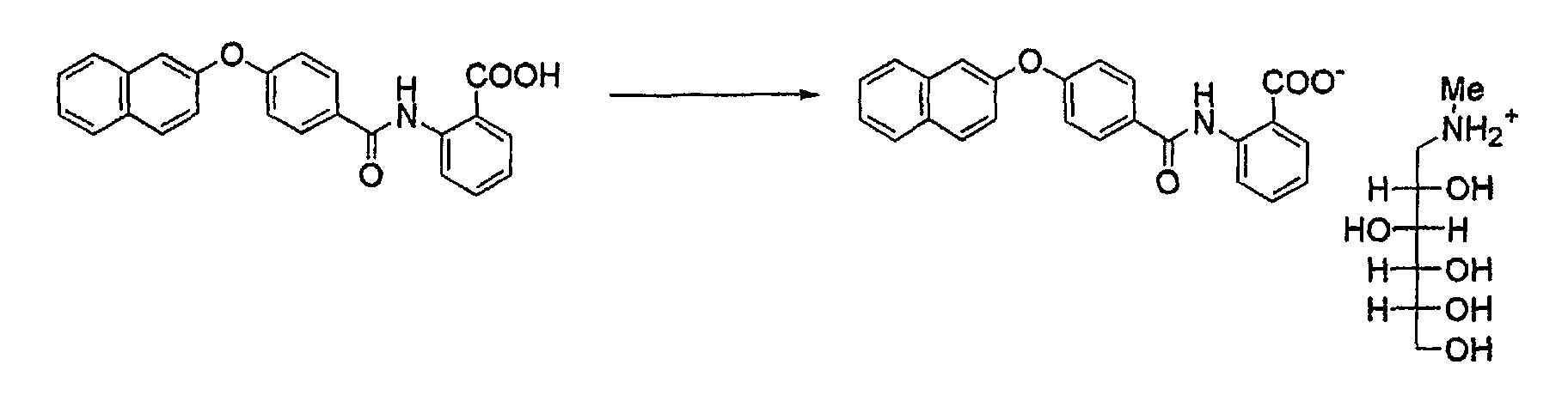
1H-NMR(DMSO-d6) δ (ppm):
2.49-2.51 (m, 5H), 2.89-3.07 (m, 2H), 3.38-3.47 (m, 3H), 3.57-3.61 (m, 1H), 3.66-3.67 (m, 1H), 3.86 (br.s, 1H), 4.40-4.44 (br.s, 1H), 4.58 (br.s, 1H), 5.43 (br.s, 1H), 6.98 (t, J = 8.6Hz, 1H), 7.20 (d, J = 8.9Hz, 2H), 7.22-7.39 (m, 2H), 7.45-7.57 (m, 3H), 7.87-8.09 (m, 6H), 8.64 (d, J = 8.3Hz, 1H).
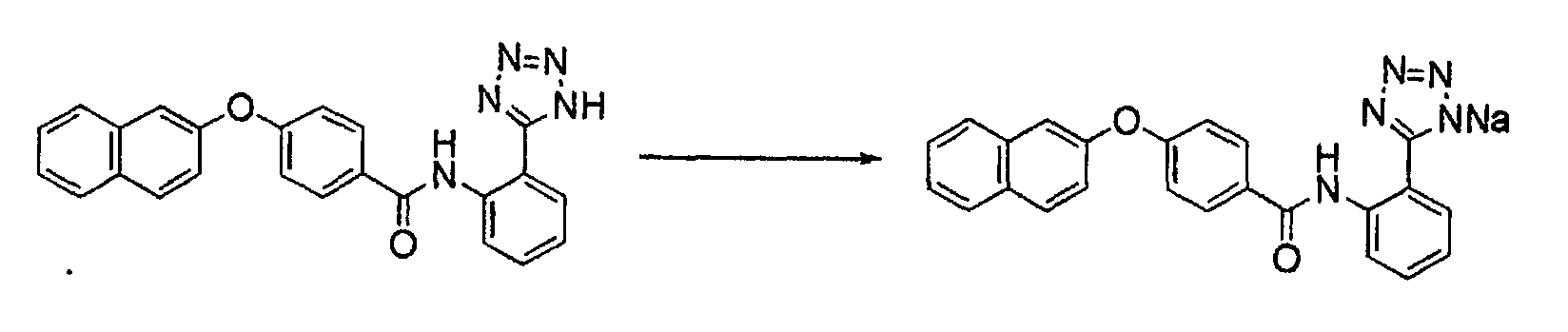
1H-NMR(DMSO-d6) δ (ppm):
7.15 (td, J = 1.5 and 7.8Hz, 1H), 7.25 (dt, J = 2.9 and 8.8Hz, 2H), 7.31 (td, J = 1.5 and 8.8Hz, 1H), 7.39 (dd, J = 2.5 and 8.8Hz, 1H), 7.47-7.54 (m, 2H), 7.60 (d, J = 2.4Hz, 1H), 7.90 (d, J = 7.8Hz, 1H), 7.90 (d, J = 7.8Hz, 1H), 7.96 (d, J = 7.8Hz, 1H), 8.03 (d, J = 9.3Hz, 1H), 8.25-8.30 (m, 3H), 8.79 (dd, J = 1.0 and 8.3Hz, 1H), 13.39 (br.s, 1H).

1H-NMR(DMSO-d6) δ (ppm):
3.65 (s, 2H), 6.95 (t, J = 8.2Hz, 1H), 7.10 (d, J = 8.6Hz, 2H), 7.25 (t, J = 7.3Hz, 1H), 7.33-7.36 (m, 1H), 7.37-7.53 (m, 5H), 7.93 (t, J = 7.3Hz, 2H), 7.99 (d, J = 8.9Hz, 2H), 8.46 (d, J = 8.3Hz, 1H), 14.80-14.91 (m, 1H).

1H-NMR(CDCl3) δ (ppm):
3.88 (s, 3H), 5.26 (br.s, 1H), 6.90-7.20 (m, 6H), 7.35 (br.s, 1H), 7.50-7.70 (m, 3H), 7.90-8.05 (m, 3H), 8.84 (d, J = 7.6Hz, 1H), 11.95 (br.s, 1H).

1H-NMR(DMSO-d6) δ (ppm):
7.05-7.20 (m, 6H), 7.24 (s, 1H), 7.60 (dt, J = 2.0 and 9.0Hz, 1H), 7.74 (dd, J = 9.0 and 13.0Hz, 2H), 7.95 (d, J = 8.9Hz, 2H), 8.03 (dd, J = 1.7 and 8.0Hz, 1H), 8.28 (d, J = 9.0Hz, 1H), 9.70 (s, 1H), 12.20 (br.s, 1H), 13.70 (br.s, 1H).

1H-NMR(CDCl3) δ (ppm):
3.76 (s, 2H), 3.89 (s, 3H), 5.26 (br.s, 1H), 7.02-7.15 (m, 5H), 7.22 (dd, J = 2.3 and 8.9Hz, 1H), 7.31-7.37 (m, 3H), 7.53 (dt, J = 1.7 and 8.9Hz, 1H), 7.60 (d, J = 9.2Hz, 1H), 7.64 (d, J = 8.9Hz, 1H), 8.01 (dd, J = 1.7 and 8.3Hz, 1H), 8.72 (d, J = 8.3Hz, 1H), 11.10 (br.s, 1H).

1H-NMR (DMSO-d6) δ (ppm):
3.83 (s, 2H), 7.07-7.28 (m, 6H), 7.41-7.46 (m, 3H), 7.65 (d, J = 7.6Hz, 1H), 7.75 (d, J = 8.9Hz, 1H), 7.81 (d, J = 8.9Hz, 1H), 8.04 (dd, J = 1.3 and 7.9Hz, 1H), 8.59 (d, J = 8.3Hz, 1H), 9.72 (s, 1H), 11.24 (br.s, 1H), 13.65 (br.s, 1H).


1H-NMR(CDCl3) δ (ppm):
3.72(s, 2H), 3.87(s, 3H), 5.04(s, 2H), 6.91-7.02(m, 6H), 7.06(td, J = 8.6Hz, 1.6Hz, 1H), 7.24-7.46(m, 7H), 7.52(td, J = 8.0Hz, 1.6Hz, 1H), 7.99(dd, J = 8.2Hz, 1.6Hz, 1H), 8.71(dd, J = 8.6Hz, 1.3Hz, 1H), 11.03(brs, 1H)
| Example | Compound | 1H-NMR data (CDCl3) δ (ppm) | Yield (%) |
| 89 | 313 | 3.74 (2H, s), 3.85 (3H,s), 4.03 (2H, s), 6.91 (2H, d, J = 8.57Hz),7.00 (2H, d, J = 8.58Hz), 7.06 (1H, ddd, J = 0.99, 7.25, 7.92Hz), 7.19-7.26 (7H, m), 7.34 (2H, d, J=8.25Hz), 7.52 (1H, ddd, J = 1.32, 7.26, 8.57Hz), 7.99 (1H, dd, J = 1.32, 7.91Hz), 8.72 (1H, d, J = 8.58Hz), 11.05 (1H, br). | 63 |
| 90 | 317 | 3.74 (2H, s), 3.84 (3H, s), 5.02 (2H, s), 6.62-6.74 (3H, m), 7.03 (2H, d, J = 8.6Hz), 7.21 (1H, t, J = 8.2Hz), 7.32 (2H, d, J = 8.6Hz), 7.37-7.40 (5H, m), 7.47 (1H, dd, J = 8.9 and 2.6Hz), 7.95 (1H, d, J = 2.6Hz), 8.72 (1H, d, J = 8.9Hz), 10.95 (1H, sbr). | 46 |
| 91 | 319 | 3.75 (2H, s), 3.84 (3H, s), 5.02 (2H, s), 6.61-6.78 (4H, m), 7.03 (2H, d, J = 8.6Hz), 7.20 (1H, t, J = 8.2Hz), 7.33 (2H, d, J = 8.3Hz), 7.33-7.38 (5H, m), 7.97-8.03 (1H, m), 8.56 (1H, dd, J = 11.9 and 2.6Hz). | 55 |
| 92 | 321 | 2.31 (3H, s), 3.73 (2H, s), 3.83 (3H, s), 5.01 (2H, s), 6.61-6.73 (3H, m), 7.02 (2H, d, J = 8.6Hz), 7.20 (1H, t, J = 8.2Hz), 7.31-7.41 (8H, m), 7.78 (1H, d, J = 2.0Hz), 8.60 (1H, d, J = 8.6Hz), 10.93 (1H, sbr). | 47 |
| 93 | 324 | 3.72 (2H, s), 3.81 (3H, s), 5.07 (2H, s), 6.88-7.10 (7H, m), 7.14-7.28 (5H, m), 7.31 (2H, d, J = 8.25Hz), 7.50 (1H, ddd, J = 1.65, 7.26, 8.58Hz), 7.97 (1H, dd, J = 1.65, 7.92Hz), 8.72 (1H, d, J = 8.25Hz), 11.04 (1H, s). | 89 |

1H-NMR(CDCl3) δ (ppm):
3.74 (2H, s), 5.00 (2H, s), 6.87-6.99 (6H, m), 7.08 (1H, t, J = 7.5H z), 7.24-7.43 (7H, m), 7.57 (1H, t, J = 7.5Hz), 8.07 (1H, d, J = 8.0 Hz), 8.75 (1H, d, J = 8.0Hz), 10.77 (1H, brs).

1H-NMR(DMSO-d6) δ (ppm):
3.70 (2H, s), 3.78 (3H, s), 6.76 (2H, d, J = 8.9Hz), 6.88 (4H, d-like, J = 8.6Hz), 7.18 (1H, t, J = 7.5Hz), 7.30 (2H, d, J = 8.6Hz), 7.59 (1H, J = 7. 8Hz), 7.89 (1H, dd, J = 7.9Hz, 1.7Hz), 8.29 (1H, d, J = 7.6Hz), 9.31 (1H, s), 10.61 (1H, brs).
1H-NMR(CDCl3) δ (ppm):
3.98 (s, 3H), 6.92 (d, 2H, J = 8.91Hz), 7.01-7.15 (m, 4H), 7.32 (t,1 H, J = 8.24Hz), 7.76 (t, 1H, J = 8.56Hz), 8.02 (d, 2H, J = 8.59Hz), 8.10 (dd, 1H, J = 1.32, 7.91Hz), 8.65 (d, 1H, J = 8.26Hz), 9.57 (s, 1H), 11.63 (s, 1H).

1H-NMR(CDCl3) δ (ppm):
1.10-1.60 (6H, m), 1.79-1.84 (2H, brm), 1.96-2.04 (2H, brm), 3.72 (2 H, s), 3.87 (3H, s), 4.10-4.19 (1H, m), 6.86 (2H, d, J = 9.2Hz), 6.96 (4H, d, J = 8.3Hz), 7.06 (1H, t, J = 8.3Hz), 7.30 (2H, d, J = 8.6H z), 7.52 (1H, td, J = 8.6Hz, 1.7Hz), 7.99 (1H, dd, J = 8.3Hz, 1.7H z), 8.71 (1H, dd, J = 8.6Hz, 1.0Hz), 11.03 (1H, brs).

1H-NMR(DMSO-d6) δ (ppm):
1.24-1.55 (6H, m), 1.65-1.75(2H, brm), 1.85-1.95 (2H, brm), 3.72 (2H, s), 4.20-4.28 (1H, m), 6.89-6.96 (6H, m), 7.13 (1H, t, J = 8.5Hz), 7.32 (2H, d, J = 8.6Hz), 7.56 (1H, t, J = 8.0Hz), 7.95 (1H, dd, J = 7.9Hz,1.7Hz), 8.61 (1H, d, J = 8.3Hz), 11.16 (1H, brs).
| Example | Compound | 1H-NMR(CDCl3) δ (ppm) | Yield (%) |
| 99 | 291 | 1.56-1.68(m, 2H), 1.76-1.88 (m,6H), 3.72 (s, 2H), 3.87 (s, 3H), 4.70 (brm, 1H), 6.83 (d, 2H, J = 8.9Hz), 6.96 (d, 2H, J = 8.6Hz), 6.97 (d, 2H, J = 8.9Hz), 7.05 (ddd, 1H, J = 7.9Hz, 6.9Hz, 1.0Hz), 7.30 (d, 2H, J = 8.6Hz), 7.51 (ddd, 1H , J = 8.6Hz, 6.9Hz, 1.3Hz), 7.98 (dd, 1H, J = 7.9Hz, 1.3Hz), 8.72 (dd, 1H, J = 8.6Hz, 1.0Hz), 11.03 (brs, 1H). | 94 |
| 100 | 285 | 1.28-1.48 (m, 16H), 1.58-1.81 (m, 4H), 2.02-2.14 (m, 2H), 3.72 (s,2H), 3.86 (s, 3H), 4.34 (m, 1H), 6.84 (d, 2H, J = 9.2Hz), 6.96 (d, 2H, J = 9.2Hz), 6.97 (d, 2H, J = 8.6Hz), 7.05 (ddd, 1H, J = 7.9Hz, 6.9Hz, 1.0Hz), 7.30 (d, 2H, J = 8.6Hz), 7.51 (ddd, 1H, J = 8.6Hz, 6.9Hz, 1.7Hz), 7.98 (dd, 1H, J = 7.9Hz, 1.7Hz), 8.72(d, 1H, J=8.6Hz), 11.03(s, 1H). | 47 |
| 101 | 272 | 1.32 (d, 6H, J = 6.3Hz), 3.72 (s, 2H), 3.87 (s, 3H), 4.47 (sep, 1H, J = 6.3Hz), 6.84 (d, 2H, J = 8.9Hz), 6.96 (d, 2H, J = 8.6Hz), 6.97 (d, 2H, J = 8.9Hz), 7.06 (ddd, 1H, J = 8.2Hz, 6.9Hz, 1.0Hz), 7.30 (d, 2H, J = 8.6Hz), 7.51 (ddd, 1H, J = 8.6Hz, 6.9Hz, 1.7Hz), 7.98 (dd, 1H, J = 8.2Hz, 1.7Hz), 8.72 (dd, 1H, J = 8.6Hz, 1.0Hz), 11.03 (s, 1H). | 72 |
| 102 | 265 | 0.96 (t, 6H, J = 7.6Hz), 1.67 (dq, 4H, J = 7.6Hz, 5.9Hz), 3.72 (s,2H), 3.86 (s, 3H), 4.03 (quint, 1H, J = 5.9Hz), 6.85 (d, 2H, J = 9.2Hz), 6.94-6.99 (m, 4H), 7.05 (ddd, 1H, J = 7.9Hz, 6.9Hz, 1.0Hz), 7.30 (d, 2H, J = 8.6Hz), 7.51 (ddd, 1H, J = 8.6Hz, 6.9Hz, 1.7Hz), 7.98 (dd, 1H, J = 7.9Hz, 1.7Hz), 8.72 (dd, 1H, J = 8.6Hz, 1.0Hz), 11.03 (s, 1H). | 50 |
| 103 | 274 | 1.5-1.7 (8H, m), 1.77-1.95 (6H, brm), 3.95 (3H, s), 4.38 (1H, m), 6.88 (2H, d, J = 8.9Hz), 6.98-7.04 (4H, m), 7.11 (1H, t, J= 7.7Hz), 7.60 (1H, td, J = 7.6Hz, 1.6Hz), 8.00 (2H, d, J = 8.9Hz), 8.07 (1H, dd, J = 7.9Hz, 1.7Hz), 8.92 (1H, dd, J = 8.6Hz, 0.7Hz), 11.98 (1H, br). | 82 |
| 104 | 276 | 1.51-1.74 (8H, brm), 1.76-2.00 (6H, brm), 3.96 (3H, s), 4.40 (1H, quint, J = 4.0Hz), 6.91 (2H, d, J = 8.9Hz), 7.00-7.06 (3H, m), 7.15 (1H, td, J = 7.6 and 1.3Hz), 7.62 (1H, td, J = 7.6 and 1.3Hz), 8.07-8.12 (2H, m), 8.63 (1H, d, J = 2.3Hz), 8.86 (1H, d, J = 8.0Hz), 12.15 (1H, brs). | 85 |
| 105 | 281 | 1.40-1.60 (8H, m), 1.72-1.95 (6H, m), 2.31 (3H, s), 3.71 (2H, s), 3.86 (3H, s), 4.34 (1H, quint, J = 4.0Hz), 6.81 (2H, d, J = 8.9Hz), 6.94-6.98 (4H, m), 7.30 (2H, d, J = 8.9Hz), 7.34 (1H, m), 7.79 (1H, d, J = 1.7Hz), 8.59 (1H, d, J = 8.6Hz), 10.90 (1H, brs). | 44 |
| 106 | 259 | 1.02 (6H, d, J = 6.6Hz), 2.07 (1H, quint, J = 6.6Hz), 3.69 (2H, d, J = 6.6Hz), 3.72 (2H, s), 3.88 (3H, s), 6.86 (2H, d, J = 9.2Hz), 6.95 (2H, d, J = 7.9Hz), 6.98 (2H,d, J = 8.9Hz), 7.06 (1H, td, J = 7.7 and 1.0Hz), 7.29 (2H, t, J = 8.0Hz), 7.52 (1H, td, J = 7.9 and 1.6Hz), 7.99 (1H, dd, J = 7.9 and 1.6Hz), 8.71 (1H, d, J = 7.9Hz). | 46 |
| 107 | 284 | 1.23-1.92 (14H, m), 3.71 (2H, s), 3.87 (3H, s), 4.35 (1H, tt, J = 3.96, 7.92Hz), 6.86-6.97 (4H, m),7.02-7.11 (3H, m), 7.28 (2H, m), 7.51 (1H. ddd, J = 1.65, 7.26, 8.57Hz), 7.98 (1H, dd, J = 1.65, 7.91Hz), 8.70 (1H, dd, J = 0.99, 8.58Hz), 11.30 (1H, s). | 69 |
| 108 | 257 | 3.72 (2H, s), 3.87 (3H, s), 4.31 (4H, s), 6.90-7.02 (10H, m), 7.06 (1H, ddd, J = 8.2Hz, 7.3Hz, and 1.0Hz), 7.25-7.33 (4H, m), 7.52 (1H, ddd, J = 8.6Hz, 7.3Hz and 1.7Hz), 7.99 (1H, dd, J = 8.2Hz and 1.7Hz), 8.71 (1H, dd, J = 8.6Hz and 1.0Hz), 11.04 (1H, brs). | 68 |
| 109 | 261 | 2.52(1H, ddd, J = 6.9Hz, 6.6Hz, and 1.3Hz), 2.55 (1H, ddd, J = 6.9Hz, 6.9Hz, and 1.3Hz), 3.72(2H, s), 3.87 (3H, s), 3.99 (2H, t, J = 6.9Hz), 5.11 (1H, dd, J= 10.2Hz, and 1.7Hz), 5.17 (1H, dd, J = 17.1Hz, and 1.7Hz), 5.90 (1H, dddd, J = 17.1Hz, 10.2Hz, 6.9Hz, and 6.6Hz), 6.86 (2H, d, J = 8.9Hz), 6.95 (2H, d, J = 8.6Hz), 6.98 (2H, d, J = 8.9Hz), 7.06 (1H, ddd, J = 8.2Hz, 7.3Hz, and 1.0Hz), 7.30 (2H, d, J = 8.6Hz), 7.51 (1H, ddd, J = 8.6Hz, 7.3Hz, and 1.3Hz), 7.98 (1H, dd, J= 8.2Hz, and 1.3Hz), 8.71 (1H, dd, J = 8.6Hz, and 1.0Hz), 11.04 (1H, brs). | 52 |
| 110 | 255 | 0.93 (6H, t, J = 7.3Hz), 1.34-1.55 (4H, m), 1.62-1.71 (1H, m), 3.72 (2H, s), 3.82 (2H, d, J = 5.6Hz), 3.87 (3H, s), 6.86 (2H, d, J = 8.9Hz), 6.95 (2H, d, J = 8.6Hz), 6.98 (2H, d, J = 8.9Hz), 7.06 (1H, ddd, J = 8.2Hz, 6.9Hz, and 1.0Hz), 7.30 (2H, d, J = 8.6Hz), 7.52 (1H, ddd, J = 8.6Hz, 6.9Hz, and 1.3Hz), 7.99 (1H, dd, J = 8.2Hz, and 1.3Hz), 8.71 (1H, dd, J = 8.6Hz, and 1.0Hz), 11.03(1H, brs). | 41 |
| 111 | 269 | 0.98 (3H, t, J = 7.3Hz), 1.45-1.64 (2H, m), 1.71-1.82 (2H, m), 3.72 (2H, s), 3.87 (3H, s), 3.93 (2H,t, J = 6.6Hz), 6.85 (2H, d, J = 8.9Hz), 6.96 (2H, d, J = 8.6Hz), 6.98 (2H, d, J = 8.9Hz), 7.06 (1H,ddd, J = 8.2Hz, 6.9Hz, and 1.0Hz), 7.30 (2H, d, J = 8.6Hz), 7.52 (1H, ddd, J = 8.6Hz, 6.9Hz, and 1.7Hz), 7.99 (1H, dd, J= 8.2Hz, and 1.3Hz), 8.71 (1H, dd, J = 8.6Hz, and 1.0Hz), 11.03 (1H, brs). | 95 |
| Example | Compound | 1H-NMR (DMSO-d6) δ (ppm): | Yield (%) |
| 112 | 314 | 3.74 (2H, s), 4.16 (2H, s), 6.93 (2H, d, J = 8.91Hz), 6.97 (2H, d, J = 8.58Hz), 7.12 (1H, ddd, J = 1.32, 7.26, 7.92Hz), 7.19-7.38 (9H, m), 7.56 (1H, ddd, J = 1.65, 7.26, 8.58Hz), 7.94 (1H, dd, J = 1.65, 7.92Hz), 8.50 (1H, dd, J = 0.66, 8.25Hz), 11.14 (1H, s), 13.55 (1H, br). | 78 |
| 113 | 292 | 1.53-1.85 (m, 6H), 1,86-1.92 (m,2H), 3.72 (s, 2H), 4.76 (br, 1H), 6.88-6.98 (m, 6H), 7.13 (dd, 1H, J = 7.9Hz, 7.6Hz), 7.32 (d, 2H, J = 8.6Hz), 7.57 (ddd, 1H, J = 8.9Hz, 7.6Hz, 1.3Hz), 7.95 (dd, 1H, J = 7.9Hz, 1.3Hz), 8.50 (d, 1H, J = 8.9Hz), 11.16 (s, 1H). | 66 |
| 114 | 279 | 1.50-1.70 (8H, br), 1.70-1.90 (6H, brm), 3.72 (2H, s), 4.41 (1H, m), 6.87-6.98 (6H, m), 7.13 (1H, t, J = 6.9Hz), 7.32 (2H, d, J = 8.6Hz), 7.58 (1H, td, J = 7.9Hz, 1.7Hz), 7.95 (1H, dd, J = 7.9Hz, 1.7Hz),8.50 (1H, d, J= 8.6Hz), 11.10 (1H, brs). | 80 |
| 115 | 286 | 1.34-1.72 (m, 22H), 3.72 (s, 2H), 4.37 (br, 1H), 6.91 (d, 2H, J = 9.2Hz), 6.92 (d, 2H, J = 8.6Hz), 6.96 (d, 2H, J = 9.2Hz), 7.13 (dd,1H, J = 7.9Hz, 7.3Hz), 7.33 (d, 2H, J = 8.6Hz), 7.57 (ddd, 1H, J = 8.6Hz, 7.3Hz, 1.7Hz), 7.95 (dd, 1H, J = 7.9Hz, 1.7Hz), 8.51 (d, 1H, J = 8.6Hz), 11.17 (s, 1H). | 68 |
| 116 | 273 | 1.32 (d, 6H, J = 6.3Hz), 3.72 (s, 2H), 3.87 (s, 3H), 4.47 (sep, 1H, J = 6.3Hz), 6.84 (d, 2H, J = 8.9Hz), 6.96 (d, 2H, J = 8.6Hz), 6.97 (d, 2H, J = 8.9Hz), 7.06 (ddd, 1H, J = 8.2Hz, 6.9Hz, 1.0Hz), 7.51 (ddd, 1H, J = 8.6Hz, 6.9Hz, 1.7Hz), 7.98 (dd, 1H, J = 8.2Hz, 1.7Hz), 8.72 (dd, 1H, J = 8.6Hz, 1.0Hz), 11.22 (s, 1H), 13.56 (brs, 1H). | 45 |
| 117 | 266 | 0.90 (d, J = 7.3Hz), 1.60 (dq, 4H, J = 7.3Hz, 5.9Hz), 3.72 (s, 2H), 4.14 (quint, 1H, J = 5.9Hz), 6.91 (d, 2H, J = 8.6Hz), 6.94 (s, 4H), 7.13 (dd, 1H, J = 7.9Hz, 7.6Hz), 7.32 (d, 2H, J = 8.6Hz), 7.57 (dd, 1H, J= 8.6Hz, 7.9Hz), 7.95 (d, 1H, J = 7.6Hz), 8.50 (d, 1H, J = 8.6Hz), 11.14 (s, 1H). | 40 |
| 118 | 275 | 1.50-1.70(8H, br), 1.71-2.00 (6H, brm), 4.46 (1H, m), 6.95 (2H, d, J = 9.2Hz), 7.05-7.09 (4H, m), 7.20 (1H, t, J = 7.7Hz), 7.66 (1H, t, J = 8.0Hz), 7.94 (2H, d, J = 8.9Hz), 8.05 (1H, dd, J = 7.9Hz, 0.7Hz), 8.70 (1H, d, J = 8.6Hz), 12.13 (1H, brs). | 78 |
| 119 | 297 | 3.92 (s, 2H), 6.98 (d, 2H, J = 9.23Hz), 7.11-7.00 (m, 4H), 7.34 (t,1H, J = 7.59Hz), 7.51 (d, 2H, J= 8.24Hz), 7.77 (t, 1H, J= 8.24Hz), 8.16 (dd, 1H, J = 1.32, 7.91Hz), 8.71 (d, 1H, J = 8.24Hz), 9.53 (s, 1H), 11.34(s, 1H), 13.77 (br, 1H). | 76 |
| 120 | 295 | 6.92 (d, 2H, J = 8.89Hz), 7.14-7.06 (m, 4H), 7.28 (t, 1H, J = 7.59Hz), 7.74 (t, 1H, J = 8.26Hz), 8.02 (d, 2H, J = 8.59Hz), 8.14 (dd, 1H, J = 1.32, 7.91Hz), 8.78 (d, 1H, J = 8.26Hz), 9.56 (s, 1H), 12.20 (s, 1H), 13.86 (br, 1H). | 78 |
| 121 | 277 | (*) 1.4-1.70 (8H, brm), 1.80-2.00 (6H, brm), 4.48 (1H, m), 6.99 (2H, d, J = 9.2Hz), 7.11-7.17 (3H, m), 7.23 (1H, t, J = 7.9Hz), 7.67 (1H, t, J = 8.3Hz), 8.05 (1H, d, J = 7.5Hz), 8.16 (1H, dd, J = 8.9 and 2.3Hz), 8.58-8,63 (2H, m), 12.23 (1H, brs). | 80 |
| 122 | 318 | 3.76 (2H, s), 5.07 (2H, s), 6.55 (1H, dd, J= 7.7 and 1.8Hz), 6.64 (1H, t, J = 2.3Hz), 6.79 (1H, dd, J = 8.3 and 1.8Hz), 6.98 (2H, d, J = 8.6Hz), 7.27 (1H, t, J = 8.3Hz), 7.31-7.42 (7H, m), 7.63 (1H, dd, J = 8.9 and 2.6Hz), 7.88 (1H, d, J = 2.6Hz), 8.53 (1H, d, J = (8.9Hz), 11.05 (1H, brs), 13.91 (1H, brs). | 66 |
| 123 | 280 | 1.40-1.60 (8H, brm), 1.72-1.96 (6H, m), 3.75 (2H, s), 4.31 (1H, quint, J= 4.0Hz), 6.78 (2H, d, J = 9.0Hz), 6.92 (2H, d, J = 9.0Hz), 6.98 (2H, d, J = 8.6Hz), 7.27 (2H, d, J =8.6Hz), 7.52 (1H, dd, J = 9.2 and 2.6Hz), 8.07 (1H, d, J = 2.6Hz), 8.75 (1H, d, J = 9.2Hz), 10.70 (1H, brs). | 80 |
| 124 | 320 | 3.81 (2H, s), 5.05 (2H, s), 6.64 (1H, dd, J = 8.0 and 2.3Hz), 6.69-6.78 (2H, m), 6.96 (1H, t, J = 2.3Hz), 7.11 (2H, d, J = 8.3Hz), 7.23 (1H, t, J = 8.3Hz), 7.32 (2H, d, J= 8.3Hz), 7.37 (5H, s), 7.83 (1H, dd, J = 8.9 and 7.7Hz), 8.59 (1H, dd, J = 11.9 and 2.6Hz), 11.01 (1H, brs). | 76 |
| 125 | 322 | 2.27 (3H, s), 3.79 (2H, s), 5.05 (2H, s), 6.63 (1H, dd, J = 8.3 and 2.3Hz), 6.74 (1H, dd, J = 8.3 and 2.3Hz), 6.94 (1H, t, J = 2.3Hz), 7.09 (2H, d, J = 8.6Hz), 7.20 (1H, t, J = 8.3Hz), 7.24-7.36 (8H, m) 7.65 (1H, s), 8.65 (1H, d, J= 8.6Hz), 10.78 (1H, brs). | 63 |
| 126 | 282 | 1.40-1.60 (8H, m), 1.74-1.92 (6H, m), 2.27 (3H, s), 3.74 (2H, s), 4.29 (1H, m), 6.77 (2H, d, J = 9.2Hz), 6.92 (2H, d, J = 8.9Hz), 6.97 (2H, d, J = 8.6Hz), 7.28 (2H, d, J = 8.9Hz), 7.38 (1H, dd, J= 8.6 and 1.7Hz), 7.92 (1H, d, J = 1.7Hz), 8.63 (1H, d, J= 8.6Hz), 10.67 (1H, brs). | 93 |
| 127 | 260 | (*) 1.01 (6H, d, J = 6.6Hz), 2.05 (1H, quint, J = 6.6Hz), 3.64 (2H, d,, J = 6.6Hz), 3.76 (2H, s), 6.81 (2H, d, J = 9.2Hz), 6.93 (2H, d, J = 9.2Hz), 6.98 (2H, d, J = 8.6Hz), 7.09 (1H, t, J = 7.5Hz), 7.28 (2H, t, J = 8.3Hz), 7.59 (1H, td, J = 7.9Hz and 1.6Hz), 8.11 (1H, dd,J = 8.3 and 1.6Hz), 8.76 (1H, d, J = 8.3Hz), 11.74 (1H, brs). | 46 |
| 128 | 324 | 3.71 (2H, s), 5.06 (2H, s), 6.84 (2H, d, J = 8.58Hz), 6.91-7.24 (10H, m), 7.31 (2H, d, J = 8.58Hz), 7.56 (1H, dd, J = 7.26, 8.25Hz), 7.94 (1H, dd, J = 1.32, 7.92Hz), 8.50 (1H, d, J = 8.25Hz), 11.21 (1H, s), 13.55 (1H, br). | 68 |
| 129 | 284 | 1.37-1.80 (14H, m), 3.77 (2H, s), 4.48 (1H, tt, J = 3.96, 7.92Hz), 6.88 (2H, d, J = 8.57Hz), 7.02 (1H, ddd, J = 1.65, 6.27, 8.57Hz), 7.12-7.26 (4H, m), 7.36 (2H, d, J = 8.25Hz), 7.64 (1H, ddd, J = 1.65, 7.26, 8.57Hz), 8.03 (1H, dd, J = 1.65, 7.92Hz), 8,57 (1H, d, J = 8.57Hz), 11.27 (1H, s), 13.66 (1H, br). | 63 |
| 130 | 258 | 3.72 (2H, s), 4.30 (4H, s), 6.91 (2H, d, J = 8.6Hz), 6.92-7.01 (8H, m), 7.12 (1H, dd, J = 7.9Hz and 7.3Hz), 7.30 (1H, t, J = 7.3Hz), 7.32 (2H, d, J = 8.6Hz), 7.56 (1H, ddd, J = 8.6Hz, 7.3Hz, and 1.7Hz), 7.95 (1H, dd, J = 7.9Hz and 1.7Hz), 8.50 (1H, d, J = 8.6Hz), 11.24 (1H, brs), 13.50-13.60 (1H, br). | 37 |
| 131 | 262 | 2.52 (1H, ddd, J = 6.9Hz, 6.6Hz, and 1.3Hz), 2.55 (1H, ddd, J = 6. 9Hz, 6.9Hz, and 1.3Hz), 3.72 (2H,s), 3.87 (3H, s), 3.99 (2H, t, J = 6.9Hz), 5.11 (1H, dd, J = 10.2Hz, and 1.7Hz), 5.17 (1H, dd, J = 17.1Hz, and 1.7Hz), 5.86-5.90 (1H, m), 6.90 (2H, d, J = 8.6Hz), 6.96 (4H, s), 7.13 (1H, dd, J = 7.6Hz, and 7.3Hz), 7.32 (2H, d, J = 8.6Hz), 7.57 (1H, dd, J = 8.6Hz, and 7.6Hz), 7.95 (1H, d, J = 7.3Hz), 8.50 (1H, d, J = 8.6Hz), 11.13 (1H, brs), 13.50-13.60 (1H, br). | 100 |
| 132 | 256 | 0.90 (6H, t, J = 7.3Hz), 1.33-1.50 (4H, m), 1.57-1.66 (1H, m), 3.72 (2H, s), 3.83 (2H, d, J = 5.9Hz), 6.90 (2H, d, J = 8.6Hz), 6.96 (4H,s), 7.13 (1H, dd, J = 7.6Hz, and 7.3Hz), 7.32 (2H, d, J = 8.6Hz), 7.57 (1H, dd, J = 8.6Hz, and 7.6Hz), 7.95 (1H, d, J = 7.3Hz), 8.50 (1 H, d, J = 8.6Hz), 11.13 (1H, brs), 13.50-13.60 (1H, br). | 80 |
| 133 | 270 | 0.98 (3H, t, J = 7.3Hz), 1.45-1.64 (2H, m), 1.71-1.82 (2H, m), 3.72 (2H, s), 3.93 (2H, t, J = 6.6Hz), 6.90 (2H, d, J = 8.6Hz), 6.96 (4H, s),7.13 (1H, dd, J = 7.6Hz, and 7.3Hz), 7.32 (2H, d, J = 8.6Hz), 7.57 (1H, dd, J = 8.6Hz, and 7.6Hz), 7.95 (1H, d, J= 7.3Hz), 8.50 (1H, d, J = 8.6Hz), 11.13 (1H, brs), 13.50-13.60 (1H, br). | 100 |
| Compound No. | LD50 (µM) |
| 4 | >5 |
| 22 | >5 |
| 29 | >5 |
| 37 | >5 |
| 59 | 1.6 |
| 66 | >5 |
| 115 | >5 |
| 129 | >5 |
| 130 | 0.16 |
| 137 | 0.29 |
| 145 | 0.30 |
| 153 | 0.042 |
| 154 | >5 |
| 160 | 0.31 |
| 168 | 0.22 |
| 176 | 0.40 |
| 179 | 0.170 |
| 185 | 0.65 |
| 197 | 3.0 |
| 198 | 0.052 |
| 200 | 0.46 |
| 206 | 0.039 |
| 211 | 0.060 |
| 212 | 0.078 |
| 224 | 0.34 |
| 234 | 0.29 |
| 237 | 3.0 |
| 243 | 1.2 |
| 250 | 2.5 |
| 251 | 0.340 |
| 254 | 0.44 |
| 256 | 0.048 |
| 258 | 0.75 |
| 260 | 0.210 |
| 262 | 0.64 |
| 266 | 0.25 |
| 270 | 0.30 |
| 279 | 0.080 |
| 286 | 0.15 |
| 288 | 0.20 |
| 292 | 0.17 |
| 293 | 1.6 |
| 296 | >5 |
| 314 | 0.25 |
| 316 | 0.60 |
| 330 | 7.5 |
| 331 | 1.0 |
| 332 | 0.19 |
The following table collectively shows the results of growth inhibition of the compound 206 of the test substance against representative 9 strains of cancer cells in 39 strains.
| Compound No. | Cancer cell strain | GI50 (µM) | TGI (µM) | LC50 (µM) |
| 206 | HBC-4 | 0.51 | 27 | >100 |
| SF-539 | 0.36 | 20 | 51 | |
| HCT-15 | 0.066 | 17 | 58 | |
| NCI-H460 | 0.092 | 12 | 53 | |
| LOX-IMVI | 0.27 | 6.3 | 44 | |
| OVCAR-8 | 0.92 | 29 | 89 | |
| RXF-631L | 0.27 | 16 | 51 | |
| MKN-74 | 0.38 | 22 | >100 | |
| PC-3 | 14 | 30 | 62 |
Claims (10)
- A cancer remedy comprising an anthranilic acid derivative represented by the following formula (1) or a pharmaceutically acceptable salt thereof as an active ingredient:wherein, X represents a group selected from the following formula (2)-1 and formula (2)-2 in the formula (1):
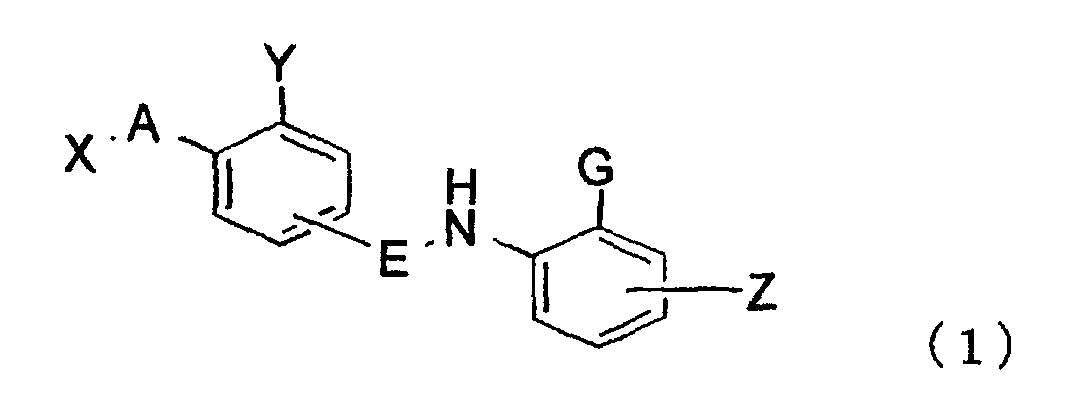 wherein, R1 and R2 represent each independently a hydrogen atom, a hydroxy group, a trihalomethyl group, an alkoxy group or an alkylthio group comprising a C1-C12 chain or cyclic hydrocarbon group and an oxy group or a thio group, a C7-C11 aralkyloxy group wherein an aryl group moiety may be substituted with one or more halogen atoms, methyl groups or methyloxy groups or a C3-C10 alkenyloxy group which may be substituted with one or more phenyl groups; R4 and R5 represent each independently a hydrogen atom, a halogen atom, a C1-C4 alkyl group or a C1-C4 alkoxy group, in the formula (2)-1 or the formula (2)-2;
A represents a bond; -O-, -S-, -S(=O)-, -S(=O)2-, -CH2-, -OCH2-, -SCH2-, -C(=O)- or -CH(OR6)-,
wherein, R6 represents a hydrogen atom or a C1-C4 alkyl group;
Y represents a hydrogen atom, a halogen atom, a nitro group, a nitrile group, an amino group, -COOR7, -NHCOR8 or -NHSO2R9,
wherein, R7 represents a hydrogen atom or a C1-C4 alkyl group; R8 and R9 represent each independently a C1-C4 alkyl group;
E represents a bond; -C(=O) -CR10R11C(=O)- (wherein, R10 and R11 represent each independently a hydrogen atom or a fluorine atom), -CH2CH2C(=O)- or -CH=CHC(=O)-;
G represents a hydrogen atom, a hydroxy group, -SO2NH2, -COOR3, (wherein, R3 represents a hydrogen atom or a C1-C4 alkyl group), -CN or a tetrazol-5-yl group; and
Z represents a hydrogen atom, a halogen atom, a nitro group or a methyl group. - The cancer remedy according to claim 1, wherein G represents -COOR3 (wherein R3 represents a hydrogen atom or a C1-C4 alkyl group) or a tetrazol-5-yl group, in the formula (1).
- The cancer remedy according to claim 1 or 2, wherein R1 is located in the 6-position with respect to the group A (2-position) on the naphthalene ring in the formula (2)-1.
- The cancer remedy according to claim 1 or 2, wherein, R2 is located in the 4-position with respect to the group A on the benzene ring in the formula (2)-2.
- The cancer remedy according to any of claims 1 to 4, wherein R4 and R5 represent each a hydrogen atom in the formula (2)-2.
- The cancer remedy according to any of claims 1 to 5, wherein R1 or R2 represents a hydrogen atom; a hydroxy group; an alkoxy group comprising a C1-C12 chain or cyclic hydrocarbon group and an oxy group; a C3-C10 alkenyloxy group which may be substituted with one or more phenyl groups; a benzyloxy group, a phenylpropyloxy group or a naphthylmethyloxy group, in the formula (2)-1 or (2)-2.
- The cancer remedy according to any of claims 1 to 6, wherein A represents -O- or -S- in the formula (1).
- The cancer remedy according to any of claims 1 to 7, wherein E represents -C(=O)- or -CH2C(=O)- in the formula (1).
- The cancer remedy according to any of claims 1 to 8, wherein the bond A and the bond E are located in the para-positions in the benzene ring substituted with the group Y, in the formula (1).
- The cancer remedy according to any of claims 1 to 9, wherein Y represents a hydrogen atom, a halogen atom, a nitro group or a nitrile group, in the formula (1).
Applications Claiming Priority (3)
| Application Number | Priority Date | Filing Date | Title |
|---|---|---|---|
| JP2000036386 | 2000-02-15 | ||
| JP2000036386 | 2000-02-15 | ||
| PCT/JP2001/001090 WO2001060354A1 (en) | 2000-02-15 | 2001-02-15 | Cancer remedy comprising anthranilic acid derivative as active ingredient |
Publications (2)
| Publication Number | Publication Date |
|---|---|
| EP1256341A1 true EP1256341A1 (en) | 2002-11-13 |
| EP1256341A4 EP1256341A4 (en) | 2004-12-08 |
Family
ID=18560433
Family Applications (1)
| Application Number | Title | Priority Date | Filing Date |
|---|---|---|---|
| EP01906131A Withdrawn EP1256341A4 (en) | 2000-02-15 | 2001-02-15 | ANTI-CANCER MEDICINAL PRODUCT COMPRISING AN ANTHRANILIC ACID DERIVATIVE AS AN ACTIVE INGREDIENT |
Country Status (5)
| Country | Link |
|---|---|
| US (2) | US20030220402A1 (en) |
| EP (1) | EP1256341A4 (en) |
| AU (2) | AU2001234089B2 (en) |
| CA (1) | CA2400264A1 (en) |
| WO (1) | WO2001060354A1 (en) |
Cited By (13)
| Publication number | Priority date | Publication date | Assignee | Title |
|---|---|---|---|---|
| US6897220B2 (en) | 2001-09-14 | 2005-05-24 | Methylgene, Inc. | Inhibitors of histone deacetylase |
| EP1670749A1 (en) * | 2003-08-14 | 2006-06-21 | Smithkline Beecham Corporation | 2-substituted benzoic acid derivatives as hm74a receptor agonists |
| WO2007066784A2 (en) | 2005-12-05 | 2007-06-14 | Otsuka Pharmaceutical Co., Ltd. | Diarylether derivatives as antitumor agents |
| EP1678162A4 (en) * | 2003-10-07 | 2008-07-02 | Hanmi Pharm Ind Co Ltd | GLYCOPROTEIN P INHIBITOR, PROCESS FOR PREPARING THE SAME, AND PHARMACEUTICAL COMPOSITION COMPRISING SUCH AN INHIBITOR |
| WO2009080835A1 (en) * | 2007-12-24 | 2009-07-02 | Karo Bio Ab | Thyromimetric compounds in treatment of disease related to sonic hedgehog signalling |
| US7868204B2 (en) | 2001-09-14 | 2011-01-11 | Methylgene Inc. | Inhibitors of histone deacetylase |
| US7868205B2 (en) | 2003-09-24 | 2011-01-11 | Methylgene Inc. | Inhibitors of histone deacetylase |
| US8088805B2 (en) | 2004-03-26 | 2012-01-03 | Methylgene Inc. | Inhibitors of histone deacetylase |
| US8188277B2 (en) | 2004-08-06 | 2012-05-29 | Otsuka Pharmaceutical Co., Ltd. | Aromatic compounds for suppressing the generation of collagen |
| US8263599B2 (en) | 2006-10-02 | 2012-09-11 | Otsuka Pharmaceutical Co., Ltd. | STAT3/5 activation inhibitor |
| US8598168B2 (en) | 2006-04-07 | 2013-12-03 | Methylgene Inc. | Inhibitors of histone deacetylase |
| EP4083029A1 (en) * | 2013-08-20 | 2022-11-02 | University of Washington through its Center for Commercialization | Novel and specific inhibitors of cytochrome p450 26 retinoic acid hydroxylase |
| EP3937943A4 (en) * | 2019-03-15 | 2022-12-07 | The General Hospital Corporation | NEW SMALL MOLECULE INHIBITORS OF TEAD TRANSCRIPTION FACTORS |
Families Citing this family (4)
| Publication number | Priority date | Publication date | Assignee | Title |
|---|---|---|---|---|
| WO2003024448A2 (en) * | 2001-09-14 | 2003-03-27 | Methylgene, Inc. | Inhibitors of histone deacetylase |
| EP1735319B1 (en) * | 2004-03-26 | 2017-05-03 | MethylGene Inc. | Inhibitors of histone deacetylase |
| KR100955112B1 (en) | 2005-06-14 | 2010-04-28 | 에프. 호프만-라 로슈 아게 | Anthranilic acid derivatives |
| US8053454B2 (en) * | 2005-10-06 | 2011-11-08 | Exelixis, Inc. | Pyridopyrimidinone inhibitors of PIM-1 and/or PIM-3 |
Family Cites Families (7)
| Publication number | Priority date | Publication date | Assignee | Title |
|---|---|---|---|---|
| DE2934543A1 (en) * | 1979-08-27 | 1981-04-02 | Basf Ag, 6700 Ludwigshafen | SUBSTITUTED N-BENZOYLANTHRANILE ACID DERIVATIVES AND THEIR ANYDRO COMPOUNDS, METHOD FOR THE PRODUCTION THEREOF AND THEIR USE AS HERBICIDES |
| US5705521A (en) * | 1990-02-12 | 1998-01-06 | The Center For Innovative Technology | Use of allosteric hemoglobin modifiers in combination with radiation therapy to treat carcinogenic tumors |
| GB9022785D0 (en) * | 1990-10-19 | 1990-12-05 | Merck Sharp & Dohme | Therapeutic agents |
| JPH05301838A (en) * | 1991-10-15 | 1993-11-16 | Mitsubishi Kasei Corp | Styrene derivative |
| JP3668494B2 (en) * | 1994-05-31 | 2005-07-06 | 帝人株式会社 | Naphthalene derivatives |
| US5808144A (en) * | 1995-11-27 | 1998-09-15 | Teijin Limited | Benzene derivatives |
| US6649656B1 (en) * | 1998-07-24 | 2003-11-18 | Teijin Limited | Anthranilic acid derivatives |
-
2001
- 2001-02-15 AU AU2001234089A patent/AU2001234089B2/en not_active Ceased
- 2001-02-15 WO PCT/JP2001/001090 patent/WO2001060354A1/en not_active Ceased
- 2001-02-15 US US10/203,288 patent/US20030220402A1/en not_active Abandoned
- 2001-02-15 AU AU3408901A patent/AU3408901A/en active Pending
- 2001-02-15 CA CA002400264A patent/CA2400264A1/en not_active Abandoned
- 2001-02-15 EP EP01906131A patent/EP1256341A4/en not_active Withdrawn
-
2004
- 2004-08-24 US US10/923,875 patent/US20050027008A1/en not_active Abandoned
Cited By (21)
| Publication number | Priority date | Publication date | Assignee | Title |
|---|---|---|---|---|
| US7838520B2 (en) | 2001-09-14 | 2010-11-23 | Methylgene, Inc. | Inhibitors of histone deacetylase |
| US7868204B2 (en) | 2001-09-14 | 2011-01-11 | Methylgene Inc. | Inhibitors of histone deacetylase |
| US6897220B2 (en) | 2001-09-14 | 2005-05-24 | Methylgene, Inc. | Inhibitors of histone deacetylase |
| EP1670749A1 (en) * | 2003-08-14 | 2006-06-21 | Smithkline Beecham Corporation | 2-substituted benzoic acid derivatives as hm74a receptor agonists |
| US7868205B2 (en) | 2003-09-24 | 2011-01-11 | Methylgene Inc. | Inhibitors of histone deacetylase |
| EP1678162A4 (en) * | 2003-10-07 | 2008-07-02 | Hanmi Pharm Ind Co Ltd | GLYCOPROTEIN P INHIBITOR, PROCESS FOR PREPARING THE SAME, AND PHARMACEUTICAL COMPOSITION COMPRISING SUCH AN INHIBITOR |
| US8088805B2 (en) | 2004-03-26 | 2012-01-03 | Methylgene Inc. | Inhibitors of histone deacetylase |
| US8188277B2 (en) | 2004-08-06 | 2012-05-29 | Otsuka Pharmaceutical Co., Ltd. | Aromatic compounds for suppressing the generation of collagen |
| WO2007066784A3 (en) * | 2005-12-05 | 2007-10-25 | Otsuka Pharma Co Ltd | Diarylether derivatives as antitumor agents |
| WO2007066784A2 (en) | 2005-12-05 | 2007-06-14 | Otsuka Pharmaceutical Co., Ltd. | Diarylether derivatives as antitumor agents |
| CN101321529B (en) * | 2005-12-05 | 2012-09-05 | 大塚制药株式会社 | Diaryl aether derivant as antineoplastic agent |
| RU2444362C2 (en) * | 2005-12-05 | 2012-03-10 | Оцука Фармасьютикал Ко., Лтд. | Drug preparation |
| US8236826B2 (en) | 2005-12-05 | 2012-08-07 | Otsuka Pharmaceutical Co., Ltd. | Diarylether derivatives as antitumor agents |
| US8598168B2 (en) | 2006-04-07 | 2013-12-03 | Methylgene Inc. | Inhibitors of histone deacetylase |
| US8263599B2 (en) | 2006-10-02 | 2012-09-11 | Otsuka Pharmaceutical Co., Ltd. | STAT3/5 activation inhibitor |
| WO2009080835A1 (en) * | 2007-12-24 | 2009-07-02 | Karo Bio Ab | Thyromimetric compounds in treatment of disease related to sonic hedgehog signalling |
| EP4083029A1 (en) * | 2013-08-20 | 2022-11-02 | University of Washington through its Center for Commercialization | Novel and specific inhibitors of cytochrome p450 26 retinoic acid hydroxylase |
| EP3937943A4 (en) * | 2019-03-15 | 2022-12-07 | The General Hospital Corporation | NEW SMALL MOLECULE INHIBITORS OF TEAD TRANSCRIPTION FACTORS |
| US12187722B2 (en) | 2019-03-15 | 2025-01-07 | The General Hospital Corporation | Small molecule inhibitors of TEAD transcription factors |
| IL286352B1 (en) * | 2019-03-15 | 2025-10-01 | Massachusetts Gen Hospital | Novel small molecule inhibitors of tead transcription factors |
| IL286352B2 (en) * | 2019-03-15 | 2026-02-01 | Massachusetts Gen Hospital | Novel small molecule inhibitors of tead transcription factors |
Also Published As
| Publication number | Publication date |
|---|---|
| US20030220402A1 (en) | 2003-11-27 |
| EP1256341A4 (en) | 2004-12-08 |
| CA2400264A1 (en) | 2001-08-23 |
| AU3408901A (en) | 2001-08-27 |
| AU2001234089B2 (en) | 2005-08-11 |
| US20050027008A1 (en) | 2005-02-03 |
| WO2001060354A1 (en) | 2001-08-23 |
Similar Documents
| Publication | Publication Date | Title |
|---|---|---|
| US20030220402A1 (en) | Cancer remedy comprising anthranilic acid derivatives as active ingredients | |
| US5776951A (en) | Anti-atherosclerotic diaryl compounds | |
| US5602277A (en) | Substituted benzene derivatives useful as neuraminidase inhibitors | |
| FR2669336A1 (en) | NOVEL OXAZOLO PYRIDINE DERIVATIVES, PROCESSES FOR PREPARING THEM AND PHARMACEUTICAL COMPOSITIONS CONTAINING SAME | |
| EP3594221B1 (en) | Gpr84 receptor antagonist and use thereof | |
| US4113871A (en) | Hypoglycemically and hypolipidemically active derivatives of phenyl-alkane-carboxylic acids | |
| CH683996A5 (en) | aminophosphonates substituted derivatives, process for their preparation and pharmaceutical compositions containing them. | |
| CS267551B1 (en) | Pharmaceutical agents for asthma treatment and method of effective substance production | |
| KR100979077B1 (en) | Solid salts of benzazine compounds and pharmaceutical compositions comprising the same | |
| US6864267B2 (en) | Calcilytic compounds | |
| US5597833A (en) | Substituted quinol-2-yl-methoxy-phenylacetic acid derivatives | |
| HK1048059A (en) | Cancer remedy comprising anthranilic acid derivative as active ingredient | |
| RU2140416C1 (en) | Derivatives of cyclohexane carboxylic acid, mixture of their isomers or separate isomers and physiologically tolerant salts, pharmaceutical composition | |
| CN102212032B (en) | 5-hyroxyquinolone derivatives, and preparation method and application thereof | |
| US20070232628A1 (en) | Calcilytic Compounds | |
| FR2491064A1 (en) | QUINOLONES, PROCESSES FOR THEIR PREPARATION AND THERAPEUTIC COMPOSITION CONTAINING SAME | |
| JPS6399057A (en) | Glycine derivative | |
| EP0862551B1 (en) | Fluoro-substituted benzoylpropionic acid derivatives | |
| US5250541A (en) | Kynurenic acid derivatives, their preparation and pharmaceutical compositions containing them | |
| FR2498183A1 (en) | NOVEL GUANIDINOCYCLOHEXANECARBOXYLIC ACID DERIVATIVES, PROCESS FOR THEIR PREPARATION AND THERAPEUTIC USE THEREOF | |
| CA2434228C (en) | Biphenyl derivatives | |
| US5849725A (en) | Phosphorylated derivatives of compositions having anti-inflammatory or analgesic activity and a method for the preparation thereof | |
| JPWO2001060354A1 (en) | Cancer treatment agents containing anthranilic acid derivatives as active ingredients | |
| JPH09188665A (en) | Novel substituted N-quinolylanthranilic acid derivative and process for producing the same | |
| CN107176930B (en) | 2- [ 5-bromo-4- (4-fluorocyclopropylnaphthalene-1-yl) -4H-1,2, 4-triazol-3-ylthio ] acetic acid compound and application thereof |
Legal Events
| Date | Code | Title | Description |
|---|---|---|---|
| PUAI | Public reference made under article 153(3) epc to a published international application that has entered the european phase |
Free format text: ORIGINAL CODE: 0009012 |
|
| 17P | Request for examination filed |
Effective date: 20020820 |
|
| AK | Designated contracting states |
Kind code of ref document: A1 Designated state(s): AT BE CH CY DE DK ES FI FR GB GR IE IT LI LU MC NL PT SE TR |
|
| AX | Request for extension of the european patent |
Free format text: AL;LT;LV;MK;RO;SI |
|
| A4 | Supplementary search report drawn up and despatched |
Effective date: 20041025 |
|
| 17Q | First examination report despatched |
Effective date: 20060825 |
|
| 17Q | First examination report despatched |
Effective date: 20060825 |
|
| STAA | Information on the status of an ep patent application or granted ep patent |
Free format text: STATUS: THE APPLICATION IS DEEMED TO BE WITHDRAWN |
|
| 18D | Application deemed to be withdrawn |
Effective date: 20070621 |
|
| REG | Reference to a national code |
Ref country code: HK Ref legal event code: WD Ref document number: 1048059 Country of ref document: HK |