EP1255967B1 - Device for measuring mass flow and energy content - Google Patents
Device for measuring mass flow and energy content Download PDFInfo
- Publication number
- EP1255967B1 EP1255967B1 EP01908602A EP01908602A EP1255967B1 EP 1255967 B1 EP1255967 B1 EP 1255967B1 EP 01908602 A EP01908602 A EP 01908602A EP 01908602 A EP01908602 A EP 01908602A EP 1255967 B1 EP1255967 B1 EP 1255967B1
- Authority
- EP
- European Patent Office
- Prior art keywords
- flow stream
- mass
- signals
- flow
- metering device
- Prior art date
- Legal status (The legal status is an assumption and is not a legal conclusion. Google has not performed a legal analysis and makes no representation as to the accuracy of the status listed.)
- Expired - Lifetime
Links
Images

Classifications
-
- G—PHYSICS
- G01—MEASURING; TESTING
- G01F—MEASURING VOLUME, VOLUME FLOW, MASS FLOW OR LIQUID LEVEL; METERING BY VOLUME
- G01F1/00—Measuring the volume flow or mass flow of fluid or fluent solid material wherein the fluid passes through a meter in a continuous flow
- G01F1/76—Devices for measuring mass flow of a fluid or a fluent solid material
- G01F1/78—Direct mass flowmeters
- G01F1/80—Direct mass flowmeters operating by measuring pressure, force, momentum, or frequency of a fluid flow to which a rotational movement has been imparted
- G01F1/84—Coriolis or gyroscopic mass flowmeters
-
- G—PHYSICS
- G01—MEASURING; TESTING
- G01N—INVESTIGATING OR ANALYSING MATERIALS BY DETERMINING THEIR CHEMICAL OR PHYSICAL PROPERTIES
- G01N33/00—Investigating or analysing materials by specific methods not covered by groups G01N1/00 - G01N31/00
- G01N33/22—Fuels; Explosives
- G01N33/225—Gaseous fuels, e.g. natural gas
Definitions
- the present invention pertains to the field of mass flow metering devices, such as Coriolis flow meters. More specifically, the metering devices are used in combination with other devices or estimation techniques that determine the composition of fluid in a flow stream by mass fraction on a real-time basis to gain superior measurement accuracy.
- Fuels are typically sold on a volumetric basis, but the heating value may vary by more than fifty percent on a constant volumetric basis depending upon variation of the fuel composition over time.
- an internal combustion engine or an industrial boiler may be operated for the express purpose of burning fuels to produce electricity.
- the engine is used to turn a small generator for this purpose.
- the boiler may be used to make steam that drives a larger generator. While the ultimate goal is to harness energy from these fuels, the energy throughput into the engine is not measured.
- Boilers and engines may be adapted to use different fuels.
- a dual-purpose boiler may be easily converted from use with a gas feedstock to use with a liquid feedstock.
- This type of switching boiler has application in the public service company sector where an electric company may wish to switch between fuels to minimize its expenditures for fuel or to reduce levels of regulated emissions. It can be very difficult to switch a boiler from oil to gas and then to ascertain how much gas must be consumed to replace the oil when the nature and content of the gas fuel is unknown.
- An engine or boiler operates at a different efficiency depending upon the nature and quality of the fuel that it burns. Even where an engine rotates at a constant speed, a change in feedstock constituents by the addition of diluents may make less torque available from the engine. Similarly, a boiler may make less steam.
- the combustion devices may suffer a diminution in or improvement in efficiency if a natural gas supply changes to one having relatively more methane. If only the heating content of the fuel were known, it would be possible to alter the operating conditions of a combustion device according to a preselected parameter, such as a change in volumetric or mass flow rate to provide a constant energy source or operation of the device within a preferred range for obtaining an optimal fuel efficiency.
- multipath ultrasonic flow meters (volumetric meters) were installed on an Australian natural gas pipeline for use as custody transfer meters at all offtakes from the transmission system into local distribution systems. The meters were each coupled with a gas chromatograph that analyzed the flow stream constituents. The mass flow measurements were converted to volume and volume-based enthalpy values were calculated for the flow stream. Ultrasonic meters were chosen for the study because they were reported to have the least uncertainty in measurement for both volume and energy content for the flow rates in the study.
- Coriolis meters were listed as possible altematives to obtain volumetric flow measurements using AGA equations to convert the mass flow readings into volume, but Coriolis meters were also characterized as having the greatest uncertainty in energy measurements, i.e., 3.0% versus 1.0% for ultrasonic meters. All of the energy uncertainties for all types of meters in the study were presented as being greater than the volume uncertainties.
- a mass-based metering device that could provide an accurate real time determination of the mass fractions in a flow stream would facilitate mass balance calculations in petrochemical refining, as well as open new horizons in the ability to conserve and sell energy values with decreased levels.
- the present invention overcomes the problems outlined above by providing a metering device that affords extremely accurate direct measurements concerning the mass fractions of a flow stream. These mass fractions may then be related to mass balance calculations in petrochemical refineries, as well as heat content or other enthalpy-related values that are available from a flow stream. Accuracy is improved by avoiding the former necessity of converting mass based flow measurements to volumetric measurements as a condition precedent to ascertaining mass fractions.
- the metering device is used to provide real time telemetry concerning mass fractions in a flow stream having multiple constituents.
- a Coriolis mass flow meter or other mass-based flow meter is used to measure a mass flow rate in the flow stream and to provide first signals representative of the mass flow rate.
- a chromatograph, density or pressure measurement combined with an empirical correlation, or other means for analyzing the content of the flow stream is used to determine constituent percentages of the flow stream and to provide second signals representative of the constituent percentages.
- a central processor, computer or controller is used to interpret the first signals and the second signals received from the analyzing means to provide output representing an energy value in the flow stream.
- the energy value is derived by multiplication of the mass flow rate times the constituent percentages times mass-based energy values of constituents corresponding to the constituent percentages.
- the energy metering device is operably coupled with a throttle to control flow based upon energy content of the flow stream based upon a preselected parameter.
- the preselected parameter may include delivery of a substantially constant rate of energy for release by combustion, delivery of energy at a rate within a preferred operating range for a combustion device, or delivery of time-controlled sales of energy content in the flow stream.
- the mass flow meter is a Coriolis meter
- the meter can also be operated as a densitometer, and the density readings can be used to associate the flow stream with an empirical correlation of energy content, as an alternative to use of a chromatograph to analyze constituent percentages.
- One aspect of the invention is a motoring device for providing real time telemetry concerning a flow stream having multiple constituents, the metering device comprising:
- said controller includes circuitry configured to multiply a mass corresponding to said first signals by a constant assumed energy content per unit mass.
- Another aspect is a throttle operably coupled with said controller to control said flow stream based upon said mass-based energy content of said flow stream.
- said mass flowmeter comprises a Coriolis mass flowmeter.
- said controller further comprises circuitry configured to receive said first signals from said Coriolis mass flowmeter and determine a representative density reading from said flow stream from said first signals.
- said mass flowmeter comprises a densitometer.
- said controller includes circuitry that determines an enthalpy related value for said flow stream based upon information obtained from said densitometer.
- Another aspect is a chromatograph connected in said flow stream that transmits third signals to said controller.
- controller comprises circuitry configured to calculate an enthalpy related value based upon information obtained from said chromatograph.
- said throttle controls said flow stream based on a preselected parameter, said preselected parameter comprises delivery of a substantially constant rato of energy for release by combustion.
- said throttle controls said flow stream based on a preselected parameter, said preselected parameter comprises delivery of energy at a rate within a preferred operating range for a combustion device.
- said throttle controls said flow stream based on a preselected parameter, said preselected parameter comprises delivery of time-controlled sales of energy content in said flow stream.
- Another aspect is a method for providing real time telemetry concerning a flow stream having multiple constituents, said method comprising the steps of:
- Another aspect is determining a representative density for said flow stream.
- Another aspect is associating a density of said flow stream with an enthalpy related value based upon said representative density obtained from a densitometer.
- step of analyzing said flow stream comprises analyzing said flow stream using a chromatograph.
- Another aspect is calculating an enthalpy related value based upon information obtained from said chromatograph.
- Another aspect is throttling said flow stream responsive to variances in a preselected parameter for delivery of energy content in said flow stream.
- said preselected parameter comprises delivery of a substantially constant rate of energy for release by combustion.
- said preselected parameter comprises delivery of energy at a rote within a preferred operating range for a combustion device.
- said preselected parameter comprises delivery of time-controlled sales of energy content in said flow stream.
- FIG. 1 depicts a schematic diagram of an energy measuring device 100 according to the present invention.
- a flowmeter 102 is operably connected to a flow line 104 for purposes of measuring a flow rate in a flow stream 106 of fuel for ultimate use in combustion device 108, e.g., a boiler or an engine.
- a flow stream analyzer 110 is similarly coupled with flow line 104 for the purpose of analyzing the composition and nature of flow stream 106.
- Analyzer 110 measures intrinsic properties of the flow stream, such as density or specific gravity, or percentages of the flow stream that are allocated to different chemical compositions, e.g., methane, ethane, butane, propane, pentane, hexane, heptane, octane, nonane, and decano.
- analyzer 110 represents a computer memory or algorithm that estimates a constant energy content of the flow stream on a per unit mass basis.
- Flowmeter 102 and analyzer 110 perform their respective direct measurements and send signals representative of these measurements to interproter/controllor 112 on lines 114 and 116.
- the interpreter/controller 112 applies a mathematical algorithm using information from these signals as input to provide an output representing the amount of enthalpy or the heating value that is available from combustion of the fuel in flow stream 106. Based upon the output, interpreter/controller 112 adjusts a remotely actuatable valve 118 to act as a throttle in providing fuel to the combustion device 108 based upon a preselected parameter governing the operation of combustion device 108. In turn, the combustion device produces a work output W and an efficiency loss EL.
- the flowmeter 102 can bo any mass flowmeter, preferably including a Coriolis mass flow meter.
- the analyzer can be a gas chromatograph, a densitometer, conductivity meter, or any other device for measuring intrinsic fluid properties that can be related to the energy content of the fluid.
- the flowmeter 102 is a Coriolis flow meter, it is possible to operate the flowmeter as a vibrating tube densitometer or as a capillary tube viscosimeter by conventional practicos according to the manufacturer's specifications. Either of these intrinsic fluid properties may be correlated to the energy content of the fuel on a per unit mass basis.
- the separate boxes shown in FIG. 1 as flowmeter 102 and analyzer 110 would merge into a single Coriolis flowmeter having different operational modes.
- the interpreter/analyzer 112 may consist of an integrated CPU and controller or the CPU and controller may be separate devices.
- FIG. 2 depicts a schematic process diagram showing operation of the interpreter/controller 112.
- the interpreter/controller 112 receives a first signal from flowmeter 102 (see FIG. 1) representing a volumetric or mass flow rate of flow stream 106.
- Interpreter/controller 112 receives a second signal from the analyzer 104 representing intrinsic properties or constituents of the flow stream 106.
- first signal and second signal do not necessarily convey a sequence of events in time, rather, the terms are merely used to distinguish the signals.
- the signals may be transmitted to interpreter/controller in any order including simultaneous transmission.
- interpreter/controller 112 applies an algorithm, statistical technique or data mapping technique to assign a heating value to the flow stream.
- This heating value is any enthalpy-related measure of energy content in the fuel that may be released by combustion. Representative values for energy content include terms that are known in the art as gross heating value (wet or dry), net heating value, enthalpy of combustion, and specific heat.
- An output from step P204 appears in step P206, and step P208 includes interpreter/controller adjusting valve 118 to govern the operation of combustion device 108 according to a preselected parameter. Suitable parameters for governing the operation of combustion device 108 include, among others:
- the fuel of choice for many industrial uses is natural gas.
- Table 1 below provides exemplary published information for substantially all constituents that will comprise an appreciable percentage of any natural gas. It is significant that the enthalpy of combustion for hydrocarbons expressed as kJ/g for each flow component is almost a constant value that varies by 7 to 15% of the methane energy content and varies by lesser percentages for among propane and higher hydrocarbons.
- the total energy content can be calculated based upon Equations (1) and (2) 2
- Q E ⁇ i n Q C ⁇ H fi
- Q E is the total energy flow rate in energy per unit time
- n represents the total number of thermodynamically significant flow components in the total flow stream
- I denotes a property for an individual flow component
- Q C is defined above
- H fi is the enthalpy of combustion for a particular constituent denoted as energy per unit mass.
- the H fi enthalpy value is understood to mean the energy released by a complete combustion where the reaction products are gaseous water and CO 2 , but other forms of heating value measurements may be substituted for H fi including net heating value, gross heating value wet and gross heating value dry, or any other commonly understood measurement of heating value.
- the energy content may be estimated by assuming an average constant energy value per unit mass, e.g., as in the kJ/g column of Table 1.
- the flow stream is a gas flow stream
- the flow stream usually comprises 60% to 90% methane, and a good average value is in the range of 52 to 53 kJ/kg.
- a value of 48 kJ/kg may be assumed for liquid flow streams.
- volumetric gas measurements must refer to a base or reference pressure and temperature, which are usually referred to in the art as standard conditions, i.e., 60°F and 14.7 psia.
- Q v std is a volumetric flow rate of the entire gas flow stream corrected to standard conditions
- H v stdi is the enthalpy of combustion for a particular constituent denoted as energy per unit volume at standard conditions
- X vl is a mole fraction of the total gas flow stream allocated to an individual constituent, and the remaining terms are defined above.
- H molei is enthalpy of combustion as energy per mole as shown in Table 1 above
- MWi molecular weight as shown in Table 1 above
- ⁇ std is the gas density at standard pressure
- P absolute pressure in the flow system in psia
- T temperature in the flow system in degrees Kelvin
- Z is the ideal gas deviation factor at internal flow system temperature and pressure, and the remaining terms are defined above.
Landscapes
- Chemical & Material Sciences (AREA)
- General Physics & Mathematics (AREA)
- Physics & Mathematics (AREA)
- Health & Medical Sciences (AREA)
- Engineering & Computer Science (AREA)
- Life Sciences & Earth Sciences (AREA)
- Fluid Mechanics (AREA)
- Food Science & Technology (AREA)
- Oil, Petroleum & Natural Gas (AREA)
- General Chemical & Material Sciences (AREA)
- Chemical Kinetics & Catalysis (AREA)
- Medicinal Chemistry (AREA)
- Analytical Chemistry (AREA)
- Biochemistry (AREA)
- General Health & Medical Sciences (AREA)
- Immunology (AREA)
- Pathology (AREA)
- Measuring Volume Flow (AREA)
- Feeding And Controlling Fuel (AREA)
- Investigating Or Analyzing Materials Using Thermal Means (AREA)
Description
- The present invention pertains to the field of mass flow metering devices, such as Coriolis flow meters. More specifically, the metering devices are used in combination with other devices or estimation techniques that determine the composition of fluid in a flow stream by mass fraction on a real-time basis to gain superior measurement accuracy.
- Industrial processes that consume or transport petrochemical liquids and gasses often use a mixture of compounds, e.g., methane, ethane, propane, and butane in a single mixture. It is often important to know the percentage of the total mixture that consists of a single type of compound. In this context, representation of the compound in the mixture is often discussed in terms of a mole fraction or a mass fraction. The term "mass fraction" means a percentage of a mixture allocated to a single compound or group of compounds on a mass basis. Similarly, the term "mole fraction" means a percentage of a mixture allocated to a single compound or group of compounds on a mole basis. It has been a conventional practice to calculate mole or mass fractions based upon volumetric measurements of the combined flow stream that are converted to mass using various empirical correlations or density measurements. This conversion process adds uncertainty and error into the mass fraction determination.
- A specific example where it is desirable to ascertain mass fractions or mole fractions from a flow stream exists in the petrochemical refining industry. Engineers are constantly reviewing process efficiencies in the cracking of various feedstocks to convert these feedstocks into refined products, e.g., as in the flame-cracking process of making ethylene directly from petroleum by combustion at 2000°F using a mixture of napthalene or crude oil and high temperature gasses with support from pure oxygen. Depending upon the nature of the crude oil and the availability of gasses, the reaction temperature and timing may be adjusted to optimize the economic recovery from use of the reactor vessel. Mass balance calculations based upon compositional fractions in the flow stream are often essential to these general types of calculations. In this context of process fine-tuning adjustments, it is not only useful to know the percentage composition of the incoming fuel stream, but it is also useful to know the percentage composition of the reaction products. These measurements are typically performed on volumetric percentages, as opposed to mass percentages.
- Another specific instance where it is desirable to know the fractional breakdown of a flow stream exists in the use of pipelines for transportation and delivery of natural gas and other fuels. Fuels are typically sold on a volumetric basis, but the heating value may vary by more than fifty percent on a constant volumetric basis depending upon variation of the fuel composition over time.
- Yet another example of a need for mass fraction analysis exists in instances where neither mass nor volume are measured. For example, an internal combustion engine or an industrial boiler may be operated for the express purpose of burning fuels to produce electricity. The engine is used to turn a small generator for this purpose. The boiler may be used to make steam that drives a larger generator. While the ultimate goal is to harness energy from these fuels, the energy throughput into the engine is not measured.
- It is substantially impossible to perform a direct or indirect measurement of chemically available energy that resides in a feedstock based upon an analysis of work output and system energy losses. The act of combustion is associated with an efficiency loss, e.g., 40% to 60%, in which a portion of the chemically available energy stored in the feedstock is lost to entropy because it cannot be converted into useful work. For example, heat is lost by convection and radiative transfer. Exhaust gasses are hotter due to the exothermic nature of combustion. Fuels almost never have consistent quality. These factors combine to prevent the monitoring of combustion efficiency as an indicator of efficiency or impending mechanical failure in a mechanical device.
- Boilers and engines may be adapted to use different fuels. For example, a dual-purpose boiler may be easily converted from use with a gas feedstock to use with a liquid feedstock. This type of switching boiler has application in the public service company sector where an electric company may wish to switch between fuels to minimize its expenditures for fuel or to reduce levels of regulated emissions. It can be very difficult to switch a boiler from oil to gas and then to ascertain how much gas must be consumed to replace the oil when the nature and content of the gas fuel is unknown.
- Even where the change in feedstock is not so drastic as a switch from oil to natural gas, the feedstocks themselves vary in quality and composition over time. Diluents including carbon dioxide, nitrogen, water, and hydrogen sulfide are commonly found in natural gas flow streams. Furthermore, the relative percentages of constituents in natural gas have large variations by producing region, in addition to variations from well to well in a selected producing region. Thus, gas that is produced from the Gulf of Mexico region may have a lower specific gravity and energy content than gas that is produced in Nigeria or California. Similarly, the nature of crude oil varies from tar-like substances to thinner oils that pour easily and have a light brown color. In transportation, individual flow streams are mixed and combined as the materials are transported by pipeline or by ship from the producing regions to the consuming regions. Each flow stream has its own composition and specific heating value.
- An engine or boiler operates at a different efficiency depending upon the nature and quality of the fuel that it burns. Even where an engine rotates at a constant speed, a change in feedstock constituents by the addition of diluents may make less torque available from the engine. Similarly, a boiler may make less steam. The combustion devices may suffer a diminution in or improvement in efficiency if a natural gas supply changes to one having relatively more methane. If only the heating content of the fuel were known, it would be possible to alter the operating conditions of a combustion device according to a preselected parameter, such as a change in volumetric or mass flow rate to provide a constant energy source or operation of the device within a preferred range for obtaining an optimal fuel efficiency.
- As reported in Snell et al., Installation of Multipath Ultrasonic Meters on a Major Australian Metering System Project, in December of 1996, multipath ultrasonic flow meters (volumetric meters) were installed on an Australian natural gas pipeline for use as custody transfer meters at all offtakes from the transmission system into local distribution systems. The meters were each coupled with a gas chromatograph that analyzed the flow stream constituents. The mass flow measurements were converted to volume and volume-based enthalpy values were calculated for the flow stream. Ultrasonic meters were chosen for the study because they were reported to have the least uncertainty in measurement for both volume and energy content for the flow rates in the study. Coriolis meters were listed as possible altematives to obtain volumetric flow measurements using AGA equations to convert the mass flow readings into volume, but Coriolis meters were also characterized as having the greatest uncertainty in energy measurements, i.e., 3.0% versus 1.0% for ultrasonic meters. All of the energy uncertainties for all types of meters in the study were presented as being greater than the volume uncertainties.
- As shown in the above discussion, a mass-based metering device that could provide an accurate real time determination of the mass fractions in a flow stream would facilitate mass balance calculations in petrochemical refining, as well as open new horizons in the ability to conserve and sell energy values with decreased levels.
- The present invention overcomes the problems outlined above by providing a metering device that affords extremely accurate direct measurements concerning the mass fractions of a flow stream. These mass fractions may then be related to mass balance calculations in petrochemical refineries, as well as heat content or other enthalpy-related values that are available from a flow stream. Accuracy is improved by avoiding the former necessity of converting mass based flow measurements to volumetric measurements as a condition precedent to ascertaining mass fractions.
- The metering device is used to provide real time telemetry concerning mass fractions in a flow stream having multiple constituents. A Coriolis mass flow meter or other mass-based flow meter is used to measure a mass flow rate in the flow stream and to provide first signals representative of the mass flow rate. A chromatograph, density or pressure measurement combined with an empirical correlation, or other means for analyzing the content of the flow stream is used to determine constituent percentages of the flow stream and to provide second signals representative of the constituent percentages.
- A central processor, computer or controller is used to interpret the first signals and the second signals received from the analyzing means to provide output representing an energy value in the flow stream. The energy value is derived by multiplication of the mass flow rate times the constituent percentages times mass-based energy values of constituents corresponding to the constituent percentages. This computational technique is advantageous because it permits a direct or mass-based computation of energy content in the flow stream while minimizing intermediate correlations, such as correlations approximating the nonideal behavior of real gasses.
- In a preferred embodiments, the energy metering device is operably coupled with a throttle to control flow based upon energy content of the flow stream based upon a preselected parameter. According to principles of the invention, the preselected parameter may include delivery of a substantially constant rate of energy for release by combustion, delivery of energy at a rate within a preferred operating range for a combustion device, or delivery of time-controlled sales of energy content in the flow stream.
- When the mass flow meter is a Coriolis meter, the meter can also be operated as a densitometer, and the density readings can be used to associate the flow stream with an empirical correlation of energy content, as an alternative to use of a chromatograph to analyze constituent percentages.
- These objects and advantages of the invention, as well as other features of the invention, will be apparent to those skilled in the art upon reading the following description together with the associated drawings. One aspect of the invention is a motoring device for providing real time telemetry concerning a flow stream having multiple constituents, the metering device comprising:
- a mass flowmeter that generates first signals indicating a mass flowrate of said flow stream flowing through said flowmeter and transmits said first signals;
- said metering device characterized by:
- an analyzer through which said flow stream passes wherein said analyzer determines constituent percentages of said flow stream and generates second signals representative of said constituent percentages; and
- a controller comprised of circuitry configured to:
- receive said first signals and said second signals,
- process said first signals and said second signals by multiplying said mass flow rate, said constituent percentages, and mass-based energy values of constituents corresponding to said constituent percentages to generate a mass-based energy content of said flow stream, and
- generate an output representative of said mass-based energy content of said flow stream
- Another aspect is that said controller includes circuitry configured to multiply a mass corresponding to said first signals by a constant assumed energy content per unit mass.
- Another aspect is a throttle operably coupled with said controller to control said flow stream based upon said mass-based energy content of said flow stream.
- Another aspect is that said mass flowmeter comprises a Coriolis mass flowmeter.
- Another aspect is that said controller further comprises circuitry configured to receive said first signals from said Coriolis mass flowmeter and determine a representative density reading from said flow stream from said first signals.
- Another aspect is that said mass flowmeter comprises a densitometer.
- Another aspect is that said controller includes circuitry that determines an enthalpy related value for said flow stream based upon information obtained from said densitometer.
- Another aspect is a chromatograph connected in said flow stream that transmits third signals to said controller.
- Another aspect is that said controller comprises circuitry configured to calculate an enthalpy related value based upon information obtained from said chromatograph.
- Another aspect is that said throttle controls said flow stream based on a preselected parameter, said preselected parameter comprises delivery of a substantially constant rato of energy for release by combustion.
- Another aspect is that said throttle controls said flow stream based on a preselected parameter, said preselected parameter comprises delivery of energy at a rate within a preferred operating range for a combustion device.
- Another aspect is that said throttle controls said flow stream based on a preselected parameter, said preselected parameter comprises delivery of time-controlled sales of energy content in said flow stream.
- Another aspect is a method for providing real time telemetry concerning a flow stream having multiple constituents, said method comprising the steps of:
- measuring a mass flow rate in said flow stream and providing first signals representative of said mass flow rate;
- said method characterized by the steps of:
- determining constituent percentages of said flow stream and generating second signals representative of said constituent percentages;
- processing said first signals and said second signals by multiplying said mass flow rate, said constituent percentages, and mass-based energy values of constituents corresponding to said constituent percentages to generate a mass-based energy content of said flow stream, and
- generating an output representative of said mass-based energy content of said flow stream.
- Another aspect is determining a representative density for said flow stream.
- Another aspect is associating a density of said flow stream with an enthalpy related value based upon said representative density obtained from a densitometer.
- Another aspect is that said step of analyzing said flow stream comprises analyzing said flow stream using a chromatograph.
- Another aspect is calculating an enthalpy related value based upon information obtained from said chromatograph.
- Another aspect is throttling said flow stream responsive to variances in a preselected parameter for delivery of energy content in said flow stream.
- Another aspect is that said preselected parameter comprises delivery of a substantially constant rate of energy for release by combustion.
- Another aspect is that said preselected parameter comprises delivery of energy at a rote within a preferred operating range for a combustion device.
- Another aspect is that said preselected parameter comprises delivery of time-controlled sales of energy content in said flow stream.
-
- FIG. 1 is a schematic diagram of an energy metering device according to the present invention; and
- FIG. 2 is a process control flow chart demonstrating operation of an signal interpreter that determines an amount of energy flowing through the energy metering device shown in FIG. 1.
- FIG. 1 depicts a schematic diagram of an
energy measuring device 100 according to the present invention. Aflowmeter 102 is operably connected to aflow line 104 for purposes of measuring a flow rate in aflow stream 106 of fuel for ultimate use incombustion device 108, e.g., a boiler or an engine. Aflow stream analyzer 110 is similarly coupled withflow line 104 for the purpose of analyzing the composition and nature offlow stream 106.Analyzer 110 measures intrinsic properties of the flow stream, such as density or specific gravity, or percentages of the flow stream that are allocated to different chemical compositions, e.g., methane, ethane, butane, propane, pentane, hexane, heptane, octane, nonane, and decano. Alternatively,analyzer 110 represents a computer memory or algorithm that estimates a constant energy content of the flow stream on a per unit mass basis.Flowmeter 102 andanalyzer 110 perform their respective direct measurements and send signals representative of these measurements to interproter/controllor 112 onlines controller 112 applies a mathematical algorithm using information from these signals as input to provide an output representing the amount of enthalpy or the heating value that is available from combustion of the fuel inflow stream 106. Based upon the output, interpreter/controller 112 adjusts a remotely actuatable valve 118 to act as a throttle in providing fuel to thecombustion device 108 based upon a preselected parameter governing the operation ofcombustion device 108. In turn, the combustion device produces a work output W and an efficiency loss EL. - The
flowmeter 102 can bo any mass flowmeter, preferably including a Coriolis mass flow meter. The analyzer can be a gas chromatograph, a densitometer, conductivity meter, or any other device for measuring intrinsic fluid properties that can be related to the energy content of the fluid. Where theflowmeter 102 is a Coriolis flow meter, it is possible to operate the flowmeter as a vibrating tube densitometer or as a capillary tube viscosimeter by conventional practicos according to the manufacturer's specifications. Either of these intrinsic fluid properties may be correlated to the energy content of the fuel on a per unit mass basis. Thus, the separate boxes shown in FIG. 1 asflowmeter 102 andanalyzer 110 would merge into a single Coriolis flowmeter having different operational modes. Similarly, the interpreter/analyzer 112 may consist of an integrated CPU and controller or the CPU and controller may be separate devices. - FIG. 2 depicts a schematic process diagram showing operation of the interpreter/
controller 112. The interpreter/controller 112 receives a first signal from flowmeter 102 (see FIG. 1) representing a volumetric or mass flow rate offlow stream 106. Interpreter/controller 112 receives a second signal from theanalyzer 104 representing intrinsic properties or constituents of theflow stream 106. In this discussion, the terms "first signal" and "second signal" do not necessarily convey a sequence of events in time, rather, the terms are merely used to distinguish the signals. The signals may be transmitted to interpreter/controller in any order including simultaneous transmission. - In step P204, interpreter/
controller 112 applies an algorithm, statistical technique or data mapping technique to assign a heating value to the flow stream. This heating value is any enthalpy-related measure of energy content in the fuel that may be released by combustion. Representative values for energy content include terms that are known in the art as gross heating value (wet or dry), net heating value, enthalpy of combustion, and specific heat. An output from step P204 appears in step P206, and step P208 includes interpreter/controller adjusting valve 118 to govern the operation ofcombustion device 108 according to a preselected parameter. Suitable parameters for governing the operation ofcombustion device 108 include, among others: - 1.) application of fuel energy at a constant rate for consumption at a constant energy rate in
combustion device 108; - 2.) application of fuel energy at rate producing a constant work output W from
combustion device 108 corrected for variations in operating efficiency due to fuel energy content; and - 3.) sale of fuel based upon energy content of the fuel for eventual use in combustion devices of the type shown as
combustion device 108. - There are many ways to calculate or estimate the energy content in a flow stream. Perhaps the simplest way is to make an educated guess as to the per unit mass energy content, as confirmed by laboratory tests or measurements performed on samples of fuel in the flow stream. Another way is to obtain multiple types of input data for use in training a conventional data mapping technique, such as an adaptive filter or neural network. These multiple types of input data could include viscosity, density, temperature, and pressure, all of which may be obtained from conventional Coriolis flowmeters together with conventional transmitters, e.g., temperature and pressure transmitters, that are used in Coriolis measuring devices. In yet another alternative, many different types of algorithms are known for their ability to relate energy content to fuel based upon intrinsic properties of the fuel. For example, a calorimeter may be used to bum a fuel and the heat content may be correlated to density, viscosity or gravity of the fuel.
- The fuel of choice for many industrial uses is natural gas. In this case, there are many excellent algorithms available that can be used to calculate the precise heating value of the gas flow stream based upon published information concerning the constituents of the gas. Table 1 below provides exemplary published information for substantially all constituents that will comprise an appreciable percentage of any natural gas. It is significant that the enthalpy of combustion for hydrocarbons expressed as kJ/g for each flow component is almost a constant value that varies by 7 to 15% of the methane energy content and varies by lesser percentages for among propane and higher hydrocarbons.
TABLE 1 PROPERTIES OF NATURAL GAS CONSTITUENTS Constituent Gas Gravity* Net Heating Value (Btu/SCF) Enthalpy of Combustion -Δc H, (kJ/mole) Molecular Weight (g/mole) Enthalpy of Combustion (kJ/g) N2** 0.9672 0 0 28.01 0.00 CO2 1.5195 0 0 44.00 0.00 H2S 1.1765 588 672.4 34.08 19.73 Methane 0.5539 909.1 889.7 16.04 55.47 Ethane 1.0382 1617.8 1559.1 30.07 51.85 Propane 1.5225 2316.1 2217.0 44.10 50.27 Isobutane 2.0068 3001.1 2866.3 58.12 49.32 N-butane 2.0068 3010.4 2874.9 58.12 49.46 Isopentane 2.4911 3698.3 3525.6 72.15 48.86 N-pentane 2.4911 3707.5 3532.4 72.15 48.96 N-hexane 2.9753 4403.7 4191.1 86.18 48.63 N-heptane 3.4596 5100.2 4849.3 100.20 48.40 N-octane 3.9439 5796.7 5507.2 114.23 48.21 N-nonane 4.4282 6493.3 6166.4 128.26 48.08 N-decane 4.9125 7188.6 6823.9 142.28 47.96 O2 1.1048 0 0 32.00 0.00 H2 0.0696 274 285.6 2.02 141.39 He 0.138 0 0 4.00 0.00 H20 0.622 0 0 18.02 0.00 *Relative to air where air = 1. - Where the flow rate measurements are performed on a mass per unit time basis, it is a simple matter to calculate the mass fractions in a flow stream according to principles of the invention. The mass fractions are calculated according to Equation (1):

where n represents the total number of thermodynamically significant flow components in the total flow stream, i denotes a property for an individual flow component, QC is a mass content of a total flow stream allocated to a flow component comprising part of a total flow stream, fraction, Xmi is a mass fraction of the total flow stream allocated to the flow component as determined by a chromatograph or other instrument for this purpose, and Qm is the total mass flow rate. - The total energy content can be calculated based upon Equations (1) and (2)
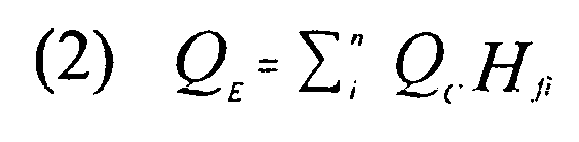
where QE is the total energy flow rate in energy per unit time, n represents the total number of thermodynamically significant flow components in the total flow stream, I denotes a property for an individual flow component, QC is defined above, and Hfi is the enthalpy of combustion for a particular constituent denoted as energy per unit mass. The Hfi enthalpy value is understood to mean the energy released by a complete combustion where the reaction products are gaseous water and CO2, but other forms of heating value measurements may be substituted for Hfi including net heating value, gross heating value wet and gross heating value dry, or any other commonly understood measurement of heating value. - Where a gas chromatograph or other mechanism for analyzing the hydrocarbon fractions in the organic flow stream is unavailable, such as when the instrument breaks down or costs too much for a specific application, the energy content may be estimated by assuming an average constant energy value per unit mass, e.g., as in the kJ/g column of Table 1. Where the flow stream is a gas flow stream, the flow stream usually comprises 60% to 90% methane, and a good average value is in the range of 52 to 53 kJ/kg. A value of 48 kJ/kg may be assumed for liquid flow streams. These estimates are typically accurate to within three to five percent, assuming that the flow stream is not contaminated with excessive amounts of diluents, e.g. carbon dioxide, water, or hydrogen sulfide.
- Volumetric gas measurements must refer to a base or reference pressure and temperature, which are usually referred to in the art as standard conditions, i.e., 60°F and 14.7 psia. Thus,

where Qv std is a volumetric flow rate of the entire gas flow stream corrected to standard conditions, Hv stdi is the enthalpy of combustion for a particular constituent denoted as energy per unit volume at standard conditions, Xvl is a mole fraction of the total gas flow stream allocated to an individual constituent, and the remaining terms are defined above. Also, for each constituent according to Equation (4),
where Hmolei is enthalpy of combustion as energy per mole as shown in Table 1 above, MWi is molecular weight as shown in Table 1 above, ρstd is the gas density at standard pressure, P is absolute pressure in the flow system in psia, T is temperature in the flow system in degrees Kelvin, Z is the ideal gas deviation factor at internal flow system temperature and pressure, and the remaining terms are defined above. - The problem that arises with volumetric conversions of this nature is that empirical correlations introduce error into the calculation. Specifically, the gas deviation factor Z may be inaccurate to an extent that exceeds the meter uncertainty. This source of error is avoided by methods and apparatus of present invention.
- Those skilled in the art will understand that the preferred embodiments described above may be subjected to apparent modifications without departing from the true scope of the invention. The inventors, accordingly, hereby state their intention to rely upon the Doctrine of Equivalents, in order to protect their full rights in the invention.
Claims (21)
- A metering device (100) for use in providing real time telemetry concerning a flow stream (106) having multiple constituents, the metering device comprising:a mass flowmeter (102) that generates first signals indicating a mass flow rate of said flow stream (106) flowing through said flowmeter (102) and transmits said first signals:said metering device characterized by:an analyzer (110) through which said flow stream passes wherein said analyzer determines constituent percentages of said flow stream and generates second signals representative of said constituent percentages; anda controller (112) comprised of circuitry configured to:receive (P202) said first signals and said second signals,process (P204) said first signals and said second signals by multiplying said mass flow rate, said constituent percentages, and mass-based energy values of constituents corresponding to said constituent percentages to generate a mass-based energy content of said flow stream, andgenerate (P206) an output representative of said mass-based energy content of said flow stream.
- The metering device (100) as set forth in claim 1 wherein said controller (112) includes circuitry configured to multiply a mass corresponding to said first signals by a constant assumed energy content per unit mass.
- The metering device (100) as set forth in claim 1 including a throttle (118) operably coupled with said controller (112) to control said flow stream (106) bused upon said mass-based energy content of said flow stream.
- The metering device (100) as set forth in claim 1 wherein said mass flowmeter (102) comprises a Coriolis mass flowmeter.
- The metering device (100) as set forth in claim 4 wherein said controller (112) further comprises circuitry configured to receive said first signals from said Coriolis mass flowmeter and determine a representative density reading from said flow stroam (106) from said first signals.
- The metering device (100) as set forth in claim 1 wherein said mass flowmeter (102) comprises a densitometer.
- The metering device (100) as set forth in claim 6 wherein said controller (112) includes circuitry that determines an enthalpy related value for said flow stream (106) based upon information obtained from said densitometer.
- The metering device (100) as set forth in claim 1 further comprising a chromatograph connected in said flow stream (106) and transmits third signals to said controller (112).
- The metering device (100) as set forth in claim 8 wherein said controller (112) comprises circuitry configured to calculate an enthalpy related value based upon information obtained from said chromatograph.
- The metering device (100) as set forth in claim 3 wherein said throttle (118) controls said flow stream (106) based on a preselected parameter, said preselected parameter comprises delivery of a substantially constant rate of energy for release by combustion.
- The metering device (100) as set forth in claim 3 wherein said throttle (118) controls said flow stream (106) based on a preselected parameter, said preselected parameter comprises delivery of energy at a rate within a preferred operating range for a combustion device (108).
- The metering device (100) as set forth in claim 3 wherein said throttle (118) controls said flow stream (106) based on a preselected parameter, said preselected parameter comprises delivery of time-controlled sales of energy content in said flow stream.
- A method (P200) for providing real time telemetry concerning a flow stream (106) having multiple constituents, said method comprising the steps of:measuring a mass flow rate in said flow stream and providing first signals representative of said mass flow rato;said method characterized by the steps of:determining constituent percentages of said flow stream and generating second signals representative of said constituent percentages;processing (P204) said first signals and said second signals by multiplying said mass flow rate, said constituent percentages, and mass-based energy values of constituents corresponding to said constituent percentages to generate a mass-based energy content of said flow stream, andgenerating (P206) an output representative of said mass-based energy content of said flow stream.
- The method (P200) according to claim 13 including a step of determining a representative density for said flow stream (106).
- The method according to claim 14 further comprising associating a density of said flow stream (106) with an enthalpy related value based upon said representative density obtained from a densitometer.
- The method according to claim 13 wherein said step of analyzing said flow stream (106) comprises analyzing said flow stream using a chromatograph.
- The method according to claim 16 further comprising calculating an enthalpy related value based upon information obtained from said chromatograph.
- The method according to claim 13 including a step of throttling (P208) said flow stream (106) responsive to variances in a preselected parameter for delivery of energy content in said flow stream.
- The method according to claim 18 wherein said preselected parameter comprises delivery of a substantially constant rate of energy for release by combustion.
- The method according to claim 18 wherein said preselected parameter comprises delivery of energy at a rate within a preferred operating range for a combustion device.
- The method according to claim 18 wherein said preselected parameter comprises delivery of time-controlled sales of energy content in said flow stream (106).
Applications Claiming Priority (3)
| Application Number | Priority Date | Filing Date | Title |
|---|---|---|---|
| US505276 | 2000-02-16 | ||
| US09/505,276 US6612186B1 (en) | 2000-02-16 | 2000-02-16 | Mass fraction metering device |
| PCT/US2001/001005 WO2001061285A1 (en) | 2000-02-16 | 2001-01-11 | Device for measuring mass flow and energy content |
Publications (2)
| Publication Number | Publication Date |
|---|---|
| EP1255967A1 EP1255967A1 (en) | 2002-11-13 |
| EP1255967B1 true EP1255967B1 (en) | 2007-02-28 |
Family
ID=24009664
Family Applications (1)
| Application Number | Title | Priority Date | Filing Date |
|---|---|---|---|
| EP01908602A Expired - Lifetime EP1255967B1 (en) | 2000-02-16 | 2001-01-11 | Device for measuring mass flow and energy content |
Country Status (18)
| Country | Link |
|---|---|
| US (1) | US6612186B1 (en) |
| EP (1) | EP1255967B1 (en) |
| JP (1) | JP4338927B2 (en) |
| KR (1) | KR100528818B1 (en) |
| CN (1) | CN1180227C (en) |
| AR (1) | AR027333A1 (en) |
| AT (1) | ATE355509T1 (en) |
| AU (2) | AU3645101A (en) |
| BR (1) | BR0108286B1 (en) |
| CA (1) | CA2398119C (en) |
| DE (1) | DE60126916T2 (en) |
| DK (1) | DK1255967T3 (en) |
| HK (1) | HK1052967B (en) |
| MX (1) | MXPA02007830A (en) |
| MY (1) | MY133962A (en) |
| PL (1) | PL198147B1 (en) |
| RU (1) | RU2251082C2 (en) |
| WO (1) | WO2001061285A1 (en) |
Cited By (3)
| Publication number | Priority date | Publication date | Assignee | Title |
|---|---|---|---|---|
| WO2011162592A1 (en) * | 2010-06-25 | 2011-12-29 | Petroliam Nasional Berhad (Petronas) | A method and system for validating energy measurement in a high pressure gas distribution network |
| RU2470291C1 (en) * | 2011-07-13 | 2012-12-20 | Открытое акционерное общество "Федеральный научно-производственный центр "Алтай" | Method of determining weight ratio of basic substance in crystalline glyoxal |
| WO2016056902A1 (en) * | 2014-10-07 | 2016-04-14 | Berkin B.V. | Method and system for determining the fractions of a streaming gaseous medium |
Families Citing this family (32)
| Publication number | Priority date | Publication date | Assignee | Title |
|---|---|---|---|---|
| FR2799289B1 (en) * | 1999-10-01 | 2001-12-28 | Air Liquide | METHOD AND DEVICE FOR MAKING A SHEMA OF AN INSTALLATION COMPRISING APPARATUSES SUPPLIED WITH GAS |
| AT5650U1 (en) * | 2001-10-02 | 2002-09-25 | Avl List Gmbh | METHOD FOR DETERMINING THE POSITION OF A COMBUSTION |
| US20030098069A1 (en) * | 2001-11-26 | 2003-05-29 | Sund Wesley E. | High purity fluid delivery system |
| EP1391703B1 (en) * | 2002-08-22 | 2007-01-24 | Ems-Patent Ag | Thermal gas flow measuring device with gas quality indicator |
| DE10330376B4 (en) * | 2003-07-04 | 2007-09-13 | Pfister Gmbh | Method and device for continuous, gravimetric dosing of flowable goods for combustion plants |
| DE102006033611B4 (en) * | 2006-07-18 | 2010-04-08 | Hydrometer Gmbh | Gas phase correction for ultrasonic flowmeter |
| ES2420558T3 (en) * | 2008-03-06 | 2013-08-23 | Ihi Corporation | Method and apparatus for monitoring the supply of oxygen in a boiler |
| US7779679B2 (en) * | 2008-04-14 | 2010-08-24 | Gm Global Technology Operations, Inc. | Fuel system diagnostics by analyzing cylinder pressure signal |
| RU2466357C2 (en) * | 2008-05-23 | 2012-11-10 | Роузмаунт, Инк. | Multi-parameter device for regulating flow of process fluid with calculation of energy flow |
| FR2941050B1 (en) * | 2009-01-12 | 2011-02-11 | Peugeot Citroen Automobiles Sa | CALCULATION OF THE CALORIFIC POWER OF A FUEL |
| WO2011128643A1 (en) * | 2010-04-14 | 2011-10-20 | Mobrey Limited | Method of determining the energy content of a methan - rich gas mixture |
| CN102262000B (en) * | 2010-05-28 | 2016-03-09 | 中国市政工程华北设计研究总院 | Determine the testing experimental system of gas utensil combustion characteristics |
| CN103134619A (en) * | 2011-11-23 | 2013-06-05 | 新奥科技发展有限公司 | Heat value analysis meter and fuel gas metering device, method and system based on heat values |
| US10641750B2 (en) | 2012-08-03 | 2020-05-05 | Conocophillips Company | Petroleum-fluid property prediction from gas chromatographic analysis of rock extracts or fluid samples |
| KR101316332B1 (en) * | 2012-10-09 | 2013-10-08 | 윤정중 | An energy measuring device using matrix typed database and the energy measuring method |
| NL2010064C2 (en) | 2012-12-27 | 2014-06-30 | Berkin Bv | DEVICE AND METHOD FOR DETERMINING THE BURNING VALUE OF A FUEL. |
| CN103557899B (en) * | 2013-10-29 | 2016-08-10 | 成都千嘉科技有限公司 | A kind of gas metering method and device based on energy meter |
| CN103542904B (en) * | 2013-10-29 | 2017-01-04 | 成都千嘉科技有限公司 | Gas metering method and device based on energy meter |
| US9528922B2 (en) * | 2014-06-23 | 2016-12-27 | Caterpillar Inc. | System and method for determining the specific gravity of a gaseous fuel |
| BR112017003278B1 (en) * | 2014-09-04 | 2021-03-23 | Micro Motion, Inc. | METHOD FOR DETERMINING SYSTEM ACCURACY, AND, SYSTEM FOR CONFIGURING A MEASUREMENT SYSTEM |
| CN108496078A (en) * | 2016-01-27 | 2018-09-04 | 高准公司 | Gas energy measurement method and related equipment |
| CN109219736A (en) | 2016-06-09 | 2019-01-15 | 高准公司 | Fuel consumption calculation of a mixture of fuel and water |
| CN107451395A (en) * | 2017-06-30 | 2017-12-08 | 华电电力科学研究院 | A kind of gas internal-combustion engine extraction flow and exhaust energy computational methods |
| CN109859582A (en) * | 2019-03-20 | 2019-06-07 | 西北农林科技大学 | An experimental teaching aid for the determination of combustion enthalpy based on Stirling heat engine and its determination method |
| CA3135826C (en) * | 2019-04-03 | 2023-09-26 | Micro Motion, Inc. | Using vapor pressure to determine concentrations of components in a multi-component fluid |
| EP3956556B1 (en) * | 2019-04-16 | 2023-04-12 | Wärtsilä Finland Oy | Heating value estimation |
| US12196728B2 (en) * | 2021-02-04 | 2025-01-14 | Chengdu Qinchuan Iot Technology Co., Ltd. | Systems and methods for measuring energy of natural gas components |
| CN112946167B (en) * | 2021-02-04 | 2022-05-27 | 成都秦川物联网科技股份有限公司 | Energy metering perception control method and system based on chromatography and ultrasonic waves |
| US11796528B2 (en) | 2021-02-04 | 2023-10-24 | Chengdu Qinchuan Iot Technology Co., Ltd. | Method and system for measuring energy of natural gas |
| US11572324B1 (en) | 2021-09-09 | 2023-02-07 | Chevron Phillips Chemical Company, Lp | Methods for operating ethylene oligomerization reactor systems with an integrated ultrasonic flow meter |
| CN118797278B (en) * | 2024-09-14 | 2024-12-17 | 山东科举药业有限公司 | American ginseng active ingredient extraction optimization system and method based on data analysis |
| EP4733721A1 (en) * | 2024-10-23 | 2026-04-29 | Abb Schweiz Ag | System and method for determining a gas flow in a gas delivery arrangement |
Family Cites Families (10)
| Publication number | Priority date | Publication date | Assignee | Title |
|---|---|---|---|---|
| SU826366A1 (en) * | 1979-08-27 | 1981-04-30 | Taganrogskij Radiotech Inst | Device for simulating straight-through boiler |
| US5201581A (en) * | 1991-11-18 | 1993-04-13 | Badger Meter, Inc. | Method and apparatus for measuring mass flow and energy content using a linear flow meter |
| US5323657A (en) | 1991-11-04 | 1994-06-28 | Badger Meter, Inc. | Volumetric flow corrector and method |
| US5807749A (en) | 1992-10-23 | 1998-09-15 | Gastec N.V. | Method for determining the calorific value of a gas and/or the Wobbe index of a natural gas |
| US5604316A (en) * | 1994-10-19 | 1997-02-18 | Alonso; Joey G. | Multiple phase coriolis mass meter |
| US5944048A (en) * | 1996-10-04 | 1999-08-31 | Emerson Electric Co. | Method and apparatus for detecting and controlling mass flow |
| US5873351A (en) * | 1997-04-16 | 1999-02-23 | Woodward Governor Company | Gas mass flow control system |
| US5913239A (en) * | 1997-06-17 | 1999-06-15 | Cummins Engine Company, Inc. | Mass flow measurement device |
| US6053054A (en) * | 1997-09-26 | 2000-04-25 | Fti Flow Technology, Inc. | Gas flow rate measurement apparatus and method |
| US6094940A (en) * | 1997-10-09 | 2000-08-01 | Nikon Corporation | Manufacturing method of synthetic silica glass |
-
2000
- 2000-02-16 US US09/505,276 patent/US6612186B1/en not_active Expired - Lifetime
-
2001
- 2001-01-11 AT AT01908602T patent/ATE355509T1/en not_active IP Right Cessation
- 2001-01-11 WO PCT/US2001/001005 patent/WO2001061285A1/en not_active Ceased
- 2001-01-11 DE DE60126916T patent/DE60126916T2/en not_active Expired - Lifetime
- 2001-01-11 CA CA002398119A patent/CA2398119C/en not_active Expired - Lifetime
- 2001-01-11 CN CNB018051758A patent/CN1180227C/en not_active Expired - Lifetime
- 2001-01-11 KR KR10-2002-7010683A patent/KR100528818B1/en not_active Expired - Fee Related
- 2001-01-11 MX MXPA02007830A patent/MXPA02007830A/en active IP Right Grant
- 2001-01-11 AU AU3645101A patent/AU3645101A/en active Pending
- 2001-01-11 HK HK03105147.8A patent/HK1052967B/en not_active IP Right Cessation
- 2001-01-11 DK DK01908602T patent/DK1255967T3/en active
- 2001-01-11 JP JP2001560631A patent/JP4338927B2/en not_active Expired - Fee Related
- 2001-01-11 PL PL356440A patent/PL198147B1/en unknown
- 2001-01-11 EP EP01908602A patent/EP1255967B1/en not_active Expired - Lifetime
- 2001-01-11 AU AU2001236451A patent/AU2001236451B2/en not_active Expired
- 2001-01-11 RU RU2002124609/28A patent/RU2251082C2/en active
- 2001-01-11 BR BRPI0108286-8A patent/BR0108286B1/en active IP Right Grant
- 2001-01-30 AR ARP010100425A patent/AR027333A1/en active IP Right Grant
- 2001-01-31 MY MYPI20010449A patent/MY133962A/en unknown
Cited By (4)
| Publication number | Priority date | Publication date | Assignee | Title |
|---|---|---|---|---|
| WO2011162592A1 (en) * | 2010-06-25 | 2011-12-29 | Petroliam Nasional Berhad (Petronas) | A method and system for validating energy measurement in a high pressure gas distribution network |
| RU2470291C1 (en) * | 2011-07-13 | 2012-12-20 | Открытое акционерное общество "Федеральный научно-производственный центр "Алтай" | Method of determining weight ratio of basic substance in crystalline glyoxal |
| WO2016056902A1 (en) * | 2014-10-07 | 2016-04-14 | Berkin B.V. | Method and system for determining the fractions of a streaming gaseous medium |
| NL2013587B1 (en) * | 2014-10-07 | 2016-10-03 | Berkin Bv | Method for determining the fractions of a flowing gaseous medium, as well as a system therefor. |
Also Published As
| Publication number | Publication date |
|---|---|
| DE60126916D1 (en) | 2007-04-12 |
| PL356440A1 (en) | 2004-06-28 |
| KR20020086544A (en) | 2002-11-18 |
| DE60126916T2 (en) | 2007-06-28 |
| CA2398119C (en) | 2008-08-05 |
| PL198147B1 (en) | 2008-05-30 |
| MY133962A (en) | 2007-11-30 |
| AU2001236451B2 (en) | 2004-07-08 |
| KR100528818B1 (en) | 2005-11-22 |
| WO2001061285A1 (en) | 2001-08-23 |
| JP4338927B2 (en) | 2009-10-07 |
| HK1052967B (en) | 2005-09-16 |
| CN1401071A (en) | 2003-03-05 |
| US6612186B1 (en) | 2003-09-02 |
| BR0108286A (en) | 2002-10-29 |
| BR0108286B1 (en) | 2013-05-07 |
| CA2398119A1 (en) | 2001-08-23 |
| DK1255967T3 (en) | 2007-06-18 |
| HK1052967A1 (en) | 2003-10-03 |
| JP2003523508A (en) | 2003-08-05 |
| MXPA02007830A (en) | 2003-02-10 |
| EP1255967A1 (en) | 2002-11-13 |
| RU2251082C2 (en) | 2005-04-27 |
| ATE355509T1 (en) | 2006-03-15 |
| AU3645101A (en) | 2001-08-27 |
| AR027333A1 (en) | 2003-03-26 |
| CN1180227C (en) | 2004-12-15 |
| RU2002124609A (en) | 2004-03-27 |
Similar Documents
| Publication | Publication Date | Title |
|---|---|---|
| US6612186B1 (en) | Mass fraction metering device | |
| AU2001236451A1 (en) | Device for measuring mass flow and energy content | |
| EP2042850B1 (en) | Method for determining carbon content of a hydrocarbon-containing mixture | |
| AU2002310231B2 (en) | Steam to carbon ratio control in steam reforming of hydrocarbons | |
| US11474092B2 (en) | Method for determining properties of a hydrocarbon-containing gas mixture and device for the same | |
| NO318642B1 (en) | Apparatus for painting mass flow | |
| AU2002310231A1 (en) | Steam to carbon ratio control in steam reforming of hydrocarbons | |
| US11360070B2 (en) | Method for determining the methane index of a hydrocarbon-containing combustion gas mixture | |
| US4369803A (en) | Control of fuel gas blending | |
| CN114424062B (en) | System and method for real-time determination of fluid energy content | |
| US20190257808A1 (en) | Chemo-Metrical Prediction of Methane Index for the Natural Gas | |
| EP4038384B1 (en) | Systems and methods for inferring energy and burning properties of a fluid in a pipeline | |
| Loubar et al. | Combustion properties determination of natural gas using thermal conductivity and co2 content | |
| Marshall et al. | Characterising Coriolis Meters for Use in 3-Phase Flow in Marginal Fields | |
| JP2022152288A (en) | Component separation program and component separation method |
Legal Events
| Date | Code | Title | Description |
|---|---|---|---|
| PUAI | Public reference made under article 153(3) epc to a published international application that has entered the european phase |
Free format text: ORIGINAL CODE: 0009012 |
|
| 17P | Request for examination filed |
Effective date: 20020815 |
|
| AK | Designated contracting states |
Kind code of ref document: A1 Designated state(s): AT BE CH CY DE DK ES FI FR GB GR IE IT LI LU MC NL PT SE TR |
|
| GRAP | Despatch of communication of intention to grant a patent |
Free format text: ORIGINAL CODE: EPIDOSNIGR1 |
|
| GRAS | Grant fee paid |
Free format text: ORIGINAL CODE: EPIDOSNIGR3 |
|
| GRAA | (expected) grant |
Free format text: ORIGINAL CODE: 0009210 |
|
| AK | Designated contracting states |
Kind code of ref document: B1 Designated state(s): AT BE CH CY DE DK ES FI FR GB GR IE IT LI LU MC NL PT SE TR |
|
| PG25 | Lapsed in a contracting state [announced via postgrant information from national office to epo] |
Ref country code: FI Free format text: LAPSE BECAUSE OF FAILURE TO SUBMIT A TRANSLATION OF THE DESCRIPTION OR TO PAY THE FEE WITHIN THE PRESCRIBED TIME-LIMIT Effective date: 20070228 Ref country code: AT Free format text: LAPSE BECAUSE OF FAILURE TO SUBMIT A TRANSLATION OF THE DESCRIPTION OR TO PAY THE FEE WITHIN THE PRESCRIBED TIME-LIMIT Effective date: 20070228 Ref country code: BE Free format text: LAPSE BECAUSE OF FAILURE TO SUBMIT A TRANSLATION OF THE DESCRIPTION OR TO PAY THE FEE WITHIN THE PRESCRIBED TIME-LIMIT Effective date: 20070228 |
|
| REG | Reference to a national code |
Ref country code: GB Ref legal event code: FG4D |
|
| REG | Reference to a national code |
Ref country code: CH Ref legal event code: EP Ref country code: CH Ref legal event code: NV Representative=s name: TROESCH SCHEIDEGGER WERNER AG |
|
| REF | Corresponds to: |
Ref document number: 60126916 Country of ref document: DE Date of ref document: 20070412 Kind code of ref document: P |
|
| REG | Reference to a national code |
Ref country code: IE Ref legal event code: FG4D |
|
| PG25 | Lapsed in a contracting state [announced via postgrant information from national office to epo] |
Ref country code: SE Free format text: LAPSE BECAUSE OF FAILURE TO SUBMIT A TRANSLATION OF THE DESCRIPTION OR TO PAY THE FEE WITHIN THE PRESCRIBED TIME-LIMIT Effective date: 20070531 |
|
| PG25 | Lapsed in a contracting state [announced via postgrant information from national office to epo] |
Ref country code: ES Free format text: LAPSE BECAUSE OF FAILURE TO SUBMIT A TRANSLATION OF THE DESCRIPTION OR TO PAY THE FEE WITHIN THE PRESCRIBED TIME-LIMIT Effective date: 20070608 |
|
| REG | Reference to a national code |
Ref country code: DK Ref legal event code: T3 |
|
| PG25 | Lapsed in a contracting state [announced via postgrant information from national office to epo] |
Ref country code: PT Free format text: LAPSE BECAUSE OF FAILURE TO SUBMIT A TRANSLATION OF THE DESCRIPTION OR TO PAY THE FEE WITHIN THE PRESCRIBED TIME-LIMIT Effective date: 20070730 |
|
| ET | Fr: translation filed | ||
| PLBE | No opposition filed within time limit |
Free format text: ORIGINAL CODE: 0009261 |
|
| STAA | Information on the status of an ep patent application or granted ep patent |
Free format text: STATUS: NO OPPOSITION FILED WITHIN TIME LIMIT |
|
| 26N | No opposition filed |
Effective date: 20071129 |
|
| PG25 | Lapsed in a contracting state [announced via postgrant information from national office to epo] |
Ref country code: GR Free format text: LAPSE BECAUSE OF FAILURE TO SUBMIT A TRANSLATION OF THE DESCRIPTION OR TO PAY THE FEE WITHIN THE PRESCRIBED TIME-LIMIT Effective date: 20070529 |
|
| PG25 | Lapsed in a contracting state [announced via postgrant information from national office to epo] |
Ref country code: MC Free format text: LAPSE BECAUSE OF NON-PAYMENT OF DUE FEES Effective date: 20080131 |
|
| PG25 | Lapsed in a contracting state [announced via postgrant information from national office to epo] |
Ref country code: IE Free format text: LAPSE BECAUSE OF NON-PAYMENT OF DUE FEES Effective date: 20080111 |
|
| PG25 | Lapsed in a contracting state [announced via postgrant information from national office to epo] |
Ref country code: CY Free format text: LAPSE BECAUSE OF FAILURE TO SUBMIT A TRANSLATION OF THE DESCRIPTION OR TO PAY THE FEE WITHIN THE PRESCRIBED TIME-LIMIT Effective date: 20070228 |
|
| PG25 | Lapsed in a contracting state [announced via postgrant information from national office to epo] |
Ref country code: LU Free format text: LAPSE BECAUSE OF NON-PAYMENT OF DUE FEES Effective date: 20080111 |
|
| PG25 | Lapsed in a contracting state [announced via postgrant information from national office to epo] |
Ref country code: TR Free format text: LAPSE BECAUSE OF FAILURE TO SUBMIT A TRANSLATION OF THE DESCRIPTION OR TO PAY THE FEE WITHIN THE PRESCRIBED TIME-LIMIT Effective date: 20070228 |
|
| PGFP | Annual fee paid to national office [announced via postgrant information from national office to epo] |
Ref country code: DK Payment date: 20150126 Year of fee payment: 15 |
|
| REG | Reference to a national code |
Ref country code: FR Ref legal event code: PLFP Year of fee payment: 16 |
|
| REG | Reference to a national code |
Ref country code: DK Ref legal event code: EBP Effective date: 20160131 |
|
| REG | Reference to a national code |
Ref country code: FR Ref legal event code: PLFP Year of fee payment: 17 |
|
| PG25 | Lapsed in a contracting state [announced via postgrant information from national office to epo] |
Ref country code: DK Free format text: LAPSE BECAUSE OF NON-PAYMENT OF DUE FEES Effective date: 20160131 |
|
| REG | Reference to a national code |
Ref country code: FR Ref legal event code: PLFP Year of fee payment: 18 |
|
| PGFP | Annual fee paid to national office [announced via postgrant information from national office to epo] |
Ref country code: DE Payment date: 20200129 Year of fee payment: 20 Ref country code: GB Payment date: 20200127 Year of fee payment: 20 Ref country code: IT Payment date: 20200123 Year of fee payment: 20 Ref country code: NL Payment date: 20200126 Year of fee payment: 20 |
|
| PGFP | Annual fee paid to national office [announced via postgrant information from national office to epo] |
Ref country code: CH Payment date: 20200131 Year of fee payment: 20 |
|
| PGFP | Annual fee paid to national office [announced via postgrant information from national office to epo] |
Ref country code: FR Payment date: 20200127 Year of fee payment: 20 |
|
| REG | Reference to a national code |
Ref country code: DE Ref legal event code: R071 Ref document number: 60126916 Country of ref document: DE |
|
| REG | Reference to a national code |
Ref country code: NL Ref legal event code: MK Effective date: 20210110 |
|
| REG | Reference to a national code |
Ref country code: CH Ref legal event code: PL |
|
| REG | Reference to a national code |
Ref country code: GB Ref legal event code: PE20 Expiry date: 20210110 |
|
| PG25 | Lapsed in a contracting state [announced via postgrant information from national office to epo] |
Ref country code: GB Free format text: LAPSE BECAUSE OF EXPIRATION OF PROTECTION Effective date: 20210110 |