EP1255374A2 - Method for entering a communication unit into a communication cell - Google Patents
Method for entering a communication unit into a communication cell Download PDFInfo
- Publication number
- EP1255374A2 EP1255374A2 EP01120941A EP01120941A EP1255374A2 EP 1255374 A2 EP1255374 A2 EP 1255374A2 EP 01120941 A EP01120941 A EP 01120941A EP 01120941 A EP01120941 A EP 01120941A EP 1255374 A2 EP1255374 A2 EP 1255374A2
- Authority
- EP
- European Patent Office
- Prior art keywords
- connection
- access point
- mode
- mobile
- communication unit
- Prior art date
- Legal status (The legal status is an assumption and is not a legal conclusion. Google has not performed a legal analysis and makes no representation as to the accuracy of the status listed.)
- Granted
Links
Images


Classifications
-
- H—ELECTRICITY
- H04—ELECTRIC COMMUNICATION TECHNIQUE
- H04W—WIRELESS COMMUNICATION NETWORKS
- H04W52/00—Power management, e.g. Transmission Power Control [TPC] or power classes
- H04W52/02—Power saving arrangements
- H04W52/0209—Power saving arrangements in terminal devices
- H04W52/0212—Power saving arrangements in terminal devices managed by the network, e.g. network or access point is leader and terminal is follower
- H04W52/0216—Power saving arrangements in terminal devices managed by the network, e.g. network or access point is leader and terminal is follower using a pre-established activity schedule, e.g. traffic indication frame
-
- H—ELECTRICITY
- H04—ELECTRIC COMMUNICATION TECHNIQUE
- H04W—WIRELESS COMMUNICATION NETWORKS
- H04W36/00—Hand-off or reselection arrangements
- H04W36/08—Reselecting an access point
-
- H—ELECTRICITY
- H04—ELECTRIC COMMUNICATION TECHNIQUE
- H04W—WIRELESS COMMUNICATION NETWORKS
- H04W52/00—Power management, e.g. Transmission Power Control [TPC] or power classes
- H04W52/02—Power saving arrangements
- H04W52/0209—Power saving arrangements in terminal devices
- H04W52/0212—Power saving arrangements in terminal devices managed by the network, e.g. network or access point is leader and terminal is follower
- H04W52/0219—Power saving arrangements in terminal devices managed by the network, e.g. network or access point is leader and terminal is follower where the power saving management affects multiple terminals
-
- H—ELECTRICITY
- H04—ELECTRIC COMMUNICATION TECHNIQUE
- H04W—WIRELESS COMMUNICATION NETWORKS
- H04W24/00—Supervisory, monitoring or testing arrangements
-
- H—ELECTRICITY
- H04—ELECTRIC COMMUNICATION TECHNIQUE
- H04W—WIRELESS COMMUNICATION NETWORKS
- H04W36/00—Hand-off or reselection arrangements
-
- H—ELECTRICITY
- H04—ELECTRIC COMMUNICATION TECHNIQUE
- H04W—WIRELESS COMMUNICATION NETWORKS
- H04W48/00—Access restriction; Network selection; Access point selection
- H04W48/20—Selecting an access point
-
- H—ELECTRICITY
- H04—ELECTRIC COMMUNICATION TECHNIQUE
- H04W—WIRELESS COMMUNICATION NETWORKS
- H04W76/00—Connection management
- H04W76/10—Connection setup
-
- H—ELECTRICITY
- H04—ELECTRIC COMMUNICATION TECHNIQUE
- H04W—WIRELESS COMMUNICATION NETWORKS
- H04W84/00—Network topologies
- H04W84/02—Hierarchically pre-organised networks, e.g. paging networks, cellular networks, WLAN [Wireless Local Area Network] or WLL [Wireless Local Loop]
- H04W84/04—Large scale networks; Deep hierarchical networks
- H04W84/042—Public Land Mobile systems, e.g. cellular systems
-
- H—ELECTRICITY
- H04—ELECTRIC COMMUNICATION TECHNIQUE
- H04W—WIRELESS COMMUNICATION NETWORKS
- H04W84/00—Network topologies
- H04W84/18—Self-organising networks, e.g. ad-hoc networks or sensor networks
-
- Y—GENERAL TAGGING OF NEW TECHNOLOGICAL DEVELOPMENTS; GENERAL TAGGING OF CROSS-SECTIONAL TECHNOLOGIES SPANNING OVER SEVERAL SECTIONS OF THE IPC; TECHNICAL SUBJECTS COVERED BY FORMER USPC CROSS-REFERENCE ART COLLECTIONS [XRACs] AND DIGESTS
- Y02—TECHNOLOGIES OR APPLICATIONS FOR MITIGATION OR ADAPTATION AGAINST CLIMATE CHANGE
- Y02D—CLIMATE CHANGE MITIGATION TECHNOLOGIES IN INFORMATION AND COMMUNICATION TECHNOLOGIES [ICT], I.E. INFORMATION AND COMMUNICATION TECHNOLOGIES AIMING AT THE REDUCTION OF THEIR OWN ENERGY USE
- Y02D30/00—Reducing energy consumption in communication networks
- Y02D30/70—Reducing energy consumption in communication networks in wireless communication networks
Definitions
- the present invention relates to a method for entering a communication unit into a communication cell as described in the preamble of claim 1 and more particularly to such a method for use in connection with short-range wireless communication systems.
- a cellular communication system is a communication system where a larger geographical area is subdivided into a number of smaller areas (cells) each covered by an appropriate transmitter/receiver (base station, access point etc.).
- Such cellular systems are well known and a typical example is the GSM mobile phone system used in Europe.
- the spatial extension of cells in mobile telephone systems may be several kilometres depending on the local transmission characteristics.
- short range systems can be used to replace traditional wirebound connections between various communication units (computers, mobile phones, headphones etc.) and a local network, which is desirable from many practical points of view.
- a short-range cellular radio communication network is a Bluetooth® system comprising a number of access points providing overlapping or adjacent radio coverage areas for communication with a number of Bluetooth® slaves in a piconet defined by an access point, each piconet being able to serve a maximum of seven Bluetooth® slaves in an active mode.
- Radio communication networks with similar properties are known, and new types may evolve in the future.
- One advantage of such systems is that a number of mobile and/or stationary units can communicate with a communications network such as a local area network (LAN) without the use of cables to interconnect these units with the network.
- LAN local area network
- Examples of such short-range wireless communication systems are the DECT (Digital Enhanced Cordless Telecommunication) system which according to one embodiment (Siemens DECT engine MD32) is able to control a maximum of 16 terminals (i.e. mobile or stationary units) running 4 simultaneous links at one time.
- DECT Digital Enhanced Cordless Telecommunication
- IrDA Infrared standard IrDA has been known and quite widespread for some years. IrDA is however limited to point-to-point connections and requires a clear line of sight.
- Short range radio communication technologies using frequency hopping techniques and (as Bluetooth) operating in the 2.4 GHz frequency band are presently known.
- Wireless LAN based on the IEEE 802.11 standard. This technology is used to replace a wired LAN throughout a building. The transmission capacity is high and so is the number of simultaneous users. It is, however, more expensive and power consuming than the Bluetooth wireless technology and the hardware requires more space and is therefore not suited for the application in small mobile devices.
- Home RF One other short range wireless communications system operating in the 2.4 GHz frequency band is the Home RF which has many similarities with the Bluetooth wireless technology.
- Home RF can operate ad hoc networks - data only - or be under the control of a connection point co-ordinating the system and providing a gateway to the telephone network (data and voice).
- Frequency hopping is applied with a hop frequency of 8 Hz while a Bluetooth link hops at 1600 Hz.
- Ultra-Wideband Radio is a new radio technology still under development. According to this technology short pulses are transmitted in a broad frequency range. The capacity is indicated to be high while power consumption is expected to be low.
- the Bluetooth® Specification 1.1 it is possible to perform hand-over of point-to-point protocol sessions (PPP-sessions), using the existing local area network access profile. Furthermore, it is possible to pre-register a Bluetooth® mobile device with a Bluetooth® access point before performing the hand-over.
- PPP-sessions point-to-point protocol sessions
- pre-register a Bluetooth® mobile device with a Bluetooth® access point before performing the hand-over. The following will exemplify this by assuming the mobile as taking the role of Bluetooth® slave, and the Bluetooth® access point as taking the role as Bluetooth® master.
- the mobile in order to perform such a pre-registration, the mobile must be in an active mode in the corresponding piconet on the new access point, at least until it is possibly set in a parked mode (a low-power mode).
- a parked mode a low-power mode
- Every Bluetooth access point (if taking the role as Bluetooth master) can serve a maximum of seven active devices (slaves) as well as an unlimited number of inactive slaves.
- the limitation to 7 active slaves are due to the AM_ADDR field defined in the baseband packet header, which only consists three bits. The value "000" is reserved to master to broadcast to all slaves hence leaving the AM_ADDR field values: 001, 010, 011, 100, 101, 110 and 111 for addresses to active slaves.
- one of these active mobiles must be parked, i.e. brought to an inactive mode, before the new mobile can enter the second piconet.
- the parked mobile can not become active before the handed over mobile or another active mobile has been brought to an inactive state in the second piconet.
- the user of an active device in the second piconet thus experiences a temporary interruption of his ongoing communication with the network, which may be annoying and even seriously degrade the usability of the system.
- the object of the present invention to provide a method for entering a communication unit into a communication cell of the kind referred to above, where said communication unit may be a Bluetooth mobile device and said communication may be in a piconet defined by a Bluetooth access point, with which it is possible to pre-register the communication unit in a communication cell without said pre-registration procedure occupying an active mode in said communication cell during the pre-registration, whereby a subsequent hand-over can be performed relatively quickly, and this object is achieved with a method of said kind, which according to the present invention also comprises the features set forth in the characterising clause of claim 1. With this arrangement, the pre-registration can be performed without occupying an active mode connection in the access point, whereby possible other active communication units will not be disturbed by the pre-registration, thus maintaining the available bandwidth for such active communication unit.
- this object is more specifically attained by in said request for communication to include an indication that the connection should be established in a low-power mode and furthermore that exchange of data between the communication unit and the access point defining the communication cell takes place in a non-active mode, whereby a low-power mode connection is established without the communication unit and the access point being in the active mode during said exchange of data.
- Pre-registration of a mobile unit in a second piconet according to the Bluetooth specification 1.1 [1] comprises the following steps:
- the mobile unit and AP2 In order to detect each other the mobile unit and AP2 carries out an inquiry procedure. However, if the mobile unit and AP2 have a priory knowledge of each other they may skip the inquiry procedure and go directly to the paging procedure according to the Bluetooth Specification 1.1.
- each piconet could accommodate a maximum number of 7 active communication units or slaves.
- 7 such communication units are in fact already active in a specific piconet the above pre-registration procedure can only be carried out by de-activating or parking one of these active units temporarily during the pre-registration period.
- the following scenario results in this case:
- the piconet is not occupied during the time it takes to perform the steps 3 to 6 (both included) of the first of the above scenarios plus the time required to associate an active member address AM_ADDR to the mobile unit as well as to transmit information on the beacon interval from AP2 to the mobile unit.
- the de-activating of a currently active unit in a piconet has been accomplished by letting the unit enter the park mode according to the Bluetooth Specification 1.1. It is however also possible to de-activate the unit by entering this into the sniff- or hold modes of the Bluetooth Specification 1.1 [1].
- the mobile may be member in a piconet with both AP1 and AP2. If the mobile's session is to be handed over between AP1 and AP2, it is advantageous if the mobile is pre-registered with the access point to which the session is to be handed over. Such pre-registration is equal to connection establishment between the mobile unit and the access point. If a pre-registration has been performed, the time it takes to perform the hand-over is reduced due to the fact that a connection is established on beforehand, whereby the hand-over can be performed as a seamless hand-over.
- a pre-registration of the mobile unit with the access point AP2 based on the Bluetooth® Specification 1.1 results in the following scenario.
- This example assumes that AP1 and AP2 both take the master role in the Bluetooth®master/slave relationship and that the mobile is already member of the piconet defined by the access point AP1, i.e. a connection already exists between the mobile and the access point AP1.
- Inquiry procedure In order to detect each other, the mobile and the access point AP2 should use the inquiry procedure. If, however, the mobile and AP2 has a priori knowledge of each other, the may skip the inquiry procedure and go directly to the paging procedure according to Bluetooth® Specification 1.1.
- connection establishment is according to the descriptions in the Bluetooth® Specification 1.1, and thus includes inquiry, paging and service discovery mechanisms.
- the mobile After successful establishment, the mobile is an active member of the piconet defined by the access point AP2; i.e. it is associated with an active member address, AM_ADDR, with the access point AP2 as master.
- AM_ADDR active member address
- the mobile In the case where the mobile is pre-registering with the access point AP2, it is advantageous to set the mobile node in parked mode. Parking the mobile ensures that resources are released in the piconet defined by the access point AP2, as the mobile does not consume an active member address in this piconet.
- the mobile When it is decided to perform a hand-over of the sessions with the mobile between the access point AP1 and the access point AP2, the mobile should become active in the piconet defined by the access point AP2. After the hand-over, the mobile node may become parked in the piconet defined by the access point AP1, assuming it is still within radio range of the access point AP1. It should be noted that how to decide when the hand-over should be executed and what triggers it, is outside the scope of the present invention.
- every Bluetooth® master can serve a maximum of seven active slaves, as well as an unlimited number of inactive slaves, i.e. slaves in a low-power mode such as parked mode, sniff mode or hold mode.
- a low-power mode such as parked mode, sniff mode or hold mode.
- the piconet defined by the access point AP2 already has seven active mobiles (i.e. active slaves), as illustrated in Figure 2, one of these seven active mobiles must be parked before the mobile unit can enter the piconet defined by the access point AP2, and the parked mobile cannot become active again before the mobile has been parked subsequently. It will be noticed that parking of any of the seven active mobiles will result in the possibility that the parked slave can become unparked again.
- the access point AP2 When the access point AP2 requests an active mobile to be parked, it first finalises the transmission of the current ACL packet (if any) to that particular slave and afterwards transmits the LMP_park_req to the mobile. Assuming the mobile accepts to enter the parked mode, it finalises the transmission of the current ACL packet (if any) and responds with a LMP_accepted. When the mobile enqueues the LMP_accepted, it starts a timer for 6*T poll slots, where T poll is the poll interval, which is the maximum time between subsequent transmissions from the Bluetooth master to a particular Bluetooth slave. In accordance with Bluetooth® Specification 1.1, [1], the default value of T poll is 40 slots.
- This timer period denotes the worst case before the Bluetooth slave enters the parked mode.
- the Bluetooth master On receipt of the LMP_accepted, the Bluetooth master starts a corresponding timer for 6*T poll slots.
- the AM_ADDR can be re-used.
- the mobile can be assigned this AM_ADDR, as a connection is established between the access point AP2 and the mobile.
- the time needed to park the mobile is corresponding to what is described above for parking the slave.
- the access point AP2 When the access point AP2 should unpark a parked mobile, it transmits a LMP_unpark_BD_ADDR_req or a LMP_unpark_PM_ADDR_req in the beacon slot negotiated, when the mobile was parked. Unparking is done using beacon trains transmitted periodically with a pre-negotiated fixed interval in between, i.e. the sleep interval. Afterwards, the access point AP2 must transmit a poll packet to the mobile to detect whether or not it has been activated in the piconet, and thus has received the AM_ADDR transmitted in the beacon slot.
- an active mobile in the piconet defined by the access point AP2 is parked, when the mobile requests a connection. Subsequently, when the mobile has been parked in the piconet defined by the access point AP2, the parked mobile is unparked again. Hereby the service to that particular mobile device is interrupted, and thus the user experience on that device is degraded.
- the present invention provides an extension of the existing mechanisms for entering Bluetooth® devices into Bluetooth® piconets, that allows Bluetooth® devices to enter a piconet but without having been active in that particular piconet. Thus, mobiles already active in that particular piconet and possibly busy exchanging data with the access point AP2 do not risk getting parked.
- FIG. 2 The scenario illustrated in Figure 2, where a mobile device (mobile 8) enters into the radio range of the access point AP2, shows that the piconet, in which the access point AP2 is master, is fully occupied, i.e. there are already seven active mobiles, mobile numbers 1-7, connected to the access point AP2.
- the following list describes how the mobile unit can join the piconet, in which the access point AP2 is master, as a parked slave, when proceeding in accordance with Bluetooth® Specification 1.1, as described above.
- the piconet in Figure 2 avoids being occupied during the time it takes to perform the actions c) to f) (both included) in list 1, plus the time it takes to associate an AM_ADDR to the mobile as well as transmit information on the beacon interval from the access point AP2 to the mobile.
- this proposal can be applied with respect to the other low-power modes specified in the Bluetooth® Specification 1.1.
- this invention ensures that the mobile unit may enter a piconet in parked mode, sniff mode and hold mode, dependent on what is requested at connection set-up.
- the Bluetooth® mobile device is responsible for requesting a connection set-up to the Bluetooth® access point AP2.
- the mobile is now able to inform the access point AP2 that it desires to enter the piconet in a low-power mode.
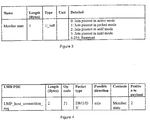
- Figure 3 describes the suggested "member state” parameter, which can be seen as an extension of the Table 5.2 in the section “Link Manager Protocol” of the Bluetooth® Specification 1.1.
- the receiving access point After receiving the request, the receiving access point should initiate and use the traditional mechanisms for parked mode, sniff mode and hold mode. Thus, the access point AP2 is able to request the mobile to enter either of these low-power modes.
- Bluetooth SIG Specification of the Bluetooth System, Version 1.1, February 2001.
Landscapes
- Engineering & Computer Science (AREA)
- Computer Networks & Wireless Communication (AREA)
- Signal Processing (AREA)
- Mobile Radio Communication Systems (AREA)
- Measurement Of The Respiration, Hearing Ability, Form, And Blood Characteristics Of Living Organisms (AREA)
- Apparatus Associated With Microorganisms And Enzymes (AREA)
- Small-Scale Networks (AREA)
- Radar Systems Or Details Thereof (AREA)
- Measurement Of Force In General (AREA)
Abstract
Description
Claims (7)
- Method for entering a communication unit into a communication cell defined by the radio coverage area of an access point, said communication cell being part of a cellular radio communication network, in which the connection between the communication unit and access point can assume at least two different modes, namely a low-power mode and an active mode, the cellular radio communication network comprising at least two access points with overlapping or adjacent radio coverage areas, each access point having a limited number of active mode connections and a number of low-power mode connections which may be substantially larger than the number of active mode connections, the at least two access points being able to hand over the communication unit, said method comprising the steps of:characterized by comprising the further steps:the communication unit discovering that it is within the radio coverage area of an access point,the communication unit requesting a connection to the access point,including in said request for a connection, an indication that the connection should be in a low-power mode,exchange of data between the communication unit and the access point in a non-active mode resulting in obtaining a low-power mode connection without having been in an active mode during said exchange of data.
- Method in accordance with claim 1,
characterized by comprising the step of
including in said request for a connection, an indication that the connection should be established in the active mode or in a specified one of several possible low-power modes. - Method in accordance with claim 1 or 2,
characterized by comprising the steps of
establishing an active mode connection between the communication unit and one access point and at least one low-power mode connection with at least one other access point. - Method in accordance with claim 3,
characterized by comprising the step of
performing hand-over of the communication unit between two access points bya) converting the active mode connection into a low-power mode connection, andb) converting a low-power mode connection into an active mode connection using the data exchanged during establishment of the low-power mode connection and maintained/updated during the low-power mode connection, to establish the active mode connection. - Method in accordance with any of the preceding claims, wherein the communication network is a Bluetooth® system and the communication unit is a Bluetooth® unit,
characterized by the data exchanged between the communication unit and the access point comprises
address information, timing information, etc., necessary for setting up the connection in the required mode. - Method in accordance with claim 5, characterized by comprising the step of implementing the inclusion of the indication in the LMP_host_connection_request by extending this with an additional parameter "member state".
- Method in accordance with claim 5 or 6, characterized by the low-power modes comprising parked mode, sniff mode and hold mode.
Priority Applications (2)
| Application Number | Priority Date | Filing Date | Title |
|---|---|---|---|
| AU2002304683A AU2002304683A1 (en) | 2001-05-05 | 2002-04-24 | Method for entering a communication unit into a communication cell |
| PCT/EP2002/004467 WO2002091679A2 (en) | 2001-05-05 | 2002-04-24 | Method for entering a communication unit into a communication cell |
Applications Claiming Priority (2)
| Application Number | Priority Date | Filing Date | Title |
|---|---|---|---|
| DKPA200100702 | 2001-05-05 | ||
| DK200100702 | 2001-05-05 |
Publications (3)
| Publication Number | Publication Date |
|---|---|
| EP1255374A2 true EP1255374A2 (en) | 2002-11-06 |
| EP1255374A3 EP1255374A3 (en) | 2003-04-16 |
| EP1255374B1 EP1255374B1 (en) | 2008-08-13 |
Family
ID=8160472
Family Applications (1)
| Application Number | Title | Priority Date | Filing Date |
|---|---|---|---|
| EP01120941A Expired - Lifetime EP1255374B1 (en) | 2001-05-05 | 2001-08-31 | Method for entering a communication unit into a communication cell |
Country Status (5)
| Country | Link |
|---|---|
| EP (1) | EP1255374B1 (en) |
| AT (1) | ATE405059T1 (en) |
| AU (1) | AU2002304683A1 (en) |
| DE (1) | DE60135307D1 (en) |
| WO (1) | WO2002091679A2 (en) |
Cited By (5)
| Publication number | Priority date | Publication date | Assignee | Title |
|---|---|---|---|---|
| GB2407004A (en) * | 2003-10-10 | 2005-04-13 | Toshiba Res Europ Ltd | Handover of a wireless download to a mobile terminal |
| EP1929710B1 (en) * | 2005-08-02 | 2013-09-04 | Trilliant Networks, Inc. | Method and apparatus for providing network communications |
| US8665068B2 (en) | 2002-03-14 | 2014-03-04 | Eices Research, Inc. | Systems and/or methods of data acquisition from a transceiver |
| US9232406B2 (en) | 2002-03-14 | 2016-01-05 | Odyssey Wireless, Inc. | Systems and/or methods of data acquisition from a transceiver |
| USRE49644E1 (en) | 2002-03-14 | 2023-09-05 | Odyssey Wireless, Inc. | Systems and/or methods of data acquisition from a transceiver |
Families Citing this family (2)
| Publication number | Priority date | Publication date | Assignee | Title |
|---|---|---|---|---|
| US7460855B2 (en) * | 2003-06-03 | 2008-12-02 | Microsoft Corporation | Selective pre-authentication to anticipated primary wireless access points |
| CN115968041B (en) * | 2022-12-22 | 2025-12-19 | 合肥工大高科信息科技股份有限公司 | Ultra-wideband concurrency identification method and system |
Family Cites Families (2)
| Publication number | Priority date | Publication date | Assignee | Title |
|---|---|---|---|---|
| SE514264C2 (en) * | 1999-05-07 | 2001-01-29 | Ericsson Telefon Ab L M | A communication system |
| US6675015B1 (en) * | 1999-09-15 | 2004-01-06 | Nokia Corporation | Apparatus, and associated method, for facilitating communication handovers in a bluetooth-public-access radio communication system |
-
2001
- 2001-08-31 DE DE60135307T patent/DE60135307D1/en not_active Expired - Fee Related
- 2001-08-31 EP EP01120941A patent/EP1255374B1/en not_active Expired - Lifetime
- 2001-08-31 AT AT01120941T patent/ATE405059T1/en not_active IP Right Cessation
-
2002
- 2002-04-24 AU AU2002304683A patent/AU2002304683A1/en not_active Abandoned
- 2002-04-24 WO PCT/EP2002/004467 patent/WO2002091679A2/en not_active Ceased
Cited By (9)
| Publication number | Priority date | Publication date | Assignee | Title |
|---|---|---|---|---|
| US8665068B2 (en) | 2002-03-14 | 2014-03-04 | Eices Research, Inc. | Systems and/or methods of data acquisition from a transceiver |
| US8970351B2 (en) | 2002-03-14 | 2015-03-03 | Eices Research, Inc. | Systems and/or methods of data acquisition from a transceiver |
| US9232406B2 (en) | 2002-03-14 | 2016-01-05 | Odyssey Wireless, Inc. | Systems and/or methods of data acquisition from a transceiver |
| USRE47408E1 (en) | 2002-03-14 | 2019-05-28 | Odyssey Wireless, Inc. | Systems and/or methods of data acquisition from a transceiver |
| USRE48562E1 (en) | 2002-03-14 | 2021-05-18 | Odyssey Wireless, Inc. | Systems and/or methods of data acquisition from a transceiver |
| USRE49644E1 (en) | 2002-03-14 | 2023-09-05 | Odyssey Wireless, Inc. | Systems and/or methods of data acquisition from a transceiver |
| GB2407004A (en) * | 2003-10-10 | 2005-04-13 | Toshiba Res Europ Ltd | Handover of a wireless download to a mobile terminal |
| GB2407004B (en) * | 2003-10-10 | 2006-01-04 | Toshiba Res Europ Ltd | Wireless download to a mobile terminal |
| EP1929710B1 (en) * | 2005-08-02 | 2013-09-04 | Trilliant Networks, Inc. | Method and apparatus for providing network communications |
Also Published As
| Publication number | Publication date |
|---|---|
| ATE405059T1 (en) | 2008-08-15 |
| DE60135307D1 (en) | 2008-09-25 |
| AU2002304683A1 (en) | 2002-11-18 |
| EP1255374A3 (en) | 2003-04-16 |
| WO2002091679A3 (en) | 2003-10-30 |
| WO2002091679A2 (en) | 2002-11-14 |
| EP1255374B1 (en) | 2008-08-13 |
Similar Documents
| Publication | Publication Date | Title |
|---|---|---|
| US6957069B2 (en) | Wireless personal communicator and communication method | |
| CA2500656C (en) | Wireless communication method and system with controlled wtru peer-to-peer communications | |
| JP4684649B2 (en) | Registration of WLAN as a UMTS routing area in WLAN-UMTS interworking | |
| US6834192B1 (en) | Method, and associated apparatus, for effectuating handover of communications in a bluetooth, or other, radio communication system | |
| JP4950327B2 (en) | System and method for performing soft handoff between frequency division duplex and time division duplex communication systems | |
| US8223662B2 (en) | Concurrent operation in multiple wireless local area networks | |
| CN114765904A (en) | Method and device for reconfiguring multilink | |
| JP2010509831A (en) | Dynamic allocation of basic service sets | |
| WO2004100576A2 (en) | Service advisor for detecting availability of a wireless communication service | |
| JP2010522448A (en) | Multifunction wireless terminal | |
| Inoue et al. | MIRAI: a solution to seamless access in heterogeneous wireless networks | |
| KR100388421B1 (en) | System for supporting handoff/roaming in the short distance radio network based on bluetooth | |
| EP1391057A4 (en) | Connection initiation in wireless networks including load balancing | |
| EP1255374B1 (en) | Method for entering a communication unit into a communication cell | |
| WO2015011190A1 (en) | Method for enhanced access selection by a user equipment in a cellular telecommunications network, telecommunications network, and system for enhanced access selection of a user equipment | |
| US20260075470A1 (en) | Enabling seamless roaming in next generation wlans | |
| TW202437787A (en) | Seamless transitions for extended personal area network (xpan) coverage | |
| CN119967501A (en) | Terminal mobility management method, device, electronic device and computer program product | |
| JP2008521271A (en) | Method and apparatus for disassociating a wireless station in a wireless network | |
| KR20040044263A (en) | Wireless LAN Cellular System and Method for Operating | |
| AU2007200222A1 (en) | Wireless communication method and system with controlled WTRU peer-to-peer communications |
Legal Events
| Date | Code | Title | Description |
|---|---|---|---|
| PUAI | Public reference made under article 153(3) epc to a published international application that has entered the european phase |
Free format text: ORIGINAL CODE: 0009012 |
|
| AK | Designated contracting states |
Kind code of ref document: A2 Designated state(s): AT BE CH CY DE DK ES FI FR GB GR IE IT LI LU MC NL PT SE TR |
|
| AX | Request for extension of the european patent |
Free format text: AL;LT;LV;MK;RO;SI |
|
| PUAL | Search report despatched |
Free format text: ORIGINAL CODE: 0009013 |
|
| RIC1 | Information provided on ipc code assigned before grant |
Ipc: 7H 04Q 7/38 B Ipc: 7H 04L 12/28 A |
|
| AK | Designated contracting states |
Designated state(s): AT BE CH CY DE DK ES FI FR GB GR IE IT LI LU MC NL PT SE TR |
|
| AX | Request for extension of the european patent |
Extension state: AL LT LV MK RO SI |
|
| 17P | Request for examination filed |
Effective date: 20030512 |
|
| AKX | Designation fees paid |
Designated state(s): AT BE CH CY DE DK ES FI FR GB GR IE IT LI LU MC NL PT SE TR |
|
| RAP1 | Party data changed (applicant data changed or rights of an application transferred) |
Owner name: TELEFONAKTIEBOLAGET LM ERICSSON (PUBL) |
|
| GRAP | Despatch of communication of intention to grant a patent |
Free format text: ORIGINAL CODE: EPIDOSNIGR1 |
|
| GRAS | Grant fee paid |
Free format text: ORIGINAL CODE: EPIDOSNIGR3 |
|
| GRAA | (expected) grant |
Free format text: ORIGINAL CODE: 0009210 |
|
| AK | Designated contracting states |
Kind code of ref document: B1 Designated state(s): AT BE CH CY DE DK ES FI FR GB GR IE IT LI LU MC NL PT SE TR |
|
| REG | Reference to a national code |
Ref country code: GB Ref legal event code: FG4D |
|
| REG | Reference to a national code |
Ref country code: CH Ref legal event code: EP |
|
| REG | Reference to a national code |
Ref country code: IE Ref legal event code: FG4D |
|
| REF | Corresponds to: |
Ref document number: 60135307 Country of ref document: DE Date of ref document: 20080925 Kind code of ref document: P |
|
| PGFP | Annual fee paid to national office [announced via postgrant information from national office to epo] |
Ref country code: GB Payment date: 20080827 Year of fee payment: 8 |
|
| PG25 | Lapsed in a contracting state [announced via postgrant information from national office to epo] |
Ref country code: NL Free format text: LAPSE BECAUSE OF FAILURE TO SUBMIT A TRANSLATION OF THE DESCRIPTION OR TO PAY THE FEE WITHIN THE PRESCRIBED TIME-LIMIT Effective date: 20080813 Ref country code: ES Free format text: LAPSE BECAUSE OF FAILURE TO SUBMIT A TRANSLATION OF THE DESCRIPTION OR TO PAY THE FEE WITHIN THE PRESCRIBED TIME-LIMIT Effective date: 20081124 |
|
| PG25 | Lapsed in a contracting state [announced via postgrant information from national office to epo] |
Ref country code: FI Free format text: LAPSE BECAUSE OF FAILURE TO SUBMIT A TRANSLATION OF THE DESCRIPTION OR TO PAY THE FEE WITHIN THE PRESCRIBED TIME-LIMIT Effective date: 20080813 Ref country code: AT Free format text: LAPSE BECAUSE OF FAILURE TO SUBMIT A TRANSLATION OF THE DESCRIPTION OR TO PAY THE FEE WITHIN THE PRESCRIBED TIME-LIMIT Effective date: 20080813 |
|
| PG25 | Lapsed in a contracting state [announced via postgrant information from national office to epo] |
Ref country code: BE Free format text: LAPSE BECAUSE OF FAILURE TO SUBMIT A TRANSLATION OF THE DESCRIPTION OR TO PAY THE FEE WITHIN THE PRESCRIBED TIME-LIMIT Effective date: 20080813 Ref country code: MC Free format text: LAPSE BECAUSE OF NON-PAYMENT OF DUE FEES Effective date: 20080831 |
|
| REG | Reference to a national code |
Ref country code: CH Ref legal event code: PL |
|
| PG25 | Lapsed in a contracting state [announced via postgrant information from national office to epo] |
Ref country code: DK Free format text: LAPSE BECAUSE OF FAILURE TO SUBMIT A TRANSLATION OF THE DESCRIPTION OR TO PAY THE FEE WITHIN THE PRESCRIBED TIME-LIMIT Effective date: 20080813 |
|
| PG25 | Lapsed in a contracting state [announced via postgrant information from national office to epo] |
Ref country code: PT Free format text: LAPSE BECAUSE OF FAILURE TO SUBMIT A TRANSLATION OF THE DESCRIPTION OR TO PAY THE FEE WITHIN THE PRESCRIBED TIME-LIMIT Effective date: 20090113 |
|
| PLBE | No opposition filed within time limit |
Free format text: ORIGINAL CODE: 0009261 |
|
| STAA | Information on the status of an ep patent application or granted ep patent |
Free format text: STATUS: NO OPPOSITION FILED WITHIN TIME LIMIT |
|
| PG25 | Lapsed in a contracting state [announced via postgrant information from national office to epo] |
Ref country code: LI Free format text: LAPSE BECAUSE OF NON-PAYMENT OF DUE FEES Effective date: 20080831 Ref country code: CH Free format text: LAPSE BECAUSE OF NON-PAYMENT OF DUE FEES Effective date: 20080831 |
|
| 26N | No opposition filed |
Effective date: 20090514 |
|
| REG | Reference to a national code |
Ref country code: FR Ref legal event code: ST Effective date: 20090630 |
|
| PG25 | Lapsed in a contracting state [announced via postgrant information from national office to epo] |
Ref country code: IE Free format text: LAPSE BECAUSE OF NON-PAYMENT OF DUE FEES Effective date: 20080831 |
|
| PG25 | Lapsed in a contracting state [announced via postgrant information from national office to epo] |
Ref country code: DE Free format text: LAPSE BECAUSE OF NON-PAYMENT OF DUE FEES Effective date: 20090303 Ref country code: IT Free format text: LAPSE BECAUSE OF FAILURE TO SUBMIT A TRANSLATION OF THE DESCRIPTION OR TO PAY THE FEE WITHIN THE PRESCRIBED TIME-LIMIT Effective date: 20080813 |
|
| PG25 | Lapsed in a contracting state [announced via postgrant information from national office to epo] |
Ref country code: FR Free format text: LAPSE BECAUSE OF NON-PAYMENT OF DUE FEES Effective date: 20080901 |
|
| PG25 | Lapsed in a contracting state [announced via postgrant information from national office to epo] |
Ref country code: SE Free format text: LAPSE BECAUSE OF FAILURE TO SUBMIT A TRANSLATION OF THE DESCRIPTION OR TO PAY THE FEE WITHIN THE PRESCRIBED TIME-LIMIT Effective date: 20081113 |
|
| GBPC | Gb: european patent ceased through non-payment of renewal fee |
Effective date: 20090831 |
|
| PG25 | Lapsed in a contracting state [announced via postgrant information from national office to epo] |
Ref country code: LU Free format text: LAPSE BECAUSE OF NON-PAYMENT OF DUE FEES Effective date: 20080831 Ref country code: CY Free format text: LAPSE BECAUSE OF FAILURE TO SUBMIT A TRANSLATION OF THE DESCRIPTION OR TO PAY THE FEE WITHIN THE PRESCRIBED TIME-LIMIT Effective date: 20080813 |
|
| PG25 | Lapsed in a contracting state [announced via postgrant information from national office to epo] |
Ref country code: TR Free format text: LAPSE BECAUSE OF FAILURE TO SUBMIT A TRANSLATION OF THE DESCRIPTION OR TO PAY THE FEE WITHIN THE PRESCRIBED TIME-LIMIT Effective date: 20080813 |
|
| PG25 | Lapsed in a contracting state [announced via postgrant information from national office to epo] |
Ref country code: GR Free format text: LAPSE BECAUSE OF FAILURE TO SUBMIT A TRANSLATION OF THE DESCRIPTION OR TO PAY THE FEE WITHIN THE PRESCRIBED TIME-LIMIT Effective date: 20081114 |
|
| PG25 | Lapsed in a contracting state [announced via postgrant information from national office to epo] |
Ref country code: GB Free format text: LAPSE BECAUSE OF NON-PAYMENT OF DUE FEES Effective date: 20090831 |