EP1255177A2 - Image recognizing apparatus and method - Google Patents
Image recognizing apparatus and method Download PDFInfo
- Publication number
- EP1255177A2 EP1255177A2 EP02009680A EP02009680A EP1255177A2 EP 1255177 A2 EP1255177 A2 EP 1255177A2 EP 02009680 A EP02009680 A EP 02009680A EP 02009680 A EP02009680 A EP 02009680A EP 1255177 A2 EP1255177 A2 EP 1255177A2
- Authority
- EP
- European Patent Office
- Prior art keywords
- behavior
- mobile unit
- image
- confidence
- calculating
- Prior art date
- Legal status (The legal status is an assumption and is not a legal conclusion. Google has not performed a legal analysis and makes no representation as to the accuracy of the status listed.)
- Withdrawn
Links
Images


Classifications
-
- G—PHYSICS
- G05—CONTROLLING; REGULATING
- G05D—SYSTEMS FOR CONTROLLING OR REGULATING NON-ELECTRIC VARIABLES
- G05D1/00—Control of position, course, altitude or attitude of land, water, air or space vehicles, e.g. using automatic pilots
- G05D1/02—Control of position or course in two dimensions
- G05D1/021—Control of position or course in two dimensions specially adapted to land vehicles
- G05D1/0231—Control of position or course in two dimensions specially adapted to land vehicles using optical position detecting means
- G05D1/0246—Control of position or course in two dimensions specially adapted to land vehicles using optical position detecting means using a video camera in combination with image processing means
- G05D1/0253—Control of position or course in two dimensions specially adapted to land vehicles using optical position detecting means using a video camera in combination with image processing means extracting relative motion information from a plurality of images taken successively, e.g. visual odometry, optical flow
-
- G—PHYSICS
- G06—COMPUTING OR CALCULATING; COUNTING
- G06V—IMAGE OR VIDEO RECOGNITION OR UNDERSTANDING
- G06V40/00—Recognition of biometric, human-related or animal-related patterns in image or video data
- G06V40/20—Movements or behaviour, e.g. gesture recognition
Definitions
- the present invention relates to image recognizing apparatus and method. More specifically, the invention relates to image recognizing apparatus and method for recognizing the behavior of mobile unit using images of external environment taken when the mobile unit is moving.
- a method for detecting optical flow is well-known in the art for recognizing behavior of mobile unit using images of external environment by calculating, for example, gradient change of image density from sequence of input images.
- the method comprises calculating optical flow from moving images and processing the optical flow with neural network layer to recognize the behavior of the mobile unit.
- the method further comprises judging necessary processing based on the recognition.
- detecting the approach to the obstacle is enabled with simple neural network based on moving images.
- It is objective of the present invention is to provide an image recognizing apparatus and method that can recognize the behavior of a mobile unit rapidly and accurately using images of external environment taken on the mobile unit in the real application.
- An image recognizing apparatus performs learning in an on-line like fashion in the real application without executing smoothing process to remove the noise effect like conventional art, and improve robustness over variation of environment by using such noise as data for feature extraction.
- the image recognizing apparatus comprises behavior command output means for outputting behavior commands to cause a mobile unit to move and local feature extraction means for extracting features of local areas within an image of external environment acquired on the mobile unit when the behavior command is output.
- the apparatus further comprises global feature extraction means for extracting features of global area of the image using the extracted features of the local areas and learning means for calculating probability models to recognize behavior of the mobile unit based on the extracted features of the global area.
- the local feature extraction means extracts the features of the local areas within the image by utilizing image intensities obtained by applying both positive and negative component of Gabor filters on two images.
- the Gabor filters are applied on one of eight different directions respectively.
- the global feature extraction means combines the features of the local areas into the global feature with the use of Gaussian functions.
- the probability models are generated utilizing expectation maximization algorithm and supervised learning with the use of neural network, but any other learning algorithm may be used.
- the apparatus may comprises a behavioral recognition means for applying Bayes' rule with use of the probability model on an image acquired afresh.
- the behavioral recognition means further calculates confidence for each of the behavior commands to recognize behavior of the mobile unit.
- the apparatus further comprises a behavioral assessment means for comparing the confidence with a predetermined value to assess the recognized behavior, an attention generation means for generating attentional demanding which demands to cause the probability model to be updated based on the result of the assessment, and an attentional modulation means for changing specified parameter of the global feature extraction means in response to the attentional demanding.
- the learning means recalculates probability model after the parameter is changed. Then the behavior recognition means recognizes behavior of the mobile unit again with the probability models.
- Fig. 1 is a block diagram of image recognizing apparatus 10 according to one embodiment of the present invention.
- Image recognizing apparatus 10 comprises a behavior command output block 12, a local feature extraction block 16, a global feature extraction block 18, a learning block 20, memory 22, a behavior recognition block 24, a behavior assessment block 26, an attention generation block 28 and an attentional modulation block 30.
- the recognizing process of the image recognizing apparatus 10 comprises two parts.
- First part is advance learning part, where relationship is learned between behavior of a moving mobile unit and images taken by a camera equipped on the mobile unit.
- Second part is behavior recognizing part, where behavior of the mobile unit is recognized based on newly taken image using the knowledge learned in the advance learning part.
- the behavior command output block 12 the local feature extraction block 16, the global feature extraction block 18, the learning block 20 and the memory 22 are employed.
- the behavior recognition block 24, the behavior assessment block 26, the attention generation block 28 and the attentional modulation block 30 are employed.
- the behavior command output block 12 outputs behavior commands to a mobile unit 32.
- term "behavior command” means a command to cause the mobile unit to go straight, to make right turn, or left turn.
- the behavior commands are output depending on instruction signal transmitted from external device.
- the behavior command output block 12 may read pre-stored sequence of behavior commands and then output them.
- the mobile unit 32 recognizes behavior of itself based on acquired image and determines which behavior to take next, and the behavior command output block 12 outputs the behavior command depending on the determination.
- the behavior command is sent to mobile unit 32 by radio or cable broadcasting and causes it to move (for example, go straight or turn left/right).
- the behavior command is also supplied to global feature extraction block 18 and used for generation of global features described below.
- an image acquisition block 14 such as a charge-coupled device (CCD) camera, which acquires image I(t) of external environment of the mobile unit 32 at time t every preset interval and supplies it to the local feature extraction block 16.
- CCD charge-coupled device
- the local feature extraction block 16 extracts feature vector of each local area of the image I(t).
- the term "local area” means one of small areas into which whole image I(t) acquired by the image acquisition block 14 is divided such that each small area has same dimension. Each local area is composed of plurality of pixels.
- the local feature extraction block 16 calculates optical flow from two images I(t), I(t+1) consecutive in time and used the optical flow to generate feature vector for each local area (hereinafter referred to as "local feature").
- the extracted local features are supplied to the global feature extraction block 18.
- the global feature extraction block 18 combines all of the local features of the image I(t) and extracts one new feature vector, which is referred to as "global feature” hereinafter.
- the global feature is supplied to the learning block 20.
- the learning block 20 implements learning based on the global feature and generates probability models described below.
- well-known expectation maximization algorithm and supervised learning with the use of neural network are used for such learning.
- other learning algorithm may be used.
- the probability models generated by the learning are stored in the memory 22 and used for recognition of behavior of the mobile unit 32 in the behavior recognizing part.
- the image recognizing apparatus 10 provides functionality of recognizing the behavior of the mobile unit 32 accurately by applying the probability models on an image acquired afresh by the image acquisition block 14.
- the image acquisition block 14 acquires image I(t) of external environment of the mobile unit 32 at time t for every preset interval as is noted above, and then supplies it to the behavior recognition block 24 this time.
- the behavior recognition block 24 applies the probability model stored in the memory 22 on the supplied image I(t).
- the block 24 then calculates "confidence" for each of behavior commands and recognizes the behavior of the mobile unit 32 based on the confidence.
- the confidence is supplied to the behavioral assessment block 26, which calculates logarithmic likelihood of the confidence. If the logarithmic likelihood of the confidence is larger than a specified value, no more operation is generated. If the logarithmic likelihood of the confidence is equal to or less then the predetermined value, the attention generation block 28 generates attentional demanding signal and supplies it to the attentional modulation block 30.
- the attentional modulation block 30 Upon receiving the attentional demanding, the attentional modulation block 30 changes (or modulates) a specified parameter in the learning algorithm and causes the learning block 20 to update the probability models, which is stored in the memory 22.
- the behavior recognition block 24 uses the updated probability models and recognizes the behavior of the mobile unit 32 again. Thus, the accuracy of behavior recognition will be expected to be more than a certain level.
- the image acquisition block 14 needs to be installed on the mobile unit 32, it is not necessary for the image recognizing apparatus 10 to be installed on the mobile unit 32 and may be located in external place. In case of being installed on the mobile unit 32, the image recognizing apparatus 10 may be either integral with or separate from the image acquisition block 14. Communication between the image acquisition block 14 and the image recognizing apparatus 10 may be done via cable or radio transmission.
- the image recognizing apparatus 10 may be all or partly implemented by, for example, executing on a computer program configured to execute processes noted above.
- Fig. 2 is a flowchart illustrating the process of the advance learning part.
- the image acquisition block 14 acquires image I(t) at time t while the mobile unit 32 moves around in a given environment (step S42).
- the local feature extraction block 16 extracts local features from the acquired images I(t) and I(t+1) (step S44 ... S48). More specifically, Gabor filters are used to calculate image intensity E i (x t ,y t ) by being applied to each local area image within the acquired images. A plurality of image intensities E i (x t ,y t ) in each direction of the Gabor filter are obtained for each local area according to the following Eq. (1) (step S44).
- E i (x t ,y t ) Img (t) ⁇ Gbr i (+) + Img (t+1) ⁇ Gbr i (-)
- Gbr i (+) and Gbr i (-) represent positive component and negative component of the Gabor filter respectively.
- Subscript "i" represents direction of the Gabor filter. In the embodiment, “i” ranges from 1 to 8.
- Img (t) represents a local area image within the image I(t) acquired at certain time t and Img (t+1) represents a local area image within the image I(t+1) acquired at consecutive time t+1.
- (x t ,y t ) shows coordinate of pixel in a local area at time t. Therefore, E i (x t ,y t ) represents image intensity in direction i of the local area image.
- Direction for applying Gabor filters and the number of Gabor filters are arbitrary.
- Gabor filters in eight directions extending radially in equal angles from center of whole image are employed.
- j argmax i E i (x t ,y t ) It should be noted that selected directions j will be different between local areas.
- the local feature extraction block 16 applies Gauss function to the largest image intensity E j (x t ,y t ) according to following Eq. (3) to obtain local feature ⁇ j (x t ,y t ) for each local area (step S48).
- ⁇ j is an average of image intensities E j (x t ,y t ).
- ⁇ j is variance of these image intensities E j (x t ,y t ). Therefore, the local feature ⁇ j (x t ,y t ) means the expression of probability density distribution for image intensity E j (x t ,y t ) in each local area image with regard to direction having the largest intensity.
- Local features ⁇ j (x t ,y t ) are calculated as many as the number of local areas. It should be noted that the direction j where local feature ⁇ j (x t ,y t ) is calculated for each local area is different.
- the global feature extraction block 18 Upon receiving the local features ⁇ j (x t ,y t ) from the local feature extraction block 16 and the behavior command from the behavior command output block 12, the global feature extraction block 18 combines all local features ⁇ j (x t ,y t ) with regard to each largest direction j of the image intensity to obtain global feature ⁇ j ( ⁇ t
- ⁇ t means two-dimensional Cartesian coordinate of (x t ,y t ).
- l) is distributed to one of classes according to the behavior command output by the behavior command output block 12 when the image I(t) is acquired, and stored in memory (step S52).
- "l" represents behavior command.
- attention class ⁇ 1 .
- term “attention class” is for updating learning result efficiently by noticing certain feature when new feature is presented, not reflecting all of them.
- the attentional class is identical to the probability model of different behaviors.
- the number of attention class is not limited to three but any number of the attention class may be employed correlating to the number of behavior commands.
- Figs. 3 to Figs. 5 illustrate the relationship among original (acquired) image I(t), local feature ⁇ j (x t ,y t ) and global feature ⁇ j ( ⁇ t
- Figs. 3 correspond to the case when the mobile unit 32 goes straight.
- Figs. 4 correspond to the case when the mobile unit 32 turns left, and
- Figs. 5 correspond to the case when the mobile unit 32 turns right, respectively.
- Upper part (a) of Figs. 3 to Figs. 5 show images of obstacles acquired at the place when the car is located in the environment.
- Middle part (b) of Figs. 3 to Figs. 5 show graph of local feature when one direction of the Gabor filter is applied to a whole image, calculated by the Eq.(2) and Eq.(3). In this example, the whole image is divided in 77*57 local areas.
- Lower part (c) of Figs. 3 to Figs. 5 are the Polar-shaped maps which depict the global feature ⁇ j calculted by Eq. (4), consisting of the eight direction of the Gabor filter. In part (c), numerals of 1 to 8 correspond to application direction of the Gabor filter (upward direction, right-upward direction, or the like).
- the learning block 20 After storing the global feature ⁇ j ( ⁇ t
- EM algorithm Expectation Maximization algorithm
- supervised learning with the use of neural network are employed to obtain probability models for recognizing behavior of the mobile unit 32.
- the EM algorithm is an iterative algorithm for estimating parameter ⁇ which takes maximum likelihood when observed data is viewed as incomplete data. Assuming mean of the observed data is represented as ⁇ 1 and covariance as ⁇ 1 , the parameter ⁇ may be represented as ⁇ ( ⁇ 1 , ⁇ 1 ). EM algorithm is initiated with appropriate initial values of ⁇ ( ⁇ 1 , ⁇ 1 ). Then the parameter ⁇ ( ⁇ 1 , ⁇ 1 ) is updated one after another by iterating Expectation (E) step and Maximization (M) step alternately.
- E Expectation
- M Maximization
- ⁇ (k) ) is calculated according to following Eq. (5) ⁇ ( ⁇
- ⁇ ( k ) ) ⁇ i ⁇ l p ( ⁇ l
- ⁇ (k) ) are calculated by following Eq. (6) and comprise a new estimated value ⁇ (k+1) .
- ⁇ ( k +1) argmax ⁇ ⁇ ( ⁇ , ⁇ ( k ) )
- ⁇ (k) ) is obtained.
- ⁇ (k) ) is obtained by partial differentiating this value ⁇ ( ⁇
- parameters ⁇ 1 and ⁇ 1 may be finally calculated. More detailed explanation will be omitted because this EM algorithm is well known in the art.
- the global feature extraction block 18 uses those calculated ⁇ 1 and ⁇ 1 in following Eq. (7) to calculate prior probability p ( ⁇ 1
- p ⁇ 1
- N the number of dimensions of global feature ⁇ j ( ⁇ t
- ⁇ 1 ) is calculated for image I(t) with attention class as supervising signal (step S58).
- Fig. 6 shows one example of hierarchical neural network used for the supervised learnin.
- This hierarchical neural network has three layer of node. Nodes in input layer 72 correspond to (original) images I(t), nodes in middle layer 74 to global features ⁇ j ( ⁇ t
- ⁇ denotes synaptic weight of the hierarchical neural network.
- l) belongs to each attention class ⁇ 1 is obtained by EM algorithm, and global feature ⁇ j ( ⁇ t
- ⁇ 1 ) may be obtained.
- Probability model calculated by learning block 20 is stored in memory 22 (step S 60). If advance learning is continued, "yes" is selected in step S62 and a series of processes from step S42 to S60 is repeated, and then probability model is updated. While the mobile unit 32 is moving, advance learning is executed for all of images I(t) acquired in time t. When probability model is judged to be highly accurate enough to recognize behavior of mobile unit 32 (for example, process is completed for predetermined number of images I(t)), the process ends (step S64).
- Fig. 7 is a flow chart illustrating of process of the behavior recognizing part.
- the image acquisition block 14 acquires two of new images at time t every preset interval (step 82).
- Probability models (prior probability p ( ⁇ 1
- ⁇ 1 )) calculated in the advance learning part are used in following Bayes' rule and confidence p( ⁇ 1 (t)) for each attention class ⁇ 1 (l 1,2,3) is calculated (step S84).
- This confidence p( ⁇ 1 (t)) means the probability that the new image I(t) belongs to each attention class ⁇ 1 .
- step S86 the largest one is selected (step S86).
- the behavior assessment block 26 determines whether logarithmic likelihood of confidence p( ⁇ 1 (t)) is larger than a predetermined value K (step S88). If log p ( ⁇ 1 (t))>K, behavior command 1 corresponding to attention class ⁇ 1 of which the confidence is largest is recognized as the behavior of the mobile unit 32 (step S92). Otherwise, log p( ⁇ 1 (t)) ⁇ K, the attention generation block 28 generates attentional demanding.
- the attentional modulation block 30 increments gaussian mixture "m" in Eq. (7) by specified value (that is, attentional modulation) (step S90). And in the learning block 20, a series of process in steps S56 to S60 in Fig. 2 is carried out again and the probability models (prior probability p-( ⁇
- step S84 The process goes back to step S84 and repeats steps S84 to S88.
- gaussian mixture m is increased until logarithmic likelihood log p( ⁇ 1 (t)) excesses the predetermined value K.
- once-generated probability model may be always used without updating process.
- the image recognizing apparatus does not recognize the behavior of the mobile unit based only on the image. Instead, since the image recognizing apparatus first complete the learning on the relationship between the global feature extracted from the image and behavior command and then recognizes the behavior using the learning result, the apparatus can recognize the behavior of the mobile unit rapidly and accurately in real application.
- the image recognizing apparatus may get the real moving status of the mobile unit according to the behavior recognizing process.
- Fig. 8 shows a block diagram of radio control car (hereinafter referred to as "RC car") 100 that carried image recognizing apparatus 10 of the present invention. Blocks with same numerals as blocks in Fig.1 have similar function.
- RC car 100 On the RC car 100 is provided an image input camera 114 to acquire images, a steering control block 132 and a motor control block 134 for controlling the behavior of the RC car 100 according to the behavior command, and receiver 136 and transmitter 138 for communicating with outside device.
- the receiver 136 receives behavior command signal from the outside device and supplies it to the behavior command output block 12.
- the RC car 100 makes going straight, left turn, or right turn in accordance with the behavior command.
- the transmitter 138 transmits behavior of RC car 100 recognized by the behavior recognition block 24 to the outside device.
- Figure 9 is an exemplar illustrating change of logarithmic likelihood log p ( ⁇ 1 (t)) of confidence for an attention class.
- Horizontal axis expresses the number of gaussian mixture m of Eq. (7) and vertical axis expresses logarithmic likelihood log p( ⁇ 1 (t)) of confidence. It can be understood that the logarithmic likelihood becomes saturated when the number of Gaussian mixture m reaches about 50. Larger logarithmic likelihood for an attention class for each image means that the image recognizing apparatus 10 recognizes the probability as sufficiently high that the RC car 100 takes the behavior corresponding to that attention class.
- Horizontal axis of each graph shows 24 frames of image on which behavioral recognition is performed.
- the image recognizing apparatus improves the reliability by repeating learning in attention class generated in bottom-up fashion in the advance learning part.
- recognizing accuracy of behavior is improved because learning result is updated until logarithmic likelihood of confidence excesses the predetermined value.
- the image recognizing apparatus instead of recognizing the behavior of mobile unit based only on images, the image recognizing apparatus pre-learned the relationship between images and behavior commands and determines the behavior using the learning result. Therefore, it can recognize the behavior of the mobile unit rapidly and accurately in real application.
Landscapes
- Engineering & Computer Science (AREA)
- Physics & Mathematics (AREA)
- Computer Vision & Pattern Recognition (AREA)
- Multimedia (AREA)
- General Physics & Mathematics (AREA)
- Theoretical Computer Science (AREA)
- Aviation & Aerospace Engineering (AREA)
- Social Psychology (AREA)
- Psychiatry (AREA)
- General Health & Medical Sciences (AREA)
- Health & Medical Sciences (AREA)
- Electromagnetism (AREA)
- Human Computer Interaction (AREA)
- Radar, Positioning & Navigation (AREA)
- Remote Sensing (AREA)
- Automation & Control Theory (AREA)
- Image Analysis (AREA)
- Image Processing (AREA)
- Length Measuring Devices By Optical Means (AREA)
- Control Of Position, Course, Altitude, Or Attitude Of Moving Bodies (AREA)
Abstract
An image recognizing apparatus and method is provided for recognizing behavior of a
mobile unit accurately with an image of external environment acquired during the
mobile unit is moving.
Behavior command output block (12) outputs behavior commands to cause the
mobile unit (32) move. Local feature extraction block (16) extracts features of local
areas of the image from the image of external environment acquired on the mobile unit
(32) when the behavior command is output. Global feature extraction block (18)
extracts feature of global area of the image using the features of local areas. Learning
block (20) calculates probability models for recognizing behavior given to the mobile
unit (32) based on the feature of global area of the image. After learning is finished,
behavior of the mobile unit (32) may be recognized rapidly and accurately by applying
the probability models to an image of external environment acquired in mobile unit (32)
afresh.
Description
The present invention relates to image recognizing apparatus and method. More
specifically, the invention relates to image recognizing apparatus and method for
recognizing the behavior of mobile unit using images of external environment taken
when the mobile unit is moving.
A method for detecting optical flow is well-known in the art for recognizing
behavior of mobile unit using images of external environment by calculating, for
example, gradient change of image density from sequence of input images.
In Japanese Patent Application Unexamined Publication (Kokai) No.
2000-171250, a method for detecting current position of a mobile unit by means of
optical flow is disclosed. According to the method, optical flow of scenes of certain
course are acquired every predetermined distance when the mobile unit moves along
with the course beforehand. Then relationship between the optical flow and taking
point is stored. After that, optical flow of the course is newly detected and undergoes
matching with all of stored optical flows. The one showing maximum matching result
is selected and a point associated with the selected one is recognized as current point
where the mobile unit moves.
In Japanese Patent Application Unexamined Publication (Kokai) No. H11-134504,
another method is disclosed. The method comprises calculating optical flow from
moving images and processing the optical flow with neural network layer to
recognize the behavior of the mobile unit. The method further comprises judging
necessary processing based on the recognition. According to the method, detecting
the approach to the obstacle is enabled with simple neural network based on moving
images.
However, in order to implement the former method, many relationships between
optical flow and point in a course need to be stored by moving the mobile unit in the
predetermined course beforehand.
Generally, there are some problems to recognize position and behavior of the
mobile unit by feature extracting based only on moving images like the latter
method. For example, since relative distance between light source and a camera on
the mobile unit changes continuously as the mobile unit moves, image intensity such
as lightness changes so great that accurate feature extracting is difficult. In
addition, since vibration of the moving mobile unit is transmitted to the camera,
accuracy of feature extraction is degraded. If a recognizing system is configured to
execute smoothing process over multiple frame of images to remove bad effects due
to the variation of image intensity or the vibration, computing load becomes too
heavy or feature extraction becomes difficult when the image moves fast due to large
time variation.
It is objective of the present invention is to provide an image recognizing
apparatus and method that can recognize the behavior of a mobile unit rapidly and
accurately using images of external environment taken on the mobile unit in the real
application.
An image recognizing apparatus according to the invention performs learning in
an on-line like fashion in the real application without executing smoothing process
to remove the noise effect like conventional art, and improve robustness over
variation of environment by using such noise as data for feature extraction.
The image recognizing apparatus according to the invention comprises behavior
command output means for outputting behavior commands to cause a mobile unit to
move and local feature extraction means for extracting features of local areas within
an image of external environment acquired on the mobile unit when the behavior
command is output. The apparatus further comprises global feature extraction
means for extracting features of global area of the image using the extracted
features of the local areas and learning means for calculating probability models to
recognize behavior of the mobile unit based on the extracted features of the global
area.
The local feature extraction means extracts the features of the local areas within
the image by utilizing image intensities obtained by applying both positive and
negative component of Gabor filters on two images. Preferably, the Gabor filters are
applied on one of eight different directions respectively.
The global feature extraction means combines the features of the local areas into
the global feature with the use of Gaussian functions.
It is preferable that the probability models are generated utilizing expectation
maximization algorithm and supervised learning with the use of neural network, but
any other learning algorithm may be used.
After the probability models are generated, high-accurate behavior recognition of
the mobile unit is enabled by applying the models to an image acquired afresh.
Therefore, the apparatus may comprises a behavioral recognition means for applying
Bayes' rule with use of the probability model on an image acquired afresh. The
behavioral recognition means further calculates confidence for each of the behavior
commands to recognize behavior of the mobile unit.
It is desirable that the accuracy of the behavior recognition is always greater
than a certain level. Therefore, the apparatus according to the invention further
comprises a behavioral assessment means for comparing the confidence with a
predetermined value to assess the recognized behavior, an attention generation
means for generating attentional demanding which demands to cause the probability
model to be updated based on the result of the assessment, and an attentional
modulation means for changing specified parameter of the global feature extraction
means in response to the attentional demanding.
In this case, the learning means recalculates probability model after the
parameter is changed. Then the behavior recognition means recognizes behavior of
the mobile unit again with the probability models.
Other features and embodiments of the invention will be apparent for those
skilled in the art by reading the following detailed description referring to the
attached drawings.
Now some preferred embodiments of the invention will be described below with
reference to the attached drawings.
Fig. 1 is a block diagram of image recognizing apparatus 10 according to one
embodiment of the present invention. Image recognizing apparatus 10 comprises a
behavior command output block 12, a local feature extraction block 16, a global
feature extraction block 18, a learning block 20, memory 22, a behavior recognition
block 24, a behavior assessment block 26, an attention generation block 28 and an
attentional modulation block 30.
The recognizing process of the image recognizing apparatus 10 comprises two
parts. First part is advance learning part, where relationship is learned between
behavior of a moving mobile unit and images taken by a camera equipped on the
mobile unit. Second part is behavior recognizing part, where behavior of the mobile
unit is recognized based on newly taken image using the knowledge learned in the
advance learning part.
In the advance learning part, the behavior command output block 12, the local
feature extraction block 16, the global feature extraction block 18, the learning block
20 and the memory 22 are employed. In the behavior recognizing part, in addition to
those blocks, the behavior recognition block 24, the behavior assessment block 26,
the attention generation block 28 and the attentional modulation block 30 are
employed.
At first, each block employed in the advance learning part is described.
The behavior command output block 12 outputs behavior commands to a mobile
unit 32. As used herein, term "behavior command" means a command to cause the
mobile unit to go straight, to make right turn, or left turn. The behavior commands
are output depending on instruction signal transmitted from external device. In
alternative embodiment, the behavior command output block 12 may read pre-stored
sequence of behavior commands and then output them. In a further alternative
embodiment, the mobile unit 32 recognizes behavior of itself based on acquired
image and determines which behavior to take next, and the behavior command
output block 12 outputs the behavior command depending on the determination.
The behavior command is sent to mobile unit 32 by radio or cable broadcasting
and causes it to move (for example, go straight or turn left/right). The behavior
command is also supplied to global feature extraction block 18 and used for
generation of global features described below.
Provided on the mobile unit 32 is an image acquisition block 14 such as a
charge-coupled device (CCD) camera, which acquires image I(t) of external
environment of the mobile unit 32 at time t every preset interval and supplies it to
the local feature extraction block 16.
The local feature extraction block 16 extracts feature vector of each local area of
the image I(t). As used herein, the term "local area" means one of small areas into
which whole image I(t) acquired by the image acquisition block 14 is divided such
that each small area has same dimension. Each local area is composed of plurality of
pixels. In the present embodiment, the local feature extraction block 16 calculates
optical flow from two images I(t), I(t+1) consecutive in time and used the optical flow
to generate feature vector for each local area (hereinafter referred to as "local
feature"). The extracted local features are supplied to the global feature extraction
block 18.
The global feature extraction block 18 combines all of the local features of the
image I(t) and extracts one new feature vector, which is referred to as "global
feature" hereinafter. The global feature is supplied to the learning block 20.
The learning block 20 implements learning based on the global feature and
generates probability models described below. In the present embodiment,
well-known expectation maximization algorithm and supervised learning with the
use of neural network are used for such learning. Alternatively, other learning
algorithm may be used. The probability models generated by the learning are stored
in the memory 22 and used for recognition of behavior of the mobile unit 32 in the
behavior recognizing part.
After the advance learning part is finished, the image recognizing apparatus 10
provides functionality of recognizing the behavior of the mobile unit 32 accurately by
applying the probability models on an image acquired afresh by the image
acquisition block 14.
Now each block employed in the behavior recognizing part is described.
The image acquisition block 14 acquires image I(t) of external environment of the
mobile unit 32 at time t for every preset interval as is noted above, and then supplies
it to the behavior recognition block 24 this time. The behavior recognition block 24
applies the probability model stored in the memory 22 on the supplied image I(t).
The block 24 then calculates "confidence" for each of behavior commands and
recognizes the behavior of the mobile unit 32 based on the confidence.
The confidence is supplied to the behavioral assessment block 26, which
calculates logarithmic likelihood of the confidence. If the logarithmic likelihood of
the confidence is larger than a specified value, no more operation is generated. If the
logarithmic likelihood of the confidence is equal to or less then the predetermined
value, the attention generation block 28 generates attentional demanding signal and
supplies it to the attentional modulation block 30.
Upon receiving the attentional demanding, the attentional modulation block 30
changes (or modulates) a specified parameter in the learning algorithm and causes
the learning block 20 to update the probability models, which is stored in the
memory 22. The behavior recognition block 24 uses the updated probability models
and recognizes the behavior of the mobile unit 32 again. Thus, the accuracy of
behavior recognition will be expected to be more than a certain level.
While the image acquisition block 14 needs to be installed on the mobile unit 32,
it is not necessary for the image recognizing apparatus 10 to be installed on the
mobile unit 32 and may be located in external place. In case of being installed on the
mobile unit 32, the image recognizing apparatus 10 may be either integral with or
separate from the image acquisition block 14. Communication between the image
acquisition block 14 and the image recognizing apparatus 10 may be done via cable
or radio transmission.
The image recognizing apparatus 10 may be all or partly implemented by, for
example, executing on a computer program configured to execute processes noted
above.
Now process in the advance learning part are described in detail with reference
to Fig. 1 and Fig. 2. Fig. 2 is a flowchart illustrating the process of the advance
learning part.
When a mobile unit 32 moves in accordance with behavior command from the
behavior command output block 12, the image acquisition block 14 acquires image
I(t) at time t while the mobile unit 32 moves around in a given environment (step
S42). The local feature extraction block 16 extracts local features from the acquired
images I(t) and I(t+1) (step S44 ... S48). More specifically, Gabor filters are used to
calculate image intensity Ei(xt,yt) by being applied to each local area image within
the acquired images. A plurality of image intensities Ei(xt,yt) in each direction of the
Gabor filter are obtained for each local area according to the following Eq. (1) (step
S44).
Ei (xt ,yt )=Img(t) · Gbri (+) + Img(t+1) · Gbri (-)
Here Gbri(+) and Gbri(-) represent positive component and negative component of
the Gabor filter respectively. Subscript "i" represents direction of the Gabor filter. In
the embodiment, "i" ranges from 1 to 8. Img(t) represents a local area image within
the image I(t) acquired at certain time t and Img(t+1) represents a local area image
within the image I(t+1) acquired at consecutive time t+1. (xt,yt) shows coordinate of
pixel in a local area at time t. Therefore, Ei(xt,yt) represents image intensity in
direction i of the local area image.
Direction for applying Gabor filters and the number of Gabor filters are arbitrary.
In the embodiment, imitating receptive field of visual sensation facility of human
being, Gabor filters in eight directions extending radially in equal angles from
center of whole image are employed.
The local feature extraction block 16 selects a direction j having the largest
image intensity from the plurality of image intensities Ei(xt,yt) (i =1, ... ,8) for each
local area according to following Eq. (2) (step S46).
j = argmaxi Ei (xt ,yt )
It should be noted that selected directions j will be different between local areas.
Then the local feature extraction block 16 applies Gauss function to the largest
image intensity Ej(xt,yt) according to following Eq. (3) to obtain local feature Ψj(xt,yt)
for each local area (step S48).
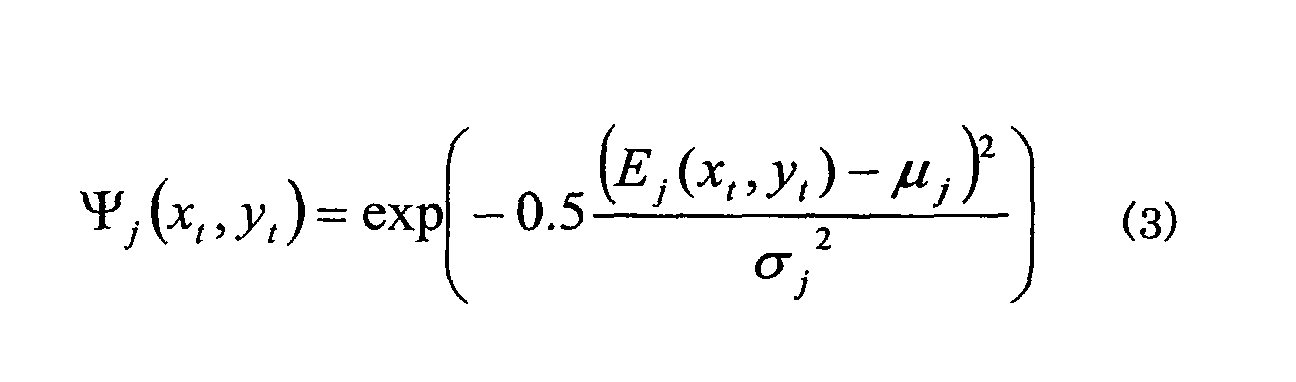 In Eq. (3), "µj" is an average of image intensities Ej(xt,yt). "σj" is variance of these
image intensities Ej(xt,yt). Therefore, the local feature Ψj(xt,yt) means the expression
of probability density distribution for image intensity Ej(xt,yt) in each local area
image with regard to direction having the largest intensity. Local features Ψj(xt,yt)
are calculated as many as the number of local areas. It should be noted that the
direction j where local feature Ψj(xt,yt) is calculated for each local area is different.
In Eq. (3), "µj" is an average of image intensities Ej(xt,yt). "σj" is variance of these
image intensities Ej(xt,yt). Therefore, the local feature Ψj(xt,yt) means the expression
of probability density distribution for image intensity Ej(xt,yt) in each local area
image with regard to direction having the largest intensity. Local features Ψj(xt,yt)
are calculated as many as the number of local areas. It should be noted that the
direction j where local feature Ψj(xt,yt) is calculated for each local area is different.
Upon receiving the local features Ψj(xt,yt) from the local feature extraction block
16 and the behavior command from the behavior command output block 12, the
global feature extraction block 18 combines all local features Ψj(xt,yt) with regard to
each largest direction j of the image intensity to obtain global feature ρj(χt|l)
according to Eq. (4) (step S50).
ρ j (χ t |l ) = ∫χ t ∈R2 Ψ j (xt ,yt )dxt dyt (j=1, ...,8)
Here, "χt" means two-dimensional Cartesian coordinate of (xt,yt).
Calculated global feature ρj(χt|l) is distributed to one of classes according to the
behavior command output by the behavior command output block 12 when the image
I(t) is acquired, and stored in memory (step S52). Here "l" represents behavior
command. In the present embodiment where three behavior commands (going
straight, a left turn and a right turn) are used, l=1 corresponds to a behavior
command of going straight, l=2 to a behavior command of turning left, and l=3 to a
behavior command of turning right. Therefore, the global features ρj when the
mobile unit is going straight (l=1), turning left (l=2) or turning right (l=3) are stored
in different classes.
These classes are called "attention class" Ω1. As used herein, term "attention
class" is for updating learning result efficiently by noticing certain feature when
new feature is presented, not reflecting all of them. The attentional class is identical
to the probability model of different behaviors.
It should be noted that the number of attention class is not limited to three but
any number of the attention class may be employed correlating to the number of
behavior commands.
Because the global feature ρj(χt|l) is calculated in association with behavior
command for image acquired at time t, a lot of sets of global feature for eight
directions are stored by behavior command.
Figs. 3 to Figs. 5 illustrate the relationship among original (acquired) image I(t),
local feature Ψj(xt,yt) and global feature ρj(χt|l) in the environment where the mobile
unit 32 runs toward obstacles. Figs. 3 correspond to the case when the mobile unit 32
goes straight. Figs. 4 correspond to the case when the mobile unit 32 turns left, and
Figs. 5 correspond to the case when the mobile unit 32 turns right, respectively.
Upper part (a) of Figs. 3 to Figs. 5 show images of obstacles acquired at the place
when the car is located in the environment. Middle part (b) of Figs. 3 to Figs. 5 show
graph of local feature when one direction of the Gabor filter is applied to a whole
image, calculated by the Eq.(2) and Eq.(3). In this example, the whole image is
divided in 77*57 local areas. Lower part (c) of Figs. 3 to Figs. 5 are the Polar-shaped
maps which depict the global feature ρj calculted by Eq. (4), consisting of the eight
direction of the Gabor filter. In part (c), numerals of 1 to 8 correspond to application
direction of the Gabor filter (upward direction, right-upward direction, or the like).
Comparing the polar-shaped maps in part (c) of Figs.3 to Figs. 5, feature on
behavior (behavior command 1) of mobile unit 32 may be recognized.
Back to Fig. 2, after storing the global feature ρj(χt|l) in step S52, the learning
block 20 starts learning based on the global feature ρj(χt|l) (step S54 to S58). More
specifically, Expectation Maximization algorithm (EM algorithm) and supervised
learning with the use of neural network are employed to obtain probability models
for recognizing behavior of the mobile unit 32.
The EM algorithm is an iterative algorithm for estimating parameter which
takes maximum likelihood when observed data is viewed as incomplete data.
Assuming mean of the observed data is represented as µ1 and covariance as Σ1, the
parameter may be represented as (µ1,Σ1). EM algorithm is initiated with
appropriate initial values of (µ1,Σ1). Then the parameter (µ1,Σ1) is updated one after
another by iterating Expectation (E) step and Maximization (M) step alternately.
On the E step, conditional expected value ϕ(|(k)) is calculated according to
following Eq. (5)
ϕ(|( k ) ) = Σ i Σ l p (ρ l |Ω l ;( k ) )log(p (ρ l ,Ω l ;( k ) ))
Then on the M step, parameters µ1 and Σ1 for maximizing ϕ( | (k)) are calculated
by following Eq. (6) and comprise a new estimated value (k+1).
( k +1) = argmax ϕ(, ( k ) )
After repeating E steps and M steps, conditional expected value ϕ(|(k)) is
obtained. By partial differentiating this value ϕ(|(k)) on (k) and letting a result
equal to zero, parameters µ1 and Σ1 may be finally calculated. More detailed
explanation will be omitted because this EM algorithm is well known in the art.
By using EM algorithm, global feature of each attention class Ω1 can be expressed
by normal distribution (step S54).
The global feature extraction block 18 uses those calculated µ1 and Σ1 in following
Eq. (7) to calculate prior probability p (ρ1|Ω1), which means the probability that
global feature ρj(χt|l) belongs to class Ω1 of behavior command l (step S56).
 Here, N is the number of dimensions of global feature ρj(χt|l).
Next, supervised learning with the use of neural network will be described. In
this learning, conditional probability density function p(I(t)|Ω1) is calculated for
image I(t) with attention class as supervising signal (step S58).
Fig. 6 shows one example of hierarchical neural network used for the supervised
learnin. This hierarchical neural network has three layer of node. Nodes in input
layer 72 correspond to (original) images I(t), nodes in middle layer 74 to global
features ρj(χt|l), and nodes in output layer 76 to attention classes Ω1, respectively.
Although only three nodes are illustrated on the input layer 72 for simple
illustration, there are actually as many nodes as the number of images I(t). Likewise,
on the middle layer 74, there are nodes as many as nodes on the input layer 72.
Nodes on the middle layer 74 correspond to nodes on the input layer 72 one by one.
Nodes on the output layer 76 are generated as many as the number of attention class
Ω1 (three in this embodiment).
In Fig. 6, "λ" denotes synaptic weight of the hierarchical neural network. The
probability that global feature ρj(χt|l) belongs to each attention class Ω1 is obtained
by EM algorithm, and global feature ρj(χt|l) is calculated for a set of images I(t) and
I(t+1) one by one, so probability relationship (that is, "λ" in Fig. 6) between image
I(t) and attention class Ω1 is determined by repeating the supervised learning with
attention class Ω1 as supervising signal. More specifically, this probability
relationship is conditional probability density function p(I(t)|Ω1). More detailed
explanation will be omitted because this hierarchical neural network is well known
in the art.
By such supervised learning with neural network, direct relation between image
I(t) and attention class Ω1, that is, conditional probability density function p(I(t) |Ω1)
may be obtained.
Process in steps S54 to S58 are executed every behavior command l. Therefore, in
the present embodiment, prior probability p (ρ1|Ω1) and conditional probability
density function p(I(t)|Ω1) (these are called "probability model" integrally) are
calculated for behavior command l =1, 2, and 3.
Probability model calculated by learning block 20 is stored in memory 22 (step S
60). If advance learning is continued, "yes" is selected in step S62 and a series of
processes from step S42 to S60 is repeated, and then probability model is updated.
While the mobile unit 32 is moving, advance learning is executed for all of images
I(t) acquired in time t. When probability model is judged to be highly accurate
enough to recognize behavior of mobile unit 32 (for example, process is completed for
predetermined number of images I(t)), the process ends (step S64).
Referring to Fig.1 and Fig. 7, the behavior recognizing part will be described in
detail. Fig. 7 is a flow chart illustrating of process of the behavior recognizing part.
The image acquisition block 14 acquires two of new images at time t every preset
interval (step 82). Probability models (prior probability p (ρ1|Ω1) and conditional
probability density function p(I(t)|Ω1)) calculated in the advance learning part are
used in following Bayes' rule and confidence p(Ω1(t)) for each attention class Ω1
(l=1,2,3) is calculated (step S84). This confidence p(Ω1(t)) means the probability that
the new image I(t) belongs to each attention class Ω1.

Then, among three calculated confidences p (Ω1(t)), p (Ω2(t)), and p(Ω3(t)), the largest
one is selected (step S86).
The behavior assessment block 26 determines whether logarithmic likelihood of
confidence p(Ω1(t)) is larger than a predetermined value K (step S88). If log p
(Ω1(t))>K, behavior command 1 corresponding to attention class Ω1 of which the
confidence is largest is recognized as the behavior of the mobile unit 32 (step S92).
Otherwise, log p(Ω1(t))≦K, the attention generation block 28 generates attentional
demanding. The attentional modulation block 30 increments gaussian mixture "m"
in Eq. (7) by specified value (that is, attentional modulation) (step S90). And in the
learning block 20, a series of process in steps S56 to S60 in Fig. 2 is carried out again
and the probability models (prior probability p-(ρ|Ω1) and conditional probability
density function p(I(t) |Ω1) are updated.
The process goes back to step S84 and repeats steps S84 to S88. Thus, gaussian
mixture m is increased until logarithmic likelihood log p(Ω1(t)) excesses the
predetermined value K. In alternative embodiment, once-generated probability
model may be always used without updating process.
As discussed above, the image recognizing apparatus according to the invention
does not recognize the behavior of the mobile unit based only on the image. Instead,
since the image recognizing apparatus first complete the learning on the
relationship between the global feature extracted from the image and behavior
command and then recognizes the behavior using the learning result, the apparatus
can recognize the behavior of the mobile unit rapidly and accurately in real
application.
In addition, in the case of the mobile unit 32 can not move correctly in accordance
with supplied behavior command due to such as error-mounted wheels, the image
recognizing apparatus may get the real moving status of the mobile unit according to
the behavior recognizing process.
Now one example of the invention will be described. Fig. 8 shows a block diagram
of radio control car (hereinafter referred to as "RC car") 100 that carried image
recognizing apparatus 10 of the present invention. Blocks with same numerals as
blocks in Fig.1 have similar function. In addition to the image recognizing apparatus
10, on the RC car 100 is provided an image input camera 114 to acquire images, a
steering control block 132 and a motor control block 134 for controlling the behavior
of the RC car 100 according to the behavior command, and receiver 136 and
transmitter 138 for communicating with outside device.
The receiver 136 receives behavior command signal from the outside device and
supplies it to the behavior command output block 12. The RC car 100 makes going
straight, left turn, or right turn in accordance with the behavior command. The
transmitter 138 transmits behavior of RC car 100 recognized by the behavior
recognition block 24 to the outside device.
After completing advance learning part, the result of behavior recognition for 24
frames of image is described as follows.
Figure 9 is an exemplar illustrating change of logarithmic likelihood log p (Ω1(t))
of confidence for an attention class. Horizontal axis expresses the number of
gaussian mixture m of Eq. (7) and vertical axis expresses logarithmic likelihood log
p(Ω1(t)) of confidence. It can be understood that the logarithmic likelihood becomes
saturated when the number of Gaussian mixture m reaches about 50. Larger
logarithmic likelihood for an attention class for each image means that the image
recognizing apparatus 10 recognizes the probability as sufficiently high that the RC
car 100 takes the behavior corresponding to that attention class.
Figs.10 show graphs of logarithmic likelihood of confidence with 24 frames of
image according to the Eq. (7) and (8) with applied number of Gaussian mixtures
m=20 when the RC car 100 goes straight and then turns left/right. Figs. 11 show the
same with m=50. In Figs.10 and Figs.11, upper graphs (a) show logarithmic
likelihood of confidence for attention class for behavior command l=1, middle graphs
(b) show logarithmic likelihood of confidence for attention class for behavior
command l=2, and lowest graphs (c) shows logarithmic likelihood of confidence for
attention class for behavior command l=3. Horizontal axis of each graph shows 24
frames of image on which behavioral recognition is performed.
First 8 frames (frame l-8) correspond to the images acquired during behavior
command l =2 is given to the RC car 100 (when the RC car turns left), middle 8
frames (frame 9-16) to the images acquired during behavior command l=1 is given to
the RC car 100 (when the RC car goes straight), and last 8 framess (frame 17-24)
corresponds to the images acquired during behavior command l =3 is given to the RC
car 100 (when the RC car turns right).
Referring to Figs. 10, in graph (a), middle eight frames (when going straight)
show largest logarithmic likelihood. In graph (b), first eight frames (when turning
left) show largest logarithmic likelihood, and in graph (c) last eight images (when
going right) show largest logarithmic likelihood. However, variation of logarithmic
likelihood between frames is so large that recognition of behavior is not sufficient.
Referring to Figs. 11, similar to Fig. 10, frames corresponding to behavior
command show largest logarithmic likelihood. However, comparing to Fig. 10, the
variation of logarithmic likelihood between frames becomes small and connection is
smoother. These advantages are accomplished by incrementing the number of
gaussian mixture by attentional modulation.
As described above, the image recognizing apparatus according to the invention
improves the reliability by repeating learning in attention class generated in
bottom-up fashion in the advance learning part. In the behavior recognizing part,
recognizing accuracy of behavior is improved because learning result is updated
until logarithmic likelihood of confidence excesses the predetermined value.
According to the invention, instead of recognizing the behavior of mobile unit
based only on images, the image recognizing apparatus pre-learned the relationship
between images and behavior commands and determines the behavior using the
learning result. Therefore, it can recognize the behavior of the mobile unit rapidly
and accurately in real application.
Although it has been described in details in terms of specific embodiment
according to the invention, it is not intended to limit the invention to such specific
embodiment. Those skilled in the art will appreciate that various modifications can
be made without departing from the scope of the invention.
Claims (20)
- An apparatus for recognizing images, comprising:behavior command output means (12) for outputting behavior commands to cause a mobile unit (32) to move;local feature extraction means (16) for extracting features of local areas within an image of external environment acquired on said mobile unit when said behavior command is output;global feature extraction means (18) for extracting feature of global area of said image using said extracted features of said local areas; andlearning means (20) for calculating probability models to recognize behavior of the mobile unit (32) based on said extracted feature of said global area.
- The apparatus according to claim 1, wherein said local feature extraction means (16) extracts said features of the local areas within the image by utilizing image intensities obtained by applying both positive and negative component of Gabor filters on two images.
- The apparatus according to claim 2, wherein each of said Gabor filters is applied on one of eight different directions respectively.
- The apparatus according to claims 1 to 3, wherein said global feature extraction means (18) combines said features of the local areas into said global feature with the use of Gaussian functions.
- The apparatus according to claim 4, wherein said learning means (20) calculates said probability models utilizing expectation maximization algorithm and supervised learning with the use of neural network.
- The apparatus according to claim 5, further comprising behavioral recognition means (24) for applying Bayes' rule with use of said probability model on an image acquired afresh, said behavioral recognition (24) means calculating confidence for each of said behavior commands to recognize behavior of said mobile unit (32) .
- The apparatus according to claim 6, further comprising:wherein said learning means (20) recalculates said probability model after said parameter has been changed.behavioral assessment means (26) for comparing said confidence with a predetermined value to assess said recognized behavior;attention generation means (28) for generating attentional demanding which demands to cause said probability models to be updated based on the result of said assessment; andattentional modulation means (30) for changing specified parameter of said learning means in response to said attentional demanding;
- The apparatus accoring to claim 7, wherein said behavioral recognition means (24) selects one confidence having largest value among the plurality of confidences and supplies it to said behaviroral assessment means (26), said behavioral recognition means (24) recognizing the behavior corresponding to the selected confidence as the behavior of said mobile unit (32) if said confidence is resulted to be larger than the predetermined value by said compairing by said behaviral assessment means (26).
- The apparatus according to claim 8, wherein said parameter is the number of Gaussian mixture in an equation of said learning means (20) for calculating said probability models.
- An apparatus for recognizing images, comprising:wherein said learning means (20) recalculates said probability model after said parameter has been changed.behavior command output means (12) for outputting behavior commands to cause a mobile unit to move;local feature extraction means (16) for extracting features of local areas within an image of external environment acquired on said mobile unit when said behavior command is output;global feature extraction means (18) for combining said extracted features of said local areas into global feature of global area of said image with the use of Gaussian functions;learning means (20) for calculating probability models by utilizing expectation maximization algorithm and supervised learning with the use of neural network based on said global feature;behavioral recognition means (24) for applying Bayes' rule with use of said probability model on an image acquired afresh and calculating confidence for each of said behavior commands to recognize behavior of said mobile unit;wherein said behavioral recognition means (24) selects one confidence having largest value among the plurality of confidence;behavioral assessment means (26) for comparing said selected confidence with a predetermined value to assess said recognized behavior;wherein said behavioral recognition means (24) recognizing the behavior corresponding to the selected confidence as the behavior of said mobile unit (32) if said confidence is resulted to be larger than the predetermined value;attention generation means (28) for generating attentional demanding which demands to cause said probability model to be updated if said confidence is resulted to be equal or smaller than the predetermined value; andattentional modulation means (30) for changing the number of Gaussian mixture in an equation of said learning means (20) for calculating said probability models in response to said attentional demanding;
- A method for recognizing images in computing system, comprising:outputting behavior commands (12) to cause a mobile unit (32) to move;extracting (16) features of local areas within an image of external environment acquired on said mobile unit when said behavior command is output;extracting (18) feature of global area of said image using said extracted features of said local areas; andcalculating probability models to recognize (24) behavior of the mobile unit based on said extracted feature of said global area.
- The method according to claim 11, wherein said step of extracting (16) features of the local areas within the image includes utilizing image intensities obtained by applying both positive and negative component of Gabor filters on two images.
- The method according to claim 12, wherein each of said Gabor filters is applied on one of eight different directions respectively.
- The method according to claims 11 to 13, wherein said step of extracting (18) feature of the global area includes combining said features of the local areas into said global feature with the use of Gaussian functions.
- The method according to claims 14, wherein said step of calculating the probability models includes utilizing expectation maximization algorithm and supervised learning with the use of neural network.
- The method according to claim 15, further comprising:applying Bayes' rule with use of said probability models on an image acquired afresh; andcalculating confidence for each of said behavior commands (12) to recognize (24) behavior of said mobile unit (32).
- The method according to claim 16, further comprising:wherein said probability model is recalculated after said parameter has been changed.comparing said confidence with a predetermined value to assess said recognized behavior;generating attentional demanding which demands to cause said probability models to be updated based on the result of said assessment; andchanging specified parameter of said learning step in response to said attentional demanding;
- The apparatus accoring to claim 17, further comprising:subsequent to said step of calculating confidence, selecting one confidence having largest value among the plurality of confidences for said comparing step,recognizing the behavior corresponding to the selected confidence as the behavior of said mobile unit if said confidence is resulted to be larger than the predetermined value in said compairing step.
- The method according to claim 18, wherein said parameter is the number of Gaussian mixture in an equation of said calculating step for calculating said probability models.
- A method for recognizing images in computing system, comprising:wherein said probability model is recalculated after said parameter has been changed.outputting (12) behavior commands to cause a mobile unit to move;extracting (16) features of local areas within an image of external environment acquired on said mobile unit when said behavior command is output;combining said extracted (16) features of said local areas into global feature (18) of global area of said image with the use of Gaussian functions;calculating probability models by utilizing expectation maximization algorithm and supervised learning (20) with the use of neural network based on said global feature;applying Bayes' rule with use of said probability model on an image acquired afresh and calculating confidence for each of said behavior commands to recognize behavior of said mobile unit;selecting one confidence having largest value among the plurality of confidence for said comparing step;comparing said selected confidence with a predetermined value to assess said recognized behavior;recognizing (24) the behavior corresponding to the selected confidence as the behavior of said mobile unit if said confidence is resulted to be larger than the predetermined value;generating attentional demanding which demands to cause said probability model to be updated if said confidence is resulted to be equal or smaller than the predetermined value; andchanging the number of Gaussian mixture in an equation of said calculating step for calculating said probability models in response to said attentional demanding;
Applications Claiming Priority (4)
| Application Number | Priority Date | Filing Date | Title |
|---|---|---|---|
| JP2001134848 | 2001-05-02 | ||
| JP2001134848 | 2001-05-02 | ||
| JP2002107013 | 2002-04-09 | ||
| JP2002107013A JP4159794B2 (en) | 2001-05-02 | 2002-04-09 | Image processing apparatus and method |
Publications (1)
| Publication Number | Publication Date |
|---|---|
| EP1255177A2 true EP1255177A2 (en) | 2002-11-06 |
Family
ID=26614620
Family Applications (1)
| Application Number | Title | Priority Date | Filing Date |
|---|---|---|---|
| EP02009680A Withdrawn EP1255177A2 (en) | 2001-05-02 | 2002-04-29 | Image recognizing apparatus and method |
Country Status (3)
| Country | Link |
|---|---|
| US (1) | US7221797B2 (en) |
| EP (1) | EP1255177A2 (en) |
| JP (1) | JP4159794B2 (en) |
Cited By (1)
| Publication number | Priority date | Publication date | Assignee | Title |
|---|---|---|---|---|
| CN115457447A (en) * | 2022-11-07 | 2022-12-09 | 浙江莲荷科技有限公司 | Moving object identification method, device and system, electronic equipment and storage medium |
Families Citing this family (42)
| Publication number | Priority date | Publication date | Assignee | Title |
|---|---|---|---|---|
| US7266220B2 (en) * | 2002-05-09 | 2007-09-04 | Matsushita Electric Industrial Co., Ltd. | Monitoring device, monitoring method and program for monitoring |
| JP3979894B2 (en) * | 2002-07-22 | 2007-09-19 | 本田技研工業株式会社 | Object detection apparatus and method |
| WO2004016400A2 (en) * | 2002-08-16 | 2004-02-26 | Evolution Robotics, Inc. | Systems and methods for the automated sensing of motion in a mobile robot using visual data |
| US7171028B2 (en) * | 2002-11-22 | 2007-01-30 | The Boeing Company | Method and apparatus for covertly determining the rate of relative motion between two objects |
| US7145478B2 (en) * | 2002-12-17 | 2006-12-05 | Evolution Robotics, Inc. | Systems and methods for controlling a density of visual landmarks in a visual simultaneous localization and mapping system |
| GB0305304D0 (en) * | 2003-03-07 | 2003-04-09 | Qinetiq Ltd | Scanning apparatus and method |
| RU2242047C1 (en) * | 2003-03-20 | 2004-12-10 | Общество с ограниченной ответственностью "Информационные исследования" ("Изучение, анализ, оценивание, распознавание") | Open system for automation of processing, analysis and recognition of images |
| US7689321B2 (en) * | 2004-02-13 | 2010-03-30 | Evolution Robotics, Inc. | Robust sensor fusion for mapping and localization in a simultaneous localization and mapping (SLAM) system |
| AU2004202179B2 (en) * | 2004-05-20 | 2011-04-21 | The Boeing Company | Method and apparatus for covertly determining the rate of relative motion between two objects |
| JP4634842B2 (en) * | 2005-03-31 | 2011-02-16 | 株式会社デンソーアイティーラボラトリ | Landscape estimation device |
| US20090041297A1 (en) * | 2005-05-31 | 2009-02-12 | Objectvideo, Inc. | Human detection and tracking for security applications |
| JP4812343B2 (en) * | 2005-06-30 | 2011-11-09 | トヨタ自動車株式会社 | Driving tendency estimation device and driving support device |
| US20070040065A1 (en) * | 2005-08-19 | 2007-02-22 | Von Thal German | Flexible refueling boom extendable tube |
| US20080059007A1 (en) * | 2006-06-09 | 2008-03-06 | Whittaker William L | System and method for autonomously convoying vehicles |
| US20080033645A1 (en) * | 2006-08-03 | 2008-02-07 | Jesse Sol Levinson | Pobabilistic methods for mapping and localization in arbitrary outdoor environments |
| US8132759B2 (en) * | 2007-03-21 | 2012-03-13 | The Boeing Company | System and method for facilitating aerial refueling |
| JP4971015B2 (en) * | 2007-04-10 | 2012-07-11 | 株式会社デンソー | Estimator |
| KR100877071B1 (en) * | 2007-07-18 | 2009-01-07 | 삼성전자주식회사 | Particle Filter-based Attitude Estimation Method and Apparatus |
| US8509538B2 (en) * | 2007-12-20 | 2013-08-13 | Intel Corporation | Method and apparatus for obtaining and processing Gabor image features |
| US8340818B2 (en) * | 2009-04-24 | 2012-12-25 | Robert Bosch Gmbh | Method of accurate mapping with mobile robots |
| AU2011305154B2 (en) | 2010-09-24 | 2015-02-05 | Irobot Corporation | Systems and methods for VSLAM optimization |
| US9015093B1 (en) | 2010-10-26 | 2015-04-21 | Michael Lamport Commons | Intelligent control with hierarchical stacked neural networks |
| US8775341B1 (en) | 2010-10-26 | 2014-07-08 | Michael Lamport Commons | Intelligent control with hierarchical stacked neural networks |
| US9750912B2 (en) | 2011-05-04 | 2017-09-05 | The Regents Of The University Of Michigan | Intubation device |
| US8798840B2 (en) | 2011-09-30 | 2014-08-05 | Irobot Corporation | Adaptive mapping with spatial summaries of sensor data |
| CN102521592B (en) * | 2011-11-30 | 2013-06-12 | 苏州大学 | Multi-feature fusion salient region extracting method based on non-clear region inhibition |
| US9020637B2 (en) | 2012-11-02 | 2015-04-28 | Irobot Corporation | Simultaneous localization and mapping for a mobile robot |
| US9037396B2 (en) | 2013-05-23 | 2015-05-19 | Irobot Corporation | Simultaneous localization and mapping for a mobile robot |
| EP3028838A1 (en) * | 2013-07-29 | 2016-06-08 | NEC Solution Innovators, Ltd. | 3d printer device, 3d printing method and method for manufacturing stereolithography product |
| DE102013217827A1 (en) * | 2013-09-06 | 2015-03-12 | Robert Bosch Gmbh | Method and control device for recognizing an object in image information |
| US9058517B1 (en) * | 2014-04-16 | 2015-06-16 | I.R.I.S. | Pattern recognition system and method using Gabor functions |
| US10915114B2 (en) * | 2017-07-27 | 2021-02-09 | AI Incorporated | Method and apparatus for combining data to construct a floor plan |
| US11348269B1 (en) * | 2017-07-27 | 2022-05-31 | AI Incorporated | Method and apparatus for combining data to construct a floor plan |
| US11042163B2 (en) | 2018-01-07 | 2021-06-22 | Nvidia Corporation | Guiding vehicles through vehicle maneuvers using machine learning models |
| DE112019000065B4 (en) | 2018-02-02 | 2025-01-09 | Nvidia Corporation | SAFETY PROCEDURE ANALYSIS FOR OBSTACLE AVOIDANCE IN AN AUTONOMOUS VEHICLE |
| DE102019113114A1 (en) | 2018-06-19 | 2019-12-19 | Nvidia Corporation | BEHAVIOR-CONTROLLED ROUTE PLANNING IN AUTONOMOUS MACHINE APPLICATIONS |
| US11966838B2 (en) | 2018-06-19 | 2024-04-23 | Nvidia Corporation | Behavior-guided path planning in autonomous machine applications |
| US10937150B2 (en) | 2018-06-28 | 2021-03-02 | General Electric Company | Systems and methods of feature correspondence analysis |
| US11520345B2 (en) | 2019-02-05 | 2022-12-06 | Nvidia Corporation | Path perception diversity and redundancy in autonomous machine applications |
| CN111753590B (en) * | 2019-03-28 | 2023-10-17 | 杭州海康威视数字技术股份有限公司 | Behavior recognition method, device and electronic equipment |
| DE112020001897T5 (en) | 2019-04-12 | 2021-12-30 | Nvidia Corporation | Training of neural networks using basic truth data supplemented with map information for autonomous machine applications |
| US12077190B2 (en) | 2020-05-18 | 2024-09-03 | Nvidia Corporation | Efficient safety aware path selection and planning for autonomous machine applications |
Family Cites Families (17)
| Publication number | Priority date | Publication date | Assignee | Title |
|---|---|---|---|---|
| DE3379611D1 (en) * | 1982-04-15 | 1989-05-18 | Toshiba Kk | Pattern features extracting apparatus and method and pattern recognition system |
| US5109425A (en) * | 1988-09-30 | 1992-04-28 | The United States Of America As Represented By The United States National Aeronautics And Space Administration | Method and apparatus for predicting the direction of movement in machine vision |
| EP0488828B1 (en) * | 1990-11-30 | 1996-08-14 | Honda Giken Kogyo Kabushiki Kaisha | Control device of an autonomously moving body and evaluation method for data thereof |
| US5500904A (en) * | 1992-04-22 | 1996-03-19 | Texas Instruments Incorporated | System and method for indicating a change between images |
| JP3369368B2 (en) * | 1995-10-11 | 2003-01-20 | 富士通株式会社 | Image processing device |
| US5751838A (en) | 1996-01-26 | 1998-05-12 | Nec Research Institute, Inc. | Correction of camera motion between two image frames |
| JP3886618B2 (en) | 1997-10-28 | 2007-02-28 | 本田技研工業株式会社 | Video processing method |
| US6532305B1 (en) * | 1998-08-04 | 2003-03-11 | Lincom Corporation | Machine learning method |
| US6353679B1 (en) * | 1998-11-03 | 2002-03-05 | Compaq Computer Corporation | Sample refinement method of multiple mode probability density estimation |
| JP2000171250A (en) | 1998-12-02 | 2000-06-23 | Japan Aviation Electronics Industry Ltd | Moving object current position detection method |
| JP4226730B2 (en) * | 1999-01-28 | 2009-02-18 | 株式会社東芝 | Object region information generation method, object region information generation device, video information processing method, and information processing device |
| US6307959B1 (en) | 1999-07-14 | 2001-10-23 | Sarnoff Corporation | Method and apparatus for estimating scene structure and ego-motion from multiple images of a scene using correlation |
| US6323807B1 (en) * | 2000-02-17 | 2001-11-27 | Mitsubishi Electric Research Laboratories, Inc. | Indoor navigation with wearable passive sensors |
| JP4624594B2 (en) * | 2000-06-28 | 2011-02-02 | パナソニック株式会社 | Object recognition method and object recognition apparatus |
| JP4581210B2 (en) * | 2000-09-29 | 2010-11-17 | 日本電気株式会社 | Video conference system |
| KR100415313B1 (en) * | 2001-12-24 | 2004-01-16 | 한국전자통신연구원 | computation apparatus of optical flow and camera motion using correlation and system modelon sequential image |
| CN1459761B (en) * | 2002-05-24 | 2010-04-21 | 清华大学 | Character Recognition Technology Based on Gabor Filter Bank |
-
2002
- 2002-04-09 JP JP2002107013A patent/JP4159794B2/en not_active Expired - Fee Related
- 2002-04-26 US US10/133,114 patent/US7221797B2/en not_active Expired - Fee Related
- 2002-04-29 EP EP02009680A patent/EP1255177A2/en not_active Withdrawn
Cited By (1)
| Publication number | Priority date | Publication date | Assignee | Title |
|---|---|---|---|---|
| CN115457447A (en) * | 2022-11-07 | 2022-12-09 | 浙江莲荷科技有限公司 | Moving object identification method, device and system, electronic equipment and storage medium |
Also Published As
| Publication number | Publication date |
|---|---|
| US7221797B2 (en) | 2007-05-22 |
| US20030007682A1 (en) | 2003-01-09 |
| JP2003042718A (en) | 2003-02-13 |
| JP4159794B2 (en) | 2008-10-01 |
Similar Documents
| Publication | Publication Date | Title |
|---|---|---|
| EP1255177A2 (en) | Image recognizing apparatus and method | |
| US20230123750A1 (en) | Image segmentation | |
| US9990736B2 (en) | Robust anytime tracking combining 3D shape, color, and motion with annealed dynamic histograms | |
| JP7263216B2 (en) | Object Shape Regression Using Wasserstein Distance | |
| US8175782B2 (en) | Adaptive driver assistance systems with robust estimation of object properties | |
| US11508157B2 (en) | Device and method of objective identification and driving assistance device | |
| WO2018009552A1 (en) | System and method for image analysis | |
| CN116152768B (en) | Intelligent driving warning system and method based on road condition recognition | |
| US7054724B2 (en) | Behavior control apparatus and method | |
| US20210192345A1 (en) | Method for generating labeled data, in particular for training a neural network, by using unlabeled partitioned samples | |
| US20060036399A1 (en) | Adaptive discriminative generative model and application to visual tracking | |
| US10810468B2 (en) | System for training descriptor with active sample selection | |
| JP2004536400A5 (en) | ||
| US12430905B2 (en) | Methods, devices, and computer readable media for training a keypoint estimation network using cGAN-based data augmentation | |
| CN115482513A (en) | Apparatus and method for adapting a pre-trained machine learning system to target data | |
| EP3686807B1 (en) | Learning method and learning device for object detector to be used for surveillance based on convolutional neural network capable of converting modes according to scales of objects, and testing method and testing device using the same | |
| EP4030383A1 (en) | Probabilistic sampling acceleration and corner feature extraction for vehicle systems | |
| CN114898304A (en) | Vehicle tracking method and device, road side equipment and network side equipment | |
| CN117237884A (en) | Interactive inspection robot based on berth positioning | |
| JP2021114048A (en) | Information processing apparatus, vehicle, vehicle control method, program, information processing server, and information processing method | |
| KR20230065125A (en) | Electronic device and training method of machine learning model | |
| US20250036967A1 (en) | Method for training a machine learning model to classify sensor data | |
| KR20230003953A (en) | Vehicle lightweight deep learning processing device and method applying environment variance adaptive feature generator | |
| Ozutemiz et al. | Adaptive unstructured road detection using close range stereo vision | |
| CN121191109A (en) | A lane line detection method, apparatus, electronic device, and computer program product. |
Legal Events
| Date | Code | Title | Description |
|---|---|---|---|
| PUAI | Public reference made under article 153(3) epc to a published international application that has entered the european phase |
Free format text: ORIGINAL CODE: 0009012 |
|
| AK | Designated contracting states |
Kind code of ref document: A2 Designated state(s): AT BE CH CY DE DK ES FI FR GB GR IE IT LI LU MC NL PT SE TR |
|
| AX | Request for extension of the european patent |
Free format text: AL;LT;LV;MK;RO;SI |
|
| STAA | Information on the status of an ep patent application or granted ep patent |
Free format text: STATUS: THE APPLICATION HAS BEEN WITHDRAWN |
|
| 18W | Application withdrawn |
Effective date: 20170119 |