BACKGROUND OF THE INVENTION
1. Field the Invention:
The present invention relates to a misfire deciding method and
system for an internal combustion engine.
2. Description of the Related Art:
As a misfire deciding method in an internal combustion engine, a
method has been proposed for directly measuring the pressure in a
combustion chamber, for example, by forming a pressure conduit leading to
the combustion chamber in a cylinder head and by arranging a partition type
pressure sensor in the pressure conduit. The formation of this pressure
conduit in the cylinder head, however, involves complex machining which
inevitably raises the manufacturing cost. A more convenient method for
measuring the internal pressure uses a pressure sensor (hereinafter called a
"gasket type pressure sensor") which is mounted on the mounting seat of a
spark plug, as disclosed, for example, in Japanese Patent Laid-Open No.
290853/1994.
Fig. 3 exemplifies an internal pressure profile as measured by an
internal pressure sensor for one cycle in the combustion engine. The solid
curve indicates the profile for normal combustion timing, and the
single-dotted curve indicates the profile for a misfire timing. When an
intake valve is closed, the inside of the combustion chamber is sealed, and
the mixture is compressed as a piston rises, so that the internal pressure rises.
Moreover, the spark plug sparks at a crank angle (or an ignition timing)
before top dead center (TDC). When the mixture is normally ignited with
that spark, the internal pressure is further raised by the explosion of the
mixture. By this pressure rise, the rise in the internal pressure is continued
for a while, even after the piston passes through the TDC and turns
downward, and the internal pressure is reduced after the piston goes down to
some extent. Therefore, the internal pressure measured profile assumes an
asymmetric shape in which the peak position is shifted to a larger angle side
than the crank angle (i.e., an αTDC) corresponding to the TDC. When the
ignition ends unsuccessfully with a misfire, on the other hand, no pressure
rise due to the explosion occurs so that the pressure assumes a maximum
value at the TDC where the volume in the combustion chamber is at a
minimum. After this, the piston moves down with the pressure change
merely following a profile which is inverted relative to that of the rising time.
Therefore, the internal pressure measured profile thus obtained is generally
symmetric so as to have a peak position at the αTDC. Thus, between the
normal combustion time and the misfire time, differences apparently occur
both in the peak value of the internal pressure measured profile and in the
symmetry of the profile.
However, the misfire decision using only one point of the internal
pressure peak value level has numerous error factors and lacks accuracy
because it does not take into consideration the tendency of the entire profile.
Japanese Patent Laid-Open Nos. 321752/1992, 72448/1992 and
325755/1992, therefore, discloses a method for deciding a misfire by
comparing the magnitudes of a before top dead center pressure integrated
value S1 obtained by integrating the internal pressure measured values for a
constant integration period defined in the before top dead center period and
an after top dead center pressure integrated value S2 obtained by integrating
the average pressure information for a constant integration period defined in
the after top dead center period. In short, by using the integrated values,
the tendency of the entire internal pressure measured profile can be reflected
in an average form on the decision result so that a more accurate misfire
decision can be made.
Here, the method using the gasket type pressure sensor indirectly
measures the internal pressure, in that the fastening force of the spark plug
fixing the sensor is loosened by the internal pressure. As compared with
the method of measuring the internal pressure directly through the pressure
conduit by using the partition type sensor, therefore, there are a number of
factors causing the absolute value of the measured pressure value to
fluctuate. More specifically, variations in the force for fastening the spark
plug and in the performance of individual piezoelectric elements easily
cause the measured value level of the internal pressure to fluctuate, such that
the measured value and its integrated value vary for a given internal pressure,
easily resulting in an erroneous decision. In the above-specified patent
publications, however, there is no disclosure of any specific means for
reducing the adverse influences of these variation-causing factors.
SUMMARY OF THE INVENTION
It is therefore an object of the present invention to provide a misfire
decision method and system for an internal combustion engine, which can be
executed conveniently and inexpensively by using a gasket type pressure
sensor and which can at all times make an accurate misfire decision while
being hardly influenced by variations in the mounting arrangement or
performance of the piezoelectric elements.
In order to achieve the above-specified object, the invention
provides a misfire deciding method for an internal combustion engine,
characterized by:
The invention provides a misfire deciding system for an internal
combustion engine, comprising:
In the misfire deciding method and system of the invention, as
shown in Fig. 4, the internal pressure measured profile for a constant period
before and after the top dead center is determined so that the misfire decision
may be made on the basis of the difference between the before top dead
center pressure integrated value S1 and the after top dead center pressure
integrated value S2, as obtained for the before top dead center period and for
the after top dead center period, respectively, that is, the differential
integrated value ΔS ≡ (S2 - S1). The method of making the misfire decision
on the basis of the differential integrated value Δ S is convenient and is
advantageous for easily canceling the influence of thermally caused drifts of
the internal pressure measured values as described below. In either event,
however, the misfire decision using the gasket type pressure sensor is easily
caused to exert influences on the internal pressure measured value level due
to variation in the fastening force of the sensor by the spark plug or in the
performance of the piezoelectric element.
In the invention, therefore, the correction measurement point is set
for the before top dead center period, and the first correction reference value
is calculated using the internal pressure measured value at the correction
measurement point, to correct the differential integrated value ΔS with the
first correction reference value, to thereby make the misfire decision on the
basis of the corrected differential integrated value ΔS. The correction
measurement point set within the before top dead center period is relatively
hardly influenced by the pressure rise due to the ignition/explosion of the
fuel so that the internal pressure measured value obtained at the
measurement point can be used as the reference value. By standardizing
the individual measured values forming the internal pressure measured
profile in comparison with that reference value, therefore, fluctuations in the
internal pressure measured value levels due to the aforementioned factors
can be suppressed to make a misfire decision of a higher accuracy.
At an idling time or at the time of running on level ground at
constant speed, for example, the air-fuel ratio or the fuel consumption rate
are substantially constant. If the crank angle at the correction
measurement point is known, therefore, the internal pressure can be
estimated from the volume of the combustion chamber at the correction
measurement point. If the internal pressure measured value with the
gasket type pressure sensor is corrected to match the estimated value of the
internal pressure, therefore, the internal pressure measured value can be
standardized even with variation in the sensor fastening force and in the
piezoelectric element performance.
In the vigorously changing situation of the running state of the
internal combustion engine, on the other hand, the absolute value of the
internal pressure is difficult to estimate even if the correction measurement
point is set at the common crank angle position. According to the
following method, however, the correction to standardize the internal
pressure measured value can be rationally made without such an absolute
value estimation. As shown in Fig. 4, more specifically, two different
correction measurement points are set within the before top dead center
period, and a first correction reference value is calculated as a difference of
ΔP0 ≡ P2 - P1 between the internal pressure measured values P1 and P2
obtained for those two correction measurement points. If these two
correction measurement points are individually set at constant crank angle
positions, the volumetric change in the gas between the two correction
measurement points always takes a determined value, and the difference ΔP0
has a meaning as the reference pressure change corresponding to the
constant volumetric change. The measured value of the difference ΔP0
fluctuates with the aforementioned dispersions in the fastening forces or the
piezoelectric element performances, and the internal pressure measured
value to be used for the misfire decision also fluctuates with the same
tendency. If the internal pressure measured value is displayed by
correcting it with a relative value calculated by dividing it by the difference
ΔP0 for the reference pressure change, therefore, the influences of the
aforementioned dispersions can be effectively reduced not through the
absolute value correction of the internal pressure.
Next in the invention for making the misfire decision with the
differential integrated value ΔS, the value of (S1 - S2)/ΔP0 calculated by the
division with the difference ΔP0 of the internal pressure measured value or
the first correction reference value is calculated (Formula (1) of Fig. 4) as a
decision index λ, and the misfire decision is made on the basis of the
decision index λ. Then, the misfire decision using the value ΔS can be
made more accurately and reproducibly. Even if the peak value of the
internal pressure measured profile fluctuates by the aforementioned factors
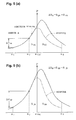
so that the measured value ΔS itself takes a different value such as ΔSA (=
S2A - S1A) and ΔSB (= S2B - S1B), as shown in Figs. 5(a) and 5(b), the
influences of the fluctuations can be drastically reduced by dividing those
values by the aforementioned differences ΔPOA and ΔPOB.
For these integrations, it is necessary to measure the internal
pressure P as a function of time or crank angle. In Fig. 4, the internal
pressure is measured as a function P(α) of the crank angle α. When the
integration period of the before top dead center period is expressed by [α1,
αTDC] whereas the integration period of the after top dead center period is
expressed by [αTDC, α2], for example, the values S1 and S2 can be
calculated on the basis of Formulas (2) and (3) of Fig. 4. In the computer
processing, the values S1 and S2 are calculated by numerical integrations by
sampling the internal pressure measured value P at every minute angles δα
while monitoring the crank angle α by a crank angle sensor or the like. In
case the correspondence between the crank angle α and the time can be
grasped, the integration variable should not be limited to the crank angle α
but can be exemplified by the time t in a more convenient method. In
order to lighten the influences of the engine speed (for a period of one cycle),
it is then effective to average and use the time-integrated value of the
internal pressure measured value P by the measured value of the prevailing
engine speed.
Hereinafter, the integrated value of the internal pressure measured
value P conceptionally includes not only the mathematically integral value
(Formulas (2) and (3) of Fig. 4, as will be called the "mathematically
integrated value") by the integral variable when the value P is expressed as a
function of the crank angle α (or another parameter (e.g., the time t) which
can correspond one to one to the value α) as the integral variable but also
another operation value, if this value reflects the integrated value. If the
sampling interval of the internal pressure measured value is constant, for
example, the added value of the sampled internal pressure measured values
for a constant period is the operation value reflecting the mathematically
integrated value so that it can be adopted as the integrated value, as defined
herein. Moreover, the value calculated by dividing the mathematically
integrated value or the added value by the width of the integration period or
the number of added data expresses the average value of the internal
pressure measured values for the individual periods and can be adopted as
the integrated value, as defined herein.
If it is considered that the measurements of the internal pressure are
ideally done, the differential integrated value ΔS is zero at the misfire. It is,
therefore, theoretically possible to decide the combustion to be a misfire, if
the value ΔS is zero, and to be normal if larger than zero. In the practical
situations, however, due to various error factors (e.g., the influences due to
the later-described hysteresis), the value ΔS does not become zero but is
measured as a finite value even at the misfire. In this case, more or less of
a margin is introduced into the decision reference for the value ΔS
considering that error. In case the value ΔS becomes smaller than a
positive lower limit, it is effective for avoiding the erroneous decision to
decide the misfire. Here in another method, the integration period of the
before top dead center period is set so longer as to correspond to the
aforementioned margin of the decision reference. Then, it is also possible
to decide the misfire, if the value ΔS takes zero or a negative value, and the
normal combustion if larger than zero. In this case, strictly speaking, the
integration period of the before top dead center period and the integration
period of the after top dead center period are not equal.
In case the integration periods are set to an equal duration for the
before top dead center period and the after top dead center period (that is,
αTDC - α1 = α2 - αTDC: Formula (4) of Fig. 4), the following new effects
can be attained. Specifically, the gasket type pressure sensor used for the
internal pressure measurement has a sensor element comprising piezoelectric
ceramics. On the other hand, most piezoelectric ceramics exhibit
pyroelectrcity as the temperature rises. Therefore, the pressure sensor
element using the piezoelectric ceramics has a problem that the zero point of
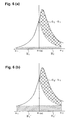
the sensor output is liable to drift when the temperature changes. Fig. 6(a)
schematically illustrates the internal pressure measured profile in a steady
state (at a low temperature), and Fig. 6(b) schematically illustrates the
internal pressure measured profile in a transient state (at a high temperature).
By the influences of the zero-point drifts due to the temperature, the internal
pressure measured profiles are evenly shifted over the entire measurement
period, if the period is so short as to cause no problem in the temperature
change. If the integration periods are equally set for the before top dead
center period and the after top dead center period, therefore, the influences
of the zero-point drifts can be offset at the operation of ΔS≡ S2 - S1, so that
the misfire decision can be made more accurately.
In the misfire decision using the value ΔS, for effectively retaining
accuracy, the difference of the value ΔS between the normal combustion
time and the misfire time is as large as possible. From this viewpoint, it is
effective that the ending point of the integration period set for the before top
dead center period and the starting point of the integration period set for the
after top dead center period are individually made identical to a top dead
center αTDC, as illustrated in Fig. 4. So long as the necessary and
sufficient misfire decision accuracy can be retained when the integration
period of the before top dead center period is set long for the aforementioned
object, however, it is possible either to join the ending point of the
integration period set for the before top dead center period and the starting
point of the integration period set for the after top dead center period at a
position (e.g., at a position deviated to the larger angle side) other than the
top dead center αTDC, or to provide a short non-integration period between
the ending point of the integration period set for the before top dead center
period and the starting point of the integration period set for the after top
dead center period.
Next, for the aforementioned misfire decision, still another
correction can be made by the following method. Specifically, a second
correction reference value is calculated on the basis of the internal pressure
measured value of the combustion cycle (or the estimated misfire cycle)
estimated in advance to be the misfire cycle, to correct the differential
integrated value ΔS with the second correction reference value.
This correction is made effective by the following background
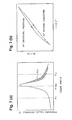
intrinsic to the gasket type pressure sensor. Fig. 7(a) illustrates the results
(in a solid curve) of the internal pressure measured value profile measured
by the gasket type pressure sensor at the normal combustion time, in
comparison with the results (in a broken curve) measured by a partition type
standard pressure sensor through a pressure conduit formed in the cylinder
head. It is thought that the measured values per se indicate the values
more approximately from the true internal pressure. In the measurements
by the gasket type pressure sensor, it is found that the profile at the pressure
dropping time appears to shift to the higher pressure side than the profile at
the pressure rising time. For example, Fig. 7(b) plots the measured value P
of the seated pressure sensor corresponding to a common crank angle,
against a measured value P' of a corresponding standard pressure sensor. It
is found that the curves are different between the pressure rising time and the
pressure dropping time thereby showing a clear hysteresis. On the other
hand, Fig. 9 plots the decision index λ obtained using two gasket type
pressure sensors of common specifications, against a decision index λ0
obtained by the standard sensor. By adopting the decision index λ, the two
linear curves have substantially equal gradients. It is, however, found that
the values (i.e., λhA and λhB) at λ0 = 0, i.e., at the misfire time indicate
considerably different values due to the difference of the hysteresis.
This hysteresis is thought to occur because the compressive gas
forced at the pressure rising time into the thread valley or gasket of the spark
plug providing the portion to be mounted in the internal combustion engine
is not promptly released at the pressure dropping time but remains. In
either event, it is apparent from Fig. 7(a) that the profile at the pressure
rising time is raised by the influences of the hysteresis to deteriorate the
symmetry of the measured value profile curves important for the misfire
decision. In the decision using the integrated values S1 and S2, the
integrated value S2 of the after top dead center pressure is directly increased.
It is, therefore, effective for improving the decision accuracy to correct the
internal pressure measured value at the pressure dropping time thereby
lessening the influences due to that hysteresis.
The frequency of occurrence of the hysteresis cannot be generally
estimated unless the aforementioned standard sensor is used. Only at the
misfire time, however, that frequency can be determined directly from the
internal pressure measured value without providing the standard sensor.
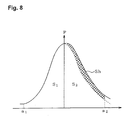
Specifically, the internal pressure measured value profile at the misfire time
should theoretically be symmetric with respect to the top dead center
position, as indicated by a broken curve in Fig. 8. However, the profile at
the pressure dropping time is raised to the extent of the hysteresis, although
the misfire occurs without the hysteresis. By comparing this profile with
the profile at the rising time, therefore, it is possible to estimate the rising
extent of the internal pressure measured value due to the hysteresis. In
other words, the rising extent of the internal pressure measured value is
calculated as the second correction reference value on the basis of the
internal pressure measured value of the combustion cycle (or the estimated
misfire cycle) which has been found in advance to become the misfire cycle.
In order to estimate the rising extent of the internal pressure
measured value accurately, it is necessary to use the internal pressure
measured value in the cycle which has been fixed for that at the misfire time,
i.e., in an estimated misfire cycle. This internal pressure measured value
ordinarily never fails to occur at the fuel cutting time for an abrupt
deceleration while the internal combustion engine for an automobile is
running. In case the misfire decision unit is commonly used for an ECU
(Electronic Control Unit) for controlling the ignition timing or the air/fuel
ratio of the internal combustion engine, for example, or in case the misfire
decision unit can acquire its control information from the ECU although not
used for the ECU, therefore, the misfire decision unit can grasp the
occurrence of the estimated misfire cycle reliably and can calculate the
second correction reference value without any problem.
As shown in Fig. 8, the second correction reference value can be
calculated as a value reflecting the differential integrated value Sh in the
estimated misfire cycle. In case the differential integrated value ΔS itself
is used as the misfire deciding information, the correction may be done by
subtracting the value Sh or the second correction reference value from the
value S2 of the value ΔS. In the misfire decision using the aforementioned
decision index λ (= ΔS/ΔP0), on the other hand, the second correction
reference value can use the decision index λ obtained in the estimated
misfire cycle, as a correction value λhp, and the decision index λ obtained in
the combustion cycle other than the estimated misfire cycle can be corrected,
in a manner to subtract the correction value λhp. In either case, it is
possible to make the accurate misfire decision, in which the influences of the
hysteresis are lightened.
Here, the second correction reference value can be also calculated
on the basis of the internal pressure measured value in a plurality of
estimated misfire cycles having occurred in the past. For example, when
the increment of the internal pressure measured value due to the hysteresis is
expected to be varied with the time due to the occurring timing of the
estimated misfire cycle, a more reliable value of the second correction
reference value can be attained by further including a statistical process such
as averaging the internal pressure measured values of a plurality of the
estimated misfire cycles having occurred in the past.
BRIEF DESCRIPTION OF THE DRAWINGS
Fig. 1 is a longitudinal section showing one example of the
mounting mode of a gasket type pressure sensor;
Fig. 2 is a block diagram showing one example of the electric
construction of a misfire decision unit of the invention;
Fig. 3 is a diagram showing internal pressure measured profiles by
comparing a misfire time and a normal combustion time;
Fig 4 is a diagram explaining a method for calculating a decision
index λ from the internal pressure measured profile of Fig. 3;
Figs. 5(a) and 5(b) are diagrams explaining the behaviors in which
the internal pressure measured values fluctuate in levels;
Figs. 6(a) and 6(b) are diagrams explaining the influences of
temperature drifts on the internal pressure measured profile;
Figs. 7(a) and 7(b) are explanatory diagrams of the hysteresis
occuring in the internal pressure measured profiles;
Fig. 8 is a diagram explaining the influences of the hysteresis to
appearing in the internal pressure measured profile at the misfire time;
Fig. 9 is a diagram plotting the behavior in which the levels of the
hysteresis are made different between individual sensors;
Fig. 10 is a flow chart showing the flow of a misfire deciding
routine in the misfire decision unit of Fig. 2;
Fig. 11 is a diagram explaining the concept of the correction value
λhp of the decision index λ;
Fig. 12 is a first graph plotting the experimental results made for
confirming the effects of the invention;
Fig. 13 is a second graph of the same;
Fig. 14 is a third graph of the same;
Fig. 15 is a fourth graph of the same;
Figs. 16(a), 16(b) and 16(c) are graphs explaining the behavior in
which the influences of variations between individual sensors are lessened
by corrections, and
Fig. 17 is a flow chart showing the flow of a misfire deciding
routine of the case in which the integrations are made by software
operations.
DESCRIPTION OF THE PREFERRED EMBODIMENT
An embodiment of the invention will be described with reference to
the accompanying drawings. However, the present invention should not be
construed as being limited thereto.
Fig. 1 shows one example of the mounting mode of a gasket type
pressure sensor. Specifically, a spark plug 50 has a fastened thread portion
52 formed in the outer circumference of the leading end portion of a main
fixture 51. The spark plug 50 is so fastened in a thread TH formed in the
bottom of a plug hole PH, by fastening the fastened thread portion 52 into
the thread TH so that a spark discharge gap g may be positioned in a
combustion chamber ER with respect to a cylinder head SH of an internal
combustion engine configured as an automobile engine. Moreover, a
flanged mounting seat 51f is formed to protrude from the outer
circumference of the main fixture 51 at a position adjoining the base end
portion of the fastened thread portion 52. On the other hand, a gasket type
pressure sensor 5 has a ring-shaped sensor element 10 made of piezoelectric
ceramics, which is clamped together with a ring-shaped gasket GS under a
constant bias pressure in the axial directions between the mounting seat
portion 51f and an open peripheral edge portion MP of the thread TH.
As a pressure in the combustion chamber ER rises, i.e., an internal
cylinder pressure rises, the spark plug 50 receives the pressure in the axial
directions so that the bias pressure applied to the sensor element 10 changes.
As a result, the generation of piezoelectric charges in the sensor element 10
changes so that a correspondingly varying signal is extracted as a measured
internal cylinder value P through an output cable CB.
Fig. 2 is a block diagram showing one example of a misfire decision
unit in accordance with the invention using the gasket type pressure sensor 5.
A misfire decision unit 1 has a main construction of an ECU 2 comprising a
computer and executes control over such drive parameters of an internal
combustion engine as an ignition timing or an air/fuel ratio, together with the
misfire decision. Here, the construction and functions of the ECU 2 are
well known in the art excepting the misfire deciding function to be described
hereinafter, and the following description will be focused on that misfire
deciding function.
The ECU 2 is constructed as a computer in which a CPU 3, a ROM
4, a RAM 5 and an input/output interface 6 are interconnected through a bus.
The ROM 4 stores a control program defining the control processing
functions of the ECU 2 and having a misfire decision routine incorporated
therein. The CPU 3 realizes the function of the ECU 2 by executing the
control program using the RAM 5 as a work memory.
A crank angle sensor 7 for detecting the crank angle of the internal
combustion engine is connected to the input/output interface 6. The crank
angle sensor 7 is, for example, a pulse generator for detecting the rotational
angle of the crankshaft. The pulse signal of the pulse generator is inputted
to a predetermined port of the input/output interface 6 via a Schmitt trigger 8.
Moreover, the speed of the engine and the duration of one cycle can be
monitored in real time with the interval of input pulses coming from the
crank angle sensor 7.
Next, the pressure sensor element 10 is connected with the
input/output interface 6 through a charge amplifier circuit 11. In this
charge amplifier circuit 11, the output cable from the pressure sensor
element 10 is connected with a negative input terminal of an operation
amplifier 15, the positive input terminal of which is grounded (thereby
forming an inverted amplifier using ground level as a reference voltage).
As a pressure is developed in the combustion chamber, the pressure sensor
element 10 (Fig. 2) generates a charge. As a result, a negative feedback
capacitor 13 connected with the operation amplifier 15 stores a charge
balancing that generated charge, and its terminal voltage is inputted as a
voltage-transformed charge signal to the negative input terminal of the
operation amplifier 15. Therefore, the operation amplifier 15 forms a
charge voltage transforming circuit together with the negative feedback
capacitor 13 so as to output the charge developed in the pressure sensor
element 10 as an amplified voltage signal. A resistor 12 connected in
parallel with the negative feedback capacitor 13 promotes the discharge of
the negative feedback capacitor 13, when the generated charge level of the
pressure sensor element 10 turns negative, and prevents output saturation of
the operation amplifier 15. On the other hand, a resistor 14 on the signal
line from the pressure sensor element 10 protects the terminals of the
operation amplifier 15.
The output of the charge amplifier circuit 11 is inputted as an
internal pressure measured value signal through a voltage follower 16 and an
A/D converter 17 to a predetermined port of the input/output interface 6.
In this embodiment, on the other hand, a before top dead center pressure
integrated value S1 and an after top dead center pressure integrated value S2
are calculated on the basis of the internal pressure measured value signal, as
shown in Fig. 4, and are used to make the misfire decision. Therefore, the
output of the charge amplifier circuit 11 is branched and inputted to an
integration circuit 24.
In this integration circuit 24, the branched output of the charge
amplifier circuit 11 is inputted through a voltage follower circuit 18 to an
operation amplifier 19 forming a well-known integrator, with which a
resistor 21 and a negative feedback capacitor 20 are connected. The
integrated output of the integration circuit 24 is inputted to a predetermined
port of the input/output interface 6 through an A/D converter 23. In order
to clear the output of the integration circuit 24 for each cycle of combustion,
a switch circuit (as exemplified by a photo-MOS relay) 22 is connected with
the negative feedback capacitor 20 for earthing/discharging the negative
feedback capacitor 20 in response to an action command signal from the
ECU 2.
In the system of this embodiment, the integration circuit 24
integrates the output of the charge amplifier circuit 11, i.e., the internal
pressure measured value P with time t. Strictly speaking, therefore, this
value is not the integrated value which is expressed by the angle α of
Formulae (2) and (3) of Fig. 4. If the interval of the input pulses from the
crank angle sensor 7 is measured by a clock counter, however, the prevailing
engine speed, i.e., the duration of one cycle (which may be an average value
of a predetermined number of immediately preceding cycles, for example)
can be calculated in real time. Therefore, the time-integrated value
obtained can be transformed into the integrated value by the angle α, if it is
divided by the duration of one cycle. Here, the aforementioned
time-integrated value can be used as it is, if the influence of the engine speed
fluctuations at the misfire measuring time is low.
The misfire decision processing flow will be descried with
reference to the explanatory diagram of Fig. 4 and the flow chart of Fig. 10
considering the case using a decision index λ (although the memories of
individual variables to be used in this processing are formed in the RAM 5
of Fig. 2). First of all, the signal of a crank angle α is inputted, as shown
in Fig. 2, as the pulse signal outputted by the crank angle sensor 7 and is
added by the α-counter in the RAM 5. This added value of the α-counter
indicates the prevailing crank angle (although the crank angle sensor 7 could
be exemplified by an absolute type pulse generator while eliminating the
α-counter). At S1 of Fig. 10, moreover, the routine is initialized by
resetting the α-counter and by activating the switching circuit 22 of Fig. 2 to
reset the integrated output of the integrator. After these resets, the addition
of the α-counter at S2 is started according to the execution of the cycle
starting job by the ECU 2.
After this, the addition of the α-counter is continued on standby
until the arrival of the sampling timing of the predetermined internal
pressure measured value P and its integrated value S. Specifically, the
routine is on standby at S3 for reading the input ports of the internal pressure
measured signal and its integrated value, and the α-counter is read at S4.
At S5, moreover, it is judged whether or not the crank angle α indicated by
the α-counter has reached a starting point α1 (or a point for setting a first
one of the aforementioned two correction measurement points in this
embodiment) of the before top dead center integration period set to a period
after an intake valve is closed. If this answer is NO, the routine returns to
S3 to repeat the subsequent operations. If YES, the routine advances to the
operations at and after S6.
At S6, the internal pressure measured value P is read in response to
the arrival of the first correction measurement point and is set as the
aforementioned value P1 in the memory. Moreover, the switching circuit
22 is turned off to release the integrator from the reset state at S7. As a
result, the integration of the internal pressure measured value P is started at
and after the starting point α1. Then, the standby is restored again for
sampling at S8, and it is judged at S9 whether or not the value α has reached
the second one of the two correction measurement points. If the answer is
NO, the routine returns to S8, at which the subsequent operations are
repeated. If YES, the routine advances to the operations at and after S10.
At S10, the internal pressure measured value P is read in response to
the arrival of the second correction measurement point and is set as the
aforementioned value P2 in the memory. At S11, moreover, the
aforementioned value ΔP0 = P2 - P1 is calculated and set in the memory. At
S12, moreover, the standby is made for the sampling. At S13, it is judged
whether or not the value α has reached a top dead center angle αTDC. If
the answer is NO, the routine returns to S12, and the subsequent operations
are repeated. If YES, the routine advances to the operations at and after
S14.
At S14, the input value from the integrator is read. This value
indicates the before top dead center pressure integrated value S1 (of Formula
(2) of Fig. 4) and is set as the value S1 in the memory. Here, the input
value from the integrator is the time-integrated value of the value P as
described above. The duration T of one cycle is determined from the input
pulse interval from the crank angle sensor 7, and the crank angle α is
transformed into the integrated value by dividing it with the duration T,
although omitted from the flow chart. At S15, the standby is restored
again for the sampling, and it is judged at S16 whether or not the value α has
reached the ending point α2 of the integration period of the after top dead
center pressure integrated value S2. If the answer is NO, the routine
returns to S15, and the subsequent operations are repeated. If YES, the
routine advances to operations at and after S17.
At S17, the input value of the integrator is read again according to
the arrival of the ending point α2. This value indicates the integrated
value from α1 to α2, i.e., Sp = S1 + S2 and is set in the memory. At S18,
the value S2 is calculated as the value of Sp - S1. Then, the routine
advances to S19, at which the value of the aforementioned decision index λ
is calculated by using the calculated values S1, S2 and ΔP0.
Next at S20, there is read a correction value λhp for the
aforementioned hysteresis correction, which has been calculated and stored
in the preceding routine. At S21, a correction is made to calculate the final
corrected decision index λ' by subtracting the correction value λhp from the
decision index λ already obtained. At S22, this value λ' is compared with
a decision reference value (or an upper limit value) λc, and the decision of
misfire is made if λ' < λc. The ECU 2 of Fig. 2 outputs a predetermined
misfire decision (Fig. 10: S23) from a decision output port of the
input/output interface 6.
In case this cycle is an estimated misfire cycle such as a fuel cut
cycle intended from the beginning by the ECU 2, the routine advances to
S25 in Fig. 10. At S25, the correction value λhp is updated by using the
decision index λ before the correction, which has been obtained in that cycle.
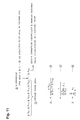
Fig. 11 shows the updating method schematically. For calculating the
value λ, it is necessary to calculate a differential integrated value ΔS for
each estimated misfire cycle. Here, the differential integrated value is used
as a correction value so that it is expressed by ΔSh and is further suffixed
into ΔSh1, ΔSh2, ---, and ΔShk so as to correspond to the time series array of
the estimated misfire cycle. In a relatively convenient method, the
differential integrated value is calculated as an average value ΔShm of the
values ΔSh which are obtained in a plurality of (e.g., an N-number of)
preceding estimated misfire cycles, as indicated by [1] in Fig. 11.
By an accidental cause, on the other hand, the value ΔSh obtained in
an estimated misfire cycle may take such a numerical value as
extraordinarily deviates from the tendency of the preceding ΔSh.
Therefore, the following method can be adopted as one for obtaining the
corrected value λhp of a higher reliability by reducing the influence of the
extraordinary value. In this method, the product value of the average value
ΔShm of the values ΔSh of the just preceding N-number and the term β/(1 - β)
by using a correction coefficient β is used as a predicted value ΔShp of a
next value ΔShi, as indicated by [2] in Fig. 11. By using the predicted
value ΔShp and the actually measured ΔShi, moreover, a correction factor Ai
is calculated for each estimated misfire cycle from a Formula [3] of Fig. 11.
The aforementioned correction coefficient β is calculated as an average
value of the correction factors Ai which have already been obtained in the
just preceding N-number of estimated misfire cycles, by Formula [4] of Fig.
11.
The value A; is so clarified, if modified into [3]' by dividing the
denominator and numerator of Formula [3] individually by ΔShi, as to come
closer to 1/2 if the difference between the result value (ΔShi) and the
predicted value (ΔShp) relating to the value ΔSh becomes smaller, to 1 if the
result value becomes larger from the predicted value, and to 0 if smaller on
the contrary. Therefore, the correction coefficient β or the average value
of the values Ai also becomes closer to 1/2 (as will be termed into the
"pattern 1") as the number of cycles of smaller difference between the result
value and the predicted value becomes larger in the product of ΔSh in the
past estimated misfire cycles, to 1 (as will be termed into the "pattern 2") as
the number of cycles, in which the result value is far higher than the
predicted value, becomes larger, and to 0 (as will be termed into the "pattern
3") as the number of cycles, in which the result value is far lower on the
contrary, becomes larger.
In this case, the value of β/(1 - β) approaches closer to 1 in the
pattern 1. In other words, the difference between the result value and the
predicted value is intrinsically small so that the effect of correction can be
reduced. In the pattern 2, on the other hand, the value of β/(1 - β) is
inversely higher as the difference of the result value from the predicted value
is larger. Therefore, the predicted value becomes higher toward the result
value so that the correction precision is enhanced. In the pattern 3, on the
other hand, the value of β/(1 - β) approaches closer to 0 as the difference of
the result value from the predicted value becomes larger. In other words,
the predicted value becomes smaller toward the result value so that the
correction accuracy is likewise enhanced. Here, each value ΔSh can be
transformed into the value λhp by dividing it by the corresponding value ΔP0.
In this case, a correction factor A using the λ and the correction coefficient β
can be likewise calculated by replacing the value ΔSh by the value λhp in
Formulae [3] and [4] of Fig. 11.
Here, the aforementioned integrations can be made by a software in
the ECU 2, and the integration circuit 24 of Fig. 2 can then be omitted. It
is also easily realized by processing a program to acquire the integrated
value with the angle α by using the input pulse interval from the crank angle
sensor 7. One example of this processing will be described with reference
to a flow chart of Fig. 17. Here, the internal pressure measured value P is
read (for a measuring job) by an interrupting operation for every increment
δα of the certain c rank angle α, and the added value of the values P is
calculated as an integrated value.
At T1, it is judged whether or not the crank angle α indicated by the
α-counter has reached the timing just before a starting point α1 of the before
top dead center integration period, i.e., α1 - δα. If the answer is NO, a
standby is made while continuing the addition of the α-counter. If YES,
the routine advances to T2, at which the integration memories S1 and S2 are
cleared. At T3, the interrupt of the measured job is permitted (to release
the mask of an interrupt terminal). From now on, the value P is read at
each δα and is stored in an overwritten shape in the P memory of the RAM 5
(Fig. 2).
The measuring job includes two steps of reading (U1) the internal
pressure measured value P and setting (U2) a measurement end flag
indicating that the reading(or measurement) of the value P has completed.
In the misfire deciding main job, it is judged by confirming the contents of
the measurement end flag at T4 whether or not the value P has been updated
by the latest measured value. If this answer is YES, the routine advances
to T5, at which the prevailing crank angle α is read. If this angle α is
smaller than the value αTDC, the routine advances to T6, at which the value
P is added to the integration memory of S1. Moreover, it is confirmed at
T7 whether or not the value α has reached α1. If this answer is YES, the
routine advances to T8, at which the prevailing value P is stored as the
aforementioned value P1. At T9, the measurement end flag is reset, and
the routine is returned to T4. After this, these operations are repeated. If
it is judged at T7 that the value α is larger than α1, on the other hand, the
routine advances to T10, at which it is judged whether or not the
aforementioned value αJ has been reached. If this answer is YES, the
routine advances to T11, at which the prevailing value P is stored as the
aforementioned P2 and at which the value ΔP0 is calculated and stored as P2-P1,
(otherwise the routine skips T11). After this, at T9, the measurement
end flag is reset, and the routine is returned to T4 to repeat the subsequent
operations.
If it is judged at T5 that the value α is not smaller than αTDC, the
routine advances to T12. If it is judged at T12 that the value α is equal to
αTDC, the routine advances to T13. At T13, the final addition of P to S1 is
made, and the addition of P to S2 is started. The routine is returned
through T9 to T4. This is because the value P at αTDC belongs to both S1
and S2. If the value δα is sufficiently small, the operation can be done
assuming that the value P at αTDC belongs to either S1 or S2. If it is
judged at T12 that the value α is larger than αTDC, on the other hand, the
routine advances to T14, at which it is judged that the value α is no more
than α2. If this answer is YES, the routine advances to T15, at which the
addition of P to S2 is continued. If NO, on the other hand, the routine
advances to T16, at which the interruption of the measuring job is inhibited
(that is, the interruption terminal is masked) to end the integrating operations
and to advance to T17. The operations at and after T17 will be omitted on
their description, because they are similar to those at and after S19 of Fig.
10.
Here will be described the results of experiments which have been
performed for confirming the effects of the invention.
First of all, ten gasket type pressure sensors identical to that shown
in Fig. 1 were prepared and were attached together with spark plugs to a
four-cylinder gasoline engine having a displacement of 2,000 cc. This
engine was run at various engine speeds by setting the ignition timing at 15
degrees of before top dead center (BTDC) and a misfire decision was made
by a decision unit in Fig. 2. Fig. 12 plots the results of misfire decisions
based on the value of the aforementioned differential integral value ΔS.
Solid diamonds plot the average values of ΔS of the cycle decided as a
normal combustion, together with their distribution ranges (as indicated by
error bars). The solid squares plot the average values of ΔS of the cycle
decided as a misfire, together with their dispersion ranges. According to
this graph, it is implied that the decisions could be made without any serious
problem for a high RPM range, but that the distributions of the values for
deciding the normal combustion and the misfire were so close to each other
for a low RPM range that an erroneous decision was probable. On the
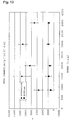
other hand, Fig. 13 plots similar experimental results of the case in which the
misfire decision is made by using the aforementioned decision index λ.
Here, the first correction measuring point was set at the integration period
starting point α1 and at a BTDC of 90 degrees, and the second correction
measuring point was set at BTDC of 5 degrees after the ignition timing. It
is seen, as compared with Fig. 12, that the ratio of the dispersion range to the
average value of λ was reduced in a low RPM range so that the decision
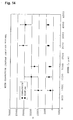
accuracy was improved. Moreover, Fig. 14 plots the case in which the
second correction measuring point was set at a BTDC of 20 degrees before
the ignition timing, and imdicates that the dispersion range ratio in the low
speed range was further reduced. Fig. 15 summarizes the dispersion range
ratios to the average value at every speed for the foregoing three results. It
is apparent that the setting of the second correction measuring point before
the ignition timing gave the most excellent result.
For two different sensors, on the other hand, Fig. 16(a) shows an
example, in which the differential integration values ΔS obtained by using
the gasket type pressure sensor are plotted against the differential integration
values ΔS0 obtained by using the standard sensor. Both the sensors caused
generally linear changes of ΔS against ΔS0 but a large difference in the
values of the gradient and the intercept. Next, Fig. 16(b) plots the decision
indexes λ, which were obtained by dividing the differential integration
values of the two sensors by the value ΔP0, against the similar decision
indexes λ0 which were obtained by using the standard sensor. It is found
that the difference in the gradient between the two straight lines was
remarkably reduced. Moreover, Fig. 16(c) plots the decision indexes λ',
which were obtained by the hysteresis correction to subtract the correction
value λhp from the decision index λ, against the value λ0. It was found that
the differences in both the gradient and the intercept between the two
straight lines were remarkably reduced, and that a constant misfire deciding
circumstance could always be realized independently of the sensors used.
It should further be apparent to those skilled in the art that various
changes in form and detail of the invention as shown and described above
may be made. It is intended that such changes be included within the spirit
and scope of the claims appended hereto.
This application is based on Japanese Patent Application No.
2001-135613 filed May 2, 2001, the disclosure of which is incorporated
herein by reference in its entirety.