EP1254940A1 - Treating agent for imparting hydrophilicity and high corrosion resistance, hydrophilizing fluid, and method of hydrophilizing - Google Patents
Treating agent for imparting hydrophilicity and high corrosion resistance, hydrophilizing fluid, and method of hydrophilizing Download PDFInfo
- Publication number
- EP1254940A1 EP1254940A1 EP01900762A EP01900762A EP1254940A1 EP 1254940 A1 EP1254940 A1 EP 1254940A1 EP 01900762 A EP01900762 A EP 01900762A EP 01900762 A EP01900762 A EP 01900762A EP 1254940 A1 EP1254940 A1 EP 1254940A1
- Authority
- EP
- European Patent Office
- Prior art keywords
- hydrophilization
- agent
- weight
- parts
- hydrophilic polymer
- Prior art date
- Legal status (The legal status is an assumption and is not a legal conclusion. Google has not performed a legal analysis and makes no representation as to the accuracy of the status listed.)
- Withdrawn
Links
Classifications
-
- C—CHEMISTRY; METALLURGY
- C09—DYES; PAINTS; POLISHES; NATURAL RESINS; ADHESIVES; COMPOSITIONS NOT OTHERWISE PROVIDED FOR; APPLICATIONS OF MATERIALS NOT OTHERWISE PROVIDED FOR
- C09D—COATING COMPOSITIONS, e.g. PAINTS, VARNISHES OR LACQUERS; FILLING PASTES; CHEMICAL PAINT OR INK REMOVERS; INKS; CORRECTING FLUIDS; WOODSTAINS; PASTES OR SOLIDS FOR COLOURING OR PRINTING; USE OF MATERIALS THEREFOR
- C09D139/00—Coating compositions based on homopolymers or copolymers of compounds having one or more unsaturated aliphatic radicals, each having only one carbon-to-carbon double bond, and at least one being terminated by a single or double bond to nitrogen or by a heterocyclic ring containing nitrogen; Coating compositions based on derivatives of such polymers
- C09D139/02—Homopolymers or copolymers of vinylamine
-
- C—CHEMISTRY; METALLURGY
- C08—ORGANIC MACROMOLECULAR COMPOUNDS; THEIR PREPARATION OR CHEMICAL WORKING-UP; COMPOSITIONS BASED THEREON
- C08L—COMPOSITIONS OF MACROMOLECULAR COMPOUNDS
- C08L39/00—Compositions of homopolymers or copolymers of compounds having one or more unsaturated aliphatic radicals, each having only one carbon-to-carbon double bond, and at least one being terminated by a single or double bond to nitrogen or by a heterocyclic ring containing nitrogen; Compositions of derivatives of such polymers
- C08L39/02—Homopolymers or copolymers of vinylamine
-
- C—CHEMISTRY; METALLURGY
- C08—ORGANIC MACROMOLECULAR COMPOUNDS; THEIR PREPARATION OR CHEMICAL WORKING-UP; COMPOSITIONS BASED THEREON
- C08L—COMPOSITIONS OF MACROMOLECULAR COMPOUNDS
- C08L63/00—Compositions of epoxy resins; Compositions of derivatives of epoxy resins
Definitions
- the present invention relates to a novel hydrophilization agent, hydrophilization liquid, and hydrophilization method, which can impart improved hydrophilicity and high corrosion-resistance on the surface of metallic material, such as aluminum, aluminum-alloy, copper, copper-alloy, stainless steel and the like, particularly in a case where these materials are used for a heat exchanger.
- heat exchangers made of metallic material such as an aluminum-containing metallic material
- their heat-dissipating and cooling portions have surface area as large as possible to enhance the heat-dissipating and cooling performance.
- the inter-fin space is extremely narrow to minimize size of the heat exchanger. Therefore, when an evaporator is operated, moisture in the atmosphere condenses on the fin surface. The condensed water tends to form water drops which fill the fin gaps (clogging), when the hydrophilicity of the fin surface is poor. As a result, ventilation resistance is increased, which reduces the heat-exchanging efficiency. And, such problems arise as power loss, generation of noise, and scattering of water drops with the air stream to the downstream side.
- Japanese Unexamined Patent Publication (kokai) No. 6-116527 discloses a hydrophilization agent of the metallic surface, which ins an acrylic-acid polymer as a film-forming component, a vanadium compound as cross-linking agent, and a silica source as the hydrophilizing component.
- this film has improved hydrophilicity, the resistance to solubility in water is unsatisfactory. It is, therefore, difficult to sustain the corrosion resistance for a long period of time.
- there is a problem unsolved regarding offensive odor is a problem unsolved regarding offensive odor.
- Japanese Unexamined Patent Publication (kokai) No.6-322552 discloses a hydrophilization surface-treating agent, which contains 5 ⁇ 25 parts by weight of sodium salt and/or potassium salt of carboxymethylcellulose, from 25 ⁇ 50 parts by weight of ammonium salt of carboxymethylcellulose, and 25 ⁇ 70 parts by weight of N-methylolacrylamide. It is disclosed to use the hydrophilization surface-treating agent mentioned above for a hydrophilization surface-treating bath and a surface-treating method of aluminum material. It is also disclosed to further include from 0.6 ⁇ 9 parts by weight of a zirconium compound in terms of Zr. The persistence of the hydrophilicity and corrosion resistance for a long period of time of the film formed by this method are unsatisfactory.
- Japanese Unexamined Patent Publication No. 7-102189 discloses a hydrophilization treating agent, which contains, as the main components, an aqueous macromolecule compound having 10% by weight or more of a polyoxyalkylene chain in terms of solid matter, and at least one aqueous resin selected from (a) unaaturated polymerizable monomer or unsaturated polymerizable aqueous natural macromolecule compound containing a carboxyl group and/or hydroxide group, (b) a natural macromolecule compound containing a carboxyl group and/or hydroxide( group or its derivative, (c) aqueous alkyd resin, (d) aqueous maleinated oil, (e) aqueous polyester resin.
- aqueous macromolecule compound having 10% by weight or more of a polyoxyalkylene chain in terms of solid matter and at least one aqueous resin selected from (a) unaaturated polymerizable monomer or unsaturated polymerizable aqueous natural macromolecule compound containing a carb
- aqueous polybutadiene resin (g) aqueous polyamide resin, (h) aqueous epoxy resin, (i) aqueous polyurethane resin, (j) aqueous phenol resin, (k) aqueous amino resin, and (I) aqueous inorganic cross-linking agent (compound of Cr, Ti, Al, Zn, Zr or the like).
- aqueous inorganic cross-linking agent compound of Cr, Ti, Al, Zn, Zr or the like.
- the present invention solves the above-mentioned problems involved in the prior art. Specifically, the present invention provides a hydrophilization agent, hydrophilization liquid, and hydrophilization method, which can impart improved hydrophilicity and high corrosion resistance on the surface of metallic materials, the raw material of which is aluminum, aluminum alloy, copper, copper alloy, stainless steel and the like.
- a film having improved hydrophilicity and corrosion resistance can be formed on the surface of metallic material by using a hydrophilization agent and hydrophilization liquid, which contains a hydrophilic polymer, that is, a copolymer of N-vinylacetamide and a polymerizable monomer having a COOX group (in the formula, X means hydrogen atom, alkali metal atom or ammonium salt), an organic cross-linking agent, and a metal compound.
- X means hydrogen atom, alkali metal atom or ammonium salt
- the hydrophilization agent according to the present invention is characterized in that it contains, as the essential components, (a) a hydrophilic polymer, that is, a copolymer of N-vinylacetamide and a polymerizable monomer having a COOX group (in the formula, X means hydrogen atom, alkali metal atom or ammonium salt), (b) an organic cross-linking agent, and (c) a metal compound of at least one compound selected from Ti, V, Cr, Mn, Co, Zn, Zr, Mo, Ce and W.
- the ratio of the N-vinylacetamide and the polymerizable monomer having a COOX group is preferably within the weight ratio of 95 : 5 ⁇ 20 : 80.
- the cross-linking agent (a) mentioned above is preferably an epoxy compound.
- At least one additive selected from the group consisting of an anti-bacteria/mildew agent, a surfactant and a thickening agent is preferably further contained.
- 0.1 ⁇ 200 parts by weight of the cross-linking agent (b) and 1 ⁇ 200 parts by weight of the metal compound(c) are blended at a weight ratio relative to 100 parts by weight of the hydrophilic polymer (a) mentioned above.
- the hydrophilization liquid of the present invention is characterized in that it contains the above-mentioned hydrophilization agent at a concentration of from 1 ⁇ 100 g/L.
- the hydrophilization method of the present invention is characterized in that the hydrophilization agent or hydrophilization liquid mentioned above is deposited on the surface of the metallic material and is dried to form the hydrophilizing film.
- a polymerizable monomer, which is copolymerized with the N-vinylacetamide in the hydrophilic polymer (a) is not particularly limited, provided that it is a polymerizable organic acid having a COOX group (in the formula, X means hydrogen atom, alkali metal atom or ammonium salt).
- X means hydrogen atom, alkali metal atom or ammonium salt.
- itaconic acid, maleic acid, maleic acid anhydride, crotonic acid, acrylic acid, (metha) acrylic acid, or their salts are listed.
- acrylic acid, (metha) acrylic acid and their salts are preferred.
- acrylic acid and/or its alkali metal or ammonium salts are preferred from the viewpoint of resistance to solubility in water and the like.
- acrylic acid, sodium acrylate, potassium acrylate, ammonium acrylate are listed.
- One or more of these compounds can he used.
- the weight ratio of N-vinylacetamide and the polymerizing monomer is preferably 95 : 5 ⁇ 20 80, more preferably 90 : 10 ⁇ 30 : 70. furthermore preferably 70 : :30 ⁇ 50 : 50.
- the polymerizable monomer is less than 95 : 5 of weight ratio, that is, the amount of one polymerizable monomer is small, the film formed is of poor resistance to solubility in water.
- the polymerizable monomer is more than 20 : 80, that is, a large amount of the polymerizable monomer, the hydrophilization persistence is lowered.
- the organic cross-linking agent (b) which is an essential component of the hydrophilization agent and hydrophilization liquid of the present invention, is used to fix the hydrophilic polymer (a) in the hydrophilizing film formed. That is, this organic cross-linking agent (b) plays the role of binder in the hydrophilizing film and prevents solution and removal of, the hydrophilic polymer. As a result, improved hydrophilicity, resistance to solubility in water and suppression of offensive odor can be ensured for a long period of time.
- a film is formed by the hydrophilization agent or the hydrophilization liquid, in which the anti-bacteria agent and/or the anti-mildew agent is added. Premature solution of the anti-bacteria agent and/or the anti-mildew agent from this film is suppressed. It is, therefore, believed that improved anti-bacteria and anti-mildew effects are provided.
- the organic cross-linking agent (b) is not particularly limited to its kind, provided that an organic compound can be cross-linked with the hydrophilic polymer (a).
- the liquid state such as colloid dispersion, emulsion and the like.
- the ionic state such as nonionic anionic and cationic states.
- an epoxy compound such as polyethylene glycol diglycidyl ether and sorbitol polyglycidyl ether; a blocked polyisocyanate such as bisulfite-blocked polyisocyanate; a polymethylol such as methylol melamine and methylol urea; a poly aziridilated compound such as diaziridilated polyethylene oxide; and aldehydes such as glyoxal and furfural are listed.
- the epoxy compound is preferred from the viewpoint of resistance to solubility in water.
- epoxy compounds are sorbitol polyglycidyl ether, glycerol polyglycidyl ether, diglycerol polyglycidyl ether, polyglycerol polyglycydil ether, trimethylol propane polyglycidyl ether, ethyleneglycol diglycydyl ether, polyethylene glycol diglycydil ether, propylene glycol diglycydil ether, polypropylene glycol diglycydil ether, ethylene oxide-containing phenol-based glycydil ether, ethylene-oxide containing lauryl alcohol-based glycydil ether and bisphenol-type epoxy resin.
- the molecular weight of the post-cross-linked hydrophilic polymer is usually in the range of from one thousand to five million, preferably from ten thousand to three million, more preferably from twenty thousand to two million.
- Such metal compound is not limited to a particular kind, provided that it is at least one compound, which contains a metal selected from the group consisting of Ti, V, Cr, Mn, Co, Zn, Zr, Mo, Ce and W.
- the metal compound may be oxide, hydroxide, fluoride. chloride, carbonate, nitrate, sulfate, nitrate, acetate, phosphate and organic substance.
- titanium compound titanium oxide, titanium hydrofluoride, and its salt (potassium salt, ammonium salt and the like), titanium sulfate and its salt (potassium, ammonium salts and the like), titanyl sulfate, titanium acetylacetonate, titanium acetyl acetonate, titanium tetracetyl acetonate, titanium lactate, and titanium triethanol aminate and the like are listed.
- vanadium compound vanadium pentoxide, metavanadinate (sodium, potassium, ammonium salts and the like), vanadium pentafluoride, vanadyl sulfate, vanadium acetylacetonate, vanadyl acetylacetonate and the like are listed.
- chromium compound chromium oxide, bichromic acid and its salt (sodium, potassium, ammonium salts and the like), chromium fluoride, chromium carbonate, chromium nitrate, chromium sulfate, chromium phosphate, chromium biphosphate, chromium acetylacetonate, and the like are listed.
- manganese oxide As the manganese compound, manganese oxide, manganate (sodium, potassium salts and the like), permanganic acid and its salt (sodium, potassium, calcium, barium, lithium salts and the like), manganese carbonate, manganese nitrate, manganese phosphate, manganese hydrophosphate, manganese acetylacetonate and the like are listed.
- cobalt compound cobalt oxide, cobalt hydroxide, cobalt carbonate, cobalt nitrate, cobalt sulfate and its salt (potassium, ammonium salts and the like), cobalt phosphate, cobalt pyrophosphate, cobalt acetylacetonate and the like are listed.
- zinc compound zinc oxide, zinc hydroxide, zinc carbonate, zinc nitrate, zinc sulfate and its salt (potassium, ammonium salts and the like), zinc phosphate, zinc hydrogen phosphate, zinc acetylacetonate and the like are listed.
- zirconium compound zirconium oxide, zirconium hydroxide, zirconium hydrofluoric acid and its salt (potassium, ammonium salts and the like), zirconium oxychloride, zirconium hydroxy-chloride, ammonium zirconium carbonate, potassium zirconium carbonate, zirconium sulfate, zirconium nitrate, zirconium acetate, zirconium phosphate, zirconium sodium phosphate, zirconium propyonate, zirconium monoacetylacetonate, zirconium bisacetylacetonate, zirconium tetracetylacetonate. zirconium acetyalacetonate bisethylacetoacetonate. zirconium acetate, zirconyl stearate, zirconyl octylate and the like are listed.
- molybdenum oxide molybdenic oxide and its salt (sodium, potassium, magnesium, ammonium salts and the like), molybdenyl acetylacetonate and the like are listed.
- cerium compound cerium oxide, cerium hydroxide, cerium chloride, cerium carbonate, dibasic cerium sulfate and its salt, cerium acetate, cerium acetate dibasic ammonium, cerium acetate, cerium phosphate, cerium octylate, cerium acetylacetonate and the like are listed.
- tungsten oxide As the tungsten compound, tungsten oxide, tungstic acid and its salt (sodium, potassium, magnesium, ammonium salts and the like) are listed.
- a complex compound of these metals for example, zinc bichromate, zinc permanganate, cobalt tungstate, cerium tungstate and the like, and pigments, which are mixture of oxides, can be used.
- an anti-bacteria agent and/or anti-mildew agent are preferably added into the hydrophilization agent and hydrophilization liquid of the present invention, provided that the effects of the agent or liquid are not impeded.
- the putrefaction odor due to propagation of bacteria, mildew and yeast can be prevented.
- the anti-bacteria/mildew agent usable in the present invention is such that can resist, during the dying step, after depositing the hydrophilization agent or hydrophilization liquid, the heating for removal of water, which is a solvent of the treatment agent or treatment liquid. That is, the decomposition temperature of the anti-bacteria/mildew agent is approximately 100°C or higher.
- anti-bacteria and/or mildew agent for example, 5-chloro-2-methyl-4-isothiazoline-3-on, 2-methyl-4-isothiazoline-3-on, 2-(4-thiocyano-methylthio) benzothiazole, 2,2-dibromo-3-nitrilopropyon amide, sodium ethylene bis(dithiocarbamate), sodium-2-pyridionethiol-1-oxide, zinc-2-pyridinethiol-1-oxide, 2,2'-dithiobis (pyridine-1-oxide), 2, 4, 5, 6-tetrachloro isophthalonitorile, 2-methyl carbonyl aminobenzilmidazole, 2, 3, 5, 6-tetrachloro-4-(methylsulfonyl)-pyridine, 2-(4-thyazolyl)-benzimidazolo, N-(fluorodichloromethyl thio) sulfamide, p-chloro-m-xylenol, dehydr
- the addition amount of the anti-bacteria and/or mildew agent is preferably 0.1 ⁇ 30% by weight, more preferably 1 ⁇ 20% by weight, relative to 100 parts by weight of the total weight of the components (a), (b) and (c).
- the addition amount is less than 0.1% by weight, the hydrophilic film formed does not satisfactorily exhibit the anti-bacterial resistance and the anti-mildew resistance.
- the addition amount exceeds 30% by weight, its effects saturate and the cost of the treating agent and the treating liquid increases and is hence economically impractical.
- a surfactant may be added.
- the surfactant used for this purpose is not limited and may be any one of the nonionic, anionic, cationic, or amphoteric surfactants. However, it is not preferable to use a surfactant having an ionic property opposite to that of the components (a), (b) and (c) used in combination with the surfactant, since the stability of the treating agent or the treating liquid may be impeded.
- the surfactants capable of adding into the hydrophilization agent or hydrophilization liquid of the present invention are for example: a non-ionic surfactant, such as polyoxyethylene alkylether, e.g. polyoxyethylene 1aurylether and polyoxyethyele stearylether, polyoxyethylene alkylphenylether, e.g., polyoxethylene nonyl- phenlylether, sorbitan fatty acid ester, e.g., a block polymer of oxyethylene and oxypropylene (Pluronic), sorbitan monolaurate and sorbitan monostearate, fatty acid ester of polyoxyethylene, e.g., polyoxyethylene laurate, polyoxyethylene stearate, and polyoxy- ethylene olealate, glycerin fatty acid ester, and polyoxyethylene propylene glycol alkyl phenol ether; an anionic surfactant such as fatty acid salt, e.g., sodium laurate, sodium
- the addition amount of the above-mentioned surfactant is preferably in a range of 0.05 ⁇ 20% by weight, more preferably 0.1 ⁇ 10% by weight relative to 100 parts by weight of the total weight of the components (a), (b) and (c) used together.
- the addition amount is less than 0.05% by weight, the hydrophilizing film formed does not exhibit satisfactory lubrication property.
- the addition amount exceeds 20% by weight, there arises disadvantageously a danger that the adhesiveness of the film and the metallic material is lowered.
- a thickening agent may be added, if necessary, into the hydrophilization agent and the hydrophilization liquid of the present invention.
- the thickening agent used for this purpose is sodium salt, potassium salt and ammonium salt of hydroxyethyl cellulose and carboxymethyl cellulose, and a copolymer of vinyl acetate and polyethylene glycol, polyvinyl pyrrolidone, vinyl pyrrolidone, and polyvinyl alcohol, which is, a partially-saponified polyvinyl acetate resin.
- the addition amount of the thickening agent mentioned above is preferably 0.5 ⁇ 50 % by weight, more preferably 3 ⁇ 30 % by weight relative to 100 parts by weight of the total weight of the components (a), (b) and (c) used together with the thickening agent.
- the addition amount is less than 0.5 % by weight, it is difficult to form a thick hydrophilizing film layer.
- the addition amount exceeds 50 % by weight, the viscosity of the hydrophilization agent or the hydrophilization liquid is so high that the operability is lowered disadvantageously.
- the hydrophilization agent of the present invention it is preferable to blend the organic cross-linking agent (b) and metal compound (c) mentioned above with the hydrophilic polymer (a) mentioned above at a weight ratio of 0.1 ⁇ 200 parts by weight of (b) and 1 ⁇ 200 parts by weight of (c) relative to 100 parts by weight of (a). More preferably, 11 ⁇ 100 parts by weight of the organic cross-linking agent (b) and 5 ⁇ 100 parts by weight of metal compound (c) relative to 100 parts by weight of the hydrophilic polymer (a).
- the blending weight ratio of the organic cross-linking agent (b) is less than 0.1 part by weight, the resistance of the formed film to solubility in water is unsatisfactory.
- the blending weight ratio exceeds 200 parts by weight, the hydrophilicity and flexibility of the film are disadvantageously lowered.
- the blending weight ratio of the metal compound (c) is less than 1 part by weight, the hydrophilicity of the film formed is unsatisfactory.
- the blending weight ratio exceeds 200 parts by weight, there is a danger that a problem of offensive odor arises and flexibility of the film is lowered.
- the hydrophilization agent mentioned above is contained preferably at a concentration of 1 ⁇ 100 g/L, more preferably in a concentration range of 5 ⁇ 50 g/L.
- concentration is less than 1 g/L, it is difficult to ensure such film thickness as to demonstrate such functions as the hydrophilicity, corrosion resistance and the like.
- concentration exceeds 100 g/L, its effects saturate and it is economically impractical.
- the solvent of the hydrophilization agent and hydrophilization liquid of the present invention is mainly composed of water. There is no problem at all in the additional use of a water-soluble solvent such as various alcohols, ethers, ketones and glycols so as to adjust and improve the drying speed.
- a rustproof agent, leveling agent, filler, colorant, anti-foamer may be added into the hydrophilization agent or hydrophilization liquid of the present invention, in a range where neither the gist of the present invention nor the film properties are impaired.
- the hydrophilization agent is used as is, or as the surface-treatment liquid, in which the agent is diluted with water.
- concentration and the viscosity of the treatment liquid are adjusted appropriately to meet the application method on the surface of, metallic material, the targeted thickness of the film and the like.
- a method for depositing the hydrophilization agent or hydrophilization liquid on the surface of metallic material is not particularly limited, and may be any one of the application methods with a roll coater, brush and the like, dipping method, flow-coat method, injection method, and spraying method.
- the contact time at the deposition on the surface of metallic material is not particularly limited.
- the drying method after depositing the hydrophilization agent or hydrophilization liquid of the present invention is not particularly limited. Usually, it is preferable to use a hot-blast oven and the like and to dry in a temperature range of 50 ⁇ 300°C, more preferably 100 ⁇ 250°C. When the drying temperature is less than 50°C, the film formation does not advance satisfactorily, so that corrosion resistance and resistance of the film formed to solubility in water are poor. On the other hand, when the drying temperature exceeds 300°C, there is a danger that a problem of hydrophilicity and offensive odor arises.
- the post-drying thickness of the hydrophilic film formed by using the hydrophilization agent and hydrophilization liquid of the present invention is within a range of 0.05 ⁇ 5 ⁇ m, more preferably 0.1 ⁇ 2 ⁇ m.
- the film thickness is less than 0.05 ⁇ m, it is difficult to impart satisfactory hydrophilicity.
- the film thickness exceeds 5 ⁇ m, there is a possibility that the heat conductivity is inappropriately lowered.
- the surface of the metallic material is degreased and washed, or pre-treated by chemical conversion and the like for the purpose of enhancing the corrosion resistance and the like.
- the hydrophilization agent and the hydrophilization liquid are deposited on the surface of the metallic material and are heated and dried so as to form a hydrophilizing film.
- anodic oxidation treatment, boemite treatment, chromate phosphatizing, chromic chromate treatment, and various non-chromate treatments zirconium-based, titanium-based, vanadium-based, cerium-based, zinc phosphate-based, silane-coupling based, resin-based and the like.
- An aluminum-alloy sheet (JIS-3004, dimension 70mm ⁇ 150mm, sheet thickness- 0.12 mm) was used.
- a hydrophilization-treated sheet was manufactured by means of treatment in the following sequence of processes: [1] ⁇ [2] ⁇ [3] ⁇ [4] ⁇ [5] ⁇ [6] ⁇ [7] ⁇ [8]
- the hydrophilic polymer is not a copolymer.
- the hydrophilic film is formed by a polymer of N-vinylacetamide alone.
- the hydrophilic film is formed by a hydrophilic polymer, which is completely free of a copolymer polymerized by using the N-vinylacetamide.
- the hydrophilic film formed is free of an organic cross-linking agent.
- Comparative Example 5 is Test No. F8 of Japanese nexamined Patent Publication (kokai) No. 6-116527.
- Comparative Example 6 is Example 38 of Japanese Unexamined Patent Publication (kokai) No. 6-322522.
- Comparative Example 7 is Example 45 of Japanese Unexamined Patent Publication (kokai)No. 7-102189.
- the hydrophilization treated sheets mentioned above were immersed in de-ionized water at room temperature for 72 hours. Drying was carried out at 80°C for 5 minutes. The contact angle of water on the hydrophilization treated sheet was measured by FACE contact angle tester (type: CA-P, Product of Kyowa Kaimen Kagaku Co., Ltd.)
- the evaluation criterion of resistance of solubility to water is as follows.
- the salt-spray test based on JIS-Z-2371 was carried out. After spraying for 240 hours, the state of corrosion generation on the samples was evaluated with the the naked eye.
- the evaluation criterion of the corrosion resistance is as follows.
- the hydrophilization-treated sheets mentioned above were immersed in de-ionized water at room temperature for 72 hours, followed by drying at 80°C for 1 hour and exposure to the water vapor of boiled de-ionized water for approximately 1 second.
- Offensive odor was quickly smelled and evaluated. Evaluation criterion of the prevention of offensive odor was as follows.
- the hydrophilizing film of Examples 1 through 10 which was formed by using the hydrophilization agent, the hydrophilization liquid and the hydrophilization method of the present invention, exhibits improved hydrophilicity persistence, resistance to solubility in water and corrosion resistance under durability test conditions, and also prevents offensive odor generation. Contrary to this, in the hydrophilic film of Comparative Examples 1 through 7, several properties are unsatisfactory and do not attain the level to satisfy the practically required functions.
- hydrophilizing film having hydrophilicity persistence, resistance to solubility in water, corrosion resistance, and prevention of offensive odor generation is formed by means of applying the hydrophilization agent, the hydrophilization liquid and the hydrophilization method according to the present invention to metallic material.
Landscapes
- Chemical & Material Sciences (AREA)
- Organic Chemistry (AREA)
- Life Sciences & Earth Sciences (AREA)
- Engineering & Computer Science (AREA)
- Materials Engineering (AREA)
- Wood Science & Technology (AREA)
- Health & Medical Sciences (AREA)
- Chemical Kinetics & Catalysis (AREA)
- Medicinal Chemistry (AREA)
- Polymers & Plastics (AREA)
- Paints Or Removers (AREA)
- Chemical Treatment Of Metals (AREA)
- Agricultural Chemicals And Associated Chemicals (AREA)
- Preventing Corrosion Or Incrustation Of Metals (AREA)
Abstract
A hydrophilizing agent which imparts corrosion resistance and hydrophilicity to a metal surface, characterized by
comprising: (a) a hydrophilic polymer which is a copolymer of N-vinylacetamide with a polymerizable monomer having a COOX
group (wherein X means hydrogen, an alkali metal atom, or an ammonium salt); (b) an organic crosslinking agent; and (c) at least
one compound of metal selected among titanium, vanadium, chromium, manganese, cobalt, zinc, zirconium, molybdenum, cerium,
and tungsten.
Description
The present invention relates to a novel hydrophilization agent,
hydrophilization liquid, and hydrophilization method, which can impart improved
hydrophilicity and high corrosion-resistance on the surface of metallic material, such as
aluminum, aluminum-alloy, copper, copper-alloy, stainless steel and the like,
particularly in a case where these materials are used for a heat exchanger.
Generally, most heat exchangers made of metallic material, such as an
aluminum-containing metallic material, are so designed that their heat-dissipating and
cooling portions have surface area as large as possible to enhance the heat-dissipating
and cooling performance. In addition, the inter-fin space is extremely narrow to
minimize size of the heat exchanger. Therefore, when an evaporator is operated,
moisture in the atmosphere condenses on the fin surface. The condensed water tends to
form water drops which fill the fin gaps (clogging), when the hydrophilicity of the fin
surface is poor. As a result, ventilation resistance is increased, which reduces the heat-exchanging
efficiency. And, such problems arise as power loss, generation of noise, and
scattering of water drops with the air stream to the downstream side.
In addition, the fundamental construction of most heat exchangers are tubes
and fins which play the role in heat dissipation. These tubes and fins are mainly bonded
by soldering. One of the most serious problems of corrosion in the heat exchanger
results in the leakage of heat transfer media due to pitting corrosion (piercing corrosion)
of the tubes. Since this is a vital damage for the heat exchanger, various countermeasures
have been taken. For example, according to one method the natural potential
of fins is rendered less noble than that of the tubes, based on the concept of protecting
the tubes by means of sacrifice-corroding the fins. Also, according to one method the
tubes themselves are provided with a sacrifice-corrosion portion. Although special
consideration in terms of the material is made for the anti-corrosion of the heat
exchanger made of aluminum alloy as described above, such measure is in many cases
unsatisfactory under the circumstances in which the heat exchanger is put into
practical use.
Several methods proposed and implemented to prevent the problems described
above reside in the hydrophilization of the fin surfaces so as to prevent the water drops
from filling the space between the fins, and hence improving the wettability, and also
adding an anti-corrosion agent into the resultant hydrophilic film so as to impart to the
film not only hydrophilicity but also corrosion resistance.
As to such surface-treating methods, for example, Japanese Unexamined
Patent Publication (kokai) No. 6-116527 discloses a hydrophilization agent of the
metallic surface, which ins an acrylic-acid polymer as a film-forming component, a
vanadium compound as cross-linking agent, and a silica source as the hydrophilizing
component. Although this film has improved hydrophilicity, the resistance to solubility
in water is unsatisfactory. It is, therefore, difficult to sustain the corrosion resistance for
a long period of time. In addition, there is a problem unsolved regarding offensive odor.
In addition, Japanese Unexamined Patent Publication (kokai) No.6-322552
discloses a hydrophilization surface-treating agent, which contains 5 ~ 25 parts by
weight of sodium salt and/or potassium salt of carboxymethylcellulose, from 25 ~ 50
parts by weight of ammonium salt of carboxymethylcellulose, and 25 ~ 70 parts by
weight of N-methylolacrylamide. It is disclosed to use the hydrophilization surface-treating
agent mentioned above for a hydrophilization surface-treating bath and a
surface-treating method of aluminum material. It is also disclosed to further include
from 0.6 ~ 9 parts by weight of a zirconium compound in terms of Zr. The persistence
of the hydrophilicity and corrosion resistance for a long period of time of the film formed
by this method are unsatisfactory.
In addition, Japanese Unexamined Patent Publication No. 7-102189 (kokai)
discloses a hydrophilization treating agent, which contains, as the main components, an
aqueous macromolecule compound having 10% by weight or more of a polyoxyalkylene
chain in terms of solid matter, and at least one aqueous resin selected from (a)
unaaturated polymerizable monomer or unsaturated polymerizable aqueous natural
macromolecule compound containing a carboxyl group and/or hydroxide group, (b) a
natural macromolecule compound containing a carboxyl group and/or hydroxide( group
or its derivative, (c) aqueous alkyd resin, (d) aqueous maleinated oil, (e) aqueous
polyester resin. (f) aqueous polybutadiene resin, (g) aqueous polyamide resin, (h)
aqueous epoxy resin, (i) aqueous polyurethane resin, (j) aqueous phenol resin, (k)
aqueous amino resin, and (I) aqueous inorganic cross-linking agent (compound of Cr, Ti,
Al, Zn, Zr or the like). However, the persistence of the hydrophilicity of the film formed
by this method is poor.
As is described above, such hydrophilization agent which enables improved
persistence of hydrophilicity and corrosion resistance to be imparted to a heat
exchanger has not been established at present
The present invention solves the above-mentioned problems involved in the
prior art. Specifically, the present invention provides a hydrophilization agent,
hydrophilization liquid, and hydrophilization method, which can impart improved
hydrophilicity and high corrosion resistance on the surface of metallic materials, the
raw material of which is aluminum, aluminum alloy, copper, copper alloy, stainless steel
and the like.
The present inventors exhaustively considered measures for solving the
problems involved in the prior art mentioned above. As a result, it was newly found that
a film having improved hydrophilicity and corrosion resistance can be formed on the
surface of metallic material by using a hydrophilization agent and hydrophilization
liquid, which contains a hydrophilic polymer, that is, a copolymer of N-vinylacetamide
and a polymerizable monomer having a COOX group (in the formula, X means hydrogen
atom, alkali metal atom or ammonium salt), an organic cross-linking agent, and a metal
compound. As a result, the present invention has been completed. The present invention
has thus been completed.
Namely, the hydrophilization agent according to the present invention is
characterized in that it contains, as the essential components, (a) a hydrophilic polymer,
that is, a copolymer of N-vinylacetamide and a polymerizable monomer having a COOX
group (in the formula, X means hydrogen atom, alkali metal atom or ammonium salt),
(b) an organic cross-linking agent, and (c) a metal compound of at least one compound
selected from Ti, V, Cr, Mn, Co, Zn, Zr, Mo, Ce and W. In the hydrophilic polymer (a)
mentioned above, the ratio of the N-vinylacetamide and the polymerizable monomer
having a COOX group (in the formula, X means hydrogen atom. alkali metal atom or
ammonium salt) is preferably within the weight ratio of 95 : 5 ~ 20 : 80. The cross-linking
agent (a) mentioned above is preferably an epoxy compound.
In addition, at least one additive selected from the group consisting of an
anti-bacteria/mildew agent, a surfactant and a thickening agent is preferably further
contained. In addition. 0.1 ~ 200 parts by weight of the cross-linking agent (b) and 1
~ 200 parts by weight of the metal compound(c) are blended at a weight ratio relative
to 100 parts by weight of the hydrophilic polymer (a) mentioned above.
Next, the hydrophilization liquid of the present invention is characterized in
that it contains the above-mentioned hydrophilization agent at a concentration of from
1 ~ 100 g/L. In addition, the hydrophilization method of the present invention is
characterized in that the hydrophilization agent or hydrophilization liquid mentioned
above is deposited on the surface of the metallic material and is dried to form the
hydrophilizing film.
The constitution of the present invention is described hereinafter in detail.
The hydrophilic polymer (a), which is an essential component of the
hydrophilization agent or hydrophilization liquid of the present invention, has an effect
to impart hydrophilization- persistence and to suppress the generation of offensive odor.
A polymerizable monomer, which is copolymerized with the N-vinylacetamide in the
hydrophilic polymer (a) is not particularly limited, provided that it is a polymerizable
organic acid having a COOX group (in the formula, X means hydrogen atom, alkali
metal atom or ammonium salt). For example, itaconic acid, maleic acid, maleic acid
anhydride, crotonic acid, acrylic acid, (metha) acrylic acid, or their salts are listed.
Among them, acrylic acid, (metha) acrylic acid and their salts are preferred.
Particularly, acrylic acid and/or its alkali metal or ammonium salts are preferred from
the viewpoint of resistance to solubility in water and the like. As such compounds,
acrylic acid, sodium acrylate, potassium acrylate, ammonium acrylate are listed. One or
more of these compounds can he used.
In the hydrophilic polymer (a), that is, a copolymer of N-vinylacetamide and
a polymerizable monomer having a COOX group (in the formula, X means hydrogen
atom, alkali metal atom or ammonium salt), the weight ratio of N-vinylacetamide and
the polymerizing monomer is preferably 95 : 5 ~ 20 80, more preferably 90 : 10 ~
30 : 70. furthermore preferably 70 : :30 ~ 50 : 50. When the polymerizable monomer is
less than 95 : 5 of weight ratio, that is, the amount of one polymerizable monomer is
small, the film formed is of poor resistance to solubility in water. On the other hand,
when the polymerizable monomer is more than 20 : 80, that is, a large amount of the
polymerizable monomer, the hydrophilization persistence is lowered.
The organic cross-linking agent (b), which is an essential component of the
hydrophilization agent and hydrophilization liquid of the present invention, is used to
fix the hydrophilic polymer (a) in the hydrophilizing film formed. That is, this organic
cross-linking agent (b) plays the role of binder in the hydrophilizing film and prevents
solution and removal of, the hydrophilic polymer. As a result, improved hydrophilicity,
resistance to solubility in water and suppression of offensive odor can be ensured for a
long period of time. A film is formed by the hydrophilization agent or the
hydrophilization liquid, in which the anti-bacteria agent and/or the anti-mildew agent
is added. Premature solution of the anti-bacteria agent and/or the anti-mildew agent
from this film is suppressed. It is, therefore, believed that improved anti-bacteria and
anti-mildew effects are provided.
The organic cross-linking agent (b) is not particularly limited to its kind,
provided that an organic compound can be cross-linked with the hydrophilic polymer (a).
There is no particular limitation regarding the liquid state such as colloid dispersion,
emulsion and the like. There is no particular limitation regarding the ionic state such as
nonionic anionic and cationic states. As the organic cross-linking agent, an epoxy
compound such as polyethylene glycol diglycidyl ether and sorbitol polyglycidyl ether; a
blocked polyisocyanate such as bisulfite-blocked polyisocyanate; a polymethylol such as
methylol melamine and methylol urea; a poly aziridilated compound such as
diaziridilated polyethylene oxide; and aldehydes such as glyoxal and furfural are listed.
Among these various organic cross-linking agents, the epoxy compound is preferred
from the viewpoint of resistance to solubility in water. Representative examples of the
epoxy compounds are sorbitol polyglycidyl ether, glycerol polyglycidyl ether, diglycerol
polyglycidyl ether, polyglycerol polyglycydil ether, trimethylol propane polyglycidyl
ether, ethyleneglycol diglycydyl ether, polyethylene glycol diglycydil ether, propylene
glycol diglycydil ether, polypropylene glycol diglycydil ether, ethylene oxide-containing
phenol-based glycydil ether, ethylene-oxide containing lauryl alcohol-based glycydil
ether and bisphenol-type epoxy resin.
The molecular weight of the post-cross-linked hydrophilic polymer is usually
in the range of from one thousand to five million, preferably from ten thousand to three
million, more preferably from twenty thousand to two million.
The metal compound (c), which is an essential component of the
hydrophilization agent and the hydrophilization liquid of the present invention, plays
the role of inhibitor, which suppresses the progress of corrosion under various
circumstances. Improved corrosion resistance can be ensured for a long period of time
by means of incorporating the metal compound in the hydrophilizing film. Such metal
compound is not limited to a particular kind, provided that it is at least one compound,
which contains a metal selected from the group consisting of Ti, V, Cr, Mn, Co, Zn, Zr,
Mo, Ce and W. The metal compound may be oxide, hydroxide, fluoride. chloride,
carbonate, nitrate, sulfate, nitrate, acetate, phosphate and organic substance.
As the titanium compound, titanium oxide, titanium hydrofluoride, and its
salt (potassium salt, ammonium salt and the like), titanium sulfate and its salt
(potassium, ammonium salts and the like), titanyl sulfate, titanium acetylacetonate,
titanium acetyl acetonate, titanium tetracetyl acetonate, titanium lactate, and titanium
triethanol aminate and the like are listed.
As the vanadium compound, vanadium pentoxide, metavanadinate (sodium,
potassium, ammonium salts and the like), vanadium pentafluoride, vanadyl sulfate,
vanadium acetylacetonate, vanadyl acetylacetonate and the like are listed.
As the chromium compound, chromium oxide, bichromic acid and its salt
(sodium, potassium, ammonium salts and the like), chromium fluoride, chromium
carbonate, chromium nitrate, chromium sulfate, chromium phosphate, chromium
biphosphate, chromium acetylacetonate, and the like are listed.
As the manganese compound, manganese oxide, manganate (sodium,
potassium salts and the like), permanganic acid and its salt (sodium, potassium,
calcium, barium, lithium salts and the like), manganese carbonate, manganese nitrate,
manganese phosphate, manganese hydrophosphate, manganese acetylacetonate and
the like are listed.
As the cobalt compound, cobalt oxide, cobalt hydroxide, cobalt carbonate,
cobalt nitrate, cobalt sulfate and its salt (potassium, ammonium salts and the like),
cobalt phosphate, cobalt pyrophosphate, cobalt acetylacetonate and the like are listed.
As the zinc compound, zinc oxide, zinc hydroxide, zinc carbonate, zinc nitrate,
zinc sulfate and its salt (potassium, ammonium salts and the like), zinc phosphate, zinc
hydrogen phosphate, zinc acetylacetonate and the like are listed.
As the zirconium compound, zirconium oxide, zirconium hydroxide,
zirconium hydrofluoric acid and its salt (potassium, ammonium salts and the like),
zirconium oxychloride, zirconium hydroxy-chloride, ammonium zirconium carbonate,
potassium zirconium carbonate, zirconium sulfate, zirconium nitrate, zirconium acetate,
zirconium phosphate, zirconium sodium phosphate, zirconium propyonate, zirconium
monoacetylacetonate, zirconium bisacetylacetonate, zirconium tetracetylacetonate.
zirconium acetyalacetonate bisethylacetoacetonate. zirconium acetate, zirconyl stearate,
zirconyl octylate and the like are listed.
As the molybdenum compound, molybdenum oxide, molybdenic oxide and its
salt (sodium, potassium, magnesium, ammonium salts and the like), molybdenyl
acetylacetonate and the like are listed.
As the cerium compound, cerium oxide, cerium hydroxide, cerium chloride,
cerium carbonate, dibasic cerium sulfate and its salt, cerium acetate, cerium acetate
dibasic ammonium, cerium acetate, cerium phosphate, cerium octylate, cerium
acetylacetonate and the like are listed.
As the tungsten compound, tungsten oxide, tungstic acid and its salt (sodium,
potassium, magnesium, ammonium salts and the like) are listed.
In addition, a complex compound of these metals. for example, zinc
bichromate, zinc permanganate, cobalt tungstate, cerium tungstate and the like, and
pigments, which are mixture of oxides, can be used.
An anti-bacteria agent and/or anti-mildew agent are preferably added into
the hydrophilization agent and hydrophilization liquid of the present invention,
provided that the effects of the agent or liquid are not impeded. By this addition, the
putrefaction odor due to propagation of bacteria, mildew and yeast, can be prevented.
Preferably, the anti-bacteria/mildew agent usable in the present invention is such that
can resist, during the dying step, after depositing the hydrophilization agent or
hydrophilization liquid, the heating for removal of water, which is a solvent of the
treatment agent or treatment liquid. That is, the decomposition temperature of the
anti-bacteria/mildew agent is approximately 100°C or higher.
As such anti-bacteria and/or mildew agent, for example, 5-chloro-2-methyl-4-isothiazoline-3-on,
2-methyl-4-isothiazoline-3-on, 2-(4-thiocyano-methylthio)
benzothiazole, 2,2-dibromo-3-nitrilopropyon amide, sodium ethylene
bis(dithiocarbamate), sodium-2-pyridionethiol-1-oxide, zinc-2-pyridinethiol-1-oxide,
2,2'-dithiobis (pyridine-1-oxide), 2, 4, 5, 6-tetrachloro isophthalonitorile, 2-methyl
carbonyl aminobenzilmidazole, 2, 3, 5, 6-tetrachloro-4-(methylsulfonyl)-pyridine, 2-(4-thyazolyl)-benzimidazolo,
N-(fluorodichloromethyl thio) sulfamide, p-chloro-m-xylenol,
dehydroacetic acid, o-phenylphenol, 1,2-benzisothiazoline-3-on, 1,2-benzisothyazoline
barium, diiodemethyl-p-toluenesulfone, 2-n-octyl-4-isothyazaoline-3-on, 10, 10'
oxybisphenoxyarsine, 1,2-dibromo-2,4-dicyanobutane, 2-bromo-2-nitropropane-diol, p-oxypropyl
benzonate, p-oxybenzonate butyl, 3-iode-2-propylbutyl carbamates, 1, 3-dimethylol-5,
5''-dimethylhidantoin, 1 or 3-monomethylol-5-, 5'-dimethylhidantoin, and
various inorganic anti-bacteria agents, such as Ag-based agents, are listed.
The addition amount of the anti-bacteria and/or mildew agent is preferably
0.1 ~ 30% by weight, more preferably 1 ~ 20% by weight, relative to 100 parts by
weight of the total weight of the components (a), (b) and (c). When the addition amount
is less than 0.1% by weight, the hydrophilic film formed does not satisfactorily exhibit
the anti-bacterial resistance and the anti-mildew resistance. On the other hand, when
the addition amount exceeds 30% by weight, its effects saturate and the cost of the
treating agent and the treating liquid increases and is hence economically impractical.
If necessary to further improve the lubricating property of the film formed by
using the hydrophilization agent and the hydrophilization liquid of the present
invention, or to improve the depositing wettability of the agent or the liquid on the
surface of the metallic material, a surfactant may be added. The surfactant used for this
purpose is not limited and may be any one of the nonionic, anionic, cationic, or
amphoteric surfactants. However, it is not preferable to use a surfactant having an ionic
property opposite to that of the components (a), (b) and (c) used in combination with the
surfactant, since the stability of the treating agent or the treating liquid may be
impeded.
The surfactants capable of adding into the hydrophilization agent or
hydrophilization liquid of the present invention are for example: a non-ionic surfactant,
such as polyoxyethylene alkylether, e.g. polyoxyethylene 1aurylether and
polyoxyethyele stearylether, polyoxyethylene alkylphenylether, e.g., polyoxethylene
nonyl- phenlylether, sorbitan fatty acid ester, e.g., a block polymer of oxyethylene and
oxypropylene (Pluronic), sorbitan monolaurate and sorbitan monostearate, fatty acid
ester of polyoxyethylene, e.g., polyoxyethylene laurate, polyoxyethylene stearate, and
polyoxy- ethylene olealate, glycerin fatty acid ester, and polyoxyethylene propylene
glycol alkyl phenol ether; an anionic surfactant such as fatty acid salt, e.g., sodium
laurate, sodium stearate and sodium olealate, alkyl sulfate, e.g., sodium dodecylsulfate,
alkylsulfosuccinate, dialkylsulfosuccinate, alkenylsulfosuccinate and polyoxyethylene
alkyl sulfate; cationic surfactant, such as alkylamine salt, e.g., stearylamine acetate,
quaternary ammonium salt, e.g., strearyltrimethyl ammonium, alkylbetaine, e.g.,
lauryl betaine, and amineoxide; and, an amphoteric surfactant such as alkyl
aminoproyonate and; alkyl dimethyl betaine. In addition, fluorine-based amphoteric
surfactant and silicon-based surfactant are used.
The addition amount of the above-mentioned surfactant is preferably in a
range of 0.05 ~ 20% by weight, more preferably 0.1 ~ 10% by weight relative to 100
parts by weight of the total weight of the components (a), (b) and (c) used together.
When the addition amount is less than 0.05% by weight, the hydrophilizing film formed
does not exhibit satisfactory lubrication property. On the other hand, when the addition
amount exceeds 20% by weight, there arises disadvantageously a danger that the
adhesiveness of the film and the metallic material is lowered.
In order to control the deposition amount of the film formed, a thickening
agent may be added, if necessary, into the hydrophilization agent and the
hydrophilization liquid of the present invention. The thickening agent used for this
purpose is sodium salt, potassium salt and ammonium salt of hydroxyethyl cellulose
and carboxymethyl cellulose, and a copolymer of vinyl acetate and polyethylene glycol,
polyvinyl pyrrolidone, vinyl pyrrolidone, and polyvinyl alcohol, which is, a partially-saponified
polyvinyl acetate resin.
The addition amount of the thickening agent mentioned above is preferably
0.5 ~ 50 % by weight, more preferably 3 ~ 30 % by weight relative to 100 parts by
weight of the total weight of the components (a), (b) and (c) used together with the
thickening agent. When the addition amount is less than 0.5 % by weight, it is difficult
to form a thick hydrophilizing film layer. On the other hand, when the addition amount
exceeds 50 % by weight, the viscosity of the hydrophilization agent or the
hydrophilization liquid is so high that the operability is lowered disadvantageously.
In the hydrophilization agent of the present invention, it is preferable to
blend the organic cross-linking agent (b) and metal compound (c) mentioned above with
the hydrophilic polymer (a) mentioned above at a weight ratio of 0.1 ~ 200 parts by
weight of (b) and 1 ~ 200 parts by weight of (c) relative to 100 parts by weight of (a).
More preferably, 11 ~ 100 parts by weight of the organic cross-linking agent (b) and 5
~ 100 parts by weight of metal compound (c) relative to 100 parts by weight of the
hydrophilic polymer (a). When the blending weight ratio of the organic cross-linking
agent (b) is less than 0.1 part by weight, the resistance of the formed film to solubility in
water is unsatisfactory. On the other hand, when the blending weight ratio exceeds 200
parts by weight, the hydrophilicity and flexibility of the film are disadvantageously
lowered. In addition, when the blending weight ratio of the metal compound (c) is less
than 1 part by weight, the hydrophilicity of the film formed is unsatisfactory. On the
other hand, when the blending weight ratio exceeds 200 parts by weight, there is a
danger that a problem of offensive odor arises and flexibility of the film is lowered.
In the hydrophilization treating liquid of the present invention, the
hydrophilization agent mentioned above is contained preferably at a concentration of
1 ~ 100 g/L, more preferably in a concentration range of 5 ~ 50 g/L. When the
concentration is less than 1 g/L, it is difficult to ensure such film thickness as to
demonstrate such functions as the hydrophilicity, corrosion resistance and the like. On
the other hand, when the concentration exceeds 100 g/L, its effects saturate and it is
economically impractical.
The solvent of the hydrophilization agent and hydrophilization liquid of the
present invention is mainly composed of water. There is no problem at all in the
additional use of a water-soluble solvent such as various alcohols, ethers, ketones and
glycols so as to adjust and improve the drying speed. In addition, one or more of a rustproof
agent, leveling agent, filler, colorant, anti-foamer may be added into the
hydrophilization agent or hydrophilization liquid of the present invention, in a range
where neither the gist of the present invention nor the film properties are impaired.
The hydrophilization agent is used as is, or as the surface-treatment liquid,
in which the agent is diluted with water. The concentration and the viscosity of the
treatment liquid are adjusted appropriately to meet the application method on the
surface of, metallic material, the targeted thickness of the film and the like.
A method for depositing the hydrophilization agent or hydrophilization
liquid on the surface of metallic material is not particularly limited, and may be any one
of the application methods with a roll coater, brush and the like, dipping method, flow-coat
method, injection method, and spraying method. The contact time at the deposition
on the surface of metallic material is not particularly limited.
The drying method after depositing the hydrophilization agent or
hydrophilization liquid of the present invention is not particularly limited. Usually, it is
preferable to use a hot-blast oven and the like and to dry in a temperature range of 50
~ 300°C, more preferably 100 ~ 250°C. When the drying temperature is less than
50°C, the film formation does not advance satisfactorily, so that corrosion resistance and
resistance of the film formed to solubility in water are poor. On the other hand, when
the drying temperature exceeds 300°C, there is a danger that a problem of
hydrophilicity and offensive odor arises.
Preferably, the post-drying thickness of the hydrophilic film formed by using
the hydrophilization agent and hydrophilization liquid of the present invention is
within a range of 0.05 ~ 5 µm, more preferably 0.1 ~ 2 µm. When the film thickness
is less than 0.05 µm, it is difficult to impart satisfactory hydrophilicity. On the other
hand, when the film thickness exceeds 5 µm, there is a possibility that the heat
conductivity is inappropriately lowered.
In the hydrophilization method of the present invention, the surface of the
metallic material is degreased and washed, or pre-treated by chemical conversion and
the like for the purpose of enhancing the corrosion resistance and the like. Subsequently,
the hydrophilization agent and the hydrophilization liquid are deposited on the surface
of the metallic material and are heated and dried so as to form a hydrophilizing film. As
the chemical conversion treatment for enhancing the corrosion resistance, anodic
oxidation treatment, boemite treatment, chromate phosphatizing, chromic chromate
treatment, and various non-chromate treatments (zirconium-based, titanium-based,
vanadium-based, cerium-based, zinc phosphate-based, silane-coupling based, resin-based
and the like) are listed.
Examples as well as Comparative Examples are shown hereinbelow. The
effects of the hydrophilization agent, hydrophilization liquid and the hydrophilization
method of the present invention are more specifically described. However, the scope of
the present invention is not limited by these examples.
An aluminum-alloy sheet (JIS-3004, dimension 70mm × 150mm, sheet
thickness- 0.12 mm) was used.
A hydrophilization-treated sheet was manufactured by means of treatment
in the following sequence of processes: [1] → [2] → [3] → [4] → [5] → [6] → [7] →
[8]
Remarks: NVA - N-vinylacetamide

1 ○ Zinc-2-pyridinethiol-1-oxide (surfactant)
3 ○ Polyvinyl pyrrolidone (polymerization degree - 360)
In Comparative Example 1 of Table 1, the hydrophilic polymer is not a
copolymer. The hydrophilic film is formed by a polymer of N-vinylacetamide alone.
In Comparative Example 2, the hydrophilic film is formed by a hydrophilic
polymer, which is completely free of a copolymer polymerized by using the N-vinylacetamide.
In Comparative Example 3, the hydrophilic film formed is free of an organic
cross-linking agent.
In Comparative Example 4, the hydrophilic film formed is free a metal
compound.
Comparative Example 5 is Test No. F8 of Japanese nexamined Patent
Publication (kokai) No. 6-116527.
Comparative Example 6 is Example 38 of Japanese Unexamined Patent
Publication (kokai) No. 6-322522.
Comparative Example 7 is Example 45 of Japanese Unexamined Patent
Publication (kokai)No. 7-102189.
The hydrophilization treated sheets mentioned above were immersed in
de-ionized water at room temperature for 72 hours. Drying was carried out at 80°C for 5
minutes. The contact angle of water on the hydrophilization treated sheet was
measured by FACE contact angle tester (type: CA-P, Product of Kyowa Kaimen Kagaku
Co., Ltd.)
The evaluation criterion of the hydrophilicity persistence was as follows.
The hydrophilization treated sheets mentioned above were immersed in
de-ionized water at room temperature for 72 hours. Drying was carried out at 80°C for 5
minutes. The weight difference of the hydrophilizing film prior and subsequent to
immersion was obtained. The dissolving ratio in water was then obtained by the
following formula.
Solution Ratio in Water (%) = {(initial weight of film - weight of film after
immersion/initial weight of film) × 100
The evaluation criterion of resistance of solubility to water is as follows.
The salt-spray test based on JIS-Z-2371 was carried out. After spraying
for 240 hours, the state of corrosion generation on the samples was evaluated with the
the naked eye. The evaluation criterion of the corrosion resistance is as follows.
The hydrophilization-treated sheets mentioned above were immersed in
de-ionized water at room temperature for 72 hours, followed by drying at 80°C for 1
hour and exposure to the water vapor of boiled de-ionized water for approximately 1
second. Offensive odor was quickly smelled and evaluated. Evaluation criterion of the
prevention of offensive odor was as follows.
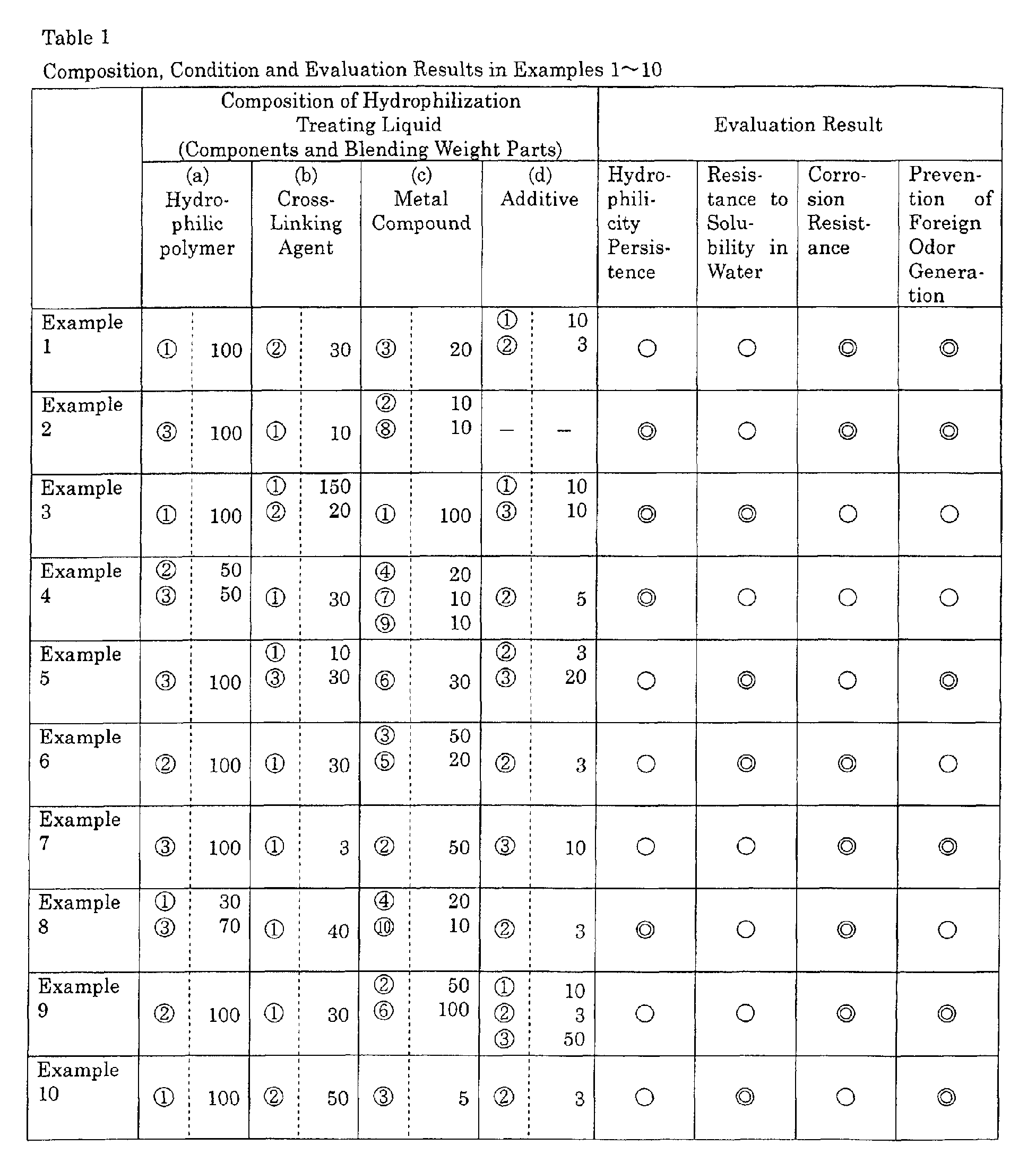
The evaluation results are shown in Table 1 and Table 2.
As is apparent from the evaluation results of Table 1 and Table 2, the
hydrophilizing film of Examples 1 through 10, which was formed by using the
hydrophilization agent, the hydrophilization liquid and the hydrophilization method of
the present invention, exhibits improved hydrophilicity persistence, resistance to
solubility in water and corrosion resistance under durability test conditions, and also
prevents offensive odor generation. Contrary to this, in the hydrophilic film of
Comparative Examples 1 through 7, several properties are unsatisfactory and do not
attain the level to satisfy the practically required functions.
As is apparent from the descriptions hereinabove, it became possible that a
hydrophilizing film having hydrophilicity persistence, resistance to solubility in water,
corrosion resistance, and prevention of offensive odor generation is formed by means of
applying the hydrophilization agent, the hydrophilization liquid and the
hydrophilization method according to the present invention to metallic material.
Consequently, the hydrophilization agent, the hydrophilization liquid and
the hydrophilization method according of the present invention are extremely useful in
practice.
| Composition, Condition and Evaluation Results in Examples l ~ 10 | ||||||||||||
| Composition of Hydrophilzation Treating Liquid (Components and Blending Weight Parts) | Evaluation Result | |||||||||||
| (a) Hydrophilic polymer | (b) Cross-Linking Agent | (c) Metal Compound | (d) Additive | Hydrophilicity Persistence | Resistance to Solubility in Water | Corrosion Resistance | Prevention of Foreign Odor Generation | |||||
| Compara tive Example 1 | 4 ○ | 100 | 1 ○ | 30 | 3 ○ 5 ○ | 50 20 | 2 ○ | 3 | Δ | × | × | Δ |
| Compara tive Example 2 | 5 ○ | 100 | 2 ○ | 30 | 3 ○ | 20 | 2 ○ | 3 | Δ | ○ | ○ | ○ |
| Compara tive Example 3 | 3 ○ | 100 | - | - | 2 ○ | 50 | 2 ○ | 3 | Δ | × | Δ | Δ |
| Compara tive Example 4 | 2 ○ | 100 | 1 ○ | 30 | - | - | 2 ○ | 3 | ○ | ○ | Δ | o ○ |
| Compara tive Example 5 | Test No.F8 of Japanese Unexamined Patent Publication (kokai) No.6-116527 | ○ | Δ | Δ | Δ | |||||||
| Compara tive Example 6 | Example 38 of Japanese Unexamined Patent Publication (kokai) No.6-322552 | Δ | Δ | ○ | ○ | |||||||
| Compara tive Example 7 | Example 45 of Japanese Unexamined Patent Publication (kokai) No.7-102189 | Δ | Δ | ○ | ○ |
Claims (20)
- A highly corrosion-resistant hydrophilization agent, characterized in that it contains (a) a hydrophilic polymer, that is, a copolymer of N-vinylacetamide and a polymerizable monomer having a COOX group (in the formula, X means hydrogen atom, alkali metal atom or ammonium salt), (b) an organic cross-linking agent, and (c) at least one metal compound selected from Ti, V, Cr, Mn, Co, Zn, Zr, Mo, Ce and W.
- A hydrophilization agent according to claim 1, wherein the ratio of N-vinylacetamide and a polymerizable monomer having a COOX group (in the formula, X means hydrogen atom, alkali metal atom or ammonium salt) is within a weight ratio of 95 : 5 ~ 20 : 80.
- A hydrophilization agent according to claim 1, wherein said organic cross-linking agent is an epoxy compound.
- A hydrophilization agent according to any one of claims 1 through 3, wherein at least one additive selected from the group consisting an anti-bacteria/mildew agent, a surfactant and a thickening agent are contained.
- A hydrophilization agent according to any one of claims 1 through 3, wherein from 0.1 to 200 parts by weight of the organic cross-linking agent (b) and from 1 to 200 parts by weight of the metal compound (c) are blended at a weight ratio relative to 100 parts by weight of said hydrophilic polymer (a).
- A highly corrosion-resistant hydrophilization liquid, characterized in that it contains, at a concentration of 1 ~ 100 g/L, a hydrophilization agent, which contains (a) a hydrophilic polymer, that is, a copolymer of N-vinylacetamide and a polymerizable monomer having a COOX group (in the formula, X means hydrogen atom, alkali metal atom or ammonium salt), (b) an organic cross-linking agent, and (c) at least one metal compound selected from Ti, V, Cr, Mn, Co, Zn, Zr, Mo, Ce and W..
- A hydrophilization liquid according to claim 6, wherein the ratio of N-vinylacetamide and a polymerizable monomer having a COOX group (in the formula, X means hydrogen atom, alkali metal atom or ammonium salt) is within a weight ratio of 95 : 5 ~ 20 : 80.
- A hydrophilization liquid according to claim 6, wherein said organic cross-linking agent is an epoxy compound.
- A hydrophilization agent according to any one of claims 6 through 8, wherein at least one additive selected from the group consisting of an anti-bacteria/mildew agent, a surfactant and a thickening agent is further contained.
- A hydrophilization agent according to any one of claims 6 through 8, wherein 0.1 ~ 200 parts by weight of the organic cross-linking agent (b) and 1 ~ 200 parts by weight of the metal compound (c) are blended at a weight ratio relative to 100 parts by weight of said hydrophilic polymer (a).
- A highly corrosion-resistant hydrophilization method, characterized in that a hydrophilization agent, which contains (a) a hydrophilic polymer, that is, a copolymer of N-vinylacetamide and a polymerizable monomer having a COOX group (in the formula, X means hydrogen atom, alkali metal atom or ammonium salt), (b) an organic cross-linking agent, and (c) at least one metal compound selected from Ti, V, Cr, Mn, Co, Zn, Zr, Mo, Ce and W, is deposited on the surface of metallic material, and is dried to form a hydrophilizing film.
- A hydrophilization method according to claim 11, wherein the ratio of N-vinylacetamide and a polymerizable monomer having a COOX group (in the formula, X means hydrogen atom, alkali metal atom or ammonium salt) is within a weight ratio of 95 : 5 ~ 20:80.
- A hydrophilization method according to claim 11, wherein said organic cross-linking agent is an epoxy compound.
- A hydrophilization method according to any one of claims 11 through 13, wherein at least one additive selected from the group consisting of an anti-bacteria/mildew agent, a surfactant and a thickening agent is further contained, in the hydrophilization agent.
- A hydrophilization agent according to any one of claims 11 through 14, wherein 0.1 ~ 200 parts by weight of the organic cross-linking agent (b) and from 1 to 200 parts by weight of the metal compound (c) are blended at a weight ratio relative to 100 parts by weight of said hydrophilic polymer (a).
- A highly corrosion-resistant hydrophilization method, characterized in that a hydrophilization liquid, which contains, at a concentration of from 1 to 100 g/L, a hydrophilization agent, containing (a) a hydrophilic polymer, that is, a copolymer of N-vinylacetamide and a polymerizable monomer having a COOX group (in the formula, X means hydrogen atom, alkali metal atom or ammonium salt), (b) an organic cross-linking agent, and (c) at least one metal compound selected from Ti, V, Cr, Mn, Co, Zn, Zr, Mo, Ce and W, is deposited on the surface of metallic material, and is dried to form a hydrophilizing film.
- A hydrophilization method according to claim 16, wherein the ratio of N-vinylacetamide and the polymerizable monomer having a COOX group (in the formula, X means hydrogen atom, alkali metal atom or ammonium salt) is within a weight ratio of 95 : 5 ~ 20 : 80.
- A hydrophilization method according to claim 16, wherein said organic cross-linking agent is an epoxy compound.
- A hydrophilization method according to any one of claims 16 through 18, wherein at least one additive selected from the group consisting of an anti-bacteria/mildew agent, a surfactant and a thickening agent is further contained in the hydrophilization agent.
- A hydrophilization agent according to any one of claims 16 through 18, wherein 0.1 ~ 200 parts by weight of the organic binder (b) and 1 ~ 200 parts by weight of the metal compound (c) are blended at a weight ratio relative to 100 parts by weight of said hydrophilic polymer (a).
Applications Claiming Priority (3)
| Application Number | Priority Date | Filing Date | Title |
|---|---|---|---|
| JP2000008235 | 2000-01-17 | ||
| JP2000008235 | 2000-01-17 | ||
| PCT/JP2001/000196 WO2001053427A1 (en) | 2000-01-17 | 2001-01-15 | Treating agent for imparting hydrophilicity and high corrosion resistance, hydrophilizing fluid, and method of hydrophilizing |
Publications (2)
| Publication Number | Publication Date |
|---|---|
| EP1254940A1 true EP1254940A1 (en) | 2002-11-06 |
| EP1254940A4 EP1254940A4 (en) | 2005-03-30 |
Family
ID=18536544
Family Applications (1)
| Application Number | Title | Priority Date | Filing Date |
|---|---|---|---|
| EP01900762A Withdrawn EP1254940A4 (en) | 2000-01-17 | 2001-01-15 | Treating agent for imparting hydrophilicity and high corrosion resistance, hydrophilizing fluid, and method of hydrophilizing |
Country Status (7)
| Country | Link |
|---|---|
| US (1) | US20030092812A1 (en) |
| EP (1) | EP1254940A4 (en) |
| KR (1) | KR20020070342A (en) |
| CN (1) | CN1180047C (en) |
| AU (1) | AU2001225533A1 (en) |
| TW (1) | TW576867B (en) |
| WO (1) | WO2001053427A1 (en) |
Families Citing this family (12)
| Publication number | Priority date | Publication date | Assignee | Title |
|---|---|---|---|---|
| DE10355833A1 (en) * | 2003-11-26 | 2005-06-23 | Behr Gmbh & Co. Kg | heat exchangers |
| US7507480B2 (en) * | 2005-05-31 | 2009-03-24 | Brookhaven Science Associates, Llc | Corrosion-resistant metal surfaces |
| WO2007013761A1 (en) * | 2005-07-25 | 2007-02-01 | Posco | Pre-sealed steel sheet with improved anti- corrosion and weldability and preparing method thereof |
| JP2007225174A (en) * | 2006-02-22 | 2007-09-06 | Fujifilm Corp | Heat exchanger |
| US20100024468A1 (en) * | 2006-10-13 | 2010-02-04 | Carrier Corporation | Refrigeration unit comprising a micro channel heat exchanger |
| JP2010013618A (en) * | 2007-12-28 | 2010-01-21 | Toto Ltd | Composite material having slowly-soluble coating film, and coating composition |
| JP5567301B2 (en) * | 2009-07-30 | 2014-08-06 | 関西ペイント株式会社 | Hydrophilization composition for heat exchanger fin material |
| CN102011116A (en) * | 2010-07-29 | 2011-04-13 | 上海电力学院 | Anticorrosive inhibitor of carbon steel and preparation method thereof |
| JP5888703B2 (en) * | 2013-02-04 | 2016-03-22 | 三菱電機株式会社 | Surface treatment method for heat exchanger and method for producing heat exchanger |
| US12486423B2 (en) | 2019-05-20 | 2025-12-02 | Resonac Corporation | Composition for aqueous coating liquid |
| CN110863195B (en) * | 2019-11-28 | 2021-10-15 | 重庆大学 | A kind of magnesium alloy surface treatment method for high concentration chloride ion environment |
| CN121161288B (en) * | 2025-11-18 | 2026-02-06 | 内蒙古科技大学 | Metal surface modification method, modified metal obtained by same and application of modified metal |
Family Cites Families (11)
| Publication number | Priority date | Publication date | Assignee | Title |
|---|---|---|---|---|
| JPS5554366A (en) * | 1978-10-16 | 1980-04-21 | Sakai Chem Ind Co Ltd | Composition for corrosion prevention of metal surface |
| US4711726A (en) * | 1986-12-29 | 1987-12-08 | Nalco Chemical Company | Carboxylate N-vinylamide copolymers for internal scale control and passivation in high pressure boiler systems |
| US4781978A (en) * | 1987-03-02 | 1988-11-01 | Minnesota Mining And Manufacturing Company | Articles having a coating formed from a polymeric blend |
| CA2004525C (en) * | 1988-12-16 | 2000-05-02 | Joseph M. Owens | Improved transition metal crosslinking of acid-containing polymers |
| US5856409A (en) * | 1989-04-07 | 1999-01-05 | Dow Corning Corporation | Method of making hydrophobic copolymers hydrophilic |
| JPH06116527A (en) * | 1992-10-07 | 1994-04-26 | Nippon Light Metal Co Ltd | Surface treatment that imparts hydrophilicity to the surface of aluminum materials |
| EP0623653B1 (en) * | 1993-05-07 | 2000-12-06 | Nippon Paint Co., Ltd. | Aqueous polyoxyalkylene surface treating solutions |
| US5895532A (en) * | 1994-07-26 | 1999-04-20 | Henkel Corporation | Process for treating the surface of aluminum sheet for cap manufacturing |
| US6300395B1 (en) * | 1994-12-07 | 2001-10-09 | Nikon Parkerizing, Co., Ltd. | Aqueous hydrophilization treatment composition and method for aluminum-containing metal material |
| JPH08291269A (en) * | 1995-02-23 | 1996-11-05 | Furukawa Electric Co Ltd:The | Hydrophilizing composition and hydrophilizing heat exchanger member |
| JPH093439A (en) * | 1995-06-16 | 1997-01-07 | Mitsuru Akashi | Dew condensation-preventing material |
-
2001
- 2001-01-12 TW TW089128364A patent/TW576867B/en active
- 2001-01-15 EP EP01900762A patent/EP1254940A4/en not_active Withdrawn
- 2001-01-15 WO PCT/JP2001/000196 patent/WO2001053427A1/en not_active Ceased
- 2001-01-15 US US10/181,380 patent/US20030092812A1/en not_active Abandoned
- 2001-01-15 CN CNB018036619A patent/CN1180047C/en not_active Expired - Fee Related
- 2001-01-15 AU AU2001225533A patent/AU2001225533A1/en not_active Abandoned
- 2001-01-15 KR KR1020027009204A patent/KR20020070342A/en not_active Ceased
Also Published As
| Publication number | Publication date |
|---|---|
| EP1254940A4 (en) | 2005-03-30 |
| TW576867B (en) | 2004-02-21 |
| KR20020070342A (en) | 2002-09-05 |
| AU2001225533A1 (en) | 2001-07-31 |
| US20030092812A1 (en) | 2003-05-15 |
| CN1395605A (en) | 2003-02-05 |
| WO2001053427A1 (en) | 2001-07-26 |
| CN1180047C (en) | 2004-12-15 |
Similar Documents
| Publication | Publication Date | Title |
|---|---|---|
| JP4008620B2 (en) | Aluminum alloy heat exchanger | |
| CN100577870C (en) | Composition and method for surface treatment of metallic materials | |
| JP4099307B2 (en) | Non-chromium anti-rust treatment agent for aluminum, anti-rust treatment method and anti-rust treated aluminum products | |
| WO2000022188A1 (en) | Hydrophilizing agent for metallic material, hydrophilizing fluid, method of hydrophilizing, metallic material, and heat exchanger | |
| EP0623653A2 (en) | Aqueous polyoxyalkylene surface treating solutions | |
| JP4351926B2 (en) | Antirust treatment agent and antirust treatment method | |
| US20030092812A1 (en) | Treating agent for imparting hydrophilicity and high corrosion resistance, hydrophilizing fluid, and method of hydrophilizing | |
| US6987143B2 (en) | Hydrophilizing agent, hydrophilizing fluid, and method of hydrophilizing | |
| JP2002285139A (en) | Hydrophilizing agent, hydrophilizing method and hydrophilized aluminum material or aluminum alloy material | |
| JPWO2000022188A1 (en) | Hydrophilic treatment agent for metal materials, hydrophilic treatment solution, hydrophilic treatment method, metal material, and heat exchanger | |
| EP1245622A1 (en) | Hydrophilic modification method and heat exchanger treated thereby | |
| TW510832B (en) | Method of producing an aluminum fin material and the aluminum fin material produced by the method | |
| JP4521010B2 (en) | Metal surface treatment agent, metal surface treatment method and surface treatment metal material | |
| JPH09296121A (en) | Aqueous surface hydrophilic treatment agent for metal material and surface treatment method | |
| JPH09316434A (en) | Aqueous treatment agent for hydrophilicity of metal material and treatment method | |
| JP3836742B2 (en) | Hydrophilization method and heat exchanger subjected to hydrophilic treatment | |
| WO2017061531A1 (en) | Hydrophilization agent and hydrophilization method | |
| JP4053683B2 (en) | Anti-corrosion treatment agent for aluminum with high corrosion resistance | |
| JP2780250B2 (en) | Hydrophilic surface treatment agent, hydrophilic surface treatment bath and surface treatment method for aluminum material | |
| JPH07102189A (en) | Hydrophilic surface treatment aqueous solution, hydrophilic surface treatment method, and hydrophilic surface treatment film | |
| TW506996B (en) | Treating agents for metal surface, process of treating metal material and surface treated metal materials | |
| JPWO2001053427A1 (en) | Highly corrosion-resistant hydrophilic treatment agent, hydrophilic treatment solution, and hydrophilic treatment method | |
| JP2000282267A (en) | Rust prevention / hydrophilization treatment agent for aluminum alloy and rust prevention / hydrophilization treatment method using the same | |
| JPH08232078A (en) | Hydrophilic aqueous treatment agent for aluminum-containing metal material, and hydrophilic treatment method |
Legal Events
| Date | Code | Title | Description |
|---|---|---|---|
| PUAI | Public reference made under article 153(3) epc to a published international application that has entered the european phase |
Free format text: ORIGINAL CODE: 0009012 |
|
| 17P | Request for examination filed |
Effective date: 20020730 |
|
| AK | Designated contracting states |
Kind code of ref document: A1 Designated state(s): AT BE CH CY DE DK ES FI FR GB GR IE IT LI LU MC NL PT SE TR |
|
| AX | Request for extension of the european patent |
Free format text: AL;LT;LV;MK;RO;SI |
|
| RAP1 | Party data changed (applicant data changed or rights of an application transferred) |
Owner name: HENKEL KGAA |
|
| A4 | Supplementary search report drawn up and despatched |
Effective date: 20050214 |
|
| STAA | Information on the status of an ep patent application or granted ep patent |
Free format text: STATUS: THE APPLICATION IS DEEMED TO BE WITHDRAWN |
|
| 18D | Application deemed to be withdrawn |
Effective date: 20070801 |