EP1254933A2 - Ink jet ink set and printing method - Google Patents
Ink jet ink set and printing method Download PDFInfo
- Publication number
- EP1254933A2 EP1254933A2 EP02076578A EP02076578A EP1254933A2 EP 1254933 A2 EP1254933 A2 EP 1254933A2 EP 02076578 A EP02076578 A EP 02076578A EP 02076578 A EP02076578 A EP 02076578A EP 1254933 A2 EP1254933 A2 EP 1254933A2
- Authority
- EP
- European Patent Office
- Prior art keywords
- ink
- dye
- ink jet
- water
- soluble
- Prior art date
- Legal status (The legal status is an assumption and is not a legal conclusion. Google has not performed a legal analysis and makes no representation as to the accuracy of the status listed.)
- Granted
Links
Classifications
-
- C—CHEMISTRY; METALLURGY
- C09—DYES; PAINTS; POLISHES; NATURAL RESINS; ADHESIVES; COMPOSITIONS NOT OTHERWISE PROVIDED FOR; APPLICATIONS OF MATERIALS NOT OTHERWISE PROVIDED FOR
- C09D—COATING COMPOSITIONS, e.g. PAINTS, VARNISHES OR LACQUERS; FILLING PASTES; CHEMICAL PAINT OR INK REMOVERS; INKS; CORRECTING FLUIDS; WOODSTAINS; PASTES OR SOLIDS FOR COLOURING OR PRINTING; USE OF MATERIALS THEREFOR
- C09D11/00—Inks
- C09D11/30—Inkjet printing inks
- C09D11/40—Ink-sets specially adapted for multi-colour inkjet printing
Definitions
- This invention relates to an ink jet ink set and printing method that provides images with improved color gamut.
- Ink jet printing is a non-impact method for producing images by the deposition of ink droplets in a pixel-by-pixel manner to an image-recording element in response to digital signals.
- continuous ink jet a continuous stream of droplets is charged and deflected in an imagewise manner onto the surface of the image-recording element, while unimaged droplets are caught and returned to an ink sump.
- drop-on-demand ink jet individual ink droplets are projected as needed onto the image-recording element to form the desired image.
- Common methods of controlling the projection of ink droplets in drop-on-demand printing include piezoelectric transducers and thermal bubble formation. Ink jet printers have found broad applications across markets ranging from industrial labeling to short run printing to desktop document and pictorial imaging.
- the inks used in the various ink jet printers can be classified as either dye-based or pigment-based.
- a dye is a colorant, which is dissolved in the carrier medium.
- a pigment is a colorant that is insoluble in the carrier medium, but is dispersed or suspended in the form of small particles, often stabilized against flocculation and settling by the use of dispersing agents.
- the carrier medium can be a liquid or a solid at room temperature in both cases. Commonly used carrier media include water, mixtures of water and organic co-solvents and high boiling organic solvents, such as hydrocarbons, esters, ketones, etc.
- the dyes For aqueous dye-based inks, the dyes needs to be sufficiently soluble in water to prepare a solution that is capable of producing adequate density on the receiving element and stable for extended periods of storage without precipitation.
- High quality ink jet printing with dye-based inks requires dyes which will provide both bright hue and good light fastness.
- ink sets comprising at least cyan, magenta and yellow inks are normally utilized.
- a black ink is often added to enhance the printing of text and darker colors.
- the range of colors that can be produced with a given set of inks defines the color gamut of that ink set.
- ink sets with a large color gamut are preferred.
- it is important that the ink sets produce images with good fastness, especially to light.
- the choice of the colorants in ink jet systems is critical for both light fastness and color gamut.
- the color gamut of an ink set is controlled primarily by the spectral absorption characteristics of the component dyes.
- the primary dyes e.g., cyan, magenta and yellow
- U.S. Patent 6,183,548 relates to an ink jet ink set comprising a magenta ink, yellow ink and a cyan ink and an optional black ink.
- an ink jet ink set comprising a magenta ink, yellow ink and a cyan ink and an optional black ink.
- the color gamut is not as large as one would like.
- a color ink jet ink set for color printing comprising:
- Another embodiment of the invention relates to an ink jet printing method, comrising the steps of
- This color ink jet ink set provides color gamuts suitable for pictorial imaging.
- a black ink can also be added to further increase the available color gamuts of this ink set.
- the ink sets used in the present invention are intended to be used in ink jet printers capable of printing four or more separate inks. At a minimum, cyan, magenta and yellow inks are required for full-color printing.
- the ink sets used in this invention include additional color inks that differ in hue from the cyan, magenta and yellow primaries; namely green, orange and/or violet.
- a black ink may be also be used to make text printing more efficient or to reduce overall ink lay-down when printing dark color areas.
- the absorption characteristics of a given image dye will vary to some extent with a change in ink laydown or printed density. This is due to factors such as measurement flare, dye-dye interactions, dye-receiver interactions, dye concentration effects, and the presence of colored impurities in the media.
- characteristic vector analysis sometimes referred to as principal component analysis or eigenvector analysis, one can determine a characteristic absorption curve that is representative of the absorption characteristics of the dye over the complete wavelength and density ranges of interest.
- the characteristic vector for each dye is thus a two-dimensional array of optical density and wavelength. This technique is described by Albert J.
- Characteristic vectors thus derived can be used to calculate the color gamuts of ink sets described below as described in the above reference.
- Dyes referred to by dye numbers are numbers assigned by The Color Index.
- any water-soluble yellow dye may be employed in the yellow ink of the ink jet ink set employed in the invention.
- the yellow dye is Direct Yellow 107, Direct Yellow 132, Direct Yellow 86 or mixtures thereof.
- any water-soluble cyan dye may be employed in the cyan ink of the ink jet ink set employed in the invention.
- the cyan dye is Acid Blue 9 or a water-soluble metal phthalocyanine dye such as Direct Blue 199 or Direct Blue 86 or mixtures thereof.
- any water-soluble black dye may be employed in the optional black ink of the ink jet ink set employed in the invention.
- the black dye is Reactive Black 31, Direct Black 19, Direct Black 168, Solubilized Sulfur Black or mixtures thereof.
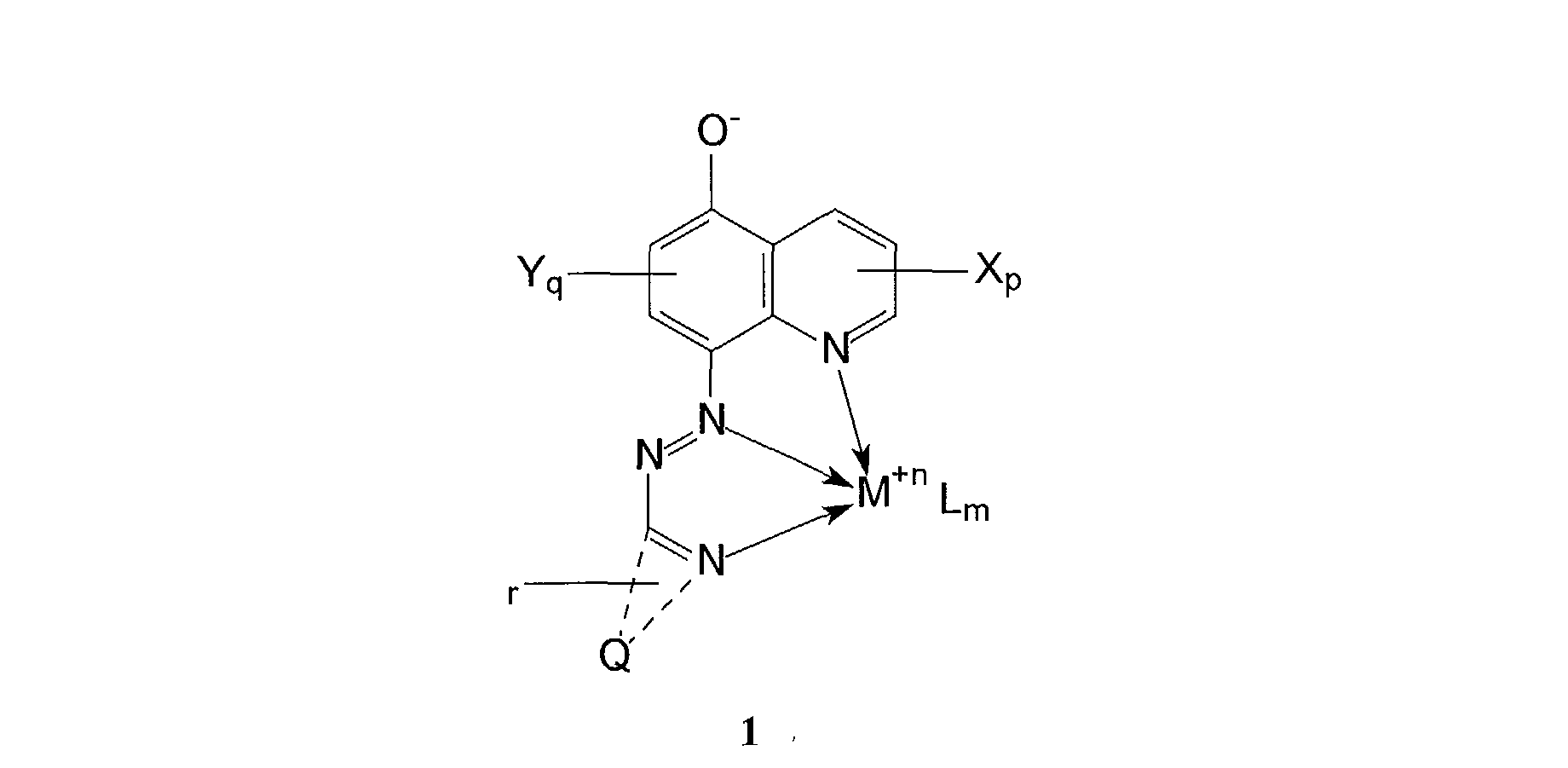
- magenta inks employed in the invention may by formulated with one or more water-soluble, transition metal complexes of 8-heterocyclylazo-5-hydroxyquinoline dyes, represented by Structure 1 (below). These dyes are described in U.S. Patents 5,997,622 and 6,001,161 wherein:
- q is 0, Q represents the atoms necessary to complete a pyridine ring, r is 0, M is Ni, n is 2, m is 1, p is 2, X represents 2-methyl and 3-carboxy and L represents a second, identical 8-heterocyclylazo-5-hydroxyquinoline dye residue.
- Preferred transition metal ions for M include Ni 2+ , Cu 2+ , Zn 2+ , Fe 2+ , Fe 3+ , Cr 3+ and Co 2+ .
- neutral ligands for L include water, pyridine, morpholine, ammonia, bipyridine and terpyridine.
- anionic ligands for L include acetate, iminodiacetate, glycine and 8-hydroxyquinoline.
- Examples of a substituted or unsubstituted alkyl group for the above substituents include methyl, ethyl, isopropyl, hydroxyethyl, 3-(N,N-dimethylamino)propyl, sulfatoethyl and benzyl.
- Examples of a substituted or unsubstituted aryl group include phenyl, naphthyl 4-chlorophenyl and 2-carboxyphenyl.
- Examples of a substituted or unsubstituted hetaryl group include pyridyl, imidazolyl and quinolyl.
- Examples of halogen include chloro, fluoro, bromo and iodo.
- Examples of a substituted or unsubstituted alkoxy group include methoxy, isopropoxy, 2-hydroxyethoxy and carboxymethoxy.
- Useful salts of carboxy, sulfo, phospho and sulfato include sodium, lithium, potassium, triethanolammonium, pyridinium and tetramethylammonium.
- Examples of a substituted or unsubstituted alkyl-, aralkyl-, aryl-, diaryl- or dialkyl carbamoyl group include N-methylcarbamoyl, N-methyl-N-(3sulfophenyl)-carbamoyl, N-p-(trimethylammonium)phenylcarbamoyl and N,N-bis (4-carboxyphenyl)carbamoyl.
- Examples of a substituted or unsubstituted alkyl-, aralkyl-, aryl-, diaryl- or dialkyl sulfamoyl group include N-methylsulfamoyl, N-methyl-N-(3sulfophenyl)-sulfamoyl, N-p-(trimethylammonium)phenylsulfamoyl and N,N-bis (4-carboxyphenyl)sulfamoyl.
- Examples of an acylamino group include acetamido, carboxyethylacetamido and benzamido.
- Examples of a ureido group include n-methylureido, ureido and 3,5-bis carboxyphenylureido.
- Examples of a sulfonylamino group include methanesulfonamido, p-toluenesulfonamido and 2-(trimethlyammonium)ethanesulfonamido.
- Examples of a substituted or unsubstituted alkyl-, aralkyl-, aryl- diaryl- or dialkyl-amino group include methylamino, N,N-dimethylamino, carboxymethylamino and 2,5-disulfoanilino.
- Examples of a quaternary ammonium group include trimethylammonium and benzyldimethylammonium.
- Examples of a phosphonium group include triphenylphosphonium and trimethlyphosphonium.
- heterocyclic ring systems completed by the atoms represented by Q include pyridine, pyrazine, quinoline, thiazole, benzothiazole and pyrazole.
- Specific dyes according to Structure 1 useful in this invention include: Dye M X 1 X 2 Z ⁇ -max 1 Ni Cl CO 2 H SO 2 NHCH(CH 3 ) 2 559 2 Cu Cl CO 2 H SO 2 NHCH(CH 3 ) 2 547 3 Ni Cl CO 2 Na H 550 4 Ni Cl CO 2 H H 551 5 Ni H CO 2 H H 546 6 Ni CH 3 CO 2 H H 552 7 Ni CO 2 H CO 2 H H 554 8 Ni OC 2 H 5 CO 2 H H 546 9 Ni SC 3 H 6 SO 3 - Na + CH 3 H 563
- One or more additional inks comprising green, orange and/or violet dyes may be used in addition to the above base sets to give ink sets with a larger color gamut.
- Any water-soluble orange and/or green and/or violet dye may be used in the invention.
- the orange dye has a hue angle between 58 and 83.
- the green dye has a hue angle between 128 and 189.
- the violet dye has a hue angle between 235 and 315.
- the water-soluble orange dye is Reactive Orange 5, Acid Orange 10 or Acid Orange 12.
- the water-soluble green dye is Reactive Green 12, Acid Green 25, Acid Green 5 or Acid Green 3.
- the water-soluble violet dye is Acid Violet 17.
- the inks employed in this invention comprise the above dyes at a concentration of from 0.2 to 10 %, preferably from 0.4 to 3% by weight of the ink jet ink composition.
- a humectant is usually employed in the ink jet compositions employed in the invention to help prevent the ink from drying out or crusting in the orifices of the printhead.
- humectants which can be used include polyhydric alcohols, such as ethylene glycol, diethylene glycol(DEG), triethylene glycol, propylene glycol, tetraethylene glycol, polyethylene glycol, glycerol, 2-methyl-2,4-pentanediol, 2-ethyl-2-hydroxymethyl-1,3-propanediol(EHMP), 1,5 pentanediol, 1,2-hexanediol, 1,2,6-hexanetriol and thioglycol; lower alkyl mono-or di-ethers derived from alkylene glycols, such as ethylene glycol mono-methyl or mono-ethyl ether, diethylene glycol mono-methyl or mono-ethyl ether, propylene glycol mono-methyl or mono-e
- Preferred humectants for the inks employed in the invention include DEG, glycerol, DEGMBE, PEGMBE, 1,2-hexanediol, 1,5-pentanediol, urea, 2-pyrrolidinone, EHMP and mixtures thereof.
- Water-miscible organic solvents may also be added to the aqueous inks employed in the invention to help the ink penetrate the receiving substrate, especially when the substrate is a highly sized paper.
- solvents include alcohols, such as methyl alcohol, ethyl alcohol, n-propyl alcohol, isopropyl alcohol, n-butyl alcohol, sec-butyl alcohol, t-butyl alcohol, iso-butyl alcohol, furfuryl alcohol, and tetrahydrofurfuryl alcohol; ketones or ketoalcohols such as acetone, methyl ethyl ketone and diacetone alcohol; ethers, such as tetrahydrofuran and dioxane; and esters, such as, ethyl lactate, ethylene carbonate and propylene carbonate.
- the amount of aqueous carrier employed is in the range of approximately 70 to 98 weight %, preferably approximately 90 to 98 weight %, based on the total weight of the ink.
- a mixture of water and a polyhydric alcohol, such as diethylene glycol, is useful as an aqueous carrier.
- the inks contain from 5 to 60 weight % of water miscible organic solvent. Percentages are based on the total weight of the aqueous carrier.
- Surfactants may be added to the ink to adjust the surface tension to an appropriate level.
- the surfactants may be anionic, cationic, amphoteric or nonionic and used at levels of 0.01 to 1% of the ink composition.
- Preferred surfactants include Surfynol 465® (available from Air Products Corp.) and Tergitol 15-S-5® (available from Union Carbide).
- a biocide may be added to the ink composition employed in the invention to suppress the growth of micro-organisms such as molds, fungi, etc. in aqueous inks.
- a preferred biocide for the ink composition employed in the present invention is Proxel® GXL (Zeneca Specialties Co.) at a final concentration of 0.0001-0.5 wt. %.
- the pH of the aqueous ink compositions employed in the invention may be adjusted by the addition of organic or inorganic acids or bases.
- Useful inks may have a preferred pH of from 2 to 10, depending upon the type of dye being used.
- Typical inorganic acids include hydrochloric, phosphoric and sulfuric acids.
- Typical organic acids include methanesulfonic, acetic and lactic acids.
- Typical inorganic bases include alkali metal hydroxides and carbonates.
- Typical organic bases include ammonia, triethanolamine and tetramethylethlenediamine.
- a typical ink composition employed in the invention may comprise, for example, the following components by weight: colorant (0.05-20%), water (20-95%), a humectant (5-70%), water miscible co-solvents (2-20%), surfactant (0.1-10%), biocide (0.05-5%) and pH control agents (0.1-10%).
- Additional additives which may optionally be present in the ink jet ink compositions employed in the invention include thickeners, conductivity enhancing agents, anti-kogation agents, drying agents, and defoamers.
- ink jet inks described above may be employed in ink jet printing wherein liquid ink drops are applied in a controlled fashion to an ink receptive layer substrate, by ejecting ink droplets from a plurality of nozzles or orifices of the print head of an ink jet printer.
- a droplet of ink is ejected from an orifice directly to a position on the ink receptive layer by pressure created by, for example, a piezoelectric device, an acoustic device, or a thermal process controlled in accordance digital data signals.
- An ink droplet is not generated and ejected through the orifices of the print head unless it is needed.
- Ink jet printing methods, and related printers are commercially available and need not be described in detail.
- Ink jet inks employed in the present invention can be used in any of the popular ink jet printing systems, including thermal or piezoelectric drop-on-demand printers and continuous ink jet printers. Of course, the specific ink formulations will vary depending upon the type of ink jet printing system.
- Ink-receptive substrates useful in ink jet printing are well known to those skilled in the art. Representative examples of such substrates are disclosed in U.S. Patents 5,605,750; 5,723,211; and 5,789,070 and EP 813 978 A1.
- Inks were prepared by mixing the dyes with water, diethylene glycol, glycerol, and Surfynol® 465 and optionally triethanolamine. The mixture was stirred in a warm water bath until the dye was in solution.
- the amount of dye used was based on the solution absorption spectrum in water such that the weight % of dye in the ink is equal to [1/solution mass absorbtivity in L/g-cm]x100.
- the other components were: 6 weight % glycerol, 6 weight % diethylene glycol, 2.0 weight % triethanolamine (if needed to aid dissolution) and 0.5 weight % Surfynol® 465.
- Each of the above inks was filtered with a 0.45 ⁇ m syringe filter and loaded into one of the color chambers of an empty Lexmark Z51 ink cartridge and then printed onto Kodak Premium Picture Paper using a Lexmark Z51 printer.
- a step wedge image consisting of eleven color patches (1 cm x 1 cm) varying in ink coverage from 10 to 100% in 10% increments was printed.
- the densities of the step wedge images from above were read using a Gretag Spectrolino® Spectrophotometer over the wavelength range of 380 - 730 nm in intervals of 10 nanometers.
- a gas-filled tungsten, type A illumination was used with a 4 mm nominal aperture and the measurement geometry employed was 45°/0° ring optic.
- characteristic vector analysis was used to construct a characteristic absorption curve over the range of the visible spectrum (380-730 nm) for each of the inks.
- the characteristic vector for each ink is a two-dimensional array of optical density vs. wavelength. This technique is described by A. J. Sant in Photographic Science and Engineering, 5 (3), May-June, 1961, and by J. L. Simonds in the Journal of the Optical Society of America , 53 (8), 968-97 4 (1963).
- Hue angle correlates with hue which is defined to be the attribute of a visual sensation according to which an area appears to be similar to one of the perceived colors, red, yellow, green, and blue, or to a combination of two of them.
- Hue angle was calculated using the characteristic vectors described above, assuming a reflection density of 2.0 at the lambda max of the printed sample and are also listed in Table 2.
- Chroma values for each printed image above were calculated from the CIElab coordinates calculated for each dye assuming a reflection density of 2.0 at the lambda max of the printed sample and also listed in Table 2.
- C* ⁇ [(a*) 2 + (b*) 2 ]
- Theoretical color gamuts were calculated by the following procedure for the CMY (Dyes A,B and C) and CMYK (Dyes A,B, C and D) base sets and the ink sets formed by adding designated orange, green and/or violet dyes to the base sets. The results are set forth in Table 3. In general, the larger the gamut, the more possible colors that a given ink set can reproduce.
- color gamut is specified using the conventional metric generally associated with reflection prints, which is CIELAB.
- CIELAB The 1931 CIE 2° standard observer color matching functions as well as the CIE defined illuminant D5000 were used.
- This information and the characteristic vectors described above were used to calculate the color gamut at a particular L* value for each set of inks, using the method described in the Journal of Photographic Science, 38, 163 (1990). Note that for this calculation no light scatter is assumed.
- the color gamut values cited in the following table represent the sum of the a* vs. b* areas at nine different L* slices (10, 20, 30, 40, 50, 60, 70, 80, and 90) calculated for each ink set.
Landscapes
- Chemical & Material Sciences (AREA)
- Life Sciences & Earth Sciences (AREA)
- Engineering & Computer Science (AREA)
- Materials Engineering (AREA)
- Wood Science & Technology (AREA)
- Organic Chemistry (AREA)
- Ink Jet Recording Methods And Recording Media Thereof (AREA)
- Inks, Pencil-Leads, Or Crayons (AREA)
- Ink Jet (AREA)
Abstract
Description

| Dye | M | X1 | X2 | Z | λ-max |
| 1 | Ni | Cl | CO2H | SO2NHCH(CH3)2 | 559 |
| 2 | Cu | Cl | CO2H | SO2NHCH(CH3)2 | 547 |
| 3 | Ni | Cl | CO2Na | H | 550 |
| 4 | Ni | Cl | CO2H | H | 551 |
| 5 | Ni | H | CO2H | H | 546 |
| 6 | Ni | CH3 | CO2H | H | 552 |
| 7 | Ni | CO2H | CO2H | H | 554 |
| 8 | Ni | OC2H5 | CO2H | H | 546 |
| 9 | Ni | SC3H6SO3 - Na+ | CH3 | H | 563 |
Chroma (C*) relates to the brightness or saturation of a given color. Chroma values for each printed image above were calculated from the CIElab coordinates calculated for each dye assuming a reflection density of 2.0 at the lambda max of the printed sample and also listed in Table 2.
| Dye | a* | b* | L* | Hue Angle | Chroma (C*) |
| A | -58.6 | -45.5 | 59.9 | 217.9 | 74.2 |
| B | 89.0 | -36.3 | 48.7 | 337.8 | 96.1 |
| C | -5.3 | 104.1 | 95.2 | 92.9 | 104.2 |
| D | 13.2 | 1.3 | 12.3 | 5.7 | 13.2 |
| E | 44.2 | 103.3 | 80.0 | 66.9 | 112.3 |
| F | 54.4 | 99.2 | 70.9 | 61.3 | 113.1 |
| G | 55.0 | 88.7 | 75.1 | 58.2 | 104.4 |
| H | 30.6 | 104.6 | 85.0 | 73.7 | 109.0 |
| I | 39.1 | 116.7 | 81.9 | 71.5 | 123.1 |
| J | 43.9 | 103.0 | 79.4 | 66.9 | 112.0 |
| K | 15.4 | 115.4 | 88.2 | 82.4 | 116.4 |
| L | 30.2 | 110.0 | 80.6 | 74.7 | 114.1 |
| M | 48.3 | 91.9 | 77.7 | 62.3 | 103.8 |
| N | 30.2 | 107.7 | 83.5 | 74.3 | 111.8 |
| O | 50.0 | 105.1 | 76.0 | 64.6 | 116.4 |
| P | 18.0 | 121.1 | 88.0 | 81.5 | 122.4 |
| Q | 39.7 | 117.2 | 81.7 | 71.3 | 123.8 |
| R | 42.2 | 104.1 | 80.6 | 67.9 | 112.4 |
| S | -51.2 | 18.3 | 39.4 | 160.3 | 54.4 |
| T | -69.8 | -9.6 | 51.2 | 187.9 | 70.4 |
| U | -82.8 | 26.3 | 72.3 | 162.4 | 86.9 |
| V | -75.1 | -10.6 | 71.3 | 188.0 | 75.8 |
| W | -76.1 | -2.7 | 75.1 | 182.0 | 76.1 |
| X | -45.6 | 47.3 | 58.9 | 134.0 | 65.7 |
| Y | -86.7 | 19.0 | 76.0 | 167.6 | 88.7 |
| Z | -92.2 | 16.5 | 74.0 | 169.8 | 93.7 |
| AA | -71.1 | 84.8 | 77.2 | 130.0 | 110.7 |
| BB | 54.6 | -94.1 | 38.2 | 300.1 | 108.8 |
| Base Set | Additional Dye | Color Gamut |
| CMY | None (Control) | 55073 |
| CMY | AA | 68990 |
| CMY | E | 72739 |
| CMY | F | 68991 |
| CMY | G | 71985 |
| CMY | H | 73308 |
| CMY | I | 72728 |
| CMY | J | 72151 |
| CMY | K | 69171 |
| CMY | L | 68586 |
| CMY | M | 72089 |
| CMY | N | 71539 |
| CMY | O | 71243 |
| CMY | P | 70765 |
| CMY | Q | 72712 |
| CMY | R | 72746 |
| CMY | S | 61680 |
| CMY | T | 60027 |
| CMY | U | 64754 |
| CMY | V | 63254 |
| CMY | W | 64928 |
| CMY | X | 61922 |
| CMY | Y | 67121 |
| CMY | Z | 67444 |
| CMY | BB | 68581 |
| CMY | AA + BB | 82809 |
| CMY | AA + H | 84027 |
| CMY | H + BB | 87166 |
| CMYK | None (Control) | 61842 |
| CMYK | AA | 71711 |
| CMYK | H | 75602 |
| CMYK | BB | 73158 |
Claims (10)
- A color ink jet ink set comprising:(a) a magenta ink comprising a carrier and a water-soluble, transition metal complex of an 8-heterocyclylazo-5-hydroxyquinoline dye;(b) a yellow ink comprising a carrier and a water-soluble yellow dye;(c) a cyan ink comprising a carrier and a water-soluble cyan dye; and(d) an orange and/or green and/or violet ink comprising a carrier and a water-soluble orange and/or green and/or violet dye.
- The ink jet ink set of Claim 1 wherein said water-soluble orange dye has a hue angle between 58 and 83.
- The ink jet ink set of Claim 1 wherein said water-soluble green dye has a hue angle between 128 and 189.
- The ink jet ink set of Claim 1 wherein said water-soluble violet dye has a hue angle between 235 and 315.
- The ink jet ink set of Claim 1 wherein said water-soluble, transition metal complex of an 8-heterocyclylazo-5-hydroxyquinoline dye is represented by the following structure:wherein:
 M represents a polyvalent transition metal ion;L represents a neutral or anionic ligand;each X, Y and Z independently represents a substituted or unsubstituted alkyl group of 1 to 6 carbon atoms, a substituted or unsubstituted aryl group of 6 to 10 carbon atoms, a substituted or unsubstituted hetaryl group of 5 to 10 atoms, halogen, cyano, a substituted or unsubstituted alkoxy group of 1 to 6 carbon atoms, hydroxy, a polyoxyalkylene group of 2 to 20 alkylene oxide residues, carboxy, sulfo, phospho, carbamoyl, a substituted or unsubstituted alkyl-, aralkyl-, aryl-, diaryl- or dialkyl carbamoyl group of 1 to 20 carbon atoms, sulfamoyl, a substituted or unsubstituted alkyl-, aralkyl-, aryl-, diaryl- or dialkyl-sulfamoyl group of 1 to 20 carbon atoms, acylamino, sulfonylamino, amino, a substituted or unsubstituted alkyl-, aralkyl-, aryl-, diaryl- or dialkyl-amino group of 1 to 20 carbon atoms or a quaternary ammonium or phosphonium group;Q represents the atoms necessary to complete a 5- or 6-membered heterocyclic ring;n represents 2 or 3;m represents an integer from 1-3;each p and r independently represents integers from 0-3;q represents 0, 1 or 2;two or more of L may be joined together to form a bi- or tridentate ligand or may represent another polydentate dye molecule;one or more of X, Y and Z, together with the carbon to which they are attached, may independently represent a ring nitrogen; andany two of X, Y or Z may be joined together to form a 5-7 membered saturated or unsaturated ring;with the proviso that at least one of X, Y and Z is a water solubilizing group or contains such a group as a substituent.
 - The ink jet ink set of Claim 5 wherein q is 0, Q represents the atoms necessary to complete a pyridine ring, r is 0, M is Ni, n is 2, m is 1, p is 2, X represents 2-methyl and 3-carboxy and L represents a second, identical 8-heterocyclylazo-5-hydroxyquinoline dye residue.
- The ink jet ink set of Claim 1 wherein said cyan dye is a copper phthalocyanine dye or Acid Blue 9.
- The ink jet ink set of Claim 7 wherein said copper phthalocyanine dye is Direct Blue 199 or Direct Blue 86.
- The ink jet ink set of Claim 1 wherein said yellow dye is Direct Yellow 107, Direct Yellow 132 or Direct Yellow 86.
- An ink jet printing method, comprising the steps of:A) providing an ink jet printer that is responsive to digital data signals;B) loading said printer with an ink jet recording element;C) loading said printer with the color ink jet ink set of Claim 1; andD) printing on said image-receiving layer using said ink jet ink set in response to said digital data signals.
Applications Claiming Priority (4)
| Application Number | Priority Date | Filing Date | Title |
|---|---|---|---|
| US848082 | 1986-04-07 | ||
| US848081 | 1992-03-09 | ||
| US09/848,082 US6513923B1 (en) | 2001-05-03 | 2001-05-03 | Ink jet printing method |
| US09/848,081 US6508549B1 (en) | 2001-05-03 | 2001-05-03 | Ink jet ink set |
Publications (3)
| Publication Number | Publication Date |
|---|---|
| EP1254933A2 true EP1254933A2 (en) | 2002-11-06 |
| EP1254933A3 EP1254933A3 (en) | 2004-01-28 |
| EP1254933B1 EP1254933B1 (en) | 2006-01-25 |
Family
ID=27126743
Family Applications (1)
| Application Number | Title | Priority Date | Filing Date |
|---|---|---|---|
| EP20020076578 Expired - Lifetime EP1254933B1 (en) | 2001-05-03 | 2002-04-22 | Ink jet ink set and printing method |
Country Status (3)
| Country | Link |
|---|---|
| EP (1) | EP1254933B1 (en) |
| JP (1) | JP2003034765A (en) |
| DE (1) | DE60208855T2 (en) |
Cited By (5)
| Publication number | Priority date | Publication date | Assignee | Title |
|---|---|---|---|---|
| EP1308490A1 (en) * | 2001-10-30 | 2003-05-07 | Hewlett-Packard Company | Lightfast ink-jet dye set having color gamut of silver halide prints |
| WO2005010110A1 (en) * | 2003-07-18 | 2005-02-03 | Hewlett-Packard Development Company, L.P. | Dye sets and ink sets for ink-jet ink imaging |
| EP1964895A1 (en) * | 2007-02-28 | 2008-09-03 | Samsung Electronics Co., Ltd. | Ink set for image recording apparatus |
| JP2014162863A (en) * | 2013-02-26 | 2014-09-08 | Ricoh Co Ltd | Ink for inkjet recording, and inkjet recording device |
| US9809723B2 (en) | 2012-09-11 | 2017-11-07 | Toyo Ink Sc Holdings Co., Ltd. | Active energy ray-curable inkjet ink composition |
Families Citing this family (10)
| Publication number | Priority date | Publication date | Assignee | Title |
|---|---|---|---|---|
| DE60237854D1 (en) * | 2001-05-02 | 2010-11-11 | Seiko Epson Corp | Ink set and ink jet recording method |
| JP4227574B2 (en) * | 2003-08-11 | 2009-02-18 | キヤノン株式会社 | Image forming method and ink set |
| US7229166B2 (en) | 2003-08-11 | 2007-06-12 | Canon Kabushiki Kaisha | Image-forming method, image-forming apparatus, ink set, and ink |
| JP2005212360A (en) | 2004-01-30 | 2005-08-11 | Canon Inc | Image forming method, image processing method, and ink jet recording apparatus |
| JP2008078033A (en) * | 2006-09-22 | 2008-04-03 | Central Res Inst Of Electric Power Ind | Solid oxide fuel cell |
| KR20090126543A (en) | 2008-06-04 | 2009-12-09 | 삼성정밀화학 주식회사 | Image forming method and electrophotographic image forming apparatus that can realize a wide color gamut |
| JP5939033B2 (en) | 2011-10-25 | 2016-06-22 | 東洋インキScホールディングス株式会社 | Active energy ray-curable inkjet ink composition |
| JP2015007178A (en) * | 2013-06-25 | 2015-01-15 | セイコーエプソン株式会社 | Inkjet ink set |
| EP2818524B1 (en) | 2013-06-25 | 2018-03-21 | Seiko Epson Corporation | Ink jet ink for printing, ink jet ink set, and printing method |
| JP6171646B2 (en) * | 2013-07-12 | 2017-08-02 | 株式会社リコー | Ink jet recording ink, ink jet recording method, and ink jet recording apparatus |
Family Cites Families (1)
| Publication number | Priority date | Publication date | Assignee | Title |
|---|---|---|---|---|
| US6183548B1 (en) * | 1999-08-31 | 2001-02-06 | Eastman Kodak Company | Ink jet ink set |
-
2002
- 2002-04-22 DE DE2002608855 patent/DE60208855T2/en not_active Expired - Fee Related
- 2002-04-22 EP EP20020076578 patent/EP1254933B1/en not_active Expired - Lifetime
- 2002-05-02 JP JP2002130733A patent/JP2003034765A/en active Pending
Cited By (6)
| Publication number | Priority date | Publication date | Assignee | Title |
|---|---|---|---|---|
| EP1308490A1 (en) * | 2001-10-30 | 2003-05-07 | Hewlett-Packard Company | Lightfast ink-jet dye set having color gamut of silver halide prints |
| US6682589B2 (en) | 2001-10-30 | 2004-01-27 | Hewlett-Packard Development Company, L.P. | Lightfast ink-jet dye set having color gamut of silver halide prints |
| WO2005010110A1 (en) * | 2003-07-18 | 2005-02-03 | Hewlett-Packard Development Company, L.P. | Dye sets and ink sets for ink-jet ink imaging |
| EP1964895A1 (en) * | 2007-02-28 | 2008-09-03 | Samsung Electronics Co., Ltd. | Ink set for image recording apparatus |
| US9809723B2 (en) | 2012-09-11 | 2017-11-07 | Toyo Ink Sc Holdings Co., Ltd. | Active energy ray-curable inkjet ink composition |
| JP2014162863A (en) * | 2013-02-26 | 2014-09-08 | Ricoh Co Ltd | Ink for inkjet recording, and inkjet recording device |
Also Published As
| Publication number | Publication date |
|---|---|
| DE60208855D1 (en) | 2006-04-13 |
| EP1254933A3 (en) | 2004-01-28 |
| DE60208855T2 (en) | 2006-08-31 |
| EP1254933B1 (en) | 2006-01-25 |
| JP2003034765A (en) | 2003-02-07 |
Similar Documents
| Publication | Publication Date | Title |
|---|---|---|
| EP1081198B1 (en) | Ink jet ink set | |
| EP1006159B1 (en) | Ink jet printing with metal complex | |
| EP1006157B1 (en) | Metal complex for ink jet ink | |
| US6508549B1 (en) | Ink jet ink set | |
| EP1254933B1 (en) | Ink jet ink set and printing method | |
| US6706102B2 (en) | Dye mixture for ink jet ink | |
| US7066991B2 (en) | Ink jet ink set | |
| US7056373B2 (en) | Ink jet ink set | |
| US6685768B2 (en) | Ink jet ink set | |
| US6513923B1 (en) | Ink jet printing method | |
| EP1234860B1 (en) | Metal complex for ink jet ink | |
| US20030070580A1 (en) | Ink jet ink set | |
| US6511170B1 (en) | Ink jet printing method | |
| US6511169B1 (en) | Ink jet printing method | |
| US6481841B1 (en) | Ink jet printing method | |
| EP1281738B1 (en) | Dye mixture for ink jet ink and printing method | |
| EP1281736A1 (en) | Ink jet ink set and printing method | |
| EP1342759A1 (en) | Ink jet ink set | |
| US6669768B2 (en) | Ink jet ink set | |
| US6524378B2 (en) | Ink jet printing method | |
| EP1964895A1 (en) | Ink set for image recording apparatus | |
| US6669767B2 (en) | Ink jet printing process |
Legal Events
| Date | Code | Title | Description |
|---|---|---|---|
| PUAI | Public reference made under article 153(3) epc to a published international application that has entered the european phase |
Free format text: ORIGINAL CODE: 0009012 |
|
| AK | Designated contracting states |
Kind code of ref document: A2 Designated state(s): AT BE CH CY DE DK ES FI FR GB GR IE IT LI LU MC NL PT SE TR |
|
| AX | Request for extension of the european patent |
Free format text: AL;LT;LV;MK;RO;SI |
|
| PUAL | Search report despatched |
Free format text: ORIGINAL CODE: 0009013 |
|
| AK | Designated contracting states |
Kind code of ref document: A3 Designated state(s): AT BE CH CY DE DK ES FI FR GB GR IE IT LI LU MC NL PT SE TR |
|
| AX | Request for extension of the european patent |
Extension state: AL LT LV MK RO SI |
|
| 17P | Request for examination filed |
Effective date: 20040604 |
|
| AKX | Designation fees paid |
Designated state(s): DE FR GB |
|
| 17Q | First examination report despatched |
Effective date: 20050223 |
|
| GRAP | Despatch of communication of intention to grant a patent |
Free format text: ORIGINAL CODE: EPIDOSNIGR1 |
|
| GRAS | Grant fee paid |
Free format text: ORIGINAL CODE: EPIDOSNIGR3 |
|
| GRAA | (expected) grant |
Free format text: ORIGINAL CODE: 0009210 |
|
| AK | Designated contracting states |
Kind code of ref document: B1 Designated state(s): DE FR GB |
|
| REG | Reference to a national code |
Ref country code: GB Ref legal event code: FG4D |
|
| PGFP | Annual fee paid to national office [announced via postgrant information from national office to epo] |
Ref country code: GB Payment date: 20060314 Year of fee payment: 5 |
|
| PGFP | Annual fee paid to national office [announced via postgrant information from national office to epo] |
Ref country code: FR Payment date: 20060403 Year of fee payment: 5 |
|
| REF | Corresponds to: |
Ref document number: 60208855 Country of ref document: DE Date of ref document: 20060413 Kind code of ref document: P |
|
| PGFP | Annual fee paid to national office [announced via postgrant information from national office to epo] |
Ref country code: DE Payment date: 20060428 Year of fee payment: 5 |
|
| ET | Fr: translation filed | ||
| PLBE | No opposition filed within time limit |
Free format text: ORIGINAL CODE: 0009261 |
|
| STAA | Information on the status of an ep patent application or granted ep patent |
Free format text: STATUS: NO OPPOSITION FILED WITHIN TIME LIMIT |
|
| 26N | No opposition filed |
Effective date: 20061026 |
|
| GBPC | Gb: european patent ceased through non-payment of renewal fee |
Effective date: 20070422 |
|
| PG25 | Lapsed in a contracting state [announced via postgrant information from national office to epo] |
Ref country code: DE Free format text: LAPSE BECAUSE OF NON-PAYMENT OF DUE FEES Effective date: 20071101 |
|
| PG25 | Lapsed in a contracting state [announced via postgrant information from national office to epo] |
Ref country code: GB Free format text: LAPSE BECAUSE OF NON-PAYMENT OF DUE FEES Effective date: 20070422 |
|
| PG25 | Lapsed in a contracting state [announced via postgrant information from national office to epo] |
Ref country code: FR Free format text: LAPSE BECAUSE OF NON-PAYMENT OF DUE FEES Effective date: 20070430 |