EP1254897A1 - Tricyclic compounds - Google Patents
Tricyclic compounds Download PDFInfo
- Publication number
- EP1254897A1 EP1254897A1 EP00985983A EP00985983A EP1254897A1 EP 1254897 A1 EP1254897 A1 EP 1254897A1 EP 00985983 A EP00985983 A EP 00985983A EP 00985983 A EP00985983 A EP 00985983A EP 1254897 A1 EP1254897 A1 EP 1254897A1
- Authority
- EP
- European Patent Office
- Prior art keywords
- group
- chloro
- compound
- ethenyl
- fluoro
- Prior art date
- Legal status (The legal status is an assumption and is not a legal conclusion. Google has not performed a legal analysis and makes no representation as to the accuracy of the status listed.)
- Withdrawn
Links
- 0 CC=CC(C(C(C=C(C)C=C*)=C(B1)C=C)OC)=C1C=C Chemical compound CC=CC(C(C(C=C(C)C=C*)=C(B1)C=C)OC)=C1C=C 0.000 description 5
Classifications
-
- C—CHEMISTRY; METALLURGY
- C07—ORGANIC CHEMISTRY
- C07D—HETEROCYCLIC COMPOUNDS
- C07D405/00—Heterocyclic compounds containing both one or more hetero rings having oxygen atoms as the only ring hetero atoms, and one or more rings having nitrogen as the only ring hetero atom
- C07D405/02—Heterocyclic compounds containing both one or more hetero rings having oxygen atoms as the only ring hetero atoms, and one or more rings having nitrogen as the only ring hetero atom containing two hetero rings
- C07D405/06—Heterocyclic compounds containing both one or more hetero rings having oxygen atoms as the only ring hetero atoms, and one or more rings having nitrogen as the only ring hetero atom containing two hetero rings linked by a carbon chain containing only aliphatic carbon atoms
-
- A—HUMAN NECESSITIES
- A61—MEDICAL OR VETERINARY SCIENCE; HYGIENE
- A61P—SPECIFIC THERAPEUTIC ACTIVITY OF CHEMICAL COMPOUNDS OR MEDICINAL PREPARATIONS
- A61P29/00—Non-central analgesic, antipyretic or antiinflammatory agents, e.g. antirheumatic agents; Non-steroidal antiinflammatory drugs [NSAID]
-
- A—HUMAN NECESSITIES
- A61—MEDICAL OR VETERINARY SCIENCE; HYGIENE
- A61P—SPECIFIC THERAPEUTIC ACTIVITY OF CHEMICAL COMPOUNDS OR MEDICINAL PREPARATIONS
- A61P37/00—Drugs for immunological or allergic disorders
- A61P37/08—Antiallergic agents
-
- A—HUMAN NECESSITIES
- A61—MEDICAL OR VETERINARY SCIENCE; HYGIENE
- A61P—SPECIFIC THERAPEUTIC ACTIVITY OF CHEMICAL COMPOUNDS OR MEDICINAL PREPARATIONS
- A61P43/00—Drugs for specific purposes, not provided for in groups A61P1/00-A61P41/00
-
- C—CHEMISTRY; METALLURGY
- C07—ORGANIC CHEMISTRY
- C07D—HETEROCYCLIC COMPOUNDS
- C07D215/00—Heterocyclic compounds containing quinoline or hydrogenated quinoline ring systems
- C07D215/02—Heterocyclic compounds containing quinoline or hydrogenated quinoline ring systems having no bond between the ring nitrogen atom and a non-ring member or having only hydrogen atoms or carbon atoms directly attached to the ring nitrogen atom
- C07D215/16—Heterocyclic compounds containing quinoline or hydrogenated quinoline ring systems having no bond between the ring nitrogen atom and a non-ring member or having only hydrogen atoms or carbon atoms directly attached to the ring nitrogen atom with hetero atoms or with carbon atoms having three bonds to hetero atoms with at the most one bond to halogen, e.g. ester or nitrile radicals, directly attached to ring carbon atoms
- C07D215/18—Halogen atoms or nitro radicals
-
- C—CHEMISTRY; METALLURGY
- C07—ORGANIC CHEMISTRY
- C07D—HETEROCYCLIC COMPOUNDS
- C07D313/00—Heterocyclic compounds containing rings of more than six members having one oxygen atom as the only ring hetero atom
- C07D313/02—Seven-membered rings
- C07D313/06—Seven-membered rings condensed with carbocyclic rings or ring systems
- C07D313/10—Seven-membered rings condensed with carbocyclic rings or ring systems condensed with two six-membered rings
- C07D313/12—[b,e]-condensed
-
- C—CHEMISTRY; METALLURGY
- C07—ORGANIC CHEMISTRY
- C07D—HETEROCYCLIC COMPOUNDS
- C07D337/00—Heterocyclic compounds containing rings of more than six members having one sulfur atom as the only ring hetero atom
- C07D337/02—Seven-membered rings
- C07D337/06—Seven-membered rings condensed with carbocyclic rings or ring systems
- C07D337/10—Seven-membered rings condensed with carbocyclic rings or ring systems condensed with two six-membered rings
- C07D337/12—[b,e]-condensed
-
- C—CHEMISTRY; METALLURGY
- C07—ORGANIC CHEMISTRY
- C07D—HETEROCYCLIC COMPOUNDS
- C07D409/00—Heterocyclic compounds containing two or more hetero rings, at least one ring having sulfur atoms as the only ring hetero atoms
- C07D409/02—Heterocyclic compounds containing two or more hetero rings, at least one ring having sulfur atoms as the only ring hetero atoms containing two hetero rings
- C07D409/06—Heterocyclic compounds containing two or more hetero rings, at least one ring having sulfur atoms as the only ring hetero atoms containing two hetero rings linked by a carbon chain containing only aliphatic carbon atoms
-
- C—CHEMISTRY; METALLURGY
- C07—ORGANIC CHEMISTRY
- C07D—HETEROCYCLIC COMPOUNDS
- C07D413/00—Heterocyclic compounds containing two or more hetero rings, at least one ring having nitrogen and oxygen atoms as the only ring hetero atoms
- C07D413/02—Heterocyclic compounds containing two or more hetero rings, at least one ring having nitrogen and oxygen atoms as the only ring hetero atoms containing two hetero rings
- C07D413/06—Heterocyclic compounds containing two or more hetero rings, at least one ring having nitrogen and oxygen atoms as the only ring hetero atoms containing two hetero rings linked by a carbon chain containing only aliphatic carbon atoms
-
- C—CHEMISTRY; METALLURGY
- C07—ORGANIC CHEMISTRY
- C07D—HETEROCYCLIC COMPOUNDS
- C07D417/00—Heterocyclic compounds containing two or more hetero rings, at least one ring having nitrogen and sulfur atoms as the only ring hetero atoms, not provided for by group C07D415/00
- C07D417/02—Heterocyclic compounds containing two or more hetero rings, at least one ring having nitrogen and sulfur atoms as the only ring hetero atoms, not provided for by group C07D415/00 containing two hetero rings
- C07D417/06—Heterocyclic compounds containing two or more hetero rings, at least one ring having nitrogen and sulfur atoms as the only ring hetero atoms, not provided for by group C07D415/00 containing two hetero rings linked by a carbon chain containing only aliphatic carbon atoms
Definitions
- This invention relates to a tricyclic compound or a pharmaceutically acceptable salt thereof having leukotriene C 4 antagonistic action and leukotriene E 4 antagonistic action in addition to potent leukotriene D 4 antagonistic action, and available for an antiallergic agent and an anti-inflammatory agent.
- halogen atom of R 1 there may be mentioned, for example, a fluorine, chlorine, bromine or iodine atom, preferably fluorine, chlorine or bromine atom, more preferably fluorine' or chlorine atom, particularly preferably a fluorine atom.
- C 1 -C 4 alkoxycarbonyl group of R 1 there may be mentioned, for example, methoxycarbonyl, ethoxycarbonyl, propoxycarbonyl, isopropoxycarbonyl, butoxycarbonyl, isobutoxycarbonyl, sec-butoxycarbonyl or t-butoxycarbonyl group, preferably methoxycarbonyl, ethoxycarbonyl, propoxycarbonyl or isopropoxycarbonyl group, more preferably a methoxycarbonyl or ethoxycarbonyl group, particularly preferably a methoxycarbonyl group.
- C 1 -C 4 alkyl group of R 1 there may be mentioned methyl, ethyl, propyl, isopropyl, butyl, isobutyl, sec-butyl or t-butyl group, preferably methyl, ethyl, propyl or isopropyl group, more preferably methyl or ethyl group, particularly preferably methyl group.
- fluoro C 1 -C 4 alkyl group of R 1 there may be mentioned, for example, fluoromethyl, difluoromethyl, trifluoromethyl, 2-fluoroethyl, 2,2,2-trifluoroethyl, 2-fluoropropyl, 3-fluor-propyl or 4-fluorobutyl group, preferably fluoromethyl, difluoromethyl, trifluoromethyl or 2-fluoroethyl group, more preferably fluoromethyl, difluoromethyl or trifluoromethyl group, particularly preferably difluoromethyl or trifluoromethyl group.
- hydroxy C 1 -C 4 alkyl group of R 1 there may be mentioned, for example, hydroxymethyl, 1-hydroxyethyl, 2-hydroxyethyl, 1-hydroxy-1-methylethyl, 1-hydroxypropyl, 2-hydroxypropyl, 3-hydroxypropyl, 1-hydroxybutyl or 4-hydroxybutyl group, preferably hydroxymethyl, 1-hydroxyethyl, 2-hydroxyethyl, 1-hydroxy-1-methylethyl, 1-hydroxypropyl or 2-hydroxypropyl group, more preferably hydroxymethyl, 1-hydroxyethyl, 1-hydroxy-1-methylethyl or 1-hydroxypropyl group, particularly preferably hydroxymethyl or 1-hydroxy1-methylethyl group.
- C 2 -C 4 alkenyl group of R 1 there may be mentioned, for example, vinyl, 1-propenyl, allyl, isopropenyl, 1-butenyl, 2-butenyl, 3-butenyl, 1-methyl-1-propenyl, 2-methyl-1-propenyl or 2-methyl-2-propenyl group, preferably vinyl, 1-propenyl, allyl, 1-butenyl, 2-butenyl or 2-methyl-1-propenyl group, more preferably vinyl, 1-propenyl or allyl group, particularly preferably a vinyl group.
- C 2 -C 4 alkynyl group of R 1 there may be mentioned, for example, ethynyl, 1-propynyl, propargyl, 1-butynyl, 2-butynyl or 3-butynyl group, preferably ethynyl, 1-propynyl or 1-butynyl group, more preferably ethynyl or 1-propynyl group, particularly preferably an ethynyl group.
- C 1 -C 4 alkoxy group of R 1 there may be mentioned, for example, methoxy, ethoxy, propoxy, isopropoxy, butoxy, isobutoxy, sec-butoxy or t-butoxy group, preferably methoxy, ethoxy, propoxy or isopropoxy group, more preferably methoxy or ethoxy group, particularly preferably a methoxy group.
- fluoro C 1 -C 4 alkoxy group of R 1 there may be mentioned, for example, a fluoromethoxy, difluoromethoxy, trifluoromethoxy, 2-fluoroethoxy, 2,2,2-trifluoroethoxy, 2-fluoro propoxy, 3-fluoro propoxy or 4-fluoro butoxy group, preferably fluoromethoxy, difluoromethoxy, trifluoromethoxy or 2-fluoroethoxy group, more preferably a fluoromethoxy, difluoromethoxy or trifluoromethoxy group, particularly preferably a difluoromethoxy or trifluoromethoxy group.
- C 1 -C 4 alkylthio group of R 1 there may be mentioned, for example, a methylthio, ethylthio, propylthio, isopropylthio, butylthio, isobutylthio, sec-butylthio or t-butylthio group, preferably methylthio, ethylthio, propylthio or isopropylthio group, more preferably a methylthio or ethylthio group, particularly preferably a methylthio group.
- a methylthio, ethylthio, propylthio, isopropylthio, butylthio, isobutylthio, sec-butylthio or t-butylthio group preferably methylthio, ethylthio, propylthio or isopropylthio group, more preferably a methylthio or ethylthio group
- C 1 -C 4 alkylsulfinyl group of R 1 there may be mentioned, for example, a methylsulfinyl, ethylsulfinyl, propylsulfinyl, isopropylsulfinyl, butylsulfinyl, isobutylsulfinyl, sec-butylsulfinyl or t-butylsulfinyl group, preferably a methylsulfinyl, ethylsulfinyl, propylsulfinyl or isopropylsulfinyl group, more preferably a methylsulfinyl or ethylsulfinyl group, particularly preferably a methylsulfinyl group.
- alkylsulfonyl group of R 1 there may be mentioned, for example, a methylsulfonyl, ethylsulfonyl, propylsulfonyl, isopropylsulfonyl, butylsulfonyl, isobutyl-sulfonyl, sec-butylsulfonyl or t-butylsulfonyl group, preferably a methylsulfonyl, ethylsulfonyl, propylsulfonyl or isopropylsulfonyl group, more preferably a methylsulfonyl or ethylsulfonyl group, particularly preferably a methylsulfonyl group.
- R 1 in the formula (I) there may be preferably mentioned, a hydrogen atom, a fluorine atom, a chlorine atom, a bromine atom, a hydroxyl group, a nitro group, a cyano group, a carbamoyl group, a formyl group, a carboxyl group, a methoxycarbonyl group, an ethoxycarbonyl group, a propoxycarbonyl group, an isopropoxycarbonyl group, a 1H-tetrazol-5-yl group, a methyl group, an ethyl group, a propyl group, an isopropyl group, a fluoromethyl group, a difluoromethyl group, a trifluoromethyl group, a 2-fluoroethyl group, a hydroxymethyl group, a 1-hydroxyethyl group, a 2-hydroxyethyl group, a 1-hydroxy-1-methylethyl group, a 1-hydroxypropyl group
- the halogen atom, a C 1 -C 4 alkyl group and a C 1 -C 4 alkoxy group of R 2 each have the same meanings as those mentioned in the above R 1 , and as R 2 , it is preferably a hydrogen atom, a fluorine atom, a chlorine atom, a bromine atom, a nitro group, a cyano group, a methyl group, an ethyl group, a propyl group, an isopropyl group, a methoxy group, an ethoxy group, a propoxy group or an isopropoxy group, more preferably a hydrogen atom, a fluorine atom, a chlorine atom, a nitro group, a cyano group, a methyl group, an ethyl group, a methoxy group or an ethoxy group, still further preferably a hydrogen atom, a fluorine atom, a chlorine atom, a methyl
- the 5-membered or a 6-membered heteroaromatic ring group containing 1 to 3 hetero atoms selected from the group consisting of a nitrogen atom, an oxygen atom and a sulfur atom, or a fused heteroaromatic ring group in which the heteroaromatic ring group and a benzene ring are fused of A
- a 5-membered heteroaromatic ring group such as furan, thiophene, oxazole, thiazole, imidazole, pyrazole or thiadiazole
- a 6-membered heteroaromatic ring group such as pyridine, pyrimidine, pyridazine or pyrazine
- a fused heteroaromatic ring group such as benzofuran, benzothiophene, benzoxazole, benzothiazole, benzimidazole, quinoline, quinazoline or quinoxaline group
- the above-mentioned heteroaromatic ring group or fused heteroaromatic ring group may have a substituent(s), and as a substituent(s), there may be mentioned, for example, a halogen atom having the same meaning as in R 1 , a nitro group, a cyano group, a C 1 -C 4 alkyl group having the same meaning as in R 1 , a fluoroC 1 -C 4 alkyl group having the same meaning as in R 1 , a C 1 -C 4 alkoxy group having the same meaning as in R 1 , a fluoro C 1 -C 4 alkoxy group having the same meaning as in R 1 , a C 1 -C 4 alkylthio group having the same meaning as in R 1 , or a C 3 -C 4 alkylene group such as a trimethylene, tetramethylene group (said alkylene group forms a 5-membered ring or a 6-membered ring by biding to
- a number of the substituent(s) on the heteroaromatic ring group or fused heteroaromatic ring group is 1 to 4, preferably 1 to 2.
- a in the formula (I) there may be specifically mentioned, preferably a 2-oxazolyl, 2-thiazolyl, 2- or 4-imidazolyl, 3-pyrazolyl, 1,3,4-thiadiazol-2-yl, 2-pyridyl, 2-or 4-pyrimidinyl, 3-pyridazinyl, 2-pyrazinyl, 2-benzoxazolyl, 2-benzothiazolyl, 2-benzimidazolyl, quinolin-2-yl, quinazolin-2-yl, quinoxaline-2-yl, 4-methyl-2-thiazolyl, 4-ethyl-2-thiazolyl, 4-isopropyl-2-thiazolyl, 4-t-butyl-2-thiazolyl, 4-trifluoromethyl-2-thiazolyl, 5-methyl-1,3,4-thiadiazol-2-yl, 5-ethyl-1,3,4-thiadiazol-2-yl, 5-isopropyl-1,3,4-thiadiazol-2-yl, 5-t
- B represents a formula: -OCH 2 -, a formula: -CH 2 CH 2 -, a formula: -SCH 2 -, a formula: -CH 2 O- or a formula: -CH 2 S-, preferably a formula: -OCH 2 -, a formula: -CH 2 O- or a formula: -CH 2 CH 2 -.
- C 1 -C 10 alkylene group of Y in the above-mentioned formula (I) there may be mentioned, for example, a methylene, ethylene, trimethylene, tetramethylene, pentamethylene, hexamethylene, heptamethylene, octamethylene, nonamethylene or decamethylene group, preferably a C 1 -C 5 alkylene group, more preferably a methylene, ethylene or trimethylene group, particularly preferably an ethylene or trimethylene group.
- the above-mentioned alkylene group may have a substituent(s), and a halogen atom, a C 1 -C 4 , alkyl group and a C 1 -C 4 alkoxy group as said substituent (s) are the same as the above-mentioned halogen atom, the C 1 -C 4 alkyl group and the C 1 -C 4 alkoxy group.
- substituent(s) for an alkylene group of Y there may be preferably mentioned a fluorine, chlorine atom, a methyl, ethyl, propyl, methoxy, ethoxy or propoxy group, more preferably a fluorine atom, a methyl, ethyl or methoxy group, particularly preferably a fluorine atom or a methyl group.
- phenylene group of Y there may be mentioned a 1,2-phenylene, 1,3-phenylene or 1,4-phenylene group, preferably a 1, 2-phenylene or 1, 3-phenylene group, more preferably a 1,2-phenylene group.
- the halogen, C 1 -C 4 alkyl, fluoro C 1 -C 4 alkyl, C 1 -C 4 alkoxy and fluoro C 1 -C 4 alkoxy group which are a substituent(s) on the C 1 -C 4 alkyl group, the fluoro C 1 -C 4 alkyl group and the phenyl group of R 3 , have the same meanings as the halogen atom, the C 1 -C 4 alkyl group, the fluoro C 1 -C 4 alkyl group, the C 1 -C 4 alkoxy group and the fluoro C 1 -C 4 alkoxy group of the above-metioned R 1 , respectively.
- R 3 it is preferably a methyl, ethyl, propyl, fluoromethyl, difluoromethyl, trifluoromethyl, 2-fluoroethyl, 2,2,2-trifluoroethyl, phenyl, (o, m or p-)fluorophenyl, (o, m or p-)chlorophenyl, (o, m or p-)methylphenyl, (o, m or p-)ethylphenyl, (o, m or p-)(trifluoromethyl)phenyl, (o, m or p-)methoxyphenyl, (o, m or p-)ethoxyphenyl, (o, m or p-)-(difluoromethoxy)phenyl, (o, m or p-)(trifluoromethoxy)-phenyl, (o, morp-)nitrophenyl or (o, morp-)nitrophen
- a carboxyl a formula: -SO 3 H, 1H-tetrazol-5-yl, methanesulfonylamino, ethanesulfonylamino, trifluoromethanesulfonylamino, phenylsulfonylamino, p-fluorophenylsulfonylamino, p-chlorophenylsulfonylamino, o-methylphenylsulfonylamino, p-methylphenylsulfonylamino, p-trifluoromethylphenylsulfonylamino, o-methoxyphenylsulfonylamino, p-methoxyphenylsulfonylamino, p-difluoromethoxyphenylsulfonylamino, p-trifluoromethoxy
- the carboxyl group may be protected by a protective group.
- the protective group it is not particularly limited so long as, it can be easily converted into a carboxyl group in vivo, there may be mentioned, for example, the C 1 -C 4 alkyl group which has the same meanings as defined in R 1 ; a C 7 -C 10 aralkyl group such as a benzyl, phenylethyl or phenylpropyl group; a C 1 -C 4 alkyl group substituted by a C 2 -C 5 alkanoyloxy group such as an acetoxymethyl, 1-acetoxyethyl, 1-acetoxypropyl, 1-acetoxybutyl, propanoyloxymethyl, 1-propanoyloxyethyl, butanoyloxymethyl, 1-butanoyloxymethyl, pivaloyloxymethyl, 1-pivaloyloxyethyl, 1-p
- a protective group for a carboxyl group there may be preferably mentioned a C 1 -C 4 alkyl group, a benzyl group, a C 1 -C 2 alkyl group substituted by a C 2 -C 5 alkanoyloxy group, a C 1 -C 2 alkyl group substituted by a (C 1 -C 4 alkoxy)carbonyloxy group, or a (5-methyl-2-oxo-1,3-dioxolen-4-yl)methyl group, more preferably a methyl, ethyl, propyl, isopropyl, butyl, isobutyl, acetoxymethyl, 1-acetoxyethyl, pivaloyloxymethyl or 1-pivaloyloxyethyl group.
- m is an integer of 1 to 4, preferably m is 1, 2 or 3, particularly preferably 1 or 2.
- R 1 may be different from each other.
- n is an integer of 1 to 3, preferably n is 1 or 2, particularly preferably 1.
- R 2 may be different from each other.
- the Compound (I) of the present invention can be converted into a pharmaceutically acceptable salt, if necessary.
- a salt may be mentioned an acid addition salt of a mineral acid such as hydrochloride, hydrobromide, hydroiodide, sulfate or phosphate; an acid addition salt of an organic acid such as a trifluoroacetic acid salt, a methane-sulfonic acid salt, an ethanesulfonic acid salt, a benzenesulfonic acid salt, a p-toluenesulfonic acid salt, an oxalate, a maleate, a fumarate, a tartarate or a citrate; a metal salt of a carboxylic acid such as a sodium salt, a potassium salt, a calcium salt, a magnesium salt, a manganese salt, an iron salt or an aluminum salt; or a salt with an organic base such as an ammonium salt, a triethylamine salt, a guan
- the Compound (I) of the present invention can also exist as a hydrate.
- tricyclic compounds having the above-mentioned formula (I) tricyclic compounds comprising the combination of two or more of the above-mentioned (1) to (30) are also preferred.
- the abbreviations mean the following groups t-Bu, t-butyl group; BO, 2-benzoxazolyl group; BT, 2-benzothiazolyl group; Tet, a 1H-tetrazol-5-yl group; Me, methyl group; i-Pr, isopropyl group; Ph, phenyl group; Py, 2-pyridyl group; Q, quinolin-2-yl group; T, 2-thiazolyl group; TQ, 5,6,7,8-tetrahydroquinolin-2-yl group.
- More preferred compounds may include Compounds Nos. 1, 2, 3, 4, 5, 6, 7, 8, 9, 10,11, 12, 13, 14, 15, 16, 17, 18, 19, 20, 21, 22, 23, 24, 25, 26, 27, 28, 29, 30, 31, 32, 33, 34, 35, 36, 37, 38, 39, 40, 41, 42, 43, 44, 45, 46, 47, 48, 49, 50, 59, 60, 61, 62, 63, 64, 65, 66, 67, 68, 69, 70, 71, 72, 73, 74, 83, 84, 85, 86, 87, 88, 89, 90, 91, 92, 93, 94, 95, 96, 97, 98, 107, 108, 109, 110, 111, 112, 113, 114, 115, 116, 117, 1119, 120, 121, 122, 131, 132, 133, 134, 135, 136, 137, 138, 139, 140, 141, 142, 143, 144, 145,
- the compound represented by the formula (I) of the present invention can be produced, for example, by Preparation process A, B, C, D, E, F, G or M shown below.
- R 1 , R 2 , R 3 , A, B, X, Y, Z, m and n have the same meanings as defined above
- L represents a halogen atom, a C 1 -C 4 alkylsulfonyloxy group, a fluoro C 1 -C 4 alkylsulfonyloxy group or a phenylsulfonyloxy group which may be substituted (said a substituent(s) is a C 1 -C 4 alkyl group or a halogen atom), R 4 represents a C 1 -C 4 alkyl group or a phenyl group which may be substituted (said a substituent(s) is a C 1 -C 4 alkyl group or a halogen atom), Tet means a 1H-tetrazol-5-yl group, Hal means a halogen atom, and t-Boc means
- Preparation process A is a preparation process of Compound (I).
- Step A1 of Preparation process A is a step of synthesizing Compound (III) by halogenating or sulfonylating Compound (II).
- Halogenation of Compound (II) can be carried out by reacting Compound (II) and a halogenating agent in a solvent or without solvent (preferably in a solvent).
- the solvent to be used is not particularly limited so long as it has no adverse effect and dissolves starting materials with some extends, and there may be mentioned, for example, halogenated hydrocarbons such as methylene chloride, chloroform, carbon tetrachloride and dichloroethane; aromatic hydrocarbons such as benzene and toluene; or aliphatic hydrocarbons such as heptane, hexane and cyclohexane, preferably halogenated hydrocarbons.
- halogenated hydrocarbons such as methylene chloride, chloroform, carbon tetrachloride and dichloroethane
- aromatic hydrocarbons such as benzene and toluene
- aliphatic hydrocarbons such as heptane, hexane and cyclohexane, preferably halogenated hydrocarbons.
- halogenating agent there may be mentioned, for example, thionyl chloride, thionyl bromide, phosphorus oxychloride, phosphorus oxybromide or phosphorus pentachloride, etc., preferably thionyl chloride or phosphorus oxychloride.
- An amount of the halogenating agent to be used is usually in an amount of 1 to 10-fold mole, preferably 1 to 2-fold mole based on Compound (II).
- the reaction is usually carried out in the range of -20 to 100°C, preferably -10 to 30°C.
- the reaction time may vary depending on the reaction temperature and others, and it is usually for 5 minutes to 10 hours, preferably 10 minutes to 5 hours.
- Sulfonylation of Compound (II) can be carried out byreacting Compound (II) and a sulfonylating agent in the presence of a base in a solvent.
- the solvent to be used is not particularly limited so long as it has no adverse effect and dissolves starting materials with some extends, and there may be mentioned, for example, the same solvent to those used in the above-mentioned halogenating reaction (for example, halogenated hydrocarbons, aromatic hydrocarbons or aliphatic hydrocarbons ), preferably halogenated hydrocarbons.
- the sulfonylating agent there may be mentioned, for example, methanesulfonyl chloride, trifluoromethanesulfonyl chloride, methanesulfonic anhydride, trifluoromethanesulfonic anhydride, benzenesulfonyl chloride, toluenesulfonylchloride, benzenesulfonyl bromide or toluenesulfonyl bromide, etc., preferably methanesulfonyl chloride, benzenesulfonyl chloride or toluenesulfonyl chloride.
- An amount of the sulfonylating agent to be used is usually in an amount of 1 to 10-fold mole, preferably 1 to 3-fold mole based on Compound (II).
- amines such as triethylamine, tributylamine, diisopropylethylamine, pyridine, picoline, lutidine and 4-dimethylaminopyridine, preferably triethylamine, diisopropylethylamine or pyridine.
- An amount of the base to be used is usually in an amount of 1 to 10-fold mole, preferably 1 to 2-fold mole based on the sulfonylating agent.
- the reaction is usually carried out in the range of -10 to 100°C, preferably 0 to 30°C.
- the reaction time may vary depending on the reaction temperature and others, and it is usually for 5 minutes to 10 hours, preferably 30 minutes to 5 hours.
- Compound (III) can be separated and purified from the reaction mixture by the usual method, and a crude product obtained by concentrating the reaction mixture can be used as such to the next step.
- Step A2 can be carried out by reacting Compound (III) and Compound (IV) in the presence of a base in a solvent.
- An amount of Compound (IV) to be used is usually in an amount of 1 to 10-fold mole, preferably 1 to 5-fold mole based on Compound (III).
- the solvent to be used is not particularly limited so long as it has no adverse effect and dissolves starting materials with some extends, and there may be mentioned, for example, aprotic polar solvents such as N,N-dimethylformamide, dimethylsulfoxide, N,N-dimethylacetamide and hexamethylphosphoric triamide; halogenated hydrocarbons such as methylene chloride, chloroform and dichloroethane; ketones such as acetone, methyl ethyl ketone and methyl isobutyl ketone; nitriles such as acetonitrile; esters such as ethyl acetate; ethers such as diethyl ether , diisopropylether, tetrahydrofuranordioxane; or a mixed solvent of the above solvents, preferably halogenated hydrocarbons, aprotic polar solvents, ethers or a mixed solvent of the above solvents.
- alkali metal hydrides such as sodium hydroxide or lithium hydroxide
- alkali metal amides such as sodium amide, etc.
- amines such as triethylamine, tributylamine, diisopropylethylamine, pyridine, picoline, lutidine or 4-dimethylaminopyridine, etc.
- alkali metal carbonates such as sodium carbonate, potassium carbonate and sodium hydrogen carbonate, preferably amines or alkali metal hydrides.
- An amount of the base to be used may vary depending on the kind of the starting compounds, and it is usually in an amount of 1 to 10-fold mole, preferably 1 to 5-fold mole based on Compound (IV).
- the reaction is usually carried out in the range of -50 to 150°C, preferably -10 to 100°C.
- the reaction time may vary depending on the reaction temperature and others, and it is usually for 5 minutes to 10 hours, preferably 30 minutes to 5 hours.
- Step A3 is a step to obtain Compound (I) in another method, in particular, it is suitably employed when X is a sulfur atom. This step is carried out by reacting Compound (II) and Compound (IV) in the presence of an acid catalyst in a solvent.
- An amount of Compound (IV) to be used is usually in an amount of 1 to 5-fold mole, preferably 1 to 2-fold mole based on Compound (II).
- the solvent to be used is not particularly limited so long as it has no adverse effect on the reaction and dissolves starting materials with some extends, and there may be mentioned, for example, halogenated hydrocarbons such as methylene chloride, chloroform and dichloroethane; alcohols such as methanol, ethanol, propanol, isopropanol and butanol; aprotic polar solvents such as N,N-dimethylformamide, dimethylsulfoxide, N,N-dimethylacetamide and hexamethylphosphoric triamide; or ethers such as diethyl ether, diisopropyl ether, tetrahydrofuran and dioxane, preferably halogenated hydrocarbons.
- halogenated hydrocarbons such as methylene chloride, chloroform and dichloroethane
- alcohols such as methanol, ethanol, propanol, isopropanol and butanol
- aprotic polar solvents
- the acid catalyst to be used there may be mentioned, for example, mineral acids such as hydrochloric acid, sulfuric acid and phosphoric acid; organic acids such as methanesulfonic acid and trifluoroacetic acid; Lewis acids such as boron trifluoride-diethyl ether complex, zinc chloride, tin tetrachloride and aluminum chloride, preferably organic acids or boron trifluoride-diethyl ether complex.
- mineral acids such as hydrochloric acid, sulfuric acid and phosphoric acid
- organic acids such as methanesulfonic acid and trifluoroacetic acid
- Lewis acids such as boron trifluoride-diethyl ether complex, zinc chloride, tin tetrachloride and aluminum chloride, preferably organic acids or boron trifluoride-diethyl ether complex.
- An amount of the catalyst to be used is usually in an amount of 0.1 to 50-fold mole, preferably 1 to 10-fold mole based on Compound (II), and when organic acids are used, it may be used in a largely excess amount served as a solvent.
- the reaction is usually carried out in the range of -10 to 100°C, preferably 0 to 30°C.
- the reaction time may vary depending on the reaction temperature and others, and it is usually for 5 minutes to 10 hours, preferably 10 minutes to 5 hours.
- the compound wherein Z is a carboxyl group (Compound Ic mentioned below) is directly produced by using Compound (IV) wherein Z is a carboxyl group, or can be synthesized by firstly leading to Compound (I) where Z is a protected carboxyl group using Compound (IV) where Z is a protected carboxyl group (said protective group is preferably C 1 -C 4 alkyl group) and then by hydrolyzing said protective group under acidic or alkaline conditions according to the conventional method.
- a desired protective group can be easily introduced into Compound (Ic) wherein Z is a carboxyl group according to the conventional method. (for example, written by W.Greene and P.G.H.Wult "Protective Group in Organic Synthesis", 2nd Ed., John Wiley & Sons, see page 224)
- Preparation process B is a preparation processs of Compound (Ia).
- a method of obtaining Compound (VI) from Compound (II) or Compound (III) and thiocarboxylic acid (V) in Step B1 can be carried out in the same manner as described in the Step A2 or Step A3 of the above-mentioned Preparation process A except for using thiocarboxylic acid (V) in place of Compound (IV).
- Step B2 Compound (VII) can be synthesized by hydrolyzing Compound (VI) under alkaline conditions according to the conventional method.
- Step B3 is carried out by reacting Compound (VI) and Compound (VIII) in the presence of a base in a solvent.
- the present reaction is carried out in the same manner as in the above-mentioned Step A2 except for using Compound (VII) in place of Compound (II), and using Compound (VIII) in place of Compound (IV).
- An amount of Compound (VIII) to be used is usually in an amount of 1 to 10-fold mole, preferably 1 to 5-fold mole based on Compound (VII)
- Preparation processs C is a preparation processs of Compound (Ib), and in Step C1, the reaction of obtaining Compound (X) from Compound (II) or Compound (III) and Compound (IX) is carried out under the same reaction conditions as those of Preparation process A except for using Compound (IX) in place of Compound (IV).
- Step C2 Compound (Ib) can be synthesized by reacting Compound (X) and an azide compound in a solvent.
- alkali metal azides such as sodium azide, potassium azide and lithium azide
- alkaline earth metal azides such as calcium azide and magnesium azide
- organic tin azides such as trimethyl tin azide, tributyl tin azide and triphenyl tin azide.
- An amount of the azide compound to be used is usually in an amount of 1 to 10-fold mole, preferably 1 to 5-fold mole based on Compound (X).
- the azide compound can be used singly, or may be used in combination with, for example, Lewis acids such as aluminum chloride, stannic chloride, zinc chloride, titanium chloride and boron trifluoride-diethyl ether complex; ammonium salts such as ammonium chloride and tetramethyl ammonium chloride; sulfonic acids such as methanesulfonic acid and ethanesulfonic acid; alkali metal chlorides such as lithium chloride, and others; or amine salts such as triethylamine hydrochloride, and others.
- Lewis acids such as aluminum chloride, stannic chloride, zinc chloride, titanium chloride and boron trifluoride-diethyl ether complex
- ammonium salts such as ammonium chloride and tetramethyl ammonium chloride
- sulfonic acids such as methanesulfonic acid and ethanesulfonic acid
- alkali metal chlorides such as lithium chloride, and others
- the solvent to be used is not particularly limited so long as it has no adverse effect on the reaction and dissolves starting materials with some extends, and there may be mentioned, for example, aprotic polar solvents such as N,N-dimethylformamide, dimethylsulfoxide, N-methylpyrrolidone and N,N-dimethylacetamide; ethers such as diethyl ether, tetrahydrofuran, dimethoxyethane, diethoxyethane and dioxane; aromatic hydrocarbons such as benzene, toluene and xylene; or aliphatic hydrocarbons such as hexane and petroleum ether.
- aprotic polar solvents such as N,N-dimethylformamide, dimethylsulfoxide, N-methylpyrrolidone and N,N-dimethylacetamide
- ethers such as diethyl ether, tetrahydrofuran, dimethoxyethane, diethoxyethan
- the reaction is usually carried out in the range of 0 to 200°C, preferably 50 to 150°C.
- the reaction time may vary depending on the reaction temperature and others, and it is usually for 1 hour to 72 hours, preferably 3 hours to 48 hours.
- Preparation process D is a preparation processs of Compound (Id), and it is carried out by a method (Step D1a) in which Compound (Ic) and Compound (XI) are reacted in the presence of a condensing agent, or a method (Step D1c) in which Compound (Ic) is once led to its reactive derivative (Step D1b), then, the reactive derivative and Compound (XI) are reacted in the presence of a base.
- Step D1a N,N'-dicyclohexylcarbodiimide (DCC), 1-ethyl-3-(3-dimethylaminopropyl)carbodiimide hydrochloride (EDC), N,N'-carbonyldiimidazole (CDI), diphenylphosphoryl azide, benztriazol-1-yloxy-tris-(dimethyamino)phosphonium hexafluorophosphate (BOP), benzotriazol-1-yloxy-tris-pyrrolidinophosphonium hexafluorophosphate (PyBOP), 2-(lH-benzotriazol-1-yl)-1,1,3,3-tetramethyluronium hexafluorophosphate (HBTU), or 2-(1H-benzotriazol-1-yl)-1,1,3,3-tetramethyluronium tetra
- An amount of the condensing agent to be used is usually 1 to 5-fold mole, preferably 1 to 3-fold mole based on Compound (Ic).
- the solvent to be used is not particularly limited so long as it has no adverse effect on the reaction and dissolves starting materials with some extends, and there may be mentioned, for example, ethers such as diethyl ether, tetrahydrofuran, dimethoxyethane, diethoxyethane and dioxane; nitriles such as acetonitrile; aprotic polar solvents such as N,N-dimethylformamide, dimethylsulfoxide, N-methylpyrrolidone and N,N-dimethylacetamide; or halogenated hydrocarbons such as methylene chloride, chloroform and dichlorodichloroethane, these may be used singly or a mixed solvent.
- ethers such as diethyl ether, tetrahydrofuran, dimethoxyethane, diethoxyethane and dioxane
- nitriles such as acetonitrile
- aprotic polar solvents such
- the reaction is usually carried out in the range of -20 to 100°C, preferably 0 to 50°C.
- the reaction time may vary depending on the reaction temperature and others, and it is usually for 30 minutes to 24 hours, preferably 1 hour to 10 hours.
- Step D1b As the reactive derivative of Compound (Ic) in Step D1b, there may be mentioned, for example, acid halide derivatives of Compound (Ic) such as an acid bromide or an acid chloride of Compound (Ic); or reactive amide derivatives of Compound (Ic) obtained from Compound (Ic) and imidazole, dimethylpyrazole or triazole, preferably an acid halide derivative.
- acid halide derivatives of Compound (Ic) such as an acid bromide or an acid chloride of Compound (Ic)
- reactive amide derivatives of Compound (Ic) obtained from Compound (Ic) and imidazole, dimethylpyrazole or triazole preferably an acid halide derivative.
- the acid halide of Compound (Ic) can be prepared according to the conventional method, and it can be synthesized by reacting, for example, Compound (Ic) with a halogenating agent (for example, thionyl chloride, thionyl bromide or phosphorus pentachloride) in a solvent (for example, halogenated hydrocarbons such as methylene chloride, chloroform and dichloroethane).
- a halogenating agent for example, thionyl chloride, thionyl bromide or phosphorus pentachloride
- a solvent for example, halogenated hydrocarbons such as methylene chloride, chloroform and dichloroethane.
- an activated amide derivative of Compound (Ic) can be prepared according to the conventional method, and it can be synthesized by reacting, for example, in the case of an imidazole amide product of Compound (Ic), Compound (Ic) is reacted with 1,1'-carbonyldiimidazole in a solvent.
- the reactive derivative of Compound (Ic) can be used in the next Step D1b as such without separation after formation.
- An amount of Compound (XI) to be used in the reaction of the reactive derivative of Compound (Ic) and Compound (XI) in Step D1c is usually 1 to 10-fold mole, preferably 1 to 5-fold mole based on Compound (Ic).
- amines such as triethylamine, tributylamine, diisopropylethylamine, pyridine, picoline; lutidine, 4-dimethylaminopyridine, 1,8-diazabicyclo[5.4.0]undecene and 1,5-diazabicyclo[4.3.0]-7-nonene, preferably triethylamine, tributylamine or diisopropylethylamine.
- An amount of the base to be used is usually in an amount of 1 to 10-fold mole, preferably 1 to 5-fold mole based on Compound (Ic).
- the reaction is usually carried out in the range of 0 to 150°C, preferably 10 to 100°C.
- the reaction time may vary depending on the reaction temperature and others, and it is usually for 5 minutes to 48 hours, preferably 30 minutes to 24 hours.
- Compound (Id) can be synthesized by a method via Compound (XII).
- Step D2 is a step to obtain Compound (XII) by amidating a carboxyl group of Compound (Ic), and it is carried out by optionally selecting a method from methods conventionally known in the art.
- Compound (XII) can be easily synthesized by reacting the reactive derivative of the above-mentioned Compound (Ic) and ammonia.
- Step D3 can be carried out by reacting Compound (XII) and Compound (XIII) in a solvent in the presence of a base.
- An amount of Compound (XIII) is usually in an amount of 1 to 10-fold mole, preferably 1 to 5-fold mole based on Compound (XII).
- Step D1 The solvent and the base to be used are mentioned those described in the above-mentioned Step D1, and the reaction can be carried out under the same conditions as Step D1.
- Preparation process E is a preparation processs of Compound (Ie).
- Step E1 the reaction of obtaining Compound (XV) from Compound (II) or Compound (III) and Compound (XIV) canbe carried out in the same manner as mentioned above except forusing Compound (XIV) in place of Compound (IV).
- Step E2 is carried out by reacting Compound (XV) and Compound (XIII) in a solvent in the presence of a base.
- An amount of Compound (XIII) to be used is usually in an amount of 1 to 10-fold mole, preferably 1 to 5-fold mole based on Compound (XV).
- the same solvents as those mentioned in the above Step D1 may be mentioned, and preferably halogenated hydrocarbons or aprotic polar solvents.
- the base to be used the same base as those mentioned in the above Step D1 may be mentioned, and an amount of the base to be used is usually in an amount of 1 to 10-fold mole, preferably 1 to 5-fold mole based on Compound (XIV). Also, in the present reaction, the base may be used in a largely excess amount served as a solvent.
- the reaction is usually carried out in the range of -20 to 100°C, preferably 0 to 50°C.
- the reaction time may vary depending on the reaction temperature and others, and it is usually for 5 minutes to 10 hours, preferably 30 minutes to 5 hours.
- Preparation process F is another preparation processs of Compound (Ie).
- the reaction of obtaining Compound (XVIII) from Compound (XVI) in Step F1 is carried out by using a conventionally known method which has been known as "Mitsunobu Reaction". For example, it is carried out by reacting Compound (XVI) and Compound (XVII), with triphenylphosphine and diethyl azodicarboxylate in tetrahydrofuran.
- An amount of triphenylphosphine to be used is usually in an amount of 1 to 5-fold mole, preferably 1 to 5-fold mole based on Compound (XVI).
- An amount of diethylazodicarboxylate to be used is usually in an amount of 1 to 10-fold mole, preferably 1 to 5-fold mole based on Compound (XVI).
- the reaction is usually carried out in the range of -50 to 80°C, preferably -10 to 50°C.
- the reaction time may vary depending on the above-mentioned other conditions, and it is usually for 5 minutes to 24 hours, preferably 30 minutes to 10 hours.
- the reaction of obtaining Compound (Ie) from Compound (XVIII) in Step F2 can be carried out by the conventionally known method, for example, by a method of deprotection by reacting with organic acids such as trifluoroacetic acid in tetrahydrofuran.
- Preparation process G is a preparation processs of Compound (If).
- Step G1 is a step of preparing Compound (XX) by trifrating Compound (XIX).
- Trifration of Compound (XIX) can be carried out by reacting Compound (XIX) and a trifrating agent in the presence of a base in a solvent.
- the solvent to be used is not particularly limited so long as it has no adverse effect on the reaction and dissolves starting materials with some extends, and there may be mentioned, for example, halogenated hydrocarbons such as methylene chloride, chloroform, carbon tetrachloride and dichloroethane; ethers such as diethyl ether, tetrahydrofuran, dimethoxyethane, diethoxyethane and dioxane; aromatic hydrocarbons such as benzene and toluene; or aliphatic hydrocarbons such as heptane, hexane and cyclohexane, preferably halogenated hydrocarbons or ethers.
- halogenated hydrocarbons such as methylene chloride, chloroform, carbon tetrachloride and dichloroethane
- ethers such as diethyl ether, tetrahydrofuran, dimethoxyethane, diethoxyethane and diox
- trifluoromethanesulfonyl chloride trifluoromethanesulfonic anhydride and the like, preferably trifluoromethanesulfonic anhydride.
- An amount of the trifrating agent to be used is usually in an amount of 1 to 10-fold mole, preferably 1 to 2-fold mole based on Compound (XIX).
- amines such as triethylamine, tributylamine, diisopropylethylamine, pyridine, picoline, lutidine, 4-dimethylaminopyridine and the like, preferably triethylamine, diisopropylethylamine, pyridine.
- An amount of the base to be used is usually in an amount of 1 to 10-fold mole, preferably 1 to 2-fold mole based on the trifrating agent.
- the reaction is usually carried out in the range of -20 to 100°C, preferably -10 to 50°C.
- the reaction time may vary depending on the reaction temperature and others, and it is usually for 5 minutes to 10 hours, preferably 5 minutes to 5 hours.
- Step G2 is carried out by reacting Compound (XX) and Compound (XXI) in an inert gas atmosphere such as nitrogen, helium and argon in the presence of a catalyst (palladium catalyst) and a base in a solvent.
- an inert gas atmosphere such as nitrogen, helium and argon
- a catalyst palladium catalyst
- a base in a solvent.
- the solvent to be used is not particularly limited so long as it has no adverse effect on the reaction and dissolves starting materials with some extends, and there may be mentioned, for example, polar solvents such as N,N-dimethylformamide, dimethylsulfoxide, N-methylpyrrolidone and N,N-dimethylacetamide, or acetonitrile, etc., preferably N,N-dimethylformamide.
- polar solvents such as N,N-dimethylformamide, dimethylsulfoxide, N-methylpyrrolidone and N,N-dimethylacetamide, or acetonitrile, etc., preferably N,N-dimethylformamide.
- amines such as triethylamine, tributylamine, diisopropylethylamine, pyridine, picoline, lutidine and 4-dimethylaminopyridine, preferably triethylamine, diisopropylethylamine or pyridine.
- An amount of the base to be used is usually in an amount of 1 to 10-fold mole, preferably 1 to 2-fold mole based on Compound (XX).
- phase-transfer catalyst such as tetrabutyl ammonium chloride and tetrabutyl ammonium bromide
- alkali metal carbonates such as potassium carbonate, sodium carbonate and sodium hydrogen carbonate
- the palladium complex there may be mentioned, for example, palladium acetate, palladium acetate-triphenylphosphine, dichlorobistriphenylphosphine or tetrakistriphenylphosphine, preferably palladium acetate-triphenylphosphine or tetrakistriphenylphosphine.
- An amount of the palladium complex to be used is usually in an amount of 0.01 to 1-foldmole, preferably 0.01 to 0.1-foldmole based on Compound (XX) .
- lithium chloride or lithium bromide may be copresent in the reaction.
- the reaction is usually carried out in the range of 0 to 150°C, preferably 25 to 80°C.
- the reaction time may vary depending on the reaction temperature and others, and it is usually for 30 minutes to 24 hours, preferably 1 hour to 10 hours.
- Preparation processs M is a preparation processs of Compound (Ia).
- Step M1 is carried out by reacting Compound (XXXX) and Compound (IVa) in the presence of a catalyst in a solvent.
- An amount of Compound (IVa) to be used is usually in an amount of 1 to 5-fold mole, preferably 1 to 2-fold mole based on Compound (XXXX).
- the solvent to be used not particularly limited so long as it has no adverse effect on the reaction and dissolves starting materials with some extends, and there may be mentioned, for example, halogenated hydrocarbons such as methylene chloride, chloroform and dichloroethane; aromatic hydrocarbons such as benzene and toluene, preferably halogenated hydrocarbons.
- halogenated hydrocarbons such as methylene chloride, chloroform and dichloroethane
- aromatic hydrocarbons such as benzene and toluene, preferably halogenated hydrocarbons.
- Lewis acids such as boron trifluoride-diethyl ether complex and others.
- An amount of the catalyst to be used is usually in an amount of 0.1 to 10-fold mole, preferably 1 to 5-fold mole based on Compound (XXXX).
- the reaction is usually carried out in the range of 0 to 100°C, preferably 0 to 30°C.
- the reaction time may vary depending on the reaction temperature and others, and it is usually for 5 minutes to 10 hours, preferably 30 minutes to 5 hours.
- the desired compound can be isolated from the reaction mixture according to the conventional manner.
- the solvent is distilled, or the solvent was removed under reduced pressure, water is added to the residue, the mixture is extracted with a water-immiscible organic solvent such as ethyl acetate, etc., and if necessary, after drying over anhydrous sodium sulfate, etc., the solvent is removed to obtain the desired compound, and further necessary, it can be further purified by the conventional method, for example, recrystallization, column chromatography, and others.
- the compound of the general formula (I) according to the present invention can be converted into a pharmaceutically acceptable salt by treating with an acid or a base according to the conventional method.
- a desired salt can be obtained by reacting with a desired acid or a base in an inert solvent (preferably ethers such as diethyl ether, tetrahydrofuran, dimethoxyethane, diethoxyethane and dioxane; alcohols such as methanol, ethanol, propanol, isopropanol and butanol; halogenated hydrocarbons such as methylene chloride, chloroform; or water), and removing the solvent, or collecting the precipitated crystal by filtration. Also, it can be separated as a salt directly from a reaction mixture at the final reaction step.
- optical isomer(s) including diastereomer
- geometric (E, Z) isomers due to an unsaturated carbon.
- optical resolution methods fractional recrystallization method, optical resolution column chromatography method or diastereimer method, etc.
- separation methods recrystallization method, column chromatography method, etc.
- optical isomers are to be separated, Compound (I) which is racemic mixture is reacted with optically active sulfonic acid compound ((S)or (R)-camphor-10-sulfonic acid, etc.), to obtain one of the diastereomer salts, if necessary, further subjecting to purification, the resulting diastereomer salt is decomposed according to the conventional manner to obtain an optical isomer. Also, when the above reaction is carried out by using the starting compound which has been subjected to optical resolution or separation, desired optical isomer or geometric isomer can be obtained.
- Compound (IV), (V), (VIII), (IX), (XI), (XIII), (XIV), (XVI), (XVII) and other sub-starting materials which are used as starting materials in the above-mentioned Preparation processes A, B, C, D, E, F, G and M are each known compounds or can be easily produced according to the conventionally known method.
- Compound (II) can be produced according to Preparation processs H or Preparation processs J as shown below
- Compound (XXIVa) can be produced according to Preparation processs I as shown below
- Compound (XIXa) can be produced according to Preparation processs K as shown below
- Compound (XXI) can be produced, for example, according to Preparation processs L as shown below
- Compound (XXXX) can be produced according to Preparation processs N as shown below.
- R 1 , R 2 , A, B, Hal, m and n have the same meanings as mentioned above
- R 5 represents a hydrogen atom or a formula: -P(R 6 ) 3 ⁇ Hal group, wherein R 6 represents a C 1 -C 4 alkyl group or a phenyl group, Ac represents an acetyl group, R 7 represents a C 1 -C 4 alkyl group, R 8 represents a halogen atom with the same meaning as in R 1 , a nitro group, a cyano group, a C 1 -C 4 alkyl group with the same meaning as in R 1 , a fluoro C 1 -C 4 alkyl group with the same meaning as in R 1 , a C 1 -C 4 alkoxy group with the same meaning as in R 1 , a fluoro C 1 -C 4 alkoxy group with the same meaning as in R 1 or a C 1 -C 4 alkylthio group with
- Preparation processs H is a preparation processs of Compound (II).
- the reaction is usually carried out in the range of 20 to 200°C, preferably 50 to 150°C.
- the reaction time may vary depending on the reaction temperature and others, it is usually for 1 hour to 200 hours, preferably 3 hours to 100 hours.
- the solvent to be used is not particularly limited so long as it has no adverse effect on the reaction and dissolves starting materials with some extends, and there may be mentioned, for example, aromatic hydrocarbons such as benzene, toluene and xylene; ethers such as diethyl ether, dioxane and tetrahydrofuran; halogenated hydrocarbons such as methylene chloride, chloroform and dichloroethane; or aprotic polar solvents such as N,N-dimethylformamide and dimethylsulfoxide, preferably aromatic hydrocarbons or ethers.
- aromatic hydrocarbons such as benzene, toluene and xylene
- ethers such as diethyl ether, dioxane and tetrahydrofuran
- halogenated hydrocarbons such as methylene chloride, chloroform and dichloroethane
- aprotic polar solvents such as N,N-dimethylformamide and di
- alkali metal hydrides such as sodium hydride, lithium hydride and potassium hydride
- alkali metal amides such as sodium amide and lithium diisopropylamide
- alkali metal alkoxides such as sodium methoxide, sodium ethoxide and potassium t-butoxide
- alkyl lithiums such as methyl lithium, butyl lithium and t-butyl lithium, preferably sodium hydride, lithium diisopropylamide, potassium t-butoxide, butyl lithium or t-butyl lithium.
- the reaction is usually carried out in the range of -80 to 100°C, preferably -60 to 50°C.
- the reaction time may vary depending on the reaction temperature and others, it is usually for 10 minutes to 10 hours, preferably 15 minutes to 6 hours.
- Step H2 The reduction of Compound (XXIV) to Compound (II) in Step H2 is carried out by using a reducing agent in a solvent.
- the reducing agent there may be mentioned, for example, sodium borohydride , lithium borohydride, sodium cyanoborohydride or lithium aluminum hydride, preferably sodium borohydride.
- solvents such as methanol, ethanol, propanol, isopropanol and butanol
- ethers such as tetrahydrofuran, dioxane and 1,2-dimethoxyethane
- nitriles such as acetonitrile
- amides such as N,N-dimethylformamide, N,N-dimethylacetamide and N-methylpyrrolidone
- water or a mixed solvent of the above solvents, preferably methanol, ethanol, tetrahydrofuran, N,N-dimethylformamide, N,N-dimethylacetamide or a mixed solvent of the above solvents.
- the reaction is usually carried out in the range of -10 to 150°C, preferably 0 to 100°C.
- the reaction time may vary depending on the reaction temperature and other conditions, and it is usually for 10 minutes to 10 hours, preferably 30 minutes to 6 hours.
- Preparation processs I is a preparation processs of Compound (XXIVa).
- Step I2 Compound (XXVI) is hydrolyzed to Compound (XXVII) according to the conventional manner under alkaline conditions.
- Step I3 is carried out by reacting Compound (XXVII) and Compound (XXIX) in a solvent in the presence of a base.
- An amount of Compound (XXIX) to be used is usually in an amount of 1 to 5-fold mole, preferably 1 to 2-fold mole based on Compound (XXVII).
- Step I3 As the solvent and the base to be used In Step I3, those mentioned in the above Step A2 may be mentioned, and as the reaction conditions, those mentioned in Step A2 can be employed and carried out.
- Step I4 contains a step (Step I4a) of obtaining a carboxylic acid material by hydrolyzing an ester group of Compound (XXVIII) and a step (Step I4b) of cyclizing said carboxylic acid material to produce Compound (XXIV).
- Step I4b is carried out by reacting the carboxylic acid material of Compound (XXVIII) obtained as mentioned above in a solvent in the presence of a catalyst (a dehydrating agent) .
- the solvent to be used is not particularly limited so long as it has no adverse effect on the reaction and dissolves starting materials with some extends, and there may be mentioned, for example, halogenated hydrocarbons such as methylene chloride, chloroform, carbon tetrachloride and dichloroethane; or nitrobenzene or carbon disulfide, preferably halogenated hydrocarbons.
- halogenated hydrocarbons such as methylene chloride, chloroform, carbon tetrachloride and dichloroethane
- nitrobenzene or carbon disulfide preferably halogenated hydrocarbons.
- the catalyst to be used there may be mentioned, for example, mineral acids such as sulfuric acid, phosphoric acid and polyphosphoric acid; acid anhydrides such as methanesulfonic anhydride and trifluoroacetic acid anhydride; or Lewis acids such as boron trifluoride-diethyl ether complex, aluminum chloride and zinc chloride, preferably polyphosphoric acid, methanesulfonic anhydride, trifluoroacetic acid anhydride or boron trifluoride-diethyl ether complex. Also, a mixture of trifluoroacetic acid anhydride and boron trifluoride-diethyl ether complex is suitably used.
- mineral acids such as sulfuric acid, phosphoric acid and polyphosphoric acid
- acid anhydrides such as methanesulfonic anhydride and trifluoroacetic acid anhydride
- Lewis acids such as boron trifluoride-diethyl ether complex, aluminum chloride and zinc chloride, preferably polyphosphoric acid
- An amount of the catalyst to be used is usually in an amount of 1 to 10-fold mole, preferably 1 to 5-fold mole based on Compound (XXVIII) or its carboxylic acid material.
- the reaction is usually carried out in the range of 0 to 100°C, preferably 0 to 50°C.
- the reaction time mayvarydepending on the reaction temperature and others, and it is usually for 5 minutes to 24 hours, preferably 30 minutes to 18 hours.
- Preparation processs J is another preparation processs of Compound (XXIV).
- Step J1 is a step to obtain Compound (XX) by trifrating Compound (XXX), and it is carried out in the same manner as in the above-mentioned Step G1 except for using Compound (XXX) in place of Compound (XIX).
- Step J2 is a step to obtain Compound (XXIV) by subjecting Compound (XXXI) and Compound (XXI) to coupling reaction, and the present reaction is carried out in the same manner as in the above-mentioned Step G2 except for using Compound (XXXI) in place of Compound (XX).
- Preparation processs K is a preparation processs of Compound (XIXa).
- Step K1 is carried out by the method of reacting Compound (XXXIII) and Compound (XXXII) according to the conventionally known method, for example, by reacting them in ethyl acetate, in the presence of an acid catalyst such as hydrochloric acid, p-toluenesulfonic acid and pyridinium p-toluenesulfonate.
- an acid catalyst such as hydrochloric acid, p-toluenesulfonic acid and pyridinium p-toluenesulfonate.
- Step K2 is carried out by reacting Compound (XXXIII) and Compound (XXXIV) in a solvent by using a base.
- a reaction of producing Compound (XXXVI) from Compound (XXXV) in Step K3 can be carried out by the conventionally known method, for example, by a method of subjecting to deprotecting reaction in tetrahydrofuran using a tetra-n-butyl ammonium fluoride 1.0M tetrahydrofuran solution.
- a reaction of producing Compound (XXXVII) from Compound (XXXVI) in Step K4 can be carried out by subjecting to rearrangement reaction in a solvent in the presence of an acid catalyst.
- the solvent to be used is not particularly limited so long as it has no adverse effect on the reaction and dissolves starting materials with some extends, and there may be mentioned, for example, a mixed solvent comprising one or several kinds of organic solvents selected from alcohols such as methanol, ethanol, propanol and butanol; ethers such as tetrahydrofuran, dioxane and 1,2-dimethoxyethane; nitriles such as acetonitrile; and amides such as N,N-dimethylformamide, N,N-dimethylacetamide and N-methylpyrrolidone; a mixed solvent with water, preferably a mixed solvent comprising one or two organic solvents selected from tetrahydrofuran and N,N-dimethylformamide with water.
- a mixed solvent comprising one or several kinds of organic solvents selected from alcohols such as methanol, ethanol, propanol and butanol
- ethers such as tetrahydrofuran,
- an amount of the catalyst to be used is usually in an amount of 1 to 100-fold mole, preferably 1 to 50-fold mole based on Compound (II).
- the reaction is usually carried out in the range of 0 to 100°C, preferably 0 to 30°C.
- the reaction time may vary depending on the reaction temperature and others, and it is usually for 5 minutes to 48 hours, preferably 30 minutes to 24 hours.
- Step K5 is carried out by reacting Compound (XXXVII) and Compound (XXXVIII) in a solvent in the presence of a base.
- An amount of Compound (XXXVIII) to be used is usually in an amount of 1 to 10-foldmole, preferably 1 to 5-foldmole based on Compound (XXXVII).
- alkali metal hydrides such as sodium hydride and lithium hydride
- alkali metal alkoxides such as sodiummethoxide, sodium ethoxide and potassium t-butoxide
- alkyl lithiums such as methyl lithium and butyl lithium
- metal amides such as sodium amide and lithium diisopropyl amide, preferably metal hydrides.
- An amount of the base to be used is usually in an amount of 1 to 5-fold mole, preferably 1 to 2-fold mole based on Compound (XXXVIII).
- the solvent to be used is not particularly limited so long as it has no adverse effect on the reaction and dissolves starting materials with some extends, and there may be mentioned, for example, aromatic hydrocarbons such as benzene and toluene; ethers such as tetrahydrofuran, dioxane, dimethoxyethane and diethoxyethane; or aprotic polar solvents such as N,N-dimethylformamide, N,N-dimethylacetamide and dimethylsulfoxide, preferably ethers.
- aromatic hydrocarbons such as benzene and toluene
- ethers such as tetrahydrofuran, dioxane, dimethoxyethane and diethoxyethane
- aprotic polar solvents such as N,N-dimethylformamide, N,N-dimethylacetamide and dimethylsulfoxide, preferably ethers.
- the reaction is usually carried out in the range of -50°C to 100°C, preferably -10°C to 50°C.
- the reaction time is usually for 15 minutes to 12 hours, preferably 30 minutes to 5 hours.
- Step K6 is carried out by subjecting Compound (XXXIX) to catalytic reduction by hydrogen in the presence of a catalyst in a solvent.
- the solvent to be used is not particularly limited so long as it has no adverse effect on the reaction and dissolves starting materials with some extends, and there may be mentioned, for example, alcohols such as methanol and ethanol; or ethers such as tetrahydrofuran and dioxane, preferably alcohols.
- the catalyst to be used in Step K6 may be mentioned, for example, palladium-carbon, platinum-carbon, platinum oxide or rhodium-carbon.
- a partial pressure of hydrogen is usually 1 atm to 10 atm, preferably 1 atm to 3 atm.
- the reaction is usually carried out in the range of 0°C to 100°C, preferably 20°C to 80°C.
- the reaction time may vary depending on the reaction temperature and others, and it is usually for 15 minutes to 72 hours, preferably 30 minutes to 48 hours.
- Preparation processs N is a preparation processs of Compound (XXXX).
- Step N1 is a reduction of Compound (XXXa) to Compound (XXXXI), and is carried out by using a reducing agent in a solvent.
- the present reaction is carried out in the same manner as in the method of obtaining Compound (II) in the above-mentioned Step H2.
- Step N2 is carried out by reacting Compound (XXXXI) according to the conventionally known method, for example, by reacting it in methanol in the presence of an acid catalyst such as hydrochloric acid, p-toluenesulfonic acid and pyridinium p-toluenesulfonate.
- an acid catalyst such as hydrochloric acid, p-toluenesulfonic acid and pyridinium p-toluenesulfonate.
- Step N3 is carried out by reacting Compound (XXXXII) and a silylating agent according to the conventionally known method, for example, by reacting it in tetrahydrofuran in the presence of a base catalyst such as imidazole.
- Step N4 is a step of converning Compound (XXXXIII) having a halogen atom into Compound (XXXXIV) having an ester group, and can be carried out by subjecting to lithiation using lithium-halogen exchange reaction between alkyl lithium and an organic halogenated material as described in "Organometallic Chemistry (New Experimental Chemistry Lecture 12)", Maruzen (1975), and then, 1 ⁇ carbon dioxide is reacted for carboxylation, subsequently to treate it with an alkylating agent such as dimethyl sulfate, or 2 ⁇ it is treated with a carbonate ester such as dimethyl carbonate.
- an alkylating agent such as dimethyl sulfate
- a carbonate ester such as dimethyl carbonate
- a reaction of producing Compound (XXXXV) from Compound (XXXXIV) in Step N5 is carried out by the conventionally known method, for example, by subjecting to deprotection reaction using a tetra-n-butyl ammonium fluoride 1.0M tetrahydrofuran solution in tetrahydrofuran.
- Step N6 is carried out by reacting Compound (XXXXV) and trifluoromethanesulfonic anhydride in a solvent in the presence of a base, and it is carried out in the same manner as the process of obtaining Compound (XX) in the above-mentioned Step G1 except for using Compound (XXXXII) in place of Compound (XIX).
- Step N7 is a coupling reaction of Compound (XXXXVI) and Compound (XXI).
- the present reaction is carried out by using a palladium catalyst in an inert gas atmosphere in a solvent.
- the present reaction is carried out in the same manner as the process of obtaining Compound (If) in the above-mentioned Step G2 except for using Compound (XXXXVI) in place of Compound (XX).
- Preparation processs O is a preparation processs of Compound (XXIV).
- Step O1 is a coupling reaction of Compound (XXXXVII) and Compound (XXI).
- the present reaction is carried out by using a palladium catalyst in an inert gas atmosphere in a solvent.
- the present reaction is carried out in the same method of obtaining Compound (If) in the above-mentioned Step G2 except for using Compound (XXXXVII) in place of Compound (XX), and copresenting neither lithium chloride nor lithium bromide.
- Preparation processs P is a method of providing Compound (XXIII) to be used in Step H1 of Preparation processs H.
- Step P1 is carried out by using Compound (XXXXVIII) and ⁇ , ⁇ -unsaturated aldehyde in a solvent in the presence of an acid catalyst as disclosed in J.Org. Chem., 42 , 911 (1977).
- Step P2 is carried out, for example, as disclosed in Japanese Provisional Patent Publication No. Hei.9-31059, by using Compound (XXXXIX) in a solvent with a brominating agent such as N-bromosuccin imide, and a radical initiator such as benzoyl peroxide and 2,2'-azobis(isobutyronitrile).
- a brominating agent such as N-bromosuccin imide
- a radical initiator such as benzoyl peroxide and 2,2'-azobis(isobutyronitrile
- Step P3 is easily carried out by reacting Compound (XXXXX) with triphenylphosphine according to the conventionally known method in a solvent.
- Preparation processs Q is a method of producing Compound (XXIX) to be used in Step I1 of Preparation processs I, and can be carried out by using Compound (XXXXXII) according to the conventionally known method, for example, with a brominating agent such as N-bromosuccin imide in the presence of a radical initiator such as benzoyl peroxide and 2,2'-azobis(isobutyronitrile).
- a brominating agent such as N-bromosuccin imide
- a radical initiator such as benzoyl peroxide and 2,2'-azobis(isobutyronitrile
- optical isomers including diastereomer
- E, Z geometric isomers due to an unsaturated carbon(s).
- These respective isomers can be separated by treating the corresponding racemic isomers or geometric isomer mixture by usual optical resolution methods (fractional crystallization method, optical resolution column chromatography method or diastereimer method, etc.) or separation methods (recrystallization method, column chromatography method, etc.).
- optical isomers are to be separated, Compound (I) which is racemic mixture is reacted with optically active sulfonic acid Compound ((S)or (R)-camphor-10-sulfonic acid, etc.), to obtain one of the diastereomer salts, if necessary, further subjecting to purification, the resulting diastereomer salt is decomposed according to the conventional manner to obtain an optical isomer.
- Compounds (XXII), (XXIII), (XXIIIa), (XXV), (XXIX), (XXX), (XXXII), (XXIV), (XXXVIII), (XXXa), (XXXXVII), (XXXXVIII), (XXXXII) and other sub-starting materials which are used as starting materials in Preparation processs H, Preparation processs I, Preparation processs J, Preparation processs K, Preparation processs L, Preparation processs N, Preparation processs O, Preparation processs P and Preparation processs Q are each known compound or can be easily produced according to the conventionally known method.
- the compound represented by the formula (I) according to the present invention has potent leukotriene antagonistic action, and is extremely useful as an antiallergic agent and an anti-inflammatory agent.
- an oral administration such as a tablet, a capsule, a granule, powder or a syrup
- a non-oral administration such as an intravenous injection, an intramuscular injection, a suppository, an inhalant, an aerosol or an ophthalmic solution.
- a dose for administration may vary depending on an age, a body weight, symptom and a form of administration as wel as a number of administration, and it is usually administered about 0.1 to 1,000 mg per day once or divided to several times to an adult person.
- a lung cell membrane fraction from guinea pigs was used as a receptor sample. Preparation of the membrane fraction was carried out according to the method of Ahn et al. (Eur. J. Pharmacol., 127, 153-155 (1986)). Lungs of Hartleymale guinea pigs (400 to 500 g body weight, Nippon SLC Co.) were extracted, and perfused with a physiological saline, and then, adding 10 mM of PIPES, 10 mM of MgCl 2 and 10 mM of CaCl 2 buffer (pH 7.5) to the lung tissue and the mixture was homogenized. This homogenate was centrifuged at 70,000xg for 10 minutes to obtain a membrane fraction.
- Leukotriene D 4 (LTD 4 ) recepter binding test was carried out according to the method of Aharony, et al. (J. Pharmacol. Expl.Ther., 243 , 921-926 (1987)). To 0.42 mg of the receptor sample were added 10 mM of PIPES; 10 mM of MgCl 2 and 10 mM of CaCl 2 buffer (pH 7.5) to make the total amount of 480 ⁇ l, and 10 ⁇ l of [ 3 H] LTD 4 (NEN Life Science Products Co.) and 10 ⁇ l of a Test compound in dimethylsulfoxide were added to the mixture, and the resulting mixture was incubated at 25°C for 30 minutes.
- the mixtures thus incubated were filtered through a glass fiber filter (Whatman Co., GF/C) using cell harvester (Brandel Co., M-30R).
- the filter were washed with 10mM of Tris. and 100 mM of NaCl buffer (pH 7.5), and 5 ml of a liquid scintillator (NACALAI TESQUE INC., clearsol I), and radioactivity was measured by a liquid scintillation analyzer (Packard Co., 2000CA).
- Kd dissociation constant
- [ 3 H] LTD 4 with 0.03 to 0.5 nM was used, and 1 ⁇ M of non-radioactive LTD 4 was added.
- Respiratory constriction was measured by modifying the method of Konzett and Rössler (Arch. Exp. Pathol. Pharmakol., 195 , pp. 71-74 (1940)).
- Hartley male guinea pigs 400 to 500 g body weight, Nippon SLC Co.
- pentobarbital 50 mg/kg, s.c.
- a cannula was inserted into the trachea to carry out artificial ventilation with an artificial ventilator (manufactured by Harvard Co., Model 683).
- An inner pressure of the respiratory tract was measured by a differential pressure transducer (Nihon Koden, TP-603T) connected to the respiratory cannula and it is used as an index of respiratory constriction.
- LTD 4 (0.03, 0.06, 0.13, 0.25, 0.5, 1 and 2 ⁇ g/kg, Sigma Co.) was intravenously administered from a cannula inserted into the right jugular vein from a low dose with an interval of 5 minutes to cause a respiratory constriction reaction and an increased amount of a respiratory inner pressure was measured.
- Test compound was suspended in 0.5% sodium carboxymethyl cellulose aqueous solution, and orally administered 1 hour before administration of LTD 4 . Animals were fasted for 24 hours before administration of the Test compound.
- reaction solution was adjusted to pH about 6.5 by using a dil. acetic acid aqueous solution and the mixture was concentrated under reduced pressure. Water was added to the residue and the precipitated solid was collected by filtration. The resulting solid was washed with diethyl ether, and then, dried under reduced pressure to obtain 0.26 g of the desired compound as yellowish solid.
- reaction solution was concentrated, water was added to the residue and the precipitated solid was collected by filtration.
- reaction solution was concentrated, water was added to the residue and the precipitated solid was collected by filtration.
- the resulting solid was washed with ethyl acetate, and dried under reduced pressure to obtain 0.17 g of the desired compound as yellowish solid.
- n-butyl lithium 1.6M-hexane solution (80.0 ml, 128.0 mmol) was added dropwise over 20 minutes to 50 ml of a diethyl ether solution containing trimethylacetylene (20.0 ml, 142.0 mmol) which had been cooled to -78°C by an acetone-dry ice bath.
- Triethyl phosphonoacetate (11.0 ml, 55.4 mmol) was added to a mixture comprising 60% oily sodium hydride (2.04 g, 51.0 mmol) and 20 ml of tetrahydrofuran, and the mixture was stirred at room temperature for 15 minutes.
- To the solution was added 2-[2-hydroxy-6,11-dihydrodibenz[b,e]oxepine-11-ylidene]acetaldehyde (3.57 g, 14.2 mmol) dissolved in 20 ml of tetrahydrofuran, and the mixture was further stirred at room temperature for 15 minutes.
- n-Butyl lithium 2.52 M-hexane solution (6.83 ml, 17.22 mmol) was added dropwise to 8-bromo-11-methoxy-2-t-butyldimethylsilyloxy-6,11-dihydrodibenz[b,e]oxepine (5.00 g, 11.48 mmol) solution dissolved in 60 ml of tetrahydrofuran at - 78°C, and the mixture was stirred at the same temperature for 30 minutes. Then, dry ice (65.0 g) was gradually added to the mixture, the mixture was gradually raised to room temperature. Then, dimethylsulfate (1.30 ml, 13.78 mmol) was added to the mixture and the mixture was refluxed for 8.5 hours.
- Tetra-n-butylammonium fluoride (6.00 ml, 20.66 mmol) was added to 11-methoxy-8-methoxycarbonyl-2-t-butyldimethylsilyloxy-6,11-dihydrodibenz[b,e]oxepine (5.44 g) solution dissolved in 250 ml of tetrahydrofuran under ice-cooling, and the mixture was stirred at the same temperature for 1 hour.
- Croton aldehyde (23.5 ml, 0.28 mol) was added dropwise over 50 minutes to a mixed solution comprising 40 ml of water and 145 ml of conc. hydrochloric acid dissolved therein 3-fluoroaniline (30.0 g, 0.27 mol) under reflux, and the mixture was refluxed for 2 hours.
- N-bromo-succinimide (4.05 g, 22.8 mmol) and 2,2'-azobis(isobutyro-nitrile) (0.37 g, 2.25 mmol) divided into several times while refluxing for 12 hours.
- reaction solution was cooled, and the mixture was washed successively with a saturated aqueous sodium hydrogen carbonate solution, an aqueous sodium thiosulfate solution, and then, with a saturated aqueous sodium chloride solution, and dried over anhydrous sodium sulfate.
- Triphenylphosphine (3.36 g, 12.8 mmol) was added to 15 ml of acetonitrile solution containing 2-bromomethyl-5-fluoroquinoline (2.20 g, 9.2 mmol), and the mixture was stirred at 60°C for 5 hours.
Landscapes
- Organic Chemistry (AREA)
- Chemical & Material Sciences (AREA)
- Health & Medical Sciences (AREA)
- Animal Behavior & Ethology (AREA)
- Veterinary Medicine (AREA)
- Public Health (AREA)
- Chemical Kinetics & Catalysis (AREA)
- General Chemical & Material Sciences (AREA)
- Nuclear Medicine, Radiotherapy & Molecular Imaging (AREA)
- General Health & Medical Sciences (AREA)
- Life Sciences & Earth Sciences (AREA)
- Pharmacology & Pharmacy (AREA)
- Medicinal Chemistry (AREA)
- Engineering & Computer Science (AREA)
- Bioinformatics & Cheminformatics (AREA)
- Pulmonology (AREA)
- Immunology (AREA)
- Pain & Pain Management (AREA)
- Rheumatology (AREA)
- Pharmaceuticals Containing Other Organic And Inorganic Compounds (AREA)
Abstract
The present invention is to provide novel tricyclic
compounds having leukotriene antagonistic action and
represented by the formula:
 wherein R1 represents a halogen atom, etc., R2 represents
a nitro group, etc., A represents a 5-membered or a
6-membered heteroaromatic ring group containing 1 to 3
hetero atoms selected from the group consisting of a
nitrogen atom, an oxygen atom and a sulfur atom, etc.,
B represents a formula: -OCH2-, etc., X represents a sulfur
atom, etc., Y represents C1-C10 alkylene group which may
have a halogen atom, etc. as a substituent(s), Z represents
a carboxyl group whic may be protected, etc.,
------
represents a single bond or a double bond,
wherein R1 represents a halogen atom, etc., R2 represents
a nitro group, etc., A represents a 5-membered or a
6-membered heteroaromatic ring group containing 1 to 3
hetero atoms selected from the group consisting of a
nitrogen atom, an oxygen atom and a sulfur atom, etc.,
B represents a formula: -OCH2-, etc., X represents a sulfur
atom, etc., Y represents C1-C10 alkylene group which may
have a halogen atom, etc. as a substituent(s), Z represents
a carboxyl group whic may be protected, etc.,
------
represents a single bond or a double bond,
m is an integer of 1 to 4, n is an integer of 1 to 3,
or a pharmaceutically acceptable salt thereof.
m is an integer of 1 to 4, n is an integer of 1 to 3,
or a pharmaceutically acceptable salt thereof.
Description
This invention relates to a tricyclic compound or a
pharmaceutically acceptable salt thereof having leukotriene C4
antagonistic action and leukotriene E4 antagonistic action in
addition to potent leukotriene D4 antagonistic action, and
available for an antiallergic agent and an anti-inflammatory
agent.
As a compound having leukotriene D4 antagonistic action
as in the present invention and having a similar structure to
that of the present invention, there has been known, for example,
those disclosed in WO94/19345 publication, and as a compound
having a partially similar structure, there has been known
compounds such as 5-[3-[3-(2-quinolinylmethoxy)phenoxy]-propyl]-1H-tetrazole(RG7152;
J.Med. Chem., 33, 1186(1990)) or
5-[[2-[[4-(2-quinolinylmethoxy)phenoxy]methyl]phenyl]-methyl]-1H-tetrazole
(RG12525; J.Med. Chem., 33, 1194(1990)),
or compounds disclosed in WO95/18107 publication, etc.
In the present invention, as a result of research for long
years about syntheses of compounds having potent leukotriene
D4 antagonistic action, as well as having antagonistic action
to leukotriene C4 and leukotriene E4 and their pharmaceutical
effects, the inventors have found that novel tricyclic compounds
have excellent leukotriene D4 antagonistic action, as well as
having leukotriene C4 and leukotriene E4 antagonistic action with
good balance, and have excellent oral absorbability and
durability of the action to accomplish the present invention.
A tricyclic compound represented by the formula (I):
 wherein R1 represents a hydrogen atom, a halogen atom, a
hydroxyl group, a nitro group, a cyano group, a carbamoyl
group, a formyl group, a carboxyl group, a C1-C4 alkoxy-carbonyl
group, a 1H-tetrazol-5-yl group, C1-C4 alkyl group,
a fluoro C1-C4 alkyl group, a hydroxy C1-C4 alkyl group, a
C2-C4 alkenyl group, a C2-C4 alkynyl group, a C1-C4 alkoxy group,
a fluoro C1-C4 alkoxy group, a C1-C4 alkylthio group, a C1-C4
alkylsulfinyl group or a C1-C4 alkylsulfonyl group, R2
represents a hydrogen atom, a halogen atom, a nitro group,
a cyano group, C1-C4 alkyl group or a C1-C4 alkoxy group, A
represents a 5-membered or a 6-membered heteroaromatic ring
group containing 1 to 3 hetero atoms selected from the group
consisting of a nitrogen atom, an oxygen atom and a sulfur
atom, or a fused heteroaromatic ring group in which the
heteroaromatic ring group and a benzene ring are fused, said
heteroaromatic ring group or fused heteroaromatic ring group
may have a halogen atom, a nitro group, a cyano group, a
C1-C4 alkyl group, a fluoro C1-C4 alkyl group, a C1-C4 alkoxy
group, a fluoro C1-C4 alkoxy group, a C1-C4 alkylthio group, a
fluoro C1-C4 alkylthio group or a C3-C4 alkylene group as a
substituent(s), B represents a formula:-OCH2-, a formula:
-CH2CH2-, a formula: -SCH2-, a formula: -CH2O- or a formula:
-CH2S-, X represents an oxygen atom, a sulfur atom, amethylene
group or a formula: =CH-, Y represents a C1-C10 alkylene group,
phenylene group or a group of a formula (a):
wherein R1 represents a hydrogen atom, a halogen atom, a
hydroxyl group, a nitro group, a cyano group, a carbamoyl
group, a formyl group, a carboxyl group, a C1-C4 alkoxy-carbonyl
group, a 1H-tetrazol-5-yl group, C1-C4 alkyl group,
a fluoro C1-C4 alkyl group, a hydroxy C1-C4 alkyl group, a
C2-C4 alkenyl group, a C2-C4 alkynyl group, a C1-C4 alkoxy group,
a fluoro C1-C4 alkoxy group, a C1-C4 alkylthio group, a C1-C4
alkylsulfinyl group or a C1-C4 alkylsulfonyl group, R2
represents a hydrogen atom, a halogen atom, a nitro group,
a cyano group, C1-C4 alkyl group or a C1-C4 alkoxy group, A
represents a 5-membered or a 6-membered heteroaromatic ring
group containing 1 to 3 hetero atoms selected from the group
consisting of a nitrogen atom, an oxygen atom and a sulfur
atom, or a fused heteroaromatic ring group in which the
heteroaromatic ring group and a benzene ring are fused, said
heteroaromatic ring group or fused heteroaromatic ring group
may have a halogen atom, a nitro group, a cyano group, a
C1-C4 alkyl group, a fluoro C1-C4 alkyl group, a C1-C4 alkoxy
group, a fluoro C1-C4 alkoxy group, a C1-C4 alkylthio group, a
fluoro C1-C4 alkylthio group or a C3-C4 alkylene group as a
substituent(s), B represents a formula:-OCH2-, a formula:
-CH2CH2-, a formula: -SCH2-, a formula: -CH2O- or a formula:
-CH2S-, X represents an oxygen atom, a sulfur atom, amethylene
group or a formula: =CH-, Y represents a C1-C10 alkylene group,
phenylene group or a group of a formula (a):
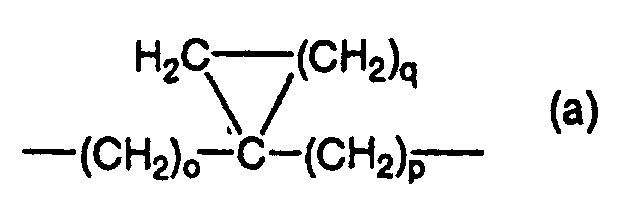 wherein o and p each is an integer of 0 to 2, and q is
an integer of 1 to 4,
wherein o and p each is an integer of 0 to 2, and q is
an integer of 1 to 4,
each of which may have a halogen atom, a C1-C4 alkyl group or a C1-C4 alkoxy group as a substituent(s), Z represents a carboxyl group which may be protected; a 1H-tetrazol-5-yl group; a formula: -SO3H group; a formula: -NH-SO2-R3; or a formula: -CO-NH-SO2-R3,
wherein R3 represents a C1-C4 alkyl group, a fluoro C1-C4 alkyl group or a phenyl group which may have at least one substituent selected from the group consisting of a halogen atom, a C1-C4 alkyl group, a fluoro C1-C4 alkyl group, a C1-C4 alkoxy group, a fluoro C1-C4 alkoxy group,
a nitro group and a cyano group as a substituent(s),
------ represents a single bond or a double bond,
m is an integer of 1 to 4, and when m is 2 or more, then
R1 may be the same or different from each other, and n is
an integer of 1 to 3, and when n is 2 or more, then R2 may
be the same or different from each other, or a pharmaceutically acceptable salt thereof.
each of which may have a halogen atom, a C1-C4 alkyl group or a C1-C4 alkoxy group as a substituent(s), Z represents a carboxyl group which may be protected; a 1H-tetrazol-5-yl group; a formula: -SO3H group; a formula: -NH-SO2-R3; or a formula: -CO-NH-SO2-R3,
wherein R3 represents a C1-C4 alkyl group, a fluoro C1-C4 alkyl group or a phenyl group which may have at least one substituent selected from the group consisting of a halogen atom, a C1-C4 alkyl group, a fluoro C1-C4 alkyl group, a C1-C4 alkoxy group, a fluoro C1-C4 alkoxy group,
a nitro group and a cyano group as a substituent(s),
------ represents a single bond or a double bond,
m is an integer of 1 to 4, and when m is 2 or more, then
R1 may be the same or different from each other, and n is
an integer of 1 to 3, and when n is 2 or more, then R2 may
be the same or different from each other, or a pharmaceutically acceptable salt thereof.
In the compound represented by the above-mentioned formula
(I), as the halogen atom of R1, there may be mentioned, for example,
a fluorine, chlorine, bromine or iodine atom, preferably
fluorine, chlorine or bromine atom, more preferably fluorine'
or chlorine atom, particularly preferably a fluorine atom.
As the C1-C4 alkoxycarbonyl group of R1, there may be
mentioned, for example, methoxycarbonyl, ethoxycarbonyl,
propoxycarbonyl, isopropoxycarbonyl, butoxycarbonyl, isobutoxycarbonyl,
sec-butoxycarbonyl or t-butoxycarbonyl group,
preferably methoxycarbonyl, ethoxycarbonyl, propoxycarbonyl
or isopropoxycarbonyl group, more preferably a methoxycarbonyl
or ethoxycarbonyl group, particularly preferably a methoxycarbonyl
group.
As the C1-C4 alkyl group of R1, there may be mentioned methyl,
ethyl, propyl, isopropyl, butyl, isobutyl, sec-butyl or t-butyl
group, preferably methyl, ethyl, propyl or isopropyl group,
more preferably methyl or ethyl group, particularly preferably
methyl group.
As the fluoro C1-C4 alkyl group of R1, there may be mentioned,
for example, fluoromethyl, difluoromethyl, trifluoromethyl,
2-fluoroethyl, 2,2,2-trifluoroethyl, 2-fluoropropyl, 3-fluor-propyl
or 4-fluorobutyl group, preferably fluoromethyl,
difluoromethyl, trifluoromethyl or 2-fluoroethyl group, more
preferably fluoromethyl, difluoromethyl or trifluoromethyl
group, particularly preferably difluoromethyl or trifluoromethyl
group.
As the hydroxy C1-C4 alkyl group of R1, there may be
mentioned, for example, hydroxymethyl, 1-hydroxyethyl,
2-hydroxyethyl, 1-hydroxy-1-methylethyl, 1-hydroxypropyl,
2-hydroxypropyl, 3-hydroxypropyl, 1-hydroxybutyl or
4-hydroxybutyl group, preferably hydroxymethyl, 1-hydroxyethyl,
2-hydroxyethyl, 1-hydroxy-1-methylethyl, 1-hydroxypropyl
or 2-hydroxypropyl group, more preferably hydroxymethyl,
1-hydroxyethyl, 1-hydroxy-1-methylethyl or 1-hydroxypropyl
group, particularly preferably hydroxymethyl or 1-hydroxy1-methylethyl
group.
As the C2-C4 alkenyl group of R1, there may be mentioned,
for example, vinyl, 1-propenyl, allyl, isopropenyl, 1-butenyl,
2-butenyl, 3-butenyl, 1-methyl-1-propenyl, 2-methyl-1-propenyl
or 2-methyl-2-propenyl group, preferably vinyl,
1-propenyl, allyl, 1-butenyl, 2-butenyl or 2-methyl-1-propenyl
group, more preferably vinyl, 1-propenyl or allyl group,
particularly preferably a vinyl group.
As the C2-C4 alkynyl group of R1, there may be mentioned,
for example, ethynyl, 1-propynyl, propargyl, 1-butynyl,
2-butynyl or 3-butynyl group, preferably ethynyl, 1-propynyl
or 1-butynyl group, more preferably ethynyl or 1-propynyl group,
particularly preferably an ethynyl group.
As the C1-C4 alkoxy group of R1, there may be mentioned,
for example, methoxy, ethoxy, propoxy, isopropoxy, butoxy,
isobutoxy, sec-butoxy or t-butoxy group, preferably methoxy,
ethoxy, propoxy or isopropoxy group, more preferably methoxy
or ethoxy group, particularly preferably a methoxy group.
As the fluoro C1-C4 alkoxy group of R1, there may be
mentioned, for example, a fluoromethoxy, difluoromethoxy,
trifluoromethoxy, 2-fluoroethoxy, 2,2,2-trifluoroethoxy,
2-fluoro propoxy, 3-fluoro propoxy or 4-fluoro butoxy group,
preferably fluoromethoxy, difluoromethoxy, trifluoromethoxy or
2-fluoroethoxy group, more preferably a fluoromethoxy,
difluoromethoxy or trifluoromethoxy group, particularly
preferably a difluoromethoxy or trifluoromethoxy group.
As the C1-C4 alkylthio group of R1, there may be mentioned,
for example, a methylthio, ethylthio, propylthio, isopropylthio,
butylthio, isobutylthio, sec-butylthio or
t-butylthio group, preferably methylthio, ethylthio,
propylthio or isopropylthio group, more preferably a methylthio
or ethylthio group, particularly preferably a methylthio group.
As the C1-C4 alkylsulfinyl group of R1, there may be
mentioned, for example, a methylsulfinyl, ethylsulfinyl,
propylsulfinyl, isopropylsulfinyl, butylsulfinyl, isobutylsulfinyl,
sec-butylsulfinyl or t-butylsulfinyl group,
preferably a methylsulfinyl, ethylsulfinyl, propylsulfinyl or
isopropylsulfinyl group, more preferably a methylsulfinyl or
ethylsulfinyl group, particularly preferably a methylsulfinyl
group.
As the C1-C4, alkylsulfonyl group of R1, there may be
mentioned, for example, a methylsulfonyl, ethylsulfonyl,
propylsulfonyl, isopropylsulfonyl, butylsulfonyl, isobutyl-sulfonyl,
sec-butylsulfonyl or t-butylsulfonyl group,
preferably a methylsulfonyl, ethylsulfonyl, propylsulfonyl or
isopropylsulfonyl group, more preferably a methylsulfonyl or
ethylsulfonyl group, particularly preferably a methylsulfonyl
group.
In particular, as R1 in the formula (I), there may be
preferably mentioned, a hydrogen atom, a fluorine atom, a
chlorine atom, a bromine atom, a hydroxyl group, a nitro group,
a cyano group, a carbamoyl group, a formyl group, a carboxyl
group, a methoxycarbonyl group, an ethoxycarbonyl group, a propoxycarbonyl
group, an isopropoxycarbonyl group, a 1H-tetrazol-5-yl
group, a methyl group, an ethyl group, a propyl group, an
isopropyl group, a fluoromethyl group, a difluoromethyl group,
a trifluoromethyl group, a 2-fluoroethyl group, a hydroxymethyl
group, a 1-hydroxyethyl group, a 2-hydroxyethyl group, a
1-hydroxy-1-methylethyl group, a 1-hydroxypropyl group, a
2-hydroxypropyl group, a vinyl group, a 1-propenyl group, an
allyl group, a 1-butenyl group, a 2-butenyl group, a
2-methyl-1-propenyl group, an ethynyl group, a 1-propynyl group,
a 1-butynyl group, a methoxy group, an ethoxy group, a propoxy
group, an isopropoxy group, a fluoromethoxy group, a difluoromethoxy
group, a trifluoromethoxy group, a 2-fluoroethoxy
group, a methylthio group, an ethylthio group, a propylthio
group, an isopropylthio group, a methylsulfinyl group, an
ethylsulfinyl group, a propylsulfinyl group, an isopropylsulfinyl
group, a methylsulfonyl group, an ethylsulfonyl group,
a propylsulfonyl group or an isopropylsulfonyl group,
more preferably a hydrogen atom, a fluorine atom, a chlorine atom, a hydroxyl group, a nitro group, a cyano group, a carbamoyl group, a formyl group, a methoxycarbonyl group, an ethoxycarbonyl group, a 1H-tetrazol-5-yl group, a methyl group, an ethyl group, a fluoromethyl group, a difluoromethyl group, a trifluoromethyl group, a hydroxymethyl group, a 1-hydroxyethyl group, a 1-hydroxy-1-methylethyl group, a 1-hydroxypropyl group, a vinyl group, a 1-propenyl group, an allyl group, an ethynyl group, a 1-propynyl group, a 1-butynyl group, a methoxy group, an ethoxy group, a fluoromethoxy group, a difluoromethoxy group, a trifluoromethoxy group, a methylthio group, an ethylthio group, a methylsulfinyl group, an ethylsulfinyl group, a methylsulfonyl group or an ethylsulfonyl group,
still further preferably a hydrogen atom, a fluorine atom, a nitro group, a cyano group, a formyl group, a methoxycarbonyl group, a 1H-tetrazol-5-yl group, a methyl group, a difluoromethyl group, a trifluoromethyl group, a hydroxymethyl group, a 1-hydroxy-1-methylethyl group, a vinyl group, an ethynyl group, a methoxy group, a difluoromethoxy group, a trifluoromethoxy group, a methylthio group, a methylsulfinyl group or a methylsulfonyl group,
particularly preferably a hydrogen atom, a fluorine atom, a cyano group, a trifluoromethyl group or an ethynyl group.
more preferably a hydrogen atom, a fluorine atom, a chlorine atom, a hydroxyl group, a nitro group, a cyano group, a carbamoyl group, a formyl group, a methoxycarbonyl group, an ethoxycarbonyl group, a 1H-tetrazol-5-yl group, a methyl group, an ethyl group, a fluoromethyl group, a difluoromethyl group, a trifluoromethyl group, a hydroxymethyl group, a 1-hydroxyethyl group, a 1-hydroxy-1-methylethyl group, a 1-hydroxypropyl group, a vinyl group, a 1-propenyl group, an allyl group, an ethynyl group, a 1-propynyl group, a 1-butynyl group, a methoxy group, an ethoxy group, a fluoromethoxy group, a difluoromethoxy group, a trifluoromethoxy group, a methylthio group, an ethylthio group, a methylsulfinyl group, an ethylsulfinyl group, a methylsulfonyl group or an ethylsulfonyl group,
still further preferably a hydrogen atom, a fluorine atom, a nitro group, a cyano group, a formyl group, a methoxycarbonyl group, a 1H-tetrazol-5-yl group, a methyl group, a difluoromethyl group, a trifluoromethyl group, a hydroxymethyl group, a 1-hydroxy-1-methylethyl group, a vinyl group, an ethynyl group, a methoxy group, a difluoromethoxy group, a trifluoromethoxy group, a methylthio group, a methylsulfinyl group or a methylsulfonyl group,
particularly preferably a hydrogen atom, a fluorine atom, a cyano group, a trifluoromethyl group or an ethynyl group.
In the formula (I), the halogen atom, a C1-C4 alkyl group
and a C1-C4 alkoxy group of R2 each have the same meanings as
those mentioned in the above R1, and as R2, it is preferably a
hydrogen atom, a fluorine atom, a chlorine atom, a bromine atom,
a nitro group, a cyano group, a methyl group, an ethyl group,
a propyl group, an isopropyl group, a methoxy group, an ethoxy
group, a propoxy group or an isopropoxy group, more preferably
a hydrogen atom, a fluorine atom, a chlorine atom, a nitro group,
a cyano group, a methyl group, an ethyl group, a methoxy group
or an ethoxy group, still further preferably a hydrogen atom,
a fluorine atom, a chlorine atom, a methyl group or a methoxy
group, particularly preferably a hydrogen atom.
In the formula (I), as "the 5-membered or a 6-membered
heteroaromatic ring group containing 1 to 3 hetero atoms selected
from the group consisting of a nitrogen atom, an oxygen atom
and a sulfur atom, or a fused heteroaromatic ring group in which
the heteroaromatic ring group and a benzene ring are fused" of
A, there may be mentioned, for example, a 5-membered
heteroaromatic ring group such as furan, thiophene, oxazole,
thiazole, imidazole, pyrazole or thiadiazole; a 6-membered
heteroaromatic ring group such as pyridine, pyrimidine,
pyridazine or pyrazine; or a fused heteroaromatic ring group
such as benzofuran, benzothiophene, benzoxazole, benzothiazole,
benzimidazole, quinoline, quinazoline or quinoxaline
group,
preferably an oxazole, thiazole, imidazole, pyrazole, thiadiazole, pyridine, pyrimidine, pyridazine, pyrazine, benzoxazole, benzothiazole, benzimidazole, quinoline, quinazoline or quinoxaline group, more preferably a thiazole, thiadiazole, pyridine, pyrimidine, benzoxazole, benzothiazole, quinolone or quinazoline group, particularly more preferably a pyridine, benzothiazole or quinoline group.
preferably an oxazole, thiazole, imidazole, pyrazole, thiadiazole, pyridine, pyrimidine, pyridazine, pyrazine, benzoxazole, benzothiazole, benzimidazole, quinoline, quinazoline or quinoxaline group, more preferably a thiazole, thiadiazole, pyridine, pyrimidine, benzoxazole, benzothiazole, quinolone or quinazoline group, particularly more preferably a pyridine, benzothiazole or quinoline group.
The above-mentioned heteroaromatic ring group or fused
heteroaromatic ring group may have a substituent(s), and as a
substituent(s), there may be mentioned, for example, a halogen
atom having the same meaning as in R1, a nitro group, a cyano
group, a C1-C4 alkyl group having the same meaning as in R1, a
fluoroC1-C4 alkyl group having the same meaning as in R1, a C1-C4
alkoxy group having the same meaning as in R1, a fluoro C1-C4
alkoxy group having the same meaning as in R1, a C1-C4 alkylthio
group having the same meaning as in R1, or a C3-C4 alkylene group
such as a trimethylene, tetramethylene group (said alkylene
group forms a 5-membered ring or a 6-membered ring by biding
to a carbon atom adjacent thereto on a heteroaromatic ring),
preferably a fluorine, chlorine, bromine atom, a nitro, cyano, methyl, ethyl, propyl, isopropyl, butyl, isobutyl, t-butyl, fluoromethyl, difluoromethyl, trifluoromethyl, 2-fluoroethyl, methoxy, ethoxy, propoxy, isopropoxy, fluoromethoxy, difluoromethoxy, trifluoromethoxy, 2-fluoroethoxy, methylthio, ethylthio, propylthio, isopropylthio, trimethylene or tetramethylene group,
more preferably a fluorine, chlorine atom, a nitro, cyano, methyl, ethyl, isopropyl, t-butyl, fluoromethyl, difluoromethyl, trifluoromethyl, methoxy, ethoxy, fluoromethoxy, difluoromethoxy, trifluoromethoxy, methylthio, ethylthio, trimethylene or tetramethylene group, still further preferably a fluorine, chlorine atom, a nitro, cyano, methyl, isopropyl, t-butyl, difluoromethyl, trifluoromethyl, methoxy, difluoromethoxy, trifluoromethoxy, methylthio or tetramethylene group, particularly preferably a fluorine, chlorine atom, a trifluoromethyl or tetramethylene group.
preferably a fluorine, chlorine, bromine atom, a nitro, cyano, methyl, ethyl, propyl, isopropyl, butyl, isobutyl, t-butyl, fluoromethyl, difluoromethyl, trifluoromethyl, 2-fluoroethyl, methoxy, ethoxy, propoxy, isopropoxy, fluoromethoxy, difluoromethoxy, trifluoromethoxy, 2-fluoroethoxy, methylthio, ethylthio, propylthio, isopropylthio, trimethylene or tetramethylene group,
more preferably a fluorine, chlorine atom, a nitro, cyano, methyl, ethyl, isopropyl, t-butyl, fluoromethyl, difluoromethyl, trifluoromethyl, methoxy, ethoxy, fluoromethoxy, difluoromethoxy, trifluoromethoxy, methylthio, ethylthio, trimethylene or tetramethylene group, still further preferably a fluorine, chlorine atom, a nitro, cyano, methyl, isopropyl, t-butyl, difluoromethyl, trifluoromethyl, methoxy, difluoromethoxy, trifluoromethoxy, methylthio or tetramethylene group, particularly preferably a fluorine, chlorine atom, a trifluoromethyl or tetramethylene group.
A number of the substituent(s) on the heteroaromatic ring
group or fused heteroaromatic ring group is 1 to 4, preferably
1 to 2.
As A in the formula (I), there may be specifically mentioned,
preferably a 2-oxazolyl, 2-thiazolyl, 2- or 4-imidazolyl,
3-pyrazolyl, 1,3,4-thiadiazol-2-yl, 2-pyridyl, 2-or
4-pyrimidinyl, 3-pyridazinyl, 2-pyrazinyl, 2-benzoxazolyl,
2-benzothiazolyl, 2-benzimidazolyl, quinolin-2-yl, quinazolin-2-yl,
quinoxaline-2-yl, 4-methyl-2-thiazolyl, 4-ethyl-2-thiazolyl,
4-isopropyl-2-thiazolyl, 4-t-butyl-2-thiazolyl,
4-trifluoromethyl-2-thiazolyl, 5-methyl-1,3,4-thiadiazol-2-yl,
5-ethyl-1,3,4-thiadiazol-2-yl, 5-isopropyl-1,3,4-thiadiazol-2-yl,
5-t-butyl-1,3,4-thiadiazol-2-yl, 5-trifluoromethyl-1,3,4-thiadiazol-2-yl,
5,6-difluoro-2-pyridyl,
5,6-dichloro-2-pyridyl, 5,6-dimethyl-2-pyridyl, 5,6-diethyl-2-pyridyl,
6-trifluoromethyl-2-pyridyl, 6-methylthio-2-pyridyl,
5,6-dihydroclopenta[b]pyridin-2-yl, 5,6,7,8-tetrahydroquinolin-2-yl,
5,6-difluoro-2-pyrimidinyl,
5,6-dichloro-2-pyrimidinyl, 5,6-dimethyl-2-pyrimidinyl,
6-trifluoromethyl-2-pyrimidinyl, 5,6-dihydrocyclopenta-[d]pyrimidin-2-yl,
5,6,7,8-tetrahydroquinazolin-2-yl,
6-fluoro-2-benzoxazolyl, 5-fluoro-2-benzoxazolyl, 5,6-difluoro-2-benzoxazolyl,
6-chloro-2-benzoxazolyl, 5-chloro-2-benzoxazolyl,
5,6-dichloro-2-benzoxazolyl, 5-chloro-6-fluoro-2-benzoxazolyl,
5-methyl-2-benzoxazolyl, 5-cyano-2-benzoxazolyl,
5-trifluoromethyl-2-benzoxazolyl,
5-methylthio-2-benzoxazolyl, 6-fluoro-2-benzothiazolyl,
5-fluoro-2-benzothiazolyl, 5,6-difluoro-2-benzothiazolyl,
6-chloro-2-benzothiazolyl, 5-chloro-2-benzothiazolyl,
5,6-dichloro-2-benzothiazolyl, 5-chloro-6-fluoro-2-benzothiazolyl,
5-methyl-2-benzothiazolyl, 5-cyano-2-benzothiazolyl,
5-trifluoromethyl-2-benzothiazolyl, 5-methylthio-2-benzothiazolyl,
5-fluoroquinolin-2-yl, 6-fluoroquinolin-2-yl,
7-fluoroquinolin-2-yl, 5-chloroquinolin-2-yl,
6-chloroquinolin-2-yl, 7-chloroquinolin-2-yl, 7-methylquinolin-2-yl,
7-trifluoromethylquinolin-2-yl, 7-methoxyquinolin-2-yl,
7-difluoromethoxyquinolin-2-yl, 7-trifluoromethoxyquinolin-2-yl,
5,7-difluoroquinolin-2-yl,
6,7-difluoroquinolin-2-yl, 5,7-dichloroquinolin-2-yl,
6,7-dichloroquinolin-2-yl, 5-chloro-7-fluoroquinolin-2-yl,
6-chloro-7-fluoroquinolin-2-yl, 7-chloro-5-fluoroquinolin-2-yl,
7-chloro-6-fluoroquinolin-2-yl, 7-chloro-6-cyanoquinolin-2-yl,
7-cyano-6-fluoroquinolin-2-yl, 6-fluoro-7-trifluoromethylquinolin-2-yl,
5,6,7-trifluoroquinolin-2-yl,
5-fluoroquinazolin-2-yl, 6-fluoroquinazolin-2-yl,
7-fluoroquinazolin-2-yl, 5-chloroquinazolin-2-yl, 6-chloroquinazolin-2-yl,
7-chloroquinazolin-2-yl, 7-methylquinazolin-2-yl,
7-trifluoromethylquinazolin-2-yl, 7-methoxyquinazolin-2-yl,
7-difluoromethoxyquinazolin-2-yl, 7-trifluoromethoxyquinazolin-2-yl,
5,7-difluoroquinazolin-2-yl,
6,7-difluoroquinazolin-2-yl, 5,7-dichloroquinazolin-2-yl,
6,7-dichloroquinazolin-2-yl, 5-chloro-7-fluoroquinazolin-2-yl,
6-chloro-7-fluoroquinazolin-2-yl, 7-chloro-5-fluoroquinazolin-2-yl,
7-chloro-6-fluoroquinazolin-2-yl, 7-chloro-6-cyano-quinazolin-2-yl,
7-cyano-6-fluoroquinazolin-2-yl,
6-fluoro-7-trifluoromethylquinazolin-2-yl or 5,6,7-trifluoroquinazolin-2-yl
group, more preferably a 2-thiazolyl,
1,3,4-thiadiazol-2-yl, 2-pyridyl, 2-pyrimidinyl, 2-benzoxazolyl,
2-benzothiazolyl, quinolin-2-yl, quinazolin-2-yl,
4-methyl-2-thiazolyl, 4-isopropyl-2-thiazolyl, 4-t-butyl-2-thiazolyl,
4-trifluoromethyl-2-thiazolyl, 5-methyl-1,3,4-thiadiazol-2-yl,
5-isopropyl-1,3,4-thiadiazol-2-yl,
5-t-butyl-1,3,4-thiadiazol-2-yl, 5-trifluoromethyl-1,3,4-thiadiazol-2-yl,
5,6-difluoro-2-pyridyl, 5,6-dichloro-2-pyridyl,
5,6-dimethyl-2-pyridyl, 5,6-dihydroclopenta-[b]pyridin-2-yl,
5,6,7,8-tetrahydroquinolin-2-yl, 5,6-difluoro-2-pyrimidinyl,
5,6-dichloro-2-.pyrimidinyl, 5,6-dimethyl-2-pyrimidinyl,
6-trifluoromethyl-2-pyrimidinyl,
5,6-dihydrocyclopenta[d]pyrimidine-2-yl, 5,6,7,8-tetrahydroquinazolin-2-yl,
6-fluoro-2-benzoxazolyl, 5-fluoro-2-benzoxazolyl,
5,6-difluoro-2-benzoxazolyl, 6-chloro-2-benzoxazolyl,
5-chloro-2-benzoxazolyl, 5,6-dichloro-2-benzoxazolyl,
5-chloro-6-fluoro-2-benzoxazolyl, 5-methyl-2-benzoxazolyl,
5-cyano-2-benzoxazolyl, 5'-trifluoromethyl-2-benzoxazolyl,
5-methylthio-2-benzoxazolyl,
6-fluoro-2-benzothiazolyl, 5-fluoro-2-benzothiazolyl,
5,6-difluoro-2-benzothiazolyl, 6-chloro-2-benzothiazolyl,
5-chloro-2-benzothiazolyl, 5,6-dichloro-2-benzothiazolyl,
5-chloro-6-fluoro-2-benzothiazolyl, 5-methyl-2-benzothiazolyl,
5-cyano-2-benzothiazolyl, 5-trifluoromethyl-2-benzothiazolyl,
5-methylthio-2-benzothiazolyl, 5-fluoroquinolin-2-yl,
6-fluoroquinolin-2-yl, 7-fluoroquinolin-2-yl,
5-chloroquinolin-2-yl, 6-chloroquinolin-2-yl, 7-chloroquinolin-2-yl,
7-methylquinolin-2-yl, 7-trifluoromethylquinolin-2-yl,
7-methoxyquinolin-2-yl, 7-difluoromethoxyquinolin-2-yl,
7-trifluoromethoxyquinolin-2-yl, 5,7-difluoroquinolin-2-yl,
6,7-difluoroquinolin-2-yl, 5,7-dichloroquinolin-2-yl,
6,7-dichloroquinolin-2-yl, 5-chloro-7-fluoroquinolin-2-yl,
6-chloro-7-fluoroquinolin-2-yl,
7-chloro-5-fluoroquinolin-2-yl, 7-chloro-6-fluoroquinolin-2-yl,
7-chloro-6-cyano-quinolin-2-yl, 7-cyano-6-fluoroquinolin-2-yl,
6-fluoro-7-trifluoromethylquinolin-2-yl,
5,6,7-trifluoroquinolin-2-yl, 5-fluoroquinazolin-2-yl,
6-fluoroquinazolin-2-yl, 7-fluoroquinazolin-2-yl, 5-chloroquinazolin-2-yl,
6-chloroquinazolin-2-yl, 7-chloroquinazolin-2-yl,
7-methylquinazolin-2-yl, 7-trifluoromethylquinazolin-2-yl,
7-methoxyquinazolin-2-yl, 7-difluoromethoxyquinazolin-2-yl,
7-trifluoromethoxyquinazolin-2-yl,
5,7-difluoroquinazolin-2-yl, 6,7-difluoroquinazolin-2-yl,
5,7-dichloroquinazolin-2-yl, 6,7-dichloroquinazolin-2-yl,
5-chloro-7-fluoroquinazolin-2-yl, 6-chloro-7-fluoroquinazolin-2-yl,
7-chloro-5-fluoroquinazolin-2-yl, 7-chloro-6-fluoroquinazolin-2-yl,
7-chloro-6-cyano-quinazolin-2-yl,
7-cyano-6-fluoroquinazolin-2-yl, 6-fluoro-7-trifluoromethylquinazolin-2-yl
or 5,6,7-trifluoroquinazolin-2-yl
group,
still further preferably a 2-pyridyl, 2-benzothiazolyl, quinolin-2-yl, 5,6-difluoro-2-pyridyl, 5,6-dichloro-2-pyridyl, 5,6-dimethyl-2-pyridyl, 5,6,7,8-tetrahydroquinolin-2-yl, 6-fluoro-2-benzothiazolyl, 5-fluoro-2-benzothiazolyl, 5,6-difluoro-2-benzothiazolyl, 6-chloro-2-benzothiazolyl, 5-chloro-2-benzothiazolyl, 5,6-dichloro-2-benzothiazolyl, 5-chloro-6-fluoro-2-benzothiazolyl, 5-methyl-2-benzothiazolyl, 5-cyano-2-benzothiazolyl, 5-trifluoromethyl-2-benzothiazolyl, 5-methylthio-2-benzothiazolyl, 5-fluoroquinolin-2-yl, 6-fluoroquinolin-2-yl, 7-fluoroquinolin-2-yl, 5-chloroquinolin-2-yl, 6-chloroquinolin-2-yl, 7-chloroquinolin-2-yl, 7-methylquinolin-2-yl, 7-trifluoromethylquinolin-2-yl, 7-methoxyquinolin-2-yl, 7-difluoromethoxyquinolin-2-yl, 7-trifluoromethoxyquinolin-2-yl, 5,7-difluoroquinolin-2-yl, 6,7-difluoroquinolin-2-yl, 5,7-dichloroquinolin-2-yl, 6,7-dichloroquinolin-2-yl, 5-chloro-7-fluoroquinolin-2-yl, 6-chloro-7-fluoroquinolin-2-yl, 7-chloro-5-fluoroquinolin-2-yl, 7-chloro-6-fluoroquinolin-2-yl, 7-chloro-6-cyanoquinolin-2-yl, 7-cyano-6-fluoroquinolin-2-yl, 6-fluoro-7-trifluoromethylquinolin-2-yl or 5,6,7-trifluoroquinolin-2-yl group,
particularly preferably a 7-fluoroquinolin-2-yl, 7-chloroquinolin-2-yl, 6,7-difluoroquinolin-2-yl, 6,7-dichloroquinolin-2-yl, 7-chloro-6-fluoroquinolin-2-yl, 6-fluoro-7-trifluoromethylquinolin-2-yl or 5,6,7,8-tetrahydroquinolin-2-yl group.
still further preferably a 2-pyridyl, 2-benzothiazolyl, quinolin-2-yl, 5,6-difluoro-2-pyridyl, 5,6-dichloro-2-pyridyl, 5,6-dimethyl-2-pyridyl, 5,6,7,8-tetrahydroquinolin-2-yl, 6-fluoro-2-benzothiazolyl, 5-fluoro-2-benzothiazolyl, 5,6-difluoro-2-benzothiazolyl, 6-chloro-2-benzothiazolyl, 5-chloro-2-benzothiazolyl, 5,6-dichloro-2-benzothiazolyl, 5-chloro-6-fluoro-2-benzothiazolyl, 5-methyl-2-benzothiazolyl, 5-cyano-2-benzothiazolyl, 5-trifluoromethyl-2-benzothiazolyl, 5-methylthio-2-benzothiazolyl, 5-fluoroquinolin-2-yl, 6-fluoroquinolin-2-yl, 7-fluoroquinolin-2-yl, 5-chloroquinolin-2-yl, 6-chloroquinolin-2-yl, 7-chloroquinolin-2-yl, 7-methylquinolin-2-yl, 7-trifluoromethylquinolin-2-yl, 7-methoxyquinolin-2-yl, 7-difluoromethoxyquinolin-2-yl, 7-trifluoromethoxyquinolin-2-yl, 5,7-difluoroquinolin-2-yl, 6,7-difluoroquinolin-2-yl, 5,7-dichloroquinolin-2-yl, 6,7-dichloroquinolin-2-yl, 5-chloro-7-fluoroquinolin-2-yl, 6-chloro-7-fluoroquinolin-2-yl, 7-chloro-5-fluoroquinolin-2-yl, 7-chloro-6-fluoroquinolin-2-yl, 7-chloro-6-cyanoquinolin-2-yl, 7-cyano-6-fluoroquinolin-2-yl, 6-fluoro-7-trifluoromethylquinolin-2-yl or 5,6,7-trifluoroquinolin-2-yl group,
particularly preferably a 7-fluoroquinolin-2-yl, 7-chloroquinolin-2-yl, 6,7-difluoroquinolin-2-yl, 6,7-dichloroquinolin-2-yl, 7-chloro-6-fluoroquinolin-2-yl, 6-fluoro-7-trifluoromethylquinolin-2-yl or 5,6,7,8-tetrahydroquinolin-2-yl group.
In the above-mentioned formula (I), B represents a
formula: -OCH2-, a formula: -CH2CH2-, a formula: -SCH2-, a formula:
-CH2O- or a formula: -CH2S-, preferably a formula: -OCH2-,
a formula: -CH2O- or a formula: -CH2CH2-.
In the above-mentioned formula (I), X is an oxygen atom,
a sulfur atom, methylene group or a formula: =CH-, preferably
a methylene group, an oxygen atom or a sulfur atom.
As the C1-C10 alkylene group of Y in the above-mentioned
formula (I), there may be mentioned, for example, a methylene,
ethylene, trimethylene, tetramethylene, pentamethylene,
hexamethylene, heptamethylene, octamethylene, nonamethylene or
decamethylene group, preferably a C1-C5 alkylene group, more
preferably a methylene, ethylene or trimethylene group,
particularly preferably an ethylene or trimethylene group.
The above-mentioned alkylene group may have a substituent(s),
and a halogen atom, a C1-C4, alkyl group and a C1-C4 alkoxy
group as said substituent (s) are the same as the above-mentioned
halogen atom, the C1-C4 alkyl group and the C1-C4 alkoxy group.
As a substituent(s) for an alkylene group of Y, there may
be preferably mentioned a fluorine, chlorine atom, a methyl,
ethyl, propyl, methoxy, ethoxy or propoxy group, more preferably
a fluorine atom, a methyl, ethyl or methoxy group, particularly
preferably a fluorine atom or a methyl group.
As the phenylene group of Y, there may be mentioned a
1,2-phenylene, 1,3-phenylene or 1,4-phenylene group, preferably
a 1, 2-phenylene or 1, 3-phenylene group, more preferably
a 1,2-phenylene group.
As a group shown by the formula (a) of Y, there may be
preferably mentioned a group wherein o=0, p=0 and q=1
(hereinafter referred to as group (a-1)), a group wherein o=0,
p=1 and q=1 (hereinafter referred to as group (a-2)), a group
whereino=0, p=1 and q=2 (hereinafter referred to as group (a-3)),
a group wherein o=1, p=0 and q=1 (hereinafter referred to as
group (a-4)), a group wherein o=1, p=1 and q=1 (hereinafter
referred to as group group (a-5)), a group wherein o=1, p=1 and
q=2 (hereinafter referred to as group (a-6)) or a group wherein
o=1, p=1 and q=3 (hereinafter referred to as group (a-7)), more
preferably a group (a-4), a group (a-5) or a group (a-6),
particularly more preferably a group (a-5).
As the preferred group in the formula (I) of Y, there may
be specifically mentioned, a methylene, ethylene, trimethylene,
tetramethylene, pentamethylene, fluoromethylene,
difluoromethylene, 1-fluoroethylene, 2-fluoroethylene,
1,1-difluoroethylene, 2,2-difluoroethylene, 1-methylethylene,
2-methylethylene, 1,1-dimethylethylene, 2,2-dimethylethylene,
1-ethylethylene, 2-ethylethylene, 1-methoxyethylene,
2-methoxyethylene, 1-fluorotrimethylene, 2-fluorotrimethylene,
3-fluorotrimethylene, 1,1-difluorotrimethylene,
2,2- difluorotrimethylene, 3,3-difluorotrimethylene,
1-methyltrimethylene, 2-methyltrimethylene, 1,1-dimethyltrimethylene,
2,2-dimethyltrimethylene, 3,3-dimethyltrimethylene,
2,2-diethyltrimethylene, 2-methoxytrimethylene,
3-methoxytrimethylene, 2,2-dimethoxytrimethylene, 3,3-dimethoxytrimethylene,
1,2-phenylene or 1,4-phenylene group, the
above-mentioned group (a-1), group (a-2), group (a-3), group
(a-4), group (a-5) or group (a-6),
further preferably a methylene, ethylene, trimethylene, fluoromethylene, difluoromethylene, 1-fluoroethylene, 2-fluoroethylene, 1,1-difluoroethylene, 2,2-difluoroethylene, 1-methylethylene, 2-methylethylene, 1,1-dimethylethylene, 2,2-dimethylethylene, 1-ethylethylene, 2-ethylethylene, 1-fluorotrimethylene, 2-fluorotrimethylene, 3-fluorotrimethylene, 1,1-difluorotrimethylene, 2,2-difluorotrimethylene, 3,3-difluorotrimethylene, 1-methyltrimethylene, 2-methyltrimethylene, 1,1-dimethyltrimethylene, 2,2-dimethyltrimethylene, 3,3-dimethyltrimethylene, 1,2-phenylene group, a group (a-4), a group (a-5) or a group (a-6),
further more preferably a methylene, ethylene, trimethylene, difluoromethylene, 1-fluoroethylene, 2-fluoroethylene, 1,1-difluoroethylene, 2,2-difluoroethylene, 1-methylethylene, 2-methylethylene, 1,1-dimethylethylene, 2,2-dimethylethylene, 1-ethylethylene, 2-ethylethylene, 2,2-difluorotrimethylene, 1-methyltrimethylene, 2-methyltrimethylene, 1,1-dimethyltrimethylene, 2,2-dimethyltrimethylene, 3,3-dimethyltrimethylene, 1,2-phenylene group or a group (a-5), particularly preferably methylene,ethylene, trimethylene, 1-methylethylene, 2-methylethylene, 1,1-dimethylethylene, 2,2-dimethylethylene, 1-ethylethylene, 2-ethylethylene, 1,2-phenylene group or a group (a-5).
further preferably a methylene, ethylene, trimethylene, fluoromethylene, difluoromethylene, 1-fluoroethylene, 2-fluoroethylene, 1,1-difluoroethylene, 2,2-difluoroethylene, 1-methylethylene, 2-methylethylene, 1,1-dimethylethylene, 2,2-dimethylethylene, 1-ethylethylene, 2-ethylethylene, 1-fluorotrimethylene, 2-fluorotrimethylene, 3-fluorotrimethylene, 1,1-difluorotrimethylene, 2,2-difluorotrimethylene, 3,3-difluorotrimethylene, 1-methyltrimethylene, 2-methyltrimethylene, 1,1-dimethyltrimethylene, 2,2-dimethyltrimethylene, 3,3-dimethyltrimethylene, 1,2-phenylene group, a group (a-4), a group (a-5) or a group (a-6),
further more preferably a methylene, ethylene, trimethylene, difluoromethylene, 1-fluoroethylene, 2-fluoroethylene, 1,1-difluoroethylene, 2,2-difluoroethylene, 1-methylethylene, 2-methylethylene, 1,1-dimethylethylene, 2,2-dimethylethylene, 1-ethylethylene, 2-ethylethylene, 2,2-difluorotrimethylene, 1-methyltrimethylene, 2-methyltrimethylene, 1,1-dimethyltrimethylene, 2,2-dimethyltrimethylene, 3,3-dimethyltrimethylene, 1,2-phenylene group or a group (a-5), particularly preferably methylene,ethylene, trimethylene, 1-methylethylene, 2-methylethylene, 1,1-dimethylethylene, 2,2-dimethylethylene, 1-ethylethylene, 2-ethylethylene, 1,2-phenylene group or a group (a-5).
In the group represented by the formula: -NH-SO2-R3 or a
formula: -CO-NH-SO2-R3 of Z,
the halogen, C1-C4 alkyl, fluoro C1-C4 alkyl, C1-C4 alkoxy and fluoro C1-C4 alkoxy group which are a substituent(s) on the C1-C4 alkyl group, the fluoro C1-C4 alkyl group and the phenyl group of R3, have the same meanings as the halogen atom, the C1-C4 alkyl group, the fluoro C1-C4 alkyl group, the C1-C4 alkoxy group and the fluoro C1-C4 alkoxy group of the above-metioned R1, respectively.
the halogen, C1-C4 alkyl, fluoro C1-C4 alkyl, C1-C4 alkoxy and fluoro C1-C4 alkoxy group which are a substituent(s) on the C1-C4 alkyl group, the fluoro C1-C4 alkyl group and the phenyl group of R3, have the same meanings as the halogen atom, the C1-C4 alkyl group, the fluoro C1-C4 alkyl group, the C1-C4 alkoxy group and the fluoro C1-C4 alkoxy group of the above-metioned R1, respectively.
As R3, it is preferably a methyl, ethyl, propyl,
fluoromethyl, difluoromethyl, trifluoromethyl, 2-fluoroethyl,
2,2,2-trifluoroethyl, phenyl, (o, m or p-)fluorophenyl, (o, m
or p-)chlorophenyl, (o, m or p-)methylphenyl, (o, m or p-)ethylphenyl,
(o, m or p-)(trifluoromethyl)phenyl, (o, m or
p-)methoxyphenyl, (o, m or p-)ethoxyphenyl, (o, m or p-)-(difluoromethoxy)phenyl,
(o, m or p-)(trifluoromethoxy)-phenyl,
(o, morp-)nitrophenyl or (o, morp-)cyanophenyl group,
further preferably a methyl, ethyl, trifluoromethyl, 2-fluoroethyl, 2,2,2-trifluoroethyl, phenyl, (o or p-)-fluorophenyl, (o or p-)chlorophenyl, (o or p-)methylphenyl, (o or p-) (trifluoromethyl)phenyl, (o or p-)methoxyphenyl, (o or p-)(difluoromethoxy)phenyl, (o or p-)(trifluoromethoxy)-phenyl, (o or p-)nitrophenyl or (o or p-)cyanophenyl group,
further more preferably a methyl, ethyl, trifluoromethyl, phenyl, p-fluorophenyl, p-chlorophenyl, (o or p-) methylphenyl, p-(trifluoromethyl)phenyl, (o or p-)methoxyphenyl, p-(difluoromethoxy)phenyl, p-(trifluoromethoxy)phenyl, p-nitrophenyl or p-cyanophenyl group,
particularly preferably a methyl, trifluoromethyl, phenyl, o-methylphenyl or p-methylphenyl group.
further preferably a methyl, ethyl, trifluoromethyl, 2-fluoroethyl, 2,2,2-trifluoroethyl, phenyl, (o or p-)-fluorophenyl, (o or p-)chlorophenyl, (o or p-)methylphenyl, (o or p-) (trifluoromethyl)phenyl, (o or p-)methoxyphenyl, (o or p-)(difluoromethoxy)phenyl, (o or p-)(trifluoromethoxy)-phenyl, (o or p-)nitrophenyl or (o or p-)cyanophenyl group,
further more preferably a methyl, ethyl, trifluoromethyl, phenyl, p-fluorophenyl, p-chlorophenyl, (o or p-) methylphenyl, p-(trifluoromethyl)phenyl, (o or p-)methoxyphenyl, p-(difluoromethoxy)phenyl, p-(trifluoromethoxy)phenyl, p-nitrophenyl or p-cyanophenyl group,
particularly preferably a methyl, trifluoromethyl, phenyl, o-methylphenyl or p-methylphenyl group.
As the preferred group of Z in the formula (I), there may
be preferably mentioned, a carboxyl, a formula: -SO3H,
1H-tetrazol-5-yl, methanesulfonylamino, ethanesulfonylamino,
trifluoromethanesulfonylamino, phenylsulfonylamino,
p-fluorophenylsulfonylamino, p-chlorophenylsulfonylamino,
o-methylphenylsulfonylamino, p-methylphenylsulfonylamino,
p-trifluoromethylphenylsulfonylamino, o-methoxyphenylsulfonylamino,
p-methoxyphenylsulfonylamino, p-difluoromethoxyphenylsulfonylamino,
p-trifluoromethoxyphenylsulfonylamino,
p-nitrophenylsulfonylamino, p-cyanophenylsulfonylamino,
methanesulfonylaminocarbonyl, ethanesulfonylaminocarbonyl,
trifluoromethanesulfonylaminocarbonyl,
phenylsulfonylaminocarbonyl, p-fluorophenylsulfonylaminocarbonyl,
p-chlorophenylsulfonylaminocarbonyl, o-methylphenylsulfonylaminocarbonyl,
p-methylphenylsulfonylaminocarbonyl,
p-trifluoromethylphenylsulfonylaminocarbonyl,
o-methoxyphenylsulfonylaminocarbonyl, p-methoxyphenylsulfonylaminocarbonyl,
p-difluoromethoxyphenylsulfonylaminocarbonyl,
p-trifluoromethoxyphenylsulfonylaminocarbonyl,
p-nitrophenylsulfonylaminocarbonyl or p-cyanophenylsulfonylaminocarbonyl
group,
more preferably a carboxyl, a formula: -SO3H, 1H-tetrazol-5-yl, methanesulfonylamino, trifluoromethanesulfonylamino, phenylsulfonylamino, o-methylphenylsulfonylamino, p-methylphenylsulfonylamino, methanesulfonylaminocarbonyl, trifluoromethanesulfonylaminocarbonyl, phenylsulfonylaminocarbonyl, o-methylphenylsulfonylaminocarbonyl or p-methylphenylsulfonylaminocarbonyl group,
particularly preferably a carboxyl, a formula: -SO3H, methanesulfonylamino, trifluoromethanesulfonylamino, methanesulfonylaminocarbonyl or trifluoromethanesulfonylaminocarbonyl group.
more preferably a carboxyl, a formula: -SO3H, 1H-tetrazol-5-yl, methanesulfonylamino, trifluoromethanesulfonylamino, phenylsulfonylamino, o-methylphenylsulfonylamino, p-methylphenylsulfonylamino, methanesulfonylaminocarbonyl, trifluoromethanesulfonylaminocarbonyl, phenylsulfonylaminocarbonyl, o-methylphenylsulfonylaminocarbonyl or p-methylphenylsulfonylaminocarbonyl group,
particularly preferably a carboxyl, a formula: -SO3H, methanesulfonylamino, trifluoromethanesulfonylamino, methanesulfonylaminocarbonyl or trifluoromethanesulfonylaminocarbonyl group.
Incidentally, when Z is a carboxyl group, the carboxyl
group may be protected by a protective group. As the protective
group, it is not particularly limited so long as, it can be easily
converted into a carboxyl group in vivo, there may be mentioned,
for example, the C1-C4 alkyl group which has the same meanings
as defined in R1; a C7-C10 aralkyl group such as a benzyl, phenylethyl
or phenylpropyl group; a C1-C4 alkyl group substituted by a C2-C5
alkanoyloxy group such as an acetoxymethyl, 1-acetoxyethyl,
1-acetoxypropyl, 1-acetoxybutyl, propanoyloxymethyl,
1-propanoyloxyethyl, butanoyloxymethyl, 1-butanoyloxymethyl,
pivaloyloxymethyl, 1-pivaloyloxyethyl, 1-pivaloyloxypropyl or
1-pivaloyloxybutyl group; a C1-C4 alkyl group substituted by a
(C1-C4 alkoxy)carbonyloxy group such as a methoxycarbonyloxymethyl,
1-(methoxycarbonyloxy)ethyl, ethoxycarbonyloxymethyl,
1-(ethoxycarbonyloxy)ethyl, propoxycarbonyloxymethyl,
isopropoxycarbonyloxymethyl, 1-(isopropoxycarbonyloxy)ethyl,
butoxycarbonyloxymethyl, 1-(butoxycarbonyloxy)-ethyl,
t-butoxycarbonyloxymethyl or 1-(t-butoxycarbonyloxy)
ethyl group; a C1-C4 alkyl group substituted by a N,N-di (C1-C4
alkyl)aminocarbonyl group such as N,N-dimethylaminocarbonylmethyl,.
2-(N,N-dimethylaminocarbonyl)ethyl or N,N-diethylaminocarbonylmethyl
group; a C1-C4 alkyl group substituted
by a N,N-di (C1-C4 alkyl) amino group or by a 5 or 6-membered cyclic
amino group which may contain an oxygen atom such as a
2-(N,N-dimethylamino)ethyl, 2-(N,N- diethylamino)ethyl,
3-(N,N-dimethylamino)propyl, 2-piperidinoethyl, 2-(4-methyl)piperidinoethyl,
3-piperidinopropyl or 2-morpholinoethyl
group; or a (5-methyl-2-oxo-1,3-dioxolen-4-yl)methyl
group and the like.
As a protective group for a carboxyl group, there may be
preferably mentioned a C1-C4 alkyl group, a benzyl group, a C1-C2
alkyl group substituted by a C2-C5 alkanoyloxy group, a C1-C2 alkyl
group substituted by a (C1-C4 alkoxy)carbonyloxy group, or a
(5-methyl-2-oxo-1,3-dioxolen-4-yl)methyl group,
more preferably a methyl, ethyl, propyl, isopropyl, butyl, isobutyl, acetoxymethyl, 1-acetoxyethyl, pivaloyloxymethyl or 1-pivaloyloxyethyl group.
more preferably a methyl, ethyl, propyl, isopropyl, butyl, isobutyl, acetoxymethyl, 1-acetoxyethyl, pivaloyloxymethyl or 1-pivaloyloxyethyl group.
In the above-mentioned formula (I), m is an integer of
1 to 4, preferably m is 1, 2 or 3, particularly preferably 1
or 2. When m is 2 or more, R1 may be different from each other.
In the above-mentioned formula (I), n is an integer of
1 to 3, preferably n is 1 or 2, particularly preferably 1. When
n is 2 or more, R2 may be different from each other.
In the Compound (I) of the present invention, there exist
an optical isomer(s) (including diastereomer) due to an
asymmetric carbon atoms) in the molecule, or there exist a case
in which a geometric isomer due to a double bond exists, and
these respective isomers are included in the present invention.
Also, the Compound (I) of the present invention can be
converted into a pharmaceutically acceptable salt, if necessary.
Such a salt may be mentioned an acid addition salt of a mineral
acid such as hydrochloride, hydrobromide, hydroiodide, sulfate
or phosphate; an acid addition salt of an organic acid such as
a trifluoroacetic acid salt, a methane-sulfonic acid salt, an
ethanesulfonic acid salt, a benzenesulfonic acid salt, a
p-toluenesulfonic acid salt, an oxalate, a maleate, a fumarate,
a tartarate or a citrate; a metal salt of a carboxylic acid such
as a sodium salt, a potassium salt, a calcium salt, a magnesium
salt, a manganese salt, an iron salt or an aluminum salt; or
a salt with an organic base such as an ammonium salt, a
triethylamine salt, a guanidine salt, a hydrazine salt, a quinine
salt or a cinchonine salt, and the like.
Incidentally, the Compound (I) of the present invention
can also exist as a hydrate.
In the tricyclic compounds having the above-mentioned
formula (I) according to the present invention, there may be
preferably mentioned
and with regard to R1, a preferred order raises from (1) to (5) in this order, with regard to R2, a preferred order raises from (6) to(8) in this order, with regard to A, a preferred order raises from (9) to (12), from (13) to (16) and from (17) to (20) in this order, with regard to Y, a preferred order raises from (23) to (26) in this order, with regard to Z, a preferred order raises from (27) to (29) in this order.
Also, as the tricyclic compounds having the above-mentioned
formula (I), tricyclic compounds comprising the
combination of two or more of the above-mentioned (1) to (30)
are also preferred.
As the preferred compounds in the Compound (I), the
compounds shown in the following Table 1 can be specifically
exemplified.

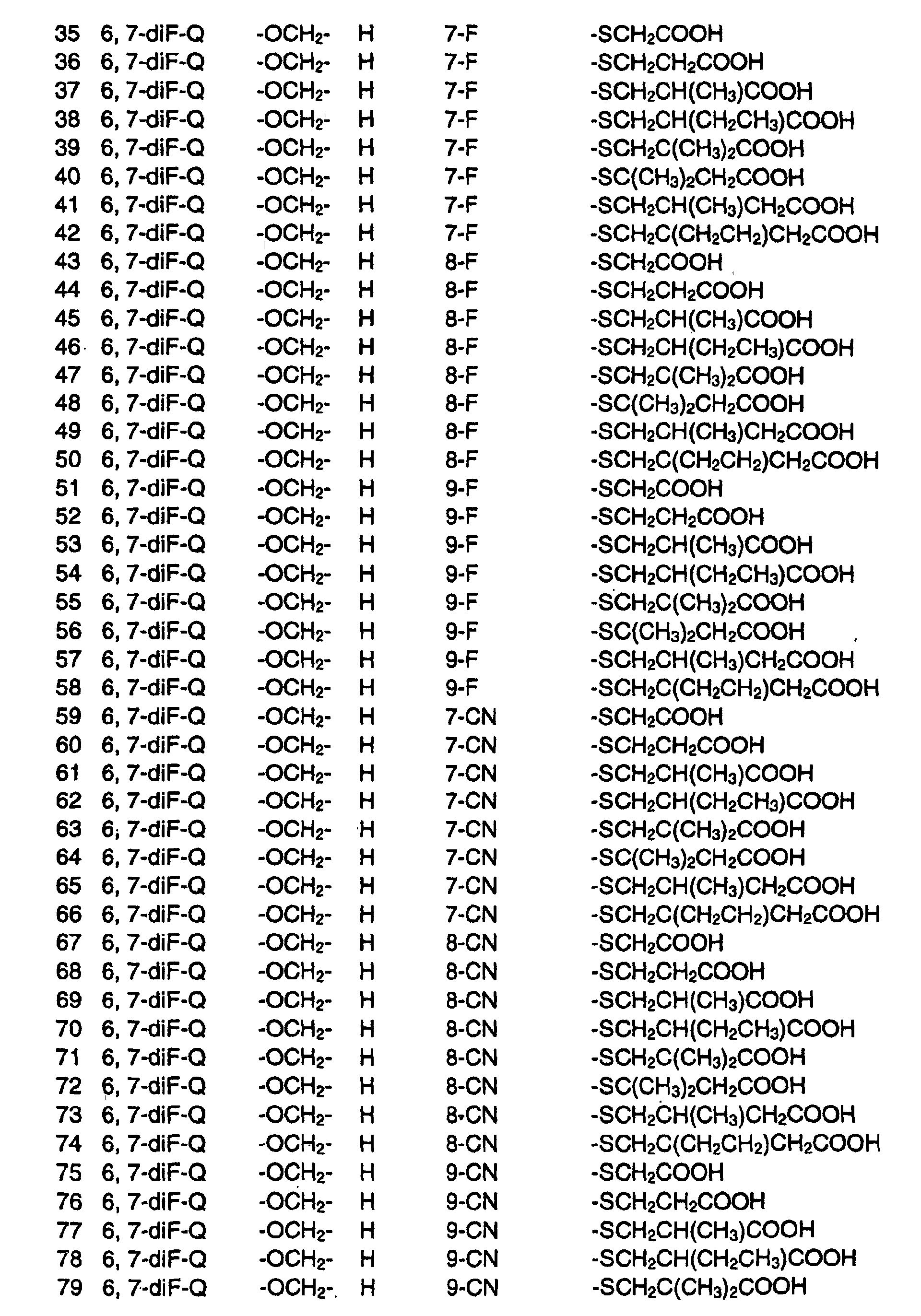


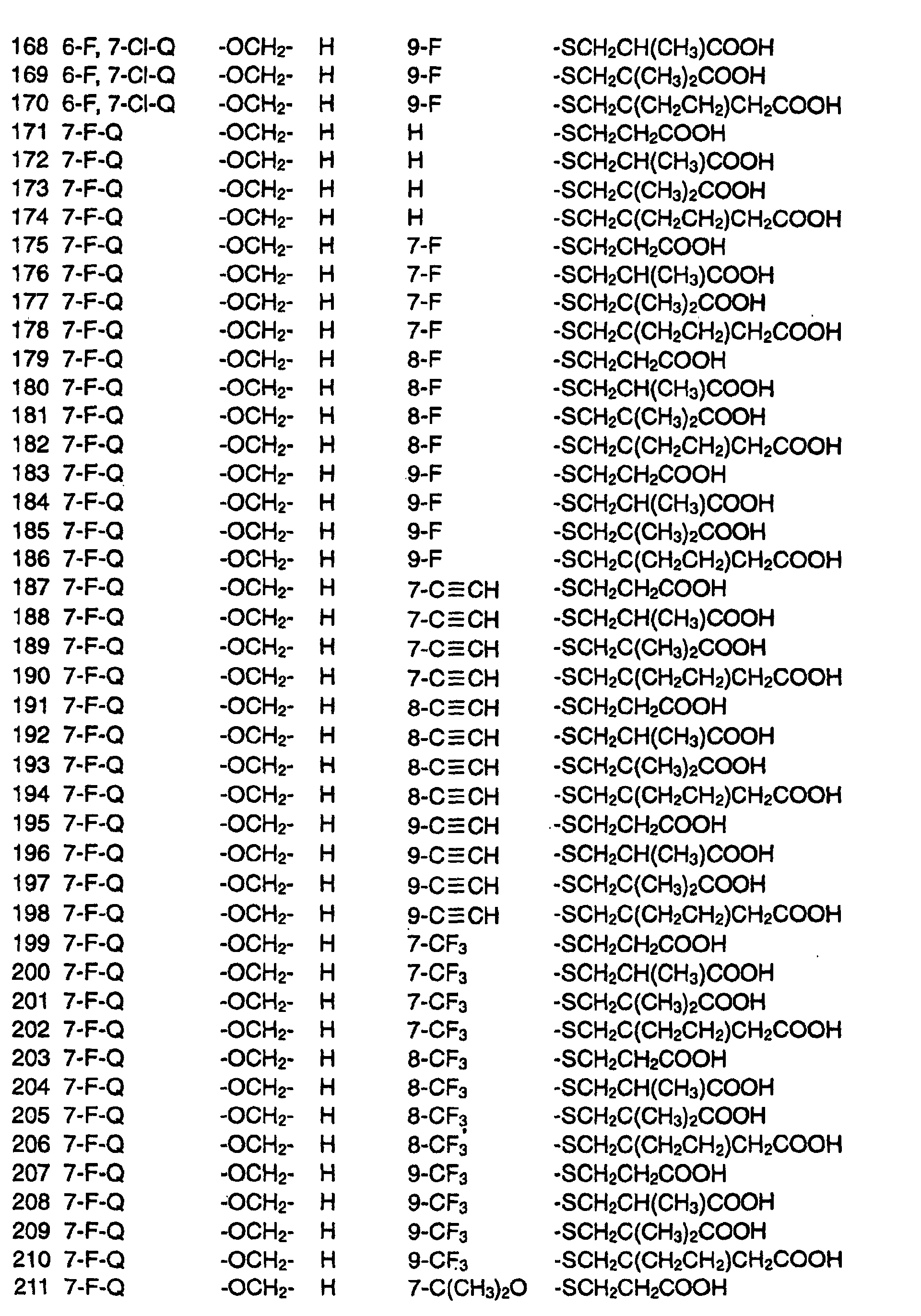
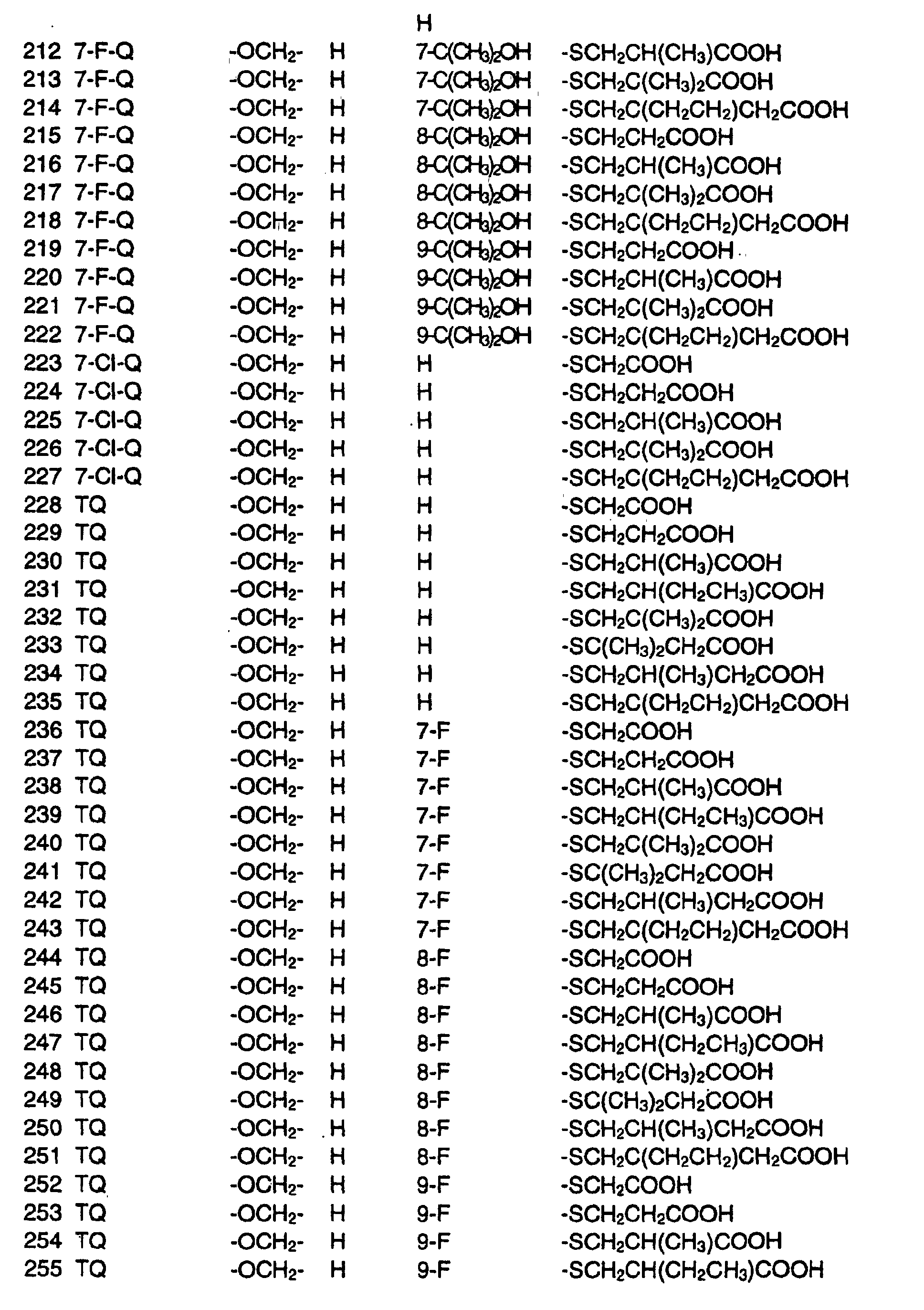
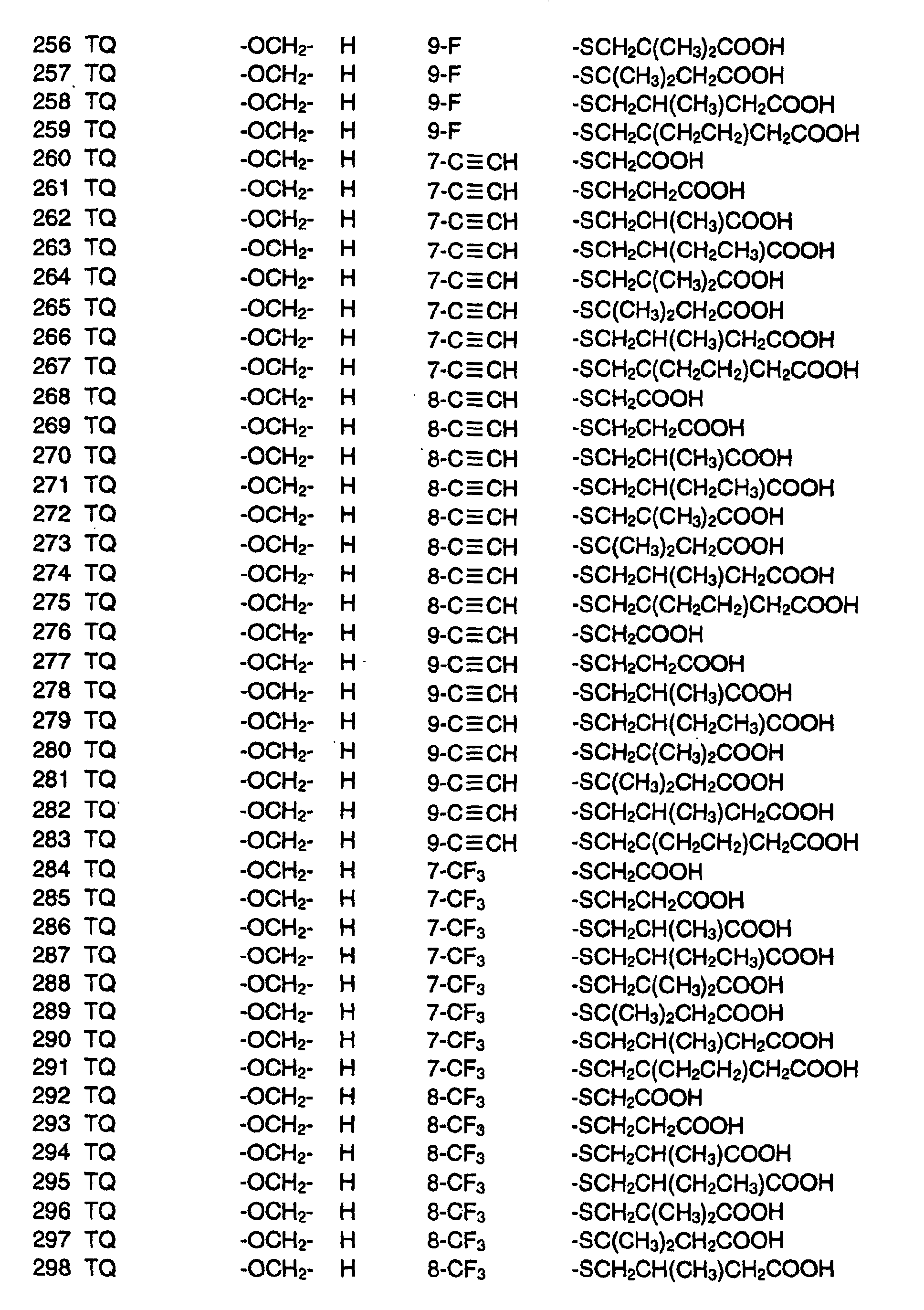
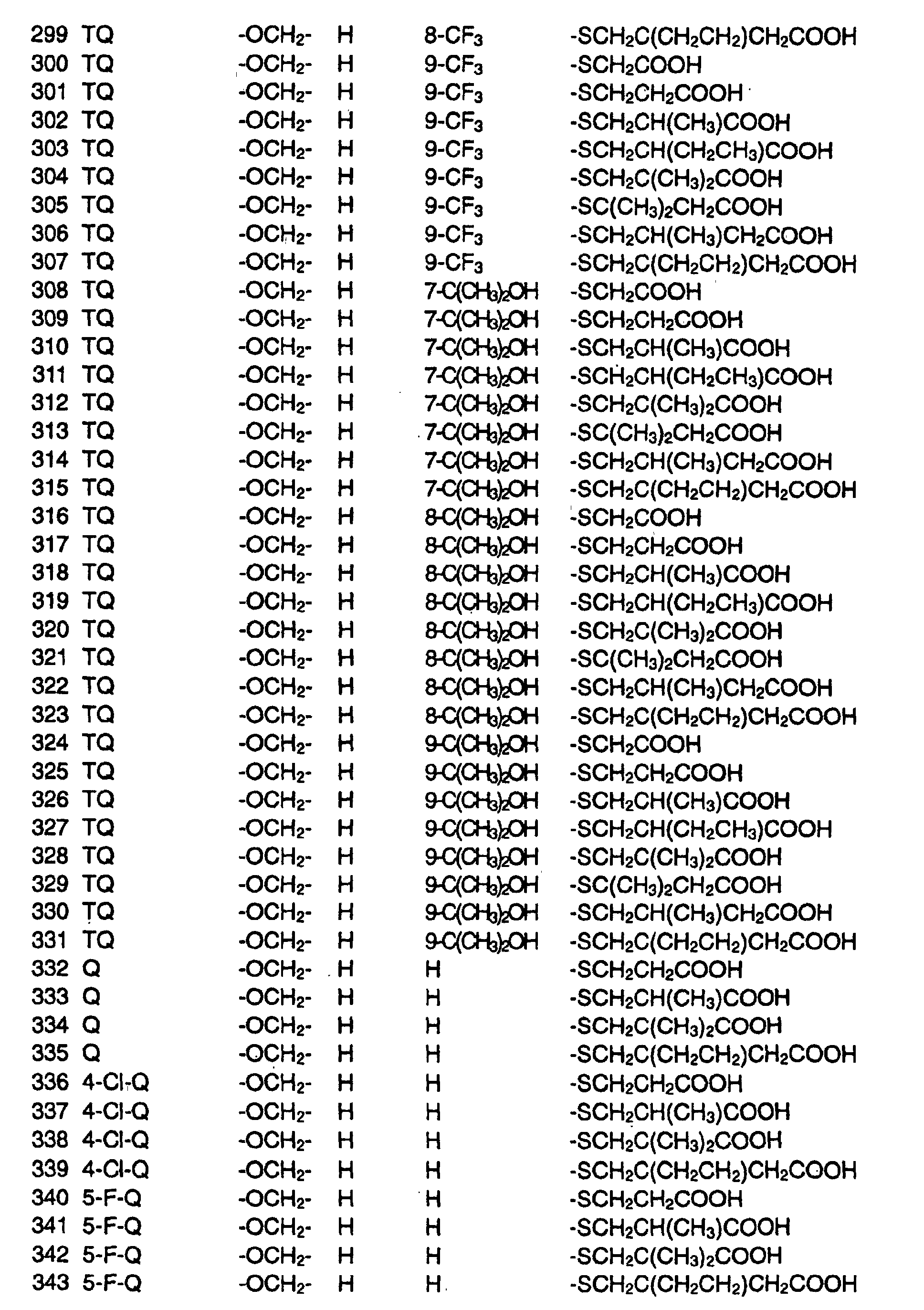
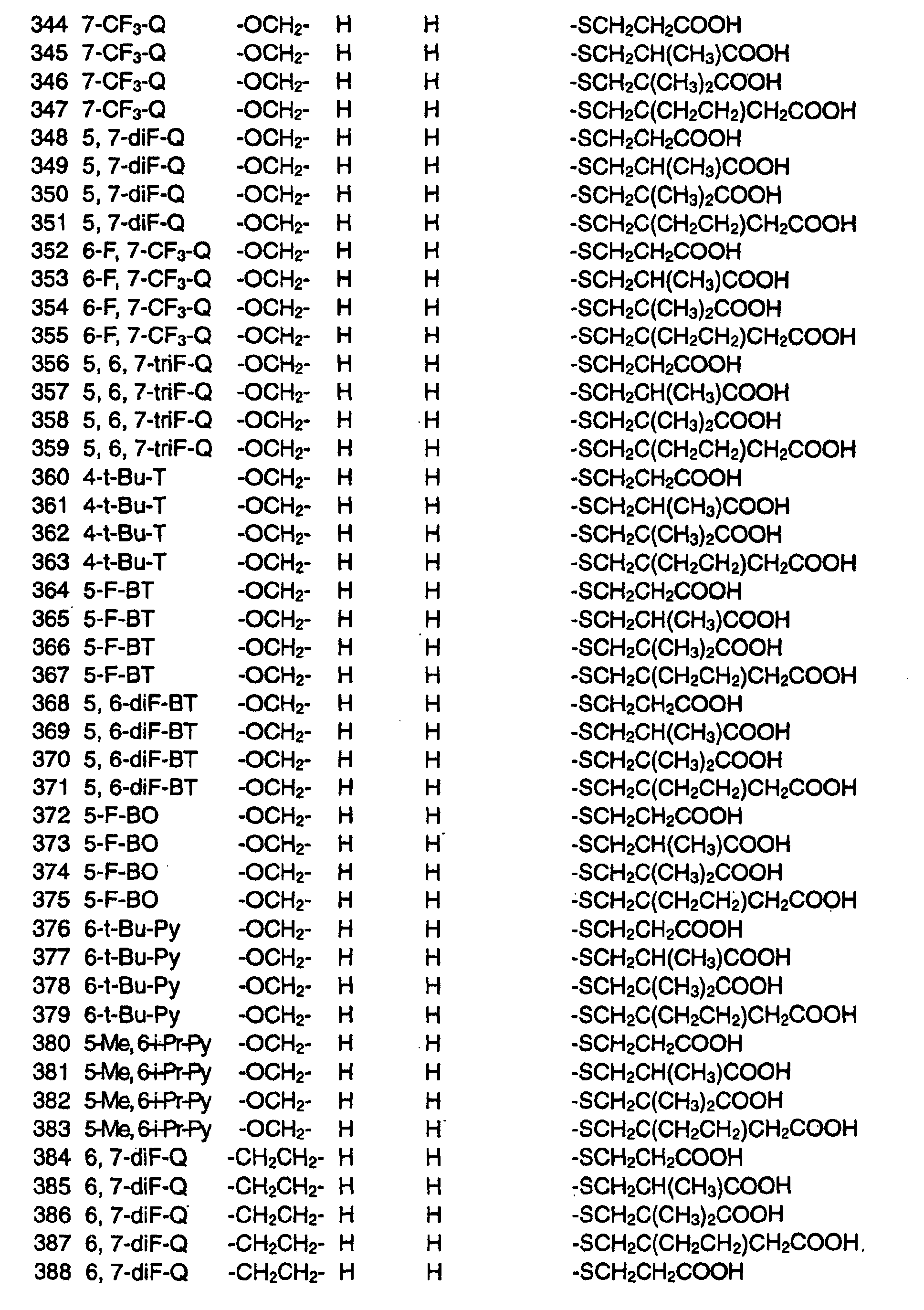

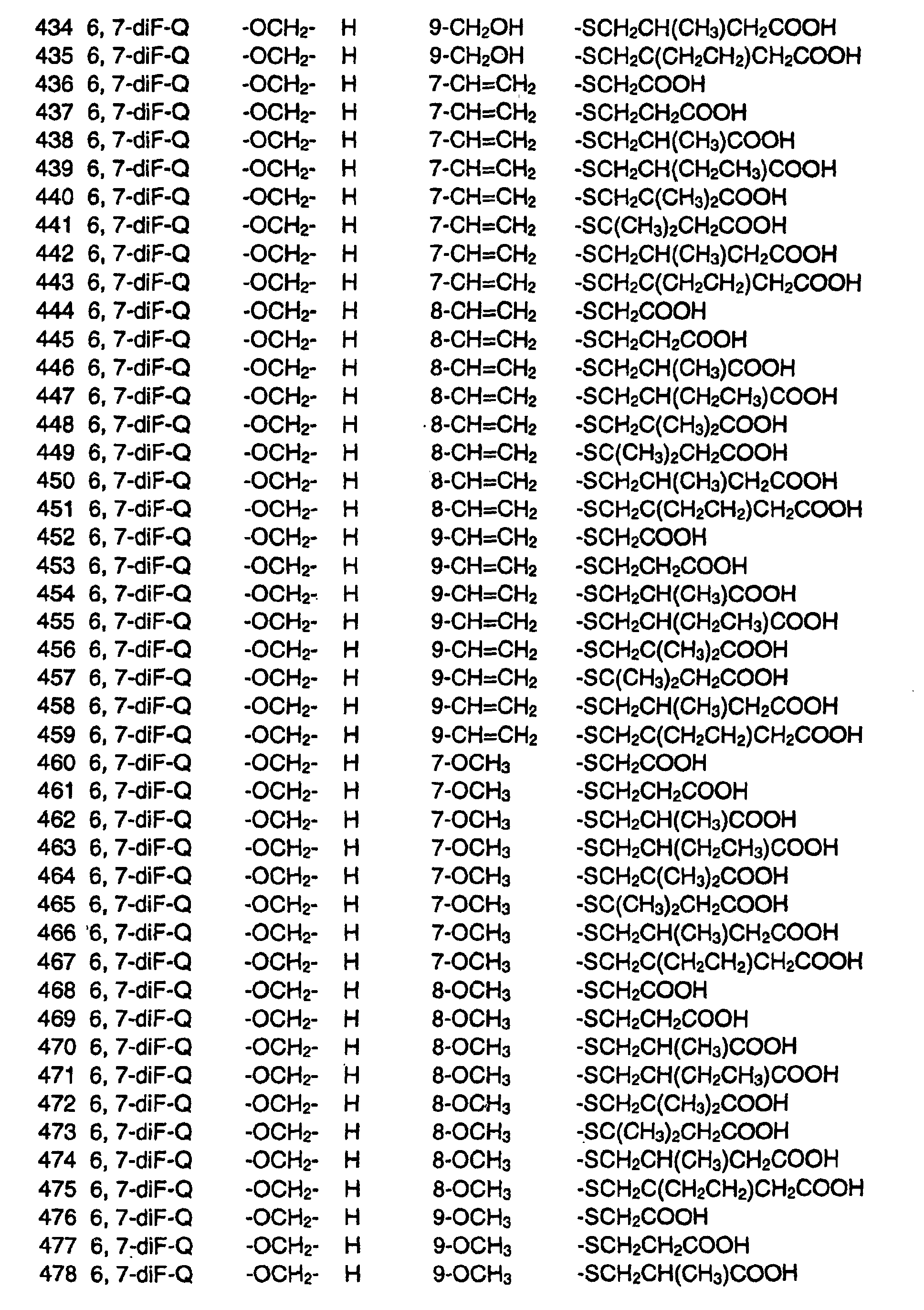
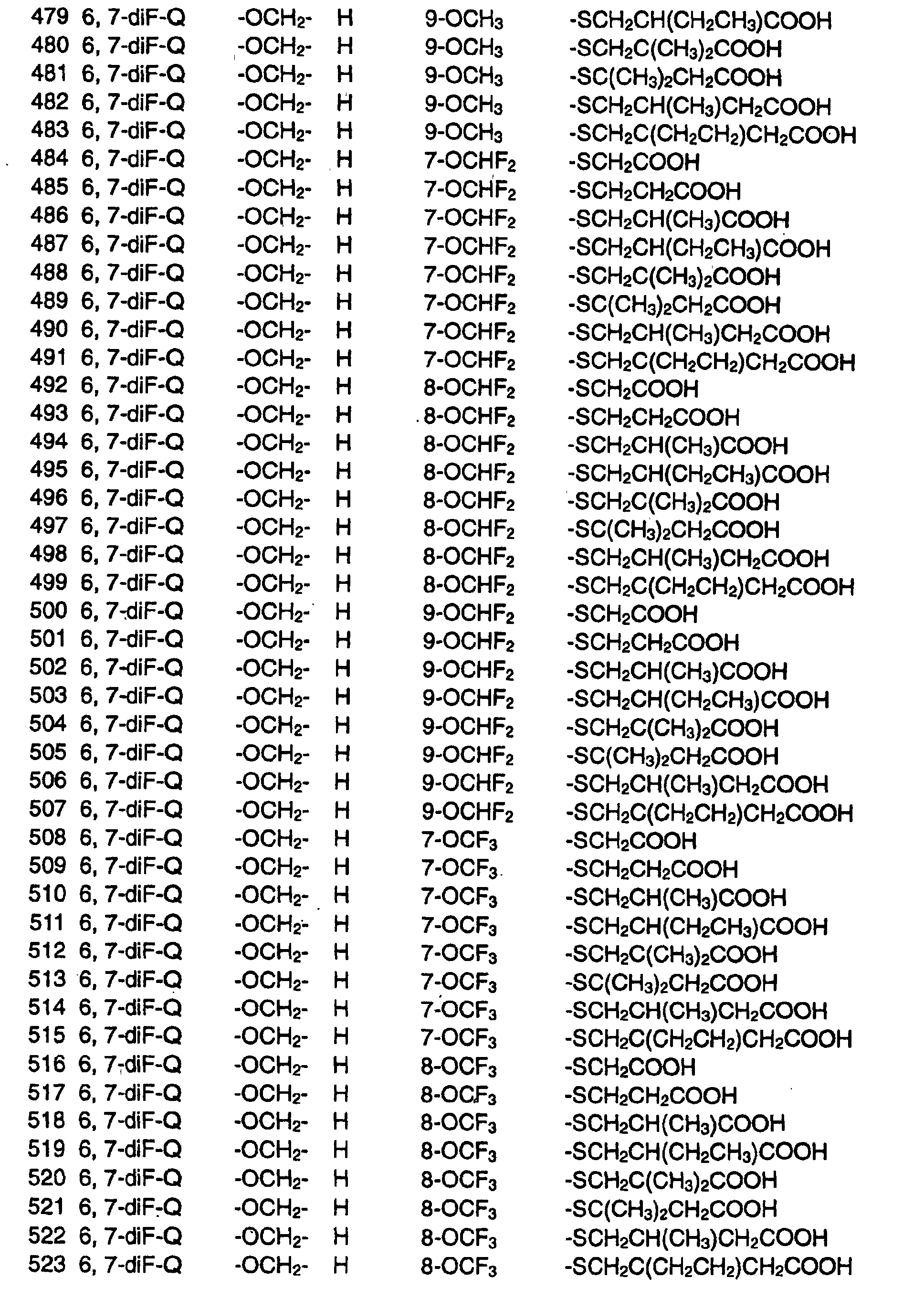
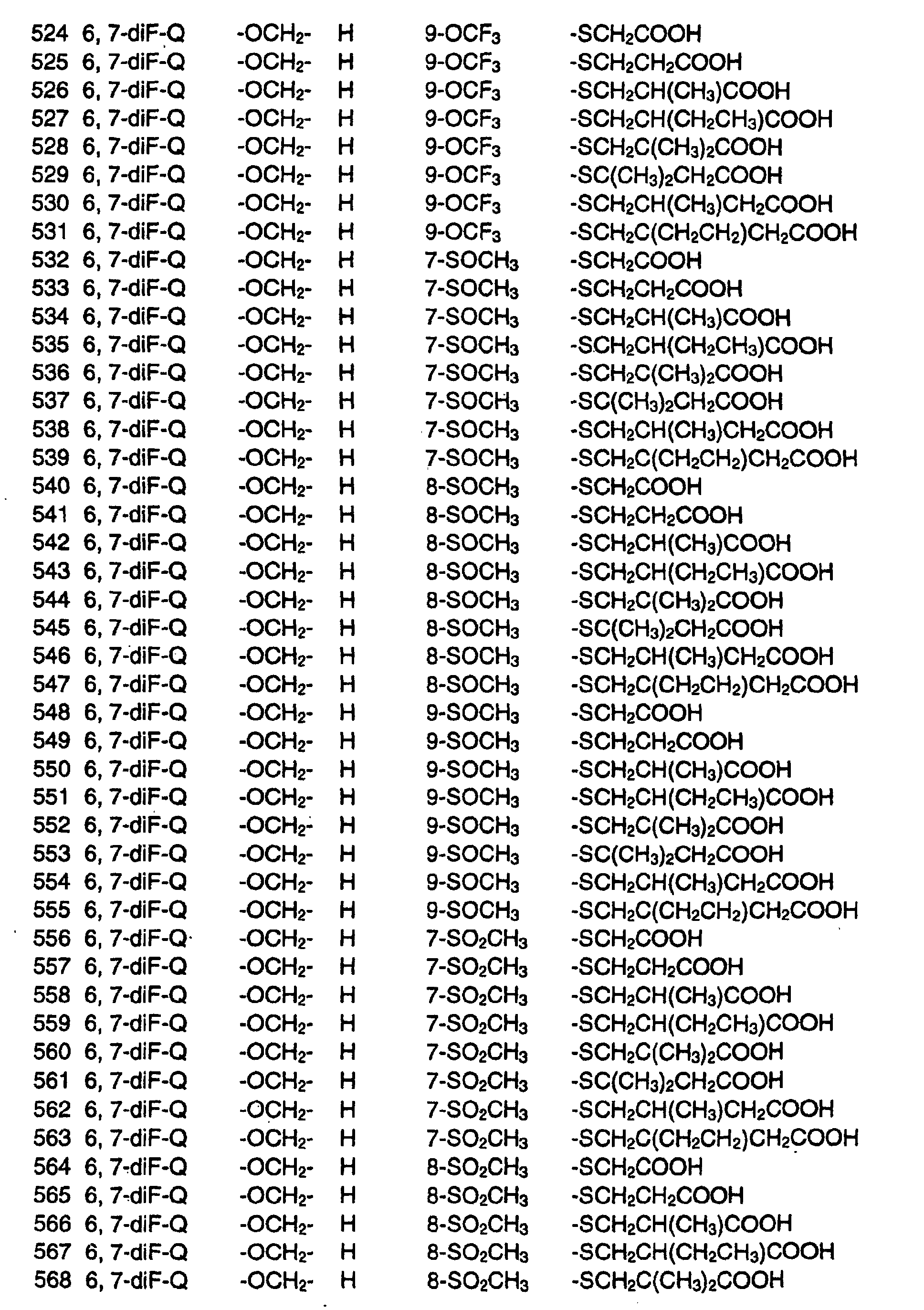
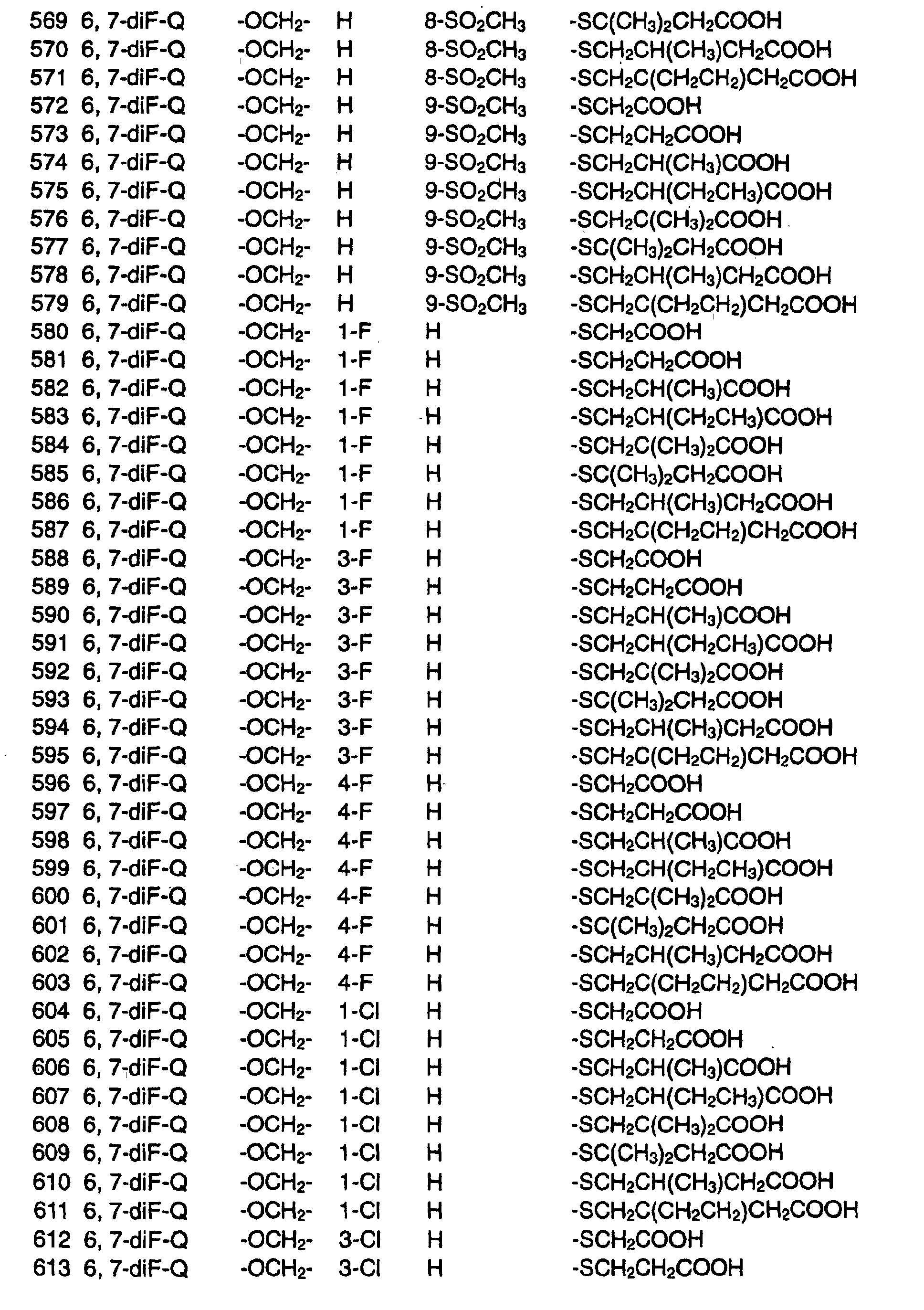


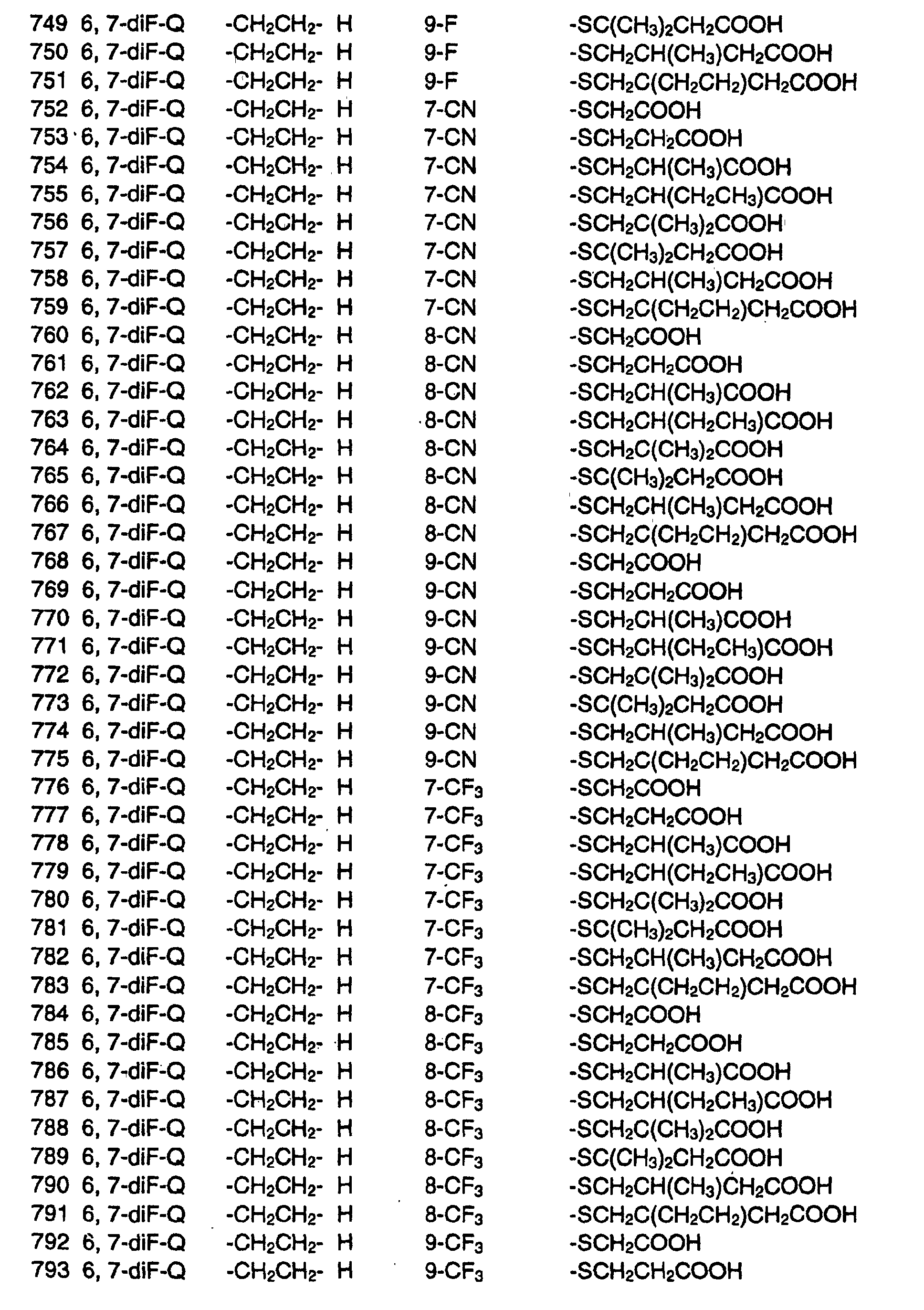
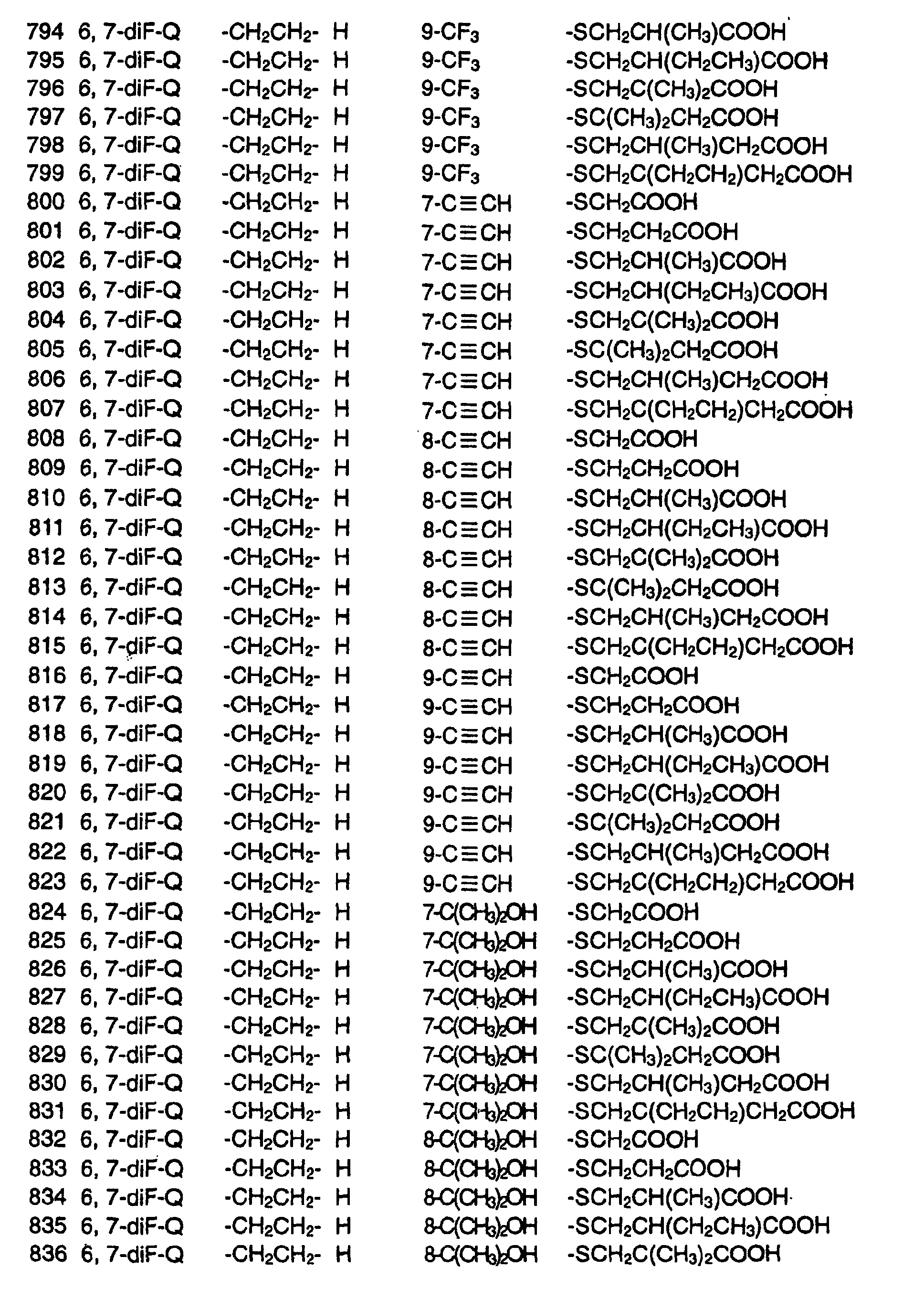
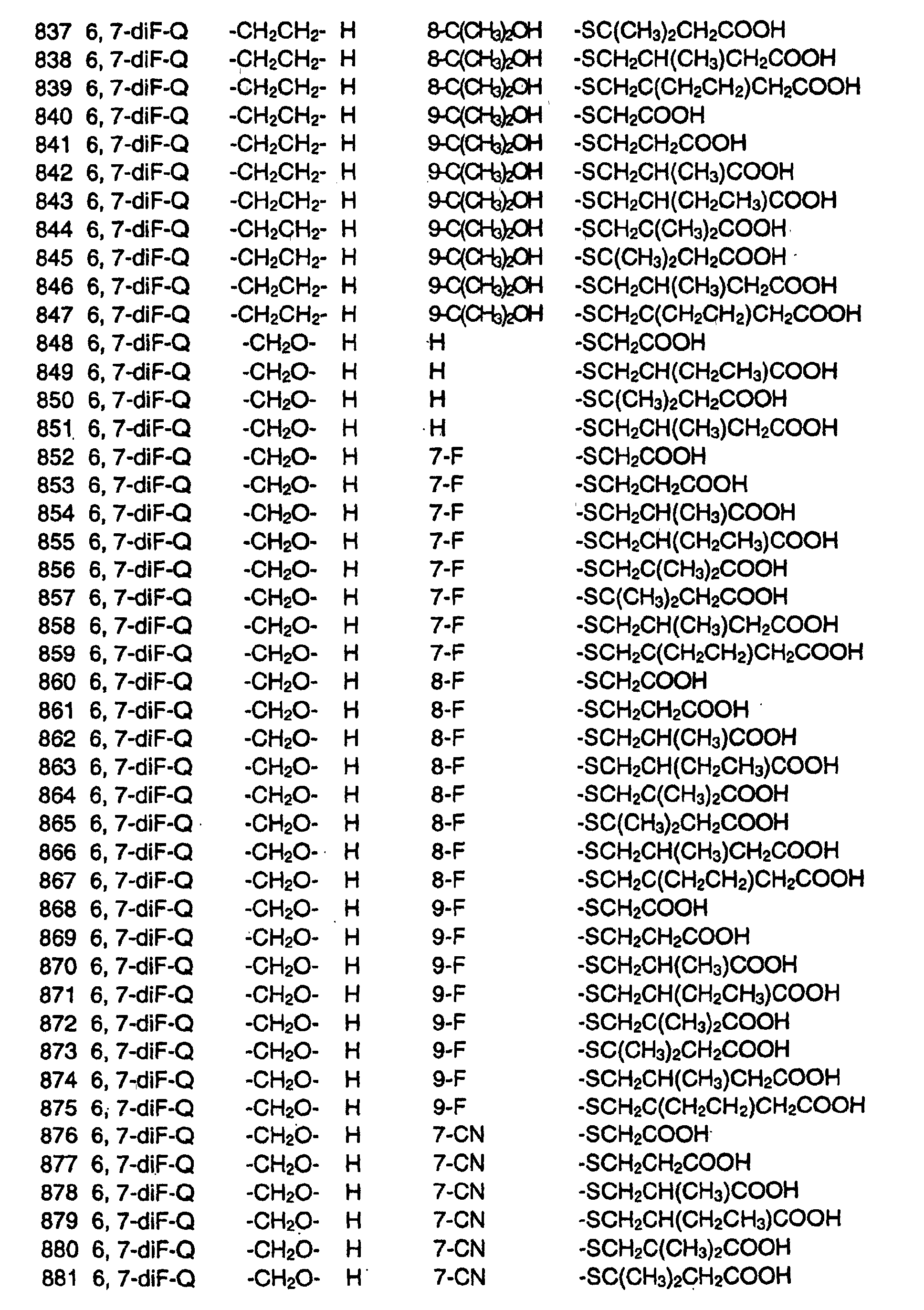
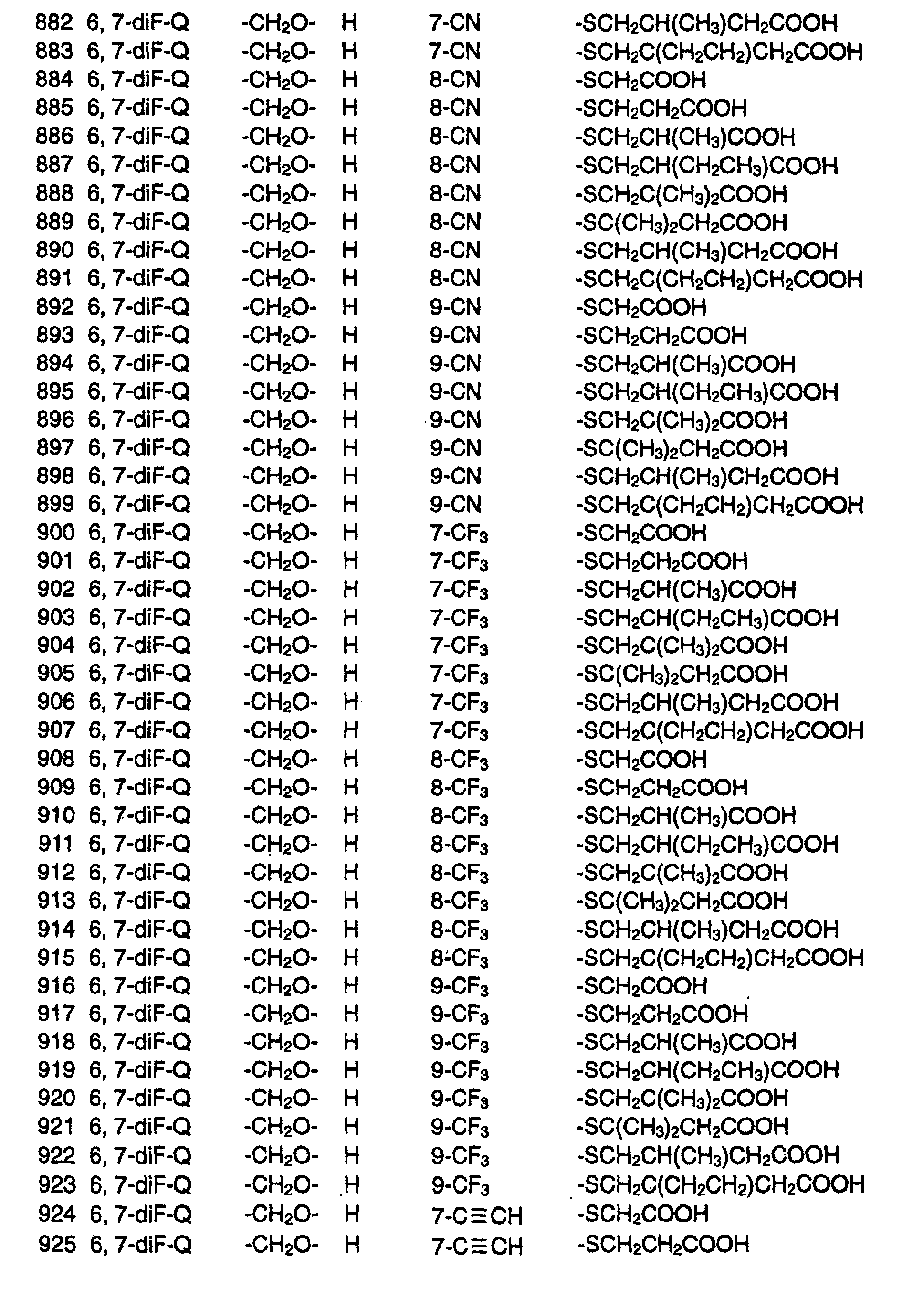
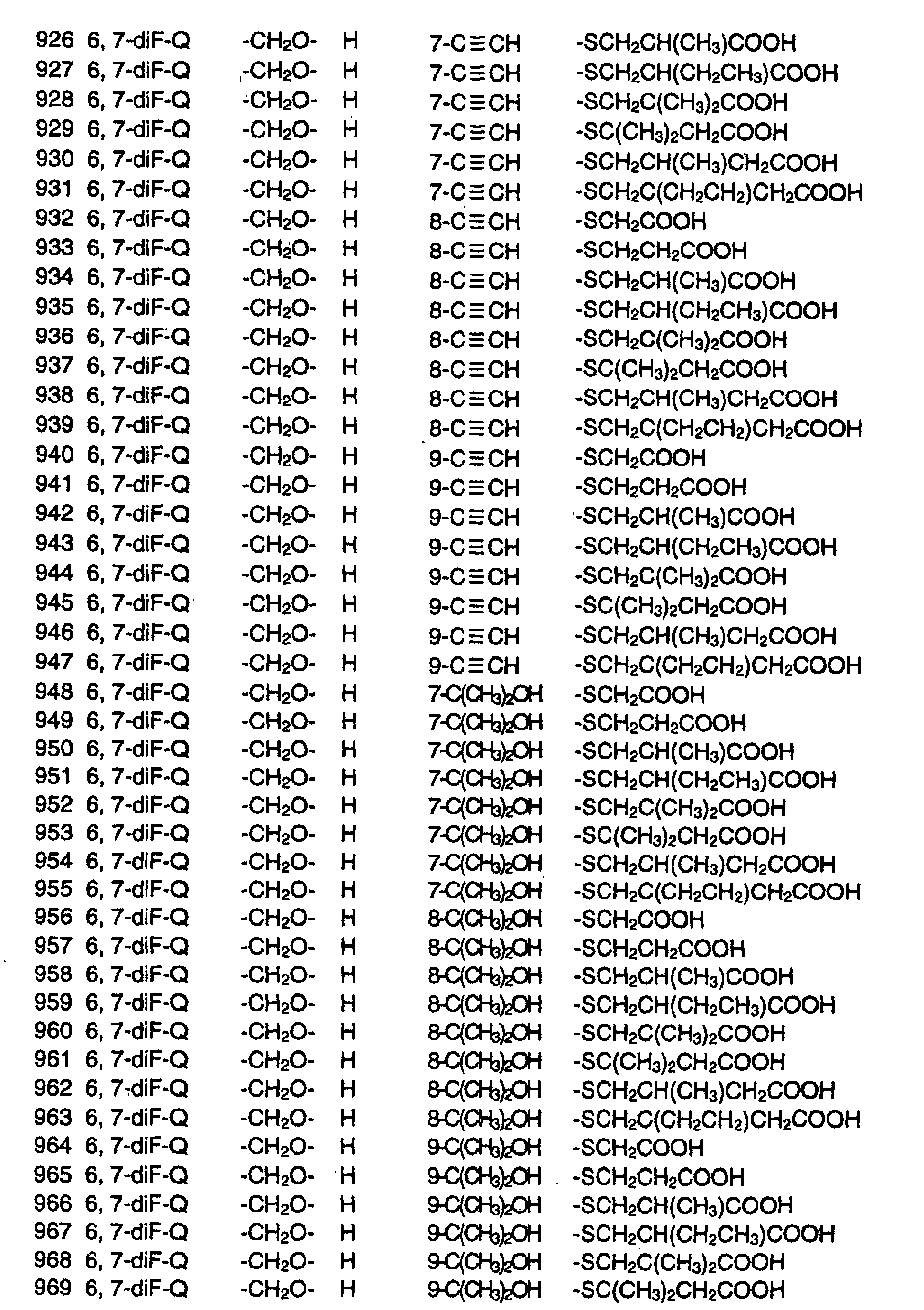

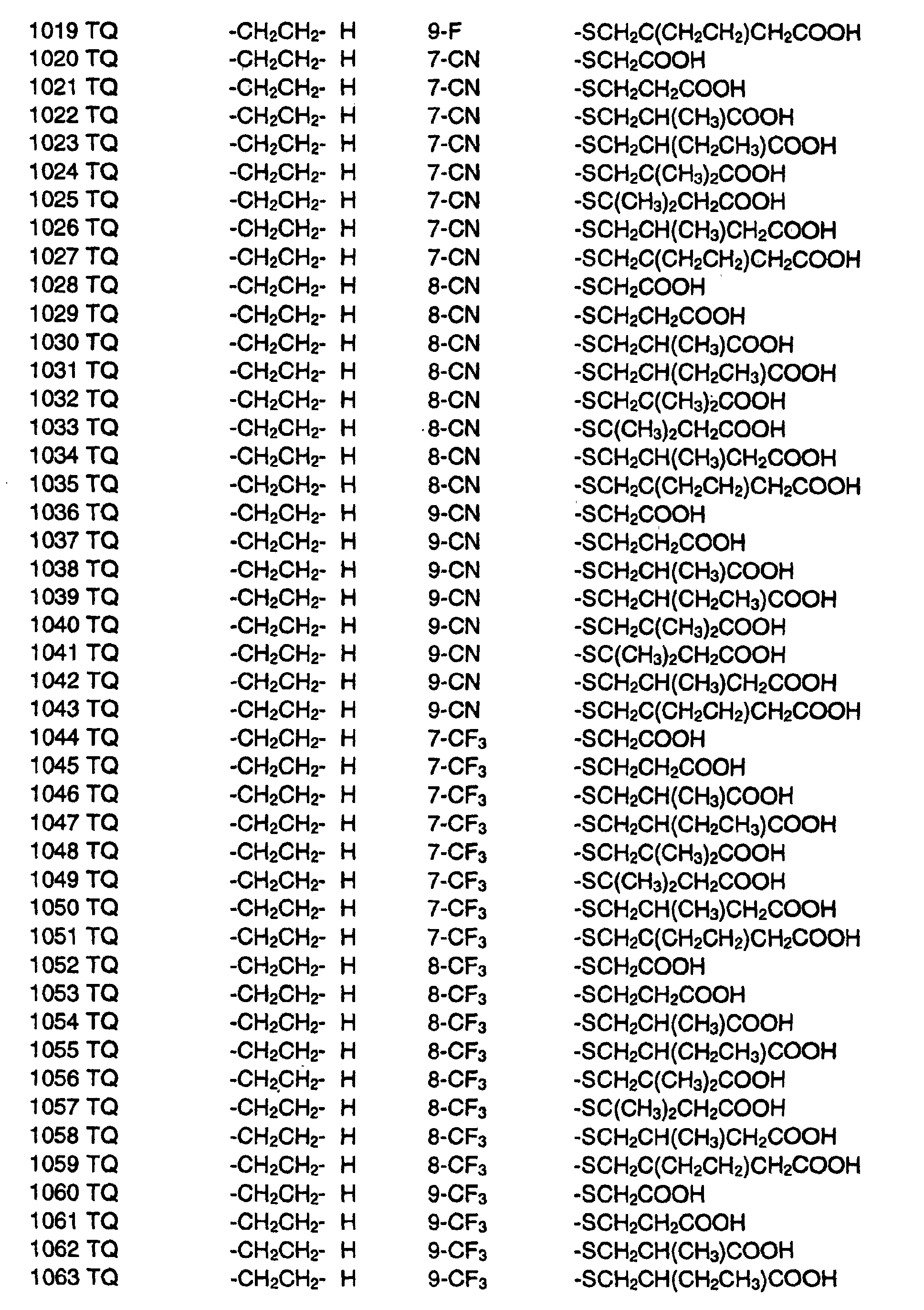


Incidentally, in the above Table 1, the abbreviations
mean the following groups
t-Bu, t-butyl group; BO, 2-benzoxazolyl group; BT, 2-benzothiazolyl group; Tet, a 1H-tetrazol-5-yl group; Me, methyl group; i-Pr, isopropyl group; Ph, phenyl group; Py, 2-pyridyl group; Q, quinolin-2-yl group; T, 2-thiazolyl group; TQ, 5,6,7,8-tetrahydroquinolin-2-yl group.
t-Bu, t-butyl group; BO, 2-benzoxazolyl group; BT, 2-benzothiazolyl group; Tet, a 1H-tetrazol-5-yl group; Me, methyl group; i-Pr, isopropyl group; Ph, phenyl group; Py, 2-pyridyl group; Q, quinolin-2-yl group; T, 2-thiazolyl group; TQ, 5,6,7,8-tetrahydroquinolin-2-yl group.
In the above Table 1, the numerical value of the formula
(I) shows a number of the position.
More preferred compounds may include Compounds Nos. 1,
2, 3, 4, 5, 6, 7, 8, 9, 10,11, 12, 13, 14, 15, 16, 17, 18, 19,
20, 21, 22, 23, 24, 25, 26, 27, 28, 29, 30, 31, 32, 33, 34, 35,
36, 37, 38, 39, 40, 41, 42, 43, 44, 45, 46, 47, 48, 49, 50, 59,
60, 61, 62, 63, 64, 65, 66, 67, 68, 69, 70, 71, 72, 73, 74, 83,
84, 85, 86, 87, 88, 89, 90, 91, 92, 93, 94, 95, 96, 97, 98, 107,
108, 109, 110, 111, 112, 113, 114, 115, 116, 117, 1119, 120,
121, 122, 131, 132, 133, 134, 135, 136, 137, 138, 139, 140, 141,
142, 143, 144, 145, 146, 155, 156, 157, 158, 159, 160, 161, 162,
163, 164, 165, 166, 171, 172, 173, 174, 175, 176, 177, 178, 179,
180, 181, 182, 187, 188, 189, 190, 191, 192, 193, 194, 199, 200,
201, 202, 203, 204, 205, 206, 211, 212, 213, 214, 215, 216, 217,
218, 223, 224, 225, 226, 227, 228, 229, 230, 231, 232, 233, 234,
235, 236, 237, 238, 239, 240, 241, 242, 243, 244, 245, 246, 247,
248, 249, 250, 251, 260, 261, 262, 263, 264, 265, 266, 267, 268,
269, 270, 271, 272, 273, 272, 275, 284, 285, 286, 287, 288, 290,
291, 292, 293, 284, 295, 296, 297, 298, 299, 308, 309, 310, 311,
312, 313, 314, 315, 316, 317, 318, 319, 320, 321, 322, 323, 332,
333, 334, 335, 340, 341, 342, 343, 344, 345, 346, 347, 348, 349,
350, 351, 352, 353, 354, 355, 356, 357, 358, 359, 360, 361, 362,
363, 364, 365, 366, 367, 368, 369, 370, 371, 372, 373, 374, 375,
384, 385, 386, 387, 388, 389, 390, 391, 392, 393, 394, 395, 396,
397, 398, 399, 404, 405, 406, 407, 412, 413, 414, 415, 416, 417,
418, 419, 420, 421, 422, 423, 424, 425, 426, 427, 436, 437, 438,
439, 440, 441, 442, 443, 444, 445, 446, 447, 448, 449, 450, 451,
460, 461, 462, 463, 464, 465, 466, 467, 468, 469, 470, 471, 472,
473, 474, 475, 484, 485, 486, 487, 488, 489, 490, 491, 492, 493,
494, 495, 496, 497, 498, 499, 508, 509, 510, 511, 512, 513, 514,
515, 516, 517, 518, 519, 520, 521, 522, 523, 532, 533, 534, 535,
536, 537, 538, 539, 540, 541, 542, 543, 544, 545, 546, 547, 548,
556,557, 558, 559, 560, 561, 562, 563, 564, 565, 566, 567, 568,
569, 570, 571, 588, 589, 590, 591, 592, 593, 594, 595, 596, 597,
598, 599, 600, 601, 602, 603, 612, 613, 614, 615, 616, 617, 618,
619, 620, 621, 622, 623, 624, 625, 626, 627, 636, 637, 638, 639,
640, 641, 642, 643, 644, 645, 646, 647, 648, 649, 650, 651, 660,
661, 662, 663, 664, 665, 666, 667, 668, 669, 670, 671, 672, 673,
674, 675, 684, 685, 686, 687, 688, 689, 690, 691, 692, 693, 694,
695, 696, 697, 698, 699, 708, 709, 710, 711, 712, 713, 714, 715,
716, 717, 718, 719, 720, 721, 722, 723, 724, 725, 726, 727, 728,
729, 730, 731, 732, 733, 734, 735, 736, 737, 738, 739, 740, 741,
742, 743, 752, 753, 754, 755, 756, 757, 758, 759, 760, 761, 762,
763, 764, 765, 766, 767, 776, 777, 778, 779, 780, 781, 782, 783,
784, 785, 786, 787, 788, 789, 790, 791, 800, 801, 802, 803, 804,
805, 806, 807, 808, 809, 810, 811, 812, 813, 814, 815, 824, 825,
826, 827, 828, 829, 830, 831, 832, 833, 834, 835, 836, 837, 838,
839, 848, 849, 850, 851, 852, 853, 854, 855, 856, 857, 858, 859,
860, 861, 862, 863, 864, 865, 866, 867, 876, 877, 878, 879, 880,
881, 882, 883, 884, 885, 886, 887, 888, 889, 890, 891, 900, 901,
902, 903, 904, 905, 906, 907, 908, 909, 910, 911, 912, 913, 914,
915, 924, 925, 926, 927, 928, 929, 930, 931, 932, 933, 934, 935,
936, 937, 938, 939, 948, 949, 950, 951, 952, 953, 954, 955, 956,
957, 958, 959, 960, 961, 962, 963, 972, 973, 974, 975, 976, 977,
978, 979, 980, 981, 982, 983, 984, 985, 986, 987, 988, 989, 990,
991, 992, 993, 994, 995, 996, 997, 998, 999, 1000, 1001, 1003,
1004, 1005, 1006, 1007, 1007, 1009, 1010, 1011, 1020, 1021, 1022,
1023, 1024, 1025, 1026, 1027, 1028, 1029, 1030, 1031, 1032, 1033,
1034, 1035, 1044, 1045, 1046, 1046, 1048; 1049, 1050, 1051, 1052,
1053, 1054, 1055, 1056, 1057, 1058, 1059, 1068, 1069, 1070, 1071,
1072, 1073, 1074, 1075, 1076, 1077, 1078, 1079, 1080, 1081, 1082,
1083, 1092, 1093, 1094, 1095, 1096, 1097, 1098, 1099, 1100, 1101,
1102, 1103, 1104, 1105, 1106 or 1107,
more preferably Compounds Nos. 1, 2, 3, 4, 5, 6, 7, 8, 9, 10, 11, 12, 13, 14, 15, 16, 19, 20, 21, 22, 23, 24, 25, 26, 27, 28, 29, 30, 31, 32, 35, 36, 37, 38, 39, 40, 41, 42, 43, 44, 45, 46, 47, 48, 49, 50, 59, 60, 61, 62, 63, 64, 65, 66, 83, 84, 85, 86, 87, 88, 89, 90, 91, 92, 93, 94, 95, 96, 97, 98, 107, 108, 109, 110,111, 112, 113, 114, 115, 116, 117, 1119, 120, 121, 122, 131, 132, 133, 134, 135, 136, 137, 138, 155, 156, 157, 158, 159, 160, 161, 162, 163, 164, 165, 166, 171, 172, 173, 174, 175, 176, 177, 178, 179, 180, 181, 182, 187, 188, 189, 190, 191, 192, 193, 194, 199, 200, 201, 202, 203, 204, 205, 206, 211, 212, 213, 214, 223, 224, 225, 226, 227, 228, 229, 230, 231, 232, 233, 234, 235, 236, 237, 238, 239, 240, 241, 242, 243, 244, 245, 246, 247, 248, 249, 250, 251, 260, 261, 262, 263, 264, 265, 266, 267, 268, 269, 270, 271, 272, 273, 272, 275, 284, 285, 286, 287, 288, 290, 291, 292, 293, 284, 295, 296, 297, 298, 299, 308, 309, 310, 311, 312, 313, 314, 315, 323, 332, 333, 334, 335, 352, 353, 354, 355, 384, 385, 386, 387, 388, 389, 390, 391, 392, 393, 394, 395, 396, 397, 398, 399, 404, 405, 406, 407, 412, 413, 414, 415, 416, 417, 418, 419, 436, 437, 438, 439, 440, 441, 442, 443, 460, 461, 462, 463, 464, 465, 466, 467, 484, 485, 486, 487, 488, 489, 490, 491, 508, 509, 510, 511, 512, 513, 514, 515, 532, 533, 534, 535, 536, 537, 538, 539, 556, 557, 558, 559, 560, 561, 562, 563, 588, 589, 590, 591, 592, 593, 594, 595, 596, 597, 598, 599, 600, 601, 602, 603, 612, 613, 614, 615, 616, 617, 618, 619, 620, 621, 622, 623, 624, 625, 626, 627, 684, 685, 686, 687, 688, 689, 690, 691, 692, 693, 694, 695, 696, 697, 698, 699, 708, 709, 710, 711, 712, 713, 714, 715, 716, 717, 718, 719, 720, 721, 722, 723, 724, 725, 726, 727, 728, 729, 730, 731, 732, 733, 734, 735, 736, 737, 738, 739, 740, 741, 742, 743, 752, 753, 754, 755, 756, 757, 758, 759, 776, 777, 778, 779, 780, 781, 782, 783, 784, 785, 786, 787, 788, 789, 790, 791, 800, 801, 802, 803, 804, 805, 806, 807, 808, 809, 810, 811, 812, 813, 814, 815, 824, 825, 826, 827, 828, 829, 830, 831, 848, 849, 850, 851, 852, 853, 854, 855, 856, 857, 858, 859, 860, 861, 862, 863, 864, 865, 866, 867, 876, 877, 878, 879, 880, 881, 882, 883, 900, 901, 902, 903, 904, 905, 906, 907, 908, 909, 910, 911, 912, 913, 914, 915, 924, 925, 926, 927, 928, 929, 930, 931, 932, 933, 934, 935, 936, 937, 938, 939, 948, 949, 950, 951, 952, 953, 954, 955, 972, 973, 974, 975, 976, 977, 978, 979, 980, 981, 982, 983, 984, 985, 986, 987, 988, 989, 990, 991, 992, 993, 994, 995, 996, 997, 998, 999, 1000, 1001, 1003, 1004, 1005, 1006, 1007, 1007, 1009, 1010, 1011, 1020, 1021, 1022, 1023, 1024, 1025, 1026, 1027, 1044, 1045, 1046, 1046, 1048, 1049, 1050, 1051, 1052, 1053, 1054, 1055, 1056, 1057, 1058, 1059, 1068, 1069, 1070, 1071, 1072, 1073, 1074, 1075, 1076, 1077, 1078, 1079, 1080, 1081, 1082, 1083, 1092, 1093, 1094, 1095, 1096, 1097, 1098 or 1099,
further more preferably Compounds Nos. 1, 2, 3, 4, 5, 6, 7, 8, 10,11, 12, 13, 14, 15, 16, 21, 22, 23, 26, 27, 28, 31, 32, 35, 36, 37, 38, 39, 40, 41, 42, 43, 44, 45, 46, 47, 48, 49, 50, 59, 60, 61, 62, 63, 64, 65, 66, 83, 84, 85, 86, 87, 88, 89, 90, 91, 92, 93, 94, 95, 96, 97, 98, 107, 108, 109, 110,111, 112, 113, 114, 115, 116, 117, 1119, 120, 121, 122, 155, 156, 157, 158, 159, 160, 161, 162, 163, 164, 165, 166, 171, 172, 173, 174, 175, 176, 177, 178, 179, 180, 181, 182, 187, 188, 189, 190, 191, 192, 193, 194, 199, 200, 201, 202, 203, 204, 205, 206, 223, 224, 225, 226, 227, 228, 229, 230, 231, 232, 233, 234, 235, 236, 237, 238, 239, 240, 241, 242, 243, 244, 245, 246, 247, 248, 249, 250, 251, 260, 261, 262, 263, 264, 265, 266, 267, 268, 269, 270, 271, 272, 273, 272, 275, 284, 285, 286, 287, 288, 290, 291, 292, 293, 284, 295, 296, 297, 298, 299, 323, 332, 333, 334, 335, 352, 353, 354, 355, 384, 385, 386, 387, 388, 389, 390, 391, 392, 393, 394, 395, 396, 397, 398, 399, 404, 405, 406, 407, 508, 509, 510, 511, 512, 513, 514, 515, 532, 533, 534, 535, 536, 537, 538, 539, 556, 557, 558, 559, 560, 561, 562, 563, 724, 725, 726, 727, 728, 729, 730, 731, 732, 733, 734, 735, 736, 737, 738, 739, 740, 741, 742, 743, 752, 753, 754, 755, 756, 757, 758, 759, 776, 777, 778, 779, 780, 781, 782, 783, 784, 785, 786, 787, 788, 789, 790, 791, 800, 801, 802, 803, 804, 805, 806, 807, 808, 809, 810, 811, 812, 813, 814, 815, 848, 856, 857, 858, 859, 860, 861, 862, 863, 864, 865, 866, 867, 876, 877, 878, 879, 880, 881, 882, 883, 900, 901, 902, 903, 904, 905, 906, 907, 908, 909, 910, 911, 912, 913, 914, 915, 924, 925, 926, 927, 928, 929, 930, 931, 932, 933, 934, 935, 936, 937, 938, 939, 948, 949, 950, 951, 952, 953, 954, 955, 972, 973, 974, 975, 976, 977, 978, 979, 980, 981, 982, 983, 984, 985, 986, 987, 988, 989, 990, 991, 992, 993, 994, 995, 996, 997, 998, 999, 1000, 1001, 1003, 1004, 1005, 1006, 1007, 1007, 1009, 1010,1011, 1020, 1021, 1022, 1023, 1024, 1025, 1026, 1027, 1044, 1045, 1046, 1046, 1048, 1049, 1050, 1051, 1052, 1053, 1054, 1055, 1056, 1057, 1058, 1059, 1068, 1069, 1070, 1071, 1072, 1073, 1074, 1075, 1076, 1077, 1078, 1079, 1080, 1081, 1082 or 1083,
particularly preferably
more preferably Compounds Nos. 1, 2, 3, 4, 5, 6, 7, 8, 9, 10, 11, 12, 13, 14, 15, 16, 19, 20, 21, 22, 23, 24, 25, 26, 27, 28, 29, 30, 31, 32, 35, 36, 37, 38, 39, 40, 41, 42, 43, 44, 45, 46, 47, 48, 49, 50, 59, 60, 61, 62, 63, 64, 65, 66, 83, 84, 85, 86, 87, 88, 89, 90, 91, 92, 93, 94, 95, 96, 97, 98, 107, 108, 109, 110,111, 112, 113, 114, 115, 116, 117, 1119, 120, 121, 122, 131, 132, 133, 134, 135, 136, 137, 138, 155, 156, 157, 158, 159, 160, 161, 162, 163, 164, 165, 166, 171, 172, 173, 174, 175, 176, 177, 178, 179, 180, 181, 182, 187, 188, 189, 190, 191, 192, 193, 194, 199, 200, 201, 202, 203, 204, 205, 206, 211, 212, 213, 214, 223, 224, 225, 226, 227, 228, 229, 230, 231, 232, 233, 234, 235, 236, 237, 238, 239, 240, 241, 242, 243, 244, 245, 246, 247, 248, 249, 250, 251, 260, 261, 262, 263, 264, 265, 266, 267, 268, 269, 270, 271, 272, 273, 272, 275, 284, 285, 286, 287, 288, 290, 291, 292, 293, 284, 295, 296, 297, 298, 299, 308, 309, 310, 311, 312, 313, 314, 315, 323, 332, 333, 334, 335, 352, 353, 354, 355, 384, 385, 386, 387, 388, 389, 390, 391, 392, 393, 394, 395, 396, 397, 398, 399, 404, 405, 406, 407, 412, 413, 414, 415, 416, 417, 418, 419, 436, 437, 438, 439, 440, 441, 442, 443, 460, 461, 462, 463, 464, 465, 466, 467, 484, 485, 486, 487, 488, 489, 490, 491, 508, 509, 510, 511, 512, 513, 514, 515, 532, 533, 534, 535, 536, 537, 538, 539, 556, 557, 558, 559, 560, 561, 562, 563, 588, 589, 590, 591, 592, 593, 594, 595, 596, 597, 598, 599, 600, 601, 602, 603, 612, 613, 614, 615, 616, 617, 618, 619, 620, 621, 622, 623, 624, 625, 626, 627, 684, 685, 686, 687, 688, 689, 690, 691, 692, 693, 694, 695, 696, 697, 698, 699, 708, 709, 710, 711, 712, 713, 714, 715, 716, 717, 718, 719, 720, 721, 722, 723, 724, 725, 726, 727, 728, 729, 730, 731, 732, 733, 734, 735, 736, 737, 738, 739, 740, 741, 742, 743, 752, 753, 754, 755, 756, 757, 758, 759, 776, 777, 778, 779, 780, 781, 782, 783, 784, 785, 786, 787, 788, 789, 790, 791, 800, 801, 802, 803, 804, 805, 806, 807, 808, 809, 810, 811, 812, 813, 814, 815, 824, 825, 826, 827, 828, 829, 830, 831, 848, 849, 850, 851, 852, 853, 854, 855, 856, 857, 858, 859, 860, 861, 862, 863, 864, 865, 866, 867, 876, 877, 878, 879, 880, 881, 882, 883, 900, 901, 902, 903, 904, 905, 906, 907, 908, 909, 910, 911, 912, 913, 914, 915, 924, 925, 926, 927, 928, 929, 930, 931, 932, 933, 934, 935, 936, 937, 938, 939, 948, 949, 950, 951, 952, 953, 954, 955, 972, 973, 974, 975, 976, 977, 978, 979, 980, 981, 982, 983, 984, 985, 986, 987, 988, 989, 990, 991, 992, 993, 994, 995, 996, 997, 998, 999, 1000, 1001, 1003, 1004, 1005, 1006, 1007, 1007, 1009, 1010, 1011, 1020, 1021, 1022, 1023, 1024, 1025, 1026, 1027, 1044, 1045, 1046, 1046, 1048, 1049, 1050, 1051, 1052, 1053, 1054, 1055, 1056, 1057, 1058, 1059, 1068, 1069, 1070, 1071, 1072, 1073, 1074, 1075, 1076, 1077, 1078, 1079, 1080, 1081, 1082, 1083, 1092, 1093, 1094, 1095, 1096, 1097, 1098 or 1099,
further more preferably Compounds Nos. 1, 2, 3, 4, 5, 6, 7, 8, 10,11, 12, 13, 14, 15, 16, 21, 22, 23, 26, 27, 28, 31, 32, 35, 36, 37, 38, 39, 40, 41, 42, 43, 44, 45, 46, 47, 48, 49, 50, 59, 60, 61, 62, 63, 64, 65, 66, 83, 84, 85, 86, 87, 88, 89, 90, 91, 92, 93, 94, 95, 96, 97, 98, 107, 108, 109, 110,111, 112, 113, 114, 115, 116, 117, 1119, 120, 121, 122, 155, 156, 157, 158, 159, 160, 161, 162, 163, 164, 165, 166, 171, 172, 173, 174, 175, 176, 177, 178, 179, 180, 181, 182, 187, 188, 189, 190, 191, 192, 193, 194, 199, 200, 201, 202, 203, 204, 205, 206, 223, 224, 225, 226, 227, 228, 229, 230, 231, 232, 233, 234, 235, 236, 237, 238, 239, 240, 241, 242, 243, 244, 245, 246, 247, 248, 249, 250, 251, 260, 261, 262, 263, 264, 265, 266, 267, 268, 269, 270, 271, 272, 273, 272, 275, 284, 285, 286, 287, 288, 290, 291, 292, 293, 284, 295, 296, 297, 298, 299, 323, 332, 333, 334, 335, 352, 353, 354, 355, 384, 385, 386, 387, 388, 389, 390, 391, 392, 393, 394, 395, 396, 397, 398, 399, 404, 405, 406, 407, 508, 509, 510, 511, 512, 513, 514, 515, 532, 533, 534, 535, 536, 537, 538, 539, 556, 557, 558, 559, 560, 561, 562, 563, 724, 725, 726, 727, 728, 729, 730, 731, 732, 733, 734, 735, 736, 737, 738, 739, 740, 741, 742, 743, 752, 753, 754, 755, 756, 757, 758, 759, 776, 777, 778, 779, 780, 781, 782, 783, 784, 785, 786, 787, 788, 789, 790, 791, 800, 801, 802, 803, 804, 805, 806, 807, 808, 809, 810, 811, 812, 813, 814, 815, 848, 856, 857, 858, 859, 860, 861, 862, 863, 864, 865, 866, 867, 876, 877, 878, 879, 880, 881, 882, 883, 900, 901, 902, 903, 904, 905, 906, 907, 908, 909, 910, 911, 912, 913, 914, 915, 924, 925, 926, 927, 928, 929, 930, 931, 932, 933, 934, 935, 936, 937, 938, 939, 948, 949, 950, 951, 952, 953, 954, 955, 972, 973, 974, 975, 976, 977, 978, 979, 980, 981, 982, 983, 984, 985, 986, 987, 988, 989, 990, 991, 992, 993, 994, 995, 996, 997, 998, 999, 1000, 1001, 1003, 1004, 1005, 1006, 1007, 1007, 1009, 1010,1011, 1020, 1021, 1022, 1023, 1024, 1025, 1026, 1027, 1044, 1045, 1046, 1046, 1048, 1049, 1050, 1051, 1052, 1053, 1054, 1055, 1056, 1057, 1058, 1059, 1068, 1069, 1070, 1071, 1072, 1073, 1074, 1075, 1076, 1077, 1078, 1079, 1080, 1081, 1082 or 1083,
particularly preferably
[2-[(E)-2-(6,7-difluoro-2-quinolinyl)ethenyl]-6,11-dihydrodibenz[b,e]oxepin-11-yl]oxyacetic acid,
[2-[(E)-2-(6,7-difluoro-2-quinolinyl)ethenyl]-6,11-dihydrodibenz[b,e]oxepin-11-yl] thioacetic acid,
3-{[2-[(E)-2-(6,7-difluoro-2-quinolinyl)ethenyl]-6,11-dihydrodibenz[b,e]oxepin-11-yl]thio}propionic acid,
3-{[2-[(E)-2-(6,7-difluoro-2-quinolinyl)ethenyl]-6,11-dihydrodibenz[b,e]oxepin-11-yl]thio}-2-methylpropionic acid,
3-{[2-[(E)-2-(6,7-difluoro-2-quinolinyl)ethenyl]-6,11-dihydrodibenz[b,e]oxepin-11-yl]thio}-2,2-dimethylpropionic acid,
3-{[2-[(E)-2-(6,7-difluoro-2-quinolinyl)ethenyl]-6,11-dihydrodibenz[b,e]oxepin-11-yl]thio}-2-ethylpropionic acid,
3-{[2-[(E)-2-(6,7-difluoro-2-quinolinyl)ethenyl]-6,11-dihydrodibenz[b,e]oxepin-11-yl]thio}-3,3-dimethylpropionic acid,
{1-[[2-[(E)-2-(6,7-difluoro-2-quinolinyl)ethenyl]-6,11-dihydrodibenz[b,e]oxepin-11-yl]thiomethyl]cyclopropyl}acetic acid,
2-{[2-[(E)-2-(6,7-difluoro-2-quinolinyl)ethenyl]-6,11-dihydrodibenz[b,e]oxepin-11-yl]thio}benzoic acid
[2-[(E)-2-(6,7-difluoro-2-quinolinyl)ethenyl]-6,11-dihydrodibenz[b,e]oxepin-11-yl]thio-N-methanesulfonylacetic amide
3-[2-[(E)-2-(6,7-difluoro-2-quinolinyl)ethenyl]-6,11-dihydrodibenz[b,e]oxepin-11-yl]thio-N-methanesulfonylpropiona mide
2-{[2-[(E)-2-(6,7-difluoro-2-quinolinyl)ethenyl]-6,11-dihydrodibenz[b,e]oxepin-11-yl]thio}ethanesulfonic acid
4-[2-[(E)-2-(6,7-difluoro-2-quinolinyl)ethenyl]-6,11-dihydrodibenz[b,e]oxepin-11-yl]butanoic acid
3-{[2-[(E)-2-(6,7-difluoro-2-quinolinyl)ethenyl]-7-fluoro-6,11-dihydrodibenz[b,e]oxepin-11-yl]thio}propionic acid,
{1-[[2-[(E)-2-(6,7-difluoro-2-quinolinyl)ethenyl]-7-fluoro-6,11-dihydrodibenz[b,e]oxepin-11-yl]thiomethyl]cyclopropyl} acetic acid,
3-{[2-[(E)-2-(6,7-difluoro-2-quinolinyl)ethenyl]-8-fluoro-6,11-dihydrodibenz[b,e]oxepin-11-yl]thio}propionic acid,
3-{[7-cyano-2-[(E)-2-(6,7-difluoro-2-quinolinyl)ethenyl]-6,11-dihydrodibenz[b,e]oxepin-11-yl]thio}propionic acid,
3-{(2-[(E)-2-(6,7-difluoro-2-quinolinyl)ethenyl]-7-trifluoromethyl-6,11-dihydrodibenz[b,e]oxepin-11-yl]thio}propionic acid,
3-{[7-ethynyl-2-[(E)-2-(6,7-difluoro-2-quinolinyl)ethenyl]-6,11-dihydrodibenz[b,e]oxepin-11-yl]thio}propionic acid,
3-{[2-[(E)-2-(7-chloro-6-fluoro-2-quinolinyl)ethenyl]-6,11-dihydrodibenz[b,e]oxepin-11-yl]thio}propionic acid,
3-{[2-[(E)-2-(7-chloro-6-fluoro-2-quinolinyl)ethenyl]-7-fluoro-6,11-dihydrodibenz[b,e]oxepin-11-yl]thio}propionic acid,
{1-[[2-[(E)-2-(7-chloro-6-fluoro-2-quinolinyl)ethenyl]-7-fluoro-6,11-dihydrodibenz[b,e]oxepin-11-yl]thiomethyl]cyclopropyl}acetic acid,
3-{[2-[(E)-2-(7-fluoro-2-quinolinyl)ethenyl]-6,11-dihydrodibenz[b,e]oxepin-11-yl]thio}propionic acid,
3-{[2-[(E)-2-(7-fluoro-2-quinolinyl)ethenyl]-6,11-dihydrodibenz[b,e]oxepin-11-yl]thio}-2-methylpropionic acid,
{1-[[2-[(E)-2-(7-chloro-6-fluoro-2-quinolinyl)ethenyl]-6,11-dihydrodibenz[b,e]oxepin-11-yl]thiomethyl]cyclopropyl}acetic acid,
{2-[(E)-2-(7-chloro-2-quinolinyl)ethenyl]-6,11-dihydrodibenz[b,e]oxepin-11-yl}thioacetic acid,
3-{[2-[(E)-2-(7-chloro-2-quinolinyl)ethenyl]-6,11-dihydrodibenz[b,e]oxepin-11-yl]thio}propionic acid,
3-{[2-[(E)-2-(7-chloro-2-quinolinyl)ethenyl]-6,11-dihydrodibenz[b,e]oxepin-11-yl]thio}-2-methylpropionic acid,
{1-[[2-[(E)-2-(7-chloro-2-quinolinyl)ethenyl]-6,11-dihydrodibenz[b,e]oxepin-11-yl]thiomethyl]cyclopropyl}acetic acid,
3-{[2-[(E)-2-(5,6,7,8-tetrahydro-2-quinolinyl)ethenyl]-6,11-dihydrodibenz[b,e]oxepin-11-yl]thio}propionic acid,
3-{[2-[(E)-2-(5,6,7,8-tetrahydro-2-quinolinyl)ethenyl]-6,11-dihydrodibenz[b,e]oxepin-11-yl]thio}-2-methylpropionic acid,
{1-([2-[(E)-2-(5,6,7,8-tetrahydro-2-quinolinyl)ethenyl]-6,11-dihydrodibenz[b,e]oxepin-11-yl]thiomethyl]cyclopropyl}acetic acid,
3-{[2-[(E)-2-(6-fluoro-7-trifluoromethyl-2-quinolinyl)ethenyl]-6,11-dihydrodibenz[b,e]oxepin-11-yl]thio}propionic acid,
3-{[3-[(E)-2-(6,7-difluoro-2-quinolinyl)ethenyl]-10,11-dihydro-5H-dibenz[a,d]cyclohepten-5-yl]thio}propionic acid,
3-{[3-[(E)-2-(6,7-difluoro-2-quinolinyl)ethenyl]-10,11-dihydro-5H-dibenz[a,d]cyclohepten-5-yl]thio}-2-methylpropionic acid, or
3-{[9-[(E)-2-(6,7-difluoro-2-quinolinyl)ethenyl]-6,11-dihydrodibenz[b,e]oxepin-11-yl]thio}propionic acid.
The compound represented by the formula (I) of the present
invention can be produced, for example, by Preparation process
A, B, C, D, E, F, G or M shown below.

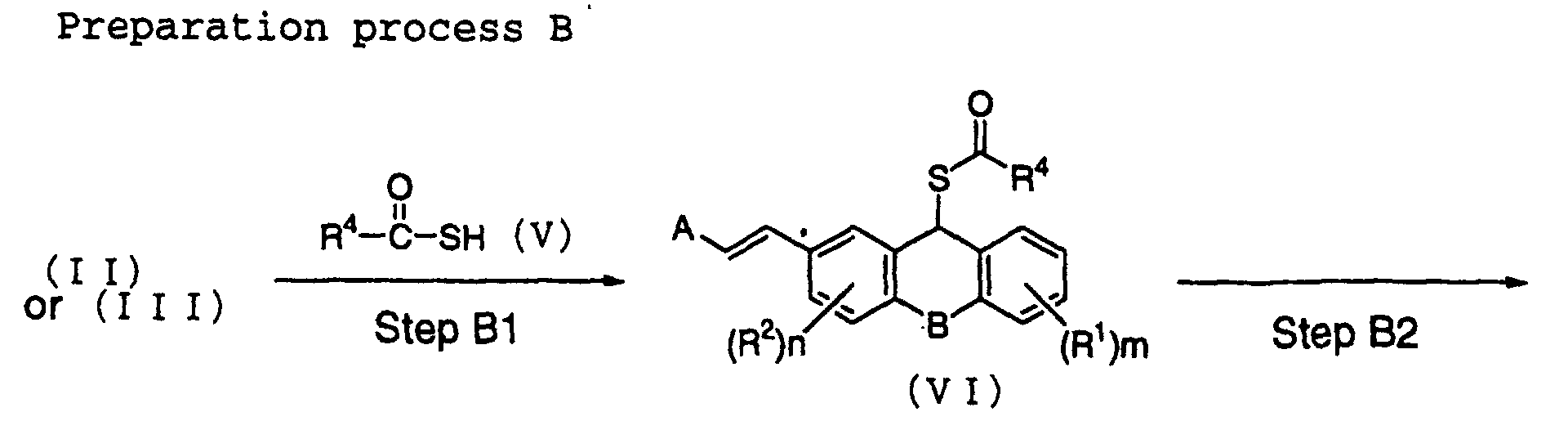

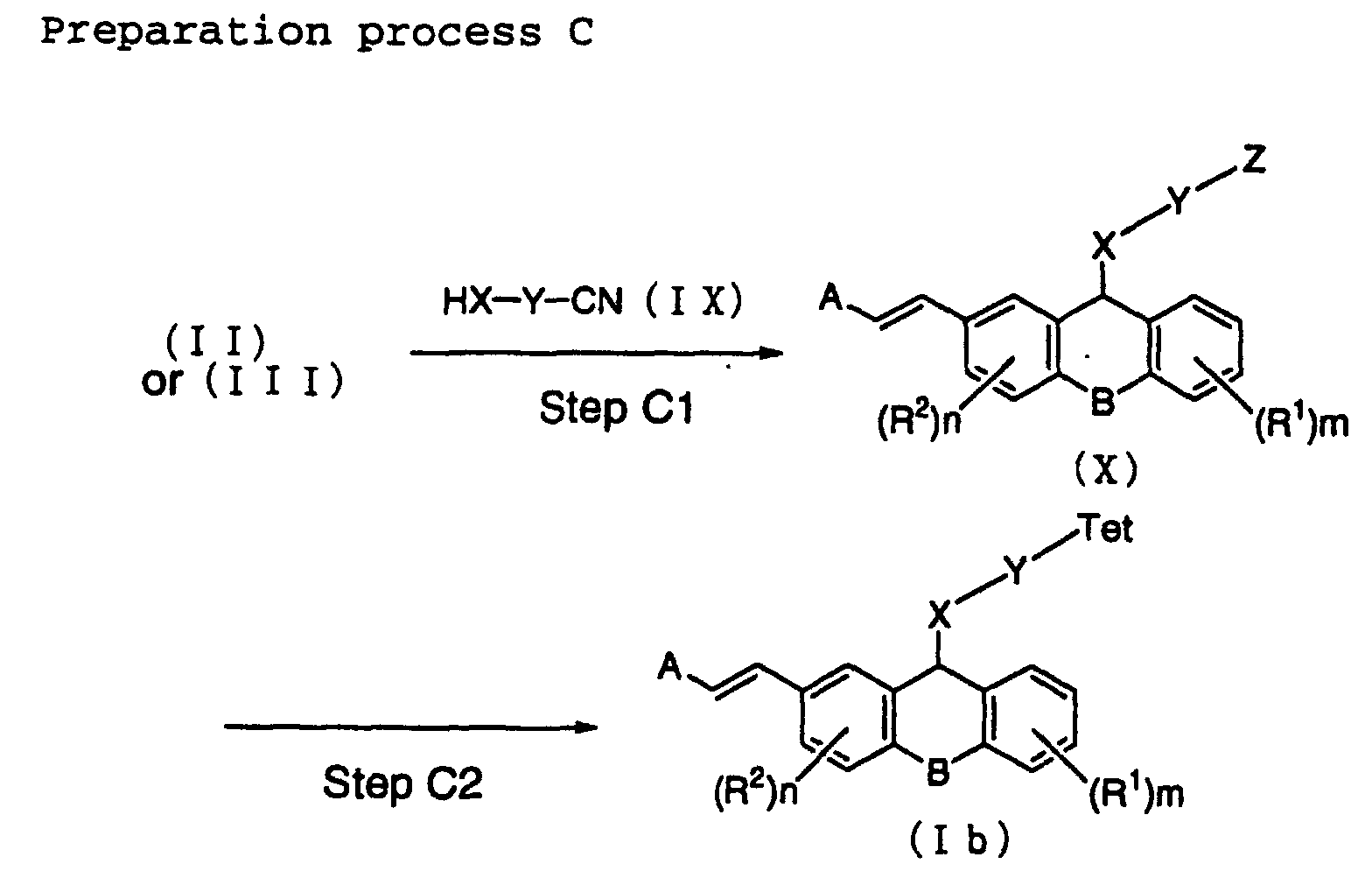


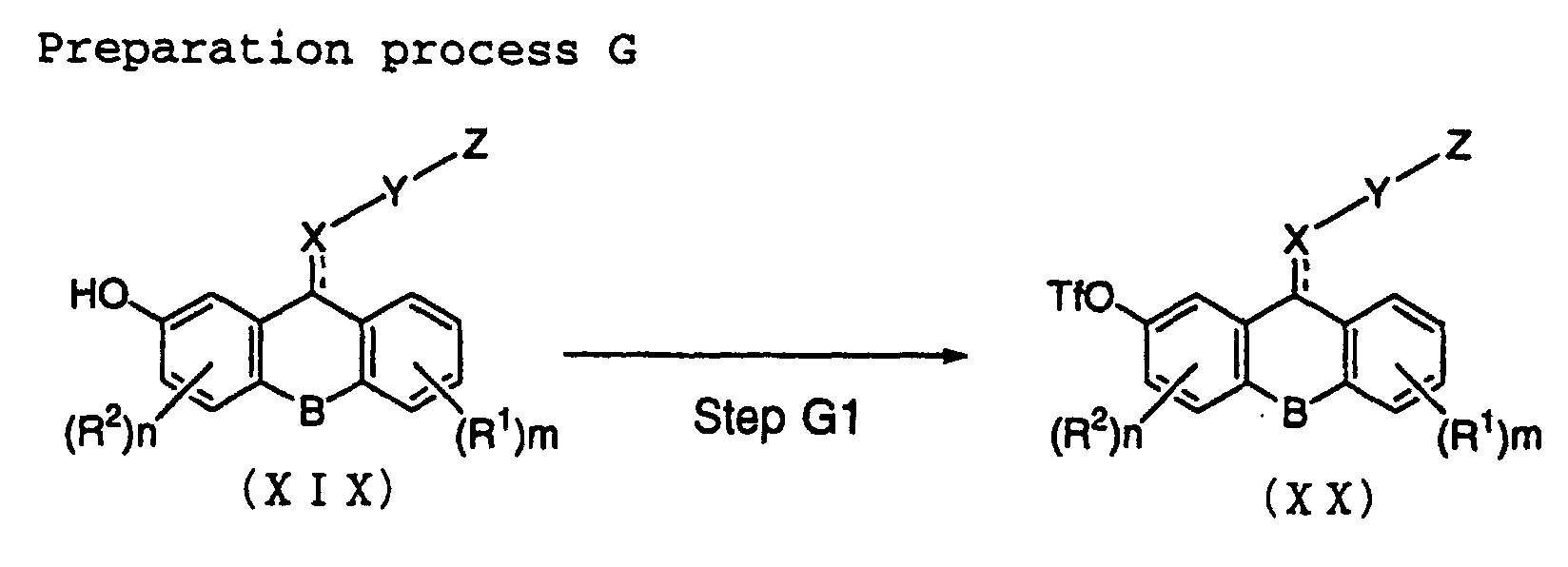
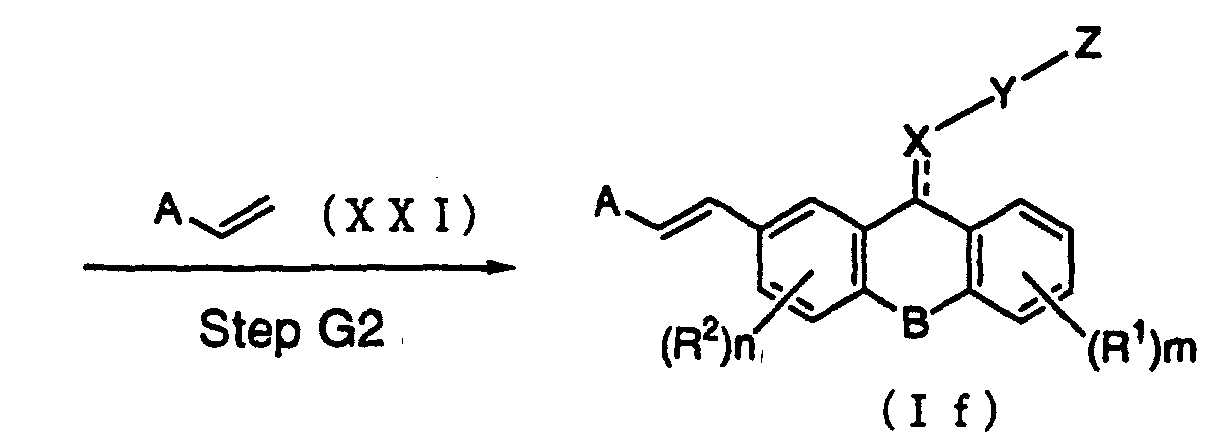
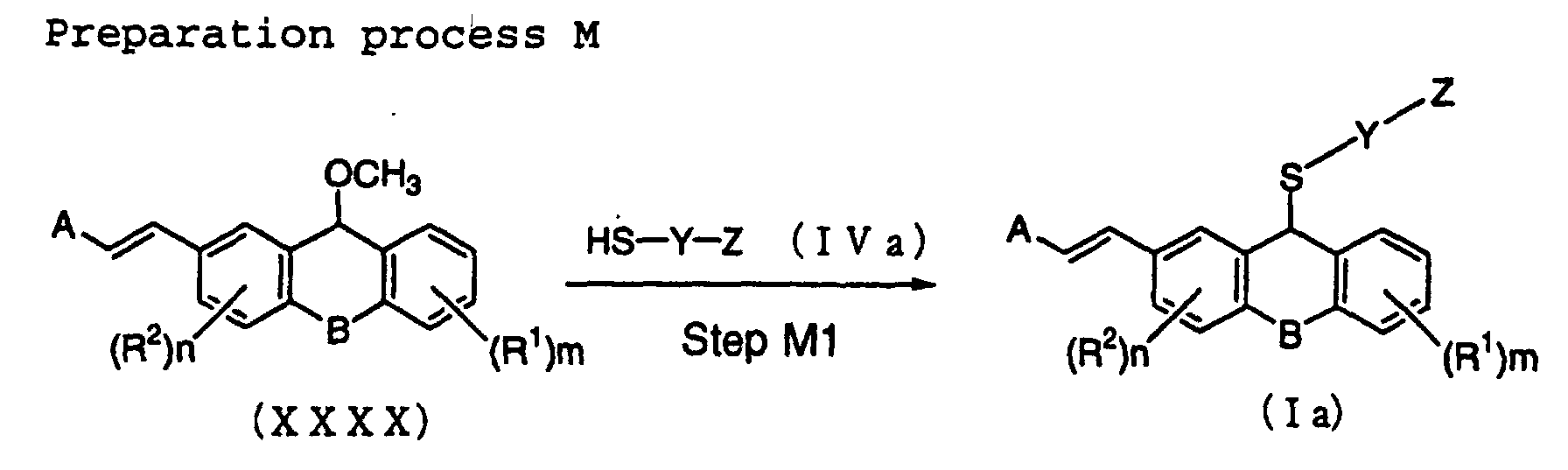
In the chemical formulae described in the above-mentioned
preparation processes, R1, R2, R3, A, B, X, Y, Z, m and n have
the same meanings as defined above, L represents a halogen atom,
a C1-C4 alkylsulfonyloxy group, a fluoro C1-C4 alkylsulfonyloxy
group or a phenylsulfonyloxy group which may be substituted (said
a substituent(s) is a C1-C4 alkyl group or a halogen atom), R4
represents a C1-C4 alkyl group or a phenyl group which may be
substituted (said a substituent(s) is a C1-C4 alkyl group or a
halogen atom), Tet means a 1H-tetrazol-5-yl group, Hal means
a halogen atom, and t-Boc means a t-butoxycarbonyl group.
Preparation process A is a preparation process of Compound
(I).
Step A1 of Preparation process A is a step of synthesizing
Compound (III) by halogenating or sulfonylating Compound (II).
Halogenation of Compound (II) can be carried out by
reacting Compound (II) and a halogenating agent in a solvent
or without solvent (preferably in a solvent).
The solvent to be used is not particularly limited so long
as it has no adverse effect and dissolves starting materials
with some extends, and there may be mentioned, for example,
halogenated hydrocarbons such as methylene chloride,
chloroform, carbon tetrachloride and dichloroethane; aromatic
hydrocarbons such as benzene and toluene; or aliphatic
hydrocarbons such as heptane, hexane and cyclohexane, preferably
halogenated hydrocarbons.
As the halogenating agent, there may be mentioned, for
example, thionyl chloride, thionyl bromide, phosphorus
oxychloride, phosphorus oxybromide or phosphorus pentachloride,
etc., preferably thionyl chloride or phosphorus
oxychloride. An amount of the halogenating agent to be used
is usually in an amount of 1 to 10-fold mole, preferably 1 to
2-fold mole based on Compound (II).
The reaction is usually carried out in the range of -20
to 100°C, preferably -10 to 30°C. The reaction time may vary
depending on the reaction temperature and others, and it is
usually for 5 minutes to 10 hours, preferably 10 minutes to 5
hours.
Sulfonylation of Compound (II) can be carried out
byreacting Compound (II) and a sulfonylating agent in the
presence of a base in a solvent.
The solvent to be used is not particularly limited so long
as it has no adverse effect and dissolves starting materials
with some extends, and there may be mentioned, for example, the
same solvent to those used in the above-mentioned halogenating
reaction (for example, halogenated hydrocarbons, aromatic
hydrocarbons or aliphatic hydrocarbons ), preferably
halogenated hydrocarbons.
As the sulfonylating agent, there may be mentioned, for
example, methanesulfonyl chloride, trifluoromethanesulfonyl
chloride, methanesulfonic anhydride, trifluoromethanesulfonic
anhydride, benzenesulfonyl chloride, toluenesulfonylchloride,
benzenesulfonyl bromide or toluenesulfonyl bromide, etc.,
preferably methanesulfonyl chloride, benzenesulfonyl chloride
or toluenesulfonyl chloride. An amount of the sulfonylating
agent to be used is usually in an amount of 1 to 10-fold mole,
preferably 1 to 3-fold mole based on Compound (II).
As the base, there may be mentioned, for example, amines
such as triethylamine, tributylamine, diisopropylethylamine,
pyridine, picoline, lutidine and 4-dimethylaminopyridine,
preferably triethylamine, diisopropylethylamine or pyridine.
An amount of the base to be used is usually in an amount
of 1 to 10-fold mole, preferably 1 to 2-fold mole based on the
sulfonylating agent.
The reaction is usually carried out in the range of -10
to 100°C, preferably 0 to 30°C. The reaction time may vary
depending on the reaction temperature and others, and it is
usually for 5 minutes to 10 hours, preferably 30 minutes to 5
hours.
Incidentally, Compound (III) can be separated and purified
from the reaction mixture by the usual method, and a crude product
obtained by concentrating the reaction mixture can be used as
such to the next step.
Step A2 can be carried out by reacting Compound (III) and
Compound (IV) in the presence of a base in a solvent.
An amount of Compound (IV) to be used is usually in an
amount of 1 to 10-fold mole, preferably 1 to 5-fold mole based
on Compound (III).
The solvent to be used is not particularly limited so long
as it has no adverse effect and dissolves starting materials
with some extends, and there may be mentioned, for example,
aprotic polar solvents such as N,N-dimethylformamide,
dimethylsulfoxide, N,N-dimethylacetamide and hexamethylphosphoric
triamide; halogenated hydrocarbons such as methylene
chloride, chloroform and dichloroethane; ketones such as
acetone, methyl ethyl ketone and methyl isobutyl ketone; nitriles
such as acetonitrile; esters such as ethyl acetate; ethers such
as diethyl ether , diisopropylether, tetrahydrofuranordioxane;
or a mixed solvent of the above solvents, preferably halogenated
hydrocarbons, aprotic polar solvents, ethers or a mixed solvent
of the above solvents.
As the base to be used, there may be mentioned, for example,
alkali metal hydrides such as sodium hydroxide or lithium
hydroxide; alkali metal amides such as sodium amide, etc.; amines
such as triethylamine, tributylamine, diisopropylethylamine,
pyridine, picoline, lutidine or 4-dimethylaminopyridine, etc.;
or alkali metal carbonates such as sodium carbonate, potassium
carbonate and sodium hydrogen carbonate, preferably amines or
alkali metal hydrides. An amount of the base to be used may
vary depending on the kind of the starting compounds, and it
is usually in an amount of 1 to 10-fold mole, preferably 1 to
5-fold mole based on Compound (IV).
The reaction is usually carried out in the range of -50
to 150°C, preferably -10 to 100°C. The reaction time may vary
depending on the reaction temperature and others, and it is
usually for 5 minutes to 10 hours, preferably 30 minutes to 5
hours.
Step A3 is a step to obtain Compound (I) in another method,
in particular, it is suitably employed when X is a sulfur atom.
This step is carried out by reacting Compound (II) and Compound
(IV) in the presence of an acid catalyst in a solvent.
An amount of Compound (IV) to be used is usually in an
amount of 1 to 5-fold mole, preferably 1 to 2-fold mole based
on Compound (II).
The solvent to be used is not particularly limited so long
as it has no adverse effect on the reaction and dissolves starting
materials with some extends, and there may be mentioned, for
example, halogenated hydrocarbons such as methylene chloride,
chloroform and dichloroethane; alcohols such as methanol,
ethanol, propanol, isopropanol and butanol; aprotic polar
solvents such as N,N-dimethylformamide, dimethylsulfoxide,
N,N-dimethylacetamide and hexamethylphosphoric triamide; or
ethers such as diethyl ether, diisopropyl ether, tetrahydrofuran
and dioxane, preferably halogenated hydrocarbons.
As the acid catalyst to be used, there may be mentioned,
for example, mineral acids such as hydrochloric acid, sulfuric
acid and phosphoric acid; organic acids such as methanesulfonic
acid and trifluoroacetic acid; Lewis acids such as boron
trifluoride-diethyl ether complex, zinc chloride, tin
tetrachloride and aluminum chloride, preferably organic acids
or boron trifluoride-diethyl ether complex.
An amount of the catalyst to be used is usually in an amount
of 0.1 to 50-fold mole, preferably 1 to 10-fold mole based on
Compound (II), and when organic acids are used, it may be used
in a largely excess amount served as a solvent.
The reaction is usually carried out in the range of -10
to 100°C, preferably 0 to 30°C. The reaction time may vary
depending on the reaction temperature and others, and it is
usually for 5 minutes to 10 hours, preferably 10 minutes to 5
hours.
Incidentally, in Compound (I), the compound wherein Z is
a carboxyl group (Compound Ic mentioned below) is directly
produced by using Compound (IV) wherein Z is a carboxyl group,
or can be synthesized by firstly leading to Compound (I) where
Z is a protected carboxyl group using Compound (IV) where Z is
a protected carboxyl group (said protective group is preferably
C1-C4 alkyl group) and then by hydrolyzing said protective group
under acidic or alkaline conditions according to the conventional
method.
Also, in Compound (I), a desired protective group can be
easily introduced into Compound (Ic) wherein Z is a carboxyl
group according to the conventional method. (for example, written
by W.Greene and P.G.H.Wult "Protective Group in Organic
Synthesis", 2nd Ed., John Wiley & Sons, see page 224)
Preparation process B is a preparation processs of Compound
(Ia).
A method of obtaining Compound (VI) from Compound (II)
or Compound (III) and thiocarboxylic acid (V) in Step B1 can
be carried out in the same manner as described in the Step A2
or Step A3 of the above-mentioned Preparation process A except
for using thiocarboxylic acid (V) in place of Compound (IV).
In Step B2, Compound (VII) can be synthesized by
hydrolyzing Compound (VI) under alkaline conditions according
to the conventional method.
Step B3 is carried out by reacting Compound (VI) and
Compound (VIII) in the presence of a base in a solvent. The
present reaction is carried out in the same manner as in the
above-mentioned Step A2 except for using Compound (VII) in place
of Compound (II), and using Compound (VIII) in place of Compound
(IV).
An amount of Compound (VIII) to be used is usually in an
amount of 1 to 10-fold mole, preferably 1 to 5-fold mole based
on Compound (VII)
Preparation processs C is a preparation processs of
Compound (Ib), and in Step C1, the reaction of obtaining Compound
(X) from Compound (II) or Compound (III) and Compound (IX) is
carried out under the same reaction conditions as those of
Preparation process A except for using Compound (IX) in place
of Compound (IV).
In Step C2, Compound (Ib) can be synthesized by reacting
Compound (X) and an azide compound in a solvent.
As the azide compound to be used, there may be mentioned,
for example, alkali metal azides such as sodium azide, potassium
azide and lithium azide; alkaline earth metal azides such as
calcium azide and magnesium azide; or organic tin azides such
as trimethyl tin azide, tributyl tin azide and triphenyl tin
azide. An amount of the azide compound to be used is usually
in an amount of 1 to 10-fold mole, preferably 1 to 5-fold mole
based on Compound (X). In said reaction, the azide compound
can be used singly, or may be used in combination with, for example,
Lewis acids such as aluminum chloride, stannic chloride,
zinc chloride, titanium chloride and boron trifluoride-diethyl
ether complex; ammonium salts such as ammonium chloride and
tetramethyl ammonium chloride; sulfonic acids such as
methanesulfonic acid and ethanesulfonic acid; alkali metal
chlorides such as lithium chloride, and others; or amine salts
such as triethylamine hydrochloride, and others.
The solvent to be used is not particularly limited so long
as it has no adverse effect on the reaction and dissolves starting
materials with some extends, and there may be mentioned, for
example, aprotic polar solvents such as N,N-dimethylformamide,
dimethylsulfoxide, N-methylpyrrolidone and N,N-dimethylacetamide;
ethers such as diethyl ether, tetrahydrofuran,
dimethoxyethane, diethoxyethane and dioxane; aromatic
hydrocarbons such as benzene, toluene and xylene; or aliphatic
hydrocarbons such as hexane and petroleum ether.
The reaction is usually carried out in the range of 0 to
200°C, preferably 50 to 150°C. The reaction time may vary
depending on the reaction temperature and others, and it is
usually for 1 hour to 72 hours, preferably 3 hours to 48 hours.
Preparation process D is a preparation processs of Compound
(Id), and it is carried out by a method (Step D1a) in which
Compound (Ic) and Compound (XI) are reacted in the presence of
a condensing agent, or a method (Step D1c) in which Compound
(Ic) is once led to its reactive derivative (Step D1b), then,
the reactive derivative and Compound (XI) are reacted in the
presence of a base.
As the condensing agent to be used in Step D1a, there may
be mentioned, for example, N,N'-dicyclohexylcarbodiimide
(DCC), 1-ethyl-3-(3-dimethylaminopropyl)carbodiimide
hydrochloride (EDC), N,N'-carbonyldiimidazole (CDI),
diphenylphosphoryl azide, benztriazol-1-yloxy-tris-(dimethyamino)phosphonium
hexafluorophosphate (BOP),
benzotriazol-1-yloxy-tris-pyrrolidinophosphonium hexafluorophosphate
(PyBOP), 2-(lH-benzotriazol-1-yl)-1,1,3,3-tetramethyluronium
hexafluorophosphate (HBTU), or 2-(1H-benzotriazol-1-yl)-1,1,3,3-tetramethyluronium
tetrafluoroborate
(TBTU), preferably DCC or EDC.
An amount of the condensing agent to be used is usually
1 to 5-fold mole, preferably 1 to 3-fold mole based on Compound
(Ic).
The solvent to be used is not particularly limited so long
as it has no adverse effect on the reaction and dissolves starting
materials with some extends, and there may be mentioned, for
example, ethers such as diethyl ether, tetrahydrofuran,
dimethoxyethane, diethoxyethane and dioxane; nitriles such as
acetonitrile; aprotic polar solvents such as N,N-dimethylformamide,
dimethylsulfoxide, N-methylpyrrolidone and
N,N-dimethylacetamide; or halogenated hydrocarbons such as
methylene chloride, chloroform and dichlorodichloroethane,
these may be used singly or a mixed solvent.
The reaction is usually carried out in the range of -20
to 100°C, preferably 0 to 50°C. The reaction time may vary
depending on the reaction temperature and others, and it is
usually for 30 minutes to 24 hours, preferably 1 hour to 10 hours.
As the reactive derivative of Compound (Ic) in Step D1b,
there may be mentioned, for example, acid halide derivatives
of Compound (Ic) such as an acid bromide or an acid chloride
of Compound (Ic); or reactive amide derivatives of Compound (Ic)
obtained from Compound (Ic) and imidazole, dimethylpyrazole or
triazole, preferably an acid halide derivative.
The acid halide of Compound (Ic) can be prepared according
to the conventional method, and it can be synthesized by reacting,
for example, Compound (Ic) with a halogenating agent (for
example, thionyl chloride, thionyl bromide or phosphorus
pentachloride) in a solvent (for example, halogenated
hydrocarbons such as methylene chloride, chloroform and
dichloroethane).
Also, an activated amide derivative of Compound (Ic) can
be prepared according to the conventional method, and it can
be synthesized by reacting, for example, in the case of an
imidazole amide product of Compound (Ic), Compound (Ic) is
reacted with 1,1'-carbonyldiimidazole in a solvent.
The reactive derivative of Compound (Ic) can be used in
the next Step D1b as such without separation after formation.
An amount of Compound (XI) to be used in the reaction of
the reactive derivative of Compound (Ic) and Compound (XI) in
Step D1c is usually 1 to 10-fold mole, preferably 1 to 5-fold
mole based on Compound (Ic).
As the base to be used, there may be mentioned, for example,
amines such as triethylamine, tributylamine, diisopropylethylamine,
pyridine, picoline; lutidine, 4-dimethylaminopyridine,
1,8-diazabicyclo[5.4.0]undecene and 1,5-diazabicyclo[4.3.0]-7-nonene,
preferably triethylamine, tributylamine
or diisopropylethylamine. An amount of the base to be
used is usually in an amount of 1 to 10-fold mole, preferably
1 to 5-fold mole based on Compound (Ic).
The reaction is usually carried out in the range of 0 to
150°C, preferably 10 to 100°C. The reaction time may vary
depending on the reaction temperature and others, and it is
usually for 5 minutes to 48 hours, preferably 30 minutes to 24
hours.
Also, Compound (Id) can be synthesized by a method via
Compound (XII).
Step D2 is a step to obtain Compound (XII) by amidating
a carboxyl group of Compound (Ic), and it is carried out by
optionally selecting a method from methods conventionally known
in the art. For example, Compound (XII) can be easily synthesized
by reacting the reactive derivative of the above-mentioned
Compound (Ic) and ammonia.
Step D3 can be carried out by reacting Compound (XII) and
Compound (XIII) in a solvent in the presence of a base.
An amount of Compound (XIII) is usually in an amount of
1 to 10-fold mole, preferably 1 to 5-fold mole based on Compound
(XII).
The solvent and the base to be used are mentioned those
described in the above-mentioned Step D1, and the reaction can
be carried out under the same conditions as Step D1.
Preparation process E is a preparation processs of Compound
(Ie).
In Step E1, the reaction of obtaining Compound (XV) from
Compound (II) or Compound (III) and Compound (XIV) canbe carried
out in the same manner as mentioned above except forusing Compound
(XIV) in place of Compound (IV).
Step E2 is carried out by reacting Compound (XV) and
Compound (XIII) in a solvent in the presence of a base.
An amount of Compound (XIII) to be used is usually in an
amount of 1 to 10-fold mole, preferably 1 to 5-fold mole based
on Compound (XV).
As the solvent to be used, the same solvents as those
mentioned in the above Step D1 may be mentioned, and preferably
halogenated hydrocarbons or aprotic polar solvents.
As the base to be used, the same base as those mentioned
in the above Step D1 may be mentioned, and an amount of the base
to be used is usually in an amount of 1 to 10-fold mole, preferably
1 to 5-fold mole based on Compound (XIV). Also, in the present
reaction, the base may be used in a largely excess amount served
as a solvent.
The reaction is usually carried out in the range of -20
to 100°C, preferably 0 to 50°C. The reaction time may vary
depending on the reaction temperature and others, and it is
usually for 5 minutes to 10 hours, preferably 30 minutes to 5
hours.
Preparation process F is another preparation processs of
Compound (Ie).
The reaction of obtaining Compound (XVIII) from Compound
(XVI) in Step F1 is carried out by using a conventionally known
method which has been known as "Mitsunobu Reaction". For
example, it is carried out by reacting Compound (XVI) and Compound
(XVII), with triphenylphosphine and diethyl azodicarboxylate
in tetrahydrofuran. An amount of triphenylphosphine to be used
is usually in an amount of 1 to 5-fold mole, preferably 1 to
5-fold mole based on Compound (XVI). An amount of diethylazodicarboxylate
to be used is usually in an amount of 1 to 10-fold
mole, preferably 1 to 5-fold mole based on Compound (XVI).
The reaction is usually carried out in the range of -50
to 80°C, preferably -10 to 50°C. The reaction time may vary
depending on the above-mentioned other conditions, and it is
usually for 5 minutes to 24 hours, preferably 30 minutes to 10
hours.
The reaction of obtaining Compound (Ie) from Compound
(XVIII) in Step F2 can be carried out by the conventionally
known method, for example, by a method of deprotection by
reacting with organic acids such as trifluoroacetic acid in
tetrahydrofuran.
Preparation process G is a preparation processs of Compound
(If).
Step G1 is a step of preparing Compound (XX) by trifrating
Compound (XIX).
Trifration of Compound (XIX) can be carried out by reacting
Compound (XIX) and a trifrating agent in the presence of a base
in a solvent.
The solvent to be used is not particularly limited so long
as it has no adverse effect on the reaction and dissolves starting
materials with some extends, and there may be mentioned, for
example, halogenated hydrocarbons such as methylene chloride,
chloroform, carbon tetrachloride and dichloroethane; ethers
such as diethyl ether, tetrahydrofuran, dimethoxyethane,
diethoxyethane and dioxane; aromatic hydrocarbons such as
benzene and toluene; or aliphatic hydrocarbons such as heptane,
hexane and cyclohexane, preferably halogenated hydrocarbons or
ethers.
As the trifrating agent, there may be mentioned, for
example, trifluoromethanesulfonyl chloride, trifluoromethanesulfonic
anhydride and the like, preferably
trifluoromethanesulfonic anhydride. An amount of the
trifrating agent to be used is usually in an amount of 1 to 10-fold
mole, preferably 1 to 2-fold mole based on Compound (XIX).
As the base, there may be mentioned, for example, amines
such as triethylamine, tributylamine, diisopropylethylamine,
pyridine, picoline, lutidine, 4-dimethylaminopyridine and the
like, preferably triethylamine, diisopropylethylamine,
pyridine. An amount of the base to be used is usually in an
amount of 1 to 10-fold mole, preferably 1 to 2-fold mole based
on the trifrating agent.
The reaction is usually carried out in the range of -20
to 100°C, preferably -10 to 50°C. The reaction time may vary
depending on the reaction temperature and others, and it is
usually for 5 minutes to 10 hours, preferably 5 minutes to 5
hours.
Step G2 is carried out by reacting Compound (XX) and
Compound (XXI) in an inert gas atmosphere such as nitrogen, helium
and argon in the presence of a catalyst (palladium catalyst)
and a base in a solvent.
The solvent to be used is not particularly limited so long
as it has no adverse effect on the reaction and dissolves starting
materials with some extends, and there may be mentioned, for
example, polar solvents such as N,N-dimethylformamide,
dimethylsulfoxide, N-methylpyrrolidone and
N,N-dimethylacetamide, or acetonitrile, etc., preferably
N,N-dimethylformamide.
As the base, there may be mentioned, for example, amines
such as triethylamine, tributylamine, diisopropylethylamine,
pyridine, picoline, lutidine and 4-dimethylaminopyridine,
preferably triethylamine, diisopropylethylamine or pyridine.
An amount of the base to be used is usually in an amount of 1
to 10-fold mole, preferably 1 to 2-fold mole based on Compound
(XX).
Also, in place of the amines, a combination of a
phase-transfer catalyst such as tetrabutyl ammonium chloride
and tetrabutyl ammonium bromide, and alkali metal carbonates
such as potassium carbonate, sodium carbonate and sodium hydrogen
carbonate may be used.
As the palladium complex, there may be mentioned, for
example, palladium acetate, palladium acetate-triphenylphosphine,
dichlorobistriphenylphosphine or tetrakistriphenylphosphine,
preferably palladium acetate-triphenylphosphine
or tetrakistriphenylphosphine. An amount of the
palladium complex to be used is usually in an amount of 0.01
to 1-foldmole, preferably 0.01 to 0.1-foldmole based on Compound
(XX) .
Also, lithium chloride or lithium bromide may be
copresent in the reaction.
The reaction is usually carried out in the range of 0 to
150°C, preferably 25 to 80°C. The reaction time may vary
depending on the reaction temperature and others, and it is
usually for 30 minutes to 24 hours, preferably 1 hour to 10 hours.
Preparation processs M is a preparation processs of
Compound (Ia).
Step M1 is carried out by reacting Compound (XXXX) and
Compound (IVa) in the presence of a catalyst in a solvent.
An amount of Compound (IVa) to be used is usually in an
amount of 1 to 5-fold mole, preferably 1 to 2-fold mole based
on Compound (XXXX).
The solvent to be used not particularly limited so long
as it has no adverse effect on the reaction and dissolves starting
materials with some extends, and there may be mentioned, for
example, halogenated hydrocarbons such as methylene chloride,
chloroform and dichloroethane; aromatic hydrocarbons such as
benzene and toluene, preferably halogenated hydrocarbons.
As the catalyst to be used, there may be used, for example,
Lewis acids such as boron trifluoride-diethyl ether complex and
others.
An amount of the catalyst to be used is usually in an amount
of 0.1 to 10-fold mole, preferably 1 to 5-fold mole based on
Compound (XXXX).
The reaction is usually carried out in the range of 0 to
100°C, preferably 0 to 30°C. The reaction time may vary depending
on the reaction temperature and others, and it is usually for
5 minutes to 10 hours, preferably 30 minutes to 5 hours.
In the above-mentioned respective reactions, the desired
compound can be isolated from the reaction mixture according
to the conventional manner. For example, when insoluble
material exists, after optionally removing it by filtration,
the solvent is distilled, or the solvent was removed under reduced
pressure, water is added to the residue, the mixture is extracted
with a water-immiscible organic solvent such as ethyl acetate,
etc., and if necessary, after drying over anhydrous sodium
sulfate, etc., the solvent is removed to obtain the desired
compound, and further necessary, it can be further purified by
the conventional method, for example, recrystallization, column
chromatography, and others.
Also, the compound of the general formula (I) according
to the present invention can be converted into a pharmaceutically
acceptable salt by treating with an acid or a base according
to the conventional method. For example, a desired salt can
be obtained by reacting with a desired acid or a base in an inert
solvent (preferably ethers such as diethyl ether, tetrahydrofuran,
dimethoxyethane, diethoxyethane and dioxane; alcohols
such as methanol, ethanol, propanol, isopropanol and butanol;
halogenated hydrocarbons such as methylene chloride,
chloroform; or water), and removing the solvent, or collecting
the precipitated crystal by filtration. Also, it can be
separated as a salt directly from a reaction mixture at the final
reaction step.
Moreover, in the compound of the formula (I), there exist
optical isomer(s) (including diastereomer) due to an asymmetric
carbon(s) and/or geometric (E, Z) isomers due to an unsaturated
carbon. These respective isomers can be separated by treating
the corresponding racemic isomers or geometric isomer mixture
by usual optical resolution methods (fractional recrystallization
method, optical resolution column chromatography
method or diastereimer method, etc.) or separation methods
(recrystallization method, column chromatography method,
etc.). For example, optical isomers are to be separated,
Compound (I) which is racemic mixture is reacted with optically
active sulfonic acid compound ((S)or (R)-camphor-10-sulfonic
acid, etc.), to obtain one of the diastereomer salts, if
necessary, further subjecting to purification, the resulting
diastereomer salt is decomposed according to the conventional
manner to obtain an optical isomer. Also, when the above reaction
is carried out by using the starting compound which has been
subjected to optical resolution or separation, desired optical
isomer or geometric isomer can be obtained.
Compound (IV), (V), (VIII), (IX), (XI), (XIII), (XIV),
(XVI), (XVII) and other sub-starting materials which are used
as starting materials in the above-mentioned Preparation
processes A, B, C, D, E, F, G and M are each known compounds
or can be easily produced according to the conventionally known
method. Also, Compound (II) can be produced according to
Preparation processs H or Preparation processs J as shown below,
Compound (XXIVa) can be produced according to Preparation
processs I as shown below, Compound (XIXa) can be produced
according to Preparation processs K as shown below, Compound
(XXI) can be produced, for example, according to Preparation
processs L as shown below, Compound (XXXX) can be produced
according to Preparation processs N as shown below.
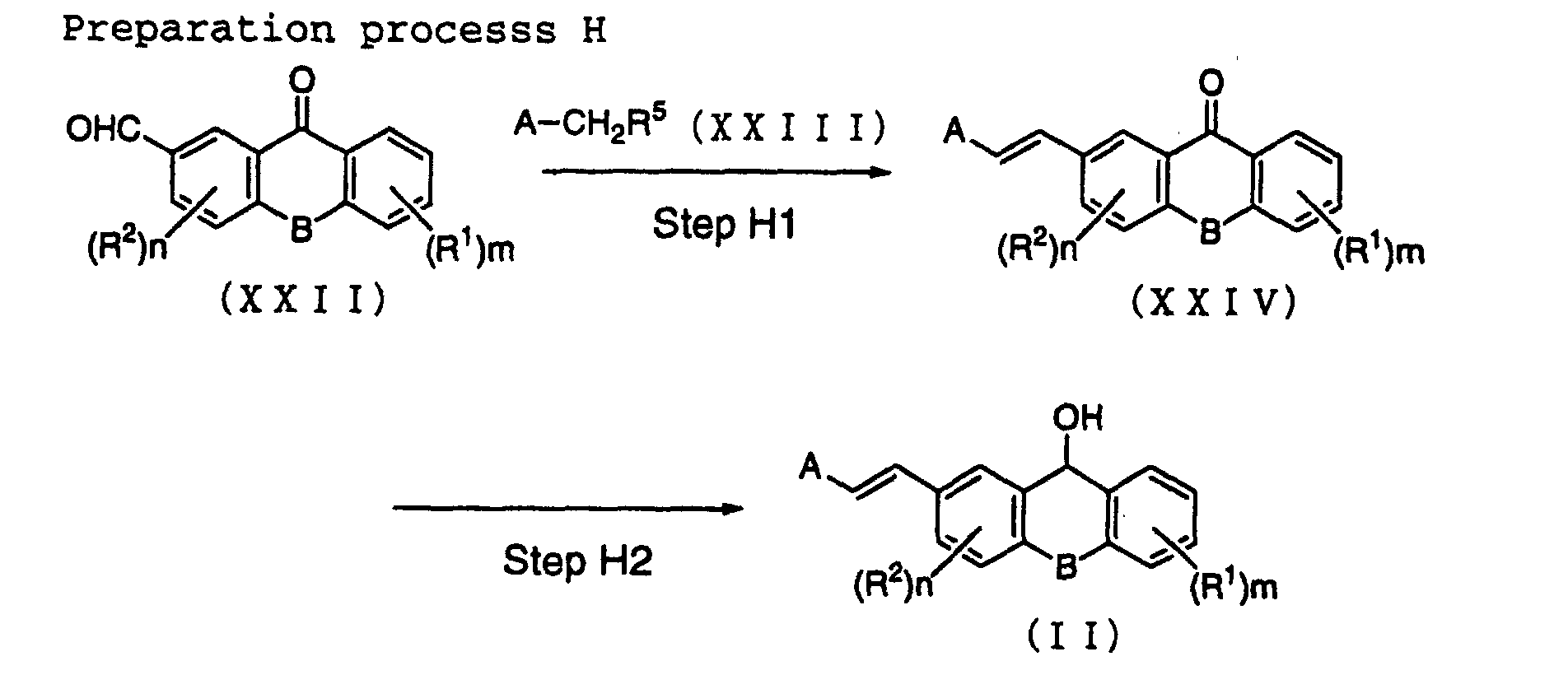

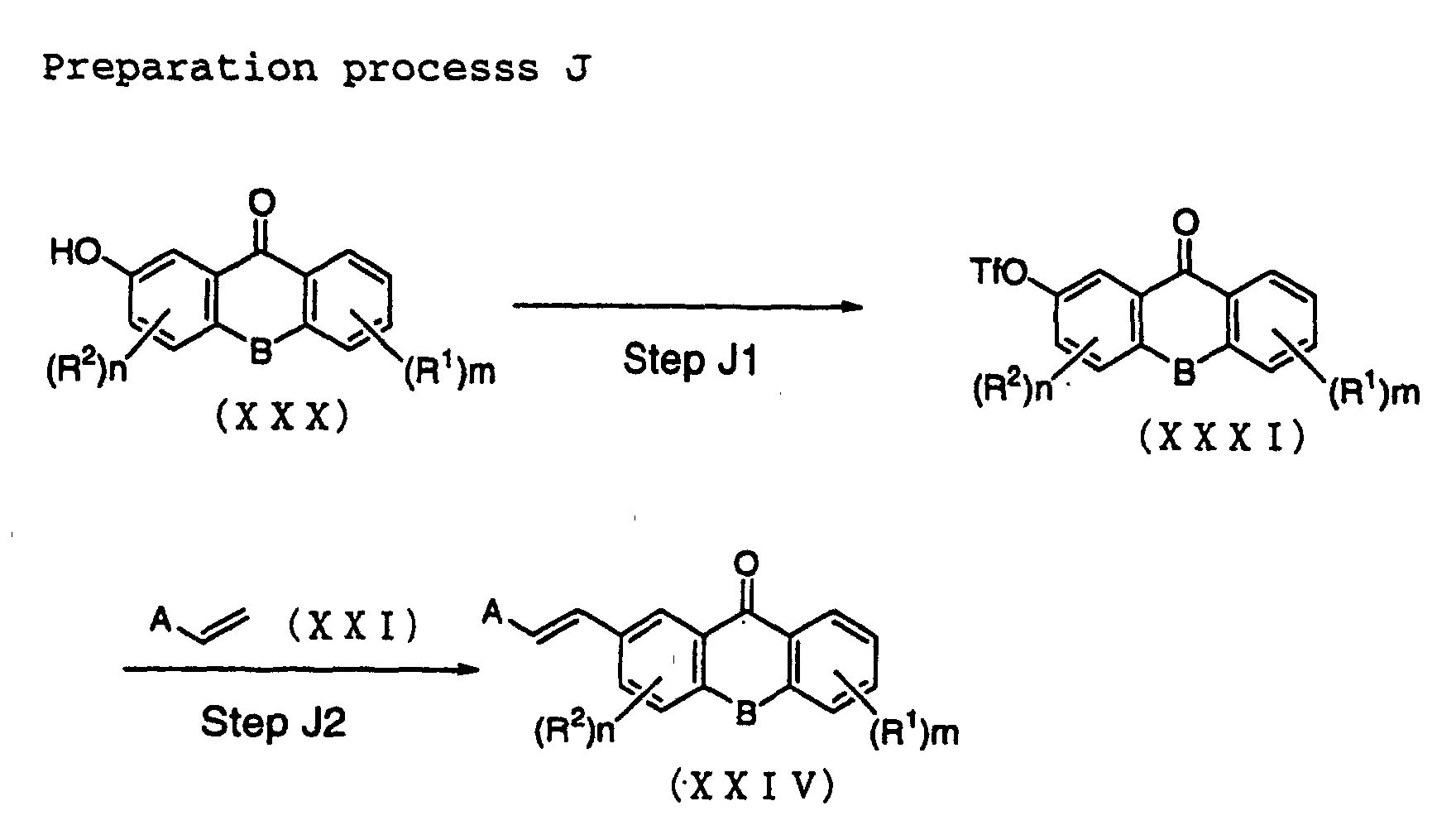
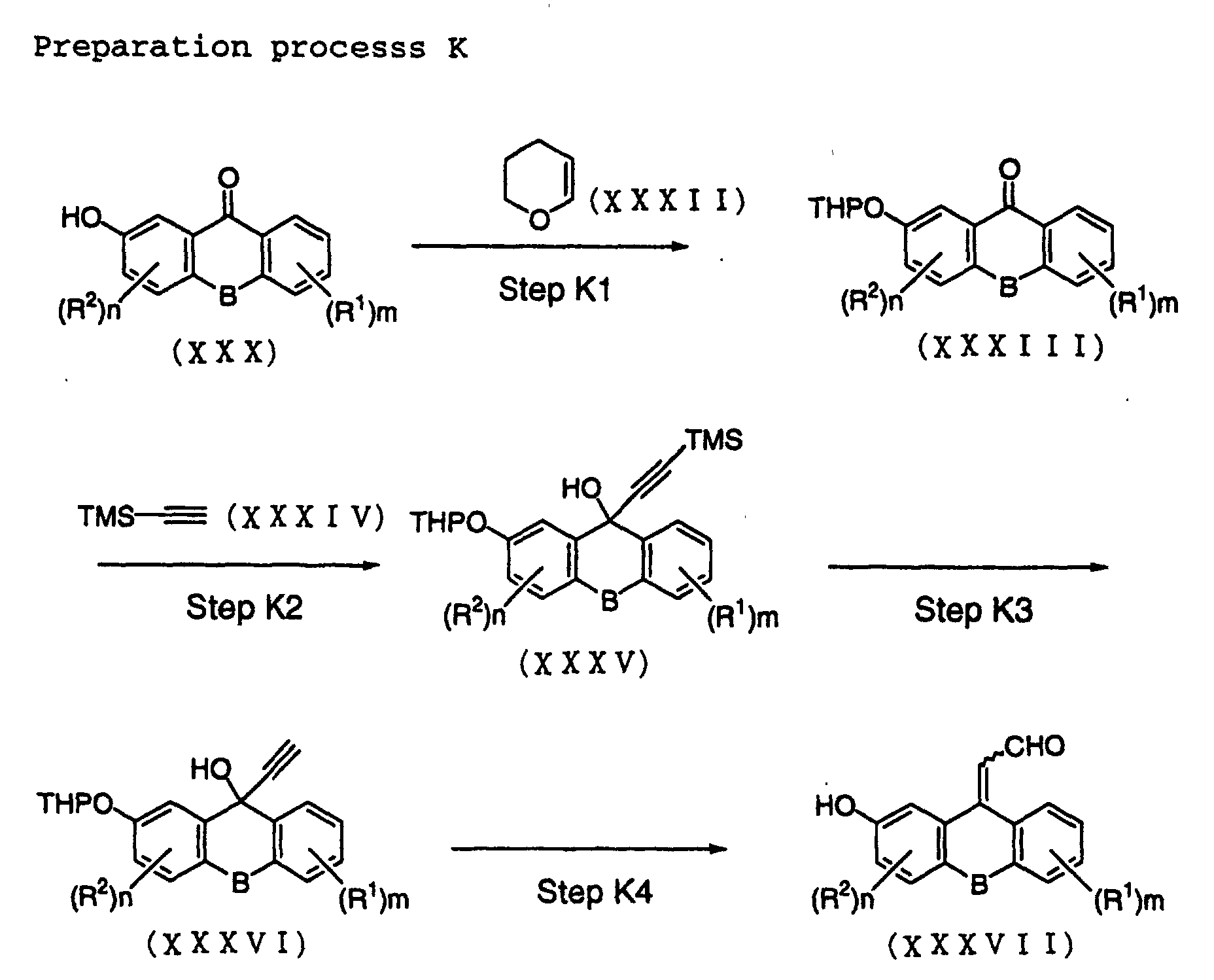
 (Reference 1) J. Org. Chem., 61, 3398(1996)
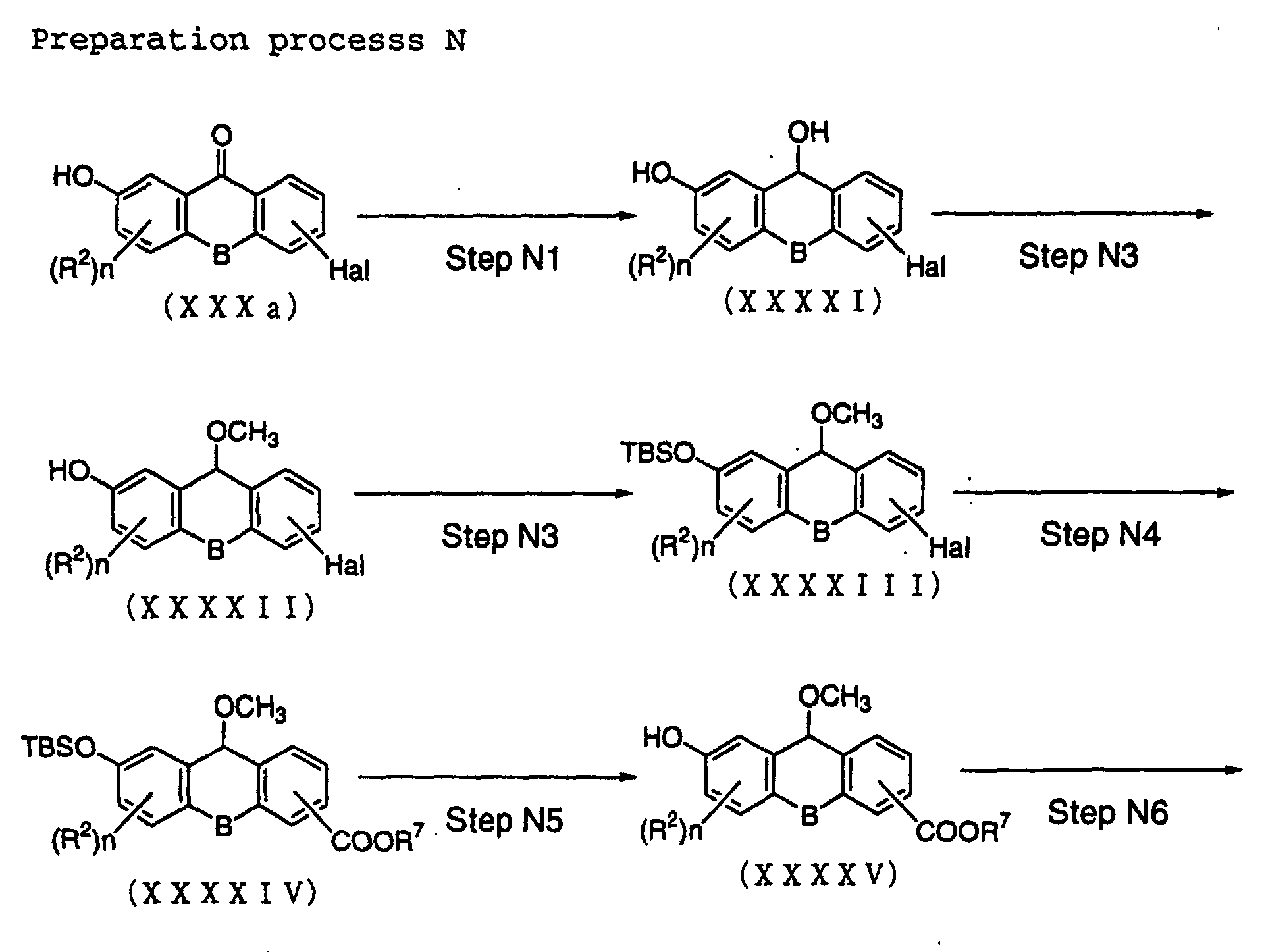

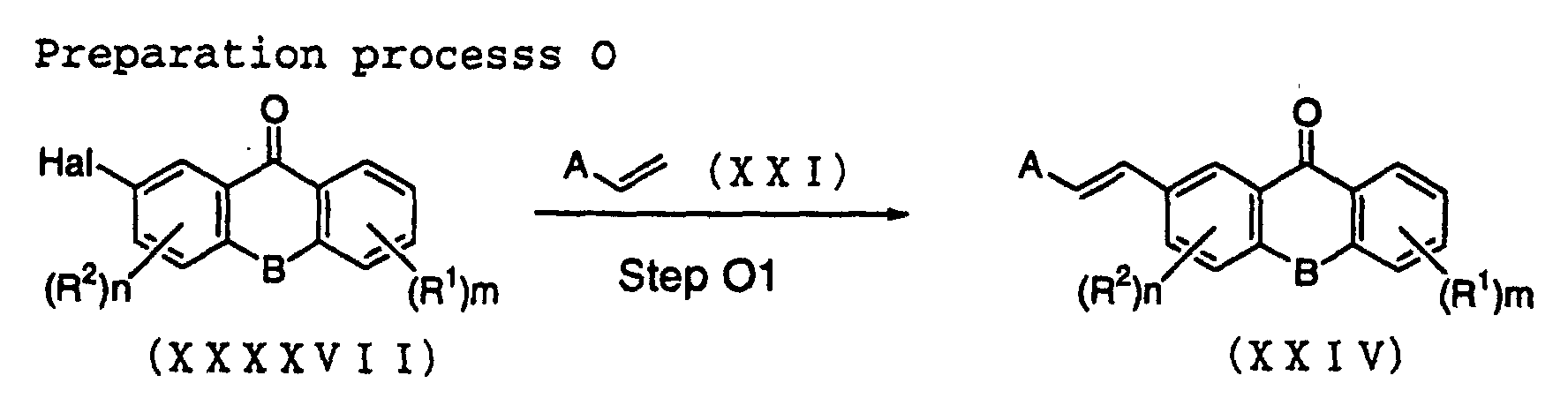


In the above formulae, R1, R2, A, B, Hal, m and n have the
same meanings as mentioned above, R5 represents a hydrogen
atom or a formula: -P(R6)3·Hal group,
wherein R6 represents a C1-C4 alkyl group or a phenyl group,
Ac represents an acetyl group, R7 represents a C1-C4 alkyl group, R8 represents a halogen atom with the same meaning as in R1, a nitro group, a cyano group, a C1-C4 alkyl group with the same meaning as in R1, a fluoro C1-C4 alkyl group with the same meaning as in R1, a C1-C4 alkoxy group with the same meaning as in R1, a fluoro C1-C4 alkoxy group with the same meaning as in R1 or a C1-C4 alkylthio group with the same meaning as in R1, r is an integer of 1 to 4, when r is 2 or more, R8s may be different from each other, Et means an ethyl group, THP means a tetrahydropyranyl group, TBS means a t-butyldimethylsilyl group.
wherein R6 represents a C1-C4 alkyl group or a phenyl group,
Ac represents an acetyl group, R7 represents a C1-C4 alkyl group, R8 represents a halogen atom with the same meaning as in R1, a nitro group, a cyano group, a C1-C4 alkyl group with the same meaning as in R1, a fluoro C1-C4 alkyl group with the same meaning as in R1, a C1-C4 alkoxy group with the same meaning as in R1, a fluoro C1-C4 alkoxy group with the same meaning as in R1 or a C1-C4 alkylthio group with the same meaning as in R1, r is an integer of 1 to 4, when r is 2 or more, R8s may be different from each other, Et means an ethyl group, THP means a tetrahydropyranyl group, TBS means a t-butyldimethylsilyl group.
Preparation processs H is a preparation processs of
Compound (II).
In Step H1 of Preparation processs H, as a starting
material, there are a method (Step H1a) of using Compound (XXIII,
R5 = a hydrogen atom) or a method (Step H1b) of using Compound
(XXIII), R5 = a formula: -P(R6)3·Hal group).
In the method of using Compound (XXIII, R5 = a hydrogen atom)
of Step H1a, it is carried out by reacting Compound (XXII) and
Compound (XXIII, R5 = a hydrogen atom) in acetic anhydride. An
amount of Compound (XXIII, R5 = a hydrogen atom) to be used is
usually in an amount of 1 to 10-foldmole, preferably 1 to 5-fold
mole based on Compound (XXII).
The reaction is usually carried out in the range of 20 to
200°C, preferably 50 to 150°C. The reaction time may vary
depending on the reaction temperature and others, it is usually
for 1 hour to 200 hours, preferably 3 hours to 100 hours.
In the method of using Compound (XXIII, R5 = a formula:
-P(R6)3·Hal group) of Step H1b, it is carried out by reacting
Compound (XXII) and Compound (XXIII, R5 = a formula: -P(R6)3·Hal
group) in a solvent in the presence of a base. An amount of
Compound (XXIII, R5 = a formula: -P(R6)3·Hal group) to be used
is usually in an amount of 1 to 5-fold mole, preferably 1 to
2-fold mole based on Compound (XXII).
The solvent to be used is not particularly limited so long
as it has no adverse effect on the reaction and dissolves starting
materials with some extends, and there may be mentioned, for
example, aromatic hydrocarbons such as benzene, toluene and
xylene; ethers such as diethyl ether, dioxane and tetrahydrofuran;
halogenated hydrocarbons such as methylene
chloride, chloroform and dichloroethane; or aprotic polar
solvents such as N,N-dimethylformamide and dimethylsulfoxide,
preferably aromatic hydrocarbons or ethers.
As the base tobe used, there may be mentioned, for example,
alkali metal hydrides such as sodium hydride, lithium hydride
and potassium hydride; alkali metal amides such as sodium amide
and lithium diisopropylamide; alkali metal alkoxides such as
sodium methoxide, sodium ethoxide and potassium t-butoxide; or
alkyl lithiums such as methyl lithium, butyl lithium and t-butyl
lithium, preferably sodium hydride, lithium diisopropylamide,
potassium t-butoxide, butyl lithium or t-butyl lithium. An
amount of the base to be used is usually in an amount of 1 to
3-fold mole, preferably 1 to 1.5-fold mole based on Compound
(XXIII, R5 = a formula: -P(R6)3·Hal group).
The reaction is usually carried out in the range of -80
to 100°C, preferably -60 to 50°C. The reaction time may vary
depending on the reaction temperature and others, it is usually
for 10 minutes to 10 hours, preferably 15 minutes to 6 hours.
The reduction of Compound (XXIV) to Compound (II) in Step
H2 is carried out by using a reducing agent in a solvent.
As the reducing agent, there may be mentioned, for example,
sodium borohydride , lithium borohydride, sodium cyanoborohydride
or lithium aluminum hydride, preferably sodium
borohydride.
As the solvent to be used, there may be mentioned, for
example, alcohols such as methanol, ethanol, propanol,
isopropanol and butanol; ethers such as tetrahydrofuran, dioxane
and 1,2-dimethoxyethane; nitriles such as acetonitrile; amides
such as N,N-dimethylformamide, N,N-dimethylacetamide and
N-methylpyrrolidone; water; or a mixed solvent of the above
solvents, preferably methanol, ethanol, tetrahydrofuran,
N,N-dimethylformamide, N,N-dimethylacetamide or a mixed
solvent of the above solvents.
The reaction is usually carried out in the range of -10
to 150°C, preferably 0 to 100°C. The reaction time may vary
depending on the reaction temperature and other conditions, and
it is usually for 10 minutes to 10 hours, preferably 30 minutes
to 6 hours.
Preparation processs I is a preparation processs of
Compound (XXIVa).
Step I1 is carried out by reacting Compound (XXV) and
Compound (XXIIIa) in acetic anhydride, and it is carried out
by the same method as mentioned in the above Step H1 except for
using Compound (XXIIIa) in place of Compound (XXIII, R5 = a
hydrogen atom).
In Step I2, Compound (XXVI) is hydrolyzed to Compound
(XXVII) according to the conventional manner under alkaline
conditions.
Step I3 is carried out by reacting Compound (XXVII) and
Compound (XXIX) in a solvent in the presence of a base. An amount
of Compound (XXIX) to be used is usually in an amount of 1 to
5-fold mole, preferably 1 to 2-fold mole based on Compound
(XXVII).
As the solvent and the base to be used In Step I3, those
mentioned in the above Step A2 may be mentioned, and as the
reaction conditions, those mentioned in Step A2 can be employed
and carried out.
Step I4 contains a step (Step I4a) of obtaining a carboxylic
acid material by hydrolyzing an ester group of Compound (XXVIII)
and a step (Step I4b) of cyclizing said carboxylic acid material
to produce Compound (XXIV).
Hydrolysis of the ester group of Compound (XXVIII) in Step
I4a can be easily carried out according to the conventional manner
under alkaline or acidic conditions.
Step I4b is carried out by reacting the carboxylic acid
material of Compound (XXVIII) obtained as mentioned above in
a solvent in the presence of a catalyst (a dehydrating agent) .
The solvent to be used is not particularly limited so long
as it has no adverse effect on the reaction and dissolves starting
materials with some extends, and there may be mentioned, for
example, halogenated hydrocarbons such as methylene chloride,
chloroform, carbon tetrachloride and dichloroethane; or
nitrobenzene or carbon disulfide, preferably halogenated
hydrocarbons.
As the catalyst to be used, there may be mentioned, for
example, mineral acids such as sulfuric acid, phosphoric acid
and polyphosphoric acid; acid anhydrides such as methanesulfonic
anhydride and trifluoroacetic acid anhydride; or Lewis acids
such as boron trifluoride-diethyl ether complex, aluminum
chloride and zinc chloride, preferably polyphosphoric acid,
methanesulfonic anhydride, trifluoroacetic acid anhydride or
boron trifluoride-diethyl ether complex. Also, a mixture of
trifluoroacetic acid anhydride and boron trifluoride-diethyl
ether complex is suitably used.
An amount of the catalyst to be used is usually in an amount
of 1 to 10-fold mole, preferably 1 to 5-fold mole based on Compound
(XXVIII) or its carboxylic acid material.
The reaction is usually carried out in the range of 0 to
100°C, preferably 0 to 50°C. The reaction timemayvarydepending
on the reaction temperature and others, and it is usually for
5 minutes to 24 hours, preferably 30 minutes to 18 hours.
Preparation processs J is another preparation processs
of Compound (XXIV).
Step J1 is a step to obtain Compound (XX) by trifrating
Compound (XXX), and it is carried out in the same manner as in
the above-mentioned Step G1 except for using Compound (XXX) in
place of Compound (XIX).
Step J2 is a step to obtain Compound (XXIV) by subjecting
Compound (XXXI) and Compound (XXI) to coupling reaction, and
the present reaction is carried out in the same manner as in
the above-mentioned Step G2 except for using Compound (XXXI)
in place of Compound (XX).
Preparation processs K is a preparation processs of
Compound (XIXa).
Step K1 is carried out by the method of reacting Compound
(XXXIII) and Compound (XXXII) according to the conventionally
known method, for example, by reacting them in ethyl acetate,
in the presence of an acid catalyst such as hydrochloric acid,
p-toluenesulfonic acid and pyridinium p-toluenesulfonate.
Step K2 is carried out by reacting Compound (XXXIII) and
Compound (XXXIV) in a solvent by using a base. The present
reaction is carried out in the same method of obtaining Compound
(XXIV) by using Compound (XXIII, R5 = a formula: -P(R6)3·Hal group)
in the above-mentioned Step H1 except for using Compound (XXXIII)
in place of Compound (XXII), and using Compound (XXXIV) in place
of Compound (XXIII, R5 = a formula: -P(R6)3·Hal group).
A reaction of producing Compound (XXXVI) from Compound
(XXXV) in Step K3 can be carried out by the conventionally known
method, for example, by a method of subjecting to deprotecting
reaction in tetrahydrofuran using a tetra-n-butyl ammonium
fluoride 1.0M tetrahydrofuran solution.
A reaction of producing Compound (XXXVII) from Compound
(XXXVI) in Step K4 can be carried out by subjecting to
rearrangement reaction in a solvent in the presence of an acid
catalyst.
The solvent to be used is not particularly limited so long
as it has no adverse effect on the reaction and dissolves starting
materials with some extends, and there may be mentioned, for
example, a mixed solvent comprising one or several kinds of
organic solvents selected from alcohols such as methanol,
ethanol, propanol and butanol; ethers such as tetrahydrofuran,
dioxane and 1,2-dimethoxyethane; nitriles such as acetonitrile;
and amides such as N,N-dimethylformamide, N,N-dimethylacetamide
and N-methylpyrrolidone; a mixed solvent with water,
preferably a mixed solvent comprising one or two organic solvents
selected from tetrahydrofuran and N,N-dimethylformamide with
water.
As the acid catalyst to be used, there may be mentioned,
for example, mineral acids such as hydrochloric acid, sulfuric
acid and phosphoric acid; organic acids such as methanesulfonic
acid and trifluoroacetic acid. An amount of the catalyst to
be used is usually in an amount of 1 to 100-fold mole, preferably
1 to 50-fold mole based on Compound (II).
The reaction is usually carried out in the range of 0 to
100°C, preferably 0 to 30°C. The reaction time may vary depending
on the reaction temperature and others, and it is usually for
5 minutes to 48 hours, preferably 30 minutes to 24 hours.
Step K5 is carried out by reacting Compound (XXXVII) and
Compound (XXXVIII) in a solvent in the presence of a base. An
amount of Compound (XXXVIII) to be used is usually in an amount
of 1 to 10-foldmole, preferably 1 to 5-foldmole based on Compound
(XXXVII).
As the base to be used, there may be mentioned, for example,
alkali metal hydrides such as sodium hydride and lithium hydride;
alkali metal alkoxides such as sodiummethoxide, sodium ethoxide
and potassium t-butoxide; alkyl lithiums such as methyl lithium
and butyl lithium; or metal amides such as sodium amide and
lithium diisopropyl amide, preferably metal hydrides.
An amount of the base to be used is usually in an amount
of 1 to 5-fold mole, preferably 1 to 2-fold mole based on Compound
(XXXVIII).
In Step K5, the solvent to be used is not particularly
limited so long as it has no adverse effect on the reaction and
dissolves starting materials with some extends, and there may
be mentioned, for example, aromatic hydrocarbons such as benzene
and toluene; ethers such as tetrahydrofuran, dioxane,
dimethoxyethane and diethoxyethane; or aprotic polar solvents
such as N,N-dimethylformamide, N,N-dimethylacetamide and
dimethylsulfoxide, preferably ethers.
The reaction is usually carried out in the range of -50°C
to 100°C, preferably -10°C to 50°C.
The reaction time is usually for 15 minutes to 12 hours,
preferably 30 minutes to 5 hours.
Step K6 is carried out by subjecting Compound (XXXIX) to
catalytic reduction by hydrogen in the presence of a catalyst
in a solvent.
In Step K6, the solvent to be used is not particularly
limited so long as it has no adverse effect on the reaction and
dissolves starting materials with some extends, and there may
be mentioned, for example, alcohols such as methanol and ethanol;
or ethers such as tetrahydrofuran and dioxane, preferably
alcohols.
The catalyst to be used in Step K6 may be mentioned, for
example, palladium-carbon, platinum-carbon, platinum oxide or
rhodium-carbon. In the reaction of Step K6, a partial pressure
of hydrogen is usually 1 atm to 10 atm, preferably 1 atm to 3
atm.
The reaction is usually carried out in the range of 0°C
to 100°C, preferably 20°C to 80°C. The reaction time may vary
depending on the reaction temperature and others, and it is
usually for 15 minutes to 72 hours, preferably 30 minutes to
48 hours.
Preparation processs N is a preparation processs of
Compound (XXXX).
Step N1 is a reduction of Compound (XXXa) to Compound
(XXXXI), and is carried out by using a reducing agent in a solvent.
The present reaction is carried out in the same manner as in
the method of obtaining Compound (II) in the above-mentioned
Step H2.
Step N2 is carried out by reacting Compound (XXXXI)
according to the conventionally known method, for example, by
reacting it in methanol in the presence of an acid catalyst such
as hydrochloric acid, p-toluenesulfonic acid and pyridinium
p-toluenesulfonate.
Step N3 is carried out by reacting Compound (XXXXII) and
a silylating agent according to the conventionally known method,
for example, by reacting it in tetrahydrofuran in the presence
of a base catalyst such as imidazole.
Step N4 is a step of converning Compound (XXXXIII) having
a halogen atom into Compound (XXXXIV) having an ester group,
and can be carried out by subjecting to lithiation using
lithium-halogen exchange reaction between alkyl lithium and an
organic halogenated material as described in "Organometallic
Chemistry (New Experimental Chemistry Lecture 12)", Maruzen
(1975), and then, 1 ○ carbon dioxide is reacted for carboxylation,
subsequently to treate it with an alkylating agent such as
dimethyl sulfate, or 2 ○ it is treated with a carbonate ester
such as dimethyl carbonate.
A reaction of producing Compound (XXXXV) from Compound
(XXXXIV) in Step N5 is carried out by the conventionally known
method, for example, by subjecting to deprotection reaction
using a tetra-n-butyl ammonium fluoride 1.0M tetrahydrofuran
solution in tetrahydrofuran.
Step N6 is carried out by reacting Compound (XXXXV) and
trifluoromethanesulfonic anhydride in a solvent in the presence
of a base, and it is carried out in the same manner as the process
of obtaining Compound (XX) in the above-mentioned Step G1 except
for using Compound (XXXXII) in place of Compound (XIX).
Step N7 is a coupling reaction of Compound (XXXXVI) and
Compound (XXI). The present reaction is carried out by using
a palladium catalyst in an inert gas atmosphere in a solvent.
The present reaction is carried out in the same manner as the
process of obtaining Compound (If) in the above-mentioned Step
G2 except for using Compound (XXXXVI) in place of Compound (XX).
Preparation processs O is a preparation processs of
Compound (XXIV).
Step O1 is a coupling reaction of Compound (XXXXVII) and
Compound (XXI). The present reaction is carried out by using
a palladium catalyst in an inert gas atmosphere in a solvent.
The present reaction is carried out in the same method of obtaining
Compound (If) in the above-mentioned Step G2 except for using
Compound (XXXXVII) in place of Compound (XX), and copresenting
neither lithium chloride nor lithium bromide.
Preparation processs P is a method of providing Compound
(XXIII) to be used in Step H1 of Preparation processs H.
Step P1 is carried out by using Compound (XXXXVIII) and
α,β-unsaturated aldehyde in a solvent in the presence of an acid
catalyst as disclosed in J.Org. Chem., 42, 911 (1977).
Step P2 is carried out, for example, as disclosed in
Japanese Provisional Patent Publication No. Hei.9-31059, by
using Compound (XXXXIX) in a solvent with a brominating agent
such as N-bromosuccin imide, and a radical initiator such as
benzoyl peroxide and 2,2'-azobis(isobutyronitrile).
Step P3 is easily carried out by reacting Compound (XXXXX)
with triphenylphosphine according to the conventionally known
method in a solvent.
Preparation processs Q is a method of producing Compound
(XXIX) to be used in Step I1 of Preparation processs I, and can
be carried out by using Compound (XXXXXII) according to the
conventionally known method, for example, with a brominating
agent such as N-bromosuccin imide in the presence of a radical
initiator such as benzoyl peroxide and 2,2'-azobis(isobutyronitrile).
In Compound (II), Compound (XIX) and Compound (XXI), there
exist optical isomers (including diastereomer) due to an
asymmetric carbon(s) and/or geometric (E, Z) isomers due to an
unsaturated carbon(s). These respective isomers can be
separated by treating the corresponding racemic isomers or
geometric isomer mixture by usual optical resolution methods
(fractional crystallization method, optical resolution column
chromatography method or diastereimer method, etc.) or
separation methods (recrystallization method, column
chromatography method, etc.). For example, optical isomers are
to be separated, Compound (I) which is racemic mixture is reacted
with optically active sulfonic acid Compound ((S)or (R)-camphor-10-sulfonic
acid, etc.), to obtain one of the
diastereomer salts, if necessary, further subjecting to
purification, the resulting diastereomer salt is decomposed
according to the conventional manner to obtain an optical isomer.
Incidentally, Compounds (XXII), (XXIII), (XXIIIa),
(XXV), (XXIX), (XXX), (XXXII), (XXXIV), (XXXVIII), (XXXa),
(XXXXVII), (XXXXVIII), (XXXXXII) and other sub-starting
materials which are used as starting materials in Preparation
processs H, Preparation processs I, Preparation processs J,
Preparation processs K, Preparation processs L, Preparation
processs N, Preparation processs O, Preparation processs P and
Preparation processs Q are each known compound or can be easily
produced according to the conventionally known method.
The compound represented by the formula (I) according to
the present invention has potent leukotriene antagonistic
action, and is extremely useful as an antiallergic agent and
an anti-inflammatory agent.
As an administration form for the purposes, there may be
mentioned, for example, an oral administration such as a tablet,
a capsule, a granule, powder or a syrup, or a non-oral
administration such as an intravenous injection, an intramuscular
injection, a suppository, an inhalant, an aerosol or
an ophthalmic solution. A dose for administration may vary
depending on an age, a body weight, symptom and a form of
administration as wel as a number of administration, and it is
usually administered about 0.1 to 1,000 mg per day once or divided
to several times to an adult person.
In the following, the present invention is further
explained in more detail by referring to Test examples and
Examples, but the scope of the present invention is not limited
by these.
As a receptor sample, a lung cell membrane fraction from
guinea pigs was used. Preparation of the membrane fraction was
carried out according to the method of Ahn et al. (Eur. J.
Pharmacol., 127, 153-155 (1986)). Lungs of Hartleymale guinea
pigs (400 to 500 g body weight, Nippon SLC Co.) were extracted,
and perfused with a physiological saline, and then, adding 10
mM of PIPES, 10 mM of MgCl2 and 10 mM of CaCl2 buffer (pH 7.5)
to the lung tissue and the mixture was homogenized. This
homogenate was centrifuged at 70,000xg for 10 minutes to obtain
a membrane fraction.
Leukotriene D4 (LTD4) recepter binding test was carried
out according to the method of Aharony, et al. (J. Pharmacol.
Expl.Ther., 243, 921-926 (1987)). To 0.42 mg of the receptor
sample were added 10 mM of PIPES; 10 mM of MgCl2 and 10 mM of
CaCl2 buffer (pH 7.5) to make the total amount of 480 µl, and
10 µl of [3H] LTD4 (NEN Life Science Products Co.) and 10 µl of
a Test compound in dimethylsulfoxide were added to the mixture,
and the resulting mixture was incubated at 25°C for 30 minutes.
The mixtures thus incubated were filtered through a glass fiber
filter (Whatman Co., GF/C) using cell harvester (Brandel Co.,
M-30R). The filter were washed with 10mM of Tris. and 100 mM
of NaCl buffer (pH 7.5), and 5 ml of a liquid scintillator (NACALAI
TESQUE INC., clearsol I), and radioactivity was measured by a
liquid scintillation analyzer (Packard Co., 2000CA). When a
dissociation constant (Kd) of LTD4 was to be obtained, [3H] LTD4
with 0.03 to 0.5 nM was used, and 1 µM of non-radioactive LTD4
was added. When a binding inhibition constant (Ki) of the Test
compound is to be meaured, [3H] LTD4 with 0.2 nM was used. Kd
and Ki are calculated according to the method of Bennett et al.
(Neurotransmitter Receptor Binding, 2nd ed., edited by H.I.
Yamamura et al., pp. 61-89, Raven Press (1985)). The results
are shown in Table 2.
| Results of leukotriene D4 receptor binding test | |||
| Test compound | pKi value | Test compound | pKi value |
| Compound of Example 2(b) | 9.5 | Compound of Example 26 | 9.5 |
| Compound of Example 3 | 9.8 | Compound of Example 32(b) | 9.1 |
| Compound of Example 4 | 9.8 | Compound of Example 34(b) | 9.2 |
| Compound of Example 5(b) | 9.6 | Compound of Example 35(b) | 9.4 |
| Compound of Example 7(b) | 9.7 | Compound of Example 40 | 9.1 |
| Compound of Example 12 | 9.8 | Compound of Example 43 | 9.9 |
| Compound of Example 13(b) | 9.2 | Compound of Example 44 | 9.7 |
| Compound of Example 14 | 9.2 | Compound of Example 45 | 9.8 |
| Compound of Example 15 | 9.8 | Compound of Example 51(c) | 9.8 |
| Compound of Example 19 | 9.7 | Compound of Example 54(b) | 9.9 |
| Compound of Example 23 | 9.3 | Compound of Example 58 | 9.3 |
| Compound A | 9.5 | ||
| Compound A: 11-(2-carboxyethyl)thio-2-(7-chloro-6-fluoro-quinolin-2-yl) methoxy-6,11-dihydrodibenz[b,e]oxepine (see WO94/193445 publication) |
Respiratory constriction was measured by modifying the
method of Konzett and Rössler (Arch. Exp. Pathol. Pharmakol.,
195, pp. 71-74 (1940)). Hartley male guinea pigs (400 to 500
g body weight, Nippon SLC Co.) were anesthetized with
pentobarbital (50 mg/kg, s.c.), and a cannula was inserted into
the trachea to carry out artificial ventilation with an
artificial ventilator (manufactured by Harvard Co., Model 683).
An inner pressure of the respiratory tract was measured by a
differential pressure transducer (Nihon Koden, TP-603T)
connected to the respiratory cannula and it is used as an index
of respiratory constriction.
LTD4 (0.03, 0.06, 0.13, 0.25, 0.5, 1 and 2 µg/kg, Sigma
Co.) was intravenously administered from a cannula inserted into
the right jugular vein from a low dose with an interval of 5
minutes to cause a respiratory constriction reaction and an
increased amount of a respiratory inner pressure was measured.
Test compound was suspended in 0.5% sodium carboxymethyl
cellulose aqueous solution, and orally administered 1 hour before
administration of LTD4. Animals were fasted for 24 hours before
administration of the Test compound. From a dose-reaction curve
of LTD4, 50% reaction dose (ED50) was measured, and a dose (A2)
of the Test compound required for shifting two-times of a
dose-reaction curve of a control group to a higher dose side
was calculated from the formula shown below.
A2 = (Dose of Compound administered)/{(ED50 of group to which
Compound was added)/(ED50 of control group)-1}
The results are shown in Table 3.
| Results of leukotriene D4 induced respiratory constriction test | |
| Test compound | A2 (mg/kg p.o. 1hr) |
| Compound of Example 2(b) | 0.0017 |
| Compound of Example 3 | 0.0036 |
| Compound of Example 4 | 0.0037 |
| Compound of Example 5(b) | 0.0026 |
| Compound of Example 7(b) | 0.0035 |
| Compound of Example 12 | 0.0049 |
| Compound of Example 13(b) | 0.0078 |
| Compound of Example 14 | 0.0044 |
| Compound of Example 15 | 0.0008 |
| Compound of Example 19 | 0.0024 |
| Compound of Example 23 | 0.0057 |
| Compound of Example 32(b) | 0.0094 |
| Compound of Example 34(b) | 0.0077 |
| Compound of Example 35(b) | 0.0066 |
| Compound of Example 40 | 0.0088 |
| Compound of Example 43 | 0.0013 |
| Compound of Example 44 | 0.005 |
| Compound of Example 51(c) | 0.0036 |
| Compound of Example 54(b) | 0.0023 |
| Compound of Example 58 | 0.0064 |
| Compound A | 0.016 |
| Compound A: 11-(2-carboxyethyl)thio-2-(7-chloro-6-fluoro-quinolin-2-yl)methoxy-6,11-dihydrodibenz[b,e]-oxepine (see WO 94/193445 publication) |
In 10ml of tetrahydrofuran was dissolved [2-[(E)-2-(6,7-difluoro-2-quinolinyl)ethenyl]-11-hydroxy-6,11-dihydrodibenz[b,e]oxepine
(1.20 g, 2.99 mmol), and after cooling to 0°C,
triethylamine (0.85 ml, 5.98 mmol) and methanesulfonyl chloride
(0.30 ml, 3.89 mmol) were added to the solution, and the mixture
was stirred at 0°C for 1 hour, and further at room temperature
for 3 hours.
After completion of the reaction, the solvent was removed
under reduced pressure. The resulting residue was dissolved
in a mixed solution of 15 ml of N,N-dimethylformamide and 5 ml
of tetrahydrofuran, methyl glycolate (0.54 g, 5.98 mmol) was
added to the mixture and the mixture was stirred at room
temperature overnight.
Then, water was added to the reaction mixture, the
resulting mixture was extracted with chloroform, the organic
layer was washed with water, and dried over anhydrous sodium
sulfate. The solvent was removed under reduced pressure, and
the resulting residue was applied to silica gel chromatography
(eluent: hexane/ethyl acetate = 2/1 (volume ratio)) to obtain
0.38 g of the desired compound as white solid.
In a mixed solution comprising 15 ml of methyl alcohol
and 5ml of tetrahydrofuran was dissolved methyl [2-[(E)-2-(6,7-difluoro-2-quinolinyl)ethenyl]-6,11-dihydrodibenz[b,e]oxepin-11-yl]oxyacetate
(0.38 g, 0.81 mmol), an aqueous 1N-sodium
hydroxide solution (2.40 ml, 2.40 mmol) was added to the solution,
and the mixture was stirred at room temperature for 5 hours.
After completion of the reaction, the reaction solution
was adjusted to pH about 6.5 by using a dil. acetic acid aqueous
solution and the mixture was concentrated under reduced pressure.
Water was added to the residue and the precipitated solid was
collected by filtration. The resulting solid was washed with
diethyl ether, and then, dried under reduced pressure to obtain
0.26 g of the desired compound as yellowish solid.
m.p.; 206 to 208°C
FAB-MS (m/z); 460(M++1)
1H-NMR(δ, DMSO-d6); 4.03(s, 1H), 5.02(d, J=12.2Hz, 1H), 5.49(s, 1H), 6.06(d, J=12.2Hz, 1H), 88(d, J=8.5Hz, 1H), 7.31-7.50(m, 4H), 7.65(dd, J=8.5, 2.2Hz, 1H), 7.74(d, J=16.4Hz, 1H), 7.80(d, J=1.9Hz, 1H), 7.80(d, J=16.4Hz, 1H), 7.89(d, J=8.80Hz, 1H), 7.96(dd, J=12.0, 8.0Hz, 1H), 8.02(dd, J=11.2, 9.0Hz, 1H), 8.34(d, J=8.8Hz, 1H).
m.p.; 206 to 208°C
FAB-MS (m/z); 460(M++1)
1H-NMR(δ, DMSO-d6); 4.03(s, 1H), 5.02(d, J=12.2Hz, 1H), 5.49(s, 1H), 6.06(d, J=12.2Hz, 1H), 88(d, J=8.5Hz, 1H), 7.31-7.50(m, 4H), 7.65(dd, J=8.5, 2.2Hz, 1H), 7.74(d, J=16.4Hz, 1H), 7.80(d, J=1.9Hz, 1H), 7.80(d, J=16.4Hz, 1H), 7.89(d, J=8.80Hz, 1H), 7.96(dd, J=12.0, 8.0Hz, 1H), 8.02(dd, J=11.2, 9.0Hz, 1H), 8.34(d, J=8.8Hz, 1H).
In a mixed solution comprising 15 ml of tetrahydrofuran
and 5 ml of methanol was dissolved [2-[(E)-2-(6,7-difluoro-2-quinolinyl)ethenyl]-6,11-dihydrodibenz[b,e]oxepin-11-yl]-oxyacetic
acid (0.27 g, 0.58 mmol), an aqueous 0.1N-sodium
hydroxide solution (5.80 ml, 0.58 mmol) was added to the mixture,
and the resulting mixture was stirred at room temperature for
1 hour.
After completion of the reaction, the reaction solution
was concentrated, the residue was washed with a mixed solution
of ethyl acetate and diethyl ether, and dried under reduced
pressure to obtain 0.10 g of the desired compound as pale yellowish
powder.
m.p.; 202 to 205°C
FAB-MS(m/z); 482(M++1)
m.p.; 202 to 205°C
FAB-MS(m/z); 482(M++1)
In a mixed solution comprising 6 ml of trifluoroacetic
acid and 40 ml of methylene chloride was dissolved [2-[(E)-2-(7-chloro-6-fluoro-2-quinolinyl)ethenyl]-11-hydroxy-6,11-dihydrodibenz[b,e]oxepine
(0.77 g, 1.90 mmol), and under
ice-cooling, 3-mercaptopropionic acid (0.18 ml, 2.09 mmol) was
added thereto and then, the mixture was stirred at room
temperature for 30 minutes.
After completion of the reaction, the reaction solution
was concentrated, water was added to the residue and the
precipitated solid was collected by filtration. The obtained
solid was dissolved in a mixed solution of chloroform : methanol
= 4: 1, and the solution was dried over anhydrous sodium sulfate
and the solvent was removed. The resulting residue was applied
to silica gel chromatography (eluent: toluene/ethyl acetate =
4/1 (volume ratio)), washed with diethyl ether, and then, dried
under reduced pressure to obtain 0.22 g of the desired compound
as yellowish solid .
m.p.; 204 to 207°C
FAB-MS(m/z); 506(M++1) 1H-NMR (δ, DMSO-d6); 2.45-2.80(m, 4H), 5.01(d, J=12.9Hz, 1H), 5.37(s, 1H), 6.18(d, J=12.9Hz, 1H), 6.87(d, J=8.5Hz, 1H), 7.35(d, J=16.1Hz, 1H), 7.30-7.50(m, 4H), 7.56(dd, J=8.5, 2.2Hz, 1H), 7.71(d, J=2.2Hz, 1H), 7.77(d, J=16.4Hz, 1H), 7.93(d, J=8.8Hz, 1H), 7.99(d, J=9.8Hz, 1H), 8.19(d, J=7.1Hz, 1H), 8.35(d, J=8.8Hz, 1H), 11.50-13.00(br.s, 1H)
m.p.; 204 to 207°C
FAB-MS(m/z); 506(M++1) 1H-NMR (δ, DMSO-d6); 2.45-2.80(m, 4H), 5.01(d, J=12.9Hz, 1H), 5.37(s, 1H), 6.18(d, J=12.9Hz, 1H), 6.87(d, J=8.5Hz, 1H), 7.35(d, J=16.1Hz, 1H), 7.30-7.50(m, 4H), 7.56(dd, J=8.5, 2.2Hz, 1H), 7.71(d, J=2.2Hz, 1H), 7.77(d, J=16.4Hz, 1H), 7.93(d, J=8.8Hz, 1H), 7.99(d, J=9.8Hz, 1H), 8.19(d, J=7.1Hz, 1H), 8.35(d, J=8.8Hz, 1H), 11.50-13.00(br.s, 1H)
In a mixed solution comprising 10 ml of methanol, 20 ml
of chloroform and 5 ml of tetrahydrofuran was dissolved 3-{[2-[(E)-2-(7-chloro-6-fluoro-2-quinolinyl)ethenyl]-6,11-dihydrodibenz[b,e]oxepin-11-yl]thio}propionicacid
(0.10 g, 0.20
mmol), then, at room temperature, an aqueous 1N-sodium hydroxide
solution (0.20 ml, 0.20 mmol) was added to the mixture, and the
resulting mixture was stirred at room temperature for 30 minutes.
After completion of the reaction, the reaction solution
was concentrated, the residue was washed with diethyl ether,
and dried under reduced pressure to obtain 0.09 g of the desired
compound as pale yellowish solid.
m.p.; 234 to 244°C (decomposed)
FAB-MS(m/z); 528(M++1)
m.p.; 234 to 244°C (decomposed)
FAB-MS(m/z); 528(M++1)
{1-[[2-[(E)-2-(6,7-difluoro-2-quinolinyl)ethenyll-7-fluoro-6,11-dihydrodibenz[b,e]oxepin-11-yl]thiomethyl]cyclopropyl}acetic
acid trifluoroacetic acid salt: (trifluoroacetic
acid salt of Exemplary compound 42)
In a mixed solution comprising 1.0 ml of trifluoroacetic
acid and 20 ml of methylene chloride was dissolved [2-[(E)-2-(6,7-difluoro-2-quinolinyl)ethenyl]-7-fluoro-11-hydroxy-6,11-dihydrodibenz[b,e]oxepine
(0.20 g, 0.48 mmol), [1-(mercaptomethyl)cyclopropyl]acetic
acid (0.10 g, 0.68 mmol) was
added to the solution, and the mixture was stirred at room
temperature for 1 hour.
After completion of the reaction, the reaction solution
was concentrated, water was added to the residue and the
precipitated solid was collected by filtration. The resulting
solid was washed with ethyl acetate, and dried under reduced
pressure to obtain 0.17 g of the desired compound as yellowish
solid.
m.p.; 174 to 179°C
FAB-MS(m/z); 548(M++1)
1H-NMR(δ, DMSO-d6); 0.30-0.50(m, 4H), 2.20-2.40(m, 2H), 2.58(d, J=12.9Hz, 1H), 2.81(d, J=12.7Hz, 1H), 5.31(d, J=13.4Hz, 1H), 5.31(s, 1H), 6.04(d, J=15.9Hz, 1H), 6.92 (d, J=8.5Hz, 1H), 7.35(d, J=16.6Hz, 1H), 7.21-7.38(m, 3H), 7.61(d, J=8.8Hz, 1H), 7.68(s, 1H), 7.80(d, J=16.4Hz, 1H), 7.91(d, J=8.5Hz, 1H), 7.97(dd, J=12.0, 7.8Hz, 1H), 8,04 (dd, J=11.0, 9.0Hz, 1H), 8.37(d, J=8.9Hz, 1H), 11.00-13.00(br.s, 1H)
m.p.; 174 to 179°C
FAB-MS(m/z); 548(M++1)
1H-NMR(δ, DMSO-d6); 0.30-0.50(m, 4H), 2.20-2.40(m, 2H), 2.58(d, J=12.9Hz, 1H), 2.81(d, J=12.7Hz, 1H), 5.31(d, J=13.4Hz, 1H), 5.31(s, 1H), 6.04(d, J=15.9Hz, 1H), 6.92 (d, J=8.5Hz, 1H), 7.35(d, J=16.6Hz, 1H), 7.21-7.38(m, 3H), 7.61(d, J=8.8Hz, 1H), 7.68(s, 1H), 7.80(d, J=16.4Hz, 1H), 7.91(d, J=8.5Hz, 1H), 7.97(dd, J=12.0, 7.8Hz, 1H), 8,04 (dd, J=11.0, 9.0Hz, 1H), 8.37(d, J=8.9Hz, 1H), 11.00-13.00(br.s, 1H)
In the same manner as in Example 2, compounds of the
following Examples 4 to 41 were obtained.
Sodium [2-[(E)-2-(6,7-difluoro-2-quinolinyl)ethenyl]-6,
11-dihydrodibenz[b,e]oxepin-11-yl]thioacetate: (Exemplary
compound 5)
Appearance; yellowish solid.
m.p.; 210 to 225°C
FAB-MS(m/z); 498(M++1)
1H-NMR(δ, DMSO-d6); 3.14(d, J=17.8Hz, 1H), 3.19(d, J=17.5Hz, 1H), 5.01(d, J=12.9Hz, 1H), 5.44(s, 1H), 6.16(d, J=12.7Hz, 1H), 6.87(d, J=8.3Hz, 1H), 7.31(d, J=16.4Hz, 1H), 7.35-7.45(m, 4H), 7.58(dd, J=8.5, 2.0Hz, 1H), 7.68(d, J=2.0Hz, 1H), 7.77(d, J=16.1Hz, 1H), 7.88(d, J=8.6Hz, 1H), 7.94(dd, J=11.9, 7.8Hz, 1H), 8.00(dd, J=11.0, 9.0Hz, 1H), 8.32(d, J=8.8Hz, 1H)
Appearance; yellowish solid.
m.p.; 210 to 225°C
FAB-MS(m/z); 498(M++1)
1H-NMR(δ, DMSO-d6); 3.14(d, J=17.8Hz, 1H), 3.19(d, J=17.5Hz, 1H), 5.01(d, J=12.9Hz, 1H), 5.44(s, 1H), 6.16(d, J=12.7Hz, 1H), 6.87(d, J=8.3Hz, 1H), 7.31(d, J=16.4Hz, 1H), 7.35-7.45(m, 4H), 7.58(dd, J=8.5, 2.0Hz, 1H), 7.68(d, J=2.0Hz, 1H), 7.77(d, J=16.1Hz, 1H), 7.88(d, J=8.6Hz, 1H), 7.94(dd, J=11.9, 7.8Hz, 1H), 8.00(dd, J=11.0, 9.0Hz, 1H), 8.32(d, J=8.8Hz, 1H)
Appearance; yellowish solid
m.p.; 213 to 216°C
FAB-MS (m/z); 490 (M++1)
1H-NMR(δ, DMSO-d6); 2.49-2.72(m, 4H), 5.02(d, J=12.9Hz, 1H), 5.36(s, 1H), 6.18(d, J=12.7Hz, 1H), 6.87(d, J=3.9Hz, 1H), 7.34(d, J=16.4Hz, 1H), 7.36-7.47 (m, 4H), 7.57(dd, J=8.5, 2.2Hz, 1H), 7.71(d, J=2.2Hz, 1H), 7.79(d, J=16.4Hz, 1H), 7.90(d, J=9.0Hz, 1H), 7.95(dd, J=12.0, 7.8Hz, 1H), 8.04(dd, J=11.2, 9.0Hz, 1H), 8.37(d, J=8.5Hz, 1H)
Appearance: red brownish solid
m.p.; 213 to 216°C
FAB-MS(m/z); 512(M++1)
Appearance; yellowish solid
FAB-MS(m/z); 518(M++1)
1H-NMR(δ, DMSO-d6); 1.10(d, J=16.6Hz, 6H), 2.56(d, J=12.9Hz, 1H), 2.85(d, J=12.9Hz, 1H), 5.02(d, J=12.9Hz, 1H), 5.23(s, 1H), 6.21(d, J=12.7Hz, 1H), 6.87(d, J=8.5Hz, 1H), 7.33(d, J=16.4Hz, 1H), 7.38-7.45(m, 4H), 7.58(dd, J=8.5, 2.2Hz, 1H), 7.66(d, J=2.2Hz, 1H), 7.78(d, J=16.4Hz, 1H), 7.88(d, J=8.8Hz, 1H), 7.95(dd, J=12.0, 7.8Hz, 1H), 8.02 (dd, J=9.0, 2.2Hz, 1H), 8.35(d, J=8.8Hz, 1H), 12.43(br.s, 1H)
Appearance; yellowish solid
m.p.; 181 to 184°C
FAB-MS(m/z); 540(M++1)
Appearance; pale yellowish solid
m.p.; 170 to 173°C
FAB-MS(m/z); 530(M++1)
1H-NMR(δ, DMSO-d6); 0.30-0.60(m, 4H), 2.23(d, J=16.1Hz, 1H), 2.34(d, J=16.1Hz, 1H), 2.53(d, J=12.7Hz, 1H), 2.80(d, J=12.9Hz, 1H), 5.02(d, J=12.7Hz, 1H), 5.23(s, 1H), 6.24(d, J=12.7Hz, 1H), 6.87(d, J=8.5Hz, 1H), 7.30-7.50(m, 5H), 7.58(dd, J=8.5, 2.0Hz, 1H), 7.66(d, J=2.0Hz, 1H), 7.78(d, J=16.1Hz, 1H), 7.89(d, J=8.8Hz, 1H), 7.95(dd, J=12.0, 8.1Hz, 1H), 8.02(dd, J=11.0, 8.8Hz, 1H), 8.35(d, J=8.8Hz, 1H), 11.5-12.5(br.s, 1H)
Appearance; yellowish solid
m.p.; 137 to 139°C
FAB-MS(m/z); 552(M++1)
Appearance; yellowish solid
FAB-MS(m/z) ; 538(M++1)
1H-NMR(δ, DMSO-d6); 5.07(d, J=12.7Hz, 1H), 6.37(s, 1H), 6.33(d, J=12.7Hz, 1H), 6.91(d, J=8.5Hz, 1H), 7.16-7.21(m, 2H), 7.25-7.42(m, 5H), 752-7.60(m, 2H), 7.66-7.76(m, 3H), 7.86(d, J=8.5Hz, 1H), 7.95(dd, J=11.7, 7.8Hz, 1H), 8.03(dd, J=11.0, 9.0Hz, 1H), 8.35(d, J=8.8Hz, 1H)
Appearance; pale yellowish solid
m.p.; 183 to 186°C
FAB-MS(m/z); 560(M++1)
Appearance; yellowish solid
FAB-MS(m/z); 538(M++1)
1H-NMR (δ, DMSO-d6); 5.11(d, J=12.9Hz, 1H), 5.79(s, 1H), 6.30(d, J=12.9Hz, 1H), 6.91(d, J=8.5Hz, 1H), 6.99(d, J=6.8Hz, 1H), 7.15(t, J=6.1Hz, 1H), 724-7.32 (m, 2H), 7.40-7.45(m, 2H), 7.56(dd, J=8.5, 2.2Hz, 1H), 7.63(J=7.8Hz, 1H), 7.71-7.76 (m, 2H), 7.84-7.90(m, 3H), 7.95(dd, J=12.0, 7.8Hz, 1H), 8.03(dd, J=11.0, 9.1HZ, 1H), 8.35(d, J=8.8Hz, 1H)
Appearance; pale yellowish solid
m.p.; 184 to 188°C
FAB-MS(m/z); 560(M++1)
Appearance; yellowish solid
FAB-MS(m/z); 538(M++1)
1H-NMR(δ, DMSO-d6); 5.11(d, J=13.2Hz, 1H), 5.93(s, 1H), 6.24(d, J=12.9Hz, 1H), 6.92(d, J=8.5Hz, 1H), 7.15-7.33(m, 4H), 7.43(d, J=7.1Hz 1H), 7.55-7.59(m, 3H), 7.72-7.77(m, 2H), 7.83-7.88(m, 3H), 7.94(dd, J=12.0, 7.8Hz, 1H), 8.03(dd, J=11.2, 9.0Hz, 1H), 8.35(d, J=8.5Hz, 1H), 13.00(br.s, 1H)
Appearance; pale yellowish solid
m.p.; 285 to 287°C (decomposed)
FAB-MS(m/z); 560(M++1)
Sodium 2-{[2-[(E)-2-(6,7-difluoro-2-quinolinyl)-ethenyl]-6,11-dihydrodibenz[b,e]oxepin-11-yl]thio}ethanesulfonate:
(Exemplary compound 31)
Appearance; pale brownish solid.
m.p.; 246 to 254°C
FAB-MS(m/z); 548(M++1)
1H-NMR(δ, DMSO-d6); 2.60-2.85(m; 4H), 5.00(d, J=12.7Hz, 1H), 5.38(s, 1H), 6.18(d, J=12.7Hz, 1H), 6.85(d, J=8.5Hz, 1H), 7.34-7.46(m, 5H), 7.55(dd, J=8.5, 2.0Hz, 1H), 7.75(s, 1H), 7.78(d, J=16.1Hz, 1H), 7.89(d, J=8.8Hz, 1H), 7.96(dd, J=11.9, 8.0Hz, 1H), 8.02(dd, J=11.2, 8.9Hz, 1H), 8.35(d, J=8.8Hz, 1H)
Appearance; pale brownish solid.
m.p.; 246 to 254°C
FAB-MS(m/z); 548(M++1)
1H-NMR(δ, DMSO-d6); 2.60-2.85(m; 4H), 5.00(d, J=12.7Hz, 1H), 5.38(s, 1H), 6.18(d, J=12.7Hz, 1H), 6.85(d, J=8.5Hz, 1H), 7.34-7.46(m, 5H), 7.55(dd, J=8.5, 2.0Hz, 1H), 7.75(s, 1H), 7.78(d, J=16.1Hz, 1H), 7.89(d, J=8.8Hz, 1H), 7.96(dd, J=11.9, 8.0Hz, 1H), 8.02(dd, J=11.2, 8.9Hz, 1H), 8.35(d, J=8.8Hz, 1H)
3-{[2-[(E)-2-(6,7-difluoro-2-quinolinyl)ethenyl]-7-fluoro-6,11-dihydrodibenz[b,e]oxepin-11-yl]thio}propionic
acid: (Exemplary compound 36)
m.p.; 224 to 227°C
FAB-MS(m/z); 508(M++1)
1H-NMR(δ, DMSO-d6); 2.54-2.75(m, 4H), 5.31(d, J=13.7Hz, 1H), 5.44(s,1H), 5.98(d, J=13.7Hz, 1H), 6.91(d, J=8.5Hz, 1H), 7.35(d, J=16.4Hz, 1H), 7.24-7.47(m, 3H), 7.59(dd, J=8.5, 2.2Hz, 1H), 7.72(d, J=2.2Hz, 1H), 7.78(d, J=16.4Hz, 1H), 7.89(d, J=8.8Hz, 1H), 7.95(dd, J=11.8, 7.9Hz, 1H), 8.19(dd, J=11.0, 9.0Hz, 1H), 8.35(d, J=8.8Hz, 1H), 11.00-13.00(br.s, 1H)
m.p.; 224 to 227°C
FAB-MS(m/z); 508(M++1)
1H-NMR(δ, DMSO-d6); 2.54-2.75(m, 4H), 5.31(d, J=13.7Hz, 1H), 5.44(s,1H), 5.98(d, J=13.7Hz, 1H), 6.91(d, J=8.5Hz, 1H), 7.35(d, J=16.4Hz, 1H), 7.24-7.47(m, 3H), 7.59(dd, J=8.5, 2.2Hz, 1H), 7.72(d, J=2.2Hz, 1H), 7.78(d, J=16.4Hz, 1H), 7.89(d, J=8.8Hz, 1H), 7.95(dd, J=11.8, 7.9Hz, 1H), 8.19(dd, J=11.0, 9.0Hz, 1H), 8.35(d, J=8.8Hz, 1H), 11.00-13.00(br.s, 1H)
Appearance; yellowish solid
m.p.; 261 to 264°C (decomposed)
FAB-MS(m/z); 513(M+-1)
1H-NMR(δ, DMSO-d6); 2.55-2.66(m, 2H), 2.68-2.73(m, 2H), 5.27(d, J=13.7Hz, 1H), 5.52(s, 1H), 6.24(d, J=13.7Hz, 1H), 6.95(d, J=8.6Hz, 1H), 7.36(d, J=16.1Hz, 1H), 7.61(t, J=7.8Hz, 1H), 7.62(dd, J=8.6, 2.2Hz, 1H), 7.72 (d, J=2.2Hz, 1H), 7.78 (dd, J=7.8, 1.5Hz, 1H), 7.79(d, J=16.1Hz, 1H), 7.88(dd, J=7.8, 1.5Hz, 1H), 7.90(d, J=8.8Hz, 1H), 7.95(dd, J=11.7, 7.8Hz, 1H), 8.03(dd, J=11.0, 8.8Hz, 1H), 8.36(d, J=8.8Hz, 1H), 11.70(br.s, 1H)
Appearance; yellowish white solid
m.p.; 179 to 182°C
FAB-MS(m/z); 537(M++1)
Sodium 3-{[2-[(E)-2-(6,7-difluoro-2-quinolinyl)ethenyl]-7-trifluoromethyl-6,11-dihydrodibenz[b,e]oxepin-11-yl]thio}propionate:
(sodium salt of Exemplary compound 84)
Appearance; yellowish white solid
FAB-MS(m/z); 580(M++1) 1H-NMR(δ, DMSO-d6); 2.09-2.20(m, 2H), 2.58-2.61(m, 1H), 2.72-2.75(m, 1H), 5.25(d, J=14.2Hz, 1H), 5.65(s, 1H), 6.28(d, J=13.7Hz, 1H), 6.88(d, J=8.6Hz, 1H), 7.37(d, J=16.4Hz, 1H), 7.55-7.62(m, 2H), 7.76-7.81(m, 4H), 7.90(d, J=8.8Hz, 1H), 7.97(dd, J=12.0, 7.8Hz, 1H), 8.02 (dd, J=11.0, 9.0Hz, 1H), 8.35 (d, J=8.8Hz, 1H)
Appearance; yellowish white solid
FAB-MS(m/z); 580(M++1) 1H-NMR(δ, DMSO-d6); 2.09-2.20(m, 2H), 2.58-2.61(m, 1H), 2.72-2.75(m, 1H), 5.25(d, J=14.2Hz, 1H), 5.65(s, 1H), 6.28(d, J=13.7Hz, 1H), 6.88(d, J=8.6Hz, 1H), 7.37(d, J=16.4Hz, 1H), 7.55-7.62(m, 2H), 7.76-7.81(m, 4H), 7.90(d, J=8.8Hz, 1H), 7.97(dd, J=12.0, 7.8Hz, 1H), 8.02 (dd, J=11.0, 9.0Hz, 1H), 8.35 (d, J=8.8Hz, 1H)
Sodium 3-{[2-[(E)-2-(6,7-difluoro-2-quinolinyl)ethenyl]-7-ethynyl-6,11-dihydrodibenz[b,e]oxepin-11-yl]thio}propionate:
(sodium salt of Exemplary compound 108)
Appearance; pale orange solid
m.p.; 186 to 189°C
FAB-MS(m/z); 535(M++1) 1H-NMR(δ, DMSO-d6); 2.09-2.25(m, 2H), 2.55-2.61(m, 1H), 2.68-2.78(m, 1H), 5.44(s, 1H), 5.45(d, J=12.9Hz, 1H), 6.15(d, J=12.9Hz, 1H), 6.87(d, J=8.6Hz, 1H), 7.36(d, J=16.4Hz, 1H), 7.37(t, J=7.6Hz, 1H), 7.47-7.52(m, 2H), 7.56(dd, J=8.5, 2.2Hz, 1H), 7.73(d, J=2.2Hz, 1H), 7.78(d, J=16.4Hz, 1H), 7.89(d, J=8.8Hz, 1H), 7.96(dd, J=12.0, 8.1Hz, 1H), 8.04(dd, J=11.2Hz, 9.0Hz, 1H), 8.34(d, J=8.6Hz, 1H)
Appearance; pale orange solid
m.p.; 186 to 189°C
FAB-MS(m/z); 535(M++1) 1H-NMR(δ, DMSO-d6); 2.09-2.25(m, 2H), 2.55-2.61(m, 1H), 2.68-2.78(m, 1H), 5.44(s, 1H), 5.45(d, J=12.9Hz, 1H), 6.15(d, J=12.9Hz, 1H), 6.87(d, J=8.6Hz, 1H), 7.36(d, J=16.4Hz, 1H), 7.37(t, J=7.6Hz, 1H), 7.47-7.52(m, 2H), 7.56(dd, J=8.5, 2.2Hz, 1H), 7.73(d, J=2.2Hz, 1H), 7.78(d, J=16.4Hz, 1H), 7.89(d, J=8.8Hz, 1H), 7.96(dd, J=12.0, 8.1Hz, 1H), 8.04(dd, J=11.2Hz, 9.0Hz, 1H), 8.34(d, J=8.6Hz, 1H)
3-{[2-[(E)-2-(7-chloro-6-fluoro-2-quinolinyl)ethenyl]-7-fluoro-6,11-dihydrodibenz[b,e]oxepin-11-yl]thio}propionic
acid: (Exemplary compound 159)
Appearance; yellowish solid
m.p.; 238 to 241°C
FAB-MS(m/z); 524(M++1) 1H-NMR(δ, DMSO-d6); 2.54-2.76(m, 4H), 5.31(d, J=13.4Hz, 1H), 5.45(s, 1H), 5.99(d, J=13.4Hz, 1H), 6.91(d, J=8.5Hz, 1H), 7.30(d, J=16.4Hz, 1H), 7.24-7.47(m, 3H), 7.59(dd, J=8.5, 2.2Hz, 1H), 7.72(d, J=1.9Hz, 1H), 7.78(d, J=16.4Hz, 1H), 7.93(d, J=8.5Hz, 1H), 8.00(d, J=9.8Hz, 1H), 8.19 (d, J=7.3Hz, 1H), 8.36 (d, J=8.8Hz, 1H), 12.32(br.s, 1H)
Appearance; yellowish solid
m.p.; 238 to 241°C
FAB-MS(m/z); 524(M++1) 1H-NMR(δ, DMSO-d6); 2.54-2.76(m, 4H), 5.31(d, J=13.4Hz, 1H), 5.45(s, 1H), 5.99(d, J=13.4Hz, 1H), 6.91(d, J=8.5Hz, 1H), 7.30(d, J=16.4Hz, 1H), 7.24-7.47(m, 3H), 7.59(dd, J=8.5, 2.2Hz, 1H), 7.72(d, J=1.9Hz, 1H), 7.78(d, J=16.4Hz, 1H), 7.93(d, J=8.5Hz, 1H), 8.00(d, J=9.8Hz, 1H), 8.19 (d, J=7.3Hz, 1H), 8.36 (d, J=8.8Hz, 1H), 12.32(br.s, 1H)
{1-[[2-[(E)-2-(7-chloro-6-fluoro-2-quinolinyl)ethenyl]-7-fluoro-6,11-dihydrodibenz[b,e]oxepin-11-yl]thiomethyl]cyclopropyl}acetic
acid: (Exemplary compound 162)
Appearance; yellowish solid
m.p.; 237 to 239°C
FAB-MS(m/z); 564(M++1)
1H-NMR(δ, DMSO-d6); 0.30-0.50(m, 4H), 2.23(d, J=15.9Hz, 1H), 2.31(d, J=15.9Hz, 1H), 2.58(d, J=12.9Hz, 1H), 2.82(d, J=12.7Hz, 1H), 5.31(d, J=13.4Hz, 1H), 5.31(s, 1H), 6.04(d, J=13.4Hz, 1H), 6.91(d, J=8.5Hz, 1H), 7.35(d, J=16.4Hz, 1H), 7.21-7.44(m, 3H), 7.61(dd, J=8.5, 1.9Hz, 1H), 7.68(d, J=1.9Hz, 1H), 7.80(d, J=16.4Hz, 1H), 7.94(d, J=8.5Hz, 1H), 8.00(d, J=9.8Hz, 1H), 8.19(d, J=7.3Hz, 1H), 8.36(d, J=8.8Hz, 1H), 12.08(br.s, 1H)
Appearance; yellowish solid
m.p.; 237 to 239°C
FAB-MS(m/z); 564(M++1)
1H-NMR(δ, DMSO-d6); 0.30-0.50(m, 4H), 2.23(d, J=15.9Hz, 1H), 2.31(d, J=15.9Hz, 1H), 2.58(d, J=12.9Hz, 1H), 2.82(d, J=12.7Hz, 1H), 5.31(d, J=13.4Hz, 1H), 5.31(s, 1H), 6.04(d, J=13.4Hz, 1H), 6.91(d, J=8.5Hz, 1H), 7.35(d, J=16.4Hz, 1H), 7.21-7.44(m, 3H), 7.61(dd, J=8.5, 1.9Hz, 1H), 7.68(d, J=1.9Hz, 1H), 7.80(d, J=16.4Hz, 1H), 7.94(d, J=8.5Hz, 1H), 8.00(d, J=9.8Hz, 1H), 8.19(d, J=7.3Hz, 1H), 8.36(d, J=8.8Hz, 1H), 12.08(br.s, 1H)
Appearance; pale yellowish solid
1H-NMR(δ, DMSO-d6); 2.45-2.80(m, 4H), 5.02(d, J=12.7Hz, 1H), 5.37(s, 1H), 6.19(d, J=12.7Hz, 1H), 6.87(d, J=8.5Hz, 1H), 7.30-7.55(m, 6H), 7.58(dd, J=8.5, 2.2Hz, 1H), 7.70(dd, J=10.3, 2.4Hz, 1H), 7.72(s, 1H), 7.80(d, J=15.6Hz, 1H), 7.84(d, J=8.5Hz, 1H), 8.04(dd, J=9.0, 6.3Hz, 1H), 8.38(d, J=8.8Hz, 1H), 12.33(br.s, 1H)
Appearance; yellowish solid
m.p.; 160 to 163°C
FAB-MS(m/z); 494(M++1)
Sodium 3-{[2-[(E)-2-(7-fluoro-2-quinolinyl)ethenyl]-6,11-dihydrodibenz[b,e]oxepin-11-yl]thio}-2-(R)-methylpropionate:
(sodium salt of Exemplary compound 172)
Appearance; pale yellowish powder
m.p.; 195 to 205°C
FAB-MS(m/z); 508(M++1)
1H-NMR(δ, DMSO-d6); 0.98-1.03(m, 3H), 2.15-2.90(m, 3H), 5.00(d, J=12.7Hz, 1H), 5.33(d, J=8.6, 1H), 6.23(dd, J=12.7, 6.1Hz, 1H), 6.85(d, J=8.5Hz, 1H), 7.33-7.51(m, 6H), 7.56(d, J=8.6Hz, 1H), 7.69-7.86(m, 4H), 8.03(dd, J=9.0, 6.6Hz, 1H), 8.38(d, J=8.5Hz, 1H),
m.p.; 195 to 205°C
FAB-MS(m/z); 508(M++1)
1H-NMR(δ, DMSO-d6); 0.98-1.03(m, 3H), 2.15-2.90(m, 3H), 5.00(d, J=12.7Hz, 1H), 5.33(d, J=8.6, 1H), 6.23(dd, J=12.7, 6.1Hz, 1H), 6.85(d, J=8.5Hz, 1H), 7.33-7.51(m, 6H), 7.56(d, J=8.6Hz, 1H), 7.69-7.86(m, 4H), 8.03(dd, J=9.0, 6.6Hz, 1H), 8.38(d, J=8.5Hz, 1H),
Appearance; yellowish solid
FAB-MS(m/z); 512(M++1)
1H-NMR (δ, DMSO-d6); 0.30-0.60 (m, 4H), 2.23(d, J=15.9Hz, 1H), 2.34(d, J=15.9Hz, 1H), 2.53(d, J=12.7Hz, 1H), 2.81(d, J=12.9Hz, 1H), 5.02(d, J=12.9Hz, 1H), 5.23(s, 1H), 6.24(d, J=12.7Hz, 1H), 6.87(d, J=8.5Hz, 1H), 7.35(d, J=16.1Hz, 1H), 7.30-7.50(m, 4H), 7.48(dd, J=8.5, 2.7Hz, 1H), 7.59(dd, J=8.5, 2.0Hz, 1H), 7.68(d, J=2.2Hz, 1H), 7.70(dd, J=10.5, 2.7Hz, 1H), 7.80(d, J=16.8Hz, 1H), 7.84(d, J=8.8Hz, 1H), 8.03(dd, J=9.0, 6.6Hz, 1H), 8.38(d, J=8.5Hz, 1H), 11.5-12.5(br.s, 1H)
Appearance; yellowish solid
m.p; 149 to 152°C
FAB-MS(m/z) ;534(M++1)
[2-[(E)-2-(7-chloro-2-quinolinyl)ethenyl]-6,11-dihydrodibenz[b,e]oxepin-11-yl]thioacetic
acid: (Exemplary
compound 223)
Appearance; yellowish red solid
m.p.; 221 to 231°C (decomposed)
FAB-MS(m/z); 474(M++1)
1H-NMR(δ, DMSO-d6); 3.25(s, 2H), 5.04(d, J=12.7Hz, 1H), 5.40(s, 1H), 6.18(d, J=12.7Hz, 1H), 6.91(d, J=8.5Hz, 1H), 7.30-7.50(m, 5H), 7.62(dd, J=8.8, 2.0Hz, 2H), 7.68(d, J=1.7Hz, 1H), 7.88(d, J=16.4Hz, 1H), 7.98(d, J=8.5Hz, 1H), 8.02(d, J=2.9Hz, 1H)
Appearance; yellowish red solid
m.p.; 221 to 231°C (decomposed)
FAB-MS(m/z); 474(M++1)
1H-NMR(δ, DMSO-d6); 3.25(s, 2H), 5.04(d, J=12.7Hz, 1H), 5.40(s, 1H), 6.18(d, J=12.7Hz, 1H), 6.91(d, J=8.5Hz, 1H), 7.30-7.50(m, 5H), 7.62(dd, J=8.8, 2.0Hz, 2H), 7.68(d, J=1.7Hz, 1H), 7.88(d, J=16.4Hz, 1H), 7.98(d, J=8.5Hz, 1H), 8.02(d, J=2.9Hz, 1H)
3-{[2-[(E)-2-(7-chloro-2-quinolinyl)ethenyl]-6,11-dihydrodibenz[b,e]oxepin-11-yl]thio}propionic
acid: (Exemplary
compound 224)
Appearance; yellowish solid
m.p.; 195 to 198°C
FAB-MS(m/z); 488(M++1)
1H-NMR(δ, DMSO-d6); 2.45-2.75(m, 4H), 5.02(d, J=12.7Hz, 1H), 5.37(s, 1H), 6.19(d, J=12.7Hz, 1H), 6.87(d, J=8.5Hz, 1H), 7.35(d, J=16.4Hz, 1H), 7.30-7.50(m, 4H), 7.58(dd, J=8.8, 2.2Hz, 2H), 7.72(d, J=2.2Hz, 1H), 7.79(d, J=16.4Hz, 1H), 7.89(d, J=8.8Hz, 1H), 7.99(d, J=9.0Hz, 1H), 8.01(s, 1H), 8.38(d, J=8.5Hz, 1H), 12.27(br.s, 1H)
Appearance; yellowish solid
m.p.; 195 to 198°C
FAB-MS(m/z); 488(M++1)
1H-NMR(δ, DMSO-d6); 2.45-2.75(m, 4H), 5.02(d, J=12.7Hz, 1H), 5.37(s, 1H), 6.19(d, J=12.7Hz, 1H), 6.87(d, J=8.5Hz, 1H), 7.35(d, J=16.4Hz, 1H), 7.30-7.50(m, 4H), 7.58(dd, J=8.8, 2.2Hz, 2H), 7.72(d, J=2.2Hz, 1H), 7.79(d, J=16.4Hz, 1H), 7.89(d, J=8.8Hz, 1H), 7.99(d, J=9.0Hz, 1H), 8.01(s, 1H), 8.38(d, J=8.5Hz, 1H), 12.27(br.s, 1H)
Sodium 3-{[2-[(E)-2-(7-chloro-2-quinolinyl)ethenyl]-6,11-dihydrodibenz[b,e]oxepin-11-yl]thio}-2-(R)-methylpropionate:
(sodium salt of Exemplary compound 225)
Appearance; yellowish powder
m.p.; 207 to 217°C
FAB-MS (m/z); 524 (M++1)
1H-NMR(δ, DMSO-d6); 0.97-1.04(m, 3H), 2.17-2.90(m, 3H), 4.99(dd, J=12.7, 2.69Hz, 1H), 5.34(d, J=10.0, 1H), 6.23(dd, J=12.7, 6.8Hz, 1H), 6.84(d, J=8.6Hz, 1H), 7.33-7.42(m, 5H), 7.56(d, J=5.6Hz, 1H), 7.57(dd, J=8.55, 2.2Hz, 1H), 7.74-7.82(m, 2H), 7.89(dd, J=8.7, 1.8Hz, 1H), 7.97-8.02(m, 2H), 8.34(d, J=8.6Hz, 1H)
Appearance; yellowish powder
m.p.; 207 to 217°C
FAB-MS (m/z); 524 (M++1)
1H-NMR(δ, DMSO-d6); 0.97-1.04(m, 3H), 2.17-2.90(m, 3H), 4.99(dd, J=12.7, 2.69Hz, 1H), 5.34(d, J=10.0, 1H), 6.23(dd, J=12.7, 6.8Hz, 1H), 6.84(d, J=8.6Hz, 1H), 7.33-7.42(m, 5H), 7.56(d, J=5.6Hz, 1H), 7.57(dd, J=8.55, 2.2Hz, 1H), 7.74-7.82(m, 2H), 7.89(dd, J=8.7, 1.8Hz, 1H), 7.97-8.02(m, 2H), 8.34(d, J=8.6Hz, 1H)
{1-[[2-[(E)-2-(7-chloro-2-quinolinyl)ethenyl]-6,11-dihydrodibenz[b,e]oxepin-11-yl]thiomethyl]cyclopropyl}acetic
acid: (Exemplary compound 227)
Appearance; yellowish solid
m.p.; 204 to 206°C
FAB-MS(m/z); 528(M++1)
1H-NMR(δ, DMSO-d6); 0.30-0.60(m, 4H), 2.22(d, J=16.1Hz, 1H), 2.33(d, J=16.1Hz, 1H), 2.53(d, J=12.9Hz, 1H), 2.80(d, J=12.9Hz, 1H), 5.02(d, J=12.7Hz, 1H), 5.23 (s, 1H), 6.23(d, J=12.7Hz, 1H), 6.87(d, J=8.5Hz, 1H), 7.30-7.50(m, 5H), 7.58(dd, J=8.5, 2.2Hz, 1H), 7.59(dd, J=8.3, 2.2Hz, 1H), 7.67(d, J=2.2Hz, 1H), 7.80(d, J=16.4Hz, 1H), 7.89(d, J=8.8Hz, 1H), 7.99(d, J=8.8Hz, 1H), 8.01(s, 1H), 8.38(d, J=8.5Hz, 1H), 12.08(br.s, 1H)
Appearance; yellowish solid
m.p.; 204 to 206°C
FAB-MS(m/z); 528(M++1)
1H-NMR(δ, DMSO-d6); 0.30-0.60(m, 4H), 2.22(d, J=16.1Hz, 1H), 2.33(d, J=16.1Hz, 1H), 2.53(d, J=12.9Hz, 1H), 2.80(d, J=12.9Hz, 1H), 5.02(d, J=12.7Hz, 1H), 5.23 (s, 1H), 6.23(d, J=12.7Hz, 1H), 6.87(d, J=8.5Hz, 1H), 7.30-7.50(m, 5H), 7.58(dd, J=8.5, 2.2Hz, 1H), 7.59(dd, J=8.3, 2.2Hz, 1H), 7.67(d, J=2.2Hz, 1H), 7.80(d, J=16.4Hz, 1H), 7.89(d, J=8.8Hz, 1H), 7.99(d, J=8.8Hz, 1H), 8.01(s, 1H), 8.38(d, J=8.5Hz, 1H), 12.08(br.s, 1H)
3-{[2-[(E)-2-(5,6,7,8-tetrahydro-2-quinolinyl)ethenyl]-6,11-dihydrodibenz[b,e]oxepin-11-yl]thio}propionic
acid: (Exemplary compound 229)
Appearance; pale yellowish solid
m.p.; 150 to 153°C
FAB-MS(m/z); 480(M++H)
1H-NMR(δ, DMSO-d6); 1.65-1.95(m, 4H), 2.00-2.25(m, 2H), 2.45-2.95(m, 6H), 4.96(d, J=12.7Hz, 1H), 5.30(s, 1H), 6.18(d, J=12.7Hz, 1H), 6.79(d, J=8.5Hz, 1H), 7.11(d, J=16.1Hz, 1H), 7.25-7.55(m, 8H), 7.60(d, J=2.2Hz, 1H)
Appearance; pale yellowish solid
m.p.; 150 to 153°C
FAB-MS(m/z); 480(M++H)
1H-NMR(δ, DMSO-d6); 1.65-1.95(m, 4H), 2.00-2.25(m, 2H), 2.45-2.95(m, 6H), 4.96(d, J=12.7Hz, 1H), 5.30(s, 1H), 6.18(d, J=12.7Hz, 1H), 6.79(d, J=8.5Hz, 1H), 7.11(d, J=16.1Hz, 1H), 7.25-7.55(m, 8H), 7.60(d, J=2.2Hz, 1H)
Sodium 3-{[2-[(E)-2-(5,6,7,8-tetrahydro-2-quinolinyl)ethenyl]-6,11-dihydrodibenz[b,e]oxepin-11-yl]thio}-2-(R)-methylpropionate:
(sodium salt of Exemplary compound 230)
Appearance; pale yellowish powder
m.p.; 168 to 173°C
FAB-MS(m/z); 494(M++1)
1H-NMR(δ, DMSO-d6); 1.02(t, 3H), 1.74-1.84 (m, 4H), 2.12-2.26(m, 2H), 2.68-2.88(m, 5H), 4.96(dd, J=12.7, 1.9Hz, 1H), 5.28(d, J=8.3, 1H), 6.20(dd, J=12.7, 5.4Hz, 1H), 6.80(d, J=8.5Hz, 1H), 7.10(dd, J=16.1, 4.6Hz, 1H), 7.27-7.49(m, 8H), 7.61(d, J=2.9Hz, 1H)
m.p.; 168 to 173°C
FAB-MS(m/z); 494(M++1)
1H-NMR(δ, DMSO-d6); 1.02(t, 3H), 1.74-1.84 (m, 4H), 2.12-2.26(m, 2H), 2.68-2.88(m, 5H), 4.96(dd, J=12.7, 1.9Hz, 1H), 5.28(d, J=8.3, 1H), 6.20(dd, J=12.7, 5.4Hz, 1H), 6.80(d, J=8.5Hz, 1H), 7.10(dd, J=16.1, 4.6Hz, 1H), 7.27-7.49(m, 8H), 7.61(d, J=2.9Hz, 1H)
Sodium 3-{[2-[(E)-2-(5,6,7,8-tetrahydro-2-quinolinyl)ethenyl]-6,11-dihydrodibenz[b,e]oxepin-11-yl]thio}-3-methylbutanoate:
(sodium salt of Exemplary compound 234)
Appearance; yellowish white-tinted powder
m.p.; 168 to 175°C
FAB-MS(m/z); 508(M++1)
1H-NMR(δ, DMSO-d6); 1.35(s, 3H), 1.37(s, 3H), 1.74-1.84(m, 4H), 2.26(d, J=13.2Hz, 1H), 2.31(d, J=13.2Hz, 1H), 2.71-2.85(m, 4H), 4.96(d, J=12.7Hz, 1H), 5.56(s, 1H), 6.20(d, J=12.7Hz, 1H), 6.74(d, J=8.5Hz, 1H), 7.09(d, J=16.1Hz, 1H), 7.28-7.50(m, 9H), 7.66(d, J=2.2Hz, 1H)
Appearance; yellowish white-tinted powder
m.p.; 168 to 175°C
FAB-MS(m/z); 508(M++1)
1H-NMR(δ, DMSO-d6); 1.35(s, 3H), 1.37(s, 3H), 1.74-1.84(m, 4H), 2.26(d, J=13.2Hz, 1H), 2.31(d, J=13.2Hz, 1H), 2.71-2.85(m, 4H), 4.96(d, J=12.7Hz, 1H), 5.56(s, 1H), 6.20(d, J=12.7Hz, 1H), 6.74(d, J=8.5Hz, 1H), 7.09(d, J=16.1Hz, 1H), 7.28-7.50(m, 9H), 7.66(d, J=2.2Hz, 1H)
Appearance; yellow greenish solid
1H-NMR(δ, DMSO-d6); 0.30-0.60(m, 4H), 1.70-1.90(m, 4H), 2.22(d, J=15.9Hz, 1H), 2.32(d, J=15.6Hz, 1H), 2.45-2.90(m, 6H), 4.99(d, J=12.7Hz, 1H), 5.18(s, 1H), 6.20(d, J=12.7Hz, 1H), 6.81(d, J=8.5Hz, 1H), 7.10(d, J=16.1Hz, 1H), 7.15-7.45(m, 4H), 7.47(d, J=16.4Hz, 1H), 7.47(dd, J=8.8, 2.2Hz, 1H), 7.56(d, J=2.2Hz, 1H), 11.0-13.0(br.s, 1H)
Appearance; pale yellowish solid
m.p.; 142 to 145°C
FAB-MS(m/z); 520(M++1)
Appearance; yellowish solid
FAB-MS(m/z); 488(M++1)
1H-NMR(δ, DMSO-d6); 2.40-2.75(m, 4H), 5.02(d, J=12.9Hz, 1H), 5.36(s, 1H), 6.18(d, J=12.7Hz, 1H), 6.88(d, J=8.5Hz, 1H), 7.34(d, J=16.4Hz, 1H), 7.35-7.50(m, 4H), 7.57(dd, J=8.5, 2.2Hz, 1H), 7.65-7.75(m, 1H), 7.72(d, J=2.4Hz, 1H), 7.85(d, J=16.8Hz, 1H), 7.80-7.90(m, 1H), 8.05(d, J=8.5Hz, 1H), 8.13(s, 1H), 8.16(d, J=8.3Hz, 1H), 12.29(br.s, 1H)
Appearance; yellowish solid
m.p.; 140 to 142°C
FAB-MS(m/z); 510(M++1)
Appearance; yellowish solid
1H-NMR(δ, DMSO-d6); 2.45-2.80(m, 4H), 5.02(d, J=12.9Hz, 1H), 5.36(s, 1H), 6.19(d, J=12.7Hz, 1H), 7.10-7.50(m, 6H), 7.60(dd, J=8.5, 2.2Hz, 2H), 7.65-7.80(m, 2H), 7.82(d, J=9.0Hz, 1H), 7.83(d, J=16.6Hz, 1H), 7.94(d, J=8.8Hz, 1H), 8.45(d, J=8.8Hz, 1H), 12.27(br.s, 1H)
Appearance; yellowish solid
m.p.; 150 to 152°C
FAB-MS(m/z); 494(M++1)
Appearance; yellowish solid
1H-NMR(δ, DMSO-d6) ; 0.30-0.60 (m, 4H), 2.24(d, J=16.1Hz, 1H), 2.35(d, J=16.1Hz, 1H), 2.55(d, J=12.7Hz, 1H), 2.82(d, J=12.9Hz, 1H), 5.03(d, J=12.7Hz, 1H), 5.24(s, 1H), 6.26(d, J=12.7Hz, 1H), 6.89(d, J=8.5Hz, 1H), 7.10-7.50(m, 6H), 7.62(dd, J=8.5, 2.0Hz, 1H), 7.71(d, J=2.0Hz, 1H), 7.47(td, J=7.8, 6.1Hz, 1H), 7.83(d, J=8.5Hz, 1H), 7.85(d, J=16.1Hz, 1H), 7.96(d, J=8.8Hz, 1H), 8.47(d, J=8.5Hz, 1H), 12.13(br.s, 1H)
Appearance; yellowish solid
m.p.; 142 to 144°C
FAB-MS(m/z) ; 534(M++1)
Appearance; yellowish solid
FAB-MS(m/z); 490 (M++1)
1H-NMR(δ, DMSO-d6); 2.40-2.80(m, 4H), 5.02(d, J=12.9Hz, 1H), 5.36(s, 1H), 6.19(d, J=12.7Hz, 1H), 6.88(d, J=8.5Hz, 1H), 7.30-7.50 (m, 5H), 7.52(td, J=10.0, 2.4Hz, 1H), 7.55-7.65(m, 1H), 7.59(dd, J=8.5, 2.2Hz, 1H), 7.73(d, J=2.2Hz, 1H), 7.85(d, J=16.4Hz, 1H), 7.91(d, J=8.8Hz, 1H), 8.45(d, J=8.8Hz, 1H), 12.0-12.5(br.s, 1H)
Appearance; pale yellowish solid
m.p.; 210 to 213°C
FAB-MS(m/z); 512 (M++1)
Appearance; yellowish solid
1H-NMR(δ, DMSO-d6) ; 0.30-0.60(m, 4H), 2.22(d, J=15.9Hz, 1H), 2.33(d, J=15.9Hz, 1H), 2.52(d, J=12.9Hz, 1H), 2.80(d, J=12.9Hz, 1H), 5.02(d, J=12.7Hz, 1H), 5.23(s, 1H), 6.24 (d, J=12.7Hz, 1H), 6.87(d, J=8.5Hz, 1H), 7.36(d, J=16.4Hz, 1H), 7.30-7.50(m, 4H), 7.52(dd, J=10.0, 2.4Hz, 1H), 7.61(dd, J=8.5, 2.0Hz, 2H), 7.69(d, J=2.0Hz, 1H), 7.85(d, J=16.4Hz, 1H), 7.92(d, J=8.8Hz, 1H), 8.45(d, J=8.8Hz, 1H), 11.5-12.5(br.s, 1H)
Appearance; yellowish solid
m.p.; 149 to 152°C
FAB-MS(m/z); 552 (M++1)
Appearance; yellowish solid
FAB-MS(m/z); 508(M++1)
1H-NMR(δ, DMSO-d6); 2.45-2.80 (m, 4H), 5.02(d, J=12.9Hz, 1H), 5.36(s, 1H), 6.19(d, J=12.7Hz, 1H), 6.87(d, J=8.5Hz, 1H), 7.36(d, J=16.4Hz), 7.35-7.50(m, 4H), 7.58(dd, J=8.5, 2.2Hz, 1H), 7.72(d, J=2.2Hz, 1H), 7.84(d, J=16.4Hz, 1H), 7.87(ddd, J=11.7, 7.1, 2.0Hz, 1H), 7.97(d, J=8.8Hz, 1H), 8.49(d, J=8.8Hz, 1H), 11.5-13.0(br.s, 1H)
Appearance; pale yellowish solid
m.p.; 235 to 237°C
FAB-MS(m/z); 530(M++1)
Appearance; yellowish solid
FAB-MS(m/z); 570(M++1)
1H-NMR(δ, DMSO-d6); 0.30-0.60(m, 4H), 2.22(d, J=15.9Hz, 1H), 2.34(d, J=16.1Hz, 1H), 2.52 (d, J=12.5Hz, 1H), 2.80(d, J=12.7Hz, 1H), 5.02(d, J=12.7Hz, 1H), 5.23(s, 1H), 6.24(d, J=12.7Hz, 1H), 6.87(d, J=8.5Hz, 1H), 7.36(d, J=16.4Hz, 1H), 7.30-7.50(m, 4H), 7.60(dd, J=8.5, 2.0Hz, 2H), 7.68(d, J=1.7Hz, 1H), 7.84(d, J=16.4Hz, 1H), 7.80-7.95(m, 1H), 7.98(d, J=9.0Hz, 1H), 8.49(d, J=8.8Hz, 1H), 12.1(br.s, 1H)
Appearance; yellowish solid
m.p.; 195 to 198°C
FAB-MS(m/z); 570(M++1)
Appearance; yellowish solid
FAB-MS(m/z); 478 (M++1)
1H-NMR(δ, DMSO-d6); 2.45-2.80(m, 4H), 5.03(d, J=12.9Hz, 1H), 5.32(s, 1H), 6.20(d, J=12.7Hz, 1H), 6.87(d, J=8.5Hz, 1H), 7.33(td, J=9.0, 2.4Hz, 1H), 7.35-7.50(m, 4H), 7.48(d, J=16.1Hz, 1H), 7.62(d, J=16.4Hz, 1H), 7.64(dd, J=8.5, 2.2Hz, 1H), 7.75(d, J=2.2Hz, 1H), 7.79(dd, J=10.0, 2.4Hz, 1H), 8.13(dd, J=9.0, 5.4Hz, 1H), 12.31(br.s, 1H)
Appearance; pale yellowish solid
m.p.;>300°C
FAB-MS(m/z); 500(M++1)
Appearance; yellowish solid
FAB-MS (m/z); 518(M++1)
1H-NMR (δ, DMSO-d6); 0.30-0.60(m, 4H), 2.22(d, J=16.1Hz, 1H), 2.34(d, J=15.9Hz, 1H), 2.53 (d, J=12.7Hz, 1H), 2.80 (d, J=12.9Hz, 1H), 5.03(d, J=12.7Hz, 1H), 5.19(s, 1H), 6.25(d, J=12.5Hz, 1H), 6.87(d, J=8.5Hz, 1H), 7.10-7.50(m, 5H), 7.47(d, J=16.1Hz, 1H), 7.63(d, J=15.9Hz, 1H), 7.64(dd, J=8.8, 2.2Hz, 1H), 7.72(d, J=2.2Hz, 1H), 7.79(dd, J=10.0, .4Hz, 1H), 8.12(dd, J=9.0, 5.4Hz, 1H), 11.5-12.5(br.s, 1H)
Appearance; yellowish solid
m.p.; 155 to 157°C
FAB-MS(m/z); 540(M++1)
Appearance; pale brownish solid
FAB-MS(m/z); 462(M++1)
1H-NMR(δ, DMSO-d6); 2.45-2.75(m, 4H), 5.03(d, J=12.7Hz, 1H), 5.32(s, 1H), 6.20(d, J=13.2Hz, 1H), 6.88(d, J=8.3Hz, 1H), 7.17(d, J=16.1Hz, 1H), 7.25(ddd, J=9.8, 8.8, 2.4Hz, 1H), 7.35-7.50(m, 4H), 7.59(dd, J=8.8, 2.9Hz, 1H), 7.66(dd, J=8.8, 2.0Hz, 1H), 7.74(dd, J=8.8, 4.4Hz, 1H), 7.76(d, J=16.6Hz, 1H), 7.78(d, J=2.4Hz, 1H), 12.0-13.0(br.s, 1H)
Appearance; brownish solid
m.p.; 247 to 250°C
FAB-MS(m/z); 484(M++1)
Appearance; yellowish solid
FAB-MS(m/z); 460(M++1)
1H-NMR(δ, DMSO-d6); 1.25(d, J=6.6Hz, 6H), 2.27(s, 3H), 2.44-2.68(m, 4H), 3.20-3.35(m, 1H), 4.98(d, J=12.9Hz, 1H), 5.36(s, 1H), 6.17(d, J=12.7Hz, 1H), 7.10(d, J=15.9Hz, 1H), 7.24(d, J=7.8Hz, 1H), 7.37-7.55(m, 7H), 7.59(d, J=2.2Hz, 1H)
Appearance; white solid
m.p.; 137 to 139°C
FAB-MS(m/z); 482(M++1)
Sodium 3-{[3-[(E)-2-(6,7-difluoro-2-quinolinyl)ethenyl]-10,11-dihydro-5H-dibenz[a,d]cyclohepten-5-yl]thio}propionate:
(sodium salt of Exemplary compound 384)
Appearance; yellowish solid
m.p.; 179 to 182°C
FAB-MS(m/z); 509(M+)
1H-NMR(δ, DMSO-d6); 2.00-2.20(m, 2H), 2.52-2.70(m, 2H), 2.80-3.00(m, 2H), 3.50-4.00(m, 2H), 5.33(s, 1H), 7.00-7.60(m, 4H), 7.22(d, J=7.8Hz, 1H), 7.46(d, J=16.1Hz, 1H), 7.54(d, J=7.3Hz, 1H), 7.65-8.20(m, 3H), 7.81(d, J=16.1Hz, 1H), 7.91(d, J=8.8Hz, 1H), 8.36(d, J=8.5Hz, 1H)
Appearance; yellowish solid
m.p.; 179 to 182°C
FAB-MS(m/z); 509(M+)
1H-NMR(δ, DMSO-d6); 2.00-2.20(m, 2H), 2.52-2.70(m, 2H), 2.80-3.00(m, 2H), 3.50-4.00(m, 2H), 5.33(s, 1H), 7.00-7.60(m, 4H), 7.22(d, J=7.8Hz, 1H), 7.46(d, J=16.1Hz, 1H), 7.54(d, J=7.3Hz, 1H), 7.65-8.20(m, 3H), 7.81(d, J=16.1Hz, 1H), 7.91(d, J=8.8Hz, 1H), 8.36(d, J=8.5Hz, 1H)
Sodium 3-{[2-[(E)-2-(6,7-difluoro-2-quinolinyl)ethenyl]-6,11-dihydrodibenz[b,e]thiepin-11-yl]thio}propionate:
(sodium salt of Exemplary compound 400)
Appearance; pale brownish solid
m.p.; 144 to 148°C
FAB-MS(m/z); 528(M++1)
1H-NMR(δ, DMSO-d6); 2.10-2.30(m, 2H), 2.55-2.65(m, 2H), 3.60-4.10(br.s, 1H), 5.10-6.00 (br.s, 1H), 5.50(s, 1H), 7.09(d, J=8.1Hz, 1H), 7.20-7.60(m, 5H), 7.43(d, J=15.6, 1H), 7.77(d, J=16.4, 1H), 7.80-8.20(m, 4H), 8.35(d, J=9.0Hz, 1H)
Appearance; pale brownish solid
m.p.; 144 to 148°C
FAB-MS(m/z); 528(M++1)
1H-NMR(δ, DMSO-d6); 2.10-2.30(m, 2H), 2.55-2.65(m, 2H), 3.60-4.10(br.s, 1H), 5.10-6.00 (br.s, 1H), 5.50(s, 1H), 7.09(d, J=8.1Hz, 1H), 7.20-7.60(m, 5H), 7.43(d, J=15.6, 1H), 7.77(d, J=16.4, 1H), 7.80-8.20(m, 4H), 8.35(d, J=9.0Hz, 1H)
EI-MS(m/z); 543(M+), CI-MS(m/z); 544(M++1)
FAB-MS(m/z); 516(M++1)
1H-NMR(δ, DMSO-d6); 0.53-0.58(m, 1H), 0.82-0.87(m, 1H), 1.02-1.09(m, 1H), 2.60(d, J=13.5Hz, 1H), 2.98(d, J=13.1Hz, 1H), 5.02(d, J=12.7Hz, 1H), 5.33(s, 1H), 6.20(d, J=12.7Hz, 1H), 6.87(d, J=8.5Hz, 1H), 7.30-7.47(m, 5H), 7.58(dd, J=8.5, 2.2Hz, 1H), 7.67(d, J=2.2Hz, 1H), 7.78(d, J=16.3Hz, 1H), 7.90(d, J=8.79Hz, 1H), 7.95(dd, J=12.0, 8.06Hz, 1H), 8.03(dd, J=11.0, 8.8Hz, 1H), 8.34(d, J=8.8Hz, 1H), 12.4(br.s, 1H)
m.p.; 175 to 185°C
FAB-MS(M/Z); 538 (M++1)
In the same manner as in Example 42, the following Compounds
of Examples 43 to 45 were obtained.
Sodium 3-{[2-[(E)-2-(6,7-difluoro-2-quinolinyl)ethenyl]-6,11-dihydrodibenz[b,e]oxepin-11-yl]thio}-2-(S)-methylpropionate:
(sodium salt of Exemplary compound 7)
Appearance; ocherous powder
m.p.; 193 to 216°C
FAB-MS(m/z); 526 (M++1)
1H-NMR(δ, DMSO-d6); 0.95-1.00(m, 3H), 2.14-2.89(m, 3H), 4.98(dd, J=12.5, 2.9Hz, 1H), 5.34(d, J=13.7Hz, 1H), 6.20(dd, J=12.3, 10.2Hz, 1H), 6.83(dd, J=8.5, 1.22Hz, 1H), 7.33-7.41 (m, 5H), 7.53(dd, J=8.5, 2.2Hz, 1H), 7.75(s, 1H), 7.78(d, J=16.1Hz, 1H), 7.89(dd, J=8.5, 2.6Hz, 1H), 7.97(dd, J=12.0, 8.3Hz, 1H), 8.03(dd, J=11.0, 8.8Hz, 1H), 8.35(d, J=8.8Hz, 1H)
Appearance; ocherous powder
m.p.; 193 to 216°C
FAB-MS(m/z); 526 (M++1)
1H-NMR(δ, DMSO-d6); 0.95-1.00(m, 3H), 2.14-2.89(m, 3H), 4.98(dd, J=12.5, 2.9Hz, 1H), 5.34(d, J=13.7Hz, 1H), 6.20(dd, J=12.3, 10.2Hz, 1H), 6.83(dd, J=8.5, 1.22Hz, 1H), 7.33-7.41 (m, 5H), 7.53(dd, J=8.5, 2.2Hz, 1H), 7.75(s, 1H), 7.78(d, J=16.1Hz, 1H), 7.89(dd, J=8.5, 2.6Hz, 1H), 7.97(dd, J=12.0, 8.3Hz, 1H), 8.03(dd, J=11.0, 8.8Hz, 1H), 8.35(d, J=8.8Hz, 1H)
Sodium 3-{[2-[(E)-2-(6,7-difluoro-2-quinolinyl)ethenyl]-6,11-dihydrodibenz[b,e]oxepin-11-yl]thio}-2-(R)-methylpropionate:
(sodium salt of Exemplary compound 7)
Appearance; ocherous powder
m.p.; 196 to 220°C
FAB-MS(m/z); 526(M++1)
1H-NMR(δ, DMSO-d6); 0.96-1.01 (m, 3H), 2.20-2.89(m, 3H), 4.98(dd, J=12.7, 2.7Hz, 1H), 5.34(d, J=11.7Hz, 1H), 6.21(dd, J=12.5, 8.3Hz, 1H), 6.83(d, J=8.8Hz, 1H), 7.33-7.44(m, 5H), 7.46(s, 1H), 7.55(d, J=8.5Hz, 1H), 7.77(d, J=16.11 1H), 7.89(d, J=8.5Hz, 1H), 7.97 (dd, J=12.0, 8.1Hz, 1H), 8.03 (dd, J=11.0, 8.8Hz, 1H), 8.34 (d, J=8.8Hz, 1H)
Appearance; ocherous powder
m.p.; 196 to 220°C
FAB-MS(m/z); 526(M++1)
1H-NMR(δ, DMSO-d6); 0.96-1.01 (m, 3H), 2.20-2.89(m, 3H), 4.98(dd, J=12.7, 2.7Hz, 1H), 5.34(d, J=11.7Hz, 1H), 6.21(dd, J=12.5, 8.3Hz, 1H), 6.83(d, J=8.8Hz, 1H), 7.33-7.44(m, 5H), 7.46(s, 1H), 7.55(d, J=8.5Hz, 1H), 7.77(d, J=16.11 1H), 7.89(d, J=8.5Hz, 1H), 7.97 (dd, J=12.0, 8.1Hz, 1H), 8.03 (dd, J=11.0, 8.8Hz, 1H), 8.34 (d, J=8.8Hz, 1H)
Sodium 3-{[2-[(E)-2-(6,7-difluoro-2-quinolinyl)ethenyl]-6,11-dihydrodibenz[b,e]oxepin-11-yl]thio}-2-ethylpropionate:
(sodium salt of Exemplary compound 10)
Appearance; pale yellowish powder
m.p.; 209 to 218°C
FAB-MS(m/z); 540(M++1)
1H-NMR(δ, DMSO-d6); 0.78(t, 3H), 1.41(m, 2H), 2.06(m, 1H), 2.54-2.63(m, 2H), 4.97(d, J=12.7Hz, 1H), 5.31(s, 1H), 6.22(d, J=12.5Hz, 1H), 6.83(d, J=8.5Hz, 1H), 7.33-7.41(m, 5H), 7.54(d, J=8.5Hz, 1H), 7.77(d, J=16.4Hz, 1H), 7.78(d, J=2.2Hz, 1H), 7.90(d, J=8.8Hz, 1H), 7.99(dd, J=12.45, 7.57Hz, 1H), 8.03(dd, J=11.2, 9.0Hz, 1H), 8.35(d, J=8.8Hz, 1H)
Appearance; pale yellowish powder
m.p.; 209 to 218°C
FAB-MS(m/z); 540(M++1)
1H-NMR(δ, DMSO-d6); 0.78(t, 3H), 1.41(m, 2H), 2.06(m, 1H), 2.54-2.63(m, 2H), 4.97(d, J=12.7Hz, 1H), 5.31(s, 1H), 6.22(d, J=12.5Hz, 1H), 6.83(d, J=8.5Hz, 1H), 7.33-7.41(m, 5H), 7.54(d, J=8.5Hz, 1H), 7.77(d, J=16.4Hz, 1H), 7.78(d, J=2.2Hz, 1H), 7.90(d, J=8.8Hz, 1H), 7.99(dd, J=12.45, 7.57Hz, 1H), 8.03(dd, J=11.2, 9.0Hz, 1H), 8.35(d, J=8.8Hz, 1H)
m.p.; 152 to 156°C
FAB-MS(m/z); 621(M++1)
1H-NMR(δ, DMSO-d6); 2.35-2.70(m, 4H), 5.00(d, J=12.7Hz, 1H), 5.35(s, 1H), 6.18(d, J=12.7Hz, 1H), 6.85 (d, J=8.6Hz, 1H), 7.35(d, J=16.3Hz, 1H), 7.35-7.46(m, 4H), 7.56(dd, J=8.6, 2.2Hz, 1H), 7.72(d, J=2.2Hz, 1H), 7.78(d, J=16.4Hz, 1H), 7.89(d, J=8.8Hz, 1H), 7.95(dd, J=12.0, 8.2Hz, 1H), 8.02(dd, J=11.0, 9.03Hz, 1H), 8.35(d, J=8.8Hz, 1H)
m.p.; 234 to 238°C
FAB-MS(m/z); 621(M++1)
1H-NMR(δ, DMSO-d6); 2.44-2.67(m, 4H), 5.02(d, J=12.7Hz, 1H), 5.36(s, 1H), 6.18(d, J=12.7Hz, 1H), 6.89(d, J=8.5Hz, 1H), 7.35(d, J=16.1Hz, 1H), 7.36(m, 4H), 7.58(dd, J=8.5, 2.2Hz, 1H), 7.74(d, J=2.2Hz, 1H), 7.90(d, J=16, 1Hz, 1H), 7.99(dd, J=11.5, 7.6Hz, 1H), 8.04(d, J=9.3Hz, 1H), 8.13(dd, J=11.0, 8.8Hz, 1H), 8.52(d, J=8.8Hz, 1H)
m.p.; 228 to 234°C (decomposed)
FAB-MS (m/z) ; 553 (M++1)
1H-NMR(δ, DMSO-d6); 3.25(s, 3H), 3.30-3.39(m, 2H), 5.04(d, J=12.9Hz, 1H), 5.37(s, 1H), 6.16(d, J=12.9Hz, 1H), 6.90(d, J=8.3Hz, 1H), 7.34(d, J=16.1Hz, 1H), 7.37-7.48(m, 4H), 7.61(dd, J=8.6, 2.0Hz, 1H), 7.64(d, J=2.0Hz, 1H), 7.78(d, J=16.4Hz, 1H), 7.87(d, J=8.5Hz, 1H), 7.96(dd, J=12.0, 7.8Hz, 1H), 8.02(dd, J=11.0, 9.0Hz, 1H), 8.35(d, J=8.6Hz, 1H), 11.93(br.s, 1H)
m.p.; 178 to 183°C
FAB-MS(m/z); 575(M++1)
In the same manner as in Example 47, the compounds of the
following Examples 48 to 49 were obtained.
[2-[(E)-2-(6,7-difluoro-2-quinolinyl)ethenyl]-6,11-di
hydrodibenz[b,e]oxepin-11-yl]thio-N-trifluoromethanesulfonylacetamide
sodium salt: (sodium salt of Exemplary compound 23)
Appearance; orange solid.
m.p.; 182 to 186°C
FAB-MS(m/z); 629(M++1)
1H-NNR(δ, DMSO-d6); 2.96(d, J=14.4Hz, 1H), 3.06(d, J=14.7Hz, 1H), 5.01(d, J=12.7Hz, 1H), 5.53(s, 1H), 6.11(d, J=12.9Hz, 1H), 6.87(d, J=8.3Hz, 1H), 7.34(d, J=16.4Hz, 1H), 7.33-7.45(m, 4H), 7.57(dd, J=8.5, 2.0Hz, 1H), 7.71(d, J=2.0Hz, 1H), 7.77(d, J=16.4Hz, 1H), 7.84(d, J=8.6Hz, 1H), 7.96(dd, J=12.0, 8.05Hz, 1H), 8.01(dd, J=11.2, 8.8Hz, 1H), 8.35(d, J=8.6Hz, 1H)
Appearance; orange solid.
m.p.; 182 to 186°C
FAB-MS(m/z); 629(M++1)
1H-NNR(δ, DMSO-d6); 2.96(d, J=14.4Hz, 1H), 3.06(d, J=14.7Hz, 1H), 5.01(d, J=12.7Hz, 1H), 5.53(s, 1H), 6.11(d, J=12.9Hz, 1H), 6.87(d, J=8.3Hz, 1H), 7.34(d, J=16.4Hz, 1H), 7.33-7.45(m, 4H), 7.57(dd, J=8.5, 2.0Hz, 1H), 7.71(d, J=2.0Hz, 1H), 7.77(d, J=16.4Hz, 1H), 7.84(d, J=8.6Hz, 1H), 7.96(dd, J=12.0, 8.05Hz, 1H), 8.01(dd, J=11.2, 8.8Hz, 1H), 8.35(d, J=8.6Hz, 1H)
Appearance; orange solid.
FAB-MS (m/z) ; 567(M++1)
1H-NMR(δ, DMSO-d6); 2.65-2.72(m, 4H), 3.25(s, 3H), 5.02(d, J=12.9Hz, 1H), 5.35(s, 1H), 6.15(d, J=12.7Hz, 1H), 6.87(d, J=8.3Hz, 1H), 7.35(1H, J=16.4Hz, 1H), 7.39-7.46(m, 4H), 7.57(dd, J=8.6, 2.2Hz, 1H), 7.71(d, J=2.2Hz, 1H), 7.78(d, J=16.4Hz, 1H), 7.87(d, J=8.5Hz, 1H), 7.94(dd, J=12.0, 7.8Hz, 1H), 8.03(dd, J=11.0, 8.8Hz, 1H), 8.36(d, J=8.5Hz, 1H), 11.83(s, 1H)
Appearance; brownish solid
m.p.; 187 to 192°C
FAB-MS (m/z); 589 (M++1)
FAB-MS(m/z); 693 (M++1)
1H-NMR (δ, DMSO-d6); 1.46(s, 9H), 2.71-2.75(m, 2H), 3.94-4.07(m, 2H), 5.04(d, J=12.9Hz, 1H), 5.39(s, 1H), 6.18(d, J=12.9Hz, 1H), 6.90(d, J=8.3Hz, 1H), 7.36(d, J=15.9Hz, 1H), 7.39-7.49 (m, 4H), 7.59(dd, J=8.6, 2.2Hz, 1H), 7.78(d, J=2.2Hz, 1H), 7.85(d, J=16.1Hz, 1H), 7.95(dd, J=11.5, 7.8Hz, 1H), 7.96(d, J=8.5Hz, 1H), 8.09(dd, J=11.0, 8.8Hz, 1H), 8.46(d, J=8.8Hz, 1H)
m.p.; 84 to 87°C
FAB-MS (m/z); 593 (M++1)
1H-NMR(δ, DMSO-d6); 2.63(t, J=7.1Hz, 2H), 3.29-3.36(m, 2H), 5.02(d, J=12.7Hz, 1H), 5.40(s, 1H), 6.20(d, J=12.9Hz, 1H), 6.88(d, J=8.6Hz, 1H), 7.35(d, J=16.4Hz, 1H), 7.38-7.47(m, 4H), 7.58(dd, J=8.3, 2.2Hz, 1H), 7.75(d, J=2.2Hz, 1H), 7.78(d, J=16.4Hz, 1H), 7.86(d, J=8.8Hz, 1H), 7.93(dd, J=11.7, 7.8Hz, 1H), 8.03(dd, J=11.0, 9.0Hz, 1H), 8.36(d, J=8.8Hz, 1H), 9.57(br.s, 1H)
CI-MS(m/z); 459(M++1), EI-MS(m/z); 458(M+)
1H-NMR(δ, CDCl3); 1.22(t, J=7.1Hz, 3H), 1.55 (quintet, J=7.7Hz, 2H), 2.06-2.17(m, 2H), 2.28(t, J=7.3Hz, 2H), 3.79(t, J=7.8Hz, 1H), 4.10(q, J=7.1Hz, 2H), 4.98(d, J=14.4Hz, 1H), 5.52(d, J=14.4Hz, 1H), 6.99-7.12(m, 4H), 7.18-7.25(m, 3H)
CI-MS(m/z); 500(M++1), EI-MS(m/z); 499(M+)
1H-NMR(δ, CDCl3); 1.23(t, J=7.1Hz, 3H), 1.61 (quintet, J=7.3Hz, 2H), 2.05-2.27(m, 2H), 2.30(t, J=7.1Hz, 2H), 3.85(t, J=7.8Hz, 1H), 4.10(q, J=7.1Hz, 2H), 5.00(d, J=14.4Hz, 1H), 5.56(d, J=14.2Hz, 1H), 6.99(d, J=8.8Hz, 1H), 7.11-7.14(m, 1H), 7.19-7.24(m, 4H), 7.43-7.45(m, 2H), 7.50(dd, J=10.3, 8.3Hz, 1H), 7.61(d, J=8.6Hz, 1H), 7.64(d, J=15.9Hz, 1H), 7.80(dd, J=11.2, 7.8Hz, 1H), 8.04(d, J=8.8Hz, 1H)
m.p.; 211 to 220°C
FAB-MS(m/z); 494(M++1)
1H-NMR(δ, DMSO-d6); 1.30-1.51(m, 2H), 1.92(t, J=7.4Hz, 2H), 2.05(q, J=7.3Hz; 2H), 4.01(t, J=7.3Hz, 1H), 5.01(d, J=13.9Hz, 1H), 5.57(d, J=13.9Hz, 1H), 6.90(d, J=8.3Hz, 1H), 7.23-7.27(m, 4H), 7.35(d, J=16.4Hz, 1H), 7.51(dd, J=8.3, 2.0Hz, 1H), 7.61(d, J=2.0Hz, 1H), 7.78(d, J=16.4Hz, 1H), 7.88(d, J=8.8Hz, 1H), 7.95(dd, J=12.0, 7.8Hz, 1H), 8.02(dd, J=11.2, 9.0Hz, 1H), 8.34(d, J=8.8Hz, 1H)
3-{[2-[(E)-2-(5,6,7,8-tetrahydro-2-quinolinyl)ethenyl]-8-methoxycarbonyl-6,11-dihydrodibenz[b,e]oxepin-11-yl]thio}propionic
acid: (Exemplary compound 1125)
In 40 ml of methylene chloride was dissolved [2-[(E)-2-(5,6,7,8-tetrahydro-2-quinolinyl)ethenyl]-11-methoxy-8-methoxycarbonyl-6,11-dihydrodibenz[b,e]oxepine
(0.20 g, 0.45
mmol), and then, 3-mercaptopropionic acid (0.14 ml, 0.54 mmol)
and boron trifluoride-diethyl ether complex (0.047 ml, 1.10
mmol) were successively added to the solution and the mixture
was stirred at room temperature for 4 hours.
After completion of the reaction, water was added to the
reaction solution, and the mixture was adjusted to pH about 6.0
with a saturated aqueous sodium hydrogen carbonate solution and
extracted with chloroform. The organic layer was washed with
a saturated aqueous sodium chloride solution, dried over
anhydrous sodium sulfate and concentrated. To the resulting
residue was added diethyl ether to form crystal, and then, the
mixture was filtered. The obtained crystal was washed with
diethyl ether and dried under reduced pressure to obtain 0.17
g of the desired compound as yellowish solid.
m.p.; 121 to 123°C
FAB-MS(m/z); 516(M++1)
1H-NMR(δ, DMSO-d6); 1.60-1.90 (m, 4H), 2.60-2.90(m, 4H), 3.87(s, 3H), 5.15(d, J=12.9Hz, 1H), 5.43 (s, 1H), 6.09(d, J=12.7Hz, 1H), 6.84(d, J=8.3Hz, 1H), 7.10(d, J=15.9Hz, 1H), 7.28(d, J=8.1Hz, 1H), 7.43 (d, J=8.3Hz, 1H), 7.47(d, J=16.1Hz, 1H), 7.48 (dd, J=8.5, 2.2Hz, 1H), 7.54(d, J=7.8Hz, 1H), 7.62(d, J=2.2Hz, 1H), 7.95(dd, J=7.8, 2.0Hz, 1H), 8.04(d, J=1.7Hz, 1H)
m.p.; 121 to 123°C
FAB-MS(m/z); 516(M++1)
1H-NMR(δ, DMSO-d6); 1.60-1.90 (m, 4H), 2.60-2.90(m, 4H), 3.87(s, 3H), 5.15(d, J=12.9Hz, 1H), 5.43 (s, 1H), 6.09(d, J=12.7Hz, 1H), 6.84(d, J=8.3Hz, 1H), 7.10(d, J=15.9Hz, 1H), 7.28(d, J=8.1Hz, 1H), 7.43 (d, J=8.3Hz, 1H), 7.47(d, J=16.1Hz, 1H), 7.48 (dd, J=8.5, 2.2Hz, 1H), 7.54(d, J=7.8Hz, 1H), 7.62(d, J=2.2Hz, 1H), 7.95(dd, J=7.8, 2.0Hz, 1H), 8.04(d, J=1.7Hz, 1H)
In the same manner as in Example 2, compounds of the
following Examples 54 to 58 were obtained.
Appearance; yellow greenish solid
1H-NMR(δ, DMSO-d6); 2.63-2.73(m, 4H), 5.00(d, J=13.2Hz, 1H), 5.33 (s, 1H), 6.10 (d, J=12.9Hz, 1H), 6.83 (d, J=8.2Hz, 1H), 6.96 (t, J=7.0Hz, 1H), 7.19(t, J=7.6Hz, 1H), 7.33(d, J=7.9Hz, 1H), 7.48(d, J=10.7Hz, 1H), 7.52(d, J=19.2Hz, 1H), 7.69(d, J=7.8Hz, 1H), 7.82-8.08(m, 5H), 8.38(d, J=8.8Hz, 1H)
Appearance; yellowish white-tinted solid
m.p.; >300°C
FAB-MS(m/z); 512 (M++1)
Appearance; yellow greenish solid
1H-NMR(δ, DMSO-d6); 1.05(d, J=6.8Hz, 3H), 2.41-2.73 (m, 3H), 2.87(m, 2H), 3.70-3.74(m, 2H), 5.33(s, 1H), 7.15-7.25(m, 4H), 7.33(d, J=6.4Hz, 1H), 7.46(d, J=16.4Hz, 1H), 7.57(d, J=7.8Hz, 1H), 7.72(s, 1H), 7.81(d, J=16.6Hz, 1H), 7.91(dd, J=8.6, 2.7Hz, 1H), 7.96(dd, J=9.2, 3.7Hz, 1H), 8.04(dd, J=11.1, 8.9Hz, 1H), 8.34(d, J=8.8Hz, 1H)
Appearance; white powder
m.p.; 211 to 220°C
FAB-MS(m/z); 524 (M++1)
Appearance; pale yellowish solid
FAB-MS(m/z); 540(M++1)
1H-NMR(δ, DMSO-d6); 2.45-2.80(m, 4H), 5.02(d, J=12.9Hz, 1H), 5.37(s, 1H), 6.19(d, J=12.7Hz, 1H), 6.88(d, J=8.5Hz, 1H), 7.30-7.50(m, 5H), 7.58(dd, J=8.5, 2.2Hz, 1H), 7.72(d, J=2.2Hz, 1H), 7.84(d, J=16.4Hz, 1H), 8.06(d, J=8.5Hz, 1H), 8.08(d, J=11.2Hz, 1H), 8.35(d, J=6.8Hz, 1H), 8.44(d, J=8.8Hz, 1H), 12.0-12.7(br.s, 1H)
Appearance; yellowish solid
m.p.; 221 to 224°C (decomposed)
FAB-MS(m/z); 494 (M++1)
Appearance; yellowish solid
1H-NMR(δ, DMSO-d6); 8.35(d, J=8.6Hz, 1H), 8.06-7.31(m, 9H), 7.22(td, J=9.0Hz, J=2.7Hz, 1H), 6.89(d, J=8.6Hz, 1H), 6.13(d, J=12.9Hz, 1H), 5.42(s, 1H), 5.03(d, J=12.9Hz, 1H), 2.66(t, J=5.9Hz, 2H), 2.53(t, J=6.1Hz, 2H)
Appearance; pale yellowish glossy solid
m.p.; 243 to 250°C
3-{[2-[(E)-2-(6,7-difluoro-2-quinolinyl)ethenyl]-6,11-dihydrodibenz[b,e]oxepin-11-yl]thio}-3-methylbutanoic
acid: (sodium salt of Exemplary compound 12)
Appearance; pale yellowish solid
FAB-MS(m/z); 540(M++1)
1H-NMR(δ, DMSO-d6); 1.36(s, 3H), 1.39(s, 3H), 2.29(d, J=18.7Hz, 1H), 2.34(d, J=18.7Hz, 1H), 4.99(d, J=12.8Hz, 1H), 5.64(s, 1H), 6.24(d, J=12.8Hz, 1H), 6.80(d, J=8.5Hz, 1H), 7.30-7.80(m, 8H), 7.90(d, J=8.8Hz, 1H), 7.97(dd, J=8.1, 7.8Hz, 1H), 8.02(dd, J=11.2, 9.0Hz, 1H), 8.34(d, J=8.8Hz, 1H)
Appearance; pale yellowish solid
FAB-MS(m/z); 540(M++1)
1H-NMR(δ, DMSO-d6); 1.36(s, 3H), 1.39(s, 3H), 2.29(d, J=18.7Hz, 1H), 2.34(d, J=18.7Hz, 1H), 4.99(d, J=12.8Hz, 1H), 5.64(s, 1H), 6.24(d, J=12.8Hz, 1H), 6.80(d, J=8.5Hz, 1H), 7.30-7.80(m, 8H), 7.90(d, J=8.8Hz, 1H), 7.97(dd, J=8.1, 7.8Hz, 1H), 8.02(dd, J=11.2, 9.0Hz, 1H), 8.34(d, J=8.8Hz, 1H)
FAB-MS(m/z); 418(M++1)
1H-NMR(δ, DMSO-d6); 5.30(d, J=12.2Hz, 1H), 5.77(d, J=14.2Hz, 1H), 5.97(d, J=3.9Hz, 1H), 6.27(d, J=3.9Hz, 1H), 6.83(d, J=8.5Hz, 1H), 7.25-7.60(m, 5H), 7.70(dd, J=8.5, 2.2Hz, 1H), 7.80(d, J=15.6Hz, 1H), 7.92(d, J=8.8Hz, 1H)
CI-MS(m/z); 399(M+), EI-MS(m/z); 399(M+)
1H-NMR(δ, DMSO-d6); 5.37(s, 2H), 7.19(d, J=8.8Hz, 1H), 7.44(d, J=15.9Hz, 1H), 7.54-7.62 (m, 2H), 7.68(d, J=7.3Hz, 1H), 7.82(d, J=7.8Hz, 1H), 7.97-8.07(m, 5H), 8.36-8.39(m, 2H)
1H-NMR(δ, DMSO-d6); 5.38(d, J=12.4Hz, 1H), 5.76(d, J=12.2Hz, 1H), 5.94(s, 1H), 6.24(s, 1H), 6.82(d, J=8.5Hz, 1H), 7.28-7.50(m, 5H), 7.56(dd, J=8.5, 2.2Hz, 1H), 7.76-7.82(m, 2H), 7.88(d, J=8.8Hz, 1H), 7.93(dd, J=12.0, 8.0Hz, 1H), 8.01(dd, J=11.2, 9.0Hz, 1H), 8.33(d, J=8.5Hz, 1H)
In the same manner as in Reference example 2, compounds
shown in the following Reference examples 3 to 13 were obtained.
Appearance; pale yellowish solid
CI-MS(m/z); 382(M++1), EI-MS(m/z); 381(M+)
1H-NMR(δ, DMSO-d6); 5.38(s, 2H), 7.19(d, J=8.5Hz, 1H), 7.45(d, J=16.4Hz, 1H), 7.49(td, J=8.8, 2.7Hz, 1H), 7.57(t, J=7.6Hz, 1H), 7.61(d, J=6.6Hz, 1H), 7.65-7.75(m, 2H), 7.82(d, J=7.6Hz, 1H), 7.91(d, J=8.5Hz, 1H), 7.94(d, J=16.4Hz, 1H), 8.00-8.15(m, 2H), 8.37(d, J=2.2Hz, 1H), 8.40(d, J=8.5Hz, 1H)
Appearance; yellow brownish solid
CI-MS(m/z); 384(M++1), EI-MS(m/z); 383(M+)
1H-NMR(δ, DMSO-d6); 5.29(d, J=12.5Hz, 1H), 5.78(d, J=12.2Hz, 1H), 5.96(d, J=3.7Hz, 1H), 6.26(d, J=3.9Hz, 1H), 6.83(d, J=8.3Hz, 1H), 7.25-7.55(m, 5H), 7.33(d, J=16.4Hz, 1H), 7.57(dd, J=8.5, 2.2Hz, 1H), 7.69(dd, J=10.7, 2.7Hz, 1H), 7.81(d, J=10.7Hz, 1H), 7.82(d, J=2.0Hz, 1H), 7.84(d, J=8.8Hz, 1H), 8.02(dd, J=8.8, 6.6Hz, 1H), 8.37(d, J=8.5Hz, 1H)
Appearance; pale yellowish solid
CI-MS(m/z); 398(M++1), EI-MS(m/z); 397(M+)
1H-NMR(δ, DMSO-d6); 5.38(s, 2H), 7.19(d, J=8.5Hz, 1H), 7.45(d, J=16.4Hz, 1H), 7.50-7.75 (m, 4H), 7.82(d, J=7.6Hz, 1H), 7.94(d, J=16.1Hz, 1H), 7.96(d, J=8.5Hz, 1H), 8.00(d, J=8.8Hz, 1H), 8.02(d, J=1.7Hz, 1H), 8.06(dd, J=8.5, 2.4Hz, 1H), 8.36(d, J=2.2Hz, 1H), 8.40(d, J=8.8Hz, 1H)
Appearance; yellowish solid
CI-MS(m/z); 399(M+), EI-MS(m/z); 399(M+)
1H-NMR(δ, DMSO-d6); 5.28(d, J=12.4Hz, 1H), 5.76(d, J=12.2Hz, 1H), 5.95(d, J=3.7Hz, 1H), 6.24(d, J=3.9Hz, 1H), 6.82(d, J=8.5Hz, 1H), 7.25-7.55(m, 5H), 7.57(dd, J=8.8, 2.2Hz, 2H), 7.81(d, J=16.4Hz, 1H), 7.81(d, J=2.0Hz, 1H), 7.89(d, J=8.8Hz, 1H), 7.98(d, J=8.8Hz, 1H), 8.00(d, J=1.7Hz, 1H), 8.36(d, J=8.8Hz, 1H)
Appearance; yellowish solid
CI-MS(m/z); 368(M++1), EI-MS(m/z); 367(M+)
1H-NMR(δ, DMSO-d6); 5.34(s, 2H), 7.14(d, J=8.5Hz, 1H), 7.20(d, J=16.1Hz, 1H), 7.34(d, J=8.1Hz, 1H), 7.43(d, J=8.1Hz, 1H), 7.50-7.75(m, 3H), 7.59(d, J=16.1Hz, 1H), 7.81(d, J=7.1Hz, 1H), 7.93(dd, J=8.5, 2.2Hz, 1H), 7.26(d, J=2.2Hz, 1H)
Appearance; pale yellowish solid
CI-MS(m/z); 370(M++1), EI-MS(m/z); 369(M+)
1H-NMR(δ, DMSO-d6); 2.70-2.90(m, 4H), 2.73(t, J=6.3Hz, 2H), 2.82(t, J=6.3Hz, 2H), 5.23(d, J=12.5Hz, 1H), 5.75(d, J=12.2Hz, 1H), 5.89(s, 1H), 6.17(d, J=3.4Hz, 1H), 6.77(d, J=8.5Hz, 1H), 7.07(d, J=16.1Hz, 1H), 7.20-7.55(m, 8H), 7.69(d, J=2.2Hz, 1H)
Appearance; yellowish solid
CI-MS(m/z); 398(M++1), EI-MS(m/z); 397(M+)
1H-NMR(δ, DMSO-d6); 5.38(s, 2H), 7.19(d, J=8.8Hz, 1H), 7.42(d, J=16.4Hz, 1H), 7.57(td, J=7.6, 1.2Hz, 1H), 7.61(d, J=6.6Hz, 1H), 7.65-7.75(m, 2H), 7.83(dd, J=7.3, 1.5Hz, 1H), 7.86(ddd, J=8.5, 7.1, 1.5Hz, 1H), 7.99(d, J=16.6Hz, 1H), 8.05(dd, J=8.5, 2.4Hz, 1H), 8.07(d, J=7.8Hz, 1H), 8.16(dd, J=8.5, 1.5Hz, 1H), 8.20(s, 1H), 8.38(d, J=2.2Hz, 1H)
Appearance; yellowish solid
CI-MS(m/z); 400(M++1), EI-MS(m/z); 399(M+)
1H-NMR(δ, DMSO-d6); 5.29 (d, J=12.5Hz, 1H), 5.76(d, J=12.5Hz, 1H), 5.95(d, J=3.4Hz, 1H), 6.24(d, J=3.9Hz, 1H), 6.82(d, J=8.3Hz, 1H), 7.30(d, J=16.4Hz, 1H), 7.30-7.45(m, 3H), 7.48(dd, J=6.8, 2.0Hz, 1H), 7.57(dd, J=8.5, 2.2Hz, 1H), 7.69(ddd, J=8.3, 6.8, 1.2Hz, 1H), 7.82(d, J=2.2Hz, 1H), 7.85(ddd, J=8.3, 6.8, 1.2Hz, 1H), 7.86(d, J=16.4Hz, 1H), 8.04(d, J=8.1Hz, 1H), 8.12(s, 1H), 8.15(d, J=8.3Hz, 1H)
Appearance; yellowish solid
CI-MS(m/z); 382(M++1), EI-MS(m/z); 381(M+)
1H-NMR(δ, DMSO-d6); 5.38(s, 2H), 7.19(d, J=8.5Hz, 1H), 7.38(ddd, J=10.0, 7.8, 1.0Hz, 1H), 7.47(d, J=16.4Hz, 1H), 7.57(td, J=7.3, 1.2Hz, 1H), 7.61(d, J=7.3Hz, 1H), 7.70(td, J=7.3, 1.5Hz, 1H), 7.75(td, J=7.8, 6.1Hz, 1H), 7.83(dd, J=7.8, 1.2Hz, 1H), 7.85(d, J=8.5Hz, 1H), 7.96(d, J=15.6Hz, 1H), 8.00(d, J=8.5Hz, 1H), 8.05(dd, J=8.8, 2.4Hz, 1H), 8.38(d, J=2.2Hz, 1H), 8.46(d, J=9.0Hz, 1H)
Appearance; yellowish solid
CI-MS(m/z); 384(M++1), EI-MS(m/z); 383(M+)
1H-NMR(δ, DMSO-d6); 5.28 (d, J=12.2Hz, 1H), 5.78(d, J=12.5Hz, 1H), 5.94(s, 1H), 6.83(d, J=8.3Hz, 1H), 7.25-7.55(m, 5H), 7.58(dd, J=8.3, 2.2Hz, 1H), 7.30-7.60(m, 1H), 7.75-7.90 (m, 3H), 7.94(d, J=8.8Hz, 1H), 8.44(d, J=8.8Hz, 1H)
Appearance; pale yellowish solid
CI-MS(m/z); 400 (M++1), EI-MS(m/z); 399(M+)
1H-NMR(δ, DMSO-d6); 5.38(s, 2H), 7.20(d, J=8.5Hz, 1H), 7.46(d, J=16.4Hz, 1H), 7.45-7.65 (m, 4H), 7.70(td, J=7.6, 1.5Hz, 1H), 7.82(dd, J=7.8, 1.2Hz, 1H), 7.97(d, J=9.0Hz, 1H), 7.98 (d, J=15.4Hz, 1H), 8.05(dd, J=8.8.2.4Hz, 1H), 8.37(d, J=2.2Hz, 1H), 8.46(d, J=8.5Hz, 1H)
Appearance; yellowish solid
CI-MS(m/z); 402(M++1), EI-MS(m/z); 401(M+)
1H-NMR(δ, DMSO-d6); 5.29(d, J=12.5Hz, 1H), 5.77(d, J=12.5Hz, 1H), 5.94(s, 1H), 6.26(d, J=3.9Hz, 1H), 6.83(d, J=8.3Hz, 1H), 7.25-7.65(m, 6H), 7.82(d, J=2.2Hz, 1H), 7.87(d, J=17.3Hz, 1H), 7.91(d, J=9.0Hz, 1H), 8.43(d, J=9.0Hz, 1H)
Appearance; yellowish solid
CI-MS (m/z); 450(M++1); EI-MS(m/z); 449 (M+)
1H-NMR(δ, DMSO-d6) ; 5.38(s, 2H), 7.20(d, J=8.5Hz, 1H), 7.47(d, J=16.4Hz, 1H), 7.57(t, J=7.6Hz, 1H), 7.61(d, J=7.8Hz, 1H), 7.70(t, J=7.3Hz, 1H), 7.82(d, J=7.6Hz, 1H), 7.99(d, J=16.4Hz, 1H), 8.07(d, J=8.1Hz, 1H), 8.10(d, J=10.3Hz, 1H), 8.13(d, J=8.1Hz, 1H), 8.30-8.45(m, 1H), 8.37(d, J=2.4Hz, 1H), 8.47(d, J=8.8Hz, 1H)
CI-MS(m/z); 452(M++1), EI-MS(m/z); 451(M+)
1H-NMR(δ, DMSO-d6) ; 5.30(d, J=12.5Hz, 1H), 5.76(d, J=12.5Hz, 1H), 5.96(br.s, 1H), 6.25(br.s, 1H), 6.83(d, J=8.5Hz, 1H), 7.30-7.55(m, 4H), 7.34(d, J=16.1Hz, 1H), 7.57(dd, J=8.5, 2.2Hz, 1H), 7.82(d, J=2.4Hz, 1H), 7.86(d, J=16.6Hz, 1H), 8.05(d, J=8.8Hz, 1H), 8.07(d, J=11.2Hz, 1H), 8.34(d, J=6.8Hz, 1H), 8.42(d, J=8.8Hz, 1H)
Appearance; yellowish solid
CI-MS(m/z); 418(M++1), EI-MS(m/z); 417(M+)
1H-NMR(δ, DMSO-d6); 5.37(s, 2H), 7.18(d, J=8.5Hz, 1H), 7.44(d, J=16.4Hz, 1H), 7.57(td, J=7.6, 1.5Hz, 1H), 7.60(d, J=7.8Hz, 1H), 7.69(td, J=7.6, 1.5Hz, 1H), 7.81(dd, J=7.6, 1.0Hz, 1H), 7.80-7.95(m, 1H), 7.96(d, J=16.1Hz, 1H), 8.03(d, J=8.8Hz, 1H), 8.04(dd, J=8.5, 2.4Hz, 1H), 8.36(d, J=2.2Hz, 1H), 8.50(d, J=8.8Hz, 1H)
Appearance; yellowish solid
CI-MS(m/z); 420(M++1), EI-MS(m/z); 4l9(M+)
1H-NMR(δ, DMSO-d6); 5.29(d, J=12.5Hz, 1H), 5.76(d, J=12.2Hz, 1H), 5.94(d, J=3.7Hz, 1H), 6.25(d, J=3.9Hz, 1H), 6.82(d, J=8.3Hz, 1H), 7.33(d, J=16.4Hz, 1H), 7.30-7.45(m, 3H), 7.48(dd, J=6.8, 2.0Hz, 1H), 7.57(dd, J=8.3, 2.2Hz, 1H), 7.82(d, J=2.7Hz, 1H), 7.85(d, J=16.6Hz, 1H), 7.86(ddd, J=11.5, 7.1, 2.2Hz, 1H), 7.97(d, J=8.8Hz, 1H), 8.47(d, J=9.0Hz, 1H)
Appearance; yellowish solid
CI-MS(m/z); 388(M++1), EI-MS(m/z); 387(M+)
1H-NMR(δ, DMSO-d6); 5.38(s, 2H), 7.19(d, J=8.5Hz, 1H), 7.34(td, J=9.0, 2.4Hz, 1H), 7.50-7.65(m, 2H), 7.58(d, J=16.1Hz, 1H), 7.70(td, J=7.3, 1.2Hz, 1H), 7.75-7.80(m, 1H), 7.78(d, J=16.1Hz, 1H), 7.81(dd, J=9.8, 2.4Hz, 1H), 8.09(dd, J=8.5, 2.2Hz, 1H), 8.14(dd, J=8.8, 5.4Hz, 1H), 8.38(d, J=2.4Hz, 1H)
Appearance; yellowish solid
CI-MS(m/z); 390(M++1), EI-MS(m/z); 389(M+)
1H-NMR(δ, DMSO-d6); 5.28(d, J=12.5Hz, 1H), 5.80(d, J=12.2Hz, 1H), 5.91(d, J=3.4Hz, 1H), 6.25(d, J=3.7Hz, 1H), 6.82(d, J=8.5Hz, 1H), 7.25-7.50(m, 5H), 7.44(d, J=16.1Hz, 1H), 7.62(dd, J=8.5, 2.2Hz, 1H), 7.63(d, J=16.4Hz, 1H), 7.79(d, J=10.0, 2.4Hz, 1H), 7.84(d, J=2.2Hz, 1H), 8.11(dd, J=8.8, 5.4Hz, 1H)
Appearance; yellowish solid
CI-MS(m/z); 372(M++1), EI-MS(m/z); 731(M+)
1H-NMR(δ, DMSO-d6); 5.38(s, 2H), 7.20 (d, J=8.8Hz, 1H), 7.26(ddd, J=9.8, 9.0, 2.7Hz, 1H), 7.28(d, J=16.4Hz, 1H), 7.57(td, J=7.6, 1.5Hz, 1H), 7.55-7.65(m, 1H), 7.61(dd, J=8.8, 2.7Hz, 1H), 7.70(td, J=7.3, 1.5Hz, 1H), 7.76 (dd, J=9.0, 4.4Hz, 1H), 7.80(dd, J=7.6, 1.2Hz, 1H), 7.90(d, J=16.4Hz, 1H), 8.13(dd, J=8.8, 2.4Hz, 1H), 8.38(d, J=2.4Hz, 1H)
Appearance; yellowish brown solid
CI-MS(m/z); 374(M++1), EI-MS(m/z); 373(M+)
1H-NMR(δ, DMSO-d6); 5.27(d, J=12.2Hz, 1H), 5.82 (d, J=12.2Hz, 1H), 5.89(d, J=3.2Hz, 1H), 6.24(d, J=3.9Hz, 1H), 6.83(d, J=8.3Hz, 1H), 7.13(d, J=16.4Hz, 1H), 7.24(ddd, J=9.8, 9.0, 2.7Hz, 1H), 7.30-7.50(m, 4H), 7.58(dd, J=8.8, 2.7Hz, 1H), 7.65(dd, J=8.5, 2.2Hz, 1H), 7.73(dd, J=8.8, 4.4Hz, 1H), 7.77(d, J=16.6Hz, 1H), 7.85(d, J=2.2Hz, 1H)
Appearance; yellowish solid
CI-MS (m/z); 370(M++1), EI-MS(m/z); 369(M+)
1H-NMR(δ, DMSO-d6); 7.14(d, J=8.5Hz, 1H), 7.21(d, J=16.1Hz, 1H), 7.31(d, J=7.8Hz, 1H), 7.50(d, J=8.3Hz, 1H), 7.54-7.71(m, 4H), 7.80 (dd, J=7.6Hz, 1H), 7.94 (dd, J=8.5, 2.4Hz, 1H), 8.25 (d, J=2.2 Hz, 1H)
Appearance; yellowish solid
CI-MS (m/z); 371(M+), EI-MS(m/z); 371(M+)
1H-NMR (δ, DMSO-d6) ; 1.24(d, J=6.6Hz, 6H), 2.30(s, 3H), 3.24-3.36(m, 1H), 5.24(d, J=12.2Hz, 1H), 5.75(d, J=12.4Hz, 1H), 5.90(s, 1H), 6.18(s, 1H), 6.77 (d, J=8.3Hz, 1H), 7.08(d, J=16.1Hz, 1H), 7.24(d, J=7.8Hz, 1H), 7.32-7.56(m, 7H), 7.68(d, J=2.0Hz, 1H)
CI-MS(m/z); 326(M++1), EI-MS(m/z); 325(M+)
1H-NMR(δ, CDCl3); 2.32(s, 3H), 7.12-7.17 (m, 2H), 7.29(d, J=16.1Hz, 1H), 7.51(dd, J=10.3, 8.5Hz, 1H), 7.62(d, J=8.6Hz, 1H), 7.62-7.65(m, 2H), 7.69(d, J=16.1Hz, 1H), 7.81(dd, J=11.5, 7.81Hz, 1H), 8.05(d, J=8.6Hz, 1H)
CI-MS(m/z); 284(M++1), EI-MS(m/z); 282(M+-1)
1H-NMR(δ, DMSO-d6); 6.81-6.84(m, 2H), 7.23(d, J=16.1Hz, 1H), 7.55-7.58(m, 2H), 7.75(d, J=16.1Hz, 1H), 7.84(d, J=8.8Hz, 1H), 7.92(dd, J=12.0, 8.0Hz, 1H), 8.00 (dd, J=11.0, 8.8Hz, 1H), 8.32(d, J=8.8Hz, 1H), 9.81(br.s, 1H)
CI-MS(m/z); 457(M++1), EI-MS(m/z); 456(M+)
1H-NMR(δ, CDCl3); 3.85(s, 3H), 5.59(s, 2H), 7.01-7.04(m, 2H), 7.22(d, J=16.4Hz, 1H), 7.49(dd, J=10.0, 8.3Hz, 1H), 7.54-7.63(m, 4H), 7.66(d, J=16.1Hz, 1H), 7.80(dd, J=11.5, 7.8Hz, 1H), 7.87(dd, J=7.8, 1.5Hz, 1H), 8.03(d, J=8.6Hz, 1H), 8.10(dd, J=8.1, 1.5Hz, 1H)
CI-MS(m/z); 425(M++1), EI-MS(m/z); 424(M+)
1H-NMR(δ, DMSO-d6); 5.29(s, 2H), 7.24(d, J=8.5Hz, 1H), 7.44(d, J=16.4Hz, 1H), 7.78(t, J=7.81Hz, 1H), 7.91(d, J=16.4Hz, 1H), 7.93-7.98(m, 2H), 8.02(dd, J=11.0, 9.0Hz, 1H), 8.06-8.10(m, 2H), 8.20(dd, J=8.0, 1.2Hz, 1H), 8.32(d, J=2.4Hz, 1H), 8.37(d, J=8.5Hz, 1H)
CI-MS(m/z); 427(M++1), EI-MS(m/z); 426(M+)
1H-NMR(δ, DMSO-d6); 5.56(d, J=13.2Hz, 1H), 5.83(d, J=13.4Hz, 1H), 6.12(d, J=3.9Hz, 1H), 6.56(d, J=4.4Hz, 1H), 6.91(d, J=8.3Hz, 1H), 7.33(d, J=16.4Hz, 1H), 7.60(t, J=7.8Hz, 1H), 7.60-7.62(m, 1H), 7.78-7.91(m, 5H), 7.94(dd, J=12.0, 8.1Hz, 1H), 8.02(dd, J=11.0, 9.0Hz, 1H), 8.35(d, J=8.8Hz, 1H)
In the same manner as in Reference example 14(a), compounds
of the following Reference example 15 was obtained.
2-[(E)-2-(4-acetoxyphenyl)ethenyl]-7-chloro-6-fluoroquinoline
Appearance; pale brownish solid
CI-MS(m/z); 342(M++1), EI-MS(m/z); 341(M+)
1H-NMR(δ, CDCl3); 2.30 (s, 3H), 7.21(dd, J=6.6, 2.0Hz, 2H), 7.44 (d, J=16.4Hz, 1H), 7.78(d, J=8.5Hz, 2H), 7.85(d, J=16.4Hz, 1H), 7.93(d, J=8.5Hz, 1H), 7.99(d, J=9.5Hz, 1H), 8.20(d, J=7.3Hz, 1H), 8.37(d, J=8.5Hz, 1H)
Appearance; pale brownish solid
CI-MS(m/z); 342(M++1), EI-MS(m/z); 341(M+)
1H-NMR(δ, CDCl3); 2.30 (s, 3H), 7.21(dd, J=6.6, 2.0Hz, 2H), 7.44 (d, J=16.4Hz, 1H), 7.78(d, J=8.5Hz, 2H), 7.85(d, J=16.4Hz, 1H), 7.93(d, J=8.5Hz, 1H), 7.99(d, J=9.5Hz, 1H), 8.20(d, J=7.3Hz, 1H), 8.37(d, J=8.5Hz, 1H)
In the same manner as in Reference example 14(b), compound
of the following Reference example 16 was obtained.
7-chloro-6-fluoro-2-[(E)-2-(4-hydroxyphenyl)ethenyl]quinoline
Appearance; yellowish solid
CI-MS(m/z); 300(M++1), EI-MS(m/z); 298(M+-1)
1H-NMR(δ, DMSO-d6) ; 6.83(d, J=8.5Hz, 2H), 7.23(d, J=16.4Hz, 1H), 7.57(d, J=8.8Hz, 2H), 7.76(d, J=16.4Hz, 1H), 7.89(d, J=8.8Hz, 1H), 7.97(d, J=10.0Hz, 1H), 8.17(d, J=7.3Hz, 1H), 8.32(d, J=8.8Hz, 1H), 9.84(br.s, 1H)
Appearance; yellowish solid
CI-MS(m/z); 300(M++1), EI-MS(m/z); 298(M+-1)
1H-NMR(δ, DMSO-d6) ; 6.83(d, J=8.5Hz, 2H), 7.23(d, J=16.4Hz, 1H), 7.57(d, J=8.8Hz, 2H), 7.76(d, J=16.4Hz, 1H), 7.89(d, J=8.8Hz, 1H), 7.97(d, J=10.0Hz, 1H), 8.17(d, J=7.3Hz, 1H), 8.32(d, J=8.8Hz, 1H), 9.84(br.s, 1H)
Methyl 2-methyl-3-trimethylsilylethynylbenzoate
In 10 ml of tetrahydrofuran were suspended methyl
3-iodo-2-methylbenzoate (1.20g, 4.35 mmol) andcopper (I) iodide
(0.21 g, 1.10 mmol), and then, triethylamine (3.0 ml, 21.5 mmol)
and trimethylacetylene (1.5 ml, 10.8 mmol) were added to the
suspension to form a uniform solution. Then, to the mixture
was added tetrakistriphenylphosphinepalladium (0) (0.72g, 0.62
mmol), and the mixture was stirred at room temperature for 5
hours under argon atmosphere.
After completion of the reaction, water was added to the
reactionmixture, the resulting mixture was extracted with ethyl
acetate, and the organic layer was washed successively with a
saturated aqueous ammonium chloride solution and a saturated
aqueous sodium chloride solution, and dried over anhydrous sodium
sulfate. The solvent was concentrated and the resulting residue
was applied to silica gel chromatography (eluent: hexane/ethyl
acetate = 99/1 (volume ratio)) to obtain 1.05 g of the desired
compound as black brownish oily product.
CI-MS(m/z); 247(M++1), EI-MS(m/z); 246(M+)
1H-NMR(δ, CDCl3); 0.27(s, 9H), 2.70(s, 3H), 3.89(s, 3H), 7.17(t, J=7.8Hz, 1H), 7.58(dd, J=7.8, 1.5Hz, 1H), 7.78(dd, J=7.8, 1.5Hz, 1H)
CI-MS(m/z); 247(M++1), EI-MS(m/z); 246(M+)
1H-NMR(δ, CDCl3); 0.27(s, 9H), 2.70(s, 3H), 3.89(s, 3H), 7.17(t, J=7.8Hz, 1H), 7.58(dd, J=7.8, 1.5Hz, 1H), 7.78(dd, J=7.8, 1.5Hz, 1H)
Methyl 2-methyl-3-trifluoromethylbenzoate
In 5 ml of dimethylformamide were suspended methyl
3-iodo-2-methylbenzoate (0.80g, 2.90 mmol) and copper (I) iodide
(0.12 g, 0.63 mmol), and methyl fluorosulfonyl(difluoro)acetate
(1.0 ml, 7.91 mmol) was added to the suspension and the mixture
was stirred at 80°C for 6 hours under argon atmosphere. After
allowing to coll, copper (I) iodide (0.18g, 0.95 mmol) and methyl
fluorosulfonyl(difluoro)acetate (2.0 ml, 15.8 mmol) were
further added to the mixture and stirred at 80°C for 10 hours.
After completion of the reaction, pentane was added to
the reaction solution, and after removing the precipitates, the
filtrate was washed twice with water and once with a saturated
aqueous sodium chloride solution, and dried over anhydrous sodium
sulfate. The solvent was concentrated to obtain 0.62 g of the
desired compound as colorless transparent oily product.
CI-MS(m/z); 219(M++1), EI-MS(m/z); 218(M+)
1H-NMR(δ, CDCl3); 2.64(s, 3H), 3.93(s, 3H), 7.34(dd, J=7.8, 8.1Hz, 1H), 7.77(d, J=8.1Hz, 1H), 7.91(d, J=7.8Hz, 1H)
CI-MS(m/z); 219(M++1), EI-MS(m/z); 218(M+)
1H-NMR(δ, CDCl3); 2.64(s, 3H), 3.93(s, 3H), 7.34(dd, J=7.8, 8.1Hz, 1H), 7.77(d, J=8.1Hz, 1H), 7.91(d, J=7.8Hz, 1H)
Methyl 2-bromomethyl-3-trimethylsilylethynylbenzoate
In 15 ml of acetonitrile was dissolved methyl
2-methyl-3-trimethylsilylethynylbenzoate (1.05 g, 4.26 mmol),
and N-bromosuccinimide (0.87 g, 4.89 mmol), and benzoyl peroxide
(0.22 g, 0.68 mmol) was added to the solution and the mixture
was refluxed for 6 hours under argon atmosphere.
After completion of the reaction, hexane was added to the
reaction mixture, and the mixture was washed successively with
water, a saturated aqueous sodium hydrogen carbonate solution
and a saturated aqueous sodium chloride solution, and dried over
anhydrous sodium sulfate. The solvent was concentrated and the
resulting residue was applied to silica gel chromatography
(eluent: hexane/ethyl acetate = 99.5/0.5 (volume ratio)) to
obtain to obtain 1.02 g of the desired compound as pale yellowish
oily product.
CI-MS(m/z); 325(M++1), EI-MS(m/z); 324 (M+)
1H-NMR(δ, CDCl3); 3.95(s, 3H), 5.19(s, 2H), 7.31(t, J=7.87Hz, 1H), 7.63(dd, J=7.8, 1.5Hz, 1H), 7.89(dd, J=7.8, 1.5Hz, 1H)
CI-MS(m/z); 325(M++1), EI-MS(m/z); 324 (M+)
1H-NMR(δ, CDCl3); 3.95(s, 3H), 5.19(s, 2H), 7.31(t, J=7.87Hz, 1H), 7.63(dd, J=7.8, 1.5Hz, 1H), 7.89(dd, J=7.8, 1.5Hz, 1H)
In the same manner as in Reference example 19, a compound
of the following Reference example 20 was obtained.
Methyl 2-bromomethyl-3-trifluoromethylbenzoate
Appearance; colorless transparent oily product
CI-MS(m/z); 297(M++1), EI-MS(m/z); 217(M+-Br)
1H-NMR(δ, CDCl3); 3.99(s, 3H), 5.11(s, 2H), 7.49(dd, J=8.1, 7.6Hz, 1H), 7.82(d, J=8.1Hz, 1H), 8.05(d, J=7.6Hz, 1H)
Appearance; colorless transparent oily product
CI-MS(m/z); 297(M++1), EI-MS(m/z); 217(M+-Br)
1H-NMR(δ, CDCl3); 3.99(s, 3H), 5.11(s, 2H), 7.49(dd, J=8.1, 7.6Hz, 1H), 7.82(d, J=8.1Hz, 1H), 8.05(d, J=7.6Hz, 1H)
In the same manner as in Reference example 14(c), compounds
of the following Reference examples 21 to 24 were obtained.
Methyl 2-[4-[(E)-2-(6,7-difluoro-2-quinolinyl)-ethenyl]phenoxymethyl]-3-ethynylbenzoate
Appearance; yellowish solid
CI-MS(m/z); 456(M++1), EI-MS(m/z); 455(M+)
1H-NMR(δ, CDCl3); 3.33(s, 1H), 3.80(s, 3H), 5.59(s, 2H), 6.99-7.02(m, 2H), 7.21(d, J=16.4Hz, 1H), 7.40(t, J=7.8Hz, 1H), 7.49(dd, J=10.0, 8.3Hz, 1H), 7.56-7.59(m, 2H), 7.60(d, J=8.8Hz, 1H), 7.70(dd, J=7.8, 1.2Hz, 1H), 7.76-7.83(m, 2H), 8.02(d, J=8.8Hz, 1H)
Appearance; yellowish solid
CI-MS(m/z); 456(M++1), EI-MS(m/z); 455(M+)
1H-NMR(δ, CDCl3); 3.33(s, 1H), 3.80(s, 3H), 5.59(s, 2H), 6.99-7.02(m, 2H), 7.21(d, J=16.4Hz, 1H), 7.40(t, J=7.8Hz, 1H), 7.49(dd, J=10.0, 8.3Hz, 1H), 7.56-7.59(m, 2H), 7.60(d, J=8.8Hz, 1H), 7.70(dd, J=7.8, 1.2Hz, 1H), 7.76-7.83(m, 2H), 8.02(d, J=8.8Hz, 1H)
Methyl 2-[4-[(E)-2-(6,7-difluoro-2-quinolinyl)ethenyl]phenoxymethyl]-3-trifluoromethylbenzoate
Appearance; yellowish solid
CI-MS(m/z); 500(M++1), EI-MS(m/z); 499(M+)
1H-NMR(δ, CDCl3); 3.77(s, 3H), 5.46(s, 2H), 6.97-7.00(m, 2H), 7.22(d, J=16.4Hz, 1H), 7.50 (dd, J=10.0, 8.3Hz, 1H), 7.57-7.60(m, 2H), 7.61(dd, J=8.1, 7.8Hz, 1H), 7.68(d, J=16.1Hz, 1H), 7.80(dd, J=11.5, 7.8Hz, 1H), 7.86(d, J=8.1Hz, 1H), 7.95(d, J=7.8Hz, 1H), 8.03(d, J=8.5Hz, 1H)
Appearance; yellowish solid
CI-MS(m/z); 500(M++1), EI-MS(m/z); 499(M+)
1H-NMR(δ, CDCl3); 3.77(s, 3H), 5.46(s, 2H), 6.97-7.00(m, 2H), 7.22(d, J=16.4Hz, 1H), 7.50 (dd, J=10.0, 8.3Hz, 1H), 7.57-7.60(m, 2H), 7.61(dd, J=8.1, 7.8Hz, 1H), 7.68(d, J=16.1Hz, 1H), 7.80(dd, J=11.5, 7.8Hz, 1H), 7.86(d, J=8.1Hz, 1H), 7.95(d, J=7.8Hz, 1H), 8.03(d, J=8.5Hz, 1H)
Ethyl 3-fluoro-2-[4-[(E)-2-(6,7-difluoro-2-quinolinyl)ethenyl]phenoxymethyl]benzoate
Appearance; yellowish solid
CI-MS(m/z); 464(M++1), EI-MS(m/z); 463 (M+)
1H-NMR(δ, CDCl3); 1.18(t, J=7.1Hz, 3H), 4.23(q, J =7.1Hz, 2H), 5.37(s, 2H), 7.06(d, J=8.8Hz, 2H), 7.34(d, J=16.4Hz, 1H), 7.51-7.72(m, 5H), 7.81(d, J=16.4Hz, 1H), 7.86-8.05(m, 3H), 8.34(d, J=8.8Hz, 1H)
Appearance; yellowish solid
CI-MS(m/z); 464(M++1), EI-MS(m/z); 463 (M+)
1H-NMR(δ, CDCl3); 1.18(t, J=7.1Hz, 3H), 4.23(q, J =7.1Hz, 2H), 5.37(s, 2H), 7.06(d, J=8.8Hz, 2H), 7.34(d, J=16.4Hz, 1H), 7.51-7.72(m, 5H), 7.81(d, J=16.4Hz, 1H), 7.86-8.05(m, 3H), 8.34(d, J=8.8Hz, 1H)
Ethyl 3-fluoro-2-[4-[(E)-2-(7-chloro-6-fluoro-2-quinolinyl)ethenyl]phenoxymethyl]benzoate
Appearance; yellowish solid
CI-MS(m/z); 480(M++1), EI-MS(m/z); 479(M+)
1H-NMR(δ, CDCl3); 1.18(t, J=7.1Hz, 3H), 4.23(q, J=7.1Hz, 2H), 5.37(s, 2H), 7.06(d, J=8.8Hz, 2H), 7.34(d, J=16.1Hz, 1H), 7.55-7.72(m, 5H), 7.81(d, J=16.4Hz, 1H), 7.91(d, J=8.8Hz, 1H), 7.98(d, J=9.8Hz, 1H), 8.19(d, J=7.3Hz, 1H), 8.35(d, J=8.8Hz, 1H)
Appearance; yellowish solid
CI-MS(m/z); 480(M++1), EI-MS(m/z); 479(M+)
1H-NMR(δ, CDCl3); 1.18(t, J=7.1Hz, 3H), 4.23(q, J=7.1Hz, 2H), 5.37(s, 2H), 7.06(d, J=8.8Hz, 2H), 7.34(d, J=16.1Hz, 1H), 7.55-7.72(m, 5H), 7.81(d, J=16.4Hz, 1H), 7.91(d, J=8.8Hz, 1H), 7.98(d, J=9.8Hz, 1H), 8.19(d, J=7.3Hz, 1H), 8.35(d, J=8.8Hz, 1H)
In the same manner as in Reference example 14(d), compounds
of the following Reference examples 25 to 28 were obtained.
2-[(E)-2-(6,7-difluoro-2-quinolinyl)ethenyl]-7-ethynyl-6,11-dihydrodibenz[b,e]oxepin-11-one
Appearance; yellowish solid
CI-MS(m/z); 424(M++1), EI-MS(m/z); 423(M+) 1H-NMR(δ, DMSO-d6); 3.47(s, 1H), 5.56(s, 2H), 7.21(d, J=8.5Hz, 1H), 7.44(d, J=16.4 Hz, 1H), 7.58(t, J=7, 8Hz, 1H), 7.79(dd, J=7.8, 1.5Hz, 1H), 7.84(dd, J=7.8, 1.5Hz, 1H), 7.92(d, J=16.4Hz, 1H), 7.94-8.09(m, 3H), 8.31(d, J=2.4Hz, 1H), 8.38(d, J=8.6Hz, 1H)
Appearance; yellowish solid
CI-MS(m/z); 424(M++1), EI-MS(m/z); 423(M+) 1H-NMR(δ, DMSO-d6); 3.47(s, 1H), 5.56(s, 2H), 7.21(d, J=8.5Hz, 1H), 7.44(d, J=16.4 Hz, 1H), 7.58(t, J=7, 8Hz, 1H), 7.79(dd, J=7.8, 1.5Hz, 1H), 7.84(dd, J=7.8, 1.5Hz, 1H), 7.92(d, J=16.4Hz, 1H), 7.94-8.09(m, 3H), 8.31(d, J=2.4Hz, 1H), 8.38(d, J=8.6Hz, 1H)
2-[(E)-2-(6,7-difluoro-2-quinolinyl)ethenyl]-6,11-dihydro-7-trifluoromethyldibenz[b,e]oxepin-11-one
Appearance; yellowish solid
CI-MS(m/z); 468(M++1), EI-MS(m/z); 467(M+) 1H-NMR(δ, CDCl3); 5.41(s, 2H), 7.14(d, J=8.54Hz, 1H), 7.33(d, J=16.4Hz, 1H), 7.51(dd, J=10.3, 8.3Hz, 1H), 7.59(t, J=7.8Hz, 1H), 7.62(d, J=8.8Hz, 1H), 7.73(d, J=16.4Hz, 1H), 7.81(dd, J=8.5, 2.4Hz, 1H), 7.82(dd, J=11.5, 7.6Hz, 1H), 7.91(d, J=7.8Hz, 1H), 8.00(d, J=7.81Hz, 1H), 8.07(d, J=8.6Hz, 1H), 8.39(d, J=2.4Hz, 1H)
Appearance; yellowish solid
CI-MS(m/z); 468(M++1), EI-MS(m/z); 467(M+) 1H-NMR(δ, CDCl3); 5.41(s, 2H), 7.14(d, J=8.54Hz, 1H), 7.33(d, J=16.4Hz, 1H), 7.51(dd, J=10.3, 8.3Hz, 1H), 7.59(t, J=7.8Hz, 1H), 7.62(d, J=8.8Hz, 1H), 7.73(d, J=16.4Hz, 1H), 7.81(dd, J=8.5, 2.4Hz, 1H), 7.82(dd, J=11.5, 7.6Hz, 1H), 7.91(d, J=7.8Hz, 1H), 8.00(d, J=7.81Hz, 1H), 8.07(d, J=8.6Hz, 1H), 8.39(d, J=2.4Hz, 1H)
7-Fluoro-2-[(E)-2-(6,7-difluoro-2-quinolinyl)ethenyl]-6,11-dihydrodibenz[b,e]oxepin-11-one
Appearance; yellowish solid
CI-MS(m/z); 418(M++1), EI-MS(m/z); 417(M+)
1H-NMR(δ, CDCl3); 5.45(s, 2H), 7.22(d, J=8.5Hz, 1H), 7.45(d, J=16.4Hz, 1H), 7.57-7.64(m, 3H), 7.95(d, J=16.1Hz, 1H), 8.00-8.09(m, 4H), 8.34(d, J=2.2Hz, 1H), 8.42(d, J=8.8Hz, 1H)
Appearance; yellowish solid
CI-MS(m/z); 418(M++1), EI-MS(m/z); 417(M+)
1H-NMR(δ, CDCl3); 5.45(s, 2H), 7.22(d, J=8.5Hz, 1H), 7.45(d, J=16.4Hz, 1H), 7.57-7.64(m, 3H), 7.95(d, J=16.1Hz, 1H), 8.00-8.09(m, 4H), 8.34(d, J=2.2Hz, 1H), 8.42(d, J=8.8Hz, 1H)
7-Fluoro-2-[(E)-2-(7-chloro-6-fluoro-2-quinolinyl)-ethenyl]
-6,11-dihydrodibenz[b,e]oxepin-11-one
Appearance; yellowish solid
CI-MS(m/z); 434(M++1), EI-MS(m/z); 433(M+)
1H-NMR(δ, CDCl3); 5.45(s, 2H), 6.83(d, J=8.5Hz, 1H), 7.24(d, J=16.4Hz, 1H), 7.42-7.78(m, 3H), 7.76(d, J=16.6Hz, 1H), 7.88-8.32(m, 4H), 8.34(d, J=2.9Hz, 1H), 8.39(d, J=8.3Hz, 1H)
Appearance; yellowish solid
CI-MS(m/z); 434(M++1), EI-MS(m/z); 433(M+)
1H-NMR(δ, CDCl3); 5.45(s, 2H), 6.83(d, J=8.5Hz, 1H), 7.24(d, J=16.4Hz, 1H), 7.42-7.78(m, 3H), 7.76(d, J=16.6Hz, 1H), 7.88-8.32(m, 4H), 8.34(d, J=2.9Hz, 1H), 8.39(d, J=8.3Hz, 1H)
In the same manner as in Reference example 14(e), compounds
of the following Reference examples 29 to 32 were obtained.
2-[(E)-2-(6,7-difluoro-2-quinolinyl)ethenyl]-7-ethynyl-11-hydroxy-6,11-dihydrodibenz[b,e]oxepine
Appearance; yellowish solid
CI-MS(m/z); 426(M++1), EI-MS(m/z); 425(M+)
1H-NMR(δ, CDCl3); 2.83(d, J=4.4Hz, 1H), 3.36(s, 1H), 5.55(d, J=13.7Hz, 1H), 5.76(d, J=4.6Hz, 1H), 5.95(d, J=13.9 Hz, 1H), 7.01(d, J=8.3Hz, 1H), 7.23(d, J=15.4Hz, 1H), 7.30(d, J=7.6Hz, 1H), 7.43-7.68(m, 7H), 7.79(dd, J=11.2, 7.6Hz, 1H), 8.04(d, J=8.6Hz, 1H)
Appearance; yellowish solid
CI-MS(m/z); 426(M++1), EI-MS(m/z); 425(M+)
1H-NMR(δ, CDCl3); 2.83(d, J=4.4Hz, 1H), 3.36(s, 1H), 5.55(d, J=13.7Hz, 1H), 5.76(d, J=4.6Hz, 1H), 5.95(d, J=13.9 Hz, 1H), 7.01(d, J=8.3Hz, 1H), 7.23(d, J=15.4Hz, 1H), 7.30(d, J=7.6Hz, 1H), 7.43-7.68(m, 7H), 7.79(dd, J=11.2, 7.6Hz, 1H), 8.04(d, J=8.6Hz, 1H)
2-[(E)-2-(6,7-difluoro-2-quinolinyl)ethenyl]-11-hydroxy-6,11-dihydro-7-trifluoromethyldibenz[b,e]oxepine
Appearance; yellowish solid
CI-MS(m/z); 470(M++1), EI-MS(m/z); 469 (M+)
1H-NMR(δ, CDCl3); 2.82(s, 1H), 5.43(d, J=13.9Hz, 1H), 5.86(s, 1H), 6.12(d, J=13.7Hz, 1H), 6.97(d, J=8.5Hz, 1H), 7.23(d, J=15.1Hz, 1H), 7.41-7.71(m, 8H), 7.78(dd, J=11.2, 7.8Hz, 1H), 8.04(d, J=8.6Hz, 1H)
Appearance; yellowish solid
CI-MS(m/z); 470(M++1), EI-MS(m/z); 469 (M+)
1H-NMR(δ, CDCl3); 2.82(s, 1H), 5.43(d, J=13.9Hz, 1H), 5.86(s, 1H), 6.12(d, J=13.7Hz, 1H), 6.97(d, J=8.5Hz, 1H), 7.23(d, J=15.1Hz, 1H), 7.41-7.71(m, 8H), 7.78(dd, J=11.2, 7.8Hz, 1H), 8.04(d, J=8.6Hz, 1H)
7-Fluoro-2-[(E)-2-(6,7-difluoro-2-quinolinyl)ethenyl]-11-hydroxy-6,11-dihydrodibenz[b,e]oxepine
Appearance; yellowish solid
CI-MS(m/z); 420(M++1), EI-MS(m/z); 419 (M+)
1H-NMR(δ, CDCl3); 5.46(d, J=13.2Hz, 1H), 5.71(d, J=14.6Hz, 1H), 6.03(d, J=4.2Hz, 1H), 6.42(d, J=4.2Hz, 1H), 6.87(d, J=8.5Hz, 1H), 7.21-7.42(m, 3H), 7.32(d, J=16.1Hz, 1H), 7.59(d, J=8.5Hz, 1H), 7.77-7.83(m, 1H), 7.89(d, J=9.0Hz, 1H), 7.97(d, J= 9.0Hz, 1H), 8.03(d, J=11.0Hz, 1H), 8.34(d, J=8.8Hz, 1H)
Appearance; yellowish solid
CI-MS(m/z); 420(M++1), EI-MS(m/z); 419 (M+)
1H-NMR(δ, CDCl3); 5.46(d, J=13.2Hz, 1H), 5.71(d, J=14.6Hz, 1H), 6.03(d, J=4.2Hz, 1H), 6.42(d, J=4.2Hz, 1H), 6.87(d, J=8.5Hz, 1H), 7.21-7.42(m, 3H), 7.32(d, J=16.1Hz, 1H), 7.59(d, J=8.5Hz, 1H), 7.77-7.83(m, 1H), 7.89(d, J=9.0Hz, 1H), 7.97(d, J= 9.0Hz, 1H), 8.03(d, J=11.0Hz, 1H), 8.34(d, J=8.8Hz, 1H)
7-Fluoro-2-[(E)-2-(7-chloro-6-fluoro-2-quinolinyl)ethenyl]-11-hydroxy-6,11-dihydrodibenz[b,e]oxepine
Appearance; yellowish solid
CI-MS(m/z); 436(M++1), EI-MS(m/z); 435(M+) 1H-NMR(δ, CDCl3); 5.47(d, J=12.7Hz, 1H), 5.68(d, J=12.7Hz, 1H), 6.05(s, 1H), 6.88(d, J=8.5Hz, 1H), 7.21-7.42(m, 4H), 7.39(d, J=16.1Hz, 1H), 7.57(m, 1H), 7.82(s, 1H), 7.98(d, J=8.8Hz, 1H), 8.02(d, J=9.8Hz, 1H), 8.21(d, J=7.3Hz, 1H), 8.40(d, J=8.5Hz, 1H)
Appearance; yellowish solid
CI-MS(m/z); 436(M++1), EI-MS(m/z); 435(M+) 1H-NMR(δ, CDCl3); 5.47(d, J=12.7Hz, 1H), 5.68(d, J=12.7Hz, 1H), 6.05(s, 1H), 6.88(d, J=8.5Hz, 1H), 7.21-7.42(m, 4H), 7.39(d, J=16.1Hz, 1H), 7.57(m, 1H), 7.82(s, 1H), 7.98(d, J=8.8Hz, 1H), 8.02(d, J=9.8Hz, 1H), 8.21(d, J=7.3Hz, 1H), 8.40(d, J=8.5Hz, 1H)
2-[(tetrahydropyran-2-yl)oxy]-6,11-dihydrodibenz[b,e]oxepin-11-one
In 100 ml of ethyl acetate was dissolved 2-hydroxy-6,11-dihydrodibenz[b,e]oxepin-11-one
(9.95 g, 44.0 mmol), and
dihydropyrane (25.0 ml, 274.0 mmol) and pyridinium p-toluenesulfonate
(2.11 g, 8.4 mmol) were added to the solution and the
mixture was stirred at room temperature for 21 hours.
After completion of the reaction, ethyl acetate was added
to the reaction solution, and the mixture was washed successively
with a saturated aqueous sodium hydrogen carbonate solution,
and then, with a saturated aqueous sodium chloride solution,
and dried over anhydrous sodium sulfate. The solvent was
concentrated and the resulting residue was applied to silica
gel chromatography (eluent: hexane/ethyl acetate = 97/5 (volume
ratio)) to obtain 12.45 g of the desired compound as pale yellowish
solid.
CI-MS(m/z); 311(M++1), EI-MS(m/z); 226(M+-THP)
1H-NMR(δ, CDCl3); 1.59-1.73(m, 3H), 1.84-2.04(m, 3H), 3.64(dt, J=11.5, 4.4 Hz, 1H), 3.93(ddd, J=11.5, 9.0, 3.2Hz, 1H), 5.15(s, 2H), 5.42(t, J=3.3Hz, 1H), 9.98(d, J=8.8Hz, 1H), 7.22(dd, J=8.8, 3.2Hz, 1H), 7.33(dd, J=7.3, 1.5Hz, 1H), 7.45(dt, J=7.6, 1.5Hz, 1H), 7.54(dt, J=7.6, 1.5Hz, 1H), 7.89(d, J=3.2Hz, 1H), 7.92(dd, J=7.8, 1.5Hz, 1H)
CI-MS(m/z); 311(M++1), EI-MS(m/z); 226(M+-THP)
1H-NMR(δ, CDCl3); 1.59-1.73(m, 3H), 1.84-2.04(m, 3H), 3.64(dt, J=11.5, 4.4 Hz, 1H), 3.93(ddd, J=11.5, 9.0, 3.2Hz, 1H), 5.15(s, 2H), 5.42(t, J=3.3Hz, 1H), 9.98(d, J=8.8Hz, 1H), 7.22(dd, J=8.8, 3.2Hz, 1H), 7.33(dd, J=7.3, 1.5Hz, 1H), 7.45(dt, J=7.6, 1.5Hz, 1H), 7.54(dt, J=7.6, 1.5Hz, 1H), 7.89(d, J=3.2Hz, 1H), 7.92(dd, J=7.8, 1.5Hz, 1H)
11-Hydroxy-2-[(tetrahydropyran-2-yl)oxy]-11-[(2-trimethylsilyl)ethynyl]-6,11-dihydrodibenz[b,e]oxepine
Under argon atmosphere, n-butyl lithium 1.6M-hexane
solution (80.0 ml, 128.0 mmol) was added dropwise over 20 minutes
to 50 ml of a diethyl ether solution containing trimethylacetylene
(20.0 ml, 142.0 mmol) which had been cooled to -78°C
by an acetone-dry ice bath. After stirring for 10 minutes, a
solution of 2-[(tetrahydropyran-2-yl)oxy]-6,11-dihydrodibenz[b,e]oxepin-11-one
(29.1 g, 93.8 mmol) dissolved in 200
ml of tetrahydrofuran was added to the mixture and the mixture
was stirred at the same temperature for 1 hour and further at
room temperature for 2 hours.
After completion of the reaction, a saturated aqueous
ammonium chloride solution was added to the reaction solution,
and the mixture was extracted with ethyl acetate. The organic
layer was washed with a saturated aqueous sodium chloride
solution and dried over anhydrous sodium sulfate. The solvent
was concentrated to obtain 38.3 g of the desired compound as
yellowish white solid (diastereomer mixture).
CI-MS(m/z); 409(M++1), EI-MS(m/z); 408 (M+), 324(M+-THP)
1H-NMR(δ, CDCl3); 0.30(s, 3H), 1.59-1.67(m, 3H), 1.79-2.03(m, 3H), 3.55-3.59(m, 1H), 3.86-3.93(m, 1H), 4.26(s, 0.5H), 4.30(s, 0.5H), 5.24(d, J=14.4 Hz, 0.5H), 5.25(d, J=14.7Hz, 1H), 5.31-5.35(m, 1H), 5.67(d, J=14.4Hz, 0.5H), 5.69(d, J=14.7Hz, 0.5H), 6.93-6.95(m, 2H), 7.05-7.08(m, 1H), 7.25-7.30(m, 2H), 7.66-7.69(m, 1H), 8.09-8.12(m, 1H)
CI-MS(m/z); 409(M++1), EI-MS(m/z); 408 (M+), 324(M+-THP)
1H-NMR(δ, CDCl3); 0.30(s, 3H), 1.59-1.67(m, 3H), 1.79-2.03(m, 3H), 3.55-3.59(m, 1H), 3.86-3.93(m, 1H), 4.26(s, 0.5H), 4.30(s, 0.5H), 5.24(d, J=14.4 Hz, 0.5H), 5.25(d, J=14.7Hz, 1H), 5.31-5.35(m, 1H), 5.67(d, J=14.4Hz, 0.5H), 5.69(d, J=14.7Hz, 0.5H), 6.93-6.95(m, 2H), 7.05-7.08(m, 1H), 7.25-7.30(m, 2H), 7.66-7.69(m, 1H), 8.09-8.12(m, 1H)
11-Ethynyl-11-hydroxy-2-[(tetrahydropyran-2-yl)oxy]-6,11-dihydrodibenz[b,e]oxepine
In 200 ml of tetrahydrofuran was dissolved 11-hydroxy-2-[(tetrahydropyran-2-yl)oxy]-11-[(2-trimethylsilyl)ethynyl]-6,11-dihydrodibenz[b,e]oxepine
(38.3 g, 93.8 mmol), and
tetra-n-butyl ammonium fluoride 1.0 M-tetrahydrofuran solution
(95.0 ml, 95.0 mmol) was added to the solution and the mixture
was stirred at room temperature for 40 minutes.
After completion of the reaction, water was added to the
reaction mixture, the resulting mixture was extracted with ethyl
acetate, and the organic layer was washed with a saturated aqueous
sodium chloride solution and dried over anhydrous sodium sulfate.
The solvent was concentrated and the resulting residue was
applied to silica gel chromatography (eluent: toluene/ethyl
acetate = 99.5/0.5 (volume ratio)) to obtain 26.2 g of the desired
compound as white solid (diastereomer mixture).
CI-MS(m/z); 319(M+-OH), 252 (M+-THP), EI-MS(m/z); 252(M+-THP)
1H-NMR(δ, CDCl3); 1.57-1.71(m, 3H), 1.81-2.01(m, 3H), 3.06(s, 0.5H), 3.07(s, 0.5H), 3.56-3.60(m, 1H), 3.86-3.90(m, 1H), 4.21(br.s, 1H), 5.29(d, J=14.7Hz, 0.5H), 5.30(d, J=14.9Hz, 0.5H), 5.33-5.34(m, 1H), 5.47(d, J=14.9Hz, 0.5H), 5.53(d, J=14.9Hz, 0.5H), 6.96-6.98(m, 2H), 7.04-7.07(m, 1H), 7.25-7.31(m, 2H), 7.60-7.62(m, 1H), 8.09-8.12(m, 1H)
CI-MS(m/z); 319(M+-OH), 252 (M+-THP), EI-MS(m/z); 252(M+-THP)
1H-NMR(δ, CDCl3); 1.57-1.71(m, 3H), 1.81-2.01(m, 3H), 3.06(s, 0.5H), 3.07(s, 0.5H), 3.56-3.60(m, 1H), 3.86-3.90(m, 1H), 4.21(br.s, 1H), 5.29(d, J=14.7Hz, 0.5H), 5.30(d, J=14.9Hz, 0.5H), 5.33-5.34(m, 1H), 5.47(d, J=14.9Hz, 0.5H), 5.53(d, J=14.9Hz, 0.5H), 6.96-6.98(m, 2H), 7.04-7.07(m, 1H), 7.25-7.31(m, 2H), 7.60-7.62(m, 1H), 8.09-8.12(m, 1H)
2-[2-Hydroxy-6,11-dihydrodibenz[b,e]oxepin-11-ylidene]acetaldehyde
In 10 ml of tetrahydrofuran was dissolved 11-ethynyl-11-hydroxy-2-[(tetrahydropyran-2-yl)oxy]-6,11-dihydrodibenz[b,e]oxepine
(0.80g, 2.4 mmol), and 2 ml of distilled water
was added to the solution. To the mixture was added trifluoroacetic
acid (0.4 ml, 5.2 mmol), and the mixture was stirred
at room temperature for 18 hours.
After completion of the reaction, a saturated aqueous
sodium hydrogen carbonate solution was added to the reaction
mixture, and the mixture was extracted with ethyl acetate. The
organic layer was washed with a saturated aqueous sodium chloride
solution and dried over anhydrous sodium sulfate. The solvent
was concentrated and the resulting residue was applied to silica
gel chromatography (eluent: toluene/ethyl acetate = 9/1 (volume
ratio)) to obtain 0.42 g of the desired compound as yellowish
solid (geometric isomer mixture).
CI-MS(m/z); 253(M++1), EI-MS(m/z); 252(M+)
1H-NMR(δ, CDCl3); 4.91(br, 1H), 5.18(s, 2H), 6.32(d, J=7.8Hz, 0.67H), 6.58(d, J=8.3Hz, 0.33H), 6.71-6.89(m, 3H),7.24-7.45(m, 4H), 9.57(d, J=8.1Hz, 0.33H), 9.88(d, J=7.8Hz, 0.67H)
CI-MS(m/z); 253(M++1), EI-MS(m/z); 252(M+)
1H-NMR(δ, CDCl3); 4.91(br, 1H), 5.18(s, 2H), 6.32(d, J=7.8Hz, 0.67H), 6.58(d, J=8.3Hz, 0.33H), 6.71-6.89(m, 3H),7.24-7.45(m, 4H), 9.57(d, J=8.1Hz, 0.33H), 9.88(d, J=7.8Hz, 0.67H)
Ethyl 4-[2-hydroxy-6,11-dihydrodibenz[b,e]oxepin-11-ylidene-2-butenoic
acid
Triethyl phosphonoacetate (11.0 ml, 55.4 mmol) was added
to a mixture comprising 60% oily sodium hydride (2.04 g, 51.0
mmol) and 20 ml of tetrahydrofuran, and the mixture was stirred
at room temperature for 15 minutes. To the solution was added
2-[2-hydroxy-6,11-dihydrodibenz[b,e]oxepine-11-ylidene]acetaldehyde
(3.57 g, 14.2 mmol) dissolved in 20 ml of
tetrahydrofuran, and the mixture was further stirred at room
temperature for 15 minutes.
After completion of the reaction, a saturated aqueous
ammonium chloride solution was added to the reaction solution,
and the mixture was extracted with ethyl acetate. The organic
layer was washed with a saturated aqueous sodium chloride
solution and dried over anhydrous sodium sulfate. The solvent
was concentrated and the resulting residue was applied to silica
gel chromatography (eluent : hexane/ethyl acetate=85/15 (volume
ratio)) to obtain 3.71 g of the desired compound as yellowish
solid (geometric isomer mixture).
CI-MS(m/z); 323(M++1), EI-MS(m/z); 322(M+)
1H-NMR(δ, CDCl3); 1.26(t, J=7.1Hz, 0.33H), 1.29(t, J=7.1Hz, 0.66H), 4.18(q, J=7.08Hz, 0.33H), 4.22(q, J=7.1Hz, 0.66H), 5.13 (s, 2H), 5.27(br, 0.33H), 5.61(br, 0.66H), 6.06(dd, J=15.4, 0.7Hz, 0.33H), 6.08(dd, J=15.4, 1.0Hz, 0.66H), 6.45(dd, J=11.7, 1.0Hz, 0.66H), 6.68-6.85 (m, 3.33H), 7.22-7.45(m, 4H), 7.41(dd, J=15.4, 11.7Hz, 0.33H), 7.76(dd, J=15.4, 11.7Hz, 0.66H)
CI-MS(m/z); 323(M++1), EI-MS(m/z); 322(M+)
1H-NMR(δ, CDCl3); 1.26(t, J=7.1Hz, 0.33H), 1.29(t, J=7.1Hz, 0.66H), 4.18(q, J=7.08Hz, 0.33H), 4.22(q, J=7.1Hz, 0.66H), 5.13 (s, 2H), 5.27(br, 0.33H), 5.61(br, 0.66H), 6.06(dd, J=15.4, 0.7Hz, 0.33H), 6.08(dd, J=15.4, 1.0Hz, 0.66H), 6.45(dd, J=11.7, 1.0Hz, 0.66H), 6.68-6.85 (m, 3.33H), 7.22-7.45(m, 4H), 7.41(dd, J=15.4, 11.7Hz, 0.33H), 7.76(dd, J=15.4, 11.7Hz, 0.66H)
Ethyl 4-[2-hydroxy-6,11-dihydrodibenz[b,e]oxepin-11-yl]butanoate
10 mg of platinum oxide (IV) suspended in 2 ml of ethanol
was added to ethyl 4-[2-hydroxy-6,11-dihydrodibenz[b,e]oxepin-11-ylidene-2-butenoate
(0.50 g, 1.6 mmol) dissolved in 5 ml of
ethanol, and the mixture was stirred at room temperature for
42 hours under hydrogen atmosphere.
After completion of the reaction, insoluble material was
removed from the reaction solution, and the filtrate was
concentrated to obtain 0.51 g of the desired compound as colorless
transparent oily product.
CI-MS(m/z); 327(M++1), EI-MS(m/z); 326 (M+)
1H-NMR(δ, CDCl3); 1.22(t, J=7.1Hz, 3H), 1.55 (quintet, J=7.8Hz, 2H), 1.96-2.08(m, 1H), 2.17-2.30(m, 1H), 2.26(t, J=7.6Hz, 2H), 3.64(t, J=7.7Hz, 1H), 4.09(q, J=7.1Hz, 2H), 4.96(d, J=15.1 Hz, 1H), 5.04(br, 1H), 5.39(d, J=15.1Hz, 1H), 6.61-6.65(m, 2H), 6.90-6.93 (m, 1H), 6.97-7.00(m, 1H), 7.13-7.18(m, 3H)
CI-MS(m/z); 327(M++1), EI-MS(m/z); 326 (M+)
1H-NMR(δ, CDCl3); 1.22(t, J=7.1Hz, 3H), 1.55 (quintet, J=7.8Hz, 2H), 1.96-2.08(m, 1H), 2.17-2.30(m, 1H), 2.26(t, J=7.6Hz, 2H), 3.64(t, J=7.7Hz, 1H), 4.09(q, J=7.1Hz, 2H), 4.96(d, J=15.1 Hz, 1H), 5.04(br, 1H), 5.39(d, J=15.1Hz, 1H), 6.61-6.65(m, 2H), 6.90-6.93 (m, 1H), 6.97-7.00(m, 1H), 7.13-7.18(m, 3H)
6,7-Difluoro-2-vinylquinoline
In a mixed solution comprising 8 ml of ethanol and
triethylamine (0.2 ml, 1.4 mmol) was dissolved 6,7-difluoro-2-methylquinoline
(10.64 g, 59.4 mmol), and 37% formaldehyde
(4.72 g, 59.4 mmol) was added to the solution and the mixture
was stirred at 60°C for 2 hours. Then, a mixed solution
comprising diethylamine hydrochloride (6.60 g, 59.4 mmol), 3
ml of ethanol, 3 ml of water and triethylamine (0.4 ml, 2.8 mmol)
was added to the mixture over 30 minutes, and then, the mixture
was stirred at 60°C for 12 hours.
After completion of the reaction, water was added to the
reaction mixture, the resulting mixture was extracted with ethyl
acetate, the organic layer was washed with a saturated aqueous
sodium chloride solution and dried over anhydrous magnesium
sulfate. The solvent was concentrated and the resulting residue
was applied to silica gel chromatography (eluent: hexane/ethyl
acetate = 9/1 (volume ratio)) to obtain 2.89 g of the desired
compound as pale yellowish solid.
CI-MS(m/z); 192(M++1), EI-MS(m/z); 191(M+)
1H-NMR(δ, DMSO-d6); 5.69(dd, J=11.0, 1.0Hz, 1H), 6.39(dd, J=17.6, 1.0Hz, 1H), 6.95(dd, =17.6, 11.0Hz, 1H), 7.82(d, J=8.8Hz, 1H), 6.93(dd, J=8.1, 3.9Hz, 1H), 8.00(dd, J=9.0, 2.2Hz, 1H), 8.33(d, J=8.5Hz, 1H)
CI-MS(m/z); 192(M++1), EI-MS(m/z); 191(M+)
1H-NMR(δ, DMSO-d6); 5.69(dd, J=11.0, 1.0Hz, 1H), 6.39(dd, J=17.6, 1.0Hz, 1H), 6.95(dd, =17.6, 11.0Hz, 1H), 7.82(d, J=8.8Hz, 1H), 6.93(dd, J=8.1, 3.9Hz, 1H), 8.00(dd, J=9.0, 2.2Hz, 1H), 8.33(d, J=8.5Hz, 1H)
11-Oxo-2-trifluoromethanesulfonyloxy-6,11-dihydrodibenz[b,e]thiepine
In 20 ml of methylene chloride was dissolved 2-hydroxy-6,11-dihydrodibenz[b,e]thiepin-11-one
(1.12 g, 4.6 mmol), and
under ice-cooling, trifluoromethanesulfonic anhydride (2.32
ml, 13.8 mmol) and triethylamine (1.84 ml, 13.8 mmol) were added
to the solution and the mixture was stirred at the same temperature
for 6 hours.
After completion of the reaction, the reaction solution
was concentrated and the obtained residue was applied to silica
gel chromatography (eluent: toluene/ethyl acetate = 9/1 (volume
ratio)) to obtain 0.95 g of the desired compound as black oily
product.
CI-MS(m/z); 375(M++1), EI-MS(m/z); 374 (M+)
1H-NMR(δ, DMSO-d6); 4.35(s, 2H), 7.40-7.50(m, 2H), 7.53(d, J=7.8Hz, 1H), 7.58(d, J=7.3Hz, 1H), 7.60-7.70(m, 2H), 8.08(d, J=2.2Hz, 1H)
CI-MS(m/z); 375(M++1), EI-MS(m/z); 374 (M+)
1H-NMR(δ, DMSO-d6); 4.35(s, 2H), 7.40-7.50(m, 2H), 7.53(d, J=7.8Hz, 1H), 7.58(d, J=7.3Hz, 1H), 7.60-7.70(m, 2H), 8.08(d, J=2.2Hz, 1H)
In the same manner as in Reference example 40, a compound
of the following Reference example 41 was obtained.
5-Oxo-3-trifluoromethanesulfonyloxy-10,11-dihydro-5H-dibenzo[a,d]cycloheptene
Appearance; brownish oily product
CI-MS(m/z); 357(M++1), EI-MS(m/z); 356(M+)
1H-NMR(δ, DMSO-d6); 3.00-3.30(m, 4H), 7.30-7.50(m, 3H), 7.51-7.65(m, 2H), 7.70(dd, J=8.5, 2.7Hz, 1H), 7.88(d, J=2.9Hz, 1H)
Appearance; brownish oily product
CI-MS(m/z); 357(M++1), EI-MS(m/z); 356(M+)
1H-NMR(δ, DMSO-d6); 3.00-3.30(m, 4H), 7.30-7.50(m, 3H), 7.51-7.65(m, 2H), 7.70(dd, J=8.5, 2.7Hz, 1H), 7.88(d, J=2.9Hz, 1H)
2-[(E)-2-(6,7-difluoro-2-quinolinyl)ethenyl]-6,11-dihydrodibenz[b,e]thiepin-11-one
In 7 ml of N,N-dimethylformamide were dissolved
11-oxo-2-trifluoromethanesulfonyloxy-6,11-dihydrodibenz[b,e]thiepin-2-yl
(0.67 g, 1.8 mmol) and 6,7-difluoro-2-vinylquinoline
(0.31g, 1.6 mmol), and then, palladium acetate (0.04
g, 0.2 mmol), triphenylphosphine (0.16 g, 0.6 mmol) and lithium
bromide (0.84 g, 4.8 mmol) were added to the solution. Then,
under nitrogen atmosphere, triethylamine (2.0 ml, 14.0 mmol) was
added to the mixture and the mixture was stirred at 100°C for
4 hours.
After completion of the reaction, the reaction solution
was concentrated, and the obtained residue was applied to silica
gel chromatography (eluent: toluene/ethyl acetate = 9/1 (volume
ratio)) to obtain 0.62 g of the desired compound as dark brownish
solid.
CI-MS(m/z); 416(M++1), EI-MS(m/z); 415 (M+)
1H-NMR(δ, DMSO-d6) ; 4.31(s, 2H), 7.30-8.20(m, 11H), 8.32(d, J=7.8Hz, 1H), 8.39(d, J=8.5Hz, 1H)
CI-MS(m/z); 416(M++1), EI-MS(m/z); 415 (M+)
1H-NMR(δ, DMSO-d6) ; 4.31(s, 2H), 7.30-8.20(m, 11H), 8.32(d, J=7.8Hz, 1H), 8.39(d, J=8.5Hz, 1H)
In the same manner as in Reference example 42, a compound
of the following Reference example 43 was obtained.
3-[(E)-2-(6,7-difluoro-2-quinolinyl)ethenyl]-10,11-dihydro-5H-dibenz[a,d]cyclohepten-5-one
Appearance; brownish solid
CI-MS(m/z); 398(M++1), EI-MS(m/z); 397(M+)
1H-NMR(δ, DMSO-d6) ; 3.21(s, 4H), 7.20-7.55(m, 7H), 7.85-8.25(m, 5H), 8.38(d, J=8.5Hz, 1H)
Appearance; brownish solid
CI-MS(m/z); 398(M++1), EI-MS(m/z); 397(M+)
1H-NMR(δ, DMSO-d6) ; 3.21(s, 4H), 7.20-7.55(m, 7H), 7.85-8.25(m, 5H), 8.38(d, J=8.5Hz, 1H)
In the same manner as in Reference example 1(b), compounds
of the following Reference examples 44 to 45 were obtained.
2-[(E)-2-(6,7-difluoro-2-quinolinyl)ethenyl]-11-hydroxy-6,11-dihydrodibenz[b,e]thiepine
Appearance; dark brownish solid
CI-MS(m/z); 418(M++1), EI-MS(m/z); 417(M+)
1H-NMR(δ, DMSO-d6); 4.38(d, J=13.7, 1H), 4.68(d, J=13.7Hz, 1H), 6.21(s, 1H), 7.06(d, J=8.3Hz, 1H), 7.20-7.50(m, 5H), 7.34(d, J=14.9, 1H), 7.84(d, J=14.4, 1H), 7.90-8.15(m, 4H), 8.40(d, J=8.8Hz, 1H)
Appearance; dark brownish solid
CI-MS(m/z); 418(M++1), EI-MS(m/z); 417(M+)
1H-NMR(δ, DMSO-d6); 4.38(d, J=13.7, 1H), 4.68(d, J=13.7Hz, 1H), 6.21(s, 1H), 7.06(d, J=8.3Hz, 1H), 7.20-7.50(m, 5H), 7.34(d, J=14.9, 1H), 7.84(d, J=14.4, 1H), 7.90-8.15(m, 4H), 8.40(d, J=8.8Hz, 1H)
3-[(E)-2-(6,7-difluoro-2-quinolinyl)ethenyl]-5-hydroxy-10,11-dihydro-5H-dibenz[a,d]cycloheptene
Appearance; dark brownish solid
CI-MS(m/z); 400(M++1), EI-MS(m/z); 399(M+)
1H-NMR(δ DMSO-d6); 3.00-3.30(m, 4H), 5.90-6.05(br.s, 1H), 6.13(s, 1H), 7.10-7.60(m, 6H), 7.39(d, J=16.4Hz, 1H), 7.65-8.10(m, 5H), 8.35(d, J=8.8Hz, 1H)
Appearance; dark brownish solid
CI-MS(m/z); 400(M++1), EI-MS(m/z); 399(M+)
1H-NMR(δ DMSO-d6); 3.00-3.30(m, 4H), 5.90-6.05(br.s, 1H), 6.13(s, 1H), 7.10-7.60(m, 6H), 7.39(d, J=16.4Hz, 1H), 7.65-8.10(m, 5H), 8.35(d, J=8.8Hz, 1H)
8-Bromo-2,11-dihydroxy-6,11-dihydrodibenz[b,e]oxepine
In a mixed solution comprising 400ml of tetrahydrofuran
and 200 ml of methanol was dissolved 8-bromo-2-hydroxy-6,11-dihydrodibenz[b,e]oxepin-11-one
(48.41 g, 0.159 mol), and
then, sodium borohydride (6.00 g, 0.159 mol) was added to the
solution and the mixture was stirred at room temperature for
2 hours.
After completion of the reaction, the solvent was removed
under reduced pressure, water was added to the residue, and after
a pH of the mixture was adjusted to about 6.0 with 1N-hydrochloric
acid, the mixture was extracted with ethyl acetate. The organic
layer was washed with a saturated aqueous sodium chloride
solution and dried over anhydrous sodium sulfate, and the solvent
was removed under reduced pressure to obtain 55.95 g of the desired
compound as dark brownish oily product. This product was used
as such for the next reaction of Reference example 47 without
further purification.
CI-MS(m/z); 307(M++1), EI-MS(m/z); 306(M+)
1H-NMR(δ, DMSO-d6) ; 5.52 (d, J=13.7Hz, 1H), 5.30(d, J=13.7Hz, 1H), 5.91(d, J=4.4Hz, 1H), 6.12(d, J=4.6Hz, 1H), 6.57(dd, J=8.8, 2.9Hz, 1H), 6.68(d, J=8.8Hz, 1H),
6.84(d, J=2.9Hz, 1H), 7.40-7.60(m, 3H), 9.01(s, 1H)
CI-MS(m/z); 307(M++1), EI-MS(m/z); 306(M+)
1H-NMR(δ, DMSO-d6) ; 5.52 (d, J=13.7Hz, 1H), 5.30(d, J=13.7Hz, 1H), 5.91(d, J=4.4Hz, 1H), 6.12(d, J=4.6Hz, 1H), 6.57(dd, J=8.8, 2.9Hz, 1H), 6.68(d, J=8.8Hz, 1H),
6.84(d, J=2.9Hz, 1H), 7.40-7.60(m, 3H), 9.01(s, 1H)
8-Bromo-2-hydroxy-11-methoxy-6,11-dihydrodibenz[b,e]-oxepine
In 500 ml of methanol was dissolved 8-bromo-2,11-dihydroxy-6,11-dihydrodibenz[b,e]oxepine
(55.95 g), and then,
p-toluenesulfonic acidmonohydrate (3.02 g, 15.9 mmol) was added
to the solution and the mixture was refluxed for 1.5 hours.
After completion of the reaction, the solvent was removed
under reduced pressure, the obtained residue was applied to
silica gel chromatography (gradient eluent: hexane to
hexane/ethyl acetate = 9/1 (volume ratio)) to obtain 45.85 g
of the desired compound as brownish oily product.
CI-MS(m/z); 321(M++1), EI-MS(m/z); 320(M+)
1H-NMR(δ, DMSO-d6) ; 3.25(s, 3H), 4.95(d, J=12.9Hz, 1H), 5.16(s, 1H), 5.57(d, J=12.9Hz, 1H), 6.67(dd, J=8.8, 2.2Hz, 1H), 6.69(d, J=8.1Hz, 1H), 6.74(d, J=2.0Hz, 1H), 7.39(d, J=8.3Hz, 1H), 7.52(dd, J=8.1, 2.2Hz, 1H), 7.61(d, J=2.0Hz, 1H)
CI-MS(m/z); 321(M++1), EI-MS(m/z); 320(M+)
1H-NMR(δ, DMSO-d6) ; 3.25(s, 3H), 4.95(d, J=12.9Hz, 1H), 5.16(s, 1H), 5.57(d, J=12.9Hz, 1H), 6.67(dd, J=8.8, 2.2Hz, 1H), 6.69(d, J=8.1Hz, 1H), 6.74(d, J=2.0Hz, 1H), 7.39(d, J=8.3Hz, 1H), 7.52(dd, J=8.1, 2.2Hz, 1H), 7.61(d, J=2.0Hz, 1H)
8-Bromo-2-t-butyldimethylsilyloxy-11-methoxy-6,11-dihydrodibenz[b,e]oxepine
In 400 ml of methylene chloride was dissolved 8-bromo-2-hydroxy-11-methoxy-6,11-dihydrodibenz[b,e]oxepine
(41.75
g, 0.130 mol), and then, t-butyldimethylsilyl chloride (29.78
g, 0.198 mol), imidazole (17.88 g, 0.263 mol) and N,N-dimethylaminopyridine
(1.59 g, 0.013 mol) were added to the
solution and the mixture was stirred at room temperature for
1.5 hours.
After completion of the reaction, the solvent was removed
under reduced pressure, the obtained residue was applied to
silica gel chromatography (gradient eluent: hexane to
hexane/ethyl acetate = 50/1 (volume ratio)) to obtain 51.26 g
of the desired compound as reddish oily product.
CI-MS(m/z); 435(M++1), EI-MS(m/z); 434 (M+)
1H-NMR(δ, DMSO-d6) ; 0.16(s, 6H), 0.94(s, 9H), 3.24(s, 3H), 4.96(d, J=12.7Hz, 1H), 5.20 (s, 1H), 5.66(d, J=12.5Hz, 1H), 6.65-6.75(m, 1H), 6.76(d, J=8.8Hz, 1H), 6.84(d, J=2.0Hz, 1H), 7.38(d, J=8.3Hz, 1H), 7.55(dd, J=8.1, 2.2Hz, 1H), 7.66(d, J=2.0Hz, 1H)
CI-MS(m/z); 435(M++1), EI-MS(m/z); 434 (M+)
1H-NMR(δ, DMSO-d6) ; 0.16(s, 6H), 0.94(s, 9H), 3.24(s, 3H), 4.96(d, J=12.7Hz, 1H), 5.20 (s, 1H), 5.66(d, J=12.5Hz, 1H), 6.65-6.75(m, 1H), 6.76(d, J=8.8Hz, 1H), 6.84(d, J=2.0Hz, 1H), 7.38(d, J=8.3Hz, 1H), 7.55(dd, J=8.1, 2.2Hz, 1H), 7.66(d, J=2.0Hz, 1H)
11-Methoxy-8-methoxycarbonyl-2-t-butyldimethylsilyloxy-6,11-dihydrodibenz[b,e]oxepine
n-Butyl lithium 2.52 M-hexane solution (6.83 ml, 17.22
mmol) was added dropwise to 8-bromo-11-methoxy-2-t-butyldimethylsilyloxy-6,11-dihydrodibenz[b,e]oxepine
(5.00 g,
11.48 mmol) solution dissolved in 60 ml of tetrahydrofuran at
- 78°C, and the mixture was stirred at the same temperature for
30 minutes. Then, dry ice (65.0 g) was gradually added to the
mixture, the mixture was gradually raised to room temperature.
Then, dimethylsulfate (1.30 ml, 13.78 mmol) was added to the
mixture and the mixture was refluxed for 8.5 hours.
After completion of the reaction, ethyl acetate was added
to the reaction mixture, and the mixture was washed with a
saturated aqueous sodium hydrogen carbonate solution, and then,
with a saturated aqueous sodium chloride solution, dried over
anhydrous sodium sulfate, and the solvent was removed under
reduced pressure to obtain 5.44 g of the desired compound as
red brownish oily product. This product was used as such for
the next reaction of Reference example 50 without effecting
further purification.
CI-MS(m/z); 415(M++1), EI-MS (m/z) ; 414 (M+)
1H-NMR(δ, DMSO-d6) ; 0.16(s, 6H), 0.94(s, 9H), 3.28(s, 3H), 3.87(s, 3H), 5.11(d, J=12.5Hz, 1H), 5.34(s, 1H), 5.70(d, J=12.7Hz, 1H), 6.72(d, J=8.8Hz, 1H), 6.76(d, J=8.8Hz, 1H), 6.87(d, J=2.0Hz, 1H), 7.58(d, J=7.8Hz, 1H), 7.94(dd, J=7.8, 1.7Hz, 1H), 8.00(d, J=2.0Hz, 1H)
CI-MS(m/z); 415(M++1), EI-MS (m/z) ; 414 (M+)
1H-NMR(δ, DMSO-d6) ; 0.16(s, 6H), 0.94(s, 9H), 3.28(s, 3H), 3.87(s, 3H), 5.11(d, J=12.5Hz, 1H), 5.34(s, 1H), 5.70(d, J=12.7Hz, 1H), 6.72(d, J=8.8Hz, 1H), 6.76(d, J=8.8Hz, 1H), 6.87(d, J=2.0Hz, 1H), 7.58(d, J=7.8Hz, 1H), 7.94(dd, J=7.8, 1.7Hz, 1H), 8.00(d, J=2.0Hz, 1H)
2-Hydroxy-11-methoxy-8-methoxycarbonyl-6,11-dihydrodibenz[b,e]oxepine
Tetra-n-butylammonium fluoride (6.00 ml, 20.66 mmol) was
added to 11-methoxy-8-methoxycarbonyl-2-t-butyldimethylsilyloxy-6,11-dihydrodibenz[b,e]oxepine
(5.44 g) solution
dissolved in 250 ml of tetrahydrofuran under ice-cooling, and
the mixture was stirred at the same temperature for 1 hour.
After completion of the reaction, a saturated aqueous
ammonium chloride solution was added to the reaction solution,
and the mixture was extracted with ethyl acetate. The organic
layer was washed with a saturated aqueous sodium chloride
solution, and dried over anhydrous sodium sulfate. The solvent
was removed under reduced pressure, and the obtained residue
was applied to silica gel chromatography (gradient eluent:
toluene to toluene/ethyl acetate = 7/3 (volume ratio)) to obtain
2.47 g of the desired compound as yellowish oily product.
CI-MS(m/z); 301(M++1), EI-MS(m/z); 300 (M+)
1H-NMR(δ, DMSO-d6) ; 3.29(s, 3H), 3.86(s, 3H), 5.10(d, J=12.9Hz, 1H), 5.31(s, 1H), 5.61(d, J=12.7Hz, 1H), 6.66(dd, J=8.8, 2.4Hz, 1H), 6.70(d, J=8.1Hz, 1H), 6.77(d, J=2.4Hz, 1H), 7.59 (d, J=7.8Hz, 1H), 7.92(dd, J=7.8, 1.7Hz, 1H), 7.95(d, J=1.7Hz, 1H), 9.06(Br.s.1H)
CI-MS(m/z); 301(M++1), EI-MS(m/z); 300 (M+)
1H-NMR(δ, DMSO-d6) ; 3.29(s, 3H), 3.86(s, 3H), 5.10(d, J=12.9Hz, 1H), 5.31(s, 1H), 5.61(d, J=12.7Hz, 1H), 6.66(dd, J=8.8, 2.4Hz, 1H), 6.70(d, J=8.1Hz, 1H), 6.77(d, J=2.4Hz, 1H), 7.59 (d, J=7.8Hz, 1H), 7.92(dd, J=7.8, 1.7Hz, 1H), 7.95(d, J=1.7Hz, 1H), 9.06(Br.s.1H)
In the same manner as in Example 51(b), a compound of the
following Reference example 51 was obtained.
11-Methoxy-8-methoxycarbonyl-2-trifluoromethanesul-fonyloxy-6,11-dihydrodibenz[b,e]oxepine
CI-MS(m/z); 433(M++1), EI-MS(m/z); 432(M+)
1H-NMR(δ, DMSO-d6); 3.32(s, 3H) , 3.88(s, 3H), 5.30(d, J=12.5Hz, 1H), 5.56(s, 1H), 5.80 (d, J=12.5Hz, 1H), 6.98(d, J=9.OHz, 1H), 7.38(dd, J=9.0, 3.2Hz, 1H), 7.58(d, J=2.9Hz, 1H), 7.58(d, J=8.3Hz, 1H), 7.99(dd, J=7.8, 1.7Hz, 1H) , 8.08(d, J=1.7Hz, 1H)
CI-MS(m/z); 433(M++1), EI-MS(m/z); 432(M+)
1H-NMR(δ, DMSO-d6); 3.32(s, 3H) , 3.88(s, 3H), 5.30(d, J=12.5Hz, 1H), 5.56(s, 1H), 5.80 (d, J=12.5Hz, 1H), 6.98(d, J=9.OHz, 1H), 7.38(dd, J=9.0, 3.2Hz, 1H), 7.58(d, J=2.9Hz, 1H), 7.58(d, J=8.3Hz, 1H), 7.99(dd, J=7.8, 1.7Hz, 1H) , 8.08(d, J=1.7Hz, 1H)
In the same manner as in Example 51(c), a compound of the
following Reference example 52 was obtained.
2-[(E)-2-(5,6,7,8-tetrahydro-2-quinolinyl)ethenyl]-11-methoxy-8-methoxycarbonyl-6,11-dihydrodibenz[b,e]oxepine
CI-MS(m/z); 442(M++1), EI-MS(m/z); 441(M+)
1H-NMR(δ, DMSO-d6); 1.60-1.90(m, 2H), 2.72(t, J=6.1Hz, 1H), 2.81(t, J=6.3Hz, 1H), 3.29(s, 3H) , 3.86(s1 3H), 5.16('d, J=12.5Hz, 1H), 5.36(s, 1H), 5.86(d, J=12.2Hz, 1H) , 6.82(d, J=8.5Hz, 1H) , 7.10(d, J=16.1Hz, 1H), 7.26(d, J=8.1Hz, 1H) , 7.41(d, J=8.1Hz, 1H) , 7.48(d, J=16.1Hz, 1H), 7.53(dd, J=8.5, 2.2Hz, 1H) , 7.58(d, J=8.1Hz, 1H) , 7.68(d, J=2.0Hz, 1H) , 7.96(dd, J=7.8, 1.7Hz, 1H) , 8.05(d, J=1.7Hz, 1H)
1H-NMR(δ, DMSO-d6); 1.60-1.90(m, 2H), 2.72(t, J=6.1Hz, 1H), 2.81(t, J=6.3Hz, 1H), 3.29(s, 3H) , 3.86(s1 3H), 5.16('d, J=12.5Hz, 1H), 5.36(s, 1H), 5.86(d, J=12.2Hz, 1H) , 6.82(d, J=8.5Hz, 1H) , 7.10(d, J=16.1Hz, 1H), 7.26(d, J=8.1Hz, 1H) , 7.41(d, J=8.1Hz, 1H) , 7.48(d, J=16.1Hz, 1H), 7.53(dd, J=8.5, 2.2Hz, 1H) , 7.58(d, J=8.1Hz, 1H) , 7.68(d, J=2.0Hz, 1H) , 7.96(dd, J=7.8, 1.7Hz, 1H) , 8.05(d, J=1.7Hz, 1H)
9-[(E)-2-(6,7-difluoro-2-quinolinyl)ethenyl]-6,11-di-hydrodibenz[b,e]oxepin-11-one
Palladium acetate (0.67 g, 3.0 mmol) and triphenylphosphine
(0.33 g, 13 mmol) were added to 40 ml of N,N-di-methylformamide
solution containing 9-bromo-6,11-dihydro-dibenz[b,e]oxepin-11-one
(2.0 g, 6.9 mmol) and 6,7-difluoro-2-vinylquinoline
(1.58 g, 8.3 mmol), and then, under nitrogen
atmosphere, triethylamine (6.0 ml, 42 mmol) was added to the
solution and the mixture was stirred at 100°C for 4 hours.
After completion of the reaction, water was added to the
reaction mixture, the resulting mixture was extracted with ethyl
acetate, the organic layer was washed with a saturated aqueous
sodium chloride solution and dried over anhydrous sodium sulfate.
The residue obtained by concentrating the solvent was applied
to silica gel column chromatography (eluent: hexane/ethyl
acetate = 3/1 (volume ratio)) to obtain 0.97 g of the desired
compound as ocherous solid.
CI-MS(m/z); 400(M++1), EI-MS(m/z); 399(M+)
1H-NMR (δ, DMSO-d6); 5.34(s, 2H), 7.14(d, J=9.0Hz, 1H) , 7.20(t, J=8.1Hz, 1H), 7.57-7.67 (m, 3H), 7.91-8.08(m, 6H), 8.14(dd, J=8.1, 1.7Hz, 1H), 8.40(d, J=8.6Hz, 1H)
CI-MS(m/z); 400(M++1), EI-MS(m/z); 399(M+)
1H-NMR (δ, DMSO-d6); 5.34(s, 2H), 7.14(d, J=9.0Hz, 1H) , 7.20(t, J=8.1Hz, 1H), 7.57-7.67 (m, 3H), 7.91-8.08(m, 6H), 8.14(dd, J=8.1, 1.7Hz, 1H), 8.40(d, J=8.6Hz, 1H)
In the same manner as in Reference example 1(b), a compound
of the following Reference example 54 was obtained.
9-[(E)-2-(6,7-difluoro-2-quinolinyl)ethenyl]-11-hydroxy-6,11-dihydrodibenz[b,e]oxepine
Appearance; ocherous solid
CI-MS(m/z); 402(M++1), EI-MS(m/z); 401 (M+)
1H-NMR(δ, DMSO-d6); 5.24(d, J=12.7Hz, 1H), 5.71(d, J=12.5Hz, 1H), 5.92(s, 1H), 6.21(br.s, 1H), 6.39(d, J=9.3Hz, 1H), 6.93(t, J=7.6Hz, 1H) , 7.18(t, J=8.3Hz, 1H) , 7.42-7.52(m, 3H), 7.66(d, J=7.8Hz, 1H), 7.84-8.27(m. 5H), 8.38(d, J=8.6Hz, 1H)
Appearance; ocherous solid
CI-MS(m/z); 402(M++1), EI-MS(m/z); 401 (M+)
1H-NMR(δ, DMSO-d6); 5.24(d, J=12.7Hz, 1H), 5.71(d, J=12.5Hz, 1H), 5.92(s, 1H), 6.21(br.s, 1H), 6.39(d, J=9.3Hz, 1H), 6.93(t, J=7.6Hz, 1H) , 7.18(t, J=8.3Hz, 1H) , 7.42-7.52(m, 3H), 7.66(d, J=7.8Hz, 1H), 7.84-8.27(m. 5H), 8.38(d, J=8.6Hz, 1H)
5-Fluoroquinaldine
Croton aldehyde (23.5 ml, 0.28 mol) was added dropwise
over 50 minutes to a mixed solution comprising 40 ml of water
and 145 ml of conc. hydrochloric acid dissolved therein
3-fluoroaniline (30.0 g, 0.27 mol) under reflux, and the mixture
was refluxed for 2 hours.
After completion of the reaction, the reaction mixture
was cooled, and washed with methylene chloride. Then, toluene
was added to the aqueous layer, and a pH of the layer was adjusted
to about 9.0 by a 30% aqueous sodium hydroxide solution and the
mixture was extracted with toluene. The organic layer was washed
with a saturated aqueous sodium chloride solution and dried over
anhydrous sodium sulfate, and the mixture was concentrated. The
obtained residue was applied to silica gel column chromatography
(gradient eluent: toluene to toluene/ethyl acetate=10/1 (volume
ratio)) to obtain 1.04 g of the desired compound as yellowish
oily product.
CI-MS(m/z); 162(M++1), EI-MS(m/z); 161(M+)
1H-NMR(δ, DMSO-d6); 2.69(s, 3H), 7.37(ddd, J=10.0, 7.8, 1.0Hz, 1R), 7.52(d, J=8.8Hz, 1H), 7.71(td, J=7.8, 6.1Hz, 1H), 7.80(d, J=8.5Hz, 1H), 8.37(d, J=8.5Hz, 1H)
CI-MS(m/z); 162(M++1), EI-MS(m/z); 161(M+)
1H-NMR(δ, DMSO-d6); 2.69(s, 3H), 7.37(ddd, J=10.0, 7.8, 1.0Hz, 1R), 7.52(d, J=8.8Hz, 1H), 7.71(td, J=7.8, 6.1Hz, 1H), 7.80(d, J=8.5Hz, 1H), 8.37(d, J=8.5Hz, 1H)
2-Bromomethyl-5-fluoroquinoline
To 40 ml of ethyl acetate solution containing
5-fluoroquinaldine (2.03 g, 12.6 mmol) were added N-bromo-succinimide
(4.05 g, 22.8 mmol) and 2,2'-azobis(isobutyro-nitrile)
(0.37 g, 2.25 mmol) divided into several times while
refluxing for 12 hours.
After completion of the reaction, the reaction solution
was cooled, and the mixture was washed successively with a
saturated aqueous sodium hydrogen carbonate solution, an aqueous
sodium thiosulfate solution, and then, with a saturated aqueous
sodium chloride solution, and dried over anhydrous sodium
sulfate. A residue obtained by concentration was applied to
silica gel column chromatography (eluent: hexane/ethyl acetate
= 50/1 (volume ratio)) to obtain 2.20 g of the desired compound
as yellowish solid.
CI-MS(m/z); 240(M++1), EI-MS(m/z); 239(M+)
1H-NMR(δ, DMSO-d6); 4.89(s, 2H), 7.47(ddd, J=10.0, 7.8, 1.0H 1H), 7.79(d, J=8.8Hz, 1H), 7.75-7.85(m, 1H), 7.88(d, J=8.5Hz, 1H), 8.54(d, J=8.5Hz, 1H)
CI-MS(m/z); 240(M++1), EI-MS(m/z); 239(M+)
1H-NMR(δ, DMSO-d6); 4.89(s, 2H), 7.47(ddd, J=10.0, 7.8, 1.0H 1H), 7.79(d, J=8.8Hz, 1H), 7.75-7.85(m, 1H), 7.88(d, J=8.5Hz, 1H), 8.54(d, J=8.5Hz, 1H)
(5-Fluoroquinolin-2-yl)triphenylphosphonium bromide
Triphenylphosphine (3.36 g, 12.8 mmol) was added to 15
ml of acetonitrile solution containing 2-bromomethyl-5-fluoroquinoline
(2.20 g, 9.2 mmol), and the mixture was stirred
at 60°C for 5 hours.
After completion of the reaction, the solvent was removed
from the reaction solution under reduced pressure, and diethyl
ether was added to the residue to crystallize the product. The
crystal was obtained by filtration, washed with diethyl ether,
and dried under reduced pressure to obtain 5.46 g of the desired
compound as brownish solid.
CI-MS(m/z); 421(M+-HBr) , EI-MS(m/z); 421(M+-HBr)
CI-MS(m/z); 421(M+-HBr) , EI-MS(m/z); 421(M+-HBr)
In the same manner as in Reference example 55, compounds
of the following Reference examples 58 to 60 were obtained.
5,7-Difluoroquinaldine
Appearance; brownish solid
CI-MS(m/z); 180(M++1), EI-MS(m/z); 179(M+)
1H-NMR(δ, DMSO-d6) ; 2.69(s, 3H), 7.40-7.60(m, 3H), 8.34(d, J=8.8Hz, 1H)
Appearance; brownish solid
CI-MS(m/z); 180(M++1), EI-MS(m/z); 179(M+)
1H-NMR(δ, DMSO-d6) ; 2.69(s, 3H), 7.40-7.60(m, 3H), 8.34(d, J=8.8Hz, 1H)
5,6,7-Trifluoroquinaldine
Appearance; brownish solid
CI-MS(m/z); 198(M++1), EI-MS(m/z); 197(M+)
1H-NMR(δ, DMSO-d6); 2.68(s, 3H) , 7.56(d, J=8.5Hz, 1H), 7.81(ddd, J=11.7, 7.1, 2.4Hz, 1H),
8.38(d, J=8.8Hz, 1H)
Appearance; brownish solid
CI-MS(m/z); 198(M++1), EI-MS(m/z); 197(M+)
1H-NMR(δ, DMSO-d6); 2.68(s, 3H) , 7.56(d, J=8.5Hz, 1H), 7.81(ddd, J=11.7, 7.1, 2.4Hz, 1H),
8.38(d, J=8.8Hz, 1H)
6-Fluoro-7-trifluoromethylquinaldine
Appearance; brownish solid
CI-MS(m/z); 230(M++1), EI-MS(m/z); 229(M+)
1H-NMR(δ, DMSO-d6); 2.87(s, 3H), 7.89(d, J=8.8Hz, 1H), 8.28(d, J=11.2Hz, 1H),
8.66(d, J=6.8Hz, 1H), 8.70(d, J=8.5Hz, 1H)
Appearance; brownish solid
CI-MS(m/z); 230(M++1), EI-MS(m/z); 229(M+)
1H-NMR(δ, DMSO-d6); 2.87(s, 3H), 7.89(d, J=8.8Hz, 1H), 8.28(d, J=11.2Hz, 1H),
8.66(d, J=6.8Hz, 1H), 8.70(d, J=8.5Hz, 1H)
In the same manner as in Reference example 56, a compound
of the following Reference examples 61 to 63 were obtained.
2-Bromomethyl-5,7-difluoroquinaldine
Appearance; brownish solid
CI-MS(m/z); 180(M++1), EI-MS(m/z); 179 (M+)
1H-NMR(δ, DMSO-d6); 4.87(s, 2H), 7.55-7.75(m, 2H), 7.76(d, J=8.8Hz, 1H), 8.53(d, J=8.5Hz, 1H)
Appearance; brownish solid
CI-MS(m/z); 180(M++1), EI-MS(m/z); 179 (M+)
1H-NMR(δ, DMSO-d6); 4.87(s, 2H), 7.55-7.75(m, 2H), 7.76(d, J=8.8Hz, 1H), 8.53(d, J=8.5Hz, 1H)
2-Bromomethyl-5,6,7-trifluoroquinaldine
Appearance; brownish solid
CI-MS(m/z); 180(M++1) , EI-MS(m/z); 179(M+)
1H-NMR (δ, DMSO-d6); 4.88 (s, 2H) , 7.82 (d, J=8.8Hz, 1H) , 7.95(ddd, J=11.5, 7.1, 2.4Hz, 1H), 8.56(d, J=8.8Hz, 1H)
Appearance; brownish solid
CI-MS(m/z); 180(M++1) , EI-MS(m/z); 179(M+)
1H-NMR (δ, DMSO-d6); 4.88 (s, 2H) , 7.82 (d, J=8.8Hz, 1H) , 7.95(ddd, J=11.5, 7.1, 2.4Hz, 1H), 8.56(d, J=8.8Hz, 1H)
2-Bromomethyl-6-fluoro-7-trifluoromethylquinaldine
Appearance; brownish solid
CI-MS(m/z); 308(M++1), EI-MS(m/z); 307(M+)
1H-NMR(δ, DMSO-d6) ; 4.90(s, 2H), 7.90(d, J=8.5Hz, 1H) , 8.15(d, J=11.5Hz, 1H), 8.42(d, J=7.1Hz, 1H), 8.52(d, J=8.5Hz, 1H)
Appearance; brownish solid
CI-MS(m/z); 308(M++1), EI-MS(m/z); 307(M+)
1H-NMR(δ, DMSO-d6) ; 4.90(s, 2H), 7.90(d, J=8.5Hz, 1H) , 8.15(d, J=11.5Hz, 1H), 8.42(d, J=7.1Hz, 1H), 8.52(d, J=8.5Hz, 1H)
In the same manner as in Reference example 57, compounds
of the following Reference examples 64 to 66 were obtained.
(5,7-Difluoroquinolin-2-yl)triphenylphosphonium
bromide
Appearance; pale brownish solid
CI-MS(m/z); 439(M+-HBr), EI-MS(m/z); 439(M+-HBr)
Appearance; pale brownish solid
CI-MS(m/z); 439(M+-HBr), EI-MS(m/z); 439(M+-HBr)
(5,6,7-Trifluoroquinolin-2-yl)triphenylphosphonium
bromide
Appearance; brownish solid
CI-MS(m/z); 439(M+-HBr), EI-MS(m/z); 439(M+-HBr)
Appearance; brownish solid
CI-MS(m/z); 439(M+-HBr), EI-MS(m/z); 439(M+-HBr)
(6-Fluoro-7-trifluoromethylquinolin-2-yl)triphenyl-phosphonium
bromide
Appearance; brownish solid
Appearance; brownish solid
In the same manner as in Reference example 2, a compound
of the following Reference example 67 was obtained.
Reference example 67
Appearance; pale yellowish solid
1H-NMR(δ DMSO-d6); 8.39-8.36(m, 2H), 8.05-7.90(m, 5H) , 7.53(dd, J=9.0, 2.4Hz, 1H),
7.47-7.38(m, 3H), 7.21(d, J=8.6Hz, 1H), 5.37(s, 2H)
Appearance; pale yellowish solid
1H-NMR(δ, DMSO-d6); 8.35(d, J=8.6Hz, 1H) , 8.05-7.29(m, 9H) , 7.18(td, J=9.0, 2.7Hz, 1H), 6.84(d, J=8.5Hz, 1H), 6.25(br.s, 1H), 5.93(s, 1H), 5.73(d, J=12.5Hz, 1H) , 5.27(d, J=12.5Hz, 1H)
In the same manner as in Reference example 19, a compound
of the following Reference example 68 was obtained.
Ethyl 2-bromomethyl-4-fluorobenzoate
Appearance; red brownish oily product
CI-MS(m/z); 261(M++1)
1H-NMR(δ, CDCl3); 8.02(dd, J=4.3, 2.7Hz, 1H), 7.19(dd, J=9.3, 2.7Hz, 1H), 7.05(td, J=7.8, 2.7Hz, 1H), 4.93(s, 2H), 4.40(q, J=7.1Hz, 2H), 1.42(t, J=7.1Hz, 3H)
Appearance; red brownish oily product
CI-MS(m/z); 261(M++1)
1H-NMR(δ, CDCl3); 8.02(dd, J=4.3, 2.7Hz, 1H), 7.19(dd, J=9.3, 2.7Hz, 1H), 7.05(td, J=7.8, 2.7Hz, 1H), 4.93(s, 2H), 4.40(q, J=7.1Hz, 2H), 1.42(t, J=7.1Hz, 3H)
In the same manner as in Reference example 14(c), a compound
of the following Reference example 69 was obtained.
Ethyl 2-{4-(6,7-difluoroquinolin-2-ylethenyl)phenoxy-methyl}-4-fluorobenzoate
Appearance; pale yellowish solid
CI-MS(m/z); 464(M++1)
1H-NMR(δ, DMSO-d6); 8.35-7.06(m, 13H), 5.48(S, 2H), 4.30(q, J=7.1Hz, 2H), 1.30(t, J=7.1Hz, 3H)
Appearance; pale yellowish solid
CI-MS(m/z); 464(M++1)
1H-NMR(δ, DMSO-d6); 8.35-7.06(m, 13H), 5.48(S, 2H), 4.30(q, J=7.1Hz, 2H), 1.30(t, J=7.1Hz, 3H)
In the same manner as in Reference example 14(d), a compound
of the following Reference example 70 was obtained.
2-{4-(6,7-Difluoroquinolin-2-ylethenyl)phenoxy-methyl}-4-fluorobenzoic
acid
Appearance; yellowish solid
CI-MS(m/z); 436(M++1)
1H-NMR(δ, DMSO-d6) ; 8.34-6.92(m, 13H) , 5.52(S, 2H)
Appearance; yellowish solid
CI-MS(m/z); 436(M++1)
1H-NMR(δ, DMSO-d6) ; 8.34-6.92(m, 13H) , 5.52(S, 2H)
Claims (32)
- A tricyclic compound represented by the formula (I):wherein R1 represents a hydrogen atom, a halogen atom, a hydroxyl group, a nitro group, a cyano group, a carbamoyl group, a formyl group, a carboxyl group, a C1-C4 alkoxycarbonyl group, a 1H-tetrazol-5-yl group, C1-C4 alkyl group, a fluoro C1-C4 alkyl group, a hydroxy C1-C4 alkyl group, a C2-C4 alkenyl group, a C2-C4 alkynyl group, a C1-C4 alkoxy group, a fluoro C1-C4 alkoxy group, a C1-C4 alkylthio group, a C1-C4 alkyisulfinyl group or a C1-C4 alkylsulfonyl group, R2 represents a hydrogen atom, a halogen atom, a nitro group, a cyano group, C1-C4 alkyl group or a C1-C4 alkoxy group, A represents a 5-membered or a 6-membered heteroaromatic ring group containing 1 to 3 hetero atoms selected from the group consisting of a nitrogen atom, an oxygen atom and a sulfur atom, or a fused heteroaromatic ring group in which the heteroaromatic ring group and a benzene ring are fused, said heteroaromatic ring group or fused heteroaromatic ring group may have a halogen atom, a nitro group, a cyano group, a C1-C4 alkyl group,a fluoro C1-C4 alkyl group, a C1-C4 alkoxy group,a fluoro C1-C4 alkoxy group, a C1-C4 alkylthio group,a fluoro C1-C4 alkylthio group or a C3-C4 alkylene group as a substituent(s), B represents a formula:-OCH2-, a formula: -CH2CH2-, a formula: -SCH2-, a formula: -CH2O- or a formula: -CH2S-, X represents an oxygen atom, a sulfuratom, amethylene group or a formula: =CH-, Y represents a C1-C10 alkylene group, phenylene group or a group of a formula (a):
 wherein o and p each is an integer of 0 to 2, and q is an integer of 1 to 4,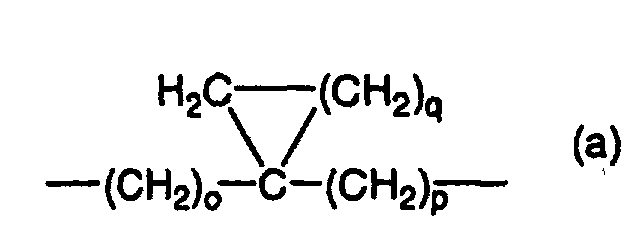
each of which may havea halogen atom, a C1-C4 alkyl group or a C1-C4 alkoxy group as a substituent(s), Z represents a carboxyl group which may be protected; a 1H-tetrazol-5-yl group; a formula: -SO3H group; a formula: -NH-SO2-R3; or a formula: -CO-NH-SO2-R3
wherein R3 represents a C1-C4 alkyl group, a fluoroC1-C4 alkyl group or a phenyl group which may have at least one substituent selected from the group consisting of a halogen atom, a C1-C4 alkyl group,a fluoro C1-C4 alkyl group, a C1-C4 alkoxy group, a fluoro C1-C4 alkoxy group, a nitro group and a cyano group as a substituent(s),
------ represents a single bond or a double bond,
m is an integer of 1 to 4, and when m is 2 or more, then R1 may be the same or different from each other, and n is an integer of 1 to 3, and when n is 2 or more, then R2 may be the same or different from each other,
or a pharmaceutically acceptable salt thereof. - A tricyclic compound or a pharmaceutically acceptable salt thereof according to Claim 1, wherein R1 of the compound represented by the formula (I) is selected from the group consisting of a hydrogen atom, a fluorine atom, a chlorine atom, a bromine atom, a hydroxyl group, a nitro group, a cyano group, a carbamoyl group, a formyl group, a carboxyl group, a methoxycarbonyl group, an ethoxycarbonyl group, a propoxy-carbonyl group, an isopropoxycarbonyl group, a 1H-tetrazol-5-yl group, amethyl group, an ethyl group, a propyl group, an isopropyl group, a fluoromethyl group, a difluoromethyl group, a trifluoromethyl group, a 2-fluoroethyl group, a hydroxymethyl group, a 1-hydroxyethyl group, a 2-hydroxyethyl group, a 1-hydroxy-1-methylethyl group, a 1-hydroxypropyl group, a 2-hydroxypropyl group, a vinyl group, a 1-propenyl group, an allyl group, a 1-butenyl group, a 2-butenyl group, a 2-methyl-1-propenyl group, an ethynyl group, a 1-propynyl group, a 1-butynyl group, a methoxy group, an ethoxy group, a propoxy group, an isopropoxy group, a fluoromethoxy group, a difluoromethoxy group, a trifluoromethoxy group, a 2-fluoroethoxy group, a methylthio group, an ethylthio group, a propylthio group, an isopropylthio group, a methylsulfinyl group, an ethylsulfinyl group, a propylsulfinyl group, an isopropylsulfinyl group, a methylsulfonyl group, an ethyl-sulfonyl group, a propylsulfonyl group and an isopropylsulfonyl group.
- A tricyclic compound or a pharmaceutically acceptable salt thereof according to Claim 1, wherein R1 of the compound represented by the formula (I) is selected from the group consisting of a hydrogen atom, a fluorine atom, a chlorine atom, a hydroxyl group, a nitro group, a cyano group, a carbamoyl group, a formyl group, a methoxycarbonyl group, an ethoxycarbonyl group, a 1H-tetrazol-5-yl group, a methyl group, an ethyl group, a fluoromethyl group, a difluoromethyl group, a trifluoromethyl group, a hydroxymethyl group, a 1-hydroxyethyl group, a 1-hydroxy-1-methylethyl group, a 1-hydroxypropyl group, avinyl group, a 1-propenyl group, an allyl group, an ethynyl group, a 1-propynyl group, a 1-butynyl group, a methoxy group, an ethoxy group, a fluoromethoxy group, a difluoromethoxy group, a trifluoromethoxy group, a methylthio group, an ethylthio group, a methylsulfinylgroup, an ethylsulfinylgroup, amethylsulfonyl group and an ethylsulfonyl group.
- A tricyclic compound or a pharmaceutically acceptable salt thereof according to Claim 1, wherein R1 of the compound represented by the formula (I) is selected from the group consisting of a hydrogen atom, a fluorine atom, a nitro group, a'cyano group, a formyl group, a methoxycarbonyl group, a 1H-tetrazol-5-yl group, a methyl group, a difluoromethyl group, a trifluoromethyl group, a hydroxymethyl group, a 1-hydroxy-1-methylethyl group, a vinyl group, an ethynyl group, a methoxy group, a difluoromethoxy group, a trifluoromethoxy group, a methylthio group, a methylsulfinyl group and a methylsulfonyl group.
- A tricyclic compound or a pharmaceutically acceptable salt thereof according to Claim 1, wherein R1 of the compound represented by the formula (I) is selected from the group consisting of a hydrogen atom, a fluorine atom, a cyano group, a trifluoromethyl group and an ethynyl group.
- A tricyclic compound or a pharmaceutically acceptable salt thereof according to Claim 1, wherein R2 of the compound represented by the formula (I) is selected from the group consisting of a hydrogen atom, a fluorine atom, a chlorine atom, a nitro group, a cyano group, a methyl group, an ethyl group, a methoxy group and an ethoxy group.
- A tricyclic compound or a pharmaceutically acceptable salt thereof according to Claim 1, wherein R2 of the compound represented by the formula (I) is selected from the group consisting of a hydrogen atom, a fluorine atom, a chlorine atom, methyl group and methoxy group.
- A tricyclic compound or a pharmaceutically acceptable salt thereof according to Claim 1, wherein R2 of the compound represented by the formula (I) is a hydrogen atom.
- A tricyclic compound or a pharmaceutically acceptable salt thereof according to Claim 1, wherein the ring shown by A of the compound represented by the formula (I) is selected from the group consisting of furan, thiophene, oxazole, thiazole, imidazole, pyrazole, thiadiazole, pyridine, pyrimidine, pyridazine, pyrazine, benzofuran, benzothiophene, benzoxazole, benzothiazole, benzimidazole, quinoline, quinazoline and quinoxaline rings.
- A tricyclic compound or a pharmaceutically acceptable salt thereof according to Claim 1, wherein the ring shown by A of the compound represented by the formula (I) is selected from the group consisting of oxazole, thiazole, imidazole, pyrazole, thiadiazole, pyridine, pyrimidine, pyridazine, pyrazine, benzoxazole, benzothiazole, benzimidazole, quinoline, quinazoline and quinoxaline rings.
- A tricyclic compound or a pharmaceutically acceptable salt thereof according to Claim 1, wherein the ring shown by A of the compound represented by the formula (I) is selected from the group consisting of thiazole, thiadiazole, pyridine, pyrimidine, benzoxazole, benzothiazole, quinoline and quinazoline rings.
- A tricyclic compound or a pharmaceutically acceptable salt thereof according to Claim 1, wherein the ring shown by A of the compound represented by the formula (I) is selected from the group consisting of pyridine, benzothiazole and quinoline rings.
- A tricyclic compound or a pharmaceutically acceptable salt thereof according to any one of Claims 9 to 12, wherein said heteroaromatic ring group or fused heteroaromatic ring group is substituted by at least one substituent selected from the group consisting of fluorine, chlorine, bromine atoms, nitro, cyano, methyl, ethyl, propyl, isopropyl, butyl, isobutyl, t-butyl, fluoromethyl, difluoromethyl, trifluoromethyl, 2-fluoroethyl, methoxy, ethoxy, propoxy, isopropoxy, fluoromethoxy, difluoromethoxy, trifluoromethoxy, 2-fluoroethoxy, methylthio, ethylthio, propylthio, isopropylthio, trimethylene and tetramethylene groups.
- A tricyclic compound or a pharmaceutically acceptable salt thereof according to any one of Claims 9 to 12, wherein said heteroaromatic ring group or fused heteroaromatic ring group is substituted by at least one substituent selected from the group consisting of fluorine, chlorine atoms, nitro, cyano, methyl, ethyl, isopropyl, t-butyl, fluoromethyl, difluoromethyl, trifluoromethyl, methoxy, ethoxy, fluoromethoxy, difluoromethoxy, trifluoromethoxy, methylthio, ethylthio, trimethylene and tetramethylene groups.
- A tricyclic compound or a pharmaceutically acceptable salt thereof according to any one of Claims 9 to 12, wherein said heteroaromatic ring group or fused heteroaromatic ring group is substituted by at least one substituent selected from the group consisting of fluorine, chlorine atoms, nitro, cyano, methyl, isopropyl, t-butyl, difluoromethyl, trifluoromethyl, methoxy, difluoromethoxy, trifluoromethoxy, methylthio and tetramethylene groups.
- A tricyclic compound or a pharmaceutically acceptable salt thereof according to any one of Claims 9 to 12, wherein said heteroaromatic ring group or fused heteroaromatic ring group is substituted by at least one substituent selected from the group consisting of fluorine, chlorine atoms, trifluoromethyl and tetramethylene groups.
- A tricyclic compound or a pharmaceutically acceptable salt thereof according to Claim 1, wherein A of the compound represented by the formula (I) is selected from the group consisting of 2-oxazolyl, 2-thiazolyl, 2- or 4-imidazolyl, 3-pyrazolyl, 1,3,4-thiadiazol-2-yl, 2-pyridyl, 2- or 4-pyrimidinyl, 3-pyridazinyl, 2-pyrazinyl, 2-benzoxazolyl, 2-benzothiazolyl, 2-benzimidazolyl, quinolin-2-yl, quinazolin-2-yl, quinoxaline-2-yl, 4-methyl-2-thiazolyl, 4-ethyl-2-thiazolyl, 4-isopropyl-2-thiazolyl, 4-t-butyl-2-thiazolyl, 4-trifluoromethyl-2-thiazolyl, 5-methyl-1,3,4-thiadiazol-2-yl, 5-ethyl-1,3,4-thiadiazol-2-yl, 5-isopropyl-1,3,4-thiadiazol-2-yl, 5-t-butyl-1,3,4-thia-diazol-2-yl, 5-trifluoromethyl-1,3,4-thiadiazol-2-yl, 5,6-difluoro-2-pyridyl, 5,6-dichloro-2-pyridyl, 5,6-di-methyl-2-pyridyl, 5,6-diethyl-2-pyridyl, 6-trifluoromethyl-2-pyridyl, 6-methylthio-2-pyridyl, 5,6-dihydroclopenta[b]pyridin-2-yl, 5,6,7,8- tetrahydroquinolin-2-yl, 5,6-difluoro-2-pyrimidinyl, 5,6-dichloro-2-pyrimidinyl, 5,6-dimethyl-2-pyrimidinyl, 6-trifluoromethyl-2-pyrimidin-yl, 5,6-dihydrocyclopenta[d]pyrimidine-2-yl, 5,6,7,8-tetrahydroquinazolin-2-yl, 6-fluoro-2-benzoxazolyl, 5-fluoro-2-benzoxazolyl, 5,6-difluoro-2-benzoxazolyl, 6-chloro-2-benzoxazolyl, 5-chloro-2-benzoxazolyl, 5,6-dichloro-2-benzoxazolyl, 5-chloro-6-fluoro-2-benzoxazolyl, 5-methyl-2-benzoxazolyl, 5-cyano-2-benzoxazolyl, 5-trifluoromethyl-2-benzoxazolyl, 5-methylthio-2-benzoxazolyl, 6-fluoro-2-benzothiazolyl, 5-fluoro-2-benzothiazolyl, 5,6-difluoro-2-benzothiazolyl, 6-chloro-2-benzothiazolyl, 5-chloro-2-benzothiazolyl, 5,6-dichloro-2-benzothiazolyl, 5-chloro-6-fluoro-2-benzothiazolyl, 5-methyl-2-benzothiazolyl, 5-cyano-2-benzothiazolyl, 5-trifluoromethyl-2-benzothiazolyl, 5-methylthio-2-benzothiazolyl, 5-fluoroquinolin-2-yl, 6-fluoroquinolin-2-yl, 7-fluoroquinolin-2-yl, 5-chloroquinolin-2-yl, 6-chloro-quinolin-2-yl, 7-chloroquinolin-2-yl, 7-methylquinolin-2-yl, 7-trifluoromethylquinolin-2-yl, 7-methoxyquinolin-2-yl, 7-difluoromethoxyquinolin-2-yl, 7-trifluoromethoxyquinolin-2- yl, 5,7-difluoroquinolin-2-yl, 6,7-difluoroquinolin-2-yl, 5,7-dichloroquinolin-2-yl, 6,7-dichloroquinolin-2-yl, 5-chloro-7-fluoroquinolin-2-yl, 6-chloro-7-fluoroquinolin-2-yl, 7-chloro-5-fluoroquinolin-2-yl, 7-chloro-6-fluoro-quinolin-2-yl, 7-chloro-6-cyano-quinolin-2-yl, 7-cyano-6-fluoroquinolin-2-yl, 6-fluoro-7-trifluoromethylquinolin-2-yl, 5,6,7-trifluoroquinolin-2-yl, 5-fluoroquinazolin-2-yl, 6-fluoroquinazolin-2-yl, 7-fluoroquinazolin-2-yl, 5-chloro-quinazolin-2-yl, 6-chloroquinazolin-2-yl, 7-chloroquinazol-in-2-yl, 7-methylquinazolin-2-yl, 7-trifluoromethyl-quinazolin-2-yl, 7-methoxyquinazolin-2-yl, 7-difluoro-methoxyquinazolin-2-yl, 7-trifluoromethoxyquinazolin-2-yl, 5,7-difluoroquinazolin-2-yl, 6,7-difluoroquinazolin-2-yl, 5,7-dichloroquinazolin-2-yl, 6,7-dichloroquinazolin-2-yl, 5-chloro-7-fluoroquinazolin-2-yl, 6-chloro-7-fluoroquin-azolin-2-yl, 7-chloro-5-fluoroquinazolin-2-yl, 7-chloro-6-fluoroquinazolin-2-yl, 7-chloro-6-cyano-quinazolin-2-yl, 7-cyano-6-fluoroquinazolin-2-yl, 6-fluoro-7-trifluoro-methylquinazolin-2-yl and 5,6,7-trifluoroquinazolin-2-yl groups.
- A tricyclic compound or a pharmaceutically acceptable salt thereof according to Claim 1, wherein A of the compound represented by the formula (I) is selected from the group consisting of 2-thiazolyl, 1,3,4-thiadiazol-2-yl, 2-pyridyl, 2-pyrimidinyl, 2-benzoxazolyl, 2-benzothiazolyl, quinolin-2-yl, quinazolin-2-yl, 4-methyl-2-thiazolyl, 4-isopropyl-2-thiazolyl, 4-t-butyl-2-thiazolyl, 4-trifluoromethyl-2-thiazolyl, 5-methyl-1,3,4-thiadiazol-2-yl, 5-isopropyl-1,3,4-thiadiazol-2-yl, 5-t-butyl-1,3,4-thiadiazol-2-yl, 5-trifluoromethyl-1,3,4-thiadiazol-2-yl, 5,6-difluoro-2-pyridyl, 5,6-dichloro-2-pyridyl, 5,6-dimethyl-2-pyridyl, 5,6-dihydroclopenta[b]pyridin-2-yl, 5,6,7,8-tetrahydro-quinolin-2-yl, 5,6-difluoro-2-pyrimidinyl, 5,6-dichloro-2-pyrimidinyl, 5,6-dimethyl-2-pyrimidinyl, 6-trifluoro-methyl-2-pyrimidinyl, 5,6-dihydrocyclopenta[d]pyrimidin-2-yl, 5,6,7,8-tetrahydroquinazolin-2-yl, 6-fluoro-2-benzoxazolyl, 5-fluoro-2-benzoxazolyl, 5,6-difluoro-2-benzoxazolyl, 6-chloro-2-benzoxazolyl, 5-chloro-2-benzoxazolyl, 5,6-dichloro-2-benzoxazolyl, 5-chloro-6-fluoro-2-benzoxazolyl, 5-methyl-2-benzoxazolyl, 5-cyano-2-benzoxazolyl, 5-trifluoromethyl-2-benzoxazolyl, 5-methyl-thio-2-benzoxazolyl, 6-fluoro-2-benzothiazolyl, 5-fluoro-2-benzothiazolyl, 5,6-difluoro-2-benzothiazolyl, 6-chloro-2-benzothiazolyl, 5-chloro-2-benzothiazolyl, 5,6-dichloro-2-benzothiazolyl, 5-chloro-6-fluoro-2-benzothiazolyl, 5-methyl-2-benzothiazolyl, 5-cyano-2-benzothiazolyl, 5-trifluoromethyl-2-benzothiazolyl, 5-methylthio-2-benzo-thiazolyl, 5-fluoroquinolin-2-yl, 6-fluoroquinolin-2-yl, 7-fluoroquinolin-2-yl, 5-chloroquinolin-2-yl, 6-chloro-quinolin-2-yl, 7-chloroquinolin-2-yl, 7-methylquinolin-2-yl, 7-trifluoromethylquinolin-2-yl, 7-methoxyquinolin-2-yl, 7-difluoromethoxyquinolin-2-yl, 7-trifluoromethoxy-quinolin-2-yl, 5,7-difluoroquinolin-2-yl, 6,7-difluoro-quinolin-2-yl, 5,7-dichloroquinolin-2-yl, 6,7-dichloro-quinolin-2-yl, 5-chloro-7-fluoroquinolin-2-yl, 6-chloro-7-fluoroquinolin-2-yl, 7-chloro-5-fluoroquinolin-2-yl, 7-chloro-6-fluoroquinolin-2-yl, 7-chloro-6-cyano-quinolin-2-yl, 7-cyano-6-fluoroquinolin-2-yl, 6-fluoro-7-trifluoro-methylquinolin-2-yl, 5,6,7-trifluoroquinolin-2-yl, 5-fluoroquinazolin-2-yl, 6-fluoroquinazolin-2-yl, 7-fluoro-quinazolin-2-yl, 5-chloroquinazolin-2-yl, 6-chloroquinazol-in-2-yl, 7-chloroquinazolin-2-yl, 7-methylquinazolin-2-yl, 7-trifluoromethylquinazolin-2-yl, 7-methoxyquinazolin-2-yl, 7-difluoromethoxyquinazolin-2-yl, 7-trifluoromethoxyquin-azolin-2-yl, 5,7-difluoroquinazolin-2-yl, 6,7-difluoro-quinazolin-2-yl, 5,7-dichloroquinazolin-2-yl, 6,7-dichloro-quinazolin-2-yl, 5-chloro-7-fluoroquinazolin-2-yl, 6-chloro-7-fluoroquinazolin-2-yl, 7-chloro-5-fluoroquinazolin-2-yl, 7-chloro-6-fluoroquinazolin-2-yl, 7-chloro-6-cyano-quina-zolin-2-yl, 7-cyano-6-fluoroquinazolin-2-yl, 6-fluoro-7-trifluoromethylquinazolin-2-yl and 5,6,7-trifluoroquin-azolin-2-yl groups.
- A tricyclic compound or a pharmaceutically acceptable salt thereof according to Claim 1, wherein A of the compound represented by the formula (I) is selected from the group consisting of 2-pyridyl, 2-benzothiazolyl, quinolin-2-yl, 5,6-difluoro-2- pyridyl, 5,6-dichloro-2-pyridyl, 5,6-di-methyl-2-pyridyl, 5,6,7,8-tetrahydroquinolin-2-yl, 6-fluoro-2-benzothiazolyl, 5-fluoro-2-benzothiazolyl, 5,6-difluoro-2-benzothiazolyl, 6-chloro-2-benzothiazolyl, 5-chloro-2-benzothiazolyl, 5,6-dichloro-2-benzothiazolyl, 5-chloro-6-fluoro-2-benzothiazolyl, 5-methyl-2-benzothia-zolyl, 5-cyano-2-benzothiazolyl, 5-trifluoromethyl-2-benzo-thiazolyl, 5-methylthio-2-benzothiazolyl, 5-fluoroquinolin-2-yl, 6-fluoroquinolin-2-yl, 7-fluoroquinolin-2-yl, 5-chloroquinolin-2-yl, 6-chloroquinolin-2-yl, 7-chloro-quinolin-2-yl, 7-methylquinolin-2-yl, 7-trifluoromethyl-quinolin-2-yl, 7-methoxyquinolin-2-yl, 7-difluoromethoxy-quinolin-2-yl, 7-trifluoromethoxyquinolin-2-yl, 5,7-di-fluoroquinolin-2-yl, 6,7-difluoroquinolin-2-yl, 5,7-di-chloroquinolin-2-yl, 6,7-dichloroquinolin-2-yl, 5-chloro-7-fluoroquinolin-2-yl, 6-chloro-7-fluoroquinolin-2-yl, 7-chloro-5-fluoroquinolin-2-yl, 7-chloro-6-fluoroquinolin-2-yl, 7-chloro-6-cyano-quinolin-2-yl, 7-cyano-6-fluoro-quinolin-2-yl, 6-fluoro-7-trifluoromethylquinolin-2-yl and 5,6,7-trifluoroquinolin-2-yl groups.
- A tricyclic compound or a pharmaceutically acceptable salt thereof according to Claim 1, wherein A of the compound represented by the formula (I) is selected from the group consisting of 7-fluoroquinolin-2-yl, 7-chloroquinolin-2-yl, 6,7-difluoroquinolin-2-yl, 6,7-dichloroquinolin-2-yl, 7-chloro-6-fluoroquinolin-2-yl, 6-fluoro-7-trifluoromethyl-quinolin-2-yl and 5,6,7,8-tetrahydroquinolin-2-yl groups.
- A tricyclic compound or a pharmaceutically acceptable salt thereof according to any one of Claims 1 to 20, wherein B in the formula (I) is a formula: -OCH2-, a formula: -CH2O-or a formula: -CH2CH2-.
- A tricyclic compound or a pharmaceutically acceptable salt thereof according to any one of Claims 1 to 20, wherein X in the formula (I) is a methylene group, a sulfur or oxygen atom.
- A tricyclic compound or a pharmaceutically acceptable salt thereof according to Claim 1, wherein Y in the formula (I) is a methylene, ethylene, trimethylene, tetramethylene, pentamethylene, fluoromethylene, difluoromethylene, 1-fluoroethylene, 2-fluoroethylene, 1,1-difluoroethylene, 2,2-difluoroethylene, 1-methylethylene, 2-methylethylene, 1,1-dimethylethylene, 2,2-dimethylethylene, 1-ethylethylene, 2-ethylethylene, 1-methoxyethylene, 2-methoxyethylene, 1-fluorotrimethylene, 2-fluorotrimethylene, 3-fluorotrimethylene, 1,1-difluorotrimethylene, 2,2-difluorotrimethylene, 3,3-difluorotrimethylene, 1-methyltrimethylene, 2-methyltrimethylene, 1,1-dimethyltrimethylene, 2,2-dimethyltrimethylene, 3,3-dimethyltrimethylene, 2,2-diethyl-trimethylene, 2-methoxytrimethylene, 3-methoxytrimethylene, 2,2-dimethoxytrimethylene, 3,3-dimethoxytrimethylene, 1,2-phenylene, 1, 3-phenylene group, a group shown by a group (a) wherein o=0, p=0 and q=1, a group wherein o=0, p=1 and q=1, a group wherein o=0, p=1 and q=2, a group wherein o=1, p=0 and q=1, a group wherein o=1, p=1 and q=1 and a group wherein o=1, p=1 and q=2.
- A tricyclic compound or a pharmaceutically acceptable salt thereof according to Claim 1, wherein Y in the formula (I) is a methylene, ethylene, trimethylene, fluoromethylene, difluoromethylene, 1-fluoroethylene, 2-fluoroethylene, 1,1-difluoroethylene, 2,2-difluoroethylene, 1-methylethylene, 2-methylethylene, 1,1-dimethylethylene, 2,2-dimethylethylene, 1-ethylethylene, 2-ethylethylene, 1-fluorotrimethylene, 2-fluorotrimethylene, 3-fluorotrimethylene, 1,1-difluorotrimethylene, 2,2-difluorotrimethylene, 3,3-difluorotrimethylene, 1-methyltrimethylene, 2-methyltrimethylene, 1,1-dimethyltrimethylene, 2,2-dimethyltrimethylene, 3,3-dimethyltrimethylene, 1,2-phenylene group, , in a group shown by the formula (a), a group wherein o=1, p=0 and q=1, a group wherein o=1, p=1 and q=1 and a group wherein o=1, p=1 and q=2.
- A tricyclic compound or a pharmaceutically acceptable salt thereof according to Claim 1, wherein Y in the formula (I) is a methylene, ethylene, trimethylene, difluoromethylene, 1-fluoroethylene, 2-fluoroethylene, 1,1-difluoroethylene, 2,2-difluoroethylene, 1-methylethylene, 2-methylethylene, 1,1-dimethylethylene, 2,2-dimethylethylene, 1-ethylethylene, 2-ethylethylene, 2,2-difluorotrimethylene, 1-methyltrimethylene, 2-methyltrimethylene, 1,1-dimethyltrimethylene, 2,2-dimethyltrimethylene, 3,3-dimethyltrimethylene, 1.2-phenylene and in a group shown by the formula (a), a group wherein o=1, p=1 and q=1.
- A tricyclic compound or a pharmaceutically acceptable salt thereof according to Claim 1, wherein Y in the formula (I) is a methylene, ethylene, trimethylene, 1-methylethylene, 2-methylethylene, 1,1-dimethylethylene, 2,2-dimethylethylene, 1-ethylethylene, 2-ethylethylene, 1,2-phenylene and in a group shown by the formula (a), a group wherein o=1, p=1 and q=1.
- A tricyclic compound or a pharmaceutically acceptable salt thereof according to Claim 1, wherein Z in the formula (I) is selected from the group consisting of a carboxyl, a 1H-tetrazol-5-yl, a formula: -SO3H, methanesulfonylamino, ethanesulfonylamino, trifluoromethanesulfonylamino, phenylsulfonylamino, p-fluorophenylsulfonylamino, p-chloro-phenylsulfonylamino, o-methylphenylsulfonylamino, p-methylphenylsulfonylamino, p-trifluoromethylphenylsulfonylamino, o-methoxyphenylsulfonylamino, p-methoxyphenylsulfonylamino, p-difluoromethoxyphenylsulfonylamino, p-trifluoromethoxy-phenylsulfonylamino, p-nitrophenylsulfonylamino, p-cyano-phenylsulfonylamino, methanesulfonylaminocarbonyl, ethane-sulfonylaminocarbonyl, trifluoromethanesulfonylaminocarbonyl, phenylsulfonylaminocarbonyl, p-fluorophenyl-sulfonylaminocarbonyl, p-chlorophenylsulfonylaminocarbonyl, o-methylphenylsulfonylaminocarbonyl, p-methylphenylsulfonylaminocarbonyl, p-trifluoromethylphenylsulfonyl-aminocarbonyl, o-methoxyphenylsulfonylaminocarbonyl, p-methoxyphenylsulfonylaminocarbonyl, p-difluoromethoxy-phenylsulfonylaminocarbonyl, p-trifluoromethoxyphenyl-sulfonylaminocarbonyl, p-nitrophenylsulfonylaminocarbonyl and p-cyanophenylsulfonylaminocarbonyl groups.
- A tricyclic compound or a pharmaceutically acceptable salt thereof according to Claim 1, wherein Z in the formula (I) is selected from the group consisting of a carboxyl, a 1H-tetrazol-5-yl, a formula: -SO3H, methanesulfonylamino, trifluoromethanesulfonylamino, phenylsulfonylamino, o-methylphenylsulfonylamino, p-methylphenylsulfonylamino, methanesulfonylaminocarbonyl, trifluoromethanesulfonyl-aminocarbonyl, phenylsulfonylaminocarbonyl, o-methylphenylsulfonylaminocarbonyl and p-methylphenylsulfonylaminocarbonyl groups.
- A tricyclic compound or a pharmaceutically acceptable salt thereof according to Claim 1, wherein Z in the formula (I) is selected from the group consisting of a carboxyl, a formula: -SO3H, methanesulfonylamino, trifluoromethanesulfonylamino, methanesulfonylaminocarbonyl and trifluoromethanesulfonylaminocarbonyl groups.
- A tricyclic compound or a pharmaceutically acceptable salt thereof according to any one of Claims 1 to 5, wherein m in the formula (I) is an integer of 1, 2 or 3.
- A tricyclic compound or a pharmaceutically acceptable salt thereof according to any one of Claims 1 and 6 to 8, wherein n in the formula (I) is an integer of 1 or 2.
- A tricyclic compound or a pharmaceutically acceptable salt thereof according to Claim 1, wherein the compound represented by the formula (I) is at least one selected from the group consisting of:[2-[(E)-2-(6,7-difluoro-2-quinolinyl)ethenyl]-6,11-dihydro-dibenz[b,e]oxepin-11-yl]oxyacetic acid,[2-[(E)-2-(6,7-difluoro-2-quinolinyl)ethenyl]-6,11-dihydro-dibenz[b,e]oxepin-11-yl]thioacetic acid,3-{[2-[(E)-2-(6,7-difluoro-2-quinolinyl)ethenyl]-6,11-di-hydrodibenz[b,e]oxepin-11-yl]thio}propionic acid,3-{[2-[(E)-2-(6,7-difluoro-2-quinolinyl)ethenyl]-6.11-di-hydrodibenz[b,e]oxepin-11-yl]thio}-2-methylpropionic acid,3-{[2-[(E)-2-(6,7-difluoro-2-quinolinyl)ethenyl]-6,11-di-hydrodibenz[b,e]oxepin-11-yl]thio}-2,2-dimethylpropionic acid,3-{[2-[(E)-2-(6,7-difluoro-2-quinolinyl)ethenyl]-6,11-di-hydrodibenz[b,e]oxepin-11-yl]thio}-2-ethylpropionic acid,3-{[2-[(E)-2-(6,7-difluoro-2-quinolinyl)ethenyl]-6,11-di-hydrodibenz[b,e]oxepin-11-yl]thio}-3,3-dimethylpropionic acid,{1-[[2-[(E)-2-(6,7-difluoro-2-quinolinyl)ethenyl]-6,11-di-hydrodibenz[b,e]oxepin-11-yl]thiomethyl]cyclopropyl}acetic acid,2-{(2-[(E)-2-(6,7-difluoro-2-quinolinyl)ethenyl]-6,11-di-hydrodibenz[b,e]oxepin-11-yl]thio}benzoic acid,[2-((E)-2-(6,7-difluoro-2-quinolinyl)ethenyl]-6,11-di-hydrodibenz[b,e]oxepin-11-yl]thio-N-methanesulfonylacet-amide,3-[2-[(E)-2-(6,7-difluoro-2-quinolinyl)ethenyl]-6,11-di-hydrodibenz[b,e]oxepin-11-yl]thio-N-methanesulfonyl-propionamide,2-{[2-[(E)-2-(6,7-difluoro-2-quinolinyl)ethenyl]-6,11-di-hydrodibenz[b,e]oxepin-11-yl]thio}ethanesulfonic acid,4-[2-[(E)-2-(6,7-difluoro-2-quinolinyl)ethenyl]-6,11-di-hydrodibenz[b,e]oxepin-11-yl]butanoic acid,3-{[2-[(E)-2-(6,7-difluoro-2-quinolinyl)ethenyl]-7-fluoro-6,11-dihydrodibenz[b,e]oxepin-11-yl]thio}propionic acid,{1-[[2-[(E)-2-(6,7-difluoro-2-quinolinyl)ethenyl]-7-fluoro-6,11-dihydrodibenz[b,e]oxepin-11-yl]thiomethyl]cyclo-propyl}acetic acid,3-{[2-[(E)-2-(6,7-difluoro-2-quinolinyl)ethenyl]-8-fluoro-6,11-dihydrodibenz[b,e]oxepin-11-yl]thio}propionic acid,3-{[7-cyano-2-[(E)-2-(6,7-difluoro-2-quinolinyl)ethenyl]-6,11-dihydrodibenz[b,e]oxepin-11-yl]thio]propionic acid,3-{[2-[(E)-2-(6,7-difluoro-2-quinolinyl)ethenyl]-7-tri-fluoromethyl-6,11-dihydrodibenz[b,e]oxepin-11-yl]thio}-propionic acid,3-{[7-ethynyl-2-[(E)-2-(6,7-difluoro-2-quinolinyl)-ethenyl]-6,11-dihydrodibenz[b,e]oxepin-11-yl]thio]-propionic acid,3-{(2-[(E)-2-(7-chloro-6-fluoro-2-quinolinyl)ethenyl]-6,11-dihydrodibenz[b,e]oxepin-11-yl]thio}propionic acid,3-{[2-[(E)-2-(7-chloro-6-fluoro-2-quinolinyl)ethenyl]-7-fluoro-6,11-dihydrodibenz[b,e]oxepin-11-yl]thio}propionic acid,{1-[[2-[(E)-2-(7-chloro-6-fluoro-2-quinolinyl)ethenyl]-7-fluoro-6,11-dihydrodibenz[b,e]oxepin-11-yl]thiomethyl]-cyclopropyl}acetic acid,3-{[2-[(E)-2-(7-fluoro-2-quinolinyl)ethenyl]-6,11-dihydro-dibenz[b,e]oxepin-11-yl]thio}propionic acid,3-{[2-[(E)-2-(7-fluoro-2-quinolinyl)ethenyl]-6,11-dihydro-dibenz[b,e]oxepin-11-yl]thio}-2-methylpropionic acid,{1-[(2-[(E)-2-(7-chloro-6-fluoro-2-quinolinyl)ethenyl]-6,11-dihydrodibenz[b,e]oxepin-11-yl]thiomethyl]cyclo-propyl}acetic acid,{2-[(E)-2-(7-chloro-2-quinolinyl)ethenyl]-6,11-dihydrodi-benz[b,e]oxepine-11-yl}thioacetic acid,3-{(2-[(E)-2-(7-chloro-2-quinolinyl)ethenyl]-6,11-dihydro-dibenz[b,e]oxepin-11-yl]thio}propionic acid,3-{[2-[(E)-2-(7-chloro-2-quinolinyl)ethenyl]-6,11-dihydro-dibenz[b,e]oxepin-11-yl]thio}-2-methylpropionic acid,{1-[[2-[(E)-2-(7-chloro-2-quinolinyl)ethenyl]-6,11-dihydro-dibenz(b,e]oxepin-11-yl]thiomethyl]cyclopropyl}acetic acid,3-{[2-[(E)-2-(5,6,7,8-tetrahydro-2-quinolinyl)ethenyl]-6,11-dihydrodibenz[b,e]oxepin-11-yl]thio}propionic acid,3-{[2-[(E)-2-(5,6,7,8-tetrahydro-2-quinolinyl)ethenyl]-6,11-dihydrodibenz[b,e]oxepin-11-yl]thio}-2-methylpropionic acid,{1-[[2-[(E)-2-(5,6,7,8-tetrahydro-2-quinolinyl)ethenyl]-6,11-dihydrodibenz[b,e]oxepin-11-yl]thiomethyl]cyclopropyl} acetic acid,3-{[2-[(E)-2-(6-fluoro-7-trifluoromethyl-2-quinolinyl)-ethenyl]-6,11-dihydrodibenz[b,ejoxepin-11-yl]thio}propionic acid,3-{[3-[(E)-2-(6,7-difluoro-2-quinolinyl)ethenyl]-10,11-di-hydro-5H-dibenz[a,d]cyclohepten-5-yl]thio}propionic acid,3-{[3-[(E)-2-(6,7-difluoro-2-quinolinyl)ethenyl]-10,11-di-hydro-5H-dibenz[a,d]cyclohepten-5-yl]thio}-2-methylpro-pionic acid, and3-{[9-[(E)-2-(6,7-difluoro-2-quinolinyl)ethenyl]-6,11-di-hydrodibenz[b,e]oxepin-11-yl]thio}propionic acid.
Applications Claiming Priority (3)
| Application Number | Priority Date | Filing Date | Title |
|---|---|---|---|
| JP37245599 | 1999-12-28 | ||
| JP37245599 | 1999-12-28 | ||
| PCT/JP2000/009406 WO2001047889A1 (en) | 1999-12-28 | 2000-12-28 | Tricyclic compounds |
Publications (2)
| Publication Number | Publication Date |
|---|---|
| EP1254897A1 true EP1254897A1 (en) | 2002-11-06 |
| EP1254897A4 EP1254897A4 (en) | 2003-04-16 |
Family
ID=18500477
Family Applications (1)
| Application Number | Title | Priority Date | Filing Date |
|---|---|---|---|
| EP00985983A Withdrawn EP1254897A4 (en) | 1999-12-28 | 2000-12-28 | TRICYCLIC CONNECTIONS |
Country Status (5)
| Country | Link |
|---|---|
| US (1) | US20030216571A1 (en) |
| EP (1) | EP1254897A4 (en) |
| AU (1) | AU2230101A (en) |
| CA (1) | CA2395834A1 (en) |
| WO (1) | WO2001047889A1 (en) |
Cited By (1)
| Publication number | Priority date | Publication date | Assignee | Title |
|---|---|---|---|---|
| WO2004043966A1 (en) * | 2002-11-12 | 2004-05-27 | Almirall Prodesfarma S.A. | New tricyclic derivatives as ltd4 antagonists |
Families Citing this family (2)
| Publication number | Priority date | Publication date | Assignee | Title |
|---|---|---|---|---|
| CZ20033519A3 (en) * | 2001-06-27 | 2004-06-16 | Ube Industries, Ltd. | Dibenzocycloheptene compound |
| JP2006151809A (en) * | 2002-12-26 | 2006-06-15 | Ube Ind Ltd | Benzocycloheptapyridine compound |
Family Cites Families (4)
| Publication number | Priority date | Publication date | Assignee | Title |
|---|---|---|---|---|
| IE59889B1 (en) * | 1986-02-14 | 1994-04-20 | Merck Frosst Canada Inc | 2-substituted quinoline dioic acids |
| US5221678A (en) * | 1990-07-26 | 1993-06-22 | Merck Frosst Canada, Inc. | (quinolin-2-ylmethoxy)tetrahydrocarbazoles as inhibitors of the biosynthesis of leukotrienes |
| CN1046279C (en) * | 1993-02-16 | 1999-11-10 | 宇部兴产株式会社 | Quinoline derivatives |
| TW448160B (en) * | 1993-12-28 | 2001-08-01 | Merck & Co Inc | Novel dicyclohexylamine salt and process for the preparation of leukotriene antagonists |
-
2000
- 2000-12-28 WO PCT/JP2000/009406 patent/WO2001047889A1/en not_active Ceased
- 2000-12-28 CA CA002395834A patent/CA2395834A1/en not_active Abandoned
- 2000-12-28 AU AU22301/01A patent/AU2230101A/en not_active Abandoned
- 2000-12-28 US US10/169,199 patent/US20030216571A1/en not_active Abandoned
- 2000-12-28 EP EP00985983A patent/EP1254897A4/en not_active Withdrawn
Cited By (4)
| Publication number | Priority date | Publication date | Assignee | Title |
|---|---|---|---|---|
| WO2004043966A1 (en) * | 2002-11-12 | 2004-05-27 | Almirall Prodesfarma S.A. | New tricyclic derivatives as ltd4 antagonists |
| ES2211315A1 (en) * | 2002-11-12 | 2004-07-01 | Almirall Prodesfarma, S.A. | New tricyclic derivatives as ltd4 antagonists |
| RU2330855C2 (en) * | 2002-11-12 | 2008-08-10 | Альмираль Продесфарма С.А. | New tricyclic derivatives as ltd4 antagonists |
| US7557212B2 (en) | 2002-11-12 | 2009-07-07 | Laboratorios Almirall, S.A. | Tricyclic derivatives as LTD4 antagonists |
Also Published As
| Publication number | Publication date |
|---|---|
| WO2001047889A1 (en) | 2001-07-05 |
| CA2395834A1 (en) | 2001-07-05 |
| AU2230101A (en) | 2001-07-09 |
| EP1254897A4 (en) | 2003-04-16 |
| US20030216571A1 (en) | 2003-11-20 |
Similar Documents
| Publication | Publication Date | Title |
|---|---|---|
| US6596758B1 (en) | Benzopyrans and benzoxepines, pharmaceutical compositions comprising them and preparation process | |
| AU614358B2 (en) | Alpha-substituted 4-(quinolin-2-yl-methoxy)-phenylacetic acids and -esters | |
| US20070142420A1 (en) | 4-heteroaryl-tetrahydroquinolines and their use as inhibitors of the cholesterin-ester transfer protein | |
| CA2249402C (en) | Benzopyran derivatives having leukotriene-antagonistic action | |
| US7309718B2 (en) | Dibenzocycloheptene compound | |
| EP1910288B1 (en) | 3-aminocarbazole compounds, pharmaceutical composition containing the same and method for the preparation thereof | |
| JP2006508116A (en) | Novel tricyclic derivatives as LTD4 antagonists | |
| WO2009115874A2 (en) | Novel heterocyclic compounds, pharmaceutical compositions containing them and processes for their preparation | |
| US20030216571A1 (en) | Tricyclic compounds | |
| US5250540A (en) | Aminomethyl-substituted 2,3-dihydropyrano[2,3-b]pyridines and their use in medicaments | |
| EP0685478B1 (en) | Quinoline derivatives | |
| US20090105327A1 (en) | Dibenzocycloheptane compounds and pharmaceuticals containing these compounds | |
| DK156066B (en) | METHOD OF ANALOGUE FOR THE PREPARATION OF OXALOAMINO OR HYDROXYACETYLAMINOBENZOPYRANE DERIVATIVES OR SALTS THEREOF WITH BASES | |
| JP2013503822A (en) | Synthetic method of Montelukast sodium intermediate | |
| CA2283404A1 (en) | Cycloalka¬b|pyridine-3-carbonylguanidine derivatives, process for producing the same, and drugs containing the same | |
| JPWO2001047889A1 (en) | Tricyclic compounds | |
| JP2006151809A (en) | Benzocycloheptapyridine compound | |
| US5310744A (en) | Quinolylmethoxyphenyl-acetamides | |
| US20090111849A1 (en) | Crystalline salt of montelukast | |
| JP3141148B2 (en) | Condensed indane derivatives and salts thereof | |
| SU1024007A3 (en) | Method of producing derivatives of pyrido/1,2-alpha-pyrimidine or their salts with alkaline metals, or their optic isomers | |
| US5288733A (en) | Quinolylmethoxyphenylacetic acid acylamides and ureas | |
| CN114380783B (en) | Preparation method of olopatadine deuterium labeled metabolite | |
| JPH0250906B2 (en) | ||
| PL174102B1 (en) | Novel isobutyl substituted quinolinomethoxyphenyl-cycloalkyoacetic methanosulfonyl amides |
Legal Events
| Date | Code | Title | Description |
|---|---|---|---|
| PUAI | Public reference made under article 153(3) epc to a published international application that has entered the european phase |
Free format text: ORIGINAL CODE: 0009012 |
|
| 17P | Request for examination filed |
Effective date: 20020710 |
|
| AK | Designated contracting states |
Kind code of ref document: A1 Designated state(s): AT BE CH CY DE DK ES FI FR GB GR IE IT LI LU MC NL PT SE TR |
|
| AX | Request for extension of the european patent |
Free format text: AL;LT;LV;MK;RO;SI |
|
| A4 | Supplementary search report drawn up and despatched |
Effective date: 20030304 |
|
| 17Q | First examination report despatched |
Effective date: 20030612 |
|
| STAA | Information on the status of an ep patent application or granted ep patent |
Free format text: STATUS: THE APPLICATION IS DEEMED TO BE WITHDRAWN |
|
| 18D | Application deemed to be withdrawn |
Effective date: 20031223 |