EP1254882A1 - Process for preparing bicyclo 2.2.1]heptane derivatives - Google Patents
Process for preparing bicyclo 2.2.1]heptane derivatives Download PDFInfo
- Publication number
- EP1254882A1 EP1254882A1 EP01951140A EP01951140A EP1254882A1 EP 1254882 A1 EP1254882 A1 EP 1254882A1 EP 01951140 A EP01951140 A EP 01951140A EP 01951140 A EP01951140 A EP 01951140A EP 1254882 A1 EP1254882 A1 EP 1254882A1
- Authority
- EP
- European Patent Office
- Prior art keywords
- bicyclo
- heptane
- ene
- formula
- hept
- Prior art date
- Legal status (The legal status is an assumption and is not a legal conclusion. Google has not performed a legal analysis and makes no representation as to the accuracy of the status listed.)
- Granted
Links
- 0 *C1C(C2)C=CC2C1* Chemical compound *C1C(C2)C=CC2C1* 0.000 description 5
Classifications
-
- C—CHEMISTRY; METALLURGY
- C07—ORGANIC CHEMISTRY
- C07C—ACYCLIC OR CARBOCYCLIC COMPOUNDS
- C07C5/00—Preparation of hydrocarbons from hydrocarbons containing the same number of carbon atoms
- C07C5/22—Preparation of hydrocarbons from hydrocarbons containing the same number of carbon atoms by isomerisation
- C07C5/23—Rearrangement of carbon-to-carbon unsaturated bonds
- C07C5/25—Migration of carbon-to-carbon double bonds
-
- C—CHEMISTRY; METALLURGY
- C07—ORGANIC CHEMISTRY
- C07C—ACYCLIC OR CARBOCYCLIC COMPOUNDS
- C07C5/00—Preparation of hydrocarbons from hydrocarbons containing the same number of carbon atoms
- C07C5/22—Preparation of hydrocarbons from hydrocarbons containing the same number of carbon atoms by isomerisation
- C07C5/23—Rearrangement of carbon-to-carbon unsaturated bonds
- C07C5/25—Migration of carbon-to-carbon double bonds
- C07C5/2506—Catalytic processes
-
- C—CHEMISTRY; METALLURGY
- C07—ORGANIC CHEMISTRY
- C07C—ACYCLIC OR CARBOCYCLIC COMPOUNDS
- C07C13/00—Cyclic hydrocarbons containing rings other than, or in addition to, six-membered aromatic rings
- C07C13/28—Polycyclic hydrocarbons or acyclic hydrocarbon derivatives thereof
- C07C13/32—Polycyclic hydrocarbons or acyclic hydrocarbon derivatives thereof with condensed rings
- C07C13/39—Polycyclic hydrocarbons or acyclic hydrocarbon derivatives thereof with condensed rings with a bicyclo ring system containing seven carbon atoms
- C07C13/40—Polycyclic hydrocarbons or acyclic hydrocarbon derivatives thereof with condensed rings with a bicyclo ring system containing seven carbon atoms with a bicycloheptane ring structure
-
- C—CHEMISTRY; METALLURGY
- C07—ORGANIC CHEMISTRY
- C07C—ACYCLIC OR CARBOCYCLIC COMPOUNDS
- C07C13/00—Cyclic hydrocarbons containing rings other than, or in addition to, six-membered aromatic rings
- C07C13/28—Polycyclic hydrocarbons or acyclic hydrocarbon derivatives thereof
- C07C13/32—Polycyclic hydrocarbons or acyclic hydrocarbon derivatives thereof with condensed rings
- C07C13/39—Polycyclic hydrocarbons or acyclic hydrocarbon derivatives thereof with condensed rings with a bicyclo ring system containing seven carbon atoms
- C07C13/42—Polycyclic hydrocarbons or acyclic hydrocarbon derivatives thereof with condensed rings with a bicyclo ring system containing seven carbon atoms with a bicycloheptene ring structure
-
- C—CHEMISTRY; METALLURGY
- C07—ORGANIC CHEMISTRY
- C07C—ACYCLIC OR CARBOCYCLIC COMPOUNDS
- C07C5/00—Preparation of hydrocarbons from hydrocarbons containing the same number of carbon atoms
- C07C5/22—Preparation of hydrocarbons from hydrocarbons containing the same number of carbon atoms by isomerisation
- C07C5/23—Rearrangement of carbon-to-carbon unsaturated bonds
- C07C5/25—Migration of carbon-to-carbon double bonds
- C07C5/2506—Catalytic processes
- C07C5/2518—Catalytic processes with crystalline alumino-silicates, e.g. molecular sieves
-
- C—CHEMISTRY; METALLURGY
- C07—ORGANIC CHEMISTRY
- C07C—ACYCLIC OR CARBOCYCLIC COMPOUNDS
- C07C2602/00—Systems containing two condensed rings
- C07C2602/36—Systems containing two condensed rings the rings having more than two atoms in common
- C07C2602/42—Systems containing two condensed rings the rings having more than two atoms in common the bicyclo ring system containing seven carbon atoms
Definitions
- the present invention relates to novel methods for producing bicyclo[2.2.1]heptanederivatives. More precisely, the invention relates to economical and efficient methods for producing 2-methylene-3-methylbicyclo[2.2.1]heptane, 2,3-dimethylbicyclo[2.2.1]hept-2-ene, 2-ethylidenebicyclo[2.2.1]heptane and 2-ethylbicyclo[2.2.1]hept-2-ene that are useful for materials of producing a base oil of traction drive fluid used for a lubricating oil for driving a fraction drive apparatus.
- Traction drive fluid that is used for traction drive lubricating oil for driving a traction drive apparatus for stepless regulators in automobiles and industrial machines is required to have specific properties of high traction coefficient and low pour point.
- cyclic compound derivatives are used in base oil of traction drive fluid.
- dimers of bicyclo[2.2.1]heptane derivatives have been proposed (Japanese Patent No.2,060,214).
- bicyclo[2.2.1]heptane derivatives especially 2-methylene-3-methylbicyclo[2.2.1]heptane, 2,3-dimethylbicycio[2.2.1]hept-2-ene, 2-ethylidenebicyclo[2.2.1]heptane and 2-ethylbicyclo[2.2.1]-hept-2-ene are important compounds as materials for producing base oil of traction drive fluid.
- the compounds of the type are obtained, for example, by reacting crotonaldehyde with dicyclopentadiene through Diels-Alder reaction, then hydrogenating the reaction product and dehydrating it.
- the process of producing bicyclo[2.2.1] compounds requires three steps of Diels-Alder reaction, hydrogenation and dehydration.
- Another problem with the process is that the reactant crotonaldehyde is relatively expensive and therefore the production costs are high.
- the present invention has been made in consideration of the above-mentioned point, and its object is to provide economical and efficient methods for producing bicyclo[2.2.1]heptane derivatives such as 2-methylene-3-methylbicyclo[2.2.1]heptane, 2,3-dimethylbicyclo[2.2.1]hept-2-ene, 2-ethylidenebicyclo[2.2.1]heptane and 2-ethylbicyclo[2.2.1]-hept-2-ene.
- bicyclo[2.2.1]heptane derivatives such as 2-methylene-3-methylbicyclo[2.2.1]heptane, 2,3-dimethylbicyclo[2.2.1]hept-2-ene, 2-ethylidenebicyclo[2.2.1]heptane and 2-ethylbicyclo[2.2.1]-hept-2-ene.
- the present inventors have assiduously studied to attain the above-mentioned object and, as a result, have found that the object can be effectively attained by starting from relatively inexpensive and easily available compounds and selecting the reaction condition of the compounds . On the basis of this finding, we have completed the present invention.
- C 3-4 acyclic olefins are reacted with cyclopentadiene to give the intended bicyclo[2.2.1]heptane derivatives.
- the C 3-4 acyclic olefins include, for example, 1-butene, 2-butene and propylene. Of those, 2-butene and 1-butene are preferred for the starting compounds in the invention.
- the starting compounds, 2-butene and cyclopentadiene are reacted with each other, and the resulting 5,6-dimethylbicyclo[2.2.1]hept-2-ene is isomerized in the presence of an isomerization catalyst to give 2-methylene-3-methylbicyclo[2.2.1]heptane and/or 2,3-dimethylbicyclo[2.2.1]hept-2-ene.
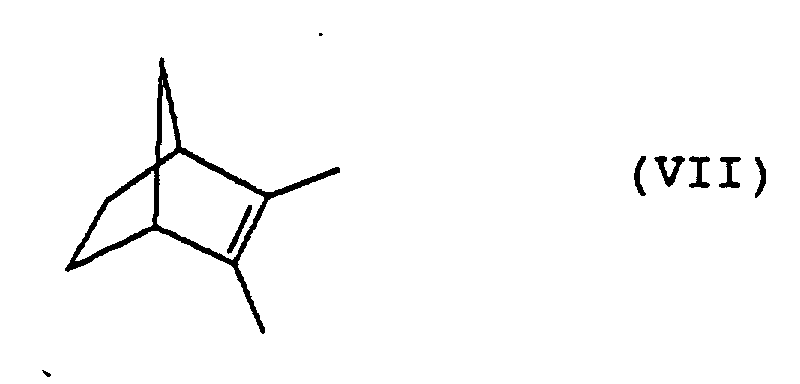
- the intermediate 5,6-dimethylbicyclo[2.2.1]hept-2-ene in this method of the invention is represented by the following chemical formula (V), and the final products 2-methylene-3-methylbicyclo[2.2.1]heptane and 2,3-dimethylbicyclo[2.2.1]hept-2-ene are by the following chemical formulae (VI) and (VII), respectively:
- the bicyclo[2.2.1]heptane derivatives can be produced in at least 2 steps starting from inexpensive 2-butene and cyclopentadiene. In addition, they can be produced only in one step, as described hereinunder.
- the starting compounds, 2-butene and cyclopentadiene are reacted with each other. This is Diels-Alder reaction.
- 2-butene may be trans-2-butene or cis-2-butene alone or may be their mixture. These are inexpensive and easily available.
- cyclopentadiene may be cyclopentadiene itself, or may also be derived from dicyclopentadiene in situ.
- dicyclopentadiene is readily pyrolyzed to give cyclopentadiene, and the resulting cyclopentadiene is substantially reacted with 2-butene.
- dicyclopentadiene is, while pyrolyzed to give cyclopentadiene, reacted with 2-butene through Diels-Alder reaction.
- the blend ratio of the starting compounds, 2-butene and cyclopentadiene is not specifically defined.
- 2-butene is excessive over its theoretical amount, or that is, the ratio of 2-butene/cyclopentadiene (by mol) is at least 1 or more.
- the reaction mixture may contain a large quantity of heavy compounds in addition to the intended products. More preferably, the blend ratio of the starting compounds falls between 2 and 20, even more preferably between 4 and 15.
- the starting compounds mentioned above are reacted with each other through Diels-Alder reaction.
- the reaction is generally effected at about 20 to 400°C, but preferably at 100 to 350°C.
- the reaction is preferably effected at 150 to 350°C. This is for promoting the pyrolysis of dicyclopentadiene.
- the Diels-Alder reaction pressure is not also specifically defined, and the reaction may be effected under any pressure.
- the starting compounds are reacted under no specific pressure, but the vapor pressure of 2-butene increases the reaction pressure, and the pressure varies depending on the reaction temperature.
- this 5,6-dimethylbicyclo[2.2.1]hept-2-ene is isomerized in the presence of an isomerization catalyst.
- the isomerization catalyst is an acidic solid catalyst generally referred to as a solid acid catalyst.
- a solid acid catalyst includes metal oxides such as alumina, silica, titania, zirconia, chromia, zinc oxide, silica-alumina, silica-magnesia, alumina-boria, silica-boria, silica-zirconia; metal phosphates such as calcium phosphate, zirconium phosphate, calcium hydroxyapatite; metal sulfates such as magnesium sulfate, calcium sulfate, aluminium sulfate; phyllosilicates such as bentonite, montmorillonite, kaolin; clays such as activated clay, acid clay; solid acids prepared by infiltrating solid phosphoric acid or sulfuric acid into silica or alumina; and other ion-exchange resins and zeolite.
- metal oxides such as alumina, silica, titan
- silica-alumina, alumina-boria and zeolite have a high acid strength; titania and montmorillonite have a medium acid strength; and alumina and silica have a low acid strength.
- the acid strength of catalyst is generally indicated by the acidity function thereof.
- solid acid catalysts mentioned above preferred are those having a middle to high acid strength, as their ability to realize high conversion and high selectivity is good.
- the catalyst is generally so controlled that its weight hourly space velocity, WHSV falls between 0.01 and 20 h -1 , preferably between 0.1 and 10 h -1 .
- the isomerization may be effected in the absence or presence of a solvent such as an organic solvent.
- the isomerization temperature preferably falls between about 20 and 400°C, more preferably between about 50 and 250°C. If the reaction temperature is lower than about 20°C, the isomerization will be delayed and the method will be impracticable; but if higher than 400°C, the products will be pyrolyzed.
- the preferred reaction temperature range varies, depending on the acid strength of the isomerization catalyst used. For example, when the acid strength of the isomerization catalyst used is high, the reaction temperature may fall between 20°C and 150°C; when it is medium, the temperature may fall between 150°C and 250°C; and when it is low, the temperature may fall between 250°C and 400°C.
- the isomerization pressure is not specifically defined, and may be effected under any pressure. In general, the isomerization is effected under no specific pressure.
- the method of the invention comprises two steps of Diels-Alder reaction and isomerization to give the bicyclo[2.2.1]heptane derivatives of formulae (VI) and/or (VII). Apart from it, the bicyclo[2.2.1]heptane derivatives can also be produced in one step.
- the method of the invention to give the bicyclo[2.2.1]heptane derivatives in one step comprises reacting 2-butene with cyclopentadiene in the presence of an isomerization catalyst for simultaneous isomerization to give 2-methylene-3-methylbicyclo[2.2.1]heptane and/or 2,3-dimethylbicyclo[2.2.1]hept-2-ene.
- the one-step method does not substantially differ from the two-step method except for the point that the isomerization catalyst is in the initial reaction system. Therefore, the details of the isomerization catalyst to be used and those of the starting compounds to be reacted and their blend ratio in the one-step method may be substantially the same as those in the above-mentioned two-step method.
- the two methods do not also substantially differ in point of the other reaction conditions such as reaction temperature and reaction pressure. Accordingly, the reaction temperature in the one-step method may fall between about 20 and 400°C, preferably between 100 and 350°C. More preferably, it falls between 150 and 350°C when the reaction starts from dicyclopentadiene.
- the reaction pressure the system does not require any specific pressure, and its pressure may be the vapor pressure at the reaction temperature.
- 2-methylene-3-methylbicyclo[2.2.1]heptane and/or 2,3-dimethylbicyclo[2.2.1]hept-2-ene are also produced efficiently.
- an acyclic olefin mixture of 2-butene and 1-butene gives a mixture of 2-methylene-3-methylbicyclo[2.2.1]heptane, 2,3-dimethylbicyclo[2.2.1]hept-2-ene, 2-ethylidenebicyclo[2.2.1]heptane and 2-ethylbicyclo[2.2.1]hept-2-ene.
- a flow-type normal pressure reaction tube of quartz glass having an outer diameter of 20 mm and a length of 500 mm was filled with 25 g of alumina-boria (Shokubai Kasei Kogyo's C-15), and the fraction was introduced into it and isomerized at 155°C and at a weight hourly space velocity (WHSV) of 1.0 hr -1 .
- WHSV weight hourly space velocity
- reaction product contains 9 % 2,3-dimethylbicyclo[2.2.1]hept-2-ene and 4 % 2-methylene-3-methylbicyclo[2.2.1]heptane, in addition to 5,6-dimethylbicyclo[2.2.1]hept-2-ene.
- Example 3 The same process as in Example 3 was repeated except that 15 g of silica-containing ⁇ -alumina (Shokubai Kasei Kogyo's DHC-1) but not 10 g of ⁇ -alumina was used as the catalyst. This gave 6 g of an isomerized product of 5,6-dimethylbicyclo[2.2.1]hept-2-ene, containing 64 % 2,3-dimethylbicyclo[2.2.1]hept-2-ene and 26 % 2-methylene-3-methylbicyclo[2.2.1]heptane.
- Example 2 The same process as in Example 1 was repeated except that 1-butene was used in place of the mixed 2-butene. This gave 93 g of an isomerized product of 5-ethylbicyclo[2.2.1]hept-2-ene, containing 67 % 2-ethylbicyclo[2.2.1]hept-2-ene and 29 % 2-ethylidenebicyclo[2.2.1]heptane.
- a flow-type normal pressure reaction tube of quartz glass having an outer diameter of 20 mm and a length of 500 mm was filled with 25 g of alumina-boria (Shokubai Kasei Kogyo' s C-15), and the fraction was introduced into it and isomerized at 155°C and at a weight hourly space velocity (WHSV) of 1.0 hr -1 .
- WHSV weight hourly space velocity
- Example 2 The same process as in Example 2 was repeated except that isomerizing the distilled fraction was tried with ceramic balls at 250°C, not with the silica-alumina catalyst (Nikki Chemical's N-632L) at 110°C, but in vain. In this, the starting compound 5,6-dimethylbicyclo[2.2.1]hept-2-ene was not isomerized and was directly collected still as it was after the process.
- the methods of the invention give the intended bicyclo[2.2.1]heptane derivatives such as 2-methylene-3-methylbicyclo[2.2.1]heptane, 2,3-dimethylbicyclo[2.2.1]hept-2-ene, 2-ethylidenebicyclo[2.2.1]heptane and 2-ethylbicyclo[2.2.1]-hept-2-ene only in one step or two steps, and the methods are economical and efficient.
Landscapes
- Chemical & Material Sciences (AREA)
- Organic Chemistry (AREA)
- Chemical Kinetics & Catalysis (AREA)
- Crystallography & Structural Chemistry (AREA)
- Organic Low-Molecular-Weight Compounds And Preparation Thereof (AREA)
- Low-Molecular Organic Synthesis Reactions Using Catalysts (AREA)
Abstract
Description

followed by isomerizing them in the presence of an isomerization catalyst to give one or more bicyclo[2.2.1]heptane derivatives of the following general formula (II):


in the presence of an isomerization catalyst to give one or more bicyclo[2.2.1]heptane derivatives of the following general formula (II):



Claims (11)
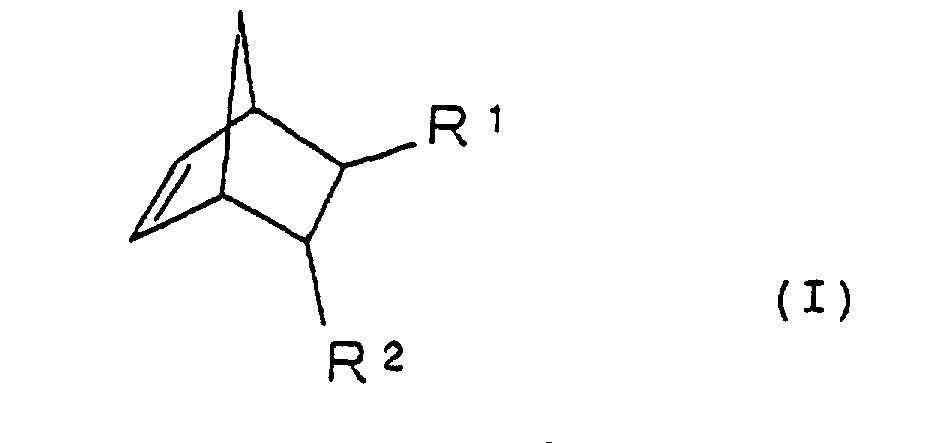
- A method for producing bicyclo[2.2.1]heptane derivatives, which comprises reacting one or more C3-4 acyclic olefins with cyclopentadiene to give bicyclo[2.2.1]heptene derivatives of the following general formula (I):wherein R1 and R2 each represent a hydrogen atom, a methyl group or an ethyl group, and the sum of the carbon atoms in R1 and R2 is 1 or 2,

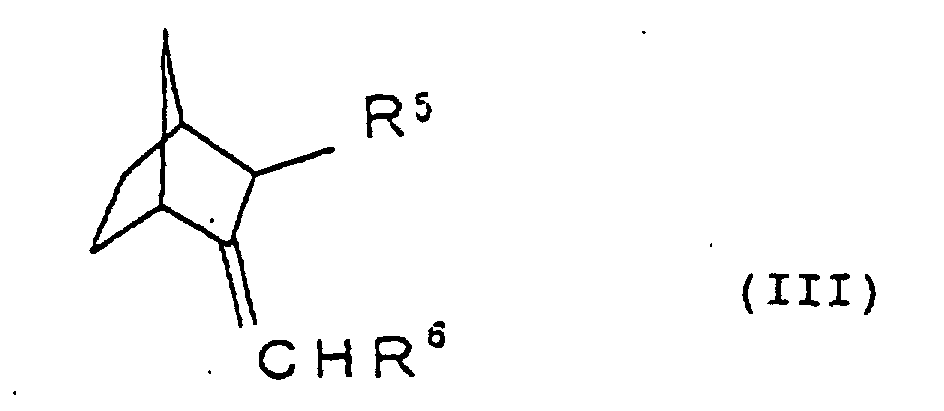
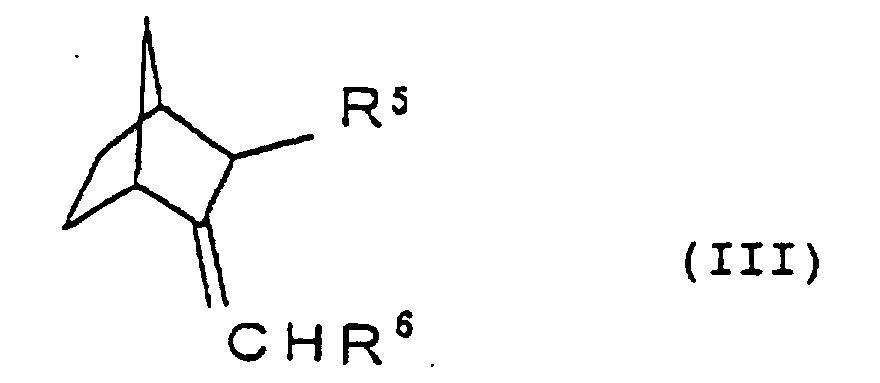
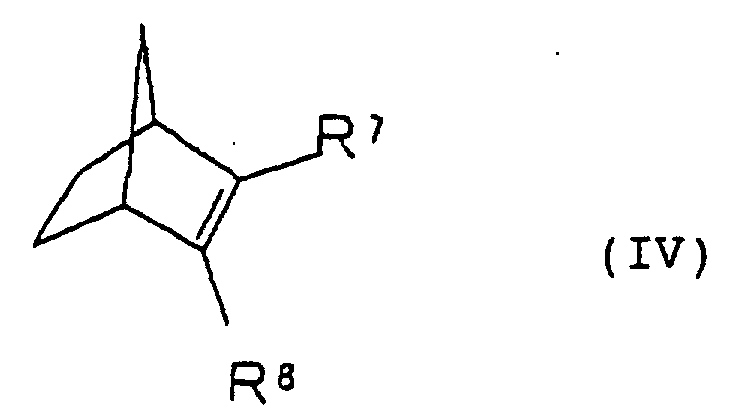
followed by isomerizing them in the presence of an isomerization catalyst to give one or more bicyclo[2.2.1]heptane derivatives of the following general formula (II):wherein R3 and R4 each represent a hydrogen atom or a methyl group, and the sum of the carbon atoms in R3 and R4 is 0 or 1, the following general formula (III):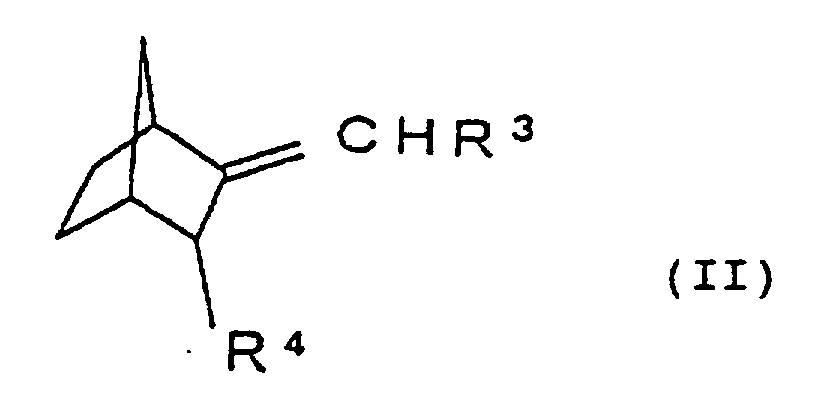 wherein R5 and R6 each represent a hydrogen atom or a methyl group, and the sum of the carbon atoms in R5 and R6 is 0 or 1, and the following general formula (IV):
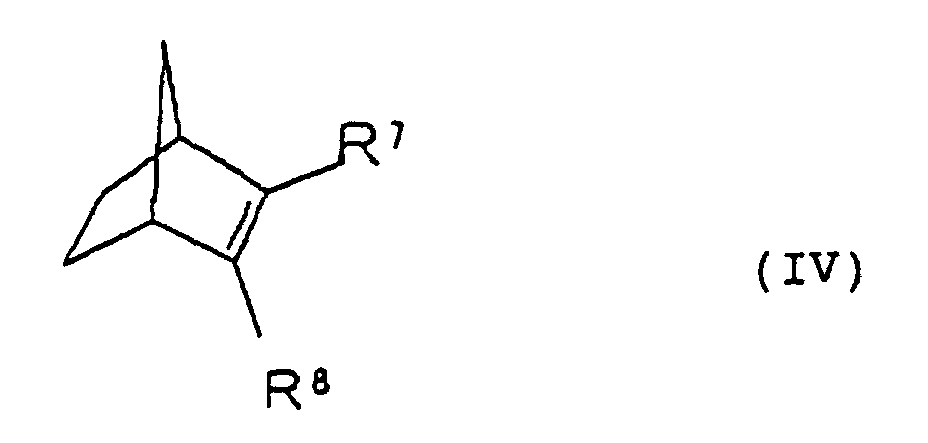
 wherein R7 and R8 each represent a hydrogen atom, a methyl group or an ethyl group, and the sum of the carbon atoms in R7 and R8 is 1 or 2.
- The method for producing bicyclo[2.2.1]heptane derivatives as claimed in claim 1, wherein the acyclic olefin is 2-butene, the bicyclo[2.2.1]heptene derivative of formula (I) is 5,6-dimethylbicyclo[2.2.1]hept-2-ene, the bicyclo[2.2.1]heptane derivative of formula (II) or (III) is 2-methylene-3-methylbicyclo[2.2.1]heptane, and the bicyclo[2.2.1]heptane derivative of formula (IV) is 2,3-dimethylbicyclo[2.2.1]hept-2-ene.
- The method for producing bicyclo[2.2.1]heptane derivatives as claimed in claim 1, wherein the acyclic olefin is 1-butene, the bicyclo[2.2.1]heptene derivative of formula (I) is 5-ethylbicyclo[2.2.1]hept-2-ene, the bicyclo[2.2.1]heptane derivative of formula (II) or (III) is 2-ethylidenebicyclo[2.2.1]heptane, and the bicyclo[2.2.1]heptane derivative of formula (IV) is 2-ethylbicyclo[2.2.1]hept-2-ene.
- A method for producing bicyclo[2.2.1)heptane derivatives, which comprises reacting one or more C3-4 acyclic olefins with cyclopentadiene in the presence of an isomerization catalyst for simultaneous isomerization to give one or more bicyclo[2.2.1]heptane derivatives of the following general formula (II):wherein R3 and R4 each represent a hydrogen atom or a methyl group, and the sum of the carbon atoms in R3 and R4 is 0 or 1, the following general formula (III):
 wherein R5 and R6 each represent a hydrogen atom or a methyl group, and the sum of the carbon atoms in R5 and R6 is 0 or 1, and the following general formula (IV):
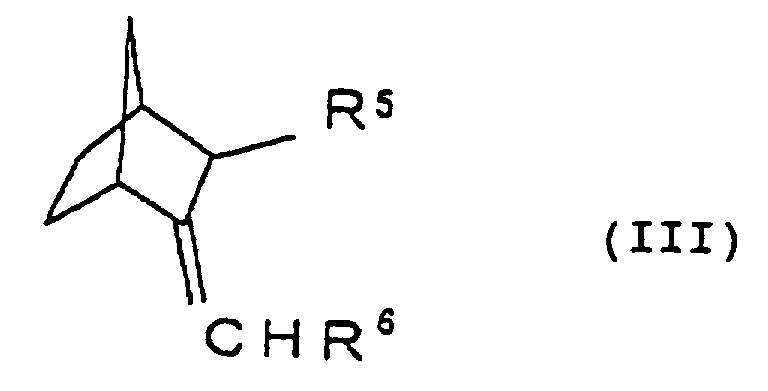 wherein R7 and R8 each represent a hydrogen atom, a methyl group or an ethyl group, and the sum of the carbon atoms in R7 and R8 is 1 or 2.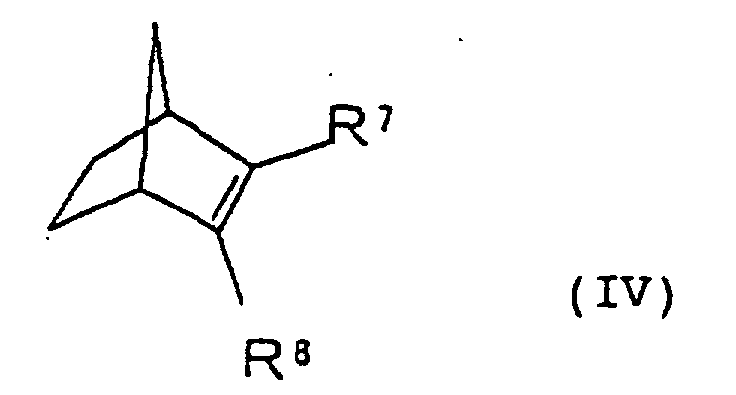
- The method for producing bicyclo[2.2.1]heptane derivatives as claimed in claim 4, wherein the acyclic olefin is 2-butene, the bicyclo[2.2.1]heptane derivative of formula (II) or (III) is 2-methylene-3-methylbicyclo[2.2.1]heptane, and the bicyclo[2.2.1]heptane derivative of formula (IV) is 2,3-dimethylbicyclo[2.2.1]hept-2-ene.
- The method for producing bicyclo[2.2.1]heptane derivatives as claimed in claim 4, wherein the acyclic olefin is 1-butene, the bicyclo[2.2.1]heptane derivative of formula (II) or (III) is 2-ethylidenebicyclo[2.2.1]heptane, and the bicyclo[2.2.1]heptane derivative of formula (IV) is 2-ethylbicyclo[2.2.1]hept-2-ene.
- A method for producing bicyclo[2.2.1]heptane derivatives, which comprises isomerizing bicyclo[2.2.1]heptene derivatives of the following general formula (I):wherein R1 and R2 each represent a hydrogen atom, a methyl group or an ethyl group, and the sum of the carbon atoms in R1 and R2 is 1 or 2,

in the presence of an isomerization catalyst to give one or more bicyclo[2.2.1]heptane derivatives of the following general formula (II):wherein R3 and R4 each represent a hydrogen atom or a methyl group, and the sum of the carbon atoms in R3 and R4 is 0 or 1, the following general formula (III):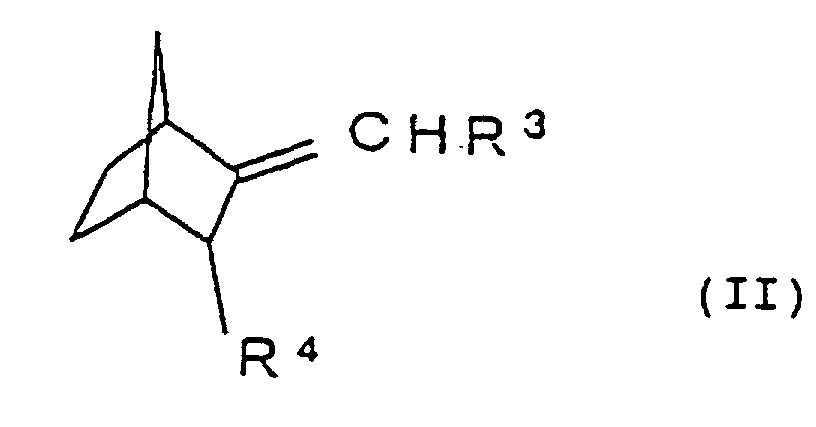 wherein R5 and R6 each represent a hydrogen atom or a methyl group, and the sum of the carbon atoms in R5 and R6 is 0 or 1, and the following general formula (IV):
 wherein R7 and R8 each represent a hydrogen atom, a methyl group or an ethyl group, and the sum of the carbon atoms in R7 and R8 is 1 or 2.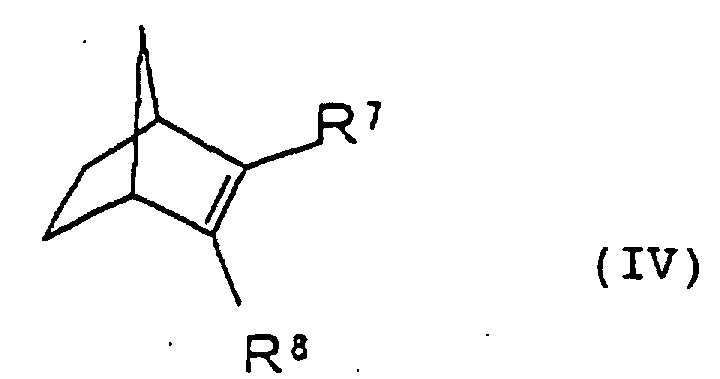
- The method for producing bicyclo[2.2.1]heptane derivatives as claimed in claim 7, wherein the bicyclo[2.2.1]heptene derivative of formula (I) is 5,6-dimethylbicyclo[2.2.1]hept-2-ene, the bicyclo[2.2.1]heptane derivative of formula (II) or (III) is 2-methylene-3-methylbicyclo[2.2.1]heptane, and the bicyclo[2.2.1]heptane derivative of formula (IV) is 2,3-dimethylbicyclo[2.2.1]hept-2-ene.
- The method for producing bicyclo[2.2.1]heptane derivatives as claimed in claim 7, wherein the bicyclo[2.2.1]heptene derivative of formula (I) is 5-ethylbicyclo[2.2.1]hept-2-ene, the bicyclo[2.2.1]heptane derivative of formula (II) or (III) is 2-ethylideriebicyclo[2.2.1]heptane, and the bicyclo[2.2.1]heptane derivative of formula (IV) is 2-ethylbicyclo[2.2.1]hept-2-ene.
- The method for producing bicyclo[2.2.1]heptane derivatives as claimed in any of claims 1 to 9, wherein the isomerization catalyst is a solid acid catalyst.
- The method for producing bicyclo[2.2.1]heptane derivatives as claimed in any of claims 1 to 6 and 10, wherein dicyclopentadiene is used in place of cyclopentadiene and, while pyrolyzed into cyclopentadiene, it is reacted with one or more C3-4 acyclic olefins.
Applications Claiming Priority (3)
| Application Number | Priority Date | Filing Date | Title |
|---|---|---|---|
| JP2000033164 | 2000-02-10 | ||
| JP2000033164A JP4354070B2 (en) | 2000-02-10 | 2000-02-10 | Method for producing bicyclo [2.2.1] heptane derivative |
| PCT/JP2001/000811 WO2001058838A1 (en) | 2000-02-10 | 2001-02-06 | Process for preparing bicyclo[2.2.1]heptane derivatives |
Publications (3)
| Publication Number | Publication Date |
|---|---|
| EP1254882A1 true EP1254882A1 (en) | 2002-11-06 |
| EP1254882A4 EP1254882A4 (en) | 2005-06-01 |
| EP1254882B1 EP1254882B1 (en) | 2006-05-24 |
Family
ID=18557683
Family Applications (1)
| Application Number | Title | Priority Date | Filing Date |
|---|---|---|---|
| EP01951140A Expired - Lifetime EP1254882B1 (en) | 2000-02-10 | 2001-02-06 | Process for preparing bicyclo 2.2.1|heptane derivatives |
Country Status (7)
| Country | Link |
|---|---|
| US (1) | US6841713B2 (en) |
| EP (1) | EP1254882B1 (en) |
| JP (1) | JP4354070B2 (en) |
| KR (1) | KR100694361B1 (en) |
| AT (1) | ATE327212T1 (en) |
| DE (1) | DE60119892T2 (en) |
| WO (1) | WO2001058838A1 (en) |
Families Citing this family (4)
| Publication number | Priority date | Publication date | Assignee | Title |
|---|---|---|---|---|
| JP4667654B2 (en) * | 2001-06-22 | 2011-04-13 | 出光興産株式会社 | Bicyclo [2.2.1] heptane derivatives |
| WO2004026998A1 (en) * | 2002-09-18 | 2004-04-01 | Idemitsu Kosan Co., Ltd. | Traction drive fluid compositions |
| US10696610B2 (en) | 2017-12-11 | 2020-06-30 | Valvoline Licensing And Intellectual Property Llc | Scalable synthesis of hydrogenated alpha styrene dimer |
| WO2020186139A1 (en) | 2019-03-13 | 2020-09-17 | Valvoline Licensing And Intellectual Property Llc | Novel traction fluid with improved low temperature properties |
Family Cites Families (3)
| Publication number | Priority date | Publication date | Assignee | Title |
|---|---|---|---|---|
| JPS563854B2 (en) | 1972-11-02 | 1981-01-27 | ||
| JP2561758B2 (en) * | 1991-04-08 | 1996-12-11 | 出光興産株式会社 | Fluid for traction drive, method for producing the same, and bicyclooctane compound |
| JPH0640956A (en) | 1992-07-23 | 1994-02-15 | Idemitsu Petrochem Co Ltd | Production of 5-alkyliden-2-norbornene |
-
2000
- 2000-02-10 JP JP2000033164A patent/JP4354070B2/en not_active Expired - Fee Related
-
2001
- 2001-02-06 EP EP01951140A patent/EP1254882B1/en not_active Expired - Lifetime
- 2001-02-06 WO PCT/JP2001/000811 patent/WO2001058838A1/en not_active Ceased
- 2001-02-06 KR KR1020027010263A patent/KR100694361B1/en not_active Expired - Fee Related
- 2001-02-06 US US10/181,433 patent/US6841713B2/en not_active Expired - Lifetime
- 2001-02-06 AT AT01951140T patent/ATE327212T1/en not_active IP Right Cessation
- 2001-02-06 DE DE60119892T patent/DE60119892T2/en not_active Expired - Lifetime
Also Published As
| Publication number | Publication date |
|---|---|
| WO2001058838A1 (en) | 2001-08-16 |
| DE60119892D1 (en) | 2006-06-29 |
| JP2001226296A (en) | 2001-08-21 |
| EP1254882A4 (en) | 2005-06-01 |
| JP4354070B2 (en) | 2009-10-28 |
| KR100694361B1 (en) | 2007-03-12 |
| ATE327212T1 (en) | 2006-06-15 |
| US6841713B2 (en) | 2005-01-11 |
| DE60119892T2 (en) | 2006-10-19 |
| KR20020077428A (en) | 2002-10-11 |
| EP1254882B1 (en) | 2006-05-24 |
| US20030045762A1 (en) | 2003-03-06 |
Similar Documents
| Publication | Publication Date | Title |
|---|---|---|
| KR0124371B1 (en) | Traction fluid, preparation method thereof and bicyclooctane compound | |
| US8935891B2 (en) | Olefin metathesis catalyst containing tungsten fluorine bonds | |
| EP0276096A1 (en) | An olefin metathesis process | |
| EP1254882B1 (en) | Process for preparing bicyclo 2.2.1|heptane derivatives | |
| JP2005170903A (en) | Method for producing bicyclo [2.2.1] heptane derivative | |
| US5254786A (en) | Olefin disproportionation catalyst and process | |
| JP2887011B2 (en) | Catalytic alkenylbenzene cyclization | |
| CA2822796C (en) | Olefin metathesis process and catalyst containing tungsten fluorine bonds | |
| KR100263541B1 (en) | Process for producing an oligomer | |
| Mravec et al. | Cyclohexylation of naphthalene over unmodified HY zeolites | |
| US5098876A (en) | Olefin disproportionation catalyst and process | |
| US6504069B1 (en) | Process for producing dimethyltetralin | |
| JP2919907B2 (en) | Method for producing methyl norbornene dicarboxylic anhydride | |
| JP2001247490A (en) | Method for producing dicyclopentadiene | |
| JP4456718B2 (en) | Process for producing unsaturated bicyclo [2.2.1] heptane derivative | |
| Grigor’eva et al. | Selective dimerization of higher cycloolefins in the presence of micro-and micromesoporous zeolite catalysts | |
| JP2005225815A (en) | Process for producing bicyclo [2.2.1] heptenes | |
| CA1274203A (en) | Process for making lubricating oil from olefins | |
| JP2000239194A (en) | Method for producing dimethyltetralin | |
| US20120316374A1 (en) | Olefin metathesis process using a catalyst containing tungsten fluorine bonds | |
| US3373215A (en) | Acid catalyzed isomerization of cyclic-monoolefins | |
| SU1133253A1 (en) | Process for preparing cyclohexadiene-1,3 or methylcyclohexadienes-1,3 | |
| JP2980758B2 (en) | Process for producing alkenylbenzene and derivatives thereof | |
| JP2002302460A (en) | Process for producing exo-tetrahydrodicyclopentadiene and catalyst for isomerization reaction | |
| JPH0672908A (en) | Method for producing oligomer |
Legal Events
| Date | Code | Title | Description |
|---|---|---|---|
| PUAI | Public reference made under article 153(3) epc to a published international application that has entered the european phase |
Free format text: ORIGINAL CODE: 0009012 |
|
| 17P | Request for examination filed |
Effective date: 20020715 |
|
| AK | Designated contracting states |
Kind code of ref document: A1 Designated state(s): AT BE CH CY DE DK ES FI FR GB GR IE IT LI LU MC NL PT SE TR |
|
| A4 | Supplementary search report drawn up and despatched |
Effective date: 20050415 |
|
| GRAP | Despatch of communication of intention to grant a patent |
Free format text: ORIGINAL CODE: EPIDOSNIGR1 |
|
| GRAS | Grant fee paid |
Free format text: ORIGINAL CODE: EPIDOSNIGR3 |
|
| GRAA | (expected) grant |
Free format text: ORIGINAL CODE: 0009210 |
|
| AK | Designated contracting states |
Kind code of ref document: B1 Designated state(s): AT BE CH CY DE DK ES FI FR GB GR IE IT LI LU MC NL PT SE TR |
|
| PG25 | Lapsed in a contracting state [announced via postgrant information from national office to epo] |
Ref country code: IT Free format text: LAPSE BECAUSE OF FAILURE TO SUBMIT A TRANSLATION OF THE DESCRIPTION OR TO PAY THE FEE WITHIN THE PRE;WARNING: LAPSES OF ITALIAN PATENTS WITH EFFECTIVE DATE BEFORE 2007 MAY HAVE OCCURRED AT ANY TIME BEFORE 2007. THE CORRECT EFFECTIVE DATE MAY BE DIFFERENT FROM THE ONE RECORDED.SCRIBED TIME-LIMIT Effective date: 20060524 Ref country code: FI Free format text: LAPSE BECAUSE OF FAILURE TO SUBMIT A TRANSLATION OF THE DESCRIPTION OR TO PAY THE FEE WITHIN THE PRESCRIBED TIME-LIMIT Effective date: 20060524 Ref country code: CH Free format text: LAPSE BECAUSE OF FAILURE TO SUBMIT A TRANSLATION OF THE DESCRIPTION OR TO PAY THE FEE WITHIN THE PRESCRIBED TIME-LIMIT Effective date: 20060524 Ref country code: LI Free format text: LAPSE BECAUSE OF FAILURE TO SUBMIT A TRANSLATION OF THE DESCRIPTION OR TO PAY THE FEE WITHIN THE PRESCRIBED TIME-LIMIT Effective date: 20060524 Ref country code: AT Free format text: LAPSE BECAUSE OF FAILURE TO SUBMIT A TRANSLATION OF THE DESCRIPTION OR TO PAY THE FEE WITHIN THE PRESCRIBED TIME-LIMIT Effective date: 20060524 |
|
| REG | Reference to a national code |
Ref country code: GB Ref legal event code: FG4D |
|
| REG | Reference to a national code |
Ref country code: CH Ref legal event code: EP |
|
| REG | Reference to a national code |
Ref country code: IE Ref legal event code: FG4D |
|
| REF | Corresponds to: |
Ref document number: 60119892 Country of ref document: DE Date of ref document: 20060629 Kind code of ref document: P |
|
| PG25 | Lapsed in a contracting state [announced via postgrant information from national office to epo] |
Ref country code: DK Free format text: LAPSE BECAUSE OF FAILURE TO SUBMIT A TRANSLATION OF THE DESCRIPTION OR TO PAY THE FEE WITHIN THE PRESCRIBED TIME-LIMIT Effective date: 20060824 Ref country code: SE Free format text: LAPSE BECAUSE OF FAILURE TO SUBMIT A TRANSLATION OF THE DESCRIPTION OR TO PAY THE FEE WITHIN THE PRESCRIBED TIME-LIMIT Effective date: 20060824 |
|
| PG25 | Lapsed in a contracting state [announced via postgrant information from national office to epo] |
Ref country code: ES Free format text: LAPSE BECAUSE OF FAILURE TO SUBMIT A TRANSLATION OF THE DESCRIPTION OR TO PAY THE FEE WITHIN THE PRESCRIBED TIME-LIMIT Effective date: 20060904 |
|
| PG25 | Lapsed in a contracting state [announced via postgrant information from national office to epo] |
Ref country code: PT Free format text: LAPSE BECAUSE OF FAILURE TO SUBMIT A TRANSLATION OF THE DESCRIPTION OR TO PAY THE FEE WITHIN THE PRESCRIBED TIME-LIMIT Effective date: 20061024 |
|
| REG | Reference to a national code |
Ref country code: CH Ref legal event code: PL |
|
| ET | Fr: translation filed | ||
| PG25 | Lapsed in a contracting state [announced via postgrant information from national office to epo] |
Ref country code: MC Free format text: LAPSE BECAUSE OF NON-PAYMENT OF DUE FEES Effective date: 20070228 |
|
| PLBE | No opposition filed within time limit |
Free format text: ORIGINAL CODE: 0009261 |
|
| STAA | Information on the status of an ep patent application or granted ep patent |
Free format text: STATUS: NO OPPOSITION FILED WITHIN TIME LIMIT |
|
| 26N | No opposition filed |
Effective date: 20070227 |
|
| PG25 | Lapsed in a contracting state [announced via postgrant information from national office to epo] |
Ref country code: IE Free format text: LAPSE BECAUSE OF NON-PAYMENT OF DUE FEES Effective date: 20070206 |
|
| PG25 | Lapsed in a contracting state [announced via postgrant information from national office to epo] |
Ref country code: GR Free format text: LAPSE BECAUSE OF FAILURE TO SUBMIT A TRANSLATION OF THE DESCRIPTION OR TO PAY THE FEE WITHIN THE PRESCRIBED TIME-LIMIT Effective date: 20060825 |
|
| PG25 | Lapsed in a contracting state [announced via postgrant information from national office to epo] |
Ref country code: CY Free format text: LAPSE BECAUSE OF FAILURE TO SUBMIT A TRANSLATION OF THE DESCRIPTION OR TO PAY THE FEE WITHIN THE PRESCRIBED TIME-LIMIT Effective date: 20060524 Ref country code: LU Free format text: LAPSE BECAUSE OF NON-PAYMENT OF DUE FEES Effective date: 20070206 |
|
| PG25 | Lapsed in a contracting state [announced via postgrant information from national office to epo] |
Ref country code: TR Free format text: LAPSE BECAUSE OF FAILURE TO SUBMIT A TRANSLATION OF THE DESCRIPTION OR TO PAY THE FEE WITHIN THE PRESCRIBED TIME-LIMIT Effective date: 20060524 |
|
| REG | Reference to a national code |
Ref country code: FR Ref legal event code: PLFP Year of fee payment: 16 |
|
| REG | Reference to a national code |
Ref country code: FR Ref legal event code: PLFP Year of fee payment: 17 |
|
| PGFP | Annual fee paid to national office [announced via postgrant information from national office to epo] |
Ref country code: NL Payment date: 20170110 Year of fee payment: 17 |
|
| PGFP | Annual fee paid to national office [announced via postgrant information from national office to epo] |
Ref country code: FR Payment date: 20170112 Year of fee payment: 17 Ref country code: DE Payment date: 20170131 Year of fee payment: 17 |
|
| PGFP | Annual fee paid to national office [announced via postgrant information from national office to epo] |
Ref country code: GB Payment date: 20170201 Year of fee payment: 17 Ref country code: BE Payment date: 20161228 Year of fee payment: 17 |
|
| REG | Reference to a national code |
Ref country code: DE Ref legal event code: R119 Ref document number: 60119892 Country of ref document: DE |
|
| REG | Reference to a national code |
Ref country code: NL Ref legal event code: MM Effective date: 20180301 |
|
| GBPC | Gb: european patent ceased through non-payment of renewal fee |
Effective date: 20180206 |
|
| REG | Reference to a national code |
Ref country code: BE Ref legal event code: MM Effective date: 20180228 |
|
| REG | Reference to a national code |
Ref country code: FR Ref legal event code: ST Effective date: 20181031 |
|
| PG25 | Lapsed in a contracting state [announced via postgrant information from national office to epo] |
Ref country code: NL Free format text: LAPSE BECAUSE OF NON-PAYMENT OF DUE FEES Effective date: 20180301 |
|
| PG25 | Lapsed in a contracting state [announced via postgrant information from national office to epo] |
Ref country code: DE Free format text: LAPSE BECAUSE OF NON-PAYMENT OF DUE FEES Effective date: 20180901 |
|
| PG25 | Lapsed in a contracting state [announced via postgrant information from national office to epo] |
Ref country code: GB Free format text: LAPSE BECAUSE OF NON-PAYMENT OF DUE FEES Effective date: 20180206 Ref country code: FR Free format text: LAPSE BECAUSE OF NON-PAYMENT OF DUE FEES Effective date: 20180228 Ref country code: BE Free format text: LAPSE BECAUSE OF NON-PAYMENT OF DUE FEES Effective date: 20180228 |