EP1253555A2 - Robust and stealthy video watermarking - Google Patents
Robust and stealthy video watermarking Download PDFInfo
- Publication number
- EP1253555A2 EP1253555A2 EP02006190A EP02006190A EP1253555A2 EP 1253555 A2 EP1253555 A2 EP 1253555A2 EP 02006190 A EP02006190 A EP 02006190A EP 02006190 A EP02006190 A EP 02006190A EP 1253555 A2 EP1253555 A2 EP 1253555A2
- Authority
- EP
- European Patent Office
- Prior art keywords
- frames
- watermark
- recited
- computer
- region
- Prior art date
- Legal status (The legal status is an assumption and is not a legal conclusion. Google has not performed a legal analysis and makes no representation as to the accuracy of the status listed.)
- Withdrawn
Links
Images


Classifications
-
- H—ELECTRICITY
- H04—ELECTRIC COMMUNICATION TECHNIQUE
- H04N—PICTORIAL COMMUNICATION, e.g. TELEVISION
- H04N19/00—Methods or arrangements for coding, decoding, compressing or decompressing digital video signals
- H04N19/46—Embedding additional information in the video signal during the compression process
- H04N19/467—Embedding additional information in the video signal during the compression process characterised by the embedded information being invisible, e.g. watermarking
-
- G—PHYSICS
- G06—COMPUTING OR CALCULATING; COUNTING
- G06T—IMAGE DATA PROCESSING OR GENERATION, IN GENERAL
- G06T1/00—General purpose image data processing
- G06T1/0021—Image watermarking
- G06T1/005—Robust watermarking, e.g. average attack or collusion attack resistant
-
- G—PHYSICS
- G06—COMPUTING OR CALCULATING; COUNTING
- G06T—IMAGE DATA PROCESSING OR GENERATION, IN GENERAL
- G06T1/00—General purpose image data processing
- G06T1/0021—Image watermarking
- G06T1/0085—Time domain based watermarking, e.g. watermarks spread over several images
-
- G—PHYSICS
- G06—COMPUTING OR CALCULATING; COUNTING
- G06T—IMAGE DATA PROCESSING OR GENERATION, IN GENERAL
- G06T2201/00—General purpose image data processing
- G06T2201/005—Image watermarking
- G06T2201/0065—Extraction of an embedded watermark; Reliable detection
Definitions
- This invention generally relates to a technology facilitating the protection of rights in the content of a video sequence.
- This invention further generally relates to a technology facilitating embedding imperceptible, de-synchronization-resistant watermarks in video sequence and facilitating detecting such watermarks.
- a "video sequence” is a series of images that typically capture (or simulate) motion, life, action, movement, etc.
- the video sequences are typically accompanied by audio.
- Watermarking a video sequence presents a series of significant challenges that are greater than those faced when watermarking other "digital goods.”
- Digital goods is a generic label for electronically stored or transmitted content. Examples of digital videos include images, audio clips, video, digital film, multimedia, software, and data.
- a video sequence is a specific type of digital videos. It may also be called a "digital video,” “video signal,” “video bitstream,” “video stream,” “streaming video,” “video media,” “video object,” “video,” “digital film,” “digital movie,” and the like.
- digital video is a high-quality form of video.
- Digital videos are often distributed to consumers over private and public networks ⁇ such as Intranets and the Internet. In particular, they may be "broadcast” via streaming video of a live or recorded event. In addition, these videos are distributed to consumers via fixed computer readable media, such as a compact disc (CD-ROM), digital versatile disc (DVD), soft magnetic tape, soft magnetic diskette, or hard magnetic disk (e.g., a preloaded hard drive).
- CD-ROM compact disc
- DVD digital versatile disc
- soft magnetic tape e.g., a preloaded hard drive
- Digital videos may be stored in one or many different formats.
- Some of the more common multimedia file formats include: MPEG, Video of Windows®, QuickTimeTM, RealVideoTM, ShockwaveTM, and the like.
- Content owners include the content author, artist, publisher, developer, distributor, etc.
- the content-based industries e.g., entertainment, music, film, television, etc.
- the content-based industries e.g., entertainment, music, film, television, etc.
- Watermarking is one of the most promising techniques for protecting the content owner's rights of a digital video. Generally, watermarking is a process of altering the digital video such that its perceptual characteristics are preserved. More specifically, a "digital watermark" (or simply “watermark”) is a pattern of bits inserted into a digital video that may be used to identify the content owners and/or the protected rights.
- Watermarks are designed to be completely invisible or, more precisely, to be imperceptible to humans and statistical analysis tools. Ideally, a watermarked video signal is perceptually identical to the original video signal.
- a watermark embedder i.e., encoder
- a watermark detector i.e., decoder
- watermarking techniques To detect the watermark, some watermarking techniques require access to the original unmarked digital video or to a pristine specimen of the marked digital video. Some, watermarking techniques are “blind.” This means that they do not require access to the original unmarked digital video or to a pristine specimen of the marked digital video. Of course, these "blind” watermarking techniques are desirable when the watermark detector is publicly available.
- a watermarked signal Before detection, a watermarked signal may undergo many possible changes by users and by the distribution environment. These changes may include unintentional modifications, such as noise and distortions. Moreover, the marked signal is often the subject of malicious attacks particularly aimed at disabling the detection of the watermark.
- a watermarking technique should embed detectible watermarks that resist modifications and attacks as long as they result in signals that are of perceptually the same quality.
- a watermarking technique that is resistant to modifications and attacks may be called “robust.” Aspects of such techniques are called “robust” if they encourage such resistance.
- a watermarking system should be robust enough to handle unintentional noise introduction into the signal (such noise my be introduced by A/D and D/A conversions, compressions/decompressions, data corruption during transmission, etc.)
- a watermarking system should be robust enough and stealthy enough to avoid purposeful and malicious detection, alternation, and/or deletion of the watermark.
- Such attack may use a "shotgun” approach where no specific watermark is known or detected (but is assumed to exist) or may use “sharp-shooter” approach where the specific watermark is attacked.
- such a digital watermark may be simply called a “watermark.”
- a watermark Generically, it may be called an "information pattern of discrete values.”
- Watermarking technology has several highly desirable goals (i.e., desiderata) to facilitate protection of copyrights of video content publishers. Below are listed several of such goals.
- Perceptual Invisibility The embedded information should not induce perceptual changes in the video quality of the resulting watermarked signal.
- the test of perceptual invisibility is often called the "golden eyes and ears” test.
- Tamperproofhess An attempt to remove the watermark should damage the value of the video well above the hearing threshold.
- the system should be inexpensive to license and implement on both programmable and application-specific platforms.
- Non-disclosure of the Original The watermarking and detection protocols should be such that the process of proving video content copyright both in-situ and in-court, does not involve usage of the original recording.
- the watermarking technique should provide strong and undeniable copyright proof. Similarly, it should enable a spectrum of protection levels, which correspond to variable video presentation and compression standards.
- a watermark is "hard-to-break” when it is “extremely hard” for an attacker to break the watermark even though the attacker may know watermarking technique.
- breaking refers to successfully modifying or removing the watermark. In particular, it should be nearly impossible to break the mark under almost all practical situations even if an attacker has a supercomputer.
- a video is a series of video "frames.” Each frame of the video is an image. Since videos are a series of images, one way to watermark a video is to embed a watermark (wholly or partially) in each frame (or a significant number) of the video.
- watermarking a video sequence presents a series of significant challenges that are greater than those faced when watermarking other "digital goods.” Particular examples of these challenges include perceptual invisibility and resistance to de-synchronization attacks. Although watermarking other types of media (e.g., images and audio) also faces these challenges, the problems of perceptual invisibility and resistance to de-synchronization are particularly acute and specifically unique for videos.
- the watermark (or portions thereof) may be embedded into each frame of the video.
- the chances of a digital pirate discovering the watermark increases as the watermark repetition increases.
- Embedding the watermark (or portions thereof) in each frame is also undesirable because it provides convenient range for the pirate to focus her efforts.
- it provides potentially thousands of bounded targets (i.e., frames) containing the same hidden data (i.e., the watermark). With this much bounded information, a digital pirate has a good chance of determining the watermark.
- watermarks may be selectively encoded in individual frames or groups of frames within the video.
- the detector typically must be synchronized along the temporal axis so that it know where (or when) to look for the watermarks. Digital pirates know this.
- a de-synchronization attack is one of their most watermark-fatal'arrows in their quiver.
- de-synching may occur unintentionally particularly when video signal is transmitted.
- Resisting de-synchronization is a particularly difficult challenge in the video realm.
- a pirate may, for example, do any of the following to de-synch a video:
- this de-synch attack splits a series of frames in which the full watermark is encoded, then the watermark may go undetected. If this attack manages to remove the isolated frames including the watermarks, then the watermark may go undetected.
- a watermark should be perceptually invisible (which include statistically invisible) within the signal. Achieving perceptual invisibility is a particularly difficult challenge in the video realm.
- a series of successive frames have one or more common sections. These common sections contain the same image data. For example, if the camera capturing the video frames is fixed on relatively stationary objects or people, then the vast majority of each frame will be identical. Typically, if the camera is fixed, the background remains identical in each frame.
- the watermark (or portions thereof) is not encoded in every frame of the video, then some frames will have no portion of the watermark encoded therein. Consequently, there will be a transition between encoded frames and non-encoded frames. Typically, perceptible "flicker" occurs at that transition. Flicker is the perceptible manifestation of the transition. This problem is particular to video.
- Flicker may be visible to the human eye. If not, it may be noticeable by statistical analysis tools. Since watermark encoding introduces “noise” into a frame, the transition from “noisy” to “noiseless” frame produces perceptible flicker in the common sections of the frames of that transition.
- the framework should be resistant to de-synchronization.
- the framework should possess several attributes that further the desiderata of watermark technology, described above. In particular, it should be perceptually invisible; thus, it should minimize or eliminate flicker.
- This technology further generally relates to a technology facilitating embedding imperceptible, de-synchronization-resistant watermarks in video sequence and facilitating detecting such watermarks.
- One or more implementations, described herein hide and/or detect stealthy and robust watermarks in digital video signals. These watermarks are resistant against unintentional and intentional modifications. In particular, the watermarks are resistant to de-synchronization. In addition, the watermarks are perceptually invisible. The watermarks are hidden in the video so that flicker is minimized or eliminated.
- one or more implementations, described herein hide a watermark (of portions thereof) over one or more regions of successive frames.
- Each region has a center defined by a hash value.
- a watermark (of portions thereof) is encoded into the region in a "plateau” manner.
- the mark (of portions thereof) is fully encoded in the frames surrounding the region's center, but trail off towards the edges of the region.
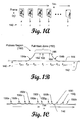
- Fig. 1A illustrates the frames (i.e., images) of a video sequence.
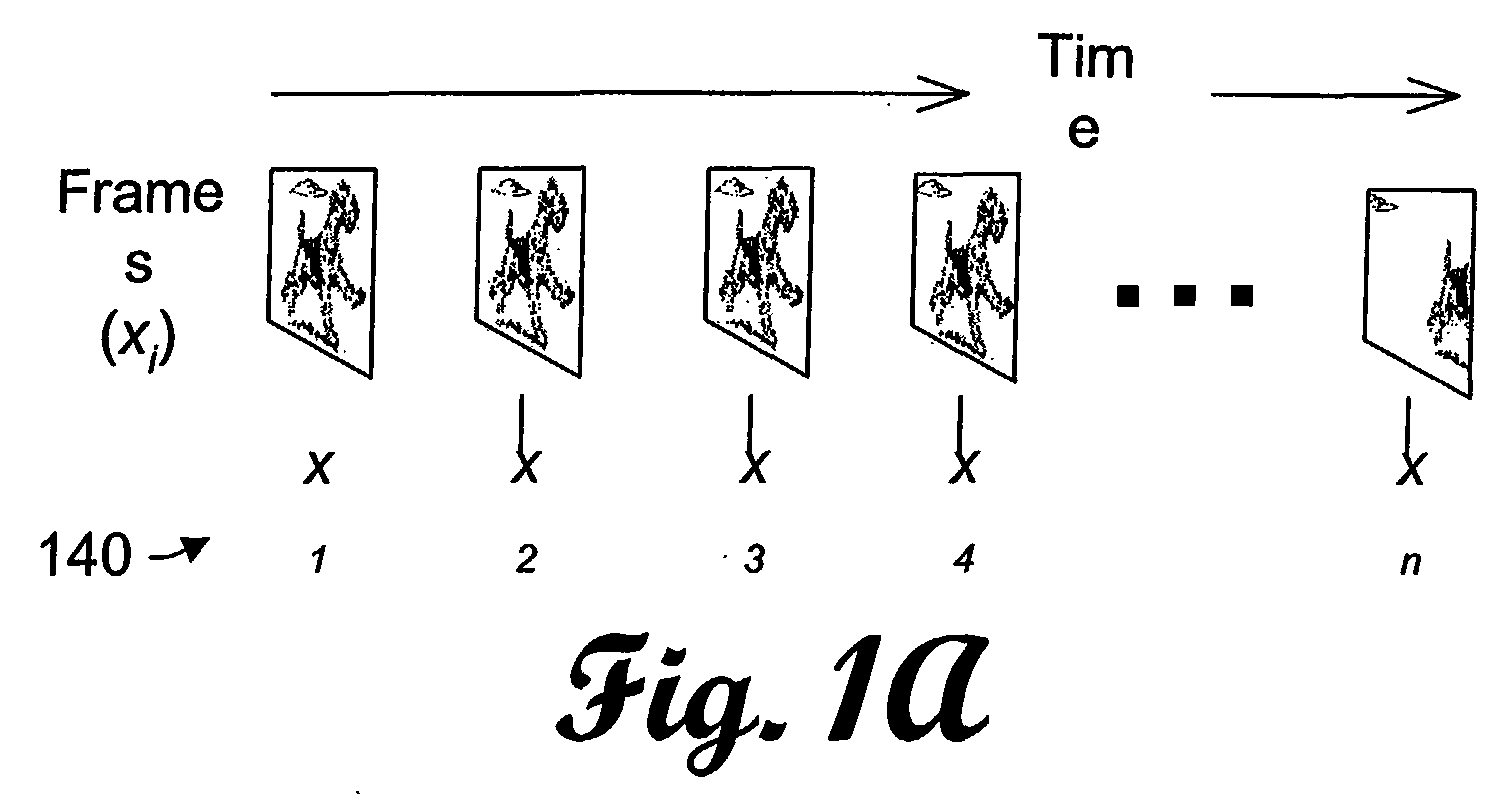
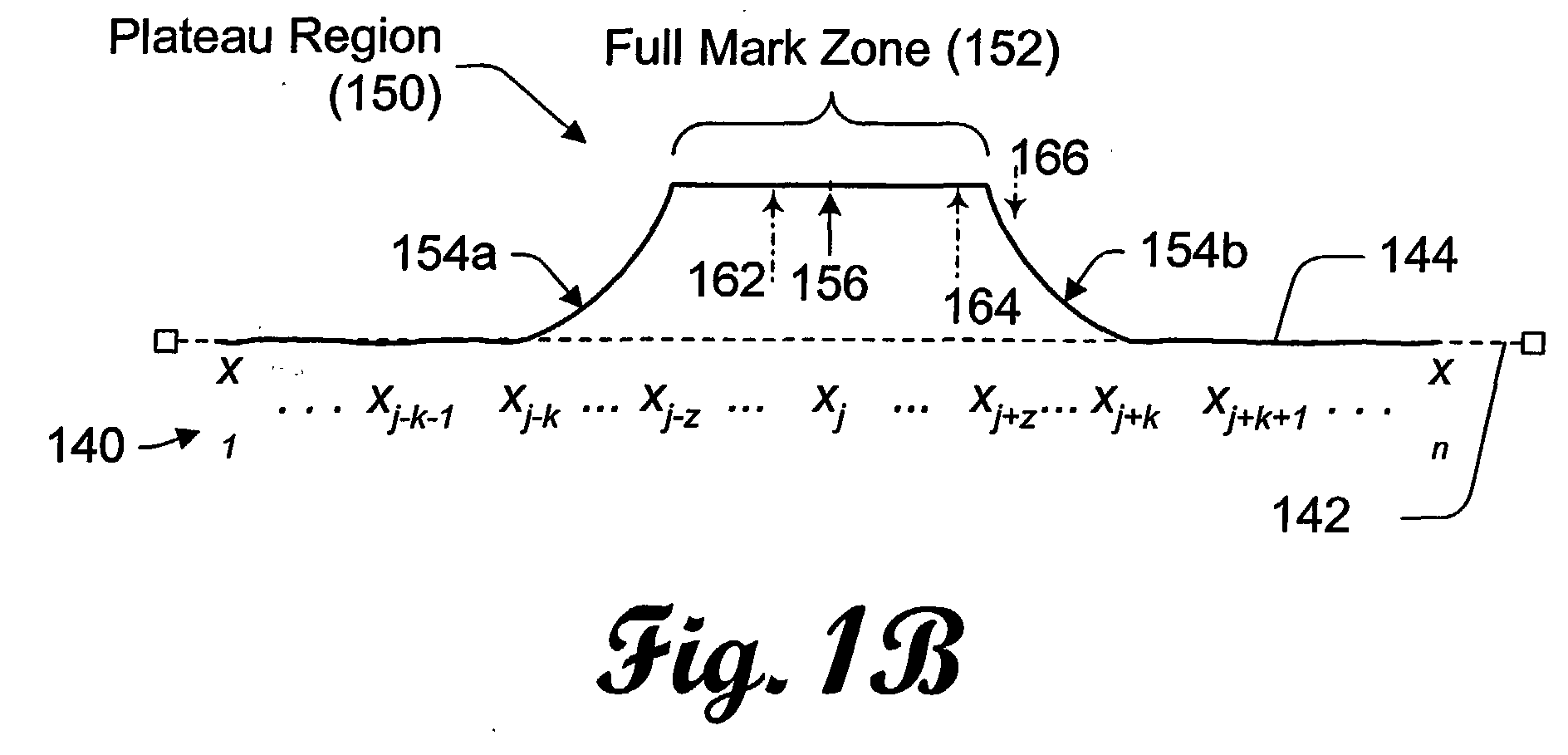
- Fig. 1B is a diagram illustrating a "plateau" shape of the watermarking of a sequence region; this illustrates an example of a watermarked sequence region in accordance with an implementation of the invention herein.
- Fig. 1C is a diagram illustrating multiple plateau-shaped sequence regions of a video signal; this illustrates an example of multiple watermarked sequence regions of a signal which is in accordance with an implementation of the invention herein.
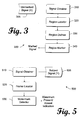
- Fig. 2 is a schematic block diagram showing a video watermarking architecture in accordance with an implementation of the invention herein.
- Fig. 3 is a schematic block diagram showing a video watermark embedding system in accordance with an implementation of the invention herein.
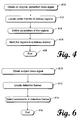
- Fig. 4 is a flow diagram showing an illustrative methodological implementation (e.g., video watermark embedding) of the invention herein.
- Fig. 5 is a schematic block diagram showing a video watermark detecting system in accordance with an implementation of the invention herein.
- Fig. 6 is a flow diagram showing an illustrative methodological implementation (e.g., video watermark detecting) of the invention herein.
- Fig. 7 is an example of a computing operating environment capable of implementing an implementation (wholly or partially) of the invention herein.
- An example of an embodiment of Robust and Stealthy Video Watermarking may be referred to as an "exemplary video watermaker.”
- the one or more exemplary implementations, described herein, of the present invention may be implemented (whole or in part) by a video watermarking architecture 200 and/or by a computing environment like that shown in Fig. 7.
- references to embedding or detecting a watermark expressly includes the embedding or detecting of a portion of a watermark. Portions of the watermark may, for example, be embedded in a single frame. The collection of such frames may constitute the entire watermark. Moreover, references herein to watermarks expressly include any information data patterns.
- the watermarks are encoded (e.g., embedded) over regions of successive frames. These regions include successive adjacent frames. These regions may also be called “temporal regions” since the frames typically fall into a specific time sequence in the video signal. Herein, they may also be called “sequence regions” and “neighbor regions.”
- a marked video includes multiple regions. The centers of each are apparently randomly selected.
- the watermark is encoded into the region in a "plateau" manner.
- the region is approximately plateau shaped. This means that the watermark is fully encoded in the frames surrounding the region's center, but trail off towards the edges of the region.
- the watermark detection of the exemplary video watermaker approximately locates the center of each region. Since the watermark is encoded over a region of frames (rather than isolated single frames), the watermark detection system can find the embedded mark anywhere within the region. This is true even when it fails to locate the exact center of the region because of de-synchronization. In context of sequence regions that are approximately plateau shaped, they may be called “plateau regions,” “watermark plateaus,” and the like.
- the exemplary video watermaker has at least two approaches: a “fully blind” and “partially blind” approach.
- hashing techniques are used in many areas such as database management, querying, cryptography, and many other fields involving large amounts of raw data.
- a hashing technique maps a large block of raw data into relatively small and structured set of identifiers. These identifiers are also referred to as “hash values” or simply “hash.”
- identifiers are also referred to as “hash values” or simply “hash.”
- the hashing function drastically reduces the size of the raw data into short identifiers. It simplifies many data management issues and reduces the computational resources needed for accessing large databases.
- the hashing technique may employ a secret key K .
- a hash value may be thought of as a binary string given a signal (e.g., an image). This string serves as the signature of the input signal and is approximately invariant under all acceptable modifications on the input signal (i.e., modifications under which the quality of the input image is preserved for all practical purposes).
- the hash technique used by the exemplary video watermaker operates on frames.(i.e., images) of a video signal such that:
- perceptual similarity may be thought of in this manner: If two signals (e.g., images) are perceptually similar, then an observer should be able to say that they are indeed the same signals (e.g., images) for all practical purposes, such that a reasonable amount of perceptual quality is maintained. Such perceptual qualities also applies to statistical analysis of machines as well as humans.
- an intermediate hash function serves equally well as a final hash function. See the descriptions in the incorporated pending U.S. Patent Applications (in particular, the ones entitled “Robust Recognizer of Perceptually Similar Content” and “Recognizer of Audio-Content in Digital Signals") for more details on intermediate and final hashing.
- d (.,.) refers to normalized Hamming distance.
- watermarking a video sequence presents a series of significant challenges that are greater than those faced when watermarking other digital goods.
- Particular examples of these challenges include perceptual invisibility and resistance to de-synchronization.
- watermarking other types of media e.g., images and audio
- the problems of perceptual invisibility and resistance to de-synchronization are particularly acute and specifically unique for videos.
- the watermark (or portions thereof) may be embedded into each frame of the video.
- the chances of a digital pirate discovering the watermark increases as the watermark repetition increases.
- Embedding the watermark (or portions thereof) in each frame is also undesirable because it provides convenient range for the pirate to focus her efforts.
- it provides potentially thousands of bounded targets (i.e., frames) containing the same hidden data (i.e., the watermark) that the pirate may attack. With these narrow targets, a digital pirate has a good chance of determining the watermark.
- the exemplary video watermaker selectively encodes watermarks (or portions thereof) into sequence regions within the video. To find the encoded information later, the exemplary video watermaker approximately locates the centers of these regions by hashing the video signal.
- a de-synch attack removes, adds, or rearranges frames, the center determined by the detection system of the exemplary video watermaker offset from the true center of the region. Since the multiple frames within that region are encoded with the watermark, the exemplary video watermaker can detect the watermark in a frame offset from the center. The de-synch would need to significantly alter the video signal before the center determined by the detection system of the exemplary video watermaker is offset enough to be miss the region entirely.
- the exemplary video watermaker encodes a watermark that is perceptually invisible within the signal. It minimizes or eliminates flicker caused by watermark encoding.
- the watermark is encoded into the sequence region in a "plateau” manner. This means that the watermark is fully encoded in the frames surrounding the region's center, but trail off towards the edges of the region.
- Fig. 1A illustrates an example of a series of individual images (i.e., frames) that collectively compose a video sequence over time.
- the numbered order of the frames (1, 2, ..., n ) indicates the typical chronological order of the frames.
- This video sequence may be all of or any portion of a complete video package.
- Fig. 1B illustrates a diagram of a plateau-shape of the watermarked sequence region. This illustrates an example of a watermarked sequence region in accordance with the exemplary video watermaker.
- the "plateau-shaped" watermark encoding technique of the exemplary video watermaker reduces (or eliminates) the effect of de-synchronization and flicker.
- the frames 140 are indicated by the same x i labeling as Fig. 1A.
- Dashed horizontal line 142 indicates a baseline of a video signal without watermark encoding.
- Solid line 144 indicates the actual video signal relative to the baseline 142.
- a video signal ⁇ such as the one indicated by line 144 ⁇ is typically not perfectly smooth, straight, etc.
- video signal 144 is illustrated in Fig. 1B in an idealized form.
- an information pattern (such as a watermark or a portion thereof) is embedded into the video signal 144.
- This ' may be accomplished using traditional or new watermarking techniques.
- Image watermarking techniques may be used to embed watermarks into the frames of the video signal.
- the watermark is embedded. That range of frames is called the plateau region 150.
- the plateau region ranges from frame x j-k to x j+k in Fig. 1B, where j is the center of the region and 2 k +1 is the length of the region.
- the center frame of the region 150 is frame x j or frame 156.
- the center frame (e.g., frame 156) is determined by hashing the video signal (or portions thereof). Thus, the locations of the centers of each region are determined by the inherent characteristics of the signal itself.
- the center frame 156 when embedding the watermark, might not be the exact frame determined by the hashing.
- the region may be offset from the frame determined by the hashing. This may be called “offset centering" of the region.
- the degree of the offset may be determined pseudorandomly, mathematically, via hashing, and/or it may be fixed. Assuming that the detection system is capably of reliably detecting the watermarks, this offset centering is acceptable and within the scope of the exemplary video watermaker described herein. It is particularly acceptable because it adds the robustness of the exemplary video watermaker.
- Full Mark Zone (FMZ) of the Plateau The watermark is fully encoded in the frames surrounding the center frame 156. Theses surrounding frames form a zone called a full mark zone (FMZ) 152.
- the FMZ 152 ranges from frame x j-z to x j+z in Fig. 1B, where 2z+1 is the length of the zone.
- the full mark zone (such as FMZ 152) includes z frames before the center frame 156 and z frames before the center frame.
- the terms “fully encoded,” “gradient encoding,” and “partially encoded” refer to the relative intensity (e.g., relative strength or scale) with which the mark is encoded. "Fully encoded" is full relative intensity.
- the plateau region 150 includes gradient edges 154a and 154b in Fig. 1B.
- leading edge 154a On the leading side of the FMZ 152 is leading edge 154a.
- trailing edge 154b On the trailing side of the FMZ 152 is trailing edge 154b.
- the watermark is partially encoded. More precisely, the watermark is gradiently encoded, which is either increasingly or decreasingly encoded.
- leading edge 154a the relative intensity with which the mark is encoded increases with successive frames.
- the leading edge 154a ranges from frame x j-k to x j-z in Fig. 1B, where k - z is the length of this edge.
- the trailing edge 154b is the mirror image of leading edge 154a.
- the relative intensity with which the mark is encoded decreases with successive frames.
- the trailing edge 154b ranges from frame x j+z to x j+k in Fig. 1B, where k - z is the length of this edge.
- the values of k and z on either size of the center need not be equivalent.
- the value of k-z may differ for the leading and trailing edges (e.g., edges 154a and 154b). In this situation, the edges are not mirror images of each other. However, this would make the "center" of the region be off the true center. Assuming that the detection system is capably of reliably detecting the watermarks, this type of approximate centering is acceptable and within the scope of the exemplary video watermaker described herein. It is particularly acceptable because it adds the robustness of the exemplary video watermaker.
- the gradient edges (e.g., edges 154a and 154b) of the plateau region 150 give the region's boundaries a softer transition between marked frames and unmarked frames.
- the smooth transition of the gradient edges is significantly less perceptible ⁇ statistically and visually ⁇ than the "flicker" of traditional video watermarking.
- gradient encoding the watermark in the FMZ 152 of the plateau region 150 increases the robustness of the watermark encoded by the exemplary video watermaker. Primarily, it reduces (or eliminates) the effect of flicker on a video signal (such as signal 144).
- Shape of Plateau Regions The shape of a plateau region is representative of the relative intensity of the watermarking encoding of that region.
- the shapes of the plateau regions illustrated herein are only examples.
- the name "plateau” is intended to be a convenient label that evokes an image of the overall general shape of the region.
- the shapes of the plateau regions are not limited to those illustrated herein or to the shape of a literal plateau.
- plateau With respect to the shape of a plateau, it may take nearly any shape.
- range of shapes are bounded by characteristics described in the language claimed herein. Examples of such characteristics of a plateau regions generated by the exemplary video watermaker include:
- a plateau region generated by the exemplary video watermaker may be described, for example, with the following shape descriptions: bump, convex, gibbous, bulge, lump, hump, bulbous, mountain-shaped, peak, mound, mesa, hill, knoll, hillock, butte, drumlin, hummock, dune, tussock, molehill, anthill, dome, arch, hemisphere, half-circle, trapezoid, and the like.
- a watermark detection system of the exemplary video watermaker processes a subject video signal. Typically, before such detection, it is unknown whether such signal includes a watermark. Likewise, it is unknown whether the subject signal has been modified from the original signal. Such modification may be intentional or unintentional.
- the watermark detection system approximately locates the center of each plateau region. More precisely, it locates frames that it considers the centers of their regions. These frames are called “detection frames” herein. To find the detection frames, the watermark detection system uses the same technique as the embedding system uses to locate the regions' center frames.
- the subject video signal itself is hashed to find the detection frames. If the subject signal remains unmodified from the original, then the detection system finds the actual center of each region. If the subject signal has been modified, then the "centers" found by the detection systems approximate the centers of the regions.
- the watermark detection system need not find the actual center of a region to detect a watermark encoded within the region. Since the watermark is encoded in each of the frames of the plateau region, the watermark detection system is likely to find the embedded mark anywhere within the region. However, if the approximate center determined by the detection system falls within a full mark zone (FMZ), then it is more likely to detect the watermark then if the if the approximate center falls within a boundary edge.
- FMZ full mark zone
- video signal 144 of Fig. 1B is a subject signal and that it has been de-synchronized (intentionally or unintentionally).
- the actual center of the signal before such de-synchronization was frame 156.
- the approximate center ⁇ determined by hashing the de-synchronized subject signal ⁇ may be frame 162, frame 164, or frame 166. These frames are indicated by dashed-dotted arrows pointing to the encoded signal of the region 150 of Fig. 1B.
- Frame 162 is just off-center from the center frame 156. Like the center frame and every other frame in the FMZ 152, it is fully encoded with the watermark. Consequently, the detection system is highly likely to detect the encoded watermark within frame 162.
- Frame 164 is more off-center from the center frame 156 than frame 162, but it is still within the FMZ 152. Similarly, the detection system is highly likely to detect the encoded watermark within frame 164.
- Frame 166 is significantly, off-center from the center frame 156. So much so, that it falls outside the FMZ 152. However, it still is within the plateau region 150. Specifically,-it is within trailing edge 154b. Although the watermark is not fully encoded within this edge, it is still partially encoded in frame 166 of edge 156b. Consequently, there is a possibility that the detection system may detect the encoded watermark within frame 166.
- Fig. 1C is a diagram illustrating an example video signal 146 having multiple watermarked plateau regions 150a-150k in accordance with the exemplary video watermaker.
- the center of the plateau regions 150a-150k is defined (i.e., located) by a hash value. Multiple hash values are determined by hashing the signal itself.
- plateau regions are distributed throughout the signal in an almost uniform and manner that appears random.
- size and shape of the regions may be varied.
- the exemplary video watermaker may be implemented via, at least, two approaches: “Partially Blind” and “Fully Blind.” Both are broadly shown in Figs. 3-6.
- the exemplary video watermaker selects multiple frames of the video. These selected frames will be the center frames of plateau regions. To select these center frames, the exemplary video watermaker may randomly or pseudorandomly select them. The center frames define the center of the plateau region for embedding marks.
- the exemplary video watermaker hashes those selected frames and stores their hash values. These will be called the "center frame hash values" herein. These values identify the locations of center frames for watermark embedding. These hash values may use a secret key; thus, may be pseudorandom also.
- the watermarks are inserted in the plateau regions of the selected center frames.
- the hash values are stored in a data storage. The locations of the center frames are not stored. Rather, the hash values of those center frames are stored.
- the hash values are sent as side information to the watermark detection system.
- the watermark detection system has secure access to the stored hash values of the center frames.
- the hash values may be cryptographically transmitted, to the detection system along with or separate from the video signal being examined by the system. Regardless, this approach assumes that users (and attackers) do not have access to them.
- the hash values may be sent to a software video player on a computer (or to a DVD player) secretly and the user does not know what these hash values are.
- Another example could be cryptographic encryption of these hash values via a secret key and transmitting them secretly or spreading them around video data in a secret manner such that attackers would not be able to find them.
- the hash value of each frame is found and compared to the hash values in the stored list of hash values. For the frames whose hash values substantially match an entry in the list, the detector looks for watermark in that frame. Those frames are called the “detection frames.” Alternatively, it looks for the watermarks in frames ⁇ whose hash values does the match ⁇ surrounding a detection frame. This is done for each detection frame. The detection frames effectively "synch" the watermark detection process.
- partially blind comes from the fact that additional information is needed at the detector side, meaning it is not completely blind. But it is not non-blind as well.
- a non-blind watermarking scheme requires the original unmarked video to be present at the detector end.
- the fully blind approach is the same as the partially blind approach, except that there is no list of center frame hash values.
- the watermark detection system has no list of hash values to compare to the hash of the frames of a subject video signal. Instead, the watermark detection system calculates the hash values based upon the subject video signal.
- a comparison between the hash values and randomly generated binary vectors is made in order to decide if the watermark is going to be embedded or not.
- the same operation is carried out using the same secret key.
- the fully blind approach By using a secret key, the fully blind approach generates a set of random binary sequence a. This might be, for example, 10 random bits. Then the hash value of each frame within the video sequence is computed, call these h i , where i indexes frame number.
- vector a is generated randomly; second, each value h i is the hash value of frame i .
- each value h i is the hash value of frame i .
- the hash function they are also generated randomly, then generation of s i from h i are also done in a random manner.
- Secret key K is used as the seed of the random number generator in all these steps.
- the detector'end has access to K. It does the same as above to find the frame locations. It generates a ; it generates hash values; and applies random projection. It finds the detection frames, which may or may not be identical to the center frames.
- the same secret key and hash function is used for hashing the center frame for embedding as is used for hashing the detection frames for detecting. Therefore, if the original unmarked signal and the subject signal are perceptually identical, then the hash values of the frames will be identical or nearly so.
- the unmarked signal and subject signal will be perceptually identical is the subject signal if an unmodified version of the marked signal. Furthermore, the unmarked signal and subject signal will be perceptually identical if the subject signal is a modified version (e.g., an attacked version) of the marked signal, but such modification did not perceptually modify the signal.
- a modified version e.g., an attacked version
- the centers of regions around which watermark is going to be embedded are determined. This task may be carried out via using robust image hash functions.
- partially blind approach the hash values are used to determine the locations of the watermarks at the decoder; thus, partially blind approach is termed to be “partially blind”.
- Fig. 2 shows a digital goods production and distribution architecture 200 (e.g., video watermarking architecture 200) having a content (e.g., video) producer/provider 222 that produces original content and distributes the content over a network 224 to a client 226.
- the content producer/provider 222 has a content storage 230 to store digital goods containing original content.
- the content producer 222 has a watermark embedding system 232 to sign the digital signals (e.g., video signals) with a watermark that uniquely identifies the content as original.
- the watermark embedding system 232 may be implemented as a standalone process or incorporated into other applications or an operating system.
- the watermark embedding system 232 applies the watermark to a digital signal (e.g., video signal) from the content storage 230.
- a digital signal e.g., video signal
- the watermark identifies the content producer 222, providing a signature that is embedded in the signal and cannot be cleanly removed.
- the content produces/provider 222 has a distribution server 234 that distributes the watermarked content over the network 224 (e.g., the Internet).
- a signal with a watermark embedded therein represents to a recipient that the signal is being distributed in accordance with the copyright authority of the content producer/provider 222.
- the server 234 may further compress and/or encrypt the content conventional compression and encryption techniques prior to distributing the content over the network 224.
- the client 226 is equipped with a processor 240, a memory 242, and one or more content output devices 244 (e.g., television, display, sound card, speakers, etc.).
- the processor 240 runs various tools to process the marked signal, such as tools to decompress the signal, decrypt the date, filter the content, and/or apply signal controls (tone, volume, etc.).
- the memory 242 stores an operating system 250 (such as a Microsoft® Windows 2000® operating system), which executes on the processor.
- the client 226 may be embodied in a many different ways, including a computer, a handheld entertainment device, a set-top box, a television, an appliance, and so forth.
- the operating system 250 implements a client-side watermark detecting system 252 to detect watermarks in the digital signal and a content loader 254 (e.g., multimedia player, audio player) to facilitate the use of content through the content output device(s) 244. If the watermark is present, the client can identify its copyright and other associated information.
- a content loader 254 e.g., multimedia player, audio player
- the operating system 250 and/or processor 240 may be configured to enforce certain rules imposed by the content producer/provider (or copyright owner). For instance, the operating system and/or processor may be configured to reject fake or copied content that does not possess a valid watermark. In another example, the system could load unverified content with a reduced level of fidelity.
- Fig. 3 shows an exemplary video watermark embedding system 300, which is an example of an embodiment of a portion of the video watermarking architecture 200.
- the watermark embedding system 232 is an example of the exemplary video watermark embedding system 300.
- the watermark embedding system 300 includes a signal obtainer 310, a region locator 320, a region definer 330, and a region marker 340.
- the signal obtainer 310 obtains an unmarked video signal 305. It may obtain the signal from nearly any source, such as a storage device or over a network communications link.
- the region locator 320 determines the locations of the regions within the signal 305. To determine the region locations, the system may first determine the center frame (such as frame 156 of Fig. 1B) of each region. It may determine the center frames pseudorandomly. After that, it finds the hash value of the center frames. These hash values effectively identify the locations of the center frames. Thus, the locations of the centers of each region are determined (via the their hash values) by the inherent characteristics of the signal itself. Alternatively, the center frame of a region may be offset from the initial frame determined by the region locator 320.
- the center frame such as frame 156 of Fig. 1B
- the region definer 330 defines the parameters of the regions. Such parameters include region length (2 k +1) and FMZ length (2 z +1). These parameters may fixed for all regions of all signals. They may be fixed for all regions, but varied per signals. They may be varied for all regions of all signals. Generally speaking, the parameters may be manipulated to adjust several factors including watermark detection probability and robustness.
- the region marker 340 watermarks the regions of the signal in a plateau manner.
- the frames of the FMZ are fully encoded while the frames of the boundary edges are gradiently encoded.
- the region marker may employ traditional or new watermarking techniques particularly those designed for image watermarking. It may employ spread-spectrum, QIM, or other watermarking techniques. This marked video may be publicly distributed to consumers and clients.
- Fig. 4 shows the methodological implementation of the exemplary video watermark embedding system 300 (or some portion thereof). More specifically, this figure shows the methodological implementation of watermark embedding of the exemplary video watermaker. This methodological implementation may be performed in software, hardware, or a combination thereof.
- the exemplary video watermaker obtains a video signal. Specifically, this signal is unmarked. At 412, it determines the locations of the plateau regions within the signal. The region locations are determined by pseudorandomly selecting them (using a secret key). The hash values of selected frame is taken and stored. These values are stored. For the partially blind approach, these values are available to the decoding system. For example, they may accompany the signal in a cryptographic envelope or they come via a separate and secure mechanism.
- the exemplary video watermaker defines the parameters of the regions. At 416, it watermarks the regions of the signal in a plateau manner. At 418, the process ends.
- Fig. 5 shows an exemplary video watermark detecting system 500, which is an example of an embodiment of a portion of the video watermarking architecture 200.
- the watermark detecting system 252 is an example of the exemplary video watermark embedding system 500.
- the watermark detecting system 500 includes a signal obtainer 510, a frame locator 520, and a watermark detector 530.
- the signal obtainer 510 obtains a subject video signal 505. It may obtain the signal from nearly any source, such as a storage device or over a network communications link. Typically, it is unknown whether the subject video signal 505 is marked and whether it has been modified.
- the frame locator 520 determines the locations of the "detection frames" of the subject signal 505.
- the detection frames are the selected frames of the signal that the system will attempt to detect the watermark.
- the system may also attempt to locate the watermark in frames surrounding the selected detection frames.
- the frame locator 520 uses the same hashing technique (including the same secret key) to find the hash values of frames of the subject signal as the watermark embedding system 300 (specifically, the region locator 320) used for the center frame of a region.
- the frame locator 520 compares the just calculated hash values of each frame of the subject video to the stored list of hash values (which was originally generated by the watermark embedding system 300). Each exact or substantial match is designated a "detection frame.”
- the frame locator 520 selects the detects frames by doing a comparison between the hash values and randomly generated binary vectors is made in order to decide if the watermark is going to be embedded or not.
- the watermark detector 530 determines whether watermarks exist in the detection frames.
- the watermark detector employs the detection technique that corresponds the watermarking technique employed by the watermark embedding system 300.
- the watermark detector 530 indicates whether the watermark is present.
- Fig. 6 show methodological implementation of the exemplary video watermark detecting system 500 (or some portion thereof). More specifically, this figure shows the methodological implementation of watermark detecting of the exemplary video watermaker. This methodological implementation may be performed in software, hardware, or a combination thereof.
- the exemplary video watermaker obtains a subject video signal. Typically, it is unknown whether the subject video signal 505 is marked and whether it has been modified. At 612, it determines the locations of the "detection frames" of the subject signal. At 614, the exemplary video watermaker determines whether watermarks exist in the detection frames.
- the watermark detector employs the detection technique that corresponds the watermarking technique employed by the watermark embedding methodological implementation of Fig. 4. Typically, it also indicates whether the watermark is present. Such indication may be stored, displayed, printed, etc. The process ends at 616.
- the “partially blind” approach is partially blind in the sense that it requires the hash values to be known at the decoder side.
- the “fully blind” approach is completely blind and relies on the fact that the collision probability of the hash values should be low and approximate uniform distribution should be achieved.
- the exemplary video watermaker embeds watermarks ⁇ w j ⁇ , 1 ⁇ j ⁇ M , each of length L w , at M different places.
- the secret key K is the seed of the pseudorandom number generator in all the randomized tasks in both approaches.
- H (.) denote the hash function to be used that produces a hash of length L .
- a( k ) denote the k -th element of an input vector a.
- ⁇ Y i ⁇ be an input to the watermark decoder.
- Compute sign vectors s i j for 1 ⁇ j ⁇ M such that s i j ( k ) 1 if ⁇ and i j ( k ) ⁇ ⁇ i j ( k ) and 0 otherwise.
- N j is the number of the places where the random binary vector h j matches the hash values of the input video.
- the watermark are embedded in a neighborhood around it. This may be done using QIM watermarking.
- the sign vectors that are derived from the center frame, may play a role in terms of decreasing visual artifacts. For a particular statistic, if one quantizes to a higher value for a given frame and if one quantizes to a lower value for a neighboring frame, there will be a slight "flickering effect.” In order to minimize this effect, a fixed sign vector may be employed. That vector is used for the whole range of neighborhood.
- Fig. 7 illustrates an example of a suitable computing environment 900 within which an exemplary video watermaker, as described herein, may be implemented (either fully or partially).
- the computing environment 900 may be utilized in the computer and network architectures described herein.
- the exemplary computing environment 900 is only one example of a computing environment and is not intended to suggest any limitation as to the scope of use or functionality of the computer and network architectures. Neither should the computing environment 900 be interpreted as having any dependency or requirement relating to any one or combination of components illustrated in the exemplary computing environment 900.
- the exemplary video watermaker may be implemented with numerous other general purpose or special purpose computing system environments or configurations.
- Examples of well known computing systems, environments, and/or configurations that may be suitable for use include, but are not limited to, personal computers, server computers, thin clients, thick clients, hand-held or laptop devices, multiprocessor systems, microprocessor-based systems, set top boxes, programmable consumer electronics, network PCs, minicomputers, mainframe computers, distributed computing environments that include any of the above systems or devices, and the like.
- the exemplary video watermaker may be described in the general context of computer-executable instructions, such as program modules, being executed by a computer.
- program modules include routines, programs, objects, components, data structures, etc. that perform particular tasks or implement particular abstract data types.
- the exemplary video watermaker may also be practiced in distributed computing environments where tasks are performed by remote processing devices that are linked through a communications network.
- program modules may be located in both local and remote computer storage media including memory storage devices.
- the computing environment 900 includes a general-purpose computing device in the form of a computer 902.
- the components of computer 902 can include, by are not limited to, one or more processors or processing units 904, a system memory 906, and a system bus 908 that couples various system components including the processor 904 to the system memory 906.
- the system bus 908 represents one or more of any of several types of bus structures, including a memory bus or memory controller, a peripheral bus, an accelerated graphics port, and a processor or local bus using any of a variety of bus architectures.
- bus architectures can include an Industry Standard Architecture (ISA) bus, a Micro Channel Architecture (MCA) bus, an Enhanced ISA (EISA) bus, a Video Electronics Standards Association (VESA) local bus, and a Peripheral Component Interconnects (PCI) bus also known as a Mezzanine bus.
- Computer 902 typically includes a variety of computer readable media. Such media can be any available media that is accessible by computer 902 and includes both volatile and non-volatile media, removable and non-removable media.
- the system memory 906 includes computer readable media in the form of volatile memory, such as random access memory (RAM) 910, and/or non-volatile memory, such as read only memory (ROM) 912.
- RAM random access memory
- ROM read only memory
- a basic input/output system (BIOS) 914 containing the basic routines that help to transfer information between elements within computer 902, such as during start-up, is stored in ROM 912.
- BIOS basic input/output system
- RAM 910 typically contains data and/or program modules that are immediately accessible to and/or presently operated on by the processing unit 904.
- Computer 902. may also include other removable/non-removable, volatile/non-volatile computer storage media.
- Fig. 7 illustrates a hard disk drive 916 for reading from and writing to a non-removable, non-volatile magnetic media (not shown), a magnetic disk drive 918 for reading from and writing to a removable, non-volatile magnetic disk 920 (e.g., a "floppy disk"), and an optical disk drive 922 for reading from and/or writing to a removable, non-volatile optical disk 924 such as a CD-ROM, DVD-ROM, or other optical media.
- a hard disk drive 916 for reading from and writing to a non-removable, non-volatile magnetic media (not shown)
- a magnetic disk drive 918 for reading from and writing to a removable, non-volatile magnetic disk 920 (e.g., a "floppy disk")
- an optical disk drive 922 for reading from and/or writing to a removable, non-volatile optical
- the hard disk drive 916, magnetic disk drive 918, and optical disk drive 922 are each connected to the system bus 908 by one or more data media interfaces 926.
- the hard disk drive 916, magnetic disk drive 918, and optical disk drive 922 can be connected to the system bus 908 by one or more interfaces (not shown).
- the disk drives and their associated computer-readable media provide non-volatile storage of computer readable instructions, data structures, program modules, and other data for computer 902.
- a hard disk 916 a removable magnetic disk 920, and a removable optical disk 924
- other types of computer readable media which can store data that is accessible by a computer, such as magnetic cassettes or other magnetic storage devices, flash memory cards, CD-ROM, digital versatile disks (DVD) or other optical storage, random access memories (RAM), read only memories (ROM), electrically erasable programmable read-only memory (EEPROM), and the like, can also be utilized to implement the exemplary computing system and environment.
- RAM random access memories
- ROM read only memories
- EEPROM electrically erasable programmable read-only memory
- Any number of program modules can be stored on the hard disk 916, magnetic disk 920, optical disk 924, ROM 912, and/or RAM 910, including by way of example, an operating system 926, one or more application programs 928, other program modules 930, and program data 932.
- Each of such operating system 926, one or more application programs 928, other program modules 930, and program data 932 may include an embodiment of a signal obtainer, a region locator, a region definer, a region marker, a signal marker, a frame locator, a synchronizer, and a watermark detector.
- a user can enter commands and information into computer 902 via input devices such as a keyboard 934 and a pointing device 936 (e.g., a "mouse").
- Other input devices 938 may include a microphone, joystick, game pad, satellite dish, serial port, scanner, and/or the like.
- input/output interfaces 940 are coupled to the system bus 908, but may be connected by other interface and bus structures, such as a parallel port, game port, or a universal serial bus (USB).
- a monitor 942 or other type of display device can also be connected to the system bus 908 via an interface, such as a video adapter 944.
- other output peripheral devices can include components such as speakers (not shown) and a printer 946 which can be connected to computer 902 via the input/output interfaces 940.
- Computer 902 can operate in a networked environment using logical connections to one or more remote computers, such as a remote computing device 948.
- the remote computing device 948 can be a personal computer, portable computer, a server, a router, a network computer, a peer device or other common network node, and the like.
- the remote computing device 948 is illustrated as a portable computer that can include many or all of the elements and features described herein relative to computer 902.
- Logical connections between computer 902 and the remote computer 948 are depicted as a local area network (LAN) 950 and a general wide area network (WAN) 952.
- LAN local area network
- WAN wide area network
- Such networking environments are commonplace in offices, enterprise-wide computer networks, intranets, and the Internet.
- the computer 902 When implemented in a LAN networking environment, the computer 902 is connected to a local network 950 via a network interface or adapter 954. When implemented in a WAN networking environment, the computer 902 typically includes a modem 956 or other means for establishing communications over the wide network 952.
- the modem 956, which can be internal or external to computer 902, can be connected to the system bus 908 via the input/output interfaces 940 or other appropriate mechanisms. It is to be appreciated that the illustrated network connections are exemplary and that other means of establishing communication link(s) between the computers 902 and 948 can be employed.
- remote application programs 958 reside on a memory device of remote computer 948.
- application programs and other executable program components such as the operating system are illustrated herein as discrete blocks, although it is recognized that such programs and components reside at various times in different storage components of the computing device 902, and are executed by the data processor(s) of the computer.
- An implementation of an exemplary video watermaker may be described in the general context of computer-executable instructions, such as program modules, executed by one or more computers or other devices.
- program modules include routines, programs, objects, components, data structures, etc. that perform particular tasks or implement particular abstract data types.
- the functionality of the program modules may be combined or distributed as desired in various embodiments.
- Fig. 7 illustrates an example of a suitable operating environment 900 in which an exemplary video watermaker may be implemented.
- the exemplary video watermaker(s) described herein may be implemented (wholly or in part) by any program modules 928-930 and/or operating system 926 in Fig. 7 or a portion thereof.
- the operating environment is only an example of a suitable operating environment and is not intended to suggest any limitation as to the scope or use of functionality of the exemplary video watermaker(s) described herein.
- Other well known computing systems, environments, and/or configurations that are suitable for use include, but are not limited to, personal computers (PCs), server computers, hand-held or laptop devices, multiprocessor systems, microprocessor-based systems, programmable consumer electronics, wireless phones and equipments, general- and special-purpose appliances, application-specific integrated circuits (ASICs), network-PCs, minicomputers, mainframe computers, distributed computing environments that include any of the above systems or devices, and the like.
- PCs personal computers
- server computers hand-held or laptop devices
- multiprocessor systems microprocessor-based systems
- programmable consumer electronics wireless phones and equipments
- general- and special-purpose appliances application-specific integrated circuits
- ASICs application-specific integrated circuits
- network-PCs minicomputers
- mainframe computers distributed computing environments that include any of the above systems or devices, and
- Computer readable media can be any available media that can be accessed by a computer.
- Computer readable media may comprise "computer storage media” and "communications media.”
- Computer storage media include volatile and non-volatile, removable and non-removable media implemented in any method or technology for storage of information such as computer readable instructions, data structures, program modules, or other data.
- Computer storage media includes, but is not limited to, RAM, ROM, EEPROM, flash memory or other memory technology, CD-ROM, digital versatile disks (DVD) or other optical storage, magnetic cassettes, magnetic tape, magnetic disk storage or other magnetic storage devices, or any other medium which can be used to store the desired information and which can be accessed by a computer.
- Communication media typically embodies computer readable instructions, data structures, program modules, or other data in a modulated data signal, such as carrier wave or other transport mechanism. Communication media also includes any information delivery media.
- modulated data signal means a signal that has one or more of its characteristics set or changed in such a manner as to encode information in the signal.
- communication media includes wired media such as a wired network or direct-wired connection, and wireless media such as acoustic, RF, infrared, and other wireless media. Combinations of any of the above are also included within the scope of computer readable media.
Landscapes
- Engineering & Computer Science (AREA)
- Physics & Mathematics (AREA)
- General Physics & Mathematics (AREA)
- Theoretical Computer Science (AREA)
- Multimedia (AREA)
- Signal Processing (AREA)
- Image Processing (AREA)
- Two-Way Televisions, Distribution Of Moving Picture Or The Like (AREA)
- Editing Of Facsimile Originals (AREA)
- Compression Or Coding Systems Of Tv Signals (AREA)
- Television Systems (AREA)
Abstract
Description
- remove frames;
- add new frames (such as commercials);
- add copied frames (copies of adjacent frames);
- change frames/sec rate;
- rearrange frames.
- U.S. Patent Application Serial No. 09/390271, entitled "A Technique for Watermarking an Image and a Resulting Watermarked' Image" filed Sept. 7, 1999;
- U.S. Patent Application Serial No. 09/390272, entitled "A Technique for Detecting a Watermark in a Marked Image" filed on Sept. 7, 1999;
- U.S. Patent Application Serial No. 09/316,899, entitled "Audio Watermarking with Dual Watermarks" filed on May 22, 1999;
- U.S. Patent Application Serial No. 09/614,660, entitled "Improved Stealthy Audio Watermarking" filed on July 12, 2000;
- U.S. Patent Application Serial No. , entitled "Robust Recognizer of Perceptually Similar Content" filed on April 24, 2001;
- U.S. Patent Application Serial No. , entitled "Derivation and Quantization of Robust Non-Local Characteristics for Blind Watermarking" filed on April 24, 2001;
- U.S. Patent Application Serial No. , entitled "Recognizer of Audio-Content in Digital Signals" filed on April 24, 2001; and
- U.S. Patent Application Serial No. 09/421,986, entitled "System and Method for Hashing Digital Images" filed on October 19, 1999.
- The hash values possess approximate uniform distribution;
- The hash values of two perceptually distinct signals (e.g., images) are approximately independent; and
- The hash values of two perceptually similar signals (e.g., images) are the same with high probability.
- Serial No. , entitled "Robust Recognizer of Perceptually Similar Content" filed on April 24,2001;
- Serial No. , entitled "Recognizer of Audio-Content in Digital Signals" filed on April 24, 2001; and
- Serial No. 09/421,986, entitled "System and Method for Hashing Digital Images" filed on October 19, 1999.
- one or more frames within the region is fully encoded relative to other frames (in particular; unmarked frames);
- one or more frames within the region are gradiently encoded relative to the fully encoded frames and the unmarked frames.
At 612, it determines the locations of the "detection frames" of the subject signal.
At 614, the exemplary video watermaker determines whether watermarks exist in the detection frames. The watermark detector employs the detection technique that corresponds the watermarking technique employed by the watermark embedding methodological implementation of Fig. 4. Typically, it also indicates whether the watermark is present. Such indication may be stored, displayed, printed, etc. The process ends at 616.


Claims (48)
- A method for facilitating the insertion of information into a video signal, the method comprising:wherein, for one or more regions, the information pattern is embedded into a frame of a region with a relative degree of intensity and relativelone oneone or more frames of that region have the patterns embedded therein which have a relative intensityrelativel that differs from the relative intensity of the pattern embedded in other frames of the region.embedding an information pattern in one or more regions of the video signal, a region comprising a plurality successive frames;
- A method as recited in claim 1 for facilitating the protection of a video signal, wherein the information pattern is a watermark.
- A method as recited in claim 1 further comprising locating the one or more regions of the video signal for embedding an information pattern therein.
- A method as recited in claim 1 further comprising randomly locating the one or more regions of the video signal for embedding an information pattern therein.
- A method as recited in claim 1 further comprising locating the one or more regions of the video signal by randomly selecting frames of the signal, where each of the regions includes at least one of the selected frames.
- A method as recited in claim 1 further comprising specifying the dimensions of the one or more regions of the video signal.
- A method as recited in claim 1 further comprising determining hash values of one or more frames of one or more of the regions of the video signal.
- A method as recited in claim 1 further comprising:determining hash values of one or more frames of one or more of the regions of the video signal;persisting the hash values with an association with the video signal.
- A method as recited in claim 1, wherein, for one or more regions, the information pattern is embedded into a frame of a region in a plateau-shaped manner.
- A method as recited in claim 1, wherein, for one or more regions, the relative intensity of information pattern embedded into a group of successive frames of the plurality of a region is substantially identical.
- A method as recited in claim 1, wherein, for one or more regions, the relative intensity of information pattern embedded into a group of successive frames of the plurality of a region is approximately similar.
- A method as recited in claim 1, wherein, for one or more regions, the relative intensity of information pattern embedded into a group of successive frames of the plurality of a region is gradient.
- A modulated video signal generated in accordance with a method as recited in claim 1.
- A computer-readable medium having computer-executable instructions that, when executed by a computer, performs a method as recited in claim 1.
- A computer comprising one or more computer-readable media having computer-executable instructions that, when executed by the computer, perform a method as recited in claim 1.
- A method for facilitating the protection of a video signal, the method comprising:locating one or more watermark regions of a video signal for embedding a watermark therein, a region comprising a plurality successive frames;for one or more watermark regions, embedding a watermark in a watermark region in an approximate plateau-shaped manner.
- A method as recited in claim 16, wherein the watermark is embedded into a frame of the region with a relative degree of intensity and relativelone or more frames of that region have a watermark embedded therein which has a relative intensityrelativel that differs from the relative intensity of the watermark embedded in other frames of that region.
- A method as recited in claim 16, wherein the locating comprises randomly locating the one or more regions.
- A method as recited in claim 16, wherein the locating comprises randomly locating the one or more regions by. randomly selecting frames of the signal, where each of the regions includes at least one of the selected frames.
- A method as recited in claim 16 further comprising specifying the dimensions of the one or more regions of the video signal.
- A method as recited in claim 16 further comprising determining hash values of one or more frames of one or more of the regions of the video signal.
- A method as recited in claim 16 further comprising:determining hash values of one or more frames of one or more of the regions of the video signal;persisting the hash values with an association with the video signal.
- A method as recited in claim 16, wherein, for one or more regions, the information pattern is embedded into a frame of a region in a plateau-shaped manner.
- A method as recited in claim 16, wherein, for one or more regions, the relative intensity of information pattern embedded into a group of successive frames of the plurality of a region is substantially identical
- A method as recited in claim 16, wherein, for one or more regions, the relative intensity of information pattern embedded into a group of successive frames of the plurality of a region of a region is approximately similar.
- A method as recited in claim 16, wherein, for one or more regions, the relative intensity of information pattern embedded into a group of successive frames of the plurality of a region is gradient.
- A modulated video signal generated in accordance with a method as recited in claim 16.
- A computer-readable medium having computer-executable instructions that, when executed by a computer, performs a method as recited in claim 16.
- A computer comprising one or more computer-readable media having computer-executable instructions that, when executed by the computer, perform a method as recited in claim 16.
- A method for facilitating the protection of a video signal, the method comprising:fully encoding one or more frames of a region of a video signal with a watermark, wherein such frames are fully encoded with the watermark relative to unmarked frames;partially encoding one or more frames of the region with the watermark, wherein such frames are partially encoded with the watermark relative to the frames of the fully encoding.
- A modulated video signal generated in accordance with a method as recited in claim 30.
- A computer-readable medium having computer-executable instructions that, when executed by a computer, performs a method as recited in claim 30.
- A computer comprising one or more computer-readable media having computer-executable instructions that, when executed by the computer, perform a method as recited in claim 30.
- A method for facilitating the protection of a video signal, the method comprising:fully encoding one or more frames of a region of a video signal with a watermark, wherein the frames are fully encoded with the watermark relative to unmarked frames;gradiently encoding at least one plurality of successive frames of the region with the watermark, wherein the plurality is gradiently encoded with the watermark relative to the unmarked frames and the fully encoded frames of the fully encoding.
- A modulated video signal generated in accordance with a method as recited in claim 34.
- A computer-readable medium having computer-executable instructions that, when executed by a computer, performs a method as recited in claim 34.
- A computer comprising one or more computer-readable media having computer-executable instructions that, when executed by the computer, perform a method as recited in claim 34.
- A method for facilitating the protection of a video signal, the method comprising:generating one or more frames of a subject video signal to produce a representative identification ("rep_id") for such frames, wherein a rep_id of a frame is based upon inherent characteristics of such frame;comparing the representative identification for the frames to a set of one or more expected rep_ids;selecting one or more detection frames of the subject video signal, wherein the generated rep_id of a detection frame substantially correspond to the an expected rep_id of the set.
- A method as recited in claim 38 further comprising:examining the one or more detection frames;determining whether a watermark is present based upon such examining and without access to a known pristine specimen of the video signal.
- A method as recited in claim 38 further comprising:examining the one or more detection frames;determining whether a watermark is present based upon such examining.
- A method as recited in claim 38 further comprising:examining the one or more detection frames and frames surrounding one or more detection frames;determining whether a watermark is present based upon such examining.
- A method as recited in claim 38, wherein the rep_id of a frame comprise a hash value of the frames.
- A method as recited in claim 38, wherein the set of one or more expected rep_ids comprise a hash value of frame of an original signal within which a watermark is embedded.
- A computer-readable medium having computer-executable instructions that, when executed by a computer, performs a method as recited in claim 38.
- A computer comprising one or more computer-readable media having computer-executable instructions that, when executed by the computer, perform a method as recited in claim 38.
- An information pattern encoding system, the system comprising:wherein, for one or more regions, the information pattern is embedded into a frame of a region with a relative degree of intensity and relativeloneone or more frames of that region have the patterns embedded therein which have a relative intensityrelativel that differs from the relative intensity of the pattern embedded in other frames of the region.a video signal obtainer configured to obtain a video signal;a region locator configured to locate one or more regions of the video signal, a region comprising a plurality successive frames;a region marker configured to embed an information pattern in one or more regions of the video signal, a region comprising a plurality successive frames,
- A system as recited in claim 46, wherein the information pattern is a watermark.
- A watermark detecting system, the system comprising:a video signal obtainer configured to obtain a subject video signal;a frame locator configured to:generate one or more frames of the subject video signal to produce a representative identification ("rep_id") for such frames, wherein a rep_id of a frame is based upon inherent characteristics of such frame;compare the representative identification for the frames to a set of one or more expected rep_ids;select one or more detection frames of the subject video signal, wherein the generated rep_id of a detection frame substantially correspond to the an expected rep_id of the set;a watermark detector configured to:examine the one or more detection frames;determine whether a watermark is present based upon such examining and without access to a known pristine specimen of the video signal.
Applications Claiming Priority (2)
| Application Number | Priority Date | Filing Date | Title |
|---|---|---|---|
| US843287 | 2001-04-24 | ||
| US09/843,287 US6975743B2 (en) | 2001-04-24 | 2001-04-24 | Robust and stealthy video watermarking into regions of successive frames |
Publications (2)
| Publication Number | Publication Date |
|---|---|
| EP1253555A2 true EP1253555A2 (en) | 2002-10-30 |
| EP1253555A3 EP1253555A3 (en) | 2003-11-26 |
Family
ID=25289542
Family Applications (1)
| Application Number | Title | Priority Date | Filing Date |
|---|---|---|---|
| EP02006190A Withdrawn EP1253555A3 (en) | 2001-04-24 | 2002-03-19 | Robust and stealthy video watermarking |
Country Status (3)
| Country | Link |
|---|---|
| US (3) | US6975743B2 (en) |
| EP (1) | EP1253555A3 (en) |
| JP (2) | JP2003032641A (en) |
Cited By (7)
| Publication number | Priority date | Publication date | Assignee | Title |
|---|---|---|---|---|
| WO2007042979A1 (en) * | 2005-10-13 | 2007-04-19 | Koninklijke Philips Electronics N.V. | Remote informed watermark detection system |
| EP1720354A4 (en) * | 2004-02-17 | 2008-05-07 | Mitsubishi Electric Corp | ELECTRONIC WATER FILLING METHOD, METHOD, APPARATUS AND PROGRAM FOR DETECTING ELECTRONIC WATER FILLING |
| WO2008059393A3 (en) * | 2006-11-16 | 2008-07-17 | Nds Ltd | System for embedding data |
| EP2551816A1 (en) * | 2011-07-28 | 2013-01-30 | Fujitsu Limited | Digital watermark embedding apparatus and method |
| CN103533457A (en) * | 2013-08-19 | 2014-01-22 | 三星电子(中国)研发中心 | Multimedia digital watermark embedding and separation methods and multimedia digital watermark embedding and separation devices |
| EP3236414A1 (en) * | 2016-04-19 | 2017-10-25 | BlackBerry Limited | Securing image data detected by an electronic device |
| US10019639B2 (en) | 2016-04-19 | 2018-07-10 | Blackberry Limited | Determining a boundary associated with image data |
Families Citing this family (100)
| Publication number | Priority date | Publication date | Assignee | Title |
|---|---|---|---|---|
| US20020136429A1 (en) * | 1994-03-17 | 2002-09-26 | John Stach | Data hiding through arrangement of objects |
| US7711564B2 (en) | 1995-07-27 | 2010-05-04 | Digimarc Corporation | Connected audio and other media objects |
| US6229924B1 (en) | 1996-05-16 | 2001-05-08 | Digimarc Corporation | Method and apparatus for watermarking video images |
| US6173271B1 (en) * | 1997-11-26 | 2001-01-09 | California Institute Of Technology | Television advertising automated billing system |
| US8332478B2 (en) * | 1998-10-01 | 2012-12-11 | Digimarc Corporation | Context sensitive connected content |
| US20020032734A1 (en) | 2000-07-26 | 2002-03-14 | Rhoads Geoffrey B. | Collateral data combined with user characteristics to select web site |
| US7302574B2 (en) | 1999-05-19 | 2007-11-27 | Digimarc Corporation | Content identifiers triggering corresponding responses through collaborative processing |
| US7346776B2 (en) | 2000-09-11 | 2008-03-18 | Digimarc Corporation | Authenticating media signals by adjusting frequency characteristics to reference values |
| US7042470B2 (en) | 2001-03-05 | 2006-05-09 | Digimarc Corporation | Using embedded steganographic identifiers in segmented areas of geographic images and characteristics corresponding to imagery data derived from aerial platforms |
| US7376242B2 (en) * | 2001-03-22 | 2008-05-20 | Digimarc Corporation | Quantization-based data embedding in mapped data |
| US8050452B2 (en) * | 2001-03-22 | 2011-11-01 | Digimarc Corporation | Quantization-based data embedding in mapped data |
| US7020775B2 (en) * | 2001-04-24 | 2006-03-28 | Microsoft Corporation | Derivation and quantization of robust non-local characteristics for blind watermarking |
| US6996273B2 (en) * | 2001-04-24 | 2006-02-07 | Microsoft Corporation | Robust recognizer of perceptually similar content |
| US7356188B2 (en) * | 2001-04-24 | 2008-04-08 | Microsoft Corporation | Recognizer of text-based work |
| US6973574B2 (en) | 2001-04-24 | 2005-12-06 | Microsoft Corp. | Recognizer of audio-content in digital signals |
| US7203335B2 (en) * | 2001-08-07 | 2007-04-10 | Gabriel Fielding | System and method for extracting a watermark signal in a digital image sequence |
| US20030065619A1 (en) * | 2001-09-28 | 2003-04-03 | Canon Kabushiki Kaisha | Information processing device, information processing method, network system, security method for digital information, storage medium and program |
| US7006662B2 (en) | 2001-12-13 | 2006-02-28 | Digimarc Corporation | Reversible watermarking using expansion, rate control and iterative embedding |
| US7321667B2 (en) * | 2002-01-18 | 2008-01-22 | Digimarc Corporation | Data hiding through arrangement of objects |
| US7567721B2 (en) | 2002-01-22 | 2009-07-28 | Digimarc Corporation | Digital watermarking of low bit rate video |
| US7840005B2 (en) * | 2002-01-22 | 2010-11-23 | Digimarc Corporation | Synchronization of media signals |
| US7424128B2 (en) * | 2002-04-10 | 2008-09-09 | Pioneer Corporation | Electronic watermark embedding apparatus, electronic watermark embedding method, record medium having electronic watermark and manufacturing method of record medium |
| US7231607B2 (en) * | 2002-07-09 | 2007-06-12 | Kaleidescope, Inc. | Mosaic-like user interface for video selection and display |
| US7246322B2 (en) | 2002-07-09 | 2007-07-17 | Kaleidescope, Inc. | Grid-like guided user interface for video selection and display |
| US20070245247A1 (en) * | 2002-05-14 | 2007-10-18 | Kaleidescape, Inc. | Grid-like guided user interface for video selection and display |
| US7188248B2 (en) * | 2002-07-09 | 2007-03-06 | Kaleidescope, Inc. | Recovering from de-synchronization attacks against watermarking and fingerprinting |
| US7003131B2 (en) * | 2002-07-09 | 2006-02-21 | Kaleidescape, Inc. | Watermarking and fingerprinting digital content using alternative blocks to embed information |
| EP1523822A4 (en) * | 2002-07-09 | 2011-08-31 | Kaleidescape Inc | SECURE PRESENTATION OF MULTIMEDIA STREAM REALIZED IN RESPONSE TO DIGITAL CONTENT FIGURE |
| US7577841B2 (en) | 2002-08-15 | 2009-08-18 | Digimarc Corporation | Watermark placement in watermarking of time varying media signals |
| US8225194B2 (en) | 2003-01-09 | 2012-07-17 | Kaleidescape, Inc. | Bookmarks and watchpoints for selection and presentation of media streams |
| WO2004070585A2 (en) * | 2003-01-31 | 2004-08-19 | Kaleidescape, Inc. | Detecting collusion among multiple recipients of fingerprinted information |
| US8572104B2 (en) | 2003-04-18 | 2013-10-29 | Kaleidescape, Inc. | Sales of collections excluding those already purchased |
| US20050086069A1 (en) * | 2003-07-15 | 2005-04-21 | Kaleidescape, Inc. | Separable presentation control rules with distinct control effects |
| US20040243820A1 (en) * | 2003-05-14 | 2004-12-02 | Kenichi Noridomi | Information-embedding apparatus and method, tampering-detecting apparatus and method, and recording medium |
| KR100948381B1 (en) * | 2003-05-15 | 2010-03-22 | 삼성전자주식회사 | Imaging Watermarking Method Using Human Visual System |
| US7623661B2 (en) * | 2003-09-08 | 2009-11-24 | Deluxe Laboratories Inc. | Motion picture encoding and counterfeit tracking system and method |
| US7831832B2 (en) | 2004-01-06 | 2010-11-09 | Microsoft Corporation | Digital goods representation based upon matrix invariances |
| US8032754B2 (en) * | 2004-01-09 | 2011-10-04 | Microsoft Corporation | Systems and methods for embedding media forensic identification markings |
| US20050165690A1 (en) * | 2004-01-23 | 2005-07-28 | Microsoft Corporation | Watermarking via quantization of rational statistics of regions |
| US7770014B2 (en) * | 2004-04-30 | 2010-08-03 | Microsoft Corporation | Randomized signal transforms and their applications |
| GB2419762A (en) * | 2004-11-01 | 2006-05-03 | Sony Uk Ltd | Method of generating protected media signals by replacing data bits with hash values |
| US7826687B2 (en) | 2005-03-18 | 2010-11-02 | The Invention Science Fund I, Llc | Including contextual information with a formed expression |
| US8599174B2 (en) | 2005-03-18 | 2013-12-03 | The Invention Science Fund I, Llc | Verifying a written expression |
| US7809215B2 (en) | 2006-10-11 | 2010-10-05 | The Invention Science Fund I, Llc | Contextual information encoded in a formed expression |
| US7397933B2 (en) * | 2005-05-27 | 2008-07-08 | Microsoft Corporation | Collusion resistant desynchronization for digital video fingerprinting |
| US20070021195A1 (en) * | 2005-06-24 | 2007-01-25 | Campbell Steven M | Gaming system file authentication |
| JP4134128B2 (en) * | 2005-09-26 | 2008-08-13 | 富士通株式会社 | Encoding availability determination device, encoding availability determination method, and encoding availability determination program |
| US20070076869A1 (en) * | 2005-10-03 | 2007-04-05 | Microsoft Corporation | Digital goods representation based upon matrix invariants using non-negative matrix factorizations |
| EP1941419A1 (en) * | 2005-10-13 | 2008-07-09 | Koninklijke Philips Electronics N.V. | Efficient watermark detection |
| US20070143786A1 (en) * | 2005-12-16 | 2007-06-21 | General Electric Company | Embedded advertisements and method of advertising |
| US20070153025A1 (en) * | 2005-12-29 | 2007-07-05 | Mitchell Owen R | Method, apparatus, and system for encoding and decoding a signal on a viewable portion of a video |
| WO2007085271A1 (en) * | 2006-01-25 | 2007-08-02 | Telefonaktiebolaget Lm Ericsson (Publ) | Gateway entity |
| US7672976B2 (en) * | 2006-05-03 | 2010-03-02 | Ut-Battelle, Llc | Method for the reduction of image content redundancy in large image databases |
| GB0611128D0 (en) * | 2006-06-06 | 2006-07-19 | Sony Uk Ltd | Encoding and detecting apparatus |
| WO2007145954A2 (en) | 2006-06-07 | 2007-12-21 | Wms Gaming Inc. | Processing metadata in wagering game systems |
| US8102863B1 (en) | 2006-06-27 | 2012-01-24 | Qurio Holdings, Inc. | High-speed WAN to wireless LAN gateway |
| US8640248B2 (en) * | 2006-08-31 | 2014-01-28 | The Invention Science Fund I, Llc | Handling masquerading elements |
| US8555396B2 (en) * | 2006-08-31 | 2013-10-08 | The Invention Science Fund I, Llc | Authenticatable displayed content |
| US8327155B2 (en) | 2006-08-31 | 2012-12-04 | The Invention Science Fund I, Llc | Screening for masquerading content |
| US9747426B2 (en) | 2006-08-31 | 2017-08-29 | Invention Science Fund I, Llc | Handling masquerading elements |
| US8615778B1 (en) | 2006-09-28 | 2013-12-24 | Qurio Holdings, Inc. | Personalized broadcast system |
| US7738676B1 (en) | 2006-11-02 | 2010-06-15 | Qurio Holdings, Inc. | Client-side watermarking using hybrid I-frames |
| US7983440B1 (en) | 2006-11-02 | 2011-07-19 | Qurio Holdings, Inc. | Selection of I-frames for client-side watermarking |
| US7802306B1 (en) | 2006-11-30 | 2010-09-21 | Qurio Holdings, Inc. | Multiple watermarks for digital rights management (DRM) and content tracking |
| US8000474B1 (en) | 2006-12-15 | 2011-08-16 | Quiro Holdings, Inc. | Client-side protection of broadcast or multicast content for non-real-time playback |
| US20080262968A1 (en) * | 2007-03-26 | 2008-10-23 | Infosys Technologies Ltd. | Software licensing control via mobile devices |
| US8590028B2 (en) | 2007-07-09 | 2013-11-19 | Infosys Limited | Content licensing and conditional access using a mobile device |
| US8510795B1 (en) * | 2007-09-04 | 2013-08-13 | Google Inc. | Video-based CAPTCHA |
| WO2009139746A1 (en) * | 2008-05-15 | 2009-11-19 | Thomson Licensing | Method, apparatus and system for anti-piracy protection in digital cinema |
| CN101437163B (en) * | 2009-01-08 | 2013-05-29 | 中国科学院研究生院 | Multi-Watermarking Technology Based on Network Information Theory |
| WO2012010947A1 (en) * | 2010-07-19 | 2012-01-26 | Instituto Nacional De Astrofisica, Optica Y Electronica | Video watermarking method resistant to temporal desynchronization attacks |
| KR20140008377A (en) * | 2011-03-25 | 2014-01-21 | 톰슨 라이센싱 | Method to hide and recover data in a video stream |
| US8644620B1 (en) * | 2011-06-21 | 2014-02-04 | Google Inc. | Processing of matching regions in a stream of screen images |
| CN102982804B (en) | 2011-09-02 | 2017-05-03 | 杜比实验室特许公司 | Method and system of voice frequency classification |
| KR20130112313A (en) | 2012-04-03 | 2013-10-14 | 삼성전자주식회사 | The method and apparatus for embedding informaiton related to a image in the image |
| US20170099149A1 (en) * | 2015-10-02 | 2017-04-06 | Sonimark, Llc | System and Method for Securing, Tracking, and Distributing Digital Media Files |
| US10169838B2 (en) | 2016-08-01 | 2019-01-01 | International Business Machines Corporation | Multiple source watermarking for surveillance |
| US10713391B2 (en) * | 2017-03-02 | 2020-07-14 | Ricoh Co., Ltd. | Tamper protection and video source identification for video processing pipeline |
| US10956773B2 (en) | 2017-03-02 | 2021-03-23 | Ricoh Company, Ltd. | Computation of audience metrics focalized on displayed content |
| US10949705B2 (en) | 2017-03-02 | 2021-03-16 | Ricoh Company, Ltd. | Focalized behavioral measurements in a video stream |
| US10929685B2 (en) | 2017-03-02 | 2021-02-23 | Ricoh Company, Ltd. | Analysis of operator behavior focalized on machine events |
| US10720182B2 (en) | 2017-03-02 | 2020-07-21 | Ricoh Company, Ltd. | Decomposition of a video stream into salient fragments |
| US10956494B2 (en) | 2017-03-02 | 2021-03-23 | Ricoh Company, Ltd. | Behavioral measurements in a video stream focalized on keywords |
| US10949463B2 (en) | 2017-03-02 | 2021-03-16 | Ricoh Company, Ltd. | Behavioral measurements in a video stream focalized on keywords |
| US10929707B2 (en) | 2017-03-02 | 2021-02-23 | Ricoh Company, Ltd. | Computation of audience metrics focalized on displayed content |
| US10719552B2 (en) | 2017-03-02 | 2020-07-21 | Ricoh Co., Ltd. | Focalized summarizations of a video stream |
| US10956495B2 (en) | 2017-03-02 | 2021-03-23 | Ricoh Company, Ltd. | Analysis of operator behavior focalized on machine events |
| US10708635B2 (en) | 2017-03-02 | 2020-07-07 | Ricoh Company, Ltd. | Subsumption architecture for processing fragments of a video stream |
| US10943122B2 (en) | 2017-03-02 | 2021-03-09 | Ricoh Company, Ltd. | Focalized behavioral measurements in a video stream |
| KR102275868B1 (en) * | 2017-11-07 | 2021-07-12 | 한국전자기술연구원 | Apparatus and Method for Falsification Protection of Video Data |
| JP6497468B1 (en) * | 2018-06-06 | 2019-04-10 | 株式会社Jvcケンウッド | Image coding apparatus, image coding method, and image alteration determination program |
| JP7314683B2 (en) * | 2019-07-23 | 2023-07-26 | 株式会社Jvcケンウッド | MOVING IMAGE ENCODER, MOVING IMAGE ENCODED METHOD, MOVING IMAGE ALTERATION DETERMINATION METHOD, AND MOVING IMAGE ALTERATION DETERMINATION PROGRAM |
| CN112492248B (en) * | 2019-09-11 | 2023-02-28 | 杭州海康威视数字技术股份有限公司 | Video verification method and device |
| US11838288B2 (en) * | 2021-06-23 | 2023-12-05 | Dell Products L.P. | Platform framework namespaces |
| CN113596497A (en) * | 2021-07-28 | 2021-11-02 | 新华智云科技有限公司 | Multi-channel live video synchronization method and system based on hidden watermark |
| US12079314B2 (en) * | 2021-08-03 | 2024-09-03 | Dell Products, L.P. | Intelligent orchestration of digital watermarking using a platform framework |
| CN114242111B (en) * | 2021-11-03 | 2025-07-11 | 阿里巴巴(中国)有限公司 | Audio processing method, device, storage medium, and electronic device |
| TR2021019005A2 (en) * | 2021-12-02 | 2021-12-21 | Erstream Yayincilik Anonim Sirketi | A CONTENT MARKING SYSTEM |
| CN120047300B (en) * | 2024-12-24 | 2026-01-23 | 中移互联网有限公司 | Methods, apparatus, devices, and computer storage media for adding image watermarks |
| CN120915965B (en) * | 2025-09-09 | 2026-07-28 | 广州市图之灵计算机技术有限公司 | Video synoptic fingerprint processing method, system and medium |
Family Cites Families (58)
| Publication number | Priority date | Publication date | Assignee | Title |
|---|---|---|---|---|
| US4773039A (en) * | 1985-11-19 | 1988-09-20 | International Business Machines Corporation | Information processing system for compaction and replacement of phrases |
| US5210820A (en) * | 1990-05-02 | 1993-05-11 | Broadcast Data Systems Limited Partnership | Signal recognition system and method |
| EP0514688A2 (en) * | 1991-05-21 | 1992-11-25 | International Business Machines Corporation | Generalized shape autocorrelation for shape acquisition and recognition |
| US5721788A (en) * | 1992-07-31 | 1998-02-24 | Corbis Corporation | Method and system for digital image signatures |
| US5535020A (en) * | 1992-10-15 | 1996-07-09 | Digital Equipment Corporation | Void and cluster apparatus and method for generating dither templates |
| JPH0773190A (en) * | 1993-04-29 | 1995-03-17 | Matsushita Electric Ind Co Ltd | Emoji naming for pen-based computer systems |
| JP3311077B2 (en) * | 1993-05-06 | 2002-08-05 | 松下電器産業株式会社 | Image retrieval device |
| US6516079B1 (en) * | 2000-02-14 | 2003-02-04 | Digimarc Corporation | Digital watermark screening and detecting strategies |
| US7171016B1 (en) * | 1993-11-18 | 2007-01-30 | Digimarc Corporation | Method for monitoring internet dissemination of image, video and/or audio files |
| US5875264A (en) * | 1993-12-03 | 1999-02-23 | Kaman Sciences Corporation | Pixel hashing image recognition system |
| JPH07239862A (en) * | 1994-03-01 | 1995-09-12 | Nippon Steel Corp | Image database search system |
| US5465353A (en) * | 1994-04-01 | 1995-11-07 | Ricoh Company, Ltd. | Image matching and retrieval by multi-access redundant hashing |
| EP0709766A1 (en) * | 1994-10-29 | 1996-05-01 | International Business Machines Corporation | Method for the transmission of line-oriented data sets |
| US5774588A (en) * | 1995-06-07 | 1998-06-30 | United Parcel Service Of America, Inc. | Method and system for comparing strings with entries of a lexicon |
| US5613004A (en) * | 1995-06-07 | 1997-03-18 | The Dice Company | Steganographic method and device |
| US5664016A (en) * | 1995-06-27 | 1997-09-02 | Northern Telecom Limited | Method of building fast MACS from hash functions |
| US5802518A (en) * | 1996-06-04 | 1998-09-01 | Multex Systems, Inc. | Information delivery system and method |
| US5778070A (en) * | 1996-06-28 | 1998-07-07 | Intel Corporation | Method and apparatus for protecting flash memory |
| US5889868A (en) * | 1996-07-02 | 1999-03-30 | The Dice Company | Optimization methods for the insertion, protection, and detection of digital watermarks in digitized data |
| US5918223A (en) * | 1996-07-22 | 1999-06-29 | Muscle Fish | Method and article of manufacture for content-based analysis, storage, retrieval, and segmentation of audio information |
| US5915038A (en) * | 1996-08-26 | 1999-06-22 | Philips Electronics North America Corporation | Using index keys extracted from JPEG-compressed images for image retrieval |
| WO1998011492A1 (en) * | 1996-09-13 | 1998-03-19 | Purdue Research Foundation | Authentication of signals using watermarks |
| US5899999A (en) * | 1996-10-16 | 1999-05-04 | Microsoft Corporation | Iterative convolution filter particularly suited for use in an image classification and retrieval system |
| JP3560441B2 (en) * | 1997-04-07 | 2004-09-02 | 日本アイ・ビー・エム株式会社 | Multiple frame data hiding method and detection method |
| US6081893A (en) * | 1997-05-28 | 2000-06-27 | Symantec Corporation | System for supporting secured log-in of multiple users into a plurality of computers using combined presentation of memorized password and transportable passport record |
| US5953451A (en) * | 1997-06-19 | 1999-09-14 | Xerox Corporation | Method of indexing words in handwritten document images using image hash tables |
| JP4456185B2 (en) * | 1997-08-29 | 2010-04-28 | 富士通株式会社 | Visible watermarked video recording medium with copy protection function and its creation / detection and recording / playback device |
| US6611599B2 (en) | 1997-09-29 | 2003-08-26 | Hewlett-Packard Development Company, L.P. | Watermarking of digital object |
| BR9812908B1 (en) | 1997-10-08 | 2009-08-11 | method for copy-protecting a digital video signal; method of reproducing a protected video signal; digital video recorder adapted for a once copy protocol for a video signal; coding apparatus for protecting a video signal; method for enabling copying of a protected video signal; apparatus for enabling copying of a protected video signal and method of processing an original video signal to limit its copying. | |
| JPH11196262A (en) * | 1997-11-07 | 1999-07-21 | Matsushita Electric Ind Co Ltd | Apparatus and method for embedding and extracting digital information and medium recording program for executing the method |
| US6101602A (en) * | 1997-12-08 | 2000-08-08 | The United States Of America As Represented By The Secretary Of The Air Force | Digital watermarking by adding random, smooth patterns |
| US6233347B1 (en) | 1998-05-21 | 2001-05-15 | Massachusetts Institute Of Technology | System method, and product for information embedding using an ensemble of non-intersecting embedding generators |
| US6314192B1 (en) * | 1998-05-21 | 2001-11-06 | Massachusetts Institute Of Technology | System, method, and product for information embedding using an ensemble of non-intersecting embedding generators |
| JPH11355735A (en) * | 1998-06-12 | 1999-12-24 | Ricoh Co Ltd | Digital data embedded playback method |
| US6285995B1 (en) * | 1998-06-22 | 2001-09-04 | U.S. Philips Corporation | Image retrieval system using a query image |
| US6256409B1 (en) * | 1998-10-19 | 2001-07-03 | Sony Corporation | Method for determining a correlation between images using multi-element image descriptors |
| US6363381B1 (en) * | 1998-11-03 | 2002-03-26 | Ricoh Co., Ltd. | Compressed document matching |
| US6321232B1 (en) * | 1998-12-18 | 2001-11-20 | Xerox Corporation | Method for creating a geometric hash tree in a document processing system |
| GB2363300B (en) * | 1998-12-29 | 2003-10-01 | Kent Ridge Digital Labs | Digital audio watermarking using content-adaptive multiple echo hopping |
| JP2000149009A (en) | 1999-01-01 | 2000-05-30 | Canon Inc | Image processing device |
| JP2000332988A (en) | 1999-05-19 | 2000-11-30 | Matsushita Electric Ind Co Ltd | Digital information embedding / extracting apparatus and method, and medium recording program for executing the method |
| US6532541B1 (en) * | 1999-01-22 | 2003-03-11 | The Trustees Of Columbia University In The City Of New York | Method and apparatus for image authentication |
| JP3740314B2 (en) | 1999-03-11 | 2006-02-01 | キヤノン株式会社 | Image processing apparatus and method |
| KR100333163B1 (en) * | 1999-03-29 | 2002-04-18 | 최종욱 | Digital watermarking method and apparatus |
| US6782361B1 (en) * | 1999-06-18 | 2004-08-24 | Mcgill University | Method and apparatus for providing background acoustic noise during a discontinued/reduced rate transmission mode of a voice transmission system |
| CA2379992C (en) * | 1999-08-06 | 2005-03-29 | Macrovision Corporation | A scaling independent technique for watermarking images |
| US6546114B1 (en) * | 1999-09-07 | 2003-04-08 | Microsoft Corporation | Technique for detecting a watermark in a marked image |
| US6574348B1 (en) * | 1999-09-07 | 2003-06-03 | Microsoft Corporation | Technique for watermarking an image and a resulting watermarked image |
| US6751343B1 (en) * | 1999-09-20 | 2004-06-15 | Ut-Battelle, Llc | Method for indexing and retrieving manufacturing-specific digital imagery based on image content |
| WO2001028230A1 (en) * | 1999-10-12 | 2001-04-19 | Koninklijke Philips Electronics N.V. | Method and system for embedding extra information, method and system for decoding |
| US6671407B1 (en) | 1999-10-19 | 2003-12-30 | Microsoft Corporation | System and method for hashing digital images |
| DE60045787D1 (en) * | 1999-12-24 | 2011-05-12 | Ibm | Method and system for identifying identical digital data |
| US6584465B1 (en) * | 2000-02-25 | 2003-06-24 | Eastman Kodak Company | Method and system for search and retrieval of similar patterns |
| US6701014B1 (en) * | 2000-06-14 | 2004-03-02 | International Business Machines Corporation | Method and apparatus for matching slides in video |
| US6990453B2 (en) * | 2000-07-31 | 2006-01-24 | Landmark Digital Services Llc | System and methods for recognizing sound and music signals in high noise and distortion |
| WO2002051063A1 (en) * | 2000-12-21 | 2002-06-27 | Digimarc Corporation | Methods, apparatus and programs for generating and utilizing content signatures |
| US7020775B2 (en) | 2001-04-24 | 2006-03-28 | Microsoft Corporation | Derivation and quantization of robust non-local characteristics for blind watermarking |
| US7398395B2 (en) * | 2001-09-20 | 2008-07-08 | Koninklijke Philips Electronics N.V. | Using multiple watermarks to protect content material |
-
2001
- 2001-04-24 US US09/843,287 patent/US6975743B2/en not_active Expired - Fee Related
-
2002
- 2002-03-19 EP EP02006190A patent/EP1253555A3/en not_active Withdrawn
- 2002-04-24 JP JP2002123174A patent/JP2003032641A/en active Pending
-
2004
- 2004-06-29 US US10/880,178 patent/US6888952B2/en not_active Expired - Fee Related
- 2004-11-08 US US10/983,372 patent/US7072493B2/en not_active Expired - Fee Related
-
2008
- 2008-02-01 JP JP2008023365A patent/JP2008211784A/en active Pending
Cited By (11)
| Publication number | Priority date | Publication date | Assignee | Title |
|---|---|---|---|---|
| EP1720354A4 (en) * | 2004-02-17 | 2008-05-07 | Mitsubishi Electric Corp | ELECTRONIC WATER FILLING METHOD, METHOD, APPARATUS AND PROGRAM FOR DETECTING ELECTRONIC WATER FILLING |
| US7769197B2 (en) | 2004-02-17 | 2010-08-03 | Mitsubishi Electric Corporation | Electronic watermark embedding method, electronic watermark detecting method, electronic watermark detecting apparatus and program |
| WO2007042979A1 (en) * | 2005-10-13 | 2007-04-19 | Koninklijke Philips Electronics N.V. | Remote informed watermark detection system |
| WO2008059393A3 (en) * | 2006-11-16 | 2008-07-17 | Nds Ltd | System for embedding data |
| EP2551816A1 (en) * | 2011-07-28 | 2013-01-30 | Fujitsu Limited | Digital watermark embedding apparatus and method |
| US8861781B2 (en) | 2011-07-28 | 2014-10-14 | Fujitsu Limited | Digital watermark embedding apparatus and method |
| CN103533457A (en) * | 2013-08-19 | 2014-01-22 | 三星电子(中国)研发中心 | Multimedia digital watermark embedding and separation methods and multimedia digital watermark embedding and separation devices |
| CN103533457B (en) * | 2013-08-19 | 2016-05-04 | 三星电子(中国)研发中心 | Multimedia digital watermark embedding and separation method and device |
| EP3236414A1 (en) * | 2016-04-19 | 2017-10-25 | BlackBerry Limited | Securing image data detected by an electronic device |
| US10019639B2 (en) | 2016-04-19 | 2018-07-10 | Blackberry Limited | Determining a boundary associated with image data |
| US10027850B2 (en) | 2016-04-19 | 2018-07-17 | Blackberry Limited | Securing image data detected by an electronic device |
Also Published As
| Publication number | Publication date |
|---|---|
| JP2003032641A (en) | 2003-01-31 |
| US20020172394A1 (en) | 2002-11-21 |
| US6888952B2 (en) | 2005-05-03 |
| US6975743B2 (en) | 2005-12-13 |
| US7072493B2 (en) | 2006-07-04 |
| JP2008211784A (en) | 2008-09-11 |
| US20050094847A1 (en) | 2005-05-05 |
| US20040234099A1 (en) | 2004-11-25 |
| EP1253555A3 (en) | 2003-11-26 |
Similar Documents
| Publication | Publication Date | Title |
|---|---|---|
| US6888952B2 (en) | Robust and stealthy video watermarking | |
| US9153006B2 (en) | Circumvention of watermark analysis in a host content | |
| US7616776B2 (en) | Methods and apparatus for enhancing the robustness of watermark extraction from digital host content | |
| JP5283732B2 (en) | Enhanced security of digital watermark for multimedia contents | |
| US8103049B2 (en) | System reactions to the detection of embedded watermarks in a digital host content | |
| JP2011091808A (en) | Method for facilitating protection of digital signal | |
| Chandramouli et al. | Digital watermarking | |
| Zamani et al. | Genetic substitution-based audio steganography for high capacity applications | |
| Ling et al. | Watermarking for image authentication | |
| Mohanty | Study and Implementation of Watermarking Algorithms | |
| Sinha | Data throughput and robustness studies in a new digital image watermarking technique based upon adaptive segmentation and space-frequency representation (WASSFR) | |
| Wolthusen | Digital Watermarking: From Concepts to Real-Time Video Applications |
Legal Events
| Date | Code | Title | Description |
|---|---|---|---|
| PUAI | Public reference made under article 153(3) epc to a published international application that has entered the european phase |
Free format text: ORIGINAL CODE: 0009012 |
|
| AK | Designated contracting states |
Kind code of ref document: A2 Designated state(s): AT BE CH CY DE DK ES FI FR GB GR IE IT LI LU MC NL PT SE TR |
|
| AX | Request for extension of the european patent |
Free format text: AL;LT;LV;MK;RO;SI |
|
| PUAL | Search report despatched |
Free format text: ORIGINAL CODE: 0009013 |
|
| AK | Designated contracting states |
Kind code of ref document: A3 Designated state(s): AT BE CH CY DE DK ES FI FR GB GR IE IT LI LU MC NL PT SE TR |
|
| AX | Request for extension of the european patent |
Extension state: AL LT LV MK RO SI |
|
| 17P | Request for examination filed |
Effective date: 20040120 |
|
| AKX | Designation fees paid |
Designated state(s): AT BE CH CY DE DK ES FI FR GB GR IE IT LI LU MC NL PT SE TR |
|
| 17Q | First examination report despatched |
Effective date: 20090622 |
|
| STAA | Information on the status of an ep patent application or granted ep patent |
Free format text: STATUS: THE APPLICATION IS DEEMED TO BE WITHDRAWN |
|
| 18D | Application deemed to be withdrawn |
Effective date: 20091103 |