EP1253506A2 - Folding electronic device - Google Patents
Folding electronic device Download PDFInfo
- Publication number
- EP1253506A2 EP1253506A2 EP02100313A EP02100313A EP1253506A2 EP 1253506 A2 EP1253506 A2 EP 1253506A2 EP 02100313 A EP02100313 A EP 02100313A EP 02100313 A EP02100313 A EP 02100313A EP 1253506 A2 EP1253506 A2 EP 1253506A2
- Authority
- EP
- European Patent Office
- Prior art keywords
- electronic device
- keyboard
- data input
- input means
- display
- Prior art date
- Legal status (The legal status is an assumption and is not a legal conclusion. Google has not performed a legal analysis and makes no representation as to the accuracy of the status listed.)
- Granted
Links
Images


Classifications
-
- H—ELECTRICITY
- H04—ELECTRIC COMMUNICATION TECHNIQUE
- H04M—TELEPHONIC COMMUNICATION
- H04M1/00—Substation equipment, e.g. for use by subscribers
- H04M1/02—Constructional features of telephone sets
- H04M1/0202—Portable telephone sets, e.g. cordless phones, mobile phones or bar type handsets
- H04M1/0206—Portable telephones comprising a plurality of mechanically joined movable body parts, e.g. hinged housings
- H04M1/0208—Portable telephones comprising a plurality of mechanically joined movable body parts, e.g. hinged housings characterized by the relative motions of the body parts
- H04M1/0214—Foldable telephones, i.e. with body parts pivoting to an open position around an axis parallel to the plane they define in closed position
- H04M1/0216—Foldable in one direction, i.e. using a one degree of freedom hinge
- H04M1/0218—The hinge comprising input and/or output user interface means
-
- G—PHYSICS
- G06—COMPUTING OR CALCULATING; COUNTING
- G06F—ELECTRIC DIGITAL DATA PROCESSING
- G06F1/00—Details not covered by groups G06F3/00 - G06F13/00 and G06F21/00
- G06F1/16—Constructional details or arrangements
- G06F1/1613—Constructional details or arrangements for portable computers
- G06F1/1615—Constructional details or arrangements for portable computers with several enclosures having relative motions, each enclosure supporting at least one I/O or computing function
- G06F1/1616—Constructional details or arrangements for portable computers with several enclosures having relative motions, each enclosure supporting at least one I/O or computing function with folding flat displays, e.g. laptop computers or notebooks having a clamshell configuration, with body parts pivoting to an open position around an axis parallel to the plane they define in closed position
- G06F1/1618—Constructional details or arrangements for portable computers with several enclosures having relative motions, each enclosure supporting at least one I/O or computing function with folding flat displays, e.g. laptop computers or notebooks having a clamshell configuration, with body parts pivoting to an open position around an axis parallel to the plane they define in closed position the display being foldable up to the back of the other housing with a single degree of freedom, e.g. by 360° rotation over the axis defined by the rear edge of the base enclosure
-
- G—PHYSICS
- G06—COMPUTING OR CALCULATING; COUNTING
- G06F—ELECTRIC DIGITAL DATA PROCESSING
- G06F1/00—Details not covered by groups G06F3/00 - G06F13/00 and G06F21/00
- G06F1/16—Constructional details or arrangements
- G06F1/1613—Constructional details or arrangements for portable computers
- G06F1/1633—Constructional details or arrangements of portable computers not specific to the type of enclosures covered by groups G06F1/1615 - G06F1/1626
- G06F1/1662—Details related to the integrated keyboard
-
- G—PHYSICS
- G06—COMPUTING OR CALCULATING; COUNTING
- G06F—ELECTRIC DIGITAL DATA PROCESSING
- G06F1/00—Details not covered by groups G06F3/00 - G06F13/00 and G06F21/00
- G06F1/16—Constructional details or arrangements
- G06F1/1613—Constructional details or arrangements for portable computers
- G06F1/1633—Constructional details or arrangements of portable computers not specific to the type of enclosures covered by groups G06F1/1615 - G06F1/1626
- G06F1/1675—Miscellaneous details related to the relative movement between the different enclosures or enclosure parts
- G06F1/1677—Miscellaneous details related to the relative movement between the different enclosures or enclosure parts for detecting open or closed state or particular intermediate positions assumed by movable parts of the enclosure, e.g. detection of display lid position with respect to main body in a laptop, detection of opening of the cover of battery compartment
-
- G—PHYSICS
- G06—COMPUTING OR CALCULATING; COUNTING
- G06F—ELECTRIC DIGITAL DATA PROCESSING
- G06F1/00—Details not covered by groups G06F3/00 - G06F13/00 and G06F21/00
- G06F1/16—Constructional details or arrangements
- G06F1/1613—Constructional details or arrangements for portable computers
- G06F1/1633—Constructional details or arrangements of portable computers not specific to the type of enclosures covered by groups G06F1/1615 - G06F1/1626
- G06F1/1684—Constructional details or arrangements related to integrated I/O peripherals not covered by groups G06F1/1635 - G06F1/1675
- G06F1/169—Constructional details or arrangements related to integrated I/O peripherals not covered by groups G06F1/1635 - G06F1/1675 the I/O peripheral being an integrated pointing device, e.g. trackball in the palm rest area, mini-joystick integrated between keyboard keys, touch pads or touch stripes
-
- H—ELECTRICITY
- H04—ELECTRIC COMMUNICATION TECHNIQUE
- H04M—TELEPHONIC COMMUNICATION
- H04M1/00—Substation equipment, e.g. for use by subscribers
- H04M1/02—Constructional features of telephone sets
- H04M1/0202—Portable telephone sets, e.g. cordless phones, mobile phones or bar type handsets
- H04M1/0206—Portable telephones comprising a plurality of mechanically joined movable body parts, e.g. hinged housings
- H04M1/0241—Portable telephones comprising a plurality of mechanically joined movable body parts, e.g. hinged housings using relative motion of the body parts to change the operational status of the telephone set, e.g. switching on/off, answering incoming call
-
- H—ELECTRICITY
- H04—ELECTRIC COMMUNICATION TECHNIQUE
- H04M—TELEPHONIC COMMUNICATION
- H04M1/00—Substation equipment, e.g. for use by subscribers
- H04M1/02—Constructional features of telephone sets
- H04M1/0202—Portable telephone sets, e.g. cordless phones, mobile phones or bar type handsets
- H04M1/0206—Portable telephones comprising a plurality of mechanically joined movable body parts, e.g. hinged housings
- H04M1/0208—Portable telephones comprising a plurality of mechanically joined movable body parts, e.g. hinged housings characterized by the relative motions of the body parts
- H04M1/0214—Foldable telephones, i.e. with body parts pivoting to an open position around an axis parallel to the plane they define in closed position
-
- H—ELECTRICITY
- H04—ELECTRIC COMMUNICATION TECHNIQUE
- H04M—TELEPHONIC COMMUNICATION
- H04M2250/00—Details of telephonic subscriber devices
- H04M2250/18—Details of telephonic subscriber devices including more than one keyboard unit
Definitions
- the invention relates to a folding electronic device comprising a first part and a second part arranged to turn with respect to the first part, the parts being turnable with respect to each other into a folded position and an open position, the first part comprising at least data input means and the second part comprising at least a display unit.
- Folding electronic devices are known, which comprise a first part and a second part turnably attached to the first part. Most typically, the parts are combined by various hinge solutions in such a device.
- This kind of electronic devices - hereinafter referred to as device in this application - are typically e.g. mobile phones, laptops, communicators, portable computers, combinations thereof or other similar devices.
- data input means - generally a keyboard - the size of which usually equals the size of substantially the entire first part and, correspondingly, a display unit the size of which equals the size of substantially the entire second part.
- the parts can be folded into a folded position, in which case the above mentioned display and data input means are covered inside the device.
- the device must thus be opened into an open position in order to see and use the display unit and the keyboard. In most situations this is difficult and in some situations even impossible.
- solutions have been disclosed, in which the device is provided with a second display unit and a simplified keyboard, which can be used when the device is in the folded position.
- the second display unit and the keyboard are usually small and thus they are mostly suitable for performing conventional mobile phone functions.
- the device is used, for instance, as a calendar, means for taking notes, address book or for some other PDA (Personal Digital Assistant) use, the device is opened so that the bigger display unit and the keyboard, typically a QWERTY keyboard, can be used.
- the solution as such is good, but it causes component and assembly costs and makes the device both bigger and heavier.
- it is very difficult to take the bigger display of such devices into use if only one hand can be used for handling the device. An example of such a situation is when someone is using the device while standing in a crowded bus.
- the purpose of the present invention is to provide a folding electronic device, whereby the above mentioned drawbacks are avoided.
- the electronic device of the invention is characterized in that in the folded position, the data input means and the display unit are on different, outer sides of the device and that at least some of the data input means are arranged to operate as a display pointing device of said display unit.
- the essential idea of the invention is that in the folded position where the first part is turned against the second part, the data input means are on the outer side of the first part of the device and, correspondingly, the display unit is on the outer side of the second part, i.e. on the reverse side of the device, or on the device side facing away from the data input means, and that when the device is in the folded position, at least some of said data input means can be used as a pointing device of the display, by which information displayed with the display unit is controlled.
- an idea of a preferred embodiment is that the data input means consist of a keyboard with a first operational mode and a second operational mode, and in the first operational mode the keyboard is arranged to operate as a data input means and in the second operational mode the keyboard or a part of it is arranged to operate as a pointing device of the display.
- the idea of a second preferred embodiment is further that the keyboard is a pointing device of a touchpad type, provided with figures representing the keys of the keyboard.
- the idea of a third preferred embodiment is that the dimensions of the pointing device of the display and those of the display unit are substantially similar, preferably even of the same size.
- the idea of a fourth preferred embodiment is that in the open position where the keyboard and the display are on the same side of the device, operational elements arranged on the side of the first part that faces away from the keyboard can be used as a pointing device of the display.
- the invention provides the advantage that the device only comprises one display unit, and thus the structure of the device is simple and the component and assembly costs are low.
- the display unit is big and the user can use it both in the folded position and in the open position, wherefore the device user is able to use the functions utilizing the display unit quickly and easily.
- the device is compact, because the bottom side of the device is utilised as a location for the data input means.
- a preferred embodiment provides the advantage that space utilisation is particularly efficient, because the keyboard is used as a pointing device of the display.
- the pointing device of the display can be made large, and thus it is easy to control the information of the display unit.
- a second preferred embodiment provides the advantage that the touchpad keyboard is thin and light and its operational mode can be adapted according to the user's wishes.
- a third preferred embodiment provides the advantage that since the dimensions of the pointing device of the display and those of the display unit are substantially similar, the information of the display unit can be controlled very precisely and in a straightforward manner. Even though the user does not see the pointing device underneath the device, it is easy for him to see what kind of effect his finger movements have on the display.
- the pointing device of the size of the display unit or bigger allows the events of the display unit to be controlled without losing one's grip on the pointing device.
- the pointing device of the display at the bottom of the device is ergonomically in an excellent place.
- a fourth preferred embodiment provides the advantage that the operational elements allow the device to be operated and used in more versatile ways.
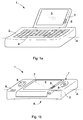
- Figure 1a schematically shows a perspective view of an embodiment of a folding electronic device according to the invention in an open position
- Figure 1b schematically shows a perspective view of the embodiment of the same folding electronic device in a folded position
- the device 1 comprises a first part 2 and a second part 3, which are turnably attached to each other by means of hinge means.
- the attachment of the parts 2, 3 to each other can be implemented with hinge means known per se, and so the matter will not be discussed herein in greater detail. It is to be noted that the dimensions and shapes of the devices and parts thereof are shown in the figures only by way of example.
- the first part 2 comprises data input means, which in the present embodiment of the invention consist of a mechanical keyboard 4, which, compared to the dimensions of the device 1, is big, preferably substantially of the size of the first part 2.
- the keys of the keyboard 4 are preferably arranged as a qwerty keyboard, which is, as well known, in a very common use and can thus be easily adopted by an occasional user as well.
- the keyboard may be of another type, too.
- the second part 3 is provided with a display unit 5 preferably of the size of substantially the entire second part 3.
- the type of the display unit 5 is a grey or colour display known per se; the technique and properties of the display unit 5 are obvious to a person skilled in the art per se, and therefore the matter will not be discussed herein in greater detail.
- second part 3 of the device is at an angle to the first part 2 and both the keyboard 4 and the display unit 5 are on the same side of the device 1. This position is particularly preferable when the PDA properties of the device 1 are utilised, for instance, in writing notes or messages or the like.
- the angle between the parts 2, 3 can be freely adjusted between its extreme positions, and thus the ergonomically best possible position to use the keyboard and display unit 5 can be achieved in each occasion.
- Figure 1b shows the device in a folded position and turned 180° with respect to the position in Figure 1a around an imaginary axis A.
- the second part 3 is turned into a recess in the first part 2, whereupon the second part 3 and the outer surface of the first part 2 form a substantially even surface, which gives an aesthetically pleasant impression of the device 1.
- the device 1 In the folded position, the device 1 is very small and it is easy to handle.
- both the keyboard 4 and the display 5 are on the sides of the device 1 that can be seen from outside, i.e. on the outer sides, but on the different, reverse sides of the device 1.
- the keyboard 4 is on the outer side of the device 1 that faces downwards, i.e. on the bottom side, where it cannot be seen
- the display 5 is on the outer side of the device that faces upwards.
- the keyboard 4 is arranged on a concavely curved surface of the first part 2, whereupon it is protected so that in the position shown by Figure 1b, for example when the device is laid onto a table, the surface of the table does not press against the keys of the keyboard 4 and accidental keystrokes can be avoided.
- the keyboard 4 can also be fitted into a specific recess or it can be otherwise sunk so as to be protected by the bottom of the second part 3 of the device.
- a mechanical keyboard refers herein to both a conventional mechanical keyboard where each key is spatially separated from other keys, and to a membrane keyboard where keys are arranged under a uniform membrane.
- a piezoelectric keyboard can also be used as a keyboard 4. In the piezoelectric keyboard, the keys of the keyboard are marked onto a substantially even surface. When a key is pressed, the piezoelectric element gives a light tactile feedback which can be sensed by the typing fingertip, whereupon the contact between the user and the keyboard is substantially improved. Also, a part of the keyboard 4, such as certain keys or a joystick provided in the keyboard, a touchpad or other similar pointing device known per se can operate as a pointing device. Thus, when the pointing device of the display is used, the rest of the keyboard can be mechanically or programmatically locked so that the device 1 would not react to accidental keystrokes.
- the parts 2, 3 of the device can also be provided with other operational elements, which can be used either in the folded or in the open position or in both positions.
- operating means of the device i.e. keys 6 and a joystick 7 are provided at the front part of the first part 2, i.e. on the side facing away from the keyboard, and on the side of the second part 3 where the display unit 5 is.
- Some of the keys 6 and the joystick 7 are fitted into recesses 8 provided on the surface of the first part 2. Ergonomically the recesses 8 are arranged preferably so that the thumbs of the user of the folded device 1 touch them suitably and it is easy to use the operational means of the device provided in the recesses.
- Both parts 2, 3 can also be provided with other operational means, components and elements well known per se by a person skilled in the art.
- the operational means placed onto the side of the first part 2 that faces away from the keyboard 4 can be used for controlling the display information when the device 1 is in the open position, in other words when the keyboard 4 and the display 5 are on the same side of the device and said operational means are on the back side of the device 1, when seen from the user.
- Figure 2a schematically shows a side view of an embodiment of the folding electronic device according to the invention in an open position.
- the second part 3 comprising the display unit 5 is at an angle of about 125° to the first part 2 comprising the keyboard 4.
- the keyboard 4 consists of a pointing device having a touchpad type of operational principle and being programmatically provided with keys that are required in the qwerty keyboard. It is to be noted that in the following, the term 'touchpad' is used to refer to the pointing device having a touchpad type of operational principle. The operation of the touchpad is obvious to a person skilled in the art, and therefore its operational principle will not be discussed in greater detail in this application.
- the keyboard 4 has two operational modes: in the first operational mode, the keyboard 4 is used as a data input means for entering text or numerical data.
- the keyboard 4 thus operates as a conventional keyboard, and when a key patterned on the keyboard is pressed, a character represented by this key appears on the display or produces a certain function.
- the first operational mode is particularly preferable when the device 1 is in the open position, one example of which is given in Figure 2a.
- the keyboard 4 or a part of it operates as a pointing device of the display.
- the user of the device controls the pointer, such as the cursor of a graphic user interface, moving on the display of the display unit 5, uses the keyboard 4 as a joystick, scrolls or zooms the information or the like shown on the display unit 5.
- the second operational mode is particularly preferable when the parts 2, 3 of the device are turned into the folded position shown in Figure 2b, in which position the device 1 is particularly suitable for performing conventional mobile phone functions or playing games, for instance.
- the keyboard 4 is on the bottom side of the device 1.
- the fingers of the user of the device 1 are set to a natural position on the keyboard 4 on the bottom side of the device, and it is simple and easy for the user to control the information of the display unit 5 by means of the keyboard 4.
- the use of the pointing device of the display does not require that the keyboard 4 must be seen.
- the operational mode of the keyboard can be defined automatically, depending on the angle between the parts.
- the operational mode can also be selected with a switch 12 for selecting the operational mode or in some other way by user command, in which case both operational modes can be used both in the folded and in the open position.
- the keyboard 4 in the second operational mode can be divided into sectors which can be defined as active or passive.
- the user of the device 1 can adapt the pointing device of the display according to his wishes or operational methods by selecting sectors as active, depending on, for example, whether he uses forefingers or middle fingers or whether he uses the fingers of only one hand in order to control the display.
- the sectors can be selected as active, for instance, by a specific switch 13 for selecting sectors or in some other suitable manner. When necessary, the selected sectors can naturally be changed.
- the user looks at the device 1 from the direction of arrow L.
- Both the keyboard 4 and the display unit 5 are on the side of the device 1 where the user is, whereupon the PDA properties of the device can be utilised easily.
- the first part 3 is now substantially equally big as the second part 4. It is perfectly clear that the parts 3 and 4 can be of the same size or of a size different in every way.
- the display unit 5 is preferably as big as possible.
- the hinge means of the device consist of a two-joint mechanical hinge 14 which allows the angle between the parts 2, 3 to be substantially adjusted continuously between the extreme positions. Alternatively, the angle between the parts 2, 3 is adjusted discontinuously, whereby the parts 2, 3 can be arranged at specific, determined angles with respect to each other.
- the hinges are implemented with hinge means well known per se by a person skilled in the art, for example with a flex hinge, and therefore they are not handled in greater detail herein.
- the antenna of the device 1 can be fitted into the hinge or hinge shaft.
- FIG 2b schematically shows a side view of the embodiment of the folding electronic device according to Figure 2a in the folded position.
- the position of the device 1 has been changed by turning the second part 3 against the first part 2 and also by turning the entire device 1 upside down.
- the user looks at the device 1 from the direction of arrow L.
- the keyboard surface on the back side of the device 1 operates as a pointing device of the display.
- the size and dimensions of the keyboard 4 are substantially the same as in the display unit 5, wherefore the pointing device can be used very logically and in a straightforward manner.
- the user need not lift his fingers up from the keyboard 4 in order to lead the cursor to a desired location on the display.
- the keyboard covers the entire area of the display unit 5, it is also possible that the cursor of the display is made to appear where the pointing fingertip is.
- the pointing device of the display is bigger than the display, and thus the display can be controlled in a particularly precise manner.
- the device 1 only comprises one display, the entire area of which can be utilized both in the folded and in the open position.
- Figure 2c schematically shows a side view of the embodiment of the folding electronic device according to Figure 2a in a second folded position.
- the parts 2, 3 of the device 1 turn about 360° with respect to each other.
- the display unit 5 is protected from potential outside blows, scratches or other similar loads that can damage the display. Therefore, the display unit 5 need not be protected by a protective window which reduces the readability of the display and causes component and assembly costs.
- the keyboard 4 and the display unit 5 are turned against each other, certain properties of the device can, however, be utilized.
- Figure 2c shows that there are no input or output devices on the outside shells of the device 1.
- These outside shells can be cast from magnesium, in which case they can be used as a frame for fixing the electronics. In this case, no separate frame has to be provided inside the device.
- a magnesium casing also gives the impression that the device 1 is of a good quality.
- Figure 3 schematically shows a perspective view of a third embodiment of the folding electronic device according to the invention in a folded position.
- the operating means of the device 1 comprises a numeric keypad 15, which is provided at the front part of the first part 2.
- a loudspeaker 16 is arranged at the front part of the first part 2, but on the other side of the second part 3 as the loudspeaker 15.
- the numeric keypad 15 and the loudspeaker can be used for example for performing conventional mobile phone functions.
- the drawings and the related description are only intended to illustrate the idea of the invention. In its details, the invention can vary within the scope of the claims.
- the biggest deflection angle between the parts 2, 3 can naturally be smaller than 360°.
- the device 1 can comprise locking elements by which the parts 2, 3 can be locked into a folded position, a second folded position and/or an open position.
- the device may also comprise more than two parts that turn with respect to each other.
- the area of the display control means can be bigger than the area of the keyboard 4.
- the shape of the parts and components of the device 1 can differ from what is shown in Figures 1a to 2c. It is also perfectly clear that the display unit 5 can be a touchscreen, in which case the functions of the device 1 can be controlled by touching the surface of the display unit 5.
- the keyboard 4 can be a double-action keyboard, which can be used as a low-resolution pointer, even when the device 1 is in a folded position.
- the double-action keyboard has keys that can detect if they are being pressed or merely touched. When the device is in a folded position and the user touches a key, a corresponding item on the display is highlighted. The item is selected by pressing the key.
- the graphical interface is configured so, that the items coincidence with the keys.
- the keys of the keyboard are preferably arranged to straight columns and rows. This kind of pointing method can be used, for example, for conventional phone functions.
Landscapes
- Engineering & Computer Science (AREA)
- Computer Hardware Design (AREA)
- Theoretical Computer Science (AREA)
- Human Computer Interaction (AREA)
- Physics & Mathematics (AREA)
- General Engineering & Computer Science (AREA)
- General Physics & Mathematics (AREA)
- Signal Processing (AREA)
- Mathematical Physics (AREA)
- Input From Keyboards Or The Like (AREA)
- Position Input By Displaying (AREA)
- Telephone Set Structure (AREA)
- Tumbler Switches (AREA)
- Surface Acoustic Wave Elements And Circuit Networks Thereof (AREA)
- Piezo-Electric Or Mechanical Vibrators, Or Delay Or Filter Circuits (AREA)
- Devices For Indicating Variable Information By Combining Individual Elements (AREA)
- Calculators And Similar Devices (AREA)
Abstract
Description
Claims (26)
- A folding electronic device comprising a first part (2) and a second part (3) arranged to turn with respect to the first part, the parts (2, 3) being turnable with respect to each other into a folded position and an open position, the first part (2) comprising at least data input means and the second part (3) comprising at least a display unit (5), characterized in that in the folded position, the data input means and the display unit (5) are on different, outer sides of the device (1) and that at least some of the data input means are arranged to operate as a display pointing device of said display unit (5).
- An electronic device as claimed in claim 1, characterized in that the data input means consist of a keyboard (4).
- An electronic device as claimed in claim 2, characterized in that the keyboard (4) has a first operational mode and a second operational mode.
- An electronic device as claimed in claim 3, characterized in that in the first operational mode, the keyboard (4) is arranged to operate as a data input means and in the second operational mode, the keyboard or a part of it is arranged to operate as a pointing device of the display.
- An electronic device as claimed in claim 3 or 4, characterized in that the operational mode of the keyboard (4) is arranged to be determined on the basis of the angle between the parts (2, 3) of the device.
- An electronic device as claimed in any one of claims 3 to 5, characterized in that the operational mode of the keyboard (4) is arranged to be selected by user command.
- An electronic device as claimed in claim 6, characterized in that the operational mode of the keyboard (4) is arranged to be selected by a switch (12) for selecting the operational mode.
- An electronic device as claimed in any one of the preceding claims, characterized in that the biggest deflection angle between the parts (2, 3) is about 360°.
- An electronic device as claimed in any one of the preceding claims, characterized in that the data input means consist of a qwerty keyboard.
- An electronic device as claimed in any one of the preceding claims, characterized in that the data input means consist of a mechanical keyboard.
- An electronic device as claimed in any one of claims 1 to 9, characterized in that the data input means consist of a touchpad provided with figures representing the keys of the keyboard.
- An electronic device as claimed in claim 11, characterized in that the touchpad in the second operational mode can be divided into sectors that can be defined as active and passive.
- An electronic device as claimed in claim 12, characterized in that the sectors of the touchpad are arranged to be defined by user command.
- An electronic device as claimed in claim 12, characterized in that the sectors of the touchpad are arranged to be defined by a switch (13) for selecting sectors.
- An electronic device as claimed in any one of the preceding claims, characterized in that the data input means are provided with a piezoelectric response function.
- An electronic device as claimed in any one of the preceding claims, characterized in that substantially the entire data input means are arranged to operate as a pointing device of the display or as a part of it.
- An electronic device as claimed in any one of claims 1 to 15, characterized in that a part of the data input means is arranged to operate as a pointing device of the display.
- An electronic device as claimed in claim 17, characterized in that the pointing device of the display is a joystick provided at the data input means.
- An electronic device as claimed in claim 17, characterized in that the pointing device of the display is a touchpad provided at the data input means.
- An electronic device as claimed in any one of the preceding claims, characterized in that operating means of the device are provided on the side of the first part (2) that faces away from the data input means.
- An electronic device as claimed in claim 20, characterized in that the operating means comprises a numeric keypad (15).
- An electronic device as claimed in any one of the preceding claims, characterized in that the data input means are fitted into a recess in the first part (2).
- An electronic device as claimed in any one of the preceding claims, characterized in that the dimensions of the pointing device of the display and those of the display unit (5) are substantially similar.
- An electronic device as claimed in any one of the preceding claims, characterized in that when the device (1) is in the open position, at least some of the operational means on the side of the first part (2) that faces away from the data input means are arranged to operate as a pointing device of the display.
- An electronic device as claimed in any one of the preceding claims, characterized in that the device (1) only comprises one display unit (5).
- An electronic device as claimed in any one of the preceding claims, characterized in that at least some part of the keyboard (4) is arranged to operate as a low-resolution pointer at least when the device (1) is in the folded position.
Applications Claiming Priority (2)
| Application Number | Priority Date | Filing Date | Title |
|---|---|---|---|
| FI20010681 | 2001-04-02 | ||
| FI20010681A FI20010681A7 (en) | 2001-04-02 | 2001-04-02 | Foldable electronic device |
Publications (3)
| Publication Number | Publication Date |
|---|---|
| EP1253506A2 true EP1253506A2 (en) | 2002-10-30 |
| EP1253506A3 EP1253506A3 (en) | 2004-07-14 |
| EP1253506B1 EP1253506B1 (en) | 2007-10-10 |
Family
ID=8560896
Family Applications (1)
| Application Number | Title | Priority Date | Filing Date |
|---|---|---|---|
| EP02100313A Expired - Lifetime EP1253506B1 (en) | 2001-04-02 | 2002-03-28 | Folding electronic device |
Country Status (6)
| Country | Link |
|---|---|
| US (1) | US6757157B2 (en) |
| EP (1) | EP1253506B1 (en) |
| JP (1) | JP3725833B2 (en) |
| AT (1) | ATE375541T1 (en) |
| DE (1) | DE60222825T2 (en) |
| FI (1) | FI20010681A7 (en) |
Cited By (3)
| Publication number | Priority date | Publication date | Assignee | Title |
|---|---|---|---|---|
| EP1556960A4 (en) * | 2002-11-01 | 2006-03-15 | Nokia Corp | PROGRAMMABLE FUNCTION KEYS FOR MOBILE COMMUNICATION DEVICES WITH PIVOTING PANELS |
| EP1749392A4 (en) * | 2004-04-21 | 2009-06-10 | Nokia Corp | ELECTRONIC MULTI-FUNCTIONAL SECONDARY UNIT WITH 360 ° RELATIVE TURN |
| TWI384831B (en) * | 2004-12-30 | 2013-02-01 | Nokia Corp | Multi-function electronic device and the method for controlling the same,and mobile device |
Families Citing this family (29)
| Publication number | Priority date | Publication date | Assignee | Title |
|---|---|---|---|---|
| EP1387246A1 (en) * | 2002-07-30 | 2004-02-04 | Motorola, Inc. | User interface and method for displaying information on a plurality of displays |
| JP2004297417A (en) * | 2003-03-27 | 2004-10-21 | Sanyo Electric Co Ltd | Portable radio terminal |
| US7512426B2 (en) | 2003-04-23 | 2009-03-31 | Nokia Corporation | Mobile communications device with synchronising hinge |
| US6900981B2 (en) | 2003-04-23 | 2005-05-31 | Nokia Corporation | Mobile Terminal with synchronizing hinge |
| US20060034601A1 (en) * | 2003-04-23 | 2006-02-16 | Tage Andersson | Multi-function two panel electronic device with 360° relative motion |
| US7426406B2 (en) * | 2003-04-23 | 2008-09-16 | Nokia Corporation | Mobile communications device with synchronising hinge |
| US20060234784A1 (en) * | 2004-12-21 | 2006-10-19 | Silviu Reinhorn | Collapsible portable display |
| US20060232578A1 (en) * | 2004-12-21 | 2006-10-19 | Silviu Reinhorn | Collapsible portable display |
| US7414834B2 (en) | 2005-04-21 | 2008-08-19 | Nokia Corporation | Mobile communications device with synchronising hinge |
| US8271549B2 (en) * | 2005-08-05 | 2012-09-18 | Intel Corporation | System and method for automatically managing media content |
| US7787912B2 (en) * | 2006-11-22 | 2010-08-31 | Nokia Corporation | Portable electronic device with double acting hinge arrangement |
| CN101290553A (en) * | 2007-04-17 | 2008-10-22 | 索尼(中国)有限公司 | Electronic equipment possessing display screen |
| JP4993290B2 (en) * | 2007-06-08 | 2012-08-08 | 株式会社キャットアイ | Display device |
| US7486503B1 (en) | 2008-02-15 | 2009-02-03 | Inventec Corporation | Portable electronic device structure |
| TWI454967B (en) * | 2008-07-16 | 2014-10-01 | Htc Corp | Electronic device and keyboard module thereof |
| US7697281B2 (en) | 2008-09-05 | 2010-04-13 | Apple Inc. | Handheld computing device |
| US7869206B2 (en) * | 2008-09-05 | 2011-01-11 | Apple Inc. | Handheld computing device |
| USD629777S1 (en) * | 2009-12-25 | 2010-12-28 | Fih (Hong Kong) Limited | Mobile phone |
| US8725223B2 (en) * | 2010-02-08 | 2014-05-13 | Nokia Corporation | Apparatus for a portable electronic device |
| US8391010B2 (en) | 2010-08-19 | 2013-03-05 | Apple Inc. | Internal frame optimized for stiffness and heat transfer |
| US8515113B2 (en) | 2010-08-19 | 2013-08-20 | Apple Inc. | Composite microphone boot to optimize sealing and mechanical properties |
| US9602914B2 (en) | 2010-08-27 | 2017-03-21 | Apple Inc. | Porting audio using a connector in a small form factor electronic device |
| US8477492B2 (en) | 2010-08-19 | 2013-07-02 | Apple Inc. | Formed PCB |
| US8634204B2 (en) | 2010-08-19 | 2014-01-21 | Apple Inc. | Compact folded configuration for integrated circuit packaging |
| US8427379B2 (en) | 2010-08-19 | 2013-04-23 | Apple Inc. | Modular material antenna assembly |
| TWM415354U (en) * | 2011-07-06 | 2011-11-01 | Acer Inc | Computer input device with labeling areas |
| US9287627B2 (en) | 2011-08-31 | 2016-03-15 | Apple Inc. | Customizable antenna feed structure |
| US9406999B2 (en) | 2011-09-23 | 2016-08-02 | Apple Inc. | Methods for manufacturing customized antenna structures |
| USD801393S1 (en) * | 2016-10-25 | 2017-10-31 | Liunan Lai | Touchpad mini keyboard (T16) |
Family Cites Families (19)
| Publication number | Priority date | Publication date | Assignee | Title |
|---|---|---|---|---|
| US5268817A (en) * | 1990-04-27 | 1993-12-07 | Kabushiki Kaisha Toshiba | Portable computer with keyboard and having display with coordinate input tablet rotatably mounted to face either toward or away from keyboard when closed over keyboard |
| US5438475A (en) * | 1993-09-30 | 1995-08-01 | Hewlett-Packard Company | Portable computer with an electronic pen storage turret |
| JPH0822343A (en) * | 1994-07-07 | 1996-01-23 | Olympus Optical Co Ltd | Information processor |
| JP3463392B2 (en) * | 1995-01-30 | 2003-11-05 | ソニー株式会社 | Electronics |
| US5666694A (en) * | 1995-09-28 | 1997-09-16 | Hewlett-Packard Company | Hinge arrangement |
| JP3222764B2 (en) * | 1996-05-17 | 2001-10-29 | シャープ株式会社 | Information processing device |
| US5889508A (en) * | 1996-09-26 | 1999-03-30 | Slotta; Mark R. | Cushion for keyboard cursor control stick |
| JPH10161773A (en) * | 1996-12-02 | 1998-06-19 | Fujitsu Ltd | Portable information processing device |
| US5793311A (en) * | 1996-12-27 | 1998-08-11 | Texas Instruments Incorporated | Low profile keyboard |
| JP3310905B2 (en) * | 1997-05-30 | 2002-08-05 | 株式会社日立製作所 | Portable information processing device |
| US5864334A (en) * | 1997-06-27 | 1999-01-26 | Compaq Computer Corporation | Computer keyboard with switchable typing/cursor control modes |
| US5887995A (en) * | 1997-09-23 | 1999-03-30 | Compaq Computer Corporation | Touchpad overlay with tactile response |
| US6046728A (en) * | 1997-12-05 | 2000-04-04 | Dell Usa, L.P. | Keyboard actuated pointing device |
| FI109731B (en) | 1998-06-02 | 2002-09-30 | Nokia Corp | Electronic device and control elements |
| US6262716B1 (en) * | 1998-07-01 | 2001-07-17 | Gateway, Inc. | Information processing apparatus having a numeric keypad with cover that functions as a palm rest |
| EP1016951A1 (en) * | 1998-11-12 | 2000-07-05 | NTS Computer Systems R & D (Ireland) Limited | A portable computer |
| GB2344905A (en) | 1998-12-17 | 2000-06-21 | Canon Kk | Hand held electronic device with back entry touch pad |
| US6424338B1 (en) * | 1999-09-30 | 2002-07-23 | Gateway, Inc. | Speed zone touchpad |
| JP2001125668A (en) * | 1999-10-26 | 2001-05-11 | Nec Niigata Ltd | Hinge mechanism of notebook type personal computer |
-
2001
- 2001-04-02 FI FI20010681A patent/FI20010681A7/en not_active IP Right Cessation
-
2002
- 2002-03-28 AT AT02100313T patent/ATE375541T1/en not_active IP Right Cessation
- 2002-03-28 EP EP02100313A patent/EP1253506B1/en not_active Expired - Lifetime
- 2002-03-28 DE DE60222825T patent/DE60222825T2/en not_active Expired - Lifetime
- 2002-03-29 US US10/112,382 patent/US6757157B2/en not_active Expired - Lifetime
- 2002-04-02 JP JP2002100082A patent/JP3725833B2/en not_active Expired - Fee Related
Cited By (3)
| Publication number | Priority date | Publication date | Assignee | Title |
|---|---|---|---|---|
| EP1556960A4 (en) * | 2002-11-01 | 2006-03-15 | Nokia Corp | PROGRAMMABLE FUNCTION KEYS FOR MOBILE COMMUNICATION DEVICES WITH PIVOTING PANELS |
| EP1749392A4 (en) * | 2004-04-21 | 2009-06-10 | Nokia Corp | ELECTRONIC MULTI-FUNCTIONAL SECONDARY UNIT WITH 360 ° RELATIVE TURN |
| TWI384831B (en) * | 2004-12-30 | 2013-02-01 | Nokia Corp | Multi-function electronic device and the method for controlling the same,and mobile device |
Also Published As
| Publication number | Publication date |
|---|---|
| FI20010681A0 (en) | 2001-04-02 |
| US20020154475A1 (en) | 2002-10-24 |
| EP1253506B1 (en) | 2007-10-10 |
| US6757157B2 (en) | 2004-06-29 |
| DE60222825T2 (en) | 2008-01-24 |
| JP2003036124A (en) | 2003-02-07 |
| ATE375541T1 (en) | 2007-10-15 |
| JP3725833B2 (en) | 2005-12-14 |
| FI20010681L (en) | 2002-10-03 |
| EP1253506A3 (en) | 2004-07-14 |
| DE60222825D1 (en) | 2007-11-22 |
| FI20010681A7 (en) | 2002-10-03 |
Similar Documents
| Publication | Publication Date | Title |
|---|---|---|
| US6757157B2 (en) | Folding electronic device | |
| US7002553B2 (en) | Active keyboard system for handheld electronic devices | |
| EP1642445B1 (en) | Multifunctional ui input device for mobile terminals | |
| JP4450008B2 (en) | Electronics | |
| US7439957B2 (en) | Compact universal keyboard | |
| EP2077491B1 (en) | Method for switching touch keyboard and handheld electronic device and storage medium using the same | |
| US20050091431A1 (en) | Portable communication devices | |
| US20050125570A1 (en) | Portable communication devices | |
| EP1238326A2 (en) | Foldable keyboard for carrying portable device | |
| JP3964154B2 (en) | Input device for portable terminal | |
| WO2006052175A1 (en) | Terminal design with keyboard arranged on the back or side surface of the terminal | |
| US20080106518A1 (en) | Tactile input arrangement for a computing device | |
| JP2004185164A (en) | Portable electronic equipment | |
| JP3109319U (en) | A numeric keypad compatible mobile phone with a keyboard window | |
| US20060082544A1 (en) | Dynamic single row QWERTY key layout | |
| JP2006054751A (en) | Mobile device | |
| US8057116B1 (en) | Data input mechanism | |
| JP2003345497A (en) | Electronic apparatus | |
| JP2003216306A (en) | Reduced set character input system for electronic equipment | |
| JPH06138976A (en) | Information processing equipment | |
| JP2003273995A (en) | Portable device | |
| JP2005128983A (en) | Personal computer usable en face like book | |
| JP2004185090A (en) | Personal digital assistant device |
Legal Events
| Date | Code | Title | Description |
|---|---|---|---|
| PUAI | Public reference made under article 153(3) epc to a published international application that has entered the european phase |
Free format text: ORIGINAL CODE: 0009012 |
|
| AK | Designated contracting states |
Kind code of ref document: A2 Designated state(s): AT BE CH CY DE DK ES FI FR GB GR IE IT LI LU MC NL PT SE TR |
|
| AX | Request for extension of the european patent |
Free format text: AL;LT;LV;MK;RO;SI |
|
| PUAL | Search report despatched |
Free format text: ORIGINAL CODE: 0009013 |
|
| AK | Designated contracting states |
Kind code of ref document: A3 Designated state(s): AT BE CH CY DE DK ES FI FR GB GR IE IT LI LU MC NL PT SE TR |
|
| AX | Request for extension of the european patent |
Extension state: AL LT LV MK RO SI |
|
| 17P | Request for examination filed |
Effective date: 20041117 |
|
| 17Q | First examination report despatched |
Effective date: 20050214 |
|
| AKX | Designation fees paid |
Designated state(s): AT BE CH CY DE DK ES FI FR GB GR IE IT LI LU MC NL PT SE TR |
|
| GRAP | Despatch of communication of intention to grant a patent |
Free format text: ORIGINAL CODE: EPIDOSNIGR1 |
|
| GRAS | Grant fee paid |
Free format text: ORIGINAL CODE: EPIDOSNIGR3 |
|
| GRAA | (expected) grant |
Free format text: ORIGINAL CODE: 0009210 |
|
| AK | Designated contracting states |
Kind code of ref document: B1 Designated state(s): AT BE CH CY DE DK ES FI FR GB GR IE IT LI LU MC NL PT SE TR |
|
| REG | Reference to a national code |
Ref country code: GB Ref legal event code: FG4D |
|
| REG | Reference to a national code |
Ref country code: CH Ref legal event code: EP |
|
| REG | Reference to a national code |
Ref country code: IE Ref legal event code: FG4D |
|
| REF | Corresponds to: |
Ref document number: 60222825 Country of ref document: DE Date of ref document: 20071122 Kind code of ref document: P |
|
| ET | Fr: translation filed | ||
| PG25 | Lapsed in a contracting state [announced via postgrant information from national office to epo] |
Ref country code: CH Free format text: LAPSE BECAUSE OF FAILURE TO SUBMIT A TRANSLATION OF THE DESCRIPTION OR TO PAY THE FEE WITHIN THE PRESCRIBED TIME-LIMIT Effective date: 20071010 Ref country code: ES Free format text: LAPSE BECAUSE OF FAILURE TO SUBMIT A TRANSLATION OF THE DESCRIPTION OR TO PAY THE FEE WITHIN THE PRESCRIBED TIME-LIMIT Effective date: 20080121 Ref country code: SE Free format text: LAPSE BECAUSE OF FAILURE TO SUBMIT A TRANSLATION OF THE DESCRIPTION OR TO PAY THE FEE WITHIN THE PRESCRIBED TIME-LIMIT Effective date: 20080110 Ref country code: LI Free format text: LAPSE BECAUSE OF FAILURE TO SUBMIT A TRANSLATION OF THE DESCRIPTION OR TO PAY THE FEE WITHIN THE PRESCRIBED TIME-LIMIT Effective date: 20071010 |
|
| REG | Reference to a national code |
Ref country code: CH Ref legal event code: PL |
|
| PG25 | Lapsed in a contracting state [announced via postgrant information from national office to epo] |
Ref country code: PT Free format text: LAPSE BECAUSE OF FAILURE TO SUBMIT A TRANSLATION OF THE DESCRIPTION OR TO PAY THE FEE WITHIN THE PRESCRIBED TIME-LIMIT Effective date: 20080310 |
|
| PG25 | Lapsed in a contracting state [announced via postgrant information from national office to epo] |
Ref country code: AT Free format text: LAPSE BECAUSE OF FAILURE TO SUBMIT A TRANSLATION OF THE DESCRIPTION OR TO PAY THE FEE WITHIN THE PRESCRIBED TIME-LIMIT Effective date: 20071010 |
|
| PG25 | Lapsed in a contracting state [announced via postgrant information from national office to epo] |
Ref country code: DK Free format text: LAPSE BECAUSE OF FAILURE TO SUBMIT A TRANSLATION OF THE DESCRIPTION OR TO PAY THE FEE WITHIN THE PRESCRIBED TIME-LIMIT Effective date: 20071010 |
|
| PLBE | No opposition filed within time limit |
Free format text: ORIGINAL CODE: 0009261 |
|
| STAA | Information on the status of an ep patent application or granted ep patent |
Free format text: STATUS: NO OPPOSITION FILED WITHIN TIME LIMIT |
|
| PG25 | Lapsed in a contracting state [announced via postgrant information from national office to epo] |
Ref country code: BE Free format text: LAPSE BECAUSE OF FAILURE TO SUBMIT A TRANSLATION OF THE DESCRIPTION OR TO PAY THE FEE WITHIN THE PRESCRIBED TIME-LIMIT Effective date: 20071010 |
|
| 26N | No opposition filed |
Effective date: 20080711 |
|
| PG25 | Lapsed in a contracting state [announced via postgrant information from national office to epo] |
Ref country code: MC Free format text: LAPSE BECAUSE OF NON-PAYMENT OF DUE FEES Effective date: 20080331 |
|
| PG25 | Lapsed in a contracting state [announced via postgrant information from national office to epo] |
Ref country code: GR Free format text: LAPSE BECAUSE OF FAILURE TO SUBMIT A TRANSLATION OF THE DESCRIPTION OR TO PAY THE FEE WITHIN THE PRESCRIBED TIME-LIMIT Effective date: 20080111 Ref country code: IE Free format text: LAPSE BECAUSE OF NON-PAYMENT OF DUE FEES Effective date: 20080328 |
|
| PG25 | Lapsed in a contracting state [announced via postgrant information from national office to epo] |
Ref country code: CY Free format text: LAPSE BECAUSE OF FAILURE TO SUBMIT A TRANSLATION OF THE DESCRIPTION OR TO PAY THE FEE WITHIN THE PRESCRIBED TIME-LIMIT Effective date: 20071010 |
|
| PG25 | Lapsed in a contracting state [announced via postgrant information from national office to epo] |
Ref country code: LU Free format text: LAPSE BECAUSE OF NON-PAYMENT OF DUE FEES Effective date: 20080328 |
|
| PG25 | Lapsed in a contracting state [announced via postgrant information from national office to epo] |
Ref country code: TR Free format text: LAPSE BECAUSE OF FAILURE TO SUBMIT A TRANSLATION OF THE DESCRIPTION OR TO PAY THE FEE WITHIN THE PRESCRIBED TIME-LIMIT Effective date: 20071010 |
|
| PG25 | Lapsed in a contracting state [announced via postgrant information from national office to epo] |
Ref country code: IT Free format text: LAPSE BECAUSE OF NON-PAYMENT OF DUE FEES Effective date: 20080331 |
|
| PGFP | Annual fee paid to national office [announced via postgrant information from national office to epo] |
Ref country code: FR Payment date: 20110317 Year of fee payment: 10 Ref country code: FI Payment date: 20110310 Year of fee payment: 10 |
|
| PGFP | Annual fee paid to national office [announced via postgrant information from national office to epo] |
Ref country code: GB Payment date: 20110323 Year of fee payment: 10 |
|
| PG25 | Lapsed in a contracting state [announced via postgrant information from national office to epo] |
Ref country code: FI Free format text: LAPSE BECAUSE OF NON-PAYMENT OF DUE FEES Effective date: 20120328 |
|
| GBPC | Gb: european patent ceased through non-payment of renewal fee |
Effective date: 20120328 |
|
| REG | Reference to a national code |
Ref country code: FR Ref legal event code: ST Effective date: 20121130 |
|
| PG25 | Lapsed in a contracting state [announced via postgrant information from national office to epo] |
Ref country code: GB Free format text: LAPSE BECAUSE OF NON-PAYMENT OF DUE FEES Effective date: 20120328 Ref country code: FR Free format text: LAPSE BECAUSE OF NON-PAYMENT OF DUE FEES Effective date: 20120402 |
|
| REG | Reference to a national code |
Ref country code: DE Ref legal event code: R082 Ref document number: 60222825 Country of ref document: DE Representative=s name: BECKER, KURIG, STRAUS, DE Ref country code: DE Ref legal event code: R081 Ref document number: 60222825 Country of ref document: DE Owner name: NOKIA TECHNOLOGIES OY, FI Free format text: FORMER OWNER: NOKIA CORP., 02610 ESPOO, FI |
|
| REG | Reference to a national code |
Ref country code: NL Ref legal event code: PD Owner name: NOKIA TECHNOLOGIES OY; FI Free format text: DETAILS ASSIGNMENT: VERANDERING VAN EIGENAAR(S), OVERDRACHT; FORMER OWNER NAME: NOKIA CORPORATION Effective date: 20151111 |
|
| REG | Reference to a national code |
Ref country code: DE Ref legal event code: R082 Ref document number: 60222825 Country of ref document: DE Representative=s name: WINTER, BRANDL, FUERNISS, HUEBNER, ROESS, KAIS, DE Ref country code: DE Ref legal event code: R081 Ref document number: 60222825 Country of ref document: DE Owner name: VIVO MOBILE COMMUNICATION CO., LTD., DONGGUAN, CN Free format text: FORMER OWNER: NOKIA TECHNOLOGIES OY, ESPOO, FI Ref country code: DE Ref legal event code: R082 Ref document number: 60222825 Country of ref document: DE Representative=s name: WINTER, BRANDL - PARTNERSCHAFT MBB, PATENTANWA, DE |
|
| PGFP | Annual fee paid to national office [announced via postgrant information from national office to epo] |
Ref country code: NL Payment date: 20210312 Year of fee payment: 20 |
|
| PGFP | Annual fee paid to national office [announced via postgrant information from national office to epo] |
Ref country code: DE Payment date: 20210316 Year of fee payment: 20 |
|
| REG | Reference to a national code |
Ref country code: DE Ref legal event code: R071 Ref document number: 60222825 Country of ref document: DE |
|
| REG | Reference to a national code |
Ref country code: NL Ref legal event code: MK Effective date: 20220327 |