EP1253206A2 - Method of amplifying or detecting hiv-1 rna - Google Patents
Method of amplifying or detecting hiv-1 rna Download PDFInfo
- Publication number
- EP1253206A2 EP1253206A2 EP02009618A EP02009618A EP1253206A2 EP 1253206 A2 EP1253206 A2 EP 1253206A2 EP 02009618 A EP02009618 A EP 02009618A EP 02009618 A EP02009618 A EP 02009618A EP 1253206 A2 EP1253206 A2 EP 1253206A2
- Authority
- EP
- European Patent Office
- Prior art keywords
- oligonucleotide
- seq
- rna
- primer
- nos
- Prior art date
- Legal status (The legal status is an assumption and is not a legal conclusion. Google has not performed a legal analysis and makes no representation as to the accuracy of the status listed.)
- Granted
Links
Images



Classifications
-
- C—CHEMISTRY; METALLURGY
- C12—BIOCHEMISTRY; BEER; SPIRITS; WINE; VINEGAR; MICROBIOLOGY; ENZYMOLOGY; MUTATION OR GENETIC ENGINEERING
- C12Q—MEASURING OR TESTING PROCESSES INVOLVING ENZYMES, NUCLEIC ACIDS OR MICROORGANISMS; COMPOSITIONS OR TEST PAPERS THEREFOR; PROCESSES OF PREPARING SUCH COMPOSITIONS; CONDITION-RESPONSIVE CONTROL IN MICROBIOLOGICAL OR ENZYMOLOGICAL PROCESSES
- C12Q1/00—Measuring or testing processes involving enzymes, nucleic acids or microorganisms; Compositions therefor; Processes of preparing such compositions
- C12Q1/70—Measuring or testing processes involving enzymes, nucleic acids or microorganisms; Compositions therefor; Processes of preparing such compositions involving virus or bacteriophage
- C12Q1/701—Specific hybridization probes
- C12Q1/702—Specific hybridization probes for retroviruses
- C12Q1/703—Viruses associated with AIDS
Definitions
- the present invention relates to methods for the amplification or detection of HIV-1 RNA in clinical tests and diagnoses.
- HIV Human immunodeficiency virus
- AIDS Human immunodeficiency syndrome
- HIV-1 which is spread worldwide
- HIV-2 which is epidemic mainly on the African West coast.
- SIV simian immunodeficiency virus
- HIV-1 infection induces the production of antibodies against structural proteins and regulatory proteins of HIV-1.
- HIV-1 attacks the T cells classified as CD4+ lymphocytes as the main target immunocytes and hence abnormalizes the immune system in various ways.
- B cells are stimulated to set off hypergammaglobulinemia, and autoantibodies and immunocomplexes appear with a marked reduction of lymphocytes and blood platelets.
- Complications such as tuberculosis, Pneumocystis carinii pneumonia and other opportunistic infections at high levels of immunodeficiency induced by HIV-1 infection are diagnostic of onset of AIDS.
- EIA enzyme immunoassay
- Western blot confirmation of suspected positive serum samples by the presence of antibodies in the serum samples which react to a specific virus antigen in a blot of electrophoretically separated various virus particle antigens.
- assay methods which detect antibodies like these are not available for diagnoses of early stage infection before the production of antibodies.
- RNA derived from such a gene For high sensitive detection, it is preferred to amplify a specific sequence in a gene to be detected or identified or an RNA derived from such a gene.
- RT-PCR reverse transcription-polymerase chain reaction
- the reverse transcription step for synthesis of the cDNA of the target RNA is followed by repeated cycles of heat denaturation, primer-annealing and elongation reaction in the presence of a pair of primers, one of which is complementary to either end of the specific sequence and the other is homologous to the other end of the specific sequence (the antisense primer may be the same as the primer used in the reverse transcription step), and a thermostable DNA polymerase to give DNA as the amplification product of the specific sequence.
- NASBA or 3SR is known as a technique for amplifying a -specific RNA sequence by the cooperative action of a reverse transcriptase and an RNA polymerase.
- This technique involves a chain reaction comprising the synthesis of a double-stranded DNA from the target RNA.
- a primer containing promoter sequences the target RNA is reverse-transcribed by the use of a reverse transcriptase followed by hydrolysis of the RNA portion by the use of ribonuclease H.
- a second primer and the DNA dependent DNA polymerase activity of the reverse transcriptase a DNA strand complementary to the first DNA strand is produced.
- RNA polymerase Using the resulting double-stranded DNA containing the promoter sequence as a template, an RNA polymerase produces an RNA having the specific sequence.
- NASBA or 3SR allows relatively isothermal amplification of ribonucleic acids and is considered suitable for automation.
- the reactions involved in this amplification technique are carried out at relatively low temperatures (for example, at 41°C)
- formation of intramolecular secondary structure of the target RNA may occur, thus preventing binding of the primers and reducing the reaction efficiency. Therefore, it is necessary to increase the binding efficiency of the primers before the amplification reaction. This is achieved by resolving the intramolecular secondary structure of the target RNA, for example, by heat denaturation of the target RNA.
- the object of the present invention is to provide a simple, speedy and sensitive method for amplifying or detecting HIV-RNA.
- the present invention has been accomplished to attain the above-mentioned object by the provision of an oligonucleotide that can bind to a region of the genomic RNA of HIV-1 which is free of RNA secondary structure. Therefore, the oligonucleotide can be used as a primer at relatively low and constant temperatures (at 35°C to 50°C, preferably at 41°C) for amplification of a nucleic acid.
- the invention defined in the claims of the present application provides a method of amplifying an RNA of HIV-1, anticipated in a sample as a template which comprises the steps of
- the invention provides a method of detecting HIV-1, which comprises conducting the aforementioned method of amplifying HIV-1 RNA in the presence of an oligonucleotide probe having a sequence different from those of the first primer and the second-primer which can specifically bind to the RNA transcript resulting from the amplification and which is labeled with a fluorescent intercalative dye, and measuring the change in the fluorescence of the reaction solution.
- this method is carried out by using an oligonucleotide probe which is designed to hybridize with at least part of the RNA transcript and to alter its fluorescence upon hybridization.
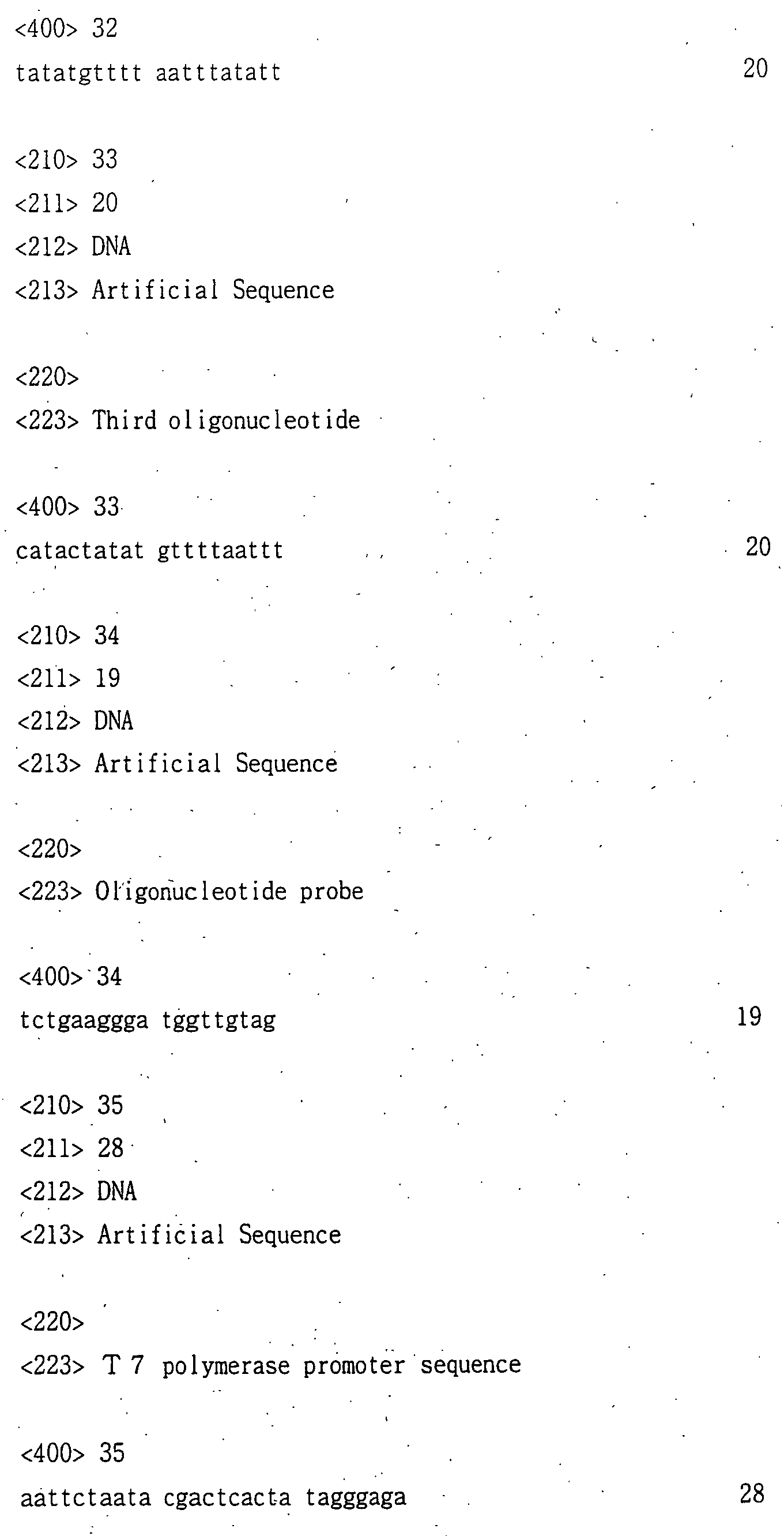
- oligonucleotide probes comprising a sequence consisting of or being complementary to at least 10 consecutive nucleotides in SEQ ID NO: 34.
- the invention provides the use of an oligonucleotide of any one of SEQ ID NOs: 1 to 35 for the amplification of HIV-1 RNA.
- Also provided by the invention is the use of an oligonucleotide of any one of SEQ ID NOs: 1 to 35 for the detection of HIV-1 in a sample.
- the invention provides a kit comprising at least one oligonucleotide of any one of SEQ ID NOs: 1 to 35 in one or more container.
- said kit is for use in one of the above-mentioned methods and/or uses and consequently may additionally comprise further suitable ingredients such as the required enzymes, buffers, and the like as well as a corresponding manual describing said method or use to the user of the kit.
- the present invention provides a nucleic acid amplification method for amplification of HIV-RNA in a sample, and a method of detecting the RNA transcript formed by the nucleic acid amplification method.
- the amplification method of the present invention may cover any amplification methods such as PCR, NASBA or 3SR.
- isothermal nucleic acid amplification by the cooperative action of a reverse transcriptase and an RNA polymerase as, e.g. in NASBA or 3SR is preferred for amplifying a specific RNA sequence in HIV-1.
- NASBA amplification of an HIV-1 RNA present in a sample comprises synthesizing a cDNA by the action of an RNA-dependent DNA polymerase by using a specific sequence in said HIV-1 RNA as the template, subsequently, the cDNA is denuded by the action of ribonuclease H to a single-stranded DNA, through degradation of the RNA in the RNA-DNA double strand of the cDNA.
- NASBA amplification further comprises forming a double-stranded DNA comprising a promoter sequence which can be transcribed into an RNA consisting of the specific nucleotide sequence of HIV-1 or a sequence complementary to the specific nucleotide sequence.
- the formation of the double-stranded DNA is accomplished by using the single-stranded DNA as the template and by the action of a DNA-dependent DNA polymerase. Transcribing the double-stranded DNA into an RNA transcript generates further templates for subsequent cDNA syntheses by the RNA-dependent DNA polymerase.
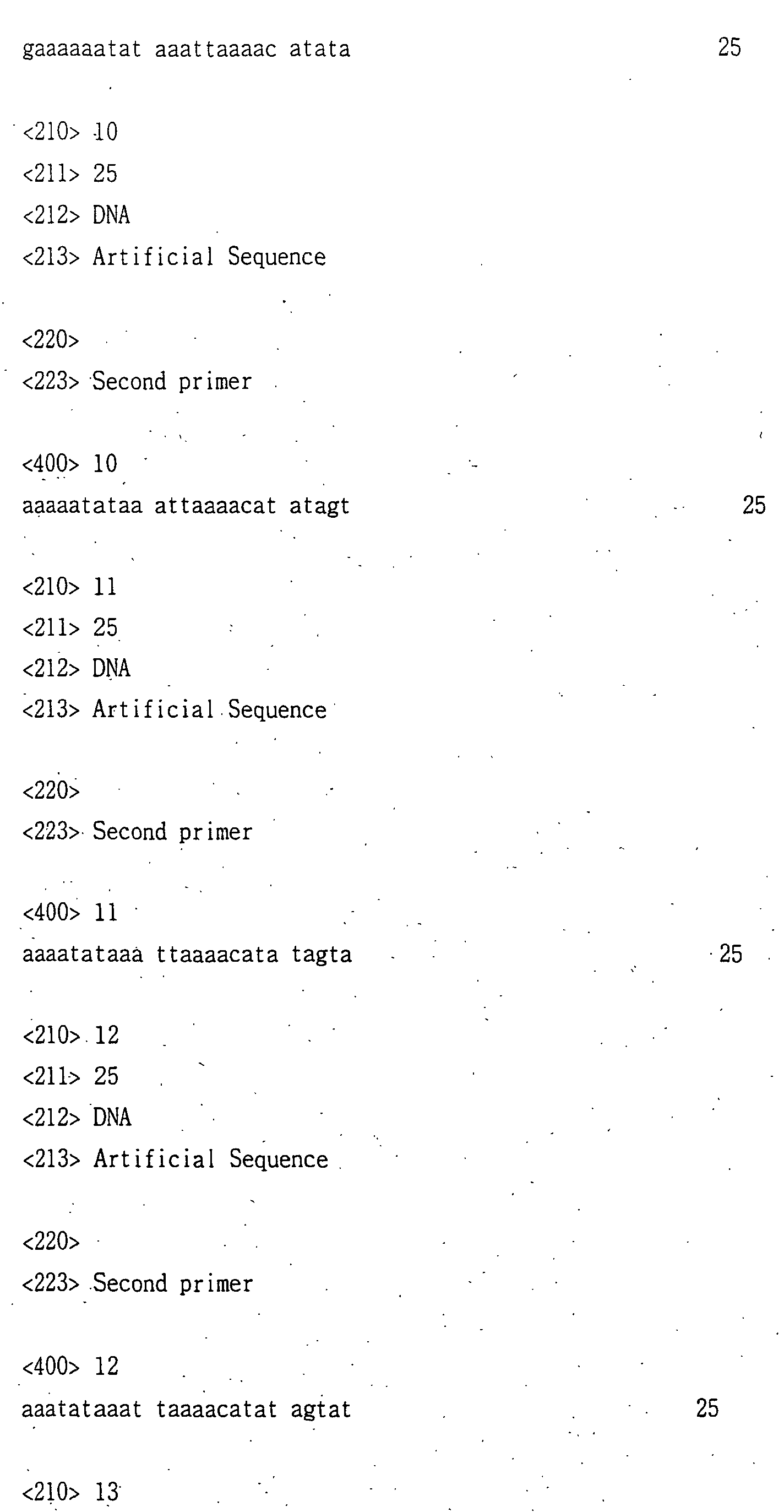
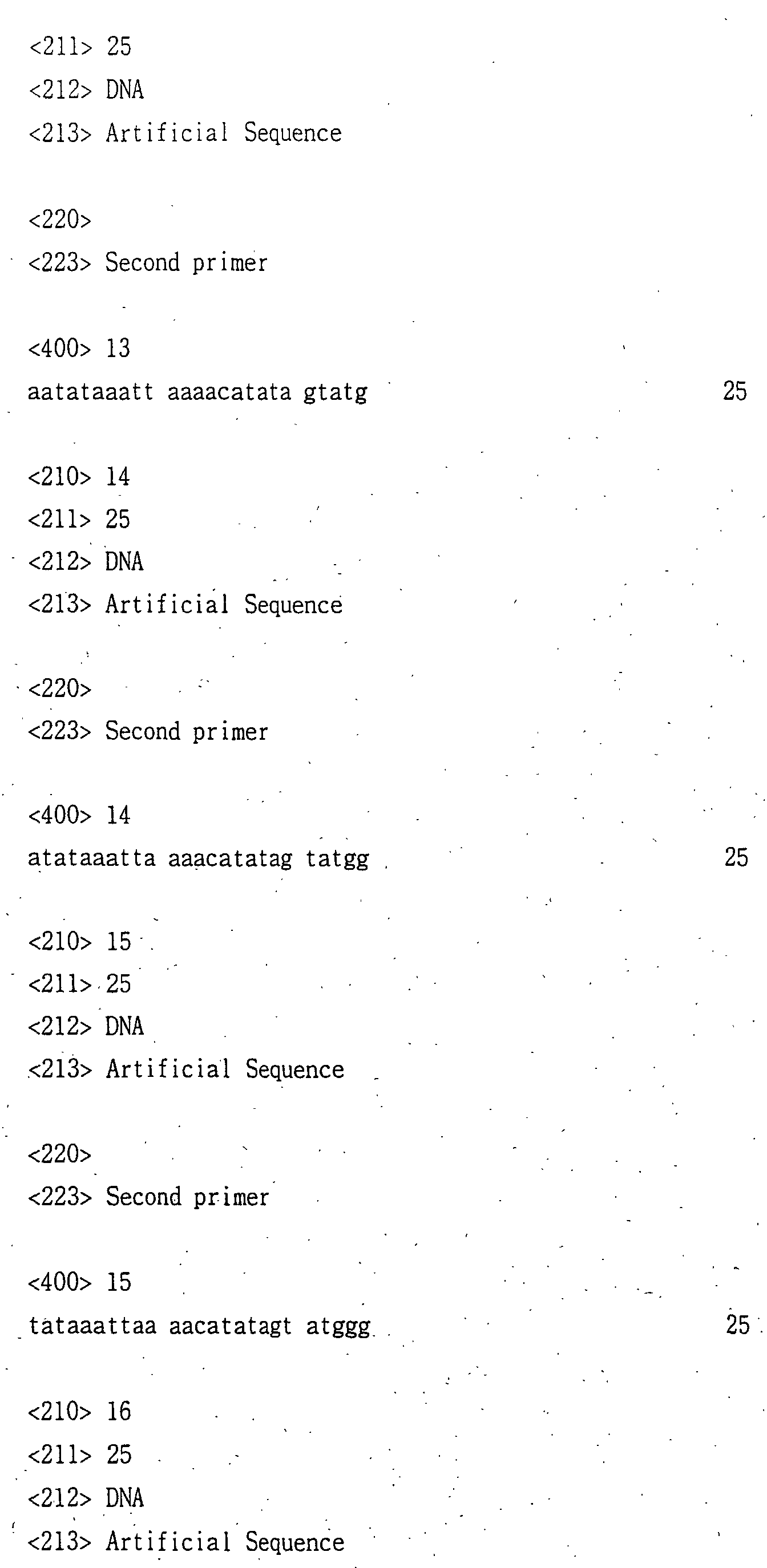
- the present invention is characterized by the use of an oligonucleotide primer comprising a sequence of any one of SEQ ID NOs: 1 to 7 as a first primer, which can bind to a specific site of the HIV-1 RNA and an oligonucleotide comprising a sequence of any one of SEQ ID NOs: 8 to 20 as a second primer, which is homologous to the part of the HIV-1 RNA to be amplified. Additionally, one of said primers has a promoter sequence for the RNA polymerase at the 5' end.
- One embodiment of the present invention is the above-mentioned amplification method, wherein the first primer is an oligonucleotide of any one of SEQ ID NOs: 1 to 7, and the second primer is an oligonucleotide of any one of SEQ ID NOs: 8 to 20, wherein either the first primer or the second primer additionally has a promoter sequence for the RNA polymerase at the 5' end.
- the RNA-dependent DNA polymerase, the DNA-dependent DNA polymerase and the ribonuclease H are not particularly limited, but AMV reverse transcriptase is preferable because it has the activities of all of them.
- As the RNA polymerase T7 phage RNA polymerase or SP6 phage RNA polymerase is preferred, though there is no particular restriction.
- HIV-1 RNA can be amplified. Before the HIV-1 RNA is used as a template in the initial stage of the nucleic acid amplification, it's 5' end is cleaved off. This is achieved by adding an oligonucleotide complementary to a region of HIV-1 RNA which flanks the 5' end of the specific sequence and overlaps by 1 to 10 bases with the specific sequence. Cleavage is executed by ribonuclease H activity.
- An oligonucleotide comprising the sequence of any of SEQ ID NOs: 21 to 33 may be used as a mediator of cleavage.
- the cleavage-mediating oligonucleotide is preferred to have a chemically modified hydroxyl group (for example, an aminated hydroxyl group) at the 3' end which cannot be elongated from the 3' end.
- the third oligonucleotide is complementary to a region which flanks the 5' end of the specific HIV-1 sequence and overlaps with this region by 1 to 10 bases.
- This oligonucleotide is added to mediate cleavage of the HIV-1 RNA at the 5' end, by the action of a ribonuclease H activity.
- the first primer is an oligonucleotide of any one of SEQ ID NOs: 1 to 7, and
- the third oligonucleotide (the cleavage-mediating oligonucleotide) is preferred to have a chemically modified hydroxyl group (for example, an aminated hydroxyl group) at the 3' end which cannot be elongated form the 3' end, too.
- a chemically modified hydroxyl group for example, an aminated hydroxyl group
- Detection of the amplification product obtained in the nucleic acid amplification step is preferably carried out by measuring the change in the fluorescence of the reaction solution during the amplification step. Preferably, this is achieved by performing the amplification reaction in the presence of an oligonucleotide probe labeled with a fluorescent intercalative dye.
- the probe can also be detected by other methods for detection of nucleic acids.
- the oligonucleotide probe may be, for example, an oligonucleotide giving a fluorescent intercalative dye linked to a phosphorus atom via a linker.
- Such a preferable probe alters its fluorescence upon formation of a double strand with the complementary target nucleic acid by intercalation of the intercalating moiety into the double strand (Ishiguro, T. et al., (1996) Nucleic Acids Res. 24 (24) 4992-4997).
- the sequence of the probe is not particularly limited as long as it contains a sequence complementary to at least part of the RNA transcript.
- the oligonucleotide probe comprises a sequence consisting of, or being complementary to, at least 10 consecutive bases in SEQ ID NO: 34 is preferred.
- it is also preferred to chemically modify the hydroxyl group at the 3' end of the probe for example, by adding glycolic acid to prevent an elongation reaction starting from this probe.
- amplification and detection of HIV-1 RNA can be carried out at constant temperature, in one tube, in one step and can be automated easily.
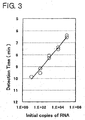
- the target HIV-RNA derived from various numbers of initial copies was detected using the combinations of oligonucleotides in the present invention.
- HIV-1 RNA in the nucleic acid extracted from HIV-positive serum was detected using the combinations of oligonucleotides described in connection with the present invention.
- Fig. 4 demonstrates that it was possible to detect the RNA (at an estimated concentration of 10 3 copies/30 ⁇ l) extracted from the HIV-positive serum at the same detection time as the standard RNA (RNA concentration: 10 copies/30 ⁇ l) of the control.
- the present invention allows speedy and sensitive detection of HIV-1 RNA extracted from HIV-positive serum.
- the present invention provides a simple, speedy and sensitive method of detecting HIV-RNA through provision of an oligonucleotide.
- This oligonucleotide can bind to a region of the genomic RNA of HIV-1 which is free of secondary structure.
- relatively low and constant temperatures at 35°C to 50°C, preferably at 41°C
- use of the oligonucleotide primer for amplification of a nucleic acid at relatively low and constant temperatures (at 35°C to 50°C, preferably at 41°C) and use of the oligonucleotide primer for amplification of a nucleic acid.
Landscapes
- Health & Medical Sciences (AREA)
- Life Sciences & Earth Sciences (AREA)
- Chemical & Material Sciences (AREA)
- Virology (AREA)
- Organic Chemistry (AREA)
- Engineering & Computer Science (AREA)
- Zoology (AREA)
- Immunology (AREA)
- Wood Science & Technology (AREA)
- Proteomics, Peptides & Aminoacids (AREA)
- Microbiology (AREA)
- Biochemistry (AREA)
- Biophysics (AREA)
- Molecular Biology (AREA)
- Analytical Chemistry (AREA)
- Physics & Mathematics (AREA)
- AIDS & HIV (AREA)
- Biotechnology (AREA)
- Bioinformatics & Cheminformatics (AREA)
- General Engineering & Computer Science (AREA)
- General Health & Medical Sciences (AREA)
- Genetics & Genomics (AREA)
- Measuring Or Testing Involving Enzymes Or Micro-Organisms (AREA)
- Investigating Or Analysing Biological Materials (AREA)
- Investigating Or Analysing Materials By The Use Of Chemical Reactions (AREA)
Abstract
Description
the amplification or detection of HIV-1 RNA in clinical tests and diagnoses.
Complications such as tuberculosis, Pneumocystis carinii pneumonia and other opportunistic infections at high levels of immunodeficiency induced by HIV-1 infection are diagnostic of onset of AIDS.
This technique involves a chain reaction comprising the synthesis of a double-stranded DNA from the target RNA. By using a primer containing promoter sequences, the target RNA is reverse-transcribed by the use of a reverse transcriptase followed by hydrolysis of the RNA portion by the use of ribonuclease H.
By the help of a second primer and the DNA dependent DNA polymerase activity of the reverse transcriptase, a DNA strand complementary to the first DNA strand is produced. Using the resulting double-stranded DNA containing the promoter sequence as a template, an RNA polymerase produces an RNA having the specific sequence. NASBA or 3SR allows relatively isothermal amplification of ribonucleic acids and is considered suitable for automation.
However, since the reactions involved in this amplification technique are carried out at relatively low temperatures (for example, at 41°C), formation of intramolecular secondary structure of the target RNA may occur, thus preventing binding of the primers and reducing the reaction efficiency. Therefore, it is necessary to increase the binding efficiency of the primers before the amplification reaction. This is achieved by resolving the intramolecular secondary structure of the target RNA, for example, by heat denaturation of the target RNA.
The object of the present invention is to provide a simple, speedy and sensitive method for amplifying or detecting HIV-RNA.
The present invention has been accomplished to attain the above-mentioned object by the provision of an oligonucleotide that can bind to a region of the genomic RNA of HIV-1 which is free of RNA secondary structure.
Therefore, the oligonucleotide can be used as a primer at relatively low and constant temperatures (at 35°C to 50°C, preferably at 41°C) for amplification of a nucleic acid.
Specifically, the invention defined in the claims of the present application provides a method of amplifying an RNA of HIV-1, anticipated in a sample as a template which comprises the steps of
The method of the invention preferably further comprises adding a third oligonulcleotide which is complementary to a region of the RNA of HIV-1
which flanks the 5' end of the specific sequence with an overlap of from 1 to 10 bases with the specific sequence to form a template used in the initial stage of the amplification by cutting the RNA derived from HIV-1 at the 5' end of the specific sequence by the action of the ribonuclease H activity, wherein the first primer is an oligonucleotide of any one of SEQ ID NOS:1 to 7, and
- (1) the second primer is an oligonucleotide of SEQ ID NO:8, and the third oligonucleotide is an oligonucleotide of any one of SEQ ID NOS:21 and 22,
- (2) the second primer is an oligonucleotide of SEQ ID NO:9, and the third oligonucleotide is an oligonucleotide of any one of SEQ ID NOS:22 to 26,
- (3) the second primer is an oligonucleotide of SEQ ID NO:10, and the third oligonucleotide is an oligonucleotide of any one of SEQ ID NOS:22 to 28,
- (4) the second primer is an oligonucleotide of SEQ ID NO:11, and the third oligonucleotide is an oligonucleotide of any one of SEQ ID NOS:22 to 29,
- (5) the second primer is an oligonucleotide of SEQ ID NO:12, and the third oligonucleotide is an oligonucleotide of any one of SEQ ID NOS:22 to 29,
- (6) the second primer is an oligonucleotide of SEQ ID NO:13, and the third oligonucleotide is an oligonucleotide of any one of SEQ ID NOS:23 to 30,
- (7) the second primer is an oligonucleotide of SEQ ID NO:14, and the third oligonucleotide is an oligonucleotide of any one of SEQ ID NOS:23 to 30,
- (8) the second primer is an oligonucleotide of SEQ ID NO:15, and the third oligonucleotide is an oligonucleotide of any one of SEQ ID NOS:24 to 30,
- (9) the second primer is an oligonucleotide of SEQ ID NO:16, and the third oligonucleotide is an oligonucleotide of any one of SEQ ID NOS:25 to 30,
- (10) the second primer is an oligonucleotide of SEQ ID NO:17, and the third oligonucleotide is an oligonucleotide of any one of SEQ ID NOS:27 to 31,
- (11) the second primer is an oligonucleotide of SEQ ID NO:18, and the third oligonucleotide is an oligonucleotide of any one of SEQ ID NOS:31 and 32,
- (12) the second primer is an oligonucleotide of SEQ ID NO:19, and the third oligonucleotide is an oligonucleotide of any one of SEQ ID NOS:32 and 33, or
- (13) the second primer is an oligonucleotide of SEQ ID NO:20, and the third oligonucleotide is an oligonucleotide of SEQ ID NO:33.
containing the structural gene of the core protein (gag) was used as a standard RNA. The standard RNA was obtained from HIV-1 RNA with ACCRUN™ 315 (product name), HIV-1 RNA Positive Control, Series 400 (BBI (Boston Biomedica, Inc.) by conventional extraction. Synthesis and subsequent purification of a double-stranded DNA containing the sequence of the gag region was performed by RT-PCR and in vitro transcription using the DNA as the template.
Distilled water for volume adjustment
Distilled water for volume adjustment
(which additionally contained the nucleotide sequence of SEQ ID NO: 35 including the T7 promoter sequence at the 5' end (SEQ ID NO:35 comprises the T7 promoter sequence from "A" at position 1 from the 5' end to "A" at position 22 and the subsequent enhancer sequence from "G" at position 23 to "A" at position 28))
Distilled water for volume adjustment
Distilled water for volume adjustment




Claims (8)
- A method of amplifying an RNA of HIV-1 anticipated in a sample as a template, which comprises the steps ofwherein either the first or the second primer contains additionally a promoter sequence for the RNA polymerase at the 5' end, and wherein the first primer is an oligonucleotide comprising the sequence of any one of SEQ ID NOs: 1 to 7, and the second primer is an oligonucleotide comprising the sequence of any one of SEQ ID NOs: 8 to 20.(a) synthesizing a cDNA by the action of an RNA-dependent DNA polymerase by using a first primer containing a sequence complementary to a specific sequence of said RNA;(b) denuding the cDNA to a single-stranded DNA through degradation of the RNA in the resulting RNA-DNA double strand by ribonuclease H activity;(c) forming a double-stranded DNA, having a promoter sequence which can be transcribed into an RNA consisting of the specific sequence or a sequence complementary to the specific sequence, by using the single-stranded DNA as template, a second primer containing a sequence homologous to the specific sequence and by the action of a DNA-dependent DNA polymerase;(d) transcribing a strand of the double-stranded DNA into an RNA transcript by the use of an RNA polymerase; and(e) synthesizing a cDNA of the RNA transcript of step (d) by the RNA-dependent DNA polymerase, in the presence of the RNA polymerase,
- The method according to Claim 1, which further comprises adding a third oligonucleotide which is complementary to a region of the RNA of HIV-1 which flanks the 5' end of the specific sequence with an overlap of from 1 to 10 bases with the specific sequence to form a template used in the initial stage of the amplification by cutting the RNA derived from HIV-1 at the 5' end of the specific sequence by the action of the ribonuclease H activity, wherein the first primer is an oligonucleotide of any one of SEQ ID NO: 1 to 7, and(1) the second primer is an oligonucleotide of SEQ ID NO:8, and the third oligonucleotide is an oligonucleotide of any one of SEQ ID NOS:21 and 22,(2) the second primer is an oligonucleotide of SEQ ID NO:9, and the third oligonucleotide is an oligonucleotide of any one of SEQ ID NOS:22 to 26,(3) the second primer is an oligonucleotide of SEQ ID NO:10, and the third oligonucleotide is an oligonucleotide of any one of SEQ ID NOS:22 to 28,(4) the second primer is an oligonucleotide of SEQ ID NO:11, and the third oligonucleotide is an oligonucleotide of any one of SEQ ID NOS:22 to 29,(5) the second primer is an oligonucleotide of SEQ ID NO:12, and the third oligonucleotide is an oligonucleotide of any one of SEQ ID NOS:22 to 29,(6) the second primer is an oligonucleotide of SEQ ID NO:13, and the third oligonucleotide is an oligonucleotide of any one of SEQ ID NOS:23 to 30,(7) the second primer is an oligonucleotide of SEQ ID NO:14, and the third oligonucleotide is an oligonucleotide of any one of SEQ ID NOS:23 to 30,(8) the second primer is an oligonucleotide of SEQ ID NO:15, and the third oligonucleotide is an oligonucleotide of any one of SEQ ID NOS:24 to 30,(9) the second primer is an oligonucleotide of SEQ ID NO:16, and the third oligonucleotide is an oligonucleotide of any one of SEQ ID NOS:25 to 30,(10) the second primer is an oligonucleotide of SEQ ID NO:17, and the third oligonucleotide is an oligonucleotide of any one of SEQ ID NOS:27 to 31,(11) the second primer is an oligonucleotide of SEQ ID NO:18, and the third oligonucleotide is an oligonucleotide of any one of SEQ ID NOS:31 and 32,(12) the second primer is an oligonucleotide of SEQ ID NO:19, and the third oligonucleotide is an oligonucleotide of any one of SEQ ID NOS:32 and 33, or(13) the second primer is an oligonucleotide of SEQ ID NO:20, and the third oligonucleotide is an oligonucleotide of SEQ ID NO:33.
- A method of detecting HIV-1, which comprises conducting the method as defined in Claim 1 or 2 in the presence of an oligonucleotide probe having a sequence different from those of the first primer and the second primer which can specifically bind to the RNA transcript resulting from the amplification and is labeled with a fluorescent intercalative dye, and measuring the change in the fluorescence of the reaction solution.
- The method according to Claim 3, wherein the oligonucleotide probe is designed to hybridize with at least part of the RNA transcript and to alter its fluorescence upon hybridization.
- The method according to Claim 4, wherein the oligonucleotide probe comprises a sequence consisting of, or being complementary to, at least 10 consecutive nucleotides in SEQ ID NO: 34.
- Use of an oligonucleotide of any one of SEQ ID NOs: 1 to 35 for the amplification of HIV-1 RNA.
- Use of an oligonucleotide of any one of SEQ ID NOs: 1 to 35 for the detection of HIV-1 in a sample.
- A kit comprising at least one oligonucleotide of any one of SEQ ID NO: 1 to 35 in one or more containers.
Applications Claiming Priority (2)
| Application Number | Priority Date | Filing Date | Title |
|---|---|---|---|
| JP2001129210A JP4701532B2 (en) | 2001-04-26 | 2001-04-26 | Amplification and detection of HIV-1 RNA |
| JP2001129210 | 2001-04-26 |
Publications (3)
| Publication Number | Publication Date |
|---|---|
| EP1253206A2 true EP1253206A2 (en) | 2002-10-30 |
| EP1253206A3 EP1253206A3 (en) | 2004-01-07 |
| EP1253206B1 EP1253206B1 (en) | 2007-07-11 |
Family
ID=18977768
Family Applications (1)
| Application Number | Title | Priority Date | Filing Date |
|---|---|---|---|
| EP02009618A Expired - Lifetime EP1253206B1 (en) | 2001-04-26 | 2002-04-26 | Method of amplifying or detecting hiv-1 rna |
Country Status (4)
| Country | Link |
|---|---|
| US (2) | US6881544B2 (en) |
| EP (1) | EP1253206B1 (en) |
| JP (1) | JP4701532B2 (en) |
| DE (1) | DE60221065T2 (en) |
Families Citing this family (2)
| Publication number | Priority date | Publication date | Assignee | Title |
|---|---|---|---|---|
| JP5481841B2 (en) * | 2008-11-28 | 2014-04-23 | 東ソー株式会社 | Cytokeratin 19 mRNA measurement method |
| JP6593984B2 (en) * | 2014-09-26 | 2019-10-23 | 株式会社Kri | RNA amplification method and HIV-1 infection diagnosis method |
Family Cites Families (11)
| Publication number | Priority date | Publication date | Assignee | Title |
|---|---|---|---|---|
| JPH03504199A (en) * | 1988-05-10 | 1991-09-19 | イー・アイ・デユポン・ド・ネモアース・アンド・コンパニー | Rapid nucleic acid detection method |
| US5374524A (en) | 1988-05-10 | 1994-12-20 | E. I. Du Pont De Nemours And Company | Solution sandwich hybridization, capture and detection of amplified nucleic acids |
| EP1715064B1 (en) | 1989-06-02 | 2009-02-25 | Institut Pasteur | Nucleotide sequences derived from the genomes of the retroviruses HIV-1, HIV-2 and SIV, and their application to the amplification of pol sequences in these viral genomes and to the in vitro diagnosis of infections resulting from these viruses |
| JPH07501052A (en) | 1991-10-28 | 1995-02-02 | インスティチュート・パスツール | Induction of protection against viral infection by synergy between viral envelope proteins and peptides corresponding to neutralizing epitopes of glycoproteins |
| US6174666B1 (en) * | 1992-03-27 | 2001-01-16 | The United States Of America As Represented By The Department Of Health And Human Services | Method of eliminating inhibitory/instability regions from mRNA |
| US5707864A (en) * | 1992-11-23 | 1998-01-13 | President And Fellows Of Harvard College | Nucleic acids encoding mutated human immunodeficiency virus matrix proteins |
| CA2169453A1 (en) | 1993-10-26 | 1995-05-04 | Cecil Czerkinsky | Inhibition of hiv mucosal infection |
| JP4438110B2 (en) | 1998-07-01 | 2010-03-24 | 東ソー株式会社 | Quantification method of target nucleic acid |
| JP2000210090A (en) * | 1998-11-19 | 2000-08-02 | Tosoh Corp | Oligo DNA that binds strongly to HCV RNA and a simple method for producing such DNA |
| JP2000316587A (en) * | 1999-03-05 | 2000-11-21 | Tosoh Corp | Nucleic acid probe |
| JP2002125687A (en) * | 2000-10-30 | 2002-05-08 | Tosoh Corp | Oligonucleotides for HIV-1 detection and detection methods |
-
2001
- 2001-04-26 JP JP2001129210A patent/JP4701532B2/en not_active Expired - Fee Related
-
2002
- 2002-04-22 US US10/126,611 patent/US6881544B2/en not_active Expired - Fee Related
- 2002-04-26 DE DE60221065T patent/DE60221065T2/en not_active Expired - Lifetime
- 2002-04-26 EP EP02009618A patent/EP1253206B1/en not_active Expired - Lifetime
-
2004
- 2004-03-19 US US10/804,002 patent/US20040202998A1/en not_active Abandoned
Also Published As
| Publication number | Publication date |
|---|---|
| EP1253206B1 (en) | 2007-07-11 |
| JP4701532B2 (en) | 2011-06-15 |
| US20040202998A1 (en) | 2004-10-14 |
| US6881544B2 (en) | 2005-04-19 |
| JP2002320481A (en) | 2002-11-05 |
| EP1253206A3 (en) | 2004-01-07 |
| DE60221065T2 (en) | 2008-03-13 |
| US20030008278A1 (en) | 2003-01-09 |
| DE60221065D1 (en) | 2007-08-23 |
Similar Documents
| Publication | Publication Date | Title |
|---|---|---|
| AU675520B2 (en) | Self-sustained, sequence replication system | |
| JPH09163991A (en) | Oligonucleotide primer for HCV nucleic acid amplification | |
| JP2009000063A (en) | Improved norovirus RNA detection method | |
| US20090181365A1 (en) | Norovirus detection reagent | |
| US7049067B2 (en) | Oligonucleotide for detection of HIV-1 and detection method | |
| JP2011078389A (en) | Method and reagent for detecting sapovirus rna | |
| JP4501443B2 (en) | Detection reagent for Shiga toxin group gene of enterohemorrhagic Escherichia coli | |
| EP1512753A1 (en) | Detection reagent for thermostable direct hemolysin-related hemolysin gene of Vibrio parahaemolyticus | |
| EP1253206B1 (en) | Method of amplifying or detecting hiv-1 rna | |
| JP2009017824A (en) | Improved method for detecting norovirus RNA | |
| EP1612284B1 (en) | Method of detecting and quantifying cytomegalovirus | |
| JP4406968B2 (en) | Simple and enhanced nucleic acid amplification method | |
| US6756198B2 (en) | Oligonucleotide for highly sensitive detection of hepatitis C virus and method for detection thereof | |
| JP2007116999A (en) | RegIV mRNA measurement method | |
| EP4053293A1 (en) | Protected isothermal nucleic acid amplification (pina) methods for point-of-need diagnosis of emerging infectious diseases | |
| JP2005245434A (en) | Norovirus detection reagent | |
| JPWO2006011667A1 (en) | Method for measuring heteronuclear ribonucleotide protein B1 (hnRNPB1) mRNA | |
| KR20050027012A (en) | Detection reagent for thermostable direct hemolysin gene of vibrio parahaemolyticus | |
| JPWO2006019065A1 (en) | α1,4-N-acetylglucosaminyltransferase (α4GnT) mRNA measurement method | |
| JP2010004793A (en) | Method for detecting norovirus rna and detection reagent | |
| JP2006223194A (en) | Method for measuring stanniocalcin 1 (STC1) mRNA | |
| WO2004029294A1 (en) | New sequencing method for sequencing rna molecules | |
| JP2001340086A (en) | Detection of thermostable hemotoxin gene of Vibrio parahaemolyticus | |
| JP2001046099A (en) | Enhanced nucleic acid amplification method |
Legal Events
| Date | Code | Title | Description |
|---|---|---|---|
| PUAI | Public reference made under article 153(3) epc to a published international application that has entered the european phase |
Free format text: ORIGINAL CODE: 0009012 |
|
| AK | Designated contracting states |
Kind code of ref document: A2 Designated state(s): AT BE CH CY DE DK ES FI FR GB GR IE IT LI LU MC NL PT SE TR |
|
| AX | Request for extension of the european patent |
Free format text: AL;LT;LV;MK;RO;SI |
|
| PUAL | Search report despatched |
Free format text: ORIGINAL CODE: 0009013 |
|
| AK | Designated contracting states |
Kind code of ref document: A3 Designated state(s): AT BE CH CY DE DK ES FI FR GB GR IE IT LI LU MC NL PT SE TR |
|
| AX | Request for extension of the european patent |
Extension state: AL LT LV MK RO SI |
|
| 17P | Request for examination filed |
Effective date: 20040608 |
|
| AKX | Designation fees paid |
Designated state(s): DE FR GB IT |
|
| 17Q | First examination report despatched |
Effective date: 20041102 |
|
| 17Q | First examination report despatched |
Effective date: 20041111 |
|
| GRAP | Despatch of communication of intention to grant a patent |
Free format text: ORIGINAL CODE: EPIDOSNIGR1 |
|
| GRAS | Grant fee paid |
Free format text: ORIGINAL CODE: EPIDOSNIGR3 |
|
| GRAA | (expected) grant |
Free format text: ORIGINAL CODE: 0009210 |
|
| AK | Designated contracting states |
Kind code of ref document: B1 Designated state(s): DE FR GB IT |
|
| REG | Reference to a national code |
Ref country code: GB Ref legal event code: FG4D |
|
| RTI1 | Title (correction) |
Free format text: METHOD OF AMPLIFYING OR DETECTING HIV-1 RNA |
|
| REF | Corresponds to: |
Ref document number: 60221065 Country of ref document: DE Date of ref document: 20070823 Kind code of ref document: P |
|
| ET | Fr: translation filed | ||
| PLBE | No opposition filed within time limit |
Free format text: ORIGINAL CODE: 0009261 |
|
| STAA | Information on the status of an ep patent application or granted ep patent |
Free format text: STATUS: NO OPPOSITION FILED WITHIN TIME LIMIT |
|
| 26N | No opposition filed |
Effective date: 20080414 |
|
| REG | Reference to a national code |
Ref country code: FR Ref legal event code: PLFP Year of fee payment: 14 |
|
| PGFP | Annual fee paid to national office [announced via postgrant information from national office to epo] |
Ref country code: GB Payment date: 20150422 Year of fee payment: 14 Ref country code: DE Payment date: 20150422 Year of fee payment: 14 |
|
| PGFP | Annual fee paid to national office [announced via postgrant information from national office to epo] |
Ref country code: IT Payment date: 20150417 Year of fee payment: 14 Ref country code: FR Payment date: 20150408 Year of fee payment: 14 |
|
| REG | Reference to a national code |
Ref country code: DE Ref legal event code: R119 Ref document number: 60221065 Country of ref document: DE |
|
| GBPC | Gb: european patent ceased through non-payment of renewal fee |
Effective date: 20160426 |
|
| REG | Reference to a national code |
Ref country code: FR Ref legal event code: ST Effective date: 20161230 |
|
| PG25 | Lapsed in a contracting state [announced via postgrant information from national office to epo] |
Ref country code: DE Free format text: LAPSE BECAUSE OF NON-PAYMENT OF DUE FEES Effective date: 20161101 Ref country code: GB Free format text: LAPSE BECAUSE OF NON-PAYMENT OF DUE FEES Effective date: 20160426 Ref country code: FR Free format text: LAPSE BECAUSE OF NON-PAYMENT OF DUE FEES Effective date: 20160502 |
|
| PG25 | Lapsed in a contracting state [announced via postgrant information from national office to epo] |
Ref country code: IT Free format text: LAPSE BECAUSE OF NON-PAYMENT OF DUE FEES Effective date: 20160426 |
|
| P01 | Opt-out of the competence of the unified patent court (upc) registered |
Effective date: 20230523 |