EP1253140A1 - Process for cyclizing optically active 4-amino-2-halogenobutyric acids - Google Patents
Process for cyclizing optically active 4-amino-2-halogenobutyric acids Download PDFInfo
- Publication number
- EP1253140A1 EP1253140A1 EP01902737A EP01902737A EP1253140A1 EP 1253140 A1 EP1253140 A1 EP 1253140A1 EP 01902737 A EP01902737 A EP 01902737A EP 01902737 A EP01902737 A EP 01902737A EP 1253140 A1 EP1253140 A1 EP 1253140A1
- Authority
- EP
- European Patent Office
- Prior art keywords
- optically active
- amino
- acid
- reaction
- azetidine
- Prior art date
- Legal status (The legal status is an assumption and is not a legal conclusion. Google has not performed a legal analysis and makes no representation as to the accuracy of the status listed.)
- Granted
Links
- 0 *C(CCN)C(O)=O Chemical compound *C(CCN)C(O)=O 0.000 description 1
Classifications
-
- C—CHEMISTRY; METALLURGY
- C07—ORGANIC CHEMISTRY
- C07D—HETEROCYCLIC COMPOUNDS
- C07D205/00—Heterocyclic compounds containing four-membered rings with one nitrogen atom as the only ring hetero atom
- C07D205/02—Heterocyclic compounds containing four-membered rings with one nitrogen atom as the only ring hetero atom not condensed with other rings
- C07D205/04—Heterocyclic compounds containing four-membered rings with one nitrogen atom as the only ring hetero atom not condensed with other rings having no double bonds between ring members or between ring members and non-ring members
Definitions
- the present invention relates to a process for producing an optically active azetidine-2-carboxylic acid, which is of value as a production intermediate of pharmaceuticals or the like, through the cyclization of an optically active 4-amino-2-halogenobutyric acid.
- the optically active compound undergoes racemization to drastically reduce the optical purity of the product.
- one of the enantiomers is generally unwanted and an optical resolution or the like procedure is required for improving the optical purity.
- the unwanted enantiomer so separated has to be discarded unless a profitable racemization method is available, with the result that the process is not economical and does not lend itself well to commercial production.
- the product azetidine-2-carboxylic acid is a racemic compound and the resolution of this racemic compound is necessary for obtaining the optically active compound. Moreover, after resolution the unwanted enantiomer has to be discarded unless a profitable racemization method is available so that this process is not economical and does not lend itself well to commercial production.
- the present invention has its object to provide an efficient, economical and commercially profitable process for producing an optically active azetidine-2-carboxylic acid.
- the inventors of the present invention did much research for overcoming the above-mentioned disadvantages and have ultimately developed the present invention.
- the present invention is directed to a process for producing optically active azetidine-2-carboxylic acid of the general formula (2): (wherein * denotes an asymmetric carbon atom) which comprises cyclizing an optically active 4-amino-2-halogenobutyric acid represented by the general formula (1): (wherein X represents a halogen atom; * denotes an asymmetric carbon atom) in the presence of an oxide of an alkaline earth metal, a hydroxide of an alkaline earth metal excepting barium, or an organic amine.
- a process for producing optically active azetidine-2-carboxylic acid in high optical yield is provided.
- the starting material of the invention namely an optically active 4-amino-2-halogenobutyric acid
- the halogen atom of said optically active 4-amino-2-halogenobutyric acid may be a fluorine, a chlorine, a bromine or an iodine atom but is preferably a chlorine or a bromine atom.
- (S)-4-amino-2-chlorobutyric acid for instance, can be obtained from (S)-2,4-diaminobutyric acid by the process described in Biochemical Journal, 64 , 323 (1956).
- an (R)-4-amino-2-halogenobutyric acid ester can be hydrolyzed in an aqueous solution of a mineral acid to give a hydrolyzate solution containing an (R)-4-amino-2-halogenobutyric acid.
- This hydrolyzate solution may be neutralized with an alkali metal base, for instance, and directly submitted to the cyclization reaction or the neutralized solution may further be purified by ion exchange column chromatography to isolate the optically active (R)-4-amino-2-halogenobutyric acid.
- optically active 4-amino-2-halogenobutyric acid of general formula (1) can be cyclized in the presence of a base, such as an oxide of an alkaline earth metal, a hydroxide of an alkaline earth metal excepting barium, or an organic amine to produce optically active azetidine-2-carboxylic acid of general formula (2) in good optical yield.
- a base such as an oxide of an alkaline earth metal, a hydroxide of an alkaline earth metal excepting barium, or an organic amine to produce optically active azetidine-2-carboxylic acid of general formula (2) in good optical yield.
- the oxide of an alkaline earth metal which can be used in the cyclization reaction includes magnesium oxide, calcium oxide, barium oxide, etc., with magnesium oxide being particularly preferred.
- the hydroxide of an alkaline earth metal includes magnesium hydroxide, calcium hydroxide, etc., although magnesium hydroxide is particularly preferred.
- a secondary amine or a tertiary amine can be used with advantage.
- secondary alkylamines such as dimethylamine, diethylamine, dipropylamine, diisopropylamine, dibutylamine, diisobutylamine, di-sec-butylamine, di-tert-butylamine, dipentylamine, dihexylamine, diheptylamine, dioctylamine, dicyclohexylamine, etc.
- secondary cycloalkylamines such as piperidine, piperazine, 2,2,6,6-tetramethylpiperidine, etc.
- secondary arylamines such as diphenylamine, ditolylamine, etc.
- secondary arylalkylamines such as dibenzylamine etc.
- tertiary alkylamines such as trimethylamine, triethylamine, tripropylamine, triisopropylamine, tributy
- the level of use of said base is not particularly restricted but the cyclization reaction can be carried out generally in the presence of 1 to 30 molar equivalents of the base relative to the optically active 4-amino-2-halogenobutyric acid (1).
- the generally preferred level is 1 to 10 molar equivalents.
- a solvent is generally employed.
- This solvent is preferably water or a mixture of water and a water-soluble organic solvent which is freely miscible with water.
- the water-soluble organic solvent mentioned just above includes methanol, ethanol, isopropyl alcohol, tert-butyl alcohol, acetone, acetonitrile, N,N-dimethylformamide and N,N-dimethylacetamide, to mention just a few examples.
- the organic solvent can be used in a proportion of 1 to 100 volume %, preferably 1 to 50 volume %, relative to water.
- the concentration of the optically active 4-amino-2-halogenobutyric acid (1) in the cyclization reaction system is generally 0.5 to 50 weight %, preferably 1 to 30 weight %.
- the cyclization reaction temperature varies with different types of base used but is usually within the range of the freezing point to the boiling point of the reaction solvent, namely water or mixture of water and a water-soluble organic solvent.
- the reaction is preferably conducted at a high temperature, but for preventing racemization during the reaction, the reaction temperature is preferably low.
- the reaction temperature is 30 to 100°C, more preferably 50 to 100°C.
- the cyclization reaction time depends on the type and equivalent of said base and the reaction temperature, but assuming that the reaction temperature is 80 to 100°C, for instance, the reaction can be usually carried to completion in about 20 minutes to about 12 hours.
- this cyclization reaction is a substitution cyclization reaction involving a stereochemical inversion of the halogen substituent in the 2-position of the optically active 4-amino-2-halogenobutyric acid (1) and gives rise to the (R)-form of azetidine-2-carboxylic acid from the (S)-form of the staring compound or the (S) form of azetidine-2-carboxylic acid from the (R)-form of the starting compound.
- the optical yield of this cyclization reaction can be increased to as high as 90% or more.
- optical yield means the percentage of the optical purity (enantiomeric excess, % ee) of the reaction product optically active azetidine-2-carboxylic acid relative to the optical purity (enantiomeric excess, % ee) of the starting material optically active 4-amino-2-halogenobutyric acid.
- the objective optically active azetidine-2-carboxylic acid can be isolated by neutralizing the base with an acid in the first place and purifying the reaction mixture by ion exchange column chromatography.
- the optically active azetidine-2-carboxylic acid can be isolated by subjecting the reaction mixture to phase separation to remove the residual organic amine as an organic layer and then purifying the aqueous layer by ion exchange column chromatography. Furthermore, where necessary, the optical purity can be increased by crystallization.
- the cyclization reaction mixture may be directly subjected to an amino-protecting reaction bypassing isolation of the cyclization product and the resulting amino-protected optically active azetidine-2-carboxylic acid derivative be isolated by the routine procedure such as extraction, concentration, chromatography, and/or crystallization.
- the yield was determined by high performance liquid chromatography using a high-purity product of (S)-N-(tert-butoxycarbonyl)azetidine-2-carboxylic acid as a standard.
- an optically active 4-amino-2-halogenobutyric acid can be cyclized in the presence of an oxide of an alkaline earth metal, a hydroxide of an alkaline earth metal excepting barium, or an organic amine to produce optically active azetidine-2-carboxylic acid in an optical yield of as high as 90% or more with good efficiency, expedience, and commercial advantage.
Landscapes
- Chemical & Material Sciences (AREA)
- Organic Chemistry (AREA)
- Organic Low-Molecular-Weight Compounds And Preparation Thereof (AREA)
- Plural Heterocyclic Compounds (AREA)
- Catalysts (AREA)
Abstract
which comprises cyclizing an optically active 4-amino-2-halogenobutyric acid in an optical yield of as high as 90% or more.
which comprises cyclizing an optically active 4-amino-2-halogenobutyric acid of the general formula (1),in which X represents a halogen atom and * denotes an asymmetric carbon atom,
in the presence of an oxide of an alkaline earth metal, a hydroxide of an alkaline earth metal excepting barium, or an organic amine.
Description


1H-NMR (CDCl3) δ 1.48 (s, 9H), 2.40-2.60 (bs, 2H), 3.80-4.00 (bs, 2H), 4.80 (t, 1H)
13C-NMR (CDCl3) δ 19.9, 28.3, 47.2, 60.4, 81.6, 157.3, 173.5
HPLC (condition for optical purity analysis)
Column: Chiral Cell OD-R (Daicel), 4.6 mm in. dia. x 25 cm long
Eluent: acetonitrile/perchloric acid aq. sol. (pH 2.0) = 1/6
Column flow rate: 0.7 ml/min.
Column temperature: 30°C
Detection wavelength: UV210 nm
Retention time:
(S)-N-(tert-butoxycarbonyl)azetidine-2-carboxylic acid: ca 35 min; (R)-N-(tert-butoxycarbonyl)azetidine-2-carboxylic acid: ca 40 min.
Claims (8)
- A process for producing an optically active azetidine-2-carboxylic acid of the general formula (2):in the formula, * denotes an asymmetric carbon atom,
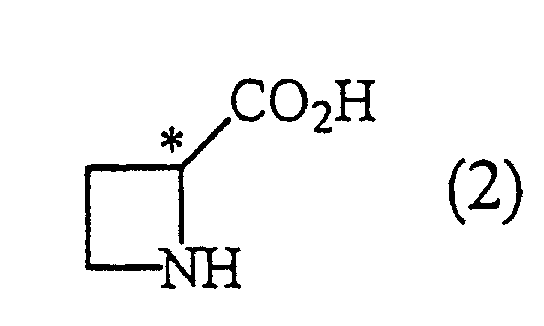
which comprises cyclizing an optically active 4-amino-2-halogenobutyric acid of the general formula (1):in the formula, X represents a halogen atom and * denotes an asymmetric carbon atom,
in the presence of an oxide of an alkaline earth metal, a hydroxide of an alkaline earth metal excepting barium, or an organic amine. - The process according to Claim 1,
wherein the oxide of an alkaline earth metal is magnesium oxide. - The process according to Claim 1,
wherein the hydroxide of an alkaline earth metal is magnesium hydroxide. - The process according to Claim 1,
wherein the organic amine is a secondary amine or a tertiary amine. - The process according to Claim 4,
wherein the secondary amine is 2,2,6,6-tetramethylpiperidine or diisopropylamine
and the tertiary amine is diisopropylethylamine, triethylamine, 1,8-diazabicyclo[4.5.0]undecene, or N,N-dimethylethanolamine. - The process according to any of Claims 1 to 5,
wherein the halogen atom is a chlorine or a bromine atom. - The process according to any of Claims 1 to 6,
wherein water or a mixture of water and a water-soluble organic solvent is used as a solvent for cyclization reaction. - The process according to any of Claims 1 to 7,
wherein an optical yield.of the cyclization reaction is not less than 90%.
Applications Claiming Priority (3)
| Application Number | Priority Date | Filing Date | Title |
|---|---|---|---|
| JP2000027909 | 2000-02-04 | ||
| JP2000027909 | 2000-02-04 | ||
| PCT/JP2001/000736 WO2001056985A1 (en) | 2000-02-04 | 2001-02-02 | Process for cyclizing optically active 4-amino-2-halogenobutyric acids |
Publications (3)
| Publication Number | Publication Date |
|---|---|
| EP1253140A1 true EP1253140A1 (en) | 2002-10-30 |
| EP1253140A4 EP1253140A4 (en) | 2003-03-26 |
| EP1253140B1 EP1253140B1 (en) | 2005-01-12 |
Family
ID=18553414
Family Applications (1)
| Application Number | Title | Priority Date | Filing Date |
|---|---|---|---|
| EP01902737A Expired - Lifetime EP1253140B1 (en) | 2000-02-04 | 2001-02-02 | Process for cyclizing optically active 4-amino-2-halogenobutyric acids |
Country Status (8)
| Country | Link |
|---|---|
| US (1) | US6747161B2 (en) |
| EP (1) | EP1253140B1 (en) |
| AT (1) | ATE286881T1 (en) |
| AU (1) | AU2001230569A1 (en) |
| DE (1) | DE60108355T2 (en) |
| ES (1) | ES2234802T3 (en) |
| TW (1) | TW506959B (en) |
| WO (1) | WO2001056985A1 (en) |
Cited By (1)
| Publication number | Priority date | Publication date | Assignee | Title |
|---|---|---|---|---|
| CN102241583A (en) * | 2011-05-13 | 2011-11-16 | 嘉兴市博源生物化工科技有限公司 | Method for synthesizing 2-chlorobutyric acid |
Families Citing this family (1)
| Publication number | Priority date | Publication date | Assignee | Title |
|---|---|---|---|---|
| JP3585422B2 (en) * | 2000-06-01 | 2004-11-04 | シャープ株式会社 | Access point device and authentication processing method thereof |
Family Cites Families (4)
| Publication number | Priority date | Publication date | Assignee | Title |
|---|---|---|---|---|
| JPH10120648A (en) * | 1996-10-23 | 1998-05-12 | Sumitomo Chem Co Ltd | Optically active N-substituted azetidine-2-carboxylic acid and method for producing the same |
| GB9815552D0 (en) * | 1998-07-17 | 1998-09-16 | Chirotech Technology Ltd | Cyclisation process |
| DE60039299D1 (en) * | 1999-05-14 | 2008-08-07 | Kaneka Corp | METHOD FOR THE PRODUCTION OF OPTICALLY ACTIVE AZETIDIN-2-CARBOXYLIC ACIDS |
| WO2001055104A1 (en) * | 2000-01-25 | 2001-08-02 | Kaneka Corporation | Process for preparation of optically active n-substituted azetidine-2-carboxylic acids |
-
2001
- 2001-02-02 WO PCT/JP2001/000736 patent/WO2001056985A1/en not_active Ceased
- 2001-02-02 AT AT01902737T patent/ATE286881T1/en not_active IP Right Cessation
- 2001-02-02 ES ES01902737T patent/ES2234802T3/en not_active Expired - Lifetime
- 2001-02-02 US US10/182,649 patent/US6747161B2/en not_active Expired - Fee Related
- 2001-02-02 EP EP01902737A patent/EP1253140B1/en not_active Expired - Lifetime
- 2001-02-02 TW TW090102122A patent/TW506959B/en not_active IP Right Cessation
- 2001-02-02 AU AU2001230569A patent/AU2001230569A1/en not_active Abandoned
- 2001-02-02 DE DE60108355T patent/DE60108355T2/en not_active Expired - Fee Related
Cited By (1)
| Publication number | Priority date | Publication date | Assignee | Title |
|---|---|---|---|---|
| CN102241583A (en) * | 2011-05-13 | 2011-11-16 | 嘉兴市博源生物化工科技有限公司 | Method for synthesizing 2-chlorobutyric acid |
Also Published As
| Publication number | Publication date |
|---|---|
| US6747161B2 (en) | 2004-06-08 |
| AU2001230569A1 (en) | 2001-08-14 |
| WO2001056985A1 (en) | 2001-08-09 |
| DE60108355T2 (en) | 2005-06-16 |
| DE60108355D1 (en) | 2005-02-17 |
| EP1253140A4 (en) | 2003-03-26 |
| ATE286881T1 (en) | 2005-01-15 |
| TW506959B (en) | 2002-10-21 |
| ES2234802T3 (en) | 2005-07-01 |
| US20030109719A1 (en) | 2003-06-12 |
| EP1253140B1 (en) | 2005-01-12 |
Similar Documents
| Publication | Publication Date | Title |
|---|---|---|
| KR100879409B1 (en) | Method for preparing (S) -bepotastine and intermediates used therein | |
| US7476737B2 (en) | Eszopiclone process | |
| US10370329B2 (en) | Process for the enantiomeric resolution of apremilast intermediates | |
| EP2010544B1 (en) | Process for preparing dorzolamide | |
| US6660855B2 (en) | Crystals of penicillin and process for the production thereof | |
| EP1253140B1 (en) | Process for cyclizing optically active 4-amino-2-halogenobutyric acids | |
| US7838700B2 (en) | Recovery and recycling of chiral tartaric acid resolving agents | |
| JP2003335756A (en) | Method for producing aromatic aldehyde and chiral diol | |
| JPWO2004076404A1 (en) | Method for producing optically active compound having substituent at 2-position | |
| US6919450B2 (en) | Process for the preparation of benazepril | |
| US20120123124A1 (en) | Manufacturing process for Tadalafil from racemic or L-tryptophan | |
| US6639095B1 (en) | Process for preparing optically active α-hydroxy acids and derivatives thereof | |
| US6346649B1 (en) | Process for the recovery and recycle of D-tartaric acid | |
| EP1590353B1 (en) | A process for the preparation of cefpodoxime proxetil | |
| US20060052626A1 (en) | Process for reductive dehaloganation | |
| JP2008169204A (en) | Method for producing (1R, 2R) -2-amino-1-cyclopentanol | |
| JPWO2001056985A1 (en) | Method for cyclization of optically active 4-amino-2-halogenobutyric acid | |
| CA2369678A1 (en) | Process for producing optically active amino acid derivatives | |
| WO2000069817A1 (en) | Process for producing optically active azetidine-2-carboxylic acids | |
| KR100868160B1 (en) | Method for preparing S-(-)-amlodipine or salts thereof and intermediates used therein | |
| US11332433B2 (en) | Process for the preparation of latanoprostene bunod and intermediate thereof and compositions comprising the same | |
| EP1251115A1 (en) | Process for producing optically active carboxylic acid substituted in 2-position | |
| KR100755151B1 (en) | New way | |
| JP4925518B2 (en) | Method for producing substituted alkylamine derivative | |
| JP2007284358A (en) | Method for producing optically active piperazine compound |
Legal Events
| Date | Code | Title | Description |
|---|---|---|---|
| PUAI | Public reference made under article 153(3) epc to a published international application that has entered the european phase |
Free format text: ORIGINAL CODE: 0009012 |
|
| 17P | Request for examination filed |
Effective date: 20020807 |
|
| AK | Designated contracting states |
Kind code of ref document: A1 Designated state(s): AT BE CH CY DE DK ES FI FR GB GR IE IT LI LU MC NL PT SE TR |
|
| AX | Request for extension of the european patent |
Free format text: AL;LT;LV;MK;RO;SI |
|
| RIN1 | Information on inventor provided before grant (corrected) |
Inventor name: SAKA, YASUHIRO Inventor name: NAGASHIMA, NOBUO Inventor name: HONDA, TATSUYA |
|
| A4 | Supplementary search report drawn up and despatched |
Effective date: 20030211 |
|
| 17Q | First examination report despatched |
Effective date: 20030918 |
|
| GRAP | Despatch of communication of intention to grant a patent |
Free format text: ORIGINAL CODE: EPIDOSNIGR1 |
|
| GRAS | Grant fee paid |
Free format text: ORIGINAL CODE: EPIDOSNIGR3 |
|
| GRAA | (expected) grant |
Free format text: ORIGINAL CODE: 0009210 |
|
| AK | Designated contracting states |
Kind code of ref document: B1 Designated state(s): AT BE CH CY DE DK ES FI FR GB GR IE IT LI LU MC NL PT SE TR |
|
| PG25 | Lapsed in a contracting state [announced via postgrant information from national office to epo] |
Ref country code: TR Free format text: LAPSE BECAUSE OF FAILURE TO SUBMIT A TRANSLATION OF THE DESCRIPTION OR TO PAY THE FEE WITHIN THE PRESCRIBED TIME-LIMIT Effective date: 20050112 Ref country code: FI Free format text: LAPSE BECAUSE OF FAILURE TO SUBMIT A TRANSLATION OF THE DESCRIPTION OR TO PAY THE FEE WITHIN THE PRESCRIBED TIME-LIMIT Effective date: 20050112 Ref country code: AT Free format text: LAPSE BECAUSE OF FAILURE TO SUBMIT A TRANSLATION OF THE DESCRIPTION OR TO PAY THE FEE WITHIN THE PRESCRIBED TIME-LIMIT Effective date: 20050112 |
|
| REG | Reference to a national code |
Ref country code: GB Ref legal event code: FG4D |
|
| REG | Reference to a national code |
Ref country code: CH Ref legal event code: EP |
|
| PG25 | Lapsed in a contracting state [announced via postgrant information from national office to epo] |
Ref country code: CY Free format text: LAPSE BECAUSE OF FAILURE TO SUBMIT A TRANSLATION OF THE DESCRIPTION OR TO PAY THE FEE WITHIN THE PRESCRIBED TIME-LIMIT Effective date: 20050202 Ref country code: IE Free format text: LAPSE BECAUSE OF NON-PAYMENT OF DUE FEES Effective date: 20050202 Ref country code: LU Free format text: LAPSE BECAUSE OF NON-PAYMENT OF DUE FEES Effective date: 20050202 |
|
| REF | Corresponds to: |
Ref document number: 60108355 Country of ref document: DE Date of ref document: 20050217 Kind code of ref document: P |
|
| REG | Reference to a national code |
Ref country code: IE Ref legal event code: FG4D |
|
| PG25 | Lapsed in a contracting state [announced via postgrant information from national office to epo] |
Ref country code: MC Free format text: LAPSE BECAUSE OF NON-PAYMENT OF DUE FEES Effective date: 20050228 |
|
| PGFP | Annual fee paid to national office [announced via postgrant information from national office to epo] |
Ref country code: ES Payment date: 20050321 Year of fee payment: 5 |
|
| REG | Reference to a national code |
Ref country code: SE Ref legal event code: TRGR |
|
| PG25 | Lapsed in a contracting state [announced via postgrant information from national office to epo] |
Ref country code: DK Free format text: LAPSE BECAUSE OF FAILURE TO SUBMIT A TRANSLATION OF THE DESCRIPTION OR TO PAY THE FEE WITHIN THE PRESCRIBED TIME-LIMIT Effective date: 20050412 |
|
| REG | Reference to a national code |
Ref country code: CH Ref legal event code: NV Representative=s name: HEPP, WENGER & RYFFEL AG |
|
| REG | Reference to a national code |
Ref country code: ES Ref legal event code: FG2A Ref document number: 2234802 Country of ref document: ES Kind code of ref document: T3 |
|
| PLBE | No opposition filed within time limit |
Free format text: ORIGINAL CODE: 0009261 |
|
| STAA | Information on the status of an ep patent application or granted ep patent |
Free format text: STATUS: NO OPPOSITION FILED WITHIN TIME LIMIT |
|
| REG | Reference to a national code |
Ref country code: IE Ref legal event code: MM4A |
|
| ET | Fr: translation filed | ||
| 26N | No opposition filed |
Effective date: 20051013 |
|
| PGFP | Annual fee paid to national office [announced via postgrant information from national office to epo] |
Ref country code: DE Payment date: 20060126 Year of fee payment: 6 |
|
| PGFP | Annual fee paid to national office [announced via postgrant information from national office to epo] |
Ref country code: CH Payment date: 20060127 Year of fee payment: 6 |
|
| PGFP | Annual fee paid to national office [announced via postgrant information from national office to epo] |
Ref country code: GB Payment date: 20060201 Year of fee payment: 6 |
|
| PGFP | Annual fee paid to national office [announced via postgrant information from national office to epo] |
Ref country code: SE Payment date: 20060207 Year of fee payment: 6 |
|
| PGFP | Annual fee paid to national office [announced via postgrant information from national office to epo] |
Ref country code: NL Payment date: 20060215 Year of fee payment: 6 |
|
| PGFP | Annual fee paid to national office [announced via postgrant information from national office to epo] |
Ref country code: FR Payment date: 20060220 Year of fee payment: 6 |
|
| PGFP | Annual fee paid to national office [announced via postgrant information from national office to epo] |
Ref country code: IT Payment date: 20060228 Year of fee payment: 6 |
|
| PGFP | Annual fee paid to national office [announced via postgrant information from national office to epo] |
Ref country code: BE Payment date: 20060418 Year of fee payment: 6 |
|
| PG25 | Lapsed in a contracting state [announced via postgrant information from national office to epo] |
Ref country code: SE Free format text: LAPSE BECAUSE OF NON-PAYMENT OF DUE FEES Effective date: 20070203 |
|
| PG25 | Lapsed in a contracting state [announced via postgrant information from national office to epo] |
Ref country code: CH Free format text: LAPSE BECAUSE OF NON-PAYMENT OF DUE FEES Effective date: 20070228 Ref country code: LI Free format text: LAPSE BECAUSE OF NON-PAYMENT OF DUE FEES Effective date: 20070228 |
|
| REG | Reference to a national code |
Ref country code: CH Ref legal event code: PL |
|
| EUG | Se: european patent has lapsed | ||
| GBPC | Gb: european patent ceased through non-payment of renewal fee |
Effective date: 20070202 |
|
| NLV4 | Nl: lapsed or anulled due to non-payment of the annual fee |
Effective date: 20070901 |
|
| REG | Reference to a national code |
Ref country code: FR Ref legal event code: ST Effective date: 20071030 |
|
| BERE | Be: lapsed |
Owner name: *KANEKA CORP. Effective date: 20070228 |
|
| PG25 | Lapsed in a contracting state [announced via postgrant information from national office to epo] |
Ref country code: BE Free format text: LAPSE BECAUSE OF NON-PAYMENT OF DUE FEES Effective date: 20070228 Ref country code: PT Free format text: LAPSE BECAUSE OF NON-PAYMENT OF DUE FEES Effective date: 20050612 |
|
| PG25 | Lapsed in a contracting state [announced via postgrant information from national office to epo] |
Ref country code: DE Free format text: LAPSE BECAUSE OF NON-PAYMENT OF DUE FEES Effective date: 20070901 Ref country code: NL Free format text: LAPSE BECAUSE OF NON-PAYMENT OF DUE FEES Effective date: 20070901 |
|
| PG25 | Lapsed in a contracting state [announced via postgrant information from national office to epo] |
Ref country code: GR Free format text: LAPSE BECAUSE OF NON-PAYMENT OF DUE FEES Effective date: 20050112 Ref country code: FR Free format text: LAPSE BECAUSE OF NON-PAYMENT OF DUE FEES Effective date: 20070228 Ref country code: GB Free format text: LAPSE BECAUSE OF NON-PAYMENT OF DUE FEES Effective date: 20070202 |
|
| REG | Reference to a national code |
Ref country code: ES Ref legal event code: FD2A Effective date: 20070203 |
|
| PG25 | Lapsed in a contracting state [announced via postgrant information from national office to epo] |
Ref country code: ES Free format text: LAPSE BECAUSE OF NON-PAYMENT OF DUE FEES Effective date: 20070203 |
|
| PG25 | Lapsed in a contracting state [announced via postgrant information from national office to epo] |
Ref country code: IT Free format text: LAPSE BECAUSE OF NON-PAYMENT OF DUE FEES Effective date: 20070202 |