EP1253009B1 - Method for producing a photogravure printed laminated packaging material - Google Patents
Method for producing a photogravure printed laminated packaging material Download PDFInfo
- Publication number
- EP1253009B1 EP1253009B1 EP02252974A EP02252974A EP1253009B1 EP 1253009 B1 EP1253009 B1 EP 1253009B1 EP 02252974 A EP02252974 A EP 02252974A EP 02252974 A EP02252974 A EP 02252974A EP 1253009 B1 EP1253009 B1 EP 1253009B1
- Authority
- EP
- European Patent Office
- Prior art keywords
- printing
- photogravure
- base film
- water based
- film
- Prior art date
- Legal status (The legal status is an assumption and is not a legal conclusion. Google has not performed a legal analysis and makes no representation as to the accuracy of the status listed.)
- Expired - Lifetime
Links
- 239000005022 packaging material Substances 0.000 title claims abstract description 31
- 238000004519 manufacturing process Methods 0.000 title description 6
- 238000007639 printing Methods 0.000 claims abstract description 129
- 239000000976 ink Substances 0.000 claims abstract description 67
- XLYOFNOQVPJJNP-UHFFFAOYSA-N water Substances O XLYOFNOQVPJJNP-UHFFFAOYSA-N 0.000 claims abstract description 66
- 229920005989 resin Polymers 0.000 claims abstract description 58
- 239000011347 resin Substances 0.000 claims abstract description 58
- 238000003475 lamination Methods 0.000 claims abstract description 41
- 238000001125 extrusion Methods 0.000 claims abstract description 40
- 229920006267 polyester film Polymers 0.000 claims abstract description 4
- 239000004411 aluminium Substances 0.000 claims abstract description 3
- XAGFODPZIPBFFR-UHFFFAOYSA-N aluminium Chemical compound [Al] XAGFODPZIPBFFR-UHFFFAOYSA-N 0.000 claims abstract description 3
- 229910052782 aluminium Inorganic materials 0.000 claims abstract description 3
- 238000000034 method Methods 0.000 claims description 62
- 239000003086 colorant Substances 0.000 claims description 44
- 238000010030 laminating Methods 0.000 claims description 2
- 239000011248 coating agent Substances 0.000 abstract description 27
- 230000004888 barrier function Effects 0.000 abstract description 6
- 239000005026 oriented polypropylene Substances 0.000 abstract description 4
- 239000004743 Polypropylene Substances 0.000 abstract description 2
- -1 polypropylene Polymers 0.000 abstract description 2
- 229920001155 polypropylene Polymers 0.000 abstract description 2
- 235000011888 snacks Nutrition 0.000 abstract description 2
- 239000010410 layer Substances 0.000 description 46
- 239000000463 material Substances 0.000 description 20
- 239000003960 organic solvent Substances 0.000 description 14
- 239000002904 solvent Substances 0.000 description 14
- 230000008569 process Effects 0.000 description 13
- 239000000853 adhesive Substances 0.000 description 12
- 230000001070 adhesive effect Effects 0.000 description 12
- 238000005516 engineering process Methods 0.000 description 10
- 230000009467 reduction Effects 0.000 description 8
- 230000000052 comparative effect Effects 0.000 description 7
- 230000007547 defect Effects 0.000 description 7
- 229920001684 low density polyethylene Polymers 0.000 description 5
- 239000004702 low-density polyethylene Substances 0.000 description 5
- KAKZBPTYRLMSJV-UHFFFAOYSA-N Butadiene Chemical compound C=CC=C KAKZBPTYRLMSJV-UHFFFAOYSA-N 0.000 description 4
- LFQSCWFLJHTTHZ-UHFFFAOYSA-N Ethanol Chemical compound CCO LFQSCWFLJHTTHZ-UHFFFAOYSA-N 0.000 description 4
- 238000009820 dry lamination Methods 0.000 description 4
- XEKOWRVHYACXOJ-UHFFFAOYSA-N Ethyl acetate Chemical compound CCOC(C)=O XEKOWRVHYACXOJ-UHFFFAOYSA-N 0.000 description 3
- KFZMGEQAYNKOFK-UHFFFAOYSA-N Isopropanol Chemical compound CC(C)O KFZMGEQAYNKOFK-UHFFFAOYSA-N 0.000 description 3
- 230000001476 alcoholic effect Effects 0.000 description 3
- 230000015572 biosynthetic process Effects 0.000 description 3
- 238000011109 contamination Methods 0.000 description 3
- 239000003795 chemical substances by application Substances 0.000 description 2
- 230000007613 environmental effect Effects 0.000 description 2
- 235000013305 food Nutrition 0.000 description 2
- 230000000704 physical effect Effects 0.000 description 2
- 238000007789 sealing Methods 0.000 description 2
- NIXOWILDQLNWCW-UHFFFAOYSA-M Acrylate Chemical compound [O-]C(=O)C=C NIXOWILDQLNWCW-UHFFFAOYSA-M 0.000 description 1
- VGGSQFUCUMXWEO-UHFFFAOYSA-N Ethene Chemical compound C=C VGGSQFUCUMXWEO-UHFFFAOYSA-N 0.000 description 1
- JOYRKODLDBILNP-UHFFFAOYSA-N Ethyl urethane Chemical compound CCOC(N)=O JOYRKODLDBILNP-UHFFFAOYSA-N 0.000 description 1
- 239000005977 Ethylene Substances 0.000 description 1
- 239000012790 adhesive layer Substances 0.000 description 1
- 238000003915 air pollution Methods 0.000 description 1
- 239000005030 aluminium foil Substances 0.000 description 1
- 150000001732 carboxylic acid derivatives Chemical class 0.000 description 1
- 239000011247 coating layer Substances 0.000 description 1
- 235000019642 color hue Nutrition 0.000 description 1
- 235000019646 color tone Nutrition 0.000 description 1
- 229920001577 copolymer Polymers 0.000 description 1
- 230000001419 dependent effect Effects 0.000 description 1
- 238000001035 drying Methods 0.000 description 1
- 230000005802 health problem Effects 0.000 description 1
- 125000001449 isopropyl group Chemical group [H]C([H])([H])C([H])(*)C([H])([H])[H] 0.000 description 1
- 229920000092 linear low density polyethylene Polymers 0.000 description 1
- 239000004707 linear low-density polyethylene Substances 0.000 description 1
- 238000002156 mixing Methods 0.000 description 1
- 239000000203 mixture Substances 0.000 description 1
- 238000012856 packing Methods 0.000 description 1
- 229920005672 polyolefin resin Polymers 0.000 description 1
- 239000000843 powder Substances 0.000 description 1
- 235000014347 soups Nutrition 0.000 description 1
Images
Classifications
-
- B—PERFORMING OPERATIONS; TRANSPORTING
- B32—LAYERED PRODUCTS
- B32B—LAYERED PRODUCTS, i.e. PRODUCTS BUILT-UP OF STRATA OF FLAT OR NON-FLAT, e.g. CELLULAR OR HONEYCOMB, FORM
- B32B27/00—Layered products comprising a layer of synthetic resin
- B32B27/06—Layered products comprising a layer of synthetic resin as the main or only constituent of a layer, which is next to another layer of the same or of a different material
- B32B27/08—Layered products comprising a layer of synthetic resin as the main or only constituent of a layer, which is next to another layer of the same or of a different material of synthetic resin
-
- B—PERFORMING OPERATIONS; TRANSPORTING
- B41—PRINTING; LINING MACHINES; TYPEWRITERS; STAMPS
- B41M—PRINTING, DUPLICATING, MARKING, OR COPYING PROCESSES; COLOUR PRINTING
- B41M1/00—Inking and printing with a printer's forme
- B41M1/26—Printing on other surfaces than ordinary paper
- B41M1/30—Printing on other surfaces than ordinary paper on organic plastics, horn or similar materials
-
- B—PERFORMING OPERATIONS; TRANSPORTING
- B32—LAYERED PRODUCTS
- B32B—LAYERED PRODUCTS, i.e. PRODUCTS BUILT-UP OF STRATA OF FLAT OR NON-FLAT, e.g. CELLULAR OR HONEYCOMB, FORM
- B32B27/00—Layered products comprising a layer of synthetic resin
- B32B27/36—Layered products comprising a layer of synthetic resin comprising polyesters
-
- B—PERFORMING OPERATIONS; TRANSPORTING
- B41—PRINTING; LINING MACHINES; TYPEWRITERS; STAMPS
- B41P—INDEXING SCHEME RELATING TO PRINTING, LINING MACHINES, TYPEWRITERS, AND TO STAMPS
- B41P2200/00—Printing processes
- B41P2200/30—Heliography
-
- Y—GENERAL TAGGING OF NEW TECHNOLOGICAL DEVELOPMENTS; GENERAL TAGGING OF CROSS-SECTIONAL TECHNOLOGIES SPANNING OVER SEVERAL SECTIONS OF THE IPC; TECHNICAL SUBJECTS COVERED BY FORMER USPC CROSS-REFERENCE ART COLLECTIONS [XRACs] AND DIGESTS
- Y10—TECHNICAL SUBJECTS COVERED BY FORMER USPC
- Y10T—TECHNICAL SUBJECTS COVERED BY FORMER US CLASSIFICATION
- Y10T428/00—Stock material or miscellaneous articles
- Y10T428/24—Structurally defined web or sheet [e.g., overall dimension, etc.]
- Y10T428/24802—Discontinuous or differential coating, impregnation or bond [e.g., artwork, printing, retouched photograph, etc.]
- Y10T428/24851—Intermediate layer is discontinuous or differential
-
- Y—GENERAL TAGGING OF NEW TECHNOLOGICAL DEVELOPMENTS; GENERAL TAGGING OF CROSS-SECTIONAL TECHNOLOGIES SPANNING OVER SEVERAL SECTIONS OF THE IPC; TECHNICAL SUBJECTS COVERED BY FORMER USPC CROSS-REFERENCE ART COLLECTIONS [XRACs] AND DIGESTS
- Y10—TECHNICAL SUBJECTS COVERED BY FORMER USPC
- Y10T—TECHNICAL SUBJECTS COVERED BY FORMER US CLASSIFICATION
- Y10T428/00—Stock material or miscellaneous articles
- Y10T428/24—Structurally defined web or sheet [e.g., overall dimension, etc.]
- Y10T428/24802—Discontinuous or differential coating, impregnation or bond [e.g., artwork, printing, retouched photograph, etc.]
- Y10T428/24851—Intermediate layer is discontinuous or differential
- Y10T428/24868—Translucent outer layer
- Y10T428/24876—Intermediate layer contains particulate material [e.g., pigment, etc.]
Definitions
- This invention relates to a method of producing a laminated packaging material with a base film thereof printed by photogravure printing using photogravure printing inks. More specifically, this invention relates to a packaging material production method capable of providing an environment friendly photogravure printed laminated packaging material by using a processing technology requiring less organic solvent as compared to the conventional technology in the photogravure printing as well as in laminating when an intermediate layer base film and/or a heat sealable film are laminated on the photogravure printed film, or when a heat sealable resin layer is formed on a surface of the base film or the intermediate layer base film.
- the photogravure printing method performed with an organic solvent type of photogravure ink is often employed, and further when intermediate base film and/or heat sealable film, or a heat sealable resin layer are laminated on the base film, the dry lamination method performed with an organic solvent type of adhesive and/or an organic solvent type of anchor coating agent are often employed.
- heat sealable resin layer is applied to a surface of the intermediate layer base film.
- the photogravure printed material is subject to an extrusion lamination method using a polar resin not requiring any anchor coating agent.
- An extrusion lamination method using a polar resin not requiring application of an anchor coating agent is also used for formation of the heat sealable resin layer.
- water based printing inks for six primary colours of yellow, red, blue, orange, green, and purple in addition to the two colours of black and white are used as basic feed inks in the photogravure printing performed with water based photogravure printing inks, printing plates each with 200 to 400 lines and plate depth in the range from 10 to 17 ⁇ are used, and colours obtained by overprinting one colour after another within the above mentioned six primary colour and two colours of black and white to obtain desired hues in printing.
- This invention provides a photogravure printed laminated packaging material comprising a base film photogravure printed with water based photogravure printing inks, and a polar resin layer formed by the extrusion lamination method as a resin layer for lamination between the base film and the intermediate layer base film and also between said intermediate layer and a heat sealable film laminated thereon.
- Preferably water based printing inks for six colours of yellow, red, blue, orange, green, and purple in addition to the two colours of black and white are used for photogravure printing the base film as basic feed printing inks; printing plates with 200 to 400 lines and plate depth in the range from 10 to 17 ⁇ are used as printing plates for printing with the feed printing inks; and further the photogravure printing method is used in printing to obtain desired hues by using the six primary colours and additional two colours of black and white as a single colour respectively or by overprinting one colour after another.
- a feature of the present invention consists in the use of the photogravure printing method using a photogravure printing ink for reducing the quantity of organic solvent used in lamination of an intermediate layer base film and a heat sealable film on a photogravure printed base film as well as the formation of a heat sealable resin layer on a surface of the printed base film or an intermediate layer base film and use of an extrusion lamination method using a polar resin, (i.e. resin having polar groups), not requiring application of an anchor coating agent for lamination nor for formation of a heat sealable resin layer thereon.
- a polar resin i.e. resin having polar groups
- hues for orange, green, and purple only with the three primary colours of yellow, red, and blue in addition to the two colours of black and white, yellow and red colours, yellow and blue colours, and red and blue colours are used in combination respectively, but the obtained hues are rather dirty, and hues required by a client can not be obtained, but with the new proposal above, when orange and yellow or red, green and yellow or blue, and purple and red or blue colours are selectively used in combination to obtain hues for orange, green, and purple colours respectively, the hues are not dirty, and clear hues required by a client can be obtained.
- Configuration of a printing plate used for printing is another important factor when the water based photogravure ink is used. Namely, when a water based printing ink is used for printing, if the printing plate to be used is a conventional one (a low mesh with about 175 lines and deep plate with the depth of 18 to 30 ⁇ ), as the water based photogravure printing ink is hardly dried due to its intrinsic defect, the printing speed becomes lower, and in addition, dots on a printed material are not clear (with the low reproducibility of dots), which makes it impossible to obtain desired hues, and in addition, when photogravure printing ink is used, such troubles as clogging of the plate, crossing over thereon, doctor lines, and contamination of a printing drum often occur due to the low re-solubility into water or alcoholic solvent, and a printed material with desired quality can hardly be obtained partially because of these troubles.
- the plate depth is 17 ⁇ or more, because of the hardness of water based ink in resolving in an water based solution due to an intrinsic defect of the water based ink, such troubles as clogging of a printing plate, crossing over thereon, doctor lines, and contamination of a printing drum occur. Further due to the hardness of water based printing ink in drying, not only the printing speed becomes lower, but also dots on a printed material become fuzzy, which makes it difficult to obtain desired hues. When the depth of engraving on a printing plate is 10 ⁇ or less, unevenness is generated on a surface of the printing plate with varies hues and the ink film is thin, so that desired colour density can hardly be obtained.
- Another important thing for obtaining desired hues with the printing plate as described above is the printing method by overprinting one colour after another within the eight colours (process colours) described above, with the printing plate having a different dot percentage for each colour.
- the inks are quickly dried, so that dots on a printed material are not clear and the hues vary to a disadvantageous level, and to overcome these troubles, generally the feed inks are previously kneaded well to form an ink having a particular colour, and printing is performed with the particular colour ink.
- the new proposal described above makes it possible to combine use of the six primary colours described above in addition to the two colours of black and white, the printing plate as described above, and the printing method by overprinting one colour after another within the primary colours described above, and with this combination, reproducibility of dots on a printed material are far more excellent than that provided when oily photogravure printing inks are used and therefore hue control satisfying customers' demands is possible without mixing any special ink having a particular colour.
- a value obtained by measuring a ratio of an area of cells surrounded by banks against a unit area on the plate with a dot meter is called dot percentage
- dot percentage a value obtained by measuring a ratio of an area of cells surrounded by banks against a unit area on the plate with a dot meter
- printing may be performed by selectively using, for overprinting, printing plates each having a different dot percentage for orange and yellow or red colours for orange, those for green and yellow or blue colours for green, or those for purple and red or blues for purple respectively, and in this case a visually desirable hue as a collection of different dot percentages for different colours can be obtained on a printed material.
- a three layered packaging material produced by the present production method namely a laminated packaging material consisting of a printed base film, an intermediate layer base film having the gas barrier capability, and a heat sealable film is compared to those produced by the various lamination methods as described above, in addition to difference in materials used for forming the three layers, there are the clear differences as described below.
- a printed base film / a water based adhesive / an intermediate layer base film / a water based adhesive / and a heat sealable film are laminated on each other, cost for the water based adhesive and processing cost for lamination between the first and second layers and that for lamination between the second and third layers are required.
- a printed base film, a solvent free adhesive layer, an intermediate layer base film, a water based anchor coating layer, an extrusion resin layer, and a heat sealable film or a printed base film /a solvent free adhesive / an intermediate layer base film / a water based anchor coating agent / an extrusion resin / and a heat sealable film, or printed base film / a solvent free adhesive / an intermediate layer base film / a water based anchor coating agent / heat sealable extrusion resin layer are laminated on each other, so that, in addition to the cost for the solvent free adhesive, water based anchor coating agent, and extrusion resin, also the cost for dry and extrusion processing is required.
- a printed base film / a water based anchor coating agent / an extrusion resin / an intermediate base film / a water based anchor coating agent / an extrusion resin / and a heat sealable film or a printed base film / a water based anchor coating agent / an extrusion resin / an intermediate layer base film / a water based anchor coating agent / and a heat sealable extrusion resin layer are laminated on each other, so that, although cost for the water based anchor coating agent and extrusion resin is required, the required processing cost is only for one inline process, and because of this feature, the cost is lower as compared to any of those required for the lamination methods described above.
- a base film printed with a water based photogravure printing ink an extrusion resin / an intermediate layer base film / an extrusion resin / and a heat sealable film, or a base film printed with a water based photogravure printing ink / an extrusion resin / an intermediate layer base film / and a heat sealable extrusion resin layer are laminated on each other, so that only the cost for extrusion resin and the processing cost for only one inline process are required, and because of this feature, the cost is lowest of all the lamination methods described above.
- the present invention is more advantageous as compared to the lamination methods based on the conventional technology also in this point.
- a film for giving the functionality such as the gas barrier capability or light shielding capability may be used as the intermediate layer base film, and two or more types of such films may be used in combination, but there is no specific limitation over configuration of the intermediate layer base film.
- a copolymer based resin such as ethylene (meta) acrylate, or a polyolefin based resin such as low density polyethylene or linear low density polyethylene denatured with a polar agent such as unsaturated carboxylic acid may be used, but there is no specific limitation over composition of the extrusion resin.
- a bi-axial oriented polypropylene film 20 ⁇ and printing inks for six primary colours of yellow, red, blue, orange, green, and purple each with the printing viscosity of Zahn cup number #3 16 sec prepared by using a water based photogravure printing ink available from the market (produced by Toyo Ink Kabushiki Kaisha, Aqua Echol JW22) and a diluted solvent in which water, ethanol, and isopropyl are mixed at the ratio of 50/30/20% (produced by Tokyo Ink Seizo Kabushiki Kaisha: AQ 602F), and also preparing with a laser a printing plate with 350 lines and the plate depth of 13 ⁇ as a photogravure printing plate, a printed material was obtained by using, for overprinting, printing plates for orange and yellow or orange and red colours for orange, those for green and yellow or green and blue colours for green, or those for purple and red or purple and blue colours for purple respectively.
- a printed material was obtained by using water based printing inks for the three primary colours of yellow, red, and blue available from the market and by using printing plates for red and yellow colours for orange, those for yellow and blue colours for green, and those for red and blue colours for purple respectively.
- Example 1 a printed material with desired clean hues could be obtained, but in Comparative Example 1, all of orange, green, and purple colours were dirty, and desired clear hues could not be obtained.
- a bi-axial oriented polypropylene film 20 ⁇ and printing inks for six primary colours of yellow, red, blue, orange, green, and purple as well as two colours of black and white each with the printing viscosity of Zahn cup #3 16 sec prepared by using an water based photogravure printing ink available from the market (produced by Toyo Ink Kabushiki Kaisha, Aqua Echol JW22) and a diluted solvent in which water, ethanol, and isopropyl alcohol are mixed at the ratio of 50/30/20% (produced by Tokyo Ink Seizo Kabushiki Kaisha: AQ 602F), and further preparing with a laser a printing plate with 350 lines and the plate depth of 13 ⁇ as a photogravure printing plate, a printed material was obtained by using, for overprinting, 8 printing plates for 8 colours prepared as described above.
- Printing plates each with 175 lines and plate depth of 18 ⁇ for photogravure printing with oily printing inks were prepared with a laser, and a printed material was obtained by performing printing in the same method as that employed in Example 2 above.
- the printing speed was lower (70 m/min) due to the hardness of being dried, which is an intrinsic defect of a water based ink, and further dots on the printed material were not clear. Further the printed material did not have a desired quality because such troubles as clogging of the printing plates, crossing over thereon, doctor lines, and contamination of the printing drum occurred due to the poor re-solubility of the water based inks, which is one of the intrinsic defects of an water based ink. In contrast, with the method employed in Example 2, the printing speed was improved to 130 m/min, and further the reproducibility of dots on the printed material was far more excellent as that in Comparative Example 2.
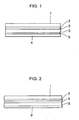
- a laminated packaging material for snacks printing 2 was performed with water based printing inks to a base film 1 comprising a bi-axial oriented polypropylene film (20 p) in the same method as that employed in Example 2 as shown in Fig. 1. Further an intermediate layer base film 3 comprising a polyester film (12 ⁇ ) with aluminium deposited thereon for giving the gas barrier capability and a heat sealable film 4 comprising a not stretched polypropylene film (20 ⁇ ) were laminated on the base film 1 by performing inline extrusion lamination with a polar resin (produced by Mitsui/Dupont Polychemical Kabushiki Kaisha; Nuclear AN 4228C) (10 ⁇ ) as a resin 5 for lamination not requiring any anchor coating agent due to polar groups.
- a polar resin produced by Mitsui/Dupont Polychemical Kabushiki Kaisha; Nuclear AN 4228C
- a butadiene based or alcoholic solvent based anchor coating agent available from the market was applied to the base film with the depth of 20 ⁇ prepared in Example 3 by the conventional extrusion lamination method, and then the intermediate layer base film with the depth of 12 ⁇ used in Example 3 was laminated thereon by using a low density polyethylene resin with the depth of 15 ⁇ as a resin for lamination. Then a urethane based or ethyl acetate solvent based anchor coating agent was applied inline to the laminated film described above, and further the heat sealable film 4 described above was laminated by extruding a low density polyethylene resin with the depth of 15 ⁇ .
- the laminated packing material prepared in Example 3 above had the same or similar physical properties as those of conventional materials, and in addition, such advantages as reduction of a quantity of organic solvents used in a printing process, smaller depth, and cost reduction were provided.
- photogravure printing 2 was performed to a base film 1 comprising a bi-axial oriented polyester film (12 ⁇ ) with water based printing inks used in Example 2 as shown in Fig. 2, and a polar resin 5 (which was the same as that used in Example 3) (10 ⁇ ) was used as a resin 5 for lamination not requiring any anchor coating agent to laminate an intermediate layer base film 3 comprising aluminium foils (7 ⁇ ) for giving the gas barrier capability thereon.
- a polar resin produced by Mitsui/Dupont Polychemical Kabushiki Kaisha; Nuclear AN 4225C
- a butadiene based or alcoholic solvent based anchor coating agent available from the market was applied to the same base film as that in Example 4 by the conventional extrusion lamination method, and a low density polyethylene resin with the depth of 15 ⁇ was extruded to laminate the intermediate layer base film with the depth of 7 ⁇ thereon. Then a low density polyethylene resin with the depth of 20 ⁇ was extruded inline to form a heat sealable resin layer thereon.
- the laminated packaging material provided in Example 4 had the same or similar physical properties and heat sealing capability as those of laminated packaging materials based on the conventional technology, and in addition such advantages as reduction of a quantity of organic solvents used in a printing process, smaller depth, and cost reduction were provided.
- the present invention can provide an established and consistent technology in the field of laminated packaging materials satisfying the requirements in the photogravure printing as well as in the lamination technology and also required for satisfying the needs for environment protection and reduction in a quantity of organic solvent used in the printing process, and the technology provided by the present invention has far more excellent cost performance as compared to that provided by other technologies.
Landscapes
- Laminated Bodies (AREA)
- Wrappers (AREA)
- Printing Plates And Materials Therefor (AREA)
- Extrusion Moulding Of Plastics Or The Like (AREA)
- Printing Methods (AREA)
Abstract
Description
Claims (5)
- A method of producing photogravure printed laminated packaging material, which method comprises the steps:a) printing a base film (1) using a photogravure printing method with water based photogravure printing inks (2) and using printing plates each with 200 to 400 lines and a plate depth in the range from 10 to 17 µ, andb) laminating the photogravure printed base film (1,2) with its printed surface to an intermediate layer base film (3) by an extrusion lamination method using a polar resin (5).
- A method of producing a photogravure printed laminated packaging material in accordance with claim 1, including the further step of applying a heat sealable resin layer (6) to the intermediate layer base film (3).
- A method of producing a photogravure printed laminated packaging material in accordance with claim 1 or claim 2, including the further step of applying a heat sealable resin layer (6) to the intermediate layer base film (3) by an extrusion lamination method using a polar resin (5).
- A method of producing a photogravure printed laminated packaging material in accordance with claim 1, 2 or 3, comprising the use of water based printing inks for the photogravure printing (2) which comprise the six primary colours of yellow, red, blue, orange, green, and purple in addition to black and white, the required colours being obtained by overprinting one colour after another to obtain desired hues.
- A method of producing a photogravure printed laminated packaging material in accordance with any preceding claim, characterised by the use of a polyester film with an aluminium deposit as the intermediate base layer film (3).
Applications Claiming Priority (2)
| Application Number | Priority Date | Filing Date | Title |
|---|---|---|---|
| JP2001131563 | 2001-04-27 | ||
| JP2001131563A JP2002326335A (en) | 2001-04-27 | 2001-04-27 | Method for producing gravure printed laminated packaging material and laminated packaging material produced by this production method |
Publications (3)
| Publication Number | Publication Date |
|---|---|
| EP1253009A2 EP1253009A2 (en) | 2002-10-30 |
| EP1253009A3 EP1253009A3 (en) | 2002-11-20 |
| EP1253009B1 true EP1253009B1 (en) | 2004-07-28 |
Family
ID=18979729
Family Applications (1)
| Application Number | Title | Priority Date | Filing Date |
|---|---|---|---|
| EP02252974A Expired - Lifetime EP1253009B1 (en) | 2001-04-27 | 2002-04-26 | Method for producing a photogravure printed laminated packaging material |
Country Status (9)
| Country | Link |
|---|---|
| US (1) | US20020157773A1 (en) |
| EP (1) | EP1253009B1 (en) |
| JP (1) | JP2002326335A (en) |
| KR (1) | KR100854293B1 (en) |
| AT (1) | ATE271974T1 (en) |
| DE (1) | DE60200803T2 (en) |
| DK (1) | DK1253009T3 (en) |
| ES (1) | ES2223029T3 (en) |
| PT (1) | PT1253009E (en) |
Cited By (1)
| Publication number | Priority date | Publication date | Assignee | Title |
|---|---|---|---|---|
| US9731480B2 (en) | 2011-06-14 | 2017-08-15 | Essel Propack Limited | Printed polyester film based laminate, method of making and application thereof |
Families Citing this family (16)
| Publication number | Priority date | Publication date | Assignee | Title |
|---|---|---|---|---|
| JP4597034B2 (en) * | 2005-10-28 | 2010-12-15 | 中本パックス株式会社 | Laminate and method for producing the same |
| JP2008062956A (en) * | 2006-09-06 | 2008-03-21 | Nihon Tokkyo Kanri Co Ltd | Laminated flexible packaging material and method for manufacturing the same |
| JPWO2008038716A1 (en) * | 2006-09-29 | 2010-01-28 | 富士特殊紙業株式会社 | Laminated soft packaging material and method for producing the same |
| WO2008047581A1 (en) * | 2006-10-02 | 2008-04-24 | Fuji Tokushu Shigyo Co., Ltd. | Laminated flexible packaging material and method for manufacturing the same |
| CN103862906B (en) * | 2014-02-24 | 2016-02-10 | 深圳劲嘉彩印集团股份有限公司 | Macromolecule holographic film and production equipment thereof and preparation method |
| JP2018524436A (en) * | 2015-06-18 | 2018-08-30 | ビーエーエスエフ ソシエタス・ヨーロピアBasf Se | Aqueous printing ink comprising an aqueous dispersed polyurethane binder and an aqueous dispersed poly (meth) acrylate binder |
| RU2670335C1 (en) * | 2015-09-18 | 2018-10-22 | Тинк Лаборатори Ко., Лтд. | Method of intaglio printing |
| JP2018065367A (en) * | 2016-10-17 | 2018-04-26 | 東洋インキScホールディングス株式会社 | Print production method |
| KR101860675B1 (en) * | 2017-06-27 | 2018-05-23 | 주식회사 오리온 | Packing film using environment-friendly ink and production method thereof |
| JP7178106B2 (en) * | 2017-10-11 | 2022-11-25 | 山進社印刷株式会社 | Antifungal sheet manufacturing method and packaging material |
| KR102136002B1 (en) * | 2018-04-17 | 2020-07-20 | 주식회사 에스피씨팩 | Packing film using environment-friendly ink and method of manufacturing the same |
| JP6955271B2 (en) * | 2019-01-29 | 2021-10-27 | 三洋グラビア株式会社 | Printing method and manufacturing method of resin film printed matter for packaging |
| KR102151165B1 (en) * | 2020-03-04 | 2020-09-02 | 주식회사 유래코 | The method for preparing packing film using environment_friendly aqueous ink and film prepared thereby |
| JP7528471B2 (en) * | 2020-03-10 | 2024-08-06 | artience株式会社 | Printing production method |
| KR102232952B1 (en) | 2020-11-23 | 2021-03-26 | 주식회사선진씨앤디 | Gravure printing film |
| KR102567301B1 (en) * | 2021-04-29 | 2023-08-16 | 롯데알미늄 주식회사 | Eco-friendly packaging material manufacturing process |
Citations (1)
| Publication number | Priority date | Publication date | Assignee | Title |
|---|---|---|---|---|
| WO2000018578A1 (en) * | 1998-09-30 | 2000-04-06 | Fuji Photo Film Co., Ltd. | Laminate and method for producing the same |
Family Cites Families (18)
| Publication number | Priority date | Publication date | Assignee | Title |
|---|---|---|---|---|
| US4254173A (en) * | 1978-11-20 | 1981-03-03 | Coors Container Company | Composite material for secondary container packaging |
| DE3320141C2 (en) * | 1983-06-03 | 1986-07-03 | Harald 6070 Langen Küppers | Reproduction process for making multicolored prints |
| JP2570820B2 (en) * | 1988-06-23 | 1997-01-16 | 東レ株式会社 | Laminated film for print lamination and method for producing the same |
| CA2051219C (en) * | 1990-09-14 | 2001-06-19 | Yuji Komiya | Method of preparing laminated packaging material |
| DE69226875T2 (en) * | 1991-12-28 | 1999-04-15 | Toppan Printing Co. Ltd., Tokio/Tokyo | LAMINATED PACKING MATERIAL |
| JPH07205360A (en) * | 1994-01-17 | 1995-08-08 | Mitsubishi Chem Corp | Method for producing gas barrier laminated film |
| EP0714762B1 (en) * | 1994-06-22 | 2011-05-11 | Dai Nippon Printing Co., Ltd. | Decorative material |
| JPH08269381A (en) * | 1995-03-31 | 1996-10-15 | Toyo Ink Mfg Co Ltd | Water based printing ink |
| US5960713A (en) * | 1995-05-04 | 1999-10-05 | Howard W. DeMoore | Retractable printing-coating unit operable on the plate and blanket cylinders simultaneously from the dampener side of the first printing unit or any consecutive printing unit or any rotary offset printing press |
| JP3563863B2 (en) * | 1996-02-09 | 2004-09-08 | 大日本印刷株式会社 | Cover tape |
| WO1998015407A1 (en) * | 1996-10-08 | 1998-04-16 | H.B. Fuller Licensing & Financing, Inc. | Laminating method and hot melt adhesive |
| JPH10175244A (en) * | 1996-12-18 | 1998-06-30 | Nippon Poriorefuin Kk | Manufacturing method of laminate |
| US6165319A (en) * | 1998-05-11 | 2000-12-26 | Fort James Corporation | Printed, soft, bulky single-ply absorbent paper having a serpentine configuration and low sidedness and methods for its manufacture |
| JP2000238208A (en) * | 1999-02-24 | 2000-09-05 | Nippon Polyolefin Kk | Laminated body and method for manufacturing the same |
| PT1072407E (en) * | 1999-07-27 | 2005-10-31 | Japan Patent Man Co Ltd | PHOTOGRAPHIC PRINTING PROCESS USING WATER-BASED INK AND A MACHINE FOR EXECUTION OF THE METHOD |
| JP2001030611A (en) * | 1999-07-27 | 2001-02-06 | Nihon Tokkyo Kanri Co Ltd | Gravure printing method using aqueous gravure ink, plate cylinder used for application of the method and printed matter printed by the method |
| US6379813B1 (en) * | 1999-09-17 | 2002-04-30 | S. C. Johnson Commercial Markets, Inc. | Pigmented compositions and articles of manufacture containing same |
| US6344819B1 (en) * | 1999-11-29 | 2002-02-05 | Xerox Corporation | Heliographic ink jet apparatus and imaging processes thereof |
-
2001
- 2001-04-27 JP JP2001131563A patent/JP2002326335A/en active Pending
-
2002
- 2002-04-25 US US10/132,898 patent/US20020157773A1/en not_active Abandoned
- 2002-04-26 EP EP02252974A patent/EP1253009B1/en not_active Expired - Lifetime
- 2002-04-26 PT PT02252974T patent/PT1253009E/en unknown
- 2002-04-26 ES ES02252974T patent/ES2223029T3/en not_active Expired - Lifetime
- 2002-04-26 KR KR1020020022891A patent/KR100854293B1/en not_active Expired - Fee Related
- 2002-04-26 AT AT02252974T patent/ATE271974T1/en not_active IP Right Cessation
- 2002-04-26 DE DE60200803T patent/DE60200803T2/en not_active Expired - Lifetime
- 2002-04-26 DK DK02252974T patent/DK1253009T3/en active
Patent Citations (1)
| Publication number | Priority date | Publication date | Assignee | Title |
|---|---|---|---|---|
| WO2000018578A1 (en) * | 1998-09-30 | 2000-04-06 | Fuji Photo Film Co., Ltd. | Laminate and method for producing the same |
Cited By (1)
| Publication number | Priority date | Publication date | Assignee | Title |
|---|---|---|---|---|
| US9731480B2 (en) | 2011-06-14 | 2017-08-15 | Essel Propack Limited | Printed polyester film based laminate, method of making and application thereof |
Also Published As
| Publication number | Publication date |
|---|---|
| ATE271974T1 (en) | 2004-08-15 |
| DK1253009T3 (en) | 2004-10-25 |
| PT1253009E (en) | 2004-11-30 |
| DE60200803T2 (en) | 2005-09-22 |
| JP2002326335A (en) | 2002-11-12 |
| EP1253009A3 (en) | 2002-11-20 |
| ES2223029T3 (en) | 2005-02-16 |
| KR20020083470A (en) | 2002-11-02 |
| EP1253009A2 (en) | 2002-10-30 |
| DE60200803D1 (en) | 2004-09-02 |
| US20020157773A1 (en) | 2002-10-31 |
| KR100854293B1 (en) | 2008-08-26 |
Similar Documents
| Publication | Publication Date | Title |
|---|---|---|
| EP1253009A2 (en) | Photogravure printed laminated packaging material | |
| DE69809884T2 (en) | PRINTED POLYMER FILM AND METHOD FOR THEIR PRODUCTION | |
| EP0501441B1 (en) | Synthetic paper for writing and printing | |
| KR20190121125A (en) | Packing film using environment-friendly ink and method of manufacturing the same | |
| JPS62502359A (en) | Method for obtaining systematic color diagrams or chromaticity diagrams for screen color printing and color diagrams or chromaticity diagrams obtained by this method | |
| US9486987B2 (en) | Partially opaque-partially clear laminates and methods thereof | |
| WO2009126372A1 (en) | Multi-layer slip film for printing and lamination processes | |
| DE69608041T2 (en) | Thin metal planographic printing plates with visible traces of recording | |
| KR100412748B1 (en) | Thermoplastic resin stretched film laminate having excellent printability | |
| DE60029201T2 (en) | METHOD FOR PRINTING A SUBSTRATE AND ARTICLE THEREOF | |
| EP0748699A2 (en) | Thermal transfer recording material for imparting metallic luster and use thereof | |
| DE69226875T2 (en) | LAMINATED PACKING MATERIAL | |
| JP2003136645A (en) | Gas barrier coat film having printability and method for producing the same | |
| EP3640924B1 (en) | Label and method for manufacturing label | |
| JP2023014614A (en) | Packaging bag and laminated film for packaging and film with pigmented layer | |
| CN117227343B (en) | Heat transfer film for friction-resistant high-resolution color patterns and its preparation method | |
| DE4030622A1 (en) | IMAGE RECEIVING SHEET | |
| EP0372129A1 (en) | Lightsafe masking film | |
| JP2516639B2 (en) | Receptive sheet for thermal transfer | |
| KR20200121938A (en) | Laminate packaging material and manufacturing method therefor | |
| DE60127788T2 (en) | Color checking by inkjet printing | |
| JP4895743B2 (en) | Manufacturing method of offset printed matter with excellent light resistance | |
| CN112477458B (en) | Offset printing process and printed matter | |
| JP2005178221A (en) | High brightness printed matter | |
| JP2547620B2 (en) | Transfer material for mat processing and manufacturing method thereof |
Legal Events
| Date | Code | Title | Description |
|---|---|---|---|
| PUAI | Public reference made under article 153(3) epc to a published international application that has entered the european phase |
Free format text: ORIGINAL CODE: 0009012 |
|
| PUAL | Search report despatched |
Free format text: ORIGINAL CODE: 0009013 |
|
| AK | Designated contracting states |
Kind code of ref document: A2 Designated state(s): AT BE CH CY DE DK ES FI FR GB GR IE IT LI LU MC NL PT SE TR |
|
| AX | Request for extension of the european patent |
Free format text: AL;LT;LV;MK;RO;SI |
|
| AK | Designated contracting states |
Kind code of ref document: A3 Designated state(s): AT BE CH CY DE DK ES FI FR GB GR IE IT LI LU MC NL PT SE TR |
|
| AX | Request for extension of the european patent |
Free format text: AL;LT;LV;MK;RO;SI |
|
| RIC1 | Information provided on ipc code assigned before grant |
Free format text: 7B 41F 9/00 A, 7B 32B 7/12 B, 7B 32B 27/08 B, 7B 32B 31/30 B |
|
| 17P | Request for examination filed |
Effective date: 20030408 |
|
| AKX | Designation fees paid |
Designated state(s): AT BE CH CY DE DK ES FI FR GB GR IE IT LI LU MC NL PT SE TR |
|
| 17Q | First examination report despatched |
Effective date: 20030716 |
|
| GRAP | Despatch of communication of intention to grant a patent |
Free format text: ORIGINAL CODE: EPIDOSNIGR1 |
|
| RTI1 | Title (correction) |
Free format text: METHOD FOR PRODUCING A PHOTOGRAVURE PRINTED LAMINATED PACKAGING MATERIAL |
|
| GRAS | Grant fee paid |
Free format text: ORIGINAL CODE: EPIDOSNIGR3 |
|
| GRAA | (expected) grant |
Free format text: ORIGINAL CODE: 0009210 |
|
| GRAL | Information related to payment of fee for publishing/printing deleted |
Free format text: ORIGINAL CODE: EPIDOSDIGR3 |
|
| AK | Designated contracting states |
Kind code of ref document: B1 Designated state(s): AT BE CH CY DE DK ES FI FR GB GR IE IT LI LU MC NL PT SE TR |
|
| PG25 | Lapsed in a contracting state [announced via postgrant information from national office to epo] |
Ref country code: TR Free format text: LAPSE BECAUSE OF FAILURE TO SUBMIT A TRANSLATION OF THE DESCRIPTION OR TO PAY THE FEE WITHIN THE PRESCRIBED TIME-LIMIT Effective date: 20040728 |
|
| REG | Reference to a national code |
Ref country code: GB Ref legal event code: FG4D |
|
| REG | Reference to a national code |
Ref country code: CH Ref legal event code: EP |
|
| GRAS | Grant fee paid |
Free format text: ORIGINAL CODE: EPIDOSNIGR3 |
|
| REG | Reference to a national code |
Ref country code: IE Ref legal event code: FG4D |
|
| REF | Corresponds to: |
Ref document number: 60200803 Country of ref document: DE Date of ref document: 20040902 Kind code of ref document: P |
|
| REG | Reference to a national code |
Ref country code: GR Ref legal event code: EP Ref document number: 20040403059 Country of ref document: GR |
|
| REG | Reference to a national code |
Ref country code: DK Ref legal event code: T3 |
|
| REG | Reference to a national code |
Ref country code: SE Ref legal event code: TRGR |
|
| REG | Reference to a national code |
Ref country code: CH Ref legal event code: NV Representative=s name: TROESCH SCHEIDEGGER WERNER AG |
|
| REG | Reference to a national code |
Ref country code: PT Ref legal event code: SC4A Free format text: AVAILABILITY OF NATIONAL TRANSLATION Effective date: 20041006 |
|
| REG | Reference to a national code |
Ref country code: ES Ref legal event code: FG2A Ref document number: 2223029 Country of ref document: ES Kind code of ref document: T3 |
|
| ET | Fr: translation filed | ||
| PGFP | Annual fee paid to national office [announced via postgrant information from national office to epo] |
Ref country code: GR Payment date: 20050322 Year of fee payment: 4 Ref country code: PT Payment date: 20050322 Year of fee payment: 4 |
|
| PGFP | Annual fee paid to national office [announced via postgrant information from national office to epo] |
Ref country code: IE Payment date: 20050324 Year of fee payment: 4 |
|
| PGFP | Annual fee paid to national office [announced via postgrant information from national office to epo] |
Ref country code: AT Payment date: 20050404 Year of fee payment: 4 |
|
| PGFP | Annual fee paid to national office [announced via postgrant information from national office to epo] |
Ref country code: FI Payment date: 20050407 Year of fee payment: 4 |
|
| PGFP | Annual fee paid to national office [announced via postgrant information from national office to epo] |
Ref country code: DK Payment date: 20050411 Year of fee payment: 4 |
|
| PGFP | Annual fee paid to national office [announced via postgrant information from national office to epo] |
Ref country code: BE Payment date: 20050412 Year of fee payment: 4 |
|
| PG25 | Lapsed in a contracting state [announced via postgrant information from national office to epo] |
Ref country code: LU Free format text: LAPSE BECAUSE OF NON-PAYMENT OF DUE FEES Effective date: 20050426 Ref country code: CY Free format text: LAPSE BECAUSE OF FAILURE TO SUBMIT A TRANSLATION OF THE DESCRIPTION OR TO PAY THE FEE WITHIN THE PRESCRIBED TIME-LIMIT Effective date: 20050426 Ref country code: IT Free format text: LAPSE BECAUSE OF NON-PAYMENT OF DUE FEES Effective date: 20050426 |
|
| PGFP | Annual fee paid to national office [announced via postgrant information from national office to epo] |
Ref country code: SE Payment date: 20050426 Year of fee payment: 4 |
|
| PG25 | Lapsed in a contracting state [announced via postgrant information from national office to epo] |
Ref country code: MC Free format text: LAPSE BECAUSE OF NON-PAYMENT OF DUE FEES Effective date: 20050430 |
|
| PLBE | No opposition filed within time limit |
Free format text: ORIGINAL CODE: 0009261 |
|
| STAA | Information on the status of an ep patent application or granted ep patent |
Free format text: STATUS: NO OPPOSITION FILED WITHIN TIME LIMIT |
|
| 26N | No opposition filed |
Effective date: 20050429 |
|
| PG25 | Lapsed in a contracting state [announced via postgrant information from national office to epo] |
Ref country code: FI Free format text: LAPSE BECAUSE OF NON-PAYMENT OF DUE FEES Effective date: 20060426 Ref country code: IE Free format text: LAPSE BECAUSE OF NON-PAYMENT OF DUE FEES Effective date: 20060426 Ref country code: AT Free format text: LAPSE BECAUSE OF NON-PAYMENT OF DUE FEES Effective date: 20060426 |
|
| PG25 | Lapsed in a contracting state [announced via postgrant information from national office to epo] |
Ref country code: SE Free format text: LAPSE BECAUSE OF NON-PAYMENT OF DUE FEES Effective date: 20060427 |
|
| PG25 | Lapsed in a contracting state [announced via postgrant information from national office to epo] |
Ref country code: BE Free format text: LAPSE BECAUSE OF NON-PAYMENT OF DUE FEES Effective date: 20060430 |
|
| PG25 | Lapsed in a contracting state [announced via postgrant information from national office to epo] |
Ref country code: DK Free format text: LAPSE BECAUSE OF NON-PAYMENT OF DUE FEES Effective date: 20060501 |
|
| PG25 | Lapsed in a contracting state [announced via postgrant information from national office to epo] |
Ref country code: PT Free format text: LAPSE BECAUSE OF NON-PAYMENT OF DUE FEES Effective date: 20061026 |
|
| REG | Reference to a national code |
Ref country code: DK Ref legal event code: EBP |
|
| EUG | Se: european patent has lapsed | ||
| REG | Reference to a national code |
Ref country code: PT Ref legal event code: MM4A Free format text: LAPSE DUE TO NON-PAYMENT OF FEES Effective date: 20061026 |
|
| REG | Reference to a national code |
Ref country code: IE Ref legal event code: MM4A |
|
| BERE | Be: lapsed |
Owner name: JAPAN *PATENT MANAGEMENT CO. LTD Effective date: 20060430 |
|
| PG25 | Lapsed in a contracting state [announced via postgrant information from national office to epo] |
Ref country code: GR Free format text: LAPSE BECAUSE OF NON-PAYMENT OF DUE FEES Effective date: 20061102 |
|
| PGRI | Patent reinstated in contracting state [announced from national office to epo] |
Ref country code: IT Effective date: 20091201 |
|
| PGFP | Annual fee paid to national office [announced via postgrant information from national office to epo] |
Ref country code: GB Payment date: 20130412 Year of fee payment: 12 Ref country code: CH Payment date: 20130429 Year of fee payment: 12 |
|
| PGFP | Annual fee paid to national office [announced via postgrant information from national office to epo] |
Ref country code: NL Payment date: 20130426 Year of fee payment: 12 Ref country code: IT Payment date: 20130417 Year of fee payment: 12 |
|
| REG | Reference to a national code |
Ref country code: NL Ref legal event code: V1 Effective date: 20141101 |
|
| REG | Reference to a national code |
Ref country code: CH Ref legal event code: PL |
|
| GBPC | Gb: european patent ceased through non-payment of renewal fee |
Effective date: 20140426 |
|
| PG25 | Lapsed in a contracting state [announced via postgrant information from national office to epo] |
Ref country code: LI Free format text: LAPSE BECAUSE OF NON-PAYMENT OF DUE FEES Effective date: 20140430 Ref country code: GB Free format text: LAPSE BECAUSE OF NON-PAYMENT OF DUE FEES Effective date: 20140426 Ref country code: CH Free format text: LAPSE BECAUSE OF NON-PAYMENT OF DUE FEES Effective date: 20140430 |
|
| PG25 | Lapsed in a contracting state [announced via postgrant information from national office to epo] |
Ref country code: NL Free format text: LAPSE BECAUSE OF NON-PAYMENT OF DUE FEES Effective date: 20141101 |
|
| PG25 | Lapsed in a contracting state [announced via postgrant information from national office to epo] |
Ref country code: IT Free format text: LAPSE BECAUSE OF NON-PAYMENT OF DUE FEES Effective date: 20140426 |
|
| REG | Reference to a national code |
Ref country code: FR Ref legal event code: PLFP Year of fee payment: 14 |
|
| REG | Reference to a national code |
Ref country code: FR Ref legal event code: PLFP Year of fee payment: 15 |
|
| REG | Reference to a national code |
Ref country code: FR Ref legal event code: PLFP Year of fee payment: 16 |
|
| REG | Reference to a national code |
Ref country code: FR Ref legal event code: PLFP Year of fee payment: 17 |
|
| PGFP | Annual fee paid to national office [announced via postgrant information from national office to epo] |
Ref country code: DE Payment date: 20180427 Year of fee payment: 17 Ref country code: ES Payment date: 20180524 Year of fee payment: 17 |
|
| PGFP | Annual fee paid to national office [announced via postgrant information from national office to epo] |
Ref country code: FR Payment date: 20180424 Year of fee payment: 17 |
|
| REG | Reference to a national code |
Ref country code: DE Ref legal event code: R119 Ref document number: 60200803 Country of ref document: DE |
|
| PG25 | Lapsed in a contracting state [announced via postgrant information from national office to epo] |
Ref country code: DE Free format text: LAPSE BECAUSE OF NON-PAYMENT OF DUE FEES Effective date: 20191101 |
|
| PG25 | Lapsed in a contracting state [announced via postgrant information from national office to epo] |
Ref country code: FR Free format text: LAPSE BECAUSE OF NON-PAYMENT OF DUE FEES Effective date: 20190430 |
|
| REG | Reference to a national code |
Ref country code: ES Ref legal event code: FD2A Effective date: 20200901 |
|
| PG25 | Lapsed in a contracting state [announced via postgrant information from national office to epo] |
Ref country code: ES Free format text: LAPSE BECAUSE OF NON-PAYMENT OF DUE FEES Effective date: 20190427 |