EP1252141B1 - Tosylproline analogs as thymidylate synthase inhibitors - Google Patents
Tosylproline analogs as thymidylate synthase inhibitors Download PDFInfo
- Publication number
- EP1252141B1 EP1252141B1 EP01905352A EP01905352A EP1252141B1 EP 1252141 B1 EP1252141 B1 EP 1252141B1 EP 01905352 A EP01905352 A EP 01905352A EP 01905352 A EP01905352 A EP 01905352A EP 1252141 B1 EP1252141 B1 EP 1252141B1
- Authority
- EP
- European Patent Office
- Prior art keywords
- acid
- cooh
- alkyl
- conhr
- sulfonyl
- Prior art date
- Legal status (The legal status is an assumption and is not a legal conclusion. Google has not performed a legal analysis and makes no representation as to the accuracy of the status listed.)
- Expired - Lifetime
Links
- 239000003734 thymidylate synthase inhibitor Substances 0.000 title claims abstract description 8
- CGPHGPCHVUSFFA-UHFFFAOYSA-N 1-(4-methylphenyl)sulfonylpyrrolidine-2-carboxylic acid Chemical class C1=CC(C)=CC=C1S(=O)(=O)N1C(C(O)=O)CCC1 CGPHGPCHVUSFFA-UHFFFAOYSA-N 0.000 title abstract description 3
- 150000001875 compounds Chemical class 0.000 claims abstract description 68
- 239000008194 pharmaceutical composition Substances 0.000 claims abstract description 9
- 125000003178 carboxy group Chemical group [H]OC(*)=O 0.000 claims description 32
- 150000002148 esters Chemical class 0.000 claims description 25
- 201000010099 disease Diseases 0.000 claims description 24
- 208000037265 diseases, disorders, signs and symptoms Diseases 0.000 claims description 24
- 239000000203 mixture Substances 0.000 claims description 22
- 125000000217 alkyl group Chemical group 0.000 claims description 21
- 150000003839 salts Chemical class 0.000 claims description 19
- 229910006074 SO2NH2 Inorganic materials 0.000 claims description 16
- 125000000043 benzamido group Chemical group [H]N([*])C(=O)C1=C([H])C([H])=C([H])C([H])=C1[H] 0.000 claims description 15
- -1 chloro, bromo, methylthio, hydroxy, methoxy, carboxy Chemical group 0.000 claims description 14
- 229910006069 SO3H Inorganic materials 0.000 claims description 13
- 125000002496 methyl group Chemical group [H]C([H])([H])* 0.000 claims description 12
- 206010028980 Neoplasm Diseases 0.000 claims description 11
- 230000002378 acidificating effect Effects 0.000 claims description 11
- 235000001014 amino acid Nutrition 0.000 claims description 11
- 150000001413 amino acids Chemical class 0.000 claims description 11
- 239000000546 pharmaceutical excipient Substances 0.000 claims description 11
- 229910018828 PO3H2 Inorganic materials 0.000 claims description 10
- OYIFNHCXNCRBQI-UHFFFAOYSA-N 2-aminoadipic acid Chemical compound OC(=O)C(N)CCCC(O)=O OYIFNHCXNCRBQI-UHFFFAOYSA-N 0.000 claims description 8
- JUQLUIFNNFIIKC-UHFFFAOYSA-N 2-aminopimelic acid Chemical compound OC(=O)C(N)CCCCC(O)=O JUQLUIFNNFIIKC-UHFFFAOYSA-N 0.000 claims description 8
- 239000003814 drug Substances 0.000 claims description 8
- 125000001495 ethyl group Chemical group [H]C([H])([H])C([H])([H])* 0.000 claims description 8
- 125000001153 fluoro group Chemical group F* 0.000 claims description 8
- 230000001580 bacterial effect Effects 0.000 claims description 6
- 208000035143 Bacterial infection Diseases 0.000 claims description 5
- 206010017533 Fungal infection Diseases 0.000 claims description 5
- WHUUTDBJXJRKMK-UHFFFAOYSA-N Glutamic acid Natural products OC(=O)C(N)CCC(O)=O WHUUTDBJXJRKMK-UHFFFAOYSA-N 0.000 claims description 5
- WHUUTDBJXJRKMK-VKHMYHEASA-N L-glutamic acid Chemical compound OC(=O)[C@@H](N)CCC(O)=O WHUUTDBJXJRKMK-VKHMYHEASA-N 0.000 claims description 5
- 208000031888 Mycoses Diseases 0.000 claims description 5
- 208000030852 Parasitic disease Diseases 0.000 claims description 5
- 208000036142 Viral infection Diseases 0.000 claims description 5
- 208000022362 bacterial infectious disease Diseases 0.000 claims description 5
- 230000002538 fungal effect Effects 0.000 claims description 5
- 235000013922 glutamic acid Nutrition 0.000 claims description 5
- 239000004220 glutamic acid Substances 0.000 claims description 5
- 125000001160 methoxycarbonyl group Chemical group [H]C([H])([H])OC(*)=O 0.000 claims description 5
- 230000003071 parasitic effect Effects 0.000 claims description 5
- 230000009385 viral infection Effects 0.000 claims description 5
- 125000004178 (C1-C4) alkyl group Chemical group 0.000 claims description 4
- YOFPFYYTUIARDI-UHFFFAOYSA-N alpha-aminosuberic acid Chemical compound OC(=O)C(N)CCCCCC(O)=O YOFPFYYTUIARDI-UHFFFAOYSA-N 0.000 claims description 4
- 125000001997 phenyl group Chemical group [H]C1=C([H])C([H])=C(*)C([H])=C1[H] 0.000 claims description 4
- 125000002023 trifluoromethyl group Chemical group FC(F)(F)* 0.000 claims description 4
- 125000004169 (C1-C6) alkyl group Chemical group 0.000 claims description 3
- 229940122149 Thymidylate synthase inhibitor Drugs 0.000 claims description 3
- 125000001246 bromo group Chemical group Br* 0.000 claims description 3
- 125000001309 chloro group Chemical group Cl* 0.000 claims description 3
- 125000001449 isopropyl group Chemical group [H]C([H])([H])C([H])(*)C([H])([H])[H] 0.000 claims description 3
- TWFSVRFWQKBHCR-UHFFFAOYSA-N 2-[[4-(2-carboxypyrrolidin-1-yl)sulfonylbenzoyl]amino]octanedioic acid Chemical compound C1=CC(C(=O)NC(CCCCCC(=O)O)C(O)=O)=CC=C1S(=O)(=O)N1C(C(O)=O)CCC1 TWFSVRFWQKBHCR-UHFFFAOYSA-N 0.000 claims description 2
- SRAHBOKVSSZEHQ-UHFFFAOYSA-N 2-[[4-[2-(2-carboxyethylcarbamoyl)pyrrolidin-1-yl]sulfonylbenzoyl]amino]pentanedioic acid Chemical compound OC(=O)CCNC(=O)C1CCCN1S(=O)(=O)C1=CC=C(C(=O)NC(CCC(O)=O)C(O)=O)C=C1 SRAHBOKVSSZEHQ-UHFFFAOYSA-N 0.000 claims description 2
- GQNBJTVIGQULAG-UHFFFAOYSA-N 2-[[4-[2-(3-methylbutylcarbamoyl)pyrrolidin-1-yl]sulfonylbenzoyl]amino]pentanedioic acid Chemical compound CC(C)CCNC(=O)C1CCCN1S(=O)(=O)C1=CC=C(C(=O)NC(CCC(O)=O)C(O)=O)C=C1 GQNBJTVIGQULAG-UHFFFAOYSA-N 0.000 claims description 2
- MZQIUMPHBRBFIF-UHFFFAOYSA-N 2-[[4-[2-(5-carboxypentylcarbamoyl)pyrrolidin-1-yl]sulfonylbenzoyl]amino]pentanedioic acid Chemical compound OC(=O)CCCCCNC(=O)C1CCCN1S(=O)(=O)C1=CC=C(C(=O)NC(CCC(O)=O)C(O)=O)C=C1 MZQIUMPHBRBFIF-UHFFFAOYSA-N 0.000 claims description 2
- MVFXJJSFGOHMCL-UHFFFAOYSA-N 2-[[4-carboxy-4-[[4-(2-carboxypiperidin-1-yl)sulfonylbenzoyl]amino]butanoyl]amino]pentanedioic acid Chemical compound C1=CC(C(=O)NC(CCC(=O)NC(CCC(=O)O)C(O)=O)C(O)=O)=CC=C1S(=O)(=O)N1C(C(O)=O)CCCC1 MVFXJJSFGOHMCL-UHFFFAOYSA-N 0.000 claims description 2
- HSFWRNGVRCDJHI-UHFFFAOYSA-N alpha-acetylene Natural products C#C HSFWRNGVRCDJHI-UHFFFAOYSA-N 0.000 claims description 2
- 125000002534 ethynyl group Chemical group [H]C#C* 0.000 claims description 2
- 125000000956 methoxy group Chemical group [H]C([H])([H])O* 0.000 claims description 2
- 125000000449 nitro group Chemical group [O-][N+](*)=O 0.000 claims description 2
- 125000000391 vinyl group Chemical group [H]C([*])=C([H])[H] 0.000 claims description 2
- JFCQEDHGNNZCLN-UHFFFAOYSA-N anhydrous glutaric acid Natural products OC(=O)CCCC(O)=O JFCQEDHGNNZCLN-UHFFFAOYSA-N 0.000 claims 1
- 238000004519 manufacturing process Methods 0.000 claims 1
- 238000000034 method Methods 0.000 abstract description 22
- 230000000844 anti-bacterial effect Effects 0.000 abstract description 7
- 230000002141 anti-parasite Effects 0.000 abstract description 7
- 239000002246 antineoplastic agent Substances 0.000 abstract description 7
- 239000003096 antiparasitic agent Substances 0.000 abstract description 7
- 230000000843 anti-fungal effect Effects 0.000 abstract description 6
- 239000003443 antiviral agent Substances 0.000 abstract description 6
- 230000000840 anti-viral effect Effects 0.000 abstract description 3
- 229940088710 antibiotic agent Drugs 0.000 abstract description 2
- 229940121375 antifungal agent Drugs 0.000 abstract description 2
- 229940125687 antiparasitic agent Drugs 0.000 abstract description 2
- 229940121357 antivirals Drugs 0.000 abstract description 2
- 108010022394 Threonine synthase Proteins 0.000 description 49
- 102000005497 Thymidylate Synthase Human genes 0.000 description 42
- 238000006243 chemical reaction Methods 0.000 description 20
- 125000001424 substituent group Chemical group 0.000 description 19
- 230000000694 effects Effects 0.000 description 18
- 241001465754 Metazoa Species 0.000 description 15
- 239000002253 acid Substances 0.000 description 15
- 239000003112 inhibitor Substances 0.000 description 15
- 230000005764 inhibitory process Effects 0.000 description 13
- RWRDLPDLKQPQOW-UHFFFAOYSA-N Pyrrolidine Chemical group C1CCNC1 RWRDLPDLKQPQOW-UHFFFAOYSA-N 0.000 description 10
- 238000003786 synthesis reaction Methods 0.000 description 10
- 150000001412 amines Chemical class 0.000 description 9
- 230000015572 biosynthetic process Effects 0.000 description 9
- 210000004027 cell Anatomy 0.000 description 9
- 239000000543 intermediate Substances 0.000 description 8
- 241000282414 Homo sapiens Species 0.000 description 7
- 229940024606 amino acid Drugs 0.000 description 7
- 102000004419 dihydrofolate reductase Human genes 0.000 description 7
- 238000011282 treatment Methods 0.000 description 7
- UHOVQNZJYSORNB-UHFFFAOYSA-N Benzene Chemical compound C1=CC=CC=C1 UHOVQNZJYSORNB-UHFFFAOYSA-N 0.000 description 6
- YMWUJEATGCHHMB-UHFFFAOYSA-N Dichloromethane Chemical compound ClCCl YMWUJEATGCHHMB-UHFFFAOYSA-N 0.000 description 6
- GHASVSINZRGABV-UHFFFAOYSA-N Fluorouracil Chemical compound FC1=CNC(=O)NC1=O GHASVSINZRGABV-UHFFFAOYSA-N 0.000 description 6
- ZMANZCXQSJIPKH-UHFFFAOYSA-N Triethylamine Chemical compound CCN(CC)CC ZMANZCXQSJIPKH-UHFFFAOYSA-N 0.000 description 6
- 230000000259 anti-tumor effect Effects 0.000 description 6
- GYOZYWVXFNDGLU-XLPZGREQSA-N dTMP Chemical compound O=C1NC(=O)C(C)=CN1[C@@H]1O[C@H](COP(O)(O)=O)[C@@H](O)C1 GYOZYWVXFNDGLU-XLPZGREQSA-N 0.000 description 6
- 229960002949 fluorouracil Drugs 0.000 description 6
- IAZDPXIOMUYVGZ-UHFFFAOYSA-N Dimethylsulphoxide Chemical compound CS(C)=O IAZDPXIOMUYVGZ-UHFFFAOYSA-N 0.000 description 5
- 239000002585 base Substances 0.000 description 5
- 238000010511 deprotection reaction Methods 0.000 description 5
- KDCGOANMDULRCW-UHFFFAOYSA-N 7H-purine Chemical compound N1=CNC2=NC=NC2=C1 KDCGOANMDULRCW-UHFFFAOYSA-N 0.000 description 4
- AFVFQIVMOAPDHO-UHFFFAOYSA-N Methanesulfonic acid Chemical compound CS(O)(=O)=O AFVFQIVMOAPDHO-UHFFFAOYSA-N 0.000 description 4
- 239000003242 anti bacterial agent Substances 0.000 description 4
- 230000003432 anti-folate effect Effects 0.000 description 4
- 229940127074 antifolate Drugs 0.000 description 4
- 239000003429 antifungal agent Substances 0.000 description 4
- 229940079593 drug Drugs 0.000 description 4
- 239000004052 folic acid antagonist Substances 0.000 description 4
- 238000000338 in vitro Methods 0.000 description 4
- 238000001727 in vivo Methods 0.000 description 4
- 230000001524 infective effect Effects 0.000 description 4
- BLWYXBNNBYXPPL-YFKPBYRVSA-N methyl (2s)-pyrrolidine-2-carboxylate Chemical compound COC(=O)[C@@H]1CCCN1 BLWYXBNNBYXPPL-YFKPBYRVSA-N 0.000 description 4
- NGVDGCNFYWLIFO-UHFFFAOYSA-N pyridoxal 5'-phosphate Chemical compound CC1=NC=C(COP(O)(O)=O)C(C=O)=C1O NGVDGCNFYWLIFO-UHFFFAOYSA-N 0.000 description 4
- 239000000243 solution Substances 0.000 description 4
- 239000007858 starting material Substances 0.000 description 4
- 210000004881 tumor cell Anatomy 0.000 description 4
- WZPWTXZSQHIABL-UHFFFAOYSA-N (2,3,4,5,6-pentafluorophenyl) benzoate Chemical compound FC1=C(F)C(F)=C(F)C(F)=C1OC(=O)C1=CC=CC=C1 WZPWTXZSQHIABL-UHFFFAOYSA-N 0.000 description 3
- 208000030507 AIDS Diseases 0.000 description 3
- QTBSBXVTEAMEQO-UHFFFAOYSA-N Acetic acid Chemical compound CC(O)=O QTBSBXVTEAMEQO-UHFFFAOYSA-N 0.000 description 3
- 206010006187 Breast cancer Diseases 0.000 description 3
- 208000026310 Breast neoplasm Diseases 0.000 description 3
- 206010009944 Colon cancer Diseases 0.000 description 3
- 208000001333 Colorectal Neoplasms Diseases 0.000 description 3
- 108010016626 Dipeptides Proteins 0.000 description 3
- 102000004190 Enzymes Human genes 0.000 description 3
- 108090000790 Enzymes Proteins 0.000 description 3
- 206010061598 Immunodeficiency Diseases 0.000 description 3
- ONIBWKKTOPOVIA-BYPYZUCNSA-N L-Proline Chemical compound OC(=O)[C@@H]1CCCN1 ONIBWKKTOPOVIA-BYPYZUCNSA-N 0.000 description 3
- YEJSPQZHMWGIGP-YFKPBYRVSA-N L-glutamic acid, dimethyl ester Chemical compound COC(=O)CC[C@H](N)C(=O)OC YEJSPQZHMWGIGP-YFKPBYRVSA-N 0.000 description 3
- WMFOQBRAJBCJND-UHFFFAOYSA-M Lithium hydroxide Chemical compound [Li+].[OH-] WMFOQBRAJBCJND-UHFFFAOYSA-M 0.000 description 3
- OKKJLVBELUTLKV-UHFFFAOYSA-N Methanol Chemical compound OC OKKJLVBELUTLKV-UHFFFAOYSA-N 0.000 description 3
- ONIBWKKTOPOVIA-UHFFFAOYSA-N Proline Natural products OC(=O)C1CCCN1 ONIBWKKTOPOVIA-UHFFFAOYSA-N 0.000 description 3
- 101150112897 TS gene Proteins 0.000 description 3
- 201000011510 cancer Diseases 0.000 description 3
- KRKNYBCHXYNGOX-UHFFFAOYSA-N citric acid Chemical compound OC(=O)CC(O)(C(O)=O)CC(O)=O KRKNYBCHXYNGOX-UHFFFAOYSA-N 0.000 description 3
- 238000011161 development Methods 0.000 description 3
- 230000002255 enzymatic effect Effects 0.000 description 3
- 229940088598 enzyme Drugs 0.000 description 3
- 238000005259 measurement Methods 0.000 description 3
- 150000004702 methyl esters Chemical class 0.000 description 3
- 150000007530 organic bases Chemical class 0.000 description 3
- 230000003389 potentiating effect Effects 0.000 description 3
- 229960002429 proline Drugs 0.000 description 3
- 125000006239 protecting group Chemical group 0.000 description 3
- JWVCLYRUEFBMGU-UHFFFAOYSA-N quinazoline Chemical compound N1=CN=CC2=CC=CC=C21 JWVCLYRUEFBMGU-UHFFFAOYSA-N 0.000 description 3
- 229940124530 sulfonamide Drugs 0.000 description 3
- 150000003456 sulfonamides Chemical class 0.000 description 3
- 238000012360 testing method Methods 0.000 description 3
- 229940124597 therapeutic agent Drugs 0.000 description 3
- IEJSCSAMMLUINT-NRFANRHFSA-N (2s)-2-[[4-[(2,7-dimethyl-4-oxo-1h-quinazolin-6-yl)methyl-prop-2-ynylamino]-2-fluorobenzoyl]amino]-4-(2h-tetrazol-5-yl)butanoic acid Chemical compound C([C@H](NC(=O)C1=CC=C(C=C1F)N(CC#C)CC=1C=C2C(=O)N=C(NC2=CC=1C)C)C(O)=O)CC=1N=NNN=1 IEJSCSAMMLUINT-NRFANRHFSA-N 0.000 description 2
- MSTNYGQPCMXVAQ-RYUDHWBXSA-N (6S)-5,6,7,8-tetrahydrofolic acid Chemical compound C([C@H]1CNC=2N=C(NC(=O)C=2N1)N)NC1=CC=C(C(=O)N[C@@H](CCC(O)=O)C(O)=O)C=C1 MSTNYGQPCMXVAQ-RYUDHWBXSA-N 0.000 description 2
- HZAXFHJVJLSVMW-UHFFFAOYSA-N 2-Aminoethan-1-ol Chemical compound NCCO HZAXFHJVJLSVMW-UHFFFAOYSA-N 0.000 description 2
- LSNNMFCWUKXFEE-UHFFFAOYSA-M Bisulfite Chemical compound OS([O-])=O LSNNMFCWUKXFEE-UHFFFAOYSA-M 0.000 description 2
- HEDRZPFGACZZDS-UHFFFAOYSA-N Chloroform Chemical compound ClC(Cl)Cl HEDRZPFGACZZDS-UHFFFAOYSA-N 0.000 description 2
- AOJJSUZBOXZQNB-TZSSRYMLSA-N Doxorubicin Chemical compound O([C@H]1C[C@@](O)(CC=2C(O)=C3C(=O)C=4C=CC=C(C=4C(=O)C3=C(O)C=21)OC)C(=O)CO)[C@H]1C[C@H](N)[C@H](O)[C@H](C)O1 AOJJSUZBOXZQNB-TZSSRYMLSA-N 0.000 description 2
- KOSRFJWDECSPRO-WDSKDSINSA-N Glu-Glu Chemical group OC(=O)CC[C@H](N)C(=O)N[C@@H](CCC(O)=O)C(O)=O KOSRFJWDECSPRO-WDSKDSINSA-N 0.000 description 2
- DHMQDGOQFOQNFH-UHFFFAOYSA-N Glycine Chemical compound NCC(O)=O DHMQDGOQFOQNFH-UHFFFAOYSA-N 0.000 description 2
- VEXZGXHMUGYJMC-UHFFFAOYSA-N Hydrochloric acid Chemical compound Cl VEXZGXHMUGYJMC-UHFFFAOYSA-N 0.000 description 2
- CKLJMWTZIZZHCS-REOHCLBHSA-N L-aspartic acid Chemical compound OC(=O)[C@@H](N)CC(O)=O CKLJMWTZIZZHCS-REOHCLBHSA-N 0.000 description 2
- ZDXPYRJPNDTMRX-VKHMYHEASA-N L-glutamine Chemical compound OC(=O)[C@@H](N)CCC(N)=O ZDXPYRJPNDTMRX-VKHMYHEASA-N 0.000 description 2
- TWRXJAOTZQYOKJ-UHFFFAOYSA-L Magnesium chloride Chemical compound [Mg+2].[Cl-].[Cl-] TWRXJAOTZQYOKJ-UHFFFAOYSA-L 0.000 description 2
- 241000699666 Mus <mouse, genus> Species 0.000 description 2
- 241000187479 Mycobacterium tuberculosis Species 0.000 description 2
- ZMXDDKWLCZADIW-UHFFFAOYSA-N N,N-Dimethylformamide Chemical compound CN(C)C=O ZMXDDKWLCZADIW-UHFFFAOYSA-N 0.000 description 2
- KFSLWBXXFJQRDL-UHFFFAOYSA-N Peracetic acid Chemical compound CC(=O)OO KFSLWBXXFJQRDL-UHFFFAOYSA-N 0.000 description 2
- ABLZXFCXXLZCGV-UHFFFAOYSA-N Phosphorous acid Chemical compound OP(O)=O ABLZXFCXXLZCGV-UHFFFAOYSA-N 0.000 description 2
- 241000233872 Pneumocystis carinii Species 0.000 description 2
- DTQVDTLACAAQTR-UHFFFAOYSA-N Trifluoroacetic acid Chemical compound OC(=O)C(F)(F)F DTQVDTLACAAQTR-UHFFFAOYSA-N 0.000 description 2
- 241000700605 Viruses Species 0.000 description 2
- 230000002411 adverse Effects 0.000 description 2
- 239000000443 aerosol Substances 0.000 description 2
- 150000001408 amides Chemical class 0.000 description 2
- 125000006242 amine protecting group Chemical group 0.000 description 2
- 238000003556 assay Methods 0.000 description 2
- 125000004432 carbon atom Chemical group C* 0.000 description 2
- 150000003857 carboxamides Chemical class 0.000 description 2
- 150000001732 carboxylic acid derivatives Chemical class 0.000 description 2
- 239000003153 chemical reaction reagent Substances 0.000 description 2
- 238000007796 conventional method Methods 0.000 description 2
- 238000011461 current therapy Methods 0.000 description 2
- 125000004122 cyclic group Chemical group 0.000 description 2
- 238000013461 design Methods 0.000 description 2
- YEJSPQZHMWGIGP-UHFFFAOYSA-N dl-glutamic acid dimethyl ester Natural products COC(=O)CCC(N)C(=O)OC YEJSPQZHMWGIGP-UHFFFAOYSA-N 0.000 description 2
- BTCSSZJGUNDROE-UHFFFAOYSA-N gamma-aminobutyric acid Chemical compound NCCCC(O)=O BTCSSZJGUNDROE-UHFFFAOYSA-N 0.000 description 2
- 108010055341 glutamyl-glutamic acid Proteins 0.000 description 2
- 125000001183 hydrocarbyl group Chemical group 0.000 description 2
- 125000004435 hydrogen atom Chemical group [H]* 0.000 description 2
- 208000015181 infectious disease Diseases 0.000 description 2
- 238000001802 infusion Methods 0.000 description 2
- 238000010253 intravenous injection Methods 0.000 description 2
- HXEACLLIILLPRG-RXMQYKEDSA-N l-pipecolic acid Natural products OC(=O)[C@H]1CCCCN1 HXEACLLIILLPRG-RXMQYKEDSA-N 0.000 description 2
- 239000007788 liquid Substances 0.000 description 2
- 238000004949 mass spectrometry Methods 0.000 description 2
- 238000012986 modification Methods 0.000 description 2
- 230000004048 modification Effects 0.000 description 2
- 208000002154 non-small cell lung carcinoma Diseases 0.000 description 2
- 230000003647 oxidation Effects 0.000 description 2
- 238000007254 oxidation reaction Methods 0.000 description 2
- NYDXNILOWQXUOF-GXKRWWSZSA-L pemetrexed disodium Chemical compound [Na+].[Na+].C=1NC=2NC(N)=NC(=O)C=2C=1CCC1=CC=C(C(=O)N[C@@H](CCC([O-])=O)C([O-])=O)C=C1 NYDXNILOWQXUOF-GXKRWWSZSA-L 0.000 description 2
- HXEACLLIILLPRG-UHFFFAOYSA-N pipecolic acid Chemical compound OC(=O)C1CCCCN1 HXEACLLIILLPRG-UHFFFAOYSA-N 0.000 description 2
- 125000003386 piperidinyl group Chemical group 0.000 description 2
- 230000002062 proliferating effect Effects 0.000 description 2
- 235000007682 pyridoxal 5'-phosphate Nutrition 0.000 description 2
- 239000011589 pyridoxal 5'-phosphate Substances 0.000 description 2
- 229960001327 pyridoxal phosphate Drugs 0.000 description 2
- 150000003235 pyrrolidines Chemical class 0.000 description 2
- 230000009467 reduction Effects 0.000 description 2
- 230000002829 reductive effect Effects 0.000 description 2
- 125000000472 sulfonyl group Chemical group *S(*)(=O)=O 0.000 description 2
- 208000024891 symptom Diseases 0.000 description 2
- 125000000999 tert-butyl group Chemical group [H]C([H])([H])C(*)(C([H])([H])[H])C([H])([H])[H] 0.000 description 2
- 239000005460 tetrahydrofolate Substances 0.000 description 2
- 231100001274 therapeutic index Toxicity 0.000 description 2
- AQRLNPVMDITEJU-UHFFFAOYSA-N triethylsilane Chemical compound CC[SiH](CC)CC AQRLNPVMDITEJU-UHFFFAOYSA-N 0.000 description 2
- 208000029729 tumor suppressor gene on chromosome 11 Diseases 0.000 description 2
- 210000001835 viscera Anatomy 0.000 description 2
- XLYOFNOQVPJJNP-UHFFFAOYSA-N water Substances O XLYOFNOQVPJJNP-UHFFFAOYSA-N 0.000 description 2
- DGVVWUTYPXICAM-UHFFFAOYSA-N β‐Mercaptoethanol Chemical compound OCCS DGVVWUTYPXICAM-UHFFFAOYSA-N 0.000 description 2
- XEEQGYMUWCZPDN-DOMZBBRYSA-N (-)-(11S,2'R)-erythro-mefloquine Chemical compound C([C@@H]1[C@@H](O)C=2C3=CC=CC(=C3N=C(C=2)C(F)(F)F)C(F)(F)F)CCCN1 XEEQGYMUWCZPDN-DOMZBBRYSA-N 0.000 description 1
- VCQURUZYYSOUHP-UHFFFAOYSA-N (2,3,4,5,6-pentafluorophenyl) 2,2,2-trifluoroacetate Chemical compound FC1=C(F)C(F)=C(OC(=O)C(F)(F)F)C(F)=C1F VCQURUZYYSOUHP-UHFFFAOYSA-N 0.000 description 1
- RDFMDVXONNIGBC-ZCFIWIBFSA-N (2R)-aminoheptanoic acid Chemical compound CCCCC[C@@H](N)C(O)=O RDFMDVXONNIGBC-ZCFIWIBFSA-N 0.000 description 1
- HGTZCOFBZINLMJ-QWHCGFSZSA-N (2r)-1-[4-[[(1s)-4-amino-1-carboxy-4-oxobutyl]carbamoyl]phenyl]sulfonylpyrrolidine-2-carboxylic acid Chemical compound C1=CC(C(=O)N[C@@H](CCC(=O)N)C(O)=O)=CC=C1S(=O)(=O)N1[C@@H](C(O)=O)CCC1 HGTZCOFBZINLMJ-QWHCGFSZSA-N 0.000 description 1
- AKVBCGQVQXPRLD-SSDOTTSWSA-N (2r)-2-azaniumyloctanoate Chemical compound CCCCCC[C@@H]([NH3+])C([O-])=O AKVBCGQVQXPRLD-SSDOTTSWSA-N 0.000 description 1
- QYNUQALWYRSVHF-OLZOCXBDSA-N (6R)-5,10-methylenetetrahydrofolic acid Chemical compound C([C@H]1CNC=2N=C(NC(=O)C=2N1C1)N)N1C1=CC=C(C(=O)N[C@@H](CCC(O)=O)C(O)=O)C=C1 QYNUQALWYRSVHF-OLZOCXBDSA-N 0.000 description 1
- XJLSEXAGTJCILF-RXMQYKEDSA-N (R)-nipecotic acid zwitterion Chemical compound OC(=O)[C@@H]1CCCNC1 XJLSEXAGTJCILF-RXMQYKEDSA-N 0.000 description 1
- 125000003088 (fluoren-9-ylmethoxy)carbonyl group Chemical group 0.000 description 1
- 108091032973 (ribonucleotides)n+m Proteins 0.000 description 1
- 238000005160 1H NMR spectroscopy Methods 0.000 description 1
- JAAIPIWKKXCNOC-UHFFFAOYSA-N 1h-tetrazol-1-ium-5-thiolate Chemical compound SC1=NN=NN1 JAAIPIWKKXCNOC-UHFFFAOYSA-N 0.000 description 1
- QPCRJFWIUHUVQB-UHFFFAOYSA-N 2-[[4-[2-(3-carboxypropylcarbamoyl)pyrrolidin-1-yl]sulfonylbenzoyl]amino]pentanedioic acid Chemical compound OC(=O)CCCNC(=O)C1CCCN1S(=O)(=O)C1=CC=C(C(=O)NC(CCC(O)=O)C(O)=O)C=C1 QPCRJFWIUHUVQB-UHFFFAOYSA-N 0.000 description 1
- HZXZFOYVNABVFC-UHFFFAOYSA-N 2-[[4-carboxy-4-[[4-(2-carboxypyrrolidin-1-yl)sulfonylbenzoyl]amino]butanoyl]amino]pentanedioic acid Chemical compound C1=CC(C(=O)NC(CCC(=O)NC(CCC(=O)O)C(O)=O)C(O)=O)=CC=C1S(=O)(=O)N1C(C(O)=O)CCC1 HZXZFOYVNABVFC-UHFFFAOYSA-N 0.000 description 1
- AKVBCGQVQXPRLD-UHFFFAOYSA-N 2-aminooctanoic acid Chemical compound CCCCCCC(N)C(O)=O AKVBCGQVQXPRLD-UHFFFAOYSA-N 0.000 description 1
- ZRWICZHXYMHBDP-UHFFFAOYSA-N 2-chlorosulfonylbenzoic acid Chemical compound OC(=O)C1=CC=CC=C1S(Cl)(=O)=O ZRWICZHXYMHBDP-UHFFFAOYSA-N 0.000 description 1
- LMRKXSDOAFUINK-UHFFFAOYSA-N 3-chlorosulfonylbenzoic acid Chemical compound OC(=O)C1=CC=CC(S(Cl)(=O)=O)=C1 LMRKXSDOAFUINK-UHFFFAOYSA-N 0.000 description 1
- PTCSSXYPZOFISK-UHFFFAOYSA-N 4-chlorosulfonylbenzoic acid Chemical compound OC(=O)C1=CC=C(S(Cl)(=O)=O)C=C1 PTCSSXYPZOFISK-UHFFFAOYSA-N 0.000 description 1
- XVMSFILGAMDHEY-UHFFFAOYSA-N 6-(4-aminophenyl)sulfonylpyridin-3-amine Chemical compound C1=CC(N)=CC=C1S(=O)(=O)C1=CC=C(N)C=N1 XVMSFILGAMDHEY-UHFFFAOYSA-N 0.000 description 1
- SLXKOJJOQWFEFD-UHFFFAOYSA-N 6-aminohexanoic acid Chemical compound NCCCCCC(O)=O SLXKOJJOQWFEFD-UHFFFAOYSA-N 0.000 description 1
- VVIAGPKUTFNRDU-UHFFFAOYSA-N 6S-folinic acid Natural products C1NC=2NC(N)=NC(=O)C=2N(C=O)C1CNC1=CC=C(C(=O)NC(CCC(O)=O)C(O)=O)C=C1 VVIAGPKUTFNRDU-UHFFFAOYSA-N 0.000 description 1
- 206010001935 American trypanosomiasis Diseases 0.000 description 1
- 108010024976 Asparaginase Proteins 0.000 description 1
- 102000015790 Asparaginase Human genes 0.000 description 1
- 241000894006 Bacteria Species 0.000 description 1
- 241000283690 Bos taurus Species 0.000 description 1
- OYPRJOBELJOOCE-UHFFFAOYSA-N Calcium Chemical compound [Ca] OYPRJOBELJOOCE-UHFFFAOYSA-N 0.000 description 1
- 241000282472 Canis lupus familiaris Species 0.000 description 1
- 241000283707 Capra Species 0.000 description 1
- 208000024699 Chagas disease Diseases 0.000 description 1
- 206010052358 Colorectal cancer metastatic Diseases 0.000 description 1
- 201000007336 Cryptococcosis Diseases 0.000 description 1
- 241000223936 Cryptosporidium parvum Species 0.000 description 1
- CMSMOCZEIVJLDB-UHFFFAOYSA-N Cyclophosphamide Chemical compound ClCCN(CCCl)P1(=O)NCCCO1 CMSMOCZEIVJLDB-UHFFFAOYSA-N 0.000 description 1
- UHDGCWIWMRVCDJ-CCXZUQQUSA-N Cytarabine Chemical compound O=C1N=C(N)C=CN1[C@H]1[C@@H](O)[C@H](O)[C@@H](CO)O1 UHDGCWIWMRVCDJ-CCXZUQQUSA-N 0.000 description 1
- CKLJMWTZIZZHCS-UHFFFAOYSA-N D-OH-Asp Natural products OC(=O)C(N)CC(O)=O CKLJMWTZIZZHCS-UHFFFAOYSA-N 0.000 description 1
- 101150074155 DHFR gene Proteins 0.000 description 1
- 241000283086 Equidae Species 0.000 description 1
- LFQSCWFLJHTTHZ-UHFFFAOYSA-N Ethanol Chemical compound CCO LFQSCWFLJHTTHZ-UHFFFAOYSA-N 0.000 description 1
- 241000282326 Felis catus Species 0.000 description 1
- 241000233866 Fungi Species 0.000 description 1
- 206010017964 Gastrointestinal infection Diseases 0.000 description 1
- WQZGKKKJIJFFOK-GASJEMHNSA-N Glucose Chemical compound OC[C@H]1OC(O)[C@H](O)[C@@H](O)[C@@H]1O WQZGKKKJIJFFOK-GASJEMHNSA-N 0.000 description 1
- 239000004471 Glycine Substances 0.000 description 1
- 102000002667 Glycine hydroxymethyltransferase Human genes 0.000 description 1
- 108010043428 Glycine hydroxymethyltransferase Proteins 0.000 description 1
- 241000282412 Homo Species 0.000 description 1
- 101000653005 Homo sapiens Thromboxane-A synthase Proteins 0.000 description 1
- 101000809797 Homo sapiens Thymidylate synthase Proteins 0.000 description 1
- UFHFLCQGNIYNRP-UHFFFAOYSA-N Hydrogen Chemical compound [H][H] UFHFLCQGNIYNRP-UHFFFAOYSA-N 0.000 description 1
- CPELXLSAUQHCOX-UHFFFAOYSA-N Hydrogen bromide Chemical class Br CPELXLSAUQHCOX-UHFFFAOYSA-N 0.000 description 1
- AVXURJPOCDRRFD-UHFFFAOYSA-N Hydroxylamine Chemical compound ON AVXURJPOCDRRFD-UHFFFAOYSA-N 0.000 description 1
- VSNHCAURESNICA-UHFFFAOYSA-N Hydroxyurea Chemical compound NC(=O)NO VSNHCAURESNICA-UHFFFAOYSA-N 0.000 description 1
- DGAQECJNVWCQMB-PUAWFVPOSA-M Ilexoside XXIX Chemical compound C[C@@H]1CC[C@@]2(CC[C@@]3(C(=CC[C@H]4[C@]3(CC[C@@H]5[C@@]4(CC[C@@H](C5(C)C)OS(=O)(=O)[O-])C)C)[C@@H]2[C@]1(C)O)C)C(=O)O[C@H]6[C@@H]([C@H]([C@@H]([C@H](O6)CO)O)O)O.[Na+] DGAQECJNVWCQMB-PUAWFVPOSA-M 0.000 description 1
- FBOZXECLQNJBKD-ZDUSSCGKSA-N L-methotrexate Chemical compound C=1N=C2N=C(N)N=C(N)C2=NC=1CN(C)C1=CC=C(C(=O)N[C@@H](CCC(O)=O)C(O)=O)C=C1 FBOZXECLQNJBKD-ZDUSSCGKSA-N 0.000 description 1
- LRQKBLKVPFOOQJ-YFKPBYRVSA-N L-norleucine Chemical compound CCCC[C@H]([NH3+])C([O-])=O LRQKBLKVPFOOQJ-YFKPBYRVSA-N 0.000 description 1
- VLJNHYLEOZPXFW-BYPYZUCNSA-N L-prolinamide Chemical compound NC(=O)[C@@H]1CCCN1 VLJNHYLEOZPXFW-BYPYZUCNSA-N 0.000 description 1
- 241000222732 Leishmania major Species 0.000 description 1
- 208000004554 Leishmaniasis Diseases 0.000 description 1
- FYYHWMGAXLPEAU-UHFFFAOYSA-N Magnesium Chemical compound [Mg] FYYHWMGAXLPEAU-UHFFFAOYSA-N 0.000 description 1
- 206010028116 Mucosal inflammation Diseases 0.000 description 1
- 201000010927 Mucositis Diseases 0.000 description 1
- 241001529936 Murinae Species 0.000 description 1
- 241000699670 Mus sp. Species 0.000 description 1
- MBBZMMPHUWSWHV-BDVNFPICSA-N N-methylglucamine Chemical compound CNC[C@H](O)[C@@H](O)[C@H](O)[C@H](O)CO MBBZMMPHUWSWHV-BDVNFPICSA-N 0.000 description 1
- 208000001388 Opportunistic Infections Diseases 0.000 description 1
- 206010033128 Ovarian cancer Diseases 0.000 description 1
- 206010061535 Ovarian neoplasm Diseases 0.000 description 1
- 241001494479 Pecora Species 0.000 description 1
- 241000223960 Plasmodium falciparum Species 0.000 description 1
- 208000005384 Pneumocystis Pneumonia Diseases 0.000 description 1
- 206010073755 Pneumocystis jirovecii pneumonia Diseases 0.000 description 1
- 108010020346 Polyglutamic Acid Proteins 0.000 description 1
- ZLMJMSJWJFRBEC-UHFFFAOYSA-N Potassium Chemical compound [K] ZLMJMSJWJFRBEC-UHFFFAOYSA-N 0.000 description 1
- OFOBLEOULBTSOW-UHFFFAOYSA-N Propanedioic acid Natural products OC(=O)CC(O)=O OFOBLEOULBTSOW-UHFFFAOYSA-N 0.000 description 1
- 208000028017 Psychotic disease Diseases 0.000 description 1
- 229910005948 SO2Cl Inorganic materials 0.000 description 1
- FAPWRFPIFSIZLT-UHFFFAOYSA-M Sodium chloride Chemical compound [Na+].[Cl-] FAPWRFPIFSIZLT-UHFFFAOYSA-M 0.000 description 1
- 241000282898 Sus scrofa Species 0.000 description 1
- IVTVGDXNLFLDRM-HNNXBMFYSA-N Tomudex Chemical compound C=1C=C2NC(C)=NC(=O)C2=CC=1CN(C)C1=CC=C(C(=O)N[C@@H](CCC(O)=O)C(O)=O)S1 IVTVGDXNLFLDRM-HNNXBMFYSA-N 0.000 description 1
- 241000223997 Toxoplasma gondii Species 0.000 description 1
- GSEJCLTVZPLZKY-UHFFFAOYSA-N Triethanolamine Chemical compound OCCN(CCO)CCO GSEJCLTVZPLZKY-UHFFFAOYSA-N 0.000 description 1
- 241000223109 Trypanosoma cruzi Species 0.000 description 1
- DJJCXFVJDGTHFX-UHFFFAOYSA-N Uridinemonophosphate Natural products OC1C(O)C(COP(O)(O)=O)OC1N1C(=O)NC(=O)C=C1 DJJCXFVJDGTHFX-UHFFFAOYSA-N 0.000 description 1
- JXLYSJRDGCGARV-WWYNWVTFSA-N Vinblastine Natural products O=C(O[C@H]1[C@](O)(C(=O)OC)[C@@H]2N(C)c3c(cc(c(OC)c3)[C@]3(C(=O)OC)c4[nH]c5c(c4CCN4C[C@](O)(CC)C[C@H](C3)C4)cccc5)[C@@]32[C@H]2[C@@]1(CC)C=CCN2CC3)C JXLYSJRDGCGARV-WWYNWVTFSA-N 0.000 description 1
- BOUQQJSBLIPJOU-UHFFFAOYSA-N [N].NC(=O)C1=CC=CC=C1 Chemical compound [N].NC(=O)C1=CC=CC=C1 BOUQQJSBLIPJOU-UHFFFAOYSA-N 0.000 description 1
- 230000004913 activation Effects 0.000 description 1
- 239000000654 additive Substances 0.000 description 1
- 230000000996 additive effect Effects 0.000 description 1
- 229940009456 adriamycin Drugs 0.000 description 1
- 229910052783 alkali metal Inorganic materials 0.000 description 1
- 150000001340 alkali metals Chemical class 0.000 description 1
- 239000002168 alkylating agent Substances 0.000 description 1
- 229940100198 alkylating agent Drugs 0.000 description 1
- 229910052782 aluminium Inorganic materials 0.000 description 1
- XAGFODPZIPBFFR-UHFFFAOYSA-N aluminium Chemical compound [Al] XAGFODPZIPBFFR-UHFFFAOYSA-N 0.000 description 1
- 229960002684 aminocaproic acid Drugs 0.000 description 1
- 230000003321 amplification Effects 0.000 description 1
- 230000000340 anti-metabolite Effects 0.000 description 1
- 230000000845 anti-microbial effect Effects 0.000 description 1
- 230000006023 anti-tumor response Effects 0.000 description 1
- 239000003430 antimalarial agent Substances 0.000 description 1
- 229940100197 antimetabolite Drugs 0.000 description 1
- 239000002256 antimetabolite Substances 0.000 description 1
- 239000004599 antimicrobial Substances 0.000 description 1
- 229940058905 antimony compound for treatment of leishmaniasis and trypanosomiasis Drugs 0.000 description 1
- 150000001463 antimony compounds Chemical class 0.000 description 1
- 229940041181 antineoplastic drug Drugs 0.000 description 1
- 229960003272 asparaginase Drugs 0.000 description 1
- DCXYFEDJOCDNAF-UHFFFAOYSA-M asparaginate Chemical compound [O-]C(=O)C(N)CC(N)=O DCXYFEDJOCDNAF-UHFFFAOYSA-M 0.000 description 1
- 235000003704 aspartic acid Nutrition 0.000 description 1
- 239000012131 assay buffer Substances 0.000 description 1
- VSRXQHXAPYXROS-UHFFFAOYSA-N azanide;cyclobutane-1,1-dicarboxylic acid;platinum(2+) Chemical compound [NH2-].[NH2-].[Pt+2].OC(=O)C1(C(O)=O)CCC1 VSRXQHXAPYXROS-UHFFFAOYSA-N 0.000 description 1
- 238000003705 background correction Methods 0.000 description 1
- KXDAEFPNCMNJSK-UHFFFAOYSA-N benzene carboxamide Natural products NC(=O)C1=CC=CC=C1 KXDAEFPNCMNJSK-UHFFFAOYSA-N 0.000 description 1
- SRSXLGNVWSONIS-UHFFFAOYSA-N benzenesulfonic acid Chemical compound OS(=O)(=O)C1=CC=CC=C1 SRSXLGNVWSONIS-UHFFFAOYSA-N 0.000 description 1
- 229940092714 benzenesulfonic acid Drugs 0.000 description 1
- 125000001584 benzyloxycarbonyl group Chemical group C(=O)(OCC1=CC=CC=C1)* 0.000 description 1
- OQFSQFPPLPISGP-UHFFFAOYSA-N beta-carboxyaspartic acid Natural products OC(=O)C(N)C(C(O)=O)C(O)=O OQFSQFPPLPISGP-UHFFFAOYSA-N 0.000 description 1
- 230000008238 biochemical pathway Effects 0.000 description 1
- 230000037396 body weight Effects 0.000 description 1
- 239000011575 calcium Substances 0.000 description 1
- 229910052791 calcium Inorganic materials 0.000 description 1
- 239000002775 capsule Substances 0.000 description 1
- 125000003917 carbamoyl group Chemical group [H]N([H])C(*)=O 0.000 description 1
- 229910052799 carbon Inorganic materials 0.000 description 1
- 150000001722 carbon compounds Chemical class 0.000 description 1
- 125000002915 carbonyl group Chemical group [*:2]C([*:1])=O 0.000 description 1
- 229960004562 carboplatin Drugs 0.000 description 1
- 150000007942 carboxylates Chemical class 0.000 description 1
- 239000000969 carrier Substances 0.000 description 1
- 210000000170 cell membrane Anatomy 0.000 description 1
- 239000003795 chemical substances by application Substances 0.000 description 1
- 238000002512 chemotherapy Methods 0.000 description 1
- 238000004587 chromatography analysis Methods 0.000 description 1
- 230000001684 chronic effect Effects 0.000 description 1
- DQLATGHUWYMOKM-UHFFFAOYSA-L cisplatin Chemical compound N[Pt](N)(Cl)Cl DQLATGHUWYMOKM-UHFFFAOYSA-L 0.000 description 1
- 229960004316 cisplatin Drugs 0.000 description 1
- 230000002860 competitive effect Effects 0.000 description 1
- 238000002425 crystallisation Methods 0.000 description 1
- 230000008025 crystallization Effects 0.000 description 1
- 229960004397 cyclophosphamide Drugs 0.000 description 1
- 125000001559 cyclopropyl group Chemical group [H]C1([H])C([H])([H])C1([H])* 0.000 description 1
- 125000004186 cyclopropylmethyl group Chemical group [H]C([H])(*)C1([H])C([H])([H])C1([H])[H] 0.000 description 1
- 229960000684 cytarabine Drugs 0.000 description 1
- JSRLJPSBLDHEIO-SHYZEUOFSA-N dUMP Chemical compound O1[C@H](COP(O)(O)=O)[C@@H](O)C[C@@H]1N1C(=O)NC(=O)C=C1 JSRLJPSBLDHEIO-SHYZEUOFSA-N 0.000 description 1
- ZBCBWPMODOFKDW-UHFFFAOYSA-N diethanolamine Chemical compound OCCNCCO ZBCBWPMODOFKDW-UHFFFAOYSA-N 0.000 description 1
- 125000000118 dimethyl group Chemical group [H]C([H])([H])* 0.000 description 1
- 238000004821 distillation Methods 0.000 description 1
- 239000003534 dna topoisomerase inhibitor Substances 0.000 description 1
- 238000009509 drug development Methods 0.000 description 1
- 239000003596 drug target Substances 0.000 description 1
- 238000007824 enzymatic assay Methods 0.000 description 1
- 230000032050 esterification Effects 0.000 description 1
- 238000005886 esterification reaction Methods 0.000 description 1
- RIFGWPKJUGCATF-UHFFFAOYSA-N ethyl chloroformate Chemical compound CCOC(Cl)=O RIFGWPKJUGCATF-UHFFFAOYSA-N 0.000 description 1
- 238000001914 filtration Methods 0.000 description 1
- 239000012467 final product Substances 0.000 description 1
- 229940014144 folate Drugs 0.000 description 1
- OVBPIULPVIDEAO-LBPRGKRZSA-N folic acid Chemical compound C=1N=C2NC(N)=NC(=O)C2=NC=1CNC1=CC=C(C(=O)N[C@@H](CCC(O)=O)C(O)=O)C=C1 OVBPIULPVIDEAO-LBPRGKRZSA-N 0.000 description 1
- 235000019152 folic acid Nutrition 0.000 description 1
- 239000011724 folic acid Substances 0.000 description 1
- VVIAGPKUTFNRDU-ABLWVSNPSA-N folinic acid Chemical compound C1NC=2NC(N)=NC(=O)C=2N(C=O)C1CNC1=CC=C(C(=O)N[C@@H](CCC(O)=O)C(O)=O)C=C1 VVIAGPKUTFNRDU-ABLWVSNPSA-N 0.000 description 1
- 235000008191 folinic acid Nutrition 0.000 description 1
- 239000011672 folinic acid Substances 0.000 description 1
- 238000009472 formulation Methods 0.000 description 1
- 229960003692 gamma aminobutyric acid Drugs 0.000 description 1
- 229920000370 gamma-poly(glutamate) polymer Polymers 0.000 description 1
- ZDXPYRJPNDTMRX-UHFFFAOYSA-N glutamine Natural products OC(=O)C(N)CCC(N)=O ZDXPYRJPNDTMRX-UHFFFAOYSA-N 0.000 description 1
- 229960002449 glycine Drugs 0.000 description 1
- 150000002334 glycols Chemical class 0.000 description 1
- 230000036541 health Effects 0.000 description 1
- 125000004051 hexyl group Chemical group [H]C([H])([H])C([H])([H])C([H])([H])C([H])([H])C([H])([H])C([H])([H])* 0.000 description 1
- 238000004128 high performance liquid chromatography Methods 0.000 description 1
- 238000000589 high-performance liquid chromatography-mass spectrometry Methods 0.000 description 1
- 210000005260 human cell Anatomy 0.000 description 1
- 229910052739 hydrogen Inorganic materials 0.000 description 1
- 239000001257 hydrogen Substances 0.000 description 1
- 229960001330 hydroxycarbamide Drugs 0.000 description 1
- 239000000367 immunologic factor Substances 0.000 description 1
- 230000001939 inductive effect Effects 0.000 description 1
- 230000002401 inhibitory effect Effects 0.000 description 1
- 150000007529 inorganic bases Chemical class 0.000 description 1
- 239000012444 intercalating antibiotic Substances 0.000 description 1
- 230000002452 interceptive effect Effects 0.000 description 1
- 238000010255 intramuscular injection Methods 0.000 description 1
- SRJOCJYGOFTFLH-UHFFFAOYSA-N isonipecotic acid Chemical compound OC(=O)C1CCNCC1 SRJOCJYGOFTFLH-UHFFFAOYSA-N 0.000 description 1
- 231100000518 lethal Toxicity 0.000 description 1
- 230000001665 lethal effect Effects 0.000 description 1
- 229960001691 leucovorin Drugs 0.000 description 1
- 201000002364 leukopenia Diseases 0.000 description 1
- 239000011777 magnesium Substances 0.000 description 1
- 229910052749 magnesium Inorganic materials 0.000 description 1
- 229910001629 magnesium chloride Inorganic materials 0.000 description 1
- 201000004792 malaria Diseases 0.000 description 1
- VZCYOOQTPOCHFL-UPHRSURJSA-N maleic acid Chemical compound OC(=O)\C=C/C(O)=O VZCYOOQTPOCHFL-UPHRSURJSA-N 0.000 description 1
- 239000011976 maleic acid Substances 0.000 description 1
- 239000000463 material Substances 0.000 description 1
- 230000007246 mechanism Effects 0.000 description 1
- 229960001962 mefloquine Drugs 0.000 description 1
- 108020004999 messenger RNA Proteins 0.000 description 1
- MYWUZJCMWCOHBA-VIFPVBQESA-N methamphetamine Chemical compound CN[C@@H](C)CC1=CC=CC=C1 MYWUZJCMWCOHBA-VIFPVBQESA-N 0.000 description 1
- 229940098779 methanesulfonic acid Drugs 0.000 description 1
- HNQIVZYLYMDVSB-UHFFFAOYSA-N methanesulfonimidic acid Chemical compound CS(N)(=O)=O HNQIVZYLYMDVSB-UHFFFAOYSA-N 0.000 description 1
- QARBMVPHQWIHKH-UHFFFAOYSA-N methanesulfonyl chloride Chemical compound CS(Cl)(=O)=O QARBMVPHQWIHKH-UHFFFAOYSA-N 0.000 description 1
- WSFSSNUMVMOOMR-NJFSPNSNSA-N methanone Chemical compound O=[14CH2] WSFSSNUMVMOOMR-NJFSPNSNSA-N 0.000 description 1
- 229960000485 methotrexate Drugs 0.000 description 1
- BLWYXBNNBYXPPL-RXMQYKEDSA-N methyl (2r)-pyrrolidine-2-carboxylate Chemical compound COC(=O)[C@H]1CCCN1 BLWYXBNNBYXPPL-RXMQYKEDSA-N 0.000 description 1
- UZCXPYDBYUEZCV-UHFFFAOYSA-N methyl 3-aminopropanoate Chemical compound COC(=O)CCN UZCXPYDBYUEZCV-UHFFFAOYSA-N 0.000 description 1
- BLWYXBNNBYXPPL-UHFFFAOYSA-N methyl pyrrolidine-2-carboxylate Chemical compound COC(=O)C1CCCN1 BLWYXBNNBYXPPL-UHFFFAOYSA-N 0.000 description 1
- 150000007522 mineralic acids Chemical class 0.000 description 1
- 230000000394 mitotic effect Effects 0.000 description 1
- 230000017066 negative regulation of growth Effects 0.000 description 1
- 231100000252 nontoxic Toxicity 0.000 description 1
- 230000003000 nontoxic effect Effects 0.000 description 1
- 238000003199 nucleic acid amplification method Methods 0.000 description 1
- 244000039328 opportunistic pathogen Species 0.000 description 1
- 150000007524 organic acids Chemical class 0.000 description 1
- 235000005985 organic acids Nutrition 0.000 description 1
- 238000006053 organic reaction Methods 0.000 description 1
- 239000003960 organic solvent Substances 0.000 description 1
- 238000002638 palliative care Methods 0.000 description 1
- 244000052769 pathogen Species 0.000 description 1
- 230000037361 pathway Effects 0.000 description 1
- 108010001564 pegaspargase Proteins 0.000 description 1
- 125000000538 pentafluorophenyl group Chemical group FC1=C(F)C(F)=C(*)C(F)=C1F 0.000 description 1
- 230000000144 pharmacologic effect Effects 0.000 description 1
- UYWQUFXKFGHYNT-UHFFFAOYSA-N phenylmethyl ester of formic acid Natural products O=COCC1=CC=CC=C1 UYWQUFXKFGHYNT-UHFFFAOYSA-N 0.000 description 1
- PTMHPRAIXMAOOB-UHFFFAOYSA-N phosphoramidic acid Chemical class NP(O)(O)=O PTMHPRAIXMAOOB-UHFFFAOYSA-N 0.000 description 1
- 239000006187 pill Substances 0.000 description 1
- 201000000317 pneumocystosis Diseases 0.000 description 1
- 239000002798 polar solvent Substances 0.000 description 1
- 229920002643 polyglutamic acid Polymers 0.000 description 1
- 229910052700 potassium Inorganic materials 0.000 description 1
- 239000011591 potassium Substances 0.000 description 1
- 239000000843 powder Substances 0.000 description 1
- 238000002360 preparation method Methods 0.000 description 1
- 229940002612 prodrug Drugs 0.000 description 1
- 239000000651 prodrug Substances 0.000 description 1
- 239000000047 product Substances 0.000 description 1
- 238000011321 prophylaxis Methods 0.000 description 1
- 235000018102 proteins Nutrition 0.000 description 1
- 108090000623 proteins and genes Proteins 0.000 description 1
- 102000004169 proteins and genes Human genes 0.000 description 1
- 230000004144 purine metabolism Effects 0.000 description 1
- 230000006825 purine synthesis Effects 0.000 description 1
- KOUKXHPPRFNWPP-UHFFFAOYSA-N pyrazine-2,5-dicarboxylic acid;hydrate Chemical compound O.OC(=O)C1=CN=C(C(O)=O)C=N1 KOUKXHPPRFNWPP-UHFFFAOYSA-N 0.000 description 1
- 230000004147 pyrimidine metabolism Effects 0.000 description 1
- JAEIBKXSIXOLOL-UHFFFAOYSA-N pyrrolidin-1-ium-3-carboxylate Chemical compound OC(=O)C1CCNC1 JAEIBKXSIXOLOL-UHFFFAOYSA-N 0.000 description 1
- 239000002516 radical scavenger Substances 0.000 description 1
- 229960004432 raltitrexed Drugs 0.000 description 1
- 238000009790 rate-determining step (RDS) Methods 0.000 description 1
- 238000004007 reversed phase HPLC Methods 0.000 description 1
- 238000012216 screening Methods 0.000 description 1
- 238000000926 separation method Methods 0.000 description 1
- 229910052708 sodium Inorganic materials 0.000 description 1
- 239000011734 sodium Substances 0.000 description 1
- 239000012279 sodium borohydride Substances 0.000 description 1
- 229910000033 sodium borohydride Inorganic materials 0.000 description 1
- 238000002415 sodium dodecyl sulfate polyacrylamide gel electrophoresis Methods 0.000 description 1
- 159000000000 sodium salts Chemical class 0.000 description 1
- 239000007787 solid Substances 0.000 description 1
- 241000894007 species Species 0.000 description 1
- 230000003595 spectral effect Effects 0.000 description 1
- 238000010254 subcutaneous injection Methods 0.000 description 1
- 239000000126 substance Substances 0.000 description 1
- IIACRCGMVDHOTQ-UHFFFAOYSA-N sulfamic acid Chemical class NS(O)(=O)=O IIACRCGMVDHOTQ-UHFFFAOYSA-N 0.000 description 1
- 150000003460 sulfonic acids Chemical class 0.000 description 1
- 239000000829 suppository Substances 0.000 description 1
- 239000000725 suspension Substances 0.000 description 1
- 238000013268 sustained release Methods 0.000 description 1
- 239000012730 sustained-release form Substances 0.000 description 1
- 230000009885 systemic effect Effects 0.000 description 1
- 239000003826 tablet Substances 0.000 description 1
- XJJBXZIKXFOMLP-ZETCQYMHSA-N tert-butyl (2s)-pyrrolidine-2-carboxylate Chemical compound CC(C)(C)OC(=O)[C@@H]1CCCN1 XJJBXZIKXFOMLP-ZETCQYMHSA-N 0.000 description 1
- 125000005931 tert-butyloxycarbonyl group Chemical group [H]C([H])([H])C(OC(*)=O)(C([H])([H])[H])C([H])([H])[H] 0.000 description 1
- 230000000699 topical effect Effects 0.000 description 1
- 229940044693 topoisomerase inhibitor Drugs 0.000 description 1
- 231100000331 toxic Toxicity 0.000 description 1
- 230000002588 toxic effect Effects 0.000 description 1
- 231100000419 toxicity Toxicity 0.000 description 1
- 230000001988 toxicity Effects 0.000 description 1
- VZCYOOQTPOCHFL-UHFFFAOYSA-N trans-butenedioic acid Natural products OC(=O)C=CC(O)=O VZCYOOQTPOCHFL-UHFFFAOYSA-N 0.000 description 1
- 238000012546 transfer Methods 0.000 description 1
- 230000009466 transformation Effects 0.000 description 1
- 238000000844 transformation Methods 0.000 description 1
- LENZDBCJOHFCAS-UHFFFAOYSA-N tris Chemical compound OCC(N)(CO)CO LENZDBCJOHFCAS-UHFFFAOYSA-N 0.000 description 1
- 229960000281 trometamol Drugs 0.000 description 1
- 201000008827 tuberculosis Diseases 0.000 description 1
- DJJCXFVJDGTHFX-ZAKLUEHWSA-N uridine-5'-monophosphate Chemical compound O[C@@H]1[C@@H](O)[C@H](COP(O)(O)=O)O[C@H]1N1C(=O)NC(=O)C=C1 DJJCXFVJDGTHFX-ZAKLUEHWSA-N 0.000 description 1
- 229960003048 vinblastine Drugs 0.000 description 1
- JXLYSJRDGCGARV-XQKSVPLYSA-N vincaleukoblastine Chemical compound C([C@@H](C[C@]1(C(=O)OC)C=2C(=CC3=C([C@]45[C@H]([C@@]([C@H](OC(C)=O)[C@]6(CC)C=CCN([C@H]56)CC4)(O)C(=O)OC)N3C)C=2)OC)C[C@@](C2)(O)CC)N2CCC2=C1NC1=CC=CC=C21 JXLYSJRDGCGARV-XQKSVPLYSA-N 0.000 description 1
- 230000004580 weight loss Effects 0.000 description 1
Classifications
-
- C—CHEMISTRY; METALLURGY
- C07—ORGANIC CHEMISTRY
- C07D—HETEROCYCLIC COMPOUNDS
- C07D207/00—Heterocyclic compounds containing five-membered rings not condensed with other rings, with one nitrogen atom as the only ring hetero atom
- C07D207/46—Heterocyclic compounds containing five-membered rings not condensed with other rings, with one nitrogen atom as the only ring hetero atom with hetero atoms directly attached to the ring nitrogen atom
- C07D207/48—Sulfur atoms
-
- A—HUMAN NECESSITIES
- A61—MEDICAL OR VETERINARY SCIENCE; HYGIENE
- A61P—SPECIFIC THERAPEUTIC ACTIVITY OF CHEMICAL COMPOUNDS OR MEDICINAL PREPARATIONS
- A61P31/00—Antiinfectives, i.e. antibiotics, antiseptics, chemotherapeutics
-
- A—HUMAN NECESSITIES
- A61—MEDICAL OR VETERINARY SCIENCE; HYGIENE
- A61P—SPECIFIC THERAPEUTIC ACTIVITY OF CHEMICAL COMPOUNDS OR MEDICINAL PREPARATIONS
- A61P31/00—Antiinfectives, i.e. antibiotics, antiseptics, chemotherapeutics
- A61P31/04—Antibacterial agents
-
- A—HUMAN NECESSITIES
- A61—MEDICAL OR VETERINARY SCIENCE; HYGIENE
- A61P—SPECIFIC THERAPEUTIC ACTIVITY OF CHEMICAL COMPOUNDS OR MEDICINAL PREPARATIONS
- A61P31/00—Antiinfectives, i.e. antibiotics, antiseptics, chemotherapeutics
- A61P31/10—Antimycotics
-
- A—HUMAN NECESSITIES
- A61—MEDICAL OR VETERINARY SCIENCE; HYGIENE
- A61P—SPECIFIC THERAPEUTIC ACTIVITY OF CHEMICAL COMPOUNDS OR MEDICINAL PREPARATIONS
- A61P31/00—Antiinfectives, i.e. antibiotics, antiseptics, chemotherapeutics
- A61P31/12—Antivirals
-
- A—HUMAN NECESSITIES
- A61—MEDICAL OR VETERINARY SCIENCE; HYGIENE
- A61P—SPECIFIC THERAPEUTIC ACTIVITY OF CHEMICAL COMPOUNDS OR MEDICINAL PREPARATIONS
- A61P33/00—Antiparasitic agents
-
- A—HUMAN NECESSITIES
- A61—MEDICAL OR VETERINARY SCIENCE; HYGIENE
- A61P—SPECIFIC THERAPEUTIC ACTIVITY OF CHEMICAL COMPOUNDS OR MEDICINAL PREPARATIONS
- A61P35/00—Antineoplastic agents
-
- A—HUMAN NECESSITIES
- A61—MEDICAL OR VETERINARY SCIENCE; HYGIENE
- A61P—SPECIFIC THERAPEUTIC ACTIVITY OF CHEMICAL COMPOUNDS OR MEDICINAL PREPARATIONS
- A61P43/00—Drugs for specific purposes, not provided for in groups A61P1/00-A61P41/00
-
- C—CHEMISTRY; METALLURGY
- C07—ORGANIC CHEMISTRY
- C07D—HETEROCYCLIC COMPOUNDS
- C07D211/00—Heterocyclic compounds containing hydrogenated pyridine rings, not condensed with other rings
- C07D211/92—Heterocyclic compounds containing hydrogenated pyridine rings, not condensed with other rings with a hetero atom directly attached to the ring nitrogen atom
- C07D211/96—Sulfur atom
Definitions
- This invention relates to thymidylate synthase (TS) inhibitors.
- this invention relates to certain tosylproline analogs that are TS inhibitors, to methods of making them, to pharmaceutical compositions containing them, and to their uses.
- Thymidylate synthase is an essential enzyme for virtually all living organisms. Together, TS, dihydrofolate reductase (DHFR), and serine hydroxymethylase form a biochemical functional unit, the thymidylate synthase cycle, that provides the sole de novo pathway for synthesis of the DNA base thymidine 5'-monophosphate (dTMP) from the RNA base uridine 5'-monophosphate (dUMP).
- dTMP DNA base thymidine 5'-monophosphate
- dUMP RNA base uridine 5'-monophosphate
- TS and DHFR are both targets for anti-cancer drug development. Because TS is essential for all living species, and the TS gene is even found in many viruses, it is also a target for development of anti-parasitic, anti-bacterial, anti-fungal, and anti-viral agents.
- TS is an especially attractive drug target for the following reasons: (i) it is the only enzyme in the cell in which 5,10-methylenetetrahydrofolate (mTHF) is oxidized during one-carbon transfer, and thus the associated binding site is unique; (ii) it is the rate-limiting step in the thymidylate synthase cycle; (iii) the TS gene is not as prone to amplification as is the DHFR gene, and therefore resistance by this mechanism should be less frequent; (iv) inhibition of either TS or DHFR causes 'thymineless death' of the cell, but TS inhibitors do not cause purine depletion and the concomitant side-effects in normal human cells, as do DHFR inhibitors; and (v) tumor cells are especially sensitive to TS inhibition because the activity of TS is unusually high in rapidly proliferating cells, while this activity is barely detectable in non-proliferating cells: the levels of mRNA for TS increase up to 1000-fold higher in relation to DH
- 5-fluorouracil a prodrug that targets TS
- 5-FU enters the cell, becomes ribosylated and phosphorylated, and forms a covalent ternary complex with TS and mTHF.
- 5-FU has serious adverse side-effects because it affects at least seven other recognized biochemical pathways, and also becomes incorporated into DNA. See Takimoto C: Antifolates in clinical development. Semin Oncol (Supp 18):S18-40-S18-51, 1987, and references cited therein for the structures and properties of the compounds discussed in this section.
- LY 231514 is a classical antifolate originally thought to be a pure TS inhibitor but later recognized to inhibit purine synthesis and DHFR activity. It must be polyglutamated by folylpolyglutamyl synthase for activity. LY 231514 has been studied in a number of clinical trials, with activity noted in non-small cell lung cancer, breast cancer, and colorectal cancer, at doses typically around 500-600 mg/m 2 in a ten-minute IV infusion every three weeks.
- Raltritrexed is a pure TS inhibitor that has been approved for use in Europe for metastatic colorectal cancer and is currently in Phase III testing in the USA. It must also be polyglutamated for activity. Raltritrexed has been reported to be active in colorectal cancer, breast cancer, ovarian cancer, and non-small cell lung cancer, with similar anti-tumor response rates and lower toxicity than 5-FU/leucovorin. A typical dose is 3 mg/m 2 in a fifteen-minute IV infusion every three weeks. See US Patent No.
- ZD 9331 a derivative of raltritrexed, is a water-soluble pure TS inhibitor that is not polyglutamated within the cell. It is a more potent TS inhibitor than raltritrexed polyglutamates, and is presently undergoing Phase II trials. See US Patent No. 5,955,463; and Jackman AL, Kimbell R, Brown M, et al: The anti-tumor activity of ZD 9331, a non-polyglutamatable quinazoline thymidylate synthase inhibitor. In Purine and Pyrimidine Metabolism in Man VIII (ed. Sahota A and Taylor M) 185-188, Plenum Press, New York, 1995.
- TS inhibitors are well-established as anti-tumor agents, especially for solid tumors.
- Immunocompromised individuals e.g. patients with HIV/AIDS, show opportunistic infections with fungi, with bacteria such as Pneumocystis carinii and Mycobacterium tuberculosis , and with other pathogens that can typically reduce life expectancy, often by many years.
- Other infections e.g. parasitic infections, affect a significant proportion of the world's population.
- TS inhibitors with 100-fold selectivity for bacterial TS over human TS have been discovered, indicating that screening of compounds active against TS may lead to broad applications for TS inhibitors outside of cancer treatment, such as for anti-parasitic, anti-bacterial, anti-fungal, and anti-viral agents; and TS has been isolated and purified from a number of these organisms.
- TS from at least the following organisms is available: Pneumocystis carinii pneumonia is the most common lethal infection of AIDS patients.
- TS is the first protein that has been isolated and purified from Pneumocystis carinii . Tuberculosis has undergone a marked increase in the USA, among both HIV-negative and, especially, HIV-positive individuals.
- Toxoplasma gondii is an opportunistic pathogen frequently infecting immunocompromised individuals.
- Current therapies have serious side-effects.
- Plasmodium falciparum is the protozoan responsible for most cases of human malaria.
- mefloquine the most recent drug, has been recognized as a drug possibly inducing psychosis.
- Trypanosoma cruzi causes Chagas' disease.
- Leishmania major causes leishmaniasis, a disease affecting persons in the Mediterranean, Middle East, India, and China.
- Current therapy involves the use of toxic antimony compounds.
- Cryptococcus neoformans infection is frequently associated with AIDS.
- Cryptosporidium parvum causes chronic anti-microbial resistant gastrointestinal infections in immunocompromised individuals.
- many viruses carry the TS gene in their DNA.
- TS inhibitors may prove valuable as anti-parasitics, anti-bacterials, antifungals, and anti-virals.
- this invention provides compounds of formula I: where:
- this invention provides pharmaceutically acceptable excipient and a therapeutically effective amount of at least one compound of this invention.
- These compositions find use as anti-tumor, anti-parasitic, anti-bacterial, anti-fungal, and anti-viral agents.
- compositions of the present invention may be used in a method of treating an animal having a disease capable of treatment by administration of a thymidylate sunthase inhibitor.
- This method of treating an animal comprises administration to that animal of a therapeutically effective amount of at least one compound or composition of this invention, optionally in conjunction with at least one other conventional therapeutic agent for the disease being treated.
- Alkyl means a linear hydrocarbyl group having from one to the number of carbon atoms specified, or a branched or cyclic hydrocarbyl group having from three to the number of carbon atoms specified.
- exemplary alkyl groups include methyl, ethyl, isopropyl, cyclopropyl, tert -butyl, cyclopropylmethyl, and hexyl.
- Animal includes humans and non-human mammals, such as companion animals (cats, dogs, and the like) and farm animals (cattle, horses, sheep, goats, swine, and the like).
- “Pharmaceutically acceptable excipient” means an excipient that is useful in preparing a pharmaceutical composition that is generally safe, non-toxic, and desirable, and includes excipients that are acceptable for veterinary use as well as for human pharmaceutical use. Such excipients may be solid, liquid, semisolid, or, in the case of an aerosol composition, gaseous.
- “Pharmaceutically acceptable salts and esters” means salts and esters that are pharmaceutically acceptable and have the desired pharmacological properties. Such salts include salts that may be formed where acidic protons present in the compounds are capable of reacting with inorganic or organic bases. Suitable inorganic salts include those formed with the alkali metals, e.g. sodium and potassium, magnesium, calcium, and aluminum. Suitable organic salts include those formed with organic bases such as the amine bases, e.g. ethanolamine, diethanolamine, triethanolamine, tromethamine, N-methylglucamine, and the like. Such salts also include acid addition salts formed with inorganic acids (e.g. hydrochloric and hydrobromic acids) and organic acids (e.g.
- esters include esters formed from carboxy, sulfonyloxy, and phosphonoxy groups present in the compounds, e.g. C 1-6 alkyl esters.
- a pharmaceutically acceptable salt or ester may be a mono-acid-mono-salt or ester or a di-salt or ester; and similarly where there are more than two acidic groups present, some or all of such groups can be salified or esterified.
- a "protecting group” has the meaning conventionally associated with it in organic synthesis, i.e. a group that selectively blocks one or more reactive sites in a multifunctional compound such that a chemical reaction can be carried out selectively on another unprotected reactive site and such that the group can readily be removed after the selective reaction is complete.
- a “therapeutically effective amount” means the amount that, when administered to an animal for treating a disease, is sufficient to effect treatment for that disease.
- Treating" or “treatment” of a disease includes preventing the disease from occurring in an animal that may be predisposed to the disease but does not yet experience or exhibit symptoms of the disease (prophylactic treatment), inhibiting the disease (slowing or arresting its development), providing relief from the symptoms or side-effects of the disease (including palliative treatment), and relieving the disease (causing regression of the disease).
- the compound of this invention possess one or more chiral centers, and can therefore be produced as individual stereoisomers or as mixtures of stereoisomers, depending on whether individual stereoisomers or mixtures of stereoisomers of the starting materials are used. Unless indicated otherwise, the description or naming of a compound or group of compounds is intended to include both the individual stereoisomers or mixtures (racemic or otherwise) of stereoisomers. Methods for the determination of stereochemistry and the separation of stereoisomers are well known to a person of ordinary skill in the art [see the discussion in Chapter 4 of March J: Advanced Organic Chemistry, 4th ed. John Wiley and Sons, New York, NY, 1992].
- Implicit hydrogen atoms (such as the hydrogen on the benzamide nitrogen, hydrogens on the benzene, etc.) are omitted from the formulae for clarity, but should be understood to be present.
- Presently preferred compounds of this invention include:
- the therapeutic ratio of a compound can be determined, for example, by comparing the dose that gives effective anti-tumor activity in a suitable in vivo model such as an L5178Y TK +/- tumor [see Fischer et al: Meth Med Res: 10: 247, 1964] in a suitable animal species such as the mouse, with the dose that gives significant weight loss (or other observable side-effects) in the test animal species.
- the therapeutic ratio of a compound for parasitic, bacterial, fungal, and viral infections can be measured in vitro by comparing the inhibition of the TS of the target infective organism and the inhibition of the TS of the animal in which the disease is to be treated, or may be determined in vitro by similar methods to those described previously for anti-tumor activity.
- compositions will be administered as pharmaceutical compositions by one of the following routes: oral, topical, systemic (e.g. transdermal, intranasal, or by suppository), or parenteral (e.g. intramuscular, subcutaneous, or intravenous injection).
- routes e.g. oral, topical, systemic (e.g. transdermal, intranasal, or by suppository), or parenteral (e.g. intramuscular, subcutaneous, or intravenous injection).
- routes e.g. intramuscular, subcutaneous, or intravenous injection.
- routes e.g. intramuscular, subcutaneous, or intravenous injection.
- routes e.g. intramuscular, subcutaneous, or intravenous injection.
- Compositions may take the form of tablets, pills, capsules, semisolids, powders, sustained release formulations, solutions, suspensions, elixirs, aerosols, or any other appropriate compositions; and comprise at least one compound of this invention in combination with at
- compounds of this invention when administered as anti-tumor agents, will be administered by intravenous injection.
- the amount of a compound of this invention in the composition may vary widely depending on the type of composition, size of a unit dosage, kind of excipients, and other factors well known to those of ordinary skill in the art.
- the final composition may comprise from 0.000001 percent by weight (%w) to 10 %w of the compound of this invention, preferably 0.00001 %w to 1 %w, with the remainder being the excipient or excipients.
- the starting materials and reagents used in preparing these compounds are either available from commercial suppliers such as Aldrich Chemical Company (Milwaukee, WI), Bachem (Torrance, CA), Sigma (St. Louis, MO), or are prepared by methods well known to a person of ordinary skill in the art following procedures described in such references as Fieser and Fieser's Reagents for Organic Synthesis, vols 1-17, John Wiley and Sons, New York, NY, 1991; Rodd's Chemistry of Carbon Compounds, vols. 1-5 and supps, Elsevier Science Publishers, 1989; Organic Reactions, vols 1-40, John Wiley and Sons, New York, NY, 1991; March J: Advanced Organic Chemistry, 4th ed.
- the starting materials, intermediates, and compounds of this invention may be isolated and purified using conventional techniques, including filtration, distillation, crystallization, chromatography, and the like. They may be characterized using conventional methods, including physical constants and spectral data.
- a carboxybenzenesulfonic acid chloride 2 is reacted with a (protected) R 5' -substituted pyrrolidine 1, such as proline methyl ester, in the presence of a weak base in water to form a carboxybenzenesulfonyl(R 5' -substituted pyrrolidine) 3.
- R 5' -substituted pyrrolidine such as proline methyl ester
- proline methyl ester discussed can be replaced with an alternative ester of proline, or prolinamide, esters or amides of the phosphonic acid or sulfonic acid analogs of proline, the corresponding pipecolinic acid-based compounds, compounds where the proline is replaced by pyrrolidine-3-carboxylic acid or pipecolinic acid is replaced by piperidine-3-carboxylic acid or 4-carboxylic acid, or the 4-chlorosulfonylbenzoic acid is replaced by 3-chlorosulfonylbenzoic acid, and these compounds in which the pyrrolidine or piperidine ring and/or the benzene ring are substituted with substituents inert to the reaction conditions (or protected such substituents where the protecting group can be removed without adverse effect on the remainder of the compound).
- R 2 is to be -CONHR 3 , -CONHCOR 4 , -CONHSO 2 R 4 , -SO 2 NHR 3 , -SO 2 NHCOR 4 , or -SO 2 NHSO 2 R 4 ; then the original R 2' will contain a carboxyl or sulfonyl group protected as an ester that is differentially removable.
- R 2 may be extended in the same manner as described above for the "extension" of R 5 through a carboxamide or sulfonamide linkage, by reaction with a (protected) amine R 3' NH 2 , amide R 4' CONH 2 , or sulfonamide R 4 SO 2 NH 2 , where R 3' denotes R 3 protected where necessary to enable the reaction to produce the desired product.
- Step B 1-(R)-(4-Pentafluorophenyloxycarbonylbenzenesulfonyl)pyrrolidine-2-carboxylic acid methyl ester
- the product from the previous step was dissolved in 7 mL dry N,N -dimethylformamide (DMF). To this was added pyridine (0.63 mL, 7.79 mmol) and pentafluorophenyl trifluoroacetate (1.34 mL, 7.80 mmol). The reaction was stirred at ambient temperature for 3.5 hours before diluting with ethyl acetate (100 mL). This was then rinsed with 50 mL 1 M aqueous sodium carbonate, 50 mL 1 M aqueous sodium hydrogen sulfate, and 50 mL 5 M aqueous sodium chloride.
- DMF dry N,N -dimethylformamide
- Step D 2-[4-(2(R)-Carboxypyrrolidine-1-sulfonyl)benzoylamino]pentane-(S)-dioic acid
- Step A 1-(R)-(4-Carboxybenzenesulfonyl)pyrrolidine-2-carboxylic acid tert -butyl ester
- the reaction was allowed to proceed at ambient temperature for 1.25 hours, flooded with 100 mL ethyl acetate, rinsed with 50 mL 1 M aqueous sodium carbonate, 50 mL 1 M aqueous sodium hydrogen sulfate, and 50 mL 5 M aqueous sodium chloride, dried over anhydrous sodium sulfate, filtered, and evaporated to dryness.
- Step B 2-[4-(2(R)- tert -Butoxycarbonylpyrrolidine-1-sulfonyl)benzoylamino]pentane-(S)-dioic acid dimethyl ester
- the product has an R f of 0.26 in this solvent system. After chromatography the product is evaporated to dryness yielding 1.25 g (2.45 mmol, 42 % from pyrrolidine-2-carboxylic acid tert -butyl ester)
- Step D 2- ⁇ 4-[2(R)-(2-Carboxyethylaminocarbonyl)-pyrrolidine-1-sulfonyl]-benzoylamino ⁇ -pentane(S)dioic acid
- TS was expressed, purified, and characterized by SDS-PAGE and mass spectroscopy.
- Enzymatic inhibition assays were performed by the methods described in Wahba AJ and Friedkin M: Direct spectrophotometric evidence for the oxidation of tetrahydrofolate during the enzymatic synthesis of thymidylate. J Biol Chem: 236: PC11-PC12, 1961; and Chen SC, Daron HH, and Aull JL: Inhibition of thymidylate synthase by pyridoxal phosphate. Int J Biochem: 21: 1217-1221, 1989, mentioned previously.
- the assay buffer consisted of 50 mM TES pH 7.4; 71 mM 2-mercaptoethanol, 15 mM formaldehyde, 25 mM magnesium chloride, and 0.04 mM 6R-methylenetetrahydrofolate.
- the compound to be tested (dissolved in dimethylsulfoxide) was added to 0.5 mL of this solution such that the final concentration of DMSO was never higher than 3 %v/v. 2'-deoxyuridinemonophosphate (dUMP)was added; and finally TS (5 ⁇ L) was added, the solution mixed rapidly, and the reaction followed at 340 nm (with background correction) in a UV-vis spectrophotometer. Inhibition constants were calculated as described by Chen et al. Compounds of the invention demonstrated inhibition of TS in this assay, and were competitive with respect to dUMP.
Landscapes
- Organic Chemistry (AREA)
- Health & Medical Sciences (AREA)
- Chemical & Material Sciences (AREA)
- Life Sciences & Earth Sciences (AREA)
- Veterinary Medicine (AREA)
- General Health & Medical Sciences (AREA)
- General Chemical & Material Sciences (AREA)
- Medicinal Chemistry (AREA)
- Nuclear Medicine, Radiotherapy & Molecular Imaging (AREA)
- Pharmacology & Pharmacy (AREA)
- Chemical Kinetics & Catalysis (AREA)
- Animal Behavior & Ethology (AREA)
- Public Health (AREA)
- Oncology (AREA)
- Communicable Diseases (AREA)
- Tropical Medicine & Parasitology (AREA)
- Virology (AREA)
- Engineering & Computer Science (AREA)
- Bioinformatics & Cheminformatics (AREA)
- Pharmaceuticals Containing Other Organic And Inorganic Compounds (AREA)
- Nitrogen Condensed Heterocyclic Rings (AREA)
- Plural Heterocyclic Compounds (AREA)
- Pyrane Compounds (AREA)
- Pyrrole Compounds (AREA)
- Cosmetics (AREA)
- Enzymes And Modification Thereof (AREA)
Abstract
Description
- This invention relates to thymidylate synthase (TS) inhibitors. In particular, this invention relates to certain tosylproline analogs that are TS inhibitors, to methods of making them, to pharmaceutical compositions containing them, and to their uses.
- Thymidylate synthase is an essential enzyme for virtually all living organisms. Together, TS, dihydrofolate reductase (DHFR), and serine hydroxymethylase form a biochemical functional unit, the thymidylate synthase cycle, that provides the sole de novo pathway for synthesis of the DNA base thymidine 5'-monophosphate (dTMP) from the RNA base uridine 5'-monophosphate (dUMP). Thus, TS and DHFR are both targets for anti-cancer drug development. Because TS is essential for all living species, and the TS gene is even found in many viruses, it is also a target for development of anti-parasitic, anti-bacterial, anti-fungal, and anti-viral agents.
- TS is an especially attractive drug target for the following reasons: (i) it is the only enzyme in the cell in which 5,10-methylenetetrahydrofolate (mTHF) is oxidized during one-carbon transfer, and thus the associated binding site is unique; (ii) it is the rate-limiting step in the thymidylate synthase cycle; (iii) the TS gene is not as prone to amplification as is the DHFR gene, and therefore resistance by this mechanism should be less frequent; (iv) inhibition of either TS or DHFR causes 'thymineless death' of the cell, but TS inhibitors do not cause purine depletion and the concomitant side-effects in normal human cells, as do DHFR inhibitors; and (v) tumor cells are especially sensitive to TS inhibition because the activity of TS is unusually high in rapidly proliferating cells, while this activity is barely detectable in non-proliferating cells: the levels of mRNA for TS increase up to 1000-fold higher in relation to DHFR in certain tumor cells, presumably to support the increased requirement for dTMP in rapidly dividing cells.
- Since its discovery in 1957, 5-fluorouracil (5-FU), a prodrug that targets TS, has been used in the USA as a principal drug in chemotherapy aimed at cancers of internal organs. 5-FU enters the cell, becomes ribosylated and phosphorylated, and forms a covalent ternary complex with TS and mTHF. However, 5-FU has serious adverse side-effects because it affects at least seven other recognized biochemical pathways, and also becomes incorporated into DNA. See Takimoto C: Antifolates in clinical development. Semin Oncol (Supp 18):S18-40-S18-51, 1987, and references cited therein for the structures and properties of the compounds discussed in this section.
- LY 231514 is a classical antifolate originally thought to be a pure TS inhibitor but later recognized to inhibit purine synthesis and DHFR activity. It must be polyglutamated by folylpolyglutamyl synthase for activity. LY 231514 has been studied in a number of clinical trials, with activity noted in non-small cell lung cancer, breast cancer, and colorectal cancer, at doses typically around 500-600 mg/m2 in a ten-minute IV infusion every three weeks.
- Raltritrexed is a pure TS inhibitor that has been approved for use in Europe for metastatic colorectal cancer and is currently in Phase III testing in the USA. It must also be polyglutamated for activity. Raltritrexed has been reported to be active in colorectal cancer, breast cancer, ovarian cancer, and non-small cell lung cancer, with similar anti-tumor response rates and lower toxicity than 5-FU/leucovorin. A typical dose is 3 mg/m2 in a fifteen-minute IV infusion every three weeks. See US Patent No. 4,992,550; Marsham PR, Wardleworth JM, Boyle FT, et al: Design and synthesis of potent non-polyglutamatable quinazoline antifolate thymidylate synthase inhibitors. J Med Chem: 42:3809-3820, 1999; and Cunningham D, Zalcberg JR, Rath U, et al: 'Tomudex' (ZD1694): Results of a randomized trial in advanced colorectal cancer demonstrate efficacy and reduced mucositis and leucopenia. Eur J Cancer: 31A: 1945-1954, 1995.
- ZD 9331, a derivative of raltritrexed, is a water-soluble pure TS inhibitor that is not polyglutamated within the cell. It is a more potent TS inhibitor than raltritrexed polyglutamates, and is presently undergoing Phase II trials. See US Patent No. 5,955,463; and Jackman AL, Kimbell R, Brown M, et al: The anti-tumor activity of ZD 9331, a non-polyglutamatable quinazoline thymidylate synthase inhibitor. In Purine and Pyrimidine Metabolism in Man VIII (ed. Sahota A and Taylor M) 185-188, Plenum Press, New York, 1995.
- Thus TS inhibitors are well-established as anti-tumor agents, especially for solid tumors.
- Immunocompromised individuals, e.g. patients with HIV/AIDS, show opportunistic infections with fungi, with bacteria such as Pneumocystis carinii and Mycobacterium tuberculosis, and with other pathogens that can typically reduce life expectancy, often by many years. Other infections, e.g. parasitic infections, affect a significant proportion of the world's population. TS inhibitors with 100-fold selectivity for bacterial TS over human TS have been discovered, indicating that screening of compounds active against TS may lead to broad applications for TS inhibitors outside of cancer treatment, such as for anti-parasitic, anti-bacterial, anti-fungal, and anti-viral agents; and TS has been isolated and purified from a number of these organisms. TS from at least the following organisms is available: Pneumocystis carinii pneumonia is the most common lethal infection of AIDS patients. TS is the first protein that has been isolated and purified from Pneumocystis carinii. Tuberculosis has undergone a marked increase in the USA, among both HIV-negative and, especially, HIV-positive individuals. Multi-drug resistant forms of Mycobacterium tuberculosis are rapidly emerging. Toxoplasma gondii is an opportunistic pathogen frequently infecting immunocompromised individuals. Current therapies have serious side-effects. Plasmodium falciparum is the protozoan responsible for most cases of human malaria. There are strains resistant to most of the common anti-malarial drugs; and mefloquine, the most recent drug, has been recognized as a drug possibly inducing psychosis. Trypanosoma cruzi causes Chagas' disease. There is currently no satisfactory treatment. Leishmania major causes leishmaniasis, a disease affecting persons in the Mediterranean, Middle East, India, and China. Current therapy involves the use of toxic antimony compounds. Cryptococcus neoformans infection is frequently associated with AIDS. Cryptosporidium parvum causes chronic anti-microbial resistant gastrointestinal infections in immunocompromised individuals. In addition, as mentioned before, many viruses carry the TS gene in their DNA.
- Thus TS inhibitors may prove valuable as anti-parasitics, anti-bacterials, antifungals, and anti-virals.
- In a first aspect, this invention provides compounds of formula I:where:

- R1 is -COOH, -CONH2, -SO3H, -SO2NH2, -PO3H2;
- R2 is C1-6 alkyl optionally substituted with -COOH, -CONH2, -CONHR3, -CONHCOR4, -CONHSO2R4, -SO3H, -SO2NH2, -SO2NHR3, -SO2NHCOR4, -SO2NHSO2R4, -PO3H2, -4-(1,2,3-triazolyl), -5-tetrazolyl, -5-(3-oxo-1,2,4-triazolyl), -S(O)m-4-(1,2,3-triazolyl), -S(O)m-5-tetrazolyl, or -S(O)m-5-(3-oxo-1,2,4-triazolyl);
- R3 is a group such that R3-NH2 is an amino acid;
- R4 is C1-4 alkyl, trifluoromethyl, or phenyl optionally substituted with methyl, trifluoromethyl, or nitro;
- m is 0, 1, or 2;
- each X and Y, which may be the same or different, is independently selected from methyl, ethyl, isopropyl, ethenyl, ethynyl, fluoro, chloro, bromo, methylthio, hydroxy, methoxy, carboxy, and methoxycarbonyl;
- n is 0, 1, 2, or 3;
- p is 0, 1, or 2;
- q is 1 or 2;
- R5 is -COOH, -CONH2, -CONHR2, -SO3H, -SO2NH2, -SO2NHR2, or -PO3H2, and the pharmaceutically acceptable salts and esters thereof.
-
- In a second aspect, this invention provides pharmaceutically acceptable excipient and a therapeutically effective amount of at least one compound of this invention. These compositions find use as anti-tumor, anti-parasitic, anti-bacterial, anti-fungal, and anti-viral agents.
- The pharmaceutical compositions of the present invention may be used in a method of treating an animal having a disease capable of treatment by administration of a thymidylate sunthase inhibitor. This method of treating an animal comprises administration to that animal of a therapeutically effective amount of at least one compound or composition of this invention, optionally in conjunction with at least one other conventional therapeutic agent for the disease being treated.
- "Alkyl" means a linear hydrocarbyl group having from one to the number of carbon atoms specified, or a branched or cyclic hydrocarbyl group having from three to the number of carbon atoms specified. Exemplary alkyl groups include methyl, ethyl, isopropyl, cyclopropyl, tert-butyl, cyclopropylmethyl, and hexyl.
- "Animal" includes humans and non-human mammals, such as companion animals (cats, dogs, and the like) and farm animals (cattle, horses, sheep, goats, swine, and the like).
- "Disease" includes any unhealthy condition of an animal, including particularly tumors, especially tumors of the internal organs, and parasitic, bacterial, fungal, and viral infections.
- "Pharmaceutically acceptable excipient" means an excipient that is useful in preparing a pharmaceutical composition that is generally safe, non-toxic, and desirable, and includes excipients that are acceptable for veterinary use as well as for human
pharmaceutical use. Such excipients may be solid, liquid, semisolid, or, in the case of an aerosol composition, gaseous. - "Pharmaceutically acceptable salts and esters" means salts and esters that are pharmaceutically acceptable and have the desired pharmacological properties. Such salts include salts that may be formed where acidic protons present in the compounds are capable of reacting with inorganic or organic bases. Suitable inorganic salts include those formed with the alkali metals, e.g. sodium and potassium, magnesium, calcium, and aluminum. Suitable organic salts include those formed with organic bases such as the amine bases, e.g. ethanolamine, diethanolamine, triethanolamine, tromethamine, N-methylglucamine, and the like. Such salts also include acid addition salts formed with inorganic acids (e.g. hydrochloric and hydrobromic acids) and organic acids (e.g. acetic acid, citric acid, maleic acid, and the alkane- and arene-sulfonic acids such as methanesulfonic acid and benzenesulfonic acid). Pharmaceutically acceptable esters include esters formed from carboxy, sulfonyloxy, and phosphonoxy groups present in the compounds, e.g. C1-6 alkyl esters. When there are two acidic groups present, a pharmaceutically acceptable salt or ester may be a mono-acid-mono-salt or ester or a di-salt or ester; and similarly where there are more than two acidic groups present, some or all of such groups can be salified or esterified.
- A "protecting group" has the meaning conventionally associated with it in organic synthesis, i.e. a group that selectively blocks one or more reactive sites in a multifunctional compound such that a chemical reaction can be carried out selectively on another unprotected reactive site and such that the group can readily be removed after the selective reaction is complete.
- A "therapeutically effective amount" means the amount that, when administered to an animal for treating a disease, is sufficient to effect treatment for that disease.
- "Treating" or "treatment" of a disease includes preventing the disease from occurring in an animal that may be predisposed to the disease but does not yet experience or exhibit symptoms of the disease (prophylactic treatment), inhibiting the disease (slowing or arresting its development), providing relief from the symptoms or side-effects of the disease (including palliative treatment), and relieving the disease (causing regression of the disease).
- The compound of this invention possess one or more chiral centers, and can therefore be produced as individual stereoisomers or as mixtures of stereoisomers, depending on whether individual stereoisomers or mixtures of stereoisomers of the starting materials are used. Unless indicated otherwise, the description or naming of a compound or group of compounds is intended to include both the individual stereoisomers or mixtures (racemic or otherwise) of stereoisomers. Methods for the determination of stereochemistry and the separation of stereoisomers are well known to a person of ordinary skill in the art [see the discussion in Chapter 4 of March J: Advanced Organic Chemistry, 4th ed. John Wiley and Sons, New York, NY, 1992].
- Implicit hydrogen atoms (such as the hydrogen on the benzamide nitrogen, hydrogens on the benzene, etc.) are omitted from the formulae for clarity, but should be understood to be present.
- While the broadest definition of the invention is set out in the Summary of the Invention, certain compounds of this invention are presently preferred.
- Presently preferred compounds of this invention are compounds of formula I where:
- the -CONHCHR1R2 group is at the 3- or 4-position, especially the 4-position;
- R1 is -COON;
- R2 is C2-6, alkyl;
- the substituent on R2 is present and is -COOH, -CONH2, -CONHR3, -SO3H, -SO2NH2, -SO2NHR3, -PO3H2, -4-triazolyl, -5-tetrazolyl, -5-(3-oxo-1,2,4-triazolyl), -S(O)m-4-triazolyl, -S(O)m-5-tetrazolyl, or -S(O)m-5-(3-oxo-1,2,4-triazolyl), especially -COOH, -CONH2, -CONHR3, -SO2NH2, -SO2NHR3, -4-triazolyl, -5-tetrazolyl, or -5-(3-oxo-1,2,4-triazolyl), particularly -CONHR3 and -SO2NHR3;
- the substituent on R2 is at the ω-position of R2 (i.e. the position furthest from the benzene ring);
- R3 is such that R3-NH2 is an acidic amino acid such as aspartic acid, aspartamine, glutamic acid, glutamine, 2-aminohexanedioic acid, 2-aminoheptanedioic acid, 2-aminooctanedioic acid, or polyglutamic acid, especially glutamic acid, 2-aminohexanedioic acid, 2-aminoheptanedioic acid, or 2-aminooctanedioic acid;
- R4 is C1-4 alkyl;
- each X and Y, which may be the same or different, is methyl, ethyl, fluoro, chloro, bromo, methoxy, carboxy, or methoxycarbonyl, especially methyl , fluoro, chloro, or bromo;
- n is 0 or 1;
- p is 0 or 1;
- the R5 group is at the 2- or 3-position; and
- R5 is -COOH, -CONHR2, -SO3H, or -SO2NHR2, or -PO3H2, especially -CONHR2' or -SO2NHR2', where R2' is C2-6 alkyl, the substituent on R2' is present and is -COOH, -CONH2, -SO3H, -SO2NH2, -4-triazolyl, -5-tetrazolyl, -5-(3-oxo-1,2,4-triazolyl), -S(O)m-4-triazolyl, -S(O)m-5-tetrazolyl, or -S(O)m-5-(3-oxo-1,2,4-triazolyl), especially where the substituent is -COOH, and the substituent is at the ω-position of R2' (i.e. the position furthest from the ring);
- and their individual stereoisomers, and the pharmaceutically acceptable salts and esters thereof.
-
- A number of different preferences have been given above, and following any one of these preferences results in a compound of this invention that is more presently preferred than a compound in which that particular preference is not followed. However, these preferences are generally independent [although some (alternative) preferences are mutually exclusive], and additive; and following more than one of these preferences may result in a more presently preferred compound than one in which fewer of the preferences are followed.
- Presently preferred classes of compounds of this invention include those where:
- (a) R1 is -COOH; R2 is C2-6 alkyl ω-substituted with -COOH, -CONH2, -CONHR3,-SO2NH2, or -SO2NHR3, -4-triazolyl, or -5-tetrazolyl; R3 is an acidic amino acid; each X and Y is independently methyl, ethyl, fluoro, chloro, bromo, methoxy, carboxy, or methoxycarbonyl; n and p are independently 0 or 1; and R5 is-CONHR2' where R2' is C2-6 alkyl ω-substituted with -COOH, -CONH2, -SO3H, -SO2NH2, -4-triazolyl, or -5-tetrazolyl;
- (b) R1 is -COOH; R2 is C2-6 alkyl ω-substituted with -CONHR3 or -SO2NHR3; R3 is an acidic amino acid; each X and Y is independently methyl, ethyl, fluoro, chloro, bromo, or methoxy; n and p are independently 0 or 1; and R5 is -CONHR2' where R2' is C2-6 alkyl ω-substituted with -COOH, -CONH2, -4-triazolyl, or -5-tetrazolyl;
- (c) R1 is -COOH; R2 is C2-6 alkyl ω-substituted with -CONHR3; R3 is an acidic amino acid selected from glutamic acid, 2-aminohexanedioic acid, 2-aminoheptanedioic acid, or 2-aminooctanedioic acid; n and p are 0; and R5 is -CONHR2' where R2' is C2-6 alkyl ω-substituted with -COOH or -CONH2;
- (d) R1 is -COON; R2 is C2-6 alkyl ω-substituted with -COOH; n and p are 0; and R5 is-CONHR2' where R2' is C2-6 alkyl ω-substituted with -COOH or -CONH2; and their individual stereoisomers, and the pharmaceutically acceptable salts and esters thereof.
-
- Presently preferred compounds of this invention include:
- 2-[4-(2-carboxypyrrolidine-1-sulfonyl)benzoylamino]octanedioic acid;
- 2-[4-(2-carboxypyrrolidine-1-sulfonyl)benzoylamino]-4-[1,3-dicarboxypropylaminocarbonyl]butanoic acid [a compound having a glutamylglutamic acid side chain];
- 2-[4-(2-carboxypiperidine-1-sulfonyl)benzoylamino]-4-[1,3-dicarboxypropylaminocarbonyl]butanoic acid;
- 2- {4-[2-(2-carboxyethylaminocarbonyl)pyrrolidine-1-sulfonyl]benzoylamino}pentanedioic acid [the compound of Example 2];
- 2- {4-[2-(3-carboxypropylaminocarbonyl)-pyrrolidine- 1-sulfonyl]-benzoylamino}pentanedioic acid;
- 2- {4-[2-(5-carboxypentylaminocarbonyl)-pyrrolidine-1-sulfonyl]-benzoylamino}pentanedioic acid;
- 2-{4-[2-(3-methylbutylaminocarbonyl)-pyrrolidine-1-sulfonyl]benzoylamino}pentanedioic acid; and their individual stereoisomers, and the pharmaceutically acceptable salts and esters thereof.
-
- The compounds of this invention are thymidylate synthase inhibitors. Their activity as TS inhibitors in vivo can be measured directly by measurement of the inhibition of TS (especially thymidylate synthase associated with tumor cell lines), by methods such as those discussed in Wahba AJ and Friedkin M: Direct spectrophotometric evidence for the oxidation of tetrahydrofolate during the enzymatic synthesis of thymidylate. J Biol Chem: 236: PC11-PC12, 1961; and Chen SC, Daron HH, and Aull JL: Inhibition of thymidylate synthase by pyridoxal phosphate. Int J Biochem: 21: 1217-1221, 1989; and as discussed in Example 3. Their activity can also be measured in vitro by measurement of the inhibition of growth of certain tumor cell lines, such as mouse L1210 and human W1L2 cells, and by measuring the affinity of the compounds for the reduced folate/methotrexate cell membrane carrier, as discussed in Jackman et al., mentioned previously, and the references cited therein, and in UK Patent Specification No. 2065653B; and the MFC-7 human breast cancer cell line [see Lippman et al.: Cancer Res: 36: 4595, 1976]. Their activity can be measured in vivo by activity against experimental tumors (murine and human xenografts) in mice, also as discussed in Jackman et al. and the references cited therein. Their activity against parasitic, bacterial, fungal, and viral infections can be measured in vitro by measurement of inhibition of the TS of the infective agent, or by inhibition of the infective organism itself; and can be measured in vivo against animals infected with the infective organism.
- The therapeutic ratio of a compound can be determined, for example, by comparing the dose that gives effective anti-tumor activity in a suitable in vivo model such as an L5178Y TK +/- tumor [see Fischer et al: Meth Med Res: 10: 247, 1964] in a suitable animal species such as the mouse, with the dose that gives significant weight loss (or other observable side-effects) in the test animal species. The therapeutic ratio of a compound for parasitic, bacterial, fungal, and viral infections can be measured in vitro by comparing the inhibition of the TS of the target infective organism and the inhibition of the TS of the animal in which the disease is to be treated, or may be determined in vitro by similar methods to those described previously for anti-tumor activity.
- In general, compounds of this invention will be administered in therapeutically effective amounts by any of the usual modes known in the art, either singly or in combination with at least one other compound of this invention and/or at least one other conventional therapeutic agent for the disease being treated. A therapeutically effective amount may vary widely depending on the disease, its severity, the age and relative health of the animal being treated, the potency of the compound(s), and other factors. As anti-tumor agents, therapeutically effective amounts of compounds of this invention may range from 0.5 to 5000 milligrams per square meter (mg/m2) body area of the animal, i.e. approximately 0.01-100 mg/Kg body weight; for example, 5-500 mg/m2. A person of ordinary skill in the art will be able without undue experimentation, having regard to that skill and this disclosure, to determine a therapeutically effective amount of a compound of this invention for a given disease.
- In general, compounds of this invention will be administered as pharmaceutical compositions by one of the following routes: oral, topical, systemic (e.g. transdermal, intranasal, or by suppository), or parenteral (e.g. intramuscular, subcutaneous, or intravenous injection). Compositions may take the form of tablets, pills, capsules, semisolids, powders, sustained release formulations, solutions, suspensions, elixirs, aerosols, or any other appropriate compositions; and comprise at least one compound of this invention in combination with at least one pharmaceutically acceptable excipient. Suitable excipients are well known to persons of ordinary skill in the art, and they, and the methods of formulating the compositions, may be found in such standard references as Alfonso AR: Remington's Pharmaceutical Sciences, 17th ed., Mack Publishing Company, Easton PA, 1985. Suitable liquid carriers, especially for injectable solutions, include water, aqueous saline solution, aqueous dextrose solution, and glycols.
- Typically, when administered as anti-tumor agents, compounds of this invention will be administered by intravenous injection. The amount of a compound of this invention in the composition may vary widely depending on the type of composition, size of a unit dosage, kind of excipients, and other factors well known to those of ordinary skill in the art. In general, the final composition may comprise from 0.000001 percent by weight (%w) to 10 %w of the compound of this invention, preferably 0.00001 %w to 1 %w, with the remainder being the excipient or excipients.
- An anti-tumor composition may optionally contain, in addition to a compound of this invention, at least one other compound of this invention, and/or at least one anti-tumor agent selected from, for example, mitotic inhibitors (e.g. vinblastine), alkylating agents (e.g. cisplatin, carboplatin, and cyclophosphamide), antimetabolites (e.g. 5-FU, cytarabine, and hydroxyurea), intercalating antibiotics (e.g. adriamycin), enzymes (e.g. asparaginase or PEG-asparaginase), topoisomerase inhibitors, and biological response modifiers.
- When administered as anti-parasitic, anti-bacterial, anti-fungal, or anti-viral agents, compounds of this invention may be administered by any method and route of administration suitable to the treatment of the disease, typically as pharmaceutical compositions. As with the anti-tumor compositions mentioned previously, anti-parasitic, anti-bacterial, anti-fungal, or anti-viral compositions may optionally contain, in addition to a compound of this invention, at least one other compound of this invention and/or at least one other therapeutic agent useful in the treatment of the disease being treated.
- The starting materials and reagents used in preparing these compounds are either available from commercial suppliers such as Aldrich Chemical Company (Milwaukee, WI), Bachem (Torrance, CA), Sigma (St. Louis, MO), or are prepared by methods well known to a person of ordinary skill in the art following procedures described in such references as Fieser and Fieser's Reagents for Organic Synthesis, vols 1-17, John Wiley and Sons, New York, NY, 1991; Rodd's Chemistry of Carbon Compounds, vols. 1-5 and supps, Elsevier Science Publishers, 1989; Organic Reactions, vols 1-40, John Wiley and Sons, New York, NY, 1991; March J: Advanced Organic Chemistry, 4th ed. John Wiley and Sons, New York, NY, 1992; and Larock: Comprehensive Organic Transformations, VCH Publishers, 1989. These schemes are merely illustrative of some methods by which the compounds of this invention can be synthesized, and various modifications to these schemes can be made and will be suggested to a person of ordinary skill in the art having regard to this disclosure.
- The starting materials, intermediates, and compounds of this invention may be isolated and purified using conventional techniques, including filtration, distillation, crystallization, chromatography, and the like. They may be characterized using conventional methods, including physical constants and spectral data.
- Unless specified to the contrary, the reactions described herein take place at atmospheric pressure over a temperature range between about 0 °C and 125 °C.
- The compounds of this invention may be prepared by the methods described below and as given in the Examples. Examples of ways in which modifications of the substituents on R2 and R5, in particular, may be made, be found in US Patent No. 4,992,550; US Patent No. 5,955,463; and Marsham PR, Wardleworth JM, Boyle FT, et al: Design and synthesis of potent non-polyglutamatable quinazoline antifolate thymidylate synthase inhibitors. J Med Chem: 42:3809-3820, 1999; all mentioned previously, and in references cited therein.
- A general reaction scheme is shown below:
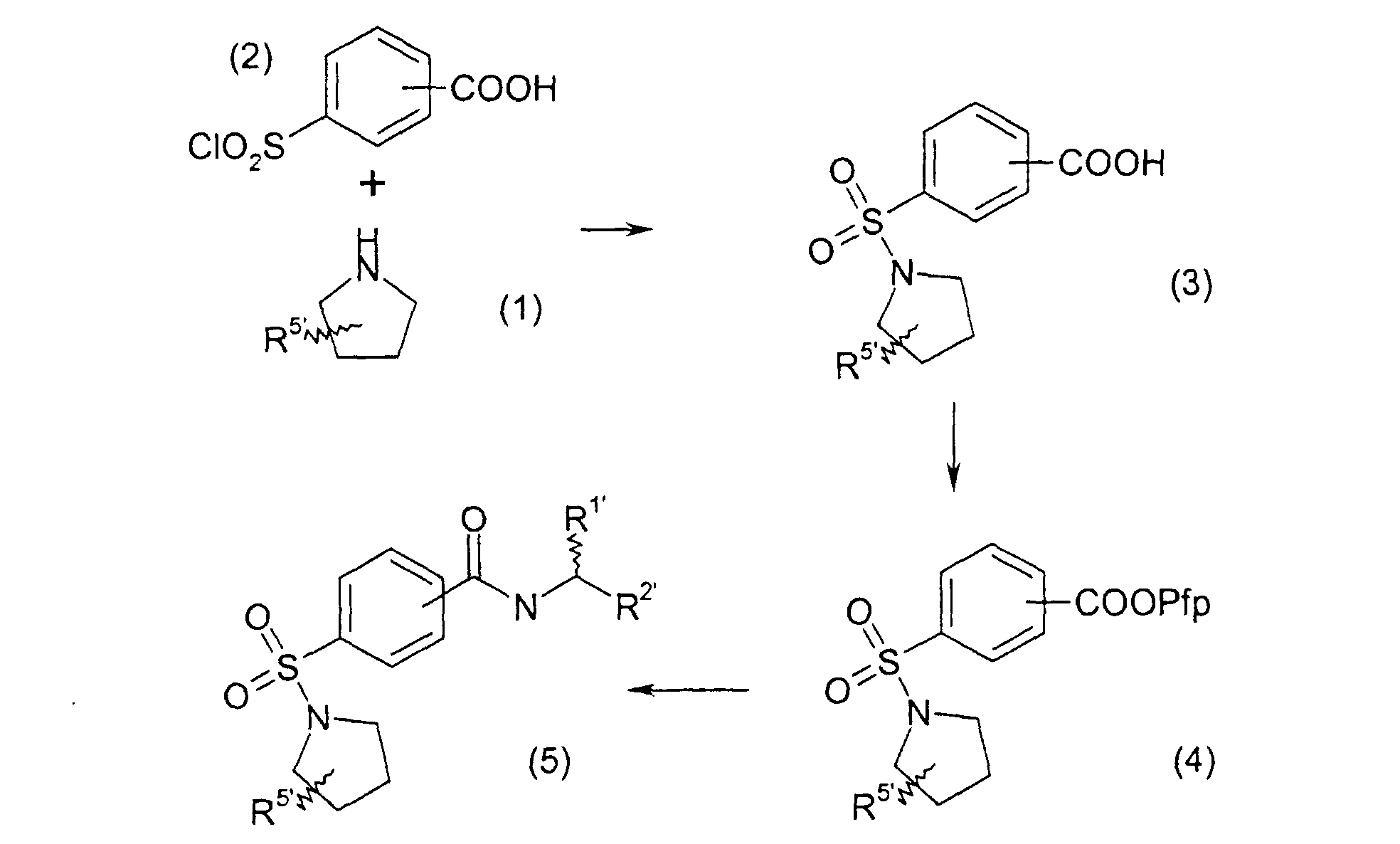
- In this basic scheme, for clarity, the cyclic amine ring has been drawn as a pyrrolidine ring, and the possible X substituents on the benzene ring and the possible Y substituents on the pyrrolidine ring have been omitted, but no loss of generality is intended by these changes and omissions. It will be evident that the pyrrolidine ring may be replaced by a piperidine ring, and that non-interfering (or protected) substituents may be placed on these rings, without affecting the reactions shown.
- In the first step, a carboxybenzenesulfonic acid chloride 2 is reacted with a (protected) R5'-substituted pyrrolidine 1, such as proline methyl ester, in the presence of a weak base in water to form a carboxybenzenesulfonyl(R5'-substituted pyrrolidine) 3. This is then converted to an appropriate ester, such as the pentafluorophenyl (Pfp) ester 4 shown, by reaction with pentafluorophenyl trifluoroacetate and pyridine in DMF or a similar polar solvent, to activate the carbonyl group. Reaction with an amine of the formula R1'R2'CHNH2, such as glutamic acid dimethyl ester, in the presence of an organic base such as triethylamine, in an organic solvent such as dichloromethane, gives a protected intermediate 5. The intermediate is then deprotected in one or more steps to give the final product of formula I (not shown in the scheme).
- It will be evident that the proline methyl ester discussed can be replaced with an alternative ester of proline, or prolinamide, esters or amides of the phosphonic acid or sulfonic acid analogs of proline, the corresponding pipecolinic acid-based compounds, compounds where the proline is replaced by pyrrolidine-3-carboxylic acid or pipecolinic acid is replaced by piperidine-3-carboxylic acid or 4-carboxylic acid, or the 4-chlorosulfonylbenzoic acid is replaced by 3-chlorosulfonylbenzoic acid, and these compounds in which the pyrrolidine or piperidine ring and/or the benzene ring are substituted with substituents inert to the reaction conditions (or protected such substituents where the protecting group can be removed without adverse effect on the remainder of the compound). Similarly, the glutamic acid dimethyl ester discussed can be replaced with alternative esters of amino acids, aminophosphonic acids, aminosulfonic acids, dipeptides, substituted amino acids, and the like. Thus the choice of starting materials allows for the synthesis of a large variety of compounds of Formula I without further reaction.
- This basic synthetic methodology is illustrated by Example 1.
- When R1' or R5' is, for example, a carboxylic acid, sulfonic acid, or phosphonic acid, it will typically be protected throughout the synthesis as an alkyl, e.g. C1-4 alkyl ester, typically the methyl ester; with the ester being removed in the final deprotection step by reaction with an aqueous base, such as aqueous lithium hydroxide. When R1' or R5' is, for example, a carboxamide or sulfonamide, it will typically be protected with a typical amine-protecting group well known to a person of ordinary skill in the art, such as tert-butoxycarbonyl (BOC), benzyloxycarbonyl (CBZ), 9-fluorenylmethoxycarbonyl (FMOC), and the like, if needed, with the protecting group being removed in the final deprotection step by such methods as are conventional for removal of these amine-protecting groups. Thus deprotection of these R1' and R5' groups will lead to compounds where the substituents R1 and R5 are -COOH, -CONH2, -SO3H, -SO2NH2, or -PO3H2.
- Similarly, when the substituent on R2 of formula I is to be -COOH, -CONH2, -SO3H, -SO2NH2, or -PO3H2, then the substituent on R2' will be protected as described immediately above for R1' or R5', and will be deprotected in the same manner in the final deprotection step(s).
- When R5 is to be -CONHR2 or -SO2NHR2, then R5' should be a carboxylic acid or sulfonic acid protected as an ester that is differentially removable, i.e. removable under circumstances where other carboxyl or sulfonyl groups remain protected. For example, if the proline methyl ester is replaced by proline tert-butyl ester and the appropriate intermediate of formula 5 formed, then the tert-butyl ester may be selectively removed while methyl groups remain on the carboxylates of R1' and R2'. This removal may be carried out, for example, by reaction of the compound of formula 5 with 50% trifluoroacetic acid in dichloromethane, with triethylsilane as a scavenger. The free terminal acidic group may then be converted to the pentafluorophenyl ester for activation, and reacted with an appropriate amine of the formula R2'NH2 to form a new intermediate of formula 5, which can then be deprotected in the same manner as described previously.
- This modified synthetic methodology is illustrated by Example 2.
- If the substituent on R2 is to be -CONHR3, -CONHCOR4, -CONHSO2R4, -SO2NHR3, -SO2NHCOR4, or -SO2NHSO2R4; then the original R2' will contain a carboxyl or sulfonyl group protected as an ester that is differentially removable. Then R2 may be extended in the same manner as described above for the "extension" of R5 through a carboxamide or sulfonamide linkage, by reaction with a (protected) amine R3'NH2, amide R4'CONH2, or sulfonamide R4SO2NH2, where R3' denotes R3 protected where necessary to enable the reaction to produce the desired product. Alternatively, a carboxyl substituent, exposed by appropriate deprotection, can be converted into an aminosulfonylmethyl group by reduction to the alcohol (reaction with ethyl chloroformate and triethylamine followed by reduction with sodium borohydride), conversion to the mesylate and esterification with thioacetic acid, conversion to the methylsulfonyl chloride, then to the methylsulfonamide, and, by reaction with R4COCl or R4SO2Cl, into a substituent of formula -SO2NHCOR4 or -SO2NHSO2R4, by methods analogous to those described in, and illustrated in Scheme 2 of, Marsham et al.
- If the substituent on R2 is to be -4-triazolyl, -5-tetrazolyl, or -5-(3-oxo-1,2,4-triazolyl), desirably the appropriate amine R1'R2'CHNH2, will first be purchased or synthesized, such as by the method of Van TT, Kojiro E, Grzonka Z: Synthesis of γ-tetrazole analogs of glutamic acid and its derivatives. Tetrahedron 33:2299-2302, 1977, or by other methods known to a person of ordinary skill in the art, and then coupled to the pentafluorophenyl benzoate intermediate of formula 4, and further reacted or deprotected as appropriate to the compound of formula I to be prepared.
- If the substituent on R2 is to be -S(O)m-4-triazolyl, -S(O)m-5-tetrazolyl, or -S(O)m-5-(3-oxo-1,2,4-triazolyl), then the appropriate amine R1'R2'CHNH2 containing a triazolylthio, etc., substituent will be prepared from a hydroxyamine, via the mesylate, by reaction with the sodium salt of triazolethiol, tetrazolethiol, or oxotriazolylthiol. The amine is then coupled to the pentafluorophenyl benzoate intermediate of formula 4, oxidized (for example, with peracetic acid in chloroform/methanol), and further reacted or deprotected as appropriate to the compound of formula I to be prepared. These methods are described in, and illustrated in Scheme 3 of, Marsham et al.
- Generally, if the side chain R1R2CH- is complex, it will be preferable to assemble the appropriate amine first, in protected form as necessary, and then couple it to the pentafluorophenyl benzoate intermediate of formula 4, rather than assemble the side chain after formation of the benzamide bond. In particular, dipeptides and esterified dipeptides, such as glutamylglutamic acid, are readily available. However, a person of ordinary skill in the art, having regard to that skill, this disclosure, and the references cited herein, will be able to prepare desired compounds of formula 1 without undue experimentation.
- The following examples illustrate the invention. All commercially available materials were used as received. All synthesized compounds were characterized by 1H NMR (Bruker DMX 400 MHz Spectrometer) and high-performance liquid-chromatography/mass-spectroscopy (HPLC-MS, Hewlett-Packard Series 1100 MSD), and judged to be at least 95% pure before testing in enzymatic assays.
-

- To (R)-pyrrolidine-2-carboxylic acid methyl ester hydrochloride (D-Pro-OMe·HCl) (1.0 g, 6.04 mmol) was added 4-chlorosulfonylbenzoic acid (1.32 g, 6 mmol) and sodium carbonate (2.0 g, 18.5 mmol). The solids were dissolved in 40 mL water and stirred for 14 hours at ambient temperature. The solution was then acidified with 50 mL 1 M aqueous sodium hydrogen sulfate and extracted with ethyl acetate (1 × 50 mL, 3 × 20 mL). The combined organic extracts were rinsed with 50 mL 5 M aqueous sodium chloride, dried over anhydrous sodium sulfate, filtered, and evaporated to dryness to produce 1-(R)-(4-carboxybenzenesulfonyl)pyrrolidine-2-carboxylic acid methyl ester as a white solid, weighing 1.62 g (5.19 mmol, 86 %).
- The product from the previous step was dissolved in 7 mL dry N,N-dimethylformamide (DMF). To this was added pyridine (0.63 mL, 7.79 mmol) and pentafluorophenyl trifluoroacetate (1.34 mL, 7.80 mmol). The reaction was stirred at ambient temperature for 3.5 hours before diluting with ethyl acetate (100 mL). This was then rinsed with 50 mL 1 M aqueous sodium carbonate, 50 mL 1 M aqueous sodium hydrogen sulfate, and 50 mL 5 M aqueous sodium chloride. The solvent was removed by rotary evaporation, and the residue redissolved in a few milliliters of chloroform and purified by flash chromatography (4 cm column, 80:20 hexane:ethyl acetate, switching to 60:40 hexane:ethyl acetate). Fractions containing the pure product were combined and evaporated to dryness, yielding a white crust of 1-(R)-(4-pentafluorophenyloxycarbonylbenzenesulfonyl)pyrrolidine-2-carboxylic acid methyl ester weighing 2.11 g (4.41 mmol, 73 % from pyrrolidine-2-carboxylic acid methyl ester).
- To the product from the previous step (0.4 g, 0.835 mmol) was added (S)-glutamic acid dimethyl ester hydrochloride (0.18 g). These were dissolved in 5 mL dry dichloromethane, and triethylamine (0.47 mL, 3.37 mmol) was added. The reaction was allowed to proceed for 15 hours at ambient temperature, at which time it was flooded with 100 mL ethyl acetate, rinsed with 50 mL 1 M aqueous sodium hydrogen sulfate, 50 mL 1 M aqueous sodium carbonate, and 50 mL 5 M aqueous sodium chloride. The solvent was removed by rotary evaporation and the residue purified by flash chromatography (2 cm silica gel column, 70:30 chloroform:ethyl acetate). The purified 2-[4-(2(R)-methoxycarbonylpyrrolidine-1-sulfonyl)benzoylamino]pentane-(S)-dioic acid dimethyl ester product weighed 0.322 g (0.685 mmol, 82 %).
- To the product from the previous step was added lithium hydroxide (66 mg, 2.76 mmol) and 15 mL water. The reaction was stirred vigorously at ambient temperature for 3.5 hours. The solution was acidified with 3 mL 1 M aqueous hydrochloric acid, flash-frozen, and lyophilized. The dry white crust was then redissolved in 4.5 mL water and 1.5 mL acetonitrile and purified by reverse phase chromatography to yield 2-[4-(2(R)-carboxypyrrolidine-1-sulfonyl)benzoylamino]pentane-(S)-dioic acid (110 mg, 0.258 mmol, 38 %), MS: calc. 428, obs. 429 (M+H).
- In a similar manner using L-proline methyl ester, DL-proline methyl ester, and DL-pipecolinic acid methyl ester in place of D-proline methyl ester, there were prepared 2-[4-(2(S)-carboxypyrrolidine-1-sulfonyl)benzoylamino]pentane-(S)-dioic acid, MS: calc. 428, obs. 429 (M+H), 2-[4-(2(RS)-carboxypyrrolidine-1-sulfonyl)benzoylamino]pentane-(S)-dioic acid, MS: calc. 428, obs. 429 (M+H), and 2-[4-(2(RS)-carboxypiperidine-1-sulfonyl)benzoylamino]pentane-(S)-dioic acid, MS: calc. 442, obs. 443 (M+H), respectively.
- In a similar manner using the dimethyl esters of (S)-aspartic acid, (S)-2-aminohexanoic acid, (R)-2-aminoheptanoic acid, (R)-2-aminooctanoic acid, (RS)-2-aminooctanoic acid, and the methyl ester of (S)-glutamine in place of (S)-glutamic acid dimethyl ester, there were obtained 2-[4-(2(R)-carboxypyrrolidine-1-sulfonyl)benzoylamino]butane-(S)-dioic acid, MS: calc. 414, obs. 415 (M+H), 2-[4-(2(R)-carboxypyrrolidine-1-sulfonyl)benzoylamino]hexane-(S)-dioic acid, MS: calc. 442, obs. 443 (M+H), 2-[4-(2(R)-carboxypyrrolidine-1-sulfonyl)benzoylamino]heptane-(S)-dioic acid, MS: calc. 456, obs. 457 (M+H), 2-[4-(2(R)-carboxypyrrolidine-l-sulfonyl)benzoylamino]octane-(R)-dioic acid, MS: calc. 470, obs. 471 (M+H), 2-[4-(2(R)-carboxypyrrolidine-1-sulfonyl)benzoylamino]octane-(RS)-dioic acid, MS: calc. 470, obs. 471 (M+H), and 4-aminocarbonyl-2-[4-(2(R)-carboxypyrrolidine-1-sulfonyl)benzoylamino]-(S)-butanoic acid, MS: calc. 427, obs. 428 (M+H).
-

- To 4-chlorosulfonylbenzoic acid (1.29 g) in 10 mL dry DMF and 10 mL dry tetrahydrofuran (THF) was added (R)-pyrrolidine-2-carboxylic acid tert-butyl ester (D-Pro-OtBu ), (1 g, 5.84 mmol) and pyridine (1.2 mL, 14.8 mmol). This was done in an ice-water bath, which was slowly allowed to warm to ambient temperature. After 13 hours, pyridine (0.71 mL, 8.78 mmol) and pentafluorophenyl trifluoroacetate (1.51 mL, 8.79 mmol) were added. The reaction was allowed to proceed at ambient temperature for 1.25 hours, flooded with 100 mL ethyl acetate, rinsed with 50 mL 1 M aqueous sodium carbonate, 50 mL 1 M aqueous sodium hydrogen sulfate, and 50 mL 5 M aqueous sodium chloride, dried over anhydrous sodium sulfate, filtered, and evaporated to dryness.
- The crude product from the previous step was mixed with (S)-glutamic acid dimethyl ester hydrochloride (1.9 g, 8.8 mmol) and dissolved in 20 mL dichloromethane, followed by addition of triethylamine (4.9 mL, 35 mmol). After 5 hours at ambient temperature the reaction was flooded with 100 mL ethyl acetate, rinsed with 2 × 50 mL 1 M aqueous sodium hydrogen sulfate and 50 mL 5 M aqueous sodium chloride, dried over anhydrous sodium sulfate, filtered, and evaporated to dryness. The residue was purified by flash chromatography (4 cm silica gel column, 70:30 chloroform:ethyl acetate). The product has an Rf of 0.26 in this solvent system. After chromatography the product is evaporated to dryness yielding 1.25 g (2.45 mmol, 42 % from pyrrolidine-2-carboxylic acid tert-butyl ester)
- The product from the previous step was dissolved in 25 mL dry dichloromethane. To this was added triethylsilane (2.9 mL, 18.2 mmol) and 25 mL neat trifluoroacetic acid. The reaction was allowed to stir at ambient temperature for 45 minutes, after which time it was evaporated to dryness and submitted to high vacuum overnight. The residue was then dissolved in 5 mL dry DMF and reacted with pyridine (0.4 mL, 4.95 mmol) and pentafluorophenyl trifluoroacetate (0.84 mL, 4.89 mmol). This was allowed to stir for 3 hours at ambient temperature, at which point the reaction was flooded with 100 mL ethyl acetate, rinsed with 50 mL 1 M aqueous sodium carbonate, 50 mL 1 M aqueous sodium hydrogen sulfate, 50 mL 5 M aqueous sodium chloride, evaporated to dryness, and purified by flash chromatography (4 cm column, 70:30 chloroform:ethyl acetate). Fractions containing pure product were combined and evaporated to dryness to yield 1.07 g (1.73 mmol, 70 % for two steps).
- To the product from the previous step (221 mg, 0.355 mmol) was added 3-aminopropionic acid methyl ester hydrochloride (82 mg, 0.534 mmol), 5 mL dry dichloromethane, and triethylamine (0.2 mL, 1.43 mmol). The reaction was allowed to stir at ambient temperature for 1.5 hours, after which point it was flooded with 100 mL ethyl acetate. The combined organic layer was rinsed with 50 mL 1 M aqueous sodium carbonate, 50 mL 1 M aqueous sodium hydrogen sulfate, and 50 mL 5 M aqueous sodium chloride, dried over anhydrous sodium sulfate, filtered, and evaporated to dryness. To this was added lithium hydroxide (34 mg, 1.42 mmol) and 5 mL water, and the reaction mixture was stirred at ambient temperature for two hours. The reaction was acidified with 1.5 mL 1 N aqueous hydrochloric acid, filtered, and purified by reverse phase HPLC to yield 2-{4-[2(R)-(2-carboxyethylaminocarbonyl)-pyrrolidine- I -sulfonyl]benzoylamino}pentane-(S)-dioic acid (81 mg, 0.162 mmol, 36 % for two steps), MS: calc. 499, obs. 500 (M+H).
- In a similar manner, substituting the methyl esters of glycine, 4-aminobutanoic acid, and 6-aminohexanoic acid for 3-aminopropionic acid methyl ester, there were obtained 2- {4-[2(R)-(carboxymethylaminocarbonyl)-pyrrolidine-1-sulfonyl]benzoylamino}pentane-(S)-dioic acid, MS: calc. 485, obs. 486 (M+H), 2-{4-[2(R)-(3-carboxypropylaminocarbonyl)-pyrrolidine-1-sulfonyl]benzoylamino}pentane-(S)-dioic acid, MS: calc. 513, obs. 514 (M+H), and
2- {4-[2(R)-(5-carboxypentylaminocarbonyl)-pyrrolidine-1-sulfonyl]benzoylamino}pentane-(S)-dioic acid, MS: calc. 541, obs. 542 (M+H), respectively. - TS was expressed, purified, and characterized by SDS-PAGE and mass spectroscopy. Enzymatic inhibition assays were performed by the methods described in Wahba AJ and Friedkin M: Direct spectrophotometric evidence for the oxidation of tetrahydrofolate during the enzymatic synthesis of thymidylate. J Biol Chem: 236: PC11-PC12, 1961; and Chen SC, Daron HH, and Aull JL: Inhibition of thymidylate synthase by pyridoxal phosphate. Int J Biochem: 21: 1217-1221, 1989, mentioned previously.
- Briefly, the assay buffer consisted of 50 mM TES pH 7.4; 71 mM 2-mercaptoethanol, 15 mM formaldehyde, 25 mM magnesium chloride, and 0.04 mM 6R-methylenetetrahydrofolate. The compound to be tested (dissolved in dimethylsulfoxide) was added to 0.5 mL of this solution such that the final concentration of DMSO was never higher than 3 %v/v. 2'-deoxyuridinemonophosphate (dUMP)was added; and finally TS (5 µL) was added, the solution mixed rapidly, and the reaction followed at 340 nm (with background correction) in a UV-vis spectrophotometer. Inhibition constants were calculated as described by Chen et al. Compounds of the invention demonstrated inhibition of TS in this assay, and were competitive with respect to dUMP.
Claims (9)
- A compound of formula I:where:
 as an individual stereoisomer or mixture of stereoisomers, or a pharmaceutically acceptable salt or ester thereof.R1 is -COOH, -CONH2, -SO3H, -SO2NH2, -PO3H2;R2 is C1-6 alkyl optionally substituted with -COOH. -CONH2, -CONHR3, -CONHCOR4, -CONHSO2R4, -SO3H, -SO2NH2, -SO2NHR3, -SO2NHCOR4, -SO2NHSO2R4, -PO3H2, -4-(1,2,3-triazolyl), -5-tetrazolyl, -5-(3-oxo-1,2,4-triazolyl), -S(O)m-4-(1,2,3-triazolyl), -S(O)m-5-tetrazolyl, or -S(O)m-5-(3-oxo-1,2,4-triazolyl);R3 is a group such that R3-NH2 is an amino acid;R4 is C1-4 alkyl, trifluoromethyl, or phenyl optionally substituted with methyl, trifluoromethyl or nitro;m is 0, 1, or 2;each X and Y, which may be the same or different, is independently selected from methyl, ethyl, isopropyl, ethenyl, ethynyl, fluoro, chloro, bromo, methylthio, hydroxy, methoxy, carboxy, and methoxycarbonyl;n is 0, 1, 2, or 3;p is 0, 1, or 2;q is 1 or 2;R5 is -COOH, -CONH2, -CONHR2, -SO3H, -SO2NH2, -SO2NHR2, or -PO3H2,
 - A compound of Claim 1 where R1 is -COOH; R2 is C2-6 alkyl ω-substituted with - COOH, -CONH2, -CONHR3, -SO2NH2, or -SO2NHR3, -4-triazolyl, or -5-tetrazolyl; R3 is an acidic amino acid; each X and Y is independently methyl, ethyl, fluoro, chloro, bromo, methoxy, carboxy, or methoxycarbonyl; n and p are independently 0 or 1; and R5 is -CONHR2' where R2' is C2-6 alkyl ω-substituted with -COOH, -CONH2, -SO3H, -SO2NH2, -4-triazolyl, or -5-tetrazolyl, as an individual stereoisomer or mixture of stereoisomers, or a pharmaceutically acceptable salt or ester thereof.
- A compound of Claim 1 where R1 is -COOH; R2 is C2-6 alkyl ω-substituted with -CONHR3 or -SO2NHR3; R3 is an acidic amino acid; each X and Y is independently methyl, ethyl, fluoro, chloro, bromo, or methoxy; n and p are independently 0 or 1; and R5 is -CONHR2' where R2' is C2-6 alkyl ω-substituted with -COOH, -CONH2, -4-triazolyl, or -5-tetrazolyl, as an individual stereoisomer or mixture of stereoisomers, or a pharmaceutically acceptable salt or ester thereof.
- A compound of Claim 1 where R1 is -COON: R2 is C2-6 alkyl ω-substituted with -CONHR3; R3 is an acidic amino acid selected from glutamic acid, 2-aminohexanedioic acid, 2-aminoheptanedioic acid, or 2-aminooctanedioic acid; n and p are 0; and R5 is -CONHR2 where R2' is C2-6 alkyl ω-substituted with -COOH or -CONH2,
as an individual stereoisomer or mixture of stereoisomers, or a pharmaceutically acceptable salt or ester thereof. - A compound of Claim 1 where R1 is -COOH; R2 is C2-6 alkyl ω-substituted with -COOH; n and p are 0; and R5 is -CONHR2' where R2' is C2-6 alkyl ω-substituted with -COOH or -CONH2,
as an individual stereoisomer or mixture of stereoisomers, or a pharmaceutically acceptable salt or ester thereof. - A compound of Claim 1 that is:as an individual stereoisomer or mixture of stereoisomers, or a pharmaceutically aceptable salt or ester thereof.2-[4-(2-carboxypyrrolidine-1-sulfonyl)benzoylamino]octanedioic acid;2-[4-(2-carboxypyrrolidine-1-sulfonyl)benzoylamino)-4-[1,3-dicarboxypropylaminocarbonyl]-butanoic acid;2-[4-(2-carboxypiperidine-1-sulfonyl)benzoylamino]-4-[1,3-dicarboxypropylaminocarbonyl]-butanoic acid;2-{4-[2-(2-carboxyethylaminocarbonyl)-pyrrolidine-1-sulfonyl]benzoylamino}pentanedioic acid;2-{4-[2-(3-carboxpropylaminocarbonyl)-pyrrolidine-1-sulfonyl]benzoylamino}pentanedioic acid;2-{4-[2-(5-carboxypentylaminocarbonyl)-pyrrolidine-1-sulfonyl]benzoylamino}pentanedioic acid; or2-{4-[2-(3-methylbutylaminocarbonyl)-pyrrolidine-1-sulfonyl]benzoylamino}pentanedioic acid;
- A pharmaceutical composition suitable for administration to an individual for treating a disease which may be alleviated by a thymidylate synthase inhibitor comprising a therapeutically effective amount of a compound of any one of Claims 1 to 6 and a pharmaceutically acceptable excipient.
- A pharmaceutical composition according to Claim 7 wherein the disease is a tumor, or a parasitic bacterial, fungal or viral infection.
- The use of a compound of any one of Claims 1-6 in the manufacture of a medicament for treating a disease which may be alleviated by a thymidylate synthase inhibitor, wherein the disease is a tumor, or a parasitic, bacterial, fungal or viral infection.
Applications Claiming Priority (3)
| Application Number | Priority Date | Filing Date | Title |
|---|---|---|---|
| US496378 | 1990-03-20 | ||
| US09/496,378 US6143776A (en) | 2000-02-02 | 2000-02-02 | Tosylproline analogs as thymidylate synthase inhibitors |
| PCT/US2001/003391 WO2001056987A1 (en) | 2000-02-02 | 2001-02-02 | Tosylproline analogs as thymidylate synthase inhibitors |
Publications (2)
| Publication Number | Publication Date |
|---|---|
| EP1252141A1 EP1252141A1 (en) | 2002-10-30 |
| EP1252141B1 true EP1252141B1 (en) | 2003-07-30 |
Family
ID=23972366
Family Applications (1)
| Application Number | Title | Priority Date | Filing Date |
|---|---|---|---|
| EP01905352A Expired - Lifetime EP1252141B1 (en) | 2000-02-02 | 2001-02-02 | Tosylproline analogs as thymidylate synthase inhibitors |
Country Status (8)
| Country | Link |
|---|---|
| US (1) | US6143776A (en) |
| EP (1) | EP1252141B1 (en) |
| JP (1) | JP2003521535A (en) |
| AT (1) | ATE246174T1 (en) |
| AU (2) | AU2001233242B2 (en) |
| CA (1) | CA2398752A1 (en) |
| DE (1) | DE60100539T2 (en) |
| WO (1) | WO2001056987A1 (en) |
Families Citing this family (8)
| Publication number | Priority date | Publication date | Assignee | Title |
|---|---|---|---|---|
| US6589978B2 (en) * | 2000-06-30 | 2003-07-08 | Hoffman-La Roche Inc. | 1-sulfonyl pyrrolidine derivatives |
| WO2002088298A1 (en) * | 2001-04-27 | 2002-11-07 | The Procter & Gamble Company | Compounds, compositions, and methods for controlling biofilms |
| CN1668918A (en) * | 2002-07-24 | 2005-09-14 | 基德姆生物科学有限公司 | Methods of Drug Discovery |
| WO2010138955A2 (en) * | 2009-05-29 | 2010-12-02 | University Of Florida Research Foundation, Inc. | Methods and compositions for treating neoplasia |
| ITMI20130085A1 (en) * | 2013-01-22 | 2014-07-23 | Gabriele Cruciani | NEW MOLECULES FOR USE AS ANTI-HUMAN AGENTS |
| SG11202011298YA (en) * | 2018-05-16 | 2020-12-30 | Infex Therapeutics Ltd | Antibacterial compounds |
| US11491148B2 (en) | 2019-05-06 | 2022-11-08 | Janssen Sciences Ireland Unlimited Company | Amide derivatives useful in the treatment of HBV infection or HBV-induced diseases |
| WO2021242753A1 (en) * | 2020-05-26 | 2021-12-02 | The Regents Of The University Of Michigan | Mitochondrial targeting compounds for the treatment of associated diseases |
Family Cites Families (9)
| Publication number | Priority date | Publication date | Assignee | Title |
|---|---|---|---|---|
| EP0031237B1 (en) * | 1979-12-19 | 1984-10-17 | National Research Development Corporation | Quinazoline derivatives, processes for their preparation, compositions containing them and their use as anti-cancer agents |
| GB8607683D0 (en) * | 1986-03-27 | 1986-04-30 | Ici Plc | Anti-tumor agents |
| US4925939A (en) * | 1989-01-05 | 1990-05-15 | Sloan-Kettering Institute For Cancer Research | 6,7-dihydropyrrol[3,4-c]pyrido[2,3-d]pyrimidine derivatives |
| US5958930A (en) * | 1991-04-08 | 1999-09-28 | Duquesne University Of The Holy Ghost | Pyrrolo pyrimidine and furo pyrimidine derivatives |
| GB9205320D0 (en) * | 1992-03-11 | 1992-04-22 | Ici Plc | Anti-tumour compounds |
| GB9205907D0 (en) * | 1992-03-18 | 1992-04-29 | Cancer Res Inst Royal | Anti-cancer compounds |
| CZ63199A3 (en) * | 1996-08-28 | 1999-08-11 | The Procter & Gamble Company | Substituted cyclic amine-type compounds as metalloprotease inhibitors, methods for their preparation and use as pharmaceuticals |
| JP4024309B2 (en) * | 1996-10-22 | 2007-12-19 | 第一三共株式会社 | New treatment for infectious diseases |
| AR016133A1 (en) * | 1997-07-31 | 2001-06-20 | Wyeth Corp | CARBAMILOXI COMPOUND INHIBITING THE ADHESION OF LEUKOCYTES THROUGH VLA-4, COMPOUNDS THAT ARE DRUGS OF THESE COMPOUNDS, PHARMACEUTICAL COMPOSITION, METHOD FOR SETTING VLA-4 TO A BIOLOGICAL SAMPLE, METHOD FOR THE TREATMENT OF A TREATMENT |
-
2000
- 2000-02-02 US US09/496,378 patent/US6143776A/en not_active Expired - Fee Related
-
2001
- 2001-02-02 WO PCT/US2001/003391 patent/WO2001056987A1/en not_active Ceased
- 2001-02-02 AT AT01905352T patent/ATE246174T1/en not_active IP Right Cessation
- 2001-02-02 DE DE60100539T patent/DE60100539T2/en not_active Expired - Fee Related
- 2001-02-02 AU AU2001233242A patent/AU2001233242B2/en not_active Ceased
- 2001-02-02 JP JP2001556837A patent/JP2003521535A/en not_active Withdrawn
- 2001-02-02 EP EP01905352A patent/EP1252141B1/en not_active Expired - Lifetime
- 2001-02-02 AU AU3324201A patent/AU3324201A/en active Pending
- 2001-02-02 CA CA002398752A patent/CA2398752A1/en not_active Abandoned
Also Published As
| Publication number | Publication date |
|---|---|
| DE60100539D1 (en) | 2003-09-04 |
| WO2001056987A1 (en) | 2001-08-09 |
| ATE246174T1 (en) | 2003-08-15 |
| CA2398752A1 (en) | 2001-08-09 |
| US6143776A (en) | 2000-11-07 |
| AU2001233242B2 (en) | 2004-11-18 |
| DE60100539T2 (en) | 2004-06-09 |
| EP1252141A1 (en) | 2002-10-30 |
| AU3324201A (en) | 2001-08-14 |
| JP2003521535A (en) | 2003-07-15 |
Similar Documents
| Publication | Publication Date | Title |
|---|---|---|
| KR100226114B1 (en) | Quinazolin Compounds With Antiproliferative Action | |
| AU2012300944B2 (en) | Selective and reversible inhibitors of ubiquitin specific protease 7 | |
| JP2022071072A (en) | (S) -7- (1-acryloylpiperidin-4-yl) -2- (4-phenoxyphenyl) -4,5,6,7-tetra-hydropyrazolo [1,5-A] pyrimidine-3-carboxamide Crystal form, its preparation, and its use | |
| Huang et al. | Evodiamine-inspired dual inhibitors of histone deacetylase 1 (HDAC1) and topoisomerase 2 (TOP2) with potent antitumor activity | |
| Xiao et al. | Design, synthesis, and biological evaluation of cytotoxic 11-aminoalkenylindenoisoquinoline and 11-diaminoalkenylindenoisoquinoline topoisomerase I inhibitors | |
| EP1535911A1 (en) | Metabolically inert anti-inflammatory and anti-tumor antifolates | |
| PL207057B1 (en) | Ortho-substituted nitrogen-containing bisaryl compounds used as potassium channel inhibitors | |
| SK1192002A3 (en) | Caspase inhibitors and uses thereof | |
| RS56670B1 (en) | N-acylsulfonamide apoptosis promoters | |
| CZ223294A3 (en) | Derivatives of pipecolic acid, process of their preparation and pharmaceutical compositions containing thereof | |
| FI85482B (en) | THERAPEUTIC FORM OF THERAPEUTIC ACTION THERAPEUTICALLY ACTIVE 9- / 3- (4-GUANIDINOPHENYL) PROPYLAMINO / OCTAHYDRO-10 OXO-6H-PYRIDAZO / 1,2-A // 1,2 / DIAZEPIN-1-CARBOXYLSY | |
| US6143776A (en) | Tosylproline analogs as thymidylate synthase inhibitors | |
| JP2018508583A (en) | Salt of quinazoline derivative and process for producing the same | |
| WO1991010666A1 (en) | Three new non-polyglutamatable deazaaminopterins and process for preparing the same | |
| AU2001233242A1 (en) | Tosylproline analogs as thymidylate synthase inhibitors | |
| US8575339B2 (en) | Derivatives of erlotinib | |
| US20020082420A1 (en) | Bicyclic heterocycles, pharmaceutical compositions containing them, their use, and processes for preparing them | |
| KR20110041513A (en) | New (poly) aminoalkylaminoalkylamides, alkyl-ureas, or alkyl-sulfonamide derivatives of epipodophyllotoxins, methods for their preparation, and therapeutic uses as anticancer agents | |
| EP2016081B1 (en) | Anti-viral pyrimidine nucleoside derivatives | |
| Harvison et al. | Synthesis and biological activity of novel folic acid analogs: pteroyl-S-alkylhomocysteine sulfoximines | |
| AU638679B2 (en) | Antiproliferative cyclic compounds | |
| Nakane et al. | 7-Oxabicyclo [2.2. 1] heptyl carboxylic acids as thromboxane A2 antagonists: aza. omega.-chain analogs | |
| HU194824B (en) | Process for production of new derivatives of bi-24-pirroli/di/n-dion and medical preparatives containing them | |
| KR19980032504A (en) | Methods for inhibiting the growth of mammalian cells | |
| Cogan et al. | Doxsaliform: A novel N-Mannich base prodrug of a doxorubicin formaldehyde conjugate |
Legal Events
| Date | Code | Title | Description |
|---|---|---|---|
| PUAI | Public reference made under article 153(3) epc to a published international application that has entered the european phase |
Free format text: ORIGINAL CODE: 0009012 |
|
| 17P | Request for examination filed |
Effective date: 20020809 |
|
| AK | Designated contracting states |
Kind code of ref document: A1 Designated state(s): AT BE CH CY DE DK ES FI FR GB GR IE IT LI LU MC NL PT SE TR |
|
| AX | Request for extension of the european patent |
Free format text: AL;LT;LV;MK;RO;SI |
|
| GRAH | Despatch of communication of intention to grant a patent |
Free format text: ORIGINAL CODE: EPIDOS IGRA |
|
| GRAH | Despatch of communication of intention to grant a patent |
Free format text: ORIGINAL CODE: EPIDOS IGRA |
|
| GRAA | (expected) grant |
Free format text: ORIGINAL CODE: 0009210 |
|
| AK | Designated contracting states |
Designated state(s): AT BE CH CY DE DK ES FI FR GB GR IE IT LI LU MC NL PT SE TR |
|
| PG25 | Lapsed in a contracting state [announced via postgrant information from national office to epo] |
Ref country code: NL Free format text: LAPSE BECAUSE OF FAILURE TO SUBMIT A TRANSLATION OF THE DESCRIPTION OR TO PAY THE FEE WITHIN THE PRESCRIBED TIME-LIMIT Effective date: 20030730 Ref country code: FI Free format text: LAPSE BECAUSE OF FAILURE TO SUBMIT A TRANSLATION OF THE DESCRIPTION OR TO PAY THE FEE WITHIN THE PRESCRIBED TIME-LIMIT Effective date: 20030730 Ref country code: CY Free format text: LAPSE BECAUSE OF FAILURE TO SUBMIT A TRANSLATION OF THE DESCRIPTION OR TO PAY THE FEE WITHIN THE PRESCRIBED TIME-LIMIT Effective date: 20030730 Ref country code: BE Free format text: LAPSE BECAUSE OF FAILURE TO SUBMIT A TRANSLATION OF THE DESCRIPTION OR TO PAY THE FEE WITHIN THE PRESCRIBED TIME-LIMIT Effective date: 20030730 Ref country code: IT Free format text: LAPSE BECAUSE OF FAILURE TO SUBMIT A TRANSLATION OF THE DESCRIPTION OR TO PAY THE FEE WITHIN THE PRESCRIBED TIME-LIMIT;WARNING: LAPSES OF ITALIAN PATENTS WITH EFFECTIVE DATE BEFORE 2007 MAY HAVE OCCURRED AT ANY TIME BEFORE 2007. THE CORRECT EFFECTIVE DATE MAY BE DIFFERENT FROM THE ONE RECORDED. Effective date: 20030730 Ref country code: TR Free format text: LAPSE BECAUSE OF FAILURE TO SUBMIT A TRANSLATION OF THE DESCRIPTION OR TO PAY THE FEE WITHIN THE PRESCRIBED TIME-LIMIT Effective date: 20030730 Ref country code: AT Free format text: LAPSE BECAUSE OF FAILURE TO SUBMIT A TRANSLATION OF THE DESCRIPTION OR TO PAY THE FEE WITHIN THE PRESCRIBED TIME-LIMIT Effective date: 20030730 |
|
| REG | Reference to a national code |
Ref country code: GB Ref legal event code: FG4D |
|
| REG | Reference to a national code |
Ref country code: CH Ref legal event code: EP |
|
| REG | Reference to a national code |
Ref country code: IE Ref legal event code: FG4D |
|
| REF | Corresponds to: |
Ref document number: 60100539 Country of ref document: DE Date of ref document: 20030904 Kind code of ref document: P |
|
| REG | Reference to a national code |
Ref country code: CH Ref legal event code: NV Representative=s name: BOVARD AG PATENTANWAELTE |
|
| PG25 | Lapsed in a contracting state [announced via postgrant information from national office to epo] |
Ref country code: GR Free format text: LAPSE BECAUSE OF FAILURE TO SUBMIT A TRANSLATION OF THE DESCRIPTION OR TO PAY THE FEE WITHIN THE PRESCRIBED TIME-LIMIT Effective date: 20031030 Ref country code: DK Free format text: LAPSE BECAUSE OF FAILURE TO SUBMIT A TRANSLATION OF THE DESCRIPTION OR TO PAY THE FEE WITHIN THE PRESCRIBED TIME-LIMIT Effective date: 20031030 Ref country code: SE Free format text: LAPSE BECAUSE OF FAILURE TO SUBMIT A TRANSLATION OF THE DESCRIPTION OR TO PAY THE FEE WITHIN THE PRESCRIBED TIME-LIMIT Effective date: 20031030 |
|
| PG25 | Lapsed in a contracting state [announced via postgrant information from national office to epo] |
Ref country code: ES Free format text: LAPSE BECAUSE OF FAILURE TO SUBMIT A TRANSLATION OF THE DESCRIPTION OR TO PAY THE FEE WITHIN THE PRESCRIBED TIME-LIMIT Effective date: 20031110 |
|
| NLV1 | Nl: lapsed or annulled due to failure to fulfill the requirements of art. 29p and 29m of the patents act | ||
| PG25 | Lapsed in a contracting state [announced via postgrant information from national office to epo] |
Ref country code: PT Free format text: LAPSE BECAUSE OF FAILURE TO SUBMIT A TRANSLATION OF THE DESCRIPTION OR TO PAY THE FEE WITHIN THE PRESCRIBED TIME-LIMIT Effective date: 20031230 |
|
| LTIE | Lt: invalidation of european patent or patent extension |
Effective date: 20030730 |
|
| PG25 | Lapsed in a contracting state [announced via postgrant information from national office to epo] |
Ref country code: IE Free format text: LAPSE BECAUSE OF NON-PAYMENT OF DUE FEES Effective date: 20040202 Ref country code: LU Free format text: LAPSE BECAUSE OF NON-PAYMENT OF DUE FEES Effective date: 20040202 |
|
| PG25 | Lapsed in a contracting state [announced via postgrant information from national office to epo] |
Ref country code: MC Free format text: LAPSE BECAUSE OF NON-PAYMENT OF DUE FEES Effective date: 20040228 |
|
| ET | Fr: translation filed | ||
| PLBE | No opposition filed within time limit |
Free format text: ORIGINAL CODE: 0009261 |
|
| STAA | Information on the status of an ep patent application or granted ep patent |
Free format text: STATUS: NO OPPOSITION FILED WITHIN TIME LIMIT |
|
| 26N | No opposition filed |
Effective date: 20040504 |
|
| REG | Reference to a national code |
Ref country code: IE Ref legal event code: MM4A |
|
| PGFP | Annual fee paid to national office [announced via postgrant information from national office to epo] |
Ref country code: FR Payment date: 20060217 Year of fee payment: 6 |
|
| PGFP | Annual fee paid to national office [announced via postgrant information from national office to epo] |
Ref country code: GB Payment date: 20060223 Year of fee payment: 6 |
|
| PGFP | Annual fee paid to national office [announced via postgrant information from national office to epo] |
Ref country code: CH Payment date: 20060227 Year of fee payment: 6 |
|
| PGFP | Annual fee paid to national office [announced via postgrant information from national office to epo] |
Ref country code: DE Payment date: 20060331 Year of fee payment: 6 |
|
| PG25 | Lapsed in a contracting state [announced via postgrant information from national office to epo] |
Ref country code: LI Free format text: LAPSE BECAUSE OF NON-PAYMENT OF DUE FEES Effective date: 20070228 Ref country code: CH Free format text: LAPSE BECAUSE OF NON-PAYMENT OF DUE FEES Effective date: 20070228 |
|
| REG | Reference to a national code |
Ref country code: CH Ref legal event code: PL |
|
| GBPC | Gb: european patent ceased through non-payment of renewal fee |
Effective date: 20070202 |
|
| REG | Reference to a national code |
Ref country code: FR Ref legal event code: ST Effective date: 20071030 |
|
| PG25 | Lapsed in a contracting state [announced via postgrant information from national office to epo] |
Ref country code: DE Free format text: LAPSE BECAUSE OF NON-PAYMENT OF DUE FEES Effective date: 20070901 |
|
| PG25 | Lapsed in a contracting state [announced via postgrant information from national office to epo] |
Ref country code: FR Free format text: LAPSE BECAUSE OF NON-PAYMENT OF DUE FEES Effective date: 20070228 Ref country code: GB Free format text: LAPSE BECAUSE OF NON-PAYMENT OF DUE FEES Effective date: 20070202 |