EP1250836A2 - Disposable containers - Google Patents
Disposable containers Download PDFInfo
- Publication number
- EP1250836A2 EP1250836A2 EP02252311A EP02252311A EP1250836A2 EP 1250836 A2 EP1250836 A2 EP 1250836A2 EP 02252311 A EP02252311 A EP 02252311A EP 02252311 A EP02252311 A EP 02252311A EP 1250836 A2 EP1250836 A2 EP 1250836A2
- Authority
- EP
- European Patent Office
- Prior art keywords
- box structure
- disposable container
- container according
- absorbent material
- blank
- Prior art date
- Legal status (The legal status is an assumption and is not a legal conclusion. Google has not performed a legal analysis and makes no representation as to the accuracy of the status listed.)
- Withdrawn
Links
Images


Classifications
-
- A—HUMAN NECESSITIES
- A01—AGRICULTURE; FORESTRY; ANIMAL HUSBANDRY; HUNTING; TRAPPING; FISHING
- A01K—ANIMAL HUSBANDRY; AVICULTURE; APICULTURE; PISCICULTURE; FISHING; REARING OR BREEDING ANIMALS, NOT OTHERWISE PROVIDED FOR; NEW BREEDS OF ANIMALS
- A01K1/00—Housing animals; Equipment therefor
- A01K1/01—Removal of dung or urine ; Removal of manure from stables
- A01K1/0107—Cat trays; Dog urinals; Toilets for pets
- A01K1/0125—Foldable or collapsible litter boxes
Definitions
- This invention relates to disposable containers, particularly to such containers intended for the disposal of domestic or household waste such as for example cat litter, cooking oil and fat, and for the disposal of commercial and industrial waste such as motor oil and similar and like materials.
- the present invention therefore seeks to provide a disposable container for household and commercial and industrial waste material which will obviate or lessen the disadvantages of known means or methods of disposal.
- a disposable container comprising a box structure formed from a blank which is creased and scored to enable said box structure to be opened from a closed position to an open position , the volume of said box structure in its open position being greater than the volume of the box structure in its closed position, said box structure containing an absorbent material.
- the volume of the box structure in its open position will be at least twice as great as the volume of the box structure in its closed position.
- said blank will be a one-piece blank of cardboard or similar material.
- the disposable container will preferably be generally diamond-shaped in cross-section in its closed position and generally rectangular in its open position, and means will preferably be provided to retain the container in its closed position.
- the disposable container will be generally rectangular or square in its closed and open positions.
- the containers may be wholly or partially lined with impervious material to prevent liquid passing through the walls of the containers.
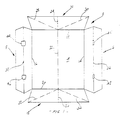
- the one-piece blank shown in the drawing composed of a good quality cardboard or like material and indicated generally by reference numeral 2, comprises a base portion 4, side portions 6 and 8, and end portions 10 and 12, the side portions and end portions being distinguished from the base portion 4 by crease lines 14,16 and 18,20 as shown in the drawing.
- the base portion 4 has a medial crease line 22, and the end portions 10 and 12 have medial score lines 24 and 26 respectively.
- the said end portions 10 and 12 additionally have diagonal crease lines 28,30 and 32,34 respectively.
- the end portions, as shown, are tapered outwardly from the base portion 4.
- the side portions 6 and 8 have medial crease lines 36 and 38 respectively and are shaped as shown in the drawing.
- the side portion 6 is provided with spaced slits or openings 40 and 42 on the medial crease line 36, and the end portion 8 is provided with movable flaps or tabs 44 and 46 which are located about the medial crease line 38 and which are adapted to engage in the slits or openings 40 and 42 as will be explained hereinafter.
- the whole or a part of the surface of the blank may be coated with or may have applied thereto a liquid impervious coating or layer of material.
- the blank may be provided with a locking device, in the form of a fold-over strip and locking tab, to provide rigidity in use of the container.
- a disposable container formed from the blank of Figure 1 is shown in Figures 2 and 3 and is indicated generally by reference numeral 48. Located in the bottom of the container and formed of the usual material is a predetermined quantity of cat litter indicated by reference numeral 50.
- Figure 4 shows a plurality of disposable containers 48 in superposed and stacked relationship for ease of storage.
- the disposable container 48 will be used by a cat or cats in the position shown in Figures 2 and 3.
- the container 48 holding the soiled litter 50 is folded inwardly in the direction of arrows 52 and 54 and about the medial crease lines 22,24, and 26 such that the two 'halves' of the container move towards one another as shown.
- Continued movement about said medial lines in the directions of arrows 56 and 58 ( Figure 6) moves the container into the fully closed position shown in Figure 6.
- the container may be disposed of as household or domestic waste in the usual way.
- the cat litter may be contained in a tube or bag prior to use.
- the blank of Figure 1 may be creased and scored on its side portions 6 and 8.
- the medial crease line 22 would extend between the side walls 6 and 8
- the medial score lines 24 and 26 would be in the said side walls 6 and 8.
- the blank would be folded about the 'repositioned' crease lines, it being appreciated that a similar box structure to that shown in Figures 5 and 6 would still be produced.
- the blank of Figure 1 may be modified such that the resultant box structure is generally square or rectangular in cross-section instead of being generally diamond-shaped in cross-section.
- the one-piece blank shown and indicated by reference numeral 60 comprises rectangular portions 62, 64, 66, and 68, the portion 68 having a smaller rectangular portion 70 which in turn has a small flap 72.
- the portions 62 and 66 are provided with rectangular flaps 84 and 86 respectively, and the portions 64 and 68 are provided with triangular flaps 88 and 90 respectively, the flaps 84, 86 and 88,90 being provided to form the base of a disposable container as will be hereinafter explained.
- the rectangular portions 62, 64, 66, 68 and 70 are each provided with a crease line, these being indicated respectively by reference numerals 74, 76, 78, 80, and 82, and additionally the portions 64 and 68 are each provided with crease lines 92,94 and 96,98 respectively.
- the rectangular portion 66 is provided with a movable flap 100.
- the one-piece blank 60 will preferably be composed of cardboard or similar material, or other material may be used if preferred.
- the blank may be wholly or partially lined with an impervious material, which may be adhered to the blank or otherwise applied thereto. Suitable materials for this purpose are PVC, polythene and similar materials.
- the one-piece blank 60 of Figure 7 is shown as having been made up into a container 102 in the form of a box having a base 104 and side walls 106, 108, 110 and 112.
- the side walls 106 to 112 are formed by folding the portions 62, 64, 66, and 68 about the fold lines 62A, 64A, 66A, and 68A ( Figure 7) and adhering the portion 70 to the portion 62 so as to form a sleeve, and then folding the flaps 88 and 90 about fold lines 88A and 90A (Figure 7), followed by the folding of the flaps 84 and 86 about fold lines 84A and 86A ( Figure 7) so as to form the base 104.
- the base 104 will preferably be sealed along the junction lines formed by the overlapping flaps 84, 86, 88, and 90.
- the container shown in Figures 8 to 12 will contain a predetermined quantity of an absorbent material, which may be natural or engineered, the material being capable of absorbing liquids such as oil, grease and similar substances.
- an absorbent material which may be natural or engineered, the material being capable of absorbing liquids such as oil, grease and similar substances.
- Such material may, for example, be coir pith or granules.
- the combination of the container and the absorbent material forms an oil drainage kit.
- the contaminated material and the substances soaks to an incorporated level to be considered as a solid.
- the contaminated absorbent material may have too much substance present for the survival of neutralising agents which can include enzymes and/or bacteria, such that it may be desirable to include a module within and additional to the absorbent material.
- This module may be a mixture of absorbent, food source and enzyme/bacteria which is compressed or protected within a slow release barrier from which the neutralising agents may work.
- the absorbent material and the module may work independently or in conjunction with each other.
- the included module which will take a number of hours to reconstitute (once exposed to liquid), will expand, introducing a clean area of sufficient volume for the bacteria to multiply and digest the liquid which has been absorbed.
- the container When the absorbing process is finished, the container may be closed and sealed and, because the liquid - oil or the like - is now considered a solid since it has been absorbed by the absorbent material, the closed container may be disposed of in a regulated and environmentally acceptable manner.
- the invention provides disposable containers which can be used for a variety of purposes, which can be moved from a closed position to an open position in order to increase its volume, and which contains an absorbent material which is capable of neutralising the waste material to enable the closed container and waste material to be disposed of as household or domestic waste, and/or in other regulated and environmentally acceptable manners.
- the container and absorbent material together therefore form a kit which can be used, not only for the purposes described herein, but for other similar purposes.
Landscapes
- Life Sciences & Earth Sciences (AREA)
- Environmental Sciences (AREA)
- Zoology (AREA)
- Animal Husbandry (AREA)
- Biodiversity & Conservation Biology (AREA)
- Packaging Of Annular Or Rod-Shaped Articles, Wearing Apparel, Cassettes, Or The Like (AREA)
- Cartons (AREA)
Abstract
Description
Claims (15)
- A disposable container comprising a box structure formed from a blank which is creased and scored to enable said box structure to be opened from a closed position to an open position, the volume of said box structure in its open position being greater than the volume of the box structure in its closed position, said box structure containing an absorbent material.
- A disposable container according to Claim 1, wherein the volume of said box structure in its open position is at least twice as great as the volume of the box structure in its closed position.
- A disposable container according to Claim 1 or Claim 2, wherein said blank is a one-piece blank of cardboard or similar material.
- A disposable container according to any of Claims 1 to 3, wherein said container is wholly or partially lined with impervious
- A disposable container according to any of Claims 1 to 4, wherein said box structure is generally diamond-shaped in cross-section in its closed position and generally rectangular in its open position.
- A disposable container according to any of the preceding Claims, wherein said blank includes a locking device in the form of a fold-over strip and locking tab to provide rigidity in use of the container.
- A disposable container according to any of Claims 1 to 6, wherein said absorbent material contained in said box structure is cat litter.
- A disposable container according to Claim 7, wherein the cat litter contained in the box structure is contained in a bag or tube prior to use.
- A disposable container according to any of Claims 1 to 4, wherein said box structure is generally rectangular or square in both its closed and open positions.
- A disposable container according to Claim 9, wherein said box structure contains a predetermined quantity of an absorbent material, said material being natural or engineered and being capable of absorbing liquids such as oil, grease and similar substances.
- A disposable container according to Claim 10, wherein said absorbent material is coir pith or granules.
- A disposable container according to Claim 11, wherein said absorbent material includes a module.
- A disposable container according to Claim 12, wherein said module comprises a mixture of absorbent, food source and enzyme/bacteria compressed or protected within a slow release barrier.
- A cat litter kit comprising a box structure containing an absorbent material.
- A drainage kit comprising a box structure containing an absorbent material.
Applications Claiming Priority (2)
| Application Number | Priority Date | Filing Date | Title |
|---|---|---|---|
| GB0107874 | 2001-03-29 | ||
| GB0107874A GB0107874D0 (en) | 2001-03-29 | 2001-03-29 | Disposable containers |
Publications (2)
| Publication Number | Publication Date |
|---|---|
| EP1250836A2 true EP1250836A2 (en) | 2002-10-23 |
| EP1250836A3 EP1250836A3 (en) | 2003-12-03 |
Family
ID=9911834
Family Applications (1)
| Application Number | Title | Priority Date | Filing Date |
|---|---|---|---|
| EP02252311A Withdrawn EP1250836A3 (en) | 2001-03-29 | 2002-03-28 | Disposable containers |
Country Status (2)
| Country | Link |
|---|---|
| EP (1) | EP1250836A3 (en) |
| GB (1) | GB0107874D0 (en) |
Family Cites Families (6)
| Publication number | Priority date | Publication date | Assignee | Title |
|---|---|---|---|---|
| US4791883A (en) * | 1987-03-26 | 1988-12-20 | Donald L. Lehman | Disposable litter boxes |
| US4807563A (en) * | 1987-07-15 | 1989-02-28 | Berry Products Corporation | Self-contained, disposable, sanitary toilet facility for pets |
| US5249550A (en) * | 1992-09-14 | 1993-10-05 | Hines Lisa C | Disposable litter box |
| GB9513016D0 (en) * | 1995-06-24 | 1995-08-30 | Arkimedes Limited | Disposable cat litter tray |
| GB9526642D0 (en) * | 1995-12-29 | 1996-02-28 | Nutland Geoffrey | Coir pith |
| FR2786463B1 (en) * | 1998-11-27 | 2001-03-23 | Fabrice Ponsin | NEW FOLDABLE CONTAINERS AND THEIR APPLICATIONS, IN PARTICULAR TO LITTERS FOR ANIMALS |
-
2001
- 2001-03-29 GB GB0107874A patent/GB0107874D0/en not_active Ceased
-
2002
- 2002-03-28 EP EP02252311A patent/EP1250836A3/en not_active Withdrawn
Also Published As
| Publication number | Publication date |
|---|---|
| EP1250836A3 (en) | 2003-12-03 |
| GB0107874D0 (en) | 2001-05-23 |
Similar Documents
| Publication | Publication Date | Title |
|---|---|---|
| US5022553A (en) | Temporary diaper storage container | |
| US4791883A (en) | Disposable litter boxes | |
| CA2461396C (en) | Foldable storage container | |
| US4541360A (en) | Disposable animal litter box | |
| US4940016A (en) | Unitary collapsible and disposable pet litter container | |
| US4441451A (en) | Disposable kitty litter box | |
| US5476067A (en) | Disposable pet toiletry system | |
| US4807563A (en) | Self-contained, disposable, sanitary toilet facility for pets | |
| US5035205A (en) | Collapsible disposable cat litter box | |
| US4846103A (en) | Collapsible disposable litter container | |
| US5716840A (en) | Disposable oil pan with bio-remediation filler | |
| US5832869A (en) | Pre-filled disposable cardboard pet litter container | |
| US4890576A (en) | Transformable container | |
| US20120311972A1 (en) | Disposable Container for Absorbing Oils, Fats and Greases | |
| US4932360A (en) | Disposable litter box and package | |
| US5046457A (en) | Animal enclosure apparatus, and methods of constructing and utilizing same | |
| US5172652A (en) | Absorbent pet waste container | |
| CA2569905A1 (en) | Improvements in and relating to packaging | |
| US5000341A (en) | Container with absorbent interior | |
| US4967692A (en) | Disposable commode for animals | |
| US20110289024A1 (en) | Multifunctional Packaging Container and Methods of Use Thereof | |
| US5251573A (en) | Disposable pet litter container | |
| US5829671A (en) | Pet litter scoop | |
| US20040118357A1 (en) | Cat lavatory | |
| WO1992010088A1 (en) | Disposable animal litter tray |
Legal Events
| Date | Code | Title | Description |
|---|---|---|---|
| PUAI | Public reference made under article 153(3) epc to a published international application that has entered the european phase |
Free format text: ORIGINAL CODE: 0009012 |
|
| AK | Designated contracting states |
Kind code of ref document: A2 Designated state(s): AT BE CH CY DE DK ES FI FR GB GR IE IT LI LU MC NL PT SE TR |
|
| AX | Request for extension of the european patent |
Free format text: AL;LT;LV;MK;RO;SI |
|
| RIN1 | Information on inventor provided before grant (corrected) |
Inventor name: LYNCH, MICHELLE Inventor name: NUTLAND, GEOFFREY |
|
| RAP1 | Party data changed (applicant data changed or rights of an application transferred) |
Owner name: DAINTON LIMITED |
|
| RAP1 | Party data changed (applicant data changed or rights of an application transferred) |
Owner name: FOUNDAINTON LIMITED |
|
| RAP1 | Party data changed (applicant data changed or rights of an application transferred) |
Owner name: DAINTON LIMITED |
|
| PUAL | Search report despatched |
Free format text: ORIGINAL CODE: 0009013 |
|
| AK | Designated contracting states |
Kind code of ref document: A3 Designated state(s): AT BE CH CY DE DK ES FI FR GB GR IE IT LI LU MC NL PT SE TR |
|
| AX | Request for extension of the european patent |
Extension state: AL LT LV MK RO SI |
|
| RIC1 | Information provided on ipc code assigned before grant |
Ipc: 7B 65D 5/00 B Ipc: 7A 01K 1/01 A |
|
| 17P | Request for examination filed |
Effective date: 20040601 |
|
| AKX | Designation fees paid |
Designated state(s): AT BE CH CY DE DK ES FI FR GB GR IE IT LI LU MC NL PT SE TR |
|
| 17Q | First examination report despatched |
Effective date: 20040825 |
|
| STAA | Information on the status of an ep patent application or granted ep patent |
Free format text: STATUS: THE APPLICATION IS DEEMED TO BE WITHDRAWN |
|
| 18D | Application deemed to be withdrawn |
Effective date: 20050105 |