EP1250160B1 - Antimicrobial flash-dry disinfectant aerosol - Google Patents
Antimicrobial flash-dry disinfectant aerosol Download PDFInfo
- Publication number
- EP1250160B1 EP1250160B1 EP01902209A EP01902209A EP1250160B1 EP 1250160 B1 EP1250160 B1 EP 1250160B1 EP 01902209 A EP01902209 A EP 01902209A EP 01902209 A EP01902209 A EP 01902209A EP 1250160 B1 EP1250160 B1 EP 1250160B1
- Authority
- EP
- European Patent Office
- Prior art keywords
- flash
- dry
- composition
- container
- disinfectant composition
- Prior art date
- Legal status (The legal status is an assumption and is not a legal conclusion. Google has not performed a legal analysis and makes no representation as to the accuracy of the status listed.)
- Expired - Lifetime
Links
Images
Classifications
-
- A—HUMAN NECESSITIES
- A61—MEDICAL OR VETERINARY SCIENCE; HYGIENE
- A61L—METHODS OR APPARATUS FOR STERILISING MATERIALS OR OBJECTS IN GENERAL; DISINFECTION, STERILISATION OR DEODORISATION OF AIR; CHEMICAL ASPECTS OF BANDAGES, DRESSINGS, ABSORBENT PADS OR SURGICAL ARTICLES; MATERIALS FOR BANDAGES, DRESSINGS, ABSORBENT PADS OR SURGICAL ARTICLES
- A61L2/00—Disinfection or sterilisation of materials or objects, in general; Accessories therefor
- A61L2/16—Disinfection or sterilisation of materials or objects, in general; Accessories therefor using chemical substances
- A61L2/22—Phase substances, e.g. smokes or aerosols
-
- A—HUMAN NECESSITIES
- A01—AGRICULTURE; FORESTRY; ANIMAL HUSBANDRY; HUNTING; TRAPPING; FISHING
- A01N—PRESERVATION OF BODIES OF HUMANS OR ANIMALS OR PLANTS OR PARTS THEREOF; BIOCIDES, e.g. AS DISINFECTANTS, AS PESTICIDES OR AS HERBICIDES; PEST REPELLANTS OR ATTRACTANTS; PLANT GROWTH REGULATORS
- A01N25/00—Biocides, pest repellants or attractants, or plant growth regulators, characterised by their forms, or by their non-active ingredients or by their methods of application, e.g. seed treatment or sequential application; Substances for reducing the noxious effect of the active ingredients to organisms other than pests
- A01N25/02—Biocides, pest repellants or attractants, or plant growth regulators, characterised by their forms, or by their non-active ingredients or by their methods of application, e.g. seed treatment or sequential application; Substances for reducing the noxious effect of the active ingredients to organisms other than pests containing liquids as carriers, diluents or solvents
- A01N25/04—Dispersions, emulsions, suspoemulsions, suspension concentrates or gels
- A01N25/06—Aerosols
-
- A—HUMAN NECESSITIES
- A01—AGRICULTURE; FORESTRY; ANIMAL HUSBANDRY; HUNTING; TRAPPING; FISHING
- A01N—PRESERVATION OF BODIES OF HUMANS OR ANIMALS OR PLANTS OR PARTS THEREOF; BIOCIDES, e.g. AS DISINFECTANTS, AS PESTICIDES OR AS HERBICIDES; PEST REPELLANTS OR ATTRACTANTS; PLANT GROWTH REGULATORS
- A01N59/00—Biocides, pest repellants or attractants, or plant growth regulators containing elements or inorganic compounds
-
- B—PERFORMING OPERATIONS; TRANSPORTING
- B65—CONVEYING; PACKING; STORING; HANDLING THIN OR FILAMENTARY MATERIAL
- B65D—CONTAINERS FOR STORAGE OR TRANSPORT OF ARTICLES OR MATERIALS, e.g. BAGS, BARRELS, BOTTLES, BOXES, CANS, CARTONS, CRATES, DRUMS, JARS, TANKS, HOPPERS, FORWARDING CONTAINERS; ACCESSORIES, CLOSURES, OR FITTINGS THEREFOR; PACKAGING ELEMENTS; PACKAGES
- B65D83/00—Containers or packages with special means for dispensing contents
- B65D83/14—Containers for dispensing liquid or semi-liquid contents by internal gaseous pressure, i.e. aerosol containers comprising propellant
- B65D83/60—Containers for dispensing liquid or semi-liquid contents by internal gaseous pressure, i.e. aerosol containers comprising propellant with contents and propellant separated
-
- B—PERFORMING OPERATIONS; TRANSPORTING
- B65—CONVEYING; PACKING; STORING; HANDLING THIN OR FILAMENTARY MATERIAL
- B65D—CONTAINERS FOR STORAGE OR TRANSPORT OF ARTICLES OR MATERIALS, e.g. BAGS, BARRELS, BOTTLES, BOXES, CANS, CARTONS, CRATES, DRUMS, JARS, TANKS, HOPPERS, FORWARDING CONTAINERS; ACCESSORIES, CLOSURES, OR FITTINGS THEREFOR; PACKAGING ELEMENTS; PACKAGES
- B65D83/00—Containers or packages with special means for dispensing contents
- B65D83/14—Containers for dispensing liquid or semi-liquid contents by internal gaseous pressure, i.e. aerosol containers comprising propellant
- B65D83/68—Dispensing two or more contents
- B65D83/682—Dispensing two or more contents initially separated and subsequently mixed
Definitions
- the present invention relates to an aerosol apparatus (e.g. pressurised) for dispensing an antimicrobial agent in an aerosol spray onto a surface to be disinfected.
- the aerosol apparatus contains a flash-dry disinfectant composition comprising said antimicrobial agent (e.g. the antimicrobial agent may be hydrogen peroxide).
- Disinfectant compositions which comprise an alcohol(s) and hydrogen peroxide, compositions which have a bactericidal effect when applied to a surface (please see U.S. patent nos 5,916,568 and 5,868,998 which describe the use of hydrogen peroxide as a bactericide.
- the present invention provides, in combination, an aerosol spray apparatus for applying an anti-microbial agent to a surface to be disinfected and a liquid flash-dry disinfectant composition, in accordance with claim 1.
- the invention also provides a method for disinfecting a surface and a liquid flash-dry composition for disinfecting a surface. Preferred embodiments of the invention are defined in the dependent claims.
- the components of the flash-dry disinfectant composition i.e. the antimicrobial agent and the flash vaporisation component
- the flash-dry disinfectant composition may be mixed together just prior to the flash-dry disinfectant composition being applied to a surface.
- said apparatus may comprise a first container means containing said antimicrobial agent and a second container means containing said flash vaporisation component wherein said aerosol spray apparatus comprises mixing means for mixing said antimicrobial agent and said flash vaporisation component together prior to dispensing said liquid flash-dry disinfectant composition through said spray nozzle.
- the antimicrobial agent may.
- the flash vaporisation component may, for example, comprise an alkanol of formula ROH wherein R is a group containing from 1 to 6 carbon atoms such as for example ethanol, isopropanol, butanol and the like. Additionally the flash vaporisation component may, for example, comprise a ketone of up to six carbon atoms (e.g.acetone); an ether of up to six carbon atoms; a halogenated organic compound such as, for example, freon, chloroform; etc.
- a flash-dry disinfectant composition (in a container means or as being sprayed as an aerosol onto the surface to be disinfected) comprises 10 to 30% by volume of hydrogen peroxide, 10 to 85% by volume of a flash vaporisation component for example an alcohol such as ethanol.
- the flash-dry disinfectant composition comprises a remainder component or element which may, for example, comprise or be water.
- a flash-dry disinfectant composition in a container means or as being sprayed as an aerosol onto the surface to be disinfected
- a flash-dry disinfectant composition may for example in particular comprise 10 to 30% by volume of hydrogen peroxide, 10 to 85 % by volume of an alcohol such as for example ethanol and 10 to 65 % by volume of water.
- the flash-dry disinfectant composition of the present invention may comprise any (liquid) flash vaporisation component which is able to impart to the composition a flash vaporisation characteristic i.e. to achieve in a relatively, (desired or necessary) short period of time after applying the flash dry aerosol to a surface, a state wherein the surface is essentially dry leaving behind the antimicrobial agent (i.e. a surface has achieved a desired or necessary state of dryness).
- the flash dry liquid may for example be one which is able to evaporate at a relatively rapid rate at ambient room temperature and pressure, i.e. having a high volatility (e.g at 15 degrees centigrade or higher such as at 20 to 25 degrees centigrade).
- the flash-dry disinfectant composition may for example, comprise a flash vaporisation component comprising one or more of the above mentioned materials; it may for example comprise an alkanol comprising from 2 to 5 carbon atoms (e.g ethanol, isopropanol, butanol etc...), an alkoxy substituted alkane (i.e. an ether) comprising from 2 to 4 carbon atoms (e.g. diethyl ether - ethoxy ethane, ....); etc...
- the flash dry materials may be obtained from any known suppliers.
- An alcohol for example may be obtained from any known supplier such as Fisher Scientific, Signa-Aldrich (e.g. as a composition comprising 82-95% by volume ethanol, 2 to 10% by volume water and 3 to 10% by volume methanol).
- the antimicrobial agent may as mentioned above be hydrogen peroxide; it may also be a compound that forms peroxide in an aqueous medium (i.e. in situ).
- the hydrogen peroxide may be obtained from any known supplier such as Fisher Scientific, Signa-Aldrich (e.g. as a composition comprising 30% by volume hydrogen peroxide and 70% by volume water).
- the aerosol apparatus may take any desired (known) form provided that it may deliver the flash-dry disinfectant composition to a surface in aerosol (e.g. in micro aerosol).
- the aerosol apparatus may for example comprise a pressurised container containing a predosed amount of inert propellant gas component in addition to the flash-dry disinfectant composition.
- the basic aerosol container is configured to be able to contain or store the flash-dry disinfectant composition under pressure which is due to the additional presence in the container of an inert pressurising gas component such as air, nitrogen gas, etc..
- the basic aerosol container may comprise there within or otherwise be associated with a secondary pressurized gas container which is appropriately coupled in any suitable (known) manner to the spray nozzle so as to be able to induce the disinfectant composition through the nozzle as an aerosol spray.
- the propellant gas may be any gas which is at least essentially inert with respect to the flash-dry disinfectant composition components (e.g. nitrogen gas, air, and the like); it may also be a freon gas.
- the aerosol apparatus alternatively may comprise a mechanism for manually introducing atmospheric air into the container so as to generate a positive pressure therein as mentioned above; an example of this latter type of aerosol apparatus is described in U.S. patent no. 5,265,775.
- the aerosol apparatus may for example be configured in any known manner so as to be able to generate or provide a spray having droplet sizes of for example from 1 to 100 microns; larger sized droplets may of course be used provided that the desired flash dry effect is achieved when the composition is applied to a surface to be disinfected.
- the aerosol container may have any type of known spray nozzle system coupled to the pressurised container for dispensing an aerosol spray or jet onto a surface.
- the nozzle is of course configured so as to be able to pass from a normal closed configuration (no spray being developed) to an active open configuration, the opened configuration being such so as to allow the internal positive pressure persisting in the aerosol container to urge the flash-dry disinfectant composition out of the container as an aerosol spray.
- Suitable (aerosol) type may be obtained from Electron Microscopy Sciences, Pennsylvania USA (i.e. Spray Safe Atomizer (64186); from Four Star Chemicals, ,California USA (i.e Aluminum and epoxy coated cans); and from CEODEUX Firetec, out of Luxembourg (i.e. 3-Six and nine liter extinguisher type sprayer).
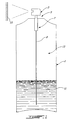
- the aerosol spray can comprises an outer cylindrical container shell 1, a spray valve nozzle assembly 3 (comprising a spray nozzle 5) and a siphoning assembly 7 (including a siphoning tube 9).
- the spray can also contains therein a liquid flash-dry disinfection composition 11 in accordance with the present invention.
- a pressure space 13 is located above the disinfection composition 11 and may contain a pressurised gas for inducing the disinfection composition to pass up through the siphoning assembly tube 9 to the spray nozzle 5 for ultimately being passed therethrough as a spray aerosol indicated in dotted outline; the spray of course being directed to the surface 15 to be sterilized.
- the various liquid component forming the disinfectant composition may be poured into the container shell 1; the valve nozzle assembly 3 is then used to cap or seal (in a permanent or removable manner) the container shell 11 in gas or air tight fashion; and then the container is pressurized (through the nozzle assembly 3 - nozzle 5 removed) using an inert gas to a pressure ranging for example from 414 to 1380 kPa (60 psig to 200 psig).
- an inert gas instead of an inert gas the container once the nozzle assembly is in place may be pressurized by being filled with a suitable (known) low boiling point refrigerant gas such as a freon.
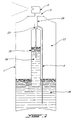
- FIG 2 this figure illustrates an acrosol spray can assembly wherein components of the flash-dry disinfectant composition are kept apart in separate container means until the time at which they are to be sprayed.
- This can assembly also comprises an outer cylindrical container shell 1, a spray valve nozzle assembly 3 (comprising a spray nozzle 5) and a siphoning tube 9.
- the spray can also has an inner container 20 which is also provided with a siphon tube assembly indicated generally by the reference numeral 22.
- the inner container 20 contains a first liquid component 24 of the flash-dry disinfection composition whereas a second liquid component (indicated by the reference numeral 26) is located outside the inner container 20 but inside the container shell 1.
- the can assembly is also provided with a siphoning and mixing assembly 28.
- a pressure space 13 is located above the second disinfection component 26 and may contain a pressurised gas for inducing the first and second liquid components 24 and 26 to pass up through respective siphoning assembly tubes 9 and 22 to the mixing assembly 28 and then on to the spray nozzle 5 for ultimately being passed therethrough as a spray aerosol indicated in dotted outline.
- the system shown may be pressurised through the nozzle assembly 3 (first removing the nozzle 5). In this case when nozzle 5 is depressed both liquid components 24 and 26 will be forced into the mixing assembly, mixed and then sprayed out the nozzle 5.
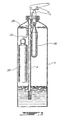
- this figure illustrates an alternate aerosol spray can assembly wherein components of the flash-dry disinfectant composition are kept apart in separate container means until the time at which they are to be sprayed; the spray container may be obtained from CEODEUX Firetec, out of Luxembourg.
- This assembly differs from that shown in figure 2 in that the pressurization is accomplished by use of a scaled pressurized CO 2 canister 30.
- the pressurization is accomplished by use of a scaled pressurized CO 2 canister 30.
- the carbon dioxide in the canister 30 is allowed to escape (in known fashion) so as to induce CO 2 pressurization of the system including that of the second liquid component.
- the nozzle is depressed again the two liquid components are forced to mix together in the mixing assembly the resultant flash-dry disinfectant composition is expelled out through the spray nozzle as a spray aerosol.
- the various elements or components of the present invention such as the materials for the flash-dry disinfectant composition (including their proportions in the flash-dry disinfection composition), the components or element of the aerosol apparatus (i.e. the spray nozzle head) are of course to be selected with a view to the desired or necessary ends herein i.e. disinfection/drying.
- the surface(s) to be treated in accordance with the present invention may be hard (e.g. metal) or soft (e.g. carpet)
- BG Bacillus subtilis var niger spores
- ATCC.9372 Bacillus subtilis var niger spores
- BG Bacillus subtilis var niger spores
- ATCC.9372 Bacillus subtilis var niger spores
- BG is a Gram-positive spore-forming bacteria that is widely used as an accepted surrogate for spore-forming bacterial BW agents such as Bacillus anthracis .
- the extreme protection that sporulation gives to this mircroorganism makes it one of the most difficult to eliminate.
- BG spores are produced following our internal Work Instructions based on standard microbiology procedures.
- MS2 The other challenge organism used for the sterilizing tests is MS2 (ATCC 15597-B1).
- MS2 is an approximately 26 nm icosahedral bacteriophage that infects Escherichia coli (ATCC 15597). It is an accepted surrogate for viral BW agents, including Ebola and Venezuelan Equine Encephalitis.
- MS2 is prepared according to Dugway Proving Ground SOP.
- the Neutralizing Dilution Solution (NDS buffer) used for purpose of sampling contains sodium thiosulfate, which is the agent responsible for the neutralization of the oxidants (such as hydrogen peroxide) present in the experimental samples.
- the neutralization action of sodium thiosulfate prevents the oxidizing process from going on once the sampling has occurred, ensuring the accuracy of the chosen contact time.
- the sterilizing solution is applied by means of an aerosol spray can (Sure Shot Atomizer, Model B sprayer, Milwaukee Sprayer MFG. CO. INC., Milwaukee, WI, USA) filled with the biocidal solution and air or gaseous nitrogen.
- The.gas propellant ensures the propulsion in the form of an aerosol of the sterilizing solution to be expelled.
- Adapted spray nozzles come in different sizes. We used the finest nozzle available (#B30-040) in order to produce an aerosol with droplet size as small as possible.
- the physico/chemical properties of the biocidal agents combined with the aerosol application method contribute to generate a flash-dry sterilizing solution.
- the sterilizing efficacy of the hydrogen peroxide/ethanol solution was tested on various surfaces in order to assess its efficacy on different materials Examples 2 and 3.
- the solution was challenged with MS2 and BG for 60 minutes of contact time. We obtained reduction rates of a 100% for all the samples with the exception of the ceiling tile sample in Example 3 that yielded a 99,86% result.
- the selected sterilizing solution (H 2 O 2 10% in ethanol) is a flash-dry biocidal solution with high and fast kill rate.
- the said solution combines a 100% sterilizing efficacy against MS2 and BG spores within 5 minutes of contact time with flash-dry properties.
Landscapes
- Life Sciences & Earth Sciences (AREA)
- Chemical & Material Sciences (AREA)
- Health & Medical Sciences (AREA)
- Dispersion Chemistry (AREA)
- Engineering & Computer Science (AREA)
- General Health & Medical Sciences (AREA)
- Wood Science & Technology (AREA)
- Zoology (AREA)
- Environmental Sciences (AREA)
- Mechanical Engineering (AREA)
- Dentistry (AREA)
- Plant Pathology (AREA)
- Pest Control & Pesticides (AREA)
- Agronomy & Crop Science (AREA)
- Inorganic Chemistry (AREA)
- Veterinary Medicine (AREA)
- Public Health (AREA)
- Chemical Kinetics & Catalysis (AREA)
- Animal Behavior & Ethology (AREA)
- Epidemiology (AREA)
- General Chemical & Material Sciences (AREA)
- Toxicology (AREA)
- Agricultural Chemicals And Associated Chemicals (AREA)
- Apparatus For Disinfection Or Sterilisation (AREA)
- Medicinal Preparation (AREA)
Abstract
Description
- The present invention relates to an aerosol apparatus (e.g. pressurised) for dispensing an antimicrobial agent in an aerosol spray onto a surface to be disinfected. The aerosol apparatus contains a flash-dry disinfectant composition comprising said antimicrobial agent (e.g. the antimicrobial agent may be hydrogen peroxide).
- Disinfectant compositions are known which comprise an alcohol(s) and hydrogen peroxide, compositions which have a bactericidal effect when applied to a surface (please see U.S. patent nos 5,916,568 and 5,868,998 which describe the use of hydrogen peroxide as a bactericide.
- It would be advantageous to have a means for facilitating the application of or dispensing of a disinfectant composition onto a surface so as to facilitate the antimicrobial effect of such disinfectant composition while at the same time being able to facilitate or accelerate the drying of the surface to be disinfected.
- The present invention provides, in combination, an aerosol spray apparatus for applying an anti-microbial agent to a surface to be disinfected and a liquid flash-dry disinfectant composition, in accordance with claim 1. The invention also provides a method for disinfecting a surface and a liquid flash-dry composition for disinfecting a surface. Preferred embodiments of the invention are defined in the dependent claims.
- In accordance with the present invention the components of the flash-dry disinfectant composition (i.e. the antimicrobial agent and the flash vaporisation component) may be mixed together just prior to the flash-dry disinfectant composition being applied to a surface.
- Accordingly said apparatus may comprise a first container means containing said antimicrobial agent and a second container means containing said flash vaporisation component wherein said aerosol spray apparatus comprises mixing means for mixing said antimicrobial agent and said flash vaporisation component together prior to dispensing said liquid flash-dry disinfectant composition through said spray nozzle.
- In accordance with the present invention the antimicrobial agent may. For example, be hydrogen peroxide; however any other suitable (known) antimicrobial agent able to be incorporated into a formulation able to be disposed on a surface by means of an aerosol spray may be used.
- The flash vaporisation component may, for example, comprise an alkanol of formula ROH wherein R is a group containing from 1 to 6 carbon atoms such as for example ethanol, isopropanol, butanol and the like. Additionally the flash vaporisation component may, for example, comprise a ketone of up to six carbon atoms (e.g.acetone); an ether of up to six carbon atoms; a halogenated organic compound such as, for example, freon, chloroform; etc..
- In accordance with the present invention a flash-dry disinfectant composition (in a container means or as being sprayed as an aerosol onto the surface to be disinfected) comprises 10 to 30% by volume of hydrogen peroxide, 10 to 85% by volume of a flash vaporisation component for example an alcohol such as ethanol. The flash-dry disinfectant composition comprises a remainder component or element which may, for example, comprise or be water.
- In accordance with the present invention a flash-dry disinfectant composition (in a container means or as being sprayed as an aerosol onto the surface to be disinfected) may for example in particular comprise 10 to 30% by volume of hydrogen peroxide, 10 to 85 % by volume of an alcohol such as for example ethanol and 10 to 65 % by volume of water.
- More particularly, the flash-dry disinfectant composition of the present invention may comprise any (liquid) flash vaporisation component which is able to impart to the composition a flash vaporisation characteristic i.e. to achieve in a relatively, (desired or necessary) short period of time after applying the flash dry aerosol to a surface, a state wherein the surface is essentially dry leaving behind the antimicrobial agent (i.e. a surface has achieved a desired or necessary state of dryness). The flash dry liquid may for example be one which is able to evaporate at a relatively rapid rate at ambient room temperature and pressure, i.e. having a high volatility (e.g at 15 degrees centigrade or higher such as at 20 to 25 degrees centigrade). The flash-dry disinfectant composition may for example, comprise a flash vaporisation component comprising one or more of the above mentioned materials; it may for example comprise an alkanol comprising from 2 to 5 carbon atoms (e.g ethanol, isopropanol, butanol etc...), an alkoxy substituted alkane (i.e. an ether) comprising from 2 to 4 carbon atoms (e.g. diethyl ether - ethoxy ethane, ....); etc... The flash dry materials may be obtained from any known suppliers. An alcohol for example may be obtained from any known supplier such as Fisher Scientific, Signa-Aldrich (e.g. as a composition comprising 82-95% by volume ethanol, 2 to 10% by volume water and 3 to 10% by volume methanol).
- The antimicrobial agent may as mentioned above be hydrogen peroxide; it may also be a compound that forms peroxide in an aqueous medium (i.e. in situ). The hydrogen peroxide may be obtained from any known supplier such as Fisher Scientific, Signa-Aldrich (e.g. as a composition comprising 30% by volume hydrogen peroxide and 70% by volume water).
- The aerosol apparatus may take any desired (known) form provided that it may deliver the flash-dry disinfectant composition to a surface in aerosol (e.g. in micro aerosol).
- The aerosol apparatus may for example comprise a pressurised container containing a predosed amount of inert propellant gas component in addition to the flash-dry disinfectant composition. In this case, the basic aerosol container is configured to be able to contain or store the flash-dry disinfectant composition under pressure which is due to the additional presence in the container of an inert pressurising gas component such as air, nitrogen gas, etc.. Alternatively the basic aerosol container may comprise there within or otherwise be associated with a secondary pressurized gas container which is appropriately coupled in any suitable (known) manner to the spray nozzle so as to be able to induce the disinfectant composition through the nozzle as an aerosol spray. The propellant gas may be any gas which is at least essentially inert with respect to the flash-dry disinfectant composition components (e.g. nitrogen gas, air, and the like); it may also be a freon gas.
- The aerosol apparatus alternatively may comprise a mechanism for manually introducing atmospheric air into the container so as to generate a positive pressure therein as mentioned above; an example of this latter type of aerosol apparatus is described in U.S. patent no. 5,265,775.
- The aerosol apparatus may for example be configured in any known manner so as to be able to generate or provide a spray having droplet sizes of for example from 1 to 100 microns; larger sized droplets may of course be used provided that the desired flash dry effect is achieved when the composition is applied to a surface to be disinfected.
- The aerosol container may have any type of known spray nozzle system coupled to the pressurised container for dispensing an aerosol spray or jet onto a surface. The nozzle is of course configured so as to be able to pass from a normal closed configuration (no spray being developed) to an active open configuration, the opened configuration being such so as to allow the internal positive pressure persisting in the aerosol container to urge the flash-dry disinfectant composition out of the container as an aerosol spray. Suitable (aerosol) type may be obtained from Electron Microscopy Sciences, Pennsylvania USA (i.e. Spray Safe Atomizer (64186); from Four Star Chemicals, ,California USA (i.e Aluminum and epoxy coated cans); and from CEODEUX Firetec, out of Luxembourg (i.e. 3-Six and nine liter extinguisher type sprayer).
- In the drawings which illustrate example embodiments of the present invention :
- Figure 1
- is a schematic illustration of a known type of aerosol can containing a flash dry disinfection composition of the present invention;
- Figure 2
- is a schematic illustration of an alternative type of aerosol can containing separated liquid components of a flash dry disinfection composition of the present invention; and
- Figure 3
- is a is a schematic illustration of an additional type of (known) aerosol can containing separated liquid components of a flash dry disinfection composition of the present invention.
- With respect to the drawings the same reference numerals will be used to designate the same element(s).
- Referring to figure 1 the aerosol spray can comprises an outer cylindrical container shell 1, a spray valve nozzle assembly 3 (comprising a spray nozzle 5) and a siphoning assembly 7 (including a siphoning tube 9). The spray can also contains therein a liquid flash-
dry disinfection composition 11 in accordance with the present invention. Apressure space 13 is located above thedisinfection composition 11 and may contain a pressurised gas for inducing the disinfection composition to pass up through thesiphoning assembly tube 9 to thespray nozzle 5 for ultimately being passed therethrough as a spray aerosol indicated in dotted outline; the spray of course being directed to thesurface 15 to be sterilized. - In accordance with the embodiment illustrated in figure 1 the various liquid component forming the disinfectant composition may be poured into the container shell 1; the
valve nozzle assembly 3 is then used to cap or seal (in a permanent or removable manner) thecontainer shell 11 in gas or air tight fashion; and then the container is pressurized (through the nozzle assembly 3 -nozzle 5 removed) using an inert gas to a pressure ranging for example from 414 to 1380 kPa (60 psig to 200 psig). Alternatively, instead of an inert gas the container once the nozzle assembly is in place may be pressurized by being filled with a suitable (known) low boiling point refrigerant gas such as a freon. - Turning to figure 2; this figure illustrates an acrosol spray can assembly wherein components of the flash-dry disinfectant composition are kept apart in separate container means until the time at which they are to be sprayed. This can assembly also comprises an outer cylindrical container shell 1, a spray valve nozzle assembly 3 (comprising a spray nozzle 5) and a
siphoning tube 9. The spray can however, also has aninner container 20 which is also provided with a siphon tube assembly indicated generally by thereference numeral 22. Theinner container 20 contains a firstliquid component 24 of the flash-dry disinfection composition whereas a second liquid component (indicated by the reference numeral 26) is located outside theinner container 20 but inside the container shell 1. The can assembly is also provided with a siphoning andmixing assembly 28. Apressure space 13 is located above thesecond disinfection component 26 and may contain a pressurised gas for inducing the first and secondliquid components siphoning assembly tubes mixing assembly 28 and then on to thespray nozzle 5 for ultimately being passed therethrough as a spray aerosol indicated in dotted outline. The system shown may be pressurised through the nozzle assembly 3 (first removing the nozzle 5). In this case whennozzle 5 is depressed bothliquid components nozzle 5. - Referring to figure 3, this figure illustrates an alternate aerosol spray can assembly wherein components of the flash-dry disinfectant composition are kept apart in separate container means until the time at which they are to be sprayed; the spray container may be obtained from CEODEUX Firetec, out of Luxembourg. This assembly differs from that shown in figure 2 in that the pressurization is accomplished by use of a scaled pressurized CO2 canister 30. In this case when the respective nozzle is initially depressed the carbon dioxide in the
canister 30 is allowed to escape (in known fashion) so as to induce CO2 pressurization of the system including that of the second liquid component. When the nozzle is depressed again the two liquid components are forced to mix together in the mixing assembly the resultant flash-dry disinfectant composition is expelled out through the spray nozzle as a spray aerosol. - The various elements or components of the present invention such as the materials for the flash-dry disinfectant composition (including their proportions in the flash-dry disinfection composition), the components or element of the aerosol apparatus (i.e. the spray nozzle head) are of course to be selected with a view to the desired or necessary ends herein i.e. disinfection/drying.
- The surface(s) to be treated in accordance with the present invention may be hard (e.g. metal) or soft (e.g. carpet)
- The following examples illustrate various example flash-dry disinfectant compositions of the present invention. The various microorganisms used for the tests as well as the procedure (protocol 4) used to effect various tests will be discussed after the examples.
-
Solutions Evaporation Time 1 minute 2 minutes 5 minutes 15 minutes 30 minutes 40 minutes 45 minutes H2O wet wet humid droplets droplets droplets dry H2O2 10% wet wet humid driplets droplets droplets dry H2O2 10% in ETOH wet humid dry dry dry dry dry ETOH 95% humid dry dry dry dry dry dry - The sterilizing effect of an aerosol containing H2O2/ETOH on various materials inoculated with BG for 60 minutes contact time.
Temperature : 20.7°C
- The comparative performance of a sterilizing agent against MS2 phage on various surfaces for 60 minutes contact time.
- Temperature: 22.4°C
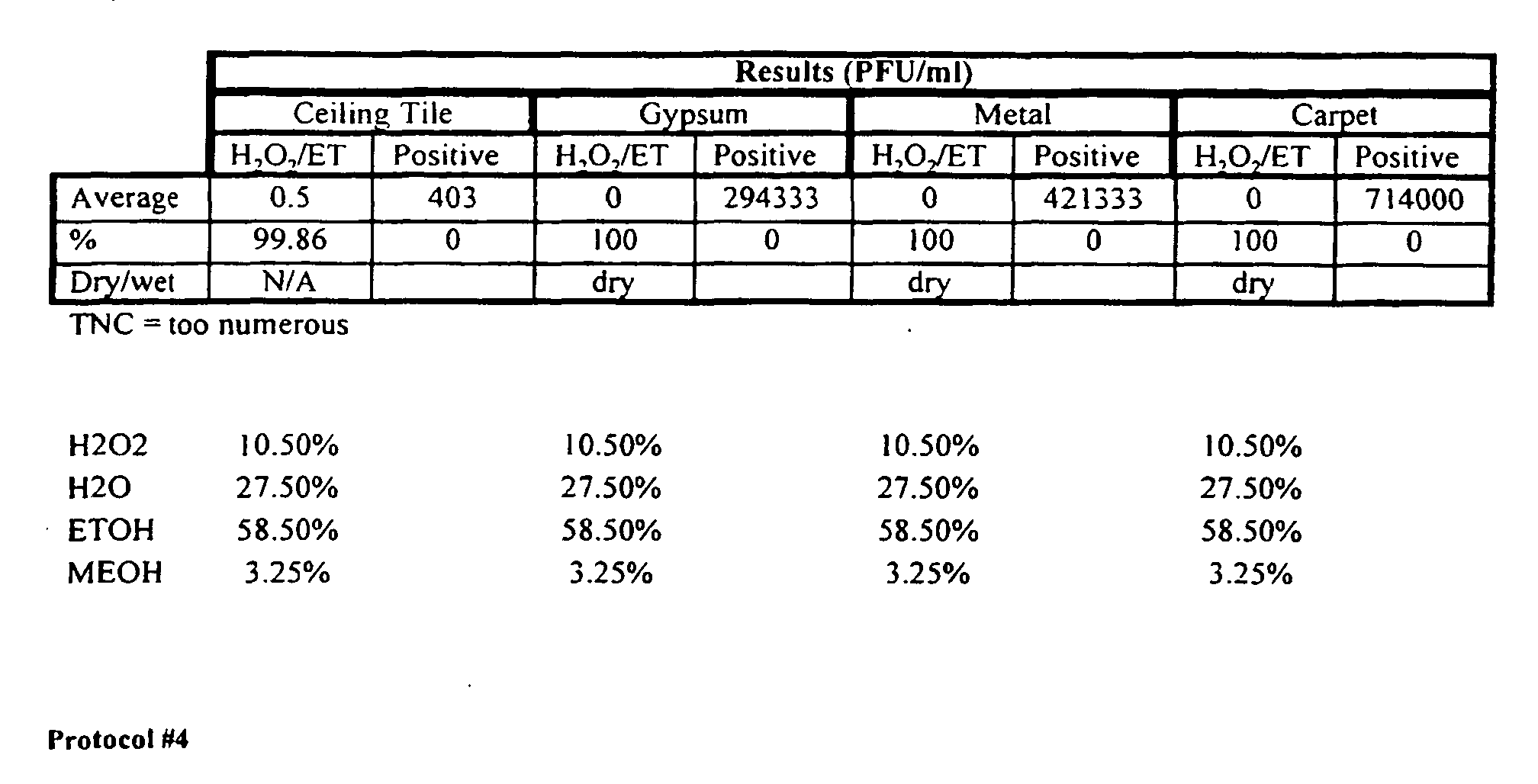
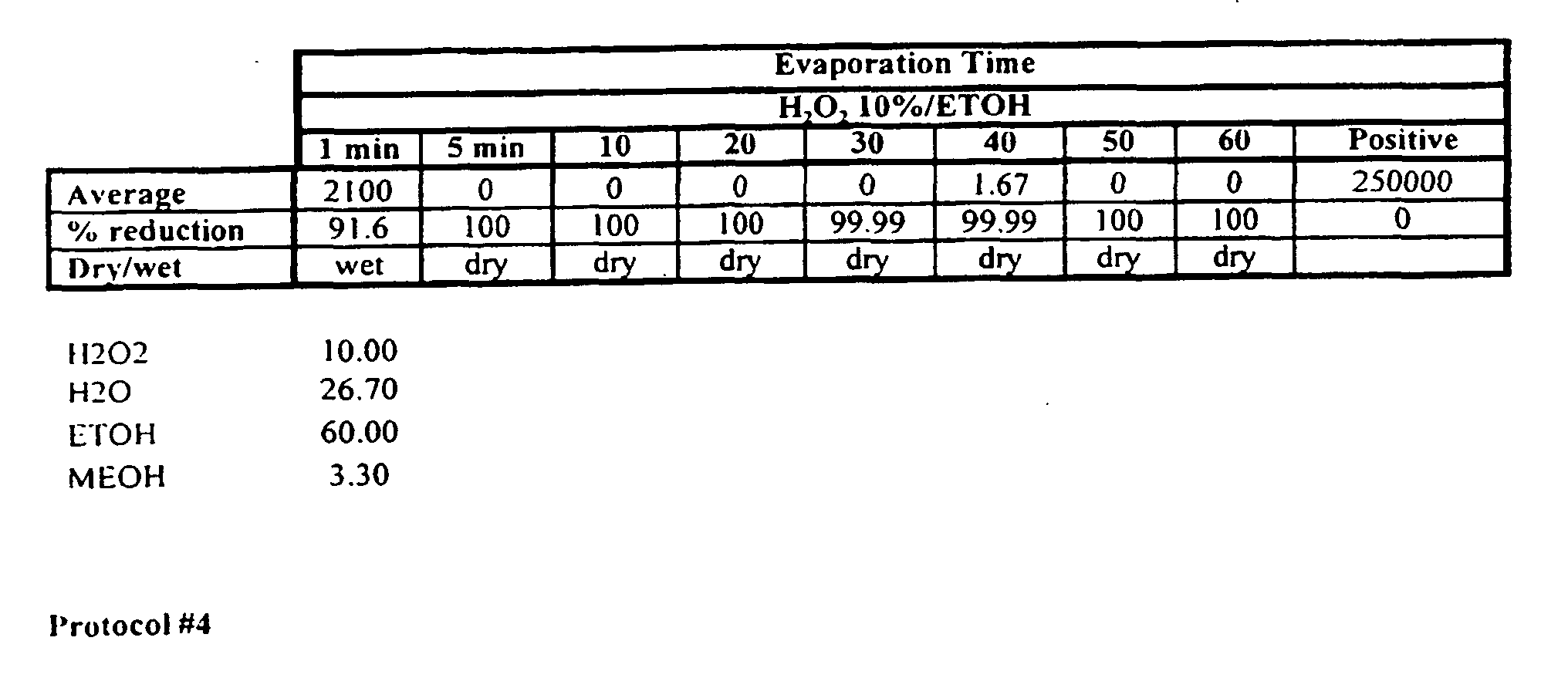
- Sterilizing effect of H2O2 10% in Ethanol (lot 991208) on Gypsum wallboard pieces inoculated with BG spores.
- Temperature: 19.6°C
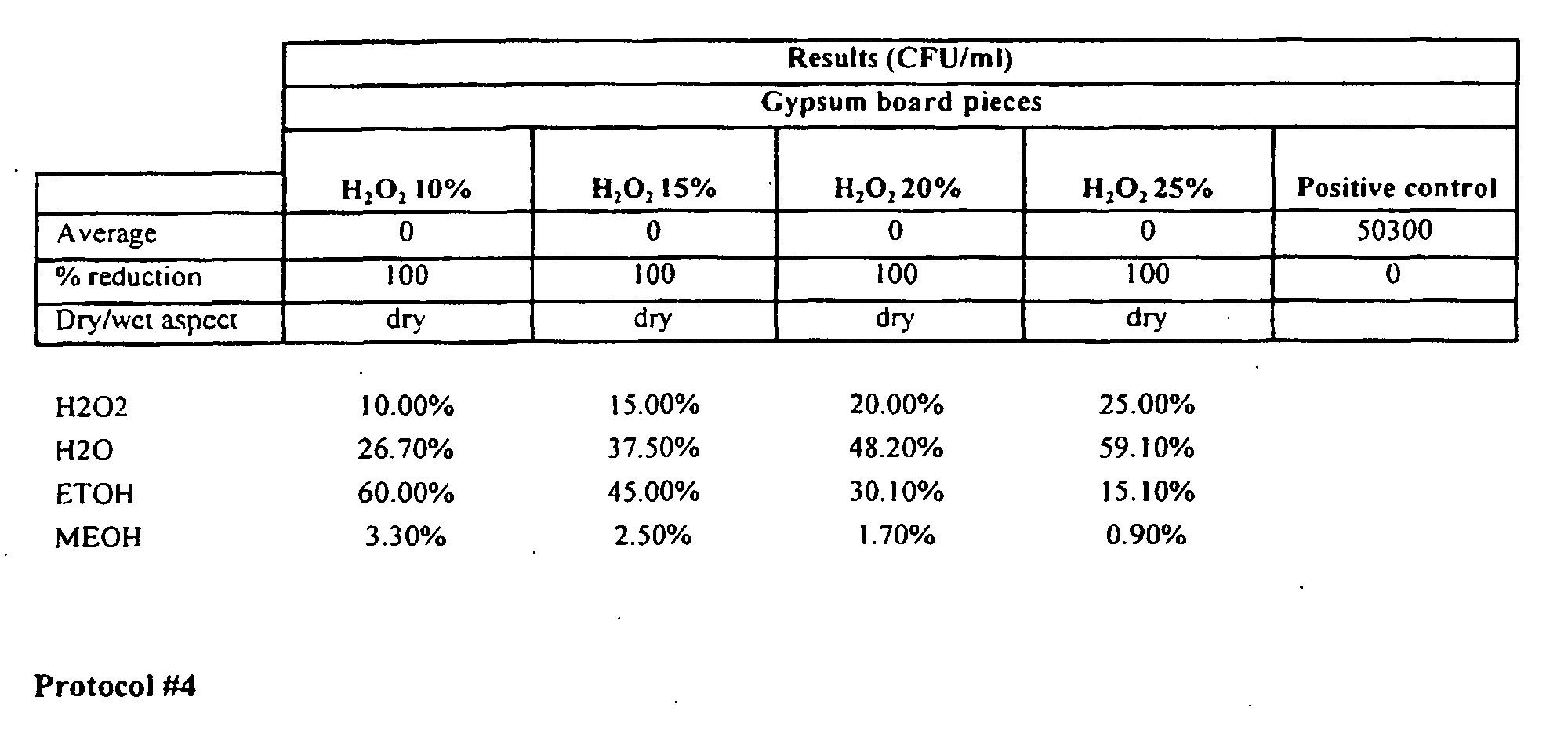
- Performance of H2O2 in ETOH against BG spores on gypsum board places for 60 minutes contact time.
- Temperature: 19.6°C
- Performance of H2O2 10% in methanol against BG spores on gypsum board pieces for different contact time
- Temperature: 19.0°C

- Performance of H2O2 10% in Isopropyl alcohol against BG spores on gypsum board pieces for different contact time
- Temperature: 19.0°C

- Performance of H2O2 10% in propanol against BG spores on gypsum board pieces for different contact time
- Temperature: 19.8°C

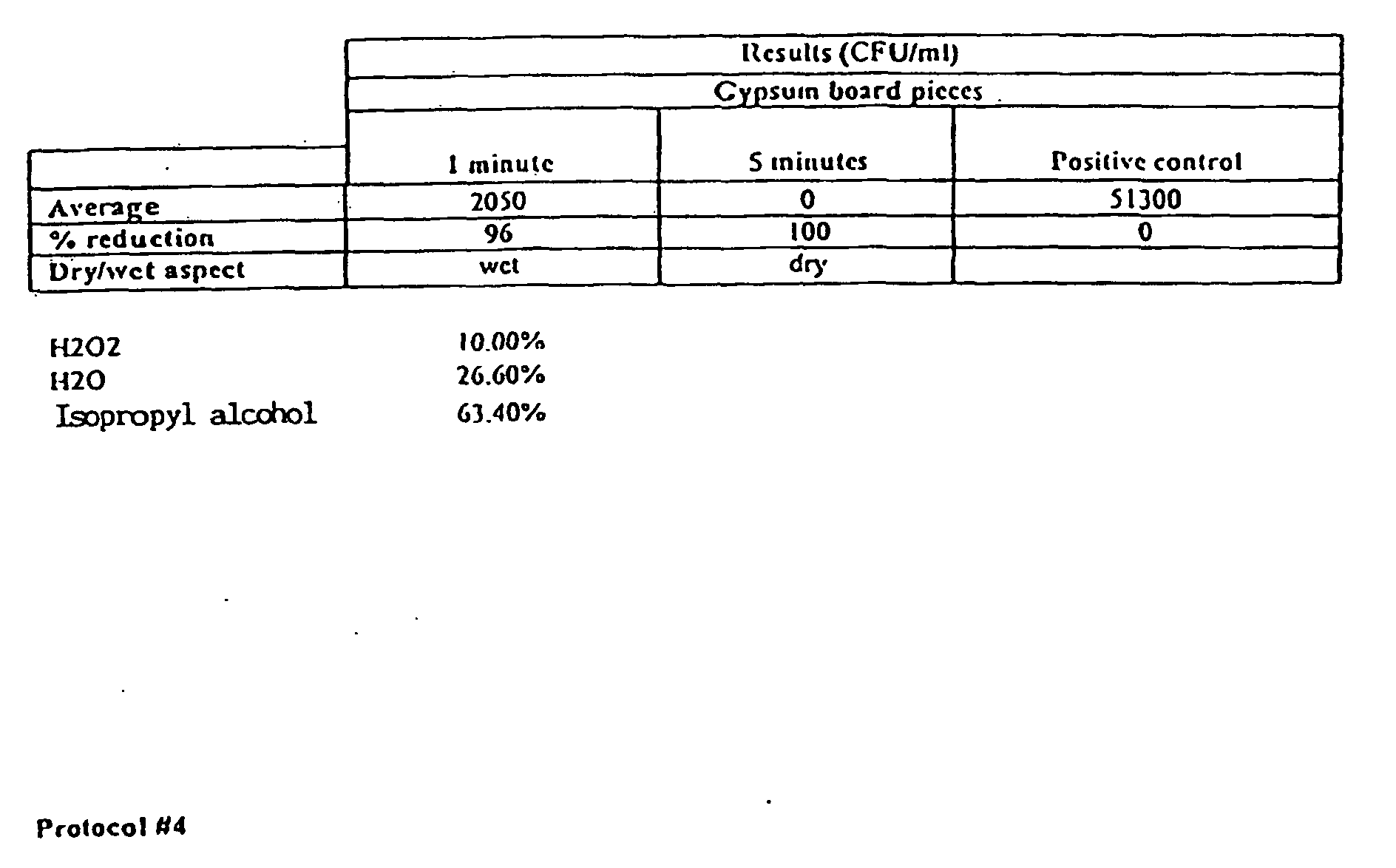
- Performance of H2O2 10% in isopropyl alcohol against BG spores on gypsum board pieces for different contact time
- Temperature: 19.8°C
- Performance of H2O2 10% in methanol against BG spores on gypsum board pieces for different contact time
- Temperature: 19.8°C

- Bacillus subtilis var niger spores (ATCC.9372) is used as challenge organism. BG is a Gram-positive spore-forming bacteria that is widely used as an accepted surrogate for spore-forming bacterial BW agents such as Bacillus anthracis. The extreme protection that sporulation gives to this mircroorganism makes it one of the most difficult to eliminate. BG spores are produced following our internal Work Instructions based on standard microbiology procedures.
- The other challenge organism used for the sterilizing tests is MS2 (ATCC 15597-B1). MS2 is an approximately 26 nm icosahedral bacteriophage that infects Escherichia coli (ATCC 15597). It is an accepted surrogate for viral BW agents, including Ebola and Venezuelan Equine Encephalitis. MS2 is prepared according to Dugway Proving Ground SOP.
-
- Apparatus and Reagents
- Gypsum wallboard piece of 10cm*10cm
- Carpet piece of 10cm*10cm
- Sheet metal piece of 10cm*10cm
- Ceiling tile piece of 10cm*10cm
- Tissue of partition panels piece of 10cm*10cm
- NDS buffer
- Incubator
- Bacillus subtilis var niger spores and MS2 phage
- Spray can (SureShot Atomizer, Model B sprayer, Milwaukee Sprayer MFG. CO. INC.,
- Milwaukee WI, USA) with fin spray nozzle (#B30-040) filled with biocidal solutions and air or gaseous nitrogen.
-
-
- 1. With a sponge, spread the inoculum at a concentration of 107 CFU/ml or PFU/ml over the clean surface of the pieces to be tested. Keep 1 cm border free of microorganisms.
- 2. Using the spray can, treat all the surface of the pieces for 3 to 5 seconds.
- 3. Wait for the chosen contact time.
- 4. Sample the experimental and positive control pieces of the gypsum board, sheet metal and ceiling tile with a swab in 9 ml of NDS buffer. Sample the experimental and positive control pieces of the carpet and tissue, by soaking the pieces in 27 ml of NDS buffer and then sampling 1 ml of the residual liquid.
- 5. For BG spores, place 0.2 ml of each dilution on TSA media; for MS2 phage, place 1.0 ml of each dilution on MS2 media. Incubate at 35°C for 24 hours.
-
- Numerous experiments were perfonned to evaluate the comparative performance of TAS against MS2 phage and BG spores under different environmental conditions.
- The Neutralizing Dilution Solution (NDS buffer) used for purpose of sampling contains sodium thiosulfate, which is the agent responsible for the neutralization of the oxidants (such as hydrogen peroxide) present in the experimental samples. The neutralization action of sodium thiosulfate prevents the oxidizing process from going on once the sampling has occurred, ensuring the accuracy of the chosen contact time.
- The sterilizing solution is applied by means of an aerosol spray can (Sure Shot Atomizer, Model B sprayer, Milwaukee Sprayer MFG. CO. INC., Milwaukee, WI, USA) filled with the biocidal solution and air or gaseous nitrogen. The.gas propellant ensures the propulsion in the form of an aerosol of the sterilizing solution to be expelled. Adapted spray nozzles come in different sizes. We used the finest nozzle available (#B30-040) in order to produce an aerosol with droplet size as small as possible. The physico/chemical properties of the biocidal agents combined with the aerosol application method contribute to generate a flash-dry sterilizing solution.
- Microbiological results are presented in the Examples 1 to 10. Prior experimentation proved the concentration of 10% of hydrogen peroxide in combination with ethanol (ETOH) to provide a 100% sterilizing efficacy as well as a short evaporation time. The performance of hydrogen peroxide 10% (H2O2 10%) in combination with different alcohols against BG spores on gypsum board pieces was evaluated for various contact time throughout Examples 6 to 10. Positive results were observed for all the alcohols tested (isopropyl alcohol, methanol and propanol all in a concentration of 63,4%) and all the configurations with 5-minute contact time and above presented a 100% sterilizing efficacy. After 5 minutes of contact time all sample surfaces were left dry. It is worth noting that after I minute of contact time, an average of 96,1% of microorganisms are already eliminated.
- The sterilizing efficacy of the hydrogen peroxide/ethanol solution was tested on various surfaces in order to assess its efficacy on different materials Examples 2 and 3. The solution was challenged with MS2 and BG for 60 minutes of contact time. We obtained reduction rates of a 100% for all the samples with the exception of the ceiling tile sample in Example 3 that yielded a 99,86% result.
- The selected sterilizing solution (H2O2 10% in ethanol) is a flash-dry biocidal solution with high and fast kill rate. The said solution combines a 100% sterilizing efficacy against MS2 and BG spores within 5 minutes of contact time with flash-dry properties.
Claims (16)
- An aerosol spray apparatus for applying an anti-microbial agent to a surface to be disinfected, comprising:characterised in that:an aerosol spray nozzle (5) coupled to a container apparatus (1) for containing a liquid disinfectant composition (11) able to be sprayed from the apparatus, and a liquid flash-dry disinfectant composition in the container apparatus, said flash-dry disinfectant composition being able, once sprayed in aerosol form onto the surface to be disinfected, to flash vaporize to leave an essentially dry surface having the anti-microbial agent deposited thereon;said liquid flash-dry disinfectant composition comprises: 10% to 30% by volume of hydrogen peroxide;10% to 85% by volume of a flash vaporization component; anda remainder component.
- Apparatus as claimed in claim 1 wherein the flash vaporization component comprises an alcohol.
- Apparatus as claimed in claim 1 wherein the flash vaporization component comprises an alkanol of formula ROH wherein R is a group containing 1 to 6 carbon atoms.
- Apparatus as claimed in any preceding claim wherein the flash vaporization component comprises ethanol.
- Apparatus as claimed in claim 1 wherein the flash-dry disinfectant composition comprises:10% to 30% by volume hydrogen peroxide;10% to 85% by volume of an alcohol; and10% to 65% by volume water.
- Apparatus as claimed in claim 5 wherein the alcohol is ethanol.
- Apparatus as claimed in any preceding claim wherein the container apparatus comprises a first container for containing a gas propellant and a second container for containing the liquid disinfectant composition.
- Apparatus as claimed in any of claims 1-7 wherein the container apparatus comprises a first container for containing a first liquid component and a second container for containing a second liquid component.
- Apparatus as claimed in claim 8 wherein the container apparatus further comprises a third container for containing a gas propellant.
- A liquid flash-dry disinfectant composition comprising a flash vaporization component for disinfecting a surface, said flash-dry disinfectant composition being able, once sprayed in aerosol form onto the surface to be disinfected, to flash vaporize to leave an essentially dry surface having an anti-microbial agent deposited thereon;
characterised in that:said liquid flash-dry disinfectant composition comprises:10% to 30% by volume of hydrogen peroxide;10% to 85% by volume of a flash vaporization component; anda remainder component. - A composition as claimed in claim 10 wherein the flash vaporization component comprises an alcohol.
- A composition as claimed in claim 10 wherein the flash vaporization component comprises an alkanol of formula ROH wherein R is a group containing 1 to 6 carbon atoms.
- A composition as claimed in any of claims 10 to 12 wherein the flash vaporization component comprises ethanol.
- A composition as claimed in claim 10, comprising:10% to 30% by volume hydrogen peroxide;10% to 85% by volume of an alcohol, and10% to 65% by volume water.
- A composition as claimed in claim 14 wherein the alcohol is ethanol.
- A method for disinfecting a surface, comprising:characterised in that said liquid flash-dry disinfectant composition is a composition as claimed in any one of claims 10 to 15.applying by aerosol spray to a surface to be disinfected a liquid flash-dry disinfectant composition comprising a flash vaporization component which is able, once the flash-dry disinfectant composition is sprayed in aerosol form onto said surface, to flash vaporize to leave an essentially dry surface having an anti- microbial agent deposited thereon;
Priority Applications (1)
| Application Number | Priority Date | Filing Date | Title |
|---|---|---|---|
| EP05076692A EP1593396A1 (en) | 2000-01-26 | 2001-01-26 | Antimicrobial flash-dry disinfectant aerosol |
Applications Claiming Priority (3)
| Application Number | Priority Date | Filing Date | Title |
|---|---|---|---|
| CA2297002 | 2000-01-26 | ||
| CA002297002A CA2297002A1 (en) | 2000-01-26 | 2000-01-26 | Antimicrobial flash-dry disinfectant aerosol |
| PCT/CA2001/000102 WO2001054740A1 (en) | 2000-01-26 | 2001-01-26 | Antimicrobial flash-dry disinfectant aerosol |
Related Child Applications (1)
| Application Number | Title | Priority Date | Filing Date |
|---|---|---|---|
| EP05076692A Division EP1593396A1 (en) | 2000-01-26 | 2001-01-26 | Antimicrobial flash-dry disinfectant aerosol |
Publications (2)
| Publication Number | Publication Date |
|---|---|
| EP1250160A1 EP1250160A1 (en) | 2002-10-23 |
| EP1250160B1 true EP1250160B1 (en) | 2005-08-24 |
Family
ID=4165157
Family Applications (2)
| Application Number | Title | Priority Date | Filing Date |
|---|---|---|---|
| EP05076692A Withdrawn EP1593396A1 (en) | 2000-01-26 | 2001-01-26 | Antimicrobial flash-dry disinfectant aerosol |
| EP01902209A Expired - Lifetime EP1250160B1 (en) | 2000-01-26 | 2001-01-26 | Antimicrobial flash-dry disinfectant aerosol |
Family Applications Before (1)
| Application Number | Title | Priority Date | Filing Date |
|---|---|---|---|
| EP05076692A Withdrawn EP1593396A1 (en) | 2000-01-26 | 2001-01-26 | Antimicrobial flash-dry disinfectant aerosol |
Country Status (10)
| Country | Link |
|---|---|
| US (1) | US20010053333A1 (en) |
| EP (2) | EP1593396A1 (en) |
| JP (1) | JP2003520644A (en) |
| CN (1) | CN1419457A (en) |
| AT (1) | ATE302617T1 (en) |
| AU (1) | AU2001229925A1 (en) |
| CA (1) | CA2297002A1 (en) |
| DE (1) | DE60112888T2 (en) |
| IL (1) | IL150928A0 (en) |
| WO (1) | WO2001054740A1 (en) |
Families Citing this family (33)
| Publication number | Priority date | Publication date | Assignee | Title |
|---|---|---|---|---|
| US20030228401A1 (en) * | 2002-06-06 | 2003-12-11 | Newman Michael D. | System and method of using non-volatile microbiocidal application agents |
| US20050238732A1 (en) * | 2003-12-19 | 2005-10-27 | Kaitao Lu | Carbonated germicide with pressure control |
| US20050136086A1 (en) * | 2003-12-19 | 2005-06-23 | Rafael Herruzo | Efficacy enhancers for germicides |
| US20050171216A1 (en) * | 2004-01-30 | 2005-08-04 | Zhu Peter C. | Germicidal compositions containing phthalaldehyde mixtures and methods of using such compositions for disinfection or sterilization |
| US7476767B2 (en) * | 2004-01-30 | 2009-01-13 | Ethicon, Inc. | Alpha-hydroxy sulfonate aldehydes, germicidal compositions containing the alpha-hydroxy sulfonate aldehydes, or mixtures of alpha-hydroxy sulfonate aldehydes and phthalaldehydes, and methods of using the compounds or compositions for disinfection or sterilization |
| US7390837B2 (en) | 2004-01-30 | 2008-06-24 | Ethicon, Inc. | Germicidal compositions containing phenylmalonaldehyde-type compounds, or mixtures of phenylmalonaldehyde-type compounds and phthalaldehydes, and methods of using such compositions for disinfection or sterilization |
| US7291649B2 (en) * | 2005-06-29 | 2007-11-06 | Ethicon, Inc. | Forming germicidal aromatic dialdehydes with acetals |
| DE102006049320A1 (en) * | 2006-10-19 | 2008-04-30 | Jürgen Schablitzki | Method for cleaning and disinfecting evaporators of air conditioners comprises removing the air filters from the evaporators and cleaning the evaporators with an alcohol-containing cleaning agent and a disinfecting solution |
| DE102007015584A1 (en) * | 2007-03-29 | 2008-10-02 | Maja-Maschinenfabrik Hermann Schill Gmbh & Co. Kg | Device and method for disinfecting ice machines, ice silos and / or channels for transporting ice |
| CN100493620C (en) * | 2007-04-02 | 2009-06-03 | 郑州大学生化工程中心 | Two-stage flash continuous sterilization process and device |
| US8889081B2 (en) | 2009-10-15 | 2014-11-18 | Medivators Inc. | Room fogging disinfection system |
| AU2010325926B2 (en) | 2009-12-03 | 2014-01-09 | Minntech Corporation | Container and system for decontaminating a medical device with a fog |
| CN103702689B (en) | 2011-05-27 | 2016-08-17 | 马尔科尔净化装置公司 | Cleaning system including the environmental Kuznets Curves using cleaning of substances |
| KR102087068B1 (en) * | 2011-07-08 | 2020-03-10 | 에스.씨. 존슨 앤 선 인코포레이티드 | Compressed gas aerosols with enhanced intensity and longevity of actives |
| US20130089533A1 (en) * | 2011-10-05 | 2013-04-11 | Arkema Inc. | Disinfectant compositions with hydrogen peroxide |
| CN103908689B (en) * | 2013-01-05 | 2016-08-24 | 北京天物阳光环保技术有限公司 | Modular side row's gas distributor |
| US9920058B2 (en) | 2013-05-06 | 2018-03-20 | Georgia Tech Research Corporation | Molecules with potent DHFR binding affinity and antibacterial activity |
| US9211356B2 (en) * | 2014-03-18 | 2015-12-15 | The Procter & Gamble Company | Ink jet delivery system comprising an improved fluid mixture |
| US9919069B2 (en) * | 2015-05-24 | 2018-03-20 | LivOnyx Inc. | Systems and methods for sanitizing surfaces |
| WO2017027738A1 (en) | 2015-08-11 | 2017-02-16 | Akeso Biomedical, Inc. | Antimicrobial preparation and uses thereof |
| US10653658B2 (en) | 2015-08-11 | 2020-05-19 | Akeso Biomedical, Inc. | Biofilm inhibiting compositions enhancing weight gain in livestock |
| WO2017215552A1 (en) | 2016-06-14 | 2017-12-21 | The University Of Hong Kong | Antimicrobial compounds and methods for use thereof |
| CN107296969A (en) * | 2017-04-14 | 2017-10-27 | 任帅帅 | Anaesthetic mask sterilization method |
| DE102018218512B4 (en) * | 2018-10-29 | 2021-11-11 | James Hardie Europe Gmbh | Method and device for producing a plasterboard |
| US12329159B2 (en) | 2018-12-13 | 2025-06-17 | ProKure Solutions, LLC | Systems and methods for use of chlorine dioxide in cultivation and post-harvest applications |
| US10898602B2 (en) * | 2019-01-29 | 2021-01-26 | James Allen Kodak | Alcohol vapor deodorization system |
| US20200297889A1 (en) * | 2019-03-22 | 2020-09-24 | Alfa Laval Corporate Ab | Airborne microorganisms neutralizing system and method of neutralizing airbone microorganism |
| CA3181177A1 (en) * | 2020-04-30 | 2021-10-04 | University Of Central Florida Research Foundation, Inc. | Dispensable nanoparticle based composition for disinfection |
| CN111789985A (en) * | 2020-07-28 | 2020-10-20 | 燊洛施消毒用品(上海)有限公司 | A kind of method that adopts pressure spray can to atomize hydrogen peroxide to carry out disinfection and sterilization |
| CN112030395A (en) * | 2020-08-13 | 2020-12-04 | 齐鲁宏业纺织集团有限公司 | A yarn spray processing device and yarn processing method |
| CN113082274A (en) * | 2021-05-26 | 2021-07-09 | 燊洛施消毒用品(上海)有限公司 | Self-spraying pressure aerosol can for integral disinfection of environmental space |
| IT202100025955A1 (en) * | 2021-10-11 | 2023-04-11 | 99 Holding S A R L | Sanitizing and disinfectant formulation |
| EP4415541A1 (en) * | 2021-10-11 | 2024-08-21 | 99 Holding S.A.R.L | Sanitizing/cleaning and disinfectant formulation |
Family Cites Families (14)
| Publication number | Priority date | Publication date | Assignee | Title |
|---|---|---|---|---|
| NL267775A (en) * | 1959-08-05 | |||
| GB2122900A (en) * | 1982-07-01 | 1984-01-25 | Surgikos Inc | Disinfectant compositions having residual biocidal activity and wipes and sprays containing them |
| GB8315880D0 (en) * | 1983-06-09 | 1983-07-13 | Rizla Ltd | Sprayable germicide materials |
| US4716032A (en) * | 1983-08-03 | 1987-12-29 | Geoffrey J. Westfall | Aerosol spray composition for mastitis prevention |
| US4678658A (en) * | 1985-05-24 | 1987-07-07 | Larry Casey | Aerosol germicide and dye |
| EP0404015B1 (en) * | 1989-06-23 | 1994-02-09 | Junsuke Nakamura | A disinfectant composition and a disinfection method using the same |
| GB9107681D0 (en) * | 1991-04-11 | 1991-05-29 | Unilever Plc | Container |
| US5868998A (en) * | 1991-06-26 | 1999-02-09 | Arbor Acres Farm, Inc. | Method for the microaerosol fumigation of newly hatched poultry |
| ES2131679T3 (en) * | 1994-03-09 | 1999-08-01 | Kemira Chemicals Bv | PROCEDURE FOR THE PREPARATION OF AQUEOUS SOLUTIONS CONTAINING PERFORMIC ACID, AS WELL AS ITS USE. |
| JP3811508B2 (en) * | 1994-08-31 | 2006-08-23 | ジョンソン株式会社 | Method for activating peroxide and composition thereof |
| US6106774A (en) * | 1996-11-12 | 2000-08-22 | Reckitt Benckiser Inc. | Ready to use aqueous hard surface cleaning and disinfecting compositions containing hydrogen peroxide |
| GB2319179A (en) * | 1996-11-12 | 1998-05-20 | Reckitt & Colman Inc | Cleaning and disinfecting compositions |
| US6106854A (en) * | 1998-03-25 | 2000-08-22 | Belfer; William A. | Disinfectant composition for infectious water and surface contaminations |
| US5916568A (en) * | 1998-11-09 | 1999-06-29 | Smyth; Teresa A. | Flash-dry disinfectant solution for use as a hand wash |
-
2000
- 2000-01-26 CA CA002297002A patent/CA2297002A1/en not_active Abandoned
-
2001
- 2001-01-26 EP EP05076692A patent/EP1593396A1/en not_active Withdrawn
- 2001-01-26 AT AT01902209T patent/ATE302617T1/en not_active IP Right Cessation
- 2001-01-26 EP EP01902209A patent/EP1250160B1/en not_active Expired - Lifetime
- 2001-01-26 IL IL15092801A patent/IL150928A0/en unknown
- 2001-01-26 US US09/770,518 patent/US20010053333A1/en not_active Abandoned
- 2001-01-26 DE DE60112888T patent/DE60112888T2/en not_active Expired - Fee Related
- 2001-01-26 WO PCT/CA2001/000102 patent/WO2001054740A1/en not_active Ceased
- 2001-01-26 JP JP2001554723A patent/JP2003520644A/en active Pending
- 2001-01-26 AU AU2001229925A patent/AU2001229925A1/en not_active Abandoned
- 2001-01-26 CN CN01807064A patent/CN1419457A/en active Pending
Also Published As
| Publication number | Publication date |
|---|---|
| ATE302617T1 (en) | 2005-09-15 |
| JP2003520644A (en) | 2003-07-08 |
| CA2297002A1 (en) | 2001-07-26 |
| DE60112888D1 (en) | 2005-09-29 |
| IL150928A0 (en) | 2003-02-12 |
| AU2001229925A1 (en) | 2001-08-07 |
| EP1250160A1 (en) | 2002-10-23 |
| CN1419457A (en) | 2003-05-21 |
| US20010053333A1 (en) | 2001-12-20 |
| DE60112888T2 (en) | 2006-06-14 |
| WO2001054740A1 (en) | 2001-08-02 |
| EP1593396A1 (en) | 2005-11-09 |
Similar Documents
| Publication | Publication Date | Title |
|---|---|---|
| EP1593396A1 (en) | Antimicrobial flash-dry disinfectant aerosol | |
| EP1979454B1 (en) | Combination air sanitizer, soft surface deodorizer/sanitizer and hard surface disinfectant | |
| CA2335974C (en) | Improved disinfection | |
| US9226495B2 (en) | Disinfection aerosol, method of use and manufacture | |
| JP7202660B2 (en) | Method and system for disinfection | |
| EP3136861B1 (en) | Composition containing peroxide and an antimicrobial agent and process of killing spores | |
| US20080000931A1 (en) | Devices, systems, and methods for dispensing disinfectant solutions | |
| GB2374287A (en) | Antimicrobial composition based on 40-70% C1-4 alkyl alcohol or benzyl alcohol & having a pH of 7.0-13 for sanitizing & disinfecting hard surfaces | |
| KR20070098756A (en) | Splitter for foam and mist delivery | |
| KR20070098755A (en) | Composition for pretreatment of foam in medical instruments | |
| CN117479965A (en) | Fast-acting aerosol for air disinfection and sterilization | |
| US6866870B2 (en) | Biocide composition and related methods | |
| JP3655200B2 (en) | Antibacterial composition that diffuses to control bacteria contained in the air, and method of diffusing the composition | |
| HK1084610A (en) | Antimicrobial flash-dry disinfectant aerosol | |
| US20070231198A1 (en) | Hydrogen Peroxide Foam Treatment | |
| US12296072B2 (en) | Disinfectant fogging composition | |
| CN107105644B (en) | Biocidal and/or phyto-cleaning formulations for aerosol use, prepared from active biodegradable non-residue substances | |
| JP7138537B2 (en) | Full-injection type aerosol composition and full-injection type aerosol product for mold prevention | |
| GB2597045A (en) | An aerosol dispenser | |
| CN101126050A (en) | Foam pretreatment composition for medical devices | |
| JP3227443U (en) | Disinfectant ejector | |
| US20060073068A1 (en) | Composition for disinfecting surfaces | |
| KR20070098757A (en) | Hydrogen Peroxide Foam Treatment | |
| US3189405A (en) | Decontaminating device and fog generator | |
| CA3259740A1 (en) | Instant action aerosol for air sanitization and disinfection |
Legal Events
| Date | Code | Title | Description |
|---|---|---|---|
| PUAI | Public reference made under article 153(3) epc to a published international application that has entered the european phase |
Free format text: ORIGINAL CODE: 0009012 |
|
| 17P | Request for examination filed |
Effective date: 20020814 |
|
| AK | Designated contracting states |
Kind code of ref document: A1 Designated state(s): AT BE CH CY DE DK ES FI FR GB GR IE IT LI LU MC NL PT SE TR |
|
| AX | Request for extension of the european patent |
Free format text: AL;LT;LV;MK;RO;SI |
|
| 17Q | First examination report despatched |
Effective date: 20030317 |
|
| GRAP | Despatch of communication of intention to grant a patent |
Free format text: ORIGINAL CODE: EPIDOSNIGR1 |
|
| GRAS | Grant fee paid |
Free format text: ORIGINAL CODE: EPIDOSNIGR3 |
|
| GRAA | (expected) grant |
Free format text: ORIGINAL CODE: 0009210 |
|
| AK | Designated contracting states |
Kind code of ref document: B1 Designated state(s): AT BE CH CY DE DK ES FI FR GB GR IE IT LI LU MC NL PT SE TR |
|
| PG25 | Lapsed in a contracting state [announced via postgrant information from national office to epo] |
Ref country code: IT Free format text: LAPSE BECAUSE OF FAILURE TO SUBMIT A TRANSLATION OF THE DESCRIPTION OR TO PAY THE FEE WITHIN THE PRESCRIBED TIME-LIMIT;WARNING: LAPSES OF ITALIAN PATENTS WITH EFFECTIVE DATE BEFORE 2007 MAY HAVE OCCURRED AT ANY TIME BEFORE 2007. THE CORRECT EFFECTIVE DATE MAY BE DIFFERENT FROM THE ONE RECORDED. Effective date: 20050824 Ref country code: BE Free format text: LAPSE BECAUSE OF FAILURE TO SUBMIT A TRANSLATION OF THE DESCRIPTION OR TO PAY THE FEE WITHIN THE PRESCRIBED TIME-LIMIT Effective date: 20050824 Ref country code: LI Free format text: LAPSE BECAUSE OF FAILURE TO SUBMIT A TRANSLATION OF THE DESCRIPTION OR TO PAY THE FEE WITHIN THE PRESCRIBED TIME-LIMIT Effective date: 20050824 Ref country code: AT Free format text: LAPSE BECAUSE OF FAILURE TO SUBMIT A TRANSLATION OF THE DESCRIPTION OR TO PAY THE FEE WITHIN THE PRESCRIBED TIME-LIMIT Effective date: 20050824 Ref country code: CH Free format text: LAPSE BECAUSE OF FAILURE TO SUBMIT A TRANSLATION OF THE DESCRIPTION OR TO PAY THE FEE WITHIN THE PRESCRIBED TIME-LIMIT Effective date: 20050824 Ref country code: FI Free format text: LAPSE BECAUSE OF FAILURE TO SUBMIT A TRANSLATION OF THE DESCRIPTION OR TO PAY THE FEE WITHIN THE PRESCRIBED TIME-LIMIT Effective date: 20050824 |
|
| REG | Reference to a national code |
Ref country code: GB Ref legal event code: FG4D |
|
| REG | Reference to a national code |
Ref country code: CH Ref legal event code: EP |
|
| REG | Reference to a national code |
Ref country code: IE Ref legal event code: FG4D |
|
| REF | Corresponds to: |
Ref document number: 60112888 Country of ref document: DE Date of ref document: 20050929 Kind code of ref document: P |
|
| PG25 | Lapsed in a contracting state [announced via postgrant information from national office to epo] |
Ref country code: SE Free format text: LAPSE BECAUSE OF FAILURE TO SUBMIT A TRANSLATION OF THE DESCRIPTION OR TO PAY THE FEE WITHIN THE PRESCRIBED TIME-LIMIT Effective date: 20051124 Ref country code: DK Free format text: LAPSE BECAUSE OF FAILURE TO SUBMIT A TRANSLATION OF THE DESCRIPTION OR TO PAY THE FEE WITHIN THE PRESCRIBED TIME-LIMIT Effective date: 20051124 Ref country code: GR Free format text: LAPSE BECAUSE OF FAILURE TO SUBMIT A TRANSLATION OF THE DESCRIPTION OR TO PAY THE FEE WITHIN THE PRESCRIBED TIME-LIMIT Effective date: 20051124 |
|
| PG25 | Lapsed in a contracting state [announced via postgrant information from national office to epo] |
Ref country code: ES Free format text: LAPSE BECAUSE OF FAILURE TO SUBMIT A TRANSLATION OF THE DESCRIPTION OR TO PAY THE FEE WITHIN THE PRESCRIBED TIME-LIMIT Effective date: 20051205 |
|
| PG25 | Lapsed in a contracting state [announced via postgrant information from national office to epo] |
Ref country code: PT Free format text: LAPSE BECAUSE OF FAILURE TO SUBMIT A TRANSLATION OF THE DESCRIPTION OR TO PAY THE FEE WITHIN THE PRESCRIBED TIME-LIMIT Effective date: 20060124 |
|
| PG25 | Lapsed in a contracting state [announced via postgrant information from national office to epo] |
Ref country code: IE Free format text: LAPSE BECAUSE OF NON-PAYMENT OF DUE FEES Effective date: 20060126 |
|
| PG25 | Lapsed in a contracting state [announced via postgrant information from national office to epo] |
Ref country code: LU Free format text: LAPSE BECAUSE OF NON-PAYMENT OF DUE FEES Effective date: 20060131 Ref country code: MC Free format text: LAPSE BECAUSE OF NON-PAYMENT OF DUE FEES Effective date: 20060131 |
|
| REG | Reference to a national code |
Ref country code: CH Ref legal event code: PL |
|
| ET | Fr: translation filed | ||
| PLBE | No opposition filed within time limit |
Free format text: ORIGINAL CODE: 0009261 |
|
| STAA | Information on the status of an ep patent application or granted ep patent |
Free format text: STATUS: NO OPPOSITION FILED WITHIN TIME LIMIT |
|
| 26N | No opposition filed |
Effective date: 20060526 |
|
| REG | Reference to a national code |
Ref country code: IE Ref legal event code: MM4A |
|
| PG25 | Lapsed in a contracting state [announced via postgrant information from national office to epo] |
Ref country code: TR Free format text: LAPSE BECAUSE OF FAILURE TO SUBMIT A TRANSLATION OF THE DESCRIPTION OR TO PAY THE FEE WITHIN THE PRESCRIBED TIME-LIMIT Effective date: 20050824 |
|
| PGFP | Annual fee paid to national office [announced via postgrant information from national office to epo] |
Ref country code: DE Payment date: 20080430 Year of fee payment: 8 |
|
| PGFP | Annual fee paid to national office [announced via postgrant information from national office to epo] |
Ref country code: NL Payment date: 20080424 Year of fee payment: 8 |
|
| PG25 | Lapsed in a contracting state [announced via postgrant information from national office to epo] |
Ref country code: CY Free format text: LAPSE BECAUSE OF FAILURE TO SUBMIT A TRANSLATION OF THE DESCRIPTION OR TO PAY THE FEE WITHIN THE PRESCRIBED TIME-LIMIT Effective date: 20050824 |
|
| PGFP | Annual fee paid to national office [announced via postgrant information from national office to epo] |
Ref country code: FR Payment date: 20080417 Year of fee payment: 8 |
|
| PGFP | Annual fee paid to national office [announced via postgrant information from national office to epo] |
Ref country code: GB Payment date: 20080429 Year of fee payment: 8 |
|
| GBPC | Gb: european patent ceased through non-payment of renewal fee |
Effective date: 20090126 |
|
| NLV4 | Nl: lapsed or anulled due to non-payment of the annual fee |
Effective date: 20090801 |
|
| PG25 | Lapsed in a contracting state [announced via postgrant information from national office to epo] |
Ref country code: DE Free format text: LAPSE BECAUSE OF NON-PAYMENT OF DUE FEES Effective date: 20090801 |
|
| REG | Reference to a national code |
Ref country code: FR Ref legal event code: ST Effective date: 20091030 |
|
| PG25 | Lapsed in a contracting state [announced via postgrant information from national office to epo] |
Ref country code: GB Free format text: LAPSE BECAUSE OF NON-PAYMENT OF DUE FEES Effective date: 20090126 Ref country code: NL Free format text: LAPSE BECAUSE OF NON-PAYMENT OF DUE FEES Effective date: 20090801 |
|
| PG25 | Lapsed in a contracting state [announced via postgrant information from national office to epo] |
Ref country code: FR Free format text: LAPSE BECAUSE OF NON-PAYMENT OF DUE FEES Effective date: 20090202 |