EP1249446A2 - Use of thio derivates as perfuming and flavoring ingredients - Google Patents
Use of thio derivates as perfuming and flavoring ingredients Download PDFInfo
- Publication number
- EP1249446A2 EP1249446A2 EP02005809A EP02005809A EP1249446A2 EP 1249446 A2 EP1249446 A2 EP 1249446A2 EP 02005809 A EP02005809 A EP 02005809A EP 02005809 A EP02005809 A EP 02005809A EP 1249446 A2 EP1249446 A2 EP 1249446A2
- Authority
- EP
- European Patent Office
- Prior art keywords
- product
- thiol
- composition
- ethanethioate
- compound
- Prior art date
- Legal status (The legal status is an assumption and is not a legal conclusion. Google has not performed a legal analysis and makes no representation as to the accuracy of the status listed.)
- Granted
Links
- 0 *C(CCO*)N Chemical compound *C(CCO*)N 0.000 description 1
Classifications
-
- C—CHEMISTRY; METALLURGY
- C07—ORGANIC CHEMISTRY
- C07C—ACYCLIC OR CARBOCYCLIC COMPOUNDS
- C07C327/00—Thiocarboxylic acids
- C07C327/20—Esters of monothiocarboxylic acids
- C07C327/28—Esters of monothiocarboxylic acids having sulfur atoms of esterified thiocarboxyl groups bound to carbon atoms of hydrocarbon radicals substituted by singly-bound oxygen atoms
-
- C—CHEMISTRY; METALLURGY
- C07—ORGANIC CHEMISTRY
- C07C—ACYCLIC OR CARBOCYCLIC COMPOUNDS
- C07C323/00—Thiols, sulfides, hydropolysulfides or polysulfides substituted by halogen, oxygen or nitrogen atoms, or by sulfur atoms not being part of thio groups
- C07C323/10—Thiols, sulfides, hydropolysulfides or polysulfides substituted by halogen, oxygen or nitrogen atoms, or by sulfur atoms not being part of thio groups containing thio groups and singly-bound oxygen atoms bound to the same carbon skeleton
- C07C323/11—Thiols, sulfides, hydropolysulfides or polysulfides substituted by halogen, oxygen or nitrogen atoms, or by sulfur atoms not being part of thio groups containing thio groups and singly-bound oxygen atoms bound to the same carbon skeleton having the sulfur atoms of the thio groups bound to acyclic carbon atoms of the carbon skeleton
- C07C323/12—Thiols, sulfides, hydropolysulfides or polysulfides substituted by halogen, oxygen or nitrogen atoms, or by sulfur atoms not being part of thio groups containing thio groups and singly-bound oxygen atoms bound to the same carbon skeleton having the sulfur atoms of the thio groups bound to acyclic carbon atoms of the carbon skeleton the carbon skeleton being acyclic and saturated
-
- C—CHEMISTRY; METALLURGY
- C11—ANIMAL OR VEGETABLE OILS, FATS, FATTY SUBSTANCES OR WAXES; FATTY ACIDS THEREFROM; DETERGENTS; CANDLES
- C11B—PRODUCING, e.g. BY PRESSING RAW MATERIALS OR BY EXTRACTION FROM WASTE MATERIALS, REFINING OR PRESERVING FATS, FATTY SUBSTANCES, e.g. LANOLIN, FATTY OILS OR WAXES; ESSENTIAL OILS; PERFUMES
- C11B9/00—Essential oils; Perfumes
- C11B9/0007—Aliphatic compounds
- C11B9/0011—Aliphatic compounds containing S
Definitions
- the present invention relates to the perfume arid flavor industries. It concerns more particularly a compound of formula in the form of any one of its isomers or of a mixture thereof, and wherein R represents a hydrogen atom or an acetyl group, R 1 represents a methyl or an ethyl group and R 2 represents a C 3 -C 4 linear or branched alkyl group.
- R represents a hydrogen atom or an acetyl group
- R 1 represents a methyl or an ethyl group
- R 2 represents a C 3 -C 4 linear or branched alkyl group.
- the invention concerns also the use of such a compound as a perfuming or flavoring ingredient.
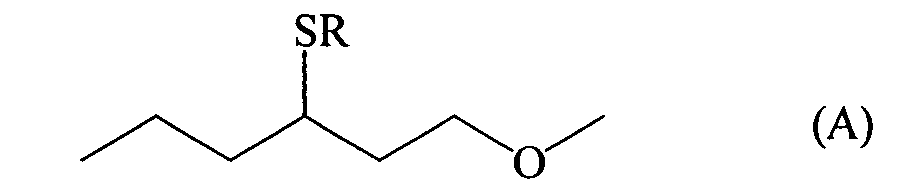
- EP 0 982 295 teaches the use as perfuming or flavor ingredients of compounds of formula wherein R represents a hydrogen atom or an acetyl group.
- the compounds of formula (II) are described as being able to confer an odor effect extremely powerful of the clary-sage type, even when used in small amounts.
- the taste conferred by said compounds is of the exotic fruit type with a mint note.
- S-[1-(2-methoxyethyl)butyl] ethanethioate is said to possess an odor with a typical sulfury note, accompanied by box-tree (Buxus), blackcurrant and onion type notes, which odor is also pronounced of the odor of sage.
- 1-methoxy-3-hexanethiol which also obeys formula (A), it is said to develop an odor of the sulfury type, but its fragrance also presents very natural green and herbaceous odor notes, which can be described as being reminiscent of the odor of the clary-sage. Its flavor, in addition to the above mentioned exotic fruit-minty effect, is described as being also reminiscent of grapefruit.
- the compounds of formula (I) may also be in an optically active form as they possess at least one chiral centre, i.e. the carbon atom bearing the R 2 group and the sulfur atom.
- the organoleptic properties of the isomers can differ from those of the respective racemates and in some cases, the pure optically active isomers possessed preferred organoleptic properties when compared with the respective racemates or even optically active mixtures of chiral isomers.
- the compounds (I) possess very natural and powerful sulfury green, herbaceous odors and are able to impart to the compositions to which they are added typical and surprising fruity tonalities.
- the compounds (I) provide typical and well-marked odor effects, when said compounds are incorporated in perfumes, even at high dilutions. Furthermore, although compounds (I) all seem to be characterized by their typical sulfury, green notes, a variety of odor nuances can be found amongst the various compounds of formula (I). For example, 1-methoxyheptane-3-thiol imparts a floral, green gardenia note recalling the floral-fruity odor of styrallyl acetate, whereas 1-ethoxyhexane-3-thiol is able to impart a berry, blackberry type and vegetable note.
- 1-methoxy-4-methylpentane-3-thiol it is particularly appreciated by the perfumers and is therefore a preferred ingredient of the invention.
- This compound develops an odor of the sulfury, herbaceous type and additionally it is able to impart to a composition a very much appreciated and marked fruity tonality, which is quite unexpected in view of the above-cited prior art disclosure.
- optically active compounds one can cite the (S)-1-methoxyheptane-3-thiol which has a nice natural black-currant note accompanied by green and tropical fruit notes.
- the ethers of the invention can suit almost all the fields of modern perfumery.
- the compounds (I) can also be used in functional perfumery, namely to perfume soaps, shower or bath gels, shampoos, body deodorants and antiperspirants, ambient air deodorants, liquid or solid detergents for textile treatment, detergent compositions or cleaning products for dishes or varied surfaces, or cosmetic preparations.
- the compounds according to the invention can be used alone, as well as mixed with other perfuming ingredients, solvents or additives commonly used in perfumery.
- the nature and variety of these coingredients do not require a more detailed description here, which would not be exhaustive anyway. In fact, a person skilled in the art, having a general knowledge, is able to choose them according to the nature of the product that has to be perfumed and the olfactory effect sought.
- These perfuming coingredients belong to varied chemical groups such as alcohols, aldehydes, ketones, esters, ethers, acetates, nitriles, terpernic hydrocarbons, heterocyclic nitrogen- or sulfur-containing compounds, as well as natural or synthetic essential oils.
- the proportions in which the compounds according to the invention can be incorporated in the different products mentioned above vary in a broad range of values. These values depend on the nature of the product that has to be perfumed and on the olfactory effect sought, as well as on the nature of the coingredients in a given composition when the compounds of the invention are used in admixture with perfuming coingredients, solvents or additives commonly used in the art.
- the compounds according to the invention will be used in small amounts, typically at very high dilutions, owing to their strong odor impact.
- concentrations from 1 ppm to 1%, and preferably from 10 ppm to 0.1% by weight of these compounds, with respect to the weight of the perfuming composition in which they are incorporated, can typically be used. Much lower concentrations than these can be used when these compounds are directly applied for perfuming some of the consumer products mentioned above.
- the compounds of formula (I) are also useful as flavoring ingredients, i.e. to impart taste to flavoring compositions and foods, pharmaceuticals or beverages for example. Their taste is associated with tropical fruits and berries notes.
- (R)-1-methoxy-4-methylpentane-3-thiol imparts an unexpected black-currant and guava flavor note.
- (S)-1-methoxyheptane-3-thiol which is particularly appreciated and is therefore a preferred flavor ingredient of the invention, in addition to its guava and passion fruit notes, also provides a very good and surprising berry note, including tonalities of the blackcurrant, strawberry, raspberry or blackberry type.
- the compounds of the invention are thus particularly suitable for the flavoring of products such as desserts, ice-creams, candies, beverages such as sodas or juices, compotes or fruit jams, yogurts or other dairy products, chewing-gums, pharmaceutical preparations, soups or stocks, cube stocks, dressings, snacks, sauces or ready cooked dishes.
- beverages such as sodas or juices, compotes or fruit jams, yogurts or other dairy products, chewing-gums, pharmaceutical preparations, soups or stocks, cube stocks, dressings, snacks, sauces or ready cooked dishes.
- the compounds according to the invention will typically be used in concentrations of the order of 0.001 to 0.1 ppm, preferably from 0.01 to 0.05 ppm, with respect to the foods into which they are incorporated. Much higher concentrations can be used when these compounds are directly applied in concentrated flavor or flavoring compositions which will be incorporated in consumer products.
- the thiols are the preferred perfuming or flavoring ingredients of the invention.
- the compounds (I) of the invention thus make it possible to confer, improve, enhance or modify the odor or taste of consumer products, as well as of perfuming bases or concentrates, or yet flavor preparations and compositions. In other words, they can impart to the latter their characteristic organoleptic properties, as the case may be, thus modifying and/or improving the original odor and taste properties of the products and compositions in which they are incorporated.
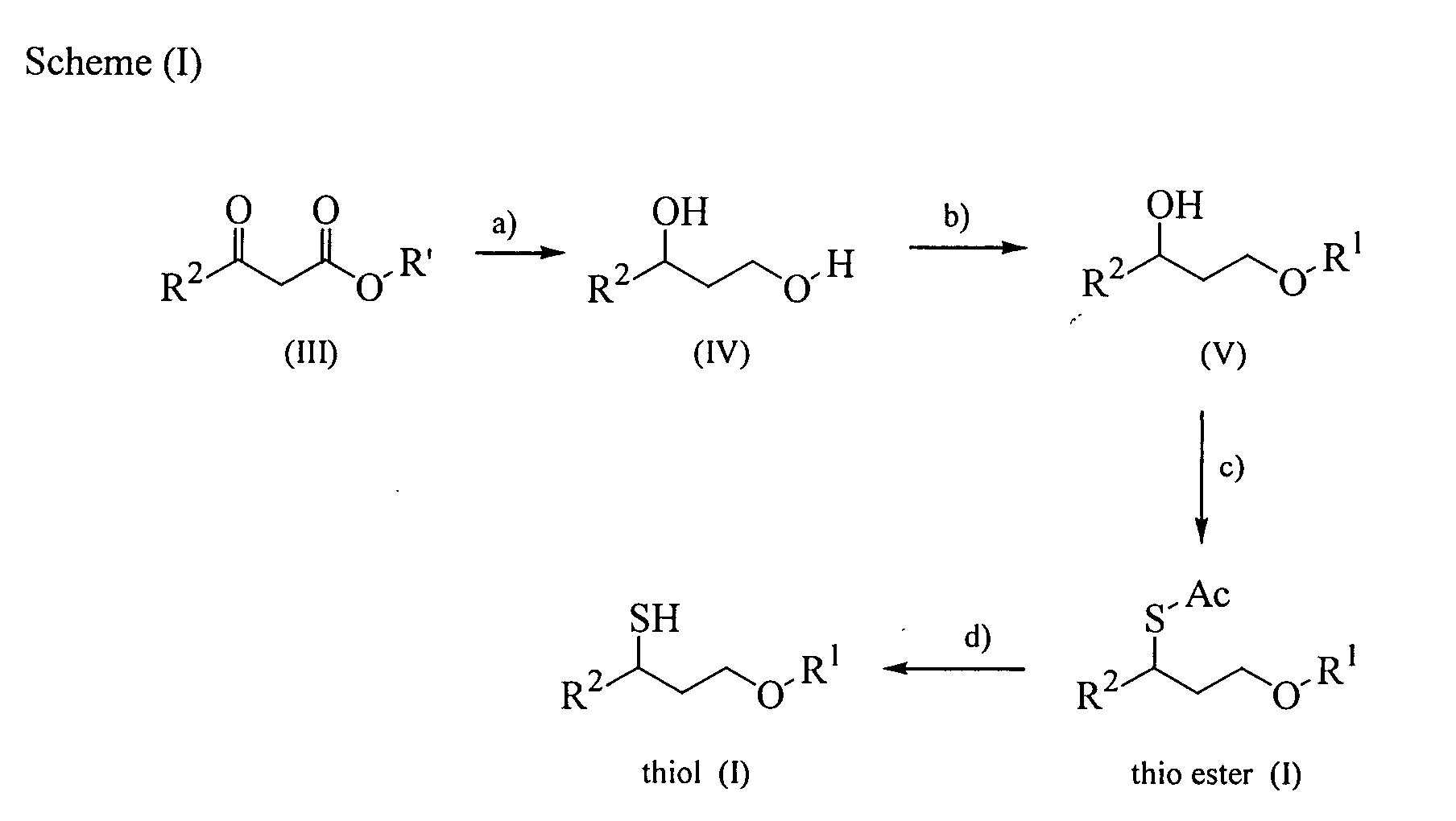
- the compounds of the invention may be prepared by the method summarized in the following scheme II:
- the starting optically active alcohol methyl (R)-3-hydroxy-heptanoate was obtained according to the method described by M.Utaka et al. in J.Org.Chem, 1990, 55 , 3917.
- the starting optically active alcohol methyl (S)-3-hydroxy-4-methylpentanoate was obtained according to the method described by N.Mochizuki et al . in Biosci. Biotechnol. Biochem., 1994, 58 , 1666.
- the intermediates (V) were obtained by following the same experimental procedure as described in example 1.b) and using MeI as alkylating agent.
- the crude product was purified by flash chromatography (cyclohexane/Et 2 O 7.5:2.5 then 7:3).
- the GC homogeneous fractions were combined and distilled (Vigreux column) to give the intermediates (V).
- R 2 R 1 Final product Yield n Bu Me (R)-1-Methoxyheptan-3-ol 51.4 % i Pr Me (S)-1-Methoxy-4-methylpentan-3-ol 41.5 %
- This compound was prepared from (R)-1-methoxyheptan-3-ol via inversion of configuration.
- the synthesis consists in the LiAlH 4 reduction of [(S)-1-(2-methoxyethyl)pentyl] acetate, according to the same procedure as described in example 1.d).
- [(S)-1-(2-methoxyethyl)pentyl] acetate was obtained by the same procedure as described in example 1.c) but in the presence of acetic acid instead of thioacetic acid.
- optically active thio esters (I) were obtained by following the same experimental procedure as described in Example 1.c) and using the corresponding optically active starting material according to scheme (II).
- R 2 R 1 Final product Yield n Bu Me (S)-S-[1-(2-Methoxyethyl)pentyl] ethanethioate 64 % n Bu Me (R)-S-[1-(2-Methoxyethyl)pentyl] ethanethioate 60 % i Pr Me (R)-S-[1-(2-Methoxyethyl)-2-methylpropyl] ethanethioate 24 %
- optically active thiol (I) was obtained by following the same experimental procedure as described in Example 1.d) and using the corresponding optically active starting material according to scheme (II).
- R 2 R 1 Final product Yield n Bu Me (S)-1-Methoxyheptane-3-thiol 91 % n Bu Me (R)-1-Methoxyheptane-3-thiol 91 % i Pr Me (R)-1-Methoxy-4-methylpentane-3-thiol 64 %
- composition containing the 1-methoxy-3-hexanethiol described in EP 0 982 295 presented a clear scent of the clary sage flower type.
- composition containing 1-methoxy-4-methylpentane-3-thiol according to the invention was judged to possess a very distinct fragrance more typical of clary sage seeds and appeared as softer, less sharp and with an enhanced fruity character when compared to the prior art fragrance.
- composition which contained 1-ethoxyhexane-3-thiol had a less powerful scent than the one containing 1-methoxy-3-hexanethiol, but with a clear blackcurrant note, totally absent from the prior known fragrance.
- a flavoring base composition with a berry character was prepared by admixing the following ingredients: Ingredients Parts by weight 4-(4-Methoxyphenyl)-2-butanone 20.00 Ethyl isovalerianoate 40.00 Maltol 20.00 Isobutiric acid 10.00 ⁇ -Damascone 1) 0.10 Ionone beta 0.30 Ethyl acetate 50.00 Ethyl butyrate 20.00 1% Bucchu oil 0.50 Propylene glycol 839.1 1000
- This base sorbet, or candy which does not contain any compound according to the invention, was compared to a new sorbet, or candy, containing the above-described flavoring composition and containing also 0.05% by weight of a 0.1% solution in ethanol of (S)-1-methoxyheptane-3-thiol.
- This composition of the invention was then compared to the base composition, on a blind test.
- the sorbet was prepared by admixing the following ingredients and using the usual techniques: Ingredients Parts by weight Sugar 150.0 Glucose 40 DE syrup 40.0 Citric acid 7.0 Maleic acid 3.0 Lactic acid 0.5 Trisodium citrate (20% aqueous solution) 2.0 Meypyrogen® IC 304 3.5 Water 794.0 1000
- the candy was prepared by admixing the following ingredients and using the usual mixing techniques: Ingredients Parts by weight 65% Glucose syrup 122.0 Glucose 30.0 Citric acid 1.5 153.5
Landscapes
- Chemical & Material Sciences (AREA)
- Organic Chemistry (AREA)
- Wood Science & Technology (AREA)
- Engineering & Computer Science (AREA)
- Chemical Kinetics & Catalysis (AREA)
- Oil, Petroleum & Natural Gas (AREA)
- Life Sciences & Earth Sciences (AREA)
- Organic Low-Molecular-Weight Compounds And Preparation Thereof (AREA)
- Seasonings (AREA)
- Fats And Perfumes (AREA)
- Cosmetics (AREA)
- Disinfection, Sterilisation Or Deodorisation Of Air (AREA)
- Detergent Compositions (AREA)
- Confectionery (AREA)
- Pharmaceuticals Containing Other Organic And Inorganic Compounds (AREA)
Abstract
Description


and R2 represents a C3-C4 linear or branched alkyl group,
possess useful organoleptic properties, which render them very useful for the perfume and flavor industries.
- R1 and R2
- as defined above
- R'
- being a C1-4 alkyl group
| R2 | R' | Final product | Yield |
| nPr | Et | Hexane-1,3-diol | 75 % |
| nBu | Me | Heptane-1,3-diol | 76 % |
| iPr | Me | 4-Methylpentane-1,3-diol | 73 % |
1H-NMR (after exchange with D2O) : 3.90-3.75(m, 1H-C(3), 2H-C(1)) ; 1.75-1.55(m,
2H-C(2)); 1.55-1.25(m, 2H-C(4), 2H-C(5)) ; 0.93(t, J = 6.9, 3H-C(6)).
13C-NMR : 71.36(d); 61.21(t); 39.89(t); 38.35(t); 18.76(t); 14.07(q).
MS : 100(15, [M-18]+), 85(8), 75(100), 57(80), 45(50), 43(53).
1H-NMR (after exchange with D2O): 3.80(m, H-C(3), 2H-C(1)) ; 1.75-1.25(3m, 8H) ;
0.91(t, J= 7.1, 3H-C(7)).
13C-NMR: 71.58(d); 61.16(t); 38.37(t); 37.43(t); 27.79(t); 22.74(t); 14.07(q).
MS : 114(2, [M-18]+), 85(40), 75(92), 69(45), 57(100), 45(68), 44(54), 41(55).
1H-NMR (after exchange with D2O): 3.80(m, 2H-C(1)) ; 3.53(m, H-C(3)) ; 1.75-1.55(m,
2H-C(2), H-C(4)) ; 0.93, 0.91(2d, J = 6.7, 3H-C(5), Me-C(4)).
13C-NMR: 76.60(d); 61.61(t); 35.03(t); 33.98(d); 18.44(q); 17.71(q).
MS : 100(10, [M- H2O]+), 75(100), 57(95), 45(70), 43(65).
| R2 | R1 | Final product | Yield |
| nPr | Et | 1-Ethoxyhexan-3-ol | 47% |
| nBu | Me | 1-Methoxyheptan-3-ol | 48 % |
| nBu | Et | 1-Ethoxyheptan-3-ol | 43 % |
| iPr | Me | 1-Methoxy-4-methylpentan-3-ol | 44 % |
1H-NMR : 3.79(m, H-C(3)) ; 3.68(dt, J= 9.5, 5.1, H-C(1)) ; 3.59(ddd, J= 9.5, 4.7, 4.1, H- C(1)) ; 3.50(q, J = 7.1, CH2O) ; 1.70(m, 2H-C(2)); 1.55-1.30(m, 4H); 1.20(t, J =
7.1, CH 3CH2)) ; 0.93(t, J= 6.7, 3H-C(6)).
13C-NMR : 71.34(d); 69.71(t); 66.61(t); 39.72(t); 36.38(t); 18.81(t); 15.18(q);
14.14(q).
MS : 145(1, [M-1]+), 128(3), 113(3), 103(45), 85(30), 71(16), 59(100), 45(52).
1H-NMR : 3.77(m, H-C(3)) ; 3.63(dt, J = 9.5, 5.1, H-C(1)); 3.54(ddd, J = 9.5, 4.7, 4.1, H- C(1)) ; 3.35(s, MeO) ; 2.90(d, J = 2.8, OH) ; 1.70(m, 2H-C(2)) ; 1.55-1.24(m,
6H) ; 0.90(t, J= 7.1, 3H-C(7)).
13C-NMR : 71.78(t); 71.41(d); 58.89(s, MeO); 37.22(t); 36.35(t); 27.82(t); 22.77(t);
14.09(q).
MS : 128(2, [M- 18]+), 113(2), 89(86), 71(29), 57(30), 45(100), 41(31).
1H-NMR : 3.77(m, H-C(3)) ; 3.68, 3.59(2m, 2H-C(1)) ; 3.49(q, J= 6.7, CH2O); 3.19(d, J
= 2.8, OH); 1.70(m, 2H) ; 1.55-1.25(6H) ; 1.20(t, J = 6.7, CH3CH 2); 0.91(t, J =
7.1, 3H-C(7)).
13C-NMR : 71.69(d); 69.76(t); 66.63(t); 37.24(t); 36.36(t); 27.85(t); 22.79(t);
15.19(q); 14.10(q).
MS : 159(1, [M- 1]+), 142(4), 127(3), 103(55), 85(29), 72(20), 59(100), 45(55).
1H-NMR: 3.65(dt, J = 9.1, 5.2, H-C(1)) ; 3.55(m, H-C(1), H-C(3)) ; 3.35(s, MeO);
2.87(d, J = 3.2, OH) ; 1.75-1.60(m, 2H-C(2), H-C(4)) ; 0.93, 0.91(2d, J = 7.1,
3H-C(5), Me-C(4)).
13C-NMR: 76.27(d); 72.13(t); 58.88(q); 33.73(d); 33.10(t); 18.46(q); 17.69(q).
MS : 133(0.5, [M + 1]+), 100(5, [M-MeOH]+), 89(64), 71(14), 57(16), 45(100).
| R2 | R1 | Final product | Yield |
| nPr | Et | S-[1-(2-Ethoxyethyl)butyl] ethanethioate | 53 % |
| nBu | Me | S-[1-(2-Methoxyethyl)pentyl] ethanethioate | 73 % |
| nBu | Et | S-[1-(2-Ethoxyethyl)pentyl] ethanethioate | 60 % |
| iPr | Me | S-[1-(2-Methoxyethyl)-2-methylpropyl] ethanethioate | 55 % |
IR: 1707s, 1124s.
1H-NMR : 3.63(m, H-C(1)); 3.47(m, CH2CH 2O); 3.45(q, J = 6.7, CH3CH 2O); 2.31(s,
MeCO) ; 1.91, 1.79(2m, CH2-C(1)); 1.58(m, 2H); 1.39(m, 2H); 1.18(t, J= 6.7,
CH 3CH2O); 0.90(t, J= 7.1, 3H-C(4)).
13C-NMR: 195.75(s); 68.08(t); 66.24(t); 41.55(d); 37.36(t); 34.79(t); 30.75(q);
19.97(t); 15.20(q); 13.87(q).
MS : 206(0.5), 205(1), 204(10, M +), 161(100), 128(20), 117(43), 102(15), 99(14), 85(47),
73(37), 59(30), 43(24).
IR: 1707s, 1124s.
1H-NMR: 3.60(m, H-C(1)); 3.42(m, CH2O); 3.31(s, MeO); 2.32(s, MeCO); 1.90,
1.79(2m, CH2-C(1)); 1.60(m, 2H) ; 1.32(m, 4H) ; 0.88(t, J = 7.1, 3H-C(5)).
13C-NMR : 195.7(s); 70.24(t); 58.64(q); 41.67(d); 34.80(t); 34.68(t); 30.76(q);
28.93(t); 22.50(t); 13.97(q).
MS : 206(0.5), 205(1), 204(3, M +), 161(35), 129(22), 114(7), 103(12), 96(18), 71(44),
59(38), 55(49), 45(100), 41(95).
IR : 1707s, 1124s.
1H-NMR : 3.61(m, H-C(1)) ; 3.47(m, CH2O); 3.45(m, MeCH2O); 2.31(s, MeCO); 1.98- 1.24(4m, 8H) ; 1.19(t, J= 6.7, CH 3CH2); 0.89(t, J= 7.1, 3H-C(5)).
13C-NMR : 195.74(s); 68.09(t); 66.24(t); 41.75(d); 34.86(t); 34.76(t); 30.75(q);
28.90(t); 22.51(t); 15.20(q); 13.97(q).
MS : 218(5, M +), 200(4), 175(100), 142(20), 131(60), 103(22), 97(35), 85(55), 73(55),
59(54), 43(55).
1H-NMR 3.61(dt, J = 10.3, 4.1, 1H of CH2O) ; 3.50-3.34(m, H-C(1), 1H of CH2O) ;
3.31(s, MeO) ; 2.39(s, MeCO) ; 1.93(m, 2H) ; 1.70(m, 1H) ; 0.94, 0.92(2d, J = 6.9,
3H-C(3), Me-C(2)).
13C-NMR : 195.68(s); 70.58(t); 58.70(q); 47.70(d); 32.50(t); 32.44(d); 30.82(q);
19.87(q) ; 18.69(q).
MS: 192(0.2), 191(4), 190(8, M +), 147(43), 115(20), 88(24), 71(47), 55(50), 45(100),
43(98).
| R2 | R1 | Final product | Yield |
| nPr | Et | 1-Ethoxyhexane-3-thiol | 90 % |
| nBu | Me | 1-Methoxyheptane-3-thiol | 55 % |
| iPr | Me | 1-Methoxy-4-methylpentane-3-thiol | 64 % |
IR : 2480w, 2440w, 1247s, 1127s.
1H-NMR : 3.58(m, 2H-C(1)); 3.48(dq, J = 1.6, 7.1, CH2O); 2.95(m, H-C(3)); 1.97(m,
1H); 1.66-1.40(m, 5H); 1.38(d, J= 6.7, SH); 1.12(t, J= 6.7, CH 3CH2); 0.92(t, J
= 7.1, 3H-C(7)).
13C-NMR: 68.09(t); 66.27(t); 41.44(t); 38.96(t); 37.69(d); 20.17(t); 15.22(q);
13.77(q).
MS: 163(1), 162(8, M +), 128(7), 116(100), 101(14), 99(15), 88(76), 85(80), 59(50),
55(50), 41(23).
IR : 2591vw, 1124s.
1H-NMR : 3.54(m, 2H-C(1)) ; 3.34(s, MeO) ; 2.93(m, H-C(3)) ; 1.97(m, 2H) ; 1.65(m,
2H) ; 1.49(m, 2H); 1.38(d, J = 7.8, SH) ; 1.33(m, 2H); 0.91(t, J = 7.1, 3H- C(7)).
13C-NMR: 70.28(t); 58.71(q); 39.02(t); 38.82(t); 37.83(d); 29.20(t); 22.44(t);
14.02(q).
MS : 164(0.5), 163(1), 162(11, M +), 130(10), 128(9), 101(9), 97(15), 88(62), 71(55),
55(49), 45(100), 41(35).
1H-NMR 3.55(m, 2H-C(1)) 3.35(s, MeO); 2.90(m, H-C(3)) ; 1.94, 1.85, 1.60(3m, 2H- C(2), H-C(4)) ; 1.18(d, J = 7.9, SH) ; 0.99, 0.92(2d, J = 6.7, 3H-C(5), Me-C(4)).
13C-NMR: 70.61(t); 58.70(q); 44.27(d); 36.20(t); 33.94(d); 20.19(q); 17.29(q).
MS : 150(0.5, [M + 2]+), 149 (1, [M+1]+), 148(9, M +), 116(15), 114(10), 101(5), 88(10),
83(20), 71(35), 67(5), 58(9), 55(30), 47(2), 45(100), 41(24).

- R1 and R2
- as defined above
| R2 | Final product | Yield |
| nBu | (R)-heptane-1,3-diol | 99 % |
| iPr | (S)-4-methylpentane-1,3-diol | 81% |
the analytical data are identical to those of the racemic diol and are described in example 1, [α]D 20 = 1.0°±0.2° (c = 1.00, CHCl3)
the analytical data are identical to those of the racemic diol and are described in example 1, [α]D 20 = 12.3° (c = 1.01, CHCl3)
| R2 | R1 | Final product | Yield |
| nBu | Me | (R)-1-Methoxyheptan-3-ol | 51.4 % |
| iPr | Me | (S)-1-Methoxy-4-methylpentan-3-ol | 41.5 % |
the analytical data are identical to those of the racemic monoether and are described in example 1,
the analytical data are identical to those of the racemic monoether and are described in example 1,
the analytical data are identical to those of the racemic monoether and are described in example 1,
| R2 | R1 | Final product | Yield |
| nBu | Me | (S)-S-[1-(2-Methoxyethyl)pentyl] ethanethioate | 64 % |
| nBu | Me | (R)-S-[1-(2-Methoxyethyl)pentyl] ethanethioate | 60 % |
| iPr | Me | (R)-S-[1-(2-Methoxyethyl)-2-methylpropyl] ethanethioate | 24 % |
the analytical data are identical to those of the racemic thio ester and are described in example 1,
the analytical data are identical to those of the racemic thio ester and are described in example 1,
the analytical data are identical to those of the racemic thio ester and are described in example 1,
| R2 | R1 | Final product | Yield |
| nBu | Me | (S)-1-Methoxyheptane-3-thiol | 91 % |
| nBu | Me | (R)-1-Methoxyheptane-3-thiol | 91 % |
| iPr | Me | (R)-1-Methoxy-4-methylpentane-3-thiol | 64 % |
the analytical data are identical to those of the racemic thio ester and are described in example 1,
the analytical data are identical to those of the racemic thio ester and are described in example 1,
the analytical data are identical to those of the racemic thio ester and are described in example 1,
| Ingredients | Parts by weight |
| Geranyl acetate | 70 |
| Linalyl acetate | 6500 |
| Neryl acetate | 30 |
| 10% cis-3-Hexenol acetate | 5 |
| 10% C9 aldehyde | 1 |
| Camphor | 20 |
| (+)-Carvone | 2 |
| 10% Cetalox ® 1) | 10 |
| Citronellol | 10 |
| 10% Coumarine | 2 |
| 1% * Damascenone | 20 |
| Dipropylene glycol | 30 |
| Eucalyptol | 30 |
| 10% Eugenol | 5 |
| Geraniol | 40 |
| Lemongrass | 20 |
| Linalool | 1500 |
| 10% Menthone | 10 |
| Myroxyde ®2) | 50 |
| Nerol | 20 |
| 10% Nerol oxide | 20 |
| 10% Pipol | 15 |
| Terpineol | 80 |
| 10% Benzyl tiglate | 10 |
| Total | 8500 |
| Ingredients | Parts by weight |
| 4-(4-Methoxyphenyl)-2-butanone | 20.00 |
| Ethyl isovalerianoate | 40.00 |
| Maltol | 20.00 |
| Isobutiric acid | 10.00 |
| β-Damascone 1) | 0.10 |
| Ionone beta | 0.30 |
| Ethyl acetate | 50.00 |
| Ethyl butyrate | 20.00 |
| 1% Bucchu oil | 0.50 |
| Propylene glycol | 839.1 |
| |
| Ingredients | Parts by weight |
| Sugar | 150.0 |
| Glucose 40 DE syrup | 40.0 |
| Citric acid | 7.0 |
| Maleic acid | 3.0 |
| Lactic acid | 0.5 |
| Trisodium citrate (20% aqueous solution) | 2.0 |
| Meypyrogen® IC 304 | 3.5 |
| Water | 794.0 |
| |
| Ingredients | Parts by weight |
| 65% Glucose syrup | 122.0 |
| Glucose | 30.0 |
| Citric acid | 1.5 |
| |
Claims (9)
- A compound of formulain the form of any one of its isomers or of a mixture thereof, and wherein R represents a hydrogen atom or an acetyl group, R1 represents a methyl or an ethyl group and R2 represents a C3-C4 linear or branched alkyl group, provided that 1-methoxy-3-hexanethiol and S-[1-(2-methoxyethyl)butyl] ethanethioate are excluded.

- As a compound of formula (I) according to claim 1, 1-methoxy-4-methylpentane-3-thiol or (S)-1-methoxyheptane-3-thiol.
- As a compound of formula (I) according to claim 1, 1-methoxyheptane-3-thiol, 1-ethoxyhexane-3-thiol, S-[1-(2-ethoxyethyl)pentyl] ethanethioate, S-[1-(2-ethoxyethyl) butyl]ethanethioate or (R)-1-methoxy-4-methylpentane-3-thiol.
- A perfuming composition or a perfumed product containing as active ingredient a compound according to anyone of claims 1 to 3.
- Perfumed product according to claim 4, in the form of a perfume or a cologne, a soap, a shower or bath gel, a shampoo or another hair-care product, a cosmetic preparation, a body or ambient air deodorant, a detergent or a fabric softener, or a household product.
- A flavoring composition or a flavored product containing as active ingredient a compound according to anyone of claims 1 to 3.
- Flavored product according to claim 6, in the form of a dessert, ice-cream, candy, beverage, soda, juice, compote or fruit jam, yogurt or another dairy product, chewing-gums, pharmaceutical preparations, soup or stock, cube stock, dressing, snack, sauce or a ready cooked dish.
- A method to confer, improve, enhance or modify the odor properties of a perfuming composition or a perfumed product, which method comprises adding a compound according to anyone of claims 1 to 3 as perfuming ingredient to said composition or product.
- A method to confer, improve, enhance or modify the flavor properties of a flavor composition or a flavored product, which method comprises adding a compound according to anyone of claims 1 to 3 as flavoring ingredient to said composition or product.
Applications Claiming Priority (2)
| Application Number | Priority Date | Filing Date | Title |
|---|---|---|---|
| IB0100631 | 2001-04-12 | ||
| WOPCT/IB01/00631 | 2001-04-12 |
Publications (3)
| Publication Number | Publication Date |
|---|---|
| EP1249446A2 true EP1249446A2 (en) | 2002-10-16 |
| EP1249446A3 EP1249446A3 (en) | 2003-06-11 |
| EP1249446B1 EP1249446B1 (en) | 2007-03-07 |
Family
ID=11004086
Family Applications (1)
| Application Number | Title | Priority Date | Filing Date |
|---|---|---|---|
| EP02005809A Expired - Lifetime EP1249446B1 (en) | 2001-04-12 | 2002-03-14 | Use of thio derivates as flavoring ingredients |
Country Status (6)
| Country | Link |
|---|---|
| US (1) | US7008919B2 (en) |
| EP (1) | EP1249446B1 (en) |
| JP (1) | JP4154166B2 (en) |
| AT (1) | ATE356112T1 (en) |
| DE (1) | DE60218561T2 (en) |
| ES (1) | ES2282337T3 (en) |
Cited By (4)
| Publication number | Priority date | Publication date | Assignee | Title |
|---|---|---|---|---|
| WO2006120625A1 (en) * | 2005-05-13 | 2006-11-16 | Firmenich Sa | Thiols as flavoring ingredient |
| WO2008090397A1 (en) * | 2007-01-23 | 2008-07-31 | Quest International Services B.V. | Optimized perfumery for rinse-off products |
| US7517840B2 (en) | 2005-04-07 | 2009-04-14 | Givaudan Fragrances Corporation | Optimized perfumery for rinse-off products |
| WO2017046057A1 (en) * | 2015-09-17 | 2017-03-23 | Henkel Ag & Co. Kgaa | Perfume composition comprising fragrance modulator compounds for increasing the intensity of fragrance |
Families Citing this family (5)
| Publication number | Priority date | Publication date | Assignee | Title |
|---|---|---|---|---|
| WO2004031766A1 (en) | 2002-10-04 | 2004-04-15 | Kao Corporation | Indicator for assessing body odor, process for producing the same, body odor assessment method, method of assessing efficaciousness of deodorant and kit for conveniently assesing body odor |
| US10993464B2 (en) | 2005-05-13 | 2021-05-04 | Firmenich Sa | Thiols as flavoring ingredient |
| JP2008214261A (en) * | 2007-03-02 | 2008-09-18 | Sapporo Breweries Ltd | Aromatic compounds, aromatic compositions, aromatic hop extracts |
| WO2016135193A1 (en) * | 2015-02-25 | 2016-09-01 | Firmenich Sa | A synergistic perfuming composition |
| JP6859419B1 (en) * | 2019-11-15 | 2021-04-14 | 長谷川香料株式会社 | 3-Mercapto-3-methylpentyl acetate and flavoring agent |
Family Cites Families (1)
| Publication number | Priority date | Publication date | Assignee | Title |
|---|---|---|---|---|
| ES2187105T3 (en) * | 1998-08-21 | 2003-05-16 | Firmenich & Cie | ETERNAL; ITS USE AS PERFUMING AND AROMATIZING AGENTS; ITS PREPARATION. |
-
2002
- 2002-03-14 AT AT02005809T patent/ATE356112T1/en not_active IP Right Cessation
- 2002-03-14 ES ES02005809T patent/ES2282337T3/en not_active Expired - Lifetime
- 2002-03-14 DE DE60218561T patent/DE60218561T2/en not_active Expired - Lifetime
- 2002-03-14 EP EP02005809A patent/EP1249446B1/en not_active Expired - Lifetime
- 2002-03-25 US US10/106,541 patent/US7008919B2/en not_active Expired - Lifetime
- 2002-04-09 JP JP2002106946A patent/JP4154166B2/en not_active Expired - Lifetime
Cited By (4)
| Publication number | Priority date | Publication date | Assignee | Title |
|---|---|---|---|---|
| US7517840B2 (en) | 2005-04-07 | 2009-04-14 | Givaudan Fragrances Corporation | Optimized perfumery for rinse-off products |
| WO2006120625A1 (en) * | 2005-05-13 | 2006-11-16 | Firmenich Sa | Thiols as flavoring ingredient |
| WO2008090397A1 (en) * | 2007-01-23 | 2008-07-31 | Quest International Services B.V. | Optimized perfumery for rinse-off products |
| WO2017046057A1 (en) * | 2015-09-17 | 2017-03-23 | Henkel Ag & Co. Kgaa | Perfume composition comprising fragrance modulator compounds for increasing the intensity of fragrance |
Also Published As
| Publication number | Publication date |
|---|---|
| ES2282337T3 (en) | 2007-10-16 |
| JP2003012637A (en) | 2003-01-15 |
| US7008919B2 (en) | 2006-03-07 |
| US20030040460A1 (en) | 2003-02-27 |
| EP1249446B1 (en) | 2007-03-07 |
| DE60218561T2 (en) | 2007-11-29 |
| JP4154166B2 (en) | 2008-09-24 |
| DE60218561D1 (en) | 2007-04-19 |
| EP1249446A3 (en) | 2003-06-11 |
| ATE356112T1 (en) | 2007-03-15 |
Similar Documents
| Publication | Publication Date | Title |
|---|---|---|
| EP1458666B1 (en) | Improved aromachemicals | |
| US7008919B2 (en) | Use of thio derivatives as perfuming and flavoring ingredients | |
| EP0770670B1 (en) | Perfume composition containing (4R)-cis-4-methyl-2-substituted-tetrahydro-2H-pyran derivative and method for improving fragrance by using it | |
| US20080213451A1 (en) | Flavor Composition or Fragrance Composition, and Flavor-Improving Agents | |
| US6129941A (en) | 1-methoxy-3-hexanethiol and its S-acetyl derivative as perfuming and flavoring ingredients | |
| US5180710A (en) | Ethyl (2e,4z,7z)-2,4,7-decatrienoate and its use as a perfuming or flavoring ingredient | |
| JPH03173841A (en) | Acyclic terpene compound containing oxygen or sulfur and fragrance and flavor compositions containing said compound | |
| US4065408A (en) | α-Oxy(oxo) sulfide perfume and cologne compositions | |
| JP3574744B2 (en) | Ethyl vanillin isobutyrate | |
| US20020055455A1 (en) | Use of unsaturated esters as perfuming ingredients | |
| JPH04266865A (en) | 3-(hexenyloxy)-propane-nitrile, preparation thereof and use thereof | |
| EP2181085A1 (en) | Cyclopropanated aromachemicals | |
| US20090016976A1 (en) | Citral and citronellal derivatives | |
| EP0908173B1 (en) | Use in perfumery of 1-methoxy-2-methyl-3-phenylpropane,1-(2-methoxypropyl)-4-methylbenzene and 3-methoxy-2,2,3,-trimethyl-1-phenylbutane | |
| US9179701B2 (en) | 2-mercapto-5-methyl-4-heptanone and its use in flavor and fragrance compositions | |
| EP2307429A1 (en) | Substituted butanol derivatives and their use as fragrance and flavor materials | |
| KR20260042481A (en) | Fragrance composition | |
| EP0211954A1 (en) | Use of (+/-)-cis-gamma-irone in perfumery and novel process for preparing same | |
| EP2168941A1 (en) | Novel Glycolate derivatives |
Legal Events
| Date | Code | Title | Description |
|---|---|---|---|
| PUAI | Public reference made under article 153(3) epc to a published international application that has entered the european phase |
Free format text: ORIGINAL CODE: 0009012 |
|
| AK | Designated contracting states |
Kind code of ref document: A2 Designated state(s): AT BE CH CY DE DK ES FI FR GB GR IE IT LI LU MC NL PT SE TR |
|
| AX | Request for extension of the european patent |
Free format text: AL;LT;LV;MK;RO;SI |
|
| PUAL | Search report despatched |
Free format text: ORIGINAL CODE: 0009013 |
|
| AK | Designated contracting states |
Designated state(s): AT BE CH CY DE DK ES FI FR GB GR IE IT LI LU MC NL PT SE TR |
|
| AX | Request for extension of the european patent |
Extension state: AL LT LV MK RO SI |
|
| RIC1 | Information provided on ipc code assigned before grant |
Ipc: 7C 07C 323/28 B Ipc: 7A 23L 1/226 B Ipc: 7C 07C 323/12 A Ipc: 7C 11B 9/00 B |
|
| 17P | Request for examination filed |
Effective date: 20031211 |
|
| AKX | Designation fees paid |
Designated state(s): AT BE CH CY DE DK ES FI FR GB GR IE IT LI LU MC NL PT SE TR |
|
| 17Q | First examination report despatched |
Effective date: 20041119 |
|
| GRAP | Despatch of communication of intention to grant a patent |
Free format text: ORIGINAL CODE: EPIDOSNIGR1 |
|
| RTI1 | Title (correction) |
Free format text: USE OF THIO DERIVATES AS FLAVORING INGREDIENTS |
|
| GRAS | Grant fee paid |
Free format text: ORIGINAL CODE: EPIDOSNIGR3 |
|
| GRAA | (expected) grant |
Free format text: ORIGINAL CODE: 0009210 |
|
| AK | Designated contracting states |
Kind code of ref document: B1 Designated state(s): AT BE CH CY DE DK ES FI FR GB GR IE IT LI LU MC NL PT SE TR |
|
| PG25 | Lapsed in a contracting state [announced via postgrant information from national office to epo] |
Ref country code: AT Free format text: LAPSE BECAUSE OF FAILURE TO SUBMIT A TRANSLATION OF THE DESCRIPTION OR TO PAY THE FEE WITHIN THE PRESCRIBED TIME-LIMIT Effective date: 20070307 Ref country code: FI Free format text: LAPSE BECAUSE OF FAILURE TO SUBMIT A TRANSLATION OF THE DESCRIPTION OR TO PAY THE FEE WITHIN THE PRESCRIBED TIME-LIMIT Effective date: 20070307 Ref country code: BE Free format text: LAPSE BECAUSE OF FAILURE TO SUBMIT A TRANSLATION OF THE DESCRIPTION OR TO PAY THE FEE WITHIN THE PRESCRIBED TIME-LIMIT Effective date: 20070307 |
|
| REG | Reference to a national code |
Ref country code: GB Ref legal event code: FG4D |
|
| RIN1 | Information on inventor provided before grant (corrected) |
Inventor name: VAN DE WAAL, MATTHIJS Inventor name: ESCHER, SINA, DOROTHEA Inventor name: NICLASS, YVAN |
|
| REG | Reference to a national code |
Ref country code: CH Ref legal event code: EP |
|
| REF | Corresponds to: |
Ref document number: 60218561 Country of ref document: DE Date of ref document: 20070419 Kind code of ref document: P |
|
| REG | Reference to a national code |
Ref country code: IE Ref legal event code: FG4D |
|
| PG25 | Lapsed in a contracting state [announced via postgrant information from national office to epo] |
Ref country code: SE Free format text: LAPSE BECAUSE OF FAILURE TO SUBMIT A TRANSLATION OF THE DESCRIPTION OR TO PAY THE FEE WITHIN THE PRESCRIBED TIME-LIMIT Effective date: 20070607 |
|
| ET | Fr: translation filed | ||
| PG25 | Lapsed in a contracting state [announced via postgrant information from national office to epo] |
Ref country code: PT Free format text: LAPSE BECAUSE OF FAILURE TO SUBMIT A TRANSLATION OF THE DESCRIPTION OR TO PAY THE FEE WITHIN THE PRESCRIBED TIME-LIMIT Effective date: 20070807 |
|
| REG | Reference to a national code |
Ref country code: ES Ref legal event code: FG2A Ref document number: 2282337 Country of ref document: ES Kind code of ref document: T3 |
|
| PLBE | No opposition filed within time limit |
Free format text: ORIGINAL CODE: 0009261 |
|
| STAA | Information on the status of an ep patent application or granted ep patent |
Free format text: STATUS: NO OPPOSITION FILED WITHIN TIME LIMIT |
|
| PG25 | Lapsed in a contracting state [announced via postgrant information from national office to epo] |
Ref country code: DK Free format text: LAPSE BECAUSE OF FAILURE TO SUBMIT A TRANSLATION OF THE DESCRIPTION OR TO PAY THE FEE WITHIN THE PRESCRIBED TIME-LIMIT Effective date: 20070307 Ref country code: IE Free format text: LAPSE BECAUSE OF NON-PAYMENT OF DUE FEES Effective date: 20070314 Ref country code: MC Free format text: LAPSE BECAUSE OF NON-PAYMENT OF DUE FEES Effective date: 20070331 |
|
| 26N | No opposition filed |
Effective date: 20071210 |
|
| PG25 | Lapsed in a contracting state [announced via postgrant information from national office to epo] |
Ref country code: GR Free format text: LAPSE BECAUSE OF FAILURE TO SUBMIT A TRANSLATION OF THE DESCRIPTION OR TO PAY THE FEE WITHIN THE PRESCRIBED TIME-LIMIT Effective date: 20070608 |
|
| PGFP | Annual fee paid to national office [announced via postgrant information from national office to epo] |
Ref country code: IT Payment date: 20080219 Year of fee payment: 7 Ref country code: NL Payment date: 20080214 Year of fee payment: 7 |
|
| PG25 | Lapsed in a contracting state [announced via postgrant information from national office to epo] |
Ref country code: CY Free format text: LAPSE BECAUSE OF FAILURE TO SUBMIT A TRANSLATION OF THE DESCRIPTION OR TO PAY THE FEE WITHIN THE PRESCRIBED TIME-LIMIT Effective date: 20070307 |
|
| PG25 | Lapsed in a contracting state [announced via postgrant information from national office to epo] |
Ref country code: LU Free format text: LAPSE BECAUSE OF NON-PAYMENT OF DUE FEES Effective date: 20070314 |
|
| NLV4 | Nl: lapsed or anulled due to non-payment of the annual fee |
Effective date: 20091001 |
|
| PG25 | Lapsed in a contracting state [announced via postgrant information from national office to epo] |
Ref country code: NL Free format text: LAPSE BECAUSE OF NON-PAYMENT OF DUE FEES Effective date: 20091001 |
|
| PG25 | Lapsed in a contracting state [announced via postgrant information from national office to epo] |
Ref country code: IT Free format text: LAPSE BECAUSE OF NON-PAYMENT OF DUE FEES Effective date: 20090314 |
|
| PGFP | Annual fee paid to national office [announced via postgrant information from national office to epo] |
Ref country code: TR Payment date: 20150312 Year of fee payment: 14 |
|
| REG | Reference to a national code |
Ref country code: FR Ref legal event code: PLFP Year of fee payment: 15 |
|
| REG | Reference to a national code |
Ref country code: FR Ref legal event code: PLFP Year of fee payment: 16 |
|
| REG | Reference to a national code |
Ref country code: FR Ref legal event code: PLFP Year of fee payment: 17 |
|
| REG | Reference to a national code |
Ref country code: DE Ref legal event code: R081 Ref document number: 60218561 Country of ref document: DE Owner name: FIRMENICH SA, CH Free format text: FORMER OWNER: FIRMENICH S.A., GENF/GENEVE, CH |
|
| REG | Reference to a national code |
Ref country code: CH Ref legal event code: PCOW Free format text: NEW ADDRESS: 7, RUE DE LA BERGERE, 1242 SATIGNY (CH) |
|
| PGFP | Annual fee paid to national office [announced via postgrant information from national office to epo] |
Ref country code: FR Payment date: 20210225 Year of fee payment: 20 Ref country code: CH Payment date: 20210331 Year of fee payment: 20 |
|
| PGFP | Annual fee paid to national office [announced via postgrant information from national office to epo] |
Ref country code: DE Payment date: 20210302 Year of fee payment: 20 Ref country code: GB Payment date: 20210308 Year of fee payment: 20 |
|
| PGFP | Annual fee paid to national office [announced via postgrant information from national office to epo] |
Ref country code: ES Payment date: 20210402 Year of fee payment: 20 |
|
| REG | Reference to a national code |
Ref country code: DE Ref legal event code: R071 Ref document number: 60218561 Country of ref document: DE |
|
| REG | Reference to a national code |
Ref country code: CH Ref legal event code: PL |
|
| REG | Reference to a national code |
Ref country code: GB Ref legal event code: PE20 Expiry date: 20220313 |
|
| PG25 | Lapsed in a contracting state [announced via postgrant information from national office to epo] |
Ref country code: GB Free format text: LAPSE BECAUSE OF EXPIRATION OF PROTECTION Effective date: 20220313 |
|
| REG | Reference to a national code |
Ref country code: ES Ref legal event code: FD2A Effective date: 20220624 |
|
| PG25 | Lapsed in a contracting state [announced via postgrant information from national office to epo] |
Ref country code: TR Free format text: LAPSE BECAUSE OF NON-PAYMENT OF DUE FEES Effective date: 20160314 |
|
| PG25 | Lapsed in a contracting state [announced via postgrant information from national office to epo] |
Ref country code: ES Free format text: LAPSE BECAUSE OF EXPIRATION OF PROTECTION Effective date: 20220315 |