EP1248788B1 - Synthesis of isosorbide mononitrate - Google Patents
Synthesis of isosorbide mononitrate Download PDFInfo
- Publication number
- EP1248788B1 EP1248788B1 EP20000985697 EP00985697A EP1248788B1 EP 1248788 B1 EP1248788 B1 EP 1248788B1 EP 20000985697 EP20000985697 EP 20000985697 EP 00985697 A EP00985697 A EP 00985697A EP 1248788 B1 EP1248788 B1 EP 1248788B1
- Authority
- EP
- European Patent Office
- Prior art keywords
- alkali metal
- isosorbide
- groups
- group
- transition metal
- Prior art date
- Legal status (The legal status is an assumption and is not a legal conclusion. Google has not performed a legal analysis and makes no representation as to the accuracy of the status listed.)
- Expired - Lifetime
Links
- YWXYYJSYQOXTPL-SLPGGIOYSA-N isosorbide mononitrate Chemical compound [O-][N+](=O)O[C@@H]1CO[C@@H]2[C@@H](O)CO[C@@H]21 YWXYYJSYQOXTPL-SLPGGIOYSA-N 0.000 title description 50
- 229960003827 isosorbide mononitrate Drugs 0.000 title description 50
- 230000015572 biosynthetic process Effects 0.000 title description 9
- 238000003786 synthesis reaction Methods 0.000 title description 6
- 238000000034 method Methods 0.000 claims abstract description 55
- 239000003054 catalyst Substances 0.000 claims abstract description 49
- XEEYBQQBJWHFJM-UHFFFAOYSA-N Iron Chemical compound [Fe] XEEYBQQBJWHFJM-UHFFFAOYSA-N 0.000 claims abstract description 30
- 150000001875 compounds Chemical class 0.000 claims abstract description 29
- 229910052723 transition metal Inorganic materials 0.000 claims abstract description 26
- 150000003624 transition metals Chemical class 0.000 claims abstract description 26
- UFHFLCQGNIYNRP-UHFFFAOYSA-N Hydrogen Chemical compound [H][H] UFHFLCQGNIYNRP-UHFFFAOYSA-N 0.000 claims abstract description 24
- IEQIEDJGQAUEQZ-UHFFFAOYSA-N phthalocyanine Chemical compound N1C(N=C2C3=CC=CC=C3C(N=C3C4=CC=CC=C4C(=N4)N3)=N2)=C(C=CC=C2)C2=C1N=C1C2=CC=CC=C2C4=N1 IEQIEDJGQAUEQZ-UHFFFAOYSA-N 0.000 claims abstract description 21
- 229910052739 hydrogen Inorganic materials 0.000 claims abstract description 20
- 239000001257 hydrogen Substances 0.000 claims abstract description 20
- 229910017052 cobalt Inorganic materials 0.000 claims abstract description 16
- 239000010941 cobalt Substances 0.000 claims abstract description 16
- GUTLYIVDDKVIGB-UHFFFAOYSA-N cobalt atom Chemical compound [Co] GUTLYIVDDKVIGB-UHFFFAOYSA-N 0.000 claims abstract description 16
- 125000003545 alkoxy group Chemical group 0.000 claims abstract description 15
- 229910052742 iron Inorganic materials 0.000 claims abstract description 15
- 125000000923 (C1-C30) alkyl group Chemical group 0.000 claims abstract description 5
- 125000003118 aryl group Chemical group 0.000 claims abstract description 5
- 125000005842 heteroatom Chemical group 0.000 claims abstract description 5
- 229910052757 nitrogen Inorganic materials 0.000 claims abstract description 4
- 229910052760 oxygen Inorganic materials 0.000 claims abstract description 4
- 125000000304 alkynyl group Chemical group 0.000 claims abstract description 3
- 125000004104 aryloxy group Chemical group 0.000 claims abstract description 3
- 125000004181 carboxyalkyl group Chemical group 0.000 claims abstract description 3
- 125000005352 carboxycycloalkyl group Chemical group 0.000 claims abstract description 3
- 125000000392 cycloalkenyl group Chemical group 0.000 claims abstract description 3
- 125000000000 cycloalkoxy group Chemical group 0.000 claims abstract description 3
- 125000000753 cycloalkyl group Chemical group 0.000 claims abstract description 3
- 125000001072 heteroaryl group Chemical group 0.000 claims abstract description 3
- 125000005553 heteroaryloxy group Chemical group 0.000 claims abstract description 3
- 125000000623 heterocyclic group Chemical group 0.000 claims abstract description 3
- 229910052717 sulfur Inorganic materials 0.000 claims abstract description 3
- BASFCYQUMIYNBI-UHFFFAOYSA-N platinum Chemical compound [Pt] BASFCYQUMIYNBI-UHFFFAOYSA-N 0.000 claims abstract 4
- 229910052697 platinum Inorganic materials 0.000 claims abstract 2
- YMWUJEATGCHHMB-UHFFFAOYSA-N Dichloromethane Chemical compound ClCCl YMWUJEATGCHHMB-UHFFFAOYSA-N 0.000 claims description 117
- OKKJLVBELUTLKV-UHFFFAOYSA-N Methanol Chemical compound OC OKKJLVBELUTLKV-UHFFFAOYSA-N 0.000 claims description 87
- -1 sulphonate ester Chemical class 0.000 claims description 55
- LFQSCWFLJHTTHZ-UHFFFAOYSA-N Ethanol Chemical compound CCO LFQSCWFLJHTTHZ-UHFFFAOYSA-N 0.000 claims description 54
- 230000009467 reduction Effects 0.000 claims description 41
- 238000006243 chemical reaction Methods 0.000 claims description 37
- 229910052783 alkali metal Inorganic materials 0.000 claims description 30
- 239000002904 solvent Substances 0.000 claims description 25
- 150000004678 hydrides Chemical class 0.000 claims description 20
- 150000001340 alkali metals Chemical class 0.000 claims description 19
- DGAQECJNVWCQMB-PUAWFVPOSA-M Ilexoside XXIX Chemical compound C[C@@H]1CC[C@@]2(CC[C@@]3(C(=CC[C@H]4[C@]3(CC[C@@H]5[C@@]4(CC[C@@H](C5(C)C)OS(=O)(=O)[O-])C)C)[C@@H]2[C@]1(C)O)C)C(=O)O[C@H]6[C@@H]([C@H]([C@@H]([C@H](O6)CO)O)O)O.[Na+] DGAQECJNVWCQMB-PUAWFVPOSA-M 0.000 claims description 18
- 239000000203 mixture Substances 0.000 claims description 18
- 229910052708 sodium Inorganic materials 0.000 claims description 18
- 239000011734 sodium Substances 0.000 claims description 18
- MUMZUERVLWJKNR-UHFFFAOYSA-N oxoplatinum Chemical compound [Pt]=O MUMZUERVLWJKNR-UHFFFAOYSA-N 0.000 claims description 17
- 229910003446 platinum oxide Inorganic materials 0.000 claims description 17
- ZLMJMSJWJFRBEC-UHFFFAOYSA-N Potassium Chemical compound [K] ZLMJMSJWJFRBEC-UHFFFAOYSA-N 0.000 claims description 14
- 229910052700 potassium Inorganic materials 0.000 claims description 14
- 239000011591 potassium Substances 0.000 claims description 14
- WHXSMMKQMYFTQS-UHFFFAOYSA-N Lithium Chemical compound [Li] WHXSMMKQMYFTQS-UHFFFAOYSA-N 0.000 claims description 13
- 125000000217 alkyl group Chemical group 0.000 claims description 13
- 229910052744 lithium Inorganic materials 0.000 claims description 13
- OKTJSMMVPCPJKN-UHFFFAOYSA-N Carbon Chemical group [C] OKTJSMMVPCPJKN-UHFFFAOYSA-N 0.000 claims description 12
- 125000004432 carbon atom Chemical group C* 0.000 claims description 12
- 125000004122 cyclic group Chemical group 0.000 claims description 12
- RTZKZFJDLAIYFH-UHFFFAOYSA-N Diethyl ether Chemical compound CCOCC RTZKZFJDLAIYFH-UHFFFAOYSA-N 0.000 claims description 7
- 239000012298 atmosphere Substances 0.000 claims description 7
- 229910000102 alkali metal hydride Inorganic materials 0.000 claims description 3
- 150000008046 alkali metal hydrides Chemical class 0.000 claims description 3
- 229920000642 polymer Polymers 0.000 claims description 3
- ALYNCZNDIQEVRV-UHFFFAOYSA-N 4-aminobenzoic acid Chemical compound NC1=CC=C(C(O)=O)C=C1 ALYNCZNDIQEVRV-UHFFFAOYSA-N 0.000 claims description 2
- BSYNRYMUTXBXSQ-UHFFFAOYSA-N Aspirin Chemical compound CC(=O)OC1=CC=CC=C1C(O)=O BSYNRYMUTXBXSQ-UHFFFAOYSA-N 0.000 claims description 2
- 125000000739 C2-C30 alkenyl group Chemical group 0.000 claims description 2
- 229940064734 aminobenzoate Drugs 0.000 claims description 2
- 125000004093 cyano group Chemical group *C#N 0.000 claims description 2
- 150000002148 esters Chemical class 0.000 claims description 2
- 229910052736 halogen Inorganic materials 0.000 claims description 2
- 150000002367 halogens Chemical class 0.000 claims description 2
- 150000002576 ketones Chemical class 0.000 claims description 2
- CMWTZPSULFXXJA-VIFPVBQESA-M naproxen(1-) Chemical compound C1=C([C@H](C)C([O-])=O)C=CC2=CC(OC)=CC=C21 CMWTZPSULFXXJA-VIFPVBQESA-M 0.000 claims description 2
- 125000000449 nitro group Chemical group [O-][N+](*)=O 0.000 claims description 2
- 125000001424 substituent group Chemical group 0.000 claims description 2
- 150000003568 thioethers Chemical class 0.000 claims description 2
- 125000004429 atom Chemical group 0.000 abstract 1
- MOYKHGMNXAOIAT-JGWLITMVSA-N isosorbide dinitrate Chemical compound [O-][N+](=O)O[C@H]1CO[C@@H]2[C@H](O[N+](=O)[O-])CO[C@@H]21 MOYKHGMNXAOIAT-JGWLITMVSA-N 0.000 description 61
- 229960000201 isosorbide dinitrate Drugs 0.000 description 52
- 239000012279 sodium borohydride Substances 0.000 description 48
- 229910000033 sodium borohydride Inorganic materials 0.000 description 48
- 238000006722 reduction reaction Methods 0.000 description 44
- KLDXJTOLSGUMSJ-JGWLITMVSA-N Isosorbide Chemical compound O[C@@H]1CO[C@@H]2[C@@H](O)CO[C@@H]21 KLDXJTOLSGUMSJ-JGWLITMVSA-N 0.000 description 30
- 229960002479 isosorbide Drugs 0.000 description 24
- KMHSUNDEGHRBNV-UHFFFAOYSA-N 2,4-dichloropyrimidine-5-carbonitrile Chemical compound ClC1=NC=C(C#N)C(Cl)=N1 KMHSUNDEGHRBNV-UHFFFAOYSA-N 0.000 description 21
- QTBSBXVTEAMEQO-UHFFFAOYSA-N Acetic acid Chemical compound CC(O)=O QTBSBXVTEAMEQO-UHFFFAOYSA-N 0.000 description 21
- 238000004817 gas chromatography Methods 0.000 description 21
- 230000008569 process Effects 0.000 description 18
- WEVYAHXRMPXWCK-UHFFFAOYSA-N Acetonitrile Chemical compound CC#N WEVYAHXRMPXWCK-UHFFFAOYSA-N 0.000 description 15
- HEMHJVSKTPXQMS-UHFFFAOYSA-M Sodium hydroxide Chemical compound [OH-].[Na+] HEMHJVSKTPXQMS-UHFFFAOYSA-M 0.000 description 15
- 230000002829 reductive effect Effects 0.000 description 15
- JYWNYMJKURVPFH-UHFFFAOYSA-N N-gamma-Acetyl-N-2-Formyl-5-Methoxykynurenamine Chemical compound COC1=CC=C(NC=O)C(C(=O)CCNC(C)=O)=C1 JYWNYMJKURVPFH-UHFFFAOYSA-N 0.000 description 13
- WFDIJRYMOXRFFG-UHFFFAOYSA-N Acetic anhydride Chemical compound CC(=O)OC(C)=O WFDIJRYMOXRFFG-UHFFFAOYSA-N 0.000 description 12
- VEXZGXHMUGYJMC-UHFFFAOYSA-N Hydrochloric acid Chemical compound Cl VEXZGXHMUGYJMC-UHFFFAOYSA-N 0.000 description 12
- 239000011541 reaction mixture Substances 0.000 description 12
- HCHKCACWOHOZIP-UHFFFAOYSA-N Zinc Chemical compound [Zn] HCHKCACWOHOZIP-UHFFFAOYSA-N 0.000 description 9
- 238000007792 addition Methods 0.000 description 9
- MPMSMUBQXQALQI-UHFFFAOYSA-N cobalt phthalocyanine Chemical compound [Co+2].C12=CC=CC=C2C(N=C2[N-]C(C3=CC=CC=C32)=N2)=NC1=NC([C]1C=CC=CC1=1)=NC=1N=C1[C]3C=CC=CC3=C2[N-]1 MPMSMUBQXQALQI-UHFFFAOYSA-N 0.000 description 9
- 229910052751 metal Inorganic materials 0.000 description 9
- 239000002184 metal Substances 0.000 description 9
- CSCPPACGZOOCGX-UHFFFAOYSA-N Acetone Chemical compound CC(C)=O CSCPPACGZOOCGX-UHFFFAOYSA-N 0.000 description 8
- 229910021586 Nickel(II) chloride Inorganic materials 0.000 description 8
- 229910019020 PtO2 Inorganic materials 0.000 description 8
- YKIOKAURTKXMSB-UHFFFAOYSA-N adams's catalyst Chemical compound O=[Pt]=O YKIOKAURTKXMSB-UHFFFAOYSA-N 0.000 description 8
- QMMRZOWCJAIUJA-UHFFFAOYSA-L nickel dichloride Chemical compound Cl[Ni]Cl QMMRZOWCJAIUJA-UHFFFAOYSA-L 0.000 description 8
- PXHVJJICTQNCMI-UHFFFAOYSA-N Nickel Chemical compound [Ni] PXHVJJICTQNCMI-UHFFFAOYSA-N 0.000 description 7
- 125000002887 hydroxy group Chemical group [H]O* 0.000 description 7
- 238000002360 preparation method Methods 0.000 description 7
- VYPSYNLAJGMNEJ-UHFFFAOYSA-N Silicium dioxide Chemical compound O=[Si]=O VYPSYNLAJGMNEJ-UHFFFAOYSA-N 0.000 description 6
- HEDRZPFGACZZDS-MICDWDOJSA-N Trichloro(2H)methane Chemical compound [2H]C(Cl)(Cl)Cl HEDRZPFGACZZDS-MICDWDOJSA-N 0.000 description 6
- 238000003756 stirring Methods 0.000 description 6
- 229910052725 zinc Inorganic materials 0.000 description 6
- 239000011701 zinc Substances 0.000 description 6
- 238000005160 1H NMR spectroscopy Methods 0.000 description 5
- 238000011944 chemoselective reduction Methods 0.000 description 5
- 239000003960 organic solvent Substances 0.000 description 5
- XLYOFNOQVPJJNP-UHFFFAOYSA-N water Substances O XLYOFNOQVPJJNP-UHFFFAOYSA-N 0.000 description 5
- VHYFNPMBLIVWCW-UHFFFAOYSA-N 4-Dimethylaminopyridine Chemical compound CN(C)C1=CC=NC=C1 VHYFNPMBLIVWCW-UHFFFAOYSA-N 0.000 description 4
- 238000000921 elemental analysis Methods 0.000 description 4
- 238000002474 experimental method Methods 0.000 description 4
- 238000001914 filtration Methods 0.000 description 4
- 238000004519 manufacturing process Methods 0.000 description 4
- 239000012258 stirred mixture Substances 0.000 description 4
- KLDXJTOLSGUMSJ-KVTDHHQDSA-N (3r,3ar,6r,6ar)-2,3,3a,5,6,6a-hexahydrofuro[3,2-b]furan-3,6-diol Chemical compound O[C@@H]1CO[C@@H]2[C@H](O)CO[C@@H]21 KLDXJTOLSGUMSJ-KVTDHHQDSA-N 0.000 description 3
- 238000001644 13C nuclear magnetic resonance spectroscopy Methods 0.000 description 3
- FYYHWMGAXLPEAU-UHFFFAOYSA-N Magnesium Chemical compound [Mg] FYYHWMGAXLPEAU-UHFFFAOYSA-N 0.000 description 3
- ZMXDDKWLCZADIW-UHFFFAOYSA-N N,N-Dimethylformamide Chemical compound CN(C)C=O ZMXDDKWLCZADIW-UHFFFAOYSA-N 0.000 description 3
- 239000007868 Raney catalyst Substances 0.000 description 3
- 229910000564 Raney nickel Inorganic materials 0.000 description 3
- 230000029936 alkylation Effects 0.000 description 3
- 238000005804 alkylation reaction Methods 0.000 description 3
- 238000004458 analytical method Methods 0.000 description 3
- 239000003638 chemical reducing agent Substances 0.000 description 3
- 230000000052 comparative effect Effects 0.000 description 3
- 238000011156 evaluation Methods 0.000 description 3
- 238000004128 high performance liquid chromatography Methods 0.000 description 3
- 238000011068 loading method Methods 0.000 description 3
- 239000011777 magnesium Substances 0.000 description 3
- 229910052749 magnesium Inorganic materials 0.000 description 3
- 238000002844 melting Methods 0.000 description 3
- 230000008018 melting Effects 0.000 description 3
- 238000000655 nuclear magnetic resonance spectrum Methods 0.000 description 3
- 238000011946 reduction process Methods 0.000 description 3
- 150000003839 salts Chemical class 0.000 description 3
- 239000011877 solvent mixture Substances 0.000 description 3
- 238000001228 spectrum Methods 0.000 description 3
- 239000000725 suspension Substances 0.000 description 3
- 229910052720 vanadium Inorganic materials 0.000 description 3
- GPPXJZIENCGNKB-UHFFFAOYSA-N vanadium Chemical compound [V]#[V] GPPXJZIENCGNKB-UHFFFAOYSA-N 0.000 description 3
- KLDXJTOLSGUMSJ-UNTFVMJOSA-N (3s,3ar,6s,6ar)-2,3,3a,5,6,6a-hexahydrofuro[3,2-b]furan-3,6-diol Chemical compound O[C@H]1CO[C@@H]2[C@@H](O)CO[C@@H]21 KLDXJTOLSGUMSJ-UNTFVMJOSA-N 0.000 description 2
- IJGRMHOSHXDMSA-UHFFFAOYSA-N Atomic nitrogen Chemical compound N#N IJGRMHOSHXDMSA-UHFFFAOYSA-N 0.000 description 2
- HEDRZPFGACZZDS-UHFFFAOYSA-N Chloroform Chemical compound ClC(Cl)Cl HEDRZPFGACZZDS-UHFFFAOYSA-N 0.000 description 2
- 229910002651 NO3 Inorganic materials 0.000 description 2
- GRYLNZFGIOXLOG-UHFFFAOYSA-N Nitric acid Chemical compound O[N+]([O-])=O GRYLNZFGIOXLOG-UHFFFAOYSA-N 0.000 description 2
- KDLHZDBZIXYQEI-UHFFFAOYSA-N Palladium Chemical compound [Pd] KDLHZDBZIXYQEI-UHFFFAOYSA-N 0.000 description 2
- 241000589540 Pseudomonas fluorescens Species 0.000 description 2
- JUJWROOIHBZHMG-UHFFFAOYSA-N Pyridine Chemical compound C1=CC=NC=C1 JUJWROOIHBZHMG-UHFFFAOYSA-N 0.000 description 2
- PMZURENOXWZQFD-UHFFFAOYSA-L Sodium Sulfate Chemical compound [Na+].[Na+].[O-]S([O-])(=O)=O PMZURENOXWZQFD-UHFFFAOYSA-L 0.000 description 2
- DKGAVHZHDRPRBM-UHFFFAOYSA-N Tert-Butanol Chemical compound CC(C)(C)O DKGAVHZHDRPRBM-UHFFFAOYSA-N 0.000 description 2
- WYURNTSHIVDZCO-UHFFFAOYSA-N Tetrahydrofuran Chemical compound C1CCOC1 WYURNTSHIVDZCO-UHFFFAOYSA-N 0.000 description 2
- 238000013459 approach Methods 0.000 description 2
- 150000001720 carbohydrates Chemical class 0.000 description 2
- 235000014633 carbohydrates Nutrition 0.000 description 2
- 238000012512 characterization method Methods 0.000 description 2
- 239000012967 coordination catalyst Substances 0.000 description 2
- 238000004821 distillation Methods 0.000 description 2
- 230000000694 effects Effects 0.000 description 2
- FBPFZTCFMRRESA-UHFFFAOYSA-N hexane-1,2,3,4,5,6-hexol Chemical class OCC(O)C(O)C(O)C(O)CO FBPFZTCFMRRESA-UHFFFAOYSA-N 0.000 description 2
- 239000000463 material Substances 0.000 description 2
- 229910052759 nickel Inorganic materials 0.000 description 2
- 238000006396 nitration reaction Methods 0.000 description 2
- 229910017604 nitric acid Inorganic materials 0.000 description 2
- BWHMMNNQKKPAPP-UHFFFAOYSA-L potassium carbonate Chemical compound [K+].[K+].[O-]C([O-])=O BWHMMNNQKKPAPP-UHFFFAOYSA-L 0.000 description 2
- 230000009257 reactivity Effects 0.000 description 2
- 239000000377 silicon dioxide Substances 0.000 description 2
- 241000894007 species Species 0.000 description 2
- 238000010561 standard procedure Methods 0.000 description 2
- 239000000758 substrate Substances 0.000 description 2
- 231100000331 toxic Toxicity 0.000 description 2
- 230000002588 toxic effect Effects 0.000 description 2
- 231100000419 toxicity Toxicity 0.000 description 2
- 230000001988 toxicity Effects 0.000 description 2
- 238000010626 work up procedure Methods 0.000 description 2
- JVSFQJZRHXAUGT-UHFFFAOYSA-N 2,2-dimethylpropanoyl chloride Chemical compound CC(C)(C)C(Cl)=O JVSFQJZRHXAUGT-UHFFFAOYSA-N 0.000 description 1
- KLDXJTOLSGUMSJ-UHFFFAOYSA-N 2,3,3a,5,6,6a-hexahydrofuro[3,2-b]furan-3,6-diol Chemical compound OC1COC2C(O)COC21 KLDXJTOLSGUMSJ-UHFFFAOYSA-N 0.000 description 1
- 125000003903 2-propenyl group Chemical group [H]C([*])([H])C([H])=C([H])[H] 0.000 description 1
- 206010002383 Angina Pectoris Diseases 0.000 description 1
- ZOXJGFHDIHLPTG-UHFFFAOYSA-N Boron Chemical compound [B] ZOXJGFHDIHLPTG-UHFFFAOYSA-N 0.000 description 1
- 241000235555 Cunninghamella Species 0.000 description 1
- 102000004190 Enzymes Human genes 0.000 description 1
- 108090000790 Enzymes Proteins 0.000 description 1
- 239000004367 Lipase Substances 0.000 description 1
- 102000004882 Lipase Human genes 0.000 description 1
- 108090001060 Lipase Proteins 0.000 description 1
- BZLVMXJERCGZMT-UHFFFAOYSA-N Methyl tert-butyl ether Chemical compound COC(C)(C)C BZLVMXJERCGZMT-UHFFFAOYSA-N 0.000 description 1
- KWYUFKZDYYNOTN-UHFFFAOYSA-M Potassium hydroxide Chemical compound [OH-].[K+] KWYUFKZDYYNOTN-UHFFFAOYSA-M 0.000 description 1
- RTAQQCXQSZGOHL-UHFFFAOYSA-N Titanium Chemical compound [Ti] RTAQQCXQSZGOHL-UHFFFAOYSA-N 0.000 description 1
- 230000021736 acetylation Effects 0.000 description 1
- 238000006640 acetylation reaction Methods 0.000 description 1
- 238000005917 acylation reaction Methods 0.000 description 1
- 229910001854 alkali hydroxide Inorganic materials 0.000 description 1
- 229910000288 alkali metal carbonate Inorganic materials 0.000 description 1
- 150000008041 alkali metal carbonates Chemical class 0.000 description 1
- QVGXLLKOCUKJST-UHFFFAOYSA-N atomic oxygen Chemical compound [O] QVGXLLKOCUKJST-UHFFFAOYSA-N 0.000 description 1
- 230000008901 benefit Effects 0.000 description 1
- 125000001797 benzyl group Chemical group [H]C1=C([H])C([H])=C(C([H])=C1[H])C([H])([H])* 0.000 description 1
- VBQDSLGFSUGBBE-UHFFFAOYSA-N benzyl(triethyl)azanium Chemical compound CC[N+](CC)(CC)CC1=CC=CC=C1 VBQDSLGFSUGBBE-UHFFFAOYSA-N 0.000 description 1
- 230000004071 biological effect Effects 0.000 description 1
- 229910052796 boron Inorganic materials 0.000 description 1
- 244000309464 bull Species 0.000 description 1
- NMTNUQBORQILRK-XCVPVQRUSA-N cantharidic acid Chemical compound C1C[C@@H]2[C@](C(O)=O)(C)[C@@](C)(C(O)=O)[C@H]1O2 NMTNUQBORQILRK-XCVPVQRUSA-N 0.000 description 1
- 229910052799 carbon Inorganic materials 0.000 description 1
- 150000001732 carboxylic acid derivatives Chemical class 0.000 description 1
- 230000000747 cardiac effect Effects 0.000 description 1
- 238000009903 catalytic hydrogenation reaction Methods 0.000 description 1
- 239000003153 chemical reaction reagent Substances 0.000 description 1
- 238000004587 chromatography analysis Methods 0.000 description 1
- 238000004440 column chromatography Methods 0.000 description 1
- 230000002939 deleterious effect Effects 0.000 description 1
- 238000010511 deprotection reaction Methods 0.000 description 1
- 238000001514 detection method Methods 0.000 description 1
- 230000001627 detrimental effect Effects 0.000 description 1
- 150000005690 diesters Chemical class 0.000 description 1
- 150000002009 diols Chemical class 0.000 description 1
- 238000004090 dissolution Methods 0.000 description 1
- 239000003480 eluent Substances 0.000 description 1
- 230000002708 enhancing effect Effects 0.000 description 1
- 230000007071 enzymatic hydrolysis Effects 0.000 description 1
- 238000006047 enzymatic hydrolysis reaction Methods 0.000 description 1
- 125000001033 ether group Chemical group 0.000 description 1
- DQYBDCGIPTYXML-UHFFFAOYSA-N ethoxyethane;hydrate Chemical compound O.CCOCC DQYBDCGIPTYXML-UHFFFAOYSA-N 0.000 description 1
- 238000001704 evaporation Methods 0.000 description 1
- 230000008020 evaporation Effects 0.000 description 1
- 238000000605 extraction Methods 0.000 description 1
- 238000010438 heat treatment Methods 0.000 description 1
- 150000002429 hydrazines Chemical class 0.000 description 1
- 125000004435 hydrogen atom Chemical group [H]* 0.000 description 1
- XLYOFNOQVPJJNP-UHFFFAOYSA-M hydroxide Chemical compound [OH-] XLYOFNOQVPJJNP-UHFFFAOYSA-M 0.000 description 1
- 230000006872 improvement Effects 0.000 description 1
- 238000011835 investigation Methods 0.000 description 1
- 229910000464 lead oxide Inorganic materials 0.000 description 1
- 235000019421 lipase Nutrition 0.000 description 1
- 230000000813 microbial effect Effects 0.000 description 1
- 238000012544 monitoring process Methods 0.000 description 1
- 238000006386 neutralization reaction Methods 0.000 description 1
- 150000002823 nitrates Chemical class 0.000 description 1
- 150000002828 nitro derivatives Chemical class 0.000 description 1
- 239000012044 organic layer Substances 0.000 description 1
- 239000003791 organic solvent mixture Substances 0.000 description 1
- YEXPOXQUZXUXJW-UHFFFAOYSA-N oxolead Chemical compound [Pb]=O YEXPOXQUZXUXJW-UHFFFAOYSA-N 0.000 description 1
- 239000001301 oxygen Substances 0.000 description 1
- HRGDZIGMBDGFTC-UHFFFAOYSA-N platinum(2+) Chemical compound [Pt+2] HRGDZIGMBDGFTC-UHFFFAOYSA-N 0.000 description 1
- 229910000027 potassium carbonate Inorganic materials 0.000 description 1
- 125000001436 propyl group Chemical group [H]C([*])([H])C([H])([H])C([H])([H])[H] 0.000 description 1
- 238000000746 purification Methods 0.000 description 1
- UMJSCPRVCHMLSP-UHFFFAOYSA-N pyridine Natural products COC1=CC=CN=C1 UMJSCPRVCHMLSP-UHFFFAOYSA-N 0.000 description 1
- 239000002994 raw material Substances 0.000 description 1
- 239000012429 reaction media Substances 0.000 description 1
- 230000035484 reaction time Effects 0.000 description 1
- 230000001105 regulatory effect Effects 0.000 description 1
- 238000011160 research Methods 0.000 description 1
- 239000011369 resultant mixture Substances 0.000 description 1
- 238000013341 scale-up Methods 0.000 description 1
- 239000000741 silica gel Substances 0.000 description 1
- 229910002027 silica gel Inorganic materials 0.000 description 1
- 235000021309 simple sugar Nutrition 0.000 description 1
- 229910052938 sodium sulfate Inorganic materials 0.000 description 1
- 235000011152 sodium sulphate Nutrition 0.000 description 1
- 239000007787 solid Substances 0.000 description 1
- CXVCSRUYMINUSF-UHFFFAOYSA-N tetrathiomolybdate(2-) Chemical compound [S-][Mo]([S-])(=S)=S CXVCSRUYMINUSF-UHFFFAOYSA-N 0.000 description 1
- 239000010936 titanium Substances 0.000 description 1
- 229910052719 titanium Inorganic materials 0.000 description 1
- 229940124549 vasodilator Drugs 0.000 description 1
- 239000003071 vasodilator agent Substances 0.000 description 1
- 238000005406 washing Methods 0.000 description 1
- 239000002699 waste material Substances 0.000 description 1
Classifications
-
- C—CHEMISTRY; METALLURGY
- C07—ORGANIC CHEMISTRY
- C07D—HETEROCYCLIC COMPOUNDS
- C07D493/00—Heterocyclic compounds containing oxygen atoms as the only ring hetero atoms in the condensed system
- C07D493/02—Heterocyclic compounds containing oxygen atoms as the only ring hetero atoms in the condensed system in which the condensed system contains two hetero rings
- C07D493/04—Ortho-condensed systems
Definitions
- This invention relates to the synthesis of chemical compounds, in particular the synthesis of isosorbide-5-mononitrate and substituted analogues thereof. More specifically, the invention relates to the preparation of isosorbide-5-mononitrate via selective chemical reduction of isosorbide dinitrate.
- Isosorbide (1,4:3,6-dianhydro-D-glucitol) is one of the hexitol class of bicylic heterocyles derived from simple sugars, which in recent years has attracted increasing interest, particularly as regards its biological activity. This growing importance particularly of certain analogues of isosorbide is attributable to the reactivity of the hydroxyl groups, which as shown in the structural formula of isosorbide below are, relative to the ring juncture, exo at the 2-position and endo at the 5-position:
- the other two main compounds of the hexitol class which differ from isosorbide solely in the stereochemistry of the hydroxyl groups, are isoidide (1,4:3,6-dianhydro-L-iditol) in which the hydroxyl groups are both exo relative to the ring juncture, and isomannide (1,4:3,6-dianhydro-D-mannitol) in which the hydroxyl groups both adopt an endo conformation.
- Isosorbide-5-mononitrate is currently the most commercially important analogue of isosorbide, which is an important vasodilator useful in cardiac treatment, for example for treating angina.
- This method selectively esterifies isosorbide with carboxylic acid derivatives in the presence of 4-dimethylaminopyridine (DMAP).
- DMAP 4-dimethylaminopyridine
- the yields for the functionalised isosorbide were of the order of 68 to 85% of the 2-protected diol.
- This approach is an example of the utilisation of the sterically unhindered 2- exo hydroxyl group which is esterified in preference to the more sterically crowded 5- endo moiety. The process however suffers from problems relating to the expense and toxicity of the reagents used.
- hydrazine derivatives have also shown some potential, but a drawback of this route is that yields favour the formation of isosorbide-2-mononitrate over isosorbide-5-mononitrate.
- Another route to isosorbide-5-mononitrate from the 2,5-dinitrate is reported by Anteunis et al in Org. Mag. Res., 1971, 3 , 693, and involves heating the dinitrate in a closed vessel with hydrochloric acid.
- only limited reduction yields are obtained and furthermore the process is not selective as between the 2- and 5-mononitrates.
- the present invention has been devised and involves selective chemical reduction of isosorbide-2,5-dinitrate using particular reducing systems hitherto not disclosed for this purpose.
- the present invention provides a method of synthesising a compound of the following formula (1), in which each of R 1 and R 2 is independently selected from H or optionally substituted straight or branched chain C 1 -C 30 alkyl, C 1 -C 30 carboxyalkyl, C 1 -C 30 sulphoxyalkyl, C 1 -C 30 alkoxy, C 3 -C 30 cycloalkyl, C 3 -C 30 carboxycycloalkyl, C 3 -C 30 sulphoxycycloalkyl, C 3 -C 30 cycloalkoxy, heterocyclic, carboxyheterocyclic, sulphoxyheterocyclic, oxyheterocyclic, C 3 -C 30 cycloalkenyl, carboxycycloalkenyl, sulphoxycycloalkenyl or cycloalkenoxy, C 8 -C 30 cycloalkynyl, carboxycycloalkynyl, sulphoxy, C 8 -C 30
- the invention provides a compound according to formula (1) as defined above as or when produced by the method of the first aspect of the invention.
- the invention further provides, in a third aspect, the use of a reducing system selected from (i) hydrogen in the presence of a platinum oxide, or (ii) a hydride source in the presence of a transition metal phthalocyanine or polyphthalocyanine in which the transition metal is iron and/or cobalt for effecting reduction selectively at the 2-position of a compound according to formula (2) to form a compound of formula (1).
- a reducing system selected from (i) hydrogen in the presence of a platinum oxide, or (ii) a hydride source in the presence of a transition metal phthalocyanine or polyphthalocyanine in which the transition metal is iron and/or cobalt for effecting reduction selectively at the 2-position of a compound according to formula (2) to form a compound of formula (1).
- the compound according to formula (1) as defined above which compound is preferably that which is prepared by the method of the invention, is preferably isosorbide-5-mononitrate, i.e. that compound in which R 1 and R 2 are both hydrogen.
- the isosorbide dinitrate of formula (2) may be prepared by any known synthetic route and is available commercially. By way of example, it may be prepared by direct nitration of isosorbide in a mixture of nitric acid, acetic anhydride and acetic acid at a temperature of 5-10°C, as taught by Jackson & Hayward, Can. J. Chem., 38 (1960), 496, 497, 500.
- the reducing system which is used to reduce the 2,5-dinitrate compound of formula (2) selectively (or, more correctly, preferentially) at the 2-position is selected from (i) hydrogen in the presence of a platinum oxide catalyst, or (ii) a hydride source in the presence of a transitional metal phthalocyanine or polyphthalocyanine, which transition metal is selected from iron or cobalt.
- a transitional metal phthalocyanine or polyphthalocyanine which transition metal is selected from iron or cobalt.
- this can be phthalocyanine polymer complexed with either or both of iron or cobalt.
- the reaction is preferably carried out by reacting a solution of the dinitrate compound with hydrogen gas, e.g. by stirring under a hydrogen atmosphere at e.g. room temperature and at a suitable pressure.
- the pressure of the hydrogen atmosphere is preferably in the range of from about 5 to about 300 psi and the reaction time is preferably from about 60 to about 600 minutes.
- the reaction may be carried out further in the presence of a not easily oxidisable coordinating metal salt, in order to assist the selectivity of the reduction process towards the 2-position on the isosorbide moiety.
- a suitable such coordinating metal salt is nickel (II) chloride. It may however be desirable not to use such a material in the carrying out of the process in view of the toxicity implications of nickel, and indeed it is an advantage of the reducing systems according to the invention that such a selector, as used for example in EP-A-0201067, is not necessary for achieving adequate yields of the decided 5-mononitrate product.
- the not easily oxidisable coordinating metal salt as a selector may preferably be used in an amount of from about 0.5% to about 50% molar equivalent (based on the amount of compound of formula (2)).
- the hydride source acts as the principal reducing agent, with the transition metal (iron or cobalt) phthalocyanine (or polyphthalocyanine) acting as a coordination catalyst to drive the reduction selectively to the 2-position.
- the hydride source may be selected from any of the following: alkali metal tetrahydroborates (e.g. sodium, potassium or lithium tetrahydroborates), alkali metal hydrides (such as sodium, potassium or lithium hydrides), alkali metal tetrahydridoaluminates (such as those of lithium or sodium), alkali metal alkyl borohydrides (where the alkali metal is lithium, sodium or potassium, and up to three alkyl groups can be present, each alkyl group comprising branched chain, linear or cyclic carbon groups of up to 20 carbon atoms)), alkali metal alkoxy borohydrides (where the alkali metal is lithium, sodium or potassium, and up to three alkoxy groups can be present, each alkoxy group comprising branched chain, linear or cyclic carbon groups of up to 20 carbon atoms)), alkali metal alkyl hydridoaluminates (where the alkali metal is lithium, sodium or potassium, and up to three al
- the catalyst is preferably selected from iron or cobalt phthalocyanine, which together with the hydride source (preferably sodium tetrahydroborate) give excellent yields and degrees of selectivity in the conversion of isosorbide dinitrate to isosorbide-5-mononitrate.
- the hydride source preferably sodium tetrahydroborate
- the amount of hydride source (especially sodium tetrahydroborate) used in the process of the invention may typically be from about 1 to about 10 molar equivalents, more preferably from about 1.5 to about 6 molar equivalents (based on the amount of compound of formula (2)).
- the amount of the transition metal phthalocyanine catalyst will typically be from about 1 to about 10% molar equivalents (on the same basis).
- the reaction is preferably carried out in an organic solvent.
- Methanol is a preferred organic solvent, although other suitable organic solvents may include higher aliphatic alcohols, chloroform, THF, dichloromethane, t-butanol, acetone, t-butylmethylether, acetonitrile or dimethylformamide. Any combination of one or more organic solvent components may be used. However, it has been found to be particularly preferred to use a solvent system comprising a mixture of organic solvents especially dichloromethane/methanol or dichloromethane/ethanol.
- Such organic solvent mixtures are advantageous because they permit control over the vigour of the reaction between the isosorbide dinitrate and the hydride source/transition metal phthalocyanine catalyst, whilst the methanol component assists in the dissolution of the sodium tetrahydro borate allowing better reaction with the dissolved isosorbide dinitrate.
- the dichloromethane/methanol solvent mixture is somewhat preferred over the dichloromethane/ethanol system, because of the lower solubility of sodium tetrahydroborate in ethanol as compared within methanol. It is possible, however, that the solvent reaction medium may also contain an amount of water, e.g. in an amount of up to about 20% by weight of the total amount of solvent.
- a SE-30 column was used, with the following temperature settings: Col; 160°C, inj:180°c, det:240°C.
- a RP C-18 column was used; mobile phase:82:18, water:methanol; flow rate:1.1 ml/min; detector:222nm;inj.vo1:15 ⁇ l.
- a Gallenkamp (UK) electrothermal melting point unit was used according to the standard procedure.
- Isosorbide-2-mononitrate 0.5g,2.6mmol
- ethanol 50ml
- Platinum oxide (20mg) was added and the reaction mixture stirred at room temperature.
- the system was de-aerated and then placed under an atmosphere of hydrogen (14 psi pressure).
- the reaction was monitored by HPLC for the formation of reduction products and the amount of residual isosorbide-2-mononitrate remaining in the reaction mixture.
- This Example therefore demonstrates the preferential reduction of isosorbide-2,5-dinitrate at the 2-position rather than at the 5-position.
- Example 2 Chemoselective reduction of isosorbide dinitrate using H 2 /PtO 2 .
- This example demonstrates the use of hydrogen gas in the presence of platinum oxide catalyst as the reducing system in the method according to the invention.
- Isosorbide-2,5-dinitrate (2g,8.48mmol) was dissolved in methanol (30ml). To this solution was added platinum oxide (25mg) and the air was removed using a vacuum pump and replaced with an atmosphere of hydrogen (14 p.s.i pressure). The reaction mixture was stirred at room temperature. The presence of reaction components was monitored by GC. The results are shown in Graph 2 below.
- This example demonstrates the use of H 2 /PtO 2 as the reducing system, but additionally in the presence of nickel chloride as a selector to further drive the reduction towards the 2-position.
- Isosorbide-2,5-dinitrate (2g,8.48mmol) was dissolved in methanol (30ml). To this solution was added platinum oxide (25mg) and nickel chloride (2g,14.9mmol). The reaction mixture was stirred at room temperature and de-aerated and then placed under an atmosphere of hydrogen (14 psi pressure). The reduction was followed by monitoring the presence of reaction components by GC. The results are shown in Graph 3 below.
- Example 4 Chemoselective reduction of isosorbide dinitrate using H 2 /PtO 2 .
- Isosorbide-2,5-dinitrate (4g,16.94mmol) was added to methanol (80ml) and stirred at room temperature. Platinum oxide (50mg) was added and the system was de-aerated using a vacuum pump. The atmosphere was replaced with hydrogen gas (14 psi pressure) and the system was monitored by GC. After three hours the reaction was terminated by the removal of hydrogen and the catalyst was vacuum filtered over a bed of Celite. The solvent was removed under vacuum and the reduction products separated by chromatography (silica, dichloromethane:ethanol,96:4) to yield isosorbide-5-mononitrate (1.46g, 45.1%) as a white crystalline solid (m.p.90.7°C,Lit.89-91°C).
- Example 5 Scale-up example using H 2 /PtO 2 as the reducing system
- Example 4 In order to demonstrate the ability of the laboratory scale reductions exemplified above to be scaled up, the method of Example 4 was scaled up by a factor of 15.
- Isosorbide-2,5-dinitrate 60g,0.254mol was dissolved in methanol (1200ml) and platinum oxide (750mg) was added and the vessel purged with hydrogen (14 psi pressure). Once fully purged, the reaction mixture was stirred at room temperature and the pressure regulated to the desired level. The procedure was repeated for different H 2 pressures in order to further illustrate the effect of pressure on the efficiency of the reduction reaction. The experiment was repeated 5 times, using pressures of 20, 50, 70, 120 and 300 psi. The results are shown in Graph 4 below.
- Example 6 Selective reduction of isosorbide dinitrate using sodium tetrahydroborate/iron phthalocyanine.
- This example demonstrates the use of sodium tetrahydroborate/iron phthalocyanine as the reducing system in the production of isosorbide-5-mononitrate from isosorbide dinitrate in accordance with the invention.
- Isosorbide dinitrate (0.500g, 2.12mmol) was dissolved in methanol (20ml) and to this solution was added iron phthalocyanine (0.075g, 0.132mmol). To this suspension was added, with stirring at room temperature, sodium tetrahydroborate (0.160g, 4.23mmol). After an initial vigorous reaction the solution was acidified with hydrochloric acid (2M HCl, 10ml), upon which the catalyst became insoluble. The solution was then neutralised by addition of sodium hydroxide (2M NaOH). The catalyst was removed by filtration and the reduction products were extracted with dichloromethane (30ml x10).
- Isosorbide-5-mononitrate was isolated by column chromatography (silica, acetonitrile 15% in dichloromethane). After filtration of the catalyst, it was reused in the process as detailed above. In one case the catalyst was used three times. The yield of isosorbide-5-mononitrate recovered from each use of the catalyst is shown in Table 1 below. Run Yield (%wt) 1 48.1 2 44.2 3 43.1
- Example 7 Selective reduction of isosorbide dinitrate using sodium tetrahydroborate/cobalt phthalocyanine.
- Example 8 Variability of cobalt phthalocyanine and sodium tetrahydroborate levels in selective reduction of isosorbide dinitrate
- cobalt phthalocyanine catalyst loading (% w/w relative to isosorbide) and sodium tetrahydroborate molar equivalent levels were systematically varied.
- a first set of runs details the variance in isolated yield of isosorbide-5-mononitrate as the levels of cobalt phthalocyanine catalyst were varied, while holding the levels of sodium tetrahydroborate used at a constant 6 molar equivalents (relative to the level of isosorbide used). The method used was as follows:
- Isosorbide dinitrate (0.5g; 2.12mmol) was dissolved in methanol (20ml) and cobalt phthalocyanine was added (0.025g, 5% w/w; 0.05g, 10% w/w; 0.075g, 15% w/w; 0.1g, 20% w/w and 0.125g, 25% w/w) at the set level to be studied.
- To this suspension was added.sodium tetrahydroborate (0.48g, 12.72mmol). After an initial vigorous reaction the solution was acidified (2N HCl, 10ml) and subsequently neutralised (2N NaOH). The catalyst was filtered off and the reduction products were extracted with 10x30ml portions of dichloromethane.
- Isosorbide dinitrate (1g; 4.24mmol) was dissolved in methanol (200ml). Potassium hydroxide solution (0.25mol; 100ml) was added and the system was stirred at room temperature. Raney nickel (2.0g) was added to the stirred solution, portionwise, over one hour and the reaction was monitored by GC. Analysis of the mixture after addition showed >95% isosorbide content, indicating that large-scale overreduction had occurred.
- Isosorbide dinitrate 500mg; 2.12mmol was dissolved in methanol (20ml), and to this solution was added 75mg of the metal phthalocyanine catalyst (where the metal was zinc, magnesium, sodium or vanadium). While stirring the suspension at room temperature, sodium tetrahydroborate (160mg; 4.23mmol) was added and after an initial vigorous reaction hydrochloric acid (2M; 10ml) was added, at which point the catalyst became insoluble in the reaction mixture. The solution was neutralised by the addition of 2M sodium hydroxide solution, after which the catalyst was removed by filtration and the reduction products extracted with 10x30ml portions of dichloromethane. The dichloromethane was evaporated under reduced pressure and the residues analysed by GC. The analysis showed >95% unreacted isosorbide dinitrate.
- Isosorbide dinitrate (1.0g; 4.24mmol) was dissolved in a mixture of 10ml dichloromethane and 2ml methanol,. and sodium tetrahydroborate (0.32g; 8.46mmol) was added to the stirred mixture. The mixture was stirred for a further 1 hour, then acidified with approximately 10ml of 2N HCl solution (effervescent reaction) followed by neutralisation with 2N sodium hydroxide. The organic layer was water washed and stripped under reduced pressure. GC analysis of the residue indicated 96.85% unreacted isosorbide dinitrate.
- Zinc powder used in the following procedure was activated by stirring with 1% hydrochloric acid, washing with water, ethanol, acetone and diethyl ether, then dried and immediately used in the following process.
- Isosorbide dinitrate (5g; 21.2mmol) was stirred in 100mls of ethanol and the mixture was cooled to -10°C under nitrogen for about 20 minutes, then zinc powder (3g; 45.9mmol; pretreated as above) and acetic acid (2ml; 46mmol) were added. After 7hrs a further 1ml of acetic acid was added. After a further 5hrs isosorbide dinitrate (3g; 13mmol), zinc powder (3g; 45.9mmol; pretreated as above) and acetic acid (2ml; 46mmol) were sequentially added. The mixture was allowed to stir for a further 10 hrs before filtration and evaporation under reduced pressure.
- This example demonstrates the use of preferred solvent mixtures for optimising the selective reduction of isosorbide dinitrate to isosorbide-5-mononitrate using sodium tetrahydroborate and iron phthalocyanine catalyst.
- Isosorbide dinitrate (1g; 4.23mmol) was dissolved in 2.5mls of acetonitrile, and this solution was added slowly to a cold (10°C) stirred solution of 0.32g (8.46mmol) of sodium tetrahydroborate and 0.15g (0.264mmol) of iron phthalocyanine in 6mls of ethanol. The resultant mixture was filtered, evaporated to dryness, then analysed by GC. The GC data (run 3 of Table 5 below) indicated essentially no remaining isosorbide dinitrate, with 84.14% isosorbide-5-mononitrate, and 13.86% isosorbide (as a result of overreduction). The run was repeated on a 5g isosorbide dinitrate scale, and the results were again very consistent with the initial run (run 4 of Table 5 below).
- Example 11 The preparative methodology used was as described in Example 11 above.
- the 2 molar equivalents of sodium tetrahydroborate (as outlined in Examples 5-7 of Table 5 above) was reduced to 1.5 molar equivalents (run 1 of Table 6 below).
- the GC analysis of the reaction mixture indicates that 1.5 molar equivalents of sodium tetrahydroborate is extremely undesirable for the dichloromethane/ethanol system as the reaction had only gone to 37.7% completion, with 61.85% unreacted isosorbide dinitrate remaining.
- the preparative methodology used was as described in Example 11 above.
- the 2 molar equivalents of sodium tetrahydroborate (as outlined in Example 8 of Table 5 above) was reduced to 1.75 and 1.5 molar equivalents (run 2 and 3 respectively of Table 6 below).
- the GC analyses indicates only a slight reduction in isosorbide-5-mononitrate content relative to the case where 2 molar equivalents of sodium tetrahydroborate were used, although it may have been the case for the use of 1.5 molar equivalents of sodium tetrahydroborate that the reaction might have progressed to give a higher overall yield of isosorbide-5-mononitrate if allowed to stir for a further hour after addition of the alcohol.
- This example describes variation in the molar quantities of iron phthalocyanine catalyst used for both solvent combinations (dichloromethane/ethanol and dichloromethane/methanol).
- the preparative methodology used was as described in Example 11 above.
- the 0.0623 molar equivalents of iron phthalocyanine catalyst (as outlined in Examples 5-7 of Table 5 above) was reduced by 50% to 0.0312 molar equivalents (run 1 of Table 7 below), while maintaining the sodium tetrahydroborate level at 2 molar equivalents (as for Examples 5-7 of Table 5 above).
- the GC analysis of the reaction mixture (run 1 of Table 7 below) indicates that 0.0312 molar equivalents of iron phthalocyanine catalyst is extremely undesirable for the dichloromethane/ethanol system as the reaction had only gone to 26.9% completion, with 70.27% unreacted isosorbide dinitrate remaining.
- Example 11 The preparative methodology used was as described in Example 11 above. While maintaining the 1.75 molar equivalent level of sodium tetrahydroborate used (as outlined in Example 2 of Table 6 above) the iron phthalocyanine molar equivalent level was reduced from 0.0623 molar equivalents (as outlined in Example 2 of Table 6 above) to 0.0312 molar equivalents (run 2 of Table 7 below), then to 0.0125 molar equivalents (run 3 of Table 7 below), and finally to 0.0062 molar equivalents (run 4 of Table 7 below).
- dichloromethane/methanol solvent system is the desired combination, since one can utilise lower sodium tetrahydroborate and iron phthalocyanine molar equivalent levels to achieve a good yield and selectivity of isosorbide-5-mononitrate from isosorbide dinitrate, when compared with the equivalent solvent system of dichloromethane/ethanol.
Landscapes
- Chemical & Material Sciences (AREA)
- Organic Chemistry (AREA)
- Heterocyclic Carbon Compounds Containing A Hetero Ring Having Oxygen Or Sulfur (AREA)
- Low-Molecular Organic Synthesis Reactions Using Catalysts (AREA)
- Organic Low-Molecular-Weight Compounds And Preparation Thereof (AREA)
- Catalysts (AREA)
- Steroid Compounds (AREA)
Abstract
Description
- This invention relates to the synthesis of chemical compounds, in particular the synthesis of isosorbide-5-mononitrate and substituted analogues thereof. More specifically, the invention relates to the preparation of isosorbide-5-mononitrate via selective chemical reduction of isosorbide dinitrate.
- Isosorbide (1,4:3,6-dianhydro-D-glucitol) is one of the hexitol class of bicylic heterocyles derived from simple sugars, which in recent years has attracted increasing interest, particularly as regards its biological activity. This growing importance particularly of certain analogues of isosorbide is attributable to the reactivity of the hydroxyl groups, which as shown in the structural formula of isosorbide below are, relative to the ring juncture, exo at the 2-position and endo at the 5-position:

- Incidentally, although omitted from the formulae throughout (for ease of drawing), the respective hydrogen atoms at the 3- and 4- positions also display chirality (each assumes an exo configuration); see Chem. Abs. Regn. No. 652-67-5.
- The other two main compounds of the hexitol class, which differ from isosorbide solely in the stereochemistry of the hydroxyl groups, are isoidide (1,4:3,6-dianhydro-L-iditol) in which the hydroxyl groups are both exo relative to the ring juncture, and isomannide (1,4:3,6-dianhydro-D-mannitol) in which the hydroxyl groups both adopt an endo conformation.
- The nature of the endo 2-hydroxyl group of isosorbide leads to internal hydrogen bonding between this hydroxyl group and the opposite ether ring oxygen. This increases the reactivity of the 5-endo position, thus leading to an interesting synthetic problem to the protection of the 2-position.
- Isosorbide-5-mononitrate is currently the most commercially important analogue of isosorbide, which is an important vasodilator useful in cardiac treatment, for example for treating angina.
- Various synthetic routes to isosorbide-5-mononitrate are known, but to date all these preparative methods suffer from disadvantages, whether it be expense, excessive time of reaction, low selectivity, safety or low yield.
- For example, Seemayer et al in Tetrahedron Asymmetry, 1992, 3, 1123 and United States Patent US-A-5538891 describe the enzymatic hydrolysis of the diester analogue of isosorbide through the use of lipase from Pseudomonas fluorescens. Isosorbide is initially diacetylated using acetic anhydride and pyridine and the resulting di-acetate is then treated with the enzyme Pseudomonas fluorescens to give the 2-monoacetate. After nitration at the 5-position with nitric acid and acetic anhydride and deprotection of the 2-position with potassium carbonate and methanol, the 5-mononitrate is obtained. This however is a four-stage process involving an inefficient route to protection of the 2-position.
- The bioconversion of isosorbide dinitrate has been studied by Ropena et al, as reported in Appl. Microbial. Biotechnol, 1988, 27, 358. The study identified two Cunninghamella strains for effecting chemo-selective reduction of the dinitrate and good selectivity towards the preparation of either isosorbide-2-mononitrate or isosorbide-5-mononitrate is reported.
- The literature also contains disclosures of selective alkylations of isosorbide. The most productive of these methods with respect to yield is reported by Stoss et al, in Synthesis Com., 1987, 174 and European Patent application EP-A-0057847. The preparation involves acetylation with acetic anhydride followed by distillation over alkali metal carbonate, hydroxide or methylate, or lead oxide, yielding up to 70% of the desired product. However, from a practical point of view and in particular an industrial viewpoint, the use of large scale distillation apparatus can incur excessive capital expenditure. A more practical solution to this problem is reported by Cetovic et al, in Synthesis, 1989, 610. This method selectively esterifies isosorbide with carboxylic acid derivatives in the presence of 4-dimethylaminopyridine (DMAP). The yields for the functionalised isosorbide were of the order of 68 to 85% of the 2-protected diol. This approach is an example of the utilisation of the sterically unhindered 2-exo hydroxyl group which is esterified in preference to the more sterically crowded 5-endo moiety. The process however suffers from problems relating to the expense and toxicity of the reagents used.
- Another approach to the selective alkylation of isosorbide is reported by Abenhaim et al in Carbohydrate Research 1994, 261, 255. Under direct alkylation using allyl, propyl and benzyl protecting groups, 40% yields of the 2-exo-benzyl derivative was reported. This reference also disclosed results of selective mono-acylation of isosorbide and it also suggests the use of a counter-ion for guiding the selectivity of the reaction towards the 2-exo moiety.
- In Bull. Soc. Chim. Fr., 1988, 3, 567, Lem et al report the protection of the 2-hydroxyl function of isosorbide, preliminary dialkylation of the carbohydrate, followed by treatment with pivaloyl chloride, to yield the required 2-exo adduct. The yields for this route were reasonable, but it was not so promising as regards selectivity for the 2-exo product.
- The preparation of isosorbide-5-mononitrate from isosorbide dinitrate is also a commercially important route. For example, in Ind. J. Chem., 1997, 36B, 793 Chandrasekaran et al disclose a process involving chemo-selective reduction of isosorbide dinitrate to its 5-mononitrate in a 70% yield using benzyltriethylammonium tetrathiomolybdate. In a previous paper from the same first author, in Synthesis, 1994, 1033, a corresponding process was achieved using a titanium borohydride complex which gave isosorbide-5-mononitrate in a 57% yield. The cost of such reduction complexes, however, makes such processes unfeasible on anything other than a laboratory scale.
- In Gazzetta Chimica Italiana, 1987, 117, 173, Lucchi et al describe the preparation of isosorbide-5-mononitrate using a reductive system comprising zinc and acetic acid in an inert medium. Yields of 44% are reported. However, a drawback of this method is the need for addition of acetic acid at regular time intervals over a 24 hour period and the cost of disposal of a toxic, zinc-rich effluent. This system is also disclosed in published European Patent application EP-A-0201067, although recent investigations have shown this system as disclosed therein to be inadequate for achieving satisfactory yields of the desired 5-mononitrate product.
- Catalytic hydrogenation of isosorbide-2,5-dinitrate has also been proposed in the literature for the preparation of isosorbide-5-mononitrate, for example in EP-A-0201067 mentioned above. In this disclosure palladium on carbon (10%) in the presence of nickel chloride as a selector is used, and is reported to give a 61% yield of the desired 5-mononitrate. This process however is undesirable for practical use in the manufacture of a pharmaceutical-grade product, not only because of the modest yield of the 5-mononitrate over the 2-mononitrate, but also because the necessary use of the NiCl2 selector, this being an expensive material and nickel being highly toxic, thereby requiring special purification and waste treatment techniques.
- Also, as disclosed in US-A-4381400, hydrazine derivatives have also shown some potential, but a drawback of this route is that yields favour the formation of isosorbide-2-mononitrate over isosorbide-5-mononitrate.
Another route to isosorbide-5-mononitrate from the 2,5-dinitrate is reported by Anteunis et al in Org. Mag. Res., 1971, 3, 693, and involves heating the dinitrate in a closed vessel with hydrochloric acid. However, only limited reduction yields are obtained and furthermore the process is not selective as between the 2- and 5-mononitrates. - As mentioned above, none of the above discussed known routes to isosorbide-5-mononitrate is free from one or more problems or disadvantages as regards yield, selectivity, time of reaction, safety or expense. There is therefore a need for a new synthetic route to isosorbide-5-mononitrate which represents an improvement on the prior art as discussed above.
- With this object in mind, the present invention has been devised and involves selective chemical reduction of isosorbide-2,5-dinitrate using particular reducing systems hitherto not disclosed for this purpose.
- Accordingly, in a first aspect the present invention provides a method of synthesising a compound of the following formula (1),in which each of R1 and R2 is independently selected from H or optionally substituted straight or branched chain C1-C30 alkyl, C1-C30 carboxyalkyl, C1-C30 sulphoxyalkyl, C1-C30 alkoxy, C3-C30 cycloalkyl, C3-C30 carboxycycloalkyl, C3-C30 sulphoxycycloalkyl, C3-C30 cycloalkoxy, heterocyclic, carboxyheterocyclic, sulphoxyheterocyclic, oxyheterocyclic, C3-C30 cycloalkenyl, carboxycycloalkenyl, sulphoxycycloalkenyl or cycloalkenoxy, C8-C30 cycloalkynyl, carboxycycloalkynyl, sulphoxycycloalkynyl or cycloalkynoxy, C2-C30 alkynyl, carboxyalkynyl, sulphoxyalkynyl or alkynoxy group, C4-C30 aromatic, carboxyaromatic, sulphoxyaromatic or aryloxy, C4-C30 heteroaromatic, carboxyheteroaromatic, sulphoxyheteroaromatic or heteroaryloxy group, wherein in any of the said hetero atom-containing groups the hetero atom is selected from the group consisting of O, S, and N and in the case of any of the aforementioned groups being substituted, there are present one or more substituents independently selected from the group consisting of halogen, cyano, C1-C30 alkyl, C2-C30 alkenyl, C4-C30 aromatic, C1-C30 ether, C1-C30 ester, C1-C30 sulphonate ester, nitro, C1-C30 ketone, C1-C30 thioether and/or one or more pharmaceutically active groups such as 2-acetoxybenzoate, 2-N-(3'-trifluoromethylphenyl)aminobenzoate, (S)-6-methoxy-α-methyl-2-naphthaleneacetate and (S)-1-[N-[1-(ethoxycarbonyl)-3-phenylpropyl)-L-alanyl]-L-proline carboxylate; the method comprising treating a compound of the following formula (2):
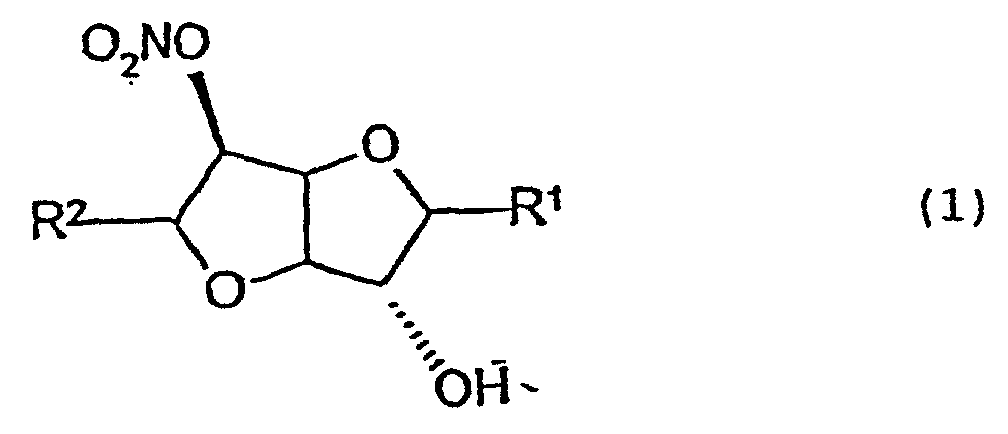 with a reducing system effective to selectively reduce the compound of formula (2) at the 2-position to produce the compound of formula (1), wherein the reducing system is selected from (i) hydrogen in the presence of a platinum oxide catalyst, or (ii) a hydride source in the presence of a transition metal phthalocyanine or polyphthalocyanine in which the transition metal is iron and/or cobalt.
- In a second aspect the invention provides a compound according to formula (1) as defined above as or when produced by the method of the first aspect of the invention.
- The invention further provides, in a third aspect, the use of a reducing system selected from (i) hydrogen in the presence of a platinum oxide, or (ii) a hydride source in the presence of a transition metal phthalocyanine or polyphthalocyanine in which the transition metal is iron and/or cobalt for effecting reduction selectively at the 2-position of a compound according to formula (2) to form a compound of formula (1).
- Preferred features and embodiments of the present invention in its various aspects will now be described in detail.
- The compound according to formula (1) as defined above, which compound is preferably that which is prepared by the method of the invention, is preferably isosorbide-5-mononitrate, i.e. that compound in which R1 and R2 are both hydrogen.
- For use in the invention the isosorbide dinitrate of formula (2) may be prepared by any known synthetic route and is available commercially. By way of example, it may be prepared by direct nitration of isosorbide in a mixture of nitric acid, acetic anhydride and acetic acid at a temperature of 5-10°C, as taught by Jackson & Hayward, Can. J. Chem., 38 (1960), 496, 497, 500.
- According to the invention the reducing system which is used to reduce the 2,5-dinitrate compound of formula (2) selectively (or, more correctly, preferentially) at the 2-position is selected from (i) hydrogen in the presence of a platinum oxide catalyst, or (ii) a hydride source in the presence of a transitional metal phthalocyanine or polyphthalocyanine, which transition metal is selected from iron or cobalt. In the case of the polyphthalocyanine species, this can be phthalocyanine polymer complexed with either or both of iron or cobalt.
- In the case of hydrogen in the presence of a platinum oxide catalyst as the reducing system, the reaction is preferably carried out by reacting a solution of the dinitrate compound with hydrogen gas, e.g. by stirring under a hydrogen atmosphere at e.g. room temperature and at a suitable pressure.
- The pressure of the hydrogen atmosphere is preferably in the range of from about 5 to about 300 psi and the reaction time is preferably from about 60 to about 600 minutes.
- When hydrogen in the presence of a platinum oxide catalyst is used as the reducing system, the reaction may be carried out further in the presence of a not easily oxidisable coordinating metal salt, in order to assist the selectivity of the reduction process towards the 2-position on the isosorbide moiety. A suitable such coordinating metal salt is nickel (II) chloride. It may however be desirable not to use such a material in the carrying out of the process in view of the toxicity implications of nickel, and indeed it is an advantage of the reducing systems according to the invention that such a selector, as used for example in EP-A-0201067, is not necessary for achieving adequate yields of the decided 5-mononitrate product.
- If used, however, the not easily oxidisable coordinating metal salt as a selector may preferably be used in an amount of from about 0.5% to about 50% molar equivalent (based on the amount of compound of formula (2)).
- In the case of hydride source/phthalocyanine as the reducing system, the hydride source acts as the principal reducing agent, with the transition metal (iron or cobalt) phthalocyanine (or polyphthalocyanine) acting as a coordination catalyst to drive the reduction selectively to the 2-position.
- The hydride source may be selected from any of the following: alkali metal tetrahydroborates (e.g. sodium, potassium or lithium tetrahydroborates), alkali metal hydrides (such as sodium, potassium or lithium hydrides), alkali metal tetrahydridoaluminates (such as those of lithium or sodium), alkali metal alkyl borohydrides (where the alkali metal is lithium, sodium or potassium, and up to three alkyl groups can be present, each alkyl group comprising branched chain, linear or cyclic carbon groups of up to 20 carbon atoms)), alkali metal alkoxy borohydrides (where the alkali metal is lithium, sodium or potassium, and up to three alkoxy groups can be present, each alkoxy group comprising branched chain, linear or cyclic carbon groups of up to 20 carbon atoms)), alkali metal alkyl hydridoaluminates (where the alkali metal is lithium, sodium or potassium, and up to three alkyl groups can be present, each alkyl group comprising branched chain, linear or cyclic carbon groups of up to 20 carbon atoms)), or alkali metal alkoxyhydridoaluminates (where the alkali metal is lithium, sodium or potassium, and up to three alkoxy groups can be present , each alkoxy group comprising branched chain, linear or cyclic carbon groups of up to 20 carbon atoms).
- The catalyst is preferably selected from iron or cobalt phthalocyanine, which together with the hydride source (preferably sodium tetrahydroborate) give excellent yields and degrees of selectivity in the conversion of isosorbide dinitrate to isosorbide-5-mononitrate.
- The amount of hydride source (especially sodium tetrahydroborate) used in the process of the invention may typically be from about 1 to about 10 molar equivalents, more preferably from about 1.5 to about 6 molar equivalents (based on the amount of compound of formula (2)). The amount of the transition metal phthalocyanine catalyst will typically be from about 1 to about 10% molar equivalents (on the same basis).
- In the methods of the invention, and as already mentioned above as being preferred in the context of the hydrogen/platinum oxide reducing system, the reaction is preferably carried out in an organic solvent. Methanol is a preferred organic solvent, although other suitable organic solvents may include higher aliphatic alcohols, chloroform, THF, dichloromethane, t-butanol, acetone, t-butylmethylether, acetonitrile or dimethylformamide. Any combination of one or more organic solvent components may be used. However, it has been found to be particularly preferred to use a solvent system comprising a mixture of organic solvents especially dichloromethane/methanol or dichloromethane/ethanol. Such organic solvent mixtures are advantageous because they permit control over the vigour of the reaction between the isosorbide dinitrate and the hydride source/transition metal phthalocyanine catalyst, whilst the methanol component assists in the dissolution of the sodium tetrahydro borate allowing better reaction with the dissolved isosorbide dinitrate. The dichloromethane/methanol solvent mixture is somewhat preferred over the dichloromethane/ethanol system, because of the lower solubility of sodium tetrahydroborate in ethanol as compared within methanol. It is possible, however, that the solvent reaction medium may also contain an amount of water, e.g. in an amount of up to about 20% by weight of the total amount of solvent.
- The present invention will now be demonstrated in further detail, by way of non-limiting example only, in the following Examples.
- For the purpose of detection and characterisation of the various products of interest in the Examples below, techniques employed included any suitable combination of 1HNMR and 13CNMR spectroscopy, gas chromatography (GC), high performance liquid chromatography (HPLC), elemental analysis and melting point determination. Notes about each of these techniques are set out below:
- The 1HNMR and 13CNMR spectra for isosorbide have been fully characterised, for example by Hopton et al, in Can. J. Chem., 1969, 47, 2395. It is noteworthy to mention that the spectrum of isosorbide is complicated with respect to the other parent compounds isomannide and isoidide, owing to the loss of symmetry arising from the endo-exo nature of the hydroxyl groups. This characteristic induces inequivalence of the hydrogéns within the two rings.
- The observed 1HNMR spectrum for isosorbide-5-mononitrate is as follows:
1HNMR (300 MHz, CDCl3) δ, ppm : 2.1(1H,s,OH), 3.98(4H,m), 4.37(1H,s), 4.42(1H,d,J=4.95), 5.0(1H,t,J=5.08 and 4.95), 5.35(1H,M). - A SE-30 column was used, with the following temperature settings: Col; 160°C, inj:180°c, det:240°C.
- A RP C-18 column was used; mobile phase:82:18, water:methanol; flow rate:1.1 ml/min; detector:222nm;inj.vo1:15µl.
- A Carlo Erba Strumentazione mod. 1106 CHN analyzer was used according to the standard procedure.
- A Gallenkamp (UK) electrothermal melting point unit was used according to the standard procedure.
- As a background experiment to demonstrate the effect of the different steric natures of the nitrate ester functions in isosorbide-2,5-dinitrate on the selectivity of reduction as between the 2 and 5 positions, in separate procedures isosorbide-2-mononitrate and isosorbide-5-mononitrate were subjected to reduction using hydrogen gas in the presence of platinum oxide catalyst.
- Isosorbide-2-mononitrate (0.5g,2.6mmol) was dissolved in ethanol (50ml). Platinum oxide (20mg) was added and the reaction mixture stirred at room temperature. The system was de-aerated and then placed under an atmosphere of hydrogen (14 psi pressure). The reaction was monitored by HPLC for the formation of reduction products and the amount of residual isosorbide-2-mononitrate remaining in the reaction mixture.
- The above procedure was repeated for isosorbide-5-mononitrate in place of the 2-mononitrate.
- The results of these two experiments are illustrated in Graph 1 below.

- It can be seen from the above graph 1 that platinum oxide is reducing the mononitrates at different rates. Isosorbide-2-mononitrate is reduced to 10% of its initial concentration after 6 hours, but the level of isosorbide-5-mononitrate remains steady at 70% after the same time period. Without intending to be limited by theory, the reason for this display in selectivity may be attributed to the different steric nature of the 2- and 5- nitrate ester functions, attack at the 5-endo site being blocked by steric hindrance and preferential reduction at the 2-exo site occurring owing to greater accessibility.
- This Example therefore demonstrates the preferential reduction of isosorbide-2,5-dinitrate at the 2-position rather than at the 5-position.
- This example demonstrates the use of hydrogen gas in the presence of platinum oxide catalyst as the reducing system in the method according to the invention.
- Isosorbide-2,5-dinitrate (2g,8.48mmol) was dissolved in methanol (30ml). To this solution was added platinum oxide (25mg) and the air was removed using a vacuum pump and replaced with an atmosphere of hydrogen (14 p.s.i pressure). The reaction mixture was stirred at room temperature. The presence of reaction components was monitored by GC. The results are shown in Graph 2 below.

- The results shown in graph 2 above confirm the nature of the selectivity of the platinum oxide catalyst towards the 2-exo functionality of the isosorbide moiety, producing isosorbide-5-mononitrate in moderate yields (50%).
- This example demonstrates the use of H2/PtO2 as the reducing system, but additionally in the presence of nickel chloride as a selector to further drive the reduction towards the 2-position.
- Isosorbide-2,5-dinitrate (2g,8.48mmol) was dissolved in methanol (30ml). To this solution was added platinum oxide (25mg) and nickel chloride (2g,14.9mmol). The reaction mixture was stirred at room temperature and de-aerated and then placed under an atmosphere of hydrogen (14 psi pressure). The reduction was followed by monitoring the presence of reaction components by GC. The results are shown in Graph 3 below.

- The results shown in graph 3 above displayed an increase in total yield of isosorbide-5-mononitrate by 6% after three hours. Although complete reduction had not occurred, the results show the advantageous use of nickel chloride in enhancing the selectivity of the reduction reaction. Owing to potential difficulties in extraction of nickel chloride from a practical system, it is possible that its presence may be less preferred in the case of a scaled-up industrial process.
- This is another example demonstrating the use of H2/PtO2 as the reducing system in the production and characterisation of isosorbide-5-mononitrate in accordance with a preferred embodiment of the invention.
- Isosorbide-2,5-dinitrate (4g,16.94mmol) was added to methanol (80ml) and stirred at room temperature. Platinum oxide (50mg) was added and the system was de-aerated using a vacuum pump. The atmosphere was replaced with hydrogen gas (14 psi pressure) and the system was monitored by GC. After three hours the reaction was terminated by the removal of hydrogen and the catalyst was vacuum filtered over a bed of Celite. The solvent was removed under vacuum and the reduction products separated by chromatography (silica, dichloromethane:ethanol,96:4) to yield isosorbide-5-mononitrate (1.46g, 45.1%) as a white crystalline solid (m.p.90.7°C,Lit.89-91°C). The product was characterised by NMR and elemental analysis as follows:
1HNMR (300 MHz, CDCl3) δ, ppm:2.05(1H,OH), 3.94 (4H,m), 4.37 (1H,s), 4.41(1H,d,J=4.8), 5.00 (1H,t,J=5.3 and 5.1), 5.40 (1H,m).
13CNMR (300 MHz, CDCl3) δ, ppm: 69.218, 75.732, 75.834, 81.177, 81.454, 88.907.
Elemental analysis found: % (calcd for C10H14O5): C, 37.77 (37.70), H,4.73 (4.75), N,7.34 (7.33). - In order to demonstrate the ability of the laboratory scale reductions exemplified above to be scaled up, the method of Example 4 was scaled up by a factor of 15.
- Isosorbide-2,5-dinitrate (60g,0.254mol) was dissolved in methanol (1200ml) and platinum oxide (750mg) was added and the vessel purged with hydrogen (14 psi pressure). Once fully purged, the reaction mixture was stirred at room temperature and the pressure regulated to the desired level. The procedure was repeated for different H2 pressures in order to further illustrate the effect of pressure on the efficiency of the reduction reaction. The experiment was repeated 5 times, using pressures of 20, 50, 70, 120 and 300 psi. The results are shown in Graph 4 below.

- The results illustrated in graph 4 above demonstrate the ability of the H2/PtO2 réduction system to be scaled up with only a marginal (5%) loss of product yield. The results also show that lower pressures are preferential for the formation of isosorbide-5-mononitrate.
- This example demonstrates the use of sodium tetrahydroborate/iron phthalocyanine as the reducing system in the production of isosorbide-5-mononitrate from isosorbide dinitrate in accordance with the invention.
- Isosorbide dinitrate (0.500g, 2.12mmol) was dissolved in methanol (20ml) and to this solution was added iron phthalocyanine (0.075g, 0.132mmol). To this suspension was added, with stirring at room temperature, sodium tetrahydroborate (0.160g, 4.23mmol). After an initial vigorous reaction the solution was acidified with hydrochloric acid (2M HCl, 10ml), upon which the catalyst became insoluble. The solution was then neutralised by addition of sodium hydroxide (2M NaOH). The catalyst was removed by filtration and the reduction products were extracted with dichloromethane (30ml x10). Isosorbide-5-mononitrate was isolated by column chromatography (silica, acetonitrile 15% in dichloromethane). After filtration of the catalyst, it was reused in the process as detailed above. In one case the catalyst was used three times. The yield of isosorbide-5-mononitrate recovered from each use of the catalyst is shown in Table 1 below.
Run Yield (%wt) 1 48.1 2 44.2 3 43.1 - This example thus also demonstrates the recyclability of the iron phthalocyanine catalyst. Given that it is expensive and that residual levels can cause colour problems in the isosorbide-5-mononitrate recovered from the process, the ability to recycle the catalyst has a major impact in terms of lowering overall raw material costs for the process. The data in the above Table 1 also show that there is little decrease in effectiveness of the catalyst after each reuse.
- To demonstrate the use of cobalt phthalocyanine as the coordination catalyst in combination with sodium tetrahydroborate, the procedure of the initial run of Example 6 above was repeated using cobalt phthalocyanine instead of iron phthalocyanine. In five separate runs the amount of cobalt phthalocyanine was varied between 5 and 25% by weight of the isosorbide dinitrate substrate. The resulting yields of isosorbide-5-mononitrate for each run are shown in Table 2 below.
Run Cobalt Phthalocyline Catalyst (%w/w) Yield (%wt). 1 5 38 2 10 42 3 15 47 4 20 41 5 25 37 - The above results illustrate the optimum level of catalyst, peaking at around 15%w/w.
- In this example the cobalt phthalocyanine catalyst loading (% w/w relative to isosorbide) and sodium tetrahydroborate molar equivalent levels were systematically varied. A first set of runs details the variance in isolated yield of isosorbide-5-mononitrate as the levels of cobalt phthalocyanine catalyst were varied, while holding the levels of sodium tetrahydroborate used at a constant 6 molar equivalents (relative to the level of isosorbide used). The method used was as follows:
- Isosorbide dinitrate (0.5g; 2.12mmol) was dissolved in methanol (20ml) and cobalt phthalocyanine was added (0.025g, 5% w/w; 0.05g, 10% w/w; 0.075g, 15% w/w; 0.1g, 20% w/w and 0.125g, 25% w/w) at the set level to be studied. To this suspension was added.sodium tetrahydroborate (0.48g, 12.72mmol). After an initial vigorous reaction the solution was acidified (2N HCl, 10ml) and subsequently neutralised (2N NaOH). The catalyst was filtered off and the reduction products were extracted with 10x30ml portions of dichloromethane. The solvent was removed under reduced pressure and the residue was chromatographed on a silica gel column (eluent: acetonitrile:dichloromethane - 15:85 v/v). The isolated yields of isosorbide-5-mononitrate are detailed in Table 3 below.
Cobalt (%w/w) % 5-mononitrate Sodium borohydride 5 38 6 eq 10 42 6 eq 15 47 6 eq 20 41 6 eq 25 37 6 eq - The above results indicate that for methanol as a solvent system, a 15% catalyst loading was optimal.
- In a second set of runs the system was re-examined at a 15% catalyst loading, while varying the molar equivalents of sodium tetrahydroborate used (relative to isosorbide) from 1 equivalent up to 6 equivalents. The method used for evaluation of the system was as detailed above. The isolated yields of isosorbide-5-mononitrate are detailed in Table 4 below.
Borohydride equivalence % 5-mononitrate 1 16.2 3 31.0 5 50.0 6 42.0 - The results indicate that for this system, the usage of 5 molar equivalents of sodium tetrahydroborate was optimal.
- Two alternative known reduction systems, apart from the PtO2/H2 and sodium tetrahydroborate/transition metal phthalocyanine systems preferred for use in the invention, were tested for their ability to selectively reduce isosorbide dinitrate to the 5-mononitrate.
- The systems assessed were Raney nickel/H2 and sodium tetrahydroborate/transition metal phthalocyanine where the metal used was zinc, magnesium, sodium or vanadium. Sodium tetrahydroborate (with no metal phthalocyanine catalyst) was also evaluated as a comparative example. The experimental details were as follows:
- Isosorbide dinitrate (1g; 4.24mmol) was dissolved in methanol (200ml). Potassium hydroxide solution (0.25mol; 100ml) was added and the system was stirred at room temperature. Raney nickel (2.0g) was added to the stirred solution, portionwise, over one hour and the reaction was monitored by GC. Analysis of the mixture after addition showed >95% isosorbide content, indicating that large-scale overreduction had occurred.
- Isosorbide dinitrate (500mg; 2.12mmol) was dissolved in methanol (20ml), and to this solution was added 75mg of the metal phthalocyanine catalyst (where the metal was zinc, magnesium, sodium or vanadium). While stirring the suspension at room temperature, sodium tetrahydroborate (160mg; 4.23mmol) was added and after an initial vigorous reaction hydrochloric acid (2M; 10ml) was added, at which point the catalyst became insoluble in the reaction mixture. The solution was neutralised by the addition of 2M sodium hydroxide solution, after which the catalyst was removed by filtration and the reduction products extracted with 10x30ml portions of dichloromethane. The dichloromethane was evaporated under reduced pressure and the residues analysed by GC. The analysis showed >95% unreacted isosorbide dinitrate.
- Isosorbide dinitrate (1.0g; 4.24mmol) was dissolved in a mixture of 10ml dichloromethane and 2ml methanol,. and sodium tetrahydroborate (0.32g; 8.46mmol) was added to the stirred mixture. The mixture was stirred for a further 1 hour, then acidified with approximately 10ml of 2N HCl solution (effervescent reaction) followed by neutralisation with 2N sodium hydroxide. The organic layer was water washed and stripped under reduced pressure. GC analysis of the residue indicated 96.85% unreacted isosorbide dinitrate.
- It can be seen from the above results that both of these alternative known reduction systems failed to produce the 5-mononitrate product in any significant amount, totally reducing the dinitrate to isosorbide itself or resulting in no significant reduction at all.
- Another known process for the selective reduction of isosorbide dinitrate to isosorbide-5-mononitrate was tested for its ability to produce the results claimed. The known process was that using zinc/acetic acid as the reduction system, as described in Gazzetta Chimica Italiana, 1987, 117, 173 (Lucchi et al) and EP-A-0201067 (Modena).
- Zinc powder used in the following procedure was activated by stirring with 1% hydrochloric acid, washing with water, ethanol, acetone and diethyl ether, then dried and immediately used in the following process.
- The procedure and results were as follows:
- Isosorbide dinitrate (5g; 21.2mmol) was stirred in 100mls of ethanol and the mixture was cooled to -10°C under nitrogen for about 20 minutes, then zinc powder (3g; 45.9mmol; pretreated as above) and acetic acid (2ml; 46mmol) were added. After 7hrs a further 1ml of acetic acid was added. After a further 5hrs isosorbide dinitrate (3g; 13mmol), zinc powder (3g; 45.9mmol; pretreated as above) and acetic acid (2ml; 46mmol) were sequentially added. The mixture was allowed to stir for a further 10 hrs before filtration and evaporation under reduced pressure. GC analysis of the reaction mixture gave 5.4% isosorbide, 0.6% isosorbide-2-mononitrate, 55.5% isosorbide-5-mononitrate and 38.5% isosorbide dinitrate. This compares unfavourably with EP-A-201067, which claims a ratio of products comprising 15% isosorbide, 2% isosorbide-2-mononitrate, 75% isosorbide-5-mononitrate and 8% isosorbide dinitrate. Thus, this prior art process failed to give satisfactory results as regards yield of the desired 5-mononitrate product in terms of the degree to which the reaction had progressed.
- This example demonstrates the use of preferred solvent mixtures for optimising the selective reduction of isosorbide dinitrate to isosorbide-5-mononitrate using sodium tetrahydroborate and iron phthalocyanine catalyst.
- To a stirred solution containing 200mls of methanol, 5g (21.18mmol) of isosorbide dinitrate and 0.75g (1.32mmol) of iron phthalocyanine was added, portionwise over two hours, 1.6g (42.29mmol) of sodium tetrahydroborate (granular). Successive sodium tetrahydroborate additions were made once the initial vigorous reaction had subsided. The reaction was stirred for a further 15 mins after visible effervescence had ceased. The resultant dark blue solution was filtered (to remove the catalyst), the solvent was removed under reduced pressure, and the residue was redissolved in dichloromethane. The dichloromethane solution was water washed, dried over sodium sulphate, and the solvent again removed under reduced pressure to give a residue which was analysed by GC. The results (run 1 of Table 5 below) indicated 90% selectivity of reaction towards isosorbide-5-mononitrate. The effervescence of reaction, however, would make control of sodium tetrahydroborate addition a problem on a plant scale.
- A 7 molar equivalent ratio of sodium tetrahydroborate to substrate was used in this case, as detailed in the reference paper Angew. Chem. Int. Ed. Engl. 20, 5, (1981), which details the non-selective reduction of organic nitro compounds (rather than the selective reduction of organic nitrate esters, as is the essence of the present invention using the sodium tetrahydroborate / ethanol reduction system.
- To a stirred solution containing 22mls of ethanol, 1.12g (29.6mmol) of sodium tetrahydroborate and 0.15g (0.264mmol) of iron phthalocyanine was added, portionwise, 1g (4.23mmol) of isosorbide dinitrate. Once the exothermic reaction had subsided, sufficient dilute hydrochloric acid was added to dissolve the residual boron species, the solution then being evaporated to dryness and the residue analysed by GC. The results (run 2 of Table 5 below) indicate that the large excess of sodium tetrahydroborate used has caused complete overreduction of the isosorbide dinitrate to isosorbide.
- Isosorbide dinitrate (1g; 4.23mmol) was dissolved in 2.5mls of acetonitrile, and this solution was added slowly to a cold (10°C) stirred solution of 0.32g (8.46mmol) of sodium tetrahydroborate and 0.15g (0.264mmol) of iron phthalocyanine in 6mls of ethanol. The resultant mixture was filtered, evaporated to dryness, then analysed by GC. The GC data (run 3 of Table 5 below) indicated essentially no remaining isosorbide dinitrate, with 84.14% isosorbide-5-mononitrate, and 13.86% isosorbide (as a result of overreduction). The run was repeated on a 5g isosorbide dinitrate scale, and the results were again very consistent with the initial run (run 4 of Table 5 below).
- Most of the solvents evaluated as above had shown reasonably good selectivity, but would be difficult to control on a plant scale, given the highly exothermic nature of the reduction process. A method to safely control the reduction process was therefore required and to this end it was decided to evaluate methylene chloride/alcohol mixtures where the isosorbide dinitrate would be stirred along with sodium tetrahydroborate and iron phthalocyanine catalyst in methylene chloride, in which the isosorbide dinitrate has limited solubility. By gradual addition of the alcohol the isosorbide dinitrate would gradually dissolve in the solvent mixture, and be reduced by the sodium tetrahydroborate in the presence of the iron phthalocyanine catalyst. The exothermicity of reaction could therefore be controlled by the rate of addition of the alcohol to the reaction mixture.
- For evaluation of ethanol as the solvent, 1g (4.23mmol) of isosorbide dinitrate was stirred with 0.32g (8.46mmol) of sodium tetrahydroborate and 0.15g (0.264mmol) of iron phthalocyanine in 10mls of dichloromethane. Ethanol (10mls) was then gradually added to the stirred mixture to control the reaction exotherm, the reaction was monitored for completion (as evidenced by the lack of effervescence), then stirred for a further 15minutes. Acetone (5mls) was added to destroy residual sodium tetrahydroborate, then the mixture was filtered and evaporated under reduced pressure. GC analysis of the residue (run 5 of Table 5 below) showed 96.42% isosorbide-5-mononitrate, with no isosorbide dinitrate present, and only 3.43% isosorbide-2-mononitrate present (this represents an isosorbide-5-mononitrate:isosorbide-2-mononitrate ratio of 28:1, superior to any previously reported selective reduction system for isosorbide dinitrate).
- The consistency of the process was demonstrated by repeated runs on the 1g isosorbide dinitrate scale using the above system (runs 6-7 of Table 5 below). In one case (run 6) an isosorbide-5-mononitrate:isosorbide-2-mononitrate ratio of 72:1 was recorded. In another case (run 7) a selectivity of 97.78% isosorbide-5-mononitrate was recorded.
- A stirred mixture of 1g (4.23mmol) of isosorbide dinitrate, 0.32g (8.46mmol) of sodium tetrahydroborate and 0.15g (0.264mmol) of iron phthalocyanine in 10mls of dichloromethane was prepared. Methanol (2mls) was then gradually added to the stirred mixture, slowly to control the reaction exotherm, then the reaction was monitored for completion (as evidenced by the lack of effervescence), and stirred for a further 15minutes. Acetone (5mls) was added to destroy residual sodium tetrahydroborate, then the mixture was filtered and evaporated under reduced pressure. GC analysis of the residue (run 8 of Table 5 below) showed 95.11% isosorbide-5-mononitrate, with 4.67% unreacted isosorbide dinitrate, and 0.22% isosorbide-2-mononitrate. This represents an isosorbide-5-mononitrate:isosorbide-2-mononitrate ratio of 432:1.
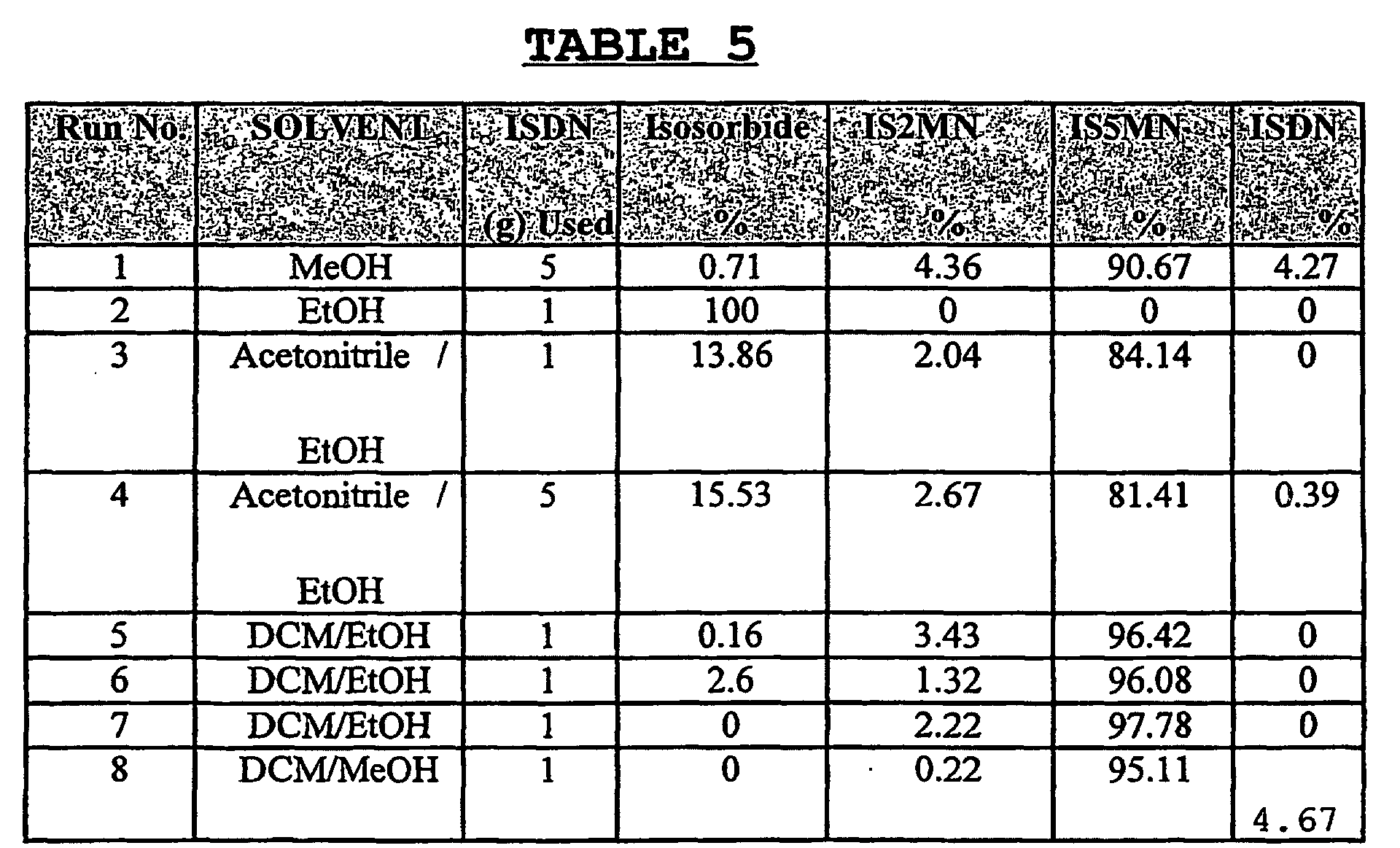
- On the basis of the data as detailed in Example 11 above, it became clear that dichloromethane/methanol and dichloromethane/ethanol solvent compositions gave the highest selectivities of reduction of isosorbide dinitrate, and also enabled control to be exerted on the rate of reaction. The two solvent systems were selected for further process optimisation. This example describes variation in the molar quantities of sodium tetrahydroborate used for both solvent combinations.
- The preparative methodology used was as described in Example 11 above. The 2 molar equivalents of sodium tetrahydroborate (as outlined in Examples 5-7 of Table 5 above) was reduced to 1.5 molar equivalents (run 1 of Table 6 below). The GC analysis of the reaction mixture (run 1 of Table 6 below) indicates that 1.5 molar equivalents of sodium tetrahydroborate is extremely undesirable for the dichloromethane/ethanol system as the reaction had only gone to 37.7% completion, with 61.85% unreacted isosorbide dinitrate remaining.
- The preparative methodology used was as described in Example 11 above. The 2 molar equivalents of sodium tetrahydroborate (as outlined in Example 8 of Table 5 above) was reduced to 1.75 and 1.5 molar equivalents (run 2 and 3 respectively of Table 6 below). The GC analyses indicates only a slight reduction in isosorbide-5-mononitrate content relative to the case where 2 molar equivalents of sodium tetrahydroborate were used, although it may have been the case for the use of 1.5 molar equivalents of sodium tetrahydroborate that the reaction might have progressed to give a higher overall yield of isosorbide-5-mononitrate if allowed to stir for a further hour after addition of the alcohol.
- It would certainly appear from this data that it is possible to use relatively less sodium tetrahydroborate for the dichloromethane/methanol solvent system, compared with the dichloromethane/ethanol system, in order to get a good (>95%) selectivity of reduction to isosorbide-5-mononitrate.

- This example describes variation in the molar quantities of iron phthalocyanine catalyst used for both solvent combinations (dichloromethane/ethanol and dichloromethane/methanol).
- The preparative methodology used was as described in Example 11 above. The 0.0623 molar equivalents of iron phthalocyanine catalyst (as outlined in Examples 5-7 of Table 5 above) was reduced by 50% to 0.0312 molar equivalents (run 1 of Table 7 below), while maintaining the sodium tetrahydroborate level at 2 molar equivalents (as for Examples 5-7 of Table 5 above). The GC analysis of the reaction mixture (run 1 of Table 7 below) indicates that 0.0312 molar equivalents of iron phthalocyanine catalyst is extremely undesirable for the dichloromethane/ethanol system as the reaction had only gone to 26.9% completion, with 70.27% unreacted isosorbide dinitrate remaining.
- The preparative methodology used was as described in Example 11 above. While maintaining the 1.75 molar equivalent level of sodium tetrahydroborate used (as outlined in Example 2 of Table 6 above) the iron phthalocyanine molar equivalent level was reduced from 0.0623 molar equivalents (as outlined in Example 2 of Table 6 above) to 0.0312 molar equivalents (run 2 of Table 7 below), then to 0.0125 molar equivalents (run 3 of Table 7 below), and finally to 0.0062 molar equivalents (run 4 of Table 7 below). The GC analysis of the reaction mixture (runs 2-4 of Table 7 below) indicates that halving the molar equivalent level of iron phthalocyanine catalyst level (run 2 of Table 7 below) did not have a detrimental effect on the performance of the reduction system (unlike the dichloromethane/ethanol solvent system where this level of catalyst had a very deleterious effect on yield, as per run 1 of Table 7 below). At a lower catalyst level of 0.0125 molar equivalents for the dichloromethane/methanol solvent system the overall conversion began to reduce (run 3 of Table 7 below), with 24.4% unreacted isosorbide dinitrate, while at a catalyst level of 0.0062 molar equivalents (run 4 of Table 7 below) 68.09% of unreacted isosorbide dinitrate was left upon workup of the reaction mixture. Clearly a catalyst level of 0.0312 molar equivalents is desirable for this reduction system. An experiment was also carried out using no iron phthalocyanine catalyst whatever. The results (run 5 of Table 7 below), not surprisingly, indicated almost totally unreacted isosorbide dinitrate (96.85%) after workup of the reaction. Clearly, the iron phthalocyanine catalyst has a definite role in ensuring progress of the reduction, as well as mediating a high selectivity of reduction of isosorbide dinitrate to isosorbide-5-mononitrate.
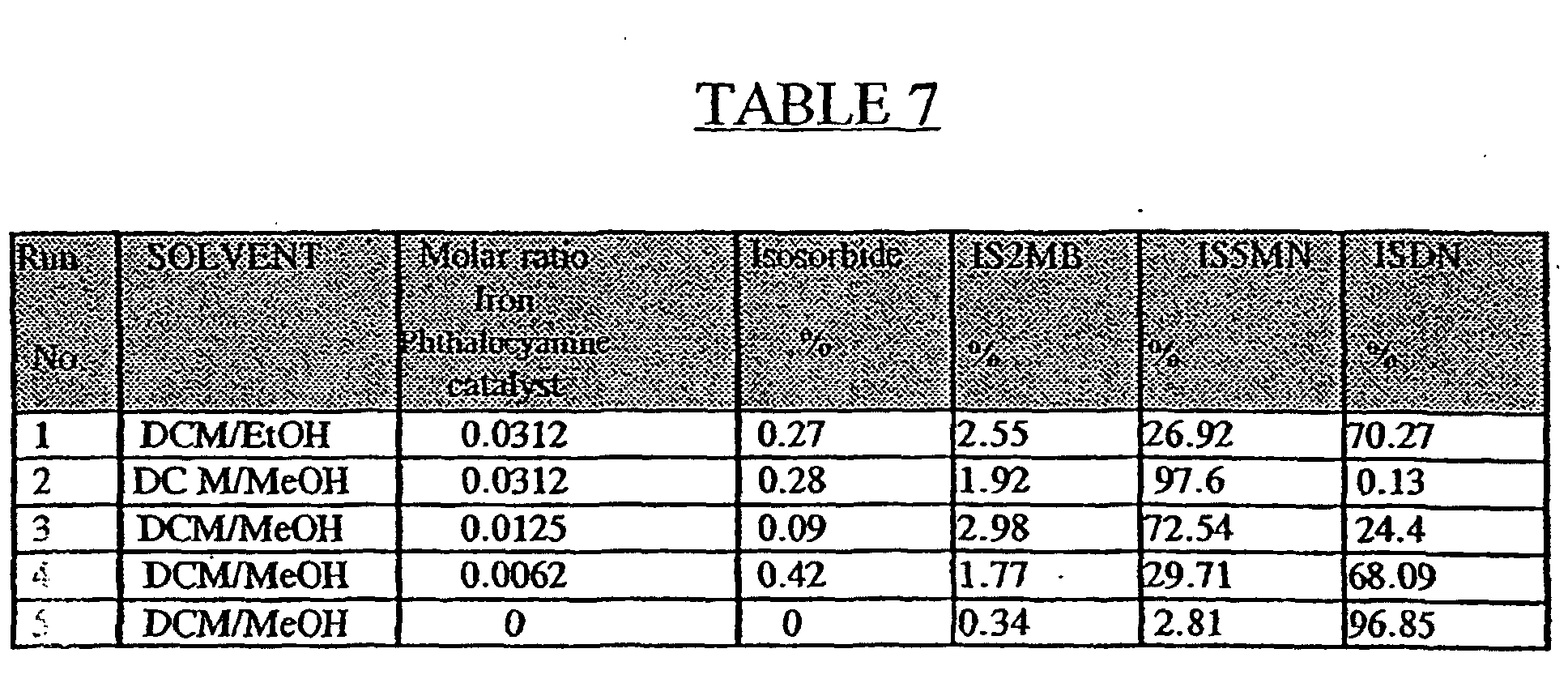
- The outcome of the evaluations detailed in Examples 12 and Examples 13 above are that the dichloromethane/methanol solvent system is the desired combination, since one can utilise lower sodium tetrahydroborate and iron phthalocyanine molar equivalent levels to achieve a good yield and selectivity of isosorbide-5-mononitrate from isosorbide dinitrate, when compared with the equivalent solvent system of dichloromethane/ethanol.
Claims (12)
- A method of synthesising a compound of the following formula (1),in which each of R1 and R2 is independently selected from H or optionally substituted straight or branched chain C1-C30 alkyl, C1-C30 carboxyalkyl, C1-C30 sulphoxyalkyl, C1-C30 alkoxy, C3-C30 cycloalkyl, C3-C30 carboxycycloalkyl, C3-C30 sulphoxycycloalkyl, C3-C30 cycloalkoxy, heterocyclic, carboxyheterocyclic, sulphoxyheterocyclic, oxyheterocyclic, C3-C30 cycloalkenyl, carboxycycloalkenyl, sulphoxycycloalkenyl or cycloalkenoxy, C8-C30 cycloalkynyl, carboxycycloalkynyl, sulphoxycycloalkynyl or cycloalkynoxy, C2-C30 alkynyl, carboxyalkynyl, sulphoxyalkynyl or alkynoxy group, C4-C30 aromatic, carboxyaromatic, sulphoxyaromatic or aryloxy, C4-C30 heteroaromatic, carboxyheteroaromatic, sulphoxyheteroaromatic or heteroaryloxy group, wherein in any of the said hetero atom-containing groups the hetero atom is selected from the group consisting of O, S, and N and in the case of any of the aforementioned groups being substituted, there are present one or more substituents independently selected from the group consisting of halogen, cyano, C1-C30 alkyl, C2-C30 alkenyl, C4-C30 aromatic, C1-C30 ether, C1-C30 ester, C1-C30 sulphonate ester, nitro, C1-C30 ketone, C1-C30 thioether and/or one or more pharmaceutically active groups; the method comprising treating a compound of the following formula (2):
 with a reducing system effective to reduce preferentially the compound of formula (2) at the 2-position to produce the compound of formula (1), wherein the reducing system comprises (i) hydrogen in the presence of a platinum oxide catalyst, or (ii) a hydride source in the presence of a transition metal phthalocyanine or polyphthalocyanine in which the transition metal is iron and/or cobalt.
- A method according to claim 1 wherein the or each pharmaceutically active group is selected from the group consisting of 2-acetoxybenzoate, 2-N-(3'-trifluoromethylphenyl)aminobenzoate, (S)-6-methoxy-α-methyl-2-naphthaleneacetate and (S)-1-[N-[1-(ethoxycarbonyl)-3-phenylpropyl]-L-alanyl]-L-proline carboxylate.
- A method according to claim 1 wherein R1 and R2 are both hydrogen.
- A method according to any one of claims 1 to 3 wherein the reducing system comprises hydrogen in the presence of a platinum catalyst and the reaction is carried out at room temperature under a hydrogen gas atmosphere of 5 to 300 psi.
- A method according to claim 3 or claim 4 wherein the reaction is carried out in a solvent comprising dichloromethane/methanol or dichloromethane/ethanol.
- A method according to any one of claims 1 to 3 wherein the reducing system comprises a hydride source in the presence of a polyphthalocyanine polymer complexed with iron, cobalt or a mixture of both.
- A method according to any one of claims 1 to 3 wherein the reducing system comprises a hydride source in the presence of a transition metal phthalocyanine or polyphthalocyanine in which the transition metal is iron, cobalt or a mixture of both and the hydride source is selected from the group consisting of alkali metal tetrahydroborates, alkali metal hydrides, alkali metal tetrahydridoaluminates, alkali metal alkyl borohydrides (where the alkali metal is lithium, sodium or potassium, and up to three alkyl groups can be present, each alkyl group comprising branched chain, linear or cyclic carbon groups of up to 20 carbon atoms), alkali metal alkoxy borohydrides (where the alkali metal is lithium, sodium or potassium, and up to three alkoxy groups can be present, each alkoxy group comprising branched chain, linear or cyclic carbon groups of up to 20 carbon atoms), alkali metal alkyl hydridoaluminates (where the alkali metal is lithium, sodium or potassium, and up to three alkyl groups can be present, each alkyl group comprising branched chain, linear or cyclic carbon groups of up to 20 carbon atoms), and alkali metal alkoxyhydridoaluminates (where the alkali metal is lithium, sodium or potassium, and up to three alkoxy groups can be present , each alkoxy group comprising branched chain, linear or cyclic carbon groups of up to 20 carbon atoms).
- A method according to any one of claims 1 to 3 wherein the reducing system comprises a hydride source in the presence of a transition metal phthalocyanine or polyphthalocyanine in which the transition metal is iron, cobalt or a mixture of both and the hydride source is used in an amount of from 1 to 10 molar equivalents with respect to the compound of formula (2).
- A method according to any one of claims 1 to 3 wherein the reducing system comprises a hydride source in the presence of a transition metal phthalocyanine or polyphthalocyanine in which the transition metal is iron, cobalt or a mixture of both and the transition metal phthalocyanine is used in an amount of from 1 to 10% molar equivalents with respect to the compound of formula (2).
- The use of a reducing system selected from (i) hydrogen in the presence of a platinum oxide catalyst, or (ii) a hydride source in the presence of a transition metal phthalocyanine or polyphthalocyanine in which the transition metal is iron, cobalt or a mixture of both for effecting reduction preferentially at the 2-position of a compound according to the formula (2) defined in any one of claims 1 to 3 to form a corresponding compound of the formula (1) defined in any of claims 1 to 3.
- The use according to claim 10 wherein the reducing system comprises a hydride source in the presence of a polyphthalocyanine polymer complexed with iron, cobalt or a mixture of both.
- The use according to claim 10 wherein the reducing system comprises a hydride source in the presence of a transition metal phthalocyanine or polyphthalocyanine in which the transition metal is iron, cobalt or a mixture of both and the hydride source is selected from the group consisting of alkali metal tetrahydroborates, alkali metal hydrides, alkali metal tetrahydridoaluminates, alkali metal alkyl borohydrides (where the alkali metal is lithium, sodium or potassium, and up to three alkyl groups can be present, each alkyl group comprising branched chain, linear or cyclic carbon groups of up to 20 carbon atoms), alkali metal alkoxy borohydrides (where the alkali metal is lithium, sodium or potassium, and up to three alkoxy groups can be present, each alkoxy group comprising branched chain, linear or cyclic carbon groups of up to 20 carbon atoms), alkali metal alkyl hydridoaluminates (where the alkali metal is lithium, sodium or potassium, and up to three alkyl groups can be present, each alkyl group comprising branched chain, linear or cyclic carbon groups of up to 20 carbon atoms), and alkali metal alkoxyhydridoaluminates (where the alkali metal is lithium, sodium or potassium, and up to three alkoxy groups can be present , each alkoxy group comprising branched chain, linear or cyclic carbon groups of up to 20 carbon atoms).
Applications Claiming Priority (3)
| Application Number | Priority Date | Filing Date | Title |
|---|---|---|---|
| GBGB9930778.7A GB9930778D0 (en) | 1999-12-29 | 1999-12-29 | Compound synthesis |
| GB9930778 | 1999-12-29 | ||
| PCT/GB2000/004996 WO2001049692A1 (en) | 1999-12-29 | 2000-12-28 | Synthesis of isorsorbide mononitrate |
Publications (2)
| Publication Number | Publication Date |
|---|---|
| EP1248788A1 EP1248788A1 (en) | 2002-10-16 |
| EP1248788B1 true EP1248788B1 (en) | 2004-10-27 |
Family
ID=10867135
Family Applications (1)
| Application Number | Title | Priority Date | Filing Date |
|---|---|---|---|
| EP20000985697 Expired - Lifetime EP1248788B1 (en) | 1999-12-29 | 2000-12-28 | Synthesis of isosorbide mononitrate |
Country Status (7)
| Country | Link |
|---|---|
| EP (1) | EP1248788B1 (en) |
| JP (1) | JP2003519235A (en) |
| AT (1) | ATE280771T1 (en) |
| AU (1) | AU2209601A (en) |
| DE (1) | DE60015396D1 (en) |
| GB (1) | GB9930778D0 (en) |
| WO (1) | WO2001049692A1 (en) |
Families Citing this family (3)
| Publication number | Priority date | Publication date | Assignee | Title |
|---|---|---|---|---|
| CN103641840B (en) * | 2013-11-28 | 2016-03-16 | 青岛黄海制药有限责任公司 | A kind of synthesis of 5-isosorbide mononitrate and purification process |
| CN104892623B (en) * | 2015-06-11 | 2017-08-11 | 山东新时代药业有限公司 | A kind of preparation method of 5 Isosorbide Mononitrate |
| CN109369754B (en) * | 2018-09-30 | 2022-03-01 | 镇江利众医药科技有限公司 | Nitrate ester compound and application thereof |
Citations (1)
| Publication number | Priority date | Publication date | Assignee | Title |
|---|---|---|---|---|
| EP1038862A2 (en) * | 1999-03-26 | 2000-09-27 | Dinamite Dipharma S.p.A. | Process for the preparation of nitric monoesters of dihydroxyalkyl, dihydroxycycloalkyl and dihydroxy(poly)cycloalkyl compounds |
Family Cites Families (2)
| Publication number | Priority date | Publication date | Assignee | Title |
|---|---|---|---|---|
| FR2500835A1 (en) * | 1981-02-27 | 1982-09-03 | Poudres & Explosifs Ste Nale | PROCESS FOR THE SYNTHESIS OF MONONITRATES OF ISOSORBIDE |
| IT1208537B (en) * | 1985-05-10 | 1989-07-10 | Consiglio Nazionale Ricerche | PROCESS FOR THE PREPARATION OF ISOSORBIDE-5-MONOHYDRATE. |
-
1999
- 1999-12-29 GB GBGB9930778.7A patent/GB9930778D0/en not_active Ceased
-
2000
- 2000-12-28 JP JP2001550232A patent/JP2003519235A/en active Pending
- 2000-12-28 EP EP20000985697 patent/EP1248788B1/en not_active Expired - Lifetime
- 2000-12-28 DE DE60015396T patent/DE60015396D1/en not_active Expired - Lifetime
- 2000-12-28 WO PCT/GB2000/004996 patent/WO2001049692A1/en not_active Ceased
- 2000-12-28 AT AT00985697T patent/ATE280771T1/en not_active IP Right Cessation
- 2000-12-28 AU AU22096/01A patent/AU2209601A/en not_active Abandoned
Patent Citations (1)
| Publication number | Priority date | Publication date | Assignee | Title |
|---|---|---|---|---|
| EP1038862A2 (en) * | 1999-03-26 | 2000-09-27 | Dinamite Dipharma S.p.A. | Process for the preparation of nitric monoesters of dihydroxyalkyl, dihydroxycycloalkyl and dihydroxy(poly)cycloalkyl compounds |
Also Published As
| Publication number | Publication date |
|---|---|
| EP1248788A1 (en) | 2002-10-16 |
| ATE280771T1 (en) | 2004-11-15 |
| DE60015396D1 (en) | 2004-12-02 |
| WO2001049692A1 (en) | 2001-07-12 |
| GB9930778D0 (en) | 2000-02-16 |
| JP2003519235A (en) | 2003-06-17 |
| AU2209601A (en) | 2001-07-16 |
Similar Documents
| Publication | Publication Date | Title |
|---|---|---|
| JP7500102B2 (en) | Intermediate for synthesizing camptothecin derivatives, production method thereof and use thereof | |
| GB2271565A (en) | Facile condensation of methylbenzoxazoles with aromatic aldehydes | |
| JP2025072517A (en) | Method for producing phenol derivatives | |
| AU2002365874A1 (en) | Crystalline venlafaxine base and novel polymorphs of venlafaxine hydrochloride, processes for preparing thereof | |
| EP1860103B1 (en) | Anticancer compound, intermediate therefor, and processes for producing these | |
| EP1248788A1 (en) | Synthesis of isosorbide mononitrate | |
| IE52602B1 (en) | Process for the synthesis of isosorbide mononitrates | |
| KR100980379B1 (en) | Method for preparing 5-hydroxy-3-oxoheptanoate derivative having optical activity | |
| EP0811603A1 (en) | Aminotetralone derivatives and process for producing the same | |
| Farin et al. | Pseudoesters and derivatives. XXVI. Formation of cyclopropanes and five membered heterocycles by Michael initiated ring closure reactions of 2-bromo-3-formylacrylic acid derivatives | |
| CA2902009A1 (en) | Isohexide monotriflates and process for synthesis thereof | |
| EP1741716B1 (en) | Process for producing pentacyclic taxane | |
| CN119431211B (en) | Intermediate, and preparation method and application thereof | |
| CN111793047B (en) | Preparation method of eribulin intermediate | |
| US6677464B2 (en) | Process for preparation of 7-oxabicyclo[2.2.1]hept-5-ene-2-carboxylic acid derivatives | |
| CN118834148B (en) | A preparation method of L-penicillamine | |
| JP2007084536A (en) | Method for producing procyanidins B1-B4 and catechin polymers | |
| GB2358859A (en) | Synthesis of isosorbide compounds | |
| Kumar et al. | Synthesis of dihydrodiols and diol epoxides of dibenz [a, h] acridine | |
| KR800000904B1 (en) | Preparation of 2-hydroxymethyl-3-hydroxy-6- (1-hydroxy-2-tert-butylaminoethyl) pyridine | |
| Bredenkamp et al. | Palladium catalysed tandem allylic substitution methodology in the synthesis of a component of civet | |
| Saito et al. | A highly diastereoselective tandem Michael-Michael addition reaction in a rotameric ring system: steric acceleration due to conformation locking | |
| CN118026793A (en) | Preparation method and application of optically pure α-aryl chiral amine compound | |
| EP4703350A1 (en) | Method for preparing 4-aminoindan and method for preparing dihydroindenyl-pyrazolo[3,4-b]pyridine-amine | |
| CN119306684A (en) | A key intermediate for preparing SGLTs inhibitors and a preparation method thereof |
Legal Events
| Date | Code | Title | Description |
|---|---|---|---|
| PUAI | Public reference made under article 153(3) epc to a published international application that has entered the european phase |
Free format text: ORIGINAL CODE: 0009012 |
|
| 17P | Request for examination filed |
Effective date: 20020718 |
|
| AK | Designated contracting states |
Kind code of ref document: A1 Designated state(s): AT BE CH CY DE DK ES FI FR GB GR IE IT LI LU MC NL PT SE TR |
|
| AX | Request for extension of the european patent |
Free format text: AL;LT;LV;MK;RO;SI |
|
| GRAP | Despatch of communication of intention to grant a patent |
Free format text: ORIGINAL CODE: EPIDOSNIGR1 |
|
| GRAS | Grant fee paid |
Free format text: ORIGINAL CODE: EPIDOSNIGR3 |
|
| GRAA | (expected) grant |
Free format text: ORIGINAL CODE: 0009210 |
|
| AK | Designated contracting states |
Kind code of ref document: B1 Designated state(s): AT BE CH CY DE DK ES FI FR GB GR IE IT LI LU MC NL PT SE TR |
|
| PG25 | Lapsed in a contracting state [announced via postgrant information from national office to epo] |
Ref country code: IT Free format text: LAPSE BECAUSE OF FAILURE TO SUBMIT A TRANSLATION OF THE DESCRIPTION OR TO PAY THE FEE WITHIN THE PRESCRIBED TIME-LIMIT;WARNING: LAPSES OF ITALIAN PATENTS WITH EFFECTIVE DATE BEFORE 2007 MAY HAVE OCCURRED AT ANY TIME BEFORE 2007. THE CORRECT EFFECTIVE DATE MAY BE DIFFERENT FROM THE ONE RECORDED. Effective date: 20041027 Ref country code: CY Free format text: LAPSE BECAUSE OF FAILURE TO SUBMIT A TRANSLATION OF THE DESCRIPTION OR TO PAY THE FEE WITHIN THE PRESCRIBED TIME-LIMIT Effective date: 20041027 Ref country code: CH Free format text: LAPSE BECAUSE OF FAILURE TO SUBMIT A TRANSLATION OF THE DESCRIPTION OR TO PAY THE FEE WITHIN THE PRESCRIBED TIME-LIMIT Effective date: 20041027 Ref country code: FR Free format text: LAPSE BECAUSE OF FAILURE TO SUBMIT A TRANSLATION OF THE DESCRIPTION OR TO PAY THE FEE WITHIN THE PRESCRIBED TIME-LIMIT Effective date: 20041027 Ref country code: FI Free format text: LAPSE BECAUSE OF FAILURE TO SUBMIT A TRANSLATION OF THE DESCRIPTION OR TO PAY THE FEE WITHIN THE PRESCRIBED TIME-LIMIT Effective date: 20041027 Ref country code: LI Free format text: LAPSE BECAUSE OF FAILURE TO SUBMIT A TRANSLATION OF THE DESCRIPTION OR TO PAY THE FEE WITHIN THE PRESCRIBED TIME-LIMIT Effective date: 20041027 Ref country code: SE Free format text: LAPSE BECAUSE OF FAILURE TO SUBMIT A TRANSLATION OF THE DESCRIPTION OR TO PAY THE FEE WITHIN THE PRESCRIBED TIME-LIMIT Effective date: 20041027 Ref country code: NL Free format text: LAPSE BECAUSE OF FAILURE TO SUBMIT A TRANSLATION OF THE DESCRIPTION OR TO PAY THE FEE WITHIN THE PRESCRIBED TIME-LIMIT Effective date: 20041027 Ref country code: TR Free format text: LAPSE BECAUSE OF FAILURE TO SUBMIT A TRANSLATION OF THE DESCRIPTION OR TO PAY THE FEE WITHIN THE PRESCRIBED TIME-LIMIT Effective date: 20041027 Ref country code: BE Free format text: LAPSE BECAUSE OF FAILURE TO SUBMIT A TRANSLATION OF THE DESCRIPTION OR TO PAY THE FEE WITHIN THE PRESCRIBED TIME-LIMIT Effective date: 20041027 Ref country code: AT Free format text: LAPSE BECAUSE OF FAILURE TO SUBMIT A TRANSLATION OF THE DESCRIPTION OR TO PAY THE FEE WITHIN THE PRESCRIBED TIME-LIMIT Effective date: 20041027 |
|
| REG | Reference to a national code |
Ref country code: GB Ref legal event code: FG4D |
|
| REG | Reference to a national code |
Ref country code: CH Ref legal event code: EP |
|
| REG | Reference to a national code |
Ref country code: IE Ref legal event code: FG4D |
|
| REF | Corresponds to: |
Ref document number: 60015396 Country of ref document: DE Date of ref document: 20041202 Kind code of ref document: P |
|
| PG25 | Lapsed in a contracting state [announced via postgrant information from national office to epo] |
Ref country code: LU Free format text: LAPSE BECAUSE OF NON-PAYMENT OF DUE FEES Effective date: 20041228 |
|
| PG25 | Lapsed in a contracting state [announced via postgrant information from national office to epo] |
Ref country code: IE Free format text: LAPSE BECAUSE OF NON-PAYMENT OF DUE FEES Effective date: 20041230 |
|
| PG25 | Lapsed in a contracting state [announced via postgrant information from national office to epo] |
Ref country code: MC Free format text: LAPSE BECAUSE OF NON-PAYMENT OF DUE FEES Effective date: 20041231 |
|
| PG25 | Lapsed in a contracting state [announced via postgrant information from national office to epo] |
Ref country code: DK Free format text: LAPSE BECAUSE OF FAILURE TO SUBMIT A TRANSLATION OF THE DESCRIPTION OR TO PAY THE FEE WITHIN THE PRESCRIBED TIME-LIMIT Effective date: 20050127 Ref country code: GR Free format text: LAPSE BECAUSE OF FAILURE TO SUBMIT A TRANSLATION OF THE DESCRIPTION OR TO PAY THE FEE WITHIN THE PRESCRIBED TIME-LIMIT Effective date: 20050127 |
|
| PG25 | Lapsed in a contracting state [announced via postgrant information from national office to epo] |
Ref country code: DE Free format text: LAPSE BECAUSE OF FAILURE TO SUBMIT A TRANSLATION OF THE DESCRIPTION OR TO PAY THE FEE WITHIN THE PRESCRIBED TIME-LIMIT Effective date: 20050128 |
|
| PG25 | Lapsed in a contracting state [announced via postgrant information from national office to epo] |
Ref country code: ES Free format text: LAPSE BECAUSE OF FAILURE TO SUBMIT A TRANSLATION OF THE DESCRIPTION OR TO PAY THE FEE WITHIN THE PRESCRIBED TIME-LIMIT Effective date: 20050207 |
|
| LTIE | Lt: invalidation of european patent or patent extension |
Effective date: 20041027 |
|
| REG | Reference to a national code |
Ref country code: CH Ref legal event code: PL |
|
| NLV1 | Nl: lapsed or annulled due to failure to fulfill the requirements of art. 29p and 29m of the patents act | ||
| PLBE | No opposition filed within time limit |
Free format text: ORIGINAL CODE: 0009261 |
|
| STAA | Information on the status of an ep patent application or granted ep patent |
Free format text: STATUS: NO OPPOSITION FILED WITHIN TIME LIMIT |
|
| REG | Reference to a national code |
Ref country code: IE Ref legal event code: MM4A |
|
| 26N | No opposition filed |
Effective date: 20050728 |
|
| EN | Fr: translation not filed | ||
| PGFP | Annual fee paid to national office [announced via postgrant information from national office to epo] |
Ref country code: GB Payment date: 20061220 Year of fee payment: 7 |
|
| PG25 | Lapsed in a contracting state [announced via postgrant information from national office to epo] |
Ref country code: PT Free format text: LAPSE BECAUSE OF NON-PAYMENT OF DUE FEES Effective date: 20050327 |
|
| GBPC | Gb: european patent ceased through non-payment of renewal fee |
Effective date: 20071228 |
|
| PG25 | Lapsed in a contracting state [announced via postgrant information from national office to epo] |
Ref country code: GB Free format text: LAPSE BECAUSE OF NON-PAYMENT OF DUE FEES Effective date: 20071228 |