EP1248309A1 - Lithium iron thiophosphate compound, process for producing the compound, and lithium battery using the compound - Google Patents
Lithium iron thiophosphate compound, process for producing the compound, and lithium battery using the compound Download PDFInfo
- Publication number
- EP1248309A1 EP1248309A1 EP20020006656 EP02006656A EP1248309A1 EP 1248309 A1 EP1248309 A1 EP 1248309A1 EP 20020006656 EP20020006656 EP 20020006656 EP 02006656 A EP02006656 A EP 02006656A EP 1248309 A1 EP1248309 A1 EP 1248309A1
- Authority
- EP
- European Patent Office
- Prior art keywords
- lithium
- compound
- iron
- thiophosphate
- present
- Prior art date
- Legal status (The legal status is an assumption and is not a legal conclusion. Google has not performed a legal analysis and makes no representation as to the accuracy of the status listed.)
- Withdrawn
Links
- -1 Lithium iron thiophosphate compound Chemical class 0.000 title claims abstract description 31
- 229910052744 lithium Inorganic materials 0.000 title claims abstract description 28
- WHXSMMKQMYFTQS-UHFFFAOYSA-N Lithium Chemical compound [Li] WHXSMMKQMYFTQS-UHFFFAOYSA-N 0.000 title claims abstract description 23
- 238000000034 method Methods 0.000 title claims description 12
- 150000001875 compounds Chemical class 0.000 title abstract description 14
- XEEYBQQBJWHFJM-UHFFFAOYSA-N iron Substances [Fe] XEEYBQQBJWHFJM-UHFFFAOYSA-N 0.000 claims abstract description 51
- 239000007772 electrode material Substances 0.000 claims abstract description 17
- 229910052742 iron Inorganic materials 0.000 claims description 12
- 229910052698 phosphorus Inorganic materials 0.000 claims description 7
- 150000004763 sulfides Chemical class 0.000 claims description 7
- 238000010438 heat treatment Methods 0.000 claims description 6
- 229910052717 sulfur Inorganic materials 0.000 claims description 2
- 229910001416 lithium ion Inorganic materials 0.000 description 51
- HBBGRARXTFLTSG-UHFFFAOYSA-N Lithium ion Chemical compound [Li+] HBBGRARXTFLTSG-UHFFFAOYSA-N 0.000 description 50
- 238000003379 elimination reaction Methods 0.000 description 21
- 239000000203 mixture Substances 0.000 description 17
- 229910011890 LiFe1 Inorganic materials 0.000 description 16
- UCKMPCXJQFINFW-UHFFFAOYSA-N Sulphide Chemical compound [S-2] UCKMPCXJQFINFW-UHFFFAOYSA-N 0.000 description 14
- 229910005318 FePS3 Inorganic materials 0.000 description 11
- 230000008030 elimination Effects 0.000 description 11
- 239000013078 crystal Substances 0.000 description 7
- 229910009735 Li2FeS2 Inorganic materials 0.000 description 5
- 238000007254 oxidation reaction Methods 0.000 description 5
- MBMLMWLHJBBADN-UHFFFAOYSA-N Ferrous sulfide Chemical compound [Fe]=S MBMLMWLHJBBADN-UHFFFAOYSA-N 0.000 description 4
- 238000002441 X-ray diffraction Methods 0.000 description 4
- 238000009792 diffusion process Methods 0.000 description 4
- 238000003780 insertion Methods 0.000 description 4
- 230000037431 insertion Effects 0.000 description 4
- GLNWILHOFOBOFD-UHFFFAOYSA-N lithium sulfide Chemical compound [Li+].[Li+].[S-2] GLNWILHOFOBOFD-UHFFFAOYSA-N 0.000 description 4
- OOAMWLCPBMQMIR-UHFFFAOYSA-K lithium;iron(2+);thiophosphate Chemical compound [Li+].[Fe+2].[O-]P([O-])([O-])=S OOAMWLCPBMQMIR-UHFFFAOYSA-K 0.000 description 4
- 230000003647 oxidation Effects 0.000 description 4
- AHKZTVQIVOEVFO-UHFFFAOYSA-N oxide(2-) Chemical compound [O-2] AHKZTVQIVOEVFO-UHFFFAOYSA-N 0.000 description 4
- 239000000843 powder Substances 0.000 description 4
- 239000007858 starting material Substances 0.000 description 4
- 229910003092 TiS2 Inorganic materials 0.000 description 3
- 238000006243 chemical reaction Methods 0.000 description 3
- 238000003411 electrode reaction Methods 0.000 description 3
- 230000001747 exhibiting effect Effects 0.000 description 3
- 238000009830 intercalation Methods 0.000 description 3
- 230000002687 intercalation Effects 0.000 description 3
- 150000002500 ions Chemical class 0.000 description 3
- 229910052960 marcasite Inorganic materials 0.000 description 3
- NIFIFKQPDTWWGU-UHFFFAOYSA-N pyrite Chemical compound [Fe+2].[S-][S-] NIFIFKQPDTWWGU-UHFFFAOYSA-N 0.000 description 3
- 229910052683 pyrite Inorganic materials 0.000 description 3
- 238000011160 research Methods 0.000 description 3
- 239000007784 solid electrolyte Substances 0.000 description 3
- 229910001428 transition metal ion Inorganic materials 0.000 description 3
- XKRFYHLGVUSROY-UHFFFAOYSA-N Argon Chemical compound [Ar] XKRFYHLGVUSROY-UHFFFAOYSA-N 0.000 description 2
- 229910032387 LiCoO2 Inorganic materials 0.000 description 2
- 239000011149 active material Substances 0.000 description 2
- 239000006182 cathode active material Substances 0.000 description 2
- 150000001768 cations Chemical class 0.000 description 2
- 230000005611 electricity Effects 0.000 description 2
- 239000000463 material Substances 0.000 description 2
- 229910052751 metal Inorganic materials 0.000 description 2
- 239000002184 metal Substances 0.000 description 2
- 239000008188 pellet Substances 0.000 description 2
- 239000010453 quartz Substances 0.000 description 2
- 238000006479 redox reaction Methods 0.000 description 2
- 239000011369 resultant mixture Substances 0.000 description 2
- VYPSYNLAJGMNEJ-UHFFFAOYSA-N silicon dioxide Inorganic materials O=[Si]=O VYPSYNLAJGMNEJ-UHFFFAOYSA-N 0.000 description 2
- 239000007787 solid Substances 0.000 description 2
- OKTJSMMVPCPJKN-UHFFFAOYSA-N Carbon Chemical compound [C] OKTJSMMVPCPJKN-UHFFFAOYSA-N 0.000 description 1
- 229910000733 Li alloy Inorganic materials 0.000 description 1
- 229910007452 Li1/2Fe1/2 Inorganic materials 0.000 description 1
- 229910012974 LiCo2 Inorganic materials 0.000 description 1
- 229910014395 LiNi1/2Mn3/2O4 Inorganic materials 0.000 description 1
- 229910005896 NiPS3 Inorganic materials 0.000 description 1
- 229910004586 P2S3 Inorganic materials 0.000 description 1
- OAICVXFJPJFONN-UHFFFAOYSA-N Phosphorus Chemical compound [P] OAICVXFJPJFONN-UHFFFAOYSA-N 0.000 description 1
- 241000519995 Stachys sylvatica Species 0.000 description 1
- RYYWUUFWQRZTIU-UHFFFAOYSA-N Thiophosphoric acid Chemical class OP(O)(S)=O RYYWUUFWQRZTIU-UHFFFAOYSA-N 0.000 description 1
- 239000006183 anode active material Substances 0.000 description 1
- 229910052786 argon Inorganic materials 0.000 description 1
- 229910052799 carbon Inorganic materials 0.000 description 1
- 239000003575 carbonaceous material Substances 0.000 description 1
- 230000000694 effects Effects 0.000 description 1
- 230000002708 enhancing effect Effects 0.000 description 1
- 239000007789 gas Substances 0.000 description 1
- 239000011521 glass Substances 0.000 description 1
- 229910021397 glassy carbon Inorganic materials 0.000 description 1
- LHJOPRPDWDXEIY-UHFFFAOYSA-N indium lithium Chemical compound [Li].[In] LHJOPRPDWDXEIY-UHFFFAOYSA-N 0.000 description 1
- 239000011261 inert gas Substances 0.000 description 1
- 238000006713 insertion reaction Methods 0.000 description 1
- 150000002505 iron Chemical class 0.000 description 1
- 239000001989 lithium alloy Substances 0.000 description 1
- 229910001386 lithium phosphate Inorganic materials 0.000 description 1
- 239000011574 phosphorus Substances 0.000 description 1
- CYQAYERJWZKYML-UHFFFAOYSA-N phosphorus pentasulfide Chemical compound S1P(S2)(=S)SP3(=S)SP1(=S)SP2(=S)S3 CYQAYERJWZKYML-UHFFFAOYSA-N 0.000 description 1
- 150000003346 selenoethers Chemical class 0.000 description 1
- KHDSWONFYIAAPE-UHFFFAOYSA-N silicon sulfide Chemical compound S=[Si]=S KHDSWONFYIAAPE-UHFFFAOYSA-N 0.000 description 1
- 229910052723 transition metal Inorganic materials 0.000 description 1
- 150000003624 transition metals Chemical class 0.000 description 1
- TWQULNDIKKJZPH-UHFFFAOYSA-K trilithium;phosphate Chemical compound [Li+].[Li+].[Li+].[O-]P([O-])([O-])=O TWQULNDIKKJZPH-UHFFFAOYSA-K 0.000 description 1
Images



Classifications
-
- H—ELECTRICITY
- H01—ELECTRIC ELEMENTS
- H01M—PROCESSES OR MEANS, e.g. BATTERIES, FOR THE DIRECT CONVERSION OF CHEMICAL ENERGY INTO ELECTRICAL ENERGY
- H01M4/00—Electrodes
- H01M4/02—Electrodes composed of, or comprising, active material
- H01M4/36—Selection of substances as active materials, active masses, active liquids
- H01M4/58—Selection of substances as active materials, active masses, active liquids of inorganic compounds other than oxides or hydroxides, e.g. sulfides, selenides, tellurides, halogenides or LiCoFy; of polyanionic structures, e.g. phosphates, silicates or borates
- H01M4/5805—Phosphides
-
- H—ELECTRICITY
- H01—ELECTRIC ELEMENTS
- H01M—PROCESSES OR MEANS, e.g. BATTERIES, FOR THE DIRECT CONVERSION OF CHEMICAL ENERGY INTO ELECTRICAL ENERGY
- H01M10/00—Secondary cells; Manufacture thereof
- H01M10/05—Accumulators with non-aqueous electrolyte
- H01M10/052—Li-accumulators
-
- H—ELECTRICITY
- H01—ELECTRIC ELEMENTS
- H01M—PROCESSES OR MEANS, e.g. BATTERIES, FOR THE DIRECT CONVERSION OF CHEMICAL ENERGY INTO ELECTRICAL ENERGY
- H01M10/00—Secondary cells; Manufacture thereof
- H01M10/05—Accumulators with non-aqueous electrolyte
- H01M10/056—Accumulators with non-aqueous electrolyte characterised by the materials used as electrolytes, e.g. mixed inorganic/organic electrolytes
- H01M10/0561—Accumulators with non-aqueous electrolyte characterised by the materials used as electrolytes, e.g. mixed inorganic/organic electrolytes the electrolyte being constituted of inorganic materials only
- H01M10/0562—Solid materials
-
- H—ELECTRICITY
- H01—ELECTRIC ELEMENTS
- H01M—PROCESSES OR MEANS, e.g. BATTERIES, FOR THE DIRECT CONVERSION OF CHEMICAL ENERGY INTO ELECTRICAL ENERGY
- H01M4/00—Electrodes
- H01M4/02—Electrodes composed of, or comprising, active material
- H01M4/36—Selection of substances as active materials, active masses, active liquids
- H01M4/58—Selection of substances as active materials, active masses, active liquids of inorganic compounds other than oxides or hydroxides, e.g. sulfides, selenides, tellurides, halogenides or LiCoFy; of polyanionic structures, e.g. phosphates, silicates or borates
- H01M4/581—Chalcogenides or intercalation compounds thereof
-
- H—ELECTRICITY
- H01—ELECTRIC ELEMENTS
- H01M—PROCESSES OR MEANS, e.g. BATTERIES, FOR THE DIRECT CONVERSION OF CHEMICAL ENERGY INTO ELECTRICAL ENERGY
- H01M4/00—Electrodes
- H01M4/02—Electrodes composed of, or comprising, active material
- H01M4/36—Selection of substances as active materials, active masses, active liquids
- H01M4/58—Selection of substances as active materials, active masses, active liquids of inorganic compounds other than oxides or hydroxides, e.g. sulfides, selenides, tellurides, halogenides or LiCoFy; of polyanionic structures, e.g. phosphates, silicates or borates
- H01M4/581—Chalcogenides or intercalation compounds thereof
- H01M4/5815—Sulfides
-
- H—ELECTRICITY
- H01—ELECTRIC ELEMENTS
- H01M—PROCESSES OR MEANS, e.g. BATTERIES, FOR THE DIRECT CONVERSION OF CHEMICAL ENERGY INTO ELECTRICAL ENERGY
- H01M4/00—Electrodes
- H01M4/02—Electrodes composed of, or comprising, active material
- H01M2004/026—Electrodes composed of, or comprising, active material characterised by the polarity
- H01M2004/028—Positive electrodes
-
- H—ELECTRICITY
- H01—ELECTRIC ELEMENTS
- H01M—PROCESSES OR MEANS, e.g. BATTERIES, FOR THE DIRECT CONVERSION OF CHEMICAL ENERGY INTO ELECTRICAL ENERGY
- H01M2300/00—Electrolytes
- H01M2300/0017—Non-aqueous electrolytes
- H01M2300/0065—Solid electrolytes
- H01M2300/0068—Solid electrolytes inorganic
-
- Y—GENERAL TAGGING OF NEW TECHNOLOGICAL DEVELOPMENTS; GENERAL TAGGING OF CROSS-SECTIONAL TECHNOLOGIES SPANNING OVER SEVERAL SECTIONS OF THE IPC; TECHNICAL SUBJECTS COVERED BY FORMER USPC CROSS-REFERENCE ART COLLECTIONS [XRACs] AND DIGESTS
- Y02—TECHNOLOGIES OR APPLICATIONS FOR MITIGATION OR ADAPTATION AGAINST CLIMATE CHANGE
- Y02E—REDUCTION OF GREENHOUSE GAS [GHG] EMISSIONS, RELATED TO ENERGY GENERATION, TRANSMISSION OR DISTRIBUTION
- Y02E60/00—Enabling technologies; Technologies with a potential or indirect contribution to GHG emissions mitigation
- Y02E60/10—Energy storage using batteries
Definitions
- the present invention relates to a lithium iron thiophosphate compound, more specifically, to a lithium iron thiophosphate compound which is particularly useful as an electrode active material of a lithium battery, a process for producing the compound, and a lithium battery using the compound.
- Lithium batteries are particularly actively researched, as being capable of giving a high energy density, in various fields since lithium is a material having a small atomic weight and a large ionization energy.
- LiCoO 2 is used as its cathode active material and a carbon material is used as its anode active material. Electrode reactions in these active materials are an insertion reaction of lithium ions between crystal layers and an elimination reaction from the layers. In the case that the insertion-elimination reaction of lithium ions is used as electrode reaction, a change in crystal structure caused by the electrode reaction becomes small so that very good battery characteristics such as a decrease in capacity-drop resulting from the repetition of charge and discharge are obtained.
- lithium ions may be called guests and e.g. an oxide having lamellar structure, tunnel structure and network structure which receives the lithium ions may be called an intercalation host.
- the intercalation host was made mainly about sulfides including TiS 2 .
- the researches have been made mainly about oxides including LiCoO 2 . Shift of the researches from sulfides to oxides is made because the oxides make it possible to develop batteries having a high energy density because of a nobler electrode voltage of the oxides.
- the insertion-elimination voltage of lithium ions is, for example, 3 V in the case of V 2 O 5 , 4 V in the case of LiCo 2 O, and about 5 V in the case of LiNi 1/2 Mn 3/2 O 4 .
- an electrode active material it is important not only that the energy density thereof is made as high as possible, but also that a larger output current is taken out. In order to make the output current property high, it is necessary to make the diffusion of lithium ions in an intercalation host speedy.
- a sulfide ion coordinates to a lithium ion.
- oxide type hosts an oxide ion coordinates to a lithium ion.
- electrostatically attractive force acts intensely between the two so that the oxide ion tends-to disturb the diffusion of the lithium ion.
- a sulfide ion has a higher polarizing ability than an oxide ion, and thus, the sulfide ion has a small effect of disturbing the diffusion of a lithium ion. That is, in order to make the energy density of a battery high, it is preferred to use an oxide type host, and in order to make the output of the battery high, it is preferred to use a sulfide type host.
- the electromotive force of the sulfide type host is generally small.
- the electromotive force measured in TiS 2 which is most known, is about 2.3 V, and that of almost all sulfide type hosts is 2.5 V or less.
- the sulfide type hosts have a problem that it is difficult to make the energy density high.
- An object of the present invention is to provide a lithium iron thiophosphate compound represented by a general formula Li 2x Fe 1-x PS 3 which is capable of enhancing the diffusion of lithium ion and exhibiting a high electromotive force.
- Another object of the present invention is to provide a process for producing the above-mentioned lithium iron thiophosphate compound.
- Still another object of the present invention is to provide a lithium battery using the above-mentioned lithium iron thiophosphate compound as an electrode active material.
- a first aspect of the present invention is to provide a lithium iron thiophosphate compound represented by a general formula: Li 2x Fe 1-x PS 3 wherein x is more than 0 and less than 1.
- a preferred embodiment is the above-mentioned lithium iron thiophosphate compound wherein x in the general formula Li 2x Fe 1-x PS 3 is not less than 0.4 and not more than 0.6.
- a preferred embodiment is the above-mentioned lithium iron thiophosphate compound wherein x in the general formula Li 2x Fe 1-x PS 3 is 0.5.
- a second aspect of the present invention is to provide a process for producing the above-mentioned lithium iron thiophosphate compound, comprising the steps of:
- a third aspect of the present invention is to provide a lithium battery wherein the above-mentioned lithium iron thiophosphate compound is used as an electrode active material.
- a host structure causing insertion-elimination reaction generally contains transition metal ions, the valence of which is changed by insertion-elimination of ions. It has been found out that in known sulfides, various transition metal ions cause a change in their valence. However, any element in the fourth period, which has a small atomic weight, is preferred as the transition metal in the host structure since it is possible to make capacity density high when used as an active material. From the industrial viewpoint, it is preferred to use an inexpensive element. As an element for satisfying these requirements, it is considered that an iron sulfide is preferred.
- iron sulfide acting as an electrode active material in a lithium battery e.g. FeS 2 and Li 2 FeS 2 are reported.
- the voltage generated when lithium ions are inserted in FeS 2 is about 1.7 V, and the voltage generated when the lithium ions are eliminated from Li 2 FeS 2 is as low as 2.3 V.
- FePS 3 has a lamellar structure and ions can be inserted in the layers.
- this material exhibits an electrode voltage of about 3 V before the insertion of lithium ions therein but the voltage drops drastically by the insertion of the lithium ions so that the insertion voltage of the lithium ions becomes as low as 2 V or less (R. Brec, Solid State Ionics, vol. 22, p.3 (1986))
- the valence of the iron ions in this compound FePS 3 is +2.
- the iron ions change into a lower oxidation number.
- a very low voltage would be exhibited.
- the oxidation number of the iron ions is +2 and the oxidation number changes to +3 with the elimination of the lithium ions.
- a different example of a sulfide generating a voltage by a redox pair of Fe 2+ /Fe 3+ is Li 2 FeS 2 described above.
- the iron ions in this sulfide are in a +2 valence state.
- the redox pair of Fe 2+ /Fe 3+ exhibits a voltage of about 2.3 V.
- Li 2x Fe 1-x PS 3 compound its redox pair generating a voltage is a redox pair of Fe 2+ /Fe 3+ in the same way as in Li 2 FeS 2 .
- the lithium iron thiophosphate compound generates about 3V, which is significantly higher than Li 2 FeS 2 .
- the redox voltage thereof changes dependently on the kind of cations adjacent to transition metal ions acting as a redox pair (A.K. Padhi, K.S. Nanjundaswamy, C. Masquelier, and J.B. Goodenough, J. Electrochemical Society, vol. 144, 2581 (1997)).
- Li 2x Fe 1-x PS 3 a part (x) of Fe 2+ in FePS 3 is substituted with Li + and lithium ions, the number of which is x are present between its layers. Consequently, the redox pair of Fe 2+ /Fe 3+ is affected by P 4+ in a P 2 S 6 octahedron which shares a side with an FeS 6 octahedron so that such a high voltage is exhibited.
- Li 2x Fe 1-x PS 3 has a structure similar to FePS 3 or Li 2 FeS 3 .
- the structures of FePS 3 and Li 2 PS 3 are already reported in Z. Anorg. Allig. Chem, 401, 97 (1973) and J. Solid State Chem., 43, 151 (1982).
- Li 2 PS 3 belongs to a hexagonal system (space group: P6 3 /mcm), and has a lamellar structure wherein lithium ions are present between layers of PS 3 . That is, the lamellar structure is represented by PS 3 -Li-PS 3 .
- FePS 3 belongs to a prismatic crystal system (space group: C2/m), which is slightly distorted from the hexagonal system, and has a structure wherein iron ions are present in alternate spaces between PS 3 layers similar to Li 2 PS 3 .
- FePS 3 has a lamellar structure of PS 3 -Fe-PS 3 -( )-PS 3 , wherein ( ) represents a space having no cations between layers.
- Li 2x Fe 1-x PS 3 has a lamellar structure PS 3 -(Fe 1-x Li x )-PS 3 -Li x -PS 3 wherein a part of the iron ions in FePS 3 is substituted with lithium ions and further the lithium ions occupy sites containing no Fe ions between PS 3 layers.
- the lithium iron thiophosphate according to the present invention is represented by a general formula Li 2x Fe 1-x PS 3 .
- Li 2x Fe 1-x PS 3 can be obtained by introducing Li, Fe and P and/or sulfides thereof and S into an airtight container filled with inert atmosphere and heating the mixture at a temperature between 400 and 800 °C.
- Li 2x Fe 1-x PS 3 can be obtained by mixing e.g. Li 2 S, Fe, FeS, P 2 S 5 , P 2 S 3 , Li, S and P as starting materials to have a desired composition, putting the resultant mixture airtightly in inert atmosphere, for example, in the manner of putting the mixture airtightly into a quartz tube, and heating the mixture at a temperature of 400 to 800 °C.
- Li 2x Fe 1-x PS 3 In Li 2x Fe 1-x PS 3 according to the present invention, lithium ions which can be electrochemically inserted and eliminated would be lithium ions present between layers of PS 3 -(Fe 1-x Li x )-PS 3 . Furthermore, the insertion-elimination reaction thereof advances simultaneously with the redox reaction of Fe 2+ /Fe 3+ . Therefore, in the composition making the capacity of Li 2x Fe 1-x PS 3 largest, x is 1/2. As an electrode active material, this composition (LiFe 1/2 PS 3 ) is most preferred.
- Li 2x Fe 1-x PS 3 according to the present invention is particularly useful as an electrode active material of a lithium battery, and exhibits a high voltage of about 3 V on the basis of its lithium electrode.
- a lithium iron thiophosphate compound represented by LiFe 1/2 PS 3 was synthesized and the electrode characteristic thereof in a lithium battery was examined.
- LiFe 1/2 PS 3 was synthesized by the following method.
- metal iron (Fe) powder, iron sulfide (II) (FeS), and diphosphorus pentasulfide (P 2 S 5 ) were used as starting materials. These starting materials were mixed with each other at a molar ratio of 1:1:1. Thereafter, the mixture was molded into a pellet form. The pellets were put airtightly into a quartz tube whose inner surface was coated with carbon, and the tube was heated at 700 °C for 8 hours.
- LiFe 1/2 PS 3 obtained in the present example can be considered to have a structure similar to that of Li 2 PS 3 or FePS 3 .
- oxysuflide glass represented by 0.01Li 3 PO 4 -0.63Li 2 S-0.36SiS 2 was synthesized as a lithium ion electrically-conductive solid electrolyte by the following method.
- Lithium sulfide, silicon sulfide and lithium phosphate were weighed at a molar ratio of 63:36:1 and then mixed with each other. This mixture was filled into a crucible made of glassy carbon. The mixture was melted at 1000 °C in flow of argon gas for 2 hours. The melted product was super-rapidly cooled with twin rollers. In this way, a lithium ion electrically-conductive solid electrolyte was obtained.
- LiFe 1/2 PS 3 and 0.01Li 3 PO 4 -0.63Li 2 S-0.36SiS 2 which were synthesized by the above-mentioned methods, were used to examine the characteristic of LiFe 1/2 PS 3 as an electrode active material by the following method.
- LiFe 1/2 PS 3 and 0.01Li 3 PO 4 -0.63Li 2 S-0.36SiS 2 obtained in the above-mentioned methods were mixed with each other at a weight ratio of 1:1 and then 10 mg of this mixture was used as a working electrode.
- a counter electrode an indium-lithium alloy was used. The working electrode and the counter electrode were put together to sandwich a solid electrolyte layer so that they were integrated into a three-layer form. In this way, an electrochemical cell was produced. Constant electric current pulses (electric current value: 10 ⁇ A) in an oxidization direction were repeatedly supplied to this electrochemical cell for 2 hours. After each of the supplies of the pulses, open circuit voltage (pause time: 2 hours) was recorded. Subsequently, constant electric current pulses were repeatedly supplied thereto in a reduction direction. In the same way, open circuit voltage was recorded. The thus obtained voltage curve of LiFe 1/2 PS 3 is shown in FIG. 2.
- its lower transverse axis represents the electricity quantity of the electric current supplied to LiFe 1/2 PS 3 per weight
- its upper transverse axis represents the elimination quantity ( ⁇ : Li 1 ⁇ Fe 1/2 PS 3 ) of lithium ions, calculated from the electricity quantity of the supplied electric current.
- Its left vertical axis represents the voltage between terminals of the measured cell
- its right vertical axis represents the value obtained by converting the voltage of LiFe 1/2 PS 3 from terminal-terminal voltage to voltage on the basis of lithium electrode.
- Black spots represent a voltage change during elimination of the lithium ions.
- White spots represent a voltage change when the lithium ions are inserted again after the elimination of the lithium ions.
- LiFe 1/2 PS 3 As is evident from FIG. 2, in LiFe 1/2 PS 3 according to the present example, lithium ions can be eliminated at a voltage of about 3 V (on the basis of lithium electrode), and after the elimination of the lithium ions, they can be inserted again. It has also been found out that LiFe 1/2 PS 3 according to the present example acts as an electrode active material exhibiting a relatively high voltage though this compound is a sulfide.
- a lithium iron thiophosphate compound represented by Li 2/3 Fe 2/3 PS 3 was synthesized and electrode characteristic thereof in a lithium battery was examined.
- Li 2/3 Fe 2/3 PS 3 was synthesized by the following method.
- Li 2/3 Fe 2/3 PS 3 was synthesized in the same way as in Example 1 except that a composition obtained by mixing Fe powder, FeS, P 2 S 5 and lithium sulfide (Li 2 S) at a molar ratio of 3:1:3:2 was used as a starting material.
- Li 2/3 Fe 2/3 PS 3 obtained in the present example can be considered to have a structure similar to that of LiFe 1/2 PS 3 in Example 1.
- Li 2/3 Fe 2/3 PS 3 As is evident from FIG. 4, in Li 2/3 Fe 2/3 PS 3 according to the present example, lithium ions can be eliminated at a voltage of about 3 V (on the basis of lithium electrode voltage), and after the elimination of the lithium ions, they can be inserted again. It has also been found out that Li 2/3 Fe 2/3 PS 3 according to the present example acts as an electrode active material exhibiting a relatively high voltage though this compound is a sulfide.
- the first elimination quantity of lithium ions corresponds to 0.23 Li with respect to Li 2/3 Fe 2/3 PS 3 .
- the first elimination quantity of lithium ions corresponds to 0.37 Li with respect to LiFe 1/2 PS 3 in Example 1.
- 1/3 of a lithium ion is present between Li 1/3 Fe 2/3 PS 3 layers and in LiFe 1/2 PS 3 , 1/2 of a lithium ion is present between Li 1/2 Fe 1/2 PS 3 layers. It can be therefore considered that the lithium ions which are inserted and eliminated at the time of charge and discharge are lithium ions present between Li x Fe 1-x PS 3 layers.
- the quantity of lithium eliminated from Li 2x Fe 1 -x PS 3 is xLi
- the quantity of Fe 2+ whose valence changes with the elimination of the lithium ions is (1-x)Fe 2+ .
- x is 1/2. This composition is most preferred.
- the lithium iron thiophosphate according to the present invention a voltage of about 3 V can be generated on the basis of lithium electrode.
- the lithium iron thiophosphate is used as an electrode active material of a lithium battery, it is possible to provide a lithium battery having high output as well as high energy density.
Landscapes
- Chemical & Material Sciences (AREA)
- Electrochemistry (AREA)
- General Chemical & Material Sciences (AREA)
- Chemical Kinetics & Catalysis (AREA)
- Inorganic Chemistry (AREA)
- Manufacturing & Machinery (AREA)
- Engineering & Computer Science (AREA)
- Physics & Mathematics (AREA)
- Condensed Matter Physics & Semiconductors (AREA)
- General Physics & Mathematics (AREA)
- Secondary Cells (AREA)
- Battery Electrode And Active Subsutance (AREA)
- Compounds Of Iron (AREA)
Abstract
Description
- The present invention relates to a lithium iron thiophosphate compound, more specifically, to a lithium iron thiophosphate compound which is particularly useful as an electrode active material of a lithium battery, a process for producing the compound, and a lithium battery using the compound.
- In recent years, with the development of portable devices such as personal computers and portable telephones, demand of batteries has been becoming very large as power sources thereof. Lithium batteries are particularly actively researched, as being capable of giving a high energy density, in various fields since lithium is a material having a small atomic weight and a large ionization energy.
- In the so-called lithium ion battery, LiCoO2 is used as its cathode active material and a carbon material is used as its anode active material. Electrode reactions in these active materials are an insertion reaction of lithium ions between crystal layers and an elimination reaction from the layers. In the case that the insertion-elimination reaction of lithium ions is used as electrode reaction, a change in crystal structure caused by the electrode reaction becomes small so that very good battery characteristics such as a decrease in capacity-drop resulting from the repetition of charge and discharge are obtained.
- Such insertion-elimination reaction of lithium ions into or from crystal layers was found out for the first time in TiS2. Thereafter, similar reactions were observed e.g. in various sulfides, selenides and oxides. Furthermore, it has been found out that lithium ions are inserted into and eliminated from one-dimensional tunnel structure or three-dimensional network structure, and the application thereof to electrode active materials has been investigated.
- In the insertion-elimination reaction, inserted or eliminated lithium ions may be called guests and e.g. an oxide having lamellar structure, tunnel structure and network structure which receives the lithium ions may be called an intercalation host.
- Researches on the intercalation host were made mainly about sulfides including TiS2. In recent years, the researches have been made mainly about oxides including LiCoO2. Shift of the researches from sulfides to oxides is made because the oxides make it possible to develop batteries having a high energy density because of a nobler electrode voltage of the oxides. When an oxide type host is used, the insertion-elimination voltage of lithium ions is, for example, 3 V in the case of V2O5, 4 V in the case of LiCo2O, and about 5 V in the case of LiNi1/2Mn3/2O4. On the other hand, the insertion-elimination reaction of lithium ions in the case of almost all of sulfide type hosts takes place at 2.5 V or less on the basis of lithium. Therefore, the voltage of lithium batteries using a sulfide as a cathode active material becomes 2.5 V or less.
- For an electrode active material, it is important not only that the energy density thereof is made as high as possible, but also that a larger output current is taken out. In order to make the output current property high, it is necessary to make the diffusion of lithium ions in an intercalation host speedy.
- In sulfide type hosts, a sulfide ion coordinates to a lithium ion. In oxide type hosts, an oxide ion coordinates to a lithium ion. In the case that an oxide ion coordinates to a lithium ion, in general, electrostatically attractive force acts intensely between the two so that the oxide ion tends-to disturb the diffusion of the lithium ion. On the other hand, a sulfide ion has a higher polarizing ability than an oxide ion, and thus, the sulfide ion has a small effect of disturbing the diffusion of a lithium ion. That is, in order to make the energy density of a battery high, it is preferred to use an oxide type host, and in order to make the output of the battery high, it is preferred to use a sulfide type host.
- However, the electromotive force of the sulfide type host is generally small. The electromotive force measured in TiS2, which is most known, is about 2.3 V, and that of almost all sulfide type hosts is 2.5 V or less. Thus, the sulfide type hosts have a problem that it is difficult to make the energy density high.
- An object of the present invention is to provide a lithium iron thiophosphate compound represented by a general formula Li2xFe1-xPS3 which is capable of enhancing the diffusion of lithium ion and exhibiting a high electromotive force.
- Another object of the present invention is to provide a process for producing the above-mentioned lithium iron thiophosphate compound.
- Still another object of the present invention is to provide a lithium battery using the above-mentioned lithium iron thiophosphate compound as an electrode active material.
- That is, a first aspect of the present invention is to provide a lithium iron thiophosphate compound represented by a general formula: Li2xFe1-xPS3 wherein x is more than 0 and less than 1.
- A preferred embodiment is the above-mentioned lithium iron thiophosphate compound wherein x in the general formula Li2xFe1-xPS3 is not less than 0.4 and not more than 0.6.
- A preferred embodiment is the above-mentioned lithium iron thiophosphate compound wherein x in the general formula Li2xFe1-xPS3 is 0.5.
- A second aspect of the present invention is to provide a process for producing the above-mentioned lithium iron thiophosphate compound, comprising the steps of:
- introducing Li, Fe, P, S and/or a sulfide of Li, Fe, P to an airtight container filled with inert atmosphere, and
- heating the resultant mixture at a temperature between 400 to 800 °C.
-
- A third aspect of the present invention is to provide a lithium battery wherein the above-mentioned lithium iron thiophosphate compound is used as an electrode active material.
- The invention is described in detail in connection with the drawings in which
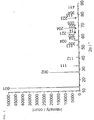
- FIG. 1 is an X-ray diffraction pattern of a lithium iron thiophosphate compound in Example 1 according to the present invention;
- FIG. 2 is a graph showing a characteristic of an electrode active material of the lithium iron thiophosphate compound in Example 1 according to the present invention;
- FIG. 3 is an X-ray diffraction pattern of a lithium iron thiophosphate compound in Example 2 according to the present invention; and
- FIG. 4 is a graph showing a characteristic of an electrode active material of the lithium iron thiophosphate compound in Example 2 according to the present invention.
-
- A host structure causing insertion-elimination reaction generally contains transition metal ions, the valence of which is changed by insertion-elimination of ions. It has been found out that in known sulfides, various transition metal ions cause a change in their valence. However, any element in the fourth period, which has a small atomic weight, is preferred as the transition metal in the host structure since it is possible to make capacity density high when used as an active material. From the industrial viewpoint, it is preferred to use an inexpensive element. As an element for satisfying these requirements, it is considered that an iron sulfide is preferred.
- As the iron sulfide acting as an electrode active material in a lithium battery, e.g. FeS2 and Li2FeS2 are reported. The voltage generated when lithium ions are inserted in FeS2 is about 1.7 V, and the voltage generated when the lithium ions are eliminated from Li2FeS2 is as low as 2.3 V. As other iron sulfides, it is reported that FePS3 has a lamellar structure and ions can be inserted in the layers. However, it is reported that this material exhibits an electrode voltage of about 3 V before the insertion of lithium ions therein but the voltage drops drastically by the insertion of the lithium ions so that the insertion voltage of the lithium ions becomes as low as 2 V or less (R. Brec, Solid State Ionics, vol. 22, p.3 (1986))
- The valence of the iron ions in this compound FePS3 is +2. In redox reaction in the insertion of lithium ions, the iron ions change into a lower oxidation number. As a result, a very low voltage would be exhibited. Accordingly, in order to make the voltage higher, it is necessary to make the oxidation number of the iron ions higher in the insertion-elimination reaction of the lithium ions. In the Li2xFe1-xPS3 of the present invention, the oxidation number of the iron ions is +2 and the oxidation number changes to +3 with the elimination of the lithium ions.
- A different example of a sulfide generating a voltage by a redox pair of Fe2+/Fe3+ is Li2FeS2 described above. The iron ions in this sulfide are in a +2 valence state. By eliminating lithium ions electrochemically to become a composition of Li2-δ FeS2 wherein δ is the elimination quantity of the lithium ions, the redox pair of Fe2+/Fe3+ exhibits a voltage of about 2.3 V.
- In the Li2xFe1-xPS3 compound according to the present invention, its redox pair generating a voltage is a redox pair of Fe2+/Fe3+ in the same way as in Li2FeS2. However, the lithium iron thiophosphate compound generates about 3V, which is significantly higher than Li2FeS2. It is known that in the oxide type hosts, the redox voltage thereof changes dependently on the kind of cations adjacent to transition metal ions acting as a redox pair (A.K. Padhi, K.S. Nanjundaswamy, C. Masquelier, and J.B. Goodenough, J. Electrochemical Society, vol. 144, 2581 (1997)). It is considered that in Li2xFe1-xPS3 according to the present invention, a part (x) of Fe2+ in FePS3 is substituted with Li+ and lithium ions, the number of which is x are present between its layers. Consequently, the redox pair of Fe2+/Fe3+ is affected by P4+ in a P2S6 octahedron which shares a side with an FeS6 octahedron so that such a high voltage is exhibited.
- Li2xFe1-xPS3 according to the present invention has a structure similar to FePS3 or Li2FeS3. The structures of FePS3 and Li2PS3 are already reported in Z. Anorg. Allig. Chem, 401, 97 (1973) and J. Solid State Chem., 43, 151 (1982). Li2PS3 belongs to a hexagonal system (space group:
P63/mcm), and has a lamellar structure wherein lithium ions are present between layers of PS3. That is, the lamellar structure is represented by PS3-Li-PS3. On the other hand, FePS3 belongs to a prismatic crystal system (space group: C2/m), which is slightly distorted from the hexagonal system, and has a structure wherein iron ions are present in alternate spaces between PS3 layers similar to Li2PS3. Namely, FePS3 has a lamellar structure of PS3-Fe-PS3-( )-PS3, wherein ( ) represents a space having no cations between layers. It is considered that Li2xFe1-xPS3 according to the present invention has a lamellar structure PS3-(Fe1-xLix)-PS3-Lix-PS3 wherein a part of the iron ions in FePS3 is substituted with lithium ions and further the lithium ions occupy sites containing no Fe ions between PS3 layers. - Various thiophosphate compounds represented by a general formula MePS3 wherein Me represents a metal, such as NiPS3 and MnPS3, have a lamellar structure equivalent to that of FePS3. However, only Li2NiP2S6 is reported as a compound having a composition between MePS3-Li2PS3 and no iron type compound has been reported before the present invention.
- The lithium iron thiophosphate according to the present invention is represented by a general formula Li2xFe1-xPS3. In this general formula, x is 0 < x < 1, preferably 0.4 ≦x≦ 0.6, and most preferably x =0.5. In the case of x =0 or 1, the intended lithium iron thiophosphate compound which is an objective product of the present invention cannot be obtained.
- Li2xFe1-xPS3 according to the present invention can be obtained by introducing Li, Fe and P and/or sulfides thereof and S into an airtight container filled with inert atmosphere and heating the mixture at a temperature between 400 and 800 °C. Specifically, Li2xFe1-xPS3 can be obtained by mixing e.g. Li2S, Fe, FeS, P2S5, P2S3, Li, S and P as starting materials to have a desired composition, putting the resultant mixture airtightly in inert atmosphere, for example, in the manner of putting the mixture airtightly into a quartz tube, and heating the mixture at a temperature of 400 to 800 °C. In the case that the mixture is heated in flow of inert gas, phosphorus evaporates and scatters as the molecule of P2S5 because P2S5 is in a molecular crystal state, and thus, a compound having a desired composition cannot be obtained. When the heating temperature is lower than 400 °C, the reaction rate is low so that the reaction for obtaining a desired compound requires long time. When the heating temperature is higher than 800 °C, a desired compound cannot be obtained since FePS3 sublimates.
- In Li2xFe1-xPS3 according to the present invention, lithium ions which can be electrochemically inserted and eliminated would be lithium ions present between layers of PS3-(Fe1-xLix)-PS3. Furthermore, the insertion-elimination reaction thereof advances simultaneously with the redox reaction of Fe2+/Fe3+. Therefore, in the composition making the capacity of Li2xFe1-xPS3 largest, x is 1/2. As an electrode active material, this composition (LiFe1/2PS3) is most preferred.
- Li2xFe1-xPS3 according to the present invention is particularly useful as an electrode active material of a lithium battery, and exhibits a high voltage of about 3 V on the basis of its lithium electrode.
- The present invention will be described in greater detail by way of Examples, but the present invention is not limited thereto.
- In the present example, a lithium iron thiophosphate compound represented by LiFe1/2PS3 was synthesized and the electrode characteristic thereof in a lithium battery was examined.
- LiFe1/2PS3 was synthesized by the following method.
- As starting materials, metal iron (Fe) powder, iron sulfide (II) (FeS), and diphosphorus pentasulfide (P2S5) were used. These starting materials were mixed with each other at a molar ratio of 1:1:1. Thereafter, the mixture was molded into a pellet form. The pellets were put airtightly into a quartz tube whose inner surface was coated with carbon, and the tube was heated at 700 °C for 8 hours.
- The X-ray diffraction pattern of the thus obtained powder of LiFe1/2PS3 is shown in FIG. 1. Index numbers as unit lattice of hexagonal crystal can be assigned to all diffraction peaks. Thus, LiFe1/2PS3 obtained in the present example can be considered to have a structure similar to that of Li2PS3 or FePS3.
- Next, oxysuflide glass represented by 0.01Li3PO4-0.63Li2S-0.36SiS2 was synthesized as a lithium ion electrically-conductive solid electrolyte by the following method.
- Lithium sulfide, silicon sulfide and lithium phosphate were weighed at a molar ratio of 63:36:1 and then mixed with each other. This mixture was filled into a crucible made of glassy carbon. The mixture was melted at 1000 °C in flow of argon gas for 2 hours. The melted product was super-rapidly cooled with twin rollers. In this way, a lithium ion electrically-conductive solid electrolyte was obtained.
- LiFe1/2PS3 and 0.01Li3PO4-0.63Li2S-0.36SiS2, which were synthesized by the above-mentioned methods, were used to examine the characteristic of LiFe1/2PS3 as an electrode active material by the following method.
- LiFe1/2PS3 and 0.01Li3PO4-0.63Li2S-0.36SiS2 obtained in the above-mentioned methods were mixed with each other at a weight ratio of 1:1 and then 10 mg of this mixture was used as a working electrode. As a counter electrode, an indium-lithium alloy was used. The working electrode and the counter electrode were put together to sandwich a solid electrolyte layer so that they were integrated into a three-layer form. In this way, an electrochemical cell was produced. Constant electric current pulses (electric current value: 10 µA) in an oxidization direction were repeatedly supplied to this electrochemical cell for 2 hours. After each of the supplies of the pulses, open circuit voltage (pause time: 2 hours) was recorded. Subsequently, constant electric current pulses were repeatedly supplied thereto in a reduction direction. In the same way, open circuit voltage was recorded. The thus obtained voltage curve of LiFe1/2PS3 is shown in FIG. 2.
- In FIG. 2, its lower transverse axis represents the electricity quantity of the electric current supplied to LiFe1/2PS3 per weight, and its upper transverse axis represents the elimination quantity (δ: Li1δFe1/2PS3) of lithium ions, calculated from the electricity quantity of the supplied electric current. Its left vertical axis represents the voltage between terminals of the measured cell, and its right vertical axis represents the value obtained by converting the voltage of LiFe1/2PS3 from terminal-terminal voltage to voltage on the basis of lithium electrode. Black spots represent a voltage change during elimination of the lithium ions. White spots represent a voltage change when the lithium ions are inserted again after the elimination of the lithium ions.
- As is evident from FIG. 2, in LiFe1/2PS3 according to the present example, lithium ions can be eliminated at a voltage of about 3 V (on the basis of lithium electrode), and after the elimination of the lithium ions, they can be inserted again. It has also been found out that LiFe1/2PS3 according to the present example acts as an electrode active material exhibiting a relatively high voltage though this compound is a sulfide.
- In the present example, a lithium iron thiophosphate compound represented by Li2/3Fe2/3PS3 was synthesized and electrode characteristic thereof in a lithium battery was examined.
- Li2/3Fe2/3PS3 was synthesized by the following method.
- Li2/3Fe2/3PS3 was synthesized in the same way as in Example 1 except that a composition obtained by mixing Fe powder, FeS, P2S5 and lithium sulfide (Li2S) at a molar ratio of 3:1:3:2 was used as a starting material.
- The X-ray diffraction pattern of the thus obtained powder of Li2/3Fe2/3PS3 is shown in FIG. 3. Index numbers as unit lattice of hexagonal crystal can be assigned to all diffraction peaks. Thus, Li2/3Fe2/3PS3 obtained in the present example can be considered to have a structure similar to that of LiFe1/2PS3 in Example 1.
- Next, the electrode characteristic of Li2/3Fe2/3PS3 was examined by the same method as in Example 1. The results are shown in FIG. 4.
- As is evident from FIG. 4, in Li2/3Fe2/3PS3 according to the present example, lithium ions can be eliminated at a voltage of about 3 V (on the basis of lithium electrode voltage), and after the elimination of the lithium ions, they can be inserted again. It has also been found out that Li2/3Fe2/3PS3 according to the present example acts as an electrode active material exhibiting a relatively high voltage though this compound is a sulfide.
- In the present example, the first elimination quantity of lithium ions corresponds to 0.23 Li with respect to Li2/3Fe2/3PS3. On the other hand, the first elimination quantity of lithium ions corresponds to 0.37 Li with respect to LiFe1/2PS3 in Example 1. In Li2/3Fe2/3PS3, 1/3 of a lithium ion is present between Li1/3Fe2/3PS3 layers and in LiFe1/2PS3, 1/2 of a lithium ion is present between Li1/2Fe1/2PS3 layers. It can be therefore considered that the lithium ions which are inserted and eliminated at the time of charge and discharge are lithium ions present between LixFe1-xPS3 layers.
- At the time of charge, the quantity of lithium eliminated from Li2xFe1 -xPS3 is xLi, and the quantity of Fe2+ whose valence changes with the elimination of the lithium ions is (1-x)Fe2+. Accordingly, in the composition having a maximum elimination quantity of the lithium ions, that is, a maximum capacity when Li2xFe1-xPS3 is used as an electrode active material, x is 1/2. This composition is most preferred.
- As described above, the lithium iron thiophosphate according to the present invention, a voltage of about 3 V can be generated on the basis of lithium electrode. For example, when the lithium iron thiophosphate is used as an electrode active material of a lithium battery, it is possible to provide a lithium battery having high output as well as high energy density.
Claims (5)
- A lithium iron thiophosphate compound represented by a general formula: Li2xFe1-xPS3 wherein x is more than 0 and less than 1.
- The lithium iron thiophosphate compound according to claim 1, wherein x in the general formula Li2xFe1-xPS3 is not less than 0.4 and not more than 0.6.
- The lithium iron thiophosphate compound according to claim 1, wherein x in the general formula Li2xFe1-xPS3 is 0.5.
- A process for producing the lithium iron thiophosphate compound according to any one of claims 1 to 3, comprising the steps of:introducing Li, Fe, P, S and/or sulfides of Li, Fe, P to an airtight container filled with inert atmosphere, andheating at a temperature between 400 and 800 °C.
- A lithium battery wherein the lithium iron thiophosphate compound according to any one of claims 1 to 3 is used as an electrode active material.
Applications Claiming Priority (2)
| Application Number | Priority Date | Filing Date | Title |
|---|---|---|---|
| JP2001089447 | 2001-03-27 | ||
| JP2001089447A JP4924963B2 (en) | 2001-03-27 | 2001-03-27 | Lithium iron thiophosphate compound, method for producing the same, and lithium battery using the compound |
Publications (1)
| Publication Number | Publication Date |
|---|---|
| EP1248309A1 true EP1248309A1 (en) | 2002-10-09 |
Family
ID=18944374
Family Applications (1)
| Application Number | Title | Priority Date | Filing Date |
|---|---|---|---|
| EP20020006656 Withdrawn EP1248309A1 (en) | 2001-03-27 | 2002-03-26 | Lithium iron thiophosphate compound, process for producing the compound, and lithium battery using the compound |
Country Status (3)
| Country | Link |
|---|---|
| US (1) | US20020142219A1 (en) |
| EP (1) | EP1248309A1 (en) |
| JP (1) | JP4924963B2 (en) |
Cited By (4)
| Publication number | Priority date | Publication date | Assignee | Title |
|---|---|---|---|---|
| CN106233525A (en) * | 2014-04-15 | 2016-12-14 | 魁北克电力公司 | Method for electrochemical charging/discharging of lithium-sulfur (Li-S) batteries and device using said method |
| CN111403730A (en) * | 2020-01-21 | 2020-07-10 | 南京航空航天大学 | FePS for sodium ion battery3@ MXene nano composite anode material, preparation method thereof and sodium ion battery |
| CN111592046A (en) * | 2020-06-16 | 2020-08-28 | 浙江大学 | Sulfur-defect-rich ferrophosphorus sulfide nanosheet and preparation method and application thereof |
| EP4664560A4 (en) * | 2023-02-07 | 2026-04-29 | Mitsui Kinzoku Company Ltd | ACTIVE MATERIAL, SOLID ELECTROLYTE, ELECTRODE MIXTURE AND BATTERY |
Families Citing this family (10)
| Publication number | Priority date | Publication date | Assignee | Title |
|---|---|---|---|---|
| US6821677B2 (en) * | 2001-03-29 | 2004-11-23 | Kabushiki Kaisha Toshiba | Negative electrode active material and nonaqueous electrolyte battery |
| DE102007048289A1 (en) * | 2007-10-08 | 2009-04-09 | Universität Siegen | Lithium argyrodites |
| GB2464455B (en) * | 2008-10-14 | 2010-09-15 | Iti Scotland Ltd | Lithium-containing transition metal sulfide compounds |
| WO2016080443A1 (en) * | 2014-11-18 | 2016-05-26 | 国立研究開発法人産業技術総合研究所 | Lithium-iron-phosphorus-sulfur-carbon composite body and method for producing same |
| US11063289B2 (en) | 2016-09-05 | 2021-07-13 | Toyota Motor Europe | Increasing ionic conductivity of lithium titanium thiophosphate by sintering |
| WO2018041374A1 (en) | 2016-09-05 | 2018-03-08 | Toyota Motor Europe | Method of synthesis of liti2(ps4)3 |
| US11063293B2 (en) | 2016-10-28 | 2021-07-13 | Toyota Motor Europe | Increasing ionic conductivity of LiTi2(PS4)3 by Zr doping |
| US10807877B2 (en) | 2016-10-28 | 2020-10-20 | Toyota Motor Europe | Increasing ionic conductivity of LiTi2(PS4)3 by Al doping |
| CN112551599B (en) * | 2020-12-10 | 2022-11-11 | 西安交通大学深圳研究院 | A kind of nickel thiophosphate nanosheet/graphene composite material and preparation method thereof |
| CN120004230B (en) * | 2025-02-27 | 2025-11-28 | 上海动力电池循环利用中心有限公司 | Potassium-ion battery anode iron thiophosphate nanosheets, their preparation methods and applications |
Citations (2)
| Publication number | Priority date | Publication date | Assignee | Title |
|---|---|---|---|---|
| US4049879A (en) * | 1976-04-19 | 1977-09-20 | Exxon Research & Engineering Co. | Intercalated transition metal phosphorus trisulfides |
| US4579724A (en) * | 1982-12-06 | 1986-04-01 | National Research Development Corporation | Cathode material for alkali-metal rechargeable cell |
Family Cites Families (3)
| Publication number | Priority date | Publication date | Assignee | Title |
|---|---|---|---|---|
| FR2420852A1 (en) * | 1978-03-24 | 1979-10-19 | Comp Generale Electricite | LITHIUM GENERATOR |
| JPS60500053A (en) * | 1982-12-06 | 1985-01-17 | ナショナル・リサ−チ・デイベロップメント・コ−ポレイション | Cathode material for rechargeable alkali metal batteries |
| US5168020A (en) * | 1985-07-18 | 1992-12-01 | Allied-Signal Inc. | Rechargeable sodium alloy anode |
-
2001
- 2001-03-27 JP JP2001089447A patent/JP4924963B2/en not_active Expired - Fee Related
-
2002
- 2002-03-18 US US10/098,475 patent/US20020142219A1/en not_active Abandoned
- 2002-03-26 EP EP20020006656 patent/EP1248309A1/en not_active Withdrawn
Patent Citations (2)
| Publication number | Priority date | Publication date | Assignee | Title |
|---|---|---|---|---|
| US4049879A (en) * | 1976-04-19 | 1977-09-20 | Exxon Research & Engineering Co. | Intercalated transition metal phosphorus trisulfides |
| US4579724A (en) * | 1982-12-06 | 1986-04-01 | National Research Development Corporation | Cathode material for alkali-metal rechargeable cell |
Non-Patent Citations (2)
| Title |
|---|
| GLEDEL, C. ET AL.: "Synthesis and EXAFS Characterization of Amorphous Iron Phosphorus Sulfide (FePS3) Thin Films", J. MAT. SCI. LETT., vol. 7, no. 9, 1988, pages 1054 - 1055, XP001095258 * |
| KUZMINSKII Y V ET AL: "Iron and nickel phosphorus trisulfides as electroactive materials for primary lithium batteries", JOURNAL OF POWER SOURCES, ELSEVIER SEQUOIA S.A. LAUSANNE, CH, vol. 55, no. 2, 1 June 1995 (1995-06-01), pages 133 - 141, XP004044378, ISSN: 0378-7753 * |
Cited By (8)
| Publication number | Priority date | Publication date | Assignee | Title |
|---|---|---|---|---|
| CN106233525A (en) * | 2014-04-15 | 2016-12-14 | 魁北克电力公司 | Method for electrochemical charging/discharging of lithium-sulfur (Li-S) batteries and device using said method |
| US10536019B2 (en) | 2014-04-15 | 2020-01-14 | HYDRO-QUéBEC | Method for the electrochemical charging/discharging of a lithium-sulphur (Li—S) battery and device using the method |
| CN106233525B (en) * | 2014-04-15 | 2020-09-11 | 魁北克电力公司 | Methods for electrochemical charging/discharging of lithium-sulfur (Li-S) batteries and devices using the same |
| EP3132490B1 (en) * | 2014-04-15 | 2023-06-07 | Hydro-Québec | Method for the electrochemical charging/discharging of a lithium-sulphur (li-s) battery and device using said method |
| CN111403730A (en) * | 2020-01-21 | 2020-07-10 | 南京航空航天大学 | FePS for sodium ion battery3@ MXene nano composite anode material, preparation method thereof and sodium ion battery |
| CN111403730B (en) * | 2020-01-21 | 2020-12-25 | 南京航空航天大学 | FePS for sodium ion battery3@ MXene nano composite anode material, preparation method thereof and sodium ion battery |
| CN111592046A (en) * | 2020-06-16 | 2020-08-28 | 浙江大学 | Sulfur-defect-rich ferrophosphorus sulfide nanosheet and preparation method and application thereof |
| EP4664560A4 (en) * | 2023-02-07 | 2026-04-29 | Mitsui Kinzoku Company Ltd | ACTIVE MATERIAL, SOLID ELECTROLYTE, ELECTRODE MIXTURE AND BATTERY |
Also Published As
| Publication number | Publication date |
|---|---|
| US20020142219A1 (en) | 2002-10-03 |
| JP4924963B2 (en) | 2012-04-25 |
| JP2002284530A (en) | 2002-10-03 |
Similar Documents
| Publication | Publication Date | Title |
|---|---|---|
| Padhi et al. | Phospho‐olivines as positive‐electrode materials for rechargeable lithium batteries | |
| Oukahou et al. | Investigation of LiMn1-xMxPO4 (M= Ni, Fe) as cathode materials for Li-ion batteries using density functional theory | |
| CN100517817C (en) | Alkali/transition metal halo-and hydroxy-phosphates and related electrode active materials | |
| KR100655812B1 (en) | Electrodes, Lithium-Ion Batteries, and Lithium-Ion Batteries with Lithium-Containing Phosphate Active Materials | |
| EP2615057B1 (en) | Metal fluoride and phosphate nanocomposites as electrode materials | |
| EP0933827B1 (en) | Lithium secondary battery | |
| US7270915B2 (en) | Alkali/transition metal HALO-and hydroxy-phosphates and related electrode active materials | |
| JP3142522B2 (en) | Lithium secondary battery | |
| EP2203948B1 (en) | Positive electrode active material, lithium secondary battery, and manufacture methods therefore | |
| CN100379062C (en) | Carbon-coated lithium-containing powder and manufacturing method thereof | |
| EP0951083B1 (en) | Solid state lithium secondary battery | |
| JP4578684B2 (en) | Lithium secondary battery | |
| EP1855334A2 (en) | Cathode material for manufacturing a rechargeable battery | |
| US20170005332A1 (en) | Oxyfluoride compounds for lithium-cells and batteries | |
| US20020142219A1 (en) | Lithium iron thiophosphate compound, process for producing the compound, and lithium battery using the compound | |
| US20070072034A1 (en) | Secondary electrochemical cell | |
| JPS6359507B2 (en) | ||
| KR20120016079A (en) | Solid electrolyte material, electrode body containing solid electrolyte material, all-solid battery containing solid electrolyte material, and method of manufacturing solid electrolyte material | |
| US20040202935A1 (en) | Cathode active material with increased alkali/metal content and method of making same | |
| EP0951082B1 (en) | Lithium secondary battery | |
| CN100359723C (en) | Negative electrode for lithium batteries | |
| EP1432055B1 (en) | Positive electrode material for lithium secondary battery, method for producing the same, and lithium secondary battery | |
| MXPA02010016A (en) | Electrochemical element with ceramic particles in the electrolyte layer. | |
| EP2569814A1 (en) | Ion conductor and solid state battery | |
| Padhi | Mapping redox energies of electrode materials for lithium batteries |
Legal Events
| Date | Code | Title | Description |
|---|---|---|---|
| PUAI | Public reference made under article 153(3) epc to a published international application that has entered the european phase |
Free format text: ORIGINAL CODE: 0009012 |
|
| AK | Designated contracting states |
Kind code of ref document: A1 Designated state(s): AT BE CH CY DE DK ES FI FR GB GR IE IT LI LU MC NL PT SE TR |
|
| AX | Request for extension of the european patent |
Free format text: AL;LT;LV;MK;RO;SI |
|
| RIN1 | Information on inventor provided before grant (corrected) |
Inventor name: TAKADA, KAZUNORI Inventor name: KOUGUCHI, MASARU C/O JAPAN STORAGE BATTERY CO.,LT Inventor name: KAJIYAMA, AKIHISA, TODA KOGYO CORPORATION Inventor name: INADA, TARO, DENKI KAGAKU KOGYO KABUSHIKI KAISHA Inventor name: KONDO, SHIGEO NATIONAL INST.FOR MATERIALSSCIENCE Inventor name: WATANABE, MAMORU |
|
| AKX | Designation fees paid | ||
| REG | Reference to a national code |
Ref country code: DE Ref legal event code: 8566 |
|
| STAA | Information on the status of an ep patent application or granted ep patent |
Free format text: STATUS: THE APPLICATION IS DEEMED TO BE WITHDRAWN |
|
| 18D | Application deemed to be withdrawn |
Effective date: 20030410 |