EP1248103A2 - Eluent for ion chromatography for measuring alkaline earth metal ions, and method for analyzing alkaline earth metal ions, employing it - Google Patents
Eluent for ion chromatography for measuring alkaline earth metal ions, and method for analyzing alkaline earth metal ions, employing it Download PDFInfo
- Publication number
- EP1248103A2 EP1248103A2 EP02005626A EP02005626A EP1248103A2 EP 1248103 A2 EP1248103 A2 EP 1248103A2 EP 02005626 A EP02005626 A EP 02005626A EP 02005626 A EP02005626 A EP 02005626A EP 1248103 A2 EP1248103 A2 EP 1248103A2
- Authority
- EP
- European Patent Office
- Prior art keywords
- acid
- eluent
- alkaline earth
- earth metal
- metal ions
- Prior art date
- Legal status (The legal status is an assumption and is not a legal conclusion. Google has not performed a legal analysis and makes no representation as to the accuracy of the status listed.)
- Ceased
Links
Images

Classifications
-
- G—PHYSICS
- G01—MEASURING; TESTING
- G01N—INVESTIGATING OR ANALYSING MATERIALS BY DETERMINING THEIR CHEMICAL OR PHYSICAL PROPERTIES
- G01N30/00—Investigating or analysing materials by separation into components using adsorption, absorption or similar phenomena or using ion-exchange, e.g. chromatography or field flow fractionation
- G01N30/96—Investigating or analysing materials by separation into components using adsorption, absorption or similar phenomena or using ion-exchange, e.g. chromatography or field flow fractionation using ion-exchange
-
- G—PHYSICS
- G01—MEASURING; TESTING
- G01N—INVESTIGATING OR ANALYSING MATERIALS BY DETERMINING THEIR CHEMICAL OR PHYSICAL PROPERTIES
- G01N30/00—Investigating or analysing materials by separation into components using adsorption, absorption or similar phenomena or using ion-exchange, e.g. chromatography or field flow fractionation
- G01N30/02—Column chromatography
- G01N30/26—Conditioning of the fluid carrier; Flow patterns
- G01N30/28—Control of physical parameters of the fluid carrier
- G01N30/34—Control of physical parameters of the fluid carrier of fluid composition, e.g. gradient
-
- Y—GENERAL TAGGING OF NEW TECHNOLOGICAL DEVELOPMENTS; GENERAL TAGGING OF CROSS-SECTIONAL TECHNOLOGIES SPANNING OVER SEVERAL SECTIONS OF THE IPC; TECHNICAL SUBJECTS COVERED BY FORMER USPC CROSS-REFERENCE ART COLLECTIONS [XRACs] AND DIGESTS
- Y10—TECHNICAL SUBJECTS COVERED BY FORMER USPC
- Y10T—TECHNICAL SUBJECTS COVERED BY FORMER US CLASSIFICATION
- Y10T436/00—Chemistry: analytical and immunological testing
- Y10T436/25—Chemistry: analytical and immunological testing including sample preparation
- Y10T436/25875—Gaseous sample or with change of physical state
Definitions
- the present invention relates to an eluent for ion chromatography for analyzing cations such as alkaline earth metal ions, and an analytical method by ion chromatography employing it.
- ion chromatography has been used in many cases, to carry out analyses of ions in environmental water, industrial water related to atomic power/semiconductors and test samples of e.g. food products.
- a separation column packed with a strongly acidic cation exchanger is used.
- a column of this type is employed for simultaneously analyzing monovalent cations and divalent cations including alkaline earth metals, there has been a problem that due to a substantial difference in its selectivity, it takes a long time for their analysis, or the analysis has to be carried out by setting an independent analytical condition for each of them. If the analysis is carried out by setting such different analytical conditions, there has been a problem that under the analytical condition for analysis of monovalent cations, divalent cations tend to accumulate in the column, whereby the separation performance deteriorates.
- the above-mentioned improved methods have a problem that, although the elution may be facilitated, the divalent cations elute in a competitive state of ion exchange equilibrium and complex-formation equilibrium, whereby the peak shape tends to have tailing, as is different from monovalent cations which elute by a normal ion exchange reaction. Consequently, it is not possible to solve problems such as a decrease in the quantifying precision in the analysis of the chromatogram, difficulty in identification due to an overlapping with adjacent peaks and deterioration of the detection sensitivity. Further, depending upon the type of the complex-forming agent, a system peak (a peak not attributable to cations in the test sample) will appear and will overlap the peaks of the test sample, and in order to avoid this, it has been necessary to extend the analytical time.
- an object of the present invention to provide an eluent containing a complex-forming agent, which is capable of letting an alkaline earth metal such as magnesium or calcium elute in a good peak shape and which is capable of not permitting a system peak to appear or not permitting an influence over the analysis of cations.
- the present invention has been made to accomplish the above object, and firstly, it provides an eluent for ion chromatography for analyzing divalent cations, which comprises an acid and at least one amino acid selected from the group consisting of histidine, lysine and arginine.
- the present invention provides such an eluent, wherein the divalent cations are alkaline earth metal ions.
- the present invention provides such an eluent, wherein the acid is nitric acid, sulfuric acid, phosphoric acid, methanesulfonic acid, oxalic acid, tartaric acid, benzoic acid or phthalic acid.
- the present invention provides a method for analyzing cations by ion chromatography employing a cation exchange column, wherein the eluent as defined above is used.
- the acid as one of the components of the eluent may, for example, be a mineral acid such as nitric acid, sulfuric acid or phosphoric acid, or an organic acid such as methanesulfonic acid, oxalic acid, tartaric acid, benzoic acid or phthalic acid.
- the concentration of the acid may optionally be determined taking into consideration various conditions such as the ion species to be analyzed and the amount of the test sample to be supplied to the column, but usually, it is preferably from about 0.1 to 10 mmol/l.
- At least one amino acid selected from the group consisting of histidine, lysine and arginine is added to the above acid to obtain an eluent in order to elute divalent cations, particularly alkaline earth metal ions, in a good peak shape and further to prevent appearance of a system peak.
- the amino acid to be added to the above-mentioned acid is at least one member selected from histidine, lysine and arginine, and the respective amino acids are not particularly limited with respect to the types of optical isomers or the purities, and further they are not restricted with respect to the types of counter ions.
- Such counter ions which are not restricted in the present invention, may, for example, be halide ions such as chloride ions, sulfate ions, nitrate ions or phosphate ions.
- concentration of the amino acid to be added to the above acid may also suitably be determined taking into consideration the ion species to be analyzed and various conditions such as the amount of the test sample to be supplied to the column, but it is usually preferably from 0.01 to 10 mmol/l. Further, in a case where two or more amino acids are to be added, the total concentration of the two or more amino acids is preferably within the above range.
- the method for analyzing cations by ion chromatography employing a cation exchange column is a method in which the eluent having an amino acid added to an acid, as described above, is used.
- This analytical method is useful for an analysis of divalent cations or for an analysis of a test sample containing monovalent and divalent cations, and it is particularly useful for a test sample containing alkaline earth metal ions as the divalent cations.
- the present invention can be carried out by using a conventional column which is commonly used in ion chromatography, such as a separation column packed with a strongly acidic cation exchanger.
- a conventional column which is commonly used in ion chromatography
- An example of a commercially readily available column may be TSKgel IC-Cation or TSKgel IC-Cation I/II HR (each being a tradename, manufactured by TOSOH CORPORATION), Shodex YK-421 (tradename, manufactured by Showa Denko K.K.), or IonPac CS12 (tradename, manufactured by Dionex).
- a column having carboxyl groups introduced to a polymer gel such as TSKgel IC-Cation I/IIHR
- a column having a suitable cation exchange gel packed in a suitable column other than a commercially available separation column.
- the analysis is particularly preferably carried out under conditions such that separation of the respective ions in the separation column is optimized.
- conditions include, for example, the flow rates of the test sample and the eluent, the temperature for analysis, the column capacity (the ion exchange capacity), the amount of the test sample charged and the concentration of the test sample.
- the flow rate is from 0.5 to 1.0 ml/min
- the temperature for analysis is from 25 to 40°C
- Detection of cations eluted from the column upon supply of the eluent can be carried out by using e.g. an electrical conductivity detector, an ultraviolet and visible ray detector or a refractive index detector. However, for a high sensitivity analysis, it is particularly preferred to carry out the detection by means of an electrical conductivity detector.
- the following analysis was carried out by using as a column for separation of cations a commercially available column (TSKgel IC-Cation I/II HR, tradename, manufactured by TOSOH CORPORATION, internal diameter: 4.6 mm, length: 10 cm) and as an eluent an eluent containing 2.5 mmol/l of nitric acid and 0.5 mmol/l of histidine.
- the conditions for the analysis were such that the column temperature was 40°C, and the flow rate of the eluent was 0.67 ml/min, and an electrical conductivity detector was used for the detection.
- a mixed aqueous solution (20 ⁇ l) which contained six types of standard cations ((1) lithium ions (1 mg/l), (2) sodium ions (5 mg/l), (3) ammonium ions (5 mg/l), (4) potassium ions (10 mg/l), (5) magnesium ions (5 mg/l), and (6) calcium ions (10 mg/l)).
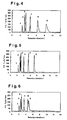
- the obtained chromatogram is shown in Fig. 1.
- a chromatogram was obtained in the same manner as in Example 1 except that as an eluent, an eluent containing 2.5 mmol/l of nitric acid and 0.2 mmol/l of arginine, was used. The obtained chromatogram is shown in Fig. 2.
- a chromatogram was obtained in the same manner as in Example 1 except that as an eluent, an eluent containing 2.5 mmol/l of nitric acid and 0.5 mmol/l of lysine, was used. The obtained chromatogram is shown in Fig. 3.
- a chromatogram was obtained in the same manner as in Example 1 except that as an eluent, 2.5 mmol/l of nitric acid was used without adding an amino acid. The obtained chromatogram is shown in Fig. 4.
- a chromatogram was obtained in the same manner as in Example 1 except that as an eluent, 2.5 mmol/l of nitric acid and 0.1 mmol/l of ethylenediamine were used. The obtained chromatogram is shown in Fig. 5.
- a chromatogram was obtained in the same manner as in Example 1 except that as an eluent, an eluent containing 2 mmol/l of nitric acid and 1 mmol/l of pyridine-2,6-dicarboxylic acid was used. The obtained chromatogram is shown in Fig. 6.
- the eluent of the present invention it becomes possible to elute alkaline earth metals such as magnesium and calcium in good peak shapes and to make a system peak not to influence over the analysis. Further, the present invention can be carried out by using a conventional means such as a column as it is, and it can be carried out simply by adding an acid to an amino acid, whereby no additional load will be required to the person in its practical operation.
- An eluent for ion chromatography for analyzing divalent cations which comprises an acid and at least one amino acid selected from the group consisting of histidine, lysine and arginine.
Landscapes
- Physics & Mathematics (AREA)
- Health & Medical Sciences (AREA)
- Life Sciences & Earth Sciences (AREA)
- Chemical & Material Sciences (AREA)
- Analytical Chemistry (AREA)
- Biochemistry (AREA)
- General Health & Medical Sciences (AREA)
- General Physics & Mathematics (AREA)
- Immunology (AREA)
- Pathology (AREA)
- Treatment Of Liquids With Adsorbents In General (AREA)
- Investigating Or Analysing Biological Materials (AREA)
- Investigating Or Analyzing Non-Biological Materials By The Use Of Chemical Means (AREA)
- Sampling And Sample Adjustment (AREA)
Abstract
Description
- The present invention relates to an eluent for ion chromatography for analyzing cations such as alkaline earth metal ions, and an analytical method by ion chromatography employing it.
- Heretofore, for analyses of inorganic ions, ion chromatography has been used in many cases, to carry out analyses of ions in environmental water, industrial water related to atomic power/semiconductors and test samples of e.g. food products.
- In an analysis of cations by ion chromatography, a separation column packed with a strongly acidic cation exchanger is used. In a case where a column of this type is employed for simultaneously analyzing monovalent cations and divalent cations including alkaline earth metals, there has been a problem that due to a substantial difference in its selectivity, it takes a long time for their analysis, or the analysis has to be carried out by setting an independent analytical condition for each of them. If the analysis is carried out by setting such different analytical conditions, there has been a problem that under the analytical condition for analysis of monovalent cations, divalent cations tend to accumulate in the column, whereby the separation performance deteriorates.
- Under the circumstances, there has been a proposal for an improved method for simultaneously analyzing monovalent and divalent cations by ion chromatography. For example, an improved method has been proposed wherein a dilute acid such as dilute nitric acid, or one having a complex-forming agent incorporated to the acid, is used as an eluent. By this improved method, divalent cations are separated in a state where the apparent electrical charge in ion exchange is reduced by formation of a complex with the complex-forming agent or ion exchange group, whereby a chromatogram can be obtained wherein the respective ions are eluted in a good balance in a short period of analytical time. Further, as another improved method for analyzing monovalent and divalent cations simultaneously and satisfactorily, an improved method has also been reported wherein using a weakly acidic cation exchange column, an eluent having a complex-forming agent such as pyridine-2,6-dicarboxylic acid added, is used (Am. Lab. (Fairfield Conn.) Vol. 21, No. 5, p. 92-101). Still further, a weakly acidic cation exchange column for simultaneously analyzing monovalent and divalent cations without using a complex-forming agent, has also been reported (JP-A-6-18505, JP-A-8-257419).
- However, the above-mentioned improved methods have a problem that, although the elution may be facilitated, the divalent cations elute in a competitive state of ion exchange equilibrium and complex-formation equilibrium, whereby the peak shape tends to have tailing, as is different from monovalent cations which elute by a normal ion exchange reaction. Consequently, it is not possible to solve problems such as a decrease in the quantifying precision in the analysis of the chromatogram, difficulty in identification due to an overlapping with adjacent peaks and deterioration of the detection sensitivity. Further, depending upon the type of the complex-forming agent, a system peak (a peak not attributable to cations in the test sample) will appear and will overlap the peaks of the test sample, and in order to avoid this, it has been necessary to extend the analytical time.
- Under these circumstances, it is an object of the present invention to provide an eluent containing a complex-forming agent, which is capable of letting an alkaline earth metal such as magnesium or calcium elute in a good peak shape and which is capable of not permitting a system peak to appear or not permitting an influence over the analysis of cations.
- The present invention has been made to accomplish the above object, and firstly, it provides an eluent for ion chromatography for analyzing divalent cations, which comprises an acid and at least one amino acid selected from the group consisting of histidine, lysine and arginine.
- Secondly, the present invention provides such an eluent, wherein the divalent cations are alkaline earth metal ions.
- Thirdly, the present invention provides such an eluent, wherein the acid is nitric acid, sulfuric acid, phosphoric acid, methanesulfonic acid, oxalic acid, tartaric acid, benzoic acid or phthalic acid.
- Fourthly, the present invention provides a method for analyzing cations by ion chromatography employing a cation exchange column, wherein the eluent as defined above is used.
- In the accompanying drawings:
- Fig. 1 is a chromatogram showing the results of
Example 1. In the figure, the
peak 1 is a peak of lithium ions,peak 2 is a peak of sodium ions,peak 3 is a peak of ammonium ions,peak 4 is a peak of potassium ions,peak 5 is a peak of magnesium ions, andpeak 6 is a peak of calcium ions. - Fig. 2 is a chromatogram showing the results of
Example 2. In the figure,
peaks 1 to 6 are the same as in Fig. 1. - Fig. 3 is a chromatogram showing the results of
Example 3. In the figure,
peaks 1 to 6 are the same as in Fig. 1. - Fig. 4 is a chromatogram showing the results of
Comparative Example 1. In the figure,
peaks 1 to 6 are the same as in Fig. 1. - Fig. 5 is a chromatogram showing the results of
Comparative Example 2. In the figure,
peaks 1 to 6 are the same as in Fig. 1. - Fig. 6 is a chromatogram showing the results of
Comparative Example 3. In the figure,
peaks 1 to 6 are the same as in Fig. 1. -
- The acid as one of the components of the eluent, may, for example, be a mineral acid such as nitric acid, sulfuric acid or phosphoric acid, or an organic acid such as methanesulfonic acid, oxalic acid, tartaric acid, benzoic acid or phthalic acid. The concentration of the acid may optionally be determined taking into consideration various conditions such as the ion species to be analyzed and the amount of the test sample to be supplied to the column, but usually, it is preferably from about 0.1 to 10 mmol/ℓ.
- In the present invention, at least one amino acid selected from the group consisting of histidine, lysine and arginine is added to the above acid to obtain an eluent in order to elute divalent cations, particularly alkaline earth metal ions, in a good peak shape and further to prevent appearance of a system peak. The amino acid to be added to the above-mentioned acid is at least one member selected from histidine, lysine and arginine, and the respective amino acids are not particularly limited with respect to the types of optical isomers or the purities, and further they are not restricted with respect to the types of counter ions. Such counter ions which are not restricted in the present invention, may, for example, be halide ions such as chloride ions, sulfate ions, nitrate ions or phosphate ions. The concentration of the amino acid to be added to the above acid may also suitably be determined taking into consideration the ion species to be analyzed and various conditions such as the amount of the test sample to be supplied to the column, but it is usually preferably from 0.01 to 10 mmol/ℓ. Further, in a case where two or more amino acids are to be added, the total concentration of the two or more amino acids is preferably within the above range.
- The method for analyzing cations by ion chromatography employing a cation exchange column, according to the present invention, is a method in which the eluent having an amino acid added to an acid, as described above, is used. This analytical method is useful for an analysis of divalent cations or for an analysis of a test sample containing monovalent and divalent cations, and it is particularly useful for a test sample containing alkaline earth metal ions as the divalent cations.
- The present invention can be carried out by using a conventional column which is commonly used in ion chromatography, such as a separation column packed with a strongly acidic cation exchanger. An example of a commercially readily available column may be TSKgel IC-Cation or TSKgel IC-Cation I/II HR (each being a tradename, manufactured by TOSOH CORPORATION), Shodex YK-421 (tradename, manufactured by Showa Denko K.K.), or IonPac CS12 (tradename, manufactured by Dionex). Among them, it is preferred to employ a column having carboxyl groups introduced to a polymer gel (such as TSKgel IC-Cation I/IIHR) from such a viewpoint that alkali metal ions and alkaline earth metal ions can be eluted in a good balance. It is, of course, possible to use a column having a suitable cation exchange gel packed in a suitable column, other than a commercially available separation column.
- The analysis is particularly preferably carried out under conditions such that separation of the respective ions in the separation column is optimized. Such conditions include, for example, the flow rates of the test sample and the eluent, the temperature for analysis, the column capacity (the ion exchange capacity), the amount of the test sample charged and the concentration of the test sample. Usually, it is preferred to carry out a preliminarily analysis by setting the flow rate to be from 0.5 to 1.0 ml/min, the temperature for analysis to be from 25 to 40°C, the amount of the sample charged to be at most 100 µl and the concentration of the test sample to be at most 50 mg/ℓ as the total ion concentration, and then determine the conditions. Detection of cations eluted from the column upon supply of the eluent, can be carried out by using e.g. an electrical conductivity detector, an ultraviolet and visible ray detector or a refractive index detector. However, for a high sensitivity analysis, it is particularly preferred to carry out the detection by means of an electrical conductivity detector.
- Now, the present invention will be described in further detail with reference to Examples. However, it should be understood that the present invention is by no means restricted to such specific Examples.
- The following analysis was carried out by using as a column for separation of cations a commercially available column (TSKgel IC-Cation I/II HR, tradename, manufactured by TOSOH CORPORATION, internal diameter: 4.6 mm, length: 10 cm) and as an eluent an eluent containing 2.5 mmol/ℓ of nitric acid and 0.5 mmol/ℓ of histidine. The conditions for the analysis were such that the column temperature was 40°C, and the flow rate of the eluent was 0.67 ml/min, and an electrical conductivity detector was used for the detection.
- As a test sample, a mixed aqueous solution (20 µl) was used which contained six types of standard cations ((1) lithium ions (1 mg/ℓ), (2) sodium ions (5 mg/ℓ), (3) ammonium ions (5 mg/ℓ), (4) potassium ions (10 mg/ℓ), (5) magnesium ions (5 mg/ℓ), and (6) calcium ions (10 mg/ℓ)). The obtained chromatogram is shown in Fig. 1.
- As is evident from Fig. 1, the time required for the six types of standard cations to appear was about 10 minutes. Further, in Fig. 1, the asymmetry factor of calcium ions was 1.55, and a system peak appeared as a negative peak at about 5.2 minutes and did not hinder quantitative determination of standard cations. Thus, sufficient effects of improvement were obtained.
- A chromatogram was obtained in the same manner as in Example 1 except that as an eluent, an eluent containing 2.5 mmol/ℓ of nitric acid and 0.2 mmol/ℓ of arginine, was used. The obtained chromatogram is shown in Fig. 2.
- In Fig. 2, the asymmetry factor of calcium ions was 1.52, and a system peak appeared as a negative peak at about 6.4 minutes and did not hinder quantitative determination of standard cations. Thus, sufficient effects of improvement were obtained.
- A chromatogram was obtained in the same manner as in Example 1 except that as an eluent, an eluent containing 2.5 mmol/ℓ of nitric acid and 0.5 mmol/ℓ of lysine, was used. The obtained chromatogram is shown in Fig. 3.
- In Fig. 3, the asymmetry factor of calcium ions was 1.04, and a system peak appeared as a negative peak at about 4.7 minutes and did not hinder quantitative determination of standard cations. Thus, sufficient effects of improvement were obtained.
- A chromatogram was obtained in the same manner as in Example 1 except that as an eluent, 2.5 mmol/ℓ of nitric acid was used without adding an amino acid. The obtained chromatogram is shown in Fig. 4.
- In Fig. 4, no system peak appeared, but the asymmetry factor of calcium ions was 5.92, and the peak shape had a large tailing.
- A chromatogram was obtained in the same manner as in Example 1 except that as an eluent, 2.5 mmol/ℓ of nitric acid and 0.1 mmol/ℓ of ethylenediamine were used. The obtained chromatogram is shown in Fig. 5.
- In Fig. 5, the asymmetry factor of calcium ions was 0.97, and the effects of improvement of the peak shape was observed. However, a system peak appeared as a negative peak at about 13.4 minutes, and therefore, the analysis cycle had to be at least 14 minutes. Consequently, the total analytical time per test sample was prolonged.
- A chromatogram was obtained in the same manner as in Example 1 except that as an eluent, an eluent containing 2 mmol/ℓ of nitric acid and 1 mmol/ℓ of pyridine-2,6-dicarboxylic acid was used. The obtained chromatogram is shown in Fig. 6.
- In Fig. 6, the asymmetry factor of calcium ions was 2.2, and the effects of improvement of the peak shape were observed, but a system peak appeared as a broad positive peak between 2 minutes to 4 minutes and overlapped the peaks of standard cations, whereby quantitative determination of the standard cations became difficult.
- As described in the foregoing, by the eluent of the present invention, it becomes possible to elute alkaline earth metals such as magnesium and calcium in good peak shapes and to make a system peak not to influence over the analysis. Further, the present invention can be carried out by using a conventional means such as a column as it is, and it can be carried out simply by adding an acid to an amino acid, whereby no additional load will be required to the person in its practical operation.
- The entire disclosure of Japanese Patent Application No. 2001-70358 filed on March 13, 2001 including specification, claims, drawings and summary are incorporated herein by reference in its entirety.
- An eluent for ion chromatography for analyzing divalent cations, which comprises an acid and at least one amino acid selected from the group consisting of histidine, lysine and arginine.
Claims (4)
- An eluent for ion chromatography for analyzing divalent cations, which comprises an acid and at least one amino acid selected from the group consisting of histidine, lysine and arginine.
- The eluent according to Claim 1, wherein the divalent cations are alkaline earth metal ions.
- The eluent according to Claim 1 or 2, wherein the acid is nitric acid, sulfuric acid, phosphoric acid, methanesulfonic acid, oxalic acid, tartaric acid, benzoic acid or phthalic acid.
- A method for analyzing cations by ion chromatography employing a cation exchange column, wherein the eluent as defined in any one of Claims 1 to 3 is used.
Applications Claiming Priority (2)
| Application Number | Priority Date | Filing Date | Title |
|---|---|---|---|
| JP2001070358A JP2002267642A (en) | 2001-03-13 | 2001-03-13 | Eluent for ion chromatography for measuring alkaline earth metal ions and method for analyzing alkaline earth metal ions using the same |
| JP2001070358 | 2001-03-13 |
Publications (2)
| Publication Number | Publication Date |
|---|---|
| EP1248103A2 true EP1248103A2 (en) | 2002-10-09 |
| EP1248103A3 EP1248103A3 (en) | 2004-02-11 |
Family
ID=18928248
Family Applications (1)
| Application Number | Title | Priority Date | Filing Date |
|---|---|---|---|
| EP02005626A Ceased EP1248103A3 (en) | 2001-03-13 | 2002-03-12 | Eluent for ion chromatography for measuring alkaline earth metal ions, and method for analyzing alkaline earth metal ions, employing it |
Country Status (3)
| Country | Link |
|---|---|
| US (2) | US20020130081A1 (en) |
| EP (1) | EP1248103A3 (en) |
| JP (1) | JP2002267642A (en) |
Cited By (2)
| Publication number | Priority date | Publication date | Assignee | Title |
|---|---|---|---|---|
| CN103743836A (en) * | 2013-12-23 | 2014-04-23 | 广西科技大学 | Detection method of benzoic acid serving as food preservative |
| CN104215721A (en) * | 2014-10-09 | 2014-12-17 | 中国科学院上海有机化学研究所 | Application of phthalic acid in amino acid analysis |
Families Citing this family (13)
| Publication number | Priority date | Publication date | Assignee | Title |
|---|---|---|---|---|
| US7468161B2 (en) | 2002-04-15 | 2008-12-23 | Ventana Medical Systems, Inc. | Automated high volume slide processing system |
| US11249095B2 (en) | 2002-04-15 | 2022-02-15 | Ventana Medical Systems, Inc. | Automated high volume slide processing system |
| JP4114076B2 (en) * | 2004-02-17 | 2008-07-09 | 独立行政法人 日本原子力研究開発機構 | Actinide element separation method |
| JP4682702B2 (en) * | 2005-05-27 | 2011-05-11 | 日立化成工業株式会社 | Cation analysis ion chromatography column and method for producing the same |
| CN100362346C (en) * | 2006-06-21 | 2008-01-16 | 广州星群(药业)股份有限公司 | Method for detecting amino acid component in Xiasangju preparation |
| CN102209889B (en) | 2008-11-12 | 2015-05-13 | 文塔纳医疗系统公司 | Methods and apparatuses for heating slides carrying specimens |
| CN101806782A (en) * | 2010-03-29 | 2010-08-18 | 内蒙古蒙牛乳业(集团)股份有限公司 | Preparation method of benzoic acid standard solution, method for determining standard curve of benzoic acid standard solution and method for detecting content of benzoic acid standard solution in milk powder or milk |
| CN101806682B (en) * | 2010-03-29 | 2012-05-30 | 内蒙古蒙牛乳业(集团)股份有限公司 | Method for detecting benzoic acid content in cheese |
| JP5907326B1 (en) * | 2014-08-12 | 2016-04-26 | 株式会社アイスティサイエンス | Analytical pretreatment apparatus and analytical pretreatment method for amino acids, organic acids and carbohydrates |
| CN108279280A (en) * | 2018-01-31 | 2018-07-13 | 安徽瑞思威尔科技有限公司 | A kind of effective method of potassium in quick detection pit mud |
| CN109507314A (en) * | 2018-10-29 | 2019-03-22 | 中科谱研(北京)科技有限公司 | The ion chromatography method of sodium, potassium, magnesium, calcium in Amino Acid Compound Injection |
| CN111077005A (en) * | 2020-01-03 | 2020-04-28 | 昆明理工大学 | A method for revealing grain boundaries of recrystallized grains of duplex stainless steel during hot deformation |
| CN113325118B (en) * | 2021-07-21 | 2022-12-09 | 海南通用三洋药业有限公司 | Method for measuring sodium content in parecoxib sodium |
Family Cites Families (12)
| Publication number | Priority date | Publication date | Assignee | Title |
|---|---|---|---|---|
| US3732146A (en) * | 1970-12-22 | 1973-05-08 | Behringwerke Ag | Process for the isolation of native, highly purified plasminogen |
| CH643297A5 (en) * | 1978-06-30 | 1984-05-30 | Alpha Patent Ltd | Method for preparation of pure urokinase. |
| US4381346A (en) * | 1979-11-13 | 1983-04-26 | Huasin Syed S | Isolation of plasminogen activators useful as therapeutic and diagnostic agents |
| US4673733A (en) * | 1985-04-11 | 1987-06-16 | Sudhish Chandra | Treatment of biological and pharmaceutical products adsorbed on a solid phase with virus and pyrogen inactivating agents |
| JPS62266460A (en) * | 1986-05-14 | 1987-11-19 | Osaka Soda Co Ltd | Automatic analysis for trace of calcium and magnesium in dense salt solution |
| JPS6463378A (en) * | 1986-08-11 | 1989-03-09 | Mitsui Toatsu Chemicals | Separation of single stranded tpa and double standard tpa |
| JP2737920B2 (en) * | 1988-05-19 | 1998-04-08 | 東ソー株式会社 | Quantitative analysis of alkaline earth metals by ion chromatography |
| JP2737923B2 (en) * | 1988-05-27 | 1998-04-08 | 東ソー株式会社 | Quantitative analysis of alkaline earth metals by ion chromatography |
| JPH0431760A (en) * | 1990-05-28 | 1992-02-03 | Nec Corp | Method for removing phosphoric acid ion in solution |
| JP2652304B2 (en) | 1992-06-17 | 1997-09-10 | 信越化学工業株式会社 | Fluorine-containing organosilicon compound |
| JPH06213881A (en) * | 1993-01-14 | 1994-08-05 | Yokogawa Analytical Syst Kk | Method for measuring alkali metal ion and ammonium ion |
| JPH08257419A (en) | 1995-03-23 | 1996-10-08 | Tosoh Corp | Weakly acidic cation exchanger gel and method for producing the same |
-
2001
- 2001-03-13 JP JP2001070358A patent/JP2002267642A/en active Pending
-
2002
- 2002-03-11 US US10/093,508 patent/US20020130081A1/en not_active Abandoned
- 2002-03-12 EP EP02005626A patent/EP1248103A3/en not_active Ceased
-
2003
- 2003-10-02 US US10/675,976 patent/US7160462B2/en not_active Expired - Fee Related
Non-Patent Citations (1)
| Title |
|---|
| HAJOS P: "Histidine as a dipolar eluent component in cation chromatography" JOURNAL OF CHROMATOGRAPHY A, ELSEVIER SCIENCE, NL, vol. 789, no. 1-2, 21 November 1997 (1997-11-21), pages 141-148, XP004099937 ISSN: 0021-9673 * |
Cited By (3)
| Publication number | Priority date | Publication date | Assignee | Title |
|---|---|---|---|---|
| CN103743836A (en) * | 2013-12-23 | 2014-04-23 | 广西科技大学 | Detection method of benzoic acid serving as food preservative |
| CN104215721A (en) * | 2014-10-09 | 2014-12-17 | 中国科学院上海有机化学研究所 | Application of phthalic acid in amino acid analysis |
| CN104215721B (en) * | 2014-10-09 | 2016-02-03 | 中国科学院上海有机化学研究所 | The application of phthalic acid in amino acid analysis |
Also Published As
| Publication number | Publication date |
|---|---|
| US20040067598A1 (en) | 2004-04-08 |
| US20020130081A1 (en) | 2002-09-19 |
| EP1248103A3 (en) | 2004-02-11 |
| JP2002267642A (en) | 2002-09-18 |
| US7160462B2 (en) | 2007-01-09 |
Similar Documents
| Publication | Publication Date | Title |
|---|---|---|
| US7160462B2 (en) | Eluent for ion chromatography for measuring alkaline earth metal ions, and method for analyzing alkaline earth metal ions, employing it | |
| Forman | Rapid determination of plasma ammonia by an ion-exchange technic | |
| US5126272A (en) | System for detecting transition and rare earth elements in a matrix | |
| Heumann et al. | Chloride distribution coefficient on strongly basic anion-exchange resin: Dependence on co-ion in alkali fluoride solutions | |
| US4199323A (en) | Analytical technique for quantitating acid/salt and base/salt samples for species concentration | |
| Chen et al. | Simultaneous speciation of iron (II) and iron (III) by ion chromatography with chemiluminescence detection | |
| Dybczyński et al. | New reversed phase-high performance liquid chromatographic method for selective separation of yttrium from all rare earth elements employing nitrilotriacetate complexes in anion exchange mode | |
| Brown et al. | Anion—cation separations on a mixed bed alumina—silica column | |
| Arguello et al. | Ion-exchange separation and determination of calcium and magnesium | |
| Michalski | Principles and applications of ion chromatography | |
| US4500431A (en) | Separation of analysis of anions | |
| Janoš | Retention models in ion chromatography: the role of side equilibria in ion-exchange chromatography of inorganic cations and anions | |
| Krishen et al. | Acetylacetone as Analytical Extraction Reagent. Calculation of Successive Formation Constants from Extraction Data | |
| CA1168705A (en) | Ion exchange chromatography with indirect photometric detection | |
| Do et al. | Application of central composite designs for optimisation of the chromatographic separation of monomethylarsonate and dimethylarsinate and of selenomethionine and selenite by ion-pair chromatography coupled with plasma mass spectrometric detection | |
| US3709662A (en) | Iron analysis reagent formulation | |
| Janoš | Determination of stability constants of metal complexes from ion chromatographic measurements | |
| Lin et al. | A parallel processing solid phase extraction protocol for the determination of whole blood folate | |
| Morris et al. | Assay of inorganic sulfate in biologic fluids by nonsuppressed (single-column) ion chromatography | |
| Tarter | Eluent selection criteria for the simultaneous determination of anions and cations | |
| Hajós | Ethylenediamine as eluent component in cation chromatography. Predictive and comparative study for analysis of alkaline earth ions | |
| RU2215289C1 (en) | Method of determining mass concentrations of anionic impurities in aqueous heat carrier with boric acid additives | |
| US5651876A (en) | Interference suppressing buffer | |
| Kura | Chromatographic study of the acidic hydrolysis of cyclic octametaphosphate | |
| JPS62237353A (en) | Anion chromatography method |
Legal Events
| Date | Code | Title | Description |
|---|---|---|---|
| PUAI | Public reference made under article 153(3) epc to a published international application that has entered the european phase |
Free format text: ORIGINAL CODE: 0009012 |
|
| AK | Designated contracting states |
Kind code of ref document: A2 Designated state(s): AT BE CH CY DE DK ES FI FR GB GR IE IT LI LU MC NL PT SE TR |
|
| AX | Request for extension of the european patent |
Free format text: AL;LT;LV;MK;RO;SI |
|
| PUAL | Search report despatched |
Free format text: ORIGINAL CODE: 0009013 |
|
| AK | Designated contracting states |
Kind code of ref document: A3 Designated state(s): AT BE CH CY DE DK ES FI FR GB GR IE IT LI LU MC NL PT SE TR |
|
| AX | Request for extension of the european patent |
Extension state: AL LT LV MK RO SI |
|
| RIC1 | Information provided on ipc code assigned before grant |
Ipc: 7G 01N 30/96 B Ipc: 7G 01N 30/34 A |
|
| 17P | Request for examination filed |
Effective date: 20040427 |
|
| AKX | Designation fees paid |
Designated state(s): DE FR GB |
|
| 17Q | First examination report despatched |
Effective date: 20050404 |
|
| STAA | Information on the status of an ep patent application or granted ep patent |
Free format text: STATUS: THE APPLICATION HAS BEEN REFUSED |
|
| 18R | Application refused |
Effective date: 20111003 |