EP1247593A2 - Die for extruding aluminium or aluminium alloys - Google Patents
Die for extruding aluminium or aluminium alloys Download PDFInfo
- Publication number
- EP1247593A2 EP1247593A2 EP02007509A EP02007509A EP1247593A2 EP 1247593 A2 EP1247593 A2 EP 1247593A2 EP 02007509 A EP02007509 A EP 02007509A EP 02007509 A EP02007509 A EP 02007509A EP 1247593 A2 EP1247593 A2 EP 1247593A2
- Authority
- EP
- European Patent Office
- Prior art keywords
- die
- alloy
- alloy coating
- coating
- extruding
- Prior art date
- Legal status (The legal status is an assumption and is not a legal conclusion. Google has not performed a legal analysis and makes no representation as to the accuracy of the status listed.)
- Granted
Links
Images
Classifications
-
- B—PERFORMING OPERATIONS; TRANSPORTING
- B21—MECHANICAL METAL-WORKING WITHOUT ESSENTIALLY REMOVING MATERIAL; PUNCHING METAL
- B21C—MANUFACTURE OF METAL SHEETS, WIRE, RODS, TUBES, PROFILES OR LIKE SEMI-MANUFACTURED PRODUCTS OTHERWISE THAN BY ROLLING; AUXILIARY OPERATIONS USED IN CONNECTION WITH METAL-WORKING WITHOUT ESSENTIALLY REMOVING MATERIAL
- B21C25/00—Profiling tools for metal extruding
- B21C25/02—Dies
- B21C25/025—Selection of materials therefor
-
- B—PERFORMING OPERATIONS; TRANSPORTING
- B21—MECHANICAL METAL-WORKING WITHOUT ESSENTIALLY REMOVING MATERIAL; PUNCHING METAL
- B21C—MANUFACTURE OF METAL SHEETS, WIRE, RODS, TUBES, PROFILES OR LIKE SEMI-MANUFACTURED PRODUCTS OTHERWISE THAN BY ROLLING; AUXILIARY OPERATIONS USED IN CONNECTION WITH METAL-WORKING WITHOUT ESSENTIALLY REMOVING MATERIAL
- B21C25/00—Profiling tools for metal extruding
- B21C25/10—Making tools by operations not covered by a single other subclass
Definitions
- This invention generally relates to an extruding die useful in hot-extrusion into aluminum or aluminum alloy shapes, and more particularly, to an extruding die, which is so improved as to permit production of extruded materials of higher dimensional precision, while meeting a demand for longer life.
- a die serving to hot-extrude aluminum or aluminum alloy (which will be hereinafter simply referred to as Al or Al alloy) is useful under the high temperature and friction environment, and is thus limited as to its material to hot-working tool steel typically known as JIS SKD61.
- the die made of the tool steel as described the above by itself causes the useful life to be shortened by cracking and seizure of a material to be extruded onto the die surface in the process of extruding, as well as high temperature wear or the like.
- the cracking, seizure and high temperature wear or the like as described the above are supposed to be factors contributing to surface folding of products and degradation of product quality inclusive of degraded dimensional precision, and the need for frequent exchange of dies also results in remarkably degraded productivity.
- an Al or Al alloy extruding die in the first mode comprises Co-group alloy, Ni-group alloy, Cr-group alloy or like high temperature wear-resistant alloy coating applied by thermal spraying on a required die surface portion having been formed in the shape of a rough surface having surface roughness Rz of 5 ⁇ m or more.
- an Al or Al alloy extruding die in the second mode is characterized in that the die is held at a temperature in the range from 500 to 800 °C for a predetermined period of time, after the above alloy coating has been applied on the above rough surface.
- an Al or Al alloy extruding die in the third mode is characterized in that the alloy coating surface is so roughened as to have surface roughness Rz of 10 ⁇ m or less.
- an Al or Al alloy extruding die in the fourth mode according to the present invention is characterized in that the thickness of the alloy coating is limited to the range from 10 ⁇ m or more to 200 ⁇ m or less.
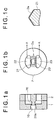
- reference numeral 1 denotes a female die segment having a hole 10 in the axial center
- 2 is a male die segment having a mandrel 20 projecting from the axial center of a cylindrical part.
- Both the female and male die segments 1, 2 are limited as to their material to tool steel called JIS SKD61.
- An opening of the male die segment 2 is divided into a plurality of ports 22, 23 through a bridge 21 serving to support the mandrel 20 as one body.
- the circumference of the tip end of the mandrel 20 provides a bearing part 20a, and the bearing part 20a and the edge of the hole 10 of the female die segment 1 make up an orifice extending in a rectangular shape in section.
- the periphery of a root portion of the mandrel 20, that is, the surface of the bridge 21 on the front side of the male die segment 2 with the mandrel 20 projecting therefrom is formed in the shape of a rough surface having surface roughness Rz of 5 ⁇ m or more by shot blasting or the like, for instance, and high temperature wear-resistant alloy coating 2a is applied on the rough surface by thermal spraying.
- the male die segment 2 is heat-treated at a temperature in the range from 500 to 800°C for about one hour, after the high temperature wear-resistant alloy coating 2a has been applied as described the above.
- a portion of the alloy coating 2a on the male die segment 2 is formed in the shape of a rough surface having surface roughness Rz of 10 ⁇ m or less by shot blasting, polishing or the like, after application of the above alloy coating 2a or the heat treatment as described the above.
- Examples of preferably useful high temperature wear-resistant alloy include Co-group alloy such as an alloy consisting of 58 mass % (which will be hereinafter simply referred to as %) Co ⁇ 25% Cr ⁇ 15% W ⁇ 2% C and an alloy consisting of 65% Co ⁇ 26% Cr ⁇ 6% Mo ⁇ 3% Ni. Otherwise, Ni-group alloy such as an alloy consisting of 60% Ni ⁇ 18% Cr ⁇ 18% Co ⁇ 4% Mo or Cr-group alloy and so on will be also available.
- Co-group alloy such as an alloy consisting of 58 mass % (which will be hereinafter simply referred to as %) Co ⁇ 25% Cr ⁇ 15% W ⁇ 2% C and an alloy consisting of 65% Co ⁇ 26% Cr ⁇ 6% Mo ⁇ 3% Ni.
- Ni-group alloy such as an alloy consisting of 60% Ni ⁇ 18% Cr ⁇ 18% Co ⁇ 4% Mo or Cr-group alloy and so on will be also available.
- the high temperature wear-resistant alloy coating 2a is applied on a portion easily worn by concentration of stress, that is, the root portion of the mandrel 20 and its neighboring surface of the male die segment 2.
- the above alloy coating 2a produces an effect of preventing Al or metal elements in the Al alloy from being diffused in die steel within the range of the coating portion, permitting a contribution toward control of brittle cracking in the die within the range of the coating portion.
- the high temperature wear-resistant alloy coating 2a provides high wear resistance under the high temperature environment enough to eliminate die cracking produced by stress concentrated on a wear part and also to restrain dimensional precision from being degraded by die flexure produced by stress concentrated on the wear part.
- the die surface to be subjected to application of the high temperature wear-resistant alloy coating 2a is preliminarily formed in the shape of the rough surface having surface roughness Rz of 5 ⁇ m or more, adhesiveness of the alloy coating 2a is so enhanced that the alloy coating 2a hardly peels off. Further, since the above high temperature wear-resistant alloy coating is closer in coefficient value of thermal expansion to the die steel such as JIS SKD61 than carbide coating and ceramic coating, peeling of the alloy coating 2a hardly occurs even though the die is heated up to a temperature of about 500°C supposed to be an extrusion temperature.
- the die if heat-treated at a temperature in the range from 500 to 800°C for about one hour after the alloy coating 2a has been applied as described the above, permits the components of the alloy coating 2a to be diffused into the die within the range of the coating portion, providing further enhanced adhesiveness of the alloy coating 2a.
- the alloy coating 2a if so roughened as to have surface roughness Rz of 10 ⁇ m or less, produces a degrading effect of anchoring between the alloy coating and Al or Al alloy in the process of extruding the Al or Al alloy, permitting the alloy coating 2a to more hardly peel off.
- the die may be eliminated from thermal strain produced by subjecting the die steel within the range of the coating portion to heating partially in excess (like by cladding) during application of the alloy coating, permitting production of extruded shapes of high dimensional precision.
- the extruding die according to the present invention permits production of extruded materials of higher dimensional precision, while meeting a demand for longer life of the die by preventing die cracking and high temperature wear more satisfactorily from occurring in the process of extruding.
- the rough surface having surface roughness Rz of less than 5 ⁇ m does not attain sufficient adhesiveness of the alloy coating 2a.
- the surface roughness Rz of the above rough surface needs to be limited to 5 ⁇ m or more. The upper limit of the surface roughness is not worth due consideration.
- the thickness of the high temperature wear-resistant alloy coating 2a applied by thermal spraying is less than 10 ⁇ m, the prospective effect of the alloy coating in preventing the components of a material to be extruded from being diffused in the die steel lasts only a short period of time. For that reason, the die pertinent to the above decreases its limiting extrusion output, and besides, Al or metal elements in the Al alloy will be diffused into the die steel within the range of the coating portion through existing pores in the sprayed alloy coating to produce brittle cracking.
- the thickness of the above alloy coating is preferably limited to 10 ⁇ m or more.
- the thickness of the above alloy coating 2a is preferably limited to the range from 10 to 200 ⁇ m.
- the heat treatment at a temperature of less than 500°C is not enough to diffuse the components of the alloy coating into the die steel.
- the heat treatment at a temperature of more than 800°C produces the degrading strength of the die steel. Accordingly, the heating temperature for the above heat treatment needs to be limited to the range from 500 to 800°C.
- the most preferable heating temperature and holding time for the heat treatment are supposed to be about 700°C and about one hour.
- the rough surface having surface roughness Rz of more than 10 ⁇ m causes the alloy coating 2a to easily peel off under the action of the effect of anchoring between the alloy coating 2a and the Al or Al alloy in the process of extruding the Al or Al alloy.
- the surface roughness Rz of the above alloy coating 2a needs to be limited to 10 ⁇ m or less.
- the present invention is also applicable to a solid die serving to produce solid extruded shapes.
- an extrusion orifice or port of a die hole and its peripheral area of the solid die are supposed to be preferably suitable for application of the alloy coating.
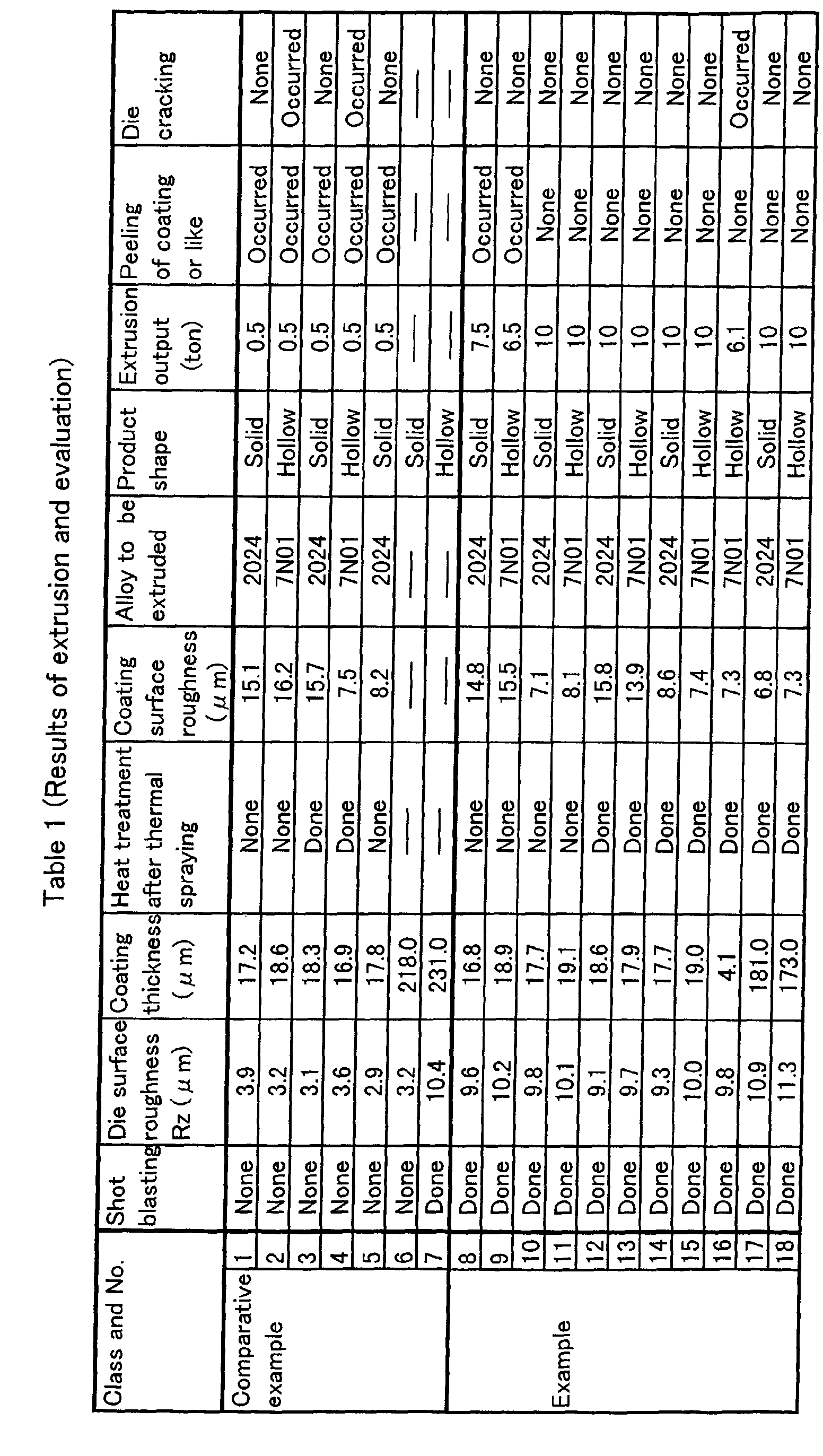
- the solid die and the hollow die both made of SKD61 steel as base metal seven kinds of dies (i.e., four kinds of solid dies and three kinds of hollow dies) as Comparative examples 1 to 7, as well as eleven kinds of dies (i.e., five kinds of solid dies and six kinds of hollow dies) as Examples 8 to 18 were produced on an experimental basis.
- seven kinds of dies i.e., four kinds of solid dies and three kinds of hollow dies
- eleven kinds of dies i.e., five kinds of solid dies and six kinds of hollow dies
- the above alloy coating was applied on the die surface portion without pre-treating the above die surface portion by shot blasting into a surface having surface roughness Rz of 5 ⁇ m or more.
- the heat treatment at a temperature of 700°C for one hour was put into effect after application of the alloy coating.
- the alloy coating surface was so roughened as to have surface roughness Rz of 7.5 ⁇ m or 8.2 ⁇ m by shot blasting with fine grain-sized grits after application of the alloy coating.
- the thickness of the Co-group alloy coating was limited to 218 ⁇ m and 231 ⁇ m respectively for the dies as Comparative examples 6, 7.
- the alloy coating was applied on the die surface portion having been pre-treated by shot blasting into a surface having surface roughness Rz in the range from 9.1 to 11.3 ⁇ m.
- the heat treatment was not put into effect after application of the alloy coating.
- the heat treatment at a temperature of 700°C for one hour was put into effect after application of the alloy coating.
- the alloy coating surface was so roughened as to have surface roughness Rz in the range from 6.8 to 8.6 ⁇ m by shot blasting with fine grain-sized grits
- the thickness of the Co-group alloy coating was limited to 4.1 ⁇ m for the die as Example 16, and to 181 ⁇ m and 173 ⁇ m for the dies as Examples 17,18.
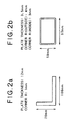
- extruded shapes having sections and dimensions as shown in FIGS. 2a and 2b were produced according to the following conditions using the above dies for extrusion of materials including 2000- and 7000-group alloys particularly supposed to have higher frequency at which die cracking occurs. Extrusion conditions
- the aluminum alloy adhered to the die was dissolved with caustic soda every extrusion output of 500Kg to check whether or not die cracking and peeling of the alloy coating occurred. Then, extrusion was discontinued whenever the die cracking and the peeling of the alloy coating were found.
- the alloy coating was so sound that neither peeling of the alloy coating nor die cracking was found even after the extrusion output had exceeded 10 ton.
- the life of the die was made longer than that of each die as Comparative examples, while die cracking was found whenever the extrusion output reached 6.1 ton, because of its alloy coating having a thickness as small as 4.1 ⁇ m.
- the Co-group alloy, Ni-group alloy, Cr-group alloy or like high temperature wear-resistant alloy coating is applied on the required portion of the die surface by thermal spraying.
- the alloy coating produces the effect of preventing Al or metal elements in the Al alloy from being diffused into the die steel within the range of the coating portion, permitting a contribution toward control of brittle cracking in the die within the range of the coating portion.
- the high temperature wear-resistant alloy coating provides high wear resistance under the high temperature environment enough to eliminate die cracking produced by stress concentrated on the wear part, and also to restrain dimensional precision from being degraded by die flexure produced by stress concentrated on the wear part.
- the die surface to be subjected to application of the high temperature wear-resistant alloy coating is formed in the shape of the rough surface having surface roughness Rz of 5 ⁇ m or more, adhesiveness of the alloy coating may be so enhanced that the alloy coating hardly peels off. Further, since the above high temperature wear-resistant alloy coating is closer in coefficient value of thermal expansion to the die steel such as JIS SKD61 than the carbide coating and the ceramic coating, peeling of the alloy coating hardly occurs even though the die is heated up to the temperature close to 500°C supposed to be the extrusion temperature.
- the die may be eliminated from thermal strain produced by subjecting the die steel within the range of the coating portion to heating partially in excess (like by cladding) during application of the alloy coating, permitting production of the extruded shapes of high dimensional precision.
- the extruding die according to the present invention permits production of extruded materials of higher dimensional precision, while meeting a demand for longer life of the die by preventing die cracking and high temperature wear more satisfactorily from occurring in the process of extruding.
- the die in accordance with the extruding die in claim 2 according to the present invention, is held at a temperature in the range from 500 to 800 °C for a predetermined period of time, after the alloy coating has been applied on the rough surface.
- the components of the alloy coating may be diffused into the die steel within the range of the coating portion, providing so enhanced adhesiveness of the alloy coating as to meet a demand for remarkably longer life of the die.
- the alloy coating surface is so roughened as to have surface roughness Rz of 10 ⁇ m or less, after application of the alloy coating.
- Rz surface roughness
- the thickness of the alloy coating is limited to 10 ⁇ m or more.
- the prospective effect of the coating in preventing the components of the material to be extruded from being diffused into the die steel may last a longer period of time, so that the die may increase its limiting extrusion output, and besides, brittle cracking may be prevented from occurring even if the components of the material to be extruded are diffused into the die steel through the existing pores in the sprayed coating.
- the thickness of the alloy coating is also limited to 200 ⁇ m or less, thus preventing the alloy coating from peeling off during thermal-spraying with the alloy.
- an aluminum or aluminum alloy extruding die which comprises Co-group alloy, Ni-group alloy, Cr-group alloy or like high temperature wear-resistant alloy coating applied by thermal spraying on a required die surface portion having been formed in the shape of a rough surface having surface roughness Rz of 5 ⁇ m or more.
- the die is held at a temperature in the range from 500 to 800°C for a predetermined period of time or the alloy coating surface is so roughened as to have surface roughness Rz of 10 ⁇ m or less.
Landscapes
- Engineering & Computer Science (AREA)
- Mechanical Engineering (AREA)
- Extrusion Of Metal (AREA)
- Coating By Spraying Or Casting (AREA)
Abstract
Description
- Solid extrusion
Material: 2024
Billet diameter: 219mm
Extrusion rate: 2m/min.
Billet temperature: 430°C - Hollow extrusion
Material: 7N01
Billet diameter: 219mm
Extrusion rate: 5m/min.
Billet temperature: 450°C
Claims (5)
- An aluminum or aluminum alloy extruding die, comprising Co-group alloy, Ni-group alloy, Cr-group alloy or like high temperature wear-resistant alloy coating applied by thermal spraying on a required die surface portion having been formed in the shape of a rough surface having surface roughness Rz of 5 µm or more.
- An aluminum or aluminum alloy extruding die according to claim 1, wherein the die is held at a temperature in the range from 500 to 800°C for a predetermined period of time, after said alloy coating has been applied on said rough surface.
- An aluminum or aluminum alloy extruding die according to claim 1, wherein the surface of said alloy coating is so roughened as to have surface roughness Rz of 10 µm or less.
- An aluminum or aluminum alloy extruding die according to claim 1, wherein the thickness of said alloy coating is limited to the range from 10 µm or more to 200 µm or less.
- An aluminum or aluminum alloy extruding die according to claim 2 or 3, wherein the thickness of said alloy coating is limited to the range from 10 µm or more to 200 µm or less.
Applications Claiming Priority (6)
| Application Number | Priority Date | Filing Date | Title |
|---|---|---|---|
| JP2001108089 | 2001-04-06 | ||
| JP2001108089 | 2001-04-06 | ||
| JP2002000766 | 2002-01-07 | ||
| JP2002000766 | 2002-01-07 | ||
| JP2002039769A JP2003260512A (en) | 2001-04-06 | 2002-02-18 | Die for extrusion of Al or Al alloy |
| JP2002039769 | 2002-02-18 |
Publications (3)
| Publication Number | Publication Date |
|---|---|
| EP1247593A2 true EP1247593A2 (en) | 2002-10-09 |
| EP1247593A3 EP1247593A3 (en) | 2003-10-01 |
| EP1247593B1 EP1247593B1 (en) | 2005-05-04 |
Family
ID=27346477
Family Applications (1)
| Application Number | Title | Priority Date | Filing Date |
|---|---|---|---|
| EP02007509A Expired - Lifetime EP1247593B1 (en) | 2001-04-06 | 2002-04-02 | Method of manufacturing a die serving to extrude aluminium or aluminium alloys |
Country Status (4)
| Country | Link |
|---|---|
| US (1) | US6668611B2 (en) |
| EP (1) | EP1247593B1 (en) |
| JP (1) | JP2003260512A (en) |
| DE (1) | DE60203963T2 (en) |
Cited By (3)
| Publication number | Priority date | Publication date | Assignee | Title |
|---|---|---|---|---|
| CN103846302A (en) * | 2012-11-28 | 2014-06-11 | 昆山捷安特轻合金科技有限公司 | Extrusion mold with improved structure |
| CN105107864A (en) * | 2015-09-24 | 2015-12-02 | 重庆盛镁镁业有限公司 | Rectangular clamping-type aluminum alloy section die |
| CN105170680A (en) * | 2015-09-08 | 2015-12-23 | 广州科技职业技术学院 | Protective type double-hole extrusion mould for aluminum section bar |
Families Citing this family (9)
| Publication number | Priority date | Publication date | Assignee | Title |
|---|---|---|---|---|
| US7722922B2 (en) * | 2003-10-20 | 2010-05-25 | Furukawa-Sky Aluminum Corp. | Coating apparatus for an aluminum alloy heat exchanger member, method of producing a heat exchanger member, and aluminum alloy heat exchanger member |
| US7980191B2 (en) * | 2003-11-25 | 2011-07-19 | Murphy Michael J | Extruded strut, fuselage and front wing assembly for towable hydrofoil |
| US9796108B2 (en) | 2008-08-28 | 2017-10-24 | Corning Incorporated | Wear resistant coatings for tool dies |
| JP5669126B2 (en) * | 2009-06-18 | 2015-02-12 | パナソニックIpマネジメント株式会社 | Method for forming light reflection preventing texture and lens barrel having texture formed by the method |
| JP2013519527A (en) * | 2010-02-12 | 2013-05-30 | ノルスク・ヒドロ・アーエスアー | Modular extrusion die |
| CN104525606A (en) * | 2014-12-11 | 2015-04-22 | 西南铝业(集团)有限责任公司 | Aluminum product extruding machine and extruding mould thereof |
| CN105090731B (en) * | 2015-09-24 | 2017-10-13 | 重庆盛镁镁业有限公司 | Hollow clamp-close type aluminium alloy extrusions |
| CN105251800B (en) * | 2015-11-27 | 2017-09-01 | 浙江中质合金材料有限公司 | A kind of processing method of the double screw bar extruding moulds of hard alloy |
| CN108555051B (en) * | 2018-01-09 | 2024-04-30 | 广东和胜工业铝材股份有限公司 | Splitter plate, aluminum alloy pipe extrusion die and forming method thereof |
Family Cites Families (13)
| Publication number | Priority date | Publication date | Assignee | Title |
|---|---|---|---|---|
| CH538311A (en) * | 1972-03-30 | 1973-06-30 | Alusuisse | Press die |
| US4571983A (en) * | 1985-04-30 | 1986-02-25 | United Technologies Corporation | Refractory metal coated metal-working dies |
| JPS6434504A (en) * | 1987-07-31 | 1989-02-06 | Sumitomo Metal Ind | Manufacture of roller for rolling |
| JPH0246914A (en) * | 1988-08-05 | 1990-02-16 | Fujisash Co | Extruding die for aluminum section |
| US4914796A (en) * | 1988-12-12 | 1990-04-10 | Eastman Kodak Company | Process for manufacturing nickel coated shot blasted web conveying roller |
| JPH02255213A (en) * | 1989-03-28 | 1990-10-16 | Sumitomo Metal Ind Ltd | Cold drawing die |
| JPH06315716A (en) | 1993-05-11 | 1994-11-15 | Hitachi Metals Ltd | Tool for forming zinc containing aluminum alloy |
| JPH07155828A (en) | 1993-12-01 | 1995-06-20 | Sumitomo Light Metal Ind Ltd | Hollow Rice for Extrusion of Zinc-Containing Aluminum Alloy |
| DK0656235T3 (en) * | 1993-12-01 | 1998-02-02 | Sumitomo Light Metal Ind | Hollow extruder nozzle for extruding a hollow element of a zinc-containing aluminum alloy |
| JP2877013B2 (en) * | 1994-05-25 | 1999-03-31 | 株式会社神戸製鋼所 | Surface-treated metal member having excellent wear resistance and method for producing the same |
| JPH08281320A (en) | 1995-04-12 | 1996-10-29 | Kobe Steel Ltd | Die for hot extruding of al or al alloy excellent in wear resistance and seizure resistance |
| ATE228039T1 (en) * | 1997-09-10 | 2002-12-15 | Wefa Singen Gmbh | EXTRUSION TOOL AND METHOD FOR THE PRODUCTION THEREOF |
| JP3730015B2 (en) * | 1998-06-02 | 2005-12-21 | 株式会社不二機販 | Surface treatment method for metal products |
-
2002
- 2002-02-18 JP JP2002039769A patent/JP2003260512A/en active Pending
- 2002-04-02 DE DE60203963T patent/DE60203963T2/en not_active Expired - Lifetime
- 2002-04-02 EP EP02007509A patent/EP1247593B1/en not_active Expired - Lifetime
- 2002-04-04 US US10/117,864 patent/US6668611B2/en not_active Expired - Lifetime
Cited By (3)
| Publication number | Priority date | Publication date | Assignee | Title |
|---|---|---|---|---|
| CN103846302A (en) * | 2012-11-28 | 2014-06-11 | 昆山捷安特轻合金科技有限公司 | Extrusion mold with improved structure |
| CN105170680A (en) * | 2015-09-08 | 2015-12-23 | 广州科技职业技术学院 | Protective type double-hole extrusion mould for aluminum section bar |
| CN105107864A (en) * | 2015-09-24 | 2015-12-02 | 重庆盛镁镁业有限公司 | Rectangular clamping-type aluminum alloy section die |
Also Published As
| Publication number | Publication date |
|---|---|
| EP1247593B1 (en) | 2005-05-04 |
| US20020189318A1 (en) | 2002-12-19 |
| DE60203963D1 (en) | 2005-06-09 |
| JP2003260512A (en) | 2003-09-16 |
| EP1247593A3 (en) | 2003-10-01 |
| US6668611B2 (en) | 2003-12-30 |
| DE60203963T2 (en) | 2005-10-06 |
Similar Documents
| Publication | Publication Date | Title |
|---|---|---|
| EP1247593B1 (en) | Method of manufacturing a die serving to extrude aluminium or aluminium alloys | |
| JP5808341B2 (en) | Punch for cold backward extrusion forging | |
| WO2008010614A1 (en) | A die assembly and a method of making it | |
| KR100403061B1 (en) | Plug and mandrel bar for rolling of seamless steel pipe and method of manufacturing seamless steel pipe | |
| JP2006035298A (en) | Titanium alloy bolt and manufacturing method thereof | |
| WO2000033989A1 (en) | Application of dry lubricant to forming dies and forming dies that operate with high force | |
| EP0073101A1 (en) | Friction-actuated extrusion | |
| JP2005199329A (en) | β titanium alloy bolt manufacturing method | |
| EP1933995B1 (en) | Forming tool | |
| JP2009028759A (en) | Punch for plastic working | |
| JP2003112229A (en) | Stainless steel forging tool | |
| AU9712898A (en) | Process for the manufacture of a casting mould, and casting mould | |
| JP3554058B2 (en) | Aluminum extrusion parts and method of manufacturing the same | |
| SU946714A1 (en) | Tool for pressing | |
| JP2004058061A (en) | Die for extrusion of Zn-containing Al alloy | |
| JPH11309539A (en) | Press forming tool for forming recesses | |
| JPH1190526A (en) | Aluminum alloy extrusion die structure | |
| JPS5868420A (en) | Manufacture of extrusion product | |
| JP2530331B2 (en) | Aluminum profile high speed extrusion die | |
| JP2006212699A (en) | Manufacturing method of stepped shaft parts made of titanium alloy | |
| JP4184593B2 (en) | Method of applying thick film sprayed coating, thick film sprayed coating and fan or blower with the coating | |
| JPH05253613A (en) | Mandrel for hot extrusion | |
| CN213915531U (en) | Lamination mold | |
| CN1342109A (en) | Process for wall ironing of product in sheet form, and wall ironing tool | |
| JPH0417974A (en) | Chip for solder and its manufacture |
Legal Events
| Date | Code | Title | Description |
|---|---|---|---|
| PUAI | Public reference made under article 153(3) epc to a published international application that has entered the european phase |
Free format text: ORIGINAL CODE: 0009012 |
|
| AK | Designated contracting states |
Kind code of ref document: A2 Designated state(s): AT BE CH CY DE DK ES FI FR GB GR IE IT LI LU MC NL PT SE TR |
|
| AX | Request for extension of the european patent |
Free format text: AL;LT;LV;MK;RO;SI |
|
| PUAL | Search report despatched |
Free format text: ORIGINAL CODE: 0009013 |
|
| AK | Designated contracting states |
Kind code of ref document: A3 Designated state(s): AT BE CH CY DE DK ES FI FR GB GR IE IT LI LU MC NL PT SE TR |
|
| AX | Request for extension of the european patent |
Extension state: AL LT LV MK RO SI |
|
| 17P | Request for examination filed |
Effective date: 20031218 |
|
| AKX | Designation fees paid |
Designated state(s): DE FR |
|
| 17Q | First examination report despatched |
Effective date: 20040712 |
|
| RAP1 | Party data changed (applicant data changed or rights of an application transferred) |
Owner name: FURUKAWA-SKY ALUMINUM CORP. |
|
| GRAP | Despatch of communication of intention to grant a patent |
Free format text: ORIGINAL CODE: EPIDOSNIGR1 |
|
| RTI1 | Title (correction) |
Free format text: METHOD OF MANUFACTURING A DIE SERVING TO EXTRUDE ALUMINIUM OR ALUMINIUM ALLOYS |
|
| RIN1 | Information on inventor provided before grant (corrected) |
Inventor name: SHOJI, RYOC/O FURUKAWA ELECTRIC CO LTD Inventor name: KAKINOKI, TOSHIYUKIFURUKAWA ELECTRIC CO LTD Inventor name: YAMAGUCHI, HIROKAZUC/O FURUKAWA ELECTRIC CO LTD Inventor name: KASHIWAZAKI, KAZUHISAC/O FURUKAWA ELECTRIC CO LTD |
|
| GRAA | (expected) grant |
Free format text: ORIGINAL CODE: 0009210 |
|
| GRAS | Grant fee paid |
Free format text: ORIGINAL CODE: EPIDOSNIGR3 |
|
| AK | Designated contracting states |
Kind code of ref document: B1 Designated state(s): DE FR |
|
| RIN1 | Information on inventor provided before grant (corrected) |
Inventor name: KAKINOKI, TOSHIYUKIC/O FURUKAWA ELECTRIC CO LTD Inventor name: SHOJI, RYOC/O FURUKAWA ELECTRIC CO LTD Inventor name: KASHIWAZAKI, KAZUHISAC/O FURUKAWA ELECTRIC CO LTD Inventor name: YAMAGUCHI, HIROKAZUC/O FURUKAWA ELECTRIC CO LTD |
|
| REF | Corresponds to: |
Ref document number: 60203963 Country of ref document: DE Date of ref document: 20050609 Kind code of ref document: P |
|
| PLBE | No opposition filed within time limit |
Free format text: ORIGINAL CODE: 0009261 |
|
| STAA | Information on the status of an ep patent application or granted ep patent |
Free format text: STATUS: NO OPPOSITION FILED WITHIN TIME LIMIT |
|
| ET | Fr: translation filed | ||
| 26N | No opposition filed |
Effective date: 20060207 |
|
| REG | Reference to a national code |
Ref country code: FR Ref legal event code: CA |
|
| REG | Reference to a national code |
Ref country code: FR Ref legal event code: PLFP Year of fee payment: 15 |
|
| REG | Reference to a national code |
Ref country code: FR Ref legal event code: PLFP Year of fee payment: 16 |
|
| REG | Reference to a national code |
Ref country code: FR Ref legal event code: PLFP Year of fee payment: 17 |
|
| PGFP | Annual fee paid to national office [announced via postgrant information from national office to epo] |
Ref country code: FR Payment date: 20200312 Year of fee payment: 19 |
|
| PGFP | Annual fee paid to national office [announced via postgrant information from national office to epo] |
Ref country code: DE Payment date: 20200317 Year of fee payment: 19 |
|
| REG | Reference to a national code |
Ref country code: DE Ref legal event code: R119 Ref document number: 60203963 Country of ref document: DE |
|
| PG25 | Lapsed in a contracting state [announced via postgrant information from national office to epo] |
Ref country code: FR Free format text: LAPSE BECAUSE OF NON-PAYMENT OF DUE FEES Effective date: 20210430 Ref country code: DE Free format text: LAPSE BECAUSE OF NON-PAYMENT OF DUE FEES Effective date: 20211103 |