EP1246480A1 - Providing location based directory numbers for personalized services - Google Patents
Providing location based directory numbers for personalized services Download PDFInfo
- Publication number
- EP1246480A1 EP1246480A1 EP01308404A EP01308404A EP1246480A1 EP 1246480 A1 EP1246480 A1 EP 1246480A1 EP 01308404 A EP01308404 A EP 01308404A EP 01308404 A EP01308404 A EP 01308404A EP 1246480 A1 EP1246480 A1 EP 1246480A1
- Authority
- EP
- European Patent Office
- Prior art keywords
- location
- service
- wireless terminal
- wireless
- information
- Prior art date
- Legal status (The legal status is an assumption and is not a legal conclusion. Google has not performed a legal analysis and makes no representation as to the accuracy of the status listed.)
- Withdrawn
Links
- 238000000034 method Methods 0.000 claims abstract description 12
- 238000012544 monitoring process Methods 0.000 claims 3
- 230000008901 benefit Effects 0.000 description 4
- 230000001419 dependent effect Effects 0.000 description 4
- 230000006870 function Effects 0.000 description 4
- 238000004891 communication Methods 0.000 description 3
- 238000010586 diagram Methods 0.000 description 2
- 238000007726 management method Methods 0.000 description 2
- 230000015556 catabolic process Effects 0.000 description 1
- 230000001413 cellular effect Effects 0.000 description 1
- 238000013500 data storage Methods 0.000 description 1
- 230000000694 effects Effects 0.000 description 1
- 230000000977 initiatory effect Effects 0.000 description 1
- 238000010295 mobile communication Methods 0.000 description 1
Images

Classifications
-
- H—ELECTRICITY
- H04—ELECTRIC COMMUNICATION TECHNIQUE
- H04W—WIRELESS COMMUNICATION NETWORKS
- H04W4/00—Services specially adapted for wireless communication networks; Facilities therefor
- H04W4/02—Services making use of location information
- H04W4/029—Location-based management or tracking services
-
- H—ELECTRICITY
- H04—ELECTRIC COMMUNICATION TECHNIQUE
- H04W—WIRELESS COMMUNICATION NETWORKS
- H04W4/00—Services specially adapted for wireless communication networks; Facilities therefor
- H04W4/02—Services making use of location information
-
- H—ELECTRICITY
- H04—ELECTRIC COMMUNICATION TECHNIQUE
- H04L—TRANSMISSION OF DIGITAL INFORMATION, e.g. TELEGRAPHIC COMMUNICATION
- H04L61/00—Network arrangements, protocols or services for addressing or naming
- H04L61/45—Network directories; Name-to-address mapping
- H04L61/4557—Directories for hybrid networks, e.g. including telephone numbers
-
- H—ELECTRICITY
- H04—ELECTRIC COMMUNICATION TECHNIQUE
- H04L—TRANSMISSION OF DIGITAL INFORMATION, e.g. TELEGRAPHIC COMMUNICATION
- H04L67/00—Network arrangements or protocols for supporting network services or applications
- H04L67/50—Network services
- H04L67/52—Network services specially adapted for the location of the user terminal
Definitions
- the present invention relates generally to a method of providing a personalized telephone feature to a mobile telephone subscriber and, more particularly, to identifying a provider of a service located local to the current position of the mobile telephone where the type of service can be predefined by the mobile telephone subscriber and the identification of the provider of the service is dynamically updated as the subscriber roams to a new location.
- Wireless telecommunication systems currently support the use of mobile terminals that are capable of both voice and data communication. These devices typically include an integrated wireless telephone and a software controlled data terminal that implements a micro browser for web surfing and other data communication activities. These features have been used to advantage by commercial entities, which have employed data network (e.g., Internet) servers to provide customer service information via web page documents sent to micro browser equipped wireless terminals. With their integrated telephony equipment, mobile terminals can request and receive such information while a subscriber is at any location served by the wireless network. As far is known, the mobile capabilities of a wireless terminal have not been exploited to include the personalization of customer service information which is wireless terminal location dependent.
- data network e.g., Internet
- a mobile terminal subscriber located in a remote geographical area can obtain and call the telephone number of a specific service such as a hotel, a restaurant etc.
- What is desirable is a system that allows a mobile telephone subscriber to identify a provider of a service that is dependent on the current location of the mobile telephone.
- the service may be personalized by types, such as emergency service and directory service; or it may be by business chains, such as Hilton and McDonalds. It is envisioned that this service will be most useful when a traveler, using a wireless terminal, is desirous of reaching a specific service having a telephone number that is location dependent.
- the foregoing problems are solved and an advance in the art is obtained by a novel method for identifying, to a mobile telephone subscriber, a provider of a specific service.
- the provider identified can be the provider located proximate to the current position of a mobile terminal in a wireless telecommunication network.
- the mobile terminal location is monitored and used to locate providers of the specific service requested that are proximate to but not necessarily the nearest to the location of the mobile terminal.
- a group of service providers are identified, one of the group of providers located can be selected and identified by name and/or telephone number, and/or location, etc., and this information is delivered to the mobile terminal for use by the subscriber.
- the location based directory numbers and, if desired, names of providers of a type of service selected by the subscriber are downloaded to the terminal, and the terminal then stores the obtained numbers and names as part of an address book.
- the mobile terminal user wants to make a call to one of the obtained numbers in the address book, it is retrieved and presented to the user who then does a click to make the call.
- the process of obtaining fresh directory numbers and names is repeated as the mobile terminal travels to a new geographical location and the new information is substituted for the old information whenever the old information become invalid.
- the customer service information can represent any category of service desired such as, for example, a specific hotel of a chain, a restaurant, emergency facilities (especially in a foreign country) such as a hospital, police, etc.
- FIG. 1 illustrates a network architecture for a telecommunication system 2 that provides customer service in accordance with the present invention.
- the telecommunication system 2 includes a wireless network resource group 4 and a data network resource group 6.
- the wireless network resource group 4 can be implemented in a conventional wireless telephone network that has been enhanced to carry data.
- a wireless network capable of carrying circuit-switched data can be used for this purpose. More preferably, however, the wireless network resource group 4 provides packet-switched data service.
- An example of a wireless infrastructure include UMTS (Universal Mobile Telephone System), a "3 rd Generation" wireless system based on GSM (Global System for Mobile communications).
- GSM adds a packet network overlay known as GRPS (GSM Packet Radio Service) to a wireless circuit voice network. It is thus ideally suited for implementing the wireless network resource group 4 of FIG. 1.
- GRPS GSM Packet Radio Service
- the data network resource group 6 of FIG. 1 can be implemented using a conventional packet data network based on the IP (Internet Protocol) and/or ATM (Asynchronous Transfer Mode) protocols, and which also has wireless network access capability.
- IP Internet Protocol
- ATM Asynchronous Transfer Mode
- a wireless terminal 8 is assumed to include an integrated wireless transceiver for voice and data delivery, and a software-controlled data terminal that includes a display 10.
- the wireless terminal 8 should be capable of displaying text messages, and may also implement a graphical user interface, such as a web browser or the like.
- the wireless terminal 8 can implement a WAP (Wireless Application Protocol) micro-browser to display WML (WAP Markup Language) documents.
- WAP Wireless Application Protocol
- WML WAP Markup Language
- the wireless terminal 8 is further assumed to be roaming in a network that is not owned by the provider from which services are subscribed .
- the wireless network resource group 4 is shown as including a visited PLMN (Public Land-based Mobile Network) 12 and a home PLMN 14.
- the home PLMN 14 is the network owned or operated by the provider from which services are subscribed, and the visited PLMN 12 serves the wireless terminal when it is roaming.
- the home PLMN 14 includes a home location register (HLR) 16.
- the home location register 16 implements a conventional HLR (Home Location Register) function that maintains generalized location information about wireless terminals under its jurisdiction (i.e., the network and vicinity of a mobile, such as the mobile's current location/routing area).
- the home location register 16 can also track intra-network (i.e., cell-to-cell) mobile terminal movement by initiating queries of base station resources in a mobile terminal's current PLMN, as described in more detail below.
- the home location register (HLR) 16 further includes an inter-working function for communicating wireless terminal location information to a data network (IP) resource group 6, and maintains an interface with an application server 30 (see below) in the data network resource group. Via this interface, the home location register 16 sets a location update notification flag at the request of the application server 30 and notifies the application server whenever there is a mobile terminal location change.
- the location change may be a change from one visited PLMN to another, or a change from one cell to another within the same PLMN.
- the visited PLMN 12 includes a Base Station 18, a data switching node 20, a data network gateway (SGSN) 22, and a visitor location register (MSC/VLR) 24.
- the base station 18 communicates over an air interface 19 with the wireless terminal 8.
- the data switching node 20 is labeled "SGSN" (Serving GPRS Support Node) in FIG. 1 according to the UMTS designation for this component.
- Other wireless network standards may use other names.
- the ANSI-41 standard for CDMA (Code Division Multiple Access) data networks use the terms "PCF" (Packet Control Function).
- the data switching node 20 is a conventional router entity with mobility support capability that routes data traffic between the base station 18 and the data network resource group (IP) 6.
- IP data network resource group
- the data switching node 20 also performs a conventional VLR (Visitor Location Register) function in terms of mobile location. It therefore reports to the HLR 16 whenever the mobile terminal 8 is operating within the jurisdiction of the visited PLMN 12.
- VLR Visitor
- the data network gateway 22 is labeled "GGSN" (Gateway GPRS Support Node) in FIG. 1, according to the UMTS designation for this component.
- Other wireless network standards may use other names.
- the ANSI-41 standard for CDMA (Code Division Multiple Access) data networks use the term "PDSN" (Packet Data Serving Node).
- the data network gateway 22 is a conventional routing entity that serves as a gateway that allows the wireless network resource group 4 to communicate with the data network resource group 6.
- the visitor location register 24 or the SGSN has the ability to report the location of the wireless terminal 8 to the home location register 16.
- the visitor location register or the SGSN can be programmed to report to the home location register 16 (via the data switching node 20) whenever a mobile terminal enters or leaves their jurisdiction.
- the data network resource group 6 of FIG. 1 includes a data network application server 30, a user profile server 32, a localized directory server 34 and may include a wireless network gateway 36. It is to be noted that the WAP is slowly being phased out of the WAP standards. As previously described, the application server 30 also maintains an interface with the home location register 16. This interface is used by the application server 30 to request notification of mobile terminal location changes. The application server 30 similarly maintains interfaces with the user profile server 32. Note that each of these interfaces can be advantageously based on commonly used IETF (Internet Engineering Task Force)/W3C (World Wide Web Consortium) specifications, such as XML (eXtensible Markup Language) over HTTP (Hyper Text Transfer Protocol), etc.
- IETF Internet Engineering Task Force
- W3C World Wide Web Consortium
- the user profile server 32 is a data network entity that stores user profile information provided by a wireless subscriber. It includes a GUI (Graphical User Interface 50 (preferably implemented as one or more WWW web pages) that is programmed to prompt for and receive input regarding the customer service information desired by the subscriber. For example, if the subscriber wishes to be informed about services, the user profile information may include service types, serving company names or service chain names, etc.
- a data storage resource 52 associated with the user profile server 32 stores the user profile information received via the GUI 50.
- An interface in the user profile server is responsive to user profile information queries from the application server 30 and provides user profile information thereto upon request.
- the local directory server 34 is a data network resource which may be operated by the local telephone provider, the participating service providers, or third part6y directory providers. These providers maintain local directory databases 34.
- the foregoing entities of the wireless network resource group 4 and the data network resource group 6 are adapted to support an "on location" directory service.
- the mobile subscriber Prior to invoking service, the mobile subscriber must obtain a service subscription and establish a user profile. Although this can be done in a variety of ways, the most likely scenario is that the subscriber would access a URL to sign up for the service by entering information such as name, billing address, email address, initial user service profile, etc. Service profile information is stored in the user profile server 32. For the subscriber to manage the profile, a URL which may be the same or different from the one mentioned above can be accessed to do so.
- a profile management session can be performed whereby the new subscriber is able to specify his or her user profile information.
- the wireless terminal 8 will typically use the wireless terminal 8 to subscribe to the service and establish a user profile. Alternatively, the subscriber could perform these tasks using any other suitable network device, such as a personal computer or the like. It is desirable to allow wireless subscribers to request on demand that their profiles be updated to reflect their current interests. For that reason, the wireless terminal 8 can be programmed to provide a menu which may be presented to the user when the URL is accessed which allows the subscriber to perform profile management on demand.
- the application server will instruct the home location register 16 to set an event notification flag to notify the application server whenever a mobile terminal changes location. This is shown as step 62 of Fig. 2.
- the information of the services in the subscriber profile including the telephone numbers, address, etc. will be automatically updated whenever the mobile user moves to a new area.
- the wireless terminal 8 can make a request for an update of the information.
- the wireless terminal 8 will communicate the request to the application server 30.
- the application server 30 will request the mobile terminal location from the home location register 16.
- the home location register 16 will report the wireless terminal's location change information when a location change has occurred.
- a location change notification is received by the application server 30 in step 64 of FIG. 2.
- the application server can be provisioned to define geographic areas that correlate with the mobile terminal location information provided by the home location server 16. Only when a mobile terminal moves from one area such as an area serviced by one base station to a second area serviced by a second base station will a new customer information request be performed.
- Each service area definition in the application server can contain information about the actual wireless cells, PLMNs, country, etc. that it encompasses, allowing rapid determination of the subscriber's service area location.
- An additional benefit of defining areas in the application server is that geographic information, rather than cellular information, can be specified to the local directory servers 34 as part of a customer information query. By way of example, it is easier to ask a local directory server 34 for an emer5gency service directory number, other than it is to request information based on wireless network PLMN location data.
- step 66 the application server 30 determines that a mobile terminal's location warrants information update, one or more information requests are made in step 66 to the localized directory server(s) 34. Determination of the appropriate localized directory server(s) 34 requires that the application server consult the user profile server 32 (step 65) to find the information for the service defined in the user's profile (step 67), that being the local telephone number and/or address of a specific provider or providers from a generalized local directory.
- step 68 the localized directory server(s) 34, queried by the application content server 30, respond(s) with appropriate customer service information.
- step 70 the application server 30 formats the customer service information as necessary and sends it to the wireless terminal 8.
- the application server 30 acts as a WAP push proxy gateway that is programmed to form a document, such as a WML document, containing the customer service information and push to the mobile terminal.
- the wireless network gateway 36 delivers the WML document containing the customer service information to the mobile terminal 8.
- the wireless terminal 8 will be a WAP-enabled client that interprets the WML document and stores the information in the mobile terminal's directory.
- HTML Hypertext Markup Language
- xHTML extensible HTML
- cHTML compact HTML
- WSP WAP Session Protocol
- novel system and method for providing customer service are disclosed.
- the disclosed service advantageously allows mobile subscribers to obtain personalized information (information that is specifically identified and requested by the mobile subscriber) such as service provider telephone numbers based on mobile terminal location.
Landscapes
- Engineering & Computer Science (AREA)
- Computer Networks & Wireless Communication (AREA)
- Signal Processing (AREA)
- Mobile Radio Communication Systems (AREA)
- Telephonic Communication Services (AREA)
Abstract
In this invention, a wireless terminal location is monitored and used to locate
providers of a requested service that are proximate to the location of the wireless
terminal. At least one of the providers located is selected and identified by name
and/or telephone number and/or the location, etc., and this information is delivered to
and stored in the directory of the wireless terminal. The process is repeated as
necessary to update the list of service providers when the wireless terminal is
transported to a new location area. The service providers located can represent any
category of service desired such as emergency facilities (especially in a foreign
country) such as paramedics, hospital, police, or roadside assistance, etc.
Description
- The present invention relates generally to a method of providing a personalized telephone feature to a mobile telephone subscriber and, more particularly, to identifying a provider of a service located local to the current position of the mobile telephone where the type of service can be predefined by the mobile telephone subscriber and the identification of the provider of the service is dynamically updated as the subscriber roams to a new location.
- A situation often experienced by a mobile telephone subscriber, whether in a vehicle or on foot in a remote and unfamiliar geographical area, is the need to obtain assistance, information and/or aid promptly. For example, in the case of a breakdown or disabling of the vehicle where roadside assistance is required, the person in need must select a most convenient and suitable provider of the required service. Under normal circumstances, this is at best difficult and highly time consuming. Even when the vehicle is provided with wireless communication, for example, a mobile telephone, the problem still exists in locating a service provider, and, in those instances where time is important, locating and obtaining the telephone number of the nearest service provider.
- A similar situation occurs when a traveler, using a mobile telephone in a remote geographical area needs to reach a specific type of service provider in that area. Wireless telecommunication systems currently support the use of mobile terminals that are capable of both voice and data communication. These devices typically include an integrated wireless telephone and a software controlled data terminal that implements a micro browser for web surfing and other data communication activities. These features have been used to advantage by commercial entities, which have employed data network (e.g., Internet) servers to provide customer service information via web page documents sent to micro browser equipped wireless terminals. With their integrated telephony equipment, mobile terminals can request and receive such information while a subscriber is at any location served by the wireless network. As far is known, the mobile capabilities of a wireless terminal have not been exploited to include the personalization of customer service information which is wireless terminal location dependent.
- The advantages of location-dependent personalization of customer service information are several. For example, a mobile terminal subscriber located in a remote geographical area (which can include a foreign country) can obtain and call the telephone number of a specific service such as a hotel, a restaurant etc.
- What is desirable is a system that allows a mobile telephone subscriber to identify a provider of a service that is dependent on the current location of the mobile telephone. The service may be personalized by types, such as emergency service and directory service; or it may be by business chains, such as Hilton and McDonalds. It is envisioned that this service will be most useful when a traveler, using a wireless terminal, is desirous of reaching a specific service having a telephone number that is location dependent.
- The foregoing problems are solved and an advance in the art is obtained by a novel method for identifying, to a mobile telephone subscriber, a provider of a specific service. If desired, the provider identified can be the provider located proximate to the current position of a mobile terminal in a wireless telecommunication network. According to this method, the mobile terminal location is monitored and used to locate providers of the specific service requested that are proximate to but not necessarily the nearest to the location of the mobile terminal. When a group of service providers are identified, one of the group of providers located can be selected and identified by name and/or telephone number, and/or location, etc., and this information is delivered to the mobile terminal for use by the subscriber. In a preferred embodiment, the location based directory numbers and, if desired, names of providers of a type of service selected by the subscriber are downloaded to the terminal, and the terminal then stores the obtained numbers and names as part of an address book. When the mobile terminal user wants to make a call to one of the obtained numbers in the address book, it is retrieved and presented to the user who then does a click to make the call. The process of obtaining fresh directory numbers and names is repeated as the mobile terminal travels to a new geographical location and the new information is substituted for the old information whenever the old information become invalid. The customer service information can represent any category of service desired such as, for example, a specific hotel of a chain, a restaurant, emergency facilities (especially in a foreign country) such as a hospital, police, etc.
- The features, aspects and advantages of the present invention will become better understood with regard to the following description, appended claims, and accompanying drawings where:
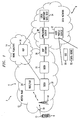
- FIG. 1 is a functional block diagram showing a network architecture for a wireless telecommunication system that provides location based directory numbers and names for the types of services selected by the mobile terminal user in accordance with the invention; and,
- FIG. 2 is a flow diagram showing a series of method steps performed to implement customer service in accordance with the principles of the invention.
-
- Turning now to the figures, wherein like reference numerals represent like elements in all of the several views, FIG. 1 illustrates a network architecture for a
telecommunication system 2 that provides customer service in accordance with the present invention. As shown, thetelecommunication system 2 includes a wireless network resource group 4 and a data network resource group 6. The wireless network resource group 4 can be implemented in a conventional wireless telephone network that has been enhanced to carry data. A wireless network capable of carrying circuit-switched data can be used for this purpose. More preferably, however, the wireless network resource group 4 provides packet-switched data service. An example of a wireless infrastructure include UMTS (Universal Mobile Telephone System), a "3rd Generation" wireless system based on GSM (Global System for Mobile communications). GSM adds a packet network overlay known as GRPS (GSM Packet Radio Service) to a wireless circuit voice network. It is thus ideally suited for implementing the wireless network resource group 4 of FIG. 1. - The data network resource group 6 of FIG. 1 can be implemented using a conventional packet data network based on the IP (Internet Protocol) and/or ATM (Asynchronous Transfer Mode) protocols, and which also has wireless network access capability.
- In the architecture of Fig 1, a
wireless terminal 8 is assumed to include an integrated wireless transceiver for voice and data delivery, and a software-controlled data terminal that includes adisplay 10. Thewireless terminal 8 should be capable of displaying text messages, and may also implement a graphical user interface, such as a web browser or the like. By way of example only, thewireless terminal 8 can implement a WAP (Wireless Application Protocol) micro-browser to display WML (WAP Markup Language) documents. There are a variety of suitable wireless terminal products on the market today, and others in development. These include web enabled telephones, PDAs (Personal Digital Assistants), handheld computers, pagers and the like. - In FIG. 1, the
wireless terminal 8 is further assumed to be roaming in a network that is not owned by the provider from which services are subscribed . As such, the wireless network resource group 4 is shown as including a visited PLMN (Public Land-based Mobile Network) 12 and a home PLMN 14. The home PLMN 14 is the network owned or operated by the provider from which services are subscribed, and the visited PLMN 12 serves the wireless terminal when it is roaming. The home PLMN 14 includes a home location register (HLR) 16. Thehome location register 16 implements a conventional HLR (Home Location Register) function that maintains generalized location information about wireless terminals under its jurisdiction (i.e., the network and vicinity of a mobile, such as the mobile's current location/routing area). Thehome location register 16 can also track intra-network (i.e., cell-to-cell) mobile terminal movement by initiating queries of base station resources in a mobile terminal's current PLMN, as described in more detail below. The home location register (HLR) 16 further includes an inter-working function for communicating wireless terminal location information to a data network (IP) resource group 6, and maintains an interface with an application server 30 (see below) in the data network resource group. Via this interface, thehome location register 16 sets a location update notification flag at the request of theapplication server 30 and notifies the application server whenever there is a mobile terminal location change. The location change may be a change from one visited PLMN to another, or a change from one cell to another within the same PLMN. - The visited PLMN 12 includes a Base
Station 18, adata switching node 20, a data network gateway (SGSN) 22, and a visitor location register (MSC/VLR) 24. Thebase station 18 communicates over anair interface 19 with thewireless terminal 8. Thedata switching node 20 is labeled "SGSN" (Serving GPRS Support Node) in FIG. 1 according to the UMTS designation for this component. Other wireless network standards may use other names. For example, the ANSI-41 standard for CDMA (Code Division Multiple Access) data networks use the terms "PCF" (Packet Control Function). Regardless of the implementation specific name applied, thedata switching node 20 is a conventional router entity with mobility support capability that routes data traffic between thebase station 18 and the data network resource group (IP) 6. Thedata switching node 20 also performs a conventional VLR (Visitor Location Register) function in terms of mobile location. It therefore reports to theHLR 16 whenever themobile terminal 8 is operating within the jurisdiction of the visited PLMN 12. - The
data network gateway 22 is labeled "GGSN" (Gateway GPRS Support Node) in FIG. 1, according to the UMTS designation for this component. Other wireless network standards may use other names. For example, the ANSI-41 standard for CDMA (Code Division Multiple Access) data networks use the term "PDSN" (Packet Data Serving Node). Regardless of the implementation specific name applied, thedata network gateway 22 is a conventional routing entity that serves as a gateway that allows the wireless network resource group 4 to communicate with the data network resource group 6. Thevisitor location register 24 or the SGSN has the ability to report the location of thewireless terminal 8 to thehome location register 16. The visitor location register or the SGSN can be programmed to report to the home location register 16 (via the data switching node 20) whenever a mobile terminal enters or leaves their jurisdiction. - The data network resource group 6 of FIG. 1 includes a data
network application server 30, auser profile server 32, alocalized directory server 34 and may include awireless network gateway 36. It is to be noted that the WAP is slowly being phased out of the WAP standards. As previously described, theapplication server 30 also maintains an interface with thehome location register 16. This interface is used by theapplication server 30 to request notification of mobile terminal location changes. Theapplication server 30 similarly maintains interfaces with theuser profile server 32. Note that each of these interfaces can be advantageously based on commonly used IETF (Internet Engineering Task Force)/W3C (World Wide Web Consortium) specifications, such as XML (eXtensible Markup Language) over HTTP (Hyper Text Transfer Protocol), etc. - The
user profile server 32 is a data network entity that stores user profile information provided by a wireless subscriber. It includes a GUI (Graphical User Interface 50 (preferably implemented as one or more WWW web pages) that is programmed to prompt for and receive input regarding the customer service information desired by the subscriber. For example, if the subscriber wishes to be informed about services, the user profile information may include service types, serving company names or service chain names, etc. Adata storage resource 52 associated with theuser profile server 32 stores the user profile information received via theGUI 50. An interface in the user profile server is responsive to user profile information queries from theapplication server 30 and provides user profile information thereto upon request. - The
local directory server 34 is a data network resource which may be operated by the local telephone provider, the participating service providers, or third part6y directory providers. These providers maintainlocal directory databases 34. - With additional reference now to FIG. 2, the foregoing entities of the wireless network resource group 4 and the data network resource group 6 are adapted to support an "on location" directory service. Prior to invoking service, the mobile subscriber must obtain a service subscription and establish a user profile. Although this can be done in a variety of ways, the most likely scenario is that the subscriber would access a URL to sign up for the service by entering information such as name, billing address, email address, initial user service profile, etc. Service profile information is stored in the
user profile server 32. For the subscriber to manage the profile, a URL which may be the same or different from the one mentioned above can be accessed to do so. A profile management session can be performed whereby the new subscriber is able to specify his or her user profile information. Note that the subscriber will typically use thewireless terminal 8 to subscribe to the service and establish a user profile. Alternatively, the subscriber could perform these tasks using any other suitable network device, such as a personal computer or the like. It is desirable to allow wireless subscribers to request on demand that their profiles be updated to reflect their current interests. For that reason, thewireless terminal 8 can be programmed to provide a menu which may be presented to the user when the URL is accessed which allows the subscriber to perform profile management on demand. - After the subscription and the profile have been processed and stored, the application server will instruct the
home location register 16 to set an event notification flag to notify the application server whenever a mobile terminal changes location. This is shown asstep 62 of Fig. 2. The information of the services in the subscriber profile including the telephone numbers, address, etc. will be automatically updated whenever the mobile user moves to a new area. Alternatively, thewireless terminal 8 can make a request for an update of the information. In any event, after the mobile telephone subscriber has requested and is signed up for the service, when arequest 60 is made to invoke the service, thewireless terminal 8 will communicate the request to theapplication server 30. Theapplication server 30 will request the mobile terminal location from thehome location register 16. - Pursuant to the event notification flag set per request of the
application server 30, thehome location register 16 will report the wireless terminal's location change information when a location change has occurred. Such a location change notification is received by theapplication server 30 instep 64 of FIG. 2. This causes several things to happen. The application server can be provisioned to define geographic areas that correlate with the mobile terminal location information provided by thehome location server 16. Only when a mobile terminal moves from one area such as an area serviced by one base station to a second area serviced by a second base station will a new customer information request be performed. Each service area definition in the application server can contain information about the actual wireless cells, PLMNs, country, etc. that it encompasses, allowing rapid determination of the subscriber's service area location. An additional benefit of defining areas in the application server is that geographic information, rather than cellular information, can be specified to thelocal directory servers 34 as part of a customer information query. By way of example, it is easier to ask alocal directory server 34 for an emer5gency service directory number, other than it is to request information based on wireless network PLMN location data. - Once the
application server 30 determines that a mobile terminal's location warrants information update, one or more information requests are made instep 66 to the localized directory server(s) 34. Determination of the appropriate localized directory server(s) 34 requires that the application server consult the user profile server 32 (step 65) to find the information for the service defined in the user's profile (step 67), that being the local telephone number and/or address of a specific provider or providers from a generalized local directory. - In
step 68, the localized directory server(s) 34, queried by theapplication content server 30, respond(s) with appropriate customer service information. Instep 70, theapplication server 30 formats the customer service information as necessary and sends it to thewireless terminal 8. In a WAP implementation of the invention, theapplication server 30 acts as a WAP push proxy gateway that is programmed to form a document, such as a WML document, containing the customer service information and push to the mobile terminal. - In
step 72 of FIG. 2, thewireless network gateway 36 delivers the WML document containing the customer service information to themobile terminal 8. In a WAP implementation of the invention, thewireless terminal 8 will be a WAP-enabled client that interprets the WML document and stores the information in the mobile terminal's directory. Note that other interface formats between theapplication server 30 and thewireless terminal 8 could also be used, including HTML (Hypertext Markup Language, xHTML (extensible HTML), or cHTML (compact HTML) over HTTP or WSP (WAP Session Protocol) where WSP is used in conjunction with WML. - Accordingly, novel system and method for providing customer service are disclosed. The disclosed service advantageously allows mobile subscribers to obtain personalized information (information that is specifically identified and requested by the mobile subscriber) such as service provider telephone numbers based on mobile terminal location.
- While various embodiments of the invention have been described, it should be apparent that many variations and alternative embodiments could be implemented in accordance with the invention. It is understood, therefore, that the invention is not to be in any way limited except in accordance with the spirit of the appended claims and their equivalents.
Claims (5)
- A method for identifying a provider of a service to a wireless terminal in a wireless telecommunication network, comprising the steps of:receiving a request to select a provider of a specific service from the wireless terminal;monitoring the wireless terminal location;using the wireless terminal location to locate providers of the specific service requested which are proximate to the wireless terminal location;selecting one of the providers located;obtaining an identifier of the provider selected; andsending the identifier of the provider selected to the wireless terminal.
- The method of claim 1 wherein the identifier is a telephone number.
- The method of claim 1 wherein the identifier is a name and address.
- The method of claim 1 wherein the provider of the service selected is determined by the location of the provider relative to the location of the wireless terminal.
- The method of claim 1 wherein the monitoring step includes requesting wireless terminal location update events from a wireless network mobile location server and monitoring said update events as they are received.
Applications Claiming Priority (2)
| Application Number | Priority Date | Filing Date | Title |
|---|---|---|---|
| US09/815,854 US7242948B2 (en) | 2001-03-23 | 2001-03-23 | Providing location based directory numbers for personalized services |
| US815854 | 2004-04-02 |
Publications (1)
| Publication Number | Publication Date |
|---|---|
| EP1246480A1 true EP1246480A1 (en) | 2002-10-02 |
Family
ID=25219018
Family Applications (1)
| Application Number | Title | Priority Date | Filing Date |
|---|---|---|---|
| EP01308404A Withdrawn EP1246480A1 (en) | 2001-03-23 | 2001-10-02 | Providing location based directory numbers for personalized services |
Country Status (3)
| Country | Link |
|---|---|
| US (1) | US7242948B2 (en) |
| EP (1) | EP1246480A1 (en) |
| JP (1) | JP2002344625A (en) |
Cited By (5)
| Publication number | Priority date | Publication date | Assignee | Title |
|---|---|---|---|---|
| WO2004030398A1 (en) * | 2002-09-24 | 2004-04-08 | Qualcomm Incorporated | Method and apparatus for supporting location-based group communications |
| WO2005027545A1 (en) * | 2003-09-09 | 2005-03-24 | Siemens Aktiengesellschaft | Method for the transmission of information |
| EP1523204A1 (en) * | 2003-10-10 | 2005-04-13 | Lucent Technologies Inc. | Automatic updating of non-emergency telephone numbers for wireless handset |
| EP2257103A4 (en) * | 2008-04-24 | 2011-06-15 | Huawei Tech Co Ltd | A method, system and device for service providing |
| WO2017144000A1 (en) * | 2016-02-26 | 2017-08-31 | 北京佰才邦技术有限公司 | Method and apparatus for providing service provider identifier, access device, and terminal device |
Families Citing this family (31)
| Publication number | Priority date | Publication date | Assignee | Title |
|---|---|---|---|---|
| WO2003047297A1 (en) * | 2001-11-21 | 2003-06-05 | Nokia Corporation | A telecommunications system and method for controlling privacy |
| US20040198376A1 (en) * | 2002-07-30 | 2004-10-07 | Ravinder Chandhok | Method and apparatus for supporting group communications based on location vector |
| US7945477B2 (en) | 2002-09-23 | 2011-05-17 | Werbitt Julie M | Patron service system and method |
| US20040185888A1 (en) * | 2003-03-18 | 2004-09-23 | Nokia Corporation | Solving mobile station identity in a multi-SIM situation |
| US7321920B2 (en) | 2003-03-21 | 2008-01-22 | Vocel, Inc. | Interactive messaging system |
| GB0413683D0 (en) | 2004-06-18 | 2004-07-21 | Nokia Corp | Customisation of an electronic device |
| US20050288758A1 (en) * | 2003-08-08 | 2005-12-29 | Jones Timothy S | Methods and apparatuses for implanting and removing an electrical stimulation lead |
| US20050108417A1 (en) * | 2003-11-19 | 2005-05-19 | Serge Haumont | System and method for reducing subscriber database loads |
| JP4340570B2 (en) * | 2004-03-25 | 2009-10-07 | パイオニア株式会社 | Address information distribution / collection method, address information distribution / collection program, and transmission / reception terminal |
| US20050221878A1 (en) * | 2004-04-05 | 2005-10-06 | Van Bosch James A | Method for entering a personalized communication profile into a communication user interface |
| US7616665B2 (en) * | 2004-04-13 | 2009-11-10 | Research In Motion Limited | Method and system for monitoring the health of wireless telecommunication networks |
| WO2006021005A2 (en) * | 2004-08-19 | 2006-02-23 | Cingular Wireless Ii, Llc | Testing for mobile device locator systems, such as for e911 |
| US20060046768A1 (en) * | 2004-08-30 | 2006-03-02 | Bilhan Kirbas | Mobile phone address book population device and technique |
| US20060136297A1 (en) * | 2004-12-17 | 2006-06-22 | Daniel Willis | Method and system for providing location specific advertising content within mobile platforms |
| US20060184534A1 (en) * | 2005-02-11 | 2006-08-17 | Villageprofile.Com, Inc. | Method and apparatus for publishing a community based directory and of offering associated community based services |
| US10178522B2 (en) | 2005-08-02 | 2019-01-08 | Qualcomm Incorporated | VoIP emergency call support |
| US8254893B2 (en) * | 2005-11-17 | 2012-08-28 | Nitesh Ratnakar | System and method for automatically downloading and storing contact information to a personal communication device based on a geographical position of the personal communication device |
| EP1892918B1 (en) * | 2006-08-23 | 2010-10-27 | Alcatel Lucent | Method for registration of a plurality of "permanently registered users " in an IMS subsystem of an NGN system |
| US8069202B1 (en) | 2007-02-02 | 2011-11-29 | Resource Consortium Limited | Creating a projection of a situational network |
| US8457682B2 (en) | 2008-03-04 | 2013-06-04 | Dbsd Satellite Services G.P. | Method and system for integrated satellite assistance services |
| US9276664B2 (en) | 2007-04-30 | 2016-03-01 | Dish Network Corporation | Mobile interactive satellite services |
| US8260267B2 (en) * | 2007-12-05 | 2012-09-04 | Zoove Corp. | Device based telecommunications initiated data fulfillment system |
| US20090222838A1 (en) * | 2008-02-29 | 2009-09-03 | Palm, Inc. | Techniques for dynamic contact information |
| US8626230B2 (en) | 2008-03-04 | 2014-01-07 | Dish Network Corporation | Method and system for using routine driving information in mobile interactive satellite services |
| CN102056289A (en) * | 2009-10-28 | 2011-05-11 | 中国移动通信集团公司 | Terminal locating method based on mobile network, system and locating information server |
| EP2815389B1 (en) * | 2012-02-17 | 2018-10-31 | Elerts Corporation | Systems and methods for providing emergency resources |
| US10580243B2 (en) | 2013-04-16 | 2020-03-03 | Imageware Systems, Inc. | Conditional and situational biometric authentication and enrollment |
| US9286528B2 (en) | 2013-04-16 | 2016-03-15 | Imageware Systems, Inc. | Multi-modal biometric database searching methods |
| US11216824B1 (en) | 2015-02-26 | 2022-01-04 | Allstate Insurance Company | Role assignment for enhanced roadside assistance |
| EP3405877B1 (en) * | 2016-01-22 | 2022-09-21 | Nokia Solutions and Networks Oy | Application relocation between clouds |
| US11481755B2 (en) * | 2019-04-15 | 2022-10-25 | IQMetrix Software Development Corporation | Multi-venue food-service transaction fulfillment using unique system-wide identifiers |
Citations (2)
| Publication number | Priority date | Publication date | Assignee | Title |
|---|---|---|---|---|
| WO1999045732A1 (en) * | 1998-03-03 | 1999-09-10 | Telefonaktiebolaget Lm Ericsson (Publ) | Method, arrangement and apparatus for providing information |
| WO2000079811A1 (en) * | 1999-06-18 | 2000-12-28 | Swisscom Mobile Ag | Method and system for offering mobile subscribers anonymous, location-based services |
Family Cites Families (7)
| Publication number | Priority date | Publication date | Assignee | Title |
|---|---|---|---|---|
| US5920821A (en) * | 1995-12-04 | 1999-07-06 | Bell Atlantic Network Services, Inc. | Use of cellular digital packet data (CDPD) communications to convey system identification list data to roaming cellular subscriber stations |
| US6512754B2 (en) * | 1997-10-14 | 2003-01-28 | Lucent Technologies Inc. | Point-to-point protocol encapsulation in ethernet frame |
| US20030060211A1 (en) * | 1999-01-26 | 2003-03-27 | Vincent Chern | Location-based information retrieval system for wireless communication device |
| US6564143B1 (en) * | 1999-01-29 | 2003-05-13 | International Business Machines Corporation | Method and apparatus for personalizing static and temporal location based services |
| US6466796B1 (en) * | 1999-04-01 | 2002-10-15 | Lucent Technologies Inc. | System for providing location based service to a wireless telephone set in a telephone system |
| US6484033B2 (en) * | 2000-12-04 | 2002-11-19 | Motorola, Inc. | Wireless communication system for location based schedule management and method therefor |
| WO2002047415A1 (en) * | 2000-12-04 | 2002-06-13 | Nokia Corporation | Communication system and method for establishing a connection to a serving network element |
-
2001
- 2001-03-23 US US09/815,854 patent/US7242948B2/en not_active Expired - Fee Related
- 2001-10-02 EP EP01308404A patent/EP1246480A1/en not_active Withdrawn
-
2002
- 2002-03-12 JP JP2002066749A patent/JP2002344625A/en not_active Withdrawn
Patent Citations (2)
| Publication number | Priority date | Publication date | Assignee | Title |
|---|---|---|---|---|
| WO1999045732A1 (en) * | 1998-03-03 | 1999-09-10 | Telefonaktiebolaget Lm Ericsson (Publ) | Method, arrangement and apparatus for providing information |
| WO2000079811A1 (en) * | 1999-06-18 | 2000-12-28 | Swisscom Mobile Ag | Method and system for offering mobile subscribers anonymous, location-based services |
Cited By (8)
| Publication number | Priority date | Publication date | Assignee | Title |
|---|---|---|---|---|
| WO2004030398A1 (en) * | 2002-09-24 | 2004-04-08 | Qualcomm Incorporated | Method and apparatus for supporting location-based group communications |
| WO2005027545A1 (en) * | 2003-09-09 | 2005-03-24 | Siemens Aktiengesellschaft | Method for the transmission of information |
| EP1523204A1 (en) * | 2003-10-10 | 2005-04-13 | Lucent Technologies Inc. | Automatic updating of non-emergency telephone numbers for wireless handset |
| EP2257103A4 (en) * | 2008-04-24 | 2011-06-15 | Huawei Tech Co Ltd | A method, system and device for service providing |
| WO2017144000A1 (en) * | 2016-02-26 | 2017-08-31 | 北京佰才邦技术有限公司 | Method and apparatus for providing service provider identifier, access device, and terminal device |
| CN107135530A (en) * | 2016-02-26 | 2017-09-05 | 北京佰才邦技术有限公司 | Method, device, access device and the terminal device of service provider identity are provided |
| US10349238B2 (en) | 2016-02-26 | 2019-07-09 | Baicells Technologies Co. Ltd. | Method and apparatus for providing service provider identity, access device and terminal device |
| CN107135530B (en) * | 2016-02-26 | 2020-10-02 | 北京佰才邦技术有限公司 | Method, device, access equipment and terminal equipment for providing service provider identification |
Also Published As
| Publication number | Publication date |
|---|---|
| US20020137525A1 (en) | 2002-09-26 |
| JP2002344625A (en) | 2002-11-29 |
| US7242948B2 (en) | 2007-07-10 |
Similar Documents
| Publication | Publication Date | Title |
|---|---|---|
| US7242948B2 (en) | Providing location based directory numbers for personalized services | |
| US20020098832A1 (en) | Intelligent personalized customer service | |
| EP1222827B1 (en) | Method and apparatus for selectively providing user-specific information to origin servers in wireless application protocol applications | |
| EP1060632B1 (en) | Method, arrangement and apparatus for providing information | |
| US6741853B1 (en) | Device aware internet portal | |
| US7136631B1 (en) | Apparatus and method to provide one-click logon service for wireless devices | |
| CA2303182C (en) | Updating of internet access point settings in a mobile communication system | |
| US7093286B1 (en) | Method and system for exchanging sensitive information in a wireless communication system | |
| CN1307830C (en) | Method and system for providing location-related information | |
| EP1302869A1 (en) | Location-based services provision | |
| US20040198379A1 (en) | Method for authorizing location services | |
| US6862454B1 (en) | Efficient communication with passive devices | |
| KR20020026560A (en) | Method of initializing a mobile communication device for making a dispatch call | |
| US7492733B2 (en) | Method of transmitting packets in a mobile 3G network system | |
| US20100177751A1 (en) | System and method of delivering content over a local wireless system | |
| FI112430B (en) | data Transfer Service | |
| KR20020096568A (en) | System for providing wireless internet service | |
| WO2001084267A2 (en) | Method for enabling internet/intranet location specific directory of services and/or application options for wap-enabled devices | |
| WO2001056214A2 (en) | State-dependent information serving | |
| FI111321B (en) | Implementation of site-dependent services in a data communication system | |
| KR100804143B1 (en) | Location based bulletin board service method using PC in mobile communication network | |
| Devlić et al. | Location-aware content delivery service using publish/subscribe | |
| KR100627827B1 (en) | Destination map information providing system and method through linkage between wired and wireless communication providers | |
| KR20030095141A (en) | Method and Apparatus for notifying Location of MS in wireless inernet | |
| CA2602006C (en) | Updating of internet access point settings in a mobile communication system |
Legal Events
| Date | Code | Title | Description |
|---|---|---|---|
| PUAI | Public reference made under article 153(3) epc to a published international application that has entered the european phase |
Free format text: ORIGINAL CODE: 0009012 |
|
| 17P | Request for examination filed |
Effective date: 20011012 |
|
| AK | Designated contracting states |
Kind code of ref document: A1 Designated state(s): AT BE CH CY DE DK ES FI FR GB GR IE IT LI LU MC NL PT SE TR |
|
| AX | Request for extension of the european patent |
Free format text: AL;LT;LV;MK;RO;SI |
|
| STAA | Information on the status of an ep patent application or granted ep patent |
Free format text: STATUS: THE APPLICATION IS DEEMED TO BE WITHDRAWN |
|
| AKX | Designation fees paid | ||
| 18D | Application deemed to be withdrawn |
Effective date: 20021214 |
|
| REG | Reference to a national code |
Ref country code: DE Ref legal event code: 8566 |