EP1246370A1 - Decoding method for block codes used for the purpose of channel coding - Google Patents
Decoding method for block codes used for the purpose of channel coding Download PDFInfo
- Publication number
- EP1246370A1 EP1246370A1 EP01302867A EP01302867A EP1246370A1 EP 1246370 A1 EP1246370 A1 EP 1246370A1 EP 01302867 A EP01302867 A EP 01302867A EP 01302867 A EP01302867 A EP 01302867A EP 1246370 A1 EP1246370 A1 EP 1246370A1
- Authority
- EP
- European Patent Office
- Prior art keywords
- decoding
- polynomial
- erasures
- error
- error position
- Prior art date
- Legal status (The legal status is an assumption and is not a legal conclusion. Google has not performed a legal analysis and makes no representation as to the accuracy of the status listed.)
- Withdrawn
Links
- 238000000034 method Methods 0.000 title claims abstract description 27
- 230000005540 biological transmission Effects 0.000 claims abstract description 21
- 208000011580 syndromic disease Diseases 0.000 claims abstract description 15
- 230000009466 transformation Effects 0.000 claims abstract description 6
- 238000004590 computer program Methods 0.000 claims abstract description 4
- 238000011835 investigation Methods 0.000 claims description 8
- 238000005070 sampling Methods 0.000 claims description 3
- 230000000630 rising effect Effects 0.000 claims description 2
- 238000012937 correction Methods 0.000 description 2
- 238000011161 development Methods 0.000 description 2
- 230000018109 developmental process Effects 0.000 description 2
- 235000014676 Phragmites communis Nutrition 0.000 description 1
- 238000013459 approach Methods 0.000 description 1
- 238000004891 communication Methods 0.000 description 1
- 125000004122 cyclic group Chemical group 0.000 description 1
- 238000013461 design Methods 0.000 description 1
- 238000010586 diagram Methods 0.000 description 1
- 238000011156 evaluation Methods 0.000 description 1
- 238000012545 processing Methods 0.000 description 1
- 238000012360 testing method Methods 0.000 description 1
Images


Classifications
-
- H—ELECTRICITY
- H03—ELECTRONIC CIRCUITRY
- H03M—CODING; DECODING; CODE CONVERSION IN GENERAL
- H03M13/00—Coding, decoding or code conversion, for error detection or error correction; Coding theory basic assumptions; Coding bounds; Error probability evaluation methods; Channel models; Simulation or testing of codes
- H03M13/03—Error detection or forward error correction by redundancy in data representation, i.e. code words containing more digits than the source words
- H03M13/05—Error detection or forward error correction by redundancy in data representation, i.e. code words containing more digits than the source words using block codes, i.e. a predetermined number of check bits joined to a predetermined number of information bits
- H03M13/13—Linear codes
- H03M13/15—Cyclic codes, i.e. cyclic shifts of codewords produce other codewords, e.g. codes defined by a generator polynomial, Bose-Chaudhuri-Hocquenghem [BCH] codes
- H03M13/151—Cyclic codes, i.e. cyclic shifts of codewords produce other codewords, e.g. codes defined by a generator polynomial, Bose-Chaudhuri-Hocquenghem [BCH] codes using error location or error correction polynomials
- H03M13/154—Error and erasure correction, e.g. by using the error and erasure locator or Forney polynomial
-
- H—ELECTRICITY
- H03—ELECTRONIC CIRCUITRY
- H03M—CODING; DECODING; CODE CONVERSION IN GENERAL
- H03M13/00—Coding, decoding or code conversion, for error detection or error correction; Coding theory basic assumptions; Coding bounds; Error probability evaluation methods; Channel models; Simulation or testing of codes
- H03M13/03—Error detection or forward error correction by redundancy in data representation, i.e. code words containing more digits than the source words
- H03M13/05—Error detection or forward error correction by redundancy in data representation, i.e. code words containing more digits than the source words using block codes, i.e. a predetermined number of check bits joined to a predetermined number of information bits
- H03M13/13—Linear codes
- H03M13/15—Cyclic codes, i.e. cyclic shifts of codewords produce other codewords, e.g. codes defined by a generator polynomial, Bose-Chaudhuri-Hocquenghem [BCH] codes
- H03M13/151—Cyclic codes, i.e. cyclic shifts of codewords produce other codewords, e.g. codes defined by a generator polynomial, Bose-Chaudhuri-Hocquenghem [BCH] codes using error location or error correction polynomials
- H03M13/1525—Determination and particular use of error location polynomials
- H03M13/153—Determination and particular use of error location polynomials using the Berlekamp-Massey algorithm
-
- H—ELECTRICITY
- H03—ELECTRONIC CIRCUITRY
- H03M—CODING; DECODING; CODE CONVERSION IN GENERAL
- H03M13/00—Coding, decoding or code conversion, for error detection or error correction; Coding theory basic assumptions; Coding bounds; Error probability evaluation methods; Channel models; Simulation or testing of codes
- H03M13/37—Decoding methods or techniques, not specific to the particular type of coding provided for in groups H03M13/03 - H03M13/35
- H03M13/45—Soft decoding, i.e. using symbol reliability information
- H03M13/451—Soft decoding, i.e. using symbol reliability information using a set of candidate code words, e.g. ordered statistics decoding [OSD]
- H03M13/453—Soft decoding, i.e. using symbol reliability information using a set of candidate code words, e.g. ordered statistics decoding [OSD] wherein the candidate code words are obtained by an algebraic decoder, e.g. Chase decoding
- H03M13/455—Soft decoding, i.e. using symbol reliability information using a set of candidate code words, e.g. ordered statistics decoding [OSD] wherein the candidate code words are obtained by an algebraic decoder, e.g. Chase decoding using a set of erasure patterns or successive erasure decoding, e.g. generalized minimum distance [GMD] decoding
Definitions
- the invention relates to a method, a receiving device and a computer program for decoding an algebraic block code used in a digital transmission system for the purpose of channel coding.
- algebraic block codes are used for the purpose of raising the reliability in digital transmission systems.
- specific code instructions of the information to be sent that is to say to be transmitted, are used to add redundancy, in order thereby to detect at the receiving end errors arising during transmission, and to correct them, if appropriate.
- Reed-Solomon code developed by Irving Reed and Gustav Solomon has developed to one of the most used codes in the fields of channel coding.
- RS code Reed-Solomon code
- Reed-Solomon codes or RS codes are suitable, for example, in particular for correcting burst errors, such as occur inter alia, for example, in the case of scratches in audio CDs. Furthermore, the application of a Reed-Solomon code has proved to be advantageous in the case of concatenated codes. Reference may be made, in particular, in this regard to the publication by J. Hagenauer, E. Offer and L. Papke which appeared in 1993 under the title of "Improving the Standard Coding System for Deep Space Missions" in Proceedings of IEEE International Conference on Communications on pages 1092 to 1097 and in the case of which the concatenation of an internal convolution code with the aid of an external Reed-Solomon code was investigated (Figure 2).
- bit error rate can be substantially reduced when reliability information is generated for the received bits or symbols and adopted, and the decoding is, moreover, carried out by iteration, that is to say after decoding of the external and the internal codes the inner code is once again decoded, the outer one is subsequently further decoded, and so on until the maximum number of iterations is reached, or no error is any longer discovered.
- SED successive erasure decoding
- a code word comprises, for example, a length of n symbols with information which is embedded therein, is to be sent and has a length of k symbols
- a code word formed need not necessarily be constructed systematically as illustrated in Figure 3a, that is to say the code word generated as a consequence of the coding need not contain in clear text the information originally to be sent.
- the code word can also be of nonsystematic design, as illustrated in Figure 3b, that is to say can contain the information and redundancy in a mixed fashion.
- erasure decoding can be carried out in a simple way in the case of Reed-Solomon codes.
- symbols recognized as unreliable from the consideration of the generated reliability information is marked as erasure, in order to indicate that an error position is already recognized as such but that the corresponding error value is still unknown.
- the effectiveness of such an erasure decoding can be substantially raised when it is carried out successively.
- it is customary firstly to decode over all received symbols, and erasures are introduced upon the occurrence of a decoding failure until the decoding has succeeded. If the number of erasures introduced reaches a specific, prescribed maximum upper bound without the decoding thereby being possible, decoding failure is recognized.
- the number of the decoding results buffered after each completed decoding is used to determine with the aid of weighting criteria which result is to be regarded as the best, that is to say is to be used as final decoding result for further processing.
- This method is denoted as generalized minimum distance (GMD) decoding.
- One object of the invention therefore consists in indicating an efficient way, which is simplified by comparison with the prior art, for successive erasure decoding of algebraic block codes used for channel coding for digital data transmission.
- the solution of the task according to the invention is characterized by a method, a receiving device and a computer program having the features of Claims 1, 9 and 13, respectively.
- a transmission system for digital data transmission in which channel coding is undertaken by means of an algebraic block code, to make use of a received word, preferably by applying a discrete Fourier transformation, to generate coefficients of an interpolating receiving polynomial and, on the basis of the receiving polynomial, to carry out an error position search starting from known, code-specific zero points and subsequent defined introduction of erasures.
- the transmission system uses the current Reed-Solomon code or related codes such as, in particular, the BCH codes, a decoding device having proved itself in practice which carries out the procedure according to the invention in two stages.
- a decoding device having proved itself in practice which carries out the procedure according to the invention in two stages.
- the introduction of the erasures is performed successively in a preferred development, reliability information expediently being obtained by the receiving device itself in a way known per se for the symbols to be erased with reference to the symbols, contained at the individual interpolation points, of the received word.
- the combination according to the invention of partial method steps known per se substantially simplifies with reference to complexity the mechanism required for decoding, including subsequent error correction, in the form of the necessary hardware and/or software, such that, for example, a decoding device implemented as an integrated circuit can be designed with a greatly reduced number of gates.
- the invention also permits a substantial growth in benefit with reference to the bit error rate if, instead of an error-only decoder, use is made of a receiving device having a decoding device in accordance with the invention as external decoding device.
- ⁇ represents a primitive nth unit root in GF(q)
- a transmit code word "c" emitted by a transmitting device of the transmission system has a symbol sequence c 0 ,...., c (n-1) , with element c 0 ,..., c (n-1) from GF(q).
- the first step in initializing a decoding mechanism in accordance with the invention is to use the hardware and/or software implemented in the receiving device to form the coefficients R i of an interpolating receiving polynomial by applying a Fourier transformation via the rule in which case 0 ⁇ i ⁇ (n-1) holds.
- the part R [1] (X) of the receiving polynomial which is relevant to the algorithm is yielded subsequently from the coefficients R i via the rule and is denoted as a syndrome polynomial.
- the decoding mechanism of the receiving device is designed in such a way that error position only decoding is performed in the first stage. For the case in which the syndrome polynomial R [1] (X) is already "zero" at the initialization, no errors occur during the transmission of information, and the subsequently described decoding is aborted at this juncture.
- the error-only decoding is then carried out in a way known per se to the person skilled in the art and essentially follows the Berlekamp-Massey algorithm in the present example.
- the syndrome polynomial R [1] (X) and the assigned error position polynomial G [1] (X) are, by contrast, displaced to the right by one position in order then to obtain "zero" for the coefficient R i [1] , and the degree d [1] of the error position polynomial is consequently increased by one. Furthermore, the corresponding assigned auxiliary polynomials are corrected via auxiliary operations.
- the part of the mechanism according to the invention which is described above therefore corresponds in the present exemplary embodiment essentially to the Berlekamp-Massey algorithm, which is known per se.
- the current error position polynomial G [1] (X) obtained at the end after the investigation of all the coefficients R 1 [1] comprises the detected error positions, based on the transmission, as zero points of the polynomial.
- the decoding is to be regarded as successful (reference numeral 10 in Figure 1) in this case when the number of the zero points of the error position polynomial G [1] (X) at the sampled positions ⁇ 0 ,.., ⁇ n-1 corresponds to the associated degree d [1] . Otherwise, decoding is held to be unsuccessful, and the decoding is continued by further reaching investigation of the error position polynomial G [1] (X) and of the error position auxiliary polynomial G [2] (X), taking account of erasures to be introduced.
- reliability information supplied by the A/D converter of the receiving device during sampling of the received word r is used to sort the sampled points ⁇ 0 , ..., ⁇ n-1 in accordance with their reliability.
- P(X) being a polynomial of degree (k-1) at most and being selected such that the division leaves no remainder, that is to say P(X) constitutes the unknown lower coefficient of the error value polynomial E(X).
- the code used for channel coding may further be the (6,2) Reed-Solomon code which can therefore correct up to two errors.
- An error-only decoding will therefore, as expected, detect the first two points as error positions and supply the zero word as decoding result.
- the aim with the present example is to show that the code word actually sent can be obtained by erasing two real error positions.
Landscapes
- Physics & Mathematics (AREA)
- Mathematical Physics (AREA)
- Probability & Statistics with Applications (AREA)
- Engineering & Computer Science (AREA)
- Theoretical Computer Science (AREA)
- Algebra (AREA)
- General Physics & Mathematics (AREA)
- Pure & Applied Mathematics (AREA)
- Error Detection And Correction (AREA)
- Detection And Correction Of Errors (AREA)
- Detection And Prevention Of Errors In Transmission (AREA)
Abstract
The invention relates to decoding an algebraic block
code used for the purpose of channel coding. One object
of the invention is to indicate an efficient way, which
is simplified by comparison with the prior art, for
decoding algebraic block codes used for channel coding
for digital data transmission. The invention proposes
for this purpose a method, a receiving device and a
computer program in such a way that a received word (r)
is sampled at predeterminable interpolation points
(α0, ..., αn-1) in order to obtain symbols (r0, ...,. rn-1)
contained in the received word (r), coefficients (R1)
for the purpose of forming a syndrome polynomial
(R[1](X)) are obtained by applying a discrete Fourier
transformation to the symbols (r0,...,. rn-1) and an
error position search is carried out on the basis of
the syndrome polynomial (R[1] (X)) with the defined
introduction of erasures.
Description
- The invention relates to a method, a receiving device and a computer program for decoding an algebraic block code used in a digital transmission system for the purpose of channel coding.
- As is generally known, algebraic block codes are used for the purpose of raising the reliability in digital transmission systems. In this case, specific code instructions of the information to be sent, that is to say to be transmitted, are used to add redundancy, in order thereby to detect at the receiving end errors arising during transmission, and to correct them, if appropriate.
- Furthermore, of the algebraic block codes the Reed-Solomon code (RS code) developed by Irving Reed and Gustav Solomon has developed to one of the most used codes in the fields of channel coding. For the purpose of further understanding of the Reed-Solomon code, reference may be made in this regard to the publication entitled "Polynomial Codes over Certain Finite Fields" which appeared in 1960 in Volume 8 on pages 300 to 304 in the series SIAM Journal of Applied Mathematics by Reed and Solomon, the subject matter of which is to be fully regarded as part of the disclosure content of the present application.
- Reed-Solomon codes or RS codes are suitable, for example, in particular for correcting burst errors, such as occur inter alia, for example, in the case of scratches in audio CDs. Furthermore, the application of a Reed-Solomon code has proved to be advantageous in the case of concatenated codes. Reference may be made, in particular, in this regard to the publication by J. Hagenauer, E. Offer and L. Papke which appeared in 1993 under the title of "Improving the Standard Coding System for Deep Space Missions" in Proceedings of IEEE International Conference on Communications on pages 1092 to 1097 and in the case of which the concatenation of an internal convolution code with the aid of an external Reed-Solomon code was investigated (Figure 2). In this case, it was also shown that the bit error rate can be substantially reduced when reliability information is generated for the received bits or symbols and adopted, and the decoding is, moreover, carried out by iteration, that is to say after decoding of the external and the internal codes the inner code is once again decoded, the outer one is subsequently further decoded, and so on until the maximum number of iterations is reached, or no error is any longer discovered. The content of the abovementioned publication is taken fully in reference as part of the disclosure of the present invention.
- One possibility of making use in decoding of reliability information generated in relation to received symbols is the successive erasure decoding (SED), which is known to the person skilled in the art.
- If a code word comprises, for example, a length of n symbols with information which is embedded therein, is to be sent and has a length of k symbols, a code word formed using the Reed-Solomon code permits a correction of t = int ((n-k)/2)) symbol errors. Note that a code word formed need not necessarily be constructed systematically as illustrated in Figure 3a, that is to say the code word generated as a consequence of the coding need not contain in clear text the information originally to be sent. The code word can also be of nonsystematic design, as illustrated in Figure 3b, that is to say can contain the information and redundancy in a mixed fashion.
- Moreover, it has proved in practice that erasure decoding can be carried out in a simple way in the case of Reed-Solomon codes. In this case, symbols recognized as unreliable from the consideration of the generated reliability information is marked as erasure, in order to indicate that an error position is already recognized as such but that the corresponding error value is still unknown. The effectiveness of such an erasure decoding can be substantially raised when it is carried out successively. For this purpose, it is customary firstly to decode over all received symbols, and erasures are introduced upon the occurrence of a decoding failure until the decoding has succeeded. If the number of erasures introduced reaches a specific, prescribed maximum upper bound without the decoding thereby being possible, decoding failure is recognized.
- So far, in the case of such methods for successive erasure decoding it has been necessary to go through a complete decoding in each step. In other words, the decoding is firstly carried out without erasures, subsequently with two, thereafter with four, etc., and this requires an increased outlay on time or, in the case of correspondingly many decoding devices operating in parallel, an increased demand on resources. For this purpose, it is customary in practice to dispense with the method for successive erasure decoding.
- A method with the aid of which the previously required multiplicity of decodings can be reduced to a single one has been published by U. Sorger in March 1993 in IEEE, Transactions on Information Theory, under the title of "A new RS-Code decoding algorithm based on Newton's interpolation" on pages 358 to 365, and incorporated in 1994 into his dissertation, which is fully incorporated by reference for the purpose of better understanding of the present invention. This method disclosed by U. Sorger is based substantially on Newton's interpolation, the received symbols being sorted in terms of their reliability. For the decoding, the maximum number of erasures is thereupon firstly active, and subsequently two erasures are removed in each step, and the decoding result is stored. At the end, that is to say when all erasures have been removed, the number of the decoding results buffered after each completed decoding is used to determine with the aid of weighting criteria which result is to be regarded as the best, that is to say is to be used as final decoding result for further processing. This method is denoted as generalized minimum distance (GMD) decoding.
- Although this method does already constitute a simplification by comparison with a multiplicity of decoding devices operating in parallel, the method disclosed by Sorger continues to exhibit enormous complexity, essentially because of the Newton's interpolation required therein, particularly by comparison with conventional error-only decoding (EOD) methods. Furthermore, this complexity and the disadvantages associated therewith are essentially not influenced by the approach, proposed moreover in the dissertation by U. Sorger, of firstly decoding over all Newton's coefficients and subsequently introducing the erasures.
- One object of the invention therefore consists in indicating an efficient way, which is simplified by comparison with the prior art, for successive erasure decoding of algebraic block codes used for channel coding for digital data transmission.
- The solution of the task according to the invention is characterized by a method, a receiving device and a computer program having the features of Claims 1, 9 and 13, respectively.
- Advantageous and preferred developments are the subject matter of the subclaims.
- According to the invention, it is provided in the case of a transmission system for digital data transmission, in which channel coding is undertaken by means of an algebraic block code, to make use of a received word, preferably by applying a discrete Fourier transformation, to generate coefficients of an interpolating receiving polynomial and, on the basis of the receiving polynomial, to carry out an error position search starting from known, code-specific zero points and subsequent defined introduction of erasures.
- In a preferred way, the transmission system according to the invention uses the current Reed-Solomon code or related codes such as, in particular, the BCH codes, a decoding device having proved itself in practice which carries out the procedure according to the invention in two stages. Thus, it is provided to carry out an error position search firstly on the basis of an algebraic decoding method which is known per se and executes an error-only decoding, in particular on the basis of a Berlekamp-Massey algorithm or variants thereof. The decoding can be continued subsequently through defined introduction of erasures. For this purpose, it is provided, in particular, to use the code-specific zero points from the receiving polynomial to generate an error position polynomial which is functionally connected, and to carry out the introduction of erasures in the error position polynomial, which then becomes the erasure and error position polynomial.
- The introduction of the erasures is performed successively in a preferred development, reliability information expediently being obtained by the receiving device itself in a way known per se for the symbols to be erased with reference to the symbols, contained at the individual interpolation points, of the received word.
- If individual decoding results are advantageously buffered, they can, if a maximum available number of erasures has not yet been reached, be made available to a generalized minimum distance decoding (GMD).
- If the maximum number of erasures which can be introduced has been reached, without a unique decoding being possible, the decoding is terminated with decoding failure.
- Thus, the combination according to the invention of partial method steps known per se substantially simplifies with reference to complexity the mechanism required for decoding, including subsequent error correction, in the form of the necessary hardware and/or software, such that, for example, a decoding device implemented as an integrated circuit can be designed with a greatly reduced number of gates.
- As has already been shown by Hagenauer, in the case of application for concatenated codes, in particular with an internal soft output decoder, for example based on the soft output Viterbi algorithm, and iterated decoding, the invention also permits a substantial growth in benefit with reference to the bit error rate if, instead of an error-only decoder, use is made of a receiving device having a decoding device in accordance with the invention as external decoding device.
- The invention is described in detail by way of example below and with reference to the attached drawing, in which:
- Figure 1
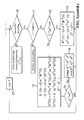
- shows a diagrammatic flowchart of an exemplary embodiment of a decoding mechanism in accordance with the invention,
- Figure 2
- shows a block diagram of a standard coding system in accordance with the publication by Hagenauer et al., referred to,
- Figure 3a
- shows a sketch of the principle of a systematically constructed code word, in which the information and the redundancy are present separately from one another, and
- Figure 3b
- shows a sketch of the principle of a non-systematically constructed code word in which the information and the redundancy are mixed.
- It may firstly be assumed in general terms for the following description that for the purpose of channel coding of an item of information to be sent, use is made for a digital transmission system, for example a mobile radio system, of a cyclic (n, k) Reed-Solomon code in the narrower sense, that is to say n=q-1 in the GF(q) (Galois field). The number of the symbols comprised over all by the code word formed is therefore defined by "n", and the number of the symbols of the information to be sent and embedded in the code word is defined by "k". The number of the correctable errors is therefore yielded as t = int ((n-k)/2)), it being possible, as an alternative, to introduce two erasures for each correctable error.
- If α represents a primitive nth unit root in GF(q), it is possible, as is known per se to the person skilled in the art in this field, to evaluate and transmit a polynomial of (k-1)th degree in α0, .., αn-1 in order to form the code word.
- Consequently, a transmit code word "c" emitted by a transmitting device of the transmission system has a symbol sequence c0,...., c(n-1), with element c0,..., c(n-1) from GF(q). A received word "r" which differs from the sent code word "c" by the error word "e" is then obtained in an assigned receiving device after transmission of the sent code word c. In general terms, it holds that: r = c + e.
- With subsequent reference to Figure 1, after the transmission a received word "r" with symbols r0,.., rn-1 sampled at the interpolation points α0,.., αn-1 is therefore present at the receiving device.
- As marked by the reference numerals 1 and 2 in Figure 1, the first step in initializing a decoding mechanism in accordance with the invention is to use the hardware and/or software implemented in the receiving device to form the coefficients Ri of an interpolating receiving polynomialby applying a Fourier transformation via the rule
 in which case 0 ≤ i ≤ (n-1) holds.
- In the present case, in which a code word is produced by evaluating a coding polynomial of (k-1)th degree, only the coefficients Rk to Rn-1 are of interest for the algorithm, since these coefficients depend exclusively on transmission errors and not on the word sent.
- The part R[1] (X) of the receiving polynomial which is relevant to the algorithm is yielded subsequently from the coefficients Ri via the ruleand is denoted as a syndrome polynomial.

- Furthermore, for the purpose of initializing the decoding mechanism an auxiliary polynomial R[2] (X) : = Xk is defined, and the running variables are set at i := k and j := 1, respectively, for the respective position in the syndrome and the number of erasures.
- Finally, an error position polynomial G[1] (X) := 1 is defined with an associated degree d(1) : =0 and an error positioned auxiliary polynomial G[2] (X) := 0 with an associated degree d[2] : =0 is defined.
- As is described in detail below, the decoding mechanism of the receiving device is designed in such a way that error position only decoding is performed in the first stage. For the case in which the syndrome polynomial R[1] (X) is already "zero" at the initialization, no errors occur during the transmission of information, and the subsequently described decoding is aborted at this juncture.
- Following the initialization, the error-only decoding is then carried out in a way known per se to the person skilled in the art and essentially follows the Berlekamp-Massey algorithm in the present example.
- For this purpose, the individual coefficients Ri [1] are firstly investigated in a stepwise fashion and marked by the reference numeral 3 in Figure 1 as to whether they are "zero". If the coefficient to be investigated R1 [1] = 0, no change takes place at the error position polynomial and syndrome polynomial, but, as marked by the reference numeral 4 in Figure 1, the coefficients of the auxiliary polynomial R[2] (X) and of the error position auxiliary polynomial G[2] (X) are displaced to the right by one position in each case by multiplying by the unknown "X", and the degree d[2] of the error position auxiliary polynomial is consequently increased by one.
- If the coefficient Ri [1] to be investigated does not vanish, the syndrome polynomial R[1] (X) and the assigned error position polynomial G[1] (X) are, by contrast, displaced to the right by one position in order then to obtain "zero" for the coefficient Ri [1], and the degree d[1] of the error position polynomial is consequently increased by one. Furthermore, the corresponding assigned auxiliary polynomials are corrected via auxiliary operations. In accordance with the operation field marked by the reference numeral 5, the functional relationships:
- Since, however, the error position polynomial G[1] (X) is permitted to have at most the same degree by comparison with the error position auxiliary polynomial G[2] (X), an exchange of all correspondingly relevant register contents is carried out for the case in which increasing the degree d[1] of the error position polynomial G[1] (X) renders the said degree greater than the degree d[2] (reference numerals 6 and 7 in Figure 1).
- If the output of a subsequent test (reference numeral 8 in Figure 1) is that the running variable i < n-1, not all coefficients Ri have been processed yet. The running variable is increased in this case by 1 (reference numeral 9 in Figure 1) and the decoding mechanism is executed once again for the next coefficient Ri [1] (reference numeral 3 in Figure 1).
- The part of the mechanism according to the invention which is described above therefore corresponds in the present exemplary embodiment essentially to the Berlekamp-Massey algorithm, which is known per se. Assuming that the total number of errors ≤ t, the current error position polynomial G[1] (X) obtained at the end after the investigation of all the coefficients R1 [1] comprises the detected error positions, based on the transmission, as zero points of the polynomial.
- The decoding is to be regarded as successful (reference numeral 10 in Figure 1) in this case when the number of the zero points of the error position polynomial G[1] (X) at the sampled positions α0,.., αn-1 corresponds to the associated degree d[1]. Otherwise, decoding is held to be unsuccessful, and the decoding is continued by further reaching investigation of the error position polynomial G[1] (X) and of the error position auxiliary polynomial G[2] (X), taking account of erasures to be introduced.
- It is firstly checked for this purpose whether the number of erasures already introduced has already reached the maximum number "max" of erasures. As already mentioned above, the maximum number of erasures can be specified individually and is yielded by a Reed-Solomon code as smaller than or equal to 2t. Since j=1 was set when initializing 2 the decoding mechanism and, as is to be seen in the case of the decision box marked by the reference numeral 11, the running variable j is used to check the number of erasures, the check for j is j: j ≤ max + 1.
- If the maximum number of erasures has already been introduced, and decoding has not succeeded, there is failure of decoding and the algorithm is aborted.
- If the algorithm has found a solution for the decoding problem, in which case the maximum number of erasures has not yet been introduced, it is possible to carry out a GMD decoding. A further decoding solution is obtained with 2 erasures in each case. A list of decoding solutions is therefore present at the end of the decoding algorithm. The "best" solution is determined as the most likely one from this list with the aid of individual criteria.
- If the maximum number of erasures has not yet been introduced, the error position polynomial G[1] at the respective sampled points α0, ..., αn-1 is investigated for zero points.
- For this purpose, reliability information supplied by the A/D converter of the receiving device during sampling of the received word r is used to sort the sampled points α0, ..., αn-1 in accordance with their reliability.
- Thereupon, the sampled point specified as the most unreliable is used to start a zero point investigation 12 of the error position polynomial G[1] (X).
- The functional register operations essentially corresponding to the error position investigation of the syndrome polynomial R[1] (X) are subsequently carried out by introducing respective erasures at the corresponding sampled points.
- If there is a zero point of the error position polynomial G[1] (X) at such a sampled point α1(j), it therefore holds for the register operations, as is shown by the reference numeral 13 in Figure 1, that:
- If, by contrast, the result of the check at the corresponding sampled point α1(j) is that the corresponding error position polynomial G[1] (α1(j) does not vanish, the functional relationships:
- A comparison 15 of the degrees d[1] and d[2] and, if appropriate, an exchange 16 of the register contents then follow in accordance with the steps which follow in the preceding investigation of the syndrome polynomial R[1] (X).
- After increasing 17 the running variables j, an appropriate check is then made firstly in turn as to whether the decoding has succeeded, or whether, possibly, a maximum number of erasures has not yet been introduced, so that the error position polynomial G[1] is to be investigated at the correspondingly next sample point α1(j).
- After successful decoding with or without erasures, it is, finally, necessary to calculate the error values in a way known to the person skilled in the art. It holds in general that:
- E(X) representing the error value polynomial to be calculated.
- Solving for Ω(X) yields:

- P(X) being a polynomial of degree (k-1) at most and being selected such that the division leaves no remainder, that is to say P(X) constitutes the unknown lower coefficient of the error value polynomial E(X). Furthermore, the rule
- It holds for each zero point zj of the error position polynomial G[1] (X) that:
- Since, furthermore it holds thatit is necessary in each case, in order not to have to calculate R[1]/[2] (X) explicitly, to calculate only the coefficient Ri [1] of interest, which leads to a further simplification.

- The additional, inventive introduction of erasures of genuine error positions is described below with the aid of an example of an errored information transmission in which an error-only decoding of the received word "r" leads to an incorrect result.
- Let α = 5 be selected as primitive element over the finite body with seven elements. The code used for channel coding may further be the (6,2) Reed-Solomon code which can therefore correct up to two errors.
- Let the code polynomial used to form the code word be: C(X)=3+6X. The evaluation in X = 1,5,4,6,2,3, which corresponds to the sampled points αj (where j = 0 to 5), yields a code word "c" with the transmission values c0 = 2, c1 = 5, c2 = 6, c3 = 4, c4 = 1 and c5 = 0. Let the received word "r" have the symbols r0 = 2, r1 = 5, r2 = 0, r3 = 0, r4 = 0 and r5 = 0.
- Thus, one error more than can be corrected has appeared during the transmission. An error-only decoding will therefore, as expected, detect the first two points as error positions and supply the zero word as decoding result.
- In accordance with the method according to the invention, it holds for the coefficients of the receiving polynomial Rj for j = 0, ..., 5, after carrying out the Fourier transformation, that: Rj = 6-1 (2*1+5*5-j), that is to say (R2, R3, R4, R5) = (2, 3, 6, 1).
- For the purpose of starting the implemented decoding mechanism, it holds in accordance with the previously described initialization that:
- It follows that the checking of the first coefficient of the syndrome polynomial, that is to say this is the coefficient R2 [1] for the initialized starting value i = 2, yields the value 2, that is to say a non-vanishing value. The operations to be carried out in accordance with the functional relationships (4) therefore yield:

- The investigation of the coefficient R3 [1] yields the value 2 for i = 3 in the next step.
- It therefore holds that:

- Since d[2] > d[1] at this point, the contents of the correspondingly assigned registers are consequently exchanged with one another, and therefore it holds that:
- For i=4 and R4 [1] = 4, it holds correspondingly that:

 and
and
- Since, in turn, this results in d[2] > d[1], the contents of the correspondingly assigned registers are exchanged with one another a further time, and so it holds that:
- Since the error position polynomial G[1] (X) = 6X2+6X+2 has the 2 zero points at X=1 and X=5, the error-only decoding would, as already mentioned above, recognize the first two positions of the received word r as error positions, and would therefore, as expected, supply the zero word as result at this point.
- However, the aim with the present example is to show that the code word actually sent can be obtained by erasing two real error positions.
- In the case of a corresponding sorting of the sampled points in terms of rising reliability, erasures are subsequently introduced into the sampled points detected as unreliable, erasures being inserted at X=2 and X=4 in the present example.
- Checking the error position polynomial G[1] (X) at the point X=2: G[2] at the point X = 2 for j=1 yields firstly: G[1] (2) = 6*4+6*2*2=3. G[2] (2) = 2 for the corresponding error position auxiliary polynomial.
- Upon introducing the erasure at X=2, the functional relationships (6) applied in this case yield the following register operations to be carried out:
 and
and
- Thus, for j=2 the error position polynomial G[1] (X) in X=4 is:
G[1] (4) = 3+4*4+2+6 = 6. The corresponding error position auxiliary polynomial G[2] (4) = 5. - The following operations apply correspondingly with reference to the second erasure to be introduced at X=4:
 and
and
- Since d[1] = 4 and is therefore greater than d[2] = 3, the register contents must consequently be changed in turn, and so it holds that:
- Since G[1] (X) = 3+6X=6X2+3X3 = 3 (X-2) (X-4) (X-6) and, furthermore, the number of these zero points of G[1] at the sampled points corresponds to the degree d[1], the decoding is regarded as successful, and the error position still lacking is found at X = 6.
- The error values still to be calculated are therefore yielded from Ω (X) as follows:
- As already shown above, r = c + e holds in a general way for the relationship between a sent code word "c" and the word "r" which is received after the transmission via a disturbed channel and differs from the sent code word c by the error word "e".
- The sent code word "c" is therefore yielded after substituting the calculated error values in e via the relationship r-e = c, that is to say c = (2,5,0,0,0,0)-(0,0,1,3,6,0) = (2,5,6,4,1,0).
Claims (13)
- Method for decoding in a receiving device for a digital transmission system, in which, for the purpose of transmitting data, channel coding is undertaken by means of an algebraic block code with the aid of the following steps:sampling a received word (r) at predeterminable interpolation points (α0, ..., αn-1) in order to obtain the symbols (r0, ..., rn-1) contained in the received word,obtaining coefficients (R1) for the purpose of forming a syndrome polynomial (R[1] (X)) by applying an interpolation, preferably a Fourier transformation to the symbols (r0, ...,. rn-1), andcarrying out an error position search on the basis of the syndrome polynomial (R[1] (X)) with the defined introduction of erasures.
- Method according to Claim 1, characterized in that carrying out the error position search includes, in a first stage, error-only decoding, based on the syndrome polynomial (R[1] (X)) in order to obtain an error position polynomial (G[1] (X)), functionally connected to the polynomial (R[1] (X)), and an error position auxiliary polynomial (G[2] (X)) and, in a second stage, carrying out a zero point investigation based on the error position polynomial (G[1] (X)) and the error position auxiliary polynomial (G[2] (X)) with the defined introduction of erasures.
- Method according to Claim 2, characterized in that an algebraic decoding method is used for the error-only decoding.
- Method according to Claim 2 or 3, characterized in that the Berlekamp-Massey method is applied for the error-only decoding.
- Method according to one of Claims 1 to 4, characterized in that the symbol positions of the received word are presorted with reference to their reliability for the purpose of the defined introduction of the erasures.
- Method according to one of Claims 1 to 5, characterized in that the received symbols (r0, ..., rn-1) are sorted in terms of rising reliability in response to the reliability information generated by the receiving device and successive erasures are introduced at the interpolation points.
- Method according to one of Claims 1 to 6, characterized in that individual decoding results are buffered and, if a maximum available number of erasures has not yet been reached, are made available to a GMD.
- Method according to one of Claims 1 to 6, characterized in that the algorithm is aborted with decoding failure after the introduction of a maximum available number of erasures in the case of unsuccessful decoding.
- Receiving device of a digital transmission system in which, for the purpose of transmitting data, channel coding is undertaken by means of an algebraic block code comprisinga device for sampling a received word (r) with symbols (r0,..., rn-1) at predeterminable interpolation points (α0, ..., αn-1),a decoding device having
devices for obtaining coefficients (R1) for the purpose of forming a syndrome polynomial (R[1] (X)) by applying an interpolation, in particular a Fourier transformation to the symbols (r0, ...,. rn-1), and
devices for carrying out an error-only decoding, based on the syndrome polynomial (R[1] (X)), in order to obtain an error position polynomial (G[1] (X)) functionally connected to the polynomial r[1](X)) and based thereon, in order to carry out a zero point investigation with the defined introduction of erasures. - Receiving device according to Claim 9, characterized by a device for generating reliability information with reference to the positions of the symbols (r0,...,. rn-1) of the received word (r) .
- Receiving device according to Claim 9 or 10, characterized in that the decoding device is adapted for decoding Reed-Solomon codes and/or their related codes such as, for example, a BCH code.
- Receiving device according to Claim 9, 10 or 11, characterized in that the block code used for the purpose of channel coding is part of a concatenated code.
- Computer program for carrying out a method according to one of Claims 1 to 8, in particular inside a receiving device according to one of Claims 9 to 12.
Priority Applications (3)
| Application Number | Priority Date | Filing Date | Title |
|---|---|---|---|
| EP01302867A EP1246370A1 (en) | 2001-03-28 | 2001-03-28 | Decoding method for block codes used for the purpose of channel coding |
| US10/100,651 US20020184593A1 (en) | 2001-03-28 | 2002-03-18 | Decoding method for block codes used for the purpose of channel coding |
| JP2002090164A JP2002359562A (en) | 2001-03-28 | 2002-03-28 | Method of decoding block code used for channel coding |
Applications Claiming Priority (1)
| Application Number | Priority Date | Filing Date | Title |
|---|---|---|---|
| EP01302867A EP1246370A1 (en) | 2001-03-28 | 2001-03-28 | Decoding method for block codes used for the purpose of channel coding |
Publications (1)
| Publication Number | Publication Date |
|---|---|
| EP1246370A1 true EP1246370A1 (en) | 2002-10-02 |
Family
ID=8181840
Family Applications (1)
| Application Number | Title | Priority Date | Filing Date |
|---|---|---|---|
| EP01302867A Withdrawn EP1246370A1 (en) | 2001-03-28 | 2001-03-28 | Decoding method for block codes used for the purpose of channel coding |
Country Status (3)
| Country | Link |
|---|---|
| US (1) | US20020184593A1 (en) |
| EP (1) | EP1246370A1 (en) |
| JP (1) | JP2002359562A (en) |
Families Citing this family (2)
| Publication number | Priority date | Publication date | Assignee | Title |
|---|---|---|---|---|
| KR100520621B1 (en) * | 2002-01-16 | 2005-10-10 | 삼성전자주식회사 | Method and apparatus for weighted non-binary repeatative accumulating codes and space-time coding thereof |
| CN111354060B (en) * | 2020-02-19 | 2023-07-07 | 广州安凯微电子股份有限公司 | Window animation acceleration method and device based on double-buffer technology and storage medium |
-
2001
- 2001-03-28 EP EP01302867A patent/EP1246370A1/en not_active Withdrawn
-
2002
- 2002-03-18 US US10/100,651 patent/US20020184593A1/en not_active Abandoned
- 2002-03-28 JP JP2002090164A patent/JP2002359562A/en active Pending
Non-Patent Citations (4)
| Title |
|---|
| FORNEY J G D: "Generalized minimum distance decoding", IEEE TRANS. INFORM. THEORY, vol. IT12, April 1966 (1966-04-01), USA, pages 125 - 131, XP002174974 * |
| HAGENAUER J, OFFER E, PAPKE L: "Improving the standard coding system for deep space missions", IEEE INTERNATIONAL CONFERENCE ON COMMUNICATIONS, vol. 2, 23 May 1993 (1993-05-23) - 26 March 1993 (1993-03-26), Geneva, Switzerland, pages 1092 - 1097, XP002174972 * |
| KOTTER R: "Fast generalized minimum-distance decoding of algebraic-geometry and Reed-Solomon codes", IEEE TRANSACTIONS ON INFORMATION THEORY, vol. 42, May 1996 (1996-05-01), USA, pages 721 - 737, XP002174973 * |
| SORGER U K: "A NEW REED-SOLOMON CODE DECODING ALGORITHM BASED ON NEWTON'S INTERPOLATION", IEEE TRANSACTIONS ON INFORMATION THEORY, IEEE INC. NEW YORK, US, vol. 39, no. 2, 1 March 1993 (1993-03-01), pages 358 - 365, XP000377699, ISSN: 0018-9448 * |
Also Published As
| Publication number | Publication date |
|---|---|
| US20020184593A1 (en) | 2002-12-05 |
| JP2002359562A (en) | 2002-12-13 |
Similar Documents
| Publication | Publication Date | Title |
|---|---|---|
| US7370258B2 (en) | Iterative concatenated convolutional Reed-Solomon decoding method | |
| US9214958B2 (en) | Method and decoder for processing decoding | |
| JP3610329B2 (en) | Turbo coding method using large minimum distance and system for realizing the same | |
| EP0728390B1 (en) | Method and apparatus for decoder optimization | |
| AU650399B1 (en) | Improved error correcting decoder and decoding method for receivers in digital cellular communication | |
| CN100438346C (en) | Method and apparatus for erasure and single error correction of linear block codes | |
| US8949697B1 (en) | Low power Reed-Solomon decoder | |
| US5970075A (en) | Method and apparatus for generating an error location polynomial table | |
| EP0446745B1 (en) | Viterbi algorithm outputting a plurality of most probable sequences in descending probability order | |
| US20080092025A1 (en) | Method and System for Improving Decoding Efficiency in Wireless Receivers | |
| US20030028838A1 (en) | Acceleration of convergence rate with verified bits in turbo decoding | |
| US7793195B1 (en) | Incremental generation of polynomials for decoding reed-solomon codes | |
| US7657819B2 (en) | Method and apparatus for termination of iterative turbo decoding | |
| US20100017692A1 (en) | Method and apparatus for cyclic redundancy check in communication system | |
| EP0861525A1 (en) | Improved multiple-burst-correction system | |
| KR20050019014A (en) | Decoding method and apparatus | |
| KR20020006022A (en) | Method and device for decoding convolution codes | |
| US5809042A (en) | Interleave type error correction method and apparatus | |
| US7716554B2 (en) | System and method for blind transport format detection with cyclic redundancy check | |
| US20020184593A1 (en) | Decoding method for block codes used for the purpose of channel coding | |
| US20020116681A1 (en) | Decoder, system and method for decoding trubo block codes | |
| EP1612949A1 (en) | Method and system for correcting errors in electronic memory devices | |
| RU2236090C1 (en) | Communication channel quality control process | |
| US8181096B2 (en) | Configurable Reed-Solomon decoder based on modified Forney syndromes | |
| CN101431340A (en) | Fast self-adapting confidence degree propagation interpretation method for Reed-Solomon code |
Legal Events
| Date | Code | Title | Description |
|---|---|---|---|
| PUAI | Public reference made under article 153(3) epc to a published international application that has entered the european phase |
Free format text: ORIGINAL CODE: 0009012 |
|
| AK | Designated contracting states |
Kind code of ref document: A1 Designated state(s): AT BE CH CY DE DK ES FI FR GB GR IE IT LI LU MC NL PT SE TR |
|
| AX | Request for extension of the european patent |
Free format text: AL;LT;LV;MK;RO;SI |
|
| 17P | Request for examination filed |
Effective date: 20030324 |
|
| AKX | Designation fees paid |
Designated state(s): DE FR GB |
|
| 17Q | First examination report despatched |
Effective date: 20050617 |
|
| STAA | Information on the status of an ep patent application or granted ep patent |
Free format text: STATUS: THE APPLICATION IS DEEMED TO BE WITHDRAWN |
|
| 18D | Application deemed to be withdrawn |
Effective date: 20051001 |