EP1246167A1 - Arrangement for de-activating automatic noise cancellation in a mobile station - Google Patents
Arrangement for de-activating automatic noise cancellation in a mobile station Download PDFInfo
- Publication number
- EP1246167A1 EP1246167A1 EP02396033A EP02396033A EP1246167A1 EP 1246167 A1 EP1246167 A1 EP 1246167A1 EP 02396033 A EP02396033 A EP 02396033A EP 02396033 A EP02396033 A EP 02396033A EP 1246167 A1 EP1246167 A1 EP 1246167A1
- Authority
- EP
- European Patent Office
- Prior art keywords
- comparison
- anc
- value
- facility
- mobile station
- Prior art date
- Legal status (The legal status is an assumption and is not a legal conclusion. Google has not performed a legal analysis and makes no representation as to the accuracy of the status listed.)
- Withdrawn
Links
- 238000001514 detection method Methods 0.000 claims abstract description 11
- 230000003213 activating effect Effects 0.000 claims abstract description 8
- 230000009849 deactivation Effects 0.000 claims abstract description 6
- 230000004913 activation Effects 0.000 claims abstract description 5
- 230000005236 sound signal Effects 0.000 claims abstract description 4
- 238000010586 diagram Methods 0.000 description 5
- 238000000034 method Methods 0.000 description 4
- 230000003044 adaptive effect Effects 0.000 description 1
- 238000012544 monitoring process Methods 0.000 description 1
- 238000011017 operating method Methods 0.000 description 1
Images



Classifications
-
- G—PHYSICS
- G10—MUSICAL INSTRUMENTS; ACOUSTICS
- G10L—SPEECH ANALYSIS TECHNIQUES OR SPEECH SYNTHESIS; SPEECH RECOGNITION; SPEECH OR VOICE PROCESSING TECHNIQUES; SPEECH OR AUDIO CODING OR DECODING
- G10L21/00—Speech or voice signal processing techniques to produce another audible or non-audible signal, e.g. visual or tactile, in order to modify its quality or its intelligibility
- G10L21/02—Speech enhancement, e.g. noise reduction or echo cancellation
- G10L21/0208—Noise filtering
-
- G—PHYSICS
- G10—MUSICAL INSTRUMENTS; ACOUSTICS
- G10L—SPEECH ANALYSIS TECHNIQUES OR SPEECH SYNTHESIS; SPEECH RECOGNITION; SPEECH OR VOICE PROCESSING TECHNIQUES; SPEECH OR AUDIO CODING OR DECODING
- G10L21/00—Speech or voice signal processing techniques to produce another audible or non-audible signal, e.g. visual or tactile, in order to modify its quality or its intelligibility
- G10L21/02—Speech enhancement, e.g. noise reduction or echo cancellation
- G10L21/0208—Noise filtering
- G10L21/0216—Noise filtering characterised by the method used for estimating noise
- G10L2021/02161—Number of inputs available containing the signal or the noise to be suppressed
- G10L2021/02165—Two microphones, one receiving mainly the noise signal and the other one mainly the speech signal
Definitions
- the present invention relates to an arrangement for activating and deactivating automatic noise cancellation (ANC) in a mobile station, in which there is an ANC circuit for removing background noise from an audio signal and circuits for activating and deactivating ANC.
- ANC automatic noise cancellation
- Automatic noise cancellation is used to remove background noise from an incoming audio signal. This feature is generally separately activated and deactivated. Its continuous use is not desirable, as it increases the power consumption of the mobile station. Usually the user must select, from the mobile station's settings, the method of using the ANC, which can be, for example, 'Always ON' or 'Manual'. The former results in unnecessary power consumption while the latter is difficult for the user, because it demands several key strokes, which additionally must often be made during a call.
- the present invention is intended to create an arrangement for activating and deactivating automatic noise cancellation when it is required. According to the invention, this purpose is achieved in such a way that the system includes an automatic circuit configuration detecting a need for ANC, according to a selected criterion, the detection circuit configuration being arranged to automatically control the activation and deactivation of ANC. According to one preferred embodiment, the detection circuit configuration includes a comparison circuit for comparing the set criterion value with the volume level of the mobile station device, in such a way that the comparison circuit activates ANC at the set sound volume value.
- the detection circuit configuration includes a comparison circuit for comparing the set criterion value with the measured value of the background noise, in such a way that the comparison circuit activates ANC at the set volume level of the background noise.
- the schematic diagrams of the examples of Figure 1 and 3 show the operational configuration of the mobile station.
- the signal is processed digitally.
- the 'bypass connection' of the noise cancellation (ANC) takes place by forwarding the flow of bits, which arrives at the ANC's incoming register, directly to the following stages, i.e. to the input register of the speech coding, without processing.
- the noise cancellation has been activated, before the flow of bits arriving at the incoming register of the ANC is forwarded, it is subject to processing, which is, as such, known.
- the invention can be implemented in different types of mobile station (TDMA, CDMA, digital/analog).
- the schematic diagram according to Figure 1 shows a digital mobile station, in which the speech to be sent, which comes to the microphone 1, is converted into digital form by an A/D converter 2, the noise is suppressed, if necessary, by noise cancellation (ANC facility 3), and the speech is coded in speech coding 4, after which processing of the baseband frequency signal takes place in the block 5, as is known.
- the signal is converted to a radio frequency and transmitted 6 through a duplex filter (DPLX) and an antenna (ANT).
- DPLX duplex filter
- ANT antenna
- the known operations of the receiver branch 7 are carried out when speech is received in the receiver, and it is reproduced in the loudspeaker 8.
- Figure 1 is marked with a means 13, the significance of which is explained later, for showing the state information of the mobile station.
- volume level control 9 the information available from which is exploited by the automatic detection circuit configuration 10 to detect a need for noise cancellation, is connected to the receiver branch 7. This too is actually implemented by means of software, which is explained later. In any event, the noise cancellation is activated and deactivated automatically, with only the receiver volume level control value and the state information of the mobile station being exploited to detect a need for it.
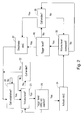
- FIG. 2 shows only one possible implementation, in the form of a program flow chart.
- the program monitors the loop formed by an initial check 20. Once a call is connected, the execution changes to monitoring the level of the volume level of the loop 21. If the volume level is not increased, the program returns to check 22 the status. If the volume level is increased, the execution moves to checking 23 the trigger level and returns, unless the trigger level is reached. If the check 23 detects that the trigger level has been reached, the program activates the ANC, stage 24. From this, the execution must move to the checking stages in the opposite direction.
- the program flow can also incorporate more complex initializations, for example, an initial state check of the volume level setting and, according to it, a move to either stage 21 or stage 25.
- Figure 3 shows a schematic diagram of a second embodiment while Figure 4 shows a corresponding flow chart.
- the same reference numbers as above are used for operationally corresponding components.
- the speech that comes from the microphone 1 is also converted using an A/D converter 2, the noise is cancelled, if necessary, by noise cancellation (ANC facility 3), and the speech is coded in speech coding 4, after the baseband frequency signal is processed in block 5.
- the signal is converted to a radio frequency and transmitted by a transmitter 6, through a duplex filter (DPLX) and an antenna (ANT).
- DPLX duplex filter
- ANT antenna
- a separate microphone 11 and an A/D converter 12 are used to detect background noise. This is primarily exploited in the noise cancellation itself (ANC facility 3), but also in detecting 10 a need for ANC.
- detection 13 of the state of the mobile station is exploited when detecting a need for ANC.
- the corresponding program flow chart is somewhat simpler, because the criterion value required for the program is constant, Figure 4.
Landscapes
- Engineering & Computer Science (AREA)
- Computational Linguistics (AREA)
- Quality & Reliability (AREA)
- Signal Processing (AREA)
- Health & Medical Sciences (AREA)
- Audiology, Speech & Language Pathology (AREA)
- Human Computer Interaction (AREA)
- Physics & Mathematics (AREA)
- Acoustics & Sound (AREA)
- Multimedia (AREA)
- Mobile Radio Communication Systems (AREA)
Abstract
The invention relates to an arrangement for
activating and deactivating automatic noise
cancellation (ANC) in a mobile station, in
which there are an ANC facility (3) for
suppressing background noise in an incoming
audio signal, as well as circuits for
activating and deactivating the ANC. The
arrangement includes automatic detection (10)
of the need for ANC according to a selected
criterion, for example, a set noise level,
the detection circuit configuration (10)
being arranged to automatically control the
activation and deactivation of the ANC
facility (3).
Description
- The present invention relates to an arrangement for activating and deactivating automatic noise cancellation (ANC) in a mobile station, in which there is an ANC circuit for removing background noise from an audio signal and circuits for activating and deactivating ANC.
- Automatic noise cancellation is used to remove background noise from an incoming audio signal. This feature is generally separately activated and deactivated. Its continuous use is not desirable, as it increases the power consumption of the mobile station. Usually the user must select, from the mobile station's settings, the method of using the ANC, which can be, for example, 'Always ON' or 'Manual'. The former results in unnecessary power consumption while the latter is difficult for the user, because it demands several key strokes, which additionally must often be made during a call.
- The theory and operating methods of automatic noise cancellation are widely known. US patent publications 5,406,635 (Järvinen) and 5,839,101 (Vähätalo) disclose certain methods for limiting background noise in a mobile station. The publication 'IEEE Signal Processing Magazine'; S. J. Elliot, August 1993 features an extensive presentation of the history of noise cancellation technology and certain present methods. Background noise cancellation can be based either on the analysis of frequency fields (e.g., adaptive filters) or on active feedback on background noise obtained with the aid of an additional microphone, in cases in which this is possible.
- All the methods have the drawback that they cause an increase in power consumption, which, in mobile stations, means a shorter period of operation for each battery charge. Thus, the use of ANC is only desirable when it is really necessary.
- The present invention is intended to create an arrangement for activating and deactivating automatic noise cancellation when it is required. According to the invention, this purpose is achieved in such a way that the system includes an automatic circuit configuration detecting a need for ANC, according to a selected criterion, the detection circuit configuration being arranged to automatically control the activation and deactivation of ANC. According to one preferred embodiment, the detection circuit configuration includes a comparison circuit for comparing the set criterion value with the volume level of the mobile station device, in such a way that the comparison circuit activates ANC at the set sound volume value.
- According to a second preferred embodiment, if there is an additional microphone in the mobile station for measuring background noise, the detection circuit configuration includes a comparison circuit for comparing the set criterion value with the measured value of the background noise, in such a way that the comparison circuit activates ANC at the set volume level of the background noise.
- Once the ANC setting criteria has been made, the user need no longer take care of activating and deactivating ANC.
- With the aid of the invention, automatic noise cancellation will only be activated when it is really necessary, thus avoiding unnecessary power consumption. Other advantages and embodiments of the invention will become apparent in connection with the examples described later.
- In the following, the invention is examined with reference to the accompanying figures, in which
- Figure 1
- shows a schematic diagram of a mobile station equipped with noise cancellation,
- Figure 2
- shows a flow chart of the noise cancellation of the embodiment of Figure 1,
- Figure 3
- shows a schematic diagram of a mobile station according to a second embodiment,
- Figure 4
- shows a flow chart of the noise cancellation of the embodiment of figure 3.
- In both cases, the schematic diagrams of the examples of Figure 1 and 3 show the operational configuration of the mobile station. Naturally, the signal is processed digitally. Thus, the 'bypass connection' of the noise cancellation (ANC) takes place by forwarding the flow of bits, which arrives at the ANC's incoming register, directly to the following stages, i.e. to the input register of the speech coding, without processing. When the noise cancellation has been activated, before the flow of bits arriving at the incoming register of the ANC is forwarded, it is subject to processing, which is, as such, known.
- The invention can be implemented in different types of mobile station (TDMA, CDMA, digital/analog).
- The schematic diagram according to Figure 1 shows a digital mobile station, in which the speech to be sent, which comes to the microphone 1, is converted into digital form by an A/
D converter 2, the noise is suppressed, if necessary, by noise cancellation (ANC facility 3), and the speech is coded inspeech coding 4, after which processing of the baseband frequency signal takes place in theblock 5, as is known. Next, the signal is converted to a radio frequency and transmitted 6 through a duplex filter (DPLX) and an antenna (ANT). The known operations of thereceiver branch 7 are carried out when speech is received in the receiver, and it is reproduced in theloudspeaker 8. In addition, Figure 1 is marked with ameans 13, the significance of which is explained later, for showing the state information of the mobile station. - In the description according to Figure 1,
volume level control 9, the information available from which is exploited by the automaticdetection circuit configuration 10 to detect a need for noise cancellation, is connected to thereceiver branch 7. This too is actually implemented by means of software, which is explained later. In any event, the noise cancellation is activated and deactivated automatically, with only the receiver volume level control value and the state information of the mobile station being exploited to detect a need for it. - Automatic detection can be implemented by means of software in many different ways. Thus, Figure 2 shows only one possible implementation, in the form of a program flow chart. When the mobile station is closed, the program monitors the loop formed by an
initial check 20. Once a call is connected, the execution changes to monitoring the level of the volume level of theloop 21. If the volume level is not increased, the program returns to check 22 the status. If the volume level is increased, the execution moves to checking 23 the trigger level and returns, unless the trigger level is reached. If thecheck 23 detects that the trigger level has been reached, the program activates the ANC,stage 24. From this, the execution must move to the checking stages in the opposite direction. When a call is connected and remains at the same sound level, the execution runs around the loop instages 25, 'Volume level reduced' and 28, 'Call ended?'. If the volume level is reduced, check 26, 'Trigger level achieved', follows, from which the execution returns tostage 25, if the trigger level has not been achieved and the call is still connected. If the trigger level has been reached, the program deactivates the ANC instage 27 and returns to theinitial check 20. - The program flow can also incorporate more complex initializations, for example, an initial state check of the volume level setting and, according to it, a move to either
stage 21 orstage 25. - Figure 3 shows a schematic diagram of a second embodiment while Figure 4 shows a corresponding flow chart. The same reference numbers as above are used for operationally corresponding components. Thus, in the digital mobile station according to Figure 3, the speech that comes from the microphone 1 is also converted using an A/
D converter 2, the noise is cancelled, if necessary, by noise cancellation (ANC facility 3), and the speech is coded inspeech coding 4, after the baseband frequency signal is processed inblock 5. Similarly, after this the signal is converted to a radio frequency and transmitted by atransmitter 6, through a duplex filter (DPLX) and an antenna (ANT). The known operations of thereceiver branch 7 are carried out in this case too, when speech is received and it is repeated by theloudspeaker 8. - Unlike in Figure 1, in the embodiment of Figure 3, a
separate microphone 11 and an A/D converter 12 are used to detect background noise. This is primarily exploited in the noise cancellation itself (ANC facility 3), but also in detecting 10 a need for ANC. Here too,detection 13 of the state of the mobile station is exploited when detecting a need for ANC. The corresponding program flow chart is somewhat simpler, because the criterion value required for the program is constant, Figure 4. Thus, from theinitial state check 20 the flow goes to monitor the firsttrigger level check 23, from which, if the trigger level is exceeded, ANC is activated,stage 3, and the program then goes to the secondtrigger level check 26. From here the execution returns to theinitial check 20, through the deactivation of the ANC,stage 27, if the trigger level has been reached (downwards). Otherwise, the execution runs around a loop through thecall state check 28 and the secondtrigger level check 26. - In this case too, the program can be supplemented and adapted in many different ways.
Claims (7)
- An arrangement for activating and deactivating automatic noise cancellation (ANC) in a mobile station, in which there is an ANC facility (3) for cancelling background noise of an incoming audio signal and circuits for activating and deactivating ANC, characterized in that the arrangement includes an automatic circuit configuration (10) for detecting a need for ANC, according to a selected criterion, which detection circuit configuration (10) is arranged to automatically control the activation and deactivation of the ANC facility (3).
- A arrangement according to Claim 1 in a mobile station equipped with sound level control, characterized in that the detection circuit configuration (10) includes a comparison circuit for comparing the set criterion value with the volume level control value of the mobile station device, in such a way that the comparison circuit activates the ANC facility (3) at the set volume level value.
- An arrangement according to Claim 2 in a mobile station, which is equipped with a digital operating system controlling its functions, characterized in that the arrangement includes stages carried out by means of software:a) a first comparison (23) of the set value of the volume level with a criterion value, if the set value is raised,b) return to the first comparison (23), if the criterion value is not exceeded,c) activation of the ANC facility, if the criterion value is reached, and a move to a second comparison (d - f),d) a second comparison (26) of the set value of the volume level, if the set value is reduced,e) return to the second comparison (26), if the criterion value is not gone below,f) deactivation (27) of the ANC facility, if the criterion value is gone below, and a move back to the first comparison (a - c).
- An arrangement according to Claim 3, characterized in that the arrangement also includes one or several checks to examine the operating state, so that, in a non-active state:if the ANC is activated, it is deactivated,a move is made from the first and/or the second comparison to a comparison of the operating state, from which a return is made to the first comparison until the operating state is activated.
- An arrangement according to Claim 1 in a mobile station, in which there is an additional microphone (11) for detecting background noise, characterized in that the detection circuit configuration (10) includes a comparison circuit for comparing the set criterion value with the value of the measured background noise, in such a way that the comparison circuit activates the ANC facility (3) at a set value of the volume of the background noise.
- An arrangement according to Claim 5 in a mobile station, which is equipped with a digital operating system controlling functions, characterized in that the arrangement includes stages carried out by means of software:a) a first comparison (23) of the background noise with the criterion value,b) a return to the first comparison (23), if the criterion value is not exceeded,c) activation (24) of the ANC facility, if the criterion value is reached, and a move to a second comparison (d - f),d) a second comparison (26) of the background noise with the criterion value,e) a return to the second comparison (26), if the criterion is not gone below,f) deactivation (27) of the ANC facility, if the criterion value is gone below, and a move back to the first comparison (a - c).
- An arrangement according to Claim 6, characterized in that the arrangement also includes one or several checks to examine the operating state, so that in a non-active state:if the ANC facility is activated, it is deactivated, anda move is made from the first or second comparison to a comparison of the operating state, from which a return is made to the first comparison, until the operating state is activated.
Applications Claiming Priority (2)
| Application Number | Priority Date | Filing Date | Title |
|---|---|---|---|
| FI20010654A FI110564B (en) | 2001-03-29 | 2001-03-29 | Automatic noise cancellation (ANC) system on and off in a mobile phone |
| FI20010654 | 2001-03-29 |
Publications (1)
| Publication Number | Publication Date |
|---|---|
| EP1246167A1 true EP1246167A1 (en) | 2002-10-02 |
Family
ID=8560874
Family Applications (1)
| Application Number | Title | Priority Date | Filing Date |
|---|---|---|---|
| EP02396033A Withdrawn EP1246167A1 (en) | 2001-03-29 | 2002-03-18 | Arrangement for de-activating automatic noise cancellation in a mobile station |
Country Status (3)
| Country | Link |
|---|---|
| US (1) | US20020141598A1 (en) |
| EP (1) | EP1246167A1 (en) |
| FI (1) | FI110564B (en) |
Families Citing this family (7)
| Publication number | Priority date | Publication date | Assignee | Title |
|---|---|---|---|---|
| US6978010B1 (en) * | 2002-03-21 | 2005-12-20 | Bellsouth Intellectual Property Corp. | Ambient noise cancellation for voice communication device |
| US8849231B1 (en) | 2007-08-08 | 2014-09-30 | Audience, Inc. | System and method for adaptive power control |
| GB2441835B (en) * | 2007-02-07 | 2008-08-20 | Sonaptic Ltd | Ambient noise reduction system |
| US8798289B1 (en) * | 2008-08-05 | 2014-08-05 | Audience, Inc. | Adaptive power saving for an audio device |
| CN103680510B (en) * | 2012-09-11 | 2016-06-29 | 华为终端有限公司 | Noise reduction process method and device |
| WO2023106439A1 (en) * | 2021-12-07 | 2023-06-15 | 엘지전자 주식회사 | Wireless sound device and control method thereof |
| TW202401998A (en) * | 2022-06-29 | 2024-01-01 | 日商新唐科技日本股份有限公司 | Signal processing device and control method |
Citations (6)
| Publication number | Priority date | Publication date | Assignee | Title |
|---|---|---|---|---|
| US5251263A (en) * | 1992-05-22 | 1993-10-05 | Andrea Electronics Corporation | Adaptive noise cancellation and speech enhancement system and apparatus therefor |
| EP0645756A1 (en) * | 1993-09-29 | 1995-03-29 | Ericsson Ge Mobile Communications Inc. | System for adaptively reducing noise in speech signals |
| EP0661903A2 (en) * | 1993-12-29 | 1995-07-05 | Nec Corporation | A telephone set with background noise suppression function |
| EP0856834A2 (en) * | 1997-01-29 | 1998-08-05 | Nec Corporation | Noise canceler |
| WO2000063887A1 (en) * | 1999-04-19 | 2000-10-26 | Motorola Inc. | Noise suppression using external voice activity detection |
| DK200001369A (en) * | 1999-09-16 | 2001-03-17 | Siemens Audiologische Technik | Method for reducing acoustic noise signals |
Family Cites Families (9)
| Publication number | Priority date | Publication date | Assignee | Title |
|---|---|---|---|---|
| FI92535C (en) * | 1992-02-14 | 1994-11-25 | Nokia Mobile Phones Ltd | Noise canceling system for speech signals |
| DE69227019T2 (en) * | 1992-03-11 | 1999-03-18 | Mitsubishi Denki K.K., Tokio/Tokyo | Damping device |
| US5625684A (en) * | 1993-02-04 | 1997-04-29 | Local Silence, Inc. | Active noise suppression system for telephone handsets and method |
| EP0967592B1 (en) * | 1993-06-23 | 2007-01-24 | Noise Cancellation Technologies, Inc. | Variable gain active noise cancellation system with improved residual noise sensing |
| US5406622A (en) * | 1993-09-02 | 1995-04-11 | At&T Corp. | Outbound noise cancellation for telephonic handset |
| FI100840B (en) * | 1995-12-12 | 1998-02-27 | Nokia Mobile Phones Ltd | Noise cancellation and background noise canceling method in a noise and a mobile telephone |
| US5870685A (en) * | 1996-09-04 | 1999-02-09 | Ericsson Inc. | Mobile station operations management based on battery capacity |
| JP3606348B2 (en) * | 1997-03-18 | 2005-01-05 | 松下電器産業株式会社 | Wireless communication device |
| FR2808958B1 (en) * | 2000-05-11 | 2002-10-25 | Sagem | PORTABLE TELEPHONE WITH SURROUNDING NOISE MITIGATION |
-
2001
- 2001-03-29 FI FI20010654A patent/FI110564B/en not_active IP Right Cessation
-
2002
- 2002-03-13 US US10/096,988 patent/US20020141598A1/en not_active Abandoned
- 2002-03-18 EP EP02396033A patent/EP1246167A1/en not_active Withdrawn
Patent Citations (7)
| Publication number | Priority date | Publication date | Assignee | Title |
|---|---|---|---|---|
| US5251263A (en) * | 1992-05-22 | 1993-10-05 | Andrea Electronics Corporation | Adaptive noise cancellation and speech enhancement system and apparatus therefor |
| EP0645756A1 (en) * | 1993-09-29 | 1995-03-29 | Ericsson Ge Mobile Communications Inc. | System for adaptively reducing noise in speech signals |
| EP0661903A2 (en) * | 1993-12-29 | 1995-07-05 | Nec Corporation | A telephone set with background noise suppression function |
| EP0856834A2 (en) * | 1997-01-29 | 1998-08-05 | Nec Corporation | Noise canceler |
| WO2000063887A1 (en) * | 1999-04-19 | 2000-10-26 | Motorola Inc. | Noise suppression using external voice activity detection |
| DK200001369A (en) * | 1999-09-16 | 2001-03-17 | Siemens Audiologische Technik | Method for reducing acoustic noise signals |
| DE19944467A1 (en) * | 1999-09-16 | 2001-03-29 | Siemens Audiologische Technik | Method of reducing acoustic noise signals enables significant improvement in signal processing based on presence of multi-microphone noise reduction algorithm |
Also Published As
| Publication number | Publication date |
|---|---|
| FI20010654L (en) | 2002-09-30 |
| FI110564B (en) | 2003-02-14 |
| US20020141598A1 (en) | 2002-10-03 |
| FI20010654A0 (en) | 2001-03-29 |
Similar Documents
| Publication | Publication Date | Title |
|---|---|---|
| CA2166239C (en) | Speech presence detector and method therefor | |
| CN1090418C (en) | Clear channel selection system for cordless telephone | |
| JPH04505995A (en) | Speakerphone for cellular telephones with howling prevention, detection, erasure and determination | |
| JP5612025B2 (en) | Automatic gain control circuit | |
| KR20050005431A (en) | Apparatus, and an associated method, for increasing receiver sensitivity of a direct conversion receiver | |
| JPH11317690A (en) | Adaptive control technology for receiver linearity for radio transceivers. | |
| KR20030067687A (en) | A radio receiver | |
| EP1246167A1 (en) | Arrangement for de-activating automatic noise cancellation in a mobile station | |
| US20110300874A1 (en) | System and method for removing tdma audio noise | |
| US20030039352A1 (en) | Receiver, method, program and carrier signal for adapting the sound volume of an acoustic signal of an incoming call | |
| MXPA03006595A (en) | System and method for adaptive equalization in a wireless communication system. | |
| US6272116B1 (en) | Power saving device | |
| JPH04323938A (en) | Hand-free circuit | |
| US6347141B1 (en) | Method of and apparatus for adaptation of an echo canceller in a system with multitasking | |
| US6055421A (en) | Carrier squelch method and apparatus | |
| JP3760787B2 (en) | Mobile phone | |
| EP2213109A1 (en) | Method of operating a hearing device and a hearing device | |
| JP2814913B2 (en) | Modem card for mobile radiotelephone | |
| JPH01253353A (en) | Howling canceler system for hand-free telephone | |
| US6748210B2 (en) | Method and apparatus for automatically terminating to a voice mail an incoming call made to a radio telephone | |
| KR200161166Y1 (en) | Mobile communication device | |
| JP2861850B2 (en) | VOX type mobile phone | |
| JP2001268212A (en) | Voice communication device | |
| CN1518366A (en) | Method for detecting audio signal by using digital signal processing | |
| JPH01238351A (en) | Return error preventing system for hand-free telephone set |
Legal Events
| Date | Code | Title | Description |
|---|---|---|---|
| PUAI | Public reference made under article 153(3) epc to a published international application that has entered the european phase |
Free format text: ORIGINAL CODE: 0009012 |
|
| AK | Designated contracting states |
Kind code of ref document: A1 Designated state(s): AT BE CH CY DE DK ES FI FR GB GR IE IT LI LU MC NL PT SE TR |
|
| AX | Request for extension of the european patent |
Free format text: AL;LT;LV;MK;RO;SI |
|
| AKX | Designation fees paid | ||
| REG | Reference to a national code |
Ref country code: DE Ref legal event code: 8566 |
|
| STAA | Information on the status of an ep patent application or granted ep patent |
Free format text: STATUS: THE APPLICATION IS DEEMED TO BE WITHDRAWN |
|
| 18D | Application deemed to be withdrawn |
Effective date: 20021130 |