EP1246124A2 - Image space display method and apparatus - Google Patents
Image space display method and apparatus Download PDFInfo
- Publication number
- EP1246124A2 EP1246124A2 EP02251934A EP02251934A EP1246124A2 EP 1246124 A2 EP1246124 A2 EP 1246124A2 EP 02251934 A EP02251934 A EP 02251934A EP 02251934 A EP02251934 A EP 02251934A EP 1246124 A2 EP1246124 A2 EP 1246124A2
- Authority
- EP
- European Patent Office
- Prior art keywords
- space
- display
- image
- images
- features
- Prior art date
- Legal status (The legal status is an assumption and is not a legal conclusion. Google has not performed a legal analysis and makes no representation as to the accuracy of the status listed.)
- Granted
Links
Images






Classifications
-
- G—PHYSICS
- G06—COMPUTING OR CALCULATING; COUNTING
- G06F—ELECTRIC DIGITAL DATA PROCESSING
- G06F18/00—Pattern recognition
- G06F18/40—Software arrangements specially adapted for pattern recognition, e.g. user interfaces or toolboxes therefor
Definitions
- the present invention generally relates to a technique for displaying an image space and, more particularly, to an image space display method and apparatus for spatially displaying features of image.
- the above-mentioned known technique 1) is a method for mapping image features on a display space of a 2-dimensional by reducing the number of dimensions of a multidimensional space according to principal component analysis.
- the above-mentioned known technique 2) introduces an idea of dynamic updating of visualized results in a visual classification technique where the updating is performed in response to a user operation, and the visual classification is given by arranging a large number of documents and keywords based on their mutual relationships.
- the known technique 1) has a problem in that principal component analysis cannot be carried out when image features cannot be represented by vector data or when image similarity between images cannot be represented by a linear function.
- the known technique 2) has a drawback in that the number of keywords becomes large due to a large amount of computation, which makes a processing time lengthy, thereby making it unsuitable for interactive presentation.
- a more specific object of the present invention is to provide an image space display method and apparatus which facilitates a user to grasp a feature space by assigning each feature to a respective one of dimensional axes of a display space.
- the tree-structure is generated for each of the features and each tree structure is mapped in one-dimension so as to dimensional data corresponding to the number of the features.
- the dimensional data is used as the display coordinate-axes data so as to map the features in the dimensions of the display space.
- dividing the display space may include the step of: obtaining distances between each point of the features and center points of two clusters with respect to each point; sorting each points according to a difference between the obtained distances; and dividing the display space into two clusters by setting a boundary of the clusters according to an order of the sorting.
- the boundary of the clusters may be set between points of which a difference of distances preceding and proceeding points is largest in the order of the sorting.
- a area corresponding to one of dimensions of the display space may be divided in accordance with distances to center points of the two clusters and a ratio of differences of the difference distances at the boundary of the clusters.
- the boundary of the clusters may correspond to a halfway point in the order of the sorting.
- the features may be three-dimensional data corresponding to form, texture and color of the images, and the features are displayed by using the three-dimensional data as display coordinate-axes data.
- an image feature space display process for mapping each feature on the dimensional axes of the display space can be performed with high accuracy, and the image space displayed by the method of the above-mentioned invention enables a user to easily grasp the feature space.
- the main image when selecting a main image of each sub-space in the step of dividing into four sub-spaces, the main image may be sequentially determined based on a result of calculation according to an evaluation equation that is previously established based on a distance to main image previously determined in consideration with a positional relationship with respect to each feature.
- the once determined main image may be recalculated based on evaluation equations based on three other main images so as to determine the main image again based on a result of the recalculation.
- a position of the main image may be calculated repeatedly until a change in the position does not occur, and the position at which a change does not occur is selected as the position of the main image.
- a process of removing one of the images farthest to the main image from the sub-space concerned may be repeatedly performed so as to distribute the images uniformly to the sub spaces.
- a three-dimensional display space may be used instead of the two-dimensional display space.
- an image-space display apparatus for extracting features from images, hierarchically dividing a feature space of the features, virtually converting the images into a tree structure, dividing a display space according to the tree-structure, and displaying the image space by displaying the images on each of the divided display spaces
- the apparatus comprising: means for generating a tree-structure for each of the features; means for generating dimension data corresponding to a number of the features by mapping each tree structure in one-dimension; and means for displaying the dimension data on the corresponding divided display spaces as display coordinate-axis data.
- an image-space display apparatus for extracting features from images, hierarchically dividing a feature space of the features, virtually converting the images into a tree structure, dividing a display space according to the tree-structure, and displaying the image space by displaying the images on each of the divided display spaces
- the apparatus comprising: means for assigning the extracted features to respective dimensional axes of the display space; means for dividing recursively the feature space into four sub-spaces in accordance with the dimensional axes while reflecting a relationship between the images arranged in a two-dimensional display space in a relationship between the images on the feature space; and means for locating the tree-structure of each sub-space in four sub-spaces generated by dividing the two-dimensional display space.
- a computer-readable medium having a program embodied therein for causing a computer to extract features from images, hierarchically divide a feature space of the features, virtually convert the images into a tree structure, divide a display space according to the tree-structure, and display the image space by displaying the images on each of the divided display spaces
- said program comprising: a program code for generating a tree-structure for each of the features; a program code for generating dimension data corresponding to a number of the features by mapping each tree structure in one-dimension; and a program code for displaying the dimension data on the corresponding divided display spaces as display coordinate-axis data.
- a computer-readable medium having a program embodied therein for causing a computer to extract features from images, hierarchically divide a feature space of the features, virtually convert the images into a tree structure, divide a display space according to the tree-structure, and display the image space by displaying the images on each of the divided display spaces
- said program comprising: a program code for assigning the extracted features to respective dimensional axes of the display space; a program code for dividing recursively the feature space into four sub-spaces in accordance with the dimensional axes while reflecting a relationship between the images arranged in a two-dimensional display space in a relationship between the images on the feature space; and a program code for locating the tree-structure of each sub-space in four sub-spaces generated by dividing the two-dimensional display space.
- FIG. 1 is a block diagram of an image display apparatus according to a first embodiment of the present invention.
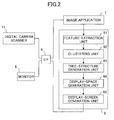
- FIG. 2 is a block diagram of a part of the image display apparatus performing an image display process.
- the image display apparatus comprises: a central processing unit (CPU) 1 which controls an entire operation of the image display apparatus; a read only memory (ROM) 2 which stores programs executed by the CPU 1; a random access memory (RAM) which stores dynamic data for executing the programs stored in the ROM 2 and serves as a work area when the programs are executed; a keyboard 4 and a mouse 5 as input devices; a monitor 6 as a display apparatus; an image display unit 8 which executes an image application 7; a peripheral interface (I/F) 9 which functions as an interface with a peripheral device 1 such as a digital camera or a scanner; and a network I/F 10 which functions as an interface with a network 12.
- CPU central processing unit
- ROM read only memory
- RAM random access memory
- keyboard 4 and a mouse 5 as input devices
- a monitor 6 as a display apparatus
- an image display unit 8 which executes an image application 7
- a peripheral interface (I/F) 9 which functions as an interface with a peripheral device 1 such as a digital camera or
- a memory-media driving unit 15 such as a CD-ROM driving unit is connected to the bus 13.
- the memory-media driving unit 15 reads program codes from a memory medium such as a CD-ROM so as to load the program codes stored in the memory medium to the computer so that the computer carries out various functions of the present invention mentioned later.
- the image display part 8 comprises, as shown in FIG. 2, a feature-extraction unit 81, a clustering unit 82, a tree-structure generation unit 83, a display-space generation unit 84 and a display-screen generation unit 85.
- the units 81-85 perform a feature-extraction process, a clustering process, a tree-structure generation process, a display-space generation process and a display-screen generation process, respectively, in accordance with the image application 7.
- the processes include 1) a feature-extraction process, 2) a feature-space tree-structure extraction process and 3) an image display screen generation process.
- a feature of an image there are various features such as a histogram feature, an edge feature or a texture feature.
- the present invention is applicable to any features.
- the present application is applicable to features extracted from data other than image data.
- the present invention is applicable to features extracted from text data.
- a description will be given of an extraction process of a general histogram feature.
- image data from which features area extracted there is image data supplied by the peripheral devices 11 such as a digital camera or a scanner, or image data downloaded from the Web. There is no limitation with respect to the input method.
- a suitable color space for example, Lab, Luv, HSV, etc.
- the selected color space is divided into a plurality of areas.
- an investigation is performed as to which pixel of the image corresponds to which area of the color space.
- the pixel number data is normalized based on the number of whole pixels.
- the normalized data of the number of pixels for each area corresponds to the histogram feature.
- the feature of a histogram serves as a point of the feature space of the histogram.
- a distance between two features in the feature space of a histogram a sum total of differences of the numbers of pixels for each corresponding area of the two features or a Euclid distance is generally use. In this way, the distance between features can be obtained.
- a feature space is a high order dimension space, and cannot be simply displayed in 2-dimension on a screen.
- the structure of a feature space is first expressed by a tree-structure. Then, the feature space can be virtually expressed on a screen by mapping the tree structure on the space of the screen.
- the feature space is clustered, and is divided into a plurality of sub-spaces so as to form nodes of the tree-structure. Further, each subspace (node) is clustered, and is divided into sub-spaces to form nodes.
- the tree structure of the feature space is can be generated by performing the above-mentioned operation recursively. That is, all features are arranged in the lowermost nodes, respectively, on an individual node basis.
- FIG. 3 shows an example of the thus-formed tree-structure. Although the number of nodes which divide the space may be any number equal to or greater than 2, the number of nodes here is set to 2 for the sake of convenience.
- similar features are arranged close to each other, and a positional relationship of images on the image space is expressed by the tree structure.
- a clustering method the general Nearest Neighor method, the K-average algorithm method, etc. can be used. Although similar images are arranged close to each other in this tree structure, other accuracies depend on the accuracy of clustering Thus, a method for improving the accuracy of clustering, a clustering according to the following procedures can be used. It should be noted that the dividing number is set to 2 in this method.
- a difference between difference distances of opposite sides of the point sorted according to the difference distance is obtained so as to set a boundary of clusters between points of which distance is largest.
- the side of which difference distance is smaller than a distance to the boundary of cluster belongs to C1, and the side of which difference distance is larger than a distance to the boundary of cluster belongs to C2.
- the tree structure should be well-balanced. That is, when it is desired to distribute images at an equal interval on a final display screen, the separation may be performed at the middle of the number of images.
- the thus-obtained-two clusters are set as nodes of a tree so as to recursively perform the same processes (1), (2) and (3) for each node. A tree is generated by this operation, and finally each image belongs to a leaf node.
- a screen is generated from the thus-generated one tree-structure.
- a tree structure is generated with a meaningful feature unit, and a tree structure in the binary-tree form is generated for each feature.
- the features having such a meaning are color, form or texture, and an axis of a screen generated by the following screen generation process corresponds to each feature.
- each tree structure is mapped in 1-dimension.
- the display area on a screen is a data area for mapping in 1-dimension.
- the tree structure is traced from a root thereof, and a) the data area is divided into two so that the two child nodes are arranged in the respective areas.
- the area may be equally divided.
- the dividing points may be decided in proportion to the number of nodes belonging to a child node or in proportion to a distance between a dividing point at the time of clustering and each center point.
- a area corresponding to the space of the gap may be set and the space is not provided with a child node. According to such a method, the display screen can express further accurate similarity.
- FIG. 4 is an example of mapping of a tree structure shown in FIG. 3.
- the area is equally divided while tracing the tree structure.
- multidimensional data corresponding to the number of tree structures can be obtained.
- the data is preferably up to three dimensions. For example, if a tree-structure is generated based on the features of color, form an texture, the 3-dimensional display space having axes corresponding to color, form and texture shaft, respectively, can be generated.
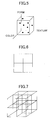
- FIG. 5 shows an example of a final spatial screen display.
- Each point shown in FIG. 5 is a location of the feature which is extracted from an image according to parameters of form, texture and color, and the image may be displayed at that location as it is.
- form, texture and color extracted from an image are rendered to be features in the present embodiment, the present invention is not limited to such a feature and can be applied to any features such as a feature extracted from text data.
- the image space display process is performed by executing programs stored in the ROM 2 while the CPU 1 uses the RAM 3 as a work area.
- a feature is assigned to each display dimension axis.
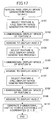
- FIG. 17 is a flowchart of a process of generating a feature-axis display space.
- a feature A is selected and a call is made for a display-space generation process I so as to generate a 1-dimensional display space (step S101).
- the coordinates of the 1-dimensional display space of the feature A are acquired (step S102), and the acquired coordinates are set as coordinates of a display axis X (step S103).
- a feature B is selected and a call is made to the display-space generation process I so as to generate a 1-dimensional display space (step S104).
- step S105 the coordinates of the 1-dimensional display space of the feature B are acquired (step S105), and the acquired coordinates are set as coordinates of a display axis Y (step S106).
- step S107 a feature C is selected and a call is made to the display-space generation process I so as to generate a 1-dimensional display space (step S107).
- step S108 the coordinates of the 1-dimensional display space of the feature B are acquired (step S108), and the acquired coordinates are set as coordinates of a display axis Z (step S109).
- a 3-dimensional display screen is generated based on coordinate values of the display axes acquired in the process of steps S103, S106, and S109.
- steps S101-S103 makes the feature A to correspond to the coordinate axis X
- steps S104-S106 makes the feature B to correspond to the coordinate axis Y
- steps S107-S109 makes the feature C to correspond to the coordinate axis Z.
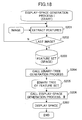
- FIG. 18 is a flowchart of the above-mentioned display-space generation process I.
- the image feature is extracted to the last image (steps S201 and S202) so as to obtain a set of features (feature space) (step S203).
- a binary-tree generation process shown in FIG. 19 is called (step S204), and the binary-tree generation process is performed with respect to the set of the features (step S205).
- a display-space generation process II shown in FIG. 20 is called based on root sets (nodes) of the binary tree and a display space as inputs (step S206), and the display space is generated by performing the display space generation process II (step S207).
- FIG. 19 is a flowchart of a binary-tree generation process, which is called in step S204 and performed in step S205.
- a call is made to the clustering process shown in FIG. 21 so as to generate two subsets (clusters) A and B by half-dividing a feature set calling (step S301).
- the clustering process has been described in the description of 2) feature-space tree-structure extraction process.
- each of the subsets A and B is set as a child set (child node) of the feature set (step S302).
- step S303 it is determined whether or not the feature element of the subset A is 1 (step S303). If the feature element of the subset A is 1, it is determined whether or not the feature element of the subset B is 1 (step S304). Moreover, if the feature element of the subset A is not 1 in step S303, the binary-tree generation process is called so as to perform the process after step S301 by regarding the subset A as a set, and also perform the process of step S304. This process is ended if the feature element of the subset B is 1 in step S304. If the feature element of the subset B is not 1, the binary-tree generation process is called in step S305 (step S306) so as to perform the process after step 301 by regarding the subset B as a set, and the process is ended.
- FIG. 20 is a flowchart of the display-space generation process II, which is called in step S206 and performed in step S207.
- step S401 it is judged whether or not all the features are sets (leaf sets) belonging to the respective lowermost nodes. If they are leaf sets, the image is arranged in the display space (step S402), and the process is ended. On the other hand, if it is judged in step S401 that the features are not leaf sets, the display space is divided into subsets A and B (step S403). Then, each of the subsets A and B corresponding to children of the binary tree is assigned to a respective one of the sub-spaces A and B (step S404).
- step S405 the display-space generation process II is called recursively by regarding the subset A as a set and the sub-space A as a display space.
- step S406 the display-space generation process II is called recursively by regarding the subset B as a set and the sub-space B as a display space (step S406).
- steps S403, S404 and S405 is repeated until a leaf set is formed, and the image is arranged in the display space after the leaf set is established (step S402).
- FIG. 21 is a flowchart of the clustering process, which is performed in step S301.
- an arbitrary point A is selected (step S501), and a point farthest to the selected point A is set as point C1 (step S502).
- a point farthest to the point C1 is set as point C2 (step S503), and an arbitrary point P, which has not been processed, is selected (step S504).
- difference distances between the Point P and each of the points C1 and C2 are calculated (step S505).
- the selected point P is rendered as a point, which has been processed (step S506).
- steps S504 through S506 is repeated until unprocessed points are eliminated (step S507).
- all points are sorted according to an ascending order of the difference distances (step S508).
- a difference between difference distances preceding and proceeding each point is calculated for all sorted points (step S509), and the set of points is divided at a cluster boundary where the difference between difference distances is maximum (step S510).
- the features are assigned to the display-space dimensional axes as shown in FIG. 17 in the present embodiment, the above-mentioned display-space generation process I may be called when the features are not assigned to the display dimensional axes.
- An image display apparatus is the same as the image display apparatus according to the above-mentioned first embodiment. Additionally, the image display apparatus according to the second embodiment has the same structure as that shown in FIG. 2, and description thereof will be omitted.
- the process performed by the image display unit 8 includes 1) feature-extraction process, 2) feature-space division process and 3) image-display screen generation process.
- This processing is the same as the 1) feature-extraction process of the above-mentioned first embodiment, and a description thereof will be omitted.
- a feature space is divided so as to assign a feature to a display space.
- a description will be given below of a dividing method of a feature space in a case where a 2-dimensional display space is generated. It is assumed that features A and B are extracted from each image so that the feature A is assigned to the X-axis of the display space and the feature B is assigned to the Y-axis of the display space.
- the feature space is divided into four (FIG. 6).
- the feature space is divided into eight (FIG. 7).
- a distance (0-1) between the image a and the image b in the space of the feature A is expressed by DA(FAa,FAb).
- a distance (0-1) between the image a and the image B in a space of the feature B is expressed by DB(FBa,FBb). The value of the distance ranges from 0 to 1.
- an image that is farthest to the selected image with respect to the two features is set as a main image c1 of a sub-space (lower left sub-space in FIG. 8). That is, the image c which maximizes the following evaluation equation (1) is set as the main image c1.
- c) an image that is farthest to the image c1 with respect to the two features is set as a main image c2 of a sub-space (upper right sub-space in FIG. 9) located along a diagonal line. That is, the image c which maximizes the following evaluation equation (2) is set as the main image c2.
- an image, which is close to c1 with respect to the feature A and remote from c1 with respect to the feature B and remote from c2 with respect to the feature A and close to c2 with respect to the feature B, is set as a main image c3 of the third sub-space (upper left sub-space in FIG. 10). That is, the image c which maximizes the following evaluation equation (3) is set as the main image c3. (1-DA(FAc1,FAc)) + DB(FBc1,FBc) + DA(FAc2,FAc) + (1-DB(FBc2,FBc))
- an image which is close to c1 with respect to the feature B and remote from c1 with respect to the feature A and remote from c2 with respect to the feature B and close to c2 with respect to the feature A and remote from 3 with respect to both the features A and B, is set as a main image c4 of the fourth sub-space (lower right sub-space in FIG. 11), That is, the image c which maximizes the following evaluation equation (4) is set as the main image c4.
- DA(FAp,FAcn) + DB(FBp,FBcn) In this way, an image can be divided into four sub-spaces.
- the above-mentioned method can be expanded to a case of a 3-dimensional display space by assigning three features to each dimensional axis in the same manner (FIG. 13).
- each sub-space can be subdivided by recursively processing the thus-generated sub-spaces. This process is repeated until only one image is located in each sub-space.
- the sub-spaces are expressed by the tree-structure as shown in FIG. 14, and the tree-structure extraction process of a feature space is completed.
- the expressed tree-structure is traced from a root thereof, and a) a display space is divided into four c1-c4, as shown in FIG. 15.
- a simple division is used for the dividing method. It should be noted that although the equal-division has been explained above, there are following methods, for example.
- Each sub-space of the tree-structure is assigned to a respective one of the divided display spaces.
- the positional relationship between the sub-spaces must be corresponded to the positional relationship, which has been taken into consideration at the time of generating the sub-spaces. If it is a sub-space of a leaf node of the tree-structure, the image is arranged on the display space since that image is assigned to the node.
- the image of in the form of a tree-structure can be arranged in the display space, as shown in FIG. 16.
- the distribution of the image in the thus-generated display space is not uniform. There may be a case in which an application requires a uniform distribution. An uneven distribution is caused by unevenness in the number of images assigned to each sub-space at the time of generating the sub-space. Then, a description will be given below of a method of assigning images to a sub-space uniformly.
- the image is uniformly allocated to the display space.
- the present embodiment assumes that features are assigned to display dimensional axes and to achieve a higher accuracy than the first embodiment. Therefore, the above-mentioned feature axis display space generation process shown in FIG. 17 is not performed, but the process of FIGS. 18 through 21 is performed. However, the binary-tree generation process shown in FIG. 19 is replaced by a process shown in FIG. 22. Therefore, in the present embodiment, the clustering process in step S301 is replaced by the clustering process shown in FIG. 22.
- FIG. 22 is a flowchart of the clustering process according to the second embodiment of the present invention.
- an arbitrary point A is selected first (step S601). Then, a point at which the above-mentioned evaluation equation (1) takes a maximum value with respect to the selected point A is set as a point c1 (step S602). Subsequently, a point at which the evaluation equation (2) takes a maximum value is set as a point c2 (step S603). A point at which the evaluation equation (3) takes a maximum value is set as a point c3 (step S604). A point at which the evaluation equation (4) takes a maximum value is set as a point c4 (step S605). Thereafter, an arbitrary point P, which has not been processed, is selected (step S606).
- step S607 Distances between the selected point P represented by the equation (5) and each of the points c1, c2, c3 and c4 are calculated (step S607). Then, the point P is added to the cluster cn having the smallest distance (step S608). The selected point P is rendered to be as processed (step S609). All points are sorted in ascending order of the difference distances (step S610). The process of steps S606 through S610 is repeated until unprocessed points are eliminated (step S611). Other processes that area not described are the same as the above-mentioned first embodiment.
Landscapes
- Engineering & Computer Science (AREA)
- Computer Vision & Pattern Recognition (AREA)
- Theoretical Computer Science (AREA)
- Evolutionary Biology (AREA)
- Physics & Mathematics (AREA)
- Bioinformatics & Cheminformatics (AREA)
- Bioinformatics & Computational Biology (AREA)
- Data Mining & Analysis (AREA)
- Life Sciences & Earth Sciences (AREA)
- Evolutionary Computation (AREA)
- Artificial Intelligence (AREA)
- General Engineering & Computer Science (AREA)
- General Physics & Mathematics (AREA)
- Human Computer Interaction (AREA)
- Information Retrieval, Db Structures And Fs Structures Therefor (AREA)
- Image Analysis (AREA)
- Digital Computer Display Output (AREA)
Abstract
Description
The present invention is applicable to any features. Of course, the present application is applicable to features extracted from data other than image data. For example, the present invention is applicable to features extracted from text data. Here, a description will be given of an extraction process of a general histogram feature. As the image data from which features area extracted, there is image data supplied by the
There may be a case in which an application requires a uniform distribution. An uneven distribution is caused by unevenness in the number of images assigned to each sub-space at the time of generating the sub-space. Then, a description will be given below of a method of assigning images to a sub-space uniformly.
Claims (15)
- An image-space display method of extracting features from images, hierarchically dividing a feature space of the features, virtually converting. the images into a tree structure, dividing a display space according to the tree-structure, and displaying the image space by displaying the images on each of the divided display spaces,
characterized by the steps of:generating a tree-structure for each of the features;generating dimension data corresponding to a number of the features by mapping each tree structure in one-dimension; anddisplaying the dimension data on the corresponding divided display spaces as display coordinate-axis data. - The image space display method as claimed in claim 1, characterized in that dividing the display space includes the step of:obtaining distances between each point of the features and center points of two clusters with respect to each point;sorting each points according to a difference between the obtained distances;and dividing the display space into two clusters by setting a boundary of the clusters according to an order of the sorting.
- The image space display method as claimed in claim 2, characterized in that the boundary of the clusters is set between points of which a difference of distances preceding and succeeding points is largest in the order of the sorting.
- The image space display method as claimed in claim 3, characterized in that an area corresponding to one of dimensions of the display space is divided in accordance with distances to center points of the two clusters and a ratio of differences of the difference distances at the boundary of the clusters.
- The image space display method as claimed in claim 2, characterized in that the boundary of the clusters corresponds to a halfway point in the order of the sorting.
- The image space display method as claimed in claim 1, characterized in that the features are three-dimensional data corresponding to form, texture and color of the images, and the features are displayed by using the three-dimensional data as display coordinate-axes data.
- An image-space display method of extracting features from images, hierarchically dividing a feature space of the features, virtually converting the images into a tree structure, dividing a display space according to the tree-structure, and displaying the image space by displaying the images on each of the divided display spaces,
characterized by the steps of:assigning the extracted features to respective dimensional axes of the display space;dividing recursively the feature space into four sub-spaces in accordance with the dimensional axes while reflecting a relationship between the images arranged in a two-dimensional display space in a relationship between the images on the feature space; andlocating the tree-structure of each sub-space in four sub-spaces generated by dividing the two-dimensional display space. - The image space display method as claimed in claim 7, characterized in that when selecting a main image of each sub-space in the step of dividing into four sub-spaces, the main image is sequentially determined based on a result of calculation according to an evaluation equation that is previously established based on a distance to main image previously determined in consideration with a positional relationship with respect to each feature.
- The image space display method as claimed in claim 8, characterized in that the once determined main image is recalculated based on evaluation equations based on three other main images so as to determine the main image again based on a result of the recalculation.
- The image space display method as claimed in claim 9, characterized in that a position of the main image is calculated repeatedly until a change in the position does not occur, and the position at which a change does not occur is selected as the position of the main image.
- The image space display method as claimed in claim 7, characterized in that a number of images assigned to the closest main image exceeds a maximum number of images containable in the sub-space containing the closest main image, a process of removing one of the images farthest to the main image from the sub-space concerned is repeatedly performed so as to distribute the images uniformly to the sub spaces.
- The image space display method as claimed in claim 7, characterized in that a three-dimensional display space is used instead of the two-dimensional display space.
- An image-space display apparatus for extracting features from images, hierarchically dividing a feature space of the features, virtually converting the images into a tree structure, dividing a display space according to the tree-structure, and displaying the image space by displaying the images on each of the divided display spaces,
characterized by:means for generating a tree-structure for each of the features;means for generating dimension data corresponding to a number of the features by mapping each tree structure in one-dimension; andmeans for displaying the dimension data on the corresponding divided display spaces as display coordinate-axis data. - An image-space display apparatus for extracting features from images, hierarchically dividing a feature space of the features, virtually converting the images into a tree structure, dividing a display space according to the tree-structure, and displaying the image space by displaying the images on each of the divided display spaces,
characterized by:means for assigning the extracted features to respective dimensional axes of the display space;means for dividing recursively the feature space into four sub-spaces in accordance with the dimensional axes while reflecting a relationship between the images arranged in a two-dimensional display space in a relationship between the images on the feature space; andmeans for locating the tree-structure of each sub-space in four sub-spaces generated by dividing the two-dimensional display space. - A computer program comprising program code means that, when executed on a computer, instructs the computer to perform the method of any one of claims 1 to 12.
Applications Claiming Priority (6)
| Application Number | Priority Date | Filing Date | Title |
|---|---|---|---|
| JP2001079007 | 2001-03-19 | ||
| JP2001079007 | 2001-03-19 | ||
| JP2001162701 | 2001-05-30 | ||
| JP2001162701 | 2001-05-30 | ||
| JP2002065213 | 2002-03-11 | ||
| JP2002065213A JP3950718B2 (en) | 2001-03-19 | 2002-03-11 | Image space display method |
Publications (3)
| Publication Number | Publication Date |
|---|---|
| EP1246124A2 true EP1246124A2 (en) | 2002-10-02 |
| EP1246124A3 EP1246124A3 (en) | 2004-11-17 |
| EP1246124B1 EP1246124B1 (en) | 2007-01-24 |
Family
ID=27346289
Family Applications (1)
| Application Number | Title | Priority Date | Filing Date |
|---|---|---|---|
| EP02251934A Expired - Lifetime EP1246124B1 (en) | 2001-03-19 | 2002-03-18 | Image space display method and apparatus |
Country Status (4)
| Country | Link |
|---|---|
| US (1) | US6853374B2 (en) |
| EP (1) | EP1246124B1 (en) |
| JP (1) | JP3950718B2 (en) |
| DE (1) | DE60217748T2 (en) |
Cited By (8)
| Publication number | Priority date | Publication date | Assignee | Title |
|---|---|---|---|---|
| DE10331129A1 (en) * | 2003-07-09 | 2005-03-03 | Harald Oppermann | Balancing machine with a clamping device |
| US7127282B2 (en) | 1998-12-23 | 2006-10-24 | Medispectra, Inc. | Optical methods and systems for rapid screening of the cervix |
| US7136518B2 (en) | 2003-04-18 | 2006-11-14 | Medispectra, Inc. | Methods and apparatus for displaying diagnostic data |
| US7187810B2 (en) | 1999-12-15 | 2007-03-06 | Medispectra, Inc. | Methods and systems for correcting image misalignment |
| US7260248B2 (en) | 1999-12-15 | 2007-08-21 | Medispectra, Inc. | Image processing using measures of similarity |
| US7282723B2 (en) | 2002-07-09 | 2007-10-16 | Medispectra, Inc. | Methods and apparatus for processing spectral data for use in tissue characterization |
| US7309867B2 (en) | 2003-04-18 | 2007-12-18 | Medispectra, Inc. | Methods and apparatus for characterization of tissue samples |
| US7469160B2 (en) | 2003-04-18 | 2008-12-23 | Banks Perry S | Methods and apparatus for evaluating image focus |
Families Citing this family (15)
| Publication number | Priority date | Publication date | Assignee | Title |
|---|---|---|---|---|
| JP4079680B2 (en) * | 2002-04-26 | 2008-04-23 | 独立行政法人産業技術総合研究所 | Image composition apparatus and method |
| US8065627B2 (en) * | 2003-09-30 | 2011-11-22 | Hewlett-Packard Development Company, L.P. | Single pass automatic photo album page layout |
| DE102005014761A1 (en) * | 2005-03-31 | 2006-10-05 | Siemens Ag | Method for arranging object data in electronic cards |
| US7644356B2 (en) * | 2005-06-10 | 2010-01-05 | Hewlett-Packard Development Company, L.P. | Constraint-based albuming of graphic elements |
| JP4650293B2 (en) * | 2006-02-15 | 2011-03-16 | 富士フイルム株式会社 | Image classification display device and image classification display program |
| TW200809764A (en) | 2006-04-24 | 2008-02-16 | Sony Corp | Image processing device, image processing method and program recording medium |
| JP4934843B2 (en) | 2006-11-29 | 2012-05-23 | 株式会社リコー | Information processing apparatus, image registration method, and program |
| WO2008102410A1 (en) * | 2007-02-19 | 2008-08-28 | Sony Computer Entertainment Inc. | Clustering device, its method, computer, program and recording medium |
| JP5121367B2 (en) * | 2007-09-25 | 2013-01-16 | 株式会社東芝 | Apparatus, method and system for outputting video |
| JP4694581B2 (en) * | 2008-01-25 | 2011-06-08 | 富士フイルム株式会社 | File generation apparatus and method, three-dimensional shape reproduction apparatus and method, and program |
| JP4675995B2 (en) * | 2008-08-28 | 2011-04-27 | 株式会社東芝 | Display processing apparatus, program, and display processing method |
| JP5388631B2 (en) * | 2009-03-03 | 2014-01-15 | 株式会社東芝 | Content presentation apparatus and method |
| JP4852119B2 (en) * | 2009-03-25 | 2012-01-11 | 株式会社東芝 | Data display device, data display method, and data display program |
| US9911194B2 (en) * | 2016-05-26 | 2018-03-06 | Disney Enterprises, Inc. | Systems and methods for higher order dimensional space video segmentation |
| JP6971112B2 (en) * | 2017-09-29 | 2021-11-24 | 株式会社Screenホールディングス | Teacher data creation support device, classification device and teacher data creation support method |
Family Cites Families (6)
| Publication number | Priority date | Publication date | Assignee | Title |
|---|---|---|---|---|
| US6121969A (en) * | 1997-07-29 | 2000-09-19 | The Regents Of The University Of California | Visual navigation in perceptual databases |
| KR100284778B1 (en) * | 1998-10-28 | 2001-03-15 | 정선종 | Insertion method of high dimensional index structure for content-based image retrieval |
| JP4173246B2 (en) * | 1999-04-28 | 2008-10-29 | 株式会社リコー | Similar image display method and recording medium storing similar image display processing program |
| US6675174B1 (en) * | 2000-02-02 | 2004-01-06 | International Business Machines Corp. | System and method for measuring similarity between a set of known temporal media segments and a one or more temporal media streams |
| JP3457617B2 (en) * | 2000-03-23 | 2003-10-20 | 株式会社東芝 | Image search system and image search method |
| KR100429792B1 (en) * | 2000-11-15 | 2004-05-03 | 삼성전자주식회사 | Indexing method of feature vector space and retrieval method |
-
2002
- 2002-03-11 JP JP2002065213A patent/JP3950718B2/en not_active Expired - Fee Related
- 2002-03-15 US US10/097,244 patent/US6853374B2/en not_active Expired - Fee Related
- 2002-03-18 EP EP02251934A patent/EP1246124B1/en not_active Expired - Lifetime
- 2002-03-18 DE DE60217748T patent/DE60217748T2/en not_active Expired - Lifetime
Cited By (9)
| Publication number | Priority date | Publication date | Assignee | Title |
|---|---|---|---|---|
| US7127282B2 (en) | 1998-12-23 | 2006-10-24 | Medispectra, Inc. | Optical methods and systems for rapid screening of the cervix |
| US7187810B2 (en) | 1999-12-15 | 2007-03-06 | Medispectra, Inc. | Methods and systems for correcting image misalignment |
| US7260248B2 (en) | 1999-12-15 | 2007-08-21 | Medispectra, Inc. | Image processing using measures of similarity |
| US7282723B2 (en) | 2002-07-09 | 2007-10-16 | Medispectra, Inc. | Methods and apparatus for processing spectral data for use in tissue characterization |
| US7136518B2 (en) | 2003-04-18 | 2006-11-14 | Medispectra, Inc. | Methods and apparatus for displaying diagnostic data |
| US7309867B2 (en) | 2003-04-18 | 2007-12-18 | Medispectra, Inc. | Methods and apparatus for characterization of tissue samples |
| US7469160B2 (en) | 2003-04-18 | 2008-12-23 | Banks Perry S | Methods and apparatus for evaluating image focus |
| DE10331129A1 (en) * | 2003-07-09 | 2005-03-03 | Harald Oppermann | Balancing machine with a clamping device |
| DE10331129B4 (en) * | 2003-07-09 | 2005-07-14 | Harald Oppermann | Balancing machine with a clamping device |
Also Published As
| Publication number | Publication date |
|---|---|
| US20020145603A1 (en) | 2002-10-10 |
| DE60217748D1 (en) | 2007-03-15 |
| US6853374B2 (en) | 2005-02-08 |
| DE60217748T2 (en) | 2007-10-31 |
| JP3950718B2 (en) | 2007-08-01 |
| JP2003051011A (en) | 2003-02-21 |
| EP1246124A3 (en) | 2004-11-17 |
| EP1246124B1 (en) | 2007-01-24 |
Similar Documents
| Publication | Publication Date | Title |
|---|---|---|
| EP1246124A2 (en) | Image space display method and apparatus | |
| US12223570B2 (en) | Systems and methods for high dimensional 3D data visualization | |
| JP5229744B2 (en) | Image classification device and image classification program | |
| JP4587832B2 (en) | Method and apparatus for organizing identified areas in image data | |
| US7440638B2 (en) | Image retrieving system, image classifying system, image retrieving program, image classifying program, image retrieving method and image classifying method | |
| EP2997493B1 (en) | Efficient contours and gating in flow cytometry | |
| JP4173246B2 (en) | Similar image display method and recording medium storing similar image display processing program | |
| CN111062432B (en) | Semantically multi-modal image generation method | |
| JP6564543B1 (en) | Data three-dimensional visualization method, data three-dimensional visualization program, and data three-dimensional visualization system | |
| JPWO2004047026A1 (en) | Image search program | |
| CN100501772C (en) | Periodic interactive image analysis method | |
| US12125207B2 (en) | Image segmentation method and apparatus and image three-dimensional reconstruction method and apparatus | |
| JPH08287258A (en) | Color image recognition device | |
| JP2003203090A (en) | Image space display method | |
| JP2020095498A (en) | Image classifying apparatus and method | |
| CN113763496A (en) | Image coloring method, device and computer readable storage medium | |
| US11995835B2 (en) | Pixel-level object detection system and program thereof | |
| Lindblad et al. | Exact linear time euclidean distance transforms of grid line sampled shapes | |
| Silva et al. | Visualization of ensembles of oil reservoir models based on pixelization, small multiples and reservoir similarities | |
| WO2025196806A3 (en) | System and method for analysing and visualizing geospatial data | |
| KR20240175155A (en) | Device and method for analyzing crystal structures | |
| CN114359529A (en) | Model disassembling method, device and system | |
| Jarocki | Parallel step assignment for continuous generalization constrained with target map. | |
| JPH1040364A (en) | Color image generation method | |
| CN111080732A (en) | Method and system for forming a virtual map |
Legal Events
| Date | Code | Title | Description |
|---|---|---|---|
| PUAI | Public reference made under article 153(3) epc to a published international application that has entered the european phase |
Free format text: ORIGINAL CODE: 0009012 |
|
| 17P | Request for examination filed |
Effective date: 20020416 |
|
| AK | Designated contracting states |
Kind code of ref document: A2 Designated state(s): AT BE CH CY DE DK ES FI FR GB GR IE IT LI LU MC NL PT SE TR |
|
| AX | Request for extension of the european patent |
Free format text: AL;LT;LV;MK;RO;SI |
|
| PUAL | Search report despatched |
Free format text: ORIGINAL CODE: 0009013 |
|
| AK | Designated contracting states |
Kind code of ref document: A3 Designated state(s): AT BE CH CY DE DK ES FI FR GB GR IE IT LI LU MC NL PT SE TR |
|
| AX | Request for extension of the european patent |
Extension state: AL LT LV MK RO SI |
|
| RIC1 | Information provided on ipc code assigned before grant |
Ipc: 7G 06F 17/30 B Ipc: 7G 06T 11/20 B Ipc: 7G 06K 9/62 A |
|
| AKX | Designation fees paid |
Designated state(s): DE FR GB |
|
| GRAP | Despatch of communication of intention to grant a patent |
Free format text: ORIGINAL CODE: EPIDOSNIGR1 |
|
| GRAS | Grant fee paid |
Free format text: ORIGINAL CODE: EPIDOSNIGR3 |
|
| GRAA | (expected) grant |
Free format text: ORIGINAL CODE: 0009210 |
|
| AK | Designated contracting states |
Kind code of ref document: B1 Designated state(s): DE FR GB |
|
| REG | Reference to a national code |
Ref country code: GB Ref legal event code: FG4D |
|
| REF | Corresponds to: |
Ref document number: 60217748 Country of ref document: DE Date of ref document: 20070315 Kind code of ref document: P |
|
| ET | Fr: translation filed | ||
| PLBE | No opposition filed within time limit |
Free format text: ORIGINAL CODE: 0009261 |
|
| STAA | Information on the status of an ep patent application or granted ep patent |
Free format text: STATUS: NO OPPOSITION FILED WITHIN TIME LIMIT |
|
| 26N | No opposition filed |
Effective date: 20071025 |
|
| REG | Reference to a national code |
Ref country code: FR Ref legal event code: PLFP Year of fee payment: 14 |
|
| PGFP | Annual fee paid to national office [announced via postgrant information from national office to epo] |
Ref country code: DE Payment date: 20150320 Year of fee payment: 14 |
|
| PGFP | Annual fee paid to national office [announced via postgrant information from national office to epo] |
Ref country code: GB Payment date: 20150319 Year of fee payment: 14 Ref country code: FR Payment date: 20150319 Year of fee payment: 14 |
|
| REG | Reference to a national code |
Ref country code: DE Ref legal event code: R119 Ref document number: 60217748 Country of ref document: DE |
|
| GBPC | Gb: european patent ceased through non-payment of renewal fee |
Effective date: 20160318 |
|
| REG | Reference to a national code |
Ref country code: FR Ref legal event code: ST Effective date: 20161130 |
|
| PG25 | Lapsed in a contracting state [announced via postgrant information from national office to epo] |
Ref country code: FR Free format text: LAPSE BECAUSE OF NON-PAYMENT OF DUE FEES Effective date: 20160331 Ref country code: GB Free format text: LAPSE BECAUSE OF NON-PAYMENT OF DUE FEES Effective date: 20160318 Ref country code: DE Free format text: LAPSE BECAUSE OF NON-PAYMENT OF DUE FEES Effective date: 20161001 |