EP1245635A1 - Fluoroelastomer composition for crosslinking - Google Patents
Fluoroelastomer composition for crosslinking Download PDFInfo
- Publication number
- EP1245635A1 EP1245635A1 EP00970244A EP00970244A EP1245635A1 EP 1245635 A1 EP1245635 A1 EP 1245635A1 EP 00970244 A EP00970244 A EP 00970244A EP 00970244 A EP00970244 A EP 00970244A EP 1245635 A1 EP1245635 A1 EP 1245635A1
- Authority
- EP
- European Patent Office
- Prior art keywords
- group
- elastomer
- formula
- composition
- crosslinking
- Prior art date
- Legal status (The legal status is an assumption and is not a legal conclusion. Google has not performed a legal analysis and makes no representation as to the accuracy of the status listed.)
- Granted
Links
- 238000004132 cross linking Methods 0.000 title claims abstract description 43
- 239000000203 mixture Substances 0.000 title claims abstract description 42
- 229920001973 fluoroelastomer Polymers 0.000 title 1
- 229920001971 elastomer Polymers 0.000 claims abstract description 87
- 239000000806 elastomer Substances 0.000 claims abstract description 72
- 229910052731 fluorine Inorganic materials 0.000 claims abstract description 60
- 150000001875 compounds Chemical class 0.000 claims abstract description 34
- 125000001153 fluoro group Chemical group F* 0.000 claims abstract description 23
- 125000000962 organic group Chemical group 0.000 claims abstract description 6
- 125000003178 carboxy group Chemical group [H]OC(*)=O 0.000 claims description 43
- YCKRFDGAMUMZLT-UHFFFAOYSA-N Fluorine atom Chemical compound [F] YCKRFDGAMUMZLT-UHFFFAOYSA-N 0.000 claims description 41
- 239000011737 fluorine Substances 0.000 claims description 41
- 125000004432 carbon atom Chemical group C* 0.000 claims description 26
- 239000003431 cross linking reagent Substances 0.000 claims description 26
- 229920006169 Perfluoroelastomer Polymers 0.000 claims description 25
- 125000002560 nitrile group Chemical group 0.000 claims description 21
- 125000001997 phenyl group Chemical group [H]C1=C([H])C([H])=C(*)C([H])=C1[H] 0.000 claims description 16
- 125000004453 alkoxycarbonyl group Chemical group 0.000 claims description 12
- 125000000217 alkyl group Chemical group 0.000 claims description 12
- 125000001797 benzyl group Chemical group [H]C1=C([H])C([H])=C(C([H])=C1[H])C([H])([H])* 0.000 claims description 12
- 125000002023 trifluoromethyl group Chemical group FC(F)(F)* 0.000 claims description 8
- 125000004435 hydrogen atom Chemical group [H]* 0.000 claims description 6
- 125000002947 alkylene group Chemical group 0.000 claims description 5
- 125000006551 perfluoro alkylene group Chemical group 0.000 claims description 5
- 125000001931 aliphatic group Chemical group 0.000 claims description 3
- 230000003064 anti-oxidating effect Effects 0.000 claims description 3
- 125000005156 substituted alkylene group Chemical group 0.000 claims description 3
- 239000000126 substance Substances 0.000 abstract description 10
- BFKJFAAPBSQJPD-UHFFFAOYSA-N tetrafluoroethene Chemical group FC(F)=C(F)F BFKJFAAPBSQJPD-UHFFFAOYSA-N 0.000 description 38
- 239000000047 product Substances 0.000 description 37
- BLTXWCKMNMYXEA-UHFFFAOYSA-N 1,1,2-trifluoro-2-(trifluoromethoxy)ethene Chemical compound FC(F)=C(F)OC(F)(F)F BLTXWCKMNMYXEA-UHFFFAOYSA-N 0.000 description 27
- 238000006116 polymerization reaction Methods 0.000 description 23
- 239000000178 monomer Substances 0.000 description 22
- 230000009102 absorption Effects 0.000 description 19
- 238000010521 absorption reaction Methods 0.000 description 19
- 229920000642 polymer Polymers 0.000 description 19
- 238000000034 method Methods 0.000 description 17
- IJGRMHOSHXDMSA-UHFFFAOYSA-N Atomic nitrogen Chemical compound N#N IJGRMHOSHXDMSA-UHFFFAOYSA-N 0.000 description 16
- ROOXNKNUYICQNP-UHFFFAOYSA-N ammonium persulfate Chemical compound [NH4+].[NH4+].[O-]S(=O)(=O)OOS([O-])(=O)=O ROOXNKNUYICQNP-UHFFFAOYSA-N 0.000 description 16
- VEXZGXHMUGYJMC-UHFFFAOYSA-N Hydrochloric acid Chemical compound Cl VEXZGXHMUGYJMC-UHFFFAOYSA-N 0.000 description 12
- 238000006243 chemical reaction Methods 0.000 description 12
- 238000004140 cleaning Methods 0.000 description 12
- RAXXELZNTBOGNW-UHFFFAOYSA-N imidazole Natural products C1=CNC=N1 RAXXELZNTBOGNW-UHFFFAOYSA-N 0.000 description 12
- VLKZOEOYAKHREP-UHFFFAOYSA-N n-Hexane Chemical compound CCCCCC VLKZOEOYAKHREP-UHFFFAOYSA-N 0.000 description 12
- 230000000704 physical effect Effects 0.000 description 12
- XLYOFNOQVPJJNP-UHFFFAOYSA-N water Substances O XLYOFNOQVPJJNP-UHFFFAOYSA-N 0.000 description 12
- 239000000243 solution Substances 0.000 description 11
- 238000003756 stirring Methods 0.000 description 11
- RTZKZFJDLAIYFH-UHFFFAOYSA-N Diethyl ether Chemical compound CCOCC RTZKZFJDLAIYFH-UHFFFAOYSA-N 0.000 description 10
- 238000002835 absorbance Methods 0.000 description 10
- 238000002360 preparation method Methods 0.000 description 10
- XEKOWRVHYACXOJ-UHFFFAOYSA-N Ethyl acetate Chemical compound CCOC(C)=O XEKOWRVHYACXOJ-UHFFFAOYSA-N 0.000 description 9
- OKKJLVBELUTLKV-UHFFFAOYSA-N Methanol Chemical compound OC OKKJLVBELUTLKV-UHFFFAOYSA-N 0.000 description 9
- 229910001870 ammonium persulfate Inorganic materials 0.000 description 8
- 229910001873 dinitrogen Inorganic materials 0.000 description 8
- -1 tetramine compound Chemical class 0.000 description 8
- 150000001336 alkenes Chemical class 0.000 description 7
- 239000007864 aqueous solution Substances 0.000 description 7
- 230000015572 biosynthetic process Effects 0.000 description 7
- 238000005345 coagulation Methods 0.000 description 7
- 238000005259 measurement Methods 0.000 description 7
- 238000003786 synthesis reaction Methods 0.000 description 7
- ZCYVEMRRCGMTRW-UHFFFAOYSA-N 7553-56-2 Chemical group [I] ZCYVEMRRCGMTRW-UHFFFAOYSA-N 0.000 description 6
- YMWUJEATGCHHMB-UHFFFAOYSA-N Dichloromethane Chemical compound ClCCl YMWUJEATGCHHMB-UHFFFAOYSA-N 0.000 description 6
- 238000010306 acid treatment Methods 0.000 description 6
- 230000015271 coagulation Effects 0.000 description 6
- 239000006185 dispersion Substances 0.000 description 6
- 229910052740 iodine Inorganic materials 0.000 description 6
- 239000003566 sealing material Substances 0.000 description 6
- 238000004293 19F NMR spectroscopy Methods 0.000 description 5
- VGGSQFUCUMXWEO-UHFFFAOYSA-N Ethene Chemical compound C=C VGGSQFUCUMXWEO-UHFFFAOYSA-N 0.000 description 5
- 239000005977 Ethylene Substances 0.000 description 5
- 238000004458 analytical method Methods 0.000 description 5
- 125000002915 carbonyl group Chemical group [*:2]C([*:1])=O 0.000 description 5
- UUAGAQFQZIEFAH-UHFFFAOYSA-N chlorotrifluoroethylene Chemical group FC(F)=C(F)Cl UUAGAQFQZIEFAH-UHFFFAOYSA-N 0.000 description 5
- 230000000052 comparative effect Effects 0.000 description 5
- 230000006835 compression Effects 0.000 description 5
- 238000007906 compression Methods 0.000 description 5
- 230000005484 gravity Effects 0.000 description 5
- 238000010438 heat treatment Methods 0.000 description 5
- 229910052739 hydrogen Inorganic materials 0.000 description 5
- 239000007787 solid Substances 0.000 description 5
- BQCIDUSAKPWEOX-UHFFFAOYSA-N 1,1-Difluoroethene Chemical compound FC(F)=C BQCIDUSAKPWEOX-UHFFFAOYSA-N 0.000 description 4
- FRCHKSNAZZFGCA-UHFFFAOYSA-N 1,1-dichloro-1-fluoroethane Chemical compound CC(F)(Cl)Cl FRCHKSNAZZFGCA-UHFFFAOYSA-N 0.000 description 4
- JYEUMXHLPRZUAT-UHFFFAOYSA-N 1,2,3-triazine Chemical compound C1=CN=NN=C1 JYEUMXHLPRZUAT-UHFFFAOYSA-N 0.000 description 4
- JGMQEXIDVPFWHK-UHFFFAOYSA-N 4-[2-[3-amino-4-(methylamino)phenyl]-1,1,1,3,3,3-hexafluoropropan-2-yl]-1-n-methylbenzene-1,2-diamine Chemical compound C1=C(N)C(NC)=CC=C1C(C(F)(F)F)(C(F)(F)F)C1=CC=C(NC)C(N)=C1 JGMQEXIDVPFWHK-UHFFFAOYSA-N 0.000 description 4
- WKBOTKDWSSQWDR-UHFFFAOYSA-N Bromine atom Chemical group [Br] WKBOTKDWSSQWDR-UHFFFAOYSA-N 0.000 description 4
- PIICEJLVQHRZGT-UHFFFAOYSA-N Ethylenediamine Chemical compound NCCN PIICEJLVQHRZGT-UHFFFAOYSA-N 0.000 description 4
- 238000005033 Fourier transform infrared spectroscopy Methods 0.000 description 4
- HEDRZPFGACZZDS-MICDWDOJSA-N Trichloro(2H)methane Chemical compound [2H]C(Cl)(Cl)Cl HEDRZPFGACZZDS-MICDWDOJSA-N 0.000 description 4
- 239000002253 acid Substances 0.000 description 4
- 229920001577 copolymer Polymers 0.000 description 4
- 238000005530 etching Methods 0.000 description 4
- 239000007789 gas Substances 0.000 description 4
- HCDGVLDPFQMKDK-UHFFFAOYSA-N hexafluoropropylene Chemical group FC(F)=C(F)C(F)(F)F HCDGVLDPFQMKDK-UHFFFAOYSA-N 0.000 description 4
- 239000011630 iodine Substances 0.000 description 4
- 229910052757 nitrogen Inorganic materials 0.000 description 4
- 125000005010 perfluoroalkyl group Chemical group 0.000 description 4
- 229910001220 stainless steel Inorganic materials 0.000 description 4
- 239000010935 stainless steel Substances 0.000 description 4
- 125000001424 substituent group Chemical group 0.000 description 4
- CPFKVVLZVUUQGV-UHFFFAOYSA-N 4-[2-(3,4-diaminophenyl)-1,1,1,3,3,3-hexafluoropropan-2-yl]benzene-1,2-diamine Chemical compound C1=C(N)C(N)=CC=C1C(C(F)(F)F)(C(F)(F)F)C1=CC=C(N)C(N)=C1 CPFKVVLZVUUQGV-UHFFFAOYSA-N 0.000 description 3
- GQILCMONWYJNFP-UHFFFAOYSA-N 4-[2-(3-amino-4-anilinophenyl)-1,1,1,3,3,3-hexafluoropropan-2-yl]-1-n-phenylbenzene-1,2-diamine Chemical compound NC1=CC(C(C=2C=C(N)C(NC=3C=CC=CC=3)=CC=2)(C(F)(F)F)C(F)(F)F)=CC=C1NC1=CC=CC=C1 GQILCMONWYJNFP-UHFFFAOYSA-N 0.000 description 3
- QTBSBXVTEAMEQO-UHFFFAOYSA-N Acetic acid Chemical compound CC(O)=O QTBSBXVTEAMEQO-UHFFFAOYSA-N 0.000 description 3
- ZCQWOFVYLHDMMC-UHFFFAOYSA-N Oxazole Chemical compound C1=COC=N1 ZCQWOFVYLHDMMC-UHFFFAOYSA-N 0.000 description 3
- VYPSYNLAJGMNEJ-UHFFFAOYSA-N Silicium dioxide Chemical compound O=[Si]=O VYPSYNLAJGMNEJ-UHFFFAOYSA-N 0.000 description 3
- HEMHJVSKTPXQMS-UHFFFAOYSA-M Sodium hydroxide Chemical compound [OH-].[Na+] HEMHJVSKTPXQMS-UHFFFAOYSA-M 0.000 description 3
- ZMANZCXQSJIPKH-UHFFFAOYSA-N Triethylamine Chemical compound CCN(CC)CC ZMANZCXQSJIPKH-UHFFFAOYSA-N 0.000 description 3
- 150000001732 carboxylic acid derivatives Chemical class 0.000 description 3
- 239000012986 chain transfer agent Substances 0.000 description 3
- 239000003795 chemical substances by application Substances 0.000 description 3
- 238000002485 combustion reaction Methods 0.000 description 3
- 239000013078 crystal Substances 0.000 description 3
- 230000003247 decreasing effect Effects 0.000 description 3
- BNIILDVGGAEEIG-UHFFFAOYSA-L disodium hydrogen phosphate Chemical compound [Na+].[Na+].OP([O-])([O-])=O BNIILDVGGAEEIG-UHFFFAOYSA-L 0.000 description 3
- 229910000397 disodium phosphate Inorganic materials 0.000 description 3
- 235000019800 disodium phosphate Nutrition 0.000 description 3
- 238000000921 elemental analysis Methods 0.000 description 3
- 239000003995 emulsifying agent Substances 0.000 description 3
- 239000000945 filler Substances 0.000 description 3
- 238000001914 filtration Methods 0.000 description 3
- 125000000524 functional group Chemical group 0.000 description 3
- 239000001257 hydrogen Substances 0.000 description 3
- 125000002883 imidazolyl group Chemical group 0.000 description 3
- 238000012844 infrared spectroscopy analysis Methods 0.000 description 3
- 238000010884 ion-beam technique Methods 0.000 description 3
- 229910052751 metal Inorganic materials 0.000 description 3
- 239000002184 metal Substances 0.000 description 3
- 239000003505 polymerization initiator Substances 0.000 description 3
- 238000003825 pressing Methods 0.000 description 3
- 125000002924 primary amino group Chemical group [H]N([H])* 0.000 description 3
- 238000007789 sealing Methods 0.000 description 3
- 239000001488 sodium phosphate Substances 0.000 description 3
- 239000002904 solvent Substances 0.000 description 3
- 229920001897 terpolymer Polymers 0.000 description 3
- 238000005406 washing Methods 0.000 description 3
- YYROPELSRYBVMQ-UHFFFAOYSA-N 4-toluenesulfonyl chloride Chemical compound CC1=CC=C(S(Cl)(=O)=O)C=C1 YYROPELSRYBVMQ-UHFFFAOYSA-N 0.000 description 2
- OKTJSMMVPCPJKN-UHFFFAOYSA-N Carbon Chemical compound [C] OKTJSMMVPCPJKN-UHFFFAOYSA-N 0.000 description 2
- LFQSCWFLJHTTHZ-UHFFFAOYSA-N Ethanol Chemical compound CCO LFQSCWFLJHTTHZ-UHFFFAOYSA-N 0.000 description 2
- UFHFLCQGNIYNRP-UHFFFAOYSA-N Hydrogen Chemical compound [H][H] UFHFLCQGNIYNRP-UHFFFAOYSA-N 0.000 description 2
- TWRXJAOTZQYOKJ-UHFFFAOYSA-L Magnesium chloride Chemical compound [Mg+2].[Cl-].[Cl-] TWRXJAOTZQYOKJ-UHFFFAOYSA-L 0.000 description 2
- GRYLNZFGIOXLOG-UHFFFAOYSA-N Nitric acid Chemical compound O[N+]([O-])=O GRYLNZFGIOXLOG-UHFFFAOYSA-N 0.000 description 2
- UIIMBOGNXHQVGW-UHFFFAOYSA-M Sodium bicarbonate Chemical compound [Na+].OC([O-])=O UIIMBOGNXHQVGW-UHFFFAOYSA-M 0.000 description 2
- FAPWRFPIFSIZLT-UHFFFAOYSA-M Sodium chloride Chemical compound [Na+].[Cl-] FAPWRFPIFSIZLT-UHFFFAOYSA-M 0.000 description 2
- QAOWNCQODCNURD-UHFFFAOYSA-N Sulfuric acid Chemical compound OS(O)(=O)=O QAOWNCQODCNURD-UHFFFAOYSA-N 0.000 description 2
- FZWLAAWBMGSTSO-UHFFFAOYSA-N Thiazole Chemical compound C1=CSC=N1 FZWLAAWBMGSTSO-UHFFFAOYSA-N 0.000 description 2
- GWEVSGVZZGPLCZ-UHFFFAOYSA-N Titan oxide Chemical compound O=[Ti]=O GWEVSGVZZGPLCZ-UHFFFAOYSA-N 0.000 description 2
- QYKIQEUNHZKYBP-UHFFFAOYSA-N Vinyl ether Chemical class C=COC=C QYKIQEUNHZKYBP-UHFFFAOYSA-N 0.000 description 2
- HQYDHKCXAWIVBP-UHFFFAOYSA-N [4-[1,1,1,3,3,3-hexafluoro-2-[4-(4-methylphenyl)sulfonyloxy-3-nitrophenyl]propan-2-yl]-2-nitrophenyl] 4-methylbenzenesulfonate Chemical compound C1=CC(C)=CC=C1S(=O)(=O)OC1=CC=C(C(C=2C=C(C(OS(=O)(=O)C=3C=CC(C)=CC=3)=CC=2)[N+]([O-])=O)(C(F)(F)F)C(F)(F)F)C=C1[N+]([O-])=O HQYDHKCXAWIVBP-UHFFFAOYSA-N 0.000 description 2
- 239000000654 additive Substances 0.000 description 2
- 150000003863 ammonium salts Chemical class 0.000 description 2
- 239000012298 atmosphere Substances 0.000 description 2
- 238000012661 block copolymerization Methods 0.000 description 2
- GDTBXPJZTBHREO-UHFFFAOYSA-N bromine Substances BrBr GDTBXPJZTBHREO-UHFFFAOYSA-N 0.000 description 2
- 229910052794 bromium Inorganic materials 0.000 description 2
- 239000006229 carbon black Substances 0.000 description 2
- 238000012937 correction Methods 0.000 description 2
- 230000007423 decrease Effects 0.000 description 2
- 229960004132 diethyl ether Drugs 0.000 description 2
- 238000009792 diffusion process Methods 0.000 description 2
- 238000001312 dry etching Methods 0.000 description 2
- 238000007720 emulsion polymerization reaction Methods 0.000 description 2
- 125000002887 hydroxy group Chemical group [H]O* 0.000 description 2
- 238000002188 infrared transmission spectroscopy Methods 0.000 description 2
- 238000005468 ion implantation Methods 0.000 description 2
- 150000002500 ions Chemical class 0.000 description 2
- 239000012263 liquid product Substances 0.000 description 2
- 238000004519 manufacturing process Methods 0.000 description 2
- 238000002844 melting Methods 0.000 description 2
- 230000008018 melting Effects 0.000 description 2
- 238000002156 mixing Methods 0.000 description 2
- LSFMGKVJOWXDPC-UHFFFAOYSA-N n-benzyl-4-[2-[4-[benzyl(methyl)amino]-3-nitrophenyl]-1,1,1,3,3,3-hexafluoropropan-2-yl]-n-methyl-2-nitroaniline Chemical compound C=1C=C(C(C=2C=C(C(N(C)CC=3C=CC=CC=3)=CC=2)[N+]([O-])=O)(C(F)(F)F)C(F)(F)F)C=C([N+]([O-])=O)C=1N(C)CC1=CC=CC=C1 LSFMGKVJOWXDPC-UHFFFAOYSA-N 0.000 description 2
- JRZJOMJEPLMPRA-UHFFFAOYSA-N olefin Natural products CCCCCCCC=C JRZJOMJEPLMPRA-UHFFFAOYSA-N 0.000 description 2
- 239000012044 organic layer Substances 0.000 description 2
- 125000004430 oxygen atom Chemical group O* 0.000 description 2
- 238000001020 plasma etching Methods 0.000 description 2
- 229920002493 poly(chlorotrifluoroethylene) Polymers 0.000 description 2
- 239000005023 polychlorotrifluoroethylene (PCTFE) polymer Substances 0.000 description 2
- 239000004810 polytetrafluoroethylene Substances 0.000 description 2
- 229920001343 polytetrafluoroethylene Polymers 0.000 description 2
- 239000011541 reaction mixture Substances 0.000 description 2
- 238000010992 reflux Methods 0.000 description 2
- 239000004065 semiconductor Substances 0.000 description 2
- 238000010898 silica gel chromatography Methods 0.000 description 2
- 125000000542 sulfonic acid group Chemical group 0.000 description 2
- 238000001291 vacuum drying Methods 0.000 description 2
- 238000004073 vulcanization Methods 0.000 description 2
- 125000000008 (C1-C10) alkyl group Chemical group 0.000 description 1
- WSJULBMCKQTTIG-OWOJBTEDSA-N (e)-1,1,1,2,3,4,4,4-octafluorobut-2-ene Chemical compound FC(F)(F)C(/F)=C(\F)C(F)(F)F WSJULBMCKQTTIG-OWOJBTEDSA-N 0.000 description 1
- OURRZLCUWZZPKV-UHFFFAOYSA-N 1,1,2,2-tetrafluoro-1-iodo-2-(1,2,2-trifluoroethenoxy)ethane Chemical compound FC(F)=C(F)OC(F)(F)C(F)(F)I OURRZLCUWZZPKV-UHFFFAOYSA-N 0.000 description 1
- MIZLGWKEZAPEFJ-UHFFFAOYSA-N 1,1,2-trifluoroethene Chemical group FC=C(F)F MIZLGWKEZAPEFJ-UHFFFAOYSA-N 0.000 description 1
- PGRNEGLBSNLPNP-UHFFFAOYSA-N 1,6-dichloro-3-methylhex-1-ene Chemical compound ClC=CC(C)CCCCl PGRNEGLBSNLPNP-UHFFFAOYSA-N 0.000 description 1
- 238000005160 1H NMR spectroscopy Methods 0.000 description 1
- SONQUBLFXUMJKL-UHFFFAOYSA-N 2,3-diaminobenzenethiol Chemical compound NC1=CC=CC(S)=C1N SONQUBLFXUMJKL-UHFFFAOYSA-N 0.000 description 1
- MFYSUUPKMDJYPF-UHFFFAOYSA-N 2-[(4-methyl-2-nitrophenyl)diazenyl]-3-oxo-n-phenylbutanamide Chemical compound C=1C=CC=CC=1NC(=O)C(C(=O)C)N=NC1=CC=C(C)C=C1[N+]([O-])=O MFYSUUPKMDJYPF-UHFFFAOYSA-N 0.000 description 1
- NGNBDVOYPDDBFK-UHFFFAOYSA-N 2-[2,4-di(pentan-2-yl)phenoxy]acetyl chloride Chemical compound CCCC(C)C1=CC=C(OCC(Cl)=O)C(C(C)CCC)=C1 NGNBDVOYPDDBFK-UHFFFAOYSA-N 0.000 description 1
- NMRDKGOPQYFYTD-UHFFFAOYSA-N 4-[1,1,1,3,3,3-hexafluoro-2-(4-hydroxy-3-nitrophenyl)propan-2-yl]-2-nitrophenol Chemical compound C1=C([N+]([O-])=O)C(O)=CC=C1C(C(F)(F)F)(C(F)(F)F)C1=CC=C(O)C([N+]([O-])=O)=C1 NMRDKGOPQYFYTD-UHFFFAOYSA-N 0.000 description 1
- QUWALQFSJIMLKR-UHFFFAOYSA-N 4-[2-[3-amino-4-(benzylamino)phenyl]-1,1,1,3,3,3-hexafluoropropan-2-yl]-1-n-benzylbenzene-1,2-diamine Chemical compound NC1=CC(C(C=2C=C(N)C(NCC=3C=CC=CC=3)=CC=2)(C(F)(F)F)C(F)(F)F)=CC=C1NCC1=CC=CC=C1 QUWALQFSJIMLKR-UHFFFAOYSA-N 0.000 description 1
- PIBKGSSQQAVTLM-UHFFFAOYSA-N 4-[2-[3-amino-4-(ethylamino)phenyl]-1,1,1,3,3,3-hexafluoropropan-2-yl]-1-n-ethylbenzene-1,2-diamine Chemical compound C1=C(N)C(NCC)=CC=C1C(C(F)(F)F)(C(F)(F)F)C1=CC=C(NCC)C(N)=C1 PIBKGSSQQAVTLM-UHFFFAOYSA-N 0.000 description 1
- IWSQPRSYFPOVBX-UHFFFAOYSA-N 4-[2-[3-amino-4-(propylamino)phenyl]-1,1,1,3,3,3-hexafluoropropan-2-yl]-1-n-propylbenzene-1,2-diamine Chemical compound C1=C(N)C(NCCC)=CC=C1C(C(F)(F)F)(C(F)(F)F)C1=CC=C(NCCC)C(N)=C1 IWSQPRSYFPOVBX-UHFFFAOYSA-N 0.000 description 1
- VHUUQVKOLVNVRT-UHFFFAOYSA-N Ammonium hydroxide Chemical compound [NH4+].[OH-] VHUUQVKOLVNVRT-UHFFFAOYSA-N 0.000 description 1
- 229930185605 Bisphenol Natural products 0.000 description 1
- DKPFZGUDAPQIHT-UHFFFAOYSA-N Butyl acetate Natural products CCCCOC(C)=O DKPFZGUDAPQIHT-UHFFFAOYSA-N 0.000 description 1
- KRHYYFGTRYWZRS-UHFFFAOYSA-M Fluoride anion Chemical compound [F-] KRHYYFGTRYWZRS-UHFFFAOYSA-M 0.000 description 1
- CSNNHWWHGAXBCP-UHFFFAOYSA-L Magnesium sulfate Chemical compound [Mg+2].[O-][S+2]([O-])([O-])[O-] CSNNHWWHGAXBCP-UHFFFAOYSA-L 0.000 description 1
- 239000006057 Non-nutritive feed additive Substances 0.000 description 1
- RTAQQCXQSZGOHL-UHFFFAOYSA-N Titanium Chemical compound [Ti] RTAQQCXQSZGOHL-UHFFFAOYSA-N 0.000 description 1
- 235000010724 Wisteria floribunda Nutrition 0.000 description 1
- 230000009471 action Effects 0.000 description 1
- 150000001412 amines Chemical class 0.000 description 1
- QGZKDVFQNNGYKY-UHFFFAOYSA-N ammonia Natural products N QGZKDVFQNNGYKY-UHFFFAOYSA-N 0.000 description 1
- 125000003118 aryl group Chemical group 0.000 description 1
- 238000004380 ashing Methods 0.000 description 1
- 230000005540 biological transmission Effects 0.000 description 1
- IISBACLAFKSPIT-UHFFFAOYSA-N bisphenol A Chemical compound C=1C=C(O)C=CC=1C(C)(C)C1=CC=C(O)C=C1 IISBACLAFKSPIT-UHFFFAOYSA-N 0.000 description 1
- 239000003054 catalyst Substances 0.000 description 1
- 239000003153 chemical reaction reagent Substances 0.000 description 1
- 230000001112 coagulating effect Effects 0.000 description 1
- 229910052681 coesite Inorganic materials 0.000 description 1
- 239000003086 colorant Substances 0.000 description 1
- 229910052906 cristobalite Inorganic materials 0.000 description 1
- 239000012043 crude product Substances 0.000 description 1
- 238000001035 drying Methods 0.000 description 1
- 230000000694 effects Effects 0.000 description 1
- 229920001198 elastomeric copolymer Polymers 0.000 description 1
- 239000000839 emulsion Substances 0.000 description 1
- 238000005516 engineering process Methods 0.000 description 1
- XBSVWZGULSYIEG-UHFFFAOYSA-N ethenyl hypofluorite Chemical class FOC=C XBSVWZGULSYIEG-UHFFFAOYSA-N 0.000 description 1
- LBAQSKZHMLAFHH-UHFFFAOYSA-N ethoxyethane;hydron;chloride Chemical compound Cl.CCOCC LBAQSKZHMLAFHH-UHFFFAOYSA-N 0.000 description 1
- 230000001747 exhibiting effect Effects 0.000 description 1
- 238000000605 extraction Methods 0.000 description 1
- 235000012438 extruded product Nutrition 0.000 description 1
- 239000000706 filtrate Substances 0.000 description 1
- XUCNUKMRBVNAPB-UHFFFAOYSA-N fluoroethene Chemical compound FC=C XUCNUKMRBVNAPB-UHFFFAOYSA-N 0.000 description 1
- 238000010528 free radical solution polymerization reaction Methods 0.000 description 1
- 238000004108 freeze drying Methods 0.000 description 1
- FUZZWVXGSFPDMH-UHFFFAOYSA-N hexanoic acid Chemical compound CCCCCC(O)=O FUZZWVXGSFPDMH-UHFFFAOYSA-N 0.000 description 1
- 150000002431 hydrogen Chemical class 0.000 description 1
- 230000006698 induction Effects 0.000 description 1
- 229910001629 magnesium chloride Inorganic materials 0.000 description 1
- 159000000003 magnesium salts Chemical class 0.000 description 1
- RIWRFSMVIUAEBX-UHFFFAOYSA-N n-methyl-1-phenylmethanamine Chemical compound CNCC1=CC=CC=C1 RIWRFSMVIUAEBX-UHFFFAOYSA-N 0.000 description 1
- 229910017604 nitric acid Inorganic materials 0.000 description 1
- 239000012299 nitrogen atmosphere Substances 0.000 description 1
- 239000003129 oil well Substances 0.000 description 1
- 125000002971 oxazolyl group Chemical group 0.000 description 1
- 230000003647 oxidation Effects 0.000 description 1
- 238000007254 oxidation reaction Methods 0.000 description 1
- 230000001590 oxidative effect Effects 0.000 description 1
- 125000005429 oxyalkyl group Chemical group 0.000 description 1
- 125000005702 oxyalkylene group Chemical group 0.000 description 1
- NXJCBFBQEVOTOW-UHFFFAOYSA-L palladium(2+);dihydroxide Chemical compound O[Pd]O NXJCBFBQEVOTOW-UHFFFAOYSA-L 0.000 description 1
- 239000004014 plasticizer Substances 0.000 description 1
- 238000005498 polishing Methods 0.000 description 1
- 229920002981 polyvinylidene fluoride Polymers 0.000 description 1
- USHAGKDGDHPEEY-UHFFFAOYSA-L potassium persulfate Chemical compound [K+].[K+].[O-]S(=O)(=O)OOS([O-])(=O)=O USHAGKDGDHPEEY-UHFFFAOYSA-L 0.000 description 1
- 239000002244 precipitate Substances 0.000 description 1
- 230000008569 process Effects 0.000 description 1
- 238000012545 processing Methods 0.000 description 1
- 238000001953 recrystallisation Methods 0.000 description 1
- 230000009467 reduction Effects 0.000 description 1
- 150000003839 salts Chemical class 0.000 description 1
- 239000000377 silicon dioxide Substances 0.000 description 1
- 239000011734 sodium Substances 0.000 description 1
- 235000017557 sodium bicarbonate Nutrition 0.000 description 1
- 229910000030 sodium bicarbonate Inorganic materials 0.000 description 1
- 239000011780 sodium chloride Substances 0.000 description 1
- NLJMYIDDQXHKNR-UHFFFAOYSA-K sodium citrate Chemical compound O.O.[Na+].[Na+].[Na+].[O-]C(=O)CC(O)(CC([O-])=O)C([O-])=O NLJMYIDDQXHKNR-UHFFFAOYSA-K 0.000 description 1
- HPALAKNZSZLMCH-UHFFFAOYSA-M sodium;chloride;hydrate Chemical class O.[Na+].[Cl-] HPALAKNZSZLMCH-UHFFFAOYSA-M 0.000 description 1
- 238000004544 sputter deposition Methods 0.000 description 1
- 238000000992 sputter etching Methods 0.000 description 1
- 229910052682 stishovite Inorganic materials 0.000 description 1
- 238000010557 suspension polymerization reaction Methods 0.000 description 1
- 239000010936 titanium Substances 0.000 description 1
- 229910052719 titanium Inorganic materials 0.000 description 1
- 229910052905 tridymite Inorganic materials 0.000 description 1
- 229920001567 vinyl ester resin Polymers 0.000 description 1
- 238000001039 wet etching Methods 0.000 description 1
Images
Classifications
-
- C—CHEMISTRY; METALLURGY
- C08—ORGANIC MACROMOLECULAR COMPOUNDS; THEIR PREPARATION OR CHEMICAL WORKING-UP; COMPOSITIONS BASED THEREON
- C08K—Use of inorganic or non-macromolecular organic substances as compounding ingredients
- C08K5/00—Use of organic ingredients
- C08K5/16—Nitrogen-containing compounds
- C08K5/17—Amines; Quaternary ammonium compounds
- C08K5/18—Amines; Quaternary ammonium compounds with aromatically bound amino groups
-
- C—CHEMISTRY; METALLURGY
- C08—ORGANIC MACROMOLECULAR COMPOUNDS; THEIR PREPARATION OR CHEMICAL WORKING-UP; COMPOSITIONS BASED THEREON
- C08J—WORKING-UP; GENERAL PROCESSES OF COMPOUNDING; AFTER-TREATMENT NOT COVERED BY SUBCLASSES C08B, C08C, C08F, C08G or C08H
- C08J5/00—Manufacture of articles or shaped materials containing macromolecular substances
-
- C—CHEMISTRY; METALLURGY
- C08—ORGANIC MACROMOLECULAR COMPOUNDS; THEIR PREPARATION OR CHEMICAL WORKING-UP; COMPOSITIONS BASED THEREON
- C08K—Use of inorganic or non-macromolecular organic substances as compounding ingredients
- C08K5/00—Use of organic ingredients
- C08K5/36—Sulfur-, selenium-, or tellurium-containing compounds
- C08K5/41—Compounds containing sulfur bound to oxygen
-
- C—CHEMISTRY; METALLURGY
- C08—ORGANIC MACROMOLECULAR COMPOUNDS; THEIR PREPARATION OR CHEMICAL WORKING-UP; COMPOSITIONS BASED THEREON
- C08L—COMPOSITIONS OF MACROMOLECULAR COMPOUNDS
- C08L27/00—Compositions of homopolymers or copolymers of compounds having one or more unsaturated aliphatic radicals, each having only one carbon-to-carbon double bond, and at least one being terminated by a halogen; Compositions of derivatives of such polymers
- C08L27/02—Compositions of homopolymers or copolymers of compounds having one or more unsaturated aliphatic radicals, each having only one carbon-to-carbon double bond, and at least one being terminated by a halogen; Compositions of derivatives of such polymers not modified by chemical after-treatment
- C08L27/12—Compositions of homopolymers or copolymers of compounds having one or more unsaturated aliphatic radicals, each having only one carbon-to-carbon double bond, and at least one being terminated by a halogen; Compositions of derivatives of such polymers not modified by chemical after-treatment containing fluorine atoms
-
- C—CHEMISTRY; METALLURGY
- C08—ORGANIC MACROMOLECULAR COMPOUNDS; THEIR PREPARATION OR CHEMICAL WORKING-UP; COMPOSITIONS BASED THEREON
- C08L—COMPOSITIONS OF MACROMOLECULAR COMPOUNDS
- C08L2201/00—Properties
- C08L2201/02—Flame or fire retardant/resistant
Definitions
- the present invention relates to an elastomer composition for crosslinking which can provide a crosslinked rubber molded article having good sealing property and excellent mechanical strength and heat resistance at high temperatures, and particularly relates to a fluorine-containing elastomer composition for crosslinking.
- Fluorine-containing elastomers particularly perfluoro elastomers mainly comprising a tetrafluoroethylene (TFE) unit are widely used as a sealing material used under hard environment because of excellent chemical resistance, solvent resistance and heat resistance thereof.
- TFE tetrafluoroethylene
- a triazine crosslinking system for forming a triazine ring with an organotin compound by using a fluorine-containing elastomer having a nitrile group introduced as a crosslinking point
- an oxazol crosslinking system for forming an oxazol ring with bisaminophenol similarly by using a fluorine-containing elastomer having a nitrile group introduced as a crosslinking point
- an imidazole crosslinking system for forming an imidazole ring with a tetramine compound (for example, JP-A-59-109546) and a thiazole crosslinking system for forming a thiazole ring with bisaminothiophenol
- a thiazole crosslinking system for forming a thiazole ring with bisaminothiophenol
- crosslinking systems when crosslinking a nitrile group-containing perfluoro elastomer with a tetramine compound, heat resistance of the obtained crosslinked rubber molded article is enhanced as compared with conventional crosslinking systems, but the molded article is deteriorated remarkably at high temperature exceeding 300°C as compared with the triazine crosslinking and oxazole crosslinking systems.
- An object of the present invention is to provide an elastomer composition for crosslinking which can give a crosslinked rubber molded article possessing particularly improved mechanical strength and heat resistance at high temperatures and having excellent chemical resistance.
- Another object of the present invention is to provide a novel crosslinking agent.
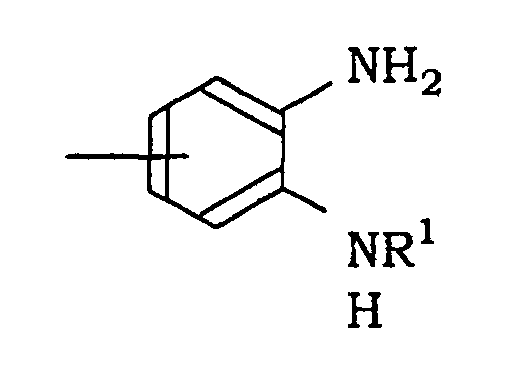
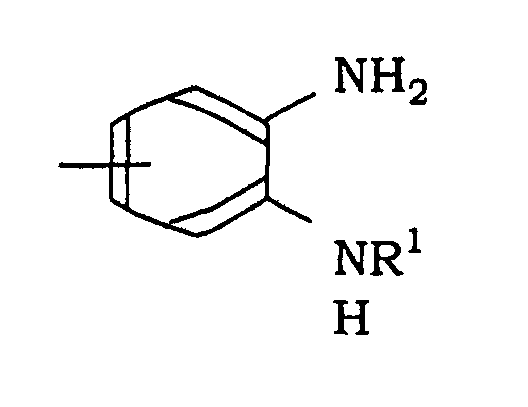
- the present invention relates to an elastomer composition for crosslinking which comprises (A) a compound having at least two crosslinkable reactive groups represented by the formula (I): wherein R 1 are the same or different and each is fluorine atom or a monovalent organic group, and (B) an elastomer having a curing site capable of reacting with the crosslinkable reactive group (I).
- the compound (A) is a novel crosslinking agent since its action as a crosslinking agent has not been known.
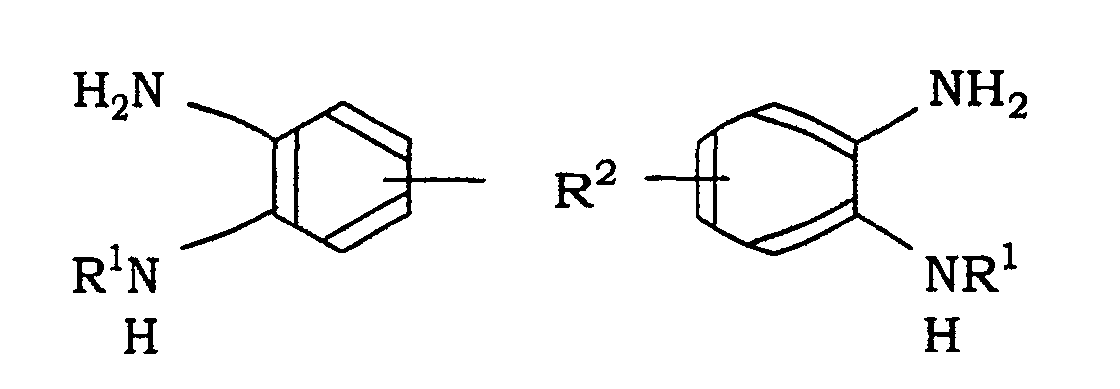
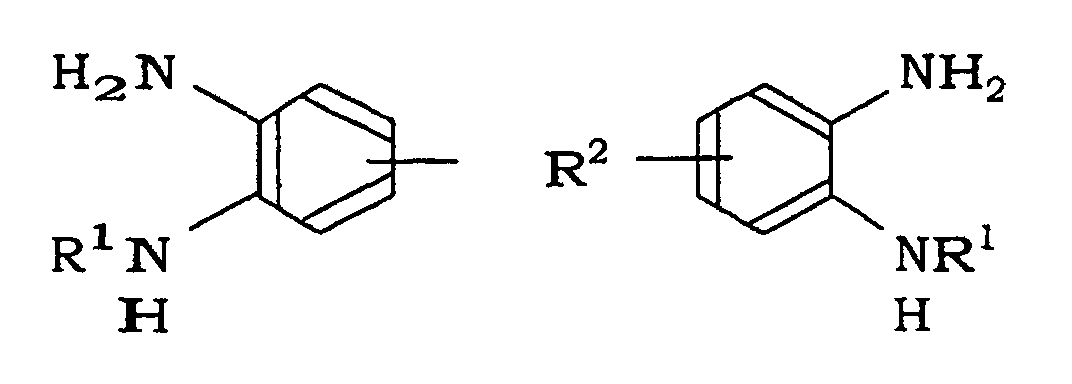
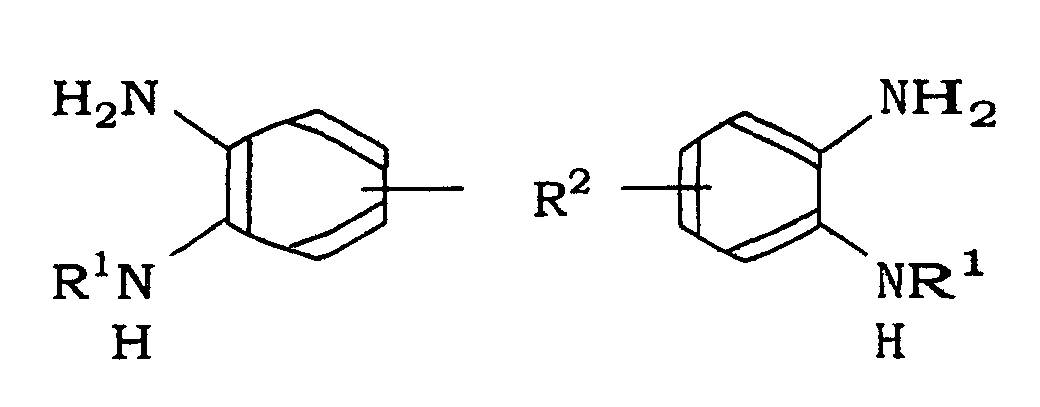
- Example of the compound (A) is preferably a compound represented by the formula (II): wherein R 1 are as defined above, R 2 is -SO 2 -, -O-, -CO-, an alkylene group which may have been substituted, or a single bond.
- Example of the elastomer (B) which can be used preferably is a fluorine-containing elastomer, particularly a perfluoro elastomer having a nitrile group, a carboxyl group and/or an alkoxycarbonyl group as a curing site.
- the present invention also relates to a crosslinked rubber molded article obtained by crosslinking the elastomer composition for crosslinking of the present invention.
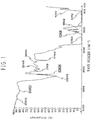
- Fig. 1 is a chart of infrared spectroscopic analysis of a fluorine-containing elastomer A having a CN group which was obtained in Preparation Example 1.
- the elastomer composition for crosslinking of the present invention is crosslinked, its crosslinking system is analogous to an imidazole crosslinking system.
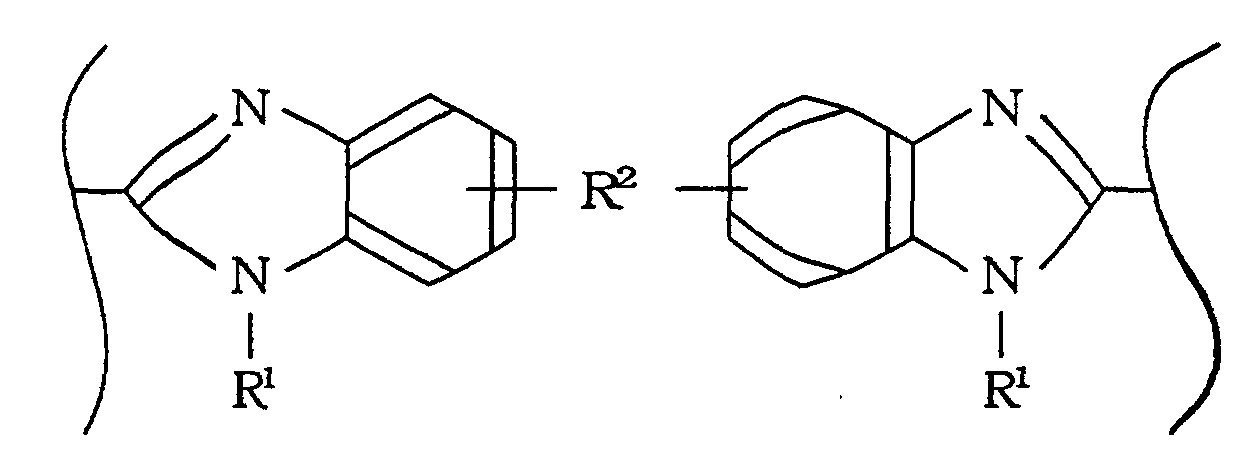
- a crosslinking structure is formed, but in the present invention, as represented by: there is a N-R 1 bond instead of a N-H bond of the imidazole ring. It can be considered that this N-R 1 bond greatly contributes to enhancement of heat resistance. Therefore in the present invention, the compound (A) acting as a crosslinking agent is an important factor.
- the compound (A) is explained hereinbelow.
- the compound (A) has at least two crosslinkable reactive groups represented by the formula (I), preferably two or three groups, particularly preferably two groups in order to form the crosslinking structure.
- the substituent R 1 is a monovalent organic group other than hydrogen or fluorine atom, and particularly preferred is a substituent forming the N-R 1 bond having a higher anti-oxidizing property than the N-H bond.
- the "substituent forming the N-R 1 bond having a higher anti-oxidizing property than the N-H bond” means a substituent forming the N-R 1 bond which is present in a compound hardly oxidized as compared with a compound having the N-H bond when the compound (A) forms an imidazole ring.
- R 1 is not limited particularly, and examples thereof are an aliphatic hydrocarbon group which may have been substituted or a benzyl group or phenyl group which may have been substituted.
- At least one of R 1 is, for instance, a lower alkyl group having 1 to 10 carbon atoms, particularly 1 to 6 carbon atoms such as -CH 3 , -C 2 H 5 or -C 3 H 7 ; a fluorine atom-containing lower alkyl group having 1 to 10 carbon atoms, particularly 1 to 6 carbon atoms such as -CF 3 , -C 2 F 5 , -CH 2 F -CH 2 CF 3 or -CH 2 C 2 F 5 ; a phenyl group; a benzyl group; a benzyl group or phenyl group in which 1 to 5 hydrogen atoms have been substituted by fluorine atoms such as -C 6 F 5 or -CH 2 C 6 F 5 ; a benzyl group or phenyl group in which 1 to 5 hydrogen atoms have been substituted by -CF 3 such as -C 6 H 5-n (CF 3 ) n or -CH 2 C 6 H 5-n (
- a phenyl group and -CH 3 are preferred from the viewpoint of particularly excellent heat resistance, good crosslinkability and relatively easy synthesis.
- Preferred compound (A) is a compound having at least two crosslinkable reactive groups (I) and represented by the formula (II): from the viewpoint of easy synthesis.
- R 1 is as defined above.
- the positions of NH 2 and NHR 1 to the phenyl group may be the same or reverse.
- R 2 is -SO 2 -, -O-, -CO-, an alkylene group which may have been substituted, or a single bond.
- Non-restricted examples of the preferable alkylene group R 2 which may have been substituted are, for instance, a non-substituted alkylene group having 1 to 6 carbon atoms or a perfluoro alkylene group having 1 to 10 carbon atoms.
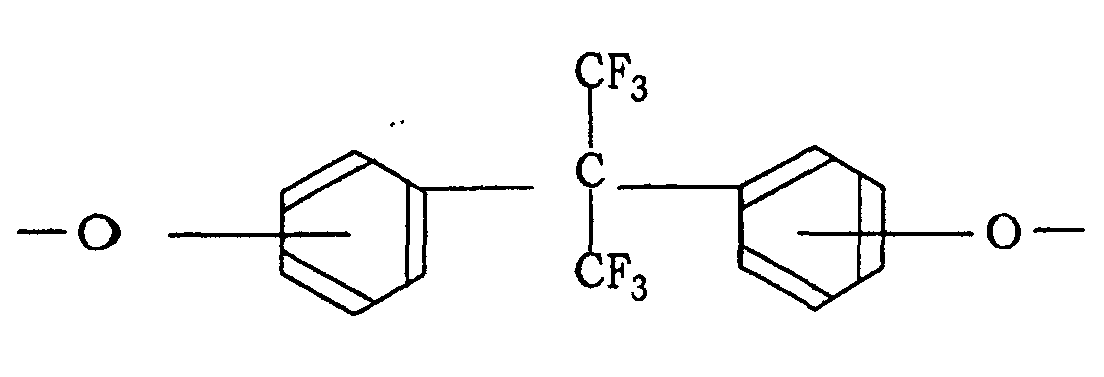
- Examples of the perfluoro alkylene group are: and the like.
- Those R 2 are known as examples of bisdiaminophenyl compounds described in JP-B-2-59177, JP-A-8-120146, etc.
- R 2 may be bonded to any positions of the right and left benzene rings but it is preferable that R 2 is bonded so that either of NH 2 group or NHR 1 group is located at para-position with respect to R 2 from the viewpoint of easy synthesis and easy crosslinking reaction.
- Example of the preferable compound (A) is the compound represented by the formula (IV): wherein R 4 are the same or different and each is an alkyl group having 1 to 10 carbon atoms, an alkyl group having fluorine atom and 1 to 10 carbon atoms, a phenyl group, a benzyl group, or a phenyl group or benzyl group in which 1 to 5 hydrogen atoms have been substituted by fluorine atom or -CF 3 .
- Non-restricted examples of the compound are, for instance, 2,2-bis-[3-amino-4-(N-methylamino)phenyl]hexafluoropropane, 2,2-bis-[3-amino-4-(N-ethylamino)phenyl]hexafluoropropane, 2,2-bis-[3-amino-4-(N-propylamino)phenyl]hexafluoropropane, 2,2-bis-[3-amino-4-(N-phenylamino)phenyl]hexafluoropropane, 2,2-bis-[3-amino-4-(N-perfluorophenylamino)phenyl]hexafluoropropane, 2,2-bis-[3-amino-4-(N-benzylamino)phenyl]hexafluoropropane, and the like.
- the compound (A) explained above is a novel crosslinking agent, has excellent mechanical strength, heat resistance and chemical resistance and provides a crosslinked product having a particularly well-balanced heat resistance and chemical resistance.
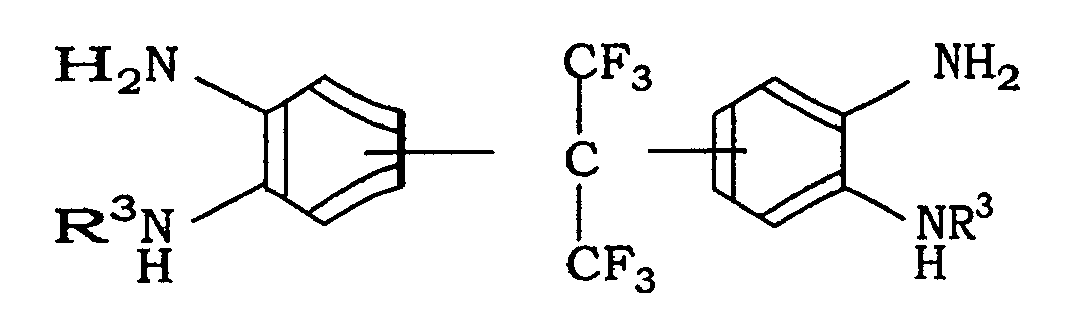
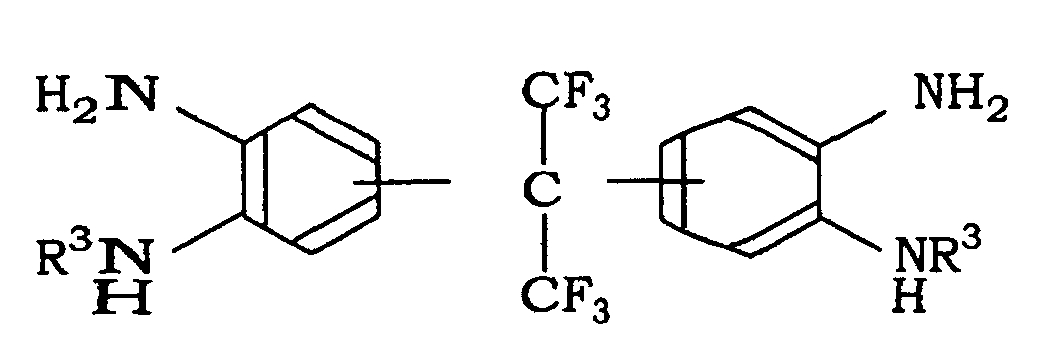
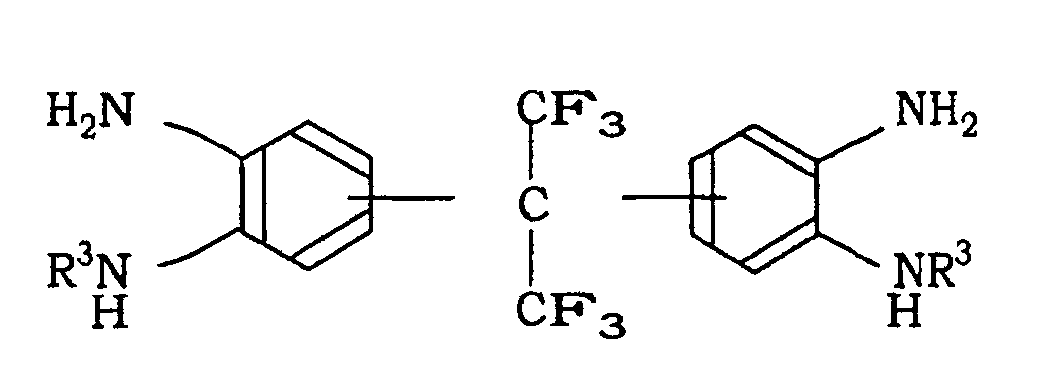
- the compound represented by the formula (III): wherein R 3 is an alkyl group which has 1 to 6 carbon atoms and may have been substituted, is a novel compound.
- the crosslinkable elastomer (B) may be an elastomer which has a curing site capable of reacting with the crosslinkable reactive group (I) and is excellent in heat resistance. Examples thereof are, for instance, fluorine-containing elastomers.
- Examples of the curing site capable of reacting with the crosslinkable reactive group (I) are a nitrile group (-CN group), carboxyl group (-COOH group) and alkoxycarbonyl group (-COOR group, R is an alkyl group having 1 to 3 carbon atoms).
- Examples of the preferable fluorine-containing elastomer are crosslinkable fluorine-containing elastomers which have a carboxyl group, nitrile group and/or alkoxycarbonyl group as a curing site on an end of a trunk chain and/or a branched chain and are represented by the formula (V): X 1 -[A-(Y) p ] q -X 2 or the formula (VI): X 1 -[A-(Y 1 ) p ] q -[B-(Y 2 ) r ] s -X 2 wherein X 1 and X 2 are the same or different and each is a carboxyl group, alkoxycarbonyl group, nitrile group, iodine atom, bromine atom or sulfonic acid group, Y, Y 1 and Y 2 are the same or different and each is a divalent organic group having a carboxyl group, alkoxycarbonyl group or n
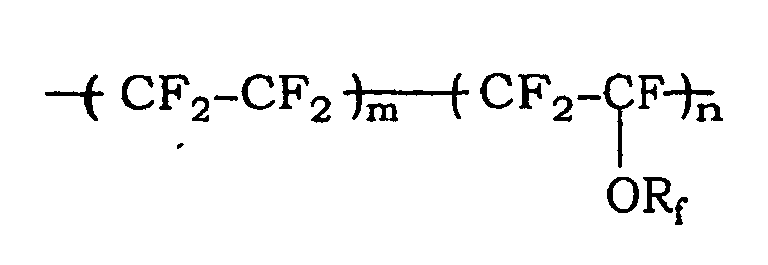
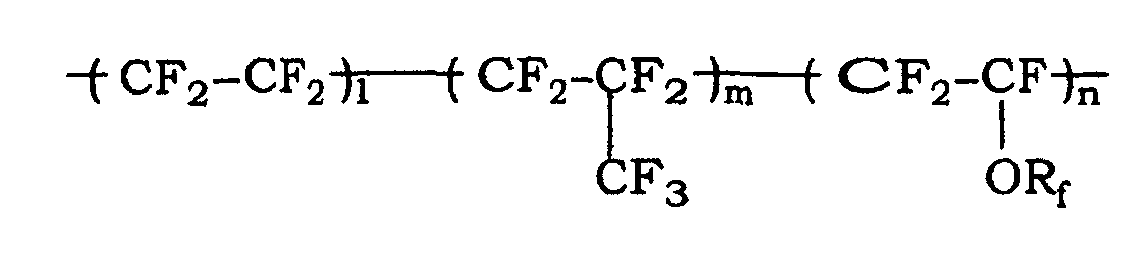
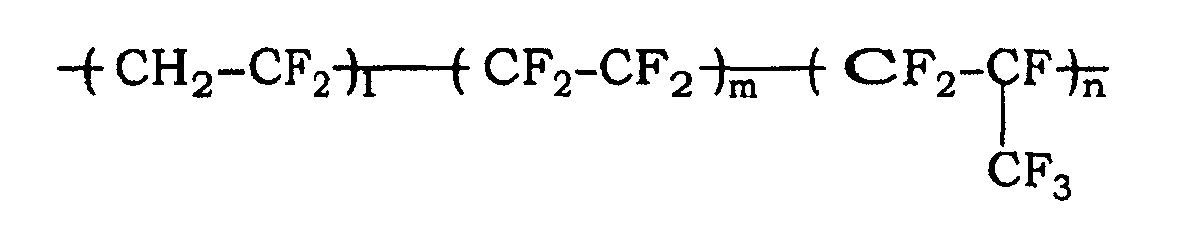
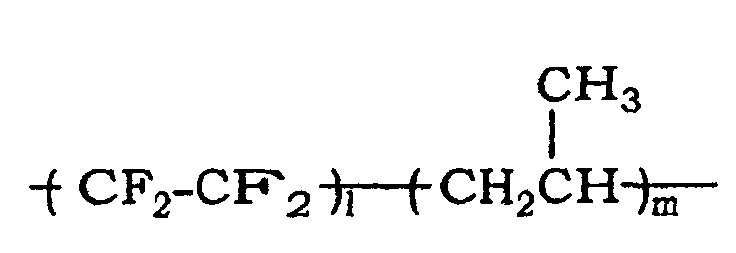
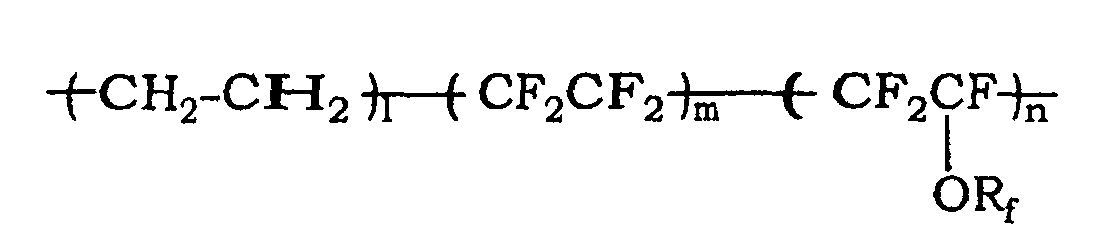
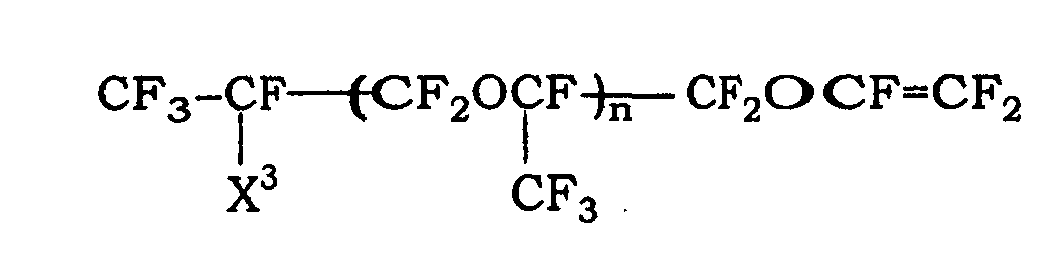
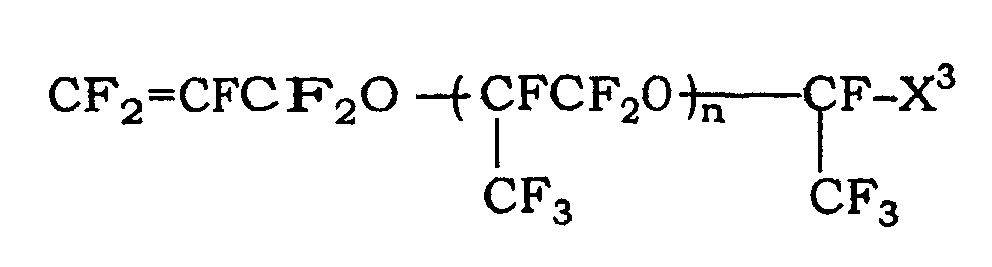
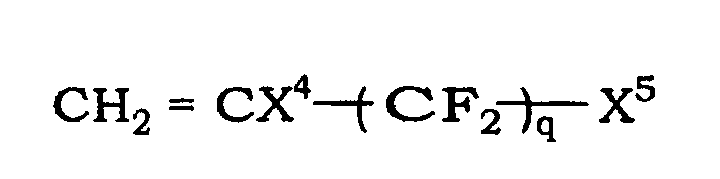
- the elastomeric segment A may be, for example, perfluoro elastomer segments such as a copolymer rubber represented by the formula (1): wherein m/n is 95 to 50/5 to 50 (in mole ratio), R f is a fluoropolyoxyalkyl group having 1 to 20 carbon atoms or a perfluoroalkyl group having 1 to 8 carbon atoms and a terpolymer rubber represented by the formula (2): wherein l/m/n is 95 to 35/0 to 30/5 to 35 (in mole ratio), R f is a fluoropolyoxyalkyl group having 1 to 20 carbon atoms or a perfluoroalkyl group having 1 to 8 carbon atoms, or non-perfluoro elastomer segments such as a copolymer rubber represented by the formula (3): wherein m/n is 85 to 60/15 to 40 (in mole ratio), a terpolymer rubber represented by the formula (4): wherein l/m/
- examples of the suitable iodine-containing monomer are perfluoro(vinyl ether) compounds, for instance, perfluoro(6,6-dihydro-6-iodo-3-oxa-1-hexene), perfluoro(5-iodo-3-oxa-1-pentene), and the like.
- CF 2 CHI, and the like can be used suitably.
- the non-elastomeric segment B is not limited basically as far as the segment contains fluorine atom and does not have the above-mentioned elastomeric property.
- the non-elastomeric segment B may be selected depending on properties and functions intended to obtain by block copolymerization thereof. Particularly a crystalline polymer chain segment having a crystalline melting point of not less than 150°C is preferred in order to impart mechanical properties.
- monomers copolymerizable therewith for example, ethylene, propylene, vinyl chloride, vinyl ethers, carboxylic acid vinyl esters and acryls can be
- preferable examples of the monomer which is used as a main component are, for instance, a sole use of fluorine-containing olefin, a combination use of fluorine-containing olefins, a combination use of ethylene and TFE and a combination use of ethylene and CTFE. Particularly a sole use of perhalo olefin and a combination use of perhalo olefins are preferable.
- the above-mentioned unit Y 2 giving curing sites may be introduced for various crosslinking systems as a monomer capable of constituting the non-elastomeric segment B in an amount of not more than 5 % by mole, preferably not more than 2 % by mole.
- a block copolymerization of the non-elastomeric segment B can be carried out, for example, by changing to the monomer for the non-elastomeric segment B subsequently to emulsion polymerization of the elastomeric segment A.
- the number average molecular weight of the non-elastomeric segment B can be adjusted in the wide range of from 1,000 to 1,200,000, preferably from 3,000 to 400,000.
- the non-elastomeric segment B can be surely block-copolymerized with the elastomeric segment A when the elastomeric segment A comprises not less than 90 % by mole, particularly not less than 95 % by mole of perhalo olefin unit as a component unit thereof. And also the molecular weight (degree of polymerization) of the non-elastomeric segment B can be increased.
- X 1 and X 2 which are the end groups of the elastomer are carboxyl group, alkoxycarbonyl group, iodine atom, bromine atom or sulfonic acid group.
- Example of the method for introducing such a functional group to the ends of the elastomer is a method of treating with an acid which is described hereinafter.
- fluorine-containing elastomers in which at least one of X 1 , X 2 , Y, Y 1 and Y 2 capable of becoming a curing site is a nitrile group, carboxyl group or alkoxycarbonyl group are used preferably.
- the above-mentioned fluorine-containing elastomer having carboxyl group at an end of a trunk chain thereof namely, at least one of X 1 and X 2 is carboxyl group
- the fluorine-containing elastomers (V) and (VI) are characterized in that they are not polymerization products but fluorine-containing elastomers isolated from a polymerization reaction mixture. Therefore those elastomers are in the state of so-called mass and can be crosslinked by adding a crosslinking agent or by irradiation of high energy rays.
- Sco, Scf, D, Dp, F and Fp in the equation represent the following respective values of the aimed fluorine-containing elastomer and a standard perfluoro elastomer mentioned below.
- Sco/Scf is a proportion of carbonyl group (carbonyl group of carboxyl group, hereinafter the same) to C-F bond in the perfluoro elastomer.
- the fluorine-containing elastomer of the present invention is a perfluoro elastomer, only this term may be used. Namely, Sco/Scfp ⁇ 0.01 (Scfp: Area absorbance of C-F bond of the perfluoro elastomer).
- D/Dp and F/Fp are those used for correction in case where the fluorine-containing elastomer (VI) has a non-perfluoro elastomer, for example, vinylidene fluoride. Namely, when the non-perfluoro monomer such as vinylidene fluoride is copolymerized, an amount of C-F bonds in the elastomer decreases and an area of absorbance of C-F bonds measured with a transmission IR analyzer decreases.
- an area absorbance of C-F is proportional to the number of moles of fluorine atoms per a unit area of the elastomer (a value obtained by dividing a weight of fluorine atom by an atomic weight 19 of fluorine).
- a weight of perfluoro elastomer having a volume V is V ⁇ Dp (Dp is a specific gravity of perfluoro elastomer), and thus a weight of fluorine in the perfluoro elastomer is V ⁇ Dp ⁇ Fp / 100 (Fp is a fluorine content of the perfluoro elastomer (Fp % by weight)) and the number of moles of fluorine is V ⁇ Dp ⁇ Fp / 1900.
- V ⁇ D ⁇ F / 1900 the number of moles of fluorine in a non-perfluoro elastomer having a volume V is V ⁇ D ⁇ F / 1900 (D and F are a specific gravity and fluorine content of the non-perfluoro elastomer, respectively).
- this equation is substituted for the equation Sco/Scfp ⁇ 0.01 of the perfluoro elastomer, the above-mentioned equation (1) can be obtained.
- the equation (1) means that the fluorine-containing elastomer, irrespective of perfluoro elastomer or non-perfluoro elastomer, contains not less than 1 mmol of carboxyl group per 1 kg of the polymer. Particularly preferred is the fluorine-containing elastomer containing from 10 to 250 mmol of carboxyl group.
- the elastomer is prepared by copolymerizing a carboxyl group-containing monomer, it is preferable that a copolymerized proportion of the carboxyl group-containing monomer is from 0.3 to 2 % by mole.
- other crosslinkable functional groups for example, nitrile group, etc.
- a total amount of those functional groups and carboxyl groups is preferably within the above-mentioned range.
- carboxyl groups are preferably bonded to the end groups X 1 and X 2 of the trunk chain.
- the above-mentioned fluorine-containing elastomer can be prepared by polymerization methods such as emulsion polymerization, suspension polymerization and solution polymerization.
- carboxyl groups or groups capable of forming carboxyl group for example, acid fluoride, acid chloride and CF 2 OH, any of which form carboxyl group in the presence of water
- carboxyl groups or groups capable of forming carboxyl group for example, acid fluoride, acid chloride and CF 2 OH, any of which form carboxyl group in the presence of water
- carboxyl groups or groups capable of forming carboxyl group for example, acid fluoride, acid chloride and CF 2 OH, any of which form carboxyl group in the presence of water
- APS ammonium persulfate
- KPS potassium persulfate
- a chain transfer agent which is usually used for adjusting a molecular weight may be used.
- the polymerization initiator can make it possible that the above-mentioned groups are present at the ends of elastomer, however, such a polymerization initiator may be used.
- the molecular weight of the elastomer may be adjusted by carrying out the polymerization at a low pressure, for example, at a pressure less than 2 MPa ⁇ G, preferably at a pressure of not more than 1 MPa ⁇ G.
- a low pressure for example, at a pressure less than 2 MPa ⁇ G, preferably at a pressure of not more than 1 MPa ⁇ G.
- Other polymerization conditions are not limited particularly.
- a pH value of the polymerization system is adjusted to a strong acid having a pH value of not more than 3.
- an acid treatment of a polymerization product to convert groups such as a metal salt and ammonium salt of carboxylic acid present therein to carboxyl group.
- Examples of the proper acid treatment method are a method of washing the polymerization product, for example, with hydrochloric acid, sulfuric acid, nitric acid, or the like and a method of adjusting a system of a mixture after the polymerization reaction to a pH value of not more than 3 with such an acid.
- the acid treatment is applied as means for coagulation when isolating the polymerization product from the polymerization reaction mixture by coagulation.
- the polymerization product may be isolated by means of freeze drying, or the like after the acid treatment of the polymerization mixture. Further a coagulation method by ultrasonic wave or by mechanical force may be employed.
- carboxyl group can be introduced by oxidizing a fluorine-containing elastomer containing iodine or bromine with a fuming nitric acid.
- An amount of the compound (A) which is a crosslinking agent is preferably from 0.1 to 10 parts by weight based on 100 parts by weight of the elastomer.
- additives which are usually added to a crosslinkable elastomer composition as the case demands, for example, a filler, processing aid, plasticizer, coloring agent, and the like.
- a filler for example, a filler, processing aid, plasticizer, coloring agent, and the like.
- one or more of usual crosslinking agent and crosslinking accelerator other than the above-mentioned ones may be blended.
- two or more elastomers may be mixed in a range not lowering an effect of the present invention.
- composition of the present invention can be prepared by mixing each of the above-mentioned components by using usual processing equipment for rubber, for example, an open roll, Banbury mixer, kneader, or the like.
- the composition can be prepared also by a method of using a closed mixer and a method of co-coagulation through emulsion mixing.
- a pre-molded article For producing a pre-molded article from the above-mentioned composition, usual known methods may be employed, such as a method of heating and compressing in a metal mold, a method of putting in a heated metal mold under pressure and a method of extruding with an extruder.
- a pre-molded article extruded without using a crosslinking agent can be used as it is.
- a crosslinked product having good physical properties can be obtained at a relatively low crosslinking temperature (for example, from 150° to 230°C preferably from 170° to 200°C).
- the present invention also relates to the so-obtained crosslinked product.
- a high heat resistance which cannot be obtained by conventional imidazole crosslinking and further excellent mechanical strength and chemical resistance can be provided.
- a variation per a given period of time of a compression set at high temperatures which is an index for evaluating a sealing property essential particularly for a sealing material is reduced.
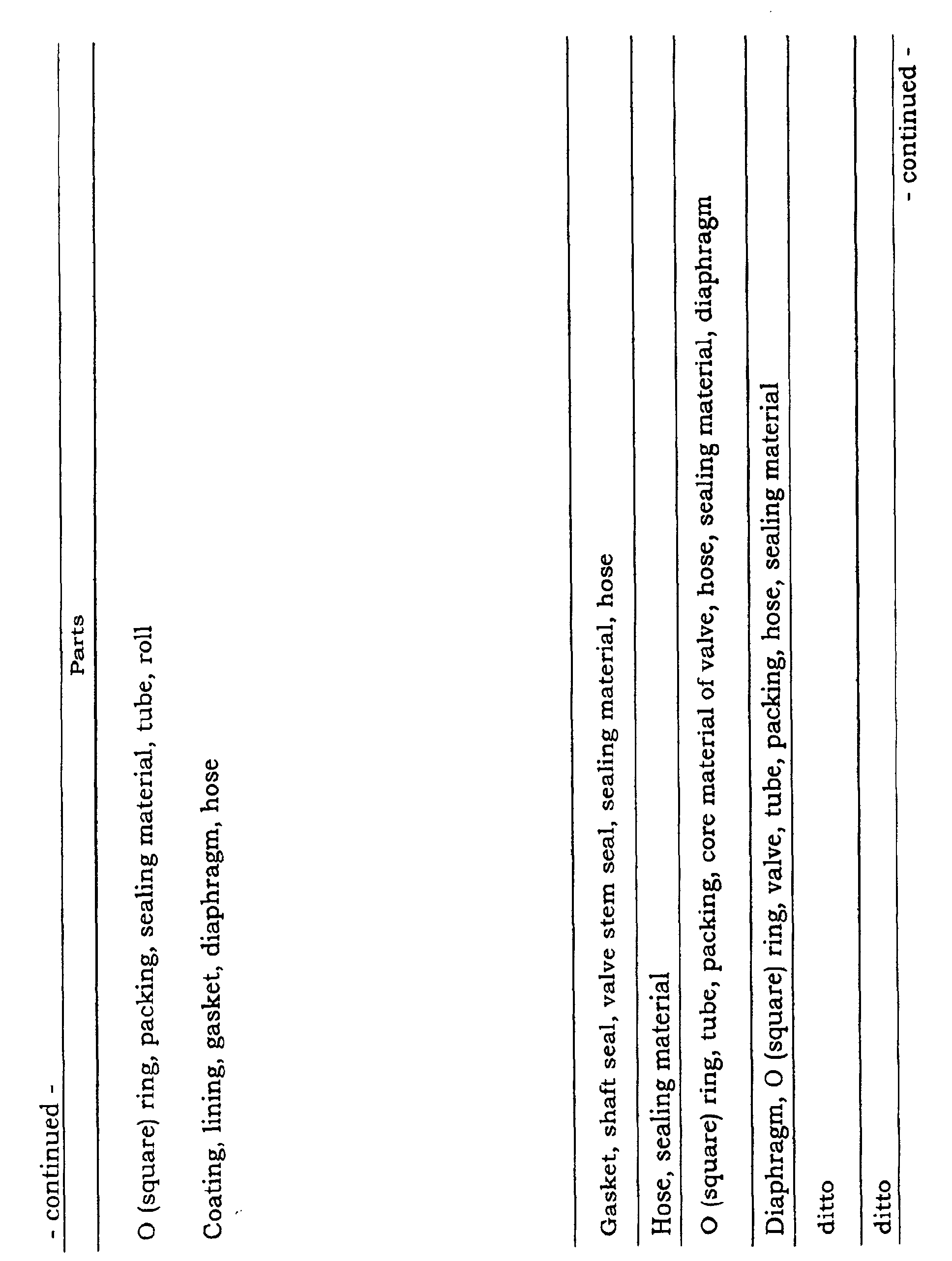
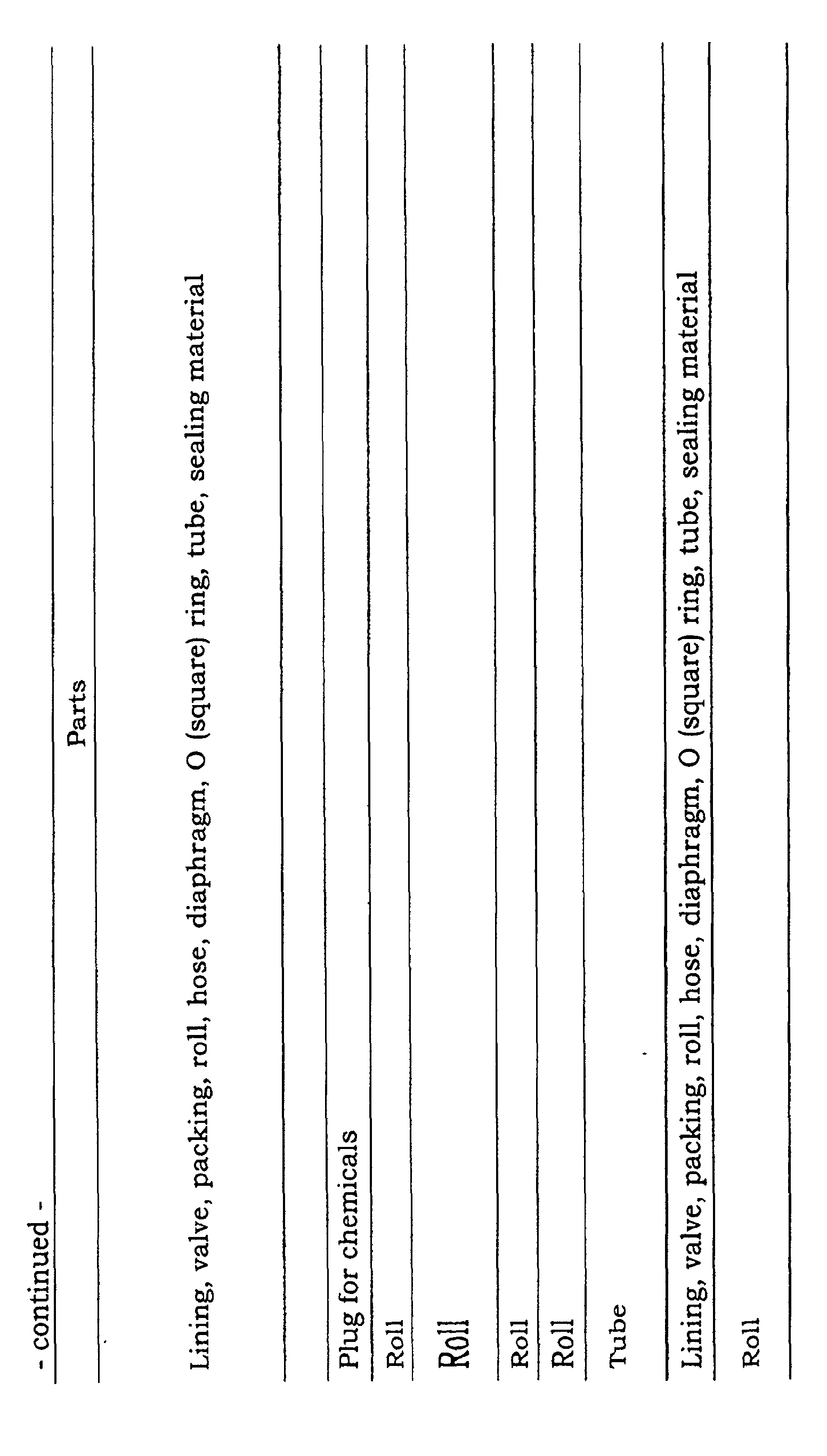
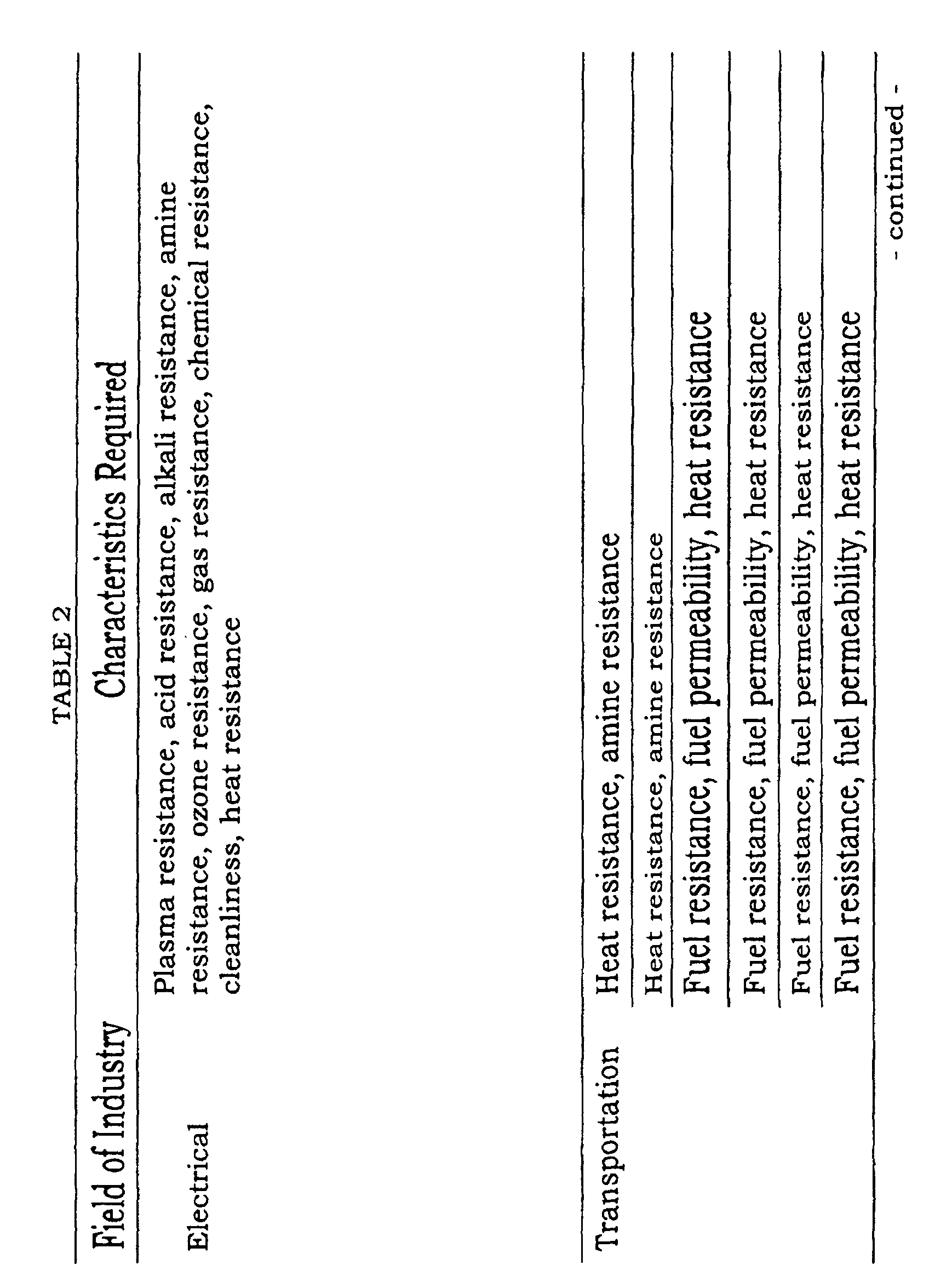
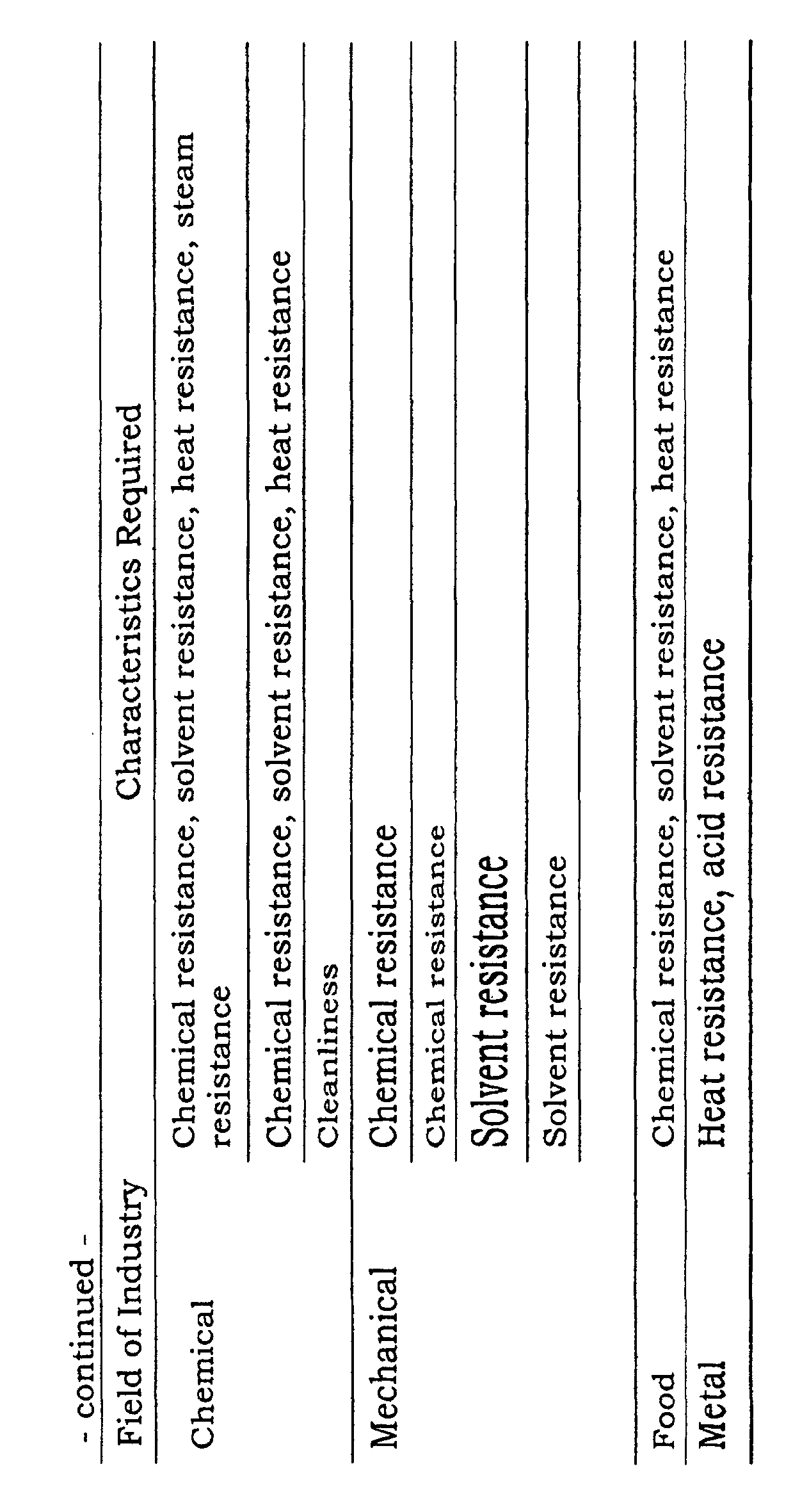
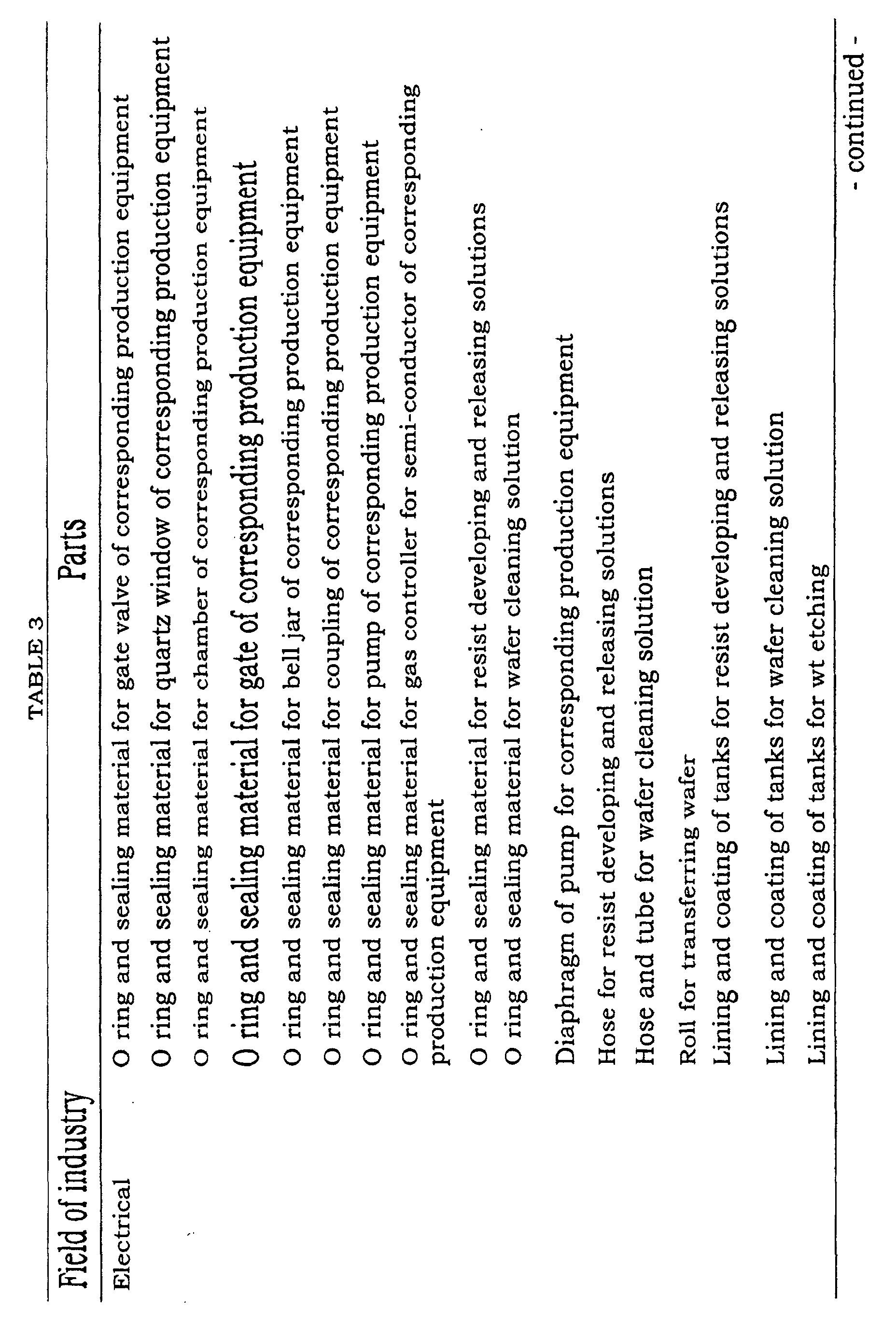
- crosslinked product of the present invention is useful as various molded articles in the fields shown in Tables 1, 2 and 3 on the following pages.
- crosslinked product of the present invention can be used built-in the following semiconductor manufacturing equipment.
- the crosslinked rubber molded article of the present invention is suitable as a sealing material used under temperature environment of not less than 300°C, particularly a sealing material for O 2 sensor of motor engine, a sealing material for airplane and space ship engines, a sealing material for oil well excavator, etc.
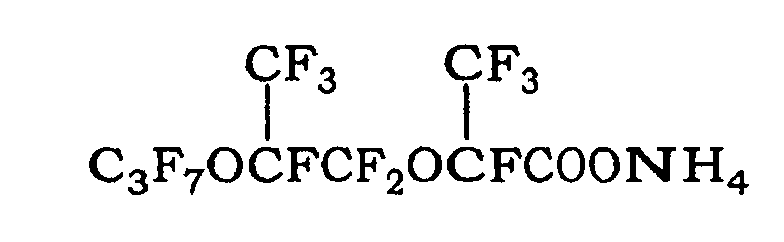
- a 3-liter stainless steel autoclave having no ignition source was charged with 1 liter of pure water, 10 g of: as an emulsifying agent and 0.09 g of disodium phosphate ⁇ 12H 2 O as a pH control agent.
- 10 ml of an aqueous solution of ammonium persulfate (APS) having a concentration of 527 mg/ml was introduced with pressurized nitrogen gas to initiate a reaction.
- APS ammonium persulfate
- 1,196 g of the obtained aqueous dispersion was diluted with 3,588 g of water and added slowly to 2,800 g of an aqueous solution of 3.5 % by weight of hydrochloric acid with stirring. After the addition, stirring was continued for five minutes and then a coagulated product was filtrated.
- the obtained polymer was put in 2 kg of HCFC-141b, followed by stirring for five minutes and filtrating again. After that, the washing with HCFC-141b and the filtration were repeated four times and vacuum drying was carried out at 60°C for 72 hours to obtain 240 g of a polymer (nitrile group-containing elastomer A).
- a 3-liter stainless steel autoclave having no ignition source was charged with 1 liter of pure water, 10 g of: as an emulsifying agent and 0.09 g of disodium phosphate ⁇ 12H 2 O as a pH control agent.
- 10 ml of an aqueous solution of ammonium persulfate (APS) having a concentration of 527 mg/ml was introduced with pressurized nitrogen gas to initiate a reaction.
- APS ammonium persulfate
- 1,000 g of the obtained aqueous dispersion was diluted with 3,000 g of water and added slowly to 2,800 g of an aqueous solution of 3.5 % by weight of hydrochloric acid with stirring. After the addition, stirring was continued for five minutes and then a coagulated product was filtrated.
- the obtained polymer was put in 800 g of HCFC-141b, followed by stirring for five minutes and filtrating again. After that, the washing with HCFC-141b and the filtration were repeated four times and vacuum drying was carried out at 120°C for 72 hours to obtain 70 g of a polymer.
- a 45-liter stainless steel autoclave having no ignition source was charged with 27 liter of pure water, 270 g of: as an emulsifying agent and 2.4 g of disodium phosphate ⁇ 12H 2 O as a pH control agent.
- 473 ml of an aqueous solution of ammonium persulfate (APS) having a concentration of 0.3 g/ml was introduced with pressurized nitrogen gas to initiate a reaction.
- APS ammonium persulfate
- aqueous dispersion was subjected to coagulating with hydrochloric acid and drying in the same manner as in Preparation Example 1 to obtain a polymer (nitrile group-containing elastomer B).
- This product was dissolved in 50 ml of diethylether and thereto was gradually added 1N hydrochloric acid-diethylether solution.
- the precipitated hydrochloric acid salt was filtrated, washed with diethylether and then dissolved in 100 ml of water. Thereto was added dropwise 14 % aqueous ammonia under nitrogen atmosphere until a pH value became 7.
- AFTA-Ph 2,2-bis[3-amino-4-(N-phenylamino)phenyl]hexafluoropropane
- carbon black Thermax N-990 available from Cancarb Co., Ltd.
- Vulcanization curves of each composition for crosslinking are obtained at a temperature shown in Table 4 with JSR Curastometer Model II and then a minimum viscosity ( ⁇ min), maximum viscosity ( ⁇ max), induction time (T 10 ) and optimum vulcanization time (T 90 ) are obtained.
- a 100 % modulus, tensile strength, elongation and hardness (IRHD) of a 2 mm thick crosslinked product in normal state (25°C) are measured according to JIS K6301.
- a 100 % modulus, tensile strength, elongation and hardness (IRHD) of a 2 mm thick crosslinked product in normal state are measured according to JIS K6301. Further a ratio of variation from the physical properties in normal state (variation rate) is calculated.
- a compression set of the O-ring (AS-568A-214) is measured according to JIS K6301 after allowing to stand at 300°C for 70 hours and at 300°C for 168 hours, respectively.
- a crosslinkable composition and crosslinked product were produced in the same manner as in Example 1 except that the fluorine-containing elastomer having COOH group which was prepared in Preparation Example 2 was used as an elastomer and the crosslinking by pressing was carried out at 200°C for 80 minutes. Physical properties were measured in the same manner as in Example 1. The results are shown in Table 4.
- a crosslinkable composition and crosslinked product were produced in the same manner as in Example 2 except that 2,2-bis[3-amino-4-(N-methylamino)phenyl]hexafluoropropane obtained in Preparation Example 3 was used as a crosslinking agent, an adding amount of the crosslinking agent was 2.18 parts by weight and the crosslinking by pressing was carried out at 200°C for 35 minutes. Physical properties were measured in the same manner as in Example 1. The results are shown in Table 4.
- a crosslinkable composition and crosslinked product were produced in the same manner as in Example 1 except that 2,2-bis(3,4-diaminophenyl)hexafluoropropane (AFTA) was used as a crosslinking agent and an adding amount thereof was 2 parts by weight. Physical properties were measured in the same manner as in Example 1. The results are shown in Table 4.
- AFTA 2,2-bis(3,4-diaminophenyl)hexafluoropropane
- a crosslinkable composition and crosslinked product were produced in the same manner as in Example 2 except that 2,2-bis(3,4-diaminophenyl)hexafluoropropane (AFTA) was used as a crosslinking agent and an adding amount thereof was 2 parts by weight. Physical properties were measured in the same manner as in Example 2. The results are shown in Table 4.
- AFTA 2,2-bis(3,4-diaminophenyl)hexafluoropropane
- the crosslinked product having excellent heat resistance can be obtained when the crosslinking agent of the present invention is used.
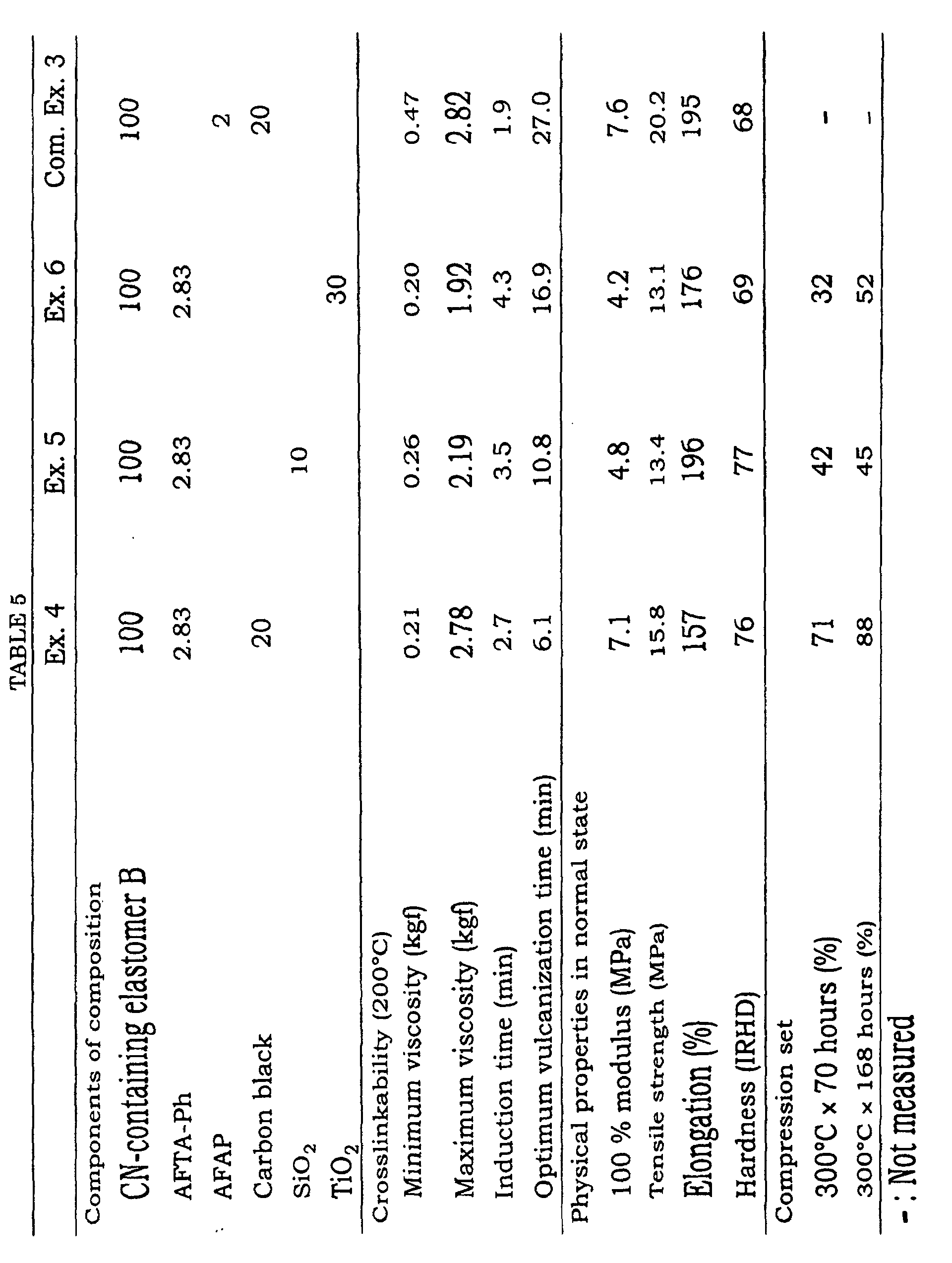
- a crosslinkable composition and crosslinked product were produced in the same manner as in Example 1 except that the CN-containing elastomer B obtained in Preparation Example 3 was used as a CN-containing elastomer, carbon black (Thermax N-990 available from Cancarb Co., Ltd., Example 4), SiO 2 (CABOCYL M-7D available from Cabot Co., Ltd., Example 5) and TiO 2 (TM-1 available from Fuji Titanium Kogyo Kabushiki Kaisha, Example 6) were used as a filler, and adding amounts thereof were as shown in Table 5. Physical properties were measured in the same manner as in Example 1. The results are shown in Table 5.
- a crosslinkable composition and crosslinked product were produced in the same manner as in Example 4 except that 2,2-bis(3,4-diaminophenyl)hexafluoropropane (AFTA) was used as a crosslinking agent and an adding amount thereof was 2 parts by weight. Physical properties were measured in the same manner as in Example 4. The results are shown in Table 5.
- AFTA 2,2-bis(3,4-diaminophenyl)hexafluoropropane
- a sample was produced from the sheet-like crosslinked product and was dipped in ethylenediamine at 100°C for 168 hours to measure variations (%) of volume and weight according to JIS K6301.
- the present invention can provide a novel crosslinkable elastomer composition and crosslinking agent from which a crosslinked rubber molded article having excellent chemical resistance and mechanical strength and possessing enhanced heat resistance, particularly heat resistance at high temperatures can be obtained.
Landscapes
- Chemical & Material Sciences (AREA)
- Health & Medical Sciences (AREA)
- Chemical Kinetics & Catalysis (AREA)
- Medicinal Chemistry (AREA)
- Polymers & Plastics (AREA)
- Organic Chemistry (AREA)
- Engineering & Computer Science (AREA)
- Manufacturing & Machinery (AREA)
- Materials Engineering (AREA)
- Compositions Of Macromolecular Compounds (AREA)
- Addition Polymer Or Copolymer, Post-Treatments, Or Chemical Modifications (AREA)
- Organic Low-Molecular-Weight Compounds And Preparation Thereof (AREA)
- Sealing Material Composition (AREA)
Abstract
Description



a terpolymer rubber represented by the formula (2):
non-perfluoro elastomer segments such as a copolymer rubber represented by the formula (3):

a terpolymer rubber represented by the formula (4):
a terpolymer rubber represented by the formula (5):













| Ethylenediamine resistance (100°C × 168 hours) | Steam resistance (288°C × 168 hours) | |||
| Variation of weight (%) | Variation of volume (%) | Variation of weight (%) | Variation of volume (%) | |
| Ex. 7 | +8 | +15 | -1.4 | -1.0 |
| Com. Ex. 4 | +51 | +109 | +8 | +69 |
Claims (20)
- An elastomer composition for crosslinking which comprises (A) a compound having at least two crosslinkable reactive groups represented by the formula (I):wherein R1 are the same or different and each is fluorine atom or a monovalent organic group, and (B) an elastomer having a curing site capable of reacting with the crosslinkable reactive group (I).
- The composition of Claim 1, wherein the compound (A) is a compound represented by the formula (II):in which R1 is as defined above, R2 is -SO2-, -O-, -CO-, an alkylene group which may have been substituted,
 or a single bond.
- The composition of Claim 2, wherein in the formula (II), R2 is a non-substituted alkylene group having 1 to 6 carbon atoms or a perfluoro alkylene group having 1 to 10 carbon atoms.
- The composition of Claim 3, wherein in the formula (II), R2 is:

- The composition of any of Claims 1 to 4, wherein in the formula (I) or (II), the N-R1 bond has a higher anti-oxidizing property than the N-H bond.
- The composition of any of Claims 1 to 5, wherein in the formula (I) or (II), R1 is an aliphatic hydrocarbon group which may have been substituted or a benzyl group or phenyl group which may have been substituted.
- The composition of any of Claims 1 to 6, wherein in the formula (I) or (II), at least one of R1 is an alkyl group having 1 to 10 carbon atoms or an alkyl group having fluorine atom and 1 to 10 carbon atoms.
- The composition of any of Claims 1 to 7, wherein in the formula (I) or (II), at least one of R1 is a phenyl group, a benzyl group, or a benzyl group or phenyl group in which 1 to 5 hydrogen atoms have been substituted by fluorine atom or -CF3.
- The composition of any of Claims 1 to 8, wherein the elastomer (B) has a nitrile group, carboxyl group and/or alkoxycarbonyl group as a curing site.
- The composition of any of Claims 1 to 9, wherein the elastomer (B) is a fluorine-containing elastomer.
- The composition of Claim 10, wherein the fluorine-containing elastomer (B) is a perfluoro elastomer.
- A crosslinking agent comprising a compound (A) having at least two crosslinkable reactive groups represented by the formula (I):wherein R1 are the same or different and each is fluorine atom or a monovalent organic group.

- The crosslinking agent of Claim 12, wherein the compound (A) is a compound represented by the formula (II):in which R1 is as defined above, R2 is -SO2-, -O-, -CO-, an alkylene group which may have been substituted,
 or a single bond.
- The crosslinking agent of Claim 13, wherein in the formula (II), R2 is a non-substituted alkylene group having 1 to 6 carbon atoms or a perfluoro alkylene group having 1 to 10 carbon atoms.
- The crosslinking agent of Claim 14, wherein in the formula (II), R2 is:

- The crosslinking agent of any of Claims 12 to 15, wherein in the formula (I) or (II), R1 is an aliphatic hydrocarbon group which may have been substituted or a benzyl group or phenyl group which may have been substituted.
- The crosslinking agent of any of Claims 12 to 16, wherein in the formula (I) or (II), at least one of R1 is an alkyl group having 1 to 10 carbon atoms or an alkyl group having fluorine atom and 1 to 10 carbon atoms.
- The crosslinking agent of any of Claims 12 to 17, wherein in the formula (I) or (II), at least one of R1 is a phenyl group, a benzyl group, or a benzyl group or phenyl group in which 1 to 5 hydrogen atoms have been substituted by fluorine atom or -CF3.
- A compound represented by the formula (III):wherein R3 is an alkyl group which has 1 to 6 carbon atoms and may have been substituted.
- A crosslinked rubber molded article obtained by crosslinking the elastomer composition for crosslinking of any of Claims 1 to 11.
Applications Claiming Priority (3)
| Application Number | Priority Date | Filing Date | Title |
|---|---|---|---|
| JP31427499 | 1999-11-04 | ||
| JP31427499 | 1999-11-04 | ||
| PCT/JP2000/007670 WO2001032773A1 (en) | 1999-11-04 | 2000-10-31 | Fluoroelastomer composition for crosslinking |
Publications (3)
| Publication Number | Publication Date |
|---|---|
| EP1245635A1 true EP1245635A1 (en) | 2002-10-02 |
| EP1245635A4 EP1245635A4 (en) | 2004-06-16 |
| EP1245635B1 EP1245635B1 (en) | 2008-09-03 |
Family
ID=18051397
Family Applications (1)
| Application Number | Title | Priority Date | Filing Date |
|---|---|---|---|
| EP00970244A Expired - Lifetime EP1245635B1 (en) | 1999-11-04 | 2000-10-31 | Fluoroelastomer composition for crosslinking |
Country Status (8)
| Country | Link |
|---|---|
| US (1) | US6878778B1 (en) |
| EP (1) | EP1245635B1 (en) |
| JP (1) | JP4051929B2 (en) |
| KR (1) | KR100659958B1 (en) |
| CN (1) | CN1164673C (en) |
| DE (1) | DE60040168D1 (en) |
| TW (1) | TWI286562B (en) |
| WO (1) | WO2001032773A1 (en) |
Cited By (1)
| Publication number | Priority date | Publication date | Assignee | Title |
|---|---|---|---|---|
| WO2014115806A1 (en) | 2013-01-28 | 2014-07-31 | 日本ゼオン株式会社 | Cross-linkable rubber composition for seal material used in oil field or gas well, and seal material |
Families Citing this family (22)
| Publication number | Priority date | Publication date | Assignee | Title |
|---|---|---|---|---|
| JP4655934B2 (en) * | 2003-09-24 | 2011-03-23 | ダイキン工業株式会社 | Perfluoroelastomer seal material |
| JP2008266368A (en) * | 2007-04-16 | 2008-11-06 | Daikin Ind Ltd | Fluorine-containing elastomer composition and sealing material comprising the same |
| JP2009197134A (en) * | 2008-02-21 | 2009-09-03 | Daikin Ind Ltd | Method for producing crosslinking fluorine-containing elastomer composition |
| WO2010014275A2 (en) * | 2008-07-31 | 2010-02-04 | 3M Innovative Properties Company | Fluoropolymer compositions and methods of curing |
| TWI394787B (en) * | 2008-10-16 | 2013-05-01 | Greene Tweed Of Delaware | Perfluoroelastomer compositions and methods of preparing same |
| JP2012505948A (en) * | 2008-10-22 | 2012-03-08 | ダイキン工業株式会社 | Perfluoroelastomer composition |
| JP2012512311A (en) * | 2008-12-17 | 2012-05-31 | グリーン, ツイード オブ デラウェア, インコーポレイテッド | Perfluoroelastomer composition containing barium titanate filler |
| US8343370B2 (en) * | 2009-02-19 | 2013-01-01 | Federal-Mogul Corporation | Method of fabricating a PTFE seal element and a shaft seal assembly therewith |
| EP2610302A4 (en) | 2010-08-25 | 2017-04-12 | Daikin Industries, Ltd. | Fluororubber composition |
| CN103080216B (en) | 2010-08-25 | 2016-01-20 | 大金工业株式会社 | Strip material |
| JPWO2012026556A1 (en) | 2010-08-25 | 2013-10-28 | ダイキン工業株式会社 | Complex shaped fluoro rubber molding |
| EP2568007B1 (en) | 2010-08-25 | 2017-10-04 | Daikin Industries, Ltd. | Fluororubber composition |
| EP2610533B1 (en) * | 2010-08-25 | 2025-01-15 | Daikin Industries, Ltd. | Seal member |
| EP3913269A1 (en) | 2010-08-25 | 2021-11-24 | Daikin Industries, Ltd. | Hose |
| US9365712B2 (en) | 2010-09-24 | 2016-06-14 | Greene, Tweed Technologies, Inc. | Fluorine-containing elastomer compositions suitable for high temperature applications |
| JP5833657B2 (en) | 2010-09-24 | 2015-12-16 | グリーン, ツイード オブ デラウェア, インコーポレイテッド | Fluorine-containing elastomer composition suitable for high temperature applications |
| EP2909253B1 (en) | 2012-10-22 | 2021-11-10 | Delsper LP | Cross-linked organic polymer compositions |
| JP6272908B2 (en) | 2013-01-28 | 2018-01-31 | デルスパー リミテッド パートナーシップ | Anti-extrusion composition for sealing and wear resistant components |
| JP6456913B2 (en) | 2013-03-15 | 2019-01-23 | デルスパー リミテッド パートナーシップ | Cross-linked organic polymers for use as elastomers |
| KR101642575B1 (en) | 2014-07-04 | 2016-07-26 | 박현우 | Investigate crosslinking fluorine rubber compound application to insulated electric wire |
| JP2022500523A (en) * | 2018-09-11 | 2022-01-04 | グリーン, ツイード テクノロジーズ, インコーポレイテッド | Cross-linked compositions for forming cross-linked organic polymers, organic polymer compositions, methods of forming them, and articles made from them. |
| CN117255779A (en) | 2021-04-27 | 2023-12-19 | 大金工业株式会社 | Bisdiaminophenyl compounds, cross-linking agents, compositions and molded articles |
Family Cites Families (2)
| Publication number | Priority date | Publication date | Assignee | Title |
|---|---|---|---|---|
| US3310573A (en) * | 1963-06-17 | 1967-03-21 | Du Pont | Diaryl fluoro compounds |
| JPS59232137A (en) | 1983-06-01 | 1984-12-26 | イ−・アイ・デユポン・デ・ニモアス・アンド・カンパニ− | Aromatic amine-containing curable fluoro polymer |
-
2000
- 2000-10-31 CN CNB008152969A patent/CN1164673C/en not_active Expired - Lifetime
- 2000-10-31 US US10/129,375 patent/US6878778B1/en not_active Expired - Lifetime
- 2000-10-31 JP JP2001535462A patent/JP4051929B2/en not_active Expired - Lifetime
- 2000-10-31 WO PCT/JP2000/007670 patent/WO2001032773A1/en not_active Ceased
- 2000-10-31 DE DE60040168T patent/DE60040168D1/en not_active Expired - Lifetime
- 2000-10-31 KR KR1020027005811A patent/KR100659958B1/en not_active Expired - Lifetime
- 2000-10-31 EP EP00970244A patent/EP1245635B1/en not_active Expired - Lifetime
- 2000-11-02 TW TW089123066A patent/TWI286562B/en not_active IP Right Cessation
Cited By (1)
| Publication number | Priority date | Publication date | Assignee | Title |
|---|---|---|---|---|
| WO2014115806A1 (en) | 2013-01-28 | 2014-07-31 | 日本ゼオン株式会社 | Cross-linkable rubber composition for seal material used in oil field or gas well, and seal material |
Also Published As
| Publication number | Publication date |
|---|---|
| US6878778B1 (en) | 2005-04-12 |
| KR100659958B1 (en) | 2006-12-22 |
| EP1245635A4 (en) | 2004-06-16 |
| JP4051929B2 (en) | 2008-02-27 |
| TWI286562B (en) | 2007-09-11 |
| CN1164673C (en) | 2004-09-01 |
| WO2001032773A1 (en) | 2001-05-10 |
| EP1245635B1 (en) | 2008-09-03 |
| CN1387551A (en) | 2002-12-25 |
| DE60040168D1 (en) | 2008-10-16 |
| KR20020055595A (en) | 2002-07-09 |
Similar Documents
| Publication | Publication Date | Title |
|---|---|---|
| EP1245635B1 (en) | Fluoroelastomer composition for crosslinking | |
| EP1153976A1 (en) | Fluoroelastomer and crosslinkable composition thereof | |
| EP0754721B1 (en) | Fluorine-containing elastomer composition | |
| JP3223776B2 (en) | Fluorine-containing elastomer composition | |
| US5648429A (en) | Curable fluoroelastomeric compositions | |
| JPWO2001032773A1 (en) | Fluorine-based elastomer composition for crosslinking | |
| JPS63304009A (en) | Production of peroxide-curable fluorine-containing elastomer | |
| JP3369215B2 (en) | Vinylidene fluoride based fluoroelastomer with excellent resistance to organic bases | |
| JPWO2000029479A1 (en) | Fluorine-containing elastomer and crosslinking composition thereof | |
| JP5067161B2 (en) | Crosslinkable composition and molded article comprising the same | |
| JPH073101A (en) | Fluoroelastomer composition | |
| JP4687650B2 (en) | Fluorine-containing elastomer composition and molded article comprising the same | |
| WO2009119439A1 (en) | Fluorine-containing elastomer, and cross-linkable composition containing the same | |
| JPH08104789A (en) | Fluorine-containing elastomer composition | |
| EP1310522A1 (en) | Crosslinkable elastomer composition | |
| JP4748125B2 (en) | Fluorine rubber crosslinking composition | |
| JP2008524425A (en) | Fluoropolymer having pendant amidoxime structure or amidrazon structure | |
| JPH07224201A (en) | Fluorine-containing copolymer composition | |
| WO2007013397A1 (en) | Curable composition, molded article obtained from same, and method for producing molded article | |
| JPH10330571A (en) | Vulcanizable fluorine-containing elastomer composition | |
| JP2009197134A (en) | Method for producing crosslinking fluorine-containing elastomer composition | |
| JP2008274104A (en) | Crosslinkable composition and molded article comprising the same | |
| JPH0653815B2 (en) | Fluorine rubber vulcanizing composition | |
| EP2691454A2 (en) | Curable fluoroelastomer composition |
Legal Events
| Date | Code | Title | Description |
|---|---|---|---|
| PUAI | Public reference made under article 153(3) epc to a published international application that has entered the european phase |
Free format text: ORIGINAL CODE: 0009012 |
|
| 17P | Request for examination filed |
Effective date: 20020527 |
|
| AK | Designated contracting states |
Kind code of ref document: A1 Designated state(s): AT BE CH CY DE DK ES FI FR GB GR IE IT LI LU MC NL PT SE |
|
| RBV | Designated contracting states (corrected) |
Designated state(s): AT BE CH CY DE FR GB IT LI NL |
|
| A4 | Supplementary search report drawn up and despatched |
Effective date: 20040504 |
|
| 17Q | First examination report despatched |
Effective date: 20040823 |
|
| GRAP | Despatch of communication of intention to grant a patent |
Free format text: ORIGINAL CODE: EPIDOSNIGR1 |
|
| RBV | Designated contracting states (corrected) |
Designated state(s): DE FR GB IT NL |
|
| GRAS | Grant fee paid |
Free format text: ORIGINAL CODE: EPIDOSNIGR3 |
|
| GRAA | (expected) grant |
Free format text: ORIGINAL CODE: 0009210 |
|
| AK | Designated contracting states |
Kind code of ref document: B1 Designated state(s): DE FR GB IT NL |
|
| REG | Reference to a national code |
Ref country code: GB Ref legal event code: FG4D |
|
| REF | Corresponds to: |
Ref document number: 60040168 Country of ref document: DE Date of ref document: 20081016 Kind code of ref document: P |
|
| PLBE | No opposition filed within time limit |
Free format text: ORIGINAL CODE: 0009261 |
|
| STAA | Information on the status of an ep patent application or granted ep patent |
Free format text: STATUS: NO OPPOSITION FILED WITHIN TIME LIMIT |
|
| 26N | No opposition filed |
Effective date: 20090604 |
|
| PG25 | Lapsed in a contracting state [announced via postgrant information from national office to epo] |
Ref country code: IT Free format text: LAPSE BECAUSE OF NON-PAYMENT OF DUE FEES Effective date: 20081031 |
|
| PGRI | Patent reinstated in contracting state [announced from national office to epo] |
Ref country code: IT Effective date: 20110616 |
|
| REG | Reference to a national code |
Ref country code: FR Ref legal event code: PLFP Year of fee payment: 17 |
|
| REG | Reference to a national code |
Ref country code: FR Ref legal event code: PLFP Year of fee payment: 18 |
|
| REG | Reference to a national code |
Ref country code: FR Ref legal event code: PLFP Year of fee payment: 19 |
|
| PGFP | Annual fee paid to national office [announced via postgrant information from national office to epo] |
Ref country code: FR Payment date: 20190913 Year of fee payment: 20 Ref country code: NL Payment date: 20190912 Year of fee payment: 20 |
|
| PGFP | Annual fee paid to national office [announced via postgrant information from national office to epo] |
Ref country code: DE Payment date: 20191015 Year of fee payment: 20 |
|
| PGFP | Annual fee paid to national office [announced via postgrant information from national office to epo] |
Ref country code: IT Payment date: 20191009 Year of fee payment: 20 |
|
| PGFP | Annual fee paid to national office [announced via postgrant information from national office to epo] |
Ref country code: GB Payment date: 20191031 Year of fee payment: 20 |
|
| REG | Reference to a national code |
Ref country code: DE Ref legal event code: R071 Ref document number: 60040168 Country of ref document: DE |
|
| REG | Reference to a national code |
Ref country code: NL Ref legal event code: MK Effective date: 20201030 |
|
| REG | Reference to a national code |
Ref country code: GB Ref legal event code: PE20 Expiry date: 20201030 |
|
| PG25 | Lapsed in a contracting state [announced via postgrant information from national office to epo] |
Ref country code: GB Free format text: LAPSE BECAUSE OF EXPIRATION OF PROTECTION Effective date: 20201030 |