EP1245607A1 - Method of crystallizing low-molecular polycarbonate and process for producing polycarbonate resin from the same - Google Patents
Method of crystallizing low-molecular polycarbonate and process for producing polycarbonate resin from the same Download PDFInfo
- Publication number
- EP1245607A1 EP1245607A1 EP00961159A EP00961159A EP1245607A1 EP 1245607 A1 EP1245607 A1 EP 1245607A1 EP 00961159 A EP00961159 A EP 00961159A EP 00961159 A EP00961159 A EP 00961159A EP 1245607 A1 EP1245607 A1 EP 1245607A1
- Authority
- EP
- European Patent Office
- Prior art keywords
- polycarbonate
- molecular weight
- low molecular
- aromatic polycarbonate
- group
- Prior art date
- Legal status (The legal status is an assumption and is not a legal conclusion. Google has not performed a legal analysis and makes no representation as to the accuracy of the status listed.)
- Withdrawn
Links
- 229920000515 polycarbonate Polymers 0.000 title claims abstract description 222
- 239000004417 polycarbonate Substances 0.000 title claims abstract description 222
- 238000000034 method Methods 0.000 title claims abstract description 102
- 239000004431 polycarbonate resin Substances 0.000 title claims abstract description 30
- 229920005668 polycarbonate resin Polymers 0.000 title claims abstract description 30
- 125000003118 aryl group Chemical group 0.000 claims abstract description 183
- 150000001875 compounds Chemical class 0.000 claims abstract description 133
- 238000002844 melting Methods 0.000 claims abstract description 53
- 230000008018 melting Effects 0.000 claims abstract description 53
- 239000000203 mixture Substances 0.000 claims abstract description 50
- XLYOFNOQVPJJNP-UHFFFAOYSA-N water Substances O XLYOFNOQVPJJNP-UHFFFAOYSA-N 0.000 claims abstract description 47
- -1 carbonic acid diester compounds Chemical class 0.000 claims abstract description 34
- 238000006068 polycondensation reaction Methods 0.000 claims abstract description 16
- 239000011261 inert gas Substances 0.000 claims abstract description 12
- ISWSIDIOOBJBQZ-UHFFFAOYSA-N Phenol Chemical compound OC1=CC=CC=C1 ISWSIDIOOBJBQZ-UHFFFAOYSA-N 0.000 claims description 82
- ROORDVPLFPIABK-UHFFFAOYSA-N diphenyl carbonate Chemical compound C=1C=CC=CC=1OC(=O)OC1=CC=CC=C1 ROORDVPLFPIABK-UHFFFAOYSA-N 0.000 claims description 17
- 239000008187 granular material Substances 0.000 claims description 15
- 230000009477 glass transition Effects 0.000 claims description 14
- 238000010438 heat treatment Methods 0.000 claims description 11
- 239000000155 melt Substances 0.000 claims description 10
- 238000004519 manufacturing process Methods 0.000 claims description 7
- 230000000306 recurrent effect Effects 0.000 claims description 7
- 125000002947 alkylene group Chemical group 0.000 claims description 5
- 125000001118 alkylidene group Chemical group 0.000 claims description 5
- 125000000008 (C1-C10) alkyl group Chemical group 0.000 claims description 4
- 125000003710 aryl alkyl group Chemical group 0.000 claims description 4
- 125000002993 cycloalkylene group Chemical group 0.000 claims description 4
- 125000005843 halogen group Chemical group 0.000 claims description 4
- 125000004435 hydrogen atom Chemical group [H]* 0.000 claims description 4
- 125000004430 oxygen atom Chemical group O* 0.000 claims description 3
- 125000001174 sulfone group Chemical group 0.000 claims description 3
- 125000003375 sulfoxide group Chemical group 0.000 claims description 3
- 229910052717 sulfur Inorganic materials 0.000 claims description 3
- 125000004434 sulfur atom Chemical group 0.000 claims description 3
- 239000006185 dispersion Substances 0.000 claims description 2
- 239000007864 aqueous solution Substances 0.000 claims 1
- 238000002425 crystallisation Methods 0.000 abstract description 77
- 230000008025 crystallization Effects 0.000 abstract description 69
- 238000006116 polymerization reaction Methods 0.000 description 53
- 239000000047 product Substances 0.000 description 50
- 239000007788 liquid Substances 0.000 description 38
- 239000007790 solid phase Substances 0.000 description 32
- 239000002245 particle Substances 0.000 description 28
- 239000002904 solvent Substances 0.000 description 21
- IISBACLAFKSPIT-UHFFFAOYSA-N bisphenol A Chemical compound C=1C=C(O)C=CC=1C(C)(C)C1=CC=C(O)C=C1 IISBACLAFKSPIT-UHFFFAOYSA-N 0.000 description 17
- 239000003054 catalyst Substances 0.000 description 16
- 239000011259 mixed solution Substances 0.000 description 16
- 229920000642 polymer Polymers 0.000 description 16
- IJGRMHOSHXDMSA-UHFFFAOYSA-N Atomic nitrogen Chemical compound N#N IJGRMHOSHXDMSA-UHFFFAOYSA-N 0.000 description 13
- 238000006243 chemical reaction Methods 0.000 description 13
- 239000011521 glass Substances 0.000 description 13
- OKKJLVBELUTLKV-UHFFFAOYSA-N Methanol Chemical compound OC OKKJLVBELUTLKV-UHFFFAOYSA-N 0.000 description 12
- 238000011084 recovery Methods 0.000 description 10
- 229910001873 dinitrogen Inorganic materials 0.000 description 9
- 238000007598 dipping method Methods 0.000 description 9
- 150000002148 esters Chemical class 0.000 description 9
- 238000002156 mixing Methods 0.000 description 8
- CSCPPACGZOOCGX-UHFFFAOYSA-N Acetone Chemical compound CC(C)=O CSCPPACGZOOCGX-UHFFFAOYSA-N 0.000 description 7
- LFQSCWFLJHTTHZ-UHFFFAOYSA-N Ethanol Chemical compound CCO LFQSCWFLJHTTHZ-UHFFFAOYSA-N 0.000 description 7
- 239000010419 fine particle Substances 0.000 description 7
- WRMNZCZEMHIOCP-UHFFFAOYSA-N 2-phenylethanol Chemical compound OCCC1=CC=CC=C1 WRMNZCZEMHIOCP-UHFFFAOYSA-N 0.000 description 6
- BVKZGUZCCUSVTD-UHFFFAOYSA-L Carbonate Chemical compound [O-]C([O-])=O BVKZGUZCCUSVTD-UHFFFAOYSA-L 0.000 description 6
- YMWUJEATGCHHMB-UHFFFAOYSA-N Dichloromethane Chemical compound ClCCl YMWUJEATGCHHMB-UHFFFAOYSA-N 0.000 description 6
- KFZMGEQAYNKOFK-UHFFFAOYSA-N Isopropanol Chemical compound CC(C)O KFZMGEQAYNKOFK-UHFFFAOYSA-N 0.000 description 6
- 125000000217 alkyl group Chemical group 0.000 description 6
- 238000005520 cutting process Methods 0.000 description 6
- 125000002887 hydroxy group Chemical group [H]O* 0.000 description 6
- BDERNNFJNOPAEC-UHFFFAOYSA-N propan-1-ol Chemical compound CCCO BDERNNFJNOPAEC-UHFFFAOYSA-N 0.000 description 6
- WGTYBPLFGIVFAS-UHFFFAOYSA-M tetramethylammonium hydroxide Chemical compound [OH-].C[N+](C)(C)C WGTYBPLFGIVFAS-UHFFFAOYSA-M 0.000 description 6
- 238000011282 treatment Methods 0.000 description 6
- LYCAIKOWRPUZTN-UHFFFAOYSA-N Ethylene glycol Chemical compound OCCO LYCAIKOWRPUZTN-UHFFFAOYSA-N 0.000 description 5
- 150000001339 alkali metal compounds Chemical class 0.000 description 5
- 238000007664 blowing Methods 0.000 description 5
- 239000000843 powder Substances 0.000 description 5
- KJCVRFUGPWSIIH-UHFFFAOYSA-N 1-naphthol Chemical compound C1=CC=C2C(O)=CC=CC2=C1 KJCVRFUGPWSIIH-UHFFFAOYSA-N 0.000 description 4
- JWAZRIHNYRIHIV-UHFFFAOYSA-N 2-naphthol Chemical compound C1=CC=CC2=CC(O)=CC=C21 JWAZRIHNYRIHIV-UHFFFAOYSA-N 0.000 description 4
- XKRFYHLGVUSROY-UHFFFAOYSA-N Argon Chemical compound [Ar] XKRFYHLGVUSROY-UHFFFAOYSA-N 0.000 description 4
- BTBUEUYNUDRHOZ-UHFFFAOYSA-N Borate Chemical compound [O-]B([O-])[O-] BTBUEUYNUDRHOZ-UHFFFAOYSA-N 0.000 description 4
- 229910052783 alkali metal Inorganic materials 0.000 description 4
- 150000001340 alkali metals Chemical class 0.000 description 4
- 230000015572 biosynthetic process Effects 0.000 description 4
- 230000000694 effects Effects 0.000 description 4
- 235000012438 extruded product Nutrition 0.000 description 4
- RLSSMJSEOOYNOY-UHFFFAOYSA-N m-cresol Chemical compound CC1=CC=CC(O)=C1 RLSSMJSEOOYNOY-UHFFFAOYSA-N 0.000 description 4
- QWVGKYWNOKOFNN-UHFFFAOYSA-N o-cresol Chemical compound CC1=CC=CC=C1O QWVGKYWNOKOFNN-UHFFFAOYSA-N 0.000 description 4
- IWDCLRJOBJJRNH-UHFFFAOYSA-N p-cresol Chemical compound CC1=CC=C(O)C=C1 IWDCLRJOBJJRNH-UHFFFAOYSA-N 0.000 description 4
- 229910052698 phosphorus Inorganic materials 0.000 description 4
- 238000003756 stirring Methods 0.000 description 4
- 238000003786 synthesis reaction Methods 0.000 description 4
- GPFJHNSSBHPYJK-UHFFFAOYSA-N (3-methylphenyl) hydrogen carbonate Chemical compound CC1=CC=CC(OC(O)=O)=C1 GPFJHNSSBHPYJK-UHFFFAOYSA-N 0.000 description 3
- ISPYQTSUDJAMAB-UHFFFAOYSA-N 2-chlorophenol Chemical compound OC1=CC=CC=C1Cl ISPYQTSUDJAMAB-UHFFFAOYSA-N 0.000 description 3
- MSXVEPNJUHWQHW-UHFFFAOYSA-N 2-methylbutan-2-ol Chemical compound CCC(C)(C)O MSXVEPNJUHWQHW-UHFFFAOYSA-N 0.000 description 3
- HORNXRXVQWOLPJ-UHFFFAOYSA-N 3-chlorophenol Chemical compound OC1=CC=CC(Cl)=C1 HORNXRXVQWOLPJ-UHFFFAOYSA-N 0.000 description 3
- LSNNMFCWUKXFEE-UHFFFAOYSA-M Bisulfite Chemical compound OS([O-])=O LSNNMFCWUKXFEE-UHFFFAOYSA-M 0.000 description 3
- OIFBSDVPJOWBCH-UHFFFAOYSA-N Diethyl carbonate Chemical compound CCOC(=O)OCC OIFBSDVPJOWBCH-UHFFFAOYSA-N 0.000 description 3
- XEKOWRVHYACXOJ-UHFFFAOYSA-N Ethyl acetate Chemical compound CCOC(C)=O XEKOWRVHYACXOJ-UHFFFAOYSA-N 0.000 description 3
- 238000012695 Interfacial polymerization Methods 0.000 description 3
- WMFOQBRAJBCJND-UHFFFAOYSA-M Lithium hydroxide Chemical compound [Li+].[OH-] WMFOQBRAJBCJND-UHFFFAOYSA-M 0.000 description 3
- LRHPLDYGYMQRHN-UHFFFAOYSA-N N-Butanol Chemical compound CCCCO LRHPLDYGYMQRHN-UHFFFAOYSA-N 0.000 description 3
- KWYUFKZDYYNOTN-UHFFFAOYSA-M Potassium hydroxide Chemical compound [OH-].[K+] KWYUFKZDYYNOTN-UHFFFAOYSA-M 0.000 description 3
- HEMHJVSKTPXQMS-UHFFFAOYSA-M Sodium hydroxide Chemical compound [OH-].[Na+] HEMHJVSKTPXQMS-UHFFFAOYSA-M 0.000 description 3
- ZMANZCXQSJIPKH-UHFFFAOYSA-N Triethylamine Chemical compound CCN(CC)CC ZMANZCXQSJIPKH-UHFFFAOYSA-N 0.000 description 3
- MUCRFDZUHPMASM-UHFFFAOYSA-N bis(2-chlorophenyl) carbonate Chemical compound ClC1=CC=CC=C1OC(=O)OC1=CC=CC=C1Cl MUCRFDZUHPMASM-UHFFFAOYSA-N 0.000 description 3
- 230000000903 blocking effect Effects 0.000 description 3
- BTANRVKWQNVYAZ-UHFFFAOYSA-N butan-2-ol Chemical compound CCC(C)O BTANRVKWQNVYAZ-UHFFFAOYSA-N 0.000 description 3
- 150000004649 carbonic acid derivatives Chemical class 0.000 description 3
- 238000004040 coloring Methods 0.000 description 3
- 239000013078 crystal Substances 0.000 description 3
- MTHSVFCYNBDYFN-UHFFFAOYSA-N diethylene glycol Chemical compound OCCOCCO MTHSVFCYNBDYFN-UHFFFAOYSA-N 0.000 description 3
- IEJIGPNLZYLLBP-UHFFFAOYSA-N dimethyl carbonate Chemical compound COC(=O)OC IEJIGPNLZYLLBP-UHFFFAOYSA-N 0.000 description 3
- ZUOUZKKEUPVFJK-UHFFFAOYSA-N diphenyl Chemical compound C1=CC=CC=C1C1=CC=CC=C1 ZUOUZKKEUPVFJK-UHFFFAOYSA-N 0.000 description 3
- 238000004090 dissolution Methods 0.000 description 3
- 238000004821 distillation Methods 0.000 description 3
- 238000001914 filtration Methods 0.000 description 3
- 239000012535 impurity Substances 0.000 description 3
- 229910052757 nitrogen Inorganic materials 0.000 description 3
- 239000012299 nitrogen atmosphere Substances 0.000 description 3
- 229910017464 nitrogen compound Inorganic materials 0.000 description 3
- 150000002830 nitrogen compounds Chemical class 0.000 description 3
- 230000003287 optical effect Effects 0.000 description 3
- WVDDGKGOMKODPV-ZQBYOMGUSA-N phenyl(114C)methanol Chemical compound O[14CH2]C1=CC=CC=C1 WVDDGKGOMKODPV-ZQBYOMGUSA-N 0.000 description 3
- 239000011574 phosphorus Substances 0.000 description 3
- 229920005989 resin Polymers 0.000 description 3
- 239000011347 resin Substances 0.000 description 3
- 239000007787 solid Substances 0.000 description 3
- 230000006641 stabilisation Effects 0.000 description 3
- 238000011105 stabilization Methods 0.000 description 3
- YBYIRNPNPLQARY-UHFFFAOYSA-N 1H-indene Chemical compound C1=CC=C2CC=CC2=C1 YBYIRNPNPLQARY-UHFFFAOYSA-N 0.000 description 2
- VJIDDJAKLVOBSE-UHFFFAOYSA-N 2-ethylbenzene-1,4-diol Chemical compound CCC1=CC(O)=CC=C1O VJIDDJAKLVOBSE-UHFFFAOYSA-N 0.000 description 2
- WXNZTHHGJRFXKQ-UHFFFAOYSA-N 4-chlorophenol Chemical compound OC1=CC=C(Cl)C=C1 WXNZTHHGJRFXKQ-UHFFFAOYSA-N 0.000 description 2
- FJKROLUGYXJWQN-UHFFFAOYSA-N 4-hydroxybenzoic acid Chemical compound OC(=O)C1=CC=C(O)C=C1 FJKROLUGYXJWQN-UHFFFAOYSA-N 0.000 description 2
- RTZKZFJDLAIYFH-UHFFFAOYSA-N Diethyl ether Chemical compound CCOCC RTZKZFJDLAIYFH-UHFFFAOYSA-N 0.000 description 2
- QXNVGIXVLWOKEQ-UHFFFAOYSA-N Disodium Chemical class [Na][Na] QXNVGIXVLWOKEQ-UHFFFAOYSA-N 0.000 description 2
- QIGBRXMKCJKVMJ-UHFFFAOYSA-N Hydroquinone Chemical compound OC1=CC=C(O)C=C1 QIGBRXMKCJKVMJ-UHFFFAOYSA-N 0.000 description 2
- YGYAWVDWMABLBF-UHFFFAOYSA-N Phosgene Chemical compound ClC(Cl)=O YGYAWVDWMABLBF-UHFFFAOYSA-N 0.000 description 2
- ZLMJMSJWJFRBEC-UHFFFAOYSA-N Potassium Chemical compound [K] ZLMJMSJWJFRBEC-UHFFFAOYSA-N 0.000 description 2
- CDBYLPFSWZWCQE-UHFFFAOYSA-L Sodium Carbonate Chemical compound [Na+].[Na+].[O-]C([O-])=O CDBYLPFSWZWCQE-UHFFFAOYSA-L 0.000 description 2
- UIIMBOGNXHQVGW-UHFFFAOYSA-M Sodium bicarbonate Chemical compound [Na+].OC([O-])=O UIIMBOGNXHQVGW-UHFFFAOYSA-M 0.000 description 2
- KKEYFWRCBNTPAC-UHFFFAOYSA-N Terephthalic acid Chemical compound OC(=O)C1=CC=C(C(O)=O)C=C1 KKEYFWRCBNTPAC-UHFFFAOYSA-N 0.000 description 2
- WYURNTSHIVDZCO-UHFFFAOYSA-N Tetrahydrofuran Chemical compound C1CCOC1 WYURNTSHIVDZCO-UHFFFAOYSA-N 0.000 description 2
- WNLRTRBMVRJNCN-UHFFFAOYSA-N adipic acid Chemical compound OC(=O)CCCCC(O)=O WNLRTRBMVRJNCN-UHFFFAOYSA-N 0.000 description 2
- 150000001447 alkali salts Chemical class 0.000 description 2
- 150000003863 ammonium salts Chemical class 0.000 description 2
- 229910052786 argon Inorganic materials 0.000 description 2
- 229950011260 betanaphthol Drugs 0.000 description 2
- 235000010290 biphenyl Nutrition 0.000 description 2
- 239000004305 biphenyl Substances 0.000 description 2
- PXKLMJQFEQBVLD-UHFFFAOYSA-N bisphenol F Chemical compound C1=CC(O)=CC=C1CC1=CC=C(O)C=C1 PXKLMJQFEQBVLD-UHFFFAOYSA-N 0.000 description 2
- WERYXYBDKMZEQL-UHFFFAOYSA-N butane-1,4-diol Chemical compound OCCCCO WERYXYBDKMZEQL-UHFFFAOYSA-N 0.000 description 2
- 239000003795 chemical substances by application Substances 0.000 description 2
- 238000011109 contamination Methods 0.000 description 2
- 238000007796 conventional method Methods 0.000 description 2
- QLVWOKQMDLQXNN-UHFFFAOYSA-N dibutyl carbonate Chemical compound CCCCOC(=O)OCCCC QLVWOKQMDLQXNN-UHFFFAOYSA-N 0.000 description 2
- FYIBPWZEZWVDQB-UHFFFAOYSA-N dicyclohexyl carbonate Chemical compound C1CCCCC1OC(=O)OC1CCCCC1 FYIBPWZEZWVDQB-UHFFFAOYSA-N 0.000 description 2
- 238000001035 drying Methods 0.000 description 2
- 230000004927 fusion Effects 0.000 description 2
- 239000011361 granulated particle Substances 0.000 description 2
- 239000001307 helium Substances 0.000 description 2
- 229910052734 helium Inorganic materials 0.000 description 2
- SWQJXJOGLNCZEY-UHFFFAOYSA-N helium atom Chemical compound [He] SWQJXJOGLNCZEY-UHFFFAOYSA-N 0.000 description 2
- QQVIHTHCMHWDBS-UHFFFAOYSA-N isophthalic acid Chemical compound OC(=O)C1=CC=CC(C(O)=O)=C1 QQVIHTHCMHWDBS-UHFFFAOYSA-N 0.000 description 2
- JVTAAEKCZFNVCJ-UHFFFAOYSA-N lactic acid Chemical compound CC(O)C(O)=O JVTAAEKCZFNVCJ-UHFFFAOYSA-N 0.000 description 2
- IIPYXGDZVMZOAP-UHFFFAOYSA-N lithium nitrate Chemical compound [Li+].[O-][N+]([O-])=O IIPYXGDZVMZOAP-UHFFFAOYSA-N 0.000 description 2
- 239000000463 material Substances 0.000 description 2
- 238000005259 measurement Methods 0.000 description 2
- 239000000178 monomer Substances 0.000 description 2
- 239000004014 plasticizer Substances 0.000 description 2
- SCVFZCLFOSHCOH-UHFFFAOYSA-M potassium acetate Chemical compound [K+].CC([O-])=O SCVFZCLFOSHCOH-UHFFFAOYSA-M 0.000 description 2
- XAEFZNCEHLXOMS-UHFFFAOYSA-M potassium benzoate Chemical compound [K+].[O-]C(=O)C1=CC=CC=C1 XAEFZNCEHLXOMS-UHFFFAOYSA-M 0.000 description 2
- BWHMMNNQKKPAPP-UHFFFAOYSA-L potassium carbonate Chemical compound [K+].[K+].[O-]C([O-])=O BWHMMNNQKKPAPP-UHFFFAOYSA-L 0.000 description 2
- FGIUAXJPYTZDNR-UHFFFAOYSA-N potassium nitrate Chemical compound [K+].[O-][N+]([O-])=O FGIUAXJPYTZDNR-UHFFFAOYSA-N 0.000 description 2
- 229920006395 saturated elastomer Polymers 0.000 description 2
- VWDWKYIASSYTQR-UHFFFAOYSA-N sodium nitrate Chemical compound [Na+].[O-][N+]([O-])=O VWDWKYIASSYTQR-UHFFFAOYSA-N 0.000 description 2
- LPXPTNMVRIOKMN-UHFFFAOYSA-M sodium nitrite Chemical compound [Na+].[O-]N=O LPXPTNMVRIOKMN-UHFFFAOYSA-M 0.000 description 2
- RYYKJJJTJZKILX-UHFFFAOYSA-M sodium octadecanoate Chemical class [Na+].CCCCCCCCCCCCCCCCCC([O-])=O RYYKJJJTJZKILX-UHFFFAOYSA-M 0.000 description 2
- GEHJYWRUCIMESM-UHFFFAOYSA-L sodium sulfite Chemical compound [Na+].[Na+].[O-]S([O-])=O GEHJYWRUCIMESM-UHFFFAOYSA-L 0.000 description 2
- 239000012265 solid product Substances 0.000 description 2
- 239000000243 solution Substances 0.000 description 2
- 230000000638 stimulation Effects 0.000 description 2
- 238000000967 suction filtration Methods 0.000 description 2
- DZLFLBLQUQXARW-UHFFFAOYSA-N tetrabutylammonium Chemical compound CCCC[N+](CCCC)(CCCC)CCCC DZLFLBLQUQXARW-UHFFFAOYSA-N 0.000 description 2
- VDZOOKBUILJEDG-UHFFFAOYSA-M tetrabutylammonium hydroxide Chemical compound [OH-].CCCC[N+](CCCC)(CCCC)CCCC VDZOOKBUILJEDG-UHFFFAOYSA-M 0.000 description 2
- BJQWBACJIAKDTJ-UHFFFAOYSA-N tetrabutylphosphanium Chemical compound CCCC[P+](CCCC)(CCCC)CCCC BJQWBACJIAKDTJ-UHFFFAOYSA-N 0.000 description 2
- BXYHVFRRNNWPMB-UHFFFAOYSA-N tetramethylphosphanium Chemical compound C[P+](C)(C)C BXYHVFRRNNWPMB-UHFFFAOYSA-N 0.000 description 2
- 229920001169 thermoplastic Polymers 0.000 description 2
- CNHDIAIOKMXOLK-UHFFFAOYSA-N toluquinol Chemical compound CC1=CC(O)=CC=C1O CNHDIAIOKMXOLK-UHFFFAOYSA-N 0.000 description 2
- DNIAPMSPPWPWGF-GSVOUGTGSA-N (R)-(-)-Propylene glycol Chemical compound C[C@@H](O)CO DNIAPMSPPWPWGF-GSVOUGTGSA-N 0.000 description 1
- HCNHNBLSNVSJTJ-UHFFFAOYSA-N 1,1-Bis(4-hydroxyphenyl)ethane Chemical compound C=1C=C(O)C=CC=1C(C)C1=CC=C(O)C=C1 HCNHNBLSNVSJTJ-UHFFFAOYSA-N 0.000 description 1
- GFMYLYZAYMLEMK-UHFFFAOYSA-N 1-(2-phenylpropan-2-yl)cyclohexa-3,5-diene-1,3-diol Chemical compound C1C(O)=CC=CC1(O)C(C)(C)C1=CC=CC=C1 GFMYLYZAYMLEMK-UHFFFAOYSA-N 0.000 description 1
- QPGRPTCYNLFHGR-UHFFFAOYSA-N 1-butylcyclohexa-3,5-diene-1,3-diol Chemical compound CCCCC1(O)CC(O)=CC=C1 QPGRPTCYNLFHGR-UHFFFAOYSA-N 0.000 description 1
- MRVNKFHOCJWEBM-UHFFFAOYSA-N 1-ethylcyclohexa-3,5-diene-1,3-diol Chemical compound CCC1(O)CC(O)=CC=C1 MRVNKFHOCJWEBM-UHFFFAOYSA-N 0.000 description 1
- YKPXTMAQTAVHDA-UHFFFAOYSA-N 1-methylcyclohexa-3,5-diene-1,3-diol Chemical compound CC1(O)CC(O)=CC=C1 YKPXTMAQTAVHDA-UHFFFAOYSA-N 0.000 description 1
- CJEYCKQTMDFTAF-UHFFFAOYSA-N 1-phenylcyclohexa-3,5-diene-1,3-diol Chemical compound C1C(O)=CC=CC1(O)C1=CC=CC=C1 CJEYCKQTMDFTAF-UHFFFAOYSA-N 0.000 description 1
- PKIWGLCRDMDKTA-UHFFFAOYSA-N 1-tert-butylcyclohexa-3,5-diene-1,3-diol Chemical compound CC(C)(C)C1(O)CC(O)=CC=C1 PKIWGLCRDMDKTA-UHFFFAOYSA-N 0.000 description 1
- TXYQFJWVHVYIHB-UHFFFAOYSA-N 2,6-dichloro-4-(3,5-dichloro-4-hydroxyphenoxy)phenol Chemical compound C1=C(Cl)C(O)=C(Cl)C=C1OC1=CC(Cl)=C(O)C(Cl)=C1 TXYQFJWVHVYIHB-UHFFFAOYSA-N 0.000 description 1
- AZYODYPUWJPKOI-UHFFFAOYSA-N 2-(2-bromophenoxy)acetic acid Chemical compound OC(=O)COC1=CC=CC=C1Br AZYODYPUWJPKOI-UHFFFAOYSA-N 0.000 description 1
- LUELYTMQTXRXOI-UHFFFAOYSA-N 2-(2-phenylpropan-2-yl)benzene-1,4-diol Chemical compound C=1C(O)=CC=C(O)C=1C(C)(C)C1=CC=CC=C1 LUELYTMQTXRXOI-UHFFFAOYSA-N 0.000 description 1
- XRCRJFOGPCJKPF-UHFFFAOYSA-N 2-butylbenzene-1,4-diol Chemical compound CCCCC1=CC(O)=CC=C1O XRCRJFOGPCJKPF-UHFFFAOYSA-N 0.000 description 1
- NJMIRMHNYQIHST-UHFFFAOYSA-M 2-dodecylbenzenesulfonate;tetrabutylphosphanium Chemical compound CCCC[P+](CCCC)(CCCC)CCCC.CCCCCCCCCCCCC1=CC=CC=C1S([O-])(=O)=O NJMIRMHNYQIHST-UHFFFAOYSA-M 0.000 description 1
- XCZKKZXWDBOGPA-UHFFFAOYSA-N 2-phenylbenzene-1,4-diol Chemical compound OC1=CC=C(O)C(C=2C=CC=CC=2)=C1 XCZKKZXWDBOGPA-UHFFFAOYSA-N 0.000 description 1
- VEORPZCZECFIRK-UHFFFAOYSA-N 3,3',5,5'-tetrabromobisphenol A Chemical compound C=1C(Br)=C(O)C(Br)=CC=1C(C)(C)C1=CC(Br)=C(O)C(Br)=C1 VEORPZCZECFIRK-UHFFFAOYSA-N 0.000 description 1
- YMTYZTXUZLQUSF-UHFFFAOYSA-N 3,3'-Dimethylbisphenol A Chemical compound C1=C(O)C(C)=CC(C(C)(C)C=2C=C(C)C(O)=CC=2)=C1 YMTYZTXUZLQUSF-UHFFFAOYSA-N 0.000 description 1
- VPWNQTHUCYMVMZ-UHFFFAOYSA-N 4,4'-sulfonyldiphenol Chemical compound C1=CC(O)=CC=C1S(=O)(=O)C1=CC=C(O)C=C1 VPWNQTHUCYMVMZ-UHFFFAOYSA-N 0.000 description 1
- VWGKEVWFBOUAND-UHFFFAOYSA-N 4,4'-thiodiphenol Chemical compound C1=CC(O)=CC=C1SC1=CC=C(O)C=C1 VWGKEVWFBOUAND-UHFFFAOYSA-N 0.000 description 1
- NZGQHKSLKRFZFL-UHFFFAOYSA-N 4-(4-hydroxyphenoxy)phenol Chemical compound C1=CC(O)=CC=C1OC1=CC=C(O)C=C1 NZGQHKSLKRFZFL-UHFFFAOYSA-N 0.000 description 1
- RQCACQIALULDSK-UHFFFAOYSA-N 4-(4-hydroxyphenyl)sulfinylphenol Chemical compound C1=CC(O)=CC=C1S(=O)C1=CC=C(O)C=C1 RQCACQIALULDSK-UHFFFAOYSA-N 0.000 description 1
- RSSGMIIGVQRGDS-UHFFFAOYSA-N 4-[(4-hydroxyphenyl)-phenylmethyl]phenol Chemical compound C1=CC(O)=CC=C1C(C=1C=CC(O)=CC=1)C1=CC=CC=C1 RSSGMIIGVQRGDS-UHFFFAOYSA-N 0.000 description 1
- UMPGNGRIGSEMTC-UHFFFAOYSA-N 4-[1-(4-hydroxyphenyl)-3,3,5-trimethylcyclohexyl]phenol Chemical compound C1C(C)CC(C)(C)CC1(C=1C=CC(O)=CC=1)C1=CC=C(O)C=C1 UMPGNGRIGSEMTC-UHFFFAOYSA-N 0.000 description 1
- OVVCSFQRAXVPGT-UHFFFAOYSA-N 4-[1-(4-hydroxyphenyl)cyclopentyl]phenol Chemical compound C1=CC(O)=CC=C1C1(C=2C=CC(O)=CC=2)CCCC1 OVVCSFQRAXVPGT-UHFFFAOYSA-N 0.000 description 1
- XHQYAMKBTLODDV-UHFFFAOYSA-N 4-[2-(4-hydroxyphenyl)heptan-2-yl]phenol Chemical compound C=1C=C(O)C=CC=1C(C)(CCCCC)C1=CC=C(O)C=C1 XHQYAMKBTLODDV-UHFFFAOYSA-N 0.000 description 1
- IFXCFXBIEFACDX-UHFFFAOYSA-N 4-[5-(4-hydroxyphenyl)-5-methyl-2-propan-2-ylcyclohexyl]phenol Chemical compound CC(C)C1CCC(C)(C=2C=CC(O)=CC=2)CC1C1=CC=C(O)C=C1 IFXCFXBIEFACDX-UHFFFAOYSA-N 0.000 description 1
- IZHWVJYOHQYQQV-UHFFFAOYSA-N 4-[5-[2-(4-hydroxyphenyl)propan-2-yl]-2-methylcyclohexyl]phenol Chemical compound CC1CCC(C(C)(C)C=2C=CC(O)=CC=2)CC1C1=CC=C(O)C=C1 IZHWVJYOHQYQQV-UHFFFAOYSA-N 0.000 description 1
- NUDSREQIJYWLRA-UHFFFAOYSA-N 4-[9-(4-hydroxy-3-methylphenyl)fluoren-9-yl]-2-methylphenol Chemical compound C1=C(O)C(C)=CC(C2(C3=CC=CC=C3C3=CC=CC=C32)C=2C=C(C)C(O)=CC=2)=C1 NUDSREQIJYWLRA-UHFFFAOYSA-N 0.000 description 1
- SMUNZPHNSOBXBQ-UHFFFAOYSA-N 4-[[4-(4-hydroxyphenyl)-4-methylcyclohexyl]methyl]-2,3-dimethylphenol Chemical compound C1=C(O)C(C)=C(C)C(CC2CCC(C)(CC2)C=2C=CC(O)=CC=2)=C1 SMUNZPHNSOBXBQ-UHFFFAOYSA-N 0.000 description 1
- 229940090248 4-hydroxybenzoic acid Drugs 0.000 description 1
- KAUQJMHLAFIZDU-UHFFFAOYSA-N 6-Hydroxy-2-naphthoic acid Chemical compound C1=C(O)C=CC2=CC(C(=O)O)=CC=C21 KAUQJMHLAFIZDU-UHFFFAOYSA-N 0.000 description 1
- RYCIIXKBLGUHMY-UHFFFAOYSA-N 9,9-dimethylxanthene-3,6-diol Chemical compound OC1=CC=C2C(C)(C)C3=CC=C(O)C=C3OC2=C1 RYCIIXKBLGUHMY-UHFFFAOYSA-N 0.000 description 1
- VHUUQVKOLVNVRT-UHFFFAOYSA-N Ammonium hydroxide Chemical class [NH4+].[OH-] VHUUQVKOLVNVRT-UHFFFAOYSA-N 0.000 description 1
- WVDDGKGOMKODPV-UHFFFAOYSA-N Benzyl alcohol Chemical compound OCC1=CC=CC=C1 WVDDGKGOMKODPV-UHFFFAOYSA-N 0.000 description 1
- SDDLEVPIDBLVHC-UHFFFAOYSA-N Bisphenol Z Chemical compound C1=CC(O)=CC=C1C1(C=2C=CC(O)=CC=2)CCCCC1 SDDLEVPIDBLVHC-UHFFFAOYSA-N 0.000 description 1
- 239000012448 Lithium borohydride Substances 0.000 description 1
- NBIIXXVUZAFLBC-UHFFFAOYSA-N Phosphoric acid Chemical class OP(O)(O)=O NBIIXXVUZAFLBC-UHFFFAOYSA-N 0.000 description 1
- 239000002202 Polyethylene glycol Substances 0.000 description 1
- KEAYESYHFKHZAL-UHFFFAOYSA-N Sodium Chemical class [Na] KEAYESYHFKHZAL-UHFFFAOYSA-N 0.000 description 1
- VMHLLURERBWHNL-UHFFFAOYSA-M Sodium acetate Chemical compound [Na+].CC([O-])=O VMHLLURERBWHNL-UHFFFAOYSA-M 0.000 description 1
- KDYFGRWQOYBRFD-UHFFFAOYSA-N Succinic acid Natural products OC(=O)CCC(O)=O KDYFGRWQOYBRFD-UHFFFAOYSA-N 0.000 description 1
- BGNXCDMCOKJUMV-UHFFFAOYSA-N Tert-Butylhydroquinone Chemical compound CC(C)(C)C1=CC(O)=CC=C1O BGNXCDMCOKJUMV-UHFFFAOYSA-N 0.000 description 1
- KYPYTERUKNKOLP-UHFFFAOYSA-N Tetrachlorobisphenol A Chemical compound C=1C(Cl)=C(O)C(Cl)=CC=1C(C)(C)C1=CC(Cl)=C(O)C(Cl)=C1 KYPYTERUKNKOLP-UHFFFAOYSA-N 0.000 description 1
- UWHCKJMYHZGTIT-UHFFFAOYSA-N Tetraethylene glycol, Natural products OCCOCCOCCOCCO UWHCKJMYHZGTIT-UHFFFAOYSA-N 0.000 description 1
- RTAQQCXQSZGOHL-UHFFFAOYSA-N Titanium Chemical compound [Ti] RTAQQCXQSZGOHL-UHFFFAOYSA-N 0.000 description 1
- AZFNGPAYDKGCRB-XCPIVNJJSA-M [(1s,2s)-2-amino-1,2-diphenylethyl]-(4-methylphenyl)sulfonylazanide;chlororuthenium(1+);1-methyl-4-propan-2-ylbenzene Chemical compound [Ru+]Cl.CC(C)C1=CC=C(C)C=C1.C1=CC(C)=CC=C1S(=O)(=O)[N-][C@@H](C=1C=CC=CC=1)[C@@H](N)C1=CC=CC=C1 AZFNGPAYDKGCRB-XCPIVNJJSA-M 0.000 description 1
- ISKQADXMHQSTHK-UHFFFAOYSA-N [4-(aminomethyl)phenyl]methanamine Chemical compound NCC1=CC=C(CN)C=C1 ISKQADXMHQSTHK-UHFFFAOYSA-N 0.000 description 1
- YIMQCDZDWXUDCA-UHFFFAOYSA-N [4-(hydroxymethyl)cyclohexyl]methanol Chemical compound OCC1CCC(CO)CC1 YIMQCDZDWXUDCA-UHFFFAOYSA-N 0.000 description 1
- 239000002250 absorbent Substances 0.000 description 1
- 230000002745 absorbent Effects 0.000 description 1
- 230000001133 acceleration Effects 0.000 description 1
- 150000001242 acetic acid derivatives Chemical class 0.000 description 1
- 239000000654 additive Substances 0.000 description 1
- 239000001361 adipic acid Substances 0.000 description 1
- 235000011037 adipic acid Nutrition 0.000 description 1
- 230000002411 adverse Effects 0.000 description 1
- 125000002723 alicyclic group Chemical group 0.000 description 1
- 150000001335 aliphatic alkanes Chemical class 0.000 description 1
- 125000001931 aliphatic group Chemical group 0.000 description 1
- 150000001341 alkaline earth metal compounds Chemical class 0.000 description 1
- 235000011114 ammonium hydroxide Nutrition 0.000 description 1
- 239000002216 antistatic agent Substances 0.000 description 1
- 150000001558 benzoic acid derivatives Chemical class 0.000 description 1
- 125000001797 benzyl group Chemical group [H]C1=C([H])C([H])=C(C([H])=C1[H])C([H])([H])* 0.000 description 1
- KVXFBKPMKYHETJ-UHFFFAOYSA-M benzyl(trimethyl)azanium;benzoate Chemical compound [O-]C(=O)C1=CC=CC=C1.C[N+](C)(C)CC1=CC=CC=C1 KVXFBKPMKYHETJ-UHFFFAOYSA-M 0.000 description 1
- XQNNSZOASLKPGA-UHFFFAOYSA-M benzyl(trimethyl)phosphanium;hydroxide Chemical compound [OH-].C[P+](C)(C)CC1=CC=CC=C1 XQNNSZOASLKPGA-UHFFFAOYSA-M 0.000 description 1
- NDKBVBUGCNGSJJ-UHFFFAOYSA-M benzyltrimethylammonium hydroxide Chemical compound [OH-].C[N+](C)(C)CC1=CC=CC=C1 NDKBVBUGCNGSJJ-UHFFFAOYSA-M 0.000 description 1
- 125000006267 biphenyl group Chemical group 0.000 description 1
- VCCBEIPGXKNHFW-UHFFFAOYSA-N biphenyl-4,4'-diol Chemical group C1=CC(O)=CC=C1C1=CC=C(O)C=C1 VCCBEIPGXKNHFW-UHFFFAOYSA-N 0.000 description 1
- MHFGNKMUCULCRW-UHFFFAOYSA-N bis(4-phenylphenyl) carbonate Chemical compound C=1C=C(C=2C=CC=CC=2)C=CC=1OC(=O)OC(C=C1)=CC=C1C1=CC=CC=C1 MHFGNKMUCULCRW-UHFFFAOYSA-N 0.000 description 1
- 239000002981 blocking agent Substances 0.000 description 1
- 238000009835 boiling Methods 0.000 description 1
- FLLNLJJKHKZKMB-UHFFFAOYSA-N boron;tetramethylazanium Chemical compound [B].C[N+](C)(C)C FLLNLJJKHKZKMB-UHFFFAOYSA-N 0.000 description 1
- YHWCPXVTRSHPNY-UHFFFAOYSA-N butan-1-olate;titanium(4+) Chemical compound [Ti+4].CCCC[O-].CCCC[O-].CCCC[O-].CCCC[O-] YHWCPXVTRSHPNY-UHFFFAOYSA-N 0.000 description 1
- KDYFGRWQOYBRFD-NUQCWPJISA-N butanedioic acid Chemical compound O[14C](=O)CC[14C](O)=O KDYFGRWQOYBRFD-NUQCWPJISA-N 0.000 description 1
- 239000006227 byproduct Substances 0.000 description 1
- FJDQFPXHSGXQBY-UHFFFAOYSA-L caesium carbonate Chemical compound [Cs+].[Cs+].[O-]C([O-])=O FJDQFPXHSGXQBY-UHFFFAOYSA-L 0.000 description 1
- 229910000024 caesium carbonate Inorganic materials 0.000 description 1
- VSGNNIFQASZAOI-UHFFFAOYSA-L calcium acetate Chemical compound [Ca+2].CC([O-])=O.CC([O-])=O VSGNNIFQASZAOI-UHFFFAOYSA-L 0.000 description 1
- 235000011092 calcium acetate Nutrition 0.000 description 1
- 239000001639 calcium acetate Substances 0.000 description 1
- 229960005147 calcium acetate Drugs 0.000 description 1
- BVKZGUZCCUSVTD-UHFFFAOYSA-N carbonic acid Chemical class OC(O)=O BVKZGUZCCUSVTD-UHFFFAOYSA-N 0.000 description 1
- 150000004650 carbonic acid diesters Chemical class 0.000 description 1
- WLZGEDNSZCPRCJ-UHFFFAOYSA-M cesium;octadecanoate Chemical compound [Cs+].CCCCCCCCCCCCCCCCCC([O-])=O WLZGEDNSZCPRCJ-UHFFFAOYSA-M 0.000 description 1
- 239000003086 colorant Substances 0.000 description 1
- 230000000052 comparative effect Effects 0.000 description 1
- 238000013329 compounding Methods 0.000 description 1
- 150000001913 cyanates Chemical class 0.000 description 1
- 150000001924 cycloalkanes Chemical class 0.000 description 1
- QYQADNCHXSEGJT-UHFFFAOYSA-N cyclohexane-1,1-dicarboxylate;hydron Chemical compound OC(=O)C1(C(O)=O)CCCCC1 QYQADNCHXSEGJT-UHFFFAOYSA-N 0.000 description 1
- HPXRVTGHNJAIIH-UHFFFAOYSA-N cyclohexanol Chemical compound OC1CCCCC1 HPXRVTGHNJAIIH-UHFFFAOYSA-N 0.000 description 1
- FOTKYAAJKYLFFN-UHFFFAOYSA-N decane-1,10-diol Chemical compound OCCCCCCCCCCO FOTKYAAJKYLFFN-UHFFFAOYSA-N 0.000 description 1
- 230000003247 decreasing effect Effects 0.000 description 1
- PNOXNTGLSKTMQO-UHFFFAOYSA-L diacetyloxytin Chemical compound CC(=O)O[Sn]OC(C)=O PNOXNTGLSKTMQO-UHFFFAOYSA-L 0.000 description 1
- 150000001991 dicarboxylic acids Chemical class 0.000 description 1
- 150000005205 dihydroxybenzenes Chemical class 0.000 description 1
- SMBQBQBNOXIFSF-UHFFFAOYSA-N dilithium Chemical class [Li][Li] SMBQBQBNOXIFSF-UHFFFAOYSA-N 0.000 description 1
- REKWWOFUJAJBCL-UHFFFAOYSA-L dilithium;hydrogen phosphate Chemical compound [Li+].[Li+].OP([O-])([O-])=O REKWWOFUJAJBCL-UHFFFAOYSA-L 0.000 description 1
- BBLSYMNDKUHQAG-UHFFFAOYSA-L dilithium;sulfite Chemical compound [Li+].[Li+].[O-]S([O-])=O BBLSYMNDKUHQAG-UHFFFAOYSA-L 0.000 description 1
- 239000003085 diluting agent Substances 0.000 description 1
- XXBDWLFCJWSEKW-UHFFFAOYSA-N dimethylbenzylamine Chemical compound CN(C)CC1=CC=CC=C1 XXBDWLFCJWSEKW-UHFFFAOYSA-N 0.000 description 1
- ZPWVASYFFYYZEW-UHFFFAOYSA-L dipotassium hydrogen phosphate Chemical compound [K+].[K+].OP([O-])([O-])=O ZPWVASYFFYYZEW-UHFFFAOYSA-L 0.000 description 1
- KCIDZIIHRGYJAE-YGFYJFDDSA-L dipotassium;[(2r,3r,4s,5r,6r)-3,4,5-trihydroxy-6-(hydroxymethyl)oxan-2-yl] phosphate Chemical class [K+].[K+].OC[C@H]1O[C@H](OP([O-])([O-])=O)[C@H](O)[C@@H](O)[C@H]1O KCIDZIIHRGYJAE-YGFYJFDDSA-L 0.000 description 1
- BNIILDVGGAEEIG-UHFFFAOYSA-L disodium hydrogen phosphate Chemical compound [Na+].[Na+].OP([O-])([O-])=O BNIILDVGGAEEIG-UHFFFAOYSA-L 0.000 description 1
- WGMBWDBRVAKMOO-UHFFFAOYSA-L disodium;4-[2-(4-oxidophenyl)propan-2-yl]phenolate Chemical compound [Na+].[Na+].C=1C=C([O-])C=CC=1C(C)(C)C1=CC=C([O-])C=C1 WGMBWDBRVAKMOO-UHFFFAOYSA-L 0.000 description 1
- CGTFJFMQVDMOQB-UHFFFAOYSA-N disodium;dioxido(phenoxy)borane Chemical compound [Na+].[Na+].[O-]B([O-])OC1=CC=CC=C1 CGTFJFMQVDMOQB-UHFFFAOYSA-N 0.000 description 1
- 229920006351 engineering plastic Polymers 0.000 description 1
- CLFHYDMCXUUHQP-UHFFFAOYSA-N ethanolate;hexadecyl(trimethyl)azanium Chemical compound CC[O-].CCCCCCCCCCCCCCCC[N+](C)(C)C CLFHYDMCXUUHQP-UHFFFAOYSA-N 0.000 description 1
- 125000001495 ethyl group Chemical group [H]C([H])([H])C([H])([H])* 0.000 description 1
- 238000001125 extrusion Methods 0.000 description 1
- 239000000835 fiber Substances 0.000 description 1
- 239000000945 filler Substances 0.000 description 1
- 239000007789 gas Substances 0.000 description 1
- 238000001879 gelation Methods 0.000 description 1
- 150000002291 germanium compounds Chemical class 0.000 description 1
- YBMRDBCBODYGJE-UHFFFAOYSA-N germanium oxide Inorganic materials O=[Ge]=O YBMRDBCBODYGJE-UHFFFAOYSA-N 0.000 description 1
- 239000003365 glass fiber Substances 0.000 description 1
- 239000012760 heat stabilizer Substances 0.000 description 1
- WJLUBOLDZCQZEV-UHFFFAOYSA-M hexadecyl(trimethyl)azanium;hydroxide Chemical compound [OH-].CCCCCCCCCCCCCCCC[N+](C)(C)C WJLUBOLDZCQZEV-UHFFFAOYSA-M 0.000 description 1
- DUVPWNLGOZEUAV-UHFFFAOYSA-M hexadecyl(trimethyl)phosphanium;hydroxide Chemical compound [OH-].CCCCCCCCCCCCCCCC[P+](C)(C)C DUVPWNLGOZEUAV-UHFFFAOYSA-M 0.000 description 1
- 150000004679 hydroxides Chemical class 0.000 description 1
- 150000002440 hydroxy compounds Chemical class 0.000 description 1
- WGCNASOHLSPBMP-UHFFFAOYSA-N hydroxyacetaldehyde Natural products OCC=O WGCNASOHLSPBMP-UHFFFAOYSA-N 0.000 description 1
- 229910052738 indium Inorganic materials 0.000 description 1
- 229910052500 inorganic mineral Inorganic materials 0.000 description 1
- 235000014655 lactic acid Nutrition 0.000 description 1
- 239000004310 lactic acid Substances 0.000 description 1
- XIXADJRWDQXREU-UHFFFAOYSA-M lithium acetate Chemical compound [Li+].CC([O-])=O XIXADJRWDQXREU-UHFFFAOYSA-M 0.000 description 1
- 229940031993 lithium benzoate Drugs 0.000 description 1
- XGZVUEUWXADBQD-UHFFFAOYSA-L lithium carbonate Chemical compound [Li+].[Li+].[O-]C([O-])=O XGZVUEUWXADBQD-UHFFFAOYSA-L 0.000 description 1
- 229910052808 lithium carbonate Inorganic materials 0.000 description 1
- 229910000032 lithium hydrogen carbonate Inorganic materials 0.000 description 1
- IDNHOWMYUQKKTI-UHFFFAOYSA-M lithium nitrite Chemical compound [Li+].[O-]N=O IDNHOWMYUQKKTI-UHFFFAOYSA-M 0.000 description 1
- 229910003002 lithium salt Inorganic materials 0.000 description 1
- 159000000002 lithium salts Chemical class 0.000 description 1
- VVNXEADCOVSAER-UHFFFAOYSA-N lithium sodium Chemical compound [Li].[Na] VVNXEADCOVSAER-UHFFFAOYSA-N 0.000 description 1
- HGPXWXLYXNVULB-UHFFFAOYSA-M lithium stearate Chemical compound [Li+].CCCCCCCCCCCCCCCCCC([O-])=O HGPXWXLYXNVULB-UHFFFAOYSA-M 0.000 description 1
- LDJNSLOKTFFLSL-UHFFFAOYSA-M lithium;benzoate Chemical compound [Li+].[O-]C(=O)C1=CC=CC=C1 LDJNSLOKTFFLSL-UHFFFAOYSA-M 0.000 description 1
- POMZBEGASDKMRR-UHFFFAOYSA-M lithium;cyanate Chemical compound [Li+].[O-]C#N POMZBEGASDKMRR-UHFFFAOYSA-M 0.000 description 1
- HQRPHMAXFVUBJX-UHFFFAOYSA-M lithium;hydrogen carbonate Chemical compound [Li+].OC([O-])=O HQRPHMAXFVUBJX-UHFFFAOYSA-M 0.000 description 1
- ZJZXSOKJEJFHCP-UHFFFAOYSA-M lithium;thiocyanate Chemical compound [Li+].[S-]C#N ZJZXSOKJEJFHCP-UHFFFAOYSA-M 0.000 description 1
- 125000002496 methyl group Chemical group [H]C([H])([H])* 0.000 description 1
- 239000011707 mineral Substances 0.000 description 1
- 235000010755 mineral Nutrition 0.000 description 1
- 238000000465 moulding Methods 0.000 description 1
- NHLUVTZJQOJKCC-UHFFFAOYSA-N n,n-dimethylhexadecan-1-amine Chemical compound CCCCCCCCCCCCCCCCN(C)C NHLUVTZJQOJKCC-UHFFFAOYSA-N 0.000 description 1
- RXOHFPCZGPKIRD-UHFFFAOYSA-N naphthalene-2,6-dicarboxylic acid Chemical compound C1=C(C(O)=O)C=CC2=CC(C(=O)O)=CC=C21 RXOHFPCZGPKIRD-UHFFFAOYSA-N 0.000 description 1
- SLCVBVWXLSEKPL-UHFFFAOYSA-N neopentyl glycol Chemical compound OCC(C)(C)CO SLCVBVWXLSEKPL-UHFFFAOYSA-N 0.000 description 1
- 150000002823 nitrates Chemical class 0.000 description 1
- 150000002826 nitrites Chemical class 0.000 description 1
- 125000004433 nitrogen atom Chemical group N* 0.000 description 1
- PVADDRMAFCOOPC-UHFFFAOYSA-N oxogermanium Chemical compound [Ge]=O PVADDRMAFCOOPC-UHFFFAOYSA-N 0.000 description 1
- 239000008188 pellet Substances 0.000 description 1
- 238000005191 phase separation Methods 0.000 description 1
- 150000002989 phenols Chemical class 0.000 description 1
- 125000001997 phenyl group Chemical group [H]C1=C([H])C([H])=C(*)C([H])=C1[H] 0.000 description 1
- DJFBJKSMACBYBD-UHFFFAOYSA-N phosphane;hydrate Chemical class O.P DJFBJKSMACBYBD-UHFFFAOYSA-N 0.000 description 1
- XYFCBTPGUUZFHI-UHFFFAOYSA-O phosphonium Chemical compound [PH4+] XYFCBTPGUUZFHI-UHFFFAOYSA-O 0.000 description 1
- 125000004437 phosphorous atom Chemical group 0.000 description 1
- 230000000704 physical effect Effects 0.000 description 1
- 238000012643 polycondensation polymerization Methods 0.000 description 1
- 229920001223 polyethylene glycol Polymers 0.000 description 1
- BITYAPCSNKJESK-UHFFFAOYSA-N potassiosodium Chemical compound [Na].[K] BITYAPCSNKJESK-UHFFFAOYSA-N 0.000 description 1
- 229910052700 potassium Inorganic materials 0.000 description 1
- 239000011591 potassium Substances 0.000 description 1
- 229960003975 potassium Drugs 0.000 description 1
- 235000011056 potassium acetate Nutrition 0.000 description 1
- 235000010235 potassium benzoate Nutrition 0.000 description 1
- 239000004300 potassium benzoate Substances 0.000 description 1
- 229940103091 potassium benzoate Drugs 0.000 description 1
- 239000011736 potassium bicarbonate Substances 0.000 description 1
- 229910000028 potassium bicarbonate Inorganic materials 0.000 description 1
- 235000015497 potassium bicarbonate Nutrition 0.000 description 1
- 229910000027 potassium carbonate Inorganic materials 0.000 description 1
- 235000011181 potassium carbonates Nutrition 0.000 description 1
- GKKCIDNWFBPDBW-UHFFFAOYSA-M potassium cyanate Chemical compound [K]OC#N GKKCIDNWFBPDBW-UHFFFAOYSA-M 0.000 description 1
- TYJJADVDDVDEDZ-UHFFFAOYSA-M potassium hydrogencarbonate Chemical compound [K+].OC([O-])=O TYJJADVDDVDEDZ-UHFFFAOYSA-M 0.000 description 1
- 229940086066 potassium hydrogencarbonate Drugs 0.000 description 1
- 235000010333 potassium nitrate Nutrition 0.000 description 1
- 239000004323 potassium nitrate Substances 0.000 description 1
- 235000010289 potassium nitrite Nutrition 0.000 description 1
- 239000004304 potassium nitrite Substances 0.000 description 1
- 229940114930 potassium stearate Drugs 0.000 description 1
- BHZRJJOHZFYXTO-UHFFFAOYSA-L potassium sulfite Chemical compound [K+].[K+].[O-]S([O-])=O BHZRJJOHZFYXTO-UHFFFAOYSA-L 0.000 description 1
- 235000019252 potassium sulphite Nutrition 0.000 description 1
- ZNNZYHKDIALBAK-UHFFFAOYSA-M potassium thiocyanate Chemical compound [K+].[S-]C#N ZNNZYHKDIALBAK-UHFFFAOYSA-M 0.000 description 1
- 229940116357 potassium thiocyanate Drugs 0.000 description 1
- ANBFRLKBEIFNQU-UHFFFAOYSA-M potassium;octadecanoate Chemical compound [K+].CCCCCCCCCCCCCCCCCC([O-])=O ANBFRLKBEIFNQU-UHFFFAOYSA-M 0.000 description 1
- 238000001556 precipitation Methods 0.000 description 1
- 238000002360 preparation method Methods 0.000 description 1
- 125000001436 propyl group Chemical group [H]C([*])([H])C([H])([H])C([H])([H])[H] 0.000 description 1
- 230000036632 reaction speed Effects 0.000 description 1
- 230000009257 reactivity Effects 0.000 description 1
- GHMLBKRAJCXXBS-UHFFFAOYSA-N resorcinol Chemical compound OC1=CC=CC(O)=C1 GHMLBKRAJCXXBS-UHFFFAOYSA-N 0.000 description 1
- 229960001755 resorcinol Drugs 0.000 description 1
- RTHYXYOJKHGZJT-UHFFFAOYSA-N rubidium nitrate Inorganic materials [Rb+].[O-][N+]([O-])=O RTHYXYOJKHGZJT-UHFFFAOYSA-N 0.000 description 1
- 229940010109 rubidium nitrite Drugs 0.000 description 1
- VPMVPQJJBGXJAI-UHFFFAOYSA-M rubidium(1+);nitrite Chemical compound [Rb+].[O-]N=O VPMVPQJJBGXJAI-UHFFFAOYSA-M 0.000 description 1
- 150000003902 salicylic acid esters Chemical class 0.000 description 1
- 238000000926 separation method Methods 0.000 description 1
- 238000010008 shearing Methods 0.000 description 1
- 238000007086 side reaction Methods 0.000 description 1
- 239000001632 sodium acetate Substances 0.000 description 1
- 235000017281 sodium acetate Nutrition 0.000 description 1
- WXMKPNITSTVMEF-UHFFFAOYSA-M sodium benzoate Chemical compound [Na+].[O-]C(=O)C1=CC=CC=C1 WXMKPNITSTVMEF-UHFFFAOYSA-M 0.000 description 1
- 235000010234 sodium benzoate Nutrition 0.000 description 1
- 239000004299 sodium benzoate Substances 0.000 description 1
- 229960003885 sodium benzoate Drugs 0.000 description 1
- 229910000030 sodium bicarbonate Inorganic materials 0.000 description 1
- 235000017557 sodium bicarbonate Nutrition 0.000 description 1
- 229910000033 sodium borohydride Inorganic materials 0.000 description 1
- 239000012279 sodium borohydride Substances 0.000 description 1
- 229910000029 sodium carbonate Inorganic materials 0.000 description 1
- ZVCDLGYNFYZZOK-UHFFFAOYSA-M sodium cyanate Chemical compound [Na]OC#N ZVCDLGYNFYZZOK-UHFFFAOYSA-M 0.000 description 1
- 235000010344 sodium nitrate Nutrition 0.000 description 1
- 239000004317 sodium nitrate Substances 0.000 description 1
- 235000010288 sodium nitrite Nutrition 0.000 description 1
- 159000000000 sodium salts Chemical class 0.000 description 1
- 235000010265 sodium sulphite Nutrition 0.000 description 1
- VGTPCRGMBIAPIM-UHFFFAOYSA-M sodium thiocyanate Chemical compound [Na+].[S-]C#N VGTPCRGMBIAPIM-UHFFFAOYSA-M 0.000 description 1
- 239000003381 stabilizer Substances 0.000 description 1
- 239000000126 substance Substances 0.000 description 1
- 150000004763 sulfides Chemical class 0.000 description 1
- LSNNMFCWUKXFEE-UHFFFAOYSA-L sulfite Chemical class [O-]S([O-])=O LSNNMFCWUKXFEE-UHFFFAOYSA-L 0.000 description 1
- 150000003457 sulfones Chemical class 0.000 description 1
- 150000003462 sulfoxides Chemical class 0.000 description 1
- 125000000999 tert-butyl group Chemical group [H]C([H])([H])C(*)(C([H])([H])[H])C([H])([H])[H] 0.000 description 1
- 150000003512 tertiary amines Chemical class 0.000 description 1
- UVVFKNZCYIIHGM-UHFFFAOYSA-L tetrabutylazanium;carbonate Chemical compound [O-]C([O-])=O.CCCC[N+](CCCC)(CCCC)CCCC.CCCC[N+](CCCC)(CCCC)CCCC UVVFKNZCYIIHGM-UHFFFAOYSA-L 0.000 description 1
- DFQPZDGUFQJANM-UHFFFAOYSA-M tetrabutylphosphanium;hydroxide Chemical compound [OH-].CCCC[P+](CCCC)(CCCC)CCCC DFQPZDGUFQJANM-UHFFFAOYSA-M 0.000 description 1
- 229940073455 tetraethylammonium hydroxide Drugs 0.000 description 1
- LRGJRHZIDJQFCL-UHFFFAOYSA-M tetraethylazanium;hydroxide Chemical compound [OH-].CC[N+](CC)(CC)CC LRGJRHZIDJQFCL-UHFFFAOYSA-M 0.000 description 1
- QBFHVLJPBLSAJC-UHFFFAOYSA-M tetraethylazanium;phenoxide Chemical compound [O-]C1=CC=CC=C1.CC[N+](CC)(CC)CC QBFHVLJPBLSAJC-UHFFFAOYSA-M 0.000 description 1
- ZOMVKCHODRHQEV-UHFFFAOYSA-M tetraethylphosphanium;hydroxide Chemical compound [OH-].CC[P+](CC)(CC)CC ZOMVKCHODRHQEV-UHFFFAOYSA-M 0.000 description 1
- YLQBMQCUIZJEEH-UHFFFAOYSA-N tetrahydrofuran Natural products C=1C=COC=1 YLQBMQCUIZJEEH-UHFFFAOYSA-N 0.000 description 1
- QEMXHQIAXOOASZ-UHFFFAOYSA-N tetramethylammonium Chemical compound C[N+](C)(C)C QEMXHQIAXOOASZ-UHFFFAOYSA-N 0.000 description 1
- MRYQZMHVZZSQRT-UHFFFAOYSA-M tetramethylazanium;acetate Chemical compound CC([O-])=O.C[N+](C)(C)C MRYQZMHVZZSQRT-UHFFFAOYSA-M 0.000 description 1
- CRUVUWATNULHFA-UHFFFAOYSA-M tetramethylphosphanium;hydroxide Chemical compound [OH-].C[P+](C)(C)C CRUVUWATNULHFA-UHFFFAOYSA-M 0.000 description 1
- 239000010936 titanium Substances 0.000 description 1
- 229910052719 titanium Inorganic materials 0.000 description 1
- IMFACGCPASFAPR-UHFFFAOYSA-N tributylamine Chemical compound CCCCN(CCCC)CCCC IMFACGCPASFAPR-UHFFFAOYSA-N 0.000 description 1
- KHAUBYTYGDOYRU-IRXASZMISA-N trospectomycin Chemical compound CN[C@H]([C@H]1O2)[C@@H](O)[C@@H](NC)[C@H](O)[C@H]1O[C@H]1[C@]2(O)C(=O)C[C@@H](CCCC)O1 KHAUBYTYGDOYRU-IRXASZMISA-N 0.000 description 1
- 238000005292 vacuum distillation Methods 0.000 description 1
Classifications
-
- C—CHEMISTRY; METALLURGY
- C08—ORGANIC MACROMOLECULAR COMPOUNDS; THEIR PREPARATION OR CHEMICAL WORKING-UP; COMPOSITIONS BASED THEREON
- C08G—MACROMOLECULAR COMPOUNDS OBTAINED OTHERWISE THAN BY REACTIONS ONLY INVOLVING UNSATURATED CARBON-TO-CARBON BONDS
- C08G64/00—Macromolecular compounds obtained by reactions forming a carbonic ester link in the main chain of the macromolecule
- C08G64/20—General preparatory processes
-
- C—CHEMISTRY; METALLURGY
- C08—ORGANIC MACROMOLECULAR COMPOUNDS; THEIR PREPARATION OR CHEMICAL WORKING-UP; COMPOSITIONS BASED THEREON
- C08G—MACROMOLECULAR COMPOUNDS OBTAINED OTHERWISE THAN BY REACTIONS ONLY INVOLVING UNSATURATED CARBON-TO-CARBON BONDS
- C08G64/00—Macromolecular compounds obtained by reactions forming a carbonic ester link in the main chain of the macromolecule
- C08G64/40—Post-polymerisation treatment
Definitions
- the present invention relates to crystallization of a low molecular weight polycarbonate and a method for preparing a polycarbonate resin by using the crystallization method. More specifically, the present invention relates to the method of crystallization, in which the engineering design of a recovery process is simple and short time crystallization is easy, and a method for preparing a high molecular weight polycarbonate resin having excellent color tone and accompanying less gel component, in high productivity by using the crystallization method.
- Aromatic polycarbonate resins are currently used in optical uses such as CDs (compact discs), optical discs or lenses as a material excellent in transparency, heat resistance and mechanical properties, and they are used in various fields such as automobile fields, electrical and electronic applications or various containers as an engineering plastic.
- aromatic polycarbonate resins conventionally have been produced by interfacial polymerization in which phosgene and an aromatic dihydroxy compound are polymerized in water and a water-immiscible solvent, melt polycondensation in which an aromatic dihydroxy compound and a carbonate bond-forming compound are subjected to a heat melt reaction in the presence of an ester interchange catalyst, or the like.
- JP-B 7-094546 JP-B means Japanese examined patent publication
- JP-B discloses the ratio of terminal groups and the method of crystallization of a low molecular weight polycarbonate, the degree of crystallization after crystallization of the oligomer, and others.
- the patent publication describes a heat crystallization method and a solvent treating method.
- the heat crystallization method shown in the publication comprises heating and holding the oligomer at a temperature equal to or higher than the glass transition temperature (Tg) of the oligomer and lower than the temperature at which the oligomer starts to melt.
- Tg glass transition temperature
- the solvent treating method a method comprising dissolving the oligomer in a solvent followed by precipitation and crystallization, and a method comprising dipping the oligomer in a solvent having a smaller solubility against the oligomer, for example, acetone, ethyl acetate, tetrahydrofuran or the like, are shown.
- the methods for crystallizing a low molecular aromatic polycarbonate have jet some troubles on industrial applications. That is, the heating crystallization comprises the simple holding of the oligomer at a constant temperature, but it has troubles that it needs the heating and holding for about 1 hour for crystallization even in the shortest case and is low in productivity.
- the solvent crystallization method can shorten the time required for crystallization in a considerable degree compared with the heating crystallization method, but the scale of apparatus becomes larger since the method separately requires a recovery process for the solvent used for crystallization, and further the method commonly has a trouble that the polycarbonate to be obtained is brittle and apt to become fine particles since the solvent used for crystallization commonly, at the same time, causes cracks frequently on the polycarbonate.
- the inventors of the present invention zealously pursued studies to achieve the above-mentioned tasks and found the following: the crystallization of an uncrystallized low molecular weight aromatic polycarbonate can be effectively achieved by bringing the polycarbonate into contact with a specific compound which conventionally has been considered unsuitable as a crystallization solvent since it is a good solvent, without accompanying troubles which the conventional methods accompany and further, the recovery of the solvent in this process is easy; and a polycarbonate resin of high quality which has excellent color tone and less branching can be produced by subjecting the low molecular weight aromatic polycarbonate crystallized by the crystallization method to a solid phase polymerization. Thus, they have completed the present invention.
- the first invention of the present invention is a method for crystallizing a low molecular weight aromatic polycarbonate characterized in that an uncrystallized low molecular weight aromatic polycarbonate whose main recurrent unit is expressed by the following formula (1), [in the formula (1), R 1 , R 2 , R 3 and R 4 are each independently a hydrogen atom, a halogen atom, a C 1-10 alkyl group, a C 7-20 aralkyl group or a C 6-20 aryl group; W is a C 2-10 alkylidene group, a C 1-15 alkylene group, a C 7-20 aryl-substituted alkylene group, a C 3-15 cycloalkylidene group, a C 3-15 cycloalkylene group, an oxygen atom, a sulfur atom, a sulfoxide group or a sulfone group], and which has an intrinsic viscosity [ ⁇ ] of 0.05 to 0.38 is crystallized by the following formula
- the second invention of the present invention is a method for crystallizing a low molecular weight aromatic polycarbonate characterized in that 100 parts by weight of an uncrystallized low molecular weight aromatic polycarbonate whose main recurrent unit is expressed by the above formula (1), and having an intrinsic viscosity [ ⁇ ] of 0.05 to 0.38 and 0.1 to 25 parts by weight of at least one kind or more selected from the group consisting of aromatic monohydroxy compounds, carbonic acid diesters and aromatic dihydroxy compounds are subjected to melt mixing, and the obtained mixture is held at a temperature equal to or higher than the glass transition temperature and lower than the melting point of the mixture for crystallizing the low molecular weight aromatic polycarbonate.
- the third invention is a method for preparing a high quality polycarbonate resin by heating the low molecular weight aromatic polycarbonate, which has been crystallized by the above method, at a temperature equal to or lower than the melting point of the crystallized product under reduced pressure or in an inert gas flow to convert it into a high polymerization state.
- Aromatic polycarbonate of the present invention is a thermoplastic polymer whose main polymeric recurrent unit is expressed by the above-mentioned formula (1).
- the aromatic polycarbonate is a thermoplastic polymer commonly produced by the reaction of an aromatic dihydroxy compound with a carbonate bond-forming compound, and as the aromatic dihydroxy compound used in the production of the polymer, a compound expressed by the following formula (2) is preferably used, and in the formula (2), R 1 , R 2 , R 3 and R 4 , and W are same as those in the above formula (1).
- the C 1-10 alkyl group is, for example, methyl, ethyl, propyl, t-butyl or the like;
- the C 7-20 aralkyl group is, for example, benzyl, 2-phenyl-2-propyl or the like.
- the C 6-20 aryl group is, for example, phenyl, a -naphthyl, ⁇ -naphthyl or the like.
- all or a part of R 1 , R 2 , R 3 and R 4 may be a hydrogen atom or a halogen atom.
- the W is a C 2-10 alkylidene group, a C 1-15 alkylene group, a C 7-20 aryl-substituted alkylene group, a C 3-15 cycloalkylidene group or a C 3-15 cycloalkylene group.
- the alkylidene group is, for example, methylene, ethylidene, 2,2-propylidene, 2,2-butylidene or the like.
- the alkylene group is, for example, 1,2-ethylene, 1,3-propylene or the like.
- the cycloalkylidene group is, for example, 1,1-cyclopentyl, 1,1-cyclohexyl, 9,9-fluorene or the like.
- aromatic dihydroxy compound examples include bis(4-hydroxyaryl)alkanes such as bis(4-hydroxyphenyl)methane, 2,2-bis(4-hydroxyphenyl)propane, 1,1-bis(4-hydroxyphenyl)ethane, 2,2-bis(4-hydroxy-3-methylphenyl)propane, 2,2-bis(4-hydroxyphenyl)heptane, 2,2-bis(4-hydroxy-3,5-dichlorophenyl)propane, 2,2-bis(4-hydroxy-3,5-dibromophenyl)propane, bis(4-hydroxyphenyl)phenylmethane, 4,4'-dihydroxyphenyl-1,1'-m-diisopropylbenzene, and 4,4'-dihydroxyphenyl-9,9-fluorene, bis(hydroxyaryl)cycloalkanes such as 1,1-bis(4-hydroxyphenyl)cyclopentane, 1,1-bis(4-hydroxyphenyl)
- 2,2-bis(4-hydroxyphenyl)propane (common name is "bisphenol A”) is cited as an especially suitable aromatic dihydroxy compound to use in the method of the present invention from the points that it is stable as a monomer and easily available in a state in which the quantity of impurities is little, and others.
- various kinds of monomers can be compounded (copolymerized) independently or in combination of two or more kinds at need besides the above-mentioned aromatic dihydroxy compounds into the aromatic polycarbonate of the present invention.
- the copolymerizing components include (i) aliphatic dihydroxy compounds, for example, ethylene glycol, 1,4-butanediol, 1, 4-cyclohexanedimethanol, 2,2-dimethyl-1,3-propanediol, 1,10-decanediol, diethylene glycol, tetraethylene glycol, polyethylene glycol, polytetramethylene glycol and the like, (ii) dicarboxylic acids, for example, succinic acid, isophthalic acid, 2,6-naphthalenedicarboxylic acid, adipic acid, cyclohexanedicarboxylic acid, terephthalic acid and the like; and (iii) oxy acids , for example, p-hydroxybenzoic acid, 6-hydroxy-2-naphthoic acid, lactic acid and the like.
- dicarboxylic acids for example, succinic acid, isophthalic acid, 2,6-naphthalenedicarboxylic
- an aromatic carbonic acid ester is used when the polycarbonate oligomer is produced by a melt polycondensation method.
- aromatic carbonic acid ester examples include diaryl carbonates such as diphenyl carbonate, ditolyl carbonate, bis(2-chlorophenyl) carbonate, m-cresyl carbonate, dinaphthyl carbonate and bis(4-phenylphenyl) carbonate, dialkyl carbonates of dimethyl carbonate, diethyl carbonate and dibutyl carbonate, and dicycloalkyl carbonates such as dicyclohexyl carbonate.
- diphenyl carbonate is the most preferred from the points of reactivity, stability against coloring of the obtained resin, and further cost.
- carbonate bond-forming compound commonly phosgene is used when the polycarbonate oligomer is produced by an interfacial polymerization method.
- the low molecular weight aromatic polycarbonate to which the present invention is applied is produced preferably through melt polycondensation which subjects the above-mentioned aromatic dihydroxy compound and the carbonate bond-forming compound to melt polycondensation which is carried out by heat melt reaction preferably in the presence of an ester interchange catalyst.
- the charging mole ratio of the row materials for polymerization although it somewhat depends on the type, the size or the like of the polymerization reactor, is about 1.07/1 to 0.9/1 in the mole ratio of carbonate bond-forming compound/aromatic dihydroxy compound.
- an ester interchange catalyst is applicable.
- the ester interchange catalyst is a catalyst system containing an alkali metal compound, a titanium catalyst such as tetrabutyl titanate, a tine compound such as stannous acetate or dibutyltin diacetate, a germanium compound such as germanium oxide, an alkaline earth metal compound such as calcium acetate, or the like.
- a basic ester interchange catalyst is preferred from the points of view of a polymerization reaction speed, coloring during the reaction and the like, and a catalyst system containing an alkali metal compound is especially preferred.
- alkali metal compound preferably used as the above-mentioned catalyst examples include hydroxides, hydrogencarbonates, carbonates, acetates, nitrates, nitrites, sulfites, cyanates, thiocyanatess, stearates, borohydrides, benzoates, hydrogenphosphates, bisphenol salts and phenol salts of an alkali metal.
- the compounds include sodium hydroxide, potassium hydroxide, lithium hydroxide, sodium hydrogencarbonate, potassium hydrogencarbonate, lithium hydrogencarbonate, sodium carbonate, potassium carbonate, lithium carbonate, cesium carbonate, sodium acetate, potassium acetate, lithium acetate, sodium nitrate, potassium nitrate, rubidium nitrate, lithium nitrate, sodium nitrite, potassium nitrite, rubidium nitrite, lithium nitrite, sodium sulfite, potassium sulfite, lithium sulfite, sodium cyanate, potassium cyanate, lithium cyanate, sodium thiocyanate, potassium thiocyanate, lithium thiocyanate, cesium thiocyanate, sodium stearate, potassium stearate, lithium stearate, cesium stearate, sodium borohydride, potassium borohydride, lithium borohydride, sodium phenyl borate, sodium benzoate, potassium benzoate, lithium benzoate, disodium hydrogen
- a catalyst system containing an alkali metal element as shown above can be used; however, since the alkali metal compound has an activity to decompose a carbonate bonding, the amount of its use is preferably suppressed as low as possible while keeping the speed of polymerization reaction.
- a basic nitrogen compound and/or a basic phosphorus compound together with a basic ester interchange catalyst such as the above-mentioned alkali metal compound and keep the amount of an alkali metal element in the range of 1 ⁇ 10 -8 to 5 ⁇ 10 -5 mol based on 1 mol of the aromatic dihydroxy compound.
- a basic ester interchange catalyst such as the above-mentioned alkali metal compound
- the polycarbonate can be effectively produced, and at the same time the physical properties of the obtained polycarbonate are preferable for achieving the objects of the present invention.
- the above-mentioned basic nitrogen compound and/or basic phosphorus compound is preferably used at such a ratio that the basic nitrogen atom or basic phosphorus atom is 1 ⁇ 10 -5 to 5 ⁇ 10 -4 equivalent based on 1 mol of the aromatic dihydroxy compound.
- a more preferable ratio of the amount of use is 2 ⁇ 10 -5 to 5 ⁇ 10 -4 equivalent based on the same basis.
- An especially preferable ratio of the amount of use is 5 ⁇ 10 -5 to 4 ⁇ 10 -4 equivalent based on the same basis.
- an aromatic polycarbonate in a state of an oligomer or prepolymer having an intrinsic viscosity [ ⁇ ] of 0.05 to 0.38, preferably 0.10 to 0.32, more preferably 0.10 to 0.25 is used as the uncrystallized low molecular weight aromatic polycarbonate.
- An intrinsic viscosity [ ⁇ ] of an aromatic polycarbonate in the present invention is the value calculated from a viscosity determined at a temperature of 20°C in a dichloromethane solution.
- the intrinsic viscosity [ ⁇ ] of the low molecular weight aromatic polycarbonate used in the present invention is smaller than the above-mentioned range, it is difficult to prepare a crystallized product having a melting point sufficiently high for performing a solid-phase polymerization reaction, and further volatile components generated during the solid phase polymerization reaction is too large; and such an intrinsic viscosity is not preferred.
- the intrinsic viscosity [ ⁇ ] exceeds the above-mentioned range, because too much time is needed for producing the low molecular weight aromatic polycarbonate, and coloring, gelation or the like sometimes occur.
- the uncrystallized low molecular weight aromatic polycarbonate commonly has a completely amorphous state having a degree of crystallization of almost 0%, or in an amorphous state near to this.
- the polycarbonate oligomer exiting in a molten state of just after the reaction is preferably used.
- the low molecular weight polycarbonate shown above when the low molecular weight polycarbonate shown above is crystallized, a monohydroxy compound or a mixture of this compound and water is used as a crystallization solvent, and the low molecular weight aromatic polycarbonate is brought into contact with the liquid or the vapor; thus the polycarbonate is crystallized.
- an aliphatic alcohol such as methanol, ethanol, 1-propanol, 2-propanol, 1-butanol, 2-butanol or 2-methyl-2-butanol
- an alicyclic alcohol such as cyclohexanol
- an aromatic alcohol such as phenol, benzyl alcohol, phenethyl alcohol, o-chlorophenol, m-chlorophenol, p-chlorophenol, o-cresol, m-cresol, p-cresol, 1-naphthol or 2-naphthol
- an aromatic alcohol such as phenol, benzyl alcohol, phenethyl alcohol, o-chlorophenol, m-chlorophenol, p-chlorophenol, o-cresol, m-cresol, p-cresol, 1-naphthol or 2-naphthol
- methanol, ethanol, 1-propanol, 2-propanol and phenol are preferable, and phenol is especially preferable.
- These monohydroxy compounds can be used independently or in a mixture of plural compounds.
- the content of the monohydroxy compound in the mixture is 1 wt. % or more, preferably in the range of 5 to 99 wt. % in terms of the monohydroxy compound.
- the mixture of a monohydroxy compound and water is not necessarily homogenous solution, but it may be in a state of a dispersion.
- the monohydroxy compound can be used independently, but when it is used in a mixture with water, the mixing ratio of both the components (mono hydroxy compound/water) is suitably 1/99 to 99.9/0.1, and the range of 5/95 to 99/1 by weight is preferable.
- the ratio of water is larger than this range, unfavorably, the time needed for crystallization is too long, or a low molecular weight polycarbonate that has been sufficiently polymerized can not be obtained.
- the inventors of the present invention found a peculiar effect that, in a mixture of phenol and water, due to the addition of water, the dissolution of the low molecular weight aromatic polycarbonate during the crystallization treatment is not only suppressed compared with the case of phenol alone, but also the crystallization is accelerated. This effect is especially significant in the range of 95/5 to 80/20 in terms of the weight ratio of phenol/water.
- the uncrystallized low molecular weight polycarbonate oligomer or prepolymer
- the monohydroxy compound formed by the reaction of a carbonate bond-forming compound to use in the production with an aromatic dihydroxy compound is identical to the monohydroxy compound to use for crystallization. This brings merits that the possibility of the contamination of impurities into the polycarbonate resin product is reduced, and the designing of the recovery system becomes easy.
- the method for bringing a low molecular weight aromatic polycarbonate into contact with a monohydroxy compound or a mixture of a monohydroxy compound and water is
- Examples of a preferable mode in the case of the above-mentioned ( I ) include a method that a low molecular weight aromatic polycarbonate of a molten state is granulated by dropping it or allowing it to adhere in a specified size onto a stainless plate intermittently, subsequently the polycarbonate is allowed to drop from the stainless plate into liquid flow of a mixed liquid containing the above-mentioned monohydroxy compound, and it is transported to a solid-liquid separator, a method that a low molecular weight aromatic polycarbonate is pulled out in the shape of a strand from a molten state, the strand-shaped polycarbonate is cut into a specified length and granulated by a cutter, a rotary blade or the like, subsequently it is allowed to drop into liquid flow of a mixed liquid containing the above-mentioned monohydroxy compound, the granulated particles are recovered, and they are transported to a solid-liquid separator by the liquid flow, and the like.
- Examples of a preferable mode in the case of the above-mentioned (II) include a method that a low molecular weight polycarbonate of a molten state is extruded into a mixed solution containing the above-mentioned monohydroxy compound in the shape of a strand by a gear pump or the like, and subsequently the strand-shaped polycarbonate is cut by applying shearing force, that is, the strand-shaped polycarbonate is cut into a specified length and granulated by an in-liquid chip cutter, for example, a cutter, a rotary blade or the like whose blade is placed perpendicularly to a discharge opening.
- an in-liquid chip cutter for example, a cutter, a rotary blade or the like whose blade is placed perpendicularly to a discharge opening.
- Examples of a preferable mode in the case of the above-mentioned (III) include a method that a low molecular weight polycarbonate of a molten state is granulated by dropping it or allowing it to adhere in a specified size onto a stainless plate intermittently, and subsequently the granules on the stainless plate are transported through a space of a mixed vapor containing the above-mentioned monohydroxy compound on a belt conveyor, a method that polycarbonate is pulled out in the shape of a strand from a molten state, the strand-shaped polycarbonate is cut into a specified length and granulated by a cutter, a rotary blade or the like, and subsequently the granules are transported by a flow of the mixed vapor, a method that a polycarbonate is pulled out in a shape of a strand from a molten state, the strand-shaped polycarbonate is cut into a specified length and granulated by a cutter, a rotary blade or
- Examples of a preferable mode in the case of the above-mentioned (IV) include a method that a low molecular weight polycarbonate is pulled out in the shape of a strand from a molten state into water or hot water with the result that it is converted into a glass state, the strand-shaped polycarbonate is cut into a specified length and granulated by a cutter, a rotary blade or the like, subsequently the granulated polycarbonate is allowed to drop into liquid flow of a mixed solution containing the above-mentioned monohydroxy compound, the granulated particles are recovered, and they are transported to a solid-liquid separator by the liquid flow.
- Examples of a preferable mode in the case of the above-mentioned (V) include a method that a low molecular weight polycarbonate after polymerization is discharged into water or hot water with the result that it is converted into a glass state, subsequently it is extruded in the shape of a strand into a mixed solution containing the above-mentioned monohydroxy compound, and the strand-shaped polycarbonate is cut into a specified length and granulated by a cutter, a rotary blade or the like whose blade is placed perpendicularly to the strand.
- Examples of a preferable mode in the case of the above-mentioned (VI) include a method that a low molecular weight polycarbonate is pulled out in a shape of a strand from a molten state into water or hot water with the result that it is converted into a glass state, the strand-shaped polycarbonate is cut into a specified length and granulated by a cutter, a rotary blade or the like, and subsequently the granules are transported by mixed vapor flow containing a monohydroxy compound, a method that a low molecular weight polycarbonate is pulled out in a shape of a strand from a molten state into water or hot water with the result that it is converted into a glass state, the strand-shaped polycarbonate is cut into a specified length and granulated by a cutter, a rotary blade or the like, and subsequently the granules are transported through mixed vapor flow containing the above-mentioned monohydroxy compound on a belt conveyor, and the like.
- examples of a preferable mode in the case of the above-mentioned (VII) include a method that a low molecular weight polycarbonate of a molten state is granulated by dropping it or allowing it to adhere in a specified size onto a cooled stainless plate intermittently while it is converted into a glass state, subsequently the polycarbonate is allowed to drop from the stainless plate into liquid flow of a mixed solution containing the above-mentioned monohydroxy compound, and it is transport to a solid-liquid separator.
- examples of a preferable mode in the case of the above-mentioned (VIII) include a method that a low molecular weight polycarbonate of a molten state is granulated by dropping it or allowing it to adhere in a specified size onto a cooled stainless plate intermittently while it is converted into a glass state, and subsequently the granules are transported by a mixed vapor flow containing the above-mentioned monohydroxy compound, a method that the polycarbonate of a molten state is granulated by dropping it or allowing it to adhere in a specified size onto a cooled stainless plate intermittently while it is converted into a glass state, and subsequently the granulates are transported through a mixed vapor flow containing the above-mentioned monohydroxy compound on a belt conveyor, and the like.
- the amount of the monohydroxy compound or a mixture of the monohydroxy compound and water used in dipping an uncrystallized low molecular weight aromatic polycarbonate is not specifically limited, it is preferably 0.5 to 50 times the uncrystallized low molecular weight aromatic polycarbonate by weight. When it is 0.5 time or less by weight, it is insufficient for the low molecular weight aromatic polycarbonate to be dipped, on the other hand, 50 times or more by weight is not preferred on the view point of process efficiency since larger amount of liquid must be handled.
- the temperature of the monohydroxy compound or a mixture of the monohydroxy compound and water used in dipping an uncrystallized low molecular weight aromatic polycarbonate is not specifically limited, and it is preferably equal to or higher than the melting point and equal to or lower than the boiling point of the mixture of the monohydroxy compound and water.
- the time for dipping in the mixed liquid depends the kind, concentration and temperature of the monohydroxy compound; however, generally speaking, it is suitably about 5 seconds to 30 minutes.
- the vapor containing the monohydroxy compound or a mixture of the monohydroxy compound and water used in the process of the present invention is not limited to a saturated vapor consisting only of the monohydroxy compound or the mixture of the monohydroxy compound and water, but a mixed vapor of an inert gas such as nitrogen, argon or helium, and a mixture of the monohydroxy compound and water can be used.
- the exposing time to the vapor containing the monohydroxy compound is suitably about 10 minutes to 10 hours.
- an uncrystallized low molecular weight aromatic polycarbonate having the main recurring unit expressed by the above-mentioned formula (1) and an intrinsic viscosity [ ⁇ ] of 0.05 to 0.38, and 0.1 to 25 parts by weight of at least one or more kinds of compounds selected from the group consisting of aromatic monohydroxy compounds, carbonic acid diester compounds and aromatic dihydroxy compounds are melt mixed, and the obtained mixture is crystallized by holding it at a temperature equal to or higher than the glass transition temperature, and lower than the melting point of the mixture.
- the low molecular weight aromatic polycarbonate is added 0.1 to 25 parts by weight of at least one or more kinds selected from the group consisting of aromatic monohydroxy compounds, carbonic acid diester compounds and aromatic dihydroxy compounds as a plasticizer, and the mixture is melt mixed under the following conditions.
- aromatic monohydroxy compound examples include phenol, benzyl alcohol, phenethyl alcohol, o-chlorophenol, m-chlorophenol, p-chlorophenol, o-cresol, m-cresol, p-cresol, 1-naphthol, 2-naphthol and the like.
- phenol, benzyl alcohol, phenethyl alcohol, o-chlorophenol and m-chlorophenol are preferable, and phenol is especially preferable.
- carboxylic acid diester compound examples include diphenyl carbonate, ditolyl carbonate, bis(2-chlorophenyl) carbonate, m-cresyl carbonate, dinaphthyl carbonate, bis(4-pnenylphenyl) carbonate, dimethyl carbonate, diethyl carbonate, dibutyl carbonate, dicyclohexyl carbonate and the like.
- diphenyl carbonate, ditolyl carbonate, bis(2-chlorophenyl) carbonate, m-cresyl carbonate, dimethyl carbonate and diethyl carbonate are preferable, and diphenyl carbonate is especially preferable.
- the aromatic dihydroxy compound which is added to an uncrystallized low molecular weight aromatic polycarbonate and melt mixed may be identical to or different from the aromatic dihydroxy compound which has been used for producing the low molecular weight aromatic polycarbonate.
- the low molecular weight aromatic polycarbonate and at least one or more kinds of compounds selected from the group consisting of aromatic monohydroxy compounds, carbonic acid diester compounds and aromatic dihydroxy compounds are mixed at a temperature equal to or higher than the glass transition temperature (Tg) of the lower molecular weight aromatic polycarbonate.
- Tg glass transition temperature
- the melt-mixing temperature is commonly 160 to 250°C, preferably 180 to 220°C.
- the method for melt mixing is not specifically limited, as far as a low molecular weight aromatic polycarbonate of a molten state and at least one or more kinds of compounds selected from the group consisting of aromatic monohydroxy compounds, carbonic acid diester compounds and aromatic dihydroxy compounds can be homogeneously mixed.
- At least one or more kinds of compounds selected from the group consisting of aromatic monohydroxy compounds, carbonic acid diester compounds and aromatic dihydroxy compounds may be added to the product at a point when the polymerization reaction of the low molecular weight aromatic polycarbonate has been completed in a vertical type or horizontal type polymerization reactor and mixed, or at least one or more kinds of compounds selected from the group consisting of aromatic monohydroxy compounds, carbonic acid diester compounds and aromatic dihydroxy compounds may be added in a liquid state to the product by a twin-screw extruder or the like using a plunger pump or the like and melt mixed.
- a low molecular weight aromatic polycarbonate of a substantially uncrystallized state and at least one or more kinds of compounds selected from the group consisting of aromatic monohydroxy compounds, carbonic acid diester compounds and aromatic dihydroxy compounds are melt mixed homogeneously at a temperature equal to or higher than the glass transition temperature (Tg) of the low molecular weight aromatic polycarbonate, and subsequently the mixture is crystallized by holding it at a temperature ranging from the glass transition temperature (Tg) to a temperature not exceeding the melting point of the mixture. If the temperature is lower than the glass transition temperature (Tg) of the mixture, the crystallization hardly proceeds, and if it is equal to or higher than the melting point, crystals melt, and objects of the present invention are not achieved.
- a preferable temperature for the crystallization treatment is a temperature equal to or higher than "the glass transition temperature of the mixture + 20°C", and not exceeding the melting temperature of the mixture, more preferably a temperature equal to or higher than "the glass transition temperature of the mixture + 40°C", and equal to or lower than "the melting point-5°C".
- a temperature in the range of about 110 to 220°C is preferred, although it depends the degree of polymerization.
- an uncrystallized low molecular weight polycarbonate can be crystallized as mentioned above; however, 0.1 to 25 parts by weight of a crystallized granular aromatic polycarbonate (this is called "crystallized polycarbonate" in the present invention) having substantially identical structure can be added to 100 parts by weight of the low molecular weight polycarbonate and melt mixed at a temperature lower than the melting point of the crystallized aromatic polycarbonate, at need.
- the crystallized polycarbonate like this can be melt mixed with the uncrystallized low molecular weight polycarbonate.
- substantially identical structure means that the main recurrent units of the polymers are identical to each other, and that it is no mater to have some differences in the parts having substantially no relation to the main recurrent units, for example, the structures of the terminal groups, the constitution ratio of a terminal group such as hydroxyl group, the degree of branches generated by a side reaction or the like.
- the intrinsic viscosity [ ⁇ ] of the crystallized aromatic polycarbonate is preferably 0.15 to 1.7, more preferably 0.25 to 1.5.
- crystallized aromatic polycarbonate a polycarbonate produced by either of melt polycondensation or interfacial polymerization can be used; however, a crystallized product converted into a high molecular weight by solid phase polymerization shown bellow is suitably used.
- the degree of crystallization of the above-mentioned crystallized aromatic polycarbonate is preferably about 10 to 70%.
- the degree of crystallization of the crystallized aromatic polycarbonate of less than 10% is insufficient in crystallization stimulation efficiency and not preferred; and a polycarbonate having a degree of crystallization of 70% or more is substantially difficult in production.
- the degree of crystallization of the crystallized aromatic polycarbonate is preferably 15 to 60%, and more preferably 20 to 55%.
- the amount of addition of the above-mentioned crystallized aromatic polycarbonate is preferably 0.1 to 25 parts by weight, more preferably 0.5 to 20 parts by weight based on 100 parts by weight of the low molecular weight aromatic polycarbonate.
- the amount of addition of the crystallized aromatic polycarbonate is preferably 0.5 to 20 parts by weight, more preferably 1.0 to 15 parts by weight based on 100 parts by weight of the low molecular weight aromatic polycarbonate.
- the low molecular weight aromatic polycarbonate and the crystallized aromatic polycarbonate are mixed at a temperature equal to or higher than the melting point of the low molecular weight aromatic polycarbonate and lower than the melting point of the crystallized aromatic polycarbonate. That is, in the state that the low molecular weight aromatic polycarbonate is in a molten state and the crystallized aromatic polycarbonate is in the solid state, they are mixed as homogeneously as possible.
- the melt-mixing temperature like this is selected commonly in the range of 160 to 250°C, preferably in the range of 180 to 220°C.
- a method for melt mixing there is no special limitation on a method for melt mixing as far as it can mix a low molecular weight aromatic polycarbonate of a molten state and a powdery granular crystallized aromatic polycarbonate homogeneously.
- granules of the crystallized aromatic polycarbonate may be mixed in a vertical or horizontal polymerization reactor on the time when the polymerization of the low molecular weight aromatic polycarbonate has been completed, or both the components may be melt mixed by a twin-screw extruder or the like.
- the range of the average particle diameter is preferably from 0.1 to 500 ⁇ m, more preferably from about 0.5 to 100 ⁇ m, and it is preferable that the particle diameters distribute substantially in the range.
- the melt-mixed product thus obtained is quickly crystallized by the treatment with the above-mentioned monohydroxy compound represented by phenol, but depending the degree of the progress of the crystallization, in some cases it is preferable to apply heating at a temperature equal to or higher than the crystallization temperature for the acceleration of crystallization.
- the additional heat treatment like this is carried out in the range where no re-fusion occurs between crystallized products themselves, and it is required that the crystallization proceeds to such an extent that they do not fuse at a solid phase polymerization temperature. In this case, depending the crystallization temperature, some increase in the degree of polymerization may occur.
- the crystallized aromatic polycarbonate which has been crystallized and granulated by the method of the present invention shown above is treated for the removal and recovery of the crystallization solvent at need.
- a solid-liquid separator such as a centrifugal separator, a hot air dryer or the like is commonly used.
- a known separation means such as distillation or two-phase separation can be used for separating water.
- the monohydroxy compound used as the crystallization solvent in the present invention hardly causes cracks on polycarbonate granules, and there is less chance of affecting bad influences on the properties of the polymer and the subsequent solid phase polymerization process even in the case of the remaining of the compound in a minute amount in the polymer.
- the recovery process can be rationalized.
- an aromatic dihydroxy compound and diphenyl carbonate are made to react in the melt polycondensation process, phenol is generated; and thereby, when phenol it self or a mixture of phenol and water is used in the crystallization process, the recovery processes for both the processes can be integrated. Further, it is possible to use the phenol generated in the melt polycondensation process in the crystallization process.
- the low molecular weight polycarbonate crystallized, as shown above, by the method of the present invention can be subjected to solid phase polymerization by heating it as in a solid state at a temperature equal to or lower than the melting point of the crystallized product under reduced pressure or in an inert gas flow; thus, it is converted into an aromatic polycarbonate of high degree of polymerization.
- the solid phase polymerization temperature is suitably about 180 to 350°C. Although a higher temperature is preferable from the point of polymerization speed, it is necessary to carry out solid phase polymerization at a temperature lower than the melting point of the crystallized product in order to prevent the fusion of the crystallized product. Further, since the melting point of the crystallized product increases with the increase of the degree of polymerization, the method in which the solid phase polymerization temperature is serially increased with the increase of the melting point is also preferable.
- the polymerization time is commonly several hours to several tens of hours.
- the inert gas to use is, for example, helium, argon or nitrogen gas, or the like.
- the degree of the reduced pressure under which the polymerization is carried out the lower it is, the higher the polymerization efficiency is; however, the degree of the reduced pressure is about 1 Pa to 30 kPa, preferably about 5 Pa to 15 kPa, from the consideration of a practical range.
- the crystallized product may be stirred mechanically or by gas flow.
- the solid phase polymerization is preferably continued until the intrinsic viscosity [ ⁇ ] of the polymer reaches 0.3 to 1.7.
- the polycarbonate resin produced by solid phase polymerization shown above is excellent in color tone, little in the content of gel component and excellent in formability; however, it can be treated, at need, for the blocking reaction of terminal hydroxy groups and the stabilization of melt viscosity, and it is preferable to apply these treatments in that they improve the molding thermal stability and the endurance stability of the polycarbonate resin.
- the blocking of terminal hydroxyl groups of the polycarbonate resin can be carried out by using a polymer melt-mixing apparatus such as a twin-screw extruder on a polycarbonate resin whose polymerization has been completed; for example, according to a method described in US Patent 5,696,222, the terminal hydroxy groups can be blocked with a salicylic acid ester compound.
- the amount of use of the salicylic acid ester is preferably 0.8 to 10 mol, more preferably 0.8 to 5 mol, especially preferably 0.9 to 2 mol based on 1 chemical equivalent of the terminal hydroxyl group before the blocking reaction.
- melt-viscosity stabilization method which has been used in melt polymerization is applicable; for example, a polycarbonate prepared by completing the solid phase polymerization is remelted, and a method disclosed by JP-A 7-165905 (JP-A means an unexamined Japanese patent publication) can be applied to the molten polymer.
- a sulfonic acid compound is suitable.
- the sulfonic acid compound can be (A) sulfonic acid phosphonium or ammonium salt or (B) sulfonic acid or a lower ester of sulfonic acid.
- the above (A) and (B) can be used in combination.
- the polycarbonate resin produced by the present invention can be used in the conventional usage of a polycarbonate resin as a forming resin, a film or a fiber by compounding it with various additives such as a mold-releasing agent, a heat stabilizer, an ultraviolet absorbent, a coloring agent and an antistatic agent, an inorganic agent such as a glass fiber, a mineral or a filler, or a polymer other than a polycarbonate resin, depending application.
- various additives such as a mold-releasing agent, a heat stabilizer, an ultraviolet absorbent, a coloring agent and an antistatic agent, an inorganic agent such as a glass fiber, a mineral or a filler, or a polymer other than a polycarbonate resin, depending application.
- the present invention enables the effective crystallization of an uncrystallized low molecular weight aromatic polycarbonate without needing a complicated recovery system nor accompanying the generation of powder or the like by crystallizing the uncrystallized low molecular weight aromatic polycarbonate with a special solvent system. And, by subjecting the obtained crystallized product to solid phase polymerization, a high quality polycarbonate resin having a high degree of polymerization can be easily prepared.
- the resin has excellent color tone and formability, and it can give useful formed articles.
- Glass transition temperature (Tg) and melting point were determined from a chart obtained through measurement at a temperature elevation speed of 20°C/min by using DSC 7 (manufactured by Parkinelmer Inc.).
- the enthalpy for crystal melting ( ⁇ H) was calculated from the area of the part of the crystal melting of the chart.
- the degree of crystallization was calculated from the ⁇ H obtained by DSC measurement, letting the ⁇ H of 100% crystallized polycarbonate 109.8 J/g referring J. Polym. Sci.: B:Polym. Phys. 1511-1517, 25 , 1979.
- the obtained polymer had an intrinsic viscosity [ ⁇ ] of 0.3, a melting point of 258°C, and a ⁇ H of 37.9 J/g. This was pulverized into a powdery product having particle diameters of 100 ⁇ m or less.
- the granular crystallized product obtained in the Example 1 was charged into a cylindrical reactor having a blowing port for an inert gas at the lower part, and the crystallized product was subjected to a solid phase polymerization reaction at 220°C for 10.5 hours in a nitrogen gas flow at 0.8 NL/cm 2 ⁇ min.
- the obtained polycarbonate had an intrinsic viscosity [ ⁇ ] of 0.40, a melting point of 281°C and a ⁇ H of 63 J/g.
- the crystallized product thus obtained has an intrinsic viscosity [ ⁇ ] of 0.25, a melting point of 240.2°C, a ⁇ H of 47.5 J/g and a degree of crystallization of 23%, and the generation of fine particles was hardly detected in this process.
- the granular crystallized product obtained in the Example 4 was charged into a cylindrical reactor having a blowing port for an inert gas at the lower part, and the crystallized product was subjected to a solid phase polymerization at 220°C for 15 hours in a nitrogen gas flow at 0.8 NL/cm 2 ⁇ min and further at 230°C for 10 hours.
- the obtained polycarbonate resin had an intrinsic viscosity [ ⁇ ] of 0.34 and a melting point of 268°C.
- This polycarbonate resin was remelted, to 500 parts by weight of this polymer was added 0.03 part by weight of dodecylbenzenesulfonic acid tetrabutylphosphonium salt, and they were pelletized after mixed for a specified time. The pellets could be excellently extrusion-molded.
- Example 6 Into a 300 ml-glass container through which nitrogen gas can flow was charged 20 grams of the crystallized low molecular weight aromatic polycarbonate obtained in Example 6, the flow rate of the nitrogen gas was set at 4 L/minute, and solid phase polymerization was carried out serially at 150°C, 160°C, 180°C, 200°C and 220°C each for 1 hour, and at 240°C for 18 hours.
- the obtained polycarbonate had an intrinsic viscosity [ ⁇ ] of 0.36 and a melting point of 276°C.
- the product had particle diameters of 2.4 to 3.4 mm, an intrinsic viscosity [ ⁇ ] of 0.16, a melting point of 222°C and a degree of crystallization of 25%.
- solid phase polymerization was carried out in the same way as in Example 5 at 220°C for 10 hours, at 230°C for 10 hours and at 240°C for 10 hours to prepare a polycarbonate resin having an intrinsic viscosity [ ⁇ ] of 0.36 and a melting point of 270°C.
- a part of the low molecular weight polycarbonate (oligomer) obtained in the above-mentioned Reference Example 1 was taken out , and it was heat-treated at 180°C for 6 hours to obtain a crystallized product.
- the product had an intrinsic viscosity [ ⁇ ] of 0.16, a melting point of 223°C and a degree of crystallization of 35%. This was crushed and classified to obtain particles having particle diameters of 1 to 3 mm, and subsequently they were made to react in a solid phase at 220°C for 10 hours in nitrogen flow to obtain a crystallized aromatic polycarbonate.
- the crystallized aromatic polycarbonate had an intrinsic viscosity [ ⁇ ] of 0.32, a melting point of 262°C and a degree of crystallization of 38%. This was crushed into powder having particle diameters of 100 ⁇ m or less.
- solid phase polymerization was carried out in the same way as in Example 5 at 220°C for 10 hours, at 230°C for 10 hours and further at 240°C for 10 hours to prepare an aromatic polycarbonate resin having an intrinsic viscosity [ ⁇ ] of 0.34 and a melting point of 280°C.
- the low molecular weight polycarbonate (oligomer) obtained in the above-mentioned Reference Example 1 was introduced into a twin-screw extruder.
- the temperature of the twin-screw extruder was set at 240°C and the extrusion flow rate was set at 6 g/ml.
- a strand die and an in-liquid chip cutter were placed on the exit side of the twin-screw extruder.
- the aperture of the strand die was 2 mm.
- phenol was used as the liquid for the in-liquid chip cutter.
- the temperature of the phenol was set at 60°C.
- the oligomer of a molten state extruded from the strand die was cut by the in-liquid chip cutter into chips.
- the shapes of the chips of the oligomer obtained by cutting using the in-liquid chip cutter were cylinders of 2 mm in diameter and 2 mm in length, and they were homogeneous. After dipped for 5 minutes in the liquid of phenol used for the in-liquid chip cutter, the chips were taken out from the liquid, and dried at 90°C for 60 minutes.
- the oligomer obtained after drying had a crystallized state, and this crystallized product had an intrinsic viscosity [ ⁇ ] of 0.15 and a degree of crystallization of 20%.
- the granular crystallized product obtained above was charged into a cylindrical reactor having a blowing port for an inert gas at the lower part, and it was subjected to a solid phase polymerization at 220°C for 10.5 hours in a nitrogen gas flow at 4 NL/min.
- the obtained polycarbonate had an intrinsic viscosity [ ⁇ ] of 0.40.
- the shapes of the chips of oligomer prepared by cutting with the in-liquid chip cutter were cylinders of 2 mm in diameter and 2 mm in length, and the obtained chips were homogeneous.
- the chips were dipped for 5 minutes in the mixed liquid of diphenyl carbonate and phenol used for the in-liquid chip cutter, and subsequently they were taken out from the liquid and dried at 120°C for 60 minutes.
- the oligomer after drying had a crystallized state, and the obtained crystallized product had an intrinsic viscosity [ ⁇ ] of 0.15 and a degree of crystallization of 22%.
- the granular crystallized product thus obtained was charged into a cylindrical reactor having a blowing port for an inert gas at the lower part, and subjected to a solid phase polymerization reaction at 220°C for 10 hours in a nitrogen gas flow at a flow rate of 4 NL/min.
- the obtained polycarbonate had an intrinsic viscosity [ ⁇ ] of 0.43.
- the granular crystallized product obtained in Example 15 was charged into a cylindrical reactor having a blowing port for an inert gas at the lower, and a solid phase polymerization reaction was carried out in a nitrogen gas flow at 0.8 NL/cm 2 ⁇ min at 180°C for 2 hours, subsequently for 4.5 hours after temperature elevation to 220°C, and further at 230°C for 15 hours.
- the obtained polycarbonate had an intrinsic viscosity [ ⁇ ] of 0.36, a melting point of 279°C and a ⁇ H of 57 J/g.
- the polycarbonate was charged into a polymerization apparatus provided with a stirrer and a vacuum distillation system, and a solid phase polymerization reaction was carried out under a reduced pressure of 0.15 mmHg while slowly stirring at 180°C for 2 hours, subsequently for 5 hours after temperature elevation to 220°C, and further for 15 hours at 230°C.
- the polycarbonate thus obtained had an intrinsic viscosity [ ⁇ ] of 0.36, a melting point of 273°C and a ⁇ H of 45 J/g.
- a mixture consisting of 500 parts by weight of the low molecular weight polycarbonate obtained in the above-mentioned Reference Example 1, 25 parts by weight of diphenyl polycarbonate and 25 parts by weight of the crystallized polycarbonate obtained in Reference Example 2 was melt extruded from a twin-screw extruder at 220°C, the extruded matter was taken out on a hot plate of 165°C, it was held there for 15 minutes for crystallization, and a crystallized product having particle diameters of 0.6 to 1.4 mm was obtained.
- the obtained crystallized product had an intrinsic viscosity [ ⁇ ] of 0.14, a melting point of 219.4°C, a ⁇ H of 22.8 J/g and a degree of crystallization of 29%.
- solid phase polymerization was carried out in the same way as in Example 2, resulting in the preparation of an aromatic polycarbonate resin having an intrinsic viscosity [ ⁇ ] of 0.42 and a melting point of 269°C.
Landscapes
- Chemical & Material Sciences (AREA)
- Health & Medical Sciences (AREA)
- Chemical Kinetics & Catalysis (AREA)
- Medicinal Chemistry (AREA)
- Polymers & Plastics (AREA)
- Organic Chemistry (AREA)
- Polyesters Or Polycarbonates (AREA)
- Compositions Of Macromolecular Compounds (AREA)
Abstract
Description

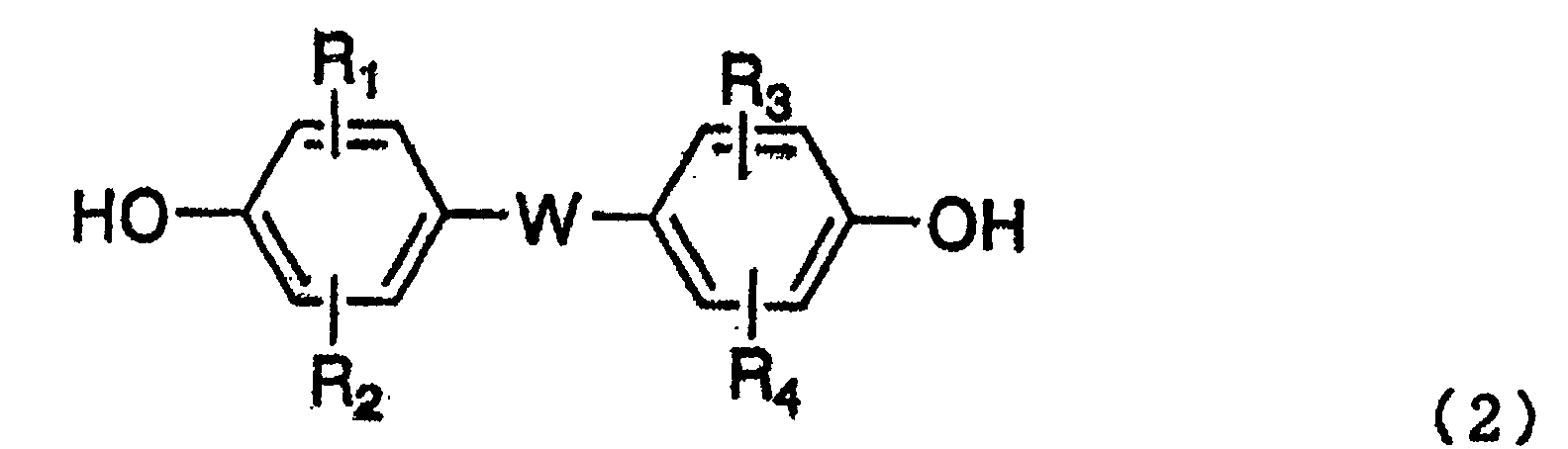
dialkyl carbonates of dimethyl carbonate, diethyl carbonate and dibutyl carbonate, and
dicycloalkyl carbonates such as dicyclohexyl carbonate. Among them, diphenyl carbonate is the most preferred from the points of reactivity, stability against coloring of the obtained resin, and further cost.
Claims (15)
- A method for crystallizing a low molecular weight aromatic polycarbonate characterized in that an uncrystallized low molecular weight aromatic polycarbonate whose main recurrent unit is expressed by the following formula (1),[in the formula (1), R1, R2, R3 and R4 are each independently a hydrogen atom, a halogen atom, a C1-10 alkyl group, a C7-20 aralkyl group or a C6-20 aryl group; W is a C2-10 alkylidene group, a C1-15 alkylene group, a C7-20 aryl-substituted alkylene group, a C3-15 cycloalkylidene group, a C3-15 cycloalkylene group, an oxygen atom, a sulfur atom, a sulfoxide group or a sulfone group], and which has an intrinsic viscosity [η] of 0.05 to 0.38 is crystallized by bringing it into contact with a monohydroxy compound or a mixture of said compound and water.

- A method for crystallizing a low molecular weight polycarbonate described in Claim 1 characterized in that the low molecular weight aromatic polycarbonate is obtained by the melt polycondensation of an aromatic dihydroxy compound and a carbonate bond-forming compound.
- A method for crystallizing a low molecular weight polycarbonate described in Claim 2 characterized in that the low molecular weight aromatic polycarbonate is obtained by the melt polycondensation of an aromatic dihydroxy compound expressed by the following formula (2)[in the formula (2), R1, R2, R3, R4 and W are same as those shown in the above-mentioned formula (1)] and a diphenyl carbonate.

- A method for crystallizing a low molecular weight aromatic polycarbonate described in any one of Claims 1 to 3 characterized in that 0.1 to 25 parts by weight of a crystallized polycarbonate powdery granules is added to 100 parts by weight of an uncrystallized low molecular weight polycarbonate having an intrinsic viscosity [η] of 0.05 to 0.38, they are mixed at a temperature equal to or higher than the melting point of the uncrystallized low molecular weight polycarbonate and lower than the melting point of the crystallized polycarbonate, and the mixture thus treated is brought into contact with a monohydroxy compound or a mixture of said compound and water to crystallize the mixture.
- A method for crystallizing a low molecular weight aromatic polycarbonate described in any one of Claims 1 to 4 characterized in that the monohydroxy compound is phenol.
- A method for crystallizing a low molecular weight aromatic polycarbonate described in Claim 5 characterized in that the low molecular weight polycarbonate is dipped in an aqueous solution or an aqueous dispersion containing phenol in an amount of 5 wt. % or more.
- A method for crystallizing a low molecular weight aromatic polycarbonate described in Claim 5 characterized in that the low molecular weight aromatic polycarbonate is brought into contact with a vapor containing phenol.
- A method for crystallizing a low molecular weight aromatic polycarbonate characterized in that 100 parts by weight of an uncrystallized low molecular weight aromatic polycarbonate whose main recurrent unit is expressed by the following formula (1),[in the formula (1), R1, R2, R3 and R4 are each independently a hydrogen atom, a halogen atom, a C1-10 alkyl group, a C7-20 aralkyl group or a C6-20 aryl group; W is a C2-10 alkylidene group, a C1-15 alkylene group, a C7-20 aryl-substituted alkylene group, a C3-15 cycloalkylidene group, a C3-15 cycloalkylene group, an oxygen atom, a sulfur atom, a sulfoxide group or a sulfone group], and which has an intrinsic viscosity [η] of 0.05 to 0.38, and 0.1 to 25 parts by weight of at least one or more kinds of compounds selected from the group consisting of aromatic monohydroxy compounds, carbonic acid diester compounds and aromatic dihydroxy compounds are melt mixed, and the obtained mixture is crystallized by holding it at a temperature equal to or higher than the glass transition temperature, and lower than the melting point of the mixture.
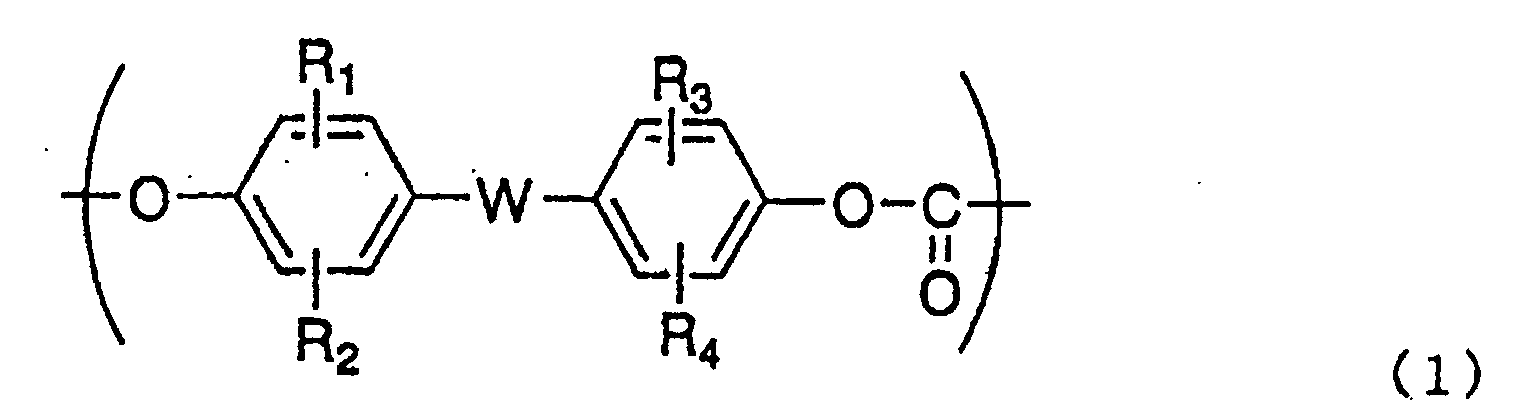
- A method for crystallizing a low molecular weight polycarbonate described in Claim 8 characterized in that the low molecular weight aromatic polycarbonate is a product obtained by melt polycondensation of an aromatic dihydroxy compound and a carbonate bond-forming compound.
- A method for crystallizing a low molecular weight aromatic polycarbonate described in Claim 8 or 9 characterized in that the aromatic monohydroxy compound is phenol.
- A method for crystallizing a low molecular weight aromatic polycarbonate described in Claim 8 or 9 characterized in that the carbonic acid diester compound is diphenyl carbonate.
- A method for crystallizing a low molecular weight aromatic polycarbonate described in Claim 8 or 9 characterized in that the aromatic dihydroxy compound which is melt mixed with the uncrystallized low molecular weight aromatic polycarbonate is expressed by the following formula (2)[in the formula (2), R1, R2, R3, R4 and W are same as those shown in the above-mentioned formula (1)].

- A method for crystallizing a low molecular weight aromatic polycarbonate described in any one of Claims 8 to 12 characterized in that 0.1 to 25 parts by weight of powdery granules of a crystallized polycarbonate is further added to 100 parts by weight of the uncrystallized low molecular weight aromatic polycarbonate.
- A method for producing a polycarbonate resin characterized in that a crystallized product obtained by crystallizing the low molecular weight aromatic polycarbonate using any method described in Claims 1 to 13 is heated at a temperature lower than the melting point of the crystallized product under reduced pressure or in an inert gas flow to convert the polycarbonate into a high polymerized state.
- A method for producing a polycarbonate resin described in Claim 14 characterized in that a polycarbonate having an intrinsic viscosity of 0.3 to 1.7 is produced by a heat treatment in an inert gas flow.
Applications Claiming Priority (7)
| Application Number | Priority Date | Filing Date | Title |
|---|---|---|---|
| JP26838099 | 1999-09-22 | ||
| JP26838099 | 1999-09-22 | ||
| JP27200099 | 1999-09-27 | ||
| JP27200099 | 1999-09-27 | ||
| JP2000060314 | 2000-03-06 | ||
| JP2000060314 | 2000-03-06 | ||
| PCT/JP2000/006470 WO2001021681A1 (en) | 1999-09-22 | 2000-09-21 | Method of crystallizing low-molecular polycarbonate and process for producing polycarbonate resin from the same |
Publications (2)
| Publication Number | Publication Date |
|---|---|
| EP1245607A1 true EP1245607A1 (en) | 2002-10-02 |
| EP1245607A4 EP1245607A4 (en) | 2004-11-10 |
Family
ID=27335623
Family Applications (1)
| Application Number | Title | Priority Date | Filing Date |
|---|---|---|---|
| EP00961159A Withdrawn EP1245607A4 (en) | 1999-09-22 | 2000-09-21 | Method of crystallizing low-molecular polycarbonate and process for producing polycarbonate resin from the same |
Country Status (6)
| Country | Link |
|---|---|
| US (1) | US6696541B1 (en) |
| EP (1) | EP1245607A4 (en) |
| CN (1) | CN1153799C (en) |
| AU (1) | AU7318600A (en) |
| TW (1) | TW500740B (en) |
| WO (1) | WO2001021681A1 (en) |
Cited By (2)
| Publication number | Priority date | Publication date | Assignee | Title |
|---|---|---|---|---|
| US6696541B1 (en) * | 1999-09-22 | 2004-02-24 | Teijin Limited | Method for crystallization of low molecular weight polycarbonate and method for preparing polycarbonate resin from it |
| US7084232B2 (en) | 2002-05-29 | 2006-08-01 | Lg Chem, Ltd. | Method for preparing high molecular weight polycarbonate |
Families Citing this family (8)
| Publication number | Priority date | Publication date | Assignee | Title |
|---|---|---|---|---|
| US6518391B1 (en) * | 2001-07-24 | 2003-02-11 | General Electric Company | Method of polycarbonate preparation by solid state polymerization |
| US20030187045A1 (en) | 2001-12-21 | 2003-10-02 | Uwe Heinelt | Substituted imidazolidines, process for their preparation, and their use as a medicament or diagnostic |
| US20090043069A1 (en) * | 2007-08-06 | 2009-02-12 | General Electric Company | Activated esters for synthesis of sulfonated telechelic polycarbonates |
| JP5688101B2 (en) * | 2011-01-14 | 2015-03-25 | 帝人株式会社 | Optical lens made of aromatic-aliphatic polycarbonate resin |
| EP2554597B1 (en) * | 2011-08-02 | 2014-12-31 | Styron Europe GmbH | Chemical resistant and fire retardant polycarbonate polyester composition |
| JP6976716B2 (en) * | 2017-05-23 | 2021-12-08 | 本州化学工業株式会社 | Aromatic polycarbonate oligomer solid |
| JP6976717B2 (en) * | 2017-05-23 | 2021-12-08 | 本州化学工業株式会社 | Aromatic polycarbonate oligomer solid |
| JP6976714B2 (en) * | 2017-05-23 | 2021-12-08 | 本州化学工業株式会社 | Aromatic polycarbonate oligomer solid |
Family Cites Families (11)
| Publication number | Priority date | Publication date | Assignee | Title |
|---|---|---|---|---|
| JPH0699553B2 (en) * | 1987-06-26 | 1994-12-07 | 旭化成工業株式会社 | Method for producing aromatic polycarbonate |
| JPH0794546B2 (en) | 1987-09-28 | 1995-10-11 | 旭化成工業株式会社 | Method for producing aromatic polycarbonate and crystalline aromatic polycarbonate powder obtained thereby |
| JP3208210B2 (en) * | 1993-03-17 | 2001-09-10 | 旭化成株式会社 | Method for producing crystalline aromatic polycarbonate prepolymer and method for producing aromatic polycarbonate |
| US5717056A (en) * | 1996-05-24 | 1998-02-10 | General Electric Company | Method for preparing polycarbonate by solid state polymerization |
| US5864006A (en) | 1997-04-08 | 1999-01-26 | The Dow Chemical Company | Method of making polycarbonate prepolymer and method of making high molecular weight polycarbonate |
| JP2003524674A (en) * | 1998-11-09 | 2003-08-19 | ゼネラル・エレクトリック・カンパニイ | How to increase the crystallinity of polycarbonate |
| US6031062A (en) * | 1999-01-28 | 2000-02-29 | General Electric Company | Method for preparing polycarbonates of enhanced crystallinity |
| GB2348879B (en) * | 1999-04-16 | 2004-03-31 | Hydron Ltd | Process |
| JP2001011171A (en) * | 1999-06-28 | 2001-01-16 | Teijin Ltd | Crystallization of low molecular weight aromatic polycarbonate and production of polycarbonate resin using the same |
| US6255435B1 (en) * | 1999-08-10 | 2001-07-03 | General Electric Company | Method of crystallizing polycarbonate prepolymer |
| EP1245607A4 (en) * | 1999-09-22 | 2004-11-10 | Teijin Ltd | Method of crystallizing low-molecular polycarbonate and process for producing polycarbonate resin from the same |
-
2000
- 2000-09-21 EP EP00961159A patent/EP1245607A4/en not_active Withdrawn
- 2000-09-21 US US10/088,590 patent/US6696541B1/en not_active Expired - Fee Related
- 2000-09-21 AU AU73186/00A patent/AU7318600A/en not_active Abandoned
- 2000-09-21 CN CNB008132763A patent/CN1153799C/en not_active Expired - Fee Related
- 2000-09-21 TW TW089119494A patent/TW500740B/en not_active IP Right Cessation
- 2000-09-21 WO PCT/JP2000/006470 patent/WO2001021681A1/en not_active Ceased
Cited By (2)
| Publication number | Priority date | Publication date | Assignee | Title |
|---|---|---|---|---|
| US6696541B1 (en) * | 1999-09-22 | 2004-02-24 | Teijin Limited | Method for crystallization of low molecular weight polycarbonate and method for preparing polycarbonate resin from it |
| US7084232B2 (en) | 2002-05-29 | 2006-08-01 | Lg Chem, Ltd. | Method for preparing high molecular weight polycarbonate |
Also Published As
| Publication number | Publication date |
|---|---|
| AU7318600A (en) | 2001-04-24 |
| EP1245607A4 (en) | 2004-11-10 |
| CN1376173A (en) | 2002-10-23 |
| US6696541B1 (en) | 2004-02-24 |
| TW500740B (en) | 2002-09-01 |
| CN1153799C (en) | 2004-06-16 |
| WO2001021681A1 (en) | 2001-03-29 |
Similar Documents
| Publication | Publication Date | Title |
|---|---|---|
| EP0403657B1 (en) | A porous, crystallized, aromatic polycarbonate prepolymer, a porous, crystallized aromatic polycarbonate, and production methods | |
| KR100357656B1 (en) | Method for producing polycarbonate | |
| US5214073A (en) | Porous, crystallized, aromatic polycarbonate prepolymer, a porous, crystallized aromatic polycarbonate, and production methods | |
| JPH0794546B2 (en) | Method for producing aromatic polycarbonate and crystalline aromatic polycarbonate powder obtained thereby | |
| JP2002540271A (en) | Highly branched polycondensates | |
| US6696541B1 (en) | Method for crystallization of low molecular weight polycarbonate and method for preparing polycarbonate resin from it | |
| EP1572791B1 (en) | Recycle method for polycarbonate resin waste | |
| US6720406B1 (en) | High-purity polymer granules and method for the production thereof | |
| DE10142735A1 (en) | Process for using polycarbonates | |
| JPH0757795B2 (en) | Process for producing aromatic polycarbonate | |
| JPH03223330A (en) | Porous polycarbonate prepolymer, its production, and production of aromatic polycarbonate by using the same | |
| EP1490422B1 (en) | Recycle process for polycondensation resins | |
| JP2003192779A (en) | Aromatic polycarbonate prepolymer and method for producing aromatic polycarbonate using the same | |
| KR20010093288A (en) | Method for preparing polycarbonates of enhanced crystallinity | |
| JP3164668B2 (en) | Method for producing granular polycarbonate | |
| JPWO2001021681A1 (en) | Method for crystallizing low molecular weight polycarbonate and method for producing polycarbonate resin using the same | |
| US6797803B2 (en) | Recycle process for polycondensation resins | |
| JP2002080579A (en) | Crystallization method of low molecular weight polycarbonate and polymerization method thereof | |
| JP2002265590A (en) | Method for crystallizing low molecular weight aromatic polycarbonate | |
| JP3754654B2 (en) | Method for producing stabilized aromatic polycarbonate | |
| JP3732797B2 (en) | Compressed granule of aromatic polycarbonate prepolymer and process for producing highly polymerized aromatic polycarbonate | |
| JP4723138B2 (en) | Aromatic polycarbonate granular molded body and method for producing polycarbonate using the same | |
| JP2001247672A (en) | Method for producing aromatic polycarbonate | |
| JP2001011171A (en) | Crystallization of low molecular weight aromatic polycarbonate and production of polycarbonate resin using the same | |
| EP0864597A1 (en) | Processes for the production of polycarbonate |
Legal Events
| Date | Code | Title | Description |
|---|---|---|---|
| PUAI | Public reference made under article 153(3) epc to a published international application that has entered the european phase |
Free format text: ORIGINAL CODE: 0009012 |
|
| 17P | Request for examination filed |
Effective date: 20020405 |
|
| AK | Designated contracting states |
Kind code of ref document: A1 Designated state(s): AT BE CH CY DE DK ES FI FR GB GR IE IT LI LU MC NL PT SE |
|
| AX | Request for extension of the european patent |
Free format text: AL;LT;LV;MK;RO;SI |
|
| RBV | Designated contracting states (corrected) |
Designated state(s): AT BE CH CY DE DK ES FR GB IT LI NL |
|
| A4 | Supplementary search report drawn up and despatched |
Effective date: 20040923 |
|
| 17Q | First examination report despatched |
Effective date: 20050111 |
|
| STAA | Information on the status of an ep patent application or granted ep patent |
Free format text: STATUS: THE APPLICATION IS DEEMED TO BE WITHDRAWN |
|
| 18D | Application deemed to be withdrawn |
Effective date: 20050524 |